1
VICTOR  YUSHCHENKO’s  ELECTION  CAMPAIGN  IN  2002-­2004:  FROM  
EFFECTIVE  TECHNOLOGIES  TO  PUBLIC  SELFCONCIUOSNESS    AND  ORANGE  
REVOLUTION  (REPORT)  
  
Denis  Bohush  
Director  General  of  the  “Interactive  PR  Group”  Agency,  Kiev,  Ukraine  
www.denisbohush.org   


Dear Ladies and Gentlemen!
It’s a great honor for me to speak before so respected audience and to present so important events occurred in
my country.
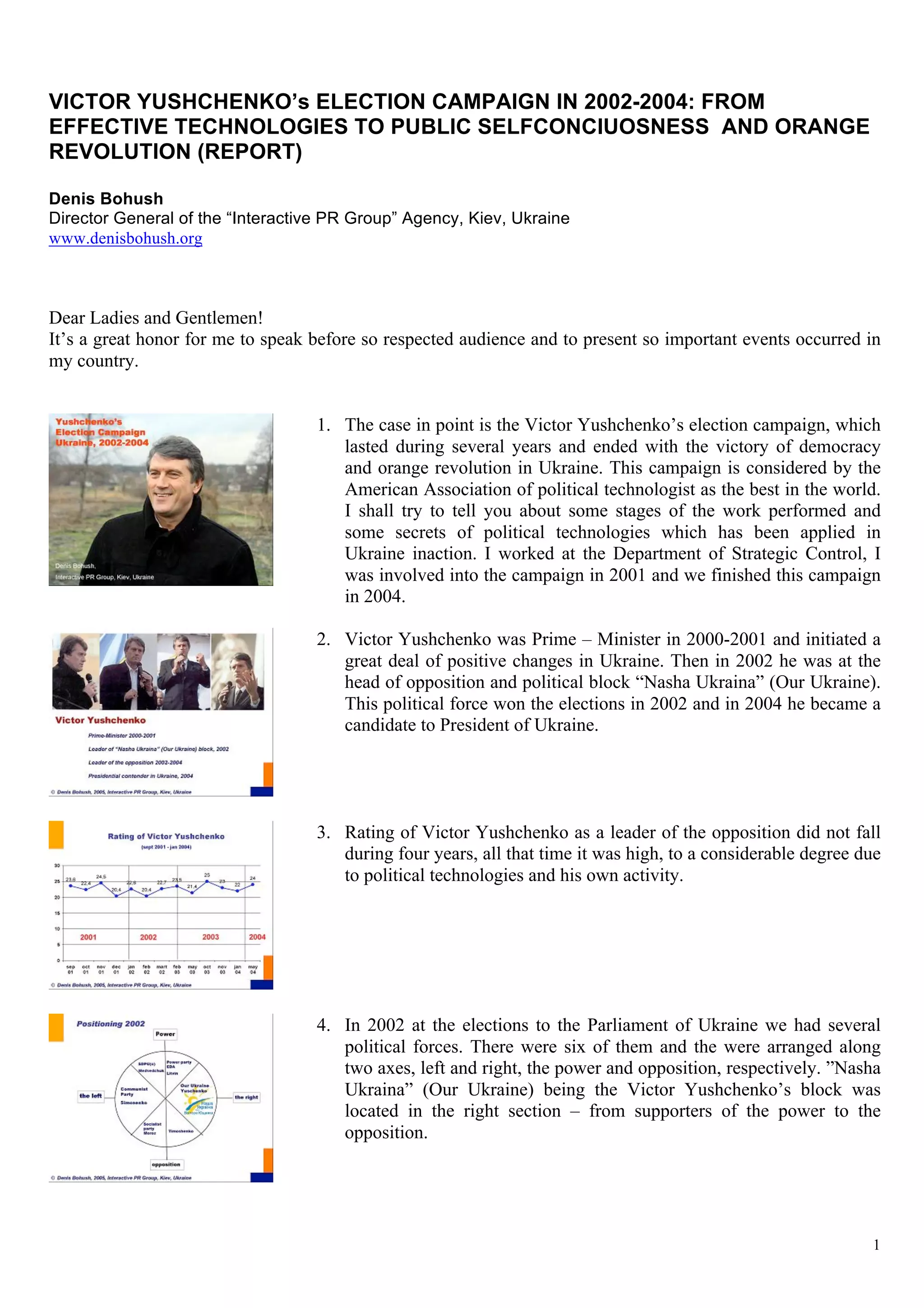
1.   The case in point is the Victor Yushchenko’s election campaign, which
lasted during several years and ended with the victory of democracy
and orange revolution in Ukraine. This campaign is considered by the
American Association of political technologist as the best in the world.
I shall try to tell you about some stages of the work performed and
some secrets of political technologies which has been applied in
Ukraine inaction. I worked at the Department of Strategic Control, I
was involved into the campaign in 2001 and we finished this campaign
in 2004.
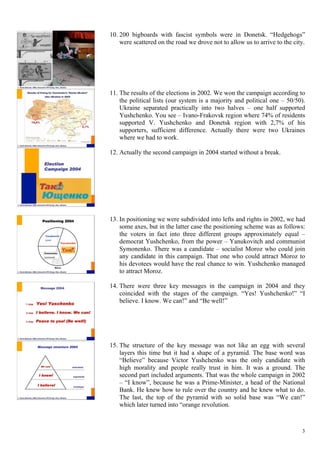
2.   Victor Yushchenko was Prime – Minister in 2000-2001 and initiated a
great deal of positive changes in Ukraine. Then in 2002 he was at the
head of opposition and political block “Nasha Ukraina” (Our Ukraine).
This political force won the elections in 2002 and in 2004 he became a
candidate to President of Ukraine.
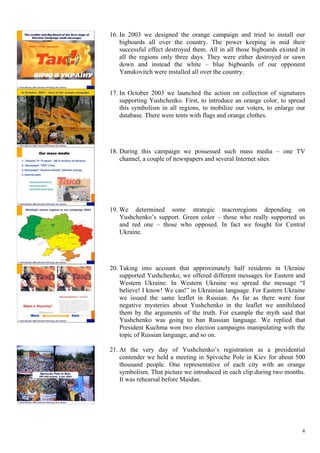
3.   Rating of Victor Yushchenko as a leader of the opposition did not fall
during four years, all that time it was high, to a considerable degree due
to political technologies and his own activity.
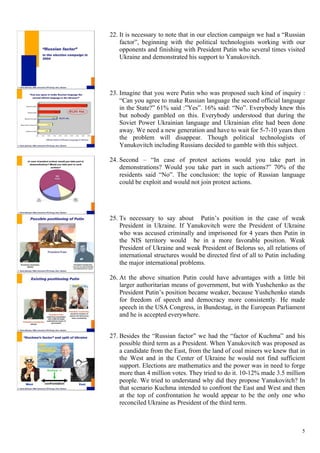
4.   In 2002 at the elections to the Parliament of Ukraine we had several
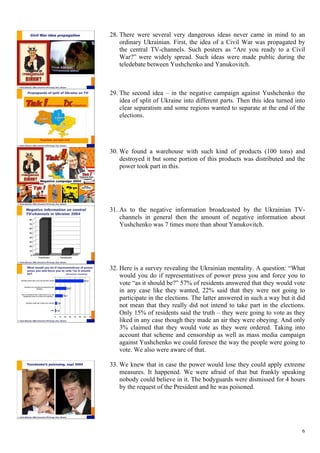
political forces. There were six of them and the were arranged along
two axes, left and right, the power and opposition, respectively. ”Nasha
Ukraina” (Our Ukraine) being the Victor Yushchenko’s block was
located in the right section – from supporters of the power to the
opposition.
2
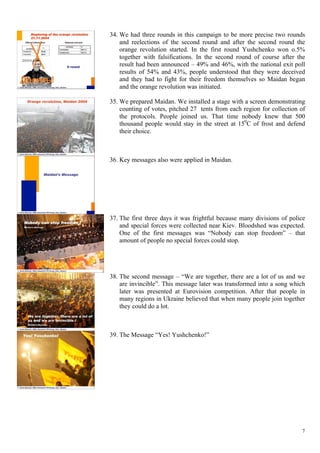
5.   I believe that the best key message in the period of political campaigns
in Ukraine was designed in 2002 during the election campaign. That
key message had the shape of an egg and consisted of several layers.
Victor Yushchenko was in the center. The second layer included:
“Victor Yushchenko had never obtained any coin of credit from West
and Russia and paid off arrears of wages and pensions”. This text was
included into all the video clips of Victor Yushchenko. Then the next
layer – different arguments. They were included into all the agitation
materials and in that way we tried to protect our key message from
censorship and discredit. The slogan “Not in word but in deed!”
6.   That time we did not use any TV channel so we decided to
communicate with big boards all over the country. It was very
impressive. And only by the end of the election campaign those big
boards, huge constructions were sawn by bandits shielded by the
power.
7.   In 2002 the only remedy we could influence the voters without our own
mass media was the pre-election round. We performed very interactive
scene with the multimedia projector and were able to install it in half an
hour in spite of all obstacles it means that when we arrived to a city and
tiles in a square were destroyed, we came to another city – a regional
center – and at that very place a zoo was located, we arrived to the third
regional center and in the room where we had to meet voters all the
chairs were taken away, in the other room they cut electricity. So we
had a very difficult campaign, but the power made a lot of mistakes and
they became known to people. People laughed may be like you do now
and understood that they were afraid of Yushchenko like the leader of
opposition.
8.   There were a lot of myths disseminated about Yushchenko and one of
the myth was that Yushchenko was weak and shilly-shally. In order to
clear up that myth we arranged all the Yushchenko’s appearances in the
following way – a special reading – stand and special visual banners.
In that case a man standing at such reading stand could not be weak.
Even one second of such image broadcasting by TV scattered the myth
from a great deal of those who hesitated.
9.   Large negative campaign aimed on discredit of Victor Yushchenko was
held practically till the end of 2004. Some channels has rejected
censorship and this campaign of discredit, but there were a lot of
different materials.
3
10.  200 bigboards with fascist symbols were in Donetsk. “Hedgehogs”
were scattered on the road we drove not to allow us to arrive to the city.
11.  The results of the elections in 2002. We won the campaign according to
the political lists (our system is a majority and political one – 50/50).
Ukraine separated practically into two halves – one half supported
Yushchenko. You see – Ivano-Frakovsk region where 74% of residents
supported V. Yushchenko and Donetsk region with 2,7% of his
supporters, sufficient difference. Actually there were two Ukraines
where we had to work.
12.  Actually the second campaign in 2004 started without a break.
13.  In positioning we were subdivided into lefts and rights in 2002, we had
some axes, but in the latter case the positioning scheme was as follows:
the voters in fact into three different groups approximately equal –
democrat Yushchenko, from the power – Yanukovitch and communist
Symonenko. There was a candidate – socialist Moroz who could join
any candidate in this campaign. That one who could attract Moroz to
his devotees would have the real chance to win. Yushchenko managed
to attract Moroz.
14.  There were three key messages in the campaign in 2004 and they
coincided with the stages of the campaign. “Yes! Yushchenko!” “I
believe. I know. We can!” and “Be well!”
15.  The structure of the key message was not like an egg with several
layers this time but it had a shape of a pyramid. The base word was
“Believe” because Victor Yushchenko was the only candidate with
high morality and people really trust in him. It was a ground. The
second part included arguments. That was the whole campaign in 2002
– “I know”, because he was a Prime-Minister, a head of the National
Bank. He knew how to rule over the country and he knew what to do.
The last, the top of the pyramid with so solid base was “We can!”
which later turned into “orange revolution.
4
16.  In 2003 we designed the orange campaign and tried to install our
bigboards all over the country. The power keeping in mid their
successful effect destroyed them. All in all those bigboards existed in
all the regions only three days. They were either destroyed or sawn
down and instead the white – blue bigboards of our opponent
Yanukovitch were installed all over the country.
17.  In October 2003 we launched the action on collection of signatures
supporting Yushchenko. First, to introduce an orange color, to spread
this symbolism in all regions, to mobilize our voters, to enlarge our
database. There were tents with flags and orange clothes.
18.  During this campaign we possessed such mass media – one TV
channel, a couple of newspapers and several Internet sites.
19.  We determined some strategic macroregions depending on
Yushchenko’s support. Green color – those who really supported us
and red one – those who opposed. In fact we fought for Central
Ukraine.
20.  Taking into account that approximately half residents in Ukraine
supported Yushchenko, we offered different messages for Eastern and
Western Ukraine. In Western Ukraine we spread the message “I
believe! I know! We can!” in Ukrainian language. For Eastern Ukraine
we issued the same leaflet in Russian. As far as there were four
negative mysteries about Yushchenko in the leaflet we annihilated
them by the arguments of the truth. For example the myth said that
Yushchenko was going to ban Russian language. We replied that
President Kuchma won two election campaigns manipulating with the
topic of Russian language, and so on.
21.  At the very day of Yushchenko’s registration as a presidential
contender we held a meeting in Spivoche Pole in Kiev for about 500
thousand people. One representative of each city with an orange
symbolism. That picture we introduced in each clip during two months.
It was rehearsal before Maidan.
5
22.  It is necessary to note that in our election campaign we had a “Russian
factor”, beginning with the political technologists working with our
opponents and finishing with President Putin who several times visited
Ukraine and demonstrated his support to Yanukovitch.
23.  Imagine that you were Putin who was proposed such kind of inquiry :
“Can you agree to make Russian language the second official language
in the State?” 61% said :”Yes”. 16% said: “No”. Everybody knew this
but nobody gambled on this. Everybody understood that during the
Soviet Power Ukrainian language and Ukrainian elite had been done
away. We need a new generation and have to wait for 5-7-10 years then
the problem will disappear. Though political technologists of
Yanukovitch including Russians decided to gamble with this subject.
24.  Second – “In case of protest actions would you take part in
demonstrations? Would you take part in such actions?” 70% of the
residents said “No”. The conclusion: the topic of Russian language
could be exploit and would not join protest actions.
25.  Ts necessary to say about Putin’s position in the case of weak
President in Ukraine. If Yanukovitch were the President of Ukraine
who was accused criminally and imprisoned for 4 years then Putin in
the NIS territory would be in a more favorable position. Weak
President of Ukraine and weak President of Belorus so, all relations of
international structures would be directed first of all to Putin including
the major international problems.
26.  At the above situation Putin could have advantages with a little bit
larger authoritarian means of government, but with Yushchenko as the
President Putin’s position became weaker, because Yushchenko stands
for freedom of speech and democracy more consistently. He made
speech in the USA Congress, in Bundestag, in the European Parliament
and he is accepted everywhere.
27.  Besides the “Russian factor” we had the “factor of Kuchma” and his
possible third term as a President. When Yanukovitch was proposed as
a candidate from the East, from the land of coal miners we knew that in
the West and in the Center of Ukraine he would not find sufficient
support. Elections are mathematics and the power was in need to forge
more than 4 million votes. They tried to do it. 10-12% made 3.5 million
people. We tried to understand why did they propose Yanukovitch? In
that scenario Kuchma intended to confront the East and West and then
at the top of confrontation he would appear to be the only one who
reconciled Ukraine as President of the third term.
6
28.  There were several very dangerous ideas never came in mind to an
ordinary Ukrainian. First, the idea of a Civil War was propagated by
the central TV-channels. Such posters as “Are you ready to a Civil
War?” were widely spread. Such ideas were made public during the
teledebate between Yushchenko and Yanukovitch.
29.  The second idea – in the negative campaign against Yushchenko the
idea of split of Ukraine into different parts. Then this idea turned into
clear separatism and some regions wanted to separate at the end of the
elections.
30.  We found a warehouse with such kind of products (100 tons) and
destroyed it but some portion of this products was distributed and the
power took part in this.
31.  As to the negative information broadcasted by the Ukrainian TV-
channels in general then the amount of negative information about
Yushchenko was 7 times more than about Yanukovitch.
32.  Here is a survey revealing the Ukrainian mentality. A question: “What
would you do if representatives of power press you and force you to
vote “as it should be?” 57% of residents answered that they would vote
in any case like they wanted, 22% said that they were not going to
participate in the elections. The latter answered in such a way but it did
not mean that they really did not intend to take part in the elections.
Only 15% of residents said the truth – they were going to vote as they
liked in any case though they made an air they were obeying. And only
3% claimed that they would vote as they were ordered. Taking into
account that scheme and censorship as well as mass media campaign
against Yushchenko we could foresee the way the people were going to
vote. We also were aware of that.
33.  We knew that in case the power would lose they could apply extreme
measures. It happened. We were afraid of that but frankly speaking
nobody could believe in it. The bodyguards were dismissed for 4 hours
by the request of the President and he was poisoned.
7
34.  We had three rounds in this campaign to be more precise two rounds
and reelections of the second round and after the second round the
orange revolution started. In the first round Yushchenko won o.5%
together with falsifications. In the second round of course after the
result had been announced – 49% and 46%, with the national exit poll
results of 54% and 43%, people understood that they were deceived
and they had to fight for their freedom themselves so Maidan began
and the orange revolution was initiated.
35.  We prepared Maidan. We installed a stage with a screen demonstrating
counting of votes, pitched 27 tents from each region for collection of
the protocols. People joined us. That time nobody knew that 500
thousand people would stay in the street at 150
C of frost and defend
their choice.
36.  Key messages also were applied in Maidan.
37.  The first three days it was frightful because many divisions of police
and special forces were collected near Kiev. Bloodshed was expected.
One of the first messages was “Nobody can stop freedom” – that
amount of people no special forces could stop.
38.  The second message – “We are together, there are a lot of us and we
are invincible”. This message later was transformed into a song which
later was presented at Eurovision competition. After that people in
many regions in Ukraine believed that when many people join together
they could do a lot.
39.  The Message “Yes! Yushchenko!”
8
40.  When some thousand of Yanukovitch’s supporters were brought to
Kiev the message “East and West together!” appeared.
41.  Summary
42.  The results of this campaign. The third round of voting – 52% for
Yushchenko and 44% for Yanukovitch. To our mind 7-10% votes were
forged at this campaign. During the first round the falsification was
higher during the third one it was considerably less but it existed. 20%
of the residents were mislead with different manipulations, brainwash
and so on.
43.  The negative results of this election campaign for Ukraine. Ideas of a
Civil War were propagated by the central TV channels. Second ideas of
split of Ukraine were disseminated which after the campaign were
transformed into clear separatism. After the Donetsk voters understood
that they were loosing they claimed that they could not agree and they
were going to separate and form a new republic. It was very dangerous.
The third result – the theme of separatism was introduced into the
society, differences in language and integration features in the regions
were aggravated, including approach to Russia, NATO, EU, the West
and so on.
44.  Positive results. First, the epoch of Kuchma who personified the
criminal power has finished. Second, Ukrainians felt proud for their
country. I believe that this is the most important. Third, Ukraine
became known in the world as a country where democracy has won.
Further, Ukraine has been separated from Russia in the international
mind. Ukraine got a status of a partner but not a “junior brother” in
relations with Russia. The characteristics allowing us to integrate in the
European structures were improved. People got a hope for better life.
45.  Very brief because of the lack of time I tried to tell you about this
campaign and technologies that were applied. This picture was made in
the Ukrainian house in Khreshchatik in Kiev. It is a large exhibition
center. There during the orange revolution 3 thousand people were
sleeping simply on the marble floor during the night and in the day they
were in Maidan. There was minus 15 outside and inside was much
more warmer. This year we had orange New Year trees. I appreciate
your attention. Thank you!

Report about Orange Revolution from Denis Bohush

  • 1.
    1 VICTOR  YUSHCHENKO’s  ELECTION CAMPAIGN  IN  2002-­2004:  FROM   EFFECTIVE  TECHNOLOGIES  TO  PUBLIC  SELFCONCIUOSNESS    AND  ORANGE   REVOLUTION  (REPORT)     Denis  Bohush   Director  General  of  the  “Interactive  PR  Group”  Agency,  Kiev,  Ukraine   www.denisbohush.org         Dear Ladies and Gentlemen! It’s a great honor for me to speak before so respected audience and to present so important events occurred in my country. 1.   The case in point is the Victor Yushchenko’s election campaign, which lasted during several years and ended with the victory of democracy and orange revolution in Ukraine. This campaign is considered by the American Association of political technologist as the best in the world. I shall try to tell you about some stages of the work performed and some secrets of political technologies which has been applied in Ukraine inaction. I worked at the Department of Strategic Control, I was involved into the campaign in 2001 and we finished this campaign in 2004. 2.   Victor Yushchenko was Prime – Minister in 2000-2001 and initiated a great deal of positive changes in Ukraine. Then in 2002 he was at the head of opposition and political block “Nasha Ukraina” (Our Ukraine). This political force won the elections in 2002 and in 2004 he became a candidate to President of Ukraine. 3.   Rating of Victor Yushchenko as a leader of the opposition did not fall during four years, all that time it was high, to a considerable degree due to political technologies and his own activity. 4.   In 2002 at the elections to the Parliament of Ukraine we had several political forces. There were six of them and the were arranged along two axes, left and right, the power and opposition, respectively. ”Nasha Ukraina” (Our Ukraine) being the Victor Yushchenko’s block was located in the right section – from supporters of the power to the opposition.
  • 2.
    2 5.   Ibelieve that the best key message in the period of political campaigns in Ukraine was designed in 2002 during the election campaign. That key message had the shape of an egg and consisted of several layers. Victor Yushchenko was in the center. The second layer included: “Victor Yushchenko had never obtained any coin of credit from West and Russia and paid off arrears of wages and pensions”. This text was included into all the video clips of Victor Yushchenko. Then the next layer – different arguments. They were included into all the agitation materials and in that way we tried to protect our key message from censorship and discredit. The slogan “Not in word but in deed!” 6.   That time we did not use any TV channel so we decided to communicate with big boards all over the country. It was very impressive. And only by the end of the election campaign those big boards, huge constructions were sawn by bandits shielded by the power. 7.   In 2002 the only remedy we could influence the voters without our own mass media was the pre-election round. We performed very interactive scene with the multimedia projector and were able to install it in half an hour in spite of all obstacles it means that when we arrived to a city and tiles in a square were destroyed, we came to another city – a regional center – and at that very place a zoo was located, we arrived to the third regional center and in the room where we had to meet voters all the chairs were taken away, in the other room they cut electricity. So we had a very difficult campaign, but the power made a lot of mistakes and they became known to people. People laughed may be like you do now and understood that they were afraid of Yushchenko like the leader of opposition. 8.   There were a lot of myths disseminated about Yushchenko and one of the myth was that Yushchenko was weak and shilly-shally. In order to clear up that myth we arranged all the Yushchenko’s appearances in the following way – a special reading – stand and special visual banners. In that case a man standing at such reading stand could not be weak. Even one second of such image broadcasting by TV scattered the myth from a great deal of those who hesitated. 9.   Large negative campaign aimed on discredit of Victor Yushchenko was held practically till the end of 2004. Some channels has rejected censorship and this campaign of discredit, but there were a lot of different materials.
  • 3.
    3 10.  200 bigboardswith fascist symbols were in Donetsk. “Hedgehogs” were scattered on the road we drove not to allow us to arrive to the city. 11.  The results of the elections in 2002. We won the campaign according to the political lists (our system is a majority and political one – 50/50). Ukraine separated practically into two halves – one half supported Yushchenko. You see – Ivano-Frakovsk region where 74% of residents supported V. Yushchenko and Donetsk region with 2,7% of his supporters, sufficient difference. Actually there were two Ukraines where we had to work. 12.  Actually the second campaign in 2004 started without a break. 13.  In positioning we were subdivided into lefts and rights in 2002, we had some axes, but in the latter case the positioning scheme was as follows: the voters in fact into three different groups approximately equal – democrat Yushchenko, from the power – Yanukovitch and communist Symonenko. There was a candidate – socialist Moroz who could join any candidate in this campaign. That one who could attract Moroz to his devotees would have the real chance to win. Yushchenko managed to attract Moroz. 14.  There were three key messages in the campaign in 2004 and they coincided with the stages of the campaign. “Yes! Yushchenko!” “I believe. I know. We can!” and “Be well!” 15.  The structure of the key message was not like an egg with several layers this time but it had a shape of a pyramid. The base word was “Believe” because Victor Yushchenko was the only candidate with high morality and people really trust in him. It was a ground. The second part included arguments. That was the whole campaign in 2002 – “I know”, because he was a Prime-Minister, a head of the National Bank. He knew how to rule over the country and he knew what to do. The last, the top of the pyramid with so solid base was “We can!” which later turned into “orange revolution.
  • 4.
    4 16.  In 2003we designed the orange campaign and tried to install our bigboards all over the country. The power keeping in mid their successful effect destroyed them. All in all those bigboards existed in all the regions only three days. They were either destroyed or sawn down and instead the white – blue bigboards of our opponent Yanukovitch were installed all over the country. 17.  In October 2003 we launched the action on collection of signatures supporting Yushchenko. First, to introduce an orange color, to spread this symbolism in all regions, to mobilize our voters, to enlarge our database. There were tents with flags and orange clothes. 18.  During this campaign we possessed such mass media – one TV channel, a couple of newspapers and several Internet sites. 19.  We determined some strategic macroregions depending on Yushchenko’s support. Green color – those who really supported us and red one – those who opposed. In fact we fought for Central Ukraine. 20.  Taking into account that approximately half residents in Ukraine supported Yushchenko, we offered different messages for Eastern and Western Ukraine. In Western Ukraine we spread the message “I believe! I know! We can!” in Ukrainian language. For Eastern Ukraine we issued the same leaflet in Russian. As far as there were four negative mysteries about Yushchenko in the leaflet we annihilated them by the arguments of the truth. For example the myth said that Yushchenko was going to ban Russian language. We replied that President Kuchma won two election campaigns manipulating with the topic of Russian language, and so on. 21.  At the very day of Yushchenko’s registration as a presidential contender we held a meeting in Spivoche Pole in Kiev for about 500 thousand people. One representative of each city with an orange symbolism. That picture we introduced in each clip during two months. It was rehearsal before Maidan.
  • 5.
    5 22.  It isnecessary to note that in our election campaign we had a “Russian factor”, beginning with the political technologists working with our opponents and finishing with President Putin who several times visited Ukraine and demonstrated his support to Yanukovitch. 23.  Imagine that you were Putin who was proposed such kind of inquiry : “Can you agree to make Russian language the second official language in the State?” 61% said :”Yes”. 16% said: “No”. Everybody knew this but nobody gambled on this. Everybody understood that during the Soviet Power Ukrainian language and Ukrainian elite had been done away. We need a new generation and have to wait for 5-7-10 years then the problem will disappear. Though political technologists of Yanukovitch including Russians decided to gamble with this subject. 24.  Second – “In case of protest actions would you take part in demonstrations? Would you take part in such actions?” 70% of the residents said “No”. The conclusion: the topic of Russian language could be exploit and would not join protest actions. 25.  Ts necessary to say about Putin’s position in the case of weak President in Ukraine. If Yanukovitch were the President of Ukraine who was accused criminally and imprisoned for 4 years then Putin in the NIS territory would be in a more favorable position. Weak President of Ukraine and weak President of Belorus so, all relations of international structures would be directed first of all to Putin including the major international problems. 26.  At the above situation Putin could have advantages with a little bit larger authoritarian means of government, but with Yushchenko as the President Putin’s position became weaker, because Yushchenko stands for freedom of speech and democracy more consistently. He made speech in the USA Congress, in Bundestag, in the European Parliament and he is accepted everywhere. 27.  Besides the “Russian factor” we had the “factor of Kuchma” and his possible third term as a President. When Yanukovitch was proposed as a candidate from the East, from the land of coal miners we knew that in the West and in the Center of Ukraine he would not find sufficient support. Elections are mathematics and the power was in need to forge more than 4 million votes. They tried to do it. 10-12% made 3.5 million people. We tried to understand why did they propose Yanukovitch? In that scenario Kuchma intended to confront the East and West and then at the top of confrontation he would appear to be the only one who reconciled Ukraine as President of the third term.
  • 6.
    6 28.  There wereseveral very dangerous ideas never came in mind to an ordinary Ukrainian. First, the idea of a Civil War was propagated by the central TV-channels. Such posters as “Are you ready to a Civil War?” were widely spread. Such ideas were made public during the teledebate between Yushchenko and Yanukovitch. 29.  The second idea – in the negative campaign against Yushchenko the idea of split of Ukraine into different parts. Then this idea turned into clear separatism and some regions wanted to separate at the end of the elections. 30.  We found a warehouse with such kind of products (100 tons) and destroyed it but some portion of this products was distributed and the power took part in this. 31.  As to the negative information broadcasted by the Ukrainian TV- channels in general then the amount of negative information about Yushchenko was 7 times more than about Yanukovitch. 32.  Here is a survey revealing the Ukrainian mentality. A question: “What would you do if representatives of power press you and force you to vote “as it should be?” 57% of residents answered that they would vote in any case like they wanted, 22% said that they were not going to participate in the elections. The latter answered in such a way but it did not mean that they really did not intend to take part in the elections. Only 15% of residents said the truth – they were going to vote as they liked in any case though they made an air they were obeying. And only 3% claimed that they would vote as they were ordered. Taking into account that scheme and censorship as well as mass media campaign against Yushchenko we could foresee the way the people were going to vote. We also were aware of that. 33.  We knew that in case the power would lose they could apply extreme measures. It happened. We were afraid of that but frankly speaking nobody could believe in it. The bodyguards were dismissed for 4 hours by the request of the President and he was poisoned.
  • 7.
    7 34.  We hadthree rounds in this campaign to be more precise two rounds and reelections of the second round and after the second round the orange revolution started. In the first round Yushchenko won o.5% together with falsifications. In the second round of course after the result had been announced – 49% and 46%, with the national exit poll results of 54% and 43%, people understood that they were deceived and they had to fight for their freedom themselves so Maidan began and the orange revolution was initiated. 35.  We prepared Maidan. We installed a stage with a screen demonstrating counting of votes, pitched 27 tents from each region for collection of the protocols. People joined us. That time nobody knew that 500 thousand people would stay in the street at 150 C of frost and defend their choice. 36.  Key messages also were applied in Maidan. 37.  The first three days it was frightful because many divisions of police and special forces were collected near Kiev. Bloodshed was expected. One of the first messages was “Nobody can stop freedom” – that amount of people no special forces could stop. 38.  The second message – “We are together, there are a lot of us and we are invincible”. This message later was transformed into a song which later was presented at Eurovision competition. After that people in many regions in Ukraine believed that when many people join together they could do a lot. 39.  The Message “Yes! Yushchenko!”
  • 8.
    8 40.  When somethousand of Yanukovitch’s supporters were brought to Kiev the message “East and West together!” appeared. 41.  Summary 42.  The results of this campaign. The third round of voting – 52% for Yushchenko and 44% for Yanukovitch. To our mind 7-10% votes were forged at this campaign. During the first round the falsification was higher during the third one it was considerably less but it existed. 20% of the residents were mislead with different manipulations, brainwash and so on. 43.  The negative results of this election campaign for Ukraine. Ideas of a Civil War were propagated by the central TV channels. Second ideas of split of Ukraine were disseminated which after the campaign were transformed into clear separatism. After the Donetsk voters understood that they were loosing they claimed that they could not agree and they were going to separate and form a new republic. It was very dangerous. The third result – the theme of separatism was introduced into the society, differences in language and integration features in the regions were aggravated, including approach to Russia, NATO, EU, the West and so on. 44.  Positive results. First, the epoch of Kuchma who personified the criminal power has finished. Second, Ukrainians felt proud for their country. I believe that this is the most important. Third, Ukraine became known in the world as a country where democracy has won. Further, Ukraine has been separated from Russia in the international mind. Ukraine got a status of a partner but not a “junior brother” in relations with Russia. The characteristics allowing us to integrate in the European structures were improved. People got a hope for better life. 45.  Very brief because of the lack of time I tried to tell you about this campaign and technologies that were applied. This picture was made in the Ukrainian house in Khreshchatik in Kiev. It is a large exhibition center. There during the orange revolution 3 thousand people were sleeping simply on the marble floor during the night and in the day they were in Maidan. There was minus 15 outside and inside was much more warmer. This year we had orange New Year trees. I appreciate your attention. Thank you!