Franjo Tuđman
and
Slobodan Milošević






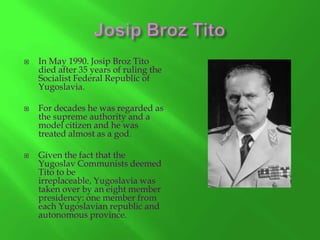
In May 1990. Josip Broz Tito
died after 35 years of ruling the
Socialist Federal Republic of
Yugoslavia.
For decades he was regarded as
the supreme authority and a
model citizen and he was
treated almost as a god.
Given the fact that the
Yugoslav Communists deemed
Tito to be
irreplaceable, Yugoslavia was
taken over by an eight member
presidency: one member from
each Yugoslavian republic and
autonomous province.






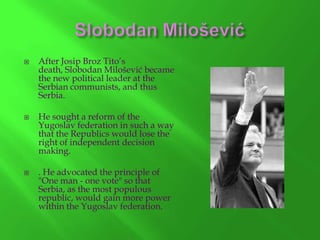
After Josip Broz Tito’s
death, Slobodan Milošević became
the new political leader at the
Serbian communists, and thus
Serbia.
He sought a reform of the
Yugoslav federation in such a way
that the Republics would lose the
right of independent decision
making.
. He advocated the principle of
"One man - one vote" so that
Serbia, as the most populous
republic, would gain more power
within the Yugoslav federation.










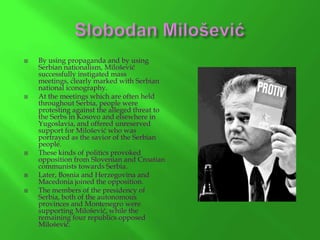
By using propaganda and by using
Serbian nationalism, Milošević
successfully instigated mass
meetings, clearly marked with Serbian
national iconography.
At the meetings which are often held
throughout Serbia, people were
protesting against the alleged threat to
the Serbs in Kosovo and elsewhere in
Yugoslavia, and offered unreserved
support for Milošević who was
portrayed as the savior of the Serbian
people.
These kinds of politics provoked
opposition from Slovenian and Croatian
communists towards Serbia.
Later, Bosnia and Herzegovina and
Macedonia joined the opposition.
The members of the presidency of
Serbia, both of the autonomous
provinces and Montenegro were
supporting Milošević, while the
remaining four republics opposed
Milošević.






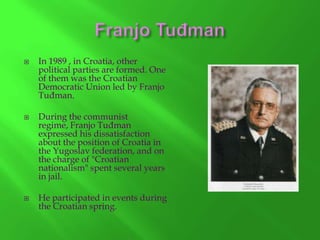
In 1989 , in Croatia, other
political parties are formed. One
of them was the Croatian
Democratic Union led by Franjo
Tuđman.
During the communist
regime, Franjo Tuđman
expressed his dissatisfaction
about the position of Croatia in
the Yugoslav federation, and on
the charge of "Croatian
nationalism" spent several years
in jail.
He participated in events during
the Croatian spring.









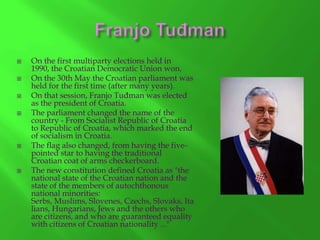
On the first multiparty elections held in
1990, the Croatian Democratic Union won.
On the 30th May the Croatian parliament was
held for the first time (after many years).
On that session, Franjo Tuđman was elected
as the president of Croatia.
The parliament changed the name of the
country - From Socialist Republic of Croatia
to Republic of Croatia, which marked the end
of socialism in Croatia.
The flag also changed, from having the fivepointed star to having the traditional
Croatian coat of arms checkerboard.
The new constitution defined Croatia as "the
national state of the Croatian nation and the
state of the members of autochthonous
national minorities:
Serbs, Muslims, Slovenes, Czechs, Slovaks, Ita
lians, Hungarians, Jews and the others who
are citizens, and who are guaranteed equality
with citizens of Croatian nationality ..."




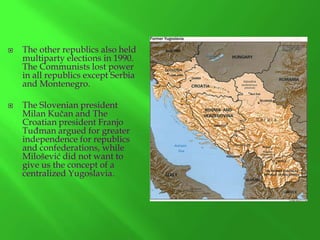
The other republics also held
multiparty elections in 1990.
The Communists lost power
in all republics except Serbia
and Montenegro.
The Slovenian president
Milan Kučan and The
Croatian president Franjo
Tuđman argued for greater
independence for republics
and confederations, while
Milošević did not want to
give us the concept of a
centralized Yugoslavia.


Milošević, who initially
presented himself as the savior of
Yugoslavia and
socialism, transformed himself
into a Serbian
nationalist, knowing that it will
increase his popularity. On
Croatian territories which were
largely populated by Serbs, the
Serbs started establishing
themselves as an “Autonomous
region” that did not recognize
the newly elected Croatian
government. Proclaimed as the
“Serbian Autonomous region of
Krajina” (SAO Krajina) and its
secession from Croatia. In
August 1991. the “Log
Revolution” started. Serbian
paramilitary troops blocked
roads with barricades. The
rebellion started because of
Milošević’s people were actively
fomenting fear and hatred.





The JNA, under control by
Milošević, gave active support to
the rebels. The ultimate goal
emphasized the creation of a
Greater Serbia that would contain
large parts of Croatia and Bosnia
and Herzegovina. During 1991
armed incidents have become
increasingly
common, particularly in the area
of Pakrac, Plitvice and Vukovar.
As the negotiations between
Tuđman and Milošević weren’t
giving any results, the Croatian
leadership decided to hold a
referendum, in which 93% of
Croatian citizens voted for the
establishment of an independent
and sovereign Croatian
state, which was declared on
25.6.1991. The same day, Slovenia
decided to become independent.
Two days later a brief conflict
between the JNA and the
Slovenian forces broke out, after
which the JNA withdrew from
Slovenia.


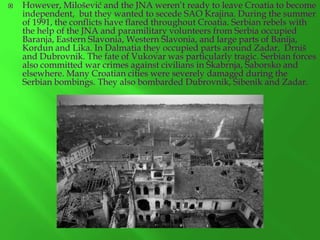
However, Milošević and the JNA weren’t ready to leave Croatia to become
independent, but they wanted to secede SAO Krajina. During the summer
of 1991, the conflicts have flared throughout Croatia. Serbian rebels with
the help of the JNA and paramilitary volunteers from Serbia occupied
Baranja, Eastern Slavonia, Western Slavonia, and large parts of Banija,
Kordun and Lika. In Dalmatia they occupied parts around Zadar, Drniš
and Dubrovnik. The fate of Vukovar was particularly tragic. Serbian forces
also committed war crimes against civilians in Škabrnja, Saborsko and
elsewhere. Many Croatian cities were severely damaged during the
Serbian bombings. They also bombarded Dubrovnik, Šibenik and Zadar.


During the war, the Croatian Democratic Union has retained power in
Croatia. Beginning in 1992. Croatia held parliamentary elections in
which the Croatian Parliamentary Union won again, while Franjo
Tuđman won the presidential election. In 1994 President Tuđman
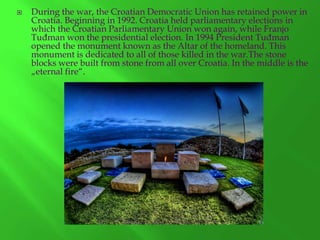
opened the monument known as the Altar of the homeland. This
monument is dedicated to all of those killed in the war.The stone
blocks were built from stone from all over Croatia. In the middle is the
„eternal fire“.




The war in Bosnia and
Herzegovina began in April
1992. A similar scenario as
the war in Croatia. Serbian
troops commited numerous
organized crimes of which
the worst was the massacre
in Srebrnica in 1995.
Initially, the military forces
of Bosniaks and Croats
cooperated, but in 1993 they
clashed in some parts of
Bosnia and Herzegovina.
They started accusing Franjo
Tuđman for interfering in
affairs of another country
and even expansionist
policies in which the
ultimate goal was the
annexation of parts of Bosnia
and Herzegovina. Either
way, the Croatian-Bosnian
war ended in 1994. and the
military cooperation against
Serbian forces resumed.



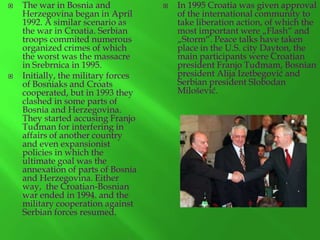
In 1995 Croatia was given approval
of the international community to
take liberation action, of which the
most important were „Flash“ and
„Storm“. Peace talks have taken
place in the U.S. city Dayton, the
main participants were Croatian
president Franjo Tuđmam, Bosnian
president Alija Izetbegović and
Serbian president Slobodan
Milošević.


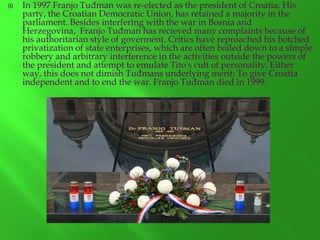
In 1997 Franjo Tuđman was re-elected as the president of Croatia. His
party, the Croatian Democratic Union, has retained a majority in the
parliament. Besides interfering with the war in Bosnia and
Herzegovina, Franjo Tuđman has recieved many complaints because of
his authoritarian style of goverment. Critics have reproached his botched
privatization of state enterprises, which are often boiled down to a simple
robbery and arbitrary interference in the activities outside the powers of
the president and attempt to emulate Tito's cult of personality. Either
way, this does not dimish Tuđmans underlying merit: To give Croatia
independent and to end the war. Franjo Tuđman died in 1999.


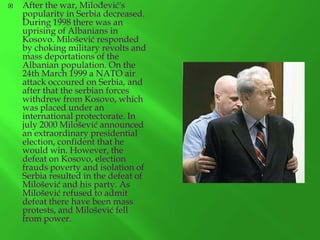
After the war, Milođević's
popularity in Serbia decreased.
During 1998 there was an
uprising of Albanians in
Kosovo. Milošević responded
by choking military revolts and
mass deportations of the
Albanian population. On the
24th March 1999 a NATO air
attack occoured on Serbia, and
after that the serbian forces
withdrew from Kosovo, which
was placed under an
international protectorate. In
july 2000 Milošević announced
an extraordinary presidential
election, confident that he
would win. However, the
defeat on Kosovo, election
frauds poverty and isolation of
Serbia resulted in the defeat of
Milošević and his party. As
Milošević refused to admit
defeat there have been mass
protests, and Milošević fell
from power.


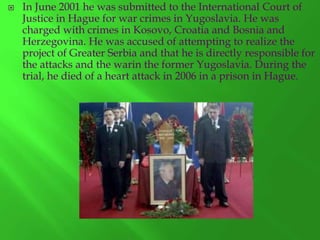
In June 2001 he was submitted to the International Court of
Justice in Hague for war crimes in Yugoslavia. He was
charged with crimes in Kosovo, Croatia and Bosnia and
Herzegovina. He was accused of attempting to realize the
project of Greater Serbia and that he is directly responsible for
the attacks and the warin the former Yugoslavia. During the
trial, he died of a heart attack in 2006 in a prison in Hague.

Controversial people in Croatia

  • 1.
  • 2.
       In May 1990.Josip Broz Tito died after 35 years of ruling the Socialist Federal Republic of Yugoslavia. For decades he was regarded as the supreme authority and a model citizen and he was treated almost as a god. Given the fact that the Yugoslav Communists deemed Tito to be irreplaceable, Yugoslavia was taken over by an eight member presidency: one member from each Yugoslavian republic and autonomous province.
  • 3.
       After Josip BrozTito’s death, Slobodan Milošević became the new political leader at the Serbian communists, and thus Serbia. He sought a reform of the Yugoslav federation in such a way that the Republics would lose the right of independent decision making. . He advocated the principle of "One man - one vote" so that Serbia, as the most populous republic, would gain more power within the Yugoslav federation.
  • 4.
         By using propagandaand by using Serbian nationalism, Milošević successfully instigated mass meetings, clearly marked with Serbian national iconography. At the meetings which are often held throughout Serbia, people were protesting against the alleged threat to the Serbs in Kosovo and elsewhere in Yugoslavia, and offered unreserved support for Milošević who was portrayed as the savior of the Serbian people. These kinds of politics provoked opposition from Slovenian and Croatian communists towards Serbia. Later, Bosnia and Herzegovina and Macedonia joined the opposition. The members of the presidency of Serbia, both of the autonomous provinces and Montenegro were supporting Milošević, while the remaining four republics opposed Milošević.
  • 5.
       In 1989 ,in Croatia, other political parties are formed. One of them was the Croatian Democratic Union led by Franjo Tuđman. During the communist regime, Franjo Tuđman expressed his dissatisfaction about the position of Croatia in the Yugoslav federation, and on the charge of "Croatian nationalism" spent several years in jail. He participated in events during the Croatian spring.
  • 6.
          On the firstmultiparty elections held in 1990, the Croatian Democratic Union won. On the 30th May the Croatian parliament was held for the first time (after many years). On that session, Franjo Tuđman was elected as the president of Croatia. The parliament changed the name of the country - From Socialist Republic of Croatia to Republic of Croatia, which marked the end of socialism in Croatia. The flag also changed, from having the fivepointed star to having the traditional Croatian coat of arms checkerboard. The new constitution defined Croatia as "the national state of the Croatian nation and the state of the members of autochthonous national minorities: Serbs, Muslims, Slovenes, Czechs, Slovaks, Ita lians, Hungarians, Jews and the others who are citizens, and who are guaranteed equality with citizens of Croatian nationality ..."
  • 7.
      The other republicsalso held multiparty elections in 1990. The Communists lost power in all republics except Serbia and Montenegro. The Slovenian president Milan Kučan and The Croatian president Franjo Tuđman argued for greater independence for republics and confederations, while Milošević did not want to give us the concept of a centralized Yugoslavia.
  • 8.
     Milošević, who initially presentedhimself as the savior of Yugoslavia and socialism, transformed himself into a Serbian nationalist, knowing that it will increase his popularity. On Croatian territories which were largely populated by Serbs, the Serbs started establishing themselves as an “Autonomous region” that did not recognize the newly elected Croatian government. Proclaimed as the “Serbian Autonomous region of Krajina” (SAO Krajina) and its secession from Croatia. In August 1991. the “Log Revolution” started. Serbian paramilitary troops blocked roads with barricades. The rebellion started because of Milošević’s people were actively fomenting fear and hatred.   The JNA, under control by Milošević, gave active support to the rebels. The ultimate goal emphasized the creation of a Greater Serbia that would contain large parts of Croatia and Bosnia and Herzegovina. During 1991 armed incidents have become increasingly common, particularly in the area of Pakrac, Plitvice and Vukovar. As the negotiations between Tuđman and Milošević weren’t giving any results, the Croatian leadership decided to hold a referendum, in which 93% of Croatian citizens voted for the establishment of an independent and sovereign Croatian state, which was declared on 25.6.1991. The same day, Slovenia decided to become independent. Two days later a brief conflict between the JNA and the Slovenian forces broke out, after which the JNA withdrew from Slovenia.
  • 9.
     However, Milošević andthe JNA weren’t ready to leave Croatia to become independent, but they wanted to secede SAO Krajina. During the summer of 1991, the conflicts have flared throughout Croatia. Serbian rebels with the help of the JNA and paramilitary volunteers from Serbia occupied Baranja, Eastern Slavonia, Western Slavonia, and large parts of Banija, Kordun and Lika. In Dalmatia they occupied parts around Zadar, Drniš and Dubrovnik. The fate of Vukovar was particularly tragic. Serbian forces also committed war crimes against civilians in Škabrnja, Saborsko and elsewhere. Many Croatian cities were severely damaged during the Serbian bombings. They also bombarded Dubrovnik, Šibenik and Zadar.
  • 10.
     During the war,the Croatian Democratic Union has retained power in Croatia. Beginning in 1992. Croatia held parliamentary elections in which the Croatian Parliamentary Union won again, while Franjo Tuđman won the presidential election. In 1994 President Tuđman opened the monument known as the Altar of the homeland. This monument is dedicated to all of those killed in the war.The stone blocks were built from stone from all over Croatia. In the middle is the „eternal fire“.
  • 11.
      The war inBosnia and Herzegovina began in April 1992. A similar scenario as the war in Croatia. Serbian troops commited numerous organized crimes of which the worst was the massacre in Srebrnica in 1995. Initially, the military forces of Bosniaks and Croats cooperated, but in 1993 they clashed in some parts of Bosnia and Herzegovina. They started accusing Franjo Tuđman for interfering in affairs of another country and even expansionist policies in which the ultimate goal was the annexation of parts of Bosnia and Herzegovina. Either way, the Croatian-Bosnian war ended in 1994. and the military cooperation against Serbian forces resumed.  In 1995 Croatia was given approval of the international community to take liberation action, of which the most important were „Flash“ and „Storm“. Peace talks have taken place in the U.S. city Dayton, the main participants were Croatian president Franjo Tuđmam, Bosnian president Alija Izetbegović and Serbian president Slobodan Milošević.
  • 12.
     In 1997 FranjoTuđman was re-elected as the president of Croatia. His party, the Croatian Democratic Union, has retained a majority in the parliament. Besides interfering with the war in Bosnia and Herzegovina, Franjo Tuđman has recieved many complaints because of his authoritarian style of goverment. Critics have reproached his botched privatization of state enterprises, which are often boiled down to a simple robbery and arbitrary interference in the activities outside the powers of the president and attempt to emulate Tito's cult of personality. Either way, this does not dimish Tuđmans underlying merit: To give Croatia independent and to end the war. Franjo Tuđman died in 1999.
  • 13.
     After the war,Milođević's popularity in Serbia decreased. During 1998 there was an uprising of Albanians in Kosovo. Milošević responded by choking military revolts and mass deportations of the Albanian population. On the 24th March 1999 a NATO air attack occoured on Serbia, and after that the serbian forces withdrew from Kosovo, which was placed under an international protectorate. In july 2000 Milošević announced an extraordinary presidential election, confident that he would win. However, the defeat on Kosovo, election frauds poverty and isolation of Serbia resulted in the defeat of Milošević and his party. As Milošević refused to admit defeat there have been mass protests, and Milošević fell from power.
  • 14.
     In June 2001he was submitted to the International Court of Justice in Hague for war crimes in Yugoslavia. He was charged with crimes in Kosovo, Croatia and Bosnia and Herzegovina. He was accused of attempting to realize the project of Greater Serbia and that he is directly responsible for the attacks and the warin the former Yugoslavia. During the trial, he died of a heart attack in 2006 in a prison in Hague.