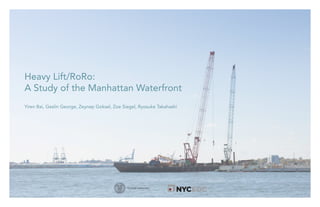
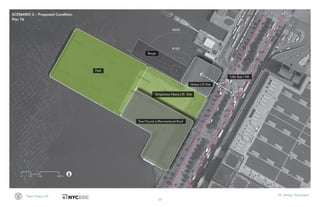
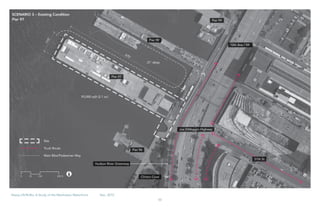
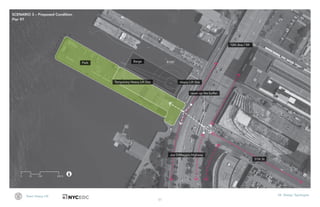
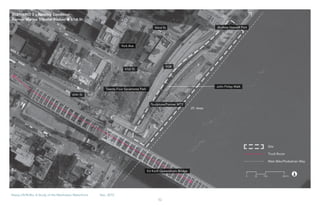
Heavy Lift/RoRo:
A Study of the Manhattan Waterfront
Yiren Bai, Geslin George, Zeynep Goksel, Zoe Siegel, Ryosuke Takahashi
Team Heavy Lift
Heavy Lift/RoRo: A Study of the Manhattan
Waterfront
This report is the final deliverable for an Urban Planning
and Urban Design Workshop (CRP 5172) completed in December
2015. This project was conducted as part of Cornell University’s
College of Art, Architecture and Planning New York City program
(AAPNYC). This component of the program was developed in
2010 by Robert W. Balder, Executive Director of AAPNYC. Each
fall semester, groups comprised of 3-5 students take on different
client-based projects and over the course of a few months,
develop a scope of work and work towards meeting project goals
and objectives determined in partnership with the client, usually
a city agency or civic organization based in New York City. This
program is open to Master’s Candidates in City and Regional
Planning and Landscape Architecture.
Participating graduate students receive only academic
credit for their work. There is no compensation of any type made
to or by the participating governmental and/or civic organizations.
The students conduct themselves as if they were retained as
professional planning consults and conduct the workshop through
the use of a scope of work that is mutually agreed upon. The
research, findings, and any recommendations from the workshop
are not in any way endorsed by Cornell University, and strictly
those of the student team defined within this report. All inquires
are to be directed to Robert W. Balder at rwb43@cornell.edu and/
or at 212-497-7597.
Team
Students:
Yiren Bai | Master of Regional Planning ‘16 | yb237@cornell.edu
Geslin George | Master of Regional Planning ‘16 | grg65@cornell.
edu
Zeynep Goksel | Dual Master of Regional Planning and Master of
Landscape Architecture ‘18 | ag2252@cornell.edu
Zoe Siegel | Master of Regional Planning ‘16 | zhs6@cornell.edu
Ryosuke Takahashi | Master of Landscape Architecture ‘16| rt368@
cornell.edu
Instructor:
Robert W. Balder | Executive Director, AAP NYC
Clients:
Max Taffet, Ryan White, Andrew Genn | NYC EDC
Acknowledgements
We would like to thank Max, Ryan and Ray for their commitment to
helping further the project and for being energetic and engaged
clients. We must of course acknowledge the several individuals
we had the pleasure of interviewing, as their contributions to
this project have been immense and extremely insightful: Scott
Shostak (EDC), Brian Craine (EDC), Trevor Johnson (Waterfront
and Open Space Division, NYC Dept of City Planning), Emil
Lissauer (Mayor’s Office of Citywide Events), Jason Marchioni
(Weeks Marine), Meenakshi Verandani (NYC SBS), Douglas Friend
(AKRF), Bill Dunne, James Connolly, Gina Callender, Richard
Pastore, (ConEdison), and Jonathan Libutti (Cornell Tech). A special
thanks to all of the individuals who took the time out of their busy
schedules to attend our final presentation in December: Andrew
Genn (EDC), Brain Craine (EDC), Scott Shostak (EDC), Patrick
Thrasher (EDC), Sandra Rothbard (OEM), David Hopkins (EDC),
Trevor Johnson (DCP), Adam Zaranko (ORR), and Zach Avre (EDC).
And finally, an enormous thanks to Bob, our supervisor and lead
navigator, without whom such a thorough study would have been
truly impossible. Thank you for keeping our team grounded and on
track, and for sharing knowledge of the Manhattan waterfront with
us which we could not hope to find in any book or website.
Table of Contents
I. Executive Summary	 1
II. Introduction	 5
III. Background	 7
IV. Project Methodology	 13
V. From Service Areas to Coastal Strategic Zones	 17
VI. Potential Sites	 23
VII. Design Typologies	 39
VIII. Limitations	 55
IX. Key Findings and Conclusions	 57
X. Recommended Next Steps	 59
XI. References	 61
XII. Appendices	 65
1
I. Executive Summary
2
Heavy Lift/RoRo: A Study of the Manhattan Waterfront	 Dec, 2015
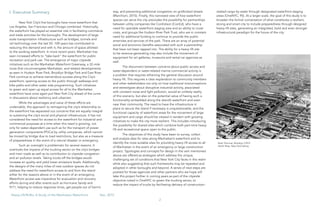
Bush Terminal, Brooklyn (1957)
North River, New York Sailing
I. Executive Summary
New York City’s five boroughs have more waterfront that
Los Angeles, San Francisco and Chicago combined. Historically,
the waterfront has played an essential role in facilitating commerce
and trade activities for the boroughs. The development of large
scale transportation infrastructure such as bridges, tunnels and
rail technology over the last 50 -100 years has contributed to
reducing this demand and with it, the amount of space allotted
to the working waterfront. In more recent years, Manhattan has
seen increased efforts to “take back” the waterfront for public
recreation and park use. The emergence of major citywide
initiatives such as the Manhattan Waterfront Greenway, a 32-mile
route that circumnavigates Manhattan, and related developments
as seen in Hudson River Park, Brooklyn Bridge Park and East River
Park continue to achieve tremendous success along the City’s
waterfront, opening access to the public through walkways and
bike paths and other water side programming. Such initiatives
to green and open up equal access for all to the Manhattan
waterfront have once again put New York City ahead of the curve
in discussions about resiliency and urbanism.
While the advantages and value of these efforts are
undeniable, this approach to reimagining the city’s relationship to
the waterfront has separated out concerns that are equally integral
to sustaining the city’s social and physical infrastructure. It has not
considered the need for access to the waterfront for industrial and
commercial purposes at a time when this need is growing, not
only for water-dependent use such as for the transport of power
generation components (PGCs) by utility companies, which cannot
be moved by bridge due to load restrictions, but also as a measure
of preparedness in the event of a natural disaster or emergency.
Such an oversight is problematic for several reasons. It
overlooks the impacts of the trucking sector on the city’s bridges
and main roads as well as its contribution to citywide congestion
and air pollution levels. Taking trucks off the bridges would
increase air quality and yield lower emissions levels. Additionally,
the designs of the many miles of new outdoor spaces do not
address the need for waterfront access to and from the island
either for the reasons above or in the event of an emergency.
Waterfront access was imperative for evacuation and recovery
efforts during and after events such as Hurricane Sandy and
9/11, helping to reduce response times, get people out of harm’s
way, and preventing additional congestion on gridlocked streets
(Marchioni, 2015). Finally, this narrowed view of how waterfront
spaces can serve the city precludes the possibility for partnerships
between utility companies like ConEdison (ConEd), who have a
need for operable waterfront staging area and an ability to cover
costs, and groups like Hudson River Park Trust, who are in constant
need for additional funding to continue to provide the public
amenities and services of the park. There are an array of potential
social and economic benefits associated with such a partnership
that have not been tapped into. The ability for a heavy lift site
to be revenue-generating may also include the movement of
equipment for art galleries, museums and rental car agencies as
well.
The disconnect between concerns about public access and
water-dependent or water-related marine commercial activity is
a problem that requires reframing the general discussion around
heavy lift. This requires a clear explanation to community members
and other stakeholders not only on how traditional misconceptions
and stereotypes about disruptive industrial activity, associated
with constant noise and light pollution, would an unlikely reality
of this scenario, but also on the potential value of having such a
functionality embedded along the island’s waterfront and even
near their community. The need to have the infrastructure in
place to secure the island if necessary is unquestionable, and the
functional capacity of waterfront areas for the movement of large
equipment and cargo should be viewed in tandem with growing
initiatives to make the city more resilient. This includes introducing
the possibility for shared sites which combine both part-time heavy
lift and recreational space open to the public.
The objectives of this study have been to survey, collect
and analyze data for sites along Manhattan’s waterfront and to
identify the most suitable sites for providing heavy lift access to all
of Manhattan in the event of an emergency or large construction
project. Typologies and concepts for design in the vein mentioned
above are offered as strategies which address the unique,
challenging set of conditions that New York City faces in this realm
while also suggesting that such frameworks may be repeated and
adopted in other boroughs and beyond. A series of next steps are
posited for those agencies and other partners who we hope will
take this project further in coming years as part of the citywide
objective noted in OneNYC to green the trucking sector, to
reduce the impact of trucks by facilitating delivery of construction-
related cargo by water through designated waterfront staging
areas (OneNYC, 95). At a larger scale, the goal of this study is to
broaden the formal conversation of what constitutes a resilient,
strong and smart city to include preparedness through designed
heavy lift sites, generating an integrated, bold and even stronger
infrastructural paradigm for the future of the city.
3
Team Heavy Lift
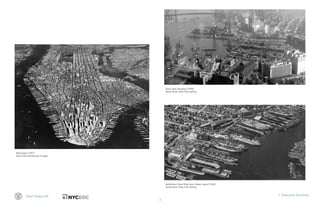
Manhattan (1951)
New York Architecture Images
Navy Yard, Brooklyn (1945)
North River, New York Sailing
Bethlehem Steel Ship Yard, Staten Island (1942)
North River, New York Sailing
I. Executive Summary
5
II. Introduction
6
Heavy Lift/RoRo: A Study of the Manhattan Waterfront	 Dec, 2015
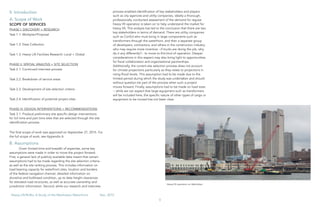
Heavy lift operation on Manhattan
II. Introduction
A. Scope of Work
SCOPE OF SERVICES
PHASE I: DISCOVERY + RESEARCH
Task 1.1: Workplan/Proposal		
Task 1.2: Data Collection
Task 1.3: Heavy Lift Facilities Research: Local + Global
PHASE II: SPATIAL ANALYSIS + SITE SELECTION
Task 2.1: Continued interview process
Task 2.2: Breakdown of service areas
Task 2.3: Development of site selection criteria
Task 2.4: Identification of potential project sites
PHASE III: DESIGN INTERVENTIONS + RECOMMENDATIONS
Task 3.1: Produce preliminary site specific design interventions
for full time and part time sites that are selected through the site
identification process.
The final scope of work was approved on September 27, 2015. For
the full scope of work, see Appendix A.
B. Assumptions
Given limited time and breadth of expertise, some key
assumptions were made in order to move the project forward.
First, a general lack of publicly available data meant that certain
assumptions had to be made regarding the site selection criteria
as well as the site ranking process. This includes information on
load bearing capacity for waterfront sites, location and borders
of the federal navigation channel, detailed information on
shoreline and bulkhead condition, up to date height clearances
for elevated road structures, as well as accurate ownership and
jurisdiction information. Second, while our research and interview
process enabled identification of key stakeholders and players
such as city agencies and utility companies, ideally a thorough,
professionally conducted assessment of the demand for regular
heavy lift operation is taken on to help understand the market for
heavy lift. This analysis has led to the conclusion that there are two
key stakeholders in terms of demand. There are utility companies
such as ConEd who must bring in large components such as
transformers through the waterfront, and then a separate group
of developers, contractors, and others in the construction industry
who may require more incentive --if trucks are doing the job, why
do it any differently?-- to move to this kind of operation. Deeper
considerations in this respect may also bring light to opportunities
for fiscal collaboration and organizational partnerships.
Additionally, the current site selection process does not account
for climate projections particularly as they relate to projections in
rising flood levels. This assumption had to be made due to the
limited period during which the study was undertaken and should
without question be part of the process when such a project
moves forward. Finally, assumptions had to be made on load sizes
-- while we can expect that large equipment such as transformers
will be included here, the specific nature of other types of cargo or
equipment to be moved has not been clear.
7
III. Background
8
Heavy Lift/RoRo: A Study of the Manhattan Waterfront	 Dec, 2015
54'180'
22'
113'-8"
90'
240'
300'
300'
90'
10'-9"
18'-4" 18'-4"
63'-2"
75'
75'
Cargo
Area
Load
R260'
22'
14' 14'
10 AxleTrailer
Example of Largest Heavy Lift Floating Crane Barge
Example of RoRo Deck Barge
1" = 20'
1" = 100'
1" = 100'
54'180'
22'
113'-8"
90'
240'
300'
300'
90'
10'-9"
18'-4" 18'-4"
63'-2"
75'
75'
Cargo
Area
Load
R260'
22'
14' 14'
10 AxleTrailer
Example of Largest Heavy Lift Floating Crane Barge
Example of RoRo Deck Barge
1" = 20'
1" = 100'
1" = 100'
22'
113'-8"
90'
240'
300'
300'
90'
10'-9"
18'-4" 18'-4"
63'-2"
75'
75'
Cargo
Area
Load
R260'
22'
10 AxleTrailer
Example of Largest Heavy Lift Floating Crane Barge
1" = 20'
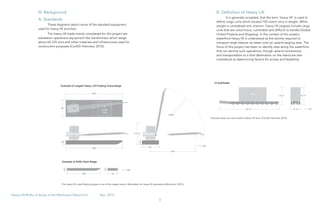
This heavy lift crane floating barge is one of the largest used in Manhattan for heavy lift operations (Marchioni, 2015).
The axle trailer can carry loads of about 95 tons. (ConED Interview, 2015)
III. Background
A. Standards
These diagrams depict some of the standard equipment
used for heavy lift activities.
The heavy lift loads mainly considered for this project are
substation operations equipment like transformers which weigh
about 60-335 tons and other materials and infrastructure used for
construction purposes (ConED Interview, 2015).
B. Definition of Heavy Lift
It is generally accepted, that the term ‘heavy lift’ is used to
define cargo units which exceed 100 metric tons in weight. While
weight is considered one criterion, heavy lift cargoes include cargo
units that are voluminous, vulnerable and difficult to handle (Global
United Projects and Shipping). In the context of this project,
waterfront heavy lift is understood as the activity required to
transport large objects via water onto an upland staging area. The
focus of this project has been to identify sites along the waterfront
that can service such operations, though upland connections
and transportation to a final destination on the island are also
considered as determining factors for access and feasibility.
9
Team Heavy Lift III. Background
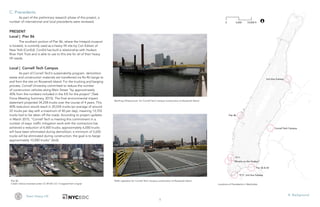
Locations of Precedents in Manhattan
RoRo operation for Cornell Tech Campus construction at Roosevelt IslandPier 86
Credit: Sidvics licensed under CC BY-SA 3.0 / Cropped from orignal
Berthing Infrastructure for Cornell Tech Campus construction at Roosevelt Island
C. Precedents
As part of the preliminary research phase of this project, a
number of international and local precedents were reviewed.
PRESENT
Local | Pier 86
The southern portion of Pier 86, where the Intrepid museum
is located, is currently used as a heavy lift site by Con Edison of
New York (ConEd). ConEd has built a relationship with Hudson
River Park Trust and is able to use to this site for all of their heavy
lift needs.
Local | Cornell Tech Campus
As part of Cornell Tech’s sustainability program, demolition
waste and construction materials are transferred via Ro-Ro barge to
and from the site on Roosevelt Island. For the trucking and barging
process, Cornell University committed to reduce the number
of construction vehicles along Main Street “by approximately
40% from the numbers included in the EIS for the project” (Task
Force Meeting Summary, 2015). The final environmental impact
statement projected 34,258 trucks over the course of 4 years. This
40% reduction would result in 20,554 trucks (an average of around
22 trucks per day with a maximum of 40 per day), meaning 13,703
trucks had to be taken off the roads. According to project updates
in March 2015, “Cornell Tech is meeting this commitment in a
number of ways: traffic mitigation work with the contractors has
achieved a reduction of 4,000 trucks; approximately 6,000 trucks
will have been eliminated during demolition; a minimum of 3,650
trucks will be eliminated during construction; the goal is to barge
approximately 10,000 trucks” (ibid).
10
Heavy Lift/RoRo: A Study of the Manhattan Waterfront	 Dec, 2015
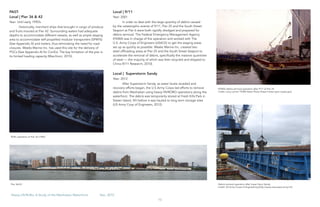
FEMA’s debris removal operation after 9/11 at Pier 25
Credit: Larry Lerner/ FEMA News Photo (https://www.nysm.nysed.gov)
RoRo operation at Pier 36 (1982)
Debris removal operation after Super Stom Sandy
Credit: US Army Corps of Engineering (http://www.nad.usace.army.mil)
Pier 36/42
PAST-
Local | Pier 36 & 42
Year: Until early 1990’s
Historically, merchant ships that brought in cargo of produce
and fruits moored at Pier 42. Surrounding waters had adequate
depths to accommodate different vessels, as well as ample staging
area to accommodate self-propelled modular transporters (SPMTs)
(See Appendix A) and trailers, thus eliminating the need for road
closures. Weeks Marine Inc. has used this site for the delivery of
PGCs (See Appendix A) for ConEd. The key limitation of the pier is
its limited loading capacity (Marchioni, 2015).
Local | 9/11
Year: 2001
In order to deal with the large quantity of debris caused
by the catastrophic events of 9/11, Pier 25 and the South Street
Seaport at Pier 6 were both rapidly dredged and prepared for
debris removal. The Federal Emergency Management Agency
(FEMA) was in charge of the operation and worked with The
U.S. Army Corps of Engineers (USACE) to get the staging areas
set up as quickly as possible. Weeks Marine Inc. created two
steel offloading areas at Pier 25 and the South Street Seaport to
accelerate the removal of debris, specifically the massive quantities
of steel — the majority of which was then recycled and shipped to
China (9/11 Research, 2010).
Local | Superstorm Sandy
Year: 2012
After Superstorm Sandy, as water levels receded and
recovery efforts began, the U.S Army Corps led efforts to remove
debris from Manhattan using heavy lift/RORO operations along the
waterfront. The debris was temporarily stored at Fresh Kills Park in
Staten Island, NY before it was hauled to long term storage sites
(US Army Corp of Engineers, 2012).
11
Team Heavy Lift III. Background
Loaded aircraft on a barge
Credit: NJ (http:///www.nj.com)
RoRo Operation at Roosevelt Island
Credit: Port of London Authority (https://www.pla.co.uk)
2nd Ave Subway Plan
Credit:
Heavy Lift crane barges and the aircraft
Credit: Engineering News Record (http://www.enr.com)
International | London
Year: 2010-2012
During the construction phase of the London 2012 Olympic
Games, over eight kilometers of waterways in and around the
Olympic Park were used to transport materials by barge and take
trucks off the roads. The waterways project was part of the Olympic
Delivery Authority’s 2007 Sustainable Development Strategy,
which aimed to transport 50 percent of materials used during the
Olympic construction phase by rail or water. To make this possible,
a multi-million pound dredging programme was completed to
clear the water freight route on the Prescott Channel (Brass, 2009).
Transportation of cargo by water was also used during the
construction of London’s Blackfriars Station. Over the construction
period from 2010 to 2012, barges were used on a daily basis
to deliver and remove materials from the station along the
River Thames. In addition to barges having greater capacity for
transporting materials to the site, the process was also more
efficient, having the added value of complementing the carbon
reduction agenda by helping to reduce the impact of bridge
construction work (Quigley, 2010).
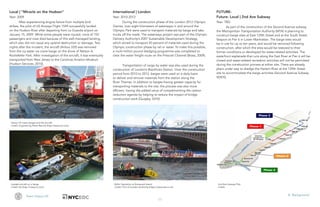
Local | “Miracle on the Hudson”
Year: 2009
After experiencing engine failure from multiple bird
strikes, the pilot of US Airways Flight 1549 successfully landed
on the Hudson River after departing from La Guardia airport on
January 15, 2009. While some people were injured, none of 155
passengers and crew died because of this well-managed landing,
which also did not cause any upland destruction or damage. Two
nights after the incident, the aircraft (Airbus 320) was removed
from the icy water via crane barge on the shore of Nelson A.
Rockefeller Park. After investigation of the aircraft, it was eventually
transported from New Jersey to the Carolinas Aviation Museum
(Hudson Services, 2010).
FUTURE-
Future- Local | 2nd Ave Subway
Year: TBD
As part of the construction of the Second Avenue subway,
the Metropolitan Transportation Authority (MTA) is planning to
construct barge sites at East 129th Street and at the South Street
Seaport at Pier 6 in Lower Manhattan. The barge sites would
be in use for up to ten years, and would be removed following
construction, after which the sites would be restored to their
former conditions or developed for water-related activities. The
waterfront esplanade that runs along the East River at Pier 6 will be
closed and water-related recreation activities will not be permitted
during the construction process at either site. There are already
plans under way to dredge the Harlem River at the 129th Street
site to accommodate the barge activities (Second Avenue Subway
SDEIS).
13
IV. Project Methodology
14
Heavy Lift/RoRo: A Study of the Manhattan Waterfront	 Dec, 2015
IV. Project Methodology
A. Phases
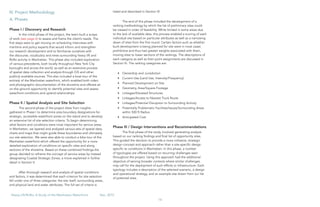
Phase I / Discovery and Research
In the initial phase of the project, the team built a scope
of work (see page 6) to assess and frame the client’s needs. The
first steps were to get moving on scheduling interviews with
maritime and policy experts that would inform and strengthen
our research development and to familiarize ourselves with
the discourse, vocabulary and news surrounding heavy lift and
RoRo activity in Manhattan. This phase also included exploration
of various precedents, both locally throughout New York City
boroughs and across the world, as well as an extensive process
of spatial data collection and analysis through GIS and other
publicly available sources. This also included a boat tour of the
entirety of the Manhattan waterfront, which enabled both video
and photographic documentation of the shoreline and offered an
on-the-ground opportunity to identify potential sites and assess
waterfront conditions and upland relationships.
Phase II / Spatial Analysis and Site Selection
The second phase of the project drew from insights
gathered in Phase I to determine area boundary designations for
strategic, accessible waterfront zones on the island and to develop
an extensive list of site selection criteria. To begin determining
what factors and conditions were most important for service areas
in Manhattan, we layered and analyzed various sets of spatial data,
charts and maps that might guide these boundaries and ultimately
our site selection. We were also able to conduct a bike tour of the
Manhattan waterfront which offered the opportunity for a more
detailed exploration of conditions on specific sites and along
sections of the shoreline. Based on these combined findings the
group decided to reframe the concept of service areas by instead
designating Coastal Strategic Zones, a move explained in further
detail in Section V.
After thorough research and analysis of spatial conditions
and factors, it was determined that each criterion for site selection
fell under one of three categories: the site itself, surrounding areas,
and physical land and water attributes. The full set of criteria is
listed and described in Section VI.
The end of this phase included the development of a
ranking methodology by which the list of preliminary sites could
be viewed in order of feasibility. While limited in some areas due
to the lack of available data, this process enabled a scoring of each
individual site based on particular attributes as well as a narrowing
down of sites from the first round. Certain factors such as whether
built development is being planned for site were in most cases
prohibitive and thus had greater weights associated with them,
moving sites to lower sections of the rankings. The descriptions of
each category as well as their point assignments are discussed in
Section VI. The ranking categories are:
•	 Ownership and Jurisdiction
•	 Current Use (Land Use, Intensity/Frequency)
•	 Planned Development on Site
•	 Geometry, Area/Square Footage
•	 Linkages/Elevated Structures
•	 Linkages/Access to Nearest Truck Route
•	 Linkages/Potential Disruption to Surrounding Activity
•	 Potentially Problematic Facilities/Issues/Surrounding Areas
within 500 ft Radius
•	 Anticipated Cost
Phase III / Design Interventions and Recommendations
The final phase of the study involved generating analysis
based on our ranking findings and final list of opportunity sites.
This guided the decision to provide a more cohesive, strategic
design concept and approach rather than a site-specific design
specific to conditions in Manhattan. In this phase, a number
of typologies are offered based on recurring challenges seen
throughout the project. Using this approach had the additional
objective of serving broader contexts where similar challenges
may call for the deployment of such efforts or infrastructure. Each
typology includes a description of the selected scenario, a design
and operational strategy, and an example site drawn from our list
of potential sites.
15
Team Heavy Lift
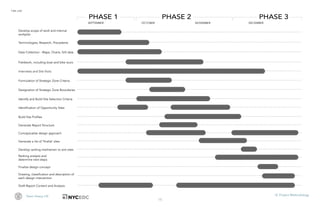
Develop scope of work and internal
workplan
Terminologies, Research, Precedents
Fieldwork, including boat and bike tours
Formulation of Strategic Zone Criteria
Designation of Strategic Zone Boundaries
Build Site Profiles
Identification of Opportunity Sites
Generate Report Structure
Conceptualize design approach
Develop ranking mechanism to sort sites
Generate a list of ‘finalist’ sites
Ranking analysis and
determine next steps
Finalize design concept
Drawing, classification and description of
each design intervention
Draft Report Content and Analysis
Identify and Build Site Selection Criteria
Interviews and Site Visits
Data Collection - Maps, Charts, GIS data
SEPTEMBER OCTOBER NOVEMBER DECEMBER
PHASE 1 PHASE 2 PHASE 3
IV. Project Methodology
TIME LINE
17
V. From Service Areas to Coastal Strategic Zones
18
Heavy Lift/RoRo: A Study of the Manhattan Waterfront	 Dec, 2015
V. From Service Areas to Coastal Strategic Zones
The original scope of work of this project involved a process
of defining and delineating certain areas in Manhattan that might
aid in framing decisions on site selection: Would the most strategic
option be to have one heavy lift or RoRo site in each service area?
The team examined whether existing service area models exist
and which boundaries of other municipal service areas would be
relevant to heavy lift or RoRo activity. Initially, the team looked at a
range of designated boundaries such as community board districts,
police precincts, and fire districts, and Waterfront Revitalization
Program (WRP) zones, alongside other essential components such
as truck routes; elevated structures such as the FDR that might
obstruct access for large cargo and trucks and/or require road
closures; areas anticipated to see an increase in demand for heavy
lift in coming years like the Hudson Yards project; coastline areas
with poor or inaccessible conditions for heavy lift activity; and
more. These concepts set the tone for moving into more detailed
discussion about the most appropriate and relevant criteria and
boundaries for service areas.
A.What/Why Strategic Zones?
Upon further analysis, it became clear that the concept
of serv Upon further analysis, it became clear that the concept
of service areas, defined as areas to be serviced by a specific
waterfront site, was slightly problematic. It was determined to
be impractical at this stage to determine the areas serviced by
a site prior to having a more detailed understanding of the sites
themselves in terms of position along the waterfront, proximity
to roads and elevated structures, surrounding neighborhoods
and so on. The team reworked this framework to develop Coastal
Strategic Zones. The purpose of Coastal Strategic Zones is to
manageably break up the island based on shared characteristics
which may share certain needs for a heavy lift operation both
on land and on water. This was not a simple process, given
the complex, dense geography of Manhattan. But after much
discussion, the team was able to designate six strategic zones
which address specific area needs and conditions. While the
issue persisted that in some ways, such a preliminary setting of
boundaries would not adequately frame the question of where
such sites are to be located, this was a productive first step for
thinking about need and access as factors for site selection. Each
strategic zone shares physical upland and waterfront characteristics
and have been determined through careful analysis of the
Manhattan waterfront using the criteria described below.
B. Strategic Zone Criteria
Anticipated Development
Anticipated development refers to built development that
is either currently under construction or already planned. Such
developments provide general knowledge of where and how much
construction material and equipment will be needed citywide over
the next five to ten years. The strategic zones consider anticipated
development, such as the Hudson Yards or the upcoming ‘Big U’,
in order to gauge demand and strategies for evenly distributing
the burden for future heavy lift service.
Truck Routes
Designated truck routes are essential to consider in terms
of movement to and from the waterfront to an upland destination.
These routes have the appropriate road width and load bearing
capacity to accommodate trucks with heavy loads. The existing
network of truck routes is considered to the extent that it offers a
basic dividing boundary for balancing those areas with abundant
truck routes and those with more sparse access.
Building Density - Building Height
Building density adds another additional layer to
characterizing strategic zones. Building heights are examined with
the assumption that denser areas may have greater future service
needs while also offering a picture of where lower buildings may
present construction opportunities through transferable air rights.
Sensitive Areas - Hospitals, no boating zones,
underground utilities etc.
These are defined as areas where heavy lift services
along the waterfront may be strictly constrained, either due
to legal issues or safety concerns, such as the location of the
United Nations, proximity to hospitals, bridges and tunnels, and
underground cable areas.
Elevated Structures
Elevated structures refer to any elevated road or rail line
along or near the coastline. These areas are potentially problematic
due to limited height clearances.
Water Depths
Bulkheads or areas near deeper waters are ideal for heavy
lift operations so as to accommodate the barge. Shallow waters will
have to be dredged to accommodate such operations.
Priority Marine Activity Zones (PMAZ)
The PMAZ are areas with concentrations of waterborne
transportation uses and are important nodes that support the city’s
waterborne transportation and maritime activities. These areas are
characterized by shorelines used for vessel docking, berthing, or
tie-up and where the maritime infrastructure—such as bulkheads,
docks, piers, and fendering is designed to support such uses.
Topography
Topography along the coastline is a significant consideration
and determinant for upland access via the waterfront. Coastal
areas with higher elevation will be exponentially more difficult for
a heavy lift or roll on roll off barge to operate due to increased
challenges of physical access.
19
Team Heavy Lift V. From Service Areas to Coastal Strategic Zones
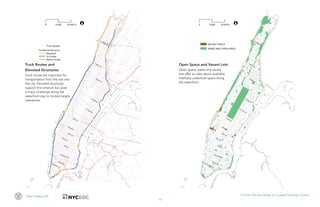
Truck Routes and
Elevated Structures
Truck routes are important for
transportation from the site into
the city. Elevated structures
support this network but pose
a major challenge along the
waterfront due to limited height
clearances.
Open Space and Vacant Lots
Open space, parks and vacant
lots offer an idea about available,
relatively underbuilt space along
the waterfront.
20
Heavy Lift/RoRo: A Study of the Manhattan Waterfront	 Dec, 2015
5,0000 10,000 ft
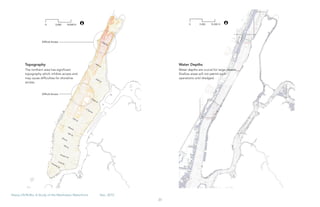
Water Depths
Water depths are crucial for large vessels.
Shallow areas will not permit such
operations until dredged.
Topography
The northern area has significant
topography which inhibits access and
may cause difficulties for shoreline
access.
21
Team Heavy Lift V. From Service Areas to Coastal Strategic Zones
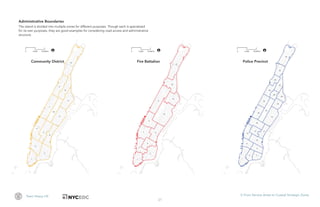
Administrative Boundaries
The island is divided into multiple zones for different purposes. Though each is specialized
for its own purposes, they are good examples for considering road access and administrative
structure.
Community District Fire Battalion Police Precinct
22
Heavy Lift/RoRo: A Study of the Manhattan Waterfront	 Dec, 2015
5,0000 10,000 ft
Coastal Strategic Zones
proximity. While the location of this zone on the east side, just
south of where the channel narrows, has ideal access to the outer
boroughs and could benefit from having a site for such purposes,
this combination of infrastructural and access conditions provide a
unique set of challenges.
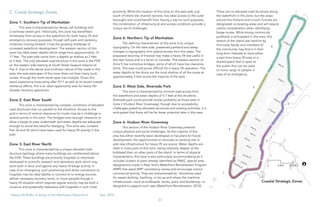
Zone 4: Northern Tip of Manhattan
The defining characteristic of this zone is its unique
topography. On the west side, preserved parkland and steep
changes in topography limit upland access from the water. The
proposed rezoning of Inwood may make a heavy lift site useful in
the near future and is a factor to consider. The eastern section of
Zone 5 has numerous bridges, some of which have low clearance
limits. This area could prove difficult for a heavy lift operation. The
water depths at the shore are the most shallow of all the zones at
approximately 5 feet across the majority of the area.
Zone 5: West Side, Riverside Park
This zone is characterized by minimal road access from
the waterfront and water depths of 5-7 feet at the shoreline.
Riverside park could provide similar problems as those seen in
Zone 2 (Hudson River Greenway), though due to accessibility
challenges posed by elevated structures and existing activities, it is
anticipated that there will be far fewer potential sites in this area.
Zone 6: Hudson River Greenway
This section of the Hudson River Greenway presents
unique physical and social challenges. As the majority of this
area has either recently been developed or has plans for future
development, the opportunities to renovate an existing site or
add new infrastructure for heavy lift are scarce. Water depths are
ideal in most parts of this zone, being relatively deeper at the
bulkhead than on other parts of the island. In terms of physical
characteristics, this zone is also particularly accommodating as it
includes clusters of piers already identified as PMAZ, special area
designations made in New York’s Waterfront Revitalization Program
(WRP) that assist WRP consistency review and encourage marine
commercial activity. They are characterized by “shorelines used
for vessel docking, berthing, or tie-up and where the maritime
infrastructure—such as bulkheads, docks, piers, and fendering—is
designed to support such uses (Waterfront Revitalization, 2012).
C. Costal Strategic Zones
Zone 1: Southern Tip of Manhattan
This area is characterized by dense, tall buildings and
a nonlinear street grid. Historically, this zone has benefitted
immensely from access to the waterfront for both heavy lift and
emergency recovery purposes, though with park and resiliency
initiatives moving forward, it has the growing challenge of
increased waterfront development. The western section of this
zone has ideal water depths which range from approximately 15-
17 feet. The east side varies from a depths as shallow as 2 feet
to 5 feet. The only elevated road structure in this zone is the FDR
on the eastern side starting at South Street Seaport heliport at
Pier 6. Due to the dense and nonlinear nature of the roads in this
area, the east-west span of this zone does not have many truck
routes, through the north-south span has multiple. Given this
area’s experience evacuating after 9/11 as well as its recent coastal
resiliency efforts, this is an ideal opportunity area for heavy lift/
disaster recovery operations.
Zone 2: East River South
This zone is characterized by complex conditions of elevated
road structures that run parallel to the shoreline. Access to the
grid in terms of vertical clearance for trucks may be a challenge in
several points in this zone. The bridges have enough clearance to
allow a barge to pass underneath and water depths are adequate
enough to avoid the need for dredging. This zone also contains
Pier 36 and 42 which have been used for heavy lift activity in the
past.
Zone 3: East River North
This zone is characterized by a unique elevated road
structure typology where many buildings are cantilevered above
the FDR. These buildings are primarily hospitals or otherwise
dedicated to scientific research and laboratory work which may
work both in favor and against any heavy lift barge activity. In
case of an emergency, such positioning and direct connection to
hospitals may be ideal (ability to connect to to energy sources,
deliver necessary recovery items, or move people) though a
heavy lift situation which requires regular activity may be both a
nuisance and potentially hazardous with hospitals in such close
There are no elevated road structures along
the waterfront in this zone, but the areas
around the Holland and Lincoln Tunnels are
designated no boating areas and will require
careful consideration when identifying
barge routes. While strong community
pushback is anticipated in this area, this
stretch of the island was hard-hit by
Hurricane Sandy and members of
the community may find it in their
long-term interests to have either
a part-time heavy lift area or a
shared space that is open to
the public that can be used
to move cargo or people in
case of an emergency.
23
VI. Potential Sites
24
Heavy Lift/RoRo: A Study of the Manhattan Waterfront	 Dec, 2015
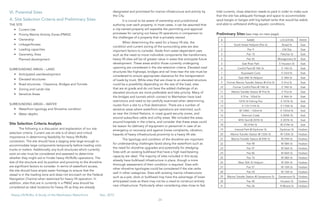
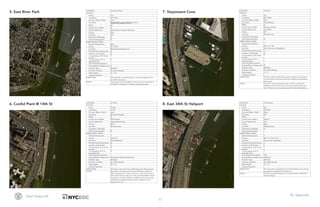
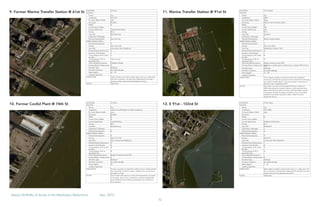
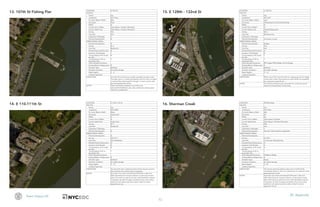
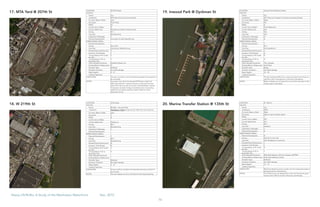
# NAME LOCATION RIVER
1 South Street Heliport (Pier 6) Broad St East
2 Pier 9 Old Slip East
3 Pier 15 Fletcher St East
4 Pier 42 Montgomery St East
5 East River Park E Houston St East
6 ConEd Plant @ 14th St E 14th St East
7 Stuyvesant Cove E 23rd St East
8 East 34th St Heliport E 34th St East
9 Former Marine Transfer Station @ 61st St E 61st St East
10 Former ConEd Plant @ 74th St E 74th St East
11 Marine Transfer Station @ 91st St E 91st St East
12 E 91st - 103rd St E 96th St East
13 107th St Fishing Pier E 107th St East
14 E 110-111th St E 110th St East
15 W 128th - 132nd St E 132nd St East
16 Sherman Creek E 204th St East
17 MTA Yard @ 207th St E 207th St East
18 W 219th St W 219th St East
19 Inwood Park @ Dyckman St Dyckman St Hudson
20 Marine Transfer Station @ 135th St W 135th St Hudson
21 Marine Transfer Station @ 59th St W 59th St Hudson
22 Pier 98 W 58th St Hudson
23 Pier 97 W 56th St Hudson
24 Pier 86 W 46th St Hudson
25 Pier 76 W 38th St Hudson
26 West 30th St Heliport W 30th St Hudson
27 Pier 57 W 15th St Hudson
28 Pier 54 W 13th St Hudson
29 Marine Transfer Station @ Gansevoort St Gansevoort St Hudson
30 Pier 40 Houston St Hudson
31 Pier 26 N Moore St Hudson
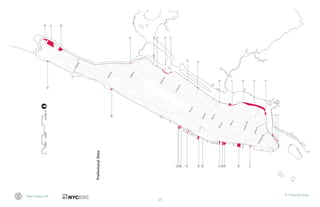
VI. Potential Sites
A. Site Selection Criteria and Preliminary Sites
THE SITE
•	 Current Use
•	 Priority Marine Activity Zones (PMAZ)
•	 Ownership
•	 Linkage/Access
•	 Loading capacities
•	 Geometry, Area
Planned development
SURROUNDING AREAS – LAND
•	 Anticipated use/development
•	 Elevated structures
•	 Road structures - Clearance, Bridges and Tunnels
•	 Zoning and Lands Use
•	 Sensitive Areas
SURROUNDING AREAS – WATER
•	 Waterfront typology and Shoreline condition
•	 Water depths
Site Selection Criteria Analysis
The following is a discussion and explanation of our site
selection criteria. Current use on-site is of direct and critical
importance in determining feasibility for heavy lift/RoRo
conversion. The site should have a staging area large enough to
accommodate large components temporarily before loading onto
trucks or trailers. Additionally, any built structures which currently
exist on-site must be considered and assessed to determine
whether they might aid or hinder heavy lift/RoRo operations. The
size of the structure and its position and proximity to the shoreline
are significant factors to consider. In terms of waterfront access,
the site should have ample water frontage to ensure that the
vessel is in the loading zone and does not encroach on the Federal
Navigation Channel when stationed for heavy lift operation. In
addition, sites that are in currently in a PMAZ area should be
considered as ideal locations for heavy lift as they are already
designated and prioritized for marine infrastructure and activity by
the City.
It is crucial to be aware of ownership and jurisdictional
authority over each property. In most cases, it can be assumed that
a city-owned property will expedite the permitting and approval
processes for carrying out heavy lift operations in comparison to
the challenges of a property that is privately owned.
When determining the need for a heavy lift site, the
condition and current zoning of the surrounding area are also
important factors to consider. Aside from water-dependent uses
such as the need to move indivisible components like transformers,
heavy lift sites will be of greater value in areas that anticipate future
development. These areas and/or those currently undergoing
upzoning are considered in the site selection criteria. Elevated road
structures like highways, bridges and rail lines near the site must be
considered to ensure appropriate clearance for the transportation
of loads by truck. While sites that are close to an elevated structure
could be a possibility depending on the size of the load, sites
that are at grade and do not have the added challenge of an
elevated structure are more preferable and take priority. Many of
the bridges and tunnels which connect to Manhattan have load
restrictions and need to be carefully examined when determining
routes from a site to a final destination. There are a number of
sensitive areas where waterfront operations are restricted, such
as near the United Nations, in coast guard security zones, and
around subsurface cable and utility areas. We included the areas
around hospitals in the criteria, and consider that these areas could
be reason for (delivery of equipment or personnel in case of an
emergency or recovery) and against (noise complaints, vibration,
hazards of heavy infrastructure) proximity to a heavy lift site.
The typology and condition of the shoreline are important
for understanding challenges faced along the waterfront such as
the need for shoreline upgrades and potentially for dredging.
Sites with an existing bulkhead that have a high load-bearing
capacity are ideal. The majority of sites included in this study
already have bulkhead infrastructure in place, though a more
thorough assessment of their condition is required. Sites with
other shoreline typologies could be considered if the site ranks
well in other categories. Sites with existing marine infrastructure
such as a pier, dock or bulkhead may have the advantage of lower
anticipated costs as there may not be a need to construct entirely
new infrastructure. Particularly when considering sites close to fast
tidal currents, close attention needs to paid in order to make sure
that the site has adequate frontage and space to accommodate
spud barges or barges with big ballast tanks that would be stable
and able to withstand shifting aquatic conditions.
Preliminary Sites (see map on next page)
25
Team Heavy Lift VI. Potential Sites
%)
3
1
2
4
5
6
7
8
9
10
12
15
20
11
13
14
16
17
18
19
24
22
21
23
26
27
28
29
30
31
25
5,0002,50010,000ft0
ChamberSt
CanalSt
HoustonSt
14thSt
23rdSt
34thSt
42ndSt
57thSt
E72ndSt
E96thSt
125thSt
145thSt
178thSt
PreliminarylSites
26
Heavy Lift/RoRo: A Study of the Manhattan Waterfront	 Dec, 2015
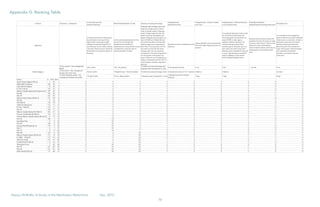
B. Ranking Methodology
The team developed a ranking mechanism for scoring the
sites and differentiating them based on their attributes. In this
ranking system, there are nine main categories derived from the
criteria presented above which were assessed to be the most
influential for determining feasibility. Each ranking category is
assigned sub-categories, each of which is paired with a different
score to reflect priority and weigh the factor’s importance. The
lower the score, the more difficult the operation of heavy lift
activities is determined to be. (See Appendix D for the full ranking
table)
Ownership and Jurisdiction
In many cases, ownership and jurisdiction over waterfront
properties align but do not belong to the same entity. Ownership
refers to the individual or agency with ownership rights and duties
over the property, and jurisdiction describes the the practical
authority to interpret and apply the law, or to govern and legislate.
The four categories are defined as:
•	 City Owned and City Organization Management (ex. EDC)
(3)
•	 City Owned and Private Management (ex. Hudson River
Park Trust) (2)
•	 Privately Owned or Other (1)
•	 State/ Federally Owned and City Management (1)
A scenario where the city owns and manages the property
is the most desirable and ideal for going through legal processes
and making heavy lift activities happen. In contrast, sites which
are controlled privately may present added legal and logistical
challenges.
Current Use - Type, Intensity & Frequency
Understanding current use(s) on site may significantly impact
the possibility for heavy lift operations. The more sophisticated and
complex the type, intensity and frequency of current use, the less
likely a smooth heavy lift scenario will be. Three sub-categories
were developed to describe the intensity of conflicts between
current use and future heavy lift use.
•	 No Conflict (3)
•	 Some Conflict (2)
•	 High Conflict (-10)
No conflict is the physical activity on site going to be no
problematic for a heavy lift site. Some conflict could be a site
with temporary uses or where the facility does not occupy the
majority of the space. High conflict could entail a highly trafficked
recreational space or facility that is in operation for most hours of
the day, particularly at night.
Planned Development on Site
This category accounts for built development that has
been approved for the site in coming months or years. Examining
existing plans allows us to think about the possibility of congruent
use between any planned programming/activities and heavy lift,
and the difficulty of conducting heavy lift activities on recently
developed sites. Achieving congruent use is the goal for all
planned development on site, though more often than not any
planned development prohibits use for heavy lift purposes.
•	 No - No Problem (3)
•	 Maybe/Unclear - Potential Problem (2)
•	 Yes - Major Problem (-25)
Geometry, Area/Square Footage
This category takes into account the property shape, area,
and spatial upland-waterfront relationship. Based on interviews
and research, it is assumed that heavy lift requires certain baseline
standards for land area as well as water frontage. Based on this,
the subcategories are divided as such:
•	 Suitable Land Area and Adequate Water Frontage (60’ or
more) (3)
•	 Suitable Land Area (Square Footage of Site) (2)
•	 Adequate Water Frontage (60’ or more) (1)
Adequate water frontage means a barge will have enough
space to dock in order to transfer material. This ranges from
60’-120’, based on the size of standard crane barges (Heartland
Barge, 2015). Suitable land area refers to an area of 20,000
square feet or more (Weeks Marine, 2015). Suitable land Area
and Adequate Water Frontage refers to a site that fulfills both the
above standards. It is important to clarify that in terms of the site
geometry, consideration is not given to extra room for storage
facilities and staging areas but only the minimum working area for
heavy lift to operate.
Linkages/Elevated Structures
This category accounts for elevated roads, rail lines, and/or
physical infrastructure along or near the coastline that may impede
the ability for trucks to move into the city from a waterfront site if
they do not have adequate vertical clearance and/or load-bearing
capacity. Areas with limited clearance pose an added challenge
and require more detailed consideration.
•	 No elevated structures (3)
•	 Elevated structures w/ 12’5’’ clearance (2)
•	 Elevated structures w/ limited clearance (1)
Linkages/Access to Nearest Truck Route
Truck routes are essential for streamlining the transportation
of heavy loads from a site to its destination. It is crucial that truck
routes be accessible from waterfront sites and into the grid.
•	 Low (3)
•	 Medium (2)
•	 High (1)
Linkages/Potential Disruption to Surrounding Activity
Potential disruption refers to the extent to which heavy lift
activities would interrupt the status quo through disruptions of
regular movement or activity. The degree of disruption is divided
into three sub-categories.
•	 Low (3)
•	 Medium (2)
•	 High (1)
Low potential disruption means while heavy lift activities
happen, roads do not need to be shut down and minimizing
general activity does not require NYPD or other agency operation.
Medium disruption may include proximity to space that is currently
open to the public such as a park, and/or the need to shut down
bikeways and/or sidewalks for heavy lift to occur. High disruption
includes the need for highway or road closures, the deployment
of NYPD or other supervising agencies, and/or bikeway/sidewalk
closures.
27
Team Heavy Lift VI. Potential Sites
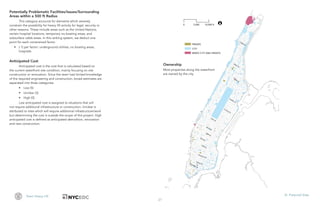
Ownership
Most properties along the waterfront
are owned by the city.
Potentially Problematic Facilities/Issues/Surrounding
Areas within a 500 ft Radius
This category accounts for elements which severely
constrain the possibility for heavy lift activity for legal, security or
other reasons. These include areas such as the United Nations,
certain hospital locations, temporary no-boating areas, and
subsurface cable areas. In this ranking system, we deduct one
point for each constrained factor.
•	 (-1) per factor: underground utilities, no boating areas,
hospitals
	
Anticipated Cost
Anticipated cost is the cost that is calculated based on
the current waterfront site condition, mainly focusing on site
construction or renovation. Since the team had limited knowledge
of the required engineering and construction, broad estimates are
separated into three categories:
•	 Low (5)
•	 Unclear (3)
•	 High (0)
Low anticipated cost is assigned to situations that will
not require additional infrastructure or construction. Unclear is
attributed to sites which will require additional infrastructure/work
but determining the cost is outside the scope of this project. High
anticipated cost is defined as anticipated demolition, renovation
and new construction.
28
Heavy Lift/RoRo: A Study of the Manhattan Waterfront	 Dec, 2015
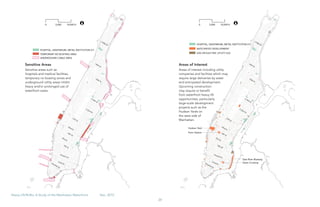
Sensitive Areas
Sensitive areas such as
hospitals and medical facilities,
temporary no boating zones and
underground utility areas inhibit
heavy and/or prolonged use of
waterfront areas.
Areas of Interest
Areas of interest including utility
companies and facilities which may
require large deliveries by water
and anticipated development.
Upcoming construction
may require or benefit
from waterfront heavy lift
opportunities, particularly
large-scale development
projects such as the
Hudson Yards on
the west side of
Manhattan.
29
Team Heavy Lift VI. Potential Sites
RANKING NAME #
1 South St Seaport (Pier 6) 1
1 West 30th St Heliport 26
3 East 34th St Heliport 8
4 E 110th -111th Streets 14
5 Marine Transfer Station @ Gansevoort 29
5 Pier 86 24
5 Pier 97 23
8 Marine Transfer Station @ 59th St 21
8 Pier 42 4
8 W 219th St 18
11 107th Street Fishing Pier 13
11 E 91st - 103rd St 12
11 Pier 76 25
14 Marine Transfer Station @ 135th St 20
15 Marine Transfer Station @ 61 St 9
15 Old ConEd Station @ 74th St 10
Site Ranking and
Coastal Strategic Zones
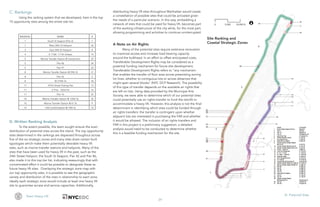
distributing heavy lift sites throughout Manhattan would create
a constellation of possible sites that could be activated given
the needs of a particular scenario. In this way, embedding a
network of sites that could be used for heavy lift, becomes part
of the working infrastructure of the city while, for the most part,
allowing programming and activities to continue uninterrupted.
A Note on Air Rights
Many of the potential sites require extensive renovation
to maximize access and increase load bearing capacity
around the bulkhead. In an effort to offset anticipated costs,
Transferable Development Rights may be considered as a
potential funding mechanism for future site development.
Transferable Development Rights refers to “any mechanism
that enables the transfer of floor area across preexisting zoning
lot lines, whether to contiguous lots or across distances that
might span several blocks” (NYC DCP Research). The possibility
of this type of transfer depends on the available air rights that
are left on lots. Using data provided by the Municipal Arts
Society, we were able to determine which of our potential sites
could potentially use air rights transfer to fund the retrofit to
accommodate a heavy lift. However, this analysis is not the final
determinant in identifying which sites could be funded through
air rights transfers: the transfer is contingent upon whether
adjacent lots are interested in purchasing the FAR and whether
it would be allowed. The inclusion of air rights transfers and
FAR in this project is a preliminary suggestion; a detailed
analysis would need to be conducted to determine whether
this is a feasible funding mechanism for the site.
C. Rankings
Using the ranking system that we developed, here is the top
15 opportunity sites among the entire site list.
D. Written Ranking Analysis
To the extent possible, the team sought ensure the even
distribution of potential sites across the island. The top opportunity
sites determined in the rankings are dispersed throughout across
five of the six strategic zones and many sites share certain built
typologies which make them potentially desirable heavy lift
sites, such as marine transfer stations and heliports. Many of the
sites that have been used for heavy lift in the past, such as the
34th Street Heliport, the South St Seaport, Pier 42 and Pier 86,
also made it to this top tier list, indicating reassuringly that with
concentrated effort it could be possible to designate these as
future heavy lift sites. Overlaying the strategic zone map with
our top opportunity sites, it is possible to see the geographic
variety and distribution of the sites in relationship to each zone.
Ideally each strategic zone would include at least one heavy lift
site to guarantee access and service capacities. Additionally,
30
Heavy Lift/RoRo: A Study of the Manhattan Waterfront	 Dec, 2015
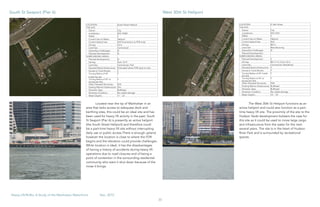
Located near the tip of Manhattan in an
area that lacks access to adequate dock and
berthing sites, this could be an ideal site and has
been used for heavy lift activity in the past. South
St Seaport (Pier 6) is presently an active heliport
(the South Street Heliport) and therefore could
be a part-time heavy lift site without interrupting
daily use or public access.There is enough upland,
however the location is close to where the FDR
begins and the elevation could provide challenges.
While location is ideal, it has the disadvantages
of having a history of accidents during heavy lift
operations due to road closures and of being a
point of contention in the surrounding residential
community who want it shut down because of the
noise it brings.
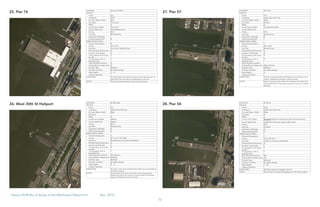
The West 30th St Heliport functions as an
active heliport and could also function as a part-
time heavy lift site. The proximity of the site to the
Hudson Yards development bolsters the case for
this site as it could be used to move large cargo
and infrastructure from the water for the next
several years. The site is in the heart of Hudson
River Park and is surrounded by recreational
spaces.
South St Seaport (Pier 6) West 30th St Heliport
LOCATION South Street Heliport
THE SITE:
Owner: City
Jurisdiction: NYC DSBS
PMAZ: Y
Current Use on Water: Heliport
Current Upland Use: N/A (Connection to FDR only)
Zoning: C4-6
Land Use: Commercial
Subsurface Challenges: N
Planned Development: N
SURROUNDING AREAS:
Planned development: N
Zoning: Park, C6-9
Land Use: Commercial, Park
Elevated Road Infrastructure: N (located where FDR starts to rise)
Access to Truck Routes: Y
Turning Radius of 45’
Inside the site
Y
Turning Radius of 45’ to
Access the Site
Y
Other Elevated Structures: N/A
Existing Marine Infrastructure: Pier
Shoreline Type: Bulkhead
Shoreline Condition: No visible damage
Water Depths: 11' - 33'
LOCATION E 34th Street
THE SITE:
Owner: City
Jurisdiction: NYC EDC
PMAZ: Y
Current Use on Water: Heliport
Current Upland Use: N/A
Zoning: M2-3
Land Use: Manufacturing
Subsurface Challenges: N
Planned Development:
SURROUNDING AREAS:
Planned Development: Y
Zoning: R8, C1-9, C4-6, C6-2
Land Use: Commerical, Residential
Elevated Road Infrastructure: Y
Access to Truck Routes: Y
Turning Radius of 45' Inside
the Site
Y
Turning Radius of 45' to
Access the Site
Y
Other Elevated Structures: FDR
Existing Marine Infrastructure: Bulkhead
Shoreline Type: Bulkhead
Shoreline Condition: No visible damage
Water Depths: 10' - 18'
31
Team Heavy Lift VI. Potential Sites
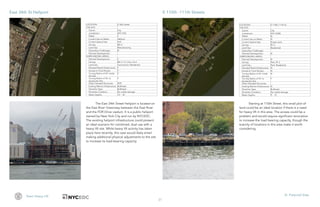
The East 34th Street Heliport is located on
the East River Greenway between the East River
and the FDR Drive viaduct. It is a public heliport
owned by New York City and run by NYCEDC.
The existing heliport infrastructure could present
an ideal scenario for combined, dual use with a
heavy lift site. While heavy lift activity has taken
place here recently, this case would likely entail
making additional physical adjustments to the site
to increase its load-bearing capacity.
Starting at 110th Street, this small plot of
land could be an ideal location if there is a need
for heavy lift in this area. The access could be a
problem and would require significant renovation
to increase the load bearing capacity, though the
scarcity of locations in this area make it worth
considering.
East 34th St Heliport E 110th -111th Streets
LOCATION E 34th Street
THE SITE:
Owner: City
Jurisdiction: NYC EDC
PMAZ: Y
Current Use on Water: Heliport
Current Upland Use: N/A
Zoning: M2-3
Land Use: Manufacturing
Subsurface Challenges: N
Planned Development:
SURROUNDING AREAS:
Planned Development: Y
Zoning: R8, C1-9, C4-6, C6-2
Land Use: Commerical, Residential
Elevated Road Infrastructure: Y
Access to Truck Routes: Y
Turning Radius of 45' Inside
the Site
Y
Turning Radius of 45' to
Access the Site
Y
Other Elevated Structures: FDR
Existing Marine Infrastructure: Bulkhead
Shoreline Type: Bulkhead
Shoreline Condition: No visible damage
Water Depths: 10' - 18'
LOCATION E 110th-111th St
THE SITE:
Owner: City
Jurisdiction: NYC DSBS
PMAZ: N
Current Use on Water: N
Current Upland Use: Empty Land
Zoning: R7-2
Land Use: Residential
Subsurface Challenges:
Planned Development: N
SURROUNDING AREAS:
Planned Development: N
Zoning: Park, R7-2
Land Use: Park, Residential
Elevated Road Infrastructure: N
Access to Truck Routes: N
Turning Radius of 45' Inside
the Site
N
Turning Radius of 45' to
Access the Site
Y
Other Elevated Structures:
Existing Marine Infrastructure: N
Shoreline Type: Bulkhead
Shoreline Condition: No visible damage
Water Depths: 9' - 12'
32
Heavy Lift/RoRo: A Study of the Manhattan Waterfront	 Dec, 2015
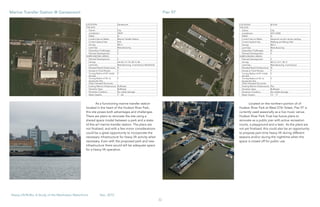
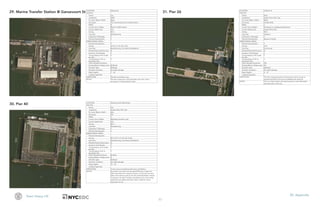
As a functioning marine transfer station
located in the heart of the Hudson River Park,
this site poses both advantages and challenges.
There are plans to renovate the site using a
shared space model between a park and a state-
of-the-art marine transfer station. The plans are
not finalized, and with a few minor considerations
could be a great opportunity to incorporate the
necessary infrastructure for heavy lift activity when
necessary. Even with the proposed park and new
infrastructure there would still be adequate space
for a heavy lift operation.
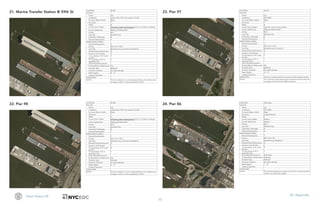
Located on the northern portion of of
Hudson River Park at West 57th Street, Pier 97 is
currently used seasonally as a live music venue.
Hudson River Park Trust has future plans to
renovate as a public pier with active recreation
courts, a playground and a lawn. As the plans are
not yet finalized, this could also be an opportunity
to propose part-time heavy lift during different
seasons and/or during the nighttime when the
space is closed off for public use.
Marine Transfer Station @ Gansevoort Pier 97
LOCATION Gansevoort
THE SITE:
Owner: City
Jurisdiction: DSNY
PMAZ: N
Current Use on Water: Marine Transfer Station
Current Upland Use: N/A
Zoning: M2-3
Land Use: Manufacturing
Subsurface Challenges: Y
Planned Development: Y
SURROUNDING AREAS:
Planned Development: Y
Zoning: C6-2A, C1-7A, M1-5, R6
Land Use: Manufacturing, Commerical, Residential
Elevated Road Infrastructure: N
Access to Truck Routes: Y
Turning Radius of 45' Inside
the Site
Y
Turning Radius of 45' to
Access the Site
Y
Other Elevated Structures:
Existing Marine Infrastructure: Bulkhead
Shoreline Type: Bulkhead
Shoreline Condition: No visible damage
Water Depths: 7' - 26'
LOCATION W 57th
THE SITE:
Owner: City
Jurisdiction: NYC DSBS
PMAZ: N
Current Use on Water: Seasonal concert venue, parking
Current Upland Use: Walking and Biking Path
Zoning: M2-3
Land Use: Manufacturing
Subsurface Challenges: N
Planned Development: Y
SURROUNDING AREAS:
Planned Development: Y
Zoning: M3-2, C4-7, M1-5
Land Use: Manufacturing, Commerical
Elevated Road Infrastructure: N
Access to Truck Routes: Y
Turning Radius of 45' Inside
the Site
Y
Turning Radius of 45' to
Access the Site
Y
Other Elevated Structures:
Existing Marine Infrastructure: Pier
Shoreline Type: Bulkhead
Shoreline Condition: No visible damage
Water Depths: 13' - 17'
33
Team Heavy Lift VI. Potential Sites
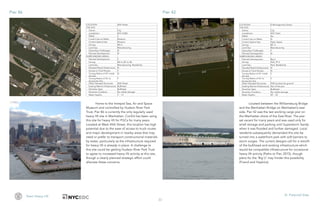
Home to the Intrepid Sea, Air and Space
Museum and controlled by Hudson River Park
Trust, Pier 86 is currently the only regularly used
heavy lift site in Manhattan. ConEd has been using
this site for heavy lift for PGCs for many years.
Located at West 45th Street, this location has high
potential due to the ease of access to truck routes
and major development in nearby areas that may
need or prefer to transport constructional materials
by water, particularly as the infrastructure required
for heavy lift is already in place. A challenge to
this site could be getting Hudson River Park Trust
to agree to increased heavy lift activity at this site,
though a clearly planned strategic effort could
alleviate these concerns.
Located between the Williamsburg Bridge
and the Manhattan Bridge on Manhattan’s east
side, Pier 42 was the last working cargo pier on
the Manhattan shore of the East River. The pier
sat vacant for many years and was used only for
small storage and parking until Superstorm Sandy
when it was flooded and further damaged. Local
residents subsequently demanded this site be
turned into a waterfront park with soft barriers to
storm surges. The current designs call for a retrofit
of the bulkhead and existing infrastructure which
would be compatible infrastructure for occasional
heavy lift activity (Paths to Pier, 2015), though
plans for the ‘Big U’ may hinder this possibility
(Friend and Hopkins).
Pier 86 Pier 42
LOCATION 44th Street
THE SITE:
Owner: City
Jurisdiction: NYC DSBS
PMAZ: Y
Current Use on Water: Museum
Current Upland Use: Museum
Zoning: M2-3
Land Use: Manufacturing
Subsurface Challenges: N
Planned Development: N
SURROUNDING AREAS:
Planned Development: Y
Zoning: M2-4, M1-6, R8
Land Use: Manufacturing, Residential
Elevated Road Infrastructure: N
Access to Truck Routes: Y
Turning Radius of 45' Inside
the Site
N
Turning Radius of 45' to
Access the Site
Y
Other Elevated Structures: 46th Street
Existing Marine Infrastructure: Bulkhead
Shoreline Type: Bulkhead
Shoreline Condition: No visible damage
Water Depths: 7' - 13'
LOCATION E Montogomery Street
THE SITE:
Owner: City
Jurisdiction: NYC Parks
PMAZ: No
Current Use on Water: N
Current Upland Use: Open Space
Zoning: M1-4
Land Use: Manufacturing
Subsurface Challenges: Y
Planned Development: N
SURROUNDING AREAS:
Planned Development: Big U
Zoning: Park, R7-2
Land Use: Park, Residential
Elevated Road Infrastructure: N
Access to Truck Routes: N
Turning Radius of 45' Inside
the Site
Y
Turning Radius of 45' to
Access the Site
Y
Other Elevated Structures: FDR touches the ground
Existing Marine Infrastructure: Part of the pier
Shoreline Type: Bulkhead
Shoreline Condition: No visible damage
Water Depths: 23' - 35'
34
Heavy Lift/RoRo: A Study of the Manhattan Waterfront	 Dec, 2015
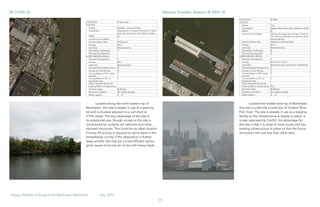
Located along the north eastern tip of
Manhattan, this site is largely in use as a parking
lot and is situated adjacent to a salt shed at
219th street. The key advantage of this site is
its substantial size, though access to this site is
constrained by multiple rail networks and other
elevated structures. This could be an ideal location
if heavy lift activity is required to serve areas in the
immediately vicinity. If the destination is further
away another site may be a more efficient option
given issues of access for trucks with heavy loads.
Located the middle west tip of Manhattan,
this site is under the jurisdiction of Hudson River
Park Trust. The site is already in use as a barging
facility so the infrastructure is largely in place. It
is also operated by ConED. An advantage for
this site is that it is close to truck routes and has
existing infrastructure in place so that the future
renovation will cost less than other sites.
W 219th St Marine Transfer Station @ 59th St
LOCATION 219th street
THE SITE:
Owner: Multiple - City and Other
Jurisdiction: Department of General Services (C), New
York City Transit (C), Time Warner Cable
PMAZ: N
Current Use on Water:
Current Upland Use: Parking Lot
Zoning: M3-1
Land Use: Manufacturing
Subsurface Challenges: Y
Planned Development:
SURROUNDING AREAS:
Planned Development: Y
Zoning: M2-1
Land Use: Manufacturing
Elevated Road Infrastructure: N
Access to Truck Routes: N
Turning Radius of 45' Inside
the Site
Y
Turning Radius of 45' to
Access the Site
Y
Other Elevated Structures:
Existing Marine Infrastructure:
Shoreline Type: Bulkhead
Shoreline Condition: No visible damage
Water Depths: 2' - 21'
LOCATION W 58th
THE SITE:
Owner: City
Jurisdiction: Hudson River Park Trust, Lease to ConED
PMAZ: N
Current Use on Water: Delivery by barge and storage of fuel oil,
Con Edison employee car parking, and a
training facility
Current Upland Use: Walking and Biking Path
Zoning: M2-3
Land Use: Manufacturing
Subsurface Challenges: N
Planned Development: Y
SURROUNDING AREAS:
Planned Development: Y
Zoning: M3-2, C4-7, M1-5
Land Use: Manufacturing, Commerical, Residential
Elevated Road Infrastructure: N
Access to Truck Routes: Y
Turning Radius of 45' Inside
the Site
Y
Turning Radius of 45' to
Access the Site
Y
Other Elevated Structures:
Existing Marine Infrastructure: Pier
Shoreline Type: Bulkhead
Shoreline Condition: No visible damage
Water Depths: 8' - 13'
35
Team Heavy Lift VI. Potential Sites
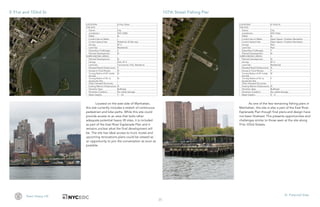
Located on the east side of Manhattan,
this site currently includes a stretch of continuous
pedestrian and bike paths. While this site could
provide access to an area that lacks other
adequate potential heavy lift sites, it is included
as part of the East River Esplanade Plan and it
remains unclear what the final development will
be. The site has ideal access to truck routes and
upcoming renovations plans could be viewed as
an opportunity to join the conversation as soon as
possible.
As one of the few remaining fishing piers in
Manhattan, this site is also a part of the East River
Esplanade Plan though final plans and design have
not been finalized. This presents opportunities and
challenges similar to those seen at the site along
91st-103rd Streets.
E 91st and 103rd St 107th Street Fishing Pier
LOCATION E 107th St
THE SITE:
Owner: City
Jurisdiction: NYC Parks
PMAZ: N
Current Use on Water: Open Space / Outdoor Recreation
Current Upland Use: Open Space / Outdoor Recreation
Zoning: Park
Land Use: Park
Subsurface Challenges: Y
Planned Development: N
SURROUNDING AREAS:
Planned Development: N
Zoning: R7-2
Land Use: Residential
Elevated Road Infrastructure: N
Access to Truck Routes: Y
Turning Radius of 45' Inside
the Site
N
Turning Radius of 45' to
Access the Site
Y
Other Elevated Structures:
Existing Marine Infrastructure: N
Shoreline Type: Bulkhead
Shoreline Condition: No visible damage
Water Depths: 2' - 5'
LOCATION E 91st-103rd
THE SITE:
Owner: City
Jurisdiction: NYC DSBS
PMAZ: N
Current Use on Water: -
Current Upland Use: Pedestrian & bike way
Zoning: R7-2
Land Use: Residential
Subsurface Challenges: Y
Planned Development: N
SURROUNDING AREAS:
Planned Development: N
Zoning: Park, R7-2
Land Use: Commercial, Park, Residence
Elevated Road Infrastructure: Y
Access to Truck Routes: N
Turning Radius of 45' Inside
the Site
N
Turning Radius of 45' to
Access the Site
N
Other Elevated Structures:
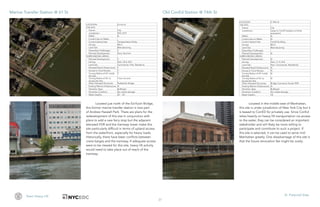
Existing Marine Infrastructure: N
Shoreline Type: Bulkhead
Shoreline Condition: No visible damage
Water Depths: 1' - 16'
36
Heavy Lift/RoRo: A Study of the Manhattan Waterfront	 Dec, 2015
Pier 76 currently functions as a tow
pound and is operated by the New York City
Police Department. There have been talks over
the course of the past several years to move
the tow pound to an alternate location. If this
were to happen, this site could be renovated to
accommodate a heavy lift and also operate as a
park in partnership with Hudson River Park Trust.
The extensive renovation that would be required
of this site would be expensive, though the access
to truck routes and the central location on the
western side of Manhattan may outweigh these
costs, particularly if a revenue-generating strategy
could be determined through the nearby Hudson
Yards project.
While final decisions remain unclear, future
use of the site is on the table for discussion. The
infrastructure was designed for trucks and the site
has good access to the main 125th Street corridor,
through truck access could be problematic given
the rail line and elevated road structures upland
which line the island’s perimeter. Significant
renovations may also be required, though the piles
are in good condition.
Pier 76 Marine Transfer Station @ 135th St
LOCATION Cross at W 34th St
THE SITE:
Owner: City
Jurisdiction: NYPD
PMAZ: N
Current Use on Water: Tow Pound
Current Upland Use: Parking/Staging area
Zoning: M2-3
Land Use: Manufacturing
Subsurface Challenges:
Planned Development: N
SURROUNDING AREAS:
Planned Development: N
Zoning: C6-4, M1-5
Land Use: Commerical, Manufacturing
Elevated Road Infrastructure: N
Access to Truck Routes: N
Turning Radius of 45' Inside
the Site
Y
Turning Radius of 45' to
Access the Site
Y
Other Elevated Structures: N
Existing Marine Infrastructure: N
Shoreline Type: Bulkhead
Shoreline Condition: No visible damage
Water Depths: 7 '- 13'
LOCATION W 135th St
THE SITE:
Owner: City
Jurisdiction: DSNY
PMAZ: Y
Current Use on Water: N/A
Current Upland Use: N/A
Zoning: M1-1
Land Use: Industrial
Subsurface Challenges: Y
Planned Development: N
SURROUNDING AREAS:
Planned Development: N
Zoning: Park, M1-2, C6-2, R8
Land Use: Park, Residential, Commercial
Elevated Road Infrastructure: Y
Access to Truck Routes: Y
Turning Radius of 45' Inside
the Site
N
Turning Radius of 45' to
Access the Site
Y
Other Elevated Structures: West Side Highway, 12th Ave overpass,
AMTRAK
Existing Marine Infrastructure: Small dock leading to facility
Shoreline Type: Bulkhead
Shoreline Condition: No visible damage
Water Depths: 12' - 14'
37
Team Heavy Lift VI. Potential Sites
Located just north of the Ed Koch Bridge,
this former marine transfer station is now part
of Andrew Haswell Park. There are plans for the
redevelopment of this site in conjunction with
plans to add a new ferry stop but the adjacent
elevated FDR and the tramway tower make this
site particularly difficult in terms of upland access
from the waterfront, especially for heavy loads.
Historically, there have been conflicts between
crane barges and the tramway. If adequate access
were to be cleared for this site, heavy lift activity
would need to take place out of reach of the
tramway.
Located in the middle east of Manhattan,
this site is under jurisdiction of New York City but it
is leased to ConED for privately use. Since ConEd
relies heavily on heavy lift transportation via access
to the water, they can be considered an important
stakeholder and will likely be more willing to
participate and contribute to such a project. If
this site is selected, it can be used to serve mid
Manhattan greatly. One disadvantage of this site is
that the future renovation fee might be costly.
Marine Transfer Station @ 61 St Old ConEd Station @ 74th St
LOCATION E 61st St
THE SITE:
Owner: City
Jurisdiction: NYC DOT
PMAZ: N
Current Use on Water:
Current Upland Use: Transportation/Utility
Zoning: M3-2
Land Use: Manufacturing
Subsurface Challenges: Y
Planned Development: Ferry Terminal
SURROUNDING AREAS:
Planned Development: Y
Zoning: Park, C8-4, R10
Land Use: Commercial, Park, Residence
Elevated Road Infrastructure: Y
Access to Truck Routes: Y
Turning Radius of 45' Inside
the Site
Y
Turning Radius of 45' to
Access the Site
Y but not sure
Other Elevated Structures: Pedestrian Bridge
Existing Marine Infrastructure: N
Shoreline Type: Bulkhead
Shoreline Condition: No visible damage
Water Depths: 25' - 30'
LOCATION E 74th St
THE SITE:
Owner: City
Jurisdiction: Lease to ConED (subject to futher
evaluation)
PMAZ: N
Current Use on Water: N
Current Upland Use: ConEd Building
Zoning: M3-2
Land Use: Manufacturing
Subsurface Challenges:
Planned Development: N
SURROUNDING AREAS:
Planned Development: N
Zoning: Park, C1-9, R10
Land Use: Park, Commercial, Residential
Elevated Road Infrastructure: N
Access to Truck Routes: N
Turning Radius of 45' Inside
the Site
N
Turning Radius of 45' to
Access the Site
N
Other Elevated Structures: Bridge Connector Across FDR
Existing Marine Infrastructure: N
Shoreline Type: Bulkhead
Shoreline Condition: No visible damage
Water Depths: 18'
38
Heavy Lift/RoRo: A Study of the Manhattan Waterfront	 Dec, 2015
%)
3
1
2
4
5
6
7
8
9
10
12
15
20
11
13
14
16
17
18
19
24
22
21
23
26
27
28
29
30
31
25
TopRanked(16)
PoorlyRanked(15)
5,0002,50010,000ft0
ChamberSt
CanalSt
HoustonSt
14thSt
23rdSt
34thSt
42ndSt
57thSt
E72ndSt
E96thSt
125thSt
145thSt
178thSt
RnakedSites
39
VII. Design Typologies
40
Heavy Lift/RoRo: A Study of the Manhattan Waterfront	 Dec, 2015
Locations of Scenario Sites
VII. Design Typologies
The design phase took on a scenario-based approach. This
allowed the team to draw on some of the recurring challenges and
factors presented in prior stages. This way of working towards a set
of typologies rather than a site-specific approach was determined
to be the most strategic option, emphasizing redundancy as a tool
and enabling transferability to other boroughs or cities.
SCENARIO 1 : Marine Transfer Station
SCENARIO 2 : Heliport
SCENARIO 3 : Site currently in use/possibility for congruent use
SCENARIO 4 : Vacant or not in use
SCENARIO 5 : Limited access
Assumptions:
Due to the varied types of heavy lift activity, the team made
a select number of assumptions which remain consistent across
each design scenario:
•	 Heavy lift operations are not occurring full-time but part-
time, and take place between 10pm and 5:30am.
•	 Heavy lift operations take place at slack tide.
•	 Concerns about dredging have already been addressed.
•	 Each site is adequately strengthened for heavy loads.
•	 The barge shown in the drawings is one of the largest
crane barges used in Manhattan for such operations
(Weeks 533). It is 300 feet long and 90 feet wide with
a depth of hull of 20 feet. Though this barge is used
infrequently and smaller barges can be used for heavy
lift operations, for design purposes the largest possible
barge is showcased to show how much maximum space
and maximum arm reach it will require.
41
Team Heavy Lift VII. Design Typologies
Marine Transfer Station @ 135th St
East 34th St Heliport
SCENARIO 1 : Marine Transfer Station
Strategy: Renovation of existing infrastructure
Example: Marine Transfer Station @ 135th St
This Marine Transfer Station (MTS) is located on the west
side of Manhattan on the Hudson River. This site is under the
jurisdiction of the New York City Department of Sanitation and is
currently not in use. The proposal for this site is to strengthen the
tipping floor of the current structure to carry the loads of trucks,
trailers and equipment that comes on a barge. A crane way that
can carry adequate load would be a new addition to the structure.
This crane will serve the smaller barges that would be docked
inside the Marine Transfer Station as well as a large barge that
would be docked along the facade of the structure.
The key advantage of this scenario is that the foundational
infrastructure of the marine transfer station serves as a valuable
foundation for the design and structure of a heavy life site.
Another advantage is that the retrofit does not compromise an
infrastructure currently committed to public use (though with
nearby restaurants and an active community board in this part of
Manhattan, pushback and questioning to such a project should
be anticipated), making it potentially less controversial than some
of the other sites. The key advantage of this specific site is that it
would service Zone 4 on the northern side of the island, an area
currently underserved in terms of industrial waterfront access. The
main limitation of this site is that it has inadequate access to the
existing transportation network. Once trucks are loaded onto the
site, they have to pass beneath the elevated West Side Highway
and then turn right onto 12th Avenue to get on the designated
truck route. Additionally, the turning radius of the ramp to the site
is constricted.
SCENARIO 2 : Heliport
Strategy: Shared commercial use
Example: East 34th St Heliport
The East 34th Street Heliport is located near the FDR
Drive viaduct. This public heliport run by Economic Development
Corporation can be combined with a heavy lift scenario to provide
an ideal dual use site. The majority of the time this site could still
function as is, however if heavy lift activity is needed it would be
well equipped to transform into a temporary heavy lift site. This
would entail making sure no helicopters land during heavy lift
activity, removing the the stacked parking structure and making
additional physical adjustments to the site to increase the load
bearing capacity.
This scenario presents a strong case for dual use of a site
which would both realize the full potential of the site and allow it
to serve a higher functional use for the surrounding community
and the City overall. This scenario would require little or no
renovation in order to be operational. The location of this site
would address the underserved needs of Zone 2 on the east side.
Heavy lift activity has occurred here recently to move construction
materials to the construction site near NYU Medical center. The
major limitation of the site is that the elevated FDR runs parallel
to the shoreline, though the 12’5” access would allow the majority
of vehicles to pass through, and its location on the 34th Street
corridor is ideal for east-west access.
42
Heavy Lift/RoRo: A Study of the Manhattan Waterfront	 Dec, 2015
18'< deep
135th St Marine Transfer Station
135th St
136th St12th Ave
Riverside Dr
Henry Hudson Pkwy / 9A
59,000 sqft (1.4 ac)
180'
210'
260'
Site
50 100 200 ft0
SCENARIO 1 – Existing Condition
Marine Transfer Station @ 135th St
43
Team Heavy Lift VII. Design Typologies
Barge
Heavy Lift Site
Barge
Crane way
Crane way
12th Ave
50 100 200 ft0
SCENARIO 1 – Proposed Condition
Marine Transfer Station @ 135th St
44
Heavy Lift/RoRo: A Study of the Manhattan Waterfront	 Dec, 2015
34th St33rd St
1st Ave
18'< deep
East River Esplanade
34th Heliport
FDR
Truck Route
Site
Main Bike/Pedestrian Way
280'
160'
110'
39,000 sqft (0.9 ac)
50 100 200 ft0
SCENARIO 2 – Existing Condition
East 34th St Heliport
45
Team Heavy Lift VII. Design Typologies
Heavy Lift Site
Barge
R100'
R200'
Parking
34th St
1st Ave
50 100 200 ft0
SCENARIO 2 – Proposed Condition
East 34th St Heliport
46
Heavy Lift/RoRo: A Study of the Manhattan Waterfront	 Dec, 2015
Pier 76
SCENARIO 3 : Currently in use, with possibility for
congruent use
Strategy: Develop multifunctional space
Example: Pier 76
Pier 76 is currently in use as a tow pound and is operated by
the New York City Police Department. A new building is proposed
to replace the existing tow pound, which currently spans the
entirety of the pier. The new structure has a smaller footprint and
is given an additional height to accommodate for this reduction in
available space. The northeast portion of the site will remain open
and will be where heavy lift operations take place. Over 50% of the
site will be converted into public space with recreational and sports
amenities to include a climbing wall, workout area and playground,
perch area, and more. The rooftop of the new building will also
be accessible to the public via a pedestrian ramp and will be in
use as an urban farm maintained by the community and ideally,
in partnership with Hudson River Park Trust. Access to the West
Side Highway is good from this site, making it easily accessible for
trucks and trailers.
The key successes of this typology are that the addition of
heavy lift functionality does not compromise the existing on-site
operation (aside from a reduction in tow pound space, which is
assumed as sites are being scouted for its relocation), and that
this can be achieved while also creating a new recreational space
with public waterfront access—which will occupy over 50% of
the site. (For context, this also preemptively fulfills conditions set
for the future of this site at the moment; namely, that if the city
is able to find an appropriate relocation site for the tow pound,
that at least 50% of the pier will be dedicated to park use (Pier
76, 2015).) The location of the site on the west side of the island
is also ideal given the volume of built development anticipated
in coming years at and around Hudson Yards. This option would
require an extensive overhaul including building demolition and
new construction, landscape design and additional permitting. This
unique context presents an opportunity to serve as a new model.
This could be a very dynamic site used to move large equipment
and cargo for the Hudson Yards project and other developments
in the area in the coming ten years or so. Considered from this
perspective, a strategy for this site could potentially transcend the
vision for the tow pound and use a revenue-generating framework
by bringing other players and interested stakeholders into the
conversation. The potential demand of this project in the way of
movement of construction materials could manifest in a solid pitch
to Hudson Yards—as well as to Hudson River Park Trust, a nonprofit
organization which would benefit greatly from added revenue.
SCENARIO 4 : Vacant or not in use
Strategy: Multipurpose park with deployable heavy lift
infrastructure
Example: Pier 97
Pier 97 is owned by the City of New York and is under the
jurisdiction of the New York City Department of Small Business
Services. It was reconstructed a few years ago and is currently
a seasonal venue for live music events. Hudson River Park Trust
plans to rebuild it as a public pier with active recreation courts, a
playground and a lawn. The Trust is also considering using this pier
as a berth for historic ships, and the heavy lift site can be used for
this purpose as well. (Pier 97, Hudson River Park 2015).
	 The North side of the pier is deep enough for the
heavy lift operations as Pier 98 which is a ConEd property (and
located to the north of this site) is currently accessed by large
barges. Heavy lift barges would use this side of Pier 97 for heavy
lift operations. As this pier is part of the Hudson River Park, the
design proposal is to allocate half of the pier as a park. The
space between the park and roads needs to be cleared to secure
enough area for heavy lift operations. When the operations are not
occurring, this part would be part of the park.
	 The chief advantage of this scenario is that it can
serve as a shared space with public access for the majority of the
time while also meeting the needs of heavy lift, part-time and
during the night. This is both the preferred scenario and the most
vital to consider as we look to the future of the waterfront: a heavy
lift activity zone that does not compromise pedestrian access
and is open to the public while its functionality is embedded in
the physical structure of the site. In this typology, park furniture
that is movable or easily deployable creates a flexible landscape
that at the same time becomes a foundational part of the City’s
infrastructure.
It also has direct access to 57th Street and 12th Avenue
which are designated truck routes and key street corridors. There
is a buffer between car lanes, which needs to be opened up for
making direct connection for trucks to 57th Street.
The site itself has some limitations. Hudson River Park Trust
has announced general upcoming plans for the site to include
integration of the pier with Clinton Cove (Pier 97, Hudson River
Park 2015). As with other sites in Hudson River Park, it connects to
47
Team Heavy Lift VII. Design Typologies
Pier 97 Former Marine Transfer Station @ 61st St
the Hudson River Greenway, which accommodates heavy flows of
pedestrians and cyclists every day and should not be frequently
disrupted. The new residential development currently under
construction across the highway could be an opponent for heavy
lift operations.
SCENARIO 5 : Limited access
Strategy: Strengthening of existing and addition of new
infrastructure
Example: Former Marine Transfer Station @ 61st St
This site is under the jurisdiction of New York City
Department of Transportation and is currently being renovated to
include benches, a seating area, improvements to the pavilion as
well as reconstruction of the piles supporting the park (Zimmer,
2012). The area in front of the Andrew Haswell Green Dog Park is
planned to be a launch site for ferries as part of the City’s Citywide
Ferry Service proposal (Citywide Ferry 2015). The proposal for
the structure to facilitate the Ferry service is a gangway landing
leading to a barge where the ferries will be docked. Any structure
on the land to support the ferry service can be combined with
the structure that might be required for a temporary heavy lift
operation.
For accessibility to this site, the John Finley Walk needs
to be adequately strengthened to support any heavy load. The
Roosevelt Island Tramway tower spans over the John Finley Walk
and the lower beams of the tower cuts off the necessary vertical
clearance over the Walk. Hence, this beam has to be removed in
order to gain the required vertical clearance and accordingly, the
tower has to be strengthened. The nearest truck routes to the site
is E 60th Street, E 59th Street and 1st Avenue.
Because of the anticipated Citywide Ferry Service facility in
this site, investing in the strengthening of infrastructure will be an
advantage to this site. On the other hand, the various elevations
of road infrastructure near the site as well as a restricted turning
radius hinders truck accessibility to the site. This site would have
to be used for operations involving specific sized loads rather than
the usual heavy lift loads.
48
Heavy Lift/RoRo: A Study of the Manhattan Waterfront	 Dec, 2015
Pier 76 / Tow Pound
Pier 78
Pier 79
18'< deep
12th Ave / 9A
Hudson River Greenway
Truck Route
Site
Main Bike/Pedestrian Way
300'
610'
170'
610'
290,000 sqft (6.7 ac)
50 100 200 ft0
SCENARIO 3 – Existing Condition
Pier 76
49
Team Heavy Lift VII. Design Typologies
Heavy Lift Site
Barge
Park
Tow Pound w/Recreational Roof
12th Ave / 9A
R100'
R200'
Temporary Heavy Lift Site
50 100 200 ft0
SCENARIO 3 – Proposed Condition
Pier 76
50
Heavy Lift/RoRo: A Study of the Manhattan Waterfront	 Dec, 2015
57th St
Pier 97
21' deep
Pier 98
Pier 99
Pier 96
Clinton Cove
Joe DiMaggio Highway
12th Ave / 9A
Hudson River Greenway
110'
670'
93,000 sqft (2.1 ac)
Truck Route
Site
Main Bike/Pedestrian Way
50 100 200 ft0
SCENARIO 3 – Existing Condition
Pier 97
51
Team Heavy Lift VII. Design Typologies
Barge R100'Park
open up the buffer
Temporary Heavy Lift Site Heavy Lift Site
57th St
Joe DiMaggio Highway
12th Ave / 9A
50 100 200 ft0
SCENARIO 3 – Proposed Condition
Pier 97
52
Heavy Lift/RoRo: A Study of the Manhattan Waterfront	 Dec, 2015
FDR
Andrew Haswell Park
John Finley Walk
Sculpture/Former MTS
Ed Koch Queensboro Bridge
60th St
61st St
Twenty-Four Sycamores Park
York Ave
62nd St
Truck Route
Site
Main Bike/Pedestrian Way
25' deep
50 100 200 ft0
SCENARIO 3 – Existing Condition
Former Marine Transfer Station @ 61st St
53
Team Heavy Lift VII. Design Typologies
Temporary Heavy Lift Site
strengthen the tramway tower
Park
Citywide Ferry Facility
strengthen the Walk
Barge
FDR
60th St
61st St
York Ave
62nd St
R100'
50 100 200 ft0
SCENARIO 3 – Proposed Condition
Former Marine Transfer Station @ 61st St
55
VIII. Limitations
56
Heavy Lift/RoRo: A Study of the Manhattan Waterfront	 Dec, 2015
VIII. Limitations
It should be noted that this is a preliminary study of the
Manhattan waterfront and there are limitations that should be duly
considered before moving the project forward at a professional
level. One major limitation is related to data: both the lack of
publicly available data and the need to have the most current data
through fieldwork and site assessments on a recurring basis. As
stated above, certain factors were considered but could not be
thoroughly assessed. These include:
•	 Load bearing capacities (upland and maritime infrastructure
such as piers)
•	 Federal Navigation Channel routes and perimeter
•	 Vertical clearances of elevated structures
•	 Bulkhead and shoreline condition
•	 Ownership and jurisdiction of waterfront sites (several
directories are publicly available, but do not match up to
one another)
•	 Comprehensive knowledge of upcoming built development
Another limitation is the engineering and logistical expertise
required to conduct such a project in necessary detail. ConEd
conducts geometric surveys for each substation route—sometimes
just days before a lift operation is set to take place— which is
then packaged and sent to DOT for review by engineers. Such
surveys account for street measurements, turning radius, impact
of existing and new streetscape infrastructure, assessment of
ground conditions and so on. Thorough site analysis needs to
be conducted in detail and on a regular basis, a crucial element
beyond the scope of this project. Lack of consultation with DOT
and the Army Corps of Engineers is another limitation in this
regard.
	 Given that the nature of the cargo and equipment
to be moved has not yet been determined, where necessary
barge sizes, types and load weights were assumed by the group
according to standards drawn from previous research.
	 The implications of these limitations, such as the
inability to comprehensively determine technical aspects of truck
access from the site, build a cost analysis, and so on, are reflected
in the ranking process and results presented above and should
be considered in a professional capacity when the project moves
forward.
57
IX. Key Findings and Conclusions
58
Heavy Lift/RoRo: A Study of the Manhattan Waterfront	 Dec, 2015
IX. Key Findings and Conclusions
1.	 Manhattan is a unique situation and every site along the
waterfront has challenges. The scarcity of available land
and a growing desire for waterfront residential and park
space are compounded by a dense network of elevated
road structures and other waterfront activities which do not
rely on waterfront access and complicate the possibility for
commercial use.
2.	 The challenges presented by a lack of upland connections
and adequate upland conditions for truck delivery (such
as vertical obstructions, inadequate vertical clearance, and
insufficient turning radius) are more severe and far less
flexible than challenges faced during the phase of moving
the load from water to an upland staging area.
3.	 Permanent physical obstructions on land pose a more
prohibitive challenge (particularly in emergency scenarios)
than systematic political difficulties to do with jurisdiction
and permitting. Heavy lift activity can occur in spite of
bureaucratic setbacks if the need is great enough—this is
not the case with complicated physical infrastructure that
cannot be easily moved. According to ConED, the most
severe upland challenges for moving trucks are often due to
small scale, permanent (not movable) street improvement
infrastructure such as medians, bump outs, and separated
bike lanes.
4.	 Piers are not required for heavy lift operations, and in
some cases may even inhibit possibilities for such activity.
Identifying upland staging areas that fulfill the appropriate
criteria is a preferred siting strategy and should consider
factors of load-bearing capacity, water frontage, size and
crane arm reach.
5.	 The prospect of a shared park and heavy lift site would be
an excellent opportunity that could be beneficial to both the
park operators and the stakeholder companies with heavy
lift needs. Heavy lifts happen infrequently and at night
and would be conducted carefully so as to have minimal
interference with park activity. As more and more waterfront
park space is planned throughout the island, there is a need
to open up the conversation for water-dependent needs in
this capacity (ConEd Interview, 2015).
6.	 A points-based ranking system is a necessary first step for
determining viable heavy lift sites, but such an analysis can
not be conclusive. There is a need for a more extensive
environmental assessment and feasibility analysis to
determine the prospective needs and impact of each site.
7.	 All waterfront development should consider issues of
sea level rise and flooding. There is a particular need for
industrial waterfront projects to address this concern as
rising tides may have direct infrastructural and operational
implications. While these are not issues that this project
addresses specifically, the incorporation of heavy lift sites
into the city’s existing infrastructure is also essential as such
sites may serve the dual function of assisting in the event
of an emergency. Building in emergency infrastructure and
capability—whether the installation of a floodwall, or ability
to transport humans if necessary—must be accommodated
when installing heavy lift sites.
The criteria and recommendations produced in this report
are meant as a launching point for further investigation of this
issue. The desire to create open park space on the waterfront is
a wonderful plan to promote health, equity and social awareness.
However, the need to maintain and expand the working waterfront
of Manhattan is only going to become a more pressing issue
as concerns about development and resiliency increase. These
concerns can and should be viewed in tandem with one another—
as opportunities to work towards a more integrated infrastructure
as opposed to concepts which work against each other.
59
X. Recommended Next Steps
60
Heavy Lift/RoRo: A Study of the Manhattan Waterfront	 Dec, 2015
X. Recommended Next Steps:
Based on the key findings and conclusions, the team
recommends the following next steps:
1.	 Invite representatives from stakeholder groups across
different city agencies, public private organizations,
marine operators, building contractors, property owners
and regulators, U.S Army Corps, and other engineers
to set up a working group/steering committee to set a
formal agenda for facilitating the discourse and action
on heavy lift activity in Manhattan. This working group
should:
2.	 Perform a detailed needs assessment to identify key
stakeholders and to more empirically determine the
demand for heavy lift and whether there is a need for
regular, full-time operation or just part-time use.
3.	 Review relevant work to date on heavy lift and RoRo
operations in Manhattan, including materials and studies
affiliated with EDC, Weeks Marine, ConED, and more.
4.	 Using the findings presented above, work with
appropriate experts to determine final site selection
criteria.
i) Work with necessary experts to conduct detailed
surveys and site analysis to develop an exhaustive
assessment of each site.
II) Develop a new scoring system to develop a shortlist
of sites.
5.	 Conduct a detailed cost analysis based on the renovation
to existing piers, bulkheads or existing structures, new
construction and/or demolition required on site.
6.	 Conduct an in-depth traffic study of the potential for
congestion reduction in Manhattan and the surrounding
boroughs if increases in maritime activity are to
incorporate heavy lift operations which are able to take
trucks off the streets. Such a study will corroborate the
need for heavy lift sites and help to set up a platform for
a more formal dialogue for such a need in New York City.
7.	 Conduct an extensive review of historical resources and
landmarks with restrictions; this should include historic
forts, bulkheads and other objects that will prevent the
development process.
8.	 Establish partnerships with community organizations like
Hudson River Park Trust, East River Park and community
boards in order to start a dialogue with residents and
community members on the need to maintain a working
waterfront for heavy lift operations and more specifically
on how such operations doesn’t have to be disruptive to
the community.
9.	 Explore potential funding mechanisms for heavy lift
infrastructure and revenue-generating strategies such
as transferable air rights, potential alternative uses of
the heavy lift site such as event space, a floating market,
a concert venue, an amusement park, etc. which may
incentivize collaboration and partnerships across sectors.
10.	Launch a call for ideas for innovative park technologies
and designs to support a simultaneous park and heavy
lift scenario. As almost the entire waterfront along the
island is being converted for public access currently,
there are more prospects for a simultaneous park-heavy
lift site.
61
XI. References
XI. References
“Pier 76 | Hudson River Park.” Hudson River Park. N.p., 2015. Web.
21 Dec. 2015.
Barge Weight Capacities Chart.” Heartland Barge, n.d. Web.
11 Nov. 2015. <http://www.heartlandbarge.com/barge-weight-
capacities-chart/?doing_wp_cron=1447949313.815859079360961
9140625>
Brass, Elaine. “Olympics move waste by water” 30 June 2009.
<http://www.greenwisebusiness.co.uk/news/olympics-move-waste-
by-water-538.aspx#.VmiVZYSNSDJ>
NYCEDC. “Citywide Ferry Service” 01 Dec 2015 <http://www.
nycedc.com/project/citywide-ferry-service>
Cornell Tech. Task force Meeting Summary. Roosevelt Island
Campus Project. Cornell University, 02 Mar. 2015. Web. 10 Dec.
2015.
Doswell, John. “Maritime Definitions by Capt Doswell” 2003.
Accessed 16 Sep 2015. <http://workingharbor.com/pdf%20files/
New%20York%20Boats%20and%20Ships%20-%20Glossary.pdf>
FEMA. “Region II Coastal Analysis and Mapping: Glossary.
10 Nov 2015 <http://www.region2coastal.com/resources/
glossary/#TOC-Z>
Friend, Douglas and Hopkins, Margaret. Personal Interview. 12
November 2015.
Hudson Services “J Supor & Son Trucking & Rigging Provides
Catastrophic Recovery For Miracle On The Hudson Plane” 10 Dec
2010. Accessed 16 Sep 2015. <http://www.jsupor.com/miracle-
onthe-hudson.aspx>
Marchioni, Jason. Weeks Marine Interview. Weeks Marine
Headquarters. 29 Oct 2015.
Marchioni, Jason. “The Importance of Maintaining Access Berths
Within Long Island, Manhattan and Its Surrounding Boroughs.”
Thesis. California Maritime Academy, 2015.
The City of New York. One New York: The Plan for a Strong and
Just City. New York, NY: City of New York, Mayor’s Office of Long-
Term Planning and Sustainability, 2015.
Paths to Pier. “The Future of Pier 42.” 10 Dec 2015 <http://
pathstopier42.com/future-of-pier-42/>
Second Avenue Subway SDEIS Coastal Zone Consistency report,
M1-M24. Excerpt. n.d.
Quigley, Nathan.“Thames takes strain from London
streets.”Network Rail Media. 28 April 2010. <https://www.pla.
co.uk/Thames-takes-strain-from-London-streets>
Ward, Justin. Corps awards $92 million in task orders for Hurricane
Sandy debris removal in NY. 15 Nov 2012.
<http://www.nad.usace.army.mil/Media/NewsReleases/tabid/4870/
Article/483834/corps-awards-92-million-in-task-orders-for-
hurricane-sandy-debris-removal-in-ny.aspx>
“Who Oversaw the Ground Zero Cleanup Operation.”
<Http://911research.wtc7.net/wtc/groundzero/players.html>. 9/11
Research, Web.
Zimmer, Amy. “15M Fix Needed to Keep Andrew H. Green Park
From Falling into East River.” DNAinfo 29 June 2012: n.
2012 Waterfront Revitalization Program FAQ. 2012 <http://www.
nyc.gov/html/dcp/html/wrp/wrp_faq.shtml>
ConEd Interview. Con Ed Service Center. 3 Dec 2015.
“A Survey of Transferable Development Rights Mechanisms in New
York City” <http://www.nyc.gov/html/dcp/pdf/tdr/research.pdf>.
NYC DCP Research, 26 Feb 2015
Pier 97, Hudson River Park
<https://www.hudsonriverpark.org/explore-the-park/locations/pier-
97>
63
Team Heavy Lift XI. References
65
XII. Appendix
66
Heavy Lift/RoRo: A Study of the Manhattan Waterfront	 Dec, 2015
   
CLIENT: NEW YORK CITY ECONOMIC DEVELOPMENT CORPORATION (EDC) 
New York City Economic Development Corporation (NYCEDC) is a not­for­profit corporation tasked with 
leveraging the City of New York’s assets to fuel economic development, create and promote quality jobs, 
and cultivate resilient communities and improve quality of life across the City’s five boroughs. As the City’s 
primary engine for economic growth, NYCEDC is committed to stimulating inclusive growth and 
implementing public policy initiatives in New York City’s neighborhoods as well as along its waterfront, 
driving plans and policy for NYC’s marine, aviation and rail freight terminals and guiding waterfront strategy, 
planning and permitting.  
CONSULTANT: CORNELL GRADUATE TEAM 
The team consists of five graduate students enrolled in the Master of Regional Planning and/or Master of 
Landscape Architecture program at Cornell University and participating in the 2015 AAP NYC fall semester. 
These include: 
❖ Yiren Bai | Master of Regional Planning | ​yb237@cornell.edu 
❖ Geslin George | Master of Regional Planning | ​grg65@cornell.edu 
❖ Zeynep Goksel | Dual Master of Regional Planning and Master of Landscape Architecture | 
ag2252@cornell.edu 
❖ Zoe Siegel | Master of Regional Planning | ​zhs6@cornell.edu 
❖ Ryosuke Takahashi | Master of Landscape Architecture | ​rt368@cornell.edu 
Faculty Advisor: Robert Balder | Executive Director of Cornell AAP NYC | ​rwb43@cornell.edu  
 
THE ISSUE 
New York City faces major issues such as 
bridge, road and tunnel congestion, growing 
environmental risks, and increasing demands 
on available real estate. With more waterfront 
than Los Angeles, San Francisco and 
Chicago combined, it is imperative that the 
city reassess its relationship to the waterfront 
in order to address these issues and to 
ensure the optimal use of this rich natural 
and communal resource. The working 
waterfront is shrinking, yet there is an 
increasing demand for waterfront parcels that 
can accommodate large infrastructure 
projects and aid in the event of a disaster.  
  
             Map 01. Delineation of study boundary (Manhattan) 
1 
THE GOAL 
In Manhattan, there are currently heavy lift sites on the East Side at Pier 36 and 42, and on the West Side 
through Hudson River Park, but these are not enough to to serve the entire island similarly. The goal of this 
project is to survey, collect and analyze data for sites along Manhattan’s waterfront and identify the most 
suitable sites for providing heavy lift access to all of Manhattan in the event of an emergency or large 
construction project and offer designs for varied uses of this type. 
 
 
SCOPE OF SERVICES 
PHASE I: DISCOVERY + RESEARCH 
Task 1.1: Workplan/Proposal  
● Review assignment and background materials and provide to NYCEDC an updated scope of 
services proposal 
Deliverable: Scope of services and workplan 
Anticipated date of completion: Friday, September 18th, 2015 
 
Task 1.2: Data Collection 
● Collect GIS data, nautical charts, land use maps 
● Conduct boat tour of the Manhattan waterfront to identify potential sites 
● Gather metrics on lot sizes, load capacity, intermodal containers and truck trailer sizes, water 
depths, air drafts of roadways and bridges 
● Gather data on existing facilities such as marine transfer stations and determine whether they can 
be repurposed 
● Gather maps and information on current truck routes in NYC 
● Map land use and ownership along Manhattan’s waterfront 
● Review WRP regulatory framework and policies 
Deliverable: Write­up of preliminary findings, maps 
Anticipated date of completion: Thursday, September 24th, 2015 
 
Task 1.3: Heavy Lift Facilities Research: Local + Global 
● Research on prior or existing day­to­day operations and emergencies such as Post 9/11 debris, 
Hurricane Sandy, the Miracle on the Hudson, human evacuation and construction equipment 
● Identify the limitations of the existing Manhattan lift sites at Piers 36 & 42 and Hudson River Park 
Deliverable: Summary of findings and analysis on ​heavy lift facilities in NYC​ and precedent facilities in 
other domestic and international contexts 
Anticipated date of completion: Thursday, September 24th, 2015 
 
 
PHASE II: SPATIAL ANALYSIS + SITE SELECTION 
Task 2.1: Continued interview process 
Interview the following individuals:  
Background + General 
● Brian Craine, ​NYCEDC Asset Management 
● Jason Marchioni, Weeks Marine   
● Michael Loughran, Related 
Regulatory 
● Scott Shostak, ​NYCEDC Counsel  
● Trevor Johnson, NYC Waterfront Revitalization Program (within DCP)   
● Meenakshi Varandani, Department of Small Business Services 
2 
XII. Appendices
Appendix A. Scope of Work
67
Team Heavy Lift XII. Appendix
● Emil Lissauer, NYC Office of Citywide Event Coordination & Management  
● Office of Emergency Management 
Physical Infrastructure  
● Army Corp of Engineers 
● Malcolm Mclaren, Mclaren Engineering 
● Jonathan Goldstick, ​Halcrow 
● Don Jon Marine Co. (tentative) 
Deliverable:  Summary and analysis of interviews 
Anticipated date of completion: Thursday, October 22, 2015 
 
Task 2.2: Breakdown of service areas  
● Map anticipated built development in New York City 
● Determine factors for viable service areas across Manhattan 
● Identify locations/zones that can (and cannot or should not) function as service areas  
● Determine specific needs and limitations of each identified service area 
● Conduct bike tour of the Manhattan waterfront to identify potential sites (Tentative Date: October 
15) 
  Deliverable: ​Map delineating service areas 
Anticipated date of completion: Thursday, October 22, 2015 
[Feedback period: October 22 ­ 28] 
 
Task 2.3: Development of site selection criteria 
● Conduct second boat tour of Manhattan waterfront (date TBD) 
Deliverable:  Written analysis and maps  
Anticipated date of completion: Monday, November 2, 2015 
[Feedback period: November 2 ­ 6] 
 
Task 2.4: Identification of potential project sites 
● Identify all potential sites 
● Determine and rank sites based upon feasibility 
Deliverable: Visual and written description and analysis of each potential site 
Anticipated date of completion: Thursday, November 12, 2015 
[Feedback period: November 12 ­ 19] 
 
PHASE III: DESIGN INTERVENTIONS + RECOMMENDATIONS 
Task 3.1: ​Produce preliminary site specific design interventions for full time and part time sites that are 
selected through the site identification process. 
  ​Deliverable: Drawing, classification and description of each design intervention 
Anticipated date of completion: Thursday, December 3, 2015 
[Feedback period: December 3 ­ 8] 
 
Final Deliverable: ​Graphics and maps of selected locations in the form of a Presentation and 
report to be delivered to ​NYCEDC, ​Office of Emergency Management, Department of City 
Planning and the Mayor’s Office of Recovery and Resiliency. 
Anticipated date of completion: December 2015, date TBD 
 
3 
68
Heavy Lift/RoRo: A Study of the Manhattan Waterfront	 Dec, 2015
Appendix B. Terminology
1.	 Barge - A non-powered vessel with a flat bottom, typically
used for transport or a work platform, moved by a tugboat.
2.	 Bathymetric Survey: The measurement of water depths,
usually with sufficient detail to map the underwater terrain
contours.
3.	 Berth: The water area along the edge of a wharf or pier for
vessel mooring.
4.	 Bulkhead: A structure or partition built to retain or prevent
sliding of the land (FEMA, 2015).
5.	 Datum:
6.	 Diurnal Tide: A tide with one high and one low water in a
day.
7.	 Draft: Maximum depth of a vessel’s hull below the waterline.
8.	 Dredge - A barge with a crane, suction device or other
mechanism to lift mud off the bottom for the purpose of
increasing the water depth to allow passage of deeper draft
vessels (Doswell, 2012).
9.	 Fender: A device placed between a dock structure and a
vessel, used to absorb berthing impact energy and provide
a wearing surface for the vessel while moored to the
structure.
10.	Gangway: A sloping ramp to provide access from a dock
structure to a vessel or floating dock from the shore.
11.	Higher High Water (HHW): The higher of two high tides in
any given tidal day.
12.	Mean High Water (MHW): The mean of all high water levels
(two per day for diurnal tides), observed over a 19 year tidal
epoch (Metonic cycle).
13.	Mean Higher Water (MHHW): The mean of the highest daily
high water levels (one per day), observed over a 19 year
tidal epoch (Metonic cycle).
14.	Mean Low Water (MLW): The mean of all low water levels
(two per day for diurnal tides), observed over a 19 year tidal
epoch (Metonic cycle).
15.	Mean Lower Low Water (MLLW): The mean of lowest low
water levels (one per day), over a 19 year tidal epoch
(Metonic cycle).
16.	PGC: This refers to power generation components used by
utility companies.
17.	Pier: A deck supported on piles, extending into the water,
more or less perpendicular from the shoreline.
18.	Pile: A pole, typically of timber, reinforced plastic, steel or
concrete, driven or otherwise set into the soil or rock to
resist applied vertical and/or horizontal loads.
19.	Riprap: Slope erosion protection formed from stone or
concrete rubble, typically dumped and graded over the
surface of a prepared shoreline slope.
20.	Self propelled modular transporter: A platform vehicle with
multiple axle lines are used for transporting massive objects
such as large bridge sections,[1]oil refining equipment,
motors and other objects that are too big or heavy for
trucks.
21.	Slack Water: The state of a tidal current when its speed is
near zero, as when reversing direction
Data Source: Waterfront Terminology, Tighe & Bond
(from http://www.tighebond.com/includes/upload/assets/
waterfront%20terminology.pdf)
69
Team Heavy Lift XII. Appendix
Appendix C. Site Profiles for Preliminary Sites
(next page)
70
Heavy Lift/RoRo: A Study of the Manhattan Waterfront	 Dec, 2015
2. Pier 9
3. Pier 15
4. Pier 42
1. South Street Heliport (Pier 6) LOCATION South Street Heliport
THE SITE:
Owner: City
Jurisdiction: NYC DSBS
On Land, Water or Both: Water
Structures: Building/Facility
PMAZ: Y
Current Use on Water: Heliport
Current Upland Use: N/A (Connection to FDR only)
Zoning: C4-6
Land Use: Commercial
Subsurface Challenges: N
Planned Development: N
SURROUNDING AREAS:
Planned development: N
Zoning: Park, C6-9
Land Use: Commercial, Park
Elevated Road Infrastructure: N (located where FDR starts to rise)
Access to Truck Routes: Y
Turning Radius of 45’
Inside the site
Y
Turning Radius of 45’ toAccess the Site Y
Other Elevated Structures: N/A
Existing Marine Infrastructure: Pier
Shoreline Type: Bulkhead
Shoreline Condition: No visible damage
Water Depths: 11' - 33'
Loading Capacities:
LIMITATIONS: The site is currently active as a commercial and private heliport.
While location is ideal, it has the disadvantages of having a history
of accidents during heavy lift operations due to road closures
and of being a point of contention in the surrounding residential
community who want it shut down because of the noise it brings.
NOTES: Its position near where the elevated FDR starts is ideal and
offers alternatives for transport direction up the east and west
sides of the island as well as into the Lower Manhattan network,
if necessary. Its water frontage and distance from surrounding
waterfront and upland uses also makes it ideal for marine
equpiment set up.
LOCATION E Fletcher St
THE SITE:
Owner: City
Jurisdiction: NYC DSBS
On Land, Water or Both: Water
Structures: 2 storeyed observation deck, landscaped area and seats
PMAZ: Yes
Current use on water: Part of the East River Esplanade
Current upland use: East River Parkway
Zoning: C4-6
Land Use: Commercial
Subsurface challenges: N
Planned Development: N
SURROUNDING AREAS:
Planned development: Big U
Zoning: C4-6, C6-9
Land Use: Commerical
Elevated Road Infrastructure: Y
Access to truck routes: Y
Turning Radius of 45' Inside
the Site
N
Turning Radius of 45' to
Access the Site
Y
Other Elevated Structures:
Existing Marine Infrastructure: Pier
Shoreline Type: Bulkhead
Shoreline Condition: No visible damage
Water Depths: 26'
Loading Capacities:
LIMITATIONS: The site is run by Hudson River Park and is currently in use for
recreational purposes
NOTES: Its position near where the elevated FDR starts is ideal and
offers alternatives for transport direction up the east and west
sides of the island as well as into the Lower Manhattan network,
if necessary. Its water frontage and distance from surrounding
waterfront and upland uses also makes it ideal for marine
equpiment set up.
LOCATION Old Slip
THE SITE:
Owner: City
Jurisdiction: NYC EDC
On Land, Water or Both: Water
Structures: N
PMAZ: N
Current Use on Water: DOES NOT EXIST
Current Upland Use:
Zoning: C4-6
Land Use:
Subsurface Challenges:
Planned Development: N
SURROUNDING AREAS:
Planned development: Y
Zoning: Park, C6-9
Land Use:
Elevated Road Infrastructure: Y
Access to Truck Routes:
Turning Radius of 45' Inside
the site
N/A
Turning radius of 45' to
access the site
N/A
Other Elevated Structures:
Existing Marine Infrastructure: N
Shoreline Type: Bulkhead
Shoreline Condition: No visible damage
Water Depths: 16' - 21'
Loading Capacities:
LIMITATIONS: The site is relatively small, faces the elevated FDR and does not
have main road access.
NOTES: Its position near where the elevated FDR starts is ideal and
offers alternatives for transport direction up the east and west
sides of the island as well as into the Lower Manhattan network,
if necessary. Its water frontage and distance from surrounding
waterfront and upland uses also makes it ideal for marine
equpiment set up.
LOCATION E Montogomery Street
THE SITE:
Owner: City
Jurisdiction: NYC Parks
On Land, Water or Both: Both
Structures: Facility/ Shed
PMAZ: No
Current Use on Water: N
Current Upland Use: Open Space
Zoning: M1-4
Land Use: Manufacturing
Subsurface Challenges: Y
Planned Development: N
SURROUNDING AREAS:
Planned Development: Big U
Zoning: Park, R7-2
Land Use: Park, Residential
Elevated Road Infrastructure: N
Access to Truck Routes: N
Turning Radius of 45' Inside
the Site
Y
Turning Radius of 45' to
Access the Site
Y
Other Elevated Structures: FDR touches the ground
Existing Marine Infrastructure: Part of the pier
Shoreline Type: Bulkhead
Shoreline Condition: No visible damage
Water Depths: 23' - 35'
Loading Capacities:
LIMITATIONS: The site is partially in use as a park.
NOTES: The site currently lies within an industrial facility. This reduces the
operations exposure to traffic and pedestrians. It is owned by the
City of New York and managed and operated by NYCDOT, which
is more experienced with City's infrastructural needs
71
Team Heavy Lift XII. Appendix
6. ConEd Plant @ 14th St 8. East 34th St Heliport
5. East River Park 7. Stuyvesant CoveLOCATION E Houston Street
THE SITE:
Owner: City
Jurisdiction: NYC Parks
On Land, Water or Both: Land
Structures: Esplanade structures- lighting, benches,amphitheater,playgrounds etc
PMAZ: No
Current Use on Water: N
Current Upland Use: Open Space / Outdoor Recreation
Zoning: Park
Land Use: Park
Subsurface Challenges: N
Planned Development: N
SURROUNDING AREAS:
Planned Development: Big U
Zoning: R7-2, M3-2
Land Use: Residential, Manufacturing
Elevated Road Infrastructure: N
Access to Truck Routes: N
Turning Radius of 45' Inside
the Site
Y
Turning Radius of 45' to
Access the Site
Y
Other Elevated Structures:
Existing Marine Infrastructure: N
Shoreline Type: Bulkhead
Shoreline Condition: No visible damage
Water Depths: 12' - 30'
Loading Capacities:
LIMITATIONS: This large site is currently heavily in use and programmed for
recreational purposes.
NOTES: Large open space is available, and this may be an ideal site to
consider for emergency or disaster recovery purposes.
LOCATION E 23rd St
THE SITE:
Owner: City
Jurisdiction: NYC DSBS
On Land, Water or Both: Both
Structures: Ferry Building
PMAZ: N
Current Use on Water: Parking and Ferry
Current Upland Use: Gas Station
Zoning: M1-1
Land Use: Manufacturing
Subsurface Challenges:
Planned Development: N
SURROUNDING AREAS:
Planned Development: Y
Zoning: Park, C2-7, R8
Land Use: Park, Commercial, Residential
Elevated Road Infrastructure: Y
Access to Truck Routes: N
Turning Radius of 45' Inside
the Site
Y
Turning Radius of 45' to
Access the Site
Y
Other Elevated Structures:
Existing Marine Infrastructure: N
Shoreline Type: Bulkhead
Shoreline Condition: No visible damage
Water Depths: 5' - 11'
Loading Capacities:
LIMITATIONS: This site is close to elevated structures and has environmental
concerns which would pose significant additional challenges to
the process.
NOTES: The site is close to Stuyvesant Town so that it is likley that
neighbors would like it to be turned into something else and
even if they do not, they might oppose the site development.
LOCATION E 34th Street
THE SITE:
Owner: City
Jurisdiction: NYC EDC
On Land, Water or Both: Water
Structures: NO
PMAZ: Y
Current Use on Water: Heliport
Current Upland Use: N/A
Zoning: M2-3
Land Use: Manufacturing
Subsurface Challenges: N
Planned Development:
SURROUNDING AREAS:
Planned Development: Y
Zoning: R8, C1-9, C4-6, C6-2
Land Use: Commerical, Residential
Elevated Road Infrastructure: Y
Access to Truck Routes: Y
Turning Radius of 45' Inside
the Site
Y
Turning Radius of 45' to
Access the Site
Y
Other Elevated Structures: FDR
Existing Marine Infrastructure: Bulkhead
Shoreline Type: Bulkhead
Shoreline Condition: No visible damage
Water Depths: 10' - 18'
Loading Capacities:
LIMITATIONS: The community is opposed to the existing heliport use and may
be sensitive to additional industrial use.
NOTES: The site could potentially serve as a shared space model with
existing heliport.
LOCATION E 14th St
THE SITE:
Owner: ConEd
Jurisdiction: ConEd
On Land, Water or Both: Land
Structures: Buildings, Storage?
PMAZ: N
Current Use on Water: PGC delivery
Current Upland Use: Transportation/Utility
Zoning: M3-2
Land Use: Manufacturing
Subsurface Challenges:
Planned Development: N
SURROUNDING AREAS:
Planned Development: Y
Zoning: Park, R7-2
Land Use: Park, Residential
Elevated Road Infrastructure: N
Access to Truck Routes: Y
Turning Radius of 45' Inside
the Site
N
Turning Radius of 45' to
Access the Site
N
Other Elevated Structures:
Existing Marine Infrastructure: Power plant related infrastructure
Shoreline Type: Bulkhead
Shoreline Condition: No visible damage
Water Depths: 28' - 29'
Loading Capacities:
LIMITATIONS: The site is in use which may conflict with heavy lift operations.
NOTES: Its position near where the elevated FDR starts is ideal and
offers alternatives for transport direction up the east and west
sides of the island as well as into the Lower Manhattan network,
if necessary. Its water frontage and distance from surrounding
waterfront and upland uses also makes it ideal for marine
equpiment set up.
72
Heavy Lift/RoRo: A Study of the Manhattan Waterfront	 Dec, 2015
10. Former ConEd Plant @ 74th St
11. Marine Transfer Station @ 91st St9. Former Marine Transfer Station @ 61st St
12. E 91st - 103rd St
LOCATION E 61st St
THE SITE:
Owner: City
Jurisdiction: NYC DOT
On Land, Water or Both: Land
Structures: Building
PMAZ: N
Current Use on Water:
Current Upland Use: Transportation/Utility
Zoning: M3-2
Land Use: Manufacturing
Subsurface Challenges: Y
Planned Development: Ferry Terminal
SURROUNDING AREAS:
Planned Development: Y
Zoning: Park, C8-4, R10
Land Use: Commercial, Park, Residence
Elevated Road Infrastructure: Y
Access to Truck Routes: Y
Turning Radius of 45' Inside
the Site
Y
Turning Radius of 45' to
Access the Site
Y but not sure
Other Elevated Structures: Pedestrian Bridge
Existing Marine Infrastructure: N
Shoreline Type: Bulkhead
Shoreline Condition: No visible damage
Water Depths: 25' - 30'
Loading Capacities:
LIMITATIONS: Tidal currents are very fast, and the water area is in a cable area.
This site is included in the East River Esplanade Plan though it
remains unclear what the final development will be.
NOTES: Cable Area
LOCATION E 91st Street
THE SITE:
Owner: City
Jurisdiction: DSNY
On Land, Water or Both: Water
Structures: Defunct marine transfer station
PMAZ: N
Current Use on Water: N/A
Current Upland Use: N/A
Zoning: M1-4
Land Use: Industrial
Subsurface Challenges: Y
Planned Development: Marine Transfer Station
SURROUNDING AREAS:
Planned Development: Y
Zoning: Park, C2-5, R8-B
Land Use: Residential, Industrial, Park
Elevated Road Infrastructure: N
Access to Truck Routes: Y
Turning Radius of 45' Inside
the Site
N
Turning Radius of 45' to
Access the Site
N
Other Elevated Structures: Bridge connector across FDR
Existing Marine Infrastructure: Old marine transfer station infrastructure, nearby E 90th St FerryDock
Shoreline Type: Bulkhead
Shoreline Condition: No visible damage
Water Depths: 17' - 28'
Loading Capacities:
LIMITATIONS: This is already a highly controversial site for the residential
community, and the site is going to be renovated and funcitoning
as a marine transfer station in the coming years. Construction is
planned to be completed by 2017.
NOTES: Its position near where the elevated FDR starts is ideal and
offers alternatives for transport direction up the east and west
sides of the island as well as into the Lower Manhattan network,
if necessary. Its water frontage and distance from surrounding
waterfront and upland uses also makes it ideal for marine
equpiment set up.
LOCATION E 91st-103rd
THE SITE:
Owner: City
Jurisdiction: NYC DSBS
On Land, Water or Both: Land
Structures: -
PMAZ: N
Current Use on Water: -
Current Upland Use: Pedestrian & bike way
Zoning: R7-2
Land Use: Residential
Subsurface Challenges: Y
Planned Development: N
SURROUNDING AREAS:
Planned Development: N
Zoning: Park, R7-2
Land Use: Commercial, Park, Residence
Elevated Road Infrastructure: Y
Access to Truck Routes: N
Turning Radius of 45' Inside
the Site
N
Turning Radius of 45' to
Access the Site
N
Other Elevated Structures:
Existing Marine Infrastructure: N
Shoreline Type: Bulkhead
Shoreline Condition: No visible damage
Water Depths: 1' - 16'
Loading Capacities:
LIMITATIONS: Water depth is shallow, and the water area is in a cable area. This
site is included in the East River Esplanade Plan though it remains
unclear what the final development will be.
NOTES: Cable Area
LOCATION E 74th St
THE SITE:
Owner: City
Jurisdiction: Lease to ConED (subject to futher evaluation)
On Land, Water or Both: Land
Structures: Building
PMAZ: N
Current Use on Water: N
Current Upland Use: ConEd Building
Zoning: M3-2
Land Use: Manufacturing
Subsurface Challenges:
Planned Development: N
SURROUNDING AREAS:
Planned Development: N
Zoning: Park, C1-9, R10
Land Use: Park, Commercial, Residential
Elevated Road Infrastructure: N
Access to Truck Routes: N
Turning Radius of 45' Inside
the Site
N
Turning Radius of 45' to
Access the Site
N
Other Elevated Structures: Bridge Connector Across FDR
Existing Marine Infrastructure: N
Shoreline Type: Bulkhead
Shoreline Condition: No visible damage
Water Depths: 18'
Loading Capacities:
LIMITATIONS: The site is currently occupied by ConEd, and it is unclear whether
there would be a conflict of uses. In addition, the cost of future
renovation is huge.
NOTES: Since ConEd relies heavily on heavy lift transportation via access
to the water, they can be considered an important stakeholder
and will likely be more willing to participate and contribute to
such a project.
73
Team Heavy Lift XII. Appendix
14. E 110-111th St
15. E 128th - 132nd St13. 107th St Fishing Pier
16. Sherman Creek
LOCATION E 107th St
THE SITE:
Owner: City
Jurisdiction: NYC Parks
On Land, Water or Both: Both
Structures: Shed
PMAZ: N
Current Use on Water: Open Space / Outdoor Recreation
Current Upland Use: Open Space / Outdoor Recreation
Zoning: Park
Land Use: Park
Subsurface Challenges: Y
Planned Development: N
SURROUNDING AREAS:
Planned Development: N
Zoning: R7-2
Land Use: Residential
Elevated Road Infrastructure: N
Access to Truck Routes: Y
Turning Radius of 45' Inside
the Site
N
Turning Radius of 45' to
Access the Site
Y
Other Elevated Structures:
Existing Marine Infrastructure: N
Shoreline Type: Bulkhead
Shoreline Condition: No visible damage
Water Depths: 2' - 5'
Loading Capacities:
LIMITATIONS: Currently this site serves as a public accessible recreation area.
The water area is in a cable and pipeline area.This site is included
in the East River Esplanade Plan though it remains unclear what
the final development will be.
NOTES: Cable and Pipeline Areahttp://ny.curbed.com/
archives/2015/02/06/the_east_side_waterfronts_radical_green_
makeover_revealed.php
LOCATION E 110th-111th St
THE SITE:
Owner: City
Jurisdiction: NYC DSBS
On Land, Water or Both: Water
Structures: Empty Land
PMAZ: N
Current Use on Water: N
Current Upland Use: Empty Land
Zoning: R7-2
Land Use: Residential
Subsurface Challenges:
Planned Development: N
SURROUNDING AREAS:
Planned Development: N
Zoning: Park, R7-2
Land Use: Park, Residential
Elevated Road Infrastructure: N
Access to Truck Routes: N
Turning Radius of 45' Inside
the Site
N
Turning Radius of 45' to
Access the Site
Y
Other Elevated Structures:
Existing Marine Infrastructure: N
Shoreline Type: Bulkhead
Shoreline Condition: No visible damage
Water Depths: 9' - 12'
Loading Capacities:
LIMITATIONS: The size of the site is relatively small so there may be concerns
about whether the working space is adequate.
NOTES: Its position near where the elevated FDR starts is ideal and
offers alternatives for transport direction up the east and west
sides of the island as well as into the Lower Manhattan network,
if necessary. Its water frontage and distance from surrounding
waterfront and upland uses also makes it ideal for marine
equpiment set up.
LOCATION E 132nd St
THE SITE:
Owner: City
Jurisdiction: NYC DOT
On Land, Water or Both: Land
Structures: Parking Space and Several Buildings
PMAZ: N
Current Use on Water: N
Current Upland Use: Parking/Staging area
Zoning: M2-2
Land Use: Manufacturing
Subsurface Challenges:
Planned Development: Conversion to park
SURROUNDING AREAS:
Planned Development: Bridges
Zoning: Park
Land Use: Park
Elevated Road Infrastructure: N
Access to Truck Routes: N
Turning Radius of 45' Inside
the Site
Y
Turning Radius of 45' to
Access the Site
Y
Other Elevated Structures: RFK bridge; Willis Bridge; 3rd Ave Bridge
Existing Marine Infrastructure: N
Shoreline Type: Bulkhead
Shoreline Condition: No visible damage
Water Depths: 9' - 12'
Loading Capacities:
LIMITATIONS: While current DOT use of this site as a staging ground for bridge
construction is ideal, future plans as a park restrain the possibility
for a long term heavy lift site.
NOTES: The site has potential to be a precedent for combined uses of
heavy lift and park/public access areas.
LOCATION W 204th Street
THE SITE:
Owner: City
Jurisdiction: NYC Parks
On Land, Water or Both: Both
Structures: No
PMAZ: No
Current Use on Water: Open space/ recreation
Current Upland Use: Open Space / Outdoor Recreation
Zoning: Park
Land Use: Park
Subsurface Challenges: Y
Planned Development: Sherman Creek waterfront esplanade
SURROUNDING AREAS:
Planned Development:
Zoning: C3, M3-1
Land Use: Commercial, Manufacturing
Elevated Road Infrastructure: N
Access to Truck Routes: N
Turning Radius of 45' Inside
the Site
N
Turning Radius of 45' to
Access the Site
Y
Other Elevated Structures: Pedestrian Bridge
Existing Marine Infrastructure: N
Shoreline Type: Riprap
Shoreline Condition: No visible damage
Water Depths: 2'- 18'
Loading Capacities:
LIMITATIONS: The site has extremely shallow waters and a ConED facility
immediately adjacent. Plans are underway for an extension of the
esplanade here as well.
NOTES: Its position near where the elevated FDR starts is ideal and
offers alternatives for transport direction up the east and west
sides of the island as well as into the Lower Manhattan network,
if necessary. Its water frontage and distance from surrounding
waterfront and upland uses also makes it ideal for marine
equpiment set up.
74
Heavy Lift/RoRo: A Study of the Manhattan Waterfront	 Dec, 2015
18. W 219th St
17. MTA Yard @ 207th St 19. Inwood Park @ Dyckman St
20. Marine Transfer Station @ 135th St
LOCATION W 207th Street
THE SITE:
Owner: City
Jurisdiction: MTA New York City Transit Authority
On Land, Water or Both: Land
Structures: Shed/ Shop
PMAZ: No
Current Use on Water: N
Current Upland Use: Maintenance facility/ Overhaul shop
Zoning: M1-1
Land Use: Manufacturing
Subsurface Challenges: Y
Planned Development: Conversion to tech/industrial hub
SURROUNDING AREAS:
Planned Development:
Zoning: C8-3, M3-1
Land Use: Commercial, Manufacturing
Elevated Road Infrastructure: Y
Access to Truck Routes: Y
Turning Radius of 45' Inside
the Site
Y
Turning Radius of 45' to
Access the Site
Y
Other Elevated Structures: Elevated Subway Line
Existing Marine Infrastructure: N
Shoreline Type: Bulkhead
Shoreline Condition: No visible damage
Water Depths: 8' -15'
Loading Capacities:
LIMITATIONS: The site is currently in use for industrial purposes and has plans to
be converted.
NOTES: Its position near where the elevated FDR starts is ideal and
offers alternatives for transport direction up the east and west
sides of the island as well as into the Lower Manhattan network,
if necessary. Its water frontage and distance from surrounding
waterfront and upland uses also makes it ideal for marine
equpiment set up.
LOCATION Inwood Park @ Dyckman Street
THE SITE:
Owner: City
Jurisdiction: NYC Parks and Trustees of Columbia University (Partial)
On Land, Water or Both: Water
Structures: NO
PMAZ: N
Current Use on Water: Pier & Restaurant
Current Upland Use: N/A
Zoning: Park
Land Use: Park
Subsurface Challenges: N
Planned Development: N
SURROUNDING AREAS:
Planned Development: Y
Zoning: R7-2
Land Use: Park, Residential
Elevated Road Infrastructure: Y
Access to Truck Routes: N
Turning Radius of 45' Inside
the Site
N
Turning Radius of 45' to
Access the Site
N
Other Elevated Structures: Train overpass
Existing Marine Infrastructure: Small Dock
Shoreline Type: Riprap
Shoreline Condition: No visible damage
Water Depths: 10' - 24'
Loading Capacities:
LIMITATIONS: This site would be difficult for a variety of reasons but if there is a
need for a site in this area this is one of the only options.
NOTES: While conditions are not ideal, this is one of the only sites on this
northern part of the island.
LOCATION 219th street
THE SITE:
Owner: Multiple - City and Other
Jurisdiction: Department of General Services (C), New York City Transit (C),Time Warner Cable
On Land, Water or Both: Land
Structures: Y
PMAZ: N
Current Use on Water:
Current Upland Use: Parking Lot
Zoning: M3-1
Land Use: Manufacturing
Subsurface Challenges: Y
Planned Development:
SURROUNDING AREAS:
Planned Development: Y
Zoning: M2-1
Land Use: Manufacturing
Elevated Road Infrastructure: N
Access to Truck Routes: N
Turning Radius of 45' Inside
the Site
Y
Turning Radius of 45' to
Access the Site
Y
Other Elevated Structures:
Existing Marine Infrastructure:
Shoreline Type: Bulkhead
Shoreline Condition: No visible damage
Water Depths: 2' - 21'
Loading Capacities:
LIMITATIONS: Access could be a problem with elevated structures and lack of
truck routes.
NOTES: The use of space on site is currently low and majority parking.
LOCATION W 135th St
THE SITE:
Owner: City
Jurisdiction: DSNY
On Land, Water or Both: Water
Structures: Defunct marine transfer station
PMAZ: Y
Current Use on Water: N/A
Current Upland Use: N/A
Zoning: M1-1
Land Use: Industrial
Subsurface Challenges: Y
Planned Development: N
SURROUNDING AREAS:
Planned Development: N
Zoning: Park, M1-2, C6-2, R8
Land Use: Park, Residential, Commercial
Elevated Road Infrastructure: Y
Access to Truck Routes: Y
Turning Radius of 45' Inside
the Site
N
Turning Radius of 45' to
Access the Site
Y
Other Elevated Structures: West Side Highway, 12th Ave overpass, AMTRAK
Existing Marine Infrastructure: Small dock leading to facility
Shoreline Type: Bulkhead
Shoreline Condition: No visible damage
Water Depths: 12' - 14'
Loading Capacities:
LIMITATIONS: While final decisions remain unclear, the site is being discussed as
being planned for development.
NOTES: The infrastructure was designed for trucks and the site has good
access to the 125th St corridor. Piles are in good shape.
75
Team Heavy Lift XII. Appendix
24. Pier 8622. Pier 98
21. Marine Transfer Station @ 59th St 23. Pier 97
LOCATION W 58th
THE SITE:
Owner: City
Jurisdiction: Hudson River Park Trust, Lease to ConED
On Land, Water or Both: Water
Structures: Y
PMAZ: N
Current Use on Water: Delivery by barge and storage of fuel oil, Con Edison employeecar parking, and a training facility
Current Upland Use: Walking and Biking Path
Zoning: M2-3
Land Use: Manufacturing
Subsurface Challenges: N
Planned Development: Y
SURROUNDING AREAS:
Planned Development: Y
Zoning: M3-2, C4-7, M1-5
Land Use: Manufacturing, Commerical, Residential
Elevated Road Infrastructure: N
Access to Truck Routes: Y
Turning Radius of 45' Inside
the Site
N
Turning Radius of 45' to
Access the Site
Y
Other Elevated Structures:
Existing Marine Infrastructure: Pier
Shoreline Type: Bulkhead
Shoreline Condition: No visible damage
Water Depths: 8' - 13'
Loading Capacities:
LIMITATIONS:
NOTES: The site is already in use as a barging facility so the infrastructure
is largely in place. It is also operated by ConED.
LOCATION W 58th
THE SITE:
Owner: City
Jurisdiction: Hudson River Park Trust, Lease to ConED
On Land, Water or Both: Water
Structures: Y
PMAZ: N
Current Use on Water: Delivery by barge and storage of fuel oil, Con Edison employeecar parking, and a training facility
Current Upland Use: Walking and Biking Path
Zoning: M2-3
Land Use: Manufacturing
Subsurface Challenges: N
Planned Development: Y
SURROUNDING AREAS:
Planned Development: Y
Zoning: M3-2, C4-7, M1-5
Land Use: Manufacturing, Commerical, Residential
Elevated Road Infrastructure: N
Access to Truck Routes: Y
Turning Radius of 45' Inside
the Site
Y
Turning Radius of 45' to
Access the Site
Y
Other Elevated Structures:
Existing Marine Infrastructure: Pier
Shoreline Type: Bulkhead
Shoreline Condition: No visible damage
Water Depths: 8' - 13'
Loading Capacities:
LIMITATIONS:
NOTES: The site is already in use as a barging facility so the infrastructure
is largely in place. It is also operated by ConED.
LOCATION 44th Street
THE SITE:
Owner: City
Jurisdiction: NYC DSBS
On Land, Water or Both: Water
Structures: Intrepid Museum
PMAZ: Y
Current Use on Water: Museum
Current Upland Use: Museum
Zoning: M2-3
Land Use: Manufacturing
Subsurface Challenges: N
Planned Development: N
SURROUNDING AREAS:
Planned Development: Y
Zoning: M2-4, M1-6, R8
Land Use: Manufacturing, Residential
Elevated Road Infrastructure: N
Access to Truck Routes: Y
Turning Radius of 45' Inside
the Site
N
Turning Radius of 45' to
Access the Site
Y
Other Elevated Structures: 46th Street
Existing Marine Infrastructure: Bulkhead
Shoreline Type: Bulkhead
Shoreline Condition: No visible damage
Water Depths: 7' - 13'
Loading Capacities:
LIMITATIONS:
NOTES: The site has already been used for heavy liftt in the past therefore
infrastrucure exists there already.
LOCATION W 57th
THE SITE:
Owner: City
Jurisdiction: NYC DSBS
On Land, Water or Both: Water
Structures: Y
PMAZ: N
Current Use on Water: Seasonal concert venue, parking
Current Upland Use: Walking and Biking Path
Zoning: M2-3
Land Use: Manufacturing
Subsurface Challenges: N
Planned Development: Y
SURROUNDING AREAS:
Planned Development: Y
Zoning: M3-2, C4-7, M1-5
Land Use: Manufacturing, Commerical
Elevated Road Infrastructure: N
Access to Truck Routes: Y
Turning Radius of 45' Inside
the Site
Y
Turning Radius of 45' to
Access the Site
Y
Other Elevated Structures:
Existing Marine Infrastructure: Pier
Shoreline Type: Bulkhead
Shoreline Condition: No visible damage
Water Depths: 13' - 17'
Loading Capacities:
LIMITATIONS: The site is currently used for concerts and other seasonal events.
NOTES: This could be an ideal opportunity to propose part-time heavy lift
or strategic heavy lift during different seasons.
76
Heavy Lift/RoRo: A Study of the Manhattan Waterfront	 Dec, 2015
28. Pier 5426. West 30th St Heliport
27. Pier 57
LOCATION W 30th Street
THE SITE:
Owner: City
Jurisdiction: Hudson River Park Trust
On Land, Water or Both: Water
Structures:
PMAZ: N
Current Use on Water: Heliport
Current Upland Use: Heliport
Zoning: M2-3
Land Use: Manufacturing
Subsurface Challenges: N
Planned Development: N
SURROUNDING AREAS:
Planned Development: Y
Zoning: M1-5, C6-3, C6-4, R8A
Land Use: Manufacturing, Commerical, Residential
Elevated Road Infrastructure: N
Access to Truck Routes: Y
Turning Radius of 45' Inside
the Site
N
Turning Radius of 45' to
Access the Site
Y
Other Elevated Structures: The High Line
Existing Marine Infrastructure: Bulkhead
Shoreline Type: Bulkhead
Shoreline Condition: No visible damage
Water Depths: 8' - 21'
Loading Capacities:
LIMITATIONS: The site is in the heart of Hudson River Park and is surrounded by
recreational spaces.
NOTES: The proximity of the site to the Hudson Yards development
bolsters the case for this site as it could be used to move large
cargo and infrastructure from the water.
LOCATION W 13th St
THE SITE:
Owner: State
Jurisdiction: Hudson River Park Trust
On Land, Water or Both: Water
Structures: N
PMAZ: N
Current Use on Water: Part of Chelsea Piers (Chelsea Piers Sports & EntertainmentComplex)
Current Upland Use: Hudson River Park event space, public access
Zoning: M2-3
Land Use: Industrial
Subsurface Challenges: N
Planned Development: N
SURROUNDING AREAS:
Planned Development: Y
Zoning: C6-2A, R6, M1-5
Land Use: Industrial, Commercial, Residential
Elevated Road Infrastructure: N
Access to Truck Routes: Y
Turning Radius of 45' Inside
the Site
Y
Turning Radius of 45' to
Access the Site
Y
Other Elevated Structures: N/A
Existing Marine Infrastructure: Pier
Shoreline Type: Bulkhead
Shoreline Condition: No visible damage
Water Depths: 7' - 38'
Loading Capacities:
LIMITATIONS: Will likely need to be dredged, high line
NOTES: Road access to the west side highway and 14th Street is good.
LOCATION W 15th St
THE SITE:
Owner: City
Jurisdiction: Hudson River Park Trust
On Land, Water or Both: Water
Structures: Building
PMAZ: N
Current Use on Water: Transportation/Utility
Current Upland Use:
Zoning: M1-5
Land Use: Manufacturing
Subsurface Challenges: N
Planned Development: Y
SURROUNDING AREAS:
Planned Development: Y
Zoning: M2-3, C6-4
Land Use: Manufacturing
Elevated Road Infrastructure: N
Access to Truck Routes: N
Turning Radius of 45' Inside
the Site
N
Turning Radius of 45' to
Access the Site
N
Other Elevated Structures:
Existing Marine Infrastructure: Marine Aviation
Shoreline Type: Bulkhead
Shoreline Condition: No visible damage
Water Depths: 8'
Loading Capacities:
LIMITATIONS: The site is being planned for development of innovative hub of
cultural, recreational and public market activities.
NOTES: Hard to convince Hudson River Park Trusthttp://ny.curbed.com/
archives/2015/09/11/new_plans_revealed_for_pier_57s_rooftop_
park.php
25. Pier 76 LOCATION Cross at W 34th St
THE SITE:
Owner: City
Jurisdiction: NYPD
On Land, Water or Both: Both
Structures: Tow Pound
PMAZ: N
Current Use on Water: Tow Pound
Current Upland Use: Parking/Staging area
Zoning: M2-3
Land Use: Manufacturing
Subsurface Challenges:
Planned Development: N
SURROUNDING AREAS:
Planned Development: N
Zoning: C6-4, M1-5
Land Use: Commerical, Manufacturing
Elevated Road Infrastructure: N
Access to Truck Routes: N
Turning Radius of 45' Inside
the Site
Y
Turning Radius of 45' to
Access the Site
Y
Other Elevated Structures: N
Existing Marine Infrastructure: N
Shoreline Type: Bulkhead
Shoreline Condition: No visible damage
Water Depths: 7 '- 13'
Loading Capacities:
LIMITATIONS: The city already has requirements about future development. At
least 50% of pier will need to be dedicated to park use.
NOTES: The site has good waterfront access and land access.
77
Team Heavy Lift XII. Appendix
29. Marine Transfer Station @ Gansevoort St
30. Pier 40
31. Pier 26
LOCATION Houston St and West Street
THE SITE:
Owner: City
Jurisdiction: Hudson River Park Trust
On Land, Water or Both: Both
Structures: YES
PMAZ: Y
Current Use on Water: Waterside recreation area
Current Upland Use: N/A
Zoning: M2-3
Land Use: Manufacturing
Subsurface Challenges: Y
Planned Development: Y
SURROUNDING AREAS:
Planned Development:
Zoning: M2-4, M1-6, C1-6A, R6, C2-6A
Land Use: Manufacturing, Commerical, Residential
Elevated Road Infrastructure: N
Access to Truck Routes: Y
Turning Radius of 45' Inside
the Site
Y
Turning Radius of 45' to
Access the Site
Y
Other Elevated Structures: Building
Existing Marine Infrastructure: N
Shoreline Type: Bulkhead
Shoreline Condition: No visible damage
Water Depths: 10' - 22'
Loading Capacities:
LIMITATIONS: Current use as recreational park area is prohibitive.
NOTES: Its position near where the elevated FDR starts is ideal and
offers alternatives for transport direction up the east and west
sides of the island as well as into the Lower Manhattan network,
if necessary. Its water frontage and distance from surrounding
waterfront and upland uses also makes it ideal for marine
equpiment set up.
LOCATION Gansevoort
THE SITE:
Owner: City
Jurisdiction: DSNY
On Land, Water or Both: Water
Structures: YES, functioning marine transfer station
PMAZ: N
Current Use on Water: Marine Transfer Station
Current Upland Use: N/A
Zoning: M2-3
Land Use: Manufacturing
Subsurface Challenges: Y
Planned Development: Y
SURROUNDING AREAS:
Planned Development: Y
Zoning: C6-2A, C1-7A, M1-5, R6
Land Use: Manufacturing, Commerical, Residential
Elevated Road Infrastructure: N
Access to Truck Routes: Y
Turning Radius of 45' Inside
the Site
Y
Turning Radius of 45' to
Access the Site
Y
Other Elevated Structures:
Existing Marine Infrastructure: Bulkhead
Shoreline Type: Bulkhead
Shoreline Condition: No visible damage
Water Depths: 7' - 26'
Loading Capacities:
LIMITATIONS: The site is currently in use.
NOTES: The site is large and could potentially work with current
occupants in a shared space model.
LOCATION N Moore St
THE SITE:
Owner: State
Jurisdiction: Hudson River Park Trust
On Land, Water or Both: Water
Structures: Facility/ Shed
PMAZ: Y
Current Use on Water: N/A (about to undergo development)
Current Upland Use: Hudson River Park
Zoning: M2-3
Land Use: Industrial
Subsurface Challenges: Y
Planned Development: Estuarium Facility
SURROUNDING AREAS:
Planned Development: Y
Zoning: C6-4
Land Use: Commercial
Elevated Road Infrastructure: N
Access to Truck Routes: Y
Turning Radius of 45' Inside
the Site
Y
Turning Radius of 45' to
Access the Site
Y
Other Elevated Structures: N/A
Existing Marine Infrastructure: Pier
Shoreline Type: Bulkhead
Shoreline Condition: No visible damage
Water Depths: 5' - 14'
Loading Capacities:
LIMITATIONS: The site is being planned for development and its use as an
educational facility will not be compatible with heavy lift.
NOTES: This is an ideal location with good access to Lower Manhattan
and other parts of the city.
78
Heavy Lift/RoRo: A Study of the Manhattan Waterfront	 Dec, 2015
Appendix D. Ranking Table
Ownership + Juridsdiction
Current Use (Land Use,
Intensity/Frequency)
Planned development on site Geometry, Area/Square Footage
Linkages/Access -
Elevated Structures
Linkages/Access - Access to nearest
truck route
Linkages/Access - Potential disruption
to surrounding activity
Potentially problematic
facilities/issues/surrounding areas within
Anticipated Cost
Is the physical activity on site going to
be problematic for a heavy lift site.
Hight conflict could entail a highly
trafficked recreational facilty that is in
use whole year. Some conflict could be
a site with temporary uses or where the
facility does not occupy the majority of
the space.
Is there planned development for this
site and if so will the planned
development be beneficial or
problematic for a heavy lift site? Is there
a possibliity for congruent uses? A
potential problem would be
Adequate water frontage means the
barge has enough space to dock in
order to transfer material. Adequate
water frontage ranges from 60'-120',
based on the size of standard crane
barges. Adequate site area refers to an
area of 20,000 sq.ft. (Weeks Marine)
Good land area refers to having both
water frontage and an adequate site
area. Note: A turning radius of 45' for
the trucks to access the site and to
navigate within the site, should be
considered for the heavy lift operations.
For the purpose of this project, we
haven't taken this into consideration as
ideally a consultation with NYC DOT on
truck naviagtion would be required for
each site.
Elevated structures as obstacles and the
clearance.
Lacking data/Data to be secured/need
DOT at the table. Requires eval by civil
engineer.
Low potential disruptions means roads
do not need to be shut down and
minimizing general activity does not
require NYPD or other agency
operation. Medium disruption can
include proximity to space that is
currently open to the public such as a
park, and/or the need to shut down
bikeways and/or sidewalks for heavy lift
to occur. High disruptions include the
need for highway or road closures
and/or bikeway/sidewalk closure.
Elements which severely constrain the
possibility for heavy lift activity for legal,
security or other reasons. These include
areas such as the United Nations,
certain hospital locations, temporary no-
boating areas, and subsurface cable
areas.
Low anticipated cost is assigned to
situations that will not require additional
infrastructure or construction. Unclear is
attributed to sites which will require
additional infrastructure/work but
determining the cost is outside the
scope of this project. High anticipated
cost is defined as anticipated
demolition, rennovation and new
construction.
3 City owned + city management
(EDC)
3 No Conflict 3 No - No problem
3 Suitable land area (sq footage) and
adequate water frontage (60' or more)
3 No elevated structures 3 Low 3 Low -1 per site 5 Low
2 City owned + other management
(Hudson River Park Trust)
2 Some Conflict 1 Maybe/Unclear - Potential problem 2 Suitable land area (sq footage of site) 2 Elevated structures w/ 12'5" clearance 2 Medium 2 Medium 3 Unclear
11 State/ Federally owned + city
management Privately Owned OR
-10 High Conflict -25 Yes - Major problem 1 Adequate water frontage (60' or more)
1 Elevated structures w/ limited
clearance
1 High 1 High 0 High
Name # Point Rank
South Street Heliport (Pier 6) 1 24 1 3 2 3 3 3 3 2 0 5
West 30th St Heliport 26 24 1 2 2 3 3 3 3 3 0 5
East 34th St Heliport 8 22 3 2 2 3 3 2 2 3 0 5
E 110-111th St 14 21 4 3 3 3 1 3 2 1 0 5
Marine Transfer Station @ Gansevoort St 29 20 5 3 2 1 3 3 3 3 -1 3
Pier 86 24 20 5 3 2 3 1 3 3 1 -1 5
Pier 97 23 20 5 2 3 1 3 3 3 3 -1 3
Marine Transfer Station @ 59th St 21 18 8 3 2 1 2 2 2 3 0 3
Pier 42 4 18 8 3 2 1 3 3 2 2 -1 3
W 219th St 18 18 8 1 2 3 3 2 1 3 0 3
107th St Fishing Pier 13 17 11 3 2 1 3 3 2 1 -1 3
E 91st - 103rd St 12 17 11 3 2 1 2 2 3 3 -2 3
Pier 76 25 17 11 3 2 3 3 3 3 1 -1 0
Marine Transfer Station @ 135th St 20 16 14 3 2 1 3 1 2 2 -1 3
Former ConEd Plant @ 74th St 10 13 15 1 2 3 3 3 1 1 -1 0
Former Marine Transfer Station @ 61st St 9 13 15 3 2 1 3 1 1 3 -1 0
Pier 54 28 7 17 1 -10 3 3 3 3 1 0 3
East River Park 5 4 18 3 -10 3 3 1 1 1 -1 3
Pier 40 30 4 18 2 -10 3 1 3 3 3 -1 0
Inwood Park @ Dyckman St 19 3 20 2 -10 3 1 2 1 1 0 3
Pier 9 2 1 21 3 -10 3 1 1 1 2 0 0
Pier 15 3 0 22 3 -10 1 1 2 3 2 -2 0
Pier 98 22 -6 23 3 2 -25 3 3 3 3 -1 3
Marine Transfer Station @ 91st St 11 -8 24 3 2 -25 3 3 3 1 -1 3
E 128th - 132nd St 15 -10 25 3 2 -25 3 1 3 1 -1 3
Sherman Creek 16 -14 26 3 2 -25 1 3 1 2 -1 0
ConEd Plant @ 14th St 6 -16 27 1 2 -25 1 3 1 1 0 0
Stuyvesant Cove 7 -22 28 3 -10 -25 3 2 3 2 0 0
Pier 57 27 -24 29 2 -10 -25 2 3 3 1 0 0
Pier 26 31 -25 30 1 -10 -25 3 3 2 1 0 0
MTA Yard @ 207th St 17 -28 31 3 -10 -25 1 2 3 1 -3 0
Rank Category
Definition
Criterion
79
Team Heavy Lift XII. Appendix
Appendix E. Interview Summaries
Brian Craine
NYCEDC
Consulting with Craine was an extremely helpful exercise, as
we talked through every potential site we were considering and he
was able to give us direct and realistic feedback on challenges and
opportunities associated with them. For example, he mentioned
that although Pier 42 is currently a heavy lift site, both this location
and East River Park are red flags due to the water depths in these
locations. The nearby ConED site which was on our list seemed
like a less feasible option since it is still in use. The fishing pier on
107th Street might be a viable option depending on water depths
and the type of barge proposed. Craine was reluctant about a joint
ferry and heavy lift site which we floated as an option due to ADA
accessibility issues, nothing it wouldn’t be impossible but would
present greater challenges. He also suggested new sites, such
as the waterfront area on the east side around 110/111th Streets
and the toe pound on the west side, and noted that while doing
any kind of heavy lift operation on the west side at Hudson River
Park would be challenging, physically these sites have the capacity
required. He also encouraged us to identify red flag sites, such as
those along the elevated sections of the FDR, and said it would
be a safe assumption for us to make that any existing structure we
take on a site will need to be demolished and rebuilt.
Scott Shostak
NYCEDC
Scott Shostak offered us a historical overview of waterfront
ownership in the US. He reinforced the idea that the ideal site we
are looking at would be one that is already set up for maritime use
and encouraged us to think about the difference between permits
for use and permits for work (right to control) which are important
determinants for legal processes undertaken on specific sites.
Scott’s expertise was valuable and well-received, and his input and
guidance should definitely be sought out at the later phases of this
project when legal concerns become a higher priority.
Jason Marchioni
Weeks Marine
Our interview with Jason Marchioni was essential to our
understanding of the needs of heavy lift activity in Manhattan
and for New York City at large. Building off his thesis, which was a
central resource for this project, he elaborated on the use of Pier
86 as the only regular heavy lift site, currently in use by ConED for
the delivery of major components such as transformers. Weeks
Marine handles these deliveries and had about 9-10 deliveries for
ConEd this year. The number varies as their transformers are on
20-30 year cycles. They are prepped at Luyster Creek in Queens
which has good access along its bulkhead and then transported
to Pier 86. Marchioni explained that street light and signs as
well as ground pressure loadings are crucial factors to take into
consideration when determining the feasibility of a heavy lift truck
route. In addition to transformers, Weeks Marine moves all kinds
of things and occasionally moves equipment for concerts and
private events. They never keep any cargo on site where they
are unloading, and most storage is kept in different yards in New
Jersey.
Marchioni highlighted the opportunity for recreational or
easily retrofitted heavy lift site. As an expert in the field, this was
a reassuring conversation, as he emphasized that it does not take
much to create a heavy lift site as long as basic criteria are met.
Moving equipment across basketball or tennis courts or even
temporary barriers are relatively smooth operations; it is, as our
interview with ConED later confirmed, the permanent street items
like bump-outs and medians that can become problematic. When
asked about community pushback to heavy lift activity, Marchioni
mentioned that Weeks Marine has not received noise complaints
in Manhattan, likely because the lifts happen so fast (around an
hour) and at night. Depending on the cargo’s final destination,
transportation via truck once the cargo is lifted upland could take
much longer than the travel time on water. This was a new finding
to the group as previous research had led us to believe the most
difficult complications were in the move of cargo from water to
land. Marchioni mentioned that the South Street Heliport (Pier 6)
is an ideal for heavy lift activity. The site has been used several
times in the past but activity has stopped here due to a number of
accidents while moving equipment.
Trevor Johnson
NYC Department of City Planning
Trevor Johnson explained the Waterfront Revitalization
Program (WRP) to us. The WRP is a regulatory review tool with the
overarching purpose of the program being to promote the use of
the waterfront to achieve multiple goals—ranging from economic
development to ecological restoration and public recreation. It lays
out a set of ten policies that projects must be consistent with. The
WRP is authorized through city, state and federal legislation as part
of the 1972 Federal Coastal Zone Management Act and covers
ten policy areas: Residential and Commercial Redevelopment,
Maritime and Industrial Development, the Use of the Waterways,
Ecological Resources, Water Quality, Flooding and Erosion,
Solid and Hazardous Waste, Public Access, Visual Quality, and
Historic Resources. Not all projects within the city’s coastal zone
are reviewed for consistency with the WRP—only projects which
require city, state, or federal discretionary action are reviewed.
Additionally, the WRP does not set strict requirements for projects,
instead it asks projects to be consistent with a policy and there are
often many ways that a project can do this. The NYC Department
of City Planning has recently proposed a number of revisions to the
WRP based on Vision 2020, the City’s Comprehensive Waterfront
Plan.
Bill Dunne & Team
ConEdison
Our interview with ConEd provided a wealth of important
information related to their heavy lift activity, starting with the
company’s need for access and moving into the process of heavy
lift and experience with Hudson River Park Trust at Pier 86.Most
of their heavy lift needs are related to substation operations
equipment. Of these, the smallest pieces being moved via
waterfront heavy lift are transformers which range from 60-
335 tons. These are indivisible components and must be built
elsewhere as there is not enough space on the island to construct
them, meaning they need to be brought to the substation already
having been assembled. In terms of process, most transformers
used by ConEd are built in Europe, with Siemens and ABB are the
main companies. They arrive in Port Newark or Port Elizabeth—this
is the manufacturer’s responsibility. Upon arrival, either Don Jon
or Weeks Marine make the move from there to Luyster Creek in
Queens, NY. From there, it is moved to a spare transformer yard
80
Heavy Lift/RoRo: A Study of the Manhattan Waterfront	 Dec, 2015
for storage or if it needs prep work before being moved. It is then
put on a multi-axle trailer, and then taken to Pier 86. For these
operations they use a mobile hydraulic crane or Jack & Slide.
Pier 86 is the only heavy lift site ConED uses in Manhattan and is
used to service all the Manhattan substations with transformers as
necessary. When a transformer has reached the end of its life, it is
disassembled into its base parts (apparently, a profitable industry
given all the copper!). ConEd has 21 substations in Manhattan.
Once the equipment has been lifted onto Manhattan via
Pier 86, the challenge of moving it from the site to its destination
begins. They determine the dimensions and then take these
to engineers who determine specifics related to axle load and
spreading load. The major concerns regarding land transportation
are the height of overhead obstructions like traffic and street lights
and the size of the road, namely to do with whether the truck can
make the turn. It is also necessary to remove cars parked along
the route. To deal with this, a geometric survey is conducted to
determine with routes, turn by turn, and to account for new street
upgrades, etc. After the survey, they submit this package to DOT
who have their engineers conduct a formal assessment. They
then get in touch with NYPD, who send between 2-12 trucks for a
normal operation. ConED also needs to coordinate with parking
vendors to book parking spots and other logistics. Once trucks hit
the ground the goal is to have a seamless operation; they prefer
not to stop given the intensity of loads and weight distribution for
the ground. ConED has prior surveys and plans for routes from
Pier 86 to all necessary substations, though with all the city’s new
modifications like crosswalks, widened medians and other inflexible
public space interventions surveys must be taken sometimes
even one or two days beforehand. Heavy lifts usually take place
between 10pm-12am, can take from a few hours to two days, but
cannot run operations past 530am. ConEd has three operations
planned for the next month or two, and usually between four and
five a year. There are exceptions, such as between 2003-2010
when several new substations were built and each demanded four
new transformers.
According to ConEd, Pier 86 is a comfortable and ideal
site because it has great draft, much more than the required 14
feet. Also, ConED has a good relationship with Hudson River Park
Trust, and it was a site well positioned not to interrupt traffic. After
they bring the object onto land at Pier 86, they normally stage at
42nd Street until they are ready, then NYPD shuts down north and
southbound traffic. Trucks can move a maximum of 5 miles per
hour so this process can take a long time.
In the past, ConEd has used Pier 5 for heavy lift activity
when access to the South Street substation has been required.
They have used the Weeks Marine 533 to reach over to north side
of the FDR to put the equipment on trailers on south side. They
also considered Pier 42 for a while a number of years ago but
faced issues to do with load bearing capacity and inadequate lift
distance between the water’s edge and the staging area (for these
operations, 55 feet is good approximate crane reach from the
bulkhead to the center of the lay down space). When this number
is higher and landing spots are further out, say 65 or 75 feet out, it
gets more difficult and loads need to be smaller and lighter. Road
closures must be completed in fifteen minutes or less, making the
West Side Highway a more feasible route than the FDR with better
access and less problems to do with elevated structures and load
bearing capacities.
ConED is able to temporarily remove planters and
infrastructure and would support a scenario where this was
possible, such as in the case of a park with deployable or movable
park furniture, especially if it suited their interests and was ideally
located for their purposes. Pier 40 was once a consideration for
such a site, but Hudson River Park Trust moved too quickly with
their designs and this became a missed opportunity. Sherman
Creek would be a great location for off loading and getting things
into other parts of the city, however the the major problem with
this site is constrained access given the elevated subway structure
(1 train).
Emil Lissauer
Mayor’s Office of Citywide Events
Emil Lissauer provided an overview of the Office of Citywide
Events’ responsibilities and their involvement in organizing and
carrying out large-scale public events and programming across
New York City. He offered an insider’s look into the extensive
logistics, planning and coordination with other city agencies and
offices that goes into planning such events —from NYPD to DOT
and DSBS— as well as the protocol for major private events such
as the recent visit of the Pope to New York and the road closures,
sidewalk closures and heightened security required to plan for it.
Douglas Friend and Margaret Hopkins
AKRF
Given the selection of AKRF to serve as the environmental
consulting firm for the ‘Big U’, Douglas (a marine engineer) and
Margaret (an environmental engineer) have both been extensively
involved in the structural and engineering details of the program
as it unfolds. Learning more about ‘Big U’ developments was
insightful, though we were also informed that given the extensive,
detailed plans for development along the waterfront site, that
any sort of part time heavy lift scenario would be highly unlikely.
This was a discouraging surprise, and it reasserts the need for
discussions about waterfront access and commercial activity —
particularly for heavy lift, for which there is a growing need, and for
which the necessary infrastructure can be built into resilient park
space such as the types planned for the ‘Big U’.
Meenakshi Varandani
NYC Department of Small Business Services
Meenakshi Varandani as the Director of Waterfront permits
gave an overview of the unit’s tasks in issuance of permits for all
construction related to improvement or maintenance of marine
and marine structures such as piers, docks, bulkheads and
seawalls. In learning about this process the team understood that
this Department needs to be consulted on obtaining permits in
the later stages of this project especially when a site has been
identified for heavy lift activity and any extensions, improvements
or strengthening the bulkhead needs to be made.
Report
Report

Report

  • 1.
    Heavy Lift/RoRo: A Studyof the Manhattan Waterfront Yiren Bai, Geslin George, Zeynep Goksel, Zoe Siegel, Ryosuke Takahashi
  • 3.
    Team Heavy Lift HeavyLift/RoRo: A Study of the Manhattan Waterfront This report is the final deliverable for an Urban Planning and Urban Design Workshop (CRP 5172) completed in December 2015. This project was conducted as part of Cornell University’s College of Art, Architecture and Planning New York City program (AAPNYC). This component of the program was developed in 2010 by Robert W. Balder, Executive Director of AAPNYC. Each fall semester, groups comprised of 3-5 students take on different client-based projects and over the course of a few months, develop a scope of work and work towards meeting project goals and objectives determined in partnership with the client, usually a city agency or civic organization based in New York City. This program is open to Master’s Candidates in City and Regional Planning and Landscape Architecture. Participating graduate students receive only academic credit for their work. There is no compensation of any type made to or by the participating governmental and/or civic organizations. The students conduct themselves as if they were retained as professional planning consults and conduct the workshop through the use of a scope of work that is mutually agreed upon. The research, findings, and any recommendations from the workshop are not in any way endorsed by Cornell University, and strictly those of the student team defined within this report. All inquires are to be directed to Robert W. Balder at rwb43@cornell.edu and/ or at 212-497-7597. Team Students: Yiren Bai | Master of Regional Planning ‘16 | yb237@cornell.edu Geslin George | Master of Regional Planning ‘16 | grg65@cornell. edu Zeynep Goksel | Dual Master of Regional Planning and Master of Landscape Architecture ‘18 | ag2252@cornell.edu Zoe Siegel | Master of Regional Planning ‘16 | zhs6@cornell.edu Ryosuke Takahashi | Master of Landscape Architecture ‘16| rt368@ cornell.edu Instructor: Robert W. Balder | Executive Director, AAP NYC Clients: Max Taffet, Ryan White, Andrew Genn | NYC EDC Acknowledgements We would like to thank Max, Ryan and Ray for their commitment to helping further the project and for being energetic and engaged clients. We must of course acknowledge the several individuals we had the pleasure of interviewing, as their contributions to this project have been immense and extremely insightful: Scott Shostak (EDC), Brian Craine (EDC), Trevor Johnson (Waterfront and Open Space Division, NYC Dept of City Planning), Emil Lissauer (Mayor’s Office of Citywide Events), Jason Marchioni (Weeks Marine), Meenakshi Verandani (NYC SBS), Douglas Friend (AKRF), Bill Dunne, James Connolly, Gina Callender, Richard Pastore, (ConEdison), and Jonathan Libutti (Cornell Tech). A special thanks to all of the individuals who took the time out of their busy schedules to attend our final presentation in December: Andrew Genn (EDC), Brain Craine (EDC), Scott Shostak (EDC), Patrick Thrasher (EDC), Sandra Rothbard (OEM), David Hopkins (EDC), Trevor Johnson (DCP), Adam Zaranko (ORR), and Zach Avre (EDC). And finally, an enormous thanks to Bob, our supervisor and lead navigator, without whom such a thorough study would have been truly impossible. Thank you for keeping our team grounded and on track, and for sharing knowledge of the Manhattan waterfront with us which we could not hope to find in any book or website.
  • 4.
    Table of Contents I.Executive Summary 1 II. Introduction 5 III. Background 7 IV. Project Methodology 13 V. From Service Areas to Coastal Strategic Zones 17 VI. Potential Sites 23 VII. Design Typologies 39 VIII. Limitations 55 IX. Key Findings and Conclusions 57 X. Recommended Next Steps 59 XI. References 61 XII. Appendices 65
  • 5.
  • 6.
    2 Heavy Lift/RoRo: AStudy of the Manhattan Waterfront Dec, 2015 Bush Terminal, Brooklyn (1957) North River, New York Sailing I. Executive Summary New York City’s five boroughs have more waterfront that Los Angeles, San Francisco and Chicago combined. Historically, the waterfront has played an essential role in facilitating commerce and trade activities for the boroughs. The development of large scale transportation infrastructure such as bridges, tunnels and rail technology over the last 50 -100 years has contributed to reducing this demand and with it, the amount of space allotted to the working waterfront. In more recent years, Manhattan has seen increased efforts to “take back” the waterfront for public recreation and park use. The emergence of major citywide initiatives such as the Manhattan Waterfront Greenway, a 32-mile route that circumnavigates Manhattan, and related developments as seen in Hudson River Park, Brooklyn Bridge Park and East River Park continue to achieve tremendous success along the City’s waterfront, opening access to the public through walkways and bike paths and other water side programming. Such initiatives to green and open up equal access for all to the Manhattan waterfront have once again put New York City ahead of the curve in discussions about resiliency and urbanism. While the advantages and value of these efforts are undeniable, this approach to reimagining the city’s relationship to the waterfront has separated out concerns that are equally integral to sustaining the city’s social and physical infrastructure. It has not considered the need for access to the waterfront for industrial and commercial purposes at a time when this need is growing, not only for water-dependent use such as for the transport of power generation components (PGCs) by utility companies, which cannot be moved by bridge due to load restrictions, but also as a measure of preparedness in the event of a natural disaster or emergency. Such an oversight is problematic for several reasons. It overlooks the impacts of the trucking sector on the city’s bridges and main roads as well as its contribution to citywide congestion and air pollution levels. Taking trucks off the bridges would increase air quality and yield lower emissions levels. Additionally, the designs of the many miles of new outdoor spaces do not address the need for waterfront access to and from the island either for the reasons above or in the event of an emergency. Waterfront access was imperative for evacuation and recovery efforts during and after events such as Hurricane Sandy and 9/11, helping to reduce response times, get people out of harm’s way, and preventing additional congestion on gridlocked streets (Marchioni, 2015). Finally, this narrowed view of how waterfront spaces can serve the city precludes the possibility for partnerships between utility companies like ConEdison (ConEd), who have a need for operable waterfront staging area and an ability to cover costs, and groups like Hudson River Park Trust, who are in constant need for additional funding to continue to provide the public amenities and services of the park. There are an array of potential social and economic benefits associated with such a partnership that have not been tapped into. The ability for a heavy lift site to be revenue-generating may also include the movement of equipment for art galleries, museums and rental car agencies as well. The disconnect between concerns about public access and water-dependent or water-related marine commercial activity is a problem that requires reframing the general discussion around heavy lift. This requires a clear explanation to community members and other stakeholders not only on how traditional misconceptions and stereotypes about disruptive industrial activity, associated with constant noise and light pollution, would an unlikely reality of this scenario, but also on the potential value of having such a functionality embedded along the island’s waterfront and even near their community. The need to have the infrastructure in place to secure the island if necessary is unquestionable, and the functional capacity of waterfront areas for the movement of large equipment and cargo should be viewed in tandem with growing initiatives to make the city more resilient. This includes introducing the possibility for shared sites which combine both part-time heavy lift and recreational space open to the public. The objectives of this study have been to survey, collect and analyze data for sites along Manhattan’s waterfront and to identify the most suitable sites for providing heavy lift access to all of Manhattan in the event of an emergency or large construction project. Typologies and concepts for design in the vein mentioned above are offered as strategies which address the unique, challenging set of conditions that New York City faces in this realm while also suggesting that such frameworks may be repeated and adopted in other boroughs and beyond. A series of next steps are posited for those agencies and other partners who we hope will take this project further in coming years as part of the citywide objective noted in OneNYC to green the trucking sector, to reduce the impact of trucks by facilitating delivery of construction- related cargo by water through designated waterfront staging areas (OneNYC, 95). At a larger scale, the goal of this study is to broaden the formal conversation of what constitutes a resilient, strong and smart city to include preparedness through designed heavy lift sites, generating an integrated, bold and even stronger infrastructural paradigm for the future of the city.
  • 7.
    3 Team Heavy Lift Manhattan(1951) New York Architecture Images Navy Yard, Brooklyn (1945) North River, New York Sailing Bethlehem Steel Ship Yard, Staten Island (1942) North River, New York Sailing I. Executive Summary
  • 9.
  • 10.
    6 Heavy Lift/RoRo: AStudy of the Manhattan Waterfront Dec, 2015 Heavy lift operation on Manhattan II. Introduction A. Scope of Work SCOPE OF SERVICES PHASE I: DISCOVERY + RESEARCH Task 1.1: Workplan/Proposal Task 1.2: Data Collection Task 1.3: Heavy Lift Facilities Research: Local + Global PHASE II: SPATIAL ANALYSIS + SITE SELECTION Task 2.1: Continued interview process Task 2.2: Breakdown of service areas Task 2.3: Development of site selection criteria Task 2.4: Identification of potential project sites PHASE III: DESIGN INTERVENTIONS + RECOMMENDATIONS Task 3.1: Produce preliminary site specific design interventions for full time and part time sites that are selected through the site identification process. The final scope of work was approved on September 27, 2015. For the full scope of work, see Appendix A. B. Assumptions Given limited time and breadth of expertise, some key assumptions were made in order to move the project forward. First, a general lack of publicly available data meant that certain assumptions had to be made regarding the site selection criteria as well as the site ranking process. This includes information on load bearing capacity for waterfront sites, location and borders of the federal navigation channel, detailed information on shoreline and bulkhead condition, up to date height clearances for elevated road structures, as well as accurate ownership and jurisdiction information. Second, while our research and interview process enabled identification of key stakeholders and players such as city agencies and utility companies, ideally a thorough, professionally conducted assessment of the demand for regular heavy lift operation is taken on to help understand the market for heavy lift. This analysis has led to the conclusion that there are two key stakeholders in terms of demand. There are utility companies such as ConEd who must bring in large components such as transformers through the waterfront, and then a separate group of developers, contractors, and others in the construction industry who may require more incentive --if trucks are doing the job, why do it any differently?-- to move to this kind of operation. Deeper considerations in this respect may also bring light to opportunities for fiscal collaboration and organizational partnerships. Additionally, the current site selection process does not account for climate projections particularly as they relate to projections in rising flood levels. This assumption had to be made due to the limited period during which the study was undertaken and should without question be part of the process when such a project moves forward. Finally, assumptions had to be made on load sizes -- while we can expect that large equipment such as transformers will be included here, the specific nature of other types of cargo or equipment to be moved has not been clear.
  • 11.
  • 12.
    8 Heavy Lift/RoRo: AStudy of the Manhattan Waterfront Dec, 2015 54'180' 22' 113'-8" 90' 240' 300' 300' 90' 10'-9" 18'-4" 18'-4" 63'-2" 75' 75' Cargo Area Load R260' 22' 14' 14' 10 AxleTrailer Example of Largest Heavy Lift Floating Crane Barge Example of RoRo Deck Barge 1" = 20' 1" = 100' 1" = 100' 54'180' 22' 113'-8" 90' 240' 300' 300' 90' 10'-9" 18'-4" 18'-4" 63'-2" 75' 75' Cargo Area Load R260' 22' 14' 14' 10 AxleTrailer Example of Largest Heavy Lift Floating Crane Barge Example of RoRo Deck Barge 1" = 20' 1" = 100' 1" = 100' 22' 113'-8" 90' 240' 300' 300' 90' 10'-9" 18'-4" 18'-4" 63'-2" 75' 75' Cargo Area Load R260' 22' 10 AxleTrailer Example of Largest Heavy Lift Floating Crane Barge 1" = 20' This heavy lift crane floating barge is one of the largest used in Manhattan for heavy lift operations (Marchioni, 2015). The axle trailer can carry loads of about 95 tons. (ConED Interview, 2015) III. Background A. Standards These diagrams depict some of the standard equipment used for heavy lift activities. The heavy lift loads mainly considered for this project are substation operations equipment like transformers which weigh about 60-335 tons and other materials and infrastructure used for construction purposes (ConED Interview, 2015). B. Definition of Heavy Lift It is generally accepted, that the term ‘heavy lift’ is used to define cargo units which exceed 100 metric tons in weight. While weight is considered one criterion, heavy lift cargoes include cargo units that are voluminous, vulnerable and difficult to handle (Global United Projects and Shipping). In the context of this project, waterfront heavy lift is understood as the activity required to transport large objects via water onto an upland staging area. The focus of this project has been to identify sites along the waterfront that can service such operations, though upland connections and transportation to a final destination on the island are also considered as determining factors for access and feasibility.
  • 13.
    9 Team Heavy LiftIII. Background Locations of Precedents in Manhattan RoRo operation for Cornell Tech Campus construction at Roosevelt IslandPier 86 Credit: Sidvics licensed under CC BY-SA 3.0 / Cropped from orignal Berthing Infrastructure for Cornell Tech Campus construction at Roosevelt Island C. Precedents As part of the preliminary research phase of this project, a number of international and local precedents were reviewed. PRESENT Local | Pier 86 The southern portion of Pier 86, where the Intrepid museum is located, is currently used as a heavy lift site by Con Edison of New York (ConEd). ConEd has built a relationship with Hudson River Park Trust and is able to use to this site for all of their heavy lift needs. Local | Cornell Tech Campus As part of Cornell Tech’s sustainability program, demolition waste and construction materials are transferred via Ro-Ro barge to and from the site on Roosevelt Island. For the trucking and barging process, Cornell University committed to reduce the number of construction vehicles along Main Street “by approximately 40% from the numbers included in the EIS for the project” (Task Force Meeting Summary, 2015). The final environmental impact statement projected 34,258 trucks over the course of 4 years. This 40% reduction would result in 20,554 trucks (an average of around 22 trucks per day with a maximum of 40 per day), meaning 13,703 trucks had to be taken off the roads. According to project updates in March 2015, “Cornell Tech is meeting this commitment in a number of ways: traffic mitigation work with the contractors has achieved a reduction of 4,000 trucks; approximately 6,000 trucks will have been eliminated during demolition; a minimum of 3,650 trucks will be eliminated during construction; the goal is to barge approximately 10,000 trucks” (ibid).
  • 14.
    10 Heavy Lift/RoRo: AStudy of the Manhattan Waterfront Dec, 2015 FEMA’s debris removal operation after 9/11 at Pier 25 Credit: Larry Lerner/ FEMA News Photo (https://www.nysm.nysed.gov) RoRo operation at Pier 36 (1982) Debris removal operation after Super Stom Sandy Credit: US Army Corps of Engineering (http://www.nad.usace.army.mil) Pier 36/42 PAST- Local | Pier 36 & 42 Year: Until early 1990’s Historically, merchant ships that brought in cargo of produce and fruits moored at Pier 42. Surrounding waters had adequate depths to accommodate different vessels, as well as ample staging area to accommodate self-propelled modular transporters (SPMTs) (See Appendix A) and trailers, thus eliminating the need for road closures. Weeks Marine Inc. has used this site for the delivery of PGCs (See Appendix A) for ConEd. The key limitation of the pier is its limited loading capacity (Marchioni, 2015). Local | 9/11 Year: 2001 In order to deal with the large quantity of debris caused by the catastrophic events of 9/11, Pier 25 and the South Street Seaport at Pier 6 were both rapidly dredged and prepared for debris removal. The Federal Emergency Management Agency (FEMA) was in charge of the operation and worked with The U.S. Army Corps of Engineers (USACE) to get the staging areas set up as quickly as possible. Weeks Marine Inc. created two steel offloading areas at Pier 25 and the South Street Seaport to accelerate the removal of debris, specifically the massive quantities of steel — the majority of which was then recycled and shipped to China (9/11 Research, 2010). Local | Superstorm Sandy Year: 2012 After Superstorm Sandy, as water levels receded and recovery efforts began, the U.S Army Corps led efforts to remove debris from Manhattan using heavy lift/RORO operations along the waterfront. The debris was temporarily stored at Fresh Kills Park in Staten Island, NY before it was hauled to long term storage sites (US Army Corp of Engineers, 2012).
  • 15.
    11 Team Heavy LiftIII. Background Loaded aircraft on a barge Credit: NJ (http:///www.nj.com) RoRo Operation at Roosevelt Island Credit: Port of London Authority (https://www.pla.co.uk) 2nd Ave Subway Plan Credit: Heavy Lift crane barges and the aircraft Credit: Engineering News Record (http://www.enr.com) International | London Year: 2010-2012 During the construction phase of the London 2012 Olympic Games, over eight kilometers of waterways in and around the Olympic Park were used to transport materials by barge and take trucks off the roads. The waterways project was part of the Olympic Delivery Authority’s 2007 Sustainable Development Strategy, which aimed to transport 50 percent of materials used during the Olympic construction phase by rail or water. To make this possible, a multi-million pound dredging programme was completed to clear the water freight route on the Prescott Channel (Brass, 2009). Transportation of cargo by water was also used during the construction of London’s Blackfriars Station. Over the construction period from 2010 to 2012, barges were used on a daily basis to deliver and remove materials from the station along the River Thames. In addition to barges having greater capacity for transporting materials to the site, the process was also more efficient, having the added value of complementing the carbon reduction agenda by helping to reduce the impact of bridge construction work (Quigley, 2010). Local | “Miracle on the Hudson” Year: 2009 After experiencing engine failure from multiple bird strikes, the pilot of US Airways Flight 1549 successfully landed on the Hudson River after departing from La Guardia airport on January 15, 2009. While some people were injured, none of 155 passengers and crew died because of this well-managed landing, which also did not cause any upland destruction or damage. Two nights after the incident, the aircraft (Airbus 320) was removed from the icy water via crane barge on the shore of Nelson A. Rockefeller Park. After investigation of the aircraft, it was eventually transported from New Jersey to the Carolinas Aviation Museum (Hudson Services, 2010). FUTURE- Future- Local | 2nd Ave Subway Year: TBD As part of the construction of the Second Avenue subway, the Metropolitan Transportation Authority (MTA) is planning to construct barge sites at East 129th Street and at the South Street Seaport at Pier 6 in Lower Manhattan. The barge sites would be in use for up to ten years, and would be removed following construction, after which the sites would be restored to their former conditions or developed for water-related activities. The waterfront esplanade that runs along the East River at Pier 6 will be closed and water-related recreation activities will not be permitted during the construction process at either site. There are already plans under way to dredge the Harlem River at the 129th Street site to accommodate the barge activities (Second Avenue Subway SDEIS).
  • 17.
  • 18.
    14 Heavy Lift/RoRo: AStudy of the Manhattan Waterfront Dec, 2015 IV. Project Methodology A. Phases Phase I / Discovery and Research In the initial phase of the project, the team built a scope of work (see page 6) to assess and frame the client’s needs. The first steps were to get moving on scheduling interviews with maritime and policy experts that would inform and strengthen our research development and to familiarize ourselves with the discourse, vocabulary and news surrounding heavy lift and RoRo activity in Manhattan. This phase also included exploration of various precedents, both locally throughout New York City boroughs and across the world, as well as an extensive process of spatial data collection and analysis through GIS and other publicly available sources. This also included a boat tour of the entirety of the Manhattan waterfront, which enabled both video and photographic documentation of the shoreline and offered an on-the-ground opportunity to identify potential sites and assess waterfront conditions and upland relationships. Phase II / Spatial Analysis and Site Selection The second phase of the project drew from insights gathered in Phase I to determine area boundary designations for strategic, accessible waterfront zones on the island and to develop an extensive list of site selection criteria. To begin determining what factors and conditions were most important for service areas in Manhattan, we layered and analyzed various sets of spatial data, charts and maps that might guide these boundaries and ultimately our site selection. We were also able to conduct a bike tour of the Manhattan waterfront which offered the opportunity for a more detailed exploration of conditions on specific sites and along sections of the shoreline. Based on these combined findings the group decided to reframe the concept of service areas by instead designating Coastal Strategic Zones, a move explained in further detail in Section V. After thorough research and analysis of spatial conditions and factors, it was determined that each criterion for site selection fell under one of three categories: the site itself, surrounding areas, and physical land and water attributes. The full set of criteria is listed and described in Section VI. The end of this phase included the development of a ranking methodology by which the list of preliminary sites could be viewed in order of feasibility. While limited in some areas due to the lack of available data, this process enabled a scoring of each individual site based on particular attributes as well as a narrowing down of sites from the first round. Certain factors such as whether built development is being planned for site were in most cases prohibitive and thus had greater weights associated with them, moving sites to lower sections of the rankings. The descriptions of each category as well as their point assignments are discussed in Section VI. The ranking categories are: • Ownership and Jurisdiction • Current Use (Land Use, Intensity/Frequency) • Planned Development on Site • Geometry, Area/Square Footage • Linkages/Elevated Structures • Linkages/Access to Nearest Truck Route • Linkages/Potential Disruption to Surrounding Activity • Potentially Problematic Facilities/Issues/Surrounding Areas within 500 ft Radius • Anticipated Cost Phase III / Design Interventions and Recommendations The final phase of the study involved generating analysis based on our ranking findings and final list of opportunity sites. This guided the decision to provide a more cohesive, strategic design concept and approach rather than a site-specific design specific to conditions in Manhattan. In this phase, a number of typologies are offered based on recurring challenges seen throughout the project. Using this approach had the additional objective of serving broader contexts where similar challenges may call for the deployment of such efforts or infrastructure. Each typology includes a description of the selected scenario, a design and operational strategy, and an example site drawn from our list of potential sites.
  • 19.
    15 Team Heavy Lift Developscope of work and internal workplan Terminologies, Research, Precedents Fieldwork, including boat and bike tours Formulation of Strategic Zone Criteria Designation of Strategic Zone Boundaries Build Site Profiles Identification of Opportunity Sites Generate Report Structure Conceptualize design approach Develop ranking mechanism to sort sites Generate a list of ‘finalist’ sites Ranking analysis and determine next steps Finalize design concept Drawing, classification and description of each design intervention Draft Report Content and Analysis Identify and Build Site Selection Criteria Interviews and Site Visits Data Collection - Maps, Charts, GIS data SEPTEMBER OCTOBER NOVEMBER DECEMBER PHASE 1 PHASE 2 PHASE 3 IV. Project Methodology TIME LINE
  • 21.
    17 V. From ServiceAreas to Coastal Strategic Zones
  • 22.
    18 Heavy Lift/RoRo: AStudy of the Manhattan Waterfront Dec, 2015 V. From Service Areas to Coastal Strategic Zones The original scope of work of this project involved a process of defining and delineating certain areas in Manhattan that might aid in framing decisions on site selection: Would the most strategic option be to have one heavy lift or RoRo site in each service area? The team examined whether existing service area models exist and which boundaries of other municipal service areas would be relevant to heavy lift or RoRo activity. Initially, the team looked at a range of designated boundaries such as community board districts, police precincts, and fire districts, and Waterfront Revitalization Program (WRP) zones, alongside other essential components such as truck routes; elevated structures such as the FDR that might obstruct access for large cargo and trucks and/or require road closures; areas anticipated to see an increase in demand for heavy lift in coming years like the Hudson Yards project; coastline areas with poor or inaccessible conditions for heavy lift activity; and more. These concepts set the tone for moving into more detailed discussion about the most appropriate and relevant criteria and boundaries for service areas. A.What/Why Strategic Zones? Upon further analysis, it became clear that the concept of serv Upon further analysis, it became clear that the concept of service areas, defined as areas to be serviced by a specific waterfront site, was slightly problematic. It was determined to be impractical at this stage to determine the areas serviced by a site prior to having a more detailed understanding of the sites themselves in terms of position along the waterfront, proximity to roads and elevated structures, surrounding neighborhoods and so on. The team reworked this framework to develop Coastal Strategic Zones. The purpose of Coastal Strategic Zones is to manageably break up the island based on shared characteristics which may share certain needs for a heavy lift operation both on land and on water. This was not a simple process, given the complex, dense geography of Manhattan. But after much discussion, the team was able to designate six strategic zones which address specific area needs and conditions. While the issue persisted that in some ways, such a preliminary setting of boundaries would not adequately frame the question of where such sites are to be located, this was a productive first step for thinking about need and access as factors for site selection. Each strategic zone shares physical upland and waterfront characteristics and have been determined through careful analysis of the Manhattan waterfront using the criteria described below. B. Strategic Zone Criteria Anticipated Development Anticipated development refers to built development that is either currently under construction or already planned. Such developments provide general knowledge of where and how much construction material and equipment will be needed citywide over the next five to ten years. The strategic zones consider anticipated development, such as the Hudson Yards or the upcoming ‘Big U’, in order to gauge demand and strategies for evenly distributing the burden for future heavy lift service. Truck Routes Designated truck routes are essential to consider in terms of movement to and from the waterfront to an upland destination. These routes have the appropriate road width and load bearing capacity to accommodate trucks with heavy loads. The existing network of truck routes is considered to the extent that it offers a basic dividing boundary for balancing those areas with abundant truck routes and those with more sparse access. Building Density - Building Height Building density adds another additional layer to characterizing strategic zones. Building heights are examined with the assumption that denser areas may have greater future service needs while also offering a picture of where lower buildings may present construction opportunities through transferable air rights. Sensitive Areas - Hospitals, no boating zones, underground utilities etc. These are defined as areas where heavy lift services along the waterfront may be strictly constrained, either due to legal issues or safety concerns, such as the location of the United Nations, proximity to hospitals, bridges and tunnels, and underground cable areas. Elevated Structures Elevated structures refer to any elevated road or rail line along or near the coastline. These areas are potentially problematic due to limited height clearances. Water Depths Bulkheads or areas near deeper waters are ideal for heavy lift operations so as to accommodate the barge. Shallow waters will have to be dredged to accommodate such operations. Priority Marine Activity Zones (PMAZ) The PMAZ are areas with concentrations of waterborne transportation uses and are important nodes that support the city’s waterborne transportation and maritime activities. These areas are characterized by shorelines used for vessel docking, berthing, or tie-up and where the maritime infrastructure—such as bulkheads, docks, piers, and fendering is designed to support such uses. Topography Topography along the coastline is a significant consideration and determinant for upland access via the waterfront. Coastal areas with higher elevation will be exponentially more difficult for a heavy lift or roll on roll off barge to operate due to increased challenges of physical access.
  • 23.
    19 Team Heavy LiftV. From Service Areas to Coastal Strategic Zones Truck Routes and Elevated Structures Truck routes are important for transportation from the site into the city. Elevated structures support this network but pose a major challenge along the waterfront due to limited height clearances. Open Space and Vacant Lots Open space, parks and vacant lots offer an idea about available, relatively underbuilt space along the waterfront.
  • 24.
    20 Heavy Lift/RoRo: AStudy of the Manhattan Waterfront Dec, 2015 5,0000 10,000 ft Water Depths Water depths are crucial for large vessels. Shallow areas will not permit such operations until dredged. Topography The northern area has significant topography which inhibits access and may cause difficulties for shoreline access.
  • 25.
    21 Team Heavy LiftV. From Service Areas to Coastal Strategic Zones Administrative Boundaries The island is divided into multiple zones for different purposes. Though each is specialized for its own purposes, they are good examples for considering road access and administrative structure. Community District Fire Battalion Police Precinct
  • 26.
    22 Heavy Lift/RoRo: AStudy of the Manhattan Waterfront Dec, 2015 5,0000 10,000 ft Coastal Strategic Zones proximity. While the location of this zone on the east side, just south of where the channel narrows, has ideal access to the outer boroughs and could benefit from having a site for such purposes, this combination of infrastructural and access conditions provide a unique set of challenges. Zone 4: Northern Tip of Manhattan The defining characteristic of this zone is its unique topography. On the west side, preserved parkland and steep changes in topography limit upland access from the water. The proposed rezoning of Inwood may make a heavy lift site useful in the near future and is a factor to consider. The eastern section of Zone 5 has numerous bridges, some of which have low clearance limits. This area could prove difficult for a heavy lift operation. The water depths at the shore are the most shallow of all the zones at approximately 5 feet across the majority of the area. Zone 5: West Side, Riverside Park This zone is characterized by minimal road access from the waterfront and water depths of 5-7 feet at the shoreline. Riverside park could provide similar problems as those seen in Zone 2 (Hudson River Greenway), though due to accessibility challenges posed by elevated structures and existing activities, it is anticipated that there will be far fewer potential sites in this area. Zone 6: Hudson River Greenway This section of the Hudson River Greenway presents unique physical and social challenges. As the majority of this area has either recently been developed or has plans for future development, the opportunities to renovate an existing site or add new infrastructure for heavy lift are scarce. Water depths are ideal in most parts of this zone, being relatively deeper at the bulkhead than on other parts of the island. In terms of physical characteristics, this zone is also particularly accommodating as it includes clusters of piers already identified as PMAZ, special area designations made in New York’s Waterfront Revitalization Program (WRP) that assist WRP consistency review and encourage marine commercial activity. They are characterized by “shorelines used for vessel docking, berthing, or tie-up and where the maritime infrastructure—such as bulkheads, docks, piers, and fendering—is designed to support such uses (Waterfront Revitalization, 2012). C. Costal Strategic Zones Zone 1: Southern Tip of Manhattan This area is characterized by dense, tall buildings and a nonlinear street grid. Historically, this zone has benefitted immensely from access to the waterfront for both heavy lift and emergency recovery purposes, though with park and resiliency initiatives moving forward, it has the growing challenge of increased waterfront development. The western section of this zone has ideal water depths which range from approximately 15- 17 feet. The east side varies from a depths as shallow as 2 feet to 5 feet. The only elevated road structure in this zone is the FDR on the eastern side starting at South Street Seaport heliport at Pier 6. Due to the dense and nonlinear nature of the roads in this area, the east-west span of this zone does not have many truck routes, through the north-south span has multiple. Given this area’s experience evacuating after 9/11 as well as its recent coastal resiliency efforts, this is an ideal opportunity area for heavy lift/ disaster recovery operations. Zone 2: East River South This zone is characterized by complex conditions of elevated road structures that run parallel to the shoreline. Access to the grid in terms of vertical clearance for trucks may be a challenge in several points in this zone. The bridges have enough clearance to allow a barge to pass underneath and water depths are adequate enough to avoid the need for dredging. This zone also contains Pier 36 and 42 which have been used for heavy lift activity in the past. Zone 3: East River North This zone is characterized by a unique elevated road structure typology where many buildings are cantilevered above the FDR. These buildings are primarily hospitals or otherwise dedicated to scientific research and laboratory work which may work both in favor and against any heavy lift barge activity. In case of an emergency, such positioning and direct connection to hospitals may be ideal (ability to connect to to energy sources, deliver necessary recovery items, or move people) though a heavy lift situation which requires regular activity may be both a nuisance and potentially hazardous with hospitals in such close There are no elevated road structures along the waterfront in this zone, but the areas around the Holland and Lincoln Tunnels are designated no boating areas and will require careful consideration when identifying barge routes. While strong community pushback is anticipated in this area, this stretch of the island was hard-hit by Hurricane Sandy and members of the community may find it in their long-term interests to have either a part-time heavy lift area or a shared space that is open to the public that can be used to move cargo or people in case of an emergency.
  • 27.
  • 28.
    24 Heavy Lift/RoRo: AStudy of the Manhattan Waterfront Dec, 2015 # NAME LOCATION RIVER 1 South Street Heliport (Pier 6) Broad St East 2 Pier 9 Old Slip East 3 Pier 15 Fletcher St East 4 Pier 42 Montgomery St East 5 East River Park E Houston St East 6 ConEd Plant @ 14th St E 14th St East 7 Stuyvesant Cove E 23rd St East 8 East 34th St Heliport E 34th St East 9 Former Marine Transfer Station @ 61st St E 61st St East 10 Former ConEd Plant @ 74th St E 74th St East 11 Marine Transfer Station @ 91st St E 91st St East 12 E 91st - 103rd St E 96th St East 13 107th St Fishing Pier E 107th St East 14 E 110-111th St E 110th St East 15 W 128th - 132nd St E 132nd St East 16 Sherman Creek E 204th St East 17 MTA Yard @ 207th St E 207th St East 18 W 219th St W 219th St East 19 Inwood Park @ Dyckman St Dyckman St Hudson 20 Marine Transfer Station @ 135th St W 135th St Hudson 21 Marine Transfer Station @ 59th St W 59th St Hudson 22 Pier 98 W 58th St Hudson 23 Pier 97 W 56th St Hudson 24 Pier 86 W 46th St Hudson 25 Pier 76 W 38th St Hudson 26 West 30th St Heliport W 30th St Hudson 27 Pier 57 W 15th St Hudson 28 Pier 54 W 13th St Hudson 29 Marine Transfer Station @ Gansevoort St Gansevoort St Hudson 30 Pier 40 Houston St Hudson 31 Pier 26 N Moore St Hudson VI. Potential Sites A. Site Selection Criteria and Preliminary Sites THE SITE • Current Use • Priority Marine Activity Zones (PMAZ) • Ownership • Linkage/Access • Loading capacities • Geometry, Area Planned development SURROUNDING AREAS – LAND • Anticipated use/development • Elevated structures • Road structures - Clearance, Bridges and Tunnels • Zoning and Lands Use • Sensitive Areas SURROUNDING AREAS – WATER • Waterfront typology and Shoreline condition • Water depths Site Selection Criteria Analysis The following is a discussion and explanation of our site selection criteria. Current use on-site is of direct and critical importance in determining feasibility for heavy lift/RoRo conversion. The site should have a staging area large enough to accommodate large components temporarily before loading onto trucks or trailers. Additionally, any built structures which currently exist on-site must be considered and assessed to determine whether they might aid or hinder heavy lift/RoRo operations. The size of the structure and its position and proximity to the shoreline are significant factors to consider. In terms of waterfront access, the site should have ample water frontage to ensure that the vessel is in the loading zone and does not encroach on the Federal Navigation Channel when stationed for heavy lift operation. In addition, sites that are in currently in a PMAZ area should be considered as ideal locations for heavy lift as they are already designated and prioritized for marine infrastructure and activity by the City. It is crucial to be aware of ownership and jurisdictional authority over each property. In most cases, it can be assumed that a city-owned property will expedite the permitting and approval processes for carrying out heavy lift operations in comparison to the challenges of a property that is privately owned. When determining the need for a heavy lift site, the condition and current zoning of the surrounding area are also important factors to consider. Aside from water-dependent uses such as the need to move indivisible components like transformers, heavy lift sites will be of greater value in areas that anticipate future development. These areas and/or those currently undergoing upzoning are considered in the site selection criteria. Elevated road structures like highways, bridges and rail lines near the site must be considered to ensure appropriate clearance for the transportation of loads by truck. While sites that are close to an elevated structure could be a possibility depending on the size of the load, sites that are at grade and do not have the added challenge of an elevated structure are more preferable and take priority. Many of the bridges and tunnels which connect to Manhattan have load restrictions and need to be carefully examined when determining routes from a site to a final destination. There are a number of sensitive areas where waterfront operations are restricted, such as near the United Nations, in coast guard security zones, and around subsurface cable and utility areas. We included the areas around hospitals in the criteria, and consider that these areas could be reason for (delivery of equipment or personnel in case of an emergency or recovery) and against (noise complaints, vibration, hazards of heavy infrastructure) proximity to a heavy lift site. The typology and condition of the shoreline are important for understanding challenges faced along the waterfront such as the need for shoreline upgrades and potentially for dredging. Sites with an existing bulkhead that have a high load-bearing capacity are ideal. The majority of sites included in this study already have bulkhead infrastructure in place, though a more thorough assessment of their condition is required. Sites with other shoreline typologies could be considered if the site ranks well in other categories. Sites with existing marine infrastructure such as a pier, dock or bulkhead may have the advantage of lower anticipated costs as there may not be a need to construct entirely new infrastructure. Particularly when considering sites close to fast tidal currents, close attention needs to paid in order to make sure that the site has adequate frontage and space to accommodate spud barges or barges with big ballast tanks that would be stable and able to withstand shifting aquatic conditions. Preliminary Sites (see map on next page)
  • 29.
    25 Team Heavy LiftVI. Potential Sites %) 3 1 2 4 5 6 7 8 9 10 12 15 20 11 13 14 16 17 18 19 24 22 21 23 26 27 28 29 30 31 25 5,0002,50010,000ft0 ChamberSt CanalSt HoustonSt 14thSt 23rdSt 34thSt 42ndSt 57thSt E72ndSt E96thSt 125thSt 145thSt 178thSt PreliminarylSites
  • 30.
    26 Heavy Lift/RoRo: AStudy of the Manhattan Waterfront Dec, 2015 B. Ranking Methodology The team developed a ranking mechanism for scoring the sites and differentiating them based on their attributes. In this ranking system, there are nine main categories derived from the criteria presented above which were assessed to be the most influential for determining feasibility. Each ranking category is assigned sub-categories, each of which is paired with a different score to reflect priority and weigh the factor’s importance. The lower the score, the more difficult the operation of heavy lift activities is determined to be. (See Appendix D for the full ranking table) Ownership and Jurisdiction In many cases, ownership and jurisdiction over waterfront properties align but do not belong to the same entity. Ownership refers to the individual or agency with ownership rights and duties over the property, and jurisdiction describes the the practical authority to interpret and apply the law, or to govern and legislate. The four categories are defined as: • City Owned and City Organization Management (ex. EDC) (3) • City Owned and Private Management (ex. Hudson River Park Trust) (2) • Privately Owned or Other (1) • State/ Federally Owned and City Management (1) A scenario where the city owns and manages the property is the most desirable and ideal for going through legal processes and making heavy lift activities happen. In contrast, sites which are controlled privately may present added legal and logistical challenges. Current Use - Type, Intensity & Frequency Understanding current use(s) on site may significantly impact the possibility for heavy lift operations. The more sophisticated and complex the type, intensity and frequency of current use, the less likely a smooth heavy lift scenario will be. Three sub-categories were developed to describe the intensity of conflicts between current use and future heavy lift use. • No Conflict (3) • Some Conflict (2) • High Conflict (-10) No conflict is the physical activity on site going to be no problematic for a heavy lift site. Some conflict could be a site with temporary uses or where the facility does not occupy the majority of the space. High conflict could entail a highly trafficked recreational space or facility that is in operation for most hours of the day, particularly at night. Planned Development on Site This category accounts for built development that has been approved for the site in coming months or years. Examining existing plans allows us to think about the possibility of congruent use between any planned programming/activities and heavy lift, and the difficulty of conducting heavy lift activities on recently developed sites. Achieving congruent use is the goal for all planned development on site, though more often than not any planned development prohibits use for heavy lift purposes. • No - No Problem (3) • Maybe/Unclear - Potential Problem (2) • Yes - Major Problem (-25) Geometry, Area/Square Footage This category takes into account the property shape, area, and spatial upland-waterfront relationship. Based on interviews and research, it is assumed that heavy lift requires certain baseline standards for land area as well as water frontage. Based on this, the subcategories are divided as such: • Suitable Land Area and Adequate Water Frontage (60’ or more) (3) • Suitable Land Area (Square Footage of Site) (2) • Adequate Water Frontage (60’ or more) (1) Adequate water frontage means a barge will have enough space to dock in order to transfer material. This ranges from 60’-120’, based on the size of standard crane barges (Heartland Barge, 2015). Suitable land area refers to an area of 20,000 square feet or more (Weeks Marine, 2015). Suitable land Area and Adequate Water Frontage refers to a site that fulfills both the above standards. It is important to clarify that in terms of the site geometry, consideration is not given to extra room for storage facilities and staging areas but only the minimum working area for heavy lift to operate. Linkages/Elevated Structures This category accounts for elevated roads, rail lines, and/or physical infrastructure along or near the coastline that may impede the ability for trucks to move into the city from a waterfront site if they do not have adequate vertical clearance and/or load-bearing capacity. Areas with limited clearance pose an added challenge and require more detailed consideration. • No elevated structures (3) • Elevated structures w/ 12’5’’ clearance (2) • Elevated structures w/ limited clearance (1) Linkages/Access to Nearest Truck Route Truck routes are essential for streamlining the transportation of heavy loads from a site to its destination. It is crucial that truck routes be accessible from waterfront sites and into the grid. • Low (3) • Medium (2) • High (1) Linkages/Potential Disruption to Surrounding Activity Potential disruption refers to the extent to which heavy lift activities would interrupt the status quo through disruptions of regular movement or activity. The degree of disruption is divided into three sub-categories. • Low (3) • Medium (2) • High (1) Low potential disruption means while heavy lift activities happen, roads do not need to be shut down and minimizing general activity does not require NYPD or other agency operation. Medium disruption may include proximity to space that is currently open to the public such as a park, and/or the need to shut down bikeways and/or sidewalks for heavy lift to occur. High disruption includes the need for highway or road closures, the deployment of NYPD or other supervising agencies, and/or bikeway/sidewalk closures.
  • 31.
    27 Team Heavy LiftVI. Potential Sites Ownership Most properties along the waterfront are owned by the city. Potentially Problematic Facilities/Issues/Surrounding Areas within a 500 ft Radius This category accounts for elements which severely constrain the possibility for heavy lift activity for legal, security or other reasons. These include areas such as the United Nations, certain hospital locations, temporary no-boating areas, and subsurface cable areas. In this ranking system, we deduct one point for each constrained factor. • (-1) per factor: underground utilities, no boating areas, hospitals Anticipated Cost Anticipated cost is the cost that is calculated based on the current waterfront site condition, mainly focusing on site construction or renovation. Since the team had limited knowledge of the required engineering and construction, broad estimates are separated into three categories: • Low (5) • Unclear (3) • High (0) Low anticipated cost is assigned to situations that will not require additional infrastructure or construction. Unclear is attributed to sites which will require additional infrastructure/work but determining the cost is outside the scope of this project. High anticipated cost is defined as anticipated demolition, renovation and new construction.
  • 32.
    28 Heavy Lift/RoRo: AStudy of the Manhattan Waterfront Dec, 2015 Sensitive Areas Sensitive areas such as hospitals and medical facilities, temporary no boating zones and underground utility areas inhibit heavy and/or prolonged use of waterfront areas. Areas of Interest Areas of interest including utility companies and facilities which may require large deliveries by water and anticipated development. Upcoming construction may require or benefit from waterfront heavy lift opportunities, particularly large-scale development projects such as the Hudson Yards on the west side of Manhattan.
  • 33.
    29 Team Heavy LiftVI. Potential Sites RANKING NAME # 1 South St Seaport (Pier 6) 1 1 West 30th St Heliport 26 3 East 34th St Heliport 8 4 E 110th -111th Streets 14 5 Marine Transfer Station @ Gansevoort 29 5 Pier 86 24 5 Pier 97 23 8 Marine Transfer Station @ 59th St 21 8 Pier 42 4 8 W 219th St 18 11 107th Street Fishing Pier 13 11 E 91st - 103rd St 12 11 Pier 76 25 14 Marine Transfer Station @ 135th St 20 15 Marine Transfer Station @ 61 St 9 15 Old ConEd Station @ 74th St 10 Site Ranking and Coastal Strategic Zones distributing heavy lift sites throughout Manhattan would create a constellation of possible sites that could be activated given the needs of a particular scenario. In this way, embedding a network of sites that could be used for heavy lift, becomes part of the working infrastructure of the city while, for the most part, allowing programming and activities to continue uninterrupted. A Note on Air Rights Many of the potential sites require extensive renovation to maximize access and increase load bearing capacity around the bulkhead. In an effort to offset anticipated costs, Transferable Development Rights may be considered as a potential funding mechanism for future site development. Transferable Development Rights refers to “any mechanism that enables the transfer of floor area across preexisting zoning lot lines, whether to contiguous lots or across distances that might span several blocks” (NYC DCP Research). The possibility of this type of transfer depends on the available air rights that are left on lots. Using data provided by the Municipal Arts Society, we were able to determine which of our potential sites could potentially use air rights transfer to fund the retrofit to accommodate a heavy lift. However, this analysis is not the final determinant in identifying which sites could be funded through air rights transfers: the transfer is contingent upon whether adjacent lots are interested in purchasing the FAR and whether it would be allowed. The inclusion of air rights transfers and FAR in this project is a preliminary suggestion; a detailed analysis would need to be conducted to determine whether this is a feasible funding mechanism for the site. C. Rankings Using the ranking system that we developed, here is the top 15 opportunity sites among the entire site list. D. Written Ranking Analysis To the extent possible, the team sought ensure the even distribution of potential sites across the island. The top opportunity sites determined in the rankings are dispersed throughout across five of the six strategic zones and many sites share certain built typologies which make them potentially desirable heavy lift sites, such as marine transfer stations and heliports. Many of the sites that have been used for heavy lift in the past, such as the 34th Street Heliport, the South St Seaport, Pier 42 and Pier 86, also made it to this top tier list, indicating reassuringly that with concentrated effort it could be possible to designate these as future heavy lift sites. Overlaying the strategic zone map with our top opportunity sites, it is possible to see the geographic variety and distribution of the sites in relationship to each zone. Ideally each strategic zone would include at least one heavy lift site to guarantee access and service capacities. Additionally,
  • 34.
    30 Heavy Lift/RoRo: AStudy of the Manhattan Waterfront Dec, 2015 Located near the tip of Manhattan in an area that lacks access to adequate dock and berthing sites, this could be an ideal site and has been used for heavy lift activity in the past. South St Seaport (Pier 6) is presently an active heliport (the South Street Heliport) and therefore could be a part-time heavy lift site without interrupting daily use or public access.There is enough upland, however the location is close to where the FDR begins and the elevation could provide challenges. While location is ideal, it has the disadvantages of having a history of accidents during heavy lift operations due to road closures and of being a point of contention in the surrounding residential community who want it shut down because of the noise it brings. The West 30th St Heliport functions as an active heliport and could also function as a part- time heavy lift site. The proximity of the site to the Hudson Yards development bolsters the case for this site as it could be used to move large cargo and infrastructure from the water for the next several years. The site is in the heart of Hudson River Park and is surrounded by recreational spaces. South St Seaport (Pier 6) West 30th St Heliport LOCATION South Street Heliport THE SITE: Owner: City Jurisdiction: NYC DSBS PMAZ: Y Current Use on Water: Heliport Current Upland Use: N/A (Connection to FDR only) Zoning: C4-6 Land Use: Commercial Subsurface Challenges: N Planned Development: N SURROUNDING AREAS: Planned development: N Zoning: Park, C6-9 Land Use: Commercial, Park Elevated Road Infrastructure: N (located where FDR starts to rise) Access to Truck Routes: Y Turning Radius of 45’ Inside the site Y Turning Radius of 45’ to Access the Site Y Other Elevated Structures: N/A Existing Marine Infrastructure: Pier Shoreline Type: Bulkhead Shoreline Condition: No visible damage Water Depths: 11' - 33' LOCATION E 34th Street THE SITE: Owner: City Jurisdiction: NYC EDC PMAZ: Y Current Use on Water: Heliport Current Upland Use: N/A Zoning: M2-3 Land Use: Manufacturing Subsurface Challenges: N Planned Development: SURROUNDING AREAS: Planned Development: Y Zoning: R8, C1-9, C4-6, C6-2 Land Use: Commerical, Residential Elevated Road Infrastructure: Y Access to Truck Routes: Y Turning Radius of 45' Inside the Site Y Turning Radius of 45' to Access the Site Y Other Elevated Structures: FDR Existing Marine Infrastructure: Bulkhead Shoreline Type: Bulkhead Shoreline Condition: No visible damage Water Depths: 10' - 18'
  • 35.
    31 Team Heavy LiftVI. Potential Sites The East 34th Street Heliport is located on the East River Greenway between the East River and the FDR Drive viaduct. It is a public heliport owned by New York City and run by NYCEDC. The existing heliport infrastructure could present an ideal scenario for combined, dual use with a heavy lift site. While heavy lift activity has taken place here recently, this case would likely entail making additional physical adjustments to the site to increase its load-bearing capacity. Starting at 110th Street, this small plot of land could be an ideal location if there is a need for heavy lift in this area. The access could be a problem and would require significant renovation to increase the load bearing capacity, though the scarcity of locations in this area make it worth considering. East 34th St Heliport E 110th -111th Streets LOCATION E 34th Street THE SITE: Owner: City Jurisdiction: NYC EDC PMAZ: Y Current Use on Water: Heliport Current Upland Use: N/A Zoning: M2-3 Land Use: Manufacturing Subsurface Challenges: N Planned Development: SURROUNDING AREAS: Planned Development: Y Zoning: R8, C1-9, C4-6, C6-2 Land Use: Commerical, Residential Elevated Road Infrastructure: Y Access to Truck Routes: Y Turning Radius of 45' Inside the Site Y Turning Radius of 45' to Access the Site Y Other Elevated Structures: FDR Existing Marine Infrastructure: Bulkhead Shoreline Type: Bulkhead Shoreline Condition: No visible damage Water Depths: 10' - 18' LOCATION E 110th-111th St THE SITE: Owner: City Jurisdiction: NYC DSBS PMAZ: N Current Use on Water: N Current Upland Use: Empty Land Zoning: R7-2 Land Use: Residential Subsurface Challenges: Planned Development: N SURROUNDING AREAS: Planned Development: N Zoning: Park, R7-2 Land Use: Park, Residential Elevated Road Infrastructure: N Access to Truck Routes: N Turning Radius of 45' Inside the Site N Turning Radius of 45' to Access the Site Y Other Elevated Structures: Existing Marine Infrastructure: N Shoreline Type: Bulkhead Shoreline Condition: No visible damage Water Depths: 9' - 12'
  • 36.
    32 Heavy Lift/RoRo: AStudy of the Manhattan Waterfront Dec, 2015 As a functioning marine transfer station located in the heart of the Hudson River Park, this site poses both advantages and challenges. There are plans to renovate the site using a shared space model between a park and a state- of-the-art marine transfer station. The plans are not finalized, and with a few minor considerations could be a great opportunity to incorporate the necessary infrastructure for heavy lift activity when necessary. Even with the proposed park and new infrastructure there would still be adequate space for a heavy lift operation. Located on the northern portion of of Hudson River Park at West 57th Street, Pier 97 is currently used seasonally as a live music venue. Hudson River Park Trust has future plans to renovate as a public pier with active recreation courts, a playground and a lawn. As the plans are not yet finalized, this could also be an opportunity to propose part-time heavy lift during different seasons and/or during the nighttime when the space is closed off for public use. Marine Transfer Station @ Gansevoort Pier 97 LOCATION Gansevoort THE SITE: Owner: City Jurisdiction: DSNY PMAZ: N Current Use on Water: Marine Transfer Station Current Upland Use: N/A Zoning: M2-3 Land Use: Manufacturing Subsurface Challenges: Y Planned Development: Y SURROUNDING AREAS: Planned Development: Y Zoning: C6-2A, C1-7A, M1-5, R6 Land Use: Manufacturing, Commerical, Residential Elevated Road Infrastructure: N Access to Truck Routes: Y Turning Radius of 45' Inside the Site Y Turning Radius of 45' to Access the Site Y Other Elevated Structures: Existing Marine Infrastructure: Bulkhead Shoreline Type: Bulkhead Shoreline Condition: No visible damage Water Depths: 7' - 26' LOCATION W 57th THE SITE: Owner: City Jurisdiction: NYC DSBS PMAZ: N Current Use on Water: Seasonal concert venue, parking Current Upland Use: Walking and Biking Path Zoning: M2-3 Land Use: Manufacturing Subsurface Challenges: N Planned Development: Y SURROUNDING AREAS: Planned Development: Y Zoning: M3-2, C4-7, M1-5 Land Use: Manufacturing, Commerical Elevated Road Infrastructure: N Access to Truck Routes: Y Turning Radius of 45' Inside the Site Y Turning Radius of 45' to Access the Site Y Other Elevated Structures: Existing Marine Infrastructure: Pier Shoreline Type: Bulkhead Shoreline Condition: No visible damage Water Depths: 13' - 17'
  • 37.
    33 Team Heavy LiftVI. Potential Sites Home to the Intrepid Sea, Air and Space Museum and controlled by Hudson River Park Trust, Pier 86 is currently the only regularly used heavy lift site in Manhattan. ConEd has been using this site for heavy lift for PGCs for many years. Located at West 45th Street, this location has high potential due to the ease of access to truck routes and major development in nearby areas that may need or prefer to transport constructional materials by water, particularly as the infrastructure required for heavy lift is already in place. A challenge to this site could be getting Hudson River Park Trust to agree to increased heavy lift activity at this site, though a clearly planned strategic effort could alleviate these concerns. Located between the Williamsburg Bridge and the Manhattan Bridge on Manhattan’s east side, Pier 42 was the last working cargo pier on the Manhattan shore of the East River. The pier sat vacant for many years and was used only for small storage and parking until Superstorm Sandy when it was flooded and further damaged. Local residents subsequently demanded this site be turned into a waterfront park with soft barriers to storm surges. The current designs call for a retrofit of the bulkhead and existing infrastructure which would be compatible infrastructure for occasional heavy lift activity (Paths to Pier, 2015), though plans for the ‘Big U’ may hinder this possibility (Friend and Hopkins). Pier 86 Pier 42 LOCATION 44th Street THE SITE: Owner: City Jurisdiction: NYC DSBS PMAZ: Y Current Use on Water: Museum Current Upland Use: Museum Zoning: M2-3 Land Use: Manufacturing Subsurface Challenges: N Planned Development: N SURROUNDING AREAS: Planned Development: Y Zoning: M2-4, M1-6, R8 Land Use: Manufacturing, Residential Elevated Road Infrastructure: N Access to Truck Routes: Y Turning Radius of 45' Inside the Site N Turning Radius of 45' to Access the Site Y Other Elevated Structures: 46th Street Existing Marine Infrastructure: Bulkhead Shoreline Type: Bulkhead Shoreline Condition: No visible damage Water Depths: 7' - 13' LOCATION E Montogomery Street THE SITE: Owner: City Jurisdiction: NYC Parks PMAZ: No Current Use on Water: N Current Upland Use: Open Space Zoning: M1-4 Land Use: Manufacturing Subsurface Challenges: Y Planned Development: N SURROUNDING AREAS: Planned Development: Big U Zoning: Park, R7-2 Land Use: Park, Residential Elevated Road Infrastructure: N Access to Truck Routes: N Turning Radius of 45' Inside the Site Y Turning Radius of 45' to Access the Site Y Other Elevated Structures: FDR touches the ground Existing Marine Infrastructure: Part of the pier Shoreline Type: Bulkhead Shoreline Condition: No visible damage Water Depths: 23' - 35'
  • 38.
    34 Heavy Lift/RoRo: AStudy of the Manhattan Waterfront Dec, 2015 Located along the north eastern tip of Manhattan, this site is largely in use as a parking lot and is situated adjacent to a salt shed at 219th street. The key advantage of this site is its substantial size, though access to this site is constrained by multiple rail networks and other elevated structures. This could be an ideal location if heavy lift activity is required to serve areas in the immediately vicinity. If the destination is further away another site may be a more efficient option given issues of access for trucks with heavy loads. Located the middle west tip of Manhattan, this site is under the jurisdiction of Hudson River Park Trust. The site is already in use as a barging facility so the infrastructure is largely in place. It is also operated by ConED. An advantage for this site is that it is close to truck routes and has existing infrastructure in place so that the future renovation will cost less than other sites. W 219th St Marine Transfer Station @ 59th St LOCATION 219th street THE SITE: Owner: Multiple - City and Other Jurisdiction: Department of General Services (C), New York City Transit (C), Time Warner Cable PMAZ: N Current Use on Water: Current Upland Use: Parking Lot Zoning: M3-1 Land Use: Manufacturing Subsurface Challenges: Y Planned Development: SURROUNDING AREAS: Planned Development: Y Zoning: M2-1 Land Use: Manufacturing Elevated Road Infrastructure: N Access to Truck Routes: N Turning Radius of 45' Inside the Site Y Turning Radius of 45' to Access the Site Y Other Elevated Structures: Existing Marine Infrastructure: Shoreline Type: Bulkhead Shoreline Condition: No visible damage Water Depths: 2' - 21' LOCATION W 58th THE SITE: Owner: City Jurisdiction: Hudson River Park Trust, Lease to ConED PMAZ: N Current Use on Water: Delivery by barge and storage of fuel oil, Con Edison employee car parking, and a training facility Current Upland Use: Walking and Biking Path Zoning: M2-3 Land Use: Manufacturing Subsurface Challenges: N Planned Development: Y SURROUNDING AREAS: Planned Development: Y Zoning: M3-2, C4-7, M1-5 Land Use: Manufacturing, Commerical, Residential Elevated Road Infrastructure: N Access to Truck Routes: Y Turning Radius of 45' Inside the Site Y Turning Radius of 45' to Access the Site Y Other Elevated Structures: Existing Marine Infrastructure: Pier Shoreline Type: Bulkhead Shoreline Condition: No visible damage Water Depths: 8' - 13'
  • 39.
    35 Team Heavy LiftVI. Potential Sites Located on the east side of Manhattan, this site currently includes a stretch of continuous pedestrian and bike paths. While this site could provide access to an area that lacks other adequate potential heavy lift sites, it is included as part of the East River Esplanade Plan and it remains unclear what the final development will be. The site has ideal access to truck routes and upcoming renovations plans could be viewed as an opportunity to join the conversation as soon as possible. As one of the few remaining fishing piers in Manhattan, this site is also a part of the East River Esplanade Plan though final plans and design have not been finalized. This presents opportunities and challenges similar to those seen at the site along 91st-103rd Streets. E 91st and 103rd St 107th Street Fishing Pier LOCATION E 107th St THE SITE: Owner: City Jurisdiction: NYC Parks PMAZ: N Current Use on Water: Open Space / Outdoor Recreation Current Upland Use: Open Space / Outdoor Recreation Zoning: Park Land Use: Park Subsurface Challenges: Y Planned Development: N SURROUNDING AREAS: Planned Development: N Zoning: R7-2 Land Use: Residential Elevated Road Infrastructure: N Access to Truck Routes: Y Turning Radius of 45' Inside the Site N Turning Radius of 45' to Access the Site Y Other Elevated Structures: Existing Marine Infrastructure: N Shoreline Type: Bulkhead Shoreline Condition: No visible damage Water Depths: 2' - 5' LOCATION E 91st-103rd THE SITE: Owner: City Jurisdiction: NYC DSBS PMAZ: N Current Use on Water: - Current Upland Use: Pedestrian & bike way Zoning: R7-2 Land Use: Residential Subsurface Challenges: Y Planned Development: N SURROUNDING AREAS: Planned Development: N Zoning: Park, R7-2 Land Use: Commercial, Park, Residence Elevated Road Infrastructure: Y Access to Truck Routes: N Turning Radius of 45' Inside the Site N Turning Radius of 45' to Access the Site N Other Elevated Structures: Existing Marine Infrastructure: N Shoreline Type: Bulkhead Shoreline Condition: No visible damage Water Depths: 1' - 16'
  • 40.
    36 Heavy Lift/RoRo: AStudy of the Manhattan Waterfront Dec, 2015 Pier 76 currently functions as a tow pound and is operated by the New York City Police Department. There have been talks over the course of the past several years to move the tow pound to an alternate location. If this were to happen, this site could be renovated to accommodate a heavy lift and also operate as a park in partnership with Hudson River Park Trust. The extensive renovation that would be required of this site would be expensive, though the access to truck routes and the central location on the western side of Manhattan may outweigh these costs, particularly if a revenue-generating strategy could be determined through the nearby Hudson Yards project. While final decisions remain unclear, future use of the site is on the table for discussion. The infrastructure was designed for trucks and the site has good access to the main 125th Street corridor, through truck access could be problematic given the rail line and elevated road structures upland which line the island’s perimeter. Significant renovations may also be required, though the piles are in good condition. Pier 76 Marine Transfer Station @ 135th St LOCATION Cross at W 34th St THE SITE: Owner: City Jurisdiction: NYPD PMAZ: N Current Use on Water: Tow Pound Current Upland Use: Parking/Staging area Zoning: M2-3 Land Use: Manufacturing Subsurface Challenges: Planned Development: N SURROUNDING AREAS: Planned Development: N Zoning: C6-4, M1-5 Land Use: Commerical, Manufacturing Elevated Road Infrastructure: N Access to Truck Routes: N Turning Radius of 45' Inside the Site Y Turning Radius of 45' to Access the Site Y Other Elevated Structures: N Existing Marine Infrastructure: N Shoreline Type: Bulkhead Shoreline Condition: No visible damage Water Depths: 7 '- 13' LOCATION W 135th St THE SITE: Owner: City Jurisdiction: DSNY PMAZ: Y Current Use on Water: N/A Current Upland Use: N/A Zoning: M1-1 Land Use: Industrial Subsurface Challenges: Y Planned Development: N SURROUNDING AREAS: Planned Development: N Zoning: Park, M1-2, C6-2, R8 Land Use: Park, Residential, Commercial Elevated Road Infrastructure: Y Access to Truck Routes: Y Turning Radius of 45' Inside the Site N Turning Radius of 45' to Access the Site Y Other Elevated Structures: West Side Highway, 12th Ave overpass, AMTRAK Existing Marine Infrastructure: Small dock leading to facility Shoreline Type: Bulkhead Shoreline Condition: No visible damage Water Depths: 12' - 14'
  • 41.
    37 Team Heavy LiftVI. Potential Sites Located just north of the Ed Koch Bridge, this former marine transfer station is now part of Andrew Haswell Park. There are plans for the redevelopment of this site in conjunction with plans to add a new ferry stop but the adjacent elevated FDR and the tramway tower make this site particularly difficult in terms of upland access from the waterfront, especially for heavy loads. Historically, there have been conflicts between crane barges and the tramway. If adequate access were to be cleared for this site, heavy lift activity would need to take place out of reach of the tramway. Located in the middle east of Manhattan, this site is under jurisdiction of New York City but it is leased to ConED for privately use. Since ConEd relies heavily on heavy lift transportation via access to the water, they can be considered an important stakeholder and will likely be more willing to participate and contribute to such a project. If this site is selected, it can be used to serve mid Manhattan greatly. One disadvantage of this site is that the future renovation fee might be costly. Marine Transfer Station @ 61 St Old ConEd Station @ 74th St LOCATION E 61st St THE SITE: Owner: City Jurisdiction: NYC DOT PMAZ: N Current Use on Water: Current Upland Use: Transportation/Utility Zoning: M3-2 Land Use: Manufacturing Subsurface Challenges: Y Planned Development: Ferry Terminal SURROUNDING AREAS: Planned Development: Y Zoning: Park, C8-4, R10 Land Use: Commercial, Park, Residence Elevated Road Infrastructure: Y Access to Truck Routes: Y Turning Radius of 45' Inside the Site Y Turning Radius of 45' to Access the Site Y but not sure Other Elevated Structures: Pedestrian Bridge Existing Marine Infrastructure: N Shoreline Type: Bulkhead Shoreline Condition: No visible damage Water Depths: 25' - 30' LOCATION E 74th St THE SITE: Owner: City Jurisdiction: Lease to ConED (subject to futher evaluation) PMAZ: N Current Use on Water: N Current Upland Use: ConEd Building Zoning: M3-2 Land Use: Manufacturing Subsurface Challenges: Planned Development: N SURROUNDING AREAS: Planned Development: N Zoning: Park, C1-9, R10 Land Use: Park, Commercial, Residential Elevated Road Infrastructure: N Access to Truck Routes: N Turning Radius of 45' Inside the Site N Turning Radius of 45' to Access the Site N Other Elevated Structures: Bridge Connector Across FDR Existing Marine Infrastructure: N Shoreline Type: Bulkhead Shoreline Condition: No visible damage Water Depths: 18'
  • 42.
    38 Heavy Lift/RoRo: AStudy of the Manhattan Waterfront Dec, 2015 %) 3 1 2 4 5 6 7 8 9 10 12 15 20 11 13 14 16 17 18 19 24 22 21 23 26 27 28 29 30 31 25 TopRanked(16) PoorlyRanked(15) 5,0002,50010,000ft0 ChamberSt CanalSt HoustonSt 14thSt 23rdSt 34thSt 42ndSt 57thSt E72ndSt E96thSt 125thSt 145thSt 178thSt RnakedSites
  • 43.
  • 44.
    40 Heavy Lift/RoRo: AStudy of the Manhattan Waterfront Dec, 2015 Locations of Scenario Sites VII. Design Typologies The design phase took on a scenario-based approach. This allowed the team to draw on some of the recurring challenges and factors presented in prior stages. This way of working towards a set of typologies rather than a site-specific approach was determined to be the most strategic option, emphasizing redundancy as a tool and enabling transferability to other boroughs or cities. SCENARIO 1 : Marine Transfer Station SCENARIO 2 : Heliport SCENARIO 3 : Site currently in use/possibility for congruent use SCENARIO 4 : Vacant or not in use SCENARIO 5 : Limited access Assumptions: Due to the varied types of heavy lift activity, the team made a select number of assumptions which remain consistent across each design scenario: • Heavy lift operations are not occurring full-time but part- time, and take place between 10pm and 5:30am. • Heavy lift operations take place at slack tide. • Concerns about dredging have already been addressed. • Each site is adequately strengthened for heavy loads. • The barge shown in the drawings is one of the largest crane barges used in Manhattan for such operations (Weeks 533). It is 300 feet long and 90 feet wide with a depth of hull of 20 feet. Though this barge is used infrequently and smaller barges can be used for heavy lift operations, for design purposes the largest possible barge is showcased to show how much maximum space and maximum arm reach it will require.
  • 45.
    41 Team Heavy LiftVII. Design Typologies Marine Transfer Station @ 135th St East 34th St Heliport SCENARIO 1 : Marine Transfer Station Strategy: Renovation of existing infrastructure Example: Marine Transfer Station @ 135th St This Marine Transfer Station (MTS) is located on the west side of Manhattan on the Hudson River. This site is under the jurisdiction of the New York City Department of Sanitation and is currently not in use. The proposal for this site is to strengthen the tipping floor of the current structure to carry the loads of trucks, trailers and equipment that comes on a barge. A crane way that can carry adequate load would be a new addition to the structure. This crane will serve the smaller barges that would be docked inside the Marine Transfer Station as well as a large barge that would be docked along the facade of the structure. The key advantage of this scenario is that the foundational infrastructure of the marine transfer station serves as a valuable foundation for the design and structure of a heavy life site. Another advantage is that the retrofit does not compromise an infrastructure currently committed to public use (though with nearby restaurants and an active community board in this part of Manhattan, pushback and questioning to such a project should be anticipated), making it potentially less controversial than some of the other sites. The key advantage of this specific site is that it would service Zone 4 on the northern side of the island, an area currently underserved in terms of industrial waterfront access. The main limitation of this site is that it has inadequate access to the existing transportation network. Once trucks are loaded onto the site, they have to pass beneath the elevated West Side Highway and then turn right onto 12th Avenue to get on the designated truck route. Additionally, the turning radius of the ramp to the site is constricted. SCENARIO 2 : Heliport Strategy: Shared commercial use Example: East 34th St Heliport The East 34th Street Heliport is located near the FDR Drive viaduct. This public heliport run by Economic Development Corporation can be combined with a heavy lift scenario to provide an ideal dual use site. The majority of the time this site could still function as is, however if heavy lift activity is needed it would be well equipped to transform into a temporary heavy lift site. This would entail making sure no helicopters land during heavy lift activity, removing the the stacked parking structure and making additional physical adjustments to the site to increase the load bearing capacity. This scenario presents a strong case for dual use of a site which would both realize the full potential of the site and allow it to serve a higher functional use for the surrounding community and the City overall. This scenario would require little or no renovation in order to be operational. The location of this site would address the underserved needs of Zone 2 on the east side. Heavy lift activity has occurred here recently to move construction materials to the construction site near NYU Medical center. The major limitation of the site is that the elevated FDR runs parallel to the shoreline, though the 12’5” access would allow the majority of vehicles to pass through, and its location on the 34th Street corridor is ideal for east-west access.
  • 46.
    42 Heavy Lift/RoRo: AStudy of the Manhattan Waterfront Dec, 2015 18'< deep 135th St Marine Transfer Station 135th St 136th St12th Ave Riverside Dr Henry Hudson Pkwy / 9A 59,000 sqft (1.4 ac) 180' 210' 260' Site 50 100 200 ft0 SCENARIO 1 – Existing Condition Marine Transfer Station @ 135th St
  • 47.
    43 Team Heavy LiftVII. Design Typologies Barge Heavy Lift Site Barge Crane way Crane way 12th Ave 50 100 200 ft0 SCENARIO 1 – Proposed Condition Marine Transfer Station @ 135th St
  • 48.
    44 Heavy Lift/RoRo: AStudy of the Manhattan Waterfront Dec, 2015 34th St33rd St 1st Ave 18'< deep East River Esplanade 34th Heliport FDR Truck Route Site Main Bike/Pedestrian Way 280' 160' 110' 39,000 sqft (0.9 ac) 50 100 200 ft0 SCENARIO 2 – Existing Condition East 34th St Heliport
  • 49.
    45 Team Heavy LiftVII. Design Typologies Heavy Lift Site Barge R100' R200' Parking 34th St 1st Ave 50 100 200 ft0 SCENARIO 2 – Proposed Condition East 34th St Heliport
  • 50.
    46 Heavy Lift/RoRo: AStudy of the Manhattan Waterfront Dec, 2015 Pier 76 SCENARIO 3 : Currently in use, with possibility for congruent use Strategy: Develop multifunctional space Example: Pier 76 Pier 76 is currently in use as a tow pound and is operated by the New York City Police Department. A new building is proposed to replace the existing tow pound, which currently spans the entirety of the pier. The new structure has a smaller footprint and is given an additional height to accommodate for this reduction in available space. The northeast portion of the site will remain open and will be where heavy lift operations take place. Over 50% of the site will be converted into public space with recreational and sports amenities to include a climbing wall, workout area and playground, perch area, and more. The rooftop of the new building will also be accessible to the public via a pedestrian ramp and will be in use as an urban farm maintained by the community and ideally, in partnership with Hudson River Park Trust. Access to the West Side Highway is good from this site, making it easily accessible for trucks and trailers. The key successes of this typology are that the addition of heavy lift functionality does not compromise the existing on-site operation (aside from a reduction in tow pound space, which is assumed as sites are being scouted for its relocation), and that this can be achieved while also creating a new recreational space with public waterfront access—which will occupy over 50% of the site. (For context, this also preemptively fulfills conditions set for the future of this site at the moment; namely, that if the city is able to find an appropriate relocation site for the tow pound, that at least 50% of the pier will be dedicated to park use (Pier 76, 2015).) The location of the site on the west side of the island is also ideal given the volume of built development anticipated in coming years at and around Hudson Yards. This option would require an extensive overhaul including building demolition and new construction, landscape design and additional permitting. This unique context presents an opportunity to serve as a new model. This could be a very dynamic site used to move large equipment and cargo for the Hudson Yards project and other developments in the area in the coming ten years or so. Considered from this perspective, a strategy for this site could potentially transcend the vision for the tow pound and use a revenue-generating framework by bringing other players and interested stakeholders into the conversation. The potential demand of this project in the way of movement of construction materials could manifest in a solid pitch to Hudson Yards—as well as to Hudson River Park Trust, a nonprofit organization which would benefit greatly from added revenue. SCENARIO 4 : Vacant or not in use Strategy: Multipurpose park with deployable heavy lift infrastructure Example: Pier 97 Pier 97 is owned by the City of New York and is under the jurisdiction of the New York City Department of Small Business Services. It was reconstructed a few years ago and is currently a seasonal venue for live music events. Hudson River Park Trust plans to rebuild it as a public pier with active recreation courts, a playground and a lawn. The Trust is also considering using this pier as a berth for historic ships, and the heavy lift site can be used for this purpose as well. (Pier 97, Hudson River Park 2015). The North side of the pier is deep enough for the heavy lift operations as Pier 98 which is a ConEd property (and located to the north of this site) is currently accessed by large barges. Heavy lift barges would use this side of Pier 97 for heavy lift operations. As this pier is part of the Hudson River Park, the design proposal is to allocate half of the pier as a park. The space between the park and roads needs to be cleared to secure enough area for heavy lift operations. When the operations are not occurring, this part would be part of the park. The chief advantage of this scenario is that it can serve as a shared space with public access for the majority of the time while also meeting the needs of heavy lift, part-time and during the night. This is both the preferred scenario and the most vital to consider as we look to the future of the waterfront: a heavy lift activity zone that does not compromise pedestrian access and is open to the public while its functionality is embedded in the physical structure of the site. In this typology, park furniture that is movable or easily deployable creates a flexible landscape that at the same time becomes a foundational part of the City’s infrastructure. It also has direct access to 57th Street and 12th Avenue which are designated truck routes and key street corridors. There is a buffer between car lanes, which needs to be opened up for making direct connection for trucks to 57th Street. The site itself has some limitations. Hudson River Park Trust has announced general upcoming plans for the site to include integration of the pier with Clinton Cove (Pier 97, Hudson River Park 2015). As with other sites in Hudson River Park, it connects to
  • 51.
    47 Team Heavy LiftVII. Design Typologies Pier 97 Former Marine Transfer Station @ 61st St the Hudson River Greenway, which accommodates heavy flows of pedestrians and cyclists every day and should not be frequently disrupted. The new residential development currently under construction across the highway could be an opponent for heavy lift operations. SCENARIO 5 : Limited access Strategy: Strengthening of existing and addition of new infrastructure Example: Former Marine Transfer Station @ 61st St This site is under the jurisdiction of New York City Department of Transportation and is currently being renovated to include benches, a seating area, improvements to the pavilion as well as reconstruction of the piles supporting the park (Zimmer, 2012). The area in front of the Andrew Haswell Green Dog Park is planned to be a launch site for ferries as part of the City’s Citywide Ferry Service proposal (Citywide Ferry 2015). The proposal for the structure to facilitate the Ferry service is a gangway landing leading to a barge where the ferries will be docked. Any structure on the land to support the ferry service can be combined with the structure that might be required for a temporary heavy lift operation. For accessibility to this site, the John Finley Walk needs to be adequately strengthened to support any heavy load. The Roosevelt Island Tramway tower spans over the John Finley Walk and the lower beams of the tower cuts off the necessary vertical clearance over the Walk. Hence, this beam has to be removed in order to gain the required vertical clearance and accordingly, the tower has to be strengthened. The nearest truck routes to the site is E 60th Street, E 59th Street and 1st Avenue. Because of the anticipated Citywide Ferry Service facility in this site, investing in the strengthening of infrastructure will be an advantage to this site. On the other hand, the various elevations of road infrastructure near the site as well as a restricted turning radius hinders truck accessibility to the site. This site would have to be used for operations involving specific sized loads rather than the usual heavy lift loads.
  • 52.
    48 Heavy Lift/RoRo: AStudy of the Manhattan Waterfront Dec, 2015 Pier 76 / Tow Pound Pier 78 Pier 79 18'< deep 12th Ave / 9A Hudson River Greenway Truck Route Site Main Bike/Pedestrian Way 300' 610' 170' 610' 290,000 sqft (6.7 ac) 50 100 200 ft0 SCENARIO 3 – Existing Condition Pier 76
  • 53.
    49 Team Heavy LiftVII. Design Typologies Heavy Lift Site Barge Park Tow Pound w/Recreational Roof 12th Ave / 9A R100' R200' Temporary Heavy Lift Site 50 100 200 ft0 SCENARIO 3 – Proposed Condition Pier 76
  • 54.
    50 Heavy Lift/RoRo: AStudy of the Manhattan Waterfront Dec, 2015 57th St Pier 97 21' deep Pier 98 Pier 99 Pier 96 Clinton Cove Joe DiMaggio Highway 12th Ave / 9A Hudson River Greenway 110' 670' 93,000 sqft (2.1 ac) Truck Route Site Main Bike/Pedestrian Way 50 100 200 ft0 SCENARIO 3 – Existing Condition Pier 97
  • 55.
    51 Team Heavy LiftVII. Design Typologies Barge R100'Park open up the buffer Temporary Heavy Lift Site Heavy Lift Site 57th St Joe DiMaggio Highway 12th Ave / 9A 50 100 200 ft0 SCENARIO 3 – Proposed Condition Pier 97
  • 56.
    52 Heavy Lift/RoRo: AStudy of the Manhattan Waterfront Dec, 2015 FDR Andrew Haswell Park John Finley Walk Sculpture/Former MTS Ed Koch Queensboro Bridge 60th St 61st St Twenty-Four Sycamores Park York Ave 62nd St Truck Route Site Main Bike/Pedestrian Way 25' deep 50 100 200 ft0 SCENARIO 3 – Existing Condition Former Marine Transfer Station @ 61st St
  • 57.
    53 Team Heavy LiftVII. Design Typologies Temporary Heavy Lift Site strengthen the tramway tower Park Citywide Ferry Facility strengthen the Walk Barge FDR 60th St 61st St York Ave 62nd St R100' 50 100 200 ft0 SCENARIO 3 – Proposed Condition Former Marine Transfer Station @ 61st St
  • 59.
  • 60.
    56 Heavy Lift/RoRo: AStudy of the Manhattan Waterfront Dec, 2015 VIII. Limitations It should be noted that this is a preliminary study of the Manhattan waterfront and there are limitations that should be duly considered before moving the project forward at a professional level. One major limitation is related to data: both the lack of publicly available data and the need to have the most current data through fieldwork and site assessments on a recurring basis. As stated above, certain factors were considered but could not be thoroughly assessed. These include: • Load bearing capacities (upland and maritime infrastructure such as piers) • Federal Navigation Channel routes and perimeter • Vertical clearances of elevated structures • Bulkhead and shoreline condition • Ownership and jurisdiction of waterfront sites (several directories are publicly available, but do not match up to one another) • Comprehensive knowledge of upcoming built development Another limitation is the engineering and logistical expertise required to conduct such a project in necessary detail. ConEd conducts geometric surveys for each substation route—sometimes just days before a lift operation is set to take place— which is then packaged and sent to DOT for review by engineers. Such surveys account for street measurements, turning radius, impact of existing and new streetscape infrastructure, assessment of ground conditions and so on. Thorough site analysis needs to be conducted in detail and on a regular basis, a crucial element beyond the scope of this project. Lack of consultation with DOT and the Army Corps of Engineers is another limitation in this regard. Given that the nature of the cargo and equipment to be moved has not yet been determined, where necessary barge sizes, types and load weights were assumed by the group according to standards drawn from previous research. The implications of these limitations, such as the inability to comprehensively determine technical aspects of truck access from the site, build a cost analysis, and so on, are reflected in the ranking process and results presented above and should be considered in a professional capacity when the project moves forward.
  • 61.
    57 IX. Key Findingsand Conclusions
  • 62.
    58 Heavy Lift/RoRo: AStudy of the Manhattan Waterfront Dec, 2015 IX. Key Findings and Conclusions 1. Manhattan is a unique situation and every site along the waterfront has challenges. The scarcity of available land and a growing desire for waterfront residential and park space are compounded by a dense network of elevated road structures and other waterfront activities which do not rely on waterfront access and complicate the possibility for commercial use. 2. The challenges presented by a lack of upland connections and adequate upland conditions for truck delivery (such as vertical obstructions, inadequate vertical clearance, and insufficient turning radius) are more severe and far less flexible than challenges faced during the phase of moving the load from water to an upland staging area. 3. Permanent physical obstructions on land pose a more prohibitive challenge (particularly in emergency scenarios) than systematic political difficulties to do with jurisdiction and permitting. Heavy lift activity can occur in spite of bureaucratic setbacks if the need is great enough—this is not the case with complicated physical infrastructure that cannot be easily moved. According to ConED, the most severe upland challenges for moving trucks are often due to small scale, permanent (not movable) street improvement infrastructure such as medians, bump outs, and separated bike lanes. 4. Piers are not required for heavy lift operations, and in some cases may even inhibit possibilities for such activity. Identifying upland staging areas that fulfill the appropriate criteria is a preferred siting strategy and should consider factors of load-bearing capacity, water frontage, size and crane arm reach. 5. The prospect of a shared park and heavy lift site would be an excellent opportunity that could be beneficial to both the park operators and the stakeholder companies with heavy lift needs. Heavy lifts happen infrequently and at night and would be conducted carefully so as to have minimal interference with park activity. As more and more waterfront park space is planned throughout the island, there is a need to open up the conversation for water-dependent needs in this capacity (ConEd Interview, 2015). 6. A points-based ranking system is a necessary first step for determining viable heavy lift sites, but such an analysis can not be conclusive. There is a need for a more extensive environmental assessment and feasibility analysis to determine the prospective needs and impact of each site. 7. All waterfront development should consider issues of sea level rise and flooding. There is a particular need for industrial waterfront projects to address this concern as rising tides may have direct infrastructural and operational implications. While these are not issues that this project addresses specifically, the incorporation of heavy lift sites into the city’s existing infrastructure is also essential as such sites may serve the dual function of assisting in the event of an emergency. Building in emergency infrastructure and capability—whether the installation of a floodwall, or ability to transport humans if necessary—must be accommodated when installing heavy lift sites. The criteria and recommendations produced in this report are meant as a launching point for further investigation of this issue. The desire to create open park space on the waterfront is a wonderful plan to promote health, equity and social awareness. However, the need to maintain and expand the working waterfront of Manhattan is only going to become a more pressing issue as concerns about development and resiliency increase. These concerns can and should be viewed in tandem with one another— as opportunities to work towards a more integrated infrastructure as opposed to concepts which work against each other.
  • 63.
  • 64.
    60 Heavy Lift/RoRo: AStudy of the Manhattan Waterfront Dec, 2015 X. Recommended Next Steps: Based on the key findings and conclusions, the team recommends the following next steps: 1. Invite representatives from stakeholder groups across different city agencies, public private organizations, marine operators, building contractors, property owners and regulators, U.S Army Corps, and other engineers to set up a working group/steering committee to set a formal agenda for facilitating the discourse and action on heavy lift activity in Manhattan. This working group should: 2. Perform a detailed needs assessment to identify key stakeholders and to more empirically determine the demand for heavy lift and whether there is a need for regular, full-time operation or just part-time use. 3. Review relevant work to date on heavy lift and RoRo operations in Manhattan, including materials and studies affiliated with EDC, Weeks Marine, ConED, and more. 4. Using the findings presented above, work with appropriate experts to determine final site selection criteria. i) Work with necessary experts to conduct detailed surveys and site analysis to develop an exhaustive assessment of each site. II) Develop a new scoring system to develop a shortlist of sites. 5. Conduct a detailed cost analysis based on the renovation to existing piers, bulkheads or existing structures, new construction and/or demolition required on site. 6. Conduct an in-depth traffic study of the potential for congestion reduction in Manhattan and the surrounding boroughs if increases in maritime activity are to incorporate heavy lift operations which are able to take trucks off the streets. Such a study will corroborate the need for heavy lift sites and help to set up a platform for a more formal dialogue for such a need in New York City. 7. Conduct an extensive review of historical resources and landmarks with restrictions; this should include historic forts, bulkheads and other objects that will prevent the development process. 8. Establish partnerships with community organizations like Hudson River Park Trust, East River Park and community boards in order to start a dialogue with residents and community members on the need to maintain a working waterfront for heavy lift operations and more specifically on how such operations doesn’t have to be disruptive to the community. 9. Explore potential funding mechanisms for heavy lift infrastructure and revenue-generating strategies such as transferable air rights, potential alternative uses of the heavy lift site such as event space, a floating market, a concert venue, an amusement park, etc. which may incentivize collaboration and partnerships across sectors. 10. Launch a call for ideas for innovative park technologies and designs to support a simultaneous park and heavy lift scenario. As almost the entire waterfront along the island is being converted for public access currently, there are more prospects for a simultaneous park-heavy lift site.
  • 65.
  • 66.
    XI. References “Pier 76| Hudson River Park.” Hudson River Park. N.p., 2015. Web. 21 Dec. 2015. Barge Weight Capacities Chart.” Heartland Barge, n.d. Web. 11 Nov. 2015. <http://www.heartlandbarge.com/barge-weight- capacities-chart/?doing_wp_cron=1447949313.815859079360961 9140625> Brass, Elaine. “Olympics move waste by water” 30 June 2009. <http://www.greenwisebusiness.co.uk/news/olympics-move-waste- by-water-538.aspx#.VmiVZYSNSDJ> NYCEDC. “Citywide Ferry Service” 01 Dec 2015 <http://www. nycedc.com/project/citywide-ferry-service> Cornell Tech. Task force Meeting Summary. Roosevelt Island Campus Project. Cornell University, 02 Mar. 2015. Web. 10 Dec. 2015. Doswell, John. “Maritime Definitions by Capt Doswell” 2003. Accessed 16 Sep 2015. <http://workingharbor.com/pdf%20files/ New%20York%20Boats%20and%20Ships%20-%20Glossary.pdf> FEMA. “Region II Coastal Analysis and Mapping: Glossary. 10 Nov 2015 <http://www.region2coastal.com/resources/ glossary/#TOC-Z> Friend, Douglas and Hopkins, Margaret. Personal Interview. 12 November 2015. Hudson Services “J Supor & Son Trucking & Rigging Provides Catastrophic Recovery For Miracle On The Hudson Plane” 10 Dec 2010. Accessed 16 Sep 2015. <http://www.jsupor.com/miracle- onthe-hudson.aspx> Marchioni, Jason. Weeks Marine Interview. Weeks Marine Headquarters. 29 Oct 2015. Marchioni, Jason. “The Importance of Maintaining Access Berths Within Long Island, Manhattan and Its Surrounding Boroughs.” Thesis. California Maritime Academy, 2015. The City of New York. One New York: The Plan for a Strong and Just City. New York, NY: City of New York, Mayor’s Office of Long- Term Planning and Sustainability, 2015. Paths to Pier. “The Future of Pier 42.” 10 Dec 2015 <http:// pathstopier42.com/future-of-pier-42/> Second Avenue Subway SDEIS Coastal Zone Consistency report, M1-M24. Excerpt. n.d. Quigley, Nathan.“Thames takes strain from London streets.”Network Rail Media. 28 April 2010. <https://www.pla. co.uk/Thames-takes-strain-from-London-streets> Ward, Justin. Corps awards $92 million in task orders for Hurricane Sandy debris removal in NY. 15 Nov 2012. <http://www.nad.usace.army.mil/Media/NewsReleases/tabid/4870/ Article/483834/corps-awards-92-million-in-task-orders-for- hurricane-sandy-debris-removal-in-ny.aspx> “Who Oversaw the Ground Zero Cleanup Operation.” <Http://911research.wtc7.net/wtc/groundzero/players.html>. 9/11 Research, Web. Zimmer, Amy. “15M Fix Needed to Keep Andrew H. Green Park From Falling into East River.” DNAinfo 29 June 2012: n. 2012 Waterfront Revitalization Program FAQ. 2012 <http://www. nyc.gov/html/dcp/html/wrp/wrp_faq.shtml> ConEd Interview. Con Ed Service Center. 3 Dec 2015. “A Survey of Transferable Development Rights Mechanisms in New York City” <http://www.nyc.gov/html/dcp/pdf/tdr/research.pdf>. NYC DCP Research, 26 Feb 2015 Pier 97, Hudson River Park <https://www.hudsonriverpark.org/explore-the-park/locations/pier- 97>
  • 67.
    63 Team Heavy LiftXI. References
  • 69.
  • 70.
    66 Heavy Lift/RoRo: AStudy of the Manhattan Waterfront Dec, 2015     CLIENT: NEW YORK CITY ECONOMIC DEVELOPMENT CORPORATION (EDC)  New York City Economic Development Corporation (NYCEDC) is a not­for­profit corporation tasked with  leveraging the City of New York’s assets to fuel economic development, create and promote quality jobs,  and cultivate resilient communities and improve quality of life across the City’s five boroughs. As the City’s  primary engine for economic growth, NYCEDC is committed to stimulating inclusive growth and  implementing public policy initiatives in New York City’s neighborhoods as well as along its waterfront,  driving plans and policy for NYC’s marine, aviation and rail freight terminals and guiding waterfront strategy,  planning and permitting.   CONSULTANT: CORNELL GRADUATE TEAM  The team consists of five graduate students enrolled in the Master of Regional Planning and/or Master of  Landscape Architecture program at Cornell University and participating in the 2015 AAP NYC fall semester.  These include:  ❖ Yiren Bai | Master of Regional Planning | ​yb237@cornell.edu  ❖ Geslin George | Master of Regional Planning | ​grg65@cornell.edu  ❖ Zeynep Goksel | Dual Master of Regional Planning and Master of Landscape Architecture |  ag2252@cornell.edu  ❖ Zoe Siegel | Master of Regional Planning | ​zhs6@cornell.edu  ❖ Ryosuke Takahashi | Master of Landscape Architecture | ​rt368@cornell.edu  Faculty Advisor: Robert Balder | Executive Director of Cornell AAP NYC | ​rwb43@cornell.edu     THE ISSUE  New York City faces major issues such as  bridge, road and tunnel congestion, growing  environmental risks, and increasing demands  on available real estate. With more waterfront  than Los Angeles, San Francisco and  Chicago combined, it is imperative that the  city reassess its relationship to the waterfront  in order to address these issues and to  ensure the optimal use of this rich natural  and communal resource. The working  waterfront is shrinking, yet there is an  increasing demand for waterfront parcels that  can accommodate large infrastructure  projects and aid in the event of a disaster.                   Map 01. Delineation of study boundary (Manhattan)  1  THE GOAL  In Manhattan, there are currently heavy lift sites on the East Side at Pier 36 and 42, and on the West Side  through Hudson River Park, but these are not enough to to serve the entire island similarly. The goal of this  project is to survey, collect and analyze data for sites along Manhattan’s waterfront and identify the most  suitable sites for providing heavy lift access to all of Manhattan in the event of an emergency or large  construction project and offer designs for varied uses of this type.      SCOPE OF SERVICES  PHASE I: DISCOVERY + RESEARCH  Task 1.1: Workplan/Proposal   ● Review assignment and background materials and provide to NYCEDC an updated scope of  services proposal  Deliverable: Scope of services and workplan  Anticipated date of completion: Friday, September 18th, 2015    Task 1.2: Data Collection  ● Collect GIS data, nautical charts, land use maps  ● Conduct boat tour of the Manhattan waterfront to identify potential sites  ● Gather metrics on lot sizes, load capacity, intermodal containers and truck trailer sizes, water  depths, air drafts of roadways and bridges  ● Gather data on existing facilities such as marine transfer stations and determine whether they can  be repurposed  ● Gather maps and information on current truck routes in NYC  ● Map land use and ownership along Manhattan’s waterfront  ● Review WRP regulatory framework and policies  Deliverable: Write­up of preliminary findings, maps  Anticipated date of completion: Thursday, September 24th, 2015    Task 1.3: Heavy Lift Facilities Research: Local + Global  ● Research on prior or existing day­to­day operations and emergencies such as Post 9/11 debris,  Hurricane Sandy, the Miracle on the Hudson, human evacuation and construction equipment  ● Identify the limitations of the existing Manhattan lift sites at Piers 36 & 42 and Hudson River Park  Deliverable: Summary of findings and analysis on ​heavy lift facilities in NYC​ and precedent facilities in  other domestic and international contexts  Anticipated date of completion: Thursday, September 24th, 2015      PHASE II: SPATIAL ANALYSIS + SITE SELECTION  Task 2.1: Continued interview process  Interview the following individuals:   Background + General  ● Brian Craine, ​NYCEDC Asset Management  ● Jason Marchioni, Weeks Marine    ● Michael Loughran, Related  Regulatory  ● Scott Shostak, ​NYCEDC Counsel   ● Trevor Johnson, NYC Waterfront Revitalization Program (within DCP)    ● Meenakshi Varandani, Department of Small Business Services  2  XII. Appendices Appendix A. Scope of Work
  • 71.
    67 Team Heavy LiftXII. Appendix ● Emil Lissauer, NYC Office of Citywide Event Coordination & Management   ● Office of Emergency Management  Physical Infrastructure   ● Army Corp of Engineers  ● Malcolm Mclaren, Mclaren Engineering  ● Jonathan Goldstick, ​Halcrow  ● Don Jon Marine Co. (tentative)  Deliverable:  Summary and analysis of interviews  Anticipated date of completion: Thursday, October 22, 2015    Task 2.2: Breakdown of service areas   ● Map anticipated built development in New York City  ● Determine factors for viable service areas across Manhattan  ● Identify locations/zones that can (and cannot or should not) function as service areas   ● Determine specific needs and limitations of each identified service area  ● Conduct bike tour of the Manhattan waterfront to identify potential sites (Tentative Date: October  15)    Deliverable: ​Map delineating service areas  Anticipated date of completion: Thursday, October 22, 2015  [Feedback period: October 22 ­ 28]    Task 2.3: Development of site selection criteria  ● Conduct second boat tour of Manhattan waterfront (date TBD)  Deliverable:  Written analysis and maps   Anticipated date of completion: Monday, November 2, 2015  [Feedback period: November 2 ­ 6]    Task 2.4: Identification of potential project sites  ● Identify all potential sites  ● Determine and rank sites based upon feasibility  Deliverable: Visual and written description and analysis of each potential site  Anticipated date of completion: Thursday, November 12, 2015  [Feedback period: November 12 ­ 19]    PHASE III: DESIGN INTERVENTIONS + RECOMMENDATIONS  Task 3.1: ​Produce preliminary site specific design interventions for full time and part time sites that are  selected through the site identification process.    ​Deliverable: Drawing, classification and description of each design intervention  Anticipated date of completion: Thursday, December 3, 2015  [Feedback period: December 3 ­ 8]    Final Deliverable: ​Graphics and maps of selected locations in the form of a Presentation and  report to be delivered to ​NYCEDC, ​Office of Emergency Management, Department of City  Planning and the Mayor’s Office of Recovery and Resiliency.  Anticipated date of completion: December 2015, date TBD    3 
  • 72.
    68 Heavy Lift/RoRo: AStudy of the Manhattan Waterfront Dec, 2015 Appendix B. Terminology 1. Barge - A non-powered vessel with a flat bottom, typically used for transport or a work platform, moved by a tugboat. 2. Bathymetric Survey: The measurement of water depths, usually with sufficient detail to map the underwater terrain contours. 3. Berth: The water area along the edge of a wharf or pier for vessel mooring. 4. Bulkhead: A structure or partition built to retain or prevent sliding of the land (FEMA, 2015). 5. Datum: 6. Diurnal Tide: A tide with one high and one low water in a day. 7. Draft: Maximum depth of a vessel’s hull below the waterline. 8. Dredge - A barge with a crane, suction device or other mechanism to lift mud off the bottom for the purpose of increasing the water depth to allow passage of deeper draft vessels (Doswell, 2012). 9. Fender: A device placed between a dock structure and a vessel, used to absorb berthing impact energy and provide a wearing surface for the vessel while moored to the structure. 10. Gangway: A sloping ramp to provide access from a dock structure to a vessel or floating dock from the shore. 11. Higher High Water (HHW): The higher of two high tides in any given tidal day. 12. Mean High Water (MHW): The mean of all high water levels (two per day for diurnal tides), observed over a 19 year tidal epoch (Metonic cycle). 13. Mean Higher Water (MHHW): The mean of the highest daily high water levels (one per day), observed over a 19 year tidal epoch (Metonic cycle). 14. Mean Low Water (MLW): The mean of all low water levels (two per day for diurnal tides), observed over a 19 year tidal epoch (Metonic cycle). 15. Mean Lower Low Water (MLLW): The mean of lowest low water levels (one per day), over a 19 year tidal epoch (Metonic cycle). 16. PGC: This refers to power generation components used by utility companies. 17. Pier: A deck supported on piles, extending into the water, more or less perpendicular from the shoreline. 18. Pile: A pole, typically of timber, reinforced plastic, steel or concrete, driven or otherwise set into the soil or rock to resist applied vertical and/or horizontal loads. 19. Riprap: Slope erosion protection formed from stone or concrete rubble, typically dumped and graded over the surface of a prepared shoreline slope. 20. Self propelled modular transporter: A platform vehicle with multiple axle lines are used for transporting massive objects such as large bridge sections,[1]oil refining equipment, motors and other objects that are too big or heavy for trucks. 21. Slack Water: The state of a tidal current when its speed is near zero, as when reversing direction Data Source: Waterfront Terminology, Tighe & Bond (from http://www.tighebond.com/includes/upload/assets/ waterfront%20terminology.pdf)
  • 73.
    69 Team Heavy LiftXII. Appendix Appendix C. Site Profiles for Preliminary Sites (next page)
  • 74.
    70 Heavy Lift/RoRo: AStudy of the Manhattan Waterfront Dec, 2015 2. Pier 9 3. Pier 15 4. Pier 42 1. South Street Heliport (Pier 6) LOCATION South Street Heliport THE SITE: Owner: City Jurisdiction: NYC DSBS On Land, Water or Both: Water Structures: Building/Facility PMAZ: Y Current Use on Water: Heliport Current Upland Use: N/A (Connection to FDR only) Zoning: C4-6 Land Use: Commercial Subsurface Challenges: N Planned Development: N SURROUNDING AREAS: Planned development: N Zoning: Park, C6-9 Land Use: Commercial, Park Elevated Road Infrastructure: N (located where FDR starts to rise) Access to Truck Routes: Y Turning Radius of 45’ Inside the site Y Turning Radius of 45’ toAccess the Site Y Other Elevated Structures: N/A Existing Marine Infrastructure: Pier Shoreline Type: Bulkhead Shoreline Condition: No visible damage Water Depths: 11' - 33' Loading Capacities: LIMITATIONS: The site is currently active as a commercial and private heliport. While location is ideal, it has the disadvantages of having a history of accidents during heavy lift operations due to road closures and of being a point of contention in the surrounding residential community who want it shut down because of the noise it brings. NOTES: Its position near where the elevated FDR starts is ideal and offers alternatives for transport direction up the east and west sides of the island as well as into the Lower Manhattan network, if necessary. Its water frontage and distance from surrounding waterfront and upland uses also makes it ideal for marine equpiment set up. LOCATION E Fletcher St THE SITE: Owner: City Jurisdiction: NYC DSBS On Land, Water or Both: Water Structures: 2 storeyed observation deck, landscaped area and seats PMAZ: Yes Current use on water: Part of the East River Esplanade Current upland use: East River Parkway Zoning: C4-6 Land Use: Commercial Subsurface challenges: N Planned Development: N SURROUNDING AREAS: Planned development: Big U Zoning: C4-6, C6-9 Land Use: Commerical Elevated Road Infrastructure: Y Access to truck routes: Y Turning Radius of 45' Inside the Site N Turning Radius of 45' to Access the Site Y Other Elevated Structures: Existing Marine Infrastructure: Pier Shoreline Type: Bulkhead Shoreline Condition: No visible damage Water Depths: 26' Loading Capacities: LIMITATIONS: The site is run by Hudson River Park and is currently in use for recreational purposes NOTES: Its position near where the elevated FDR starts is ideal and offers alternatives for transport direction up the east and west sides of the island as well as into the Lower Manhattan network, if necessary. Its water frontage and distance from surrounding waterfront and upland uses also makes it ideal for marine equpiment set up. LOCATION Old Slip THE SITE: Owner: City Jurisdiction: NYC EDC On Land, Water or Both: Water Structures: N PMAZ: N Current Use on Water: DOES NOT EXIST Current Upland Use: Zoning: C4-6 Land Use: Subsurface Challenges: Planned Development: N SURROUNDING AREAS: Planned development: Y Zoning: Park, C6-9 Land Use: Elevated Road Infrastructure: Y Access to Truck Routes: Turning Radius of 45' Inside the site N/A Turning radius of 45' to access the site N/A Other Elevated Structures: Existing Marine Infrastructure: N Shoreline Type: Bulkhead Shoreline Condition: No visible damage Water Depths: 16' - 21' Loading Capacities: LIMITATIONS: The site is relatively small, faces the elevated FDR and does not have main road access. NOTES: Its position near where the elevated FDR starts is ideal and offers alternatives for transport direction up the east and west sides of the island as well as into the Lower Manhattan network, if necessary. Its water frontage and distance from surrounding waterfront and upland uses also makes it ideal for marine equpiment set up. LOCATION E Montogomery Street THE SITE: Owner: City Jurisdiction: NYC Parks On Land, Water or Both: Both Structures: Facility/ Shed PMAZ: No Current Use on Water: N Current Upland Use: Open Space Zoning: M1-4 Land Use: Manufacturing Subsurface Challenges: Y Planned Development: N SURROUNDING AREAS: Planned Development: Big U Zoning: Park, R7-2 Land Use: Park, Residential Elevated Road Infrastructure: N Access to Truck Routes: N Turning Radius of 45' Inside the Site Y Turning Radius of 45' to Access the Site Y Other Elevated Structures: FDR touches the ground Existing Marine Infrastructure: Part of the pier Shoreline Type: Bulkhead Shoreline Condition: No visible damage Water Depths: 23' - 35' Loading Capacities: LIMITATIONS: The site is partially in use as a park. NOTES: The site currently lies within an industrial facility. This reduces the operations exposure to traffic and pedestrians. It is owned by the City of New York and managed and operated by NYCDOT, which is more experienced with City's infrastructural needs
  • 75.
    71 Team Heavy LiftXII. Appendix 6. ConEd Plant @ 14th St 8. East 34th St Heliport 5. East River Park 7. Stuyvesant CoveLOCATION E Houston Street THE SITE: Owner: City Jurisdiction: NYC Parks On Land, Water or Both: Land Structures: Esplanade structures- lighting, benches,amphitheater,playgrounds etc PMAZ: No Current Use on Water: N Current Upland Use: Open Space / Outdoor Recreation Zoning: Park Land Use: Park Subsurface Challenges: N Planned Development: N SURROUNDING AREAS: Planned Development: Big U Zoning: R7-2, M3-2 Land Use: Residential, Manufacturing Elevated Road Infrastructure: N Access to Truck Routes: N Turning Radius of 45' Inside the Site Y Turning Radius of 45' to Access the Site Y Other Elevated Structures: Existing Marine Infrastructure: N Shoreline Type: Bulkhead Shoreline Condition: No visible damage Water Depths: 12' - 30' Loading Capacities: LIMITATIONS: This large site is currently heavily in use and programmed for recreational purposes. NOTES: Large open space is available, and this may be an ideal site to consider for emergency or disaster recovery purposes. LOCATION E 23rd St THE SITE: Owner: City Jurisdiction: NYC DSBS On Land, Water or Both: Both Structures: Ferry Building PMAZ: N Current Use on Water: Parking and Ferry Current Upland Use: Gas Station Zoning: M1-1 Land Use: Manufacturing Subsurface Challenges: Planned Development: N SURROUNDING AREAS: Planned Development: Y Zoning: Park, C2-7, R8 Land Use: Park, Commercial, Residential Elevated Road Infrastructure: Y Access to Truck Routes: N Turning Radius of 45' Inside the Site Y Turning Radius of 45' to Access the Site Y Other Elevated Structures: Existing Marine Infrastructure: N Shoreline Type: Bulkhead Shoreline Condition: No visible damage Water Depths: 5' - 11' Loading Capacities: LIMITATIONS: This site is close to elevated structures and has environmental concerns which would pose significant additional challenges to the process. NOTES: The site is close to Stuyvesant Town so that it is likley that neighbors would like it to be turned into something else and even if they do not, they might oppose the site development. LOCATION E 34th Street THE SITE: Owner: City Jurisdiction: NYC EDC On Land, Water or Both: Water Structures: NO PMAZ: Y Current Use on Water: Heliport Current Upland Use: N/A Zoning: M2-3 Land Use: Manufacturing Subsurface Challenges: N Planned Development: SURROUNDING AREAS: Planned Development: Y Zoning: R8, C1-9, C4-6, C6-2 Land Use: Commerical, Residential Elevated Road Infrastructure: Y Access to Truck Routes: Y Turning Radius of 45' Inside the Site Y Turning Radius of 45' to Access the Site Y Other Elevated Structures: FDR Existing Marine Infrastructure: Bulkhead Shoreline Type: Bulkhead Shoreline Condition: No visible damage Water Depths: 10' - 18' Loading Capacities: LIMITATIONS: The community is opposed to the existing heliport use and may be sensitive to additional industrial use. NOTES: The site could potentially serve as a shared space model with existing heliport. LOCATION E 14th St THE SITE: Owner: ConEd Jurisdiction: ConEd On Land, Water or Both: Land Structures: Buildings, Storage? PMAZ: N Current Use on Water: PGC delivery Current Upland Use: Transportation/Utility Zoning: M3-2 Land Use: Manufacturing Subsurface Challenges: Planned Development: N SURROUNDING AREAS: Planned Development: Y Zoning: Park, R7-2 Land Use: Park, Residential Elevated Road Infrastructure: N Access to Truck Routes: Y Turning Radius of 45' Inside the Site N Turning Radius of 45' to Access the Site N Other Elevated Structures: Existing Marine Infrastructure: Power plant related infrastructure Shoreline Type: Bulkhead Shoreline Condition: No visible damage Water Depths: 28' - 29' Loading Capacities: LIMITATIONS: The site is in use which may conflict with heavy lift operations. NOTES: Its position near where the elevated FDR starts is ideal and offers alternatives for transport direction up the east and west sides of the island as well as into the Lower Manhattan network, if necessary. Its water frontage and distance from surrounding waterfront and upland uses also makes it ideal for marine equpiment set up.
  • 76.
    72 Heavy Lift/RoRo: AStudy of the Manhattan Waterfront Dec, 2015 10. Former ConEd Plant @ 74th St 11. Marine Transfer Station @ 91st St9. Former Marine Transfer Station @ 61st St 12. E 91st - 103rd St LOCATION E 61st St THE SITE: Owner: City Jurisdiction: NYC DOT On Land, Water or Both: Land Structures: Building PMAZ: N Current Use on Water: Current Upland Use: Transportation/Utility Zoning: M3-2 Land Use: Manufacturing Subsurface Challenges: Y Planned Development: Ferry Terminal SURROUNDING AREAS: Planned Development: Y Zoning: Park, C8-4, R10 Land Use: Commercial, Park, Residence Elevated Road Infrastructure: Y Access to Truck Routes: Y Turning Radius of 45' Inside the Site Y Turning Radius of 45' to Access the Site Y but not sure Other Elevated Structures: Pedestrian Bridge Existing Marine Infrastructure: N Shoreline Type: Bulkhead Shoreline Condition: No visible damage Water Depths: 25' - 30' Loading Capacities: LIMITATIONS: Tidal currents are very fast, and the water area is in a cable area. This site is included in the East River Esplanade Plan though it remains unclear what the final development will be. NOTES: Cable Area LOCATION E 91st Street THE SITE: Owner: City Jurisdiction: DSNY On Land, Water or Both: Water Structures: Defunct marine transfer station PMAZ: N Current Use on Water: N/A Current Upland Use: N/A Zoning: M1-4 Land Use: Industrial Subsurface Challenges: Y Planned Development: Marine Transfer Station SURROUNDING AREAS: Planned Development: Y Zoning: Park, C2-5, R8-B Land Use: Residential, Industrial, Park Elevated Road Infrastructure: N Access to Truck Routes: Y Turning Radius of 45' Inside the Site N Turning Radius of 45' to Access the Site N Other Elevated Structures: Bridge connector across FDR Existing Marine Infrastructure: Old marine transfer station infrastructure, nearby E 90th St FerryDock Shoreline Type: Bulkhead Shoreline Condition: No visible damage Water Depths: 17' - 28' Loading Capacities: LIMITATIONS: This is already a highly controversial site for the residential community, and the site is going to be renovated and funcitoning as a marine transfer station in the coming years. Construction is planned to be completed by 2017. NOTES: Its position near where the elevated FDR starts is ideal and offers alternatives for transport direction up the east and west sides of the island as well as into the Lower Manhattan network, if necessary. Its water frontage and distance from surrounding waterfront and upland uses also makes it ideal for marine equpiment set up. LOCATION E 91st-103rd THE SITE: Owner: City Jurisdiction: NYC DSBS On Land, Water or Both: Land Structures: - PMAZ: N Current Use on Water: - Current Upland Use: Pedestrian & bike way Zoning: R7-2 Land Use: Residential Subsurface Challenges: Y Planned Development: N SURROUNDING AREAS: Planned Development: N Zoning: Park, R7-2 Land Use: Commercial, Park, Residence Elevated Road Infrastructure: Y Access to Truck Routes: N Turning Radius of 45' Inside the Site N Turning Radius of 45' to Access the Site N Other Elevated Structures: Existing Marine Infrastructure: N Shoreline Type: Bulkhead Shoreline Condition: No visible damage Water Depths: 1' - 16' Loading Capacities: LIMITATIONS: Water depth is shallow, and the water area is in a cable area. This site is included in the East River Esplanade Plan though it remains unclear what the final development will be. NOTES: Cable Area LOCATION E 74th St THE SITE: Owner: City Jurisdiction: Lease to ConED (subject to futher evaluation) On Land, Water or Both: Land Structures: Building PMAZ: N Current Use on Water: N Current Upland Use: ConEd Building Zoning: M3-2 Land Use: Manufacturing Subsurface Challenges: Planned Development: N SURROUNDING AREAS: Planned Development: N Zoning: Park, C1-9, R10 Land Use: Park, Commercial, Residential Elevated Road Infrastructure: N Access to Truck Routes: N Turning Radius of 45' Inside the Site N Turning Radius of 45' to Access the Site N Other Elevated Structures: Bridge Connector Across FDR Existing Marine Infrastructure: N Shoreline Type: Bulkhead Shoreline Condition: No visible damage Water Depths: 18' Loading Capacities: LIMITATIONS: The site is currently occupied by ConEd, and it is unclear whether there would be a conflict of uses. In addition, the cost of future renovation is huge. NOTES: Since ConEd relies heavily on heavy lift transportation via access to the water, they can be considered an important stakeholder and will likely be more willing to participate and contribute to such a project.
  • 77.
    73 Team Heavy LiftXII. Appendix 14. E 110-111th St 15. E 128th - 132nd St13. 107th St Fishing Pier 16. Sherman Creek LOCATION E 107th St THE SITE: Owner: City Jurisdiction: NYC Parks On Land, Water or Both: Both Structures: Shed PMAZ: N Current Use on Water: Open Space / Outdoor Recreation Current Upland Use: Open Space / Outdoor Recreation Zoning: Park Land Use: Park Subsurface Challenges: Y Planned Development: N SURROUNDING AREAS: Planned Development: N Zoning: R7-2 Land Use: Residential Elevated Road Infrastructure: N Access to Truck Routes: Y Turning Radius of 45' Inside the Site N Turning Radius of 45' to Access the Site Y Other Elevated Structures: Existing Marine Infrastructure: N Shoreline Type: Bulkhead Shoreline Condition: No visible damage Water Depths: 2' - 5' Loading Capacities: LIMITATIONS: Currently this site serves as a public accessible recreation area. The water area is in a cable and pipeline area.This site is included in the East River Esplanade Plan though it remains unclear what the final development will be. NOTES: Cable and Pipeline Areahttp://ny.curbed.com/ archives/2015/02/06/the_east_side_waterfronts_radical_green_ makeover_revealed.php LOCATION E 110th-111th St THE SITE: Owner: City Jurisdiction: NYC DSBS On Land, Water or Both: Water Structures: Empty Land PMAZ: N Current Use on Water: N Current Upland Use: Empty Land Zoning: R7-2 Land Use: Residential Subsurface Challenges: Planned Development: N SURROUNDING AREAS: Planned Development: N Zoning: Park, R7-2 Land Use: Park, Residential Elevated Road Infrastructure: N Access to Truck Routes: N Turning Radius of 45' Inside the Site N Turning Radius of 45' to Access the Site Y Other Elevated Structures: Existing Marine Infrastructure: N Shoreline Type: Bulkhead Shoreline Condition: No visible damage Water Depths: 9' - 12' Loading Capacities: LIMITATIONS: The size of the site is relatively small so there may be concerns about whether the working space is adequate. NOTES: Its position near where the elevated FDR starts is ideal and offers alternatives for transport direction up the east and west sides of the island as well as into the Lower Manhattan network, if necessary. Its water frontage and distance from surrounding waterfront and upland uses also makes it ideal for marine equpiment set up. LOCATION E 132nd St THE SITE: Owner: City Jurisdiction: NYC DOT On Land, Water or Both: Land Structures: Parking Space and Several Buildings PMAZ: N Current Use on Water: N Current Upland Use: Parking/Staging area Zoning: M2-2 Land Use: Manufacturing Subsurface Challenges: Planned Development: Conversion to park SURROUNDING AREAS: Planned Development: Bridges Zoning: Park Land Use: Park Elevated Road Infrastructure: N Access to Truck Routes: N Turning Radius of 45' Inside the Site Y Turning Radius of 45' to Access the Site Y Other Elevated Structures: RFK bridge; Willis Bridge; 3rd Ave Bridge Existing Marine Infrastructure: N Shoreline Type: Bulkhead Shoreline Condition: No visible damage Water Depths: 9' - 12' Loading Capacities: LIMITATIONS: While current DOT use of this site as a staging ground for bridge construction is ideal, future plans as a park restrain the possibility for a long term heavy lift site. NOTES: The site has potential to be a precedent for combined uses of heavy lift and park/public access areas. LOCATION W 204th Street THE SITE: Owner: City Jurisdiction: NYC Parks On Land, Water or Both: Both Structures: No PMAZ: No Current Use on Water: Open space/ recreation Current Upland Use: Open Space / Outdoor Recreation Zoning: Park Land Use: Park Subsurface Challenges: Y Planned Development: Sherman Creek waterfront esplanade SURROUNDING AREAS: Planned Development: Zoning: C3, M3-1 Land Use: Commercial, Manufacturing Elevated Road Infrastructure: N Access to Truck Routes: N Turning Radius of 45' Inside the Site N Turning Radius of 45' to Access the Site Y Other Elevated Structures: Pedestrian Bridge Existing Marine Infrastructure: N Shoreline Type: Riprap Shoreline Condition: No visible damage Water Depths: 2'- 18' Loading Capacities: LIMITATIONS: The site has extremely shallow waters and a ConED facility immediately adjacent. Plans are underway for an extension of the esplanade here as well. NOTES: Its position near where the elevated FDR starts is ideal and offers alternatives for transport direction up the east and west sides of the island as well as into the Lower Manhattan network, if necessary. Its water frontage and distance from surrounding waterfront and upland uses also makes it ideal for marine equpiment set up.
  • 78.
    74 Heavy Lift/RoRo: AStudy of the Manhattan Waterfront Dec, 2015 18. W 219th St 17. MTA Yard @ 207th St 19. Inwood Park @ Dyckman St 20. Marine Transfer Station @ 135th St LOCATION W 207th Street THE SITE: Owner: City Jurisdiction: MTA New York City Transit Authority On Land, Water or Both: Land Structures: Shed/ Shop PMAZ: No Current Use on Water: N Current Upland Use: Maintenance facility/ Overhaul shop Zoning: M1-1 Land Use: Manufacturing Subsurface Challenges: Y Planned Development: Conversion to tech/industrial hub SURROUNDING AREAS: Planned Development: Zoning: C8-3, M3-1 Land Use: Commercial, Manufacturing Elevated Road Infrastructure: Y Access to Truck Routes: Y Turning Radius of 45' Inside the Site Y Turning Radius of 45' to Access the Site Y Other Elevated Structures: Elevated Subway Line Existing Marine Infrastructure: N Shoreline Type: Bulkhead Shoreline Condition: No visible damage Water Depths: 8' -15' Loading Capacities: LIMITATIONS: The site is currently in use for industrial purposes and has plans to be converted. NOTES: Its position near where the elevated FDR starts is ideal and offers alternatives for transport direction up the east and west sides of the island as well as into the Lower Manhattan network, if necessary. Its water frontage and distance from surrounding waterfront and upland uses also makes it ideal for marine equpiment set up. LOCATION Inwood Park @ Dyckman Street THE SITE: Owner: City Jurisdiction: NYC Parks and Trustees of Columbia University (Partial) On Land, Water or Both: Water Structures: NO PMAZ: N Current Use on Water: Pier & Restaurant Current Upland Use: N/A Zoning: Park Land Use: Park Subsurface Challenges: N Planned Development: N SURROUNDING AREAS: Planned Development: Y Zoning: R7-2 Land Use: Park, Residential Elevated Road Infrastructure: Y Access to Truck Routes: N Turning Radius of 45' Inside the Site N Turning Radius of 45' to Access the Site N Other Elevated Structures: Train overpass Existing Marine Infrastructure: Small Dock Shoreline Type: Riprap Shoreline Condition: No visible damage Water Depths: 10' - 24' Loading Capacities: LIMITATIONS: This site would be difficult for a variety of reasons but if there is a need for a site in this area this is one of the only options. NOTES: While conditions are not ideal, this is one of the only sites on this northern part of the island. LOCATION 219th street THE SITE: Owner: Multiple - City and Other Jurisdiction: Department of General Services (C), New York City Transit (C),Time Warner Cable On Land, Water or Both: Land Structures: Y PMAZ: N Current Use on Water: Current Upland Use: Parking Lot Zoning: M3-1 Land Use: Manufacturing Subsurface Challenges: Y Planned Development: SURROUNDING AREAS: Planned Development: Y Zoning: M2-1 Land Use: Manufacturing Elevated Road Infrastructure: N Access to Truck Routes: N Turning Radius of 45' Inside the Site Y Turning Radius of 45' to Access the Site Y Other Elevated Structures: Existing Marine Infrastructure: Shoreline Type: Bulkhead Shoreline Condition: No visible damage Water Depths: 2' - 21' Loading Capacities: LIMITATIONS: Access could be a problem with elevated structures and lack of truck routes. NOTES: The use of space on site is currently low and majority parking. LOCATION W 135th St THE SITE: Owner: City Jurisdiction: DSNY On Land, Water or Both: Water Structures: Defunct marine transfer station PMAZ: Y Current Use on Water: N/A Current Upland Use: N/A Zoning: M1-1 Land Use: Industrial Subsurface Challenges: Y Planned Development: N SURROUNDING AREAS: Planned Development: N Zoning: Park, M1-2, C6-2, R8 Land Use: Park, Residential, Commercial Elevated Road Infrastructure: Y Access to Truck Routes: Y Turning Radius of 45' Inside the Site N Turning Radius of 45' to Access the Site Y Other Elevated Structures: West Side Highway, 12th Ave overpass, AMTRAK Existing Marine Infrastructure: Small dock leading to facility Shoreline Type: Bulkhead Shoreline Condition: No visible damage Water Depths: 12' - 14' Loading Capacities: LIMITATIONS: While final decisions remain unclear, the site is being discussed as being planned for development. NOTES: The infrastructure was designed for trucks and the site has good access to the 125th St corridor. Piles are in good shape.
  • 79.
    75 Team Heavy LiftXII. Appendix 24. Pier 8622. Pier 98 21. Marine Transfer Station @ 59th St 23. Pier 97 LOCATION W 58th THE SITE: Owner: City Jurisdiction: Hudson River Park Trust, Lease to ConED On Land, Water or Both: Water Structures: Y PMAZ: N Current Use on Water: Delivery by barge and storage of fuel oil, Con Edison employeecar parking, and a training facility Current Upland Use: Walking and Biking Path Zoning: M2-3 Land Use: Manufacturing Subsurface Challenges: N Planned Development: Y SURROUNDING AREAS: Planned Development: Y Zoning: M3-2, C4-7, M1-5 Land Use: Manufacturing, Commerical, Residential Elevated Road Infrastructure: N Access to Truck Routes: Y Turning Radius of 45' Inside the Site N Turning Radius of 45' to Access the Site Y Other Elevated Structures: Existing Marine Infrastructure: Pier Shoreline Type: Bulkhead Shoreline Condition: No visible damage Water Depths: 8' - 13' Loading Capacities: LIMITATIONS: NOTES: The site is already in use as a barging facility so the infrastructure is largely in place. It is also operated by ConED. LOCATION W 58th THE SITE: Owner: City Jurisdiction: Hudson River Park Trust, Lease to ConED On Land, Water or Both: Water Structures: Y PMAZ: N Current Use on Water: Delivery by barge and storage of fuel oil, Con Edison employeecar parking, and a training facility Current Upland Use: Walking and Biking Path Zoning: M2-3 Land Use: Manufacturing Subsurface Challenges: N Planned Development: Y SURROUNDING AREAS: Planned Development: Y Zoning: M3-2, C4-7, M1-5 Land Use: Manufacturing, Commerical, Residential Elevated Road Infrastructure: N Access to Truck Routes: Y Turning Radius of 45' Inside the Site Y Turning Radius of 45' to Access the Site Y Other Elevated Structures: Existing Marine Infrastructure: Pier Shoreline Type: Bulkhead Shoreline Condition: No visible damage Water Depths: 8' - 13' Loading Capacities: LIMITATIONS: NOTES: The site is already in use as a barging facility so the infrastructure is largely in place. It is also operated by ConED. LOCATION 44th Street THE SITE: Owner: City Jurisdiction: NYC DSBS On Land, Water or Both: Water Structures: Intrepid Museum PMAZ: Y Current Use on Water: Museum Current Upland Use: Museum Zoning: M2-3 Land Use: Manufacturing Subsurface Challenges: N Planned Development: N SURROUNDING AREAS: Planned Development: Y Zoning: M2-4, M1-6, R8 Land Use: Manufacturing, Residential Elevated Road Infrastructure: N Access to Truck Routes: Y Turning Radius of 45' Inside the Site N Turning Radius of 45' to Access the Site Y Other Elevated Structures: 46th Street Existing Marine Infrastructure: Bulkhead Shoreline Type: Bulkhead Shoreline Condition: No visible damage Water Depths: 7' - 13' Loading Capacities: LIMITATIONS: NOTES: The site has already been used for heavy liftt in the past therefore infrastrucure exists there already. LOCATION W 57th THE SITE: Owner: City Jurisdiction: NYC DSBS On Land, Water or Both: Water Structures: Y PMAZ: N Current Use on Water: Seasonal concert venue, parking Current Upland Use: Walking and Biking Path Zoning: M2-3 Land Use: Manufacturing Subsurface Challenges: N Planned Development: Y SURROUNDING AREAS: Planned Development: Y Zoning: M3-2, C4-7, M1-5 Land Use: Manufacturing, Commerical Elevated Road Infrastructure: N Access to Truck Routes: Y Turning Radius of 45' Inside the Site Y Turning Radius of 45' to Access the Site Y Other Elevated Structures: Existing Marine Infrastructure: Pier Shoreline Type: Bulkhead Shoreline Condition: No visible damage Water Depths: 13' - 17' Loading Capacities: LIMITATIONS: The site is currently used for concerts and other seasonal events. NOTES: This could be an ideal opportunity to propose part-time heavy lift or strategic heavy lift during different seasons.
  • 80.
    76 Heavy Lift/RoRo: AStudy of the Manhattan Waterfront Dec, 2015 28. Pier 5426. West 30th St Heliport 27. Pier 57 LOCATION W 30th Street THE SITE: Owner: City Jurisdiction: Hudson River Park Trust On Land, Water or Both: Water Structures: PMAZ: N Current Use on Water: Heliport Current Upland Use: Heliport Zoning: M2-3 Land Use: Manufacturing Subsurface Challenges: N Planned Development: N SURROUNDING AREAS: Planned Development: Y Zoning: M1-5, C6-3, C6-4, R8A Land Use: Manufacturing, Commerical, Residential Elevated Road Infrastructure: N Access to Truck Routes: Y Turning Radius of 45' Inside the Site N Turning Radius of 45' to Access the Site Y Other Elevated Structures: The High Line Existing Marine Infrastructure: Bulkhead Shoreline Type: Bulkhead Shoreline Condition: No visible damage Water Depths: 8' - 21' Loading Capacities: LIMITATIONS: The site is in the heart of Hudson River Park and is surrounded by recreational spaces. NOTES: The proximity of the site to the Hudson Yards development bolsters the case for this site as it could be used to move large cargo and infrastructure from the water. LOCATION W 13th St THE SITE: Owner: State Jurisdiction: Hudson River Park Trust On Land, Water or Both: Water Structures: N PMAZ: N Current Use on Water: Part of Chelsea Piers (Chelsea Piers Sports & EntertainmentComplex) Current Upland Use: Hudson River Park event space, public access Zoning: M2-3 Land Use: Industrial Subsurface Challenges: N Planned Development: N SURROUNDING AREAS: Planned Development: Y Zoning: C6-2A, R6, M1-5 Land Use: Industrial, Commercial, Residential Elevated Road Infrastructure: N Access to Truck Routes: Y Turning Radius of 45' Inside the Site Y Turning Radius of 45' to Access the Site Y Other Elevated Structures: N/A Existing Marine Infrastructure: Pier Shoreline Type: Bulkhead Shoreline Condition: No visible damage Water Depths: 7' - 38' Loading Capacities: LIMITATIONS: Will likely need to be dredged, high line NOTES: Road access to the west side highway and 14th Street is good. LOCATION W 15th St THE SITE: Owner: City Jurisdiction: Hudson River Park Trust On Land, Water or Both: Water Structures: Building PMAZ: N Current Use on Water: Transportation/Utility Current Upland Use: Zoning: M1-5 Land Use: Manufacturing Subsurface Challenges: N Planned Development: Y SURROUNDING AREAS: Planned Development: Y Zoning: M2-3, C6-4 Land Use: Manufacturing Elevated Road Infrastructure: N Access to Truck Routes: N Turning Radius of 45' Inside the Site N Turning Radius of 45' to Access the Site N Other Elevated Structures: Existing Marine Infrastructure: Marine Aviation Shoreline Type: Bulkhead Shoreline Condition: No visible damage Water Depths: 8' Loading Capacities: LIMITATIONS: The site is being planned for development of innovative hub of cultural, recreational and public market activities. NOTES: Hard to convince Hudson River Park Trusthttp://ny.curbed.com/ archives/2015/09/11/new_plans_revealed_for_pier_57s_rooftop_ park.php 25. Pier 76 LOCATION Cross at W 34th St THE SITE: Owner: City Jurisdiction: NYPD On Land, Water or Both: Both Structures: Tow Pound PMAZ: N Current Use on Water: Tow Pound Current Upland Use: Parking/Staging area Zoning: M2-3 Land Use: Manufacturing Subsurface Challenges: Planned Development: N SURROUNDING AREAS: Planned Development: N Zoning: C6-4, M1-5 Land Use: Commerical, Manufacturing Elevated Road Infrastructure: N Access to Truck Routes: N Turning Radius of 45' Inside the Site Y Turning Radius of 45' to Access the Site Y Other Elevated Structures: N Existing Marine Infrastructure: N Shoreline Type: Bulkhead Shoreline Condition: No visible damage Water Depths: 7 '- 13' Loading Capacities: LIMITATIONS: The city already has requirements about future development. At least 50% of pier will need to be dedicated to park use. NOTES: The site has good waterfront access and land access.
  • 81.
    77 Team Heavy LiftXII. Appendix 29. Marine Transfer Station @ Gansevoort St 30. Pier 40 31. Pier 26 LOCATION Houston St and West Street THE SITE: Owner: City Jurisdiction: Hudson River Park Trust On Land, Water or Both: Both Structures: YES PMAZ: Y Current Use on Water: Waterside recreation area Current Upland Use: N/A Zoning: M2-3 Land Use: Manufacturing Subsurface Challenges: Y Planned Development: Y SURROUNDING AREAS: Planned Development: Zoning: M2-4, M1-6, C1-6A, R6, C2-6A Land Use: Manufacturing, Commerical, Residential Elevated Road Infrastructure: N Access to Truck Routes: Y Turning Radius of 45' Inside the Site Y Turning Radius of 45' to Access the Site Y Other Elevated Structures: Building Existing Marine Infrastructure: N Shoreline Type: Bulkhead Shoreline Condition: No visible damage Water Depths: 10' - 22' Loading Capacities: LIMITATIONS: Current use as recreational park area is prohibitive. NOTES: Its position near where the elevated FDR starts is ideal and offers alternatives for transport direction up the east and west sides of the island as well as into the Lower Manhattan network, if necessary. Its water frontage and distance from surrounding waterfront and upland uses also makes it ideal for marine equpiment set up. LOCATION Gansevoort THE SITE: Owner: City Jurisdiction: DSNY On Land, Water or Both: Water Structures: YES, functioning marine transfer station PMAZ: N Current Use on Water: Marine Transfer Station Current Upland Use: N/A Zoning: M2-3 Land Use: Manufacturing Subsurface Challenges: Y Planned Development: Y SURROUNDING AREAS: Planned Development: Y Zoning: C6-2A, C1-7A, M1-5, R6 Land Use: Manufacturing, Commerical, Residential Elevated Road Infrastructure: N Access to Truck Routes: Y Turning Radius of 45' Inside the Site Y Turning Radius of 45' to Access the Site Y Other Elevated Structures: Existing Marine Infrastructure: Bulkhead Shoreline Type: Bulkhead Shoreline Condition: No visible damage Water Depths: 7' - 26' Loading Capacities: LIMITATIONS: The site is currently in use. NOTES: The site is large and could potentially work with current occupants in a shared space model. LOCATION N Moore St THE SITE: Owner: State Jurisdiction: Hudson River Park Trust On Land, Water or Both: Water Structures: Facility/ Shed PMAZ: Y Current Use on Water: N/A (about to undergo development) Current Upland Use: Hudson River Park Zoning: M2-3 Land Use: Industrial Subsurface Challenges: Y Planned Development: Estuarium Facility SURROUNDING AREAS: Planned Development: Y Zoning: C6-4 Land Use: Commercial Elevated Road Infrastructure: N Access to Truck Routes: Y Turning Radius of 45' Inside the Site Y Turning Radius of 45' to Access the Site Y Other Elevated Structures: N/A Existing Marine Infrastructure: Pier Shoreline Type: Bulkhead Shoreline Condition: No visible damage Water Depths: 5' - 14' Loading Capacities: LIMITATIONS: The site is being planned for development and its use as an educational facility will not be compatible with heavy lift. NOTES: This is an ideal location with good access to Lower Manhattan and other parts of the city.
  • 82.
    78 Heavy Lift/RoRo: AStudy of the Manhattan Waterfront Dec, 2015 Appendix D. Ranking Table Ownership + Juridsdiction Current Use (Land Use, Intensity/Frequency) Planned development on site Geometry, Area/Square Footage Linkages/Access - Elevated Structures Linkages/Access - Access to nearest truck route Linkages/Access - Potential disruption to surrounding activity Potentially problematic facilities/issues/surrounding areas within Anticipated Cost Is the physical activity on site going to be problematic for a heavy lift site. Hight conflict could entail a highly trafficked recreational facilty that is in use whole year. Some conflict could be a site with temporary uses or where the facility does not occupy the majority of the space. Is there planned development for this site and if so will the planned development be beneficial or problematic for a heavy lift site? Is there a possibliity for congruent uses? A potential problem would be Adequate water frontage means the barge has enough space to dock in order to transfer material. Adequate water frontage ranges from 60'-120', based on the size of standard crane barges. Adequate site area refers to an area of 20,000 sq.ft. (Weeks Marine) Good land area refers to having both water frontage and an adequate site area. Note: A turning radius of 45' for the trucks to access the site and to navigate within the site, should be considered for the heavy lift operations. For the purpose of this project, we haven't taken this into consideration as ideally a consultation with NYC DOT on truck naviagtion would be required for each site. Elevated structures as obstacles and the clearance. Lacking data/Data to be secured/need DOT at the table. Requires eval by civil engineer. Low potential disruptions means roads do not need to be shut down and minimizing general activity does not require NYPD or other agency operation. Medium disruption can include proximity to space that is currently open to the public such as a park, and/or the need to shut down bikeways and/or sidewalks for heavy lift to occur. High disruptions include the need for highway or road closures and/or bikeway/sidewalk closure. Elements which severely constrain the possibility for heavy lift activity for legal, security or other reasons. These include areas such as the United Nations, certain hospital locations, temporary no- boating areas, and subsurface cable areas. Low anticipated cost is assigned to situations that will not require additional infrastructure or construction. Unclear is attributed to sites which will require additional infrastructure/work but determining the cost is outside the scope of this project. High anticipated cost is defined as anticipated demolition, rennovation and new construction. 3 City owned + city management (EDC) 3 No Conflict 3 No - No problem 3 Suitable land area (sq footage) and adequate water frontage (60' or more) 3 No elevated structures 3 Low 3 Low -1 per site 5 Low 2 City owned + other management (Hudson River Park Trust) 2 Some Conflict 1 Maybe/Unclear - Potential problem 2 Suitable land area (sq footage of site) 2 Elevated structures w/ 12'5" clearance 2 Medium 2 Medium 3 Unclear 11 State/ Federally owned + city management Privately Owned OR -10 High Conflict -25 Yes - Major problem 1 Adequate water frontage (60' or more) 1 Elevated structures w/ limited clearance 1 High 1 High 0 High Name # Point Rank South Street Heliport (Pier 6) 1 24 1 3 2 3 3 3 3 2 0 5 West 30th St Heliport 26 24 1 2 2 3 3 3 3 3 0 5 East 34th St Heliport 8 22 3 2 2 3 3 2 2 3 0 5 E 110-111th St 14 21 4 3 3 3 1 3 2 1 0 5 Marine Transfer Station @ Gansevoort St 29 20 5 3 2 1 3 3 3 3 -1 3 Pier 86 24 20 5 3 2 3 1 3 3 1 -1 5 Pier 97 23 20 5 2 3 1 3 3 3 3 -1 3 Marine Transfer Station @ 59th St 21 18 8 3 2 1 2 2 2 3 0 3 Pier 42 4 18 8 3 2 1 3 3 2 2 -1 3 W 219th St 18 18 8 1 2 3 3 2 1 3 0 3 107th St Fishing Pier 13 17 11 3 2 1 3 3 2 1 -1 3 E 91st - 103rd St 12 17 11 3 2 1 2 2 3 3 -2 3 Pier 76 25 17 11 3 2 3 3 3 3 1 -1 0 Marine Transfer Station @ 135th St 20 16 14 3 2 1 3 1 2 2 -1 3 Former ConEd Plant @ 74th St 10 13 15 1 2 3 3 3 1 1 -1 0 Former Marine Transfer Station @ 61st St 9 13 15 3 2 1 3 1 1 3 -1 0 Pier 54 28 7 17 1 -10 3 3 3 3 1 0 3 East River Park 5 4 18 3 -10 3 3 1 1 1 -1 3 Pier 40 30 4 18 2 -10 3 1 3 3 3 -1 0 Inwood Park @ Dyckman St 19 3 20 2 -10 3 1 2 1 1 0 3 Pier 9 2 1 21 3 -10 3 1 1 1 2 0 0 Pier 15 3 0 22 3 -10 1 1 2 3 2 -2 0 Pier 98 22 -6 23 3 2 -25 3 3 3 3 -1 3 Marine Transfer Station @ 91st St 11 -8 24 3 2 -25 3 3 3 1 -1 3 E 128th - 132nd St 15 -10 25 3 2 -25 3 1 3 1 -1 3 Sherman Creek 16 -14 26 3 2 -25 1 3 1 2 -1 0 ConEd Plant @ 14th St 6 -16 27 1 2 -25 1 3 1 1 0 0 Stuyvesant Cove 7 -22 28 3 -10 -25 3 2 3 2 0 0 Pier 57 27 -24 29 2 -10 -25 2 3 3 1 0 0 Pier 26 31 -25 30 1 -10 -25 3 3 2 1 0 0 MTA Yard @ 207th St 17 -28 31 3 -10 -25 1 2 3 1 -3 0 Rank Category Definition Criterion
  • 83.
    79 Team Heavy LiftXII. Appendix Appendix E. Interview Summaries Brian Craine NYCEDC Consulting with Craine was an extremely helpful exercise, as we talked through every potential site we were considering and he was able to give us direct and realistic feedback on challenges and opportunities associated with them. For example, he mentioned that although Pier 42 is currently a heavy lift site, both this location and East River Park are red flags due to the water depths in these locations. The nearby ConED site which was on our list seemed like a less feasible option since it is still in use. The fishing pier on 107th Street might be a viable option depending on water depths and the type of barge proposed. Craine was reluctant about a joint ferry and heavy lift site which we floated as an option due to ADA accessibility issues, nothing it wouldn’t be impossible but would present greater challenges. He also suggested new sites, such as the waterfront area on the east side around 110/111th Streets and the toe pound on the west side, and noted that while doing any kind of heavy lift operation on the west side at Hudson River Park would be challenging, physically these sites have the capacity required. He also encouraged us to identify red flag sites, such as those along the elevated sections of the FDR, and said it would be a safe assumption for us to make that any existing structure we take on a site will need to be demolished and rebuilt. Scott Shostak NYCEDC Scott Shostak offered us a historical overview of waterfront ownership in the US. He reinforced the idea that the ideal site we are looking at would be one that is already set up for maritime use and encouraged us to think about the difference between permits for use and permits for work (right to control) which are important determinants for legal processes undertaken on specific sites. Scott’s expertise was valuable and well-received, and his input and guidance should definitely be sought out at the later phases of this project when legal concerns become a higher priority. Jason Marchioni Weeks Marine Our interview with Jason Marchioni was essential to our understanding of the needs of heavy lift activity in Manhattan and for New York City at large. Building off his thesis, which was a central resource for this project, he elaborated on the use of Pier 86 as the only regular heavy lift site, currently in use by ConED for the delivery of major components such as transformers. Weeks Marine handles these deliveries and had about 9-10 deliveries for ConEd this year. The number varies as their transformers are on 20-30 year cycles. They are prepped at Luyster Creek in Queens which has good access along its bulkhead and then transported to Pier 86. Marchioni explained that street light and signs as well as ground pressure loadings are crucial factors to take into consideration when determining the feasibility of a heavy lift truck route. In addition to transformers, Weeks Marine moves all kinds of things and occasionally moves equipment for concerts and private events. They never keep any cargo on site where they are unloading, and most storage is kept in different yards in New Jersey. Marchioni highlighted the opportunity for recreational or easily retrofitted heavy lift site. As an expert in the field, this was a reassuring conversation, as he emphasized that it does not take much to create a heavy lift site as long as basic criteria are met. Moving equipment across basketball or tennis courts or even temporary barriers are relatively smooth operations; it is, as our interview with ConED later confirmed, the permanent street items like bump-outs and medians that can become problematic. When asked about community pushback to heavy lift activity, Marchioni mentioned that Weeks Marine has not received noise complaints in Manhattan, likely because the lifts happen so fast (around an hour) and at night. Depending on the cargo’s final destination, transportation via truck once the cargo is lifted upland could take much longer than the travel time on water. This was a new finding to the group as previous research had led us to believe the most difficult complications were in the move of cargo from water to land. Marchioni mentioned that the South Street Heliport (Pier 6) is an ideal for heavy lift activity. The site has been used several times in the past but activity has stopped here due to a number of accidents while moving equipment. Trevor Johnson NYC Department of City Planning Trevor Johnson explained the Waterfront Revitalization Program (WRP) to us. The WRP is a regulatory review tool with the overarching purpose of the program being to promote the use of the waterfront to achieve multiple goals—ranging from economic development to ecological restoration and public recreation. It lays out a set of ten policies that projects must be consistent with. The WRP is authorized through city, state and federal legislation as part of the 1972 Federal Coastal Zone Management Act and covers ten policy areas: Residential and Commercial Redevelopment, Maritime and Industrial Development, the Use of the Waterways, Ecological Resources, Water Quality, Flooding and Erosion, Solid and Hazardous Waste, Public Access, Visual Quality, and Historic Resources. Not all projects within the city’s coastal zone are reviewed for consistency with the WRP—only projects which require city, state, or federal discretionary action are reviewed. Additionally, the WRP does not set strict requirements for projects, instead it asks projects to be consistent with a policy and there are often many ways that a project can do this. The NYC Department of City Planning has recently proposed a number of revisions to the WRP based on Vision 2020, the City’s Comprehensive Waterfront Plan. Bill Dunne & Team ConEdison Our interview with ConEd provided a wealth of important information related to their heavy lift activity, starting with the company’s need for access and moving into the process of heavy lift and experience with Hudson River Park Trust at Pier 86.Most of their heavy lift needs are related to substation operations equipment. Of these, the smallest pieces being moved via waterfront heavy lift are transformers which range from 60- 335 tons. These are indivisible components and must be built elsewhere as there is not enough space on the island to construct them, meaning they need to be brought to the substation already having been assembled. In terms of process, most transformers used by ConEd are built in Europe, with Siemens and ABB are the main companies. They arrive in Port Newark or Port Elizabeth—this is the manufacturer’s responsibility. Upon arrival, either Don Jon or Weeks Marine make the move from there to Luyster Creek in Queens, NY. From there, it is moved to a spare transformer yard
  • 84.
    80 Heavy Lift/RoRo: AStudy of the Manhattan Waterfront Dec, 2015 for storage or if it needs prep work before being moved. It is then put on a multi-axle trailer, and then taken to Pier 86. For these operations they use a mobile hydraulic crane or Jack & Slide. Pier 86 is the only heavy lift site ConED uses in Manhattan and is used to service all the Manhattan substations with transformers as necessary. When a transformer has reached the end of its life, it is disassembled into its base parts (apparently, a profitable industry given all the copper!). ConEd has 21 substations in Manhattan. Once the equipment has been lifted onto Manhattan via Pier 86, the challenge of moving it from the site to its destination begins. They determine the dimensions and then take these to engineers who determine specifics related to axle load and spreading load. The major concerns regarding land transportation are the height of overhead obstructions like traffic and street lights and the size of the road, namely to do with whether the truck can make the turn. It is also necessary to remove cars parked along the route. To deal with this, a geometric survey is conducted to determine with routes, turn by turn, and to account for new street upgrades, etc. After the survey, they submit this package to DOT who have their engineers conduct a formal assessment. They then get in touch with NYPD, who send between 2-12 trucks for a normal operation. ConED also needs to coordinate with parking vendors to book parking spots and other logistics. Once trucks hit the ground the goal is to have a seamless operation; they prefer not to stop given the intensity of loads and weight distribution for the ground. ConED has prior surveys and plans for routes from Pier 86 to all necessary substations, though with all the city’s new modifications like crosswalks, widened medians and other inflexible public space interventions surveys must be taken sometimes even one or two days beforehand. Heavy lifts usually take place between 10pm-12am, can take from a few hours to two days, but cannot run operations past 530am. ConEd has three operations planned for the next month or two, and usually between four and five a year. There are exceptions, such as between 2003-2010 when several new substations were built and each demanded four new transformers. According to ConEd, Pier 86 is a comfortable and ideal site because it has great draft, much more than the required 14 feet. Also, ConED has a good relationship with Hudson River Park Trust, and it was a site well positioned not to interrupt traffic. After they bring the object onto land at Pier 86, they normally stage at 42nd Street until they are ready, then NYPD shuts down north and southbound traffic. Trucks can move a maximum of 5 miles per hour so this process can take a long time. In the past, ConEd has used Pier 5 for heavy lift activity when access to the South Street substation has been required. They have used the Weeks Marine 533 to reach over to north side of the FDR to put the equipment on trailers on south side. They also considered Pier 42 for a while a number of years ago but faced issues to do with load bearing capacity and inadequate lift distance between the water’s edge and the staging area (for these operations, 55 feet is good approximate crane reach from the bulkhead to the center of the lay down space). When this number is higher and landing spots are further out, say 65 or 75 feet out, it gets more difficult and loads need to be smaller and lighter. Road closures must be completed in fifteen minutes or less, making the West Side Highway a more feasible route than the FDR with better access and less problems to do with elevated structures and load bearing capacities. ConED is able to temporarily remove planters and infrastructure and would support a scenario where this was possible, such as in the case of a park with deployable or movable park furniture, especially if it suited their interests and was ideally located for their purposes. Pier 40 was once a consideration for such a site, but Hudson River Park Trust moved too quickly with their designs and this became a missed opportunity. Sherman Creek would be a great location for off loading and getting things into other parts of the city, however the the major problem with this site is constrained access given the elevated subway structure (1 train). Emil Lissauer Mayor’s Office of Citywide Events Emil Lissauer provided an overview of the Office of Citywide Events’ responsibilities and their involvement in organizing and carrying out large-scale public events and programming across New York City. He offered an insider’s look into the extensive logistics, planning and coordination with other city agencies and offices that goes into planning such events —from NYPD to DOT and DSBS— as well as the protocol for major private events such as the recent visit of the Pope to New York and the road closures, sidewalk closures and heightened security required to plan for it. Douglas Friend and Margaret Hopkins AKRF Given the selection of AKRF to serve as the environmental consulting firm for the ‘Big U’, Douglas (a marine engineer) and Margaret (an environmental engineer) have both been extensively involved in the structural and engineering details of the program as it unfolds. Learning more about ‘Big U’ developments was insightful, though we were also informed that given the extensive, detailed plans for development along the waterfront site, that any sort of part time heavy lift scenario would be highly unlikely. This was a discouraging surprise, and it reasserts the need for discussions about waterfront access and commercial activity — particularly for heavy lift, for which there is a growing need, and for which the necessary infrastructure can be built into resilient park space such as the types planned for the ‘Big U’. Meenakshi Varandani NYC Department of Small Business Services Meenakshi Varandani as the Director of Waterfront permits gave an overview of the unit’s tasks in issuance of permits for all construction related to improvement or maintenance of marine and marine structures such as piers, docks, bulkheads and seawalls. In learning about this process the team understood that this Department needs to be consulted on obtaining permits in the later stages of this project especially when a site has been identified for heavy lift activity and any extensions, improvements or strengthening the bulkhead needs to be made.