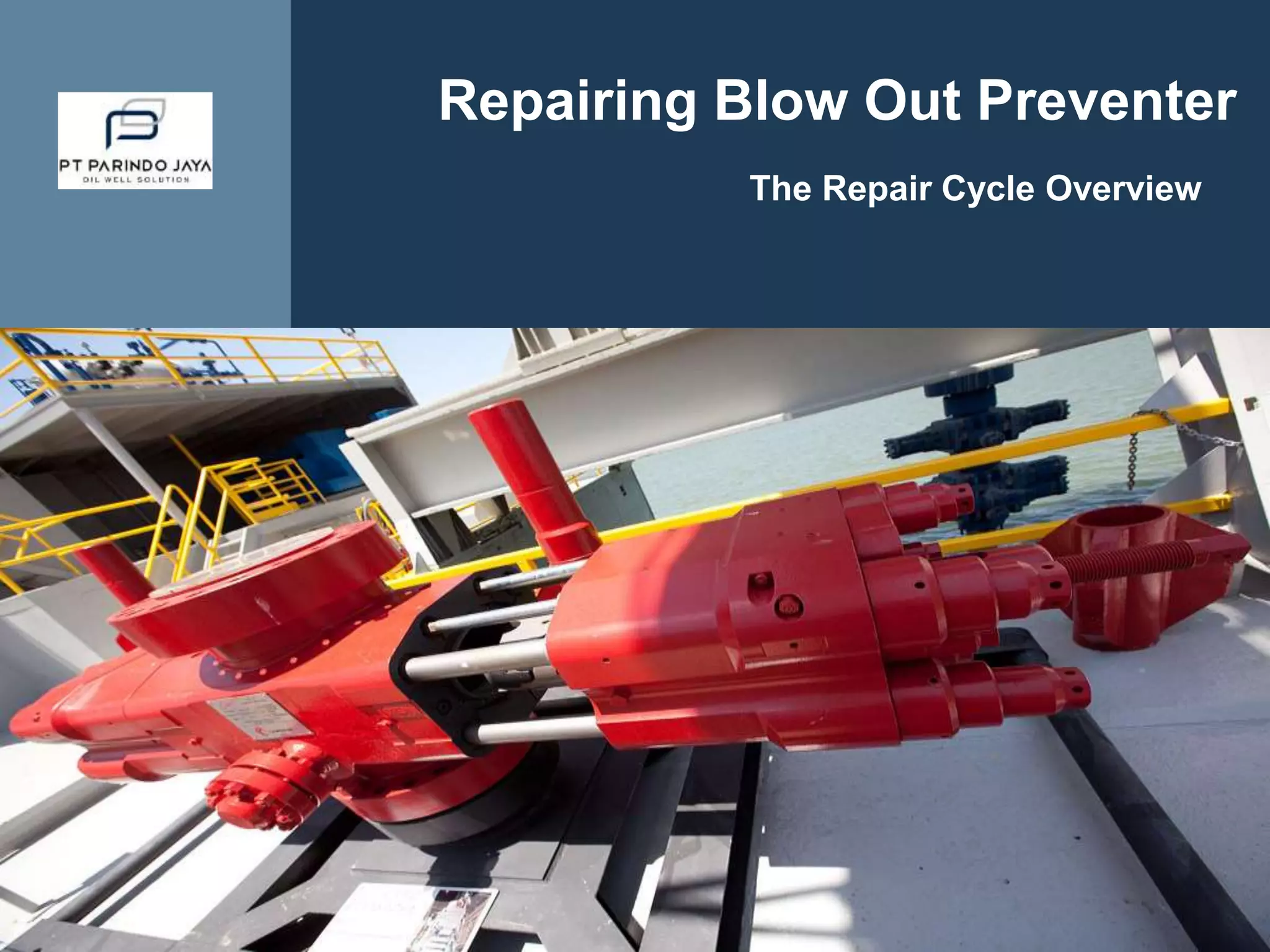
Repairing Blow Out Preventer
The Repair Cycle Overview
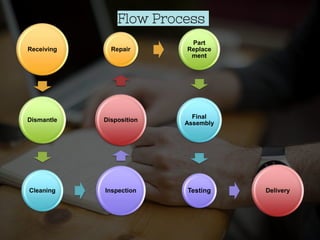
Flow Process
Receiving
Dismantle
Cleaning Inspection
Disposition
Repair
Part
Replace
ment
Final
Assembly
Testing Delivery
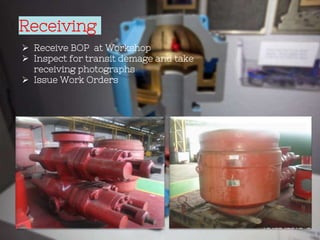
Receiving
 Receive BOP at Workshop
 Inspect for transit demage and take
receiving photographs
 Issue Work Orders
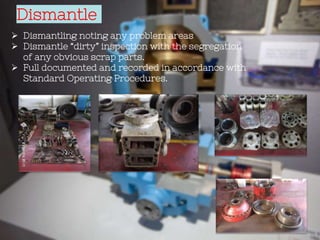
Dismantle
 Dismantling noting any problem areas
 Dismantle “dirty” inspection with the segregation
of any obvious scrap parts.
 Full documented and recorded in accordance with
Standard Operating Procedures.
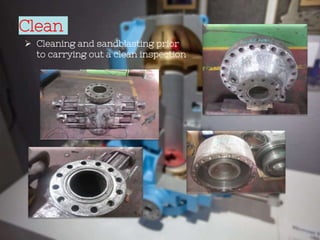
Clean
 Cleaning and sandblasting prior
to carrying out a clean inspection
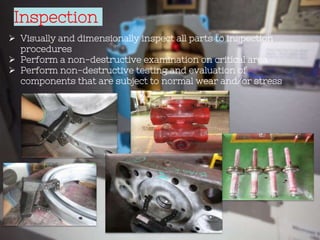
Inspection
 Visually and dimensionally inspect all parts to inspection
procedures
 Perform a non-destructive examination on critical area
 Perform non-destructive testing and evaluation of
components that are subject to normal wear and/or stress
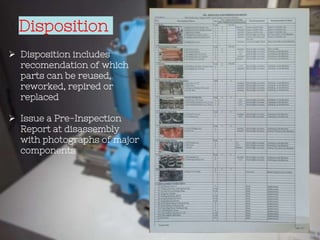
Disposition
 Disposition includes
recomendation of which
parts can be reused,
reworked, repired or
replaced
 Issue a Pre-Inspection
Report at disassembly
with photographs of major
components
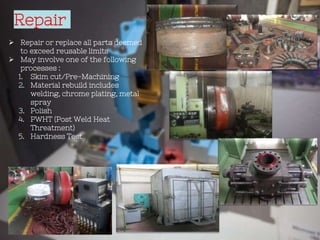
Repair
 Repair or replace all parts deemed
to exceed reusable limits
 May involve one of the following
processes :
1. Skim cut/Pre-Machining
2. Material rebuild includes
welding, chrome plating, metal
spray
3. Polish
4. PWHT (Post Weld Heat
Threatment)
5. Hardness Test
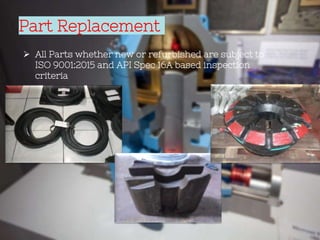
Part Replacement
 All Parts whether new or refurbished are subject to
ISO 9001:2015 and API Spec 16A based inspection
criteria
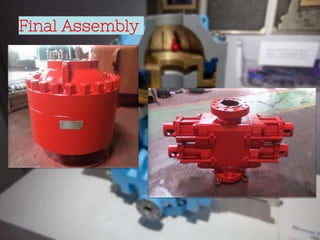
Final Assembly
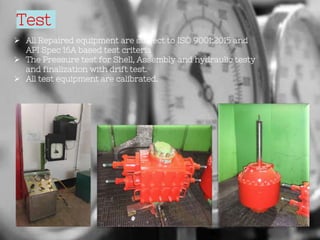
Test
 All Repaired equipment are subject to ISO 9001:2015 and
API Spec 16A based test criteria
 The Pressure test for Shell, Assembly and hydraulic testy
and finalization with drift test.
 All test equipment are calibrated.
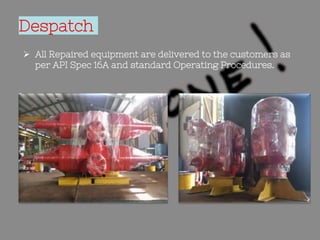
Despatch
 All Repaired equipment are delivered to the customers as
per API Spec 16A and standard Operating Procedures.

Repair Cycle Cycling.pptx