Repaid in Blood Ritual Sacrifice in Mesoamerica
Human Sacrifice: How? With what? Where? And most important… Why?
How?
The Sacrifice Stone
Sacrificial Knives
They Cut Out  the Heart of Victims… The heart was the most precious gift one could give to the gods. What does that tell us about Aztec knowledge of anatomy and physiology?
… and put it in the chac-mool, an intermediary between man  and gods
Jade was among the most precious stones to the Aztecs, so this heart is made of jade.
There were other ways to be sacrificed… This is the Flayed God. He’s wearing a cloak of human skin. The Aztecs sometimes sacrificed their victims by “flaying” them… removing the skin while they are still alive.
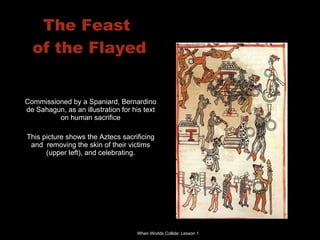
The Feast  of the Flayed Commissioned by a Spaniard, Bernardino de Sahagun, as an illustration for his text on human sacrifice This picture shows the Aztecs sacrificing and  removing the skin of their victims (upper left), and celebrating.
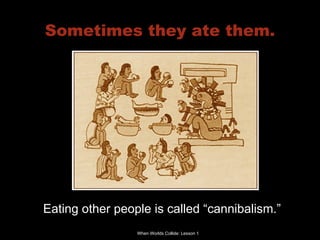
Sometimes they ate them. Eating other people is called “cannibalism.”
The Aztecs practiced human sacrifice throughout the empire, but they had one great city…
Tenochtitlan
Tenochtitlan was the heart of the Aztec Empire
And at the heart of Tenochtitlan was the Great Temple
At the Great Temple, the steps ran with human blood. When the temple was opened and blessed in 1487, Aztec records claim more than 20,000 people were sacrificed.
Why humans? Why so many? The remaining portion of the PowerPoint was created by Joel Skidmore, and is reproduced here with his expressed permission.  His original  presentation is available online at:  http://www.mesoweb.com/features/life_death/text.html . Mr. Skidwell’s work is protected by copyright. Parties  interested in reproducing his work may contact him at  [email_address]  for permission.
Thousands of years ago, the first settled cultures in the Valley of Mexico left evidence of their concern with fertility.
Female figurines are found in graves at a site called Tlatilco. Many have wide hips suggesting the power to give birth.
Like images of the great goddess from around the world, they reflect the concern of planting cultures with the birth-giving power of "mother" earth.
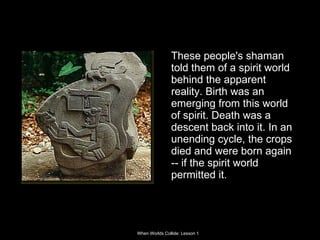
These people's shaman told them of a spirit world behind the apparent reality. Birth was an emerging from this world of spirit. Death was a descent back into it. In an unending cycle, the crops died and were born again -- if the spirit world permitted it.
The surface of the earth was a thin crust between material reality and the real world of spirit. Or, according to the shaman, everything was part of the same life force.
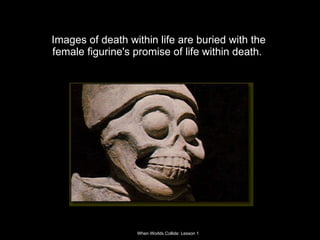
Images of death within life are buried with the female figurine's promise of life within death.
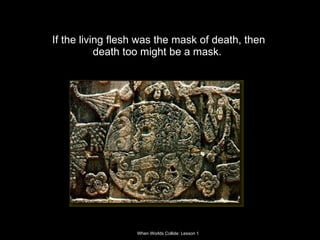
If the living flesh was the mask of death, then death too might be a mask.
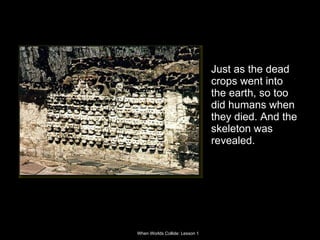
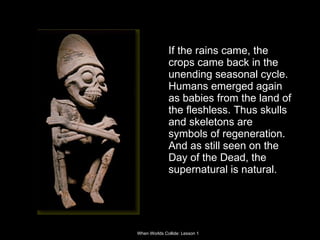
Just as the dead crops went into the earth, so too did humans when they died. And the skeleton was revealed.
If the rains came, the crops came back in the unending seasonal cycle. Humans emerged again as babies from the land of the fleshless. Thus skulls and skeletons are symbols of regeneration. And as still seen on the Day of the Dead, the supernatural is natural.
In Aztec mythology, the underworld was ruled over by its Lord and Lady. It was a gloomy place, reached by the dead only after wandering for years beneath the earth accompanied by a "soul-companion", a dog cremated with the corpse.
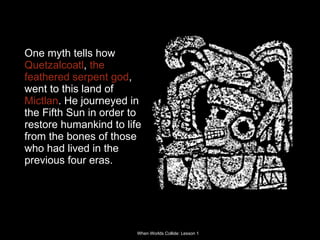
One myth tells how  Quetzalcoatl ,  the feathered serpent god , went to this land of  Mictlan . He journeyed in the Fifth Sun in order to restore humankind to life from the bones of those who had lived in the previous four eras.
Quetzalcoatl approached the Lord of Mictlan, where he sat on his throne surrounded by spiders and owls. "I've come for the bones, the precious bones, the jade bones," said Quetzalcoatl. "Can I have them in order to populate the earth?"
Only unwillingly did the Lord of Mictlan give his assent. "You may take away that which I guard so carefully on one condition -- that you parade four times around my throne blowing on this trumpet."
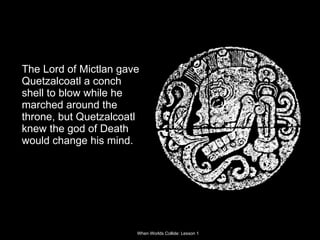
The Lord of Mictlan gave Quetzalcoatl a conch shell to blow while he marched around the throne, but Quetzalcoatl knew the god of Death would change his mind.
The Lord of Death ordered the bones recovered, but Quetzalcoatl thought of a trick.  "Tell the Lord I'll leave the bones behind," he said to his nahual, his spirit twin. Accordingly the nahual, looking just like Quetzalcoatl himself, assured the Lord of Mictlan that the bones would be left. Meanwhile Quetzalcoatl began to run.
Unfortunately, the Lord of Mictlan ordered that a pit be dug in the fleeing god's path, and sure enough he fell into it, having been startled by a covey of quail.
Those bones that weren't already shattered were pecked at by the quail. Which is why humans come in all sizes.
"This has not worked out well," said Quetzalcoatl to his spirit twin.
"What must be must be," replied the nahual. And so Quetzalcoatl scooped up the bones and, once safely beyond the dead land, ground them up in a bowl.
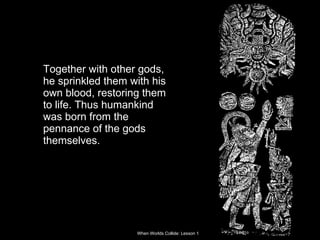
Together with other gods, he sprinkled them with his own blood, restoring them to life. Thus humankind was born from the pennance of the gods themselves.
And this gift had to be repaid in the blood of sacrifice.   Death is always followed by rebirth.
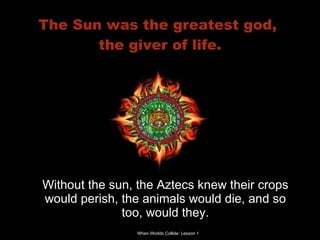
The Sun was the greatest god,  the giver of life. Without the sun, the Aztecs knew their crops would perish, the animals would die, and so too, would they.
And the Sun God was very thirsty. The blood of thousands was needed to keep him alive and moving across the sky.
It was an honor to sacrifice your life for the Sun God.
Of course, it wasn’t usually the Aztec warriors who were sacrificed.

Repaid In Blood

  • 1.
    Repaid in BloodRitual Sacrifice in Mesoamerica
  • 2.
    Human Sacrifice: How?With what? Where? And most important… Why?
  • 3.
  • 4.
  • 5.
  • 6.
    They Cut Out the Heart of Victims… The heart was the most precious gift one could give to the gods. What does that tell us about Aztec knowledge of anatomy and physiology?
  • 7.
    … and putit in the chac-mool, an intermediary between man and gods
  • 8.
    Jade was amongthe most precious stones to the Aztecs, so this heart is made of jade.
  • 9.
    There were otherways to be sacrificed… This is the Flayed God. He’s wearing a cloak of human skin. The Aztecs sometimes sacrificed their victims by “flaying” them… removing the skin while they are still alive.
  • 10.
    The Feast of the Flayed Commissioned by a Spaniard, Bernardino de Sahagun, as an illustration for his text on human sacrifice This picture shows the Aztecs sacrificing and removing the skin of their victims (upper left), and celebrating.
  • 11.
    Sometimes they atethem. Eating other people is called “cannibalism.”
  • 12.
    The Aztecs practicedhuman sacrifice throughout the empire, but they had one great city…
  • 13.
  • 14.
    Tenochtitlan was theheart of the Aztec Empire
  • 15.
    And at theheart of Tenochtitlan was the Great Temple
  • 16.
    At the GreatTemple, the steps ran with human blood. When the temple was opened and blessed in 1487, Aztec records claim more than 20,000 people were sacrificed.
  • 17.
    Why humans? Whyso many? The remaining portion of the PowerPoint was created by Joel Skidmore, and is reproduced here with his expressed permission. His original presentation is available online at: http://www.mesoweb.com/features/life_death/text.html . Mr. Skidwell’s work is protected by copyright. Parties interested in reproducing his work may contact him at [email_address] for permission.
  • 18.
    Thousands of yearsago, the first settled cultures in the Valley of Mexico left evidence of their concern with fertility.
  • 19.
    Female figurines arefound in graves at a site called Tlatilco. Many have wide hips suggesting the power to give birth.
  • 20.
    Like images ofthe great goddess from around the world, they reflect the concern of planting cultures with the birth-giving power of "mother" earth.
  • 21.
    These people's shamantold them of a spirit world behind the apparent reality. Birth was an emerging from this world of spirit. Death was a descent back into it. In an unending cycle, the crops died and were born again -- if the spirit world permitted it.
  • 22.
    The surface ofthe earth was a thin crust between material reality and the real world of spirit. Or, according to the shaman, everything was part of the same life force.
  • 23.
    Images of deathwithin life are buried with the female figurine's promise of life within death.
  • 24.
    If the livingflesh was the mask of death, then death too might be a mask.
  • 25.
    Just as thedead crops went into the earth, so too did humans when they died. And the skeleton was revealed.
  • 26.
    If the rainscame, the crops came back in the unending seasonal cycle. Humans emerged again as babies from the land of the fleshless. Thus skulls and skeletons are symbols of regeneration. And as still seen on the Day of the Dead, the supernatural is natural.
  • 27.
    In Aztec mythology,the underworld was ruled over by its Lord and Lady. It was a gloomy place, reached by the dead only after wandering for years beneath the earth accompanied by a "soul-companion", a dog cremated with the corpse.
  • 28.
    One myth tellshow Quetzalcoatl , the feathered serpent god , went to this land of Mictlan . He journeyed in the Fifth Sun in order to restore humankind to life from the bones of those who had lived in the previous four eras.
  • 29.
    Quetzalcoatl approached theLord of Mictlan, where he sat on his throne surrounded by spiders and owls. "I've come for the bones, the precious bones, the jade bones," said Quetzalcoatl. "Can I have them in order to populate the earth?"
  • 30.
    Only unwillingly didthe Lord of Mictlan give his assent. "You may take away that which I guard so carefully on one condition -- that you parade four times around my throne blowing on this trumpet."
  • 31.
    The Lord ofMictlan gave Quetzalcoatl a conch shell to blow while he marched around the throne, but Quetzalcoatl knew the god of Death would change his mind.
  • 32.
    The Lord ofDeath ordered the bones recovered, but Quetzalcoatl thought of a trick. "Tell the Lord I'll leave the bones behind," he said to his nahual, his spirit twin. Accordingly the nahual, looking just like Quetzalcoatl himself, assured the Lord of Mictlan that the bones would be left. Meanwhile Quetzalcoatl began to run.
  • 33.
    Unfortunately, the Lordof Mictlan ordered that a pit be dug in the fleeing god's path, and sure enough he fell into it, having been startled by a covey of quail.
  • 34.
    Those bones thatweren't already shattered were pecked at by the quail. Which is why humans come in all sizes.
  • 35.
    "This has notworked out well," said Quetzalcoatl to his spirit twin.
  • 36.
    "What must bemust be," replied the nahual. And so Quetzalcoatl scooped up the bones and, once safely beyond the dead land, ground them up in a bowl.
  • 37.
    Together with othergods, he sprinkled them with his own blood, restoring them to life. Thus humankind was born from the pennance of the gods themselves.
  • 38.
    And this gifthad to be repaid in the blood of sacrifice. Death is always followed by rebirth.
  • 39.
    The Sun wasthe greatest god, the giver of life. Without the sun, the Aztecs knew their crops would perish, the animals would die, and so too, would they.
  • 40.
    And the SunGod was very thirsty. The blood of thousands was needed to keep him alive and moving across the sky.
  • 41.
    It was anhonor to sacrifice your life for the Sun God.
  • 42.
    Of course, itwasn’t usually the Aztec warriors who were sacrificed.