Reformation and Scientific Revolution World History
Reformers become radical Following the rise of Martin Luther and John Calvin, hundreds of protestant sects were created. These sects had extreme ideas that were opposite from the Roman Catholic Church. The Anabaptists were one of the most important radical groups, they believed that only adults should be baptized.  Anabaptists wanted social reforms but they preached non-violence and toleration of other religions. Modern Baptists, Quakers, Mennonites, and Amish trace their roots to the Anabaptists.
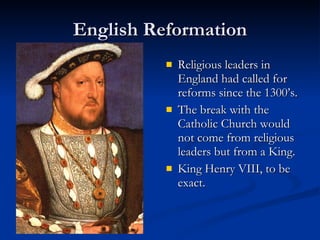
English Reformation Religious leaders in England had called for reforms since the 1300’s. The break with the Catholic Church would not come from religious leaders but from a King. King Henry VIII, to be exact.
From “Defender of the Faith” to head of the Church of England King Henry VIII violently defended the Roman Catholic Church at first. The pope gave him the title “Defender of the Faith” to reward his loyalty to the Church. However Henry VIII had a personal issue……
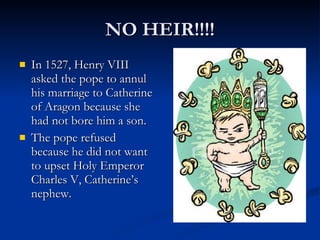
NO HEIR!!!! In 1527, Henry VIII asked the pope to annul his marriage to Catherine of Aragon because she had not bore him a son. The pope refused because he did not want to upset Holy Emperor Charles V, Catherine’s nephew.
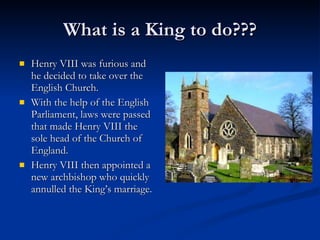
What is a King to do??? Henry VIII was furious and he decided to take over the English Church. With the help of the English Parliament, laws were passed that made Henry VIII the sole head of the Church of England. Henry VIII then appointed a new archbishop who quickly annulled the King’s marriage.
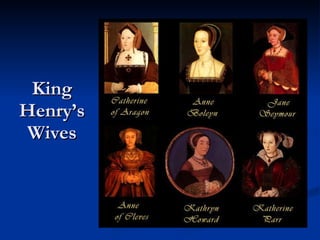
King Henry’s Wives
The legacy of King Henry VIII After his death in 1547, the rule went to his ten year old son, Edward VI.  Edward died in his teens and the throne goes to his catholic sister Mary. Mary converts England back to the Catholic Church. In 1558, Mary dies and Elizabeth becomes queen.  She brings back the protestant Church of England and moderate reforms.
Catholic Reformation While England was on the protestant roller-coaster, a wave of religious wars swept over the rest of Europe. In order to weed out the protestant religions, the Catholic Church started a wave of reforms.  The Council of Trent in 1545, was a meeting of Church leaders to plan how to reform the Church.
Reforms To combat the protestant competition, the pope strengthened the inquisition, a secret court that used testimony, torture, and execution against protestants.  The Index of Forbidden Books was created by the inquisition. To spread the Catholic faith, the pope adopted the Ignatius of Loyola or the Jesuit order. Missionaries traveled the world spreading the Catholic faith.
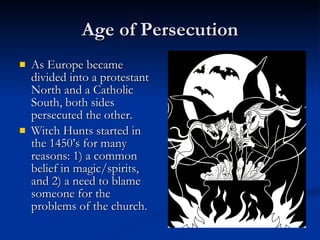
Age of Persecution As Europe became divided into a protestant North and a Catholic South, both sides persecuted the other. Witch Hunts started in the 1450’s for many reasons: 1) a common belief in magic/spirits, and 2) a need to blame someone for the problems of the church.
Scientific Revolution Profound change in the European world-view in the late 16 th  and 17 th  centuries Primary cause was the  Scientific Revolution  (1543-present) The most profound change in human history? New intellectual climate differed from medieval & early modern world-view: Rejection of authority “Best” knowledge was practical Demystification of the universe Scientists of this era differed from predecessors in combining  mathematics  and  experiment
Introduction Roots  – science & technology from: Ancient Egypt  – pyramids, mathematics China  – movable type, paper, astronomy Islam  – medicine, ancient Greek texts, astronomy, mathematics Medieval Europe  – alchemy, herbalists, cathedrals
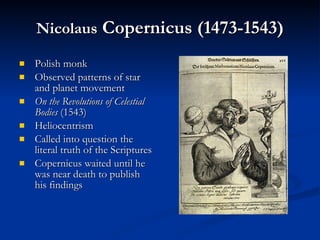
Nicolaus  Copernicus (1473-1543) Polish monk Observed patterns of star and planet movement On the Revolutions of Celestial Bodies  (1543) Heliocentrism Called into question the literal truth of the Scriptures Copernicus waited until he was near death to publish his findings
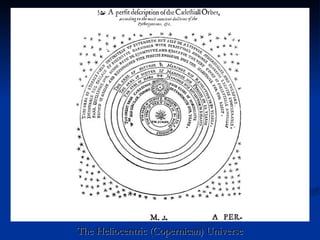
The Heliocentric (Copernican) Universe
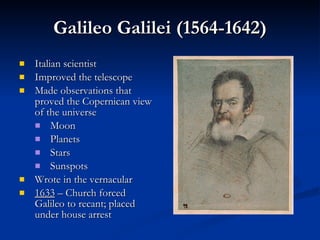
Galileo Galilei (1564-1642) Italian scientist Improved the telescope Made observations that proved the Copernican view of the universe Moon Planets Stars Sunspots Wrote in the vernacular 1633  – Church forced Galileo to recant; placed under house arrest
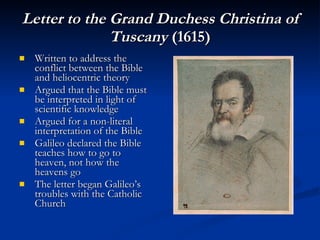
Letter to the Grand Duchess Christina of Tuscany  (1615) Written to address the conflict between the Bible and heliocentric theory Argued that the Bible must be interpreted in light of scientific knowledge Argued for a non-literal interpretation of the Bible Galileo declared the Bible teaches how to go to heaven, not how the heavens go The letter began Galileo’s troubles with the Catholic Church
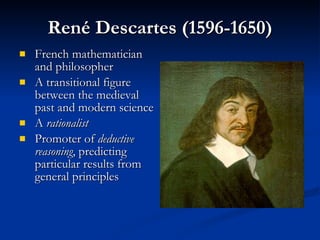
Ren é Descartes (1596-1650) French mathematician and philosopher A transitional figure between the medieval past and modern science A  rationalist Promoter of  deductive reasoning , predicting particular results from general principles
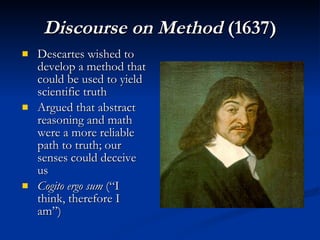
Discourse on Method  (1637) Descartes wished to develop a method that could be used to yield scientific truth Argued that abstract reasoning and math were a more reliable path to truth; our senses could deceive us Cogito ergo sum  (“I think, therefore I am”)
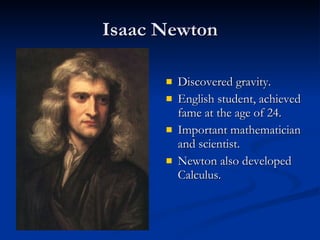
Isaac Newton Discovered gravity. English student, achieved fame at the age of 24. Important mathematician and scientist. Newton also developed Calculus.
Significance of the Scientific Revolution Contributions of these scientists made the universe comprehensible for the first time The individual became much more important; collective authority was not the source of wisdom…individual intellect was After the Revolution, God was viewed by many as either a remote “master mechanic”, or his existence began to be doubted Began long adversarial relationship between science and religion The Revolution laid the foundation for the Enlightenment of the 18 th  century…

Renaissance2[1]

  • 1.
    Reformation and ScientificRevolution World History
  • 2.
    Reformers become radicalFollowing the rise of Martin Luther and John Calvin, hundreds of protestant sects were created. These sects had extreme ideas that were opposite from the Roman Catholic Church. The Anabaptists were one of the most important radical groups, they believed that only adults should be baptized. Anabaptists wanted social reforms but they preached non-violence and toleration of other religions. Modern Baptists, Quakers, Mennonites, and Amish trace their roots to the Anabaptists.
  • 3.
    English Reformation Religiousleaders in England had called for reforms since the 1300’s. The break with the Catholic Church would not come from religious leaders but from a King. King Henry VIII, to be exact.
  • 4.
    From “Defender ofthe Faith” to head of the Church of England King Henry VIII violently defended the Roman Catholic Church at first. The pope gave him the title “Defender of the Faith” to reward his loyalty to the Church. However Henry VIII had a personal issue……
  • 5.
    NO HEIR!!!! In1527, Henry VIII asked the pope to annul his marriage to Catherine of Aragon because she had not bore him a son. The pope refused because he did not want to upset Holy Emperor Charles V, Catherine’s nephew.
  • 6.
    What is aKing to do??? Henry VIII was furious and he decided to take over the English Church. With the help of the English Parliament, laws were passed that made Henry VIII the sole head of the Church of England. Henry VIII then appointed a new archbishop who quickly annulled the King’s marriage.
  • 7.
  • 8.
    The legacy ofKing Henry VIII After his death in 1547, the rule went to his ten year old son, Edward VI. Edward died in his teens and the throne goes to his catholic sister Mary. Mary converts England back to the Catholic Church. In 1558, Mary dies and Elizabeth becomes queen. She brings back the protestant Church of England and moderate reforms.
  • 9.
    Catholic Reformation WhileEngland was on the protestant roller-coaster, a wave of religious wars swept over the rest of Europe. In order to weed out the protestant religions, the Catholic Church started a wave of reforms. The Council of Trent in 1545, was a meeting of Church leaders to plan how to reform the Church.
  • 10.
    Reforms To combatthe protestant competition, the pope strengthened the inquisition, a secret court that used testimony, torture, and execution against protestants. The Index of Forbidden Books was created by the inquisition. To spread the Catholic faith, the pope adopted the Ignatius of Loyola or the Jesuit order. Missionaries traveled the world spreading the Catholic faith.
  • 11.
    Age of PersecutionAs Europe became divided into a protestant North and a Catholic South, both sides persecuted the other. Witch Hunts started in the 1450’s for many reasons: 1) a common belief in magic/spirits, and 2) a need to blame someone for the problems of the church.
  • 12.
    Scientific Revolution Profoundchange in the European world-view in the late 16 th and 17 th centuries Primary cause was the Scientific Revolution (1543-present) The most profound change in human history? New intellectual climate differed from medieval & early modern world-view: Rejection of authority “Best” knowledge was practical Demystification of the universe Scientists of this era differed from predecessors in combining mathematics and experiment
  • 13.
    Introduction Roots – science & technology from: Ancient Egypt – pyramids, mathematics China – movable type, paper, astronomy Islam – medicine, ancient Greek texts, astronomy, mathematics Medieval Europe – alchemy, herbalists, cathedrals
  • 14.
    Nicolaus Copernicus(1473-1543) Polish monk Observed patterns of star and planet movement On the Revolutions of Celestial Bodies (1543) Heliocentrism Called into question the literal truth of the Scriptures Copernicus waited until he was near death to publish his findings
  • 15.
  • 16.
    Galileo Galilei (1564-1642)Italian scientist Improved the telescope Made observations that proved the Copernican view of the universe Moon Planets Stars Sunspots Wrote in the vernacular 1633 – Church forced Galileo to recant; placed under house arrest
  • 17.
    Letter to theGrand Duchess Christina of Tuscany (1615) Written to address the conflict between the Bible and heliocentric theory Argued that the Bible must be interpreted in light of scientific knowledge Argued for a non-literal interpretation of the Bible Galileo declared the Bible teaches how to go to heaven, not how the heavens go The letter began Galileo’s troubles with the Catholic Church
  • 18.
    Ren é Descartes(1596-1650) French mathematician and philosopher A transitional figure between the medieval past and modern science A rationalist Promoter of deductive reasoning , predicting particular results from general principles
  • 19.
    Discourse on Method (1637) Descartes wished to develop a method that could be used to yield scientific truth Argued that abstract reasoning and math were a more reliable path to truth; our senses could deceive us Cogito ergo sum (“I think, therefore I am”)
  • 20.
    Isaac Newton Discoveredgravity. English student, achieved fame at the age of 24. Important mathematician and scientist. Newton also developed Calculus.
  • 21.
    Significance of theScientific Revolution Contributions of these scientists made the universe comprehensible for the first time The individual became much more important; collective authority was not the source of wisdom…individual intellect was After the Revolution, God was viewed by many as either a remote “master mechanic”, or his existence began to be doubted Began long adversarial relationship between science and religion The Revolution laid the foundation for the Enlightenment of the 18 th century…

Editor's Notes

  • #13 -rejection of authority. Mostly Church authority, several crises contributed to this. -”best” authority was practical. Bacon: “purpose of knowledge was to ease man’s estate” Descartes: purpose of knowledge “to make us, as it were, masters and possessors of nature” Demystification of the universe: e.g., heavenly realm above the moon was no longer of eternal bodies that had no matter or weren’t physical Experiment was different from Observation, which the ancient did.
  • #15 Called into question the literal truth of the Scriptures. There are a few passages where God, for example, makes the sun stand still. This implies that the earth is still and the sun moves around it.
  • #17 Among observations: moons of Jupiter, that is that there are planets with their own satellites: this also goes against the conception of perfect crystal spheres.
  • #19 Mathematician: invented the Cartesian Coordinate system and analytic geometry, among other things. Promoter of deductive reasoning . Wanted science to be like Euclid: deductions from self-evident starting points.
  • #20 Cogito ergo sum was one of Descartes’ “axioms”, that is, certain and self-evident truths that other truths could then be deduced from using a deductive method.