PRIVACY 
INAR 514 
P r e s e n t e d b y : 
ANUOLUWA B. AYINDE, 135894 
DAN N. KOLO, 135188
Contents 
• Meaning of privacy 
• Factors affecting privacy 
• Degrees of Privacy 
• Visual Privacy 
• Acoustic Privacy 
• Privacy and Culture 
• Spatial arrangement of buildings 
• Overcrowding / Crowding 
• Privacy in public spaces 
• Conclusion
Meaning of privacy 
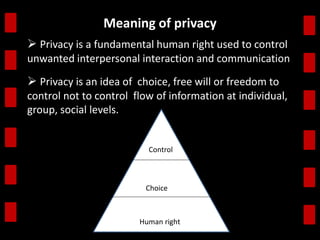
 Privacy is a fundamental human right used to control 
unwanted interpersonal interaction and communication 
 Privacy is an idea of choice, free will or freedom to 
control not to control flow of information at individual, 
group, social levels. 
Control 
Choice 
Human right
Factors affecting privacy 
• Mechanism of the senses 
• Individuality 
• Space distance 
• Architectural Elements of a space 
• Culture
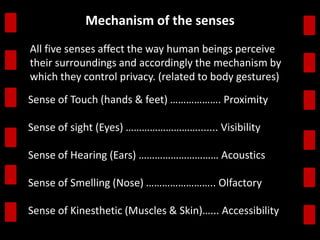
Mechanism of the senses 
All five senses affect the way human beings perceive 
their surroundings and accordingly the mechanism by 
which they control privacy. (related to body gestures) 
Sense of Touch (hands & feet) ………………. Proximity 
Sense of sight (Eyes) ………………………....... Visibility 
Sense of Hearing (Ears) ………………………… Acoustics 
Sense of Smelling (Nose) …………………….. Olfactory 
Sense of Kinesthetic (Muscles & Skin)…... Accessibility
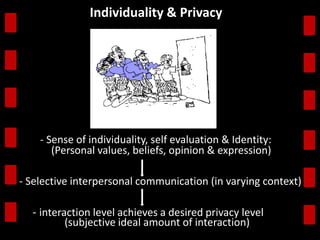
Individuality & Privacy 
- Sense of individuality, self evaluation & Identity: 
(Personal values, beliefs, opinion & expression) 
- Selective interpersonal communication (in varying context) 
- interaction level achieves a desired privacy level 
(subjective ideal amount of interaction)
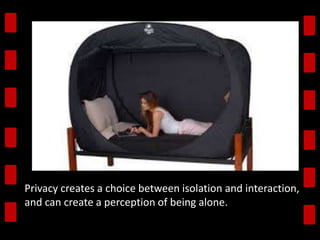
Privacy creates a choice between isolation and interaction, 
and can create a perception of being alone.
Space distance & Privacy 
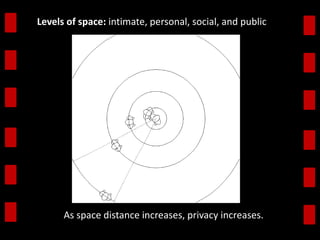
Privacy is influenced or created in various spatial distance. 
The distinct distance between humans as defined by Edward 
T. Hall are categorised as; 
Intimate space ……… most private area 
Personal space……… allow interaction with friends 
Social space…………. Contact on a temporary basis 
Public space …………. No expected direct contact but if 
any, it is usually resisted
Levels of space: intimate, personal, social, and public 
As space distance increases, privacy increases.
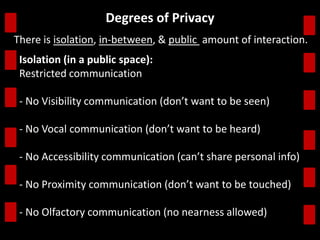
Degrees of Privacy 
There is isolation, in-between, & public amount of interaction. 
Isolation (in a public space): 
Restricted communication 
- No Visibility communication (don’t want to be seen) 
- No Vocal communication (don’t want to be heard) 
- No Accessibility communication (can’t share personal info) 
- No Proximity communication (don’t want to be touched) 
- No Olfactory communication (no nearness allowed)
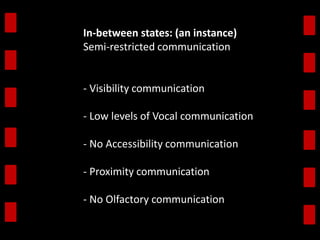
In-between states: (an instance) 
Semi-restricted communication 
- Visibility communication 
- Low levels of Vocal communication 
- No Accessibility communication 
- Proximity communication 
- No Olfactory communication
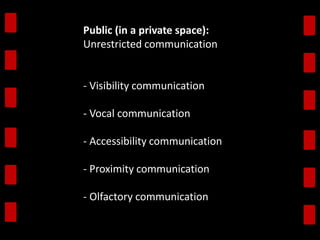
Public (in a private space): 
Unrestricted communication 
- Visibility communication 
- Vocal communication 
- Accessibility communication 
- Proximity communication 
- Olfactory communication
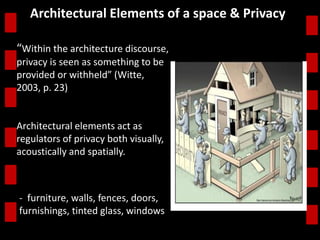
Architectural Elements of a space & Privacy 
“Within the architecture discourse, 
privacy is seen as something to be 
provided or withheld” (Witte, 
2003, p. 23) 
Architectural elements act as 
regulators of privacy both visually, 
acoustically and spatially. 
- furniture, walls, fences, doors, 
furnishings, tinted glass, windows
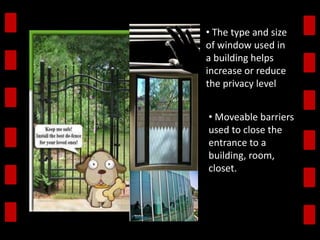
• The type and size 
of window used in 
a building helps 
increase or reduce 
the privacy level. 
• Moveable barriers 
used to close the 
entrance to a 
building, room, 
closet.
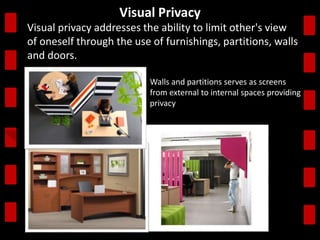
Visual Privacy 
Visual privacy addresses the ability to limit other's view 
of oneself through the use of furnishings, partitions, walls 
and doors. 
Walls and partitions serves as screens 
from external to internal spaces providing 
privacy
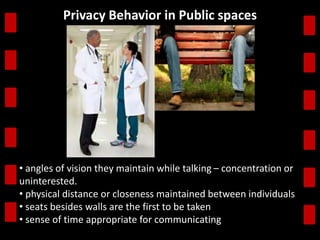
Privacy Behavior in Public spaces 
• angles of vision they maintain while talking – concentration or 
uninterested. 
• physical distance or closeness maintained between individuals 
• seats besides walls are the first to be taken 
• sense of time appropriate for communicating
. 
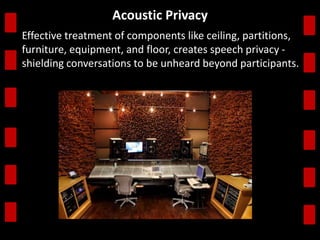
Acoustic Privacy 
Effective treatment of components like ceiling, partitions, 
furniture, equipment, and floor, creates speech privacy - 
shielding conversations to be unheard beyond participants.
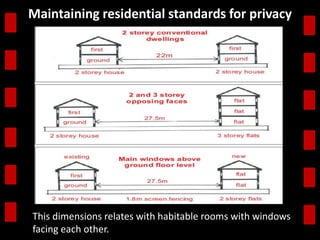
Maintaining residential standards for privacy 
This dimensions relates with habitable rooms with windows 
facing each other.
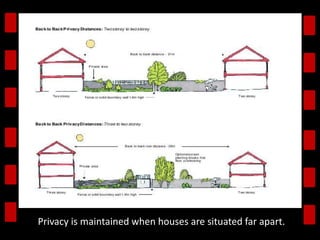
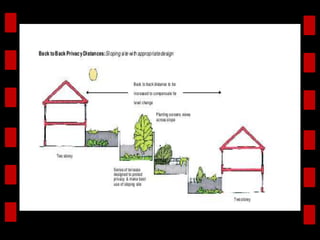
Privacy is maintained when houses are situated far apart.
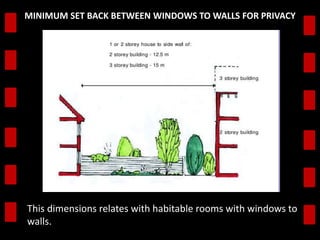
MINIMUM SET BACK BETWEEN WINDOWS TO WALLS FOR PRIVACY 
This dimensions relates with habitable rooms with windows to 
walls.
Privacy and Culture 
Culture affects the boundary of what is regarded as private. 
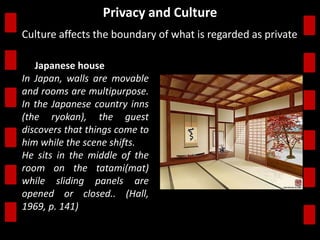
the Japanese house 
In Japan, walls are movable 
and rooms are multipurpose. 
In the Japanese country inns 
(the ryokan), the guest 
discovers that things come to 
him while the scene shifts. 
He sits in the middle of the 
room on the tatami(mat) 
while sliding panels are 
opened or closed.. (Hall, 
1969, p. 141))
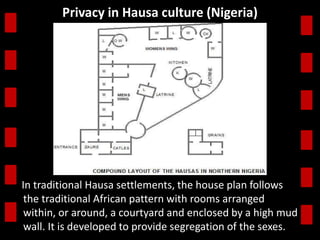
Privacy in Hausa culture (Nigeria) 
In traditional Hausa settlements, the house plan follows 
the traditional African pattern with rooms arranged 
within, or around, a courtyard and enclosed by a high mud 
wall. It is developed to provide segregation of the sexes.
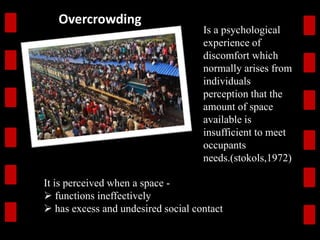
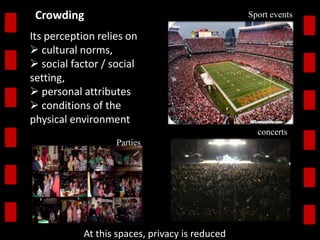
Overcrowding 
Is a psychological 
experience of 
discomfort which 
normally arises from 
individuals 
perception that the 
amount of space 
available is 
insufficient to meet 
occupants 
needs.(stokols,1972) 
It is perceived when a space - 
 functions ineffectively 
 has excess and undesired social contact
Its perception relies on 
 cultural norms, 
 social factor / social 
setting, 
 personal attributes 
 conditions of the 
physical environment 
Sport events 
Parties 
At this spaces, privacy is reduced 
concerts 
Crowding
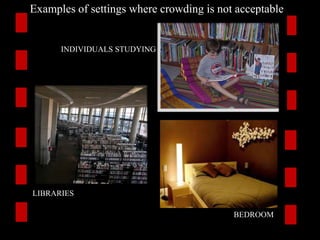
Examples of settings where crowding is not acceptable 
INDIVIDUALS STUDYING 
LIBRARIES 
BEDROOM
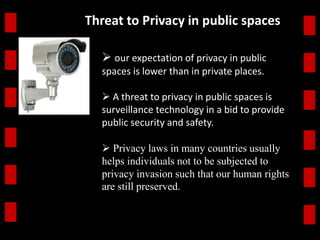
Threat to Privacy in public spaces 
 our expectation of privacy in public 
spaces is lower than in private places. 
 A threat to privacy in public spaces is 
surveillance technology in a bid to provide 
public security and safety. 
 Privacy laws in many countries usually 
helps individuals not to be subjected to 
privacy invasion such that our human rights 
are still preserved.
References 
• Ann Cavoukian (2013): Surveillance, then and now: securing privacy in 
public spaces. 
• Edward T. Hall: The Hidden Dimension (Garden City, NJ: Doubleday & 
Co., 1990), pp. 122-125. 
• Hall, E.T., (1969) “the hidden dimension, man’s use of space in public 
and private”, the bodley head, London, Sydney, Toronto 
• J. C. Moughtin(1964): The Traditional Settlements of the Hausa 
People. The Town Planning Review, Vol. 35, No. 1. Liverpool University 
Press 
• Michael Georgiou (2006): Architectural privacy: a topological 
approach to relational design problems 
• Susan Kent (1990): Domestic architecture and the use of space; an 
interdisciplinary cross-cultural study 
•USACE Design Guide for Interiors (1997) 
• Witte Nathan (2003): “Privacy: Architecture in Support of Privacy 
Regulation”, University of Cincinnati, Architectural Thesis
THANK YOU

Privacy (architectural behaviour)

  • 1.
    PRIVACY INAR 514 P r e s e n t e d b y : ANUOLUWA B. AYINDE, 135894 DAN N. KOLO, 135188
  • 3.
    Contents • Meaningof privacy • Factors affecting privacy • Degrees of Privacy • Visual Privacy • Acoustic Privacy • Privacy and Culture • Spatial arrangement of buildings • Overcrowding / Crowding • Privacy in public spaces • Conclusion
  • 4.
    Meaning of privacy  Privacy is a fundamental human right used to control unwanted interpersonal interaction and communication  Privacy is an idea of choice, free will or freedom to control not to control flow of information at individual, group, social levels. Control Choice Human right
  • 5.
    Factors affecting privacy • Mechanism of the senses • Individuality • Space distance • Architectural Elements of a space • Culture
  • 6.
    Mechanism of thesenses All five senses affect the way human beings perceive their surroundings and accordingly the mechanism by which they control privacy. (related to body gestures) Sense of Touch (hands & feet) ………………. Proximity Sense of sight (Eyes) ………………………....... Visibility Sense of Hearing (Ears) ………………………… Acoustics Sense of Smelling (Nose) …………………….. Olfactory Sense of Kinesthetic (Muscles & Skin)…... Accessibility
  • 7.
    Individuality & Privacy - Sense of individuality, self evaluation & Identity: (Personal values, beliefs, opinion & expression) - Selective interpersonal communication (in varying context) - interaction level achieves a desired privacy level (subjective ideal amount of interaction)
  • 8.
    Privacy creates achoice between isolation and interaction, and can create a perception of being alone.
  • 9.
    Space distance &Privacy Privacy is influenced or created in various spatial distance. The distinct distance between humans as defined by Edward T. Hall are categorised as; Intimate space ……… most private area Personal space……… allow interaction with friends Social space…………. Contact on a temporary basis Public space …………. No expected direct contact but if any, it is usually resisted
  • 10.
    Levels of space:intimate, personal, social, and public As space distance increases, privacy increases.
  • 11.
    Degrees of Privacy There is isolation, in-between, & public amount of interaction. Isolation (in a public space): Restricted communication - No Visibility communication (don’t want to be seen) - No Vocal communication (don’t want to be heard) - No Accessibility communication (can’t share personal info) - No Proximity communication (don’t want to be touched) - No Olfactory communication (no nearness allowed)
  • 12.
    In-between states: (aninstance) Semi-restricted communication - Visibility communication - Low levels of Vocal communication - No Accessibility communication - Proximity communication - No Olfactory communication
  • 13.
    Public (in aprivate space): Unrestricted communication - Visibility communication - Vocal communication - Accessibility communication - Proximity communication - Olfactory communication
  • 14.
    Architectural Elements ofa space & Privacy “Within the architecture discourse, privacy is seen as something to be provided or withheld” (Witte, 2003, p. 23) Architectural elements act as regulators of privacy both visually, acoustically and spatially. - furniture, walls, fences, doors, furnishings, tinted glass, windows
  • 15.
    • The typeand size of window used in a building helps increase or reduce the privacy level. • Moveable barriers used to close the entrance to a building, room, closet.
  • 16.
    Visual Privacy Visualprivacy addresses the ability to limit other's view of oneself through the use of furnishings, partitions, walls and doors. Walls and partitions serves as screens from external to internal spaces providing privacy
  • 17.
    Privacy Behavior inPublic spaces • angles of vision they maintain while talking – concentration or uninterested. • physical distance or closeness maintained between individuals • seats besides walls are the first to be taken • sense of time appropriate for communicating
  • 18.
    . Acoustic Privacy Effective treatment of components like ceiling, partitions, furniture, equipment, and floor, creates speech privacy - shielding conversations to be unheard beyond participants.
  • 19.
    Maintaining residential standardsfor privacy This dimensions relates with habitable rooms with windows facing each other.
  • 20.
    Privacy is maintainedwhen houses are situated far apart.
  • 22.
    MINIMUM SET BACKBETWEEN WINDOWS TO WALLS FOR PRIVACY This dimensions relates with habitable rooms with windows to walls.
  • 23.
    Privacy and Culture Culture affects the boundary of what is regarded as private. the Japanese house In Japan, walls are movable and rooms are multipurpose. In the Japanese country inns (the ryokan), the guest discovers that things come to him while the scene shifts. He sits in the middle of the room on the tatami(mat) while sliding panels are opened or closed.. (Hall, 1969, p. 141))
  • 24.
    Privacy in Hausaculture (Nigeria) In traditional Hausa settlements, the house plan follows the traditional African pattern with rooms arranged within, or around, a courtyard and enclosed by a high mud wall. It is developed to provide segregation of the sexes.
  • 25.
    Overcrowding Is apsychological experience of discomfort which normally arises from individuals perception that the amount of space available is insufficient to meet occupants needs.(stokols,1972) It is perceived when a space -  functions ineffectively  has excess and undesired social contact
  • 26.
    Its perception relieson  cultural norms,  social factor / social setting,  personal attributes  conditions of the physical environment Sport events Parties At this spaces, privacy is reduced concerts Crowding
  • 27.
    Examples of settingswhere crowding is not acceptable INDIVIDUALS STUDYING LIBRARIES BEDROOM
  • 28.
    Threat to Privacyin public spaces  our expectation of privacy in public spaces is lower than in private places.  A threat to privacy in public spaces is surveillance technology in a bid to provide public security and safety.  Privacy laws in many countries usually helps individuals not to be subjected to privacy invasion such that our human rights are still preserved.
  • 29.
    References • AnnCavoukian (2013): Surveillance, then and now: securing privacy in public spaces. • Edward T. Hall: The Hidden Dimension (Garden City, NJ: Doubleday & Co., 1990), pp. 122-125. • Hall, E.T., (1969) “the hidden dimension, man’s use of space in public and private”, the bodley head, London, Sydney, Toronto • J. C. Moughtin(1964): The Traditional Settlements of the Hausa People. The Town Planning Review, Vol. 35, No. 1. Liverpool University Press • Michael Georgiou (2006): Architectural privacy: a topological approach to relational design problems • Susan Kent (1990): Domestic architecture and the use of space; an interdisciplinary cross-cultural study •USACE Design Guide for Interiors (1997) • Witte Nathan (2003): “Privacy: Architecture in Support of Privacy Regulation”, University of Cincinnati, Architectural Thesis
  • 30.