Relif   ® Feel the relief Dr. Denis C. Bauer  CEO Prof. Dr. Cho l  Hee Jung  CSO Dr. Andrew Ringsmuth  Business Development Manager Dr. Kimberly Wadsworth  IP Manager
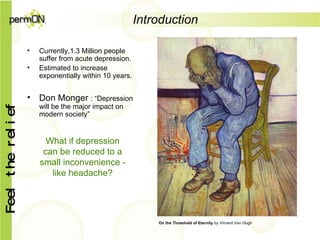
Introduction Currently,1.3 Million people suffer from acute depression.  Estimated to increase exponentially within 10 years. Don Monger  : “Depression will be the major impact on modern society”  On the Threshold of Eternity  by Vincent Van Gogh  What if depression can be reduced to a small inconvenience - like headache?
Overview Drug development  Prof. Dr. Chol Hee Jung Scientific Overview  Science behind the reliF ®  approach Motivation and Progress  Market analysis Financial overview IP portfolio Pitch
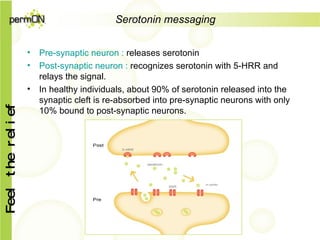
Serotonin messaging Pre-synaptic neuron :  releases  serotonin Post-synaptic neuron :  recognizes serotonin with 5-HRR and relays the signal. In healthy individuals, about 90% of serotonin released into the synaptic cleft is re-absorbed into pre-synaptic neurons with only 10% bound to post-synaptic neurons.
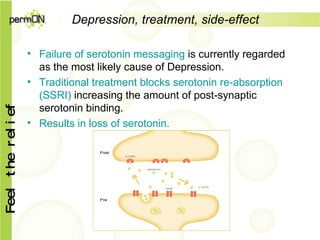
Depression, treatment, side-effect Failure  of serotonin messaging  is currently regarded as the most likely cause of Depression. Traditional treatment blocks serotonin re-absorption (SSRI)  increasing the amount of post-synaptic serotonin binding. Results in loss of serotonin.
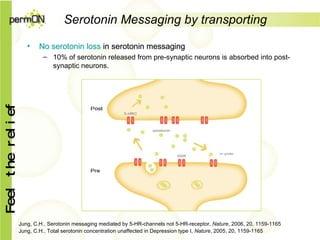
Serotonin Messaging by transporting No serotonin loss  in serotonin messaging Jung, C.H., Serotonin messaging mediated by 5-HR-channels not 5-HR-receptor,  Nature , 2006, 20, 1159-1165 Jung, C.H., Total serotonin concentration unaffected in Depression type I,  Nature , 2005, 20, 1159-1165 No serotonin loss  in serotonin messaging 10% of serotonin released from pre-synaptic neurons is absorbed into post-synaptic neurons.
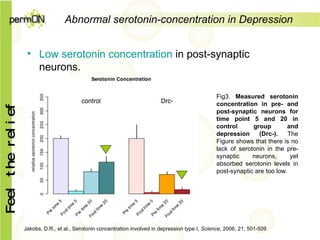
Abnormal  serotonin-concentration  in Depression Low serotonin concentration  in post-synaptic neurons. Jakobs, D.R., et al., Serotonin concentration involved in depression type I,  Science , 2006, 21, 501-509 Fig3.  Measured serotonin concentration in pre- and post - synap tic neurons  for time point 5 and 20 in control group and depression (Drc-).  The Figure shows that there is no lack of serotonin in the pre- synap tic neurons , yet absorbed serotonin levels in post-synap tic  are too low .
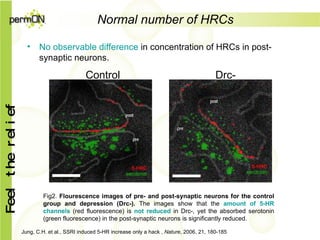
Normal number of HRCs No observable difference  in concentration of HRCs in post-synaptic neurons. Jung, C.H. et al., SSRI induced 5-HR increase only a hack ,  Nature , 2006, 21, 180-185 Fig2.  Flourescence images of pre -  and post - synap tic neurons  for the control group and depression (Drc-).  The images show that the  amount of 5-HR channels  (red fluorescence) is  not reduced  in Drc-, yet the absorbed serotonin (green fluorescence) in the post-synap tic neurons  is significantly reduced. Control  Drc-
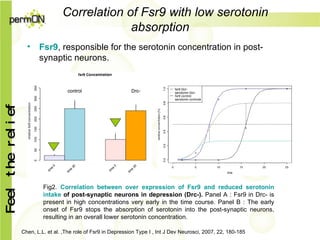
Correlation of Fsr9 with low serotonin absorption  Fsr9 , responsible for the serotonin concentration in post-synaptic neurons. Fig2.   Correlation between over expression of Fsr9 and reduced serotonin intake  of post - synap tic neurons  in depression (Drc-).  Panel A : Fsr9 in Drc- is present in high concentrations very early in the time course. Panel B : The early onset of Fsr9 stops the absorption of serotonin into the post - synap tic neurons , resulting in an overall lower serotonin concentration. Chen, L.L. et al. ,The role of Fsr9 in Depression Type I , Int J Dev Neurosci, 2007, 22, 180-185
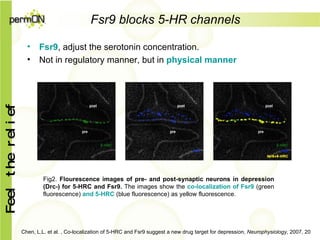
F sr9 blocks 5-HR c h annels Fsr9 , adjust the serotonin concentration. Not in regulatory manner, but in  physical manner Fig2.  Flourescence images of pre -  and post - synap tic neurons  in depression (Drc-) for 5-HR C  and  Fsr 9.  The images show the  co-localization of  Fsr 9  (green fluorescence)  and 5-HRC  (blue fluorescence) as yellow fluorescence.  Chen, L.L. et al. , Co-localization of 5-HRC and Fsr9 suggest a new drug target for depression,  Neurophysiology , 2007, 20
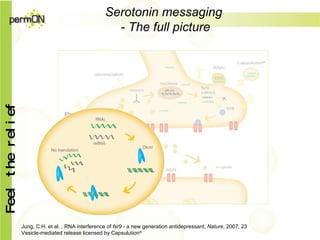
Serotonin messaging  - The full picture Jung, C.H. et al. , RNA interference of  fsr9  - a new generation antidepressant,  Nature , 2007, 23 Vesicle-mediated release licensed by Capsulution ®
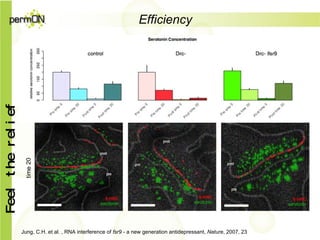
Efficiency time 20 Jung, C.H. et al. , RNA interference of  fsr9  - a new generation antidepressant,  Nature , 2007, 23
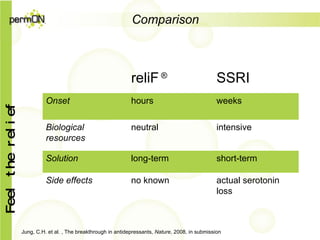
Comparison Jung, C.H. et al. , The breakthrough in antidepressants,  Nature , 2008, in submission actual serotonin loss no known Side effects short-term long-term Solution intensive neutral Biological resources weeks hours Onset SSRI reliF  ®
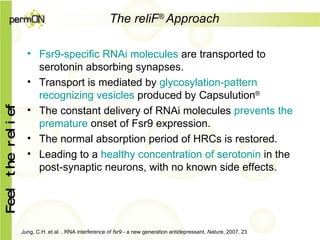
The reliF ®   Approach   Fsr9-specific RNAi molecules  are transported to serotonin absorbing synapses . Transport is mediated by  glycosylation-pattern recognizing vesicles  produced by Capsulution ® The constant delivery of RNAi molecules  prevents the premature  onset of Fsr9  expression . The normal absorption period of HRCs is restored. Leading to a  healthy concentration of serotonin  in the post - synap tic neurons , with no known side effects . Jung, C.H. et al. , RNA interference of  fsr9  - a new generation antidepressant,  Nature , 2007, 23
Overview Goal - Develop an effective, side-effect free drug to provide fast relief from depression. Motivation and Progress   Dr. Andrew Ringsmuth  Market analysis Financial overview IP Portfolio Pitch
Market for reliF ® Depression affects  7-18%  of the population (In USA,  14 million  adults/yr diagnosed) Clinical depression is the leading cause of disability in North America Expected to become the second leading cause worldwide by 2020 (World Health Organization)
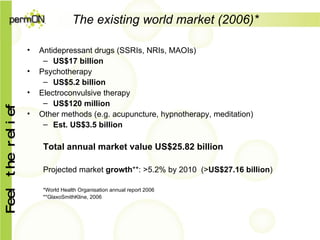
The existing world market (2006)* Antidepressant drugs (SSRIs, NRIs, MAOIs) US$17 billion Psychotherapy US$5.2 billion Electroconvulsive therapy US$120 million Other methods (e.g. acupuncture, hypnotherapy, meditation) Est. US$3.5 billion Total annual market value US$25.82 billion Projected market  growth **: >5.2% by 2010  (> US$27.16 billion ) *World Health Organisation annual report 2006 **GlaxoSmithKline, 2006
The reliF ®  advantage Problems with SSRIs (7 FDA approved, 87% of existing antidepressant market): Slow acting (upto 6-8wks. 55% of prescriptions accompany psychotherapeutic treatments) Unpredictable efficacy and side effects (Average sufferer trials 1 drug unsuccessfully + ) reliF Fast acting (same day) Shown to be effective in >97% cases where an SSRI is effective ++ No known side effects Predicted cost to consumer 5-15% above most popular SSRI ( Cymbalta ) Analysts predict price to be competitive +  Davis, K. & James, P. (2006). ‘The efficacy of drug-based depression treatments’ . J. Neur. Psych.   131 (3): 496-507. ++  Jung, C.H. et al. , RNA interference of fsr9 - a new generation antidepressant,  Nature , 2007, 23.
Expanding market potential Evidence 1  to suggest that reliF technology is adaptable to other depression-associated neurotransmitters (targeted by other existing antidepressants) R&D costs for adaptation << potential market value 1 Jung, C.H. et al. , RNA interference of fsr9 - a new generation antidepressant,  Nature , 2007, 23
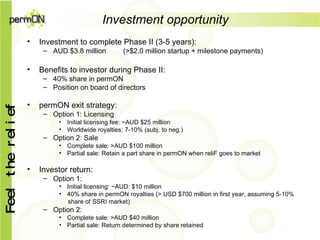
Investment opportunity Investment to complete Phase II (3-5 years): AUD $3.8 million (>$2.0 million startup + milestone payments) Benefits to investor during Phase II: 40% share in permON Position on board of directors permON exit strategy: Option 1: Licensing Initial licensing fee: ~AUD $25 million  Worldwide royalties: 7-10% (subj. to neg.) Option 2: Sale Complete sale: >AUD $100 million Partial sale: Retain a part share in permON when reliF goes to market Investor return: Option 1:  Initial licensing: ~AUD: $10 million 40% share in permON royalties (> USD $700 million in first year, assuming 5-10%  share of SSRI market) Option 2: Complete sale: >AUD $40 million Partial sale: Return determined by share retained
Overview Goal - Develop an effective, side-effect free drug to provide fast relief from depression. Motivation and Progress - Large demand and even growing market in the future. IP Portfolio   Dr. Kimberly Wadsworth  Pitch
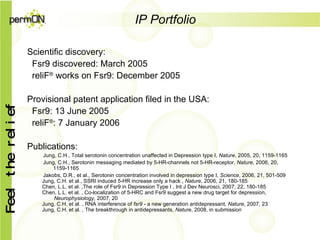
IP Portfolio Scientific discovery: Fsr9 discovered: March 2005 reliF ®  works on Fsr9: December 2005 Provisional patent application filed in the USA: Fsr9: 13 June 2005 reliF ® : 7 January 2006 Publications: Jung, C.H., Total serotonin concentration unaffected in Depression type I,  Nature , 2005, 20, 1159-1165 Jung, C.H., Serotonin messaging mediated by 5-HR-channels not 5-HR-receptor,  Nature , 2006, 20, 1159-1165 Jakobs, D.R., et al., Serotonin concentration involved in depression type I,  Science , 2006, 21, 501-509   Jung, C.H. et al., SSRI induced 5-HR increase only a hack ,  Nature , 2006, 21, 180-185   Chen, L.L. et al. ,The role of Fsr9 in Depression Type I , Int J Dev Neurosci, 2007, 22, 180-185   Chen, L.L. et al. , Co-localization of 5-HRC and Fsr9 suggest a new drug target for depression,    Neurophysiology , 2007, 20   Jung, C.H. et al. , RNA interference of  fsr9  - a new generation antidepressant,  Nature , 2007, 23   Jung, C.H. et al. , The breakthrough in antidepressants,  Nature , 2008, in submission
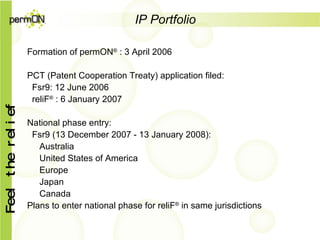
IP Portfolio Formation of permON ®  : 3 April 2006 PCT (Patent Cooperation Treaty) application filed: Fsr9: 12 June 2006 reliF ®  : 6 January 2007 National phase entry: Fsr9 (13 December 2007 - 13 January 2008): Australia United States of America Europe Japan Canada Plans to enter national phase for reliF ®  in same jurisdictions
Trademarks and licensing Trademarks: reliF ® permON ® Licensing: Capsulution ®   Obtained commercial license
Pitch reliF ®  is an effective, side-effect free drug to provide fast relief from depression. Large demand in an ever growing market. We have taken reliF ®  to pre-clinical trials (proof of concept) For your $3.8 million, you will see a return of at least $10 million plus royalties.
Outside opinions of leading clinicians “ When depression becomes a small inconvenience, rather than the major impact on human society, we can look forward to a bright future and reliF ®  is better suited than vicodin.”   Dr. Gregory House “ reliF ®  will be a major breakthrough in depression treatment.” Dr. Meredith Grey “ reliF ®  and Aspirin, two man made miracles” Dr. Frank Campion

ReliF

  • 1.
    Relif ® Feel the relief Dr. Denis C. Bauer CEO Prof. Dr. Cho l Hee Jung CSO Dr. Andrew Ringsmuth Business Development Manager Dr. Kimberly Wadsworth IP Manager
  • 2.
    Introduction Currently,1.3 Millionpeople suffer from acute depression. Estimated to increase exponentially within 10 years. Don Monger : “Depression will be the major impact on modern society” On the Threshold of Eternity by Vincent Van Gogh What if depression can be reduced to a small inconvenience - like headache?
  • 3.
    Overview Drug development Prof. Dr. Chol Hee Jung Scientific Overview Science behind the reliF ® approach Motivation and Progress Market analysis Financial overview IP portfolio Pitch
  • 4.
    Serotonin messaging Pre-synapticneuron : releases serotonin Post-synaptic neuron : recognizes serotonin with 5-HRR and relays the signal. In healthy individuals, about 90% of serotonin released into the synaptic cleft is re-absorbed into pre-synaptic neurons with only 10% bound to post-synaptic neurons.
  • 5.
    Depression, treatment, side-effectFailure of serotonin messaging is currently regarded as the most likely cause of Depression. Traditional treatment blocks serotonin re-absorption (SSRI) increasing the amount of post-synaptic serotonin binding. Results in loss of serotonin.
  • 6.
    Serotonin Messaging bytransporting No serotonin loss in serotonin messaging Jung, C.H., Serotonin messaging mediated by 5-HR-channels not 5-HR-receptor, Nature , 2006, 20, 1159-1165 Jung, C.H., Total serotonin concentration unaffected in Depression type I, Nature , 2005, 20, 1159-1165 No serotonin loss in serotonin messaging 10% of serotonin released from pre-synaptic neurons is absorbed into post-synaptic neurons.
  • 7.
    Abnormal serotonin-concentration in Depression Low serotonin concentration in post-synaptic neurons. Jakobs, D.R., et al., Serotonin concentration involved in depression type I, Science , 2006, 21, 501-509 Fig3. Measured serotonin concentration in pre- and post - synap tic neurons for time point 5 and 20 in control group and depression (Drc-). The Figure shows that there is no lack of serotonin in the pre- synap tic neurons , yet absorbed serotonin levels in post-synap tic are too low .
  • 8.
    Normal number ofHRCs No observable difference in concentration of HRCs in post-synaptic neurons. Jung, C.H. et al., SSRI induced 5-HR increase only a hack , Nature , 2006, 21, 180-185 Fig2. Flourescence images of pre - and post - synap tic neurons for the control group and depression (Drc-). The images show that the amount of 5-HR channels (red fluorescence) is not reduced in Drc-, yet the absorbed serotonin (green fluorescence) in the post-synap tic neurons is significantly reduced. Control Drc-
  • 9.
    Correlation of Fsr9with low serotonin absorption Fsr9 , responsible for the serotonin concentration in post-synaptic neurons. Fig2. Correlation between over expression of Fsr9 and reduced serotonin intake of post - synap tic neurons in depression (Drc-). Panel A : Fsr9 in Drc- is present in high concentrations very early in the time course. Panel B : The early onset of Fsr9 stops the absorption of serotonin into the post - synap tic neurons , resulting in an overall lower serotonin concentration. Chen, L.L. et al. ,The role of Fsr9 in Depression Type I , Int J Dev Neurosci, 2007, 22, 180-185
  • 10.
    F sr9 blocks5-HR c h annels Fsr9 , adjust the serotonin concentration. Not in regulatory manner, but in physical manner Fig2. Flourescence images of pre - and post - synap tic neurons in depression (Drc-) for 5-HR C and Fsr 9. The images show the co-localization of Fsr 9 (green fluorescence) and 5-HRC (blue fluorescence) as yellow fluorescence. Chen, L.L. et al. , Co-localization of 5-HRC and Fsr9 suggest a new drug target for depression, Neurophysiology , 2007, 20
  • 11.
    Serotonin messaging - The full picture Jung, C.H. et al. , RNA interference of fsr9 - a new generation antidepressant, Nature , 2007, 23 Vesicle-mediated release licensed by Capsulution ®
  • 12.
    Efficiency time 20Jung, C.H. et al. , RNA interference of fsr9 - a new generation antidepressant, Nature , 2007, 23
  • 13.
    Comparison Jung, C.H.et al. , The breakthrough in antidepressants, Nature , 2008, in submission actual serotonin loss no known Side effects short-term long-term Solution intensive neutral Biological resources weeks hours Onset SSRI reliF ®
  • 14.
    The reliF ® Approach Fsr9-specific RNAi molecules are transported to serotonin absorbing synapses . Transport is mediated by glycosylation-pattern recognizing vesicles produced by Capsulution ® The constant delivery of RNAi molecules prevents the premature onset of Fsr9 expression . The normal absorption period of HRCs is restored. Leading to a healthy concentration of serotonin in the post - synap tic neurons , with no known side effects . Jung, C.H. et al. , RNA interference of fsr9 - a new generation antidepressant, Nature , 2007, 23
  • 15.
    Overview Goal -Develop an effective, side-effect free drug to provide fast relief from depression. Motivation and Progress Dr. Andrew Ringsmuth Market analysis Financial overview IP Portfolio Pitch
  • 16.
    Market for reliF® Depression affects 7-18% of the population (In USA, 14 million adults/yr diagnosed) Clinical depression is the leading cause of disability in North America Expected to become the second leading cause worldwide by 2020 (World Health Organization)
  • 17.
    The existing worldmarket (2006)* Antidepressant drugs (SSRIs, NRIs, MAOIs) US$17 billion Psychotherapy US$5.2 billion Electroconvulsive therapy US$120 million Other methods (e.g. acupuncture, hypnotherapy, meditation) Est. US$3.5 billion Total annual market value US$25.82 billion Projected market growth **: >5.2% by 2010 (> US$27.16 billion ) *World Health Organisation annual report 2006 **GlaxoSmithKline, 2006
  • 18.
    The reliF ® advantage Problems with SSRIs (7 FDA approved, 87% of existing antidepressant market): Slow acting (upto 6-8wks. 55% of prescriptions accompany psychotherapeutic treatments) Unpredictable efficacy and side effects (Average sufferer trials 1 drug unsuccessfully + ) reliF Fast acting (same day) Shown to be effective in >97% cases where an SSRI is effective ++ No known side effects Predicted cost to consumer 5-15% above most popular SSRI ( Cymbalta ) Analysts predict price to be competitive + Davis, K. & James, P. (2006). ‘The efficacy of drug-based depression treatments’ . J. Neur. Psych. 131 (3): 496-507. ++ Jung, C.H. et al. , RNA interference of fsr9 - a new generation antidepressant, Nature , 2007, 23.
  • 19.
    Expanding market potentialEvidence 1 to suggest that reliF technology is adaptable to other depression-associated neurotransmitters (targeted by other existing antidepressants) R&D costs for adaptation << potential market value 1 Jung, C.H. et al. , RNA interference of fsr9 - a new generation antidepressant, Nature , 2007, 23
  • 20.
    Investment opportunity Investmentto complete Phase II (3-5 years): AUD $3.8 million (>$2.0 million startup + milestone payments) Benefits to investor during Phase II: 40% share in permON Position on board of directors permON exit strategy: Option 1: Licensing Initial licensing fee: ~AUD $25 million Worldwide royalties: 7-10% (subj. to neg.) Option 2: Sale Complete sale: >AUD $100 million Partial sale: Retain a part share in permON when reliF goes to market Investor return: Option 1: Initial licensing: ~AUD: $10 million 40% share in permON royalties (> USD $700 million in first year, assuming 5-10% share of SSRI market) Option 2: Complete sale: >AUD $40 million Partial sale: Return determined by share retained
  • 21.
    Overview Goal -Develop an effective, side-effect free drug to provide fast relief from depression. Motivation and Progress - Large demand and even growing market in the future. IP Portfolio Dr. Kimberly Wadsworth Pitch
  • 22.
    IP Portfolio Scientificdiscovery: Fsr9 discovered: March 2005 reliF ® works on Fsr9: December 2005 Provisional patent application filed in the USA: Fsr9: 13 June 2005 reliF ® : 7 January 2006 Publications: Jung, C.H., Total serotonin concentration unaffected in Depression type I, Nature , 2005, 20, 1159-1165 Jung, C.H., Serotonin messaging mediated by 5-HR-channels not 5-HR-receptor, Nature , 2006, 20, 1159-1165 Jakobs, D.R., et al., Serotonin concentration involved in depression type I, Science , 2006, 21, 501-509 Jung, C.H. et al., SSRI induced 5-HR increase only a hack , Nature , 2006, 21, 180-185 Chen, L.L. et al. ,The role of Fsr9 in Depression Type I , Int J Dev Neurosci, 2007, 22, 180-185 Chen, L.L. et al. , Co-localization of 5-HRC and Fsr9 suggest a new drug target for depression, Neurophysiology , 2007, 20 Jung, C.H. et al. , RNA interference of fsr9 - a new generation antidepressant, Nature , 2007, 23 Jung, C.H. et al. , The breakthrough in antidepressants, Nature , 2008, in submission
  • 23.
    IP Portfolio Formationof permON ® : 3 April 2006 PCT (Patent Cooperation Treaty) application filed: Fsr9: 12 June 2006 reliF ® : 6 January 2007 National phase entry: Fsr9 (13 December 2007 - 13 January 2008): Australia United States of America Europe Japan Canada Plans to enter national phase for reliF ® in same jurisdictions
  • 24.
    Trademarks and licensingTrademarks: reliF ® permON ® Licensing: Capsulution ® Obtained commercial license
  • 25.
    Pitch reliF ® is an effective, side-effect free drug to provide fast relief from depression. Large demand in an ever growing market. We have taken reliF ® to pre-clinical trials (proof of concept) For your $3.8 million, you will see a return of at least $10 million plus royalties.
  • 26.
    Outside opinions ofleading clinicians “ When depression becomes a small inconvenience, rather than the major impact on human society, we can look forward to a bright future and reliF ® is better suited than vicodin.” Dr. Gregory House “ reliF ® will be a major breakthrough in depression treatment.” Dr. Meredith Grey “ reliF ® and Aspirin, two man made miracles” Dr. Frank Campion