Hina Malik
PhD Scholar
Mass Communication
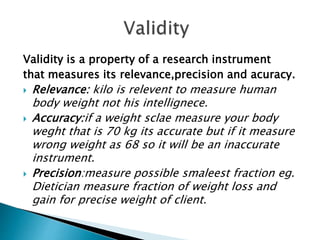
Validity is a property of a research instrument
that measures its relevance,precision and acuracy.
 Relevance: kilo is relevent to measure human
body weight not his intellignece.
 Accuracy:if a weight sclae measure your body
weght that is 70 kg its accurate but if it measure
wrong weight as 68 so it will be an inaccurate
instrument.
 Precision:measure possible smaleest fraction eg.
Dietician measure fraction of weight loss and
gain for precise weight of client.
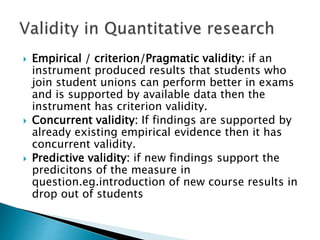
 Empirical / criterion/Pragmatic validity: if an
instrument produced results that students who
join student unions can perform better in exams
and is supported by available data then the
instrument has criterion validity.
 Concurrent validity: If findings are supported by
already existing empirical evidence then it has
concurrent validity.
 Predictive validity: if new findings support the
predicitons of the measure in
question.eg.introduction of new course results in
drop out of students
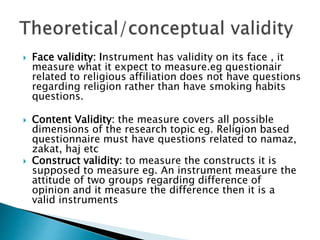
 Face validity: Instrument has validity on its face , it
measure what it expect to measure.eg questionair
related to religious affiliation does not have questions
regarding religion rather than have smoking habits
questions.
 Content Validity: the measure covers all possible
dimensions of the research topic eg. Religion based
questionnaire must have questions related to namaz,
zakat, haj etc
 Construct validity: to measure the constructs it is
supposed to measure eg. An instrument measure the
attitude of two groups regarding difference of
opinion and it measure the difference then it is a
valid instruments
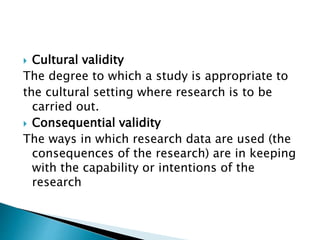
 Cultural validity
The degree to which a study is appropriate to
the cultural setting where research is to be
carried out.
 Consequential validity
The ways in which research data are used (the
consequences of the research) are in keeping
with the capability or intentions of the
research
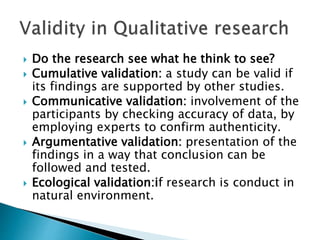
 Do the research see what he think to see?
 Cumulative validation: a study can be valid if
its findings are supported by other studies.
 Communicative validation: involvement of the
participants by checking accuracy of data, by
employing experts to confirm authenticity.
 Argumentative validation: presentation of the
findings in a way that conclusion can be
followed and tested.
 Ecological validation:if research is conduct in
natural environment.
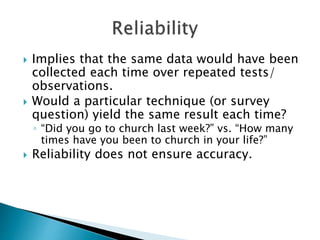
 Implies that the same data would have been
collected each time over repeated tests/
observations.
 Would a particular technique (or survey
question) yield the same result each time?
◦ “Did you go to church last week?” vs. “How many
times have you been to church in your life?”
 Reliability does not ensure accuracy.
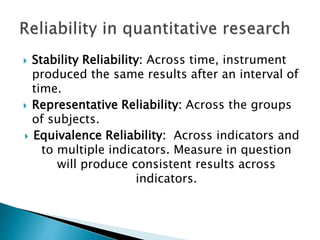
 Stability Reliability: Across time, instrument
produced the same results after an interval of
time.
 Representative Reliability: Across the groups
of subjects.
 Equivalence Reliability: Across indicators and
to multiple indicators. Measure in question
will produce consistent results across
indicators.
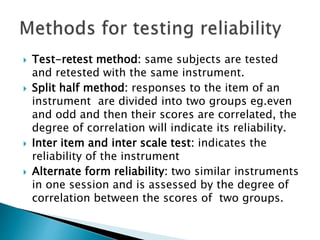
 Test-retest method: same subjects are tested
and retested with the same instrument.
 Split half method: responses to the item of an
instrument are divided into two groups eg.even
and odd and then their scores are correlated, the
degree of correlation will indicate its reliability.
 Inter item and inter scale test: indicates the
reliability of the instrument
 Alternate form reliability: two similar instruments
in one session and is assessed by the degree of
correlation between the scores of two groups.
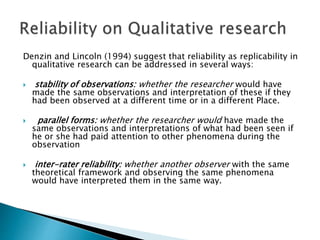
Denzin and Lincoln (1994) suggest that reliability as replicability in
qualitative research can be addressed in several ways:
 stability of observations: whether the researcher would have
made the same observations and interpretation of these if they
had been observed at a different time or in a different Place.
 parallel forms: whether the researcher would have made the
same observations and interpretations of what had been seen if
he or she had paid attention to other phenomena during the
observation
 inter-rater reliability: whether another observer with the same
theoretical framework and observing the same phenomena
would have interpreted them in the same way.
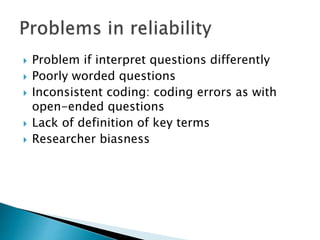
 Problem if interpret questions differently
 Poorly worded questions
 Inconsistent coding: coding errors as with
open-ended questions
 Lack of definition of key terms
 Researcher biasness
JAZKALLAH For listening me
QUESTIONS??????

Reliabality and validity ppt

  • 1.
  • 2.
    Validity is aproperty of a research instrument that measures its relevance,precision and acuracy.  Relevance: kilo is relevent to measure human body weight not his intellignece.  Accuracy:if a weight sclae measure your body weght that is 70 kg its accurate but if it measure wrong weight as 68 so it will be an inaccurate instrument.  Precision:measure possible smaleest fraction eg. Dietician measure fraction of weight loss and gain for precise weight of client.
  • 3.
     Empirical /criterion/Pragmatic validity: if an instrument produced results that students who join student unions can perform better in exams and is supported by available data then the instrument has criterion validity.  Concurrent validity: If findings are supported by already existing empirical evidence then it has concurrent validity.  Predictive validity: if new findings support the predicitons of the measure in question.eg.introduction of new course results in drop out of students
  • 4.
     Face validity:Instrument has validity on its face , it measure what it expect to measure.eg questionair related to religious affiliation does not have questions regarding religion rather than have smoking habits questions.  Content Validity: the measure covers all possible dimensions of the research topic eg. Religion based questionnaire must have questions related to namaz, zakat, haj etc  Construct validity: to measure the constructs it is supposed to measure eg. An instrument measure the attitude of two groups regarding difference of opinion and it measure the difference then it is a valid instruments
  • 5.
     Cultural validity Thedegree to which a study is appropriate to the cultural setting where research is to be carried out.  Consequential validity The ways in which research data are used (the consequences of the research) are in keeping with the capability or intentions of the research
  • 6.
     Do theresearch see what he think to see?  Cumulative validation: a study can be valid if its findings are supported by other studies.  Communicative validation: involvement of the participants by checking accuracy of data, by employing experts to confirm authenticity.  Argumentative validation: presentation of the findings in a way that conclusion can be followed and tested.  Ecological validation:if research is conduct in natural environment.
  • 7.
     Implies thatthe same data would have been collected each time over repeated tests/ observations.  Would a particular technique (or survey question) yield the same result each time? ◦ “Did you go to church last week?” vs. “How many times have you been to church in your life?”  Reliability does not ensure accuracy.
  • 8.
     Stability Reliability:Across time, instrument produced the same results after an interval of time.  Representative Reliability: Across the groups of subjects.  Equivalence Reliability: Across indicators and to multiple indicators. Measure in question will produce consistent results across indicators.
  • 9.
     Test-retest method:same subjects are tested and retested with the same instrument.  Split half method: responses to the item of an instrument are divided into two groups eg.even and odd and then their scores are correlated, the degree of correlation will indicate its reliability.  Inter item and inter scale test: indicates the reliability of the instrument  Alternate form reliability: two similar instruments in one session and is assessed by the degree of correlation between the scores of two groups.
  • 10.
    Denzin and Lincoln(1994) suggest that reliability as replicability in qualitative research can be addressed in several ways:  stability of observations: whether the researcher would have made the same observations and interpretation of these if they had been observed at a different time or in a different Place.  parallel forms: whether the researcher would have made the same observations and interpretations of what had been seen if he or she had paid attention to other phenomena during the observation  inter-rater reliability: whether another observer with the same theoretical framework and observing the same phenomena would have interpreted them in the same way.
  • 11.
     Problem ifinterpret questions differently  Poorly worded questions  Inconsistent coding: coding errors as with open-ended questions  Lack of definition of key terms  Researcher biasness
  • 12.
    JAZKALLAH For listeningme QUESTIONS??????