Marcela Bahlsen,Knan Ztion and
Marta Aparicio
4C
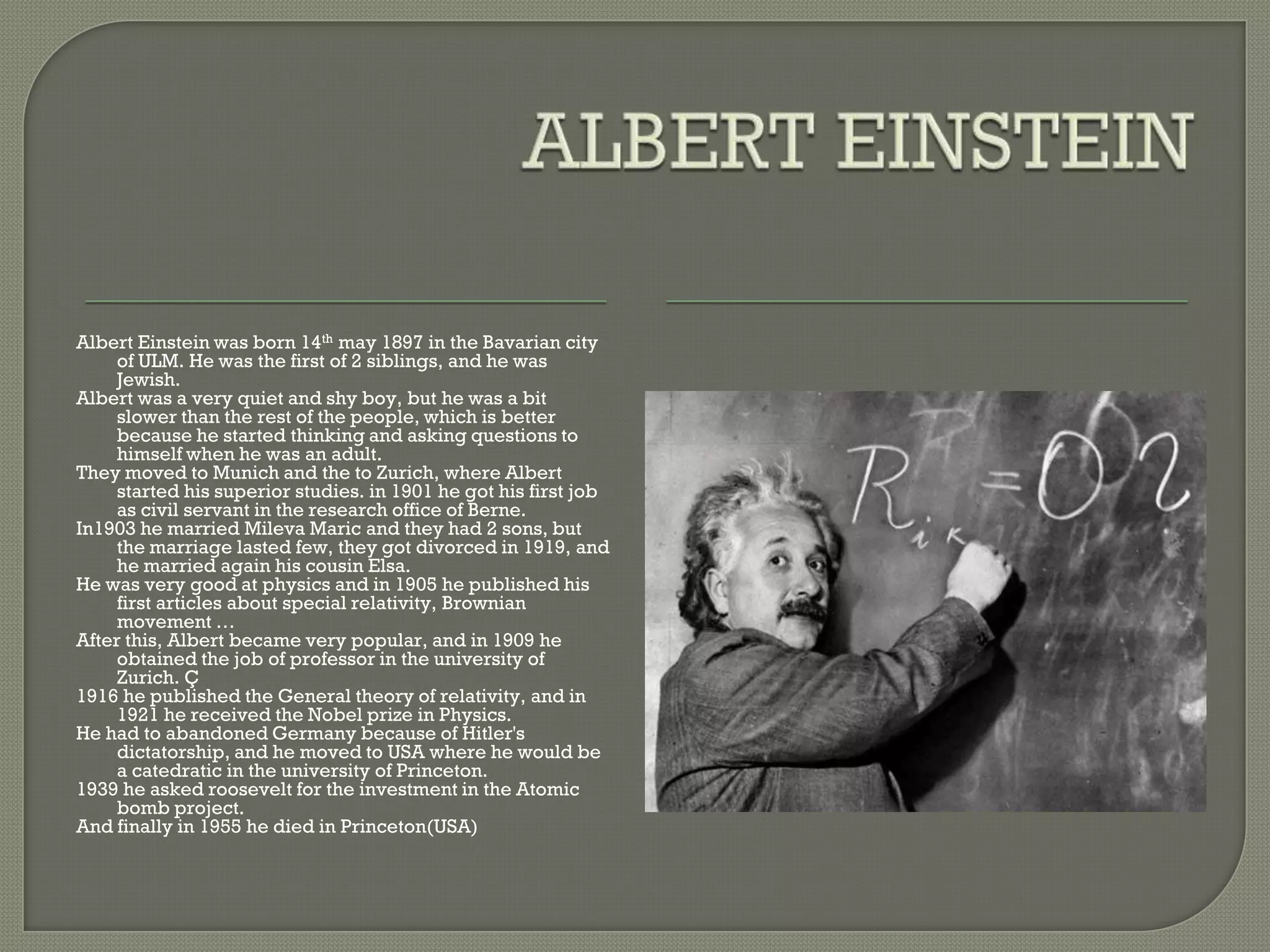
Albert Einstein was born 14th may 1897 in the Bavarian city
of ULM. He was the first of 2 siblings, and he was
Jewish.
Albert was a very quiet and shy boy, but he was a bit
slower than the rest of the people, which is better
because he started thinking and asking questions to
himself when he was an adult.
They moved to Munich and the to Zurich, where Albert
started his superior studies. in 1901 he got his first job
as civil servant in the research office of Berne.
In1903 he married Mileva Maric and they had 2 sons, but
the marriage lasted few, they got divorced in 1919, and
he married again his cousin Elsa.
He was very good at physics and in 1905 he published his
first articles about special relativity, Brownian
movement …
After this, Albert became very popular, and in 1909 he
obtained the job of professor in the university of
Zurich. Ç
1916 he published the General theory of relativity, and in
1921 he received the Nobel prize in Physics.
He had to abandoned Germany because of Hitler's
dictatorship, and he moved to USA where he would be
a catedratic in the university of Princeton.
1939 he asked roosevelt for the investment in the Atomic
bomb project.
And finally in 1955 he died in Princeton(USA)



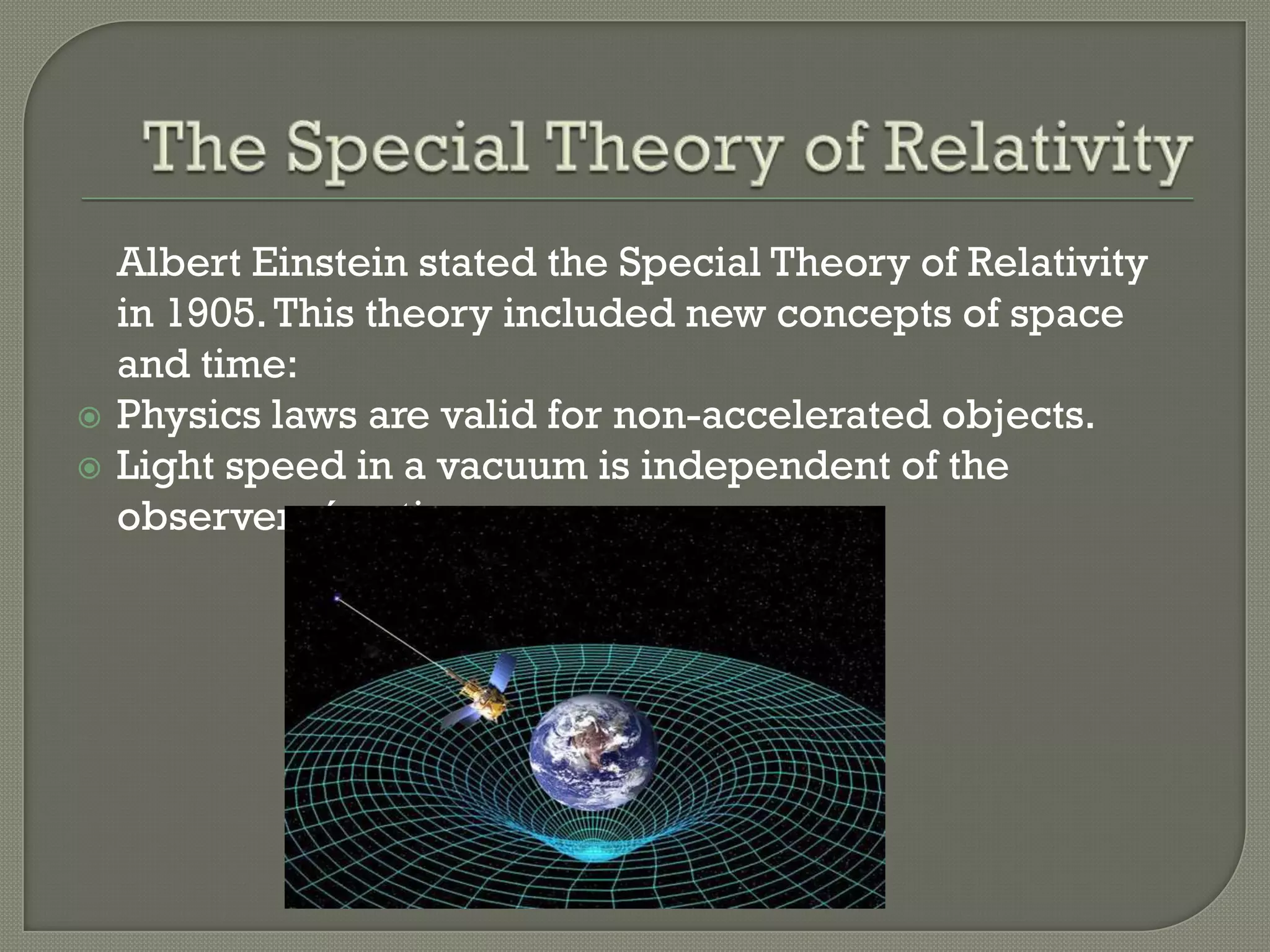
Albert Einstein stated the Special Theory of Relativity
in 1905. This theory included new concepts of space
and time:
Physics laws are valid for non-accelerated objects.
Light speed in a vacuum is independent of the
observers ´motion






He spent some years trying to include acceleration in his
theory. In 1915 he published his General Theory of Relativity.
Gravity is the force that attracts two objects.
The fastest velocity is the light velocity.
He discovered that the light in a vacuum has the same speed
no matter the speed of the observer. As a result he realized
that space and time were interwoven. (Events that occur at a
specific time for an observer, could occur at a different time
for another).
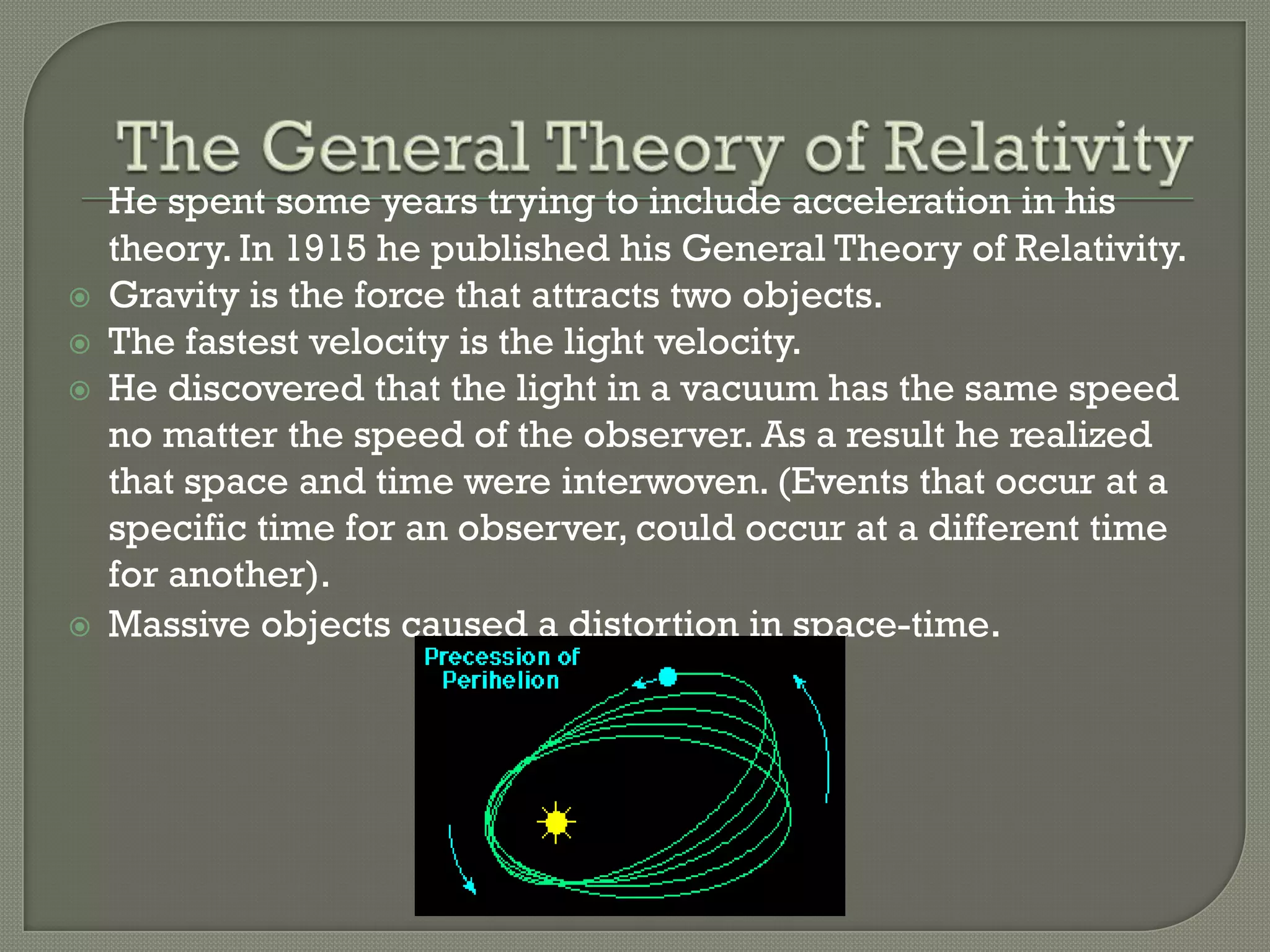
Massive objects caused a distortion in space-time.
 The

theory of relativity has strongly
influenced developments in advanced
physics, geometry, astronomy and cosmology
(origin and structure of the universe).
 Equations used and proved in the theory have
helped to develop different theories between
them some related to geometry and most
importantly to the gravitational force.
 It has helped to develop the principle of
equivalence.
 The theory is used to study the overall
structure of the universe and therefore to
expand our knowledge of cosmology.
 Using

the theory several scientists have
discovered natural phenomena such as
black holes and gravitational lenses.
 In modern physics it has shown scientists
that it is possible to unleash the energy
contained in the nucleus of an atom.
 Has affected the application of nuclear
production, and therefore has helped to
alleviate a portion of our reliance on non
renewable resources for our energy needs.
 as well as the synchronization of the global
positioning system (GPS).

Relativity (2)

  • 1.
    Marcela Bahlsen,Knan Ztionand Marta Aparicio 4C
  • 2.
    Albert Einstein wasborn 14th may 1897 in the Bavarian city of ULM. He was the first of 2 siblings, and he was Jewish. Albert was a very quiet and shy boy, but he was a bit slower than the rest of the people, which is better because he started thinking and asking questions to himself when he was an adult. They moved to Munich and the to Zurich, where Albert started his superior studies. in 1901 he got his first job as civil servant in the research office of Berne. In1903 he married Mileva Maric and they had 2 sons, but the marriage lasted few, they got divorced in 1919, and he married again his cousin Elsa. He was very good at physics and in 1905 he published his first articles about special relativity, Brownian movement … After this, Albert became very popular, and in 1909 he obtained the job of professor in the university of Zurich. Ç 1916 he published the General theory of relativity, and in 1921 he received the Nobel prize in Physics. He had to abandoned Germany because of Hitler's dictatorship, and he moved to USA where he would be a catedratic in the university of Princeton. 1939 he asked roosevelt for the investment in the Atomic bomb project. And finally in 1955 he died in Princeton(USA)
  • 3.
      Albert Einstein statedthe Special Theory of Relativity in 1905. This theory included new concepts of space and time: Physics laws are valid for non-accelerated objects. Light speed in a vacuum is independent of the observers ´motion
  • 4.
        He spent someyears trying to include acceleration in his theory. In 1915 he published his General Theory of Relativity. Gravity is the force that attracts two objects. The fastest velocity is the light velocity. He discovered that the light in a vacuum has the same speed no matter the speed of the observer. As a result he realized that space and time were interwoven. (Events that occur at a specific time for an observer, could occur at a different time for another). Massive objects caused a distortion in space-time.
  • 6.
     The theory ofrelativity has strongly influenced developments in advanced physics, geometry, astronomy and cosmology (origin and structure of the universe).  Equations used and proved in the theory have helped to develop different theories between them some related to geometry and most importantly to the gravitational force.  It has helped to develop the principle of equivalence.  The theory is used to study the overall structure of the universe and therefore to expand our knowledge of cosmology.
  • 7.
     Using the theoryseveral scientists have discovered natural phenomena such as black holes and gravitational lenses.  In modern physics it has shown scientists that it is possible to unleash the energy contained in the nucleus of an atom.  Has affected the application of nuclear production, and therefore has helped to alleviate a portion of our reliance on non renewable resources for our energy needs.  as well as the synchronization of the global positioning system (GPS).