Effects of the insect
                 growth
regulator, novaluron on
  immature leafcutting
       bees, Megachile
             rotundata
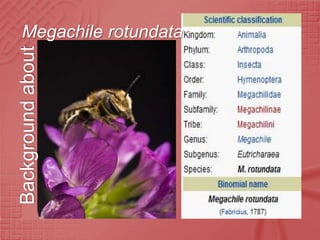
Megachile rotundata
Megachile rotundata
Background about
-   Alfalfa leafcutting bees, M. rotundata, are the
most common pollinator of alfalfa in
the Pacific Northwest.
                                         -   GOALS:
-   To evaluate novaluron toxicity to immature M.
              rotundata using 2 different possible
                         mechanisms of exposure
        -To assess immature mortality via treating

          nectar-pollen provisions and adults with
                                       novalurons.
The Alfalfa leafcutting bee, M. rotundata, is a
-

solitary, but gregarious, cavity-nesting bee.
-   M. rotundata, was introduced to North America
from Eurasia in the 1930s.
-   1950-1960s, growers were
successful at increasing alfalfa
seed set by using permanent
shelters with “bee nesting
boards”, or premade cavities,
near or in fields.
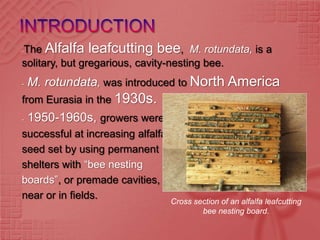
                                   Cross section of an alfalfa leafcutting
                                           bee nesting board.
M. rotundata

Environmental factors
   Wind
   Rain
   Temperature
Insecticide use in alfalfa grown
 for seed
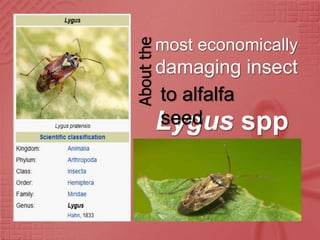
About the
            most economically
            damaging insect
            to alfalfa
            seed
            Lygus spp
Lygus spp
Most economically damaging insect
to alfalfa seed

 Several new chemistries have been
released for Lygus spp. suppression
   •Novaluron
   •Acetomiprod
   •Flonicamid
Novaluron
- An insect growth regulator that
disrupts cuticle formation and
prevents molting.
- Acts by contact or ingestion, and
as with other insect growth
regulators, targets immature life
stages
1st and 2nd : are lab and field
experiments designed to
assess mortality by applying
novaluron to nectar-pollen
provisions and adults.

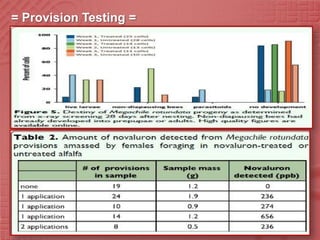
                           3rd: measured
                              novaluron
                        concentrations in
                             provisions.
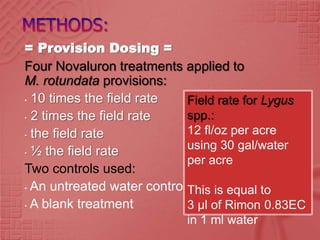
= Provision Dosing =
Four Novaluron treatments applied to
M. rotundata provisions:
• 10 times the field rate    Field rate for Lygus
• 2 times the field rate     spp.:
• the field rate
                             12 fl/oz per acre
• ½ the field rate
                             using 30 gal/water
                             per acre
Two controls used:
• An untreated water control
                             This is equal to
• A blank treatment          3 µl of Rimon 0.83EC
                            in 1 ml water
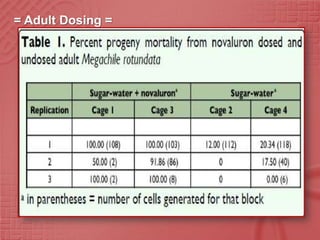
= Adult Dosing =
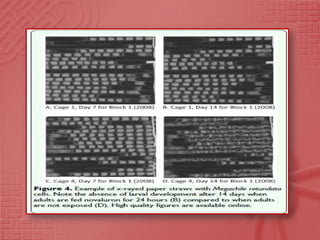
Adults were divided into two feeding
treatments :
• 10% sugar-water

• 10% sugar-water + the full field of

novaluron

= Provision Testing =
• A small M. rotundata bee shelter with a
removable nesting block was placed in the center
of each cage, approximately 1m off the ground
with a southeast orientation.
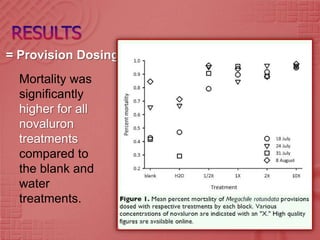
= Provision Dosing =
  Mortality was
  significantly
  higher for all
  novaluron
  treatments
  compared to
  the blank and
  water
  treatments.
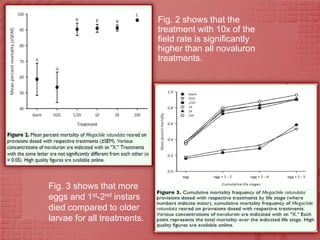
Fig. 2 shows that the
                             treatment with 10x of the
                             field rate is significantly
                             higher than all novaluron
                             treatments.


Fig. 3 shows that more
eggs and 1st-2nd instars
died compared to older
larvae for all treatments.
= Adult Dosing =
= Provision Testing =

Effects of the insect growth regulator, novaluron

  • 1.
    Effects of theinsect growth regulator, novaluron on immature leafcutting bees, Megachile rotundata
  • 2.
  • 3.
  • 4.
    - Alfalfa leafcutting bees, M. rotundata, are the most common pollinator of alfalfa in the Pacific Northwest. - GOALS: - To evaluate novaluron toxicity to immature M. rotundata using 2 different possible mechanisms of exposure -To assess immature mortality via treating nectar-pollen provisions and adults with novalurons.
  • 5.
    The Alfalfa leafcuttingbee, M. rotundata, is a - solitary, but gregarious, cavity-nesting bee. - M. rotundata, was introduced to North America from Eurasia in the 1930s. - 1950-1960s, growers were successful at increasing alfalfa seed set by using permanent shelters with “bee nesting boards”, or premade cavities, near or in fields. Cross section of an alfalfa leafcutting bee nesting board.
  • 6.
    M. rotundata Environmental factors  Wind  Rain  Temperature Insecticide use in alfalfa grown for seed
  • 7.
    About the most economically damaging insect to alfalfa seed Lygus spp
  • 8.
    Lygus spp Most economicallydamaging insect to alfalfa seed  Several new chemistries have been released for Lygus spp. suppression •Novaluron •Acetomiprod •Flonicamid
  • 9.
    Novaluron - An insectgrowth regulator that disrupts cuticle formation and prevents molting. - Acts by contact or ingestion, and as with other insect growth regulators, targets immature life stages
  • 10.
    1st and 2nd: are lab and field experiments designed to assess mortality by applying novaluron to nectar-pollen provisions and adults. 3rd: measured novaluron concentrations in provisions.
  • 11.
    = Provision Dosing= Four Novaluron treatments applied to M. rotundata provisions: • 10 times the field rate Field rate for Lygus • 2 times the field rate spp.: • the field rate 12 fl/oz per acre • ½ the field rate using 30 gal/water per acre Two controls used: • An untreated water control This is equal to • A blank treatment 3 µl of Rimon 0.83EC in 1 ml water
  • 12.
    = Adult Dosing= Adults were divided into two feeding treatments : • 10% sugar-water • 10% sugar-water + the full field of novaluron = Provision Testing = • A small M. rotundata bee shelter with a removable nesting block was placed in the center of each cage, approximately 1m off the ground with a southeast orientation.
  • 13.
    = Provision Dosing= Mortality was significantly higher for all novaluron treatments compared to the blank and water treatments.
  • 14.
    Fig. 2 showsthat the treatment with 10x of the field rate is significantly higher than all novaluron treatments. Fig. 3 shows that more eggs and 1st-2nd instars died compared to older larvae for all treatments.
  • 15.
  • 17.