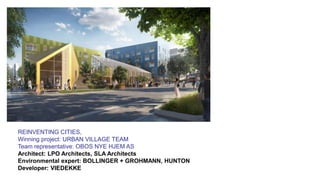
REINVENTING CITIES,
Winning project: URBAN VILLAGE TEAM
Team representative: OBOS NYE HJEM AS
Architect: LPO Architects, SLA Architects
Environmental expert: BOLLINGER + GROHMANN, HUNTON
Developer: VIEDEKKE
This 2,200 sqm site is centrally located near the subway and Furuset centre, a transportation hub and
typical suburban area of Oslo. The site, currently used as a car park, is mainly planned for housing new
development is situated in the Grorud valley, which benefits from a governmental and municipal joint effort
to tackle the environmental challenges alongside the social challenges faced by the local population.
The site is centrally located at Furuset, near the subway and Furuset centre. Furuset is a typical suburban area of
Oslo, situated in the Grorud valley to the north east of the city centre.
the Furuset area was developed in the 1970s
and comprises housing units, schools, nurseries,
care home, a shopping mall, other commercial
properties and public services.
Furuset is a very multicultural neighborhood (with
140 nationalities represented). The team bidders
will have to address interesting challenges of
social integration for the redevelopment of this
site.
The Grorud Valley Action Program (a government
and municipal joint effort) was established to
tackle the physical, environmental, social and
educational challenges faced by the population.
Benefiting from this dynamic, Furuset has seen significant improvements and upgrades of public space, such as
verdensparken- a park with a parkour area, a reopened stream, better lightings, playground equipment and art in
public space.
The last couple of years, private housing companies have started upgrading their buildings after many years of poor
maintenance. After many years without any new construction, several heavier real estate developers have
positioned themselves for property development in the area.
The Urban Village project is designed with sustainability as the guiding parameter. The car-free project creates a
surplus of energy supported by passive house principles and photovoltaics that cover all the sun-exposed roofs
and facades. The BREEAM pre-analysis indicates an “outstanding” performance outcome. The project will achieve
a low carbon footprint by opting for wood products, such as wood fiber insulation. The nature-based design
principles furthermore promote resilience to climate-change.
Key Components & Solutions
• The Urban Village is a carbon neutral project with an
extensive use of wood, renewables, car-free space and
green areas.
• The project is designed to produce more energy than it
consumes by reducing to a maximum its energy
consumption: it is energy positive. The energy production
is provided by a large surface of photovoltaic panels on
the façades and rooftops, as well as with heat pumps.
• Carbon neutrality construction is
largely achieved thanks to the use of
local materials, Cross Laminated
Timber for the building structure and
limited resource requirements, thanks
to compact building blocks.
• The project also promotes urban
agriculture and biodiversity with a large
greenhouse for herbs fruits &
vegetables. The green areas also
create different microclimates and
habitats in order to promote a
biodiversity of plant and animal species
on the site.
https://www.c40reinventingcities.org/en/sites/bygata-furuset-1268.html

Reinventing cities,

  • 1.
    REINVENTING CITIES, Winning project:URBAN VILLAGE TEAM Team representative: OBOS NYE HJEM AS Architect: LPO Architects, SLA Architects Environmental expert: BOLLINGER + GROHMANN, HUNTON Developer: VIEDEKKE
  • 2.
    This 2,200 sqmsite is centrally located near the subway and Furuset centre, a transportation hub and typical suburban area of Oslo. The site, currently used as a car park, is mainly planned for housing new development is situated in the Grorud valley, which benefits from a governmental and municipal joint effort to tackle the environmental challenges alongside the social challenges faced by the local population. The site is centrally located at Furuset, near the subway and Furuset centre. Furuset is a typical suburban area of Oslo, situated in the Grorud valley to the north east of the city centre.
  • 3.
    the Furuset areawas developed in the 1970s and comprises housing units, schools, nurseries, care home, a shopping mall, other commercial properties and public services. Furuset is a very multicultural neighborhood (with 140 nationalities represented). The team bidders will have to address interesting challenges of social integration for the redevelopment of this site. The Grorud Valley Action Program (a government and municipal joint effort) was established to tackle the physical, environmental, social and educational challenges faced by the population. Benefiting from this dynamic, Furuset has seen significant improvements and upgrades of public space, such as verdensparken- a park with a parkour area, a reopened stream, better lightings, playground equipment and art in public space. The last couple of years, private housing companies have started upgrading their buildings after many years of poor maintenance. After many years without any new construction, several heavier real estate developers have positioned themselves for property development in the area.
  • 4.
    The Urban Villageproject is designed with sustainability as the guiding parameter. The car-free project creates a surplus of energy supported by passive house principles and photovoltaics that cover all the sun-exposed roofs and facades. The BREEAM pre-analysis indicates an “outstanding” performance outcome. The project will achieve a low carbon footprint by opting for wood products, such as wood fiber insulation. The nature-based design principles furthermore promote resilience to climate-change.
  • 6.
    Key Components &Solutions • The Urban Village is a carbon neutral project with an extensive use of wood, renewables, car-free space and green areas. • The project is designed to produce more energy than it consumes by reducing to a maximum its energy consumption: it is energy positive. The energy production is provided by a large surface of photovoltaic panels on the façades and rooftops, as well as with heat pumps.
  • 7.
    • Carbon neutralityconstruction is largely achieved thanks to the use of local materials, Cross Laminated Timber for the building structure and limited resource requirements, thanks to compact building blocks. • The project also promotes urban agriculture and biodiversity with a large greenhouse for herbs fruits & vegetables. The green areas also create different microclimates and habitats in order to promote a biodiversity of plant and animal species on the site. https://www.c40reinventingcities.org/en/sites/bygata-furuset-1268.html