Prtfolio
BRIGLIA H}E}LE}NE
THE TENTERFIELDS, APT 39
BROWN STREET SOUTH , DUBLIN 8
IRELAND
+33.6.85.11.89.13 FR
HELENE.BRIGLIA}}@}GMAIL.COM
WWW.HBRIGLIA.COM
HELENE BRIGLIA}
CONTENT
. 2016 BETWEEN CONNECTION AND RECONCILIATION , DMZ KOREA ...P.4
. 2016 FOUNDATIONBENETEAUARCHITECTURECOMPETITION,DUBLINIRELAND ...P.12
. 2016 LIVING MODULE PROTOTYPE WORKSHOP, POSSOTOME BENIN ...P.18
. 2015 ECOLODGES & BIODIVERSITY CENTER, NOKOUE LAC BENIN ...P.22
. 2015 URBAN COVER REGENERARE URBANA, TARGU MURES ROUMANIA ...P.28
. 2015 PROMESSION CENTER, COLOGNE GERMANY ...P.34
. 2014 NEED IT ADAPT IT SHADOK COMPETITION, STRASBOURG FRANCE ...P.42
LAYOUT BY HELENE BRIGLIA
«If you're going to try and fail, you might as well do
it with a high goal.»
-Honeyclover
54
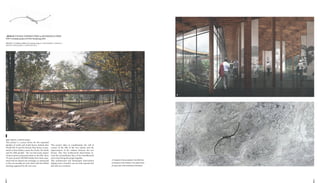
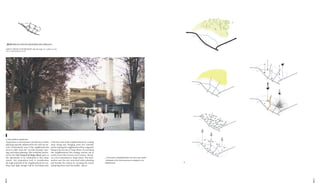
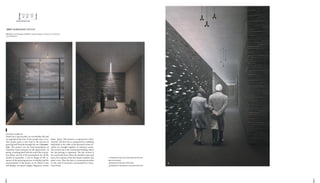
_1.Viewpoint of the promenade in the DMZ flora
_2.Viewpoint of the exhibition in the peace haven
_3.Layout plan of the architectural intervention
1
2
33
DMZ, NORTH & SOUTH KOREA
This project is a peace haven for the separated
families of north and South Korea. Indeed after
World War II and the Korean War, Korea is sepa-
rated in three distinct areas; the North, the South
and the 38th parallel. The war had many impact
of these nations and particularly on the folk. Since
70 years around 100 000 families have been sepa-
rated and are denied any exchange or contactand
so few can actually see each other with the official
meeting organized by the red cross.
This project takes in consideration the will of
contact of the folk of the two nations and the
improvement of the relation between the two
Koreas. This 1km architectural intervention in-
vests the extraordinary flora of the Demilitarized
zone wwto bring the people together.
This architectural and landscaped intervention
displays how a boarder can not only separate but
also link two countries.
. 2016 BETWEEN CONNECTION & RECONCILIATION
TOP 5 Graduate project of INSA Strasbourg 2016
PROJECT of Hélène BRIGLIA with the help of HOLLENDER L/ FINDJI H /
BOIS M/ CHEVALLIER C/ CONSTANTINI A
76
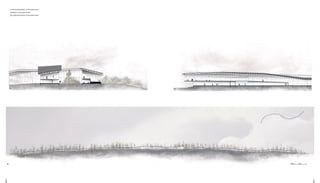
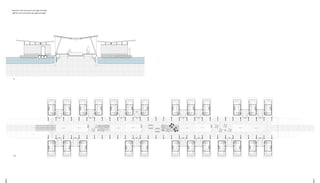
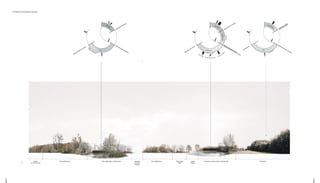
_4.Transversal section of the peace haven
_5.Section of the peace haven
_6.Longitudinal section of the peace haven
44
55
66
98
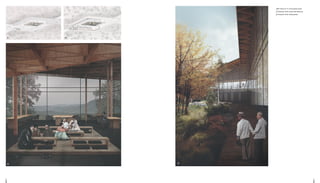
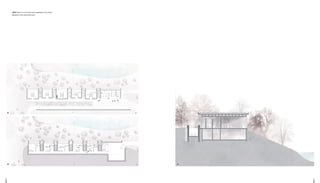
_7&7'.Plans F0- F1 of the peace haven
_8.Viewpoint of the ceremonial teahouse
_9.Viewpoint of the inside garden
77 7'7'
8 9
1110
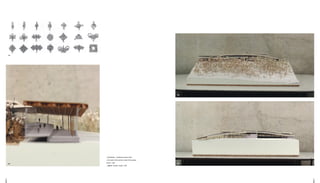
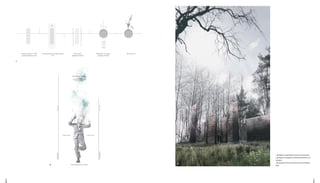
_10.Maedup - traditional korean knots
_11.Inside of the section model of the peace
haven 1:200
_12&12'. Section model 1:200
101010
1111
12
12'
1312
2
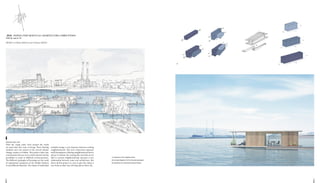
_1.Viewpoint of the neighbourhood
_2.Concept diagrams for the housing typologies
_3.Viewpoint of a individual housing module
1
3
. 2016 FOUNDATION BENETEAU ARCHITECTURE COMPETITION
TOP 10 out of 70
PROJECT of Hélène BRIGLIA and Charlotte GRESET
DUBLIN, IRELAND
With the rising water level around the world
we must find new ways of living. These floating
modules were our answer to the current climate
change context in Dublin. This project takes into
consideration the use of recycled material and the
possibility to roam in different environnements.
The different typologies of housings are the result
of repurposed containers of the Dublin harbour
to suit different lifestyles. The cluster of individual
modules brings a new dynamic between existing
neighbourhoods. This new connection expresses
itself throughout a floating neighbourhood that is
always in motion. By creating this new link we are
able to activate neighbourhoods and give a new
relationship between water and architecture. But
above all this project is a way to give the citizen a
new look on their way of living and on their city.
1514
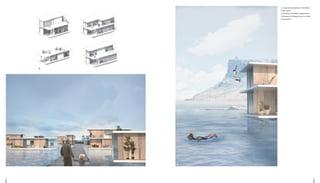
_4. Axonometric projections of the different
house module
_5.Viewpoint of the floatinf neighbourhood
_6.Viewpoint of a floating house in a natural
environnement
44
5 6
1716
77
7'7'
88
99
1010
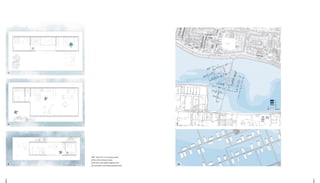
_7&7'. Plans F0-F1 of a Housing module
_8.Plan of the individual module
_9.Site plan of the floating neighbourhood
_10.Layout plan of the floating neighbourhood
1918
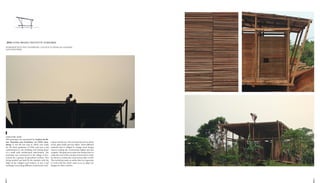
. 2016 LIVING MODULE PROTOTYPE WORKSHOP
WORKSHOP WITH INSA STRASBOURG, COULEUR DU BENIN and TOURISME
SANS FRONTIERES
POSSOTOME, BENIN
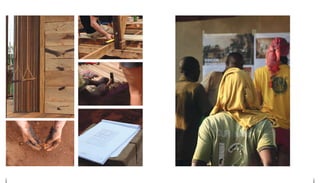
This prototype was sponsored by Couleur du Be-
nin, Tourisme sans Frontières and INSA stras-
bourg. It was the last step of whole year study
for the futur graduates of INSA and was a real
confrontation to the building and closing phase
of a small scale architectural intervention. The
prototype was constructed in the village of Pos-
sotome for a groupe of agriculture workers. This
living module was built by the students with the
helps of the villagers and workers. It was a real
exchange concerning different construction tech-
niques and the use of local material such as ebony
wood, palm stalks and wax fabric. These different
material had us obliged to change some design
aspects making the construction lighter and less
complex. The goal was to show the workers how to
make the truss of the wooden framework in order
for them to continu the construction after we left.
This workshop made us realise that it is important
to work with the client/ users so as to adapt our
designs for their comfort.
2120
2322
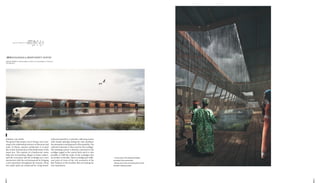
_ 1.View point of the floating ecolodges
connected to the central deck
_ 2.View point of the connecting deck and the
rainwater collecting system
1
2
. 2015 ECOLODGES & BIODIVERSITY CENTER
GROUP PROJECT with the help of BUSCOT R/ TROUSSIER M / VEDLIN C/
WATERKEYN J
NOKOUE LAKE, BENIN
The goal of this project was to bring a new mea-
ning to the relationship between architecture and
water. In Benin, riparian architecture is in peril
due to lack of protection of the biodiversity of the
major lacs. The creation of a biodiversity center
helps the surrounding villages to better unders-
tand the ecosystem and the ecolodges are a new
interraction with the environnement by bringing
a new experience throughout the seasons. Those
two major poles are connected by a long board-
walk punctuated by a rainwater collecting system
with zenital openings letting the rain transform
the atmosphere and approach of the spatiality. The
collected rainwater is then used for the ecoldges.
The retaining system is directly connected to the
ecoldges rigged at the central deck and it is also
possible to refill the tanks of the ecolodges that
are further in the lake. These ecolodges give diffe-
rent point of views of the rich ecosystem of the
lake Nokoue to the travellers that are looking for
new experiences.
TOLE ONDULÉE ÉPAISSEUR 1.5mm
PLANCHE DE BOIS LÉGER SECTION 30X150
PLANCHER SECTION 30X150
TASSEAU BOIS SECTION 30X40
GRILLE D’AÉRATION
JACINTHE D’EAU TRESSÉE
BARDAGE BOIS ROND
BARIL CAPACITÉ 220L
LAC
POMPE 1
POMPE 2
910
587
STOCKAGE D’EAU
100kg 100kg
SYSTÈME DE FLOTTAISON
UTILISATIONS
capacité de 3 mois et demi
1300 barils = 260m3
5
4
3
2524
6 77777777777777777777777777777777777777777777777777777777777777777777777777777777777777777777777777777777777777777777777777777777777777777777777777777777777777777777777777777777777777777777777777777777777777777777777777777777777777777777777777777777777777777777777777777777777777777777777777777777777777777777777777777777777777777777777777777777777777777777777777777777777777777777777777777777777777777777777777777777777777777777777777777777777777777777777777777777777777777777777777777777777777777777777777777777777777777777777777777777777777777777777777777777777777777777777777777777777777777777777777777777777777777777777777777777777777777777777777777777777777777777777777777777777777777777777777777777777777777777777777777777777777777777777777777777777777777777777777777777777777777777777777777777777777777777777777777777777777777777777777777777777777777777777777777777777777777777777777777777777777777777777777777777777
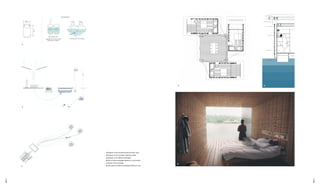
_ 3.Diagram of the recycled barrels and their uses
_ 4.Diagram of the rainwater collecting system
_ 5.Diagram of the different ecolodges
_ 6.Plan of three ecolodges decked on a rig the lake
_ 7.Section of the ecolodge
_ 8.View point of inside an ecolodge decked on a rig
8
BASSIN BAS BASSIN BAS BASSIN BAS BASSIN BASBASSIN HAUT
ESPACE
COMMUN
40 M²
ESPACE
COMMUN
40 M²
ESPACE
COMMUN
68 M²
CHAMBRE
DOUBLE
14 M²PONTON DE
DESSERTE
BASSIN HAUT BASSIN HAUT BASSIN HAUT+0.30
+0.00
2726
_ 9.Section of the central deck with rigges ecolodges
_ 10.Plan of the central deck with rigged ecolodges
10
9
2928
5 min
5 min
5 min
STRADA LIVEZENI
BULE
VARDUL
1
D
ECEMBRIE
1918
_ 1.View point a rehabilitated Boiler room into a open-market
_ 2.Diagrams of the Urban planning ans strategies for the
neighbourhood
1
2
. 2015 URBAN COVER REGENERARE URBANA
GROUP PROJECT/WORKSHOP with the help of CORNU R/ DU-
VAL C/ DECILLIA B/ LAI W
TARGU MURES, ROUMANIA
Targu Mures is a Roumanian city that has an urban
planning typically influenced by the cold war pe-
riod. Unfortunately some of the neighbourhoods
seem to suffer from the "socialist housing" typo-
logy and urban planning. This workshop sponso-
red by the City Council of Targu Mures gave us
the opportunity to be confronted to this urban
system. Our proposition took in consideration
the high potential of the neighbourhood by ma-
king some light changes and by activating some
of the key areas of the neighbourhood by creating
some strong axis, bringing some new activities
and by making the neighbourhood less congested.
Being at the far east of Targu Mures, by activating
this neighbourhood this strategy reaches out to
nearby towns like Livezeni and Corunca. This gi-
ves a new momentum to Targu Mures. This inter-
vention uses the over structured urban planning
and benefits the citizens by investing the streets
and giving them back their public places.
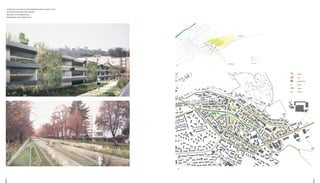
LIVEZENI
CORUNCA
LIVEZENI
CORUNCA
PARKINGS
CULTURAL & COMMUNITY CENTER
MARKET
500m
EXPANSION TO NEARBY COMMUNES
NEW LINKS
OUTREACH TO THE REST OF TARGU MURES
6
3130
_ 1.View point a Car park to help decongest the streets of surplus of cars
_ 2.Viewpoint of the repurposed waterway
_ 3.Dynamic of the neighbourhood
_ 4.Masterplan of the neighbourhood
3
4
5
3332
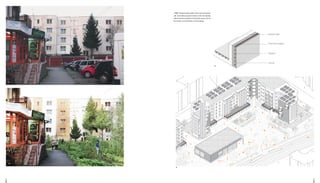
Existant Wall
Thermal Insulation
Support
Facing
_ 7&7'.Viewpoint before-after of the urban intervention
_ 8. Axonometric projection-section of the new facades
_ 9.Axonometric projection of the public square vith the
new market and intervention on the buildings
7
7'
8
9
3534
_ 1.Viewpoint of the room of the wake and the lans-
cape surrounding it
_ 2.Viewpoint of the room of the wake
_ 3.Viewpoint of the hallway to the ceremonial room
1 2
3
. 2015 PROMESSION CENTER
PROJECT of Charlotte GRESET with the help of BUSCOT R/ FINDJI H
/ DE JONGHE G
COLOGNE, GERMANY
Death has a special place in everybodies life and
we apprehend the lose of the people dear to us.
This project gives a new look at the process of
grieving and funurals through the use of promes-
sion. This project was the final presentation of
Charlotte Greset and gave us the opportunity of
giving a lending hand with the end of the concep-
tion phase and all of the presentation for all the
month of september. I was in charge of the se-
quence of the grieving process, its finality and the
representation of the project in its whole; Cyma
and display, viewpoint images, diagrams, section
plans, plans. This projects is sequenced in three
sections. The first one is composed by a building
dedicaded to the wake of the deceased where fa-
milies are brought together in intimate rooms.
The second one is the ceremonial building where
the last parting is organised. The last section is
the memorial forest where the families come and
burry the remains of the late family member and
plant a tree. They also have a commemorate plate
on the wall of memories surrounded by a luxu-
rious forest.
3736
Crémation1H30à2H
1Hà1H30Promession
DEVENIR DES CENDRES ?
TRANSFORMATION DU CORPS
Quel place?
Quels amménagements
pour le cimetière?
Quelques Kilos 30% du poids
Corps conservé à -18°C
pendant plusieurs jours
Corps plongé dans Azote liquide
<1h
Corps vibré
quelques minutes
Retrait eau et métaux
quelques minutes
Don de la vie
EAU
METAUX
N22222NNNNNNNNNNNNN222N22NN22NNNNN222222NNNNNNNNNNNNNNNNNNNNNNNNNNNNN2222NN22NNNN2222NNNNNNNNNNN
_ 4.Diagram explaining the process of promession
_ 5.Diagram comparative between promession and
cremation
_ 6.Viewpoint of the memorial and commemoration
walls
4
55
6
3938
_ 7.Program and landscape sequence
3
2
7
4140
_ 8&8'.Plans F(-1)-F0 of the rooms dedicated for the wakes
_ 9.Section of the ceremonial room
88
8'8' 99
4342
2
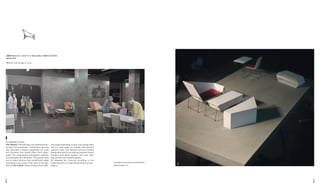
_ 1.Viewpoint of the interior of the SHADOCKS
_ 2.Detail model 1:20
1
. 2014 NEED IT ADAPT IT SHADOK COMPETITION,
2nd PLACE
PROJECT with the help of Duval C
STRASBOURG, FRANCE
The Shadok of Strasbourg is an institution pro-
moting "l'art numérique" and for their opening
they launched a design competition for some
new furniture that would reflect their philo-
sophy. Our proposition tied together mobility,
fonctionnality and flexibility. The general idea
was to make furniture that would easily adapt
according to the needs of the users of the Sha-
dok and the Fablab. These furniture have diffe-
rent usage depending on how you arrange them
and are easily made in a Fablab with minimal
material waste. The material used are wooden
boards that will be cut with the patterns of each
furniture and glued together and steel rebar
that are bent and welded together.
By adapting the furniture according to the
needs the goal is to adapt the spatiality surroun-
ding us.
4544
2
5
3
4
4' 4''
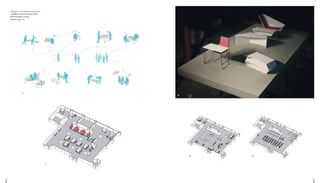
_ 3.Diagram of the modularity of the furniture
_ 4, 4'&4''.Axonometry projection of the
different installation possible
_ 5.Detail model 1:20
4746
7
8
99
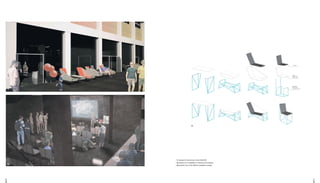
_ 7.Viewpoint of the forcourt of the SHADOKS
_ 8.Viewpoint of a installation for lectures and meetings
_ 9.Exploded view of the different installation possible

2017_PORTFOLIO_Hélène_BRIGLIA

  • 1.
  • 2.
    BRIGLIA H}E}LE}NE THE TENTERFIELDS,APT 39 BROWN STREET SOUTH , DUBLIN 8 IRELAND +33.6.85.11.89.13 FR HELENE.BRIGLIA}}@}GMAIL.COM WWW.HBRIGLIA.COM HELENE BRIGLIA} CONTENT . 2016 BETWEEN CONNECTION AND RECONCILIATION , DMZ KOREA ...P.4 . 2016 FOUNDATIONBENETEAUARCHITECTURECOMPETITION,DUBLINIRELAND ...P.12 . 2016 LIVING MODULE PROTOTYPE WORKSHOP, POSSOTOME BENIN ...P.18 . 2015 ECOLODGES & BIODIVERSITY CENTER, NOKOUE LAC BENIN ...P.22 . 2015 URBAN COVER REGENERARE URBANA, TARGU MURES ROUMANIA ...P.28 . 2015 PROMESSION CENTER, COLOGNE GERMANY ...P.34 . 2014 NEED IT ADAPT IT SHADOK COMPETITION, STRASBOURG FRANCE ...P.42 LAYOUT BY HELENE BRIGLIA «If you're going to try and fail, you might as well do it with a high goal.» -Honeyclover
  • 3.
    54 _1.Viewpoint of thepromenade in the DMZ flora _2.Viewpoint of the exhibition in the peace haven _3.Layout plan of the architectural intervention 1 2 33 DMZ, NORTH & SOUTH KOREA This project is a peace haven for the separated families of north and South Korea. Indeed after World War II and the Korean War, Korea is sepa- rated in three distinct areas; the North, the South and the 38th parallel. The war had many impact of these nations and particularly on the folk. Since 70 years around 100 000 families have been sepa- rated and are denied any exchange or contactand so few can actually see each other with the official meeting organized by the red cross. This project takes in consideration the will of contact of the folk of the two nations and the improvement of the relation between the two Koreas. This 1km architectural intervention in- vests the extraordinary flora of the Demilitarized zone wwto bring the people together. This architectural and landscaped intervention displays how a boarder can not only separate but also link two countries. . 2016 BETWEEN CONNECTION & RECONCILIATION TOP 5 Graduate project of INSA Strasbourg 2016 PROJECT of Hélène BRIGLIA with the help of HOLLENDER L/ FINDJI H / BOIS M/ CHEVALLIER C/ CONSTANTINI A
  • 4.
    76 _4.Transversal section ofthe peace haven _5.Section of the peace haven _6.Longitudinal section of the peace haven 44 55 66
  • 5.
    98 _7&7'.Plans F0- F1of the peace haven _8.Viewpoint of the ceremonial teahouse _9.Viewpoint of the inside garden 77 7'7' 8 9
  • 6.
    1110 _10.Maedup - traditionalkorean knots _11.Inside of the section model of the peace haven 1:200 _12&12'. Section model 1:200 101010 1111 12 12'
  • 7.
    1312 2 _1.Viewpoint of theneighbourhood _2.Concept diagrams for the housing typologies _3.Viewpoint of a individual housing module 1 3 . 2016 FOUNDATION BENETEAU ARCHITECTURE COMPETITION TOP 10 out of 70 PROJECT of Hélène BRIGLIA and Charlotte GRESET DUBLIN, IRELAND With the rising water level around the world we must find new ways of living. These floating modules were our answer to the current climate change context in Dublin. This project takes into consideration the use of recycled material and the possibility to roam in different environnements. The different typologies of housings are the result of repurposed containers of the Dublin harbour to suit different lifestyles. The cluster of individual modules brings a new dynamic between existing neighbourhoods. This new connection expresses itself throughout a floating neighbourhood that is always in motion. By creating this new link we are able to activate neighbourhoods and give a new relationship between water and architecture. But above all this project is a way to give the citizen a new look on their way of living and on their city.
  • 8.
    1514 _4. Axonometric projectionsof the different house module _5.Viewpoint of the floatinf neighbourhood _6.Viewpoint of a floating house in a natural environnement 44 5 6
  • 9.
    1716 77 7'7' 88 99 1010 _7&7'. Plans F0-F1of a Housing module _8.Plan of the individual module _9.Site plan of the floating neighbourhood _10.Layout plan of the floating neighbourhood
  • 10.
    1918 . 2016 LIVINGMODULE PROTOTYPE WORKSHOP WORKSHOP WITH INSA STRASBOURG, COULEUR DU BENIN and TOURISME SANS FRONTIERES POSSOTOME, BENIN This prototype was sponsored by Couleur du Be- nin, Tourisme sans Frontières and INSA stras- bourg. It was the last step of whole year study for the futur graduates of INSA and was a real confrontation to the building and closing phase of a small scale architectural intervention. The prototype was constructed in the village of Pos- sotome for a groupe of agriculture workers. This living module was built by the students with the helps of the villagers and workers. It was a real exchange concerning different construction tech- niques and the use of local material such as ebony wood, palm stalks and wax fabric. These different material had us obliged to change some design aspects making the construction lighter and less complex. The goal was to show the workers how to make the truss of the wooden framework in order for them to continu the construction after we left. This workshop made us realise that it is important to work with the client/ users so as to adapt our designs for their comfort.
  • 11.
  • 12.
    2322 _ 1.View pointof the floating ecolodges connected to the central deck _ 2.View point of the connecting deck and the rainwater collecting system 1 2 . 2015 ECOLODGES & BIODIVERSITY CENTER GROUP PROJECT with the help of BUSCOT R/ TROUSSIER M / VEDLIN C/ WATERKEYN J NOKOUE LAKE, BENIN The goal of this project was to bring a new mea- ning to the relationship between architecture and water. In Benin, riparian architecture is in peril due to lack of protection of the biodiversity of the major lacs. The creation of a biodiversity center helps the surrounding villages to better unders- tand the ecosystem and the ecolodges are a new interraction with the environnement by bringing a new experience throughout the seasons. Those two major poles are connected by a long board- walk punctuated by a rainwater collecting system with zenital openings letting the rain transform the atmosphere and approach of the spatiality. The collected rainwater is then used for the ecoldges. The retaining system is directly connected to the ecoldges rigged at the central deck and it is also possible to refill the tanks of the ecolodges that are further in the lake. These ecolodges give diffe- rent point of views of the rich ecosystem of the lake Nokoue to the travellers that are looking for new experiences.
  • 13.
    TOLE ONDULÉE ÉPAISSEUR1.5mm PLANCHE DE BOIS LÉGER SECTION 30X150 PLANCHER SECTION 30X150 TASSEAU BOIS SECTION 30X40 GRILLE D’AÉRATION JACINTHE D’EAU TRESSÉE BARDAGE BOIS ROND BARIL CAPACITÉ 220L LAC POMPE 1 POMPE 2 910 587 STOCKAGE D’EAU 100kg 100kg SYSTÈME DE FLOTTAISON UTILISATIONS capacité de 3 mois et demi 1300 barils = 260m3 5 4 3 2524 6 77777777777777777777777777777777777777777777777777777777777777777777777777777777777777777777777777777777777777777777777777777777777777777777777777777777777777777777777777777777777777777777777777777777777777777777777777777777777777777777777777777777777777777777777777777777777777777777777777777777777777777777777777777777777777777777777777777777777777777777777777777777777777777777777777777777777777777777777777777777777777777777777777777777777777777777777777777777777777777777777777777777777777777777777777777777777777777777777777777777777777777777777777777777777777777777777777777777777777777777777777777777777777777777777777777777777777777777777777777777777777777777777777777777777777777777777777777777777777777777777777777777777777777777777777777777777777777777777777777777777777777777777777777777777777777777777777777777777777777777777777777777777777777777777777777777777777777777777777777777777777777777777777777777777 _ 3.Diagram of the recycled barrels and their uses _ 4.Diagram of the rainwater collecting system _ 5.Diagram of the different ecolodges _ 6.Plan of three ecolodges decked on a rig the lake _ 7.Section of the ecolodge _ 8.View point of inside an ecolodge decked on a rig 8
  • 14.
    BASSIN BAS BASSINBAS BASSIN BAS BASSIN BASBASSIN HAUT ESPACE COMMUN 40 M² ESPACE COMMUN 40 M² ESPACE COMMUN 68 M² CHAMBRE DOUBLE 14 M²PONTON DE DESSERTE BASSIN HAUT BASSIN HAUT BASSIN HAUT+0.30 +0.00 2726 _ 9.Section of the central deck with rigges ecolodges _ 10.Plan of the central deck with rigged ecolodges 10 9
  • 15.
    2928 5 min 5 min 5min STRADA LIVEZENI BULE VARDUL 1 D ECEMBRIE 1918 _ 1.View point a rehabilitated Boiler room into a open-market _ 2.Diagrams of the Urban planning ans strategies for the neighbourhood 1 2 . 2015 URBAN COVER REGENERARE URBANA GROUP PROJECT/WORKSHOP with the help of CORNU R/ DU- VAL C/ DECILLIA B/ LAI W TARGU MURES, ROUMANIA Targu Mures is a Roumanian city that has an urban planning typically influenced by the cold war pe- riod. Unfortunately some of the neighbourhoods seem to suffer from the "socialist housing" typo- logy and urban planning. This workshop sponso- red by the City Council of Targu Mures gave us the opportunity to be confronted to this urban system. Our proposition took in consideration the high potential of the neighbourhood by ma- king some light changes and by activating some of the key areas of the neighbourhood by creating some strong axis, bringing some new activities and by making the neighbourhood less congested. Being at the far east of Targu Mures, by activating this neighbourhood this strategy reaches out to nearby towns like Livezeni and Corunca. This gi- ves a new momentum to Targu Mures. This inter- vention uses the over structured urban planning and benefits the citizens by investing the streets and giving them back their public places.
  • 16.
    LIVEZENI CORUNCA LIVEZENI CORUNCA PARKINGS CULTURAL & COMMUNITYCENTER MARKET 500m EXPANSION TO NEARBY COMMUNES NEW LINKS OUTREACH TO THE REST OF TARGU MURES 6 3130 _ 1.View point a Car park to help decongest the streets of surplus of cars _ 2.Viewpoint of the repurposed waterway _ 3.Dynamic of the neighbourhood _ 4.Masterplan of the neighbourhood 3 4 5
  • 17.
    3332 Existant Wall Thermal Insulation Support Facing _7&7'.Viewpoint before-after of the urban intervention _ 8. Axonometric projection-section of the new facades _ 9.Axonometric projection of the public square vith the new market and intervention on the buildings 7 7' 8 9
  • 18.
    3534 _ 1.Viewpoint ofthe room of the wake and the lans- cape surrounding it _ 2.Viewpoint of the room of the wake _ 3.Viewpoint of the hallway to the ceremonial room 1 2 3 . 2015 PROMESSION CENTER PROJECT of Charlotte GRESET with the help of BUSCOT R/ FINDJI H / DE JONGHE G COLOGNE, GERMANY Death has a special place in everybodies life and we apprehend the lose of the people dear to us. This project gives a new look at the process of grieving and funurals through the use of promes- sion. This project was the final presentation of Charlotte Greset and gave us the opportunity of giving a lending hand with the end of the concep- tion phase and all of the presentation for all the month of september. I was in charge of the se- quence of the grieving process, its finality and the representation of the project in its whole; Cyma and display, viewpoint images, diagrams, section plans, plans. This projects is sequenced in three sections. The first one is composed by a building dedicaded to the wake of the deceased where fa- milies are brought together in intimate rooms. The second one is the ceremonial building where the last parting is organised. The last section is the memorial forest where the families come and burry the remains of the late family member and plant a tree. They also have a commemorate plate on the wall of memories surrounded by a luxu- rious forest.
  • 19.
    3736 Crémation1H30à2H 1Hà1H30Promession DEVENIR DES CENDRES? TRANSFORMATION DU CORPS Quel place? Quels amménagements pour le cimetière? Quelques Kilos 30% du poids Corps conservé à -18°C pendant plusieurs jours Corps plongé dans Azote liquide <1h Corps vibré quelques minutes Retrait eau et métaux quelques minutes Don de la vie EAU METAUX N22222NNNNNNNNNNNNN222N22NN22NNNNN222222NNNNNNNNNNNNNNNNNNNNNNNNNNNNN2222NN22NNNN2222NNNNNNNNNNN _ 4.Diagram explaining the process of promession _ 5.Diagram comparative between promession and cremation _ 6.Viewpoint of the memorial and commemoration walls 4 55 6
  • 20.
    3938 _ 7.Program andlandscape sequence 3 2 7
  • 21.
    4140 _ 8&8'.Plans F(-1)-F0of the rooms dedicated for the wakes _ 9.Section of the ceremonial room 88 8'8' 99
  • 22.
    4342 2 _ 1.Viewpoint ofthe interior of the SHADOCKS _ 2.Detail model 1:20 1 . 2014 NEED IT ADAPT IT SHADOK COMPETITION, 2nd PLACE PROJECT with the help of Duval C STRASBOURG, FRANCE The Shadok of Strasbourg is an institution pro- moting "l'art numérique" and for their opening they launched a design competition for some new furniture that would reflect their philo- sophy. Our proposition tied together mobility, fonctionnality and flexibility. The general idea was to make furniture that would easily adapt according to the needs of the users of the Sha- dok and the Fablab. These furniture have diffe- rent usage depending on how you arrange them and are easily made in a Fablab with minimal material waste. The material used are wooden boards that will be cut with the patterns of each furniture and glued together and steel rebar that are bent and welded together. By adapting the furniture according to the needs the goal is to adapt the spatiality surroun- ding us.
  • 23.
    4544 2 5 3 4 4' 4'' _ 3.Diagramof the modularity of the furniture _ 4, 4'&4''.Axonometry projection of the different installation possible _ 5.Detail model 1:20
  • 24.
    4746 7 8 99 _ 7.Viewpoint ofthe forcourt of the SHADOKS _ 8.Viewpoint of a installation for lectures and meetings _ 9.Exploded view of the different installation possible