Mark Brown, ELC 2015, San Jose
regulators: Learning to play with others
• Regulator API overview
• Modern systems
• Non-regulator solutions
• Microcontroller interfacing
• Suspend/idle integration
• Future work
Introduction
• For Linux we mean voltage regulators
• Takes an input supply, produces a target voltage
• Many different kinds
• LDO
• DCDC
• Boost
• All very similar to software
• Enable/disable
• Set voltage
• Set performance requirements
• Typically I2C or SPI devices grouping several regulators
• Current regulators do exist, not relevant here
What is a regulator?
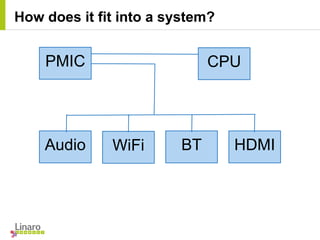
How does it fit into a system?
PMIC CPU
Audio WiFi BT HDMI
• Power saving
• Hardware interfacing
• MMC
• Fix hardware defaults
Why do regulators need drivers?
• Drivers register as devices as normal
• Provide set/get operations
• Enable
• Voltage
• Set performance characteristics
• Provide parameters
• Voltage ranges
• Time to implement changes
• Standard regmap operations provided
• Many regulators need only data
regulator API - regulator devices
• Request supply using device side supply name
• Special interface if supply might be missing
• Read status
• Request configuration
• Range based interface for voltages
• Notifications provided when configuration changes
• Details of regulator hidden
regulator API - consumer devices
• Firmware or board file maps regulators to devices
• Explicitly says what operations are allowed
• Range of voltages to set
• Supported operating modes
• If supply can be turned off
• Default behaviour is read only
• Any problems due to system integration!
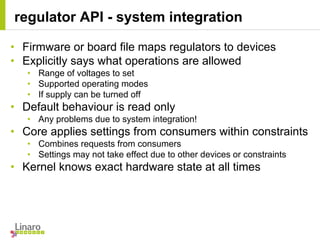
• Core applies settings from consumers within constraints
• Combines requests from consumers
• Settings may not take effect due to other devices or constraints
• Kernel knows exact hardware state at all times
regulator API - system integration
• Typically handled with hard coded configuration
• Sometimes Linux needs to tweak setup for suspend
• DT bindings
Suspend mode configuration
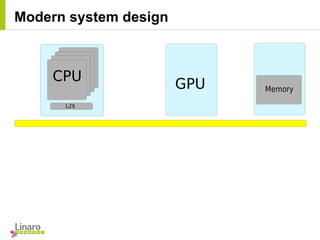
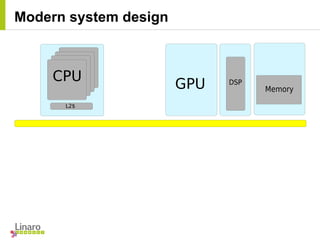
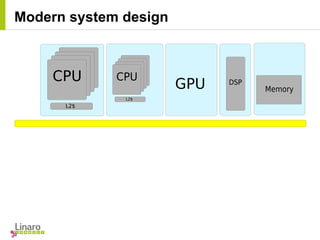
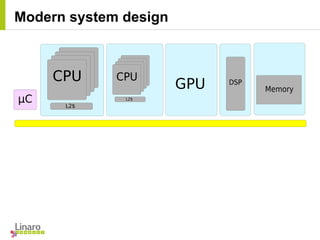
Modern system design
• Suspending main AP no longer fixed process
• Multi-cluster systems
• Runtime configurable functionality
• Blurring of distinction between suspend and idle
• Other processors running while main AP is suspended
• Baseband
• WiFi
• Always on sensor monitoring
• Fine grained power optimization
• Tuning for individual chip characteristics
• Often need real time response
• Security considerations
Motivation
• Completely hide power control details
• OS provides device on/off information
• System integration done in firmware
• Great for servers/laptops
• Limiting for mobile
• Fine grained power control
• Too much hardware variation
• Schedules too tight
Ultra simplified model - ACPI
• Key subsystems hidden from OS
• Normally CPUs
• Any OS control via higher level interfaces
• May use some regulators on a shared chip
• regulator_get_hardware_vsel_register()
• regulator_list_hardware_vsel()
Mixed model - hidden subsystem
• Microcontroller arbitrates between users
• Core SoC supplies
• Supplies shared with external components
• Ideally microcontroller offers regulator API interface
• Zero effort?
Mixed model - visible subsystem
• Linux idea of system state can diverge from hardware
• Qualcomm RPM - two modes for Linux system active
• Active - Linux running
• CPU supplies
• Idle - Linux in idle
• WiFi
System mode mapping
• Generic devices get mapped in DT
• Default is all modes that apply outside of suspend
• Provide interface for drivers that know about modes
• regulator_set_voltage(regulator, mode, min, max);
• regulator_set_voltage_mode(regulator, mode, min,
max);
Mode specific configuration
• Some microcontrollers provide abstract modes
• Essentially OPPs
• Can be hidden subsystem model
• Simple to handle for platform specific devices
• regulator_set_mode() or equivalent
• Need mapping mechanism for more generic devices
• Yes, people do this
Abstracted settings
• Confirm designs with real systems
• Upstream it
• Improve support for specifying voltages by tolerance
• Support for resolving dependency loops between
PMICs
Next steps
• Qualcomm
• Bjorn Andersson
• Stephen Boyd
• Doug Anderson
• Javier Martinez Canillas
• Kevin Hilman
Thanks
More about Linaro Connect: http://connect.linaro.org
More about Linaro: http://www.linaro.org/about/
More about Linaro engineering: http://www.linaro.org/engineering/
Linaro members: www.linaro.org/members

Regulators learning to play with others

  • 1.
    Mark Brown, ELC2015, San Jose regulators: Learning to play with others
  • 2.
    • Regulator APIoverview • Modern systems • Non-regulator solutions • Microcontroller interfacing • Suspend/idle integration • Future work Introduction
  • 3.
    • For Linuxwe mean voltage regulators • Takes an input supply, produces a target voltage • Many different kinds • LDO • DCDC • Boost • All very similar to software • Enable/disable • Set voltage • Set performance requirements • Typically I2C or SPI devices grouping several regulators • Current regulators do exist, not relevant here What is a regulator?
  • 4.
    How does itfit into a system? PMIC CPU Audio WiFi BT HDMI
  • 5.
    • Power saving •Hardware interfacing • MMC • Fix hardware defaults Why do regulators need drivers?
  • 6.
    • Drivers registeras devices as normal • Provide set/get operations • Enable • Voltage • Set performance characteristics • Provide parameters • Voltage ranges • Time to implement changes • Standard regmap operations provided • Many regulators need only data regulator API - regulator devices
  • 7.
    • Request supplyusing device side supply name • Special interface if supply might be missing • Read status • Request configuration • Range based interface for voltages • Notifications provided when configuration changes • Details of regulator hidden regulator API - consumer devices
  • 8.
    • Firmware orboard file maps regulators to devices • Explicitly says what operations are allowed • Range of voltages to set • Supported operating modes • If supply can be turned off • Default behaviour is read only • Any problems due to system integration! • Core applies settings from consumers within constraints • Combines requests from consumers • Settings may not take effect due to other devices or constraints • Kernel knows exact hardware state at all times regulator API - system integration
  • 9.
    • Typically handledwith hard coded configuration • Sometimes Linux needs to tweak setup for suspend • DT bindings Suspend mode configuration
  • 10.
  • 11.
  • 12.
  • 13.
  • 14.
    • Suspending mainAP no longer fixed process • Multi-cluster systems • Runtime configurable functionality • Blurring of distinction between suspend and idle • Other processors running while main AP is suspended • Baseband • WiFi • Always on sensor monitoring • Fine grained power optimization • Tuning for individual chip characteristics • Often need real time response • Security considerations Motivation
  • 15.
    • Completely hidepower control details • OS provides device on/off information • System integration done in firmware • Great for servers/laptops • Limiting for mobile • Fine grained power control • Too much hardware variation • Schedules too tight Ultra simplified model - ACPI
  • 16.
    • Key subsystemshidden from OS • Normally CPUs • Any OS control via higher level interfaces • May use some regulators on a shared chip • regulator_get_hardware_vsel_register() • regulator_list_hardware_vsel() Mixed model - hidden subsystem
  • 17.
    • Microcontroller arbitratesbetween users • Core SoC supplies • Supplies shared with external components • Ideally microcontroller offers regulator API interface • Zero effort? Mixed model - visible subsystem
  • 18.
    • Linux ideaof system state can diverge from hardware • Qualcomm RPM - two modes for Linux system active • Active - Linux running • CPU supplies • Idle - Linux in idle • WiFi System mode mapping
  • 19.
    • Generic devicesget mapped in DT • Default is all modes that apply outside of suspend • Provide interface for drivers that know about modes • regulator_set_voltage(regulator, mode, min, max); • regulator_set_voltage_mode(regulator, mode, min, max); Mode specific configuration
  • 20.
    • Some microcontrollersprovide abstract modes • Essentially OPPs • Can be hidden subsystem model • Simple to handle for platform specific devices • regulator_set_mode() or equivalent • Need mapping mechanism for more generic devices • Yes, people do this Abstracted settings
  • 21.
    • Confirm designswith real systems • Upstream it • Improve support for specifying voltages by tolerance • Support for resolving dependency loops between PMICs Next steps
  • 22.
    • Qualcomm • BjornAndersson • Stephen Boyd • Doug Anderson • Javier Martinez Canillas • Kevin Hilman Thanks
  • 23.
    More about LinaroConnect: http://connect.linaro.org More about Linaro: http://www.linaro.org/about/ More about Linaro engineering: http://www.linaro.org/engineering/ Linaro members: www.linaro.org/members