MSP430x1xx Family
2006 Mixed Signal Products
User’s Guide
SLAU049F
IMPORTANT NOTICE
Texas Instruments Incorporated and its subsidiaries (TI) reserve the right to make corrections, modifications,
enhancements, improvements, and other changes to its products and services at any time and to discontinue
any product or service without notice. Customers should obtain the latest relevant information before placing
orders and should verify that such information is current and complete. All products are sold subject to TI’s terms
and conditions of sale supplied at the time of order acknowledgment.
TI warrants performance of its hardware products to the specifications applicable at the time of sale in
accordance with TI’s standard warranty. Testing and other quality control techniques are used to the extent TI
deems necessary to support this warranty. Except where mandated by government requirements, testing of all
parameters of each product is not necessarily performed.
TI assumes no liability for applications assistance or customer product design. Customers are responsible for
their products and applications using TI components. To minimize the risks associated with customer products
and applications, customers should provide adequate design and operating safeguards.
TI does not warrant or represent that any license, either express or implied, is granted under any TI patent right,
copyright, mask work right, or other TI intellectual property right relating to any combination, machine, or process
in which TI products or services are used. Information published by TI regarding third-party products or services
does not constitute a license from TI to use such products or services or a warranty or endorsement thereof.
Use of such information may require a license from a third party under the patents or other intellectual property
of the third party, or a license from TI under the patents or other intellectual property of TI.
Reproduction of information in TI data books or data sheets is permissible only if reproduction is without
alteration and is accompanied by all associated warranties, conditions, limitations, and notices. Reproduction
of this information with alteration is an unfair and deceptive business practice. TI is not responsible or liable for
such altered documentation.
Resale of TI products or services with statements different from or beyond the parameters stated by TI for that
product or service voids all express and any implied warranties for the associated TI product or service and
is an unfair and deceptive business practice. TI is not responsible or liable for any such statements.
Following are URLs where you can obtain information on other Texas Instruments products and application
solutions:
Products Applications
Amplifiers amplifier.ti.com Audio www.ti.com/audio
Data Converters dataconverter.ti.com Automotive www.ti.com/automotive
DSP dsp.ti.com Broadband www.ti.com/broadband
Interface interface.ti.com Digital Control www.ti.com/digitalcontrol
Logic logic.ti.com Military www.ti.com/military
Power Mgmt power.ti.com Optical Networking www.ti.com/opticalnetwork
Microcontrollers microcontroller.ti.com Security www.ti.com/security
Telephony www.ti.com/telephony
Video & Imaging www.ti.com/video
Wireless www.ti.com/wireless
Mailing Address: Texas Instruments
Post Office Box 655303 Dallas, Texas 75265
Copyright  2006, Texas Instruments Incorporated
Related Documentation From Texas Instruments
iii
Preface
Read This First
About This Manual
This manual discusses modules and peripherals of the MSP430x1xx family of
devices. Each discussion presents the module or peripheral in a general
sense. Not all features and functions of all modules or peripherals are present
on all devices. In addition, modules or peripherals may differ in their exact
implementation between device families, or may not be fully implemented on
an individual device or device family.
Pin functions, internal signal connections and operational paramenters differ
from device-to-device. The user should consult the device-specific datasheet
for these details.
Related Documentation From Texas Instruments
For related documentation see the web site http://www.ti.com/msp430.
FCC Warning
This equipment is intended for use in a laboratory test environment only. It gen-
erates, uses, and can radiate radio frequency energy and has not been tested
for compliance with the limits of computing devices pursuant to subpart J of
part 15 of FCC rules, which are designed to provide reasonable protection
against radio frequency interference. Operation of this equipment in other en-
vironments may cause interference with radio communications, in which case
the user at his own expense will be required to take whatever measures may
be required to correct this interference.
Notational Conventions
Program examples, are shown in a special typeface.
Glossary
iv
Glossary
ACLK Auxiliary Clock See Basic Clock Module
ADC Analog-to-Digital Converter
BOR Brown-Out Reset See System Resets, Interrupts, and Operating Modes
BSL Bootstrap Loader See www.ti.com/msp430 for application reports
CPU Central Processing Unit See RISC 16-Bit CPU
DAC Digital-to-Analog Converter
DCO Digitally Controlled Oscillator See Basic Clock Module
dst Destination See RISC 16-Bit CPU
FLL Frequency Locked Loop See FLL+ in MSP430x4xx Family User’s Guide
GIE General Interrupt Enable See System Resets Interrupts and Operating Modes
INT(N/2) Integer portion of N/2
I/O Input/Output See Digital I/O
ISR Interrupt Service Routine
LSB Least-Significant Bit
LSD Least-Significant Digit
LPM Low-Power Mode See System Resets Interrupts and Operating Modes
MAB Memory Address Bus
MCLK Master Clock See Basic Clock Module
MDB Memory Data Bus
MSB Most-Significant Bit
MSD Most-Significant Digit
NMI (Non)-Maskable Interrupt See System Resets Interrupts and Operating Modes
PC Program Counter See RISC 16-Bit CPU
POR Power-On Reset See System Resets Interrupts and Operating Modes
PUC Power-Up Clear See System Resets Interrupts and Operating Modes
RAM Random Access Memory
SCG System Clock Generator See System Resets Interrupts and Operating Modes
SFR Special Function Register
SMCLK Sub-System Master Clock See Basic Clock Module
SP Stack Pointer See RISC 16-Bit CPU
SR Status Register See RISC 16-Bit CPU
src Source See RISC 16-Bit CPU
TOS Top-of-Stack See RISC 16-Bit CPU
WDT Watchdog Timer See Watchdog Timer
Register Bit Conventions
v
Register Bit Conventions
Each register is shown with a key indicating the accessibility of the each
individual bit, and the initial condition:
Register Bit Accessibility and Initial Condition
Key Bit Accessibility
rw Read/write
r Read only
r0 Read as 0
r1 Read as 1
w Write only
w0 Write as 0
w1 Write as 1
(w) No register bit implemented; writing a 1 results in a pulse.
The register bit is always read as 0.
h0 Cleared by hardware
h1 Set by hardware
−0,−1 Condition after PUC
−(0),−(1) Condition after POR
vi
Contents
vii
Contents
1 Introduction 1-1. . . . . . . . . . . . . . . . . . . . . . . . . . . . . . . . . . . . . . . . . . . . . . . . . . . . . . . . . . . . . . . . . . . . .
1.1 Architecture 1-2. . . . . . . . . . . . . . . . . . . . . . . . . . . . . . . . . . . . . . . . . . . . . . . . . . . . . . . . . . . . . . . .
1.2 Flexible Clock System 1-2. . . . . . . . . . . . . . . . . . . . . . . . . . . . . . . . . . . . . . . . . . . . . . . . . . . . . . .
1.3 Embedded Emulation 1-3. . . . . . . . . . . . . . . . . . . . . . . . . . . . . . . . . . . . . . . . . . . . . . . . . . . . . . .
1.4 Address Space 1-4. . . . . . . . . . . . . . . . . . . . . . . . . . . . . . . . . . . . . . . . . . . . . . . . . . . . . . . . . . . . .
1.4.1 Flash/ROM 1-4. . . . . . . . . . . . . . . . . . . . . . . . . . . . . . . . . . . . . . . . . . . . . . . . . . . . . . . . .
1.4.2 RAM 1-4. . . . . . . . . . . . . . . . . . . . . . . . . . . . . . . . . . . . . . . . . . . . . . . . . . . . . . . . . . . . . . .
1.4.3 Peripheral Modules 1-5. . . . . . . . . . . . . . . . . . . . . . . . . . . . . . . . . . . . . . . . . . . . . . . . . .
1.4.4 Special Function Registers (SFRs) 1-5. . . . . . . . . . . . . . . . . . . . . . . . . . . . . . . . . . . . .
1.4.5 Memory Organization 1-5. . . . . . . . . . . . . . . . . . . . . . . . . . . . . . . . . . . . . . . . . . . . . . . .
2 System Resets, Interrupts, and Operating Modes 2-1. . . . . . . . . . . . . . . . . . . . . . . . . . . . . . . . . .
2.1 System Reset and Initialization 2-2. . . . . . . . . . . . . . . . . . . . . . . . . . . . . . . . . . . . . . . . . . . . . . .
2.1.1 Power-On Reset (POR) 2-3. . . . . . . . . . . . . . . . . . . . . . . . . . . . . . . . . . . . . . . . . . . . . .
2.1.2 Brownout Reset (BOR) 2-4. . . . . . . . . . . . . . . . . . . . . . . . . . . . . . . . . . . . . . . . . . . . . . .
2.1.3 Device Initial Conditions After System Reset 2-5. . . . . . . . . . . . . . . . . . . . . . . . . . . .
2.2 Interrupts 2-6. . . . . . . . . . . . . . . . . . . . . . . . . . . . . . . . . . . . . . . . . . . . . . . . . . . . . . . . . . . . . . . . . .
2.2.1 (Non)-Maskable Interrupts (NMI) 2-7. . . . . . . . . . . . . . . . . . . . . . . . . . . . . . . . . . . . . .
2.2.2 Maskable Interrupts 2-10. . . . . . . . . . . . . . . . . . . . . . . . . . . . . . . . . . . . . . . . . . . . . . . . .
2.2.3 Interrupt Processing 2-11. . . . . . . . . . . . . . . . . . . . . . . . . . . . . . . . . . . . . . . . . . . . . . . .
2.2.4 Interrupt Vectors 2-13. . . . . . . . . . . . . . . . . . . . . . . . . . . . . . . . . . . . . . . . . . . . . . . . . . . .
2.3 Operating Modes 2-14. . . . . . . . . . . . . . . . . . . . . . . . . . . . . . . . . . . . . . . . . . . . . . . . . . . . . . . . . .
2.3.1 Entering and Exiting Low-Power Modes 2-16. . . . . . . . . . . . . . . . . . . . . . . . . . . . . . .
2.4 Principles for Low-Power Applications 2-17. . . . . . . . . . . . . . . . . . . . . . . . . . . . . . . . . . . . . . . .
2.5 Connection of Unused Pins 2-17. . . . . . . . . . . . . . . . . . . . . . . . . . . . . . . . . . . . . . . . . . . . . . . . .
Contents
viii
3 RISC 16-Bit CPU 3-1. . . . . . . . . . . . . . . . . . . . . . . . . . . . . . . . . . . . . . . . . . . . . . . . . . . . . . . . . . . . . . . . .
3.1 CPU Introduction 3-2. . . . . . . . . . . . . . . . . . . . . . . . . . . . . . . . . . . . . . . . . . . . . . . . . . . . . . . . . . .
3.2 CPU Registers 3-4. . . . . . . . . . . . . . . . . . . . . . . . . . . . . . . . . . . . . . . . . . . . . . . . . . . . . . . . . . . . .
3.2.1 Program Counter (PC) 3-4. . . . . . . . . . . . . . . . . . . . . . . . . . . . . . . . . . . . . . . . . . . . . . .
3.2.2 Stack Pointer (SP) 3-5. . . . . . . . . . . . . . . . . . . . . . . . . . . . . . . . . . . . . . . . . . . . . . . . . . .
3.2.3 Status Register (SR) 3-6. . . . . . . . . . . . . . . . . . . . . . . . . . . . . . . . . . . . . . . . . . . . . . . . .
3.2.4 Constant Generator Registers CG1 and CG2 3-7. . . . . . . . . . . . . . . . . . . . . . . . . . .
3.2.5 General−Purpose Registers R4 - R15 3-8. . . . . . . . . . . . . . . . . . . . . . . . . . . . . . . . . .
3.3 Addressing Modes 3-9. . . . . . . . . . . . . . . . . . . . . . . . . . . . . . . . . . . . . . . . . . . . . . . . . . . . . . . . . .
3.3.1 Register Mode 3-10. . . . . . . . . . . . . . . . . . . . . . . . . . . . . . . . . . . . . . . . . . . . . . . . . . . . .
3.3.2 Indexed Mode 3-11. . . . . . . . . . . . . . . . . . . . . . . . . . . . . . . . . . . . . . . . . . . . . . . . . . . . . .
3.3.3 Symbolic Mode 3-12. . . . . . . . . . . . . . . . . . . . . . . . . . . . . . . . . . . . . . . . . . . . . . . . . . . . .
3.3.4 Absolute Mode 3-13. . . . . . . . . . . . . . . . . . . . . . . . . . . . . . . . . . . . . . . . . . . . . . . . . . . . .
3.3.5 Indirect Register Mode 3-14. . . . . . . . . . . . . . . . . . . . . . . . . . . . . . . . . . . . . . . . . . . . . .
3.3.6 Indirect Autoincrement Mode 3-15. . . . . . . . . . . . . . . . . . . . . . . . . . . . . . . . . . . . . . . . .
3.3.7 Immediate Mode 3-16. . . . . . . . . . . . . . . . . . . . . . . . . . . . . . . . . . . . . . . . . . . . . . . . . . .
3.4 Instruction Set 3-17. . . . . . . . . . . . . . . . . . . . . . . . . . . . . . . . . . . . . . . . . . . . . . . . . . . . . . . . . . . . .
3.4.1 Double-Operand (Format I) Instructions 3-18. . . . . . . . . . . . . . . . . . . . . . . . . . . . . . .
3.4.2 Single-Operand (Format II) Instructions 3-19. . . . . . . . . . . . . . . . . . . . . . . . . . . . . . .
3.4.3 Jumps 3-20. . . . . . . . . . . . . . . . . . . . . . . . . . . . . . . . . . . . . . . . . . . . . . . . . . . . . . . . . . . .
3.4.4 Instruction Cycles and Lengths 3-72. . . . . . . . . . . . . . . . . . . . . . . . . . . . . . . . . . . . . . .
3.4.5 Instruction Set Description 3-74. . . . . . . . . . . . . . . . . . . . . . . . . . . . . . . . . . . . . . . . . . .
4 Basic Clock Module 4-1. . . . . . . . . . . . . . . . . . . . . . . . . . . . . . . . . . . . . . . . . . . . . . . . . . . . . . . . . . . . .
4.1 Basic Clock Module Introduction 4-2. . . . . . . . . . . . . . . . . . . . . . . . . . . . . . . . . . . . . . . . . . . . . .
4.2 Basic Clock Module Operation 4-4. . . . . . . . . . . . . . . . . . . . . . . . . . . . . . . . . . . . . . . . . . . . . . .
4.2.1 Basic Clock Module Features for Low-Power Applications 4-4. . . . . . . . . . . . . . . .
4.2.2 LFXT1 Oscillator 4-5. . . . . . . . . . . . . . . . . . . . . . . . . . . . . . . . . . . . . . . . . . . . . . . . . . . .
4.2.3 XT2 Oscillator 4-6. . . . . . . . . . . . . . . . . . . . . . . . . . . . . . . . . . . . . . . . . . . . . . . . . . . . . . .
4.2.4 Digitally-Controlled Oscillator (DCO) 4-6. . . . . . . . . . . . . . . . . . . . . . . . . . . . . . . . . . .
4.2.5 DCO Modulator 4-9. . . . . . . . . . . . . . . . . . . . . . . . . . . . . . . . . . . . . . . . . . . . . . . . . . . . .
4.2.6 Basic Clock Module Fail-Safe Operation 4-10. . . . . . . . . . . . . . . . . . . . . . . . . . . . . . .
4.2.7 Synchronization of Clock Signals 4-13. . . . . . . . . . . . . . . . . . . . . . . . . . . . . . . . . . . . .
4.3 Basic Clock Module Registers 4-14. . . . . . . . . . . . . . . . . . . . . . . . . . . . . . . . . . . . . . . . . . . . . .
5 Flash Memory Controller 5-1. . . . . . . . . . . . . . . . . . . . . . . . . . . . . . . . . . . . . . . . . . . . . . . . . . . . . . . .
5.1 Flash Memory Introduction 5-2. . . . . . . . . . . . . . . . . . . . . . . . . . . . . . . . . . . . . . . . . . . . . . . . . . .
5.2 Flash Memory Segmentation 5-3. . . . . . . . . . . . . . . . . . . . . . . . . . . . . . . . . . . . . . . . . . . . . . . . .
5.3 Flash Memory Operation 5-4. . . . . . . . . . . . . . . . . . . . . . . . . . . . . . . . . . . . . . . . . . . . . . . . . . . .
5.3.1 Flash Memory Timing Generator 5-4. . . . . . . . . . . . . . . . . . . . . . . . . . . . . . . . . . . . . .
5.3.2 Erasing Flash Memory 5-5. . . . . . . . . . . . . . . . . . . . . . . . . . . . . . . . . . . . . . . . . . . . . . .
5.3.3 Writing Flash Memory 5-8. . . . . . . . . . . . . . . . . . . . . . . . . . . . . . . . . . . . . . . . . . . . . . . .
5.3.4 Flash Memory Access During Write or Erase 5-14. . . . . . . . . . . . . . . . . . . . . . . . . . .
5.3.5 Stopping a Write or Erase Cycle 5-15. . . . . . . . . . . . . . . . . . . . . . . . . . . . . . . . . . . . . .
5.3.6 Configuring and Accessing the Flash Memory Controller 5-15. . . . . . . . . . . . . . . . .
5.3.7 Flash Memory Controller Interrupts 5-15. . . . . . . . . . . . . . . . . . . . . . . . . . . . . . . . . . .
5.3.8 Programming Flash Memory Devices 5-15. . . . . . . . . . . . . . . . . . . . . . . . . . . . . . . . .
5.4 Flash Memory Registers 5-17. . . . . . . . . . . . . . . . . . . . . . . . . . . . . . . . . . . . . . . . . . . . . . . . . . . .
Contents
ix
6 Supply Voltage Supervisor 6-1. . . . . . . . . . . . . . . . . . . . . . . . . . . . . . . . . . . . . . . . . . . . . . . . . . . . . . .
6.1 SVS Introduction 6-2. . . . . . . . . . . . . . . . . . . . . . . . . . . . . . . . . . . . . . . . . . . . . . . . . . . . . . . . . . .
6.2 SVS Operation 6-4. . . . . . . . . . . . . . . . . . . . . . . . . . . . . . . . . . . . . . . . . . . . . . . . . . . . . . . . . . . . .
6.2.1 Configuring the SVS 6-4. . . . . . . . . . . . . . . . . . . . . . . . . . . . . . . . . . . . . . . . . . . . . . . . .
6.2.2 SVS Comparator Operation 6-4. . . . . . . . . . . . . . . . . . . . . . . . . . . . . . . . . . . . . . . . . . .
6.2.3 Changing the VLDx Bits 6-5. . . . . . . . . . . . . . . . . . . . . . . . . . . . . . . . . . . . . . . . . . . . . .
6.2.4 SVS Operating Range 6-6. . . . . . . . . . . . . . . . . . . . . . . . . . . . . . . . . . . . . . . . . . . . . . .
6.3 SVS Registers 6-7. . . . . . . . . . . . . . . . . . . . . . . . . . . . . . . . . . . . . . . . . . . . . . . . . . . . . . . . . . . . .
7 Hardware Multiplier 7-1. . . . . . . . . . . . . . . . . . . . . . . . . . . . . . . . . . . . . . . . . . . . . . . . . . . . . . . . . . . . . .
7.1 Hardware Multiplier Introduction 7-2. . . . . . . . . . . . . . . . . . . . . . . . . . . . . . . . . . . . . . . . . . . . . .
7.2 Hardware Multiplier Operation 7-3. . . . . . . . . . . . . . . . . . . . . . . . . . . . . . . . . . . . . . . . . . . . . . . .
7.2.1 Operand Registers 7-3. . . . . . . . . . . . . . . . . . . . . . . . . . . . . . . . . . . . . . . . . . . . . . . . . .
7.2.2 Result Registers 7-4. . . . . . . . . . . . . . . . . . . . . . . . . . . . . . . . . . . . . . . . . . . . . . . . . . . . .
7.2.3 Software Examples 7-5. . . . . . . . . . . . . . . . . . . . . . . . . . . . . . . . . . . . . . . . . . . . . . . . . .
7.2.4 Indirect Addressing of RESLO 7-6. . . . . . . . . . . . . . . . . . . . . . . . . . . . . . . . . . . . . . . . .
7.2.5 Using Interrupts 7-6. . . . . . . . . . . . . . . . . . . . . . . . . . . . . . . . . . . . . . . . . . . . . . . . . . . . .
7.3 Hardware Multiplier Registers 7-7. . . . . . . . . . . . . . . . . . . . . . . . . . . . . . . . . . . . . . . . . . . . . . . .
8 DMA Controller 8-1. . . . . . . . . . . . . . . . . . . . . . . . . . . . . . . . . . . . . . . . . . . . . . . . . . . . . . . . . . . . . . . . . .
8.1 DMA Introduction 8-2. . . . . . . . . . . . . . . . . . . . . . . . . . . . . . . . . . . . . . . . . . . . . . . . . . . . . . . . . . .
8.2 DMA Operation 8-4. . . . . . . . . . . . . . . . . . . . . . . . . . . . . . . . . . . . . . . . . . . . . . . . . . . . . . . . . . . . .
8.2.1 DMA Addressing Modes 8-4. . . . . . . . . . . . . . . . . . . . . . . . . . . . . . . . . . . . . . . . . . . . . .
8.2.2 DMA Transfer Modes 8-5. . . . . . . . . . . . . . . . . . . . . . . . . . . . . . . . . . . . . . . . . . . . . . . .
8.2.3 Initiating DMA Transfers 8-12. . . . . . . . . . . . . . . . . . . . . . . . . . . . . . . . . . . . . . . . . . . . .
8.2.4 Stopping DMA Transfers 8-14. . . . . . . . . . . . . . . . . . . . . . . . . . . . . . . . . . . . . . . . . . . .
8.2.5 DMA Channel Priorities 8-14. . . . . . . . . . . . . . . . . . . . . . . . . . . . . . . . . . . . . . . . . . . . .
8.2.6 DMA Transfer Cycle Time 8-15. . . . . . . . . . . . . . . . . . . . . . . . . . . . . . . . . . . . . . . . . . .
8.2.7 Using DMA with System Interrupts 8-16. . . . . . . . . . . . . . . . . . . . . . . . . . . . . . . . . . . .
8.2.8 DMA Controller Interrupts 8-16. . . . . . . . . . . . . . . . . . . . . . . . . . . . . . . . . . . . . . . . . . . .
8.2.9 Using the I2C Module with the DMA Controller 8-17. . . . . . . . . . . . . . . . . . . . . . . . .
8.2.10 Using ADC12 with the DMA Controller 8-17. . . . . . . . . . . . . . . . . . . . . . . . . . . . . . . .
8.2.11 Using DAC12 With the DMA Controller 8-17. . . . . . . . . . . . . . . . . . . . . . . . . . . . . . . .
8.3 DMA Registers 8-18. . . . . . . . . . . . . . . . . . . . . . . . . . . . . . . . . . . . . . . . . . . . . . . . . . . . . . . . . . . .
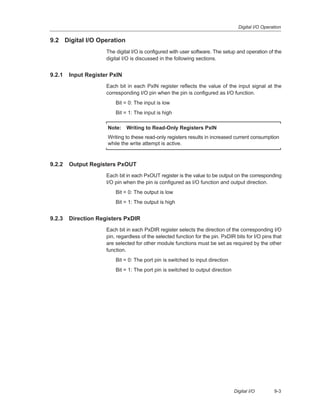
9 Digital I/O 9-1. . . . . . . . . . . . . . . . . . . . . . . . . . . . . . . . . . . . . . . . . . . . . . . . . . . . . . . . . . . . . . . . . . . . . . .
9.1 Digital I/O Introduction 9-2. . . . . . . . . . . . . . . . . . . . . . . . . . . . . . . . . . . . . . . . . . . . . . . . . . . . . . .
9.2 Digital I/O Operation 9-3. . . . . . . . . . . . . . . . . . . . . . . . . . . . . . . . . . . . . . . . . . . . . . . . . . . . . . . .
9.2.1 Input Register PnIN 9-3. . . . . . . . . . . . . . . . . . . . . . . . . . . . . . . . . . . . . . . . . . . . . . . . . .
9.2.2 Output Registers PnOUT 9-3. . . . . . . . . . . . . . . . . . . . . . . . . . . . . . . . . . . . . . . . . . . . .
9.2.3 Direction Registers PnDIR 9-3. . . . . . . . . . . . . . . . . . . . . . . . . . . . . . . . . . . . . . . . . . . .
9.2.4 Function Select Registers PnSEL 9-4. . . . . . . . . . . . . . . . . . . . . . . . . . . . . . . . . . . . . .
9.2.5 P1 and P2 Interrupts 9-5. . . . . . . . . . . . . . . . . . . . . . . . . . . . . . . . . . . . . . . . . . . . . . . . .
9.2.6 Configuring Unused Port Pins 9-6. . . . . . . . . . . . . . . . . . . . . . . . . . . . . . . . . . . . . . . . .
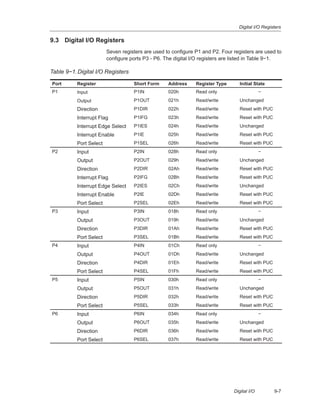
9.3 Digital I/O Registers 9-7. . . . . . . . . . . . . . . . . . . . . . . . . . . . . . . . . . . . . . . . . . . . . . . . . . . . . . . .
Contents
x
10 Watchdog Timer 10-1. . . . . . . . . . . . . . . . . . . . . . . . . . . . . . . . . . . . . . . . . . . . . . . . . . . . . . . . . . . . . . . .
10.1 Watchdog Timer Introduction 10-2. . . . . . . . . . . . . . . . . . . . . . . . . . . . . . . . . . . . . . . . . . . . . . . .
10.2 Watchdog Timer Operation 10-4. . . . . . . . . . . . . . . . . . . . . . . . . . . . . . . . . . . . . . . . . . . . . . . . . .
10.2.1 Watchdog Timer Counter 10-4. . . . . . . . . . . . . . . . . . . . . . . . . . . . . . . . . . . . . . . . . . . .
10.2.2 Watchdog Mode 10-4. . . . . . . . . . . . . . . . . . . . . . . . . . . . . . . . . . . . . . . . . . . . . . . . . . . .
10.2.3 Interval Timer Mode 10-4. . . . . . . . . . . . . . . . . . . . . . . . . . . . . . . . . . . . . . . . . . . . . . . .
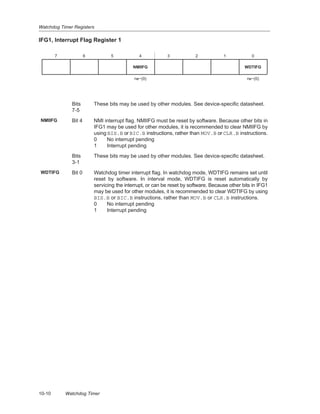
10.2.4 Watchdog Timer Interrupts 10-5. . . . . . . . . . . . . . . . . . . . . . . . . . . . . . . . . . . . . . . . . . .
10.2.5 Operation in Low-Power Modes 10-6. . . . . . . . . . . . . . . . . . . . . . . . . . . . . . . . . . . . . .
10.2.6 Software Examples 10-6. . . . . . . . . . . . . . . . . . . . . . . . . . . . . . . . . . . . . . . . . . . . . . . . .
10.3 Watchdog Timer Registers 10-7. . . . . . . . . . . . . . . . . . . . . . . . . . . . . . . . . . . . . . . . . . . . . . . . . .
11 Timer_A 11-1. . . . . . . . . . . . . . . . . . . . . . . . . . . . . . . . . . . . . . . . . . . . . . . . . . . . . . . . . . . . . . . . . . . . . . .
11.1 Timer_A Introduction 11-2. . . . . . . . . . . . . . . . . . . . . . . . . . . . . . . . . . . . . . . . . . . . . . . . . . . . . . .
11.2 Timer_A Operation 11-4. . . . . . . . . . . . . . . . . . . . . . . . . . . . . . . . . . . . . . . . . . . . . . . . . . . . . . . . .
11.2.1 16-Bit Timer Counter 11-4. . . . . . . . . . . . . . . . . . . . . . . . . . . . . . . . . . . . . . . . . . . . . . . .
11.2.2 Starting the Timer 11-5. . . . . . . . . . . . . . . . . . . . . . . . . . . . . . . . . . . . . . . . . . . . . . . . . .
11.2.3 Timer Mode Control 11-5. . . . . . . . . . . . . . . . . . . . . . . . . . . . . . . . . . . . . . . . . . . . . . . . .
11.2.4 Capture/Compare Blocks 11-11. . . . . . . . . . . . . . . . . . . . . . . . . . . . . . . . . . . . . . . . . . .
11.2.5 Output Unit 11-13. . . . . . . . . . . . . . . . . . . . . . . . . . . . . . . . . . . . . . . . . . . . . . . . . . . . . . .
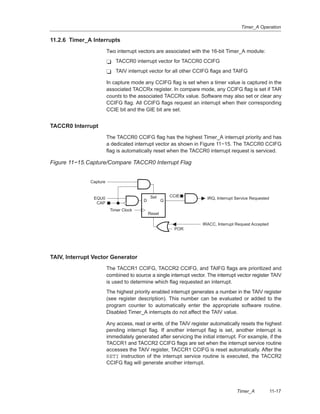
11.2.6 Timer_A Interrupts 11-17. . . . . . . . . . . . . . . . . . . . . . . . . . . . . . . . . . . . . . . . . . . . . . . . .
11.3 Timer_A Registers 11-19. . . . . . . . . . . . . . . . . . . . . . . . . . . . . . . . . . . . . . . . . . . . . . . . . . . . . . . .
12 Timer_B 12-1. . . . . . . . . . . . . . . . . . . . . . . . . . . . . . . . . . . . . . . . . . . . . . . . . . . . . . . . . . . . . . . . . . . . . . .
12.1 Timer_B Introduction 12-2. . . . . . . . . . . . . . . . . . . . . . . . . . . . . . . . . . . . . . . . . . . . . . . . . . . . . . .
12.1.1 Similarities and Differences From Timer_A 12-2. . . . . . . . . . . . . . . . . . . . . . . . . . . . .
12.2 Timer_B Operation 12-4. . . . . . . . . . . . . . . . . . . . . . . . . . . . . . . . . . . . . . . . . . . . . . . . . . . . . . . . .
12.2.1 16-Bit Timer Counter 12-4. . . . . . . . . . . . . . . . . . . . . . . . . . . . . . . . . . . . . . . . . . . . . . . .
12.2.2 Starting the Timer 12-5. . . . . . . . . . . . . . . . . . . . . . . . . . . . . . . . . . . . . . . . . . . . . . . . . .
12.2.3 Timer Mode Control 12-5. . . . . . . . . . . . . . . . . . . . . . . . . . . . . . . . . . . . . . . . . . . . . . . . .
12.2.4 Capture/Compare Blocks 12-11. . . . . . . . . . . . . . . . . . . . . . . . . . . . . . . . . . . . . . . . . . .
12.2.5 Output Unit 12-14. . . . . . . . . . . . . . . . . . . . . . . . . . . . . . . . . . . . . . . . . . . . . . . . . . . . . . .
12.2.6 Timer_B Interrupts 12-18. . . . . . . . . . . . . . . . . . . . . . . . . . . . . . . . . . . . . . . . . . . . . . . . .
12.3 Timer_B Registers 12-20. . . . . . . . . . . . . . . . . . . . . . . . . . . . . . . . . . . . . . . . . . . . . . . . . . . . . . . .
13 USART Peripheral Interface, UART Mode 13-1. . . . . . . . . . . . . . . . . . . . . . . . . . . . . . . . . . . . . . . . .
13.1 USART Introduction: UART Mode 13-2. . . . . . . . . . . . . . . . . . . . . . . . . . . . . . . . . . . . . . . . . . . .
13.2 USART Operation: UART Mode 13-4. . . . . . . . . . . . . . . . . . . . . . . . . . . . . . . . . . . . . . . . . . . . .
13.2.1 USART Initialization and Reset 13-4. . . . . . . . . . . . . . . . . . . . . . . . . . . . . . . . . . . . . . .
13.2.2 Character Format 13-4. . . . . . . . . . . . . . . . . . . . . . . . . . . . . . . . . . . . . . . . . . . . . . . . . . .
13.2.3 Asynchronous Communication Formats 13-5. . . . . . . . . . . . . . . . . . . . . . . . . . . . . . .
13.2.4 USART Receive Enable 13-9. . . . . . . . . . . . . . . . . . . . . . . . . . . . . . . . . . . . . . . . . . . . .
13.2.5 USART Transmit Enable 13-10. . . . . . . . . . . . . . . . . . . . . . . . . . . . . . . . . . . . . . . . . . .
13.2.6 UART Baud Rate Generation 13-11. . . . . . . . . . . . . . . . . . . . . . . . . . . . . . . . . . . . . . .
13.2.7 USART Interrupts 13-17. . . . . . . . . . . . . . . . . . . . . . . . . . . . . . . . . . . . . . . . . . . . . . . . .
13.3 USART Registers: UART Mode 13-21. . . . . . . . . . . . . . . . . . . . . . . . . . . . . . . . . . . . . . . . . . . . .
Contents
xi
14 USART Peripheral Interface, SPI Mode 14-1. . . . . . . . . . . . . . . . . . . . . . . . . . . . . . . . . . . . . . . . . . .
14.1 USART Introduction: SPI Mode 14-2. . . . . . . . . . . . . . . . . . . . . . . . . . . . . . . . . . . . . . . . . . . . . .
14.2 USART Operation: SPI Mode 14-4. . . . . . . . . . . . . . . . . . . . . . . . . . . . . . . . . . . . . . . . . . . . . . .
14.2.1 USART Initialization and Reset 14-4. . . . . . . . . . . . . . . . . . . . . . . . . . . . . . . . . . . . . . .
14.2.2 Master Mode 14-5. . . . . . . . . . . . . . . . . . . . . . . . . . . . . . . . . . . . . . . . . . . . . . . . . . . . . . .
14.2.3 Slave Mode 14-6. . . . . . . . . . . . . . . . . . . . . . . . . . . . . . . . . . . . . . . . . . . . . . . . . . . . . . . .
14.2.4 SPI Enable 14-7. . . . . . . . . . . . . . . . . . . . . . . . . . . . . . . . . . . . . . . . . . . . . . . . . . . . . . . .
14.2.5 Serial Clock Control 14-9. . . . . . . . . . . . . . . . . . . . . . . . . . . . . . . . . . . . . . . . . . . . . . . . .
14.2.6 SPI Interrupts 14-11. . . . . . . . . . . . . . . . . . . . . . . . . . . . . . . . . . . . . . . . . . . . . . . . . . . . .
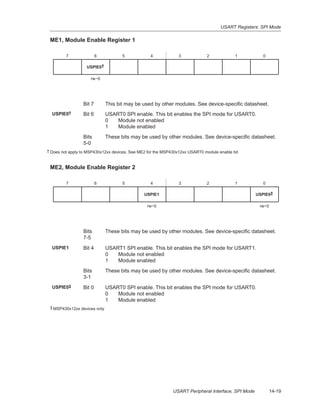
14.3 USART Registers: SPI Mode 14-13. . . . . . . . . . . . . . . . . . . . . . . . . . . . . . . . . . . . . . . . . . . . . . .
15 USART Peripheral Interface, I2C Mode 15-1. . . . . . . . . . . . . . . . . . . . . . . . . . . . . . . . . . . . . . . . . . .
15.1 I2C Module Introduction 15-2. . . . . . . . . . . . . . . . . . . . . . . . . . . . . . . . . . . . . . . . . . . . . . . . . . . .
15.2 I2C Module Operation 15-4. . . . . . . . . . . . . . . . . . . . . . . . . . . . . . . . . . . . . . . . . . . . . . . . . . . . . .
15.2.1 I2C Module Initialization 15-5. . . . . . . . . . . . . . . . . . . . . . . . . . . . . . . . . . . . . . . . . . . . .
15.2.2 I2C Serial Data 15-6. . . . . . . . . . . . . . . . . . . . . . . . . . . . . . . . . . . . . . . . . . . . . . . . . . . . .
15.2.3 I2C Addressing Modes 15-7. . . . . . . . . . . . . . . . . . . . . . . . . . . . . . . . . . . . . . . . . . . . . .
15.2.4 I2C Module Operating Modes 15-8. . . . . . . . . . . . . . . . . . . . . . . . . . . . . . . . . . . . . . . .
15.2.5 The I2C Data Register I2CDR 15-15. . . . . . . . . . . . . . . . . . . . . . . . . . . . . . . . . . . . . . .
15.2.6 I2C Clock Generation and Synchronization 15-16. . . . . . . . . . . . . . . . . . . . . . . . . . .
15.2.7 Using the I2C Module with Low Power Modes 15-17. . . . . . . . . . . . . . . . . . . . . . . . .
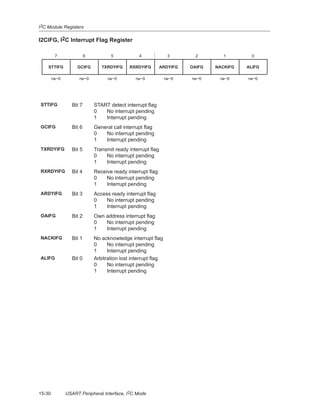
15.2.8 I2C Interrupts 15-18. . . . . . . . . . . . . . . . . . . . . . . . . . . . . . . . . . . . . . . . . . . . . . . . . . . . .
15.3 I2C Module Registers 15-20. . . . . . . . . . . . . . . . . . . . . . . . . . . . . . . . . . . . . . . . . . . . . . . . . . . . .
16 Comparator_A 16-1. . . . . . . . . . . . . . . . . . . . . . . . . . . . . . . . . . . . . . . . . . . . . . . . . . . . . . . . . . . . . . . . . .
16.1 Comparator_A Introduction 16-2. . . . . . . . . . . . . . . . . . . . . . . . . . . . . . . . . . . . . . . . . . . . . . . . .
16.2 Comparator_A Operation 16-4. . . . . . . . . . . . . . . . . . . . . . . . . . . . . . . . . . . . . . . . . . . . . . . . . .
16.2.1 Comparator 16-4. . . . . . . . . . . . . . . . . . . . . . . . . . . . . . . . . . . . . . . . . . . . . . . . . . . . . . . .
16.2.2 Input Analog Switches 16-4. . . . . . . . . . . . . . . . . . . . . . . . . . . . . . . . . . . . . . . . . . . . . .
16.2.3 Output Filter 16-5. . . . . . . . . . . . . . . . . . . . . . . . . . . . . . . . . . . . . . . . . . . . . . . . . . . . . . .
16.2.4 Voltage Reference Generator 16-5. . . . . . . . . . . . . . . . . . . . . . . . . . . . . . . . . . . . . . . .
16.2.5 Comparator_A, Port Disable Register CAPD 16-6. . . . . . . . . . . . . . . . . . . . . . . . . . .
16.2.6 Comparator_A Interrupts 16-6. . . . . . . . . . . . . . . . . . . . . . . . . . . . . . . . . . . . . . . . . . . .
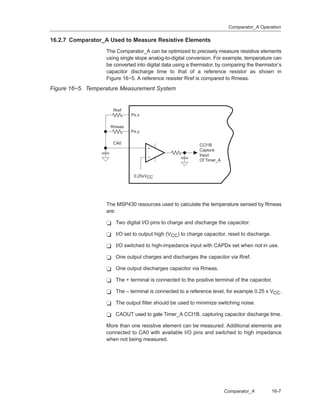
16.2.7 Comparator_A Used to Measure Resistive Elements 16-7. . . . . . . . . . . . . . . . . . . .
16.3 Comparator_A Registers 16-9. . . . . . . . . . . . . . . . . . . . . . . . . . . . . . . . . . . . . . . . . . . . . . . . . . .
17 ADC12 17-1. . . . . . . . . . . . . . . . . . . . . . . . . . . . . . . . . . . . . . . . . . . . . . . . . . . . . . . . . . . . . . . . . . . . . . . . .
17.1 ADC12 Introduction 17-2. . . . . . . . . . . . . . . . . . . . . . . . . . . . . . . . . . . . . . . . . . . . . . . . . . . . . . . .
17.2 ADC12 Operation 17-4. . . . . . . . . . . . . . . . . . . . . . . . . . . . . . . . . . . . . . . . . . . . . . . . . . . . . . . . . .
17.2.1 12-Bit ADC Core 17-4. . . . . . . . . . . . . . . . . . . . . . . . . . . . . . . . . . . . . . . . . . . . . . . . . . .
17.2.2 ADC12 Inputs and Multiplexer 17-5. . . . . . . . . . . . . . . . . . . . . . . . . . . . . . . . . . . . . . . .
17.2.3 Voltage Reference Generator 17-6. . . . . . . . . . . . . . . . . . . . . . . . . . . . . . . . . . . . . . . .
17.2.4 Auto Power-Down 17-6. . . . . . . . . . . . . . . . . . . . . . . . . . . . . . . . . . . . . . . . . . . . . . . . . .
17.2.5 Sample and Conversion Timing 17-7. . . . . . . . . . . . . . . . . . . . . . . . . . . . . . . . . . . . . .
17.2.6 Conversion Memory 17-10. . . . . . . . . . . . . . . . . . . . . . . . . . . . . . . . . . . . . . . . . . . . . . .
17.2.7 ADC12 Conversion Modes 17-10. . . . . . . . . . . . . . . . . . . . . . . . . . . . . . . . . . . . . . . . . .
17.2.8 Using the Integrated Temperature Sensor 17-16. . . . . . . . . . . . . . . . . . . . . . . . . . . .
17.2.9 ADC12 Grounding and Noise Considerations 17-17. . . . . . . . . . . . . . . . . . . . . . . . .
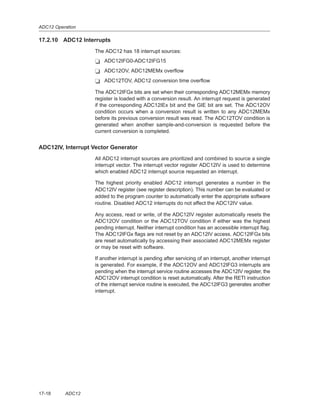
17.2.10 ADC12 Interrupts 17-18. . . . . . . . . . . . . . . . . . . . . . . . . . . . . . . . . . . . . . . . . . . . . . . . . .
17.3 ADC12 Registers 17-20. . . . . . . . . . . . . . . . . . . . . . . . . . . . . . . . . . . . . . . . . . . . . . . . . . . . . . . . .
Contents
xii
18 ADC10 18-1. . . . . . . . . . . . . . . . . . . . . . . . . . . . . . . . . . . . . . . . . . . . . . . . . . . . . . . . . . . . . . . . . . . . . . . . .
18.1 ADC10 Introduction 18-2. . . . . . . . . . . . . . . . . . . . . . . . . . . . . . . . . . . . . . . . . . . . . . . . . . . . . . . .
18.2 ADC10 Operation 18-4. . . . . . . . . . . . . . . . . . . . . . . . . . . . . . . . . . . . . . . . . . . . . . . . . . . . . . . . . .
18.2.1 10-Bit ADC Core 18-4. . . . . . . . . . . . . . . . . . . . . . . . . . . . . . . . . . . . . . . . . . . . . . . . . . .
18.2.2 ADC10 Inputs and Multiplexer 18-5. . . . . . . . . . . . . . . . . . . . . . . . . . . . . . . . . . . . . . . .
18.2.3 Voltage Reference Generator 18-6. . . . . . . . . . . . . . . . . . . . . . . . . . . . . . . . . . . . . . . .
18.2.4 Auto Power-Down 18-6. . . . . . . . . . . . . . . . . . . . . . . . . . . . . . . . . . . . . . . . . . . . . . . . . .
18.2.5 Sample and Conversion Timing 18-7. . . . . . . . . . . . . . . . . . . . . . . . . . . . . . . . . . . . . .
18.2.6 Conversion Modes 18-9. . . . . . . . . . . . . . . . . . . . . . . . . . . . . . . . . . . . . . . . . . . . . . . . . .
18.2.7 ADC10 Data Transfer Controller 18-15. . . . . . . . . . . . . . . . . . . . . . . . . . . . . . . . . . . . .
18.2.8 Using the Integrated Temperature Sensor 18-21. . . . . . . . . . . . . . . . . . . . . . . . . . . .
18.2.9 ADC10 Grounding and Noise Considerations 18-22. . . . . . . . . . . . . . . . . . . . . . . . .
18.2.10 ADC10 Interrupts 18-23. . . . . . . . . . . . . . . . . . . . . . . . . . . . . . . . . . . . . . . . . . . . . . . . . .
18.3 ADC10 Registers 18-24. . . . . . . . . . . . . . . . . . . . . . . . . . . . . . . . . . . . . . . . . . . . . . . . . . . . . . . . .
19 DAC12 19-1. . . . . . . . . . . . . . . . . . . . . . . . . . . . . . . . . . . . . . . . . . . . . . . . . . . . . . . . . . . . . . . . . . . . . . . . .
19.1 DAC12 Introduction 19-2. . . . . . . . . . . . . . . . . . . . . . . . . . . . . . . . . . . . . . . . . . . . . . . . . . . . . . . .
19.2 DAC12 Operation 19-4. . . . . . . . . . . . . . . . . . . . . . . . . . . . . . . . . . . . . . . . . . . . . . . . . . . . . . . . . .
19.2.1 DAC12 Core 19-4. . . . . . . . . . . . . . . . . . . . . . . . . . . . . . . . . . . . . . . . . . . . . . . . . . . . . . .
19.2.2 DAC12 Reference 19-5. . . . . . . . . . . . . . . . . . . . . . . . . . . . . . . . . . . . . . . . . . . . . . . . . .
19.2.3 Updating the DAC12 Voltage Output 19-5. . . . . . . . . . . . . . . . . . . . . . . . . . . . . . . . . .
19.2.4 DAC12_xDAT Data Format 19-6. . . . . . . . . . . . . . . . . . . . . . . . . . . . . . . . . . . . . . . . . .
19.2.5 DAC12 Output Amplifier Offset Calibration 19-7. . . . . . . . . . . . . . . . . . . . . . . . . . . . .
19.2.6 Grouping Multiple DAC12 Modules 19-8. . . . . . . . . . . . . . . . . . . . . . . . . . . . . . . . . . .
19.2.7 DAC12 Interrupts 19-9. . . . . . . . . . . . . . . . . . . . . . . . . . . . . . . . . . . . . . . . . . . . . . . . . . .
19.3 DAC12 Registers 19-10. . . . . . . . . . . . . . . . . . . . . . . . . . . . . . . . . . . . . . . . . . . . . . . . . . . . . . . . .
1-1Introduction
Introduction
This chapter describes the architecture of the MSP430.
Topic Page
1.1 Architecture 1-2. . . . . . . . . . . . . . . . . . . . . . . . . . . . . . . . . . . . . . . . . . . . . . . . . .
1.2 Flexible Clock System 1-2. . . . . . . . . . . . . . . . . . . . . . . . . . . . . . . . . . . . . . . . .
1.3 Embedded Emulation 1-3. . . . . . . . . . . . . . . . . . . . . . . . . . . . . . . . . . . . . . . . .
1.4 Address Space 1-4. . . . . . . . . . . . . . . . . . . . . . . . . . . . . . . . . . . . . . . . . . . . . . .
Chapter 1
Architecture
1-2 Introduction
1.1 Architecture
The MSP430 incorporates a 16-bit RISC CPU, peripherals, and a flexible clock
system that interconnect using a von-Neumann common memory address
bus (MAB) and memory data bus (MDB). Partnering a modern CPU with
modular memory-mapped analog and digital peripherals, the MSP430 offers
solutions for demanding mixed-signal applications.
Key features of the MSP430x1xx family include:
- Ultralow-power architecture extends battery life
J 0.1-µA RAM retention
J 0.8-µA real-time clock mode
J 250-µA / MIPS active
- High-performance analog ideal for precision measurement
J 12-bit or 10-bit ADC — 200 ksps, temperature sensor, VRef
J 12-bit dual-DAC
J Comparator-gated timers for measuring resistive elements
J Supply voltage supervisor
- 16-bit RISC CPU enables new applications at a fraction of the code size.
J Large register file eliminates working file bottleneck
J Compact core design reduces power consumption and cost
J Optimized for modern high-level programming
J Only 27 core instructions and seven addressing modes
J Extensive vectored-interrupt capability
- In-system programmable Flash permits flexible code changes, field
upgrades and data logging
1.2 Flexible Clock System
The clock system is designed specifically for battery-powered applications. A
low-frequency auxiliary clock (ACLK) is driven directly from a common 32-kHz
watch crystal. The ACLK can be used for a background real-time clock self
wake-up function. An integrated high-speed digitally controlled oscillator
(DCO) can source the master clock (MCLK) used by the CPU and high-speed
peripherals. By design, the DCO is active and stable in less than 6 µs.
MSP430-based solutions effectively use the high-performance 16-bit RISC
CPU in very short bursts.
- Low-frequency auxiliary clock = Ultralow-power stand-by mode
- High-speed master clock = High performance signal processing
Embedded Emulation
1-3Introduction
Figure 1−1. MSP430 Architecture
ACLK
Bus
Conv.
Peripheral
MAB 16-Bit
MDB 16-Bit
MCLK
SMCLK
Clock
System
Peripheral PeripheralPeripheral
Peripheral Peripheral Peripheral
Watchdog
RAM
Flash/
RISC CPU
16-Bit JTAG/Debug
ACLK
SMCLK
ROM
MDB 8-Bit
JTAG
1.3 Embedded Emulation
Dedicated embedded emulation logic resides on the device itself and is
accessed via JTAG using no additional system resources.
The benefits of embedded emulation include:
- Unobtrusive development and debug with full-speed execution,
breakpoints, and single-steps in an application are supported.
- Development is in-system subject to the same characteristics as the final
application.
- Mixed-signal integrity is preserved and not subject to cabling interference.
Address Space
1-4 Introduction
1.4 Address Space
The MSP430 von-Neumann architecture has one address space shared with
special function registers (SFRs), peripherals, RAM, and Flash/ROM memory
as shown in Figure 1−2. See the device-specific data sheets for specific
memory maps. Code access are always performed on even addresses. Data
can be accessed as bytes or words.
The addressable memory space is 64 KB with future expansion planned.
Figure 1−2. Memory Map
0FFE0h
Interrupt Vector Table
Flash/ROM
RAM
16-Bit Peripheral Modules
8-Bit Peripheral Modules
Special Function Registers
0FFFFh
0FFDFh
0200h
01FFh
0100h
0FFh
010h
0Fh
0h
Access
Word/Byte
Word/Byte
Word
Byte
Byte
Word/Byte
1.4.1 Flash/ROM
The start address of Flash/ROM depends on the amount of Flash/ROM
present and varies by device. The end address for Flash/ROM is 0FFFFh.
Flash can be used for both code and data. Word or byte tables can be stored
and used in Flash/ROM without the need to copy the tables to RAM before
using them.
The interrupt vector table is mapped into the upper 16 words of Flash/ROM
address space, with the highest priority interrupt vector at the highest
Flash/ROM word address (0FFFEh).
1.4.2 RAM
RAM starts at 0200h. The end address of RAM depends on the amount of RAM
present and varies by device. RAM can be used for both code and data.
Address Space
1-5Introduction
1.4.3 Peripheral Modules
Peripheral modules are mapped into the address space. The address space
from 0100 to 01FFh is reserved for 16-bit peripheral modules. These modules
should be accessed with word instructions. If byte instructions are used, only
even addresses are permissible, and the high byte of the result is always 0.
The address space from 010h to 0FFh is reserved for 8-bit peripheral modules.
These modules should be accessed with byte instructions. Read access of
byte modules using word instructions results in unpredictable data in the high
byte. If word data is written to a byte module only the low byte is written into
the peripheral register, ignoring the high byte.
1.4.4 Special Function Registers (SFRs)
Some peripheral functions are configured in the SFRs. The SFRs are located
in the lower 16 bytes of the address space, and are organized by byte. SFRs
must be accessed using byte instructions only. See the device-specific data
sheets for applicable SFR bits.
1.4.5 Memory Organization
Bytes are located at even or odd addresses. Words are only located at even
addresses as shown in Figure 1−3. When using word instructions, only even
addresses may be used. The low byte of a word is always an even address.
The high byte is at the next odd address. For example, if a data word is located
at address xxx4h, then the low byte of that data word is located at address
xxx4h, and the high byte of that word is located at address xxx5h.
Figure 1−3. Bits, Bytes, and Words in a Byte-Organized Memory
15
7
14
6
. . Bits . .
. . Bits . .
9
1
8
0
Byte
Byte
Word (High Byte)
Word (Low Byte)
xxxAh
xxx9h
xxx8h
xxx7h
xxx6h
xxx5h
xxx4h
xxx3h
2-1System Resets, Interrupts, and Operating Modes
System Resets, Interrupts,
and Operating Modes
This chapter describes the MSP430x1xx system resets, interrupts, and
operating modes.
Topic Page
2.1 System Reset and Initialization 2-2. . . . . . . . . . . . . . . . . . . . . . . . . . . . . . . . .
2.2 Interrupts 2-6. . . . . . . . . . . . . . . . . . . . . . . . . . . . . . . . . . . . . . . . . . . . . . . . . . . .
2.3 Operating Modes 2-14. . . . . . . . . . . . . . . . . . . . . . . . . . . . . . . . . . . . . . . . . . . . .
2.4 Principles for Low-Power Applications 2-17. . . . . . . . . . . . . . . . . . . . . . . .
2.5 Connection of Unused Pins 2-17. . . . . . . . . . . . . . . . . . . . . . . . . . . . . . . . . . .
Chapter 2
System Reset and Initialization
2-2 System Resets, Interrupts, and Operating Modes
2.1 System Reset and Initialization
The system reset circuitry shown in Figure 2−1 sources both a power-on reset
(POR) and a power-up clear (PUC) signal. Different events trigger these reset
signals and different initial conditions exist depending on which signal was
generated.
Figure 2−1. Power-On Reset and Power-Up Clear Schematic
POR
Detect
VCC
POR
Latch
S
S
R
PUC
Latch
S
S
R
Resetwd1
Resetwd2
S
S
Delay
RST/NMI
WDTNMI†
WDTSSEL†
WDTQn†
WDTIFG†
EQU†
MCLK
POR
PUC
0 V
S
(from flash module)
KEYV
POR
Detect#
VCC
0 V
POR
Delay#
VCC
0 V
SVS_POR§
0 V
VCC
0 V
Brownout
Reset‡
† From watchdog timer peripheral module
‡ Devices with BOR only
# Devices without BOR only
§ Devices with SVS only
~ 50us
A POR is a device reset. A POR is only generated by the following three
events:
- Powering up the device
- A low signal on the RST/NMI pin when configured in the reset mode
- An SVS low condition when PORON = 1.
A PUC is always generated when a POR is generated, but a POR is not
generated by a PUC. The following events trigger a PUC:
- A POR signal
- Watchdog timer expiration when in watchdog mode only
- Watchdog timer security key violation
- A Flash memory security key violation
System Reset and Initialization
2-3System Resets, Interrupts, and Operating Modes
2.1.1 Power-On Reset (POR)
When the VCC rise time is slow, the POR detector holds the POR signal active
until VCC has risen above the VPOR level, as shown in Figure 2−2. When the
VCC supply provides a fast rise time the POR delay, t(POR_DELAY), provides
active time on the POR signal to allow the MSP430 to initialize.
On devices with no brownout-reset circuit, If power to the MSP430 is cycled,
the supply voltage VCC must fall below Vmin to ensure that a POR signal occurs
when VCC is powered up again. If VCC does not fall below Vmin during a cycle
or a glitch, a POR may not be generated and power-up conditions may not be
set correctly. In this case, a low level on RST/NMI may not cause a POR and
a full power-cycle will be required. See device-specific datasheet for
parameters.
Figure 2−2. POR Timing
V
No POR
PORPOR
VPOR
V
t(POR_DELAY) t(POR_DELAY)
Set Signal for
POR circuitry
min
VCC(min)
VCC
System Reset and Initialization
2-4 System Resets, Interrupts, and Operating Modes
2.1.2 Brownout Reset (BOR)
Some devices have a brownout reset circuit (see device-specific datasheet)
that replaces the POR detect and POR delay circuits. The brownout reset
circuit detects low supply voltages such as when a supply voltage is applied
to or removed from the VCC terminal. The brownout reset circuit resets the
device by triggering a POR signal when power is applied or removed. The
operating levels are shown in Figure 2−3.
The POR signal becomes active when VCC crosses the VCC(start) level. It
remains active until VCC crosses the V(B_IT+) threshold and the delay t(BOR)
elapses. The delay t(BOR) is adaptive being longer for a slow ramping VCC.The
hysteresis Vhys(B_ IT−) ensures that the supply voltage must drop below
V(B_IT−) to generate another POR signal from the brownout reset circuitry.
Figure 2−3. Brownout Timing
t
(BOR)
VCC(start)
VCC
V(B_IT−)
Set Signal for
POR circuitry
V(B_IT+)
Vhys(B_IT−)
As the V(B_IT−) level is significantly above the Vmin level of the POR circuit, the
BOR provides a reset for power failures where VCC does not fall below Vmin.
See device-specific datasheet for parameters.
System Reset and Initialization
2-5System Resets, Interrupts, and Operating Modes
2.1.3 Device Initial Conditions After System Reset
After a POR, the initial MSP430 conditions are:
- The RST/NMI pin is configured in the reset mode.
- I/O pins are switched to input mode as described in the Digital I/O chapter.
- Other peripheral modules and registers are initialized as described in their
respective chapters in this manual.
- Status register (SR) is reset.
- The watchdog timer powers up active in watchdog mode.
- Program counter (PC) is loaded with address contained at reset vector
location (0FFFEh). CPU execution begins at that address.
Software Initialization
After a system reset, user software must initialize the MSP430 for the
application requirements. The following must occur:
- Initialize the SP, typically to the top of RAM.
- Initialize the watchdog to the requirements of the application.
- Configure peripheral modules to the requirements of the application.
Additionally, the watchdog timer, oscillator fault, and flash memory flags can
be evaluated to determine the source of the reset.
System Reset and Initialization
2-6 System Resets, Interrupts, and Operating Modes
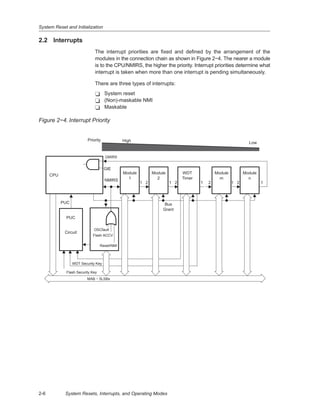
2.2 Interrupts
The interrupt priorities are fixed and defined by the arrangement of the
modules in the connection chain as shown in Figure 2−4. The nearer a module
is to the CPU/NMIRS, the higher the priority. Interrupt priorities determine what
interrupt is taken when more than one interrupt is pending simultaneously.
There are three types of interrupts:
- System reset
- (Non)-maskable NMI
- Maskable
Figure 2−4. Interrupt Priority
Bus
Grant
Module
1
Module
2
WDT
Timer
Module
m
Module
n
1 2 1 2 1 2 1 2 1
NMIRS
GIE
CPU
OSCfault
Reset/NMI
PUC
Circuit
PUC
WDT Security Key
Priority High Low
MAB − 5LSBs
GMIRS
Flash Security Key
Flash ACCV
System Reset and Initialization
2-7System Resets, Interrupts, and Operating Modes
2.2.1 (Non)-Maskable Interrupts (NMI)
(Non)-maskable NMI interrupts are not masked by the general interrupt enable
bit (GIE), but are enabled by individual interrupt enable bits (NMIIE, ACCVIE,
OFIE). When a NMI interrupt is accepted, all NMI interrupt enable bits are
automatically reset. Program execution begins at the address stored in the
(non)-maskable interrupt vector, 0FFFCh. User software must set the required
NMI interrupt enable bits for the interrupt to be re-enabled. The block diagram
for NMI sources is shown in Figure 2−5.
A (non)-maskable NMI interrupt can be generated by three sources:
- An edge on the RST/NMI pin when configured in NMI mode
- An oscillator fault occurs
- An access violation to the flash memory
Reset/NMI Pin
At power-up, the RST/NMI pin is configured in the reset mode. The function
of the RST/NMI pins is selected in the watchdog control register WDTCTL. If
the RST/NMI pin is set to the reset function, the CPU is held in the reset state
as long as the RST/NMI pin is held low. After the input changes to a high state,
the CPU starts program execution at the word address stored in the reset
vector, 0FFFEh.
If the RST/NMI pin is configured by user software to the NMI function, a signal
edge selected by the WDTNMIES bit generates an NMI interrupt if the NMIIE
bit is set. The RST/NMI flag NMIIFG is also set.
Note: Holding RST/NMI Low
When configured in the NMI mode, a signal generating an NMI event should
not hold the RST/NMI pin low. If a PUC occurs from a different source while
the NMI signal is low, the device will be held in the reset state because a PUC
changes the RST/NMI pin to the reset function.
Note: Modifying WDTNMIES
When NMI mode is selected and the WDTNMIES bit is changed, an NMI can
be generated, depending on the actual level at the RST/NMI pin. When the
NMI edge select bit is changed before selecting the NMI mode, no NMI is
generated.
System Reset and Initialization
2-8 System Resets, Interrupts, and Operating Modes
Figure 2−5. Block Diagram of (Non)-Maskable Interrupt Sources
Flash Module
KEYV
System Reset
Generator
VCC
POR PUC
WDTQn EQU
PUC
POR
PUC POR
NMIRS
Clear
S
WDTIFG
IRQ
WDTIE
Clear
IE1.0
PUC
POR
IRQA
WDTTMSEL
Counter
IFG1.0
WDTNMI
WDTTMSEL
WDTNMIES
Watchdog Timer Module
Clear
S
IFG1.4
PUC
Clear
IE1.4
PUC
NMIIFG
NMIIE
S
IFG1.1
Clear
IE1.1
PUC
OFIFG
OFIE
OSCFault
NMI_IRQA
IRQA: Interrupt Request Accepted
RST/NMI
S
FCTL1.1
Clear
IE1.5
ACCVIFG
ACCVIE
PUC
ACCV
WDT
System Reset and Initialization
2-9System Resets, Interrupts, and Operating Modes
Flash Access Violation
The flash ACCVIFG flag is set when a flash access violation occurs. The flash
access violation can be enabled to generate an NMI interrupt by setting the
ACCVIE bit. The ACCVIFG flag can then be tested by NMI the interrupt service
routine to determine if the NMI was caused by a flash access violation.
Oscillator Fault
The oscillator fault signal warns of a possible error condition with the crystal
oscillator. The oscillator fault can be enabled to generate an NMI interrupt by
setting the OFIE bit. The OFIFG flag can then be tested by NMI the interrupt
service routine to determine if the NMI was caused by an oscillator fault.
A PUC signal can trigger an oscillator fault, because the PUC switches the
LFXT1 to LF mode, therefore switching off the HF mode. The PUC signal also
switches off the XT2 oscillator.
System Reset and Initialization
2-10 System Resets, Interrupts, and Operating Modes
Example of an NMI Interrupt Handler
The NMI interrupt is a multiple-source interrupt. An NMI interrupt automatically
resets the NMIIE, OFIE and ACCVIE interrupt-enable bits. The user NMI
service routine resets the interrupt flags and re-enables the interrupt-enable
bits according to the application needs as shown in Figure 2−6.
Figure 2−6. NMI Interrupt Handler
yes
no
OFIFG=1
yes
no
ACCVIFG=1
yes
Reset ACCVIFG
no
NMIIFG=1
Reset NMIIFGReset OFIFG
Start of NMI Interrupt Handler
Reset by HW:
OFIE, NMIIE, ACCVIE
User’s Software,
Oscillator Fault
Handler
User’s Software,
Flash Access
Violation Handler
User’s Software,
External NMI
Handler
Optional
RETI
End of NMI Interrupt
Handler
Note: Enabling NMI Interrupts with ACCVIE, NMIIE, and OFIE
To prevent nested NMI interrupts, the ACCVIE, NMIIE, and OFIE enable bits
should not be set inside of an NMI interrupt service routine.
2.2.2 Maskable Interrupts
Maskable interrupts are caused by peripherals with interrupt capability
including the watchdog timer overflow in interval-timer mode. Each maskable
interrupt source can be disabled individually by an interrupt enable bit, or all
maskable interrupts can be disabled by the general interrupt enable (GIE) bit
in the status register (SR).
Each individual peripheral interrupt is discussed in the associated peripheral
module chapter in this manual.
System Reset and Initialization
2-11System Resets, Interrupts, and Operating Modes
2.2.3 Interrupt Processing
When an interrupt is requested from a peripheral and the peripheral interrupt
enable bit and GIE bit are set, the interrupt service routine is requested. Only
the individual enable bit must be set for (non)-maskable interrupts to be
requested.
Interrupt Acceptance
The interrupt latency is 6 cycles, starting with the acceptance of an interrupt
request, and lasting until the start of execution of the first instruction of the
interrupt-service routine, as shown in Figure 2−7. The interrupt logic executes
the following:
1) Any currently executing instruction is completed.
2) The PC, which points to the next instruction, is pushed onto the stack.
3) The SR is pushed onto the stack.
4) The interrupt with the highest priority is selected if multiple interrupts
occurred during the last instruction and are pending for service.
5) The interrupt request flag resets automatically on single-source flags.
Multiple source flags remain set for servicing by software.
6) The SR is cleared. This terminates any low-power mode. Because the GIE
bit is cleared, further interrupts are disabled.
7) The content of the interrupt vector is loaded into the PC: the program
continues with the interrupt service routine at that address.
Figure 2−7. Interrupt Processing
Item1
Item2SP TOS
Item1
Item2
SP TOS
PC
SR
Before
Interrupt
After
Interrupt
System Reset and Initialization
2-12 System Resets, Interrupts, and Operating Modes
Return From Interrupt
The interrupt handling routine terminates with the instruction:
RETI (return from an interrupt service routine)
The return from the interrupt takes 5 cycles to execute the following actions
and is illustrated in Figure 2−8.
1) The SR with all previous settings pops from the stack. All previous settings
of GIE, CPUOFF, etc. are now in effect, regardless of the settings used
during the interrupt service routine.
2) The PC pops from the stack and begins execution at the point where it was
interrupted.
Figure 2−8. Return From Interrupt
Item1
Item2
SP TOS
Item1
Item2SP TOS
PC
SR
Before After
PC
SR
Return From Interrupt
Interrupt Nesting
Interrupt nesting is enabled if the GIE bit is set inside an interrupt service
routine. When interrupt nesting is enabled, any interrupt occurring during an
interrupt service routine will interrupt the routine, regardless of the interrupt
priorities.
System Reset and Initialization
2-13System Resets, Interrupts, and Operating Modes
2.2.4 Interrupt Vectors
The interrupt vectors and the power-up starting address are located in the
address range 0FFFFh − 0FFE0h as described in Table 2−1. A vector is
programmed by the user with the 16-bit address of the corresponding interrupt
service routine. See the device-specific data sheet for the complete interrupt
vector list.
Table 2−1.Interrupt Sources,Flags, and Vectors
INTERRUPT SOURCE
INTERRUPT
FLAG
SYSTEM
INTERRUPT
WORD
ADDRESS
PRIORITY
Power-up, external
reset, watchdog,
flash password
WDTIFG
KEYV
Reset 0FFFEh 15, highest
NMI, oscillator fault,
flash memory access
violation
NMIIFG
OFIFG
ACCVIFG
(non)-maskable
(non)-maskable
(non)-maskable
0FFFCh 14
device-specific 0FFFAh 13
device-specific 0FFF8h 12
device-specific 0FFF6h 11
Watchdog timer WDTIFG maskable 0FFF4h 10
device-specific 0FFF2h 9
device-specific 0FFF0h 8
device-specific 0FFEEh 7
device-specific 0FFECh 6
device-specific 0FFEAh 5
device-specific 0FFE8h 4
device-specific 0FFE6h 3
device-specific 0FFE4h 2
device-specific 0FFE2h 1
device-specific 0FFE0h 0, lowest
Some module enable bits, interrupt enable bits, and interrupt flags are located
in the SFRs. The SFRs are located in the lower address range and are
implemented in byte format. SFRs must be accessed using byte instructions.
See the device-specific datasheet for the SFR configuration.
Operating Modes
2-14 System Resets, Interrupts, and Operating Modes
2.3 Operating Modes
The MSP430 family is designed for ultralow-power applications and uses
different operating modes shown in Figure 2−10.
The operating modes take into account three different needs:
- Ultralow-power
- Speed and data throughput
- Minimization of individual peripheral current consumption
The MSP430 typical current consumption is shown in Figure 2−9.
Figure 2−9. Typical Current Consumption of 13x and 14x Devices vs Operating Modes
315
AM
340
270
225
180
135
90
45
0
LPM0 LPM2 LPM3 LPM4
225
70 65
17 11 2 1 0.1 0.1
VCC = 3 V
VCC = 2.2 V
Operating Modes
A@1MHzµICC/
The low-power modes 0−4 are configured with the CPUOFF, OSCOFF, SCG0,
and SCG1 bits in the status register The advantage of including the CPUOFF,
OSCOFF, SCG0, and SCG1 mode-control bits in the status register is that the
present operating mode is saved onto the stack during an interrupt service
routine. Program flow returns to the previous operating mode if the saved SR
value is not altered during the interrupt service routine. Program flow can be
returned to a different operating mode by manipulating the saved SR value on
the stack inside of the interrupt service routine. The mode-control bits and the
stack can be accessed with any instruction.
When setting any of the mode-control bits, the selected operating mode takes
effect immediately. Peripherals operating with any disabled clock are disabled
until the clock becomes active. The peripherals may also be disabled with their
individual control register settings. All I/O port pins and RAM/registers are
unchanged. Wake up is possible through all enabled interrupts.
Operating Modes
2-15System Resets, Interrupts, and Operating Modes
Figure 2−10. MSP430x1xx Operating Modes For Basic Clock System
Active Mode
CPU Is Active
Peripheral Modules Are Active
LPM0
CPU Off, MCLK Off,
SMCLK On, ACLK On
CPUOFF = 1
SCG0 = 0
SCG1 = 0
CPUOFF = 1
SCG0 = 1
SCG1 = 0
LPM2
CPU Off, MCLK Off, SMCLK
Off, DCO Off, ACLK On
CPUOFF = 1
SCG0 = 0
SCG1 = 1
LPM3
CPU Off, MCLK Off, SMCLK
Off, DCO Off, ACLK On
DC Generator Off
LPM4
CPU Off, MCLK Off, DCO
Off, ACLK Off
DC Generator Off
CPUOFF = 1
OSCOFF = 1
SCG0 = 1
SCG1 = 1
RST/NMI
NMI Active
PUC RST/NMI is Reset Pin
WDT is Active
POR
WDT Active,
Security Key Violation
WDT
Time Expired, Overflow WDTIFG = 1
WDTIFG = 1
RST/NMI
Reset Active
VCC On
WDTIFG = 0
LPM1
CPU Off, MCLK Off,
SMCLK On, ACLK On
DC Generator Off if DCO
not used in active mode
CPUOFF = 1
SCG0 = 1
SCG1 = 1
SCG1 SCG0 OSCOFF CPUOFF Mode CPU and Clocks Status
0 0 0 0 Active CPU is active, all enabled clocks are active
0 0 0 1 LPM0 CPU, MCLK are disabled
SMCLK , ACLK are active
0 1 0 1 LPM1 CPU, MCLK, DCO osc. are disabled
DC generator is disabled if the DCO is not used for
MCLK or SMCLK in active mode
SMCLK , ACLK are active
1 0 0 1 LPM2 CPU, MCLK, SMCLK, DCO osc. are disabled
DC generator remains enabled
ACLK is active
1 1 0 1 LPM3 CPU, MCLK, SMCLK, DCO osc. are disabled
DC generator disabled
ACLK is active
1 1 1 1 LPM4 CPU and all clocks disabled
Operating Modes
2-16 System Resets, Interrupts, and Operating Modes
2.3.1 Entering and Exiting Low-Power Modes
An enabled interrupt event wakes the MSP430 from any of the low-power
operating modes. The program flow is:
- Enter interrupt service routine:
J The PC and SR are stored on the stack
J The CPUOFF, SCG1, and OSCOFF bits are automatically reset
- Options for returning from the interrupt service routine:
J The original SR is popped from the stack, restoring the previous
operating mode.
J The SR bits stored on the stack can be modified within the interrupt
service routine returning to a different operating mode when the RETI
instruction is executed.
; Enter LPM0 Example
BIS #GIE+CPUOFF,SR ; Enter LPM0
; ... ; Program stops here
;
; Exit LPM0 Interrupt Service Routine
BIC #CPUOFF,0(SP) ; Exit LPM0 on RETI
RETI
; Enter LPM3 Example
BIS #GIE+CPUOFF+SCG1+SCG0,SR ; Enter LPM3
; ... ; Program stops here
;
; Exit LPM3 Interrupt Service Routine
BIC #CPUOFF+SCG1+SCG0,0(SP) ; Exit LPM3 on RETI
RETI
Extended Time in Low-Power Modes
The negative temperature coefficient of the DCO should be considered when
the DCO is disabled for extended low-power mode periods. If the temperature
changes significantly, the DCO frequency at wake-up may be significantly
different from when the low-power mode was entered and may be out of the
specified operating range. To avoid this, the DCO can be set to it lowest value
before entering the low-power mode for extended periods of time where
temperature can change.
; Enter LPM4 Example with lowest DCO Setting
BIC #RSEL2+RSEL1+RSEL0,&BCSCTL1 ; Lowest RSEL
BIS #GIE+CPUOFF+OSCOFF+SCG1+SCG0,SR ; Enter LPM4
; ... ; Program stops
;
; Interrupt Service Routine
BIC #CPUOFF+OSCOFF+SCG1+SCG0,0(SR); Exit LPM4 on RETI
RETI
Principles for Low-Power Applications
2-17System Resets, Interrupts, and Operating Modes
2.4 Principles for Low-Power Applications
Often, the most important factor for reducing power consumption is using the
MSP430’s clock system to maximize the time in LPM3. LPM3 power
consumption is less than 2 µA typical with both a real-time clock function and
all interrupts active. A 32-kHz watch crystal is used for the ACLK and the CPU
is clocked from the DCO (normally off) which has a 6-µs wake-up.
- Use interrupts to wake the processor and control program flow.
- Peripherals should be switched on only when needed.
- Use low-power integrated peripheral modules in place of software driven
functions. For example Timer_A and Timer_B can automatically generate
PWM and capture external timing, with no CPU resources.
- Calculated branching and fast table look-ups should be used in place of
flag polling and long software calculations.
- Avoid frequent subroutine and function calls due to overhead.
- For longer software routines, single-cycle CPU registers should be used.
2.5 Connection of Unused Pins
The correct termination of all unused pins is listed in Table 2−2.
Table 2−2.Connection of Unused Pins
Pin Potential Comment
AVCC DVCC
AVSS DVSS
VREF+ Open
VeREF+ DVSS
VREF−/VeREF− DVSS
XIN DVCC
XOUT Open
XT2IN DVSS 13x, 14x, 15x and 16x devices
XT2OUT Open 13x, 14x, 15x and 16x devices
Px.0 to Px.7 Open Switched to port function, output direction
RST/NMI DVCC or VCC Pullup resistor 47 kΩ
Test/VPP DVSS P11x devices
Test DVSS Pulldown resistor 30K 11x1 devices
Open 11x1A, 11x2, 12x, 12x2 devices
TDO Open
TDI Open
TMS Open
TCK Open
3-1RISC 16-Bit CPU
RISC 16ĆBit CPU
This chapter describes the MSP430 CPU, addressing modes, and instruction
set.
Topic Page
3.1 CPU Introduction 3-2. . . . . . . . . . . . . . . . . . . . . . . . . . . . . . . . . . . . . . . . . . . . .
3.2 CPU Registers 3-4. . . . . . . . . . . . . . . . . . . . . . . . . . . . . . . . . . . . . . . . . . . . . . . .
3.3 Addressing Modes 3-9. . . . . . . . . . . . . . . . . . . . . . . . . . . . . . . . . . . . . . . . . . . .
3.4 Instruction Set 3-17. . . . . . . . . . . . . . . . . . . . . . . . . . . . . . . . . . . . . . . . . . . . . . .
Chapter 3
CPU Introduction
3-2 RISC 16-Bit CPU
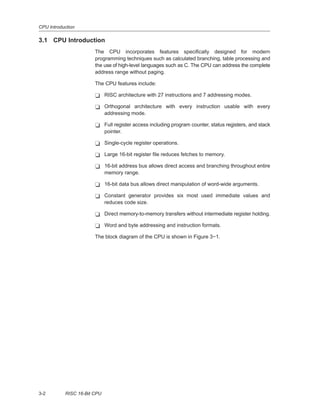
3.1 CPU Introduction
The CPU incorporates features specifically designed for modern
programming techniques such as calculated branching, table processing and
the use of high-level languages such as C. The CPU can address the complete
address range without paging.
The CPU features include:
- RISC architecture with 27 instructions and 7 addressing modes.
- Orthogonal architecture with every instruction usable with every
addressing mode.
- Full register access including program counter, status registers, and stack
pointer.
- Single-cycle register operations.
- Large 16-bit register file reduces fetches to memory.
- 16-bit address bus allows direct access and branching throughout entire
memory range.
- 16-bit data bus allows direct manipulation of word-wide arguments.
- Constant generator provides six most used immediate values and
reduces code size.
- Direct memory-to-memory transfers without intermediate register holding.
- Word and byte addressing and instruction formats.
The block diagram of the CPU is shown in Figure 3−1.
CPU Introduction
3-3RISC 16-Bit CPU
Figure 3−1. CPU Block Diagram
015
MDB − Memory Data Bus Memory Address Bus − MAB
16
Zero, Z
Carry, C
Overflow, V
Negative, N
16−bit ALU
dst src
R8 General Purpose
R9 General Purpose
R10 General Purpose
R11 General Purpose
R12 General Purpose
R13 General Purpose
R14 General Purpose
R15 General Purpose
R4 General Purpose
R5 General Purpose
R6 General Purpose
R7 General Purpose
R3/CG2 Constant Generator
R2/SR/CG1 Status
R1/SP Stack Pointer
R0/PC Program Counter 0
0
16
MCLK
CPU Registers
3-4 RISC 16-Bit CPU
3.2 CPU Registers
The CPU incorporates sixteen 16-bit registers. R0, R1, R2 and R3 have
dedicated functions. R4 to R15 are working registers for general use.
3.2.1 Program Counter (PC)
The 16-bit program counter (PC/R0) points to the next instruction to be
executed. Each instruction uses an even number of bytes (two, four, or six),
and the PC is incremented accordingly. Instruction accesses in the 64-KB
address space are performed on word boundaries, and the PC is aligned to
even addresses. Figure 3−2 shows the program counter.
Figure 3−2. Program Counter
0
15 0
Program Counter Bits 15 to 1
1
The PC can be addressed with all instructions and addressing modes. A few
examples:
MOV #LABEL,PC ; Branch to address LABEL
MOV LABEL,PC ; Branch to address contained in LABEL
MOV @R14,PC ; Branch indirect to address in R14
CPU Registers
3-5RISC 16-Bit CPU
3.2.2 Stack Pointer (SP)
The stack pointer (SP/R1) is used by the CPU to store the return addresses
of subroutine calls and interrupts. It uses a predecrement, postincrement
scheme. In addition, the SP can be used by software with all instructions and
addressing modes. Figure 3−3 shows the SP. The SP is initialized into RAM
by the user, and is aligned to even addresses.
Figure 3−4 shows stack usage.
Figure 3−3. Stack Pointer
0
15 0
Stack Pointer Bits 15 to 1
1
MOV 2(SP),R6 ; Item I2 −> R6
MOV R7,0(SP) ; Overwrite TOS with R7
PUSH #0123h ; Put 0123h onto TOS
POP R8 ; R8 = 0123h
Figure 3−4. Stack Usage
I3
I1
I2
I3
0xxxh
0xxxh − 2
0xxxh − 4
0xxxh − 6
0xxxh − 8
I1
I2
SP
0123h SP
I1
I2
I3 SP
PUSH #0123h POP R8Address
0123h
The special cases of using the SP as an argument to the PUSH and POP
instructions are described and shown in Figure 3−5.
Figure 3−5. PUSH SP - POP SP Sequence
SP1
SPold
SP1
PUSH SP
The stack pointer is changed after
a PUSH SP instruction.
SP1SP2
POP SP
The stack pointer is not changed after a POP SP
instruction. The POP SP instruction places SP1 into the
stack pointer SP (SP2=SP1)
CPU Registers
3-6 RISC 16-Bit CPU
3.2.3 Status Register (SR)
The status register (SR/R2), used as a source or destination register, can be
used in the register mode only addressed with word instructions. The remain-
ing combinations of addressing modes are used to support the constant gen-
erator. Figure 3−6 shows the SR bits.
Figure 3−6. Status Register Bits
SCG0 GIE Z C
rw-0
15 0
Reserved N
CPU
OFF
OSC
OFF
SCG1V
8 79
Table 3−1 describes the status register bits.
Table 3−1.Description of Status Register Bits
Bit Description
V Overflow bit. This bit is set when the result of an arithmetic operation
overflows the signed-variable range.
ADD(.B),ADDC(.B) Set when:
Positive + Positive = Negative
Negative + Negative = Positive,
otherwise reset
SUB(.B),SUBC(.B),CMP(.B) Set when:
Positive − Negative = Negative
Negative − Positive = Positive,
otherwise reset
SCG1 System clock generator 1. This bit, when set, turns off the SMCLK.
SCG0 System clock generator 0. This bit, when set, turns off the DCO dc
generator, if DCOCLK is not used for MCLK or SMCLK.
OSCOFF Oscillator Off. This bit, when set, turns off the LFXT1 crystal oscillator,
when LFXT1CLK is not use for MCLK or SMCLK
CPUOFF CPU off. This bit, when set, turns off the CPU.
GIE General interrupt enable. This bit, when set, enables maskable
interrupts. When reset, all maskable interrupts are disabled.
N Negative bit. This bit is set when the result of a byte or word operation
is negative and cleared when the result is not negative.
Word operation: N is set to the value of bit 15 of the
result
Byte operation: N is set to the value of bit 7 of the
result
Z Zero bit. This bit is set when the result of a byte or word operation is 0
and cleared when the result is not 0.
C Carry bit. This bit is set when the result of a byte or word operation
produced a carry and cleared when no carry occurred.
CPU Registers
3-7RISC 16-Bit CPU
3.2.4 Constant Generator Registers CG1 and CG2
Six commonly-used constants are generated with the constant generator
registers R2 and R3, without requiring an additional 16-bit word of program
code. The constants are selected with the source-register addressing modes
(As), as described in Table 3−2.
Table 3−2.Values of Constant Generators CG1, CG2
Register As Constant Remarks
R2 00 − − − − − Register mode
R2 01 (0) Absolute address mode
R2 10 00004h +4, bit processing
R2 11 00008h +8, bit processing
R3 00 00000h 0, word processing
R3 01 00001h +1
R3 10 00002h +2, bit processing
R3 11 0FFFFh −1, word processing
The constant generator advantages are:
- No special instructions required
- No additional code word for the six constants
- No code memory access required to retrieve the constant
The assembler uses the constant generator automatically if one of the six
constants is used as an immediate source operand. Registers R2 and R3,
used in the constant mode, cannot be addressed explicitly; they act as
source-only registers.
Constant Generator − Expanded Instruction Set
The RISC instruction set of the MSP430 has only 27 instructions. However, the
constant generator allows the MSP430 assembler to support 24 additional,
emulated instructions. For example, the single-operand instruction:
CLR dst
is emulated by the double-operand instruction with the same length:
MOV R3,dst
where the #0 is replaced by the assembler, and R3 is used with As=00.
INC dst
is replaced by:
ADD 0(R3),dst
CPU Registers
3-8 RISC 16-Bit CPU
3.2.5 General−Purpose Registers R4 - R15
The twelve registers, R4−R15, are general-purpose registers. All of these
registers can be used as data registers, address pointers, or index values and
can be accessed with byte or word instructions as shown in Figure 3−7.
Figure 3−7. Register-Byte/Byte-Register Operations
Unused
High Byte Low Byte
Byte
Register-Byte Operation
0h
High Byte Low Byte
Byte
Byte-Register Operation
Register
Memory Register
Memory
Example Register-Byte Operation Example Byte-Register Operation
R5 = 0A28Fh R5 = 01202h
R6 = 0203h R6 = 0223h
Mem(0203h) = 012h Mem(0223h) = 05Fh
ADD.B R5,0(R6) ADD.B @R6,R5
08Fh 05Fh
+ 012h + 002h
0A1h 00061h
Mem (0203h) = 0A1h R5 = 00061h
C = 0, Z = 0, N = 1 C = 0, Z = 0, N = 0
(Low byte of register) (Addressed byte)
+ (Addressed byte) + (Low byte of register)
−>(Addressed byte) −>(Low byte of register, zero to High byte)
Addressing Modes
3-9RISC 16-Bit CPU
3.3 Addressing Modes
Seven addressing modes for the source operand and four addressing modes
for the destination operand can address the complete address space with no
exceptions. The bit numbers in Table 3−3 describe the contents of the As
(source) and Ad (destination) mode bits.
Table 3−3.Source/Destination Operand Addressing Modes
As/Ad Addressing Mode Syntax Description
00/0 Register mode Rn Register contents are operand
01/1 Indexed mode X(Rn) (Rn + X) points to the operand. X
is stored in the next word.
01/1 Symbolic mode ADDR (PC + X) points to the operand. X
is stored in the next word. Indexed
mode X(PC) is used.
01/1 Absolute mode &ADDR The word following the instruction
contains the absolute address. X
is stored in the next word. Indexed
mode X(SR) is used.
10/− Indirect register
mode
@Rn Rn is used as a pointer to the
operand.
11/− Indirect
autoincrement
@Rn+ Rn is used as a pointer to the
operand. Rn is incremented
afterwards by 1 for .B instructions
and by 2 for .W instructions.
11/− Immediate mode #N The word following the instruction
contains the immediate constant
N. Indirect autoincrement mode
@PC+ is used.
The seven addressing modes are explained in detail in the following sections.
Most of the examples show the same addressing mode for the source and
destination, but any valid combination of source and destination addressing
modes is possible in an instruction.
Note: Use of Labels EDE, TONI, TOM, and LEO
Throughout MSP430 documentation EDE, TONI, TOM, and LEO are used
as generic labels. They are only labels. They have no special meaning.
Addressing Modes
3-10 RISC 16-Bit CPU
3.3.1 Register Mode
The register mode is described in Table 3−4.
Table 3−4.Register Mode Description
Assembler Code Content of ROM
MOV R10,R11 MOV R10,R11
Length: One or two words
Operation: Move the content of R10 to R11. R10 is not affected.
Comment: Valid for source and destination
Example: MOV R10,R11
0A023hR10
R11
Before: After:
PC
0FA15h
PCold
0A023hR10
R11
PC PCold + 2
0A023h
Note: Data in Registers
The data in the register can be accessed using word or byte instructions. If
byte instructions are used, the high byte is always 0 in the result. The status
bits are handled according to the result of the byte instruction.
Addressing Modes
3-11RISC 16-Bit CPU
3.3.2 Indexed Mode
The indexed mode is described in Table 3−5.
Table 3−5.Indexed Mode Description
Assembler Code Content of ROM
MOV 2(R5),6(R6) MOV X(R5),Y(R6)
X = 2
Y = 6
Length: Two or three words
Operation: Move the contents of the source address (contents of R5 + 2)
to the destination address (contents of R6 + 6). The source
and destination registers (R5 and R6) are not affected. In
indexed mode, the program counter is incremented
automatically so that program execution continues with the
next instruction.
Comment: Valid for source and destination
Example: MOV 2(R5),6(R6);
00006h
Address
Space
00002h
04596h PC
0FF16h
0FF14h
0FF12h
0xxxxh
05555h
01094h
01092h
01090h 0xxxxh
0xxxxh
01234h
01084h
01082h
01080h 0xxxxh
01080h
0108Ch
R5
R6
0108Ch
+0006h
01092h
01080h
+0002h
01082h
Register
Before:
00006h
Address
Space
00002h
04596h
PC
0FF16h
0FF14h
0FF12h
0xxxxh
01234h
01094h
01092h
01090h 0xxxxh
0xxxxh
01234h
01084h
01082h
01080h 0xxxxh
01080h
0108Ch
R5
R6
Register
After:
0xxxxh
Addressing Modes
3-12 RISC 16-Bit CPU
3.3.3 Symbolic Mode
The symbolic mode is described in Table 3−6.
Table 3−6.Symbolic Mode Description
Assembler Code Content of ROM
MOV EDE,TONI MOV X(PC),Y(PC)
X = EDE − PC
Y = TONI − PC
Length: Two or three words
Operation: Move the contents of the source address EDE (contents of
PC + X) to the destination address TONI (contents of PC + Y).
The words after the instruction contain the differences
between the PC and the source or destination addresses.
The assembler computes and inserts offsets X and Y
automatically. With symbolic mode, the program counter (PC)
is incremented automatically so that program execution
continues with the next instruction.
Comment: Valid for source and destination
Example: MOV EDE,TONI ;Source address EDE = 0F016h
;Dest. address TONI=01114h
011FEh
Address
Space
0F102h
04090h PC
0FF16h
0FF14h
0FF12h
0xxxxh
0A123h
0F018h
0F016h
0F014h 0xxxxh
0xxxxh
05555h
01116h
01114h
01112h 0xxxxh
0FF14h
+0F102h
0F016h
0FF16h
+011FEh
01114h
Register
Before:
011FEh
Address
Space
0F102h
04090h
PC
0FF16h
0FF14h
0FF12h
0xxxxh
0A123h
0F018h
0F016h
0F014h 0xxxxh
0xxxxh
0A123h
01116h
01114h
01112h 0xxxxh
Register
After:
0xxxxh
Addressing Modes
3-13RISC 16-Bit CPU
3.3.4 Absolute Mode
The absolute mode is described in Table 3−7.
Table 3−7.Absolute Mode Description
Assembler Code Content of ROM
MOV &EDE,&TONI MOV X(0),Y(0)
X = EDE
Y = TONI
Length: Two or three words
Operation: Move the contents of the source address EDE to the
destination address TONI. The words after the instruction
contain the absolute address of the source and destination
addresses. With absolute mode, the PC is incremented
automatically so that program execution continues with the
next instruction.
Comment: Valid for source and destination
Example: MOV &EDE,&TONI ;Source address EDE=0F016h,
;dest. address TONI=01114h
01114h
Address
Space
0F016h
04292h PC
0FF16h
0FF14h
0FF12h
0xxxxh
0A123h
0F018h
0F016h
0F014h 0xxxxh
0xxxxh
01234h
01116h
01114h
01112h 0xxxxh
Register
Before:
01114h
Address
Space
0F016h
04292h
PC
0FF16h
0FF14h
0FF12h
0xxxxh
0A123h
0F018h
0F016h
0F014h 0xxxxh
0xxxxh
0A123h
01116h
01114h
01112h 0xxxxh
Register
After:
0xxxxh
This address mode is mainly for hardware peripheral modules that are located
at an absolute, fixed address. These are addressed with absolute mode to
ensure software transportability (for example, position-independent code).
Addressing Modes
3-14 RISC 16-Bit CPU
3.3.5 Indirect Register Mode
The indirect register mode is described in Table 3−8.
Table 3−8.Indirect Mode Description
Assembler Code Content of ROM
MOV @R10,0(R11) MOV @R10,0(R11)
Length: One or two words
Operation: Move the contents of the source address (contents of R10) to
the destination address (contents of R11). The registers are
not modified.
Comment: Valid only for source operand. The substitute for destination
operand is 0(Rd).
Example: MOV.B @R10,0(R11)
0000h
Address
Space
04AEBh PC
0FF16h
0FF14h
0FF12h
0xxxxh
05BC1h
0xxxxh
0xxh
012h
0xxh
0FA33h
002A7h
R10
R11
Register
Before:
0000h
Address
Space
04AEBh
PC
0FF16h
0FF14h
0FF12h
0xxxxh
05BC1h
0FA34h
0FA32h
0FA30h 0xxxxh
0xxh
05Bh
002A8h
002A7h
002A6h 0xxh
0FA33h
002A7h
R10
R11
Register
After:
0xxxxh0xxxxh
0xxxxh 0xxxxh
0FA34h
0FA32h
0FA30h
002A8h
002A7h
002A6h
Addressing Modes
3-15RISC 16-Bit CPU
3.3.6 Indirect Autoincrement Mode
The indirect autoincrement mode is described in Table 3−9.
Table 3−9.Indirect Autoincrement Mode Description
Assembler Code Content of ROM
MOV @R10+,0(R11) MOV @R10+,0(R11)
Length: One or two words
Operation: Move the contents of the source address (contents of R10) to
the destination address (contents of R11). Register R10 is
incremented by 1 for a byte operation, or 2 for a word
operation after the fetch; it points to the next address without
any overhead. This is useful for table processing.
Comment: Valid only for source operand. The substitute for destination
operand is 0(Rd) plus second instruction INCD Rd.
Example: MOV @R10+,0(R11)
00000h
Address
Space
04ABBh PC
0FF16h
0FF14h
0FF12h
0xxxxh
05BC1h
0FA34h
0FA32h
0FA30h 0xxxxh
0xxxxh
01234h
010AAh
010A8h
010A6h 0xxxxh
0FA32h
010A8h
R10
R11
Register
Before:
Address
Space
0xxxxh
05BC1h
0FA34h
0FA32h
0FA30h 0xxxxh
0xxxxh
05BC1h
010AAh
010A8h
010A6h 0xxxxh
0FA34hR10
R11
Register
After:
0xxxxh
0xxxxh
0FF18h
00000h
04ABBh
PC
0FF16h
0FF14h
0FF12h
0xxxxh
0xxxxh
0FF18h
010A8h
The autoincrementing of the register contents occurs after the operand is
fetched. This is shown in Figure 3−8.
Figure 3−8. Operand Fetch Operation
Instruction Address Operand
+1/ +2
Addressing Modes
3-16 RISC 16-Bit CPU
3.3.7 Immediate Mode
The immediate mode is described in Table 3−10.
Table 3−10.Immediate Mode Description
Assembler Code Content of ROM
MOV #45h,TONI MOV @PC+,X(PC)
45
X = TONI − PC
Length: Two or three words
It is one word less if a constant of CG1 or CG2 can be used.
Operation: Move the immediate constant 45h, which is contained in the
word following the instruction, to destination address TONI.
When fetching the source, the program counter points to the
word following the instruction and moves the contents to the
destination.
Comment: Valid only for a source operand.
Example: MOV #45h,TONI
01192h
Address
Space
00045h
040B0h PC
0FF16h
0FF14h
0FF12h
0xxxxh
01234h
0xxxxh
0FF16h
+01192h
010A8h
Register
Before:
01192h
Address
Space
00045h
040B0h
PC
0FF16h
0FF14h
0FF12h
0xxxxh010AAh
010A8h
010A6h 0xxxxh
Register
After:
0xxxxh0FF18h
010AAh
010A8h
010A6h
00045h
Instruction Set
3-17RISC 16-Bit CPU
3.4 Instruction Set
The complete MSP430 instruction set consists of 27 core instructions and 24
emulated instructions. The core instructions are instructions that have unique
op-codes decoded by the CPU. The emulated instructions are instructions that
make code easier to write and read, but do not have op-codes themselves,
instead they are replaced automatically by the assembler with an equivalent
core instruction. There is no code or performance penalty for using emulated
instruction.
There are three core-instruction formats:
- Dual-operand
- Single-operand
- Jump
All single-operand and dual-operand instructions can be byte or word
instructions by using .B or .W extensions. Byte instructions are used to access
byte data or byte peripherals. Word instructions are used to access word data
or word peripherals. If no extension is used, the instruction is a word
instruction.
The source and destination of an instruction are defined by the following fields:
src The source operand defined by As and S-reg
dst The destination operand defined by Ad and D-reg
As The addressing bits responsible for the addressing mode used
for the source (src)
S-reg The working register used for the source (src)
Ad The addressing bits responsible for the addressing mode used
for the destination (dst)
D-reg The working register used for the destination (dst)
B/W Byte or word operation:
0: word operation
1: byte operation
Note: Destination Address
Destination addresses are valid anywhere in the memory map. However,
when using an instruction that modifies the contents of the destination, the
user must ensure the destination address is writable. For example, a
masked-ROM location would be a valid destination address, but the contents
are not modifiable, so the results of the instruction would be lost.
Instruction Set
3-18 RISC 16-Bit CPU
3.4.1 Double-Operand (Format I) Instructions
Figure 3−9 illustrates the double-operand instruction format.
Figure 3−9. Double Operand Instruction Format
B/W D-Reg
15 0
Op-code AdS-Reg
8 714 13 12 11 10 9 6 5 4 3 2 1
As
Table 3−11 lists and describes the double operand instructions.
Table 3−11.Double Operand Instructions
Mnemonic S-Reg,
D-Reg
Operation Status BitsMnemonic S-Reg,
D-Reg V N Z C
MOV(.B) src,dst src → dst − − − −
ADD(.B) src,dst src + dst → dst * * * *
ADDC(.B) src,dst src + dst + C → dst * * * *
SUB(.B) src,dst dst + .not.src + 1 → dst * * * *
SUBC(.B) src,dst dst + .not.src + C → dst * * * *
CMP(.B) src,dst dst − src * * * *
DADD(.B) src,dst src + dst + C → dst (decimally) * * * *
BIT(.B) src,dst src .and. dst 0 * * *
BIC(.B) src,dst .not.src .and. dst → dst − − − −
BIS(.B) src,dst src .or. dst → dst − − − −
XOR(.B) src,dst src .xor. dst → dst * * * *
AND(.B) src,dst src .and. dst → dst 0 * * *
* The status bit is affected
− The status bit is not affected
0 The status bit is cleared
1 The status bit is set
Note: Instructions CMP and SUB
The instructions CMP and SUB are identical except for the storage of the
result. The same is true for the BIT and AND instructions.
Instruction Set
3-19RISC 16-Bit CPU
3.4.2 Single-Operand (Format II) Instructions
Figure 3−10 illustrates the single-operand instruction format.
Figure 3−10. Single Operand Instruction Format
B/W D/S-Reg
15 0
Op-code
8 714 13 12 11 10 9 6 5 4 3 2 1
Ad
Table 3−12 lists and describes the single operand instructions.
Table 3−12.Single Operand Instructions
Mnemonic S-Reg,
D-Reg
Operation Status Bits
D-Reg
V N Z C
RRC(.B) dst C → MSB →.......LSB → C * * * *
RRA(.B) dst MSB → MSB →....LSB → C 0 * * *
PUSH(.B) src SP − 2 → SP, src → @SP − − − −
SWPB dst Swap bytes − − − −
CALL dst SP − 2 → SP, PC+2 → @SP − − − −
dst → PC
RETI TOS → SR, SP + 2 → SP * * * *
TOS → PC,SP + 2 → SP
SXT dst Bit 7 → Bit 8........Bit 15 0 * * *
* The status bit is affected
− The status bit is not affected
0 The status bit is cleared
1 The status bit is set
All addressing modes are possible for the CALL instruction. If the symbolic
mode (ADDRESS), the immediate mode (#N), the absolute mode (&EDE) or
the indexed mode x(RN) is used, the word that follows contains the address
information.
Instruction Set
3-20 RISC 16-Bit CPU
3.4.3 Jumps
Figure 3−11 shows the conditional-jump instruction format.
Figure 3−11. Jump Instruction Format
C 10-Bit PC Offset
15 0
Op-code
8 714 13 12 11 10 9 6 5 4 3 2 1
Table 3−13 lists and describes the jump instructions.
Table 3−13.Jump Instructions
Mnemonic S-Reg, D-Reg Operation
JEQ/JZ Label Jump to label if zero bit is set
JNE/JNZ Label Jump to label if zero bit is reset
JC Label Jump to label if carry bit is set
JNC Label Jump to label if carry bit is reset
JN Label Jump to label if negative bit is set
JGE Label Jump to label if (N .XOR. V) = 0
JL Label Jump to label if (N .XOR. V) = 1
JMP Label Jump to label unconditionally
Conditional jumps support program branching relative to the PC and do not
affect the status bits. The possible jump range is from −511 to +512 words
relative to the PC value at the jump instruction. The 10-bit program-counter
offset is treated as a signed 10-bit value that is doubled and added to the
program counter:
PCnew = PCold + 2 + PCoffset × 2
Instruction Set
3-21RISC 16−Bit CPU
*ADC[.W] Add carry to destination
*ADC.B Add carry to destination
Syntax ADC dst or ADC.W dst
ADC.B dst
Operation dst + C −> dst
Emulation ADDC #0,dst
ADDC.B #0,dst
Description The carry bit (C) is added to the destination operand. The previous contents
of the destination are lost.
Status Bits N: Set if result is negative, reset if positive
Z: Set if result is zero, reset otherwise
C: Set if dst was incremented from 0FFFFh to 0000, reset otherwise
Set if dst was incremented from 0FFh to 00, reset otherwise
V: Set if an arithmetic overflow occurs, otherwise reset
Mode Bits OSCOFF, CPUOFF, and GIE are not affected.
Example The 16-bit counter pointed to by R13 is added to a 32-bit counter pointed to
by R12.
ADD @R13,0(R12) ; Add LSDs
ADC 2(R12) ; Add carry to MSD
Example The 8-bit counter pointed to by R13 is added to a 16-bit counter pointed to by
R12.
ADD.B @R13,0(R12) ; Add LSDs
ADC.B 1(R12) ; Add carry to MSD
Instruction Set
3-22 RISC 16−Bit CPU
ADD[.W] Add source to destination
ADD.B Add source to destination
Syntax ADD src,dst or ADD.W src,dst
ADD.B src,dst
Operation src + dst −> dst
Description The source operand is added to the destination operand. The source operand
is not affected. The previous contents of the destination are lost.
Status Bits N: Set if result is negative, reset if positive
Z: Set if result is zero, reset otherwise
C: Set if there is a carry from the result, cleared if not
V: Set if an arithmetic overflow occurs, otherwise reset
Mode Bits OSCOFF, CPUOFF, and GIE are not affected.
Example R5 is increased by 10. The jump to TONI is performed on a carry.
ADD #10,R5
JC TONI ; Carry occurred
...... ; No carry
Example R5 is increased by 10. The jump to TONI is performed on a carry.
ADD.B #10,R5 ; Add 10 to Lowbyte of R5
JC TONI ; Carry occurred, if (R5) ≥ 246 [0Ah+0F6h]
...... ; No carry
Instruction Set
3-23RISC 16−Bit CPU
ADDC[.W] Add source and carry to destination
ADDC.B Add source and carry to destination
Syntax ADDC src,dst or ADDC.W src,dst
ADDC.B src,dst
Operation src + dst + C −> dst
Description The source operand and the carry bit (C) are added to the destination operand.
The source operand is not affected. The previous contents of the destination
are lost.
Status Bits N: Set if result is negative, reset if positive
Z: Set if result is zero, reset otherwise
C: Set if there is a carry from the MSB of the result, reset otherwise
V: Set if an arithmetic overflow occurs, otherwise reset
Mode Bits OSCOFF, CPUOFF, and GIE are not affected.
Example The 32-bit counter pointed to by R13 is added to a 32-bit counter, eleven words
(20/2 + 2/2) above the pointer in R13.
ADD @R13+,20(R13) ; ADD LSDs with no carry in
ADDC @R13+,20(R13) ; ADD MSDs with carry
... ; resulting from the LSDs
Example The 24-bit counter pointed to by R13 is added to a 24-bit counter, eleven words
above the pointer in R13.
ADD.B @R13+,10(R13) ; ADD LSDs with no carry in
ADDC.B @R13+,10(R13) ; ADD medium Bits with carry
ADDC.B @R13+,10(R13) ; ADD MSDs with carry
... ; resulting from the LSDs
Instruction Set
3-24 RISC 16−Bit CPU
AND[.W] Source AND destination
AND.B Source AND destination
Syntax AND src,dst or AND.W src,dst
AND.B src,dst
Operation src .AND. dst −> dst
Description The source operand and the destination operand are logically ANDed. The
result is placed into the destination.
Status Bits N: Set if result MSB is set, reset if not set
Z: Set if result is zero, reset otherwise
C: Set if result is not zero, reset otherwise ( = .NOT. Zero)
V: Reset
Mode Bits OSCOFF, CPUOFF, and GIE are not affected.
Example The bits set in R5 are used as a mask (#0AA55h) for the word addressed by
TOM. If the result is zero, a branch is taken to label TONI.
MOV #0AA55h,R5 ; Load mask into register R5
AND R5,TOM ; mask word addressed by TOM with R5
JZ TONI ;
...... ; Result is not zero
;
;
; or
;
;
AND #0AA55h,TOM
JZ TONI
Example The bits of mask #0A5h are logically ANDed with the low byte TOM. If the result
is zero, a branch is taken to label TONI.
AND.B #0A5h,TOM ; mask Lowbyte TOM with 0A5h
JZ TONI ;
...... ; Result is not zero
Instruction Set
3-25RISC 16−Bit CPU
BIC[.W] Clear bits in destination
BIC.B Clear bits in destination
Syntax BIC src,dst or BIC.W src,dst
BIC.B src,dst
Operation .NOT.src .AND. dst −> dst
Description The inverted source operand and the destination operand are logically
ANDed. The result is placed into the destination. The source operand is not
affected.
Status Bits Status bits are not affected.
Mode Bits OSCOFF, CPUOFF, and GIE are not affected.
Example The six MSBs of the RAM word LEO are cleared.
BIC #0FC00h,LEO ; Clear 6 MSBs in MEM(LEO)
Example The five MSBs of the RAM byte LEO are cleared.
BIC.B #0F8h,LEO ; Clear 5 MSBs in Ram location LEO
Instruction Set
3-26 RISC 16−Bit CPU
BIS[.W] Set bits in destination
BIS.B Set bits in destination
Syntax BIS src,dst or BIS.W src,dst
BIS.B src,dst
Operation src .OR. dst −> dst
Description The source operand and the destination operand are logically ORed. The
result is placed into the destination. The source operand is not affected.
Status Bits Status bits are not affected.
Mode Bits OSCOFF, CPUOFF, and GIE are not affected.
Example The six LSBs of the RAM word TOM are set.
BIS #003Fh,TOM; set the six LSBs in RAM location TOM
Example The three MSBs of RAM byte TOM are set.
BIS.B #0E0h,TOM ; set the 3 MSBs in RAM location TOM
Instruction Set
3-27RISC 16−Bit CPU
BIT[.W] Test bits in destination
BIT.B Test bits in destination
Syntax BIT src,dst or BIT.W src,dst
Operation src .AND. dst
Description The source and destination operands are logically ANDed. The result affects
only the status bits. The source and destination operands are not affected.
Status Bits N: Set if MSB of result is set, reset otherwise
Z: Set if result is zero, reset otherwise
C: Set if result is not zero, reset otherwise (.NOT. Zero)
V: Reset
Mode Bits OSCOFF, CPUOFF, and GIE are not affected.
Example If bit 9 of R8 is set, a branch is taken to label TOM.
BIT #0200h,R8 ; bit 9 of R8 set?
JNZ TOM ; Yes, branch to TOM
... ; No, proceed
Example If bit 3 of R8 is set, a branch is taken to label TOM.
BIT.B #8,R8
JC TOM
Example A serial communication receive bit (RCV) is tested. Because the carry bit is
equal to the state of the tested bit while using the BIT instruction to test a single
bit, the carry bit is used by the subsequent instruction; the read information is
shifted into register RECBUF.
;
; Serial communication with LSB is shifted first:
; xxxx xxxx xxxx xxxx
BIT.B #RCV,RCCTL ; Bit info into carry
RRC RECBUF ; Carry −> MSB of RECBUF
; cxxx xxxx
...... ; repeat previous two instructions
...... ; 8 times
; cccc cccc
; ^ ^
; MSB LSB
; Serial communication with MSB shifted first:
BIT.B #RCV,RCCTL ; Bit info into carry
RLC.B RECBUF ; Carry −> LSB of RECBUF
; xxxx xxxc
...... ; repeat previous two instructions
...... ; 8 times
; cccc cccc
; | LSB
; MSB
Instruction Set
3-28 RISC 16−Bit CPU
* BR, BRANCH Branch to .......... destination
Syntax BR dst
Operation dst −> PC
Emulation MOV dst,PC
Description An unconditional branch is taken to an address anywhere in the 64K address
space. All source addressing modes can be used. The branch instruction is
a word instruction.
Status Bits Status bits are not affected.
Example Examples for all addressing modes are given.
BR #EXEC ;Branch to label EXEC or direct branch (e.g. #0A4h)
; Core instruction MOV @PC+,PC
BR EXEC ; Branch to the address contained in EXEC
; Core instruction MOV X(PC),PC
; Indirect address
BR &EXEC ; Branch to the address contained in absolute
; address EXEC
; Core instruction MOV X(0),PC
; Indirect address
BR R5 ; Branch to the address contained in R5
; Core instruction MOV R5,PC
; Indirect R5
BR @R5 ; Branch to the address contained in the word
; pointed to by R5.
; Core instruction MOV @R5,PC
; Indirect, indirect R5
BR @R5+ ; Branch to the address contained in the word pointed
; to by R5 and increment pointer in R5 afterwards.
; The next time—S/W flow uses R5 pointer—it can
; alter program execution due to access to
; next address in a table pointed to by R5
; Core instruction MOV @R5,PC
; Indirect, indirect R5 with autoincrement
BR X(R5) ; Branch to the address contained in the address
; pointed to by R5 + X (e.g. table with address
; starting at X). X can be an address or a label
; Core instruction MOV X(R5),PC
; Indirect, indirect R5 + X
Instruction Set
3-29RISC 16−Bit CPU
CALL Subroutine
Syntax CALL dst
Operation dst −> tmp dst is evaluated and stored
SP − 2 −> SP
PC −> @SP PC updated to TOS
tmp −> PC dst saved to PC
Description A subroutine call is made to an address anywhere in the 64K address space.
All addressing modes can be used. The return address (the address of the
following instruction) is stored on the stack. The call instruction is a word
instruction.
Status Bits Status bits are not affected.
Example Examples for all addressing modes are given.
CALL #EXEC ; Call on label EXEC or immediate address (e.g. #0A4h)
; SP−2 → SP, PC+2 → @SP, @PC+ → PC
CALL EXEC ; Call on the address contained in EXEC
; SP−2 → SP, PC+2 → @SP, X(PC) → PC
; Indirect address
CALL &EXEC ; Call on the address contained in absolute address
; EXEC
; SP−2 → SP, PC+2 → @SP, X(0) → PC
; Indirect address
CALL R5 ; Call on the address contained in R5
; SP−2 → SP, PC+2 → @SP, R5 → PC
; Indirect R5
CALL @R5 ; Call on the address contained in the word
; pointed to by R5
; SP−2 → SP, PC+2 → @SP, @R5 → PC
; Indirect, indirect R5
CALL @R5+ ; Call on the address contained in the word
; pointed to by R5 and increment pointer in R5.
; The next time—S/W flow uses R5 pointer—
; it can alter the program execution due to
; access to next address in a table pointed to by R5
; SP−2 → SP, PC+2 → @SP, @R5 → PC
; Indirect, indirect R5 with autoincrement
CALL X(R5) ; Call on the address contained in the address pointed
; to by R5 + X (e.g. table with address starting at X)
; X can be an address or a label
; SP−2 → SP, PC+2 → @SP, X(R5) → PC
; Indirect, indirect R5 + X
Instruction Set
3-30 RISC 16−Bit CPU
* CLR[.W] Clear destination
* CLR.B Clear destination
Syntax CLR dst or CLR.W dst
CLR.B dst
Operation 0 −> dst
Emulation MOV #0,dst
MOV.B #0,dst
Description The destination operand is cleared.
Status Bits Status bits are not affected.
Example RAM word TONI is cleared.
CLR TONI ; 0 −> TONI
Example Register R5 is cleared.
CLR R5
Example RAM byte TONI is cleared.
CLR.B TONI ; 0 −> TONI
Instruction Set
3-31RISC 16−Bit CPU
* CLRC Clear carry bit
Syntax CLRC
Operation 0 −> C
Emulation BIC #1,SR
Description The carry bit (C) is cleared. The clear carry instruction is a word instruction.
Status Bits N: Not affected
Z: Not affected
C: Cleared
V: Not affected
Mode Bits OSCOFF, CPUOFF, and GIE are not affected.
Example The 16-bit decimal counter pointed to by R13 is added to a 32-bit counter
pointed to by R12.
CLRC ; C=0: defines start
DADD @R13,0(R12) ; add 16-bit counter to low word of 32-bit counter
DADC 2(R12) ; add carry to high word of 32-bit counter
Instruction Set
3-32 RISC 16−Bit CPU
* CLRN Clear negative bit
Syntax CLRN
Operation 0 → N
or
(.NOT.src .AND. dst −> dst)
Emulation BIC #4,SR
Description The constant 04h is inverted (0FFFBh) and is logically ANDed with the
destination operand. The result is placed into the destination. The clear
negative bit instruction is a word instruction.
Status Bits N: Reset to 0
Z: Not affected
C: Not affected
V: Not affected
Mode Bits OSCOFF, CPUOFF, and GIE are not affected.
Example The Negative bit in the status register is cleared. This avoids special treatment
with negative numbers of the subroutine called.
CLRN
CALL SUBR
......
......
SUBR JN SUBRET ; If input is negative: do nothing and return
......
......
......
SUBRET RET
Instruction Set
3-33RISC 16−Bit CPU
* CLRZ Clear zero bit
Syntax CLRZ
Operation 0 → Z
or
(.NOT.src .AND. dst −> dst)
Emulation BIC #2,SR
Description The constant 02h is inverted (0FFFDh) and logically ANDed with the
destination operand. The result is placed into the destination. The clear zero
bit instruction is a word instruction.
Status Bits N: Not affected
Z: Reset to 0
C: Not affected
V: Not affected
Mode Bits OSCOFF, CPUOFF, and GIE are not affected.
Example The zero bit in the status register is cleared.
CLRZ
Instruction Set
3-34 RISC 16−Bit CPU
CMP[.W] Compare source and destination
CMP.B Compare source and destination
Syntax CMP src,dst or CMP.W src,dst
CMP.B src,dst
Operation dst + .NOT.src + 1
or
(dst − src)
Description The source operand is subtracted from the destination operand. This is
accomplished by adding the 1s complement of the source operand plus 1. The
two operands are not affected and the result is not stored; only the status bits
are affected.
Status Bits N: Set if result is negative, reset if positive (src >= dst)
Z: Set if result is zero, reset otherwise (src = dst)
C: Set if there is a carry from the MSB of the result, reset otherwise
V: Set if an arithmetic overflow occurs, otherwise reset
Mode Bits OSCOFF, CPUOFF, and GIE are not affected.
Example R5 and R6 are compared. If they are equal, the program continues at the label
EQUAL.
CMP R5,R6 ; R5 = R6?
JEQ EQUAL ; YES, JUMP
Example Two RAM blocks are compared. If they are not equal, the program branches
to the label ERROR.
MOV #NUM,R5 ; number of words to be compared
MOV #BLOCK1,R6 ; BLOCK1 start address in R6
MOV #BLOCK2,R7 ; BLOCK2 start address in R7
L$1 CMP @R6+,0(R7) ; Are Words equal? R6 increments
JNZ ERROR ; No, branch to ERROR
INCD R7 ; Increment R7 pointer
DEC R5 ; Are all words compared?
JNZ L$1 ; No, another compare
Example The RAM bytes addressed by EDE and TONI are compared. If they are equal,
the program continues at the label EQUAL.
CMP.B EDE,TONI ; MEM(EDE) = MEM(TONI)?
JEQ EQUAL ; YES, JUMP
Instruction Set
3-35RISC 16−Bit CPU
* DADC[.W] Add carry decimally to destination
* DADC.B Add carry decimally to destination
Syntax DADC dst or DADC.W src,dst
DADC.B dst
Operation dst + C −> dst (decimally)
Emulation DADD #0,dst
DADD.B #0,dst
Description The carry bit (C) is added decimally to the destination.
Status Bits N: Set if MSB is 1
Z: Set if dst is 0, reset otherwise
C: Set if destination increments from 9999 to 0000, reset otherwise
Set if destination increments from 99 to 00, reset otherwise
V: Undefined
Mode Bits OSCOFF, CPUOFF, and GIE are not affected.
Example The four-digit decimal number contained in R5 is added to an eight-digit deci-
mal number pointed to by R8.
CLRC ; Reset carry
; next instruction’s start condition is defined
DADD R5,0(R8) ; Add LSDs + C
DADC 2(R8) ; Add carry to MSD
Example The two-digit decimal number contained in R5 is added to a four-digit decimal
number pointed to by R8.
CLRC ; Reset carry
; next instruction’s start condition is defined
DADD.B R5,0(R8) ; Add LSDs + C
DADC 1(R8) ; Add carry to MSDs
Instruction Set
3-36 RISC 16−Bit CPU
DADD[.W] Source and carry added decimally to destination
DADD.B Source and carry added decimally to destination
Syntax DADD src,dst or DADD.W src,dst
DADD.B src,dst
Operation src + dst + C −> dst (decimally)
Description The source operand and the destination operand are treated as four binary
coded decimals (BCD) with positive signs. The source operand and the carry
bit (C) are added decimally to the destination operand. The source operand
is not affected. The previous contents of the destination are lost. The result is
not defined for non-BCD numbers.
Status Bits N: Set if the MSB is 1, reset otherwise
Z: Set if result is zero, reset otherwise
C: Set if the result is greater than 9999
Set if the result is greater than 99
V: Undefined
Mode Bits OSCOFF, CPUOFF, and GIE are not affected.
Example The eight-digit BCD number contained in R5 and R6 is added decimally to an
eight-digit BCD number contained in R3 and R4 (R6 and R4 contain the
MSDs).
CLRC ; clear carry
DADD R5,R3 ; add LSDs
DADD R6,R4 ; add MSDs with carry
JC OVERFLOW ; If carry occurs go to error handling routine
Example The two-digit decimal counter in the RAM byte CNT is incremented by one.
CLRC ; clear carry
DADD.B #1,CNT ; increment decimal counter
or
SETC
DADD.B #0,CNT ; ≡ DADC.B CNT
Instruction Set
3-37RISC 16−Bit CPU
* DEC[.W] Decrement destination
* DEC.B Decrement destination
Syntax DEC dst or DEC.W dst
DEC.B dst
Operation dst − 1 −> dst
Emulation SUB #1,dst
Emulation SUB.B #1,dst
Description The destination operand is decremented by one. The original contents are
lost.
Status Bits N: Set if result is negative, reset if positive
Z: Set if dst contained 1, reset otherwise
C: Reset if dst contained 0, set otherwise
V: Set if an arithmetic overflow occurs, otherwise reset.
Set if initial value of destination was 08000h, otherwise reset.
Set if initial value of destination was 080h, otherwise reset.
Mode Bits OSCOFF, CPUOFF, and GIE are not affected.
Example R10 is decremented by 1
DEC R10 ; Decrement R10
; Move a block of 255 bytes from memory location starting with EDE to memory location starting with
;TONI. Tables should not overlap: start of destination address TONI must not be within the range EDE
; to EDE+0FEh
;
MOV #EDE,R6
MOV #255,R10
L$1 MOV.B @R6+,TONI−EDE−1(R6)
DEC R10
JNZ L$1
; Do not transfer tables using the routine above with the overlap shown in Figure 3−12.
Figure 3−12. Decrement Overlap
EDE
EDE+254
TONI
TONI+254
Instruction Set
3-38 RISC 16−Bit CPU
* DECD[.W] Double-decrement destination
* DECD.B Double-decrement destination
Syntax DECD dst or DECD.W dst
DECD.B dst
Operation dst − 2 −> dst
Emulation SUB #2,dst
Emulation SUB.B #2,dst
Description The destination operand is decremented by two. The original contents are lost.
Status Bits N: Set if result is negative, reset if positive
Z: Set if dst contained 2, reset otherwise
C: Reset if dst contained 0 or 1, set otherwise
V: Set if an arithmetic overflow occurs, otherwise reset.
Set if initial value of destination was 08001 or 08000h, otherwise reset.
Set if initial value of destination was 081 or 080h, otherwise reset.
Mode Bits OSCOFF, CPUOFF, and GIE are not affected.
Example R10 is decremented by 2.
DECD R10 ; Decrement R10 by two
; Move a block of 255 words from memory location starting with EDE to memory location
; starting with TONI
; Tables should not overlap: start of destination address TONI must not be within the
; range EDE to EDE+0FEh
;
MOV #EDE,R6
MOV #510,R10
L$1 MOV @R6+,TONI−EDE−2(R6)
DECD R10
JNZ L$1
Example Memory at location LEO is decremented by two.
DECD.B LEO ; Decrement MEM(LEO)
Decrement status byte STATUS by two.
DECD.B STATUS
Instruction Set
3-39RISC 16−Bit CPU
* DINT Disable (general) interrupts
Syntax DINT
Operation 0 → GIE
or
(0FFF7h .AND. SR → SR / .NOT.src .AND. dst −> dst)
Emulation BIC #8,SR
Description All interrupts are disabled.
The constant 08h is inverted and logically ANDed with the status register (SR).
The result is placed into the SR.
Status Bits Status bits are not affected.
Mode Bits GIE is reset. OSCOFF and CPUOFF are not affected.
Example The general interrupt enable (GIE) bit in the status register is cleared to allow
a nondisrupted move of a 32-bit counter. This ensures that the counter is not
modified during the move by any interrupt.
DINT ; All interrupt events using the GIE bit are disabled
NOP
MOV COUNTHI,R5 ; Copy counter
MOV COUNTLO,R6
EINT ; All interrupt events using the GIE bit are enabled
Note: Disable Interrupt
If any code sequence needs to be protected from interruption, the DINT
should be executed at least one instruction before the beginning of the
uninterruptible sequence, or should be followed by a NOP instruction.
Instruction Set
3-40 RISC 16−Bit CPU
* EINT Enable (general) interrupts
Syntax EINT
Operation 1 → GIE
or
(0008h .OR. SR −> SR / .src .OR. dst −> dst)
Emulation BIS #8,SR
Description All interrupts are enabled.
The constant #08h and the status register SR are logically ORed. The result
is placed into the SR.
Status Bits Status bits are not affected.
Mode Bits GIE is set. OSCOFF and CPUOFF are not affected.
Example The general interrupt enable (GIE) bit in the status register is set.
; Interrupt routine of ports P1.2 to P1.7
; P1IN is the address of the register where all port bits are read. P1IFG is the address of
; the register where all interrupt events are latched.
;
PUSH.B &P1IN
BIC.B @SP,&P1IFG ; Reset only accepted flags
EINT ; Preset port 1 interrupt flags stored on stack
; other interrupts are allowed
BIT #Mask,@SP
JEQ MaskOK ; Flags are present identically to mask: jump
......
MaskOK BIC #Mask,@SP
......
INCD SP ; Housekeeping: inverse to PUSH instruction
; at the start of interrupt subroutine. Corrects
; the stack pointer.
RETI
Note: Enable Interrupt
The instruction following the enable interrupt instruction (EINT) is always
executed, even if an interrupt service request is pending when the interrupts
are enable.
Instruction Set
3-41RISC 16−Bit CPU
* INC[.W] Increment destination
* INC.B Increment destination
Syntax INC dst or INC.W dst
INC.B dst
Operation dst + 1 −> dst
Emulation ADD #1,dst
Description The destination operand is incremented by one. The original contents are lost.
Status Bits N: Set if result is negative, reset if positive
Z: Set if dst contained 0FFFFh, reset otherwise
Set if dst contained 0FFh, reset otherwise
C: Set if dst contained 0FFFFh, reset otherwise
Set if dst contained 0FFh, reset otherwise
V: Set if dst contained 07FFFh, reset otherwise
Set if dst contained 07Fh, reset otherwise
Mode Bits OSCOFF, CPUOFF, and GIE are not affected.
Example The status byte, STATUS, of a process is incremented. When it is equal to 11,
a branch to OVFL is taken.
INC.B STATUS
CMP.B #11,STATUS
JEQ OVFL
Instruction Set
3-42 RISC 16−Bit CPU
* INCD[.W] Double-increment destination
* INCD.B Double-increment destination
Syntax INCD dst or INCD.W dst
INCD.B dst
Operation dst + 2 −> dst
Emulation ADD #2,dst
Emulation ADD.B #2,dst
Example The destination operand is incremented by two. The original contents are lost.
Status Bits N: Set if result is negative, reset if positive
Z: Set if dst contained 0FFFEh, reset otherwise
Set if dst contained 0FEh, reset otherwise
C: Set if dst contained 0FFFEh or 0FFFFh, reset otherwise
Set if dst contained 0FEh or 0FFh, reset otherwise
V: Set if dst contained 07FFEh or 07FFFh, reset otherwise
Set if dst contained 07Eh or 07Fh, reset otherwise
Mode Bits OSCOFF, CPUOFF, and GIE are not affected.
Example The item on the top of the stack (TOS) is removed without using a register.
.......
PUSH R5 ; R5 is the result of a calculation, which is stored
; in the system stack
INCD SP ; Remove TOS by double-increment from stack
; Do not use INCD.B, SP is a word-aligned
; register
RET
Example The byte on the top of the stack is incremented by two.
INCD.B 0(SP) ; Byte on TOS is increment by two
Instruction Set
3-43RISC 16−Bit CPU
* INV[.W] Invert destination
* INV.B Invert destination
Syntax INV dst
INV.B dst
Operation .NOT.dst −> dst
Emulation XOR #0FFFFh,dst
Emulation XOR.B #0FFh,dst
Description The destination operand is inverted. The original contents are lost.
Status Bits N: Set if result is negative, reset if positive
Z: Set if dst contained 0FFFFh, reset otherwise
Set if dst contained 0FFh, reset otherwise
C: Set if result is not zero, reset otherwise ( = .NOT. Zero)
Set if result is not zero, reset otherwise ( = .NOT. Zero)
V: Set if initial destination operand was negative, otherwise reset
Mode Bits OSCOFF, CPUOFF, and GIE are not affected.
Example Content of R5 is negated (twos complement).
MOV #00AEh,R5 ; R5 = 000AEh
INV R5 ; Invert R5, R5 = 0FF51h
INC R5 ; R5 is now negated, R5 = 0FF52h
Example Content of memory byte LEO is negated.
MOV.B #0AEh,LEO ; MEM(LEO) = 0AEh
INV.B LEO ; Invert LEO, MEM(LEO) = 051h
INC.B LEO ; MEM(LEO) is negated,MEM(LEO) = 052h
Instruction Set
3-44 RISC 16−Bit CPU
JC Jump if carry set
JHS Jump if higher or same
Syntax JC label
JHS label
Operation If C = 1: PC + 2 × offset −> PC
If C = 0: execute following instruction
Description The status register carry bit (C) is tested. If it is set, the 10-bit signed offset
contained in the instruction LSBs is added to the program counter. If C is reset,
the next instruction following the jump is executed. JC (jump if carry/higher or
same) is used for the comparison of unsigned numbers (0 to 65536).
Status Bits Status bits are not affected.
Example The P1IN.1 signal is used to define or control the program flow.
BIT #01h,&P1IN ; State of signal −> Carry
JC PROGA ; If carry=1 then execute program routine A
...... ; Carry=0, execute program here
Example R5 is compared to 15. If the content is higher or the same, branch to LABEL.
CMP #15,R5
JHS LABEL ; Jump is taken if R5 ≥ 15
...... ; Continue here if R5 < 15
Instruction Set
3-45RISC 16−Bit CPU
JEQ, JZ Jump if equal, jump if zero
Syntax JEQ label, JZ label
Operation If Z = 1: PC + 2 × offset −> PC
If Z = 0: execute following instruction
Description The status register zero bit (Z) is tested. If it is set, the 10-bit signed offset
contained in the instruction LSBs is added to the program counter. If Z is not
set, the instruction following the jump is executed.
Status Bits Status bits are not affected.
Example Jump to address TONI if R7 contains zero.
TST R7 ; Test R7
JZ TONI ; if zero: JUMP
Example Jump to address LEO if R6 is equal to the table contents.
CMP R6,Table(R5) ; Compare content of R6 with content of
; MEM (table address + content of R5)
JEQ LEO ; Jump if both data are equal
...... ; No, data are not equal, continue here
Example Branch to LABEL if R5 is 0.
TST R5
JZ LABEL
......
Instruction Set
3-46 RISC 16−Bit CPU
JGE Jump if greater or equal
Syntax JGE label
Operation If (N .XOR. V) = 0 then jump to label: PC + 2 × offset −> PC
If (N .XOR. V) = 1 then execute the following instruction
Description The status register negative bit (N) and overflow bit (V) are tested. If both N
and V are set or reset, the 10-bit signed offset contained in the instruction LSBs
is added to the program counter. If only one is set, the instruction following the
jump is executed.
This allows comparison of signed integers.
Status Bits Status bits are not affected.
Example When the content of R6 is greater or equal to the memory pointed to by R7,
the program continues at label EDE.
CMP @R7,R6 ; R6 ≥ (R7)?, compare on signed numbers
JGE EDE ; Yes, R6 ≥ (R7)
...... ; No, proceed
......
......
Instruction Set
3-47RISC 16−Bit CPU
JL Jump if less
Syntax JL label
Operation If (N .XOR. V) = 1 then jump to label: PC + 2 × offset −> PC
If (N .XOR. V) = 0 then execute following instruction
Description The status register negative bit (N) and overflow bit (V) are tested. If only one
is set, the 10-bit signed offset contained in the instruction LSBs is added to the
program counter. If both N and V are set or reset, the instruction following the
jump is executed.
This allows comparison of signed integers.
Status Bits Status bits are not affected.
Example When the content of R6 is less than the memory pointed to by R7, the program
continues at label EDE.
CMP @R7,R6 ; R6 < (R7)?, compare on signed numbers
JL EDE ; Yes, R6 < (R7)
...... ; No, proceed
......
......
Instruction Set
3-48 RISC 16−Bit CPU
JMP Jump unconditionally
Syntax JMP label
Operation PC + 2 × offset −> PC
Description The 10-bit signed offset contained in the instruction LSBs is added to the
program counter.
Status Bits Status bits are not affected.
Hint: This one-word instruction replaces the BRANCH instruction in the range of
−511 to +512 words relative to the current program counter.
Instruction Set
3-49RISC 16−Bit CPU
JN Jump if negative
Syntax JN label
Operation if N = 1: PC + 2 × offset −> PC
if N = 0: execute following instruction
Description The negative bit (N) of the status register is tested. If it is set, the 10-bit signed
offset contained in the instruction LSBs is added to the program counter. If N
is reset, the next instruction following the jump is executed.
Status Bits Status bits are not affected.
Example The result of a computation in R5 is to be subtracted from COUNT. If the result
is negative, COUNT is to be cleared and the program continues execution in
another path.
SUB R5,COUNT ; COUNT − R5 −> COUNT
JN L$1 ; If negative continue with COUNT=0 at PC=L$1
...... ; Continue with COUNT≥0
......
......
......
L$1 CLR COUNT
......
......
......
Instruction Set
3-50 RISC 16−Bit CPU
JNC Jump if carry not set
JLO Jump if lower
Syntax JNC label
JLO label
Operation if C = 0: PC + 2 × offset −> PC
if C = 1: execute following instruction
Description The status register carry bit (C) is tested. If it is reset, the 10-bit signed offset
contained in the instruction LSBs is added to the program counter. If C is set,
the next instruction following the jump is executed. JNC (jump if no carry/lower)
is used for the comparison of unsigned numbers (0 to 65536).
Status Bits Status bits are not affected.
Example The result in R6 is added in BUFFER. If an overflow occurs, an error handling
routine at address ERROR is used.
ADD R6,BUFFER ; BUFFER + R6 −> BUFFER
JNC CONT ; No carry, jump to CONT
ERROR ...... ; Error handler start
......
......
......
CONT ...... ; Continue with normal program flow
......
......
Example Branch to STL2 if byte STATUS contains 1 or 0.
CMP.B #2,STATUS
JLO STL2 ; STATUS < 2
...... ; STATUS ≥ 2, continue here
Instruction Set
3-51RISC 16−Bit CPU
JNE Jump if not equal
JNZ Jump if not zero
Syntax JNE label
JNZ label
Operation If Z = 0: PC + 2 × offset −> PC
If Z = 1: execute following instruction
Description The status register zero bit (Z) is tested. If it is reset, the 10-bit signed offset
contained in the instruction LSBs is added to the program counter. If Z is set,
the next instruction following the jump is executed.
Status Bits Status bits are not affected.
Example Jump to address TONI if R7 and R8 have different contents.
CMP R7,R8 ; COMPARE R7 WITH R8
JNE TONI ; if different: jump
...... ; if equal, continue
Instruction Set
3-52 RISC 16−Bit CPU
MOV[.W] Move source to destination
MOV.B Move source to destination
Syntax MOV src,dst or MOV.W src,dst
MOV.B src,dst
Operation src −> dst
Description The source operand is moved to the destination.
The source operand is not affected. The previous contents of the destination
are lost.
Status Bits Status bits are not affected.
Mode Bits OSCOFF, CPUOFF, and GIE are not affected.
Example The contents of table EDE (word data) are copied to table TOM. The length
of the tables must be 020h locations.
MOV #EDE,R10 ; Prepare pointer
MOV #020h,R9 ; Prepare counter
Loop MOV @R10+,TOM−EDE−2(R10) ; Use pointer in R10 for both tables
DEC R9 ; Decrement counter
JNZ Loop ; Counter ≠ 0, continue copying
...... ; Copying completed
......
......
Example The contents of table EDE (byte data) are copied to table TOM. The length of
the tables should be 020h locations
MOV #EDE,R10 ; Prepare pointer
MOV #020h,R9 ; Prepare counter
Loop MOV.B @R10+,TOM−EDE−1(R10) ; Use pointer in R10 for
; both tables
DEC R9 ; Decrement counter
JNZ Loop ; Counter ≠ 0, continue
; copying
...... ; Copying completed
......
......
Instruction Set
3-53RISC 16−Bit CPU
* NOP No operation
Syntax NOP
Operation None
Emulation MOV #0, R3
Description No operation is performed. The instruction may be used for the elimination of
instructions during the software check or for defined waiting times.
Status Bits Status bits are not affected.
The NOP instruction is mainly used for two purposes:
- To fill one, two, or three memory words
- To adjust software timing
Note: Emulating No-Operation Instruction
Other instructions can emulate the NOP function while providing different
numbers of instruction cycles and code words. Some examples are:
Examples:
MOV #0,R3 ; 1 cycle, 1 word
MOV 0(R4),0(R4) ; 6 cycles, 3 words
MOV @R4,0(R4) ; 5 cycles, 2 words
BIC #0,EDE(R4) ; 4 cycles, 2 words
JMP $+2 ; 2 cycles, 1 word
BIC #0,R5 ; 1 cycle, 1 word
However, care should be taken when using these examples to prevent
unintended results. For example, if MOV 0(R4), 0(R4) is used and the value
in R4 is 120h, then a security violation will occur with the watchdog timer
(address 120h) because the security key was not used.
Instruction Set
3-54 RISC 16−Bit CPU
* POP[.W] Pop word from stack to destination
* POP.B Pop byte from stack to destination
Syntax POP dst
POP.B dst
Operation @SP −> temp
SP + 2 −> SP
temp −> dst
Emulation MOV @SP+,dst or MOV.W @SP+,dst
Emulation MOV.B @SP+,dst
Description The stack location pointed to by the stack pointer (TOS) is moved to the
destination. The stack pointer is incremented by two afterwards.
Status Bits Status bits are not affected.
Example The contents of R7 and the status register are restored from the stack.
POP R7 ; Restore R7
POP SR ; Restore status register
Example The contents of RAM byte LEO is restored from the stack.
POP.B LEO ; The low byte of the stack is moved to LEO.
Example The contents of R7 is restored from the stack.
POP.B R7 ; The low byte of the stack is moved to R7,
; the high byte of R7 is 00h
Example The contents of the memory pointed to by R7 and the status register are
restored from the stack.
POP.B 0(R7) ; The low byte of the stack is moved to the
; the byte which is pointed to by R7
: Example: R7 = 203h
; Mem(R7) = low byte of system stack
: Example: R7 = 20Ah
; Mem(R7) = low byte of system stack
POP SR ; Last word on stack moved to the SR
Note: The System Stack Pointer
The system stack pointer (SP) is always incremented by two, independent
of the byte suffix.
Instruction Set
3-55RISC 16−Bit CPU
PUSH[.W] Push word onto stack
PUSH.B Push byte onto stack
Syntax PUSH src or PUSH.W src
PUSH.B src
Operation SP − 2 → SP
src → @SP
Description The stack pointer is decremented by two, then the source operand is moved
to the RAM word addressed by the stack pointer (TOS).
Status Bits Status bits are not affected.
Mode Bits OSCOFF, CPUOFF, and GIE are not affected.
Example The contents of the status register and R8 are saved on the stack.
PUSH SR ; save status register
PUSH R8 ; save R8
Example The contents of the peripheral TCDAT is saved on the stack.
PUSH.B &TCDAT ; save data from 8-bit peripheral module,
; address TCDAT, onto stack
Note: The System Stack Pointer
The system stack pointer (SP) is always decremented by two, independent
of the byte suffix.
Instruction Set
3-56 RISC 16−Bit CPU
* RET Return from subroutine
Syntax RET
Operation @SP→ PC
SP + 2 → SP
Emulation MOV @SP+,PC
Description The return address pushed onto the stack by a CALL instruction is moved to
the program counter. The program continues at the code address following the
subroutine call.
Status Bits Status bits are not affected.
Instruction Set
3-57RISC 16−Bit CPU
RETI Return from interrupt
Syntax RETI
Operation TOS → SR
SP + 2 → SP
TOS → PC
SP + 2 → SP
Description The status register is restored to the value at the beginning of the interrupt
service routine by replacing the present SR contents with the TOS contents.
The stack pointer (SP) is incremented by two.
The program counter is restored to the value at the beginning of interrupt
service. This is the consecutive step after the interrupted program flow.
Restoration is performed by replacing the present PC contents with the TOS
memory contents. The stack pointer (SP) is incremented.
Status Bits N: restored from system stack
Z: restored from system stack
C: restored from system stack
V: restored from system stack
Mode Bits OSCOFF, CPUOFF, and GIE are restored from system stack.
Example Figure 3−13 illustrates the main program interrupt.
Figure 3−13. Main Program Interrupt
PC −6
PC −4
PC −2
PC
PC +2
PC +4
PC +6
PC +8
PC = PCi
PCi +2
PCi +4
PCi +n−4
PCi +n−2
PCi +n
Interrupt Request
Interrupt Accepted
PC+2 is Stored
Onto Stack
RETI
Instruction Set
3-58 RISC 16−Bit CPU
* RLA[.W] Rotate left arithmetically
* RLA.B Rotate left arithmetically
Syntax RLA dst or RLA.W dst
RLA.B dst
Operation C <− MSB <− MSB−1 .... LSB+1 <− LSB <− 0
Emulation ADD dst,dst
ADD.B dst,dst
Description The destination operand is shifted left one position as shown in Figure 3−14.
The MSB is shifted into the carry bit (C) and the LSB is filled with 0. The RLA
instruction acts as a signed multiplication by 2.
An overflow occurs if dst ≥ 04000h and dst < 0C000h before operation is
performed: the result has changed sign.
Figure 3−14. Destination Operand—Arithmetic Shift Left
15 0
7 0
C
Byte
Word
0
An overflow occurs if dst ≥ 040h and dst < 0C0h before the operation is
performed: the result has changed sign.
Status Bits N: Set if result is negative, reset if positive
Z: Set if result is zero, reset otherwise
C: Loaded from the MSB
V: Set if an arithmetic overflow occurs:
the initial value is 04000h ≤ dst < 0C000h; reset otherwise
Set if an arithmetic overflow occurs:
the initial value is 040h ≤ dst < 0C0h; reset otherwise
Mode Bits OSCOFF, CPUOFF, and GIE are not affected.
Example R7 is multiplied by 2.
RLA R7 ; Shift left R7 (× 2)
Example The low byte of R7 is multiplied by 4.
RLA.B R7 ; Shift left low byte of R7 (× 2)
RLA.B R7 ; Shift left low byte of R7 (× 4)
Note: RLA Substitution
The assembler does not recognize the instruction:
RLA @R5+, RLA.B @R5+, or RLA(.B) @R5
It must be substituted by:
ADD @R5+,−2(R5) ADD.B @R5+,−1(R5) or ADD(.B) @R5
Instruction Set
3-59RISC 16−Bit CPU
* RLC[.W] Rotate left through carry
* RLC.B Rotate left through carry
Syntax RLC dst or RLC.W dst
RLC.B dst
Operation C <− MSB <− MSB−1 .... LSB+1 <− LSB <− C
Emulation ADDC dst,dst
Description The destination operand is shifted left one position as shown in Figure 3−15.
The carry bit (C) is shifted into the LSB and the MSB is shifted into the carry
bit (C).
Figure 3−15. Destination Operand—Carry Left Shift
15 0
7 0
C
Byte
Word
Status Bits N: Set if result is negative, reset if positive
Z: Set if result is zero, reset otherwise
C: Loaded from the MSB
V: Set if an arithmetic overflow occurs
the initial value is 04000h ≤ dst < 0C000h; reset otherwise
Set if an arithmetic overflow occurs:
the initial value is 040h ≤ dst < 0C0h; reset otherwise
Mode Bits OSCOFF, CPUOFF, and GIE are not affected.
Example R5 is shifted left one position.
RLC R5 ; (R5 x 2) + C −> R5
Example The input P1IN.1 information is shifted into the LSB of R5.
BIT.B #2,&P1IN ; Information −> Carry
RLC R5 ; Carry=P0in.1 −> LSB of R5
Example The MEM(LEO) content is shifted left one position.
RLC.B LEO ; Mem(LEO) x 2 + C −> Mem(LEO)
Note: RLC and RLC.B Substitution
The assembler does not recognize the instruction:
RLC @R5+, RLC.B @R5+, or RLC(.B) @R5
It must be substituted by:
ADDC @R5+,−2(R5) ADDC.B @R5+,−1(R5) or ADDC(.B) @R5
Instruction Set
3-60 RISC 16−Bit CPU
RRA[.W] Rotate right arithmetically
RRA.B Rotate right arithmetically
Syntax RRA dst or RRA.W dst
RRA.B dst
Operation MSB −> MSB, MSB −> MSB−1, ... LSB+1 −> LSB, LSB −> C
Description The destination operand is shifted right one position as shown in Figure 3−16.
The MSB is shifted into the MSB, the MSB is shifted into the MSB−1, and the
LSB+1 is shifted into the LSB.
Figure 3−16. Destination Operand—Arithmetic Right Shift
15 0
15 0
C
Byte
Word
Status Bits N: Set if result is negative, reset if positive
Z: Set if result is zero, reset otherwise
C: Loaded from the LSB
V: Reset
Mode Bits OSCOFF, CPUOFF, and GIE are not affected.
Example R5 is shifted right one position. The MSB retains the old value. It operates
equal to an arithmetic division by 2.
RRA R5 ; R5/2 −> R5
; The value in R5 is multiplied by 0.75 (0.5 + 0.25).
;
PUSH R5 ; Hold R5 temporarily using stack
RRA R5 ; R5 × 0.5 −> R5
ADD @SP+,R5 ; R5 × 0.5 + R5 = 1.5 × R5 −> R5
RRA R5 ; (1.5 × R5) × 0.5 = 0.75 × R5 −> R5
......
Example The low byte of R5 is shifted right one position. The MSB retains the old value.
It operates equal to an arithmetic division by 2.
RRA.B R5 ; R5/2 −> R5: operation is on low byte only
; High byte of R5 is reset
PUSH.B R5 ; R5 × 0.5 −> TOS
RRA.B @SP ; TOS × 0.5 = 0.5 × R5 × 0.5 = 0.25 × R5 −> TOS
ADD.B @SP+,R5 ; R5 × 0.5 + R5 × 0.25 = 0.75 × R5 −> R5
......
Instruction Set
3-61RISC 16−Bit CPU
RRC[.W] Rotate right through carry
RRC.B Rotate right through carry
Syntax RRC dst or RRC.W dst
RRC dst
Operation C −> MSB −> MSB−1 .... LSB+1 −> LSB −> C
Description The destination operand is shifted right one position as shown in Figure 3−17.
The carry bit (C) is shifted into the MSB, the LSB is shifted into the carry bit (C).
Figure 3−17. Destination Operand—Carry Right Shift
15 0
7 0
C
Byte
Word
Status Bits N: Set if result is negative, reset if positive
Z: Set if result is zero, reset otherwise
C: Loaded from the LSB
V: Reset
Mode Bits OSCOFF, CPUOFF, and GIE are not affected.
Example R5 is shifted right one position. The MSB is loaded with 1.
SETC ; Prepare carry for MSB
RRC R5 ; R5/2 + 8000h −> R5
Example R5 is shifted right one position. The MSB is loaded with 1.
SETC ; Prepare carry for MSB
RRC.B R5 ; R5/2 + 80h −> R5; low byte of R5 is used
Instruction Set
3-62 RISC 16−Bit CPU
* SBC[.W] Subtract source and borrow/.NOT. carry from destination
* SBC.B Subtract source and borrow/.NOT. carry from destination
Syntax SBC dst or SBC.W dst
SBC.B dst
Operation dst + 0FFFFh + C −> dst
dst + 0FFh + C −> dst
Emulation SUBC #0,dst
SUBC.B #0,dst
Description The carry bit (C) is added to the destination operand minus one. The previous
contents of the destination are lost.
Status Bits N: Set if result is negative, reset if positive
Z: Set if result is zero, reset otherwise
C: Set if there is a carry from the MSB of the result, reset otherwise.
Set to 1 if no borrow, reset if borrow.
V: Set if an arithmetic overflow occurs, reset otherwise.
Mode Bits OSCOFF, CPUOFF, and GIE are not affected.
Example The 16-bit counter pointed to by R13 is subtracted from a 32-bit counter
pointed to by R12.
SUB @R13,0(R12) ; Subtract LSDs
SBC 2(R12) ; Subtract carry from MSD
Example The 8-bit counter pointed to by R13 is subtracted from a 16-bit counter pointed
to by R12.
SUB.B @R13,0(R12) ; Subtract LSDs
SBC.B 1(R12) ; Subtract carry from MSD
Note: Borrow Implementation.
The borrow is treated as a .NOT. carry : Borrow Carry bit
Yes 0
No 1
Instruction Set
3-63RISC 16−Bit CPU
* SETC Set carry bit
Syntax SETC
Operation 1 −> C
Emulation BIS #1,SR
Description The carry bit (C) is set.
Status Bits N: Not affected
Z: Not affected
C: Set
V: Not affected
Mode Bits OSCOFF, CPUOFF, and GIE are not affected.
Example Emulation of the decimal subtraction:
Subtract R5 from R6 decimally
Assume that R5 = 03987h and R6 = 04137h
DSUB ADD #06666h,R5 ; Move content R5 from 0−9 to 6−0Fh
; R5 = 03987h + 06666h = 09FEDh
INV R5 ; Invert this (result back to 0−9)
; R5 = .NOT. R5 = 06012h
SETC ; Prepare carry = 1
DADD R5,R6 ; Emulate subtraction by addition of:
; (010000h − R5 − 1)
; R6 = R6 + R5 + 1
; R6 = 0150h
Instruction Set
3-64 RISC 16−Bit CPU
* SETN Set negative bit
Syntax SETN
Operation 1 −> N
Emulation BIS #4,SR
Description The negative bit (N) is set.
Status Bits N: Set
Z: Not affected
C: Not affected
V: Not affected
Mode Bits OSCOFF, CPUOFF, and GIE are not affected.
Instruction Set
3-65RISC 16−Bit CPU
* SETZ Set zero bit
Syntax SETZ
Operation 1 −> Z
Emulation BIS #2,SR
Description The zero bit (Z) is set.
Status Bits N: Not affected
Z: Set
C: Not affected
V: Not affected
Mode Bits OSCOFF, CPUOFF, and GIE are not affected.
Instruction Set
3-66 RISC 16−Bit CPU
SUB[.W] Subtract source from destination
SUB.B Subtract source from destination
Syntax SUB src,dst or SUB.W src,dst
SUB.B src,dst
Operation dst + .NOT.src + 1 −> dst
or
[(dst − src −> dst)]
Description The source operand is subtracted from the destination operand by adding the
source operand’s 1s complement and the constant 1. The source operand is
not affected. The previous contents of the destination are lost.
Status Bits N: Set if result is negative, reset if positive
Z: Set if result is zero, reset otherwise
C: Set if there is a carry from the MSB of the result, reset otherwise.
Set to 1 if no borrow, reset if borrow.
V: Set if an arithmetic overflow occurs, otherwise reset
Mode Bits OSCOFF, CPUOFF, and GIE are not affected.
Example See example at the SBC instruction.
Example See example at the SBC.B instruction.
Note: Borrow Is Treated as a .NOT.
The borrow is treated as a .NOT. carry : Borrow Carry bit
Yes 0
No 1
Instruction Set
3-67RISC 16−Bit CPU
SUBC[.W]SBB[.W] Subtract source and borrow/.NOT. carry from destination
SUBC.B,SBB.B Subtract source and borrow/.NOT. carry from destination
Syntax SUBC src,dst or SUBC.W src,dst or
SBB src,dst or SBB.W src,dst
SUBC.B src,dst or SBB.B src,dst
Operation dst + .NOT.src + C −> dst
or
(dst − src − 1 + C −> dst)
Description The source operand is subtracted from the destination operand by adding the
source operand’s 1s complement and the carry bit (C). The source operand
is not affected. The previous contents of the destination are lost.
Status Bits N: Set if result is negative, reset if positive.
Z: Set if result is zero, reset otherwise.
C: Set if there is a carry from the MSB of the result, reset otherwise.
Set to 1 if no borrow, reset if borrow.
V: Set if an arithmetic overflow occurs, reset otherwise.
Mode Bits OSCOFF, CPUOFF, and GIE are not affected.
Example Two floating point mantissas (24 bits) are subtracted.
LSBs are in R13 and R10, MSBs are in R12 and R9.
SUB.W R13,R10 ; 16-bit part, LSBs
SUBC.B R12,R9 ; 8-bit part, MSBs
Example The 16-bit counter pointed to by R13 is subtracted from a 16-bit counter in R10
and R11(MSD).
SUB.B @R13+,R10 ; Subtract LSDs without carry
SUBC.B @R13,R11 ; Subtract MSDs with carry
... ; resulting from the LSDs
Note: Borrow Implementation
The borrow is treated as a .NOT. carry : Borrow Carry bit
Yes 0
No 1
Instruction Set
3-68 RISC 16−Bit CPU
SWPB Swap bytes
Syntax SWPB dst
Operation Bits 15 to 8 <−> bits 7 to 0
Description The destination operand high and low bytes are exchanged as shown in
Figure 3−18.
Status Bits Status bits are not affected.
Mode Bits OSCOFF, CPUOFF, and GIE are not affected.
Figure 3−18. Destination Operand Byte Swap
15 8 7 0
Example
MOV #040BFh,R7 ; 0100000010111111 −> R7
SWPB R7 ; 1011111101000000 in R7
Example The value in R5 is multiplied by 256. The result is stored in R5,R4.
SWPB R5 ;
MOV R5,R4 ;Copy the swapped value to R4
BIC #0FF00h,R5 ;Correct the result
BIC #00FFh,R4 ;Correct the result
Instruction Set
3-69RISC 16−Bit CPU
SXT Extend Sign
Syntax SXT dst
Operation Bit 7 −> Bit 8 ......... Bit 15
Description The sign of the low byte is extended into the high byte as shown in Figure 3−19.
Status Bits N: Set if result is negative, reset if positive
Z: Set if result is zero, reset otherwise
C: Set if result is not zero, reset otherwise (.NOT. Zero)
V: Reset
Mode Bits OSCOFF, CPUOFF, and GIE are not affected.
Figure 3−19. Destination Operand Sign Extension
15 8 7 0
Example R7 is loaded with the P1IN value. The operation of the sign-extend instruction
expands bit 8 to bit 15 with the value of bit 7.
R7 is then added to R6.
MOV.B &P1IN,R7 ; P1IN = 080h: . . . . . . . . 1000 0000
SXT R7 ; R7 = 0FF80h: 1111 1111 1000 0000
Instruction Set
3-70 RISC 16−Bit CPU
* TST[.W] Test destination
* TST.B Test destination
Syntax TST dst or TST.W dst
TST.B dst
Operation dst + 0FFFFh + 1
dst + 0FFh + 1
Emulation CMP #0,dst
CMP.B #0,dst
Description The destination operand is compared with zero. The status bits are set accord-
ing to the result. The destination is not affected.
Status Bits N: Set if destination is negative, reset if positive
Z: Set if destination contains zero, reset otherwise
C: Set
V: Reset
Mode Bits OSCOFF, CPUOFF, and GIE are not affected.
Example R7 is tested. If it is negative, continue at R7NEG; if it is positive but not zero,
continue at R7POS.
TST R7 ; Test R7
JN R7NEG ; R7 is negative
JZ R7ZERO ; R7 is zero
R7POS ...... ; R7 is positive but not zero
R7NEG ...... ; R7 is negative
R7ZERO ...... ; R7 is zero
Example The low byte of R7 is tested. If it is negative, continue at R7NEG; if it is positive
but not zero, continue at R7POS.
TST.B R7 ; Test low byte of R7
JN R7NEG ; Low byte of R7 is negative
JZ R7ZERO ; Low byte of R7 is zero
R7POS ...... ; Low byte of R7 is positive but not zero
R7NEG ..... ; Low byte of R7 is negative
R7ZERO ...... ; Low byte of R7 is zero
Instruction Set
3-71RISC 16−Bit CPU
XOR[.W] Exclusive OR of source with destination
XOR.B Exclusive OR of source with destination
Syntax XOR src,dst or XOR.W src,dst
XOR.B src,dst
Operation src .XOR. dst −> dst
Description The source and destination operands are exclusive ORed. The result is placed
into the destination. The source operand is not affected.
Status Bits N: Set if result MSB is set, reset if not set
Z: Set if result is zero, reset otherwise
C: Set if result is not zero, reset otherwise ( = .NOT. Zero)
V: Set if both operands are negative
Mode Bits OSCOFF, CPUOFF, and GIE are not affected.
Example The bits set in R6 toggle the bits in the RAM word TONI.
XOR R6,TONI ; Toggle bits of word TONI on the bits set in R6
Example The bits set in R6 toggle the bits in the RAM byte TONI.
XOR.B R6,TONI ; Toggle bits of byte TONI on the bits set in
; low byte of R6
Example Reset to 0 those bits in low byte of R7 that are different from bits in RAM byte
EDE.
XOR.B EDE,R7 ; Set different bit to “1s”
INV.B R7 ; Invert Lowbyte, Highbyte is 0h
Instruction Set
3-72 RISC 16−Bit CPU
3.4.4 Instruction Cycles and Lengths
The number of CPU clock cycles required for an instruction depends on the
instruction format and the addressing modes used - not the instruction itself.
The number of clock cycles refers to the MCLK.
Interrupt and Reset Cycles
Table 3−14 lists the CPU cycles for interrupt overhead and reset.
Table 3−14.Interrupt and Reset Cycles
No. of
Cycles
Length of
Action
No. of
Cycles
Length of
Instruction
Return from interrupt (RETI) 5 1
Interrupt accepted 6 −
WDT reset 4 −
Reset (RST/NMI) 4 −
Format-II (Single Operand) Instruction Cycles and Lengths
Table 3−15 lists the length and CPU cycles for all addressing modes of
format-II instructions.
Table 3−15.Format-II Instruction Cycles and Lengths
No. of Cycles
Addressing
Mode
RRA, RRC
SWPB, SXT PUSH CALL
Length of
Instruction Example
Rn 1 3 4 1 SWPB R5
@Rn 3 4 4 1 RRC @R9
@Rn+ 3 5 5 1 SWPB @R10+
#N (See note) 4 5 2 CALL #0F000h
X(Rn) 4 5 5 2 CALL 2(R7)
EDE 4 5 5 2 PUSH EDE
&EDE 4 5 5 2 SXT &EDE
Note: Instruction Format II Immediate Mode
Do not use instructions RRA, RRC, SWPB, and SXT with the immediate
mode in the destination field. Use of these in the immediate mode results in
an unpredictable program operation.
Format-III (Jump) Instruction Cycles and Lengths
All jump instructions require one code word, and take two CPU cycles to
execute, regardless of whether the jump is taken or not.
Instruction Set
3-73RISC 16−Bit CPU
Format-I (Double Operand) Instruction Cycles and Lengths
Table 3−16 lists the length and CPU cycles for all addressing modes of format-I
instructions.
Table 3−16.Format 1 Instruction Cycles and Lengths
Addressing Mode No. of
Cycles
Length of
InstructionSrc Dst
No. of
Cycles
Length of
Instruction
Example
Rn Rm 1 1 MOV R5,R8Rn
PC 2 1 BR R9
x(Rm) 4 2 ADD R5,4(R6)
EDE 4 2 XOR R8,EDE
&EDE 4 2 MOV R5,&EDE
@Rn Rm 2 1 AND @R4,R5@Rn
PC 2 1 BR @R8
x(Rm) 5 2 XOR @R5,8(R6)
EDE 5 2 MOV @R5,EDE
&EDE 5 2 XOR @R5,&EDE
@Rn+ Rm 2 1 ADD @R5+,R6@Rn+
PC 3 1 BR @R9+
x(Rm) 5 2 XOR @R5,8(R6)
EDE 5 2 MOV @R9+,EDE
&EDE 5 2 MOV @R9+,&EDE
#N Rm 2 2 MOV #20,R9#N
PC 3 2 BR #2AEh
x(Rm) 5 3 MOV #0300h,0(SP)
EDE 5 3 ADD #33,EDE
&EDE 5 3 ADD #33,&EDE
x(Rn) Rm 3 2 MOV 2(R5),R7x(Rn)
PC 3 2 BR 2(R6)
TONI 6 3 MOV 4(R7),TONI
x(Rm) 6 3 ADD 4(R4),6(R9)
&TONI 6 3 MOV 2(R4),&TONI
EDE Rm 3 2 AND EDE,R6EDE
PC 3 2 BR EDE
TONI 6 3 CMP EDE,TONI
x(Rm) 6 3 MOV EDE,0(SP)
&TONI 6 3 MOV EDE,&TONI
&EDE Rm 3 2 MOV &EDE,R8&EDE
PC 3 2 BRA &EDE
TONI 6 3 MOV &EDE,TONI
x(Rm) 6 3 MOV &EDE,0(SP)
&TONI 6 3 MOV &EDE,&TONI
Instruction Set
3-74 RISC 16−Bit CPU
3.4.5 Instruction Set Description
The instruction map is shown in Figure 3−20 and the complete instruction set
is summarized in Table 3−17.
Figure 3−20. Core Instruction Map
0xxx
4xxx
8xxx
Cxxx
1xxx
14xx
18xx
1Cxx
20xx
24xx
28xx
2Cxx
30xx
34xx
38xx
3Cxx
4xxx
5xxx
6xxx
7xxx
8xxx
9xxx
Axxx
Bxxx
Cxxx
Dxxx
Exxx
Fxxx
RRC RRC.B SWPB RRA RRA.B SXT PUSH PUSH.B CALL RETI
000 040 080 0C0 100 140 180 1C0 200 240 280 2C0 300 340 380 3C0
JNE/JNZ
JEQ/JZ
JNC
JC
JN
JGE
JL
JMP
MOV, MOV.B
ADD, ADD.B
ADDC, ADDC.B
SUBC, SUBC.B
SUB, SUB.B
CMP, CMP.B
DADD, DADD.B
BIT, BIT.B
BIC, BIC.B
BIS, BIS.B
XOR, XOR.B
AND, AND.B
Instruction Set
3-75RISC 16−Bit CPU
Table 3−17.MSP430 Instruction Set
Mnemonic Description V N Z C
ADC(.B)† dst Add C to destination dst + C → dst * * * *
ADD(.B) src,dst Add source to destination src + dst → dst * * * *
ADDC(.B) src,dst Add source and C to destination src + dst + C → dst * * * *
AND(.B) src,dst AND source and destination src .and. dst → dst 0 * * *
BIC(.B) src,dst Clear bits in destination .not.src .and. dst → dst − − − −
BIS(.B) src,dst Set bits in destination src .or. dst → dst − − − −
BIT(.B) src,dst Test bits in destination src .and. dst 0 * * *
BR† dst Branch to destination dst → PC − − − −
CALL dst Call destination PC+2 → stack, dst → PC − − − −
CLR(.B)† dst Clear destination 0 → dst − − − −
CLRC† Clear C 0 → C − − − 0
CLRN† Clear N 0 → N − 0 − −
CLRZ† Clear Z 0 → Z − − 0 −
CMP(.B) src,dst Compare source and destination dst − src * * * *
DADC(.B)† dst Add C decimally to destination dst + C → dst (decimally) * * * *
DADD(.B) src,dst Add source and C decimally to dst. src + dst + C → dst (decimally) * * * *
DEC(.B)† dst Decrement destination dst − 1 → dst * * * *
DECD(.B)† dst Double-decrement destination dst − 2 → dst * * * *
DINT† Disable interrupts 0 → GIE − − − −
EINT† Enable interrupts 1 → GIE − − − −
INC(.B)† dst Increment destination dst +1 → dst * * * *
INCD(.B)† dst Double-increment destination dst+2 → dst * * * *
INV(.B)† dst Invert destination .not.dst → dst * * * *
JC/JHS label Jump if C set/Jump if higher or same − − − −
JEQ/JZ label Jump if equal/Jump if Z set − − − −
JGE label Jump if greater or equal − − − −
JL label Jump if less − − − −
JMP label Jump PC + 2 x offset → PC − − − −
JN label Jump if N set − − − −
JNC/JLO label Jump if C not set/Jump if lower − − − −
JNE/JNZ label Jump if not equal/Jump if Z not set − − − −
MOV(.B) src,dst Move source to destination src → dst − − − −
NOP† No operation − − − −
POP(.B)† dst Pop item from stack to destination @SP → dst, SP+2 → SP − − − −
PUSH(.B) src Push source onto stack SP − 2 → SP, src → @SP − − − −
RET† Return from subroutine @SP → PC, SP + 2 → SP − − − −
RETI Return from interrupt * * * *
RLA(.B)† dst Rotate left arithmetically * * * *
RLC(.B)† dst Rotate left through C * * * *
RRA(.B) dst Rotate right arithmetically 0 * * *
RRC(.B) dst Rotate right through C * * * *
SBC(.B)† dst Subtract not(C) from destination dst + 0FFFFh + C → dst * * * *
SETC† Set C 1 → C − − − 1
SETN† Set N 1 → N − 1 − −
SETZ† Set Z 1 → C − − 1 −
SUB(.B) src,dst Subtract source from destination dst + .not.src + 1 → dst * * * *
SUBC(.B) src,dst Subtract source and not(C) from dst. dst + .not.src + C → dst * * * *
SWPB dst Swap bytes − − − −
SXT dst Extend sign 0 * * *
TST(.B)† dst Test destination dst + 0FFFFh + 1 0 * * 1
XOR(.B) src,dst Exclusive OR source and destination src .xor. dst → dst * * * *
† Emulated Instruction
4-1Basic Clock Module
Basic Clock Module
The basic clock module provides the clocks for MSP430x1xx devices. This
chapter describes the operation of the basic clock module. The basic clock
module is implemented in all MSP430x1xx devices.
Topic Page
4.1 Basic Clock Module Introduction 4−2. . . . . . . . . . . . . . . . . . . . . . . . . . . . . . .
4.2 Basic Clock Module Operation 4−4. . . . . . . . . . . . . . . . . . . . . . . . . . . . . . . . .
4.3 Basic Clock Module Registers 4−14. . . . . . . . . . . . . . . . . . . . . . . . . . . . . . . .
Chapter 4
Basic Clock Module Introduction
4-2 Basic Clock Module
4.1 Basic Clock Module Introduction
The basic clock module supports low system cost and ultralow-power
consumption. Using three internal clock signals, the user can select the best
balance of performance and low power consumption. The basic clock module
can be configured to operate without any external components, with one
external resistor, with one or two external crystals, or with resonators, under
full software control.
The basic clock module includes two or three clock sources:
- LFXT1CLK: Low-frequency/high-frequency oscillator that can be used
either with low-frequency 32768-Hz watch crystals, or standard crystals
or resonators in the 450-kHz to 8-MHz range.
- XT2CLK: Optional high-frequency oscillator that can be used with
standard crystals, resonators, or external clock sources in the 450-kHz to
8-MHz range.
- DCOCLK: Internal digitally controlled oscillator (DCO) with RC-type
characteristics.
Three clock signals are available from the basic clock module:
- ACLK: Auxiliary clock. The ACLK is the buffered LFXT1CLK clock source
divided by 1, 2, 4, or 8. ACLK is software selectable for individual
peripheral modules.
- MCLK: Master clock. MCLK is software selectable as LFXT1CLK,
XT2CLK (if available), or DCOCLK. MCLK is divided by 1, 2, 4, or 8. MCLK
is used by the CPU and system.
- SMCLK: Sub-main clock. SMCLK is software selectable as LFXT1CLK,
XT2CLK (if available on-chip), or DCOCLK. SMCLK is divided by 1, 2, 4,
or 8. SMCLK is software selectable for individual peripheral modules.
The block diagram of the basic clock module is shown in Figure 4−1.
Basic Clock Module Introduction
4-3Basic Clock Module
Figure 4−1. Basic Clock Block Diagram
Divider
/1/2/4/8
DIVAx
MCLK
CPUOFF
DCOCLK
XIN
XOUT
DCOR
P2.5/Rosc
LFXT1 Oscillator
XT2IN
XT2OUT
XT2OFF
XT2 Oscillator
Divider
/1/2/4/8
DIVMx
SMCLK
SCG1
DIVSx
ACLK
VCC
Main System Clock
Auxillary Clock
Sub System Clock
DCO
DCOx
MODx
DC
Generator
SCG0 RSELx
off
SELS
1
0
SELMx
00
01
10
11
1
0
XT
OSCOFF
XTS
LF XT
1
0
1
0
Divider
/1/2/4/8
XT2CLK
Modulator
1
0n
n+1
12pF
0 V
LFOff XT1Off
0 V
12pF
LFXT1CLK
Note: XT2 Oscillator
The XT2 Oscillator is not present on MSP430x11xx or MSP430x12xx
devices. The LFXT1CLK is used in place of XT2CLK.
Basic Clock Module Operation
4-4 Basic Clock Module
4.2 Basic Clock Module Operation
After a PUC, MCLK and SMCLK are sourced from DCOCLK at ~800 kHz (see
device-specific datasheet for parameters) and ACLK is sourced from LFXT1
in LF mode.
Status register control bits SCG0, SCG1, OSCOFF, and CPUOFF configure
the MSP430 operating modes and enable or disable portions of the basic clock
module. See Chapter System Resets, Interrupts and Operating Modes. The
DCOCTL, BCSCTL1, and BCSCTL2 registers configure the basic clock
module
The basic clock can be configured or reconfigured by software at any time
during program execution, for example:
BIS.B #RSEL2+RSEL1+RSEL0,&BCSCTL1 ;
BIS.B #DCO2+DCO1+DCO0,&DCOCTL ; Set max DCO frequency
4.2.1 Basic Clock Module Features for Low-Power Applications
Conflicting requirements typically exist in battery-powered MSP430x1xx
applications:
- Low clock frequency for energy conservation and time keeping
- High clock frequency for fast reaction to events and fast burst processing
capability
The basic clock module addresses the above conflicting requirements by
allowing the user to select from the three available clock signals: ACLK, MCLK,
and SMCLK. For optimal low-power performance, the ACLK can be
configured to oscillate with a low-power 32,768-Hz watch crystal, providing a
stable time base for the system and low power stand-by operation. The MCLK
can be configured to operate from the on-chip DCO that can be only activated
when requested by interrupt-driven events. The SMCLK can be configured to
operate from a crystal or the DCO, depending on peripheral requirements. A
flexible clock distribution and divider system is provided to fine tune the
individual clock requirements.
Basic Clock Module Operation
4-5Basic Clock Module
4.2.2 LFXT1 Oscillator
The LFXT1 oscillator supports ultralow-current consumption using a
32,768-Hz watch crystal in LF mode (XTS = 0). A watch crystal connects to XIN
and XOUT without any other external components. Internal 12-pF load
capacitors are provided for LFXT1 in LF mode. The capacitors add serially,
providing a match for standard 32,768-Hz crystals requiring a 6-pF load.
Additional capacitors can be added if necessary.
The LFXT1 oscillator also supports high-speed crystals or resonators when in
HF mode (XTS = 1) and OSCOFF is cleared. The high-speed crystal or
resonator connects to XIN and XOUT and requires external capacitors on both
terminals. These capacitors should be sized according to the crystal or
resonator specifications.
LFXT1 may be used with an external clock signal on the XIN pin in either LF
or HF mode. When used with an external signal, the external frequency must
meet the datasheet parameters for the chosen mode and OSCOFF must be
reset.
Software can disable LFXT1 by setting OSCOFF, if this signal does not source
SMCLK or MCLK, as shown in Figure 4−2.
Figure 4−2. Off Signals for the LFXT1 Oscillator
XT2
XTS
OSCOFF
CPUOFF
SELM0
SELM1
SCG1
SELS
XT2 is an Internal Signal
XT2 = 0: MSP430x11xx, MSP430x12xx devices
XT2 = 1: MSP430x13x, MSP430x14x
MSP430x15x, and MSP430x16x devices
LFoff
XT1off
Note: LFXT1 Oscillator Characteristics
Low-frequency crystals often require hundreds of milliseconds to start up,
depending on the crystal.
Ultralow-power oscillators such as the LFXT1 in LF mode should be guarded
from noise coupling from other sources. The crystal should be placed as
close as possible to the MSP430 with the crystal housing grounded and the
crystal traces guarded with ground traces.
The LFXT1 oscillator in LF mode requires a 5.1-MΩ resistor from XOUT to
VSS when VCC < 2.5 V.
Basic Clock Module Operation
4-6 Basic Clock Module
4.2.3 XT2 Oscillator
Some devices have a second crystal oscillator, XT2. XT2 sources XT2CLK
and its characteristics are identical to LFXT1 in HF mode. The XT2OFF bit
disables the XT2 oscillator if XT2CLK is not used for MCLK or SMCLK as
shown in Figure 4−3.
XT2 may be used with external clock signals on the XT2IN pin. When used with
an external signal, the external frequency must meet the datasheet
parameters for XT2 and XT2OFF must be reset.
Figure 4−3. Off Signals for Oscillator XT2
XT2OFF
CPUOFF
SELM1
SELM0
SCG1
SELS
XT2Off (Internal signal)
4.2.4 Digitally-Controlled Oscillator (DCO)
The DCO is an integrated ring oscillator with RC-type characteristics. As with
any RC-type oscillator, frequency varies with temperature, voltage, and from
device to device. The DCO frequency can be adjusted by software using the
DCOx, MODx, and RSELx bits. The digital control of the oscillator allows
frequency stabilization despite its RC-type characteristics.
Disabling the DCO
Software can disable DCOCLK by setting SCG0 when it is not used to source
SMCLK or MCLK in active mode, as shown in Figure 4−4.
Figure 4−4. On/Off Control of DCO
QD
QD
CL
CPUOFF
XSELM1
SCG1
SELS
SCG0
SMCLK
POR
DCOCLK
DCOCLK_on
1: on
0: off
DCO_Gen_on
1: on
0: off
Basic Clock Module Operation
4-7Basic Clock Module
Adjusting the DCO frequency
After a PUC, the internal resistor is selected for the DC generator, RSELx =
4, and DCOx = 3, allowing the DCO to start at a mid-range frequency. MCLK
and SMCLK are sourced from DCOCLK. Because the CPU executes code
from MCLK, which is sourced from the fast-starting DCO, code execution
begins from PUC in less than 6 µs. The typical DCOx and RSELx ranges and
steps are shown in Figure 4−5.
The frequency of DCOCLK is set by the following functions:
- The current injected into the DC generator by either the internal or external
resistor defines the fundamental frequency. The DCOR bit selects the
internal or external resistor.
- The three RSELx bits select one of eight nominal frequency ranges for the
DCO. These ranges are defined for an individual device in the
device-specific data sheet.
- The three DCOx bits divide the DCO range selected by the RSELx bits into
8 frequency steps, separated by approximately 10%.
- The five MODx bits, switch between the frequency selected by the DCOx
bits and the next higher frequency set by DCOx+1. When DCOx = 07h,
the MODx bits have no effect because the DCO is already at the highest
setting for the selected RSELx range.
Figure 4−5. Typical DCOx Range and RSELx Steps
RSEL=0
RSEL=1
RSEL=2
RSEL=3
RSEL=4
RSEL=5
RSEL=6
RSEL=7
DCO=0 DCO=7DCO=4DCO=1 DCO=2 DCO=3 DCO=5 DCO=6
fDCO
1000 kHz
10000 kHz
100 kHz
Basic Clock Module Operation
4-8 Basic Clock Module
Using an External Resistor (ROSC) for the DCO
The DCO temperature coefficient can be reduced by using an external resistor
ROSC tied to DVCC to source the current for the DC generator. Figure 4−6
shows the typical relationship of fDCO vs. temperature for both the internal and
external resistor options. Using an external ROSC reduces the DCO
temperature coefficient to approximately 0.1%/C. See the device-specific data
sheet for parameters.
ROSC also allows the DCO to operate at higher frequencies. For example, the
internal resistor nominal value is approximately 300 kΩ, allowing the DCO to
operate up to approximately 5 MHz. When using an external ROSC of
approximately 100 kΩ the DCO can operate up to approximately 10 MHz. The
user should take care to not exceed the maximum MCLK frequency specified
in the datasheet, even though the DCO is capable of exceeding it.
Figure 4−6. DCO Frequency vs. Temperature
Celsius
0 50 100
−25%
0
25%
−50
Internal
External
fDCO
Basic Clock Module Operation
4-9Basic Clock Module
4.2.5 DCO Modulator
The modulator mixes two DCO frequencies, fDCO and fDCO+1 to produce an
intermediate effective frequency between fDCO and fDCO+1 and spread the
clock energy, reducing electromagnetic interference (EMI). The modulator
mixes fDCO and fDCO+1 for 32 DCOCLK clock cycles and is configured with the
MODx bits. When MODx = 0 the modulator is off.
The modulator mixing formula is:
t =(32− MODx) × tDCO + MODx × tDCO+1
Because fDCO is lower than the effective frequency and fDCO+1 is higher than
the effective frequency, the error of the effective frequency integrates to zero.
It does not accumulate. The error of the effective frequency is zero every 32
DCOCLK cycles. Figure 4−7 illustrates the modulator operation.
The modulator settings and DCO control are configured with software. The
DCOCLK can be compared to a stable frequency of known value and adjusted
with the DCOx, RSELx, and MODx bits. See http://www.msp430.com for
application notes and example code on configuring the DCO.
Figure 4−7. Modulator Patterns
MODx
Lower DCO Tap Frequency fDCO
31
24
16
15
5
4
3
2
1
0
Upper DCO Tap Frequency fDCO+1
Basic Clock Module Operation
4-10 Basic Clock Module
4.2.6 Basic Clock Module Fail-Safe Operation
The basic clock module incorporates an oscillator-fault detection fail-safe
feature. The oscillator fault detector is an analog circuit that monitors the
LFXT1CLK (in HF mode) and the XT2CLK. An oscillator fault is detected when
either clock signal is not present for approximately 50 µs. When an oscillator
fault is detected, and when MCLK is sourced from either LFXT1 in HF mode
or XT2, MCLK is automatically switched to the DCO for its clock source. This
allows code execution to continue, even though the crystal oscillator has
stopped.
When OFIFG is set and OFIE is set, an NMI interrupt is requested. The NMI
interrupt service routine can test the OFIFG flag to determine if an oscillator
fault occurred. The OFIFG flag must be cleared by software.
Note: No Oscillator Fault Detection for LFXT1 in LF Mode
Oscillator fault detection is only applicable for LFXT1 in HF mode and XT2.
There is no oscillator fault detection for LFXT1 in LF mode.
OFIFG is set by the oscillator fault signal, XT_OscFault. XT_OscFault is set
at POR, when LFXT1 has an oscillator fault in HF mode, or when XT2 has an
oscillator fault. When XT2 or LFXT1 in HF mode is stopped with software the
XT_OscFault signal becomes active immediately, remains active until the
oscillator is re-started, and becomes inactive approximately 50 µs after the
oscillator re-starts as shown in Figure 4−8.
Figure 4−9. Oscillator-Fault Signal
VCC
XT1OFF/
XT2OFF
LFXT1CLK/
XT2CLK
XT_OscFault
OSC faults
50 us
50 us
50 us
software enables OSC software disables OSC
Basic Clock Module Operation
4-11Basic Clock Module
Oscillator Fault Detection
Signal XT_OscFault triggers the OFIFG flag as shown in Figure 4−10. The
LFXT1_OscFault signal is low when LFXT1 is in LF mode.
On devices without XT2, the OFIFG flag cannot be cleared when LFXT1 is in
LF mode. MCLK may be sourced by LFXT1CLK in LF mode by setting the
SELMx bits, even though OFIFG remains set.
On devices with XT2, the OFIFG flag can be cleared by software when LFXT1
is in LF mode and it remains cleared. MCLK may be sourced by LFXT1CLK
in LF mode regardless of the state of the OFIFG flag.
Figure 4−10. Oscillator-Fault-Interrupt
XT_OscFault
S
Clear
OFIFG
OFIE
PUC IRQA
IE1.1
IFG1.1
XT1off
LFXT1_OscFault
POR
XT2off
XT2_OscFault
XT2
Oscillator Fault Interrupt Request
Fault_from
XT2
Fault_from
XT1
XTS
SELM1
SELM0
DCOR
Oscillator Fault Fail-Safe Logic
XT2 Is an internal signal. XT2 = 0 on devices without XT2 (MSP430x11xx and MSP430x12xx).
XT2 = 1 on devices with XT2 (MSP430F13x, MSP430F14x, MSP430F15x, and(MSP430F16x)
IRQA: Interrupt request accepted
LFXT1_OscFault: Only applicable to LFXT1 oscillator in HF mode.
XSELM1
XDCOR
OF_IRQ_NMI
Basic Clock Module Operation
4-12 Basic Clock Module
Sourcing MCLK from a Crystal
After a PUC, the basic clock module uses DCOCLK for MCLK. If required,
MCLK may be sourced from LFXT1 or XT2.
The sequence to switch the MCLK source from the DCO clock to the crystal
clock (LFXT1CLK or XT2CLK) is:
1) Switch on the crystal oscillator
2) Clear the OFIFG flag
3) Wait at least 50 µs
4) Test OFIFG, and repeat steps 1-4 until OFIFG remains cleared.
; Select LFXT1 (HF mode) for MCLK
BIC #OSCOFF,SR ; Turn on osc.
BIS.B #XTS,&BCSCTL1 ; HF mode
L1 BIC.B #OFIFG,&IFG1 ; Clear OFIFG
MOV #0FFh,R15 ; Delay
L2 DEC R15 ;
JNZ L2 ;
BIT.B #OFIFG,&IFG1 ; Re−test OFIFG
JNZ L1 ; Repeat test if needed
BIS.B #SELM1+SELM0,&BCSCTL2 ; Select LFXT1CLK
Basic Clock Module Operation
4-13Basic Clock Module
4.2.7 Synchronization of Clock Signals
When switching MCLK or SMCLK from one clock source to the another, the
switch is synchronized to avoid critical race conditions as shown in
Figure 4−11:
1) The current clock cycle continues until the next rising edge.
2) The clock remains high until the next rising edge of the new clock.
3) The new clock source is selected and continues with a full high period.
Figure 4−11. Switch MCLK from DCOCLK to LFXT1CLK
DCOCLK
LFXT1CLK
MCLK
LFXT1CLKDCOCLK
Select
LFXT1CLK
Wait for
LFXT1CLK
Basic Clock Module Registers
4-14 Basic Clock Module
4.3 Basic Clock Module Registers
The basic clock module registers are listed in Table 4−1:
Table 4−1.Basic Clock Module Registers
Register Short Form Register Type Address Initial State
DCO control register DCOCTL Read/write 056h 060h with PUC
Basic clock system control 1 BCSCTL1 Read/write 057h 084h with PUC
Basic clock system control 2 BCSCTL2 Read/write 058h Reset with POR
SFR interrupt enable register 1 IE1 Read/write 000h Reset with PUC
SFR interrupt flag register 1 IFG1 Read/write 002h Reset with PUC
Basic Clock Module Registers
4-15Basic Clock Module
DCOCTL, DCO Control Register
7 6 5 4 3 2 1 0
DCOx MODx
rw−0 rw−1 rw−1 rw−0 rw−0 rw−0 rw−0 rw−0
DCOx Bits
7-5
DCO frequency select. These bits select which of the eight discrete DCO
frequencies of the RSELx setting is selected.
MODx Bits
4-0
Modulator selection. These bits define how often the fDCO+1 frequency is
used within a period of 32 DCOCLK cycles. During the remaining clock
cycles (32−MOD) the fDCO frequency is used. Not useable when DCOx=7.
BCSCTL1, Basic Clock System Control Register 1
7 6 5 4 3 2 1 0
XT2OFF XTS DIVAx XT5V RSELx
rw−(1) rw−(0) rw−(0) rw−(0) rw−0 rw−1 rw−0 rw−0
XT2OFF Bit 7 XT2 off. This bit turns off the XT2 oscillator
0 XT2 is on
1 XT2 is off if it is not used for MCLK or SMCLK.
XTS Bit 6 LFXT1 mode select.
0 Low frequency mode
1 High frequency mode
DIVAx Bits
5-4
Divider for ACLK
00 /1
01 /2
10 /4
11 /8
XT5V Bit 3 Unused. XT5V should always be reset.
RSELx Bits
2-0
Resistor Select. The internal resistor is selected in eight different steps.
The value of the resistor defines the nominal frequency. The lowest
nominal frequency is selected by setting RSELx=0.
Basic Clock Module Registers
4-16 Basic Clock Module
BCSCTL2, Basic Clock System Control Register 2
7 6 5 4 3 2 1 0
SELMx DIVMx SELS DIVSx DCOR
rw−(0) rw−(0) rw−(0) rw−(0) rw−0 rw−0 rw−0 rw−0
SELMx Bits
7-6
Select MCLK. These bits select the MCLK source.
00 DCOCLK
01 DCOCLK
10 XT2CLK when XT2 oscillator present on-chip. LFXT1CLK when XT2
oscillator not present on-chip.
11 LFXT1CLK
DIVMx BitS
5-4
Divider for MCLK
00 /1
01 /2
10 /4
11 /8
SELS Bit 3 Select SMCLK. This bit selects the SMCLK source.
0 DCOCLK
1 XT2CLK when XT2 oscillator present on-chip. LFXT1CLK when XT2
oscillator not present on-chip.
DIVSx BitS
2-1
Divider for SMCLK
00 /1
01 /2
10 /4
11 /8
DCOR Bit 0 DCO resistor select
0 Internal resistor
1 External resistor
Basic Clock Module Registers
4-17Basic Clock Module
IE1, Interrupt Enable Register 1
7 6 5 4 3 2 1 0
OFIE
rw−0
Bits
7-2
These bits may be used by other modules. See device-specific datasheet.
OFIE Bit 1 Oscillator fault interrupt enable. This bit enables the OFIFG interrupt.
Because other bits in IE1 may be used for other modules, it is recommended
to set or clear this bit using BIS.B or BIC.B instructions, rather than MOV.B
or CLR.B instructions.
0 Interrupt not enabled
1 Interrupt enabled
Bits 0 This bit may be used by other modules. See device-specific datasheet.
IFG1, Interrupt Flag Register 1
7 6 5 4 3 2 1 0
OFIFG
rw−1
Bits
7-2
These bits may be used by other modules. See device-specific datasheet.
OFIFG Bit 1 Oscillator fault interrupt flag. Because other bits in IFG1 may be used for other
modules, it is recommended to set or clear this bit using BIS.B or BIC.B
instructions, rather than MOV.B or CLR.B instructions.
0 No interrupt pending
1 Interrupt pending
Bits 0 This bit may be used by other modules. See device-specific datasheet.
5-1Flash Memory Controller
Flash Memory Controller
This chapter describes the operation of the MSP430 flash memory controller.
Topic Page
5.1 Flash Memory Introduction 5-2. . . . . . . . . . . . . . . . . . . . . . . . . . . . . . . . . . . .
5.2 Flash Memory Segmentation 5-3. . . . . . . . . . . . . . . . . . . . . . . . . . . . . . . . . . .
5.3 Flash Memory Operation 5-4. . . . . . . . . . . . . . . . . . . . . . . . . . . . . . . . . . . . . .
5.4 Flash Memory Registers 5-17. . . . . . . . . . . . . . . . . . . . . . . . . . . . . . . . . . . . . .
Chapter 5
Flash Memory Introduction
5-2 Flash Memory Controller
5.1 Flash Memory Introduction
The MSP430 flash memory is bit-, byte-, and word-addressable and
programmable. The flash memory module has an integrated controller that
controls programming and erase operations. The controller has three
registers, a timing generator, and a voltage generator to supply program and
erase voltages.
MSP430 flash memory features include:
- Internal programming voltage generation
- Bit, byte or word programmable
- Ultralow-power operation
- Segment erase and mass erase
The block diagram of the flash memory and controller is shown in Figure 5−1.
Note: Minimum VCC During Flash Write or Erase
The minimum VCC voltage during a flash write or erase operation is 2.7 V.
If VCC falls below 2.7 V during a write or erase, the result of the write or erase
will be unpredictable.
Figure 5−1. Flash Memory Module Block Diagram
Enable
Data Latch
Enable
Address
Latch
Address Latch Data Latch
MAB
MDB
FCTL1
FCTL2
FCTL3
Timing
Generator
Programming
Voltage
Generator
Flash
Memory
Array
Flash Memory Segmentation
5-3Flash Memory Controller
5.2 Flash Memory Segmentation
MSP430 flash memory is partitioned into segments. Single bits, bytes, or
words can be written to flash memory, but the segment is the smallest size of
flash memory that can be erased.
The flash memory is partitioned into main and information memory sections.
There is no difference in the operation of the main and information memory
sections. Code or data can be located in either section. The differences
between the two sections are the segment size and the physical addresses.
The information memory has two 128-byte segments (MSP430F1101 devices
have only one). The main memory has two or more 512-byte segments. See
the device-specific datasheet for the complete memory map of a device.
The segments are further divided into blocks. A block is 64 bytes, starting at
0xx00h, 0xx40h, 0xx80h, or 0xxC0h, and ending at 0xx3Fh, 0xx7Fh, 0xxBFh,
or 0xxFFh.
Figure 5−2 shows the flash segmentation using an example of 4-KB flash that
has eight main segments and both information segments.
Figure 5−2. Flash Memory Segments, 4-KB Example
FFFFh
F000h
10FFh
1000h
Segment0
Segment1
Segment2
Segment3
Segment4
Segment5
Segment6
Segment7
SegmentA
SegmentB
FFFFh
F000h
10FFh
1000h
FE00h
FDFFh
FC00h
256-byte
Flash
Information Memory
4-kbyte
Flash
Main Memory
4 KB + 256 byte
xx3Fh
xx00h
Block
Block
Block
Block
xxFFh
xxBFh
xx7Fh
xxC0h
xx80h
xx40h
Flash Memory Operation
5-4 Flash Memory Controller
5.3 Flash Memory Operation
The default mode of the flash memory is read mode. In read mode, the flash
memory is not being erased or written, the flash timing generator and voltage
generator are off, and the memory operates identically to ROM.
MSP430 flash memory is in-system programmable (ISP) without the need for
additional external voltage. The CPU can program its own flash memory. The
flash memory write/erase modes are selected with the BLKWRT, WRT,
MERAS, and ERASE bits and are:
- Byte/word write
- Block write
- Segment Erase
- Mass Erase (all main memory segments)
- All Erase (all segments)
Reading or writing to flash memory while it is being programmed or erased is
prohibited. If CPU execution is required during the write or erase, the code to
be executed must be in RAM. Any flash update can be initiated from within
flash memory or RAM.
5.3.1 Flash Memory Timing Generator
Write and erase operations are controlled by the flash timing generator shown
in Figure 5−3. The flash timing generator operating frequency, f(FTG), must be
in the range from ~ 257 kHz to ~ 476 kHz (see device-specific datasheet).
Figure 5−3. Flash Memory Timing Generator Block Diagram
FN5 FN0 PUC........... EMEX
Flash Timing Generator
Divider, 1−64
BUSY WAIT
Reset
fFTG
FSSELx
SMCLK
SMCLK
ACLK
MCLK
00
01
10
11
The flash timing generator can be sourced from ACLK, SMCLK, or MCLK. The
selected clock source should be divided using the FNx bits to meet the
frequency requirements for fFTG. If the fFTG frequency deviates from the
specification during the write or erase operation, the result of the write or erase
may be unpredictable, or the flash memory may be stressed above the limits
of reliable operation.
Flash Memory Operation
5-5Flash Memory Controller
5.3.2 Erasing Flash Memory
The erased level of a flash memory bit is 1. Each bit can be programmed from
1 to 0 individually but to reprogram from 0 to 1 requires an erase cycle. The
smallest amount of flash that can be erased is a segment. There are three
erase modes selected with the ERASE and MERAS bits listed in Table 5−1.
Table 5−1.Erase Modes
MERAS ERASE Erase Mode
0 1 Segment erase
1 0 Mass erase (all main memory segments)
1 1 Erase all flash memory (main and information segments)
Any erase is initiated by a dummy write into the address range to be erased.
The dummy write starts the flash timing generator and the erase operation.
Figure 5−4 shows the erase cycle timing. The BUSY bit is set immediately after
the dummy write and remains set throughout the erase cycle. BUSY, MERAS,
and ERASE are automatically cleared when the cycle completes. The erase
cycle timing is not dependent on the amount of flash memory present on a
device. Erase cycle times are equivalent for all MSP430F1xx devices.
Figure 5−4. Erase Cycle Timing
BUSY
Erase Operation Active
tAll Erase = tMass Erase = 5297/fFTG, tSeg Erase = 4819/fFTG
Erase Time, VCC Current Consumption is Increased
Generate
Programming Voltage
Remove
Programming Voltage
A dummy write to an address not in the range to be erased does not start the
erase cycle, does not affect the flash memory, and is not flagged in any way.
This errant dummy write is ignored.
Interrupts should be disabled before a flash erase cycle. After the erase cycle
has completed, interrupts may be re-enabled. Any interrupt that occurred
during the erase cycle will have its associated flag set, and will generate an
interrupt request when re-enabled.
Flash Memory Operation
5-6 Flash Memory Controller
Initiating an Erase from Within Flash Memory
Any erase cycle can be initiated from within flash memory or from RAM. When
a flash segment erase operation is initiated from within flash memory, all timing
is controlled by the flash controller, and the CPU is held while the erase cycle
completes. After the erase cycle completes, the CPU resumes code execution
with the instruction following the dummy write.
When initiating an erase cycle from within flash memory, it is possible to erase
the code needed for execution after the erase. If this occurs, CPU execution
will be unpredictable after the erase cycle.
The flow to initiate an erase from flash is shown in Figure 5−5.
Figure 5−5. Erase Cycle from Within Flash Memory
Setup flash controller and erase
mode
Disable all interrupts and watchdog
Set LOCK=1, re-enable Interrupts
and watchdog
Dummy write
; Segment Erase from flash. 514 kHz < SMCLK < 952 kHz
; Assumes ACCVIE = NMIIE = OFIE = 0.
MOV #WDTPW+WDTHOLD,&WDTCTL ; Disable WDT
DINT ; Disable interrupts
MOV #FWKEY+FSSEL1+FN0,&FCTL2 ; SMCLK/2
MOV #FWKEY,&FCTL3 ; Clear LOCK
MOV #FWKEY+ERASE,&FCTL1 ; Enable segment erase
CLR &0FC10h ; Dummy write, erase S1
MOV #FWKEY+LOCK,&FCTL3 ; Done, set LOCK
... ; Re-enable WDT?
EINT ; Enable interrupts
Flash Memory Operation
5-7Flash Memory Controller
Initiating an Erase from RAM
Any erase cycle may be initiated from RAM. In this case, the CPU is not held
and can continue to execute code from RAM. The BUSY bit must be polled to
determine the end of the erase cycle before the CPU can access any flash
address again. If a flash access occurs while BUSY=1, it is an access violation,
ACCVIFG will be set, and the erase results will be unpredictable.
The flow to initiate an erase from RAM is shown in Figure 5−6.
Figure 5−6. Erase Cycle from Within RAM
yes
BUSY = 1
yes
BUSY = 1
Disable all interrupts and watchdog
Setup flash controller and
erase mode
Dummy write
Set LOCK = 1, re-enable
interrupts and watchdog
; Segment Erase from RAM. 514 kHz < SMCLK < 952 kHz
; Assumes ACCVIE = NMIIE = OFIE = 0.
MOV #WDTPW+WDTHOLD,&WDTCTL ; Disable WDT
DINT ; Disable interrupts
L1 BIT #BUSY,&FCTL3 ; Test BUSY
JNZ L1 ; Loop while busy
MOV #FWKEY+FSSEL1+FN0,&FCTL2 ; SMCLK/2
MOV #FWKEY,&FCTL3 ; Clear LOCK
MOV #FWKEY+ERASE,&FCTL1 ; Enable erase
CLR &0FC10h ; Dummy write, erase S1
L2 BIT #BUSY,&FCTL3 ; Test BUSY
JNZ L2 ; Loop while busy
MOV #FWKEY+LOCK,&FCTL3 ; Done, set LOCK
... ; Re-enable WDT?
EINT ; Enable interrupts
Flash Memory Operation
5-8 Flash Memory Controller
5.3.3 Writing Flash Memory
The write modes, selected by the WRT and BLKWRT bits, are listed in
Table 5−1.
Table 5−2.Write Modes
BLKWRT WRT Write Mode
0 1 Byte/word write
1 1 Block write
Both write modes use a sequence of individual write instructions, but using the
block write mode is approximately twice as fast as byte/word mode, because
the voltage generator remains on for the complete block write. Any instruction
that modifies a destination can be used to modify a flash location in either
byte/word mode or block-write mode. A flash word (low + high byte) must not
be written more than twice between erasures. Otherwise, damage can occur.
The BUSY bit is set while a write operation is active and cleared when the
operation completes. If the write operation is initiated from RAM, the CPU must
not access flash while BUSY=1. Otherwise, an access violation occurs,
ACCVIFG is set, and the flash write is unpredictable.
Byte/Word Write
A byte/word write operation can be initiated from within flash memory or from
RAM. When initiating from within flash memory, all timing is controlled by the
flash controller, and the CPU is held while the write completes. After the write
completes, the CPU resumes code execution with the instruction following the
write. The byte/word write timing is shown in Figure 5−7.
Figure 5−7. Byte/Word Write Timing
ÎÎ
ÎÎ
ÎÎ
ÎÎ
BUSY
Programming Operation Active
Programming Time, VCC Current Consumption is Increased
tWord = 35/fFTG
Generate
Programming Voltage
Remove
Programming Voltage
When a byte/word write is executed from RAM, the CPU continues to execute
code from RAM. The BUSY bit must be zero before the CPU accesses flash
again, otherwise an access violation occurs, ACCVIFG is set, and the write
result is unpredictable.
Flash Memory Operation
5-9Flash Memory Controller
In byte/word mode, the internally-generated programming voltage is applied
to the complete 64-byte block, each time a byte or word is written, for 32 of the
35 fFTG cycles. With each byte or word write, the amount of time the block is
subjected to the programming voltage accumulates. The cumulative
programming time, tCPT, must not be exceeded for any block. If the cumulative
programming time is met, the block must be erased before performing any
further writes to any address within the block. See the device-specific
datasheet for specifications.
Initiating a Byte/Word Write from Within Flash Memory
The flow to initiate a byte/word write from flash is shown in Figure 5−8.
Figure 5−8. Initiating a Byte/Word Write from Flash
Setup flash controller
and set WRT=1
Disable all interrupts and watchdog
Set WRT=0, LOCK=1,
re-enable interrupts and watchdog
Write byte or word
; Byte/word write from flash. 514 kHz < SMCLK < 952 kHz
; Assumes 0FF1Eh is already erased
; Assumes ACCVIE = NMIIE = OFIE = 0.
MOV #WDTPW+WDTHOLD,&WDTCTL ; Disable WDT
DINT ; Disable interrupts
MOV #FWKEY+FSSEL1+FN0,&FCTL2 ; SMCLK/2
MOV #FWKEY,&FCTL3 ; Clear LOCK
MOV #FWKEY+WRT,&FCTL1 ; Enable write
MOV #0123h,&0FF1Eh ; 0123h −> 0FF1Eh
MOV #FWKEY,&FCTL1 ; Done. Clear WRT
MOV #FWKEY+LOCK,&FCTL3 ; Set LOCK
... ; Re-enable WDT?
EINT ; Enable interrupts
Flash Memory Operation
5-10 Flash Memory Controller
Initiating a Byte/Word Write from RAM
The flow to initiate a byte/word write from RAM is shown in Figure 5−9.
Figure 5−9. Initiating a Byte/Word Write from RAM
yes
BUSY = 1
yes
BUSY = 1
Disable all interrupts and watchdog
Setup flash controller
and set WRT=1
Write byte or word
Set WRT=0, LOCK = 1
re-enable interrupts and watchdog
; Byte/word write from RAM. 514 kHz < SMCLK < 952 kHz
; Assumes 0FF1Eh is already erased
; Assumes ACCVIE = NMIIE = OFIE = 0.
MOV #WDTPW+WDTHOLD,&WDTCTL ; Disable WDT
DINT ; Disable interrupts
L1 BIT #BUSY,&FCTL3 ; Test BUSY
JNZ L1 ; Loop while busy
MOV #FWKEY+FSSEL1+FN0,&FCTL2 ; SMCLK/2
MOV #FWKEY,&FCTL3 ; Clear LOCK
MOV #FWKEY+WRT,&FCTL1 ; Enable write
MOV #0123h,&0FF1Eh ; 0123h −> 0FF1Eh
L2 BIT #BUSY,&FCTL3 ; Test BUSY
JNZ L2 ; Loop while busy
MOV #FWKEY,&FCTL1 ; Clear WRT
MOV #FWKEY+LOCK,&FCTL3 ; Set LOCK
... ; Re-enable WDT?
EINT ; Enable interrupts
Flash Memory Operation
5-11Flash Memory Controller
Block Write
The block write can be used to accelerate the flash write process when many
sequential bytes or words need to be programmed. The flash programming
voltage remains on for the duration of writing the 64-byte block. The
cumulative programming time tCPT must not be exceeded for any block during
a block write.
A block write cannot be initiated from within flash memory. The block write
must be initiated from RAM only. The BUSY bit remains set throughout the
duration of the block write. The WAIT bit must be checked between writing
each byte or word in the block. When WAIT is set the next byte or word of the
block can be written. When writing successive blocks, the BLKWRT bit must
be cleared after the current block is complete. BLKWRT can be set initiating
the next block write after the required flash recovery time given by tEnd. BUSY
is cleared following each block write completion indicating the next block can
be written. Figure 5−10 shows the block write timing.
Figure 5−10. Block-Write Cycle Timing
BUSY
WAIT
Generate Programming Operation Active
tBlock, 0 = 30/fFTG tBlock 1-63 = 21/fFTG
Write to Flash e.g., MOV #123h, &Flash
BLKWRT bit
tBlock, 1-63 = 21/fFTG tEnd = 6/fFTG
Cumulative Programming Time tCPT ∼=< 4ms, VCC Current Consumption is Increased
Programming Voltage
Remove
Programming Voltage
Flash Memory Operation
5-12 Flash Memory Controller
Block Write Flow and Example
A block write flow is shown in Figure 5−8 and the following example.
Figure 5−11. Block Write Flow
yes
BUSY = 1
Disable all interrupts and watchdog
Setup flash controller
Set BLKWRT=WRT=1
Write byte or word
no
Block Border?
yes
WAIT=0?
yes
BUSY = 1
Set BLKWRT=0
yes Another
Block?
Set WRT=0, LOCK=1
re-enable interrupts and WDT
Flash Memory Operation
5-13Flash Memory Controller
; Write one block starting at 0F000h.
; Must be executed from RAM, Assumes Flash is already erased.
; 514 kHz < SMCLK < 952 kHz
; Assumes ACCVIE = NMIIE = OFIE = 0.
MOV #32,R5 ; Use as write counter
MOV #0F000h,R6 ; Write pointer
MOV #WDTPW+WDTHOLD,&WDTCTL ; Disable WDT
DINT ; Disable interrupts
L1 BIT #BUSY,&FCTL3 ; Test BUSY
JNZ L1 ; Loop while busy
MOV #FWKEY+FSSEL1+FN0,&FCTL2 ; SMCLK/2
MOV #FWKEY,&FCTL3 ; Clear LOCK
MOV #FWKEY+BLKWRT+WRT,&FCTL1 ; Enable block write
L2 MOV Write_Value,0(R6) ; Write location
L3 BIT #WAIT,&FCTL3 ; Test WAIT
JZ L3 ; Loop while WAIT=0
INCD R6 ; Point to next word
DEC R5 ; Decrement write counter
JNZ L2 ; End of block?
MOV #FWKEY,&FCTL1 ; Clear WRT,BLKWRT
L4 BIT #BUSY,&FCTL3 ; Test BUSY
JNZ L4 ; Loop while busy
MOV #FWKEY+LOCK,&FCTL3 ; Set LOCK
... ; Re-enable WDT if needed
EINT ; Enable interrupts
Flash Memory Operation
5-14 Flash Memory Controller
5.3.4 Flash Memory Access During Write or Erase
When any write or any erase operation is initiated from RAM and while
BUSY=1, the CPU may not read or write to or from any flash location.
Otherwise, an access violation occurs, ACCVIFG is set, and the result is
unpredictable. Also if a write to flash is attempted with WRT=0, the ACCVIFG
interrupt flag is set, and the flash memory is unaffected.
When a byte/word write or any erase operation is initiated from within flash
memory, the flash controller returns op-code 03FFFh to the CPU at the next
instruction fetch. Op-code 03FFFh is the JMP PC instruction. This causes the
CPU to loop until the flash operation is finished. When the operation is finished
and BUSY=0, the flash controller allows the CPU to fetch the proper op-code
and program execution resumes.
The flash access conditions while BUSY=1 are listed in Table 5−3.
Table 5−3.Flash Access While BUSY = 1
Flash
Operation
Flash
Access
WAIT Result
Read 0 ACCVIFG = 0. 03FFFh is the value read
Any erase, or
Byte/word write
Write 0 ACCVIFG = 1. Write is ignoredAny erase, or
Byte/word write
Instruction
fetch
0 ACCVIFG = 0. CPU fetches 03FFFh. This
is the JMP PC instruction.
Any 0 ACCVIFG = 1, LOCK = 1
Read 1 ACCVIFG = 0, 03FFFh is the value read
Block write Write 1 ACCVIFG = 0, Flash is written
Instruction
fetch
1 ACCVIFG = 1, LOCK = 1
All interrupt sources should be disabled before initiating any flash operation.
If an enabled interrupt were to occur during a flash operation, the CPU would
fetch 03FFFh as the address of the interrupt service routine. The CPU would
then execute the JMP PC instruction while BUSY=1. When the flash operation
finished, the CPU would begin executing code at address 03FFFh, not the
correct address for interrupt service routine.
Flash Memory Operation
5-15Flash Memory Controller
5.3.5 Stopping a Write or Erase Cycle
Any write or erase operation can be stopped before its normal completion by
setting the emergency exit bit EMEX. Setting the EMEX bit stops the active
operation immediately and stops the flash controller. All flash operations
cease, the flash returns to read mode, and all bits in the FCTL1 register are
reset. The result of the intended operation is unpredictable.
5.3.6 Configuring and Accessing the Flash Memory Controller
The FCTLx registers are 16-bit, password-protected, read/write registers. Any
read or write access must use word instructions and write accesses must
include the write password 0A5h in the upper byte. Any write to any FCTLx
register with any value other than 0A5h in the upper byte is a security key
violation, sets the KEYV flag and triggers a PUC system reset. Any read of any
FCTLx registers reads 096h in the upper byte.
Any write to FCTL1 during an erase or byte/word write operation is an access
violation and sets ACCVIFG. Writing to FCTL1 is allowed in block write mode
when WAIT=1, but writing to FCTL1 in block write mode when WAIT=0 is an
access violation and sets ACCVIFG.
Any write to FCTL2 when the BUSY=1 is an access violation.
Any FCTLx register may be read when BUSY=1. A read will not cause an
access violation.
5.3.7 Flash Memory Controller Interrupts
The flash controller has two interrupt sources, KEYV, and ACCVIFG.
ACCVIFG is set when an access violation occurs. When the ACCVIE bit is
re-enabled after a flash write or erase, a set ACCVIFG flag will generate an
interrupt request. ACCVIFG sources the NMI interrupt vector, so it is not
necessary for GIE to be set for ACCVIFG to request an interrupt. ACCVIFG
may also be checked by software to determine if an access violation occurred.
ACCVIFG must be reset by software.
The key violation flag KEYV is set when any of the flash control registers are
written with an incorrect password. When this occurs, a PUC is generated
immediately resetting the device.
5.3.8 Programming Flash Memory Devices
There are three options for programming an MSP430 flash device. All options
support in-system programming:
- Program via JTAG
- Program via the Bootstrap Loader
- Program via a custom solution
Flash Memory Operation
5-16 Flash Memory Controller
Programming Flash Memory via JTAG
MSP430 devices can be programmed via the JTAG port. The JTAG interface
requires four signals (5 signals on 20- and 28-pin devices), ground and
optionally VCC and RST/NMI.
The JTAG port is protected with a fuse. Blowing the fuse completely disables
the JTAG port and is not reversible. Further access to the device via JTAG is
not possible For more details see the Application report Programming a
Flash-Based MSP430 Using the JTAG Interface at www.ti.com/sc/msp430.
Programming Flash Memory via the Bootstrap loader (BSL)
Every MSP430 flash device contains a bootstrap loader. The BSL enables
users to read or program the flash memory or RAM using a UART serial
interface. Access to the MSP430 flash memory via the BSL is protected by a
256-bit, user-defined password. For more details see the Application report
Features of the MSP430 Bootstrap Loader at www.ti.com/sc/msp430.
Programming Flash Memory via a Custom Solution
The ability of the MSP430 CPU to write to its own flash memory allows for
in-system and external custom programming solutions as shown in
Figure 5−12. The user can choose to provide data to the MSP430 through any
means available (UART, SPI, etc.). User-developed software can receive the
data and program the flash memory. Since this type of solution is developed
by the user, it can be completely customized to fit the application needs for
programming, erasing, or updating the flash memory.
Figure 5−12. User-Developed Programming Solution
Host
Flash Memory
UART,
Px.x,
SPI,
etc.
CPU executes
user software
Commands, data, etc.
Read/write flash memory
MSP430
Flash Memory Registers
5-17Flash Memory Controller
5.4 Flash Memory Registers
The flash memory registers are listed in Table 5−4.
Table 5−4.Flash Memory Registers
Register Short Form Register Type Address Initial State
Flash memory control register 1 FCTL1 Read/write 0128h 09600h with PUC
Flash memory control register 2 FCTL2 Read/write 012Ah 09642h with PUC
Flash memory control register 3 FCTL3 Read/write 012Ch 09618h with PUC
Interrupt Enable 1 IE1 Read/write 000h Reset with PUC
Flash Memory Registers
5-18 Flash Memory Controller
FCTL1, Flash Memory Control Register
15 14 13 12 11 10 9 8
FRKEY, Read as 096h
FWKEY, Must be written as 0A5h
7 6 5 4 3 2 1 0
BLKWRT WRT Reserved Reserved Reserved MERAS ERASE Reserved
rw−0 rw−0 r0 r0 r0 rw−0 rw−0 r0
FRKEY/
FWKEY
Bits
15-8
FCTLx password. Always read as 096h. Must be written as 0A5h or a PUC
will be generated.
BLKWRT Bit 7 Block write mode. WRT must also be set for block write mode. BLKWRT is
automatically reset when EMEX is set.
0 Block-write mode is off
1 Block-write mode is on
WRT Bit 6 Write. This bit is used to select any write mode. WRT is automatically reset
when EMEX is set.
0 Write mode is off
1 Write mode is on
Reserved Bits
5-3
Reserved. Always read as 0.
MERAS
ERASE
Bit 2
Bit 1
Mass erase and erase. These bits are used together to select the erase mode.
MERAS and ERASE are automatically reset when EMEX is set.
MERAS ERASE Erase Cycle
0 0 No erase
0 1 Erase individual segment only
1 0 Erase all main memory segments
1 1 Erase all main and information memory segments
Reserved Bit 0 Reserved. Always read as 0.
Flash Memory Registers
5-19Flash Memory Controller
FCTL2, Flash Memory Control Register
15 14 13 12 11 10 9 8
FWKEYx, Read as 096h
Must be written as 0A5h
7 6 5 4 3 2 1 0
FSSELx FNx
rw−0 rw−1 rw-0 rw-0 rw-0 rw−0 rw-1 rw−0
FWKEYx Bits
15-8
FCTLx password. Always read as 096h. Must be written as 0A5h or a PUC
will be generated.
FSSELx Bits
7−6
Flash controller clock source select
00 ACLK
01 MCLK
10 SMCLK
11 SMCLK
FNx Bits
5-0
Flash controller clock divider. These six bits select the divider for the flash
controller clock. The divisor value is FNx + 1. For example, when FNx=00h,
the divisor is 1. When FNx=03Fh the divisor is 64.
Flash Memory Registers
5-20 Flash Memory Controller
FCTL3, Flash Memory Control Register FCTL3
15 14 13 12 11 10 9 8
FWKEYx, Read as 096h
Must be written as 0A5h
7 6 5 4 3 2 1 0
Reserved Reserved EMEX LOCK WAIT ACCVIFG KEYV BUSY
r0 r0 rw-0 rw-1 r-1 rw−0 rw-(0) r(w)−0
FWKEYx Bits
15-8
FCTLx password. Always read as 096h. Must be written as 0A5h or a PUC
will be generated.
Reserved Bits
7-6
Reserved. Always read as 0.
EMEX Bit 5 Emergency exit
0 No emergency exit
1 Emergency exit
LOCK Bit 4 Lock. This bit unlocks the flash memory for writing or erasing. The LOCK bit
can be set anytime during a byte/word write or erase operation and the
operation will complete normally. In the block write mode if the LOCK bit is set
while BLKWRT=WAIT=1, then BLKWRT and WAIT are reset and the mode
ends normally.
0 Unlocked
1 Locked
WAIT Bit 3 Wait. Indicates the flash memory is being written to.
0 The flash memory is not ready for the next byte/word write
1 The flash memory is ready for the next byte/word write
ACCVIFG Bit 2 Access violation interrupt flag
0 No interrupt pending
1 Interrupt pending
KEYV Bit 1 Flash security key violation. This bit indicates an incorrect FCTLx password
was written to any flash control register and generates a PUC when set. KEYV
must be reset with software.
0 FCTLx password was written correctly
1 FCTLx password was written incorrectly
BUSY Bit 0 Busy. This bit indicates the status of the flash timing generator.
0 Not Busy
1 Busy
Flash Memory Registers
5-21Flash Memory Controller
IE1, Interrupt Enable Register 1
7 6 5 4 3 2 1 0
ACCVIE
rw−0
Bits
7-6,
4-0
These bits may be used by other modules. See device-specific datasheet.
ACCVIE Bit 5 Flash memory access violation interrupt enable. This bit enables the
ACCVIFG interrupt. Because other bits in IE1 may be used for other modules,
it is recommended to set or clear this bit using BIS.B or BIC.B instructions,
rather than MOV.B or CLR.B instructions.
0 Interrupt not enabled
1 Interrupt enabled
6-1Supply Voltage Supervisor
Supply Voltage Supervisor
This chapter describes the operation of the SVS. The SVS is implemented in
MSP430x15x and MSP430x16x devices.
Topic Page
6.1 SVS Introduction 6−2. . . . . . . . . . . . . . . . . . . . . . . . . . . . . . . . . . . . . . . . . . . . . .
6.2 SVS Operation 6−4. . . . . . . . . . . . . . . . . . . . . . . . . . . . . . . . . . . . . . . . . . . . . . . .
6.3 SVS Registers 6−7. . . . . . . . . . . . . . . . . . . . . . . . . . . . . . . . . . . . . . . . . . . . . . . .
Chapter 6
SVS Introduction
6-2 Supply Voltage Supervisor
6.1 SVS Introduction
The supply voltage supervisor (SVS) is used to monitor the AVCC supply
voltage or an external voltage. The SVS can be configured to set a flag or
generate a POR reset when the supply voltage or external voltage drops below
a user-selected threshold.
The SVS features include:
- AVCC monitoring
- Selectable generation of POR
- Output of SVS comparator accessible by software
- Low-voltage condition latched and accessible by software
- 14 selectable threshold levels
- External channel to monitor external voltage
The SVS block diagram is shown in Figure 6−1.
SVS Introduction
6-3Supply Voltage Supervisor
Figure 6−1. SVS Block Diagram
+
−
1.25V
Brownout
Reset
VCC
Set SVSFG
tReset ~ 50us
Reset
SVSCTL Bits
0001
0010
1011
1111
1101
1100
G
D
S
SVSOUT
G
D
S
VLD SVSONPORON SVSOP SVSFG
~ 50us
SVS_POR
SVSIN
AVCC
AVCC
SVS Operation
6-4 Supply Voltage Supervisor
6.2 SVS Operation
The SVS detects if the AVCC voltage drops below a selectable level. It can be
configured to provide a POR or set a flag, when a low-voltage condition occurs.
The SVS is disabled after a brownout reset to conserve current consumption.
6.2.1 Configuring the SVS
The VLDx bits are used to enable/disable the SVS and select one of 14
threshold levels (V(SVS_IT−)) for comparison with AVCC. The SVS is off when
VLDx = 0 and on when VLDx > 0. The SVSON bit does not turn on the SVS.
Instead, it reflects the on/off state of the SVS and can be used to determine
when the SVS is on.
When VLDx = 1111, the external SVSIN channel is selected. The voltage on
SVSIN is compared to an internal level of approximately 1.2 V.
6.2.2 SVS Comparator Operation
A low-voltage condition exists when AVCC drops below the selected threshold
or when the external voltage drops below its 1.2-V threshold. Any low-voltage
condition sets the SVSFG bit.
The PORON bit enables or disables the device-reset function of the SVS. If
PORON = 1, a POR is generated when SVSFG is set. If PORON = 0, a
low-voltage condition sets SVSFG, but does not generate a POR.
The SVSFG bit is latched. This allows user software to determine if a
low-voltage condition occurred previously. The SVSFG bit must be reset by
user software. If the low-voltage condition is still present when SVSFG is reset,
it will be immediately set again by the SVS.
SVS Operation
6-5Supply Voltage Supervisor
6.2.3 Changing the VLDx Bits
When the VLDx bits are changed, two settling delays are implemented to
allows the SVS circuitry to settle. During each delay, the SVS will not set
SVSFG. The delays, td(SVSon) and tsettle, are shown in Figure 6−2. The
td(SVSon) delay takes affect when VLDx is changed from zero to any non-zero
value and is a approximately 50 µs. The tsettle delay takes affect when the
VLDx bits change from any non-zero value to any other non-zero value and
is a maximum of ~12 µs. See the device-specific datasheet for the delay
parameters.
During the delays, the SVS will not flag a low-voltage condition or reset the
device, and the SVSON bit is cleared. Software can test the SVSON bit to
determine when the delay has elapsed and the SVS is monitoring the voltage
properly.
Figure 6−2. SVSON state When Changing VLDx
0 1 2 152 3
VLD vs Time
0
1
0
1
2
3
4
14
15
VLDx
SVSON
tsettletsettletsettletd(SVSon)
SVS Operation
6-6 Supply Voltage Supervisor
6.2.4 SVS Operating Range
Each SVS level has hysteresis to reduce sensitivity to small supply voltage
changes when AVCC is close to the threshold. The SVS operation and
SVS/Brownout interoperation are shown in Figure 6−3.
Figure 6−3. Operating Levels for SVS and Brownout/Reset Circuit
VCC(start)
AV
CC
V(B_IT−)
Brownout
Region
V(SVSstart)
V(SVS_IT−)
td(SVSR)
undefined
Vhys(SVS_IT−)
0
1
td(BOR)
Brownout
0
1
td(SVSon)
td(BOR)
0
1
Set POR
Brown-
Out
Region
SVS Circuit ActiveSVSOUT
Vhys(B_IT−)
Software Sets VLD>0
SVS Registers
6-7Supply Voltage Supervisor
6.3 SVS Registers
The SVS registers are listed in Table 6−1.
Table 6−1.SVS Registers
Register Short Form Register Type Address Initial State
SVS Control Register SVSCTL Read/write 055h Reset with BOR
SVSCTL, SVS Control Register
7 6 5 4 3 2 1 0
VLDx PORON SVSON SVSOP SVSFG
rw−0† rw−0† rw−0† rw−0† rw−0† r r rw−0†
† Reset by a brownout reset only, not by a POR or PUC.
VLDx Bits
7-4
Voltage level detect. These bits turn on the SVS and select the nominal SVS
threshold voltage level. See the device−specific datasheet for parameters.
0000 SVS is off
0001 1.9 V
0010 2.1 V
0011 2.2 V
0100 2.3 V
0101 2.4 V
0110 2.5 V
0111 2.65 V
1000 2.8 V
1001 2.9 V
1010 3.05
1011 3.2 V
1100 3.35 V
1101 3.5 V
1110 3.7 V
1111 Compares external input voltage SVSIN to 1.2 V.
PORON Bit 3 POR on. This bit enables the SVSFG flag to cause a POR device reset.
0 SVSFG does not cause a POR
1 SVSFG causes a POR
SVSON Bit 2 SVS on. This bit reflects the status of SVS operation. This bit DOES NOT turn
on the SVS. The SVS is turned on by setting VLDx > 0.
0 SVS is Off
1 SVS is On
SVSOP Bit 1 SVS output. This bit reflects the output value of the SVS comparator.
0 SVS comparator output is low
1 SVS comparator output is high
SVSFG Bit 0 SVS flag. This bit indicates a low voltage condition. SVSFG remains set after
a low voltage condition until reset by software or a brownout reset.
0 No low voltage condition occurred
1 A low condition is present or has occurred
7-1Hardware Multiplier
Hardware Multiplier
This chapter describes the hardware multiplier. The hardware multiplier is
implemented in MSP430x14x and MSP430x16x devices.
Topic Page
7.1 Hardware Multiplier Introduction 7-2. . . . . . . . . . . . . . . . . . . . . . . . . . . . . . .
7.2 Hardware Multiplier Operation 7-3. . . . . . . . . . . . . . . . . . . . . . . . . . . . . . . . .
7.3 Hardware Multiplier Registers 7-7. . . . . . . . . . . . . . . . . . . . . . . . . . . . . . . . . .
Chapter 7
Hardware Multiplier Introduction
7-2 Hardware Multiplier
7.1 Hardware Multiplier Introduction
The hardware multiplier is a peripheral and is not part of the MSP430 CPU.
This means, its activities do not interfere with the CPU activities. The multiplier
registers are peripheral registers that are loaded and read with CPU
instructions.
The hardware multiplier supports:
- Unsigned multiply
- Signed multiply
- Unsigned multiply accumulate
- Signed multiply accumulate
- 16×16 bits, 16×8 bits, 8×16 bits, 8×8 bits
The hardware multiplier block diagram is shown in Figure 7−1.
Figure 7−1. Hardware Multiplier Block Diagram
OP2 138h
16 x 16 Multipiler
32−bit Adder
32−bit Multiplexer
015
15 0
Multiplexer
C
MPY 130h
MPYS 132h
MAC 134h
MACS 136h
RESHI 13ChSSUMEXT 13Eh
OP1
RESLO 13Ah
031
MPY, MPYS MAC, MACS
MACS MPYS
MAC
MPY = 0000
rw
rw
rwrw015 r
Accessible
Register
Hardware Multiplier Operation
7-3Hardware Multiplier
7.2 Hardware Multiplier Operation
The hardware multiplier supports unsigned multiply, signed multiply, unsigned
multiply accumulate, and signed multiply accumulate operations. The type of
operation is selected by the address the first operand is written to.
The hardware multiplier has two 16-bit operand registers, OP1 and OP2, and
three result registers, RESLO, RESHI, and SUMEXT. RESLO stores the low
word of the result, RESHI stores the high word of the result, and SUMEXT
stores information about the result. The result is ready in three MCLK cycles
and can be read with the next instruction after writing to OP2, except when
using an indirect addressing mode to access the result. When using indirect
addressing for the result, a NOP is required before the result is ready.
7.2.1 Operand Registers
The operand one register OP1 has four addresses, shown in Table 7−1, used
to select the multiply mode. Writing the first operand to the desired address
selects the type of multiply operation but does not start any operation. Writing
the second operand to the operand two register OP2 initiates the multiply
operation. Writing OP2 starts the selected operation with the values stored in
OP1 and OP2. The result is written into the three result registers RESLO,
RESHI, and SUMEXT.
Repeated multiply operations may be performed without reloading OP1 if the
OP1 value is used for successive operations. It is not necessary to re-write the
OP1 value to perform the operations.
Table 7−1.OP1 addresses
OP1 Address Register Name Operation
0130h MPY Unsigned multiply
0132h MPYS Signed multiply
0134h MAC Unsigned multiply accumulate
0136h MACS Signed multiply accumulate
Hardware Multiplier Operation
7-4 Hardware Multiplier
7.2.2 Result Registers
The result low register RESLO holds the lower 16-bits of the calculation result.
The result high register RESHI contents depend on the multiply operation and
are listed in Table 7−2.
Table 7−2.RESHI Contents
Mode RESHI Contents
MPY Upper 16-bits of the result
MPYS The MSB is the sign of the result. The remaining bits are the
upper 15-bits of the result. Two’s complement notation is used
for the result.
MAC Upper 16-bits of the result
MACS Upper 16-bits of the result. Two’s complement notation is used
for the result.
The sum extension registers SUMEXT contents depend on the multiply
operation and are listed in Table 7−3.
Table 7−3.SUMEXT Contents
Mode SUMEXT
MPY SUMEXT is always 0000h
MPYS SUMEXT contains the extended sign of the result
00000h Result was positive or zero
0FFFFh Result was negative
MAC SUMEXT contains the carry of the result
0000h No carry for result
0001h Result has a carry
MACS SUMEXT contains the extended sign of the result
00000h Result was positive or zero
0FFFFh Result was negative
MACS Underflow and Overflow
The multiplier does not automatically detect underflow or overflow in the
MACS mode. The accumulator range for positive numbers is 0 to 7FFF FFFFh
and for negative numbers is 0FFFF FFFFh to 8000 0000h. An underflow
occurs when the sum of two negative numbers yields a result that is in the
range for a positive number. An overflow occurs when the sum of two positive
numbers yields a result that is in the range for a negative number. In both of
these cases, the SUMEXT register contains the sign of the result, 0FFFFh for
overflow and 0000h for underflow. User software must detect and handle
these conditions appropriately.
Hardware Multiplier Operation
7-5Hardware Multiplier
7.2.3 Software Examples
Examples for all multiplier modes follow. All 8x8 modes use the absolute
address for the registers because the assembler will not allow .B access to
word registers when using the labels from the standard definitions file.
; 16x16 Unsigned Multiply
MOV #01234h,&MPY ; Load first operand
MOV #05678h,&OP2 ; Load second operand
; ... ; Process results
; 8x8 Unsigned Multiply. Absolute addressing.
MOV.B #012h,&0130h ; Load first operand
MOV.B #034h,&0138h ; Load 2nd operand
; ... ; Process results
; 16x16 Signed Multiply
MOV #01234h,&MPYS ; Load first operand
MOV #05678h,&OP2 ; Load 2nd operand
; ... ; Process results
; 8x8 Signed Multiply. Absolute addressing.
MOV.B #012h,&0132h ; Load first operand
SXT &MPYS ; Sign extend first operand
MOV.B #034h,&0138h ; Load 2nd operand
SXT &OP2 ; Sign extend 2nd operand
; (triggers 2nd multiplication)
; ... ; Process results
; 16x16 Unsigned Multiply Accumulate
MOV #01234h,&MAC ; Load first operand
MOV #05678h,&OP2 ; Load 2nd operand
; ... ; Process results
; 8x8 Unsigned Multiply Accumulate. Absolute addressing
MOV.B #012h,&0134h ; Load first operand
MOV.B #034h,&0138h ; Load 2nd operand
; ... ; Process results
; 16x16 Signed Multiply Accumulate
MOV #01234h,&MACS ; Load first operand
MOV #05678h,&OP2 ; Load 2nd operand
; ... ; Process results
; 8x8 Signed Multiply Accumulate. Absolute addressing
MOV.B #012h,&0136h ; Load first operand
SXT &MACS ; Sign extend first operand
MOV.B #034h,R5 ; Temp. location for 2nd operand
SXT R5 ; Sign extend 2nd operand
MOV R5,&OP2 ; Load 2nd operand
; ... ; Process results
Hardware Multiplier Operation
7-6 Hardware Multiplier
7.2.4 Indirect Addressing of RESLO
When using indirect or indirect autoincrement addressing mode to access the
result registers, At least one instruction is needed between loading the second
operand and accessing one of the result registers:
; Access multiplier results with indirect addressing
MOV #RESLO,R5 ; RESLO address in R5 for indirect
MOV &OPER1,&MPY ; Load 1st operand
MOV &OPER2,&OP2 ; Load 2nd operand
NOP ; Need one cycle
MOV @R5+,&xxx ; Move RESLO
MOV @R5,&xxx ; Move RESHI
7.2.5 Using Interrupts
If an interrupt occurs after writing OP1, but before writing OP2, and the
multiplier is used in servicing that interrupt, the original multiplier mode
selection is lost and the results are unpredictable. To avoid this, disable
interrupts before using the hardware multiplier or do not use the multiplier in
interrupt service routines.
; Disable interrupts before using the hardware multiplier
DINT ; Disable interrupts
NOP ; Required for DINT
MOV #xxh,&MPY ; Load 1st operand
MOV #xxh,&OP2 ; Load 2nd operand
EINT ; Interrupts may be enable before
; Process results
Hardware Multiplier Registers
7-7Hardware Multiplier
7.3 Hardware Multiplier Registers
The hardware multiplier registers are listed in Table 7−4.
Table 7−4.Hardware Multiplier Registers
Register Short Form Register Type Address Initial State
Operand one - multiply MPY Read/write 0130h Unchanged
Operand one - signed multiply MPYS Read/write 0132h Unchanged
Operand one - multiply accumulate MAC Read/write 0134h Unchanged
Operand one - signed multiply accumulate MACS Read/write 0136h Unchanged
Operand two OP2 Read/write 0138h Unchanged
Result low word RESLO Read/write 013Ah Undefined
Result high word RESHI Read/write 013Ch Undefined
Sum Extension register SUMEXT Read 013Eh Undefined
8-1DMA Controller
DMA Controller
The DMA controller module transfers data from one address to another
without CPU intervention. This chapter describes the operation of the DMA
controller. The DMA controller is implemented in MSP430x15x and
MSP430x16x devices.
Topic Page
8.1 DMA Introduction 8-2. . . . . . . . . . . . . . . . . . . . . . . . . . . . . . . . . . . . . . . . . . . . .
8.2 DMA Operation 8-4. . . . . . . . . . . . . . . . . . . . . . . . . . . . . . . . . . . . . . . . . . . . . . . .
8.3 DMA Registers 8-18. . . . . . . . . . . . . . . . . . . . . . . . . . . . . . . . . . . . . . . . . . . . . . .
Chapter 8
DMA Introduction
8-2 DMA Controller
8.1 DMA Introduction
The direct memory access (DMA) controller transfers data from one address
to another, without CPU intervention, across the entire address range. For
example, the DMA controller can move data from the ADC12 conversion
memory to RAM.
Using the DMA controller can increase the throughput of peripheral modules.
It can also reduce system power consumption by allowing the CPU to remain
in a low-power mode without having to awaken to move data to or from a
peripheral.
The DMA controller features include:
- Three independent transfer channels
- Configurable DMA channel priorities
- Requires only two MCLK clock cycles
- Byte or word and mixed byte/word transfer capability
- Block sizes up to 65535 bytes or words
- Configurable transfer trigger selections
- Selectable edge or level-triggered transfer
- Four addressing modes
- Single, block, or burst-block transfer modes
The DMA controller block diagram is shown in Figure 8−1.
DMA Introduction
8-3DMA Controller
Figure 8−1.DMA Controller Block Diagram
DMAPriorityAndControl
ENNMI
DT
DMA Channel 2
DMASRSBYTE
DMA2SZ
DMA2DA
DMA2SA
DMADSTBYTE
DMASRCINCRx
DMADSTINCRx
2
2
3
DMADTx
DMAEN
DT
DMA Channel 1
DMASRSBYTE
DMA1SZ
DMA1DA
DMA1SA
DMADSTBYTE
DMASRCINCRx
DMADSTINCRx
2
2
3
DMADTx
DMAEN
DT
DMA Channel 0
DMASRSBYTE
DMA0SZ
DMA0DA
DMA0SA
DMADSTBYTE
DMASRCINCRx
DMADSTINCRx
2
2
3
DMADTx
DMAEN
Address
Space
NMI Interrupt Request
JTAG Active
Halt
Halt CPU
ROUNDROBIN
DMAONFETCH
DAC12_0IFG
DMAE0
DMAREQ
DMA0TSELx
4
DMA2IFG
TACCR2_CCIFG
TBCCR2_CCIFG
USART0 data received
USART0 transmit ready
USART1 transmit ready
USART1 data received
DMAE0
4
DMA0IFG
0000
0001
0010
0011
0100
0101
−−−
1111
1110
0110
0111
1000
1001
1010
DMAE0
4
DMA1IFG
0000
0001
0010
0011
0100
0101
−−−
1111
1110
0110
0111
1000
1001
1010
0000
0001
0010
0011
0100
0101
−−−
1111
1110
0110
0111
1000
1001
1010
Multiplier ready
No trigger
No trigger
DAC12_0IFG
DMAREQ
TACCR2_CCIFG
TBCCR2_CCIFG
USART0 data received
USART0 transmit ready
USART1 transmit ready
USART1 data received
Multiplier ready
No trigger
No trigger
DAC12_0IFG
DMAREQ
TACCR2_CCIFG
TBCCR2_CCIFG
USART0 data received
USART0 transmit ready
USART1 transmit ready
USART1 data received
Multiplier ready
No trigger
No trigger
1011
1011
1011
DMA1TSELx
DMA2TSELx
TACCR0_CCIFG
TBCCR0_CCIFG
TACCR0_CCIFG
TBCCR0_CCIFG
TACCR0_CCIFG
TBCCR0_CCIFG
ADC12IFGx
ADC12IFGx
ADC12IFGx
DMA Operation
8-4 DMA Controller
8.2 DMA Operation
The DMA controller is configured with user software. The setup and operation
of the DMA is discussed in the following sections.
8.2.1 DMA Addressing Modes
The DMA controller has four addressing modes. The addressing mode for
each DMA channel is independently configurable. For example, channel 0
may transfer between two fixed addresses, while channel 1 transfers between
two blocks of addresses. The addressing modes are shown in Figure 8−2. The
addressing modes are:
- Fixed address to fixed address
- Fixed address to block of addresses
- Block of addresses to fixed address
- Block of addresses to block of addresses
The addressing modes are configured with the DMASRCINCRx and
DMADSTINCRx control bits. The DMASRCINCRx bits select if the source
address is incremented, decremented, or unchanged after each transfer. The
DMADSTINCRx bits select if the destination address is incremented,
decremented, or unchanged after each transfer.
Transfers may be byte-to-byte, word-to-word, byte-to-word, or word-to-byte.
When transferring word-to-byte, only the lower byte of the source-word
transfers. When transferring byte-to-word, the upper byte of the
destination-word is cleared when the transfer occurs.
Figure 8−2.DMA Addressing Modes
Address SpaceAddress Space
DMA
Controller
Address Space Address SpaceDMA
Controller
DMA
Controller
DMA
Controller
Fixed Address To Block Of AddressesFixed Address To Fixed Address
Block Of Addresses To Fixed Address Block Of Addresses To Block Of Addresses
DMA Operation
8-5DMA Controller
8.2.2 DMA Transfer Modes
The DMA controller has six transfer modes selected by the DMADTx bits as
listed in Table 8−1. Each channel is individually configurable for its transfer
mode. For example, channel 0 may be configured in single transfer mode,
while channel 1 is configured for burst-block transfer mode, and channel 2
operates in repeated block mode. The transfer mode is configured
independently from the addressing mode. Any addressing mode can be used
with any transfer mode.
Table 8−1.DMA Transfer Modes
DMADTx Transfer
Mode
Description
000 Single transfer Each transfer requires a trigger. DMAEN is
automatically cleared when DMAxSZ transfers have
been made.
001 Block transfer A complete block is transferred with one trigger.
DMAEN is automatically cleared at the end of the
block transfer.
010, 011 Burst-block
transfer
CPU activity is interleaved with a block transfer.
DMAEN is automatically cleared at the end of the
burst-block transfer.
100 Repeated
single transfer
Each transfer requires a trigger. DMAEN remains
enabled.
101 Repeated
block transfer
A complete block is transferred with one trigger.
DMAEN remains enabled.
110, 111 Repeated
burst-block
transfer
CPU activity is interleaved with a block transfer.
DMAEN remains enabled.
DMA Operation
8-6 DMA Controller
Single Transfer
In single transfer mode, each byte/word transfer requires a separate trigger.
The single transfer state diagram is shown in Figure 8−3.
The DMAxSZ register is used to define the number of transfers to be made.
The DMADSTINCRx and DMASRCINCRx bits select if the destination
address and the source address are incremented or decremented after each
transfer. If DMAxSZ = 0, no transfers occur.
The DMAxSA, DMAxDA, and DMAxSZ registers are copied into temporary
registers. The temporary values of DMAxSA and DMAxDA are incremented
or decremented after each transfer. The DMAxSZ register is decremented
after each transfer. When the DMAxSZ register decrements to zero it is
reloaded from its temporary register and the corresponding DMAIFG flag is
set. When DMADTx = 0, the DMAEN bit is cleared automatically when
DMAxSZ decrements to zero and must be set again for another transfer to
occur.
In repeated single transfer mode, the DMA controller remains enabled with
DMAEN = 1, and a transfer occurs every time a trigger occurs.
DMA Operation
8-7DMA Controller
Figure 8−3.DMA Single Transfer State Diagram
Reset
Wait for Trigger
Idle
Hold CPU,
Transfer one word/byte
[+Trigger AND DMALEVEL = 0 ]
OR
[Trigger=1 AND DMALEVEL=1]
DMAABORT=0
DMAABORT = 1
2 x MCLK
DMAEN = 0
Modify T_SourceAdd
Modify T_DestAdd
Decrement DMAxSZ
[ENNMI = 1
AND NMI event]
OR
[DMALEVEL = 1
AND Trigger = 0]
[ DMADTx = 0
AND DMAxSZ = 0]
OR DMAEN = 0
DMAxSZ → T_Size
DMAxSA → T_SourceAdd
DMAxDA → T_DestAdd
DMAREQ = 0
DMAxSZ > 0
AND DMAEN = 1
DMAEN = 0
DMAEN = 1
T_Size → DMAxSZ
DMAxSA → T_SourceAdd
DMAxDA → T_DestAdd
DMADTx = 4
AND DMAxSZ = 0
AND DMAEN = 1
DMAEN = 0
DMAREQ = 0
T_Size → DMAxSZ
DMA Operation
8-8 DMA Controller
Block Transfers
In block transfer mode, a transfer of a complete block of data occurs after one
trigger. When DMADTx = 1, the DMAEN bit is cleared after the completion of
the block transfer and must be set again before another block transfer can be
triggered. After a block transfer has been triggered, further trigger signals
occurring during the block transfer are ignored. The block transfer state
diagram is shown in Figure 8−4.
The DMAxSZ register is used to define the size of the block and the
DMADSTINCRx and DMASRCINCRx bits select if the destination address
and the source address are incremented or decremented after each transfer
of the block. If DMAxSZ = 0, no transfers occur.
The DMAxSA, DMAxDA, and DMAxSZ registers are copied into temporary
registers. The temporary values of DMAxSA and DMAxDA are incremented
or decremented after each transfer in the block. The DMAxSZ register is
decremented after each transfer of the block and shows the number of
transfers remaining in the block. When the DMAxSZ register decrements to
zero it is reloaded from its temporary register and the corresponding DMAIFG
flag is set.
During a block transfer, the CPU is halted until the complete block has been
transferred. The block transfer takes 2 x MCLK x DMAxSZ clock cycles to
complete. CPU execution resumes with its previous state after the block
transfer is complete.
In repeated block transfer mode, the DMAEN bit remains set after completion
of the block transfer. The next trigger after the completion of a repeated block
transfer triggers another block transfer.
DMA Operation
8-9DMA Controller
Figure 8−4.DMA Block Transfer State Diagram
Reset
Wait for Trigger
Idle
Hold CPU,
Transfer one word/byte
[+Trigger AND DMALEVEL = 0 ]
OR
[Trigger=1 AND DMALEVEL=1]
DMAABORT=0
DMAABORT = 1
2 x MCLK
DMAEN = 0
Modify T_SourceAdd
Modify T_DestAdd
Decrement DMAxSZ
DMAxSZ > 0
[ENNMI = 1
AND NMI event]
OR
[DMALEVEL = 1
AND Trigger = 0]
[DMADTx = 1
AND DMAxSZ = 0]
OR
DMAEN = 0
DMAxSZ → T_Size
DMAxSA → T_SourceAdd
DMAxDA → T_DestAdd
DMAREQ = 0
T_Size → DMAxSZ
DMAxSA → T_SourceAdd
DMAxDA → T_DestAdd
DMADTx = 5
AND DMAxSZ = 0
AND DMAEN = 1
DMAEN = 0
DMAEN = 1
DMAEN = 0
DMAREQ = 0
T_Size → DMAxSZ
DMA Operation
8-10 DMA Controller
Burst-Block Transfers
In burst-block mode, transfers are block transfers with CPU activity
interleaved. The CPU executes 2 MCLK cycles after every four byte/word
transfers of the block resulting in 20% CPU execution capacity. After the
burst-block, CPU execution resumes at 100% capacity and the DMAEN bit is
cleared. DMAEN must be set again before another burst-block transfer can
be triggered. After a burst-block transfer has been triggered, further trigger
signals occurring during the burst-block transfer are ignored. The burst-block
transfer state diagram is shown in Figure 8−5.
The DMAxSZ register is used to define the size of the block and the
DMADSTINCRx and DMASRCINCRx bits select if the destination address
and the source address are incremented or decremented after each transfer
of the block. If DMAxSZ = 0, no transfers occur.
The DMAxSA, DMAxDA, and DMAxSZ registers are copied into temporary
registers. The temporary values of DMAxSA and DMAxDA are incremented
or decremented after each transfer in the block. The DMAxSZ register is
decremented after each transfer of the block and shows the number of
transfers remaining in the block. When the DMAxSZ register decrements to
zero it is reloaded from its temporary register and the corresponding DMAIFG
flag is set.
In repeated burst-block mode the DMAEN bit remains set after completion of
the burst-block transfer and no further trigger signals are required to initiate
another burst-block transfer. Another burst-block transfer begins immediately
after completion of a burst-block transfer. In this case, the transfers must be
stopped by clearing the DMAEN bit, or by an NMI interrupt when ENNMI is set.
In repeated burst-block mode the CPU executes at 20% capacity continuously
until the repeated burst-block transfer is stopped.
DMA Operation
8-11DMA Controller
Figure 8−5.DMA Burst-Block Transfer State Diagram
2 x MCLK
Reset
Wait for Trigger
Idle
Hold CPU,
Transfer one word/byte
Burst State
(release CPU for 2xMCLK)
[+Trigger AND DMALEVEL = 0 ]
OR
[Trigger=1 AND DMALEVEL=1]
DMAABORT=0
DMAABORT = 1
2 x MCLK
DMAEN = 0
Modify T_SourceAdd
Modify T_DestAdd
Decrement DMAxSZ
[DMADTx = {6, 7}
AND DMAxSZ = 0]
[ENNMI = 1
AND NMI event]
OR
[DMALEVEL = 1
AND Trigger = 0]
[DMADTx = {2, 3}
AND DMAxSZ = 0]
OR
DMAEN = 0
DMAxSZ → T_Size
DMAxSA → T_SourceAdd
DMAxDA → T_DestAdd
T_Size → DMAxSZ
DMAxSA → T_SourceAdd
DMAxDA → T_DestAdd
DMAEN = 0
DMAEN = 1
DMAxSZ > 0
DMAxSZ > 0 AND
a multiple of 4 words/bytes
were transferred
DMAxSZ > 0
DMAEN = 0
DMAREQ = 0
T_Size → DMAxSZ
DMA Operation
8-12 DMA Controller
8.2.3 Initiating DMA Transfers
Each DMA channel is independently configured for its trigger source with the
DMAxTSELx bits as described in Table 8−2.The DMAxTSELx bits should be
modified only when the DMACTLx DMAEN bit is 0. Otherwise, unpredictable
DMA triggers may occur.
When selecting the trigger, the trigger must not have already occurred, or the
transfer will not take place. For example, if the TACCR2 CCIFG bit is selected
as a trigger, and it is already set, no transfer will occur until the next time the
TACCR2 CCIFG bit is set.
Edge-Sensitive Triggers
When DMALEVEL = 0, edge-sensitive triggers are used and the rising edge
of the trigger signal initiates the transfer. In single-transfer mode, each transfer
requires its own trigger. When using block or burst-block modes, only one
trigger is required to initiate the block or burst-block transfer.
Level-Sensitive Triggers
When DMALEVEL = 1, level-sensitive triggers are used. For proper operation,
level-sensitive triggers can only be used when external trigger DMAE0 is
selected as the trigger. DMA transfers are triggered as long as the trigger
signal is high and the DMAEN bit remains set.
The trigger signal must remain high for a block or burst-block transfer to
complete. If the trigger signal goes low during a block or burst-block transfer,
the DMA controller is held in its current state until the trigger goes back high
or until the DMA registers are modified by software. If the DMA registers are
not modified by software, when the trigger signal goes high again, the transfer
resumes from where it was when the trigger signal went low.
When DMALEVEL = 1, transfer modes selected when DMADTx = {0, 1, 2, 3}
are recommended because the DMAEN bit is automatically reset after the
configured transfer.
Halting Executing Instructions for DMA Transfers
The DMAONFETCH bit controls when the CPU is halted for a DMA transfer.
When DMAONFETCH = 0, the CPU is halted immediately and the transfer
begins when a trigger is received. When DMAONFETCH = 1, the CPU finishes
the currently executing instruction before the DMA controller halts the CPU
and the transfer begins.
Note: DMAONFETCH Must Be Used When The DMA Writes To Flash
If the DMA controller is used to write to flash memory, the DMAONFETCH
bit must be set. Otherwise, unpredictable operation can result.
DMA Operation
8-13DMA Controller
Table 8−2.DMA Trigger Operation
DMAxTSELx Operation
0000 A transfer is triggered when the DMAREQ bit is set. The DMAREQ bit is automatically reset
when the transfer starts
0001 A transfer is triggered when the TACCR2 CCIFG flag is set. The TACCR2 CCIFG flag is
automatically reset when the transfer starts. If the TACCR2 CCIE bit is set, the TACCR2
CCIFG flag will not trigger a transfer.
0010 A transfer is triggered when the TBCCR2 CCIFG flag is set. The TBCCR2 CCIFG flag is
automatically reset when the transfer starts. If the TBCCR2 CCIE bit is set, the TBCCR2
CCIFG flag will not trigger a transfer.
0011 A transfer is triggered when USART0 receives new data. In I2C mode, the trigger is the
data-received condition, not the RXRDYIFG flag. RXRDYIFG is not cleared when the transfer
starts, and setting RXRDYIFG with software will not trigger a transfer. If RXRDYIE is set, the
data received condition will not trigger a transfer. In UART or SPI mode, a transfer is triggered
when the URXIFG0 flag is set. URXIFG0 is automatically reset when the transfer starts. If
URXIE0 is set, the URXIFG0 flag will not trigger a transfer.
0100 A transfer is triggered when USART0 is ready to transmit new data. In I2C mode, the trigger is
the transmit-ready condition, not the TXRDYIFG flag. TXRDYIFG is not cleared when the
transfer starts, and setting TXRDYIFG with software will not trigger a transfer. If TXRDYIE is
set, the transmit ready condition will not trigger a transfer. In UART or SPI mode, a transfer is
triggered when the UTXIFG0 flag is set. UTXIFG0 is automatically reset when the transfer
starts. If UTXIE0 is set, the UTXIFG0 flag will not trigger a transfer.
0101 A transfer is triggered when the DAC12_0CTL DAC12IFG flag is set. The DAC12_0CTL
DAC12IFG flag is automatically cleared when the transfer starts. If the DAC12_0CTL
DAC12IE bit is set, the DAC12_0CTL DAC12IFG flag will not trigger a transfer.
0110 A transfer is triggered by an ADC12IFGx flag. When single-channel conversions are
performed, the corresponding ADC12IFGx is the trigger. When sequences are used, the
ADC12IFGx for the last conversion in the sequence is the trigger. A transfer is triggered when
the conversion is completed and the ADC12IFGx is set. Setting the ADC12IFGx with software
will not trigger a transfer. All ADC12IFGx flags are automatically reset when the associated
ADC12MEMx register is accessed by the DMA controller.
0111 A transfer is triggered when the TACCR0 CCIFG flag is set. The TACCR0 CCIFG flag is
automatically reset when the transfer starts. If the TACCR0 CCIE bit is set, the TACCR0
CCIFG flag will not trigger a transfer.
1000 A transfer is triggered when the TBCCR0 CCIFG flag is set. The TBCCR0 CCIFG flag is
automatically reset when the transfer starts. If the TBCCR0 CCIE bit is set, the TBCCR0
CCIFG flag will not trigger a transfer.
1001 A transfer is triggered when the URXIFG1 flag is set. URXIFG1 is automatically reset when
the transfer starts. If URXIE1 is set, the URXIFG1 flag will not trigger a transfer.
1010 A transfer is triggered when the UTXIFG1 flag is set. UTXIFG1 is automatically reset when the
transfer starts. If UTXIE1 is set, the UTXIFG1 flag will not trigger a transfer.
1011 A transfer is triggered when the hardware multiplier is ready for a new operand.
1100 No transfer is triggered.
1101 No transfer is triggered.
1110 A transfer is triggered when the DMAxIFG flag is set. DMA0IFG triggers channel 1, DMA1IFG
triggers channel 2, and DMA2IFG triggers channel 0. None of the DMAxIFG flags are
automatically reset when the transfer starts.
1111 A transfer is triggered by the external trigger DMAE0.
DMA Operation
8-14 DMA Controller
8.2.4 Stopping DMA Transfers
There are two ways to stop DMA transfers in progress:
- A single, block, or burst-block transfer may be stopped with an NMI
interrupt, if the ENNMI bit is set in register DMACTL1.
- A burst-block transfer may be stopped by clearing the DMAEN bit.
8.2.5 DMA Channel Priorities
The default DMA channel priorities are DMA0−DMA1−DMA2. If two or three
triggers happen simultaneously or are pending, the channel with the highest
priority completes its transfer (single, block or burst-block transfer) first, then
the second priority channel, then the third priority channel. Transfers in
progress are not halted if a higher priority channel is triggered. The higher
priority channel waits until the transfer in progress completes before starting.
The DMA channel priorities are configurable with the ROUNDROBIN bit.
When the ROUNDROBIN bit is set, the channel that completes a transfer
becomes the lowest priority. The order of the priority of the channels always
stays the same, DMA0−DMA1−DMA2, for example:
DMA Priority Transfer Occurs New DMA Priority
DMA0 − DMA1 − DMA2 DMA1 DMA2 − DMA0 − DMA1
DMA2 − DMA0 − DMA1 DMA2 DMA0 − DMA1 − DMA2
DMA0 − DMA1 − DMA2 DMA0 DMA1 − DMA2 − DMA0
When the ROUNDROBIN bit is cleared the channel priority returns to the
default priority.
DMA Operation
8-15DMA Controller
8.2.6 DMA Transfer Cycle Time
The DMA controller requires one or two MCLK clock cycles to synchronize
before each single transfer or complete block or burst-block transfer. Each
byte/word transfer requires two MCLK cycles after synchronization, and one
cycle of wait time after the transfer. Because the DMA controller uses MCLK,
the DMA cycle time is dependent on the MSP430 operating mode and clock
system setup.
If the MCLK source is active, but the CPU is off, the DMA controller will use
the MCLK source for each transfer, without re-enabling the CPU. If the MCLK
source is off, the DMA controller will temporarily restart MCLK, sourced with
DCOCLK, for the single transfer or complete block or burst-block transfer. The
CPU remains off, and after the transfer completes, MCLK is turned off. The
maximum DMA cycle time for all operating modes is shown in Table 8−3.
Table 8−3.Maximum Single-Transfer DMA Cycle Time
CPU Operating Mode Clock Source Maximum DMA Cycle Time
Active mode MCLK=DCOCLK 4 MCLK cycles
Active mode MCLK=LFXT1CLK 4 MCLK cycles
Low-power mode LPM0/1 MCLK=DCOCLK 5 MCLK cycles
Low-power mode LPM3/4 MCLK=DCOCLK 5 MCLK cycles + 6 µs†
Low-power mode LPM0/1 MCLK=LFXT1CLK 5 MCLK cycles
Low-power mode LPM3 MCLK=LFXT1CLK 5 MCLK cycles
Low-power mode LPM4 MCLK=LFXT1CLK 5 MCLK cycles + 6 µs†
† The additional 6 µs are needed to start the DCOCLK. It is the t(LPMx) parameter in the data sheet.
DMA Operation
8-16 DMA Controller
8.2.7 Using DMA with System Interrupts
DMA transfers are not interruptible by system interrupts. System interrupts
remain pending until the completion of the transfer. NMI interrupts can
interrupt the DMA controller if the ENNMI bit is set.
System interrupt service routines are interrupted by DMA transfers. If an
interrupt service routine or other routine must execute with no interruptions,
the DMA controller should be disabled prior to executing the routine.
8.2.8 DMA Controller Interrupts
Each DMA channel has its own DMAIFG flag. Each DMAIFG flag is set in any
mode, when the corresponding DMAxSZ register counts to zero. If the
corresponding DMAIE and GIE bits are set, an interrupt request is generated.
All DMAIFG flags source only one DMA controller interrupt vector and the
interrupt vector is shared with the DAC12 module. Software must check the
DMAIFG and DAC12IFG flags to determine the source of the interrupt. The
DMAIFG flags are not reset automatically and must be reset by software.
DMA Operation
8-17DMA Controller
8.2.9 Using the I2C Module with the DMA Controller
The I2C module provides two trigger sources for the DMA controller. The I2C
module can trigger a transfer when new I2C data is received and the when the
transmit data is needed.
The TXDMAEN and RXDMAEN bits enable or disable the use of the DMA
controller with the I2C module. When RXDMAEN = 1, the DMA controller can
be used to transfer data from the I2C module after the I2C modules receives
data. When RXDMAEN = 1, RXRDYIE is ignored and RXRDYIFG will not
generate an interrupt.
When TXDMAEN = 1, the DMA controller can be used to transfer data to the
I2C module for transmission. When TXDMAEN = 1, TXRDYIE is ignored and
TXRDYIFG will not generate an interrupt.
8.2.10 Using ADC12 with the DMA Controller
MSP430 devices with an integrated DMA controller can automatically move
data from any ADC12MEMx register to another location. DMA transfers are
done without CPU intervention and independently of any low-power modes.
The DMA controller increases throughput of the ADC12 module, and
enhances low-power applications allowing the CPU to remain off while data
transfers occur.
DMA transfers can be triggered from any ADC12IFGx flag. When CONSEQx
= {0,2} the ADC12IFGx flag for the ADC12MEMx used for the conversion can
trigger a DMA transfer. When CONSEQx = {1,3}, the ADC12IFGx flag for the
last ADC12MEMx in the sequence can trigger a DMA transfer. Any
ADC12IFGx flag is automatically cleared when the DMA controller accesses
the corresponding ADC12MEMx.
8.2.11 Using DAC12 With the DMA Controller
MSP430 devices with an integrated DMA controller can automatically move
data to the DAC12_xDAT register. DMA transfers are done without CPU
intervention and independently of any low-power modes. The DMA controller
increases throughput to the DAC12 module, and enhances low-power
applications allowing the CPU to remain off while data transfers occur.
Applications requiring periodic waveform generation can benefit from using
the DMA controller with the DAC12. For example, an application that produces
a sinusoidal waveform may store the sinusoid values in a table. The DMA
controller can continuously and automatically transfer the values to the
DAC12 at specific intervals creating the sinusoid with zero CPU execution.
The DAC12_xCTL DAC12IFG flag is automatically cleared when the DMA
controller accesses the DAC12_xDAT register.
DMA Registers
8-18 DMA Controller
8.3 DMA Registers
The DMA registers are listed in Table 8−4:
Table 8−4.DMA Registers
Register Short Form Register Type Address Initial State
DMA control 0 DMACTL0 Read/write 0122h Reset with POR
DMA control 1 DMACTL1 Read/write 0124h Reset with POR
DMA channel 0 control DMA0CTL Read/write 01E0h Reset with POR
DMA channel 0 source address DMA0SA Read/write 01E2h Unchanged
DMA channel 0 destination address DMA0DA Read/write 01E4h Unchanged
DMA channel 0 transfer size DMA0SZ Read/write 01E6h Unchanged
DMA channel 1 control DMA1CTL Read/write 01E8h Reset with POR
DMA channel 1 source address DMA1SA Read/write 01EAh Unchanged
DMA channel 1 destination address DMA1DA Read/write 01ECh Unchanged
DMA channel 1 transfer size DMA1SZ Read/write 01EEh Unchanged
DMA channel 2 control DMA2CTL Read/write 01F0h Reset with POR
DMA channel 2 source address DMA2SA Read/write 01F2h Unchanged
DMA channel 2 destination address DMA2DA Read/write 01F4h Unchanged
DMA channel 2 transfer size DMA2SZ Read/write 01F6h Unchanged
DMA Registers
8-19DMA Controller
DMACTL0, DMA Control Register 0
15 14 13 12 11 10 9 8
Reserved DMA2TSELx
rw−(0) rw−(0) rw−(0) rw−(0) rw−(0) rw−(0) rw−(0) rw−(0)
7 6 5 4 3 2 1 0
DMA1TSELx DMA0TSELx
rw−(0) rw−(0) rw−(0) rw−(0) rw−(0) rw−(0) rw−(0) rw−(0)
Reserved Bits
15−12
Reserved
DMA2
TSELx
Bits
11−8
DMA trigger select. These bits select the DMA transfer trigger.
0000 DMAREQ bit (software trigger)
0001 TACCR2 CCIFG bit
0010 TBCCR2 CCIFG bit
0011 URXIFG0 (UART/SPI mode), USART0 data received (I2C mode)
0100 UTXIFG0 (UART/SPI mode), USART0 transmit ready (I2C mode)
0101 DAC12_0CTL DAC12IFG bit
0110 ADC12 ADC12IFGx bit
0111 TACCR0 CCIFG bit
1000 TBCCR0 CCIFG bit
1001 URXIFG1 bit
1010 UTXIFG1 bit
1011 Multiplier ready
1100 No action
1101 No action
1110 DMA0IFG bit triggers DMA channel 1
DMA1IFG bit triggers DMA channel 2
DMA2IFG bit triggers DMA channel 0
1111 External trigger DMAE0
DMA1
TSELx
Bits
7−4
Same as DMA2TSELx
DMA0
TSELx
Bits
3–0
Same as DMA2TSELx
DMA Registers
8-20 DMA Controller
DMACTL1, DMA Control Register 1
15 14 13 12 11 10 9 8
0 0 0 0 0 0 0 0
r0 r0 r0 r0 r0 r0 r0 r0
7 6 5 4 3 2 1 0
0 0 0 0 0
DMA
ONFETCH
ROUND
ROBIN ENNMI
r0 r0 r0 r0 r0 rw−(0) rw−(0) rw−(0)
Reserved Bits
15−3
Reserved. Read only. Always read as 0.
DMA
ONFETCH
Bit 2 DMA on fetch
0 The DMA transfer occurs immediately
1 The DMA transfer occurs on next instruction fetch after the trigger
ROUND
ROBIN
Bit 1 Round robin. This bit enables the round-robin DMA channel priorities.
0 DMA channel priority is DMA0 − DMA1 − DMA2
1 DMA channel priority changes with each transfer
ENNMI Bit 0 Enable NMI. This bit enables the interruption of a DMA transfer by an NMI
interrupt. When an NMI interrupts a DMA transfer, the current transfer is
completed normally, further transfers are stopped, and DMAABORT is set.
0 NMI interrupt does not interrupt DMA transfer
1 NMI interrupt interrupts a DMA transfer
DMA Registers
8-21DMA Controller
DMAxCTL, DMA Channel x Control Register
15 14 13 12 11 10 9 8
Reserved DMADTx DMADSTINCRx DMASRCINCRx
rw−(0) rw−(0) rw−(0) rw−(0) rw−(0) rw−(0) rw−(0) rw−(0)
7 6 5 4 3 2 1 0
DMA
DSTBYTE
DMA
SRCBYTE DMALEVEL DMAEN DMAIFG DMAIE
DMA
ABORT DMAREQ
rw−(0) rw−(0) rw−(0) rw−(0) rw−(0) rw−(0) rw−(0) rw−(0)
Reserved Bit 15 Reserved
DMADTx Bits
14−12
DMA Transfer mode.
000 Single transfer
001 Block transfer
010 Burst-block transfer
011 Burst-block transfer
100 Repeated single transfer
101 Repeated block transfer
110 Repeated burst-block transfer
111 Repeated burst-block transfer
DMA
DSTINCRx
Bits
11−10
DMA destination increment. This bit selects automatic incrementing or
decrementing of the destination address after each byte or word transfer.
When DMADSTBYTE=1, the destination address increments/decrements by
one. When DMADSTBYTE=0, the destination address
increments/decrements by two. The DMAxDA is copied into a temporary
register and the temporary register is incremented or decremented. DMAxDA
is not incremented or decremented.
00 Destination address is unchanged
01 Destination address is unchanged
10 Destination address is decremented
11 Destination address is incremented
DMA
SRCINCRx
Bits
9−8
DMA source increment. This bit selects automatic incrementing or
decrementing of the source address for each byte or word transfer. When
DMASRCBYTE=1, the source address increments/decrements by one.
When DMASRCBYTE=0, the source address increments/decrements by
two. The DMAxSA is copied into a temporary register and the temporary
register is incremented or decremented. DMAxSA is not incremented or
decremented.
00 Source address is unchanged
01 Source address is unchanged
10 Source address is decremented
11 Source address is incremented
DMA
DSTBYTE
Bit 7 DMA destination byte. This bit selects the destination as a byte or word.
0 Word
1 Byte
DMA Registers
8-22 DMA Controller
DMA
SRCBYTE
Bit 6 DMA source byte. This bit selects the source as a byte or word.
0 Word
1 Byte
DMA
LEVEL
Bit 5 DMA level. This bit selects between edge-sensitive and level-sensitive
triggers.
0 Edge sensitive (rising edge)
1 Level sensitive (high level)
DMAEN Bit 4 DMA enable
0 Disabled
1 Enabled
DMAIFG Bit 3 DMA interrupt flag
0 No interrupt pending
1 Interrupt pending
DMAIE Bit 2 DMA interrupt enable
0 Disabled
1 Enabled
DMA
ABORT
Bit 1 DMA Abort. This bit indicates if a DMA transfer was interrupt by an NMI.
0 DMA transfer not interrupted
1 DMA transfer was interrupted by NMI
DMAREQ Bit 0 DMA request. Software-controlled DMA start. DMAREQ is reset
automatically.
0 No DMA start
1 Start DMA
DMAxSA, DMA Source Address Register
15 14 13 12 11 10 9 8
DMAxSAx
rw rw rw rw rw rw rw rw
7 6 5 4 3 2 1 0
DMAxSAx
rw rw rw rw rw rw rw rw
DMAxSAx Bits
15−0
DMA source address. The source address register points to the DMA source
address for single transfers or the first source address for block transfers. The
source address register remains unchanged during block and burst-block
transfers.
DMA Registers
8-23DMA Controller
DMAxDA, DMA Destination Address Register
15 14 13 12 11 10 9 8
DMAxDAx
rw rw rw rw rw rw rw rw
7 6 5 4 3 2 1 0
DMAxDAx
rw rw rw rw rw rw rw rw
DMAxDAx Bits
15−0
DMA destination address. The destination address register points to the
destination address for single transfers or the first address for block transfers.
The DMAxDA register remains unchanged during block and burst-block
transfers.
DMAxSZ, DMA Size Address Register
15 14 13 12 11 10 9 8
DMAxSZx
rw rw rw rw rw rw rw rw
7 6 5 4 3 2 1 0
DMAxSZx
rw rw rw rw rw rw rw rw
DMAxSZx Bits
15−0
DMA size. The DMA size register defines the number of byte/word data per
block transfer. DMAxSZ register decrements with each word or byte transfer.
When DMAxSZ decrements to 0, it is immediately and automatically reloaded
with its previously initialized value.
00000h Transfer is disabled
00001h One byte or word is transferred
00002h Two bytes or words are transferred
:
0FFFFh 65535 bytes or words are transferred
9-1Digital I/O
Digital I/O
This chapter describes the operation of the digital I/O ports. Ports P1-P2 are
implemented in MSP430x11xx devices. Ports P1-P3 are implemented in
MSP430x12xx devices. Ports P1-P6 are implemented in MSP430x13x,
MSP430x14x, MSP430x15x, and MSP430x16x devices.
Topic Page
9.1 Digital I/O Introduction 9-2. . . . . . . . . . . . . . . . . . . . . . . . . . . . . . . . . . . . . . . .
9.2 Digital I/O Operation 9-3. . . . . . . . . . . . . . . . . . . . . . . . . . . . . . . . . . . . . . . . . . .
9.3 Digital I/O Registers 9-7. . . . . . . . . . . . . . . . . . . . . . . . . . . . . . . . . . . . . . . . . . .
Chapter 9
Digital I/O Introduction
9-2 Digital I/O
9.1 Digital I/O Introduction
MSP430 devices have up to 6 digital I/O ports implemented, P1 - P6. Each port
has eight I/O pins. Every I/O pin is individually configurable for input or output
direction, and each I/O line can be individually read or written to.
Ports P1 and P2 have interrupt capability. Each interrupt for the P1 and P2 I/O
lines can be individually enabled and configured to provide an interrupt on a
rising edge or falling edge of an input signal. All P1 I/O lines source a single
interrupt vector, and all P2 I/O lines source a different, single interrupt vector.
The digital I/O features include:
- Independently programmable individual I/Os
- Any combination of input or output
- Individually configurable P1 and P2 interrupts
- Independent input and output data registers
Digital I/O Operation
9-3Digital I/O
9.2 Digital I/O Operation
The digital I/O is configured with user software. The setup and operation of the
digital I/O is discussed in the following sections.
9.2.1 Input Register PxIN
Each bit in each PxIN register reflects the value of the input signal at the
corresponding I/O pin when the pin is configured as I/O function.
Bit = 0: The input is low
Bit = 1: The input is high
Note: Writing to Read-Only Registers PxIN
Writing to these read-only registers results in increased current consumption
while the write attempt is active.
9.2.2 Output Registers PxOUT
Each bit in each PxOUT register is the value to be output on the corresponding
I/O pin when the pin is configured as I/O function and output direction.
Bit = 0: The output is low
Bit = 1: The output is high
9.2.3 Direction Registers PxDIR
Each bit in each PxDIR register selects the direction of the corresponding I/O
pin, regardless of the selected function for the pin. PxDIR bits for I/O pins that
are selected for other module functions must be set as required by the other
function.
Bit = 0: The port pin is switched to input direction
Bit = 1: The port pin is switched to output direction
Digital I/O Operation
9-4 Digital I/O
9.2.4 Function Select Registers PxSEL
Port pins are often multiplexed with other peripheral module functions. See the
device-specific data sheet to determine pin functions. Each PxSEL bit is used
to select the pin function − I/O port or peripheral module function.
Bit = 0: I/O Function is selected for the pin
Bit = 1: Peripheral module function is selected for the pin
Setting PxSELx = 1 does not automatically set the pin direction. Other
peripheral module functions may require the PxDIRx bits to be configured
according to the direction needed for the module function. See the pin
schematics in the device-specific datasheet.
;Output ACLK on P2.0 on MSP430F11x1
BIS.B #01h,&P2SEL ; Select ACLK function for pin
BIS.B #01h,&P2DIR ; Set direction to output *Required*
Note: P1 and P2 Interrupts Are Disabled When PxSEL = 1
When any P1SELx or P2SELx bit is set, the corresponding pin’s interrupt
function is disabled. Therefore, signals on these pins will not generate P1 or
P2 interrupts, regardless of the state of the corresponding P1IE or P2IE bit.
When a port pin is selected as an input to a peripheral, the input signal to the
peripheral is a latched representation of the signal at the device pin. While
PxSELx=1, the internal input signal follows the signal at the pin. However, if
the PxSELx=0, the input to the peripheral maintains the value of the input
signal at the device pin before the PxSELx bit was reset.
Digital I/O Operation
9-5Digital I/O
9.2.5 P1 and P2 Interrupts
Each pin in ports P1 and P2 have interrupt capability, configured with the
PxIFG, PxIE, and PxIES registers. All P1 pins source a single interrupt vector,
and all P2 pins source a different single interrupt vector. The PxIFG register
can be tested to determine the source of a P1 or P2 interrupt.
Interrupt Flag Registers P1IFG, P2IFG
Each PxIFGx bit is the interrupt flag for its corresponding I/O pin and is set
when the selected input signal edge occurs at the pin. All PxIFGx interrupt
flags request an interrupt when their corresponding PxIE bit and the GIE bit
are set. Each PxIFG flag must be reset with software. Software can also set
each PxIFG flag, providing a way to generate a software initiated interrupt.
Bit = 0: No interrupt is pending
Bit = 1: An interrupt is pending
Only transitions, not static levels, cause interrupts. If any PxIFGx flag becomes
set during a Px interrupt service routine, or is set after the RETI instruction of
a Px interrupt service routine is executed, the set PxIFGx flag generates
another interrupt. This ensures that each transition is acknowledged.
Note: PxIFG Flags When Changing PxOUT or PxDIR
Writing to P1OUT, P1DIR, P2OUT, or P2DIR can result in setting the
corresponding P1IFG or P2IFG flags.
Note: Length of I/O Pin Interrupt Event
Any external interrupt event should be at least 1.5 times MCLK or longer, to
ensure that it is accepted and the corresponding interrupt flag is set.
Digital I/O Operation
9-6 Digital I/O
Interrupt Edge Select Registers P1IES, P2IES
Each PxIES bit selects the interrupt edge for the corresponding I/O pin.
Bit = 0: The PxIFGx flag is set with a low-to-high transition
Bit = 1: The PxIFGx flag is set with a high-to-low transition
Note: Writing to PxIESx
Writing to P1IES, or P2IES can result in setting the corresponding interrupt
flags.
PxIESx PxINx PxIFGx
0 → 1 0 May be set
0 → 1 1 Unchanged
1 → 0 0 Unchanged
1 → 0 1 May be set
Interrupt Enable P1IE, P2IE
Each PxIE bit enables the associated PxIFG interrupt flag.
Bit = 0: The interrupt is disabled
Bit = 1: The interrupt is enabled
9.2.6 Configuring Unused Port Pins
Unused I/O pins should be configured as I/O function, output direction, and left
unconnected on the PC board, to reduce power consumption. The value of the
PxOUT bit is don’t care, since the pin is unconnected. See chapter System
Resets, Interrupts, and Operating Modes for termination unused pins.
Digital I/O Registers
9-7Digital I/O
9.3 Digital I/O Registers
Seven registers are used to configure P1 and P2. Four registers are used to
configure ports P3 - P6. The digital I/O registers are listed in Table 9−1.
Table 9−1.Digital I/O Registers
Port Register Short Form Address Register Type Initial State
P1 Input P1IN 020h Read only −P1
Output P1OUT 021h Read/write Unchanged
Direction P1DIR 022h Read/write Reset with PUC
Interrupt Flag P1IFG 023h Read/write Reset with PUC
Interrupt Edge Select P1IES 024h Read/write Unchanged
Interrupt Enable P1IE 025h Read/write Reset with PUC
Port Select P1SEL 026h Read/write Reset with PUC
P2 Input P2IN 028h Read only −P2
Output P2OUT 029h Read/write Unchanged
Direction P2DIR 02Ah Read/write Reset with PUC
Interrupt Flag P2IFG 02Bh Read/write Reset with PUC
Interrupt Edge Select P2IES 02Ch Read/write Unchanged
Interrupt Enable P2IE 02Dh Read/write Reset with PUC
Port Select P2SEL 02Eh Read/write Reset with PUC
P3 Input P3IN 018h Read only −P3
Output P3OUT 019h Read/write Unchanged
Direction P3DIR 01Ah Read/write Reset with PUC
Port Select P3SEL 01Bh Read/write Reset with PUC
P4 Input P4IN 01Ch Read only −P4
Output P4OUT 01Dh Read/write Unchanged
Direction P4DIR 01Eh Read/write Reset with PUC
Port Select P4SEL 01Fh Read/write Reset with PUC
P5 Input P5IN 030h Read only −P5
Output P5OUT 031h Read/write Unchanged
Direction P5DIR 032h Read/write Reset with PUC
Port Select P5SEL 033h Read/write Reset with PUC
P6 Input P6IN 034h Read only −P6
Output P6OUT 035h Read/write Unchanged
Direction P6DIR 036h Read/write Reset with PUC
Port Select P6SEL 037h Read/write Reset with PUC
10-1Watchdog Timer
Watchdog Timer
The watchdog timer is a 16-bit timer that can be used as a watchdog or as an
interval timer. This chapter describes the watchdog timer. The watchdog timer
is implemented in all MSP430x1xx devices.
Topic Page
10.1 Watchdog Timer Introduction 10-2. . . . . . . . . . . . . . . . . . . . . . . . . . . . . . . . .
10.2 Watchdog Timer Operation 10-4. . . . . . . . . . . . . . . . . . . . . . . . . . . . . . . . . . .
10.2 Watchdog Timer Registers 10-7. . . . . . . . . . . . . . . . . . . . . . . . . . . . . . . . . . .
Chapter 10
Watchdog Timer Introduction
10-2 Watchdog Timer
10.1 Watchdog Timer Introduction
The primary function of the watchdog timer (WDT) module is to perform a
controlled system restart after a software problem occurs. If the selected time
interval expires, a system reset is generated. If the watchdog function is not
needed in an application, the module can be configured as an interval timer
and can generate interrupts at selected time intervals.
Features of the watchdog timer module include:
- Four software-selectable time intervals
- Watchdog mode
- Interval mode
- Access to WDT control register is password protected
- Control of RST/NMI pin function
- Selectable clock source
- Can be stopped to conserve power
The WDT block diagram is shown in Figure 10−1.
Note: Watchdog Timer Powers Up Active
After a PUC, the WDT module is automatically configured in the watchdog
mode with an initial ~32-ms reset interval using the DCOCLK. The user must
setup or halt the WDT prior to the expiration of the initial reset interval.
Watchdog Timer Introduction
10-3Watchdog Timer
Figure 10−1. Watchdog Timer Block Diagram
WDTQn
Y
1
2
3
4
Q6
Q9
Q13
Q15
16−bit
Counter
CLK
A
B
1
1
A EN
PUC
SMCLK
ACLK
Clear
Password
Compare
0
0
0
0
1
1
1
1
WDTCNTCL
WDTTMSEL
WDTNMI
WDTNMIES
WDTIS1
WDTSSEL
WDTIS0
WDTHOLD
EQU
EQU
Write Enable
Low Byte
R / W
MDB
LSB
MSB
WDTCTL
(Asyn)
Int.
Flag
Pulse
Generator
16−bit
Watchdog Timer Operation
10-4 Watchdog Timer
10.2 Watchdog Timer Operation
The WDT module can be configured as either a watchdog or interval timer with
the WDTCTL register. The WDTCTL register also contains control bits to
configure the RST/NMI pin. WDTCTL is a 16-bit, password-protected,
read/write register. Any read or write access must use word instructions and
write accesses must include the write password 05Ah in the upper byte. Any
write to WDTCTL with any value other than 05Ah in the upper byte is a security
key violation and triggers a PUC system reset regardless of timer mode. Any
read of WDTCTL reads 069h in the upper byte.
10.2.1 Watchdog Timer Counter
The watchdog timer counter (WDTCNT) is a 16-bit up-counter that is not
directly accessible by software. The WDTCNT is controlled and time intervals
selected through the watchdog timer control register WDTCTL.
The WDTCNT can be sourced from ACLK or SMCLK. The clock source is
selected with the WDTSSEL bit.
10.2.2 Watchdog Mode
After a PUC condition, the WDT module is configured in the watchdog mode
with an initial ~32-ms reset interval using the DCOCLK. The user must setup,
halt, or clear the WDT prior to the expiration of the initial reset interval or
another PUC will be generated. When the WDT is configured to operate in
watchdog mode, either writing to WDTCTL with an incorrect password, or
expiration of the selected time interval triggers a PUC. A PUC resets the WDT
to its default condition and configures the RST/NMI pin to reset mode.
10.2.3 Interval Timer Mode
Setting the WDTTMSEL bit to 1 selects the interval timer mode. This mode can
be used to provide periodic interrupts. In interval timer mode, the WDTIFG flag
is set at the expiration of the selected time interval. A PUC is not generated
in interval timer mode at expiration of the selected timer interval and the
WDTIFG enable bit WDTIE remains unchanged.
When the WDTIE bit and the GIE bit are set, the WDTIFG flag requests an
interrupt. The WDTIFG interrupt flag is automatically reset when its interrupt
request is serviced, or may be reset by software. The interrupt vector address
in interval timer mode is different from that in watchdog mode.
Note: Modifying the Watchdog Timer
The WDT interval should be changed together with WDTCNTCL = 1 in a
single instruction to avoid an unexpected immediate PUC or interrupt.
The WDT should be halted before changing the clock source to avoid a
possible incorrect interval.
Watchdog Timer Operation
10-5Watchdog Timer
10.2.4 Watchdog Timer Interrupts
The WDT uses two bits in the SFRs for interrupt control.
- The WDT interrupt flag, WDTIFG, located in IFG1.0
- The WDT interrupt enable, WDTIE, located in IE1.0
When using the WDT in the watchdog mode, the WDTIFG flag sources a reset
vector interrupt. The WDTIFG can be used by the reset interrupt service
routine to determine if the watchdog caused the device to reset. If the flag is
set, then the watchdog timer initiated the reset condition either by timing out
or by a security key violation. If WDTIFG is cleared, the reset was caused by
a different source.
When using the WDT in interval timer mode, the WDTIFG flag is set after the
selected time interval and requests a WDT interval timer interrupt if the WDTIE
and the GIE bits are set. The interval timer interrupt vector is different from the
reset vector used in watchdog mode. In interval timer mode, the WDTIFG flag
is reset automatically when the interrupt is serviced, or can be reset with
software.
Watchdog Timer Operation
10-6 Watchdog Timer
10.2.5 Operation in Low-Power Modes
The MSP430 devices have several low-power modes. Different clock signals
are available in different low-power modes. The requirements of the user’s
application and the type of clocking used determine how the WDT should be
configured. For example, the WDT should not be configured in watchdog
mode with SMCLK as its clock source if the user wants to use low-power mode
3 because SMCLK is not active in LPM3 and the WDT would not function.
When the watchdog timer is not required, the WDTHOLD bit can be used to
hold the WDTCNT, reducing power consumption.
10.2.6 Software Examples
Any write operation to WDTCTL must be a word operation with 05Ah
(WDTPW) in the upper byte:
; Periodically clear an active watchdog
MOV #WDTPW+WDTCNTCL,&WDTCTL
;
; Change watchdog timer interval
MOV #WDTPW+WDTCNTL+SSEL,&WDTCTL
;
; Stop the watchdog
MOV #WDTPW+WDTHOLD,&WDTCTL
;
; Change WDT to interval timer mode, clock/8192 interval
MOV #WDTPW+WDTCNTCL+WDTTMSEL+WDTIS0,&WDTCTL
Watchdog Timer Registers
10-7Watchdog Timer
10.3 Watchdog Timer Registers
The watchdog timer module registers are listed in Table 10−1.
Table 10−1.Watchdog Timer Registers
Register Short Form Register Type Address Initial State
Watchdog timer control register WDTCTL Read/write 0120h 06900h with PUC
SFR interrupt enable register 1 IE1 Read/write 0000h Reset with PUC
SFR interrupt flag register 1 IFG1 Read/write 0002h Reset with PUC†
† WDTIFG is reset with POR
Watchdog Timer Registers
10-8 Watchdog Timer
WDTCTL, Watchdog Timer Register
15 14 13 12 11 10 9 8
Read as 069h
WDTPW, must be written as 05Ah
7 6 5 4 3 2 1 0
WDTHOLD WDTNMIES WDTNMI WDTTMSEL WDTCNTCL WDTSSEL WDTISx
rw−0 rw−0 rw−0 rw−0 r0(w) rw−0 rw−0 rw−0
WDTPW Bits
15-8
Watchdog timer password. Always read as 069h. Must be written as 05Ah, or
a PUC will be generated.
WDTHOLD Bit 7 Watchdog timer hold. This bit stops the watchdog timer. Setting WDTHOLD
= 1 when the WDT is not in use conserves power.
0 Watchdog timer is not stopped
1 Watchdog timer is stopped
WDTNMIES Bit 6 Watchdog timer NMI edge select. This bit selects the interrupt edge for the
NMI interrupt when WDTNMI = 1. Modifying this bit can trigger an NMI. Modify
this bit when WDTNMI = 0 to avoid triggering an accidental NMI.
0 NMI on rising edge
1 NMI on falling edge
WDTNMI Bit 5 Watchdog timer NMI select. This bit selects the function for the RST/NMI pin.
0 Reset function
1 NMI function
WDTTMSEL Bit 4 Watchdog timer mode select
0 Watchdog mode
1 Interval timer mode
WDTCNTCL Bit 3 Watchdog timer counter clear. Setting WDTCNTCL = 1 clears the count value
to 0000h. WDTCNTCL is automatically reset.
0 No action
1 WDTCNT = 0000h
WDTSSEL Bit 2 Watchdog timer clock source select
0 SMCLK
1 ACLK
WDTISx Bits
1-0
Watchdog timer interval select. These bits select the watchdog timer interval
to set the WDTIFG flag and/or generate a PUC.
00 Watchdog clock source /32768
01 Watchdog clock source /8192
10 Watchdog clock source /512
11 Watchdog clock source /64
Watchdog Timer Registers
10-9Watchdog Timer
IE1, Interrupt Enable Register 1
7 6 5 4 3 2 1 0
NMIIE WDTIE
rw−0 rw−0
Bits
7-5
These bits may be used by other modules. See device-specific datasheet.
NMIIE Bit 4 NMI interrupt enable. This bit enables the NMI interrupt. Because other bits
in IE1 may be used for other modules, it is recommended to set or clear this
bit using BIS.B or BIC.B instructions, rather than MOV.B or CLR.B
instructions.
0 Interrupt not enabled
1 Interrupt enabled
Bits
3-1
These bits may be used by other modules. See device-specific datasheet.
WDTIE Bit 0 Watchdog timer interrupt enable. This bit enables the WDTIFG interrupt for
interval timer mode. It is not necessary to set this bit for watchdog mode.
Because other bits in IE1 may be used for other modules, it is recommended
to set or clear this bit using BIS.B or BIC.B instructions, rather than MOV.B
or CLR.B instructions.
0 Interrupt not enabled
1 Interrupt enabled
Watchdog Timer Registers
10-10 Watchdog Timer
IFG1, Interrupt Flag Register 1
7 6 5 4 3 2 1 0
NMIIFG WDTIFG
rw−(0) rw−(0)
Bits
7-5
These bits may be used by other modules. See device-specific datasheet.
NMIIFG Bit 4 NMI interrupt flag. NMIIFG must be reset by software. Because other bits in
IFG1 may be used for other modules, it is recommended to clear NMIIFG by
using BIS.B or BIC.B instructions, rather than MOV.B or CLR.B instructions.
0 No interrupt pending
1 Interrupt pending
Bits
3-1
These bits may be used by other modules. See device-specific datasheet.
WDTIFG Bit 0 Watchdog timer interrupt flag. In watchdog mode, WDTIFG remains set until
reset by software. In interval mode, WDTIFG is reset automatically by
servicing the interrupt, or can be reset by software. Because other bits in IFG1
may be used for other modules, it is recommended to clear WDTIFG by using
BIS.B or BIC.B instructions, rather than MOV.B or CLR.B instructions.
0 No interrupt pending
1 Interrupt pending
11-1Timer_A
Timer_A
Timer_A is a 16-bit timer/counter with three capture/compare registers. This
chapter describes Timer_A. Timer_A is implemented in all MSP430x1xx
devices.
Topic Page
11.1 Timer_A Introduction 11-2. . . . . . . . . . . . . . . . . . . . . . . . . . . . . . . . . . . . . . . . .
11.2 Timer_A Operation 11-4. . . . . . . . . . . . . . . . . . . . . . . . . . . . . . . . . . . . . . . . . . .
11.3 Timer_A Registers 11-19. . . . . . . . . . . . . . . . . . . . . . . . . . . . . . . . . . . . . . . . . .
Chapter 11
Timer_A Introduction
11-2 Timer_A
11.1 Timer_A Introduction
Timer_A is a 16-bit timer/counter with three capture/compare registers.
Timer_A can support multiple capture/compares, PWM outputs, and interval
timing. Timer_A also has extensive interrupt capabilities. Interrupts may be
generated from the counter on overflow conditions and from each of the
capture/compare registers.
Timer_A features include:
- Asynchronous 16-bit timer/counter with four operating modes
- Selectable and configurable clock source
- Three configurable capture/compare registers
- Configurable outputs with PWM capability
- Asynchronous input and output latching
- Interrupt vector register for fast decoding of all Timer_A interrupts
The block diagram of Timer_A is shown in Figure 11−1.
Note: Use of the Word Count
Count is used throughout this chapter. It means the counter must be in the
process of counting for the action to take place. If a particular value is directly
written to the counter, then an associated action will not take place.
Timer_A Introduction
11-3Timer_A
Figure 11−1. Timer_A Block Diagram
Comparator 2
CCI
15 0
CCISx
OUTMODx
Capture
Mode
CMx
Sync
SCS
COVlogic
Output
Unit2 D Set Q
EQU0
OUT
OUT2 Signal
Reset
GND
VCC
CCI2A
CCI2B
EQU2
Divider
1/2/4/8
Count
Mode
16−bit Timer
TAR
RC
ACLK
SMCLK
TACLK
INCLK Set TAIFG
15 0
TASSELx MCxIDx
00
01
10
11
Clear
Timer Clock
EQU0
Timer Clock
Timer Clock
SCCI Y
A
EN
CCR1
POR
TACLR
CCR0
Timer Block
00
01
10
11
CAP
1
0
1
0
CCR2
Set TACCR2
CCIFG
TACCR2
Timer_A Operation
11-4 Timer_A
11.2 Timer_A Operation
The Timer_A module is configured with user software. The setup and
operation of Timer_A is discussed in the following sections.
11.2.1 16-Bit Timer Counter
The 16-bit timer/counter register, TAR, increments or decrements (depending
on mode of operation) with each rising edge of the clock signal. TAR can be
read or written with software. Additionally, the timer can generate an interrupt
when it overflows.
TAR may be cleared by setting the TACLR bit. Setting TACLR also clears the
clock divider and count direction for up/down mode.
Note: Modifying Timer_A Registers
It is recommended to stop the timer before modifying its operation (with
exception of the interrupt enable, interrupt flag, and TACLR) to avoid errant
operating conditions.
When the timer clock is asynchronous to the CPU clock, any read from TAR
should occur while the timer is not operating or the results may be
unpredictable. Alternatively, the timer may be read multiple times while
operating, and a majority vote taken in software to determine the correct
reading. Any write to TAR will take effect immediately.
Clock Source Select and Divider
The timer clock can be sourced from ACLK, SMCLK, or externally via TACLK
or INCLK. The clock source is selected with the TASSELx bits. The selected
clock source may be passed directly to the timer or divided by 2, 4, or 8, using
the IDx bits. The clock divider is reset when TACLR is set.
Timer_A Operation
11-5Timer_A
11.2.2 Starting the Timer
The timer may be started, or restarted in the following ways:
- The timer counts when MCx > 0 and the clock source is active.
- When the timer mode is either up or up/down, the timer may be stopped
by writing 0 to TACCR0. The timer may then be restarted by writing a
nonzero value to TACCR0. In this scenario, the timer starts incrementing
in the up direction from zero.
11.2.3 Timer Mode Control
The timer has four modes of operation as described in Table 11−1: stop, up,
continuous, and up/down. The operating mode is selected with the MCx bits.
Table 11−1.Timer Modes
MCx Mode Description
00 Stop The timer is halted.
01 Up The timer repeatedly counts from zero to the value of
TACCR0
10 Continuous The timer repeatedly counts from zero to 0FFFFh.
11 Up/down The timer repeatedly counts from zero up to the value of
TACCR0 and back down to zero.
Timer_A Operation
11-6 Timer_A
Up Mode
The up mode is used if the timer period must be different from 0FFFFh counts.
The timer repeatedly counts up to the value of compare register TACCR0,
which defines the period, as shown in Figure 11−2. The number of timer counts
in the period is TACCR0+1. When the timer value equals TACCR0 the timer
restarts counting from zero. If up mode is selected when the timer value is
greater than TACCR0, the timer immediately restarts counting from zero.
Figure 11−2. Up Mode
0h
0FFFFh
TACCR0
The TACCR0 CCIFG interrupt flag is set when the timer counts to the TACCR0
value. The TAIFG interrupt flag is set when the timer counts from TACCR0 to
zero. Figure 11−3 shows the flag set cycle.
Figure 11−3. Up Mode Flag Setting
CCR0−1 CCR0 0h
Timer Clock
Timer
Set TAIFG
Set TACCR0 CCIFG
1h CCR0−1 CCR0 0h
Changing the Period Register TACCR0
When changing TACCR0 while the timer is running, if the new period is greater
than or equal to the old period, or greater than the current count value, the timer
counts up to the new period. If the new period is less than the current count
value, the timer rolls to zero. However, one additional count may occur before
the counter rolls to zero.
Timer_A Operation
11-7Timer_A
Continuous Mode
In the continuous mode, the timer repeatedly counts up to 0FFFFh and restarts
from zero as shown in Figure 11−4. The capture/compare register TACCR0
works the same way as the other capture/compare registers.
Figure 11−4. Continuous Mode
0h
0FFFFh
The TAIFG interrupt flag is set when the timer counts from 0FFFFh to zero.
Figure 11−5 shows the flag set cycle.
Figure 11−5. Continuous Mode Flag Setting
FFFEh FFFFh 0h
Timer Clock
Timer
Set TAIFG
1h FFFEh FFFFh 0h
Timer_A Operation
11-8 Timer_A
Use of the Continuous Mode
The continuous mode can be used to generate independent time intervals and
output frequencies. Each time an interval is completed, an interrupt is
generated. The next time interval is added to the TACCRx register in the
interrupt service routine. Figure 11−6 shows two separate time intervals t0 and
t1 being added to the capture/compare registers. In this usage, the time
interval is controlled by hardware, not software, without impact from interrupt
latency. Up to three independent time intervals or output frequencies can be
generated using all three capture/compare registers.
Figure 11−6. Continuous Mode Time Intervals
0FFFFh
TACCR0a
TACCR0b TACCR0c
TACCR0d
t1
t0 t0
TACCR1a
TACCR1b TACCR1c
TACCR1d
t1 t1
t0
Time intervals can be produced with other modes as well, where TACCR0 is
used as the period register. Their handling is more complex since the sum of
the old TACCRx data and the new period can be higher than the TACCR0
value. When the previous TACCRx value plus tx is greater than the TACCR0
data, the TACCR0 value must be subtracted to obtain the correct time interval.
Timer_A Operation
11-9Timer_A
Up/Down Mode
The up/down mode is used if the timer period must be different from 0FFFFh
counts, and if symmetrical pulse generation is needed. The timer repeatedly
counts up to the value of compare register TACCR0 and back down to zero,
as shown in Figure 11−7. The period is twice the value in TACCR0.
Figure 11−7. Up/Down Mode
0h
TACCR0
0FFFFh
The count direction is latched. This allows the timer to be stopped and then
restarted in the same direction it was counting before it was stopped. If this is
not desired, the TACLR bit must be set to clear the direction. The TACLR bit
also clears the TAR value and the clock divider.
In up/down mode, the TACCR0 CCIFG interrupt flag and the TAIFG interrupt
flag are set only once during a period, separated by 1/2 the timer period. The
TACCR0 CCIFG interrupt flag is set when the timer counts from TACCR0−1
to TACCR0, and TAIFG is set when the timer completes counting down from
0001h to 0000h. Figure 11−8 shows the flag set cycle.
Figure 11−8. Up/Down Mode Flag Setting
CCR0−1 CCR0 CCR0−1
Timer Clock
Timer
Set TAIFG
Set TACCR0 CCIFG
CCR0−2 1h 0h
Up/Down
Timer_A Operation
11-10 Timer_A
Changing the Period Register TACCR0
When changing TACCR0 while the timer is running, and counting in the down
direction, the timer continues its descent until it reaches zero. The new period
takes affect after the counter counts down to zero.
When the timer is counting in the up direction, and the new period is greater
than or equal to the old period, or greater than the current count value, the timer
counts up to the new period before counting down. When the timer is counting
in the up direction, and the new period is less than the current count value, the
timer begins counting down. However, one additional count may occur before
the counter begins counting down.
Use of the Up/Down Mode
The up/down mode supports applications that require dead times between
output signals (See section Timer_A Output Unit). For example, to avoid
overload conditions, two outputs driving an H-bridge must never be in a high
state simultaneously. In the example shown in Figure 11−9 the tdead is:
tdead = ttimer × (TACCR1 − TACCR2)
With: tdead Time during which both outputs need to be inactive
ttimer Cycle time of the timer clock
TACCRx Content of capture/compare register x
The TACCRx registers are not buffered. They update immediately when
written to. Therefore, any required dead time will not be maintained
automatically.
Figure 11−9. Output Unit in Up/Down Mode
0h
0FFFFh
TAIFG
Output Mode 2: Toggle/Reset
Output Mode 6: Toggle/Set
TACCR0
TACCR1
EQU1
TAIFG Interrupt EventsEQU1
EQU0
EQU1 EQU1
EQU0
TACCR2
EQU2 EQU2EQU2 EQU2
Dead Time
Timer_A Operation
11-11Timer_A
11.2.4 Capture/Compare Blocks
Three identical capture/compare blocks, TACCRx, are present in Timer_A.
Any of the blocks may be used to capture the timer data, or to generate time
intervals.
Capture Mode
The capture mode is selected when CAP = 1. Capture mode is used to record
time events. It can be used for speed computations or time measurements.
The capture inputs CCIxA and CCIxB are connected to external pins or internal
signals and are selected with the CCISx bits. The CMx bits select the capture
edge of the input signal as rising, falling, or both. A capture occurs on the
selected edge of the input signal. If a capture occurs:
- The timer value is copied into the TACCRx register
- The interrupt flag CCIFG is set
The input signal level can be read at any time via the CCI bit. MSP430x1xx
family devices may have different signals connected to CCIxA and CCIxB.
Refer to the device-specific datasheet for the connections of these signals.
The capture signal can be asynchronous to the timer clock and cause a race
condition. Setting the SCS bit will synchronize the capture with the next timer
clock. Setting the SCS bit to synchronize the capture signal with the timer clock
is recommended. This is illustrated in Figure 11−10.
Figure 11−10.Capture Signal (SCS=1)
n−2 n−1
Timer Clock
Timer
Set TACCRx CCIFG
n+1 n+3 n+4
CCI
Capture
n+2n
Overflow logic is provided in each capture/compare register to indicate if a
second capture was performed before the value from the first capture was
read. Bit COV is set when this occurs as shown in Figure 11−11. COV must
be reset with software.
Timer_A Operation
11-12 Timer_A
Figure 11−11.Capture Cycle
Second
Capture
Taken
COV = 1
Capture
Taken
No
Capture
Taken
Read
Taken
Capture
Clear Bit COV
in Register TACCTLx
Idle
Idle
Capture
Capture Read and No Capture
Capture
Capture ReadCapture
Capture
Capture Initiated by Software
Captures can be initiated by software. The CMx bits can be set for capture on
both edges. Software then sets CCIS1 = 1 and toggles bit CCIS0 to switch the
capture signal between VCC and GND, initiating a capture each time CCIS0
changes state:
MOV #CAP+SCS+CCIS1+CM_3,&TACCTLx ; Setup TACCTLx
XOR #CCIS0,&TACCTLx ; TACCTLx = TAR
Compare Mode
The compare mode is selected when CAP = 0. The compare mode is used to
generate PWM output signals or interrupts at specific time intervals. When
TAR counts to the value in a TACCRx:
- Interrupt flag CCIFG is set
- Internal signal EQUx = 1
- EQUx affects the output according to the output mode
- The input signal CCI is latched into SCCI
Timer_A Operation
11-13Timer_A
11.2.5 Output Unit
Each capture/compare block contains an output unit. The output unit is used
to generate output signals such as PWM signals. Each output unit has eight
operating modes that generate signals based on the EQU0 and EQUx signals.
Output Modes
The output modes are defined by the OUTMODx bits and are described in
Table 11−2. The OUTx signal is changed with the rising edge of the timer clock
for all modes except mode 0. Output modes 2, 3, 6, and 7 are not useful for
output unit 0 because EQUx = EQU0.
Table 11−2.Output Modes
OUTMODx Mode Description
000 Output The output signal OUTx is defined by the
OUTx bit. The OUTx signal updates
immediately when OUTx is updated.
001 Set The output is set when the timer counts
to the TACCRx value. It remains set until
a reset of the timer, or until another
output mode is selected and affects the
output.
010 Toggle/Reset The output is toggled when the timer
counts to the TACCRx value. It is reset
when the timer counts to the TACCR0
value.
011 Set/Reset The output is set when the timer counts
to the TACCRx value. It is reset when the
timer counts to the TACCR0 value.
100 Toggle The output is toggled when the timer
counts to the TACCRx value. The output
period is double the timer period.
101 Reset The output is reset when the timer counts
to the TACCRx value. It remains reset
until another output mode is selected and
affects the output.
110 Toggle/Set The output is toggled when the timer
counts to the TACCRx value. It is set
when the timer counts to the TACCR0
value.
111 Reset/Set The output is reset when the timer counts
to the TACCRx value. It is set when the
timer counts to the TACCR0 value.
Timer_A Operation
11-14 Timer_A
Output Example—Timer in Up Mode
The OUTx signal is changed when the timer counts up to the TACCRx value,
and rolls from TACCR0 to zero, depending on the output mode. An example
is shown in Figure 11−12 using TACCR0 and TACCR1.
Figure 11−12.Output Example—Timer in Up Mode
0h
0FFFFh
EQU0
TAIFG
Output Mode 1: Set
Output Mode 2: Toggle/Reset
Output Mode 3: Set/Reset
Output Mode 4: Toggle
Output Mode 5: Reset
Output Mode 6: Toggle/Set
Output Mode 7: Reset/Set
TACCR0
TACCR1
EQU1 EQU0
TAIFG
EQU1 EQU0
TAIFG
Interrupt Events
Timer_A Operation
11-15Timer_A
Output Example—Timer in Continuous Mode
The OUTx signal is changed when the timer reaches the TACCRx and
TACCR0 values, depending on the output mode. An example is shown in
Figure 11−13 using TACCR0 and TACCR1.
Figure 11−13.Output Example—Timer in Continuous Mode
0h
0FFFFh
TAIFG
Output Mode 1: Set
Output Mode 2: Toggle/Reset
Output Mode 3: Set/Reset
Output Mode 4: Toggle
Output Mode 5: Reset
Output Mode 6: Toggle/Set
Output Mode 7: Reset/Set
TACCR0
TACCR1
EQU1 TAIFG EQU1 EQU0 Interrupt EventsEQU0
Timer_A Operation
11-16 Timer_A
Output Example—Timer in Up/Down Mode
The OUTx signal changes when the timer equals TACCRx in either count
direction and when the timer equals TACCR0, depending on the output mode.
An example is shown in Figure 11−14 using TACCR0 and TACCR2.
Figure 11−14.Output Example—Timer in Up/Down Mode
0h
0FFFFh
TAIFG
Output Mode 1: Set
Output Mode 2: Toggle/Reset
Output Mode 3: Set/Reset
Output Mode 4: Toggle
Output Mode 5: Reset
Output Mode 6: Toggle/Set
Output Mode 7: Reset/Set
TACCR0
TACCR2
EQU2
TAIFG
Interrupt Events
EQU2
EQU0
EQU2 EQU2
EQU0
Note: Switching Between Output Modes
When switching between output modes, one of the OUTMODx bits should
remain set during the transition, unless switching to mode 0. Otherwise,
output glitching can occur because a NOR gate decodes output mode 0. A
safe method for switching between output modes is to use output mode 7 as
a transition state:
BIS #OUTMOD_7,&TACCTLx ; Set output mode=7
BIC #OUTMODx,&TACCTLx ; Clear unwanted bits
Timer_A Operation
11-17Timer_A
11.2.6 Timer_A Interrupts
Two interrupt vectors are associated with the 16-bit Timer_A module:
- TACCR0 interrupt vector for TACCR0 CCIFG
- TAIV interrupt vector for all other CCIFG flags and TAIFG
In capture mode any CCIFG flag is set when a timer value is captured in the
associated TACCRx register. In compare mode, any CCIFG flag is set if TAR
counts to the associated TACCRx value. Software may also set or clear any
CCIFG flag. All CCIFG flags request an interrupt when their corresponding
CCIE bit and the GIE bit are set.
TACCR0 Interrupt
The TACCR0 CCIFG flag has the highest Timer_A interrupt priority and has
a dedicated interrupt vector as shown in Figure 11−15. The TACCR0 CCIFG
flag is automatically reset when the TACCR0 interrupt request is serviced.
Figure 11−15.Capture/Compare TACCR0 Interrupt Flag
D
Set
Q
IRQ, Interrupt Service Requested
Reset
Timer Clock
POR
CAP
EQU0
Capture
IRACC, Interrupt Request Accepted
CCIE
TAIV, Interrupt Vector Generator
The TACCR1 CCIFG, TACCR2 CCIFG, and TAIFG flags are prioritized and
combined to source a single interrupt vector. The interrupt vector register TAIV
is used to determine which flag requested an interrupt.
The highest priority enabled interrupt generates a number in the TAIV register
(see register description). This number can be evaluated or added to the
program counter to automatically enter the appropriate software routine.
Disabled Timer_A interrupts do not affect the TAIV value.
Any access, read or write, of the TAIV register automatically resets the highest
pending interrupt flag. If another interrupt flag is set, another interrupt is
immediately generated after servicing the initial interrupt. For example, if the
TACCR1 and TACCR2 CCIFG flags are set when the interrupt service routine
accesses the TAIV register, TACCR1 CCIFG is reset automatically. After the
RETI instruction of the interrupt service routine is executed, the TACCR2
CCIFG flag will generate another interrupt.
Timer_A Operation
11-18 Timer_A
TAIV Software Example
The following software example shows the recommended use of TAIV and the
handling overhead. The TAIV value is added to the PC to automatically jump
to the appropriate routine.
The numbers at the right margin show the necessary CPU cycles for each
instruction. The software overhead for different interrupt sources includes
interrupt latency and return-from-interrupt cycles, but not the task handling
itself. The latencies are:
- Capture/compare block TACCR0 11 cycles
- Capture/compare blocks TACCR1, TACCR2 16 cycles
- Timer overflow TAIFG 14 cycles
; Interrupt handler for TACCR0 CCIFG. Cycles
CCIFG_0_HND
; ... ; Start of handler Interrupt latency 6
RETI 5
; Interrupt handler for TAIFG, TACCR1 and TACCR2 CCIFG.
TA_HND ... ; Interrupt latency 6
ADD &TAIV,PC ; Add offset to Jump table ā3
RETI ; Vector 0: No interrupt 5
JMP CCIFG_1_HND ; Vector 2: TACCR1 2
JMP CCIFG_2_HND ; Vector 4: TACCR2 2
RETI ; Vector 6: Reserved 5
RETI ; Vector 8: Reserved 5
TAIFG_HND ; Vector 10: TAIFG Flag
... ; Task starts here
RETI 5
CCIFG_2_HND ; Vector 4: TACCR2
... ; Task starts here
RETI ; Back to main program 5
CCIFG_1_HND ; Vector 2: TACCR1
... ; Task starts here
RETI ; Back to main program 5
Timer_A Registers
11-19Timer_A
11.3 Timer_A Registers
The Timer_A registers are listed in Table 11−3:
Table 11−3.Timer_A Registers
Register Short Form Register Type Address Initial State
Timer_A control TACTL Read/write 0160h Reset with POR
Timer_A counter TAR Read/write 0170h Reset with POR
Timer_A capture/compare control 0 TACCTL0 Read/write 0162h Reset with POR
Timer_A capture/compare 0 TACCR0 Read/write 0172h Reset with POR
Timer_A capture/compare control 1 TACCTL1 Read/write 0164h Reset with POR
Timer_A capture/compare 1 TACCR1 Read/write 0174h Reset with POR
Timer_A capture/compare control 2 TACCTL2 Read/write 0166h Reset with POR
Timer_A capture/compare 2 TACCR2 Read/write 0176h Reset with POR
Timer_A interrupt vector TAIV Read only 012Eh Reset with POR
Timer_A Registers
11-20 Timer_A
TACTL, Timer_A Control Register
15 14 13 12 11 10 9 8
Unused TASSELx
rw−(0) rw−(0) rw−(0) rw−(0) rw−(0) rw−(0) rw−(0) rw−(0)
7 6 5 4 3 2 1 0
IDx MCx Unused TACLR TAIE TAIFG
rw−(0) rw−(0) rw−(0) rw−(0) rw−(0) w−(0) rw−(0) rw−(0)
Unused Bits
15-10
Unused
TASSELx Bits
9-8
Timer_A clock source select
00 TACLK
01 ACLK
10 SMCLK
11 INCLK
IDx Bits
7-6
Input divider. These bits select the divider for the input clock.
00 /1
01 /2
10 /4
11 /8
MCx Bits
5-4
Mode control. Setting MCx = 00h when Timer_A is not in use conserves
power.
00 Stop mode: the timer is halted
01 Up mode: the timer counts up to TACCR0
10 Continuous mode: the timer counts up to 0FFFFh
11 Up/down mode: the timer counts up to TACCR0 then down to 0000h
Unused Bit 3 Unused
TACLR Bit 2 Timer_A clear. Setting this bit resets TAR, the clock divider, and the count
direction. The TACLR bit is automatically reset and is always read as zero.
TAIE Bit 1 Timer_A interrupt enable. This bit enables the TAIFG interrupt request.
0 Interrupt disabled
1 Interrupt enabled
TAIFG Bit 0 Timer_A interrupt flag
0 No interrupt pending
1 Interrupt pending
Timer_A Registers
11-21Timer_A
TAR, Timer_A Register
15 14 13 12 11 10 9 8
TARx
rw−(0) rw−(0) rw−(0) rw−(0) rw−(0) rw−(0) rw−(0) rw−(0)
7 6 5 4 3 2 1 0
TARx
rw−(0) rw−(0) rw−(0) rw−(0) rw−(0) rw−(0) rw−(0) rw−(0)
TARx Bits
15-0
Timer_A register. The TAR register is the count of Timer_A.
Timer_A Registers
11-22 Timer_A
TACCTLx, Capture/Compare Control Register
15 14 13 12 11 10 9 8
CMx CCISx SCS SCCI Unused CAP
rw−(0) rw−(0) rw−(0) rw−(0) rw−(0) r r0 rw−(0)
7 6 5 4 3 2 1 0
OUTMODx CCIE CCI OUT COV CCIFG
rw−(0) rw−(0) rw−(0) rw−(0) r rw−(0) rw−(0) rw−(0)
CMx Bit
15-14
Capture mode
00 No capture
01 Capture on rising edge
10 Capture on falling edge
11 Capture on both rising and falling edges
CCISx Bit
13-12
Capture/compare input select. These bits select the TACCRx input signal.
See the device-specific datasheet for specific signal connections.
00 CCIxA
01 CCIxB
10 GND
11 VCC
SCS Bit 11 Synchronize capture source. This bit is used to synchronize the capture input
signal with the timer clock.
0 Asynchronous capture
1 Synchronous capture
SCCI Bit 10 Synchronized capture/compare input. The selected CCI input signal is
latched with the EQUx signal and can be read via this bit
Unused Bit 9 Unused. Read only. Always read as 0.
CAP Bit 8 Capture mode
0 Compare mode
1 Capture mode
OUTMODx Bits
7-5
Output mode. Modes 2, 3, 6, and 7 are not useful for TACCR0 because EQUx
= EQU0.
000 OUT bit value
001 Set
010 Toggle/reset
011 Set/reset
100 Toggle
101 Reset
110 Toggle/set
111 Reset/set
Timer_A Registers
11-23Timer_A
CCIE Bit 4 Capture/compare interrupt enable. This bit enables the interrupt request of
the corresponding CCIFG flag.
0 Interrupt disabled
1 Interrupt enabled
CCI Bit 3 Capture/compare input. The selected input signal can be read by this bit.
OUT Bit 2 Output. For output mode 0, this bit directly controls the state of the output.
0 Output low
1 Output high
COV Bit 1 Capture overflow. This bit indicates a capture overflow occurred. COV must
be reset with software.
0 No capture overflow occurred
1 Capture overflow occurred
CCIFG Bit 0 Capture/compare interrupt flag
0 No interrupt pending
1 Interrupt pending
TAIV, Timer_A Interrupt Vector Register
15 14 13 12 11 10 9 8
0 0 0 0 0 0 0 0
r0 r0 r0 r0 r0 r0 r0 r0
7 6 5 4 3 2 1 0
0 0 0 0 TAIVx 0
r0 r0 r0 r0 r−(0) r−(0) r−(0) r0
TAIVx Bits
15-0
Timer_A Interrupt Vector value
TAIV Contents Interrupt Source Interrupt Flag
Interrupt
Priority
00h No interrupt pending −
02h Capture/compare 1 TACCR1 CCIFG Highest
04h Capture/compare 2 TACCR2 CCIFG
06h Reserved −
08h Reserved −
0Ah Timer overflow TAIFG
0Ch Reserved −
0Eh Reserved − Lowest
12-1Timer_B
Timer_B
Timer_B is a 16-bit timer/counter with multiple capture/compare registers. This
chapter describes Timer_B. Timer_B3 (three capture/compare registers) is
implemented in MSP430x13x and MSP430x15x devices. Timer_B7 (seven
capture/compare registers) is implemented in MSP430x14x and
MSP430x16x devices.
Topic Page
12.1 Timer_B Introduction 12-2. . . . . . . . . . . . . . . . . . . . . . . . . . . . . . . . . . . . . . . . .
12.2 Timer_B Operation 12-4. . . . . . . . . . . . . . . . . . . . . . . . . . . . . . . . . . . . . . . . . . .
12.3 Timer_B Registers 12-20. . . . . . . . . . . . . . . . . . . . . . . . . . . . . . . . . . . . . . . . . .
Chapter 12
Timer_B Introduction
12-2 Timer_B
12.1 Timer_B Introduction
Timer_B is a 16-bit timer/counter with three or seven capture/compare
registers. Timer_B can support multiple capture/compares, PWM outputs, and
interval timing. Timer_B also has extensive interrupt capabilities. Interrupts
may be generated from the counter on overflow conditions and from each of
the capture/compare registers.
Timer_B features include :
- Asynchronous 16-bit timer/counter with four operating modes and four
selectable lengths
- Selectable and configurable clock source
- Three or seven configurable capture/compare registers
- Configurable outputs with PWM capability
- Double-buffered compare latches with synchronized loading
- Interrupt vector register for fast decoding of all Timer_B interrupts
The block diagram of Timer_B is shown in Figure 12−1.
Note: Use of the Word Count
Count is used throughout this chapter. It means the counter must be in the
process of counting for the action to take place. If a particular value is directly
written to the counter, then an associated action does not take place.
12.1.1 Similarities and Differences From Timer_A
Timer_B is identical to Timer_A with the following exceptions:
- The length of Timer_B is programmable to be 8, 10, 12, or 16 bits.
- Timer_B TBCCRx registers are double-buffered and can be grouped.
- All Timer_B outputs can be put into a high-impedance state.
- The SCCI bit function is not implemented in Timer_B.
Timer_B Introduction
12-3Timer_B
Figure 12−1. Timer_B Block Diagram
CCR6
Comparator 6
CCI
15 0
OUTMODx
Capture
Mode
CMx
Sync
COVlogic
Output
Unit6 D Set Q
EQU0
OUT
OUT6 Signal
Reset
POR
EQU6
Divider
1/2/4/8
Count
Mode
16−bit Timer
TBR
Set TBIFG
15 0
MCxIDx
Clear
TBCLR
Timer Clock
CCR0
EQU0
Timer Clock
Timer Clock
VCC
TBR=0
UP/DOWN
EQU0
CLLDx
CNTLx
Load
CCR1
CCR2
CCR3
CCR4
CCR5
Timer Block
TBCCR6
RC
10 12 168
TBCLGRPx
CCR5
CCR4
CCR1
Group
Load Logic
Group
Load Logic
TBSSELx
00
01
10
11
GND
VCC
CCI6A
CCI6B
00
01
10
11
CCISx
00
01
10
11
00
01
10
11
CAP
1
0
SCS
1
0
Set TBCCR6
CCIFG
Compare Latch TBCL6
ACLK
SMCLK
TBCLK
Timer_B Operation
12-4 Timer_B
12.2 Timer_B Operation
The Timer_B module is configured with user software. The setup and
operation of Timer_B is discussed in the following sections.
12.2.1 16-Bit Timer Counter
The 16-bit timer/counter register, TBR, increments or decrements (depending
on mode of operation) with each rising edge of the clock signal. TBR can be
read or written with software. Additionally, the timer can generate an interrupt
when it overflows.
TBR may be cleared by setting the TBCLR bit. Setting TBCLR also clears the
clock divider and count direction for up/down mode.
Note: Modifying Timer_B Registers
It is recommended to stop the timer before modifying its operation (with
exception of the interrupt enable, interrupt flag, and TBCLR) to avoid errant
operating conditions.
When the timer clock is asynchronous to the CPU clock, any read from TBR
should occur while the timer is not operating or the results may be
unpredictable. Alternatively, the timer may be read multiple times while
operating, and a majority vote taken in software to determine the correct
reading. Any write to TBR will take effect immediately.
TBR Length
Timer_B is configurable to operate as an 8-, 10-, 12-, or 16-bit timer with the
CNTLx bits. The maximum count value, TBR(max), for the selectable lengths
is 0FFh, 03FFh, 0FFFh, and 0FFFFh, respectively. Data written to the TBR
register in 8-, 10-, and 12-bit mode is right-justified with leading zeros.
Clock Source Select and Divider
The timer clock can be sourced from ACLK, SMCLK, or externally via TBCLK
or INCLK. The clock source is selected with the TBSSELx bits. The selected
clock source may be passed directly to the timer or divided by 2,4, or 8, using
the IDx bits. The clock divider is reset when TBCLR is set.
Timer_B Operation
12-5Timer_B
12.2.2 Starting the Timer
The timer may be started or restarted in the following ways:
- The timer counts when MCx > 0 and the clock source is active.
- When the timer mode is either up or up/down, the timer may be stopped
by loading 0 to TBCL0. The timer may then be restarted by loading a
nonzero value to TBCL0. In this scenario, the timer starts incrementing in
the up direction from zero.
12.2.3 Timer Mode Control
The timer has four modes of operation as described in Table 12−1: stop, up,
continuous, and up/down. The operating mode is selected with the MCx bits.
Table 12−1.Timer Modes
MCx Mode Description
00 Stop The timer is halted.
01 Up The timer repeatedly counts from zero to the value of
compare register TBCL0.
10 Continuous The timer repeatedly counts from zero to the value
selected by the TBCNTLx bits.
11 Up/down The timer repeatedly counts from zero up to the value of
TBCL0 and then back down to zero.
Timer_B Operation
12-6 Timer_B
Up Mode
The up mode is used if the timer period must be different from TBR(max) counts.
The timer repeatedly counts up to the value of compare latch TBCL0, which
defines the period, as shown in Figure 12−2. The number of timer counts in
the period is TBCL0+1. When the timer value equals TBCL0 the timer restarts
counting from zero. If up mode is selected when the timer value is greater than
TBCL0, the timer immediately restarts counting from zero.
Figure 12−2. Up Mode
0h
TBR(max)
TBCL0
The TBCCR0 CCIFG interrupt flag is set when the timer counts to the TBCL0
value. The TBIFG interrupt flag is set when the timer counts from TBCL0 to
zero. Figure 11−3 shows the flag set cycle.
Figure 12−3. Up Mode Flag Setting
TBCL0−1 TBCL0 0h
Timer Clock
Timer
Set TBIFG
Set TBCCR0 CCIFG
1h TBCL0−1 TBCL0 0h
Changing the Period Register TBCL0
When changing TBCL0 while the timer is running and when the TBCL0 load
mode is immediate, if the new period is greater than or equal to the old period,
or greater than the current count value, the timer counts up to the new period.
If the new period is less than the current count value, the timer rolls to zero.
However, one additional count may occur before the counter rolls to zero.
Timer_B Operation
12-7Timer_B
Continuous Mode
In continuous mode the timer repeatedly counts up to TBR(max) and restarts
from zero as shown in Figure 12−4. The compare latch TBCL0 works the same
way as the other capture/compare registers.
Figure 12−4. Continuous Mode
0h
TBR(max)
The TBIFG interrupt flag is set when the timer counts from TBR(max) to zero.
Figure 12−5 shows the flag set cycle.
Figure 12−5. Continuous Mode Flag Setting
TBR (max)−1 TBR (max) 0h
Timer Clock
Timer
Set TBIFG
1h TBR (max) 0hTBR (max)−1
Timer_B Operation
12-8 Timer_B
Use of the Continuous Mode
The continuous mode can be used to generate independent time intervals and
output frequencies. Each time an interval is completed, an interrupt is
generated. The next time interval is added to the TBCLx latch in the interrupt
service routine. Figure 12−6 shows two separate time intervals t0 and t1 being
added to the capture/compare registers. The time interval is controlled by
hardware, not software, without impact from interrupt latency. Up to three
(Timer_B3) or 7 (Timer_B7) independent time intervals or output frequencies
can be generated using capture/compare registers.
Figure 12−6. Continuous Mode Time Intervals
0h
EQU0 Interrupt
TBCL0a
TBCL0b TBCL0c
TBCL0d
t1
t0 t0
TBCL1a
TBCL1b TBCL1c
TBCL1d
t1 t1
t0
EQU1 Interrupt
TBR(max)
Time intervals can be produced with other modes as well, where TBCL0 is
used as the period register. Their handling is more complex since the sum of
the old TBCLx data and the new period can be higher than the TBCL0 value.
When the sum of the previous TBCLx value plus tx is greater than the TBCL0
data, the old TBCL0 value must be subtracted to obtain the correct time
interval.
Timer_B Operation
12-9Timer_B
Up/Down Mode
The up/down mode is used if the timer period must be different from TBR(max)
counts, and if symmetrical pulse generation is needed. The timer repeatedly
counts up to the value of compare latch TBCL0, and back down to zero, as
shown in Figure 12−7. The period is twice the value in TBCL0.
Note: TBCL0 > TBR(max)
If TBCL0 > TBR(max), the counter operates as if it were configured for
continuous mode. It does not count down from TBR(max) to zero.
Figure 12−7. Up/Down Mode
0h
TBCL0
The count direction is latched. This allows the timer to be stopped and then
restarted in the same direction it was counting before it was stopped. If this is
not desired, the TBCLR bit must be used to clear the direction. The TBCLR bit
also clears the TBR value and the clock divider.
In up/down mode, the TBCCR0 CCIFG interrupt flag and the TBIFG interrupt
flag are set only once during the period, separated by 1/2 the timer period. The
TBCCR0 CCIFG interrupt flag is set when the timer counts from TBCL0−1 to
TBCL0, and TBIFG is set when the timer completes counting down from 0001h
to 0000h. Figure 12−8 shows the flag set cycle.
Figure 12−8. Up/Down Mode Flag Setting
TBCL0−1 TBCL0 TBCL0−1
Timer Clock
Timer
Set TBIFG
Set TBCCR0 CCIFG
TBCL0−2 1h 0h 1h
Up/Down
Timer_B Operation
12-10 Timer_B
Changing the Value of Period Register TBCL0
When changing TBCL0 while the timer is running, and counting in the down
direction, and when the TBCL0 load mode is immediate, the timer continues
its descent until it reaches zero. The new period takes effect after the counter
counts down to zero.
If the timer is counting in the up direction when the new period is latched into
TBCL0, and the new period is greater than or equal to the old period, or greater
than the current count value, the timer counts up to the new period before
counting down. When the timer is counting in the up direction, and the new
period is less than the current count value when TBCL0 is loaded, the timer
begins counting down. However, one additional count may occur before the
counter begins counting down.
Use of the Up/Down Mode
The up/down mode supports applications that require dead times between
output signals (see section Timer_B Output Unit). For example, to avoid
overload conditions, two outputs driving an H-bridge must never be in a high
state simultaneously. In the example shown in Figure 12−9 the tdead is:
tdead = ttimer × (TBCL1 − TBCL3)
With: tdead Time during which both outputs need to be inactive
ttimer Cycle time of the timer clock
TBCLx Content of compare latch x
The ability to simultaneously load grouped compare latches assures the dead
times.
Figure 12−9. Output Unit in Up/Down Mode
TBIFG
0h
TBR(max)
Output Mode 2: Toggle/Reset
Output Mode 6: Toggle/Set
TBCL0
TBCL1
EQU1
TBIFG Interrupt EventsEQU1
EQU0
EQU1 EQU1
EQU0
TBCL3
EQU3 EQU3EQU3 EQU3
Dead Time
Timer_B Operation
12-11Timer_B
12.2.4 Capture/Compare Blocks
Three or seven identical capture/compare blocks, TBCCRx, are present in
Timer_B. Any of the blocks may be used to capture the timer data or to
generate time intervals.
Capture Mode
The capture mode is selected when CAP = 1. Capture mode is used to record
time events. It can be used for speed computations or time measurements.
The capture inputs CCIxA and CCIxB are connected to external pins or internal
signals and are selected with the CCISx bits. The CMx bits select the capture
edge of the input signal as rising, falling, or both. A capture occurs on the
selected edge of the input signal. If a capture is performed:
- The timer value is copied into the TBCCRx register
- The interrupt flag CCIFG is set
The input signal level can be read at any time via the CCI bit. MSP430x1xx
family devices may have different signals connected to CCIxA and CCIxB.
Refer to the device-specific datasheet for the connections of these signals.
The capture signal can be asynchronous to the timer clock and cause a race
condition. Setting the SCS bit will synchronize the capture with the next timer
clock. Setting the SCS bit to synchronize the capture signal with the timer clock
is recommended. This is illustrated in Figure 12−10.
Figure 12−10. Capture Signal (SCS=1)
n−2 n−1
Timer Clock
Timer
Set TBCCRx CCIFG
n+1 n+3 n+4
CCI
Capture
n+2n
Overflow logic is provided in each capture/compare register to indicate if a
second capture was performed before the value from the first capture was
read. Bit COV is set when this occurs as shown in Figure 12−11. COV must
be reset with software.
Timer_B Operation
12-12 Timer_B
Figure 12−11.Capture Cycle
Second
Capture
Taken
COV = 1
Capture
Taken
No
Capture
Taken
Read
Taken
Capture
Clear Bit COV
in Register TBCCTLx
Idle
Idle
Capture
Capture Read and No Capture
Capture
Capture ReadCapture
Capture
Capture Initiated by Software
Captures can be initiated by software. The CMx bits can be set for capture on
both edges. Software then sets bit CCIS1=1 and toggles bit CCIS0 to switch
the capture signal between VCC and GND, initiating a capture each time
CCIS0 changes state:
MOV #CAP+SCS+CCIS1+CM_3,&TBCCTLx ; Setup TBCCTLx
XOR #CCIS0,&TBCCTLx ; TBCCTLx = TBR
Compare Mode
The compare mode is selected when CAP = 0. Compare mode is used to
generate PWM output signals or interrupts at specific time intervals. When
TBR counts to the value in a TBCLx:
- Interrupt flag CCIFG is set
- Internal signal EQUx = 1
- EQUx affects the output according to the output mode
Timer_B Operation
12-13Timer_B
Compare Latch TBCLx
The TBCCRx compare latch, TBCLx, holds the data for the comparison to the
timer value in compare mode. TBCLx is buffered by TBCCRx. The buffered
compare latch gives the user control over when a compare period updates.
The user cannot directly access TBCLx. Compare data is written to each
TBCCRx and automatically transferred to TBCLx. The timing of the transfer
from TBCCRx to TBCLx is user-selectable with the CLLDx bits as described
in Table 12−2.
Table 12−2.TBCLx Load Events
CLLDx Description
00 New data is transferred from TBCCRx to TBCLx immediately when
TBCCRx is written to.
01 New data is transferred from TBCCRx to TBCLx when TBR counts to 0
10 New data is transferred from TBCCRx to TBCLx when TBR counts to 0
for up and continuous modes. New data is transferred to from TBCCRx
to TBCLx when TBR counts to the old TBCL0 value or to 0 for up/down
mode
11 New data is transferred from TBCCRx to TBCLx when TBR
counts to the old TBCLx value.
Grouping Compare Latches
Multiple compare latches may be grouped together for simultaneous updates
with the TBCLGRPx bits. When using groups, the CLLDx bits of the lowest
numbered TBCCRx in the group determine the load event for each compare
latch of the group, except when TBCLGRP = 3, as shown in Table 12−3. The
CLLDx bits of the controlling TBCCRx must not be set to zero. When the
CLLDx bits of the controlling TBCCRx are set to zero, all compare latches
update immediately when their corresponding TBCCRx is written - no
compare latches are grouped.
Two conditions must exist for the compare latches to be loaded when grouped.
First, all TBCCRx registers of the group must be updated, even when new
TBCCRx data = old TBCCRx data. Second, the load event must occur.
Table 12−3.Compare Latch Operating Modes
TBCLGRPx Grouping Update Control
00 None Individual
01 TBCL1+TBCL2
TBCL3+TBCL4
TBCL5+TBCL6
TBCCR1
TBCCR3
TBCCR5
10 TBCL1+TBCL2+TBCL3
TBCL4+TBCL5+TBCL6
TBCCR1
TBCCR4
11 TBCL0+TBCL1+TBCL2+
TBCL3+TBCL4+TBCL5+TBCL6
TBCCR1
Timer_B Operation
12-14 Timer_B
12.2.5 Output Unit
Each capture/compare block contains an output unit. The output unit is used
to generate output signals such as PWM signals. Each output unit has eight
operating modes that generate signals based on the EQU0 and EQUx signals.
The TBOUTH pin function can be used to put all Timer_B outputs into a
high-impedance state. When the TBOUTH pin function is selected for the pin,
and when the pin is pulled high, all Timer_B outputs are in a high-impedance
state.
Output Modes
The output modes are defined by the OUTMODx bits and are described in
Table 12−4. The OUTx signal is changed with the rising edge of the timer clock
for all modes except mode 0. Output modes 2, 3, 6, and 7 are not useful for
output unit 0 because EQUx = EQU0.
Table 12−4.Output Modes
OUTMODx Mode Description
000 Output The output signal OUTx is defined by the
OUTx bit. The OUTx signal updates
immediately when OUTx is updated.
001 Set The output is set when the timer counts
to the TBCLx value. It remains set until a
reset of the timer, or until another output
mode is selected and affects the output.
010 Toggle/Reset The output is toggled when the timer
counts to the TBCLx value. It is reset
when the timer counts to the TBCL0
value.
011 Set/Reset The output is set when the timer counts
to the TBCLx value. It is reset when the
timer counts to the TBCL0 value.
100 Toggle The output is toggled when the timer
counts to the TBCLx value. The output
period is double the timer period.
101 Reset The output is reset when the timer counts
to the TBCLx value. It remains reset until
another output mode is selected and
affects the output.
110 Toggle/Set The output is toggled when the timer
counts to the TBCLx value. It is set when
the timer counts to the TBCL0 value.
111 Reset/Set The output is reset when the timer counts
to the TBCLx value. It is set when the
timer counts to the TBCL0 value.
Timer_B Operation
12-15Timer_B
Output Example—Timer in Up Mode
The OUTx signal is changed when the timer counts up to the TBCLx value, and
rolls from TBCL0 to zero, depending on the output mode. An example is shown
in Figure 12−12 using TBCL0 and TBCL1.
Figure 12−12. Output Example—Timer in Up Mode
0h
TBR(max)
EQU0
TBIFG
Output Mode 1: Set
Output Mode 2: Toggle/Reset
Output Mode 3: Set/Reset
Output Mode 4: Toggle
Output Mode 5: Reset
Output Mode 6: Toggle/Set
Output Mode 7: Reset/Set
TBCL0
TBCL1
EQU1 EQU0
TBIFG
EQU1 EQU0
TBIFG
Interrupt Events
Timer_B Operation
12-16 Timer_B
Output Example—Timer in Continuous Mode
The OUTx signal is changed when the timer reaches the TBCLx and TBCL0
values, depending on the output mode, An example is shown in Figure 12−13
using TBCL0 and TBCL1.
Figure 12−13. Output Example—Timer in Continuous Mode
0h
TBR(max)
TBIFG
Output Mode 1: Set
Output Mode 2: Toggle/Reset
Output Mode 3: Set/Reset
Output Mode 4: Toggle
Output Mode 5: Reset
Output Mode 6: Toggle/Set
Output Mode 7: Reset/Set
TBCL0
TBCL1
EQU1 TBIFG EQU1 EQU0 Interrupt EventsEQU0
Timer_B Operation
12-17Timer_B
Output Example − Timer in Up/Down Mode
The OUTx signal changes when the timer equals TBCLx in either count
direction and when the timer equals TBCL0, depending on the output mode.
An example is shown in Figure 12−14 using TBCL0 and TBCL3.
Figure 12−14. Output Example—Timer in Up/Down Mode
0h
TBR(max)
TBIFG
Output Mode 1: Set
Output Mode 2: Toggle/Reset
Output Mode 3: Set/Reset
Output Mode 4: Toggle
Output Mode 5: Reset
Output Mode 6: Toggle/Set
Output Mode 7: Reset/Set
TBCL0
TBCL3
EQU3
TBIFG
Interrupt Events
EQU3
EQU0
EQU3 EQU3
EQU0
Note: Switching Between Output Modes
When switching between output modes, one of the OUTMODx bits should
remain set during the transition, unless switching to mode 0. Otherwise,
output glitching can occur because a NOR gate decodes output mode 0. A
safe method for switching between output modes is to use output mode 7 as
a transition state:
BIS #OUTMOD_7,&TBCCTLx ; Set output mode=7
BIC #OUTMODx,&TBCCTLx ; Clear unwanted bits
Timer_B Operation
12-18 Timer_B
12.2.6 Timer_B Interrupts
Two interrupt vectors are associated with the 16-bit Timer_B module:
- TBCCR0 interrupt vector for TBCCR0 CCIFG
- TBIV interrupt vector for all other CCIFG flags and TBIFG
In capture mode, any CCIFG flag is set when a timer value is captured in the
associated TBCCRx register. In compare mode, any CCIFG flag is set when
TBR counts to the associated TBCLx value. Software may also set or clear any
CCIFG flag. All CCIFG flags request an interrupt when their corresponding
CCIE bit and the GIE bit are set.
TBCCR0 Interrupt Vector
The TBCCR0 CCIFG flag has the highest Timer_B interrupt priority and has
a dedicated interrupt vector as shown in Figure 12−15. The TBCCR0 CCIFG
flag is automatically reset when the TBCCR0 interrupt request is serviced.
Figure 12−15. Capture/Compare TBCCR0 Interrupt Flag
D
Set
Q
IRQ, Interrupt Service Requested
Reset
Timer Clock
POR
CAP
EQU0
Capture
IRACC, Interrupt Request Accepted
CCIE
TBIV, Interrupt Vector Generator
The TBIFG flag and TBCCRx CCIFG flags (excluding TBCCR0 CCIFG) are
prioritized and combined to source a single interrupt vector. The interrupt
vector register TBIV is used to determine which flag requested an interrupt.
The highest priority enabled interrupt (excluding TBCCR0 CCIFG) generates
a number in the TBIV register (see register description). This number can be
evaluated or added to the program counter to automatically enter the
appropriate software routine. Disabled Timer_B interrupts do not affect the
TBIV value.
Any access, read or write, of the TBIV register automatically resets the highest
pending interrupt flag. If another interrupt flag is set, another interrupt is
immediately generated after servicing the initial interrupt. For example, if the
TBCCR1 and TBCCR2 CCIFG flags are set when the interrupt service routine
accesses the TBIV register, TBCCR1 CCIFG is reset automatically. After the
RETI instruction of the interrupt service routine is executed, the TBCCR2
CCIFG flag will generate another interrupt.
Timer_B Operation
12-19Timer_B
TBIV, Interrupt Handler Examples
The following software example shows the recommended use of TBIV and the
handling overhead. The TBIV value is added to the PC to automatically jump
to the appropriate routine.
The numbers at the right margin show the necessary CPU clock cycles for
each instruction. The software overhead for different interrupt sources
includes interrupt latency and return-from-interrupt cycles, but not the task
handling itself. The latencies are:
- Capture/compare block CCR0 11 cycles
- Capture/compare blocks CCR1 to CCR6 16 cycles
- Timer overflow TBIFG 14 cycles
The following software example shows the recommended use of TBIV for
Timer_B3.
; Interrupt handler for TBCCR0 CCIFG. Cycles
CCIFG_0_HND
... ; Start of handler Interrupt latency 6
RETI 5
; Interrupt handler for TBIFG, TBCCR1 and TBCCR2 CCIFG.
TB_HND ... ; Interrupt latency 6
ADD &TBIV,PC ; Add offset to Jump table ā3
RETI ; Vector 0: No interrupt 5
JMP CCIFG_1_HND ; Vector 2: Module 1 2
JMP CCIFG_2_HND ; Vector 4: Module 2 2
RETI ; Vector 6
RETI ; Vector 8
RETI ; Vector 10
RETI ; Vector 12
TBIFG_HND ; Vector 14: TIMOV Flag
... ; Task starts here
RETI 5
CCIFG_2_HND ; Vector 4: Module 2
... ; Task starts here
RETI ; Back to main program 5
; The Module 1 handler shows a way to look if any other
; interrupt is pending: 5 cycles have to be spent, but
; 9 cycles may be saved if another interrupt is pending
CCIFG_1_HND ; Vector 6: Module 3
... ; Task starts here
JMP TB_HND ; Look for pending ints 2
Timer_B Registers
12-20 Timer_B
12.3 Timer_B Registers
The Timer_B registers are listed in Table 12−5:
Table 12−5.Timer_B Registers
Register Short Form Register Type Address Initial State
Timer_B control TBCTL Read/write 0180h Reset with POR
Timer_B counter TBR Read/write 0190h Reset with POR
Timer_B capture/compare control 0 TBCCTL0 Read/write 0182h Reset with POR
Timer_B capture/compare 0 TBCCR0 Read/write 0192h Reset with POR
Timer_B capture/compare control 1 TBCCTL1 Read/write 0184h Reset with POR
Timer_B capture/compare 1 TBCCR1 Read/write 0194h Reset with POR
Timer_B capture/compare control 2 TBCCTL2 Read/write 0186h Reset with POR
Timer_B capture/compare 2 TBCCR2 Read/write 0196h Reset with POR
Timer_B capture/compare control 3 TBCCTL3 Read/write 0188h Reset with POR
Timer_B capture/compare 3 TBCCR3 Read/write 0198h Reset with POR
Timer_B capture/compare control 4 TBCCTL4 Read/write 018Ah Reset with POR
Timer_B capture/compare 4 TBCCR4 Read/write 019Ah Reset with POR
Timer_B capture/compare control 5 TBCCTL5 Read/write 018Ch Reset with POR
Timer_B capture/compare 5 TBCCR5 Read/write 019Ch Reset with POR
Timer_B capture/compare control 6 TBCCTL6 Read/write 018Eh Reset with POR
Timer_B capture/compare 6 TBCCR6 Read/write 019Eh Reset with POR
Timer_B Interrupt Vector TBIV Read only 011Eh Reset with POR
Timer_B Registers
12-21Timer_B
Timer_B Control Register TBCTL
15 14 13 12 11 10 9 8
Unused TBCLGRPx CNTLx Unused TBSSELx
rw−(0) rw−(0) rw−(0) rw−(0) rw−(0) rw−(0) rw−(0) rw−(0)
7 6 5 4 3 2 1 0
IDx MCx Unused TBCLR TBIE TBIFG
rw−(0) rw−(0) rw−(0) rw−(0) rw−(0) w−(0) rw−(0) rw−(0)
Unused Bit 15 Unused
TBCLGRP Bit
14-13
TBCLx group
00 Each TBCLx latch loads independently
01 TBCL1+TBCL2 (TBCCR1 CLLDx bits control the update)
TBCL3+TBCL4 (TBCCR3 CLLDx bits control the update)
TBCL5+TBCL6 (TBCCR5 CLLDx bits control the update)
TBCL0 independent
10 TBCL1+TBCL2+TBCL3 (TBCCR1 CLLDx bits control the update)
TBCL4+TBCL5+TBCL6 (TBCCR4 CLLDx bits control the update)
TBCL0 independent
11 TBCL0+TBCL1+TBCL2+TBCL3+TBCL4+TBCL5+TBCL6
(TBCCR1 CLLDx bits control the update)
CNTLx Bits
12-11
Counter Length
00 16-bit, TBR(max) = 0FFFFh
01 12-bit, TBR(max) = 0FFFh
10 10-bit, TBR(max) = 03FFh
11 8-bit, TBR(max) = 0FFh
Unused Bit 10 Unused
TBSSELx Bits
9-8
Timer_B clock source select.
00 TBCLK
01 ACLK
10 SMCLK
11 Inverted TBCLK
IDx Bits
7-6
Input divider. These bits select the divider for the input clock.
00 /1
01 /2
10 /4
11 /8
MCx Bits
5-4
Mode control. Setting MCx = 00h when Timer_B is not in use conserves
power.
00 Stop mode: the timer is halted
01 Up mode: the timer counts up to TBCL0
10 Continuous mode: the timer counts up to the value set by TBCNTLx
11 Up/down mode: the timer counts up to TBCL0 and down to 0000h
Timer_B Registers
12-22 Timer_B
Unused Bit 3 Unused
TBCLR Bit 2 Timer_B clear. Setting this bit resets TBR, the clock divider, and the count
direction. The TBCLR bit is automatically reset and is always read as zero.
TBIE Bit 1 Timer_B interrupt enable. This bit enables the TBIFG interrupt request.
0 Interrupt disabled
1 Interrupt enabled
TBIFG Bit 0 Timer_B interrupt flag.
0 No interrupt pending
1 Interrupt pending
TBR, Timer_B Register
15 14 13 12 11 10 9 8
TBRx
rw−(0) rw−(0) rw−(0) rw−(0) rw−(0) rw−(0) rw−(0) rw−(0)
7 6 5 4 3 2 1 0
TBRx
rw−(0) rw−(0) rw−(0) rw−(0) rw−(0) rw−(0) rw−(0) rw−(0)
TBRx Bits
15-0
Timer_B register. The TBR register is the count of Timer_B.
Timer_B Registers
12-23Timer_B
TBCCTLx, Capture/Compare Control Register
15 14 13 12 11 10 9 8
CMx CCISx SCS CLLDx CAP
rw−(0) rw−(0) rw−(0) rw−(0) rw−(0) rw−(0) rw−(0) rw−(0)
7 6 5 4 3 2 1 0
OUTMODx CCIE CCI OUT COV CCIFG
rw−(0) rw−(0) rw−(0) rw−(0) r rw−(0) rw−(0) rw−(0)
CMx Bit
15-14
Capture mode
00 No capture
01 Capture on rising edge
10 Capture on falling edge
11 Capture on both rising and falling edges
CCISx Bit
13-12
Capture/compare input select. These bits select the TBCCRx input signal.
See the device-specific datasheet for specific signal connections.
00 CCIxA
01 CCIxB
10 GND
11 VCC
SCS Bit 11 Synchronize capture source. This bit is used to synchronize the capture input
signal with the timer clock.
0 Asynchronous capture
1 Synchronous capture
CLLDx Bit
10-9
Compare latch load. These bits select the compare latch load event.
00 TBCLx loads on write to TBCCRx
01 TBCLx loads when TBR counts to 0
10 TBCLx loads when TBR counts to 0 (up or continuous mode)
TBCLx loads when TBR counts to TBCL0 or to 0 (up/down mode)
11 TBCLx loads when TBR counts to TBCLx
CAP Bit 8 Capture mode
0 Compare mode
1 Capture mode
OUTMODx Bits
7-5
Output mode. Modes 2, 3, 6, and 7 are not useful for TBCL0 because EQUx
= EQU0.
000 OUT bit value
001 Set
010 Toggle/reset
011 Set/reset
100 Toggle
101 Reset
110 Toggle/set
111 Reset/set
Timer_B Registers
12-24 Timer_B
CCIE Bit 4 Capture/compare interrupt enable. This bit enables the interrupt request of
the corresponding CCIFG flag.
0 Interrupt disabled
1 Interrupt enabled
CCI Bit 3 Capture/compare input. The selected input signal can be read by this bit.
OUT Bit 2 Output. For output mode 0, this bit directly controls the state of the output.
0 Output low
1 Output high
COV Bit 1 Capture overflow. This bit indicates a capture overflow occurred. COV must
be reset with software.
0 No capture overflow occurred
1 Capture overflow occurred
CCIFG Bit 0 Capture/compare interrupt flag
0 No interrupt pending
1 Interrupt pending
Timer_B Registers
12-25Timer_B
TBIV, Timer_B Interrupt Vector Register
15 14 13 12 11 10 9 8
0 0 0 0 0 0 0 0
r0 r0 r0 r0 r0 r0 r0 r0
7 6 5 4 3 2 1 0
0 0 0 0 TBIVx 0
r0 r0 r0 r0 r−(0) r−(0) r−(0) r0
TBIVx Bits
15-0
Timer_B interrupt vector value
TBIV Contents Interrupt Source Interrupt Flag
Interrupt
Priority
00h No interrupt pending −
02h Capture/compare 1 TBCCR1 CCIFG Highest
04h Capture/compare 2 TBCCR2 CCIFG
06h Capture/compare 3† TBCCR3 CCIFG
08h Capture/compare 4† TBCCR4 CCIFG
0Ah Capture/compare 5† TBCCR5 CCIFG
0Ch Capture/compare 6† TBCCR6 CCIFG
0Eh Timer overflow TBIFG Lowest
† MSP430x14x, MSP430x16x devices only
13-1USART Peripheral Interface, UART Mode
USART Peripheral Interface, UART Mode
The universal synchronous/asynchronous receive/transmit (USART)
peripheral interface supports two serial modes with one hardware module.
This chapter discusses the operation of the asynchronous UART mode.
USART0 is implemented on the MSP430x12xx, MSP430x13xx, and
MSP430x15x devices. In addition to USART0, the MSP430x14x and
MSP430x16x devices implement a second identical USART module,
USART1.
Topic Page
13.1 USART Introduction: UART Mode 13-2. . . . . . . . . . . . . . . . . . . . . . . . . . . . .
13.2 USART Operation: UART Mode 13-4. . . . . . . . . . . . . . . . . . . . . . . . . . . . . . .
13.3 USART Registers: UART Mode 13-21. . . . . . . . . . . . . . . . . . . . . . . . . . . . . . .
Chapter 13
USART Introduction: UART Mode
13-2 USART Peripheral Interface, UART Mode
13.1 USART Introduction: UART Mode
In asynchronous mode, the USART connects the MSP430 to an external
system via two external pins, URXD and UTXD. UART mode is selected when
the SYNC bit is cleared.
UART mode features include:
- 7- or 8-bit data with odd, even, or non-parity
- Independent transmit and receive shift registers
- Separate transmit and receive buffer registers
- LSB-first data transmit and receive
- Built-in idle-line and address-bit communication protocols for
multiprocessor systems
- Receiver start-edge detection for auto-wake up from LPMx modes
- Programmable baud rate with modulation for fractional baud rate support
- Status flags for error detection and suppression and address detection
- Independent interrupt capability for receive and transmit
Figure 13−1 shows the USART when configured for UART mode.
USART Introduction: UART Mode
13-3USART Peripheral Interface, UART Mode
Figure 13−1. USART Block Diagram: UART Mode
Receiver Shift Register
Transmit Shift Register
Receiver Buffer UxRXBUF
Transmit Buffer UxTXBUF
LISTEN MM
UCLK
Clock Phase and Polarity
Receive Status
SYNC CKPH CKPL
SSEL1 SSEL0
UCLKI
ACLK
SMCLK
SMCLK
00
01
10
11
OEPE BRK
TXWAKE
UCLKS
UCLKI
Receive Control
RXERR
FE
SWRST URXEx* URXEIE URXWIE
Transmit Control
SWRST UTXEx* TXEPT
RXWAKE
SP CHAR PENAPEV
SP CHAR PENAPEV
WUT
UTXD
URXD
SOMI
STE
Prescaler/Divider UxBRx
Modulator UxMCTL
Baud−Rate Generator
UTXIFGx*
* Refer to the device-specific datasheet for SFR locations
SYNC
URXIFGx*
01
0
0
0
0
1
1
1
1
SIMO1
0
STC
SYNC= 0
USART Operation: UART Mode
13-4 USART Peripheral Interface, UART Mode
13.2 USART Operation: UART Mode
In UART mode, the USART transmits and receives characters at a bit rate
asynchronous to another device. Timing for each character is based on the
selected baud rate of the USART. The transmit and receive functions use the
same baud rate frequency.
13.2.1 USART Initialization and Reset
The USART is reset by a PUC or by setting the SWRST bit. After a PUC, the
SWRST bit is automatically set, keeping the USART in a reset condition. When
set, the SWRST bit resets the URXIEx, UTXIEx, URXIFGx, RXWAKE,
TXWAKE, RXERR, BRK, PE, OE, and FE bits and sets the UTXIFGx and
TXEPT bits. The receive and transmit enable flags, URXEx and UTXEx, are
not altered by SWRST. Clearing SWRST releases the USART for operation.
See also chapter USART Module, I2C mode for USART0 when reconfiguring
from I2C mode to UART mode.
Note: Initializing or Re-Configuring the USART Module
The required USART initialization/re-configuration process is:
1) Set SWRST (BIS.B #SWRST,&UxCTL)
2) Initialize all USART registers with SWRST = 1 (including UxCTL)
3) Enable USART module via the MEx SFRs (URXEx and/or UTXEx)
4) Clear SWRST via software (BIC.B #SWRST,&UxCTL)
5) Enable interrupts (optional) via the IEx SFRs (URXIEx and/or UTXIEx)
Failure to follow this process may result in unpredictable USART behavior.
13.2.2 Character Format
The UART character format, shown in Figure 13−2, consists of a start bit,
seven or eight data bits, an even/odd/no parity bit, an address bit (address-bit
mode), and one or two stop bits. The bit period is defined by the selected clock
source and setup of the baud rate registers.
Figure 13−2. Character Format
[Parity Bit, PENA = 1]
[Address Bit, MM = 1]
Mark
Space
D0 D6 D7 AD PA SP SP
[Optional Bit, Condition]
[2nd Stop Bit, SP = 1]
[8th Data Bit, CHAR = 1]
ST
USART Operation: UART Mode
13-5USART Peripheral Interface, UART Mode
13.2.3 Asynchronous Communication Formats
When two devices communicate asynchronously, the idle-line format is used
for the protocol. When three or more devices communicate, the USART
supports the idle-line and address-bit multiprocessor communication formats.
Idle-Line Multiprocessor Format
When MM = 0, the idle-line multiprocessor format is selected. Blocks of data
are separated by an idle time on the transmit or receive lines as shown in
Figure 13−3. An idle receive line is detected when 10 or more continuous ones
(marks) are received after the first stop bit of a character. When two stop bits
are used for the idle line the second stop bit is counted as the first mark bit of
the idle period.
The first character received after an idle period is an address character. The
RXWAKE bit is used as an address tag for each block of characters. In the
idle-line multiprocessor format, this bit is set when a received character is an
address and is transferred to UxRXBUF.
Figure 13−3. Idle-Line Format
ST Address SP ST Data SP ST Data SP
Blocks of
Characters
Idle Periods of 10 Bits or More
UTXDx/URXDx Expanded
UTXDx/URXDx
First Character Within Block
Is Address. It Follows Idle
Period of 10 Bits or More
Character Within Block
Idle Period Less Than 10 Bits
Character Within Block
UTXDx/URXDx
USART Operation: UART Mode
13-6 USART Peripheral Interface, UART Mode
The URXWIE bit is used to control data reception in the idle-line
multiprocessor format. When the URXWIE bit is set, all non-address
characters are assembled but not transferred into the UxRXBUF, and
interrupts are not generated. When an address character is received, the
receiver is temporarily activated to transfer the character to UxRXBUF and
sets the URXIFGx interrupt flag. Any applicable error flag is also set. The user
can then validate the received address.
If an address is received, user software can validate the address and must
reset URXWIE to continue receiving data. If URXWIE remains set, only
address characters will be received. The URXWIE bit is not modified by the
USART hardware automatically.
For address transmission in idle-line multiprocessor format, a precise idle
period can be generated by the USART to generate address character
identifiers on UTXDx. The wake-up temporary (WUT) flag is an internal flag
double-buffered with the user-accessible TXWAKE bit. When the transmitter
is loaded from UxTXBUF, WUT is also loaded from TXWAKE resetting the
TXWAKE bit.
The following procedure sends out an idle frame to indicate an address
character will follow:
1) Set TXWAKE, then write any character to UxTXBUF. UxTXBUF must be
ready for new data (UTXIFGx = 1).
The TXWAKE value is shifted to WUT and the contents of UxTXBUF are
shifted to the transmit shift register when the shift register is ready for new
data. This sets WUT, which suppresses the start, data, and parity bits of a
normal transmission, then transmits an idle period of exactly 11 bits. When
two stop bits are used for the idle line, the second stop bit is counted as the
first mark bit of the idle period. TXWAKE is reset automatically.
2) Write desired address character to UxTXBUF. UxTXBUF must be ready
for new data (UTXIFGx = 1).
The new character representing the specified address is shifted out
following the address-identifying idle period on UTXDx. Writing the first
“don’t care” character to UxTXBUF is necessary in order to shift the
TXWAKE bit to WUT and generate an idle-line condition. This data is
discarded and does not appear on UTXDx.
USART Operation: UART Mode
13-7USART Peripheral Interface, UART Mode
Address-Bit Multiprocessor Format
When MM = 1, the address-bit multiprocessor format is selected. Each
processed character contains an extra bit used as an address indicator shown
in Figure 13−4. The first character in a block of characters carries a set
address bit which indicates that the character is an address. The USART
RXWAKE bit is set when a received character is a valid address character and
is transferred to UxRXBUF.
The URXWIE bit is used to control data reception in the address-bit
multiprocessor format. If URXWIE is set, data characters (address bit = 0) are
assembled by the receiver but are not transferred to UxRXBUF and no
interrupts are generated. When a character containing a set address bit is
received, the receiver is temporarily activated to transfer the character to
UxRXBUF and set URXIFGx. All applicable error status flags are also set.
If an address is received, user software must reset URXWIE to continue
receiving data. If URXWIE remains set, only address characters (address bit
= 1) will be received. The URXWIE bit is not modified by the USART hardware
automatically.
Figure 13−4. Address-Bit Multiprocessor Format
ST Address SP ST Data SP ST Data SP
Blocks of
Characters
Idle Periods of No Significance
UTXDx/URXDx
Expanded
UTXDx/URXDx
First Character Within Block
Is an Address. AD Bit Is 1
AD Bit Is 0 for
Data Within Block.
Idle Time Is of No Significance
UTXDx/URXDx
1 0 0
For address transmission in address-bit multiprocessor mode, the address bit
of a character can be controlled by writing to the TXWAKE bit. The value of the
TXWAKE bit is loaded into the address bit of the character transferred from
UxTXBUF to the transmit shift register, automatically clearing the TXWAKE bit.
TXWAKE must not be cleared by software. It is cleared by USART hardware
after it is transferred to WUT or by setting SWRST.
USART Operation: UART Mode
13-8 USART Peripheral Interface, UART Mode
Automatic Error Detection
Glitch suppression prevents the USART from being accidentally started. Any
low-level on URXDx shorter than the deglitch time tτ (approximately 300 ns)
will be ignored. See the device-specific datasheet for parameters.
When a low period on URXDx exceeds tτ a majority vote is taken for the start
bit. If the majority vote fails to detect a valid start bit the USART halts character
reception and waits for the next low period on URXDx. The majority vote is also
used for each bit in a character to prevent bit errors.
The USART module automatically detects framing errors, parity errors,
overrun errors, and break conditions when receiving characters. The bits FE,
PE, OE, and BRK are set when their respective condition is detected. When
any of these error flags are set, RXERR is also set. The error conditions are
described in Table 13−1.
Table 13−1.Receive Error Conditions
Error Condition Description
Framing error
A framing error occurs when a low stop bit is
detected. When two stop bits are used, only the first
stop bit is checked for framing error. When a
framing error is detected, the FE bit is set.
Parity error
A parity error is a mismatch between the number of
1s in a character and the value of the parity bit.
When an address bit is included in the character, it
is included in the parity calculation. When a parity
error is detected, the PE bit is set.
Receive overrun error
An overrun error occurs when a character is loaded
into UxRXBUF before the prior character has been
read. When an overrun occurs, the OE bit is set.
Break condition
A break condition is a period of 10 or more low bits
received on URXDx after a missing stop bit. When a
break condition is detected, the BRK bit is set. A
break condition can also set the interrupt flag
URXIFGx.
When URXEIE = 0 and a framing error, parity error, or break condition is
detected, no character is received into UxRXBUF. When URXEIE = 1,
characters are received into UxRXBUF and any applicable error bit is set.
When any of the FE, PE, OE, BRK, or RXERR bits is set, the bit remains set
until user software resets it or UxRXBUF is read.
USART Operation: UART Mode
13-9USART Peripheral Interface, UART Mode
13.2.4 USART Receive Enable
The receive enable bit, URXEx, enables or disables data reception on URXDx
as shown in Figure 13−5. Disabling the USART receiver stops the receive
operation following completion of any character currently being received or
immediately if no receive operation is active. The receive-data buffer,
UxRXBUF, contains the character moved from the RX shift register after the
character is received.
Figure 13−5. State Diagram of Receiver Enable
Idle State
(Receiver
Enabled)
Receive
Disable
Receiver
Collects
Character
URXEx = 0
No Valid Start Bit
Not Completed
URXEx = 1
URXEx = 0
URXEx = 1
Valid Start Bit
Handle Interrupt
Conditions
Character
ReceivedURXEx = 1
URXEx = 0
Note: Re-Enabling the Receiver (Setting URXEx): UART Mode
When the receiver is disabled (URXEx = 0), re-enabling the receiver (URXEx
= 1) is asynchronous to any data stream that may be present on URXDx at
the time. Synchronization can be performed by testing for an idle line
condition before receiving a valid character (see URXWIE).
USART Operation: UART Mode
13-10 USART Peripheral Interface, UART Mode
13.2.5 USART Transmit Enable
When UTXEx is set, the UART transmitter is enabled. Transmission is initiated
by writing data to UxTXBUF. The data is then moved to the transmit shift
register on the next BITCLK after the TX shift register is empty, and
transmission begins. This process is shown in Figure 13−6.
When the UTXEx bit is reset the transmitter is stopped. Any data moved to
UxTXBUF and any active transmission of data currently in the transmit shift
register prior to clearing UTXEx will continue until all data transmission is
completed.
Figure 13−6. State Diagram of Transmitter Enable
Idle State
(Transmitter
Enabled)
Transmit
Disable
Transmission
Active
UTXEx = 0 No Data Written
to Transmit Buffer Not Completed
UTXEx = 1
UTXEx = 0
UTXEx = 1
Data Written to
Transmit Buffer Handle Interrupt
Conditions
Character
TransmittedUTXEx = 1
UTXEx = 0 And Last Buffer Entry Is Transmitted
When the transmitter is enabled (UTXEx = 1), data should not be written to
UxTXBUF unless it is ready for new data indicated by UTXIFGx = 1. Violation
can result in an erroneous transmission if data in UxTXBUF is modified as it
is being moved into the TX shift register.
It is recommended that the transmitter be disabled (UTXEx = 0) only after any
active transmission is complete. This is indicated by a set transmitter empty
bit (TXEPT = 1). Any data written to UxTXBUF while the transmitter is disabled
will be held in the buffer but will not be moved to the transmit shift register or
transmitted. Once UTXEx is set, the data in the transmit buffer is immediately
loaded into the transmit shift register and character transmission resumes.
USART Operation: UART Mode
13-11USART Peripheral Interface, UART Mode
13.2.6 UART Baud Rate Generation
The USART baud rate generator is capable of producing standard baud rates
from non-standard source frequencies. The baud rate generator uses one
prescaler/divider and a modulator as shown in Figure 13−7. This combination
supports fractional divisors for baud rate generation. The maximum USART
baud rate is one-third the UART source clock frequency BRCLK.
Figure 13−7. MSP430 Baud Rate Generator
Bit Start
mX
BRCLK
88UCLKI
ACLK
SMCLK
SMCLK 11
BITCLK
10
01
00
202728215
Compare (0 or 1)
Modulation Data Shift Register
(LSB first)
16−Bit Counter
Q0............Q15
m0m7
......
8
UxBR1 UxBR0
Toggle
FF
N =
R
R
R
UxMCTL
+0 or 1
SSEL1 SSEL0
Timing for each bit is shown in Figure 13−8. For each bit received, a majority
vote is taken to determine the bit value. These samples occur at the N/2−1,
N/2, and N/2+1 BRCLK periods, where N is the number of BRCLKs per
BITCLK.
Figure 13−8. BITCLK Baud Rate Timing
N/2
Bit Start
BRCLK
Counter
BITCLK
N/2−1 N/2−2
1 N/2 N/2−1 1 N/2 N/2−1N/2−2
0 N/2 N/2−11
INT(N/2) + m(= 0)
INT(N/2) + m(= 1)
1 0 N/2
Bit Period
NEVEN: INT(N/2)
NODD : INT(N/2) + R(= 1)
m: corresponding modulation bit
R: Remainder from N/2 division
Majority Vote: (m= 0)
(m= 1)
USART Operation: UART Mode
13-12 USART Peripheral Interface, UART Mode
Baud Rate Bit Timing
The first stage of the baud rate generator is the 16-bit counter and comparator.
At the beginning of each bit transmitted or received, the counter is loaded with
INT(N/2) where N is the value stored in the combination of UxBR0 and UxBR1.
The counter reloads INT(N/2) for each bit period half-cycle, giving a total bit
period of N BRCLKs. For a given BRCLK clock source, the baud rate used
determines the required division factor N:
N = BRCLK
baud rate
The division factor N is often a non-integer value of which the integer portion
can be realized by the prescaler/divider. The second stage of the baud rate
generator, the modulator, is used to meet the fractional part as closely as
possible. The factor N is then defined as:
N + UxBR ) 1
n S
n*1
i+0
mi
Where:
N: Target division factor
UxBR: 16-bit representation of registers UxBR0 and UxBR1
i: Bit position in the character
n: Total number of bits in the character
mi: Data of each corresponding modulation bit (1 or 0)
Baud rate + BRCLK
N
+ BRCLK
UxBR ) 1
n ȍ
n–1
i+0
mi
The BITCLK can be adjusted from bit to bit with the modulator to meet timing
requirements when a non-integer divisor is needed. Timing of each bit is
expanded by one BRCLK clock cycle if the modulator bit mi is set. Each time
a bit is received or transmitted, the next bit in the modulation control register
determines the timing for that bit. A set modulation bit increases the division
factor by one while a cleared modulation bit maintains the division factor given
by UxBR.
The timing for the start bit is determined by UxBR plus m0, the next bit is
determined by UxBR plus m1, and so on. The modulation sequence begins
with the LSB. When the character is greater than 8 bits, the modulation
sequence restarts with m0 and continues until all bits are processed.
Determining the Modulation Value
Determining the modulation value is an interactive process. Using the timing
error formula provided, beginning with the start bit , the individual bit errors are
calculated with the corresponding modulator bit set and cleared. The
modulation bit setting with the lower error is selected and the next bit error is
calculated. This process is continued until all bit errors are minimized. When
a character contains more than 8 bits, the modulation bits repeat. For example,
the 9th bit of a character uses modulation bit 0.
USART Operation: UART Mode
13-13USART Peripheral Interface, UART Mode
Transmit Bit Timing
The timing for each character is the sum of the individual bit timings. By
modulating each bit, the cumulative bit error is reduced. The individual bit error
can be calculated by:
Error [%] + NJbaud rate
BRCLK
ƪ(j ) 1) UxBR ) S
j
i+0
miƫ* (j ) 1)Nj 100%
With:
baud rate: Desired baud rate
BRCLK: Input frequency − UCLKI, ACLK, or SMCLK
j: Bit position - 0 for the start bit, 1 for data bit D0, and so on
UxBR: Division factor in registers UxBR1 and UxBR0
For example, the transmit errors for the following conditions are calculated:
Baud rate = 2400
BRCLK = 32,768 Hz (ACLK)
UxBR = 13, since the ideal division factor is 13.65
UxMCTL = 6Bh: m7=0, m6=1, m5=1, m4=0, m3=1, m2=0,
m1=1, and m0=1. The LSB of UxMCTL is used first.
Start bit Error [%] + ǒbaud rate
BRCLK
((0 ) 1) UxBR ) 1)–1Ǔ 100% + 2.54%
Data bit D0 Error [%] + ǒbaud rate
BRCLK
((1 ) 1) UxBR ) 2)–2Ǔ 100% + 5.08%
Data bit D1 Error [%] + ǒbaud rate
BRCLK
((2 ) 1) UxBR ) 2)–3Ǔ 100% + 0.29%
Data bit D2 Error [%] + ǒbaud rate
BRCLK
((3 ) 1) UxBR ) 3)–4Ǔ 100% + 2.83%
Data bit D3 Error [%] + ǒbaud rate
BRCLK
((4 ) 1) UxBR ) 3)–5Ǔ 100% +*1.95%
Data bit D4 Error [%] + ǒbaud rate
BRCLK
((5 ) 1) UxBR ) 4)–6Ǔ 100% + 0.59%
Data bit D5 Error [%] + ǒbaud rate
BRCLK
((6 ) 1) UxBR ) 5)–7Ǔ 100% + 3.13%
Data bit D6 Error [%] + ǒbaud rate
BRCLK
((7 ) 1) UxBR ) 5)–8Ǔ 100% + *1.66%
Data bit D7 Error [%] + ǒbaud rate
BRCLK
((8 ) 1) UxBR ) 6)–9Ǔ 100% + 0.88%
Parity bit Error [%] + ǒbaud rate
BRCLK
((9 ) 1) UxBR ) 7)–10Ǔ 100% + 3.42%
Stop bit 1 Error [%] + ǒbaud rate
BRCLK
((10 ) 1) UxBR ) 7)–11Ǔ 100% + *1.37%
The results show the maximum per-bit error to be 5.08% of a BITCLK period.
USART Operation: UART Mode
13-14 USART Peripheral Interface, UART Mode
Receive Bit Timing
Receive timing consists of two error sources. The first is the bit-to-bit timing
error. The second is the error between a start edge occurring and the start
edge being accepted by the USART. Figure 13−9 shows the asynchronous
timing errors between data on the URXDx pin and the internal baud-rate clock.
Figure 13−9. Receive Error
1 2 3 4 5 6
0i
t0tideal
7 8
1
t1
2
9 10 11 12 13 14 1 2 3 4 5 6 7 8 9 10 11 12 13 14 1 2 3 4 5 6 7
t0 t1 t2
ST D0 D1
D0 D1ST
Synchronization Error ± 0.5x BRCLK
Int(UxBR/2)+m0 =
Int (13/2)+1 = 6+1 = 7
Majority Vote Taken Majority Vote Taken
UxBR +m1 = 13+1 = 14 UxBR +m2 = 13+0 = 13
Majority Vote Taken
BRCLK
URXDx
URXDS
tactual
Sample
URXDS
The ideal start bit timing tideal(0) is half the baud-rate timing tbaud rate because
the bit is tested in the middle of its period. The ideal baud rate timing tideal(i) for
the remaining character bits is the baud rate timing tbaud rate. The individual bit
errors can be calculated by:
Error [%] +ȧ
ȡ
Ȣ
baud rate
BRCLK
NJ2 ƪm0 ) int ǒUxBR
2
Ǔƫ) ǒi UxBR ) S
j
i+1
mi ǓNj* 1 * jǓ 100%
Where:
baud rate is the required baud rate
BRCLK is the input frequency—selected for UCLK, ACLK, or SMCLK
j = 0 for the start bit, 1 for data bit D0, and so on
UxBR is the division factor in registers UxBR1 and UxBR0
USART Operation: UART Mode
13-15USART Peripheral Interface, UART Mode
For example, the receive errors for the following conditions are calculated:
Baud rate = 2400
BRCLK = 32,768 Hz (ACLK)
UxBR = 13, since the ideal division factor is 13.65
UxMCTL = 6B:m7=0, m6=1, m5=1, m4=0, m3=1, m2=0, m1=1 and
m0=1 The LSB of UxMCTL is used first.
Data bit D1 Error [%] + ǒbaud rate
BRCLK
[2x(1 ) 6) ) (2 UxBR ) 1)]–1–2Ǔ 100% + 0.29%
Data bit D2 Error [%] + ǒbaud rate
BRCLK
[2x(1 ) 6) ) (3 UxBR ) 2)]–1–3Ǔ 100% + 2.83%
Data bit D3 Error [%] + ǒbaud rate
BRCLK
[2x(1 ) 6) ) (4 UxBR ) 2)]–1–4Ǔ 100% + –1.95%
Data bit D4 Error [%] + ǒbaud rate
BRCLK
[2x(1 ) 6) ) (5 UxBR ) 3)]–1–5Ǔ 100% + 0.59%
Data bit D5 Error [%] + ǒbaud rate
BRCLK
[2x(1 ) 6) ) (6 UxBR ) 4)]–1–6Ǔ 100% + 3.13%
Data bit D6 Error [%] + ǒbaud rate
BRCLK
[2x(1 ) 6) ) (7 UxBR ) 4)]–1–7Ǔ 100% + –1.66%
Data bit D7 Error [%] + ǒbaud rate
BRCLK
[2x(1 ) 6) ) (8 UxBR ) 5)]–1–8Ǔ 100% + 0.88%
Parity bit Error [%] + ǒbaud rate
BRCLK
[2x(1 ) 6) ) (9 UxBR ) 6)]–1–9Ǔ 100% + 3.42%
Stop bit 1 Error [%] + ǒbaud rate
BRCLK
[2x(1 ) 6) ) (10 UxBR ) 6)]–1–10Ǔ 100% + –1.37%
Start bit Error [%] + ǒbaud rate
BRCLK
[2x(1 ) 6) ) (0 UxBR ) 0)] * 1 * 0Ǔ 100% + 2.54%
Data bit D0 Error [%] + ǒbaud rate
BRCLK
[2x(1 ) 6) ) (1 UxBR ) 1)]–1–1Ǔ 100% + 5.08%
The results show the maximum per-bit error to be 5.08% of a BITCLK period.
USART Operation: UART Mode
13-16 USART Peripheral Interface, UART Mode
Typical Baud Rates and Errors
Standard baud rate frequency data for UxBRx and UxMCTL are listed in
Table 13−2 for a 32,768-Hz watch crystal (ACLK) and a typical 1,048,576-Hz
SMCLK.
The receive error is the accumulated time versus the ideal scanning time in the
middle of each bit. The transmit error is the accumulated timing error versus
the ideal time of the bit period.
Table 13−2.Commonly Used Baud Rates, Baud Rate Data, and Errors
Divide by A: BRCLK = 32,768 Hz B: BRCLK = 1,048,576 Hz
Baud
Rate A: B: UxBR1 UxBR0 UxMCTL
Max.
TX
Error %
Max.
RX
Error %
Synchr.
RX
Error % UxBR1 UxBR0 UxMCTL
Max.
TX
Error %
Max.
RX
Error %
1200 27.31 873.81 0 1B 03 −4/3 −4/3 ±2 03 69 FF 0/0.3 ±2
2400 13.65 436.91 0 0D 6B −6/3 −6/3 ±4 01 B4 FF 0/0.3 ±2
4800 6.83 218.45 0 06 6F −9/11 −9/11 ±7 0 DA 55 0/0.4 ±2
9600 3.41 109.23 0 03 4A −21/12 −21/12 ±15 0 6D 03 −0.4/1 ±2
19,200 54.61 0 36 6B −0.2/2 ±2
38,400 27.31 0 1B 03 −4/3 ±2
76,800 13.65 0 0D 6B −6/3 ±4
115,200 9.1 0 09 08 −5/7 ±7
USART Operation: UART Mode
13-17USART Peripheral Interface, UART Mode
13.2.7 USART Interrupts
The USART has one interrupt vector for transmission and one interrupt vector
for reception.
USART Transmit Interrupt Operation
The UTXIFGx interrupt flag is set by the transmitter to indicate that UxTXBUF
is ready to accept another character. An interrupt request is generated if
UTXIEx and GIE are also set. UTXIFGx is automatically reset if the interrupt
request is serviced or if a character is written to UxTXBUF.
UTXIFGx is set after a PUC or when SWRST = 1. UTXIEx is reset after a PUC
or when SWRST = 1. The operation is shown is Figure 13−10.
Figure 13−10. Transmit Interrupt Operation
Clear
UTXIEx
Clear
D
Character Moved From
Buffer to Shift Register
Interrupt Service Requested
SWRST
Data written to UxTXBUF
Q
UTXIFGx
IRQA
VCC
PUC or SWRST
Q
Set
USART Operation: UART Mode
13-18 USART Peripheral Interface, UART Mode
USART Receive Interrupt Operation
The URXIFGx interrupt flag is set each time a character is received and loaded
into UxRXBUF. An interrupt request is generated if URXIEx and GIE are also
set. URXIFGx and URXIEx are reset by a system reset PUC signal or when
SWRST = 1. URXIFGx is automatically reset if the pending interrupt is served
(when URXSE = 0) or when UxRXBUF is read. The operation is shown in
Figure 13−11.
Figure 13−11.Receive Interrupt Operation
Clear
URXS
Clear
τ
S
SYNC
Valid Start Bit
Receiver Collects Character
URXSE
From URXD
PE
FE
BRK
URXEIE
URXWIE
RXWAKE
Erroneous Character Rejection
Non-Address Character Rejection
Character Received
or
Break Detected
URXIFGx
URXIEx Interrupt Service
Requested
SWRST
PUC
UxRXBUF Read
URXSE
IRQA
S
URXEIE is used to enable or disable erroneous characters from setting
URXIFGx. When using multiprocessor addressing modes, URXWIE is used
to auto-detect valid address characters and reject unwanted data characters.
Two types of characters do not set URXIFGx:
- Erroneous characters when URXEIE = 0
- Non-address characters when URXWIE = 1
When URXEIE = 1 a break condition will set the BRK bit and the URXIFGx flag.
USART Operation: UART Mode
13-19USART Peripheral Interface, UART Mode
Receive-Start Edge Detect Operation
The URXSE bit enables the receive start-edge detection feature. The
recommended usage of the receive-start edge feature is when BRCLK is
sourced by the DCO and when the DCO is off because of low-power mode
operation. The ultra-fast turn-on of the DCO allows character reception after
the start edge detection.
When URXSE, URXIEx and GIE are set and a start edge occurs on URXDx,
the internal signal URXS will be set. When URXS is set, a receive interrupt
request is generated but URXIFGx is not set. User software in the receive
interrupt service routine can test URXIFGx to determine the source of the
interrupt. When URXIFGx = 0 a start edge was detected and when URXIFGx
= 1 a valid character (or break) was received.
When the ISR determines the interrupt request was from a start edge, user
software toggles URXSE, and must enable the BRCLK source by returning
from the ISR to active mode or to a low-power mode where the source is active.
If the ISR returns to a low-power mode where the BRCLK source is inactive,
the character will not be received. Toggling URXSE clears the URXS signal
and re-enables the start edge detect feature for future characters. See chapter
System Resets, Interrupts, and Operating Modes for information on entering
and exiting low-power modes.
The now active BRCLK allows the USART to receive the balance of the
character. After the full character is received and moved to UxRXBUF,
URXIFGx is set and an interrupt service is again requested. Upon ISR entry,
URXIFGx = 1 indicating a character was received. The URXIFGx flag is
cleared when user software reads UxRXBUF.
; Interrupt handler for start condition and
; Character receive. BRCLK = DCO.
U0RX_Int BIT.B #URXIFG0,&IFG2 ; Test URXIFGx to determine
JNE ST_COND ; If start or character
MOV.B &UxRXBUF,dst ; Read buffer
... ;
RETI ;
ST_COND BIC.B #URXSE,&U0TCTL ; Clear URXS signal
BIS.B #URXSE,&U0TCTL ; Re-enable edge detect
BIC #SCG0+SCG1,0(SP) ; Enable BRCLK = DCO
RETI ;
Note: Break Detect With Halted UART Clock
When using the receive start-edge detect feature a break condition cannot
be detected when the BRCLK source is off.
USART Operation: UART Mode
13-20 USART Peripheral Interface, UART Mode
Receive-Start Edge Detect Conditions
When URXSE = 1, glitch suppression prevents the USART from being
accidentally started. Any low-level on URXDx shorter than the deglitch time tτ
(approximately 300 ns) will be ignored by the USART and no interrupt request
will be generated as shown in Figure 13−12. See the device-specific
datasheet for parameters.
Figure 13−12. Glitch Suppression, USART Receive Not Started
URXDx
URXS
tτ
When a glitch is longer than tτ, or a valid start bit occurs on URXDx, the USART
receive operation is started and a majority vote is taken as shown in
Figure 13−13. If the majority vote fails to detect a start bit the USART halts
character reception.
If character reception is halted, an active BRCLK is not necessary. A time-out
period longer than the character receive duration can be used by software to
indicate that a character was not received in the expected time and the
software can disable BRCLK.
Figure 13−13. Glitch Suppression, USART Activated
URXDx
URXS
tτ
Majority Vote Taken
USART Registers: UART Mode
13-21USART Peripheral Interface, UART Mode
13.3 USART Registers: UART Mode
Table 13−3 lists the registers for all devices implementing a USART module.
Table 13−4 applies only to devices with a second USART module, USART1.
Table 13−3.USART0 Control and Status Registers
Register Short Form Register Type Address Initial State
USART control register U0CTL Read/write 070h 001h with PUC
Transmit control register U0TCTL Read/write 071h 001h with PUC
Receive control register U0RCTL Read/write 072h 000h with PUC
Modulation control register U0MCTL Read/write 073h Unchanged
Baud rate control register 0 U0BR0 Read/write 074h Unchanged
Baud rate control register 1 U0BR1 Read/write 075h Unchanged
Receive buffer register U0RXBUF Read 076h Unchanged
Transmit buffer register U0TXBUF Read/write 077h Unchanged
SFR module enable register 1† ME1 Read/write 004h 000h with PUC
SFR interrupt enable register 1† IE1 Read/write 000h 000h with PUC
SFR interrupt flag register 1† IFG1 Read/write 002h 082h with PUC
† Does not apply to ’12xx devices. Refer to the register definitions for registers and bit positions for these devices.
Table 13−4.USART1 Control and Status Registers
Register Short Form Register Type Address Initial State
USART control register U1CTL Read/write 078h 001h with PUC
Transmit control register U1TCTL Read/write 079h 001h with PUC
Receive control register U1RCTL Read/write 07Ah 000h with PUC
Modulation control register U1MCTL Read/write 07Bh Unchanged
Baud rate control register 0 U1BR0 Read/write 07Ch Unchanged
Baud rate control register 1 U1BR1 Read/write 07Dh Unchanged
Receive buffer register U1RXBUF Read 07Eh Unchanged
Transmit buffer register U1TXBUF Read/write 07Fh Unchanged
SFR module enable register 2 ME2 Read/write 005h 000h with PUC
SFR interrupt enable register 2 IE2 Read/write 001h 000h with PUC
SFR interrupt flag register 2 IFG2 Read/write 003h 020h with PUC
Note: Modifying SFR bits
To avoid modifying control bits of other modules, it is recommended to set
or clear the IEx and IFGx bits using BIS.B or BIC.B instructions, rather than
MOV.B or CLR.B instructions.
USART Registers: UART Mode
13-22 USART Peripheral Interface, UART Mode
UxCTL, USART Control Register
7 6 5 4 3 2 1 0
PENA PEV SPB CHAR LISTEN SYNC MM SWRST
rw−0 rw−0 rw−0 rw−0 rw−0 rw−0 rw−0 rw−1
PENA Bit 7 Parity enable
0 Parity disabled.
1 Parity enabled. Parity bit is generated (UTXDx) and expected
(URXDx). In address-bit multiprocessor mode, the address bit is
included in the parity calculation.
PEV Bit 6 Parity select. PEV is not used when parity is disabled.
0 Odd parity
1 Even parity
SPB Bit 5 Stop bit select. Number of stop bits transmitted. The receiver always
checks for one stop bit.
0 One stop bit
1 Two stop bits
CHAR Bit 4 Character length. Selects 7-bit or 8-bit character length.
0 7-bit data
1 8-bit data
LISTEN Bit 3 Listen enable. The LISTEN bit selects loopback mode.
0 Disabled
1 Enabled. UTXDx is internally fed back to the receiver.
SYNC Bit 2 Synchronous mode enable
0 UART mode
1 SPI Mode
MM Bit 1 Multiprocessor mode select
0 Idle-line multiprocessor protocol
1 Address-bit multiprocessor protocol
SWRST Bit 0 Software reset enable
0 Disabled. USART reset released for operation
1 Enabled. USART logic held in reset state
USART Registers: UART Mode
13-23USART Peripheral Interface, UART Mode
UxTCTL, USART Transmit Control Register
7 6 5 4 3 2 1 0
Unused CKPL SSELx URXSE TXWAKE Unused TXEPT
rw−0 rw−0 rw−0 rw−0 rw−0 rw−0 rw−0 rw−1
Unused Bit 7 Unused
CKPL Bit 6 Clock polarity select
0 UCLKI = UCLK
1 UCLKI = inverted UCLK
SSELx Bits
5-4
Source select. These bits select the BRCLK source clock.
00 UCLKI
01 ACLK
10 SMCLK
11 SMCLK
URXSE Bit 3 UART receive start-edge. The bit enables the UART receive start-edge
feature.
0 Disabled
1 Enabled
TXWAKE Bit 2 Transmitter wake
0 Next character transmitted is data
1 Next character transmitted is an address
Unused Bit 1 Unused
TXEPT Bit 0 Transmitter empty flag
0 UART is transmitting data and/or data is waiting in UxTXBUF
1 Transmitter shift register and UxTXBUF are empty or SWRST=1
USART Registers: UART Mode
13-24 USART Peripheral Interface, UART Mode
UxRCTL, USART Receive Control Register
7 6 5 4 3 2 1 0
FE PE OE BRK URXEIE URXWIE RXWAKE RXERR
rw−0 rw−0 rw−0 rw−0 rw−0 rw−0 rw−0 rw−0
FE Bit 7 Framing error flag
0 No error
1 Character received with low stop bit
PE Bit 6 Parity error flag. When PENA = 0, PE is read as 0.
0 No error
1 Character received with parity error
OE Bit 5 Overrun error flag. This bit is set when a character is transferred into
UxRXBUF before the previous character was read.
0 No error
1 Overrun error occurred
BRK Bit 4 Break detect flag
0 No break condition
1 Break condition occurred
URXEIE Bit 3 Receive erroneous-character interrupt-enable
0 Erroneous characters rejected and URXIFGx is not set
1 Erroneous characters received will set URXIFGx
URXWIE Bit 2 Receive wake-up interrupt-enable. This bit enables URXIFGx to be set
when an address character is received. When URXEIE = 0, an address
character will not set URXIFGx if it is received with errors.
0 All received characters set URXIFGx
1 Only received address characters set URXIFGx
RXWAKE Bit 1 Receive wake-up flag
0 Received character is data
1 Received character is an address
RXERR Bit 0 Receive error flag. This bit indicates a character was received with error(s).
When RXERR = 1, on or more error flags (FE,PE,OE, BRK) is also set.
RXERR is cleared when UxRXBUF is read.
0 No receive errors detected
1 Receive error detected
USART Registers: UART Mode
13-25USART Peripheral Interface, UART Mode
UxBR0, USART Baud Rate Control Register 0
7 6 5 4 3 2 1 0
27 26 25 24 23 22 21 20
rw rw rw rw rw rw rw rw
UxBR1, USART Baud Rate Control Register 1
7 6 5 4 3 2 1 0
215 214 213 212 211 210 29 28
rw rw rw rw rw rw rw rw
UxBRx The valid baud-rate control range is 3 ≤ UxBR < 0FFFFh, where UxBR =
{UxBR1+UxBR0}. Unpredictable receive and transmit timing occurs if
UxBR <3.
UxMCTL, USART Modulation Control Register
7 6 5 4 3 2 1 0
m7 m6 m5 m4 m3 m2 m1 m0
rw rw rw rw rw rw rw rw
UxMCTLx Bits
7−0
Modulation bits. These bits select the modulation for BRCLK.
USART Registers: UART Mode
13-26 USART Peripheral Interface, UART Mode
UxRXBUF, USART Receive Buffer Register
7 6 5 4 3 2 1 0
27 26 25 24 23 22 21 20
r r r r r r r r
UxRXBUFx Bits
7−0
The receive-data buffer is user accessible and contains the last received
character from the receive shift register. Reading UxRXBUF resets the
receive-error bits, the RXWAKE bit, and URXIFGx. In 7-bit data mode,
UxRXBUF is LSB justified and the MSB is always reset.
UxTXBUF, USART Transmit Buffer Register
7 6 5 4 3 2 1 0
27 26 25 24 23 22 21 20
rw rw rw rw rw rw rw rw
UxTXBUFx Bits
7−0
The transmit data buffer is user accessible and holds the data waiting to be
moved into the transmit shift register and transmitted on UTXDx. Writing to
the transmit data buffer clears UTXIFGx. The MSB of UxTXBUF is not
used for 7-bit data and is reset.
USART Registers: UART Mode
13-27USART Peripheral Interface, UART Mode
ME1, Module Enable Register 1
7 6 5 4 3 2 1 0
UTXE0† URXE0†
rw−0 rw−0
UTXE0† Bit 7 USART0 transmit enable. This bit enables the transmitter for USART0.
0 Module not enabled
1 Module enabled
URXE0† Bit 6 USART0 receive enable. This bit enables the receiver for USART0.
0 Module not enabled
1 Module enabled
Bits
5-0
These bits may be used by other modules. See device-specific datasheet.
† Does not apply to MSP430x12xx devices. See ME2 for the MSP430x12xx USART0 module enable bits
ME2, Module Enable Register 2
7 6 5 4 3 2 1 0
UTXE1 URXE1 UTXE0‡ URXE0‡
rw−0 rw−0 rw−0 rw−0
Bits
7-6
These bits may be used by other modules. See device-specific datasheet.
UTXE1 Bit 5 USART1 transmit enable. This bit enables the transmitter for USART1.
0 Module not enabled
1 Module enabled
URXE1 Bit 4 USART1 receive enable. This bit enables the receiver for USART1.
0 Module not enabled
1 Module enabled
Bits
3-2
These bits may be used by other modules. See device-specific datasheet.
UTXE0‡ Bit 1 USART0 transmit enable. This bit enables the transmitter for USART0.
0 Module not enabled
1 Module enabled
URXE0‡ Bit 0 USART0 receive enable. This bit enables the receiver for USART0.
0 Module not enabled
1 Module enabled
‡ MSP430x12xx devices only
USART Registers: UART Mode
13-28 USART Peripheral Interface, UART Mode
IE1, Interrupt Enable Register 1
7 6 5 4 3 2 1 0
UTXIE0† URXIE0†
rw−0 rw−0
UTXIE0† Bit 7 USART0 transmit interrupt enable. This bit enables the UTXIFG0 interrupt.
0 Interrupt not enabled
1 Interrupt enabled
URXIE0† Bit 6 USART0 receive interrupt enable. This bit enables the URXIFG0 interrupt.
0 Interrupt not enabled
1 Interrupt enabled
Bits
5-0
These bits may be used by other modules. See device-specific datasheet.
† Does not apply to MSP430x12xx devices. See IE2 for the MSP430x12xx USART0 interrupt enable bits
IE2, Interrupt Enable Register 2
7 6 5 4 3 2 1 0
UTXIE1 URXIE1 UTXIE0‡ URXIE0‡
rw−0 rw−0 rw−0 rw−0
Bits
7-6
These bits may be used by other modules. See device-specific datasheet.
UTXIE1 Bit 5 USART1 transmit interrupt enable. This bit enables the UTXIFG1 interrupt.
0 Interrupt not enabled
1 Interrupt enabled
URXIE1 Bit 4 USART1 receive interrupt enable. This bit enables the URXIFG1 interrupt.
0 Interrupt not enabled
1 Interrupt enabled
Bits
3-2
These bits may be used by other modules. See device-specific datasheet.
UTXIE0‡ Bit 1 USART0 transmit interrupt enable. This bit enables the UTXIFG0 interrupt.
0 Interrupt not enabled
1 Interrupt enabled
URXIE0‡ Bit 0 USART0 receive interrupt enable. This bit enables the URXIFG0 interrupt.
0 Interrupt not enabled
1 Interrupt enabled
‡ MSP430x12xx devices only
USART Registers: UART Mode
13-29USART Peripheral Interface, UART Mode
IFG1, Interrupt Flag Register 1
7 6 5 4 3 2 1 0
UTXIFG0† URXIFG0†
rw−1 rw−0
UTXIFG0† Bit 7 USART0 transmit interrupt flag. UTXIFG0 is set when U0TXBUF is empty.
0 No interrupt pending
1 Interrupt pending
URXIFG0† Bit 6 USART0 receive interrupt flag. URXIFG0 is set when U0RXBUF has received
a complete character.
0 No interrupt pending
1 Interrupt pending
Bits
5-0
These bits may be used by other modules. See device-specific datasheet.
† Does not apply to MSP430x12xx devices. See IFG2 for the MSP430x12xx USART0 interrupt flag bits
IFG2, Interrupt Flag Register 2
7 6 5 4 3 2 1 0
UTXIFG1 URXIFG1 UTXIFG0‡ URXIFG0‡
rw−1 rw−0 rw−1 rw−0
Bits
7-6
These bits may be used by other modules. See device-specific datasheet.
UTXIFG1 Bit 5 USART1 transmit interrupt flag. UTXIFG1 is set when U1TXBUF empty.
0 No interrupt pending
1 Interrupt pending
URXIFG1 Bit 4 USART1 receive interrupt flag. URXIFG1 is set when U1RXBUF has received
a complete character.
0 No interrupt pending
1 Interrupt pending
Bits
3-2
These bits may be used by other modules. See device-specific datasheet.
USART Registers: UART Mode
13-30 USART Peripheral Interface, UART Mode
UTXIFG0‡ Bit 1 USART0 transmit interrupt flag. UTXIFG0 is set when U0TXBUF is empty.
0 No interrupt pending
1 Interrupt pending
URXIFG0‡ Bit 0 USART0 receive interrupt flag. URXIFG0 is set when U0RXBUF has received
a complete character.
0 No interrupt pending
1 Interrupt pending
‡ MSP430x12xx devices only
14-1USART Peripheral Interface, SPI Mode
USART Peripheral Interface, SPI Mode
The universal synchronous/asynchronous receive/transmit (USART)
peripheral interface supports two serial modes with one hardware module.
This chapter discusses the operation of the synchronous peripheral interface
or SPI mode. USART0 is implemented on the MSP430x12xx, MSP430x13xx,
and MSP430x15x devices. In addition to USART0, the MSP430x14x and
MSP430x16x devices implement a second identical USART module,
USART1.
Topic Page
14.1 USART Introduction: SPI Mode 14-2. . . . . . . . . . . . . . . . . . . . . . . . . . . . . . . .
14.2 USART Operation: SPI Mode 14-4. . . . . . . . . . . . . . . . . . . . . . . . . . . . . . . . . .
14.3 USART Registers: SPI Mode 14-13. . . . . . . . . . . . . . . . . . . . . . . . . . . . . . . . .
Chapter 14
USART Introduction: SPI Mode
14-2 USART Peripheral Interface, SPI Mode
14.1 USART Introduction: SPI Mode
In synchronous mode, the USART connects the MSP430 to an external
system via three or four pins: SIMO, SOMI, UCLK, and STE. SPI mode is
selected when the SYNC bit is set and the I2C bit is cleared.
SPI mode features include:
- 7- or 8-bit data length
- 3-pin and 4-pin SPI operation
- Master or slave modes
- Independent transmit and receive shift registers
- Separate transmit and receive buffer registers
- Selectable UCLK polarity and phase control
- Programmable UCLK frequency in master mode
- Independent interrupt capability for receive and transmit
Figure 14−1 shows the USART when configured for SPI mode.
USART Introduction: SPI Mode
14-3USART Peripheral Interface, SPI Mode
Figure 14−1. USART Block Diagram: SPI Mode
Receiver Shift Register
Transmit Shift Register
Receiver Buffer UxRXBUF
Transmit Buffer UxTXBUF
LISTEN MM
UCLK
Clock Phase and Polarity
Receive Status
SYNC CKPH CKPL
SSEL1 SSEL0
UCLKI
ACLK
SMCLK
SMCLK
00
01
10
11
OEPE BRK
TXWAKE
UCLKS
UCLKI
Receive Control
RXERR
FE
SWRST USPIEx* URXEIE URXWIE
Transmit Control
SWRST USPIEx* TXEPT
RXWAKE
SP CHAR PENAPEV
SP CHAR PENAPEV
WUT SIMO
UTXD
URXD
SOMI
STE
Prescaler/Divider UxBRx
Modulator UxMCTL
Baud−Rate Generator
UTXIFGx*
* Refer to the device-specific datasheet for SFR locations
SYNC
URXIFGx*
01
0
0
0
1
0
1
1
1
0
1
STC
SYNC= 1
USART Operation: SPI Mode
14-4 USART Peripheral Interface, SPI Mode
14.2 USART Operation: SPI Mode
In SPI mode, serial data is transmitted and received by multiple devices using
a shared clock provided by the master. An additional pin, STE, is provided as
to enable a device to receive and transmit data and is controlled by the master.
Three or four signals are used for SPI data exchange:
- SIMO Slave in, master out
Master mode: SIMO is the data output line.
Slave mode: SIMO is the data input line.
- SOMI Slave out, master in
Master mode: SOMI is the data input line.
Slave mode: SOMI is the data output line.
- UCLK USART SPI clock
Master mode: UCLK is an output.
Slave mode: UCLK is an input.
- STE Slave transmit enable. Used in 4-pin mode to allow multiple
masters on a single bus. Not used in 3-pin mode.
4-Pin master mode:
When STE is high, SIMO and UCLK operate normally.
When STE is low, SIMO and UCLK are set to the input direction.
4-pin slave mode:
When STE is high, RX/TX operation of the slave is disabled and
SOMI is forced to the input direction.
When STE is low, RX/TX operation of the slave is enabled and
SOMI operates normally.
14.2.1 USART Initialization and Reset
The USART is reset by a PUC or by the SWRST bit. After a PUC, the SWRST
bit is automatically set, keeping the USART in a reset condition. When set, the
SWRST bit resets the URXIEx, UTXIEx, URXIFGx, OE, and FE bits and sets
the UTXIFGx flag. The USPIEx bit is not altered by SWRST. Clearing SWRST
releases the USART for operation. See also chapter USART Module, I2C
mode for USART0 when reconfiguring from I2C mode to SPI mode.
Note: Initializing or Re-Configuring the USART Module
The required USART initialization/re-configuration process is:
1) Set SWRST (BIS.B #SWRST,&UxCTL)
2) Initialize all USART registers with SWRST=1 (including UxCTL)
3) Enable USART module via the MEx SFRs (USPIEx)
4) Clear SWRST via software (BIC.B #SWRST,&UxCTL)
5) Enable interrupts (optional) via the IEx SFRs (URXIEx and/or UTXIEx)
Failure to follow this process may result in unpredictable USART behavior.
USART Operation: SPI Mode
14-5USART Peripheral Interface, SPI Mode
14.2.2 Master Mode
Figure 14−2. USART Master and External Slave
Receive Buffer UxRXBUF
Receive Shift Register
MSB LSB
Transmit Buffer UxTXBUF
Transmit Shift Register
MSB LSB
SPI Receive Buffer
Data Shift Register (DSR)
MSB LSB
SOMI SOMI
SIMO SIMOMASTER SLAVE
Px.x STE
STE
SS
Port.x
UCLK SCLK
MSP430 USART COMMON SPI
Figure 14−2 shows the USART as a master in both 3-pin and 4-pin
configurations. The USART initiates data transfer when data is moved to the
transmit data buffer UxTXBUF. The UxTXBUF data is moved to the TX shift
register when the TX shift register is empty, initiating data transfer on SIMO
starting with the most-significant bit. Data on SOMI is shifted into the receive
shift register on the opposite clock edge, starting with the most-significant bit.
When the character is received, the receive data is moved from the RX shift
register to the received data buffer UxRXBUF and the receive interrupt flag,
URXIFGx, is set, indicating the RX/TX operation is complete.
A set transmit interrupt flag, UTXIFGx, indicates that data has moved from
UxTXBUF to the TX shift register and UxTXBUF is ready for new data. It does
not indicate RX/TX completion.
To receive data into the USART in master mode, data must be written to
UxTXBUF because receive and transmit operations operate concurrently.
Four-Pin SPI Master Mode
In 4-pin master mode, STE is used to prevent conflicts with another master.
The master operates normally when STE is high. When STE is low:
- SIMO and UCLK are set to inputs and no longer drive the bus
- The error bit FE is set indicating a communication integrity violation to be
handled by the user
A low STE signal does not reset the USART module. The STE input signal is
not used in 3-pin master mode.
USART Operation: SPI Mode
14-6 USART Peripheral Interface, SPI Mode
14.2.3 Slave Mode
Figure 14−3. USART Slave and External Master
Receive Buffer UxRXBUF
Receive Shift Register
LSBMSB
Transmit Buffer UxTXBUF
Transmit Shift Register
LSBMSB
SPI Receive Buffer
Data Shift Register DSR
LSBMSB
SOMISOMI
SIMOSIMOMASTER SLAVE
Px.x STE
STE
SS
Port.x
UCLKSCLK
MSP430 USARTCOMMON SPI
Figure 14−3 shows the USART as a slave in both 3-pin and 4-pin
configurations. UCLK is used as the input for the SPI clock and must be
supplied by the external master. The data-transfer rate is determined by this
clock and not by the internal baud rate generator. Data written to UxTXBUF
and moved to the TX shift register before the start of UCLK is transmitted on
SOMI. Data on SIMO is shifted into the receive shift register on the opposite
edge of UCLK and moved to UxRXBUF when the set number of bits are
received. When data is moved from the RX shift register to UxRXBUF, the
URXIFGx interrupt flag is set, indicating that data has been received. The
overrun error bit, OE, is set when the previously received data is not read from
UxRXBUF before new data is moved to UxRXBUF.
Four-Pin SPI Slave Mode
In 4-pin slave mode, STE is used by the slave to enable the transmit and
receive operations and is provided by the SPI master. When STE is low, the
slave operates normally. When STE is high:
- Any receive operation in progress on SIMO is halted
- SOMI is set to the input direction
A high STE signal does not reset the USART module. The STE input signal
is not used in 3-pin slave mode.
USART Operation: SPI Mode
14-7USART Peripheral Interface, SPI Mode
14.2.4 SPI Enable
The SPI transmit/receive enable bit USPIEx enables or disables the USART
in SPI mode. When USPIEx = 0, the USART stops operation after the current
transfer completes, or immediately if no operation is active. A PUC or set
SWRST bit disables the USART immediately and any active transfer is
terminated.
Transmit Enable
When USPIEx = 0, any further write to UxTXBUF does not transmit. Data
written to UxTXBUF will begin to transmit when USPIEx = 1 and the BRCLK
source is active. Figure 14−4 and Figure 14−5 show the transmit enable state
diagrams.
Figure 14−4. Master Mode Transmit Enable
Idle State
(Transmitter
Enabled)
Transmit
Disable
Transmission
Active
USPIEx = 0 No Data Written
to Transfer Buffer Not Completed
USPIEx = 1
USPIEx = 0
USPIEx = 1,
Data Written to
Transmit Buffer Handle Interrupt
Conditions
Character
TransmittedUSPIEx = 1
USPIEx = 0 And Last Buffer
Entry Is Transmitted
SWRST
PUC
Figure 14−5. Slave Transmit Enable State Diagram
Idle State
(Transmitter
Enabled)
Transmit
Disable
Transmission
Active
USPIEx = 0 No Clock at UCLK Not Completed
USPIEx = 1
USPIEx = 0
USPIEx = 1
Handle Interrupt
Conditions
Character
TransmittedUSPIEx = 1
USPIEx = 0
SWRST
PUC
External Clock
Present
USART Operation: SPI Mode
14-8 USART Peripheral Interface, SPI Mode
Receive Enable
The SPI receive enable state diagrams are shown in Figure 14−6 and
Figure 14−7. When USPIEx = 0, UCLK is disabled from shifting data into the
RX shift register.
Figure 14−6. SPI Master Receive-Enable State Diagram
Idle State
(Receiver
Enabled)
Receive
Disable
Receiver
Collects
Character
USPIEx = 0 No Data Written
to UxTXBUF Not Completed
USPIEx = 1
USPIEx = 0
USPIEx = 1 Handle Interrupt
Conditions
Character
Received
USPIEx = 1
USPIEx = 0
SWRST
PUC
Data Written
to UxTXBUF
Figure 14−7. SPI Slave Receive-Enable State Diagram
Idle State
(Receive
Enabled)
Receive
Disable
Receiver
Collects
Character
USPIEx = 0 No Clock at UCLK
Not Completed
USPIEx = 1
USPIEx = 0
USPIEx = 1 Handle Interrupt
Conditions
Character
ReceivedUSPIEx = 1
USPIEx = 0
SWRST
PUC
External Clock
Present
USART Operation: SPI Mode
14-9USART Peripheral Interface, SPI Mode
14.2.5 Serial Clock Control
UCLK is provided by the master on the SPI bus. When MM = 1, BITCLK is
provided by the USART baud rate generator on the UCLK pin as shown in
Figure 14−8. When MM = 0, the USART clock is provided on the UCLK pin by
the master and, the baud rate generator is not used and the SSELx bits are
don’t care. The SPI receiver and transmitter operate in parallel and use the
same clock source for data transfer.
Figure 14−8. SPI Baud Rate Generator
Bit Start
mX
BRCLK
88UCLKI
ACLK
SMCLK
SMCLK 11
BITCLK
10
01
00
202728215
Compare (0 or 1)
Modulation Data Shift Register
(LSB first)
16−Bit Counter
Q0............Q15
m0m7
......
8
UxBR1 UxBR0
Toggle
FF
N =
R
R
R
UxMCTL
SSEL1 SSEL0
The 16-bit value of UxBR0+UxBR1 is the division factor of the USART clock
source, BRCLK. The maximum baud rate that can be generated in master
mode is BRCLK/2. The maximum baud rate that can be generated in slave
mode is BRCLK. The modulator in the USART baud rate generator is not used
for SPI mode and is recommended to be set to 000h. The UCLK frequency is
given by:
Baud rate = BRCLK
UxBR
with UxBR= [UxBR1, UxBR0]
USART Operation: SPI Mode
14-10 USART Peripheral Interface, SPI Mode
Serial Clock Polarity and Phase
The polarity and phase of UCLK are independently configured via the CKPL
and CKPH control bits of the USART. Timing for each case is shown in
Figure 14−9.
Figure 14−9. USART SPI Timing
CKPH CKPL
Cycle#
UCLK
UCLK
UCLK
UCLK
SIMO/
SOMI
SIMO/
SOMI
Move to UxTXBUF
RX Sample Points
0
1
0
0
01
1 1
0 X
1 X
MSB
MSB
1 2 3 4 5 6 7 8
LSB
LSB
TX Data Shifted Out
STE
USART Operation: SPI Mode
14-11USART Peripheral Interface, SPI Mode
14.2.6 SPI Interrupts
The USART has one interrupt vector for transmission and one interrupt vector
for reception.
SPI Transmit Interrupt Operation
The UTXIFGx interrupt flag is set by the transmitter to indicate that UxTXBUF
is ready to accept another character. An interrupt request is generated if
UTXIEx and GIE are also set. UTXIFGx is automatically reset if the interrupt
request is serviced or if a character is written to UxTXBUF.
UTXIFGx is set after a PUC or when SWRST = 1. UTXIEx is reset after a PUC
or when SWRST = 1. The operation is shown is Figure 14−10.
Figure 14−10. Transmit Interrupt Operation
Clear
UTXIEx
Clear
D
Character Moved From
Buffer to Shift Register
Interrupt Service Requested
SWRST
Data moved to UxTXBUF
Q
UTXIFGx
IRQA
VCC
PUC or SWRST
Q
Set
SYNC = 1
Note: Writing to UxTXBUF in SPI Mode
Data written to UxTXBUF when UTXIFGx = 0 and USPIEx = 1 may result in
erroneous data transmission.
USART Operation: SPI Mode
14-12 USART Peripheral Interface, SPI Mode
SPI Receive Interrupt Operation
The URXIFGx interrupt flag is set each time a character is received and loaded
into UxRXBUF as shown in Figure 14−11 and Figure 14−12. An interrupt
request is generated if URXIEx and GIE are also set. URXIFGx and URXIEx
are reset by a system reset PUC signal or when SWRST = 1. URXIFGx is
automatically reset if the pending interrupt is served or when UxRXBUF is
read.
Figure 14−11.Receive Interrupt Operation
URXS
Clear
τ
(S)
SYNC
Valid Start Bit
Receiver Collects Character
URXSE
From URXD
PE
FE
BRK
URXEIE
URXWIE
RXWAKE
Character Received
URXIFGx
URXIEx Interrupt Service
Requested
SWRST
PUC
UxRXBUF Read
URXSE
IRQA
SYNC = 1
Clear
Figure 14−12. Receive Interrupt State Diagram
Receive
Character
Completed
Interrupt
Service Started,
GIE = 0
URXIFGx = 0
USPIEx = 0
URXIFGx = 1
USPIEx = 1 and
URXIEx = 1 and
GIE = 1 and
Priority Valid
GIE = 0
Priority
Too
Low
URXIFGx = 0Wait For Next
Start
USPIEx = 0
SWRST = 1
PUC
USPIEx = 1
URXIEx = 0
SWRST = 1
Receive
Character
USART Registers: SPI Mode
14-13USART Peripheral Interface, SPI Mode
14.3 USART Registers: SPI Mode
The USART registers, shown in Table 14−1 and Table 14−2, are byte
structured and should be accessed using byte instructions.
Table 14−1.USART0 Control and Status Registers
Register Short Form Register Type Address Initial State
USART control register U0CTL Read/write 070h 001h with PUC
Transmit control register U0TCTL Read/write 071h 001h with PUC
Receive control register U0RCTL Read/write 072h 000h with PUC
Modulation control register U0MCTL Read/write 073h Unchanged
Baud rate control register 0 U0BR0 Read/write 074h Unchanged
Baud rate control register 1 U0BR1 Read/write 075h Unchanged
Receive buffer register U0RXBUF Read 076h Unchanged
Transmit buffer register U0TXBUF Read/write 077h Unchanged
SFR module enable register 1† ME1 Read/write 004h 000h with PUC
SFR interrupt enable register 1† IE1 Read/write 000h 000h with PUC
SFR interrupt flag register 1† IFG1 Read/write 002h 082h with PUC
† Does not apply to MSP430x12xx devices. Refer to the register definitions for registers and bit positions for these devices.
Table 14−2.USART1 Control and Status Registers
Register Short Form Register Type Address Initial State
USART control register U1CTL Read/write 078h 001h with PUC
Transmit control register U1TCTL Read/write 079h 001h with PUC
Receive control register U1RCTL Read/write 07Ah 000h with PUC
Modulation control register U1MCTL Read/write 07Bh Unchanged
Baud rate control register 0 U1BR0 Read/write 07Ch Unchanged
Baud rate control register 1 U1BR1 Read/write 07Dh Unchanged
Receive buffer register U1RXBUF Read 07Eh Unchanged
Transmit buffer register U1TXBUF Read/write 07Fh Unchanged
SFR module enable register 2 ME2 Read/write 005h 000h with PUC
SFR interrupt enable register 2 IE2 Read/write 001h 000h with PUC
SFR interrupt flag register 2 IFG2 Read/write 003h 020h with PUC
Note: Modifying the SFR bits
To avoid modifying control bits for other modules, it is recommended to set
or clear the IEx and IFGx bits using BIS.B or BIC.B instructions, rather than
MOV.B or CLR.B instructions.
USART Registers: SPI Mode
14-14 USART Peripheral Interface, SPI Mode
UxCTL, USART Control Register
7 6 5 4 3 2 1 0
Unused Unused I2C† CHAR LISTEN SYNC MM SWRST
rw−0 rw−0 rw−0 rw−0 rw−0 rw−0 rw−0 rw−1
Unused Bits
7−6
Unused
I2C† Bit 5 I2C mode enable. This bit selects I2C or SPI operation when SYNC = 1.
0 SPI mode
1 I2C mode
CHAR Bit 4 Character length
0 7-bit data
1 8-bit data
LISTEN Bit 3 Listen enable. The LISTEN bit selects the loopback mode
0 Disabled
1 Enabled. The transmit signal is internally fed back to the receiver
SYNC Bit 2 Synchronous mode enable
0 UART mode
1 SPI mode
MM Bit 1 Master mode
0 USART is slave
1 USART is master
SWRST Bit 0 Software reset enable
0 Disabled. USART reset released for operation
1 Enabled. USART logic held in reset state
† Applies to USART0 on MSP430x15x and MSP430x16x devices only.
USART Registers: SPI Mode
14-15USART Peripheral Interface, SPI Mode
UxTCTL, USART Transmit Control Register
7 6 5 4 3 2 1 0
CKPH CKPL SSELx Unused Unused STC TXEPT
rw−0 rw−0 rw−0 rw−0 rw−0 rw−0 rw−0 rw−1
CKPH Bit 7 Clock phase select. Controls the phase of UCLK.
0 Normal UCLK clocking scheme
1 UCLK is delayed by one half cycle
CKPL Bit 6 Clock polarity select
0 The inactive level is low; data is output with the rising edge of UCLK;
input data is latched with the falling edge of UCLK.
1 The inactive level is high; data is output with the falling edge of
UCLK; input data is latched with the rising edge of UCLK.
SSELx Bits
5-4
Source select. These bits select the BRCLK source clock.
00 External UCLK (valid for slave mode only)
01 ACLK (valid for master mode only)
10 SMCLK (valid for master mode only)
11 SMCLK (valid for master mode only)
Unused Bit 3 Unused
Unused Bit 2 Unused
STC Bit 1 Slave transmit control.
0 4-pin SPI mode: STE enabled.
1 3-pin SPI mode: STE disabled.
TXEPT Bit 0 Transmitter empty flag. The TXEPT flag is not used in slave mode.
0 Transmission active and/or data waiting in UxTXBUF
1 UxTXBUF and TX shift register are empty
USART Registers: SPI Mode
14-16 USART Peripheral Interface, SPI Mode
UxRCTL, USART Receive Control Register
7 6 5 4 3 2 1 0
FE Unused OE Unused Unused Unused Unused Unused
rw−0 rw−0 rw−0 rw−0 rw−0 rw−0 rw−0 rw−0
FE Bit 7 Framing error flag. This bit indicates a bus conflict when MM = 1 and STC
= 0. FE is unused in slave mode.
0 No conflict detected
1 A negative edge occurred on STE, indicating bus conflict
Undefined Bit 6 Unused
OE Bit 5 Overrun error flag. This bit is set when a character is transferred into
UxRXBUF before the previous character was read. OE is automatically
reset when UxRXBUF is read, when SWRST = 1, or can be reset by
software.
0 No error
1 Overrun error occurred
Unused Bit 4 Unused
Unused Bit 3 Unused
Unused Bit 2 Unused
Unused Bit 1 Unused
Unused Bit 0 Unused
USART Registers: SPI Mode
14-17USART Peripheral Interface, SPI Mode
UxBR0, USART Baud Rate Control Register 0
7 6 5 4 3 2 1 0
27 26 25 24 23 22 21 20
rw rw rw rw rw rw rw rw
UxBR1, USART Baud Rate Control Register 1
7 6 5 4 3 2 1 0
215 214 213 212 211 210 29 28
rw rw rw rw rw rw rw rw
UxBRx The baud-rate generator uses the content of {UxBR1+UxBR0} to set the
baud rate. Unpredictable SPI operation occurs if UxBR < 2.
UxMCTL, USART Modulation Control Register
7 6 5 4 3 2 1 0
m7 m6 m5 m4 m3 m2 m1 m0
rw rw rw rw rw rw rw rw
UxMCTLx Bits
7−0
The modulation control register is not used for SPI mode and should be set
to 000h.
USART Registers: SPI Mode
14-18 USART Peripheral Interface, SPI Mode
UxRXBUF, USART Receive Buffer Register
7 6 5 4 3 2 1 0
27 26 25 24 23 22 21 20
r r r r r r r r
UxRXBUFx Bits
7−0
The receive-data buffer is user accessible and contains the last received
character from the receive shift register. Reading UxRXBUF resets the OE
bit and URXIFGx flag. In 7-bit data mode, UxRXBUF is LSB justified and
the MSB is always reset.
UxTXBUF, USART Transmit Buffer Register
7 6 5 4 3 2 1 0
27 26 25 24 23 22 21 20
rw rw rw rw rw rw rw rw
UxTXBUFx Bits
7−0
The transmit data buffer is user accessible and contains current data to be
transmitted. When seven-bit character-length is used, the data should be
MSB justified before being moved into UxTXBUF. Data is transmitted MSB
first. Writing to UxTXBUF clears UTXIFGx.
USART Registers: SPI Mode
14-19USART Peripheral Interface, SPI Mode
ME1, Module Enable Register 1
7 6 5 4 3 2 1 0
USPIE0†
rw−0
Bit 7 This bit may be used by other modules. See device-specific datasheet.
USPIE0† Bit 6 USART0 SPI enable. This bit enables the SPI mode for USART0.
0 Module not enabled
1 Module enabled
Bits
5-0
These bits may be used by other modules. See device-specific datasheet.
† Does not apply to MSP430x12xx devices. See ME2 for the MSP430x12xx USART0 module enable bit
ME2, Module Enable Register 2
7 6 5 4 3 2 1 0
USPIE1 USPIE0‡
rw−0 rw−0
Bits
7-5
These bits may be used by other modules. See device-specific datasheet.
USPIE1 Bit 4 USART1 SPI enable. This bit enables the SPI mode for USART1.
0 Module not enabled
1 Module enabled
Bits
3-1
These bits may be used by other modules. See device-specific datasheet.
USPIE0‡ Bit 0 USART0 SPI enable. This bit enables the SPI mode for USART0.
0 Module not enabled
1 Module enabled
‡ MSP430x12xx devices only
USART Registers: SPI Mode
14-20 USART Peripheral Interface, SPI Mode
IE1, Interrupt Enable Register 1
7 6 5 4 3 2 1 0
UTXIE0† URXIE0†
rw−0 rw−0
UTXIE0† Bit 7 USART0 transmit interrupt enable. This bit enables the UTXIFG0 interrupt.
0 Interrupt not enabled
1 Interrupt enabled
URXIE0† Bit 6 USART0 receive interrupt enable. This bit enables the URXIFG0 interrupt.
0 Interrupt not enabled
1 Interrupt enabled
Bits
5-0
These bits may be used by other modules. See device-specific datasheet.
† Does not apply to MSP430x12xx devices. See IE2 for the MSP430x12xx USART0 interrupt enable bits
IE2, Interrupt Enable Register 2
7 6 5 4 3 2 1 0
UTXIE1 URXIE1 UTXIE0‡ URXIE0‡
rw−0 rw−0 rw−0 rw−0
Bits
7-6
These bits may be used by other modules. See device-specific datasheet.
UTXIE1 Bit 5 USART1 transmit interrupt enable. This bit enables the UTXIFG1 interrupt.
0 Interrupt not enabled
1 Interrupt enabled
URXIE1 Bit 4 USART1 receive interrupt enable. This bit enables the URXIFG1 interrupt.
0 Interrupt not enabled
1 Interrupt enabled
Bits
3-2
These bits may be used by other modules. See device-specific datasheet.
USART Registers: SPI Mode
14-21USART Peripheral Interface, SPI Mode
UTXIE0‡ Bit 1 USART0 transmit interrupt enable. This bit enables the UTXIFG0 interrupt.
0 Interrupt not enabled
1 Interrupt enabled
URXIE0‡ Bit 0 USART0 receive interrupt enable. This bit enables the URXIFG0 interrupt for
USART0.
0 Interrupt not enabled
1 Interrupt enabled
‡ MSP430x12xx devices only
USART Registers: SPI Mode
14-22 USART Peripheral Interface, SPI Mode
IFG1, Interrupt Flag Register 1
7 6 5 4 3 2 1 0
UTXIFG0† URXIFG0†
rw−1 rw−0
UTXIFG0† Bit 7 USART0 transmit interrupt flag. UTXIFG0 is set when U0TXBUF is empty.
0 No interrupt pending
1 Interrupt pending
URXIFG0† Bit 6 USART0 receive interrupt flag. URXIFG0 is set when U0RXBUF has received
a complete character.
0 No interrupt pending
1 Interrupt pending
Bits
5-0
These bits may be used by other modules. See device-specific datasheet.
† Does not apply to MSP430x12xx devices. See IFG2 for the MSP430x12xx USART0 interrupt flag bits
IFG2, Interrupt Flag Register 2
7 6 5 4 3 2 1 0
UTXIFG1 URXIFG1 UTXIFG0‡ URXIFG0‡
rw−1 rw−0 rw−1 rw−0
Bits
7-6
These bits may be used by other modules. See device-specific datasheet.
UTXIFG1 Bit 5 USART1 transmit interrupt flag. UTXIFG1 is set when U1TXBUF is empty.
0 No interrupt pending
1 Interrupt pending
URXIFG1 Bit 4 USART1 receive interrupt flag. URXIFG1 is set when U1RXBUF has received
a complete character.
0 No interrupt pending
1 Interrupt pending
Bits
3-2
These bits may be used by other modules. See device-specific datasheet.
UTXIFG0‡ Bit 1 USART0 transmit interrupt flag. UTXIFG0 is set when U0TXBUF is empty.
0 No interrupt pending
1 Interrupt pending
URXIFG0‡ Bit 0 USART0 receive interrupt flag. URXIFG0 is set when U0RXBUF has received
a complete character.
0 No interrupt pending
1 Interrupt pending
‡ MSP430x12xx devices only
15-1USART Peripheral Interface, I2C Mode
USART Peripheral Interface, I2C Mode
The universal synchronous/asynchronous receive/transmit (USART)
peripheral interface supports I2C communication in USART0. This chapter
describes the I2C mode. The I2C mode is implemented on the MSP430x15x
and MSP430x16x devices.
Topic Page
15.1 I2C Module Introduction 15-2. . . . . . . . . . . . . . . . . . . . . . . . . . . . . . . . . . . . . .
15.2 I2C Module Operation 15-4. . . . . . . . . . . . . . . . . . . . . . . . . . . . . . . . . . . . . . . .
15.3 I2C Module Registers 15-20. . . . . . . . . . . . . . . . . . . . . . . . . . . . . . . . . . . . . . . .
Chapter 15
I2C Module Introduction
15-2 USART Peripheral Interface, I2C Mode
15.1 I2C Module Introduction
The inter-IC control (I2C) module provides an interface between the MSP430
and I2C-compatible devices connected by way of the two-wire I2C serial bus.
External components attached to the I2C bus serially transmit and/or receive
serial data to/from the USART through the 2-wire I2C interface.
The I2C module has the following features:
- Compliance to the Philips Semiconductor I2C specification v2.1
J Byte/word format transfer
J 7-bit and 10-bit device addressing modes
J General call
J START/RESTART/STOP
J Multi-master transmitter/slave receiver mode
J Multi-master receiver/slave transmitter mode
J Combined master transmit/receive and receive/transmit mode
J Standard mode up to100 kbps and fast mode up to 400 kbps support
- Built-in FIFO for buffered read and write
- Programmable clock generation
- 16-bit wide data access to maximize bus throughput
- Automatic data byte counting
- Designed for low power
- Slave receiver START detection for auto-wake up from LPMx modes
- Extensive interrupt capability
- Implemented on USART0 only
The I2C block diagram is shown in Figure 15−1.
I2C Module Introduction
15-3USART Peripheral Interface, I2C Mode
Figure 15−1. USART Block Diagram: I2C Mode
Receive Shift Register
Transmit Shift Register
SDA
I2C Clock Generator
I2CEN
SCL
MST
ACLK
SMCLK
SMCLK
0
1
00
01
10
11
0
1
LISTEN
I2CSSELx
1
No clock
I2CIN
I2CCLK
I2CDRW
I2CSCLLOW
I2CTXUDF
I2CRXOVR
I2CSBDI2CWORD
I2COA
I2CSA
I2CPSC
I2CSCLL
I2CSCLH
I2CNDATx
I2CRM
XA
SYNC = 1
I2C = 1
I2CTRX
R/W
I2CSTBI2CSTP I2CSTT
I2CBUSY
I2C Module Operation
15-4 USART Peripheral Interface, I2C Mode
15.2 I2C Module Operation
The I2C module supports any slave or master I2C-compatible device.
Figure 15−2 shows an example of an I2C bus. Each I2C device is recognized
by a unique address and can operate as either a transmitter or a receiver. A
device connected to the I2C bus can be considered as the master or the slave
when performing data transfers. A master initiates a data transfer and gener-
ates the clock signal SCL. Any device addressed by a master is considered
a slave.
I2C data is communicated using the serial data pin (SDA) and the serial clock
pin (SCL). Both SDA and SCL are bidirectional, and must be connected to a
positive supply voltage using a pull-up resistor.
Figure 15−2. I2C Bus Connection Diagram
MSP430
VCC
Serial Data (SDA)
Serial Clock (SCL)
Device A
Device B Device C
Note: SDA and SCL Levels
The MSP430 SDA and SCL pins must not be pulled up above the MSP430
VCC level.
I2C Module Operation
15-5USART Peripheral Interface, I2C Mode
15.2.1 I2C Module Initialization
The I2C module is part of the USART peripheral. Individual bit definitions when
using USART0 in I2C mode are different from that in SPI or UART mode. The
default value for the U0CTL register is the UART mode. To select I2C operation
the SYNC and I2C bits must be set. After module initialization, the I2C module
is ready for transmit or receive operation. Setting I2CEN releases the I2C
module for operation.
Configuring and re-configuring the I2C module must be done when I2CEN =
0 to avoid unpredictable behavior. Setting I2CEN = 0 has the following effects:
- I2C communication stops
- SDA and SCL are high impedance
- I2CTCTL, bits 3-0 are cleared and bits 7-4 are unchanged
- I2CDCTL and I2CDR register is cleared
- Transmit and receive shift registers are cleared
- U0CTL, I2CNDAT, I2CPSC, I2CSCLL, I2CSCLH registers are unchanged
- I2COA, I2CSA, I2CIE, I2CIFG, and I2CIV registers are unchanged
When re-configuring the USART from I2C mode to UART or SPI mode the I2C,
SYNC, and I2CEN bits must first be cleared, then the SWRST must be set and
the UART or SPI initialization procedure must be followed. Failure to follow this
procedure could result in unpredictable operation.
Note: Configuring the USART Module for I2C Operation After Reset
The required I2C configuration process is:
1) Select I2C mode with SWRST = 1 (BIS.B #I2C + SYNC,&U0CTL)
2) Disable the I2C module (BIC.B #I2CEN,&U0CTL)
3) Configure the I2C module with I2CEN = 0
4) Set I2CEN via software (BIS.B #I2CEN,&U0CTL)
Failure to follow this process may result in unpredictable USART behavior.
Note: Re-Configuring the USART Module for UART or SPI Operation
When re-configuring the USART module for UART or SPI operation from I2C
operation, the required process is:
1) Clear I2C, SYNC, and I2CEN (CLR.B &U0CTL)
2) Set SWRST (MOV.B #SWRST,&U0CTL)
3) Continue with UART or SPI initialization procedure.
Failure to follow this process may result in unpredictable USART behavior.
I2C Module Operation
15-6 USART Peripheral Interface, I2C Mode
15.2.2 I2C Serial Data
One clock pulse is generated by the master device for each data bit
transferred. The I2C module operates with byte data. Data is transferred most
significant bit first as shown in Figure 15−3.
The first byte after a START condition consists of a 7-bit slave address and the
R/W bit. When R/W = 0, the master transmits data to a slave. When R/W = 1,
the master receives data from a slave. The ACK bit is sent from the receiver
after each byte on the 9th SCL clock.
Figure 15−3. I2C Module Data Transfer
SDA
SCL
MSB Acknowledgement
Signal From Receiver
Acknowledgement
Signal From Receiver
1 2 7 8 9 1 2 8 9
ACK ACK
START
Condition (S)
STOP
Condition (P)R/W
START and STOP conditions are generated by the master and are shown in
Figure 15−3. A START condition is a high-to-low transition on the SDA line
while SCL is high. A STOP condition is a low-to-high transition on the SDA line
while SCL is high. The busy bit, I2CBB, is set after a START and cleared after
a STOP.
Data on SDA must be stable during the high period of SCL as shown in
Figure 15−4. The high and low state of SDA can only change when SCL is low,
otherwise START or STOP conditions will be generated.
Figure 15−4. Bit Transfer on the I2C Bus
Data Line
Stable Data
Change of Data Allowed
SDA
SCL
I2C Module Operation
15-7USART Peripheral Interface, I2C Mode
15.2.3 I2C Addressing Modes
The I2C module supports 7-bit and 10-bit addressing modes.
7-Bit Addressing
In the 7-bit addressing format, shown in Figure 15−5, the first byte is the 7-bit
slave address and the R/W bit. The ACK bit is sent from the receiver after each
byte.
Figure 15−5. I2C Module 7-Bit Addressing Format
S Slave Address R/W ACK Data ACK Data ACK P
7 8 81 1 1 1 1 1
10-Bit Addressing
In the 10-bit addressing format, shown in Figure 15−6, the first byte is made
up of 11110b plus the two MSBs of the 10-bit slave address and the R/W bit.
The ACK bit is sent from the receiver after each byte. The next byte is the
remaining 8 bits of the 10-bit slave address, followed by the ACK bit and the
8-bit data.
Figure 15−6. I2C Module 10-Bit Addressing Format
S
1
Slave Address 1st byte
7
Slave Address 2nd byteACKR/W
11 8
ACK
1
Data
8
ACK
1
P
1
1 1 1 1 0 X X
Repeated START Conditions
The direction of data flow on SDA can be changed by the master, without first
stopping a transfer, by issuing a repeated START condition. This is called a
RESTART. After a RESTART is issued, the slave address is again sent out with
the new data direction specified by the R/W bit. The RESTART condition is
shown in Figure 15−7.
Figure 15−7. I2C Module Addressing Format with Repeated START Condition
1 7 8 7 81 1 1 1 1 1 1 1
S Slave Address R/W ACK Data ACK S Slave Address R/W ACK Data ACK P
1 Any
Number
1 Any Number
I2C Module Operation
15-8 USART Peripheral Interface, I2C Mode
15.2.4 I2C Module Operating Modes
The I2C module operates in master transmitter, master receiver, slave
transmitter, or slave receiver mode.
Master Mode
In master mode, transmit and receive operation is controlled with the I2CRM,
I2CSTT, and I2CSTP bits as described in Table 15−1. The master transmitter
and master receiver modes are shown in Figure 15−8 and Figure 15−9. SCL
is held low when the intervention of the CPU is required after a byte has been
received or transmitted.
Table 15−1.Master Operation
I2CRM I2CSTP I2CSTT Condition Or Bus Activity
X 0 0 The I2C module is in master mode, but is idle. No
START or STOP condition is generated.
0 0 1 Setting I2CSTT initiates activity. I2CNDAT is used to
determine length of transmission. A STOP condition is
not automatically generated after the I2CNDAT
number of bytes have been transferred. Software must
set I2CSTP to generate a STOP condition at the end
of transmission. This is used for RESTART conditions.
0 1 1 I2CNDAT is used to determine length of transmission.
Setting I2CSTT initiates activity. A STOP condition is
automatically generated after I2CNDAT number of
bytes have been transferred.
1 0 1 I2CNDAT is not used to determine length of
transmission. Software must control the length of the
transmission. Setting the I2CSTT bit initiates activity.
Software must set the I2CSTP bit to initiate a STOP
condition and stop activity. This mode is useful if > 255
bytes are to be transferred. This mode may not be
used when a RESTART is required. I2CRM must be
reset to generate a RESTART condition.
0 1 0 Setting the I2CSTP bit generates a STOP condition on
the bus after I2CNDAT number of bytes have been
sent, or immediately if I2CNDAT number of bytes have
already been sent.
1 1 0 Setting the I2CSTP bit generates a STOP condition on
the bus after the current transmission completes, or
immediately if no transmission is currently active and
a STOP has not already been generated. Setting
I2CSTP after a STOP has already been generated will
not result in another STOP condition.
1 1 1 Reserved, no bus activity.
I2C Module Operation
15-9USART Peripheral Interface, I2C Mode
Figure 15−8. Master Transmitter Mode
IDLE
Generate START
I2CBUSY Is Set
4 x I2CPSC
I2CBB Is Set
I2CSTT Is Cleared
8 x I2CPSC
Send Slave
Address Bits 6−0
with R/W=0
8 x SCL
1
Send Slave Address
Bits 9−8 Extended
with R/W = 0
8 x SCL
I2CDR Loaded?*STOP State?
STOP State?
I2CNDAT
Number Of Bytes
Sent?
Repeat Mode?
Generate STOP
10 x I2CPSC
I2CBB Is Cleared
8 x I2CPSC
I2CSTP, I2CMST
Are Cleared
8 x I2CPSC
New START?
Send I2CDR
Low Byte
8 x SCL
Send I2CDR
High Byte
8 x SCL
New START?
2
1
2
1
NACKIFG Is Set
3
XA=0
I2CRM=1
I2CRM=0
No
No
I2CDR Written
Ack
Ack, and
I2CWORD=0
Ack
No Ack
No Ack
YesNo
Yes
I2CSTT=1
I2CDR Empty
Yes
Yes I2CSTP=1
No
3
Yes
No
*When I2RM=1, I2CSTP must be set before the last I2CDR value
is written. Othwerwise, correct STOP generation will not occur.
Send Slave Address
Bits 7−0
8 x SCL
XA=1
No ACK
No Ack
Ack Ack
IDLE
I2CBUSY Is Cleared
IDLE
I2CBUSY Is Cleared
I2C Module Operation
15-10 USART Peripheral Interface, I2C Mode
Figure 15−9. Master Receiver Mode
IDLE
Generate START
4 x I2CPSC
I2CBB Is Set
I2CSTT Is Cleared
8 x I2CPSC
Send Slave
Address Bits 6−0
with R/W = 1
8 x SCL
Send Slave Address
Bits 9−8 Extended
With R/W = 0
8 x SCL
STOP State?
STOP State?
I2CNDAT
Number Of Bytes
Received?
Repeat Mode?
Generate STOP
10 x I2CPSC
I2CBB Is Cleared
8 x I2CPSC
8 x I2CPSC
New START?
Receive Data
Low Byte
8 x SCL
New START?
2
NACKIFG Is Set
2
I2CWORD=0
I2CSTT=1
Generate Ack
For Low Byte
1 x SCL
Receive Data
High Byte
8 x SCL
Generate 2nd START
8 x SCL
4 x I2CPSC
Ack
New START?
3
I2CRM=1
I2CRM=0
No
No
Yes
Yes Yes
Yes, I2CSTP=1
No
Yes
No
IDLE
I2CBUSY Is Cleared
IDLE
I2CBUSY Is Cleared
Send Slave Address
Bits 9−8 Extended
With R/W = 1
Send Slave Address
Bits 7−0
8 x SCL
Ack
No Ack1
1
XA = 1
XA = 0
No Ack
I2CSTP, I2CMST
Are Cleared
3
3
No
Generate Ack
For High Byte
1 x SCL
Or
No
I2C Module Operation
15-11USART Peripheral Interface, I2C Mode
Arbitration
If two or more master transmitters simultaneously start a transmission on the
bus, an arbitration procedure is invoked. Figure 15−10 illustrates the
arbitration procedure between two devices. The arbitration procedure uses
the data presented on SDA by the competing transmitters. The first master
transmitter that generates a logic high is overruled by the opposing master
generating a logic low. The arbitration procedure gives priority to the device
that transmits the serial data stream with the lowest binary value. The master
transmitter that lost arbitration switches to the slave receiver mode, and sets
the arbitration lost flag ALIFG. If two or more devices send identical first bytes,
arbitration continues on the subsequent bytes.
Figure 15−10. Arbitration Procedure Between Two Master Transmitters
1
0 0 0
1
0 0 0
1 1
111
n
Device #1 Lost Arbitration
and Switches Off
Bus Line
SCL
Data From
Device #1
Data From
Device #2
Bus Line
SDA
If the arbitration procedure is in progress when a repeated START condition
or STOP condition is transmitted on SDA, the master transmitters involved in
arbitration must send the repeated START condition or STOP condition at the
same position in the format frame. Arbitration is not allowed between:
- A repeated START condition and a data bit
- A STOP condition and a data bit
- A repeated START condition and a STOP condition
I2C Module Operation
15-12 USART Peripheral Interface, I2C Mode
Automatic Data Byte Counting
Automatic data byte counting is supported in master mode with the I2CNDAT
register. When I2CRM = 0, the number of bytes to be received or transmitted
is written to I2CNDAT. A STOP condition is automatically generated after
I2CNDAT number of bytes have been transferred when I2CSTP = 1.
Note: I2CNDAT Register
Do not change the I2CNDAT register after setting I2CSTT and before
I2CNDAT number of bytes have been transmitted. Otherwise, unpredictable
operation may occur. If the I2CNDAT contents must be updated for a
RESTART, wait for ARDYIFG to become set before modifying the contents
of I2CNDAT.
Slave Mode
In slave mode, transmit and receive operations are controlled automatically by
the I2C module. The slave transmitter and slave receiver modes are shown in
Figure 15−11 and Figure 15−12.
In slave receiver mode, serial data bits received on SDA are shifted in with the
clock pulses that are generated by the master device. The slave device does
not generate the clock, but it can hold SCL low if intervention of the CPU is
required after a byte has been received. In slave receiver mode, every byte
received will be acknowledged. There is no way for a slave to generate a
NACK condition for received data.
Slave transmitter mode is entered when the slave address byte transmitted by
the master is the same as its own address and a set R/W bit has been
transmitted indicating a request to send data to the master. The slave
transmitter shifts the serial data out on SDA with the clock pulses that are
generated by the master device. The slave device does not generate the clock,
but it will hold SCL low while intervention of the CPU is required after a byte
has been transmitted.
Note: I2CTRX Bit In Slave Mode
The I2CTRX bit must be cleared for proper slave mode operation.
I2C Module Operation
15-13USART Peripheral Interface, I2C Mode
Figure 15−11.Slave Transmitter
I2CBB Is Cleared
Send Data
Low Byte
To Master
2nd Start
Detected?
Send Data
High Byte
To Master
Ack
Ack
8 x SCL
8 x SCL
STTIFG Is Set
I2CBUSY Is Set
START
Detected?
I2CBB Is Set
Send
Acknowledge
1 x SCL
4 x I2CPSC
8 x SCL
IDLE
Receive Slave
Address Bits 9−8
with R/W = 0
OAIFG Set If Not
RESTART
8 x SCL
No
STOP Detected?
STTIFG Is Set
No
Receive Slave
Address Bits 9−8
with R/W=1
8 x SCL
Send
Acknowledge
1 x SCL
OAIFG Set If Not
RESTART
I2CDR Loaded?
I2CBUSY Is
Cleared 1
RESTART
Detected?
1
Yes
Yes
No Ack
No Ack
No
No
I2CDR EmptyYes
Yes
Ack and
I2CWORD=0
4 x I2CPSC
13 x I2CPSC
IDLE
Receive Slave
Address Bits 7−0
8 x SCL
Send
Acknowledge
1 x SCL
Send
Acknowledge
1 x SCL
XA = 0
Yes
2
Matched I2COA Matched I2COA
No
Match
No
Match
XA = 1
2
2
No
Match
Matched I2COA
Data
on SDA?
No
Yes
Enter Slave Receive
mode at ”1”
Receive Slave
Address Bits 6−0
with R/W = 1
I2C Module Operation
15-14 USART Peripheral Interface, I2C Mode
Figure 15−12. Slave Receiver
IDLE
I2CBB Is Cleared
4 x I2CPSC
Yes
Receive Data
Low Byte
From Master
RESTART
Detected ?
Send
Acknowledge
Receive Data
High Byte
From Master
Send
Acknowledge
1 x SCL
1 x SCL
8 x SCL
8 x SCL
No
I2CWORD=0
Byte Mode
STTIFG Is Set
I2CBUSY Is Set
START
Detected?
I2CBB Is Set
4 x I2CPSC
IDLE
OAIFG Set If Not
RESTART
No
YesYes
No
Stop State?
I2CBUSY Is
Cleared
1 x I2CPSC
1
From Slave
Transmit Mode
Send
Acknowledge
1 x SCL
8 x SCL
Receive Slave
Address Bits 9−8
with R/W = 0
8 x SCL
Receive Slave
Address Bits 7−0
8 x SCL
Send
Acknowledge
1 x SCL
Send
Acknowledge
1 x SCL
XA = 0
2
Matched I2COA
No
Match
No
Match
XA = 1
Matched I2COA
Matched I2COA
No
Match
2
Receive Slave
Address Bits 6−0
with R/W = 0
I2C Module Operation
15-15USART Peripheral Interface, I2C Mode
15.2.5 The I2C Data Register I2CDR
The I2CDR register can be accessed as an 8-bit or 16-bit register selected by
the I2CWORD bit. The I2CDR register functions as described in Table 15−2.
When I2CWORD = 1, any attempt to modify the register with a byte instruction
will fail and the register will not be modified.
Table 15−2.I2CDR Register Function
I2CWORD I2CTRX I2CDR Function
0 1 Byte mode transmit: Only the low byte is used. The byte is
double buffered. If a new byte is written before the previous
byte has been transmitted, the new byte is held in a
temporary buffer before being latched into the I2CDR low
byte. TXRDYIFG is set when I2CDR is ready to be accessed.
I2CDR should be written after I2CSTT is set.
0 0 Byte mode receive: Only the low byte is used. The byte is
double buffered. If a new byte is received before the previous
byte has been read, the new byte is held in a temporary buffer
before being latched into the I2CDR low byte. RXRDYIFG is
set when I2CDR is ready to be read.
1 1 Word mode transmit: The low byte of the word is sent first,
then the high byte. The register is double buffered. If a new
word is written before the previous word has been
transmitted, the new word is held in a temporary buffer before
being latched into the I2CDR register. TXRDYIFG is set
when I2CDR is ready to be accessed. I2CDR should be
written after I2CSTT is set.
1 0 Word mode receive: The low byte of the word was received
first, then the high byte. The register is double buffered. If a
new word is received before the previous word has been
read, the new word is held in a temporary buffer before being
latched into the I2CDR register. RXRDYIFG is set when
I2CDR is ready to be accessed.
Transmit Underflow
In master mode, underflow occurs when the transmit shift register and the
transmit buffer are empty. In slave mode, underflow occurs when the transmit
shift register and the transmit buffer are empty and the external I2C master still
requests data. When transmit underflow occurs, the I2CTXUDF bit is set.
Writing data to the I2CDR register or resetting the I2CEN bit resets I2CTXUDF.
I2CTXUDF is used in transmit mode only.
Receive Overrun
Receive overrun occurs when the receive shift register is full and the receive
buffer is full. The I2CRXOVR bit is set when receive overrun occurs. No data
is lost because SCL is held low in this condition, which stops further bus
activity. Reading the I2CDR register or resetting I2CEN resets I2CRXOVR.
The I2CRXOVR bit is used in receive mode only.
I2C Module Operation
15-16 USART Peripheral Interface, I2C Mode
15.2.6 I2C Clock Generation and Synchronization
The I2C module is operated with the clock source selected by the I2CSSELx
bits. The prescaler, I2CPSC, and the I2CSCLH and I2CSCLL registers
determine the frequency and duty cycle of the SCL clock signal for master
mode as shown in Figure 15−13.
Note: I2CCLK Maximum Frequency
I2CIN must be at least 10x the SCL frequency x the I2CPSC divider rate in
both master and slave modes. For example, with an I2CPSC value of 02h,
I2CIN must be > 3 kHz x 3 x 10, or > 90 Khz for a 3-kHz SCL
Note: I2CPSC Value
When I2CPSC > 4, unpredictable operation can result. The I2CSCLL and
I2CSCLH registers should be used to set the SCL frequency.
Figure 15−13. I2C Module SCL Generation
I2CCLK
I2CIN
I2CPSC
(I2CPSC +1) x (I2CSCLH + 2) (I2CPSC + 1) x (I2CSCLL + 2)
During the arbitration procedure the clocks from the different masters must be
synchronized. A device that first generates a low period on SCL overrules the
other devices forcing them to start their own low periods. SCL is then held low
by the device with the longest low period. The other devices must wait for SCL
to be released before starting their high periods. Figure 15−14 illustrates the
clock synchronization. This allows a slow slave to slow down a fast master.
Figure 15−14. Synchronization of Two I2C Clock Generators During Arbitration
Wait
State Start HIGH
Period
SCL From
Device #1
SCL From
Device #2
Bus Line
SCL
I2C Module Operation
15-17USART Peripheral Interface, I2C Mode
15.2.7 Using the I2C Module with Low Power Modes
The I2C module can be used with MSP430 low-power modes. When the
internal clock source for the I2C module is present, the module operates
normally regardless of the MSP430 operating mode. When the internal clock
source for the I2C module is not present, automatic clock activation is
provided. When the I2C module is in the idle state, I2CBUSY = 0, and the I2C
clock source I2CIN is disconnected from the I2C module state machine, saving
power.
When the I2C clock source is inactive, the I2C module automatically activates
the selected clock source when needed, regardless of the control-bit settings
for the clock source. The clock source remains active until the I2C module
returns to idle condition. After the I2C module returns to the idle condition,
control of the clock-source reverts to the settings of its control bits.
Automatic I2C clock activation occurs when:
- In master mode, clock activation occurs when I2CSTT = 1 and remains
active until the transfer completes and the I2C module returns to the idle
condition.
- In slave mode, clock activation occurs when a START condition is
detected and remains active until the transfer completes and the I2C
module returns to the idle condition. After detection of the START
condition, the STTIFG flag is set, and the module holds the SCL line low
until the clock source becomes active. Once the source is active, the I2C
module releases the SCL line to the master.
When the I2C module activates an inactive clock source, the clock source
becomes active for the whole device and any peripheral configured to use the
clock source may be affected. For example, a timer using SMCLK will
increment while the I2C module forces SMCLK active.
I2C Module Operation
15-18 USART Peripheral Interface, I2C Mode
15.2.8 I2C Interrupts
The I2C module has one interrupt vector for eight interrupt flags listed in Table
15−3. Each interrupt flag has its own interrupt enable bit. When an interrupt
is enabled, and the GIE bit is set, the interrupt flag will generate an interrupt
request.
Table 15−3.I2C Interrupts
Interrupt
Flag
Interrupt Condition
ALIFG Arbitration-lost. Arbitration can be lost when two or more transmitters
start a transmission simultaneously, or when the software attempts
to initiate an I2C transfer while I2CBB = 1. The ALIFG flag is set when
arbitration has been lost. When ALIFG is set the MST and I2CSTP
bits are cleared and the I2C controller becomes a slave receiver.
NACKIFG No-acknowledge interrupt. This flag is set when an acknowledge is
expected but is not received in master mode. NACKIFG is used in
master mode only.
OAIFG Own-address interrupt. This flag is set when another master has
addressed the I2C module. OAIFG is used in slave mode only.
ARDYIFG Register-access-ready interrupt. This flag is set as described for the
below conditions.
Master transmitter, I2CRM = 0: All data sent
Master transmitter, I2CRM = 1: All data sent and I2CSTP set
Master receiver, I2CRM = 0: I2CNDAT number of bytes received and
all data read from I2CDR
Master receiver, I2CRM = 1: Last byte of data received, I2CSTP set,
and all data read from I2CDR
Slave transmitter: STOP condition detected
Slave receiver: STOP condition detected and all data read from
I2CDR
RXRDYIFG Receive ready interrupt/status. This flag is set when the I2C module
has received new data. RXRDYIFG is automatically cleared when
I2CDR is read and the receive buffer is empty. A receiver overrun is
indicated if bit I2CRXOVR = 1. RXRDYIFG is used in receive mode
only.
TXRDYIFG Transmit ready interrupt/status. This flag is set when the I2C module
is ready for new transmit data (master transmit mode) or when
another master is requesting data (slave transmit mode). TXRDYIFG
is automatically cleared when I2CDR and the transmit buffer are full.
A transmit underflow is indicated if I2CTXUDF = 1. Unused in receive
mode.
GCIFG General call interrupt. This flag is set when the I2C module received
the general call address (00h). GCIFG is used in receive mode only.
STTIFG START condition detected interrupt. This flag is set when the I2C
module detects a START condition while in slave mode. This allows
the MSP430 to be in a low power mode with the I2C clock source
inactive until a master initiates I2C communication. STTIFG is used
in slave mode only.
I2C Module Operation
15-19USART Peripheral Interface, I2C Mode
I2CIV, Interrupt Vector Generator
The I2C interrupt flags are prioritized and combined to source a single interrupt
vector. The interrupt vector register I2CIV is used to determine which flag
requested an interrupt. The highest priority enabled interrupt generates a
number in the I2CIV register that can be evaluated or added to the program
counter to automatically enter the appropriate software routine. Disabled I2C
interrupts do not affect the I2CIV value. When RXDMAEN = 1, RXRDYIFG will
not affect the I2CIV value and when TXDMAEN = 1, TXRDYIFG will not affect
the I2CIV value, regardless of the state of RXRDYIE or TXRDYIE.
Any access, read or write, of the I2CIV register automatically resets the highest
pending interrupt flag, except for TXRDYIFG and RXRDYIFG. Those flags are
reset as described in Table 15−3 . If another interrupt flag is set, another
interrupt is immediately generated after servicing the initial interrupt.
I2CIV Software Example
The following software example shows the recommended use of I2CIV. The
I2CIV value is added to the PC to automatically jump to the appropriate routine.
I2C_ISR
ADD &I2CIV, PC ; Add offset to jump table
RETI ; Vector 0: No interrupt
JMP ALIFG_ISR ; Vector 2: ALIFG
JMP NACKIFG_ISR ; Vector 4: NACKIFG
JMP OAIFG_ISR ; Vector 6: OAIFG
JMP ARDYIFG_ISR ; Vector 8: ARDYIFG
JMP RXRDYIFG_ISR ; Vector 10: RXRDYIFG
JMP TXRDYIFG_ISR ; Vector 12: TXRDYIFG
JMP GCIFG_ISR ; Vector 14: GCIFG
STTIFG_ISR ; Vector 16
... ; Task starts here
RETI ; Return
ALIFG_ISR ; Vector 2
... ; Task starts here
RETI ; Return
NACKIFG_ISR ; Vector 4
... ; Task starts here
RETI ; Return
OAIFG_ISR ; Vector 6
... ; Task starts here
RETI ; Return
ARDYIFG_ISR ; Vector 8
... ; Task starts here
RETI ; Return
RXRDYIFG_ISR ; Vector 10
... ; Task starts here
RETI ; Return
TXRDYIFG_ISR ; Vector 12
... ; Task starts here
RETI ; Return
GCIFG_ISR ; Vector 14
... ; Task starts here
RETI ; Return
I2C Module Registers
15-20 USART Peripheral Interface, I2C Mode
15.3 I2C Module Registers
The I2C module registers are listed in Table 15−4.
Table 15−4.I2C Registers
Register Short Form Register Type Address Initial State
I2C interrupt enable I2CIE Read/write 050h Reset with PUC
I2C interrupt flag I2CIFG Read/write 051h Reset with PUC
I2C data count I2CNDAT Read/write 052h Reset with PUC
USART control U0CTL Read/write 070h 001h with PUC
I2C transfer control I2CTCTL Read/write 071h Reset with PUC
I2C data control I2CDCTL Read only 072h Reset with PUC
I2C prescaler I2CPSC Read/write 073h Reset with PUC
I2C SCL high I2CSCLH Read/write 074h Reset with PUC
I2C SCL low I2CSCLL Read/write 075h Reset with PUC
I2C data I2CDRW/I2CDRB Read/write 076h Reset with PUC
I2C own address I2COA Read/write 0118h Reset with PUC
I2C slave address I2CSA Read/write 011Ah Reset with PUC
I2C interrupt vector I2CIV Read only 011Ch Reset with PUC
I2C Module Registers
15-21USART Peripheral Interface, I2C Mode
U0CTL, USART0 Control Register-I2C Mode
7 6 5 4 3 2 1 0
RXDMAEN TXDMAEN I2C XA LISTEN SYNC MST I2CEN
rw−0 rw−0 rw−0 rw−0 rw−0 rw−0 rw−0 rw−1
RXDMAEN Bit 7 Receive DMA enable. This bit enables the DMA controller to be used to
transfer data from the I2C module after the I2C modules receives data. When
RXDMAEN = 1, RXRDYIE is ignored.
0 Disabled
1 Enabled
TXDMAEN Bit 6 Transmit DMA enable. This bit enables the DMA controller to be used to
provide data to the I2C module for transmission. When TXDMAEN = 1,
TXRDYIE, is ignored.
0 Disabled
1 Enabled
I2C Bit 5 I2C mode enable. This bit select I2C or SPI operation when SYNC = 1.
0 SPI mode
1 I2C mode
XA Bit 4 Extended Addressing
0 7-bit addressing
1 10-bit addressing
LISTEN Bit 3 Listen. This bit selects loopback mode. LISTEN is only valid when MST = 1
and I2CTRX = 1 (master transmitter).
0 Normal mode
1 SDA is internally fed back to the receiver (loopback).
SYNC Bit 2 Synchronous mode enable
0 UART mode
1 SPI or I2C mode
MST Bit 1 Master. This bit selects master or slave mode. The MST bit is automatically
cleared when arbitration is lost or a STOP condition is generated.
0 Slave mode
1 Master mode
I2CEN Bit 0 I2C enable. The bit enables or disables the I2C module. The initial condition
for this bit is set, and SWRST function for UART or SPI. When the I2C and
SYNC bits are first set after a PUC, this bit becomes I2CEN function and is
automatically cleared.
0 I2C operation is disabled
1 I2C operation is enabled
I2C Module Registers
15-22 USART Peripheral Interface, I2C Mode
I2CTCTL, I2C Transmit Control Register
7 6 5 4 3 2 1 0
I2CWORD I2CRM I2CSSELx I2CTRX I2CSTB I2CSTP I2CSTT
rw−0 rw−0 rw−0 rw−0 rw−0 rw−0 rw−0 rw−0
Modifiable only when I2CEN = 0
I2CWORD Bit 7 I2C word mode. Selects byte or word mode for the I2C data register.
0 Byte mode
1 Word mode
I2CRM Bit 6 I2C repeat mode
0 I2CNDAT defines the number of bytes transmitted.
1 Number of bytes transmitted is controlled by software. I2CNDAT is
unused.
I2CSSELx Bits
5−4
I2C clock source select. When MST = 1 and arbitration is lost, the external SCL
signal is automatically used.
00 No clock − I2C module is inactive
01 ACLK
10 SMCLK
11 SMCLK
I2CTRX Bit 3 I2C transmit. This bit selects the transmit or receive function for the I2C
controller when MST = 1. When MST = 0, the R/W bit of the address byte
defines the data direction. I2CTRX must be reset for proper slave mode
operation.
0 Receive mode. Data is received on the SDA pin.
1 Transmit mode. Data transmitted on the SDA pin.
I2CSTB Bit 2 Start byte. Setting the I2CSTB bit when MST = 1 initiates a start byte when
I2CSTT = 1. After the start byte is initiated, I2CSTB is automatically cleared.
0: No action
1: Send START condition and start byte (01h), but no STOP condition.
I2CSTP Bit 1 STOP bit. This bit is used to generate STOP condition. After the STOP
condition, the I2CSTP is automatically cleared.
0: No action
1: Send STOP condition
I2CSTT Bit 0 START bit. This bit is used to generate a START condition. After the start
condition the I2CSTT is automatically cleared.
0: No action
1: Send START condition
I2C Module Registers
15-23USART Peripheral Interface, I2C Mode
I2CDCTL, I2C Data Control Register
7 6 5 4 3 2 1 0
Unused Unused I2CBUSY
I2C
SCLLOW I2CSBD I2CTXUDF I2CRXOVR I2CBB
r0 r0 r−0 r−0 r−0 r−0 r−0 r−0
Unused Bits
7−6
Unused. Always read as 0.
I2CBUSY Bit 5 I2C busy
0 I2C module is idle
1 I2C module is not idle
I2C
SCLLOW
Bit 4 I2C SCL low. This bit indicates if a slave is holding the SCL line low while the
MSP430 is the master and is unused in slave mode.
0 SCL is not being held low
1 SCL is being held low
I2CSBD Bit 3 I2C single byte data. This bit indicates if the receive register I2CDRW holds
a word or a byte. I2CSBD is valid only when I2CWORD = 1.
0 A complete word was received
1 Only the lower byte in I2CDR is valid
I2CTXUDF Bit 2 I2C transmit underflow
0 No underflow occurred
1 Transmit underflow occurred
I2CRXOVR Bit 1 I2C receive overrun
0 No receive overrun occurred
1 Receiver overrun occurred
I2CBB Bit 0 I2C bus busy bit. A START condition sets I2CBB to 1. I2CBB is reset by a
STOP condition or when I2CEN=0.
0 I2C bus not busy
1 I2C bus busy
I2C Module Registers
15-24 USART Peripheral Interface, I2C Mode
I2CDRW, I2CDRB, I2C Data Register
15 14 13 12 11 10 9 8
I2CDRW High Byte
rw−0 rw−0 rw−0 rw−0 rw−0 rw−0 rw−0 rw−0
7 6 5 4 3 2 1 0
I2CDRW Low Byte
I2CDRB
rw−0 rw−0 rw−0 rw−0 rw−0 rw−0 rw−0 rw−0
I2CDRW/
I2CDRB
Bits
15−8
I2C Data. When I2CWORD = 1, the register name is I2CDRW. When
I2CWORD = 0, the name is I2CDRB. When I2CWORD = 1, any attempt to
modify the register with a byte instruction will fail and the register will not be
updated.
I2CNDAT, I2C Transfer Byte Count Register
7 6 5 4 3 2 1 0
I2CNDATx
rw−0 rw−0 rw−0 rw−0 rw−0 rw−0 rw−0 rw−0
I2CNDATx Bits
7−0
I2C number of bytes. This register supports automatic data byte counting for
master mode. In word mode, I2CNDATx must be an even value.
I2C Module Registers
15-25USART Peripheral Interface, I2C Mode
I2CPSC, I2C Clock Prescaler Register
7 6 5 4 3 2 1 0
I2CPSCx
rw−0 rw−0 rw−0 rw−0 rw−0 rw−0 rw−0 rw−0
Modifiable only when I2CEN = 0
I2CPSCx Bits
7−0
I2C clock prescaler. The I2C clock input I2CIN is divided by the I2CPSCx value
to produce the internal I2C clock frequency. The division rate is I2CPSCx+1.
I2CPSCx values > 4 are not recommended. The I2CSCLL and I2CSCLH
registers should be used to set the SCL frequency.
000h Divide by 1
001h Divide by 2
:
0FFh Divide by 256
I2C Module Registers
15-26 USART Peripheral Interface, I2C Mode
I2CSCLH, I2C Shift Clock High Register
7 6 5 4 3 2 1 0
I2CSCLHx
rw−0 rw−0 rw−0 rw−0 rw−0 rw−0 rw−0 rw−0
Modifiable only when I2CEN = 0
I2CSCLHx Bits
7−0
I2C shift clock high. These bits define the high period of SCL when the I2C
controller is in master mode. The SCL high period is (I2CSCLH+2) x (I2CPSC
+ 1).
000h SCL high period = 5 x (I2CPSC + 1)
001h SCL high period = 5 x (I2CPSC + 1)
002h SCL high period = 5 x (I2CPSC + 1)
003h SCL high period = 5 x (I2CPSC + 1)
004h SCL high period = 6 x (I2CPSC + 1)
:
0FFh SCL high period = 257 x (I2CPSC + 1)
I2CSCLL, I2C Shift Clock Low Register
7 6 5 4 3 2 1 0
I2CSCLLx
rw−0 rw−0 rw−0 rw−0 rw−0 rw−0 rw−0 rw−0
Modifiable only when I2CEN = 0
I2CSCLLx Bits
7−0
I2C shift clock low. These bits define the low period of SCL when the I2C
controller is in master mode. The SCL low period is (I2CSCLL+2) x (I2CPSC
+ 1).
000h SCL low period = 5 x (I2CPSC + 1)
001h SCL low period = 5 x (I2CPSC + 1)
002h SCL low period = 5 x (I2CPSC + 1)
003h SCL low period = 5 x (I2CPSC + 1)
004h SCL low period = 6 x (I2CPSC + 1)
:
0FFh SCL low period = 257 x (I2CPSC + 1)
I2C Module Registers
15-27USART Peripheral Interface, I2C Mode
I2COA, I2C Own Address Register, 7-Bit Addressing Mode
15 14 13 12 11 10 9 8
0 0 0 0 0 0 0 0
r0 r0 r0 r0 r0 r0 r0 r0
7 6 5 4 3 2 1 0
0 I2COAx
r0 rw−0 rw−0 rw−0 rw−0 rw−0 rw−0 rw−0
Modifiable only when I2CEN = 0
I2COAx Bits
15-0
I2C own address. The I2COA register contains the local address of the
MSP430 I2C controller. The I2COA register is right-justified. Bit 6 is the MSB.
Bits 15-7 are always 0.
I2COA, I2C Own Address Register, 10-Bit Addressing Mode
15 14 13 12 11 10 9 8
0 0 0 0 0 0 I2COAx
r0 r0 r0 r0 r0 r0 rw−0 rw−0
7 6 5 4 3 2 1 0
I2COAx
rw−0 rw−0 rw−0 rw−0 rw−0 rw−0 rw−0 rw−0
Modifiable only when I2CEN = 0
I2COAx Bits
15-0
I2C own address. The I2COA register contains the local address of the
MSP430 I2C controller. The I2COA register is right-justified. Bit 9 is the MSB.
Bits 15-10 are always 0.
I2C Module Registers
15-28 USART Peripheral Interface, I2C Mode
I2CSA, I2C Slave Address Register, 7-Bit Addressing Mode
15 14 13 12 11 10 9 8
0 0 0 0 0 0 0 0
r0 r0 r0 r0 r0 r0 r0 r0
7 6 5 4 3 2 1 0
0 I2CSAx
r0 rw−0 rw−0 rw−0 rw−0 rw−0 rw−0 rw−0
I2CSAx Bits
15-0
I2C slave address. The I2CSA register contains the slave address of the
external device to be addressed by the MSP430. It is only used in master
mode. The I2CSA register is right-justified. Bit 6 is the MSB. Bits 15-7 are
always 0.
I2CSA, I2C Slave Address Register, 10-Bit Addressing Mode
15 14 13 12 11 10 9 8
0 0 0 0 0 0 I2CSAx
r0 r0 r0 r0 r0 r0 rw−0 rw−0
7 6 5 4 3 2 1 0
I2CSAx
rw−0 rw−0 rw−0 rw−0 rw−0 rw−0 rw−0 rw−0
I2CSAx Bits
15-0
I2C slave address. The I2CSA register contains the slave address of the
external device to be addressed by the MSP430. It is only used in master
mode. The I2CSA register is right-justified. Bit 9 is the MSB. Bits 15-10 are
always 0.
I2C Module Registers
15-29USART Peripheral Interface, I2C Mode
I2CIE, I2C Interrupt Enable Register
7 6 5 4 3 2 1 0
STTIE GCIE TXRDYIE RXRDYIE ARDYIE OAIE NACKIE ALIE
rw−0 rw−0 rw−0 rw−0 rw−0 rw−0 rw−0 rw−0
STTIE Bit 7 START detect interrupt enable
0 Interrupt disabled
1 Interrupt enabled
GCIE Bit 6 General call interrupt enable
0 Interrupt disabled
1 Interrupt enabled
TXRDYIE Bit 5 Transmit ready interrupt enable. When TXDMAEN = 1, TXRDYIE is ignored
and TXRDYIFG will not generate an interrupt.
0 Interrupt disabled
1 Interrupt enabled
RXRDYIE Bit 4 Receive ready interrupt enable. When RXDMAEN = 1, RXRDYIE is ignored
and RXRDYIFG will not generate an interrupt.
0 Interrupt disabled
1 Interrupt enabled
ARDYIE Bit 3 Access ready interrupt enable
0 Interrupt disabled
1 Interrupt enabled
OAIE Bit 2 Own address interrupt enable
0 Interrupt disabled
1 Interrupt enabled
NACKIE Bit 1 No acknowledge interrupt enable
0 Interrupt disabled
1 Interrupt enabled
ALIE Bit 0 Arbitration lost interrupt enable
0 Interrupt disabled
1 Interrupt enabled
I2C Module Registers
15-30 USART Peripheral Interface, I2C Mode
I2CIFG, I2C Interrupt Flag Register
7 6 5 4 3 2 1 0
STTIFG GCIFG TXRDYIFG RXRDYIFG ARDYIFG OAIFG NACKIFG ALIFG
rw−0 rw−0 rw−0 rw−0 rw−0 rw−0 rw−0 rw−0
STTIFG Bit 7 START detect interrupt flag
0 No interrupt pending
1 Interrupt pending
GCIFG Bit 6 General call interrupt flag
0 No interrupt pending
1 Interrupt pending
TXRDYIFG Bit 5 Transmit ready interrupt flag
0 No interrupt pending
1 Interrupt pending
RXRDYIFG Bit 4 Receive ready interrupt flag
0 No interrupt pending
1 Interrupt pending
ARDYIFG Bit 3 Access ready interrupt flag
0 No interrupt pending
1 Interrupt pending
OAIFG Bit 2 Own address interrupt flag
0 No interrupt pending
1 Interrupt pending
NACKIFG Bit 1 No acknowledge interrupt flag
0 No interrupt pending
1 Interrupt pending
ALIFG Bit 0 Arbitration lost interrupt flag
0 No interrupt pending
1 Interrupt pending
I2C Module Registers
15-31USART Peripheral Interface, I2C Mode
I2CIV, I2C Interrupt Vector Register
15 14 13 12 11 10 9 8
0 0 0 0 0 0 0 0
r0 r0 r0 r0 r0 r0 r0 r0
7 6 5 4 3 2 1 0
0 0 0 I2CIVx 0
r0 r0 r0 r−0 r−0 r−0 r−0 r0
I2CIVx Bits
15-0
I2C interrupt vector value
I2CIV
Contents Interrupt Source
Interrupt
Flag
Interrupt
Priority
000h No interrupt pending −
002h Arbitration lost ALIFG Highest
004h No acknowledgement NACKIFG
006h Own address OAIFG
008h Register access ready ARDYIFG
00Ah Receive data ready RXRDYIFG
00Ch Transmit data ready TXRDYIFG
00Eh General call GCIFG
010h START condition received STTIFG Lowest
16-1Comparator_A
Comparator_A
Comparator_A is an analog voltage comparator. This chapter describes
Comparator_A. Comparator_A is implemented in MSP430x11x1,
MSP430x12x, MSP430x13x, MSP430x14x, MSP430x15x and MSP430x16x
devices.
Topic Page
16.1 Comparator_A Introduction 16-2. . . . . . . . . . . . . . . . . . . . . . . . . . . . . . . . . . .
16.2 Comparator_A Operation 16-4. . . . . . . . . . . . . . . . . . . . . . . . . . . . . . . . . . . .
16.3 Comparator_A Registers 16-9. . . . . . . . . . . . . . . . . . . . . . . . . . . . . . . . . . . . .
Chapter 16
Comparator_A Introduction
16-2 Comparator_A
16.1 Comparator_A Introduction
The comparator_A module supports precision slope analog-to-digital
conversions, supply voltage supervision, and monitoring of external analog
signals.
Features of Comparator_A include:
- Inverting and non-inverting terminal input multiplexer
- Software selectable RC-filter for the comparator output
- Output provided to Timer_A capture input
- Software control of the port input buffer
- Interrupt capability
- Selectable reference voltage generator
- Comparator and reference generator can be powered down
The Comparator_A block diagram is shown in Figure 16−1.
Comparator_A Introduction
16-3Comparator_A
Figure 16−1. Comparator_A Block Diagram
CAOUT
+
−
CAEX
0.5x
0.25x
Set_CAIFG
CA1
CCI1B
+
−
0V
G
D
S
P2CA0
P2CA1
CAF
CARSEL
CAON
CAREFx
1 0
00
01
10
11
00
01
10
11
1
0
1
0
1
0
1
0
1
0
0V
1 0
VCAREF
CA0
0
1
0
1
VCC
VCC
VCC
Tau ~ 2.0ms
Comparator_A Operation
16-4 Comparator_A
16.2 Comparator_A Operation
The comparator_A module is configured with user software. The setup and
operation of comparator_A is discussed in the following sections.
16.2.1 Comparator
The comparator compares the analog voltages at the + and – input terminals.
If the + terminal is more positive than the – terminal, the comparator output
CAOUT is high. The comparator can be switched on or off using control bit
CAON. The comparator should be switched off when not in use to reduce
current consumption. When the comparator is switched off, the CAOUT is
always low.
16.2.2 Input Analog Switches
The analog input switches connect or disconnect the two comparator input
terminals to associated port pins using the P2CAx bits. Both comparator
terminal inputs can be controlled individually. The P2CAx bits allow:
- Application of an external signal to the + and – terminals of the comparator
- Routing of an internal reference voltage to an associated output port pin
Internally, the input switch is constructed as a T-switch to suppress distortion
in the signal path.
Note: Comparator Input Connection
When the comparator is on, the input terminals should be connected to a
signal, power, or ground. Otherwise, floating levels may cause unexpected
interrupts and increased current consumption.
The CAEX bit controls the input multiplexer, exchanging which input signals
are connected to the comparator’s + and – terminals. Additionally, when the
comparator terminals are exchanged, the output signal from the comparator
is inverted. This allows the user to determine or compensate for the
comparator input offset voltage.
Comparator_A Operation
16-5Comparator_A
16.2.3 Output Filter
The output of the comparator can be used with or without internal filtering.
When control bit CAF is set, the output is filtered with an on-chip RC-filter.
Any comparator output oscillates if the voltage difference across the input
terminals is small. Internal and external parasitic effects and cross coupling on
and between signal lines, power supply lines, and other parts of the system
are responsible for this behavior as shown in Figure 16−2. The comparator
output oscillation reduces accuracy and resolution of the comparison result.
Selecting the output filter can reduce errors associated with comparator
oscillation.
Figure 16−2. RC-Filter Response at the Output of the Comparator
+ Terminal
− Terminal Comparator Inputs
Comparator Output
Unfiltered at CAOUT
Comparator Output
Filtered at CAOUT
16.2.4 Voltage Reference Generator
The voltage reference generator is used to generate VCAREF, which can be
applied to either comparator input terminal. The CAREFx bits control the
output of the voltage generator. The CARSEL bit selects the comparator
terminal to which VCAREF is applied. If external signals are applied to both
comparator input terminals, the internal reference generator should be turned
off to reduce current consumption. The voltage reference generator can
generate a fraction of the device’s VCC or a fixed transistor threshold voltage
of ~ 0.55 V.
Comparator_A Operation
16-6 Comparator_A
16.2.5 Comparator_A, Port Disable Register CAPD
The comparator input and output functions are multiplexed with the associated
I/O port pins, which are digital CMOS gates. When analog signals are applied
to digital CMOS gates, parasitic current can flow from VCC to GND. This
parasitic current occurs if the input voltage is near the transition level of the
gate. Disabling the port pin buffer eliminates the parasitic current flow and
therefore reduces overall current consumption.
The CAPDx bits, when set, disable the corresponding P2 input buffer as shown
in Figure 16−3. When current consumption is critical, any P2 pin connected to
analog signals should be disabled with their associated CAPDx bit.
Figure 16−3. Transfer Characteristic and Power Dissipation in a CMOS Inverter/Buffer
VCC
VSS
ICCVOVI
0 VCC
VI
VCC
ICC
CAPD.x = 1
16.2.6 Comparator_A Interrupts
One interrupt flag and one interrupt vector are associated with the
Comparator_A as shown in Figure 16−4. The interrupt flag CAIFG is set on
either the rising or falling edge of the comparator output, selected by the
CAIES bit. If both the CAIE and the GIE bits are set, then the CAIFG flag
generates an interrupt request. The CAIFG flag is automatically reset when
the interrupt request is serviced or may be reset with software.
Figure 16−4. Comparator_A Interrupt System
D Q
IRQ, Interrupt Service Requested
Reset
VCC
POR
SET_CAIFG
IRACC, Interrupt Request Accepted
CAIE
CAIES
0
1
Comparator_A Operation
16-7Comparator_A
16.2.7 Comparator_A Used to Measure Resistive Elements
The Comparator_A can be optimized to precisely measure resistive elements
using single slope analog-to-digital conversion. For example, temperature can
be converted into digital data using a thermistor, by comparing the thermistor’s
capacitor discharge time to that of a reference resistor as shown in
Figure 16−5. A reference resister Rref is compared to Rmeas.
Figure 16−5. Temperature Measurement System
+
−
CA0 CCI1B
Capture
Input
Of Timer_A
+
−
Rmeas
Rref
Px.x
Px.y
0.25xVCC
The MSP430 resources used to calculate the temperature sensed by Rmeas
are:
- Two digital I/O pins to charge and discharge the capacitor.
- I/O set to output high (VCC) to charge capacitor, reset to discharge.
- I/O switched to high-impedance input with CAPDx set when not in use.
- One output charges and discharges the capacitor via Rref.
- One output discharges capacitor via Rmeas.
- The + terminal is connected to the positive terminal of the capacitor.
- The – terminal is connected to a reference level, for example 0.25 x VCC.
- The output filter should be used to minimize switching noise.
- CAOUT used to gate Timer_A CCI1B, capturing capacitor discharge time.
More than one resistive element can be measured. Additional elements are
connected to CA0 with available I/O pins and switched to high impedance
when not being measured.
Comparator_A Operation
16-8 Comparator_A
The thermistor measurement is based on a ratiometric conversion principle.
The ratio of two capacitor discharge times is calculated as shown in
Figure 16−6.
Figure 16−6. Timing for Temperature Measurement Systems
VC
VCC
0.25 × VCC
Phase I:
Charge
Phase II:
Discharge
Phase III:
Charge
tref
Phase IV:
Discharge
tmeas
t
Rmeas
Rref
The VCC voltage and the capacitor value should remain constant during the
conversion, but are not critical since they cancel in the ratio:
Nmeas
Nref
+
–Rmeas C ln
Vref
VCC
–Rref C ln
Vref
VCC
Nmeas
Nref
+
Rmeas
Rref
Rmeas + Rref
Nmeas
Nref
Comparator_A Registers
16-9Comparator_A
16.3 Comparator_A Registers
The Comparator_A registers are listed in Table 16−1:
Table 16−1.Comparator_A Registers
Register Short Form Register Type Address Initial State
Comparator_A control register 1 CACTL1 Read/write 059h Reset with POR
Comparator_A control register 2 CACTL2 Read/write 05Ah Reset with POR
Comparator_A port disable CAPD Read/write 05Bh Reset with POR
Comparator_A Registers
16-10 Comparator_A
CACTL1, Comparator_A Control Register 1
7 6 5 4 3 2 1 0
CAEX CARSEL CAREFx CAON CAIES CAIE CAIFG
rw−(0) rw−(0) rw−(0) rw−(0) rw−(0) rw−(0) rw−(0) rw−(0)
CAEX Bit 7 Comparator_A exchange. This bit exchanges the comparator inputs and
inverts the comparator output.
CARSEL Bit 6 Comparator_A reference select. This bit selects which terminal the VCAREF
is applied to.
When CAEX = 0:
0 VCAREF is applied to the + terminal
1 VCAREF is applied to the – terminal
When CAEX = 1:
0 VCAREF is applied to the – terminal
1 VCAREF is applied to the + terminal
CAREF Bits
5-4
Comparator_A reference. These bits select the reference voltage VCAREF.
00 Internal reference off. An external reference can be applied.
01 0.25*VCC
10 0.50*VCC
11 Diode reference is selected
CAON Bit 3 Comparator_A on. This bit turns on the comparator. When the comparator
is off it consumes no current. The reference circuitry is enabled or disabled
independently.
0 Off
1 On
CAIES Bit 2 Comparator_A interrupt edge select
0 Rising edge
1 Falling edge
CAIE Bit 1 Comparator_A interrupt enable
0 Disabled
1 Enabled
CAIFG Bit 0 The Comparator_A interrupt flag
0 No interrupt pending
1 Interrupt pending
Comparator_A Registers
16-11Comparator_A
CACTL2, Comparator_A, Control Register
7 6 5 4 3 2 1 0
Unused P2CA1 P2CA0 CAF CAOUT
rw−(0) rw−(0) rw−(0) rw−(0) rw−(0) rw−(0) rw−(0) r−(0)
Unused Bits
7-4
Unused.
P2CA1 Bit 3 Pin to CA1. This bit selects the CA1 pin function.
0 The pin is not connected to CA1
1 The pin is connected to CA1
P2CA0 Bit 2 Pin to CA0. This bit selects the CA0 pin function.
0 The pin is not connected to CA0
1 The pin is connected to CA0
CAF Bit 1 Comparator_A output filter
0 Comparator_A output is not filtered
1 Comparator_A output is filtered
CAOUT Bit 0 Comparator_A output. This bit reflects the value of the comparator output.
Writing this bit has no effect.
CAPD, Comparator_A, Port Disable Register
7 6 5 4 3 2 1 0
CAPD7 CAPD6 CAPD5 CAPD4 CAPD3 CAPD2 CAPD1 CAPD0
rw−(0) rw−(0) rw−(0) rw−(0) rw−(0) rw−(0) rw−(0) rw−(0)
CAPDx Bits
7-0
Comparator_A port disable. These bits individually disable the input buffer
for the pins of the port associated with Comparator_A. For example, if CA0
is on pin P2.3, the CAPDx bits can be used to individually enable or
disable each P2.x pin buffer. CAPD0 disables P2.0, CAPD1 disables P2.1,
etc.
0 The input buffer is enabled.
1 The input buffer is disabled.
17-1ADC12
ADC12
The ADC12 module is a high-performance 12-bit analog-to-digital converter.
This chapter describes the ADC12. The ADC12 is implemented in the
MSP430x13x, MSP430x14x, MSP430x15x, and MSP430x16x devices.
Topic Page
17.1 ADC12 Introduction 17-2. . . . . . . . . . . . . . . . . . . . . . . . . . . . . . . . . . . . . . . . . .
17.2 ADC12 Operation 17-4. . . . . . . . . . . . . . . . . . . . . . . . . . . . . . . . . . . . . . . . . . . .
17.3 ADC12 Registers 17-20. . . . . . . . . . . . . . . . . . . . . . . . . . . . . . . . . . . . . . . . . . . .
Chapter 17
ADC12 Introduction
17-2 ADC12
17.1 ADC12 Introduction
The ADC12 module supports fast, 12-bit analog-to-digital conversions. The
module implements a 12-bit SAR core, sample select control, reference
generator and a 16 word conversion-and-control buffer. The
conversion-and-control buffer allows up to 16 independent ADC samples to be
converted and stored without any CPU intervention.
ADC12 features include:
- Greater than 200 ksps maximum conversion rate
- Monotonic 12-bit converter with no missing codes
- Sample-and-hold with programmable sampling periods controlled by
software or timers.
- Conversion initiation by software, Timer_A, or Timer_B
- Software selectable on-chip reference voltage generation (1.5 V or 2.5 V)
- Software selectable internal or external reference
- Eight individually configurable external input channels
- Conversion channels for internal temperature sensor, AVCC, and external
references
- Independent channel-selectable reference sources for both positive and
negative references
- Selectable conversion clock source
- Single-channel, repeat-single-channel, sequence, and repeat-sequence
conversion modes
- ADC core and reference voltage can be powered down separately
- Interrupt vector register for fast decoding of 18 ADC interrupts
- 16 conversion-result storage registers
The block diagram of ADC12 is shown in Figure 17−1.
ADC12 Introduction
17-3ADC12
Figure 17−1. ADC12 Block Diagram
Sample
and
Hold
VeREF+
12−bit SAR
VR−
−
16 x 12
Memory
Buffer
−
−
16 x 8
Memory
Control
−
VR+
VREF+
VeREF−VREF− /
ADC12SC
TA1
TB1
TB0
Divider
/1 .. /8
ADC12DIVx
ADC12CLK
ENC
MSC
SHP
SHT0x
SAMPCON
SHI
S/H Convert
Sync
Sample Timer
/4 .. /1024
INCHx
4
A0
A1
A2
A3
A4
A5
A6
A7
ADC12MEM0
ADC12MEM15
ADC12MCTL0
ADC12MCTL15
CSTARTADDx
4
4
SHT1x
CONSEQx
ACLK
MCLK
SMCLK
ADC12SSELx
ADC12OSC
00
01
10
11
00
01
10
11
SHSx
00
01
10
11
00
01
10
11
ISSH
1
0
0
1
SREF2 01
SREF1
0001
SREF0
10
ADC12ON
BUSY
REFON
INCHx=0Ah
1.5 V or 2.5 V
Reference
on
Ref_x
Ref_x
INCHx=0Bh
11
R
R
0000
1001
1000
0010
0001
0011
0100
0101
0110
0111
1011
1010
0001
1111
1110
1101
1100
REF2_5V
AVCC
AVCC
AVCC
AVSS
AVSS
ADC12 Operation
17-4 ADC12
17.2 ADC12 Operation
The ADC12 module is configured with user software. The setup and operation
of the ADC12 is discussed in the following sections.
17.2.1 12-Bit ADC Core
The ADC core converts an analog input to its 12-bit digital representation and
stores the result in conversion memory. The core uses two
programmable/selectable voltage levels (VR+ and VR−) to define the upper and
lower limits of the conversion. The digital output (NADC) is full scale (0FFFh)
when the input signal is equal to or higher than VR+, and zero when the input
signal is equal to or lower than VR−. The input channel and the reference
voltage levels (VR+ and VR−) are defined in the conversion-control memory.
The conversion formula for the ADC result NADC is:
NADC
+ 4095
Vin * VR*
VR) * VR*
The ADC12 core is configured by two control registers, ADC12CTL0 and
ADC12CTL1. The core is enabled with the ADC12ON bit. The ADC12 can be
turned off when not in use to save power. With few exceptions the ADC12
control bits can only be modified when ENC = 0. ENC must be set to 1 before
any conversion can take place.
Conversion Clock Selection
The ADC12CLK is used both as the conversion clock and to generate the
sampling period when the pulse sampling mode is selected. The ADC12
source clock is selected using the ADC12SSELx bits and can be divided from
1-8 using the ADC12DIVx bits. Possible ADC12CLK sources are SMCLK,
MCLK, ACLK, and an internal oscillator ADC12OSC.
The ADC12OSC, generated internally, is in the 5-MHz range, but varies with
individual devices, supply voltage, and temperature. See the device-specific
datasheet for the ADC12OSC specification.
The user must ensure that the clock chosen for ADC12CLK remains active
until the end of a conversion. If the clock is removed during a conversion, the
operation will not complete and any result will be invalid.
ADC12 Operation
17-5ADC12
17.2.2 ADC12 Inputs and Multiplexer
The eight external and four internal analog signals are selected as the channel
for conversion by the analog input multiplexer. The input multiplexer is a
break-before-make type to reduce input-to-input noise injection resulting from
channel switching as shown in Figure 17−2. The input multiplexer is also a
T-switch to minimize the coupling between channels. Channels that are not
selected are isolated from the A/D and the intermediate node is connected to
analog ground (AVSS) so that the stray capacitance is grounded to help
eliminate crosstalk.
The ADC12 uses the charge redistribution method. When the inputs are
internally switched, the switching action may cause transients on the input
signal. These transients decay and settle before causing errant conversion.
Figure 17−2. Analog Multiplexer
R ~ 100 Ohm
ESD Protection
ADC12MCTLx.0−3
Input
Ax
Analog Port Selection
The ADC12 inputs are multiplexed with the port P6 pins, which are digital
CMOS gates. When analog signals are applied to digital CMOS gates,
parasitic current can flow from VCC to GND. This parasitic current occurs if the
input voltage is near the transition level of the gate. Disabling the port pin buffer
eliminates the parasitic current flow and therefore reduces overall current
consumption. The P6SELx bits provide the ability to disable the port pin input
and output buffers.
; P6.0 and P6.1 configured for analog input
BIS.B #3h,&P6SEL ; P6.1 and P6.0 ADC12 function
ADC12 Operation
17-6 ADC12
17.2.3 Voltage Reference Generator
The ADC12 module contains a built-in voltage reference with two selectable
voltage levels, 1.5 V and 2.5 V. Either of these reference voltages may be used
internally and externally on pin VREF+.
Setting REFON=1 enables the internal reference. When REF2_5V = 1, the
internal reference is 2.5 V, the reference is 1.5 V when REF2_5V = 0. The
reference can be turned off to save power when not in use.
For proper operation the internal voltage reference generator must be
supplied with storage capacitance across VREF+and AVSS. The recommended
storage capacitance is a parallel combination of 10-µF and 0.1-µF capacitors.
From turn-on, a minimum of 17 ms must be allowed for the voltage reference
generator to bias the recommended storage capacitors. If the internal
reference generator is not used for the conversion, the storage capacitors are
not required.
Note: Reference Decoupling
Approximately 200 µA is required from any reference used by the ADC12
while the two LSBs are being resolved during a conversion. A parallel
combination of 10-µF and 0.1-µF capacitors is recommended for any
reference used as shown in Figure 17−11.
External references may be supplied for VR+and VR−through pins VeREF+ and
VREF−/VeREF− respectively.
17.2.4 Auto Power-Down
The ADC12 is designed for low power applications. When the ADC12 is not
actively converting, the core is automatically disabled and automatically
re-enabled when needed. The ADC12OSC is also automatically enabled
when needed and disabled when not needed. The reference is not
automatically disabled, but can be disabled by setting REFON = 0. When the
core, oscillator, or reference are disabled, they consume no current.
ADC12 Operation
17-7ADC12
17.2.5 Sample and Conversion Timing
An analog-to-digital conversion is initiated with a rising edge of the sample
input signal SHI. The source for SHI is selected with the SHSx bits and
includes the following:
- The ADC12SC bit
- The Timer_A Output Unit 1
- The Timer_B Output Unit 0
- The Timer_B Output Unit 1
The polarity of the SHI signal source can be inverted with the ISSH bit. The
SAMPCON signal controls the sample period and start of conversion. When
SAMPCON is high, sampling is active. The high-to-low SAMPCON transition
starts the analog-to-digital conversion, which requires 13 ADC12CLK cycles.
Two different sample-timing methods are defined by control bit SHP, extended
sample mode and pulse mode.
Extended Sample Mode
The extended sample mode is selected when SHP = 0. The SHI signal directly
controls SAMPCON and defines the length of the sample period tsample. When
SAMPCON is high, sampling is active. The high-to-low SAMPCON transition
starts the conversion after synchronization with ADC12CLK. See Figure 17−3.
Figure 17−3. Extended Sample Mode
Start
Sampling
Stop
Sampling
Conversion
Complete
SAMPCON
SHI
tsample tconvert
tsync
13 x ADC12CLK
Start
Conversion
ADC12CLK
ADC12 Operation
17-8 ADC12
Pulse Sample Mode
The pulse sample mode is selected when SHP = 1. The SHI signal is used to
trigger the sampling timer. The SHT0x and SHT1x bits in ADC12CTL0 control
the interval of the sampling timer that defines the SAMPCON sample period
tsample. The sampling timer keeps SAMPCON high after synchronization with
AD12CLK for a programmed interval tsample. The total sampling time is tsample
plus tsync. See Figure 17−4.
The SHTx bits select the sampling time in 4x multiples of ADC12CLK. SHT0x
selects the sampling time for ADC12MCTL0 to 7 and SHT1x selects the
sampling time for ADC12MCTL8 to 15.
Figure 17−4. Pulse Sample Mode
Start
Sampling
Stop
Sampling
Conversion
Complete
SAMPCON
SHI
tsample tconvert
tsync
13 x ADC12CLK
Start
Conversion
ADC12CLK
ADC12 Operation
17-9ADC12
Sample Timing Considerations
When SAMPCON = 0 all Ax inputs are high impedance. When SAMPCON =
1, the selected Ax input can be modeled as an RC low-pass filter during the
sampling time tsample, as shown below in Figure 17−5. An internal MUX-on
input resistance RI (max. 2 kΩ) in series with capacitor CI (max. 40 pF) is seen
by the source. The capacitor CI voltage VC must be charged to within 1/2 LSB
of the source voltage VS for an accurate 12-bit conversion.
Figure 17−5. Analog Input Equivalent Circuit
RS RI
VS VC
MSP430
CI
VI
VI = Input voltage at pin Ax
VS = External source voltage
RS= External source resistance
RI = Internal MUX-on input resistance
CI = Input capacitance
VC= Capacitance-charging voltage
The resistance of the source RS and RI affect tsample. The following equation
can be used to calculate the minimum sampling time tsample for a 12-bit
conversion:
t
sample
u (RS ) RI) ln(213) CI ) 800ns
Substituting the values for RI and CI given above, the equation becomes:
t
sample
u (RS ) 2kW) 9.011 40pF ) 800ns
For example, if RS is 10 kΩ, tsample must be greater than 5.13 µs.
ADC12 Operation
17-10 ADC12
17.2.6 Conversion Memory
There are 16 ADC12MEMx conversion memory registers to store conversion
results. Each ADC12MEMx is configured with an associated ADC12MCTLx
control register. The SREFx bits define the voltage reference and the INCHx
bits select the input channel. The EOS bit defines the end of sequence when
a sequential conversion mode is used. A sequence rolls over from
ADC12MEM15 to ADC12MEM0 when the EOS bit in ADC12MCTL15 is not
set.
The CSTARTADDx bits define the first ADC12MCTLx used for any
conversion. If the conversion mode is single-channel or repeat-single-channel
the CSTARTADDx points to the single ADC12MCTLx to be used.
If the conversion mode selected is either sequence-of-channels or
repeat-sequence-of-channels, CSTARTADDx points to the first
ADC12MCTLx location to be used in a sequence. A pointer, not visible to
software, is incremented automatically to the next ADC12MCTLx in a
sequence when each conversion completes. The sequence continues until an
EOS bit in ADC12MCTLx is processed - this is the last control byte processed.
When conversion results are written to a selected ADC12MEMx, the
corresponding flag in the ADC12IFGx register is set.
17.2.7 ADC12 Conversion Modes
The ADC12 has four operating modes selected by the CONSEQx bits as
discussed in Table 17−1.
Table 17−1.Conversion Mode Summary
CONSEQx Mode Operation
00 Single channel
single-conversion
A single channel is converted once.
01 Sequence-of-
channels
A sequence of channels is converted once.
10 Repeat-single-
channel
A single channel is converted repeatedly.
11 Repeat-sequence-
of-channels
A sequence of channels is converted
repeatedly.
ADC12 Operation
17-11ADC12
Single-Channel Single-Conversion Mode
A single channel is sampled and converted once. The ADC result is written to
the ADC12MEMx defined by the CSTARTADDx bits. Figure 17−6 shows the
flow of the Single-Channel, Single-Conversion mode. When ADC12SC
triggers a conversion, successive conversions can be triggered by the
ADC12SC bit. When any other trigger source is used, ENC must be toggled
between each conversion.
Figure 17−6. Single-Channel, Single-Conversion Mode
ADC12
off
x = CSTARTADDx
Wait for Enable
ENC =
Wait for Trigger
Sample, Input
Channel Defined in
ADC12MCTLx
ENC =
ENC =
SHSx = 0
and
ENC = 1 or
and
ADC12SC =
SAMPCON =
SAMPCON = 1
Convert
SAMPCON =
ENC = 0
ENC = 0†
12 x ADC12CLK
Conversion
Completed,
Result Stored Into
ADC12MEMx,
ADC12IFG.x is Set
1 x ADC12CLK
†Conversion result is unpredictable
ENC = 0†
ADC12ON = 1
CONSEQx = 00
x = pointer to ADC12MCTLx
ADC12 Operation
17-12 ADC12
Sequence-of-Channels Mode
A sequence of channels is sampled and converted once. The ADC results are
written to the conversion memories starting with the ADCMEMx defined by the
CSTARTADDx bits. The sequence stops after the measurement of the
channel with a set EOS bit. Figure 17−7 shows the sequence-of-channels
mode. When ADC12SC triggers a sequence, successive sequences can be
triggered by the ADC12SC bit. When any other trigger source is used, ENC
must be toggled between each sequence.
Figure 17−7. Sequence-of-Channels Mode
ADC12
off
x = CSTARTADDx
Wait for Enable
ENC =
Wait for Trigger
Sample, Input
Channel Defined in
ADC12MCTLx
ENC =
ENC =
SHSx = 0
and
ENC = 1 or
and
ADC12SC =
SAMPCON =
SAMPCON = 1
Convert
SAMPCON =
12 x ADC12CLK
Conversion
Completed,
Result Stored Into
ADC12MEMx,
ADC12IFG.x is Set
1 x ADC12CLK
ADC12ON = 1
CONSEQx = 01
MSC = 1
and
SHP = 1
and
EOS.x = 0
EOS.x = 1
If x < 15 then x = x + 1
else x = 0
If x < 15 then x = x + 1
else x = 0
(MSC = 0
or
SHP = 0)
and
EOS.x = 0
x = pointer to ADC12MCTLx
ADC12 Operation
17-13ADC12
Repeat-Single-Channel Mode
A single channel is sampled and converted continuously. The ADC results are
written to the ADC12MEMx defined by the CSTARTADDx bits. It is necessary
to read the result after the completed conversion because only one
ADC12MEMx memory is used and is overwritten by the next conversion.
Figure 17−8 shows repeat-single-channel mode
Figure 17−8. Repeat-Single-Channel Mode
ADC12
off
x = CSTARTADDx
Wait for Enable
ENC =
Wait for Trigger
Sample, Input
Channel Defined in
ADC12MCTLx
ENC =
ENC =
SHSx = 0
and
ENC = 1 or
and
ADC12SC =
SAMPCON =
SAMPCON = 1
Convert
SAMPCON =
12 x ADC12CLK
Conversion
Completed,
Result Stored Into
ADC12MEMx,
ADC12IFG.x is Set
1 x ADC12CLK
ADC12ON = 1
CONSEQx = 10
MSC = 1
and
SHP = 1
and
ENC = 1
ENC = 0
(MSC = 0
or
SHP = 0)
and
ENC = 1
x = pointer to ADC12MCTLx
ADC12 Operation
17-14 ADC12
Repeat-Sequence-of-Channels Mode
A sequence of channels is sampled and converted repeatedly. The ADC
results are written to the conversion memories starting with the ADC12MEMx
defined by the CSTARTADDx bits. The sequence ends after the measurement
of the channel with a set EOS bit and the next trigger signal re-starts the
sequence. Figure 17−9 shows the repeat-sequence-of-channels mode.
Figure 17−9. Repeat-Sequence-of-Channels Mode
ADC12
off
x = CSTARTADDx
Wait for Enable
ENC =
Wait for Trigger
Sample, Input
Channel Defined in
ADC12MCTLx
ENC =
ENC =
SHSx = 0
and
ENC = 1 or
and
ADC12SC =
SAMPCON =
SAMPCON = 1
SAMPCON =
12 x ADC12CLK
Conversion
Completed,
Result Stored Into
ADC12MEMx,
ADC12IFG.x is Set
1 x ADC12CLK
ADC12ON = 1
CONSEQx = 11
MSC = 1
and
SHP = 1
and
(ENC = 1
or
EOS.x = 0)
ENC = 0
and
EOS.x = 1
(MSC = 0
or
SHP = 0)
and
(ENC = 1
or
EOS.x = 0)
If EOS.x = 1 then x =
CSTARTADDx
else {if x < 15 then x = x + 1 else
x = 0}
If EOS.x = 1 then x =
CSTARTADDx
else {if x < 15 then x = x + 1 else
x = 0}
x = pointer to ADC12MCTLx
Convert
ADC12 Operation
17-15ADC12
Using the Multiple Sample and Convert (MSC) Bit
To configure the converter to perform successive conversions automatically
and as quickly as possible, a multiple sample and convert function is available.
When MSC = 1, CONSEQx > 0, and the sample timer is used, the first rising
edge of the SHI signal triggers the first conversion. Successive conversions
are triggered automatically as soon as the prior conversion is completed.
Additional rising edges on SHI are ignored until the sequence is completed in
the single-sequence mode or until the ENC bit is toggled in
repeat-single-channel, or repeated-sequence modes. The function of the ENC
bit is unchanged when using the MSC bit.
Stopping Conversions
Stopping ADC12 activity depends on the mode of operation. The
recommended ways to stop an active conversion or conversion sequence are:
- Resetting ENC in single-channel single-conversion mode stops a
conversion immediately and the results are unpredictable. For correct
results, poll the busy bit until reset before clearing ENC.
- Resetting ENC during repeat-single-channel operation stops the
converter at the end of the current conversion.
- Resetting ENC during a sequence or repeat-sequence mode stops the
converter at the end of the sequence.
- Any conversion mode may be stopped immediately by setting the
CONSEQx = 0 and resetting ENC bit. Conversion data are unreliable.
Note: No EOS Bit Set For Sequence
If no EOS bit is set and a sequence mode is selected, resetting the ENC bit
does not stop the sequence. To stop the sequence, first select a
single-channel mode and then reset ENC.
ADC12 Operation
17-16 ADC12
17.2.8 Using the Integrated Temperature Sensor
To use the on-chip temperature sensor, the user selects the analog input
channel INCHx = 1010. Any other configuration is done as if an external
channel was selected, including reference selection, conversion-memory
selection, etc.
The typical temperature sensor transfer function is shown in Figure 17−10.
When using the temperature sensor, the sample period must be greater than
30 µs. The temperature sensor offset error can be large, and may need to be
calibrated for most applications. See device-specific datasheet for
parameters.
Selecting the temperature sensor automatically turns on the on-chip reference
generator as a voltage source for the temperature sensor. However, it does not
enable the VREF+ output or affect the reference selections for the conversion.
The reference choices for converting the temperature sensor are the same as
with any other channel.
Figure 17−10. Typical Temperature Sensor Transfer Function
Celsius
Volts
0 50 100
1.000
0.800
0.900
1.100
1.200
1.300
−50
0.700
VTEMP=0.00355(TEMPC)+0.986
ADC12 Operation
17-17ADC12
17.2.9 ADC12 Grounding and Noise Considerations
As with any high-resolution ADC, appropriate printed-circuit-board layout and
grounding techniques should be followed to eliminate ground loops, unwanted
parasitic effects, and noise.
Ground loops are formed when return current from the A/D flows through paths
that are common with other analog or digital circuitry. If care is not taken, this
current can generate small, unwanted offset voltages that can add to or
subtract from the reference or input voltages of the A/D converter. The
connections shown in Figure 17−11 help avoid this.
In addition to grounding, ripple and noise spikes on the power supply lines due
to digital switching or switching power supplies can corrupt the conversion
result. A noise-free design using separate analog and digital ground planes
with a single-point connection is recommend to achieve high accuracy.
Figure 17−11.ADC12 Grounding and Noise Considerations
DVCC
DVSS
AVCC
AVSS
VeREF+
Digital
Power Supply
Decoupling
10 uF 100 nF
+Using an External
Positive
Reference
MSP430F13x
MSP430F14x
MSP430F15x
MSP430F16x
VREF+
VREF− / VeREF−
Using the Internal
Reference
Generator
10 uF 100 nF
100 nF
+
+
10 uF 100 nF
+
Using an External
Negative
Reference
10 uF
+Analog
Power Supply
Decoupling
10 uF 100 nF
ADC12 Operation
17-18 ADC12
17.2.10 ADC12 Interrupts
The ADC12 has 18 interrupt sources:
- ADC12IFG0-ADC12IFG15
- ADC12OV, ADC12MEMx overflow
- ADC12TOV, ADC12 conversion time overflow
The ADC12IFGx bits are set when their corresponding ADC12MEMx memory
register is loaded with a conversion result. An interrupt request is generated
if the corresponding ADC12IEx bit and the GIE bit are set. The ADC12OV
condition occurs when a conversion result is written to any ADC12MEMx
before its previous conversion result was read. The ADC12TOV condition is
generated when another sample-and-conversion is requested before the
current conversion is completed.
ADC12IV, Interrupt Vector Generator
All ADC12 interrupt sources are prioritized and combined to source a single
interrupt vector. The interrupt vector register ADC12IV is used to determine
which enabled ADC12 interrupt source requested an interrupt.
The highest priority enabled ADC12 interrupt generates a number in the
ADC12IV register (see register description). This number can be evaluated or
added to the program counter to automatically enter the appropriate software
routine. Disabled ADC12 interrupts do not affect the ADC12IV value.
Any access, read or write, of the ADC12IV register automatically resets the
ADC12OV condition or the ADC12TOV condition if either was the highest
pending interrupt. Neither interrupt condition has an accessible interrupt flag.
The ADC12IFGx flags are not reset by an ADC12IV access. ADC12IFGx bits
are reset automatically by accessing their associated ADC12MEMx register
or may be reset with software.
If another interrupt is pending after servicing of an interrupt, another interrupt
is generated. For example, if the ADC12OV and ADC12IFG3 interrupts are
pending when the interrupt service routine accesses the ADC12IV register, the
ADC12OV interrupt condition is reset automatically. After the RETI instruction
of the interrupt service routine is executed, the ADC12IFG3 generates another
interrupt.
ADC12 Operation
17-19ADC12
ADC12 Interrupt Handling Software Example
The following software example shows the recommended use of ADC12IV
and the handling overhead. The ADC12IV value is added to the PC to
automatically jump to the appropriate routine.
The numbers at the right margin show the necessary CPU cycles for each
instruction. The software overhead for different interrupt sources includes
interrupt latency and return-from-interrupt cycles, but not the task handling
itself. The latencies are:
- ADC12IFG0 - ADC12IFG14, ADC12TOV and ADC12OV 16 cycles
- ADC12IFG15 14 cycles
The interrupt handler for ADC12IFG15 shows a way to check immediately if
a higher prioritized interrupt occurred during the processing of ADC12IFG15.
This saves nine cycles if another ADC12 interrupt is pending.
; Interrupt handler for ADC12.
INT_ADC12 ; Enter Interrupt Service Routine 6
ADD &ADC12IV,PC; Add offset to PC 3
RETI ; Vector 0: No interrupt 5
JMP ADOV ; Vector 2: ADC overflow 2
JMP ADTOV ; Vector 4: ADC timing overflow 2
JMP ADM0 ; Vector 6: ADC12IFG0 2
... ; Vectors 8-32 2
JMP ADM14 ; Vector 34: ADC12IFG14 2
;
; Handler for ADC12IFG15 starts here. No JMP required.
;
ADM15 MOV &ADC12MEM15,xxx; Move result, flag is reset
... ; Other instruction needed?
JMP INT_ADC12 ; Check other int pending
;
; ADC12IFG14-ADC12IFG1 handlers go here
;
ADM0 MOV &ADC12MEM0,xxx ; Move result, flag is reset
... ; Other instruction needed?
RETI ; Return 5
;
ADTOV ... ; Handle Conv. time overflow
RETI ; Return 5
;
ADOV ... ; Handle ADCMEMx overflow
RETI ; Return 5
ADC12 Registers
17-20 ADC12
17.3 ADC12 Registers
The ADC12 registers are listed in Table 17−2:
Table 17−2.ADC12 Registers
Register Short Form Register Type Address Initial State
ADC12 control register 0 ADC12CTL0 Read/write 01A0h Reset with POR
ADC12 control register 1 ADC12CTL1 Read/write 01A2h Reset with POR
ADC12 interrupt flag register ADC12IFG Read/write 01A4h Reset with POR
ADC12 interrupt enable register ADC12IE Read/write 01A6h Reset with POR
ADC12 interrupt vector word ADC12IV Read 01A8h Reset with POR
ADC12 memory 0 ADC12MEM0 Read/write 0140h Unchanged
ADC12 memory 1 ADC12MEM1 Read/write 0142h Unchanged
ADC12 memory 2 ADC12MEM2 Read/write 0144h Unchanged
ADC12 memory 3 ADC12MEM3 Read/write 0146h Unchanged
ADC12 memory 4 ADC12MEM4 Read/write 0148h Unchanged
ADC12 memory 5 ADC12MEM5 Read/write 014Ah Unchanged
ADC12 memory 6 ADC12MEM6 Read/write 014Ch Unchanged
ADC12 memory 7 ADC12MEM7 Read/write 014Eh Unchanged
ADC12 memory 8 ADC12MEM8 Read/write 0150h Unchanged
ADC12 memory 9 ADC12MEM9 Read/write 0152h Unchanged
ADC12 memory 10 ADC12MEM10 Read/write 0154h Unchanged
ADC12 memory 11 ADC12MEM11 Read/write 0156h Unchanged
ADC12 memory 12 ADC12MEM12 Read/write 0158h Unchanged
ADC12 memory 13 ADC12MEM13 Read/write 015Ah Unchanged
ADC12 memory 14 ADC12MEM14 Read/write 015Ch Unchanged
ADC12 memory 15 ADC12MEM15 Read/write 015Eh Unchanged
ADC12 memory control 0 ADC12MCTL0 Read/write 080h Reset with POR
ADC12 memory control 1 ADC12MCTL1 Read/write 081h Reset with POR
ADC12 memory control 2 ADC12MCTL2 Read/write 082h Reset with POR
ADC12 memory control 3 ADC12MCTL3 Read/write 083h Reset with POR
ADC12 memory control 4 ADC12MCTL4 Read/write 084h Reset with POR
ADC12 memory control 5 ADC12MCTL5 Read/write 085h Reset with POR
ADC12 memory control 6 ADC12MCTL6 Read/write 086h Reset with POR
ADC12 memory control 7 ADC12MCTL7 Read/write 087h Reset with POR
ADC12 memory control 8 ADC12MCTL8 Read/write 088h Reset with POR
ADC12 memory control 9 ADC12MCTL9 Read/write 089h Reset with POR
ADC12 memory control 10 ADC12MCTL10 Read/write 08Ah Reset with POR
ADC12 memory control 11 ADC12MCTL11 Read/write 08Bh Reset with POR
ADC12 memory control 12 ADC12MCTL12 Read/write 08Ch Reset with POR
ADC12 memory control 13 ADC12MCTL13 Read/write 08Dh Reset with POR
ADC12 memory control 14 ADC12MCTL14 Read/write 08Eh Reset with POR
ADC12 memory control 15 ADC12MCTL15 Read/write 08Fh Reset with POR
ADC12 Registers
17-21ADC12
ADC12CTL0, ADC12 Control Register 0
15 14 13 12 11 10 9 8
SHT1x SHT0x
rw−(0) rw−(0) rw−(0) rw−(0) rw−(0) rw−(0) rw−(0) rw−(0)
7 6 5 4 3 2 1 0
MSC REF2_5V REFON ADC12ON ADC12OVIE
ADC12
TOVIE ENC ADC12SC
rw−(0) rw−(0) rw−(0) rw−(0) rw−(0) rw−(0) rw−(0) rw−(0)
Modifiable only when ENC = 0
SHT1x Bits
15-12
Sample-and-hold time. These bits define the number of ADC12CLK cycles in
the sampling period for registers ADC12MEM8 to ADC12MEM15.
SHT0x Bits
11-8
Sample-and-hold time. These bits define the number of ADC12CLK cycles in
the sampling period for registers ADC12MEM0 to ADC12MEM7.
SHTx Bits ADC12CLK cycles
0000 4
0001 8
0010 16
0011 32
0100 64
0101 96
0110 128
0111 192
1000 256
1001 384
1010 512
1011 768
1100 1024
1101 1024
1110 1024
1111 1024
ADC12 Registers
17-22 ADC12
MSC Bit 7 Multiple sample and conversion. Valid only for sequence or repeated modes.
0 The sampling timer requires a rising edge of the SHI signal to trigger
each sample-and-conversion.
1 The first rising edge of the SHI signal triggers the sampling timer, but
further sample-and-conversions are performed automatically as soon
as the prior conversion is completed.
REF2_5V Bit 6 Reference generator voltage. REFON must also be set.
0 1.5 V
1 2.5 V
REFON Bit 5 Reference generator on
0 Reference off
1 Reference on
ADC12ON Bit 4 ADC12 on
0 ADC12 off
1 ADC12 on
ADC12OVIE Bit 3 ADC12MEMx overflow-interrupt enable. The GIE bit must also be set to
enable the interrupt.
0 Overflow interrupt disabled
1 Overflow interrupt enabled
ADC12
TOVIE
Bit 2 ADC12 conversion-time-overflow interrupt enable. The GIE bit must also be
set to enable the interrupt.
0 Conversion time overflow interrupt disabled
1 Conversion time overflow interrupt enabled
ENC Bit 1 Enable conversion
0 ADC12 disabled
1 ADC12 enabled
ADC12SC Bit 0 Start conversion. Software-controlled sample-and-conversion start.
ADC12SC and ENC may be set together with one instruction. ADC12SC is
reset automatically.
0 No sample-and-conversion-start
1 Start sample-and-conversion
ADC12 Registers
17-23ADC12
ADC12CTL1, ADC12 Control Register 1
15 14 13 12 11 10 9 8
CSTARTADDx SHSx SHP ISSH
rw−(0) rw−(0) rw−(0) rw−(0) rw−(0) rw−(0) rw−(0) rw−(0)
7 6 5 4 3 2 1 0
ADC12DIVx ADC12SSELx CONSEQx
ADC12
BUSY
rw−(0) rw−(0) rw−(0) rw−(0) rw−(0) rw−(0) rw−(0) r−(0)
Modifiable only when ENC = 0
CSTART
ADDx
Bits
15-12
Conversion start address. These bits select which ADC12
conversion-memory register is used for a single conversion or for the first
conversion in a sequence. The value of CSTARTADDx is 0 to 0Fh,
corresponding to ADC12MEM0 to ADC12MEM15.
SHSx Bits
11-10
Sample-and-hold source select
00 ADC12SC bit
01 Timer_A.OUT1
10 Timer_B.OUT0
11 Timer_B.OUT1
SHP Bit 9 Sample-and-hold pulse-mode select. This bit selects the source of the
sampling signal (SAMPCON) to be either the output of the sampling timer or
the sample-input signal directly.
0 SAMPCON signal is sourced from the sample-input signal.
1 SAMPCON signal is sourced from the sampling timer.
ISSH Bit 8 Invert signal sample-and-hold
0 The sample-input signal is not inverted.
1 The sample-input signal is inverted.
ADC12DIVx Bits
7-5
ADC12 clock divider
000 /1
001 /2
010 /3
011 /4
100 /5
101 /6
110 /7
111 /8
ADC12 Registers
17-24 ADC12
ADC12
SSELx
Bits
4-3
ADC12 clock source select
00 ADC12OSC
01 ACLK
10 MCLK
11 SMCLK
CONSEQx Bits
2-1
Conversion sequence mode select
00 Single-channel, single-conversion
01 Sequence-of-channels
10 Repeat-single-channel
11 Repeat-sequence-of-channels
ADC12
BUSY
Bit 0 ADC12 busy. This bit indicates an active sample or conversion operation.
0 No operation is active.
1 A sequence, sample, or conversion is active.
ADC12MEMx, ADC12 Conversion Memory Registers
15 14 13 12 11 10 9 8
0 0 0 0 Conversion Results
r0 r0 r0 r0 rw rw rw rw
7 6 5 4 3 2 1 0
Conversion Results
rw rw rw rw rw rw rw rw
Conversion
Results
Bits
15-0
The 12-bit conversion results are right-justified. Bit 11 is the MSB. Bits 15-12
are always 0. Writing to the conversion memory registers will corrupt the
results.
ADC12 Registers
17-25ADC12
ADC12MCTLx, ADC12 Conversion Memory Control Registers
7 6 5 4 3 2 1 0
EOS SREFx INCHx
rw−(0) rw−(0) rw−(0) rw−(0) rw−(0) rw−(0) rw−(0) rw−(0)
Modifiable only when ENC = 0
EOS Bit 7 End of sequence. Indicates the last conversion in a sequence.
0 Not end of sequence
1 End of sequence
SREFx Bits
6-4
Select reference
000 VR+ = AVCC and VR− = AVSS
001 VR+ = VREF+ and VR− = AVSS
010 VR+ = VeREF+ and VR− = AVSS
011 VR+ = VeREF+ and VR− = AVSS
100 VR+ = AVCC and VR− = VREF−/ VeREF−
101 VR+ = VREF+ and VR− = VREF−/ VeREF−
110 VR+ = VeREF+ and VR− = VREF−/ VeREF−
111 VR+ = VeREF+ and VR− = VREF−/ VeREF−
INCHx Bits
3-0
Input channel select
0000 A0
0001 A1
0010 A2
0011 A3
0100 A4
0101 A5
0110 A6
0111 A7
1000 VeREF+
1001 VREF−/VeREF−
1010 Temperature sensor
1011 (AVCC – AVSS) / 2
1100 (AVCC – AVSS) / 2
1101 (AVCC – AVSS) / 2
1110 (AVCC – AVSS) / 2
1111 (AVCC – AVSS) / 2
ADC12 Registers
17-26 ADC12
ADC12IE, ADC12 Interrupt Enable Register
15 14 13 12 11 10 9 8
ADC12IE15 ADC12IE14 ADC12IE13 ADC12IE12 ADC12IE11 ADC12IE10 ADC12IE9 ADC12IE8
rw−(0) rw−(0) rw−(0) rw−(0) rw−(0) rw−(0) rw−(0) rw−(0)
7 6 5 4 3 2 1 0
ADC12IE7 ADC12IE6 ADC12IE5 ADC12IE4 ADC12IE3 ADC12IE2 ADC12IE1 ADC12IE0
rw−(0) rw−(0) rw−(0) rw−(0) rw−(0) rw−(0) rw−(0) rw−(0)
ADC12IEx Bits
15-0
Interrupt enable. These bits enable or disable the interrupt request for the
ADC12IFGx bits.
0 Interrupt disabled
1 Interrupt enabled
ADC12IFG, ADC12 Interrupt Flag Register
15 14 13 12 11 10 9 8
ADC12
IFG15
ADC12
IFG14
ADC12
IFG13
ADC12
IFG12
ADC12
IFG11
ADC12
IFG10
ADC12
IFG9
ADC12
IFG8
rw−(0) rw−(0) rw−(0) rw−(0) rw−(0) rw−(0) rw−(0) rw−(0)
7 6 5 4 3 2 1 0
ADC12
IFG7
ADC12
IFG6
ADC12
IFG5
ADC12
IFG4
ADC12
IFG3
ADC12
IFG2
ADC12
IFG1
ADC12
IFG0
rw−(0) rw−(0) rw−(0) rw−(0) rw−(0) rw−(0) rw−(0) rw−(0)
ADC12IFGx Bits
15-0
ADC12MEMx Interrupt flag. These bits are set when corresponding
ADC12MEMx is loaded with a conversion result. The ADC12IFGx bits are
reset if the corresponding ADC12MEMx is accessed, or may be reset with
software.
0 No interrupt pending
1 Interrupt pending
ADC12 Registers
17-27ADC12
ADC12IV, ADC12 Interrupt Vector Register
15 14 13 12 11 10 9 8
0 0 0 0 0 0 0 0
r0 r0 r0 r0 r0 r0 r0 r0
7 6 5 4 3 2 1 0
0 0 ADC12IVx 0
r0 r0 r−(0) r−(0) r−(0) r−(0) r−(0) r0
ADC12IVx Bits
15-0
ADC12 interrupt vector value
ADC12IV
Contents Interrupt Source Interrupt Flag
Interrupt
Priority
000h No interrupt pending −
002h ADC12MEMx overflow − Highest
004h Conversion time overflow −
006h ADC12MEM0 interrupt flag ADC12IFG0
008h ADC12MEM1 interrupt flag ADC12IFG1
00Ah ADC12MEM2 interrupt flag ADC12IFG2
00Ch ADC12MEM3 interrupt flag ADC12IFG3
00Eh ADC12MEM4 interrupt flag ADC12IFG4
010h ADC12MEM5 interrupt flag ADC12IFG5
012h ADC12MEM6 interrupt flag ADC12IFG6
014h ADC12MEM7 interrupt flag ADC12IFG7
016h ADC12MEM8 interrupt flag ADC12IFG8
018h ADC12MEM9 interrupt flag ADC12IFG9
01Ah ADC12MEM10 interrupt flag ADC12IFG10
01Ch ADC12MEM11 interrupt flag ADC12IFG11
01Eh ADC12MEM12 interrupt flag ADC12IFG12
020h ADC12MEM13 interrupt flag ADC12IFG13
022h ADC12MEM14 interrupt flag ADC12IFG14
024h ADC12MEM15 interrupt flag ADC12IFG15 Lowest
18-1ADC10
ADC10
The ADC10 module is a high-performance 10-bit analog-to-digital converter.
This chapter describes the ADC10. The ADC10 is implemented in the
MSP430x11x2, MSP430x12x2 devices.
Topic Page
18.1 ADC10 Introduction 18-2. . . . . . . . . . . . . . . . . . . . . . . . . . . . . . . . . . . . . . . . . .
18.2 ADC10 Operation 18-4. . . . . . . . . . . . . . . . . . . . . . . . . . . . . . . . . . . . . . . . . . . .
18.3 ADC10 Registers 18-24. . . . . . . . . . . . . . . . . . . . . . . . . . . . . . . . . . . . . . . . . . . .
Chapter 18
ADC10 Introduction
18-2 ADC10
18.1 ADC10 Introduction
The ADC10 module supports fast, 10-bit analog-to-digital conversions. The
module implements a 10-bit SAR core, sample select control, reference
generator, and data transfer controller (DTC).
The DTC allows ADC10 samples to be converted and stored anywhere in
memory without CPU intervention. The module can be configured with user
software to support a variety of applications.
ADC10 features include:
- Greater than 200 ksps maximum conversion rate
- Monotonic10-bit converter with no missing codes
- Sample-and-hold with programmable sample periods
- Conversion initiation by software or Timer_A
- Software selectable on-chip reference voltage generation (1.5 V or 2.5 V)
- Software selectable internal or external reference
- Eight external input channels
- Conversion channels for internal temperature sensor, VCC, and external
references
- Selectable conversion clock source
- Single-channel, repeated single-channel, sequence, and repeated
sequence conversion modes
- ADC core and reference voltage can be powered down separately
- Data transfer controller for automatic storage of conversion results
The block diagram of ADC10 is shown in Figure 18−1.
ADC10 Introduction
18-3ADC10
Figure 18−1. ADC10 Block Diagram
1001
1000
0010
0001
0011
0100
0101
0110
0111
Sample
and
Hold 10−bit SAR
Divider
/1 .. /8
ACLK
MCLK
SMCLK
ADC10SC
TA1
TA2
TA0
Data Transfer
Controller RAM, Flash, Peripherials
VR− VR+
VeREF+
VREF+
VeREF−VREF−/
ADC10ON
INCHx
REFBURST
ADC10SSELx
ADC10DIVx
SHSx
ADC10SHTx MSC
ENC
BUSY
ADC10DF
ADC10CLK
SREF2
ADC10TB ADC10B1ADC10CT
ISSH
ADC10SR
ADC10OSC
Ref_x
S/H Convert
SAMPCON
1
0
Sync
Sample Timer
/4/8/16/64
SHI
ADC10SA
n
4
A0
A1
A2
A3
A4
A5
A6
A7
REFON
INCHx=0Ah
1.5 V or 2.5 V
Reference
on
Ref_x
SREF1
00
01
10
11
00
01
10
11
00
01
10
11
00
01
10
11
000111
01
SREF0
1011
REFOUT
1010
10CONSEQx
1
0
INCHx=0Bh
Auto
ADC10MEM
R
R
0001
1111
1110
1101
1100
0000
Halt CPU
REF2_5V
VCC
VCC
VSS
VSS
VCC
ADC10 Operation
18-4 ADC10
18.2 ADC10 Operation
The ADC10 module is configured with user software. The setup and operation
of the ADC10 is discussed in the following sections.
18.2.1 10-Bit ADC Core
The ADC core converts an analog input to its 10-bit digital representation and
stores the result in the ADC10MEM register. The core uses two
programmable/selectable voltage levels (VR+ and VR−) to define the upper and
lower limits of the conversion. The digital output (NADC) is full scale (03FFh)
when the input signal is equal to or higher than VR+, and zero when the input
signal is equal to or lower than VR−. The input channel and the reference
voltage levels (VR+ and VR−) are defined in the conversion-control memory.
Conversion results may be in straight binary format or 2s-complement format.
The conversion formula for the ADC result when using straight binary format
is:
NADC
+ 1023
Vin – VR–
VR)– VR–
The ADC10 core is configured by two control registers, ADC10CTL0 and
ADC10CTL1. The core is enabled with the ADC10ON bit. With few exceptions
the ADC10 control bits can only be modified when ENC = 0. ENC must be set
to 1 before any conversion can take place.
Conversion Clock Selection
The ADC10CLK is used both as the conversion clock and to generate the
sampling period. The ADC10 source clock is selected using the ADC10SSELx
bits and can be divided from 1-8 using the ADC10DIVx bits. Possible
ADC10CLK sources are SMCLK, MCLK, ACLK and an internal oscillator
ADC10OSC .
The ADC10OSC, generated internally, is in the 5-MHz range, but varies with
individual devices, supply voltage, and temperature. See the device-specific
datasheet for the ADC10OSC specification.
The user must ensure that the clock chosen for ADC10CLK remains active
until the end of a conversion. If the clock is removed during a conversion, the
operation will not complete, and any result will be invalid.
ADC10 Operation
18-5ADC10
18.2.2 ADC10 Inputs and Multiplexer
The eight external and four internal analog signals are selected as the channel
for conversion by the analog input multiplexer. The input multiplexer is a
break-before-make type to reduce input-to-input noise injection resulting from
channel switching as shown in Figure 18−2. The input multiplexer is also a
T-switch to minimize the coupling between channels. Channels that are not
selected are isolated from the A/D and the intermediate node is connected to
analog ground (VSS) so that the stray capacitance is grounded to help
eliminate crosstalk.
The ADC10 uses the charge redistribution method. When the inputs are
internally switched, the switching action may cause transients on the input
signal. These transients decay and settle before causing errant conversion.
Figure 18−2. Analog Multiplexer
R ~ 100Ohm
ESD Protection
INCHx
Input
Ax
Analog Port Selection
The ADC10 external inputs A0 to A4 and VeREF+ and VREF− share terminals
with I/O port P2, which are digital CMOS gates. Optional inputs A5 to A7 are
shared on port P3 on selected devices (see device-specific datasheet). When
analog signals are applied to digital CMOS gates, parasitic current can flow
from VCC to GND. This parasitic current occurs if the input voltage is near the
transition level of the gate. Disabling the port pin buffer eliminates the parasitic
current flow and therefore reduces overall current consumption. The
ADC10AEx bits provide the ability to disable the port pin input and output
buffers.
; P2.3 configured for analog input
BIS.B #08h,&ADC10AE ; P2.3 ADC10 function and enable
ADC10 Operation
18-6 ADC10
18.2.3 Voltage Reference Generator
The ADC10 module contains a built-in voltage reference with two selectable
voltage levels. Setting REFON = 1 enables the internal reference. When
REF2_5V = 1, the internal reference is 2.5 V. When REF2_5V = 0, the
reference is 1.5 V. The internal reference voltage may be used internally and,
when REFOUT = 0, externally on pin VREF+.
External references may be supplied for VR+ and VR− through pins A4 and A3
respectively. When external references are used, or when VCC is used as the
reference, the internal reference may be turned off to save power.
External storage capacitance is not required for the ADC10 reference source
as on the ADC12.
Internal Reference Low-Power Features
The ADC10 internal reference generator is designed for low power
applications. The reference generator includes a band-gap voltage source
and a separate buffer. The current consumption of each is specified separately
in the device-specific datasheet. When REFON = 1, both are enabled and
when REFON = 0 both are disabled. The total settling time when REFON
becomes set is  30 µs.
When REFON = 1, but no conversion is active, the buffer is automatically
disabled and automatically re-enabled when needed. When the buffer is
disabled, it consumes no current. In this case, the band-gap voltage source
remains enabled.
When REFOUT = 1, the REFBURST bit controls the operation of the internal
reference buffer. When REFBURST = 0, the buffer will be on continuously,
allowing the reference voltage to be present outside the device continuously.
When REFBURST = 1, the buffer is automatically disabled when the ADC10
is not actively converting, and automatically re-enabled when needed.
The internal reference buffer also has selectable speed vs. power settings.
When the maximum conversion rate is below 50 ksps, setting ADC10SR = 1
reduces the current consumption of the buffer approximately 50%.
18.2.4 Auto Power-Down
The ADC10 is designed for low power applications. When the ADC10 is not
actively converting, the core is automatically disabled and automatically
re-enabled when needed The ADC10OSC is also automatically enabled when
needed and disabled when not needed. When the core or oscillator are
disabled, they consume no current.
ADC10 Operation
18-7ADC10
18.2.5 Sample and Conversion Timing
An analog-to-digital conversion is initiated with a rising edge of sample input
signal SHI. The source for SHI is selected with the SHSx bits and includes the
following:
- The ADC10SC bit
- The Timer_A Output Unit 1
- The Timer_A Output Unit 0
- The Timer_A Output Unit 2
The polarity of the SHI signal source can be inverted with the ISSH bit. The
SHTx bits select the sample period tsample to be 4, 8, 16, or 64 ADC10CLK
cycles. The sampling timer sets SAMPCON high for the selected sample
period after synchronization with ADC10CLK. Total sampling time is tsample
plus tsync.The high-to-low SAMPCON transition starts the analog-to-digital
conversion, which requires 13 ADC10CLK cycles as shown in Figure 18−3.
Figure 18−3. Sample Timing
Start
Sampling
Stop
Sampling
Conversion
Complete
SAMPCON
SHI
tsample tconvert
tsync
13 x ADC10CLKs
Start
Conversion
ADC10CLK
ADC10 Operation
18-8 ADC10
Sample Timing Considerations
When SAMPCON = 0 all Ax inputs are high impedance. When SAMPCON =
1, the selected Ax input can be modeled as an RC low-pass filter during the
sampling time tsample, as shown below in Figure 18−4. An internal MUX-on
input resistance RI (max. 2 kΩ) in series with capacitor CI (max. 20 pF) is seen
by the source. The capacitor CI voltage VC must be charged to within ½ LSB
of the source voltage VS for an accurate 10-bit conversion.
Figure 18−4. Analog Input Equivalent Circuit
RS RI
VS VC
MSP430
CI
VI
VI = Input voltage at pin Ax
VS = External source voltage
RS= External source resistance
RI = Internal MUX-on input resistance
CI = Input capacitance
VC= Capacitance-charging voltage
The resistance of the source RS and RI affect tsample.The following equations
can be used to calculate the minimum sampling time tsample for a 10-bit
conversion.
When ADC10SR = 0:
t
sample
u (RS ) RI) ln(211) CI ) 800ns
When ADC10SR = 1:
t
sample
u (RS ) RI) ln(211) CI ) 2.5ms
Substituting the values for RI and CI given above, the equation becomes:
t
sample
u (RS ) 2k) 7.625 20pF ) 800ns (ADC10SR = 0)
t
sample
u (RS ) 2k) 7.625 20pF ) 2.5ms (ADC10SR = 1)
For example, if RS is 10 kΩ, tsample must be greater than 2.63 µs when
ADC10SR = 0, or 4.33 µs when ADC10SR = 1.
ADC10 Operation
18-9ADC10
18.2.6 Conversion Modes
The ADC10 has four operating modes selected by the CONSEQx bits as
discussed in Table 18−1.
Table 18−1.Conversion Mode Summary
CONSEQx Mode Operation
00 Single channel
single-conversion
A single channel is converted once.
01 Sequence-of-
channels
A sequence of channels is converted once.
10 Repeat single
channel
A single channel is converted repeatedly.
11 Repeat sequence-
of-channels
A sequence of channels is converted
repeatedly.
ADC10 Operation
18-10 ADC10
Single-Channel Single-Conversion Mode
A single channel selected by INCHx is sampled and converted once. The ADC
result is written to ADC10MEM. Figure 18−5 shows the flow of the
single-channel, single-conversion mode. When ADC10SC triggers a
conversion, successive conversions can be triggered by the ADC10SC bit.
When any other trigger source is used, ENC must be toggled between each
conversion.
Figure 18−5. Single-Channel Single-Conversion Mode
ADC10
Off
x = INCHx
Wait for Enable
ENC =
Wait for Trigger
Sample, Input
Channel
ENC =
ENC =
SHS = 0
and
ENC = 1 or
and
ADC10SC =
SAMPCON =
Convert
ENC = 0
ENC = 0†
12 x ADC10CLK
Conversion
Completed,
Result to
ADC10MEM,
ADC10IFG is Set
1 x ADC10CLK
† Conversion result is unpredictable
ENC = 0†
ADC10ON = 1
CONSEQx = 00
(4/8/16/64) x ADC10CLK
x = input channel Ax
ADC10 Operation
18-11ADC10
Sequence-of-Channels Mode
A sequence of channels is sampled and converted once. The sequence
begins with the channel selected by INCHx and decrements to channel A0.
Each ADC result is written to ADC10MEM. The sequence stops after
conversion of channel A0. Figure 18−6 shows the sequence-of-channels
mode. When ADC10SC triggers a sequence, successive sequences can be
triggered by the ADC10SC bit . When any other trigger source is used, ENC
must be toggled between each sequence.
Figure 18−6. Sequence-of-Channels Mode
ADC10
Off
x = INCHx
Wait for Enable
ENC =
Wait for Trigger
Sample,
Input Channel Ax
ENC =
ENC =
SHS = 0
and
ENC = 1 or
and
ADC10SC =
SAMPCON =
Convert
12 x ADC10CLK
Conversion
Completed,
Result to ADC10MEM,
ADC10IFG is Set
1 x ADC10CLK
ADC10ON = 1
CONSEQx = 01
MSC = 1
and
x ≠ 0
x = 0
If x  0 then x = x −1
MSC = 0
and
x ≠ 0
(4/8/16/64) x ADC10CLK
If x  0 then x = x −1
x = input channel Ax
ADC10 Operation
18-12 ADC10
Repeat-Single-Channel Mode
A single channel selected by INCHx is sampled and converted continuously.
Each ADC result is written to ADC10MEM. Figure 18−7 shows the
repeat-single-channel mode.
Figure 18−7. Repeat-Single-Channel Mode
ADC10
Off
x = INCHx
Wait for Enable
ENC =
Wait for Trigger
ENC =
ENC =
SHS = 0
and
ENC = 1 or
and
ADC10SC =
SAMPCON =
(4/8/16/64) × ADC10CLK
Convert
12 x ADC10CLK
Conversion
Completed,
Result to ADC10MEM,
ADC10IFG is Set
1 x ADC10CLK
ADC10ON = 1
CONSEQx = 10
MSC = 1
and
ENC = 1
ENC = 0
MSC = 0
and
ENC = 1
Sample,
Input Channel Ax
x = input channel Ax
ADC10 Operation
18-13ADC10
Repeat-Sequence-of-Channels Mode
A sequence of channels is sampled and converted repeatedly. The sequence
begins with the channel selected by INCHx and decrements to channel A0.
Each ADC result is written to ADC10MEM. The sequence ends after
conversion of channel A0, and the next trigger signal re-starts the sequence.
Figure 18−8 shows the repeat-sequence-of-channels mode.
Figure 18−8. Repeat-Sequence-of-Channels Mode
ADC10
Off
x = INCHx
Wait for Enable
ENC =
Wait for Trigger
Sample
Input Channel Ax
ENC =
ENC =
SHS = 0
and
ENC = 1 or
and
ADC10SC =
Convert
12 x ADC10CLK
Conversion
Completed,
Result to ADC10MEM,
ADC10IFG is Set
1 x ADC10CLK
ADC10ON = 1
CONSEQx = 11
MSC = 1
and
(ENC = 1
or
x ≠ 0)
ENC = 0
and
x = 0MSC = 0
and
(ENC = 1
or
x ≠ 0)
If x = 0 then x = INCH
else x = x −1
(4/8/16/64) x ADC10CLK
If x = 0 then x = INCH
else x = x −1
x = input channel Ax
SAMPCON =
ADC10 Operation
18-14 ADC10
Using the MSC Bit
To configure the converter to perform successive conversions automatically
and as quickly as possible, a multiple sample and convert function is available.
When MSC = 1 and CONSEQx  0 the first rising edge of the SHI signal
triggers the first conversion. Successive conversions are triggered
automatically as soon as the prior conversion is completed. Additional rising
edges on SHI are ignored until the sequence is completed in the
single-sequence mode or until the ENC bit is toggled in repeat-single-channel,
or repeated-sequence modes. The function of the ENC bit is unchanged when
using the MSC bit.
Stopping Conversions
Stopping ADC10 activity depends on the mode of operation. The
recommended ways to stop an active conversion or conversion sequence are:
- Resetting ENC in single-channel single-conversion mode stops a
conversion immediately and the results are unpredictable. For correct
results, poll the ADC10BUSY bit until reset before clearing ENC.
- Resetting ENC during repeat-single-channel operation stops the
converter at the end of the current conversion.
- Resetting ENC during a sequence or repeat sequence mode stops the
converter at the end of the sequence.
- Any conversion mode may be stopped immediately by setting the
CONSEQx=0 and resetting the ENC bit. Conversion data is unreliable.
ADC10 Operation
18-15ADC10
18.2.7 ADC10 Data Transfer Controller
The ADC10 includes a data transfer controller (DTC) to automatically transfer
conversion results from ADC10MEM to other on-chip memory locations. The
DTC is enabled by setting the ADC10DTC1 register to a nonzero value.
When the DTC is enabled, each time the ADC10 completes a conversion and
loads the result to ADC10MEM, a data transfer is triggered. No software
intervention is required to manage the ADC10 until the predefined amount of
conversion data has been transferred. Each DTC transfer requires one CPU
MCLK. To avoid any bus contention during the DTC transfer, the CPU is halted,
if active, for the one MCLK required for the transfer.
A DTC transfer must not be initiated while the ADC10 is busy. Software must
ensure that no active conversion or sequence is in progress when the DTC is
configured:
; ADC10 activity test
BIC.W #ENC,ADC10CTL0 ;
busy_test BIT.W #BUSY,ADC10CTL1;
JNZ busy_test ;
MOV.W #xxx,ADC10SA ; Safe
MOV.B #xx,ADC10DTC1 ;
; continue setup
ADC10 Operation
18-16 ADC10
One-Block Transfer Mode
The one-block mode is selected if the ADC10TB is reset. The value n in
ADC10DTC1 defines the total number of transfers for a block. The block start
address is defined anywhere in the MSP430 address range using the 16-bit
register ADC10SA. The block ends at ADC10SA+2n–2. The one-block
transfer mode is shown in Figure 18−9.
Figure 18−9. One-Block Transfer
ADC10SA
ADC10SA+2
ADC10SA+2n−2
ADC10SA+2n−4
1st transfer
’n’th transfer
2nd transfer
TB=0
DTC
The internal address pointer is initially equal to ADC10SA and the internal
transfer counter is initially equal to ‘n’. The internal pointer and counter are not
visible to software. The DTC transfers the word-value of ADC10MEM to the
address pointer ADC10SA. After each DTC transfer, the internal address
pointer is incremented by two and the internal transfer counter is decremented
by one.
The DTC transfers continue with each loading of ADC10MEM, until the
internal transfer counter becomes equal to zero. No additional DTC transfers
will occur until a write to ADC10SA. When using the DTC in the one-block
mode, the ADC10IFG flag is set only after a complete block has been
transferred. Figure 18−10 shows a state diagram of the one-block mode.
ADC10 Operation
18-17ADC10
Figure 18−10. State Diagram for Data Transfer Control in One-Block Transfer Mode
DTC idle
DTC reset
n=0 (ADC10DTC1)
Initialize
Start Address in ADC10SA
Wait until ADC10MEM
is written
Wait
for
CPU ready
Write to ADC10MEM
completed
Transfer data to
Address AD
AD = AD + 2
x = x − 1
Synchronize
with MCLK
1 x MCLK cycle
n is latched
in counter ’x’
x  0
DTC init
Wait for write to
ADC10SA
Write to
ADC10SA
Write to ADC10SA
x = 0
Prepare
DTC
DTC
operation
Write to ADC10SA
or
n = 0
Write to ADC10SA
x = n
AD = SA
n = 0
ADC10IFG=1
ADC10TB = 0
and
ADC10CT = 0
ADC10TB = 0
and
ADC10CT = 1
n ≠ 0
ADC10 Operation
18-18 ADC10
Two-Block Transfer Mode
The two-block mode is selected if the ADC10TB bit is set. The value n in
ADC10DTC1 defines the number of transfers for one block. The address
range of the first block is defined anywhere in the MSP430 address range with
the 16-bit register ADC10SA. The first block ends at ADC10SA+2n–2. The
address range for the second block is defined as SA+2n to SA+4n–2. The
two-block transfer mode is shown in Figure 18−11.
Figure 18−11.Two-Block Transfer
ADC10SA
ADC10SA+2
ADC10SA+2n−2
ADC10SA+2n−4
1st transfer
’n’th transfer
2nd transfer
ADC10SA+4n−2
ADC10SA+4n−4
2 x ’n’th transfer
TB=1
DTC
The internal address pointer is initially equal to ADC10SA and the internal
transfer counter is initially equal to ‘n’. The internal pointer and counter are not
visible to software. The DTC transfers the word-value of ADC10MEM to the
address pointer ADC10SA. After each DTC transfer the internal address
pointer is incremented by two and the internal transfer counter is decremented
by one.
The DTC transfers continue, with each loading of ADC10MEM, until the
internal transfer counter becomes equal to zero. At this point, block one is full
and both the ADC10IFG flag the ADC10B1 bit are set. The user can test the
ADC10B1 bit to determine that block one is full.
The DTC continues with block two. The internal transfer counter is
automatically reloaded with ’n’. At the next load of the ADC10MEM, the DTC
begins transferring conversion results to block two. After n transfers have
completed, block two is full. The ADC10IFG flag is set and the ADC10B1 bit
is cleared. User software can test the cleared ADC10B1 bit to determine that
block two is full. Figure 18−12 shows a state diagram of the two-block mode.
ADC10 Operation
18-19ADC10
Figure 18−12. State Diagram for Data Transfer Control in Two-Block Transfer Mode
DTC idle
DTC reset
ADC10B1 = 0
ADC10TB = 1
n=0 (ADC10DTC1)
Initialize
Start Address in ADC10SA
Wait until ADC10MEM
is written
Wait
for
CPU ready
Write to ADC10MEM
completed
Transfer data to
Address AD
AD = AD + 2
x = x − 1
Synchronize
with MCLK
1 x MCLK cycle
n is latched
in counter ’x’
x  0
DTC init
Wait for write to
ADC10SA
Write to
ADC10SA
Write to ADC10SA
x = 0
Prepare
DTC
DTC
operation
Write to ADC10SA
or
n = 0
ADC10IFG=1
Toggle
ADC10B1
Write to ADC10SA
x = n
If ADC10B1 = 0
then AD = SA
ADC10B1 = 1
or
ADC10CT=1
ADC10CT = 0
and
ADC10B1 = 0
n = 0
n ≠ 0
ADC10 Operation
18-20 ADC10
Continuous Transfer
A continuous transfer is selected if ADC10CT bit is set. The DTC will not stop
after block one in (one-block mode) or block two (two-block mode) has been
transferred. The internal address pointer and transfer counter are set equal to
ADC10SA and n respectively. Transfers continue starting in block one. If the
ADC10CT bit is reset, DTC transfers cease after the current completion of
transfers into block one (in the one-block mode) or block two (in the two-block
mode) have been transfer.
DTC Transfer Cycle Time
For each ADC10MEM transfer, the DTC requires one or two MCLK clock
cycles to synchronize, one for the actual transfer (while the CPU is halted), and
one cycle of wait time. Because the DTC uses MCLK, the DTC cycle time is
dependent on the MSP430 operating mode and clock system setup.
If the MCLK source is active, but the CPU is off, the DTC uses the MCLK
source for each transfer, without re-enabling the CPU. If the MCLK source is
off, the DTC temporarily restarts MCLK, sourced with DCOCLK, only during
a transfer. The CPU remains off and after the DTC transfer, MCLK is again
turned off. The maximum DTC cycle time for all operating modes is show in
Table 18−2.
Table 18−2.Maximum DTC Cycle Time
CPU Operating Mode Clock Source Maximum DTC Cycle Time
Active mode MCLK=DCOCLK 3 MCLK cycles
Active mode MCLK=LFXT1CLK 3 MCLK cycles
Low-power mode LPM0/1 MCLK=DCOCLK 4 MCLK cycles
Low-power mode LPM3/4 MCLK=DCOCLK 4 MCLK cycles + 6 µs†
Low-power mode LPM0/1 MCLK=LFXT1CLK 4 MCLK cycles
Low-power mode LPM3 MCLK=LFXT1CLK 4 MCLK cycles
Low-power mode LPM4 MCLK=LFXT1CLK 4 MCLK cycles + 6 µs†
† The additional 6 µs are needed to start the DCOCLK. It is the t(LPMx) parameter in the datasheet.
ADC10 Operation
18-21ADC10
18.2.8 Using the Integrated Temperature Sensor
To use the on-chip temperature sensor, the user selects the analog input
channel INCHx = 1010. Any other configuration is done as if an external
channel was selected, including reference selection, conversion-memory
selection, etc.
The typical temperature sensor transfer function is shown in Figure 18−13.
When using the temperature sensor, the sample period must be greater than
30 µs. The temperature sensor offset error can be large, and may need to be
calibrated for most applications. See the device-specific datasheet for the
parameters.
Selecting the temperature sensor automatically turns on the on-chip reference
generator as a voltage source for the temperature sensor. However, it does not
enable the VREF+ output or affect the reference selections for the conversion.
The reference choices for converting the temperature sensor are the same as
with any other channel.
Figure 18−14. Typical Temperature Sensor Transfer Function
Celsius
Volts
0 50 100
1.000
0.800
0.900
1.100
1.200
1.300
−50
0.700
VTEMP=0.00355(TEMPC)+0.986
ADC10 Operation
18-22 ADC10
18.2.9 ADC10 Grounding and Noise Considerations
As with any high-resolution ADC, appropriate printed-circuit-board layout and
grounding techniques should be followed to eliminate ground loops, unwanted
parasitic effects, and noise.
Ground loops are formed when return current from the A/D flows through paths
that are common with other analog or digital circuitry. If care is not taken, this
current can generate small, unwanted offset voltages that can add to or
subtract from the reference or input voltages of the A/D converter. The
connections shown in Figure 18−15 help avoid this.
In addition to grounding, ripple and noise spikes on the power supply lines due
to digital switching or switching power supplies can corrupt the conversion
result. A noise-free design is important to achieve high accuracy.
Figure 18−16. ADC10 Grounding and Noise Considerations
VCC
VSS
Power Supply
Decoupling
MSP430F12x2
MSP430F11x2
Ve REF+
VREF−
10 uF 100 nF
+
External
Reference
ADC10 Operation
18-23ADC10
18.2.10 ADC10 Interrupts
One interrupt and one interrupt vector are associated with the ADC10 as
shown in Figure 18−17. When the DTC is not used (ADC10DTC1 = 0)
ADC10IFG is set when conversion results are loaded into ADC10MEM. When
DTC is used (ADC10DTC1  0) ADC10IFG is set when a block transfer
completes and the internal transfer counter ’n’ = 0. If both the ADC10IE and
the GIE bits are set, then the ADC10IFG flag generates an interrupt request.
The ADC10IFG flag is automatically reset when the interrupt request is
serviced or may be reset by software.
Figure 18−17. ADC10 Interrupt System
D Q
IRQ, Interrupt Service Requested
Reset
ADC10CLK
POR
’n’ = 0
Set ADC10IFG
IRACC, Interrupt Request Accepted
ADC10IE
ADC10 Registers
18-24 ADC10
18.3 ADC10 Registers
The ADC10 registers are listed in Table 18−3.
Table 18−3.ADC10 Registers
Register Short Form Register Type Address Initial State
ADC10 Input enable register ADC10AE Read/write 04Ah Reset with POR
ADC10 control register 0 ADC10CTL0 Read/write 01B0h Reset with POR
ADC10 control register 1 ADC10CTL1 Read/write 01B2h Reset with POR
ADC10 memory ADC10MEM Read 01B4h Unchanged
ADC10 data transfer control register 0 ADC10DTC0 Read/write 048h Reset with POR
ADC10 data transfer control register 1 ADC10DTC1 Read/write 049h Reset with POR
ADC10 data transfer start address ADC10SA Read/write 01BCh 0200h with POR
ADC10 Registers
18-25ADC10
ADC10CTL0, ADC10 Control Register 0
15 14 13 12 11 10 9 8
SREFx ADC10SHTx ADC10SR REFOUT REFBURST
rw−(0) rw−(0) rw−(0) rw−(0) rw−(0) rw−(0) rw−(0) rw−(0)
7 6 5 4 3 2 1 0
MSC REF2_5V REFON ADC10ON ADC10IE ADC10IFG ENC ADC10SC
rw−(0) rw−(0) rw−(0) rw−(0) rw−(0) rw−(0) rw−(0) rw−(0)
Modifiable only when ENC = 0
SREFx Bits
15-13
Select reference
000 VR+ = VCC and VR− = VSS
001 VR+ = VREF+ and VR− = VSS
010 VR+ = VeREF+ and VR− = VSS
011 VR+ = VeREF+ and VR− = VSS
100 VR+ = VCC and VR− = VREF−/ VeREF−
101 VR+ = VREF+ and VR− = VREF−/ VeREF−
110 VR+ = VeREF+ and VR− = VREF−/ VeREF−
111 VR+ = VeREF+ and VR− = VREF−/ VeREF−
ADC10
SHTx
Bits
12-11
ADC10 sample-and-hold time
00 4 x ADC10CLKs
01 8 x ADC10CLKs
10 16 x ADC10CLKs
11 64 x ADC10CLKs
ADC10SR Bit 10 ADC10 sampling rate. This bit selects the reference buffer drive capability for
the maximum sampling rate. Setting ADC10SR reduces the current
consumption of the reference buffer.
0 Reference buffer supports up to ~200 ksps
1 Reference buffer supports up to ~50 ksps
REFOUT Bit 9 Reference output
0 Reference output off
1 Reference output on
REFBURST Bit 8 Reference burst. REFOUT must also be set.
0 Reference buffer on continuously
1 Reference buffer on only during sample-and-conversion
ADC10 Registers
18-26 ADC10
MSC Bit 7 Multiple sample and conversion. Valid only for sequence or repeated modes.
0 The sampling requires a rising edge of the SHI signal to trigger each
sample-and-conversion.
1 The first rising edge of the SHI signal triggers the sampling timer, but
further sample-and-conversions are performed automatically as soon
as the prior conversion is completed
REF2_5V Bit 6 Reference-generator voltage. REFON must also be set.
0 1.5 V
1 2.5 V
REFON Bit 5 Reference generator on
0 Reference off
1 Reference on
ADC10ON Bit 4 ADC10 on
0 ADC10 off
1 ADC10 on
ADC10IE Bit 3 ADC10 interrupt enable
0 Interrupt disabled
1 interrupt enabled
ADC10IFG Bit 2 ADC10 interrupt flag. This bit is set if ADC10MEM is loaded with a conversion
result. It is automatically reset when the interrupt request is accepted, or it may
be reset by software. When using the DTC this flag is set when a block of
transfers is completed.
0 No interrupt pending
1 Interrupt pending
ENC Bit 1 Enable conversion
0 ADC10 disabled
1 ADC10 enabled
ADC10SC Bit 0 Start conversion. Software-controlled sample-and-conversion start.
ADC10SC and ENC may be set together with one instruction. ADC10SC is
reset automatically.
0 No sample-and-conversion start
1 Start sample-and-conversion
ADC10 Registers
18-27ADC10
ADC10CTL1, ADC10 Control Register 1
15 14 13 12 11 10 9 8
INCHx SHSx ADC10DF ISSH
rw−(0) rw−(0) rw−(0) rw−(0) rw−(0) rw−(0) rw−(0) rw−(0)
7 6 5 4 3 2 1 0
ADC10DIVx ADC10SSELx CONSEQx
ADC10
BUSY
rw−(0) rw−(0) rw−(0) rw−(0) rw−(0) rw−(0) rw−(0) r−0
Modifiable only when ENC = 0
INCHx Bits
15-12
Input channel select. These bits select the channel for a single-conversion or
the highest channel for a sequence of conversions.
0000 A0
0001 A1
0010 A2
0011 A3
0100 A4
0101 A5
0110 A6
0111 A7
1000 VeREF+
1001 VREF−/VeREF−
1010 Temperature sensor
1011 (VCC – VSS) / 2
1100 (VCC – VSS) / 2
1101 (VCC – VSS) / 2
1110 (VCC – VSS) / 2
1111 (VCC – VSS) / 2
SHSx Bits
11-10
Sample-and-hold source select
00 ADC10SC bit
01 Timer_A.OUT1
10 Timer_A.OUT0
11 Timer_A.OUT2
ADC10DF Bit 9 ADC10 data format
0 Straight binary
1 2’s complement
ISSH Bit 8 Invert signal sample-and-hold
0 The sample-input signal is not inverted.
1 The sample-input signal is inverted.
ADC10 Registers
18-28 ADC10
ADC10DIVx Bits
7-5
ADC10 clock divider
000 /1
001 /2
010 /3
011 /4
100 /5
101 /6
110 /7
111 /8
ADC10
SSELx
Bits
4-3
ADC10 clock source select
00 ADC10OSC
01 ACLK
10 MCLK
11 SMCLK
CONSEQx Bits
2-1
Conversion sequence mode select
00 Single-channel-single-conversion
01 Sequence-of-channels
10 Repeat-single-channel
11 Repeat-sequence-of-channels
ADC10
BUSY
Bit 0 ADC10 busy. This bit indicates an active sample or conversion operation
0 No operation is active.
1 A sequence, sample, or conversion is active.
ADC10AE, Analog (Input) Enable Control Register
7 6 5 4 3 2 1 0
ADC10AE7 ADC10AE6 ADC10AE5 ADC10AE4 ADC10AE3 ADC10AE2 ADC10AE1 ADC10AE0
rw−(0) rw−(0) rw−(0) rw−(0) rw−(0) rw−(0) rw−(0) rw−(0)
ADC10AEx Bits
7-0
ADC10 analog enable
0 Analog input disabled
1 Analog input enabled
ADC10 Registers
18-29ADC10
ADC10MEM, Conversion-Memory Register, Binary Format
15 14 13 12 11 10 9 8
0 0 0 0 0 0 Conversion Results
r0 r0 r0 r0 r0 r0 r r
7 6 5 4 3 2 1 0
Conversion Results
r r r r r r r r
Conversion
Results
Bits
15-0
The 10-bit conversion results are right justified, straight-binary format. Bit 9
is the MSB. Bits 15-10 are always 0.
ADC10MEM, Conversion-Memory Register, 2’s Complement Format
15 14 13 12 11 10 9 8
Conversion Results
r r r r r r r r
7 6 5 4 3 2 1 0
Conversion Results 0 0 0 0 0 0
r r r0 r0 r0 r0 r0 r0
Conversion
Results
Bits
15-0
The 10-bit conversion results are left-justified, 2’s complement format. Bit 15
is the MSB. Bits 5-0 are always 0.
ADC10 Registers
18-30 ADC10
ADC10DTC0, Data Transfer Control Register 0
7 6 5 4 3 2 1 0
Reserved ADC10TB ADC10CT ADC10B1
ADC10
FETCH
r0 r0 r0 r0 rw−(0) rw−(0) rw−(0) rw−(0)
Reserved Bits
7-4
Reserved. Always read as 0.
ADC10TB Bit 3 ADC10 two-block mode.
0 One-block transfer mode
1 Two-block transfer mode
ADC10CT Bit 2 ADC10 continuous transfer.
0 Data transfer stops when one block (one-block mode) or two blocks
(two-block mode) have completed.
1 Data is transferred continuously. DTC operation is stopped only if
ADC10CT cleared, or ADC10SA is written to.
ADC10B1 Bit 1 ADC10 block one. This bit indicates for two-block mode which block is filled
with ADC10 conversion results. ADC10B1 is valid only after ADC10IFG has
been set the first time during DTC operation. ADC10TB must also be set
0 Block 2 is filled
1 Block 1 is filled
ADC10
FETCH
Bit 0 This bit should normally be reset.
ADC10 Registers
18-31ADC10
ADC10DTC1, Data Transfer Control Register 1
7 6 5 4 3 2 1 0
DTC Transfers
rw−(0) rw−(0) rw−(0) rw−(0) rw−(0) rw−(0) rw−(0) rw−(0)
DTC
Transfers
Bits
7-0
DTC transfers. These bits define the number of transfers in each block.
0 DTC is disabled
01h-0FFh Number of transfers per block
ADC10SA, Start Address Register for Data Transfer
15 14 13 12 11 10 9 8
ADC10SAx
rw−(0) rw−(0) rw−(0) rw−(0) rw−(0) rw−(0) rw−(1) rw−(0)
7 6 5 4 3 2 1 0
ADC10SAx 0
rw−(0) rw−(0) rw−(0) rw−(0) rw−(0) rw−(0) rw−(0) r0
ADC10SAx Bits
15-1
ADC10 start address. These bits are the start address for the DTC. A write
to register ADC10SA is required to initiate DTC transfers.
Unused Bit 0 Unused, Read only. Always read as 0.
19-1DAC12
DAC12
The DAC12 module is a 12-bit, voltage output digital-to-analog converter. This
chapter describes the DAC12. Two DAC12 modules are implemented in the
MSP430x15x and MSP430x16x devices.
Topic Page
19.1 DAC12 Introduction 19-2. . . . . . . . . . . . . . . . . . . . . . . . . . . . . . . . . . . . . . . . . .
19.2 DAC12 Operation 19-4. . . . . . . . . . . . . . . . . . . . . . . . . . . . . . . . . . . . . . . . . . . .
19.3 DAC12 Registers 19-10. . . . . . . . . . . . . . . . . . . . . . . . . . . . . . . . . . . . . . . . . . . .
Chapter 19
DAC12 Introduction
19-2 DAC12
19.1 DAC12 Introduction
The DAC12 module is a 12-bit, voltage output DAC. The DAC12 can be
configured in 8- or 12-bit mode and may be used in conjunction with the DMA
controller. When multiple DAC12 modules are present, they may be grouped
together for synchronous update operation.
Features of the DAC12 include:
- 12-bit monotonic output
- 8- or 12-bit voltage output resolution
- Programmable settling time vs power consumption
- Internal or external reference selection
- Straight binary or 2’s compliment data format
- Self-calibration option for offset correction
- Synchronized update capability for multiple DAC12s
Note: Multiple DAC12 Modules
Some devices may integrate more than one DAC12 module. In the case
where more than one DAC12 is present on a device, the multiple DAC12
modules operate identically.
Throughout this chapter, nomenclature appears such as DAC12_xDAT or
DAC12_xCTL to describe register names. When this occurs, the x is used
to indicate which DAC12 module is being discussed. In cases where
operation is identical, the register is simply referred to as DAC12_xCTL.
The block diagram of the two DAC12 modules in the MSP430F15x/16x
devices is shown in Figure 19−1.
DAC12 Introduction
19-3DAC12
Figure 19−1. DAC12 Block Diagram
DAC12_0
DAC12_0OUT
2.5V or 1.5V reference from ADC12
DAC12SREFx
VR− VR+
DAC12_0DAT
DAC12_0Latch
DAC12_1
DAC12LSELx
VR− VR+
DAC12_1DAT
DAC12_1Latch
TB2
TA1
DAC12DF
DAC12RES
AVSS
00
01
10
11
00
01
10
11
00
01
10
11
VeREF+
VREF+
DAC12DF
DAC12RES
Latch Bypass
DAC12LSELx
TB2
TA1
00
01
10
11
00
01
10
11
Latch Bypass
DAC12IR
To ADC12 module
DAC12_1DAT Updated
DAC12_0DAT Updated
1
0
0
1
DAC12ENC
0
1
DAC12ENC
DAC12GRP
1
0
DAC12GRP
DAC12SREFx
AVSS
00
01
10
11
x3
/3
DAC12_1OUT
DAC12AMPx
3
x3
DAC12IR
/3
Group
Load
Logic
DAC12AMPx
3
DAC12 Operation
19-4 DAC12
19.2 DAC12 Operation
The DAC12 module is configured with user software. The setup and operation
of the DAC12 is discussed in the following sections.
19.2.1 DAC12 Core
The DAC12 can be configured to operate in 8- or 12-bit mode using the
DAC12RES bit. The full-scale output is programmable to be 1x or 3x the
selected reference voltage via the DAC12IR bit. This feature allows the user
to control the dynamic range of the DAC12. The DAC12DF bit allows the user
to select between straight binary data and 2’s compliment data for the DAC.
When using straight binary data format, the formula for the output voltage is
given in Table 19−1.
Table 19−1.DAC12 Full-Scale Range (Vref = VeREF+ or VREF+)
Resolution DAC12RES DAC12IR Output Voltage Formula
12 bit 0 0
Vout + Vref 3
DAC12_xDAT
4096
12 bit 0 1
Vout + Vref
DAC12_xDAT
4096
8 bit 1 0
Vout + Vref 3
DAC12_xDAT
256
8 bit 1 1
Vout + Vref
DAC12_xDAT
256
In 8-bit mode the maximum useable value for DAC12_xDAT is 0FFh and in
12-bit mode the maximum useable value for DAC12_xDAT is 0FFFh. Values
greater than these may be written to the register, but all leading bits are
ignored.
DAC12 Port Selection
The DAC12 outputs are multiplexed with the port P6 pins and ADC12 analog
inputs. When DAC12AMPx  0, the DAC12 function is automatically selected
for the pin, regardless of the state of the associated P6SELx and P6DIRx bits.
DAC12 Operation
19-5DAC12
19.2.2 DAC12 Reference
The reference for the DAC12 is configured to use either an external reference
voltage or the internal 1.5-V/2.5-V reference from the ADC12 module with the
DAC12SREFx bits. When DAC12SREFx = {0,1} the VREF+ signal is used as
the reference and when DAC12SREFx = {2,3} the VeREF+ signal is used as the
reference.
To use the ADC12 internal reference, it must be enabled and configured via
the applicable ADC12 control bits (see the ADC12 chapter). Once the ADC12
reference is configured, the reference voltage appears on the VREF+ signal.
DAC12 Reference Input and Voltage Output Buffers
The reference input and voltage output buffers of the DAC12 can be
configured for optimized settling time vs power consumption. Eight
combinations are selected using the DAC12AMPx bits. In the low/low setting,
the settling time is the slowest, and the current consumption of both buffers is
the lowest. The medium and high settings have faster settling times, but the
current consumption increases. See the device-specific data sheet for
parameters.
19.2.3 Updating the DAC12 Voltage Output
The DAC12_xDAT register can be connected directly to the DAC12 core or
double buffered. The trigger for updating the DAC12 voltage output is selected
with the DAC12LSELx bits.
When DAC12LSELx = 0 the data latch is transparent and the DAC12_xDAT
register is applied directly to the DAC12 core. the DAC12 output updates
immediately when new DAC12 data is written to the DAC12_xDAT register,
regardless of the state of the DAC12ENC bit.
When DAC12LSELx = 1, DAC12 data is latched and applied to the DAC12
core after new data is written to DAC12_xDAT. When DAC12LSELx = 2 or 3,
data is latched on the rising edge from the Timer_A CCR1 output or Timer_B
CCR2 output respectively. DAC12ENC must be set to latch the new data when
DAC12LSELx  0.
DAC12 Operation
19-6 DAC12
19.2.4 DAC12_xDAT Data Format
The DAC12 supports both straight binary and 2’s compliment data formats.
When using straight binary data format, the full-scale output value is 0FFFh
in 12-bit mode (0FFh in 8-bit mode) as shown in Figure 19−2.
Figure 19−2. Output Voltage vs DAC12 Data, 12-Bit, Straight Binary Mode
Full-Scale Output
0 0FFFh
0
Output Voltage
DAC Data
When using 2’s compliment data format, the range is shifted such that a
DAC12_xDAT value of 0800h (0080h in 8-bit mode) results in a zero output
voltage, 0000h is the mid-scale output voltage, and 07FFh (007Fh for 8-bit
mode) is the full-scale voltage output as shown in Figure 19−3.
Figure 19−3. Output Voltage vs DAC12 Data, 12-Bit, 2’s Compliment Mode
Full-Scale Output
0800h (−2048) 07FFh (+2047)0
0
Output Voltage
DAC Data
Mid-Scale Output
DAC12 Operation
19-7DAC12
19.2.5 DAC12 Output Amplifier Offset Calibration
The offset voltage of the DAC12 output amplifier can be positive or negative.
When the offset is negative, the output amplifier attempts to drive the voltage
negative, but cannot do so. The output voltage remains at zero until the DAC12
digital input produces a sufficient positive output voltage to overcome the
negative offset voltage, resulting in the transfer function shown in Figure 19−4.
Figure 19−4. Negative Offset
Output Voltage
0
DAC DataNegative Offset
When the output amplifier has a positive offset, a digital input of zero does not
result in a zero output voltage. The DAC12 output voltage reaches the
maximum output level before the DAC12 data reaches the maximum code.
This is shown in Figure 19−5.
Figure 19−5. Positive Offset
Vcc
Output Voltage
0
DAC Data Full-Scale Code
The DAC12 has the capability to calibrate the offset voltage of the output
amplifier. Setting the DAC12CALON bit initiates the offset calibration. The
calibration should complete before using the DAC12. When the calibration is
complete, the DAC12CALON bit is automatically reset. The DAC12AMPx bits
should be configured before calibration. For best calibration results, port and
CPU activity should be minimized during calibration.
DAC12 Operation
19-8 DAC12
19.2.6 Grouping Multiple DAC12 Modules
Multiple DAC12s can be grouped together with the DAC12GRP bit to
synchronize the update of each DAC12 output. Hardware ensures that all
DAC12 modules in a group update simultaneously independent of any
interrupt or NMI event.
On the MSP430x15x and MSP430x16x devices, DAC12_0 and DAC12_1 are
grouped by setting the DAC12GRP bit of DAC12_0. The DAC12GRP bit of
DAC12_1 is don’t care. When DAC12_0 and DAC12_1 are grouped:
- The DAC12_1 DAC12LSELx bits select the update trigger for both DACs
- The DAC12LSELx bits for both DACs must be  0
- The DAC12ENC bits of both DACs must be set to 1
When DAC12_0 and DAC12_1 are grouped, both DAC12_xDAT registers
must be written to before the outputs update - even if data for one or both of
the DACs is not changed. Figure 19−6 shows a latch-update timing example
for grouped DAC12_0 and DAC12_1.
When DAC12_0 DAC12GRP = 1 and both DAC12_x DAC12LSELx  0 and
either DAC12ENC = 0, neither DAC12 will update.
Figure 19−6. DAC12 Group Update Example, Timer_A3 Trigger
DAC12_0
DAC12GRP
DAC12_0
DAC12ENC
TimerA_OUT1
DAC12_0
Latch Trigger
DAC12_0 Updated
DAC12_0 DAC12LSELx = 2 DAC12_0 DAC12LSELx  0 AND
DAC12_1 DAC12LSELx = 2
DAC12_0DAT
New Data
DAC12_1DAT
New Data
DAC12_0 and DAC12_1
Updated Simultaneously
Note: DAC12 Settling Time
The DMA controller is capable of transferring data to the DAC12 faster than
the DAC12 output can settle. The user must assure the DAC12 settling time
is not violated when using the DMA controller. See the device-specific data
sheet for parameters.
DAC12 Operation
19-9DAC12
19.2.7 DAC12 Interrupts
The DAC12 interrupt vector is shared with the DMA controller. Software must
check the DAC12IFG and DMAIFG flags to determine the source of the
interrupt.
The DAC12IFG bit is set when DAC12LSELx  0 and DAC12 data is latched
from the DAC12_xDAT register into the data latch. When DAC12LSELx = 0,
the DAC12IFG flag is not set.
A set DAC12IFG bit indicates that the DAC12 is ready for new data. If both the
DAC12IE and GIE bits are set, the DAC12IFG generates an interrupt request.
The DAC12IFG flag is not reset automatically. It must be reset by software.
DAC12 Registers
19-10 DAC12
19.3 DAC12 Registers
The DAC12 registers are listed in Table 19−2:
Table 19−2.DAC12 Registers
Register Short Form Register Type Address Initial State
DAC12_0 control DAC12_0CTL Read/write 01C0h Reset with POR
DAC12_0 data DAC12_0DAT Read/write 01C8h Reset with POR
DAC12_1 control DAC12_1CTL Read/write 01C2h Reset with POR
DAC12_1 data DAC12_1DAT Read/write 01CAh Reset with POR
DAC12 Registers
19-11DAC12
DAC12_xCTL, DAC12 Control Register
15 14 13 12 11 10 9 8
Reserved DAC12SREFx DAC12RES DAC12LSELx
DAC12
CALON DAC12IR
rw−(0) rw−(0) rw−(0) rw−(0) rw−(0) rw−(0) rw−(0) rw−(0)
7 6 5 4 3 2 1 0
DAC12AMPx DAC12DF DAC12IE DAC12IFG DAC12ENC
DAC12
GRP
rw−(0) rw−(0) rw−(0) rw−(0) rw−(0) rw−(0) rw−(0) rw−(0)
Modifiable only when DAC12ENC = 0
Reserved Bit 15 Reserved
DAC12
SREFx
Bits
14-13
DAC12 select reference voltage
00 VREF+
01 VREF+
10 VeREF+
11 VeREF+
DAC12
RES
Bit 12 DAC12 resolution select
0 12-bit resolution
1 8-bit resolution
DAC12
LSELx
Bits
11-10
DAC12 load select. Selects the load trigger for the DAC12 latch. DAC12ENC
must be set for the DAC to update, except when DAC12LSELx = 0.
00 DAC12 latch loads when DAC12_xDAT written (DAC12ENC is ignored)
01 DAC12 latch loads when DAC12_xDAT written, or, when grouped,
when all DAC12_xDAT registers in the group have been written.
10 Rising edge of Timer_A.OUT1 (TA1)
11 Rising edge of Timer_B.OUT2 (TB2)
DAC12
CALON
Bit 9 DAC12 calibration on. This bit initiates the DAC12 offset calibration sequence
and is automatically reset when the calibration completes.
0 Calibration is not active
1 Initiate calibration/calibration in progress
DAC12IR Bit 8 DAC12 input range. This bit sets the reference input and voltage output range.
0 DAC12 full-scale output = 3x reference voltage
1 DAC12 full-scale output = 1x reference voltage
DAC12 Registers
19-12 DAC12
DAC12
AMPx
Bits
7-5
DAC12 amplifier setting. These bits select settling time vs. current
consumption for the DAC12 input and output amplifiers.
DAC12AMPx Input Buffer Output Buffer
000 Off DAC12 off, output high Z
001 Off DAC12 off, output 0 V
010 Low speed/current Low speed/current
011 Low speed/current Medium speed/current
100 Low speed/current High speed/current
101 Medium speed/current Medium speed/current
110 Medium speed/current High speed/current
111 High speed/current High speed/current
DAC12DF Bit 4 DAC12 data format
0 Straight binary
1 2’s compliment
DAC12IE Bit 3 DAC12 interrupt enable
0 Disabled
1 Enabled
DAC12IFG Bit 2 DAC12 Interrupt flag
0 No interrupt pending
1 Interrupt pending
DAC12
ENC
Bit 1 DAC12 enable conversion. This bit enables the DAC12 module when
DAC12LSELx  0. when DAC12LSELx = 0, DAC12ENC is ignored.
0 DAC12 disabled
1 DAC12 enabled
DAC12
GRP
Bit 0 DAC12 group. Groups DAC12_x with the next higher DAC12_x. Not used for
DAC12_1 on MSP430x15x and MSP430x16x devices.
0 Not grouped
1 Grouped
DAC12 Registers
19-13DAC12
DAC12_xDAT, DAC12 Data Register
15 14 13 12 11 10 9 8
0 0 0 0 DAC12 Data
r(0) r(0) r(0) r(0) rw−(0) rw−(0) rw−(0) rw−(0)
7 6 5 4 3 2 1 0
DAC12 Data
rw−(0) rw−(0) rw−(0) rw−(0) rw−(0) rw−(0) rw−(0) rw−(0)
Unused Bits
15-12
Unused. These bits are always 0 and do not affect the DAC12 core.
DAC12 Data Bits
11-0
DAC12 data
DAC12 Data Format DAC12 Data
12-bit binary The DAC12 data are right-justified. Bit 11 is the MSB.
12-bit 2’s complement The DAC12 data are right-justified. Bit 11 is the MSB
(sign).
8-bit binary The DAC12 data are right-justified. Bit 7 is the MSB.
Bits 11-8 are don’t care and do not effect the DAC12
core.
8-bit 2’s complement The DAC12 data are right-justified. Bit 7 is the MSB
(sign). Bits 11-8 are don’t care and do not effect the
DAC12 core.

430ug slau049f

  • 1.
    MSP430x1xx Family 2006 MixedSignal Products User’s Guide SLAU049F
  • 2.
    IMPORTANT NOTICE Texas InstrumentsIncorporated and its subsidiaries (TI) reserve the right to make corrections, modifications, enhancements, improvements, and other changes to its products and services at any time and to discontinue any product or service without notice. Customers should obtain the latest relevant information before placing orders and should verify that such information is current and complete. All products are sold subject to TI’s terms and conditions of sale supplied at the time of order acknowledgment. TI warrants performance of its hardware products to the specifications applicable at the time of sale in accordance with TI’s standard warranty. Testing and other quality control techniques are used to the extent TI deems necessary to support this warranty. Except where mandated by government requirements, testing of all parameters of each product is not necessarily performed. TI assumes no liability for applications assistance or customer product design. Customers are responsible for their products and applications using TI components. To minimize the risks associated with customer products and applications, customers should provide adequate design and operating safeguards. TI does not warrant or represent that any license, either express or implied, is granted under any TI patent right, copyright, mask work right, or other TI intellectual property right relating to any combination, machine, or process in which TI products or services are used. Information published by TI regarding third-party products or services does not constitute a license from TI to use such products or services or a warranty or endorsement thereof. Use of such information may require a license from a third party under the patents or other intellectual property of the third party, or a license from TI under the patents or other intellectual property of TI. Reproduction of information in TI data books or data sheets is permissible only if reproduction is without alteration and is accompanied by all associated warranties, conditions, limitations, and notices. Reproduction of this information with alteration is an unfair and deceptive business practice. TI is not responsible or liable for such altered documentation. Resale of TI products or services with statements different from or beyond the parameters stated by TI for that product or service voids all express and any implied warranties for the associated TI product or service and is an unfair and deceptive business practice. TI is not responsible or liable for any such statements. Following are URLs where you can obtain information on other Texas Instruments products and application solutions: Products Applications Amplifiers amplifier.ti.com Audio www.ti.com/audio Data Converters dataconverter.ti.com Automotive www.ti.com/automotive DSP dsp.ti.com Broadband www.ti.com/broadband Interface interface.ti.com Digital Control www.ti.com/digitalcontrol Logic logic.ti.com Military www.ti.com/military Power Mgmt power.ti.com Optical Networking www.ti.com/opticalnetwork Microcontrollers microcontroller.ti.com Security www.ti.com/security Telephony www.ti.com/telephony Video & Imaging www.ti.com/video Wireless www.ti.com/wireless Mailing Address: Texas Instruments Post Office Box 655303 Dallas, Texas 75265 Copyright  2006, Texas Instruments Incorporated
  • 3.
    Related Documentation FromTexas Instruments iii Preface Read This First About This Manual This manual discusses modules and peripherals of the MSP430x1xx family of devices. Each discussion presents the module or peripheral in a general sense. Not all features and functions of all modules or peripherals are present on all devices. In addition, modules or peripherals may differ in their exact implementation between device families, or may not be fully implemented on an individual device or device family. Pin functions, internal signal connections and operational paramenters differ from device-to-device. The user should consult the device-specific datasheet for these details. Related Documentation From Texas Instruments For related documentation see the web site http://www.ti.com/msp430. FCC Warning This equipment is intended for use in a laboratory test environment only. It gen- erates, uses, and can radiate radio frequency energy and has not been tested for compliance with the limits of computing devices pursuant to subpart J of part 15 of FCC rules, which are designed to provide reasonable protection against radio frequency interference. Operation of this equipment in other en- vironments may cause interference with radio communications, in which case the user at his own expense will be required to take whatever measures may be required to correct this interference. Notational Conventions Program examples, are shown in a special typeface.
  • 4.
    Glossary iv Glossary ACLK Auxiliary ClockSee Basic Clock Module ADC Analog-to-Digital Converter BOR Brown-Out Reset See System Resets, Interrupts, and Operating Modes BSL Bootstrap Loader See www.ti.com/msp430 for application reports CPU Central Processing Unit See RISC 16-Bit CPU DAC Digital-to-Analog Converter DCO Digitally Controlled Oscillator See Basic Clock Module dst Destination See RISC 16-Bit CPU FLL Frequency Locked Loop See FLL+ in MSP430x4xx Family User’s Guide GIE General Interrupt Enable See System Resets Interrupts and Operating Modes INT(N/2) Integer portion of N/2 I/O Input/Output See Digital I/O ISR Interrupt Service Routine LSB Least-Significant Bit LSD Least-Significant Digit LPM Low-Power Mode See System Resets Interrupts and Operating Modes MAB Memory Address Bus MCLK Master Clock See Basic Clock Module MDB Memory Data Bus MSB Most-Significant Bit MSD Most-Significant Digit NMI (Non)-Maskable Interrupt See System Resets Interrupts and Operating Modes PC Program Counter See RISC 16-Bit CPU POR Power-On Reset See System Resets Interrupts and Operating Modes PUC Power-Up Clear See System Resets Interrupts and Operating Modes RAM Random Access Memory SCG System Clock Generator See System Resets Interrupts and Operating Modes SFR Special Function Register SMCLK Sub-System Master Clock See Basic Clock Module SP Stack Pointer See RISC 16-Bit CPU SR Status Register See RISC 16-Bit CPU src Source See RISC 16-Bit CPU TOS Top-of-Stack See RISC 16-Bit CPU WDT Watchdog Timer See Watchdog Timer
  • 5.
    Register Bit Conventions v RegisterBit Conventions Each register is shown with a key indicating the accessibility of the each individual bit, and the initial condition: Register Bit Accessibility and Initial Condition Key Bit Accessibility rw Read/write r Read only r0 Read as 0 r1 Read as 1 w Write only w0 Write as 0 w1 Write as 1 (w) No register bit implemented; writing a 1 results in a pulse. The register bit is always read as 0. h0 Cleared by hardware h1 Set by hardware −0,−1 Condition after PUC −(0),−(1) Condition after POR
  • 6.
  • 7.
    Contents vii Contents 1 Introduction 1-1.. . . . . . . . . . . . . . . . . . . . . . . . . . . . . . . . . . . . . . . . . . . . . . . . . . . . . . . . . . . . . . . . . . . . 1.1 Architecture 1-2. . . . . . . . . . . . . . . . . . . . . . . . . . . . . . . . . . . . . . . . . . . . . . . . . . . . . . . . . . . . . . . . 1.2 Flexible Clock System 1-2. . . . . . . . . . . . . . . . . . . . . . . . . . . . . . . . . . . . . . . . . . . . . . . . . . . . . . . 1.3 Embedded Emulation 1-3. . . . . . . . . . . . . . . . . . . . . . . . . . . . . . . . . . . . . . . . . . . . . . . . . . . . . . . 1.4 Address Space 1-4. . . . . . . . . . . . . . . . . . . . . . . . . . . . . . . . . . . . . . . . . . . . . . . . . . . . . . . . . . . . . 1.4.1 Flash/ROM 1-4. . . . . . . . . . . . . . . . . . . . . . . . . . . . . . . . . . . . . . . . . . . . . . . . . . . . . . . . . 1.4.2 RAM 1-4. . . . . . . . . . . . . . . . . . . . . . . . . . . . . . . . . . . . . . . . . . . . . . . . . . . . . . . . . . . . . . . 1.4.3 Peripheral Modules 1-5. . . . . . . . . . . . . . . . . . . . . . . . . . . . . . . . . . . . . . . . . . . . . . . . . . 1.4.4 Special Function Registers (SFRs) 1-5. . . . . . . . . . . . . . . . . . . . . . . . . . . . . . . . . . . . . 1.4.5 Memory Organization 1-5. . . . . . . . . . . . . . . . . . . . . . . . . . . . . . . . . . . . . . . . . . . . . . . . 2 System Resets, Interrupts, and Operating Modes 2-1. . . . . . . . . . . . . . . . . . . . . . . . . . . . . . . . . . 2.1 System Reset and Initialization 2-2. . . . . . . . . . . . . . . . . . . . . . . . . . . . . . . . . . . . . . . . . . . . . . . 2.1.1 Power-On Reset (POR) 2-3. . . . . . . . . . . . . . . . . . . . . . . . . . . . . . . . . . . . . . . . . . . . . . 2.1.2 Brownout Reset (BOR) 2-4. . . . . . . . . . . . . . . . . . . . . . . . . . . . . . . . . . . . . . . . . . . . . . . 2.1.3 Device Initial Conditions After System Reset 2-5. . . . . . . . . . . . . . . . . . . . . . . . . . . . 2.2 Interrupts 2-6. . . . . . . . . . . . . . . . . . . . . . . . . . . . . . . . . . . . . . . . . . . . . . . . . . . . . . . . . . . . . . . . . . 2.2.1 (Non)-Maskable Interrupts (NMI) 2-7. . . . . . . . . . . . . . . . . . . . . . . . . . . . . . . . . . . . . . 2.2.2 Maskable Interrupts 2-10. . . . . . . . . . . . . . . . . . . . . . . . . . . . . . . . . . . . . . . . . . . . . . . . . 2.2.3 Interrupt Processing 2-11. . . . . . . . . . . . . . . . . . . . . . . . . . . . . . . . . . . . . . . . . . . . . . . . 2.2.4 Interrupt Vectors 2-13. . . . . . . . . . . . . . . . . . . . . . . . . . . . . . . . . . . . . . . . . . . . . . . . . . . . 2.3 Operating Modes 2-14. . . . . . . . . . . . . . . . . . . . . . . . . . . . . . . . . . . . . . . . . . . . . . . . . . . . . . . . . . 2.3.1 Entering and Exiting Low-Power Modes 2-16. . . . . . . . . . . . . . . . . . . . . . . . . . . . . . . 2.4 Principles for Low-Power Applications 2-17. . . . . . . . . . . . . . . . . . . . . . . . . . . . . . . . . . . . . . . . 2.5 Connection of Unused Pins 2-17. . . . . . . . . . . . . . . . . . . . . . . . . . . . . . . . . . . . . . . . . . . . . . . . .
  • 8.
    Contents viii 3 RISC 16-BitCPU 3-1. . . . . . . . . . . . . . . . . . . . . . . . . . . . . . . . . . . . . . . . . . . . . . . . . . . . . . . . . . . . . . . . . 3.1 CPU Introduction 3-2. . . . . . . . . . . . . . . . . . . . . . . . . . . . . . . . . . . . . . . . . . . . . . . . . . . . . . . . . . . 3.2 CPU Registers 3-4. . . . . . . . . . . . . . . . . . . . . . . . . . . . . . . . . . . . . . . . . . . . . . . . . . . . . . . . . . . . . 3.2.1 Program Counter (PC) 3-4. . . . . . . . . . . . . . . . . . . . . . . . . . . . . . . . . . . . . . . . . . . . . . . 3.2.2 Stack Pointer (SP) 3-5. . . . . . . . . . . . . . . . . . . . . . . . . . . . . . . . . . . . . . . . . . . . . . . . . . . 3.2.3 Status Register (SR) 3-6. . . . . . . . . . . . . . . . . . . . . . . . . . . . . . . . . . . . . . . . . . . . . . . . . 3.2.4 Constant Generator Registers CG1 and CG2 3-7. . . . . . . . . . . . . . . . . . . . . . . . . . . 3.2.5 General−Purpose Registers R4 - R15 3-8. . . . . . . . . . . . . . . . . . . . . . . . . . . . . . . . . . 3.3 Addressing Modes 3-9. . . . . . . . . . . . . . . . . . . . . . . . . . . . . . . . . . . . . . . . . . . . . . . . . . . . . . . . . . 3.3.1 Register Mode 3-10. . . . . . . . . . . . . . . . . . . . . . . . . . . . . . . . . . . . . . . . . . . . . . . . . . . . . 3.3.2 Indexed Mode 3-11. . . . . . . . . . . . . . . . . . . . . . . . . . . . . . . . . . . . . . . . . . . . . . . . . . . . . . 3.3.3 Symbolic Mode 3-12. . . . . . . . . . . . . . . . . . . . . . . . . . . . . . . . . . . . . . . . . . . . . . . . . . . . . 3.3.4 Absolute Mode 3-13. . . . . . . . . . . . . . . . . . . . . . . . . . . . . . . . . . . . . . . . . . . . . . . . . . . . . 3.3.5 Indirect Register Mode 3-14. . . . . . . . . . . . . . . . . . . . . . . . . . . . . . . . . . . . . . . . . . . . . . 3.3.6 Indirect Autoincrement Mode 3-15. . . . . . . . . . . . . . . . . . . . . . . . . . . . . . . . . . . . . . . . . 3.3.7 Immediate Mode 3-16. . . . . . . . . . . . . . . . . . . . . . . . . . . . . . . . . . . . . . . . . . . . . . . . . . . 3.4 Instruction Set 3-17. . . . . . . . . . . . . . . . . . . . . . . . . . . . . . . . . . . . . . . . . . . . . . . . . . . . . . . . . . . . . 3.4.1 Double-Operand (Format I) Instructions 3-18. . . . . . . . . . . . . . . . . . . . . . . . . . . . . . . 3.4.2 Single-Operand (Format II) Instructions 3-19. . . . . . . . . . . . . . . . . . . . . . . . . . . . . . . 3.4.3 Jumps 3-20. . . . . . . . . . . . . . . . . . . . . . . . . . . . . . . . . . . . . . . . . . . . . . . . . . . . . . . . . . . . 3.4.4 Instruction Cycles and Lengths 3-72. . . . . . . . . . . . . . . . . . . . . . . . . . . . . . . . . . . . . . . 3.4.5 Instruction Set Description 3-74. . . . . . . . . . . . . . . . . . . . . . . . . . . . . . . . . . . . . . . . . . . 4 Basic Clock Module 4-1. . . . . . . . . . . . . . . . . . . . . . . . . . . . . . . . . . . . . . . . . . . . . . . . . . . . . . . . . . . . . 4.1 Basic Clock Module Introduction 4-2. . . . . . . . . . . . . . . . . . . . . . . . . . . . . . . . . . . . . . . . . . . . . . 4.2 Basic Clock Module Operation 4-4. . . . . . . . . . . . . . . . . . . . . . . . . . . . . . . . . . . . . . . . . . . . . . . 4.2.1 Basic Clock Module Features for Low-Power Applications 4-4. . . . . . . . . . . . . . . . 4.2.2 LFXT1 Oscillator 4-5. . . . . . . . . . . . . . . . . . . . . . . . . . . . . . . . . . . . . . . . . . . . . . . . . . . . 4.2.3 XT2 Oscillator 4-6. . . . . . . . . . . . . . . . . . . . . . . . . . . . . . . . . . . . . . . . . . . . . . . . . . . . . . . 4.2.4 Digitally-Controlled Oscillator (DCO) 4-6. . . . . . . . . . . . . . . . . . . . . . . . . . . . . . . . . . . 4.2.5 DCO Modulator 4-9. . . . . . . . . . . . . . . . . . . . . . . . . . . . . . . . . . . . . . . . . . . . . . . . . . . . . 4.2.6 Basic Clock Module Fail-Safe Operation 4-10. . . . . . . . . . . . . . . . . . . . . . . . . . . . . . . 4.2.7 Synchronization of Clock Signals 4-13. . . . . . . . . . . . . . . . . . . . . . . . . . . . . . . . . . . . . 4.3 Basic Clock Module Registers 4-14. . . . . . . . . . . . . . . . . . . . . . . . . . . . . . . . . . . . . . . . . . . . . . 5 Flash Memory Controller 5-1. . . . . . . . . . . . . . . . . . . . . . . . . . . . . . . . . . . . . . . . . . . . . . . . . . . . . . . . 5.1 Flash Memory Introduction 5-2. . . . . . . . . . . . . . . . . . . . . . . . . . . . . . . . . . . . . . . . . . . . . . . . . . . 5.2 Flash Memory Segmentation 5-3. . . . . . . . . . . . . . . . . . . . . . . . . . . . . . . . . . . . . . . . . . . . . . . . . 5.3 Flash Memory Operation 5-4. . . . . . . . . . . . . . . . . . . . . . . . . . . . . . . . . . . . . . . . . . . . . . . . . . . . 5.3.1 Flash Memory Timing Generator 5-4. . . . . . . . . . . . . . . . . . . . . . . . . . . . . . . . . . . . . . 5.3.2 Erasing Flash Memory 5-5. . . . . . . . . . . . . . . . . . . . . . . . . . . . . . . . . . . . . . . . . . . . . . . 5.3.3 Writing Flash Memory 5-8. . . . . . . . . . . . . . . . . . . . . . . . . . . . . . . . . . . . . . . . . . . . . . . . 5.3.4 Flash Memory Access During Write or Erase 5-14. . . . . . . . . . . . . . . . . . . . . . . . . . . 5.3.5 Stopping a Write or Erase Cycle 5-15. . . . . . . . . . . . . . . . . . . . . . . . . . . . . . . . . . . . . . 5.3.6 Configuring and Accessing the Flash Memory Controller 5-15. . . . . . . . . . . . . . . . . 5.3.7 Flash Memory Controller Interrupts 5-15. . . . . . . . . . . . . . . . . . . . . . . . . . . . . . . . . . . 5.3.8 Programming Flash Memory Devices 5-15. . . . . . . . . . . . . . . . . . . . . . . . . . . . . . . . . 5.4 Flash Memory Registers 5-17. . . . . . . . . . . . . . . . . . . . . . . . . . . . . . . . . . . . . . . . . . . . . . . . . . . .
  • 9.
    Contents ix 6 Supply VoltageSupervisor 6-1. . . . . . . . . . . . . . . . . . . . . . . . . . . . . . . . . . . . . . . . . . . . . . . . . . . . . . . 6.1 SVS Introduction 6-2. . . . . . . . . . . . . . . . . . . . . . . . . . . . . . . . . . . . . . . . . . . . . . . . . . . . . . . . . . . 6.2 SVS Operation 6-4. . . . . . . . . . . . . . . . . . . . . . . . . . . . . . . . . . . . . . . . . . . . . . . . . . . . . . . . . . . . . 6.2.1 Configuring the SVS 6-4. . . . . . . . . . . . . . . . . . . . . . . . . . . . . . . . . . . . . . . . . . . . . . . . . 6.2.2 SVS Comparator Operation 6-4. . . . . . . . . . . . . . . . . . . . . . . . . . . . . . . . . . . . . . . . . . . 6.2.3 Changing the VLDx Bits 6-5. . . . . . . . . . . . . . . . . . . . . . . . . . . . . . . . . . . . . . . . . . . . . . 6.2.4 SVS Operating Range 6-6. . . . . . . . . . . . . . . . . . . . . . . . . . . . . . . . . . . . . . . . . . . . . . . 6.3 SVS Registers 6-7. . . . . . . . . . . . . . . . . . . . . . . . . . . . . . . . . . . . . . . . . . . . . . . . . . . . . . . . . . . . . 7 Hardware Multiplier 7-1. . . . . . . . . . . . . . . . . . . . . . . . . . . . . . . . . . . . . . . . . . . . . . . . . . . . . . . . . . . . . . 7.1 Hardware Multiplier Introduction 7-2. . . . . . . . . . . . . . . . . . . . . . . . . . . . . . . . . . . . . . . . . . . . . . 7.2 Hardware Multiplier Operation 7-3. . . . . . . . . . . . . . . . . . . . . . . . . . . . . . . . . . . . . . . . . . . . . . . . 7.2.1 Operand Registers 7-3. . . . . . . . . . . . . . . . . . . . . . . . . . . . . . . . . . . . . . . . . . . . . . . . . . 7.2.2 Result Registers 7-4. . . . . . . . . . . . . . . . . . . . . . . . . . . . . . . . . . . . . . . . . . . . . . . . . . . . . 7.2.3 Software Examples 7-5. . . . . . . . . . . . . . . . . . . . . . . . . . . . . . . . . . . . . . . . . . . . . . . . . . 7.2.4 Indirect Addressing of RESLO 7-6. . . . . . . . . . . . . . . . . . . . . . . . . . . . . . . . . . . . . . . . . 7.2.5 Using Interrupts 7-6. . . . . . . . . . . . . . . . . . . . . . . . . . . . . . . . . . . . . . . . . . . . . . . . . . . . . 7.3 Hardware Multiplier Registers 7-7. . . . . . . . . . . . . . . . . . . . . . . . . . . . . . . . . . . . . . . . . . . . . . . . 8 DMA Controller 8-1. . . . . . . . . . . . . . . . . . . . . . . . . . . . . . . . . . . . . . . . . . . . . . . . . . . . . . . . . . . . . . . . . . 8.1 DMA Introduction 8-2. . . . . . . . . . . . . . . . . . . . . . . . . . . . . . . . . . . . . . . . . . . . . . . . . . . . . . . . . . . 8.2 DMA Operation 8-4. . . . . . . . . . . . . . . . . . . . . . . . . . . . . . . . . . . . . . . . . . . . . . . . . . . . . . . . . . . . . 8.2.1 DMA Addressing Modes 8-4. . . . . . . . . . . . . . . . . . . . . . . . . . . . . . . . . . . . . . . . . . . . . . 8.2.2 DMA Transfer Modes 8-5. . . . . . . . . . . . . . . . . . . . . . . . . . . . . . . . . . . . . . . . . . . . . . . . 8.2.3 Initiating DMA Transfers 8-12. . . . . . . . . . . . . . . . . . . . . . . . . . . . . . . . . . . . . . . . . . . . . 8.2.4 Stopping DMA Transfers 8-14. . . . . . . . . . . . . . . . . . . . . . . . . . . . . . . . . . . . . . . . . . . . 8.2.5 DMA Channel Priorities 8-14. . . . . . . . . . . . . . . . . . . . . . . . . . . . . . . . . . . . . . . . . . . . . 8.2.6 DMA Transfer Cycle Time 8-15. . . . . . . . . . . . . . . . . . . . . . . . . . . . . . . . . . . . . . . . . . . 8.2.7 Using DMA with System Interrupts 8-16. . . . . . . . . . . . . . . . . . . . . . . . . . . . . . . . . . . . 8.2.8 DMA Controller Interrupts 8-16. . . . . . . . . . . . . . . . . . . . . . . . . . . . . . . . . . . . . . . . . . . . 8.2.9 Using the I2C Module with the DMA Controller 8-17. . . . . . . . . . . . . . . . . . . . . . . . . 8.2.10 Using ADC12 with the DMA Controller 8-17. . . . . . . . . . . . . . . . . . . . . . . . . . . . . . . . 8.2.11 Using DAC12 With the DMA Controller 8-17. . . . . . . . . . . . . . . . . . . . . . . . . . . . . . . . 8.3 DMA Registers 8-18. . . . . . . . . . . . . . . . . . . . . . . . . . . . . . . . . . . . . . . . . . . . . . . . . . . . . . . . . . . . 9 Digital I/O 9-1. . . . . . . . . . . . . . . . . . . . . . . . . . . . . . . . . . . . . . . . . . . . . . . . . . . . . . . . . . . . . . . . . . . . . . . 9.1 Digital I/O Introduction 9-2. . . . . . . . . . . . . . . . . . . . . . . . . . . . . . . . . . . . . . . . . . . . . . . . . . . . . . . 9.2 Digital I/O Operation 9-3. . . . . . . . . . . . . . . . . . . . . . . . . . . . . . . . . . . . . . . . . . . . . . . . . . . . . . . . 9.2.1 Input Register PnIN 9-3. . . . . . . . . . . . . . . . . . . . . . . . . . . . . . . . . . . . . . . . . . . . . . . . . . 9.2.2 Output Registers PnOUT 9-3. . . . . . . . . . . . . . . . . . . . . . . . . . . . . . . . . . . . . . . . . . . . . 9.2.3 Direction Registers PnDIR 9-3. . . . . . . . . . . . . . . . . . . . . . . . . . . . . . . . . . . . . . . . . . . . 9.2.4 Function Select Registers PnSEL 9-4. . . . . . . . . . . . . . . . . . . . . . . . . . . . . . . . . . . . . . 9.2.5 P1 and P2 Interrupts 9-5. . . . . . . . . . . . . . . . . . . . . . . . . . . . . . . . . . . . . . . . . . . . . . . . . 9.2.6 Configuring Unused Port Pins 9-6. . . . . . . . . . . . . . . . . . . . . . . . . . . . . . . . . . . . . . . . . 9.3 Digital I/O Registers 9-7. . . . . . . . . . . . . . . . . . . . . . . . . . . . . . . . . . . . . . . . . . . . . . . . . . . . . . . .
  • 10.
    Contents x 10 Watchdog Timer10-1. . . . . . . . . . . . . . . . . . . . . . . . . . . . . . . . . . . . . . . . . . . . . . . . . . . . . . . . . . . . . . . . 10.1 Watchdog Timer Introduction 10-2. . . . . . . . . . . . . . . . . . . . . . . . . . . . . . . . . . . . . . . . . . . . . . . . 10.2 Watchdog Timer Operation 10-4. . . . . . . . . . . . . . . . . . . . . . . . . . . . . . . . . . . . . . . . . . . . . . . . . . 10.2.1 Watchdog Timer Counter 10-4. . . . . . . . . . . . . . . . . . . . . . . . . . . . . . . . . . . . . . . . . . . . 10.2.2 Watchdog Mode 10-4. . . . . . . . . . . . . . . . . . . . . . . . . . . . . . . . . . . . . . . . . . . . . . . . . . . . 10.2.3 Interval Timer Mode 10-4. . . . . . . . . . . . . . . . . . . . . . . . . . . . . . . . . . . . . . . . . . . . . . . . 10.2.4 Watchdog Timer Interrupts 10-5. . . . . . . . . . . . . . . . . . . . . . . . . . . . . . . . . . . . . . . . . . . 10.2.5 Operation in Low-Power Modes 10-6. . . . . . . . . . . . . . . . . . . . . . . . . . . . . . . . . . . . . . 10.2.6 Software Examples 10-6. . . . . . . . . . . . . . . . . . . . . . . . . . . . . . . . . . . . . . . . . . . . . . . . . 10.3 Watchdog Timer Registers 10-7. . . . . . . . . . . . . . . . . . . . . . . . . . . . . . . . . . . . . . . . . . . . . . . . . . 11 Timer_A 11-1. . . . . . . . . . . . . . . . . . . . . . . . . . . . . . . . . . . . . . . . . . . . . . . . . . . . . . . . . . . . . . . . . . . . . . . 11.1 Timer_A Introduction 11-2. . . . . . . . . . . . . . . . . . . . . . . . . . . . . . . . . . . . . . . . . . . . . . . . . . . . . . . 11.2 Timer_A Operation 11-4. . . . . . . . . . . . . . . . . . . . . . . . . . . . . . . . . . . . . . . . . . . . . . . . . . . . . . . . . 11.2.1 16-Bit Timer Counter 11-4. . . . . . . . . . . . . . . . . . . . . . . . . . . . . . . . . . . . . . . . . . . . . . . . 11.2.2 Starting the Timer 11-5. . . . . . . . . . . . . . . . . . . . . . . . . . . . . . . . . . . . . . . . . . . . . . . . . . 11.2.3 Timer Mode Control 11-5. . . . . . . . . . . . . . . . . . . . . . . . . . . . . . . . . . . . . . . . . . . . . . . . . 11.2.4 Capture/Compare Blocks 11-11. . . . . . . . . . . . . . . . . . . . . . . . . . . . . . . . . . . . . . . . . . . 11.2.5 Output Unit 11-13. . . . . . . . . . . . . . . . . . . . . . . . . . . . . . . . . . . . . . . . . . . . . . . . . . . . . . . 11.2.6 Timer_A Interrupts 11-17. . . . . . . . . . . . . . . . . . . . . . . . . . . . . . . . . . . . . . . . . . . . . . . . . 11.3 Timer_A Registers 11-19. . . . . . . . . . . . . . . . . . . . . . . . . . . . . . . . . . . . . . . . . . . . . . . . . . . . . . . . 12 Timer_B 12-1. . . . . . . . . . . . . . . . . . . . . . . . . . . . . . . . . . . . . . . . . . . . . . . . . . . . . . . . . . . . . . . . . . . . . . . 12.1 Timer_B Introduction 12-2. . . . . . . . . . . . . . . . . . . . . . . . . . . . . . . . . . . . . . . . . . . . . . . . . . . . . . . 12.1.1 Similarities and Differences From Timer_A 12-2. . . . . . . . . . . . . . . . . . . . . . . . . . . . . 12.2 Timer_B Operation 12-4. . . . . . . . . . . . . . . . . . . . . . . . . . . . . . . . . . . . . . . . . . . . . . . . . . . . . . . . . 12.2.1 16-Bit Timer Counter 12-4. . . . . . . . . . . . . . . . . . . . . . . . . . . . . . . . . . . . . . . . . . . . . . . . 12.2.2 Starting the Timer 12-5. . . . . . . . . . . . . . . . . . . . . . . . . . . . . . . . . . . . . . . . . . . . . . . . . . 12.2.3 Timer Mode Control 12-5. . . . . . . . . . . . . . . . . . . . . . . . . . . . . . . . . . . . . . . . . . . . . . . . . 12.2.4 Capture/Compare Blocks 12-11. . . . . . . . . . . . . . . . . . . . . . . . . . . . . . . . . . . . . . . . . . . 12.2.5 Output Unit 12-14. . . . . . . . . . . . . . . . . . . . . . . . . . . . . . . . . . . . . . . . . . . . . . . . . . . . . . . 12.2.6 Timer_B Interrupts 12-18. . . . . . . . . . . . . . . . . . . . . . . . . . . . . . . . . . . . . . . . . . . . . . . . . 12.3 Timer_B Registers 12-20. . . . . . . . . . . . . . . . . . . . . . . . . . . . . . . . . . . . . . . . . . . . . . . . . . . . . . . . 13 USART Peripheral Interface, UART Mode 13-1. . . . . . . . . . . . . . . . . . . . . . . . . . . . . . . . . . . . . . . . . 13.1 USART Introduction: UART Mode 13-2. . . . . . . . . . . . . . . . . . . . . . . . . . . . . . . . . . . . . . . . . . . . 13.2 USART Operation: UART Mode 13-4. . . . . . . . . . . . . . . . . . . . . . . . . . . . . . . . . . . . . . . . . . . . . 13.2.1 USART Initialization and Reset 13-4. . . . . . . . . . . . . . . . . . . . . . . . . . . . . . . . . . . . . . . 13.2.2 Character Format 13-4. . . . . . . . . . . . . . . . . . . . . . . . . . . . . . . . . . . . . . . . . . . . . . . . . . . 13.2.3 Asynchronous Communication Formats 13-5. . . . . . . . . . . . . . . . . . . . . . . . . . . . . . . 13.2.4 USART Receive Enable 13-9. . . . . . . . . . . . . . . . . . . . . . . . . . . . . . . . . . . . . . . . . . . . . 13.2.5 USART Transmit Enable 13-10. . . . . . . . . . . . . . . . . . . . . . . . . . . . . . . . . . . . . . . . . . . 13.2.6 UART Baud Rate Generation 13-11. . . . . . . . . . . . . . . . . . . . . . . . . . . . . . . . . . . . . . . 13.2.7 USART Interrupts 13-17. . . . . . . . . . . . . . . . . . . . . . . . . . . . . . . . . . . . . . . . . . . . . . . . . 13.3 USART Registers: UART Mode 13-21. . . . . . . . . . . . . . . . . . . . . . . . . . . . . . . . . . . . . . . . . . . . .
  • 11.
    Contents xi 14 USART PeripheralInterface, SPI Mode 14-1. . . . . . . . . . . . . . . . . . . . . . . . . . . . . . . . . . . . . . . . . . . 14.1 USART Introduction: SPI Mode 14-2. . . . . . . . . . . . . . . . . . . . . . . . . . . . . . . . . . . . . . . . . . . . . . 14.2 USART Operation: SPI Mode 14-4. . . . . . . . . . . . . . . . . . . . . . . . . . . . . . . . . . . . . . . . . . . . . . . 14.2.1 USART Initialization and Reset 14-4. . . . . . . . . . . . . . . . . . . . . . . . . . . . . . . . . . . . . . . 14.2.2 Master Mode 14-5. . . . . . . . . . . . . . . . . . . . . . . . . . . . . . . . . . . . . . . . . . . . . . . . . . . . . . . 14.2.3 Slave Mode 14-6. . . . . . . . . . . . . . . . . . . . . . . . . . . . . . . . . . . . . . . . . . . . . . . . . . . . . . . . 14.2.4 SPI Enable 14-7. . . . . . . . . . . . . . . . . . . . . . . . . . . . . . . . . . . . . . . . . . . . . . . . . . . . . . . . 14.2.5 Serial Clock Control 14-9. . . . . . . . . . . . . . . . . . . . . . . . . . . . . . . . . . . . . . . . . . . . . . . . . 14.2.6 SPI Interrupts 14-11. . . . . . . . . . . . . . . . . . . . . . . . . . . . . . . . . . . . . . . . . . . . . . . . . . . . . 14.3 USART Registers: SPI Mode 14-13. . . . . . . . . . . . . . . . . . . . . . . . . . . . . . . . . . . . . . . . . . . . . . . 15 USART Peripheral Interface, I2C Mode 15-1. . . . . . . . . . . . . . . . . . . . . . . . . . . . . . . . . . . . . . . . . . . 15.1 I2C Module Introduction 15-2. . . . . . . . . . . . . . . . . . . . . . . . . . . . . . . . . . . . . . . . . . . . . . . . . . . . 15.2 I2C Module Operation 15-4. . . . . . . . . . . . . . . . . . . . . . . . . . . . . . . . . . . . . . . . . . . . . . . . . . . . . . 15.2.1 I2C Module Initialization 15-5. . . . . . . . . . . . . . . . . . . . . . . . . . . . . . . . . . . . . . . . . . . . . 15.2.2 I2C Serial Data 15-6. . . . . . . . . . . . . . . . . . . . . . . . . . . . . . . . . . . . . . . . . . . . . . . . . . . . . 15.2.3 I2C Addressing Modes 15-7. . . . . . . . . . . . . . . . . . . . . . . . . . . . . . . . . . . . . . . . . . . . . . 15.2.4 I2C Module Operating Modes 15-8. . . . . . . . . . . . . . . . . . . . . . . . . . . . . . . . . . . . . . . . 15.2.5 The I2C Data Register I2CDR 15-15. . . . . . . . . . . . . . . . . . . . . . . . . . . . . . . . . . . . . . . 15.2.6 I2C Clock Generation and Synchronization 15-16. . . . . . . . . . . . . . . . . . . . . . . . . . . 15.2.7 Using the I2C Module with Low Power Modes 15-17. . . . . . . . . . . . . . . . . . . . . . . . . 15.2.8 I2C Interrupts 15-18. . . . . . . . . . . . . . . . . . . . . . . . . . . . . . . . . . . . . . . . . . . . . . . . . . . . . 15.3 I2C Module Registers 15-20. . . . . . . . . . . . . . . . . . . . . . . . . . . . . . . . . . . . . . . . . . . . . . . . . . . . . 16 Comparator_A 16-1. . . . . . . . . . . . . . . . . . . . . . . . . . . . . . . . . . . . . . . . . . . . . . . . . . . . . . . . . . . . . . . . . . 16.1 Comparator_A Introduction 16-2. . . . . . . . . . . . . . . . . . . . . . . . . . . . . . . . . . . . . . . . . . . . . . . . . 16.2 Comparator_A Operation 16-4. . . . . . . . . . . . . . . . . . . . . . . . . . . . . . . . . . . . . . . . . . . . . . . . . . 16.2.1 Comparator 16-4. . . . . . . . . . . . . . . . . . . . . . . . . . . . . . . . . . . . . . . . . . . . . . . . . . . . . . . . 16.2.2 Input Analog Switches 16-4. . . . . . . . . . . . . . . . . . . . . . . . . . . . . . . . . . . . . . . . . . . . . . 16.2.3 Output Filter 16-5. . . . . . . . . . . . . . . . . . . . . . . . . . . . . . . . . . . . . . . . . . . . . . . . . . . . . . . 16.2.4 Voltage Reference Generator 16-5. . . . . . . . . . . . . . . . . . . . . . . . . . . . . . . . . . . . . . . . 16.2.5 Comparator_A, Port Disable Register CAPD 16-6. . . . . . . . . . . . . . . . . . . . . . . . . . . 16.2.6 Comparator_A Interrupts 16-6. . . . . . . . . . . . . . . . . . . . . . . . . . . . . . . . . . . . . . . . . . . . 16.2.7 Comparator_A Used to Measure Resistive Elements 16-7. . . . . . . . . . . . . . . . . . . . 16.3 Comparator_A Registers 16-9. . . . . . . . . . . . . . . . . . . . . . . . . . . . . . . . . . . . . . . . . . . . . . . . . . . 17 ADC12 17-1. . . . . . . . . . . . . . . . . . . . . . . . . . . . . . . . . . . . . . . . . . . . . . . . . . . . . . . . . . . . . . . . . . . . . . . . . 17.1 ADC12 Introduction 17-2. . . . . . . . . . . . . . . . . . . . . . . . . . . . . . . . . . . . . . . . . . . . . . . . . . . . . . . . 17.2 ADC12 Operation 17-4. . . . . . . . . . . . . . . . . . . . . . . . . . . . . . . . . . . . . . . . . . . . . . . . . . . . . . . . . . 17.2.1 12-Bit ADC Core 17-4. . . . . . . . . . . . . . . . . . . . . . . . . . . . . . . . . . . . . . . . . . . . . . . . . . . 17.2.2 ADC12 Inputs and Multiplexer 17-5. . . . . . . . . . . . . . . . . . . . . . . . . . . . . . . . . . . . . . . . 17.2.3 Voltage Reference Generator 17-6. . . . . . . . . . . . . . . . . . . . . . . . . . . . . . . . . . . . . . . . 17.2.4 Auto Power-Down 17-6. . . . . . . . . . . . . . . . . . . . . . . . . . . . . . . . . . . . . . . . . . . . . . . . . . 17.2.5 Sample and Conversion Timing 17-7. . . . . . . . . . . . . . . . . . . . . . . . . . . . . . . . . . . . . . 17.2.6 Conversion Memory 17-10. . . . . . . . . . . . . . . . . . . . . . . . . . . . . . . . . . . . . . . . . . . . . . . 17.2.7 ADC12 Conversion Modes 17-10. . . . . . . . . . . . . . . . . . . . . . . . . . . . . . . . . . . . . . . . . . 17.2.8 Using the Integrated Temperature Sensor 17-16. . . . . . . . . . . . . . . . . . . . . . . . . . . . 17.2.9 ADC12 Grounding and Noise Considerations 17-17. . . . . . . . . . . . . . . . . . . . . . . . . 17.2.10 ADC12 Interrupts 17-18. . . . . . . . . . . . . . . . . . . . . . . . . . . . . . . . . . . . . . . . . . . . . . . . . . 17.3 ADC12 Registers 17-20. . . . . . . . . . . . . . . . . . . . . . . . . . . . . . . . . . . . . . . . . . . . . . . . . . . . . . . . .
  • 12.
    Contents xii 18 ADC10 18-1.. . . . . . . . . . . . . . . . . . . . . . . . . . . . . . . . . . . . . . . . . . . . . . . . . . . . . . . . . . . . . . . . . . . . . . . . 18.1 ADC10 Introduction 18-2. . . . . . . . . . . . . . . . . . . . . . . . . . . . . . . . . . . . . . . . . . . . . . . . . . . . . . . . 18.2 ADC10 Operation 18-4. . . . . . . . . . . . . . . . . . . . . . . . . . . . . . . . . . . . . . . . . . . . . . . . . . . . . . . . . . 18.2.1 10-Bit ADC Core 18-4. . . . . . . . . . . . . . . . . . . . . . . . . . . . . . . . . . . . . . . . . . . . . . . . . . . 18.2.2 ADC10 Inputs and Multiplexer 18-5. . . . . . . . . . . . . . . . . . . . . . . . . . . . . . . . . . . . . . . . 18.2.3 Voltage Reference Generator 18-6. . . . . . . . . . . . . . . . . . . . . . . . . . . . . . . . . . . . . . . . 18.2.4 Auto Power-Down 18-6. . . . . . . . . . . . . . . . . . . . . . . . . . . . . . . . . . . . . . . . . . . . . . . . . . 18.2.5 Sample and Conversion Timing 18-7. . . . . . . . . . . . . . . . . . . . . . . . . . . . . . . . . . . . . . 18.2.6 Conversion Modes 18-9. . . . . . . . . . . . . . . . . . . . . . . . . . . . . . . . . . . . . . . . . . . . . . . . . . 18.2.7 ADC10 Data Transfer Controller 18-15. . . . . . . . . . . . . . . . . . . . . . . . . . . . . . . . . . . . . 18.2.8 Using the Integrated Temperature Sensor 18-21. . . . . . . . . . . . . . . . . . . . . . . . . . . . 18.2.9 ADC10 Grounding and Noise Considerations 18-22. . . . . . . . . . . . . . . . . . . . . . . . . 18.2.10 ADC10 Interrupts 18-23. . . . . . . . . . . . . . . . . . . . . . . . . . . . . . . . . . . . . . . . . . . . . . . . . . 18.3 ADC10 Registers 18-24. . . . . . . . . . . . . . . . . . . . . . . . . . . . . . . . . . . . . . . . . . . . . . . . . . . . . . . . . 19 DAC12 19-1. . . . . . . . . . . . . . . . . . . . . . . . . . . . . . . . . . . . . . . . . . . . . . . . . . . . . . . . . . . . . . . . . . . . . . . . . 19.1 DAC12 Introduction 19-2. . . . . . . . . . . . . . . . . . . . . . . . . . . . . . . . . . . . . . . . . . . . . . . . . . . . . . . . 19.2 DAC12 Operation 19-4. . . . . . . . . . . . . . . . . . . . . . . . . . . . . . . . . . . . . . . . . . . . . . . . . . . . . . . . . . 19.2.1 DAC12 Core 19-4. . . . . . . . . . . . . . . . . . . . . . . . . . . . . . . . . . . . . . . . . . . . . . . . . . . . . . . 19.2.2 DAC12 Reference 19-5. . . . . . . . . . . . . . . . . . . . . . . . . . . . . . . . . . . . . . . . . . . . . . . . . . 19.2.3 Updating the DAC12 Voltage Output 19-5. . . . . . . . . . . . . . . . . . . . . . . . . . . . . . . . . . 19.2.4 DAC12_xDAT Data Format 19-6. . . . . . . . . . . . . . . . . . . . . . . . . . . . . . . . . . . . . . . . . . 19.2.5 DAC12 Output Amplifier Offset Calibration 19-7. . . . . . . . . . . . . . . . . . . . . . . . . . . . . 19.2.6 Grouping Multiple DAC12 Modules 19-8. . . . . . . . . . . . . . . . . . . . . . . . . . . . . . . . . . . 19.2.7 DAC12 Interrupts 19-9. . . . . . . . . . . . . . . . . . . . . . . . . . . . . . . . . . . . . . . . . . . . . . . . . . . 19.3 DAC12 Registers 19-10. . . . . . . . . . . . . . . . . . . . . . . . . . . . . . . . . . . . . . . . . . . . . . . . . . . . . . . . .
  • 13.
    1-1Introduction Introduction This chapter describesthe architecture of the MSP430. Topic Page 1.1 Architecture 1-2. . . . . . . . . . . . . . . . . . . . . . . . . . . . . . . . . . . . . . . . . . . . . . . . . . 1.2 Flexible Clock System 1-2. . . . . . . . . . . . . . . . . . . . . . . . . . . . . . . . . . . . . . . . . 1.3 Embedded Emulation 1-3. . . . . . . . . . . . . . . . . . . . . . . . . . . . . . . . . . . . . . . . . 1.4 Address Space 1-4. . . . . . . . . . . . . . . . . . . . . . . . . . . . . . . . . . . . . . . . . . . . . . . Chapter 1
  • 14.
    Architecture 1-2 Introduction 1.1 Architecture TheMSP430 incorporates a 16-bit RISC CPU, peripherals, and a flexible clock system that interconnect using a von-Neumann common memory address bus (MAB) and memory data bus (MDB). Partnering a modern CPU with modular memory-mapped analog and digital peripherals, the MSP430 offers solutions for demanding mixed-signal applications. Key features of the MSP430x1xx family include: - Ultralow-power architecture extends battery life J 0.1-µA RAM retention J 0.8-µA real-time clock mode J 250-µA / MIPS active - High-performance analog ideal for precision measurement J 12-bit or 10-bit ADC — 200 ksps, temperature sensor, VRef J 12-bit dual-DAC J Comparator-gated timers for measuring resistive elements J Supply voltage supervisor - 16-bit RISC CPU enables new applications at a fraction of the code size. J Large register file eliminates working file bottleneck J Compact core design reduces power consumption and cost J Optimized for modern high-level programming J Only 27 core instructions and seven addressing modes J Extensive vectored-interrupt capability - In-system programmable Flash permits flexible code changes, field upgrades and data logging 1.2 Flexible Clock System The clock system is designed specifically for battery-powered applications. A low-frequency auxiliary clock (ACLK) is driven directly from a common 32-kHz watch crystal. The ACLK can be used for a background real-time clock self wake-up function. An integrated high-speed digitally controlled oscillator (DCO) can source the master clock (MCLK) used by the CPU and high-speed peripherals. By design, the DCO is active and stable in less than 6 µs. MSP430-based solutions effectively use the high-performance 16-bit RISC CPU in very short bursts. - Low-frequency auxiliary clock = Ultralow-power stand-by mode - High-speed master clock = High performance signal processing
  • 15.
    Embedded Emulation 1-3Introduction Figure 1−1.MSP430 Architecture ACLK Bus Conv. Peripheral MAB 16-Bit MDB 16-Bit MCLK SMCLK Clock System Peripheral PeripheralPeripheral Peripheral Peripheral Peripheral Watchdog RAM Flash/ RISC CPU 16-Bit JTAG/Debug ACLK SMCLK ROM MDB 8-Bit JTAG 1.3 Embedded Emulation Dedicated embedded emulation logic resides on the device itself and is accessed via JTAG using no additional system resources. The benefits of embedded emulation include: - Unobtrusive development and debug with full-speed execution, breakpoints, and single-steps in an application are supported. - Development is in-system subject to the same characteristics as the final application. - Mixed-signal integrity is preserved and not subject to cabling interference.
  • 16.
    Address Space 1-4 Introduction 1.4Address Space The MSP430 von-Neumann architecture has one address space shared with special function registers (SFRs), peripherals, RAM, and Flash/ROM memory as shown in Figure 1−2. See the device-specific data sheets for specific memory maps. Code access are always performed on even addresses. Data can be accessed as bytes or words. The addressable memory space is 64 KB with future expansion planned. Figure 1−2. Memory Map 0FFE0h Interrupt Vector Table Flash/ROM RAM 16-Bit Peripheral Modules 8-Bit Peripheral Modules Special Function Registers 0FFFFh 0FFDFh 0200h 01FFh 0100h 0FFh 010h 0Fh 0h Access Word/Byte Word/Byte Word Byte Byte Word/Byte 1.4.1 Flash/ROM The start address of Flash/ROM depends on the amount of Flash/ROM present and varies by device. The end address for Flash/ROM is 0FFFFh. Flash can be used for both code and data. Word or byte tables can be stored and used in Flash/ROM without the need to copy the tables to RAM before using them. The interrupt vector table is mapped into the upper 16 words of Flash/ROM address space, with the highest priority interrupt vector at the highest Flash/ROM word address (0FFFEh). 1.4.2 RAM RAM starts at 0200h. The end address of RAM depends on the amount of RAM present and varies by device. RAM can be used for both code and data.
  • 17.
    Address Space 1-5Introduction 1.4.3 PeripheralModules Peripheral modules are mapped into the address space. The address space from 0100 to 01FFh is reserved for 16-bit peripheral modules. These modules should be accessed with word instructions. If byte instructions are used, only even addresses are permissible, and the high byte of the result is always 0. The address space from 010h to 0FFh is reserved for 8-bit peripheral modules. These modules should be accessed with byte instructions. Read access of byte modules using word instructions results in unpredictable data in the high byte. If word data is written to a byte module only the low byte is written into the peripheral register, ignoring the high byte. 1.4.4 Special Function Registers (SFRs) Some peripheral functions are configured in the SFRs. The SFRs are located in the lower 16 bytes of the address space, and are organized by byte. SFRs must be accessed using byte instructions only. See the device-specific data sheets for applicable SFR bits. 1.4.5 Memory Organization Bytes are located at even or odd addresses. Words are only located at even addresses as shown in Figure 1−3. When using word instructions, only even addresses may be used. The low byte of a word is always an even address. The high byte is at the next odd address. For example, if a data word is located at address xxx4h, then the low byte of that data word is located at address xxx4h, and the high byte of that word is located at address xxx5h. Figure 1−3. Bits, Bytes, and Words in a Byte-Organized Memory 15 7 14 6 . . Bits . . . . Bits . . 9 1 8 0 Byte Byte Word (High Byte) Word (Low Byte) xxxAh xxx9h xxx8h xxx7h xxx6h xxx5h xxx4h xxx3h
  • 18.
    2-1System Resets, Interrupts,and Operating Modes System Resets, Interrupts, and Operating Modes This chapter describes the MSP430x1xx system resets, interrupts, and operating modes. Topic Page 2.1 System Reset and Initialization 2-2. . . . . . . . . . . . . . . . . . . . . . . . . . . . . . . . . 2.2 Interrupts 2-6. . . . . . . . . . . . . . . . . . . . . . . . . . . . . . . . . . . . . . . . . . . . . . . . . . . . 2.3 Operating Modes 2-14. . . . . . . . . . . . . . . . . . . . . . . . . . . . . . . . . . . . . . . . . . . . . 2.4 Principles for Low-Power Applications 2-17. . . . . . . . . . . . . . . . . . . . . . . . 2.5 Connection of Unused Pins 2-17. . . . . . . . . . . . . . . . . . . . . . . . . . . . . . . . . . . Chapter 2
  • 19.
    System Reset andInitialization 2-2 System Resets, Interrupts, and Operating Modes 2.1 System Reset and Initialization The system reset circuitry shown in Figure 2−1 sources both a power-on reset (POR) and a power-up clear (PUC) signal. Different events trigger these reset signals and different initial conditions exist depending on which signal was generated. Figure 2−1. Power-On Reset and Power-Up Clear Schematic POR Detect VCC POR Latch S S R PUC Latch S S R Resetwd1 Resetwd2 S S Delay RST/NMI WDTNMI† WDTSSEL† WDTQn† WDTIFG† EQU† MCLK POR PUC 0 V S (from flash module) KEYV POR Detect# VCC 0 V POR Delay# VCC 0 V SVS_POR§ 0 V VCC 0 V Brownout Reset‡ † From watchdog timer peripheral module ‡ Devices with BOR only # Devices without BOR only § Devices with SVS only ~ 50us A POR is a device reset. A POR is only generated by the following three events: - Powering up the device - A low signal on the RST/NMI pin when configured in the reset mode - An SVS low condition when PORON = 1. A PUC is always generated when a POR is generated, but a POR is not generated by a PUC. The following events trigger a PUC: - A POR signal - Watchdog timer expiration when in watchdog mode only - Watchdog timer security key violation - A Flash memory security key violation
  • 20.
    System Reset andInitialization 2-3System Resets, Interrupts, and Operating Modes 2.1.1 Power-On Reset (POR) When the VCC rise time is slow, the POR detector holds the POR signal active until VCC has risen above the VPOR level, as shown in Figure 2−2. When the VCC supply provides a fast rise time the POR delay, t(POR_DELAY), provides active time on the POR signal to allow the MSP430 to initialize. On devices with no brownout-reset circuit, If power to the MSP430 is cycled, the supply voltage VCC must fall below Vmin to ensure that a POR signal occurs when VCC is powered up again. If VCC does not fall below Vmin during a cycle or a glitch, a POR may not be generated and power-up conditions may not be set correctly. In this case, a low level on RST/NMI may not cause a POR and a full power-cycle will be required. See device-specific datasheet for parameters. Figure 2−2. POR Timing V No POR PORPOR VPOR V t(POR_DELAY) t(POR_DELAY) Set Signal for POR circuitry min VCC(min) VCC
  • 21.
    System Reset andInitialization 2-4 System Resets, Interrupts, and Operating Modes 2.1.2 Brownout Reset (BOR) Some devices have a brownout reset circuit (see device-specific datasheet) that replaces the POR detect and POR delay circuits. The brownout reset circuit detects low supply voltages such as when a supply voltage is applied to or removed from the VCC terminal. The brownout reset circuit resets the device by triggering a POR signal when power is applied or removed. The operating levels are shown in Figure 2−3. The POR signal becomes active when VCC crosses the VCC(start) level. It remains active until VCC crosses the V(B_IT+) threshold and the delay t(BOR) elapses. The delay t(BOR) is adaptive being longer for a slow ramping VCC.The hysteresis Vhys(B_ IT−) ensures that the supply voltage must drop below V(B_IT−) to generate another POR signal from the brownout reset circuitry. Figure 2−3. Brownout Timing t (BOR) VCC(start) VCC V(B_IT−) Set Signal for POR circuitry V(B_IT+) Vhys(B_IT−) As the V(B_IT−) level is significantly above the Vmin level of the POR circuit, the BOR provides a reset for power failures where VCC does not fall below Vmin. See device-specific datasheet for parameters.
  • 22.
    System Reset andInitialization 2-5System Resets, Interrupts, and Operating Modes 2.1.3 Device Initial Conditions After System Reset After a POR, the initial MSP430 conditions are: - The RST/NMI pin is configured in the reset mode. - I/O pins are switched to input mode as described in the Digital I/O chapter. - Other peripheral modules and registers are initialized as described in their respective chapters in this manual. - Status register (SR) is reset. - The watchdog timer powers up active in watchdog mode. - Program counter (PC) is loaded with address contained at reset vector location (0FFFEh). CPU execution begins at that address. Software Initialization After a system reset, user software must initialize the MSP430 for the application requirements. The following must occur: - Initialize the SP, typically to the top of RAM. - Initialize the watchdog to the requirements of the application. - Configure peripheral modules to the requirements of the application. Additionally, the watchdog timer, oscillator fault, and flash memory flags can be evaluated to determine the source of the reset.
  • 23.
    System Reset andInitialization 2-6 System Resets, Interrupts, and Operating Modes 2.2 Interrupts The interrupt priorities are fixed and defined by the arrangement of the modules in the connection chain as shown in Figure 2−4. The nearer a module is to the CPU/NMIRS, the higher the priority. Interrupt priorities determine what interrupt is taken when more than one interrupt is pending simultaneously. There are three types of interrupts: - System reset - (Non)-maskable NMI - Maskable Figure 2−4. Interrupt Priority Bus Grant Module 1 Module 2 WDT Timer Module m Module n 1 2 1 2 1 2 1 2 1 NMIRS GIE CPU OSCfault Reset/NMI PUC Circuit PUC WDT Security Key Priority High Low MAB − 5LSBs GMIRS Flash Security Key Flash ACCV
  • 24.
    System Reset andInitialization 2-7System Resets, Interrupts, and Operating Modes 2.2.1 (Non)-Maskable Interrupts (NMI) (Non)-maskable NMI interrupts are not masked by the general interrupt enable bit (GIE), but are enabled by individual interrupt enable bits (NMIIE, ACCVIE, OFIE). When a NMI interrupt is accepted, all NMI interrupt enable bits are automatically reset. Program execution begins at the address stored in the (non)-maskable interrupt vector, 0FFFCh. User software must set the required NMI interrupt enable bits for the interrupt to be re-enabled. The block diagram for NMI sources is shown in Figure 2−5. A (non)-maskable NMI interrupt can be generated by three sources: - An edge on the RST/NMI pin when configured in NMI mode - An oscillator fault occurs - An access violation to the flash memory Reset/NMI Pin At power-up, the RST/NMI pin is configured in the reset mode. The function of the RST/NMI pins is selected in the watchdog control register WDTCTL. If the RST/NMI pin is set to the reset function, the CPU is held in the reset state as long as the RST/NMI pin is held low. After the input changes to a high state, the CPU starts program execution at the word address stored in the reset vector, 0FFFEh. If the RST/NMI pin is configured by user software to the NMI function, a signal edge selected by the WDTNMIES bit generates an NMI interrupt if the NMIIE bit is set. The RST/NMI flag NMIIFG is also set. Note: Holding RST/NMI Low When configured in the NMI mode, a signal generating an NMI event should not hold the RST/NMI pin low. If a PUC occurs from a different source while the NMI signal is low, the device will be held in the reset state because a PUC changes the RST/NMI pin to the reset function. Note: Modifying WDTNMIES When NMI mode is selected and the WDTNMIES bit is changed, an NMI can be generated, depending on the actual level at the RST/NMI pin. When the NMI edge select bit is changed before selecting the NMI mode, no NMI is generated.
  • 25.
    System Reset andInitialization 2-8 System Resets, Interrupts, and Operating Modes Figure 2−5. Block Diagram of (Non)-Maskable Interrupt Sources Flash Module KEYV System Reset Generator VCC POR PUC WDTQn EQU PUC POR PUC POR NMIRS Clear S WDTIFG IRQ WDTIE Clear IE1.0 PUC POR IRQA WDTTMSEL Counter IFG1.0 WDTNMI WDTTMSEL WDTNMIES Watchdog Timer Module Clear S IFG1.4 PUC Clear IE1.4 PUC NMIIFG NMIIE S IFG1.1 Clear IE1.1 PUC OFIFG OFIE OSCFault NMI_IRQA IRQA: Interrupt Request Accepted RST/NMI S FCTL1.1 Clear IE1.5 ACCVIFG ACCVIE PUC ACCV WDT
  • 26.
    System Reset andInitialization 2-9System Resets, Interrupts, and Operating Modes Flash Access Violation The flash ACCVIFG flag is set when a flash access violation occurs. The flash access violation can be enabled to generate an NMI interrupt by setting the ACCVIE bit. The ACCVIFG flag can then be tested by NMI the interrupt service routine to determine if the NMI was caused by a flash access violation. Oscillator Fault The oscillator fault signal warns of a possible error condition with the crystal oscillator. The oscillator fault can be enabled to generate an NMI interrupt by setting the OFIE bit. The OFIFG flag can then be tested by NMI the interrupt service routine to determine if the NMI was caused by an oscillator fault. A PUC signal can trigger an oscillator fault, because the PUC switches the LFXT1 to LF mode, therefore switching off the HF mode. The PUC signal also switches off the XT2 oscillator.
  • 27.
    System Reset andInitialization 2-10 System Resets, Interrupts, and Operating Modes Example of an NMI Interrupt Handler The NMI interrupt is a multiple-source interrupt. An NMI interrupt automatically resets the NMIIE, OFIE and ACCVIE interrupt-enable bits. The user NMI service routine resets the interrupt flags and re-enables the interrupt-enable bits according to the application needs as shown in Figure 2−6. Figure 2−6. NMI Interrupt Handler yes no OFIFG=1 yes no ACCVIFG=1 yes Reset ACCVIFG no NMIIFG=1 Reset NMIIFGReset OFIFG Start of NMI Interrupt Handler Reset by HW: OFIE, NMIIE, ACCVIE User’s Software, Oscillator Fault Handler User’s Software, Flash Access Violation Handler User’s Software, External NMI Handler Optional RETI End of NMI Interrupt Handler Note: Enabling NMI Interrupts with ACCVIE, NMIIE, and OFIE To prevent nested NMI interrupts, the ACCVIE, NMIIE, and OFIE enable bits should not be set inside of an NMI interrupt service routine. 2.2.2 Maskable Interrupts Maskable interrupts are caused by peripherals with interrupt capability including the watchdog timer overflow in interval-timer mode. Each maskable interrupt source can be disabled individually by an interrupt enable bit, or all maskable interrupts can be disabled by the general interrupt enable (GIE) bit in the status register (SR). Each individual peripheral interrupt is discussed in the associated peripheral module chapter in this manual.
  • 28.
    System Reset andInitialization 2-11System Resets, Interrupts, and Operating Modes 2.2.3 Interrupt Processing When an interrupt is requested from a peripheral and the peripheral interrupt enable bit and GIE bit are set, the interrupt service routine is requested. Only the individual enable bit must be set for (non)-maskable interrupts to be requested. Interrupt Acceptance The interrupt latency is 6 cycles, starting with the acceptance of an interrupt request, and lasting until the start of execution of the first instruction of the interrupt-service routine, as shown in Figure 2−7. The interrupt logic executes the following: 1) Any currently executing instruction is completed. 2) The PC, which points to the next instruction, is pushed onto the stack. 3) The SR is pushed onto the stack. 4) The interrupt with the highest priority is selected if multiple interrupts occurred during the last instruction and are pending for service. 5) The interrupt request flag resets automatically on single-source flags. Multiple source flags remain set for servicing by software. 6) The SR is cleared. This terminates any low-power mode. Because the GIE bit is cleared, further interrupts are disabled. 7) The content of the interrupt vector is loaded into the PC: the program continues with the interrupt service routine at that address. Figure 2−7. Interrupt Processing Item1 Item2SP TOS Item1 Item2 SP TOS PC SR Before Interrupt After Interrupt
  • 29.
    System Reset andInitialization 2-12 System Resets, Interrupts, and Operating Modes Return From Interrupt The interrupt handling routine terminates with the instruction: RETI (return from an interrupt service routine) The return from the interrupt takes 5 cycles to execute the following actions and is illustrated in Figure 2−8. 1) The SR with all previous settings pops from the stack. All previous settings of GIE, CPUOFF, etc. are now in effect, regardless of the settings used during the interrupt service routine. 2) The PC pops from the stack and begins execution at the point where it was interrupted. Figure 2−8. Return From Interrupt Item1 Item2 SP TOS Item1 Item2SP TOS PC SR Before After PC SR Return From Interrupt Interrupt Nesting Interrupt nesting is enabled if the GIE bit is set inside an interrupt service routine. When interrupt nesting is enabled, any interrupt occurring during an interrupt service routine will interrupt the routine, regardless of the interrupt priorities.
  • 30.
    System Reset andInitialization 2-13System Resets, Interrupts, and Operating Modes 2.2.4 Interrupt Vectors The interrupt vectors and the power-up starting address are located in the address range 0FFFFh − 0FFE0h as described in Table 2−1. A vector is programmed by the user with the 16-bit address of the corresponding interrupt service routine. See the device-specific data sheet for the complete interrupt vector list. Table 2−1.Interrupt Sources,Flags, and Vectors INTERRUPT SOURCE INTERRUPT FLAG SYSTEM INTERRUPT WORD ADDRESS PRIORITY Power-up, external reset, watchdog, flash password WDTIFG KEYV Reset 0FFFEh 15, highest NMI, oscillator fault, flash memory access violation NMIIFG OFIFG ACCVIFG (non)-maskable (non)-maskable (non)-maskable 0FFFCh 14 device-specific 0FFFAh 13 device-specific 0FFF8h 12 device-specific 0FFF6h 11 Watchdog timer WDTIFG maskable 0FFF4h 10 device-specific 0FFF2h 9 device-specific 0FFF0h 8 device-specific 0FFEEh 7 device-specific 0FFECh 6 device-specific 0FFEAh 5 device-specific 0FFE8h 4 device-specific 0FFE6h 3 device-specific 0FFE4h 2 device-specific 0FFE2h 1 device-specific 0FFE0h 0, lowest Some module enable bits, interrupt enable bits, and interrupt flags are located in the SFRs. The SFRs are located in the lower address range and are implemented in byte format. SFRs must be accessed using byte instructions. See the device-specific datasheet for the SFR configuration.
  • 31.
    Operating Modes 2-14 SystemResets, Interrupts, and Operating Modes 2.3 Operating Modes The MSP430 family is designed for ultralow-power applications and uses different operating modes shown in Figure 2−10. The operating modes take into account three different needs: - Ultralow-power - Speed and data throughput - Minimization of individual peripheral current consumption The MSP430 typical current consumption is shown in Figure 2−9. Figure 2−9. Typical Current Consumption of 13x and 14x Devices vs Operating Modes 315 AM 340 270 225 180 135 90 45 0 LPM0 LPM2 LPM3 LPM4 225 70 65 17 11 2 1 0.1 0.1 VCC = 3 V VCC = 2.2 V Operating Modes A@1MHzµICC/ The low-power modes 0−4 are configured with the CPUOFF, OSCOFF, SCG0, and SCG1 bits in the status register The advantage of including the CPUOFF, OSCOFF, SCG0, and SCG1 mode-control bits in the status register is that the present operating mode is saved onto the stack during an interrupt service routine. Program flow returns to the previous operating mode if the saved SR value is not altered during the interrupt service routine. Program flow can be returned to a different operating mode by manipulating the saved SR value on the stack inside of the interrupt service routine. The mode-control bits and the stack can be accessed with any instruction. When setting any of the mode-control bits, the selected operating mode takes effect immediately. Peripherals operating with any disabled clock are disabled until the clock becomes active. The peripherals may also be disabled with their individual control register settings. All I/O port pins and RAM/registers are unchanged. Wake up is possible through all enabled interrupts.
  • 32.
    Operating Modes 2-15System Resets,Interrupts, and Operating Modes Figure 2−10. MSP430x1xx Operating Modes For Basic Clock System Active Mode CPU Is Active Peripheral Modules Are Active LPM0 CPU Off, MCLK Off, SMCLK On, ACLK On CPUOFF = 1 SCG0 = 0 SCG1 = 0 CPUOFF = 1 SCG0 = 1 SCG1 = 0 LPM2 CPU Off, MCLK Off, SMCLK Off, DCO Off, ACLK On CPUOFF = 1 SCG0 = 0 SCG1 = 1 LPM3 CPU Off, MCLK Off, SMCLK Off, DCO Off, ACLK On DC Generator Off LPM4 CPU Off, MCLK Off, DCO Off, ACLK Off DC Generator Off CPUOFF = 1 OSCOFF = 1 SCG0 = 1 SCG1 = 1 RST/NMI NMI Active PUC RST/NMI is Reset Pin WDT is Active POR WDT Active, Security Key Violation WDT Time Expired, Overflow WDTIFG = 1 WDTIFG = 1 RST/NMI Reset Active VCC On WDTIFG = 0 LPM1 CPU Off, MCLK Off, SMCLK On, ACLK On DC Generator Off if DCO not used in active mode CPUOFF = 1 SCG0 = 1 SCG1 = 1 SCG1 SCG0 OSCOFF CPUOFF Mode CPU and Clocks Status 0 0 0 0 Active CPU is active, all enabled clocks are active 0 0 0 1 LPM0 CPU, MCLK are disabled SMCLK , ACLK are active 0 1 0 1 LPM1 CPU, MCLK, DCO osc. are disabled DC generator is disabled if the DCO is not used for MCLK or SMCLK in active mode SMCLK , ACLK are active 1 0 0 1 LPM2 CPU, MCLK, SMCLK, DCO osc. are disabled DC generator remains enabled ACLK is active 1 1 0 1 LPM3 CPU, MCLK, SMCLK, DCO osc. are disabled DC generator disabled ACLK is active 1 1 1 1 LPM4 CPU and all clocks disabled
  • 33.
    Operating Modes 2-16 SystemResets, Interrupts, and Operating Modes 2.3.1 Entering and Exiting Low-Power Modes An enabled interrupt event wakes the MSP430 from any of the low-power operating modes. The program flow is: - Enter interrupt service routine: J The PC and SR are stored on the stack J The CPUOFF, SCG1, and OSCOFF bits are automatically reset - Options for returning from the interrupt service routine: J The original SR is popped from the stack, restoring the previous operating mode. J The SR bits stored on the stack can be modified within the interrupt service routine returning to a different operating mode when the RETI instruction is executed. ; Enter LPM0 Example BIS #GIE+CPUOFF,SR ; Enter LPM0 ; ... ; Program stops here ; ; Exit LPM0 Interrupt Service Routine BIC #CPUOFF,0(SP) ; Exit LPM0 on RETI RETI ; Enter LPM3 Example BIS #GIE+CPUOFF+SCG1+SCG0,SR ; Enter LPM3 ; ... ; Program stops here ; ; Exit LPM3 Interrupt Service Routine BIC #CPUOFF+SCG1+SCG0,0(SP) ; Exit LPM3 on RETI RETI Extended Time in Low-Power Modes The negative temperature coefficient of the DCO should be considered when the DCO is disabled for extended low-power mode periods. If the temperature changes significantly, the DCO frequency at wake-up may be significantly different from when the low-power mode was entered and may be out of the specified operating range. To avoid this, the DCO can be set to it lowest value before entering the low-power mode for extended periods of time where temperature can change. ; Enter LPM4 Example with lowest DCO Setting BIC #RSEL2+RSEL1+RSEL0,&BCSCTL1 ; Lowest RSEL BIS #GIE+CPUOFF+OSCOFF+SCG1+SCG0,SR ; Enter LPM4 ; ... ; Program stops ; ; Interrupt Service Routine BIC #CPUOFF+OSCOFF+SCG1+SCG0,0(SR); Exit LPM4 on RETI RETI
  • 34.
    Principles for Low-PowerApplications 2-17System Resets, Interrupts, and Operating Modes 2.4 Principles for Low-Power Applications Often, the most important factor for reducing power consumption is using the MSP430’s clock system to maximize the time in LPM3. LPM3 power consumption is less than 2 µA typical with both a real-time clock function and all interrupts active. A 32-kHz watch crystal is used for the ACLK and the CPU is clocked from the DCO (normally off) which has a 6-µs wake-up. - Use interrupts to wake the processor and control program flow. - Peripherals should be switched on only when needed. - Use low-power integrated peripheral modules in place of software driven functions. For example Timer_A and Timer_B can automatically generate PWM and capture external timing, with no CPU resources. - Calculated branching and fast table look-ups should be used in place of flag polling and long software calculations. - Avoid frequent subroutine and function calls due to overhead. - For longer software routines, single-cycle CPU registers should be used. 2.5 Connection of Unused Pins The correct termination of all unused pins is listed in Table 2−2. Table 2−2.Connection of Unused Pins Pin Potential Comment AVCC DVCC AVSS DVSS VREF+ Open VeREF+ DVSS VREF−/VeREF− DVSS XIN DVCC XOUT Open XT2IN DVSS 13x, 14x, 15x and 16x devices XT2OUT Open 13x, 14x, 15x and 16x devices Px.0 to Px.7 Open Switched to port function, output direction RST/NMI DVCC or VCC Pullup resistor 47 kΩ Test/VPP DVSS P11x devices Test DVSS Pulldown resistor 30K 11x1 devices Open 11x1A, 11x2, 12x, 12x2 devices TDO Open TDI Open TMS Open TCK Open
  • 35.
    3-1RISC 16-Bit CPU RISC16ĆBit CPU This chapter describes the MSP430 CPU, addressing modes, and instruction set. Topic Page 3.1 CPU Introduction 3-2. . . . . . . . . . . . . . . . . . . . . . . . . . . . . . . . . . . . . . . . . . . . . 3.2 CPU Registers 3-4. . . . . . . . . . . . . . . . . . . . . . . . . . . . . . . . . . . . . . . . . . . . . . . . 3.3 Addressing Modes 3-9. . . . . . . . . . . . . . . . . . . . . . . . . . . . . . . . . . . . . . . . . . . . 3.4 Instruction Set 3-17. . . . . . . . . . . . . . . . . . . . . . . . . . . . . . . . . . . . . . . . . . . . . . . Chapter 3
  • 36.
    CPU Introduction 3-2 RISC16-Bit CPU 3.1 CPU Introduction The CPU incorporates features specifically designed for modern programming techniques such as calculated branching, table processing and the use of high-level languages such as C. The CPU can address the complete address range without paging. The CPU features include: - RISC architecture with 27 instructions and 7 addressing modes. - Orthogonal architecture with every instruction usable with every addressing mode. - Full register access including program counter, status registers, and stack pointer. - Single-cycle register operations. - Large 16-bit register file reduces fetches to memory. - 16-bit address bus allows direct access and branching throughout entire memory range. - 16-bit data bus allows direct manipulation of word-wide arguments. - Constant generator provides six most used immediate values and reduces code size. - Direct memory-to-memory transfers without intermediate register holding. - Word and byte addressing and instruction formats. The block diagram of the CPU is shown in Figure 3−1.
  • 37.
    CPU Introduction 3-3RISC 16-BitCPU Figure 3−1. CPU Block Diagram 015 MDB − Memory Data Bus Memory Address Bus − MAB 16 Zero, Z Carry, C Overflow, V Negative, N 16−bit ALU dst src R8 General Purpose R9 General Purpose R10 General Purpose R11 General Purpose R12 General Purpose R13 General Purpose R14 General Purpose R15 General Purpose R4 General Purpose R5 General Purpose R6 General Purpose R7 General Purpose R3/CG2 Constant Generator R2/SR/CG1 Status R1/SP Stack Pointer R0/PC Program Counter 0 0 16 MCLK
  • 38.
    CPU Registers 3-4 RISC16-Bit CPU 3.2 CPU Registers The CPU incorporates sixteen 16-bit registers. R0, R1, R2 and R3 have dedicated functions. R4 to R15 are working registers for general use. 3.2.1 Program Counter (PC) The 16-bit program counter (PC/R0) points to the next instruction to be executed. Each instruction uses an even number of bytes (two, four, or six), and the PC is incremented accordingly. Instruction accesses in the 64-KB address space are performed on word boundaries, and the PC is aligned to even addresses. Figure 3−2 shows the program counter. Figure 3−2. Program Counter 0 15 0 Program Counter Bits 15 to 1 1 The PC can be addressed with all instructions and addressing modes. A few examples: MOV #LABEL,PC ; Branch to address LABEL MOV LABEL,PC ; Branch to address contained in LABEL MOV @R14,PC ; Branch indirect to address in R14
  • 39.
    CPU Registers 3-5RISC 16-BitCPU 3.2.2 Stack Pointer (SP) The stack pointer (SP/R1) is used by the CPU to store the return addresses of subroutine calls and interrupts. It uses a predecrement, postincrement scheme. In addition, the SP can be used by software with all instructions and addressing modes. Figure 3−3 shows the SP. The SP is initialized into RAM by the user, and is aligned to even addresses. Figure 3−4 shows stack usage. Figure 3−3. Stack Pointer 0 15 0 Stack Pointer Bits 15 to 1 1 MOV 2(SP),R6 ; Item I2 −> R6 MOV R7,0(SP) ; Overwrite TOS with R7 PUSH #0123h ; Put 0123h onto TOS POP R8 ; R8 = 0123h Figure 3−4. Stack Usage I3 I1 I2 I3 0xxxh 0xxxh − 2 0xxxh − 4 0xxxh − 6 0xxxh − 8 I1 I2 SP 0123h SP I1 I2 I3 SP PUSH #0123h POP R8Address 0123h The special cases of using the SP as an argument to the PUSH and POP instructions are described and shown in Figure 3−5. Figure 3−5. PUSH SP - POP SP Sequence SP1 SPold SP1 PUSH SP The stack pointer is changed after a PUSH SP instruction. SP1SP2 POP SP The stack pointer is not changed after a POP SP instruction. The POP SP instruction places SP1 into the stack pointer SP (SP2=SP1)
  • 40.
    CPU Registers 3-6 RISC16-Bit CPU 3.2.3 Status Register (SR) The status register (SR/R2), used as a source or destination register, can be used in the register mode only addressed with word instructions. The remain- ing combinations of addressing modes are used to support the constant gen- erator. Figure 3−6 shows the SR bits. Figure 3−6. Status Register Bits SCG0 GIE Z C rw-0 15 0 Reserved N CPU OFF OSC OFF SCG1V 8 79 Table 3−1 describes the status register bits. Table 3−1.Description of Status Register Bits Bit Description V Overflow bit. This bit is set when the result of an arithmetic operation overflows the signed-variable range. ADD(.B),ADDC(.B) Set when: Positive + Positive = Negative Negative + Negative = Positive, otherwise reset SUB(.B),SUBC(.B),CMP(.B) Set when: Positive − Negative = Negative Negative − Positive = Positive, otherwise reset SCG1 System clock generator 1. This bit, when set, turns off the SMCLK. SCG0 System clock generator 0. This bit, when set, turns off the DCO dc generator, if DCOCLK is not used for MCLK or SMCLK. OSCOFF Oscillator Off. This bit, when set, turns off the LFXT1 crystal oscillator, when LFXT1CLK is not use for MCLK or SMCLK CPUOFF CPU off. This bit, when set, turns off the CPU. GIE General interrupt enable. This bit, when set, enables maskable interrupts. When reset, all maskable interrupts are disabled. N Negative bit. This bit is set when the result of a byte or word operation is negative and cleared when the result is not negative. Word operation: N is set to the value of bit 15 of the result Byte operation: N is set to the value of bit 7 of the result Z Zero bit. This bit is set when the result of a byte or word operation is 0 and cleared when the result is not 0. C Carry bit. This bit is set when the result of a byte or word operation produced a carry and cleared when no carry occurred.
  • 41.
    CPU Registers 3-7RISC 16-BitCPU 3.2.4 Constant Generator Registers CG1 and CG2 Six commonly-used constants are generated with the constant generator registers R2 and R3, without requiring an additional 16-bit word of program code. The constants are selected with the source-register addressing modes (As), as described in Table 3−2. Table 3−2.Values of Constant Generators CG1, CG2 Register As Constant Remarks R2 00 − − − − − Register mode R2 01 (0) Absolute address mode R2 10 00004h +4, bit processing R2 11 00008h +8, bit processing R3 00 00000h 0, word processing R3 01 00001h +1 R3 10 00002h +2, bit processing R3 11 0FFFFh −1, word processing The constant generator advantages are: - No special instructions required - No additional code word for the six constants - No code memory access required to retrieve the constant The assembler uses the constant generator automatically if one of the six constants is used as an immediate source operand. Registers R2 and R3, used in the constant mode, cannot be addressed explicitly; they act as source-only registers. Constant Generator − Expanded Instruction Set The RISC instruction set of the MSP430 has only 27 instructions. However, the constant generator allows the MSP430 assembler to support 24 additional, emulated instructions. For example, the single-operand instruction: CLR dst is emulated by the double-operand instruction with the same length: MOV R3,dst where the #0 is replaced by the assembler, and R3 is used with As=00. INC dst is replaced by: ADD 0(R3),dst
  • 42.
    CPU Registers 3-8 RISC16-Bit CPU 3.2.5 General−Purpose Registers R4 - R15 The twelve registers, R4−R15, are general-purpose registers. All of these registers can be used as data registers, address pointers, or index values and can be accessed with byte or word instructions as shown in Figure 3−7. Figure 3−7. Register-Byte/Byte-Register Operations Unused High Byte Low Byte Byte Register-Byte Operation 0h High Byte Low Byte Byte Byte-Register Operation Register Memory Register Memory Example Register-Byte Operation Example Byte-Register Operation R5 = 0A28Fh R5 = 01202h R6 = 0203h R6 = 0223h Mem(0203h) = 012h Mem(0223h) = 05Fh ADD.B R5,0(R6) ADD.B @R6,R5 08Fh 05Fh + 012h + 002h 0A1h 00061h Mem (0203h) = 0A1h R5 = 00061h C = 0, Z = 0, N = 1 C = 0, Z = 0, N = 0 (Low byte of register) (Addressed byte) + (Addressed byte) + (Low byte of register) −>(Addressed byte) −>(Low byte of register, zero to High byte)
  • 43.
    Addressing Modes 3-9RISC 16-BitCPU 3.3 Addressing Modes Seven addressing modes for the source operand and four addressing modes for the destination operand can address the complete address space with no exceptions. The bit numbers in Table 3−3 describe the contents of the As (source) and Ad (destination) mode bits. Table 3−3.Source/Destination Operand Addressing Modes As/Ad Addressing Mode Syntax Description 00/0 Register mode Rn Register contents are operand 01/1 Indexed mode X(Rn) (Rn + X) points to the operand. X is stored in the next word. 01/1 Symbolic mode ADDR (PC + X) points to the operand. X is stored in the next word. Indexed mode X(PC) is used. 01/1 Absolute mode &ADDR The word following the instruction contains the absolute address. X is stored in the next word. Indexed mode X(SR) is used. 10/− Indirect register mode @Rn Rn is used as a pointer to the operand. 11/− Indirect autoincrement @Rn+ Rn is used as a pointer to the operand. Rn is incremented afterwards by 1 for .B instructions and by 2 for .W instructions. 11/− Immediate mode #N The word following the instruction contains the immediate constant N. Indirect autoincrement mode @PC+ is used. The seven addressing modes are explained in detail in the following sections. Most of the examples show the same addressing mode for the source and destination, but any valid combination of source and destination addressing modes is possible in an instruction. Note: Use of Labels EDE, TONI, TOM, and LEO Throughout MSP430 documentation EDE, TONI, TOM, and LEO are used as generic labels. They are only labels. They have no special meaning.
  • 44.
    Addressing Modes 3-10 RISC16-Bit CPU 3.3.1 Register Mode The register mode is described in Table 3−4. Table 3−4.Register Mode Description Assembler Code Content of ROM MOV R10,R11 MOV R10,R11 Length: One or two words Operation: Move the content of R10 to R11. R10 is not affected. Comment: Valid for source and destination Example: MOV R10,R11 0A023hR10 R11 Before: After: PC 0FA15h PCold 0A023hR10 R11 PC PCold + 2 0A023h Note: Data in Registers The data in the register can be accessed using word or byte instructions. If byte instructions are used, the high byte is always 0 in the result. The status bits are handled according to the result of the byte instruction.
  • 45.
    Addressing Modes 3-11RISC 16-BitCPU 3.3.2 Indexed Mode The indexed mode is described in Table 3−5. Table 3−5.Indexed Mode Description Assembler Code Content of ROM MOV 2(R5),6(R6) MOV X(R5),Y(R6) X = 2 Y = 6 Length: Two or three words Operation: Move the contents of the source address (contents of R5 + 2) to the destination address (contents of R6 + 6). The source and destination registers (R5 and R6) are not affected. In indexed mode, the program counter is incremented automatically so that program execution continues with the next instruction. Comment: Valid for source and destination Example: MOV 2(R5),6(R6); 00006h Address Space 00002h 04596h PC 0FF16h 0FF14h 0FF12h 0xxxxh 05555h 01094h 01092h 01090h 0xxxxh 0xxxxh 01234h 01084h 01082h 01080h 0xxxxh 01080h 0108Ch R5 R6 0108Ch +0006h 01092h 01080h +0002h 01082h Register Before: 00006h Address Space 00002h 04596h PC 0FF16h 0FF14h 0FF12h 0xxxxh 01234h 01094h 01092h 01090h 0xxxxh 0xxxxh 01234h 01084h 01082h 01080h 0xxxxh 01080h 0108Ch R5 R6 Register After: 0xxxxh
  • 46.
    Addressing Modes 3-12 RISC16-Bit CPU 3.3.3 Symbolic Mode The symbolic mode is described in Table 3−6. Table 3−6.Symbolic Mode Description Assembler Code Content of ROM MOV EDE,TONI MOV X(PC),Y(PC) X = EDE − PC Y = TONI − PC Length: Two or three words Operation: Move the contents of the source address EDE (contents of PC + X) to the destination address TONI (contents of PC + Y). The words after the instruction contain the differences between the PC and the source or destination addresses. The assembler computes and inserts offsets X and Y automatically. With symbolic mode, the program counter (PC) is incremented automatically so that program execution continues with the next instruction. Comment: Valid for source and destination Example: MOV EDE,TONI ;Source address EDE = 0F016h ;Dest. address TONI=01114h 011FEh Address Space 0F102h 04090h PC 0FF16h 0FF14h 0FF12h 0xxxxh 0A123h 0F018h 0F016h 0F014h 0xxxxh 0xxxxh 05555h 01116h 01114h 01112h 0xxxxh 0FF14h +0F102h 0F016h 0FF16h +011FEh 01114h Register Before: 011FEh Address Space 0F102h 04090h PC 0FF16h 0FF14h 0FF12h 0xxxxh 0A123h 0F018h 0F016h 0F014h 0xxxxh 0xxxxh 0A123h 01116h 01114h 01112h 0xxxxh Register After: 0xxxxh
  • 47.
    Addressing Modes 3-13RISC 16-BitCPU 3.3.4 Absolute Mode The absolute mode is described in Table 3−7. Table 3−7.Absolute Mode Description Assembler Code Content of ROM MOV &EDE,&TONI MOV X(0),Y(0) X = EDE Y = TONI Length: Two or three words Operation: Move the contents of the source address EDE to the destination address TONI. The words after the instruction contain the absolute address of the source and destination addresses. With absolute mode, the PC is incremented automatically so that program execution continues with the next instruction. Comment: Valid for source and destination Example: MOV &EDE,&TONI ;Source address EDE=0F016h, ;dest. address TONI=01114h 01114h Address Space 0F016h 04292h PC 0FF16h 0FF14h 0FF12h 0xxxxh 0A123h 0F018h 0F016h 0F014h 0xxxxh 0xxxxh 01234h 01116h 01114h 01112h 0xxxxh Register Before: 01114h Address Space 0F016h 04292h PC 0FF16h 0FF14h 0FF12h 0xxxxh 0A123h 0F018h 0F016h 0F014h 0xxxxh 0xxxxh 0A123h 01116h 01114h 01112h 0xxxxh Register After: 0xxxxh This address mode is mainly for hardware peripheral modules that are located at an absolute, fixed address. These are addressed with absolute mode to ensure software transportability (for example, position-independent code).
  • 48.
    Addressing Modes 3-14 RISC16-Bit CPU 3.3.5 Indirect Register Mode The indirect register mode is described in Table 3−8. Table 3−8.Indirect Mode Description Assembler Code Content of ROM MOV @R10,0(R11) MOV @R10,0(R11) Length: One or two words Operation: Move the contents of the source address (contents of R10) to the destination address (contents of R11). The registers are not modified. Comment: Valid only for source operand. The substitute for destination operand is 0(Rd). Example: MOV.B @R10,0(R11) 0000h Address Space 04AEBh PC 0FF16h 0FF14h 0FF12h 0xxxxh 05BC1h 0xxxxh 0xxh 012h 0xxh 0FA33h 002A7h R10 R11 Register Before: 0000h Address Space 04AEBh PC 0FF16h 0FF14h 0FF12h 0xxxxh 05BC1h 0FA34h 0FA32h 0FA30h 0xxxxh 0xxh 05Bh 002A8h 002A7h 002A6h 0xxh 0FA33h 002A7h R10 R11 Register After: 0xxxxh0xxxxh 0xxxxh 0xxxxh 0FA34h 0FA32h 0FA30h 002A8h 002A7h 002A6h
  • 49.
    Addressing Modes 3-15RISC 16-BitCPU 3.3.6 Indirect Autoincrement Mode The indirect autoincrement mode is described in Table 3−9. Table 3−9.Indirect Autoincrement Mode Description Assembler Code Content of ROM MOV @R10+,0(R11) MOV @R10+,0(R11) Length: One or two words Operation: Move the contents of the source address (contents of R10) to the destination address (contents of R11). Register R10 is incremented by 1 for a byte operation, or 2 for a word operation after the fetch; it points to the next address without any overhead. This is useful for table processing. Comment: Valid only for source operand. The substitute for destination operand is 0(Rd) plus second instruction INCD Rd. Example: MOV @R10+,0(R11) 00000h Address Space 04ABBh PC 0FF16h 0FF14h 0FF12h 0xxxxh 05BC1h 0FA34h 0FA32h 0FA30h 0xxxxh 0xxxxh 01234h 010AAh 010A8h 010A6h 0xxxxh 0FA32h 010A8h R10 R11 Register Before: Address Space 0xxxxh 05BC1h 0FA34h 0FA32h 0FA30h 0xxxxh 0xxxxh 05BC1h 010AAh 010A8h 010A6h 0xxxxh 0FA34hR10 R11 Register After: 0xxxxh 0xxxxh 0FF18h 00000h 04ABBh PC 0FF16h 0FF14h 0FF12h 0xxxxh 0xxxxh 0FF18h 010A8h The autoincrementing of the register contents occurs after the operand is fetched. This is shown in Figure 3−8. Figure 3−8. Operand Fetch Operation Instruction Address Operand +1/ +2
  • 50.
    Addressing Modes 3-16 RISC16-Bit CPU 3.3.7 Immediate Mode The immediate mode is described in Table 3−10. Table 3−10.Immediate Mode Description Assembler Code Content of ROM MOV #45h,TONI MOV @PC+,X(PC) 45 X = TONI − PC Length: Two or three words It is one word less if a constant of CG1 or CG2 can be used. Operation: Move the immediate constant 45h, which is contained in the word following the instruction, to destination address TONI. When fetching the source, the program counter points to the word following the instruction and moves the contents to the destination. Comment: Valid only for a source operand. Example: MOV #45h,TONI 01192h Address Space 00045h 040B0h PC 0FF16h 0FF14h 0FF12h 0xxxxh 01234h 0xxxxh 0FF16h +01192h 010A8h Register Before: 01192h Address Space 00045h 040B0h PC 0FF16h 0FF14h 0FF12h 0xxxxh010AAh 010A8h 010A6h 0xxxxh Register After: 0xxxxh0FF18h 010AAh 010A8h 010A6h 00045h
  • 51.
    Instruction Set 3-17RISC 16-BitCPU 3.4 Instruction Set The complete MSP430 instruction set consists of 27 core instructions and 24 emulated instructions. The core instructions are instructions that have unique op-codes decoded by the CPU. The emulated instructions are instructions that make code easier to write and read, but do not have op-codes themselves, instead they are replaced automatically by the assembler with an equivalent core instruction. There is no code or performance penalty for using emulated instruction. There are three core-instruction formats: - Dual-operand - Single-operand - Jump All single-operand and dual-operand instructions can be byte or word instructions by using .B or .W extensions. Byte instructions are used to access byte data or byte peripherals. Word instructions are used to access word data or word peripherals. If no extension is used, the instruction is a word instruction. The source and destination of an instruction are defined by the following fields: src The source operand defined by As and S-reg dst The destination operand defined by Ad and D-reg As The addressing bits responsible for the addressing mode used for the source (src) S-reg The working register used for the source (src) Ad The addressing bits responsible for the addressing mode used for the destination (dst) D-reg The working register used for the destination (dst) B/W Byte or word operation: 0: word operation 1: byte operation Note: Destination Address Destination addresses are valid anywhere in the memory map. However, when using an instruction that modifies the contents of the destination, the user must ensure the destination address is writable. For example, a masked-ROM location would be a valid destination address, but the contents are not modifiable, so the results of the instruction would be lost.
  • 52.
    Instruction Set 3-18 RISC16-Bit CPU 3.4.1 Double-Operand (Format I) Instructions Figure 3−9 illustrates the double-operand instruction format. Figure 3−9. Double Operand Instruction Format B/W D-Reg 15 0 Op-code AdS-Reg 8 714 13 12 11 10 9 6 5 4 3 2 1 As Table 3−11 lists and describes the double operand instructions. Table 3−11.Double Operand Instructions Mnemonic S-Reg, D-Reg Operation Status BitsMnemonic S-Reg, D-Reg V N Z C MOV(.B) src,dst src → dst − − − − ADD(.B) src,dst src + dst → dst * * * * ADDC(.B) src,dst src + dst + C → dst * * * * SUB(.B) src,dst dst + .not.src + 1 → dst * * * * SUBC(.B) src,dst dst + .not.src + C → dst * * * * CMP(.B) src,dst dst − src * * * * DADD(.B) src,dst src + dst + C → dst (decimally) * * * * BIT(.B) src,dst src .and. dst 0 * * * BIC(.B) src,dst .not.src .and. dst → dst − − − − BIS(.B) src,dst src .or. dst → dst − − − − XOR(.B) src,dst src .xor. dst → dst * * * * AND(.B) src,dst src .and. dst → dst 0 * * * * The status bit is affected − The status bit is not affected 0 The status bit is cleared 1 The status bit is set Note: Instructions CMP and SUB The instructions CMP and SUB are identical except for the storage of the result. The same is true for the BIT and AND instructions.
  • 53.
    Instruction Set 3-19RISC 16-BitCPU 3.4.2 Single-Operand (Format II) Instructions Figure 3−10 illustrates the single-operand instruction format. Figure 3−10. Single Operand Instruction Format B/W D/S-Reg 15 0 Op-code 8 714 13 12 11 10 9 6 5 4 3 2 1 Ad Table 3−12 lists and describes the single operand instructions. Table 3−12.Single Operand Instructions Mnemonic S-Reg, D-Reg Operation Status Bits D-Reg V N Z C RRC(.B) dst C → MSB →.......LSB → C * * * * RRA(.B) dst MSB → MSB →....LSB → C 0 * * * PUSH(.B) src SP − 2 → SP, src → @SP − − − − SWPB dst Swap bytes − − − − CALL dst SP − 2 → SP, PC+2 → @SP − − − − dst → PC RETI TOS → SR, SP + 2 → SP * * * * TOS → PC,SP + 2 → SP SXT dst Bit 7 → Bit 8........Bit 15 0 * * * * The status bit is affected − The status bit is not affected 0 The status bit is cleared 1 The status bit is set All addressing modes are possible for the CALL instruction. If the symbolic mode (ADDRESS), the immediate mode (#N), the absolute mode (&EDE) or the indexed mode x(RN) is used, the word that follows contains the address information.
  • 54.
    Instruction Set 3-20 RISC16-Bit CPU 3.4.3 Jumps Figure 3−11 shows the conditional-jump instruction format. Figure 3−11. Jump Instruction Format C 10-Bit PC Offset 15 0 Op-code 8 714 13 12 11 10 9 6 5 4 3 2 1 Table 3−13 lists and describes the jump instructions. Table 3−13.Jump Instructions Mnemonic S-Reg, D-Reg Operation JEQ/JZ Label Jump to label if zero bit is set JNE/JNZ Label Jump to label if zero bit is reset JC Label Jump to label if carry bit is set JNC Label Jump to label if carry bit is reset JN Label Jump to label if negative bit is set JGE Label Jump to label if (N .XOR. V) = 0 JL Label Jump to label if (N .XOR. V) = 1 JMP Label Jump to label unconditionally Conditional jumps support program branching relative to the PC and do not affect the status bits. The possible jump range is from −511 to +512 words relative to the PC value at the jump instruction. The 10-bit program-counter offset is treated as a signed 10-bit value that is doubled and added to the program counter: PCnew = PCold + 2 + PCoffset × 2
  • 55.
    Instruction Set 3-21RISC 16−BitCPU *ADC[.W] Add carry to destination *ADC.B Add carry to destination Syntax ADC dst or ADC.W dst ADC.B dst Operation dst + C −> dst Emulation ADDC #0,dst ADDC.B #0,dst Description The carry bit (C) is added to the destination operand. The previous contents of the destination are lost. Status Bits N: Set if result is negative, reset if positive Z: Set if result is zero, reset otherwise C: Set if dst was incremented from 0FFFFh to 0000, reset otherwise Set if dst was incremented from 0FFh to 00, reset otherwise V: Set if an arithmetic overflow occurs, otherwise reset Mode Bits OSCOFF, CPUOFF, and GIE are not affected. Example The 16-bit counter pointed to by R13 is added to a 32-bit counter pointed to by R12. ADD @R13,0(R12) ; Add LSDs ADC 2(R12) ; Add carry to MSD Example The 8-bit counter pointed to by R13 is added to a 16-bit counter pointed to by R12. ADD.B @R13,0(R12) ; Add LSDs ADC.B 1(R12) ; Add carry to MSD
  • 56.
    Instruction Set 3-22 RISC16−Bit CPU ADD[.W] Add source to destination ADD.B Add source to destination Syntax ADD src,dst or ADD.W src,dst ADD.B src,dst Operation src + dst −> dst Description The source operand is added to the destination operand. The source operand is not affected. The previous contents of the destination are lost. Status Bits N: Set if result is negative, reset if positive Z: Set if result is zero, reset otherwise C: Set if there is a carry from the result, cleared if not V: Set if an arithmetic overflow occurs, otherwise reset Mode Bits OSCOFF, CPUOFF, and GIE are not affected. Example R5 is increased by 10. The jump to TONI is performed on a carry. ADD #10,R5 JC TONI ; Carry occurred ...... ; No carry Example R5 is increased by 10. The jump to TONI is performed on a carry. ADD.B #10,R5 ; Add 10 to Lowbyte of R5 JC TONI ; Carry occurred, if (R5) ≥ 246 [0Ah+0F6h] ...... ; No carry
  • 57.
    Instruction Set 3-23RISC 16−BitCPU ADDC[.W] Add source and carry to destination ADDC.B Add source and carry to destination Syntax ADDC src,dst or ADDC.W src,dst ADDC.B src,dst Operation src + dst + C −> dst Description The source operand and the carry bit (C) are added to the destination operand. The source operand is not affected. The previous contents of the destination are lost. Status Bits N: Set if result is negative, reset if positive Z: Set if result is zero, reset otherwise C: Set if there is a carry from the MSB of the result, reset otherwise V: Set if an arithmetic overflow occurs, otherwise reset Mode Bits OSCOFF, CPUOFF, and GIE are not affected. Example The 32-bit counter pointed to by R13 is added to a 32-bit counter, eleven words (20/2 + 2/2) above the pointer in R13. ADD @R13+,20(R13) ; ADD LSDs with no carry in ADDC @R13+,20(R13) ; ADD MSDs with carry ... ; resulting from the LSDs Example The 24-bit counter pointed to by R13 is added to a 24-bit counter, eleven words above the pointer in R13. ADD.B @R13+,10(R13) ; ADD LSDs with no carry in ADDC.B @R13+,10(R13) ; ADD medium Bits with carry ADDC.B @R13+,10(R13) ; ADD MSDs with carry ... ; resulting from the LSDs
  • 58.
    Instruction Set 3-24 RISC16−Bit CPU AND[.W] Source AND destination AND.B Source AND destination Syntax AND src,dst or AND.W src,dst AND.B src,dst Operation src .AND. dst −> dst Description The source operand and the destination operand are logically ANDed. The result is placed into the destination. Status Bits N: Set if result MSB is set, reset if not set Z: Set if result is zero, reset otherwise C: Set if result is not zero, reset otherwise ( = .NOT. Zero) V: Reset Mode Bits OSCOFF, CPUOFF, and GIE are not affected. Example The bits set in R5 are used as a mask (#0AA55h) for the word addressed by TOM. If the result is zero, a branch is taken to label TONI. MOV #0AA55h,R5 ; Load mask into register R5 AND R5,TOM ; mask word addressed by TOM with R5 JZ TONI ; ...... ; Result is not zero ; ; ; or ; ; AND #0AA55h,TOM JZ TONI Example The bits of mask #0A5h are logically ANDed with the low byte TOM. If the result is zero, a branch is taken to label TONI. AND.B #0A5h,TOM ; mask Lowbyte TOM with 0A5h JZ TONI ; ...... ; Result is not zero
  • 59.
    Instruction Set 3-25RISC 16−BitCPU BIC[.W] Clear bits in destination BIC.B Clear bits in destination Syntax BIC src,dst or BIC.W src,dst BIC.B src,dst Operation .NOT.src .AND. dst −> dst Description The inverted source operand and the destination operand are logically ANDed. The result is placed into the destination. The source operand is not affected. Status Bits Status bits are not affected. Mode Bits OSCOFF, CPUOFF, and GIE are not affected. Example The six MSBs of the RAM word LEO are cleared. BIC #0FC00h,LEO ; Clear 6 MSBs in MEM(LEO) Example The five MSBs of the RAM byte LEO are cleared. BIC.B #0F8h,LEO ; Clear 5 MSBs in Ram location LEO
  • 60.
    Instruction Set 3-26 RISC16−Bit CPU BIS[.W] Set bits in destination BIS.B Set bits in destination Syntax BIS src,dst or BIS.W src,dst BIS.B src,dst Operation src .OR. dst −> dst Description The source operand and the destination operand are logically ORed. The result is placed into the destination. The source operand is not affected. Status Bits Status bits are not affected. Mode Bits OSCOFF, CPUOFF, and GIE are not affected. Example The six LSBs of the RAM word TOM are set. BIS #003Fh,TOM; set the six LSBs in RAM location TOM Example The three MSBs of RAM byte TOM are set. BIS.B #0E0h,TOM ; set the 3 MSBs in RAM location TOM
  • 61.
    Instruction Set 3-27RISC 16−BitCPU BIT[.W] Test bits in destination BIT.B Test bits in destination Syntax BIT src,dst or BIT.W src,dst Operation src .AND. dst Description The source and destination operands are logically ANDed. The result affects only the status bits. The source and destination operands are not affected. Status Bits N: Set if MSB of result is set, reset otherwise Z: Set if result is zero, reset otherwise C: Set if result is not zero, reset otherwise (.NOT. Zero) V: Reset Mode Bits OSCOFF, CPUOFF, and GIE are not affected. Example If bit 9 of R8 is set, a branch is taken to label TOM. BIT #0200h,R8 ; bit 9 of R8 set? JNZ TOM ; Yes, branch to TOM ... ; No, proceed Example If bit 3 of R8 is set, a branch is taken to label TOM. BIT.B #8,R8 JC TOM Example A serial communication receive bit (RCV) is tested. Because the carry bit is equal to the state of the tested bit while using the BIT instruction to test a single bit, the carry bit is used by the subsequent instruction; the read information is shifted into register RECBUF. ; ; Serial communication with LSB is shifted first: ; xxxx xxxx xxxx xxxx BIT.B #RCV,RCCTL ; Bit info into carry RRC RECBUF ; Carry −> MSB of RECBUF ; cxxx xxxx ...... ; repeat previous two instructions ...... ; 8 times ; cccc cccc ; ^ ^ ; MSB LSB ; Serial communication with MSB shifted first: BIT.B #RCV,RCCTL ; Bit info into carry RLC.B RECBUF ; Carry −> LSB of RECBUF ; xxxx xxxc ...... ; repeat previous two instructions ...... ; 8 times ; cccc cccc ; | LSB ; MSB
  • 62.
    Instruction Set 3-28 RISC16−Bit CPU * BR, BRANCH Branch to .......... destination Syntax BR dst Operation dst −> PC Emulation MOV dst,PC Description An unconditional branch is taken to an address anywhere in the 64K address space. All source addressing modes can be used. The branch instruction is a word instruction. Status Bits Status bits are not affected. Example Examples for all addressing modes are given. BR #EXEC ;Branch to label EXEC or direct branch (e.g. #0A4h) ; Core instruction MOV @PC+,PC BR EXEC ; Branch to the address contained in EXEC ; Core instruction MOV X(PC),PC ; Indirect address BR &EXEC ; Branch to the address contained in absolute ; address EXEC ; Core instruction MOV X(0),PC ; Indirect address BR R5 ; Branch to the address contained in R5 ; Core instruction MOV R5,PC ; Indirect R5 BR @R5 ; Branch to the address contained in the word ; pointed to by R5. ; Core instruction MOV @R5,PC ; Indirect, indirect R5 BR @R5+ ; Branch to the address contained in the word pointed ; to by R5 and increment pointer in R5 afterwards. ; The next time—S/W flow uses R5 pointer—it can ; alter program execution due to access to ; next address in a table pointed to by R5 ; Core instruction MOV @R5,PC ; Indirect, indirect R5 with autoincrement BR X(R5) ; Branch to the address contained in the address ; pointed to by R5 + X (e.g. table with address ; starting at X). X can be an address or a label ; Core instruction MOV X(R5),PC ; Indirect, indirect R5 + X
  • 63.
    Instruction Set 3-29RISC 16−BitCPU CALL Subroutine Syntax CALL dst Operation dst −> tmp dst is evaluated and stored SP − 2 −> SP PC −> @SP PC updated to TOS tmp −> PC dst saved to PC Description A subroutine call is made to an address anywhere in the 64K address space. All addressing modes can be used. The return address (the address of the following instruction) is stored on the stack. The call instruction is a word instruction. Status Bits Status bits are not affected. Example Examples for all addressing modes are given. CALL #EXEC ; Call on label EXEC or immediate address (e.g. #0A4h) ; SP−2 → SP, PC+2 → @SP, @PC+ → PC CALL EXEC ; Call on the address contained in EXEC ; SP−2 → SP, PC+2 → @SP, X(PC) → PC ; Indirect address CALL &EXEC ; Call on the address contained in absolute address ; EXEC ; SP−2 → SP, PC+2 → @SP, X(0) → PC ; Indirect address CALL R5 ; Call on the address contained in R5 ; SP−2 → SP, PC+2 → @SP, R5 → PC ; Indirect R5 CALL @R5 ; Call on the address contained in the word ; pointed to by R5 ; SP−2 → SP, PC+2 → @SP, @R5 → PC ; Indirect, indirect R5 CALL @R5+ ; Call on the address contained in the word ; pointed to by R5 and increment pointer in R5. ; The next time—S/W flow uses R5 pointer— ; it can alter the program execution due to ; access to next address in a table pointed to by R5 ; SP−2 → SP, PC+2 → @SP, @R5 → PC ; Indirect, indirect R5 with autoincrement CALL X(R5) ; Call on the address contained in the address pointed ; to by R5 + X (e.g. table with address starting at X) ; X can be an address or a label ; SP−2 → SP, PC+2 → @SP, X(R5) → PC ; Indirect, indirect R5 + X
  • 64.
    Instruction Set 3-30 RISC16−Bit CPU * CLR[.W] Clear destination * CLR.B Clear destination Syntax CLR dst or CLR.W dst CLR.B dst Operation 0 −> dst Emulation MOV #0,dst MOV.B #0,dst Description The destination operand is cleared. Status Bits Status bits are not affected. Example RAM word TONI is cleared. CLR TONI ; 0 −> TONI Example Register R5 is cleared. CLR R5 Example RAM byte TONI is cleared. CLR.B TONI ; 0 −> TONI
  • 65.
    Instruction Set 3-31RISC 16−BitCPU * CLRC Clear carry bit Syntax CLRC Operation 0 −> C Emulation BIC #1,SR Description The carry bit (C) is cleared. The clear carry instruction is a word instruction. Status Bits N: Not affected Z: Not affected C: Cleared V: Not affected Mode Bits OSCOFF, CPUOFF, and GIE are not affected. Example The 16-bit decimal counter pointed to by R13 is added to a 32-bit counter pointed to by R12. CLRC ; C=0: defines start DADD @R13,0(R12) ; add 16-bit counter to low word of 32-bit counter DADC 2(R12) ; add carry to high word of 32-bit counter
  • 66.
    Instruction Set 3-32 RISC16−Bit CPU * CLRN Clear negative bit Syntax CLRN Operation 0 → N or (.NOT.src .AND. dst −> dst) Emulation BIC #4,SR Description The constant 04h is inverted (0FFFBh) and is logically ANDed with the destination operand. The result is placed into the destination. The clear negative bit instruction is a word instruction. Status Bits N: Reset to 0 Z: Not affected C: Not affected V: Not affected Mode Bits OSCOFF, CPUOFF, and GIE are not affected. Example The Negative bit in the status register is cleared. This avoids special treatment with negative numbers of the subroutine called. CLRN CALL SUBR ...... ...... SUBR JN SUBRET ; If input is negative: do nothing and return ...... ...... ...... SUBRET RET
  • 67.
    Instruction Set 3-33RISC 16−BitCPU * CLRZ Clear zero bit Syntax CLRZ Operation 0 → Z or (.NOT.src .AND. dst −> dst) Emulation BIC #2,SR Description The constant 02h is inverted (0FFFDh) and logically ANDed with the destination operand. The result is placed into the destination. The clear zero bit instruction is a word instruction. Status Bits N: Not affected Z: Reset to 0 C: Not affected V: Not affected Mode Bits OSCOFF, CPUOFF, and GIE are not affected. Example The zero bit in the status register is cleared. CLRZ
  • 68.
    Instruction Set 3-34 RISC16−Bit CPU CMP[.W] Compare source and destination CMP.B Compare source and destination Syntax CMP src,dst or CMP.W src,dst CMP.B src,dst Operation dst + .NOT.src + 1 or (dst − src) Description The source operand is subtracted from the destination operand. This is accomplished by adding the 1s complement of the source operand plus 1. The two operands are not affected and the result is not stored; only the status bits are affected. Status Bits N: Set if result is negative, reset if positive (src >= dst) Z: Set if result is zero, reset otherwise (src = dst) C: Set if there is a carry from the MSB of the result, reset otherwise V: Set if an arithmetic overflow occurs, otherwise reset Mode Bits OSCOFF, CPUOFF, and GIE are not affected. Example R5 and R6 are compared. If they are equal, the program continues at the label EQUAL. CMP R5,R6 ; R5 = R6? JEQ EQUAL ; YES, JUMP Example Two RAM blocks are compared. If they are not equal, the program branches to the label ERROR. MOV #NUM,R5 ; number of words to be compared MOV #BLOCK1,R6 ; BLOCK1 start address in R6 MOV #BLOCK2,R7 ; BLOCK2 start address in R7 L$1 CMP @R6+,0(R7) ; Are Words equal? R6 increments JNZ ERROR ; No, branch to ERROR INCD R7 ; Increment R7 pointer DEC R5 ; Are all words compared? JNZ L$1 ; No, another compare Example The RAM bytes addressed by EDE and TONI are compared. If they are equal, the program continues at the label EQUAL. CMP.B EDE,TONI ; MEM(EDE) = MEM(TONI)? JEQ EQUAL ; YES, JUMP
  • 69.
    Instruction Set 3-35RISC 16−BitCPU * DADC[.W] Add carry decimally to destination * DADC.B Add carry decimally to destination Syntax DADC dst or DADC.W src,dst DADC.B dst Operation dst + C −> dst (decimally) Emulation DADD #0,dst DADD.B #0,dst Description The carry bit (C) is added decimally to the destination. Status Bits N: Set if MSB is 1 Z: Set if dst is 0, reset otherwise C: Set if destination increments from 9999 to 0000, reset otherwise Set if destination increments from 99 to 00, reset otherwise V: Undefined Mode Bits OSCOFF, CPUOFF, and GIE are not affected. Example The four-digit decimal number contained in R5 is added to an eight-digit deci- mal number pointed to by R8. CLRC ; Reset carry ; next instruction’s start condition is defined DADD R5,0(R8) ; Add LSDs + C DADC 2(R8) ; Add carry to MSD Example The two-digit decimal number contained in R5 is added to a four-digit decimal number pointed to by R8. CLRC ; Reset carry ; next instruction’s start condition is defined DADD.B R5,0(R8) ; Add LSDs + C DADC 1(R8) ; Add carry to MSDs
  • 70.
    Instruction Set 3-36 RISC16−Bit CPU DADD[.W] Source and carry added decimally to destination DADD.B Source and carry added decimally to destination Syntax DADD src,dst or DADD.W src,dst DADD.B src,dst Operation src + dst + C −> dst (decimally) Description The source operand and the destination operand are treated as four binary coded decimals (BCD) with positive signs. The source operand and the carry bit (C) are added decimally to the destination operand. The source operand is not affected. The previous contents of the destination are lost. The result is not defined for non-BCD numbers. Status Bits N: Set if the MSB is 1, reset otherwise Z: Set if result is zero, reset otherwise C: Set if the result is greater than 9999 Set if the result is greater than 99 V: Undefined Mode Bits OSCOFF, CPUOFF, and GIE are not affected. Example The eight-digit BCD number contained in R5 and R6 is added decimally to an eight-digit BCD number contained in R3 and R4 (R6 and R4 contain the MSDs). CLRC ; clear carry DADD R5,R3 ; add LSDs DADD R6,R4 ; add MSDs with carry JC OVERFLOW ; If carry occurs go to error handling routine Example The two-digit decimal counter in the RAM byte CNT is incremented by one. CLRC ; clear carry DADD.B #1,CNT ; increment decimal counter or SETC DADD.B #0,CNT ; ≡ DADC.B CNT
  • 71.
    Instruction Set 3-37RISC 16−BitCPU * DEC[.W] Decrement destination * DEC.B Decrement destination Syntax DEC dst or DEC.W dst DEC.B dst Operation dst − 1 −> dst Emulation SUB #1,dst Emulation SUB.B #1,dst Description The destination operand is decremented by one. The original contents are lost. Status Bits N: Set if result is negative, reset if positive Z: Set if dst contained 1, reset otherwise C: Reset if dst contained 0, set otherwise V: Set if an arithmetic overflow occurs, otherwise reset. Set if initial value of destination was 08000h, otherwise reset. Set if initial value of destination was 080h, otherwise reset. Mode Bits OSCOFF, CPUOFF, and GIE are not affected. Example R10 is decremented by 1 DEC R10 ; Decrement R10 ; Move a block of 255 bytes from memory location starting with EDE to memory location starting with ;TONI. Tables should not overlap: start of destination address TONI must not be within the range EDE ; to EDE+0FEh ; MOV #EDE,R6 MOV #255,R10 L$1 MOV.B @R6+,TONI−EDE−1(R6) DEC R10 JNZ L$1 ; Do not transfer tables using the routine above with the overlap shown in Figure 3−12. Figure 3−12. Decrement Overlap EDE EDE+254 TONI TONI+254
  • 72.
    Instruction Set 3-38 RISC16−Bit CPU * DECD[.W] Double-decrement destination * DECD.B Double-decrement destination Syntax DECD dst or DECD.W dst DECD.B dst Operation dst − 2 −> dst Emulation SUB #2,dst Emulation SUB.B #2,dst Description The destination operand is decremented by two. The original contents are lost. Status Bits N: Set if result is negative, reset if positive Z: Set if dst contained 2, reset otherwise C: Reset if dst contained 0 or 1, set otherwise V: Set if an arithmetic overflow occurs, otherwise reset. Set if initial value of destination was 08001 or 08000h, otherwise reset. Set if initial value of destination was 081 or 080h, otherwise reset. Mode Bits OSCOFF, CPUOFF, and GIE are not affected. Example R10 is decremented by 2. DECD R10 ; Decrement R10 by two ; Move a block of 255 words from memory location starting with EDE to memory location ; starting with TONI ; Tables should not overlap: start of destination address TONI must not be within the ; range EDE to EDE+0FEh ; MOV #EDE,R6 MOV #510,R10 L$1 MOV @R6+,TONI−EDE−2(R6) DECD R10 JNZ L$1 Example Memory at location LEO is decremented by two. DECD.B LEO ; Decrement MEM(LEO) Decrement status byte STATUS by two. DECD.B STATUS
  • 73.
    Instruction Set 3-39RISC 16−BitCPU * DINT Disable (general) interrupts Syntax DINT Operation 0 → GIE or (0FFF7h .AND. SR → SR / .NOT.src .AND. dst −> dst) Emulation BIC #8,SR Description All interrupts are disabled. The constant 08h is inverted and logically ANDed with the status register (SR). The result is placed into the SR. Status Bits Status bits are not affected. Mode Bits GIE is reset. OSCOFF and CPUOFF are not affected. Example The general interrupt enable (GIE) bit in the status register is cleared to allow a nondisrupted move of a 32-bit counter. This ensures that the counter is not modified during the move by any interrupt. DINT ; All interrupt events using the GIE bit are disabled NOP MOV COUNTHI,R5 ; Copy counter MOV COUNTLO,R6 EINT ; All interrupt events using the GIE bit are enabled Note: Disable Interrupt If any code sequence needs to be protected from interruption, the DINT should be executed at least one instruction before the beginning of the uninterruptible sequence, or should be followed by a NOP instruction.
  • 74.
    Instruction Set 3-40 RISC16−Bit CPU * EINT Enable (general) interrupts Syntax EINT Operation 1 → GIE or (0008h .OR. SR −> SR / .src .OR. dst −> dst) Emulation BIS #8,SR Description All interrupts are enabled. The constant #08h and the status register SR are logically ORed. The result is placed into the SR. Status Bits Status bits are not affected. Mode Bits GIE is set. OSCOFF and CPUOFF are not affected. Example The general interrupt enable (GIE) bit in the status register is set. ; Interrupt routine of ports P1.2 to P1.7 ; P1IN is the address of the register where all port bits are read. P1IFG is the address of ; the register where all interrupt events are latched. ; PUSH.B &P1IN BIC.B @SP,&P1IFG ; Reset only accepted flags EINT ; Preset port 1 interrupt flags stored on stack ; other interrupts are allowed BIT #Mask,@SP JEQ MaskOK ; Flags are present identically to mask: jump ...... MaskOK BIC #Mask,@SP ...... INCD SP ; Housekeeping: inverse to PUSH instruction ; at the start of interrupt subroutine. Corrects ; the stack pointer. RETI Note: Enable Interrupt The instruction following the enable interrupt instruction (EINT) is always executed, even if an interrupt service request is pending when the interrupts are enable.
  • 75.
    Instruction Set 3-41RISC 16−BitCPU * INC[.W] Increment destination * INC.B Increment destination Syntax INC dst or INC.W dst INC.B dst Operation dst + 1 −> dst Emulation ADD #1,dst Description The destination operand is incremented by one. The original contents are lost. Status Bits N: Set if result is negative, reset if positive Z: Set if dst contained 0FFFFh, reset otherwise Set if dst contained 0FFh, reset otherwise C: Set if dst contained 0FFFFh, reset otherwise Set if dst contained 0FFh, reset otherwise V: Set if dst contained 07FFFh, reset otherwise Set if dst contained 07Fh, reset otherwise Mode Bits OSCOFF, CPUOFF, and GIE are not affected. Example The status byte, STATUS, of a process is incremented. When it is equal to 11, a branch to OVFL is taken. INC.B STATUS CMP.B #11,STATUS JEQ OVFL
  • 76.
    Instruction Set 3-42 RISC16−Bit CPU * INCD[.W] Double-increment destination * INCD.B Double-increment destination Syntax INCD dst or INCD.W dst INCD.B dst Operation dst + 2 −> dst Emulation ADD #2,dst Emulation ADD.B #2,dst Example The destination operand is incremented by two. The original contents are lost. Status Bits N: Set if result is negative, reset if positive Z: Set if dst contained 0FFFEh, reset otherwise Set if dst contained 0FEh, reset otherwise C: Set if dst contained 0FFFEh or 0FFFFh, reset otherwise Set if dst contained 0FEh or 0FFh, reset otherwise V: Set if dst contained 07FFEh or 07FFFh, reset otherwise Set if dst contained 07Eh or 07Fh, reset otherwise Mode Bits OSCOFF, CPUOFF, and GIE are not affected. Example The item on the top of the stack (TOS) is removed without using a register. ....... PUSH R5 ; R5 is the result of a calculation, which is stored ; in the system stack INCD SP ; Remove TOS by double-increment from stack ; Do not use INCD.B, SP is a word-aligned ; register RET Example The byte on the top of the stack is incremented by two. INCD.B 0(SP) ; Byte on TOS is increment by two
  • 77.
    Instruction Set 3-43RISC 16−BitCPU * INV[.W] Invert destination * INV.B Invert destination Syntax INV dst INV.B dst Operation .NOT.dst −> dst Emulation XOR #0FFFFh,dst Emulation XOR.B #0FFh,dst Description The destination operand is inverted. The original contents are lost. Status Bits N: Set if result is negative, reset if positive Z: Set if dst contained 0FFFFh, reset otherwise Set if dst contained 0FFh, reset otherwise C: Set if result is not zero, reset otherwise ( = .NOT. Zero) Set if result is not zero, reset otherwise ( = .NOT. Zero) V: Set if initial destination operand was negative, otherwise reset Mode Bits OSCOFF, CPUOFF, and GIE are not affected. Example Content of R5 is negated (twos complement). MOV #00AEh,R5 ; R5 = 000AEh INV R5 ; Invert R5, R5 = 0FF51h INC R5 ; R5 is now negated, R5 = 0FF52h Example Content of memory byte LEO is negated. MOV.B #0AEh,LEO ; MEM(LEO) = 0AEh INV.B LEO ; Invert LEO, MEM(LEO) = 051h INC.B LEO ; MEM(LEO) is negated,MEM(LEO) = 052h
  • 78.
    Instruction Set 3-44 RISC16−Bit CPU JC Jump if carry set JHS Jump if higher or same Syntax JC label JHS label Operation If C = 1: PC + 2 × offset −> PC If C = 0: execute following instruction Description The status register carry bit (C) is tested. If it is set, the 10-bit signed offset contained in the instruction LSBs is added to the program counter. If C is reset, the next instruction following the jump is executed. JC (jump if carry/higher or same) is used for the comparison of unsigned numbers (0 to 65536). Status Bits Status bits are not affected. Example The P1IN.1 signal is used to define or control the program flow. BIT #01h,&P1IN ; State of signal −> Carry JC PROGA ; If carry=1 then execute program routine A ...... ; Carry=0, execute program here Example R5 is compared to 15. If the content is higher or the same, branch to LABEL. CMP #15,R5 JHS LABEL ; Jump is taken if R5 ≥ 15 ...... ; Continue here if R5 < 15
  • 79.
    Instruction Set 3-45RISC 16−BitCPU JEQ, JZ Jump if equal, jump if zero Syntax JEQ label, JZ label Operation If Z = 1: PC + 2 × offset −> PC If Z = 0: execute following instruction Description The status register zero bit (Z) is tested. If it is set, the 10-bit signed offset contained in the instruction LSBs is added to the program counter. If Z is not set, the instruction following the jump is executed. Status Bits Status bits are not affected. Example Jump to address TONI if R7 contains zero. TST R7 ; Test R7 JZ TONI ; if zero: JUMP Example Jump to address LEO if R6 is equal to the table contents. CMP R6,Table(R5) ; Compare content of R6 with content of ; MEM (table address + content of R5) JEQ LEO ; Jump if both data are equal ...... ; No, data are not equal, continue here Example Branch to LABEL if R5 is 0. TST R5 JZ LABEL ......
  • 80.
    Instruction Set 3-46 RISC16−Bit CPU JGE Jump if greater or equal Syntax JGE label Operation If (N .XOR. V) = 0 then jump to label: PC + 2 × offset −> PC If (N .XOR. V) = 1 then execute the following instruction Description The status register negative bit (N) and overflow bit (V) are tested. If both N and V are set or reset, the 10-bit signed offset contained in the instruction LSBs is added to the program counter. If only one is set, the instruction following the jump is executed. This allows comparison of signed integers. Status Bits Status bits are not affected. Example When the content of R6 is greater or equal to the memory pointed to by R7, the program continues at label EDE. CMP @R7,R6 ; R6 ≥ (R7)?, compare on signed numbers JGE EDE ; Yes, R6 ≥ (R7) ...... ; No, proceed ...... ......
  • 81.
    Instruction Set 3-47RISC 16−BitCPU JL Jump if less Syntax JL label Operation If (N .XOR. V) = 1 then jump to label: PC + 2 × offset −> PC If (N .XOR. V) = 0 then execute following instruction Description The status register negative bit (N) and overflow bit (V) are tested. If only one is set, the 10-bit signed offset contained in the instruction LSBs is added to the program counter. If both N and V are set or reset, the instruction following the jump is executed. This allows comparison of signed integers. Status Bits Status bits are not affected. Example When the content of R6 is less than the memory pointed to by R7, the program continues at label EDE. CMP @R7,R6 ; R6 < (R7)?, compare on signed numbers JL EDE ; Yes, R6 < (R7) ...... ; No, proceed ...... ......
  • 82.
    Instruction Set 3-48 RISC16−Bit CPU JMP Jump unconditionally Syntax JMP label Operation PC + 2 × offset −> PC Description The 10-bit signed offset contained in the instruction LSBs is added to the program counter. Status Bits Status bits are not affected. Hint: This one-word instruction replaces the BRANCH instruction in the range of −511 to +512 words relative to the current program counter.
  • 83.
    Instruction Set 3-49RISC 16−BitCPU JN Jump if negative Syntax JN label Operation if N = 1: PC + 2 × offset −> PC if N = 0: execute following instruction Description The negative bit (N) of the status register is tested. If it is set, the 10-bit signed offset contained in the instruction LSBs is added to the program counter. If N is reset, the next instruction following the jump is executed. Status Bits Status bits are not affected. Example The result of a computation in R5 is to be subtracted from COUNT. If the result is negative, COUNT is to be cleared and the program continues execution in another path. SUB R5,COUNT ; COUNT − R5 −> COUNT JN L$1 ; If negative continue with COUNT=0 at PC=L$1 ...... ; Continue with COUNT≥0 ...... ...... ...... L$1 CLR COUNT ...... ...... ......
  • 84.
    Instruction Set 3-50 RISC16−Bit CPU JNC Jump if carry not set JLO Jump if lower Syntax JNC label JLO label Operation if C = 0: PC + 2 × offset −> PC if C = 1: execute following instruction Description The status register carry bit (C) is tested. If it is reset, the 10-bit signed offset contained in the instruction LSBs is added to the program counter. If C is set, the next instruction following the jump is executed. JNC (jump if no carry/lower) is used for the comparison of unsigned numbers (0 to 65536). Status Bits Status bits are not affected. Example The result in R6 is added in BUFFER. If an overflow occurs, an error handling routine at address ERROR is used. ADD R6,BUFFER ; BUFFER + R6 −> BUFFER JNC CONT ; No carry, jump to CONT ERROR ...... ; Error handler start ...... ...... ...... CONT ...... ; Continue with normal program flow ...... ...... Example Branch to STL2 if byte STATUS contains 1 or 0. CMP.B #2,STATUS JLO STL2 ; STATUS < 2 ...... ; STATUS ≥ 2, continue here
  • 85.
    Instruction Set 3-51RISC 16−BitCPU JNE Jump if not equal JNZ Jump if not zero Syntax JNE label JNZ label Operation If Z = 0: PC + 2 × offset −> PC If Z = 1: execute following instruction Description The status register zero bit (Z) is tested. If it is reset, the 10-bit signed offset contained in the instruction LSBs is added to the program counter. If Z is set, the next instruction following the jump is executed. Status Bits Status bits are not affected. Example Jump to address TONI if R7 and R8 have different contents. CMP R7,R8 ; COMPARE R7 WITH R8 JNE TONI ; if different: jump ...... ; if equal, continue
  • 86.
    Instruction Set 3-52 RISC16−Bit CPU MOV[.W] Move source to destination MOV.B Move source to destination Syntax MOV src,dst or MOV.W src,dst MOV.B src,dst Operation src −> dst Description The source operand is moved to the destination. The source operand is not affected. The previous contents of the destination are lost. Status Bits Status bits are not affected. Mode Bits OSCOFF, CPUOFF, and GIE are not affected. Example The contents of table EDE (word data) are copied to table TOM. The length of the tables must be 020h locations. MOV #EDE,R10 ; Prepare pointer MOV #020h,R9 ; Prepare counter Loop MOV @R10+,TOM−EDE−2(R10) ; Use pointer in R10 for both tables DEC R9 ; Decrement counter JNZ Loop ; Counter ≠ 0, continue copying ...... ; Copying completed ...... ...... Example The contents of table EDE (byte data) are copied to table TOM. The length of the tables should be 020h locations MOV #EDE,R10 ; Prepare pointer MOV #020h,R9 ; Prepare counter Loop MOV.B @R10+,TOM−EDE−1(R10) ; Use pointer in R10 for ; both tables DEC R9 ; Decrement counter JNZ Loop ; Counter ≠ 0, continue ; copying ...... ; Copying completed ...... ......
  • 87.
    Instruction Set 3-53RISC 16−BitCPU * NOP No operation Syntax NOP Operation None Emulation MOV #0, R3 Description No operation is performed. The instruction may be used for the elimination of instructions during the software check or for defined waiting times. Status Bits Status bits are not affected. The NOP instruction is mainly used for two purposes: - To fill one, two, or three memory words - To adjust software timing Note: Emulating No-Operation Instruction Other instructions can emulate the NOP function while providing different numbers of instruction cycles and code words. Some examples are: Examples: MOV #0,R3 ; 1 cycle, 1 word MOV 0(R4),0(R4) ; 6 cycles, 3 words MOV @R4,0(R4) ; 5 cycles, 2 words BIC #0,EDE(R4) ; 4 cycles, 2 words JMP $+2 ; 2 cycles, 1 word BIC #0,R5 ; 1 cycle, 1 word However, care should be taken when using these examples to prevent unintended results. For example, if MOV 0(R4), 0(R4) is used and the value in R4 is 120h, then a security violation will occur with the watchdog timer (address 120h) because the security key was not used.
  • 88.
    Instruction Set 3-54 RISC16−Bit CPU * POP[.W] Pop word from stack to destination * POP.B Pop byte from stack to destination Syntax POP dst POP.B dst Operation @SP −> temp SP + 2 −> SP temp −> dst Emulation MOV @SP+,dst or MOV.W @SP+,dst Emulation MOV.B @SP+,dst Description The stack location pointed to by the stack pointer (TOS) is moved to the destination. The stack pointer is incremented by two afterwards. Status Bits Status bits are not affected. Example The contents of R7 and the status register are restored from the stack. POP R7 ; Restore R7 POP SR ; Restore status register Example The contents of RAM byte LEO is restored from the stack. POP.B LEO ; The low byte of the stack is moved to LEO. Example The contents of R7 is restored from the stack. POP.B R7 ; The low byte of the stack is moved to R7, ; the high byte of R7 is 00h Example The contents of the memory pointed to by R7 and the status register are restored from the stack. POP.B 0(R7) ; The low byte of the stack is moved to the ; the byte which is pointed to by R7 : Example: R7 = 203h ; Mem(R7) = low byte of system stack : Example: R7 = 20Ah ; Mem(R7) = low byte of system stack POP SR ; Last word on stack moved to the SR Note: The System Stack Pointer The system stack pointer (SP) is always incremented by two, independent of the byte suffix.
  • 89.
    Instruction Set 3-55RISC 16−BitCPU PUSH[.W] Push word onto stack PUSH.B Push byte onto stack Syntax PUSH src or PUSH.W src PUSH.B src Operation SP − 2 → SP src → @SP Description The stack pointer is decremented by two, then the source operand is moved to the RAM word addressed by the stack pointer (TOS). Status Bits Status bits are not affected. Mode Bits OSCOFF, CPUOFF, and GIE are not affected. Example The contents of the status register and R8 are saved on the stack. PUSH SR ; save status register PUSH R8 ; save R8 Example The contents of the peripheral TCDAT is saved on the stack. PUSH.B &TCDAT ; save data from 8-bit peripheral module, ; address TCDAT, onto stack Note: The System Stack Pointer The system stack pointer (SP) is always decremented by two, independent of the byte suffix.
  • 90.
    Instruction Set 3-56 RISC16−Bit CPU * RET Return from subroutine Syntax RET Operation @SP→ PC SP + 2 → SP Emulation MOV @SP+,PC Description The return address pushed onto the stack by a CALL instruction is moved to the program counter. The program continues at the code address following the subroutine call. Status Bits Status bits are not affected.
  • 91.
    Instruction Set 3-57RISC 16−BitCPU RETI Return from interrupt Syntax RETI Operation TOS → SR SP + 2 → SP TOS → PC SP + 2 → SP Description The status register is restored to the value at the beginning of the interrupt service routine by replacing the present SR contents with the TOS contents. The stack pointer (SP) is incremented by two. The program counter is restored to the value at the beginning of interrupt service. This is the consecutive step after the interrupted program flow. Restoration is performed by replacing the present PC contents with the TOS memory contents. The stack pointer (SP) is incremented. Status Bits N: restored from system stack Z: restored from system stack C: restored from system stack V: restored from system stack Mode Bits OSCOFF, CPUOFF, and GIE are restored from system stack. Example Figure 3−13 illustrates the main program interrupt. Figure 3−13. Main Program Interrupt PC −6 PC −4 PC −2 PC PC +2 PC +4 PC +6 PC +8 PC = PCi PCi +2 PCi +4 PCi +n−4 PCi +n−2 PCi +n Interrupt Request Interrupt Accepted PC+2 is Stored Onto Stack RETI
  • 92.
    Instruction Set 3-58 RISC16−Bit CPU * RLA[.W] Rotate left arithmetically * RLA.B Rotate left arithmetically Syntax RLA dst or RLA.W dst RLA.B dst Operation C <− MSB <− MSB−1 .... LSB+1 <− LSB <− 0 Emulation ADD dst,dst ADD.B dst,dst Description The destination operand is shifted left one position as shown in Figure 3−14. The MSB is shifted into the carry bit (C) and the LSB is filled with 0. The RLA instruction acts as a signed multiplication by 2. An overflow occurs if dst ≥ 04000h and dst < 0C000h before operation is performed: the result has changed sign. Figure 3−14. Destination Operand—Arithmetic Shift Left 15 0 7 0 C Byte Word 0 An overflow occurs if dst ≥ 040h and dst < 0C0h before the operation is performed: the result has changed sign. Status Bits N: Set if result is negative, reset if positive Z: Set if result is zero, reset otherwise C: Loaded from the MSB V: Set if an arithmetic overflow occurs: the initial value is 04000h ≤ dst < 0C000h; reset otherwise Set if an arithmetic overflow occurs: the initial value is 040h ≤ dst < 0C0h; reset otherwise Mode Bits OSCOFF, CPUOFF, and GIE are not affected. Example R7 is multiplied by 2. RLA R7 ; Shift left R7 (× 2) Example The low byte of R7 is multiplied by 4. RLA.B R7 ; Shift left low byte of R7 (× 2) RLA.B R7 ; Shift left low byte of R7 (× 4) Note: RLA Substitution The assembler does not recognize the instruction: RLA @R5+, RLA.B @R5+, or RLA(.B) @R5 It must be substituted by: ADD @R5+,−2(R5) ADD.B @R5+,−1(R5) or ADD(.B) @R5
  • 93.
    Instruction Set 3-59RISC 16−BitCPU * RLC[.W] Rotate left through carry * RLC.B Rotate left through carry Syntax RLC dst or RLC.W dst RLC.B dst Operation C <− MSB <− MSB−1 .... LSB+1 <− LSB <− C Emulation ADDC dst,dst Description The destination operand is shifted left one position as shown in Figure 3−15. The carry bit (C) is shifted into the LSB and the MSB is shifted into the carry bit (C). Figure 3−15. Destination Operand—Carry Left Shift 15 0 7 0 C Byte Word Status Bits N: Set if result is negative, reset if positive Z: Set if result is zero, reset otherwise C: Loaded from the MSB V: Set if an arithmetic overflow occurs the initial value is 04000h ≤ dst < 0C000h; reset otherwise Set if an arithmetic overflow occurs: the initial value is 040h ≤ dst < 0C0h; reset otherwise Mode Bits OSCOFF, CPUOFF, and GIE are not affected. Example R5 is shifted left one position. RLC R5 ; (R5 x 2) + C −> R5 Example The input P1IN.1 information is shifted into the LSB of R5. BIT.B #2,&P1IN ; Information −> Carry RLC R5 ; Carry=P0in.1 −> LSB of R5 Example The MEM(LEO) content is shifted left one position. RLC.B LEO ; Mem(LEO) x 2 + C −> Mem(LEO) Note: RLC and RLC.B Substitution The assembler does not recognize the instruction: RLC @R5+, RLC.B @R5+, or RLC(.B) @R5 It must be substituted by: ADDC @R5+,−2(R5) ADDC.B @R5+,−1(R5) or ADDC(.B) @R5
  • 94.
    Instruction Set 3-60 RISC16−Bit CPU RRA[.W] Rotate right arithmetically RRA.B Rotate right arithmetically Syntax RRA dst or RRA.W dst RRA.B dst Operation MSB −> MSB, MSB −> MSB−1, ... LSB+1 −> LSB, LSB −> C Description The destination operand is shifted right one position as shown in Figure 3−16. The MSB is shifted into the MSB, the MSB is shifted into the MSB−1, and the LSB+1 is shifted into the LSB. Figure 3−16. Destination Operand—Arithmetic Right Shift 15 0 15 0 C Byte Word Status Bits N: Set if result is negative, reset if positive Z: Set if result is zero, reset otherwise C: Loaded from the LSB V: Reset Mode Bits OSCOFF, CPUOFF, and GIE are not affected. Example R5 is shifted right one position. The MSB retains the old value. It operates equal to an arithmetic division by 2. RRA R5 ; R5/2 −> R5 ; The value in R5 is multiplied by 0.75 (0.5 + 0.25). ; PUSH R5 ; Hold R5 temporarily using stack RRA R5 ; R5 × 0.5 −> R5 ADD @SP+,R5 ; R5 × 0.5 + R5 = 1.5 × R5 −> R5 RRA R5 ; (1.5 × R5) × 0.5 = 0.75 × R5 −> R5 ...... Example The low byte of R5 is shifted right one position. The MSB retains the old value. It operates equal to an arithmetic division by 2. RRA.B R5 ; R5/2 −> R5: operation is on low byte only ; High byte of R5 is reset PUSH.B R5 ; R5 × 0.5 −> TOS RRA.B @SP ; TOS × 0.5 = 0.5 × R5 × 0.5 = 0.25 × R5 −> TOS ADD.B @SP+,R5 ; R5 × 0.5 + R5 × 0.25 = 0.75 × R5 −> R5 ......
  • 95.
    Instruction Set 3-61RISC 16−BitCPU RRC[.W] Rotate right through carry RRC.B Rotate right through carry Syntax RRC dst or RRC.W dst RRC dst Operation C −> MSB −> MSB−1 .... LSB+1 −> LSB −> C Description The destination operand is shifted right one position as shown in Figure 3−17. The carry bit (C) is shifted into the MSB, the LSB is shifted into the carry bit (C). Figure 3−17. Destination Operand—Carry Right Shift 15 0 7 0 C Byte Word Status Bits N: Set if result is negative, reset if positive Z: Set if result is zero, reset otherwise C: Loaded from the LSB V: Reset Mode Bits OSCOFF, CPUOFF, and GIE are not affected. Example R5 is shifted right one position. The MSB is loaded with 1. SETC ; Prepare carry for MSB RRC R5 ; R5/2 + 8000h −> R5 Example R5 is shifted right one position. The MSB is loaded with 1. SETC ; Prepare carry for MSB RRC.B R5 ; R5/2 + 80h −> R5; low byte of R5 is used
  • 96.
    Instruction Set 3-62 RISC16−Bit CPU * SBC[.W] Subtract source and borrow/.NOT. carry from destination * SBC.B Subtract source and borrow/.NOT. carry from destination Syntax SBC dst or SBC.W dst SBC.B dst Operation dst + 0FFFFh + C −> dst dst + 0FFh + C −> dst Emulation SUBC #0,dst SUBC.B #0,dst Description The carry bit (C) is added to the destination operand minus one. The previous contents of the destination are lost. Status Bits N: Set if result is negative, reset if positive Z: Set if result is zero, reset otherwise C: Set if there is a carry from the MSB of the result, reset otherwise. Set to 1 if no borrow, reset if borrow. V: Set if an arithmetic overflow occurs, reset otherwise. Mode Bits OSCOFF, CPUOFF, and GIE are not affected. Example The 16-bit counter pointed to by R13 is subtracted from a 32-bit counter pointed to by R12. SUB @R13,0(R12) ; Subtract LSDs SBC 2(R12) ; Subtract carry from MSD Example The 8-bit counter pointed to by R13 is subtracted from a 16-bit counter pointed to by R12. SUB.B @R13,0(R12) ; Subtract LSDs SBC.B 1(R12) ; Subtract carry from MSD Note: Borrow Implementation. The borrow is treated as a .NOT. carry : Borrow Carry bit Yes 0 No 1
  • 97.
    Instruction Set 3-63RISC 16−BitCPU * SETC Set carry bit Syntax SETC Operation 1 −> C Emulation BIS #1,SR Description The carry bit (C) is set. Status Bits N: Not affected Z: Not affected C: Set V: Not affected Mode Bits OSCOFF, CPUOFF, and GIE are not affected. Example Emulation of the decimal subtraction: Subtract R5 from R6 decimally Assume that R5 = 03987h and R6 = 04137h DSUB ADD #06666h,R5 ; Move content R5 from 0−9 to 6−0Fh ; R5 = 03987h + 06666h = 09FEDh INV R5 ; Invert this (result back to 0−9) ; R5 = .NOT. R5 = 06012h SETC ; Prepare carry = 1 DADD R5,R6 ; Emulate subtraction by addition of: ; (010000h − R5 − 1) ; R6 = R6 + R5 + 1 ; R6 = 0150h
  • 98.
    Instruction Set 3-64 RISC16−Bit CPU * SETN Set negative bit Syntax SETN Operation 1 −> N Emulation BIS #4,SR Description The negative bit (N) is set. Status Bits N: Set Z: Not affected C: Not affected V: Not affected Mode Bits OSCOFF, CPUOFF, and GIE are not affected.
  • 99.
    Instruction Set 3-65RISC 16−BitCPU * SETZ Set zero bit Syntax SETZ Operation 1 −> Z Emulation BIS #2,SR Description The zero bit (Z) is set. Status Bits N: Not affected Z: Set C: Not affected V: Not affected Mode Bits OSCOFF, CPUOFF, and GIE are not affected.
  • 100.
    Instruction Set 3-66 RISC16−Bit CPU SUB[.W] Subtract source from destination SUB.B Subtract source from destination Syntax SUB src,dst or SUB.W src,dst SUB.B src,dst Operation dst + .NOT.src + 1 −> dst or [(dst − src −> dst)] Description The source operand is subtracted from the destination operand by adding the source operand’s 1s complement and the constant 1. The source operand is not affected. The previous contents of the destination are lost. Status Bits N: Set if result is negative, reset if positive Z: Set if result is zero, reset otherwise C: Set if there is a carry from the MSB of the result, reset otherwise. Set to 1 if no borrow, reset if borrow. V: Set if an arithmetic overflow occurs, otherwise reset Mode Bits OSCOFF, CPUOFF, and GIE are not affected. Example See example at the SBC instruction. Example See example at the SBC.B instruction. Note: Borrow Is Treated as a .NOT. The borrow is treated as a .NOT. carry : Borrow Carry bit Yes 0 No 1
  • 101.
    Instruction Set 3-67RISC 16−BitCPU SUBC[.W]SBB[.W] Subtract source and borrow/.NOT. carry from destination SUBC.B,SBB.B Subtract source and borrow/.NOT. carry from destination Syntax SUBC src,dst or SUBC.W src,dst or SBB src,dst or SBB.W src,dst SUBC.B src,dst or SBB.B src,dst Operation dst + .NOT.src + C −> dst or (dst − src − 1 + C −> dst) Description The source operand is subtracted from the destination operand by adding the source operand’s 1s complement and the carry bit (C). The source operand is not affected. The previous contents of the destination are lost. Status Bits N: Set if result is negative, reset if positive. Z: Set if result is zero, reset otherwise. C: Set if there is a carry from the MSB of the result, reset otherwise. Set to 1 if no borrow, reset if borrow. V: Set if an arithmetic overflow occurs, reset otherwise. Mode Bits OSCOFF, CPUOFF, and GIE are not affected. Example Two floating point mantissas (24 bits) are subtracted. LSBs are in R13 and R10, MSBs are in R12 and R9. SUB.W R13,R10 ; 16-bit part, LSBs SUBC.B R12,R9 ; 8-bit part, MSBs Example The 16-bit counter pointed to by R13 is subtracted from a 16-bit counter in R10 and R11(MSD). SUB.B @R13+,R10 ; Subtract LSDs without carry SUBC.B @R13,R11 ; Subtract MSDs with carry ... ; resulting from the LSDs Note: Borrow Implementation The borrow is treated as a .NOT. carry : Borrow Carry bit Yes 0 No 1
  • 102.
    Instruction Set 3-68 RISC16−Bit CPU SWPB Swap bytes Syntax SWPB dst Operation Bits 15 to 8 <−> bits 7 to 0 Description The destination operand high and low bytes are exchanged as shown in Figure 3−18. Status Bits Status bits are not affected. Mode Bits OSCOFF, CPUOFF, and GIE are not affected. Figure 3−18. Destination Operand Byte Swap 15 8 7 0 Example MOV #040BFh,R7 ; 0100000010111111 −> R7 SWPB R7 ; 1011111101000000 in R7 Example The value in R5 is multiplied by 256. The result is stored in R5,R4. SWPB R5 ; MOV R5,R4 ;Copy the swapped value to R4 BIC #0FF00h,R5 ;Correct the result BIC #00FFh,R4 ;Correct the result
  • 103.
    Instruction Set 3-69RISC 16−BitCPU SXT Extend Sign Syntax SXT dst Operation Bit 7 −> Bit 8 ......... Bit 15 Description The sign of the low byte is extended into the high byte as shown in Figure 3−19. Status Bits N: Set if result is negative, reset if positive Z: Set if result is zero, reset otherwise C: Set if result is not zero, reset otherwise (.NOT. Zero) V: Reset Mode Bits OSCOFF, CPUOFF, and GIE are not affected. Figure 3−19. Destination Operand Sign Extension 15 8 7 0 Example R7 is loaded with the P1IN value. The operation of the sign-extend instruction expands bit 8 to bit 15 with the value of bit 7. R7 is then added to R6. MOV.B &P1IN,R7 ; P1IN = 080h: . . . . . . . . 1000 0000 SXT R7 ; R7 = 0FF80h: 1111 1111 1000 0000
  • 104.
    Instruction Set 3-70 RISC16−Bit CPU * TST[.W] Test destination * TST.B Test destination Syntax TST dst or TST.W dst TST.B dst Operation dst + 0FFFFh + 1 dst + 0FFh + 1 Emulation CMP #0,dst CMP.B #0,dst Description The destination operand is compared with zero. The status bits are set accord- ing to the result. The destination is not affected. Status Bits N: Set if destination is negative, reset if positive Z: Set if destination contains zero, reset otherwise C: Set V: Reset Mode Bits OSCOFF, CPUOFF, and GIE are not affected. Example R7 is tested. If it is negative, continue at R7NEG; if it is positive but not zero, continue at R7POS. TST R7 ; Test R7 JN R7NEG ; R7 is negative JZ R7ZERO ; R7 is zero R7POS ...... ; R7 is positive but not zero R7NEG ...... ; R7 is negative R7ZERO ...... ; R7 is zero Example The low byte of R7 is tested. If it is negative, continue at R7NEG; if it is positive but not zero, continue at R7POS. TST.B R7 ; Test low byte of R7 JN R7NEG ; Low byte of R7 is negative JZ R7ZERO ; Low byte of R7 is zero R7POS ...... ; Low byte of R7 is positive but not zero R7NEG ..... ; Low byte of R7 is negative R7ZERO ...... ; Low byte of R7 is zero
  • 105.
    Instruction Set 3-71RISC 16−BitCPU XOR[.W] Exclusive OR of source with destination XOR.B Exclusive OR of source with destination Syntax XOR src,dst or XOR.W src,dst XOR.B src,dst Operation src .XOR. dst −> dst Description The source and destination operands are exclusive ORed. The result is placed into the destination. The source operand is not affected. Status Bits N: Set if result MSB is set, reset if not set Z: Set if result is zero, reset otherwise C: Set if result is not zero, reset otherwise ( = .NOT. Zero) V: Set if both operands are negative Mode Bits OSCOFF, CPUOFF, and GIE are not affected. Example The bits set in R6 toggle the bits in the RAM word TONI. XOR R6,TONI ; Toggle bits of word TONI on the bits set in R6 Example The bits set in R6 toggle the bits in the RAM byte TONI. XOR.B R6,TONI ; Toggle bits of byte TONI on the bits set in ; low byte of R6 Example Reset to 0 those bits in low byte of R7 that are different from bits in RAM byte EDE. XOR.B EDE,R7 ; Set different bit to “1s” INV.B R7 ; Invert Lowbyte, Highbyte is 0h
  • 106.
    Instruction Set 3-72 RISC16−Bit CPU 3.4.4 Instruction Cycles and Lengths The number of CPU clock cycles required for an instruction depends on the instruction format and the addressing modes used - not the instruction itself. The number of clock cycles refers to the MCLK. Interrupt and Reset Cycles Table 3−14 lists the CPU cycles for interrupt overhead and reset. Table 3−14.Interrupt and Reset Cycles No. of Cycles Length of Action No. of Cycles Length of Instruction Return from interrupt (RETI) 5 1 Interrupt accepted 6 − WDT reset 4 − Reset (RST/NMI) 4 − Format-II (Single Operand) Instruction Cycles and Lengths Table 3−15 lists the length and CPU cycles for all addressing modes of format-II instructions. Table 3−15.Format-II Instruction Cycles and Lengths No. of Cycles Addressing Mode RRA, RRC SWPB, SXT PUSH CALL Length of Instruction Example Rn 1 3 4 1 SWPB R5 @Rn 3 4 4 1 RRC @R9 @Rn+ 3 5 5 1 SWPB @R10+ #N (See note) 4 5 2 CALL #0F000h X(Rn) 4 5 5 2 CALL 2(R7) EDE 4 5 5 2 PUSH EDE &EDE 4 5 5 2 SXT &EDE Note: Instruction Format II Immediate Mode Do not use instructions RRA, RRC, SWPB, and SXT with the immediate mode in the destination field. Use of these in the immediate mode results in an unpredictable program operation. Format-III (Jump) Instruction Cycles and Lengths All jump instructions require one code word, and take two CPU cycles to execute, regardless of whether the jump is taken or not.
  • 107.
    Instruction Set 3-73RISC 16−BitCPU Format-I (Double Operand) Instruction Cycles and Lengths Table 3−16 lists the length and CPU cycles for all addressing modes of format-I instructions. Table 3−16.Format 1 Instruction Cycles and Lengths Addressing Mode No. of Cycles Length of InstructionSrc Dst No. of Cycles Length of Instruction Example Rn Rm 1 1 MOV R5,R8Rn PC 2 1 BR R9 x(Rm) 4 2 ADD R5,4(R6) EDE 4 2 XOR R8,EDE &EDE 4 2 MOV R5,&EDE @Rn Rm 2 1 AND @R4,R5@Rn PC 2 1 BR @R8 x(Rm) 5 2 XOR @R5,8(R6) EDE 5 2 MOV @R5,EDE &EDE 5 2 XOR @R5,&EDE @Rn+ Rm 2 1 ADD @R5+,R6@Rn+ PC 3 1 BR @R9+ x(Rm) 5 2 XOR @R5,8(R6) EDE 5 2 MOV @R9+,EDE &EDE 5 2 MOV @R9+,&EDE #N Rm 2 2 MOV #20,R9#N PC 3 2 BR #2AEh x(Rm) 5 3 MOV #0300h,0(SP) EDE 5 3 ADD #33,EDE &EDE 5 3 ADD #33,&EDE x(Rn) Rm 3 2 MOV 2(R5),R7x(Rn) PC 3 2 BR 2(R6) TONI 6 3 MOV 4(R7),TONI x(Rm) 6 3 ADD 4(R4),6(R9) &TONI 6 3 MOV 2(R4),&TONI EDE Rm 3 2 AND EDE,R6EDE PC 3 2 BR EDE TONI 6 3 CMP EDE,TONI x(Rm) 6 3 MOV EDE,0(SP) &TONI 6 3 MOV EDE,&TONI &EDE Rm 3 2 MOV &EDE,R8&EDE PC 3 2 BRA &EDE TONI 6 3 MOV &EDE,TONI x(Rm) 6 3 MOV &EDE,0(SP) &TONI 6 3 MOV &EDE,&TONI
  • 108.
    Instruction Set 3-74 RISC16−Bit CPU 3.4.5 Instruction Set Description The instruction map is shown in Figure 3−20 and the complete instruction set is summarized in Table 3−17. Figure 3−20. Core Instruction Map 0xxx 4xxx 8xxx Cxxx 1xxx 14xx 18xx 1Cxx 20xx 24xx 28xx 2Cxx 30xx 34xx 38xx 3Cxx 4xxx 5xxx 6xxx 7xxx 8xxx 9xxx Axxx Bxxx Cxxx Dxxx Exxx Fxxx RRC RRC.B SWPB RRA RRA.B SXT PUSH PUSH.B CALL RETI 000 040 080 0C0 100 140 180 1C0 200 240 280 2C0 300 340 380 3C0 JNE/JNZ JEQ/JZ JNC JC JN JGE JL JMP MOV, MOV.B ADD, ADD.B ADDC, ADDC.B SUBC, SUBC.B SUB, SUB.B CMP, CMP.B DADD, DADD.B BIT, BIT.B BIC, BIC.B BIS, BIS.B XOR, XOR.B AND, AND.B
  • 109.
    Instruction Set 3-75RISC 16−BitCPU Table 3−17.MSP430 Instruction Set Mnemonic Description V N Z C ADC(.B)† dst Add C to destination dst + C → dst * * * * ADD(.B) src,dst Add source to destination src + dst → dst * * * * ADDC(.B) src,dst Add source and C to destination src + dst + C → dst * * * * AND(.B) src,dst AND source and destination src .and. dst → dst 0 * * * BIC(.B) src,dst Clear bits in destination .not.src .and. dst → dst − − − − BIS(.B) src,dst Set bits in destination src .or. dst → dst − − − − BIT(.B) src,dst Test bits in destination src .and. dst 0 * * * BR† dst Branch to destination dst → PC − − − − CALL dst Call destination PC+2 → stack, dst → PC − − − − CLR(.B)† dst Clear destination 0 → dst − − − − CLRC† Clear C 0 → C − − − 0 CLRN† Clear N 0 → N − 0 − − CLRZ† Clear Z 0 → Z − − 0 − CMP(.B) src,dst Compare source and destination dst − src * * * * DADC(.B)† dst Add C decimally to destination dst + C → dst (decimally) * * * * DADD(.B) src,dst Add source and C decimally to dst. src + dst + C → dst (decimally) * * * * DEC(.B)† dst Decrement destination dst − 1 → dst * * * * DECD(.B)† dst Double-decrement destination dst − 2 → dst * * * * DINT† Disable interrupts 0 → GIE − − − − EINT† Enable interrupts 1 → GIE − − − − INC(.B)† dst Increment destination dst +1 → dst * * * * INCD(.B)† dst Double-increment destination dst+2 → dst * * * * INV(.B)† dst Invert destination .not.dst → dst * * * * JC/JHS label Jump if C set/Jump if higher or same − − − − JEQ/JZ label Jump if equal/Jump if Z set − − − − JGE label Jump if greater or equal − − − − JL label Jump if less − − − − JMP label Jump PC + 2 x offset → PC − − − − JN label Jump if N set − − − − JNC/JLO label Jump if C not set/Jump if lower − − − − JNE/JNZ label Jump if not equal/Jump if Z not set − − − − MOV(.B) src,dst Move source to destination src → dst − − − − NOP† No operation − − − − POP(.B)† dst Pop item from stack to destination @SP → dst, SP+2 → SP − − − − PUSH(.B) src Push source onto stack SP − 2 → SP, src → @SP − − − − RET† Return from subroutine @SP → PC, SP + 2 → SP − − − − RETI Return from interrupt * * * * RLA(.B)† dst Rotate left arithmetically * * * * RLC(.B)† dst Rotate left through C * * * * RRA(.B) dst Rotate right arithmetically 0 * * * RRC(.B) dst Rotate right through C * * * * SBC(.B)† dst Subtract not(C) from destination dst + 0FFFFh + C → dst * * * * SETC† Set C 1 → C − − − 1 SETN† Set N 1 → N − 1 − − SETZ† Set Z 1 → C − − 1 − SUB(.B) src,dst Subtract source from destination dst + .not.src + 1 → dst * * * * SUBC(.B) src,dst Subtract source and not(C) from dst. dst + .not.src + C → dst * * * * SWPB dst Swap bytes − − − − SXT dst Extend sign 0 * * * TST(.B)† dst Test destination dst + 0FFFFh + 1 0 * * 1 XOR(.B) src,dst Exclusive OR source and destination src .xor. dst → dst * * * * † Emulated Instruction
  • 110.
    4-1Basic Clock Module BasicClock Module The basic clock module provides the clocks for MSP430x1xx devices. This chapter describes the operation of the basic clock module. The basic clock module is implemented in all MSP430x1xx devices. Topic Page 4.1 Basic Clock Module Introduction 4−2. . . . . . . . . . . . . . . . . . . . . . . . . . . . . . . 4.2 Basic Clock Module Operation 4−4. . . . . . . . . . . . . . . . . . . . . . . . . . . . . . . . . 4.3 Basic Clock Module Registers 4−14. . . . . . . . . . . . . . . . . . . . . . . . . . . . . . . . Chapter 4
  • 111.
    Basic Clock ModuleIntroduction 4-2 Basic Clock Module 4.1 Basic Clock Module Introduction The basic clock module supports low system cost and ultralow-power consumption. Using three internal clock signals, the user can select the best balance of performance and low power consumption. The basic clock module can be configured to operate without any external components, with one external resistor, with one or two external crystals, or with resonators, under full software control. The basic clock module includes two or three clock sources: - LFXT1CLK: Low-frequency/high-frequency oscillator that can be used either with low-frequency 32768-Hz watch crystals, or standard crystals or resonators in the 450-kHz to 8-MHz range. - XT2CLK: Optional high-frequency oscillator that can be used with standard crystals, resonators, or external clock sources in the 450-kHz to 8-MHz range. - DCOCLK: Internal digitally controlled oscillator (DCO) with RC-type characteristics. Three clock signals are available from the basic clock module: - ACLK: Auxiliary clock. The ACLK is the buffered LFXT1CLK clock source divided by 1, 2, 4, or 8. ACLK is software selectable for individual peripheral modules. - MCLK: Master clock. MCLK is software selectable as LFXT1CLK, XT2CLK (if available), or DCOCLK. MCLK is divided by 1, 2, 4, or 8. MCLK is used by the CPU and system. - SMCLK: Sub-main clock. SMCLK is software selectable as LFXT1CLK, XT2CLK (if available on-chip), or DCOCLK. SMCLK is divided by 1, 2, 4, or 8. SMCLK is software selectable for individual peripheral modules. The block diagram of the basic clock module is shown in Figure 4−1.
  • 112.
    Basic Clock ModuleIntroduction 4-3Basic Clock Module Figure 4−1. Basic Clock Block Diagram Divider /1/2/4/8 DIVAx MCLK CPUOFF DCOCLK XIN XOUT DCOR P2.5/Rosc LFXT1 Oscillator XT2IN XT2OUT XT2OFF XT2 Oscillator Divider /1/2/4/8 DIVMx SMCLK SCG1 DIVSx ACLK VCC Main System Clock Auxillary Clock Sub System Clock DCO DCOx MODx DC Generator SCG0 RSELx off SELS 1 0 SELMx 00 01 10 11 1 0 XT OSCOFF XTS LF XT 1 0 1 0 Divider /1/2/4/8 XT2CLK Modulator 1 0n n+1 12pF 0 V LFOff XT1Off 0 V 12pF LFXT1CLK Note: XT2 Oscillator The XT2 Oscillator is not present on MSP430x11xx or MSP430x12xx devices. The LFXT1CLK is used in place of XT2CLK.
  • 113.
    Basic Clock ModuleOperation 4-4 Basic Clock Module 4.2 Basic Clock Module Operation After a PUC, MCLK and SMCLK are sourced from DCOCLK at ~800 kHz (see device-specific datasheet for parameters) and ACLK is sourced from LFXT1 in LF mode. Status register control bits SCG0, SCG1, OSCOFF, and CPUOFF configure the MSP430 operating modes and enable or disable portions of the basic clock module. See Chapter System Resets, Interrupts and Operating Modes. The DCOCTL, BCSCTL1, and BCSCTL2 registers configure the basic clock module The basic clock can be configured or reconfigured by software at any time during program execution, for example: BIS.B #RSEL2+RSEL1+RSEL0,&BCSCTL1 ; BIS.B #DCO2+DCO1+DCO0,&DCOCTL ; Set max DCO frequency 4.2.1 Basic Clock Module Features for Low-Power Applications Conflicting requirements typically exist in battery-powered MSP430x1xx applications: - Low clock frequency for energy conservation and time keeping - High clock frequency for fast reaction to events and fast burst processing capability The basic clock module addresses the above conflicting requirements by allowing the user to select from the three available clock signals: ACLK, MCLK, and SMCLK. For optimal low-power performance, the ACLK can be configured to oscillate with a low-power 32,768-Hz watch crystal, providing a stable time base for the system and low power stand-by operation. The MCLK can be configured to operate from the on-chip DCO that can be only activated when requested by interrupt-driven events. The SMCLK can be configured to operate from a crystal or the DCO, depending on peripheral requirements. A flexible clock distribution and divider system is provided to fine tune the individual clock requirements.
  • 114.
    Basic Clock ModuleOperation 4-5Basic Clock Module 4.2.2 LFXT1 Oscillator The LFXT1 oscillator supports ultralow-current consumption using a 32,768-Hz watch crystal in LF mode (XTS = 0). A watch crystal connects to XIN and XOUT without any other external components. Internal 12-pF load capacitors are provided for LFXT1 in LF mode. The capacitors add serially, providing a match for standard 32,768-Hz crystals requiring a 6-pF load. Additional capacitors can be added if necessary. The LFXT1 oscillator also supports high-speed crystals or resonators when in HF mode (XTS = 1) and OSCOFF is cleared. The high-speed crystal or resonator connects to XIN and XOUT and requires external capacitors on both terminals. These capacitors should be sized according to the crystal or resonator specifications. LFXT1 may be used with an external clock signal on the XIN pin in either LF or HF mode. When used with an external signal, the external frequency must meet the datasheet parameters for the chosen mode and OSCOFF must be reset. Software can disable LFXT1 by setting OSCOFF, if this signal does not source SMCLK or MCLK, as shown in Figure 4−2. Figure 4−2. Off Signals for the LFXT1 Oscillator XT2 XTS OSCOFF CPUOFF SELM0 SELM1 SCG1 SELS XT2 is an Internal Signal XT2 = 0: MSP430x11xx, MSP430x12xx devices XT2 = 1: MSP430x13x, MSP430x14x MSP430x15x, and MSP430x16x devices LFoff XT1off Note: LFXT1 Oscillator Characteristics Low-frequency crystals often require hundreds of milliseconds to start up, depending on the crystal. Ultralow-power oscillators such as the LFXT1 in LF mode should be guarded from noise coupling from other sources. The crystal should be placed as close as possible to the MSP430 with the crystal housing grounded and the crystal traces guarded with ground traces. The LFXT1 oscillator in LF mode requires a 5.1-MΩ resistor from XOUT to VSS when VCC < 2.5 V.
  • 115.
    Basic Clock ModuleOperation 4-6 Basic Clock Module 4.2.3 XT2 Oscillator Some devices have a second crystal oscillator, XT2. XT2 sources XT2CLK and its characteristics are identical to LFXT1 in HF mode. The XT2OFF bit disables the XT2 oscillator if XT2CLK is not used for MCLK or SMCLK as shown in Figure 4−3. XT2 may be used with external clock signals on the XT2IN pin. When used with an external signal, the external frequency must meet the datasheet parameters for XT2 and XT2OFF must be reset. Figure 4−3. Off Signals for Oscillator XT2 XT2OFF CPUOFF SELM1 SELM0 SCG1 SELS XT2Off (Internal signal) 4.2.4 Digitally-Controlled Oscillator (DCO) The DCO is an integrated ring oscillator with RC-type characteristics. As with any RC-type oscillator, frequency varies with temperature, voltage, and from device to device. The DCO frequency can be adjusted by software using the DCOx, MODx, and RSELx bits. The digital control of the oscillator allows frequency stabilization despite its RC-type characteristics. Disabling the DCO Software can disable DCOCLK by setting SCG0 when it is not used to source SMCLK or MCLK in active mode, as shown in Figure 4−4. Figure 4−4. On/Off Control of DCO QD QD CL CPUOFF XSELM1 SCG1 SELS SCG0 SMCLK POR DCOCLK DCOCLK_on 1: on 0: off DCO_Gen_on 1: on 0: off
  • 116.
    Basic Clock ModuleOperation 4-7Basic Clock Module Adjusting the DCO frequency After a PUC, the internal resistor is selected for the DC generator, RSELx = 4, and DCOx = 3, allowing the DCO to start at a mid-range frequency. MCLK and SMCLK are sourced from DCOCLK. Because the CPU executes code from MCLK, which is sourced from the fast-starting DCO, code execution begins from PUC in less than 6 µs. The typical DCOx and RSELx ranges and steps are shown in Figure 4−5. The frequency of DCOCLK is set by the following functions: - The current injected into the DC generator by either the internal or external resistor defines the fundamental frequency. The DCOR bit selects the internal or external resistor. - The three RSELx bits select one of eight nominal frequency ranges for the DCO. These ranges are defined for an individual device in the device-specific data sheet. - The three DCOx bits divide the DCO range selected by the RSELx bits into 8 frequency steps, separated by approximately 10%. - The five MODx bits, switch between the frequency selected by the DCOx bits and the next higher frequency set by DCOx+1. When DCOx = 07h, the MODx bits have no effect because the DCO is already at the highest setting for the selected RSELx range. Figure 4−5. Typical DCOx Range and RSELx Steps RSEL=0 RSEL=1 RSEL=2 RSEL=3 RSEL=4 RSEL=5 RSEL=6 RSEL=7 DCO=0 DCO=7DCO=4DCO=1 DCO=2 DCO=3 DCO=5 DCO=6 fDCO 1000 kHz 10000 kHz 100 kHz
  • 117.
    Basic Clock ModuleOperation 4-8 Basic Clock Module Using an External Resistor (ROSC) for the DCO The DCO temperature coefficient can be reduced by using an external resistor ROSC tied to DVCC to source the current for the DC generator. Figure 4−6 shows the typical relationship of fDCO vs. temperature for both the internal and external resistor options. Using an external ROSC reduces the DCO temperature coefficient to approximately 0.1%/C. See the device-specific data sheet for parameters. ROSC also allows the DCO to operate at higher frequencies. For example, the internal resistor nominal value is approximately 300 kΩ, allowing the DCO to operate up to approximately 5 MHz. When using an external ROSC of approximately 100 kΩ the DCO can operate up to approximately 10 MHz. The user should take care to not exceed the maximum MCLK frequency specified in the datasheet, even though the DCO is capable of exceeding it. Figure 4−6. DCO Frequency vs. Temperature Celsius 0 50 100 −25% 0 25% −50 Internal External fDCO
  • 118.
    Basic Clock ModuleOperation 4-9Basic Clock Module 4.2.5 DCO Modulator The modulator mixes two DCO frequencies, fDCO and fDCO+1 to produce an intermediate effective frequency between fDCO and fDCO+1 and spread the clock energy, reducing electromagnetic interference (EMI). The modulator mixes fDCO and fDCO+1 for 32 DCOCLK clock cycles and is configured with the MODx bits. When MODx = 0 the modulator is off. The modulator mixing formula is: t =(32− MODx) × tDCO + MODx × tDCO+1 Because fDCO is lower than the effective frequency and fDCO+1 is higher than the effective frequency, the error of the effective frequency integrates to zero. It does not accumulate. The error of the effective frequency is zero every 32 DCOCLK cycles. Figure 4−7 illustrates the modulator operation. The modulator settings and DCO control are configured with software. The DCOCLK can be compared to a stable frequency of known value and adjusted with the DCOx, RSELx, and MODx bits. See http://www.msp430.com for application notes and example code on configuring the DCO. Figure 4−7. Modulator Patterns MODx Lower DCO Tap Frequency fDCO 31 24 16 15 5 4 3 2 1 0 Upper DCO Tap Frequency fDCO+1
  • 119.
    Basic Clock ModuleOperation 4-10 Basic Clock Module 4.2.6 Basic Clock Module Fail-Safe Operation The basic clock module incorporates an oscillator-fault detection fail-safe feature. The oscillator fault detector is an analog circuit that monitors the LFXT1CLK (in HF mode) and the XT2CLK. An oscillator fault is detected when either clock signal is not present for approximately 50 µs. When an oscillator fault is detected, and when MCLK is sourced from either LFXT1 in HF mode or XT2, MCLK is automatically switched to the DCO for its clock source. This allows code execution to continue, even though the crystal oscillator has stopped. When OFIFG is set and OFIE is set, an NMI interrupt is requested. The NMI interrupt service routine can test the OFIFG flag to determine if an oscillator fault occurred. The OFIFG flag must be cleared by software. Note: No Oscillator Fault Detection for LFXT1 in LF Mode Oscillator fault detection is only applicable for LFXT1 in HF mode and XT2. There is no oscillator fault detection for LFXT1 in LF mode. OFIFG is set by the oscillator fault signal, XT_OscFault. XT_OscFault is set at POR, when LFXT1 has an oscillator fault in HF mode, or when XT2 has an oscillator fault. When XT2 or LFXT1 in HF mode is stopped with software the XT_OscFault signal becomes active immediately, remains active until the oscillator is re-started, and becomes inactive approximately 50 µs after the oscillator re-starts as shown in Figure 4−8. Figure 4−9. Oscillator-Fault Signal VCC XT1OFF/ XT2OFF LFXT1CLK/ XT2CLK XT_OscFault OSC faults 50 us 50 us 50 us software enables OSC software disables OSC
  • 120.
    Basic Clock ModuleOperation 4-11Basic Clock Module Oscillator Fault Detection Signal XT_OscFault triggers the OFIFG flag as shown in Figure 4−10. The LFXT1_OscFault signal is low when LFXT1 is in LF mode. On devices without XT2, the OFIFG flag cannot be cleared when LFXT1 is in LF mode. MCLK may be sourced by LFXT1CLK in LF mode by setting the SELMx bits, even though OFIFG remains set. On devices with XT2, the OFIFG flag can be cleared by software when LFXT1 is in LF mode and it remains cleared. MCLK may be sourced by LFXT1CLK in LF mode regardless of the state of the OFIFG flag. Figure 4−10. Oscillator-Fault-Interrupt XT_OscFault S Clear OFIFG OFIE PUC IRQA IE1.1 IFG1.1 XT1off LFXT1_OscFault POR XT2off XT2_OscFault XT2 Oscillator Fault Interrupt Request Fault_from XT2 Fault_from XT1 XTS SELM1 SELM0 DCOR Oscillator Fault Fail-Safe Logic XT2 Is an internal signal. XT2 = 0 on devices without XT2 (MSP430x11xx and MSP430x12xx). XT2 = 1 on devices with XT2 (MSP430F13x, MSP430F14x, MSP430F15x, and(MSP430F16x) IRQA: Interrupt request accepted LFXT1_OscFault: Only applicable to LFXT1 oscillator in HF mode. XSELM1 XDCOR OF_IRQ_NMI
  • 121.
    Basic Clock ModuleOperation 4-12 Basic Clock Module Sourcing MCLK from a Crystal After a PUC, the basic clock module uses DCOCLK for MCLK. If required, MCLK may be sourced from LFXT1 or XT2. The sequence to switch the MCLK source from the DCO clock to the crystal clock (LFXT1CLK or XT2CLK) is: 1) Switch on the crystal oscillator 2) Clear the OFIFG flag 3) Wait at least 50 µs 4) Test OFIFG, and repeat steps 1-4 until OFIFG remains cleared. ; Select LFXT1 (HF mode) for MCLK BIC #OSCOFF,SR ; Turn on osc. BIS.B #XTS,&BCSCTL1 ; HF mode L1 BIC.B #OFIFG,&IFG1 ; Clear OFIFG MOV #0FFh,R15 ; Delay L2 DEC R15 ; JNZ L2 ; BIT.B #OFIFG,&IFG1 ; Re−test OFIFG JNZ L1 ; Repeat test if needed BIS.B #SELM1+SELM0,&BCSCTL2 ; Select LFXT1CLK
  • 122.
    Basic Clock ModuleOperation 4-13Basic Clock Module 4.2.7 Synchronization of Clock Signals When switching MCLK or SMCLK from one clock source to the another, the switch is synchronized to avoid critical race conditions as shown in Figure 4−11: 1) The current clock cycle continues until the next rising edge. 2) The clock remains high until the next rising edge of the new clock. 3) The new clock source is selected and continues with a full high period. Figure 4−11. Switch MCLK from DCOCLK to LFXT1CLK DCOCLK LFXT1CLK MCLK LFXT1CLKDCOCLK Select LFXT1CLK Wait for LFXT1CLK
  • 123.
    Basic Clock ModuleRegisters 4-14 Basic Clock Module 4.3 Basic Clock Module Registers The basic clock module registers are listed in Table 4−1: Table 4−1.Basic Clock Module Registers Register Short Form Register Type Address Initial State DCO control register DCOCTL Read/write 056h 060h with PUC Basic clock system control 1 BCSCTL1 Read/write 057h 084h with PUC Basic clock system control 2 BCSCTL2 Read/write 058h Reset with POR SFR interrupt enable register 1 IE1 Read/write 000h Reset with PUC SFR interrupt flag register 1 IFG1 Read/write 002h Reset with PUC
  • 124.
    Basic Clock ModuleRegisters 4-15Basic Clock Module DCOCTL, DCO Control Register 7 6 5 4 3 2 1 0 DCOx MODx rw−0 rw−1 rw−1 rw−0 rw−0 rw−0 rw−0 rw−0 DCOx Bits 7-5 DCO frequency select. These bits select which of the eight discrete DCO frequencies of the RSELx setting is selected. MODx Bits 4-0 Modulator selection. These bits define how often the fDCO+1 frequency is used within a period of 32 DCOCLK cycles. During the remaining clock cycles (32−MOD) the fDCO frequency is used. Not useable when DCOx=7. BCSCTL1, Basic Clock System Control Register 1 7 6 5 4 3 2 1 0 XT2OFF XTS DIVAx XT5V RSELx rw−(1) rw−(0) rw−(0) rw−(0) rw−0 rw−1 rw−0 rw−0 XT2OFF Bit 7 XT2 off. This bit turns off the XT2 oscillator 0 XT2 is on 1 XT2 is off if it is not used for MCLK or SMCLK. XTS Bit 6 LFXT1 mode select. 0 Low frequency mode 1 High frequency mode DIVAx Bits 5-4 Divider for ACLK 00 /1 01 /2 10 /4 11 /8 XT5V Bit 3 Unused. XT5V should always be reset. RSELx Bits 2-0 Resistor Select. The internal resistor is selected in eight different steps. The value of the resistor defines the nominal frequency. The lowest nominal frequency is selected by setting RSELx=0.
  • 125.
    Basic Clock ModuleRegisters 4-16 Basic Clock Module BCSCTL2, Basic Clock System Control Register 2 7 6 5 4 3 2 1 0 SELMx DIVMx SELS DIVSx DCOR rw−(0) rw−(0) rw−(0) rw−(0) rw−0 rw−0 rw−0 rw−0 SELMx Bits 7-6 Select MCLK. These bits select the MCLK source. 00 DCOCLK 01 DCOCLK 10 XT2CLK when XT2 oscillator present on-chip. LFXT1CLK when XT2 oscillator not present on-chip. 11 LFXT1CLK DIVMx BitS 5-4 Divider for MCLK 00 /1 01 /2 10 /4 11 /8 SELS Bit 3 Select SMCLK. This bit selects the SMCLK source. 0 DCOCLK 1 XT2CLK when XT2 oscillator present on-chip. LFXT1CLK when XT2 oscillator not present on-chip. DIVSx BitS 2-1 Divider for SMCLK 00 /1 01 /2 10 /4 11 /8 DCOR Bit 0 DCO resistor select 0 Internal resistor 1 External resistor
  • 126.
    Basic Clock ModuleRegisters 4-17Basic Clock Module IE1, Interrupt Enable Register 1 7 6 5 4 3 2 1 0 OFIE rw−0 Bits 7-2 These bits may be used by other modules. See device-specific datasheet. OFIE Bit 1 Oscillator fault interrupt enable. This bit enables the OFIFG interrupt. Because other bits in IE1 may be used for other modules, it is recommended to set or clear this bit using BIS.B or BIC.B instructions, rather than MOV.B or CLR.B instructions. 0 Interrupt not enabled 1 Interrupt enabled Bits 0 This bit may be used by other modules. See device-specific datasheet. IFG1, Interrupt Flag Register 1 7 6 5 4 3 2 1 0 OFIFG rw−1 Bits 7-2 These bits may be used by other modules. See device-specific datasheet. OFIFG Bit 1 Oscillator fault interrupt flag. Because other bits in IFG1 may be used for other modules, it is recommended to set or clear this bit using BIS.B or BIC.B instructions, rather than MOV.B or CLR.B instructions. 0 No interrupt pending 1 Interrupt pending Bits 0 This bit may be used by other modules. See device-specific datasheet.
  • 127.
    5-1Flash Memory Controller FlashMemory Controller This chapter describes the operation of the MSP430 flash memory controller. Topic Page 5.1 Flash Memory Introduction 5-2. . . . . . . . . . . . . . . . . . . . . . . . . . . . . . . . . . . . 5.2 Flash Memory Segmentation 5-3. . . . . . . . . . . . . . . . . . . . . . . . . . . . . . . . . . . 5.3 Flash Memory Operation 5-4. . . . . . . . . . . . . . . . . . . . . . . . . . . . . . . . . . . . . . 5.4 Flash Memory Registers 5-17. . . . . . . . . . . . . . . . . . . . . . . . . . . . . . . . . . . . . . Chapter 5
  • 128.
    Flash Memory Introduction 5-2Flash Memory Controller 5.1 Flash Memory Introduction The MSP430 flash memory is bit-, byte-, and word-addressable and programmable. The flash memory module has an integrated controller that controls programming and erase operations. The controller has three registers, a timing generator, and a voltage generator to supply program and erase voltages. MSP430 flash memory features include: - Internal programming voltage generation - Bit, byte or word programmable - Ultralow-power operation - Segment erase and mass erase The block diagram of the flash memory and controller is shown in Figure 5−1. Note: Minimum VCC During Flash Write or Erase The minimum VCC voltage during a flash write or erase operation is 2.7 V. If VCC falls below 2.7 V during a write or erase, the result of the write or erase will be unpredictable. Figure 5−1. Flash Memory Module Block Diagram Enable Data Latch Enable Address Latch Address Latch Data Latch MAB MDB FCTL1 FCTL2 FCTL3 Timing Generator Programming Voltage Generator Flash Memory Array
  • 129.
    Flash Memory Segmentation 5-3FlashMemory Controller 5.2 Flash Memory Segmentation MSP430 flash memory is partitioned into segments. Single bits, bytes, or words can be written to flash memory, but the segment is the smallest size of flash memory that can be erased. The flash memory is partitioned into main and information memory sections. There is no difference in the operation of the main and information memory sections. Code or data can be located in either section. The differences between the two sections are the segment size and the physical addresses. The information memory has two 128-byte segments (MSP430F1101 devices have only one). The main memory has two or more 512-byte segments. See the device-specific datasheet for the complete memory map of a device. The segments are further divided into blocks. A block is 64 bytes, starting at 0xx00h, 0xx40h, 0xx80h, or 0xxC0h, and ending at 0xx3Fh, 0xx7Fh, 0xxBFh, or 0xxFFh. Figure 5−2 shows the flash segmentation using an example of 4-KB flash that has eight main segments and both information segments. Figure 5−2. Flash Memory Segments, 4-KB Example FFFFh F000h 10FFh 1000h Segment0 Segment1 Segment2 Segment3 Segment4 Segment5 Segment6 Segment7 SegmentA SegmentB FFFFh F000h 10FFh 1000h FE00h FDFFh FC00h 256-byte Flash Information Memory 4-kbyte Flash Main Memory 4 KB + 256 byte xx3Fh xx00h Block Block Block Block xxFFh xxBFh xx7Fh xxC0h xx80h xx40h
  • 130.
    Flash Memory Operation 5-4Flash Memory Controller 5.3 Flash Memory Operation The default mode of the flash memory is read mode. In read mode, the flash memory is not being erased or written, the flash timing generator and voltage generator are off, and the memory operates identically to ROM. MSP430 flash memory is in-system programmable (ISP) without the need for additional external voltage. The CPU can program its own flash memory. The flash memory write/erase modes are selected with the BLKWRT, WRT, MERAS, and ERASE bits and are: - Byte/word write - Block write - Segment Erase - Mass Erase (all main memory segments) - All Erase (all segments) Reading or writing to flash memory while it is being programmed or erased is prohibited. If CPU execution is required during the write or erase, the code to be executed must be in RAM. Any flash update can be initiated from within flash memory or RAM. 5.3.1 Flash Memory Timing Generator Write and erase operations are controlled by the flash timing generator shown in Figure 5−3. The flash timing generator operating frequency, f(FTG), must be in the range from ~ 257 kHz to ~ 476 kHz (see device-specific datasheet). Figure 5−3. Flash Memory Timing Generator Block Diagram FN5 FN0 PUC........... EMEX Flash Timing Generator Divider, 1−64 BUSY WAIT Reset fFTG FSSELx SMCLK SMCLK ACLK MCLK 00 01 10 11 The flash timing generator can be sourced from ACLK, SMCLK, or MCLK. The selected clock source should be divided using the FNx bits to meet the frequency requirements for fFTG. If the fFTG frequency deviates from the specification during the write or erase operation, the result of the write or erase may be unpredictable, or the flash memory may be stressed above the limits of reliable operation.
  • 131.
    Flash Memory Operation 5-5FlashMemory Controller 5.3.2 Erasing Flash Memory The erased level of a flash memory bit is 1. Each bit can be programmed from 1 to 0 individually but to reprogram from 0 to 1 requires an erase cycle. The smallest amount of flash that can be erased is a segment. There are three erase modes selected with the ERASE and MERAS bits listed in Table 5−1. Table 5−1.Erase Modes MERAS ERASE Erase Mode 0 1 Segment erase 1 0 Mass erase (all main memory segments) 1 1 Erase all flash memory (main and information segments) Any erase is initiated by a dummy write into the address range to be erased. The dummy write starts the flash timing generator and the erase operation. Figure 5−4 shows the erase cycle timing. The BUSY bit is set immediately after the dummy write and remains set throughout the erase cycle. BUSY, MERAS, and ERASE are automatically cleared when the cycle completes. The erase cycle timing is not dependent on the amount of flash memory present on a device. Erase cycle times are equivalent for all MSP430F1xx devices. Figure 5−4. Erase Cycle Timing BUSY Erase Operation Active tAll Erase = tMass Erase = 5297/fFTG, tSeg Erase = 4819/fFTG Erase Time, VCC Current Consumption is Increased Generate Programming Voltage Remove Programming Voltage A dummy write to an address not in the range to be erased does not start the erase cycle, does not affect the flash memory, and is not flagged in any way. This errant dummy write is ignored. Interrupts should be disabled before a flash erase cycle. After the erase cycle has completed, interrupts may be re-enabled. Any interrupt that occurred during the erase cycle will have its associated flag set, and will generate an interrupt request when re-enabled.
  • 132.
    Flash Memory Operation 5-6Flash Memory Controller Initiating an Erase from Within Flash Memory Any erase cycle can be initiated from within flash memory or from RAM. When a flash segment erase operation is initiated from within flash memory, all timing is controlled by the flash controller, and the CPU is held while the erase cycle completes. After the erase cycle completes, the CPU resumes code execution with the instruction following the dummy write. When initiating an erase cycle from within flash memory, it is possible to erase the code needed for execution after the erase. If this occurs, CPU execution will be unpredictable after the erase cycle. The flow to initiate an erase from flash is shown in Figure 5−5. Figure 5−5. Erase Cycle from Within Flash Memory Setup flash controller and erase mode Disable all interrupts and watchdog Set LOCK=1, re-enable Interrupts and watchdog Dummy write ; Segment Erase from flash. 514 kHz < SMCLK < 952 kHz ; Assumes ACCVIE = NMIIE = OFIE = 0. MOV #WDTPW+WDTHOLD,&WDTCTL ; Disable WDT DINT ; Disable interrupts MOV #FWKEY+FSSEL1+FN0,&FCTL2 ; SMCLK/2 MOV #FWKEY,&FCTL3 ; Clear LOCK MOV #FWKEY+ERASE,&FCTL1 ; Enable segment erase CLR &0FC10h ; Dummy write, erase S1 MOV #FWKEY+LOCK,&FCTL3 ; Done, set LOCK ... ; Re-enable WDT? EINT ; Enable interrupts
  • 133.
    Flash Memory Operation 5-7FlashMemory Controller Initiating an Erase from RAM Any erase cycle may be initiated from RAM. In this case, the CPU is not held and can continue to execute code from RAM. The BUSY bit must be polled to determine the end of the erase cycle before the CPU can access any flash address again. If a flash access occurs while BUSY=1, it is an access violation, ACCVIFG will be set, and the erase results will be unpredictable. The flow to initiate an erase from RAM is shown in Figure 5−6. Figure 5−6. Erase Cycle from Within RAM yes BUSY = 1 yes BUSY = 1 Disable all interrupts and watchdog Setup flash controller and erase mode Dummy write Set LOCK = 1, re-enable interrupts and watchdog ; Segment Erase from RAM. 514 kHz < SMCLK < 952 kHz ; Assumes ACCVIE = NMIIE = OFIE = 0. MOV #WDTPW+WDTHOLD,&WDTCTL ; Disable WDT DINT ; Disable interrupts L1 BIT #BUSY,&FCTL3 ; Test BUSY JNZ L1 ; Loop while busy MOV #FWKEY+FSSEL1+FN0,&FCTL2 ; SMCLK/2 MOV #FWKEY,&FCTL3 ; Clear LOCK MOV #FWKEY+ERASE,&FCTL1 ; Enable erase CLR &0FC10h ; Dummy write, erase S1 L2 BIT #BUSY,&FCTL3 ; Test BUSY JNZ L2 ; Loop while busy MOV #FWKEY+LOCK,&FCTL3 ; Done, set LOCK ... ; Re-enable WDT? EINT ; Enable interrupts
  • 134.
    Flash Memory Operation 5-8Flash Memory Controller 5.3.3 Writing Flash Memory The write modes, selected by the WRT and BLKWRT bits, are listed in Table 5−1. Table 5−2.Write Modes BLKWRT WRT Write Mode 0 1 Byte/word write 1 1 Block write Both write modes use a sequence of individual write instructions, but using the block write mode is approximately twice as fast as byte/word mode, because the voltage generator remains on for the complete block write. Any instruction that modifies a destination can be used to modify a flash location in either byte/word mode or block-write mode. A flash word (low + high byte) must not be written more than twice between erasures. Otherwise, damage can occur. The BUSY bit is set while a write operation is active and cleared when the operation completes. If the write operation is initiated from RAM, the CPU must not access flash while BUSY=1. Otherwise, an access violation occurs, ACCVIFG is set, and the flash write is unpredictable. Byte/Word Write A byte/word write operation can be initiated from within flash memory or from RAM. When initiating from within flash memory, all timing is controlled by the flash controller, and the CPU is held while the write completes. After the write completes, the CPU resumes code execution with the instruction following the write. The byte/word write timing is shown in Figure 5−7. Figure 5−7. Byte/Word Write Timing ÎÎ ÎÎ ÎÎ ÎÎ BUSY Programming Operation Active Programming Time, VCC Current Consumption is Increased tWord = 35/fFTG Generate Programming Voltage Remove Programming Voltage When a byte/word write is executed from RAM, the CPU continues to execute code from RAM. The BUSY bit must be zero before the CPU accesses flash again, otherwise an access violation occurs, ACCVIFG is set, and the write result is unpredictable.
  • 135.
    Flash Memory Operation 5-9FlashMemory Controller In byte/word mode, the internally-generated programming voltage is applied to the complete 64-byte block, each time a byte or word is written, for 32 of the 35 fFTG cycles. With each byte or word write, the amount of time the block is subjected to the programming voltage accumulates. The cumulative programming time, tCPT, must not be exceeded for any block. If the cumulative programming time is met, the block must be erased before performing any further writes to any address within the block. See the device-specific datasheet for specifications. Initiating a Byte/Word Write from Within Flash Memory The flow to initiate a byte/word write from flash is shown in Figure 5−8. Figure 5−8. Initiating a Byte/Word Write from Flash Setup flash controller and set WRT=1 Disable all interrupts and watchdog Set WRT=0, LOCK=1, re-enable interrupts and watchdog Write byte or word ; Byte/word write from flash. 514 kHz < SMCLK < 952 kHz ; Assumes 0FF1Eh is already erased ; Assumes ACCVIE = NMIIE = OFIE = 0. MOV #WDTPW+WDTHOLD,&WDTCTL ; Disable WDT DINT ; Disable interrupts MOV #FWKEY+FSSEL1+FN0,&FCTL2 ; SMCLK/2 MOV #FWKEY,&FCTL3 ; Clear LOCK MOV #FWKEY+WRT,&FCTL1 ; Enable write MOV #0123h,&0FF1Eh ; 0123h −> 0FF1Eh MOV #FWKEY,&FCTL1 ; Done. Clear WRT MOV #FWKEY+LOCK,&FCTL3 ; Set LOCK ... ; Re-enable WDT? EINT ; Enable interrupts
  • 136.
    Flash Memory Operation 5-10Flash Memory Controller Initiating a Byte/Word Write from RAM The flow to initiate a byte/word write from RAM is shown in Figure 5−9. Figure 5−9. Initiating a Byte/Word Write from RAM yes BUSY = 1 yes BUSY = 1 Disable all interrupts and watchdog Setup flash controller and set WRT=1 Write byte or word Set WRT=0, LOCK = 1 re-enable interrupts and watchdog ; Byte/word write from RAM. 514 kHz < SMCLK < 952 kHz ; Assumes 0FF1Eh is already erased ; Assumes ACCVIE = NMIIE = OFIE = 0. MOV #WDTPW+WDTHOLD,&WDTCTL ; Disable WDT DINT ; Disable interrupts L1 BIT #BUSY,&FCTL3 ; Test BUSY JNZ L1 ; Loop while busy MOV #FWKEY+FSSEL1+FN0,&FCTL2 ; SMCLK/2 MOV #FWKEY,&FCTL3 ; Clear LOCK MOV #FWKEY+WRT,&FCTL1 ; Enable write MOV #0123h,&0FF1Eh ; 0123h −> 0FF1Eh L2 BIT #BUSY,&FCTL3 ; Test BUSY JNZ L2 ; Loop while busy MOV #FWKEY,&FCTL1 ; Clear WRT MOV #FWKEY+LOCK,&FCTL3 ; Set LOCK ... ; Re-enable WDT? EINT ; Enable interrupts
  • 137.
    Flash Memory Operation 5-11FlashMemory Controller Block Write The block write can be used to accelerate the flash write process when many sequential bytes or words need to be programmed. The flash programming voltage remains on for the duration of writing the 64-byte block. The cumulative programming time tCPT must not be exceeded for any block during a block write. A block write cannot be initiated from within flash memory. The block write must be initiated from RAM only. The BUSY bit remains set throughout the duration of the block write. The WAIT bit must be checked between writing each byte or word in the block. When WAIT is set the next byte or word of the block can be written. When writing successive blocks, the BLKWRT bit must be cleared after the current block is complete. BLKWRT can be set initiating the next block write after the required flash recovery time given by tEnd. BUSY is cleared following each block write completion indicating the next block can be written. Figure 5−10 shows the block write timing. Figure 5−10. Block-Write Cycle Timing BUSY WAIT Generate Programming Operation Active tBlock, 0 = 30/fFTG tBlock 1-63 = 21/fFTG Write to Flash e.g., MOV #123h, &Flash BLKWRT bit tBlock, 1-63 = 21/fFTG tEnd = 6/fFTG Cumulative Programming Time tCPT ∼=< 4ms, VCC Current Consumption is Increased Programming Voltage Remove Programming Voltage
  • 138.
    Flash Memory Operation 5-12Flash Memory Controller Block Write Flow and Example A block write flow is shown in Figure 5−8 and the following example. Figure 5−11. Block Write Flow yes BUSY = 1 Disable all interrupts and watchdog Setup flash controller Set BLKWRT=WRT=1 Write byte or word no Block Border? yes WAIT=0? yes BUSY = 1 Set BLKWRT=0 yes Another Block? Set WRT=0, LOCK=1 re-enable interrupts and WDT
  • 139.
    Flash Memory Operation 5-13FlashMemory Controller ; Write one block starting at 0F000h. ; Must be executed from RAM, Assumes Flash is already erased. ; 514 kHz < SMCLK < 952 kHz ; Assumes ACCVIE = NMIIE = OFIE = 0. MOV #32,R5 ; Use as write counter MOV #0F000h,R6 ; Write pointer MOV #WDTPW+WDTHOLD,&WDTCTL ; Disable WDT DINT ; Disable interrupts L1 BIT #BUSY,&FCTL3 ; Test BUSY JNZ L1 ; Loop while busy MOV #FWKEY+FSSEL1+FN0,&FCTL2 ; SMCLK/2 MOV #FWKEY,&FCTL3 ; Clear LOCK MOV #FWKEY+BLKWRT+WRT,&FCTL1 ; Enable block write L2 MOV Write_Value,0(R6) ; Write location L3 BIT #WAIT,&FCTL3 ; Test WAIT JZ L3 ; Loop while WAIT=0 INCD R6 ; Point to next word DEC R5 ; Decrement write counter JNZ L2 ; End of block? MOV #FWKEY,&FCTL1 ; Clear WRT,BLKWRT L4 BIT #BUSY,&FCTL3 ; Test BUSY JNZ L4 ; Loop while busy MOV #FWKEY+LOCK,&FCTL3 ; Set LOCK ... ; Re-enable WDT if needed EINT ; Enable interrupts
  • 140.
    Flash Memory Operation 5-14Flash Memory Controller 5.3.4 Flash Memory Access During Write or Erase When any write or any erase operation is initiated from RAM and while BUSY=1, the CPU may not read or write to or from any flash location. Otherwise, an access violation occurs, ACCVIFG is set, and the result is unpredictable. Also if a write to flash is attempted with WRT=0, the ACCVIFG interrupt flag is set, and the flash memory is unaffected. When a byte/word write or any erase operation is initiated from within flash memory, the flash controller returns op-code 03FFFh to the CPU at the next instruction fetch. Op-code 03FFFh is the JMP PC instruction. This causes the CPU to loop until the flash operation is finished. When the operation is finished and BUSY=0, the flash controller allows the CPU to fetch the proper op-code and program execution resumes. The flash access conditions while BUSY=1 are listed in Table 5−3. Table 5−3.Flash Access While BUSY = 1 Flash Operation Flash Access WAIT Result Read 0 ACCVIFG = 0. 03FFFh is the value read Any erase, or Byte/word write Write 0 ACCVIFG = 1. Write is ignoredAny erase, or Byte/word write Instruction fetch 0 ACCVIFG = 0. CPU fetches 03FFFh. This is the JMP PC instruction. Any 0 ACCVIFG = 1, LOCK = 1 Read 1 ACCVIFG = 0, 03FFFh is the value read Block write Write 1 ACCVIFG = 0, Flash is written Instruction fetch 1 ACCVIFG = 1, LOCK = 1 All interrupt sources should be disabled before initiating any flash operation. If an enabled interrupt were to occur during a flash operation, the CPU would fetch 03FFFh as the address of the interrupt service routine. The CPU would then execute the JMP PC instruction while BUSY=1. When the flash operation finished, the CPU would begin executing code at address 03FFFh, not the correct address for interrupt service routine.
  • 141.
    Flash Memory Operation 5-15FlashMemory Controller 5.3.5 Stopping a Write or Erase Cycle Any write or erase operation can be stopped before its normal completion by setting the emergency exit bit EMEX. Setting the EMEX bit stops the active operation immediately and stops the flash controller. All flash operations cease, the flash returns to read mode, and all bits in the FCTL1 register are reset. The result of the intended operation is unpredictable. 5.3.6 Configuring and Accessing the Flash Memory Controller The FCTLx registers are 16-bit, password-protected, read/write registers. Any read or write access must use word instructions and write accesses must include the write password 0A5h in the upper byte. Any write to any FCTLx register with any value other than 0A5h in the upper byte is a security key violation, sets the KEYV flag and triggers a PUC system reset. Any read of any FCTLx registers reads 096h in the upper byte. Any write to FCTL1 during an erase or byte/word write operation is an access violation and sets ACCVIFG. Writing to FCTL1 is allowed in block write mode when WAIT=1, but writing to FCTL1 in block write mode when WAIT=0 is an access violation and sets ACCVIFG. Any write to FCTL2 when the BUSY=1 is an access violation. Any FCTLx register may be read when BUSY=1. A read will not cause an access violation. 5.3.7 Flash Memory Controller Interrupts The flash controller has two interrupt sources, KEYV, and ACCVIFG. ACCVIFG is set when an access violation occurs. When the ACCVIE bit is re-enabled after a flash write or erase, a set ACCVIFG flag will generate an interrupt request. ACCVIFG sources the NMI interrupt vector, so it is not necessary for GIE to be set for ACCVIFG to request an interrupt. ACCVIFG may also be checked by software to determine if an access violation occurred. ACCVIFG must be reset by software. The key violation flag KEYV is set when any of the flash control registers are written with an incorrect password. When this occurs, a PUC is generated immediately resetting the device. 5.3.8 Programming Flash Memory Devices There are three options for programming an MSP430 flash device. All options support in-system programming: - Program via JTAG - Program via the Bootstrap Loader - Program via a custom solution
  • 142.
    Flash Memory Operation 5-16Flash Memory Controller Programming Flash Memory via JTAG MSP430 devices can be programmed via the JTAG port. The JTAG interface requires four signals (5 signals on 20- and 28-pin devices), ground and optionally VCC and RST/NMI. The JTAG port is protected with a fuse. Blowing the fuse completely disables the JTAG port and is not reversible. Further access to the device via JTAG is not possible For more details see the Application report Programming a Flash-Based MSP430 Using the JTAG Interface at www.ti.com/sc/msp430. Programming Flash Memory via the Bootstrap loader (BSL) Every MSP430 flash device contains a bootstrap loader. The BSL enables users to read or program the flash memory or RAM using a UART serial interface. Access to the MSP430 flash memory via the BSL is protected by a 256-bit, user-defined password. For more details see the Application report Features of the MSP430 Bootstrap Loader at www.ti.com/sc/msp430. Programming Flash Memory via a Custom Solution The ability of the MSP430 CPU to write to its own flash memory allows for in-system and external custom programming solutions as shown in Figure 5−12. The user can choose to provide data to the MSP430 through any means available (UART, SPI, etc.). User-developed software can receive the data and program the flash memory. Since this type of solution is developed by the user, it can be completely customized to fit the application needs for programming, erasing, or updating the flash memory. Figure 5−12. User-Developed Programming Solution Host Flash Memory UART, Px.x, SPI, etc. CPU executes user software Commands, data, etc. Read/write flash memory MSP430
  • 143.
    Flash Memory Registers 5-17FlashMemory Controller 5.4 Flash Memory Registers The flash memory registers are listed in Table 5−4. Table 5−4.Flash Memory Registers Register Short Form Register Type Address Initial State Flash memory control register 1 FCTL1 Read/write 0128h 09600h with PUC Flash memory control register 2 FCTL2 Read/write 012Ah 09642h with PUC Flash memory control register 3 FCTL3 Read/write 012Ch 09618h with PUC Interrupt Enable 1 IE1 Read/write 000h Reset with PUC
  • 144.
    Flash Memory Registers 5-18Flash Memory Controller FCTL1, Flash Memory Control Register 15 14 13 12 11 10 9 8 FRKEY, Read as 096h FWKEY, Must be written as 0A5h 7 6 5 4 3 2 1 0 BLKWRT WRT Reserved Reserved Reserved MERAS ERASE Reserved rw−0 rw−0 r0 r0 r0 rw−0 rw−0 r0 FRKEY/ FWKEY Bits 15-8 FCTLx password. Always read as 096h. Must be written as 0A5h or a PUC will be generated. BLKWRT Bit 7 Block write mode. WRT must also be set for block write mode. BLKWRT is automatically reset when EMEX is set. 0 Block-write mode is off 1 Block-write mode is on WRT Bit 6 Write. This bit is used to select any write mode. WRT is automatically reset when EMEX is set. 0 Write mode is off 1 Write mode is on Reserved Bits 5-3 Reserved. Always read as 0. MERAS ERASE Bit 2 Bit 1 Mass erase and erase. These bits are used together to select the erase mode. MERAS and ERASE are automatically reset when EMEX is set. MERAS ERASE Erase Cycle 0 0 No erase 0 1 Erase individual segment only 1 0 Erase all main memory segments 1 1 Erase all main and information memory segments Reserved Bit 0 Reserved. Always read as 0.
  • 145.
    Flash Memory Registers 5-19FlashMemory Controller FCTL2, Flash Memory Control Register 15 14 13 12 11 10 9 8 FWKEYx, Read as 096h Must be written as 0A5h 7 6 5 4 3 2 1 0 FSSELx FNx rw−0 rw−1 rw-0 rw-0 rw-0 rw−0 rw-1 rw−0 FWKEYx Bits 15-8 FCTLx password. Always read as 096h. Must be written as 0A5h or a PUC will be generated. FSSELx Bits 7−6 Flash controller clock source select 00 ACLK 01 MCLK 10 SMCLK 11 SMCLK FNx Bits 5-0 Flash controller clock divider. These six bits select the divider for the flash controller clock. The divisor value is FNx + 1. For example, when FNx=00h, the divisor is 1. When FNx=03Fh the divisor is 64.
  • 146.
    Flash Memory Registers 5-20Flash Memory Controller FCTL3, Flash Memory Control Register FCTL3 15 14 13 12 11 10 9 8 FWKEYx, Read as 096h Must be written as 0A5h 7 6 5 4 3 2 1 0 Reserved Reserved EMEX LOCK WAIT ACCVIFG KEYV BUSY r0 r0 rw-0 rw-1 r-1 rw−0 rw-(0) r(w)−0 FWKEYx Bits 15-8 FCTLx password. Always read as 096h. Must be written as 0A5h or a PUC will be generated. Reserved Bits 7-6 Reserved. Always read as 0. EMEX Bit 5 Emergency exit 0 No emergency exit 1 Emergency exit LOCK Bit 4 Lock. This bit unlocks the flash memory for writing or erasing. The LOCK bit can be set anytime during a byte/word write or erase operation and the operation will complete normally. In the block write mode if the LOCK bit is set while BLKWRT=WAIT=1, then BLKWRT and WAIT are reset and the mode ends normally. 0 Unlocked 1 Locked WAIT Bit 3 Wait. Indicates the flash memory is being written to. 0 The flash memory is not ready for the next byte/word write 1 The flash memory is ready for the next byte/word write ACCVIFG Bit 2 Access violation interrupt flag 0 No interrupt pending 1 Interrupt pending KEYV Bit 1 Flash security key violation. This bit indicates an incorrect FCTLx password was written to any flash control register and generates a PUC when set. KEYV must be reset with software. 0 FCTLx password was written correctly 1 FCTLx password was written incorrectly BUSY Bit 0 Busy. This bit indicates the status of the flash timing generator. 0 Not Busy 1 Busy
  • 147.
    Flash Memory Registers 5-21FlashMemory Controller IE1, Interrupt Enable Register 1 7 6 5 4 3 2 1 0 ACCVIE rw−0 Bits 7-6, 4-0 These bits may be used by other modules. See device-specific datasheet. ACCVIE Bit 5 Flash memory access violation interrupt enable. This bit enables the ACCVIFG interrupt. Because other bits in IE1 may be used for other modules, it is recommended to set or clear this bit using BIS.B or BIC.B instructions, rather than MOV.B or CLR.B instructions. 0 Interrupt not enabled 1 Interrupt enabled
  • 148.
    6-1Supply Voltage Supervisor SupplyVoltage Supervisor This chapter describes the operation of the SVS. The SVS is implemented in MSP430x15x and MSP430x16x devices. Topic Page 6.1 SVS Introduction 6−2. . . . . . . . . . . . . . . . . . . . . . . . . . . . . . . . . . . . . . . . . . . . . . 6.2 SVS Operation 6−4. . . . . . . . . . . . . . . . . . . . . . . . . . . . . . . . . . . . . . . . . . . . . . . . 6.3 SVS Registers 6−7. . . . . . . . . . . . . . . . . . . . . . . . . . . . . . . . . . . . . . . . . . . . . . . . Chapter 6
  • 149.
    SVS Introduction 6-2 SupplyVoltage Supervisor 6.1 SVS Introduction The supply voltage supervisor (SVS) is used to monitor the AVCC supply voltage or an external voltage. The SVS can be configured to set a flag or generate a POR reset when the supply voltage or external voltage drops below a user-selected threshold. The SVS features include: - AVCC monitoring - Selectable generation of POR - Output of SVS comparator accessible by software - Low-voltage condition latched and accessible by software - 14 selectable threshold levels - External channel to monitor external voltage The SVS block diagram is shown in Figure 6−1.
  • 150.
    SVS Introduction 6-3Supply VoltageSupervisor Figure 6−1. SVS Block Diagram + − 1.25V Brownout Reset VCC Set SVSFG tReset ~ 50us Reset SVSCTL Bits 0001 0010 1011 1111 1101 1100 G D S SVSOUT G D S VLD SVSONPORON SVSOP SVSFG ~ 50us SVS_POR SVSIN AVCC AVCC
  • 151.
    SVS Operation 6-4 SupplyVoltage Supervisor 6.2 SVS Operation The SVS detects if the AVCC voltage drops below a selectable level. It can be configured to provide a POR or set a flag, when a low-voltage condition occurs. The SVS is disabled after a brownout reset to conserve current consumption. 6.2.1 Configuring the SVS The VLDx bits are used to enable/disable the SVS and select one of 14 threshold levels (V(SVS_IT−)) for comparison with AVCC. The SVS is off when VLDx = 0 and on when VLDx > 0. The SVSON bit does not turn on the SVS. Instead, it reflects the on/off state of the SVS and can be used to determine when the SVS is on. When VLDx = 1111, the external SVSIN channel is selected. The voltage on SVSIN is compared to an internal level of approximately 1.2 V. 6.2.2 SVS Comparator Operation A low-voltage condition exists when AVCC drops below the selected threshold or when the external voltage drops below its 1.2-V threshold. Any low-voltage condition sets the SVSFG bit. The PORON bit enables or disables the device-reset function of the SVS. If PORON = 1, a POR is generated when SVSFG is set. If PORON = 0, a low-voltage condition sets SVSFG, but does not generate a POR. The SVSFG bit is latched. This allows user software to determine if a low-voltage condition occurred previously. The SVSFG bit must be reset by user software. If the low-voltage condition is still present when SVSFG is reset, it will be immediately set again by the SVS.
  • 152.
    SVS Operation 6-5Supply VoltageSupervisor 6.2.3 Changing the VLDx Bits When the VLDx bits are changed, two settling delays are implemented to allows the SVS circuitry to settle. During each delay, the SVS will not set SVSFG. The delays, td(SVSon) and tsettle, are shown in Figure 6−2. The td(SVSon) delay takes affect when VLDx is changed from zero to any non-zero value and is a approximately 50 µs. The tsettle delay takes affect when the VLDx bits change from any non-zero value to any other non-zero value and is a maximum of ~12 µs. See the device-specific datasheet for the delay parameters. During the delays, the SVS will not flag a low-voltage condition or reset the device, and the SVSON bit is cleared. Software can test the SVSON bit to determine when the delay has elapsed and the SVS is monitoring the voltage properly. Figure 6−2. SVSON state When Changing VLDx 0 1 2 152 3 VLD vs Time 0 1 0 1 2 3 4 14 15 VLDx SVSON tsettletsettletsettletd(SVSon)
  • 153.
    SVS Operation 6-6 SupplyVoltage Supervisor 6.2.4 SVS Operating Range Each SVS level has hysteresis to reduce sensitivity to small supply voltage changes when AVCC is close to the threshold. The SVS operation and SVS/Brownout interoperation are shown in Figure 6−3. Figure 6−3. Operating Levels for SVS and Brownout/Reset Circuit VCC(start) AV CC V(B_IT−) Brownout Region V(SVSstart) V(SVS_IT−) td(SVSR) undefined Vhys(SVS_IT−) 0 1 td(BOR) Brownout 0 1 td(SVSon) td(BOR) 0 1 Set POR Brown- Out Region SVS Circuit ActiveSVSOUT Vhys(B_IT−) Software Sets VLD>0
  • 154.
    SVS Registers 6-7Supply VoltageSupervisor 6.3 SVS Registers The SVS registers are listed in Table 6−1. Table 6−1.SVS Registers Register Short Form Register Type Address Initial State SVS Control Register SVSCTL Read/write 055h Reset with BOR SVSCTL, SVS Control Register 7 6 5 4 3 2 1 0 VLDx PORON SVSON SVSOP SVSFG rw−0† rw−0† rw−0† rw−0† rw−0† r r rw−0† † Reset by a brownout reset only, not by a POR or PUC. VLDx Bits 7-4 Voltage level detect. These bits turn on the SVS and select the nominal SVS threshold voltage level. See the device−specific datasheet for parameters. 0000 SVS is off 0001 1.9 V 0010 2.1 V 0011 2.2 V 0100 2.3 V 0101 2.4 V 0110 2.5 V 0111 2.65 V 1000 2.8 V 1001 2.9 V 1010 3.05 1011 3.2 V 1100 3.35 V 1101 3.5 V 1110 3.7 V 1111 Compares external input voltage SVSIN to 1.2 V. PORON Bit 3 POR on. This bit enables the SVSFG flag to cause a POR device reset. 0 SVSFG does not cause a POR 1 SVSFG causes a POR SVSON Bit 2 SVS on. This bit reflects the status of SVS operation. This bit DOES NOT turn on the SVS. The SVS is turned on by setting VLDx > 0. 0 SVS is Off 1 SVS is On SVSOP Bit 1 SVS output. This bit reflects the output value of the SVS comparator. 0 SVS comparator output is low 1 SVS comparator output is high SVSFG Bit 0 SVS flag. This bit indicates a low voltage condition. SVSFG remains set after a low voltage condition until reset by software or a brownout reset. 0 No low voltage condition occurred 1 A low condition is present or has occurred
  • 155.
    7-1Hardware Multiplier Hardware Multiplier Thischapter describes the hardware multiplier. The hardware multiplier is implemented in MSP430x14x and MSP430x16x devices. Topic Page 7.1 Hardware Multiplier Introduction 7-2. . . . . . . . . . . . . . . . . . . . . . . . . . . . . . . 7.2 Hardware Multiplier Operation 7-3. . . . . . . . . . . . . . . . . . . . . . . . . . . . . . . . . 7.3 Hardware Multiplier Registers 7-7. . . . . . . . . . . . . . . . . . . . . . . . . . . . . . . . . . Chapter 7
  • 156.
    Hardware Multiplier Introduction 7-2Hardware Multiplier 7.1 Hardware Multiplier Introduction The hardware multiplier is a peripheral and is not part of the MSP430 CPU. This means, its activities do not interfere with the CPU activities. The multiplier registers are peripheral registers that are loaded and read with CPU instructions. The hardware multiplier supports: - Unsigned multiply - Signed multiply - Unsigned multiply accumulate - Signed multiply accumulate - 16×16 bits, 16×8 bits, 8×16 bits, 8×8 bits The hardware multiplier block diagram is shown in Figure 7−1. Figure 7−1. Hardware Multiplier Block Diagram OP2 138h 16 x 16 Multipiler 32−bit Adder 32−bit Multiplexer 015 15 0 Multiplexer C MPY 130h MPYS 132h MAC 134h MACS 136h RESHI 13ChSSUMEXT 13Eh OP1 RESLO 13Ah 031 MPY, MPYS MAC, MACS MACS MPYS MAC MPY = 0000 rw rw rwrw015 r Accessible Register
  • 157.
    Hardware Multiplier Operation 7-3HardwareMultiplier 7.2 Hardware Multiplier Operation The hardware multiplier supports unsigned multiply, signed multiply, unsigned multiply accumulate, and signed multiply accumulate operations. The type of operation is selected by the address the first operand is written to. The hardware multiplier has two 16-bit operand registers, OP1 and OP2, and three result registers, RESLO, RESHI, and SUMEXT. RESLO stores the low word of the result, RESHI stores the high word of the result, and SUMEXT stores information about the result. The result is ready in three MCLK cycles and can be read with the next instruction after writing to OP2, except when using an indirect addressing mode to access the result. When using indirect addressing for the result, a NOP is required before the result is ready. 7.2.1 Operand Registers The operand one register OP1 has four addresses, shown in Table 7−1, used to select the multiply mode. Writing the first operand to the desired address selects the type of multiply operation but does not start any operation. Writing the second operand to the operand two register OP2 initiates the multiply operation. Writing OP2 starts the selected operation with the values stored in OP1 and OP2. The result is written into the three result registers RESLO, RESHI, and SUMEXT. Repeated multiply operations may be performed without reloading OP1 if the OP1 value is used for successive operations. It is not necessary to re-write the OP1 value to perform the operations. Table 7−1.OP1 addresses OP1 Address Register Name Operation 0130h MPY Unsigned multiply 0132h MPYS Signed multiply 0134h MAC Unsigned multiply accumulate 0136h MACS Signed multiply accumulate
  • 158.
    Hardware Multiplier Operation 7-4Hardware Multiplier 7.2.2 Result Registers The result low register RESLO holds the lower 16-bits of the calculation result. The result high register RESHI contents depend on the multiply operation and are listed in Table 7−2. Table 7−2.RESHI Contents Mode RESHI Contents MPY Upper 16-bits of the result MPYS The MSB is the sign of the result. The remaining bits are the upper 15-bits of the result. Two’s complement notation is used for the result. MAC Upper 16-bits of the result MACS Upper 16-bits of the result. Two’s complement notation is used for the result. The sum extension registers SUMEXT contents depend on the multiply operation and are listed in Table 7−3. Table 7−3.SUMEXT Contents Mode SUMEXT MPY SUMEXT is always 0000h MPYS SUMEXT contains the extended sign of the result 00000h Result was positive or zero 0FFFFh Result was negative MAC SUMEXT contains the carry of the result 0000h No carry for result 0001h Result has a carry MACS SUMEXT contains the extended sign of the result 00000h Result was positive or zero 0FFFFh Result was negative MACS Underflow and Overflow The multiplier does not automatically detect underflow or overflow in the MACS mode. The accumulator range for positive numbers is 0 to 7FFF FFFFh and for negative numbers is 0FFFF FFFFh to 8000 0000h. An underflow occurs when the sum of two negative numbers yields a result that is in the range for a positive number. An overflow occurs when the sum of two positive numbers yields a result that is in the range for a negative number. In both of these cases, the SUMEXT register contains the sign of the result, 0FFFFh for overflow and 0000h for underflow. User software must detect and handle these conditions appropriately.
  • 159.
    Hardware Multiplier Operation 7-5HardwareMultiplier 7.2.3 Software Examples Examples for all multiplier modes follow. All 8x8 modes use the absolute address for the registers because the assembler will not allow .B access to word registers when using the labels from the standard definitions file. ; 16x16 Unsigned Multiply MOV #01234h,&MPY ; Load first operand MOV #05678h,&OP2 ; Load second operand ; ... ; Process results ; 8x8 Unsigned Multiply. Absolute addressing. MOV.B #012h,&0130h ; Load first operand MOV.B #034h,&0138h ; Load 2nd operand ; ... ; Process results ; 16x16 Signed Multiply MOV #01234h,&MPYS ; Load first operand MOV #05678h,&OP2 ; Load 2nd operand ; ... ; Process results ; 8x8 Signed Multiply. Absolute addressing. MOV.B #012h,&0132h ; Load first operand SXT &MPYS ; Sign extend first operand MOV.B #034h,&0138h ; Load 2nd operand SXT &OP2 ; Sign extend 2nd operand ; (triggers 2nd multiplication) ; ... ; Process results ; 16x16 Unsigned Multiply Accumulate MOV #01234h,&MAC ; Load first operand MOV #05678h,&OP2 ; Load 2nd operand ; ... ; Process results ; 8x8 Unsigned Multiply Accumulate. Absolute addressing MOV.B #012h,&0134h ; Load first operand MOV.B #034h,&0138h ; Load 2nd operand ; ... ; Process results ; 16x16 Signed Multiply Accumulate MOV #01234h,&MACS ; Load first operand MOV #05678h,&OP2 ; Load 2nd operand ; ... ; Process results ; 8x8 Signed Multiply Accumulate. Absolute addressing MOV.B #012h,&0136h ; Load first operand SXT &MACS ; Sign extend first operand MOV.B #034h,R5 ; Temp. location for 2nd operand SXT R5 ; Sign extend 2nd operand MOV R5,&OP2 ; Load 2nd operand ; ... ; Process results
  • 160.
    Hardware Multiplier Operation 7-6Hardware Multiplier 7.2.4 Indirect Addressing of RESLO When using indirect or indirect autoincrement addressing mode to access the result registers, At least one instruction is needed between loading the second operand and accessing one of the result registers: ; Access multiplier results with indirect addressing MOV #RESLO,R5 ; RESLO address in R5 for indirect MOV &OPER1,&MPY ; Load 1st operand MOV &OPER2,&OP2 ; Load 2nd operand NOP ; Need one cycle MOV @R5+,&xxx ; Move RESLO MOV @R5,&xxx ; Move RESHI 7.2.5 Using Interrupts If an interrupt occurs after writing OP1, but before writing OP2, and the multiplier is used in servicing that interrupt, the original multiplier mode selection is lost and the results are unpredictable. To avoid this, disable interrupts before using the hardware multiplier or do not use the multiplier in interrupt service routines. ; Disable interrupts before using the hardware multiplier DINT ; Disable interrupts NOP ; Required for DINT MOV #xxh,&MPY ; Load 1st operand MOV #xxh,&OP2 ; Load 2nd operand EINT ; Interrupts may be enable before ; Process results
  • 161.
    Hardware Multiplier Registers 7-7HardwareMultiplier 7.3 Hardware Multiplier Registers The hardware multiplier registers are listed in Table 7−4. Table 7−4.Hardware Multiplier Registers Register Short Form Register Type Address Initial State Operand one - multiply MPY Read/write 0130h Unchanged Operand one - signed multiply MPYS Read/write 0132h Unchanged Operand one - multiply accumulate MAC Read/write 0134h Unchanged Operand one - signed multiply accumulate MACS Read/write 0136h Unchanged Operand two OP2 Read/write 0138h Unchanged Result low word RESLO Read/write 013Ah Undefined Result high word RESHI Read/write 013Ch Undefined Sum Extension register SUMEXT Read 013Eh Undefined
  • 162.
    8-1DMA Controller DMA Controller TheDMA controller module transfers data from one address to another without CPU intervention. This chapter describes the operation of the DMA controller. The DMA controller is implemented in MSP430x15x and MSP430x16x devices. Topic Page 8.1 DMA Introduction 8-2. . . . . . . . . . . . . . . . . . . . . . . . . . . . . . . . . . . . . . . . . . . . . 8.2 DMA Operation 8-4. . . . . . . . . . . . . . . . . . . . . . . . . . . . . . . . . . . . . . . . . . . . . . . . 8.3 DMA Registers 8-18. . . . . . . . . . . . . . . . . . . . . . . . . . . . . . . . . . . . . . . . . . . . . . . Chapter 8
  • 163.
    DMA Introduction 8-2 DMAController 8.1 DMA Introduction The direct memory access (DMA) controller transfers data from one address to another, without CPU intervention, across the entire address range. For example, the DMA controller can move data from the ADC12 conversion memory to RAM. Using the DMA controller can increase the throughput of peripheral modules. It can also reduce system power consumption by allowing the CPU to remain in a low-power mode without having to awaken to move data to or from a peripheral. The DMA controller features include: - Three independent transfer channels - Configurable DMA channel priorities - Requires only two MCLK clock cycles - Byte or word and mixed byte/word transfer capability - Block sizes up to 65535 bytes or words - Configurable transfer trigger selections - Selectable edge or level-triggered transfer - Four addressing modes - Single, block, or burst-block transfer modes The DMA controller block diagram is shown in Figure 8−1.
  • 164.
    DMA Introduction 8-3DMA Controller Figure8−1.DMA Controller Block Diagram DMAPriorityAndControl ENNMI DT DMA Channel 2 DMASRSBYTE DMA2SZ DMA2DA DMA2SA DMADSTBYTE DMASRCINCRx DMADSTINCRx 2 2 3 DMADTx DMAEN DT DMA Channel 1 DMASRSBYTE DMA1SZ DMA1DA DMA1SA DMADSTBYTE DMASRCINCRx DMADSTINCRx 2 2 3 DMADTx DMAEN DT DMA Channel 0 DMASRSBYTE DMA0SZ DMA0DA DMA0SA DMADSTBYTE DMASRCINCRx DMADSTINCRx 2 2 3 DMADTx DMAEN Address Space NMI Interrupt Request JTAG Active Halt Halt CPU ROUNDROBIN DMAONFETCH DAC12_0IFG DMAE0 DMAREQ DMA0TSELx 4 DMA2IFG TACCR2_CCIFG TBCCR2_CCIFG USART0 data received USART0 transmit ready USART1 transmit ready USART1 data received DMAE0 4 DMA0IFG 0000 0001 0010 0011 0100 0101 −−− 1111 1110 0110 0111 1000 1001 1010 DMAE0 4 DMA1IFG 0000 0001 0010 0011 0100 0101 −−− 1111 1110 0110 0111 1000 1001 1010 0000 0001 0010 0011 0100 0101 −−− 1111 1110 0110 0111 1000 1001 1010 Multiplier ready No trigger No trigger DAC12_0IFG DMAREQ TACCR2_CCIFG TBCCR2_CCIFG USART0 data received USART0 transmit ready USART1 transmit ready USART1 data received Multiplier ready No trigger No trigger DAC12_0IFG DMAREQ TACCR2_CCIFG TBCCR2_CCIFG USART0 data received USART0 transmit ready USART1 transmit ready USART1 data received Multiplier ready No trigger No trigger 1011 1011 1011 DMA1TSELx DMA2TSELx TACCR0_CCIFG TBCCR0_CCIFG TACCR0_CCIFG TBCCR0_CCIFG TACCR0_CCIFG TBCCR0_CCIFG ADC12IFGx ADC12IFGx ADC12IFGx
  • 165.
    DMA Operation 8-4 DMAController 8.2 DMA Operation The DMA controller is configured with user software. The setup and operation of the DMA is discussed in the following sections. 8.2.1 DMA Addressing Modes The DMA controller has four addressing modes. The addressing mode for each DMA channel is independently configurable. For example, channel 0 may transfer between two fixed addresses, while channel 1 transfers between two blocks of addresses. The addressing modes are shown in Figure 8−2. The addressing modes are: - Fixed address to fixed address - Fixed address to block of addresses - Block of addresses to fixed address - Block of addresses to block of addresses The addressing modes are configured with the DMASRCINCRx and DMADSTINCRx control bits. The DMASRCINCRx bits select if the source address is incremented, decremented, or unchanged after each transfer. The DMADSTINCRx bits select if the destination address is incremented, decremented, or unchanged after each transfer. Transfers may be byte-to-byte, word-to-word, byte-to-word, or word-to-byte. When transferring word-to-byte, only the lower byte of the source-word transfers. When transferring byte-to-word, the upper byte of the destination-word is cleared when the transfer occurs. Figure 8−2.DMA Addressing Modes Address SpaceAddress Space DMA Controller Address Space Address SpaceDMA Controller DMA Controller DMA Controller Fixed Address To Block Of AddressesFixed Address To Fixed Address Block Of Addresses To Fixed Address Block Of Addresses To Block Of Addresses
  • 166.
    DMA Operation 8-5DMA Controller 8.2.2DMA Transfer Modes The DMA controller has six transfer modes selected by the DMADTx bits as listed in Table 8−1. Each channel is individually configurable for its transfer mode. For example, channel 0 may be configured in single transfer mode, while channel 1 is configured for burst-block transfer mode, and channel 2 operates in repeated block mode. The transfer mode is configured independently from the addressing mode. Any addressing mode can be used with any transfer mode. Table 8−1.DMA Transfer Modes DMADTx Transfer Mode Description 000 Single transfer Each transfer requires a trigger. DMAEN is automatically cleared when DMAxSZ transfers have been made. 001 Block transfer A complete block is transferred with one trigger. DMAEN is automatically cleared at the end of the block transfer. 010, 011 Burst-block transfer CPU activity is interleaved with a block transfer. DMAEN is automatically cleared at the end of the burst-block transfer. 100 Repeated single transfer Each transfer requires a trigger. DMAEN remains enabled. 101 Repeated block transfer A complete block is transferred with one trigger. DMAEN remains enabled. 110, 111 Repeated burst-block transfer CPU activity is interleaved with a block transfer. DMAEN remains enabled.
  • 167.
    DMA Operation 8-6 DMAController Single Transfer In single transfer mode, each byte/word transfer requires a separate trigger. The single transfer state diagram is shown in Figure 8−3. The DMAxSZ register is used to define the number of transfers to be made. The DMADSTINCRx and DMASRCINCRx bits select if the destination address and the source address are incremented or decremented after each transfer. If DMAxSZ = 0, no transfers occur. The DMAxSA, DMAxDA, and DMAxSZ registers are copied into temporary registers. The temporary values of DMAxSA and DMAxDA are incremented or decremented after each transfer. The DMAxSZ register is decremented after each transfer. When the DMAxSZ register decrements to zero it is reloaded from its temporary register and the corresponding DMAIFG flag is set. When DMADTx = 0, the DMAEN bit is cleared automatically when DMAxSZ decrements to zero and must be set again for another transfer to occur. In repeated single transfer mode, the DMA controller remains enabled with DMAEN = 1, and a transfer occurs every time a trigger occurs.
  • 168.
    DMA Operation 8-7DMA Controller Figure8−3.DMA Single Transfer State Diagram Reset Wait for Trigger Idle Hold CPU, Transfer one word/byte [+Trigger AND DMALEVEL = 0 ] OR [Trigger=1 AND DMALEVEL=1] DMAABORT=0 DMAABORT = 1 2 x MCLK DMAEN = 0 Modify T_SourceAdd Modify T_DestAdd Decrement DMAxSZ [ENNMI = 1 AND NMI event] OR [DMALEVEL = 1 AND Trigger = 0] [ DMADTx = 0 AND DMAxSZ = 0] OR DMAEN = 0 DMAxSZ → T_Size DMAxSA → T_SourceAdd DMAxDA → T_DestAdd DMAREQ = 0 DMAxSZ > 0 AND DMAEN = 1 DMAEN = 0 DMAEN = 1 T_Size → DMAxSZ DMAxSA → T_SourceAdd DMAxDA → T_DestAdd DMADTx = 4 AND DMAxSZ = 0 AND DMAEN = 1 DMAEN = 0 DMAREQ = 0 T_Size → DMAxSZ
  • 169.
    DMA Operation 8-8 DMAController Block Transfers In block transfer mode, a transfer of a complete block of data occurs after one trigger. When DMADTx = 1, the DMAEN bit is cleared after the completion of the block transfer and must be set again before another block transfer can be triggered. After a block transfer has been triggered, further trigger signals occurring during the block transfer are ignored. The block transfer state diagram is shown in Figure 8−4. The DMAxSZ register is used to define the size of the block and the DMADSTINCRx and DMASRCINCRx bits select if the destination address and the source address are incremented or decremented after each transfer of the block. If DMAxSZ = 0, no transfers occur. The DMAxSA, DMAxDA, and DMAxSZ registers are copied into temporary registers. The temporary values of DMAxSA and DMAxDA are incremented or decremented after each transfer in the block. The DMAxSZ register is decremented after each transfer of the block and shows the number of transfers remaining in the block. When the DMAxSZ register decrements to zero it is reloaded from its temporary register and the corresponding DMAIFG flag is set. During a block transfer, the CPU is halted until the complete block has been transferred. The block transfer takes 2 x MCLK x DMAxSZ clock cycles to complete. CPU execution resumes with its previous state after the block transfer is complete. In repeated block transfer mode, the DMAEN bit remains set after completion of the block transfer. The next trigger after the completion of a repeated block transfer triggers another block transfer.
  • 170.
    DMA Operation 8-9DMA Controller Figure8−4.DMA Block Transfer State Diagram Reset Wait for Trigger Idle Hold CPU, Transfer one word/byte [+Trigger AND DMALEVEL = 0 ] OR [Trigger=1 AND DMALEVEL=1] DMAABORT=0 DMAABORT = 1 2 x MCLK DMAEN = 0 Modify T_SourceAdd Modify T_DestAdd Decrement DMAxSZ DMAxSZ > 0 [ENNMI = 1 AND NMI event] OR [DMALEVEL = 1 AND Trigger = 0] [DMADTx = 1 AND DMAxSZ = 0] OR DMAEN = 0 DMAxSZ → T_Size DMAxSA → T_SourceAdd DMAxDA → T_DestAdd DMAREQ = 0 T_Size → DMAxSZ DMAxSA → T_SourceAdd DMAxDA → T_DestAdd DMADTx = 5 AND DMAxSZ = 0 AND DMAEN = 1 DMAEN = 0 DMAEN = 1 DMAEN = 0 DMAREQ = 0 T_Size → DMAxSZ
  • 171.
    DMA Operation 8-10 DMAController Burst-Block Transfers In burst-block mode, transfers are block transfers with CPU activity interleaved. The CPU executes 2 MCLK cycles after every four byte/word transfers of the block resulting in 20% CPU execution capacity. After the burst-block, CPU execution resumes at 100% capacity and the DMAEN bit is cleared. DMAEN must be set again before another burst-block transfer can be triggered. After a burst-block transfer has been triggered, further trigger signals occurring during the burst-block transfer are ignored. The burst-block transfer state diagram is shown in Figure 8−5. The DMAxSZ register is used to define the size of the block and the DMADSTINCRx and DMASRCINCRx bits select if the destination address and the source address are incremented or decremented after each transfer of the block. If DMAxSZ = 0, no transfers occur. The DMAxSA, DMAxDA, and DMAxSZ registers are copied into temporary registers. The temporary values of DMAxSA and DMAxDA are incremented or decremented after each transfer in the block. The DMAxSZ register is decremented after each transfer of the block and shows the number of transfers remaining in the block. When the DMAxSZ register decrements to zero it is reloaded from its temporary register and the corresponding DMAIFG flag is set. In repeated burst-block mode the DMAEN bit remains set after completion of the burst-block transfer and no further trigger signals are required to initiate another burst-block transfer. Another burst-block transfer begins immediately after completion of a burst-block transfer. In this case, the transfers must be stopped by clearing the DMAEN bit, or by an NMI interrupt when ENNMI is set. In repeated burst-block mode the CPU executes at 20% capacity continuously until the repeated burst-block transfer is stopped.
  • 172.
    DMA Operation 8-11DMA Controller Figure8−5.DMA Burst-Block Transfer State Diagram 2 x MCLK Reset Wait for Trigger Idle Hold CPU, Transfer one word/byte Burst State (release CPU for 2xMCLK) [+Trigger AND DMALEVEL = 0 ] OR [Trigger=1 AND DMALEVEL=1] DMAABORT=0 DMAABORT = 1 2 x MCLK DMAEN = 0 Modify T_SourceAdd Modify T_DestAdd Decrement DMAxSZ [DMADTx = {6, 7} AND DMAxSZ = 0] [ENNMI = 1 AND NMI event] OR [DMALEVEL = 1 AND Trigger = 0] [DMADTx = {2, 3} AND DMAxSZ = 0] OR DMAEN = 0 DMAxSZ → T_Size DMAxSA → T_SourceAdd DMAxDA → T_DestAdd T_Size → DMAxSZ DMAxSA → T_SourceAdd DMAxDA → T_DestAdd DMAEN = 0 DMAEN = 1 DMAxSZ > 0 DMAxSZ > 0 AND a multiple of 4 words/bytes were transferred DMAxSZ > 0 DMAEN = 0 DMAREQ = 0 T_Size → DMAxSZ
  • 173.
    DMA Operation 8-12 DMAController 8.2.3 Initiating DMA Transfers Each DMA channel is independently configured for its trigger source with the DMAxTSELx bits as described in Table 8−2.The DMAxTSELx bits should be modified only when the DMACTLx DMAEN bit is 0. Otherwise, unpredictable DMA triggers may occur. When selecting the trigger, the trigger must not have already occurred, or the transfer will not take place. For example, if the TACCR2 CCIFG bit is selected as a trigger, and it is already set, no transfer will occur until the next time the TACCR2 CCIFG bit is set. Edge-Sensitive Triggers When DMALEVEL = 0, edge-sensitive triggers are used and the rising edge of the trigger signal initiates the transfer. In single-transfer mode, each transfer requires its own trigger. When using block or burst-block modes, only one trigger is required to initiate the block or burst-block transfer. Level-Sensitive Triggers When DMALEVEL = 1, level-sensitive triggers are used. For proper operation, level-sensitive triggers can only be used when external trigger DMAE0 is selected as the trigger. DMA transfers are triggered as long as the trigger signal is high and the DMAEN bit remains set. The trigger signal must remain high for a block or burst-block transfer to complete. If the trigger signal goes low during a block or burst-block transfer, the DMA controller is held in its current state until the trigger goes back high or until the DMA registers are modified by software. If the DMA registers are not modified by software, when the trigger signal goes high again, the transfer resumes from where it was when the trigger signal went low. When DMALEVEL = 1, transfer modes selected when DMADTx = {0, 1, 2, 3} are recommended because the DMAEN bit is automatically reset after the configured transfer. Halting Executing Instructions for DMA Transfers The DMAONFETCH bit controls when the CPU is halted for a DMA transfer. When DMAONFETCH = 0, the CPU is halted immediately and the transfer begins when a trigger is received. When DMAONFETCH = 1, the CPU finishes the currently executing instruction before the DMA controller halts the CPU and the transfer begins. Note: DMAONFETCH Must Be Used When The DMA Writes To Flash If the DMA controller is used to write to flash memory, the DMAONFETCH bit must be set. Otherwise, unpredictable operation can result.
  • 174.
    DMA Operation 8-13DMA Controller Table8−2.DMA Trigger Operation DMAxTSELx Operation 0000 A transfer is triggered when the DMAREQ bit is set. The DMAREQ bit is automatically reset when the transfer starts 0001 A transfer is triggered when the TACCR2 CCIFG flag is set. The TACCR2 CCIFG flag is automatically reset when the transfer starts. If the TACCR2 CCIE bit is set, the TACCR2 CCIFG flag will not trigger a transfer. 0010 A transfer is triggered when the TBCCR2 CCIFG flag is set. The TBCCR2 CCIFG flag is automatically reset when the transfer starts. If the TBCCR2 CCIE bit is set, the TBCCR2 CCIFG flag will not trigger a transfer. 0011 A transfer is triggered when USART0 receives new data. In I2C mode, the trigger is the data-received condition, not the RXRDYIFG flag. RXRDYIFG is not cleared when the transfer starts, and setting RXRDYIFG with software will not trigger a transfer. If RXRDYIE is set, the data received condition will not trigger a transfer. In UART or SPI mode, a transfer is triggered when the URXIFG0 flag is set. URXIFG0 is automatically reset when the transfer starts. If URXIE0 is set, the URXIFG0 flag will not trigger a transfer. 0100 A transfer is triggered when USART0 is ready to transmit new data. In I2C mode, the trigger is the transmit-ready condition, not the TXRDYIFG flag. TXRDYIFG is not cleared when the transfer starts, and setting TXRDYIFG with software will not trigger a transfer. If TXRDYIE is set, the transmit ready condition will not trigger a transfer. In UART or SPI mode, a transfer is triggered when the UTXIFG0 flag is set. UTXIFG0 is automatically reset when the transfer starts. If UTXIE0 is set, the UTXIFG0 flag will not trigger a transfer. 0101 A transfer is triggered when the DAC12_0CTL DAC12IFG flag is set. The DAC12_0CTL DAC12IFG flag is automatically cleared when the transfer starts. If the DAC12_0CTL DAC12IE bit is set, the DAC12_0CTL DAC12IFG flag will not trigger a transfer. 0110 A transfer is triggered by an ADC12IFGx flag. When single-channel conversions are performed, the corresponding ADC12IFGx is the trigger. When sequences are used, the ADC12IFGx for the last conversion in the sequence is the trigger. A transfer is triggered when the conversion is completed and the ADC12IFGx is set. Setting the ADC12IFGx with software will not trigger a transfer. All ADC12IFGx flags are automatically reset when the associated ADC12MEMx register is accessed by the DMA controller. 0111 A transfer is triggered when the TACCR0 CCIFG flag is set. The TACCR0 CCIFG flag is automatically reset when the transfer starts. If the TACCR0 CCIE bit is set, the TACCR0 CCIFG flag will not trigger a transfer. 1000 A transfer is triggered when the TBCCR0 CCIFG flag is set. The TBCCR0 CCIFG flag is automatically reset when the transfer starts. If the TBCCR0 CCIE bit is set, the TBCCR0 CCIFG flag will not trigger a transfer. 1001 A transfer is triggered when the URXIFG1 flag is set. URXIFG1 is automatically reset when the transfer starts. If URXIE1 is set, the URXIFG1 flag will not trigger a transfer. 1010 A transfer is triggered when the UTXIFG1 flag is set. UTXIFG1 is automatically reset when the transfer starts. If UTXIE1 is set, the UTXIFG1 flag will not trigger a transfer. 1011 A transfer is triggered when the hardware multiplier is ready for a new operand. 1100 No transfer is triggered. 1101 No transfer is triggered. 1110 A transfer is triggered when the DMAxIFG flag is set. DMA0IFG triggers channel 1, DMA1IFG triggers channel 2, and DMA2IFG triggers channel 0. None of the DMAxIFG flags are automatically reset when the transfer starts. 1111 A transfer is triggered by the external trigger DMAE0.
  • 175.
    DMA Operation 8-14 DMAController 8.2.4 Stopping DMA Transfers There are two ways to stop DMA transfers in progress: - A single, block, or burst-block transfer may be stopped with an NMI interrupt, if the ENNMI bit is set in register DMACTL1. - A burst-block transfer may be stopped by clearing the DMAEN bit. 8.2.5 DMA Channel Priorities The default DMA channel priorities are DMA0−DMA1−DMA2. If two or three triggers happen simultaneously or are pending, the channel with the highest priority completes its transfer (single, block or burst-block transfer) first, then the second priority channel, then the third priority channel. Transfers in progress are not halted if a higher priority channel is triggered. The higher priority channel waits until the transfer in progress completes before starting. The DMA channel priorities are configurable with the ROUNDROBIN bit. When the ROUNDROBIN bit is set, the channel that completes a transfer becomes the lowest priority. The order of the priority of the channels always stays the same, DMA0−DMA1−DMA2, for example: DMA Priority Transfer Occurs New DMA Priority DMA0 − DMA1 − DMA2 DMA1 DMA2 − DMA0 − DMA1 DMA2 − DMA0 − DMA1 DMA2 DMA0 − DMA1 − DMA2 DMA0 − DMA1 − DMA2 DMA0 DMA1 − DMA2 − DMA0 When the ROUNDROBIN bit is cleared the channel priority returns to the default priority.
  • 176.
    DMA Operation 8-15DMA Controller 8.2.6DMA Transfer Cycle Time The DMA controller requires one or two MCLK clock cycles to synchronize before each single transfer or complete block or burst-block transfer. Each byte/word transfer requires two MCLK cycles after synchronization, and one cycle of wait time after the transfer. Because the DMA controller uses MCLK, the DMA cycle time is dependent on the MSP430 operating mode and clock system setup. If the MCLK source is active, but the CPU is off, the DMA controller will use the MCLK source for each transfer, without re-enabling the CPU. If the MCLK source is off, the DMA controller will temporarily restart MCLK, sourced with DCOCLK, for the single transfer or complete block or burst-block transfer. The CPU remains off, and after the transfer completes, MCLK is turned off. The maximum DMA cycle time for all operating modes is shown in Table 8−3. Table 8−3.Maximum Single-Transfer DMA Cycle Time CPU Operating Mode Clock Source Maximum DMA Cycle Time Active mode MCLK=DCOCLK 4 MCLK cycles Active mode MCLK=LFXT1CLK 4 MCLK cycles Low-power mode LPM0/1 MCLK=DCOCLK 5 MCLK cycles Low-power mode LPM3/4 MCLK=DCOCLK 5 MCLK cycles + 6 µs† Low-power mode LPM0/1 MCLK=LFXT1CLK 5 MCLK cycles Low-power mode LPM3 MCLK=LFXT1CLK 5 MCLK cycles Low-power mode LPM4 MCLK=LFXT1CLK 5 MCLK cycles + 6 µs† † The additional 6 µs are needed to start the DCOCLK. It is the t(LPMx) parameter in the data sheet.
  • 177.
    DMA Operation 8-16 DMAController 8.2.7 Using DMA with System Interrupts DMA transfers are not interruptible by system interrupts. System interrupts remain pending until the completion of the transfer. NMI interrupts can interrupt the DMA controller if the ENNMI bit is set. System interrupt service routines are interrupted by DMA transfers. If an interrupt service routine or other routine must execute with no interruptions, the DMA controller should be disabled prior to executing the routine. 8.2.8 DMA Controller Interrupts Each DMA channel has its own DMAIFG flag. Each DMAIFG flag is set in any mode, when the corresponding DMAxSZ register counts to zero. If the corresponding DMAIE and GIE bits are set, an interrupt request is generated. All DMAIFG flags source only one DMA controller interrupt vector and the interrupt vector is shared with the DAC12 module. Software must check the DMAIFG and DAC12IFG flags to determine the source of the interrupt. The DMAIFG flags are not reset automatically and must be reset by software.
  • 178.
    DMA Operation 8-17DMA Controller 8.2.9Using the I2C Module with the DMA Controller The I2C module provides two trigger sources for the DMA controller. The I2C module can trigger a transfer when new I2C data is received and the when the transmit data is needed. The TXDMAEN and RXDMAEN bits enable or disable the use of the DMA controller with the I2C module. When RXDMAEN = 1, the DMA controller can be used to transfer data from the I2C module after the I2C modules receives data. When RXDMAEN = 1, RXRDYIE is ignored and RXRDYIFG will not generate an interrupt. When TXDMAEN = 1, the DMA controller can be used to transfer data to the I2C module for transmission. When TXDMAEN = 1, TXRDYIE is ignored and TXRDYIFG will not generate an interrupt. 8.2.10 Using ADC12 with the DMA Controller MSP430 devices with an integrated DMA controller can automatically move data from any ADC12MEMx register to another location. DMA transfers are done without CPU intervention and independently of any low-power modes. The DMA controller increases throughput of the ADC12 module, and enhances low-power applications allowing the CPU to remain off while data transfers occur. DMA transfers can be triggered from any ADC12IFGx flag. When CONSEQx = {0,2} the ADC12IFGx flag for the ADC12MEMx used for the conversion can trigger a DMA transfer. When CONSEQx = {1,3}, the ADC12IFGx flag for the last ADC12MEMx in the sequence can trigger a DMA transfer. Any ADC12IFGx flag is automatically cleared when the DMA controller accesses the corresponding ADC12MEMx. 8.2.11 Using DAC12 With the DMA Controller MSP430 devices with an integrated DMA controller can automatically move data to the DAC12_xDAT register. DMA transfers are done without CPU intervention and independently of any low-power modes. The DMA controller increases throughput to the DAC12 module, and enhances low-power applications allowing the CPU to remain off while data transfers occur. Applications requiring periodic waveform generation can benefit from using the DMA controller with the DAC12. For example, an application that produces a sinusoidal waveform may store the sinusoid values in a table. The DMA controller can continuously and automatically transfer the values to the DAC12 at specific intervals creating the sinusoid with zero CPU execution. The DAC12_xCTL DAC12IFG flag is automatically cleared when the DMA controller accesses the DAC12_xDAT register.
  • 179.
    DMA Registers 8-18 DMAController 8.3 DMA Registers The DMA registers are listed in Table 8−4: Table 8−4.DMA Registers Register Short Form Register Type Address Initial State DMA control 0 DMACTL0 Read/write 0122h Reset with POR DMA control 1 DMACTL1 Read/write 0124h Reset with POR DMA channel 0 control DMA0CTL Read/write 01E0h Reset with POR DMA channel 0 source address DMA0SA Read/write 01E2h Unchanged DMA channel 0 destination address DMA0DA Read/write 01E4h Unchanged DMA channel 0 transfer size DMA0SZ Read/write 01E6h Unchanged DMA channel 1 control DMA1CTL Read/write 01E8h Reset with POR DMA channel 1 source address DMA1SA Read/write 01EAh Unchanged DMA channel 1 destination address DMA1DA Read/write 01ECh Unchanged DMA channel 1 transfer size DMA1SZ Read/write 01EEh Unchanged DMA channel 2 control DMA2CTL Read/write 01F0h Reset with POR DMA channel 2 source address DMA2SA Read/write 01F2h Unchanged DMA channel 2 destination address DMA2DA Read/write 01F4h Unchanged DMA channel 2 transfer size DMA2SZ Read/write 01F6h Unchanged
  • 180.
    DMA Registers 8-19DMA Controller DMACTL0,DMA Control Register 0 15 14 13 12 11 10 9 8 Reserved DMA2TSELx rw−(0) rw−(0) rw−(0) rw−(0) rw−(0) rw−(0) rw−(0) rw−(0) 7 6 5 4 3 2 1 0 DMA1TSELx DMA0TSELx rw−(0) rw−(0) rw−(0) rw−(0) rw−(0) rw−(0) rw−(0) rw−(0) Reserved Bits 15−12 Reserved DMA2 TSELx Bits 11−8 DMA trigger select. These bits select the DMA transfer trigger. 0000 DMAREQ bit (software trigger) 0001 TACCR2 CCIFG bit 0010 TBCCR2 CCIFG bit 0011 URXIFG0 (UART/SPI mode), USART0 data received (I2C mode) 0100 UTXIFG0 (UART/SPI mode), USART0 transmit ready (I2C mode) 0101 DAC12_0CTL DAC12IFG bit 0110 ADC12 ADC12IFGx bit 0111 TACCR0 CCIFG bit 1000 TBCCR0 CCIFG bit 1001 URXIFG1 bit 1010 UTXIFG1 bit 1011 Multiplier ready 1100 No action 1101 No action 1110 DMA0IFG bit triggers DMA channel 1 DMA1IFG bit triggers DMA channel 2 DMA2IFG bit triggers DMA channel 0 1111 External trigger DMAE0 DMA1 TSELx Bits 7−4 Same as DMA2TSELx DMA0 TSELx Bits 3–0 Same as DMA2TSELx
  • 181.
    DMA Registers 8-20 DMAController DMACTL1, DMA Control Register 1 15 14 13 12 11 10 9 8 0 0 0 0 0 0 0 0 r0 r0 r0 r0 r0 r0 r0 r0 7 6 5 4 3 2 1 0 0 0 0 0 0 DMA ONFETCH ROUND ROBIN ENNMI r0 r0 r0 r0 r0 rw−(0) rw−(0) rw−(0) Reserved Bits 15−3 Reserved. Read only. Always read as 0. DMA ONFETCH Bit 2 DMA on fetch 0 The DMA transfer occurs immediately 1 The DMA transfer occurs on next instruction fetch after the trigger ROUND ROBIN Bit 1 Round robin. This bit enables the round-robin DMA channel priorities. 0 DMA channel priority is DMA0 − DMA1 − DMA2 1 DMA channel priority changes with each transfer ENNMI Bit 0 Enable NMI. This bit enables the interruption of a DMA transfer by an NMI interrupt. When an NMI interrupts a DMA transfer, the current transfer is completed normally, further transfers are stopped, and DMAABORT is set. 0 NMI interrupt does not interrupt DMA transfer 1 NMI interrupt interrupts a DMA transfer
  • 182.
    DMA Registers 8-21DMA Controller DMAxCTL,DMA Channel x Control Register 15 14 13 12 11 10 9 8 Reserved DMADTx DMADSTINCRx DMASRCINCRx rw−(0) rw−(0) rw−(0) rw−(0) rw−(0) rw−(0) rw−(0) rw−(0) 7 6 5 4 3 2 1 0 DMA DSTBYTE DMA SRCBYTE DMALEVEL DMAEN DMAIFG DMAIE DMA ABORT DMAREQ rw−(0) rw−(0) rw−(0) rw−(0) rw−(0) rw−(0) rw−(0) rw−(0) Reserved Bit 15 Reserved DMADTx Bits 14−12 DMA Transfer mode. 000 Single transfer 001 Block transfer 010 Burst-block transfer 011 Burst-block transfer 100 Repeated single transfer 101 Repeated block transfer 110 Repeated burst-block transfer 111 Repeated burst-block transfer DMA DSTINCRx Bits 11−10 DMA destination increment. This bit selects automatic incrementing or decrementing of the destination address after each byte or word transfer. When DMADSTBYTE=1, the destination address increments/decrements by one. When DMADSTBYTE=0, the destination address increments/decrements by two. The DMAxDA is copied into a temporary register and the temporary register is incremented or decremented. DMAxDA is not incremented or decremented. 00 Destination address is unchanged 01 Destination address is unchanged 10 Destination address is decremented 11 Destination address is incremented DMA SRCINCRx Bits 9−8 DMA source increment. This bit selects automatic incrementing or decrementing of the source address for each byte or word transfer. When DMASRCBYTE=1, the source address increments/decrements by one. When DMASRCBYTE=0, the source address increments/decrements by two. The DMAxSA is copied into a temporary register and the temporary register is incremented or decremented. DMAxSA is not incremented or decremented. 00 Source address is unchanged 01 Source address is unchanged 10 Source address is decremented 11 Source address is incremented DMA DSTBYTE Bit 7 DMA destination byte. This bit selects the destination as a byte or word. 0 Word 1 Byte
  • 183.
    DMA Registers 8-22 DMAController DMA SRCBYTE Bit 6 DMA source byte. This bit selects the source as a byte or word. 0 Word 1 Byte DMA LEVEL Bit 5 DMA level. This bit selects between edge-sensitive and level-sensitive triggers. 0 Edge sensitive (rising edge) 1 Level sensitive (high level) DMAEN Bit 4 DMA enable 0 Disabled 1 Enabled DMAIFG Bit 3 DMA interrupt flag 0 No interrupt pending 1 Interrupt pending DMAIE Bit 2 DMA interrupt enable 0 Disabled 1 Enabled DMA ABORT Bit 1 DMA Abort. This bit indicates if a DMA transfer was interrupt by an NMI. 0 DMA transfer not interrupted 1 DMA transfer was interrupted by NMI DMAREQ Bit 0 DMA request. Software-controlled DMA start. DMAREQ is reset automatically. 0 No DMA start 1 Start DMA DMAxSA, DMA Source Address Register 15 14 13 12 11 10 9 8 DMAxSAx rw rw rw rw rw rw rw rw 7 6 5 4 3 2 1 0 DMAxSAx rw rw rw rw rw rw rw rw DMAxSAx Bits 15−0 DMA source address. The source address register points to the DMA source address for single transfers or the first source address for block transfers. The source address register remains unchanged during block and burst-block transfers.
  • 184.
    DMA Registers 8-23DMA Controller DMAxDA,DMA Destination Address Register 15 14 13 12 11 10 9 8 DMAxDAx rw rw rw rw rw rw rw rw 7 6 5 4 3 2 1 0 DMAxDAx rw rw rw rw rw rw rw rw DMAxDAx Bits 15−0 DMA destination address. The destination address register points to the destination address for single transfers or the first address for block transfers. The DMAxDA register remains unchanged during block and burst-block transfers. DMAxSZ, DMA Size Address Register 15 14 13 12 11 10 9 8 DMAxSZx rw rw rw rw rw rw rw rw 7 6 5 4 3 2 1 0 DMAxSZx rw rw rw rw rw rw rw rw DMAxSZx Bits 15−0 DMA size. The DMA size register defines the number of byte/word data per block transfer. DMAxSZ register decrements with each word or byte transfer. When DMAxSZ decrements to 0, it is immediately and automatically reloaded with its previously initialized value. 00000h Transfer is disabled 00001h One byte or word is transferred 00002h Two bytes or words are transferred : 0FFFFh 65535 bytes or words are transferred
  • 185.
    9-1Digital I/O Digital I/O Thischapter describes the operation of the digital I/O ports. Ports P1-P2 are implemented in MSP430x11xx devices. Ports P1-P3 are implemented in MSP430x12xx devices. Ports P1-P6 are implemented in MSP430x13x, MSP430x14x, MSP430x15x, and MSP430x16x devices. Topic Page 9.1 Digital I/O Introduction 9-2. . . . . . . . . . . . . . . . . . . . . . . . . . . . . . . . . . . . . . . . 9.2 Digital I/O Operation 9-3. . . . . . . . . . . . . . . . . . . . . . . . . . . . . . . . . . . . . . . . . . . 9.3 Digital I/O Registers 9-7. . . . . . . . . . . . . . . . . . . . . . . . . . . . . . . . . . . . . . . . . . . Chapter 9
  • 186.
    Digital I/O Introduction 9-2Digital I/O 9.1 Digital I/O Introduction MSP430 devices have up to 6 digital I/O ports implemented, P1 - P6. Each port has eight I/O pins. Every I/O pin is individually configurable for input or output direction, and each I/O line can be individually read or written to. Ports P1 and P2 have interrupt capability. Each interrupt for the P1 and P2 I/O lines can be individually enabled and configured to provide an interrupt on a rising edge or falling edge of an input signal. All P1 I/O lines source a single interrupt vector, and all P2 I/O lines source a different, single interrupt vector. The digital I/O features include: - Independently programmable individual I/Os - Any combination of input or output - Individually configurable P1 and P2 interrupts - Independent input and output data registers
  • 187.
    Digital I/O Operation 9-3DigitalI/O 9.2 Digital I/O Operation The digital I/O is configured with user software. The setup and operation of the digital I/O is discussed in the following sections. 9.2.1 Input Register PxIN Each bit in each PxIN register reflects the value of the input signal at the corresponding I/O pin when the pin is configured as I/O function. Bit = 0: The input is low Bit = 1: The input is high Note: Writing to Read-Only Registers PxIN Writing to these read-only registers results in increased current consumption while the write attempt is active. 9.2.2 Output Registers PxOUT Each bit in each PxOUT register is the value to be output on the corresponding I/O pin when the pin is configured as I/O function and output direction. Bit = 0: The output is low Bit = 1: The output is high 9.2.3 Direction Registers PxDIR Each bit in each PxDIR register selects the direction of the corresponding I/O pin, regardless of the selected function for the pin. PxDIR bits for I/O pins that are selected for other module functions must be set as required by the other function. Bit = 0: The port pin is switched to input direction Bit = 1: The port pin is switched to output direction
  • 188.
    Digital I/O Operation 9-4Digital I/O 9.2.4 Function Select Registers PxSEL Port pins are often multiplexed with other peripheral module functions. See the device-specific data sheet to determine pin functions. Each PxSEL bit is used to select the pin function − I/O port or peripheral module function. Bit = 0: I/O Function is selected for the pin Bit = 1: Peripheral module function is selected for the pin Setting PxSELx = 1 does not automatically set the pin direction. Other peripheral module functions may require the PxDIRx bits to be configured according to the direction needed for the module function. See the pin schematics in the device-specific datasheet. ;Output ACLK on P2.0 on MSP430F11x1 BIS.B #01h,&P2SEL ; Select ACLK function for pin BIS.B #01h,&P2DIR ; Set direction to output *Required* Note: P1 and P2 Interrupts Are Disabled When PxSEL = 1 When any P1SELx or P2SELx bit is set, the corresponding pin’s interrupt function is disabled. Therefore, signals on these pins will not generate P1 or P2 interrupts, regardless of the state of the corresponding P1IE or P2IE bit. When a port pin is selected as an input to a peripheral, the input signal to the peripheral is a latched representation of the signal at the device pin. While PxSELx=1, the internal input signal follows the signal at the pin. However, if the PxSELx=0, the input to the peripheral maintains the value of the input signal at the device pin before the PxSELx bit was reset.
  • 189.
    Digital I/O Operation 9-5DigitalI/O 9.2.5 P1 and P2 Interrupts Each pin in ports P1 and P2 have interrupt capability, configured with the PxIFG, PxIE, and PxIES registers. All P1 pins source a single interrupt vector, and all P2 pins source a different single interrupt vector. The PxIFG register can be tested to determine the source of a P1 or P2 interrupt. Interrupt Flag Registers P1IFG, P2IFG Each PxIFGx bit is the interrupt flag for its corresponding I/O pin and is set when the selected input signal edge occurs at the pin. All PxIFGx interrupt flags request an interrupt when their corresponding PxIE bit and the GIE bit are set. Each PxIFG flag must be reset with software. Software can also set each PxIFG flag, providing a way to generate a software initiated interrupt. Bit = 0: No interrupt is pending Bit = 1: An interrupt is pending Only transitions, not static levels, cause interrupts. If any PxIFGx flag becomes set during a Px interrupt service routine, or is set after the RETI instruction of a Px interrupt service routine is executed, the set PxIFGx flag generates another interrupt. This ensures that each transition is acknowledged. Note: PxIFG Flags When Changing PxOUT or PxDIR Writing to P1OUT, P1DIR, P2OUT, or P2DIR can result in setting the corresponding P1IFG or P2IFG flags. Note: Length of I/O Pin Interrupt Event Any external interrupt event should be at least 1.5 times MCLK or longer, to ensure that it is accepted and the corresponding interrupt flag is set.
  • 190.
    Digital I/O Operation 9-6Digital I/O Interrupt Edge Select Registers P1IES, P2IES Each PxIES bit selects the interrupt edge for the corresponding I/O pin. Bit = 0: The PxIFGx flag is set with a low-to-high transition Bit = 1: The PxIFGx flag is set with a high-to-low transition Note: Writing to PxIESx Writing to P1IES, or P2IES can result in setting the corresponding interrupt flags. PxIESx PxINx PxIFGx 0 → 1 0 May be set 0 → 1 1 Unchanged 1 → 0 0 Unchanged 1 → 0 1 May be set Interrupt Enable P1IE, P2IE Each PxIE bit enables the associated PxIFG interrupt flag. Bit = 0: The interrupt is disabled Bit = 1: The interrupt is enabled 9.2.6 Configuring Unused Port Pins Unused I/O pins should be configured as I/O function, output direction, and left unconnected on the PC board, to reduce power consumption. The value of the PxOUT bit is don’t care, since the pin is unconnected. See chapter System Resets, Interrupts, and Operating Modes for termination unused pins.
  • 191.
    Digital I/O Registers 9-7DigitalI/O 9.3 Digital I/O Registers Seven registers are used to configure P1 and P2. Four registers are used to configure ports P3 - P6. The digital I/O registers are listed in Table 9−1. Table 9−1.Digital I/O Registers Port Register Short Form Address Register Type Initial State P1 Input P1IN 020h Read only −P1 Output P1OUT 021h Read/write Unchanged Direction P1DIR 022h Read/write Reset with PUC Interrupt Flag P1IFG 023h Read/write Reset with PUC Interrupt Edge Select P1IES 024h Read/write Unchanged Interrupt Enable P1IE 025h Read/write Reset with PUC Port Select P1SEL 026h Read/write Reset with PUC P2 Input P2IN 028h Read only −P2 Output P2OUT 029h Read/write Unchanged Direction P2DIR 02Ah Read/write Reset with PUC Interrupt Flag P2IFG 02Bh Read/write Reset with PUC Interrupt Edge Select P2IES 02Ch Read/write Unchanged Interrupt Enable P2IE 02Dh Read/write Reset with PUC Port Select P2SEL 02Eh Read/write Reset with PUC P3 Input P3IN 018h Read only −P3 Output P3OUT 019h Read/write Unchanged Direction P3DIR 01Ah Read/write Reset with PUC Port Select P3SEL 01Bh Read/write Reset with PUC P4 Input P4IN 01Ch Read only −P4 Output P4OUT 01Dh Read/write Unchanged Direction P4DIR 01Eh Read/write Reset with PUC Port Select P4SEL 01Fh Read/write Reset with PUC P5 Input P5IN 030h Read only −P5 Output P5OUT 031h Read/write Unchanged Direction P5DIR 032h Read/write Reset with PUC Port Select P5SEL 033h Read/write Reset with PUC P6 Input P6IN 034h Read only −P6 Output P6OUT 035h Read/write Unchanged Direction P6DIR 036h Read/write Reset with PUC Port Select P6SEL 037h Read/write Reset with PUC
  • 192.
    10-1Watchdog Timer Watchdog Timer Thewatchdog timer is a 16-bit timer that can be used as a watchdog or as an interval timer. This chapter describes the watchdog timer. The watchdog timer is implemented in all MSP430x1xx devices. Topic Page 10.1 Watchdog Timer Introduction 10-2. . . . . . . . . . . . . . . . . . . . . . . . . . . . . . . . . 10.2 Watchdog Timer Operation 10-4. . . . . . . . . . . . . . . . . . . . . . . . . . . . . . . . . . . 10.2 Watchdog Timer Registers 10-7. . . . . . . . . . . . . . . . . . . . . . . . . . . . . . . . . . . Chapter 10
  • 193.
    Watchdog Timer Introduction 10-2Watchdog Timer 10.1 Watchdog Timer Introduction The primary function of the watchdog timer (WDT) module is to perform a controlled system restart after a software problem occurs. If the selected time interval expires, a system reset is generated. If the watchdog function is not needed in an application, the module can be configured as an interval timer and can generate interrupts at selected time intervals. Features of the watchdog timer module include: - Four software-selectable time intervals - Watchdog mode - Interval mode - Access to WDT control register is password protected - Control of RST/NMI pin function - Selectable clock source - Can be stopped to conserve power The WDT block diagram is shown in Figure 10−1. Note: Watchdog Timer Powers Up Active After a PUC, the WDT module is automatically configured in the watchdog mode with an initial ~32-ms reset interval using the DCOCLK. The user must setup or halt the WDT prior to the expiration of the initial reset interval.
  • 194.
    Watchdog Timer Introduction 10-3WatchdogTimer Figure 10−1. Watchdog Timer Block Diagram WDTQn Y 1 2 3 4 Q6 Q9 Q13 Q15 16−bit Counter CLK A B 1 1 A EN PUC SMCLK ACLK Clear Password Compare 0 0 0 0 1 1 1 1 WDTCNTCL WDTTMSEL WDTNMI WDTNMIES WDTIS1 WDTSSEL WDTIS0 WDTHOLD EQU EQU Write Enable Low Byte R / W MDB LSB MSB WDTCTL (Asyn) Int. Flag Pulse Generator 16−bit
  • 195.
    Watchdog Timer Operation 10-4Watchdog Timer 10.2 Watchdog Timer Operation The WDT module can be configured as either a watchdog or interval timer with the WDTCTL register. The WDTCTL register also contains control bits to configure the RST/NMI pin. WDTCTL is a 16-bit, password-protected, read/write register. Any read or write access must use word instructions and write accesses must include the write password 05Ah in the upper byte. Any write to WDTCTL with any value other than 05Ah in the upper byte is a security key violation and triggers a PUC system reset regardless of timer mode. Any read of WDTCTL reads 069h in the upper byte. 10.2.1 Watchdog Timer Counter The watchdog timer counter (WDTCNT) is a 16-bit up-counter that is not directly accessible by software. The WDTCNT is controlled and time intervals selected through the watchdog timer control register WDTCTL. The WDTCNT can be sourced from ACLK or SMCLK. The clock source is selected with the WDTSSEL bit. 10.2.2 Watchdog Mode After a PUC condition, the WDT module is configured in the watchdog mode with an initial ~32-ms reset interval using the DCOCLK. The user must setup, halt, or clear the WDT prior to the expiration of the initial reset interval or another PUC will be generated. When the WDT is configured to operate in watchdog mode, either writing to WDTCTL with an incorrect password, or expiration of the selected time interval triggers a PUC. A PUC resets the WDT to its default condition and configures the RST/NMI pin to reset mode. 10.2.3 Interval Timer Mode Setting the WDTTMSEL bit to 1 selects the interval timer mode. This mode can be used to provide periodic interrupts. In interval timer mode, the WDTIFG flag is set at the expiration of the selected time interval. A PUC is not generated in interval timer mode at expiration of the selected timer interval and the WDTIFG enable bit WDTIE remains unchanged. When the WDTIE bit and the GIE bit are set, the WDTIFG flag requests an interrupt. The WDTIFG interrupt flag is automatically reset when its interrupt request is serviced, or may be reset by software. The interrupt vector address in interval timer mode is different from that in watchdog mode. Note: Modifying the Watchdog Timer The WDT interval should be changed together with WDTCNTCL = 1 in a single instruction to avoid an unexpected immediate PUC or interrupt. The WDT should be halted before changing the clock source to avoid a possible incorrect interval.
  • 196.
    Watchdog Timer Operation 10-5WatchdogTimer 10.2.4 Watchdog Timer Interrupts The WDT uses two bits in the SFRs for interrupt control. - The WDT interrupt flag, WDTIFG, located in IFG1.0 - The WDT interrupt enable, WDTIE, located in IE1.0 When using the WDT in the watchdog mode, the WDTIFG flag sources a reset vector interrupt. The WDTIFG can be used by the reset interrupt service routine to determine if the watchdog caused the device to reset. If the flag is set, then the watchdog timer initiated the reset condition either by timing out or by a security key violation. If WDTIFG is cleared, the reset was caused by a different source. When using the WDT in interval timer mode, the WDTIFG flag is set after the selected time interval and requests a WDT interval timer interrupt if the WDTIE and the GIE bits are set. The interval timer interrupt vector is different from the reset vector used in watchdog mode. In interval timer mode, the WDTIFG flag is reset automatically when the interrupt is serviced, or can be reset with software.
  • 197.
    Watchdog Timer Operation 10-6Watchdog Timer 10.2.5 Operation in Low-Power Modes The MSP430 devices have several low-power modes. Different clock signals are available in different low-power modes. The requirements of the user’s application and the type of clocking used determine how the WDT should be configured. For example, the WDT should not be configured in watchdog mode with SMCLK as its clock source if the user wants to use low-power mode 3 because SMCLK is not active in LPM3 and the WDT would not function. When the watchdog timer is not required, the WDTHOLD bit can be used to hold the WDTCNT, reducing power consumption. 10.2.6 Software Examples Any write operation to WDTCTL must be a word operation with 05Ah (WDTPW) in the upper byte: ; Periodically clear an active watchdog MOV #WDTPW+WDTCNTCL,&WDTCTL ; ; Change watchdog timer interval MOV #WDTPW+WDTCNTL+SSEL,&WDTCTL ; ; Stop the watchdog MOV #WDTPW+WDTHOLD,&WDTCTL ; ; Change WDT to interval timer mode, clock/8192 interval MOV #WDTPW+WDTCNTCL+WDTTMSEL+WDTIS0,&WDTCTL
  • 198.
    Watchdog Timer Registers 10-7WatchdogTimer 10.3 Watchdog Timer Registers The watchdog timer module registers are listed in Table 10−1. Table 10−1.Watchdog Timer Registers Register Short Form Register Type Address Initial State Watchdog timer control register WDTCTL Read/write 0120h 06900h with PUC SFR interrupt enable register 1 IE1 Read/write 0000h Reset with PUC SFR interrupt flag register 1 IFG1 Read/write 0002h Reset with PUC† † WDTIFG is reset with POR
  • 199.
    Watchdog Timer Registers 10-8Watchdog Timer WDTCTL, Watchdog Timer Register 15 14 13 12 11 10 9 8 Read as 069h WDTPW, must be written as 05Ah 7 6 5 4 3 2 1 0 WDTHOLD WDTNMIES WDTNMI WDTTMSEL WDTCNTCL WDTSSEL WDTISx rw−0 rw−0 rw−0 rw−0 r0(w) rw−0 rw−0 rw−0 WDTPW Bits 15-8 Watchdog timer password. Always read as 069h. Must be written as 05Ah, or a PUC will be generated. WDTHOLD Bit 7 Watchdog timer hold. This bit stops the watchdog timer. Setting WDTHOLD = 1 when the WDT is not in use conserves power. 0 Watchdog timer is not stopped 1 Watchdog timer is stopped WDTNMIES Bit 6 Watchdog timer NMI edge select. This bit selects the interrupt edge for the NMI interrupt when WDTNMI = 1. Modifying this bit can trigger an NMI. Modify this bit when WDTNMI = 0 to avoid triggering an accidental NMI. 0 NMI on rising edge 1 NMI on falling edge WDTNMI Bit 5 Watchdog timer NMI select. This bit selects the function for the RST/NMI pin. 0 Reset function 1 NMI function WDTTMSEL Bit 4 Watchdog timer mode select 0 Watchdog mode 1 Interval timer mode WDTCNTCL Bit 3 Watchdog timer counter clear. Setting WDTCNTCL = 1 clears the count value to 0000h. WDTCNTCL is automatically reset. 0 No action 1 WDTCNT = 0000h WDTSSEL Bit 2 Watchdog timer clock source select 0 SMCLK 1 ACLK WDTISx Bits 1-0 Watchdog timer interval select. These bits select the watchdog timer interval to set the WDTIFG flag and/or generate a PUC. 00 Watchdog clock source /32768 01 Watchdog clock source /8192 10 Watchdog clock source /512 11 Watchdog clock source /64
  • 200.
    Watchdog Timer Registers 10-9WatchdogTimer IE1, Interrupt Enable Register 1 7 6 5 4 3 2 1 0 NMIIE WDTIE rw−0 rw−0 Bits 7-5 These bits may be used by other modules. See device-specific datasheet. NMIIE Bit 4 NMI interrupt enable. This bit enables the NMI interrupt. Because other bits in IE1 may be used for other modules, it is recommended to set or clear this bit using BIS.B or BIC.B instructions, rather than MOV.B or CLR.B instructions. 0 Interrupt not enabled 1 Interrupt enabled Bits 3-1 These bits may be used by other modules. See device-specific datasheet. WDTIE Bit 0 Watchdog timer interrupt enable. This bit enables the WDTIFG interrupt for interval timer mode. It is not necessary to set this bit for watchdog mode. Because other bits in IE1 may be used for other modules, it is recommended to set or clear this bit using BIS.B or BIC.B instructions, rather than MOV.B or CLR.B instructions. 0 Interrupt not enabled 1 Interrupt enabled
  • 201.
    Watchdog Timer Registers 10-10Watchdog Timer IFG1, Interrupt Flag Register 1 7 6 5 4 3 2 1 0 NMIIFG WDTIFG rw−(0) rw−(0) Bits 7-5 These bits may be used by other modules. See device-specific datasheet. NMIIFG Bit 4 NMI interrupt flag. NMIIFG must be reset by software. Because other bits in IFG1 may be used for other modules, it is recommended to clear NMIIFG by using BIS.B or BIC.B instructions, rather than MOV.B or CLR.B instructions. 0 No interrupt pending 1 Interrupt pending Bits 3-1 These bits may be used by other modules. See device-specific datasheet. WDTIFG Bit 0 Watchdog timer interrupt flag. In watchdog mode, WDTIFG remains set until reset by software. In interval mode, WDTIFG is reset automatically by servicing the interrupt, or can be reset by software. Because other bits in IFG1 may be used for other modules, it is recommended to clear WDTIFG by using BIS.B or BIC.B instructions, rather than MOV.B or CLR.B instructions. 0 No interrupt pending 1 Interrupt pending
  • 202.
    11-1Timer_A Timer_A Timer_A is a16-bit timer/counter with three capture/compare registers. This chapter describes Timer_A. Timer_A is implemented in all MSP430x1xx devices. Topic Page 11.1 Timer_A Introduction 11-2. . . . . . . . . . . . . . . . . . . . . . . . . . . . . . . . . . . . . . . . . 11.2 Timer_A Operation 11-4. . . . . . . . . . . . . . . . . . . . . . . . . . . . . . . . . . . . . . . . . . . 11.3 Timer_A Registers 11-19. . . . . . . . . . . . . . . . . . . . . . . . . . . . . . . . . . . . . . . . . . Chapter 11
  • 203.
    Timer_A Introduction 11-2 Timer_A 11.1Timer_A Introduction Timer_A is a 16-bit timer/counter with three capture/compare registers. Timer_A can support multiple capture/compares, PWM outputs, and interval timing. Timer_A also has extensive interrupt capabilities. Interrupts may be generated from the counter on overflow conditions and from each of the capture/compare registers. Timer_A features include: - Asynchronous 16-bit timer/counter with four operating modes - Selectable and configurable clock source - Three configurable capture/compare registers - Configurable outputs with PWM capability - Asynchronous input and output latching - Interrupt vector register for fast decoding of all Timer_A interrupts The block diagram of Timer_A is shown in Figure 11−1. Note: Use of the Word Count Count is used throughout this chapter. It means the counter must be in the process of counting for the action to take place. If a particular value is directly written to the counter, then an associated action will not take place.
  • 204.
    Timer_A Introduction 11-3Timer_A Figure 11−1.Timer_A Block Diagram Comparator 2 CCI 15 0 CCISx OUTMODx Capture Mode CMx Sync SCS COVlogic Output Unit2 D Set Q EQU0 OUT OUT2 Signal Reset GND VCC CCI2A CCI2B EQU2 Divider 1/2/4/8 Count Mode 16−bit Timer TAR RC ACLK SMCLK TACLK INCLK Set TAIFG 15 0 TASSELx MCxIDx 00 01 10 11 Clear Timer Clock EQU0 Timer Clock Timer Clock SCCI Y A EN CCR1 POR TACLR CCR0 Timer Block 00 01 10 11 CAP 1 0 1 0 CCR2 Set TACCR2 CCIFG TACCR2
  • 205.
    Timer_A Operation 11-4 Timer_A 11.2Timer_A Operation The Timer_A module is configured with user software. The setup and operation of Timer_A is discussed in the following sections. 11.2.1 16-Bit Timer Counter The 16-bit timer/counter register, TAR, increments or decrements (depending on mode of operation) with each rising edge of the clock signal. TAR can be read or written with software. Additionally, the timer can generate an interrupt when it overflows. TAR may be cleared by setting the TACLR bit. Setting TACLR also clears the clock divider and count direction for up/down mode. Note: Modifying Timer_A Registers It is recommended to stop the timer before modifying its operation (with exception of the interrupt enable, interrupt flag, and TACLR) to avoid errant operating conditions. When the timer clock is asynchronous to the CPU clock, any read from TAR should occur while the timer is not operating or the results may be unpredictable. Alternatively, the timer may be read multiple times while operating, and a majority vote taken in software to determine the correct reading. Any write to TAR will take effect immediately. Clock Source Select and Divider The timer clock can be sourced from ACLK, SMCLK, or externally via TACLK or INCLK. The clock source is selected with the TASSELx bits. The selected clock source may be passed directly to the timer or divided by 2, 4, or 8, using the IDx bits. The clock divider is reset when TACLR is set.
  • 206.
    Timer_A Operation 11-5Timer_A 11.2.2 Startingthe Timer The timer may be started, or restarted in the following ways: - The timer counts when MCx > 0 and the clock source is active. - When the timer mode is either up or up/down, the timer may be stopped by writing 0 to TACCR0. The timer may then be restarted by writing a nonzero value to TACCR0. In this scenario, the timer starts incrementing in the up direction from zero. 11.2.3 Timer Mode Control The timer has four modes of operation as described in Table 11−1: stop, up, continuous, and up/down. The operating mode is selected with the MCx bits. Table 11−1.Timer Modes MCx Mode Description 00 Stop The timer is halted. 01 Up The timer repeatedly counts from zero to the value of TACCR0 10 Continuous The timer repeatedly counts from zero to 0FFFFh. 11 Up/down The timer repeatedly counts from zero up to the value of TACCR0 and back down to zero.
  • 207.
    Timer_A Operation 11-6 Timer_A UpMode The up mode is used if the timer period must be different from 0FFFFh counts. The timer repeatedly counts up to the value of compare register TACCR0, which defines the period, as shown in Figure 11−2. The number of timer counts in the period is TACCR0+1. When the timer value equals TACCR0 the timer restarts counting from zero. If up mode is selected when the timer value is greater than TACCR0, the timer immediately restarts counting from zero. Figure 11−2. Up Mode 0h 0FFFFh TACCR0 The TACCR0 CCIFG interrupt flag is set when the timer counts to the TACCR0 value. The TAIFG interrupt flag is set when the timer counts from TACCR0 to zero. Figure 11−3 shows the flag set cycle. Figure 11−3. Up Mode Flag Setting CCR0−1 CCR0 0h Timer Clock Timer Set TAIFG Set TACCR0 CCIFG 1h CCR0−1 CCR0 0h Changing the Period Register TACCR0 When changing TACCR0 while the timer is running, if the new period is greater than or equal to the old period, or greater than the current count value, the timer counts up to the new period. If the new period is less than the current count value, the timer rolls to zero. However, one additional count may occur before the counter rolls to zero.
  • 208.
    Timer_A Operation 11-7Timer_A Continuous Mode Inthe continuous mode, the timer repeatedly counts up to 0FFFFh and restarts from zero as shown in Figure 11−4. The capture/compare register TACCR0 works the same way as the other capture/compare registers. Figure 11−4. Continuous Mode 0h 0FFFFh The TAIFG interrupt flag is set when the timer counts from 0FFFFh to zero. Figure 11−5 shows the flag set cycle. Figure 11−5. Continuous Mode Flag Setting FFFEh FFFFh 0h Timer Clock Timer Set TAIFG 1h FFFEh FFFFh 0h
  • 209.
    Timer_A Operation 11-8 Timer_A Useof the Continuous Mode The continuous mode can be used to generate independent time intervals and output frequencies. Each time an interval is completed, an interrupt is generated. The next time interval is added to the TACCRx register in the interrupt service routine. Figure 11−6 shows two separate time intervals t0 and t1 being added to the capture/compare registers. In this usage, the time interval is controlled by hardware, not software, without impact from interrupt latency. Up to three independent time intervals or output frequencies can be generated using all three capture/compare registers. Figure 11−6. Continuous Mode Time Intervals 0FFFFh TACCR0a TACCR0b TACCR0c TACCR0d t1 t0 t0 TACCR1a TACCR1b TACCR1c TACCR1d t1 t1 t0 Time intervals can be produced with other modes as well, where TACCR0 is used as the period register. Their handling is more complex since the sum of the old TACCRx data and the new period can be higher than the TACCR0 value. When the previous TACCRx value plus tx is greater than the TACCR0 data, the TACCR0 value must be subtracted to obtain the correct time interval.
  • 210.
    Timer_A Operation 11-9Timer_A Up/Down Mode Theup/down mode is used if the timer period must be different from 0FFFFh counts, and if symmetrical pulse generation is needed. The timer repeatedly counts up to the value of compare register TACCR0 and back down to zero, as shown in Figure 11−7. The period is twice the value in TACCR0. Figure 11−7. Up/Down Mode 0h TACCR0 0FFFFh The count direction is latched. This allows the timer to be stopped and then restarted in the same direction it was counting before it was stopped. If this is not desired, the TACLR bit must be set to clear the direction. The TACLR bit also clears the TAR value and the clock divider. In up/down mode, the TACCR0 CCIFG interrupt flag and the TAIFG interrupt flag are set only once during a period, separated by 1/2 the timer period. The TACCR0 CCIFG interrupt flag is set when the timer counts from TACCR0−1 to TACCR0, and TAIFG is set when the timer completes counting down from 0001h to 0000h. Figure 11−8 shows the flag set cycle. Figure 11−8. Up/Down Mode Flag Setting CCR0−1 CCR0 CCR0−1 Timer Clock Timer Set TAIFG Set TACCR0 CCIFG CCR0−2 1h 0h Up/Down
  • 211.
    Timer_A Operation 11-10 Timer_A Changingthe Period Register TACCR0 When changing TACCR0 while the timer is running, and counting in the down direction, the timer continues its descent until it reaches zero. The new period takes affect after the counter counts down to zero. When the timer is counting in the up direction, and the new period is greater than or equal to the old period, or greater than the current count value, the timer counts up to the new period before counting down. When the timer is counting in the up direction, and the new period is less than the current count value, the timer begins counting down. However, one additional count may occur before the counter begins counting down. Use of the Up/Down Mode The up/down mode supports applications that require dead times between output signals (See section Timer_A Output Unit). For example, to avoid overload conditions, two outputs driving an H-bridge must never be in a high state simultaneously. In the example shown in Figure 11−9 the tdead is: tdead = ttimer × (TACCR1 − TACCR2) With: tdead Time during which both outputs need to be inactive ttimer Cycle time of the timer clock TACCRx Content of capture/compare register x The TACCRx registers are not buffered. They update immediately when written to. Therefore, any required dead time will not be maintained automatically. Figure 11−9. Output Unit in Up/Down Mode 0h 0FFFFh TAIFG Output Mode 2: Toggle/Reset Output Mode 6: Toggle/Set TACCR0 TACCR1 EQU1 TAIFG Interrupt EventsEQU1 EQU0 EQU1 EQU1 EQU0 TACCR2 EQU2 EQU2EQU2 EQU2 Dead Time
  • 212.
    Timer_A Operation 11-11Timer_A 11.2.4 Capture/CompareBlocks Three identical capture/compare blocks, TACCRx, are present in Timer_A. Any of the blocks may be used to capture the timer data, or to generate time intervals. Capture Mode The capture mode is selected when CAP = 1. Capture mode is used to record time events. It can be used for speed computations or time measurements. The capture inputs CCIxA and CCIxB are connected to external pins or internal signals and are selected with the CCISx bits. The CMx bits select the capture edge of the input signal as rising, falling, or both. A capture occurs on the selected edge of the input signal. If a capture occurs: - The timer value is copied into the TACCRx register - The interrupt flag CCIFG is set The input signal level can be read at any time via the CCI bit. MSP430x1xx family devices may have different signals connected to CCIxA and CCIxB. Refer to the device-specific datasheet for the connections of these signals. The capture signal can be asynchronous to the timer clock and cause a race condition. Setting the SCS bit will synchronize the capture with the next timer clock. Setting the SCS bit to synchronize the capture signal with the timer clock is recommended. This is illustrated in Figure 11−10. Figure 11−10.Capture Signal (SCS=1) n−2 n−1 Timer Clock Timer Set TACCRx CCIFG n+1 n+3 n+4 CCI Capture n+2n Overflow logic is provided in each capture/compare register to indicate if a second capture was performed before the value from the first capture was read. Bit COV is set when this occurs as shown in Figure 11−11. COV must be reset with software.
  • 213.
    Timer_A Operation 11-12 Timer_A Figure11−11.Capture Cycle Second Capture Taken COV = 1 Capture Taken No Capture Taken Read Taken Capture Clear Bit COV in Register TACCTLx Idle Idle Capture Capture Read and No Capture Capture Capture ReadCapture Capture Capture Initiated by Software Captures can be initiated by software. The CMx bits can be set for capture on both edges. Software then sets CCIS1 = 1 and toggles bit CCIS0 to switch the capture signal between VCC and GND, initiating a capture each time CCIS0 changes state: MOV #CAP+SCS+CCIS1+CM_3,&TACCTLx ; Setup TACCTLx XOR #CCIS0,&TACCTLx ; TACCTLx = TAR Compare Mode The compare mode is selected when CAP = 0. The compare mode is used to generate PWM output signals or interrupts at specific time intervals. When TAR counts to the value in a TACCRx: - Interrupt flag CCIFG is set - Internal signal EQUx = 1 - EQUx affects the output according to the output mode - The input signal CCI is latched into SCCI
  • 214.
    Timer_A Operation 11-13Timer_A 11.2.5 OutputUnit Each capture/compare block contains an output unit. The output unit is used to generate output signals such as PWM signals. Each output unit has eight operating modes that generate signals based on the EQU0 and EQUx signals. Output Modes The output modes are defined by the OUTMODx bits and are described in Table 11−2. The OUTx signal is changed with the rising edge of the timer clock for all modes except mode 0. Output modes 2, 3, 6, and 7 are not useful for output unit 0 because EQUx = EQU0. Table 11−2.Output Modes OUTMODx Mode Description 000 Output The output signal OUTx is defined by the OUTx bit. The OUTx signal updates immediately when OUTx is updated. 001 Set The output is set when the timer counts to the TACCRx value. It remains set until a reset of the timer, or until another output mode is selected and affects the output. 010 Toggle/Reset The output is toggled when the timer counts to the TACCRx value. It is reset when the timer counts to the TACCR0 value. 011 Set/Reset The output is set when the timer counts to the TACCRx value. It is reset when the timer counts to the TACCR0 value. 100 Toggle The output is toggled when the timer counts to the TACCRx value. The output period is double the timer period. 101 Reset The output is reset when the timer counts to the TACCRx value. It remains reset until another output mode is selected and affects the output. 110 Toggle/Set The output is toggled when the timer counts to the TACCRx value. It is set when the timer counts to the TACCR0 value. 111 Reset/Set The output is reset when the timer counts to the TACCRx value. It is set when the timer counts to the TACCR0 value.
  • 215.
    Timer_A Operation 11-14 Timer_A OutputExample—Timer in Up Mode The OUTx signal is changed when the timer counts up to the TACCRx value, and rolls from TACCR0 to zero, depending on the output mode. An example is shown in Figure 11−12 using TACCR0 and TACCR1. Figure 11−12.Output Example—Timer in Up Mode 0h 0FFFFh EQU0 TAIFG Output Mode 1: Set Output Mode 2: Toggle/Reset Output Mode 3: Set/Reset Output Mode 4: Toggle Output Mode 5: Reset Output Mode 6: Toggle/Set Output Mode 7: Reset/Set TACCR0 TACCR1 EQU1 EQU0 TAIFG EQU1 EQU0 TAIFG Interrupt Events
  • 216.
    Timer_A Operation 11-15Timer_A Output Example—Timerin Continuous Mode The OUTx signal is changed when the timer reaches the TACCRx and TACCR0 values, depending on the output mode. An example is shown in Figure 11−13 using TACCR0 and TACCR1. Figure 11−13.Output Example—Timer in Continuous Mode 0h 0FFFFh TAIFG Output Mode 1: Set Output Mode 2: Toggle/Reset Output Mode 3: Set/Reset Output Mode 4: Toggle Output Mode 5: Reset Output Mode 6: Toggle/Set Output Mode 7: Reset/Set TACCR0 TACCR1 EQU1 TAIFG EQU1 EQU0 Interrupt EventsEQU0
  • 217.
    Timer_A Operation 11-16 Timer_A OutputExample—Timer in Up/Down Mode The OUTx signal changes when the timer equals TACCRx in either count direction and when the timer equals TACCR0, depending on the output mode. An example is shown in Figure 11−14 using TACCR0 and TACCR2. Figure 11−14.Output Example—Timer in Up/Down Mode 0h 0FFFFh TAIFG Output Mode 1: Set Output Mode 2: Toggle/Reset Output Mode 3: Set/Reset Output Mode 4: Toggle Output Mode 5: Reset Output Mode 6: Toggle/Set Output Mode 7: Reset/Set TACCR0 TACCR2 EQU2 TAIFG Interrupt Events EQU2 EQU0 EQU2 EQU2 EQU0 Note: Switching Between Output Modes When switching between output modes, one of the OUTMODx bits should remain set during the transition, unless switching to mode 0. Otherwise, output glitching can occur because a NOR gate decodes output mode 0. A safe method for switching between output modes is to use output mode 7 as a transition state: BIS #OUTMOD_7,&TACCTLx ; Set output mode=7 BIC #OUTMODx,&TACCTLx ; Clear unwanted bits
  • 218.
    Timer_A Operation 11-17Timer_A 11.2.6 Timer_AInterrupts Two interrupt vectors are associated with the 16-bit Timer_A module: - TACCR0 interrupt vector for TACCR0 CCIFG - TAIV interrupt vector for all other CCIFG flags and TAIFG In capture mode any CCIFG flag is set when a timer value is captured in the associated TACCRx register. In compare mode, any CCIFG flag is set if TAR counts to the associated TACCRx value. Software may also set or clear any CCIFG flag. All CCIFG flags request an interrupt when their corresponding CCIE bit and the GIE bit are set. TACCR0 Interrupt The TACCR0 CCIFG flag has the highest Timer_A interrupt priority and has a dedicated interrupt vector as shown in Figure 11−15. The TACCR0 CCIFG flag is automatically reset when the TACCR0 interrupt request is serviced. Figure 11−15.Capture/Compare TACCR0 Interrupt Flag D Set Q IRQ, Interrupt Service Requested Reset Timer Clock POR CAP EQU0 Capture IRACC, Interrupt Request Accepted CCIE TAIV, Interrupt Vector Generator The TACCR1 CCIFG, TACCR2 CCIFG, and TAIFG flags are prioritized and combined to source a single interrupt vector. The interrupt vector register TAIV is used to determine which flag requested an interrupt. The highest priority enabled interrupt generates a number in the TAIV register (see register description). This number can be evaluated or added to the program counter to automatically enter the appropriate software routine. Disabled Timer_A interrupts do not affect the TAIV value. Any access, read or write, of the TAIV register automatically resets the highest pending interrupt flag. If another interrupt flag is set, another interrupt is immediately generated after servicing the initial interrupt. For example, if the TACCR1 and TACCR2 CCIFG flags are set when the interrupt service routine accesses the TAIV register, TACCR1 CCIFG is reset automatically. After the RETI instruction of the interrupt service routine is executed, the TACCR2 CCIFG flag will generate another interrupt.
  • 219.
    Timer_A Operation 11-18 Timer_A TAIVSoftware Example The following software example shows the recommended use of TAIV and the handling overhead. The TAIV value is added to the PC to automatically jump to the appropriate routine. The numbers at the right margin show the necessary CPU cycles for each instruction. The software overhead for different interrupt sources includes interrupt latency and return-from-interrupt cycles, but not the task handling itself. The latencies are: - Capture/compare block TACCR0 11 cycles - Capture/compare blocks TACCR1, TACCR2 16 cycles - Timer overflow TAIFG 14 cycles ; Interrupt handler for TACCR0 CCIFG. Cycles CCIFG_0_HND ; ... ; Start of handler Interrupt latency 6 RETI 5 ; Interrupt handler for TAIFG, TACCR1 and TACCR2 CCIFG. TA_HND ... ; Interrupt latency 6 ADD &TAIV,PC ; Add offset to Jump table ā3 RETI ; Vector 0: No interrupt 5 JMP CCIFG_1_HND ; Vector 2: TACCR1 2 JMP CCIFG_2_HND ; Vector 4: TACCR2 2 RETI ; Vector 6: Reserved 5 RETI ; Vector 8: Reserved 5 TAIFG_HND ; Vector 10: TAIFG Flag ... ; Task starts here RETI 5 CCIFG_2_HND ; Vector 4: TACCR2 ... ; Task starts here RETI ; Back to main program 5 CCIFG_1_HND ; Vector 2: TACCR1 ... ; Task starts here RETI ; Back to main program 5
  • 220.
    Timer_A Registers 11-19Timer_A 11.3 Timer_ARegisters The Timer_A registers are listed in Table 11−3: Table 11−3.Timer_A Registers Register Short Form Register Type Address Initial State Timer_A control TACTL Read/write 0160h Reset with POR Timer_A counter TAR Read/write 0170h Reset with POR Timer_A capture/compare control 0 TACCTL0 Read/write 0162h Reset with POR Timer_A capture/compare 0 TACCR0 Read/write 0172h Reset with POR Timer_A capture/compare control 1 TACCTL1 Read/write 0164h Reset with POR Timer_A capture/compare 1 TACCR1 Read/write 0174h Reset with POR Timer_A capture/compare control 2 TACCTL2 Read/write 0166h Reset with POR Timer_A capture/compare 2 TACCR2 Read/write 0176h Reset with POR Timer_A interrupt vector TAIV Read only 012Eh Reset with POR
  • 221.
    Timer_A Registers 11-20 Timer_A TACTL,Timer_A Control Register 15 14 13 12 11 10 9 8 Unused TASSELx rw−(0) rw−(0) rw−(0) rw−(0) rw−(0) rw−(0) rw−(0) rw−(0) 7 6 5 4 3 2 1 0 IDx MCx Unused TACLR TAIE TAIFG rw−(0) rw−(0) rw−(0) rw−(0) rw−(0) w−(0) rw−(0) rw−(0) Unused Bits 15-10 Unused TASSELx Bits 9-8 Timer_A clock source select 00 TACLK 01 ACLK 10 SMCLK 11 INCLK IDx Bits 7-6 Input divider. These bits select the divider for the input clock. 00 /1 01 /2 10 /4 11 /8 MCx Bits 5-4 Mode control. Setting MCx = 00h when Timer_A is not in use conserves power. 00 Stop mode: the timer is halted 01 Up mode: the timer counts up to TACCR0 10 Continuous mode: the timer counts up to 0FFFFh 11 Up/down mode: the timer counts up to TACCR0 then down to 0000h Unused Bit 3 Unused TACLR Bit 2 Timer_A clear. Setting this bit resets TAR, the clock divider, and the count direction. The TACLR bit is automatically reset and is always read as zero. TAIE Bit 1 Timer_A interrupt enable. This bit enables the TAIFG interrupt request. 0 Interrupt disabled 1 Interrupt enabled TAIFG Bit 0 Timer_A interrupt flag 0 No interrupt pending 1 Interrupt pending
  • 222.
    Timer_A Registers 11-21Timer_A TAR, Timer_ARegister 15 14 13 12 11 10 9 8 TARx rw−(0) rw−(0) rw−(0) rw−(0) rw−(0) rw−(0) rw−(0) rw−(0) 7 6 5 4 3 2 1 0 TARx rw−(0) rw−(0) rw−(0) rw−(0) rw−(0) rw−(0) rw−(0) rw−(0) TARx Bits 15-0 Timer_A register. The TAR register is the count of Timer_A.
  • 223.
    Timer_A Registers 11-22 Timer_A TACCTLx,Capture/Compare Control Register 15 14 13 12 11 10 9 8 CMx CCISx SCS SCCI Unused CAP rw−(0) rw−(0) rw−(0) rw−(0) rw−(0) r r0 rw−(0) 7 6 5 4 3 2 1 0 OUTMODx CCIE CCI OUT COV CCIFG rw−(0) rw−(0) rw−(0) rw−(0) r rw−(0) rw−(0) rw−(0) CMx Bit 15-14 Capture mode 00 No capture 01 Capture on rising edge 10 Capture on falling edge 11 Capture on both rising and falling edges CCISx Bit 13-12 Capture/compare input select. These bits select the TACCRx input signal. See the device-specific datasheet for specific signal connections. 00 CCIxA 01 CCIxB 10 GND 11 VCC SCS Bit 11 Synchronize capture source. This bit is used to synchronize the capture input signal with the timer clock. 0 Asynchronous capture 1 Synchronous capture SCCI Bit 10 Synchronized capture/compare input. The selected CCI input signal is latched with the EQUx signal and can be read via this bit Unused Bit 9 Unused. Read only. Always read as 0. CAP Bit 8 Capture mode 0 Compare mode 1 Capture mode OUTMODx Bits 7-5 Output mode. Modes 2, 3, 6, and 7 are not useful for TACCR0 because EQUx = EQU0. 000 OUT bit value 001 Set 010 Toggle/reset 011 Set/reset 100 Toggle 101 Reset 110 Toggle/set 111 Reset/set
  • 224.
    Timer_A Registers 11-23Timer_A CCIE Bit4 Capture/compare interrupt enable. This bit enables the interrupt request of the corresponding CCIFG flag. 0 Interrupt disabled 1 Interrupt enabled CCI Bit 3 Capture/compare input. The selected input signal can be read by this bit. OUT Bit 2 Output. For output mode 0, this bit directly controls the state of the output. 0 Output low 1 Output high COV Bit 1 Capture overflow. This bit indicates a capture overflow occurred. COV must be reset with software. 0 No capture overflow occurred 1 Capture overflow occurred CCIFG Bit 0 Capture/compare interrupt flag 0 No interrupt pending 1 Interrupt pending TAIV, Timer_A Interrupt Vector Register 15 14 13 12 11 10 9 8 0 0 0 0 0 0 0 0 r0 r0 r0 r0 r0 r0 r0 r0 7 6 5 4 3 2 1 0 0 0 0 0 TAIVx 0 r0 r0 r0 r0 r−(0) r−(0) r−(0) r0 TAIVx Bits 15-0 Timer_A Interrupt Vector value TAIV Contents Interrupt Source Interrupt Flag Interrupt Priority 00h No interrupt pending − 02h Capture/compare 1 TACCR1 CCIFG Highest 04h Capture/compare 2 TACCR2 CCIFG 06h Reserved − 08h Reserved − 0Ah Timer overflow TAIFG 0Ch Reserved − 0Eh Reserved − Lowest
  • 225.
    12-1Timer_B Timer_B Timer_B is a16-bit timer/counter with multiple capture/compare registers. This chapter describes Timer_B. Timer_B3 (three capture/compare registers) is implemented in MSP430x13x and MSP430x15x devices. Timer_B7 (seven capture/compare registers) is implemented in MSP430x14x and MSP430x16x devices. Topic Page 12.1 Timer_B Introduction 12-2. . . . . . . . . . . . . . . . . . . . . . . . . . . . . . . . . . . . . . . . . 12.2 Timer_B Operation 12-4. . . . . . . . . . . . . . . . . . . . . . . . . . . . . . . . . . . . . . . . . . . 12.3 Timer_B Registers 12-20. . . . . . . . . . . . . . . . . . . . . . . . . . . . . . . . . . . . . . . . . . Chapter 12
  • 226.
    Timer_B Introduction 12-2 Timer_B 12.1Timer_B Introduction Timer_B is a 16-bit timer/counter with three or seven capture/compare registers. Timer_B can support multiple capture/compares, PWM outputs, and interval timing. Timer_B also has extensive interrupt capabilities. Interrupts may be generated from the counter on overflow conditions and from each of the capture/compare registers. Timer_B features include : - Asynchronous 16-bit timer/counter with four operating modes and four selectable lengths - Selectable and configurable clock source - Three or seven configurable capture/compare registers - Configurable outputs with PWM capability - Double-buffered compare latches with synchronized loading - Interrupt vector register for fast decoding of all Timer_B interrupts The block diagram of Timer_B is shown in Figure 12−1. Note: Use of the Word Count Count is used throughout this chapter. It means the counter must be in the process of counting for the action to take place. If a particular value is directly written to the counter, then an associated action does not take place. 12.1.1 Similarities and Differences From Timer_A Timer_B is identical to Timer_A with the following exceptions: - The length of Timer_B is programmable to be 8, 10, 12, or 16 bits. - Timer_B TBCCRx registers are double-buffered and can be grouped. - All Timer_B outputs can be put into a high-impedance state. - The SCCI bit function is not implemented in Timer_B.
  • 227.
    Timer_B Introduction 12-3Timer_B Figure 12−1.Timer_B Block Diagram CCR6 Comparator 6 CCI 15 0 OUTMODx Capture Mode CMx Sync COVlogic Output Unit6 D Set Q EQU0 OUT OUT6 Signal Reset POR EQU6 Divider 1/2/4/8 Count Mode 16−bit Timer TBR Set TBIFG 15 0 MCxIDx Clear TBCLR Timer Clock CCR0 EQU0 Timer Clock Timer Clock VCC TBR=0 UP/DOWN EQU0 CLLDx CNTLx Load CCR1 CCR2 CCR3 CCR4 CCR5 Timer Block TBCCR6 RC 10 12 168 TBCLGRPx CCR5 CCR4 CCR1 Group Load Logic Group Load Logic TBSSELx 00 01 10 11 GND VCC CCI6A CCI6B 00 01 10 11 CCISx 00 01 10 11 00 01 10 11 CAP 1 0 SCS 1 0 Set TBCCR6 CCIFG Compare Latch TBCL6 ACLK SMCLK TBCLK
  • 228.
    Timer_B Operation 12-4 Timer_B 12.2Timer_B Operation The Timer_B module is configured with user software. The setup and operation of Timer_B is discussed in the following sections. 12.2.1 16-Bit Timer Counter The 16-bit timer/counter register, TBR, increments or decrements (depending on mode of operation) with each rising edge of the clock signal. TBR can be read or written with software. Additionally, the timer can generate an interrupt when it overflows. TBR may be cleared by setting the TBCLR bit. Setting TBCLR also clears the clock divider and count direction for up/down mode. Note: Modifying Timer_B Registers It is recommended to stop the timer before modifying its operation (with exception of the interrupt enable, interrupt flag, and TBCLR) to avoid errant operating conditions. When the timer clock is asynchronous to the CPU clock, any read from TBR should occur while the timer is not operating or the results may be unpredictable. Alternatively, the timer may be read multiple times while operating, and a majority vote taken in software to determine the correct reading. Any write to TBR will take effect immediately. TBR Length Timer_B is configurable to operate as an 8-, 10-, 12-, or 16-bit timer with the CNTLx bits. The maximum count value, TBR(max), for the selectable lengths is 0FFh, 03FFh, 0FFFh, and 0FFFFh, respectively. Data written to the TBR register in 8-, 10-, and 12-bit mode is right-justified with leading zeros. Clock Source Select and Divider The timer clock can be sourced from ACLK, SMCLK, or externally via TBCLK or INCLK. The clock source is selected with the TBSSELx bits. The selected clock source may be passed directly to the timer or divided by 2,4, or 8, using the IDx bits. The clock divider is reset when TBCLR is set.
  • 229.
    Timer_B Operation 12-5Timer_B 12.2.2 Startingthe Timer The timer may be started or restarted in the following ways: - The timer counts when MCx > 0 and the clock source is active. - When the timer mode is either up or up/down, the timer may be stopped by loading 0 to TBCL0. The timer may then be restarted by loading a nonzero value to TBCL0. In this scenario, the timer starts incrementing in the up direction from zero. 12.2.3 Timer Mode Control The timer has four modes of operation as described in Table 12−1: stop, up, continuous, and up/down. The operating mode is selected with the MCx bits. Table 12−1.Timer Modes MCx Mode Description 00 Stop The timer is halted. 01 Up The timer repeatedly counts from zero to the value of compare register TBCL0. 10 Continuous The timer repeatedly counts from zero to the value selected by the TBCNTLx bits. 11 Up/down The timer repeatedly counts from zero up to the value of TBCL0 and then back down to zero.
  • 230.
    Timer_B Operation 12-6 Timer_B UpMode The up mode is used if the timer period must be different from TBR(max) counts. The timer repeatedly counts up to the value of compare latch TBCL0, which defines the period, as shown in Figure 12−2. The number of timer counts in the period is TBCL0+1. When the timer value equals TBCL0 the timer restarts counting from zero. If up mode is selected when the timer value is greater than TBCL0, the timer immediately restarts counting from zero. Figure 12−2. Up Mode 0h TBR(max) TBCL0 The TBCCR0 CCIFG interrupt flag is set when the timer counts to the TBCL0 value. The TBIFG interrupt flag is set when the timer counts from TBCL0 to zero. Figure 11−3 shows the flag set cycle. Figure 12−3. Up Mode Flag Setting TBCL0−1 TBCL0 0h Timer Clock Timer Set TBIFG Set TBCCR0 CCIFG 1h TBCL0−1 TBCL0 0h Changing the Period Register TBCL0 When changing TBCL0 while the timer is running and when the TBCL0 load mode is immediate, if the new period is greater than or equal to the old period, or greater than the current count value, the timer counts up to the new period. If the new period is less than the current count value, the timer rolls to zero. However, one additional count may occur before the counter rolls to zero.
  • 231.
    Timer_B Operation 12-7Timer_B Continuous Mode Incontinuous mode the timer repeatedly counts up to TBR(max) and restarts from zero as shown in Figure 12−4. The compare latch TBCL0 works the same way as the other capture/compare registers. Figure 12−4. Continuous Mode 0h TBR(max) The TBIFG interrupt flag is set when the timer counts from TBR(max) to zero. Figure 12−5 shows the flag set cycle. Figure 12−5. Continuous Mode Flag Setting TBR (max)−1 TBR (max) 0h Timer Clock Timer Set TBIFG 1h TBR (max) 0hTBR (max)−1
  • 232.
    Timer_B Operation 12-8 Timer_B Useof the Continuous Mode The continuous mode can be used to generate independent time intervals and output frequencies. Each time an interval is completed, an interrupt is generated. The next time interval is added to the TBCLx latch in the interrupt service routine. Figure 12−6 shows two separate time intervals t0 and t1 being added to the capture/compare registers. The time interval is controlled by hardware, not software, without impact from interrupt latency. Up to three (Timer_B3) or 7 (Timer_B7) independent time intervals or output frequencies can be generated using capture/compare registers. Figure 12−6. Continuous Mode Time Intervals 0h EQU0 Interrupt TBCL0a TBCL0b TBCL0c TBCL0d t1 t0 t0 TBCL1a TBCL1b TBCL1c TBCL1d t1 t1 t0 EQU1 Interrupt TBR(max) Time intervals can be produced with other modes as well, where TBCL0 is used as the period register. Their handling is more complex since the sum of the old TBCLx data and the new period can be higher than the TBCL0 value. When the sum of the previous TBCLx value plus tx is greater than the TBCL0 data, the old TBCL0 value must be subtracted to obtain the correct time interval.
  • 233.
    Timer_B Operation 12-9Timer_B Up/Down Mode Theup/down mode is used if the timer period must be different from TBR(max) counts, and if symmetrical pulse generation is needed. The timer repeatedly counts up to the value of compare latch TBCL0, and back down to zero, as shown in Figure 12−7. The period is twice the value in TBCL0. Note: TBCL0 > TBR(max) If TBCL0 > TBR(max), the counter operates as if it were configured for continuous mode. It does not count down from TBR(max) to zero. Figure 12−7. Up/Down Mode 0h TBCL0 The count direction is latched. This allows the timer to be stopped and then restarted in the same direction it was counting before it was stopped. If this is not desired, the TBCLR bit must be used to clear the direction. The TBCLR bit also clears the TBR value and the clock divider. In up/down mode, the TBCCR0 CCIFG interrupt flag and the TBIFG interrupt flag are set only once during the period, separated by 1/2 the timer period. The TBCCR0 CCIFG interrupt flag is set when the timer counts from TBCL0−1 to TBCL0, and TBIFG is set when the timer completes counting down from 0001h to 0000h. Figure 12−8 shows the flag set cycle. Figure 12−8. Up/Down Mode Flag Setting TBCL0−1 TBCL0 TBCL0−1 Timer Clock Timer Set TBIFG Set TBCCR0 CCIFG TBCL0−2 1h 0h 1h Up/Down
  • 234.
    Timer_B Operation 12-10 Timer_B Changingthe Value of Period Register TBCL0 When changing TBCL0 while the timer is running, and counting in the down direction, and when the TBCL0 load mode is immediate, the timer continues its descent until it reaches zero. The new period takes effect after the counter counts down to zero. If the timer is counting in the up direction when the new period is latched into TBCL0, and the new period is greater than or equal to the old period, or greater than the current count value, the timer counts up to the new period before counting down. When the timer is counting in the up direction, and the new period is less than the current count value when TBCL0 is loaded, the timer begins counting down. However, one additional count may occur before the counter begins counting down. Use of the Up/Down Mode The up/down mode supports applications that require dead times between output signals (see section Timer_B Output Unit). For example, to avoid overload conditions, two outputs driving an H-bridge must never be in a high state simultaneously. In the example shown in Figure 12−9 the tdead is: tdead = ttimer × (TBCL1 − TBCL3) With: tdead Time during which both outputs need to be inactive ttimer Cycle time of the timer clock TBCLx Content of compare latch x The ability to simultaneously load grouped compare latches assures the dead times. Figure 12−9. Output Unit in Up/Down Mode TBIFG 0h TBR(max) Output Mode 2: Toggle/Reset Output Mode 6: Toggle/Set TBCL0 TBCL1 EQU1 TBIFG Interrupt EventsEQU1 EQU0 EQU1 EQU1 EQU0 TBCL3 EQU3 EQU3EQU3 EQU3 Dead Time
  • 235.
    Timer_B Operation 12-11Timer_B 12.2.4 Capture/CompareBlocks Three or seven identical capture/compare blocks, TBCCRx, are present in Timer_B. Any of the blocks may be used to capture the timer data or to generate time intervals. Capture Mode The capture mode is selected when CAP = 1. Capture mode is used to record time events. It can be used for speed computations or time measurements. The capture inputs CCIxA and CCIxB are connected to external pins or internal signals and are selected with the CCISx bits. The CMx bits select the capture edge of the input signal as rising, falling, or both. A capture occurs on the selected edge of the input signal. If a capture is performed: - The timer value is copied into the TBCCRx register - The interrupt flag CCIFG is set The input signal level can be read at any time via the CCI bit. MSP430x1xx family devices may have different signals connected to CCIxA and CCIxB. Refer to the device-specific datasheet for the connections of these signals. The capture signal can be asynchronous to the timer clock and cause a race condition. Setting the SCS bit will synchronize the capture with the next timer clock. Setting the SCS bit to synchronize the capture signal with the timer clock is recommended. This is illustrated in Figure 12−10. Figure 12−10. Capture Signal (SCS=1) n−2 n−1 Timer Clock Timer Set TBCCRx CCIFG n+1 n+3 n+4 CCI Capture n+2n Overflow logic is provided in each capture/compare register to indicate if a second capture was performed before the value from the first capture was read. Bit COV is set when this occurs as shown in Figure 12−11. COV must be reset with software.
  • 236.
    Timer_B Operation 12-12 Timer_B Figure12−11.Capture Cycle Second Capture Taken COV = 1 Capture Taken No Capture Taken Read Taken Capture Clear Bit COV in Register TBCCTLx Idle Idle Capture Capture Read and No Capture Capture Capture ReadCapture Capture Capture Initiated by Software Captures can be initiated by software. The CMx bits can be set for capture on both edges. Software then sets bit CCIS1=1 and toggles bit CCIS0 to switch the capture signal between VCC and GND, initiating a capture each time CCIS0 changes state: MOV #CAP+SCS+CCIS1+CM_3,&TBCCTLx ; Setup TBCCTLx XOR #CCIS0,&TBCCTLx ; TBCCTLx = TBR Compare Mode The compare mode is selected when CAP = 0. Compare mode is used to generate PWM output signals or interrupts at specific time intervals. When TBR counts to the value in a TBCLx: - Interrupt flag CCIFG is set - Internal signal EQUx = 1 - EQUx affects the output according to the output mode
  • 237.
    Timer_B Operation 12-13Timer_B Compare LatchTBCLx The TBCCRx compare latch, TBCLx, holds the data for the comparison to the timer value in compare mode. TBCLx is buffered by TBCCRx. The buffered compare latch gives the user control over when a compare period updates. The user cannot directly access TBCLx. Compare data is written to each TBCCRx and automatically transferred to TBCLx. The timing of the transfer from TBCCRx to TBCLx is user-selectable with the CLLDx bits as described in Table 12−2. Table 12−2.TBCLx Load Events CLLDx Description 00 New data is transferred from TBCCRx to TBCLx immediately when TBCCRx is written to. 01 New data is transferred from TBCCRx to TBCLx when TBR counts to 0 10 New data is transferred from TBCCRx to TBCLx when TBR counts to 0 for up and continuous modes. New data is transferred to from TBCCRx to TBCLx when TBR counts to the old TBCL0 value or to 0 for up/down mode 11 New data is transferred from TBCCRx to TBCLx when TBR counts to the old TBCLx value. Grouping Compare Latches Multiple compare latches may be grouped together for simultaneous updates with the TBCLGRPx bits. When using groups, the CLLDx bits of the lowest numbered TBCCRx in the group determine the load event for each compare latch of the group, except when TBCLGRP = 3, as shown in Table 12−3. The CLLDx bits of the controlling TBCCRx must not be set to zero. When the CLLDx bits of the controlling TBCCRx are set to zero, all compare latches update immediately when their corresponding TBCCRx is written - no compare latches are grouped. Two conditions must exist for the compare latches to be loaded when grouped. First, all TBCCRx registers of the group must be updated, even when new TBCCRx data = old TBCCRx data. Second, the load event must occur. Table 12−3.Compare Latch Operating Modes TBCLGRPx Grouping Update Control 00 None Individual 01 TBCL1+TBCL2 TBCL3+TBCL4 TBCL5+TBCL6 TBCCR1 TBCCR3 TBCCR5 10 TBCL1+TBCL2+TBCL3 TBCL4+TBCL5+TBCL6 TBCCR1 TBCCR4 11 TBCL0+TBCL1+TBCL2+ TBCL3+TBCL4+TBCL5+TBCL6 TBCCR1
  • 238.
    Timer_B Operation 12-14 Timer_B 12.2.5Output Unit Each capture/compare block contains an output unit. The output unit is used to generate output signals such as PWM signals. Each output unit has eight operating modes that generate signals based on the EQU0 and EQUx signals. The TBOUTH pin function can be used to put all Timer_B outputs into a high-impedance state. When the TBOUTH pin function is selected for the pin, and when the pin is pulled high, all Timer_B outputs are in a high-impedance state. Output Modes The output modes are defined by the OUTMODx bits and are described in Table 12−4. The OUTx signal is changed with the rising edge of the timer clock for all modes except mode 0. Output modes 2, 3, 6, and 7 are not useful for output unit 0 because EQUx = EQU0. Table 12−4.Output Modes OUTMODx Mode Description 000 Output The output signal OUTx is defined by the OUTx bit. The OUTx signal updates immediately when OUTx is updated. 001 Set The output is set when the timer counts to the TBCLx value. It remains set until a reset of the timer, or until another output mode is selected and affects the output. 010 Toggle/Reset The output is toggled when the timer counts to the TBCLx value. It is reset when the timer counts to the TBCL0 value. 011 Set/Reset The output is set when the timer counts to the TBCLx value. It is reset when the timer counts to the TBCL0 value. 100 Toggle The output is toggled when the timer counts to the TBCLx value. The output period is double the timer period. 101 Reset The output is reset when the timer counts to the TBCLx value. It remains reset until another output mode is selected and affects the output. 110 Toggle/Set The output is toggled when the timer counts to the TBCLx value. It is set when the timer counts to the TBCL0 value. 111 Reset/Set The output is reset when the timer counts to the TBCLx value. It is set when the timer counts to the TBCL0 value.
  • 239.
    Timer_B Operation 12-15Timer_B Output Example—Timerin Up Mode The OUTx signal is changed when the timer counts up to the TBCLx value, and rolls from TBCL0 to zero, depending on the output mode. An example is shown in Figure 12−12 using TBCL0 and TBCL1. Figure 12−12. Output Example—Timer in Up Mode 0h TBR(max) EQU0 TBIFG Output Mode 1: Set Output Mode 2: Toggle/Reset Output Mode 3: Set/Reset Output Mode 4: Toggle Output Mode 5: Reset Output Mode 6: Toggle/Set Output Mode 7: Reset/Set TBCL0 TBCL1 EQU1 EQU0 TBIFG EQU1 EQU0 TBIFG Interrupt Events
  • 240.
    Timer_B Operation 12-16 Timer_B OutputExample—Timer in Continuous Mode The OUTx signal is changed when the timer reaches the TBCLx and TBCL0 values, depending on the output mode, An example is shown in Figure 12−13 using TBCL0 and TBCL1. Figure 12−13. Output Example—Timer in Continuous Mode 0h TBR(max) TBIFG Output Mode 1: Set Output Mode 2: Toggle/Reset Output Mode 3: Set/Reset Output Mode 4: Toggle Output Mode 5: Reset Output Mode 6: Toggle/Set Output Mode 7: Reset/Set TBCL0 TBCL1 EQU1 TBIFG EQU1 EQU0 Interrupt EventsEQU0
  • 241.
    Timer_B Operation 12-17Timer_B Output Example− Timer in Up/Down Mode The OUTx signal changes when the timer equals TBCLx in either count direction and when the timer equals TBCL0, depending on the output mode. An example is shown in Figure 12−14 using TBCL0 and TBCL3. Figure 12−14. Output Example—Timer in Up/Down Mode 0h TBR(max) TBIFG Output Mode 1: Set Output Mode 2: Toggle/Reset Output Mode 3: Set/Reset Output Mode 4: Toggle Output Mode 5: Reset Output Mode 6: Toggle/Set Output Mode 7: Reset/Set TBCL0 TBCL3 EQU3 TBIFG Interrupt Events EQU3 EQU0 EQU3 EQU3 EQU0 Note: Switching Between Output Modes When switching between output modes, one of the OUTMODx bits should remain set during the transition, unless switching to mode 0. Otherwise, output glitching can occur because a NOR gate decodes output mode 0. A safe method for switching between output modes is to use output mode 7 as a transition state: BIS #OUTMOD_7,&TBCCTLx ; Set output mode=7 BIC #OUTMODx,&TBCCTLx ; Clear unwanted bits
  • 242.
    Timer_B Operation 12-18 Timer_B 12.2.6Timer_B Interrupts Two interrupt vectors are associated with the 16-bit Timer_B module: - TBCCR0 interrupt vector for TBCCR0 CCIFG - TBIV interrupt vector for all other CCIFG flags and TBIFG In capture mode, any CCIFG flag is set when a timer value is captured in the associated TBCCRx register. In compare mode, any CCIFG flag is set when TBR counts to the associated TBCLx value. Software may also set or clear any CCIFG flag. All CCIFG flags request an interrupt when their corresponding CCIE bit and the GIE bit are set. TBCCR0 Interrupt Vector The TBCCR0 CCIFG flag has the highest Timer_B interrupt priority and has a dedicated interrupt vector as shown in Figure 12−15. The TBCCR0 CCIFG flag is automatically reset when the TBCCR0 interrupt request is serviced. Figure 12−15. Capture/Compare TBCCR0 Interrupt Flag D Set Q IRQ, Interrupt Service Requested Reset Timer Clock POR CAP EQU0 Capture IRACC, Interrupt Request Accepted CCIE TBIV, Interrupt Vector Generator The TBIFG flag and TBCCRx CCIFG flags (excluding TBCCR0 CCIFG) are prioritized and combined to source a single interrupt vector. The interrupt vector register TBIV is used to determine which flag requested an interrupt. The highest priority enabled interrupt (excluding TBCCR0 CCIFG) generates a number in the TBIV register (see register description). This number can be evaluated or added to the program counter to automatically enter the appropriate software routine. Disabled Timer_B interrupts do not affect the TBIV value. Any access, read or write, of the TBIV register automatically resets the highest pending interrupt flag. If another interrupt flag is set, another interrupt is immediately generated after servicing the initial interrupt. For example, if the TBCCR1 and TBCCR2 CCIFG flags are set when the interrupt service routine accesses the TBIV register, TBCCR1 CCIFG is reset automatically. After the RETI instruction of the interrupt service routine is executed, the TBCCR2 CCIFG flag will generate another interrupt.
  • 243.
    Timer_B Operation 12-19Timer_B TBIV, InterruptHandler Examples The following software example shows the recommended use of TBIV and the handling overhead. The TBIV value is added to the PC to automatically jump to the appropriate routine. The numbers at the right margin show the necessary CPU clock cycles for each instruction. The software overhead for different interrupt sources includes interrupt latency and return-from-interrupt cycles, but not the task handling itself. The latencies are: - Capture/compare block CCR0 11 cycles - Capture/compare blocks CCR1 to CCR6 16 cycles - Timer overflow TBIFG 14 cycles The following software example shows the recommended use of TBIV for Timer_B3. ; Interrupt handler for TBCCR0 CCIFG. Cycles CCIFG_0_HND ... ; Start of handler Interrupt latency 6 RETI 5 ; Interrupt handler for TBIFG, TBCCR1 and TBCCR2 CCIFG. TB_HND ... ; Interrupt latency 6 ADD &TBIV,PC ; Add offset to Jump table ā3 RETI ; Vector 0: No interrupt 5 JMP CCIFG_1_HND ; Vector 2: Module 1 2 JMP CCIFG_2_HND ; Vector 4: Module 2 2 RETI ; Vector 6 RETI ; Vector 8 RETI ; Vector 10 RETI ; Vector 12 TBIFG_HND ; Vector 14: TIMOV Flag ... ; Task starts here RETI 5 CCIFG_2_HND ; Vector 4: Module 2 ... ; Task starts here RETI ; Back to main program 5 ; The Module 1 handler shows a way to look if any other ; interrupt is pending: 5 cycles have to be spent, but ; 9 cycles may be saved if another interrupt is pending CCIFG_1_HND ; Vector 6: Module 3 ... ; Task starts here JMP TB_HND ; Look for pending ints 2
  • 244.
    Timer_B Registers 12-20 Timer_B 12.3Timer_B Registers The Timer_B registers are listed in Table 12−5: Table 12−5.Timer_B Registers Register Short Form Register Type Address Initial State Timer_B control TBCTL Read/write 0180h Reset with POR Timer_B counter TBR Read/write 0190h Reset with POR Timer_B capture/compare control 0 TBCCTL0 Read/write 0182h Reset with POR Timer_B capture/compare 0 TBCCR0 Read/write 0192h Reset with POR Timer_B capture/compare control 1 TBCCTL1 Read/write 0184h Reset with POR Timer_B capture/compare 1 TBCCR1 Read/write 0194h Reset with POR Timer_B capture/compare control 2 TBCCTL2 Read/write 0186h Reset with POR Timer_B capture/compare 2 TBCCR2 Read/write 0196h Reset with POR Timer_B capture/compare control 3 TBCCTL3 Read/write 0188h Reset with POR Timer_B capture/compare 3 TBCCR3 Read/write 0198h Reset with POR Timer_B capture/compare control 4 TBCCTL4 Read/write 018Ah Reset with POR Timer_B capture/compare 4 TBCCR4 Read/write 019Ah Reset with POR Timer_B capture/compare control 5 TBCCTL5 Read/write 018Ch Reset with POR Timer_B capture/compare 5 TBCCR5 Read/write 019Ch Reset with POR Timer_B capture/compare control 6 TBCCTL6 Read/write 018Eh Reset with POR Timer_B capture/compare 6 TBCCR6 Read/write 019Eh Reset with POR Timer_B Interrupt Vector TBIV Read only 011Eh Reset with POR
  • 245.
    Timer_B Registers 12-21Timer_B Timer_B ControlRegister TBCTL 15 14 13 12 11 10 9 8 Unused TBCLGRPx CNTLx Unused TBSSELx rw−(0) rw−(0) rw−(0) rw−(0) rw−(0) rw−(0) rw−(0) rw−(0) 7 6 5 4 3 2 1 0 IDx MCx Unused TBCLR TBIE TBIFG rw−(0) rw−(0) rw−(0) rw−(0) rw−(0) w−(0) rw−(0) rw−(0) Unused Bit 15 Unused TBCLGRP Bit 14-13 TBCLx group 00 Each TBCLx latch loads independently 01 TBCL1+TBCL2 (TBCCR1 CLLDx bits control the update) TBCL3+TBCL4 (TBCCR3 CLLDx bits control the update) TBCL5+TBCL6 (TBCCR5 CLLDx bits control the update) TBCL0 independent 10 TBCL1+TBCL2+TBCL3 (TBCCR1 CLLDx bits control the update) TBCL4+TBCL5+TBCL6 (TBCCR4 CLLDx bits control the update) TBCL0 independent 11 TBCL0+TBCL1+TBCL2+TBCL3+TBCL4+TBCL5+TBCL6 (TBCCR1 CLLDx bits control the update) CNTLx Bits 12-11 Counter Length 00 16-bit, TBR(max) = 0FFFFh 01 12-bit, TBR(max) = 0FFFh 10 10-bit, TBR(max) = 03FFh 11 8-bit, TBR(max) = 0FFh Unused Bit 10 Unused TBSSELx Bits 9-8 Timer_B clock source select. 00 TBCLK 01 ACLK 10 SMCLK 11 Inverted TBCLK IDx Bits 7-6 Input divider. These bits select the divider for the input clock. 00 /1 01 /2 10 /4 11 /8 MCx Bits 5-4 Mode control. Setting MCx = 00h when Timer_B is not in use conserves power. 00 Stop mode: the timer is halted 01 Up mode: the timer counts up to TBCL0 10 Continuous mode: the timer counts up to the value set by TBCNTLx 11 Up/down mode: the timer counts up to TBCL0 and down to 0000h
  • 246.
    Timer_B Registers 12-22 Timer_B UnusedBit 3 Unused TBCLR Bit 2 Timer_B clear. Setting this bit resets TBR, the clock divider, and the count direction. The TBCLR bit is automatically reset and is always read as zero. TBIE Bit 1 Timer_B interrupt enable. This bit enables the TBIFG interrupt request. 0 Interrupt disabled 1 Interrupt enabled TBIFG Bit 0 Timer_B interrupt flag. 0 No interrupt pending 1 Interrupt pending TBR, Timer_B Register 15 14 13 12 11 10 9 8 TBRx rw−(0) rw−(0) rw−(0) rw−(0) rw−(0) rw−(0) rw−(0) rw−(0) 7 6 5 4 3 2 1 0 TBRx rw−(0) rw−(0) rw−(0) rw−(0) rw−(0) rw−(0) rw−(0) rw−(0) TBRx Bits 15-0 Timer_B register. The TBR register is the count of Timer_B.
  • 247.
    Timer_B Registers 12-23Timer_B TBCCTLx, Capture/CompareControl Register 15 14 13 12 11 10 9 8 CMx CCISx SCS CLLDx CAP rw−(0) rw−(0) rw−(0) rw−(0) rw−(0) rw−(0) rw−(0) rw−(0) 7 6 5 4 3 2 1 0 OUTMODx CCIE CCI OUT COV CCIFG rw−(0) rw−(0) rw−(0) rw−(0) r rw−(0) rw−(0) rw−(0) CMx Bit 15-14 Capture mode 00 No capture 01 Capture on rising edge 10 Capture on falling edge 11 Capture on both rising and falling edges CCISx Bit 13-12 Capture/compare input select. These bits select the TBCCRx input signal. See the device-specific datasheet for specific signal connections. 00 CCIxA 01 CCIxB 10 GND 11 VCC SCS Bit 11 Synchronize capture source. This bit is used to synchronize the capture input signal with the timer clock. 0 Asynchronous capture 1 Synchronous capture CLLDx Bit 10-9 Compare latch load. These bits select the compare latch load event. 00 TBCLx loads on write to TBCCRx 01 TBCLx loads when TBR counts to 0 10 TBCLx loads when TBR counts to 0 (up or continuous mode) TBCLx loads when TBR counts to TBCL0 or to 0 (up/down mode) 11 TBCLx loads when TBR counts to TBCLx CAP Bit 8 Capture mode 0 Compare mode 1 Capture mode OUTMODx Bits 7-5 Output mode. Modes 2, 3, 6, and 7 are not useful for TBCL0 because EQUx = EQU0. 000 OUT bit value 001 Set 010 Toggle/reset 011 Set/reset 100 Toggle 101 Reset 110 Toggle/set 111 Reset/set
  • 248.
    Timer_B Registers 12-24 Timer_B CCIEBit 4 Capture/compare interrupt enable. This bit enables the interrupt request of the corresponding CCIFG flag. 0 Interrupt disabled 1 Interrupt enabled CCI Bit 3 Capture/compare input. The selected input signal can be read by this bit. OUT Bit 2 Output. For output mode 0, this bit directly controls the state of the output. 0 Output low 1 Output high COV Bit 1 Capture overflow. This bit indicates a capture overflow occurred. COV must be reset with software. 0 No capture overflow occurred 1 Capture overflow occurred CCIFG Bit 0 Capture/compare interrupt flag 0 No interrupt pending 1 Interrupt pending
  • 249.
    Timer_B Registers 12-25Timer_B TBIV, Timer_BInterrupt Vector Register 15 14 13 12 11 10 9 8 0 0 0 0 0 0 0 0 r0 r0 r0 r0 r0 r0 r0 r0 7 6 5 4 3 2 1 0 0 0 0 0 TBIVx 0 r0 r0 r0 r0 r−(0) r−(0) r−(0) r0 TBIVx Bits 15-0 Timer_B interrupt vector value TBIV Contents Interrupt Source Interrupt Flag Interrupt Priority 00h No interrupt pending − 02h Capture/compare 1 TBCCR1 CCIFG Highest 04h Capture/compare 2 TBCCR2 CCIFG 06h Capture/compare 3† TBCCR3 CCIFG 08h Capture/compare 4† TBCCR4 CCIFG 0Ah Capture/compare 5† TBCCR5 CCIFG 0Ch Capture/compare 6† TBCCR6 CCIFG 0Eh Timer overflow TBIFG Lowest † MSP430x14x, MSP430x16x devices only
  • 250.
    13-1USART Peripheral Interface,UART Mode USART Peripheral Interface, UART Mode The universal synchronous/asynchronous receive/transmit (USART) peripheral interface supports two serial modes with one hardware module. This chapter discusses the operation of the asynchronous UART mode. USART0 is implemented on the MSP430x12xx, MSP430x13xx, and MSP430x15x devices. In addition to USART0, the MSP430x14x and MSP430x16x devices implement a second identical USART module, USART1. Topic Page 13.1 USART Introduction: UART Mode 13-2. . . . . . . . . . . . . . . . . . . . . . . . . . . . . 13.2 USART Operation: UART Mode 13-4. . . . . . . . . . . . . . . . . . . . . . . . . . . . . . . 13.3 USART Registers: UART Mode 13-21. . . . . . . . . . . . . . . . . . . . . . . . . . . . . . . Chapter 13
  • 251.
    USART Introduction: UARTMode 13-2 USART Peripheral Interface, UART Mode 13.1 USART Introduction: UART Mode In asynchronous mode, the USART connects the MSP430 to an external system via two external pins, URXD and UTXD. UART mode is selected when the SYNC bit is cleared. UART mode features include: - 7- or 8-bit data with odd, even, or non-parity - Independent transmit and receive shift registers - Separate transmit and receive buffer registers - LSB-first data transmit and receive - Built-in idle-line and address-bit communication protocols for multiprocessor systems - Receiver start-edge detection for auto-wake up from LPMx modes - Programmable baud rate with modulation for fractional baud rate support - Status flags for error detection and suppression and address detection - Independent interrupt capability for receive and transmit Figure 13−1 shows the USART when configured for UART mode.
  • 252.
    USART Introduction: UARTMode 13-3USART Peripheral Interface, UART Mode Figure 13−1. USART Block Diagram: UART Mode Receiver Shift Register Transmit Shift Register Receiver Buffer UxRXBUF Transmit Buffer UxTXBUF LISTEN MM UCLK Clock Phase and Polarity Receive Status SYNC CKPH CKPL SSEL1 SSEL0 UCLKI ACLK SMCLK SMCLK 00 01 10 11 OEPE BRK TXWAKE UCLKS UCLKI Receive Control RXERR FE SWRST URXEx* URXEIE URXWIE Transmit Control SWRST UTXEx* TXEPT RXWAKE SP CHAR PENAPEV SP CHAR PENAPEV WUT UTXD URXD SOMI STE Prescaler/Divider UxBRx Modulator UxMCTL Baud−Rate Generator UTXIFGx* * Refer to the device-specific datasheet for SFR locations SYNC URXIFGx* 01 0 0 0 0 1 1 1 1 SIMO1 0 STC SYNC= 0
  • 253.
    USART Operation: UARTMode 13-4 USART Peripheral Interface, UART Mode 13.2 USART Operation: UART Mode In UART mode, the USART transmits and receives characters at a bit rate asynchronous to another device. Timing for each character is based on the selected baud rate of the USART. The transmit and receive functions use the same baud rate frequency. 13.2.1 USART Initialization and Reset The USART is reset by a PUC or by setting the SWRST bit. After a PUC, the SWRST bit is automatically set, keeping the USART in a reset condition. When set, the SWRST bit resets the URXIEx, UTXIEx, URXIFGx, RXWAKE, TXWAKE, RXERR, BRK, PE, OE, and FE bits and sets the UTXIFGx and TXEPT bits. The receive and transmit enable flags, URXEx and UTXEx, are not altered by SWRST. Clearing SWRST releases the USART for operation. See also chapter USART Module, I2C mode for USART0 when reconfiguring from I2C mode to UART mode. Note: Initializing or Re-Configuring the USART Module The required USART initialization/re-configuration process is: 1) Set SWRST (BIS.B #SWRST,&UxCTL) 2) Initialize all USART registers with SWRST = 1 (including UxCTL) 3) Enable USART module via the MEx SFRs (URXEx and/or UTXEx) 4) Clear SWRST via software (BIC.B #SWRST,&UxCTL) 5) Enable interrupts (optional) via the IEx SFRs (URXIEx and/or UTXIEx) Failure to follow this process may result in unpredictable USART behavior. 13.2.2 Character Format The UART character format, shown in Figure 13−2, consists of a start bit, seven or eight data bits, an even/odd/no parity bit, an address bit (address-bit mode), and one or two stop bits. The bit period is defined by the selected clock source and setup of the baud rate registers. Figure 13−2. Character Format [Parity Bit, PENA = 1] [Address Bit, MM = 1] Mark Space D0 D6 D7 AD PA SP SP [Optional Bit, Condition] [2nd Stop Bit, SP = 1] [8th Data Bit, CHAR = 1] ST
  • 254.
    USART Operation: UARTMode 13-5USART Peripheral Interface, UART Mode 13.2.3 Asynchronous Communication Formats When two devices communicate asynchronously, the idle-line format is used for the protocol. When three or more devices communicate, the USART supports the idle-line and address-bit multiprocessor communication formats. Idle-Line Multiprocessor Format When MM = 0, the idle-line multiprocessor format is selected. Blocks of data are separated by an idle time on the transmit or receive lines as shown in Figure 13−3. An idle receive line is detected when 10 or more continuous ones (marks) are received after the first stop bit of a character. When two stop bits are used for the idle line the second stop bit is counted as the first mark bit of the idle period. The first character received after an idle period is an address character. The RXWAKE bit is used as an address tag for each block of characters. In the idle-line multiprocessor format, this bit is set when a received character is an address and is transferred to UxRXBUF. Figure 13−3. Idle-Line Format ST Address SP ST Data SP ST Data SP Blocks of Characters Idle Periods of 10 Bits or More UTXDx/URXDx Expanded UTXDx/URXDx First Character Within Block Is Address. It Follows Idle Period of 10 Bits or More Character Within Block Idle Period Less Than 10 Bits Character Within Block UTXDx/URXDx
  • 255.
    USART Operation: UARTMode 13-6 USART Peripheral Interface, UART Mode The URXWIE bit is used to control data reception in the idle-line multiprocessor format. When the URXWIE bit is set, all non-address characters are assembled but not transferred into the UxRXBUF, and interrupts are not generated. When an address character is received, the receiver is temporarily activated to transfer the character to UxRXBUF and sets the URXIFGx interrupt flag. Any applicable error flag is also set. The user can then validate the received address. If an address is received, user software can validate the address and must reset URXWIE to continue receiving data. If URXWIE remains set, only address characters will be received. The URXWIE bit is not modified by the USART hardware automatically. For address transmission in idle-line multiprocessor format, a precise idle period can be generated by the USART to generate address character identifiers on UTXDx. The wake-up temporary (WUT) flag is an internal flag double-buffered with the user-accessible TXWAKE bit. When the transmitter is loaded from UxTXBUF, WUT is also loaded from TXWAKE resetting the TXWAKE bit. The following procedure sends out an idle frame to indicate an address character will follow: 1) Set TXWAKE, then write any character to UxTXBUF. UxTXBUF must be ready for new data (UTXIFGx = 1). The TXWAKE value is shifted to WUT and the contents of UxTXBUF are shifted to the transmit shift register when the shift register is ready for new data. This sets WUT, which suppresses the start, data, and parity bits of a normal transmission, then transmits an idle period of exactly 11 bits. When two stop bits are used for the idle line, the second stop bit is counted as the first mark bit of the idle period. TXWAKE is reset automatically. 2) Write desired address character to UxTXBUF. UxTXBUF must be ready for new data (UTXIFGx = 1). The new character representing the specified address is shifted out following the address-identifying idle period on UTXDx. Writing the first “don’t care” character to UxTXBUF is necessary in order to shift the TXWAKE bit to WUT and generate an idle-line condition. This data is discarded and does not appear on UTXDx.
  • 256.
    USART Operation: UARTMode 13-7USART Peripheral Interface, UART Mode Address-Bit Multiprocessor Format When MM = 1, the address-bit multiprocessor format is selected. Each processed character contains an extra bit used as an address indicator shown in Figure 13−4. The first character in a block of characters carries a set address bit which indicates that the character is an address. The USART RXWAKE bit is set when a received character is a valid address character and is transferred to UxRXBUF. The URXWIE bit is used to control data reception in the address-bit multiprocessor format. If URXWIE is set, data characters (address bit = 0) are assembled by the receiver but are not transferred to UxRXBUF and no interrupts are generated. When a character containing a set address bit is received, the receiver is temporarily activated to transfer the character to UxRXBUF and set URXIFGx. All applicable error status flags are also set. If an address is received, user software must reset URXWIE to continue receiving data. If URXWIE remains set, only address characters (address bit = 1) will be received. The URXWIE bit is not modified by the USART hardware automatically. Figure 13−4. Address-Bit Multiprocessor Format ST Address SP ST Data SP ST Data SP Blocks of Characters Idle Periods of No Significance UTXDx/URXDx Expanded UTXDx/URXDx First Character Within Block Is an Address. AD Bit Is 1 AD Bit Is 0 for Data Within Block. Idle Time Is of No Significance UTXDx/URXDx 1 0 0 For address transmission in address-bit multiprocessor mode, the address bit of a character can be controlled by writing to the TXWAKE bit. The value of the TXWAKE bit is loaded into the address bit of the character transferred from UxTXBUF to the transmit shift register, automatically clearing the TXWAKE bit. TXWAKE must not be cleared by software. It is cleared by USART hardware after it is transferred to WUT or by setting SWRST.
  • 257.
    USART Operation: UARTMode 13-8 USART Peripheral Interface, UART Mode Automatic Error Detection Glitch suppression prevents the USART from being accidentally started. Any low-level on URXDx shorter than the deglitch time tτ (approximately 300 ns) will be ignored. See the device-specific datasheet for parameters. When a low period on URXDx exceeds tτ a majority vote is taken for the start bit. If the majority vote fails to detect a valid start bit the USART halts character reception and waits for the next low period on URXDx. The majority vote is also used for each bit in a character to prevent bit errors. The USART module automatically detects framing errors, parity errors, overrun errors, and break conditions when receiving characters. The bits FE, PE, OE, and BRK are set when their respective condition is detected. When any of these error flags are set, RXERR is also set. The error conditions are described in Table 13−1. Table 13−1.Receive Error Conditions Error Condition Description Framing error A framing error occurs when a low stop bit is detected. When two stop bits are used, only the first stop bit is checked for framing error. When a framing error is detected, the FE bit is set. Parity error A parity error is a mismatch between the number of 1s in a character and the value of the parity bit. When an address bit is included in the character, it is included in the parity calculation. When a parity error is detected, the PE bit is set. Receive overrun error An overrun error occurs when a character is loaded into UxRXBUF before the prior character has been read. When an overrun occurs, the OE bit is set. Break condition A break condition is a period of 10 or more low bits received on URXDx after a missing stop bit. When a break condition is detected, the BRK bit is set. A break condition can also set the interrupt flag URXIFGx. When URXEIE = 0 and a framing error, parity error, or break condition is detected, no character is received into UxRXBUF. When URXEIE = 1, characters are received into UxRXBUF and any applicable error bit is set. When any of the FE, PE, OE, BRK, or RXERR bits is set, the bit remains set until user software resets it or UxRXBUF is read.
  • 258.
    USART Operation: UARTMode 13-9USART Peripheral Interface, UART Mode 13.2.4 USART Receive Enable The receive enable bit, URXEx, enables or disables data reception on URXDx as shown in Figure 13−5. Disabling the USART receiver stops the receive operation following completion of any character currently being received or immediately if no receive operation is active. The receive-data buffer, UxRXBUF, contains the character moved from the RX shift register after the character is received. Figure 13−5. State Diagram of Receiver Enable Idle State (Receiver Enabled) Receive Disable Receiver Collects Character URXEx = 0 No Valid Start Bit Not Completed URXEx = 1 URXEx = 0 URXEx = 1 Valid Start Bit Handle Interrupt Conditions Character ReceivedURXEx = 1 URXEx = 0 Note: Re-Enabling the Receiver (Setting URXEx): UART Mode When the receiver is disabled (URXEx = 0), re-enabling the receiver (URXEx = 1) is asynchronous to any data stream that may be present on URXDx at the time. Synchronization can be performed by testing for an idle line condition before receiving a valid character (see URXWIE).
  • 259.
    USART Operation: UARTMode 13-10 USART Peripheral Interface, UART Mode 13.2.5 USART Transmit Enable When UTXEx is set, the UART transmitter is enabled. Transmission is initiated by writing data to UxTXBUF. The data is then moved to the transmit shift register on the next BITCLK after the TX shift register is empty, and transmission begins. This process is shown in Figure 13−6. When the UTXEx bit is reset the transmitter is stopped. Any data moved to UxTXBUF and any active transmission of data currently in the transmit shift register prior to clearing UTXEx will continue until all data transmission is completed. Figure 13−6. State Diagram of Transmitter Enable Idle State (Transmitter Enabled) Transmit Disable Transmission Active UTXEx = 0 No Data Written to Transmit Buffer Not Completed UTXEx = 1 UTXEx = 0 UTXEx = 1 Data Written to Transmit Buffer Handle Interrupt Conditions Character TransmittedUTXEx = 1 UTXEx = 0 And Last Buffer Entry Is Transmitted When the transmitter is enabled (UTXEx = 1), data should not be written to UxTXBUF unless it is ready for new data indicated by UTXIFGx = 1. Violation can result in an erroneous transmission if data in UxTXBUF is modified as it is being moved into the TX shift register. It is recommended that the transmitter be disabled (UTXEx = 0) only after any active transmission is complete. This is indicated by a set transmitter empty bit (TXEPT = 1). Any data written to UxTXBUF while the transmitter is disabled will be held in the buffer but will not be moved to the transmit shift register or transmitted. Once UTXEx is set, the data in the transmit buffer is immediately loaded into the transmit shift register and character transmission resumes.
  • 260.
    USART Operation: UARTMode 13-11USART Peripheral Interface, UART Mode 13.2.6 UART Baud Rate Generation The USART baud rate generator is capable of producing standard baud rates from non-standard source frequencies. The baud rate generator uses one prescaler/divider and a modulator as shown in Figure 13−7. This combination supports fractional divisors for baud rate generation. The maximum USART baud rate is one-third the UART source clock frequency BRCLK. Figure 13−7. MSP430 Baud Rate Generator Bit Start mX BRCLK 88UCLKI ACLK SMCLK SMCLK 11 BITCLK 10 01 00 202728215 Compare (0 or 1) Modulation Data Shift Register (LSB first) 16−Bit Counter Q0............Q15 m0m7 ...... 8 UxBR1 UxBR0 Toggle FF N = R R R UxMCTL +0 or 1 SSEL1 SSEL0 Timing for each bit is shown in Figure 13−8. For each bit received, a majority vote is taken to determine the bit value. These samples occur at the N/2−1, N/2, and N/2+1 BRCLK periods, where N is the number of BRCLKs per BITCLK. Figure 13−8. BITCLK Baud Rate Timing N/2 Bit Start BRCLK Counter BITCLK N/2−1 N/2−2 1 N/2 N/2−1 1 N/2 N/2−1N/2−2 0 N/2 N/2−11 INT(N/2) + m(= 0) INT(N/2) + m(= 1) 1 0 N/2 Bit Period NEVEN: INT(N/2) NODD : INT(N/2) + R(= 1) m: corresponding modulation bit R: Remainder from N/2 division Majority Vote: (m= 0) (m= 1)
  • 261.
    USART Operation: UARTMode 13-12 USART Peripheral Interface, UART Mode Baud Rate Bit Timing The first stage of the baud rate generator is the 16-bit counter and comparator. At the beginning of each bit transmitted or received, the counter is loaded with INT(N/2) where N is the value stored in the combination of UxBR0 and UxBR1. The counter reloads INT(N/2) for each bit period half-cycle, giving a total bit period of N BRCLKs. For a given BRCLK clock source, the baud rate used determines the required division factor N: N = BRCLK baud rate The division factor N is often a non-integer value of which the integer portion can be realized by the prescaler/divider. The second stage of the baud rate generator, the modulator, is used to meet the fractional part as closely as possible. The factor N is then defined as: N + UxBR ) 1 n S n*1 i+0 mi Where: N: Target division factor UxBR: 16-bit representation of registers UxBR0 and UxBR1 i: Bit position in the character n: Total number of bits in the character mi: Data of each corresponding modulation bit (1 or 0) Baud rate + BRCLK N + BRCLK UxBR ) 1 n ȍ n–1 i+0 mi The BITCLK can be adjusted from bit to bit with the modulator to meet timing requirements when a non-integer divisor is needed. Timing of each bit is expanded by one BRCLK clock cycle if the modulator bit mi is set. Each time a bit is received or transmitted, the next bit in the modulation control register determines the timing for that bit. A set modulation bit increases the division factor by one while a cleared modulation bit maintains the division factor given by UxBR. The timing for the start bit is determined by UxBR plus m0, the next bit is determined by UxBR plus m1, and so on. The modulation sequence begins with the LSB. When the character is greater than 8 bits, the modulation sequence restarts with m0 and continues until all bits are processed. Determining the Modulation Value Determining the modulation value is an interactive process. Using the timing error formula provided, beginning with the start bit , the individual bit errors are calculated with the corresponding modulator bit set and cleared. The modulation bit setting with the lower error is selected and the next bit error is calculated. This process is continued until all bit errors are minimized. When a character contains more than 8 bits, the modulation bits repeat. For example, the 9th bit of a character uses modulation bit 0.
  • 262.
    USART Operation: UARTMode 13-13USART Peripheral Interface, UART Mode Transmit Bit Timing The timing for each character is the sum of the individual bit timings. By modulating each bit, the cumulative bit error is reduced. The individual bit error can be calculated by: Error [%] + NJbaud rate BRCLK ƪ(j ) 1) UxBR ) S j i+0 miƫ* (j ) 1)Nj 100% With: baud rate: Desired baud rate BRCLK: Input frequency − UCLKI, ACLK, or SMCLK j: Bit position - 0 for the start bit, 1 for data bit D0, and so on UxBR: Division factor in registers UxBR1 and UxBR0 For example, the transmit errors for the following conditions are calculated: Baud rate = 2400 BRCLK = 32,768 Hz (ACLK) UxBR = 13, since the ideal division factor is 13.65 UxMCTL = 6Bh: m7=0, m6=1, m5=1, m4=0, m3=1, m2=0, m1=1, and m0=1. The LSB of UxMCTL is used first. Start bit Error [%] + ǒbaud rate BRCLK ((0 ) 1) UxBR ) 1)–1Ǔ 100% + 2.54% Data bit D0 Error [%] + ǒbaud rate BRCLK ((1 ) 1) UxBR ) 2)–2Ǔ 100% + 5.08% Data bit D1 Error [%] + ǒbaud rate BRCLK ((2 ) 1) UxBR ) 2)–3Ǔ 100% + 0.29% Data bit D2 Error [%] + ǒbaud rate BRCLK ((3 ) 1) UxBR ) 3)–4Ǔ 100% + 2.83% Data bit D3 Error [%] + ǒbaud rate BRCLK ((4 ) 1) UxBR ) 3)–5Ǔ 100% +*1.95% Data bit D4 Error [%] + ǒbaud rate BRCLK ((5 ) 1) UxBR ) 4)–6Ǔ 100% + 0.59% Data bit D5 Error [%] + ǒbaud rate BRCLK ((6 ) 1) UxBR ) 5)–7Ǔ 100% + 3.13% Data bit D6 Error [%] + ǒbaud rate BRCLK ((7 ) 1) UxBR ) 5)–8Ǔ 100% + *1.66% Data bit D7 Error [%] + ǒbaud rate BRCLK ((8 ) 1) UxBR ) 6)–9Ǔ 100% + 0.88% Parity bit Error [%] + ǒbaud rate BRCLK ((9 ) 1) UxBR ) 7)–10Ǔ 100% + 3.42% Stop bit 1 Error [%] + ǒbaud rate BRCLK ((10 ) 1) UxBR ) 7)–11Ǔ 100% + *1.37% The results show the maximum per-bit error to be 5.08% of a BITCLK period.
  • 263.
    USART Operation: UARTMode 13-14 USART Peripheral Interface, UART Mode Receive Bit Timing Receive timing consists of two error sources. The first is the bit-to-bit timing error. The second is the error between a start edge occurring and the start edge being accepted by the USART. Figure 13−9 shows the asynchronous timing errors between data on the URXDx pin and the internal baud-rate clock. Figure 13−9. Receive Error 1 2 3 4 5 6 0i t0tideal 7 8 1 t1 2 9 10 11 12 13 14 1 2 3 4 5 6 7 8 9 10 11 12 13 14 1 2 3 4 5 6 7 t0 t1 t2 ST D0 D1 D0 D1ST Synchronization Error ± 0.5x BRCLK Int(UxBR/2)+m0 = Int (13/2)+1 = 6+1 = 7 Majority Vote Taken Majority Vote Taken UxBR +m1 = 13+1 = 14 UxBR +m2 = 13+0 = 13 Majority Vote Taken BRCLK URXDx URXDS tactual Sample URXDS The ideal start bit timing tideal(0) is half the baud-rate timing tbaud rate because the bit is tested in the middle of its period. The ideal baud rate timing tideal(i) for the remaining character bits is the baud rate timing tbaud rate. The individual bit errors can be calculated by: Error [%] +ȧ ȡ Ȣ baud rate BRCLK NJ2 ƪm0 ) int ǒUxBR 2 Ǔƫ) ǒi UxBR ) S j i+1 mi ǓNj* 1 * jǓ 100% Where: baud rate is the required baud rate BRCLK is the input frequency—selected for UCLK, ACLK, or SMCLK j = 0 for the start bit, 1 for data bit D0, and so on UxBR is the division factor in registers UxBR1 and UxBR0
  • 264.
    USART Operation: UARTMode 13-15USART Peripheral Interface, UART Mode For example, the receive errors for the following conditions are calculated: Baud rate = 2400 BRCLK = 32,768 Hz (ACLK) UxBR = 13, since the ideal division factor is 13.65 UxMCTL = 6B:m7=0, m6=1, m5=1, m4=0, m3=1, m2=0, m1=1 and m0=1 The LSB of UxMCTL is used first. Data bit D1 Error [%] + ǒbaud rate BRCLK [2x(1 ) 6) ) (2 UxBR ) 1)]–1–2Ǔ 100% + 0.29% Data bit D2 Error [%] + ǒbaud rate BRCLK [2x(1 ) 6) ) (3 UxBR ) 2)]–1–3Ǔ 100% + 2.83% Data bit D3 Error [%] + ǒbaud rate BRCLK [2x(1 ) 6) ) (4 UxBR ) 2)]–1–4Ǔ 100% + –1.95% Data bit D4 Error [%] + ǒbaud rate BRCLK [2x(1 ) 6) ) (5 UxBR ) 3)]–1–5Ǔ 100% + 0.59% Data bit D5 Error [%] + ǒbaud rate BRCLK [2x(1 ) 6) ) (6 UxBR ) 4)]–1–6Ǔ 100% + 3.13% Data bit D6 Error [%] + ǒbaud rate BRCLK [2x(1 ) 6) ) (7 UxBR ) 4)]–1–7Ǔ 100% + –1.66% Data bit D7 Error [%] + ǒbaud rate BRCLK [2x(1 ) 6) ) (8 UxBR ) 5)]–1–8Ǔ 100% + 0.88% Parity bit Error [%] + ǒbaud rate BRCLK [2x(1 ) 6) ) (9 UxBR ) 6)]–1–9Ǔ 100% + 3.42% Stop bit 1 Error [%] + ǒbaud rate BRCLK [2x(1 ) 6) ) (10 UxBR ) 6)]–1–10Ǔ 100% + –1.37% Start bit Error [%] + ǒbaud rate BRCLK [2x(1 ) 6) ) (0 UxBR ) 0)] * 1 * 0Ǔ 100% + 2.54% Data bit D0 Error [%] + ǒbaud rate BRCLK [2x(1 ) 6) ) (1 UxBR ) 1)]–1–1Ǔ 100% + 5.08% The results show the maximum per-bit error to be 5.08% of a BITCLK period.
  • 265.
    USART Operation: UARTMode 13-16 USART Peripheral Interface, UART Mode Typical Baud Rates and Errors Standard baud rate frequency data for UxBRx and UxMCTL are listed in Table 13−2 for a 32,768-Hz watch crystal (ACLK) and a typical 1,048,576-Hz SMCLK. The receive error is the accumulated time versus the ideal scanning time in the middle of each bit. The transmit error is the accumulated timing error versus the ideal time of the bit period. Table 13−2.Commonly Used Baud Rates, Baud Rate Data, and Errors Divide by A: BRCLK = 32,768 Hz B: BRCLK = 1,048,576 Hz Baud Rate A: B: UxBR1 UxBR0 UxMCTL Max. TX Error % Max. RX Error % Synchr. RX Error % UxBR1 UxBR0 UxMCTL Max. TX Error % Max. RX Error % 1200 27.31 873.81 0 1B 03 −4/3 −4/3 ±2 03 69 FF 0/0.3 ±2 2400 13.65 436.91 0 0D 6B −6/3 −6/3 ±4 01 B4 FF 0/0.3 ±2 4800 6.83 218.45 0 06 6F −9/11 −9/11 ±7 0 DA 55 0/0.4 ±2 9600 3.41 109.23 0 03 4A −21/12 −21/12 ±15 0 6D 03 −0.4/1 ±2 19,200 54.61 0 36 6B −0.2/2 ±2 38,400 27.31 0 1B 03 −4/3 ±2 76,800 13.65 0 0D 6B −6/3 ±4 115,200 9.1 0 09 08 −5/7 ±7
  • 266.
    USART Operation: UARTMode 13-17USART Peripheral Interface, UART Mode 13.2.7 USART Interrupts The USART has one interrupt vector for transmission and one interrupt vector for reception. USART Transmit Interrupt Operation The UTXIFGx interrupt flag is set by the transmitter to indicate that UxTXBUF is ready to accept another character. An interrupt request is generated if UTXIEx and GIE are also set. UTXIFGx is automatically reset if the interrupt request is serviced or if a character is written to UxTXBUF. UTXIFGx is set after a PUC or when SWRST = 1. UTXIEx is reset after a PUC or when SWRST = 1. The operation is shown is Figure 13−10. Figure 13−10. Transmit Interrupt Operation Clear UTXIEx Clear D Character Moved From Buffer to Shift Register Interrupt Service Requested SWRST Data written to UxTXBUF Q UTXIFGx IRQA VCC PUC or SWRST Q Set
  • 267.
    USART Operation: UARTMode 13-18 USART Peripheral Interface, UART Mode USART Receive Interrupt Operation The URXIFGx interrupt flag is set each time a character is received and loaded into UxRXBUF. An interrupt request is generated if URXIEx and GIE are also set. URXIFGx and URXIEx are reset by a system reset PUC signal or when SWRST = 1. URXIFGx is automatically reset if the pending interrupt is served (when URXSE = 0) or when UxRXBUF is read. The operation is shown in Figure 13−11. Figure 13−11.Receive Interrupt Operation Clear URXS Clear τ S SYNC Valid Start Bit Receiver Collects Character URXSE From URXD PE FE BRK URXEIE URXWIE RXWAKE Erroneous Character Rejection Non-Address Character Rejection Character Received or Break Detected URXIFGx URXIEx Interrupt Service Requested SWRST PUC UxRXBUF Read URXSE IRQA S URXEIE is used to enable or disable erroneous characters from setting URXIFGx. When using multiprocessor addressing modes, URXWIE is used to auto-detect valid address characters and reject unwanted data characters. Two types of characters do not set URXIFGx: - Erroneous characters when URXEIE = 0 - Non-address characters when URXWIE = 1 When URXEIE = 1 a break condition will set the BRK bit and the URXIFGx flag.
  • 268.
    USART Operation: UARTMode 13-19USART Peripheral Interface, UART Mode Receive-Start Edge Detect Operation The URXSE bit enables the receive start-edge detection feature. The recommended usage of the receive-start edge feature is when BRCLK is sourced by the DCO and when the DCO is off because of low-power mode operation. The ultra-fast turn-on of the DCO allows character reception after the start edge detection. When URXSE, URXIEx and GIE are set and a start edge occurs on URXDx, the internal signal URXS will be set. When URXS is set, a receive interrupt request is generated but URXIFGx is not set. User software in the receive interrupt service routine can test URXIFGx to determine the source of the interrupt. When URXIFGx = 0 a start edge was detected and when URXIFGx = 1 a valid character (or break) was received. When the ISR determines the interrupt request was from a start edge, user software toggles URXSE, and must enable the BRCLK source by returning from the ISR to active mode or to a low-power mode where the source is active. If the ISR returns to a low-power mode where the BRCLK source is inactive, the character will not be received. Toggling URXSE clears the URXS signal and re-enables the start edge detect feature for future characters. See chapter System Resets, Interrupts, and Operating Modes for information on entering and exiting low-power modes. The now active BRCLK allows the USART to receive the balance of the character. After the full character is received and moved to UxRXBUF, URXIFGx is set and an interrupt service is again requested. Upon ISR entry, URXIFGx = 1 indicating a character was received. The URXIFGx flag is cleared when user software reads UxRXBUF. ; Interrupt handler for start condition and ; Character receive. BRCLK = DCO. U0RX_Int BIT.B #URXIFG0,&IFG2 ; Test URXIFGx to determine JNE ST_COND ; If start or character MOV.B &UxRXBUF,dst ; Read buffer ... ; RETI ; ST_COND BIC.B #URXSE,&U0TCTL ; Clear URXS signal BIS.B #URXSE,&U0TCTL ; Re-enable edge detect BIC #SCG0+SCG1,0(SP) ; Enable BRCLK = DCO RETI ; Note: Break Detect With Halted UART Clock When using the receive start-edge detect feature a break condition cannot be detected when the BRCLK source is off.
  • 269.
    USART Operation: UARTMode 13-20 USART Peripheral Interface, UART Mode Receive-Start Edge Detect Conditions When URXSE = 1, glitch suppression prevents the USART from being accidentally started. Any low-level on URXDx shorter than the deglitch time tτ (approximately 300 ns) will be ignored by the USART and no interrupt request will be generated as shown in Figure 13−12. See the device-specific datasheet for parameters. Figure 13−12. Glitch Suppression, USART Receive Not Started URXDx URXS tτ When a glitch is longer than tτ, or a valid start bit occurs on URXDx, the USART receive operation is started and a majority vote is taken as shown in Figure 13−13. If the majority vote fails to detect a start bit the USART halts character reception. If character reception is halted, an active BRCLK is not necessary. A time-out period longer than the character receive duration can be used by software to indicate that a character was not received in the expected time and the software can disable BRCLK. Figure 13−13. Glitch Suppression, USART Activated URXDx URXS tτ Majority Vote Taken
  • 270.
    USART Registers: UARTMode 13-21USART Peripheral Interface, UART Mode 13.3 USART Registers: UART Mode Table 13−3 lists the registers for all devices implementing a USART module. Table 13−4 applies only to devices with a second USART module, USART1. Table 13−3.USART0 Control and Status Registers Register Short Form Register Type Address Initial State USART control register U0CTL Read/write 070h 001h with PUC Transmit control register U0TCTL Read/write 071h 001h with PUC Receive control register U0RCTL Read/write 072h 000h with PUC Modulation control register U0MCTL Read/write 073h Unchanged Baud rate control register 0 U0BR0 Read/write 074h Unchanged Baud rate control register 1 U0BR1 Read/write 075h Unchanged Receive buffer register U0RXBUF Read 076h Unchanged Transmit buffer register U0TXBUF Read/write 077h Unchanged SFR module enable register 1† ME1 Read/write 004h 000h with PUC SFR interrupt enable register 1† IE1 Read/write 000h 000h with PUC SFR interrupt flag register 1† IFG1 Read/write 002h 082h with PUC † Does not apply to ’12xx devices. Refer to the register definitions for registers and bit positions for these devices. Table 13−4.USART1 Control and Status Registers Register Short Form Register Type Address Initial State USART control register U1CTL Read/write 078h 001h with PUC Transmit control register U1TCTL Read/write 079h 001h with PUC Receive control register U1RCTL Read/write 07Ah 000h with PUC Modulation control register U1MCTL Read/write 07Bh Unchanged Baud rate control register 0 U1BR0 Read/write 07Ch Unchanged Baud rate control register 1 U1BR1 Read/write 07Dh Unchanged Receive buffer register U1RXBUF Read 07Eh Unchanged Transmit buffer register U1TXBUF Read/write 07Fh Unchanged SFR module enable register 2 ME2 Read/write 005h 000h with PUC SFR interrupt enable register 2 IE2 Read/write 001h 000h with PUC SFR interrupt flag register 2 IFG2 Read/write 003h 020h with PUC Note: Modifying SFR bits To avoid modifying control bits of other modules, it is recommended to set or clear the IEx and IFGx bits using BIS.B or BIC.B instructions, rather than MOV.B or CLR.B instructions.
  • 271.
    USART Registers: UARTMode 13-22 USART Peripheral Interface, UART Mode UxCTL, USART Control Register 7 6 5 4 3 2 1 0 PENA PEV SPB CHAR LISTEN SYNC MM SWRST rw−0 rw−0 rw−0 rw−0 rw−0 rw−0 rw−0 rw−1 PENA Bit 7 Parity enable 0 Parity disabled. 1 Parity enabled. Parity bit is generated (UTXDx) and expected (URXDx). In address-bit multiprocessor mode, the address bit is included in the parity calculation. PEV Bit 6 Parity select. PEV is not used when parity is disabled. 0 Odd parity 1 Even parity SPB Bit 5 Stop bit select. Number of stop bits transmitted. The receiver always checks for one stop bit. 0 One stop bit 1 Two stop bits CHAR Bit 4 Character length. Selects 7-bit or 8-bit character length. 0 7-bit data 1 8-bit data LISTEN Bit 3 Listen enable. The LISTEN bit selects loopback mode. 0 Disabled 1 Enabled. UTXDx is internally fed back to the receiver. SYNC Bit 2 Synchronous mode enable 0 UART mode 1 SPI Mode MM Bit 1 Multiprocessor mode select 0 Idle-line multiprocessor protocol 1 Address-bit multiprocessor protocol SWRST Bit 0 Software reset enable 0 Disabled. USART reset released for operation 1 Enabled. USART logic held in reset state
  • 272.
    USART Registers: UARTMode 13-23USART Peripheral Interface, UART Mode UxTCTL, USART Transmit Control Register 7 6 5 4 3 2 1 0 Unused CKPL SSELx URXSE TXWAKE Unused TXEPT rw−0 rw−0 rw−0 rw−0 rw−0 rw−0 rw−0 rw−1 Unused Bit 7 Unused CKPL Bit 6 Clock polarity select 0 UCLKI = UCLK 1 UCLKI = inverted UCLK SSELx Bits 5-4 Source select. These bits select the BRCLK source clock. 00 UCLKI 01 ACLK 10 SMCLK 11 SMCLK URXSE Bit 3 UART receive start-edge. The bit enables the UART receive start-edge feature. 0 Disabled 1 Enabled TXWAKE Bit 2 Transmitter wake 0 Next character transmitted is data 1 Next character transmitted is an address Unused Bit 1 Unused TXEPT Bit 0 Transmitter empty flag 0 UART is transmitting data and/or data is waiting in UxTXBUF 1 Transmitter shift register and UxTXBUF are empty or SWRST=1
  • 273.
    USART Registers: UARTMode 13-24 USART Peripheral Interface, UART Mode UxRCTL, USART Receive Control Register 7 6 5 4 3 2 1 0 FE PE OE BRK URXEIE URXWIE RXWAKE RXERR rw−0 rw−0 rw−0 rw−0 rw−0 rw−0 rw−0 rw−0 FE Bit 7 Framing error flag 0 No error 1 Character received with low stop bit PE Bit 6 Parity error flag. When PENA = 0, PE is read as 0. 0 No error 1 Character received with parity error OE Bit 5 Overrun error flag. This bit is set when a character is transferred into UxRXBUF before the previous character was read. 0 No error 1 Overrun error occurred BRK Bit 4 Break detect flag 0 No break condition 1 Break condition occurred URXEIE Bit 3 Receive erroneous-character interrupt-enable 0 Erroneous characters rejected and URXIFGx is not set 1 Erroneous characters received will set URXIFGx URXWIE Bit 2 Receive wake-up interrupt-enable. This bit enables URXIFGx to be set when an address character is received. When URXEIE = 0, an address character will not set URXIFGx if it is received with errors. 0 All received characters set URXIFGx 1 Only received address characters set URXIFGx RXWAKE Bit 1 Receive wake-up flag 0 Received character is data 1 Received character is an address RXERR Bit 0 Receive error flag. This bit indicates a character was received with error(s). When RXERR = 1, on or more error flags (FE,PE,OE, BRK) is also set. RXERR is cleared when UxRXBUF is read. 0 No receive errors detected 1 Receive error detected
  • 274.
    USART Registers: UARTMode 13-25USART Peripheral Interface, UART Mode UxBR0, USART Baud Rate Control Register 0 7 6 5 4 3 2 1 0 27 26 25 24 23 22 21 20 rw rw rw rw rw rw rw rw UxBR1, USART Baud Rate Control Register 1 7 6 5 4 3 2 1 0 215 214 213 212 211 210 29 28 rw rw rw rw rw rw rw rw UxBRx The valid baud-rate control range is 3 ≤ UxBR < 0FFFFh, where UxBR = {UxBR1+UxBR0}. Unpredictable receive and transmit timing occurs if UxBR <3. UxMCTL, USART Modulation Control Register 7 6 5 4 3 2 1 0 m7 m6 m5 m4 m3 m2 m1 m0 rw rw rw rw rw rw rw rw UxMCTLx Bits 7−0 Modulation bits. These bits select the modulation for BRCLK.
  • 275.
    USART Registers: UARTMode 13-26 USART Peripheral Interface, UART Mode UxRXBUF, USART Receive Buffer Register 7 6 5 4 3 2 1 0 27 26 25 24 23 22 21 20 r r r r r r r r UxRXBUFx Bits 7−0 The receive-data buffer is user accessible and contains the last received character from the receive shift register. Reading UxRXBUF resets the receive-error bits, the RXWAKE bit, and URXIFGx. In 7-bit data mode, UxRXBUF is LSB justified and the MSB is always reset. UxTXBUF, USART Transmit Buffer Register 7 6 5 4 3 2 1 0 27 26 25 24 23 22 21 20 rw rw rw rw rw rw rw rw UxTXBUFx Bits 7−0 The transmit data buffer is user accessible and holds the data waiting to be moved into the transmit shift register and transmitted on UTXDx. Writing to the transmit data buffer clears UTXIFGx. The MSB of UxTXBUF is not used for 7-bit data and is reset.
  • 276.
    USART Registers: UARTMode 13-27USART Peripheral Interface, UART Mode ME1, Module Enable Register 1 7 6 5 4 3 2 1 0 UTXE0† URXE0† rw−0 rw−0 UTXE0† Bit 7 USART0 transmit enable. This bit enables the transmitter for USART0. 0 Module not enabled 1 Module enabled URXE0† Bit 6 USART0 receive enable. This bit enables the receiver for USART0. 0 Module not enabled 1 Module enabled Bits 5-0 These bits may be used by other modules. See device-specific datasheet. † Does not apply to MSP430x12xx devices. See ME2 for the MSP430x12xx USART0 module enable bits ME2, Module Enable Register 2 7 6 5 4 3 2 1 0 UTXE1 URXE1 UTXE0‡ URXE0‡ rw−0 rw−0 rw−0 rw−0 Bits 7-6 These bits may be used by other modules. See device-specific datasheet. UTXE1 Bit 5 USART1 transmit enable. This bit enables the transmitter for USART1. 0 Module not enabled 1 Module enabled URXE1 Bit 4 USART1 receive enable. This bit enables the receiver for USART1. 0 Module not enabled 1 Module enabled Bits 3-2 These bits may be used by other modules. See device-specific datasheet. UTXE0‡ Bit 1 USART0 transmit enable. This bit enables the transmitter for USART0. 0 Module not enabled 1 Module enabled URXE0‡ Bit 0 USART0 receive enable. This bit enables the receiver for USART0. 0 Module not enabled 1 Module enabled ‡ MSP430x12xx devices only
  • 277.
    USART Registers: UARTMode 13-28 USART Peripheral Interface, UART Mode IE1, Interrupt Enable Register 1 7 6 5 4 3 2 1 0 UTXIE0† URXIE0† rw−0 rw−0 UTXIE0† Bit 7 USART0 transmit interrupt enable. This bit enables the UTXIFG0 interrupt. 0 Interrupt not enabled 1 Interrupt enabled URXIE0† Bit 6 USART0 receive interrupt enable. This bit enables the URXIFG0 interrupt. 0 Interrupt not enabled 1 Interrupt enabled Bits 5-0 These bits may be used by other modules. See device-specific datasheet. † Does not apply to MSP430x12xx devices. See IE2 for the MSP430x12xx USART0 interrupt enable bits IE2, Interrupt Enable Register 2 7 6 5 4 3 2 1 0 UTXIE1 URXIE1 UTXIE0‡ URXIE0‡ rw−0 rw−0 rw−0 rw−0 Bits 7-6 These bits may be used by other modules. See device-specific datasheet. UTXIE1 Bit 5 USART1 transmit interrupt enable. This bit enables the UTXIFG1 interrupt. 0 Interrupt not enabled 1 Interrupt enabled URXIE1 Bit 4 USART1 receive interrupt enable. This bit enables the URXIFG1 interrupt. 0 Interrupt not enabled 1 Interrupt enabled Bits 3-2 These bits may be used by other modules. See device-specific datasheet. UTXIE0‡ Bit 1 USART0 transmit interrupt enable. This bit enables the UTXIFG0 interrupt. 0 Interrupt not enabled 1 Interrupt enabled URXIE0‡ Bit 0 USART0 receive interrupt enable. This bit enables the URXIFG0 interrupt. 0 Interrupt not enabled 1 Interrupt enabled ‡ MSP430x12xx devices only
  • 278.
    USART Registers: UARTMode 13-29USART Peripheral Interface, UART Mode IFG1, Interrupt Flag Register 1 7 6 5 4 3 2 1 0 UTXIFG0† URXIFG0† rw−1 rw−0 UTXIFG0† Bit 7 USART0 transmit interrupt flag. UTXIFG0 is set when U0TXBUF is empty. 0 No interrupt pending 1 Interrupt pending URXIFG0† Bit 6 USART0 receive interrupt flag. URXIFG0 is set when U0RXBUF has received a complete character. 0 No interrupt pending 1 Interrupt pending Bits 5-0 These bits may be used by other modules. See device-specific datasheet. † Does not apply to MSP430x12xx devices. See IFG2 for the MSP430x12xx USART0 interrupt flag bits IFG2, Interrupt Flag Register 2 7 6 5 4 3 2 1 0 UTXIFG1 URXIFG1 UTXIFG0‡ URXIFG0‡ rw−1 rw−0 rw−1 rw−0 Bits 7-6 These bits may be used by other modules. See device-specific datasheet. UTXIFG1 Bit 5 USART1 transmit interrupt flag. UTXIFG1 is set when U1TXBUF empty. 0 No interrupt pending 1 Interrupt pending URXIFG1 Bit 4 USART1 receive interrupt flag. URXIFG1 is set when U1RXBUF has received a complete character. 0 No interrupt pending 1 Interrupt pending Bits 3-2 These bits may be used by other modules. See device-specific datasheet.
  • 279.
    USART Registers: UARTMode 13-30 USART Peripheral Interface, UART Mode UTXIFG0‡ Bit 1 USART0 transmit interrupt flag. UTXIFG0 is set when U0TXBUF is empty. 0 No interrupt pending 1 Interrupt pending URXIFG0‡ Bit 0 USART0 receive interrupt flag. URXIFG0 is set when U0RXBUF has received a complete character. 0 No interrupt pending 1 Interrupt pending ‡ MSP430x12xx devices only
  • 280.
    14-1USART Peripheral Interface,SPI Mode USART Peripheral Interface, SPI Mode The universal synchronous/asynchronous receive/transmit (USART) peripheral interface supports two serial modes with one hardware module. This chapter discusses the operation of the synchronous peripheral interface or SPI mode. USART0 is implemented on the MSP430x12xx, MSP430x13xx, and MSP430x15x devices. In addition to USART0, the MSP430x14x and MSP430x16x devices implement a second identical USART module, USART1. Topic Page 14.1 USART Introduction: SPI Mode 14-2. . . . . . . . . . . . . . . . . . . . . . . . . . . . . . . . 14.2 USART Operation: SPI Mode 14-4. . . . . . . . . . . . . . . . . . . . . . . . . . . . . . . . . . 14.3 USART Registers: SPI Mode 14-13. . . . . . . . . . . . . . . . . . . . . . . . . . . . . . . . . Chapter 14
  • 281.
    USART Introduction: SPIMode 14-2 USART Peripheral Interface, SPI Mode 14.1 USART Introduction: SPI Mode In synchronous mode, the USART connects the MSP430 to an external system via three or four pins: SIMO, SOMI, UCLK, and STE. SPI mode is selected when the SYNC bit is set and the I2C bit is cleared. SPI mode features include: - 7- or 8-bit data length - 3-pin and 4-pin SPI operation - Master or slave modes - Independent transmit and receive shift registers - Separate transmit and receive buffer registers - Selectable UCLK polarity and phase control - Programmable UCLK frequency in master mode - Independent interrupt capability for receive and transmit Figure 14−1 shows the USART when configured for SPI mode.
  • 282.
    USART Introduction: SPIMode 14-3USART Peripheral Interface, SPI Mode Figure 14−1. USART Block Diagram: SPI Mode Receiver Shift Register Transmit Shift Register Receiver Buffer UxRXBUF Transmit Buffer UxTXBUF LISTEN MM UCLK Clock Phase and Polarity Receive Status SYNC CKPH CKPL SSEL1 SSEL0 UCLKI ACLK SMCLK SMCLK 00 01 10 11 OEPE BRK TXWAKE UCLKS UCLKI Receive Control RXERR FE SWRST USPIEx* URXEIE URXWIE Transmit Control SWRST USPIEx* TXEPT RXWAKE SP CHAR PENAPEV SP CHAR PENAPEV WUT SIMO UTXD URXD SOMI STE Prescaler/Divider UxBRx Modulator UxMCTL Baud−Rate Generator UTXIFGx* * Refer to the device-specific datasheet for SFR locations SYNC URXIFGx* 01 0 0 0 1 0 1 1 1 0 1 STC SYNC= 1
  • 283.
    USART Operation: SPIMode 14-4 USART Peripheral Interface, SPI Mode 14.2 USART Operation: SPI Mode In SPI mode, serial data is transmitted and received by multiple devices using a shared clock provided by the master. An additional pin, STE, is provided as to enable a device to receive and transmit data and is controlled by the master. Three or four signals are used for SPI data exchange: - SIMO Slave in, master out Master mode: SIMO is the data output line. Slave mode: SIMO is the data input line. - SOMI Slave out, master in Master mode: SOMI is the data input line. Slave mode: SOMI is the data output line. - UCLK USART SPI clock Master mode: UCLK is an output. Slave mode: UCLK is an input. - STE Slave transmit enable. Used in 4-pin mode to allow multiple masters on a single bus. Not used in 3-pin mode. 4-Pin master mode: When STE is high, SIMO and UCLK operate normally. When STE is low, SIMO and UCLK are set to the input direction. 4-pin slave mode: When STE is high, RX/TX operation of the slave is disabled and SOMI is forced to the input direction. When STE is low, RX/TX operation of the slave is enabled and SOMI operates normally. 14.2.1 USART Initialization and Reset The USART is reset by a PUC or by the SWRST bit. After a PUC, the SWRST bit is automatically set, keeping the USART in a reset condition. When set, the SWRST bit resets the URXIEx, UTXIEx, URXIFGx, OE, and FE bits and sets the UTXIFGx flag. The USPIEx bit is not altered by SWRST. Clearing SWRST releases the USART for operation. See also chapter USART Module, I2C mode for USART0 when reconfiguring from I2C mode to SPI mode. Note: Initializing or Re-Configuring the USART Module The required USART initialization/re-configuration process is: 1) Set SWRST (BIS.B #SWRST,&UxCTL) 2) Initialize all USART registers with SWRST=1 (including UxCTL) 3) Enable USART module via the MEx SFRs (USPIEx) 4) Clear SWRST via software (BIC.B #SWRST,&UxCTL) 5) Enable interrupts (optional) via the IEx SFRs (URXIEx and/or UTXIEx) Failure to follow this process may result in unpredictable USART behavior.
  • 284.
    USART Operation: SPIMode 14-5USART Peripheral Interface, SPI Mode 14.2.2 Master Mode Figure 14−2. USART Master and External Slave Receive Buffer UxRXBUF Receive Shift Register MSB LSB Transmit Buffer UxTXBUF Transmit Shift Register MSB LSB SPI Receive Buffer Data Shift Register (DSR) MSB LSB SOMI SOMI SIMO SIMOMASTER SLAVE Px.x STE STE SS Port.x UCLK SCLK MSP430 USART COMMON SPI Figure 14−2 shows the USART as a master in both 3-pin and 4-pin configurations. The USART initiates data transfer when data is moved to the transmit data buffer UxTXBUF. The UxTXBUF data is moved to the TX shift register when the TX shift register is empty, initiating data transfer on SIMO starting with the most-significant bit. Data on SOMI is shifted into the receive shift register on the opposite clock edge, starting with the most-significant bit. When the character is received, the receive data is moved from the RX shift register to the received data buffer UxRXBUF and the receive interrupt flag, URXIFGx, is set, indicating the RX/TX operation is complete. A set transmit interrupt flag, UTXIFGx, indicates that data has moved from UxTXBUF to the TX shift register and UxTXBUF is ready for new data. It does not indicate RX/TX completion. To receive data into the USART in master mode, data must be written to UxTXBUF because receive and transmit operations operate concurrently. Four-Pin SPI Master Mode In 4-pin master mode, STE is used to prevent conflicts with another master. The master operates normally when STE is high. When STE is low: - SIMO and UCLK are set to inputs and no longer drive the bus - The error bit FE is set indicating a communication integrity violation to be handled by the user A low STE signal does not reset the USART module. The STE input signal is not used in 3-pin master mode.
  • 285.
    USART Operation: SPIMode 14-6 USART Peripheral Interface, SPI Mode 14.2.3 Slave Mode Figure 14−3. USART Slave and External Master Receive Buffer UxRXBUF Receive Shift Register LSBMSB Transmit Buffer UxTXBUF Transmit Shift Register LSBMSB SPI Receive Buffer Data Shift Register DSR LSBMSB SOMISOMI SIMOSIMOMASTER SLAVE Px.x STE STE SS Port.x UCLKSCLK MSP430 USARTCOMMON SPI Figure 14−3 shows the USART as a slave in both 3-pin and 4-pin configurations. UCLK is used as the input for the SPI clock and must be supplied by the external master. The data-transfer rate is determined by this clock and not by the internal baud rate generator. Data written to UxTXBUF and moved to the TX shift register before the start of UCLK is transmitted on SOMI. Data on SIMO is shifted into the receive shift register on the opposite edge of UCLK and moved to UxRXBUF when the set number of bits are received. When data is moved from the RX shift register to UxRXBUF, the URXIFGx interrupt flag is set, indicating that data has been received. The overrun error bit, OE, is set when the previously received data is not read from UxRXBUF before new data is moved to UxRXBUF. Four-Pin SPI Slave Mode In 4-pin slave mode, STE is used by the slave to enable the transmit and receive operations and is provided by the SPI master. When STE is low, the slave operates normally. When STE is high: - Any receive operation in progress on SIMO is halted - SOMI is set to the input direction A high STE signal does not reset the USART module. The STE input signal is not used in 3-pin slave mode.
  • 286.
    USART Operation: SPIMode 14-7USART Peripheral Interface, SPI Mode 14.2.4 SPI Enable The SPI transmit/receive enable bit USPIEx enables or disables the USART in SPI mode. When USPIEx = 0, the USART stops operation after the current transfer completes, or immediately if no operation is active. A PUC or set SWRST bit disables the USART immediately and any active transfer is terminated. Transmit Enable When USPIEx = 0, any further write to UxTXBUF does not transmit. Data written to UxTXBUF will begin to transmit when USPIEx = 1 and the BRCLK source is active. Figure 14−4 and Figure 14−5 show the transmit enable state diagrams. Figure 14−4. Master Mode Transmit Enable Idle State (Transmitter Enabled) Transmit Disable Transmission Active USPIEx = 0 No Data Written to Transfer Buffer Not Completed USPIEx = 1 USPIEx = 0 USPIEx = 1, Data Written to Transmit Buffer Handle Interrupt Conditions Character TransmittedUSPIEx = 1 USPIEx = 0 And Last Buffer Entry Is Transmitted SWRST PUC Figure 14−5. Slave Transmit Enable State Diagram Idle State (Transmitter Enabled) Transmit Disable Transmission Active USPIEx = 0 No Clock at UCLK Not Completed USPIEx = 1 USPIEx = 0 USPIEx = 1 Handle Interrupt Conditions Character TransmittedUSPIEx = 1 USPIEx = 0 SWRST PUC External Clock Present
  • 287.
    USART Operation: SPIMode 14-8 USART Peripheral Interface, SPI Mode Receive Enable The SPI receive enable state diagrams are shown in Figure 14−6 and Figure 14−7. When USPIEx = 0, UCLK is disabled from shifting data into the RX shift register. Figure 14−6. SPI Master Receive-Enable State Diagram Idle State (Receiver Enabled) Receive Disable Receiver Collects Character USPIEx = 0 No Data Written to UxTXBUF Not Completed USPIEx = 1 USPIEx = 0 USPIEx = 1 Handle Interrupt Conditions Character Received USPIEx = 1 USPIEx = 0 SWRST PUC Data Written to UxTXBUF Figure 14−7. SPI Slave Receive-Enable State Diagram Idle State (Receive Enabled) Receive Disable Receiver Collects Character USPIEx = 0 No Clock at UCLK Not Completed USPIEx = 1 USPIEx = 0 USPIEx = 1 Handle Interrupt Conditions Character ReceivedUSPIEx = 1 USPIEx = 0 SWRST PUC External Clock Present
  • 288.
    USART Operation: SPIMode 14-9USART Peripheral Interface, SPI Mode 14.2.5 Serial Clock Control UCLK is provided by the master on the SPI bus. When MM = 1, BITCLK is provided by the USART baud rate generator on the UCLK pin as shown in Figure 14−8. When MM = 0, the USART clock is provided on the UCLK pin by the master and, the baud rate generator is not used and the SSELx bits are don’t care. The SPI receiver and transmitter operate in parallel and use the same clock source for data transfer. Figure 14−8. SPI Baud Rate Generator Bit Start mX BRCLK 88UCLKI ACLK SMCLK SMCLK 11 BITCLK 10 01 00 202728215 Compare (0 or 1) Modulation Data Shift Register (LSB first) 16−Bit Counter Q0............Q15 m0m7 ...... 8 UxBR1 UxBR0 Toggle FF N = R R R UxMCTL SSEL1 SSEL0 The 16-bit value of UxBR0+UxBR1 is the division factor of the USART clock source, BRCLK. The maximum baud rate that can be generated in master mode is BRCLK/2. The maximum baud rate that can be generated in slave mode is BRCLK. The modulator in the USART baud rate generator is not used for SPI mode and is recommended to be set to 000h. The UCLK frequency is given by: Baud rate = BRCLK UxBR with UxBR= [UxBR1, UxBR0]
  • 289.
    USART Operation: SPIMode 14-10 USART Peripheral Interface, SPI Mode Serial Clock Polarity and Phase The polarity and phase of UCLK are independently configured via the CKPL and CKPH control bits of the USART. Timing for each case is shown in Figure 14−9. Figure 14−9. USART SPI Timing CKPH CKPL Cycle# UCLK UCLK UCLK UCLK SIMO/ SOMI SIMO/ SOMI Move to UxTXBUF RX Sample Points 0 1 0 0 01 1 1 0 X 1 X MSB MSB 1 2 3 4 5 6 7 8 LSB LSB TX Data Shifted Out STE
  • 290.
    USART Operation: SPIMode 14-11USART Peripheral Interface, SPI Mode 14.2.6 SPI Interrupts The USART has one interrupt vector for transmission and one interrupt vector for reception. SPI Transmit Interrupt Operation The UTXIFGx interrupt flag is set by the transmitter to indicate that UxTXBUF is ready to accept another character. An interrupt request is generated if UTXIEx and GIE are also set. UTXIFGx is automatically reset if the interrupt request is serviced or if a character is written to UxTXBUF. UTXIFGx is set after a PUC or when SWRST = 1. UTXIEx is reset after a PUC or when SWRST = 1. The operation is shown is Figure 14−10. Figure 14−10. Transmit Interrupt Operation Clear UTXIEx Clear D Character Moved From Buffer to Shift Register Interrupt Service Requested SWRST Data moved to UxTXBUF Q UTXIFGx IRQA VCC PUC or SWRST Q Set SYNC = 1 Note: Writing to UxTXBUF in SPI Mode Data written to UxTXBUF when UTXIFGx = 0 and USPIEx = 1 may result in erroneous data transmission.
  • 291.
    USART Operation: SPIMode 14-12 USART Peripheral Interface, SPI Mode SPI Receive Interrupt Operation The URXIFGx interrupt flag is set each time a character is received and loaded into UxRXBUF as shown in Figure 14−11 and Figure 14−12. An interrupt request is generated if URXIEx and GIE are also set. URXIFGx and URXIEx are reset by a system reset PUC signal or when SWRST = 1. URXIFGx is automatically reset if the pending interrupt is served or when UxRXBUF is read. Figure 14−11.Receive Interrupt Operation URXS Clear τ (S) SYNC Valid Start Bit Receiver Collects Character URXSE From URXD PE FE BRK URXEIE URXWIE RXWAKE Character Received URXIFGx URXIEx Interrupt Service Requested SWRST PUC UxRXBUF Read URXSE IRQA SYNC = 1 Clear Figure 14−12. Receive Interrupt State Diagram Receive Character Completed Interrupt Service Started, GIE = 0 URXIFGx = 0 USPIEx = 0 URXIFGx = 1 USPIEx = 1 and URXIEx = 1 and GIE = 1 and Priority Valid GIE = 0 Priority Too Low URXIFGx = 0Wait For Next Start USPIEx = 0 SWRST = 1 PUC USPIEx = 1 URXIEx = 0 SWRST = 1 Receive Character
  • 292.
    USART Registers: SPIMode 14-13USART Peripheral Interface, SPI Mode 14.3 USART Registers: SPI Mode The USART registers, shown in Table 14−1 and Table 14−2, are byte structured and should be accessed using byte instructions. Table 14−1.USART0 Control and Status Registers Register Short Form Register Type Address Initial State USART control register U0CTL Read/write 070h 001h with PUC Transmit control register U0TCTL Read/write 071h 001h with PUC Receive control register U0RCTL Read/write 072h 000h with PUC Modulation control register U0MCTL Read/write 073h Unchanged Baud rate control register 0 U0BR0 Read/write 074h Unchanged Baud rate control register 1 U0BR1 Read/write 075h Unchanged Receive buffer register U0RXBUF Read 076h Unchanged Transmit buffer register U0TXBUF Read/write 077h Unchanged SFR module enable register 1† ME1 Read/write 004h 000h with PUC SFR interrupt enable register 1† IE1 Read/write 000h 000h with PUC SFR interrupt flag register 1† IFG1 Read/write 002h 082h with PUC † Does not apply to MSP430x12xx devices. Refer to the register definitions for registers and bit positions for these devices. Table 14−2.USART1 Control and Status Registers Register Short Form Register Type Address Initial State USART control register U1CTL Read/write 078h 001h with PUC Transmit control register U1TCTL Read/write 079h 001h with PUC Receive control register U1RCTL Read/write 07Ah 000h with PUC Modulation control register U1MCTL Read/write 07Bh Unchanged Baud rate control register 0 U1BR0 Read/write 07Ch Unchanged Baud rate control register 1 U1BR1 Read/write 07Dh Unchanged Receive buffer register U1RXBUF Read 07Eh Unchanged Transmit buffer register U1TXBUF Read/write 07Fh Unchanged SFR module enable register 2 ME2 Read/write 005h 000h with PUC SFR interrupt enable register 2 IE2 Read/write 001h 000h with PUC SFR interrupt flag register 2 IFG2 Read/write 003h 020h with PUC Note: Modifying the SFR bits To avoid modifying control bits for other modules, it is recommended to set or clear the IEx and IFGx bits using BIS.B or BIC.B instructions, rather than MOV.B or CLR.B instructions.
  • 293.
    USART Registers: SPIMode 14-14 USART Peripheral Interface, SPI Mode UxCTL, USART Control Register 7 6 5 4 3 2 1 0 Unused Unused I2C† CHAR LISTEN SYNC MM SWRST rw−0 rw−0 rw−0 rw−0 rw−0 rw−0 rw−0 rw−1 Unused Bits 7−6 Unused I2C† Bit 5 I2C mode enable. This bit selects I2C or SPI operation when SYNC = 1. 0 SPI mode 1 I2C mode CHAR Bit 4 Character length 0 7-bit data 1 8-bit data LISTEN Bit 3 Listen enable. The LISTEN bit selects the loopback mode 0 Disabled 1 Enabled. The transmit signal is internally fed back to the receiver SYNC Bit 2 Synchronous mode enable 0 UART mode 1 SPI mode MM Bit 1 Master mode 0 USART is slave 1 USART is master SWRST Bit 0 Software reset enable 0 Disabled. USART reset released for operation 1 Enabled. USART logic held in reset state † Applies to USART0 on MSP430x15x and MSP430x16x devices only.
  • 294.
    USART Registers: SPIMode 14-15USART Peripheral Interface, SPI Mode UxTCTL, USART Transmit Control Register 7 6 5 4 3 2 1 0 CKPH CKPL SSELx Unused Unused STC TXEPT rw−0 rw−0 rw−0 rw−0 rw−0 rw−0 rw−0 rw−1 CKPH Bit 7 Clock phase select. Controls the phase of UCLK. 0 Normal UCLK clocking scheme 1 UCLK is delayed by one half cycle CKPL Bit 6 Clock polarity select 0 The inactive level is low; data is output with the rising edge of UCLK; input data is latched with the falling edge of UCLK. 1 The inactive level is high; data is output with the falling edge of UCLK; input data is latched with the rising edge of UCLK. SSELx Bits 5-4 Source select. These bits select the BRCLK source clock. 00 External UCLK (valid for slave mode only) 01 ACLK (valid for master mode only) 10 SMCLK (valid for master mode only) 11 SMCLK (valid for master mode only) Unused Bit 3 Unused Unused Bit 2 Unused STC Bit 1 Slave transmit control. 0 4-pin SPI mode: STE enabled. 1 3-pin SPI mode: STE disabled. TXEPT Bit 0 Transmitter empty flag. The TXEPT flag is not used in slave mode. 0 Transmission active and/or data waiting in UxTXBUF 1 UxTXBUF and TX shift register are empty
  • 295.
    USART Registers: SPIMode 14-16 USART Peripheral Interface, SPI Mode UxRCTL, USART Receive Control Register 7 6 5 4 3 2 1 0 FE Unused OE Unused Unused Unused Unused Unused rw−0 rw−0 rw−0 rw−0 rw−0 rw−0 rw−0 rw−0 FE Bit 7 Framing error flag. This bit indicates a bus conflict when MM = 1 and STC = 0. FE is unused in slave mode. 0 No conflict detected 1 A negative edge occurred on STE, indicating bus conflict Undefined Bit 6 Unused OE Bit 5 Overrun error flag. This bit is set when a character is transferred into UxRXBUF before the previous character was read. OE is automatically reset when UxRXBUF is read, when SWRST = 1, or can be reset by software. 0 No error 1 Overrun error occurred Unused Bit 4 Unused Unused Bit 3 Unused Unused Bit 2 Unused Unused Bit 1 Unused Unused Bit 0 Unused
  • 296.
    USART Registers: SPIMode 14-17USART Peripheral Interface, SPI Mode UxBR0, USART Baud Rate Control Register 0 7 6 5 4 3 2 1 0 27 26 25 24 23 22 21 20 rw rw rw rw rw rw rw rw UxBR1, USART Baud Rate Control Register 1 7 6 5 4 3 2 1 0 215 214 213 212 211 210 29 28 rw rw rw rw rw rw rw rw UxBRx The baud-rate generator uses the content of {UxBR1+UxBR0} to set the baud rate. Unpredictable SPI operation occurs if UxBR < 2. UxMCTL, USART Modulation Control Register 7 6 5 4 3 2 1 0 m7 m6 m5 m4 m3 m2 m1 m0 rw rw rw rw rw rw rw rw UxMCTLx Bits 7−0 The modulation control register is not used for SPI mode and should be set to 000h.
  • 297.
    USART Registers: SPIMode 14-18 USART Peripheral Interface, SPI Mode UxRXBUF, USART Receive Buffer Register 7 6 5 4 3 2 1 0 27 26 25 24 23 22 21 20 r r r r r r r r UxRXBUFx Bits 7−0 The receive-data buffer is user accessible and contains the last received character from the receive shift register. Reading UxRXBUF resets the OE bit and URXIFGx flag. In 7-bit data mode, UxRXBUF is LSB justified and the MSB is always reset. UxTXBUF, USART Transmit Buffer Register 7 6 5 4 3 2 1 0 27 26 25 24 23 22 21 20 rw rw rw rw rw rw rw rw UxTXBUFx Bits 7−0 The transmit data buffer is user accessible and contains current data to be transmitted. When seven-bit character-length is used, the data should be MSB justified before being moved into UxTXBUF. Data is transmitted MSB first. Writing to UxTXBUF clears UTXIFGx.
  • 298.
    USART Registers: SPIMode 14-19USART Peripheral Interface, SPI Mode ME1, Module Enable Register 1 7 6 5 4 3 2 1 0 USPIE0† rw−0 Bit 7 This bit may be used by other modules. See device-specific datasheet. USPIE0† Bit 6 USART0 SPI enable. This bit enables the SPI mode for USART0. 0 Module not enabled 1 Module enabled Bits 5-0 These bits may be used by other modules. See device-specific datasheet. † Does not apply to MSP430x12xx devices. See ME2 for the MSP430x12xx USART0 module enable bit ME2, Module Enable Register 2 7 6 5 4 3 2 1 0 USPIE1 USPIE0‡ rw−0 rw−0 Bits 7-5 These bits may be used by other modules. See device-specific datasheet. USPIE1 Bit 4 USART1 SPI enable. This bit enables the SPI mode for USART1. 0 Module not enabled 1 Module enabled Bits 3-1 These bits may be used by other modules. See device-specific datasheet. USPIE0‡ Bit 0 USART0 SPI enable. This bit enables the SPI mode for USART0. 0 Module not enabled 1 Module enabled ‡ MSP430x12xx devices only
  • 299.
    USART Registers: SPIMode 14-20 USART Peripheral Interface, SPI Mode IE1, Interrupt Enable Register 1 7 6 5 4 3 2 1 0 UTXIE0† URXIE0† rw−0 rw−0 UTXIE0† Bit 7 USART0 transmit interrupt enable. This bit enables the UTXIFG0 interrupt. 0 Interrupt not enabled 1 Interrupt enabled URXIE0† Bit 6 USART0 receive interrupt enable. This bit enables the URXIFG0 interrupt. 0 Interrupt not enabled 1 Interrupt enabled Bits 5-0 These bits may be used by other modules. See device-specific datasheet. † Does not apply to MSP430x12xx devices. See IE2 for the MSP430x12xx USART0 interrupt enable bits IE2, Interrupt Enable Register 2 7 6 5 4 3 2 1 0 UTXIE1 URXIE1 UTXIE0‡ URXIE0‡ rw−0 rw−0 rw−0 rw−0 Bits 7-6 These bits may be used by other modules. See device-specific datasheet. UTXIE1 Bit 5 USART1 transmit interrupt enable. This bit enables the UTXIFG1 interrupt. 0 Interrupt not enabled 1 Interrupt enabled URXIE1 Bit 4 USART1 receive interrupt enable. This bit enables the URXIFG1 interrupt. 0 Interrupt not enabled 1 Interrupt enabled Bits 3-2 These bits may be used by other modules. See device-specific datasheet.
  • 300.
    USART Registers: SPIMode 14-21USART Peripheral Interface, SPI Mode UTXIE0‡ Bit 1 USART0 transmit interrupt enable. This bit enables the UTXIFG0 interrupt. 0 Interrupt not enabled 1 Interrupt enabled URXIE0‡ Bit 0 USART0 receive interrupt enable. This bit enables the URXIFG0 interrupt for USART0. 0 Interrupt not enabled 1 Interrupt enabled ‡ MSP430x12xx devices only
  • 301.
    USART Registers: SPIMode 14-22 USART Peripheral Interface, SPI Mode IFG1, Interrupt Flag Register 1 7 6 5 4 3 2 1 0 UTXIFG0† URXIFG0† rw−1 rw−0 UTXIFG0† Bit 7 USART0 transmit interrupt flag. UTXIFG0 is set when U0TXBUF is empty. 0 No interrupt pending 1 Interrupt pending URXIFG0† Bit 6 USART0 receive interrupt flag. URXIFG0 is set when U0RXBUF has received a complete character. 0 No interrupt pending 1 Interrupt pending Bits 5-0 These bits may be used by other modules. See device-specific datasheet. † Does not apply to MSP430x12xx devices. See IFG2 for the MSP430x12xx USART0 interrupt flag bits IFG2, Interrupt Flag Register 2 7 6 5 4 3 2 1 0 UTXIFG1 URXIFG1 UTXIFG0‡ URXIFG0‡ rw−1 rw−0 rw−1 rw−0 Bits 7-6 These bits may be used by other modules. See device-specific datasheet. UTXIFG1 Bit 5 USART1 transmit interrupt flag. UTXIFG1 is set when U1TXBUF is empty. 0 No interrupt pending 1 Interrupt pending URXIFG1 Bit 4 USART1 receive interrupt flag. URXIFG1 is set when U1RXBUF has received a complete character. 0 No interrupt pending 1 Interrupt pending Bits 3-2 These bits may be used by other modules. See device-specific datasheet. UTXIFG0‡ Bit 1 USART0 transmit interrupt flag. UTXIFG0 is set when U0TXBUF is empty. 0 No interrupt pending 1 Interrupt pending URXIFG0‡ Bit 0 USART0 receive interrupt flag. URXIFG0 is set when U0RXBUF has received a complete character. 0 No interrupt pending 1 Interrupt pending ‡ MSP430x12xx devices only
  • 302.
    15-1USART Peripheral Interface,I2C Mode USART Peripheral Interface, I2C Mode The universal synchronous/asynchronous receive/transmit (USART) peripheral interface supports I2C communication in USART0. This chapter describes the I2C mode. The I2C mode is implemented on the MSP430x15x and MSP430x16x devices. Topic Page 15.1 I2C Module Introduction 15-2. . . . . . . . . . . . . . . . . . . . . . . . . . . . . . . . . . . . . . 15.2 I2C Module Operation 15-4. . . . . . . . . . . . . . . . . . . . . . . . . . . . . . . . . . . . . . . . 15.3 I2C Module Registers 15-20. . . . . . . . . . . . . . . . . . . . . . . . . . . . . . . . . . . . . . . . Chapter 15
  • 303.
    I2C Module Introduction 15-2USART Peripheral Interface, I2C Mode 15.1 I2C Module Introduction The inter-IC control (I2C) module provides an interface between the MSP430 and I2C-compatible devices connected by way of the two-wire I2C serial bus. External components attached to the I2C bus serially transmit and/or receive serial data to/from the USART through the 2-wire I2C interface. The I2C module has the following features: - Compliance to the Philips Semiconductor I2C specification v2.1 J Byte/word format transfer J 7-bit and 10-bit device addressing modes J General call J START/RESTART/STOP J Multi-master transmitter/slave receiver mode J Multi-master receiver/slave transmitter mode J Combined master transmit/receive and receive/transmit mode J Standard mode up to100 kbps and fast mode up to 400 kbps support - Built-in FIFO for buffered read and write - Programmable clock generation - 16-bit wide data access to maximize bus throughput - Automatic data byte counting - Designed for low power - Slave receiver START detection for auto-wake up from LPMx modes - Extensive interrupt capability - Implemented on USART0 only The I2C block diagram is shown in Figure 15−1.
  • 304.
    I2C Module Introduction 15-3USARTPeripheral Interface, I2C Mode Figure 15−1. USART Block Diagram: I2C Mode Receive Shift Register Transmit Shift Register SDA I2C Clock Generator I2CEN SCL MST ACLK SMCLK SMCLK 0 1 00 01 10 11 0 1 LISTEN I2CSSELx 1 No clock I2CIN I2CCLK I2CDRW I2CSCLLOW I2CTXUDF I2CRXOVR I2CSBDI2CWORD I2COA I2CSA I2CPSC I2CSCLL I2CSCLH I2CNDATx I2CRM XA SYNC = 1 I2C = 1 I2CTRX R/W I2CSTBI2CSTP I2CSTT I2CBUSY
  • 305.
    I2C Module Operation 15-4USART Peripheral Interface, I2C Mode 15.2 I2C Module Operation The I2C module supports any slave or master I2C-compatible device. Figure 15−2 shows an example of an I2C bus. Each I2C device is recognized by a unique address and can operate as either a transmitter or a receiver. A device connected to the I2C bus can be considered as the master or the slave when performing data transfers. A master initiates a data transfer and gener- ates the clock signal SCL. Any device addressed by a master is considered a slave. I2C data is communicated using the serial data pin (SDA) and the serial clock pin (SCL). Both SDA and SCL are bidirectional, and must be connected to a positive supply voltage using a pull-up resistor. Figure 15−2. I2C Bus Connection Diagram MSP430 VCC Serial Data (SDA) Serial Clock (SCL) Device A Device B Device C Note: SDA and SCL Levels The MSP430 SDA and SCL pins must not be pulled up above the MSP430 VCC level.
  • 306.
    I2C Module Operation 15-5USARTPeripheral Interface, I2C Mode 15.2.1 I2C Module Initialization The I2C module is part of the USART peripheral. Individual bit definitions when using USART0 in I2C mode are different from that in SPI or UART mode. The default value for the U0CTL register is the UART mode. To select I2C operation the SYNC and I2C bits must be set. After module initialization, the I2C module is ready for transmit or receive operation. Setting I2CEN releases the I2C module for operation. Configuring and re-configuring the I2C module must be done when I2CEN = 0 to avoid unpredictable behavior. Setting I2CEN = 0 has the following effects: - I2C communication stops - SDA and SCL are high impedance - I2CTCTL, bits 3-0 are cleared and bits 7-4 are unchanged - I2CDCTL and I2CDR register is cleared - Transmit and receive shift registers are cleared - U0CTL, I2CNDAT, I2CPSC, I2CSCLL, I2CSCLH registers are unchanged - I2COA, I2CSA, I2CIE, I2CIFG, and I2CIV registers are unchanged When re-configuring the USART from I2C mode to UART or SPI mode the I2C, SYNC, and I2CEN bits must first be cleared, then the SWRST must be set and the UART or SPI initialization procedure must be followed. Failure to follow this procedure could result in unpredictable operation. Note: Configuring the USART Module for I2C Operation After Reset The required I2C configuration process is: 1) Select I2C mode with SWRST = 1 (BIS.B #I2C + SYNC,&U0CTL) 2) Disable the I2C module (BIC.B #I2CEN,&U0CTL) 3) Configure the I2C module with I2CEN = 0 4) Set I2CEN via software (BIS.B #I2CEN,&U0CTL) Failure to follow this process may result in unpredictable USART behavior. Note: Re-Configuring the USART Module for UART or SPI Operation When re-configuring the USART module for UART or SPI operation from I2C operation, the required process is: 1) Clear I2C, SYNC, and I2CEN (CLR.B &U0CTL) 2) Set SWRST (MOV.B #SWRST,&U0CTL) 3) Continue with UART or SPI initialization procedure. Failure to follow this process may result in unpredictable USART behavior.
  • 307.
    I2C Module Operation 15-6USART Peripheral Interface, I2C Mode 15.2.2 I2C Serial Data One clock pulse is generated by the master device for each data bit transferred. The I2C module operates with byte data. Data is transferred most significant bit first as shown in Figure 15−3. The first byte after a START condition consists of a 7-bit slave address and the R/W bit. When R/W = 0, the master transmits data to a slave. When R/W = 1, the master receives data from a slave. The ACK bit is sent from the receiver after each byte on the 9th SCL clock. Figure 15−3. I2C Module Data Transfer SDA SCL MSB Acknowledgement Signal From Receiver Acknowledgement Signal From Receiver 1 2 7 8 9 1 2 8 9 ACK ACK START Condition (S) STOP Condition (P)R/W START and STOP conditions are generated by the master and are shown in Figure 15−3. A START condition is a high-to-low transition on the SDA line while SCL is high. A STOP condition is a low-to-high transition on the SDA line while SCL is high. The busy bit, I2CBB, is set after a START and cleared after a STOP. Data on SDA must be stable during the high period of SCL as shown in Figure 15−4. The high and low state of SDA can only change when SCL is low, otherwise START or STOP conditions will be generated. Figure 15−4. Bit Transfer on the I2C Bus Data Line Stable Data Change of Data Allowed SDA SCL
  • 308.
    I2C Module Operation 15-7USARTPeripheral Interface, I2C Mode 15.2.3 I2C Addressing Modes The I2C module supports 7-bit and 10-bit addressing modes. 7-Bit Addressing In the 7-bit addressing format, shown in Figure 15−5, the first byte is the 7-bit slave address and the R/W bit. The ACK bit is sent from the receiver after each byte. Figure 15−5. I2C Module 7-Bit Addressing Format S Slave Address R/W ACK Data ACK Data ACK P 7 8 81 1 1 1 1 1 10-Bit Addressing In the 10-bit addressing format, shown in Figure 15−6, the first byte is made up of 11110b plus the two MSBs of the 10-bit slave address and the R/W bit. The ACK bit is sent from the receiver after each byte. The next byte is the remaining 8 bits of the 10-bit slave address, followed by the ACK bit and the 8-bit data. Figure 15−6. I2C Module 10-Bit Addressing Format S 1 Slave Address 1st byte 7 Slave Address 2nd byteACKR/W 11 8 ACK 1 Data 8 ACK 1 P 1 1 1 1 1 0 X X Repeated START Conditions The direction of data flow on SDA can be changed by the master, without first stopping a transfer, by issuing a repeated START condition. This is called a RESTART. After a RESTART is issued, the slave address is again sent out with the new data direction specified by the R/W bit. The RESTART condition is shown in Figure 15−7. Figure 15−7. I2C Module Addressing Format with Repeated START Condition 1 7 8 7 81 1 1 1 1 1 1 1 S Slave Address R/W ACK Data ACK S Slave Address R/W ACK Data ACK P 1 Any Number 1 Any Number
  • 309.
    I2C Module Operation 15-8USART Peripheral Interface, I2C Mode 15.2.4 I2C Module Operating Modes The I2C module operates in master transmitter, master receiver, slave transmitter, or slave receiver mode. Master Mode In master mode, transmit and receive operation is controlled with the I2CRM, I2CSTT, and I2CSTP bits as described in Table 15−1. The master transmitter and master receiver modes are shown in Figure 15−8 and Figure 15−9. SCL is held low when the intervention of the CPU is required after a byte has been received or transmitted. Table 15−1.Master Operation I2CRM I2CSTP I2CSTT Condition Or Bus Activity X 0 0 The I2C module is in master mode, but is idle. No START or STOP condition is generated. 0 0 1 Setting I2CSTT initiates activity. I2CNDAT is used to determine length of transmission. A STOP condition is not automatically generated after the I2CNDAT number of bytes have been transferred. Software must set I2CSTP to generate a STOP condition at the end of transmission. This is used for RESTART conditions. 0 1 1 I2CNDAT is used to determine length of transmission. Setting I2CSTT initiates activity. A STOP condition is automatically generated after I2CNDAT number of bytes have been transferred. 1 0 1 I2CNDAT is not used to determine length of transmission. Software must control the length of the transmission. Setting the I2CSTT bit initiates activity. Software must set the I2CSTP bit to initiate a STOP condition and stop activity. This mode is useful if > 255 bytes are to be transferred. This mode may not be used when a RESTART is required. I2CRM must be reset to generate a RESTART condition. 0 1 0 Setting the I2CSTP bit generates a STOP condition on the bus after I2CNDAT number of bytes have been sent, or immediately if I2CNDAT number of bytes have already been sent. 1 1 0 Setting the I2CSTP bit generates a STOP condition on the bus after the current transmission completes, or immediately if no transmission is currently active and a STOP has not already been generated. Setting I2CSTP after a STOP has already been generated will not result in another STOP condition. 1 1 1 Reserved, no bus activity.
  • 310.
    I2C Module Operation 15-9USARTPeripheral Interface, I2C Mode Figure 15−8. Master Transmitter Mode IDLE Generate START I2CBUSY Is Set 4 x I2CPSC I2CBB Is Set I2CSTT Is Cleared 8 x I2CPSC Send Slave Address Bits 6−0 with R/W=0 8 x SCL 1 Send Slave Address Bits 9−8 Extended with R/W = 0 8 x SCL I2CDR Loaded?*STOP State? STOP State? I2CNDAT Number Of Bytes Sent? Repeat Mode? Generate STOP 10 x I2CPSC I2CBB Is Cleared 8 x I2CPSC I2CSTP, I2CMST Are Cleared 8 x I2CPSC New START? Send I2CDR Low Byte 8 x SCL Send I2CDR High Byte 8 x SCL New START? 2 1 2 1 NACKIFG Is Set 3 XA=0 I2CRM=1 I2CRM=0 No No I2CDR Written Ack Ack, and I2CWORD=0 Ack No Ack No Ack YesNo Yes I2CSTT=1 I2CDR Empty Yes Yes I2CSTP=1 No 3 Yes No *When I2RM=1, I2CSTP must be set before the last I2CDR value is written. Othwerwise, correct STOP generation will not occur. Send Slave Address Bits 7−0 8 x SCL XA=1 No ACK No Ack Ack Ack IDLE I2CBUSY Is Cleared IDLE I2CBUSY Is Cleared
  • 311.
    I2C Module Operation 15-10USART Peripheral Interface, I2C Mode Figure 15−9. Master Receiver Mode IDLE Generate START 4 x I2CPSC I2CBB Is Set I2CSTT Is Cleared 8 x I2CPSC Send Slave Address Bits 6−0 with R/W = 1 8 x SCL Send Slave Address Bits 9−8 Extended With R/W = 0 8 x SCL STOP State? STOP State? I2CNDAT Number Of Bytes Received? Repeat Mode? Generate STOP 10 x I2CPSC I2CBB Is Cleared 8 x I2CPSC 8 x I2CPSC New START? Receive Data Low Byte 8 x SCL New START? 2 NACKIFG Is Set 2 I2CWORD=0 I2CSTT=1 Generate Ack For Low Byte 1 x SCL Receive Data High Byte 8 x SCL Generate 2nd START 8 x SCL 4 x I2CPSC Ack New START? 3 I2CRM=1 I2CRM=0 No No Yes Yes Yes Yes, I2CSTP=1 No Yes No IDLE I2CBUSY Is Cleared IDLE I2CBUSY Is Cleared Send Slave Address Bits 9−8 Extended With R/W = 1 Send Slave Address Bits 7−0 8 x SCL Ack No Ack1 1 XA = 1 XA = 0 No Ack I2CSTP, I2CMST Are Cleared 3 3 No Generate Ack For High Byte 1 x SCL Or No
  • 312.
    I2C Module Operation 15-11USARTPeripheral Interface, I2C Mode Arbitration If two or more master transmitters simultaneously start a transmission on the bus, an arbitration procedure is invoked. Figure 15−10 illustrates the arbitration procedure between two devices. The arbitration procedure uses the data presented on SDA by the competing transmitters. The first master transmitter that generates a logic high is overruled by the opposing master generating a logic low. The arbitration procedure gives priority to the device that transmits the serial data stream with the lowest binary value. The master transmitter that lost arbitration switches to the slave receiver mode, and sets the arbitration lost flag ALIFG. If two or more devices send identical first bytes, arbitration continues on the subsequent bytes. Figure 15−10. Arbitration Procedure Between Two Master Transmitters 1 0 0 0 1 0 0 0 1 1 111 n Device #1 Lost Arbitration and Switches Off Bus Line SCL Data From Device #1 Data From Device #2 Bus Line SDA If the arbitration procedure is in progress when a repeated START condition or STOP condition is transmitted on SDA, the master transmitters involved in arbitration must send the repeated START condition or STOP condition at the same position in the format frame. Arbitration is not allowed between: - A repeated START condition and a data bit - A STOP condition and a data bit - A repeated START condition and a STOP condition
  • 313.
    I2C Module Operation 15-12USART Peripheral Interface, I2C Mode Automatic Data Byte Counting Automatic data byte counting is supported in master mode with the I2CNDAT register. When I2CRM = 0, the number of bytes to be received or transmitted is written to I2CNDAT. A STOP condition is automatically generated after I2CNDAT number of bytes have been transferred when I2CSTP = 1. Note: I2CNDAT Register Do not change the I2CNDAT register after setting I2CSTT and before I2CNDAT number of bytes have been transmitted. Otherwise, unpredictable operation may occur. If the I2CNDAT contents must be updated for a RESTART, wait for ARDYIFG to become set before modifying the contents of I2CNDAT. Slave Mode In slave mode, transmit and receive operations are controlled automatically by the I2C module. The slave transmitter and slave receiver modes are shown in Figure 15−11 and Figure 15−12. In slave receiver mode, serial data bits received on SDA are shifted in with the clock pulses that are generated by the master device. The slave device does not generate the clock, but it can hold SCL low if intervention of the CPU is required after a byte has been received. In slave receiver mode, every byte received will be acknowledged. There is no way for a slave to generate a NACK condition for received data. Slave transmitter mode is entered when the slave address byte transmitted by the master is the same as its own address and a set R/W bit has been transmitted indicating a request to send data to the master. The slave transmitter shifts the serial data out on SDA with the clock pulses that are generated by the master device. The slave device does not generate the clock, but it will hold SCL low while intervention of the CPU is required after a byte has been transmitted. Note: I2CTRX Bit In Slave Mode The I2CTRX bit must be cleared for proper slave mode operation.
  • 314.
    I2C Module Operation 15-13USARTPeripheral Interface, I2C Mode Figure 15−11.Slave Transmitter I2CBB Is Cleared Send Data Low Byte To Master 2nd Start Detected? Send Data High Byte To Master Ack Ack 8 x SCL 8 x SCL STTIFG Is Set I2CBUSY Is Set START Detected? I2CBB Is Set Send Acknowledge 1 x SCL 4 x I2CPSC 8 x SCL IDLE Receive Slave Address Bits 9−8 with R/W = 0 OAIFG Set If Not RESTART 8 x SCL No STOP Detected? STTIFG Is Set No Receive Slave Address Bits 9−8 with R/W=1 8 x SCL Send Acknowledge 1 x SCL OAIFG Set If Not RESTART I2CDR Loaded? I2CBUSY Is Cleared 1 RESTART Detected? 1 Yes Yes No Ack No Ack No No I2CDR EmptyYes Yes Ack and I2CWORD=0 4 x I2CPSC 13 x I2CPSC IDLE Receive Slave Address Bits 7−0 8 x SCL Send Acknowledge 1 x SCL Send Acknowledge 1 x SCL XA = 0 Yes 2 Matched I2COA Matched I2COA No Match No Match XA = 1 2 2 No Match Matched I2COA Data on SDA? No Yes Enter Slave Receive mode at ”1” Receive Slave Address Bits 6−0 with R/W = 1
  • 315.
    I2C Module Operation 15-14USART Peripheral Interface, I2C Mode Figure 15−12. Slave Receiver IDLE I2CBB Is Cleared 4 x I2CPSC Yes Receive Data Low Byte From Master RESTART Detected ? Send Acknowledge Receive Data High Byte From Master Send Acknowledge 1 x SCL 1 x SCL 8 x SCL 8 x SCL No I2CWORD=0 Byte Mode STTIFG Is Set I2CBUSY Is Set START Detected? I2CBB Is Set 4 x I2CPSC IDLE OAIFG Set If Not RESTART No YesYes No Stop State? I2CBUSY Is Cleared 1 x I2CPSC 1 From Slave Transmit Mode Send Acknowledge 1 x SCL 8 x SCL Receive Slave Address Bits 9−8 with R/W = 0 8 x SCL Receive Slave Address Bits 7−0 8 x SCL Send Acknowledge 1 x SCL Send Acknowledge 1 x SCL XA = 0 2 Matched I2COA No Match No Match XA = 1 Matched I2COA Matched I2COA No Match 2 Receive Slave Address Bits 6−0 with R/W = 0
  • 316.
    I2C Module Operation 15-15USARTPeripheral Interface, I2C Mode 15.2.5 The I2C Data Register I2CDR The I2CDR register can be accessed as an 8-bit or 16-bit register selected by the I2CWORD bit. The I2CDR register functions as described in Table 15−2. When I2CWORD = 1, any attempt to modify the register with a byte instruction will fail and the register will not be modified. Table 15−2.I2CDR Register Function I2CWORD I2CTRX I2CDR Function 0 1 Byte mode transmit: Only the low byte is used. The byte is double buffered. If a new byte is written before the previous byte has been transmitted, the new byte is held in a temporary buffer before being latched into the I2CDR low byte. TXRDYIFG is set when I2CDR is ready to be accessed. I2CDR should be written after I2CSTT is set. 0 0 Byte mode receive: Only the low byte is used. The byte is double buffered. If a new byte is received before the previous byte has been read, the new byte is held in a temporary buffer before being latched into the I2CDR low byte. RXRDYIFG is set when I2CDR is ready to be read. 1 1 Word mode transmit: The low byte of the word is sent first, then the high byte. The register is double buffered. If a new word is written before the previous word has been transmitted, the new word is held in a temporary buffer before being latched into the I2CDR register. TXRDYIFG is set when I2CDR is ready to be accessed. I2CDR should be written after I2CSTT is set. 1 0 Word mode receive: The low byte of the word was received first, then the high byte. The register is double buffered. If a new word is received before the previous word has been read, the new word is held in a temporary buffer before being latched into the I2CDR register. RXRDYIFG is set when I2CDR is ready to be accessed. Transmit Underflow In master mode, underflow occurs when the transmit shift register and the transmit buffer are empty. In slave mode, underflow occurs when the transmit shift register and the transmit buffer are empty and the external I2C master still requests data. When transmit underflow occurs, the I2CTXUDF bit is set. Writing data to the I2CDR register or resetting the I2CEN bit resets I2CTXUDF. I2CTXUDF is used in transmit mode only. Receive Overrun Receive overrun occurs when the receive shift register is full and the receive buffer is full. The I2CRXOVR bit is set when receive overrun occurs. No data is lost because SCL is held low in this condition, which stops further bus activity. Reading the I2CDR register or resetting I2CEN resets I2CRXOVR. The I2CRXOVR bit is used in receive mode only.
  • 317.
    I2C Module Operation 15-16USART Peripheral Interface, I2C Mode 15.2.6 I2C Clock Generation and Synchronization The I2C module is operated with the clock source selected by the I2CSSELx bits. The prescaler, I2CPSC, and the I2CSCLH and I2CSCLL registers determine the frequency and duty cycle of the SCL clock signal for master mode as shown in Figure 15−13. Note: I2CCLK Maximum Frequency I2CIN must be at least 10x the SCL frequency x the I2CPSC divider rate in both master and slave modes. For example, with an I2CPSC value of 02h, I2CIN must be > 3 kHz x 3 x 10, or > 90 Khz for a 3-kHz SCL Note: I2CPSC Value When I2CPSC > 4, unpredictable operation can result. The I2CSCLL and I2CSCLH registers should be used to set the SCL frequency. Figure 15−13. I2C Module SCL Generation I2CCLK I2CIN I2CPSC (I2CPSC +1) x (I2CSCLH + 2) (I2CPSC + 1) x (I2CSCLL + 2) During the arbitration procedure the clocks from the different masters must be synchronized. A device that first generates a low period on SCL overrules the other devices forcing them to start their own low periods. SCL is then held low by the device with the longest low period. The other devices must wait for SCL to be released before starting their high periods. Figure 15−14 illustrates the clock synchronization. This allows a slow slave to slow down a fast master. Figure 15−14. Synchronization of Two I2C Clock Generators During Arbitration Wait State Start HIGH Period SCL From Device #1 SCL From Device #2 Bus Line SCL
  • 318.
    I2C Module Operation 15-17USARTPeripheral Interface, I2C Mode 15.2.7 Using the I2C Module with Low Power Modes The I2C module can be used with MSP430 low-power modes. When the internal clock source for the I2C module is present, the module operates normally regardless of the MSP430 operating mode. When the internal clock source for the I2C module is not present, automatic clock activation is provided. When the I2C module is in the idle state, I2CBUSY = 0, and the I2C clock source I2CIN is disconnected from the I2C module state machine, saving power. When the I2C clock source is inactive, the I2C module automatically activates the selected clock source when needed, regardless of the control-bit settings for the clock source. The clock source remains active until the I2C module returns to idle condition. After the I2C module returns to the idle condition, control of the clock-source reverts to the settings of its control bits. Automatic I2C clock activation occurs when: - In master mode, clock activation occurs when I2CSTT = 1 and remains active until the transfer completes and the I2C module returns to the idle condition. - In slave mode, clock activation occurs when a START condition is detected and remains active until the transfer completes and the I2C module returns to the idle condition. After detection of the START condition, the STTIFG flag is set, and the module holds the SCL line low until the clock source becomes active. Once the source is active, the I2C module releases the SCL line to the master. When the I2C module activates an inactive clock source, the clock source becomes active for the whole device and any peripheral configured to use the clock source may be affected. For example, a timer using SMCLK will increment while the I2C module forces SMCLK active.
  • 319.
    I2C Module Operation 15-18USART Peripheral Interface, I2C Mode 15.2.8 I2C Interrupts The I2C module has one interrupt vector for eight interrupt flags listed in Table 15−3. Each interrupt flag has its own interrupt enable bit. When an interrupt is enabled, and the GIE bit is set, the interrupt flag will generate an interrupt request. Table 15−3.I2C Interrupts Interrupt Flag Interrupt Condition ALIFG Arbitration-lost. Arbitration can be lost when two or more transmitters start a transmission simultaneously, or when the software attempts to initiate an I2C transfer while I2CBB = 1. The ALIFG flag is set when arbitration has been lost. When ALIFG is set the MST and I2CSTP bits are cleared and the I2C controller becomes a slave receiver. NACKIFG No-acknowledge interrupt. This flag is set when an acknowledge is expected but is not received in master mode. NACKIFG is used in master mode only. OAIFG Own-address interrupt. This flag is set when another master has addressed the I2C module. OAIFG is used in slave mode only. ARDYIFG Register-access-ready interrupt. This flag is set as described for the below conditions. Master transmitter, I2CRM = 0: All data sent Master transmitter, I2CRM = 1: All data sent and I2CSTP set Master receiver, I2CRM = 0: I2CNDAT number of bytes received and all data read from I2CDR Master receiver, I2CRM = 1: Last byte of data received, I2CSTP set, and all data read from I2CDR Slave transmitter: STOP condition detected Slave receiver: STOP condition detected and all data read from I2CDR RXRDYIFG Receive ready interrupt/status. This flag is set when the I2C module has received new data. RXRDYIFG is automatically cleared when I2CDR is read and the receive buffer is empty. A receiver overrun is indicated if bit I2CRXOVR = 1. RXRDYIFG is used in receive mode only. TXRDYIFG Transmit ready interrupt/status. This flag is set when the I2C module is ready for new transmit data (master transmit mode) or when another master is requesting data (slave transmit mode). TXRDYIFG is automatically cleared when I2CDR and the transmit buffer are full. A transmit underflow is indicated if I2CTXUDF = 1. Unused in receive mode. GCIFG General call interrupt. This flag is set when the I2C module received the general call address (00h). GCIFG is used in receive mode only. STTIFG START condition detected interrupt. This flag is set when the I2C module detects a START condition while in slave mode. This allows the MSP430 to be in a low power mode with the I2C clock source inactive until a master initiates I2C communication. STTIFG is used in slave mode only.
  • 320.
    I2C Module Operation 15-19USARTPeripheral Interface, I2C Mode I2CIV, Interrupt Vector Generator The I2C interrupt flags are prioritized and combined to source a single interrupt vector. The interrupt vector register I2CIV is used to determine which flag requested an interrupt. The highest priority enabled interrupt generates a number in the I2CIV register that can be evaluated or added to the program counter to automatically enter the appropriate software routine. Disabled I2C interrupts do not affect the I2CIV value. When RXDMAEN = 1, RXRDYIFG will not affect the I2CIV value and when TXDMAEN = 1, TXRDYIFG will not affect the I2CIV value, regardless of the state of RXRDYIE or TXRDYIE. Any access, read or write, of the I2CIV register automatically resets the highest pending interrupt flag, except for TXRDYIFG and RXRDYIFG. Those flags are reset as described in Table 15−3 . If another interrupt flag is set, another interrupt is immediately generated after servicing the initial interrupt. I2CIV Software Example The following software example shows the recommended use of I2CIV. The I2CIV value is added to the PC to automatically jump to the appropriate routine. I2C_ISR ADD &I2CIV, PC ; Add offset to jump table RETI ; Vector 0: No interrupt JMP ALIFG_ISR ; Vector 2: ALIFG JMP NACKIFG_ISR ; Vector 4: NACKIFG JMP OAIFG_ISR ; Vector 6: OAIFG JMP ARDYIFG_ISR ; Vector 8: ARDYIFG JMP RXRDYIFG_ISR ; Vector 10: RXRDYIFG JMP TXRDYIFG_ISR ; Vector 12: TXRDYIFG JMP GCIFG_ISR ; Vector 14: GCIFG STTIFG_ISR ; Vector 16 ... ; Task starts here RETI ; Return ALIFG_ISR ; Vector 2 ... ; Task starts here RETI ; Return NACKIFG_ISR ; Vector 4 ... ; Task starts here RETI ; Return OAIFG_ISR ; Vector 6 ... ; Task starts here RETI ; Return ARDYIFG_ISR ; Vector 8 ... ; Task starts here RETI ; Return RXRDYIFG_ISR ; Vector 10 ... ; Task starts here RETI ; Return TXRDYIFG_ISR ; Vector 12 ... ; Task starts here RETI ; Return GCIFG_ISR ; Vector 14 ... ; Task starts here RETI ; Return
  • 321.
    I2C Module Registers 15-20USART Peripheral Interface, I2C Mode 15.3 I2C Module Registers The I2C module registers are listed in Table 15−4. Table 15−4.I2C Registers Register Short Form Register Type Address Initial State I2C interrupt enable I2CIE Read/write 050h Reset with PUC I2C interrupt flag I2CIFG Read/write 051h Reset with PUC I2C data count I2CNDAT Read/write 052h Reset with PUC USART control U0CTL Read/write 070h 001h with PUC I2C transfer control I2CTCTL Read/write 071h Reset with PUC I2C data control I2CDCTL Read only 072h Reset with PUC I2C prescaler I2CPSC Read/write 073h Reset with PUC I2C SCL high I2CSCLH Read/write 074h Reset with PUC I2C SCL low I2CSCLL Read/write 075h Reset with PUC I2C data I2CDRW/I2CDRB Read/write 076h Reset with PUC I2C own address I2COA Read/write 0118h Reset with PUC I2C slave address I2CSA Read/write 011Ah Reset with PUC I2C interrupt vector I2CIV Read only 011Ch Reset with PUC
  • 322.
    I2C Module Registers 15-21USARTPeripheral Interface, I2C Mode U0CTL, USART0 Control Register-I2C Mode 7 6 5 4 3 2 1 0 RXDMAEN TXDMAEN I2C XA LISTEN SYNC MST I2CEN rw−0 rw−0 rw−0 rw−0 rw−0 rw−0 rw−0 rw−1 RXDMAEN Bit 7 Receive DMA enable. This bit enables the DMA controller to be used to transfer data from the I2C module after the I2C modules receives data. When RXDMAEN = 1, RXRDYIE is ignored. 0 Disabled 1 Enabled TXDMAEN Bit 6 Transmit DMA enable. This bit enables the DMA controller to be used to provide data to the I2C module for transmission. When TXDMAEN = 1, TXRDYIE, is ignored. 0 Disabled 1 Enabled I2C Bit 5 I2C mode enable. This bit select I2C or SPI operation when SYNC = 1. 0 SPI mode 1 I2C mode XA Bit 4 Extended Addressing 0 7-bit addressing 1 10-bit addressing LISTEN Bit 3 Listen. This bit selects loopback mode. LISTEN is only valid when MST = 1 and I2CTRX = 1 (master transmitter). 0 Normal mode 1 SDA is internally fed back to the receiver (loopback). SYNC Bit 2 Synchronous mode enable 0 UART mode 1 SPI or I2C mode MST Bit 1 Master. This bit selects master or slave mode. The MST bit is automatically cleared when arbitration is lost or a STOP condition is generated. 0 Slave mode 1 Master mode I2CEN Bit 0 I2C enable. The bit enables or disables the I2C module. The initial condition for this bit is set, and SWRST function for UART or SPI. When the I2C and SYNC bits are first set after a PUC, this bit becomes I2CEN function and is automatically cleared. 0 I2C operation is disabled 1 I2C operation is enabled
  • 323.
    I2C Module Registers 15-22USART Peripheral Interface, I2C Mode I2CTCTL, I2C Transmit Control Register 7 6 5 4 3 2 1 0 I2CWORD I2CRM I2CSSELx I2CTRX I2CSTB I2CSTP I2CSTT rw−0 rw−0 rw−0 rw−0 rw−0 rw−0 rw−0 rw−0 Modifiable only when I2CEN = 0 I2CWORD Bit 7 I2C word mode. Selects byte or word mode for the I2C data register. 0 Byte mode 1 Word mode I2CRM Bit 6 I2C repeat mode 0 I2CNDAT defines the number of bytes transmitted. 1 Number of bytes transmitted is controlled by software. I2CNDAT is unused. I2CSSELx Bits 5−4 I2C clock source select. When MST = 1 and arbitration is lost, the external SCL signal is automatically used. 00 No clock − I2C module is inactive 01 ACLK 10 SMCLK 11 SMCLK I2CTRX Bit 3 I2C transmit. This bit selects the transmit or receive function for the I2C controller when MST = 1. When MST = 0, the R/W bit of the address byte defines the data direction. I2CTRX must be reset for proper slave mode operation. 0 Receive mode. Data is received on the SDA pin. 1 Transmit mode. Data transmitted on the SDA pin. I2CSTB Bit 2 Start byte. Setting the I2CSTB bit when MST = 1 initiates a start byte when I2CSTT = 1. After the start byte is initiated, I2CSTB is automatically cleared. 0: No action 1: Send START condition and start byte (01h), but no STOP condition. I2CSTP Bit 1 STOP bit. This bit is used to generate STOP condition. After the STOP condition, the I2CSTP is automatically cleared. 0: No action 1: Send STOP condition I2CSTT Bit 0 START bit. This bit is used to generate a START condition. After the start condition the I2CSTT is automatically cleared. 0: No action 1: Send START condition
  • 324.
    I2C Module Registers 15-23USARTPeripheral Interface, I2C Mode I2CDCTL, I2C Data Control Register 7 6 5 4 3 2 1 0 Unused Unused I2CBUSY I2C SCLLOW I2CSBD I2CTXUDF I2CRXOVR I2CBB r0 r0 r−0 r−0 r−0 r−0 r−0 r−0 Unused Bits 7−6 Unused. Always read as 0. I2CBUSY Bit 5 I2C busy 0 I2C module is idle 1 I2C module is not idle I2C SCLLOW Bit 4 I2C SCL low. This bit indicates if a slave is holding the SCL line low while the MSP430 is the master and is unused in slave mode. 0 SCL is not being held low 1 SCL is being held low I2CSBD Bit 3 I2C single byte data. This bit indicates if the receive register I2CDRW holds a word or a byte. I2CSBD is valid only when I2CWORD = 1. 0 A complete word was received 1 Only the lower byte in I2CDR is valid I2CTXUDF Bit 2 I2C transmit underflow 0 No underflow occurred 1 Transmit underflow occurred I2CRXOVR Bit 1 I2C receive overrun 0 No receive overrun occurred 1 Receiver overrun occurred I2CBB Bit 0 I2C bus busy bit. A START condition sets I2CBB to 1. I2CBB is reset by a STOP condition or when I2CEN=0. 0 I2C bus not busy 1 I2C bus busy
  • 325.
    I2C Module Registers 15-24USART Peripheral Interface, I2C Mode I2CDRW, I2CDRB, I2C Data Register 15 14 13 12 11 10 9 8 I2CDRW High Byte rw−0 rw−0 rw−0 rw−0 rw−0 rw−0 rw−0 rw−0 7 6 5 4 3 2 1 0 I2CDRW Low Byte I2CDRB rw−0 rw−0 rw−0 rw−0 rw−0 rw−0 rw−0 rw−0 I2CDRW/ I2CDRB Bits 15−8 I2C Data. When I2CWORD = 1, the register name is I2CDRW. When I2CWORD = 0, the name is I2CDRB. When I2CWORD = 1, any attempt to modify the register with a byte instruction will fail and the register will not be updated. I2CNDAT, I2C Transfer Byte Count Register 7 6 5 4 3 2 1 0 I2CNDATx rw−0 rw−0 rw−0 rw−0 rw−0 rw−0 rw−0 rw−0 I2CNDATx Bits 7−0 I2C number of bytes. This register supports automatic data byte counting for master mode. In word mode, I2CNDATx must be an even value.
  • 326.
    I2C Module Registers 15-25USARTPeripheral Interface, I2C Mode I2CPSC, I2C Clock Prescaler Register 7 6 5 4 3 2 1 0 I2CPSCx rw−0 rw−0 rw−0 rw−0 rw−0 rw−0 rw−0 rw−0 Modifiable only when I2CEN = 0 I2CPSCx Bits 7−0 I2C clock prescaler. The I2C clock input I2CIN is divided by the I2CPSCx value to produce the internal I2C clock frequency. The division rate is I2CPSCx+1. I2CPSCx values > 4 are not recommended. The I2CSCLL and I2CSCLH registers should be used to set the SCL frequency. 000h Divide by 1 001h Divide by 2 : 0FFh Divide by 256
  • 327.
    I2C Module Registers 15-26USART Peripheral Interface, I2C Mode I2CSCLH, I2C Shift Clock High Register 7 6 5 4 3 2 1 0 I2CSCLHx rw−0 rw−0 rw−0 rw−0 rw−0 rw−0 rw−0 rw−0 Modifiable only when I2CEN = 0 I2CSCLHx Bits 7−0 I2C shift clock high. These bits define the high period of SCL when the I2C controller is in master mode. The SCL high period is (I2CSCLH+2) x (I2CPSC + 1). 000h SCL high period = 5 x (I2CPSC + 1) 001h SCL high period = 5 x (I2CPSC + 1) 002h SCL high period = 5 x (I2CPSC + 1) 003h SCL high period = 5 x (I2CPSC + 1) 004h SCL high period = 6 x (I2CPSC + 1) : 0FFh SCL high period = 257 x (I2CPSC + 1) I2CSCLL, I2C Shift Clock Low Register 7 6 5 4 3 2 1 0 I2CSCLLx rw−0 rw−0 rw−0 rw−0 rw−0 rw−0 rw−0 rw−0 Modifiable only when I2CEN = 0 I2CSCLLx Bits 7−0 I2C shift clock low. These bits define the low period of SCL when the I2C controller is in master mode. The SCL low period is (I2CSCLL+2) x (I2CPSC + 1). 000h SCL low period = 5 x (I2CPSC + 1) 001h SCL low period = 5 x (I2CPSC + 1) 002h SCL low period = 5 x (I2CPSC + 1) 003h SCL low period = 5 x (I2CPSC + 1) 004h SCL low period = 6 x (I2CPSC + 1) : 0FFh SCL low period = 257 x (I2CPSC + 1)
  • 328.
    I2C Module Registers 15-27USARTPeripheral Interface, I2C Mode I2COA, I2C Own Address Register, 7-Bit Addressing Mode 15 14 13 12 11 10 9 8 0 0 0 0 0 0 0 0 r0 r0 r0 r0 r0 r0 r0 r0 7 6 5 4 3 2 1 0 0 I2COAx r0 rw−0 rw−0 rw−0 rw−0 rw−0 rw−0 rw−0 Modifiable only when I2CEN = 0 I2COAx Bits 15-0 I2C own address. The I2COA register contains the local address of the MSP430 I2C controller. The I2COA register is right-justified. Bit 6 is the MSB. Bits 15-7 are always 0. I2COA, I2C Own Address Register, 10-Bit Addressing Mode 15 14 13 12 11 10 9 8 0 0 0 0 0 0 I2COAx r0 r0 r0 r0 r0 r0 rw−0 rw−0 7 6 5 4 3 2 1 0 I2COAx rw−0 rw−0 rw−0 rw−0 rw−0 rw−0 rw−0 rw−0 Modifiable only when I2CEN = 0 I2COAx Bits 15-0 I2C own address. The I2COA register contains the local address of the MSP430 I2C controller. The I2COA register is right-justified. Bit 9 is the MSB. Bits 15-10 are always 0.
  • 329.
    I2C Module Registers 15-28USART Peripheral Interface, I2C Mode I2CSA, I2C Slave Address Register, 7-Bit Addressing Mode 15 14 13 12 11 10 9 8 0 0 0 0 0 0 0 0 r0 r0 r0 r0 r0 r0 r0 r0 7 6 5 4 3 2 1 0 0 I2CSAx r0 rw−0 rw−0 rw−0 rw−0 rw−0 rw−0 rw−0 I2CSAx Bits 15-0 I2C slave address. The I2CSA register contains the slave address of the external device to be addressed by the MSP430. It is only used in master mode. The I2CSA register is right-justified. Bit 6 is the MSB. Bits 15-7 are always 0. I2CSA, I2C Slave Address Register, 10-Bit Addressing Mode 15 14 13 12 11 10 9 8 0 0 0 0 0 0 I2CSAx r0 r0 r0 r0 r0 r0 rw−0 rw−0 7 6 5 4 3 2 1 0 I2CSAx rw−0 rw−0 rw−0 rw−0 rw−0 rw−0 rw−0 rw−0 I2CSAx Bits 15-0 I2C slave address. The I2CSA register contains the slave address of the external device to be addressed by the MSP430. It is only used in master mode. The I2CSA register is right-justified. Bit 9 is the MSB. Bits 15-10 are always 0.
  • 330.
    I2C Module Registers 15-29USARTPeripheral Interface, I2C Mode I2CIE, I2C Interrupt Enable Register 7 6 5 4 3 2 1 0 STTIE GCIE TXRDYIE RXRDYIE ARDYIE OAIE NACKIE ALIE rw−0 rw−0 rw−0 rw−0 rw−0 rw−0 rw−0 rw−0 STTIE Bit 7 START detect interrupt enable 0 Interrupt disabled 1 Interrupt enabled GCIE Bit 6 General call interrupt enable 0 Interrupt disabled 1 Interrupt enabled TXRDYIE Bit 5 Transmit ready interrupt enable. When TXDMAEN = 1, TXRDYIE is ignored and TXRDYIFG will not generate an interrupt. 0 Interrupt disabled 1 Interrupt enabled RXRDYIE Bit 4 Receive ready interrupt enable. When RXDMAEN = 1, RXRDYIE is ignored and RXRDYIFG will not generate an interrupt. 0 Interrupt disabled 1 Interrupt enabled ARDYIE Bit 3 Access ready interrupt enable 0 Interrupt disabled 1 Interrupt enabled OAIE Bit 2 Own address interrupt enable 0 Interrupt disabled 1 Interrupt enabled NACKIE Bit 1 No acknowledge interrupt enable 0 Interrupt disabled 1 Interrupt enabled ALIE Bit 0 Arbitration lost interrupt enable 0 Interrupt disabled 1 Interrupt enabled
  • 331.
    I2C Module Registers 15-30USART Peripheral Interface, I2C Mode I2CIFG, I2C Interrupt Flag Register 7 6 5 4 3 2 1 0 STTIFG GCIFG TXRDYIFG RXRDYIFG ARDYIFG OAIFG NACKIFG ALIFG rw−0 rw−0 rw−0 rw−0 rw−0 rw−0 rw−0 rw−0 STTIFG Bit 7 START detect interrupt flag 0 No interrupt pending 1 Interrupt pending GCIFG Bit 6 General call interrupt flag 0 No interrupt pending 1 Interrupt pending TXRDYIFG Bit 5 Transmit ready interrupt flag 0 No interrupt pending 1 Interrupt pending RXRDYIFG Bit 4 Receive ready interrupt flag 0 No interrupt pending 1 Interrupt pending ARDYIFG Bit 3 Access ready interrupt flag 0 No interrupt pending 1 Interrupt pending OAIFG Bit 2 Own address interrupt flag 0 No interrupt pending 1 Interrupt pending NACKIFG Bit 1 No acknowledge interrupt flag 0 No interrupt pending 1 Interrupt pending ALIFG Bit 0 Arbitration lost interrupt flag 0 No interrupt pending 1 Interrupt pending
  • 332.
    I2C Module Registers 15-31USARTPeripheral Interface, I2C Mode I2CIV, I2C Interrupt Vector Register 15 14 13 12 11 10 9 8 0 0 0 0 0 0 0 0 r0 r0 r0 r0 r0 r0 r0 r0 7 6 5 4 3 2 1 0 0 0 0 I2CIVx 0 r0 r0 r0 r−0 r−0 r−0 r−0 r0 I2CIVx Bits 15-0 I2C interrupt vector value I2CIV Contents Interrupt Source Interrupt Flag Interrupt Priority 000h No interrupt pending − 002h Arbitration lost ALIFG Highest 004h No acknowledgement NACKIFG 006h Own address OAIFG 008h Register access ready ARDYIFG 00Ah Receive data ready RXRDYIFG 00Ch Transmit data ready TXRDYIFG 00Eh General call GCIFG 010h START condition received STTIFG Lowest
  • 333.
    16-1Comparator_A Comparator_A Comparator_A is ananalog voltage comparator. This chapter describes Comparator_A. Comparator_A is implemented in MSP430x11x1, MSP430x12x, MSP430x13x, MSP430x14x, MSP430x15x and MSP430x16x devices. Topic Page 16.1 Comparator_A Introduction 16-2. . . . . . . . . . . . . . . . . . . . . . . . . . . . . . . . . . . 16.2 Comparator_A Operation 16-4. . . . . . . . . . . . . . . . . . . . . . . . . . . . . . . . . . . . 16.3 Comparator_A Registers 16-9. . . . . . . . . . . . . . . . . . . . . . . . . . . . . . . . . . . . . Chapter 16
  • 334.
    Comparator_A Introduction 16-2 Comparator_A 16.1Comparator_A Introduction The comparator_A module supports precision slope analog-to-digital conversions, supply voltage supervision, and monitoring of external analog signals. Features of Comparator_A include: - Inverting and non-inverting terminal input multiplexer - Software selectable RC-filter for the comparator output - Output provided to Timer_A capture input - Software control of the port input buffer - Interrupt capability - Selectable reference voltage generator - Comparator and reference generator can be powered down The Comparator_A block diagram is shown in Figure 16−1.
  • 335.
    Comparator_A Introduction 16-3Comparator_A Figure 16−1.Comparator_A Block Diagram CAOUT + − CAEX 0.5x 0.25x Set_CAIFG CA1 CCI1B + − 0V G D S P2CA0 P2CA1 CAF CARSEL CAON CAREFx 1 0 00 01 10 11 00 01 10 11 1 0 1 0 1 0 1 0 1 0 0V 1 0 VCAREF CA0 0 1 0 1 VCC VCC VCC Tau ~ 2.0ms
  • 336.
    Comparator_A Operation 16-4 Comparator_A 16.2Comparator_A Operation The comparator_A module is configured with user software. The setup and operation of comparator_A is discussed in the following sections. 16.2.1 Comparator The comparator compares the analog voltages at the + and – input terminals. If the + terminal is more positive than the – terminal, the comparator output CAOUT is high. The comparator can be switched on or off using control bit CAON. The comparator should be switched off when not in use to reduce current consumption. When the comparator is switched off, the CAOUT is always low. 16.2.2 Input Analog Switches The analog input switches connect or disconnect the two comparator input terminals to associated port pins using the P2CAx bits. Both comparator terminal inputs can be controlled individually. The P2CAx bits allow: - Application of an external signal to the + and – terminals of the comparator - Routing of an internal reference voltage to an associated output port pin Internally, the input switch is constructed as a T-switch to suppress distortion in the signal path. Note: Comparator Input Connection When the comparator is on, the input terminals should be connected to a signal, power, or ground. Otherwise, floating levels may cause unexpected interrupts and increased current consumption. The CAEX bit controls the input multiplexer, exchanging which input signals are connected to the comparator’s + and – terminals. Additionally, when the comparator terminals are exchanged, the output signal from the comparator is inverted. This allows the user to determine or compensate for the comparator input offset voltage.
  • 337.
    Comparator_A Operation 16-5Comparator_A 16.2.3 OutputFilter The output of the comparator can be used with or without internal filtering. When control bit CAF is set, the output is filtered with an on-chip RC-filter. Any comparator output oscillates if the voltage difference across the input terminals is small. Internal and external parasitic effects and cross coupling on and between signal lines, power supply lines, and other parts of the system are responsible for this behavior as shown in Figure 16−2. The comparator output oscillation reduces accuracy and resolution of the comparison result. Selecting the output filter can reduce errors associated with comparator oscillation. Figure 16−2. RC-Filter Response at the Output of the Comparator + Terminal − Terminal Comparator Inputs Comparator Output Unfiltered at CAOUT Comparator Output Filtered at CAOUT 16.2.4 Voltage Reference Generator The voltage reference generator is used to generate VCAREF, which can be applied to either comparator input terminal. The CAREFx bits control the output of the voltage generator. The CARSEL bit selects the comparator terminal to which VCAREF is applied. If external signals are applied to both comparator input terminals, the internal reference generator should be turned off to reduce current consumption. The voltage reference generator can generate a fraction of the device’s VCC or a fixed transistor threshold voltage of ~ 0.55 V.
  • 338.
    Comparator_A Operation 16-6 Comparator_A 16.2.5Comparator_A, Port Disable Register CAPD The comparator input and output functions are multiplexed with the associated I/O port pins, which are digital CMOS gates. When analog signals are applied to digital CMOS gates, parasitic current can flow from VCC to GND. This parasitic current occurs if the input voltage is near the transition level of the gate. Disabling the port pin buffer eliminates the parasitic current flow and therefore reduces overall current consumption. The CAPDx bits, when set, disable the corresponding P2 input buffer as shown in Figure 16−3. When current consumption is critical, any P2 pin connected to analog signals should be disabled with their associated CAPDx bit. Figure 16−3. Transfer Characteristic and Power Dissipation in a CMOS Inverter/Buffer VCC VSS ICCVOVI 0 VCC VI VCC ICC CAPD.x = 1 16.2.6 Comparator_A Interrupts One interrupt flag and one interrupt vector are associated with the Comparator_A as shown in Figure 16−4. The interrupt flag CAIFG is set on either the rising or falling edge of the comparator output, selected by the CAIES bit. If both the CAIE and the GIE bits are set, then the CAIFG flag generates an interrupt request. The CAIFG flag is automatically reset when the interrupt request is serviced or may be reset with software. Figure 16−4. Comparator_A Interrupt System D Q IRQ, Interrupt Service Requested Reset VCC POR SET_CAIFG IRACC, Interrupt Request Accepted CAIE CAIES 0 1
  • 339.
    Comparator_A Operation 16-7Comparator_A 16.2.7 Comparator_AUsed to Measure Resistive Elements The Comparator_A can be optimized to precisely measure resistive elements using single slope analog-to-digital conversion. For example, temperature can be converted into digital data using a thermistor, by comparing the thermistor’s capacitor discharge time to that of a reference resistor as shown in Figure 16−5. A reference resister Rref is compared to Rmeas. Figure 16−5. Temperature Measurement System + − CA0 CCI1B Capture Input Of Timer_A + − Rmeas Rref Px.x Px.y 0.25xVCC The MSP430 resources used to calculate the temperature sensed by Rmeas are: - Two digital I/O pins to charge and discharge the capacitor. - I/O set to output high (VCC) to charge capacitor, reset to discharge. - I/O switched to high-impedance input with CAPDx set when not in use. - One output charges and discharges the capacitor via Rref. - One output discharges capacitor via Rmeas. - The + terminal is connected to the positive terminal of the capacitor. - The – terminal is connected to a reference level, for example 0.25 x VCC. - The output filter should be used to minimize switching noise. - CAOUT used to gate Timer_A CCI1B, capturing capacitor discharge time. More than one resistive element can be measured. Additional elements are connected to CA0 with available I/O pins and switched to high impedance when not being measured.
  • 340.
    Comparator_A Operation 16-8 Comparator_A Thethermistor measurement is based on a ratiometric conversion principle. The ratio of two capacitor discharge times is calculated as shown in Figure 16−6. Figure 16−6. Timing for Temperature Measurement Systems VC VCC 0.25 × VCC Phase I: Charge Phase II: Discharge Phase III: Charge tref Phase IV: Discharge tmeas t Rmeas Rref The VCC voltage and the capacitor value should remain constant during the conversion, but are not critical since they cancel in the ratio: Nmeas Nref + –Rmeas C ln Vref VCC –Rref C ln Vref VCC Nmeas Nref + Rmeas Rref Rmeas + Rref Nmeas Nref
  • 341.
    Comparator_A Registers 16-9Comparator_A 16.3 Comparator_ARegisters The Comparator_A registers are listed in Table 16−1: Table 16−1.Comparator_A Registers Register Short Form Register Type Address Initial State Comparator_A control register 1 CACTL1 Read/write 059h Reset with POR Comparator_A control register 2 CACTL2 Read/write 05Ah Reset with POR Comparator_A port disable CAPD Read/write 05Bh Reset with POR
  • 342.
    Comparator_A Registers 16-10 Comparator_A CACTL1,Comparator_A Control Register 1 7 6 5 4 3 2 1 0 CAEX CARSEL CAREFx CAON CAIES CAIE CAIFG rw−(0) rw−(0) rw−(0) rw−(0) rw−(0) rw−(0) rw−(0) rw−(0) CAEX Bit 7 Comparator_A exchange. This bit exchanges the comparator inputs and inverts the comparator output. CARSEL Bit 6 Comparator_A reference select. This bit selects which terminal the VCAREF is applied to. When CAEX = 0: 0 VCAREF is applied to the + terminal 1 VCAREF is applied to the – terminal When CAEX = 1: 0 VCAREF is applied to the – terminal 1 VCAREF is applied to the + terminal CAREF Bits 5-4 Comparator_A reference. These bits select the reference voltage VCAREF. 00 Internal reference off. An external reference can be applied. 01 0.25*VCC 10 0.50*VCC 11 Diode reference is selected CAON Bit 3 Comparator_A on. This bit turns on the comparator. When the comparator is off it consumes no current. The reference circuitry is enabled or disabled independently. 0 Off 1 On CAIES Bit 2 Comparator_A interrupt edge select 0 Rising edge 1 Falling edge CAIE Bit 1 Comparator_A interrupt enable 0 Disabled 1 Enabled CAIFG Bit 0 The Comparator_A interrupt flag 0 No interrupt pending 1 Interrupt pending
  • 343.
    Comparator_A Registers 16-11Comparator_A CACTL2, Comparator_A,Control Register 7 6 5 4 3 2 1 0 Unused P2CA1 P2CA0 CAF CAOUT rw−(0) rw−(0) rw−(0) rw−(0) rw−(0) rw−(0) rw−(0) r−(0) Unused Bits 7-4 Unused. P2CA1 Bit 3 Pin to CA1. This bit selects the CA1 pin function. 0 The pin is not connected to CA1 1 The pin is connected to CA1 P2CA0 Bit 2 Pin to CA0. This bit selects the CA0 pin function. 0 The pin is not connected to CA0 1 The pin is connected to CA0 CAF Bit 1 Comparator_A output filter 0 Comparator_A output is not filtered 1 Comparator_A output is filtered CAOUT Bit 0 Comparator_A output. This bit reflects the value of the comparator output. Writing this bit has no effect. CAPD, Comparator_A, Port Disable Register 7 6 5 4 3 2 1 0 CAPD7 CAPD6 CAPD5 CAPD4 CAPD3 CAPD2 CAPD1 CAPD0 rw−(0) rw−(0) rw−(0) rw−(0) rw−(0) rw−(0) rw−(0) rw−(0) CAPDx Bits 7-0 Comparator_A port disable. These bits individually disable the input buffer for the pins of the port associated with Comparator_A. For example, if CA0 is on pin P2.3, the CAPDx bits can be used to individually enable or disable each P2.x pin buffer. CAPD0 disables P2.0, CAPD1 disables P2.1, etc. 0 The input buffer is enabled. 1 The input buffer is disabled.
  • 344.
    17-1ADC12 ADC12 The ADC12 moduleis a high-performance 12-bit analog-to-digital converter. This chapter describes the ADC12. The ADC12 is implemented in the MSP430x13x, MSP430x14x, MSP430x15x, and MSP430x16x devices. Topic Page 17.1 ADC12 Introduction 17-2. . . . . . . . . . . . . . . . . . . . . . . . . . . . . . . . . . . . . . . . . . 17.2 ADC12 Operation 17-4. . . . . . . . . . . . . . . . . . . . . . . . . . . . . . . . . . . . . . . . . . . . 17.3 ADC12 Registers 17-20. . . . . . . . . . . . . . . . . . . . . . . . . . . . . . . . . . . . . . . . . . . . Chapter 17
  • 345.
    ADC12 Introduction 17-2 ADC12 17.1ADC12 Introduction The ADC12 module supports fast, 12-bit analog-to-digital conversions. The module implements a 12-bit SAR core, sample select control, reference generator and a 16 word conversion-and-control buffer. The conversion-and-control buffer allows up to 16 independent ADC samples to be converted and stored without any CPU intervention. ADC12 features include: - Greater than 200 ksps maximum conversion rate - Monotonic 12-bit converter with no missing codes - Sample-and-hold with programmable sampling periods controlled by software or timers. - Conversion initiation by software, Timer_A, or Timer_B - Software selectable on-chip reference voltage generation (1.5 V or 2.5 V) - Software selectable internal or external reference - Eight individually configurable external input channels - Conversion channels for internal temperature sensor, AVCC, and external references - Independent channel-selectable reference sources for both positive and negative references - Selectable conversion clock source - Single-channel, repeat-single-channel, sequence, and repeat-sequence conversion modes - ADC core and reference voltage can be powered down separately - Interrupt vector register for fast decoding of 18 ADC interrupts - 16 conversion-result storage registers The block diagram of ADC12 is shown in Figure 17−1.
  • 346.
    ADC12 Introduction 17-3ADC12 Figure 17−1.ADC12 Block Diagram Sample and Hold VeREF+ 12−bit SAR VR− − 16 x 12 Memory Buffer − − 16 x 8 Memory Control − VR+ VREF+ VeREF−VREF− / ADC12SC TA1 TB1 TB0 Divider /1 .. /8 ADC12DIVx ADC12CLK ENC MSC SHP SHT0x SAMPCON SHI S/H Convert Sync Sample Timer /4 .. /1024 INCHx 4 A0 A1 A2 A3 A4 A5 A6 A7 ADC12MEM0 ADC12MEM15 ADC12MCTL0 ADC12MCTL15 CSTARTADDx 4 4 SHT1x CONSEQx ACLK MCLK SMCLK ADC12SSELx ADC12OSC 00 01 10 11 00 01 10 11 SHSx 00 01 10 11 00 01 10 11 ISSH 1 0 0 1 SREF2 01 SREF1 0001 SREF0 10 ADC12ON BUSY REFON INCHx=0Ah 1.5 V or 2.5 V Reference on Ref_x Ref_x INCHx=0Bh 11 R R 0000 1001 1000 0010 0001 0011 0100 0101 0110 0111 1011 1010 0001 1111 1110 1101 1100 REF2_5V AVCC AVCC AVCC AVSS AVSS
  • 347.
    ADC12 Operation 17-4 ADC12 17.2ADC12 Operation The ADC12 module is configured with user software. The setup and operation of the ADC12 is discussed in the following sections. 17.2.1 12-Bit ADC Core The ADC core converts an analog input to its 12-bit digital representation and stores the result in conversion memory. The core uses two programmable/selectable voltage levels (VR+ and VR−) to define the upper and lower limits of the conversion. The digital output (NADC) is full scale (0FFFh) when the input signal is equal to or higher than VR+, and zero when the input signal is equal to or lower than VR−. The input channel and the reference voltage levels (VR+ and VR−) are defined in the conversion-control memory. The conversion formula for the ADC result NADC is: NADC + 4095 Vin * VR* VR) * VR* The ADC12 core is configured by two control registers, ADC12CTL0 and ADC12CTL1. The core is enabled with the ADC12ON bit. The ADC12 can be turned off when not in use to save power. With few exceptions the ADC12 control bits can only be modified when ENC = 0. ENC must be set to 1 before any conversion can take place. Conversion Clock Selection The ADC12CLK is used both as the conversion clock and to generate the sampling period when the pulse sampling mode is selected. The ADC12 source clock is selected using the ADC12SSELx bits and can be divided from 1-8 using the ADC12DIVx bits. Possible ADC12CLK sources are SMCLK, MCLK, ACLK, and an internal oscillator ADC12OSC. The ADC12OSC, generated internally, is in the 5-MHz range, but varies with individual devices, supply voltage, and temperature. See the device-specific datasheet for the ADC12OSC specification. The user must ensure that the clock chosen for ADC12CLK remains active until the end of a conversion. If the clock is removed during a conversion, the operation will not complete and any result will be invalid.
  • 348.
    ADC12 Operation 17-5ADC12 17.2.2 ADC12Inputs and Multiplexer The eight external and four internal analog signals are selected as the channel for conversion by the analog input multiplexer. The input multiplexer is a break-before-make type to reduce input-to-input noise injection resulting from channel switching as shown in Figure 17−2. The input multiplexer is also a T-switch to minimize the coupling between channels. Channels that are not selected are isolated from the A/D and the intermediate node is connected to analog ground (AVSS) so that the stray capacitance is grounded to help eliminate crosstalk. The ADC12 uses the charge redistribution method. When the inputs are internally switched, the switching action may cause transients on the input signal. These transients decay and settle before causing errant conversion. Figure 17−2. Analog Multiplexer R ~ 100 Ohm ESD Protection ADC12MCTLx.0−3 Input Ax Analog Port Selection The ADC12 inputs are multiplexed with the port P6 pins, which are digital CMOS gates. When analog signals are applied to digital CMOS gates, parasitic current can flow from VCC to GND. This parasitic current occurs if the input voltage is near the transition level of the gate. Disabling the port pin buffer eliminates the parasitic current flow and therefore reduces overall current consumption. The P6SELx bits provide the ability to disable the port pin input and output buffers. ; P6.0 and P6.1 configured for analog input BIS.B #3h,&P6SEL ; P6.1 and P6.0 ADC12 function
  • 349.
    ADC12 Operation 17-6 ADC12 17.2.3Voltage Reference Generator The ADC12 module contains a built-in voltage reference with two selectable voltage levels, 1.5 V and 2.5 V. Either of these reference voltages may be used internally and externally on pin VREF+. Setting REFON=1 enables the internal reference. When REF2_5V = 1, the internal reference is 2.5 V, the reference is 1.5 V when REF2_5V = 0. The reference can be turned off to save power when not in use. For proper operation the internal voltage reference generator must be supplied with storage capacitance across VREF+and AVSS. The recommended storage capacitance is a parallel combination of 10-µF and 0.1-µF capacitors. From turn-on, a minimum of 17 ms must be allowed for the voltage reference generator to bias the recommended storage capacitors. If the internal reference generator is not used for the conversion, the storage capacitors are not required. Note: Reference Decoupling Approximately 200 µA is required from any reference used by the ADC12 while the two LSBs are being resolved during a conversion. A parallel combination of 10-µF and 0.1-µF capacitors is recommended for any reference used as shown in Figure 17−11. External references may be supplied for VR+and VR−through pins VeREF+ and VREF−/VeREF− respectively. 17.2.4 Auto Power-Down The ADC12 is designed for low power applications. When the ADC12 is not actively converting, the core is automatically disabled and automatically re-enabled when needed. The ADC12OSC is also automatically enabled when needed and disabled when not needed. The reference is not automatically disabled, but can be disabled by setting REFON = 0. When the core, oscillator, or reference are disabled, they consume no current.
  • 350.
    ADC12 Operation 17-7ADC12 17.2.5 Sampleand Conversion Timing An analog-to-digital conversion is initiated with a rising edge of the sample input signal SHI. The source for SHI is selected with the SHSx bits and includes the following: - The ADC12SC bit - The Timer_A Output Unit 1 - The Timer_B Output Unit 0 - The Timer_B Output Unit 1 The polarity of the SHI signal source can be inverted with the ISSH bit. The SAMPCON signal controls the sample period and start of conversion. When SAMPCON is high, sampling is active. The high-to-low SAMPCON transition starts the analog-to-digital conversion, which requires 13 ADC12CLK cycles. Two different sample-timing methods are defined by control bit SHP, extended sample mode and pulse mode. Extended Sample Mode The extended sample mode is selected when SHP = 0. The SHI signal directly controls SAMPCON and defines the length of the sample period tsample. When SAMPCON is high, sampling is active. The high-to-low SAMPCON transition starts the conversion after synchronization with ADC12CLK. See Figure 17−3. Figure 17−3. Extended Sample Mode Start Sampling Stop Sampling Conversion Complete SAMPCON SHI tsample tconvert tsync 13 x ADC12CLK Start Conversion ADC12CLK
  • 351.
    ADC12 Operation 17-8 ADC12 PulseSample Mode The pulse sample mode is selected when SHP = 1. The SHI signal is used to trigger the sampling timer. The SHT0x and SHT1x bits in ADC12CTL0 control the interval of the sampling timer that defines the SAMPCON sample period tsample. The sampling timer keeps SAMPCON high after synchronization with AD12CLK for a programmed interval tsample. The total sampling time is tsample plus tsync. See Figure 17−4. The SHTx bits select the sampling time in 4x multiples of ADC12CLK. SHT0x selects the sampling time for ADC12MCTL0 to 7 and SHT1x selects the sampling time for ADC12MCTL8 to 15. Figure 17−4. Pulse Sample Mode Start Sampling Stop Sampling Conversion Complete SAMPCON SHI tsample tconvert tsync 13 x ADC12CLK Start Conversion ADC12CLK
  • 352.
    ADC12 Operation 17-9ADC12 Sample TimingConsiderations When SAMPCON = 0 all Ax inputs are high impedance. When SAMPCON = 1, the selected Ax input can be modeled as an RC low-pass filter during the sampling time tsample, as shown below in Figure 17−5. An internal MUX-on input resistance RI (max. 2 kΩ) in series with capacitor CI (max. 40 pF) is seen by the source. The capacitor CI voltage VC must be charged to within 1/2 LSB of the source voltage VS for an accurate 12-bit conversion. Figure 17−5. Analog Input Equivalent Circuit RS RI VS VC MSP430 CI VI VI = Input voltage at pin Ax VS = External source voltage RS= External source resistance RI = Internal MUX-on input resistance CI = Input capacitance VC= Capacitance-charging voltage The resistance of the source RS and RI affect tsample. The following equation can be used to calculate the minimum sampling time tsample for a 12-bit conversion: t sample u (RS ) RI) ln(213) CI ) 800ns Substituting the values for RI and CI given above, the equation becomes: t sample u (RS ) 2kW) 9.011 40pF ) 800ns For example, if RS is 10 kΩ, tsample must be greater than 5.13 µs.
  • 353.
    ADC12 Operation 17-10 ADC12 17.2.6Conversion Memory There are 16 ADC12MEMx conversion memory registers to store conversion results. Each ADC12MEMx is configured with an associated ADC12MCTLx control register. The SREFx bits define the voltage reference and the INCHx bits select the input channel. The EOS bit defines the end of sequence when a sequential conversion mode is used. A sequence rolls over from ADC12MEM15 to ADC12MEM0 when the EOS bit in ADC12MCTL15 is not set. The CSTARTADDx bits define the first ADC12MCTLx used for any conversion. If the conversion mode is single-channel or repeat-single-channel the CSTARTADDx points to the single ADC12MCTLx to be used. If the conversion mode selected is either sequence-of-channels or repeat-sequence-of-channels, CSTARTADDx points to the first ADC12MCTLx location to be used in a sequence. A pointer, not visible to software, is incremented automatically to the next ADC12MCTLx in a sequence when each conversion completes. The sequence continues until an EOS bit in ADC12MCTLx is processed - this is the last control byte processed. When conversion results are written to a selected ADC12MEMx, the corresponding flag in the ADC12IFGx register is set. 17.2.7 ADC12 Conversion Modes The ADC12 has four operating modes selected by the CONSEQx bits as discussed in Table 17−1. Table 17−1.Conversion Mode Summary CONSEQx Mode Operation 00 Single channel single-conversion A single channel is converted once. 01 Sequence-of- channels A sequence of channels is converted once. 10 Repeat-single- channel A single channel is converted repeatedly. 11 Repeat-sequence- of-channels A sequence of channels is converted repeatedly.
  • 354.
    ADC12 Operation 17-11ADC12 Single-Channel Single-ConversionMode A single channel is sampled and converted once. The ADC result is written to the ADC12MEMx defined by the CSTARTADDx bits. Figure 17−6 shows the flow of the Single-Channel, Single-Conversion mode. When ADC12SC triggers a conversion, successive conversions can be triggered by the ADC12SC bit. When any other trigger source is used, ENC must be toggled between each conversion. Figure 17−6. Single-Channel, Single-Conversion Mode ADC12 off x = CSTARTADDx Wait for Enable ENC = Wait for Trigger Sample, Input Channel Defined in ADC12MCTLx ENC = ENC = SHSx = 0 and ENC = 1 or and ADC12SC = SAMPCON = SAMPCON = 1 Convert SAMPCON = ENC = 0 ENC = 0† 12 x ADC12CLK Conversion Completed, Result Stored Into ADC12MEMx, ADC12IFG.x is Set 1 x ADC12CLK †Conversion result is unpredictable ENC = 0† ADC12ON = 1 CONSEQx = 00 x = pointer to ADC12MCTLx
  • 355.
    ADC12 Operation 17-12 ADC12 Sequence-of-ChannelsMode A sequence of channels is sampled and converted once. The ADC results are written to the conversion memories starting with the ADCMEMx defined by the CSTARTADDx bits. The sequence stops after the measurement of the channel with a set EOS bit. Figure 17−7 shows the sequence-of-channels mode. When ADC12SC triggers a sequence, successive sequences can be triggered by the ADC12SC bit. When any other trigger source is used, ENC must be toggled between each sequence. Figure 17−7. Sequence-of-Channels Mode ADC12 off x = CSTARTADDx Wait for Enable ENC = Wait for Trigger Sample, Input Channel Defined in ADC12MCTLx ENC = ENC = SHSx = 0 and ENC = 1 or and ADC12SC = SAMPCON = SAMPCON = 1 Convert SAMPCON = 12 x ADC12CLK Conversion Completed, Result Stored Into ADC12MEMx, ADC12IFG.x is Set 1 x ADC12CLK ADC12ON = 1 CONSEQx = 01 MSC = 1 and SHP = 1 and EOS.x = 0 EOS.x = 1 If x < 15 then x = x + 1 else x = 0 If x < 15 then x = x + 1 else x = 0 (MSC = 0 or SHP = 0) and EOS.x = 0 x = pointer to ADC12MCTLx
  • 356.
    ADC12 Operation 17-13ADC12 Repeat-Single-Channel Mode Asingle channel is sampled and converted continuously. The ADC results are written to the ADC12MEMx defined by the CSTARTADDx bits. It is necessary to read the result after the completed conversion because only one ADC12MEMx memory is used and is overwritten by the next conversion. Figure 17−8 shows repeat-single-channel mode Figure 17−8. Repeat-Single-Channel Mode ADC12 off x = CSTARTADDx Wait for Enable ENC = Wait for Trigger Sample, Input Channel Defined in ADC12MCTLx ENC = ENC = SHSx = 0 and ENC = 1 or and ADC12SC = SAMPCON = SAMPCON = 1 Convert SAMPCON = 12 x ADC12CLK Conversion Completed, Result Stored Into ADC12MEMx, ADC12IFG.x is Set 1 x ADC12CLK ADC12ON = 1 CONSEQx = 10 MSC = 1 and SHP = 1 and ENC = 1 ENC = 0 (MSC = 0 or SHP = 0) and ENC = 1 x = pointer to ADC12MCTLx
  • 357.
    ADC12 Operation 17-14 ADC12 Repeat-Sequence-of-ChannelsMode A sequence of channels is sampled and converted repeatedly. The ADC results are written to the conversion memories starting with the ADC12MEMx defined by the CSTARTADDx bits. The sequence ends after the measurement of the channel with a set EOS bit and the next trigger signal re-starts the sequence. Figure 17−9 shows the repeat-sequence-of-channels mode. Figure 17−9. Repeat-Sequence-of-Channels Mode ADC12 off x = CSTARTADDx Wait for Enable ENC = Wait for Trigger Sample, Input Channel Defined in ADC12MCTLx ENC = ENC = SHSx = 0 and ENC = 1 or and ADC12SC = SAMPCON = SAMPCON = 1 SAMPCON = 12 x ADC12CLK Conversion Completed, Result Stored Into ADC12MEMx, ADC12IFG.x is Set 1 x ADC12CLK ADC12ON = 1 CONSEQx = 11 MSC = 1 and SHP = 1 and (ENC = 1 or EOS.x = 0) ENC = 0 and EOS.x = 1 (MSC = 0 or SHP = 0) and (ENC = 1 or EOS.x = 0) If EOS.x = 1 then x = CSTARTADDx else {if x < 15 then x = x + 1 else x = 0} If EOS.x = 1 then x = CSTARTADDx else {if x < 15 then x = x + 1 else x = 0} x = pointer to ADC12MCTLx Convert
  • 358.
    ADC12 Operation 17-15ADC12 Using theMultiple Sample and Convert (MSC) Bit To configure the converter to perform successive conversions automatically and as quickly as possible, a multiple sample and convert function is available. When MSC = 1, CONSEQx > 0, and the sample timer is used, the first rising edge of the SHI signal triggers the first conversion. Successive conversions are triggered automatically as soon as the prior conversion is completed. Additional rising edges on SHI are ignored until the sequence is completed in the single-sequence mode or until the ENC bit is toggled in repeat-single-channel, or repeated-sequence modes. The function of the ENC bit is unchanged when using the MSC bit. Stopping Conversions Stopping ADC12 activity depends on the mode of operation. The recommended ways to stop an active conversion or conversion sequence are: - Resetting ENC in single-channel single-conversion mode stops a conversion immediately and the results are unpredictable. For correct results, poll the busy bit until reset before clearing ENC. - Resetting ENC during repeat-single-channel operation stops the converter at the end of the current conversion. - Resetting ENC during a sequence or repeat-sequence mode stops the converter at the end of the sequence. - Any conversion mode may be stopped immediately by setting the CONSEQx = 0 and resetting ENC bit. Conversion data are unreliable. Note: No EOS Bit Set For Sequence If no EOS bit is set and a sequence mode is selected, resetting the ENC bit does not stop the sequence. To stop the sequence, first select a single-channel mode and then reset ENC.
  • 359.
    ADC12 Operation 17-16 ADC12 17.2.8Using the Integrated Temperature Sensor To use the on-chip temperature sensor, the user selects the analog input channel INCHx = 1010. Any other configuration is done as if an external channel was selected, including reference selection, conversion-memory selection, etc. The typical temperature sensor transfer function is shown in Figure 17−10. When using the temperature sensor, the sample period must be greater than 30 µs. The temperature sensor offset error can be large, and may need to be calibrated for most applications. See device-specific datasheet for parameters. Selecting the temperature sensor automatically turns on the on-chip reference generator as a voltage source for the temperature sensor. However, it does not enable the VREF+ output or affect the reference selections for the conversion. The reference choices for converting the temperature sensor are the same as with any other channel. Figure 17−10. Typical Temperature Sensor Transfer Function Celsius Volts 0 50 100 1.000 0.800 0.900 1.100 1.200 1.300 −50 0.700 VTEMP=0.00355(TEMPC)+0.986
  • 360.
    ADC12 Operation 17-17ADC12 17.2.9 ADC12Grounding and Noise Considerations As with any high-resolution ADC, appropriate printed-circuit-board layout and grounding techniques should be followed to eliminate ground loops, unwanted parasitic effects, and noise. Ground loops are formed when return current from the A/D flows through paths that are common with other analog or digital circuitry. If care is not taken, this current can generate small, unwanted offset voltages that can add to or subtract from the reference or input voltages of the A/D converter. The connections shown in Figure 17−11 help avoid this. In addition to grounding, ripple and noise spikes on the power supply lines due to digital switching or switching power supplies can corrupt the conversion result. A noise-free design using separate analog and digital ground planes with a single-point connection is recommend to achieve high accuracy. Figure 17−11.ADC12 Grounding and Noise Considerations DVCC DVSS AVCC AVSS VeREF+ Digital Power Supply Decoupling 10 uF 100 nF +Using an External Positive Reference MSP430F13x MSP430F14x MSP430F15x MSP430F16x VREF+ VREF− / VeREF− Using the Internal Reference Generator 10 uF 100 nF 100 nF + + 10 uF 100 nF + Using an External Negative Reference 10 uF +Analog Power Supply Decoupling 10 uF 100 nF
  • 361.
    ADC12 Operation 17-18 ADC12 17.2.10ADC12 Interrupts The ADC12 has 18 interrupt sources: - ADC12IFG0-ADC12IFG15 - ADC12OV, ADC12MEMx overflow - ADC12TOV, ADC12 conversion time overflow The ADC12IFGx bits are set when their corresponding ADC12MEMx memory register is loaded with a conversion result. An interrupt request is generated if the corresponding ADC12IEx bit and the GIE bit are set. The ADC12OV condition occurs when a conversion result is written to any ADC12MEMx before its previous conversion result was read. The ADC12TOV condition is generated when another sample-and-conversion is requested before the current conversion is completed. ADC12IV, Interrupt Vector Generator All ADC12 interrupt sources are prioritized and combined to source a single interrupt vector. The interrupt vector register ADC12IV is used to determine which enabled ADC12 interrupt source requested an interrupt. The highest priority enabled ADC12 interrupt generates a number in the ADC12IV register (see register description). This number can be evaluated or added to the program counter to automatically enter the appropriate software routine. Disabled ADC12 interrupts do not affect the ADC12IV value. Any access, read or write, of the ADC12IV register automatically resets the ADC12OV condition or the ADC12TOV condition if either was the highest pending interrupt. Neither interrupt condition has an accessible interrupt flag. The ADC12IFGx flags are not reset by an ADC12IV access. ADC12IFGx bits are reset automatically by accessing their associated ADC12MEMx register or may be reset with software. If another interrupt is pending after servicing of an interrupt, another interrupt is generated. For example, if the ADC12OV and ADC12IFG3 interrupts are pending when the interrupt service routine accesses the ADC12IV register, the ADC12OV interrupt condition is reset automatically. After the RETI instruction of the interrupt service routine is executed, the ADC12IFG3 generates another interrupt.
  • 362.
    ADC12 Operation 17-19ADC12 ADC12 InterruptHandling Software Example The following software example shows the recommended use of ADC12IV and the handling overhead. The ADC12IV value is added to the PC to automatically jump to the appropriate routine. The numbers at the right margin show the necessary CPU cycles for each instruction. The software overhead for different interrupt sources includes interrupt latency and return-from-interrupt cycles, but not the task handling itself. The latencies are: - ADC12IFG0 - ADC12IFG14, ADC12TOV and ADC12OV 16 cycles - ADC12IFG15 14 cycles The interrupt handler for ADC12IFG15 shows a way to check immediately if a higher prioritized interrupt occurred during the processing of ADC12IFG15. This saves nine cycles if another ADC12 interrupt is pending. ; Interrupt handler for ADC12. INT_ADC12 ; Enter Interrupt Service Routine 6 ADD &ADC12IV,PC; Add offset to PC 3 RETI ; Vector 0: No interrupt 5 JMP ADOV ; Vector 2: ADC overflow 2 JMP ADTOV ; Vector 4: ADC timing overflow 2 JMP ADM0 ; Vector 6: ADC12IFG0 2 ... ; Vectors 8-32 2 JMP ADM14 ; Vector 34: ADC12IFG14 2 ; ; Handler for ADC12IFG15 starts here. No JMP required. ; ADM15 MOV &ADC12MEM15,xxx; Move result, flag is reset ... ; Other instruction needed? JMP INT_ADC12 ; Check other int pending ; ; ADC12IFG14-ADC12IFG1 handlers go here ; ADM0 MOV &ADC12MEM0,xxx ; Move result, flag is reset ... ; Other instruction needed? RETI ; Return 5 ; ADTOV ... ; Handle Conv. time overflow RETI ; Return 5 ; ADOV ... ; Handle ADCMEMx overflow RETI ; Return 5
  • 363.
    ADC12 Registers 17-20 ADC12 17.3ADC12 Registers The ADC12 registers are listed in Table 17−2: Table 17−2.ADC12 Registers Register Short Form Register Type Address Initial State ADC12 control register 0 ADC12CTL0 Read/write 01A0h Reset with POR ADC12 control register 1 ADC12CTL1 Read/write 01A2h Reset with POR ADC12 interrupt flag register ADC12IFG Read/write 01A4h Reset with POR ADC12 interrupt enable register ADC12IE Read/write 01A6h Reset with POR ADC12 interrupt vector word ADC12IV Read 01A8h Reset with POR ADC12 memory 0 ADC12MEM0 Read/write 0140h Unchanged ADC12 memory 1 ADC12MEM1 Read/write 0142h Unchanged ADC12 memory 2 ADC12MEM2 Read/write 0144h Unchanged ADC12 memory 3 ADC12MEM3 Read/write 0146h Unchanged ADC12 memory 4 ADC12MEM4 Read/write 0148h Unchanged ADC12 memory 5 ADC12MEM5 Read/write 014Ah Unchanged ADC12 memory 6 ADC12MEM6 Read/write 014Ch Unchanged ADC12 memory 7 ADC12MEM7 Read/write 014Eh Unchanged ADC12 memory 8 ADC12MEM8 Read/write 0150h Unchanged ADC12 memory 9 ADC12MEM9 Read/write 0152h Unchanged ADC12 memory 10 ADC12MEM10 Read/write 0154h Unchanged ADC12 memory 11 ADC12MEM11 Read/write 0156h Unchanged ADC12 memory 12 ADC12MEM12 Read/write 0158h Unchanged ADC12 memory 13 ADC12MEM13 Read/write 015Ah Unchanged ADC12 memory 14 ADC12MEM14 Read/write 015Ch Unchanged ADC12 memory 15 ADC12MEM15 Read/write 015Eh Unchanged ADC12 memory control 0 ADC12MCTL0 Read/write 080h Reset with POR ADC12 memory control 1 ADC12MCTL1 Read/write 081h Reset with POR ADC12 memory control 2 ADC12MCTL2 Read/write 082h Reset with POR ADC12 memory control 3 ADC12MCTL3 Read/write 083h Reset with POR ADC12 memory control 4 ADC12MCTL4 Read/write 084h Reset with POR ADC12 memory control 5 ADC12MCTL5 Read/write 085h Reset with POR ADC12 memory control 6 ADC12MCTL6 Read/write 086h Reset with POR ADC12 memory control 7 ADC12MCTL7 Read/write 087h Reset with POR ADC12 memory control 8 ADC12MCTL8 Read/write 088h Reset with POR ADC12 memory control 9 ADC12MCTL9 Read/write 089h Reset with POR ADC12 memory control 10 ADC12MCTL10 Read/write 08Ah Reset with POR ADC12 memory control 11 ADC12MCTL11 Read/write 08Bh Reset with POR ADC12 memory control 12 ADC12MCTL12 Read/write 08Ch Reset with POR ADC12 memory control 13 ADC12MCTL13 Read/write 08Dh Reset with POR ADC12 memory control 14 ADC12MCTL14 Read/write 08Eh Reset with POR ADC12 memory control 15 ADC12MCTL15 Read/write 08Fh Reset with POR
  • 364.
    ADC12 Registers 17-21ADC12 ADC12CTL0, ADC12Control Register 0 15 14 13 12 11 10 9 8 SHT1x SHT0x rw−(0) rw−(0) rw−(0) rw−(0) rw−(0) rw−(0) rw−(0) rw−(0) 7 6 5 4 3 2 1 0 MSC REF2_5V REFON ADC12ON ADC12OVIE ADC12 TOVIE ENC ADC12SC rw−(0) rw−(0) rw−(0) rw−(0) rw−(0) rw−(0) rw−(0) rw−(0) Modifiable only when ENC = 0 SHT1x Bits 15-12 Sample-and-hold time. These bits define the number of ADC12CLK cycles in the sampling period for registers ADC12MEM8 to ADC12MEM15. SHT0x Bits 11-8 Sample-and-hold time. These bits define the number of ADC12CLK cycles in the sampling period for registers ADC12MEM0 to ADC12MEM7. SHTx Bits ADC12CLK cycles 0000 4 0001 8 0010 16 0011 32 0100 64 0101 96 0110 128 0111 192 1000 256 1001 384 1010 512 1011 768 1100 1024 1101 1024 1110 1024 1111 1024
  • 365.
    ADC12 Registers 17-22 ADC12 MSCBit 7 Multiple sample and conversion. Valid only for sequence or repeated modes. 0 The sampling timer requires a rising edge of the SHI signal to trigger each sample-and-conversion. 1 The first rising edge of the SHI signal triggers the sampling timer, but further sample-and-conversions are performed automatically as soon as the prior conversion is completed. REF2_5V Bit 6 Reference generator voltage. REFON must also be set. 0 1.5 V 1 2.5 V REFON Bit 5 Reference generator on 0 Reference off 1 Reference on ADC12ON Bit 4 ADC12 on 0 ADC12 off 1 ADC12 on ADC12OVIE Bit 3 ADC12MEMx overflow-interrupt enable. The GIE bit must also be set to enable the interrupt. 0 Overflow interrupt disabled 1 Overflow interrupt enabled ADC12 TOVIE Bit 2 ADC12 conversion-time-overflow interrupt enable. The GIE bit must also be set to enable the interrupt. 0 Conversion time overflow interrupt disabled 1 Conversion time overflow interrupt enabled ENC Bit 1 Enable conversion 0 ADC12 disabled 1 ADC12 enabled ADC12SC Bit 0 Start conversion. Software-controlled sample-and-conversion start. ADC12SC and ENC may be set together with one instruction. ADC12SC is reset automatically. 0 No sample-and-conversion-start 1 Start sample-and-conversion
  • 366.
    ADC12 Registers 17-23ADC12 ADC12CTL1, ADC12Control Register 1 15 14 13 12 11 10 9 8 CSTARTADDx SHSx SHP ISSH rw−(0) rw−(0) rw−(0) rw−(0) rw−(0) rw−(0) rw−(0) rw−(0) 7 6 5 4 3 2 1 0 ADC12DIVx ADC12SSELx CONSEQx ADC12 BUSY rw−(0) rw−(0) rw−(0) rw−(0) rw−(0) rw−(0) rw−(0) r−(0) Modifiable only when ENC = 0 CSTART ADDx Bits 15-12 Conversion start address. These bits select which ADC12 conversion-memory register is used for a single conversion or for the first conversion in a sequence. The value of CSTARTADDx is 0 to 0Fh, corresponding to ADC12MEM0 to ADC12MEM15. SHSx Bits 11-10 Sample-and-hold source select 00 ADC12SC bit 01 Timer_A.OUT1 10 Timer_B.OUT0 11 Timer_B.OUT1 SHP Bit 9 Sample-and-hold pulse-mode select. This bit selects the source of the sampling signal (SAMPCON) to be either the output of the sampling timer or the sample-input signal directly. 0 SAMPCON signal is sourced from the sample-input signal. 1 SAMPCON signal is sourced from the sampling timer. ISSH Bit 8 Invert signal sample-and-hold 0 The sample-input signal is not inverted. 1 The sample-input signal is inverted. ADC12DIVx Bits 7-5 ADC12 clock divider 000 /1 001 /2 010 /3 011 /4 100 /5 101 /6 110 /7 111 /8
  • 367.
    ADC12 Registers 17-24 ADC12 ADC12 SSELx Bits 4-3 ADC12clock source select 00 ADC12OSC 01 ACLK 10 MCLK 11 SMCLK CONSEQx Bits 2-1 Conversion sequence mode select 00 Single-channel, single-conversion 01 Sequence-of-channels 10 Repeat-single-channel 11 Repeat-sequence-of-channels ADC12 BUSY Bit 0 ADC12 busy. This bit indicates an active sample or conversion operation. 0 No operation is active. 1 A sequence, sample, or conversion is active. ADC12MEMx, ADC12 Conversion Memory Registers 15 14 13 12 11 10 9 8 0 0 0 0 Conversion Results r0 r0 r0 r0 rw rw rw rw 7 6 5 4 3 2 1 0 Conversion Results rw rw rw rw rw rw rw rw Conversion Results Bits 15-0 The 12-bit conversion results are right-justified. Bit 11 is the MSB. Bits 15-12 are always 0. Writing to the conversion memory registers will corrupt the results.
  • 368.
    ADC12 Registers 17-25ADC12 ADC12MCTLx, ADC12Conversion Memory Control Registers 7 6 5 4 3 2 1 0 EOS SREFx INCHx rw−(0) rw−(0) rw−(0) rw−(0) rw−(0) rw−(0) rw−(0) rw−(0) Modifiable only when ENC = 0 EOS Bit 7 End of sequence. Indicates the last conversion in a sequence. 0 Not end of sequence 1 End of sequence SREFx Bits 6-4 Select reference 000 VR+ = AVCC and VR− = AVSS 001 VR+ = VREF+ and VR− = AVSS 010 VR+ = VeREF+ and VR− = AVSS 011 VR+ = VeREF+ and VR− = AVSS 100 VR+ = AVCC and VR− = VREF−/ VeREF− 101 VR+ = VREF+ and VR− = VREF−/ VeREF− 110 VR+ = VeREF+ and VR− = VREF−/ VeREF− 111 VR+ = VeREF+ and VR− = VREF−/ VeREF− INCHx Bits 3-0 Input channel select 0000 A0 0001 A1 0010 A2 0011 A3 0100 A4 0101 A5 0110 A6 0111 A7 1000 VeREF+ 1001 VREF−/VeREF− 1010 Temperature sensor 1011 (AVCC – AVSS) / 2 1100 (AVCC – AVSS) / 2 1101 (AVCC – AVSS) / 2 1110 (AVCC – AVSS) / 2 1111 (AVCC – AVSS) / 2
  • 369.
    ADC12 Registers 17-26 ADC12 ADC12IE,ADC12 Interrupt Enable Register 15 14 13 12 11 10 9 8 ADC12IE15 ADC12IE14 ADC12IE13 ADC12IE12 ADC12IE11 ADC12IE10 ADC12IE9 ADC12IE8 rw−(0) rw−(0) rw−(0) rw−(0) rw−(0) rw−(0) rw−(0) rw−(0) 7 6 5 4 3 2 1 0 ADC12IE7 ADC12IE6 ADC12IE5 ADC12IE4 ADC12IE3 ADC12IE2 ADC12IE1 ADC12IE0 rw−(0) rw−(0) rw−(0) rw−(0) rw−(0) rw−(0) rw−(0) rw−(0) ADC12IEx Bits 15-0 Interrupt enable. These bits enable or disable the interrupt request for the ADC12IFGx bits. 0 Interrupt disabled 1 Interrupt enabled ADC12IFG, ADC12 Interrupt Flag Register 15 14 13 12 11 10 9 8 ADC12 IFG15 ADC12 IFG14 ADC12 IFG13 ADC12 IFG12 ADC12 IFG11 ADC12 IFG10 ADC12 IFG9 ADC12 IFG8 rw−(0) rw−(0) rw−(0) rw−(0) rw−(0) rw−(0) rw−(0) rw−(0) 7 6 5 4 3 2 1 0 ADC12 IFG7 ADC12 IFG6 ADC12 IFG5 ADC12 IFG4 ADC12 IFG3 ADC12 IFG2 ADC12 IFG1 ADC12 IFG0 rw−(0) rw−(0) rw−(0) rw−(0) rw−(0) rw−(0) rw−(0) rw−(0) ADC12IFGx Bits 15-0 ADC12MEMx Interrupt flag. These bits are set when corresponding ADC12MEMx is loaded with a conversion result. The ADC12IFGx bits are reset if the corresponding ADC12MEMx is accessed, or may be reset with software. 0 No interrupt pending 1 Interrupt pending
  • 370.
    ADC12 Registers 17-27ADC12 ADC12IV, ADC12Interrupt Vector Register 15 14 13 12 11 10 9 8 0 0 0 0 0 0 0 0 r0 r0 r0 r0 r0 r0 r0 r0 7 6 5 4 3 2 1 0 0 0 ADC12IVx 0 r0 r0 r−(0) r−(0) r−(0) r−(0) r−(0) r0 ADC12IVx Bits 15-0 ADC12 interrupt vector value ADC12IV Contents Interrupt Source Interrupt Flag Interrupt Priority 000h No interrupt pending − 002h ADC12MEMx overflow − Highest 004h Conversion time overflow − 006h ADC12MEM0 interrupt flag ADC12IFG0 008h ADC12MEM1 interrupt flag ADC12IFG1 00Ah ADC12MEM2 interrupt flag ADC12IFG2 00Ch ADC12MEM3 interrupt flag ADC12IFG3 00Eh ADC12MEM4 interrupt flag ADC12IFG4 010h ADC12MEM5 interrupt flag ADC12IFG5 012h ADC12MEM6 interrupt flag ADC12IFG6 014h ADC12MEM7 interrupt flag ADC12IFG7 016h ADC12MEM8 interrupt flag ADC12IFG8 018h ADC12MEM9 interrupt flag ADC12IFG9 01Ah ADC12MEM10 interrupt flag ADC12IFG10 01Ch ADC12MEM11 interrupt flag ADC12IFG11 01Eh ADC12MEM12 interrupt flag ADC12IFG12 020h ADC12MEM13 interrupt flag ADC12IFG13 022h ADC12MEM14 interrupt flag ADC12IFG14 024h ADC12MEM15 interrupt flag ADC12IFG15 Lowest
  • 371.
    18-1ADC10 ADC10 The ADC10 moduleis a high-performance 10-bit analog-to-digital converter. This chapter describes the ADC10. The ADC10 is implemented in the MSP430x11x2, MSP430x12x2 devices. Topic Page 18.1 ADC10 Introduction 18-2. . . . . . . . . . . . . . . . . . . . . . . . . . . . . . . . . . . . . . . . . . 18.2 ADC10 Operation 18-4. . . . . . . . . . . . . . . . . . . . . . . . . . . . . . . . . . . . . . . . . . . . 18.3 ADC10 Registers 18-24. . . . . . . . . . . . . . . . . . . . . . . . . . . . . . . . . . . . . . . . . . . . Chapter 18
  • 372.
    ADC10 Introduction 18-2 ADC10 18.1ADC10 Introduction The ADC10 module supports fast, 10-bit analog-to-digital conversions. The module implements a 10-bit SAR core, sample select control, reference generator, and data transfer controller (DTC). The DTC allows ADC10 samples to be converted and stored anywhere in memory without CPU intervention. The module can be configured with user software to support a variety of applications. ADC10 features include: - Greater than 200 ksps maximum conversion rate - Monotonic10-bit converter with no missing codes - Sample-and-hold with programmable sample periods - Conversion initiation by software or Timer_A - Software selectable on-chip reference voltage generation (1.5 V or 2.5 V) - Software selectable internal or external reference - Eight external input channels - Conversion channels for internal temperature sensor, VCC, and external references - Selectable conversion clock source - Single-channel, repeated single-channel, sequence, and repeated sequence conversion modes - ADC core and reference voltage can be powered down separately - Data transfer controller for automatic storage of conversion results The block diagram of ADC10 is shown in Figure 18−1.
  • 373.
    ADC10 Introduction 18-3ADC10 Figure 18−1.ADC10 Block Diagram 1001 1000 0010 0001 0011 0100 0101 0110 0111 Sample and Hold 10−bit SAR Divider /1 .. /8 ACLK MCLK SMCLK ADC10SC TA1 TA2 TA0 Data Transfer Controller RAM, Flash, Peripherials VR− VR+ VeREF+ VREF+ VeREF−VREF−/ ADC10ON INCHx REFBURST ADC10SSELx ADC10DIVx SHSx ADC10SHTx MSC ENC BUSY ADC10DF ADC10CLK SREF2 ADC10TB ADC10B1ADC10CT ISSH ADC10SR ADC10OSC Ref_x S/H Convert SAMPCON 1 0 Sync Sample Timer /4/8/16/64 SHI ADC10SA n 4 A0 A1 A2 A3 A4 A5 A6 A7 REFON INCHx=0Ah 1.5 V or 2.5 V Reference on Ref_x SREF1 00 01 10 11 00 01 10 11 00 01 10 11 00 01 10 11 000111 01 SREF0 1011 REFOUT 1010 10CONSEQx 1 0 INCHx=0Bh Auto ADC10MEM R R 0001 1111 1110 1101 1100 0000 Halt CPU REF2_5V VCC VCC VSS VSS VCC
  • 374.
    ADC10 Operation 18-4 ADC10 18.2ADC10 Operation The ADC10 module is configured with user software. The setup and operation of the ADC10 is discussed in the following sections. 18.2.1 10-Bit ADC Core The ADC core converts an analog input to its 10-bit digital representation and stores the result in the ADC10MEM register. The core uses two programmable/selectable voltage levels (VR+ and VR−) to define the upper and lower limits of the conversion. The digital output (NADC) is full scale (03FFh) when the input signal is equal to or higher than VR+, and zero when the input signal is equal to or lower than VR−. The input channel and the reference voltage levels (VR+ and VR−) are defined in the conversion-control memory. Conversion results may be in straight binary format or 2s-complement format. The conversion formula for the ADC result when using straight binary format is: NADC + 1023 Vin – VR– VR)– VR– The ADC10 core is configured by two control registers, ADC10CTL0 and ADC10CTL1. The core is enabled with the ADC10ON bit. With few exceptions the ADC10 control bits can only be modified when ENC = 0. ENC must be set to 1 before any conversion can take place. Conversion Clock Selection The ADC10CLK is used both as the conversion clock and to generate the sampling period. The ADC10 source clock is selected using the ADC10SSELx bits and can be divided from 1-8 using the ADC10DIVx bits. Possible ADC10CLK sources are SMCLK, MCLK, ACLK and an internal oscillator ADC10OSC . The ADC10OSC, generated internally, is in the 5-MHz range, but varies with individual devices, supply voltage, and temperature. See the device-specific datasheet for the ADC10OSC specification. The user must ensure that the clock chosen for ADC10CLK remains active until the end of a conversion. If the clock is removed during a conversion, the operation will not complete, and any result will be invalid.
  • 375.
    ADC10 Operation 18-5ADC10 18.2.2 ADC10Inputs and Multiplexer The eight external and four internal analog signals are selected as the channel for conversion by the analog input multiplexer. The input multiplexer is a break-before-make type to reduce input-to-input noise injection resulting from channel switching as shown in Figure 18−2. The input multiplexer is also a T-switch to minimize the coupling between channels. Channels that are not selected are isolated from the A/D and the intermediate node is connected to analog ground (VSS) so that the stray capacitance is grounded to help eliminate crosstalk. The ADC10 uses the charge redistribution method. When the inputs are internally switched, the switching action may cause transients on the input signal. These transients decay and settle before causing errant conversion. Figure 18−2. Analog Multiplexer R ~ 100Ohm ESD Protection INCHx Input Ax Analog Port Selection The ADC10 external inputs A0 to A4 and VeREF+ and VREF− share terminals with I/O port P2, which are digital CMOS gates. Optional inputs A5 to A7 are shared on port P3 on selected devices (see device-specific datasheet). When analog signals are applied to digital CMOS gates, parasitic current can flow from VCC to GND. This parasitic current occurs if the input voltage is near the transition level of the gate. Disabling the port pin buffer eliminates the parasitic current flow and therefore reduces overall current consumption. The ADC10AEx bits provide the ability to disable the port pin input and output buffers. ; P2.3 configured for analog input BIS.B #08h,&ADC10AE ; P2.3 ADC10 function and enable
  • 376.
    ADC10 Operation 18-6 ADC10 18.2.3Voltage Reference Generator The ADC10 module contains a built-in voltage reference with two selectable voltage levels. Setting REFON = 1 enables the internal reference. When REF2_5V = 1, the internal reference is 2.5 V. When REF2_5V = 0, the reference is 1.5 V. The internal reference voltage may be used internally and, when REFOUT = 0, externally on pin VREF+. External references may be supplied for VR+ and VR− through pins A4 and A3 respectively. When external references are used, or when VCC is used as the reference, the internal reference may be turned off to save power. External storage capacitance is not required for the ADC10 reference source as on the ADC12. Internal Reference Low-Power Features The ADC10 internal reference generator is designed for low power applications. The reference generator includes a band-gap voltage source and a separate buffer. The current consumption of each is specified separately in the device-specific datasheet. When REFON = 1, both are enabled and when REFON = 0 both are disabled. The total settling time when REFON becomes set is 30 µs. When REFON = 1, but no conversion is active, the buffer is automatically disabled and automatically re-enabled when needed. When the buffer is disabled, it consumes no current. In this case, the band-gap voltage source remains enabled. When REFOUT = 1, the REFBURST bit controls the operation of the internal reference buffer. When REFBURST = 0, the buffer will be on continuously, allowing the reference voltage to be present outside the device continuously. When REFBURST = 1, the buffer is automatically disabled when the ADC10 is not actively converting, and automatically re-enabled when needed. The internal reference buffer also has selectable speed vs. power settings. When the maximum conversion rate is below 50 ksps, setting ADC10SR = 1 reduces the current consumption of the buffer approximately 50%. 18.2.4 Auto Power-Down The ADC10 is designed for low power applications. When the ADC10 is not actively converting, the core is automatically disabled and automatically re-enabled when needed The ADC10OSC is also automatically enabled when needed and disabled when not needed. When the core or oscillator are disabled, they consume no current.
  • 377.
    ADC10 Operation 18-7ADC10 18.2.5 Sampleand Conversion Timing An analog-to-digital conversion is initiated with a rising edge of sample input signal SHI. The source for SHI is selected with the SHSx bits and includes the following: - The ADC10SC bit - The Timer_A Output Unit 1 - The Timer_A Output Unit 0 - The Timer_A Output Unit 2 The polarity of the SHI signal source can be inverted with the ISSH bit. The SHTx bits select the sample period tsample to be 4, 8, 16, or 64 ADC10CLK cycles. The sampling timer sets SAMPCON high for the selected sample period after synchronization with ADC10CLK. Total sampling time is tsample plus tsync.The high-to-low SAMPCON transition starts the analog-to-digital conversion, which requires 13 ADC10CLK cycles as shown in Figure 18−3. Figure 18−3. Sample Timing Start Sampling Stop Sampling Conversion Complete SAMPCON SHI tsample tconvert tsync 13 x ADC10CLKs Start Conversion ADC10CLK
  • 378.
    ADC10 Operation 18-8 ADC10 SampleTiming Considerations When SAMPCON = 0 all Ax inputs are high impedance. When SAMPCON = 1, the selected Ax input can be modeled as an RC low-pass filter during the sampling time tsample, as shown below in Figure 18−4. An internal MUX-on input resistance RI (max. 2 kΩ) in series with capacitor CI (max. 20 pF) is seen by the source. The capacitor CI voltage VC must be charged to within ½ LSB of the source voltage VS for an accurate 10-bit conversion. Figure 18−4. Analog Input Equivalent Circuit RS RI VS VC MSP430 CI VI VI = Input voltage at pin Ax VS = External source voltage RS= External source resistance RI = Internal MUX-on input resistance CI = Input capacitance VC= Capacitance-charging voltage The resistance of the source RS and RI affect tsample.The following equations can be used to calculate the minimum sampling time tsample for a 10-bit conversion. When ADC10SR = 0: t sample u (RS ) RI) ln(211) CI ) 800ns When ADC10SR = 1: t sample u (RS ) RI) ln(211) CI ) 2.5ms Substituting the values for RI and CI given above, the equation becomes: t sample u (RS ) 2k) 7.625 20pF ) 800ns (ADC10SR = 0) t sample u (RS ) 2k) 7.625 20pF ) 2.5ms (ADC10SR = 1) For example, if RS is 10 kΩ, tsample must be greater than 2.63 µs when ADC10SR = 0, or 4.33 µs when ADC10SR = 1.
  • 379.
    ADC10 Operation 18-9ADC10 18.2.6 ConversionModes The ADC10 has four operating modes selected by the CONSEQx bits as discussed in Table 18−1. Table 18−1.Conversion Mode Summary CONSEQx Mode Operation 00 Single channel single-conversion A single channel is converted once. 01 Sequence-of- channels A sequence of channels is converted once. 10 Repeat single channel A single channel is converted repeatedly. 11 Repeat sequence- of-channels A sequence of channels is converted repeatedly.
  • 380.
    ADC10 Operation 18-10 ADC10 Single-ChannelSingle-Conversion Mode A single channel selected by INCHx is sampled and converted once. The ADC result is written to ADC10MEM. Figure 18−5 shows the flow of the single-channel, single-conversion mode. When ADC10SC triggers a conversion, successive conversions can be triggered by the ADC10SC bit. When any other trigger source is used, ENC must be toggled between each conversion. Figure 18−5. Single-Channel Single-Conversion Mode ADC10 Off x = INCHx Wait for Enable ENC = Wait for Trigger Sample, Input Channel ENC = ENC = SHS = 0 and ENC = 1 or and ADC10SC = SAMPCON = Convert ENC = 0 ENC = 0† 12 x ADC10CLK Conversion Completed, Result to ADC10MEM, ADC10IFG is Set 1 x ADC10CLK † Conversion result is unpredictable ENC = 0† ADC10ON = 1 CONSEQx = 00 (4/8/16/64) x ADC10CLK x = input channel Ax
  • 381.
    ADC10 Operation 18-11ADC10 Sequence-of-Channels Mode Asequence of channels is sampled and converted once. The sequence begins with the channel selected by INCHx and decrements to channel A0. Each ADC result is written to ADC10MEM. The sequence stops after conversion of channel A0. Figure 18−6 shows the sequence-of-channels mode. When ADC10SC triggers a sequence, successive sequences can be triggered by the ADC10SC bit . When any other trigger source is used, ENC must be toggled between each sequence. Figure 18−6. Sequence-of-Channels Mode ADC10 Off x = INCHx Wait for Enable ENC = Wait for Trigger Sample, Input Channel Ax ENC = ENC = SHS = 0 and ENC = 1 or and ADC10SC = SAMPCON = Convert 12 x ADC10CLK Conversion Completed, Result to ADC10MEM, ADC10IFG is Set 1 x ADC10CLK ADC10ON = 1 CONSEQx = 01 MSC = 1 and x ≠ 0 x = 0 If x 0 then x = x −1 MSC = 0 and x ≠ 0 (4/8/16/64) x ADC10CLK If x 0 then x = x −1 x = input channel Ax
  • 382.
    ADC10 Operation 18-12 ADC10 Repeat-Single-ChannelMode A single channel selected by INCHx is sampled and converted continuously. Each ADC result is written to ADC10MEM. Figure 18−7 shows the repeat-single-channel mode. Figure 18−7. Repeat-Single-Channel Mode ADC10 Off x = INCHx Wait for Enable ENC = Wait for Trigger ENC = ENC = SHS = 0 and ENC = 1 or and ADC10SC = SAMPCON = (4/8/16/64) × ADC10CLK Convert 12 x ADC10CLK Conversion Completed, Result to ADC10MEM, ADC10IFG is Set 1 x ADC10CLK ADC10ON = 1 CONSEQx = 10 MSC = 1 and ENC = 1 ENC = 0 MSC = 0 and ENC = 1 Sample, Input Channel Ax x = input channel Ax
  • 383.
    ADC10 Operation 18-13ADC10 Repeat-Sequence-of-Channels Mode Asequence of channels is sampled and converted repeatedly. The sequence begins with the channel selected by INCHx and decrements to channel A0. Each ADC result is written to ADC10MEM. The sequence ends after conversion of channel A0, and the next trigger signal re-starts the sequence. Figure 18−8 shows the repeat-sequence-of-channels mode. Figure 18−8. Repeat-Sequence-of-Channels Mode ADC10 Off x = INCHx Wait for Enable ENC = Wait for Trigger Sample Input Channel Ax ENC = ENC = SHS = 0 and ENC = 1 or and ADC10SC = Convert 12 x ADC10CLK Conversion Completed, Result to ADC10MEM, ADC10IFG is Set 1 x ADC10CLK ADC10ON = 1 CONSEQx = 11 MSC = 1 and (ENC = 1 or x ≠ 0) ENC = 0 and x = 0MSC = 0 and (ENC = 1 or x ≠ 0) If x = 0 then x = INCH else x = x −1 (4/8/16/64) x ADC10CLK If x = 0 then x = INCH else x = x −1 x = input channel Ax SAMPCON =
  • 384.
    ADC10 Operation 18-14 ADC10 Usingthe MSC Bit To configure the converter to perform successive conversions automatically and as quickly as possible, a multiple sample and convert function is available. When MSC = 1 and CONSEQx 0 the first rising edge of the SHI signal triggers the first conversion. Successive conversions are triggered automatically as soon as the prior conversion is completed. Additional rising edges on SHI are ignored until the sequence is completed in the single-sequence mode or until the ENC bit is toggled in repeat-single-channel, or repeated-sequence modes. The function of the ENC bit is unchanged when using the MSC bit. Stopping Conversions Stopping ADC10 activity depends on the mode of operation. The recommended ways to stop an active conversion or conversion sequence are: - Resetting ENC in single-channel single-conversion mode stops a conversion immediately and the results are unpredictable. For correct results, poll the ADC10BUSY bit until reset before clearing ENC. - Resetting ENC during repeat-single-channel operation stops the converter at the end of the current conversion. - Resetting ENC during a sequence or repeat sequence mode stops the converter at the end of the sequence. - Any conversion mode may be stopped immediately by setting the CONSEQx=0 and resetting the ENC bit. Conversion data is unreliable.
  • 385.
    ADC10 Operation 18-15ADC10 18.2.7 ADC10Data Transfer Controller The ADC10 includes a data transfer controller (DTC) to automatically transfer conversion results from ADC10MEM to other on-chip memory locations. The DTC is enabled by setting the ADC10DTC1 register to a nonzero value. When the DTC is enabled, each time the ADC10 completes a conversion and loads the result to ADC10MEM, a data transfer is triggered. No software intervention is required to manage the ADC10 until the predefined amount of conversion data has been transferred. Each DTC transfer requires one CPU MCLK. To avoid any bus contention during the DTC transfer, the CPU is halted, if active, for the one MCLK required for the transfer. A DTC transfer must not be initiated while the ADC10 is busy. Software must ensure that no active conversion or sequence is in progress when the DTC is configured: ; ADC10 activity test BIC.W #ENC,ADC10CTL0 ; busy_test BIT.W #BUSY,ADC10CTL1; JNZ busy_test ; MOV.W #xxx,ADC10SA ; Safe MOV.B #xx,ADC10DTC1 ; ; continue setup
  • 386.
    ADC10 Operation 18-16 ADC10 One-BlockTransfer Mode The one-block mode is selected if the ADC10TB is reset. The value n in ADC10DTC1 defines the total number of transfers for a block. The block start address is defined anywhere in the MSP430 address range using the 16-bit register ADC10SA. The block ends at ADC10SA+2n–2. The one-block transfer mode is shown in Figure 18−9. Figure 18−9. One-Block Transfer ADC10SA ADC10SA+2 ADC10SA+2n−2 ADC10SA+2n−4 1st transfer ’n’th transfer 2nd transfer TB=0 DTC The internal address pointer is initially equal to ADC10SA and the internal transfer counter is initially equal to ‘n’. The internal pointer and counter are not visible to software. The DTC transfers the word-value of ADC10MEM to the address pointer ADC10SA. After each DTC transfer, the internal address pointer is incremented by two and the internal transfer counter is decremented by one. The DTC transfers continue with each loading of ADC10MEM, until the internal transfer counter becomes equal to zero. No additional DTC transfers will occur until a write to ADC10SA. When using the DTC in the one-block mode, the ADC10IFG flag is set only after a complete block has been transferred. Figure 18−10 shows a state diagram of the one-block mode.
  • 387.
    ADC10 Operation 18-17ADC10 Figure 18−10.State Diagram for Data Transfer Control in One-Block Transfer Mode DTC idle DTC reset n=0 (ADC10DTC1) Initialize Start Address in ADC10SA Wait until ADC10MEM is written Wait for CPU ready Write to ADC10MEM completed Transfer data to Address AD AD = AD + 2 x = x − 1 Synchronize with MCLK 1 x MCLK cycle n is latched in counter ’x’ x 0 DTC init Wait for write to ADC10SA Write to ADC10SA Write to ADC10SA x = 0 Prepare DTC DTC operation Write to ADC10SA or n = 0 Write to ADC10SA x = n AD = SA n = 0 ADC10IFG=1 ADC10TB = 0 and ADC10CT = 0 ADC10TB = 0 and ADC10CT = 1 n ≠ 0
  • 388.
    ADC10 Operation 18-18 ADC10 Two-BlockTransfer Mode The two-block mode is selected if the ADC10TB bit is set. The value n in ADC10DTC1 defines the number of transfers for one block. The address range of the first block is defined anywhere in the MSP430 address range with the 16-bit register ADC10SA. The first block ends at ADC10SA+2n–2. The address range for the second block is defined as SA+2n to SA+4n–2. The two-block transfer mode is shown in Figure 18−11. Figure 18−11.Two-Block Transfer ADC10SA ADC10SA+2 ADC10SA+2n−2 ADC10SA+2n−4 1st transfer ’n’th transfer 2nd transfer ADC10SA+4n−2 ADC10SA+4n−4 2 x ’n’th transfer TB=1 DTC The internal address pointer is initially equal to ADC10SA and the internal transfer counter is initially equal to ‘n’. The internal pointer and counter are not visible to software. The DTC transfers the word-value of ADC10MEM to the address pointer ADC10SA. After each DTC transfer the internal address pointer is incremented by two and the internal transfer counter is decremented by one. The DTC transfers continue, with each loading of ADC10MEM, until the internal transfer counter becomes equal to zero. At this point, block one is full and both the ADC10IFG flag the ADC10B1 bit are set. The user can test the ADC10B1 bit to determine that block one is full. The DTC continues with block two. The internal transfer counter is automatically reloaded with ’n’. At the next load of the ADC10MEM, the DTC begins transferring conversion results to block two. After n transfers have completed, block two is full. The ADC10IFG flag is set and the ADC10B1 bit is cleared. User software can test the cleared ADC10B1 bit to determine that block two is full. Figure 18−12 shows a state diagram of the two-block mode.
  • 389.
    ADC10 Operation 18-19ADC10 Figure 18−12.State Diagram for Data Transfer Control in Two-Block Transfer Mode DTC idle DTC reset ADC10B1 = 0 ADC10TB = 1 n=0 (ADC10DTC1) Initialize Start Address in ADC10SA Wait until ADC10MEM is written Wait for CPU ready Write to ADC10MEM completed Transfer data to Address AD AD = AD + 2 x = x − 1 Synchronize with MCLK 1 x MCLK cycle n is latched in counter ’x’ x 0 DTC init Wait for write to ADC10SA Write to ADC10SA Write to ADC10SA x = 0 Prepare DTC DTC operation Write to ADC10SA or n = 0 ADC10IFG=1 Toggle ADC10B1 Write to ADC10SA x = n If ADC10B1 = 0 then AD = SA ADC10B1 = 1 or ADC10CT=1 ADC10CT = 0 and ADC10B1 = 0 n = 0 n ≠ 0
  • 390.
    ADC10 Operation 18-20 ADC10 ContinuousTransfer A continuous transfer is selected if ADC10CT bit is set. The DTC will not stop after block one in (one-block mode) or block two (two-block mode) has been transferred. The internal address pointer and transfer counter are set equal to ADC10SA and n respectively. Transfers continue starting in block one. If the ADC10CT bit is reset, DTC transfers cease after the current completion of transfers into block one (in the one-block mode) or block two (in the two-block mode) have been transfer. DTC Transfer Cycle Time For each ADC10MEM transfer, the DTC requires one or two MCLK clock cycles to synchronize, one for the actual transfer (while the CPU is halted), and one cycle of wait time. Because the DTC uses MCLK, the DTC cycle time is dependent on the MSP430 operating mode and clock system setup. If the MCLK source is active, but the CPU is off, the DTC uses the MCLK source for each transfer, without re-enabling the CPU. If the MCLK source is off, the DTC temporarily restarts MCLK, sourced with DCOCLK, only during a transfer. The CPU remains off and after the DTC transfer, MCLK is again turned off. The maximum DTC cycle time for all operating modes is show in Table 18−2. Table 18−2.Maximum DTC Cycle Time CPU Operating Mode Clock Source Maximum DTC Cycle Time Active mode MCLK=DCOCLK 3 MCLK cycles Active mode MCLK=LFXT1CLK 3 MCLK cycles Low-power mode LPM0/1 MCLK=DCOCLK 4 MCLK cycles Low-power mode LPM3/4 MCLK=DCOCLK 4 MCLK cycles + 6 µs† Low-power mode LPM0/1 MCLK=LFXT1CLK 4 MCLK cycles Low-power mode LPM3 MCLK=LFXT1CLK 4 MCLK cycles Low-power mode LPM4 MCLK=LFXT1CLK 4 MCLK cycles + 6 µs† † The additional 6 µs are needed to start the DCOCLK. It is the t(LPMx) parameter in the datasheet.
  • 391.
    ADC10 Operation 18-21ADC10 18.2.8 Usingthe Integrated Temperature Sensor To use the on-chip temperature sensor, the user selects the analog input channel INCHx = 1010. Any other configuration is done as if an external channel was selected, including reference selection, conversion-memory selection, etc. The typical temperature sensor transfer function is shown in Figure 18−13. When using the temperature sensor, the sample period must be greater than 30 µs. The temperature sensor offset error can be large, and may need to be calibrated for most applications. See the device-specific datasheet for the parameters. Selecting the temperature sensor automatically turns on the on-chip reference generator as a voltage source for the temperature sensor. However, it does not enable the VREF+ output or affect the reference selections for the conversion. The reference choices for converting the temperature sensor are the same as with any other channel. Figure 18−14. Typical Temperature Sensor Transfer Function Celsius Volts 0 50 100 1.000 0.800 0.900 1.100 1.200 1.300 −50 0.700 VTEMP=0.00355(TEMPC)+0.986
  • 392.
    ADC10 Operation 18-22 ADC10 18.2.9ADC10 Grounding and Noise Considerations As with any high-resolution ADC, appropriate printed-circuit-board layout and grounding techniques should be followed to eliminate ground loops, unwanted parasitic effects, and noise. Ground loops are formed when return current from the A/D flows through paths that are common with other analog or digital circuitry. If care is not taken, this current can generate small, unwanted offset voltages that can add to or subtract from the reference or input voltages of the A/D converter. The connections shown in Figure 18−15 help avoid this. In addition to grounding, ripple and noise spikes on the power supply lines due to digital switching or switching power supplies can corrupt the conversion result. A noise-free design is important to achieve high accuracy. Figure 18−16. ADC10 Grounding and Noise Considerations VCC VSS Power Supply Decoupling MSP430F12x2 MSP430F11x2 Ve REF+ VREF− 10 uF 100 nF + External Reference
  • 393.
    ADC10 Operation 18-23ADC10 18.2.10 ADC10Interrupts One interrupt and one interrupt vector are associated with the ADC10 as shown in Figure 18−17. When the DTC is not used (ADC10DTC1 = 0) ADC10IFG is set when conversion results are loaded into ADC10MEM. When DTC is used (ADC10DTC1 0) ADC10IFG is set when a block transfer completes and the internal transfer counter ’n’ = 0. If both the ADC10IE and the GIE bits are set, then the ADC10IFG flag generates an interrupt request. The ADC10IFG flag is automatically reset when the interrupt request is serviced or may be reset by software. Figure 18−17. ADC10 Interrupt System D Q IRQ, Interrupt Service Requested Reset ADC10CLK POR ’n’ = 0 Set ADC10IFG IRACC, Interrupt Request Accepted ADC10IE
  • 394.
    ADC10 Registers 18-24 ADC10 18.3ADC10 Registers The ADC10 registers are listed in Table 18−3. Table 18−3.ADC10 Registers Register Short Form Register Type Address Initial State ADC10 Input enable register ADC10AE Read/write 04Ah Reset with POR ADC10 control register 0 ADC10CTL0 Read/write 01B0h Reset with POR ADC10 control register 1 ADC10CTL1 Read/write 01B2h Reset with POR ADC10 memory ADC10MEM Read 01B4h Unchanged ADC10 data transfer control register 0 ADC10DTC0 Read/write 048h Reset with POR ADC10 data transfer control register 1 ADC10DTC1 Read/write 049h Reset with POR ADC10 data transfer start address ADC10SA Read/write 01BCh 0200h with POR
  • 395.
    ADC10 Registers 18-25ADC10 ADC10CTL0, ADC10Control Register 0 15 14 13 12 11 10 9 8 SREFx ADC10SHTx ADC10SR REFOUT REFBURST rw−(0) rw−(0) rw−(0) rw−(0) rw−(0) rw−(0) rw−(0) rw−(0) 7 6 5 4 3 2 1 0 MSC REF2_5V REFON ADC10ON ADC10IE ADC10IFG ENC ADC10SC rw−(0) rw−(0) rw−(0) rw−(0) rw−(0) rw−(0) rw−(0) rw−(0) Modifiable only when ENC = 0 SREFx Bits 15-13 Select reference 000 VR+ = VCC and VR− = VSS 001 VR+ = VREF+ and VR− = VSS 010 VR+ = VeREF+ and VR− = VSS 011 VR+ = VeREF+ and VR− = VSS 100 VR+ = VCC and VR− = VREF−/ VeREF− 101 VR+ = VREF+ and VR− = VREF−/ VeREF− 110 VR+ = VeREF+ and VR− = VREF−/ VeREF− 111 VR+ = VeREF+ and VR− = VREF−/ VeREF− ADC10 SHTx Bits 12-11 ADC10 sample-and-hold time 00 4 x ADC10CLKs 01 8 x ADC10CLKs 10 16 x ADC10CLKs 11 64 x ADC10CLKs ADC10SR Bit 10 ADC10 sampling rate. This bit selects the reference buffer drive capability for the maximum sampling rate. Setting ADC10SR reduces the current consumption of the reference buffer. 0 Reference buffer supports up to ~200 ksps 1 Reference buffer supports up to ~50 ksps REFOUT Bit 9 Reference output 0 Reference output off 1 Reference output on REFBURST Bit 8 Reference burst. REFOUT must also be set. 0 Reference buffer on continuously 1 Reference buffer on only during sample-and-conversion
  • 396.
    ADC10 Registers 18-26 ADC10 MSCBit 7 Multiple sample and conversion. Valid only for sequence or repeated modes. 0 The sampling requires a rising edge of the SHI signal to trigger each sample-and-conversion. 1 The first rising edge of the SHI signal triggers the sampling timer, but further sample-and-conversions are performed automatically as soon as the prior conversion is completed REF2_5V Bit 6 Reference-generator voltage. REFON must also be set. 0 1.5 V 1 2.5 V REFON Bit 5 Reference generator on 0 Reference off 1 Reference on ADC10ON Bit 4 ADC10 on 0 ADC10 off 1 ADC10 on ADC10IE Bit 3 ADC10 interrupt enable 0 Interrupt disabled 1 interrupt enabled ADC10IFG Bit 2 ADC10 interrupt flag. This bit is set if ADC10MEM is loaded with a conversion result. It is automatically reset when the interrupt request is accepted, or it may be reset by software. When using the DTC this flag is set when a block of transfers is completed. 0 No interrupt pending 1 Interrupt pending ENC Bit 1 Enable conversion 0 ADC10 disabled 1 ADC10 enabled ADC10SC Bit 0 Start conversion. Software-controlled sample-and-conversion start. ADC10SC and ENC may be set together with one instruction. ADC10SC is reset automatically. 0 No sample-and-conversion start 1 Start sample-and-conversion
  • 397.
    ADC10 Registers 18-27ADC10 ADC10CTL1, ADC10Control Register 1 15 14 13 12 11 10 9 8 INCHx SHSx ADC10DF ISSH rw−(0) rw−(0) rw−(0) rw−(0) rw−(0) rw−(0) rw−(0) rw−(0) 7 6 5 4 3 2 1 0 ADC10DIVx ADC10SSELx CONSEQx ADC10 BUSY rw−(0) rw−(0) rw−(0) rw−(0) rw−(0) rw−(0) rw−(0) r−0 Modifiable only when ENC = 0 INCHx Bits 15-12 Input channel select. These bits select the channel for a single-conversion or the highest channel for a sequence of conversions. 0000 A0 0001 A1 0010 A2 0011 A3 0100 A4 0101 A5 0110 A6 0111 A7 1000 VeREF+ 1001 VREF−/VeREF− 1010 Temperature sensor 1011 (VCC – VSS) / 2 1100 (VCC – VSS) / 2 1101 (VCC – VSS) / 2 1110 (VCC – VSS) / 2 1111 (VCC – VSS) / 2 SHSx Bits 11-10 Sample-and-hold source select 00 ADC10SC bit 01 Timer_A.OUT1 10 Timer_A.OUT0 11 Timer_A.OUT2 ADC10DF Bit 9 ADC10 data format 0 Straight binary 1 2’s complement ISSH Bit 8 Invert signal sample-and-hold 0 The sample-input signal is not inverted. 1 The sample-input signal is inverted.
  • 398.
    ADC10 Registers 18-28 ADC10 ADC10DIVxBits 7-5 ADC10 clock divider 000 /1 001 /2 010 /3 011 /4 100 /5 101 /6 110 /7 111 /8 ADC10 SSELx Bits 4-3 ADC10 clock source select 00 ADC10OSC 01 ACLK 10 MCLK 11 SMCLK CONSEQx Bits 2-1 Conversion sequence mode select 00 Single-channel-single-conversion 01 Sequence-of-channels 10 Repeat-single-channel 11 Repeat-sequence-of-channels ADC10 BUSY Bit 0 ADC10 busy. This bit indicates an active sample or conversion operation 0 No operation is active. 1 A sequence, sample, or conversion is active. ADC10AE, Analog (Input) Enable Control Register 7 6 5 4 3 2 1 0 ADC10AE7 ADC10AE6 ADC10AE5 ADC10AE4 ADC10AE3 ADC10AE2 ADC10AE1 ADC10AE0 rw−(0) rw−(0) rw−(0) rw−(0) rw−(0) rw−(0) rw−(0) rw−(0) ADC10AEx Bits 7-0 ADC10 analog enable 0 Analog input disabled 1 Analog input enabled
  • 399.
    ADC10 Registers 18-29ADC10 ADC10MEM, Conversion-MemoryRegister, Binary Format 15 14 13 12 11 10 9 8 0 0 0 0 0 0 Conversion Results r0 r0 r0 r0 r0 r0 r r 7 6 5 4 3 2 1 0 Conversion Results r r r r r r r r Conversion Results Bits 15-0 The 10-bit conversion results are right justified, straight-binary format. Bit 9 is the MSB. Bits 15-10 are always 0. ADC10MEM, Conversion-Memory Register, 2’s Complement Format 15 14 13 12 11 10 9 8 Conversion Results r r r r r r r r 7 6 5 4 3 2 1 0 Conversion Results 0 0 0 0 0 0 r r r0 r0 r0 r0 r0 r0 Conversion Results Bits 15-0 The 10-bit conversion results are left-justified, 2’s complement format. Bit 15 is the MSB. Bits 5-0 are always 0.
  • 400.
    ADC10 Registers 18-30 ADC10 ADC10DTC0,Data Transfer Control Register 0 7 6 5 4 3 2 1 0 Reserved ADC10TB ADC10CT ADC10B1 ADC10 FETCH r0 r0 r0 r0 rw−(0) rw−(0) rw−(0) rw−(0) Reserved Bits 7-4 Reserved. Always read as 0. ADC10TB Bit 3 ADC10 two-block mode. 0 One-block transfer mode 1 Two-block transfer mode ADC10CT Bit 2 ADC10 continuous transfer. 0 Data transfer stops when one block (one-block mode) or two blocks (two-block mode) have completed. 1 Data is transferred continuously. DTC operation is stopped only if ADC10CT cleared, or ADC10SA is written to. ADC10B1 Bit 1 ADC10 block one. This bit indicates for two-block mode which block is filled with ADC10 conversion results. ADC10B1 is valid only after ADC10IFG has been set the first time during DTC operation. ADC10TB must also be set 0 Block 2 is filled 1 Block 1 is filled ADC10 FETCH Bit 0 This bit should normally be reset.
  • 401.
    ADC10 Registers 18-31ADC10 ADC10DTC1, DataTransfer Control Register 1 7 6 5 4 3 2 1 0 DTC Transfers rw−(0) rw−(0) rw−(0) rw−(0) rw−(0) rw−(0) rw−(0) rw−(0) DTC Transfers Bits 7-0 DTC transfers. These bits define the number of transfers in each block. 0 DTC is disabled 01h-0FFh Number of transfers per block ADC10SA, Start Address Register for Data Transfer 15 14 13 12 11 10 9 8 ADC10SAx rw−(0) rw−(0) rw−(0) rw−(0) rw−(0) rw−(0) rw−(1) rw−(0) 7 6 5 4 3 2 1 0 ADC10SAx 0 rw−(0) rw−(0) rw−(0) rw−(0) rw−(0) rw−(0) rw−(0) r0 ADC10SAx Bits 15-1 ADC10 start address. These bits are the start address for the DTC. A write to register ADC10SA is required to initiate DTC transfers. Unused Bit 0 Unused, Read only. Always read as 0.
  • 402.
    19-1DAC12 DAC12 The DAC12 moduleis a 12-bit, voltage output digital-to-analog converter. This chapter describes the DAC12. Two DAC12 modules are implemented in the MSP430x15x and MSP430x16x devices. Topic Page 19.1 DAC12 Introduction 19-2. . . . . . . . . . . . . . . . . . . . . . . . . . . . . . . . . . . . . . . . . . 19.2 DAC12 Operation 19-4. . . . . . . . . . . . . . . . . . . . . . . . . . . . . . . . . . . . . . . . . . . . 19.3 DAC12 Registers 19-10. . . . . . . . . . . . . . . . . . . . . . . . . . . . . . . . . . . . . . . . . . . . Chapter 19
  • 403.
    DAC12 Introduction 19-2 DAC12 19.1DAC12 Introduction The DAC12 module is a 12-bit, voltage output DAC. The DAC12 can be configured in 8- or 12-bit mode and may be used in conjunction with the DMA controller. When multiple DAC12 modules are present, they may be grouped together for synchronous update operation. Features of the DAC12 include: - 12-bit monotonic output - 8- or 12-bit voltage output resolution - Programmable settling time vs power consumption - Internal or external reference selection - Straight binary or 2’s compliment data format - Self-calibration option for offset correction - Synchronized update capability for multiple DAC12s Note: Multiple DAC12 Modules Some devices may integrate more than one DAC12 module. In the case where more than one DAC12 is present on a device, the multiple DAC12 modules operate identically. Throughout this chapter, nomenclature appears such as DAC12_xDAT or DAC12_xCTL to describe register names. When this occurs, the x is used to indicate which DAC12 module is being discussed. In cases where operation is identical, the register is simply referred to as DAC12_xCTL. The block diagram of the two DAC12 modules in the MSP430F15x/16x devices is shown in Figure 19−1.
  • 404.
    DAC12 Introduction 19-3DAC12 Figure 19−1.DAC12 Block Diagram DAC12_0 DAC12_0OUT 2.5V or 1.5V reference from ADC12 DAC12SREFx VR− VR+ DAC12_0DAT DAC12_0Latch DAC12_1 DAC12LSELx VR− VR+ DAC12_1DAT DAC12_1Latch TB2 TA1 DAC12DF DAC12RES AVSS 00 01 10 11 00 01 10 11 00 01 10 11 VeREF+ VREF+ DAC12DF DAC12RES Latch Bypass DAC12LSELx TB2 TA1 00 01 10 11 00 01 10 11 Latch Bypass DAC12IR To ADC12 module DAC12_1DAT Updated DAC12_0DAT Updated 1 0 0 1 DAC12ENC 0 1 DAC12ENC DAC12GRP 1 0 DAC12GRP DAC12SREFx AVSS 00 01 10 11 x3 /3 DAC12_1OUT DAC12AMPx 3 x3 DAC12IR /3 Group Load Logic DAC12AMPx 3
  • 405.
    DAC12 Operation 19-4 DAC12 19.2DAC12 Operation The DAC12 module is configured with user software. The setup and operation of the DAC12 is discussed in the following sections. 19.2.1 DAC12 Core The DAC12 can be configured to operate in 8- or 12-bit mode using the DAC12RES bit. The full-scale output is programmable to be 1x or 3x the selected reference voltage via the DAC12IR bit. This feature allows the user to control the dynamic range of the DAC12. The DAC12DF bit allows the user to select between straight binary data and 2’s compliment data for the DAC. When using straight binary data format, the formula for the output voltage is given in Table 19−1. Table 19−1.DAC12 Full-Scale Range (Vref = VeREF+ or VREF+) Resolution DAC12RES DAC12IR Output Voltage Formula 12 bit 0 0 Vout + Vref 3 DAC12_xDAT 4096 12 bit 0 1 Vout + Vref DAC12_xDAT 4096 8 bit 1 0 Vout + Vref 3 DAC12_xDAT 256 8 bit 1 1 Vout + Vref DAC12_xDAT 256 In 8-bit mode the maximum useable value for DAC12_xDAT is 0FFh and in 12-bit mode the maximum useable value for DAC12_xDAT is 0FFFh. Values greater than these may be written to the register, but all leading bits are ignored. DAC12 Port Selection The DAC12 outputs are multiplexed with the port P6 pins and ADC12 analog inputs. When DAC12AMPx 0, the DAC12 function is automatically selected for the pin, regardless of the state of the associated P6SELx and P6DIRx bits.
  • 406.
    DAC12 Operation 19-5DAC12 19.2.2 DAC12Reference The reference for the DAC12 is configured to use either an external reference voltage or the internal 1.5-V/2.5-V reference from the ADC12 module with the DAC12SREFx bits. When DAC12SREFx = {0,1} the VREF+ signal is used as the reference and when DAC12SREFx = {2,3} the VeREF+ signal is used as the reference. To use the ADC12 internal reference, it must be enabled and configured via the applicable ADC12 control bits (see the ADC12 chapter). Once the ADC12 reference is configured, the reference voltage appears on the VREF+ signal. DAC12 Reference Input and Voltage Output Buffers The reference input and voltage output buffers of the DAC12 can be configured for optimized settling time vs power consumption. Eight combinations are selected using the DAC12AMPx bits. In the low/low setting, the settling time is the slowest, and the current consumption of both buffers is the lowest. The medium and high settings have faster settling times, but the current consumption increases. See the device-specific data sheet for parameters. 19.2.3 Updating the DAC12 Voltage Output The DAC12_xDAT register can be connected directly to the DAC12 core or double buffered. The trigger for updating the DAC12 voltage output is selected with the DAC12LSELx bits. When DAC12LSELx = 0 the data latch is transparent and the DAC12_xDAT register is applied directly to the DAC12 core. the DAC12 output updates immediately when new DAC12 data is written to the DAC12_xDAT register, regardless of the state of the DAC12ENC bit. When DAC12LSELx = 1, DAC12 data is latched and applied to the DAC12 core after new data is written to DAC12_xDAT. When DAC12LSELx = 2 or 3, data is latched on the rising edge from the Timer_A CCR1 output or Timer_B CCR2 output respectively. DAC12ENC must be set to latch the new data when DAC12LSELx 0.
  • 407.
    DAC12 Operation 19-6 DAC12 19.2.4DAC12_xDAT Data Format The DAC12 supports both straight binary and 2’s compliment data formats. When using straight binary data format, the full-scale output value is 0FFFh in 12-bit mode (0FFh in 8-bit mode) as shown in Figure 19−2. Figure 19−2. Output Voltage vs DAC12 Data, 12-Bit, Straight Binary Mode Full-Scale Output 0 0FFFh 0 Output Voltage DAC Data When using 2’s compliment data format, the range is shifted such that a DAC12_xDAT value of 0800h (0080h in 8-bit mode) results in a zero output voltage, 0000h is the mid-scale output voltage, and 07FFh (007Fh for 8-bit mode) is the full-scale voltage output as shown in Figure 19−3. Figure 19−3. Output Voltage vs DAC12 Data, 12-Bit, 2’s Compliment Mode Full-Scale Output 0800h (−2048) 07FFh (+2047)0 0 Output Voltage DAC Data Mid-Scale Output
  • 408.
    DAC12 Operation 19-7DAC12 19.2.5 DAC12Output Amplifier Offset Calibration The offset voltage of the DAC12 output amplifier can be positive or negative. When the offset is negative, the output amplifier attempts to drive the voltage negative, but cannot do so. The output voltage remains at zero until the DAC12 digital input produces a sufficient positive output voltage to overcome the negative offset voltage, resulting in the transfer function shown in Figure 19−4. Figure 19−4. Negative Offset Output Voltage 0 DAC DataNegative Offset When the output amplifier has a positive offset, a digital input of zero does not result in a zero output voltage. The DAC12 output voltage reaches the maximum output level before the DAC12 data reaches the maximum code. This is shown in Figure 19−5. Figure 19−5. Positive Offset Vcc Output Voltage 0 DAC Data Full-Scale Code The DAC12 has the capability to calibrate the offset voltage of the output amplifier. Setting the DAC12CALON bit initiates the offset calibration. The calibration should complete before using the DAC12. When the calibration is complete, the DAC12CALON bit is automatically reset. The DAC12AMPx bits should be configured before calibration. For best calibration results, port and CPU activity should be minimized during calibration.
  • 409.
    DAC12 Operation 19-8 DAC12 19.2.6Grouping Multiple DAC12 Modules Multiple DAC12s can be grouped together with the DAC12GRP bit to synchronize the update of each DAC12 output. Hardware ensures that all DAC12 modules in a group update simultaneously independent of any interrupt or NMI event. On the MSP430x15x and MSP430x16x devices, DAC12_0 and DAC12_1 are grouped by setting the DAC12GRP bit of DAC12_0. The DAC12GRP bit of DAC12_1 is don’t care. When DAC12_0 and DAC12_1 are grouped: - The DAC12_1 DAC12LSELx bits select the update trigger for both DACs - The DAC12LSELx bits for both DACs must be 0 - The DAC12ENC bits of both DACs must be set to 1 When DAC12_0 and DAC12_1 are grouped, both DAC12_xDAT registers must be written to before the outputs update - even if data for one or both of the DACs is not changed. Figure 19−6 shows a latch-update timing example for grouped DAC12_0 and DAC12_1. When DAC12_0 DAC12GRP = 1 and both DAC12_x DAC12LSELx 0 and either DAC12ENC = 0, neither DAC12 will update. Figure 19−6. DAC12 Group Update Example, Timer_A3 Trigger DAC12_0 DAC12GRP DAC12_0 DAC12ENC TimerA_OUT1 DAC12_0 Latch Trigger DAC12_0 Updated DAC12_0 DAC12LSELx = 2 DAC12_0 DAC12LSELx 0 AND DAC12_1 DAC12LSELx = 2 DAC12_0DAT New Data DAC12_1DAT New Data DAC12_0 and DAC12_1 Updated Simultaneously Note: DAC12 Settling Time The DMA controller is capable of transferring data to the DAC12 faster than the DAC12 output can settle. The user must assure the DAC12 settling time is not violated when using the DMA controller. See the device-specific data sheet for parameters.
  • 410.
    DAC12 Operation 19-9DAC12 19.2.7 DAC12Interrupts The DAC12 interrupt vector is shared with the DMA controller. Software must check the DAC12IFG and DMAIFG flags to determine the source of the interrupt. The DAC12IFG bit is set when DAC12LSELx 0 and DAC12 data is latched from the DAC12_xDAT register into the data latch. When DAC12LSELx = 0, the DAC12IFG flag is not set. A set DAC12IFG bit indicates that the DAC12 is ready for new data. If both the DAC12IE and GIE bits are set, the DAC12IFG generates an interrupt request. The DAC12IFG flag is not reset automatically. It must be reset by software.
  • 411.
    DAC12 Registers 19-10 DAC12 19.3DAC12 Registers The DAC12 registers are listed in Table 19−2: Table 19−2.DAC12 Registers Register Short Form Register Type Address Initial State DAC12_0 control DAC12_0CTL Read/write 01C0h Reset with POR DAC12_0 data DAC12_0DAT Read/write 01C8h Reset with POR DAC12_1 control DAC12_1CTL Read/write 01C2h Reset with POR DAC12_1 data DAC12_1DAT Read/write 01CAh Reset with POR
  • 412.
    DAC12 Registers 19-11DAC12 DAC12_xCTL, DAC12Control Register 15 14 13 12 11 10 9 8 Reserved DAC12SREFx DAC12RES DAC12LSELx DAC12 CALON DAC12IR rw−(0) rw−(0) rw−(0) rw−(0) rw−(0) rw−(0) rw−(0) rw−(0) 7 6 5 4 3 2 1 0 DAC12AMPx DAC12DF DAC12IE DAC12IFG DAC12ENC DAC12 GRP rw−(0) rw−(0) rw−(0) rw−(0) rw−(0) rw−(0) rw−(0) rw−(0) Modifiable only when DAC12ENC = 0 Reserved Bit 15 Reserved DAC12 SREFx Bits 14-13 DAC12 select reference voltage 00 VREF+ 01 VREF+ 10 VeREF+ 11 VeREF+ DAC12 RES Bit 12 DAC12 resolution select 0 12-bit resolution 1 8-bit resolution DAC12 LSELx Bits 11-10 DAC12 load select. Selects the load trigger for the DAC12 latch. DAC12ENC must be set for the DAC to update, except when DAC12LSELx = 0. 00 DAC12 latch loads when DAC12_xDAT written (DAC12ENC is ignored) 01 DAC12 latch loads when DAC12_xDAT written, or, when grouped, when all DAC12_xDAT registers in the group have been written. 10 Rising edge of Timer_A.OUT1 (TA1) 11 Rising edge of Timer_B.OUT2 (TB2) DAC12 CALON Bit 9 DAC12 calibration on. This bit initiates the DAC12 offset calibration sequence and is automatically reset when the calibration completes. 0 Calibration is not active 1 Initiate calibration/calibration in progress DAC12IR Bit 8 DAC12 input range. This bit sets the reference input and voltage output range. 0 DAC12 full-scale output = 3x reference voltage 1 DAC12 full-scale output = 1x reference voltage
  • 413.
    DAC12 Registers 19-12 DAC12 DAC12 AMPx Bits 7-5 DAC12amplifier setting. These bits select settling time vs. current consumption for the DAC12 input and output amplifiers. DAC12AMPx Input Buffer Output Buffer 000 Off DAC12 off, output high Z 001 Off DAC12 off, output 0 V 010 Low speed/current Low speed/current 011 Low speed/current Medium speed/current 100 Low speed/current High speed/current 101 Medium speed/current Medium speed/current 110 Medium speed/current High speed/current 111 High speed/current High speed/current DAC12DF Bit 4 DAC12 data format 0 Straight binary 1 2’s compliment DAC12IE Bit 3 DAC12 interrupt enable 0 Disabled 1 Enabled DAC12IFG Bit 2 DAC12 Interrupt flag 0 No interrupt pending 1 Interrupt pending DAC12 ENC Bit 1 DAC12 enable conversion. This bit enables the DAC12 module when DAC12LSELx 0. when DAC12LSELx = 0, DAC12ENC is ignored. 0 DAC12 disabled 1 DAC12 enabled DAC12 GRP Bit 0 DAC12 group. Groups DAC12_x with the next higher DAC12_x. Not used for DAC12_1 on MSP430x15x and MSP430x16x devices. 0 Not grouped 1 Grouped
  • 414.
    DAC12 Registers 19-13DAC12 DAC12_xDAT, DAC12Data Register 15 14 13 12 11 10 9 8 0 0 0 0 DAC12 Data r(0) r(0) r(0) r(0) rw−(0) rw−(0) rw−(0) rw−(0) 7 6 5 4 3 2 1 0 DAC12 Data rw−(0) rw−(0) rw−(0) rw−(0) rw−(0) rw−(0) rw−(0) rw−(0) Unused Bits 15-12 Unused. These bits are always 0 and do not affect the DAC12 core. DAC12 Data Bits 11-0 DAC12 data DAC12 Data Format DAC12 Data 12-bit binary The DAC12 data are right-justified. Bit 11 is the MSB. 12-bit 2’s complement The DAC12 data are right-justified. Bit 11 is the MSB (sign). 8-bit binary The DAC12 data are right-justified. Bit 7 is the MSB. Bits 11-8 are don’t care and do not effect the DAC12 core. 8-bit 2’s complement The DAC12 data are right-justified. Bit 7 is the MSB (sign). Bits 11-8 are don’t care and do not effect the DAC12 core.