06/11/66 1
MUKUL TYAGI
MBA I YEAR
INTRODUCTION TO MANAGEMENT &
ORGANISATION
06/11/66 2
 R&D
 Marketing
 Finance
 Production
 HR
06/11/66 3
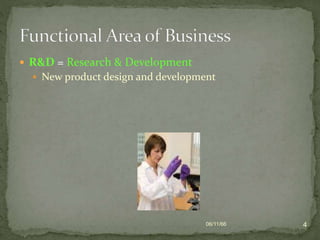
 R&D = Research & Development
 New product design and development
06/11/66 4
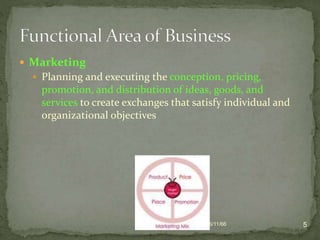
 Marketing
 Planning and executing the conception, pricing,
promotion, and distribution of ideas, goods, and
services to create exchanges that satisfy individual and
organizational objectives
06/11/66 5
 Finance
 Revenue, expenses, budget, financial records and
financial statements
06/11/66 6
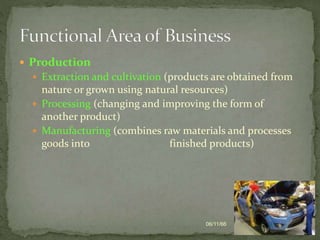
 Production
 Extraction and cultivation (products are obtained from
nature or grown using natural resources)
 Processing (changing and improving the form of
another product)
 Manufacturing (combines raw materials and processes
goods into finished products)
06/11/66 7
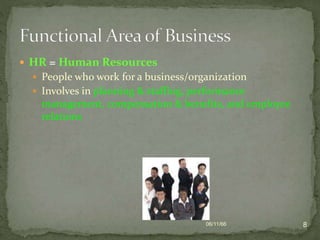
 HR = Human Resources
 People who work for a business/organization
 Involves in planning & staffing, performance
management, compensation & benefits, and employee
relations
06/11/66 8
 Management involves coordinating and overseeing
the work activities of others so that their activities are
completed efficiently and effectively.
 Or Management is the art of getting work done
through others
06/11/66 9
06/11/66 10
 A manager is a professional who takes a leadership role
in an organisation and manages a team of employees.
Often, managers are responsible for managing a
specific department in their company. There are many
types of managers, but they usually have duties like
conducting performance reviews and making
decisions. Managers are often the line of
communication between a company's employees and
its high-level executives
06/11/66 11
06/11/66 12
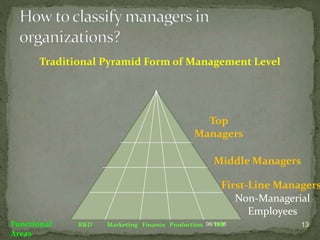
Traditional Pyramid Form of Management Level
06/11/66 13
Top
Managers
Middle Managers
First-Line Managers
Non-Managerial
Employees
Functional
Areas
R&D Marketing Finance Production HR
 First-line managers: manage the work of
nonmanagerial employees who typically are involve
with producing the organization’s products or
servicing the organization’s customer
 They are often called: supervisor, shift manager,
district manager, department manager, office manager
06/11/66 14
 Middle managers: manage work of first-line
managers
 They are often called: regional manager, project
leader, store manager, division manager
06/11/66 15
 Top managers: are responsible for making
organizationwide decisions and establishing the plans
and goals that affect the entire organization.
 They are often called: executive vice president,
president, managing director, chief operating officer,
chief executive officer
06/11/66 16
06/11/66 17
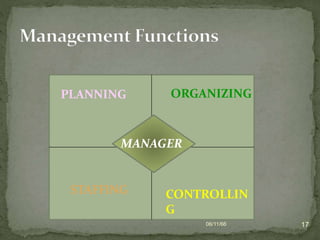
PLANNING ORGANIZING
CONTROLLIN
G
MANAGER
STAFFING
 Define goals
 Establish strategies for achieving those goals
 Develop plans to integrate and coordinate activities
Setting goals and plans (how to achieve them)
06/11/66 18
 Determine
 What tasks are to be done ?
 Who is to do them ?
 How tasks are to be grouped ?
 Who reports to whom ?
 Where decisions are to be made ?
Arrange tasks and other resources to
accomplish organization’s goals
06/11/66 19
 Motivate subordinates(lower positions)
 Help resolve group conflicts
 Influence individuals or teams as they work
 Select the most effective communication channel
 Deal with employee behavior issues
Hire, train, motivate(lead) people
06/11/66 20
 Monitor activities’ performance
 Compare actual performance with the set goals
 Evaluate activities’ performance whether things are
going as planed
 Correct any disturbance to get work back on track and
achieve the set goals
Ensure all activities are accomplished as planned
06/11/66 21
 Technical Skills: job-specific knowledge and
techniques needed to proficiently perform work tasks
 Human Skills: ability to work well with other people
both individually and in group
 Conceptual Skills: ability to see the organization as a
whole, understand the relationships among various
subunits, visualize how the organization fits into its
external environment
06/11/66 22
 World Health Organization (WHO):
 Google
 Tesla
 Microsoft:
06/11/66 24
Examples of successful organizations
 Division of Labor: Organization involves dividing
tasks and responsibilities among individuals or teams
based on their skills and expertise.
 Coordination and Communication: Effective
organization requires proper coordination and
communication between different departments,
teams, and individuals.
06/11/66 25
What are the characteristics of an organization?
 Specialization: The organization allows individuals
to specialize in their respective areas,uses their
expertise to deliver high-quality results.
 Flexibility and Adaptability: it also allows for
flexibility and adaptability to changing circumstances.
06/11/66 26
06/11/66 27

organisation and management.pptx

  • 1.
  • 2.
    INTRODUCTION TO MANAGEMENT& ORGANISATION 06/11/66 2
  • 3.
     R&D  Marketing Finance  Production  HR 06/11/66 3
  • 4.
     R&D =Research & Development  New product design and development 06/11/66 4
  • 5.
     Marketing  Planningand executing the conception, pricing, promotion, and distribution of ideas, goods, and services to create exchanges that satisfy individual and organizational objectives 06/11/66 5
  • 6.
     Finance  Revenue,expenses, budget, financial records and financial statements 06/11/66 6
  • 7.
     Production  Extractionand cultivation (products are obtained from nature or grown using natural resources)  Processing (changing and improving the form of another product)  Manufacturing (combines raw materials and processes goods into finished products) 06/11/66 7
  • 8.
     HR =Human Resources  People who work for a business/organization  Involves in planning & staffing, performance management, compensation & benefits, and employee relations 06/11/66 8
  • 9.
     Management involvescoordinating and overseeing the work activities of others so that their activities are completed efficiently and effectively.  Or Management is the art of getting work done through others 06/11/66 9
  • 10.
  • 11.
     A manageris a professional who takes a leadership role in an organisation and manages a team of employees. Often, managers are responsible for managing a specific department in their company. There are many types of managers, but they usually have duties like conducting performance reviews and making decisions. Managers are often the line of communication between a company's employees and its high-level executives 06/11/66 11
  • 12.
  • 13.
    Traditional Pyramid Formof Management Level 06/11/66 13 Top Managers Middle Managers First-Line Managers Non-Managerial Employees Functional Areas R&D Marketing Finance Production HR
  • 14.
     First-line managers:manage the work of nonmanagerial employees who typically are involve with producing the organization’s products or servicing the organization’s customer  They are often called: supervisor, shift manager, district manager, department manager, office manager 06/11/66 14
  • 15.
     Middle managers:manage work of first-line managers  They are often called: regional manager, project leader, store manager, division manager 06/11/66 15
  • 16.
     Top managers:are responsible for making organizationwide decisions and establishing the plans and goals that affect the entire organization.  They are often called: executive vice president, president, managing director, chief operating officer, chief executive officer 06/11/66 16
  • 17.
  • 18.
     Define goals Establish strategies for achieving those goals  Develop plans to integrate and coordinate activities Setting goals and plans (how to achieve them) 06/11/66 18
  • 19.
     Determine  Whattasks are to be done ?  Who is to do them ?  How tasks are to be grouped ?  Who reports to whom ?  Where decisions are to be made ? Arrange tasks and other resources to accomplish organization’s goals 06/11/66 19
  • 20.
     Motivate subordinates(lowerpositions)  Help resolve group conflicts  Influence individuals or teams as they work  Select the most effective communication channel  Deal with employee behavior issues Hire, train, motivate(lead) people 06/11/66 20
  • 21.
     Monitor activities’performance  Compare actual performance with the set goals  Evaluate activities’ performance whether things are going as planed  Correct any disturbance to get work back on track and achieve the set goals Ensure all activities are accomplished as planned 06/11/66 21
  • 22.
     Technical Skills:job-specific knowledge and techniques needed to proficiently perform work tasks  Human Skills: ability to work well with other people both individually and in group  Conceptual Skills: ability to see the organization as a whole, understand the relationships among various subunits, visualize how the organization fits into its external environment 06/11/66 22
  • 23.
     World HealthOrganization (WHO):  Google  Tesla  Microsoft: 06/11/66 24 Examples of successful organizations
  • 24.
     Division ofLabor: Organization involves dividing tasks and responsibilities among individuals or teams based on their skills and expertise.  Coordination and Communication: Effective organization requires proper coordination and communication between different departments, teams, and individuals. 06/11/66 25 What are the characteristics of an organization?
  • 25.
     Specialization: Theorganization allows individuals to specialize in their respective areas,uses their expertise to deliver high-quality results.  Flexibility and Adaptability: it also allows for flexibility and adaptability to changing circumstances. 06/11/66 26
  • 26.