05-03-2024
1
MANAGERIAL
F O R M B A B A T C H O F 2 0 2 3 - 2 5
Based on the Curriculum of Dr. A. P. J. Abdul Kalaam Technical
University , Lucknow, Uttar Pradesh
Drafted by: Atul Raghuvanshi
ECONOMICS
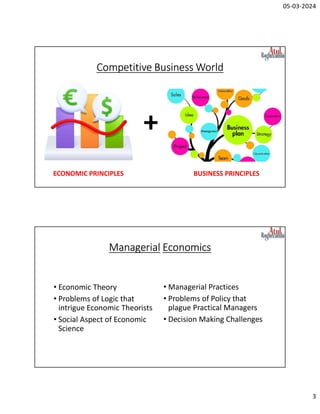
No. of Applications (in millions)
2012 2013 2014 2015 2016 2017 2018 2019 2020 2021 2022
6
4
2
0
No. of New
Businesses Starting Every Year
The Global Data
05-03-2024
2
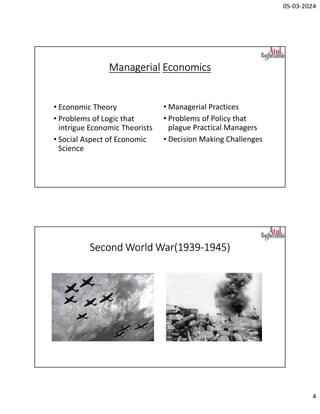
Competitive Business World
Business Managers are required to do:
Allocate
Resources
Wisely
Determine
Pricing Strategies
Forcast Demand Analyze Market
Trends
05-03-2024
3
Competitive Business World
+
ECONOMIC PRINCIPLES BUSINESS PRINCIPLES
Managerial Economics
• Economic Theory
• Problems of Logic that
intrigue Economic Theorists
• Social Aspect of Economic
Science
• Managerial Practices
• Problems of Policy that
plague Practical Managers
• Decision Making Challenges
05-03-2024
4
Managerial Economics
• Economic Theory
• Problems of Logic that
intrigue Economic Theorists
• Social Aspect of Economic
Science
• Managerial Practices
• Problems of Policy that
plague Practical Managers
• Decision Making Challenges
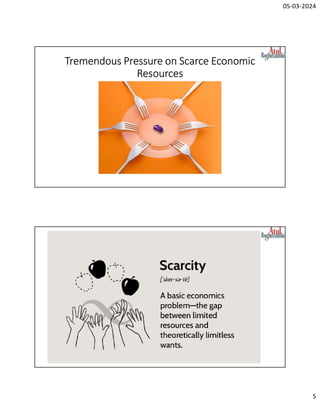
Second World War(1939-1945)
05-03-2024
5
Tremendous Pressure on Scarce Economic
Resources
05-03-2024
6
Scarcity of resources results from two
fundamental facts of life:
•Human wants are virtually unlimited and
insatiable
•Economic resources to satisfy these human
demands are limited.
An analysis of scarcity of resources and choice
making poses three basic questions:
What to
produce and
how much
to produce?
For whom to
produce?
How to
produce?
05-03-2024
7
Definitions of Managerial Economics-
“Managerial Economics is economics applied in decision-
making.
It is a special branch of economics bridging the gap between
the economic theory and managerial practice.
Its stress is on the use of the tools of economic analysis in
clarifying problems in organizing and evaluating information
and in comparing alternative courses of action.”
-W. W. Haynes
Definitions of Managerial Economics-
“Managerial Economics is the integration of economic
theory with business practice for the purpose of
facilitating decision-making and forward planning by
management.”
- Spencer & Siegelman
05-03-2024
8
05-03-2024
9
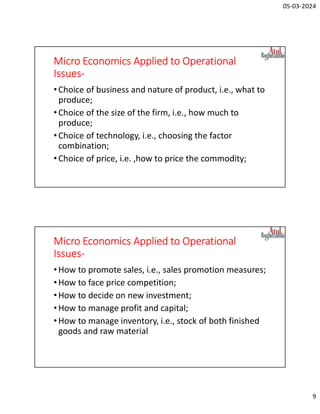
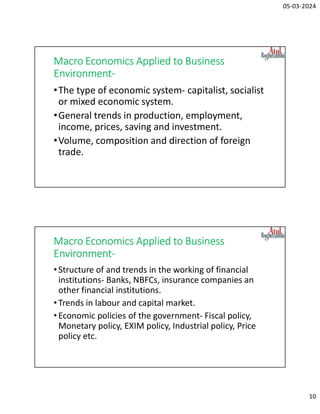
Micro Economics Applied to Operational
Issues-
•Choice of business and nature of product, i.e., what to
produce;
•Choice of the size of the firm, i.e., how much to
produce;
•Choice of technology, i.e., choosing the factor
combination;
•Choice of price, i.e. ,how to price the commodity;
Micro Economics Applied to Operational
Issues-
•How to promote sales, i.e., sales promotion measures;
•How to face price competition;
•How to decide on new investment;
•How to manage profit and capital;
•How to manage inventory, i.e., stock of both finished
goods and raw material
05-03-2024
10
Macro Economics Applied to Business
Environment-
•The type of economic system- capitalist, socialist
or mixed economic system.
•General trends in production, employment,
income, prices, saving and investment.
•Volume, composition and direction of foreign
trade.
Macro Economics Applied to Business
Environment-
•Structure of and trends in the working of financial
institutions- Banks, NBFCs, insurance companies an
other financial institutions.
•Trends in labour and capital market.
•Economic policies of the government- Fiscal policy,
Monetary policy, EXIM policy, Industrial policy, Price
policy etc.
05-03-2024
11
Macro Economics Applied to Business
Environment-
• Social factors- value system, property rights, customs and habits.
• Social organizations- Trade unions, consumer unions and consumer
cooperatives and producers unions.
• Political environment is constituted of the following factors:
• Political system-democratic, socialist, communist, authoritarian or any
other type.
• State‘s attitude towards private sector
• Policy, role and working of public sector
• Political stability
Nature of Managerial Economics-
• Both Science and Art
• Positive and Normative Science
• Beyond tool making
• Close to Microeconomics
• Operates against the backdrop of Macroeconomics
• Prescriptive Actions
• Decision Support System
• Organizations can’t sustain without it
• Overall a dynamic discipline
05-03-2024
12
Five types of Resource Decisions made by
Organizations-
• The selection of product or service to be produced.
• The choice of production methods and resource combinations.
• The determination of the best price and quantity combination
• Promotional strategy and activities.
• The selection of the location from which to produce and sell goods or
service to consumer
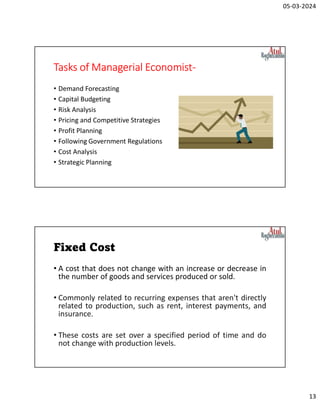
Tasks of a Managerial Economist
05-03-2024
13
Tasks of Managerial Economist-
• Demand Forecasting
• Capital Budgeting
• Risk Analysis
• Pricing and Competitive Strategies
• Profit Planning
• Following Government Regulations
• Cost Analysis
• Strategic Planning
Fixed Cost
• A cost that does not change with an increase or decrease in
the number of goods and services produced or sold.
• Commonly related to recurring expenses that aren't directly
related to production, such as rent, interest payments, and
insurance.
• These costs are set over a specified period of time and do
not change with production levels.
05-03-2024
14
Variable Cost
• A variable cost is a corporate expense that changes in proportion
to how much a company produces or sells.
• Variable costs increase or decrease depending on a company's
production or sales volume—they rise as production increases
and fall as production decreases.
• Example- A manufacturing company's costs of raw materials and
packaging—or A retail company's shipping expenses, which rise
or fall with sales.
Variable Cost
• When production or sales increase, variable costs increase;
when production or sales decrease, variable costs decrease.
• Variable costs are a central part in determining a product's
contribution margin, the metric used to determine a
company's break-even or target profit level.
• Examples of variable costs include- raw materials, labor,
utilities, commission, or distribution costs.
05-03-2024
15
Marginal Cost
• Marginal cost is the change in total production cost that comes
from making or producing one additional unit.
• The purpose of analyzing marginal cost is to determine at what
point an organization can achieve economies of scale to optimize
production and overall operations.
• If the marginal cost of producing one additional unit is lower
than the per-unit price, the producer has the potential to gain a
profit.
Marginal Cost
• A company can maximize its profits by producing to where
marginal cost (MC) equals marginal revenue (MR).
• Marginal cost is the change in the total cost of production
upon a change in output that is the change in the quantity of
production.
• The change in total cost arises when the quantity produced
changes by one unit.
05-03-2024
16
Economies of Scale
• Economies of scale are cost advantages reaped by companies
when production becomes efficient.
• Companies can achieve economies of scale by increasing
production and lowering costs.
• This happens because costs are spread over a larger number
of goods. Costs can be both fixed and variable.
ABC Ltd. is a toy company that produces robot toys. Every
month, they produce 2,000 robot toys for a total cost of Rs.
2,00,000. They expect to produce 4,000 robot toys next month
for Rs. 2,50,000.
Total Number of Robots = 2000
Total Cost = Rs. 2,00,000
Expected Number of Robots to be produced = 4000
Expected Total Cost = Rs. 2,50,000
Marginal Cost = (Change in Total Cost)/ (Change in Quantity)
• Change in total cost = (2,50,000-2,00,000) = Rs. 50,000
• Change in total units = (4000-2000) = 2000
So, the marginal cost equals 50,000/2000 = Rs. 25
05-03-2024
17
Opportunity Cost
•Opportunity cost represents the potential benefits
that an individual, investor, or business misses out on
choosing one alternative over another.
•To properly evaluate opportunity costs, the costs and
benefits of every option available must be considered
and weighed against the others.
Opportunity Cost
• Example-
Investing in a new manufacturing plant in Lucknow as opposed
to Prayagraj, deciding not to upgrade company equipment, or
opting for the most expensive packaging unit.
Opportunity Cost=FO−CO
where: FO=Return on best forgone option
CO=Return on chosen op on
05-03-2024
18
Sunk Cost
•A sunk cost, sometimes called a retrospective cost,
refers to an investment already incurred that can’t be
recovered.
•Examples of sunk costs in business include marketing,
research, new software installation or equipment,
salaries and benefits, or facilities expenses.
•By comparison, opportunity costs are lost returns
from resources that were invested elsewhere.
Sunk Cost
“In sunk cost theory, we will often decide to
stay with something because we’ve put time
or resources into it. We believe that because
we have ‘sunk’ that cost into it, we somehow
need to recoup it. That’s a fallacy.”
05-03-2024
19
Fundamental Principles of
Managerial Economics
Marginal Principle-
•A decision is profitable-
• if revenue increases more than costs;
• if costs reduce more than revenues;
• if increase in some revenues is more than
decrease in others; and
• if decrease in some costs is greater than increase
in others.
05-03-2024
20
Marginal Principle-
• Marginal analysis implies judging the impact of a unit change in
one variable on the other.
• Marginal generally refers to small changes.
• Marginal revenue is change in total revenue per unit change in
output sold.
• The decision of a firm to change the price would depend upon
the resulting impact/change in marginal revenue and marginal
cost. If the marginal revenue is greater than the marginal cost,
then the firm should bring about the change in price.
Marginal Principle-
• Marginal analysis is an examination of the additional benefits
of an activity compared to the additional costs incurred by
that same activity.
• Marginal refers to the focus on the cost or benefit of the next
unit or individual
05-03-2024
21
Marginal Principle-
• XYZ Sounds Ltd. Produces
lightweight headsets for $100,
but it costs $70 to produce each
headset.
• If 100 units produced,
• Total Revenue=$10,000
• Total Cost=$7000
• Profit=$3000
• At the point when 101 units are
sold-
• Total Revenue=$10,100
• Here the firm is changing the
control variable.
• With this increase in production-
• Marginal Benefit=$100
• Another Employee to hire---------
• Total Cost Increases to- $15,000
• Cost of producing one unit=$149
• Marginal Cost of 100th unit=$70
• Marginal Cost of 101th
Unit=$149
Incremental Principle-
•A decision is profitable-
• if revenue increases more than costs;
• if costs reduce more than revenues;
• if increase in some revenues is more than
decrease in others; and
• if decrease in some costs is greater than increase
in others.
05-03-2024
22
Incremental Principle-
• Main objective- Maximization of profits or to raise the
profits in the business
• Incremental analysis is a decision-making technique
• Determines the true cost difference between alternatives
• Also called the relevant cost approach, marginal analysis, or
differential analysis
• Disregards any sunk cost or past cost
Incremental Principle-
•The incremental concept is closely related to the
marginal costs and marginal revenues
•Incremental concept involves two important activities-
1. Estimating the impact of decision alternatives on costs
and revenues.
2. Emphasizing the changes in total cost and total cost and
total revenue resulting from changes in prices, products,
procedures, investments or whatever may be at stake in
the decision
05-03-2024
23
Incremental Principle/Analysis-
•Change in output due to change in process,
product or investment is considered as
incremental change.
Process Product Investment Output
Incremental Principle/Analysis-
•Change in the firm's performance for a given
managerial decision
•Refers to changes in cost and revenue due to a
policy change
05-03-2024
24
Difference between Marginal &
Incremental Principle-
Marginal
• Implies judging the impact of a
unit change in one variable on
the other
• Generally refers to small changes
• Refers to change in total costs
per unit change in output
produced
• Marginal revenue is greater than
the marginal cost, then the firm
should bring about the change in
price.
Incremental
• Analysis the change in the firm's
performance for a given
managerial decision
• Incremental analysis is
generalization of marginal
concept
• Refers to change in total costs
due to change in total output
• Refers to changes in cost and
revenue due to a policy change
Equi-Marginal Principle
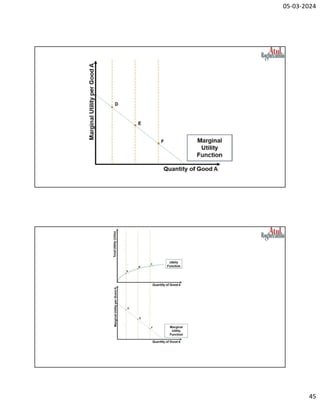
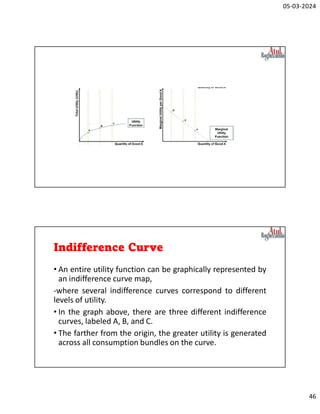
• Marginal Utility is the utility derived from the additional unit
of a commodity consumed.
• A consumer will reach the stage of equilibrium when the
marginal utilities of various commodities he consumes are
equal.
• According to the modern economists, this law has been
formulated in form of law of proportional marginal utility.
• Also known as- Principle of maximum satisfaction
05-03-2024
25
Equi-Marginal Principle
•A consumer will spend his money/income on different
goods in such a way that the marginal utility of each
good is proportional to its price.
•MUx / Px = MUy / Py = MUz / Pz Where, MU
represents marginal utility and P is the price of good.
Equi-Marginal Principle
• Similarly, a producer who wants to maximize profit (or reach
equilibrium) will use the technique of production which
satisfies the following condition:
MRP1 / MC1 = MRP2 / MC2 = MRP3 / MC3
*Where, MRP is marginal revenue product of inputs and
MC represents marginal cost.
05-03-2024
26
Equi-Marginal Principle
•You have 3 examinations tomorrow-
•You only have 9 hours to study today (a usual case for
students who cram during exams!)
•Subjects are –Economics, Management and
Accounting
•Objective- To maximize the average of your grades in
these 3 subjects with your limited study time.
Equi-Marginal Principle
• How should you allocate your 6 hours of study time?
• Such that the marginal grade (or additional grade) from the
last hour of studying spent in one subject is just equal to the
marginal grade from the last hour of studying spent in any of
the other subjects?
• The marginal grade may be represented by the additional
grade that you expect to get in each of the subjects from
each additional time that you spend studying for each and
the level of difficulty of the subject concerned.
05-03-2024
27
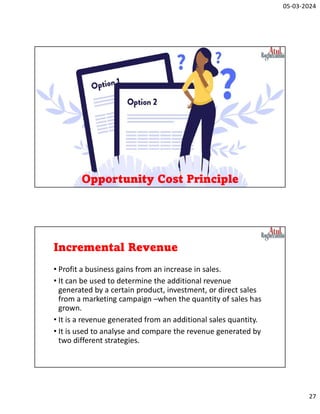
Opportunity Cost Principle
Incremental Revenue
• Profit a business gains from an increase in sales.
• It can be used to determine the additional revenue
generated by a certain product, investment, or direct sales
from a marketing campaign –when the quantity of sales has
grown.
• It is a revenue generated from an additional sales quantity.
• It is used to analyse and compare the revenue generated by
two different strategies.
05-03-2024
28
Change in revenue due to a new decision.
CASE STUDY
05-03-2024
29
•BOAT Technologies Corporation is in final stage of
developing it’s cutting-edge technology smartwatch.
•The watch is one of its kind and is bound to be a hit in
the market owing to its specifications – that make it
special among its rivals.
•Although BOAT is sure of making it big, they need to
calculate the incremental revenue once launched.
• At Boat –they need to first arrive at a Baseline Revenue
Level.
• Suppose, they estimate a sale of 4000 units.
• The Selling Price per unit = Rupees 2000/-
• The Cost of manufacturing a watch = Rupees 900/-
• Than, Incremental Revenue = 4000 × 2000
= Rupees 80,00,000/-
• And, Incremental Cost = No. of Units × Cost per Unit
= 4000 × 900 = Rupees 36,00,000/-
05-03-2024
30
Contribution Analysis
•Contribution is the difference between
incremental revenue and incremental cost
associated with a particular project
•Contribution Analysis = IR-IC
Contribution Analysis is Useful For-
•Accepting or rejecting a project
•Introducing a new product
•Accepting a new order
•Establishing a new plant
•Make or buy a product
05-03-2024
31
Incremental Costs are-
• Labour Costs
• Material Costs
• Overheads
• Fixed Costs
• Opportunity Costs
• Sunk Costs
• Committed Costs
05-03-2024
32
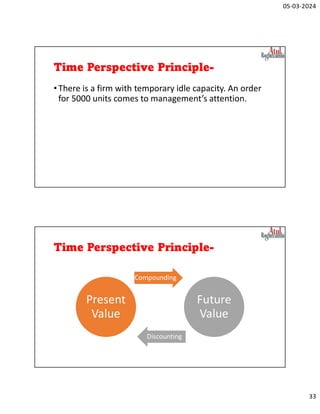
Time Perspective Principle-
•A manager/decision maker should give due emphasis,
both to short-term and long-term impact of his
decisions, giving apt significance to the different time
periods before reaching any decision.
Time Perspective Principle-
•A decision of the firm should take into consideration
both short run and long run effects on Revenues and
cost & maintain the right balance between the long
run and short run.
05-03-2024
33
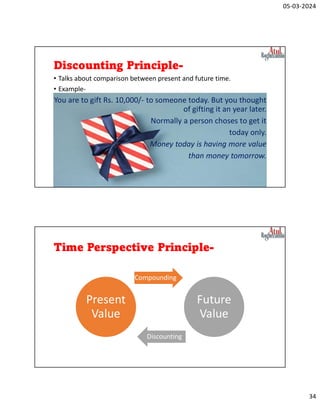
Time Perspective Principle-
•There is a firm with temporary idle capacity. An order
for 5000 units comes to management’s attention.
Time Perspective Principle-
Present
Value
Compounding
Future
Value
Discounting
05-03-2024
34
Discounting Principle-
• Talks about comparison between present and future time.
• Example-
You are to gift Rs. 10,000/- to someone today. But you thought
of gifting it an year later.
Normally a person choses to get it
today only.
Money today is having more value
than money tomorrow.
Time Perspective Principle-
Present
Value
Compounding
Future
Value
Discounting
05-03-2024
35
Time Value of Money/Method of
Discounting Principle-
• By the concept of compounding-
• Future Value of Money = Present Value (1+Interest rate)𝑡
• 𝑡
• Where PV= present value
• FV= future value
• T= time period in years
Time Value of Money/Method of
Discounting Principle-
•We commonly see bank and postal departments
advertising that they will give 12% interest for every
year on bank deposits –what we have invested with
them.
•With this 12% interest for one year, if we want to get
1-lakh rupees after one year,
•How much we should deposit at present?
05-03-2024
36
Utility
05-03-2024
37
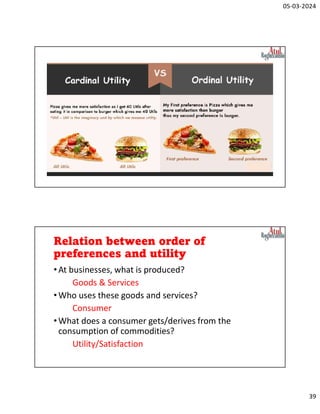
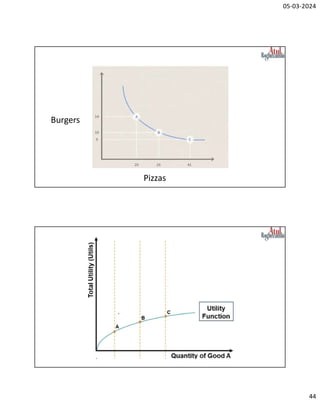
• Total satisfaction or benefit derived from consuming a
good or service.
• Economic theories based on rational choice usually assume
that consumers will strive to maximize their utility.
• The economic utility of a good or service is important to
understand because it directly influences the demand, and
therefore price, of that good or service.
• In practice, a consumer's utility is usually impossible to
measure or quantify. However, some economists believe
that they can indirectly estimate what is the utility of an
economic good or service by employing various models.
Ordinal Utility-
• Early economists of the Spanish Scholastic tradition of the
1300s and 1400s described the economic value of goods as
deriving directly from the property of usefulness.
• Ordinal Utility states that the satisfaction a consumer gets
after consuming a good or service cannot be scaled in
numbers, whereas, these things can be arranged in the
order of preference.
05-03-2024
38
Ordinal Utility-
•Austrian economist Carl Menger, in a discovery known
as the marginal revolution, used a kind of framework
which said that first available units of any economic
good will be put to the most highly valued uses, and
subsequent units go to lower-valued uses –Ordinal
Utility.
•This ordinal theory of utility is useful for explaining the
law of diminishing marginal utility and fundamental
economic laws of supply and demand.
Cardinal Utility-
05-03-2024
39
Relation between order of
preferences and utility
•At businesses, what is produced?
Goods & Services
•Who uses these goods and services?
Consumer
•What does a consumer gets/derives from the
consumption of commodities?
Utility/Satisfaction
05-03-2024
40
Relation between order of
preferences and utility
• Do consumers have limited income?
Yes, Always –due to increasing needs, wants & desires
• What does a consumer need to do than?
Should allocate his limited income among available
goods in order to obtain maximum satisfaction or utility.
• How?
Consumer chooses the best commodity bundle that
he/she can afford
Relation between order of
preferences and utility
•Affordability is determined by what?
Budget Constraint
•Budget constraint depends upon what?
Consumer’s Income & Prices of Commodities
•Choice of best bundle is guided by what?
Consumer’s Preferences
•Would that best bundle be giving the highest utility?
Yes
05-03-2024
41
Relation between order of
preferences and utility
Ordinal Utility can be explained
through Indifference Curve Analysis
05-03-2024
42
Indifference Curve
•An indifference curve is a chart showing various
combinations of two goods or commodities that
leave the consumer equally well off or equally
satisfied—hence indifferent (neutral)
—when it comes to having any combination
between the two items that is shown along the
curve.
Indifference Curve
•In economics, an indifference curve is a line –drawn
between different consumption bundles, on a graph
charting the
•quantity of good A consumed
versus
•the quantity of good B consumed.
05-03-2024
43
Indifference Curve
•An indifference curve is a contour line where utility
remains constant across all points on the line.
•At each of the consumption bundles, the individual is
said to be indifferent.
Indifference Curve
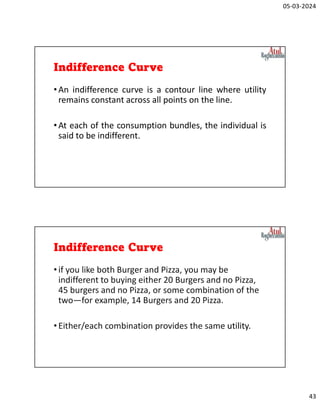
•if you like both Burger and Pizza, you may be
indifferent to buying either 20 Burgers and no Pizza,
45 burgers and no Pizza, or some combination of the
two—for example, 14 Burgers and 20 Pizza.
•Either/each combination provides the same utility.
05-03-2024
44
Burgers
Pizzas
05-03-2024
45
05-03-2024
46
Indifference Curve
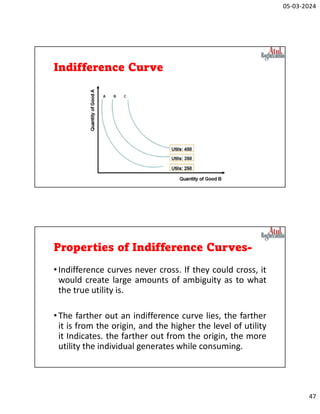
• An entire utility function can be graphically represented by
an indifference curve map,
-where several indifference curves correspond to different
levels of utility.
• In the graph above, there are three different indifference
curves, labeled A, B, and C.
• The farther from the origin, the greater utility is generated
across all consumption bundles on the curve.
05-03-2024
47
Indifference Curve
Properties of Indifference Curves-
•Indifference curves never cross. If they could cross, it
would create large amounts of ambiguity as to what
the true utility is.
•The farther out an indifference curve lies, the farther
it is from the origin, and the higher the level of utility
it Indicates. the farther out from the origin, the more
utility the individual generates while consuming.
05-03-2024
48
Properties of Indifference Curves-
•Indifference curves never cross. If they could cross, it
would create large amounts of ambiguity as to what
the true utility is.
•The farther out an indifference curve lies, the farther
it is from the origin, and the higher the level of utility
it Indicates. the farther out from the origin, the more
utility the individual generates while consuming.
Properties of Indifference Curves-
•Indifference curves slope downwards. The only
way an individual can increase consumption in
one good without gaining utility is to consume
another good and generate the same amount of
utility. Therefore, the slope is downwards
sloping.
05-03-2024
49
Properties of Indifference Curves-
•Indifference curves assume a convex shape.
•The curve gets flatter as you move down the curve to
the right.
•It illustrates that all individuals experience diminishing
marginal utility, where additional consumption of
another good will generate a lesser amount of utility
than the prior.
Marginal Rate of Substitution(MRS)
•The slope of the indifference curve is known as the
marginal rate of substitution (MRS).
•The MRS is the rate at which the consumer is willing to
give up one good for another.
•For example, a consumer who values apples will be
slower to give them up for oranges, and the slope will
reflect this rate of substitution.
05-03-2024
50
Marginal Utility of Money- Through
Cardinal Utility
MU(A)/P(A) = MU(B)/P(B) =…………MU(N)/P(N) = MU(Money)
05-03-2024
51
UNIT-1 Completed
D E M A N D A N D S U P P LY A N A LY S I S
Unit-II
Atul Raghuvanshi,
Assistant Professor- FMS SRGC
05-03-2024
52
Demand theory is an economic principle, relating
to relationship between consumer demand for
goods & services and their prices in the market.
Demand theory forms the basis for the demand
curve which relates consumer desire to the amount
of goods available.
Demand Theory
Demand is an economic concept that relates to a
consumer's desire to purchase goods and services
and willingness to pay a specific price for them. An
increase in the price of a good or service tends to
decrease the quantity demanded.
Concept of Demand
05-03-2024
53
• Direct and Derived Demand
• Recurring and Replacement Demand
• Complementary & Competing Demand
• Demand for Consumer goods & Capital goods
• Demand for Perishable & Durable goods
• Individual, Market & Industry Demand
Types of Demand
• Price of product
• Income of consumer
• Price of related goods
• Taste & Preferences
• Advertising
• Consumer’s expectation of future income & price
• Population
• Growth of Economy
Determinants of Demand
05-03-2024
54
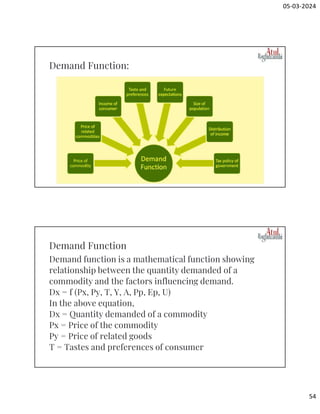
Demand Function:
Demand function is a mathematical function showing
relationship between the quantity demanded of a
commodity and the factors influencing demand.
Dx = f (Px, Py, T, Y, A, Pp, Ep, U)
In the above equation,
Dx = Quantity demanded of a commodity
Px = Price of the commodity
Py = Price of related goods
T = Tastes and preferences of consumer
Demand Function
05-03-2024
55
Demand function is a mathematical function showing
relationship between the quantity demanded of a
commodity and the factors influencing demand.
Dx = f (Px, Py, T, Y, A, Pp, Ep, U)
In the above equation,
Dx = Quantity demanded of a commodity
Px = Price of the commodity
Py = Price of related goods
T = Tastes and preferences of consumer
Demand Function
Y = Income level
A = Advertising and promotional activities
Pp = Population (Size of the market)
Ep = Consumer’s expectations about future prices
U = Specific factors affecting demand for a
commodity such as seasonal changes, taxation
policy, availability of credit facilities, etc.
Demand Function
05-03-2024
56
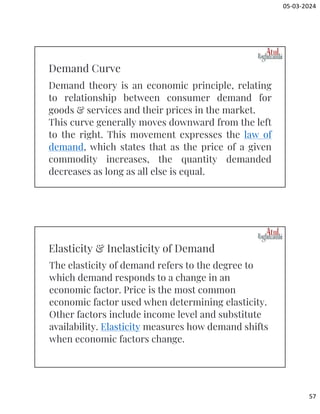
The demand curve is a graphical representation of
the relationship between the price of a good or
service and the quantity demanded for a given
period of time.
In a typical representation, the price appears on
the left vertical axis while the quantity demanded is
on the horizontal axis.
Demand Curve
Demand Curve
05-03-2024
57
Demand theory is an economic principle, relating
to relationship between consumer demand for
goods & services and their prices in the market.
This curve generally moves downward from the left
to the right. This movement expresses the law of
demand, which states that as the price of a given
commodity increases, the quantity demanded
decreases as long as all else is equal.
Demand Curve
The elasticity of demand refers to the degree to
which demand responds to a change in an
economic factor. Price is the most common
economic factor used when determining elasticity.
Other factors include income level and substitute
availability. Elasticity measures how demand shifts
when economic factors change.
Elasticity & Inelasticity of Demand
05-03-2024
58
When demand remains constant regardless of
economic changes, a good or service is called
inelastic, conversely, when demand changes for a
good or service in relation to economic changes, it
is known as elastic.
Elasticity & Inelasticity of Demand
It is the demand for a commodity that moves in the
contrary direction of its price. However, the
influence of the price change is not always constant
. Sometimes, the demand for a commodity changes
substantially, even for smaller price changes.
On the other hand, there are some commodities for
which the demand is not impacted much by price
changes.
05-03-2024
59
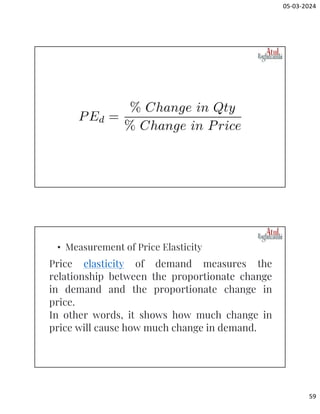
Price elasticity of demand measures the
relationship between the proportionate change
in demand and the proportionate change in
price.
In other words, it shows how much change in
price will cause how much change in demand.
• Measurement of Price Elasticity
05-03-2024
60
The formula to calculate the price elasticity of demand
is:
EP=Proportionate change in Demand/ Proportionate
change in Price
• Measurement of Price Elasticity
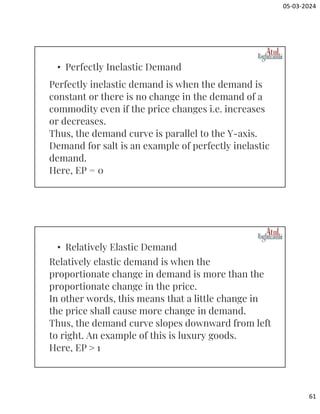
Perfectly elastic demand is when the price is
constant but there is a change in the demand i.e.
increase or decrease of a commodity. Thus, the
demand curve is parallel to the X-axis.
Here, EP = ∞
• Perfectly Elastic Demand
05-03-2024
61
Perfectly inelastic demand is when the demand is
constant or there is no change in the demand of a
commodity even if the price changes i.e. increases
or decreases.
Thus, the demand curve is parallel to the Y-axis.
Demand for salt is an example of perfectly inelastic
demand.
Here, EP = 0
• Perfectly Inelastic Demand
Relatively elastic demand is when the
proportionate change in demand is more than the
proportionate change in the price.
In other words, this means that a little change in
the price shall cause more change in demand.
Thus, the demand curve slopes downward from left
to right. An example of this is luxury goods.
Here, EP ˃ 1
• Relatively Elastic Demand
05-03-2024
62
• The cross elasticity of demand is an economic concept
that measures the responsiveness in the quantity
demanded of one good when the price for another
good changes.
• Also called cross-price elasticity of demand, this
measurement is calculated by taking the percentage
change in the quantity demanded of one good and
dividing it by the percentage change in the price of the
other good.
• Cross Elasticity Demand
• Exy= Percentage Change in Quantity of X/
Percentage Change in Price of Y
Cross Elasticity Demand
05-03-2024
63
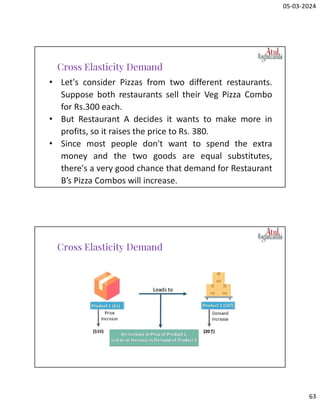
• Let's consider Pizzas from two different restaurants.
Suppose both restaurants sell their Veg Pizza Combo
for Rs.300 each.
• But Restaurant A decides it wants to make more in
profits, so it raises the price to Rs. 380.
• Since most people don't want to spend the extra
money and the two goods are equal substitutes,
there's a very good chance that demand for Restaurant
B’s Pizza Combos will increase.
Cross Elasticity Demand
05-03-2024
64
• The concept of Elasticity of Demand has important practical
applications in Managerial Decision Making.
• Elasticity of demand (ED) is one way you can analyze the way a
product's price affects its demand.
• If a firm is considering changing the price of its product or
service, calculating its elasticity of demand may affect its
decision to alter prices and by how much.
• Uses of Elasticity of Demand for Managerial
Decision Making
Potential total revenue
• Elasticity of demand can help a business predict how much
revenue a product will generate under certain market
circumstances.
• Knowing how much money that business might make given a
specific price point can help you make informed decisions
about prices and products.
• Uses of Elasticity of Demand for Managerial
Decision Making
05-03-2024
65
Presence of substitutes
• If you know the elasticity of demand for a product, it is
possible to find out whether there are other competitive
products on the market.
• If you find that the demand for your products changes more or
less than you anticipated when setting your prices, other
products might be drawing consumers' attention.
• Uses of Elasticity of Demand for Managerial
Decision Making
Price differentiation
• Price elasticity of demand can help a business determine
whether it would be reasonable to charge different amounts in
different circumstances.
• For example, if you offer a movie subscription service, you
might be able to use this formula to determine whether it
would be profitable to offer a tiered subscription model with
several price points.
• Uses of Elasticity of Demand for Managerial
Decision Making
05-03-2024
66
Taxation
• Elasticity of demand can be useful if a business wants to know
whether they should accommodate for the cost of any
additional taxes when setting prices for their products.
• Products such as alcohol and tobacco, for example, are often
taxed and you may want to incorporate all or part of the cost
in your prices.
• Uses of Elasticity of Demand for Managerial
Decision Making
Price Distribution
• A monopolist adopts a price discrimination policy when the
elasticity of demand of different consumers or sub-markets is
different.
• Consumers whose demand is inelastic can be charged a higher
price than those with more elastic demand.
• Uses of Elasticity of Demand for Managerial
Decision Making
05-03-2024
67
It is a technique for estimation of probable demand
for a product or service in the future. It is based on
the analysis of past demand for that product or
service in the present market condition. Demand
forecasting should be done on a scientific basis and
facts and events related to forecasting should be
considered.
• Demand Forecasting
• Passive demand forecasting,
• Active demand forecasting,
• Short-term projections,
• Long-term projections,
• External macro forecasting, and
• Internal business forecasting.
• Types of Demand Forecasting
05-03-2024
68
Methods of
Demand
Forecasting
A technique for anticipating future demand for a product is
demand forecasting. However, the strength of the projection
is significantly influenced by the quantity and quality of the
data, the methods used to calculate it, and the user's level of
competence.
Significance of
Demand Forecasting
• The first step in creating a demand prediction is to have a firm
understanding of the challenges. It would further help to look for accurate
solutions to it. The best demand forecasting models and methods will be
determined in this step.
• Moreover, it is important to look for questions such as does being mindful
of seasonal demand assist you in controlling inventory levels year-round?
Or is it necessary to use supply chain analytics to find weak points in your
supply chain? and so on.
• Evidently, planning for upcoming events requires much more inputs than
planning for current events, even though past demand projections may
serve as a starting point. It's not the only indication, by any means.
05-03-2024
69
Types of Demand
Forecasting
Short Term
Demand
Forecasting
Long Term
Demand
Forecasting
Passive Demand
Forecasting
The forecasting method known as passive demand forecasting uses
only previous sales data to project future consumer demand.
This technique does not incorporate any external factors such as
seasonality, customer preferences, or economic trends, and instead
uses only past sales records to project future demand.
Passive demand forecasting is best suited for companies with
relatively stable customer demand. This is mainly because it does not
consider any changes in customer preferences or economic
conditions.
05-03-2024
70
Internal Demand
Forecasting
Businesses utilize the internal demand forecasting method to forecast
future consumer demand for their goods and services. This
forecasting process is based on a variety of factors such as past sales,
industry trends, economic conditions, and customer feedback.
Businesses can use this technique to more effectively plan for their
production and inventory requirements. It further ensures that they
have the proper quantity of goods and services on hand to satisfy
client demand.
Active Demand
Forecasting
Making projections for future demand for goods or services is known
as active demand forecasting. This type of forecasting involves
analyzing past demand, current market trends, and other data to
make predictions about future demand.
It is often used in the retail and manufacturing industries to help with
product planning and inventory management.
Active demand forecasting can help companies make better decisions
about how much to produce or order, when to produce or order, and
how to price products or services.
05-03-2024
71
Techniques of Demand
Forecasting
• Market Research/Surveying
• Statistical Approach- Trend Projection, Regression Analysis, Time Series Analysis, Market Segmentation, Decision
Trees
• Econometric Models
• Composite Sales Force Approach
• A/B Experiment
• Delphi Method
• Barometrics
• Expert Opinion
Market
Research/
Surveying
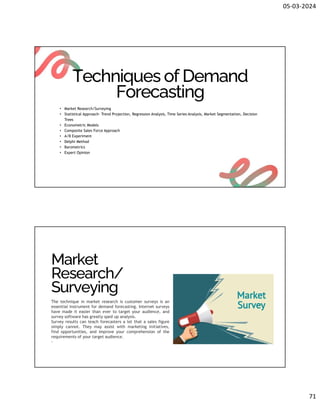
The technique in market research is customer surveys is an
essential instrument for demand forecasting. Internet surveys
have made it easier than ever to target your audience, and
survey software has greatly sped up analysis.
Survey results can teach forecasters a lot that a sales figure
simply cannot. They may assist with marketing initiatives,
find opportunities, and improve your comprehension of the
requirements of your target audience.
.
05-03-2024
72
Statistical Approach
EconometricModels
05-03-2024
73
A/B
Experiment
• There are times when it is possible to study consumer
behaviour through carefully monitored market trials. This
includes testing different campaigns, features, website
images or features, email subject lines, and many other
things using A/B methods.
• If customers strongly prefer one over the other and are
more aware of their preferences, businesses will be better
able to predict demand. For instance, a study found that
firms enjoy a boost in sales when they offer prices with
odd final numbers!
Delphi
Method
• The Delphi method is a qualitative forecasting technique that
relies on the opinions of experts to predict future demand. In
a series of rounds, specialists are questioned about the
anticipated demand for various products. The opinions are
then consolidated and used to make a prediction.
• The Delphi Method, which was developed by the RAND
Corporation and is still commonly utilized today, is frequently
employed in conjunction with an expert opinion. The Delphi
method of forecasting utilizes the expertise of subject-matter
experts to anticipate demand.
05-03-2024
74
Barometrics
Three indicators are used in this forecasting technique to
identify trends.
•Leading indicators attempt to predict future events. For
instance, a surge in complaints from customers about shipping
delays or backorders could lead to a decline in sales.
•Lagging indicators look back at prior outcomes. For inventory
management purposes, a rise in sales over the previous month
can indicate a tendency that has to be continuously
monitored.
•Coincidental indications are used to gauge what is happening
right now. As an example, real-time inventory turnover
displays continuous sales activity.
Leading
Indicators
Lagging
Indicators
Coincidental
Indicators
Supply Analysis
(Unit-IInd)
-For MBA Second Year-
By- Atul Raghuvanshi
05-03-2024
75
Law of Supply
05-03-2024
76
The law of supply is a microeconomic law. It states
that, all other factors being equal, as the price of a good
or service increases, the quantity of that good or
service that suppliers offer will increase, and vice
versa.
In plain terms, this law means that as the price of an
item goes up, suppliers will attempt to maximize their
profits by increasing the number of that item that they
sell.
• Law of Supply
Law of Supply
•Law of supply states that other factors remaining
constant, price and quantity supplied of a good
are directly related to each other.
•In other words, when the price paid by buyers
for a good rises, then suppliers increase the
supply of that good in the market.
05-03-2024
77
Law of Supply
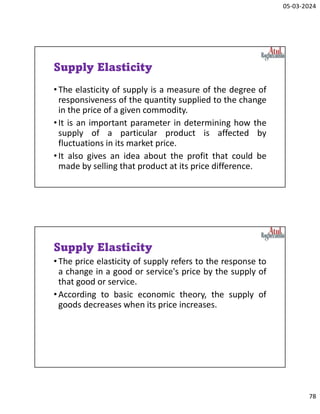
•Law of supply depicts the producer behavior at
the time of changes in the prices of goods and
services.
•When the price of a good rises, the supplier
increases the supply in order to earn a profit
because of higher prices.
Law of Supply
05-03-2024
78
Supply Elasticity
•The elasticity of supply is a measure of the degree of
responsiveness of the quantity supplied to the change
in the price of a given commodity.
•It is an important parameter in determining how the
supply of a particular product is affected by
fluctuations in its market price.
•It also gives an idea about the profit that could be
made by selling that product at its price difference.
Supply Elasticity
•The price elasticity of supply refers to the response to
a change in a good or service's price by the supply of
that good or service.
•According to basic economic theory, the supply of
goods decreases when its price increases.
05-03-2024
79
Supply Elasticity
•Es= [(Δq/q)×100] ÷ [(Δp/p)×100] = (Δq/q) ÷ (Δp/p)
•Δq= The change in quantity supplied
•q= The quantity supplied
•Δp= The change in price
•p= The price
Types of Elasticity of Supply
•Perfectly Elastic Supply: A commodity becomes
perfectly elastic when its elasticity of supply is infinite.
This means that even for a slight increase in price, the
supply becomes infinite. For a perfectly elastic supply,
the percentage change in the price is zero for any
change in the quantity supplied.
•More than Unit Elastic Supply: When the percentage
change in the supply is greater than the percentage
change in price, then the commodity has the price
elasticity of supply greater than 1.
05-03-2024
80
Types of Elasticity of Supply
•Unit Elastic Supply: A product is said to have a unit
elastic supply when the change in its quantity supplied
is proportionate or equal to the change in its price.
The elasticity of supply, in this case, is equal to 1.
•Less than Unit Elastic Supply: When the change in the
supply of a commodity is lesser as compared to the
change in its price, we can say that it has a relatively
less elastic supply. In such a case, the price elasticity
of supply is less than 1.
Types of Elasticity of Supply
•Perfectly Inelastic Supply: Product supply is said to be
perfectly inelastic when the percentage change in the
quantity supplied is zero irrespective of the change in
its price. This type of price elasticity of supply applies
to exclusive items. For example, a designer gown
styled by a famous personality.
05-03-2024
81
Determinants of Price Elasticity of Supply
•Marginal Cost
•Time
•Number of Firms
•Mobility of Factor of Production
Determinants of Price Elasticity of Supply
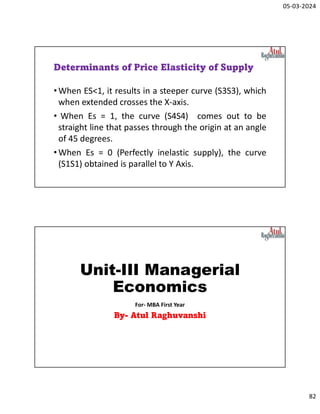
•Keeping the quantity supplied on the X-axis and
the price of the commodity on the Y-axis, we can
draw certain conclusions from the different
values of elasticity of the supplied formula.
•When Es=infinite(Perfectly Elastic Supply), the
curve SS will be straight line.
•When Es>1 a flatter curve S2S2 is obtained
which when extended intersects the Y Axis.
05-03-2024
82
Determinants of Price Elasticity of Supply
•When ES<1, it results in a steeper curve (S3S3), which
when extended crosses the X-axis.
• When Es = 1, the curve (S4S4) comes out to be
straight line that passes through the origin at an angle
of 45 degrees.
•When Es = 0 (Perfectly inelastic supply), the curve
(S1S1) obtained is parallel to Y Axis.
Unit-III Managerial
Economics
For- MBA First Year
By- Atul Raghuvanshi
05-03-2024
83
What is Production?
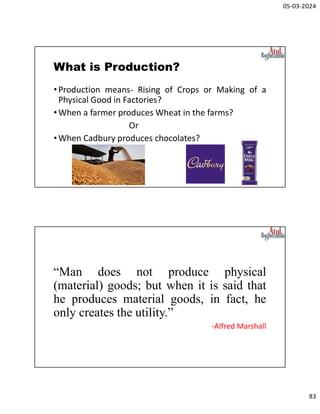
•Production means- Rising of Crops or Making of a
Physical Good in Factories?
•When a farmer produces Wheat in the farms?
Or
•When Cadbury produces chocolates?
“Man does not produce physical
(material) goods; but when it is said that
he produces material goods, in fact, he
only creates the utility.”
-Alfred Marshall
05-03-2024
84
The word "production” is used to imply
creation or increasing the utility of a
good so that its value is increased.
•Production means an increase in the value of a
commodity."-Nicholson
•"Production is any activity which adds to the value of
a nation's supply of goods and services.” -M. J. Ulmer
•"Production may be defined as the process by which
inputs may be transformed into output" -Robert Awh
05-03-2024
85
Difference between Consumption
and Production-
•Production and consumption are considered to be
altogether contrary and different activities.
•Consumption is the use of utility whereas
Production is creation of utility.
Methods of Creation of Utility-
•Form Utility
•Place Utility
•Time Utility
•Service Utility
•Possession Utility
•Knowledge Utility
05-03-2024
86
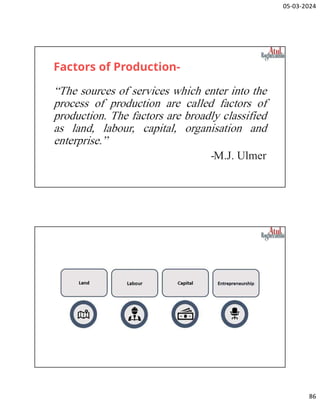
Factors of Production-
“The sources of services which enter into the
process of production are called factors of
production. The factors are broadly classified
as land, labour, capital, organisation and
enterprise.”
-M.J. Ulmer
05-03-2024
87
Factors of production are neither two
nor four but millions.
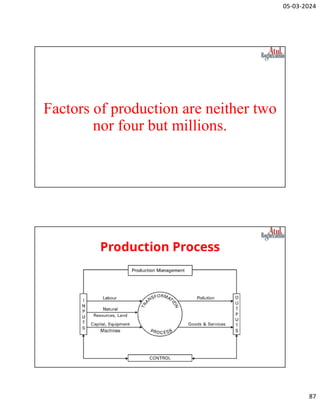
Production Process
05-03-2024
88
Production Theory-
•Production theory is an application of
Constrained Optimization Technique.
•Means- The firm tries either to minimize cost of
production at a given level of output or maximize
the output achievable with a given level of cost.
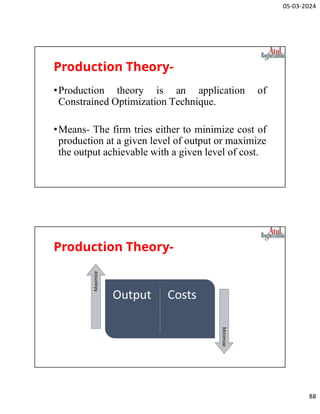
Production Theory-
Output Costs
Maximize
Minimize
05-03-2024
89
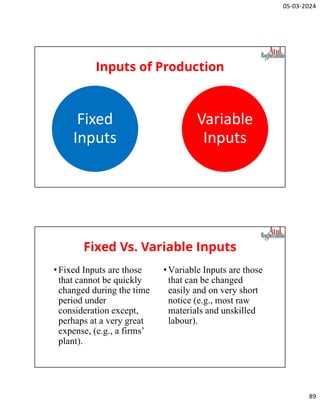
Inputs of Production
Fixed
Inputs
Variable
Inputs
Fixed Vs. Variable Inputs
•Fixed Inputs are those
that cannot be quickly
changed during the time
period under
consideration except,
perhaps at a very great
expense, (e.g., a firms’
plant).
• Variable Inputs are those
that can be changed
easily and on very short
notice (e.g., most raw
materials and unskilled
labour).
05-03-2024
90
Production Decisions
•What are objectives of a Producer/Business Owner?
Maximizing Profits
Expanding Market Share
Improving Product Quality
Reducing Costs
Production Decisions
•Important questions for a Producer/Business
Owner-
What ratio should the firm combine inputs to
produce outputs?
How much output should the firm produce?
05-03-2024
91
Production Decisions
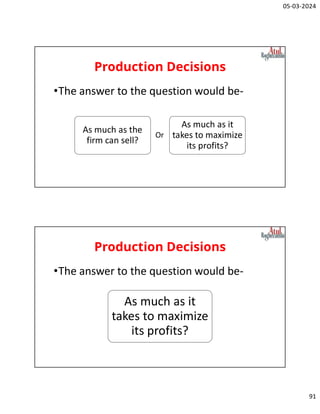
•The answer to the question would be-
As much as the
firm can sell?
As much as it
takes to maximize
its profits?
Or
Production Decisions
•The answer to the question would be-
As much as it
takes to maximize
its profits?
05-03-2024
92
Production Decisions
•How the producer/owner, at given state of
technology, combines various inputs to
produce a definite amount of output in an
economically efficient manner?
Steps in Production Decisions
1.Production Technology
2.Consumer & Cost Constraints
3.Input Choices
05-03-2024
93
Production Function
•Is an equation that expresses the relationship
between the quantities of productive factors
(such as labour and capital) used and the amount
of product obtained.
•It tells amount of product that can be obtained
from every combination of factors, assuming that
the most efficient available methods of
production are used.
Production Function
•In a general mathematical form, a production function
can be expressed as: Q= f(LB, L, K, M, t)
•Q = output/quantity
•LB = Land & Buildings.
•L = Labour.
•K = capital.
•M = raw material.
•t= time.
05-03-2024
94
Production Function
•It can also be expressed as: Q= f(X1, X2, X3, X4…Xn)
•Q = output/quantity produced during a given period of
time
•(X1, X2, X3, X4…Xn)= Quantities of Various Inputs
used in production
What does Production Function
answer?
•What is the marginal productivity of a particular factor
of Production?
•What is the cheapest combination of productive factors
that can be used to produce a given output?
05-03-2024
95
Nature of Production Function-
•Represents a purely technical relationship in
physical quantities between the inputs of factors
and the output of the products.
•It has no reference to money price. The price
factor is left out altogether.
•The output is the result of a joint use of the
factors of production.
Nature of Production Function-
•The physical productivity of one factor can be
measured only in the context of this factor being
used in conjunction with other factors.
•The nature or the quantity of the various factors and
the manner in which they are combined will depend
on the state of technical knowledge.
•For instance, labour productivity will depend on the
quality of labour as determined by their education
and training.
05-03-2024
96
Assumptions of Production Function-
•Production function is related to a specific time period.
•The state of technology is fixed during this period of
time.
•The factors of production are divisible into the most
viable units.
•There are only two factors of production, labour and
capital.
•Inelastic supply of factors in the short-run period.
Limitations of Production Function-
•Restricts itself to the case of two inputs and one
output.
•Assumes a smooth and continuous curve, which is not
possible in the real world, as there are always
discontinuities in production.
•Assumes technology as fixed, which is not possible in
the real world.
•Assumes a perfectly competitive market, which is rare
in the real world.
05-03-2024
97
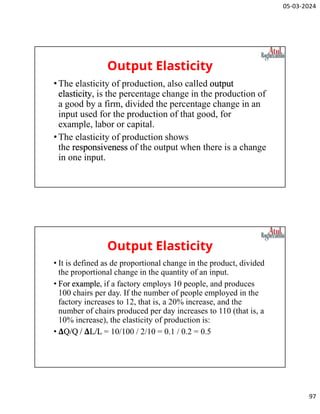
Output Elasticity
•The elasticity of production, also called output
elasticity, is the percentage change in the production of
a good by a firm, divided the percentage change in an
input used for the production of that good, for
example, labor or capital.
•The elasticity of production shows
the responsiveness of the output when there is a change
in one input.
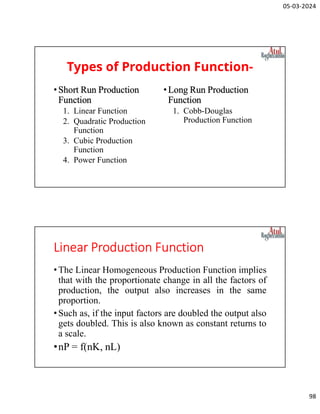
Output Elasticity
• It is defined as de proportional change in the product, divided
the proportional change in the quantity of an input.
• For example, if a factory employs 10 people, and produces
100 chairs per day. If the number of people employed in the
factory increases to 12, that is, a 20% increase, and the
number of chairs produced per day increases to 110 (that is, a
10% increase), the elasticity of production is:
• ΔQ/Q / ΔL/L = 10/100 / 2/10 = 0.1 / 0.2 = 0.5
05-03-2024
98
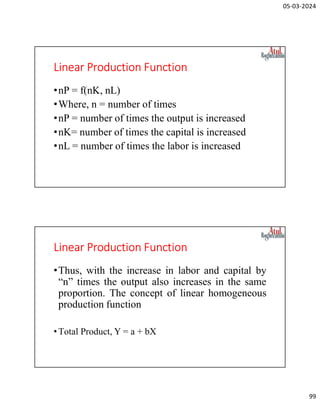
Types of Production Function-
•Short Run Production
Function
1. Linear Function
2. Quadratic Production
Function
3. Cubic Production
Function
4. Power Function
• Long Run Production
Function
1. Cobb-Douglas
Production Function
Linear Production Function
•The Linear Homogeneous Production Function implies
that with the proportionate change in all the factors of
production, the output also increases in the same
proportion.
•Such as, if the input factors are doubled the output also
gets doubled. This is also known as constant returns to
a scale.
•nP = f(nK, nL)
05-03-2024
99
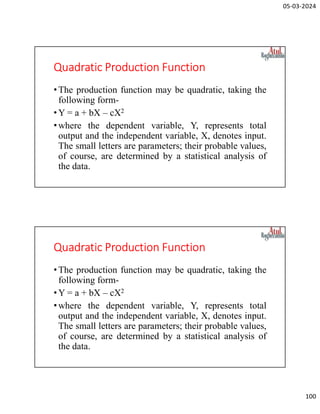
Linear Production Function
•nP = f(nK, nL)
•Where, n = number of times
•nP = number of times the output is increased
•nK= number of times the capital is increased
•nL = number of times the labor is increased
Linear Production Function
•Thus, with the increase in labor and capital by
“n” times the output also increases in the same
proportion. The concept of linear homogeneous
production function
•Total Product, Y = a + bX
05-03-2024
100
Quadratic Production Function
•The production function may be quadratic, taking the
following form-
•Y = a + bX – cX2
•where the dependent variable, Y, represents total
output and the independent variable, X, denotes input.
The small letters are parameters; their probable values,
of course, are determined by a statistical analysis of
the data.
Quadratic Production Function
•The production function may be quadratic, taking the
following form-
•Y = a + bX – cX2
•where the dependent variable, Y, represents total
output and the independent variable, X, denotes input.
The small letters are parameters; their probable values,
of course, are determined by a statistical analysis of
the data.
05-03-2024
101
Quadratic Production Function
(i) The minus sign in the last term denotes diminishing
marginal returns.
(ii) The equation allows for decreasing marginal
product but not for both increasing and decreasing
marginal products.
(iii) The elasticity of production is not constant at all
points along the curve as in a power function, but
declines with input magnitude.
Quadratic Production Function
(iv) The equation never allows for an increasing
marginal product.
(v) When X = O, Y = a. This means that there is some
output even when no variable input is applied.
(vi) The quadratic equation has only one bend as
compared with a linear equation which has no bends.
05-03-2024
102
Quadratic Production Function
(iv) The equation never allows for an increasing
marginal product.
(v) When X = O, Y = a. This means that there is some
output even when no variable input is applied.
(vi) The quadratic equation has only one bend as
compared with a linear equation which has no bends.
Cubic Production Function
•The cubic production function takes the
following form –
Y= a + bx + cX2 – dX3
05-03-2024
103
Cubic Production Function
•It allows for both increasing and decreasing
marginal productivity.
•The elasticity of production varies at each point
along the curve.
•Marginal productivity decreases at an increasing
rate in the later stages.
Cobb Douglas Production Function
•The Cobb-Douglas production function is based
on the empirical study of the American
manufacturing industry made by Paul H. Douglas
and C.W. Cobb.
•A linear homogeneous production function which
takes into account two inputs, labour and capital,
for the entire output of the manufacturing
industry.
05-03-2024
104
Cobb Douglas Production Function
•Q = ALa Cβ
•where Q is output.
•L and С are inputs of labour and capital
respectively.
•A, a and β are positive parameters
Cobb Douglas Production Function
•The equation tells that-
•Output depends directly on L and C, and that
part of output which cannot be explained by
L and С is explained by A which is the
‘residual’, often called technical change.
05-03-2024
105
Cobb Douglas Production Function
•The production function solved by Cobb-
Douglas had
•1/4 contribution of capital to the increase in
manufacturing industry and
•3/4 of labour so that the C-D production
function is-
Cobb Douglas Production Function
•Q = AL3/4 C1/4
•which shows constant returns to scale because the
total of the values of L and С is equal to one: (3/4
+ 1/4), i.e.,(a + β = 1)
•The coefficient of labourer in the C-D function
measures the percentage increase in Q that would
result from a 1 per cent increase in L, while
holding С as constant.
05-03-2024
106
Cobb Douglas Production Function
•Similarly, В is the percentage increase in Q that
would result from a 1 per cent increase in C, while
holding L as constant.
Limitations of Cobb Douglas Production
Function-
•Considers only two inputs, labour and capital, and
neglects some important inputs, like raw
materials, which are used in production.
•It is, therefore, not possible to generalize this
function to more than two inputs.
05-03-2024
107
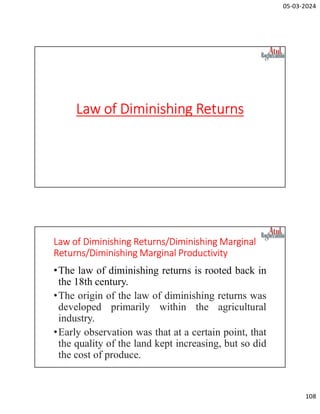
Consumption •Utility
Factors of
Production/Input •Returns/Product
If Consumption
Increases
Utility starts
decreasing
If Factors of
Production/Inputs
increase
Returns/Product
start decreasing
05-03-2024
108
Law of Diminishing Returns
Law of Diminishing Returns/Diminishing Marginal
Returns/Diminishing Marginal Productivity
•The law of diminishing returns is rooted back in
the 18th century.
•The origin of the law of diminishing returns was
developed primarily within the agricultural
industry.
•Early observation was that at a certain point, that
the quality of the land kept increasing, but so did
the cost of produce.
05-03-2024
109
Law of Diminishing Returns/Diminishing Marginal
Returns/Diminishing Marginal Productivity
•Diminishing Returns are the decrease
in marginal (incremental) output(MP) of
a production process as the amount/quantity of a
single factor of production is incrementally
increased, holding all other factors of production
equal.
Law of Diminishing Returns/Diminishing Marginal
Returns/Diminishing Marginal Productivity
•In productive processes, increasing a factor of
production by one unit, while holding all other
production factors constant, will at some point
return a lower unit of output per incremental unit
of input.
05-03-2024
110
Law of Diminishing Returns/Diminishing Marginal
Returns/Diminishing Marginal Productivity
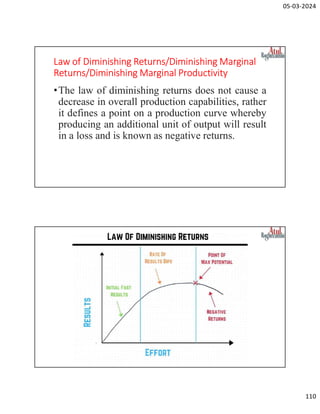
•The law of diminishing returns does not cause a
decrease in overall production capabilities, rather
it defines a point on a production curve whereby
producing an additional unit of output will result
in a loss and is known as negative returns.
05-03-2024
111
Law of Returns to Scale
Difference between Short Run & Long Run
Short Run
• Firms can only control
prices, means only prices
are highly variable.
• Short run production
function alludes to the time
period, in which at least
one factor of production is
fixed.
Long Run
• Factors of Production and
Costs both are variable.
• Long run production
function connotes the time
period, in which all the
factors of production are
variable.
05-03-2024
112
Law of Returns to Scale
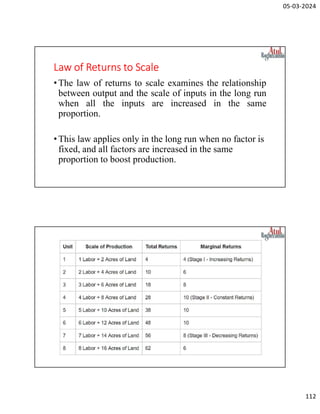
•The law of returns to scale examines the relationship
between output and the scale of inputs in the long run
when all the inputs are increased in the same
proportion.
•This law applies only in the long run when no factor is
fixed, and all factors are increased in the same
proportion to boost production.
05-03-2024
113
Three stages of Law of Returns to Scale
•Increasing Returns to Scale
•Diminishing Returns to Scale
•Constant Returns to Scale
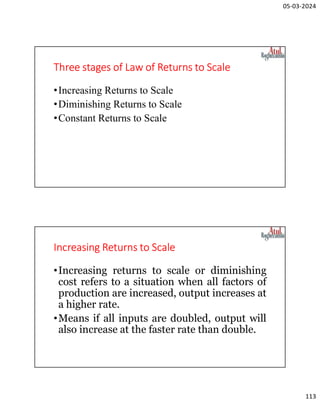
Increasing Returns to Scale
•Increasing returns to scale or diminishing
cost refers to a situation when all factors of
production are increased, output increases at
a higher rate.
•Means if all inputs are doubled, output will
also increase at the faster rate than double.
05-03-2024
114
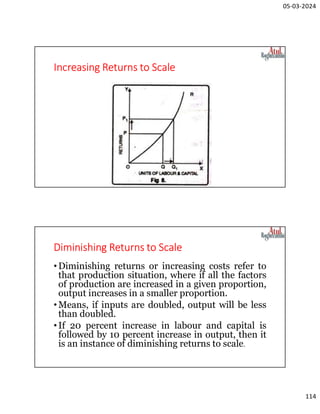
Increasing Returns to Scale
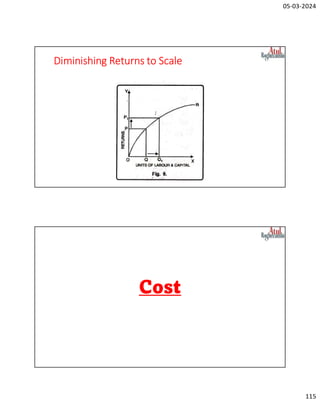
Diminishing Returns to Scale
•Diminishing returns or increasing costs refer to
that production situation, where if all the factors
of production are increased in a given proportion,
output increases in a smaller proportion.
•Means, if inputs are doubled, output will be less
than doubled.
•If 20 percent increase in labour and capital is
followed by 10 percent increase in output, then it
is an instance of diminishing returns to scale.
05-03-2024
115
Diminishing Returns to Scale
Cost
05-03-2024
116
Fixed Cost Vs. Variable Cost
Fixed Cost
• Costs for expenses that remain
constant for a specific period,
such as rent or loan payments.
• Fixed costs are generally easier
to plan, manage, and budget.
• Fixed Costs are time related.
Variable Cost
• Variable costs are for expenses
that change constantly, such as
taxes, labor, and operational
expenses.
• Variasble costs are not easier to
track, plan, manage, and budget.
• Variable Costs are volume
related.
Cost-Output Relationship in the Short Run
How can we
make
changes to
the
production?
By making
change in
the variable
inputs
05-03-2024
117
Cost-Output Relationship in the Short Run
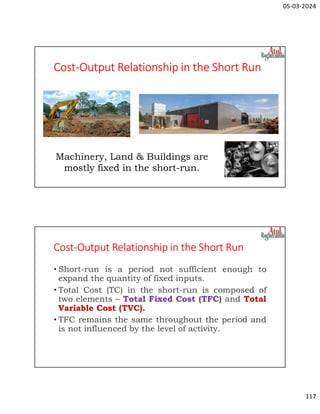
Machinery, Land & Buildings are
mostly fixed in the short-run.
Cost-Output Relationship in the Short Run
• Short-run is a period not sufficient enough to
expand the quantity of fixed inputs.
• Total Cost (TC) in the short-run is composed of
two elements – Total Fixed Cost (TFC) and Total
Variable Cost (TVC).
• TFC remains the same throughout the period and
is not influenced by the level of activity.
05-03-2024
118
Cost-Output Relationship in the Short Run
• The firm will continue to incur these costs even if
the firm is temporarily shut down.
• Even though TFC remains the same, fixed cost per
unit varies with changes in the level of output.
• TVC increases with increase in the level of
activity, and decreases with decrease in the level
of activity.
• If the firm is shut down, there are no variable
costs.
Cost-Output Relationship in the Short Run
So in the short-run an increase in TC implies
an increase in TVC only. Thus:
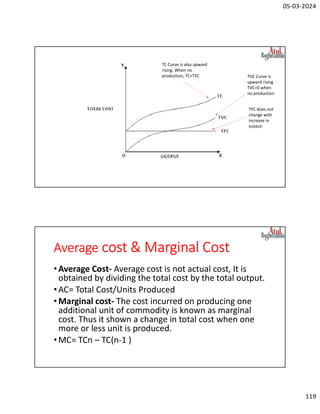
TC = TFC + TVC
TFC = TC – TVC
TVC = TC – TFC
TC = TFC when the output is zero.
05-03-2024
119
TFC does not
change with
increase in
output
TVC Curve is
upward rising
TVC=0 when
no production
TC Curve is also upward
rising. When no
production, TC=TFC
Average cost & Marginal Cost
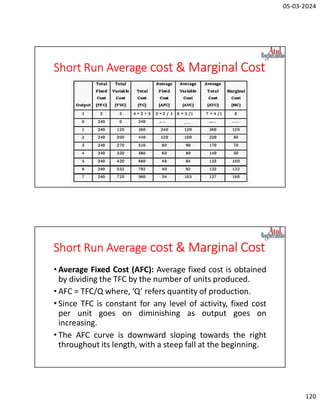
•Average Cost- Average cost is not actual cost, It is
obtained by dividing the total cost by the total output.
•AC= Total Cost/Units Produced
•Marginal cost- The cost incurred on producing one
additional unit of commodity is known as marginal
cost. Thus it shown a change in total cost when one
more or less unit is produced.
•MC= TCn – TC(n-1 )
05-03-2024
120
Short Run Average cost & Marginal Cost
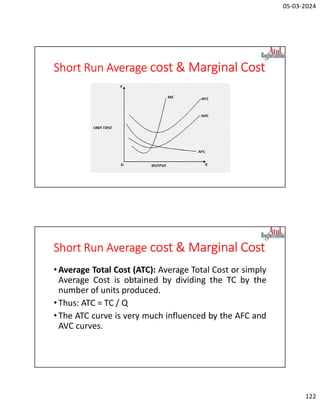
• Average Fixed Cost (AFC): Average fixed cost is obtained
by dividing the TFC by the number of units produced.
• AFC = TFC/Q where, ‘Q’ refers quantity of production.
• Since TFC is constant for any level of activity, fixed cost
per unit goes on diminishing as output goes on
increasing.
• The AFC curve is downward sloping towards the right
throughout its length, with a steep fall at the beginning.
05-03-2024
121
Short Run Average cost & Marginal Cost
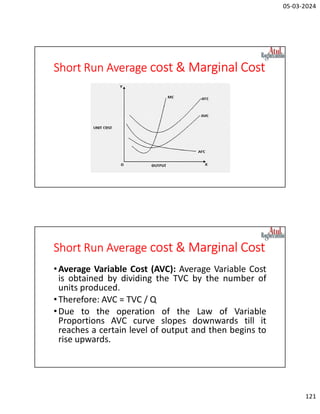
•Average Variable Cost (AVC): Average Variable Cost
is obtained by dividing the TVC by the number of
units produced.
•Therefore: AVC = TVC / Q
•Due to the operation of the Law of Variable
Proportions AVC curve slopes downwards till it
reaches a certain level of output and then begins to
rise upwards.
05-03-2024
122
Short Run Average cost & Marginal Cost
•Average Total Cost (ATC): Average Total Cost or simply
Average Cost is obtained by dividing the TC by the
number of units produced.
•Thus: ATC = TC / Q
•The ATC curve is very much influenced by the AFC and
AVC curves.
05-03-2024
123
Short Run Average cost & Marginal Cost
In the beginning both AFC curve and AVC curve decline
and therefore ATC curve also declines.
The AFC curve continues the trend throughout, though
at a diminishing rate.
AVC curve continues the trend till it reaches a certain
level and thereafter it starts rising slowly.
Short Run Average cost & Marginal Cost
• Since this rise initially is at a rate lower than the rate of
decline in the AFC curve,
the ATC curve continues to decline for some more time and
reaches the lowest point,
which obviously is further than the lowest point of the AVC
curve.
• Thereafter the ATC curve starts rising because the rate of rise
in the AVC curve is greater than the rate of decline in the AFC
curve.
05-03-2024
124
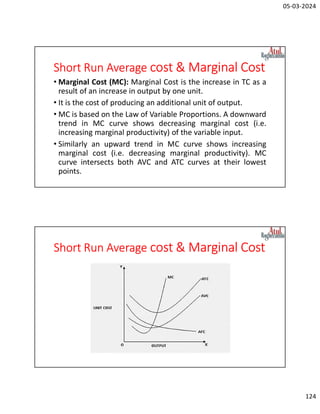
Short Run Average cost & Marginal Cost
• Marginal Cost (MC): Marginal Cost is the increase in TC as a
result of an increase in output by one unit.
• It is the cost of producing an additional unit of output.
• MC is based on the Law of Variable Proportions. A downward
trend in MC curve shows decreasing marginal cost (i.e.
increasing marginal productivity) of the variable input.
• Similarly an upward trend in MC curve shows increasing
marginal cost (i.e. decreasing marginal productivity). MC
curve intersects both AVC and ATC curves at their lowest
points.
Short Run Average cost & Marginal Cost
05-03-2024
125
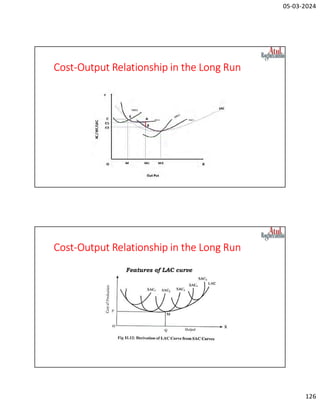
Cost-Output Relationship in the Long Run
• In the long run the size of an industry can be expanded to
meet the increased demand for products
-as such in the long run all the factors of production can be
varied according to the need.
• Hence, long run costs are those which vary with output
when all the input factors including plant and equipment
vary.
• Costs fall as output increases due to economies of scale,
consequently the average cost AC of production falls.
Cost-Output Relationship in the Long Run
•Some firms experience diseconomies of scale if the
average cost begins to increase.
•This fall and rise derives a U shaped or boat shaped
average cost curve in the long run which is denoted as
LAC.
05-03-2024
126
Cost-Output Relationship in the Long Run
05-03-2024
127
Cost-Output Relationship in the Long Run
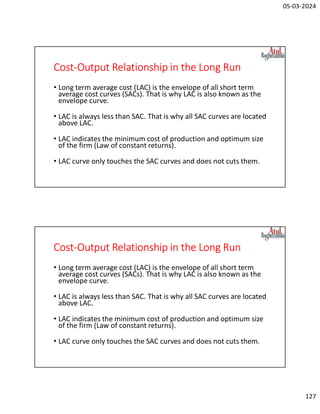
• Long term average cost (LAC) is the envelope of all short term
average cost curves (SACs). That is why LAC is also known as the
envelope curve.
• LAC is always less than SAC. That is why all SAC curves are located
above LAC.
• LAC indicates the minimum cost of production and optimum size
of the firm (Law of constant returns).
• LAC curve only touches the SAC curves and does not cuts them.
Cost-Output Relationship in the Long Run
• Long term average cost (LAC) is the envelope of all short term
average cost curves (SACs). That is why LAC is also known as the
envelope curve.
• LAC is always less than SAC. That is why all SAC curves are located
above LAC.
• LAC indicates the minimum cost of production and optimum size
of the firm (Law of constant returns).
• LAC curve only touches the SAC curves and does not cuts them.
05-03-2024
128
Cost-Output Relationship in the Long Run
•In the short run, the SAC curve is U-shaped because
the laws of returns operate but in the long run, LAC is
also U-shaped because
-the Laws of Returns to scale operate namely the law of
increasing return to scale, the Law of Constant Returns
to scale and the Law of Diminishing Returns to scale.
Cost-Output Relationship in the Long Run
•As the level of output is expanded or the scale of
operation is increased by the large firm they will enjoy
economies of scale but if these firms produce beyond
their installed capacity then they might get
diseconomies of scale.
•Economies of scale bring down the fall in unit cost and
diseconomies result in rising in it.
05-03-2024
129
Total Revenue
•The total revenue is the total amount a
vendor/business can collect from the sale of
commodities or services to the customer.
•The price of the commodities can be expressed as P ×
Q, which means the cost price of the commodities
multiplied by the amount sold.
•Therefore, total revenue (TR) is defined as the market
cost price of the commodity (p) multiplied by the
enterprise's output (q).
Total Revenue
Thus,
TR = p × q
Where,
TR-Total Revenue,
P-Price,
Q-Quantity.
05-03-2024
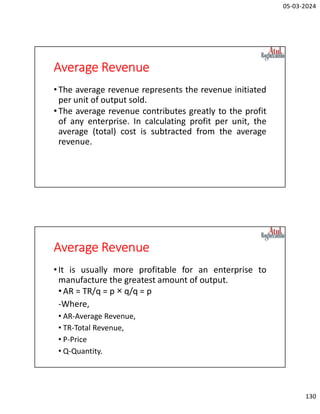
130
Average Revenue
•The average revenue represents the revenue initiated
per unit of output sold.
•The average revenue contributes greatly to the profit
of any enterprise. In calculating profit per unit, the
average (total) cost is subtracted from the average
revenue.
Average Revenue
•It is usually more profitable for an enterprise to
manufacture the greatest amount of output.
• AR = TR/q = p × q/q = p
-Where,
• AR-Average Revenue,
• TR-Total Revenue,
• P-Price
• Q-Quantity.
05-03-2024
131
Unit-IV
Market Structures,
(Managerial Economics)
• For MBA First SemesterStudents of AKTU, Lucknow UttarPradesh
Compiled By:- Atul Raghuvanshi
05-03-2024
132
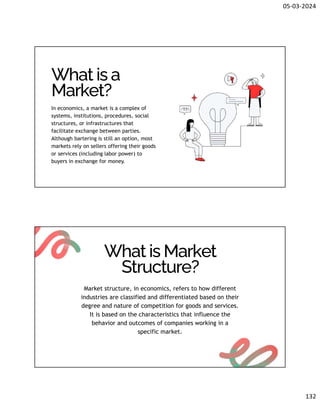
What is a
Market?
In economics, a market is a complex of
systems, institutions, procedures, social
structures, or infrastructures that
facilitate exchange between parties.
Although bartering is still an option, most
markets rely on sellers offering their goods
or services (including labor power) to
buyers in exchange for money.
What is Market
Structure?
Market structure, in economics, refers to how different
industries are classified and differentiated based on their
degree and nature of competition for goods and services.
It is based on the characteristics that influence the
behavior and outcomes of companies working in a
specific market.
05-03-2024
133
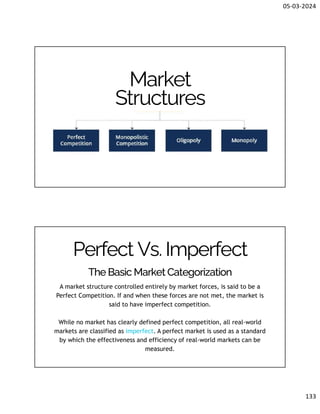
Market
Structures
The Basic Market Categorization
A market structure controlled entirely by market forces, is said to be a
Perfect Competition. If and when these forces are not met, the market is
said to have imperfect competition.
While no market has clearly defined perfect competition, all real-world
markets are classified as imperfect. A perfect market is used as a standard
by which the effectiveness and efficiency of real-world markets can be
measured.
Perfect Vs. Imperfect
05-03-2024
134
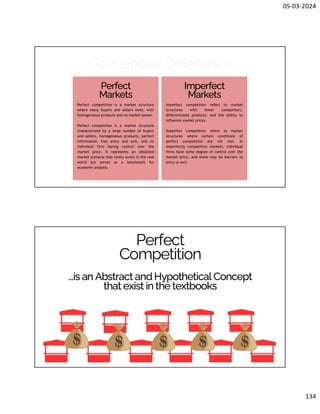
Conceptual Difference
Perfect
Markets
Imperfect
Markets
Perfect competition is a market structure
where many buyers and sellers exist, with
homogeneous products and no market power.
Perfect competition is a market structure
characterized by a large number of buyers
and sellers, homogeneous products, perfect
information, free entry and exit, and no
individual firm having control over the
market price. It represents an idealized
market scenario that rarely exists in the real
world but serves as a benchmark for
economic analysis.
Imperfect competition refers to market
structures with fewer competitors,
differentiated products, and the ability to
influence market prices.
Imperfect competition refers to market
structures where certain conditions of
perfect competition are not met. In
imperfectly competitive markets, individual
firms have some degree of control over the
market price, and there may be barriers to
entry or exit.
...is an Abstract and Hypothetical Concept
that exist in the textbooks
Perfect
Competition
05-03-2024
135
• Theoretically, resources would be divided among companies equally
and fairly in a market with perfect competition, and no monopoly
would exist.
• Each company would have the same industry knowledge and they
would all sell the same products.
• There would be plenty of buyers and sellers in this market, and
demand would help set prices evenly across the board.
Perfect Competition
• The term perfect competition refers to a theoretical market
structure. Although perfect competition rarely occurs in real-world
markets, it provides a useful model for explaining how supply and
demand affect prices and behavior in a market economy.
• Under perfect competition, there are many buyers and sellers, and
prices reflect supply and demand. Companies earn just enough profit
to stay in business and no more. If they were to earn excess profits,
other companies would enter the market and drive profits down.
Perfect Competition
05-03-2024
136
Key Takeaways
• Perfect competition is an ideal type of market structure where all
producers and consumers have full and symmetric information and no
transaction costs.
• There are a large number of producers and consumers competing with one
another in this kind of environment.
• Perfect competition is theoretically the opposite of a monopolistic
market.
• Since all real markets exist outside of the plane of the perfect
competition model, each can be classified as imperfect.
• The opposite of perfect competition is imperfect competition, which
exists when a market violates the abstract tenets of neoclassical pure or
perfect competition.
• All firms sell an identical product (the product is a commodity or
homogeneous).
• All firms are price takers (they cannot influence the market price of
their products).
• Market share has no influence on prices.
• Buyers have complete or perfect information (in the past, present,
and future) about the product being sold and the prices charged by
each firm.
• Capital resources and labor are perfectly mobile.
• Firms can enter or exit the market without cost
Characteristicsof PerfectCompetition
05-03-2024
137
• The sellers and buyers are fully aware of the current market price of a
product.
• Therefore, none of them sell or buy at a higher rate.
• As a result, the same price prevails in the market under perfect
competition.
• The buyers and sellers cannot influence the market price by increasing or
decreasing their purchases or output, respectively.
• The market price of products in perfect competition is determined by the
industry.
• This implies that in perfect competition, the market price of products is
determined by taking into account two market forces, namely market
demand and market supply.
Price DeterminationunderPerfect
Competition
• An industry consists of many independent firms.
• Each firm has several factories, farms or mines, as required. Each
such firm in the industry produces a homogeneous product.
• Equilibrium of the industry happens when the total output of the
industry is equal to the total demand.
• In such a scenario, the prevailing price of a commodity is its
equilibrium price.
• Under competitive conditions, the interaction of demand and supply
determines the equilibrium price
Price DeterminationunderPerfect
Competition
05-03-2024
138
Monopoly
• Monopoly is an opposite form of market and is derived from two Greek
words,Monos(meaningsingle)andPolus (Meaningseller).
• A market situation where there is only one seller in the market selling a
productwithno closesubstitutesis knownas Monopoly.
• For example, Indian Railways. In a monopoly market, there are various
restrictions on the entry of new firms and exit of the existing firms. Also,
thereare chancesof PriceDiscriminationin a Monopolymarket.
05-03-2024
139
Featuresof Monopoly
• The product has only one seller in the market.
• Monopolies possess information that is unknownto others in the market.
• There are profit maximization and price discrimination associated with
monopolistic markets. Monopolists are guided by the need to maximize profit
either by expanding sales production or by raising the price.
• It has high barriers to entry for any new firm that produces the same product.
• The monopolist is the price maker, i.e., it decides the price, which maximizes its
profit. The price is determined by evaluating the demand for the product.
• The monopolist does not discriminate among customers and charges them all
alike for the same product.
Under monopoly, for the equilibrium
and price determination, two different
conditions need to be satisfied:
Marginal revenue must be equal to marginal cost.
MC must cut MR from below.
05-03-2024
140
Price DeterminationUnder Monopoly
Purpose of the
Monopolist
is to earn Maximum Profit
There are two approaches to determining
equilibrium price under a monopoly
Total Cost & Total Revenue
Approach
Marginal Cost & Marginal
Revenue Approach
05-03-2024
141
PriceDeterminationUnderMonopoly
• Monopolist can earn maximum profits when difference between
TR and TC is maximum.
• By fixing different prices, a monopolist tries to find out the level
of output where the difference between TR and TC is maximum.
• The level of output where monopolist earns maximum profits is
called the equilibrium situation.
• TC is the total cost curve. TR is the total revenue curve.
• TR curve starts from the origin. It indicates that at zero level of output,
TR will also be zero.
• TC curve starts from P
. It reflects that even if the firm discontinues its
production, it will have to suffer the loss of fixed costs.
• Total profits of the firm are represented by TP curve
05-03-2024
142
PriceDeterminationUnderMonopoly
• Now as the firm increases its production, TR also increases.
• But in the initial stage, the rate of increase in TR is less than that
of TC.
• Therefore, RC part of TP curve reflects that firm is incurring losses.
• At point M, total revenue is equal to total cost.
• It shows that firm is working under no profit, no loss basis. termed
as equilibrium output.
Marginal Revenue and Marginal Cost
Approach
The study of equilibrium price according to this analysis can be
conducted in two time periods.
The Short
Run
The Long
Run
Normal
Profits
Super
Normal
Profits
Minimum
Losses
05-03-2024
143
Marginal Revenue and Marginal Cost
Approach: Super Normal Profits
• If the price determined by the monopolist in more than AC, he will
get super-normal profits.
• The monopolist will produce up to the level where MC=MR.
• This limit will indicate equilibrium output.
• Output is measured on X-axis and price on Y-axis.
• SAC and SMC are the short run average cost and marginal cost
curves respectively while AR and MR are the average revenue and
marginal revenue curves respective
05-03-2024
144
• The monopolist is in equilibrium at point E because at point E both the
conditions of equilibrium are fulfilled i.e., MR = MC and MC intersects the
MR curve from below.
• At this level of equilibrium the monopolist will produce OQ1 level of
output and sells it at CQ1 price which is more than average cost DQ1 by CD
per unit. Therefore, in this case total profits of the monopolist will be
equal to shaded area ABDC
Marginal Revenue and Marginal Cost
Approach: Normal Profits
• A monopolist in the short run would enjoy normal profits when
average revenue is just equal to average cost.
• We know that average cost of production is inclusive of normal
profits.
• The firm is in equilibrium at point E. Here marginal cost is equal to
marginal revenue.
• The firm is producing OM level of output. At OM level of output
average cost curve touches the average revenue curve at point P.
Therefore, at point ‘P’ price MR is equal to average cost of the
total product. In this way, monopoly firm enjoys the normal profits.
05-03-2024
145
Marginal Revenue and Marginal Cost
Approach: Normal Profits
Marginal Revenue and Marginal Cost
Approach: Normal Profits
• A monopolist in the short run would enjoy normal profits when
average revenue is just equal to average cost.
• We know that average cost of production is inclusive of normal
profits.
• The firm is in equilibrium at point E. Here marginal cost is equal to
marginal revenue.
• The firm is producing OM level of output. At OM level of output
average cost curve touches the average revenue curve at point P.
Therefore, at point ‘P’ price MR is equal to average cost of the
total product. In this way, monopoly firm enjoys the normal profits.
05-03-2024
146
Marginal Revenue and Marginal Cost
Approach: Minimum Losses
• In the short run, the monopolist may have to incur
losses.
• This situation occurs if in the short run price falls below
the variable cost.
• In other words, if price falls due to depression and fall
in demand, the monopolist will continue to produce as
long as price covers the average variable cost.
• Once the price falls below the average variable cost,
monopolist will stop production.
Marginal Revenue and Marginal Cost
Approach: Minimum Losses
Thus, a monopolist in the short
run equilibrium may bear the
minimum loss, equal to fixed
costs.
Therefore, equilibrium price will
be equal to average variable cost.
05-03-2024
147
Marginal Revenue and Marginal Cost
Approach: Minimum Losses
Marginal Revenue and Marginal Cost
Approach: Minimum Losses
• In the short run, the monopolist may have to incur
losses.
• This situation occurs if in the short run price falls below
the variable cost.
• In other words, if price falls due to depression and fall
in demand, the monopolist will continue to produce as
long as price covers the average variable cost.
• Once the price falls below the average variable cost,
monopolist will stop production.
05-03-2024
148
Marginal Revenue and Marginal Cost
Approach: Minimum Losses
• In the short run, the monopolist may have to incur
losses.
• This situation occurs if in the short run price falls below
the variable cost.
• In other words, if price falls due to depression and fall
in demand, the monopolist will continue to produce as
long as price covers the average variable cost.
• Once the price falls below the average variable cost,
monopolist will stop production.
Long Run Equilibrium under Monopoly
• Long-run is the period in which output can be changed
by changing the factors of production.
• In other words, all variable factors can be changed and
monopolist would choose that plant size which is most
appropriate for specific level of demand.
• Here, equilibrium would be attained at that level of
output where the long-run marginal cost cuts marginal
revenue curve from below
05-03-2024
149
Monopolistic Market
• Monopolistic competition exists when many companies
offer competing products or services that are similar, but
not perfect, substitutes.
• The barriers to entry in a monopolistic competitive
industry are low, and the decisions of any one firm do
not directly affect its competitors.
• The competing companies differentiate themselves
based on pricing and marketing decisions.
Monopolistic Market
• Monopolistic competition occurs when many companies
offer similar but not identical products.
• Firms in monopolistic competition differentiate their
products through pricing and marketing strategies.
• Barriers to entry, or the costs or other obstacles that
prevent new competitors from entering an industry, are
low in monopolistic competition.
05-03-2024
150
Monopolistic Market
• Low barriers to entry
• Product Differentiation
• Pricing
• Demand Elasticity
Equilibrium in the Monopolistic Market
05-03-2024
151
Equilibrium in the Monopolistic Market
Oligopoly
• An oligopoly is a type of market structure that exists
within an economy. In an oligopoly, there is a small
number of firms that control the market.
• A key characteristic of an oligopoly is that none of these
firms can keep the other(s) from having significant
influence over the market.
• The concentration ratio measures the market share of
the largest firms.
05-03-2024
152
Oligopoly
• There is no precise upper limit to the number of firms in
an oligopoly, but the number must be low enough that
the actions of one firm significantly influence the
others.
• An oligopoly is different from a monopoly, which is a
market with only one producer.
Oligopoly
• An oligopoly is a market structure wherein a small number of
producers work to restrict output and/or fix prices so they can
achieve above-normal market returns.
• Economic, legal, and technological factors can contribute to the
formation and maintenance, or dissolution, of oligopolies.
• The major difficulty that oligopolies face is the prisoner's
dilemma that each member faces, which encourages each
member to cheat.
• Government policy can discourage or encourage oligopolistic
behavior, and firms in mixed economies often seek
government blessing for ways to limit competition.
05-03-2024
153
Oligopoly
• These market structures are made up of a small number of
companies within an industry that controls the market.
• Firms in an oligopoly set prices, whether collectively—in
a cartel—or under the leadership of one firm, rather
than taking prices from the market. Profit margins are thus
higher than they would be in a more competitive market.
• Some of the barriers to entry (that prevent new players from
entering the market) in an oligopoly include economies of
scale, regulatory barriers, accessing supply and distribution
channels, capital requirements, and brand loyalty.
Features of Oligopoly
• Few Sellers
• Interdependence of the sellers
• Advertising
• Competition
• Entry & Exit Barriers
• Lack of Uniformity
05-03-2024
154
Cartel: The Collusive Oligopoly
• A cartel is an organization created from a formal
agreement between a group of producers of a good or
service to control supply or to regulate or manipulate
prices.
• A collection of independent businesses or countries that
act together like a single producer, cartel members may
agree on prices, total industry output, market shares,
allocation of customers, allocation of territories, bid-
rigging, and the division of profits.
Paul Sweezy Model: Kinked Demand
Curve Analysis
• This model was developed independently by Prof. Paul
M. Sweezy on the one hand and Profs. R. C. Hall and C.
J. Hitch on the other hand.
05-03-2024
155
Assumptions of Kinked Demand Curve
Analysis:
• There are only a few firms in an oligopolistic market.
• The firms are producing close-substitute products.
• The quality of the products remains constant and the
firms do not spend on advertising.
• A set of prices of the product has already been
determined and these prices prevail in the market at
present.
Assumptions of Kinked Demand Curve
Analysis:
• Each firm believes that if it reduces the price of its
product, the rival firms would follow suit, but if it
increases the price, the rivals would not follow it.
• They would simply keep their prices unchanged.
• Because of this asymmetric pattern of reaction of the
rivals, the demand curve of each firm would have a kink
at the prevailing price of its product.
05-03-2024
156
Assumptions of Kinked Demand Curve
Analysis:
PriceLeadershipunder Oligopoly
• The oligopoly market structure has perfect competition, monopoly,
and monopolistic competition.
• A few large firms dominate the market and then try to collide and
share the market.
• They try to maximize profit by joining hands and reducing the market
competition.
• They mainly focus on non-price competition and product
differentiation.
• In the oligopoly market, the price leader has some extent of market
power and effect.
• The price leadership model of oligopoly helps stabilize the price in
the market. This also helps in easing the price wars in the market.
05-03-2024
157
PriceLeadershipunder Oligopoly
• The oligopoly market structure has perfect competition, monopoly,
and monopolistic competition.
• A few large firms dominate the market and then try to collide and
share the market.
• They try to maximize profit by joining hands and reducing the market
competition.
• They mainly focus on non-price competition and product
differentiation.
• In the oligopoly market, the price leader has some extent of market
power and effect.
• The price leadership model of oligopoly helps stabilize the price in
the market. This also helps in easing the price wars in the market.
Types ofPriceLeadershipunderOligopoly
Collusive
Oligopoly
Barometric
Oligopoly
Dominant
Oligopoly
05-03-2024
158
TypesofPriceLeadershipunder
Oligopoly
Collusive Oligopoly
• The firms combine their actions to maximize profit.
• This coordination between the firms has occurred
through output conditions and price fixing.
• Under this market structure, the prices of goods and
services are generally higher.
• This benefits the firms involved but affects the
consumers adversely.
TypesofPriceLeadershipunder
Oligopoly
Barometric Oligopoly
• The barometrical market structure is also known as
price leadership. Under this market structure, the firm
that looms the market is a barometer firm.
• This firm sets the expense of particular goods and
services for the entire market.
• The other firms in the industry follow the lead of the
barometer firm.
05-03-2024
159
PriceDeterminationUnderMonopoly
Barometric Oligopoly
• To avoid the loss of market share, other firms try to
follow the pricing strategy of the Barometer firm. This
structure helps create the need for more cooperation
and contracts between the firms in the market.
TypesofPriceLeadershipunder
Oligopoly
Dominant Oligopoly
• This is a type of market structure where a single
dominant firm has a very larger market share. This firm
has a larger market share than any other firm in the
industry.
05-03-2024
160
Unit-V Managerial
Economics
For- MBA First Year
By- Atul Raghuvanshi
National Income
•National income is the value of the aggregate
output of the different sectors during a certain
time period.
•In other words, it is the flow of goods and
services produced in an economy in a particular
year.
•National Income defines a country's wealth.
05-03-2024
161
National Income
•National income is the sum total of the value of
all the goods and services manufactured by the
residents of the country, in a year., within its
domestic boundaries or outside.
•It is the net amount of income of the citizens by
production in a year.
National Income
•The aggregate economic performance of a nation is
calculated with the help of National income data.
•The basic purpose of national income is to throw light
on aggregate output and income and provide a basis
for the government to formulate its policy, programs,
to maximize the national welfare of the people.
•Central Statistical Organization calculates the national
income in India.
05-03-2024
162
National Income
•According to Marshall: “The labor and capital of
a country acting on its natural resources produce
annually a certain net aggregate of commodities,
material and immaterial including services of all
kinds. This is the true net annual income or
revenue of the country or national dividend.”
Modern Approach of National Income
GDP GNP
05-03-2024
163
Gross Domestic Product
• GDP, is the aggregate value of goods and services produced
in a country. GDP is calculated over regular time intervals,
such as a quarter or a year. GDP as an economic indicator is
used worldwide to measure the growth of countries
economy.
• Goods are valued at their market prices, so:
• All goods measured in the same units (e.g., Rupees in India)
• Things without exact market value are excluded.
• GDP = Consumption + Investment + Government Spending +
Exports - Imports.
Constituents of Gross Domestic Product
• Wages and salaries
• Rent
• Interest
• Undistributed profits
• Mixed-income
• Direct taxes
• Dividend
• Depreciation
05-03-2024
164
Gross National Product
•Gross National Product (GNP) is an estimated value of
all goods and services produced by a country’s
residents and businesses.
•GNP does not include the services used to produce
manufactured goods because its value is included in
the price of the finished product.
•It also includes net income arising in a country from
abroad.
Constituents of Gross National Product
•Consumer goods and services
•Gross private domestic income
•Goods produced or services rendered
•Income arising from abroad.
•GNP = GDP + NR (Net income from assets abroad or
Net Income Receipts) - NP (Net payment outflow to
foreign assets).
05-03-2024
165
Methods of Calculating National Income
•Product Method
•Income Method
•Expenditure Method
Product Method of Calculating National
Income
• In product approach, national income is measured as a flow
of goods and services.
• Value of money for all final goods and services is produced in
an economy during a year.
• Final goods are those goods which are directly consumed
and not used in further production process.
• All goods and services produced during the year in various
industries are added up.
• This is also known as value-added to GDP or GDP at the
sector of origin's cost factor.
05-03-2024
166
Product Method of Calculating National
Income
•India includes the following items:
•agriculture and allied services;
•mining;
•development,
•construction,
Product Method of Calculating National
Income
•the supply of electricity, gas, and water, transport,
communication, and trade;
•banking and industrial real estate and property
ownership of residential and commercial services and
public administration and defence and other services
(or government services).
•It is, in other words, the amount of the added gross
value.
05-03-2024
167
Income Method of Calculating National
Income
•In income approach, national income is
measured as a flow of factor incomes.
•Income received by basic factors like labor,
capital, land and entrepreneurship are summed
up.
•This approach is also called as income
distributed approach.
Income Method of Calculating National
Income
•In a nation that produces GDP during a year,
people earn income from their jobs.
•Thus the sum of all factor incomes is GDP by
revenue method: wages and salaries (employee
compensation) + rent + interest + benefit.
05-03-2024
168
Expenditure Method of Calculating National
Income
• In this method, the income is calculated as the aggregate of
all expenditures incurred by households, firms, government,
and foreigners.
• It is assumed that all the factor income earned is spent in the
form of expenditure incurred in the production of the goods
and services, and circulated by the businesses in an
economy.
• Therefore, the total final expenditure incurred is the Gross
Domestic Product at Market Price.
• It is often known as the Income Disposable Method.
Expenditure Method of Calculating National
Income
05-03-2024
169
Circular Flow of Income
•How economies create wealth?
•In an economy, all factors of production (FoP) undergo
a production flow/cycle;
•In the process of which it generates wealth in the
form of making payments to the factor of production,
known as factor payments.
Circular Flow of Income
•Thus, the economic wealth of nations is created
by generating this flow and producing
commodities (goods and services), which are
then consumed by consumers who spend their
income on these goods and services.
05-03-2024
170
Circular Flow of Income
•A simple economy assumes that there exist only two
sectors, i.e., Households and Firms.
•Households are consumers of goods and services and
the owners of the factors of production (land labour,
capital, and enterprise).
•However, the firm sector produces goods and services
and sells them to households.
Circular Flow of Income
• In the circular flow of income (two-sector economy), there is an
exchange of goods and services between the two players i.e., the
firms and households, which leads to a certain flow of money in
the economy. Households provide the firms with the factors of
production, namely Land (Natural Resources), Labor, Capital,
and Enterprise that generates goods and services, and
consumers spend their income on the consumption of these
goods and services. The firms then make factor payments to
households in the form of rent, wages, interest, and profit. This
flow of goods and services and factors payments between firms
and households reflects the circular flow of money in an
economy. .
05-03-2024
171
Circular Flow of Income
•In the circular flow of income (two-sector economy),
there is an exchange of goods and services between
the two players i.e., the firms and households, which
leads to a certain flow of money in the economy.
•Households provide the firms with the factors of
production, namely Land (Natural Resources), Labor,
Capital, and Enterprise that generates goods and
services, and consumers spend their income on the
consumption of these goods and services.
Circular Flow of Income in Two Sector
Economy
05-03-2024
172
Circular Flow of Income in Two Sector
Economy
Thank
you very
much!
ATUL RAGHUVANSHI
+91 7060671682,
atulkumar.srgc@gmail.com
05-03-2024
173
Best of Luck for Your Exams!

Managerial Economics Combined_compressed.pdf

  • 1.
    05-03-2024 1 MANAGERIAL F O RM B A B A T C H O F 2 0 2 3 - 2 5 Based on the Curriculum of Dr. A. P. J. Abdul Kalaam Technical University , Lucknow, Uttar Pradesh Drafted by: Atul Raghuvanshi ECONOMICS No. of Applications (in millions) 2012 2013 2014 2015 2016 2017 2018 2019 2020 2021 2022 6 4 2 0 No. of New Businesses Starting Every Year The Global Data
  • 2.
    05-03-2024 2 Competitive Business World BusinessManagers are required to do: Allocate Resources Wisely Determine Pricing Strategies Forcast Demand Analyze Market Trends
  • 3.
    05-03-2024 3 Competitive Business World + ECONOMICPRINCIPLES BUSINESS PRINCIPLES Managerial Economics • Economic Theory • Problems of Logic that intrigue Economic Theorists • Social Aspect of Economic Science • Managerial Practices • Problems of Policy that plague Practical Managers • Decision Making Challenges
  • 4.
    05-03-2024 4 Managerial Economics • EconomicTheory • Problems of Logic that intrigue Economic Theorists • Social Aspect of Economic Science • Managerial Practices • Problems of Policy that plague Practical Managers • Decision Making Challenges Second World War(1939-1945)
  • 5.
    05-03-2024 5 Tremendous Pressure onScarce Economic Resources
  • 6.
    05-03-2024 6 Scarcity of resourcesresults from two fundamental facts of life: •Human wants are virtually unlimited and insatiable •Economic resources to satisfy these human demands are limited. An analysis of scarcity of resources and choice making poses three basic questions: What to produce and how much to produce? For whom to produce? How to produce?
  • 7.
    05-03-2024 7 Definitions of ManagerialEconomics- “Managerial Economics is economics applied in decision- making. It is a special branch of economics bridging the gap between the economic theory and managerial practice. Its stress is on the use of the tools of economic analysis in clarifying problems in organizing and evaluating information and in comparing alternative courses of action.” -W. W. Haynes Definitions of Managerial Economics- “Managerial Economics is the integration of economic theory with business practice for the purpose of facilitating decision-making and forward planning by management.” - Spencer & Siegelman
  • 8.
  • 9.
    05-03-2024 9 Micro Economics Appliedto Operational Issues- •Choice of business and nature of product, i.e., what to produce; •Choice of the size of the firm, i.e., how much to produce; •Choice of technology, i.e., choosing the factor combination; •Choice of price, i.e. ,how to price the commodity; Micro Economics Applied to Operational Issues- •How to promote sales, i.e., sales promotion measures; •How to face price competition; •How to decide on new investment; •How to manage profit and capital; •How to manage inventory, i.e., stock of both finished goods and raw material
  • 10.
    05-03-2024 10 Macro Economics Appliedto Business Environment- •The type of economic system- capitalist, socialist or mixed economic system. •General trends in production, employment, income, prices, saving and investment. •Volume, composition and direction of foreign trade. Macro Economics Applied to Business Environment- •Structure of and trends in the working of financial institutions- Banks, NBFCs, insurance companies an other financial institutions. •Trends in labour and capital market. •Economic policies of the government- Fiscal policy, Monetary policy, EXIM policy, Industrial policy, Price policy etc.
  • 11.
    05-03-2024 11 Macro Economics Appliedto Business Environment- • Social factors- value system, property rights, customs and habits. • Social organizations- Trade unions, consumer unions and consumer cooperatives and producers unions. • Political environment is constituted of the following factors: • Political system-democratic, socialist, communist, authoritarian or any other type. • State‘s attitude towards private sector • Policy, role and working of public sector • Political stability Nature of Managerial Economics- • Both Science and Art • Positive and Normative Science • Beyond tool making • Close to Microeconomics • Operates against the backdrop of Macroeconomics • Prescriptive Actions • Decision Support System • Organizations can’t sustain without it • Overall a dynamic discipline
  • 12.
    05-03-2024 12 Five types ofResource Decisions made by Organizations- • The selection of product or service to be produced. • The choice of production methods and resource combinations. • The determination of the best price and quantity combination • Promotional strategy and activities. • The selection of the location from which to produce and sell goods or service to consumer Tasks of a Managerial Economist
  • 13.
    05-03-2024 13 Tasks of ManagerialEconomist- • Demand Forecasting • Capital Budgeting • Risk Analysis • Pricing and Competitive Strategies • Profit Planning • Following Government Regulations • Cost Analysis • Strategic Planning Fixed Cost • A cost that does not change with an increase or decrease in the number of goods and services produced or sold. • Commonly related to recurring expenses that aren't directly related to production, such as rent, interest payments, and insurance. • These costs are set over a specified period of time and do not change with production levels.
  • 14.
    05-03-2024 14 Variable Cost • Avariable cost is a corporate expense that changes in proportion to how much a company produces or sells. • Variable costs increase or decrease depending on a company's production or sales volume—they rise as production increases and fall as production decreases. • Example- A manufacturing company's costs of raw materials and packaging—or A retail company's shipping expenses, which rise or fall with sales. Variable Cost • When production or sales increase, variable costs increase; when production or sales decrease, variable costs decrease. • Variable costs are a central part in determining a product's contribution margin, the metric used to determine a company's break-even or target profit level. • Examples of variable costs include- raw materials, labor, utilities, commission, or distribution costs.
  • 15.
    05-03-2024 15 Marginal Cost • Marginalcost is the change in total production cost that comes from making or producing one additional unit. • The purpose of analyzing marginal cost is to determine at what point an organization can achieve economies of scale to optimize production and overall operations. • If the marginal cost of producing one additional unit is lower than the per-unit price, the producer has the potential to gain a profit. Marginal Cost • A company can maximize its profits by producing to where marginal cost (MC) equals marginal revenue (MR). • Marginal cost is the change in the total cost of production upon a change in output that is the change in the quantity of production. • The change in total cost arises when the quantity produced changes by one unit.
  • 16.
    05-03-2024 16 Economies of Scale •Economies of scale are cost advantages reaped by companies when production becomes efficient. • Companies can achieve economies of scale by increasing production and lowering costs. • This happens because costs are spread over a larger number of goods. Costs can be both fixed and variable. ABC Ltd. is a toy company that produces robot toys. Every month, they produce 2,000 robot toys for a total cost of Rs. 2,00,000. They expect to produce 4,000 robot toys next month for Rs. 2,50,000. Total Number of Robots = 2000 Total Cost = Rs. 2,00,000 Expected Number of Robots to be produced = 4000 Expected Total Cost = Rs. 2,50,000 Marginal Cost = (Change in Total Cost)/ (Change in Quantity) • Change in total cost = (2,50,000-2,00,000) = Rs. 50,000 • Change in total units = (4000-2000) = 2000 So, the marginal cost equals 50,000/2000 = Rs. 25
  • 17.
    05-03-2024 17 Opportunity Cost •Opportunity costrepresents the potential benefits that an individual, investor, or business misses out on choosing one alternative over another. •To properly evaluate opportunity costs, the costs and benefits of every option available must be considered and weighed against the others. Opportunity Cost • Example- Investing in a new manufacturing plant in Lucknow as opposed to Prayagraj, deciding not to upgrade company equipment, or opting for the most expensive packaging unit. Opportunity Cost=FO−CO where: FO=Return on best forgone option CO=Return on chosen op on
  • 18.
    05-03-2024 18 Sunk Cost •A sunkcost, sometimes called a retrospective cost, refers to an investment already incurred that can’t be recovered. •Examples of sunk costs in business include marketing, research, new software installation or equipment, salaries and benefits, or facilities expenses. •By comparison, opportunity costs are lost returns from resources that were invested elsewhere. Sunk Cost “In sunk cost theory, we will often decide to stay with something because we’ve put time or resources into it. We believe that because we have ‘sunk’ that cost into it, we somehow need to recoup it. That’s a fallacy.”
  • 19.
    05-03-2024 19 Fundamental Principles of ManagerialEconomics Marginal Principle- •A decision is profitable- • if revenue increases more than costs; • if costs reduce more than revenues; • if increase in some revenues is more than decrease in others; and • if decrease in some costs is greater than increase in others.
  • 20.
    05-03-2024 20 Marginal Principle- • Marginalanalysis implies judging the impact of a unit change in one variable on the other. • Marginal generally refers to small changes. • Marginal revenue is change in total revenue per unit change in output sold. • The decision of a firm to change the price would depend upon the resulting impact/change in marginal revenue and marginal cost. If the marginal revenue is greater than the marginal cost, then the firm should bring about the change in price. Marginal Principle- • Marginal analysis is an examination of the additional benefits of an activity compared to the additional costs incurred by that same activity. • Marginal refers to the focus on the cost or benefit of the next unit or individual
  • 21.
    05-03-2024 21 Marginal Principle- • XYZSounds Ltd. Produces lightweight headsets for $100, but it costs $70 to produce each headset. • If 100 units produced, • Total Revenue=$10,000 • Total Cost=$7000 • Profit=$3000 • At the point when 101 units are sold- • Total Revenue=$10,100 • Here the firm is changing the control variable. • With this increase in production- • Marginal Benefit=$100 • Another Employee to hire--------- • Total Cost Increases to- $15,000 • Cost of producing one unit=$149 • Marginal Cost of 100th unit=$70 • Marginal Cost of 101th Unit=$149 Incremental Principle- •A decision is profitable- • if revenue increases more than costs; • if costs reduce more than revenues; • if increase in some revenues is more than decrease in others; and • if decrease in some costs is greater than increase in others.
  • 22.
    05-03-2024 22 Incremental Principle- • Mainobjective- Maximization of profits or to raise the profits in the business • Incremental analysis is a decision-making technique • Determines the true cost difference between alternatives • Also called the relevant cost approach, marginal analysis, or differential analysis • Disregards any sunk cost or past cost Incremental Principle- •The incremental concept is closely related to the marginal costs and marginal revenues •Incremental concept involves two important activities- 1. Estimating the impact of decision alternatives on costs and revenues. 2. Emphasizing the changes in total cost and total cost and total revenue resulting from changes in prices, products, procedures, investments or whatever may be at stake in the decision
  • 23.
    05-03-2024 23 Incremental Principle/Analysis- •Change inoutput due to change in process, product or investment is considered as incremental change. Process Product Investment Output Incremental Principle/Analysis- •Change in the firm's performance for a given managerial decision •Refers to changes in cost and revenue due to a policy change
  • 24.
    05-03-2024 24 Difference between Marginal& Incremental Principle- Marginal • Implies judging the impact of a unit change in one variable on the other • Generally refers to small changes • Refers to change in total costs per unit change in output produced • Marginal revenue is greater than the marginal cost, then the firm should bring about the change in price. Incremental • Analysis the change in the firm's performance for a given managerial decision • Incremental analysis is generalization of marginal concept • Refers to change in total costs due to change in total output • Refers to changes in cost and revenue due to a policy change Equi-Marginal Principle • Marginal Utility is the utility derived from the additional unit of a commodity consumed. • A consumer will reach the stage of equilibrium when the marginal utilities of various commodities he consumes are equal. • According to the modern economists, this law has been formulated in form of law of proportional marginal utility. • Also known as- Principle of maximum satisfaction
  • 25.
    05-03-2024 25 Equi-Marginal Principle •A consumerwill spend his money/income on different goods in such a way that the marginal utility of each good is proportional to its price. •MUx / Px = MUy / Py = MUz / Pz Where, MU represents marginal utility and P is the price of good. Equi-Marginal Principle • Similarly, a producer who wants to maximize profit (or reach equilibrium) will use the technique of production which satisfies the following condition: MRP1 / MC1 = MRP2 / MC2 = MRP3 / MC3 *Where, MRP is marginal revenue product of inputs and MC represents marginal cost.
  • 26.
    05-03-2024 26 Equi-Marginal Principle •You have3 examinations tomorrow- •You only have 9 hours to study today (a usual case for students who cram during exams!) •Subjects are –Economics, Management and Accounting •Objective- To maximize the average of your grades in these 3 subjects with your limited study time. Equi-Marginal Principle • How should you allocate your 6 hours of study time? • Such that the marginal grade (or additional grade) from the last hour of studying spent in one subject is just equal to the marginal grade from the last hour of studying spent in any of the other subjects? • The marginal grade may be represented by the additional grade that you expect to get in each of the subjects from each additional time that you spend studying for each and the level of difficulty of the subject concerned.
  • 27.
    05-03-2024 27 Opportunity Cost Principle IncrementalRevenue • Profit a business gains from an increase in sales. • It can be used to determine the additional revenue generated by a certain product, investment, or direct sales from a marketing campaign –when the quantity of sales has grown. • It is a revenue generated from an additional sales quantity. • It is used to analyse and compare the revenue generated by two different strategies.
  • 28.
    05-03-2024 28 Change in revenuedue to a new decision. CASE STUDY
  • 29.
    05-03-2024 29 •BOAT Technologies Corporationis in final stage of developing it’s cutting-edge technology smartwatch. •The watch is one of its kind and is bound to be a hit in the market owing to its specifications – that make it special among its rivals. •Although BOAT is sure of making it big, they need to calculate the incremental revenue once launched. • At Boat –they need to first arrive at a Baseline Revenue Level. • Suppose, they estimate a sale of 4000 units. • The Selling Price per unit = Rupees 2000/- • The Cost of manufacturing a watch = Rupees 900/- • Than, Incremental Revenue = 4000 × 2000 = Rupees 80,00,000/- • And, Incremental Cost = No. of Units × Cost per Unit = 4000 × 900 = Rupees 36,00,000/-
  • 30.
    05-03-2024 30 Contribution Analysis •Contribution isthe difference between incremental revenue and incremental cost associated with a particular project •Contribution Analysis = IR-IC Contribution Analysis is Useful For- •Accepting or rejecting a project •Introducing a new product •Accepting a new order •Establishing a new plant •Make or buy a product
  • 31.
    05-03-2024 31 Incremental Costs are- •Labour Costs • Material Costs • Overheads • Fixed Costs • Opportunity Costs • Sunk Costs • Committed Costs
  • 32.
    05-03-2024 32 Time Perspective Principle- •Amanager/decision maker should give due emphasis, both to short-term and long-term impact of his decisions, giving apt significance to the different time periods before reaching any decision. Time Perspective Principle- •A decision of the firm should take into consideration both short run and long run effects on Revenues and cost & maintain the right balance between the long run and short run.
  • 33.
    05-03-2024 33 Time Perspective Principle- •Thereis a firm with temporary idle capacity. An order for 5000 units comes to management’s attention. Time Perspective Principle- Present Value Compounding Future Value Discounting
  • 34.
    05-03-2024 34 Discounting Principle- • Talksabout comparison between present and future time. • Example- You are to gift Rs. 10,000/- to someone today. But you thought of gifting it an year later. Normally a person choses to get it today only. Money today is having more value than money tomorrow. Time Perspective Principle- Present Value Compounding Future Value Discounting
  • 35.
    05-03-2024 35 Time Value ofMoney/Method of Discounting Principle- • By the concept of compounding- • Future Value of Money = Present Value (1+Interest rate)𝑡 • 𝑡 • Where PV= present value • FV= future value • T= time period in years Time Value of Money/Method of Discounting Principle- •We commonly see bank and postal departments advertising that they will give 12% interest for every year on bank deposits –what we have invested with them. •With this 12% interest for one year, if we want to get 1-lakh rupees after one year, •How much we should deposit at present?
  • 36.
  • 37.
    05-03-2024 37 • Total satisfactionor benefit derived from consuming a good or service. • Economic theories based on rational choice usually assume that consumers will strive to maximize their utility. • The economic utility of a good or service is important to understand because it directly influences the demand, and therefore price, of that good or service. • In practice, a consumer's utility is usually impossible to measure or quantify. However, some economists believe that they can indirectly estimate what is the utility of an economic good or service by employing various models. Ordinal Utility- • Early economists of the Spanish Scholastic tradition of the 1300s and 1400s described the economic value of goods as deriving directly from the property of usefulness. • Ordinal Utility states that the satisfaction a consumer gets after consuming a good or service cannot be scaled in numbers, whereas, these things can be arranged in the order of preference.
  • 38.
    05-03-2024 38 Ordinal Utility- •Austrian economistCarl Menger, in a discovery known as the marginal revolution, used a kind of framework which said that first available units of any economic good will be put to the most highly valued uses, and subsequent units go to lower-valued uses –Ordinal Utility. •This ordinal theory of utility is useful for explaining the law of diminishing marginal utility and fundamental economic laws of supply and demand. Cardinal Utility-
  • 39.
    05-03-2024 39 Relation between orderof preferences and utility •At businesses, what is produced? Goods & Services •Who uses these goods and services? Consumer •What does a consumer gets/derives from the consumption of commodities? Utility/Satisfaction
  • 40.
    05-03-2024 40 Relation between orderof preferences and utility • Do consumers have limited income? Yes, Always –due to increasing needs, wants & desires • What does a consumer need to do than? Should allocate his limited income among available goods in order to obtain maximum satisfaction or utility. • How? Consumer chooses the best commodity bundle that he/she can afford Relation between order of preferences and utility •Affordability is determined by what? Budget Constraint •Budget constraint depends upon what? Consumer’s Income & Prices of Commodities •Choice of best bundle is guided by what? Consumer’s Preferences •Would that best bundle be giving the highest utility? Yes
  • 41.
    05-03-2024 41 Relation between orderof preferences and utility Ordinal Utility can be explained through Indifference Curve Analysis
  • 42.
    05-03-2024 42 Indifference Curve •An indifferencecurve is a chart showing various combinations of two goods or commodities that leave the consumer equally well off or equally satisfied—hence indifferent (neutral) —when it comes to having any combination between the two items that is shown along the curve. Indifference Curve •In economics, an indifference curve is a line –drawn between different consumption bundles, on a graph charting the •quantity of good A consumed versus •the quantity of good B consumed.
  • 43.
    05-03-2024 43 Indifference Curve •An indifferencecurve is a contour line where utility remains constant across all points on the line. •At each of the consumption bundles, the individual is said to be indifferent. Indifference Curve •if you like both Burger and Pizza, you may be indifferent to buying either 20 Burgers and no Pizza, 45 burgers and no Pizza, or some combination of the two—for example, 14 Burgers and 20 Pizza. •Either/each combination provides the same utility.
  • 44.
  • 45.
  • 46.
    05-03-2024 46 Indifference Curve • Anentire utility function can be graphically represented by an indifference curve map, -where several indifference curves correspond to different levels of utility. • In the graph above, there are three different indifference curves, labeled A, B, and C. • The farther from the origin, the greater utility is generated across all consumption bundles on the curve.
  • 47.
    05-03-2024 47 Indifference Curve Properties ofIndifference Curves- •Indifference curves never cross. If they could cross, it would create large amounts of ambiguity as to what the true utility is. •The farther out an indifference curve lies, the farther it is from the origin, and the higher the level of utility it Indicates. the farther out from the origin, the more utility the individual generates while consuming.
  • 48.
    05-03-2024 48 Properties of IndifferenceCurves- •Indifference curves never cross. If they could cross, it would create large amounts of ambiguity as to what the true utility is. •The farther out an indifference curve lies, the farther it is from the origin, and the higher the level of utility it Indicates. the farther out from the origin, the more utility the individual generates while consuming. Properties of Indifference Curves- •Indifference curves slope downwards. The only way an individual can increase consumption in one good without gaining utility is to consume another good and generate the same amount of utility. Therefore, the slope is downwards sloping.
  • 49.
    05-03-2024 49 Properties of IndifferenceCurves- •Indifference curves assume a convex shape. •The curve gets flatter as you move down the curve to the right. •It illustrates that all individuals experience diminishing marginal utility, where additional consumption of another good will generate a lesser amount of utility than the prior. Marginal Rate of Substitution(MRS) •The slope of the indifference curve is known as the marginal rate of substitution (MRS). •The MRS is the rate at which the consumer is willing to give up one good for another. •For example, a consumer who values apples will be slower to give them up for oranges, and the slope will reflect this rate of substitution.
  • 50.
    05-03-2024 50 Marginal Utility ofMoney- Through Cardinal Utility MU(A)/P(A) = MU(B)/P(B) =…………MU(N)/P(N) = MU(Money)
  • 51.
    05-03-2024 51 UNIT-1 Completed D EM A N D A N D S U P P LY A N A LY S I S Unit-II Atul Raghuvanshi, Assistant Professor- FMS SRGC
  • 52.
    05-03-2024 52 Demand theory isan economic principle, relating to relationship between consumer demand for goods & services and their prices in the market. Demand theory forms the basis for the demand curve which relates consumer desire to the amount of goods available. Demand Theory Demand is an economic concept that relates to a consumer's desire to purchase goods and services and willingness to pay a specific price for them. An increase in the price of a good or service tends to decrease the quantity demanded. Concept of Demand
  • 53.
    05-03-2024 53 • Direct andDerived Demand • Recurring and Replacement Demand • Complementary & Competing Demand • Demand for Consumer goods & Capital goods • Demand for Perishable & Durable goods • Individual, Market & Industry Demand Types of Demand • Price of product • Income of consumer • Price of related goods • Taste & Preferences • Advertising • Consumer’s expectation of future income & price • Population • Growth of Economy Determinants of Demand
  • 54.
    05-03-2024 54 Demand Function: Demand functionis a mathematical function showing relationship between the quantity demanded of a commodity and the factors influencing demand. Dx = f (Px, Py, T, Y, A, Pp, Ep, U) In the above equation, Dx = Quantity demanded of a commodity Px = Price of the commodity Py = Price of related goods T = Tastes and preferences of consumer Demand Function
  • 55.
    05-03-2024 55 Demand function isa mathematical function showing relationship between the quantity demanded of a commodity and the factors influencing demand. Dx = f (Px, Py, T, Y, A, Pp, Ep, U) In the above equation, Dx = Quantity demanded of a commodity Px = Price of the commodity Py = Price of related goods T = Tastes and preferences of consumer Demand Function Y = Income level A = Advertising and promotional activities Pp = Population (Size of the market) Ep = Consumer’s expectations about future prices U = Specific factors affecting demand for a commodity such as seasonal changes, taxation policy, availability of credit facilities, etc. Demand Function
  • 56.
    05-03-2024 56 The demand curveis a graphical representation of the relationship between the price of a good or service and the quantity demanded for a given period of time. In a typical representation, the price appears on the left vertical axis while the quantity demanded is on the horizontal axis. Demand Curve Demand Curve
  • 57.
    05-03-2024 57 Demand theory isan economic principle, relating to relationship between consumer demand for goods & services and their prices in the market. This curve generally moves downward from the left to the right. This movement expresses the law of demand, which states that as the price of a given commodity increases, the quantity demanded decreases as long as all else is equal. Demand Curve The elasticity of demand refers to the degree to which demand responds to a change in an economic factor. Price is the most common economic factor used when determining elasticity. Other factors include income level and substitute availability. Elasticity measures how demand shifts when economic factors change. Elasticity & Inelasticity of Demand
  • 58.
    05-03-2024 58 When demand remainsconstant regardless of economic changes, a good or service is called inelastic, conversely, when demand changes for a good or service in relation to economic changes, it is known as elastic. Elasticity & Inelasticity of Demand It is the demand for a commodity that moves in the contrary direction of its price. However, the influence of the price change is not always constant . Sometimes, the demand for a commodity changes substantially, even for smaller price changes. On the other hand, there are some commodities for which the demand is not impacted much by price changes.
  • 59.
    05-03-2024 59 Price elasticity ofdemand measures the relationship between the proportionate change in demand and the proportionate change in price. In other words, it shows how much change in price will cause how much change in demand. • Measurement of Price Elasticity
  • 60.
    05-03-2024 60 The formula tocalculate the price elasticity of demand is: EP=Proportionate change in Demand/ Proportionate change in Price • Measurement of Price Elasticity Perfectly elastic demand is when the price is constant but there is a change in the demand i.e. increase or decrease of a commodity. Thus, the demand curve is parallel to the X-axis. Here, EP = ∞ • Perfectly Elastic Demand
  • 61.
    05-03-2024 61 Perfectly inelastic demandis when the demand is constant or there is no change in the demand of a commodity even if the price changes i.e. increases or decreases. Thus, the demand curve is parallel to the Y-axis. Demand for salt is an example of perfectly inelastic demand. Here, EP = 0 • Perfectly Inelastic Demand Relatively elastic demand is when the proportionate change in demand is more than the proportionate change in the price. In other words, this means that a little change in the price shall cause more change in demand. Thus, the demand curve slopes downward from left to right. An example of this is luxury goods. Here, EP ˃ 1 • Relatively Elastic Demand
  • 62.
    05-03-2024 62 • The crosselasticity of demand is an economic concept that measures the responsiveness in the quantity demanded of one good when the price for another good changes. • Also called cross-price elasticity of demand, this measurement is calculated by taking the percentage change in the quantity demanded of one good and dividing it by the percentage change in the price of the other good. • Cross Elasticity Demand • Exy= Percentage Change in Quantity of X/ Percentage Change in Price of Y Cross Elasticity Demand
  • 63.
    05-03-2024 63 • Let's considerPizzas from two different restaurants. Suppose both restaurants sell their Veg Pizza Combo for Rs.300 each. • But Restaurant A decides it wants to make more in profits, so it raises the price to Rs. 380. • Since most people don't want to spend the extra money and the two goods are equal substitutes, there's a very good chance that demand for Restaurant B’s Pizza Combos will increase. Cross Elasticity Demand Cross Elasticity Demand
  • 64.
    05-03-2024 64 • The conceptof Elasticity of Demand has important practical applications in Managerial Decision Making. • Elasticity of demand (ED) is one way you can analyze the way a product's price affects its demand. • If a firm is considering changing the price of its product or service, calculating its elasticity of demand may affect its decision to alter prices and by how much. • Uses of Elasticity of Demand for Managerial Decision Making Potential total revenue • Elasticity of demand can help a business predict how much revenue a product will generate under certain market circumstances. • Knowing how much money that business might make given a specific price point can help you make informed decisions about prices and products. • Uses of Elasticity of Demand for Managerial Decision Making
  • 65.
    05-03-2024 65 Presence of substitutes •If you know the elasticity of demand for a product, it is possible to find out whether there are other competitive products on the market. • If you find that the demand for your products changes more or less than you anticipated when setting your prices, other products might be drawing consumers' attention. • Uses of Elasticity of Demand for Managerial Decision Making Price differentiation • Price elasticity of demand can help a business determine whether it would be reasonable to charge different amounts in different circumstances. • For example, if you offer a movie subscription service, you might be able to use this formula to determine whether it would be profitable to offer a tiered subscription model with several price points. • Uses of Elasticity of Demand for Managerial Decision Making
  • 66.
    05-03-2024 66 Taxation • Elasticity ofdemand can be useful if a business wants to know whether they should accommodate for the cost of any additional taxes when setting prices for their products. • Products such as alcohol and tobacco, for example, are often taxed and you may want to incorporate all or part of the cost in your prices. • Uses of Elasticity of Demand for Managerial Decision Making Price Distribution • A monopolist adopts a price discrimination policy when the elasticity of demand of different consumers or sub-markets is different. • Consumers whose demand is inelastic can be charged a higher price than those with more elastic demand. • Uses of Elasticity of Demand for Managerial Decision Making
  • 67.
    05-03-2024 67 It is atechnique for estimation of probable demand for a product or service in the future. It is based on the analysis of past demand for that product or service in the present market condition. Demand forecasting should be done on a scientific basis and facts and events related to forecasting should be considered. • Demand Forecasting • Passive demand forecasting, • Active demand forecasting, • Short-term projections, • Long-term projections, • External macro forecasting, and • Internal business forecasting. • Types of Demand Forecasting
  • 68.
    05-03-2024 68 Methods of Demand Forecasting A techniquefor anticipating future demand for a product is demand forecasting. However, the strength of the projection is significantly influenced by the quantity and quality of the data, the methods used to calculate it, and the user's level of competence. Significance of Demand Forecasting • The first step in creating a demand prediction is to have a firm understanding of the challenges. It would further help to look for accurate solutions to it. The best demand forecasting models and methods will be determined in this step. • Moreover, it is important to look for questions such as does being mindful of seasonal demand assist you in controlling inventory levels year-round? Or is it necessary to use supply chain analytics to find weak points in your supply chain? and so on. • Evidently, planning for upcoming events requires much more inputs than planning for current events, even though past demand projections may serve as a starting point. It's not the only indication, by any means.
  • 69.
    05-03-2024 69 Types of Demand Forecasting ShortTerm Demand Forecasting Long Term Demand Forecasting Passive Demand Forecasting The forecasting method known as passive demand forecasting uses only previous sales data to project future consumer demand. This technique does not incorporate any external factors such as seasonality, customer preferences, or economic trends, and instead uses only past sales records to project future demand. Passive demand forecasting is best suited for companies with relatively stable customer demand. This is mainly because it does not consider any changes in customer preferences or economic conditions.
  • 70.
    05-03-2024 70 Internal Demand Forecasting Businesses utilizethe internal demand forecasting method to forecast future consumer demand for their goods and services. This forecasting process is based on a variety of factors such as past sales, industry trends, economic conditions, and customer feedback. Businesses can use this technique to more effectively plan for their production and inventory requirements. It further ensures that they have the proper quantity of goods and services on hand to satisfy client demand. Active Demand Forecasting Making projections for future demand for goods or services is known as active demand forecasting. This type of forecasting involves analyzing past demand, current market trends, and other data to make predictions about future demand. It is often used in the retail and manufacturing industries to help with product planning and inventory management. Active demand forecasting can help companies make better decisions about how much to produce or order, when to produce or order, and how to price products or services.
  • 71.
    05-03-2024 71 Techniques of Demand Forecasting •Market Research/Surveying • Statistical Approach- Trend Projection, Regression Analysis, Time Series Analysis, Market Segmentation, Decision Trees • Econometric Models • Composite Sales Force Approach • A/B Experiment • Delphi Method • Barometrics • Expert Opinion Market Research/ Surveying The technique in market research is customer surveys is an essential instrument for demand forecasting. Internet surveys have made it easier than ever to target your audience, and survey software has greatly sped up analysis. Survey results can teach forecasters a lot that a sales figure simply cannot. They may assist with marketing initiatives, find opportunities, and improve your comprehension of the requirements of your target audience. .
  • 72.
  • 73.
    05-03-2024 73 A/B Experiment • There aretimes when it is possible to study consumer behaviour through carefully monitored market trials. This includes testing different campaigns, features, website images or features, email subject lines, and many other things using A/B methods. • If customers strongly prefer one over the other and are more aware of their preferences, businesses will be better able to predict demand. For instance, a study found that firms enjoy a boost in sales when they offer prices with odd final numbers! Delphi Method • The Delphi method is a qualitative forecasting technique that relies on the opinions of experts to predict future demand. In a series of rounds, specialists are questioned about the anticipated demand for various products. The opinions are then consolidated and used to make a prediction. • The Delphi Method, which was developed by the RAND Corporation and is still commonly utilized today, is frequently employed in conjunction with an expert opinion. The Delphi method of forecasting utilizes the expertise of subject-matter experts to anticipate demand.
  • 74.
    05-03-2024 74 Barometrics Three indicators areused in this forecasting technique to identify trends. •Leading indicators attempt to predict future events. For instance, a surge in complaints from customers about shipping delays or backorders could lead to a decline in sales. •Lagging indicators look back at prior outcomes. For inventory management purposes, a rise in sales over the previous month can indicate a tendency that has to be continuously monitored. •Coincidental indications are used to gauge what is happening right now. As an example, real-time inventory turnover displays continuous sales activity. Leading Indicators Lagging Indicators Coincidental Indicators Supply Analysis (Unit-IInd) -For MBA Second Year- By- Atul Raghuvanshi
  • 75.
  • 76.
    05-03-2024 76 The law ofsupply is a microeconomic law. It states that, all other factors being equal, as the price of a good or service increases, the quantity of that good or service that suppliers offer will increase, and vice versa. In plain terms, this law means that as the price of an item goes up, suppliers will attempt to maximize their profits by increasing the number of that item that they sell. • Law of Supply Law of Supply •Law of supply states that other factors remaining constant, price and quantity supplied of a good are directly related to each other. •In other words, when the price paid by buyers for a good rises, then suppliers increase the supply of that good in the market.
  • 77.
    05-03-2024 77 Law of Supply •Lawof supply depicts the producer behavior at the time of changes in the prices of goods and services. •When the price of a good rises, the supplier increases the supply in order to earn a profit because of higher prices. Law of Supply
  • 78.
    05-03-2024 78 Supply Elasticity •The elasticityof supply is a measure of the degree of responsiveness of the quantity supplied to the change in the price of a given commodity. •It is an important parameter in determining how the supply of a particular product is affected by fluctuations in its market price. •It also gives an idea about the profit that could be made by selling that product at its price difference. Supply Elasticity •The price elasticity of supply refers to the response to a change in a good or service's price by the supply of that good or service. •According to basic economic theory, the supply of goods decreases when its price increases.
  • 79.
    05-03-2024 79 Supply Elasticity •Es= [(Δq/q)×100]÷ [(Δp/p)×100] = (Δq/q) ÷ (Δp/p) •Δq= The change in quantity supplied •q= The quantity supplied •Δp= The change in price •p= The price Types of Elasticity of Supply •Perfectly Elastic Supply: A commodity becomes perfectly elastic when its elasticity of supply is infinite. This means that even for a slight increase in price, the supply becomes infinite. For a perfectly elastic supply, the percentage change in the price is zero for any change in the quantity supplied. •More than Unit Elastic Supply: When the percentage change in the supply is greater than the percentage change in price, then the commodity has the price elasticity of supply greater than 1.
  • 80.
    05-03-2024 80 Types of Elasticityof Supply •Unit Elastic Supply: A product is said to have a unit elastic supply when the change in its quantity supplied is proportionate or equal to the change in its price. The elasticity of supply, in this case, is equal to 1. •Less than Unit Elastic Supply: When the change in the supply of a commodity is lesser as compared to the change in its price, we can say that it has a relatively less elastic supply. In such a case, the price elasticity of supply is less than 1. Types of Elasticity of Supply •Perfectly Inelastic Supply: Product supply is said to be perfectly inelastic when the percentage change in the quantity supplied is zero irrespective of the change in its price. This type of price elasticity of supply applies to exclusive items. For example, a designer gown styled by a famous personality.
  • 81.
    05-03-2024 81 Determinants of PriceElasticity of Supply •Marginal Cost •Time •Number of Firms •Mobility of Factor of Production Determinants of Price Elasticity of Supply •Keeping the quantity supplied on the X-axis and the price of the commodity on the Y-axis, we can draw certain conclusions from the different values of elasticity of the supplied formula. •When Es=infinite(Perfectly Elastic Supply), the curve SS will be straight line. •When Es>1 a flatter curve S2S2 is obtained which when extended intersects the Y Axis.
  • 82.
    05-03-2024 82 Determinants of PriceElasticity of Supply •When ES<1, it results in a steeper curve (S3S3), which when extended crosses the X-axis. • When Es = 1, the curve (S4S4) comes out to be straight line that passes through the origin at an angle of 45 degrees. •When Es = 0 (Perfectly inelastic supply), the curve (S1S1) obtained is parallel to Y Axis. Unit-III Managerial Economics For- MBA First Year By- Atul Raghuvanshi
  • 83.
    05-03-2024 83 What is Production? •Productionmeans- Rising of Crops or Making of a Physical Good in Factories? •When a farmer produces Wheat in the farms? Or •When Cadbury produces chocolates? “Man does not produce physical (material) goods; but when it is said that he produces material goods, in fact, he only creates the utility.” -Alfred Marshall
  • 84.
    05-03-2024 84 The word "production”is used to imply creation or increasing the utility of a good so that its value is increased. •Production means an increase in the value of a commodity."-Nicholson •"Production is any activity which adds to the value of a nation's supply of goods and services.” -M. J. Ulmer •"Production may be defined as the process by which inputs may be transformed into output" -Robert Awh
  • 85.
    05-03-2024 85 Difference between Consumption andProduction- •Production and consumption are considered to be altogether contrary and different activities. •Consumption is the use of utility whereas Production is creation of utility. Methods of Creation of Utility- •Form Utility •Place Utility •Time Utility •Service Utility •Possession Utility •Knowledge Utility
  • 86.
    05-03-2024 86 Factors of Production- “Thesources of services which enter into the process of production are called factors of production. The factors are broadly classified as land, labour, capital, organisation and enterprise.” -M.J. Ulmer
  • 87.
    05-03-2024 87 Factors of productionare neither two nor four but millions. Production Process
  • 88.
    05-03-2024 88 Production Theory- •Production theoryis an application of Constrained Optimization Technique. •Means- The firm tries either to minimize cost of production at a given level of output or maximize the output achievable with a given level of cost. Production Theory- Output Costs Maximize Minimize
  • 89.
    05-03-2024 89 Inputs of Production Fixed Inputs Variable Inputs FixedVs. Variable Inputs •Fixed Inputs are those that cannot be quickly changed during the time period under consideration except, perhaps at a very great expense, (e.g., a firms’ plant). • Variable Inputs are those that can be changed easily and on very short notice (e.g., most raw materials and unskilled labour).
  • 90.
    05-03-2024 90 Production Decisions •What areobjectives of a Producer/Business Owner? Maximizing Profits Expanding Market Share Improving Product Quality Reducing Costs Production Decisions •Important questions for a Producer/Business Owner- What ratio should the firm combine inputs to produce outputs? How much output should the firm produce?
  • 91.
    05-03-2024 91 Production Decisions •The answerto the question would be- As much as the firm can sell? As much as it takes to maximize its profits? Or Production Decisions •The answer to the question would be- As much as it takes to maximize its profits?
  • 92.
    05-03-2024 92 Production Decisions •How theproducer/owner, at given state of technology, combines various inputs to produce a definite amount of output in an economically efficient manner? Steps in Production Decisions 1.Production Technology 2.Consumer & Cost Constraints 3.Input Choices
  • 93.
    05-03-2024 93 Production Function •Is anequation that expresses the relationship between the quantities of productive factors (such as labour and capital) used and the amount of product obtained. •It tells amount of product that can be obtained from every combination of factors, assuming that the most efficient available methods of production are used. Production Function •In a general mathematical form, a production function can be expressed as: Q= f(LB, L, K, M, t) •Q = output/quantity •LB = Land & Buildings. •L = Labour. •K = capital. •M = raw material. •t= time.
  • 94.
    05-03-2024 94 Production Function •It canalso be expressed as: Q= f(X1, X2, X3, X4…Xn) •Q = output/quantity produced during a given period of time •(X1, X2, X3, X4…Xn)= Quantities of Various Inputs used in production What does Production Function answer? •What is the marginal productivity of a particular factor of Production? •What is the cheapest combination of productive factors that can be used to produce a given output?
  • 95.
    05-03-2024 95 Nature of ProductionFunction- •Represents a purely technical relationship in physical quantities between the inputs of factors and the output of the products. •It has no reference to money price. The price factor is left out altogether. •The output is the result of a joint use of the factors of production. Nature of Production Function- •The physical productivity of one factor can be measured only in the context of this factor being used in conjunction with other factors. •The nature or the quantity of the various factors and the manner in which they are combined will depend on the state of technical knowledge. •For instance, labour productivity will depend on the quality of labour as determined by their education and training.
  • 96.
    05-03-2024 96 Assumptions of ProductionFunction- •Production function is related to a specific time period. •The state of technology is fixed during this period of time. •The factors of production are divisible into the most viable units. •There are only two factors of production, labour and capital. •Inelastic supply of factors in the short-run period. Limitations of Production Function- •Restricts itself to the case of two inputs and one output. •Assumes a smooth and continuous curve, which is not possible in the real world, as there are always discontinuities in production. •Assumes technology as fixed, which is not possible in the real world. •Assumes a perfectly competitive market, which is rare in the real world.
  • 97.
    05-03-2024 97 Output Elasticity •The elasticityof production, also called output elasticity, is the percentage change in the production of a good by a firm, divided the percentage change in an input used for the production of that good, for example, labor or capital. •The elasticity of production shows the responsiveness of the output when there is a change in one input. Output Elasticity • It is defined as de proportional change in the product, divided the proportional change in the quantity of an input. • For example, if a factory employs 10 people, and produces 100 chairs per day. If the number of people employed in the factory increases to 12, that is, a 20% increase, and the number of chairs produced per day increases to 110 (that is, a 10% increase), the elasticity of production is: • ΔQ/Q / ΔL/L = 10/100 / 2/10 = 0.1 / 0.2 = 0.5
  • 98.
    05-03-2024 98 Types of ProductionFunction- •Short Run Production Function 1. Linear Function 2. Quadratic Production Function 3. Cubic Production Function 4. Power Function • Long Run Production Function 1. Cobb-Douglas Production Function Linear Production Function •The Linear Homogeneous Production Function implies that with the proportionate change in all the factors of production, the output also increases in the same proportion. •Such as, if the input factors are doubled the output also gets doubled. This is also known as constant returns to a scale. •nP = f(nK, nL)
  • 99.
    05-03-2024 99 Linear Production Function •nP= f(nK, nL) •Where, n = number of times •nP = number of times the output is increased •nK= number of times the capital is increased •nL = number of times the labor is increased Linear Production Function •Thus, with the increase in labor and capital by “n” times the output also increases in the same proportion. The concept of linear homogeneous production function •Total Product, Y = a + bX
  • 100.
    05-03-2024 100 Quadratic Production Function •Theproduction function may be quadratic, taking the following form- •Y = a + bX – cX2 •where the dependent variable, Y, represents total output and the independent variable, X, denotes input. The small letters are parameters; their probable values, of course, are determined by a statistical analysis of the data. Quadratic Production Function •The production function may be quadratic, taking the following form- •Y = a + bX – cX2 •where the dependent variable, Y, represents total output and the independent variable, X, denotes input. The small letters are parameters; their probable values, of course, are determined by a statistical analysis of the data.
  • 101.
    05-03-2024 101 Quadratic Production Function (i)The minus sign in the last term denotes diminishing marginal returns. (ii) The equation allows for decreasing marginal product but not for both increasing and decreasing marginal products. (iii) The elasticity of production is not constant at all points along the curve as in a power function, but declines with input magnitude. Quadratic Production Function (iv) The equation never allows for an increasing marginal product. (v) When X = O, Y = a. This means that there is some output even when no variable input is applied. (vi) The quadratic equation has only one bend as compared with a linear equation which has no bends.
  • 102.
    05-03-2024 102 Quadratic Production Function (iv)The equation never allows for an increasing marginal product. (v) When X = O, Y = a. This means that there is some output even when no variable input is applied. (vi) The quadratic equation has only one bend as compared with a linear equation which has no bends. Cubic Production Function •The cubic production function takes the following form – Y= a + bx + cX2 – dX3
  • 103.
    05-03-2024 103 Cubic Production Function •Itallows for both increasing and decreasing marginal productivity. •The elasticity of production varies at each point along the curve. •Marginal productivity decreases at an increasing rate in the later stages. Cobb Douglas Production Function •The Cobb-Douglas production function is based on the empirical study of the American manufacturing industry made by Paul H. Douglas and C.W. Cobb. •A linear homogeneous production function which takes into account two inputs, labour and capital, for the entire output of the manufacturing industry.
  • 104.
    05-03-2024 104 Cobb Douglas ProductionFunction •Q = ALa Cβ •where Q is output. •L and С are inputs of labour and capital respectively. •A, a and β are positive parameters Cobb Douglas Production Function •The equation tells that- •Output depends directly on L and C, and that part of output which cannot be explained by L and С is explained by A which is the ‘residual’, often called technical change.
  • 105.
    05-03-2024 105 Cobb Douglas ProductionFunction •The production function solved by Cobb- Douglas had •1/4 contribution of capital to the increase in manufacturing industry and •3/4 of labour so that the C-D production function is- Cobb Douglas Production Function •Q = AL3/4 C1/4 •which shows constant returns to scale because the total of the values of L and С is equal to one: (3/4 + 1/4), i.e.,(a + β = 1) •The coefficient of labourer in the C-D function measures the percentage increase in Q that would result from a 1 per cent increase in L, while holding С as constant.
  • 106.
    05-03-2024 106 Cobb Douglas ProductionFunction •Similarly, В is the percentage increase in Q that would result from a 1 per cent increase in C, while holding L as constant. Limitations of Cobb Douglas Production Function- •Considers only two inputs, labour and capital, and neglects some important inputs, like raw materials, which are used in production. •It is, therefore, not possible to generalize this function to more than two inputs.
  • 107.
    05-03-2024 107 Consumption •Utility Factors of Production/Input•Returns/Product If Consumption Increases Utility starts decreasing If Factors of Production/Inputs increase Returns/Product start decreasing
  • 108.
    05-03-2024 108 Law of DiminishingReturns Law of Diminishing Returns/Diminishing Marginal Returns/Diminishing Marginal Productivity •The law of diminishing returns is rooted back in the 18th century. •The origin of the law of diminishing returns was developed primarily within the agricultural industry. •Early observation was that at a certain point, that the quality of the land kept increasing, but so did the cost of produce.
  • 109.
    05-03-2024 109 Law of DiminishingReturns/Diminishing Marginal Returns/Diminishing Marginal Productivity •Diminishing Returns are the decrease in marginal (incremental) output(MP) of a production process as the amount/quantity of a single factor of production is incrementally increased, holding all other factors of production equal. Law of Diminishing Returns/Diminishing Marginal Returns/Diminishing Marginal Productivity •In productive processes, increasing a factor of production by one unit, while holding all other production factors constant, will at some point return a lower unit of output per incremental unit of input.
  • 110.
    05-03-2024 110 Law of DiminishingReturns/Diminishing Marginal Returns/Diminishing Marginal Productivity •The law of diminishing returns does not cause a decrease in overall production capabilities, rather it defines a point on a production curve whereby producing an additional unit of output will result in a loss and is known as negative returns.
  • 111.
    05-03-2024 111 Law of Returnsto Scale Difference between Short Run & Long Run Short Run • Firms can only control prices, means only prices are highly variable. • Short run production function alludes to the time period, in which at least one factor of production is fixed. Long Run • Factors of Production and Costs both are variable. • Long run production function connotes the time period, in which all the factors of production are variable.
  • 112.
    05-03-2024 112 Law of Returnsto Scale •The law of returns to scale examines the relationship between output and the scale of inputs in the long run when all the inputs are increased in the same proportion. •This law applies only in the long run when no factor is fixed, and all factors are increased in the same proportion to boost production.
  • 113.
    05-03-2024 113 Three stages ofLaw of Returns to Scale •Increasing Returns to Scale •Diminishing Returns to Scale •Constant Returns to Scale Increasing Returns to Scale •Increasing returns to scale or diminishing cost refers to a situation when all factors of production are increased, output increases at a higher rate. •Means if all inputs are doubled, output will also increase at the faster rate than double.
  • 114.
    05-03-2024 114 Increasing Returns toScale Diminishing Returns to Scale •Diminishing returns or increasing costs refer to that production situation, where if all the factors of production are increased in a given proportion, output increases in a smaller proportion. •Means, if inputs are doubled, output will be less than doubled. •If 20 percent increase in labour and capital is followed by 10 percent increase in output, then it is an instance of diminishing returns to scale.
  • 115.
  • 116.
    05-03-2024 116 Fixed Cost Vs.Variable Cost Fixed Cost • Costs for expenses that remain constant for a specific period, such as rent or loan payments. • Fixed costs are generally easier to plan, manage, and budget. • Fixed Costs are time related. Variable Cost • Variable costs are for expenses that change constantly, such as taxes, labor, and operational expenses. • Variasble costs are not easier to track, plan, manage, and budget. • Variable Costs are volume related. Cost-Output Relationship in the Short Run How can we make changes to the production? By making change in the variable inputs
  • 117.
    05-03-2024 117 Cost-Output Relationship inthe Short Run Machinery, Land & Buildings are mostly fixed in the short-run. Cost-Output Relationship in the Short Run • Short-run is a period not sufficient enough to expand the quantity of fixed inputs. • Total Cost (TC) in the short-run is composed of two elements – Total Fixed Cost (TFC) and Total Variable Cost (TVC). • TFC remains the same throughout the period and is not influenced by the level of activity.
  • 118.
    05-03-2024 118 Cost-Output Relationship inthe Short Run • The firm will continue to incur these costs even if the firm is temporarily shut down. • Even though TFC remains the same, fixed cost per unit varies with changes in the level of output. • TVC increases with increase in the level of activity, and decreases with decrease in the level of activity. • If the firm is shut down, there are no variable costs. Cost-Output Relationship in the Short Run So in the short-run an increase in TC implies an increase in TVC only. Thus: TC = TFC + TVC TFC = TC – TVC TVC = TC – TFC TC = TFC when the output is zero.
  • 119.
    05-03-2024 119 TFC does not changewith increase in output TVC Curve is upward rising TVC=0 when no production TC Curve is also upward rising. When no production, TC=TFC Average cost & Marginal Cost •Average Cost- Average cost is not actual cost, It is obtained by dividing the total cost by the total output. •AC= Total Cost/Units Produced •Marginal cost- The cost incurred on producing one additional unit of commodity is known as marginal cost. Thus it shown a change in total cost when one more or less unit is produced. •MC= TCn – TC(n-1 )
  • 120.
    05-03-2024 120 Short Run Averagecost & Marginal Cost Short Run Average cost & Marginal Cost • Average Fixed Cost (AFC): Average fixed cost is obtained by dividing the TFC by the number of units produced. • AFC = TFC/Q where, ‘Q’ refers quantity of production. • Since TFC is constant for any level of activity, fixed cost per unit goes on diminishing as output goes on increasing. • The AFC curve is downward sloping towards the right throughout its length, with a steep fall at the beginning.
  • 121.
    05-03-2024 121 Short Run Averagecost & Marginal Cost Short Run Average cost & Marginal Cost •Average Variable Cost (AVC): Average Variable Cost is obtained by dividing the TVC by the number of units produced. •Therefore: AVC = TVC / Q •Due to the operation of the Law of Variable Proportions AVC curve slopes downwards till it reaches a certain level of output and then begins to rise upwards.
  • 122.
    05-03-2024 122 Short Run Averagecost & Marginal Cost Short Run Average cost & Marginal Cost •Average Total Cost (ATC): Average Total Cost or simply Average Cost is obtained by dividing the TC by the number of units produced. •Thus: ATC = TC / Q •The ATC curve is very much influenced by the AFC and AVC curves.
  • 123.
    05-03-2024 123 Short Run Averagecost & Marginal Cost In the beginning both AFC curve and AVC curve decline and therefore ATC curve also declines. The AFC curve continues the trend throughout, though at a diminishing rate. AVC curve continues the trend till it reaches a certain level and thereafter it starts rising slowly. Short Run Average cost & Marginal Cost • Since this rise initially is at a rate lower than the rate of decline in the AFC curve, the ATC curve continues to decline for some more time and reaches the lowest point, which obviously is further than the lowest point of the AVC curve. • Thereafter the ATC curve starts rising because the rate of rise in the AVC curve is greater than the rate of decline in the AFC curve.
  • 124.
    05-03-2024 124 Short Run Averagecost & Marginal Cost • Marginal Cost (MC): Marginal Cost is the increase in TC as a result of an increase in output by one unit. • It is the cost of producing an additional unit of output. • MC is based on the Law of Variable Proportions. A downward trend in MC curve shows decreasing marginal cost (i.e. increasing marginal productivity) of the variable input. • Similarly an upward trend in MC curve shows increasing marginal cost (i.e. decreasing marginal productivity). MC curve intersects both AVC and ATC curves at their lowest points. Short Run Average cost & Marginal Cost
  • 125.
    05-03-2024 125 Cost-Output Relationship inthe Long Run • In the long run the size of an industry can be expanded to meet the increased demand for products -as such in the long run all the factors of production can be varied according to the need. • Hence, long run costs are those which vary with output when all the input factors including plant and equipment vary. • Costs fall as output increases due to economies of scale, consequently the average cost AC of production falls. Cost-Output Relationship in the Long Run •Some firms experience diseconomies of scale if the average cost begins to increase. •This fall and rise derives a U shaped or boat shaped average cost curve in the long run which is denoted as LAC.
  • 126.
    05-03-2024 126 Cost-Output Relationship inthe Long Run Cost-Output Relationship in the Long Run
  • 127.
    05-03-2024 127 Cost-Output Relationship inthe Long Run • Long term average cost (LAC) is the envelope of all short term average cost curves (SACs). That is why LAC is also known as the envelope curve. • LAC is always less than SAC. That is why all SAC curves are located above LAC. • LAC indicates the minimum cost of production and optimum size of the firm (Law of constant returns). • LAC curve only touches the SAC curves and does not cuts them. Cost-Output Relationship in the Long Run • Long term average cost (LAC) is the envelope of all short term average cost curves (SACs). That is why LAC is also known as the envelope curve. • LAC is always less than SAC. That is why all SAC curves are located above LAC. • LAC indicates the minimum cost of production and optimum size of the firm (Law of constant returns). • LAC curve only touches the SAC curves and does not cuts them.
  • 128.
    05-03-2024 128 Cost-Output Relationship inthe Long Run •In the short run, the SAC curve is U-shaped because the laws of returns operate but in the long run, LAC is also U-shaped because -the Laws of Returns to scale operate namely the law of increasing return to scale, the Law of Constant Returns to scale and the Law of Diminishing Returns to scale. Cost-Output Relationship in the Long Run •As the level of output is expanded or the scale of operation is increased by the large firm they will enjoy economies of scale but if these firms produce beyond their installed capacity then they might get diseconomies of scale. •Economies of scale bring down the fall in unit cost and diseconomies result in rising in it.
  • 129.
    05-03-2024 129 Total Revenue •The totalrevenue is the total amount a vendor/business can collect from the sale of commodities or services to the customer. •The price of the commodities can be expressed as P × Q, which means the cost price of the commodities multiplied by the amount sold. •Therefore, total revenue (TR) is defined as the market cost price of the commodity (p) multiplied by the enterprise's output (q). Total Revenue Thus, TR = p × q Where, TR-Total Revenue, P-Price, Q-Quantity.
  • 130.
    05-03-2024 130 Average Revenue •The averagerevenue represents the revenue initiated per unit of output sold. •The average revenue contributes greatly to the profit of any enterprise. In calculating profit per unit, the average (total) cost is subtracted from the average revenue. Average Revenue •It is usually more profitable for an enterprise to manufacture the greatest amount of output. • AR = TR/q = p × q/q = p -Where, • AR-Average Revenue, • TR-Total Revenue, • P-Price • Q-Quantity.
  • 131.
    05-03-2024 131 Unit-IV Market Structures, (Managerial Economics) •For MBA First SemesterStudents of AKTU, Lucknow UttarPradesh Compiled By:- Atul Raghuvanshi
  • 132.
    05-03-2024 132 What is a Market? Ineconomics, a market is a complex of systems, institutions, procedures, social structures, or infrastructures that facilitate exchange between parties. Although bartering is still an option, most markets rely on sellers offering their goods or services (including labor power) to buyers in exchange for money. What is Market Structure? Market structure, in economics, refers to how different industries are classified and differentiated based on their degree and nature of competition for goods and services. It is based on the characteristics that influence the behavior and outcomes of companies working in a specific market.
  • 133.
    05-03-2024 133 Market Structures The Basic MarketCategorization A market structure controlled entirely by market forces, is said to be a Perfect Competition. If and when these forces are not met, the market is said to have imperfect competition. While no market has clearly defined perfect competition, all real-world markets are classified as imperfect. A perfect market is used as a standard by which the effectiveness and efficiency of real-world markets can be measured. Perfect Vs. Imperfect
  • 134.
    05-03-2024 134 Conceptual Difference Perfect Markets Imperfect Markets Perfect competitionis a market structure where many buyers and sellers exist, with homogeneous products and no market power. Perfect competition is a market structure characterized by a large number of buyers and sellers, homogeneous products, perfect information, free entry and exit, and no individual firm having control over the market price. It represents an idealized market scenario that rarely exists in the real world but serves as a benchmark for economic analysis. Imperfect competition refers to market structures with fewer competitors, differentiated products, and the ability to influence market prices. Imperfect competition refers to market structures where certain conditions of perfect competition are not met. In imperfectly competitive markets, individual firms have some degree of control over the market price, and there may be barriers to entry or exit. ...is an Abstract and Hypothetical Concept that exist in the textbooks Perfect Competition
  • 135.
    05-03-2024 135 • Theoretically, resourceswould be divided among companies equally and fairly in a market with perfect competition, and no monopoly would exist. • Each company would have the same industry knowledge and they would all sell the same products. • There would be plenty of buyers and sellers in this market, and demand would help set prices evenly across the board. Perfect Competition • The term perfect competition refers to a theoretical market structure. Although perfect competition rarely occurs in real-world markets, it provides a useful model for explaining how supply and demand affect prices and behavior in a market economy. • Under perfect competition, there are many buyers and sellers, and prices reflect supply and demand. Companies earn just enough profit to stay in business and no more. If they were to earn excess profits, other companies would enter the market and drive profits down. Perfect Competition
  • 136.
    05-03-2024 136 Key Takeaways • Perfectcompetition is an ideal type of market structure where all producers and consumers have full and symmetric information and no transaction costs. • There are a large number of producers and consumers competing with one another in this kind of environment. • Perfect competition is theoretically the opposite of a monopolistic market. • Since all real markets exist outside of the plane of the perfect competition model, each can be classified as imperfect. • The opposite of perfect competition is imperfect competition, which exists when a market violates the abstract tenets of neoclassical pure or perfect competition. • All firms sell an identical product (the product is a commodity or homogeneous). • All firms are price takers (they cannot influence the market price of their products). • Market share has no influence on prices. • Buyers have complete or perfect information (in the past, present, and future) about the product being sold and the prices charged by each firm. • Capital resources and labor are perfectly mobile. • Firms can enter or exit the market without cost Characteristicsof PerfectCompetition
  • 137.
    05-03-2024 137 • The sellersand buyers are fully aware of the current market price of a product. • Therefore, none of them sell or buy at a higher rate. • As a result, the same price prevails in the market under perfect competition. • The buyers and sellers cannot influence the market price by increasing or decreasing their purchases or output, respectively. • The market price of products in perfect competition is determined by the industry. • This implies that in perfect competition, the market price of products is determined by taking into account two market forces, namely market demand and market supply. Price DeterminationunderPerfect Competition • An industry consists of many independent firms. • Each firm has several factories, farms or mines, as required. Each such firm in the industry produces a homogeneous product. • Equilibrium of the industry happens when the total output of the industry is equal to the total demand. • In such a scenario, the prevailing price of a commodity is its equilibrium price. • Under competitive conditions, the interaction of demand and supply determines the equilibrium price Price DeterminationunderPerfect Competition
  • 138.
    05-03-2024 138 Monopoly • Monopoly isan opposite form of market and is derived from two Greek words,Monos(meaningsingle)andPolus (Meaningseller). • A market situation where there is only one seller in the market selling a productwithno closesubstitutesis knownas Monopoly. • For example, Indian Railways. In a monopoly market, there are various restrictions on the entry of new firms and exit of the existing firms. Also, thereare chancesof PriceDiscriminationin a Monopolymarket.
  • 139.
    05-03-2024 139 Featuresof Monopoly • Theproduct has only one seller in the market. • Monopolies possess information that is unknownto others in the market. • There are profit maximization and price discrimination associated with monopolistic markets. Monopolists are guided by the need to maximize profit either by expanding sales production or by raising the price. • It has high barriers to entry for any new firm that produces the same product. • The monopolist is the price maker, i.e., it decides the price, which maximizes its profit. The price is determined by evaluating the demand for the product. • The monopolist does not discriminate among customers and charges them all alike for the same product. Under monopoly, for the equilibrium and price determination, two different conditions need to be satisfied: Marginal revenue must be equal to marginal cost. MC must cut MR from below.
  • 140.
    05-03-2024 140 Price DeterminationUnder Monopoly Purposeof the Monopolist is to earn Maximum Profit There are two approaches to determining equilibrium price under a monopoly Total Cost & Total Revenue Approach Marginal Cost & Marginal Revenue Approach
  • 141.
    05-03-2024 141 PriceDeterminationUnderMonopoly • Monopolist canearn maximum profits when difference between TR and TC is maximum. • By fixing different prices, a monopolist tries to find out the level of output where the difference between TR and TC is maximum. • The level of output where monopolist earns maximum profits is called the equilibrium situation. • TC is the total cost curve. TR is the total revenue curve. • TR curve starts from the origin. It indicates that at zero level of output, TR will also be zero. • TC curve starts from P . It reflects that even if the firm discontinues its production, it will have to suffer the loss of fixed costs. • Total profits of the firm are represented by TP curve
  • 142.
    05-03-2024 142 PriceDeterminationUnderMonopoly • Now asthe firm increases its production, TR also increases. • But in the initial stage, the rate of increase in TR is less than that of TC. • Therefore, RC part of TP curve reflects that firm is incurring losses. • At point M, total revenue is equal to total cost. • It shows that firm is working under no profit, no loss basis. termed as equilibrium output. Marginal Revenue and Marginal Cost Approach The study of equilibrium price according to this analysis can be conducted in two time periods. The Short Run The Long Run Normal Profits Super Normal Profits Minimum Losses
  • 143.
    05-03-2024 143 Marginal Revenue andMarginal Cost Approach: Super Normal Profits • If the price determined by the monopolist in more than AC, he will get super-normal profits. • The monopolist will produce up to the level where MC=MR. • This limit will indicate equilibrium output. • Output is measured on X-axis and price on Y-axis. • SAC and SMC are the short run average cost and marginal cost curves respectively while AR and MR are the average revenue and marginal revenue curves respective
  • 144.
    05-03-2024 144 • The monopolistis in equilibrium at point E because at point E both the conditions of equilibrium are fulfilled i.e., MR = MC and MC intersects the MR curve from below. • At this level of equilibrium the monopolist will produce OQ1 level of output and sells it at CQ1 price which is more than average cost DQ1 by CD per unit. Therefore, in this case total profits of the monopolist will be equal to shaded area ABDC Marginal Revenue and Marginal Cost Approach: Normal Profits • A monopolist in the short run would enjoy normal profits when average revenue is just equal to average cost. • We know that average cost of production is inclusive of normal profits. • The firm is in equilibrium at point E. Here marginal cost is equal to marginal revenue. • The firm is producing OM level of output. At OM level of output average cost curve touches the average revenue curve at point P. Therefore, at point ‘P’ price MR is equal to average cost of the total product. In this way, monopoly firm enjoys the normal profits.
  • 145.
    05-03-2024 145 Marginal Revenue andMarginal Cost Approach: Normal Profits Marginal Revenue and Marginal Cost Approach: Normal Profits • A monopolist in the short run would enjoy normal profits when average revenue is just equal to average cost. • We know that average cost of production is inclusive of normal profits. • The firm is in equilibrium at point E. Here marginal cost is equal to marginal revenue. • The firm is producing OM level of output. At OM level of output average cost curve touches the average revenue curve at point P. Therefore, at point ‘P’ price MR is equal to average cost of the total product. In this way, monopoly firm enjoys the normal profits.
  • 146.
    05-03-2024 146 Marginal Revenue andMarginal Cost Approach: Minimum Losses • In the short run, the monopolist may have to incur losses. • This situation occurs if in the short run price falls below the variable cost. • In other words, if price falls due to depression and fall in demand, the monopolist will continue to produce as long as price covers the average variable cost. • Once the price falls below the average variable cost, monopolist will stop production. Marginal Revenue and Marginal Cost Approach: Minimum Losses Thus, a monopolist in the short run equilibrium may bear the minimum loss, equal to fixed costs. Therefore, equilibrium price will be equal to average variable cost.
  • 147.
    05-03-2024 147 Marginal Revenue andMarginal Cost Approach: Minimum Losses Marginal Revenue and Marginal Cost Approach: Minimum Losses • In the short run, the monopolist may have to incur losses. • This situation occurs if in the short run price falls below the variable cost. • In other words, if price falls due to depression and fall in demand, the monopolist will continue to produce as long as price covers the average variable cost. • Once the price falls below the average variable cost, monopolist will stop production.
  • 148.
    05-03-2024 148 Marginal Revenue andMarginal Cost Approach: Minimum Losses • In the short run, the monopolist may have to incur losses. • This situation occurs if in the short run price falls below the variable cost. • In other words, if price falls due to depression and fall in demand, the monopolist will continue to produce as long as price covers the average variable cost. • Once the price falls below the average variable cost, monopolist will stop production. Long Run Equilibrium under Monopoly • Long-run is the period in which output can be changed by changing the factors of production. • In other words, all variable factors can be changed and monopolist would choose that plant size which is most appropriate for specific level of demand. • Here, equilibrium would be attained at that level of output where the long-run marginal cost cuts marginal revenue curve from below
  • 149.
    05-03-2024 149 Monopolistic Market • Monopolisticcompetition exists when many companies offer competing products or services that are similar, but not perfect, substitutes. • The barriers to entry in a monopolistic competitive industry are low, and the decisions of any one firm do not directly affect its competitors. • The competing companies differentiate themselves based on pricing and marketing decisions. Monopolistic Market • Monopolistic competition occurs when many companies offer similar but not identical products. • Firms in monopolistic competition differentiate their products through pricing and marketing strategies. • Barriers to entry, or the costs or other obstacles that prevent new competitors from entering an industry, are low in monopolistic competition.
  • 150.
    05-03-2024 150 Monopolistic Market • Lowbarriers to entry • Product Differentiation • Pricing • Demand Elasticity Equilibrium in the Monopolistic Market
  • 151.
    05-03-2024 151 Equilibrium in theMonopolistic Market Oligopoly • An oligopoly is a type of market structure that exists within an economy. In an oligopoly, there is a small number of firms that control the market. • A key characteristic of an oligopoly is that none of these firms can keep the other(s) from having significant influence over the market. • The concentration ratio measures the market share of the largest firms.
  • 152.
    05-03-2024 152 Oligopoly • There isno precise upper limit to the number of firms in an oligopoly, but the number must be low enough that the actions of one firm significantly influence the others. • An oligopoly is different from a monopoly, which is a market with only one producer. Oligopoly • An oligopoly is a market structure wherein a small number of producers work to restrict output and/or fix prices so they can achieve above-normal market returns. • Economic, legal, and technological factors can contribute to the formation and maintenance, or dissolution, of oligopolies. • The major difficulty that oligopolies face is the prisoner's dilemma that each member faces, which encourages each member to cheat. • Government policy can discourage or encourage oligopolistic behavior, and firms in mixed economies often seek government blessing for ways to limit competition.
  • 153.
    05-03-2024 153 Oligopoly • These marketstructures are made up of a small number of companies within an industry that controls the market. • Firms in an oligopoly set prices, whether collectively—in a cartel—or under the leadership of one firm, rather than taking prices from the market. Profit margins are thus higher than they would be in a more competitive market. • Some of the barriers to entry (that prevent new players from entering the market) in an oligopoly include economies of scale, regulatory barriers, accessing supply and distribution channels, capital requirements, and brand loyalty. Features of Oligopoly • Few Sellers • Interdependence of the sellers • Advertising • Competition • Entry & Exit Barriers • Lack of Uniformity
  • 154.
    05-03-2024 154 Cartel: The CollusiveOligopoly • A cartel is an organization created from a formal agreement between a group of producers of a good or service to control supply or to regulate or manipulate prices. • A collection of independent businesses or countries that act together like a single producer, cartel members may agree on prices, total industry output, market shares, allocation of customers, allocation of territories, bid- rigging, and the division of profits. Paul Sweezy Model: Kinked Demand Curve Analysis • This model was developed independently by Prof. Paul M. Sweezy on the one hand and Profs. R. C. Hall and C. J. Hitch on the other hand.
  • 155.
    05-03-2024 155 Assumptions of KinkedDemand Curve Analysis: • There are only a few firms in an oligopolistic market. • The firms are producing close-substitute products. • The quality of the products remains constant and the firms do not spend on advertising. • A set of prices of the product has already been determined and these prices prevail in the market at present. Assumptions of Kinked Demand Curve Analysis: • Each firm believes that if it reduces the price of its product, the rival firms would follow suit, but if it increases the price, the rivals would not follow it. • They would simply keep their prices unchanged. • Because of this asymmetric pattern of reaction of the rivals, the demand curve of each firm would have a kink at the prevailing price of its product.
  • 156.
    05-03-2024 156 Assumptions of KinkedDemand Curve Analysis: PriceLeadershipunder Oligopoly • The oligopoly market structure has perfect competition, monopoly, and monopolistic competition. • A few large firms dominate the market and then try to collide and share the market. • They try to maximize profit by joining hands and reducing the market competition. • They mainly focus on non-price competition and product differentiation. • In the oligopoly market, the price leader has some extent of market power and effect. • The price leadership model of oligopoly helps stabilize the price in the market. This also helps in easing the price wars in the market.
  • 157.
    05-03-2024 157 PriceLeadershipunder Oligopoly • Theoligopoly market structure has perfect competition, monopoly, and monopolistic competition. • A few large firms dominate the market and then try to collide and share the market. • They try to maximize profit by joining hands and reducing the market competition. • They mainly focus on non-price competition and product differentiation. • In the oligopoly market, the price leader has some extent of market power and effect. • The price leadership model of oligopoly helps stabilize the price in the market. This also helps in easing the price wars in the market. Types ofPriceLeadershipunderOligopoly Collusive Oligopoly Barometric Oligopoly Dominant Oligopoly
  • 158.
    05-03-2024 158 TypesofPriceLeadershipunder Oligopoly Collusive Oligopoly • Thefirms combine their actions to maximize profit. • This coordination between the firms has occurred through output conditions and price fixing. • Under this market structure, the prices of goods and services are generally higher. • This benefits the firms involved but affects the consumers adversely. TypesofPriceLeadershipunder Oligopoly Barometric Oligopoly • The barometrical market structure is also known as price leadership. Under this market structure, the firm that looms the market is a barometer firm. • This firm sets the expense of particular goods and services for the entire market. • The other firms in the industry follow the lead of the barometer firm.
  • 159.
    05-03-2024 159 PriceDeterminationUnderMonopoly Barometric Oligopoly • Toavoid the loss of market share, other firms try to follow the pricing strategy of the Barometer firm. This structure helps create the need for more cooperation and contracts between the firms in the market. TypesofPriceLeadershipunder Oligopoly Dominant Oligopoly • This is a type of market structure where a single dominant firm has a very larger market share. This firm has a larger market share than any other firm in the industry.
  • 160.
    05-03-2024 160 Unit-V Managerial Economics For- MBAFirst Year By- Atul Raghuvanshi National Income •National income is the value of the aggregate output of the different sectors during a certain time period. •In other words, it is the flow of goods and services produced in an economy in a particular year. •National Income defines a country's wealth.
  • 161.
    05-03-2024 161 National Income •National incomeis the sum total of the value of all the goods and services manufactured by the residents of the country, in a year., within its domestic boundaries or outside. •It is the net amount of income of the citizens by production in a year. National Income •The aggregate economic performance of a nation is calculated with the help of National income data. •The basic purpose of national income is to throw light on aggregate output and income and provide a basis for the government to formulate its policy, programs, to maximize the national welfare of the people. •Central Statistical Organization calculates the national income in India.
  • 162.
    05-03-2024 162 National Income •According toMarshall: “The labor and capital of a country acting on its natural resources produce annually a certain net aggregate of commodities, material and immaterial including services of all kinds. This is the true net annual income or revenue of the country or national dividend.” Modern Approach of National Income GDP GNP
  • 163.
    05-03-2024 163 Gross Domestic Product •GDP, is the aggregate value of goods and services produced in a country. GDP is calculated over regular time intervals, such as a quarter or a year. GDP as an economic indicator is used worldwide to measure the growth of countries economy. • Goods are valued at their market prices, so: • All goods measured in the same units (e.g., Rupees in India) • Things without exact market value are excluded. • GDP = Consumption + Investment + Government Spending + Exports - Imports. Constituents of Gross Domestic Product • Wages and salaries • Rent • Interest • Undistributed profits • Mixed-income • Direct taxes • Dividend • Depreciation
  • 164.
    05-03-2024 164 Gross National Product •GrossNational Product (GNP) is an estimated value of all goods and services produced by a country’s residents and businesses. •GNP does not include the services used to produce manufactured goods because its value is included in the price of the finished product. •It also includes net income arising in a country from abroad. Constituents of Gross National Product •Consumer goods and services •Gross private domestic income •Goods produced or services rendered •Income arising from abroad. •GNP = GDP + NR (Net income from assets abroad or Net Income Receipts) - NP (Net payment outflow to foreign assets).
  • 165.
    05-03-2024 165 Methods of CalculatingNational Income •Product Method •Income Method •Expenditure Method Product Method of Calculating National Income • In product approach, national income is measured as a flow of goods and services. • Value of money for all final goods and services is produced in an economy during a year. • Final goods are those goods which are directly consumed and not used in further production process. • All goods and services produced during the year in various industries are added up. • This is also known as value-added to GDP or GDP at the sector of origin's cost factor.
  • 166.
    05-03-2024 166 Product Method ofCalculating National Income •India includes the following items: •agriculture and allied services; •mining; •development, •construction, Product Method of Calculating National Income •the supply of electricity, gas, and water, transport, communication, and trade; •banking and industrial real estate and property ownership of residential and commercial services and public administration and defence and other services (or government services). •It is, in other words, the amount of the added gross value.
  • 167.
    05-03-2024 167 Income Method ofCalculating National Income •In income approach, national income is measured as a flow of factor incomes. •Income received by basic factors like labor, capital, land and entrepreneurship are summed up. •This approach is also called as income distributed approach. Income Method of Calculating National Income •In a nation that produces GDP during a year, people earn income from their jobs. •Thus the sum of all factor incomes is GDP by revenue method: wages and salaries (employee compensation) + rent + interest + benefit.
  • 168.
    05-03-2024 168 Expenditure Method ofCalculating National Income • In this method, the income is calculated as the aggregate of all expenditures incurred by households, firms, government, and foreigners. • It is assumed that all the factor income earned is spent in the form of expenditure incurred in the production of the goods and services, and circulated by the businesses in an economy. • Therefore, the total final expenditure incurred is the Gross Domestic Product at Market Price. • It is often known as the Income Disposable Method. Expenditure Method of Calculating National Income
  • 169.
    05-03-2024 169 Circular Flow ofIncome •How economies create wealth? •In an economy, all factors of production (FoP) undergo a production flow/cycle; •In the process of which it generates wealth in the form of making payments to the factor of production, known as factor payments. Circular Flow of Income •Thus, the economic wealth of nations is created by generating this flow and producing commodities (goods and services), which are then consumed by consumers who spend their income on these goods and services.
  • 170.
    05-03-2024 170 Circular Flow ofIncome •A simple economy assumes that there exist only two sectors, i.e., Households and Firms. •Households are consumers of goods and services and the owners of the factors of production (land labour, capital, and enterprise). •However, the firm sector produces goods and services and sells them to households. Circular Flow of Income • In the circular flow of income (two-sector economy), there is an exchange of goods and services between the two players i.e., the firms and households, which leads to a certain flow of money in the economy. Households provide the firms with the factors of production, namely Land (Natural Resources), Labor, Capital, and Enterprise that generates goods and services, and consumers spend their income on the consumption of these goods and services. The firms then make factor payments to households in the form of rent, wages, interest, and profit. This flow of goods and services and factors payments between firms and households reflects the circular flow of money in an economy. .
  • 171.
    05-03-2024 171 Circular Flow ofIncome •In the circular flow of income (two-sector economy), there is an exchange of goods and services between the two players i.e., the firms and households, which leads to a certain flow of money in the economy. •Households provide the firms with the factors of production, namely Land (Natural Resources), Labor, Capital, and Enterprise that generates goods and services, and consumers spend their income on the consumption of these goods and services. Circular Flow of Income in Two Sector Economy
  • 172.
    05-03-2024 172 Circular Flow ofIncome in Two Sector Economy Thank you very much! ATUL RAGHUVANSHI +91 7060671682, atulkumar.srgc@gmail.com
  • 173.