Advanced Distributed Learning:
Enabling Enhanced Learning Experiences
Damon Regan, Ph.D.
The Tolliver Group, Inc., supporting the ADL Initiative
eLSE 2013
What are enhanced
learning experiences?
2
3
How do we enable enhanced
learning experiences?
Unlock the power of data to spur
innovation and improve quality
4
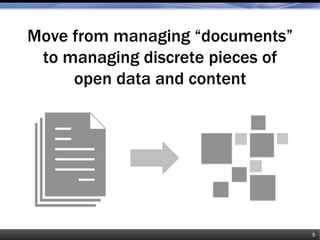
Move from managing “documents”
to managing discrete pieces of
open data and content
5
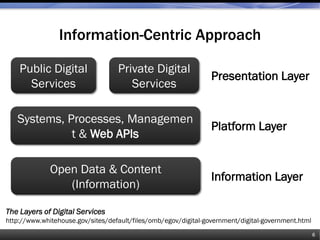
Information-Centric Approach
6
Presentation Layer
Platform Layer
Information Layer
Open Data & Content
(Information)
Systems, Processes, Managemen
t & Web APIs
Public Digital
Services
The Layers of Digital Services
http://www.whitehouse.gov/sites/default/files/omb/egov/digital-government/digital-government.html
Private Digital
Services
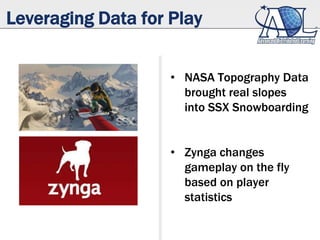
• NASA Topography Data
brought real slopes
into SSX Snowboarding
• Zynga changes
gameplay on the fly
based on player
statistics
Leveraging Data for Play
8
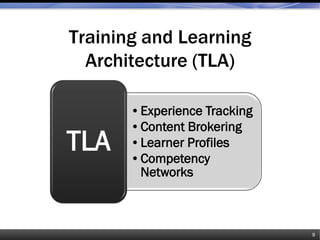
•Experience Tracking
•Content Brokering
•Learner Profiles
•Competency
Networks
TLA
Training and Learning
Architecture (TLA)
9
TLA Experience API
Web Service Specification &
Open Source Examples
10
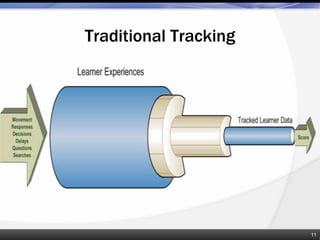
Traditional Tracking
11
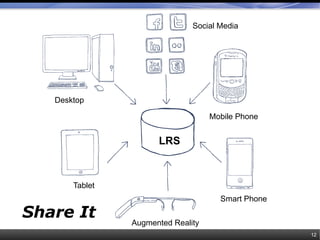
Share It
12
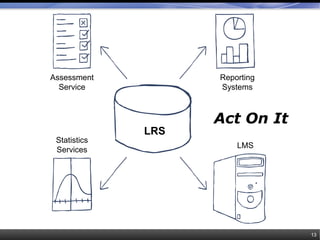
LRS
Desktop
Tablet
Social Media
Mobile Phone
Smart Phone
Augmented Reality
Act On It
13
Assessment
Service
Reporting
Systems
Statistics
Services
LMS
LRS
ADL Learning Record Store (LRS)
Open Source Software
14
https://github.com/adlnet/ADL_LRS
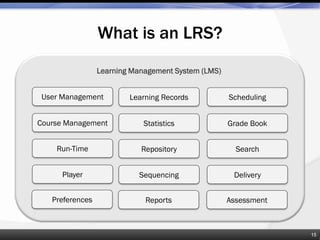
Learning Management System (LMS)
User Management
Course Management
Run-Time
Player
Scheduling
Grade Book
Search
Delivery
Learning Records
Statistics
Repository
Sequencing
Preferences AssessmentReports
What is an LRS?
15
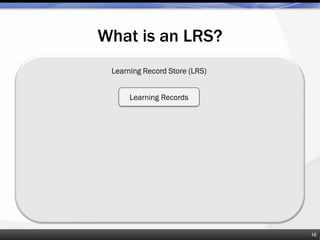
What is an LRS?
16
Learning Record Store (LRS)
Learning Records
Get Involved – Experience API
17
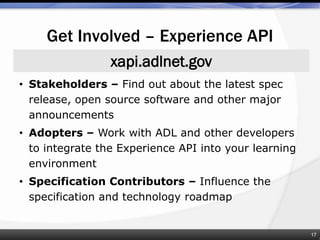
• Stakeholders – Find out about the latest spec
release, open source software and other major
announcements
• Adopters – Work with ADL and other developers
to integrate the Experience API into your learning
environment
• Specification Contributors – Influence the
specification and technology roadmap
xapi.adlnet.gov
Enabling Games and Virtual World
Learning Experiences
18
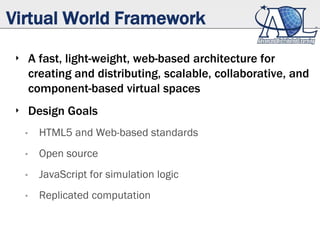
Virtual World Framework
‣ A fast, light-weight, web-based architecture for
creating and distributing, scalable, collaborative, and
component-based virtual spaces
‣ Design Goals
• HTML5 and Web-based standards
• Open source
• JavaScript for simulation logic
• Replicated computation
20
21
22
Enabling Mobile Learning
Experiences
23
Why Mobile?
“As part of this strategy, the delivery of
credible, rigorous, and relevant training
and education products through the
medium of hand held devices for the
individual Soldier provides the optimum
delivery mechanism for the future force.”
Army Learning Concept 2015
24
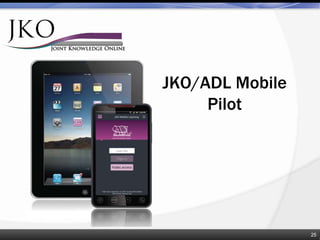
JKO/ADL Mobile
Pilot
25
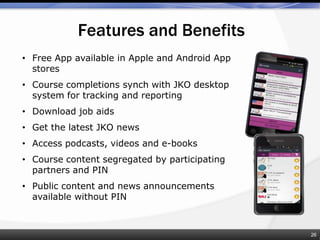
• Free App available in Apple and Android App
stores
• Course completions synch with JKO desktop
system for tracking and reporting
• Download job aids
• Get the latest JKO news
• Access podcasts, videos and e-books
• Course content segregated by participating
partners and PIN
• Public content and news announcements
available without PIN
Features and Benefits
26
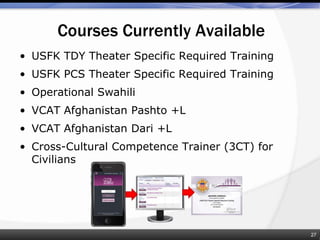
• USFK TDY Theater Specific Required Training
• USFK PCS Theater Specific Required Training
• Operational Swahili
• VCAT Afghanistan Pashto +L
• VCAT Afghanistan Dari +L
• Cross-Cultural Competence Trainer (3CT) for
Civilians
Courses Currently Available
27
• Continuing ADL/Partner lab coalition collaboration
– Best practices and lessons learned sharing
– Content sharing
• Expansion of content development
• Integration of Experience API
• Instructional strategies for mobile learning
• Guidance and best practices on mobile learning
development for the DoD community
JKO/ADL Mobile Pilot Way Forward
28
Mobile Training Implementation
Framework (MoTIF)
Produce examples, guidelines, and best
practices for designing mobile learning
29
http://motif.adlnet.gov
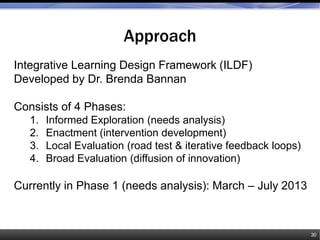
Approach
30
Integrative Learning Design Framework (ILDF)
Developed by Dr. Brenda Bannan
Consists of 4 Phases:
1. Informed Exploration (needs analysis)
2. Enactment (intervention development)
3. Local Evaluation (road test & iterative feedback loops)
4. Broad Evaluation (diffusion of innovation)
Currently in Phase 1 (needs analysis): March – July 2013
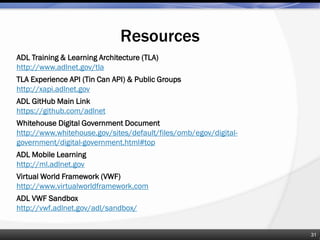
Resources
31
ADL Training & Learning Architecture (TLA)
http://www.adlnet.gov/tla
TLA Experience API (Tin Can API) & Public Groups
http://xapi.adlnet.gov
ADL GitHub Main Link
https://github.com/adlnet
Whitehouse Digital Government Document
http://www.whitehouse.gov/sites/default/files/omb/egov/digital-
government/digital-government.html#top
ADL Mobile Learning
http://ml.adlnet.gov
Virtual World Framework (VWF)
http://www.virtualworldframework.com
ADL VWF Sandbox
http://vwf.adlnet.gov/adl/sandbox/
32
Let’s Connect!
@damonregan
Damon Regan, Ph.D.
Technical Team Co-Lead
The Tolliver Group, Inc
damon.regan.ctr@adlnet.gov

Advanced Distributed Learning: Enabling Enhanced Learning Experiences

  • 1.
    Advanced Distributed Learning: EnablingEnhanced Learning Experiences Damon Regan, Ph.D. The Tolliver Group, Inc., supporting the ADL Initiative eLSE 2013
  • 2.
  • 3.
  • 4.
    How do weenable enhanced learning experiences? Unlock the power of data to spur innovation and improve quality 4
  • 5.
    Move from managing“documents” to managing discrete pieces of open data and content 5
  • 6.
    Information-Centric Approach 6 Presentation Layer PlatformLayer Information Layer Open Data & Content (Information) Systems, Processes, Managemen t & Web APIs Public Digital Services The Layers of Digital Services http://www.whitehouse.gov/sites/default/files/omb/egov/digital-government/digital-government.html Private Digital Services
  • 7.
    • NASA TopographyData brought real slopes into SSX Snowboarding • Zynga changes gameplay on the fly based on player statistics Leveraging Data for Play
  • 8.
  • 9.
    •Experience Tracking •Content Brokering •LearnerProfiles •Competency Networks TLA Training and Learning Architecture (TLA) 9
  • 10.
    TLA Experience API WebService Specification & Open Source Examples 10
  • 11.
  • 12.
    Share It 12 LRS Desktop Tablet Social Media MobilePhone Smart Phone Augmented Reality
  • 13.
  • 14.
    ADL Learning RecordStore (LRS) Open Source Software 14 https://github.com/adlnet/ADL_LRS
  • 15.
    Learning Management System(LMS) User Management Course Management Run-Time Player Scheduling Grade Book Search Delivery Learning Records Statistics Repository Sequencing Preferences AssessmentReports What is an LRS? 15
  • 16.
    What is anLRS? 16 Learning Record Store (LRS) Learning Records
  • 17.
    Get Involved –Experience API 17 • Stakeholders – Find out about the latest spec release, open source software and other major announcements • Adopters – Work with ADL and other developers to integrate the Experience API into your learning environment • Specification Contributors – Influence the specification and technology roadmap xapi.adlnet.gov
  • 18.
    Enabling Games andVirtual World Learning Experiences 18
  • 19.
    Virtual World Framework ‣A fast, light-weight, web-based architecture for creating and distributing, scalable, collaborative, and component-based virtual spaces ‣ Design Goals • HTML5 and Web-based standards • Open source • JavaScript for simulation logic • Replicated computation
  • 20.
  • 21.
  • 22.
  • 23.
  • 24.
    Why Mobile? “As partof this strategy, the delivery of credible, rigorous, and relevant training and education products through the medium of hand held devices for the individual Soldier provides the optimum delivery mechanism for the future force.” Army Learning Concept 2015 24
  • 25.
  • 26.
    • Free Appavailable in Apple and Android App stores • Course completions synch with JKO desktop system for tracking and reporting • Download job aids • Get the latest JKO news • Access podcasts, videos and e-books • Course content segregated by participating partners and PIN • Public content and news announcements available without PIN Features and Benefits 26
  • 27.
    • USFK TDYTheater Specific Required Training • USFK PCS Theater Specific Required Training • Operational Swahili • VCAT Afghanistan Pashto +L • VCAT Afghanistan Dari +L • Cross-Cultural Competence Trainer (3CT) for Civilians Courses Currently Available 27
  • 28.
    • Continuing ADL/Partnerlab coalition collaboration – Best practices and lessons learned sharing – Content sharing • Expansion of content development • Integration of Experience API • Instructional strategies for mobile learning • Guidance and best practices on mobile learning development for the DoD community JKO/ADL Mobile Pilot Way Forward 28
  • 29.
    Mobile Training Implementation Framework(MoTIF) Produce examples, guidelines, and best practices for designing mobile learning 29 http://motif.adlnet.gov
  • 30.
    Approach 30 Integrative Learning DesignFramework (ILDF) Developed by Dr. Brenda Bannan Consists of 4 Phases: 1. Informed Exploration (needs analysis) 2. Enactment (intervention development) 3. Local Evaluation (road test & iterative feedback loops) 4. Broad Evaluation (diffusion of innovation) Currently in Phase 1 (needs analysis): March – July 2013
  • 31.
    Resources 31 ADL Training &Learning Architecture (TLA) http://www.adlnet.gov/tla TLA Experience API (Tin Can API) & Public Groups http://xapi.adlnet.gov ADL GitHub Main Link https://github.com/adlnet Whitehouse Digital Government Document http://www.whitehouse.gov/sites/default/files/omb/egov/digital- government/digital-government.html#top ADL Mobile Learning http://ml.adlnet.gov Virtual World Framework (VWF) http://www.virtualworldframework.com ADL VWF Sandbox http://vwf.adlnet.gov/adl/sandbox/
  • 32.
    32 Let’s Connect! @damonregan Damon Regan,Ph.D. Technical Team Co-Lead The Tolliver Group, Inc damon.regan.ctr@adlnet.gov

Editor's Notes

  • #6 Move from managing “documents” to managing discrete pieces of open data and content which can be tagged, shared, secured, mashed up and presented in the way that is most useful for the consumer of that information
  • #7 The conceptual model for building a 21st century digital government is depicted in this slide. It also represents our conceptual model for enabling the learning applications we see the community wanting to build. The model acknowledges the three “layers” of digital services”The information layer contains digital information. It includes structured information (e.g., the most common concept of "data") such as learning experience data, plus unstructured information (e.g., content), such as field manuals and distributed learning content.The platform layer includes all the systems and processes used to manage and expose this information anytime, anywhere, and on any device.A web service or Web API (Application Programming Interface) is a method of communication between two electronic devices across the world wide web.The presentation layer  defines the manner in which information is organized and provided to customers. It represents the way the government and private sector deliver government information (e.g., data or content) digitally, whether through websites,16 mobile applications, or other modes of delivery.These three layers separate information creation from information presentation – allowing us to create content and data once, and then use it in different ways. In effect, this model represents a fundamental shift from the way our government provides digital services today.Why web services? Fueling the App EconomyThe City of San Francisco releases its raw public transportation data on train routes, schedules, and to-the-minute location updates directly to the public through web services. This has enabled citizen developers to write over 10 different mobile applications to help the public navigate San Francisco’s public transit systems—more services than the city could provide if it focused on presentation development rather than opening the data publicly through web services.The shared platform we envision for learning technology follows this information centric approach to enable the variety of learning applications that need to be created. Our projects focus on providing 1) open source software for managing data and content and 2) web API standards for exposing information to current and future applications. Open source software in R&D supports shaping the future of learning and the evolution from monolithic systems to information-centric approaches. Web API standards allow for commercial innovation on top of the open source software projects.
  • #9 More than learning management systems are used for learning and training. Ultimately informal and formal learning experiences will be integrated with LMSs, human resource systems, reporting systems, job placement systems, readiness indicator systems, etc for a comprehensive learning environment. The goal is to use systems that work well for a specific function and share data between these systems.Recommender system example for “learner preferences” instead of two or three user-entered preferences.
  • #10 ADL’s Training and Learning Architecture will be used to support the use cases described earlier in this presentation and more. TLA uses modern approaches already proven by other industries.TLA is split into two types of componentsWeb APIsOpen Source Software Relationship to SCORMSCORM is not going away.TLA can be used with SCORM or without SCORM, but they can complement one another.TLA components will covered in more detail later in this presentation.
  • #12 If we look at traditional e-learning, there is a lot that could be going on within the content. However, due to technological restrictions and lack of services to make sense of big data, we needed to boil things down to track it. The filter here takes the data flow and filters out only a couple trickles of data.
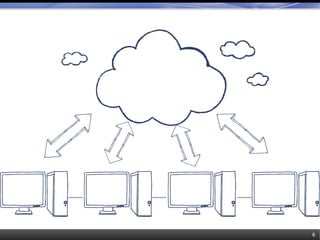
  • #13 The Experience API uses a technology called “Activity Streams” widely used by social media. An activity stream reads as a sentence, “Jonathan completed Information Assurance 101”. This statement is human readable, meaningful if printed on an interface, and is machine readable.The Experience API can be used to track data from any type of networked resource. This includes all of the resource types discussed at the beginning of this presentation: Mobile, Augmented reality, games, virtual worlds, etc.This was possible only with web-based content in the past. The xAPI opens up the type of content/experiences that can be used to anything that has a connection to a network.
  • #14 The Experience API uses a technology called “Activity Streams” widely used by social media. An activity stream reads as a sentence, “Jonathan completed Information Assurance 101”. This statement is human readable, meaningful if printed on an interface, and is machine readable.The Experience API can be used to track data from any type of networked resource. This includes all of the resource types discussed at the beginning of this presentation: Mobile, Augmented reality, games, virtual worlds, etc.This was possible only with web-based content in the past. The xAPI opens up the type of content/experiences that can be used to anything that has a connection to a network.
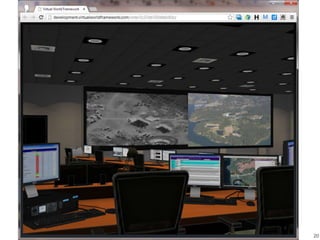
  • #20 Embrace HTML5 and web-based standardsExecute simulations on multiple platformsEnsure future compatibilityEnable integration with other technologiesEmbrace open source technologyAvoid vendor lock inLeverage the community of users to develop the platformNeed a feature or have an improvement? Build it! Submit it!Allow users to branch and modify the platform for their own needsUse JavaScript for simulation logicThere are millions of web developers in the world. It’s accessible and easy to learn.Performance is quickly improving, and is acceptable for may use casesDevelopment time is greatly reduced relative to other languagesModify simulation logic in real time, while the system runsUse ‘replicated computation’Run all logic on client machines. The architecture ensures synchronizationVery low server overhead. One server can run many simulations When an application is designed to use the VWF, the architecture automatically handles the replication and synchronization between clients, allowing the application to be shared by multiple users
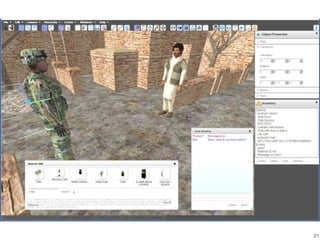
  • #21 A Virtual Collaborative Training Environment (VCTE)
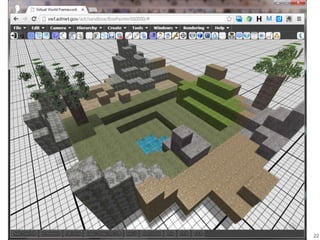
  • #22 ADL's sandbox application allows the user to create and edit their own environment. Be sure to check out some of the demo environments - you can reach them from the "Visit an Existing World" button.
  • #23 ADL's sandbox application allows the user to create and edit their own environment. Be sure to check out some of the demo environments - you can reach them from the "Visit an Existing World" button.
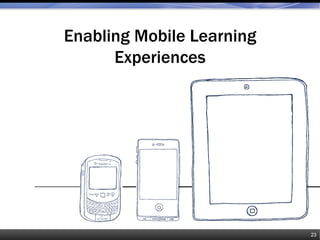
  • #24 Smartphones and tablets enable learning anytime and anywhereEfficient tools for performance supportSpaced learning – spacing effectExcellent opportunities for tailored content because of the context provided by a phone Phone and tablet-specific features - GPS Location, acceleration, etc Learning architecture data – Previous course history, preferences, learning style, etc
  • #26 JKO: The DoD unique and authoritative distributed learning training platform, leveraging technology to deliver, track and report training where other traditional training methods may not be cost effective or efficient. ADL: The DoD Office of the Deputy Assistant Secretary of Defense (Readiness) initiative to harness the power of learning and information technologies to standardize and improve education and training.History:Initiated with FY11-FY12 OSD AT&L Coalition Warfare Program (CWP) project.CWP Mobile Learning Environment (MoLE) project was sponsored to create a mobile medical application.Approximately 24 partner nations involved.Joint Staff J7 (Joint Knowledge Online) was the technology and transition lead for the MoLE project.CWP projects must result with transition of the capability to DoD and coalition partners.The CWP MoLE project transitioned into two applications:1. The Global MedAid App - Worldwide medical use, including civilian medical community2. The JKO Mobile Hybrid App – joint and coalition military training
  • #30 a recurring subject, theme, idea, etc.a distinctive and recurring form, shape, figure, etc., in a designa dominant idea or feature
  • #31 Focus Ares for MoTIF:Mobile Learning development guidelines (for IDs, training developers, learning technologists)Experience API JavaScript wrapper and prototypeExperience API design implications for mobileInformal learningSpaced learningLeveraging sensorsWhat SCORM functionality is needed?Status, score, progress, time, bookmarkingGlobal objectives to enable course completion sync / equivalent between desktop & mobile