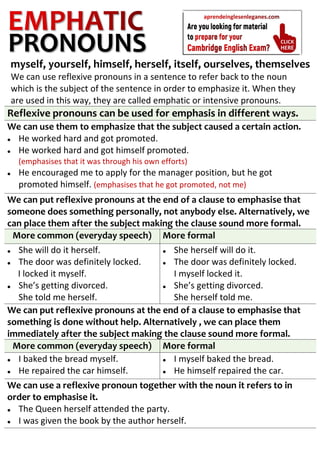
myself, yourself, himself, herself, itself, ourselves, themselves
We can use reflexive pronouns in a sentence to refer back to the noun
which is the subject of the sentence in order to emphasize it. When they
are used in this way, they are called emphatic or intensive pronouns.
Reflexive pronouns can be used for emphasis in different ways.
We can use them to emphasize that the subject caused a certain action.
 He worked hard and got promoted.
 He worked hard and got himself promoted.
(emphasises that it was through his own efforts)
 He encouraged me to apply for the manager position, but he got
promoted himself. (emphasises that he got promoted, not me)
We can put reflexive pronouns at the end of a clause to emphasise that
someone does something personally, not anybody else. Alternatively, we
can place them after the subject making the clause sound more formal.
More common (everyday speech) More formal
 She will do it herself.
 The door was definitely locked.
I locked it myself.
 She’s getting divorced.
She told me herself.
 She herself will do it.
 The door was definitely locked.
I myself locked it.
 She’s getting divorced.
She herself told me.
We can put reflexive pronouns at the end of a clause to emphasise that
something is done without help. Alternatively , we can place them
immediately after the subject making the clause sound more formal.
More common (everyday speech) More formal
 I baked the bread myself.
 He repaired the car himself.
 I myself baked the bread.
 He himself repaired the car.
We can use a reflexive pronoun together with the noun it refers to in
order to emphasise it.
 The Queen herself attended the party.
 I was given the book by the author herself.

REFLEXIVE PRONOUNS FOR EMPHASIS.pdf

  • 1.
    myself, yourself, himself,herself, itself, ourselves, themselves We can use reflexive pronouns in a sentence to refer back to the noun which is the subject of the sentence in order to emphasize it. When they are used in this way, they are called emphatic or intensive pronouns. Reflexive pronouns can be used for emphasis in different ways. We can use them to emphasize that the subject caused a certain action.  He worked hard and got promoted.  He worked hard and got himself promoted. (emphasises that it was through his own efforts)  He encouraged me to apply for the manager position, but he got promoted himself. (emphasises that he got promoted, not me) We can put reflexive pronouns at the end of a clause to emphasise that someone does something personally, not anybody else. Alternatively, we can place them after the subject making the clause sound more formal. More common (everyday speech) More formal  She will do it herself.  The door was definitely locked. I locked it myself.  She’s getting divorced. She told me herself.  She herself will do it.  The door was definitely locked. I myself locked it.  She’s getting divorced. She herself told me. We can put reflexive pronouns at the end of a clause to emphasise that something is done without help. Alternatively , we can place them immediately after the subject making the clause sound more formal. More common (everyday speech) More formal  I baked the bread myself.  He repaired the car himself.  I myself baked the bread.  He himself repaired the car. We can use a reflexive pronoun together with the noun it refers to in order to emphasise it.  The Queen herself attended the party.  I was given the book by the author herself.