Objectives
At the endof this lecture students will be able to:
• Define reflection, reflective and journal writing.
• Define Reflective learning and discuss process of reflective
learning.
• Define and Describe ERA, Gibbs reflective cycle, Borton’s
development framework, John’s Model & ORID model
• Discuss 6 features of reflective writing using Gibbs model.
3.
Reflection
• Reflection isan important human activity in which people recapture
their experience, think about it, ponder over & evaluate it. It is
working with experience that is important in learning’.
OR
• “Reflection is an essential phase in the learning process whereby
people explore their experiences in a conscious manner in order to
acquire new understandings and new behaviour patterns.” (Professor
Peter Jarvis ,1987).
• Reflective practice is "the capacity to reflect on action so as to
engage in a process of continuous learning
4.
Reflection
• Usually comesat the end, should look back on your experience and
reflect on it.
• Feelings and reactions will be there in reflection and understand WHY
you behaved the way you did.
• Experience which leads to decisions.
• Looking at experience from another point of view.
• Critical analysis and evaluation of knowledge and skills.
5.
Reflective Expressions Phrases
Examples
•But now as I look back….
• Remembering makes me feel …
• This reminds me of …
• Remembering this has made me realize…
• Now I understand why I felt that way …
6.
Personal Writing
• Willprobably be a memory of something that has happened
to you.
• Will include thoughts and feelings
• Written in 1st person
7.
Reflective Writing
• Accordingto Gravett, (2001), “reflective writing is a practice
in which the writer describes a real or imaginal scene, event,
interaction”.
• Describe, Express feelings about your reaction of personal
experience.
• Tell the reader how you felt – before / during/afterwards.
8.
Critical Reflection
• Thinkabout an experience or event that revealed an area of concern
(Boyed & Fales, 1983; Baker, 1996)
• E.g. nursing student making a clinical error
• Lack of knowledge about a disease
• Personal assumption or bias towards a patient
• Learn about yourself, your gaps in knowledge, assumptions and
biases and thought processes.
• Adopting to new knowledge through personal growth and change .
9.
Critical Reflection
Reflection:
Informal &Formal
Informal Reflection
• Involves self- questioning
• Develops our awareness of our own assumptions(true without
proof)
Formal Reflection
• Draws on research & theory
• Provides guidance & frameworks for practice.
10.
What Is ReflectiveLearning?
• Reflective learning is a learned process that requires time and practice.
• It is an active process involving thinking through the issues yourself, asking
questions and seeking out relevant information to aid your understanding .
• Reflective learning works best when you think about what you
are doing before, during and after your learning experience.
• Reflective learning is not only about recognizing something new, it is also to
see reality in a new way.
• Reflection is an important skill to develop and requires you to think about
how you are personally relating to what is happening in the learning
environment.
11.
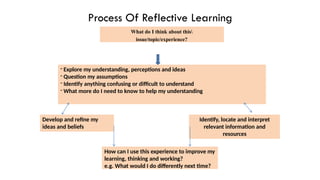
Process Of ReflectiveLearning
What do I think about this
issue/topic/experience?
- Explore my understanding, perceptions and ideas
- Question my assumptions
- Identify anything confusing or difficult to understand
- What more do I need to know to help my understanding
Develop and refine my
ideas and beliefs
Identify, locate and interpret
relevant information and
resources
How can I use this experience to improve my
learning, thinking and working?
e.g. What would I do differently next time?
12.
What Should YouWrite About?
• What do you think about issues discussed at the learning
event?
• What do you understand so far?
• How can you reach a better understanding?
• What do you need to know more about, and how can you
go about finding out more?
• What resources have helped you to understand and/or
been interesting to use?
13.
Cont…
• How doyou feel about the way you have approached the
subject/topic so far?
• Have you changed your opinions or values during
process/experience?
• How can you improve your learning, thinking and working
in the future?
• Have you identified the next step for your development?
14.
Models or Frameworksof Reflection
• Models OR frameworks for reflection, encourage a structured process to
guide the act of reflection.
• There is no right model.
• Often it is appropriate to use one model of reflection as a basis, but use
prompt questions from other models if they best fit your particular situation.
•Common models
• Kolb’s
• Gibbs'
• Johns'
• Driscoll (by Borton)
• ORID
David A. Kolb’sExperiential Cycle (Kolb
1984)
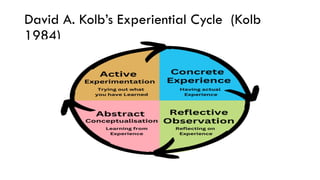
• CONCRETE EXPERIENCE:
• You consciously and physically experience a situation, which makes you
realise that you need to reflect systematically in order to learn
something new or improve on your existing skill and practice. At this
stage you will make a note of the specific situation and just describe
what you see, how you feel and what you think.
17.
David A. Kolb’sExperiential Cycle (Kolb
1984)
• REFLECTIVE OBSERVATION:
• Having written down the description of the experience, it is now time to
reflect more deeply on what has happened in that situation. The
questions you need to ask yourself are: what worked? What failed?
Why did the situation arise? Why did others and I behave the way we
did?
18.
David A. Kolb’sExperiential Cycle (Kolb
1984)
• Abstract conceptualisation:
• The guiding question for this stage leads on from the questions in the reflective
observation stage: what could I have done better or differently? How can I
improve? Initially, you try to find different ways for dealing with the situations
and think up strategies for when you experience a similar situation again. Also,
this is the stage where you should consult colleagues and literature in order to
get a better understanding and further ideas.
19.
David A. Kolb’sExperiential Cycle (Kolb
1984)
• Active experimentation:
• This stage is now practising the newly acquired theoretical knowledge. You
take your own reflections and thoughts about improvements as well as the
theories back into your practice and try out the new strategies. Some of them
will work, others won’t, so this is then automatically the basis for the new cycle.
As the experiences within the active experimentation stage become the new
“concrete experiences”.
20.
GIBBS' MODEL
• GrahamGibbs developed his reflective cycle (Gibbs 1988) based
upon each stage of David
• A. Kolb’s experiential cycle (Kolb 1984).
• Full structured analysis of a situation
• Most commonly used model by health care professionals
21.
JOHNS' MODEL
• ChristopherJohns designed his model for structured reflection
(Johns 2006) through analyzing the dialogue between practitioners
and their supervisors .
• Johns used Barbara Carper’s patterns of knowing in his model
(Carper 1978) which includes the following:
• Aesthetics (the art of what we do)
• Personal (self awareness)
• Ethics (moral knowledge)
• Empirics (scientific knowledge)
22.
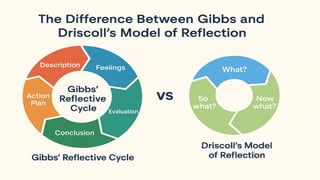
DRISCOLL (BY BORTON)
•Terry Borton’s (1970) 3 stem questions: 'were developed by John Driscoll in
1994, 2000 and 2007.
• 1. What?
• 2. So What?
• 3. Now What?
•This is a description of the event. Trigger questions: What…
•… is the purpose of returning to this situation?
•… what happened?
•… did other people do who were involved in this?
•… did I see/do?
•… was my reaction to it
23.
Cont…..
• Trigger questions:
•Sowhat…
•What did I feel at the time of the event? Is there any change in my feelings now?
•Is there anyone who can help me to reflect on my practice? Were those feelings I had different
from other people?
•Trigger questions: Now what…
• Are the implications for me and others in clinical practice based on what I have described and
analyzed?
•Is the main learning that I take from reflecting on my practice in this way?
•Help do I need to help me 'action' the results of my reflections?
•…aspect should be tackled first?
•How can I modify my practice if a similar situation arises again? How will I notice that I am any
different in clinical practice?
24.
Layers of Reflection- Exercise
• Reflection involves describing, analyzing and
• evaluating our thoughts, assumptions, beliefs,
• theory base and actions.
25.
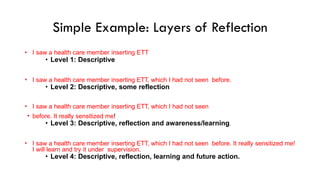
Simple Example: Layersof Reflection
• I saw a health care member inserting ETT
• Level 1: Descriptive
• I saw a health care member inserting ETT, which I had not seen before.
• Level 2: Descriptive, some reflection
• I saw a health care member inserting ETT, which I had not seen
• before. It really sensitized me!
• Level 3: Descriptive, reflection and awareness/learning.
• I saw a health care member inserting ETT, which I had not seen before. It really sensitized me!
I will learn and try it under supervision.
• Level 4: Descriptive, reflection, learning and future action.
26.
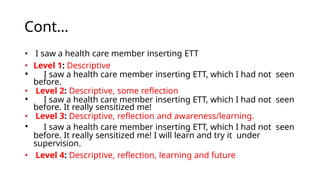
Cont…
• I sawa health care member inserting ETT
• Level 1: Descriptive
• I saw a health care member inserting ETT, which I had not seen
before.
• Level 2: Descriptive, some reflection
• I saw a health care member inserting ETT, which I had not seen
before. It really sensitized me!
• Level 3: Descriptive, reflection and awareness/learning.
• I saw a health care member inserting ETT, which I had not seen
before. It really sensitized me! I will learn and try it under
supervision.
• Level 4: Descriptive, reflection, learning and future
27.
•Objective: discuss yourconcrete experience
• What did you do, observe, read, and hear?
• Who was involved?
• What was said?
ORID Model
28.
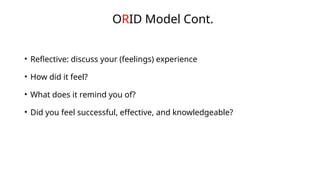
• Reflective: discussyour (feelings) experience
• How did it feel?
• What does it remind you of?
• Did you feel successful, effective, and knowledgeable?
ORID Model Cont.
29.
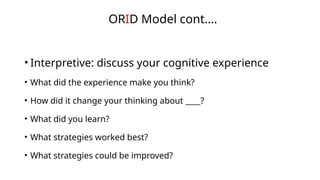
• Interpretive: discussyour cognitive experience
• What did the experience make you think?
• How did it change your thinking about ____?
• What did you learn?
• What strategies worked best?
• What strategies could be improved?
ORID Model cont.…
30.
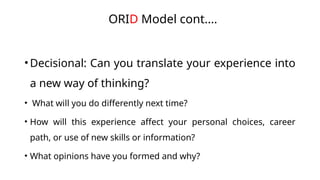
•Decisional: Can youtranslate your experience into
a new way of thinking?
• What will you do differently next time?
• How will this experience affect your personal choices, career
path, or use of new skills or information?
• What opinions have you formed and why?
ORID Model cont.…
31.
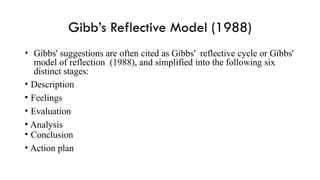
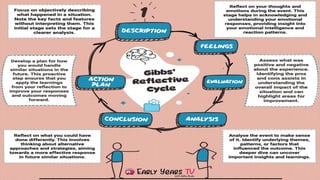
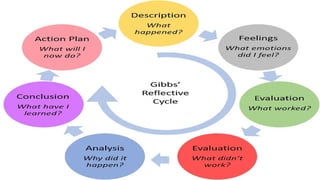
Gibb’s Reflective Model(1988)
• Gibbs' suggestions are often cited as Gibbs' reflective cycle or Gibbs'
model of reflection (1988), and simplified into the following six
distinct stages:
• Description
• Feelings
• Evaluation
• Analysis
• Conclusion
• Action plan
35.
Gibb’s Reflective Model
•Description:
•"What happened? Don't make judgments yet or try to draw conclusions; simply describe.
•Feelings:
• "What were your reactions and feelings? Again, don't move on to analyzing these yet."
•Evaluation:
• "What was good or bad about the experience? Make value judgments.
•Analysis:
• "What sense can you make of the situation? Bring in ideas from outside the experience to
help you.“
• "What was really going on?" • "Were different people's experiences similar or different in
important ways?"
•Conclusions:
• "What can be concluded from these experiences and the analysis you have undertaken?
•Personal Action Plans:
• "What are you going to do differently in this type of situation next time?"
• "What steps are you going to take on the basis of what you have learnt?
36.
1. Reason ofwriting
- Deliberate and purposeful – commit self to identify learning.
Features Of Reflective Writing
2. Writing can help us to order our thoughts
• Impose some order in the content
• Prioritize and identify what is important
• Force to acknowledge issues that may be ignored
• Put hierarchical order to issues
37.
3. The purposeof creating a permanent record
• Provides a fuller picture of what has going on.
• Can not forget or ignore events.
4. Creativity through writing
• May lead to creative thinking, where actions are not only justified and
defended, but development of new understandings and perspectives
are achieved or understanding of past situations are seen by different
dimensions.
38.
5. Using writingto develop logical skills
• Logical reasoning, logical skills.
6. Using writing to develop critical thinking
• Critical thinking – involves problem solving, reasoning,
considering opposing viewpoints and an attitude of enquiry.
Journal Writing
• Journalwriting is a powerful and versatile activity that can serve
various purposes, from personal reflection and emotional
processing to academic and professional development.
• Journal writing, also called journaling, in simple words is an
informal way of writing or a method of penning down emotions,
experiences, thoughts, events, etc.
• It can be a written or a typed medium of records where the person
pens down the thoughts, observations, experiences, etc.
• This can be written on a daily or periodic basis, or when there is an
urge to write. It can be a record of anything and everything.
40
41.
Benefits of JournalWriting
• Emotional Health:
• Stress Relief: Writing about thoughts and feelings can help
reduce stress by providing a healthy outlet for emotions.
• Emotional Clarity: It allows individuals to explore and
understand their emotions more deeply, often leading to
greater self-awareness.
• Mood Enhancement: Regularly journaling can boost mood
and overall emotional well-being.
• Communication Skills:
• Writing Skills: Regular writing practice can improve overall
writing skills.
• Expressiveness: It can enhance one’s ability to articulate
thoughts and emotions clearly.
41
42.
Benefits of JournalWriting
• Mental Health:
• Cognitive Processing: Journaling can improve cognitive functions
like memory and comprehension.
• Problem-Solving: It helps in organizing thoughts, which can lead to
better problem-solving abilities.
• Self-Discipline: The regular practice of journaling can enhance self-
discipline and goal-setting capabilities.
• Personal Growth:
• Self-Discovery: It is a tool for self-reflection, helping individuals
discover their values, beliefs, and desires.
• Goal Achievement: Journaling can help track progress towards goals
and maintain motivation.
• Creativity: It encourages creativity by providing a space for free
expression without judgment.
42
43.
Types of Journals
•Personal Journal: Focuses on daily events, thoughts, and
feelings. It’s often used for emotional and mental clarity.
• Travel Journal: Captures experiences, thoughts, and
memories from travels. It can include descriptions of places,
people, and activities.
• Dream Journal: Records dreams and their potential
meanings. This can help in understanding subconscious
thoughts and emotions.
• Gratitude Journal: Lists things the writer is thankful for,
promoting a positive outlook on life.
• Bullet Journal: Combines planning, to-do lists, and diary
entries. It’s a highly customizable organizational tool.
43
44.
Types of Journals
•Art Journal: Includes sketches, drawings, and other
artistic expressions along with or instead of text.
• Academic Journal: Used by students to reflect on
their learning experiences and academic progress.
• Professional Journal: Helps professionals track their
career development, project progress, and
professional goals.
44
45.
Tips for EffectiveJournal Writing
• Consistency: Write regularly, whether daily or weekly, to
build the habit and gain the most benefits.
• Honesty: Be truthful and open in your entries. This is a
private space for genuine self-expression.
• No Rules: Allow yourself the freedom to write without
worrying about grammar, spelling, or structure.
• Prompt Usage: Use writing prompts if you’re stuck. Prompts
can inspire new thoughts and directions.
• Review: Occasionally review past entries to reflect on your
progress and patterns in your thoughts and behavior.
45
46.
Tips for EffectiveJournal Writing
• Privacy: Ensure your journal is kept in a secure
place to maintain your privacy.
• Flexibility: Allow yourself to experiment with
different types of journals and writing styles to see
what works best for you.
• Supplement with Other Media: Incorporate
drawings, photos, or clippings to enhance your
journal entries.
46
47.
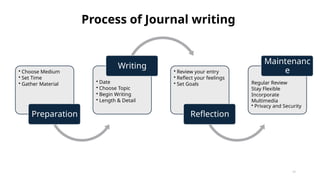
Process of Journalwriting
• Choose Medium
• Set Time
• Gather Material
Preparation
• Date
• Choose Topic
• Begin Writing
• Length & Detail
Writing • Review your entry
• Reflect your feelings
• Set Goals
Reflection
Regular Review
Stay Flexible
Incorporate
Multimedia
• Privacy and Security
Maintenanc
e
47
48.
Process of JournalWriting
• Journal writing is a personal and flexible process that can be
tailored to individual preferences and goals.
Step-by-Step Guide to Journal Writing
1. Preparation
• Choose Your Medium:
• Physical Journal: Select a notebook or diary that you like.
The physical act of writing can be therapeutic for some
people.
• Digital Journal: Use a computer, tablet, or smartphone with
a word processor or a dedicated journaling app. Digital
journals offer convenience and can include multimedia
elements.
48
49.
Process of JournalWriting
• Set Aside Time:
• Dedicate a specific time each day or week for journaling.
Consistency helps in making journaling a habit.
• Choose a quiet and comfortable place where you can
write without distractions.
• Gather Materials:
• For physical journals, have pens, pencils, and any other
preferred writing tools.
• For digital journals, ensure your device is charged and
any necessary software is installed.
50.
Process of JournalWriting
2. Writing
• Start with a Date:
• Begin each entry with the date. This helps in keeping track
of your entries chronologically.
• Choose a Topic or Prompt:
• Free Writing: Write about whatever comes to mind without
a specific topic. This can be a stream of consciousness style.
• Prompts: Use writing prompts to guide your entries.
Prompts can be questions, quotes, or specific themes (e.g.,
"What am I grateful for today?").
50
51.
Process of JournalWriting
• Begin Writing:
• Write honestly and openly. Don’t worry about grammar,
spelling, or punctuation. The goal is to express yourself freely.
• Focus on your thoughts, feelings, and experiences. Describe
events, reflect on emotions, and explore ideas.
• Length and Detail:
• Write as much or as little as you feel necessary. Some days
you might write a few sentences, while other days you might
fill several pages.
• Include details that are meaningful to you, such as sensory
experiences, dialogues, and reflections.
52.
Process of JournalWriting
3. Reflection
• Review Your Entry:
• After writing, read through your entry. This can help in
processing your thoughts and gaining insights.
• Highlight or underline key points or recurring themes.
52
53.
Process of Journalwriting
• Reflect on Your Feelings:
• Consider how writing the entry made you feel. Did it
provide relief, clarity, or new perspectives?
• Set Intentions or Goals:
• Use your reflections to set intentions or goals. For
example, if you wrote about a challenging situation,
consider how you might address it going forward.
54.
Process of Journalwriting
4. Maintenance
• Regular Review:
• Periodically review past entries to observe patterns,
progress, and changes over time. This can provide
valuable insights into your personal growth.
• Stay Flexible:
• Allow yourself to adapt your journaling practice as
needed. If you find a particular method or prompt more
effective, incorporate it more regularly.
55.
Process of Journalwriting
• Incorporate Multimedia:
• Enhance your journal with photos, drawings, clippings,
or other media that are relevant to your entries.
• Privacy and Security:
• Ensure your journal is kept private. For physical journals,
store them in a secure place. For digital journals, use
passwords or encryption if needed.
56.
References
• Jarvis, P.(1987). Adult learning in the social context. Croom Helm.
• Gravett, S. (2001). Teaching, learning and reflective practice. The
Journal of Higher Education, 72(2), 160–183.
• Baker, C. R. (1996). Reflection and the development of clinical
expertise in occupational therapy. British Journal of Occupational
Therapy, 59(6), 263–268.
• Boyd, E. M., & Fales, A. W. (1983). Reflective learning: Key to learning
from experience. Journal of Humanistic Psychology, 23(2), 99–117.
• Gibbs, G. (2013). Learning by doing: A guide to teaching and learning
methods. Oxford Centre for Staff and Learning Development.
(Original work published 1988).
• Johns, C. (1995). Framing learning through reflection within Carper’s
fundamental ways of knowing in nursing. Journal of Advanced
Nursing, 22(2), 226–234.
57.
References
• Borton, T.(1970). Reach, touch, and teach: Student concerns and
process education. McGraw-Hill.
• Driscoll, J. (1994). Reflective practice for practice. Senior Nurse, 13(7),
47–50.
• Stanfield, B. R. (2000). The art of focused conversation: 100 essential rules. New
Society Publishers.
• Coughlan, A (2007-08). Reflective learning: keeping a reflective, learning journal.
DCU Student Learning Resources. (p.1-4)
• https://www.dcu.ie/sites/default/files/students/Reflectiv elearning.pdf Retrieved on
13/10/2020
• Özkahraman, Yildirim, B. An Overview of Critical Thinking in Nursing and
Education. American International Journal of Contemporary Research
• http://www.brainyquote.com/quotes/keywords/ref lectio n.html Retrieved on
13/10/2020



![reflection. chapter number#4 [autosaved]](https://cdn.slidesharecdn.com/ss_thumbnails/reflection-260202070717-4095125f-thumbnail.jpg?width=640&height=640&fit=bounds)


