The ethical library worker
Yvonne Morris
Policy Manager, CILIP
• Background to the review
• Methodology
• Marshalling the evidence
• Key findings
• Reworking and refreshing the ethical framework
• Presenting the new ethical framework!
• Next steps
CILIP’s mandate
• Royal Charter mandates CILIP to “represent and act as the
professional body for persons working in or interested in library
and information services”
• Mandate extends to maintenance of a Professional Knowledge
and Skills Base (PKSB) on behalf of the sector. Ethical Principles
and Code of Professional Practice at its heart
Trusted
professionals
Responding to a rapidly changing
profession
• Library & information profession changing rapidly and significantly in
response to digital disruption and wider trends, such as:
• Speed of new technological developments
• Growth of big data
• The rise of the “digital citizen”
• Funding
• Regulation
• Changing communities
• Embedded workforce
• This recognition prompted the need to review our ethical principles
Ethics Review
• Review launched in July 2017
• Overseen by CILIP’s Ethics
Committee, chaired by Dawn Finch
• New Framework approved by
CILIP Board in September 2018
• Framework launched October 2018
Examining the key issues
• How professional ethics are currently operating within the profession
• How aware the profession is of the ethical principles
• The extent to which the principles reflect the wider range of professional
contexts
• Whether the principles play an active and positive role in the development
of the profession
• The interaction between professional ethics of individuals and institutional
ethics
Methodology
• Big Conversation on social media
• Survey - 1556 responses
• 12 workshops all over the UK
• Ethics Summit
Marshalling the evidence
• Landscape of major workplace and professional issues expressed in the
surveys, workshops and social media
• Digest of comments on each of the 12 ethical principles
• Segmented analysis:
• Age, gender, disability, ethnicity, sexuality
• Level and sector
Key findings
• 89% survey respondents have values and ethical principles they
wish to see upheld within the information profession
• Values built up through a personal code or from the CILIP’s
Ethical Principles and Code of Professional Practice
Work-based issues
• Privacy
• Censorship
• Funding
• Copyright
• Volunteers
• Barriers to accessing information
• Standards and skills
• Employment related issues
77% respondents thought a professional ethical framework should
help in addressing these issues
Ethics Summit
Top level ethical framework presented to summit participants.
They recommended:
• Streamlined ethical principles
• Reordering so priorities could become clearer
• Greater clarification of key elements
• Further explanatory materials and supporting documents
Intended outcomes of the project
• Increased awareness of, and engagement with the ethical
principles by library and information professionals
• Increased relevance and applicability across a wide range of
sectors
• Clarify the role of CILIP as steward of the principles on behalf of
the profession
• Consider the role of sanctions for violations of the principles
A majority of these outcomes and deliverables have been
achieved!
New ethical framework: design
principles
• Fewer
• Shorter
• More direct language
• Easy to remember
• Build on existing principles – continuity
• Include important values even if not prominent in consultation
• Beware of fashion – enduring values
• Explicit commitment of individual information professionals
• Framework to support professional judgment when tackling difficult
issues
New ethical framework: what’s
changed?
• Fewer principles using more direct language
• Express commitment from individual information
professionals
• New ethical principle on information literacy
• Shorter Code of Professional Conduct
• New section expressing CILIP commitments
Commitment to Professional Ethics by
CILIP Members
As an ethical Information Professional I make a commitment
to uphold, promote and defend:
• Human rights, equalities and diversity, and the equitable treatment of users
and colleagues
• The public benefit and the advancement of the wider good of our profession
to society
• Preservation and continuity of access to knowledge
• Intellectual freedom, including freedom from censorship
• Impartiality and the avoidance of inappropriate bias
• The confidentiality of information provided by clients or users and the right of
all individuals to privacy
• The development of information skills and information literacy
Code of Professional Conduct
At all times I will work to uphold and advance:
• The reputation of the profession
• The currency and relevancy of my skills
• Engagement with, and learning from, colleagues, my
professional bodies, and those in other related professions
• Integrity in the management of information, human and
financial resources
CILIP’s Commitments
I expect my professional body to support me in this by upholding
promoting and defending:
• Human rights
• Equalities and diversity
• Information governance and practice that protects the privacy of
individuals
• The value of information professionals’ work to government, employers
and other key stakeholders
• The contribution of information professionals to the public benefit
• The provision of excellent information services, relevant to the needs of all
members of society
• The development of balanced and fair open access and copyright systems
Continued…
CILIP’s Commitments continued
And by advocating for:
• Changes to regulation and legislation to advance good information services
and ethical practice
• Intellectual freedom, including freedom from censorship
And by supporting:
• CILIP members in their continuing professional development
CILIP will act as steward of the Ethical Framework and support its
embedding in professional life
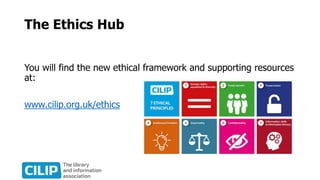
The Ethics Hub
You will find the new ethical framework and supporting resources
at:
www.cilip.org.uk/ethics
Next steps…
Thank you!
Over to you….
Commitment to Professional Ethics by
CILIP Members
As an ethical Information Professional I make a commitment
to uphold, promote and defend:
• Human rights, equalities and diversity, and the equitable treatment of users
and colleagues
• The public benefit and the advancement of the wider good of our profession
to society
• Preservation and continuity of access to knowledge
• Intellectual freedom, including freedom from censorship
• Impartiality and the avoidance of inappropriate bias
• The confidentiality of information provided by clients or users and the right of
all individuals to privacy
• The development of information skills and information literacy
1. Concern for the public good in all professional matters, including respect for diversity
within society, and the promoting of equal opportunities and human rights.
2. Concern for the good reputation of the information profession.
3. Commitment to the defence, and the advancement, of access to information, ideas and
works of the imagination.
4. Provision of the best possible service within available resources.
5. Concern for balancing the needs of actual and potential users and the reasonable
demands of employers.
6. Equitable treatment of all information users.
7. Impartiality, and avoidance of inappropriate bias, in acquiring and evaluating information
and in mediating it to other information users.
8. Respect for confidentiality and privacy in dealing with information users.
9. Concern for the conservation and preservation of our information heritage
in all formats.
10. Respect for, and understanding of, the integrity of information items and for the
intellectual effort of those who created them.
11. Commitment to maintaining and improving personal professional knowledge, skills and
competences.
12. Respect for the skills and competences of all others, whether information professionals
or information users, employers or colleagues.
The previous ethical principles

The Ethical Library Worker

  • 1.
    The ethical libraryworker Yvonne Morris Policy Manager, CILIP
  • 2.
    • Background tothe review • Methodology • Marshalling the evidence • Key findings • Reworking and refreshing the ethical framework • Presenting the new ethical framework! • Next steps
  • 3.
    CILIP’s mandate • RoyalCharter mandates CILIP to “represent and act as the professional body for persons working in or interested in library and information services” • Mandate extends to maintenance of a Professional Knowledge and Skills Base (PKSB) on behalf of the sector. Ethical Principles and Code of Professional Practice at its heart
  • 4.
  • 5.
    Responding to arapidly changing profession • Library & information profession changing rapidly and significantly in response to digital disruption and wider trends, such as: • Speed of new technological developments • Growth of big data • The rise of the “digital citizen” • Funding • Regulation • Changing communities • Embedded workforce • This recognition prompted the need to review our ethical principles
  • 6.
    Ethics Review • Reviewlaunched in July 2017 • Overseen by CILIP’s Ethics Committee, chaired by Dawn Finch • New Framework approved by CILIP Board in September 2018 • Framework launched October 2018
  • 7.
    Examining the keyissues • How professional ethics are currently operating within the profession • How aware the profession is of the ethical principles • The extent to which the principles reflect the wider range of professional contexts • Whether the principles play an active and positive role in the development of the profession • The interaction between professional ethics of individuals and institutional ethics
  • 8.
    Methodology • Big Conversationon social media • Survey - 1556 responses • 12 workshops all over the UK • Ethics Summit
  • 9.
    Marshalling the evidence •Landscape of major workplace and professional issues expressed in the surveys, workshops and social media • Digest of comments on each of the 12 ethical principles • Segmented analysis: • Age, gender, disability, ethnicity, sexuality • Level and sector
  • 10.
    Key findings • 89%survey respondents have values and ethical principles they wish to see upheld within the information profession • Values built up through a personal code or from the CILIP’s Ethical Principles and Code of Professional Practice
  • 11.
    Work-based issues • Privacy •Censorship • Funding • Copyright • Volunteers • Barriers to accessing information • Standards and skills • Employment related issues 77% respondents thought a professional ethical framework should help in addressing these issues
  • 12.
    Ethics Summit Top levelethical framework presented to summit participants. They recommended: • Streamlined ethical principles • Reordering so priorities could become clearer • Greater clarification of key elements • Further explanatory materials and supporting documents
  • 13.
    Intended outcomes ofthe project • Increased awareness of, and engagement with the ethical principles by library and information professionals • Increased relevance and applicability across a wide range of sectors • Clarify the role of CILIP as steward of the principles on behalf of the profession • Consider the role of sanctions for violations of the principles A majority of these outcomes and deliverables have been achieved!
  • 14.
    New ethical framework:design principles • Fewer • Shorter • More direct language • Easy to remember • Build on existing principles – continuity • Include important values even if not prominent in consultation • Beware of fashion – enduring values • Explicit commitment of individual information professionals • Framework to support professional judgment when tackling difficult issues
  • 15.
    New ethical framework:what’s changed? • Fewer principles using more direct language • Express commitment from individual information professionals • New ethical principle on information literacy • Shorter Code of Professional Conduct • New section expressing CILIP commitments
  • 16.
    Commitment to ProfessionalEthics by CILIP Members As an ethical Information Professional I make a commitment to uphold, promote and defend: • Human rights, equalities and diversity, and the equitable treatment of users and colleagues • The public benefit and the advancement of the wider good of our profession to society • Preservation and continuity of access to knowledge • Intellectual freedom, including freedom from censorship • Impartiality and the avoidance of inappropriate bias • The confidentiality of information provided by clients or users and the right of all individuals to privacy • The development of information skills and information literacy
  • 17.
    Code of ProfessionalConduct At all times I will work to uphold and advance: • The reputation of the profession • The currency and relevancy of my skills • Engagement with, and learning from, colleagues, my professional bodies, and those in other related professions • Integrity in the management of information, human and financial resources
  • 18.
    CILIP’s Commitments I expectmy professional body to support me in this by upholding promoting and defending: • Human rights • Equalities and diversity • Information governance and practice that protects the privacy of individuals • The value of information professionals’ work to government, employers and other key stakeholders • The contribution of information professionals to the public benefit • The provision of excellent information services, relevant to the needs of all members of society • The development of balanced and fair open access and copyright systems Continued…
  • 19.
    CILIP’s Commitments continued Andby advocating for: • Changes to regulation and legislation to advance good information services and ethical practice • Intellectual freedom, including freedom from censorship And by supporting: • CILIP members in their continuing professional development CILIP will act as steward of the Ethical Framework and support its embedding in professional life
  • 20.
    The Ethics Hub Youwill find the new ethical framework and supporting resources at: www.cilip.org.uk/ethics
  • 21.
  • 22.
  • 23.
    Commitment to ProfessionalEthics by CILIP Members As an ethical Information Professional I make a commitment to uphold, promote and defend: • Human rights, equalities and diversity, and the equitable treatment of users and colleagues • The public benefit and the advancement of the wider good of our profession to society • Preservation and continuity of access to knowledge • Intellectual freedom, including freedom from censorship • Impartiality and the avoidance of inappropriate bias • The confidentiality of information provided by clients or users and the right of all individuals to privacy • The development of information skills and information literacy
  • 24.
    1. Concern forthe public good in all professional matters, including respect for diversity within society, and the promoting of equal opportunities and human rights. 2. Concern for the good reputation of the information profession. 3. Commitment to the defence, and the advancement, of access to information, ideas and works of the imagination. 4. Provision of the best possible service within available resources. 5. Concern for balancing the needs of actual and potential users and the reasonable demands of employers. 6. Equitable treatment of all information users. 7. Impartiality, and avoidance of inappropriate bias, in acquiring and evaluating information and in mediating it to other information users. 8. Respect for confidentiality and privacy in dealing with information users. 9. Concern for the conservation and preservation of our information heritage in all formats. 10. Respect for, and understanding of, the integrity of information items and for the intellectual effort of those who created them. 11. Commitment to maintaining and improving personal professional knowledge, skills and competences. 12. Respect for the skills and competences of all others, whether information professionals or information users, employers or colleagues. The previous ethical principles