Reflection
Revisited
Tim Goodchild
Senior Lecturer
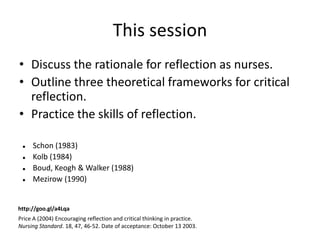
This session
• Discuss the rationale for reflection as nurses.
• Outline three theoretical frameworks for critical
reflection.
• Practice the skills of reflection.
 Schon (1983)
 Kolb (1984)
 Boud, Keogh & Walker (1988)
 Mezirow (1990)
http://goo.gl/a4Lqa
Price A (2004) Encouraging reflection and critical thinking in practice.
Nursing Standard. 18, 47, 46-52. Date of acceptance: October 13 2003.
“The passing of the years
does not necessarily bring
gifts of understanding
within one’s own life.”
Salmon (1985)
[purr]
Not a new idea..
• Socrates (400BCs).
• Dewey (1930s).
 Derives meaning from experience.
 Schon (1980/90s).
Why?
What skills do you need
to be a reflective
practitioner?
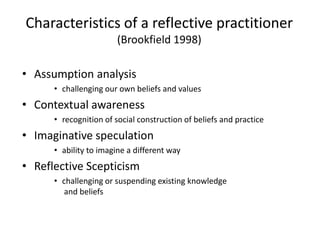
Characteristics of a reflective practitioner
(Brookfield 1998)
• Assumption analysis
• challenging our own beliefs and values
• Contextual awareness
• recognition of social construction of beliefs and practice
• Imaginative speculation
• ability to imagine a different way
• Reflective Scepticism
• challenging or suspending existing knowledge
and beliefs
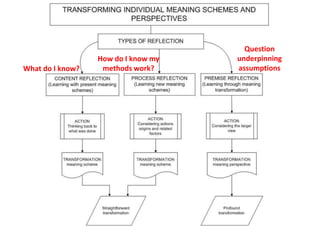
Re-evaluating experience
What do I know?
How do I know my
methods work?
Question
underpinning
assumptions
Phases
1. A disorientating dilemma.
2. Self-examination with feelings.
3. A critical assessment of assumptions.
4. Recognition that process of transformation is shared.
5. Exploration of options for new roles, relationships and actions.
6. Planning a course of action.
7. Acquiring knowledge and skills for implementing one’s plans.
8. Provisional trying of new roles.
9. Building self-confidence and competence in new roles and relationships.
10. Reintegration on the basis of conditions dictated by one’s new perspective.
Mezirow’s Phases of Meaning in Transformational Learning. (Mezirow, 2000: 22)
Critical Writing
Exercise

Reflective Practice

  • 1.
  • 2.
    This session • Discussthe rationale for reflection as nurses. • Outline three theoretical frameworks for critical reflection. • Practice the skills of reflection.  Schon (1983)  Kolb (1984)  Boud, Keogh & Walker (1988)  Mezirow (1990) http://goo.gl/a4Lqa Price A (2004) Encouraging reflection and critical thinking in practice. Nursing Standard. 18, 47, 46-52. Date of acceptance: October 13 2003.
  • 3.
    “The passing ofthe years does not necessarily bring gifts of understanding within one’s own life.” Salmon (1985) [purr]
  • 4.
    Not a newidea.. • Socrates (400BCs). • Dewey (1930s).  Derives meaning from experience.  Schon (1980/90s).
  • 5.
  • 6.
    What skills doyou need to be a reflective practitioner?
  • 7.
    Characteristics of areflective practitioner (Brookfield 1998) • Assumption analysis • challenging our own beliefs and values • Contextual awareness • recognition of social construction of beliefs and practice • Imaginative speculation • ability to imagine a different way • Reflective Scepticism • challenging or suspending existing knowledge and beliefs
  • 8.
  • 10.
    What do Iknow? How do I know my methods work? Question underpinning assumptions
  • 11.
    Phases 1. A disorientatingdilemma. 2. Self-examination with feelings. 3. A critical assessment of assumptions. 4. Recognition that process of transformation is shared. 5. Exploration of options for new roles, relationships and actions. 6. Planning a course of action. 7. Acquiring knowledge and skills for implementing one’s plans. 8. Provisional trying of new roles. 9. Building self-confidence and competence in new roles and relationships. 10. Reintegration on the basis of conditions dictated by one’s new perspective. Mezirow’s Phases of Meaning in Transformational Learning. (Mezirow, 2000: 22)
  • 12.

Editor's Notes

  • #8 Whilst writing about adult learning the four characteristics identified by Brookfield are perhaps the most important in terms of reflection in working with CSA
  • #12 For transformative learning to take place, experiences should be deconstructed, acted upon and then reconstructed, done via what Mezirow calls critical reflection.To enable learning from this critical reflection we must examine the underlying beliefs and assumptions that affect how we make sense of our experience, with reflection enabling us to correct distortions in our beliefs and the errors in our problem solving.Transformative learning involves becoming more reflective and critical, being more open to the perspectives of others and being less defensive against and more accepting of new ideas as they present themselves to you. It is ‘premise’ reflection which contributes to transformative learning, which is critically reflecting on the premises or deep held assumptions we have about our worlds.