2008 Refining Processes Handbook
www.HydrocarbonProcessing.com
Processes Index Company Index
Premier sponsors:
Sponsors:
Hydrocarbon Processing’s 2008 Refining Processes Handbook reflects the
dynamic advancements now available in licensed process technologies, catalysts
and equipment. The refining industry is under tremendous pressure to process
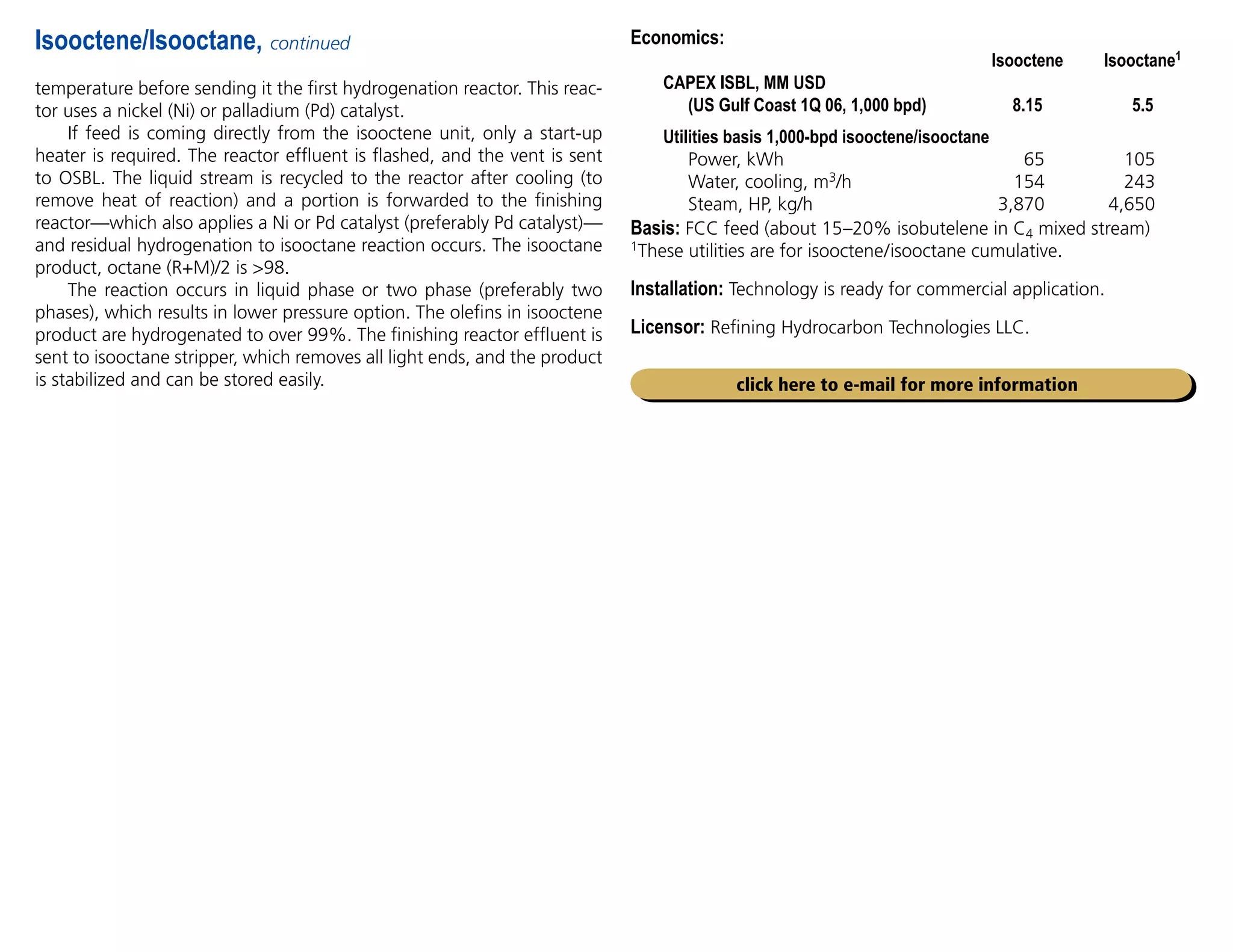
“cleaner” transportation fuels with varying specifications for a global market.
Refiners must balance capital investment and operating strategies that provide
the optimum profitability for their organization. Hence, refining organizations
will apply leading-edge technology in conjunction with “best practices” for
refining fuels and petrochemical feedstocks from crude oil.
HP’s process handbooks are inclusive catalogs of established and emerging
refining technologies that can be applied to existing and grassroots facilities.
Economic stresses drive efforts to conserve energy consumption, minimize waste,
improve product qualities, and, most important, increase yields and throughput.
In further expansion, the process entries presented an expanded description
of the licensed technology including a process flow diagram, product description,
economic information and other vital information. Specific processing operations
to be emphasized include alkylation, biofuels, coking, (crude) distillation, catalytic
cracking (fluid and resid), gasification, hydrocracking, hydrotreating, hydrogen,
isomerization, desulfurization, lube treating, visbreaking, etc.
To maintain as complete a listing as possible, the 2008 Refining Processes
Handbook is available on CD-ROM and at our website for paid subscribers.
Additional copies may be ordered from our website.
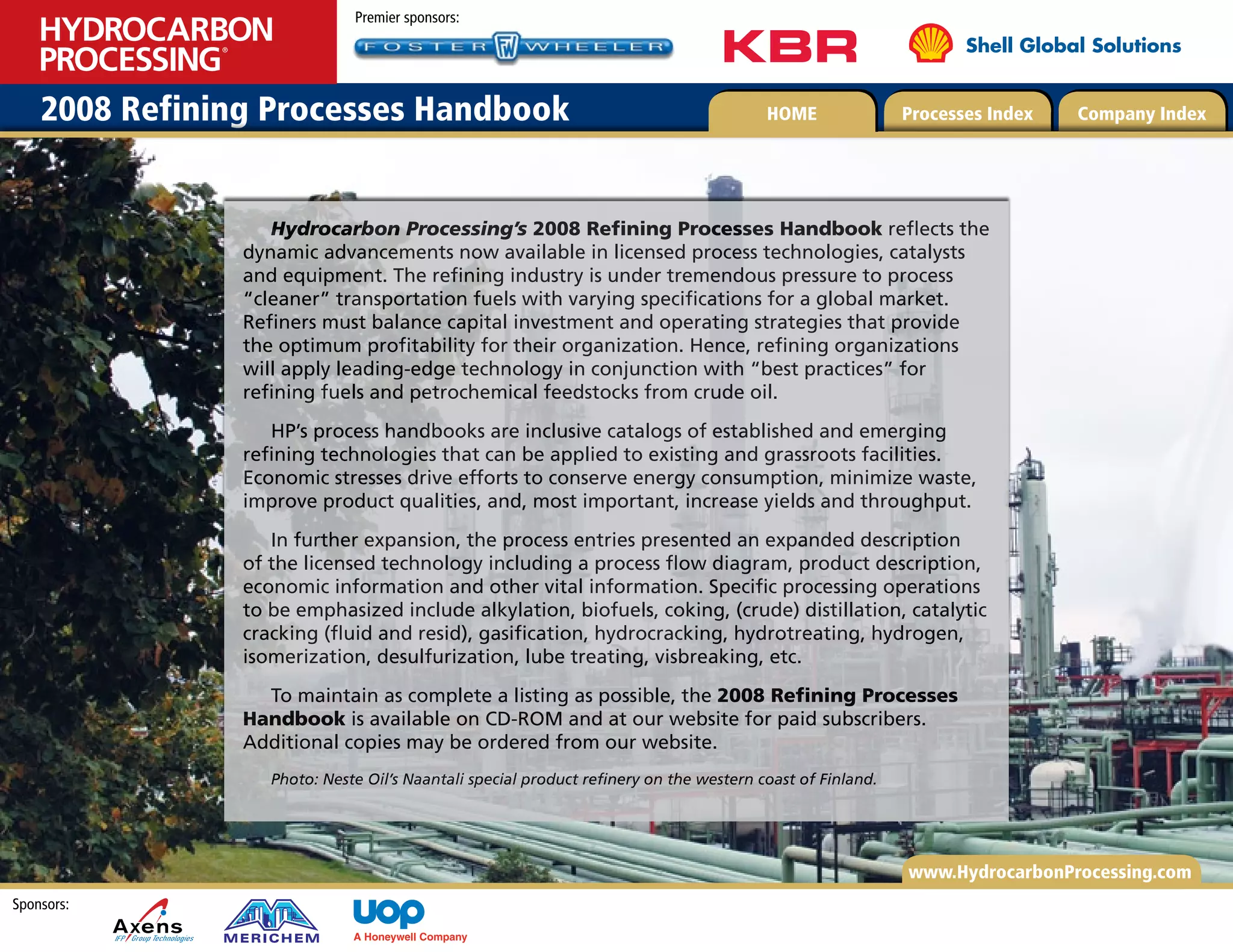
Photo: Neste Oil’s Naantali special product refinery on the western coast of Finland.
HOME
2008 Refining Processes Handbook
www.HydrocarbonProcessing.com
Company Index
Premier sponsors:
Sponsors:
Alkylation
Aromatics
Biofuels
Catalytic cracking
Catalytic reforming
Coking
Deasphalting/asphalt
Desulfurization-fuels
Distillation-Crude
Distillation-Vacuum
Ethers
Gasification
Hydroconversion
Hydrocracking
Hydrodearomatization
Hydrofinishing
Hydrogen
Hydrogenation
Hydroprocessing
Hydrotreating
Isomerization
Isooctene/isooctane
Lubes
Olefins
Oxygen enrichment
Petrochemicals
Reactors
Sulfur recovery
Treating
Treating-acid gas
Treating-flue gas
Treating-fuels
Treating-offgas
Upgrading-heavy oil
Visbreaking
Waxes
HOME Processes Index
Processes Index
2008 Refining Processes Handbook
www.HydrocarbonProcessing.com
Premier sponsors:
Sponsors:
ABB Lummus Global B.V.
Air Products and Chemicals Inc.
Akzo Nobel
Axens
Bechtel Corp.
Belco Technologies Corp.
CDTECH
Chevron Lummus Global LLC
Davy Process Technology
DuPont
ExxonMobil Research and Engineering Co.
Foster Wheeler USA Corp.
GE Energy
Genoil Inc.
Goar, Allison & Associates, Inc.,
an Air Products Company
GTC Technology
Haldor Topsøe A/S
Hamon Research-Cottrell
KBR
Linde AG, Division Gas and Engineering
Lummus Technology, a CB&I company
Lurgi GmbH
Lyondell Chemical Co.
Merichem Chemical & Refinery Services LLC,
Process Technology Division
Merichem Chemical & Refinery Services LLC,
Gas Technology Products Division
Neste Jacobs OY
Quadrise Fuel International
QuestAir Technologies Inc.
Refining Hydrocarbon Technologies LLC
Shaw
Shell Global Solutions International B.V.
Snamprogetti, a company of Saipem
TECHNIP
ThioSolv LLC
TOTAL
Uhde GmbH
UOP
Viscolube SpA
Worley Parsons
HOME Processes Index
Company Index
Company Index
www.HydrocarbonProcessing.com
Deep thermal conversion
Thermal gasoil
Visbreaking
ABB Lummus Global B.V.
2008 Refining Processes Handbook Processes Index Company Index
HOME
HYDROCARBON PROCESSING
®
www.HydrocarbonProcessing.com
Hydrogen-recovery
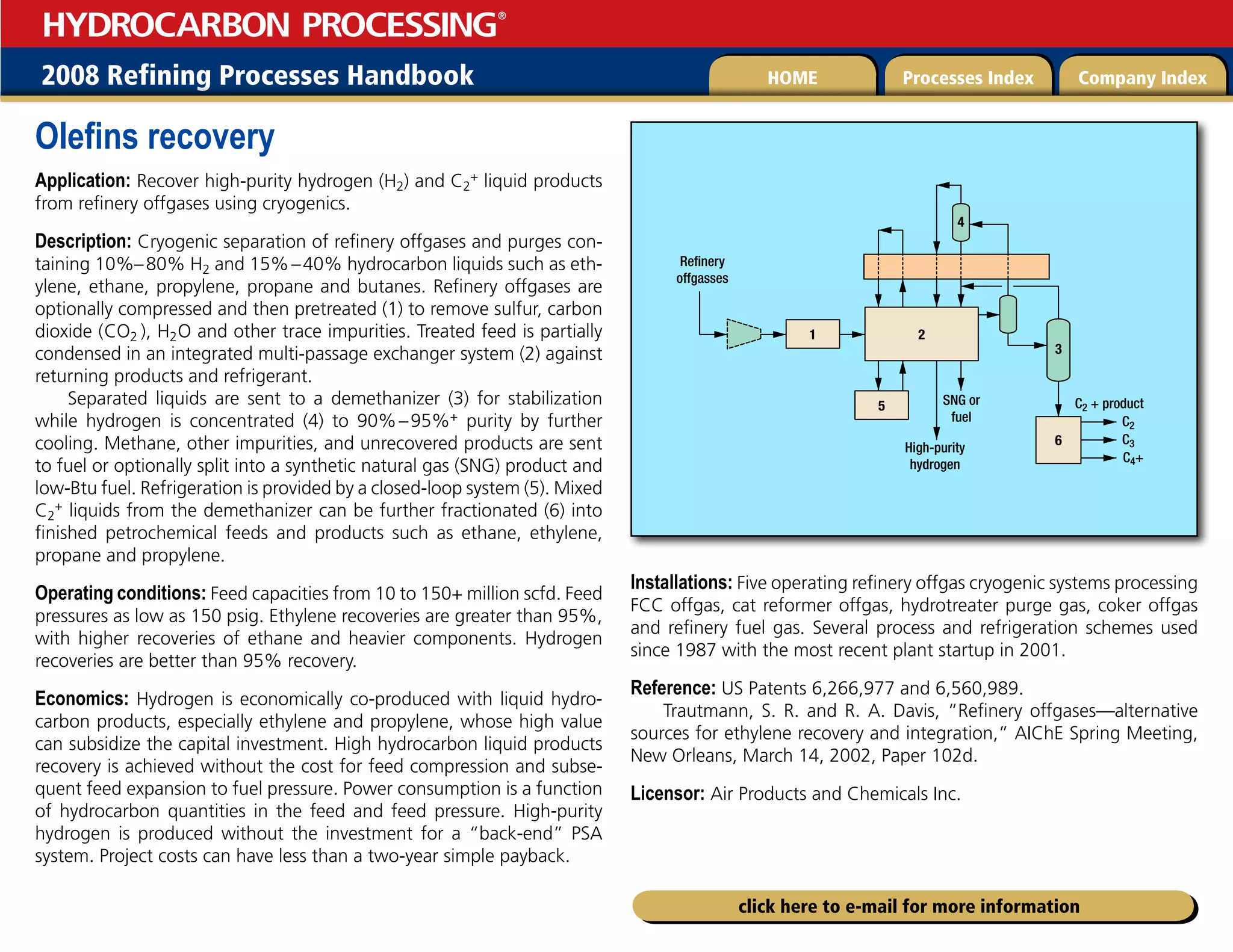
Olefins recovery
Air Products and Chemicals Inc.
2008 Refining Processes Handbook Processes Index Company Index
HOME
HYDROCARBON PROCESSING
®
www.HydrocarbonProcessing.com
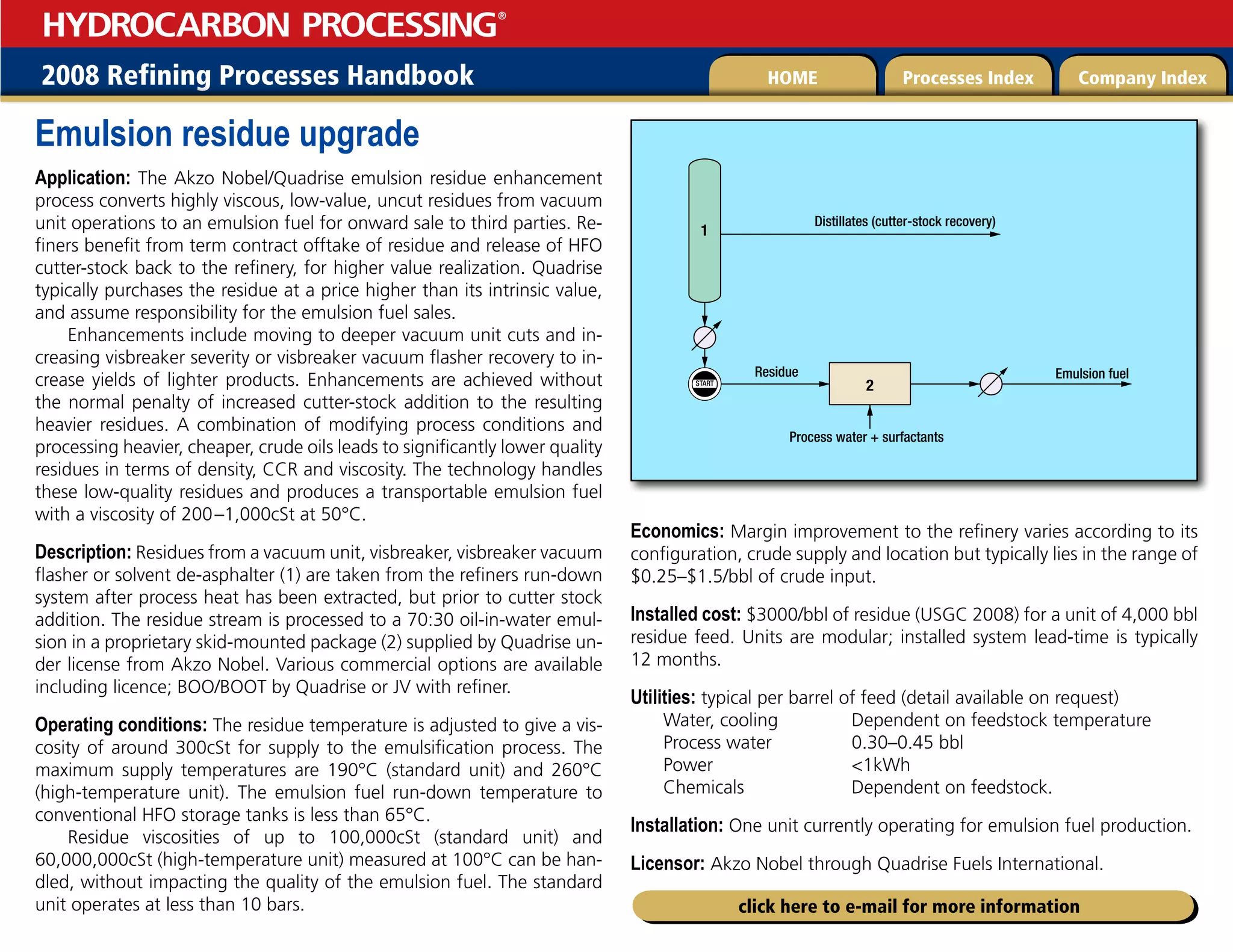
Emulsion residue upgrade
Akzo Nobel
2008 Refining Processes Handbook Processes Index Company Index
HOME
HYDROCARBON PROCESSING
®
www.HydrocarbonProcessing.com
2008 Refining Processes Handbook Processes Index Company Index
HOME
HYDROCARBON PROCESSING
®
www.HydrocarbonProcessing.com
2008 Refining Processes Handbook Processes Index Company Index
HOME
HYDROCARBON PROCESSING
®
Axens is a refining, petrochemical and natural gas market-focused
supplier of process technology, catalysts, adsorbents and services,
backed by nearly 50 years of commercial success. Axens is a world
leader in several areas, such as:
• Petroleum hydrotreating & hydroconversion
• FCC gasoline desulfurization
• Catalytic Reforming
• 
BTX (benzene, toluene, xylenes) production  purification
• Selective Hydrogenation of olefin cuts
• Sulfur recovery catalysts.
Axens is a fully-owned subsidiary of IFP.
Processes
Fluid catalytic cracking
Resid catalytic cracking
Resid cracking
Catalytic reforming
Hydroconversion—VGO and DAO
Hydrocracking
Hydrocracking-residue
Hydrotreating, diesel
Hydrotreating-resid
Isomerization
Lube oil refining, spent
Spent lube oil re-refining
www.HydrocarbonProcessing.com
Lube extraction (2 processes)
Lube hydrotreating (2 processes)
Dewaxing
Dewaxing/wax deoiling
Wax hydrotreating
Bechtel Corp.
2008 Refining Processes Handbook Processes Index Company Index
HOME
HYDROCARBON PROCESSING
®
www.HydrocarbonProcessing.com
NOX
reduction, low temperature
SO2
removal, regenerative
Wet scrubbing system, EDV
Belco Technologies Corp.
2008 Refining Processes Handbook Processes Index Company Index
HOME
HYDROCARBON PROCESSING
®
www.HydrocarbonProcessing.com
Alkylate, butanes to alkylate
Alkylation, low-temperature acid catalyzed
Ethers-ETBE
Ethers-MTBE
TAEE, from refinery C5
feeds
TAME, from refinery and steam cracker C5
feeds
TAME, from refinery C5
feeds
Hydrogenation
Hydrogenation-benzene in reformate
Hydrogenation, selective for MTBE/ETBE C4
raffinate
Hydrogenation, selective for refinery C4
feeds
Hydrogenation-selective for refinery C5
feeds
Hydrotreating
Isomerization
Isooctene/isooctane, conversion of refinery MTBE units
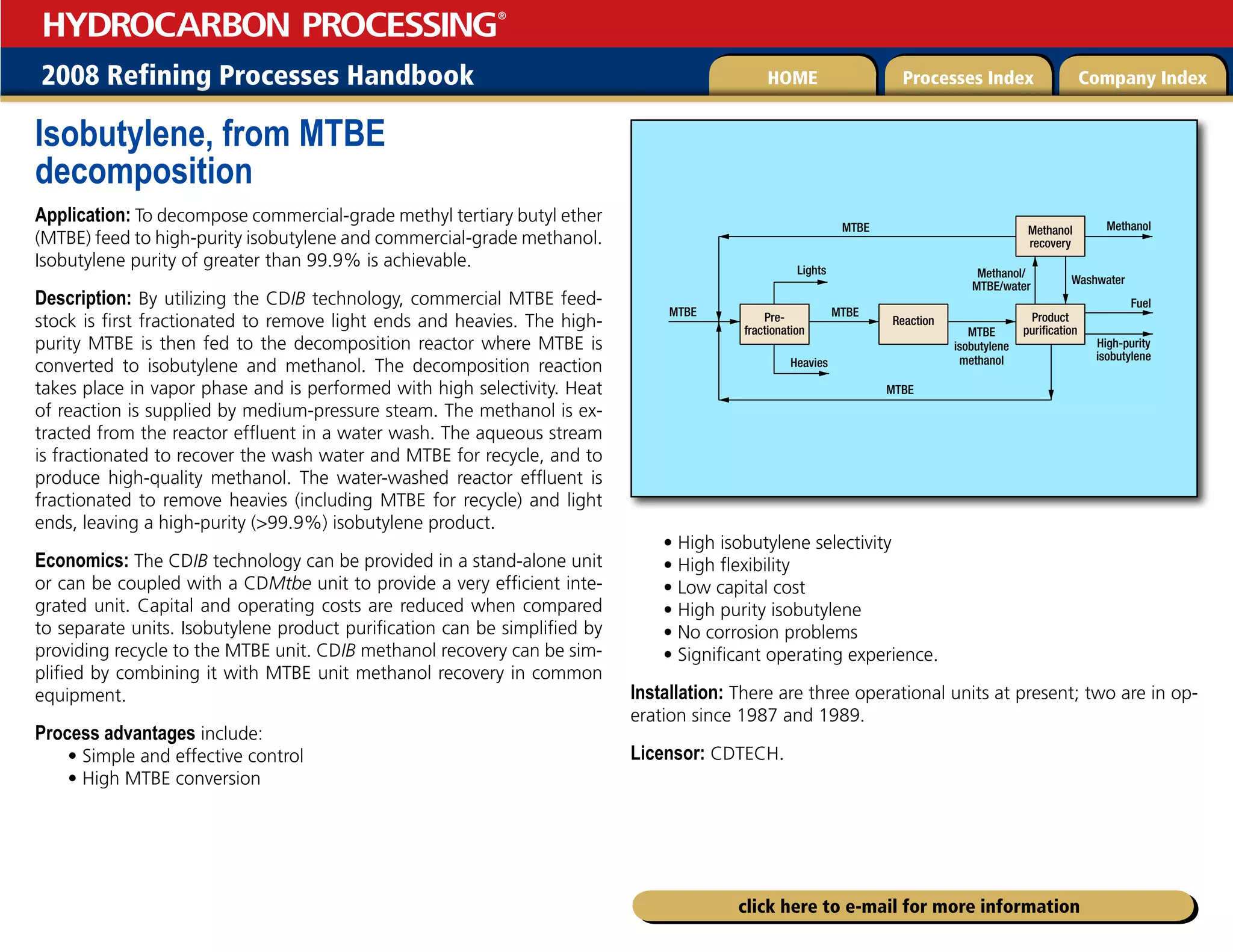
Isobutylene, from MTBE decomposition
CDTECH
2008 Refining Processes Handbook Processes Index Company Index
HOME
HYDROCARBON PROCESSING
®
www.HydrocarbonProcessing.com
Hydrocracking
Hydrocracking, resid
Hydrofinishing
Hydrotreating
Hydrotreating-RDS/VRDS/UFR/OCR
Dewaxing
Chevron Lummus Global LLC
2008 Refining Processes Handbook Processes Index Company Index
HOME
HYDROCARBON PROCESSING
®
www.HydrocarbonProcessing.com
Prereforming with feed ultra purification
Davy Process Technology
2008 Refining Processes Handbook Processes Index Company Index
HOME
HYDROCARBON PROCESSING
®
www.HydrocarbonProcessing.com
Alkylation
Hydrocracking
Hydrotreating
DuPont
2008 Refining Processes Handbook Processes Index Company Index
HOME
HYDROCARBON PROCESSING
®
www.HydrocarbonProcessing.com
Alkylation, sulfuric acid
Fluid catalytic cracking
Fluid catalytic cracking, high olefin
Fluid catalytic cracking, residual
Coking, fluid
Gasoline desulfurization, ultra-deep
Gasification
Hydrocracking, moderate pressure
Pressure swing adsorption-rapid cycle
Hydroprocessing, ULSD
Gas treating—H2
S removal
Wet gas scrubbing (WGS), wet gas scrubbing plus
NOX
abatement/SNCR
Catalytic dewaxing
ExxonMobil Research and Engineering Co.
2008 Refining Processes Handbook Processes Index Company Index
HOME
HYDROCARBON PROCESSING
®
www.HydrocarbonProcessing.com
2008 Refining Processes Handbook Processes Index Company Index
HOME
HYDROCARBON PROCESSING
®
Processes
Coking
Deasphalting
Crude distillation
Hydrogen-steam reforming
Visbreaking
Foster Wheeler USA Corpration is a global engineering and con-
struction contractor and power equipment supplier, with a reputa-
tion for delivering high-quality, technically-advanced, reliable facili-
ties and equipment on time, on budget and with a world-class safety
record.
Our Engineering  Construction Group designs and constructs
leading-edge processing facilities for the upstream oil  gas, LNG 
gas-to-liquids, refining, chemicals  petrochemicals, power, environ-
mental, pharmaceuticals, biotechnology  healthcare industries. Fos-
ter Wheeler is a market leader in heavy oil upgrading technologies,
offering world-leading technology in delayed coking, solvent deas-
phalting, and visbreaking, and providing cost-effective solutions for
the refining industry.
Services:
• Market studies
• Master planning
• Feasibility studies
• Concept screening
• Environmental engineering
• Front-end design (FEED)
• Project management (PMC)
• Engineering (E)
• Procurement (P)
• Construction (C)  construction management (Cm)
• Commissioning  start-up
• Validation
• Plant operations  maintenance
• Training
Our Global Power Group, world-leading experts in combustion
technology, designs, manufactures and erects steam generating and
auxiliary equipment for power stations and industrial markets world-
wide, and also provides a range of after-market services.
Technical articles
Integrated hydrogen solutions: Combining
hydrogen recovery and optimized steam
Upgrade refinery residuals into value-added
products
Optimize turnaround projects
Drivers for additional delayed coking capacity in
the refining industry
When solvent deasphalting is the most appropri-
ate technology for upgrading residue
www.HydrocarbonProcessing.com
Gasification
GE Energy
2008 Refining Processes Handbook Processes Index Company Index
HOME
HYDROCARBON PROCESSING
®
www.HydrocarbonProcessing.com
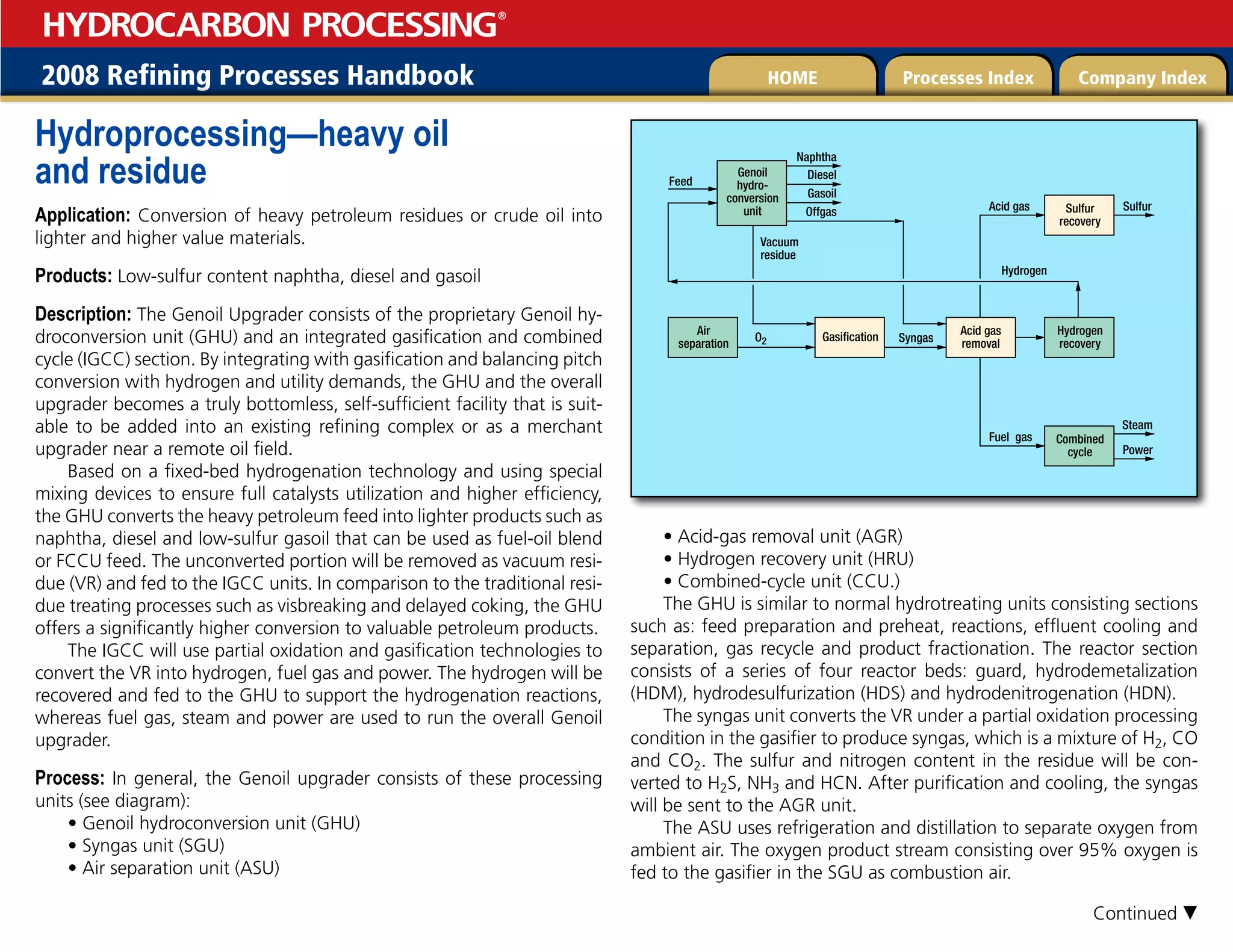
Hydroprocessing-heavy oil and residue
Genoil Inc.
2008 Refining Processes Handbook Processes Index Company Index
HOME
HYDROCARBON PROCESSING
®
www.HydrocarbonProcessing.com
Sulfur processing
Sulfur recovery
Goar, Allison  Associates, Inc., an Air Products Company
2008 Refining Processes Handbook Processes Index Company Index
HOME
HYDROCARBON PROCESSING
®
www.HydrocarbonProcessing.com
Aromatics (3 processes)
Aromatics recovery
Benzene saturation
Paraxylene
Styrene recovery
Xylene isomerization
Desulfurization
Hydrotreating, pyrolysis gasoline
Carboxylic acid recovery
Dimethyl terephthlate
GTC Technology
2008 Refining Processes Handbook Processes Index Company Index
HOME
HYDROCARBON PROCESSING
®
www.HydrocarbonProcessing.com
Fluid catalytic cracking-pretreatment
Diesel upgrading
Diesel-ultra-low-sulfur diesel (ULSD)
Hydrocracking
Hydrodearomatization
Hydrogen-HTCR and HTCR twin plants
Hydrogen-HTER-p
Hydrogen—Methanol-to-shift
Hydrogen-Steam methane reforming (SMR)
Hydrotreating
Flue gas denitrification
Flue gas desulfurization-SNOX
Sour gas treatment
Spent acid regeneration
Haldor Topsøe A/S
2008 Refining Processes Handbook Processes Index Company Index
HOME
HYDROCARBON PROCESSING
®
www.HydrocarbonProcessing.com
Wet gas scrubbing, wet gas scrubbing plus
Hamon Research-Cottrell
2008 Refining Processes Handbook Processes Index Company Index
HOME
HYDROCARBON PROCESSING
®
www.HydrocarbonProcessing.com
2008 Refining Processes Handbook Processes Index Company Index
HOME
HYDROCARBON PROCESSING
®
Processes
Fluid catalytic cracking
Fluid catalytic cracking, high olefin
Fluid catalytic cracking, residual
Coking
Asphaltene pelletization
Deasphalting
Isooctene/isooctane
Heavy oil upgrading
KBR is a leading global engineering, construction and services com-
pany supporting the energy, petrochemicals, government services and
civil infrastructure sectors. KBR has been delivering high yields and
efficiency to its customers in the hydrocarbon processing industry for
over 80 years, when Morris Kellogg founded the M.W. Kellogg Com-
pany. KBR is one of the few leading engineering and construction
companies to specialize in the development and licensing of process
technologies for petrochemicals, refining, ammonia production and
coal gasification, all founded on extensive research and development
at its Technology Center.
With thousands of successful projects worldwide, KBR also com-
bines its technology expertise with full engineering, procurement
and construction services to help clients maximize the value of their
assets. This has become a critical factor as the world’s supply of con-
ventional oil and gas resources is being depleted, and KBR technol-
ogy continues to help customers transform low value hydrocarbons
into high value products with processes that produce some of the
highest yields, efficiencies and reliability available in the hydrocarbon
processing industry.
Email: technology@kbr.com
Web: technology.kbr.com
Technical articles
To vacuum or not to vacuum
Unlocking current refinery constraints
Consider new technology to produce clean diesel
Holding the key
www.HydrocarbonProcessing.com
Oxygen enrichment for Claus units
Oxygen enrichment for FCC units
Linde AG, Division Gas and Engineering
2008 Refining Processes Handbook Processes Index Company Index
HOME
HYDROCARBON PROCESSING
®
www.HydrocarbonProcessing.com
Alkylation
Fluid catalytic cracking
Fluid catalytic cracking for maximum olefins
Coking
Lummus Technology, a CBI company
2008 Refining Processes Handbook Processes Index Company Index
HOME
HYDROCARBON PROCESSING
®
www.HydrocarbonProcessing.com
Biodiesel
Multipurpose gasification
Hydrogen (steam reforming)
Lurgi GmbH
2008 Refining Processes Handbook Processes Index Company Index
HOME
HYDROCARBON PROCESSING
®
www.HydrocarbonProcessing.com
Isomerization
Lyondell Chemical Co.
2008 Refining Processes Handbook Processes Index Company Index
HOME
HYDROCARBON PROCESSING
®
www.HydrocarbonProcessing.com
2008 Refining Processes Handbook Processes Index Company Index
HOME
HYDROCARBON PROCESSING
®
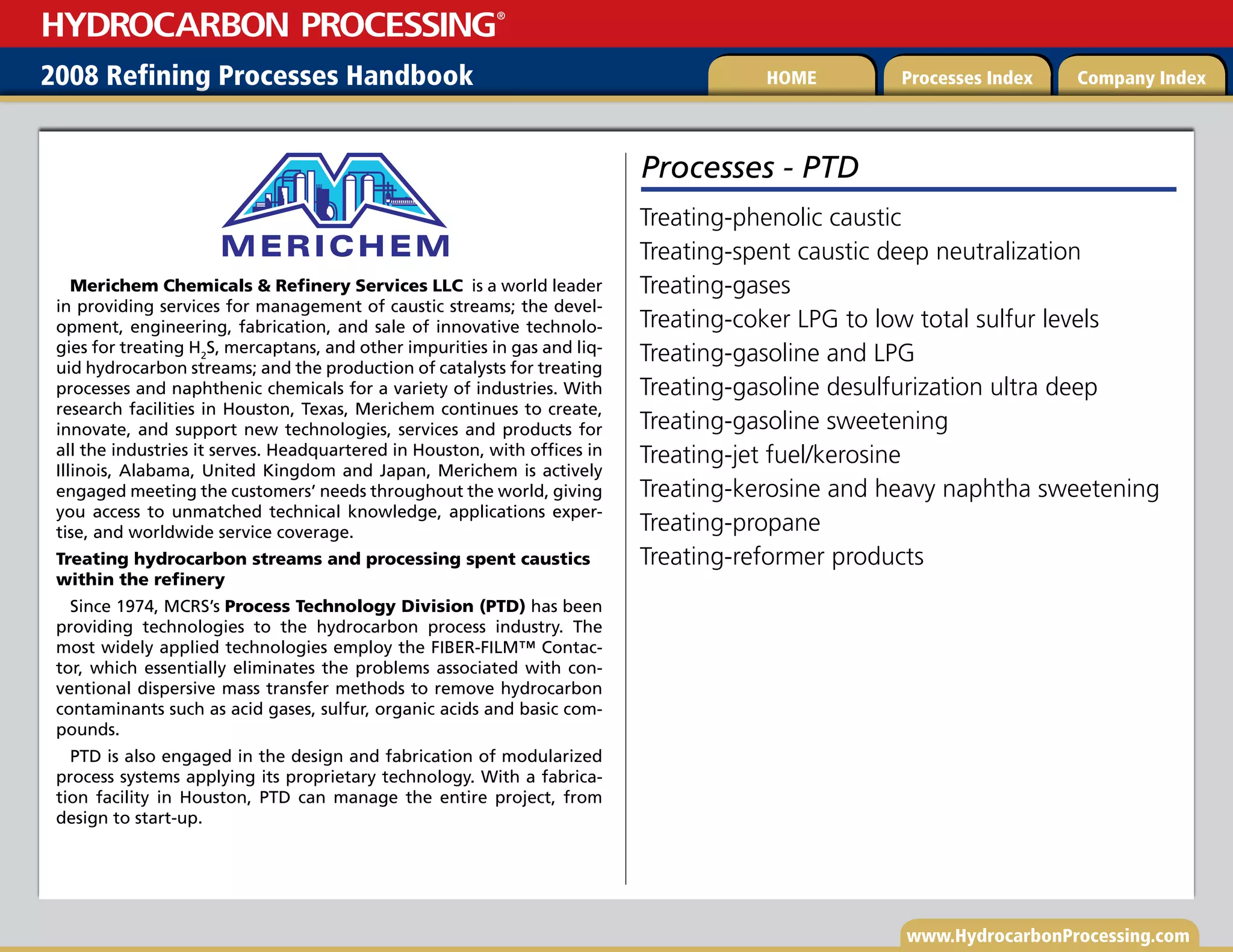
Merichem Chemicals  Refinery Services LLC is a world leader
in providing services for management of caustic streams; the devel-
opment, engineering, fabrication, and sale of innovative technolo-
gies for treating H2
S, mercaptans, and other impurities in gas and liq-
uid hydrocarbon streams; and the production of catalysts for treating
processes and naphthenic chemicals for a variety of industries. With
research facilities in Houston, Texas, Merichem continues to create,
innovate, and support new technologies, services and products for
all the industries it serves. Headquartered in Houston, with offices in
Illinois, Alabama, United Kingdom and Japan, Merichem is actively
engaged meeting the customers’ needs throughout the world, giving
you access to unmatched technical knowledge, applications exper-
tise, and worldwide service coverage.
Treating hydrocarbon streams and processing spent caustics
within the refinery
Since 1974, MCRS’s Process Technology Division (PTD) has been
providing technologies to the hydrocarbon process industry. The
most widely applied technologies employ the FIBER-FILM™ Contac-
tor, which essentially eliminates the problems associated with con-
ventional dispersive mass transfer methods to remove hydrocarbon
contaminants such as acid gases, sulfur, organic acids and basic com-
pounds.
PTD is also engaged in the design and fabrication of modularized
process systems applying its proprietary technology. With a fabrica-
tion facility in Houston, PTD can manage the entire project, from
design to start-up.
Processes - PTD
Treating-phenolic caustic
Treating-spent caustic deep neutralization
Treating-gases
Treating-coker LPG to low total sulfur levels
Treating-gasoline and LPG
Treating-gasoline desulfurization ultra deep
Treating-gasoline sweetening
Treating-jet fuel/kerosine
Treating-kerosine and heavy naphtha sweetening
Treating-propane
Treating-reformer products
www.HydrocarbonProcessing.com
2008 Refining Processes Handbook Processes Index Company Index
HOME
Meeting Today’s Challenges for H2
S Removal/Recovery
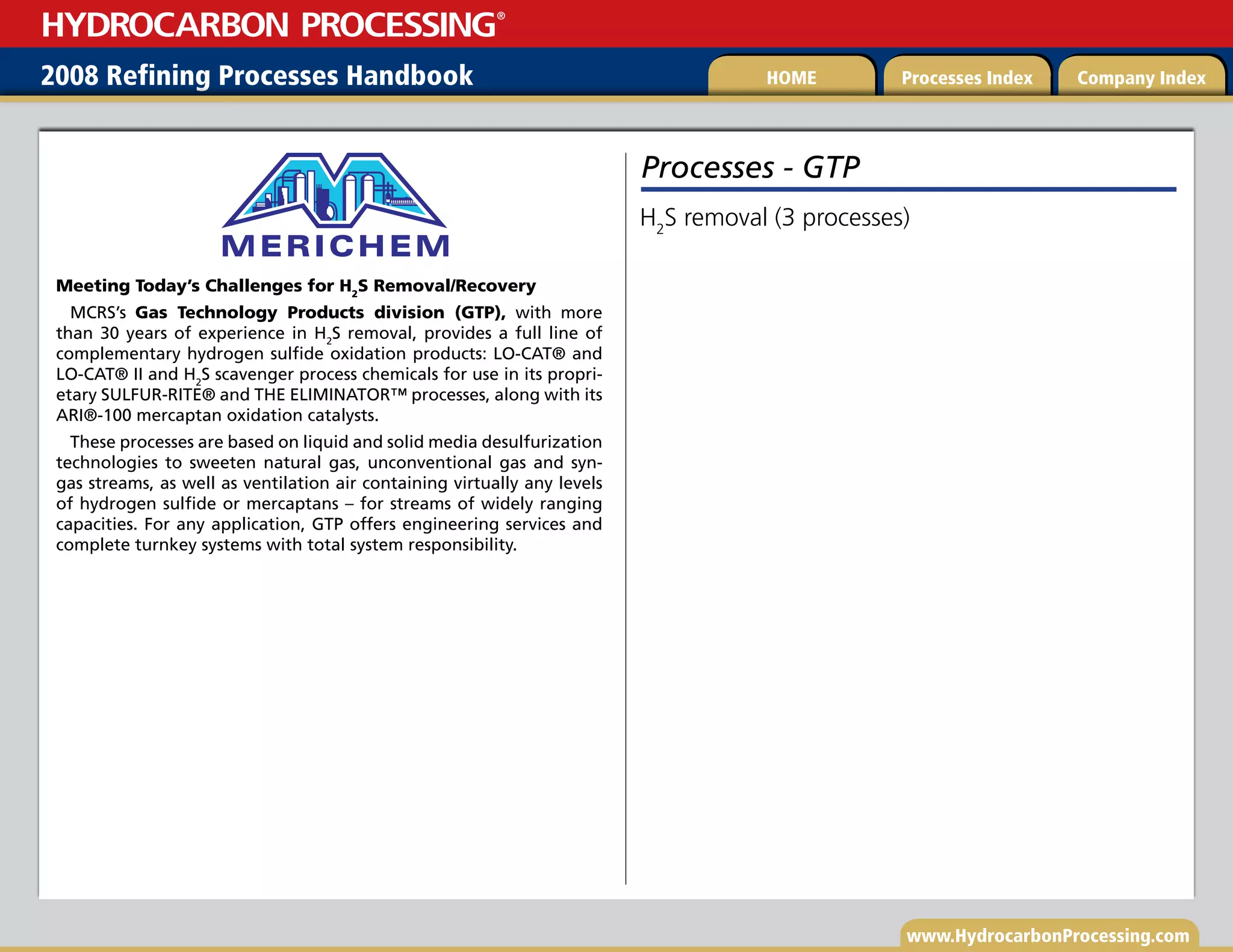
MCRS’s Gas Technology Products division (GTP), with more
than 30 years of experience in H2
S removal, provides a full line of
complementary hydrogen sulfide oxidation products: LO-CAT® and
LO-CAT® II and H2
S scavenger process chemicals for use in its propri-
etary SULFUR-RITE® and THE ELIMINATOR™ processes, along with its
ARI®-100 mercaptan oxidation catalysts.
These processes are based on liquid and solid media desulfurization
technologies to sweeten natural gas, unconventional gas and syn-
gas streams, as well as ventilation air containing virtually any levels
of hydrogen sulfide or mercaptans – for streams of widely ranging
capacities. For any application, GTP offers engineering services and
complete turnkey systems with total system responsibility.
HYDROCARBON PROCESSING
®
Processes - GTP
H2
S removal (3 processes)
www.HydrocarbonProcessing.com
Isooctene/isooctane
Neste Jacobs OY
2008 Refining Processes Handbook Processes Index Company Index
HOME
HYDROCARBON PROCESSING
®
www.HydrocarbonProcessing.com
Emulsion residue upgrade
Quadrise Fuel International
2008 Refining Processes Handbook Processes Index Company Index
HOME
HYDROCARBON PROCESSING
®
www.HydrocarbonProcessing.com
Pressure swing adsorption-rapid cycle
QuestAir Technologies Inc.
2008 Refining Processes Handbook Processes Index Company Index
HOME
HYDROCARBON PROCESSING
®
www.HydrocarbonProcessing.com
Alkylation
Biodiesel
Hydrogenation/hydrodesulfurization
Olefin etherification
Isooctene/isooctane
Refining Hydrocarbon Technologies LLC
2008 Refining Processes Handbook Processes Index Company Index
HOME
HYDROCARBON PROCESSING
®
www.HydrocarbonProcessing.com
Deep catalytic cracking
Fluid catalytic cracking
Resid catalytic cracking
Refinery offgas-purification and olefins recovery
Shaw
2008 Refining Processes Handbook Processes Index Company Index
HOME
HYDROCARBON PROCESSING
®
www.HydrocarbonProcessing.com
2008 Refining Processes Handbook Processes Index Company Index
HOME
HYDROCARBON PROCESSING
®
Shell Global Solutions provides business and operational con-
sultancy, catalysts, technical services and research and development
expertise to the energy and processing industries worldwide. Shell
Global Solutions has approximately 5,000 staff located in an exten-
sive network of offices around the world, with primary commercial
and technical centres operating in the USA, Europe and Asia Pacific.
Shell Global Solutions supports the Shell Group’s business activities
in downstream manufacturing, downstream marketing, gas  LNG,
production and project management. Outside of the Shell Group, the
company successfully services refining, chemicals, gas, metals, pulp
and paper and motor-sport customers worldwide.
Processes
Fluid catalytic cracking
Crude distillation
Gasification
Hydrocracking
Reactor internals
Deep thermal conversion
Thermal gasoil
Visbreaking
Technical articles
Shell gasification technology: Generating profit
from the bottom of the barrel
Hydrocracking technology for clean fuels
Operating experience provides foundation for
innovative solutions
Market responsiveness through residue thermal
conversion technologies
Low NOx emission from FCC regenerators
Shell’s ultimate flexible FCC technology in
delivering diesel/propylene
www.HydrocarbonProcessing.com
Ethers
Isooctene/isooctane
Isooctene/isooctane, conversion of refinery MTBE units
Butene-1 recovery
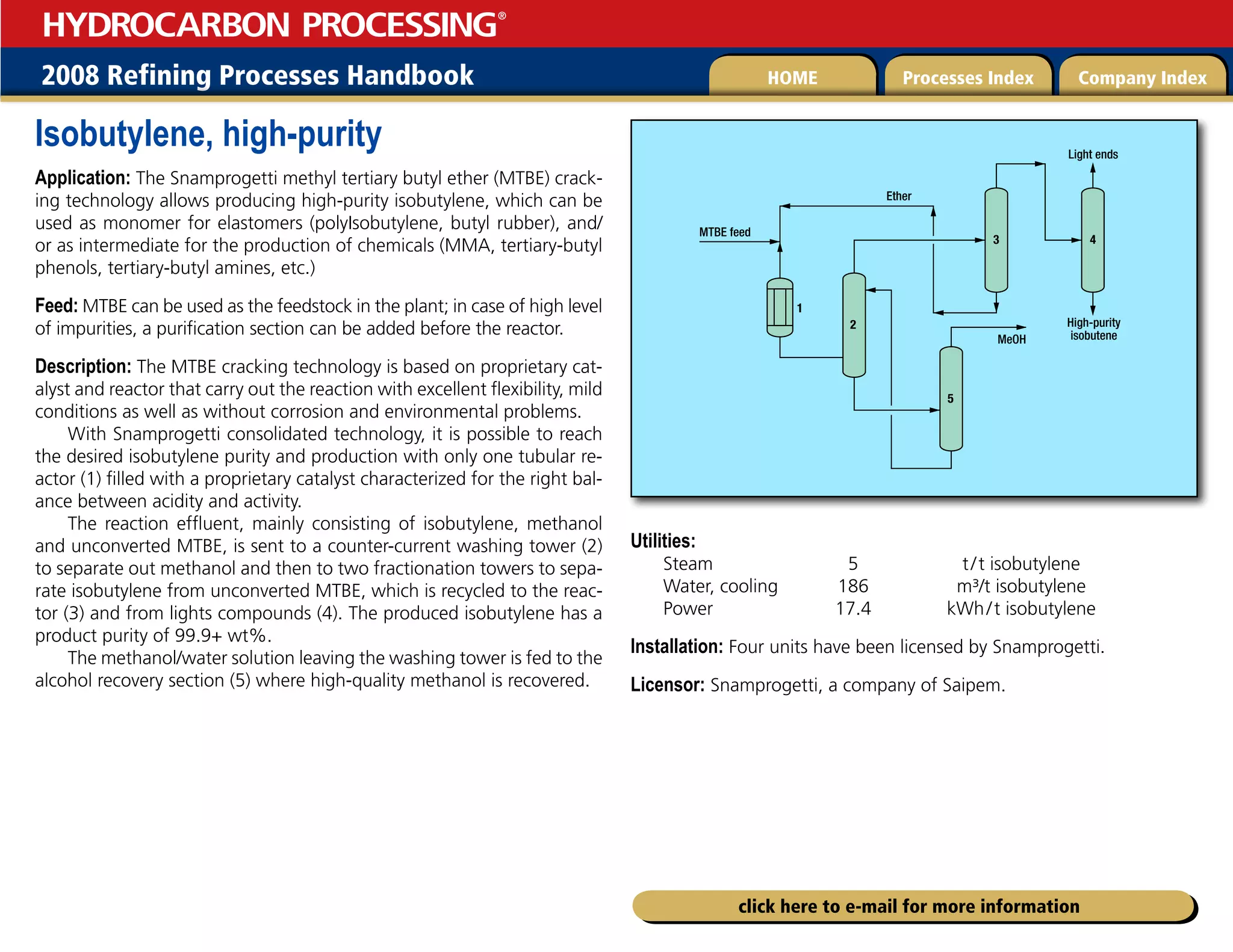
Isobutylene, high-purity
Snamprogetti, a company of Saipem
2008 Refining Processes Handbook Processes Index Company Index
HOME
HYDROCARBON PROCESSING
®
www.HydrocarbonProcessing.com
Crude distillation
Hydrogen
TECHNIP
2008 Refining Processes Handbook Processes Index Company Index
HOME
HYDROCARBON PROCESSING
®
www.HydrocarbonProcessing.com
Treating
Treating-sour water stripper gas
ThioSolv LLC
2008 Refining Processes Handbook Processes Index Company Index
HOME
HYDROCARBON PROCESSING
®
www.HydrocarbonProcessing.com
Crude distillation
TOTAL
2008 Refining Processes Handbook Processes Index Company Index
HOME
HYDROCARBON PROCESSING
®
www.HydrocarbonProcessing.com
Aromatics extractive distillation
Vacuum distillation
Ethers-ETBE
Ethers-MTBE
Gasification-PDQ
Gasification-PSG
Hydrogen
Hydrofinishing/hydrotreating
Lube treating
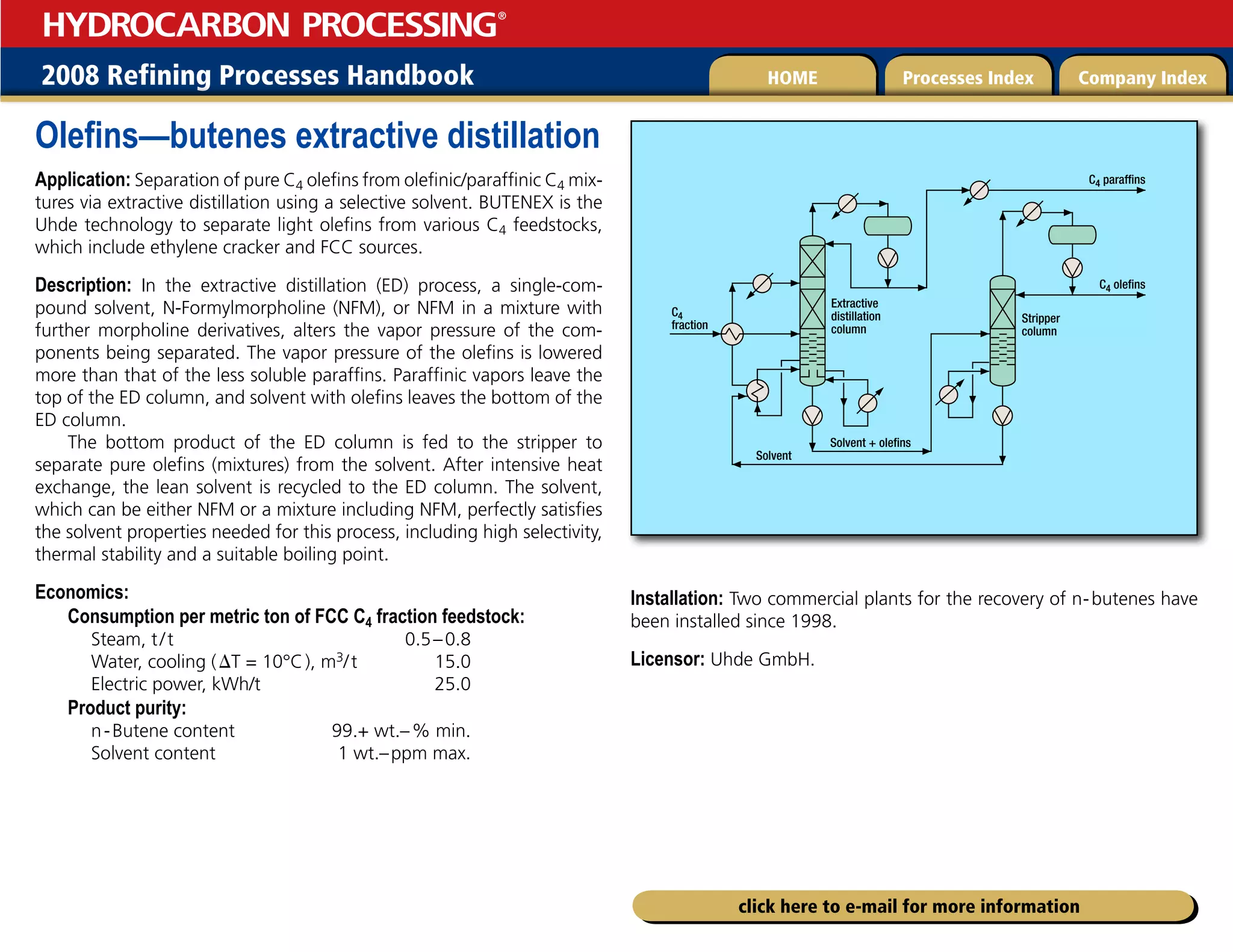
Olefins-butenes extractive distillation
Olefins-dehydrogenation of light paraffins to olefins
Slack wax deoiling
White oil and wax hydrotreating
Uhde GmbH
2008 Refining Processes Handbook Processes Index Company Index
HOME
HYDROCARBON PROCESSING
®
www.HydrocarbonProcessing.com
2008 Refining Processes Handbook Processes Index Company Index
HOME
HYDROCARBON PROCESSING
®
UOP LLC, a Honeywell company, has been delivering cutting-edge
technology to the petroleum refining, gas processing, petrochemi-
cal production and major manufacturing industries for almost 100
years.
The company’s roots date back to 1914, when the revolutionary
Dubbs thermal cracking process created the technological founda-
tion for today’s modern refining industry. Since then, UOP engineers
have generated thousands of patents, leading to a complete port-
folio of licensed processes, catalysts, molecular sieve adsorbents and
key mechanical equipment that support the quality, efficiency and
profitability needs of customers around the globe. These products
are backed by a broad array of engineering and technical services
that facilitate successful installation and operations.
For more information, visit UOP online at www.uop.com.
Processes
Alkylation (2 processes)
Alkylation-HF
Green diesel
Fluid catalytic cracking
Catalytic reforming
Coking
Deasphalting
Hydrocracking
Hydroprocessing-resid
Hydrotreating (2 processes)
Hydrotreating/desulfurization
Isomerization (4 processes)
Treating-pressure swing adsorption
Visbreaking
Technical articles
Technology advancements in benzene saturation
Process and catalyst innovations in hydrocracking
to maximize high-quality distillate fuel
www.HydrocarbonProcessing.com
Lube oil refining, spent
Spent lube oil re-refining
Viscolube SpA
2008 Refining Processes Handbook Processes Index Company Index
HOME
HYDROCARBON PROCESSING
®
www.HydrocarbonProcessing.com
Sulfur recovery
Worley Parsons
2008 Refining Processes Handbook Processes Index Company Index
HOME
HYDROCARBON PROCESSING
®
www.HydrocarbonProcessing.com
Alkylate, butanes to alkylate - CDTECH
Alkylation - DuPont
Alkylation - Lummus Technology, a CBI company
Alkylation - Refining Hydrocarbon Technologies LLC
Alkylation - UOP (2 processes)
Alkylation, low-temperature acid catalyzed - CDTECH
Alkylation, sulfuric acid - ExxonMobil Research and Engineering Co.
Alkylation-HF - UOP
Alkylation
2008 Refining Processes Handbook Processes Index Company Index
HOME
HYDROCARBON PROCESSING
®
www.HydrocarbonProcessing.com
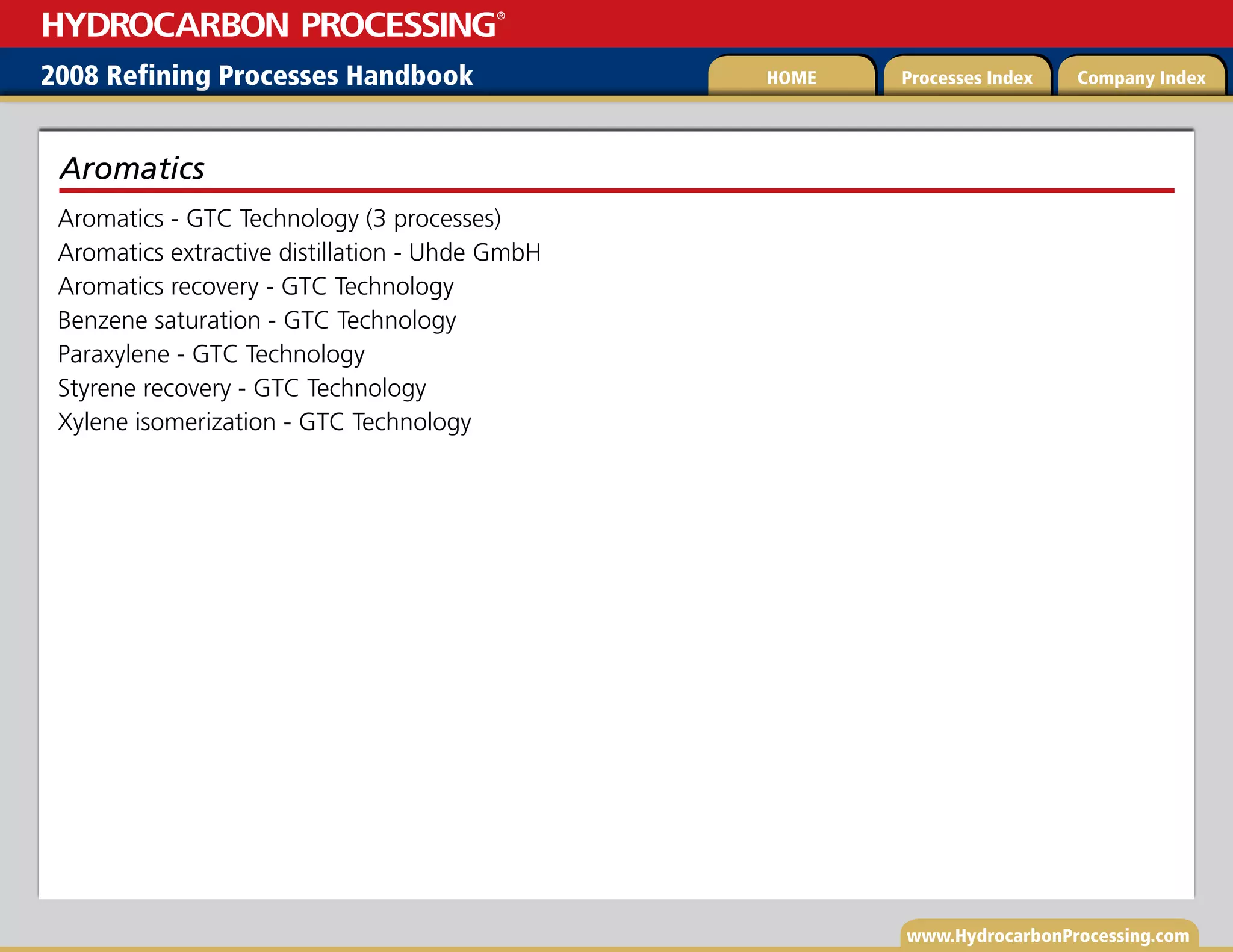
Aromatics - GTC Technology (3 processes)
Aromatics extractive distillation - Uhde GmbH
Aromatics recovery - GTC Technology
Benzene saturation - GTC Technology
Paraxylene - GTC Technology
Styrene recovery - GTC Technology
Xylene isomerization - GTC Technology
Aromatics
2008 Refining Processes Handbook Processes Index Company Index
HOME
HYDROCARBON PROCESSING
®
www.HydrocarbonProcessing.com
Biodiesel - Lurgi GmbH
Biodiesel - Refining Hydrocarbon Technologies LLC
Green diesel - UOP
Biofuels
2008 Refining Processes Handbook Processes Index Company Index
HOME
HYDROCARBON PROCESSING
®
www.HydrocarbonProcessing.com
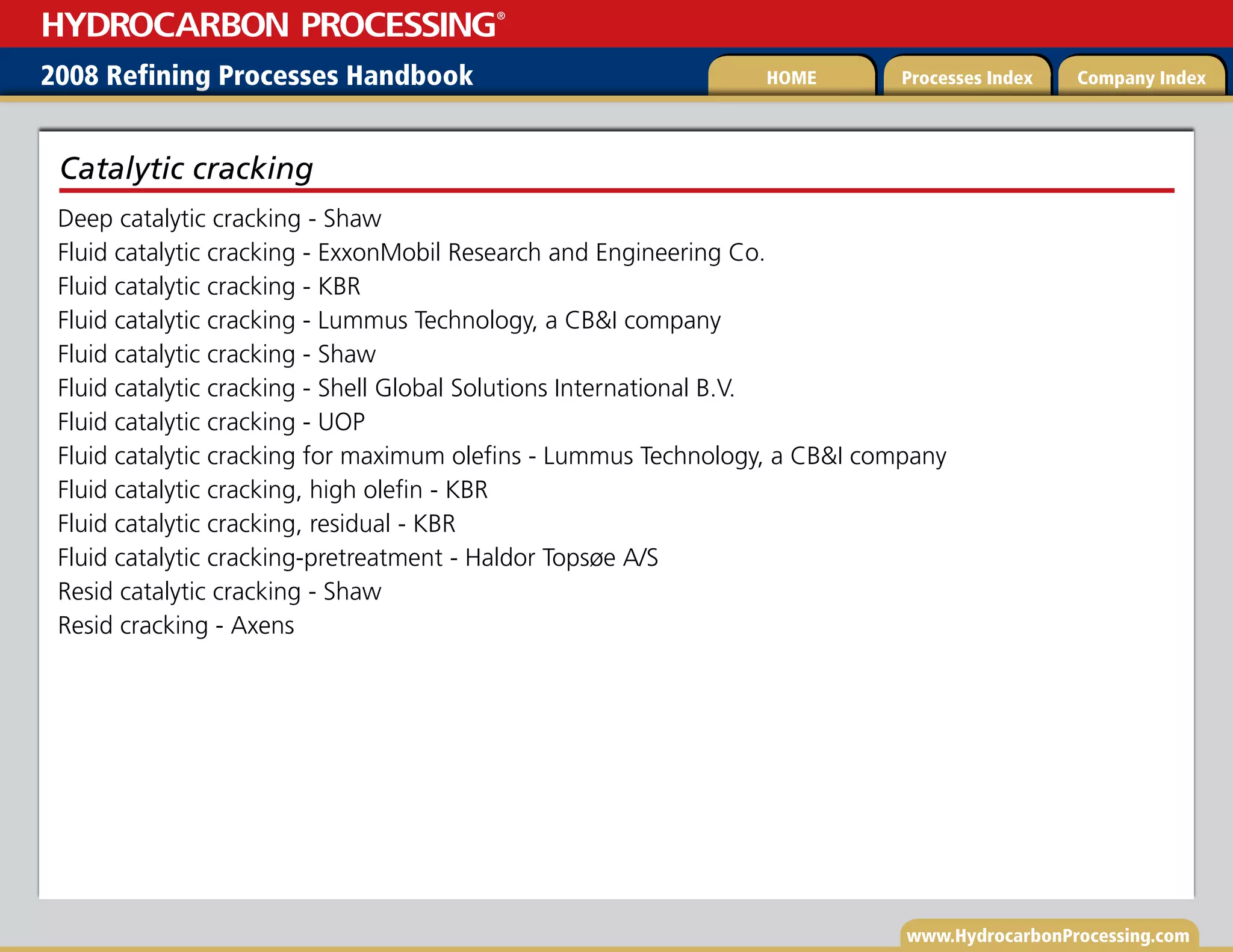
Deep catalytic cracking - Shaw
Fluid catalytic cracking - ExxonMobil Research and Engineering Co.
Fluid catalytic cracking - KBR
Fluid catalytic cracking - Lummus Technology, a CBI company
Fluid catalytic cracking - Shaw
Fluid catalytic cracking - Shell Global Solutions International B.V.
Fluid catalytic cracking - UOP
Fluid catalytic cracking for maximum olefins - Lummus Technology, a CBI company
Fluid catalytic cracking, high olefin - KBR
Fluid catalytic cracking, residual - KBR
Fluid catalytic cracking-pretreatment - Haldor Topsøe A/S
Resid catalytic cracking - Shaw
Resid cracking - Axens
Catalytic cracking
2008 Refining Processes Handbook Processes Index Company Index
HOME
HYDROCARBON PROCESSING
®
www.HydrocarbonProcessing.com
Catalytic reforming - Axens
Catalytic reforming - UOP
Catalytic reforming
2008 Refining Processes Handbook Processes Index Company Index
HOME
HYDROCARBON PROCESSING
®
www.HydrocarbonProcessing.com
Coking - Foster Wheeler USA Corp.
Coking - KBR
Coking - Lummus Technology, a CBI company
Coking, fluid - ExxonMobil Research and Engineering Co.
Coking
2008 Refining Processes Handbook Processes Index Company Index
HOME
HYDROCARBON PROCESSING
®
www.HydrocarbonProcessing.com
Asphaltene pelletization - KBR
Deasphalting - Foster Wheeler USA Corp.
Deasphalting - KBR
Deasphalting/asphalt
2008 Refining Processes Handbook Processes Index Company Index
HOME
HYDROCARBON PROCESSING
®
www.HydrocarbonProcessing.com
Desulfurizaton - GTC Technology
Diesel upgrading - Haldor Topsøe A/S
Diesel-ultra-low-sulfur diesel (ULSD) - Haldor Topsøe
Gasoline desulfurization, ultra-deep - ExxonMobil Research and Engineering Co.
Hydrogenation/hydrodesulfurization - Refining Hydrocarbon Technologies LLC
Desulfurization-fuels
2008 Refining Processes Handbook Processes Index Company Index
HOME
HYDROCARBON PROCESSING
®
www.HydrocarbonProcessing.com
Crude distillation - Foster Wheeler USA Corp.
Crude distillation - Shell Global Solutions International B.V.
Crude distillation - TECHNIP
Distillation-Crude
2008 Refining Processes Handbook Processes Index Company Index
HOME
HYDROCARBON PROCESSING
®
www.HydrocarbonProcessing.com
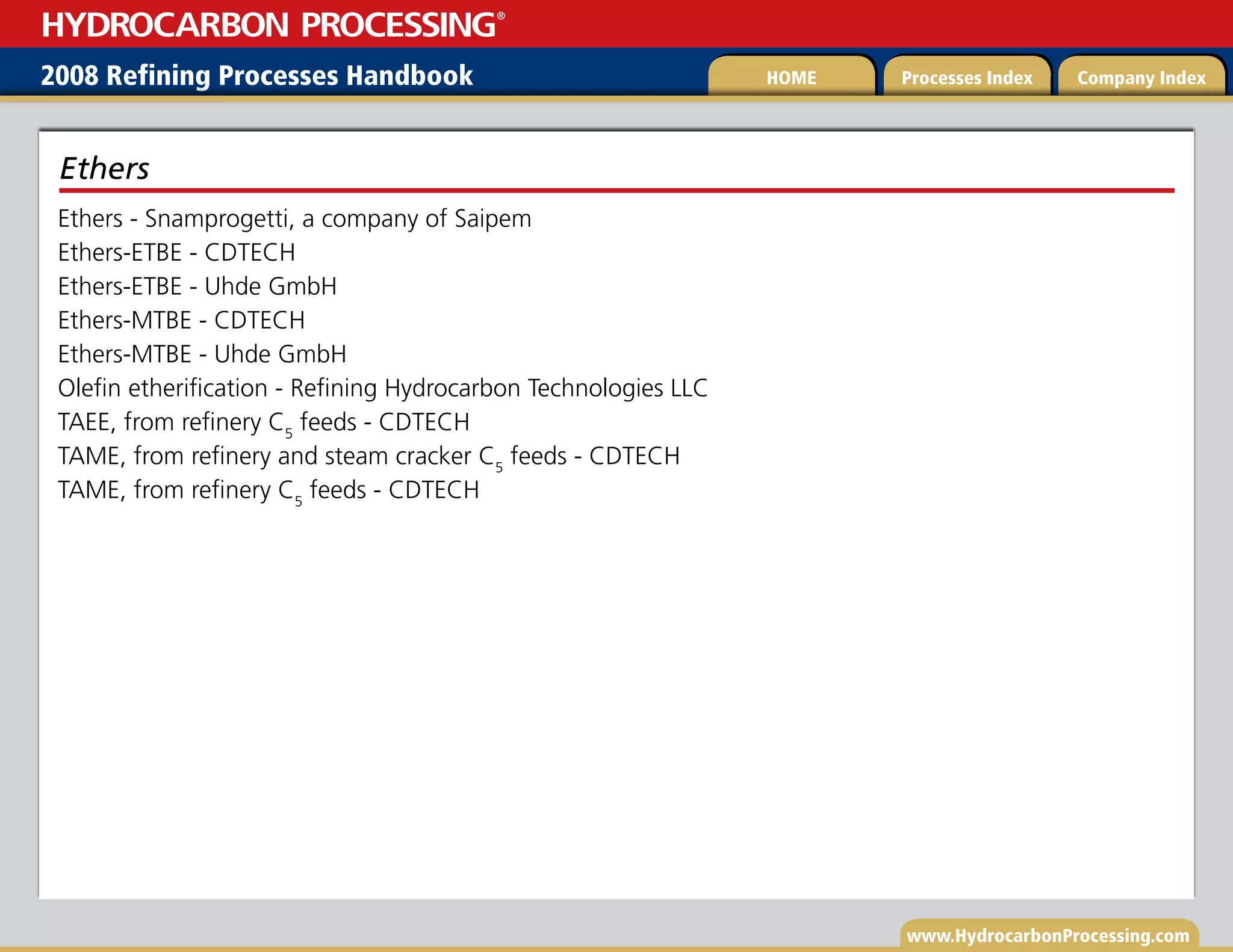
Ethers - Snamprogetti, a company of Saipem
Ethers-ETBE - CDTECH
Ethers-ETBE - Uhde GmbH
Ethers-MTBE - CDTECH
Ethers-MTBE - Uhde GmbH
Olefin etherification - Refining Hydrocarbon Technologies LLC
TAEE, from refinery C5
feeds - CDTECH
TAME, from refinery and steam cracker C5
feeds - CDTECH
TAME, from refinery C5
feeds - CDTECH
Ethers
2008 Refining Processes Handbook Processes Index Company Index
HOME
HYDROCARBON PROCESSING
®
www.HydrocarbonProcessing.com
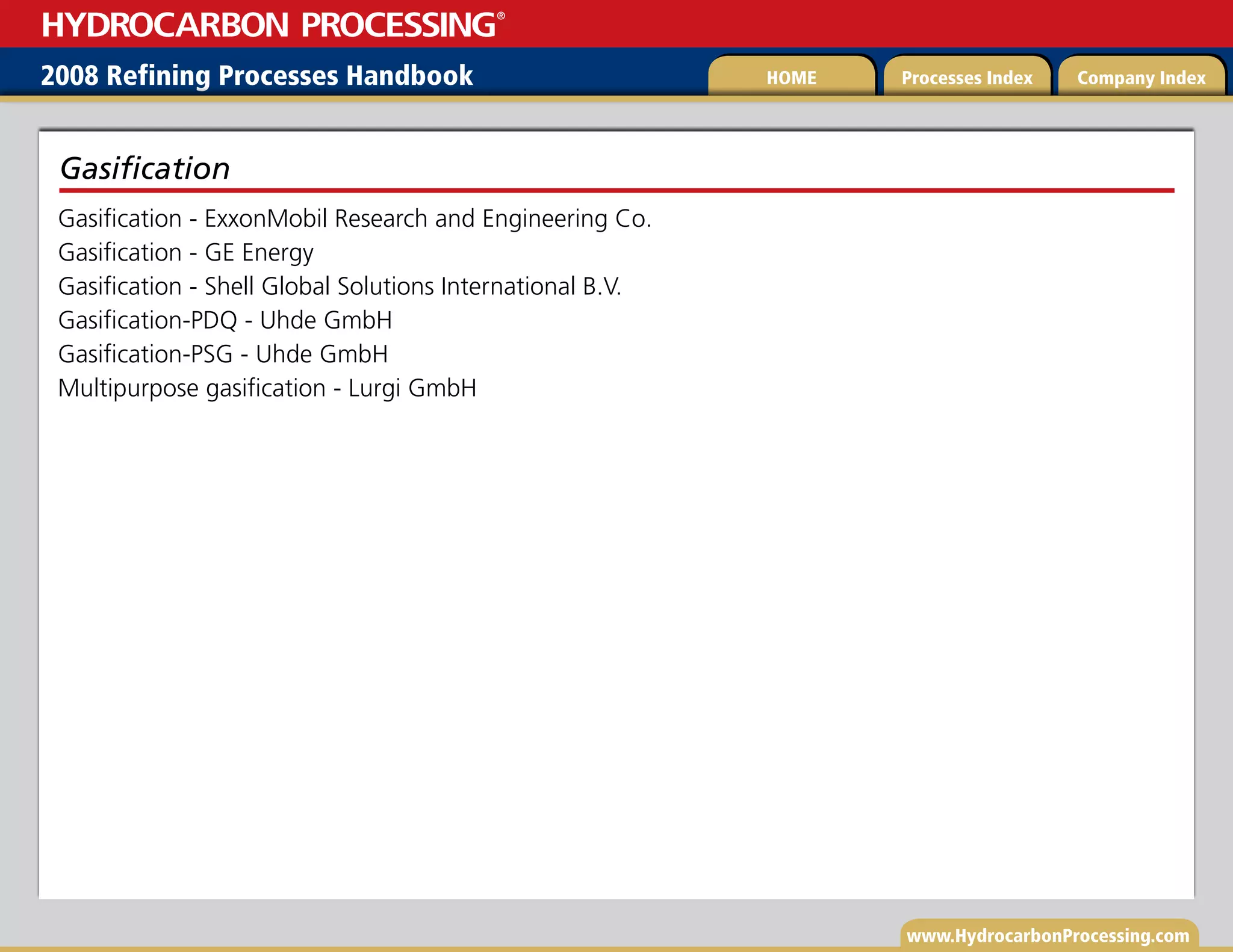
Gasification - ExxonMobil Research and Engineering Co.
Gasification - GE Energy
Gasification - Shell Global Solutions International B.V.
Gasification-PDQ - Uhde GmbH
Gasification-PSG - Uhde GmbH
Multipurpose gasification - Lurgi GmbH
Gasification
2008 Refining Processes Handbook Processes Index Company Index
HOME
HYDROCARBON PROCESSING
®
www.HydrocarbonProcessing.com
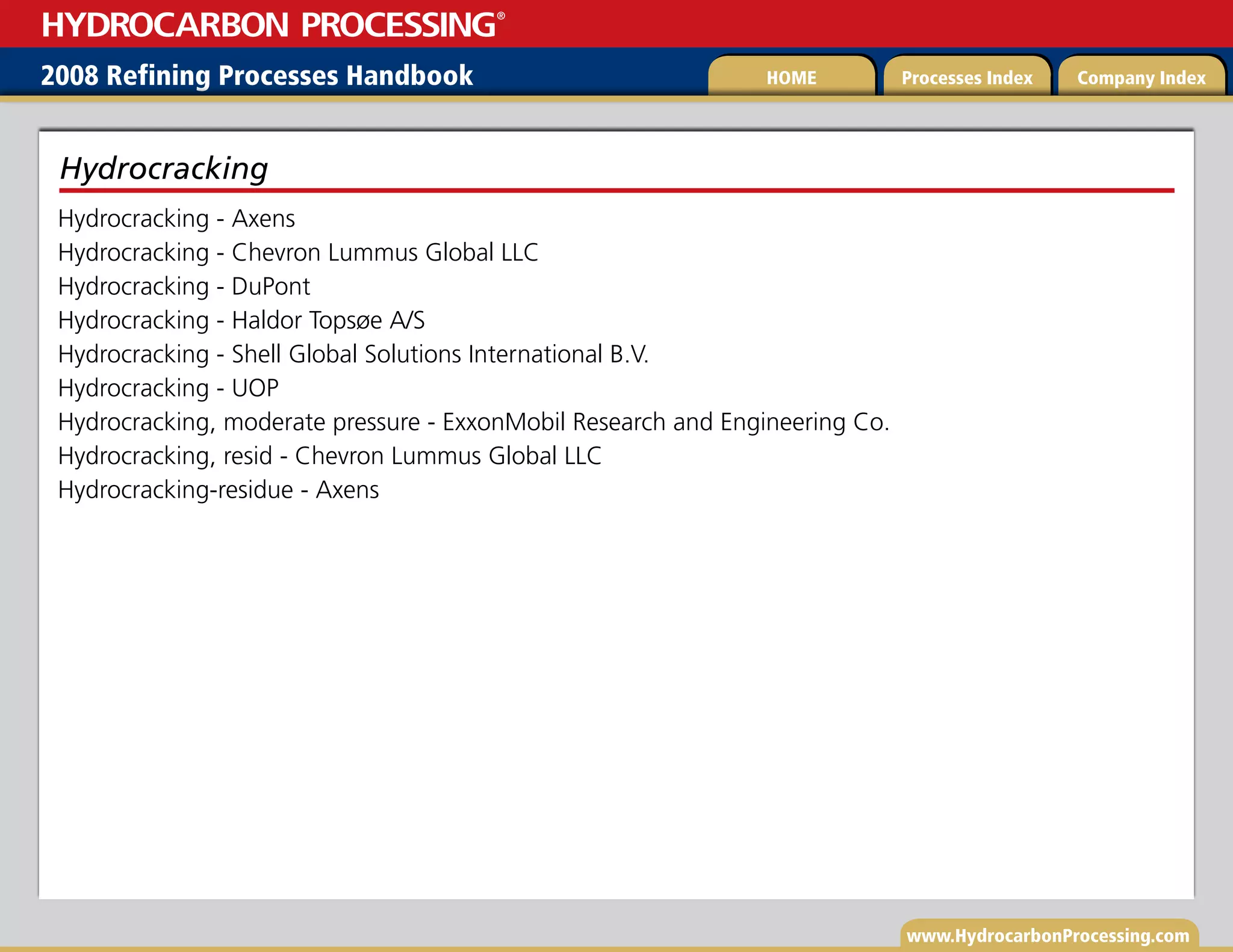
Hydrocracking - Axens
Hydrocracking - Chevron Lummus Global LLC
Hydrocracking - DuPont
Hydrocracking - Haldor Topsøe A/S
Hydrocracking - Shell Global Solutions International B.V.
Hydrocracking - UOP
Hydrocracking, moderate pressure - ExxonMobil Research and Engineering Co.
Hydrocracking, resid - Chevron Lummus Global LLC
Hydrocracking-residue - Axens
Hydrocracking
2008 Refining Processes Handbook Processes Index Company Index
HOME
HYDROCARBON PROCESSING
®
www.HydrocarbonProcessing.com
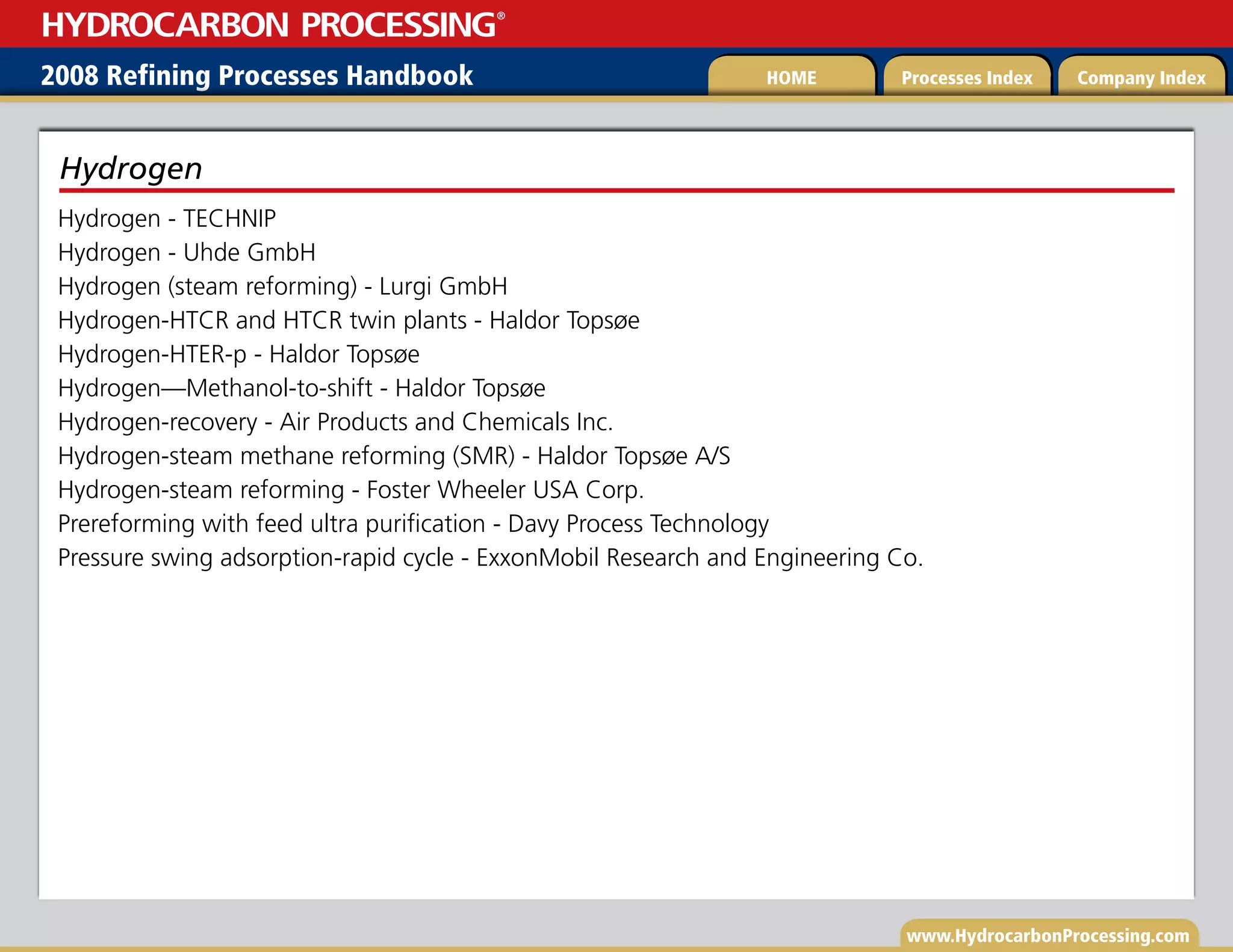
Hydrogen - TECHNIP
Hydrogen - Uhde GmbH
Hydrogen (steam reforming) - Lurgi GmbH
Hydrogen-HTCR and HTCR twin plants - Haldor Topsøe
Hydrogen-HTER-p - Haldor Topsøe
Hydrogen—Methanol-to-shift - Haldor Topsøe
Hydrogen-recovery - Air Products and Chemicals Inc.
Hydrogen-steam methane reforming (SMR) - Haldor Topsøe A/S
Hydrogen-steam reforming - Foster Wheeler USA Corp.
Prereforming with feed ultra purification - Davy Process Technology
Pressure swing adsorption-rapid cycle - ExxonMobil Research and Engineering Co.
Hydrogen
2008 Refining Processes Handbook Processes Index Company Index
HOME
HYDROCARBON PROCESSING
®
www.HydrocarbonProcessing.com
Hydrogenation - CDTECH
Hydrogenation, selective for MTBE/ETBE C4
raffinate - CDTECH
Hydrogenation, selective for refinery C4
feeds - CDTECH
Hydrogenation-benzene in reformate - CDTECH
Hydrogenation-selective for refinery C5
feeds - CDTECH
Hydrogenation
2008 Refining Processes Handbook Processes Index Company Index
HOME
HYDROCARBON PROCESSING
®
www.HydrocarbonProcessing.com
Hydroprocessing-resid - UOP
Hydroprocessing, ULSD - ExxonMobil Research and Engineering Co.
Hydroprocessing
2008 Refining Processes Handbook Processes Index Company Index
HOME
HYDROCARBON PROCESSING
®
www.HydrocarbonProcessing.com
Hydrotreating - CDTECH
Hydrotreating - Chevron Lummus Global LLC
Hydrotreating - DuPont
Hydrotreating - Haldor Topsøe A/S
Hydrotreating - UOP (2 processes)
Hydrotreating, diesel - Axens
Hydrotreating, pyrolysis gasoline - GTC Technology
Hydrotreating/desulfurization - UOP
Hydrotreating-RDS/VRDS/UFR/OCR - Chevron Lummus Global LLC
Hydrotreating-resid - Axens
Hydrotreating
2008 Refining Processes Handbook Processes Index Company Index
HOME
HYDROCARBON PROCESSING
®
www.HydrocarbonProcessing.com
Isomerization - Axens
Isomerization - CDTECH
Isomerization - UOP (4 processes)
Isomerization
2008 Refining Processes Handbook Processes Index Company Index
HOME
HYDROCARBON PROCESSING
®
www.HydrocarbonProcessing.com
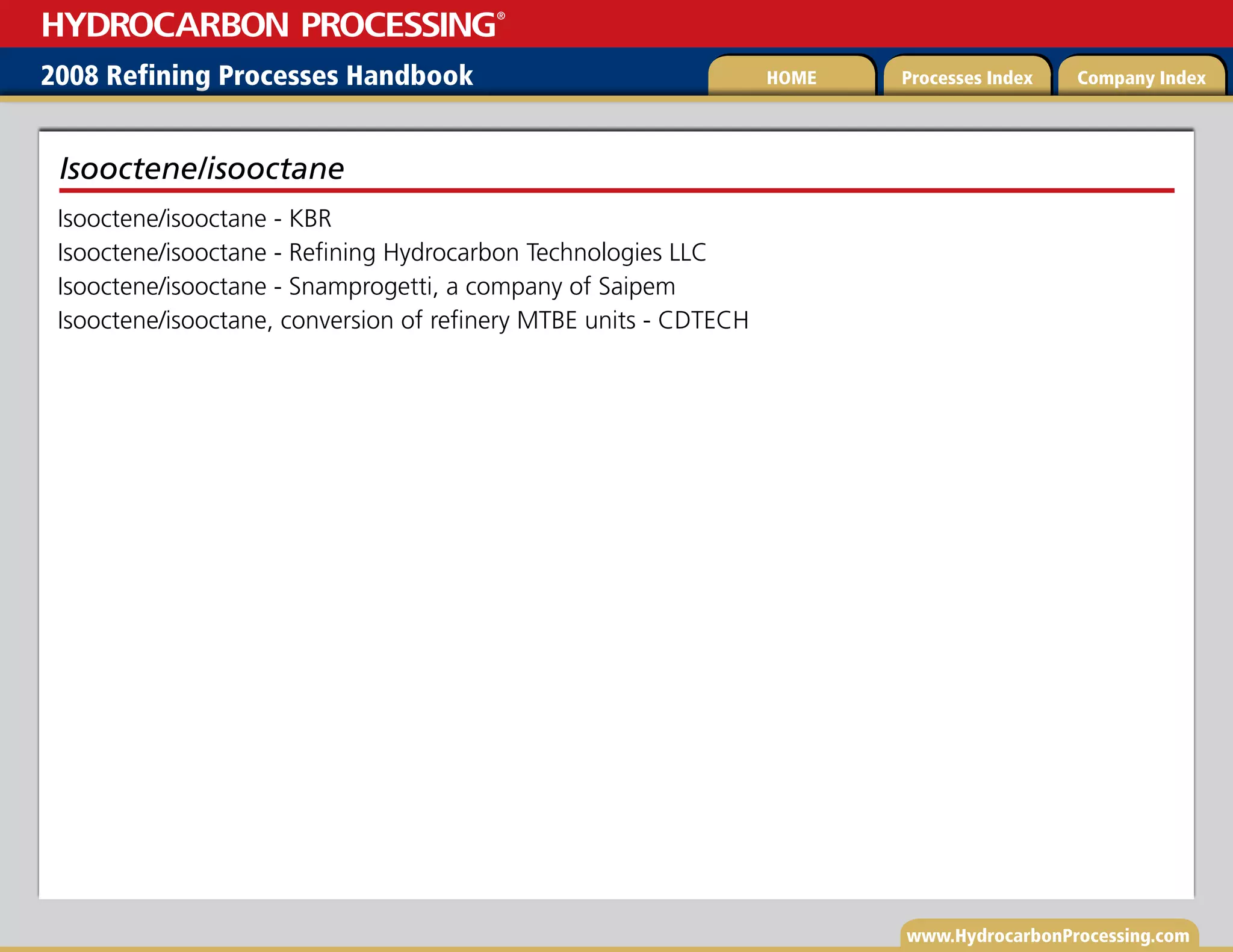
Isooctene/isooctane - KBR
Isooctene/isooctane - Refining Hydrocarbon Technologies LLC
Isooctene/isooctane - Snamprogetti, a company of Saipem
Isooctene/isooctane, conversion of refinery MTBE units - CDTECH
Isooctene/isooctane
2008 Refining Processes Handbook Processes Index Company Index
HOME
HYDROCARBON PROCESSING
®
www.HydrocarbonProcessing.com
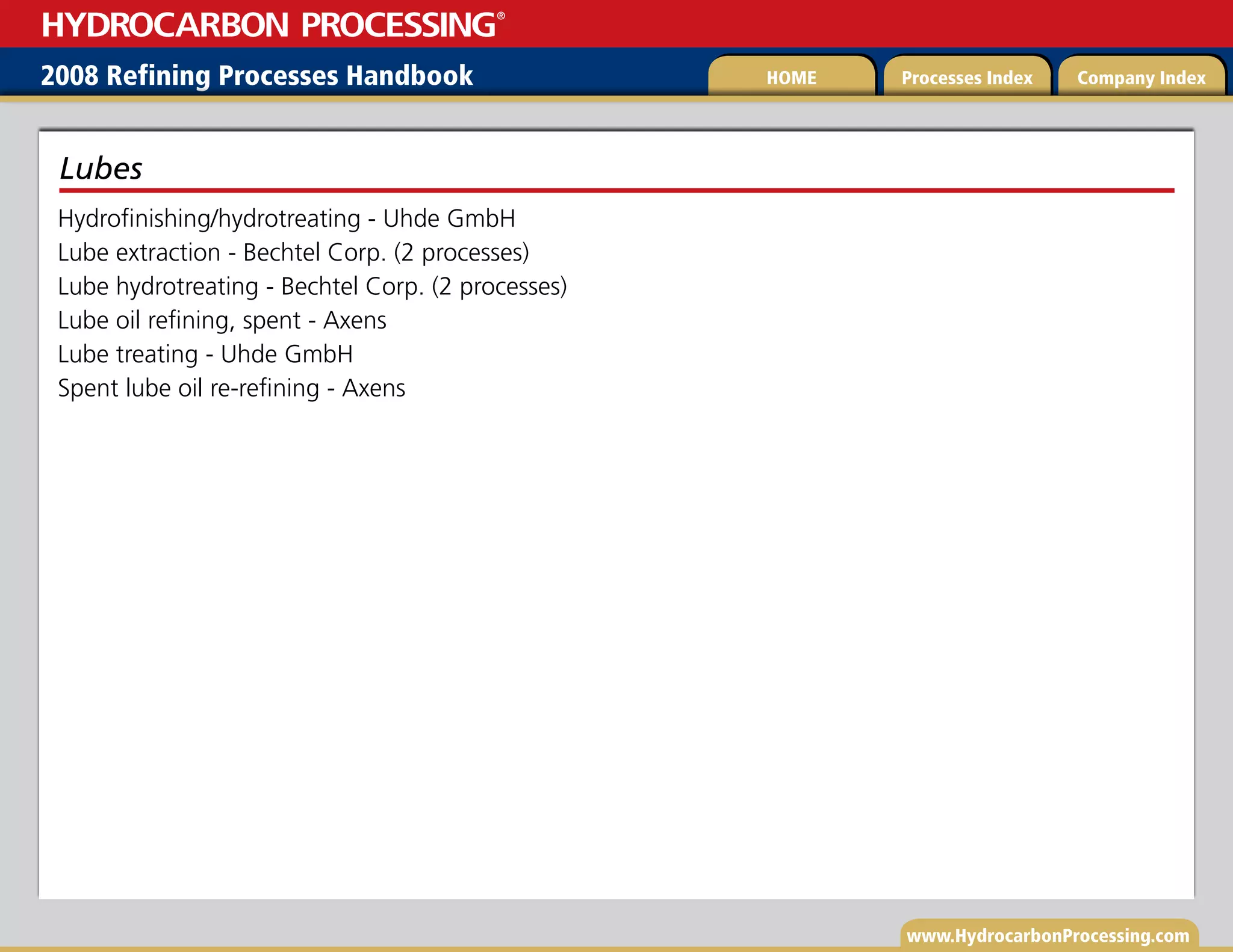
Hydrofinishing/hydrotreating - Uhde GmbH
Lube extraction - Bechtel Corp. (2 processes)
Lube hydrotreating - Bechtel Corp. (2 processes)
Lube oil refining, spent - Axens
Lube treating - Uhde GmbH
Spent lube oil re-refining - Axens
Lubes
2008 Refining Processes Handbook Processes Index Company Index
HOME
HYDROCARBON PROCESSING
®
www.HydrocarbonProcessing.com
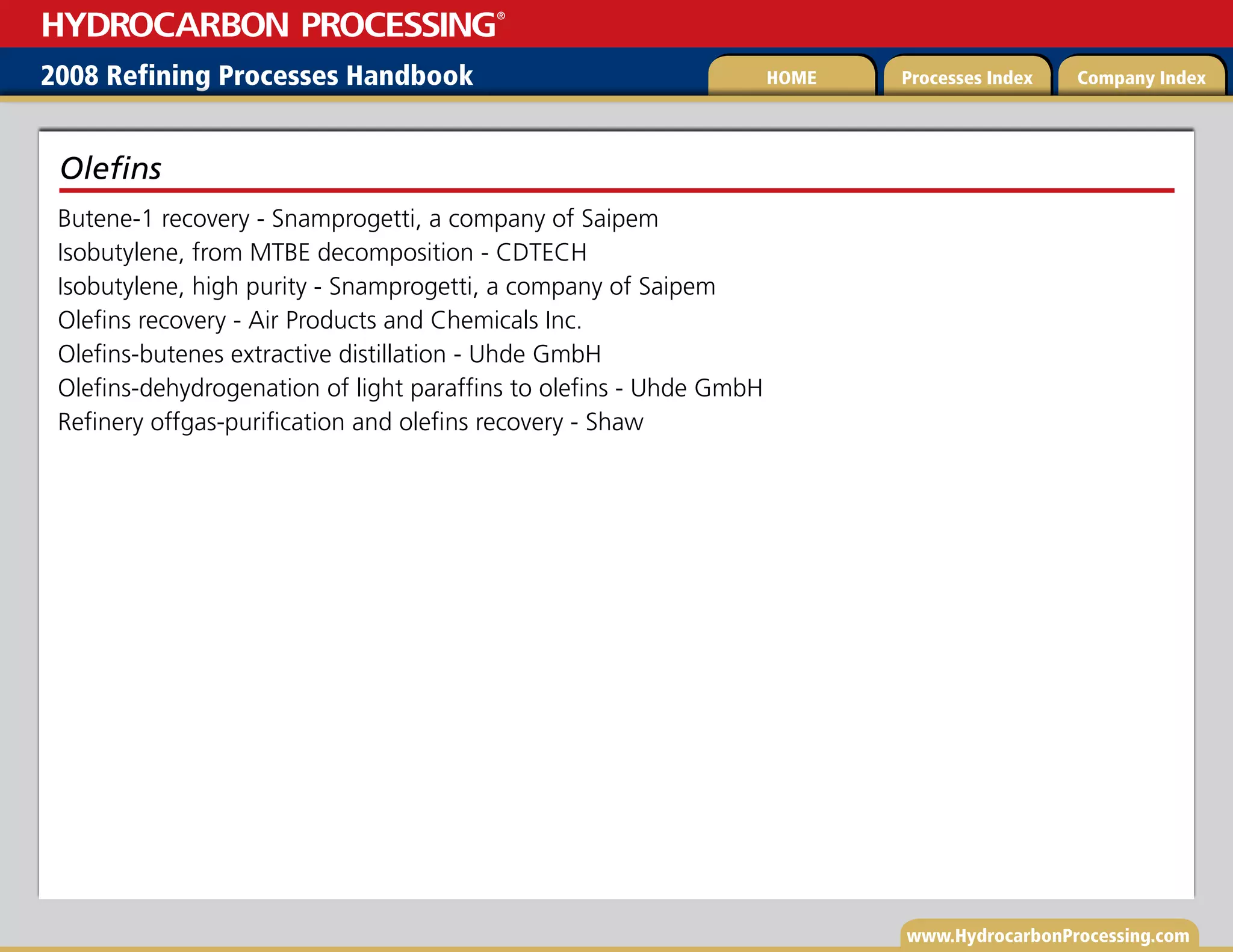
Butene-1 recovery - Snamprogetti, a company of Saipem
Isobutylene, from MTBE decomposition - CDTECH
Isobutylene, high purity - Snamprogetti, a company of Saipem
Olefins recovery - Air Products and Chemicals Inc.
Olefins-butenes extractive distillation - Uhde GmbH
Olefins-dehydrogenation of light paraffins to olefins - Uhde GmbH
Refinery offgas-purification and olefins recovery - Shaw
Olefins
2008 Refining Processes Handbook Processes Index Company Index
HOME
HYDROCARBON PROCESSING
®
www.HydrocarbonProcessing.com
Oxygen enrichment for Claus units - Linde AG, Division Gas and Engineering
Oxygen enrichment for FCC units - Linde AG, Division Gas and Engineering
Oxygen enrichment
2008 Refining Processes Handbook Processes Index Company Index
HOME
HYDROCARBON PROCESSING
®
www.HydrocarbonProcessing.com
Carboxylic acid recovery - GTC Technology
Dimethyl terephthlate - GTC Technology
Petrochemicals
2008 Refining Processes Handbook Processes Index Company Index
HOME
HYDROCARBON PROCESSING
®
www.HydrocarbonProcessing.com
Sulfur processing - Goar, Allison  Associates, Inc., an Air Products Company
Sulfur recovery - Goar, Allison  Associates, Inc., an Air Products Company
Sulfur recovery - Worley Parsons
Sulfur recovery
2008 Refining Processes Handbook Processes Index Company Index
HOME
HYDROCARBON PROCESSING
®
www.HydrocarbonProcessing.com
Treating-phenolic caustic - Merichem Chemical  Refinery Services LLC, Process Technology Division
Treating-pressure swing adsorption - UOP
Treating-spent caustic deep neutralization - Merichem Chemical  Refinery Services LLC, Process
Technology Division
Treating
2008 Refining Processes Handbook Processes Index Company Index
HOME
HYDROCARBON PROCESSING
®
www.HydrocarbonProcessing.com
Gas treating–H2
S removal - ExxonMobil Research and Engineering Co.
H2
S removal - Merichem Chemical  Refinery Services LLC, Gas Technology Products Division (3 processes)
Treating - ThioSolv LLC
Treating-gases - Merichem Chemical  Refinery Services LLC, Process Technology Division
Treating-sour water stripper gas - ThioSolv LLC
Wet gas scrubbing (WGS), wet gas scrubbing plus - ExxonMobil Research and Engineering Co.
Treating-acid gases
2008 Refining Processes Handbook Processes Index Company Index
HOME
HYDROCARBON PROCESSING
®
www.HydrocarbonProcessing.com
Flue gas denitrification - Haldor Topsøe A/S
NOX
abatement - ExxonMobil Research and Engineering Co.
Treating-flue gas
2008 Refining Processes Handbook Processes Index Company Index
HOME
HYDROCARBON PROCESSING
®
www.HydrocarbonProcessing.com
Treating-coker LPG to low total sulfur levels - Merichem Chemical  Refinery Services LLC,
Process Technology Division
Treating-gasoline and LPG - Merichem Chemical  Refinery Services LLC, Process Technology Division
Treating-gasoline desulfurization ultra deep - Merichem Chemical  Refinery Services LLC,
Process Technology Division
Treating-gasoline sweetening - Merichem Chemical  Refinery Services LLC, Process Technology Division
Treating-jet fuel/kerosine - Merichem Chemical  Refinery Services LLC, Process Technology Division
Treating-kerosine and heavy naphtha sweetening - Merichem Chemical  Refinery Services LLC,
Process Technology Division
Treating-propane - Merichem Chemical  Refinery Services LLC, Process Technology Division
Treating-reformer products - Merichem Chemical  Refinery Services LLC, Process Technology Division
Treating-fuels
2008 Refining Processes Handbook Processes Index Company Index
HOME
HYDROCARBON PROCESSING
®
www.HydrocarbonProcessing.com
Flue gas desulfurization-SNOX - Haldor Topsøe A/S
NOX
reduction, low temperature - Belco Technologies Corp.
SO2
removal, regenerative - Belco Technologies Corp.
Sour gas treatment - Haldor Topsøe A/S
Spent acid regeneration - Haldor Topsøe A/S
Wet scrubbing system, EDV - Belco Technologies Corp.
Treating-offgas
2008 Refining Processes Handbook Processes Index Company Index
HOME
HYDROCARBON PROCESSING
®
www.HydrocarbonProcessing.com
Deep thermal conversion - Shell Global Solutions International B.V.
Emulsion residue upgrade - Quadrise Fuel International
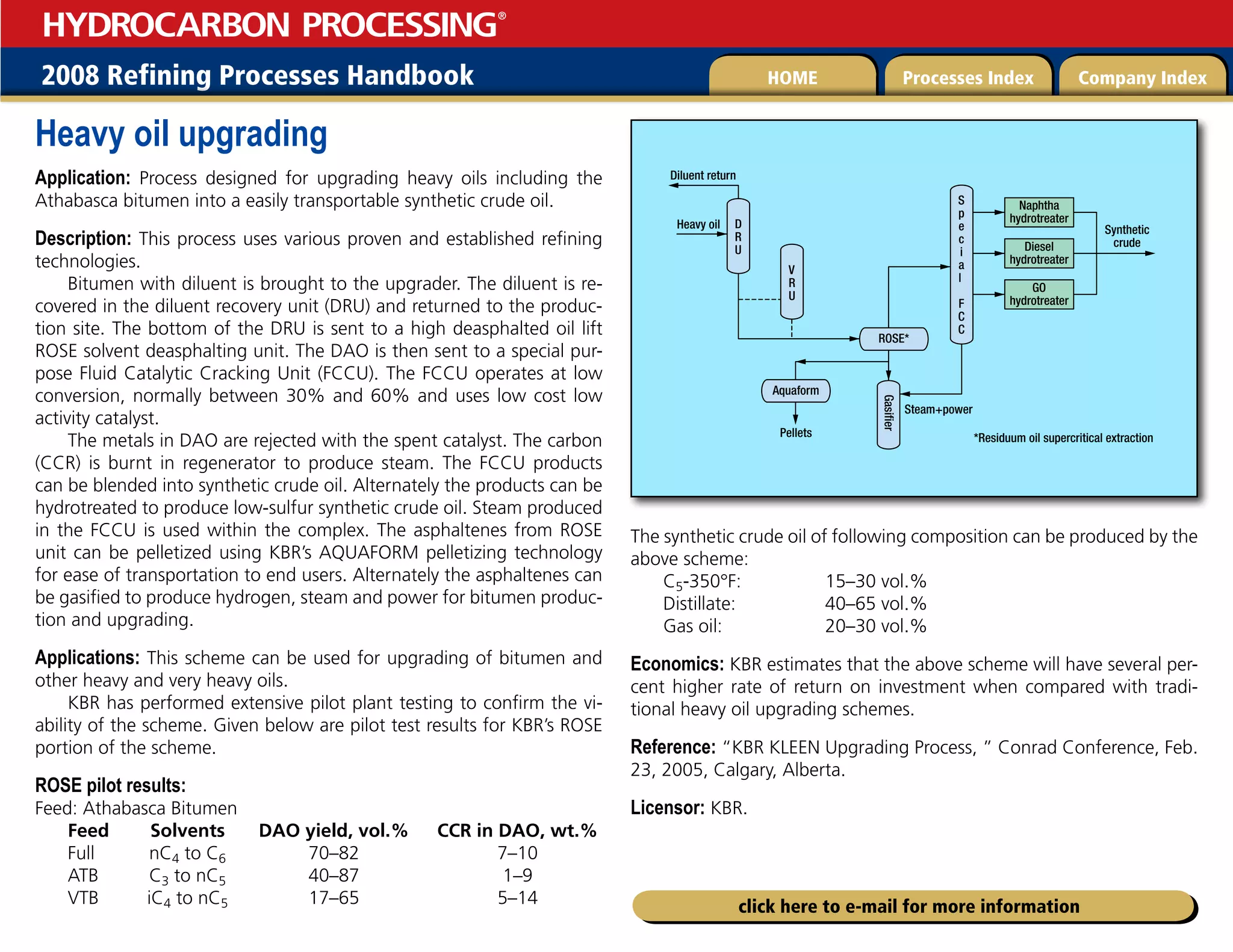
Heavy oil upgrading - KBR
Hydroprocessing-heavy oil and residue - Genoil Inc.
Thermal gasoil - Shell Global Solutions International B.V.
Upgrading-heavy oil
2008 Refining Processes Handbook Processes Index Company Index
HOME
HYDROCARBON PROCESSING
®
www.HydrocarbonProcessing.com
Visbreaking - Foster Wheeler USA Corp.
Visbreaking - Shell Global Solutions International B.V.
Visbreaking
2008 Refining Processes Handbook Processes Index Company Index
HOME
HYDROCARBON PROCESSING
®
www.HydrocarbonProcessing.com
Catalytic dewaxing - ExxonMobil Research and Engineering Co.
Dewaxing - Bechtel Corp.
Dewaxing - Chevron Lummus Global LLC
Dewaxing/wax deoiling - Bechtel Corp.
Slack wax deoiling - Uhde GmbH
Wax hydrotreating - Bechtel Corp.
White oil and wax hydrotreating - Uhde GmbH
Waxes
2008 Refining Processes Handbook Processes Index Company Index
HOME
HYDROCARBON PROCESSING
®
2008 Refining Processes Handbook Processes Index Company Index
HOME
HYDROCARBON PROCESSING
®
click here to e-mail for more information
Alkylate, butanes to alkylate
Application: With the conversion of butanes to high-value motor fuel al-
kylate using the CDAlkyPlus process, NGL producers now have another
route to upgrade butanes to gasoline blend stock. By using isobutylene
as the sole olefin source, the CDAlkyPlus technology allows for the prof-
itable conversion of isobutylene and isobutane into high-value motor
fuel alkylate.
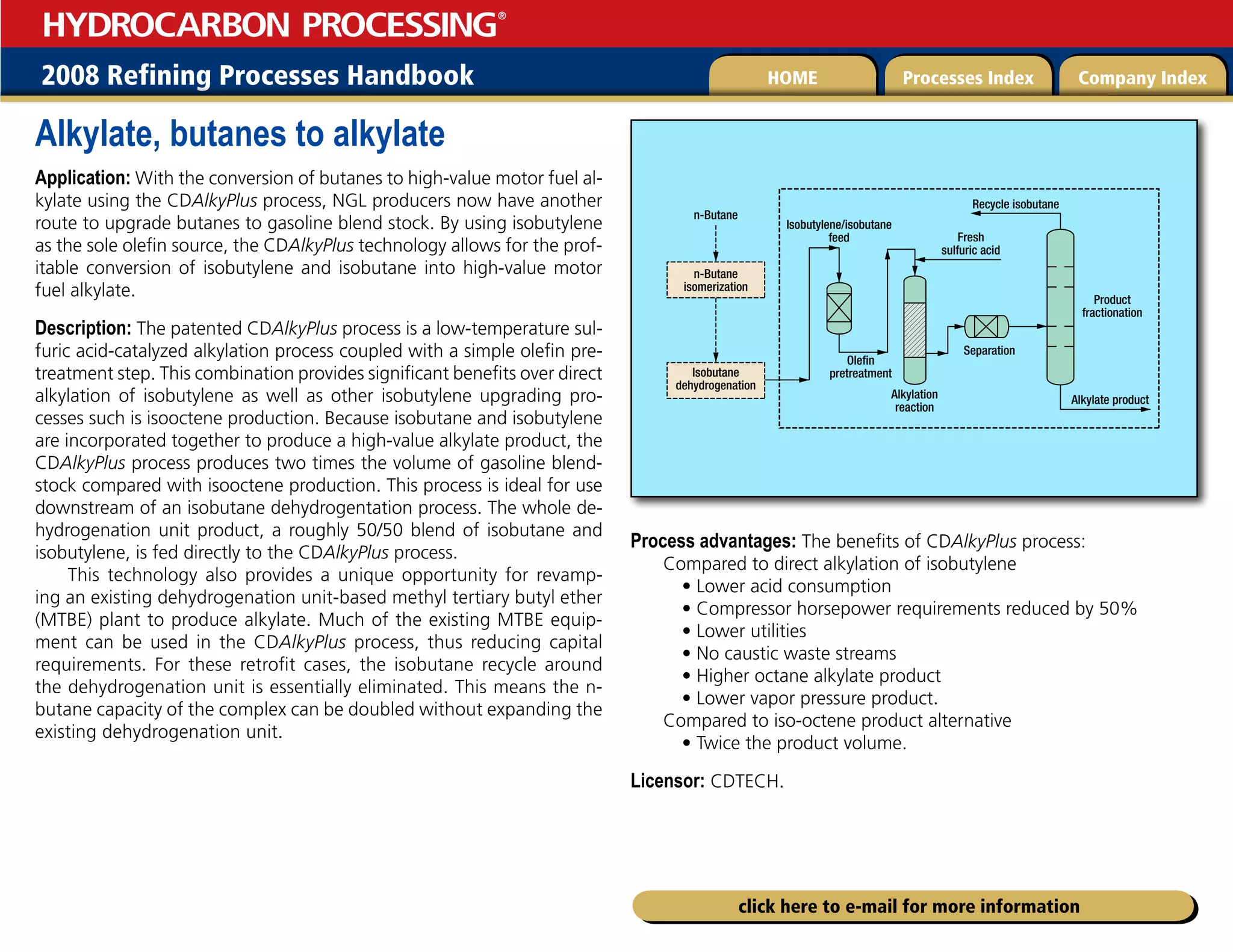
Description: The patented CDAlkyPlus process is a low-temperature sul-
furic acid-catalyzed alkylation process coupled with a simple olefin pre-
treatment step. This combination provides significant benefits over direct
alkylation of isobutylene as well as other isobutylene upgrading pro-
cesses such is isooctene production. Because isobutane and isobutylene
are incorporated together to produce a high-value alkylate product, the
CDAlkyPlus process produces two times the volume of gasoline blend-
stock compared with isooctene production. This process is ideal for use
downstream of an isobutane dehydrogentation process. The whole de-
hydrogenation unit product, a roughly 50/50 blend of isobutane and
isobutylene, is fed directly to the CDAlkyPlus process.
This technology also provides a unique opportunity for revamp-
ing an existing dehydrogenation unit-based methyl tertiary butyl ether
(MTBE) plant to produce alkylate. Much of the existing MTBE equip-
ment can be used in the CDAlkyPlus process, thus reducing capital
requirements. For these retrofit cases, the isobutane recycle around
the dehydrogenation unit is essentially eliminated. This means the n-
butane capacity of the complex can be doubled without expanding the
existing dehydrogenation unit.
Process advantages: The benefits of CDAlkyPlus process:
Compared to direct alkylation of isobutylene
• Lower acid consumption
• Compressor horsepower requirements reduced by 50%
• Lower utilities
• No caustic waste streams
• Higher octane alkylate product
• Lower vapor pressure product.
Compared to iso-octene product alternative
• Twice the product volume.
Licensor: CDTECH.
n-Butane
Recycle isobutane
Fresh
sulfuric acid
Separation
Alkylation
reaction
Product
fractionation
Alkylate product
Isobutylene/isobutane
feed
Olefin
pretreatment
n-Butane
isomerization
Isobutane
dehydrogenation
2008 Refining Processes Handbook Processes Index Company Index
HOME
HYDROCARBON PROCESSING
®
click here to e-mail for more information
Alkylation
Application: To combine propylene, butylenes and amylenes with isobutane
in the presence of strong sulfuric acid to produce high-octane branched
chain hydrocarbons using the STRATCO Effluent Refrigeration Alkylation
process.
Products: Branched chain hydrocarbons for use in high-octane motor
fuel and aviation gasoline.
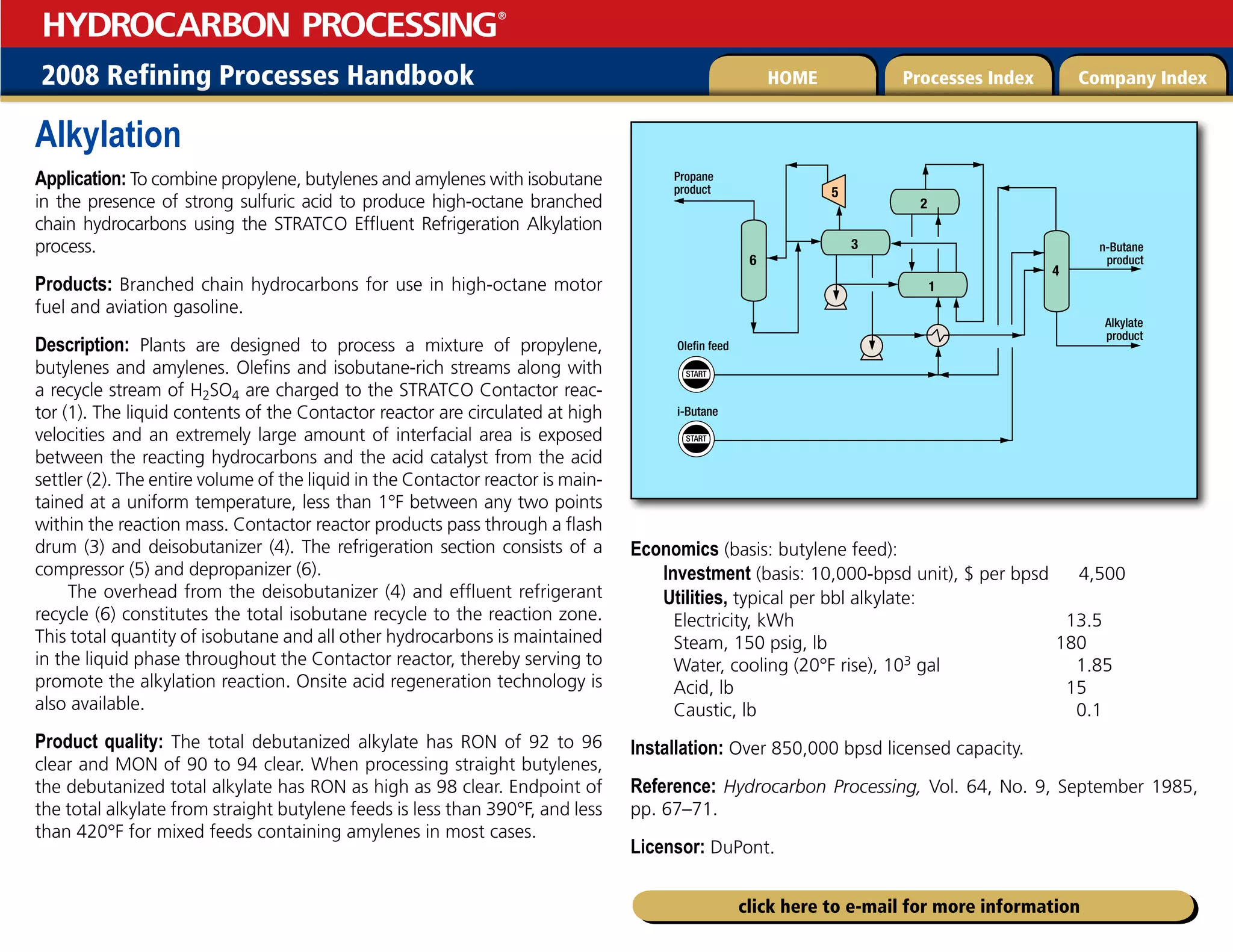
Description: Plants are designed to process a mixture of propylene,
butylenes and amylenes. Olefins and isobutane-rich streams along with
a recycle stream of H2SO4 are charged to the STRATCO Contactor reac-
tor (1). The liquid contents of the Contactor reactor are circulated at high
velocities and an extremely large amount of interfacial area is exposed
between the reacting hydrocarbons and the acid catalyst from the acid
settler (2). The entire volume of the liquid in the Contactor reactor is main-
tained at a uniform temperature, less than 1°F between any two points
within the reaction mass. Contactor reactor products pass through a flash
drum (3) and deisobutanizer (4). The refrigeration section consists of a
compressor (5) and depropanizer (6).
The overhead from the deisobutanizer (4) and effluent refrigerant
recycle (6) constitutes the total isobutane recycle to the reaction zone.
This total quantity of isobutane and all other hydrocarbons is maintained
in the liquid phase throughout the Contactor reactor, thereby serving to
promote the alkylation reaction. Onsite acid regeneration technology is
also available.
Product quality: The total debutanized alkylate has RON of 92 to 96
clear and MON of 90 to 94 clear. When processing straight butylenes,
the debutanized total alkylate has RON as high as 98 clear. Endpoint of
the total alkylate from straight butylene feeds is less than 390°F, and less
than 420°F for mixed feeds containing amylenes in most cases.
Economics (basis: butylene feed):
Investment (basis: 10,000-bpsd unit), $ per bpsd 4,500
Utilities, typical per bbl alkylate:
Electricity, kWh 13.5
Steam, 150 psig, lb 180
Water, cooling (20°F rise), 103 gal 1.85
Acid, lb 15
Caustic, lb 0.1
Installation: Over 850,000 bpsd licensed capacity.
Reference: Hydrocarbon Processing, Vol. 64, No. 9, September 1985,
pp. 67–71.
Licensor: DuPont.
START
START
Olefin feed
6
i-Butane
3
5
1
2
Propane
product
4
n-Butane
product
Alkylate
product
2008 Refining Processes Handbook Processes Index Company Index
HOME
HYDROCARBON PROCESSING
®
click here to e-mail for more information
Alkylation
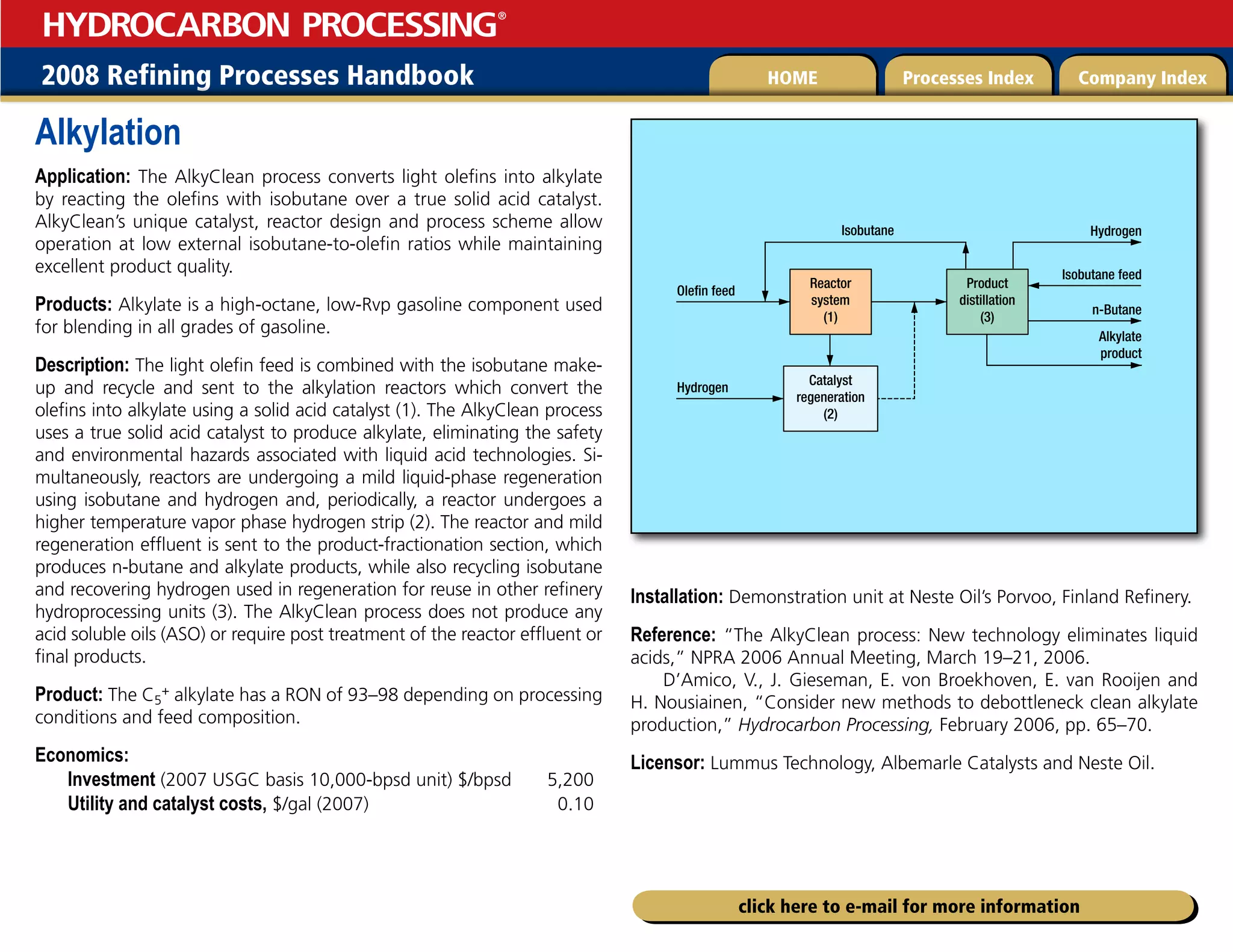
Application: The AlkyClean process converts light olefins into alkylate
by reacting the olefins with isobutane over a true solid acid catalyst.
AlkyClean’s unique catalyst, reactor design and process scheme allow
operation at low external isobutane-to-olefin ratios while maintaining
excellent product quality.
Products: Alkylate is a high-octane, low-Rvp gasoline component used
for blending in all grades of gasoline.
Description: The light olefin feed is combined with the isobutane make-
up and recycle and sent to the alkylation reactors which convert the
olefins into alkylate using a solid acid catalyst (1). The AlkyClean process
uses a true solid acid catalyst to produce alkylate, eliminating the safety
and environmental hazards associated with liquid acid technologies. Si-
multaneously, reactors are undergoing a mild liquid-phase regeneration
using isobutane and hydrogen and, periodically, a reactor undergoes a
higher temperature vapor phase hydrogen strip (2). The reactor and mild
regeneration effluent is sent to the product-fractionation section, which
produces n-butane and alkylate products, while also recycling isobutane
and recovering hydrogen used in regeneration for reuse in other refinery
hydroprocessing units (3). The AlkyClean process does not produce any
acid soluble oils (ASO) or require post treatment of the reactor effluent or
final products.
Product: The C5
+ alkylate has a RON of 93–98 depending on processing
conditions and feed composition.
Economics:
Investment (2007 USGC basis 10,000-bpsd unit) $/bpsd 5,200
Utility and catalyst costs, $/gal (2007) 0.10
Installation: Demonstration unit at Neste Oil’s Porvoo, Finland Refinery.
Reference: “The AlkyClean process: New technology eliminates liquid
acids,” NPRA 2006 Annual Meeting, March 19–21, 2006.
D’Amico, V., J. Gieseman, E. von Broekhoven, E. van Rooijen and
H. Nousiainen, “Consider new methods to debottleneck clean alkylate
production,” Hydrocarbon Processing, February 2006, pp. 65–70.
Licensor: Lummus Technology, Albemarle Catalysts and Neste Oil.
3FBDUPS
TZTUFN

$BUBMZTU
SFHFOFSBUJPO

1SPEVDU
EJTUJMMBUJPO

0MFmOGFFE
)ZESPHFO
*TPCVUBOF
*TPCVUBOFGFFE
)ZESPHFO
O#VUBOF
MLZMBUF
QSPEVDU
2008 Refining Processes Handbook Processes Index Company Index
HOME
HYDROCARBON PROCESSING
®
Alkylation
Application: The RHT-Alkylation process is an improved method to react
C3–C5 olefins with isobutane using the classical sulfuric acid alkylation
process. This process uses a unique mixing device—eductor(s)—that
provides low-temperature (25°F–30°F) operations at isothermal condi-
tions. This eductor mixing device is more cost-effective than other de-
vices being used or proposed. It is maintenance free and does not re-
quire replacement every two to three years. This mixing device can be a
retrofit replacement for existing contactors. In addition, the auto refrig-
eration vapor can be condensed by enhancing pressure and then easily
absorbed in hydrocarbon liquid, without revamping the compressor.
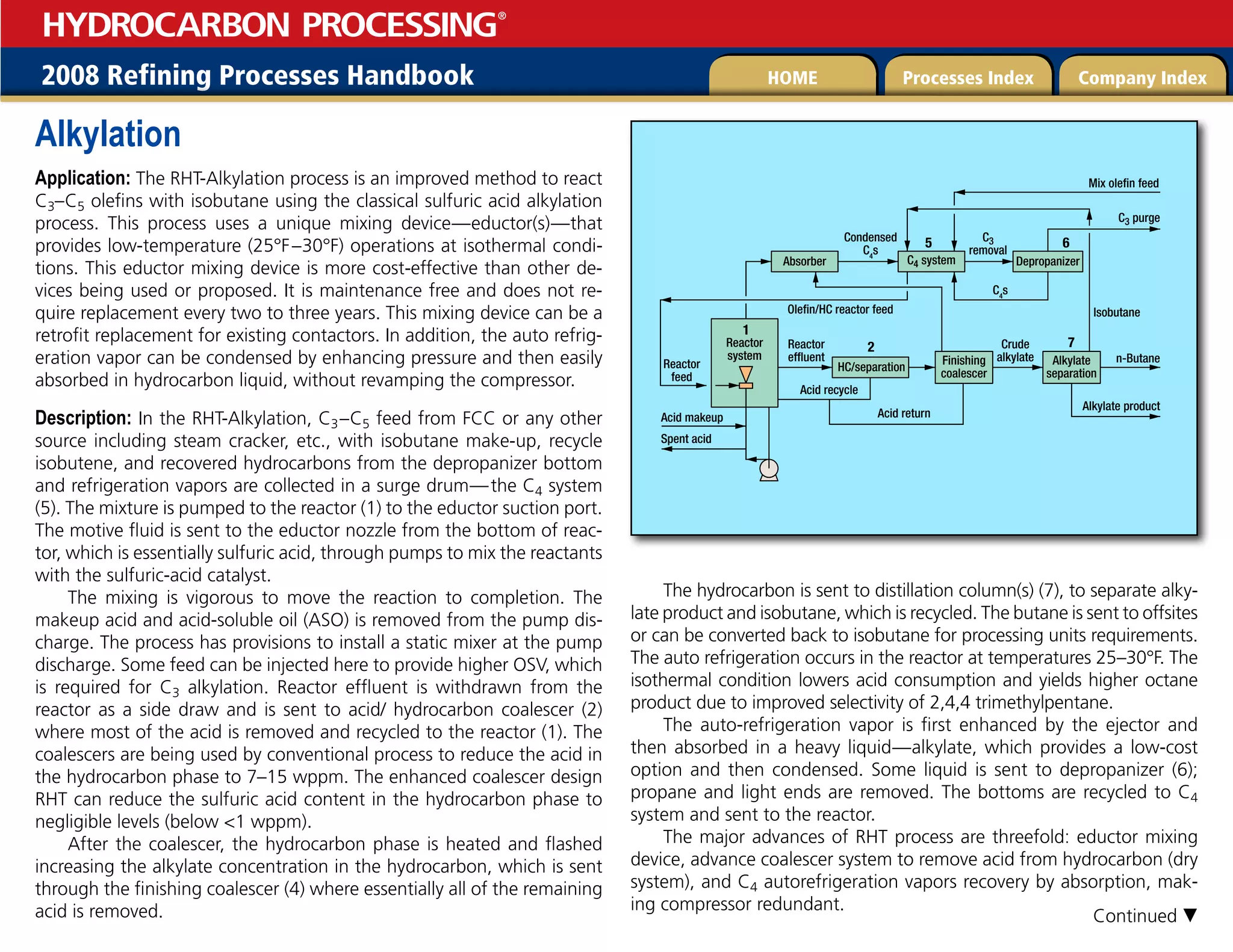
Description: In the RHT-Alkylation, C3–C5 feed from FCC or any other
source including steam cracker, etc., with isobutane make-up, recycle
isobutene, and recovered hydrocarbons from the depropanizer bottom
and refrigeration vapors are collected in a surge drum—the C4 system
(5). The mixture is pumped to the reactor (1) to the eductor suction port.
The motive fluid is sent to the eductor nozzle from the bottom of reac-
tor, which is essentially sulfuric acid, through pumps to mix the reactants
with the sulfuric-acid catalyst.
The mixing is vigorous to move the reaction to completion. The
makeup acid and acid-soluble oil (ASO) is removed from the pump dis-
charge. The process has provisions to install a static mixer at the pump
discharge. Some feed can be injected here to provide higher OSV, which
is required for C3 alkylation. Reactor effluent is withdrawn from the
reactor as a side draw and is sent to acid/ hydrocarbon coalescer (2)
where most of the acid is removed and recycled to the reactor (1). The
coalescers are being used by conventional process to reduce the acid in
the hydrocarbon phase to 7–15 wppm. The enhanced coalescer design
RHT can reduce the sulfuric acid content in the hydrocarbon phase to
negligible levels (below 1 wppm).
After the coalescer, the hydrocarbon phase is heated and flashed
increasing the alkylate concentration in the hydrocarbon, which is sent
through the finishing coalescer (4) where essentially all of the remaining
acid is removed.
The hydrocarbon is sent to distillation column(s) (7), to separate alky-
late product and isobutane, which is recycled. The butane is sent to offsites
or can be converted back to isobutane for processing units requirements.
The auto refrigeration occurs in the reactor at temperatures 25–30°F. The
isothermal condition lowers acid consumption and yields higher octane
product due to improved selectivity of 2,4,4 trimethylpentane.
The auto-refrigeration vapor is first enhanced by the ejector and
then absorbed in a heavy liquid—alkylate, which provides a low-cost
option and then condensed. Some liquid is sent to depropanizer (6);
propane and light ends are removed. The bottoms are recycled to C4
system and sent to the reactor.
The major advances of RHT process are threefold: eductor mixing
device, advance coalescer system to remove acid from hydrocarbon (dry
system), and C4 autorefrigeration vapors recovery by absorption, mak-
ing compressor redundant.
Mix olefin feed
C3 purge
Condensed
C4
s
C4
s
C3
removal
Absorber
Olefin/HC reactor feed Isobutane
Reactor
effluent
Crude
alkylate n-Butane
Reactor
feed
Acid return
Acid makeup
Alkylate product
Spent acid
Acid recycle
Reactor
system
C4 system
HC/separation
2 7
6
5
1
Finishing
coalescer
Alkylate
separation
Depropanizer
Continued 
Economics: For a US Gulf Coast unit 1Q 2006 with a capacity of 10,000
bpd alkylate unit
CAPEX ISBL, MM USD 29.5
Power, kWh 2,800
Water, cooling, m3/h 1,750
Steam, kg/h 25,600
FCC Feed (about 15% isobutelene in C4 mixed stream)
Product properties: Octane (R+M)/2:94.8–95.4
Alkylation, continued Commercial units: Technology is ready for commercialization.
References:
US patent 5,095168.
US Patent 4,130593.
Kranz, K., “Alkylation Chemistry,” Stratco, Inc., 2001.
Branzaru, J., “Introduction to Sulfuric Acid Alkylation,” Stratco, Inc.,
2001.
Nelson, Handbook of Refining.
Meyers, R. A., Handbook of Refining, McGraw Hill, New York,
1997.
Licensor: Refining Hydrocarbon Technologies LLC.
click here to e-mail for more information
2008 Refining Processes Handbook Processes Index Company Index
HOME
HYDROCARBON PROCESSING
®
click here to e-mail for more information
Alkylation
Application: The modified HF Alkylation technology is used with HF al-
kylation technology to reduce aerosol formation in the event of an HF
release, while maintaining unit operability and product quality. The UOP
Alkad Modified HF Alkylation process and the UOP ReVap Modified Al-
kylation process are both passive mitigation systems that will reduce
aerosol from any leak that occurs while additive is in the system.
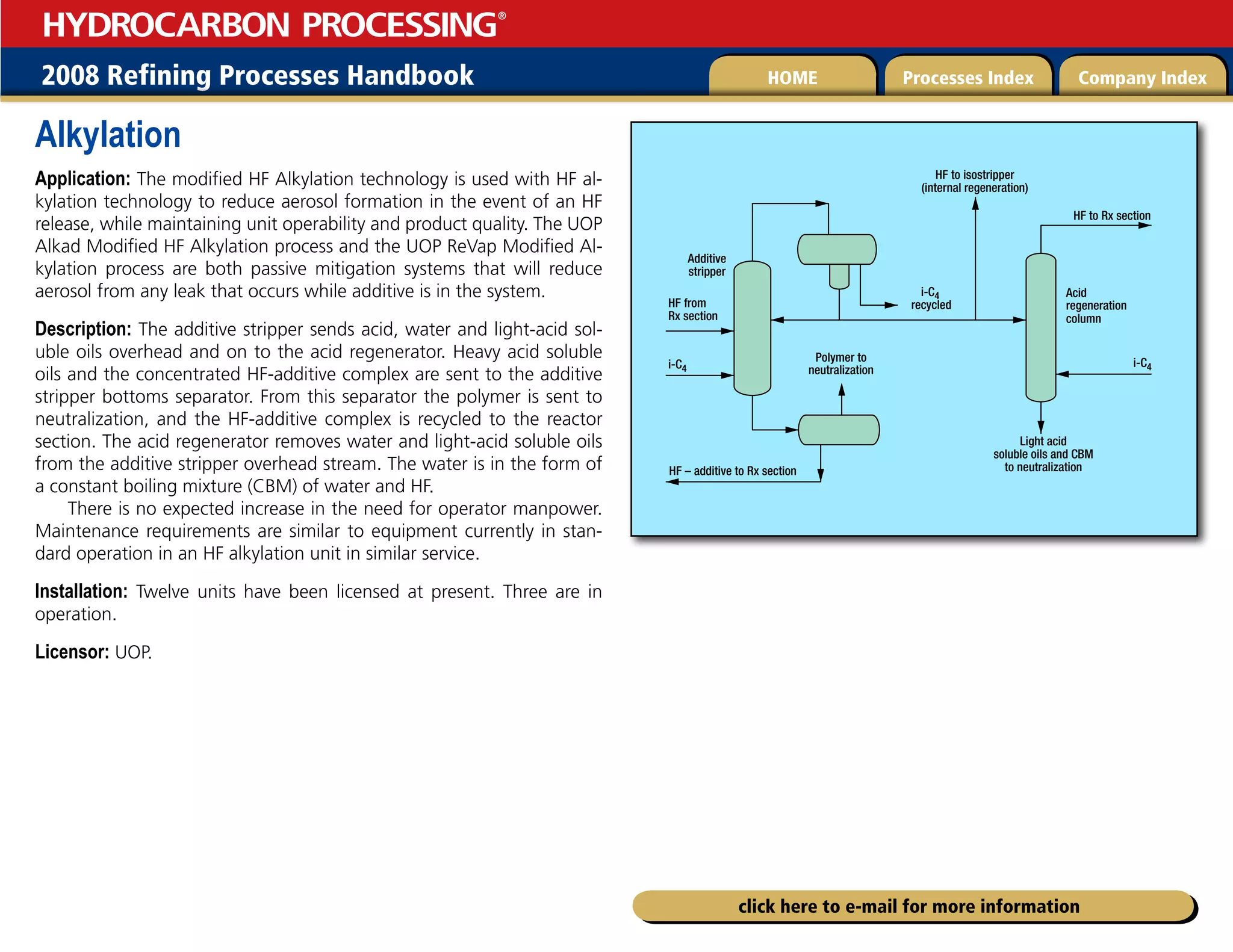
Description: The additive stripper sends acid, water and light-acid sol-
uble oils overhead and on to the acid regenerator. Heavy acid soluble
oils and the concentrated HF-additive complex are sent to the additive
stripper bottoms separator. From this separator the polymer is sent to
neutralization, and the HF-additive complex is recycled to the reactor
section. The acid regenerator removes water and light-acid soluble oils
from the additive stripper overhead stream. The water is in the form of
a constant boiling mixture (CBM) of water and HF.
There is no expected increase in the need for operator manpower.
Maintenance requirements are similar to equipment currently in stan-
dard operation in an HF alkylation unit in similar service.
Installation: Twelve units have been licensed at present. Three are in
operation.
Licensor: UOP.
HF to Rx section
Acid
regeneration
column
i-C4
recycled
Light acid
soluble oils and CBM
to neutralization
Polymer to
neutralization
HF to isostripper
(internal regeneration)
Additive
stripper
i-C4
i-C4
HF from
Rx section
HF – additive to Rx section
2008 Refining Processes Handbook Processes Index Company Index
HOME
HYDROCARBON PROCESSING
®
click here to e-mail for more information
Alkylation
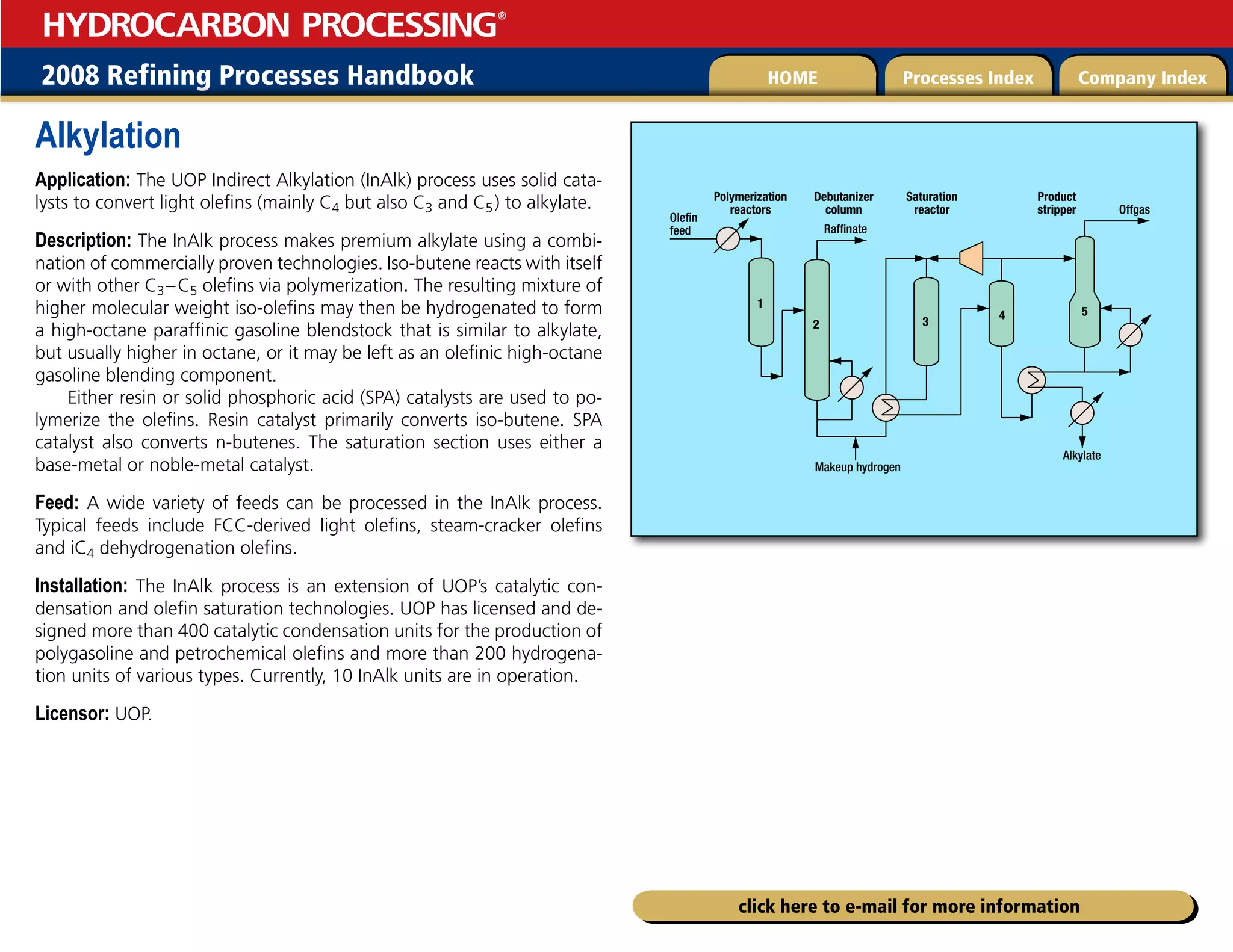
Application: The UOP Indirect Alkylation (InAlk) process uses solid cata-
lysts to convert light olefins (mainly C4 but also C3 and C5) to alkylate.
Description: The InAlk process makes premium alkylate using a combi-
nation of commercially proven technologies. Iso-butene reacts with itself
or with other C3–C5 olefins via polymerization. The resulting mixture of
higher molecular weight iso-olefins may then be hydrogenated to form
a high-octane paraffinic gasoline blendstock that is similar to alkylate,
but usually higher in octane, or it may be left as an olefinic high-octane
gasoline blending component.
Either resin or solid phosphoric acid (SPA) catalysts are used to po-
lymerize the olefins. Resin catalyst primarily converts iso-butene. SPA
catalyst also converts n-butenes. The saturation section uses either a
base-metal or noble-metal catalyst.
Feed: A wide variety of feeds can be processed in the InAlk process.
Typical feeds include FCC-derived light olefins, steam-cracker olefins
and iC4 dehydrogenation olefins.
Installation: The InAlk process is an extension of UOP’s catalytic con-
densation and olefin saturation technologies. UOP has licensed and de-
signed more than 400 catalytic condensation units for the production of
polygasoline and petrochemical olefins and more than 200 hydrogena-
tion units of various types. Currently, 10 InAlk units are in operation.
Licensor: UOP.
1
2 3
4 5
Olefin
feed Raffinate
Offgas
Alkylate
Makeup hydrogen
Polymerization
reactors
Debutanizer
column
Saturation
reactor
Product
stripper
2008 Refining Processes Handbook Processes Index Company Index
HOME
HYDROCARBON PROCESSING
®
click here to e-mail for more information
Alkylation, low-temperature acid
catalyzed
Application: The patented CDAlky process is an advanced sulfuric acid-
catalyzed alkylation process for the production of motor fuel alkylate.
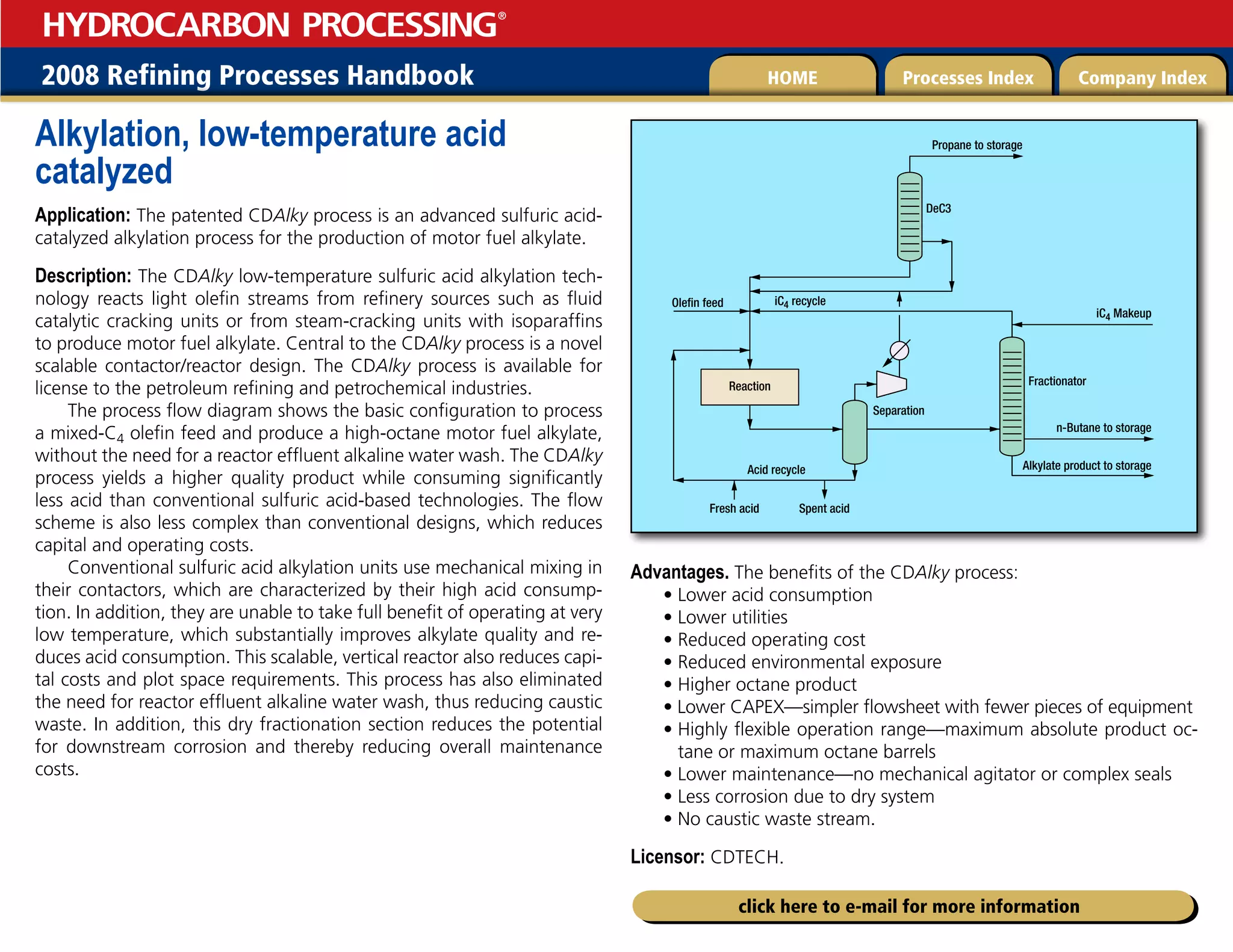
Description: The CDAlky low-temperature sulfuric acid alkylation tech-
nology reacts light olefin streams from refinery sources such as fluid
catalytic cracking units or from steam-cracking units with isoparaffins
to produce motor fuel alkylate. Central to the CDAlky process is a novel
scalable contactor/reactor design. The CDAlky process is available for
license to the petroleum refining and petrochemical industries.
The process flow diagram shows the basic configuration to process
a mixed-C4 olefin feed and produce a high-octane motor fuel alkylate,
without the need for a reactor effluent alkaline water wash. The CDAlky
process yields a higher quality product while consuming significantly
less acid than conventional sulfuric acid-based technologies. The flow
scheme is also less complex than conventional designs, which reduces
capital and operating costs.
Conventional sulfuric acid alkylation units use mechanical mixing in
their contactors, which are characterized by their high acid consump-
tion. In addition, they are unable to take full benefit of operating at very
low temperature, which substantially improves alkylate quality and re-
duces acid consumption. This scalable, vertical reactor also reduces capi-
tal costs and plot space requirements. This process has also eliminated
the need for reactor effluent alkaline water wash, thus reducing caustic
waste. In addition, this dry fractionation section reduces the potential
for downstream corrosion and thereby reducing overall maintenance
costs.
Advantages. The benefits of the CDAlky process:
• Lower acid consumption
• Lower utilities
• Reduced operating cost
• Reduced environmental exposure
• Higher octane product
• Lower CAPEX—simpler flowsheet with fewer pieces of equipment
• 
Highly flexible operation range—maximum absolute product oc-
tane or maximum octane barrels
• Lower maintenance—no mechanical agitator or complex seals
• Less corrosion due to dry system
• No caustic waste stream.
Licensor: CDTECH.
Propane to storage
DeC3
Olefin feed
Fresh acid Spent acid
Acid recycle
Separation
Reaction
iC4 recycle
iC4 Makeup
Fractionator
n-Butane to storage
Alkylate product to storage
2008 Refining Processes Handbook Processes Index Company Index
HOME
HYDROCARBON PROCESSING
®
Alkylation, sulfuric acid
Application: ExxonMobil’s Research  Engineering (EMRE’s) autore-
frigerated sulfuric-acid catalyzed process that combines butylene (and
propylene or pentylene if desired) with isobutane to produce high-oc-
tane gasoline components that are particularly attractive in locations
that are MON limited. Technology can be installed rassroots or retrofit
into existing alkylation facilities.
Products: A low-sulfur, low-Rvp, highly isoparaffinic, high-octane (es-
pecially MON) gasoline blendstock is produced from this alkylation pro-
cess.
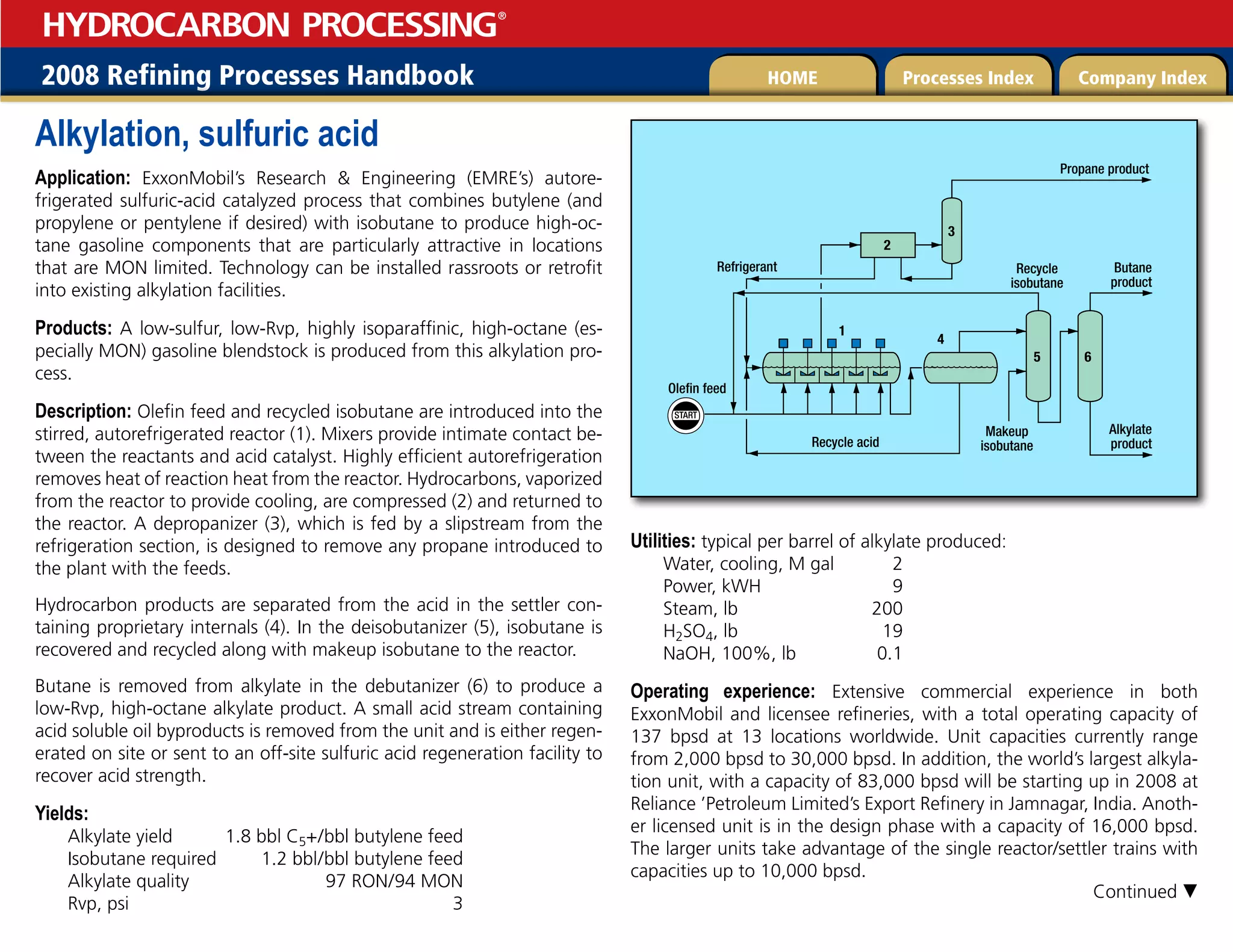
Description: Olefin feed and recycled isobutane are introduced into the
stirred, autorefrigerated reactor (1). Mixers provide intimate contact be-
tween the reactants and acid catalyst. Highly efficient autorefrigeration
removes heat of reaction heat from the reactor. Hydrocarbons, vaporized
from the reactor to provide cooling, are compressed (2) and returned to
the reactor. A depropanizer (3), which is fed by a slipstream from the
refrigeration section, is designed to remove any propane introduced to
the plant with the feeds.
Hydrocarbon products are separated from the acid in the settler con-
taining proprietary internals (4). In the deisobutanizer (5), isobutane is
recovered and recycled along with makeup isobutane to the reactor.
Butane is removed from alkylate in the debutanizer (6) to produce a
low-Rvp, high-octane alkylate product. A small acid stream containing
acid soluble oil byproducts is removed from the unit and is either regen-
erated on site or sent to an off-site sulfuric acid regeneration facility to
recover acid strength.
Yields:
Alkylate yield 1.8 bbl C5+/bbl butylene feed
Isobutane required 1.2 bbl/bbl butylene feed
Alkylate quality 97 RON/94 MON
Rvp, psi 3
Utilities: typical per barrel of alkylate produced:
Water, cooling, M gal 2
Power, kWH 9
Steam, lb 200
H2SO4, lb 19
NaOH, 100%, lb 0.1
Operating experience: Extensive commercial experience in both
ExxonMobil and licensee refineries, with a total operating capacity of
137 bpsd at 13 locations worldwide. Unit capacities currently range
from 2,000 bpsd to 30,000 bpsd. In addition, the world’s largest alkyla-
tion unit, with a capacity of 83,000 bpsd will be starting up in 2008 at
Reliance ’Petroleum Limited’s Export Refinery in Jamnagar, India. Anoth-
er licensed unit is in the design phase with a capacity of 16,000 bpsd.
The larger units take advantage of the single reactor/settler trains with
capacities up to 10,000 bpsd.
START
Alkylate
product
Butane
product
Olefin feed
Recycle acid
Makeup
isobutane
Propane product
Recycle
isobutane
Refrigerant
1
4
5 6
3
2
Continued 
Technical advantages:
• Autorefridgeration is thermodynamically more efficient, allows
lower reactor temperatures, which favor better product quality, and
lowers energy usage.
• Staged reactor results in a high average isobutane concentration,
which favors high product quality.
• Low space velocity results in high product quality and reduced
ester formation eliminating corrosion problems in fractionation equip-
ment.
• Low reactor operating pressure translates into high reliability for
the mechanical seals for the mixers, which operate in the vapor phase.
Alkylation, sulfuric acid, continued
click here to e-mail for more information
Economic advantages: Better economy of scale—Reactor system is sim-
ple and easily expandable with 10,000 bpsd single train capacities easily
achievable
Reference: Lerner, H., “Exxon sulfuric acid alkylation technology,” Hand-
book of Petroleum Refining Processes, Second Ed., R. A. Meyers, Ed.,
pp. 1.3–1.14.
Licensor: ExxonMobil Research  Engineering Co.
2008 Refining Processes Handbook Processes Index Company Index
HOME
HYDROCARBON PROCESSING
®
click here to e-mail for more information
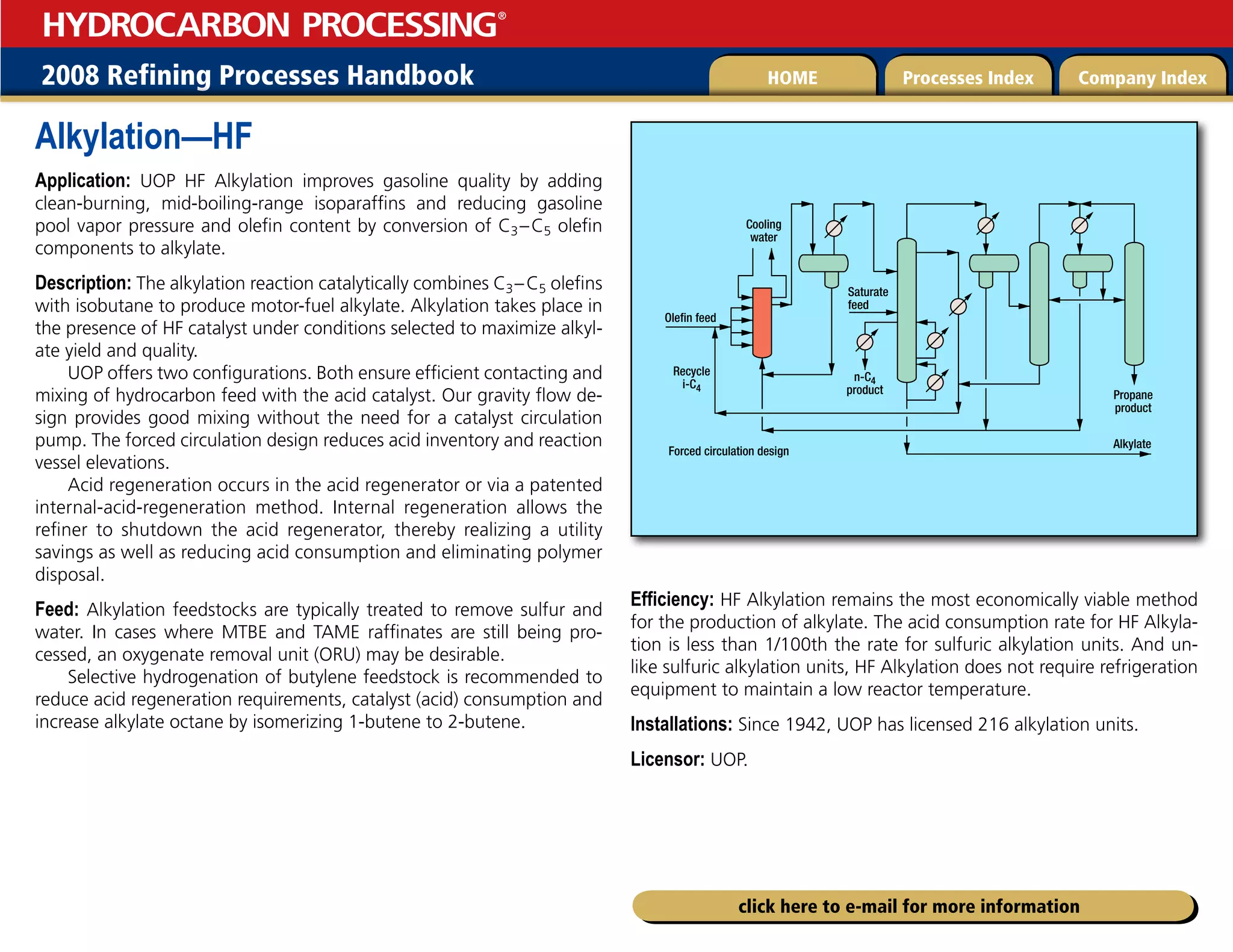
Alkylation—HF
Application: UOP HF Alkylation improves gasoline quality by adding
clean-burning, mid-boiling-range isoparaffins and reducing gasoline
pool vapor pressure and olefin content by conversion of C3–C5 olefin
components to alkylate.
Description: The alkylation reaction catalytically combines C3–C5 olefins
with isobutane to produce motor-fuel alkylate. Alkylation takes place in
the presence of HF catalyst under conditions selected to maximize alkyl-
ate yield and quality.
UOP offers two configurations. Both ensure efficient contacting and
mixing of hydrocarbon feed with the acid catalyst. Our gravity flow de-
sign provides good mixing without the need for a catalyst circulation
pump. The forced circulation design reduces acid inventory and reaction
vessel elevations.
Acid regeneration occurs in the acid regenerator or via a patented
internal-acid-regeneration method. Internal regeneration allows the
refiner to shutdown the acid regenerator, thereby realizing a utility
savings as well as reducing acid consumption and eliminating polymer
disposal.
Feed: Alkylation feedstocks are typically treated to remove sulfur and
water. In cases where MTBE and TAME raffinates are still being pro-
cessed, an oxygenate removal unit (ORU) may be desirable.
Selective hydrogenation of butylene feedstock is recommended to
reduce acid regeneration requirements, catalyst (acid) consumption and
increase alkylate octane by isomerizing 1-butene to 2-butene.
Efficiency: HF Alkylation remains the most economically viable method
for the production of alkylate. The acid consumption rate for HF Alkyla-
tion is less than 1/100th the rate for sulfuric alkylation units. And un-
like sulfuric alkylation units, HF Alkylation does not require refrigeration
equipment to maintain a low reactor temperature.
Installations: Since 1942, UOP has licensed 216 alkylation units.
Licensor: UOP.
Propane
product
Forced circulation design
n-C4
product
Saturate
feed
Alkylate
Recycle
i-C4
Olefin feed
Cooling
water
2008 Refining Processes Handbook Processes Index Company Index
HOME
HYDROCARBON PROCESSING
®
click here to e-mail for more information
Aromatics
Application: DX process converts ethylbenzene (EB) contained in the C8
aromatics feedstocks to high-purity benzene plus ethane and upgrades
mixed xylenes to premium grade. The feedstocks can be either pygas C8
or reformer C8 streams. The technology features a proprietary catalyst
with high activity, low ring loss and superior long catalyst cycle length.
This technology is partnered with Toray Industries, Inc.
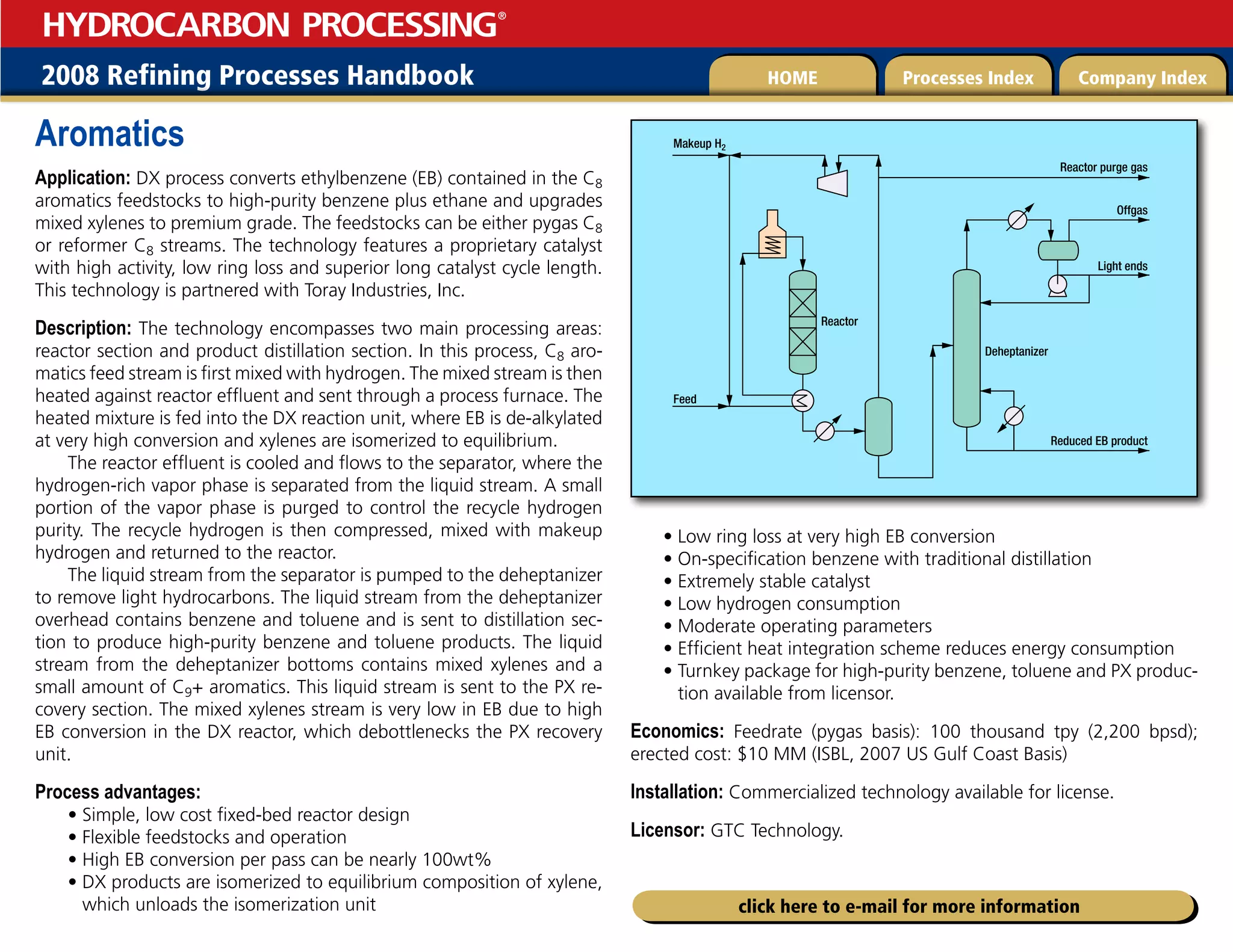
Description: The technology encompasses two main processing areas:
reactor section and product distillation section. In this process, C8 aro-
matics feed stream is first mixed with hydrogen. The mixed stream is then
heated against reactor effluent and sent through a process furnace. The
heated mixture is fed into the DX reaction unit, where EB is de-alkylated
at very high conversion and xylenes are isomerized to equilibrium.
The reactor effluent is cooled and flows to the separator, where the
hydrogen-rich vapor phase is separated from the liquid stream. A small
portion of the vapor phase is purged to control the recycle hydrogen
purity. The recycle hydrogen is then compressed, mixed with makeup
hydrogen and returned to the reactor.
The liquid stream from the separator is pumped to the deheptanizer
to remove light hydrocarbons. The liquid stream from the deheptanizer
overhead contains benzene and toluene and is sent to distillation sec-
tion to produce high-purity benzene and toluene products. The liquid
stream from the deheptanizer bottoms contains mixed xylenes and a
small amount of C9+ aromatics. This liquid stream is sent to the PX re-
covery section. The mixed xylenes stream is very low in EB due to high
EB conversion in the DX reactor, which debottlenecks the PX recovery
unit.
Process advantages:
• Simple, low cost fixed-bed reactor design
• Flexible feedstocks and operation
• High EB conversion per pass can be nearly 100wt%
• 
DX products are isomerized to equilibrium composition of xylene,
which unloads the isomerization unit
• Low ring loss at very high EB conversion
• On-specification benzene with traditional distillation
• Extremely stable catalyst
• Low hydrogen consumption
• Moderate operating parameters
• Efficient heat integration scheme reduces energy consumption
• 
Turnkey package for high-purity benzene, toluene and PX produc-
tion available from licensor.
Economics: Feedrate (pygas basis): 100 thousand tpy (2,200 bpsd);
erected cost: $10 MM (ISBL, 2007 US Gulf Coast Basis)
Installation: Commercialized technology available for license.
Licensor: GTC Technology.
Makeup H2
Feed
Reactor purge gas
Offgas
Light ends
Reduced EB product
Deheptanizer
Reactor
2008 Refining Processes Handbook Processes Index Company Index
HOME
HYDROCARBON PROCESSING
®
click here to e-mail for more information
Aromatics
Application: GT-STDP process technology produces benzene and para-
enriched xylenes from toluene disproportionation. The technology fea-
tures a proprietary catalyst with high activity and selectivity toward par-
axylene.
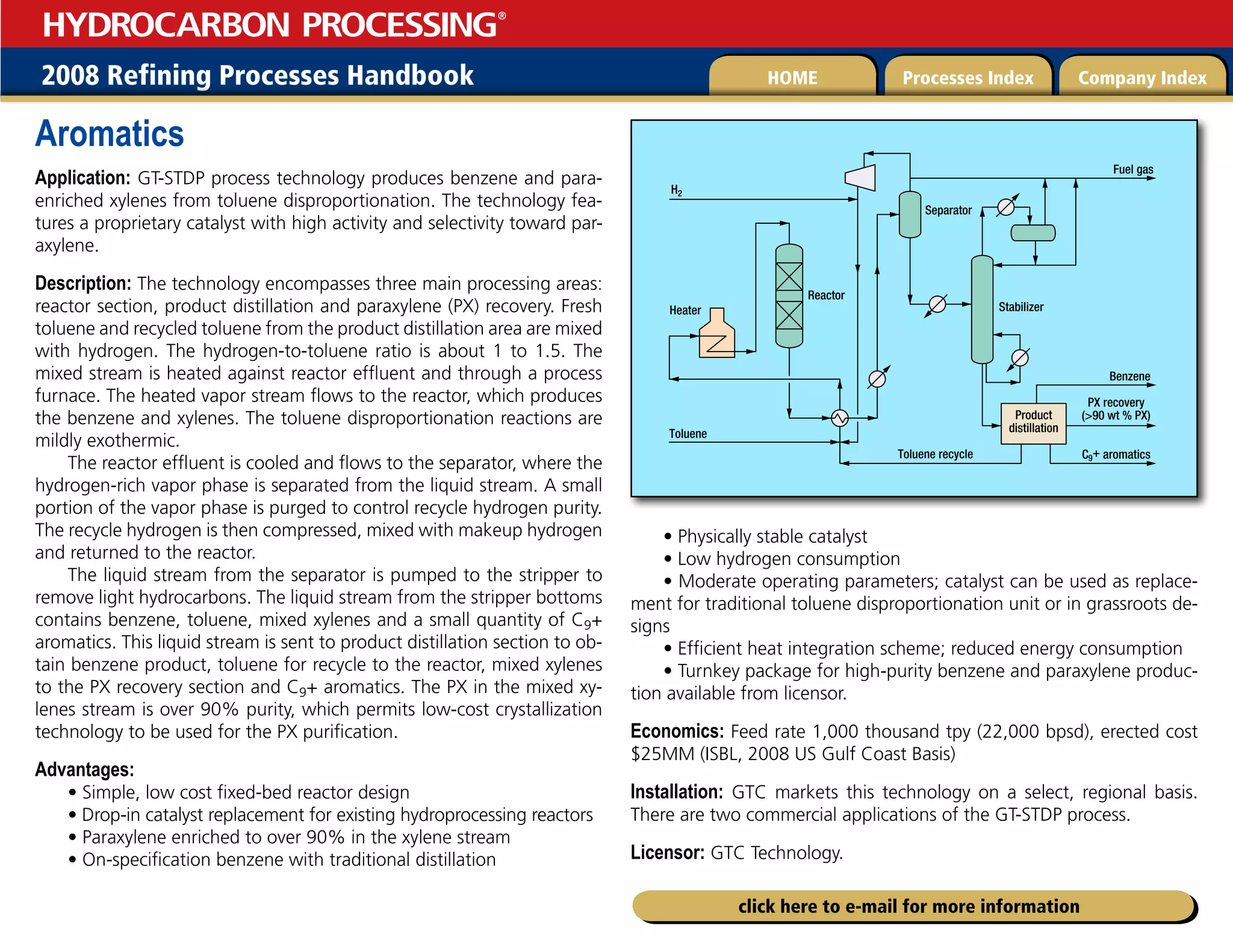
Description: The technology encompasses three main processing areas:
reactor section, product distillation and paraxylene (PX) recovery. Fresh
toluene and recycled toluene from the product distillation area are mixed
with hydrogen. The hydrogen-to-toluene ratio is about 1 to 1.5. The
mixed stream is heated against reactor effluent and through a process
furnace. The heated vapor stream flows to the reactor, which produces
the benzene and xylenes. The toluene disproportionation reactions are
mildly exothermic.
The reactor effluent is cooled and flows to the separator, where the
hydrogen-rich vapor phase is separated from the liquid stream. A small
portion of the vapor phase is purged to control recycle hydrogen purity.
The recycle hydrogen is then compressed, mixed with makeup hydrogen
and returned to the reactor.
The liquid stream from the separator is pumped to the stripper to
remove light hydrocarbons. The liquid stream from the stripper bottoms
contains benzene, toluene, mixed xylenes and a small quantity of C9+
aromatics. This liquid stream is sent to product distillation section to ob-
tain benzene product, toluene for recycle to the reactor, mixed xylenes
to the PX recovery section and C9+ aromatics. The PX in the mixed xy-
lenes stream is over 90% purity, which permits low-cost crystallization
technology to be used for the PX purification.
Advantages:
• Simple, low cost fixed-bed reactor design
• Drop-in catalyst replacement for existing hydroprocessing reactors
• Paraxylene enriched to over 90% in the xylene stream
• On-specification benzene with traditional distillation
• Physically stable catalyst
• Low hydrogen consumption
• Moderate operating parameters; catalyst can be used as replace-
ment for traditional toluene disproportionation unit or in grassroots de-
signs
• Efficient heat integration scheme; reduced energy consumption
• Turnkey package for high-purity benzene and paraxylene produc-
tion available from licensor.
Economics: Feed rate 1,000 thousand tpy (22,000 bpsd), erected cost
$25MM (ISBL, 2008 US Gulf Coast Basis)
Installation: GTC markets this technology on a select, regional basis.
There are two commercial applications of the GT-STDP process.
Licensor: GTC Technology.
Product
distillation
Fuel gas
C9+ aromatics
Separator
Toluene
Toluene recycle
PX recovery
(90 wt % PX)
Heater
Reactor
H2
Benzene
Stabilizer
2008 Refining Processes Handbook Processes Index Company Index
HOME
HYDROCARBON PROCESSING
®
click here to e-mail for more information
Aromatics
Application: GT-TransAlk produces benzene and xylenes from toluene
and/or heavy aromatics streams. The technology features a proprietary
catalyst and can accommodate varying ratios of feedstock while main-
taining high activity and selectivity.
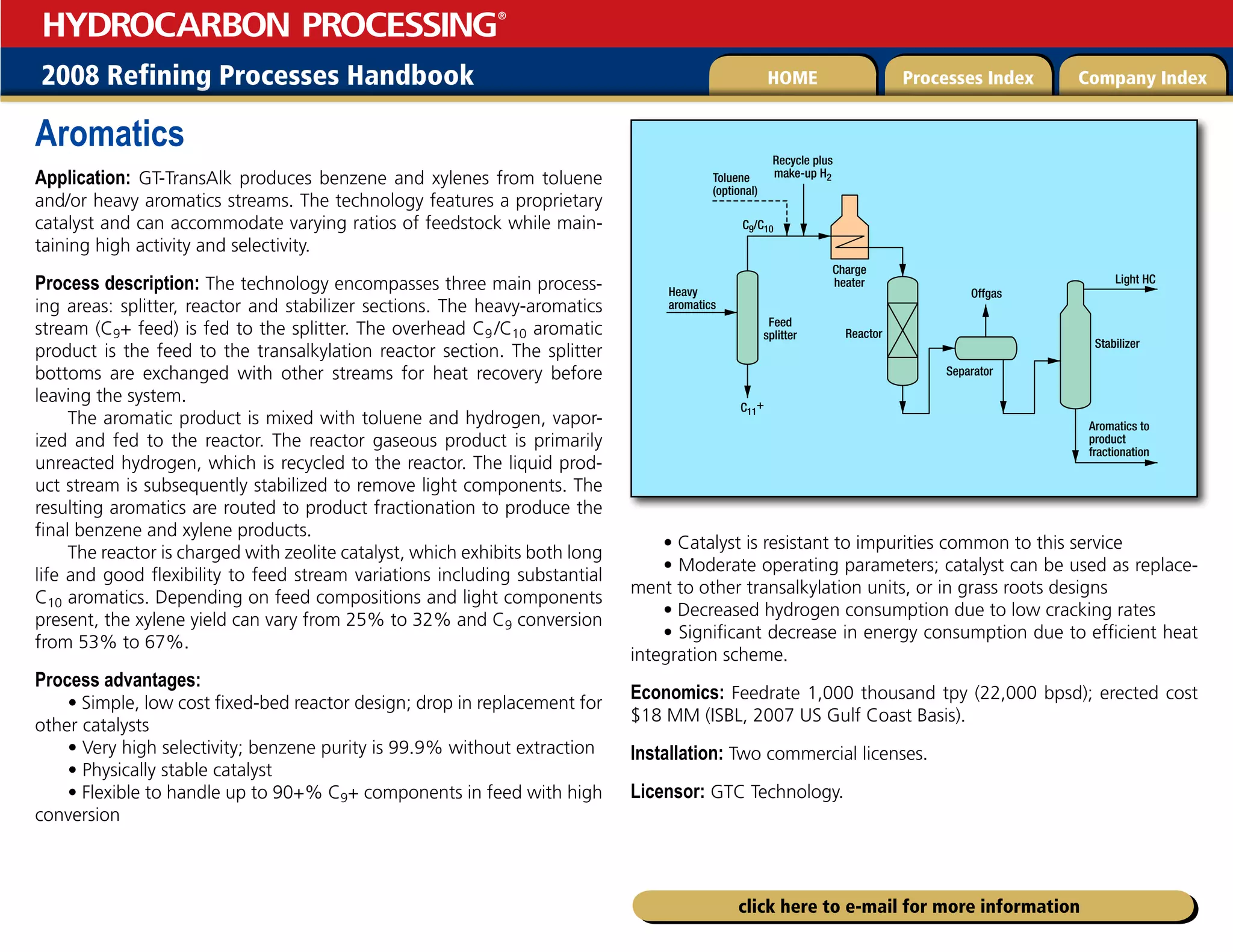
Process description: The technology encompasses three main process-
ing areas: splitter, reactor and stabilizer sections. The heavy-aromatics
stream (C9+ feed) is fed to the splitter. The overhead C9 /C10 aromatic
product is the feed to the transalkylation reactor section. The splitter
bottoms are exchanged with other streams for heat recovery before
leaving the system.
The aromatic product is mixed with toluene and hydrogen, vapor-
ized and fed to the reactor. The reactor gaseous product is primarily
unreacted hydrogen, which is recycled to the reactor. The liquid prod-
uct stream is subsequently stabilized to remove light components. The
resulting aromatics are routed to product fractionation to produce the
final benzene and xylene products.
The reactor is charged with zeolite catalyst, which exhibits both long
life and good flexibility to feed stream variations including substantial
C10 aromatics. Depending on feed compositions and light components
present, the xylene yield can vary from 25% to 32% and C9 conversion
from 53% to 67%.
Process advantages:
• Simple, low cost fixed-bed reactor design; drop in replacement for
other catalysts
• Very high selectivity; benzene purity is 99.9% without extraction
• Physically stable catalyst
• Flexible to handle up to 90+% C9+ components in feed with high
conversion
• Catalyst is resistant to impurities common to this service
• Moderate operating parameters; catalyst can be used as replace-
ment to other transalkylation units, or in grass roots designs
• Decreased hydrogen consumption due to low cracking rates
• Significant decrease in energy consumption due to efficient heat
integration scheme.
Economics: Feedrate 1,000 thousand tpy (22,000 bpsd); erected cost
$18 MM (ISBL, 2007 US Gulf Coast Basis).
Installation: Two commercial licenses.
Licensor: GTC Technology.
Charge
heater
Stabilizer
Reactor
Light HC
Aromatics to
product
fractionation
Heavy
aromatics
Feed
splitter
Toluene
(optional)
Recycle plus
make-up H2
C9/C10
C11
+
Separator
Offgas
2008 Refining Processes Handbook Processes Index Company Index
HOME
HYDROCARBON PROCESSING
®
Aromatics extractive distillation
Application: Recovery of high-purity aromatics from reformate, pyrolysis
gasoline or coke oven light oil using extractive distillation.
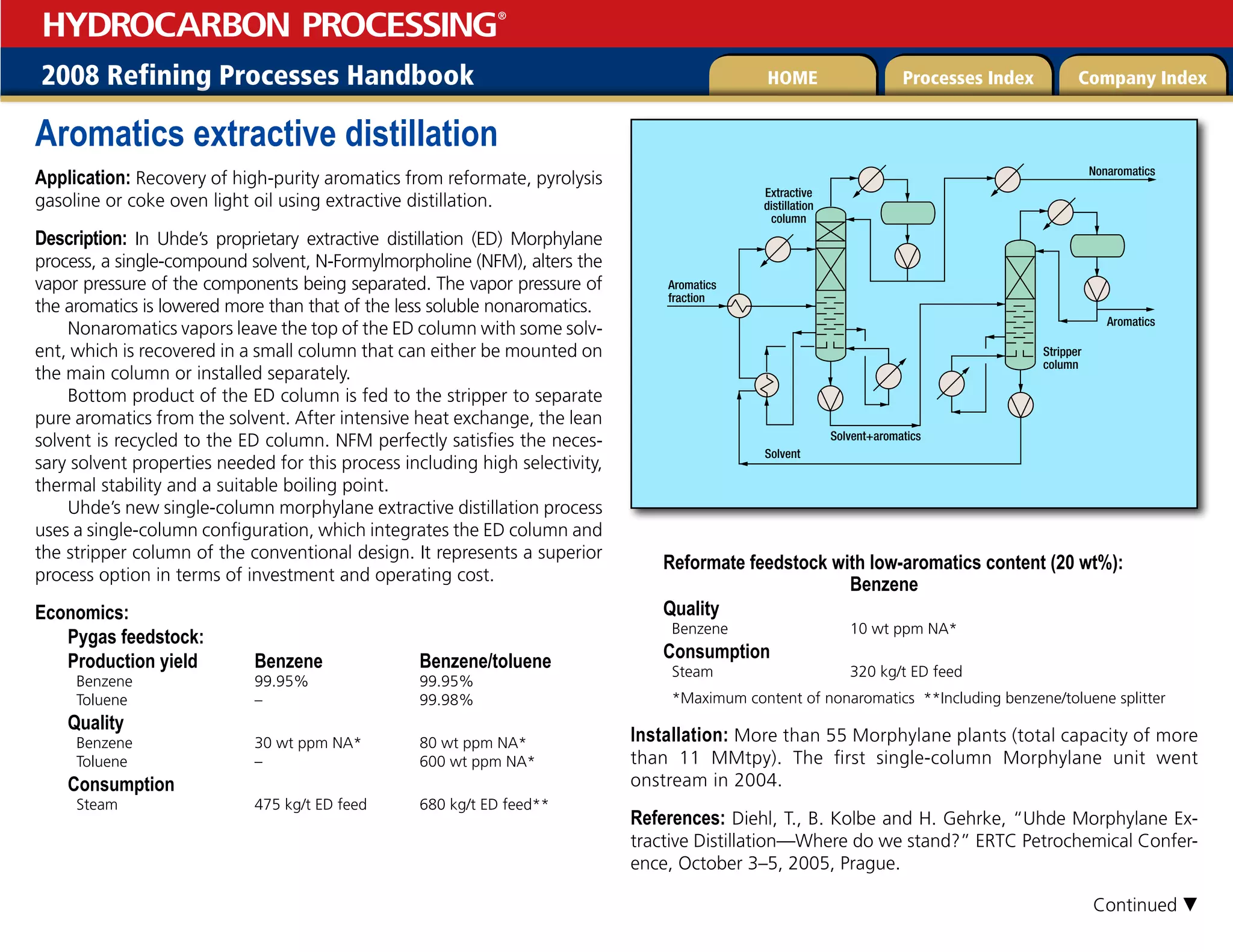
Description: In Uhde’s proprietary extractive distillation (ED) Morphylane
process, a single-compound solvent, N-Formylmorpholine (NFM), alters the
vapor pressure of the components being separated. The vapor pressure of
the aromatics is lowered more than that of the less soluble nonaromatics.
Nonaromatics vapors leave the top of the ED column with some solv­
ent, which is recovered in a small column that can either be mounted on
the main column or installed separately.
Bottom product of the ED column is fed to the stripper to separate
pure aromatics from the solvent. After intensive heat exchange, the lean
solvent is recycled to the ED column. NFM perfectly satisfies the neces-
sary solvent properties needed for this process including high selectivity,
thermal stability and a suitable boiling point.
Uhde’s new single-column morphylane extractive distillation process
uses a single-column configuration, which integrates the ED column and
the stripper column of the conventional design. It represents a superior
process option in terms of investment and operating cost.
Economics:
Pygas feedstock:
Production yield Benzene Benzene/toluene
Benzene 99.95% 99.95%
Toluene – 99.98%
Quality
Benzene 30 wt ppm NA* 80 wt ppm NA*
Toluene – 600 wt ppm NA*
Consumption
Steam 475 kg/t ED feed 680 kg/t ED feed**
Reformate feedstock with low-aromatics content (20 wt%):
Benzene
Quality
Benzene 10 wt ppm NA*
Consumption
Steam 320 kg/t ED feed
*Maximum content of nonaromatics **Including benzene/toluene splitter
Installation: More than 55 Morphylane plants (total capacity of more
than 11 MMtpy). The first single-column Morphylane unit went
onstream in 2004.
References: Diehl, T., B. Kolbe and H. Gehrke, “Uhde Morphylane Ex-
tractive Distillation—Where do we stand?” ERTC Petrochemical Confer-
ence, October 3–5, 2005, Prague.
Nonaromatics
Aromatics
Extractive
distillation
column
Stripper
column
Aromatics
fraction
Solvent
Solvent+aromatics
Continued 
Emmrich, G., U. Ranke and H. Gehrke, “Working with an extractive dis-
tillation process,” Petroleum Technology Quarterly, Summer 2001, p. 125.
Licensor: Uhde GmbH.
Aromatics extractive distillation, continued
click here to e-mail for more information
2008 Refining Processes Handbook Processes Index Company Index
HOME
HYDROCARBON PROCESSING
®
click here to e-mail for more information
Aromatics recovery
Application: GT-BTX is an aromatics recovery technology that uses ex-
tractive distillation to remove benzene, toluene, and xylene (BTX) from
refinery or petrochemical aromatics streams such as catalytic reformate
or pyrolysis gasoline. With lower capital and operating costs, simplicity of
operation, and range of feedstock and solvent performance, extractive
distillation is superior to conventional liquid-liquid extraction processes.
Flexibility of design allows use for grassroots aromatics recovery units,
debottlenecking or expansion of conventional extraction systems.
Description: Hydrocarbon feed is preheated with hot circulating solvent
and fed at a midpoint into the extractive distillation column (EDC). Lean
solvent is fed at an upper point to selectively extract the aromatics into
the column bottoms in a vapor/liquid distillation operation. The non-
aromatic hydrocarbons exit the top of the column and pass through a
condenser. A portion of the overhead stream is returned to the top of
the column as reflux to wash out any entrained solvent. The balance of
the overhead stream is raffinate product and does not require further
treatment.
Rich solvent from the bottom of the EDC is routed to the solvent-
recovery column (SRC), where the aromatics are stripped overhead.
Stripping steam from a closed-loop water circuit facilitates hydrocarbon
stripping. The SRC is operated under a vacuum to reduce the boiling
point at the base of the column.
Lean solvent from the bottom of the SRC is passed through heat
exchange before returning to the EDC. A small portion of the lean cir-
culating solvent is processed in a solvent regeneration step to remove
heavy decomposition products.
The SRC overhead mixed aromatics product is routed to the purifi-
cation section, where it is fractionated to produce chemical-grade ben-
zene, toluene and xylenes.
Process advantages:
• Lower capital cost compared to conventional liquid-liquid extrac-
tion or other extractive distillation systems
• Energy integration options to further reduce operating costs
• Higher product purity and aromatic recovery
• Recovers aromatics from full-range BTX feedstock
• Distillation-based operation provides better control and simplified
operation
• Proprietary formulation of commercially available solvent exhibits
high selectivity and capacity
• Low solvent circulation rates
• Insignificant fouling due to elimination of liquid-liquid contactors
• Fewer hydrocarbon emission sources for environmental benefits.
Economics: New unit
Feedrate 12,000 bdp reformate or pygas
ISBL capital cost $15 MM
Installations: Twenty-two.
Licensor: GTC Technology.
Lean solvent
Aromatics-rich solvent
Aromatics to
downstream
fractionation
Raffinate
Solvent
recovery
column
Extractive
distillation
column (EDC)
Hydrocarbon
feed
2008 Refining Processes Handbook Processes Index Company Index
HOME
HYDROCARBON PROCESSING
®
click here to e-mail for more information
Benzene saturation
Application: GTC Technology’s GT-BenZap is a benzene saturation tech-
nology that allows refiners to achieve the upcoming benzene limit re-
quired by EPA’s regulations under Mobile Sources Air Toxics Phase 2
(MSAT2). Benzene saturation is applied when the logistics of benzene
recovery and production are unfavorable, or where the economy of scale
for benzene production is not sufficient.
Description: GT-BenZap process features a reliable traditional design
paired with a proven nickel-based catalyst. The process consists of
hydrotreating a narrow-cut C6 fraction, which is separated from the
full-range reformate to saturate the benzene component into cyclo-
hexane. The reformate is first fed to a reformate splitter where the C6
heart cut is separated as a side-draw fraction, while the C7+ cut and
the C5– light fraction are removed as bottom and top products of the
column.
The C6 olefins present in the C6 cut are also hydrogenated to par-
affins, while the C5– olefins removed at the top of the splitter are
not, thus preserving the octane number. The hydrogenated C6 frac-
tion from the reactor outlet is sent to a stabilizer column where the
remaining hydrogen and lights are removed overhead. The C5– cut,
produced from the splitter overhead, is recombined with the hydroge-
nated C6 cut within the GT-BenZap process in a unique manner that
reduces energy consumption and capital equipment cost. The light
reformate is mixed with the C7+ cut from the splitter column and to-
gether form the full-range reformate, which is low in benzene. GTC
also offers a modular construction option and the possibility to reuse
existing equipment.
Process advantages:
• Simple and reliable technology; low operating costs
• An economical alternative to platinum-based systems
• Ability to reduce the benzene in the reformate stream by over
99.9%
• Minimized impact to hydrogen balance and octane loss.
Installation: Technology available for license.
Licensor: GTC Technology.
Full-range
reformate
Reformate
splitter
C7+
C6- rich with
benzene
C5-
Stabilizer
Low-benzene gasoline
blend stock
Offgas
Offgas
H2
2008 Refining Processes Handbook Processes Index Company Index
HOME
HYDROCARBON PROCESSING
®
Paraxylene
Application: CrystPX is a modern suspension crystallization technology
for production of paraxylene (PX). The process can be applied in a single-
stage for concentrated PX feedstock or in two stages for equilibrium
xylenes feed. The technology has fewer pieces of equipment, simplified
flow schemes and a more reliable operation compared to traditional
crystallization methods.
Description: Suspension crystallization of PX in the xylene isomer mix-
ture is used to produce PX crystals. The technology uses an optimized
arrangement of equipment to obtain the required recovery and product
purity. Washing the PX crystal with the final product in a high efficiency
pusher-centrifuge system produces the PX product.
When PX content in the feed is enriched above equilibrium, such
as streams originating from selective toluene conversion processes, the
proprietary crystallization process technology is even more economical
to produce high-purity PX product at high recoveries. The process tech-
nology takes advantage of recent advances in crystallization techniques
and improvements in equipment to create this cost-effective method for
paraxylene recovery and purification.
The design uses only crystallizers and centrifuges in the primary op-
eration. This simplicity of equipment promotes low maintenance costs,
easy incremental expansions and controlled flexibility. High-purity PX is
produced in the front section of the process at warm temperatures, tak-
ing advantage of the high concentration of PX already in the feed. At
the back end of the process, high PX recovery is obtained by operating
the crystallizers at colder temperatures. This scheme minimizes recycling
excessive amounts of filtrate, thus reducing total energy requirements.
Process advantages:
• High PX purity and recovery
• Crystallization equipment is simple, easy to procure and opera-
tionally trouble free
• Compact design requires small plot size and lowest capital invest-
ment
• Operation is flexible to meet market requirements for PX purity
• System is easily amenable to future requirement for incremental
capacity increases
• Feed concentration of PX is used efficiently through an innovative
flow scheme
• Technology is flexible to process a range of feed concentrations
(20–95 wt.% PX) using a single or multistage system
• The aromatics complex using CrystPX technology is cost competi-
tive with adsorption-based systems for PX recovery.
Economics: For 400 thousand tpy capacity from concentrated feed:
CrystPX Other crystallization
		 technologies
ISBL Investment Cost $35 MM $45 MM
Paraxylene recovery 95% 95%
Electricity consumption 50 kwh/ ton PX 80 kwh/ ton PX
Operation mode Continuous Batch
PX rich feed
Secondary
centrifuge
Primary
centrifuge
PX wash
PX lean filtrate
PX product
PX recovery section
High-purity PX
production section
Feed
drum
PX melt
(Slurry)
(Cake)
(Cake)
(Slurry)
Continued 
Installation: Two commercial licenses.
Licensor: CrystPX is a proprietary process technology marketed and li-
censed by GTC Technology Inc., in alliance with Lyondell.
Paraxylene, continued
click here to e-mail for more information
2008 Refining Processes Handbook Processes Index Company Index
HOME
HYDROCARBON PROCESSING
®
click here to e-mail for more information
Styrene recovery
Application: GT-Styrene is an extractive distillation (ED) process that di-
rectly recovers styrene from the raw pyrolysis gasoline derived from the
steam cracking of naphtha, gasoils and natural gas liquids (NGLs). The
produced styrene is high purity and suitable for polymerization at a very
attractive cost compared to conventional styrene production routes. If
desired, the mixed xylenes can also be extracted from the pygas, up-
grading their value as a chemical feedstock. The process is economically
attractive for pygas feeds containing more than 15,000 tpy styrene.
Description: Raw pyrolysis gasoline is prefractionated into a heartcut
C8 stream. The resulting styrene concentrate is fed to an ED column
and mixed with a selective solvent, which extracts the styrene to the
tower bottoms. The rich solvent mixture is routed to a solvent recovery
column SRC), which recycles the lean solvent back to the ED column
and recovers the styrene overhead. A final purification step produces a
99.9% styrene product containing less than 50-ppm phenyl acetylene.
The ED column overhead can be further processed to recover a high-
quality mixed-xylene stream. A typical world-scale cracker can produce
approximately 25,000 tpy styrene and 75,000 tpy mixed xylenes from
pyrolysis gasoline.
Process advantages:
• Produces polymer-grade styrene at 99.9% purity
• Allows the recovery of isomer-quality mixed xylenes for paraxylene
production
• Upgrades pygas stream components to chemical value
• Debottlenecks pygas hydrotreater and extends cycle length
• Reduces hydrogen consumed in hydrotreating
• Optimized solvent system and design provide economical operat-
ing costs
Economics: Basis: 25,000 tpy styrene capacity
Typical USGC capital cost $25 million
Styrene value in pygas $800/ton
Styrene product sales value $1,400/ton
Net processing $160/ton
Gross margin $11 million/yr
Pretax ROI 44%
Installation: Two commercial licenses.
Licensor: GTC Technology.
PA
hydrogenation
Feed
pretreatment
Finishing
treatment
Solvent
C8 aromatics
Heavies
Extractive
distillation
Solvent
recovery
99.9+ wt%
Styrene
product
Styrene
finishing
Pygas C8 cut
H2
2008 Refining Processes Handbook Processes Index Company Index
HOME
HYDROCARBON PROCESSING
®
click here to e-mail for more information
Xylene isomerization
Application: GT-IsomPX is GTC’s xylene isomerization technology. It is
available in two versions: EB isomerization type and EB dealkylation type.
Both versions gain high ethylbenzene (EB) conversion rates while pro-
ducing equilibrium mixed xylenes. Catalysts that exhibit superior physi-
cal activity and stability are the key to this technology. The technology
and catalysts are used commercially in several applications.
Description: For an EB dealkylation type of isomerization, the technolo-
gy encompasses two main processing areas: reactor section and product
distillation section. In this process, paraxylene (PX)-depleted feed stream
is first mixed with hydrogen. The mixed stream is then heated against
reactor effluent and through a process furnace. The heated mixture is
fed into isomerization reaction unit, where m-xylene,o-xylene and PX
are isomerized to equilibrium and EB is de-alkylated to benzene.
The reactor effluent is cooled and flows to the separator, where the
hydrogen-rich vapor phase is separated from the liquid stream. A small
portion of the vapor phase is purged to control recycle hydrogen purity.
The recycle hydrogen is then compressed, mixed with makeup hydrogen
and returned to the reactor.
The liquid stream from the separator is pumped to the deheptanizer
to remove light hydrocarbons. The liquid stream from the deheptanizer
overhead contains benzene and toluene and is sent to the distillation
section to produce high-purity benzene and toluene products. The liquid
stream from the deheptanizer bottoms contains mixed xylenes and a
small amount of C9+ aromatics. This liquid stream is returned to the PX
recovery section.
Process advantages:
• PX in xylenes reaches thermodynamic equilibrium after reaction
• With the EB-dealkylation catalyst, the byproduct benzene is pro-
duced at high purity by simple distillation.
• Low H2/HC ratio, high WHSV and low xylenes loss
• Long cycle length
• Efficient heat integration scheme reduces energy consumption
• Turnkey package for high-purity benzene, toluene and PX produc-
tion available from licensor.
Economics: Feedrate: 4,000 thousand tpy (88,000 bpsd); erected cost:
$29 MM (ISBL, 2007 US Gulf Coast Basis).
Installation: Technology available for license.
Licensor: GTC Technology.
Feed
Offgas
Light ends
Deheptanizer bottom
Deheptanizer
Reactor
Makeup H2
Reactor purge gas
2008 Refining Processes Handbook Processes Index Company Index
HOME
HYDROCARBON PROCESSING
®
click here to e-mail for more information
Biodiesel
Application: Consumption of primary energy has risen substantially in
recent years, and greenhouse gases (GHG) emissions have increased by
a substantial amount. To counter this trend, there is a global strong em-
phasis on regenerative energy such as biofuels to effectively reduce or
avoid such emissions.
Description: The Lurgi biodiesel process is centered on the transesterifi-
cation of different raw materials to methyl ester using methanol in the
presence of a catalyst. In principle, most edible oils and fats—both veg-
etable and animal sources—can be transesterified if suitably prepared.
Transesterification is based on the chemical reaction of triglycerides
with methanol to methyl ester and glycerine in the presence of an alka-
line catalyst. The reaction occurs in two mixer-settler units. The actual
conversion occurs in the mixers. The separation of methyl ester as the
light phase and glycerine water as the heavy phase occurs in the settlers
due to the insolubility of both products and the difference in density.
Byproduct components are removed from the methyl ester in the down-
stream washing stage, which operates in a counter-current mode. After
a final drying step under vacuum, the biodiesel is ready for use.
Any residual methanol contained in the glycerine water is removed
in a rectification column. In this unit operation, the methanol has a puri-
ty, which is suitable for recycling back to process. For further refinement
of the glycerine water, optional steps are available such as chemical
treatment, evaporation, distillation and bleaching to either deliver crude
glycerine at approximately 80% concentration or pharmaceutical-grade
glycerine at 99.7% purity.
Economics: The (approximate) consumption figures—without glycerine
distillation and bleaching—stated below are valid for the production of
one ton of rapeseed methyl ester at continuous operation and nominal
capacity.
Steam, kg 320
Water, cooling (t = 10°C), m3 25
Electrical energy, kWh 12
Methanol, kg 96
Catalyst (Na-methylate 100%), kg 5
Hydrochloric acid (37%), kg 10
Caustic soda (50%), kg 1.5
Nitrogen, Nm3 1
Installation: Lurgi has been building biodiesel plants for 20 years. Only in
the last five years, Lurgi has contracted more than 40 plants for the pro-
duction of biodiesel with capacities ranging from 30,000 to 250,000 tpy.
Licensors: Lurgi GmbH.
Oil
Methanol
Biodiesel
Transesterification
Catalyst
Crude glycerin
Glycerin water
evaporation
Wash
column
Glycerin
cross-flow
(patented)
Closed washwater loop
Glycerin water
Reactor 1 Reactor 2
Methanol
recovery
2008 Refining Processes Handbook Processes Index Company Index
HOME
HYDROCARBON PROCESSING
®
Biodiesel
Application: The RHT- Biodiesel process is optimized to produce biodiesel
from palm oil, rape-seed oil, vegetable and animal products that contain
fatty acids with even number of carbon atom (12 to 22). The lack of
sulfur in the biodiesel enables complying with many international fuel
specifications.
The biodiesel is comparable to petroleum-based diesel. Triglycerides
are reacted with methanol, ethanol or higher alcohols to yield biodiesel
within the acceptable boiling range. Methanol is most commonly used
for the biodiesel production since it is the most cost-effective of alco-
hols, and it can provide better economics for the biodiesel producers.
Biodiesel is produced by reacting vegetable oils and animal fats (triglyc-
erides) with methanol in the presence of highly alkaline heterogeneous
catalyst at moderate pressure and temperature. Pretreatment may be
required if the vegetable oil has a high free-fatty acids content to
optimize methyl esters yield. If free fatty acids are present in the
feed, first step is esterfication of the free-fatty acid with metha-
nol. However if the free-fatty acids concentrations are low, then
this step can be deleted.
The triglycerides and methanol are converted by transesterfication
reaction to yield methyl esters of the oils and fats, and glycerine is pro-
duced as a byproduct. The glycerine is separated from the methyl esters
(biodiesel) by phase separation via gravity settling. The methyl esters and
glycerine are purified to meet the product specifications.
Description: In the simplified process flow diagram (1), the feed—veg-
etable oil or animal fats—is pumped from storage and is mixed with
methanol in the required molar ratio vegetable/methanol at moderate
operating pressure. The feed is heated to the reaction temperature and
is sent to esterification reactor. Free-fatty acids are pretreated if the con-
centration exceeds 3% percent of the feed. The reactor contains an acid
catalyst for this reaction and can remove 99.9 % of free-fatty acids from
the vegetable oils. (Note: the pretreatment is only required when the
feed contains free-fatty acids; otherwise, this step can be omitted.
The effluent from the first reactor (if free-fatty acids are present) or
the heated feed is sent to the transesterfication reactor, where 3 moles
of methanol react with the triglyceride to produce 3 moles of methyl
ester oil (biodiesel) and one mole of glycerine. The transesterfication re-
actor uses a highly alkaline heterogeneous catalyst and provides essen-
tially 100% conversion. The transesterification reactor effluent is sent
Esterification
reactor
Transesterification
reactor
LP
Gravity
separator
Methanol
Biodiesel
Biodiesel
product
Water wash
Mixer
Water
Glycerine product
MeOH/water for recovery
Purification
Purification
Esterification
reactor
Transesterification
reactors
Triglycerides
LP
Gravity
separator
Methanol
Biodiesel Biodiesel product
Water wash
Mixer
Water
Glycerine product
MeOH/water for recovery
Purification
Triglycerides
Wash solvent
Residual glycerine/wash solvent
Continued 
Economics: The normal utilities for continuous biodiesel unit based on
heterogeneous catalyst for tph of biodiesel capacity are listed. This does
not include the glycerine purification utilities. The capital cost for the
ISBL Biodiesel plant on Gulf coast site basis based on 1Q 2006 is pro-
vided below.
CAPEX ISBL plant : USD/ton Biodiesel 235–265
Steam, lb/h 368
Water, cooling gpm 64
Power, kWh 9
Licensor: Refining Hydrocarbon Technologies LLC.
to gravity separator/settler. The biodiesel product is taken from the top
of the separator, and is water washed. The washed biodiesel product is
taken from the top of the drum. Water washing removes excess metha-
nol from the reaction products, which is recovered by normal distillation;
the pure methanol is recycled back to the reactor. The bottoms from the
separator/settler are sent to the purification unit to remove impurities
and residual methanol, which is recycled back. Pure glycerine product is
sent to storage.
Fig. 2 is an alternate flow scheme; a spare transesterification reactor
is added to remove glycerine from the reactor to sustain reaction rates.
Once the reaction rates are reduced the reactor is switched and washed
with hot solvent to remove residual glycerine and biodiesel. This extra
reactor patented mode of operation provides higher reactions rates and
onstream capability while enhancing yield and productivity. Glycerine
purity can exceed 99.8% after distillation.
Reaction chemistry: Transesterification reactions:
Triglycerides + 3 Methanol ➞ Methyl Ester of the oil (biodiesel) + Glycerol
Comparision of the Diesel/Biodiesel Properties
Fuel Property Diesel Biodiesel
Fuel standard ASTM D 975 ASTM P S 121
Fuel composition C10–C21 HC C12–C22 FAME
Lower heating value, Btu/gal 131 117
Kinemetic Vis @ 40°C 1.3–4.1 1.9–6
SG at 60°F 0.85 0.88
Water, wppm 161 500
Carbon 87 77
Hydrogen 13 12
Oxygen 0 11
Sulfur, wppm 15–500 0
Bp, °F 380–650 370–340
Flash Pt, °F 140–175 210–140
Biodiesel, continued
click here to e-mail for more information
2008 Refining Processes Handbook Processes Index Company Index
HOME
HYDROCARBON PROCESSING
®
click here to e-mail for more information
Green diesel
Application: The UOP/Eni Ecofining process for the production of green
diesel fuel is UOP’s solution to meeting the increasing demand for a sus-
tainable high-quality renewable diesel using conventional hydroprocess-
ing technology already widely used in refineries.
Description: The Ecofining process deoxygenates and then hydroge-
nates triglycerides and/or free fatty-acid feedstocks such as vegetable
oils and animal fats. The resulting paraffins are then isomerized to create
a high-quality hydrocarbon known as green diesel. If desired, the Ecofin-
ing process can also be designed to produce a slipstream of a paraffinic
green jet fuel stream in addition to the green diesel product.
A thermochemical process, the Ecofining process produces green
diesel fuel that is indistinguishable from traditional diesel fuel. It can be
used as a direct replacement fuel or as a valuable blendstock to enhance
the quality of the existing diesel pool. Blending of high-quality green
diesel will allow the use of lower quality diesel range refinery product
streams, ultimately reducing the cost of biofuel compliance and increas-
ing the overall diesel pool.
Designed for feedstock flexibility, the Ecofining process works with
a wide range of pretreated biofeedstocks—from vegetable oils and ani-
mal fats to second generation, non-food-based options such as jatropha
and algal oils.
The diesel yield and hydrogen consumption vary slightly according
to the feed-stock source and the required product cloud point. The hy-
drogen consumption may also vary between different feeds.
Experience: UOP introduced Ecofining in early 2007 as the first com-
mercial offering from its Renewable Energy  Chemicals business group
dedicated to introducing new technology for processing renewable
energy sources in existing or new petroleum refineries worldwide. The
Ecofining process is an extension of UOP’s leading portfolio of hydropro-
cessing and isomerization technologies.
Installation: ENI has announced construction of the first Ecofining unit,
with startup due in 2010. A second unit was licensed in early 2008 amid
significant market interest.
Licensor: UOP.
Green jet product
Green propane and light ends
Green naphtha product
Water
Separator
Acid gas
scrubber
Reactor
system CO2
Makeup hydrogen
Feed
Green diesel product
Green
diesel
product
Jet option
2008 Refining Processes Handbook Processes Index Company Index
HOME
HYDROCARBON PROCESSING
®
Deep catalytic cracking
Application: Selective conversion of gasoil and paraffinic residual feed-
stocks.
Products: C2–C5 olefins, aromatic-rich, high-octane gasoline and dis-
tillate.
Description: Deep catalytic cracking (DCC) is a fluidized process for se-
lectively cracking a wide variety of feedstocks to light olefins. Propylene
yields over 24 wt% are achievable with paraffinic feeds. DCC uses a
conventional traditional reactor/regenerator unit design with a catalyst
that has physical properties similar to traditional FCC catalyst. The DCC
unit may be operated in two operational modes: maximum propylene
(Type I) or maximum iso-olefins (Type II).
Each operational mode utilizes unique catalyst as well as reaction
conditions. Maximum propylene DCC uses both riser and bed crack-
ing at relatively severe reactor conditions while Type II DCC uses only
riser cracking like a modern fluid catalytic cracking (FCC) unit at milder
conditions.
The overall flow scheme of DCC is very similar to that of a con-
ventional FCC. However, innovations in the areas of catalyst devel-
opment, process variable selection and severity and gas plant design
enables the DCC to produce significantly more olefins than FCC in a
maximum-olefins mode of operation.
This technology is quite suitable for revamps as well as grassroots
applications. Feed enters the unit through proprietary feed nozzles,
as shown in the schematic. Integrating DCC technology into existing
refineries as either a grassroots or revamp application can offer an at-
tractive opportunity to produce large quantities of light olefins.
In a market requiring both propylene and ethylene, use of both
thermal and catalytic processes is essential, due to the fundamental
differences in the reaction mechanisms involved. The combination of
thermal and catalytic cracking mechanisms is the only way to increase
total olefins from light and heavy feedstocks while meeting the need
for increased propylene to ethylene ratio. A benefit associated with
DCC rather than steam cracking for propylene production is a direct
consequence of relative cost differences between DCC heavy feeds
and steam cracker’s light feeds. Additional capital and operating cost-
savings are achieved by the integration of the DCC unit and the adja-
cent steam cracker.
Products (wt% of fresh feed) DCC Type I DCC Type II FCC
Ethylene 6.1 2.3 0.9
Propylene 20.5 14.3 6.8
Butylene 14.3 14.6 11.0
in which iC4 = 5.4 6.1 3.3
Amylene — 9.8 8.5
in which iC5 = — 6.5 4.3
Deep catalytic cracking, continued
Installation: A total of 15 DCC units have been licensed.
Reference: Dharia, D., et al., “Increase light olefins production,” Hydro-
carbon Processing, April 2004, pp. 61–66.
Licensor: Shaw and Research Institute of Petroleum Processing, Sinopec.
click here to e-mail for more information
2008 Refining Processes Handbook Processes Index Company Index
HOME
HYDROCARBON PROCESSING
®
click here to e-mail for more information
Fluid catalytic cracking
Application: Conversion of gas oils and residues to light olefins, high-
octane gasoline, and distillates using the compact, self supporting Or-
thoflow converter.
Description: Feed enters through the proprietary ATOMAX-2 feed injec-
tion system. Reaction vapors pass through a right angle turn and are
quickly separated from the catalyst in a positive pressure closed-cyclone
system. Closed cyclones minimize dry-gas make and increase gasoline
yield. Spent catalyst flows through a stripper equipped with Dynaflux
baffles to the regenerator where countercurrent flow of catalyst and air
contacting is carried out.
Catalyst flow from the regenerator to the external vertical riser is
controlled by riser outlet temperature, which regulates the regenerated
catalyst slide valve. A plug valve located in the regenerator bottom head
controls the level in the stripper by regulating the catalyst flow from the
spent catalyst standpipe.
Either partial or complete CO combustion may be used in the regen-
erator. Flue gas flows to an external plenum and then to the flue-gas
system. A Cyclofines Third Stage Separator may be used to remove par-
ticulates from the flue gas for protection of a power recovery expander
and/or compliance with particulate emissions standards.
Economics: The converter is a one-piece modularized unit that combines
the disengager, stripper and regenerator vessels into a single structure.
This unique design minimizes the cost of construction, and also reduces
the amount of field mechanical work and required plot space.
Installations: More than 150 grassroots units have been designed, re-
sulting in a total of over 4 million bpsd fresh feed, with 12 of the latest
units since 1990.
References: “Maximizing flexibility for FCC’s designed to maximize
propylene,” 2008 NPRA Annual Meeting, March 9–11, 2008, San Diego.
“Optimize FCC Flue-Gas Emission Control—Part 2,” Hydrocarbon
Processing, Vol. 81, No. 10, October 2002, pp. 85–91.
“New developments in FCC feed injection and stripping technolo-
gies,” NPRA Annual Meeting, March 2000.
Licensors: KBR and ExxonMobil
2008 Refining Processes Handbook Processes Index Company Index
HOME
HYDROCARBON PROCESSING
®
Fluid catalytic cracking
Application: Selective and high conversion of a wide range of feedstocks
into high-value products. Feedstocks include virgin or hydrotreated
gasoils that may also include lube oil extract, coker gasoil and resid.
Products: High-octane gasoline, light olefins and distillate. Flexibility in
unit operation allows for maximizing the most desirable product.
Description: The Lummus process incorporates an advanced reaction
system, high-efficiency catalyst stripper and a mechanically robust,
single-stage fast fluidized bed regenerator. Oil is injected into the
base of the riser via proprietary Micro-Jet feed injection nozzles (1).
Catalyst and oil vapor flow upwards through a short-contact time,
all-vertical riser (2) where raw oil feedstock is cracked under opti-
mum conditions.
Reaction products exiting the riser are separated from the spent
catalyst in a patented, direct-coupled cyclone system (3). Product va-
pors are routed directly to fractionation, thereby eliminating nonselec-
tive post-riser cracking reactions and maintaining the optimum product
yield slate. Spent catalyst containing only minute quantities of hydro-
carbon is discharged from the diplegs of the direct-coupled cyclones
into the cyclone containment vessel (4). The catalyst flows down into
the stripper containing proprietary modular grid (MG) baffles (5).
Trace hydrocarbons entrained with spent catalyst are removed in
the MG stripper using stripping steam. The MG stripper efficiently
removes hydrocarbons at low steam rate. The net stripper vapors are
routed to the fractionator via specially designed vents in the direct-
coupled cyclones. Catalyst from the stripper flows down the spent-
catalyst standpipe and through the slide valve (6). The spent catalyst
is then transported in dilute phase to the center of the regenerator
(8) through a unique square-bend-spent catalyst transfer line (7). This
arrangement provides the lowest overall unit elevation. Catalyst is
regenerated by efficient contacting with air for complete combus-
tion of coke. For resid-containing feeds, a catalyst cooler is integrat-
ed with the regenerator. The resulting flue gas exits via cyclones (9)
to energy recovery/flue gas treating. The hot regenerated catalyst
is withdrawn via an external withdrawal well (10). The well allows
independent optimization of catalyst density in the regenerated cata-
lyst standpipe, maximizes slide valve (11) pressure drop and ensures
stable catalyst flow back to the riser feed injection zone.
The catalyst formulation can be tailored to maximize the most
desired product.
Economics:

Investment (basis: 30,000 bpsd including reaction/regeneration
system and product recovery. Excluding offsites, power recovery
and flue gas scrubbing US Gulf Coast 2006.)
$/bpsd (typical) 2,400–3,500
Utilities, typical per bbl fresh feed:
Electricity, kWh 0.8–1.0
Steam, 600 psig (produced) 50–200
Maintenance, % of investment per year 2–3


Continued 
Installation: Seventeen grassroots units licensed. Thirty-three units re-
vamped, with five revamps in design stage.
Licensor: Lummus Technology, a CBI company.
Fluid catalytic cracking, continued
click here to e-mail for more information
2008 Refining Processes Handbook Processes Index Company Index
HOME
HYDROCARBON PROCESSING
®
click here to e-mail for more information
Fluid catalytic cracking
Application: Selective conversion of gas oil feedstocks.
Products: High-octane gasoline, distillate and C3– C4 olefins.
Description: Catalytic and selective cracking in a short-contact-time riser
where oil feed is effectively dispersed and vaporized through a proprietary
feed-injection system. Operation is carried out at a temperature consistent
with targeted yields. The riser temperature profile can be optimized with
the proprietary mixed temperature control (MTC) system.
Reaction products exit the riser-reactor through a high-efficiency,
close-coupled, proprietary riser termination device RSS (riser separator
stripper). Spent catalyst is pre-stripped followed by an advanced high-
efficiency packed stripper prior to regeneration. The reaction prod-
uct vapor may be quenched to give the lowest possible dry gas and
maximum gasoline yield. Final recovery of catalyst particles occurs in
cyclones before the product vapor is transferred to the fractionation
section.
Catalyst regeneration is carried out in a single regenerator equipped
with proprietary air and catalyst distribution systems, and may be oper-
ated for either full or partial CO combustion. Heat removal for heavier
feedstocks may be accomplished by using reliable dense-phase catalyst
cooler, which has been commercially proven in over 56 units. As an
alternative to catalyst cooling, this unit can easily be retrofitted to a
two-regenerator system (R2R) in the event that a future resid operation
is desired.
The converter vessels use a cold-wall design that results in mini-
mum capital investment and maximum mechanical reliability and safe-
ty. Reliable operation is ensured through the use of advanced fluidi-
zation technology combined with a proprietary reaction system. Unit
design is tailored to the refiner’s needs and can include wide turndown
flexibility.
Available options include power recovery, waste-heat recovery,
flue-gas treatment and slurry filtration. Revamps incorporating pro-
prietary feed injection and riser termination devices and vapor quench
result in substantial improvements in capacity, yields and feedstock
flexibility within the mechanical limits of the existing unit.
Installation: Shaw and Axens have licensed 34 grassroots FCC units and
performed more than 160 revamp projects.
Reference: Meyers, R., Handbook of Petroleum Refining Process, Third Ed.
Licensor: Shaw and Axens.
2008 Refining Processes Handbook Processes Index Company Index
HOME
HYDROCARBON PROCESSING
®
click here to e-mail for more information
Fluid catalytic cracking
Application: To convert heavy distillates and residues into high-value
products, including selective propylene production when required, us-
ing the Shell fluid catalytic cracking (FCC) process.
Description: In this process, Shell’s high-performance feed nozzle sys-
tem feeds hydrocarbons to a short contact-time riser. This design en-
sures good mixing and rapid vaporization into the hot catalyst stream.
Cracking selectivity is enhanced by the feed nozzles and proprietary
riser-internals, which reduce catalyst back mixing while reducing overall
riser pressure drop.
Riser termination design incorporates reliable close-couple cyclones
that provide rapid catalyst/hydrocarbon separation. It minimizes post-
riser cracking and maximizes desired product yields, with no slurry clean
up required. Stripping begins in the staged stripper, equipped with high-
capacity baffle structure.
A single-stage partial or full-burn regenerator delivers excellent per-
formance at low cost. Proprietary internals are used at the catalyst inlet
to disperse catalyst, and the catalyst outlet to provide significant catalyst
circulation enhancement. Catalyst coolers can be added for more feed-
stock flexibility.
Cyclone-systems in the reactor and regenerator use a proprietary
design, thus providing reliability, efficiency and robustness. Flue gas
cleanup can be incorporated with Shell’s third-stage separator.
Shell Global Solutions FCC technologies are proven reliability champi-
ons due to simplicity of components and incorporation of Shell’s extensive
operating experience. The latest addition to the Shell Global Solutions
FCC technology is the MILOS process (Middle Distillate and Lower Olefins
Selective process). With this technology, refiners can produce more diesel
with improved quality and more propylene from FCC units. The key ele-
ment of MILOS is a separate riser to produce the additional propylene,
with its own optimal process conditions, while the existing FCC riser is
used for “normal” cracking or for enhanced light cycle oil (LCO) make.
This process option has a wide flexibility with respect to products, ranging
from the normal product slate to maximized propylene or diesel, which
can be achieved through operational measures.
Installation: Over 30 grassroots units designed/licensed, including 7 to
handle residue feeds, and over 30 units revamped.
Supplier: Shell Global Solutions International B.V.
Shell FCC design Shell MILOS-FCC design
To fractionator To fractionator
To fractionator
MILOS
riser
reactor
MILOS
catalyst
separator
Close
coupled
cyclones
Close
coupled
cyclones
Catalyst
circulation
enhancement
technology
Advanced
spent cat
inlet device
Cold-wall
construction
Cold-wall
construction
Staged
stripping
Staged
stripping
Riser
internals
Riser
internals
High
performance
feed nozzles
High
performance
feed nozzles
2008 Refining Processes Handbook Processes Index Company Index
HOME
HYDROCARBON PROCESSING
®
Fluid catalytic cracking
Application: Selectively convert gas oils and residue feedstocks into
higher value products using the UOP FCC process, the UOP Resid FCC
(RFCC) and the UOP PetroFCC process.
Products: Light olefins (for alkylation, polymerization, etherification or
petrochemicals), LPG, high-octane gasoline, distillates and fuel oils.
Description: UOP’s process uses a side-by-side reactor/regenerator con-
figuration and a patented pre-acceleration zone to condition the regen-
erated catalyst. Modern Optimix feed distributors inject the feed into
the riser, which terminates in a vortex separation system (VSS). A high-
efficiency stripper then separates the remaining hydrocarbons from the
catalyst, which is then reactivated in a combustor-style regenerator. With
RxCat technology, a portion of the catalyst that is pre-stripped by the
riser termination device can be recycled back to the riser via a standpipe
and the MxR chamber.
The reactor zone features a short-contact-time riser, state-of the-
art riser termination device for quick separation of catalyst and vapor,
with high hydrocarbon containment (VSS/VDS technology) and RxCat
technology, wherein a portion of the pre-stripped (carbonized) catalyst
from the riser termination device is blended with the hotter regenerated
catalyst in a proprietary mixing chamber (MxR) for delivery to the riser.
Unlike other approaches to increasing the catalyst-to-oil ratio, this
technology does not affect the total heat balance and, therefore, does
not increase coke yield. The reactor temperature can be lowered to re-
duce thermal cracking with no negative impact on conversion, thus im-
proving product selectivity. The ability to vary the carbonized/regener-
ated catalyst ratio provides considerable flexibility to handle changes in
feedstock quality and shortens the time for operating adjustments by
enabling rapid switches between gasoline, olefins or distillate operat-
ing modes. Since coke yield can be decreased at constant conversion,
capacity and reaction severity can be increased, and CO2 emissions re-
duced. Furthermore, because the catalyst delivered to the regenerator
has a higher coke content, it requires less excess oxygen at a given tem-
perature to sustain the same kinetic combustion rate. RxCat technology
has been licensed for use in four units, two of which are currently in
construction. The first unit to incorporate RxCat technology has been
operating successfully since the second quarter of 2005.
The combustor-style regenerator burns coke in a fast-fluidized envi-
ronment completely to CO2 with very low levels of CO. The circulation
of hot catalyst from the upper section to the combustor provides added
control over the burn-zone temperature and kinetics and enhances ra-
dial mixing. Catalyst coolers can be added to new and existing units to
reduce catalyst temperature and increase unit flexibility for commercial
operations of feeds up to 6 wt% Conradson carbon. A recent study of
eight different combustor-style regenerators and 15 bubbling-bed re-
generators clearly demonstrated that at a given excess oxygen level, less
NOx is emitted from the combustor-style regenerators than other avail-
able technologies.
MxR chamber
Recycled catalyst standpipe
Reactor
Regenerator
Continued 
For heavier residue feeds, the two-stage regenerator is used. In the
first stage, upper zone, the bulk of the carbon is burned from the cata-
lyst, forming a mixture of CO and CO2. Catalyst is transferred to the
second stage, lower zone, where the remaining coke is burned in com-
plete combustion, producing low levels of carbon on regenerated cata-
lyst. A catalyst cooler is located between the stages. This configuration
maximizes oxygen use, requires only one train of cyclones and one flue
gas stream, which avoids costly multiple flue gas systems and creates a
hydraulically-simple. The two stage regenerator system has processed
feeds up to 8.5 wt% Conradson carbon.
PetroFCC is a customized application using mechanical features such
as RxCAT technology for recontacting carbonized catalyst, high sever-
ity processing conditions and selected catalyst and additives to produce
high yields of propylene, light olefins and aromatics for petrochemical
applications.
UOP’s Advanced Fluidization (AF) spent catalyst stripper internals
provide a family of options (trays, grids and packing) all with state of the
art efficiency. Often the optimal selection is dependent on the unique
configuration of the unit, site constructability and inspection issues.
Within residence constraints, the new designs can save about 10 feet in
length compared to 1990s units of the same capacity and diameter. The
benefits provided by the AF internals include reduced coke, lower re-
generator temperature, higher catalyst circulation, lower dry gas make,
increased conversion, higher selectivity for desired products, the ability
to operate at high catalyst flux and increased capacity, and lower steam
consumption. One application of AF trays resulted in a 0.04 wt% reduc-
tion in coke, a 14°F (8°C) drop in the regenerator temperature, and a
2.3 LV% boost in conversion. Another FCC unit utilizes these trays to
handle a high catalyst flux rate of over 2-M lb/ft2 min. The installation
of AF grids in a small unit increased conversion and gasoline yield by 3.0
LV% and 2.8 LV% respectively, paying back the investment in less than
three months. UOP’s stripper technology has been implemented in more
than 36 FCC units with a combined on-stream capacity exceeding 1MM
bpsd.
Installation: All of UOP’s technology and equipment are commercially
proven for both process performance and mechanical reliability. UOP
has been an active designer and licensor of FCC technology since the
early 1940s and has licensed more than 225 FCC, Resid FCC and MSCC
process units. More than 150 of these units are operating worldwide. In
addition to applying our technology and skills to new units, UOP is also
extensively involved in the revamping of existing units. During the past
15 years, UOP’s FCC Engineering department has undertaken 40 to 60
revamp projects or studies per year.
Licensor: UOP.
Fluid catalytic cracking, continued
click here to e-mail for more information
2008 Refining Processes Handbook Processes Index Company Index
HOME
HYDROCARBON PROCESSING
®
Fluid catalytic cracking for maximum
olefins
Application: The Indmax FCC (I-FCC) process cracks a wide range of
feedstocks into light olefins. Feedstocks include virgin or hydrotreated
gasoil that may include lube oil extract, coker gasoil and resid.
Products: Light olefins (principally propylene, but also ethylene and
butylenes), high-octane gasoline, blending components, and distillate.
Flexibility of unit operation allows for maximizing propylene, propylene
plus ethylene, or propylene plus gasoline.
Catalyst: The Indmax catalyst is a unique, proprietary, multi-component,
multi-functional catalyst formulation that promotes selective component
cracking to provide very high conversion and yield of light olefins. It is
highly metals-tolerant and produces low delta coke and dry gas – prop-
erties that are particularly important when processing residue to make
light olefins.
Description: The I-FCC unit is designed for and operated at Indmax
process conditions: riser reactor temperature from 560°C to 600°C,
catalyst-to-oil ratio from 12 to 20, and lower hydrocarbon partial
pressure compared to conventional FCC operations. The I-FCC pro-
cess incorporates an advanced reaction system, high-efficiency cata-
lyst stripper and a mechanically robust, single-stage fast fluidized bed
regenerator. Oil is injected into the base of the riser via proprietary
Micro-Jet feed injection nozzles (1). Catalyst and oil vapor flow up-
wards through a short-contact time, all-vertical riser (2) where raw oil
feedstock is cracked under optimum conditions.
Reaction products exiting the riser are separated from the spent
catalyst in a patented, direct-coupled cyclone system (3). Product
vapors are routed directly to fractionation, thereby eliminating non-
selective, post-riser cracking and maintaining the optimum prod-
uct yield slate. Spent catalyst containing only minute quantities of
hydrocarbon is discharged from the diplegs of the direct-coupled
cyclones into the cyclone containment vessel (4). The catalyst flows
down into the stripper containing proprietary modular grid (MG)
baffles (5).
Trace hydrocarbons entrained with spent catalyst are removed
in the MG stripper using stripping steam. The MG stripper efficient-
ly removes hydrocarbons at low steam rate. The net stripper vapors
are routed to the fractionator via specially designed vents in the
direct-coupled cyclones. Catalyst from the stripper flows down the
spent-catalyst standpipe and through the slide valve (6). The spent
catalyst is then transported in dilute phase to the center of the re-
generator (8) through a unique square-bend-spent catalyst transfer
line (7). This arrangement provides the lowest overall unit elevation.
Catalyst is regenerated by efficient contacting with air for complete
combustion of coke. For resid-containing feeds, the optional cata-
lyst cooler is integrated with the regenerator. The resulting flue gas
exits via cyclones (9) to energy recovery/flue gas treating. The hot
regenerated catalyst is withdrawn via an external withdrawal well


Continued 
(10). The well allows independent optimization of catalyst density
in the regenerated catalyst standpipe, maximizes slide valve (11)
pressure drop and ensures stable catalyst flow back to the riser feed
injection zone.
Economics:

Investment (basis: 30,000 bpsd including reaction/regeneration
system and product recovery. Excluding offsites, power recovery
and flue gas scrubbing US Gulf Coast 2006.)
$/bpsd (typical) 3,000–4,000
Fluid catalytic cracking for maximum olefins, continued
click here to e-mail for more information
Installation: Two grassroots units licensed. One demonstration-scale unit
is commercially operating.
Licensor: Lummus Technology, a CBI company.
2008 Refining Processes Handbook Processes Index Company Index
HOME
HYDROCARBON PROCESSING
®
click here to e-mail for more information
Fluid catalytic cracking, high olefin
Application: MAXOFIN FCC offers refiners greater returns by maximizing
propylene yields from FCC feedstocks. Over 20 wt% propylene yield can
be produced from gasoils by combining the effects of enhanced ZSM-5
catalysts and proprietary hardware.
Description: This dual-riser design uses independent riser reaction con-
ditions (cat/oil and temperatures) for heavy and light feedstocks. C4–C6
nonaromatic naphtha cuts can be recycled to the light hydrocarbon riser.
In addition to processing light naphtha, the recycle riser can also accept
coker and light-straight-run naphthas from the refinery. Both risers can
operate at 100% gas oil/resid if market conditions dictate the need for
petroleum products instead of petrochemicals.
The recycle riser is an external, cold wall riser similar to the primary
riser. Products produced from both risers merge in the disengager vessel
and travel as a common stream to the main fractionator.
Yields: The following yields were produced from a pilot plant using a
hydrocracked gasoil feedstock:
Yields, wt% Run A Run B Run C Run D
Ethylene 3.2 3.9 6.4 8.2
Propylene 16.0 18.7 19.1 21.5
C5+ gasoline 37.9 28.8 26.2 25.0
Economics: Investment and operating costs are only slightly higher than
a conventional FCC with a single riser.
Installation: All elements of MAXOFIN FCC technology have been prov-
en. Propylene yield was dependent upon constraints in the downstream
gas plant and not the converter section.
Reference: “Maximizing Flexibility for FCC’s Designed to Maximize
Propylene,” NPRA 2008 Annual Meeting, March 9–11, 2008, San Diego.
“Future refinery—FCC’s role in refinery/petrochemical integration,”
NPRA 2001 Annual Meeting, March 2001.
Licensors: KBR and ExxonMobil.
2008 Refining Processes Handbook Processes Index Company Index
HOME
HYDROCARBON PROCESSING
®
click here to e-mail for more information
Fluid catalytic cracking, residual
Application: Conversion of low-value residual feeds and deasphalted oils
from heavy crudes to high-valued light olefins, gasoline and distillates.
Description: The converter is a one-piece modularized unit that efficiently
combines KBR’s proven Orthoflow features with ExxonMobil’s advanced
reaction design features. The regenerator is a single vessel that operates
in partial or complete CO combustion with a dense phase catalyst cooler
depending on the coke-forming tendencies of the feedstock.
The regenerator operates with a counter current flow of air and
catalyst featuring a (1) spent catalyst distributor that evenly distributes
the catalyst over the regenerator bed; and a (2) proprietary baffle that
limits back-mixing between the upper and lower portions of the bed,
effectively achieving a staged combustion in a single regenerator. The
counter-current regeneration also reduces NOx emissions compared to
other types of regenerators.
Economics:
Investment: (basis 50,000 BPSD fresh feed including converter, main
fractionator, vapor recovery unit, C3 splitter, and amine treating (no
power recovery), battery limit, direct material and labor, 2008 Gulf
Coast), $/bbl- 4900 to 5400.
Utilities, typical per bbl fresh feed
Electricity, kWh 0.7–1.0
Steam, 600 psig, produced, lb 40–200
Maintenance: % of plant replacement cost/y 3
Installation: Since 1990, KBR has designed more than a dozen FCC units,
including those that process resid and have revamped more than 160
FCC units worldwide
Reference: “Holding the key,” Hydrocarbon Engineering, March 2008.
Niccum, P. K. et al., “Optimize FCC Flue-Gas Emission Control—
Part 2,” Hydrocarbon Processing, Vol. 81, No. 10, October 2002, pp.
85–91.
“New developments in FCC feed injection and stripping technolo-
gies,” 2000 NPRA Annual Meeting, March 2000.
Licensors: KBR and ExxonMobil.
2008 Refining Processes Handbook Processes Index Company Index
HOME
HYDROCARBON PROCESSING
®
click here to e-mail for more information
Fluid catalytic cracking—pretreatment
Application: Topsøe’s FCC pretreatment technology is designed to treat
a wide variety of feedstocks ranging from gasoils through heavy-vacu-
um gas oils and coker streams to resids. This pretreatment process can
maximize FCC unit performance.
Objectives: The processing objectives range from deep desulfurization
for meeting gasoline-sulfur specifications from the FCC products, to de-
nitrogenation and metals removal, thus maximizing FCC catalyst activ-
ity. Additional objectives can include Conradson carbon reduction and
saturation of polyaromatics to maximize gasoline yields.
Description: The Topsøe FCC Pretreatment technology combines under-
standing of kinetics, high-activity catalysts, state-of-the-art internals and
engineering skills. The unit can be designed to meet specific process-
ing objectives in a cost-effective manner by utilizing the combination of
processing severity and catalyst activity.
Topsøe has experience in revamping moderate- to low-pressure
units for deep desulfurization. Such efforts enable refiners to directly
blend gasoline produced from the FCC and meet future low-sulfur (less
than 15 ppm) gasoline specifications.
An additional option is Topsøe’s Aroshift process that maximizes the
conversion of polyaromatics which can be equilibrium limited at high
operating temperatures. The Aroshift process increases the FCC conver-
sion, and the yield of gasoline and C3/C4 olefins, while reducing the
amount of light- and heavy-cycle oil. Furthermore, the quality of the
FCC gasoline is improved.
Topsøe has a wide variety of catalysts for FCC pretreatment service. The
catalysttypescoverTK-558BRIM,aCoMocatalystwithhighdesulfurization
activity, and TK-559 BRIM, a NiMo catalyst with hydrodesulfurization and
high hydrodenitrogenation activity. Topsøe offers a wide range of engi-
neering scopes from full scoping studies, reactor design packages and
process design packages to engineering design packages.
Operating conditions: Typical operating pressures range from 60 to 125
bar (900 to 1,800 psi), and temperatures from 300°C to 430°C (575°F
to 800°F).
References: Andonov, G., S. Petrov, D. Stratiev and P. Zeuthen, “MCHC
mode vs. HDS mode in an FCC unit in relation to Euro IV fuels specifica-
tions,” 10th ERTC, Vienna, November 2005.
Patel R., H. Moore and B. Hamari, “FCC hydrotreater revamp for low-
sulfur gasoline,” NPRA Annual Meeting, San Antonio, March 2004.
Patel, R., P. Zeuthen and M. Schaldemose, “Advanced FCC feed pre-
treatment technology and catalysts improves FCC profitability,” NPRA
Annual Meeting, San Antonio, March 2002.
Installations: Four units in the US.
Licensor: Haldor Topsøe A/S.
START
Products to
FCC or fractionation
Rich amine
Lean amine
H2 rich gas
Makeup
hydrogen
Furnace
Reactor
Absorber
High-pressure
separator
Low-pressure
separator
Fresh feed
Recycle gas
compressor
2008 Refining Processes Handbook Processes Index Company Index
HOME
HYDROCARBON PROCESSING
®
click here to e-mail for more information
Resid catalytic cracking
Application: Selective conversion of gasoil and heavy residual feed-
stocks.
Products: High-octane gasoline, distillate and C3– C4 olefins.
Description: For residue cracking the process is known as R2R (reactor–2
regenerators). Catalytic and selective cracking occurs in a short-contact-
time riser where oil feed is effectively dispersed and vaporized through a
proprietary feed-injection system. Operation is carried out at a tempera-
ture consistent with targeted yields. The riser temperature profile can be
optimized with the proprietary mixed temperature control (MTC) system.
Reaction products exit the riser-reactor through a high-efficiency,
close-coupled, proprietary riser termination device RSS (riser separator
stripper). Spent catalyst is pre-stripped followed by an advanced high-
efficiency packed stripper prior to regeneration. The reaction product
vapor may be quenched to give the lowest dry gas and maximum gaso-
line yield. Final recovery of catalyst particles occurs in cyclones before
the product vapor is transferred to the fractionation section.
Catalyst regeneration is carried out in two independent stages
equipped with proprietary air and catalyst distribution systems resulting
in fully regenerated catalyst with minimum hydrothermal deactivation,
plus superior metals tolerance relative to single-stage systems. These
benefits are derived by operating the first-stage regenerator in a partial
burn mode, the second-stage regenerator in a full-combustion mode
and both regenerators in parallel with respect to air and flue gas flows.
The resulting system is capable of processing feeds up to about
6 wt% ConC without additional catalyst cooling means, with less air,
lower catalyst deactivation and smaller regenerators than a single-stage
regenerator design.
Heat removal for heavier feedstocks (above 6 CCR) may be accom-
plished by using a reliable dense-phase catalyst cooler, which has been
commercially proven in over 56 units.
The converter vessels use a cold-wall design that results in minimum
capital investment and maximum mechanical reliability and safety.
Reliable operation is ensured through the use of advanced fluidiza-
tion technology combined with a proprietary reaction system. Unit design
is tailored to refiner’s needs and can include wide turndown flexibility.
Available options include power recovery, wasteheat recovery, flue-
gas treatment and slurry filtration.
Existing gasoil units can be easily retrofitted to this technology. Re-
vamps incorporating proprietary feed injection and riser termination de-
vices and vapor quench result in substantial improvements in capacity,
yields and feedstock flexibility within the mechanical limits of the exist-
ing unit.
Installation: Shaw and Axens have licensed 34 grassroots FCC units and
performed more than 160 revamp projects.
Reference: Meyers, R., Handbook of Petroleum Refining Process, Third Ed.
Licensor: Shaw and Axens.
2008 Refining Processes Handbook Processes Index Company Index
HOME
HYDROCARBON PROCESSING
®
Resid cracking
Application: Selective conversion of heavy feedstocks into petrochemi-
cal products
Products: C3–C4 olefins, in particular propylene; high-octane gasoline,
aromatics
Description: Based on the R2R resid fluid catalytic cracking (RFCC) pro-
cess using a riser and a double regenerator for gasoline production, this
new petrochemical version is oriented toward light olefins, particularly
propylene, and aromatics. The process is characterized by the utilization
of two independent risers. The main riser cracks the resid feed under con-
ditions to optimize fuels production; the second PetroRiser riser is oper-
ated to selectively crack specific recycle streams to maximize propylene
production.
The RFCC applies a short contact-time riser, proprietary injection sys-
tem and severe cracking conditions for bottoms conversion. The tempera-
ture and catalyst circulation rates are higher than those used for a conven-
tional gasoline mode operation. The main riser temperature profile can
be optimized with a mixed temperature control (MTC) system. Reaction
products are then rapidly separated from the catalyst through a high-
efficiency riser termination device (RS2).
Recycle feed is re-cracked in the PetroRiser under conditions, which
are substantially more severe than in the main riser. A precise selection of
recycle cuts combined with adapted commercial FCC catalysts and addi-
tives lead to high propylene yields with moderate dry-gas production.
Both the main riser and PetroRiser are equipped with a rapid sepa-
ration system, and the deactivated catalysts are collected in to a single
packed stripper, which enhances steam stripping efficiency of the cata-
lyst. Catalyst regeneration is carried out in two, independent stages to
minimize permanent hydrothermal activity loss. The first stage is operated
in a mild partial-combustion mode that removes produced moisture and
limits catalyst deactivation, while the second stage finishes the combus-
tion at higher temperature to fully restore catalyst activity. The R2R system
is able to process residue feed containing high metals and CCR using this
regenerator configuration and even higher contents with the addition of
a catalyst cooler.
The recycle feeds that can be used in the PetroRiser are light and
medium FCC gasoline as well as olefin streams coming from a butenes
oligomerization unit. This last option is of particular interesting under
market conditions that favor propylene over C4 olefins.
The reaction and regeneration sections use a cold-wall design that re-
sults in minimum capital investment and maximum mechanical reliability
and safety. Units are tailored to fit the market needs (feedstock and prod-
uct slate) and can include a wide range of turndown flexibility. Available
options include power recovery, waste-heat recovery, flue-gas treatment
and slurry filtration and light olefins recovery and purification.
Continued 
Installation: PetroRiser technology is available for revamp of all RFCC
and FCC units. Axens and the Shaw Group have licensed more than 40
FCC units and performed more than 100 revamp projects since the alli-
ance was created.
Resid cracking, continued Reference: “Fine-tune FCC operations for changing fuels market,” Hy-
drocarbon Processing, September 2005.
Licensor: Axens and Shaw.
click here to e-mail for more information
2008 Refining Processes Handbook Processes Index Company Index
HOME
HYDROCARBON PROCESSING
®
click here to e-mail for more information
Catalytic reforming
Application: Upgrade various types of naphtha to produce high-octane
reformate, BTX and LPG.
Description: Two different designs are offered. One design is conventional
where the catalyst is regenerated in place at the end of each cycle. Oper-
ating normally in a pressure range of 12 to 25 kg/cm2 (170 to 350 psig)
and with low pressure drop in the hydrogen loop, the product is 90 to 100
RONC. With their higher selectivity, trimetallic catalysts RG582 and RG682
make an excellent catalyst replacement for semi-regenerative reformers.
The second, the advanced Octanizing process, uses continuous cata-
lyst regeneration allowing operating pressures as low as 3.5 kg/cm2 (50
psig). This is made possible by smooth-flowing moving bed reactors (1–3)
which use a highly stable and selective catalyst suitable for continuous
regeneration (4). Main features of Axens’ regenerative technology are:
• 
Side-by-side reactor arrangement, which is very easy to erect and
consequently leads to low investment cost.
• 
The RegenC-2 catalyst regeneration system featuring the dry burn
loop, completely restores the catalyst activity while maintaining its
specific area for more than 600 cycles.
Finally, with the new CR 601 (gasoline mode) and AR 701 (aromatics
production) catalysts specifically developed for ultra-low operating pres-
sure and the very effective catalyst regeneration system, refiners operat-
ing Octanizing or Aromizing processes can obtain the highest hydrogen,
C5+ and aromatics yields over the entire catalyst life.
Yields: Typical for a 90°C to 170°C (176°F to 338°F) cut from light Ara-
bian feedstock:		 Conventional Octanizing/Aromizing
Oper. press., kg/cm2 10–15 3–7
Yield, wt% of feed:
Hydrogen		 2.8 3–4
C5+		 83 88–95
RONC		 100 100–105
MONC		 89 89–92
Installation: Of 140 units licensed, 88 units are designed with continu-
ous regeneration technology capability.
Reference: “Fixed Bed Reformer Revamp Solutions for Gasoline Pool
Improvement,” Petroleum Technology Quarterly, Summer 2000.
“Increase reformer performance through catalytic solutions,” Sev-
enth ERTC, November 2002, Paris.
“Squeezing the most out of fixed-bed reactors,” Hart Show Special,
NPRA 2003 Annual.
“Octanizing reformer options to optimize existing assets,” NPRA
Annual Meeting, March 15–17, 2005, San Francisco.
“Octanizing reformer options,” Petroleum Technology Quarterly,
Spring, 2006.
Boitiaux, J. P., et al., “New developments accelerating catalyst re-
search,” Hydrocarbon Processing, September 2006, pp. 33–40.
Licensor: Axens.
START
Feed
2 3
4
1
Reformate
2008 Refining Processes Handbook Processes Index Company Index
HOME
HYDROCARBON PROCESSING
®
click here to e-mail for more information
Catalytic reforming
Application: The UOP CCR Platforming process is used throughout the
world in the petroleum and petrochemical industries. It produces feed
for an aromatics complex or a high-octane gasoline blending product
and a significant amount of hydrogen.
Description: Hydrotreated naphtha feed is combined with recycle hy-
drogen gas and heat exchanged against reactor effluent. The combined
feed is then raised to reaction temperature in the charge heater and sent
to the reactor section.
Radial-flow reactors are arranged in a vertical stack. The predomi-
nant reactions are endothermic; so an interheater is used between each
reactor to reheat the charge to reaction temperature. The effluent from
the last reactor is heat exchanged against combined feed, cooled and
split into vapor and liquid products in a separator. The vapor phase is
hydrogen-rich. A portion of the gas is compressed and recycled back to
the reactors. The net hydrogen-rich gas is compressed and charged to-
gether with the separator liquid phase to the product recovery section.
This section is engineered to provide optimum performance.
Catalyst flows vertically by gravity down the reactor stack. Over
time, coke builds up on the catalyst at reaction conditions. Partially de-
activated catalyst is continually withdrawn from the bottom of the reac-
tor stack and transferred to the CCR regenerator.
Installation: UOP commercialized the CCR Platforming process in 1971
and now has commissioned more than 210 units (more than 4.7 million
bpd of capacity) with another 50 in various stages of design, construc-
tion and commissioning.
Efficiency/product quality: Commercial onstream efficiencies of more
than 97% are routinely achieved in CCR Platforming units.
Licensor: UOP.
Stacked
reactor
CCR
regenerator
Regenerated
catalyst
Net gas
compressor
Recovery
section
Separator
Combined
feed
exchanger
Naphtha feed
from treating
Net H2
rich gas
Fuel gas
Light ends
Aromatic
rich reformate
Stabilizer
Spent
catalyst
Fired heaters
2008 Refining Processes Handbook Processes Index Company Index
HOME
HYDROCARBON PROCESSING
®
click here to e-mail for more information
Coking
Application: Upgrade residues to lighter hydrocarbon fractions using the
Selective Yield Delayed Coking (SYDEC) process.
Description: Charge is fed directly to the fractionator (1) where it com-
bines with recycle and is pumped to the coker heater. The mixture is
heated to coking temperature, causing partial vaporization and mild
cracking. The vapor-liquid mix enters a coke drum (2 or 3) for further
cracking. Drum overhead enters the fractionator (1) to be separated into
gas, naphtha, and light and heavy gas oils. Gas and naphtha enter the
vapor recovery unit (VRU)(4). There are at least two coking drums, one
coking while the other is decoked using high-pressure water jets. The
coking unit also includes a coke handling, coke cutting, water recovery
and blowdown system. Vent gas from the blowdown system is recov-
ered in the VRU.
Operating conditions: Typical ranges are:
Heater outlet temperature, ºF		 900–950
Coke drum pressure, psig		 15–100
Recycle ratio, equiv. fresh feed		 0–1.0
Increased coking temperature decreases coke production; increases
liquid yield and gas oil end point. Increasing pressure and/or recycle ra-
tio increases gas and coke make, decreases liquid yield and gas oil end
point.
Yields:
Operation:
Products, wt% Max dist. Anode coke Needle coke
Gas 8.7 8.4 9.8
Naphtha 14.0 21.6 8.4
Gas oil 48.3 43.8 41.6
Coke 29.3 26.2 40.2
Economics:
Investment (basis 65,000–10,000 bpsd)
2Q 2005 US Gulf), $ per bpsd 6,700–13,600
Utilities, typical per bbl feed:
Fuel, 103 Btu 120
Electricity, kWh 3
Steam (exported), lb 35
Water, cooling, gal 36
Installations: Currently, 52 delayed cokers are installed worldwide with
a total installed capacity over 2.5 million bpsd
References: Handbook of Petroleum Refining Processes, Third Ed., Mc-
Graw-Hill, pp. 12.33–12.89.
“Delayed coking revamps,” Hydrocarbon Processing, September 2004.
“Residue upgrading with SYDEC Delayed Coking: Benefits  Eco-
nomics,” AIChE Spring National Meeting, April 23–27, 2006, Orlando.
“Upgrade refinery residuals into value-added products,” Hydrocar-
bon Processing, June 2006.
Licensor: Foster Wheeler USA Corp./UOP.
4535

%SZHBT
$$
736
/BQIUIB
4UFBN
-JHIUHBTPJM
)FBWZHBTPJM
'FFE
2008 Refining Processes Handbook Processes Index Company Index
HOME
HYDROCARBON PROCESSING
®
click here to e-mail for more information
Coking
Application: The coking process involves cracking of heavy residual oils
into more valuable gasoil, distillate, naphtha and LPG products. Coke
is also produced. Normal feeds include vacuum bottoms, atmospheric
bottoms, asphaltenes from ROSE and other types of solvent deasphalt-
ing units, bitumen and other heavy oils, thermal and pyrolsis tars, de-
cant oils, visbreaker and thermal tars.
Description: Delayed coking is a semi-batch thermal cracking process.
The process is comprised of coker heaters, coke drums, fractionation,
vapor recovery unit, hydraulic decoking, coke handling and blowdown
systems. Feed is normally routed via coker fractionator to remove light
fractions. Feed plus recycle from the fractionator are brought to coking
temperature in a specially designed heater and then sent to the coke
drum. The feed cracks into lighter fractions and coke in the coke drum.
Cracked material exiting from the overhead is quenched and sent to the
fractionator.
After the coke level in the drum has reached the maximum accepted
level, the feed is directed to the second drum. The drum with coke is
cooled, then cut with high-pressure water jets and removed to coke
handling area. The drum is then heated and put back in service when
the second drum fills up with coke.
Process applications: KBR has designed and delivered significant pilot-
plant work on coking of asphaltenes obtained from bitumen and other
heavy oils.
Comparison of coke produced from vacuum resid and asphaltenes:
Basis: Refinery Feed: 200,000 bpsd
Arab Heavy Maya
VTB Asphaltene VTB Asphaltene
Coker Feed
Mbpsd 49.7 26.5 63.6 49.1
wt.% CCR 23.8 38 31.2 38
Coke make, Mtd 2.7 2.1 4.4 4
Process development:
KBR operates a large one bpd coker pilot plant at its Technology Center
in Houston. The pilot plant is used for process development and for run-
ning coker pilot tests for clients.
Experience: KBR has provided process technology for more than 15 cok-
ers. The most recent design is for a bitumen vacuum resid coker, which
is expected startup in 2008.
Licensor: KBR.
Blowdown
Hydraulic
decoking
Coke
handling
VRU
Fuel gas
LPG
Naphtha
Water
Water
Makeup
water
Slop oil to
coker feed
Vapors to recovery
Crushed coke
Resid feed
Steam BFW
BFW
Steam
Light GO
HGO
2008 Refining Processes Handbook Processes Index Company Index
HOME
HYDROCARBON PROCESSING
®
Coking
Application: Conversion of atmospheric and vacuum residues, hydro-
treated and hydrocracked resids, asphalt, pyrolysis tar, decant oil, visbro-
ken or coal tar pitch, solvent-refined and Athabasca bitumen.
Description: Feedstock is introduced (after heat exchange) to the bot-
tom of the coker fractionator (1) where it mixes with condensed recycle.
The mixture is pumped to one of two coke drums (3) through the coker
heater (2) where the desired coking temperature is achieved. Steam or
boiler feedwater is injected into the heater tubes to prevent coking in
the furnace tubes. Coke drum overhead vapors flow to the fractionator
(1) where they are separated into an overhead stream containing the
wet gas, LPG and naphtha and two gasoil sidestreams.
The overhead stream is sent to a vapor recovery unit (4) where the
individual light product streams are separated. The coke that forms in
one of at least two (parallel connected) drums is then removed using
high-pressure water. The plant also includes a blow-down system for
recovery of all vent gas and slop streams, coke handling and a water
recovery system.
Operating conditions:
Heater outlet temperature, °F 900–950
Coke drum pressure, psig 15–90
Recycle ratio, vol/vol feed, % 0–100
Yields:
		 Vacuum residue of
Middle East hydrotreated Athabasca
Feedstock vac. residue bottoms bitumen
Gravity, °API 7.4 1.3 2.5
Sulfur, wt% 4.2 2.3 5.7
Conradson
carbon, wt% 20.0 27.6 23.0
Products, wt%
Gas + LPG 7.9 9.0 9.2
Naphtha 12.6 11.1 12.5
Gas oils 50.8 44.0 46.0
Coke 28.7 35.9 32.5
Economics:

Investment (basis: 20,000 bpsd straight-run vacuum residue feed,
US Gulf Coast 2008, fuel-grade coke, includes vapor recovery), US$
per bpsd (typical) 8,000
'VFMHBT
$$-1(
$PLFSOBQIUIB

-JHIUHBTPJM
)FBWZHBTPJM
#'8
4UN
4UN
4UN
#'8
'SFTIGFFE
 
4535


Continued 
Economics (continued):
Utilities, typical/bbl of feed:
Fuel, 103 Btu 123
Electricity, kWh 3.6
Steam (exported), lb 1
Water, cooling, gal 58
Boiler feedwater, lbs 38
Condensate (exported), lbs 24
Coking, continued
click here to e-mail for more information
Installation: More than 60 units.
Reference: Sieli, G. M., A. Faegh and S. Shimoda, “The impact of de-
layed coker operating conditions on refinery operations,” ERTC Coking
 Gasification Conference, April 16–18, 2007.
Licensor: Lummus Technology, a CBI company.
2008 Refining Processes Handbook Processes Index Company Index
HOME
HYDROCARBON PROCESSING
®
Coking, fluid
Application: ExxonMobil’s Research  Engineering (EMRE’s) continuous
thermal conversion process with fluidized bed reactor to convert heavy
hydrocarbons (vacuum residuum, extra heavy oil or bitumen) to lighter
liquid products and fuel-grade coke. Attractive when markets available
for fuel-grade fluid coke, or if planned applications include present or
future addition of a fluid bed boiler for cogeneration of steam and pow-
er as this combination has both heat integration as well as SOx removal
benefits.
Products: Liquid products produced are similar in yields and quality to
delayed coking. These products are upgraded through conventional
hydrotreating, hydrocracking or in a fluid catalytic cracker (FCC). Fluid
coke is used as a solid fuel, with particular advantages in cement kilns
or fluid bed boilers.
Description: A fluid coking unit is similar in operation to an FCC unit but
operates on much more difficult vacuum resid feeds. Instead of cata-
lyst, fluid coke particles are circulated between the burner and reactor
to transfer process heat. Feed, typically 1,050°F+ vacuum resid from
the bottom of the vacuum pipestill, is pumped without the need for a
preheat furnace directly to the scrubber (1) on the top of the reactor
(2). The scrubber (1) has several functions: i) to further heat the feed by
direct heat exchange with reactor effluent vapors, ii) to separate coke
particles for return to the fluid bed reactor and iii) to recycle the higher
boiling reactor effluent hydrocarbons (typically at 975+°F, but this can
be adjusted to meet downstream gas oil processing requirements) back
to the reactor with fresh feed.
Specially designed nozzles in the reactor (2) produce droplets of
feed, which interact with the circulating coke particles. Gas and liquid
thermal conversion products are removed from the top of the scrubber
and a layer of coke is added to the circulating particles. Heat for the
thermal cracking reactions is supplied by burning a fraction of the coke
in the fluid bed burner (3). Hot coke circulates between the burner (3)
and reactor (2), and cold coke returns to the burner (3). About 20% of
the coke is burned with air to supply process heat requirements, elimi-
nating the need for an external fuel supply. The rest of the coke is with-
drawn from the burner and either sold as a product or burned in a fluid
bed boiler in cogen projects.
Yields: Typical vacuum resid (~26 wt% Concarbon, 4.6 wt% sulfur, 125
Ni+V):
Component yield wt% wt%
Fuel gas (C2–) 6.7
LPG, (C3/C4) 4.4
Total C4– 11.1
Naphtha (C5-430°F) 15.3
Distillate (430°F – 650°F) 11.0
Gas oil (650°F – 975 °F) 32.2
Total C5+ Liquids		 58.6
Product coke 24.8
Consumed for process heat 5.5
Total reactor coke		 30.3
Total: 100 100
START
Reactor products
to fractionator
Net coke
1
2
3
Air
blower
Air
Hot
coke
Cold
coke
Flue gas to CO boiler
Continued 
Competitive advantages:
• Continuous fluid bed process, coke conveyed pneumatically and
contained in fluid solids and product silos.
• Process very heavy feeds from tar sands bitumen to Venezuelan
heavy crudes.
Coking, fluid, continued
click here to e-mail for more information
• Internally heat integrated, minimal use of fuel gas, and lower coke
production than delayed coking.
• Combination of fluid coking and fluid-bed boilers for COGEN has
heat integration and SOx removal synergies.
Licensor: ExxonMobil Research and Engineering Co.
2008 Refining Processes Handbook Processes Index Company Index
HOME
HYDROCARBON PROCESSING
®
click here to e-mail for more information
Asphaltene pelletization
Application: The AQUAFORM unit is designed for pelletizing heavy hy-
drocarbons including asphaltenes from ROSE solvent deasphalting pro-
cess.
Description: AQUAFORM has been designed for easy integration with
the KBR ROSE solvent deasphalting unit. Asphaltenes from the ROSE
asphaltene product drum are pumped through an exchanger to the
AQUAFORM pelletizing vessel. A rotating head inside the vessel pro-
duces small droplets of asphaltene, which are quenched in a water bath.
The pellets are removed on screen separators and then transferred to
storage using conveyer systems. The water is filtered, cooled and re-
turned to the pelletizing vessel.
The unit is constructed of carbon steel metallurgy and operates at
moderate temperatures and at near atmospheric pressure. An asphaltene
pelletizing vessel is designed for up to 1,000 tpd of asphaltene feed. Pel-
let size can be controlled by adjusting key operating conditions.
Properties of pellets: The pellets have ~30% higher heating value than
petroleum coke. The crush strength is high thus allowing for storage
in silos.
Process applications: The asphaltene pellets can be stored at ambient
conditions and can be transported using bulk transporters. The pellets
are suitable for use in cement plants and steel mills. The higher heating
value of the pellets as compared to coke can help in the debottlenecking
of cement and steel mills. The pellets can be melted again after trans-
portation for gasification and cracking in cokers.
Licensor: KBR.
Proprietary
high-capacity
feed distributor
Cooling water
Pellets and
water
Water dump
Screen for
dewatering
drying
Solids
filter
Fin fan
or water
cooler
Conveyor belt
for pellet
transportation
Solid pellets
to storage
Feed pump
Surge
drum
Pelletizer
vessel
Hot liquid
asphaltene
Cooling
water pump
Trim heat
exchanger
2008 Refining Processes Handbook Processes Index Company Index
HOME
HYDROCARBON PROCESSING
®
Deasphalting
Application: Prepare quality feed for FCC units and hydrocrackers from
vacuum residue, and blending stocks for lube oil and asphalt manufac-
turing.
Products: Deasphalted oil (DAO) for catalytic cracking and hydrocracking
feedstocks, resins for specification asphalts, and pitch for specification
asphalts and residue fuels.
Description: Feed and light paraffinic solvent are mixed and then
charged to the extractor (1). The DAO and pitch phases, both containing
solvents, exit the extractor. The DAO and solvent mixture is separated
under supercritical conditions (2). Both the pitch and DAO products are
stripped of entrained solvent (3,4). A second extraction stage is utililized
if resins are to be produced.
Operating conditions: Typical ranges are:
Solvent	
various blends of C3–C7 hydrocarbons includ-
ing light naphthas
Pressure, psig 300–600
Temp., °F 120–450
Solvent to oil ratio: 4/1 to 13/1
Yields:
Feed, type Lube oil Cracking stock
Gravity, ºAPI 6.6 6.5
Sulfur, wt% 4.9 3.0
CCR, wt% 20.1 21.8
Visc, SSU@210ºF 7,300 8,720
Ni/V, wppm 29/100 46/125
DAO
Yield, vol.% of feed 30 65
Gravity, ºAPI 20.3 15.1
Sulfur, wt% 2.7 2.2
CCR, wt% 1.4 6.2
Visc., SSU@210ºF 165 540
Ni/V, wppm 0.25/0.37 4.5/10.3
Pitch
Softening point, RB, ºF 149 240
Penetration@77ºF 12 0
Economics:
Investment (basis: 40,000–2,000 bpsd)
2Q 2005, US Gulf, $/bpsd 2,000–8,000
Utilities, typical per bbl feed:
Fuel, 103 Btu (hot oil) 56–100
Electricity, kWh 1.9–2.0
Steam, 150 psig, lb 6–9
Water, cooling (25ºF rise), gal 10


7BDVVN
SFTJEVF
DIBSHF
1JUDI
1JUDI
TUSJQQFS
)PUPJM
)PUPJM
%0
TUSJQQFS
%0
%0
TFQBSBUPS
YUSBDUPS


Continued 
Installations: Over 50 units installed; this also includes both UOP and
Foster Wheeler units originally licensed separately before merging the
technologies in 1996.
References: Handbook of Petroleum Refining Processes, Third Ed., Mc-
Graw Hill, 2003, pp. 10.37–10.61.
Deasphalting, continued
click here to e-mail for more information
“When Solvent Deasphalting is the Most Appropriate Technology
for Upgrading Residue,” International Downstream Technology Confer-
ence, February 15–16, 2006, London.
Licensor: Foster Wheeler USA Corp./UOP.
2008 Refining Processes Handbook Processes Index Company Index
HOME
HYDROCARBON PROCESSING
®
Deasphalting
Application: KBR’s ROSE (Residuum Oil Supercritical Extraction) solvent
deasphalting technology is used to extract maximum volumes of FCCU,
or hydrocracker/hydrotreater feedstocks from atmospheric and vacuum
resids, and in some special cases from whole crude oils. The extracted
deasphalted oil (DAO) yields can be adjusted to optimize integration
with downstream units. The ROSE DAO has “order of magnitude” lower
heptane insolubles content as well as lower metals and conradson car-
bon than from other solvent deasphalting processes. This lower hep-
tane insolubles content allows refiners to achieve longer run lengths in
hydrotreating and hydrocracking units and reduced catalyst usage in
FCC units. Moderate operating temperatures almost alleviates the need
for 317SS metallurgy when processing high acid crude oils.
ROSE is also useful in production and upgrading of heavy oils. The
process is also used for debottlenecking of existing vacuum distillation
units and cokers.
Products: Lube blendstocks, synthetic crude, FCCU feed, hydrocracker
feed, coker feed, resins and asphaltenes.
Description: Resid is charged through a mixer (M-1), where it is mixed
with solvent before entering the asphaltene separator (V-1), which uses
special internals to achieve maximum benefit of counter current solvent
flow. The solvent extracts primarily non-asphaltenic, paraffinic deas-
phalted oil. The asphaltene-rich stream leaves from the bottom of the
separator. The extracted oils and solvent flow overhead (V-1) through
heat exchangers (E-1, E-4, E-6) so that the solvent reaches conditions
where it exists as a supercritical fluid in which the oil is virtually insoluble.
Recovered solvent leaves the separator top (V-3) to be cooled by heat
exchange (E-4, E-1) and a cooler (E-2). The only solvent vaporized is a
small amount dissolved in fractions withdrawn in the separators. This
solvent is recovered in the product strippers.
Alternately an intermediate resin rich product can be produced in
V2 and T2 as shown in the attached figure.
V-1, V-2 and V-3 are equipped with high-performance ROSEMAX
internals. These high-efficiency, high-capacity internals offer superior
product yield and quality while minimizing vessel size and capital invest-
ment. These internals can also be used to debottleneck and improve
operations of existing solvent deasphalting units.
Yields: The solvent composition and operating conditions are adjusted
to provide the highest product quality and yields required for down-
stream processing or to meet finished product specifications. Solvents
range from propane through hexane and almost always are streams pro-
duced in refineries.
Economics:
Investment: (Basis: 30,000 bpsd, US Gulf Coast), $1,850 per bpsd
Utilities, typical per bbl feed:
Fuel absorbed, 103 Btu 80–110
Electricity, kWh 2.0
Steam, 150-psig, lb 12
START
Oils
Resins
Hot
oil
Hot
oil
Asphaltenes
V-1
T-1
V-2
T-2
V-3
T-3
E-6
E-4
E-1
E-2
P-1
P-2
M-1
Residuum
E-3
S-1
Continued 
Installation: KBR has licensed 48 units with a combined capacity of over
900,000 bpd. More than 25 units are operating with several more ex-
pected to startup within the next two years.
Deasphalting, continued Reference: Patel, V., R. Iqbal and O. Eng, “To vacuum or not to vacuum,”
Hydrocarbon Engineering, June 2007.
Iqbal, R., A. Khan, O. Eng and R. Floyd, “Unlocking current refinery
constraints,” PTQ, Summer 2008.
Licensor: KBR.
click here to e-mail for more information
2008 Refining Processes Handbook Processes Index Company Index
HOME
HYDROCARBON PROCESSING
®
click here to e-mail for more information
Desulfurization
Application: GT-BTX PluS accomplishes desulfurization of FCC gasoline
with no octane loss and decreased hydrogen consumption by using a
proprietary solvent in an extractive-distillation system. This process also
recovers valuable aromatics compounds, which can be used as petro-
chemical feedstock.
Description: The optimum feed is the mid fraction of FCC gasoline
from 70°C to 150°C. This material is fed to the GT-BTX PluS unit,
which extracts the sulfur and aromatics from the hydrocarbon stream.
The sulfur-containing aromatic components are processed in a conven-
tional hydrotreater to convert the sulfur into hydrogen sulfide (H2S).
Because the portion of gasoline being hydrotreated is reduced in vol-
ume and free of olefins, hydrogen consumption and operating costs
are greatly reduced. In contrast, conventional desulfurization schemes
must process the majority of the gasoline through hydrotreating units
to remove sulfur, which inevitably results in olefin saturation, octane
downgrade and yield loss.
FCC gasoline is fed to the extractive distillation column (EDC). In
a vapor-liquid operation, the solvent extracts the sulfur compounds
into the bottoms of the column along with the aromatic components,
while rejecting the olefins and non-aromatics into the overhead as
raffinate. Nearly all of the non-aromatics, including olefins, are effec-
tively separated into the raffinate stream. The raffinate stream can be
optionally caustic washed before routing to the gasoline pool or to an
aromatization unit to further increase benzene, toluene and xylene
(BTX) production.
Rich solvent, containing aromatics and sulfur compounds, is routed
to the solvent recovery column (SRC), where the hydrocarbons and sul-
fur species are separated and lean solvent is recovered in columns bot-
toms. The SRC overhead is hydrotreated by conventional means and
either used as desulfurized gasoline or directed to an aromatics plant.
Lean solvent from the SRC bottoms is recycled back to the EDC.
Process advantages:
• Eliminates FCC gasoline sulfur species to meet a pool gasoline
target of 10 ppm sulfur.
• Rejects olefins from being hydrotreated in the HDS unit to prevent
loss of octane rating and to reduce hydrogen consumption.
• Fewer components (only the heavy-most fraction and the aromatic
concentrate from the ED unit) are sent to hydrodesulfurization, resulting
in a smaller HDS unit and less yield loss.
• Purified benzene and other aromatics can be produced from the
aromatic-rich extract stream after hydrotreating.
• Olefin-rich raffinate stream (from the ED unit) can be directed to
an aromatization unit to produce additional BTX or recycled to the FCC
unit to increase the light olefin production.
Economics: Feedrate 1,000 thousand tpy (22,000 bpsd); erected cost
(including Fractionation and Hydrotreating) $30 MM (ISBL, 2007 US
Gulf Coast Basis).
Installation: Technology available for license.
Licensor: GTC Technology.
Feed
fractionation
Full-range
FCC naphtha
Desulfurized/de-aromatized
olefin-rich gasoline
H2S
HDS
Benzene
Toluene
Xylenes
C9+
Aromatics/
sulfur-rich
extract
H2
GT-BTX PluS
Aromatics
fractionation
C5-
2008 Refining Processes Handbook Processes Index Company Index
HOME
HYDROCARBON PROCESSING
®
click here to e-mail for more information
Diesel upgrading
Application: Topsøe’s Diesel Upgrading process can be applied for im-
provement of a variety of diesel properties, including reduction of diesel
specific gravity, reduction of T90 and T95 distillation (Back-end-shift),
reduction of aromatics, and improvements of cetane, cold-flow prop-
erties, (pour point, clouds point, viscosity and CFPP) and diesel color
reduction (poly shift). Feeds can range from blends of straight-run and
cracked gas oils up to heavy distillates, including light vacuum gasoil.
Description: Topsøe’s Diesel Upgrading process is a combination of treating
and upgrading. The technology combines state-of-the-art reactor internals,
engineering expertise in quality design, high-activity treating catalyst and
proprietary diesel upgrading catalyst. Every unit is individually designed to
improve the diesel property that requires upgrading. This is done by se-
lecting the optimum processing parameters, including unit pressure and
LHSV and determining the appropriate Topsøe high-activity catalysts and
plant lay-out. The process is suitable for new units or revamps of existing
hydrotreating units.
In the reactor system, the treating section uses Topsøe’s high-activ-
ity CoMo or NiMo catalyst, such as TK-575 BRIM or TK-576 BRIM, to
remove feed impurities such as sulfur and nitrogen. These compounds
limit the downstream upgrading catalyst performance, and the purified
stream is treated in the downstream upgrading reactor. Reactor catalyst
used in the application is dependent on the specific diesel property that
requires upgrading. Reactor section is followed by separation and strip-
ping/fractionation where final products are produced.
Like the conventional Topsøe hydrotreating process, the diesel up-
grading process uses Topsøe’s graded-bed loading and high-efficiency
patented reactor internals to provide optimal reactor performance and
catalyst utilization. Topsøe’s high-efficiency internals are effective for a
wide range of liquid loading. Topsøe’s graded-bed technology and the
use of shape-optimized inert topping material and catalyst minimize
the pressure drop build-up, thereby reducing catalyst skimming require-
ments and ensuring long catalyst cycle lengths.
References: Patel, R., “How are refiners meeting the ultra-low-sulfur
diesel challenge?” NPRA Annual Meeting, San Antonio, March 2003.
Fuente, E., P. Christensen, and M. Johansen, “Options for meeting
EU year 2005 fuels specifications,” 4th ERTC, November 1999.
Installations: A total of 16 units; six in Asia-Pacific region, one in the
Middle East, two in Europe and seven HDS/HDA units (see Hydrodearo-
matization).
Licensor: Haldor Topsøe A/S.
Hydrogen makeup
Fresh feed
H2-rich
gas
Absorber
Recycle gas
compressor
Upgrading
reactor
Treating
reactor
Lean amine
High-pressure
separator
Low-pressure
separator
Product
fractionation
Rich amine
Furnace
2008 Refining Processes Handbook Processes Index Company Index
HOME
HYDROCARBON PROCESSING
®
click here to e-mail for more information
Diesel—ultra-low-sulfur diesel (ULSD)
Application: Topsøe ULSD process is designed to produce ultra-low-sulfur
diesel (ULSD) (5–50 wppm S) from cracked and straight-run distillates.
By selecting the proper catalyst and operating conditions, the process
can be designed to produce 5 wppm S diesel at low reactor pressures
(500 psig) or at higher reactor pressure when products with improved
density, cetane, and polyaromatics are required.
Description: Topsøe ULSD process is a hydrotreating process that com-
bines Topsøe’s understanding of deep-desulfurization kinetics, high-ac-
tivity catalyst, state-of-the-art reactor internal, and engineering exper-
tise in the design of new and revamped ULSD units. The ULSD process
can be applied over a very wide range of reactor pressures.
Our highest activity BRIM catalyst is specifically formulated with
high-desulfurization activity and stability at low reactor pressure (~ 500
psig) to produce 5 wppm diesel. This catalyst is suitable for revamping
existing low-pressure hydrotreaters or in new units when minimizing
hydrogen consumption.
The highest activity BRIM catalyst is suitable at higher pressure when
secondary objectives such as cetane improvement and density reduction
are required. Topsøe offers a wide range of engineering deliverables to
meet the needs of the refiners. Our offerings include process scoping
study, reactor design package, process design package, or engineering
design package.
Installation: Topsøe has licensed more than 50 ULSD hydrotreaters of
which more than 40 units are designed for less than 10 wppm sulfur in
the diesel. Our reactor internals are installed in more than 60 ULSD units.
References:
Low, G., J. Townsend and T. Shooter, “Systematic approach for the
revamp of a low-pressure hydrotreater to produce 10-ppm, sulfur-free
diesel at BP Conyton Refinery,” 7th ERTC, Paris, November 2002.
Sarup, B., M. Johansen, L. Skyum and B. Cooper, “ULSD Production
in Practice,” 9th ERTC, Prague, November 2004.
Hoekstra, G., V. Pradhan, K. Knudsen, P. Christensen, I. Vasalos and
S. Vousvoukis, “ULSD: Ensuring the unit makes on-spec. product,” NPRA
Annual Meeting, Salt Lake City, March 2006.
Licensor: Haldor Topsøe A/S.
START
Product to
fractionation
Rich amine
Lean amine
H2 rich gas
Makeup hydrogen
Furnace
Reactor
Absorber
High-pressure
separator
Low-pressure separator
Fresh feed
Recycle gas
compressor
2008 Refining Processes Handbook Processes Index Company Index
HOME
HYDROCARBON PROCESSING
®
click here to e-mail for more information
Gasoline desulfurization, ultra-deep
Application: ExxonMobil’s Research  Engineering’s (EMRE’s) SCANfin-
ing technology reduces sulfur in FCC gasoline to levels as low as 10
wppm by selective hydrotreating to maximize octane retention with the
SCANfining technology.
Description: The feed is mixed with hydrogen, heated with reactor efflu-
ent exchange and passed through a pretreat reactor for diolefin satura-
tion. After further heat exchange with reactor effluent and preheat using
a utility, the hydrocarbon/hydrogen mixture enters the main reaction sec-
tion which features ExxonMobil Research and Engineering Co. (EMRE)
proprietary selective catalyst systems. In this section of the plant, sulfur
is removed in the form of H2S under tailored process conditions, which
strongly favor hydrodesulfurization while minimizing olefin saturation.
The feed may be full-range, intermediate or heavy FCC-naphtha
fraction. Other sulfur-containing streams such as light-coker naphtha,
steam cracker or light straight-run naphthas can also be processed with
FCC naphthas. SCANfining technology can be retrofitted to existing
units such as naphtha or diesel hydrotreaters and reformers. SCANfining
technology also features ExxonMobil’s proprietary reactor internals such
as Automatic Bed Bypass Technology for onstream mitigation of reactor
plugging/pressure drop buildup.
For high-sulfur feeds and/or very low-sulfur product, with low levels
of product mercaptans variations in the plant design from SCANfining I
Process to the SCANfining II Process for greater HDS selectivity, or addi-
tion of a ZEROMER process step for mercaptan conversion, or addition
of an EXOMER process unit for mercaptan extraction.
EMRE has an alliance with Kellogg Brown  Root (KBR) to pro-
vide SCANfining technology to refiners and an alliance with Merichem
Chemicals  Refinery Services LLC to provide EXOMER technology to
refiners.
Yields: Yield of C5+ liquid product is typically over 100 LV%.
Installation: Thirty-seven units under design, construction or operation
having combined capacity of over 1.1 million bpsd.
References: Sapre, A.V., et al., “Case History: Desulfurization of FCC
naphtha,” Hydrocarbon Processing, February 2004.
Ellis, E. S., et al., “Meeting the Low Sulfur Mogas Challenge,” World
Refining Association Third European Fuels Conference, March 2002.
Licensor: ExxonMobil Research and Engineering Co.
SCANfining 1,
SCANfining 2,
or SCANfining with
ZEROMER reaction
section
Feed
Preheater
Pretreat
reactor
Product
stripper
Low-sulfur naphtha
Sour fuel gas
Hydrogen
2008 Refining Processes Handbook Processes Index Company Index
HOME
HYDROCARBON PROCESSING
®
Hydrogenation/hydrodesulfurization
Application:Thesmartconfigurationcanbeappliedforselectivehydroge-
nation/hydroisomerization, aromatic saturation and hydrodesulfurization
(HDS) of gasoline, kerosine and diesel/distillate desulfurization. In addi-
tion, this process can be used for the selective hydrogenation of acety-
lene, MAPD, C3/C4/C5/C6/C7 and LCN, hydro-isomerization, benzene
saturation and hydrodesulfurization of gasoline, kerosine and diesel/dis-
tillate. Multiple catalyst types provide the best performance and lower
cost with optimum configuration. The RHT process operates the dis-
tillation and reaction units at optimum conditions and integrates the
stabilizer with the main distillation column thereby reducing CAPEX and
OPEX. By taking multiple draws off from distillation column, it is possible
to obtain the highest conversion, high selectivity with low operating
costs. The processes apply optimum catalyst and conditions to obtain
the best results. The process is optimized for energy consumption via
heat integration to provide low CAPEX and OPEX.
Description:
RHT-Hydrogenation: In the RHT- Hydrogenation process (flow dia-
gram A), the hydrocarbon feed is sent to the distillation column where
the feed is treated and taken as a side draw or multiple draw offs. The
feed can be treated in an optimum way for catalyst/reactor utilization.
Additional liquid is needed to dilute the feed and to maintain reaction
temperature. The feed is mixed with sufficient hydrogen to maintain the
required for reaction before entering the reactor. The side draw is mixed
with liquid from the heat sink and is heated to the reactor temperature.
The reactor effluent is sent back to the distillation column to remove
light ends/hydrogen at top, and the product is taken as side draw after
the pasteurization section. The bottom product does not require further
treatment except in the isomerization option.
The process uses metal catalyst used for hydrogenation. Most com-
monly used catalysts are Pt/Pd, Pd/Ag, Pd, Ni, Ni/Mo, and Co/Mo on
silica or alumina base. (Catalysts such as zeolite/Pt can be used aromatic
saturation). The process can be optimized for multiple or single cata-
lyst to provide best catalyst utilization and lower cost. The multiple side
draws allows heat sink and highest conversions and selectivity required
for the process/olefins or saturation. The process uses lower pressure
than conventional processes and can work in single phase or two phase
reactor operation.
RHT-HDS: FCC Gasoline: The RHT- HDS process (flow diagram B)
can be used for FCC gasoline. Processing scheme for straight-run naph-
tha, heavy gasoil and diesel is similar to conventional schemes. The FCC
Low pressure splitter
LP
H2 recycle/vent
Hydrocarbons reformate1
H2 recycle/vent
Heavy hydrocarbons
H2
H2 H2
Light hydrocarbons
Hydrogen
recycle2
1 Hydrocarbons from refinery/petrochemical
and other units
2 If recycle is required for excess hydrogen
Mixer
Gasoline
stripper 5
SHU
reactor
(A)
(B)
L cat naphtha
FCC naphtha
Recycle H2
Vent
Furnace
H2 to furnace
Compressor
Makeup
Mid cut
naphtha
Hydrogenation
reactor
Recycle
H2
HDS
reactor
Compressor
Flash
drum
Flash
drum
Continued 
gasoline is mixed with hydrogen and is heated to moderate tempera-
ture. The feed is sent to the selective hydrogenation reactor to remove
diolefins to prevent the formation of gums and polymers and coking
on the HDS catalyst. The reactor operates in two phases or single phase
down-flow reaction mode. Reactor effluent is sent to the splitter where
light cut naphtha (LCN) is taken as side-draw overhead and heavy cut
naphtha (HCN) is taken from the bottom and medium cut naphtha
(MCN) is taken as side draw. The LCN is almost sulfur-free and contains
less than 3 to 5 wppm mercaptans and other sulfur compounds. DMS is
essentially eliminated or minimized.
The HCN is taken from bottom of the splitter and is mixed with hy-
drogen required for HDS and is heated to the desulfurization temperature
in the furnace. The feed is fed to the HDS reactor in down-flow mode.
The HDS occurs in the catalyst zone at high temperatures to support
high desulfurization rates HCN, which contains the maximum sulfur lev-
el and is the most refractory. The MCN is also mixed with hydrogen and
heated to the reactor temperature and is sent the HDS reactor around
the middle of reactor. The space velocity for HCN and MCN depends on
the total sulfur concentration in both streams and the sulfur-containing
species. Another consideration for the catalyst quantity is based on the
product specifications required. The reactor effluent is sent to stabilizer,
where residual sulfur is driven from the MCN and HCN product and is
taken as the bottom product from stabilizer.
The catalyst used for first reactor for selective hydrogenations are Pt/
Pd, Pd, Ni, Ni//W or Ni/Mo depending upon the feed and operating con-
ditions selected. Catalyst required for HDS include Co/ Mo, Ni/W or Ni/
Hydrogenation/hydrodesulfurization, continued
Mo. RHT processes do not use any internals. Additionally, if the capacity
must be increased for future processes with special internals become a
bottleneck and one has to install complete additional train, which is very
expensive.
RHT-HDS: Gasoil/diesel: RHT has a configuration to desulfurize the
crude and vacuum unit pumparound and main fractionators side draws
at the location with staggered pressures so that hydrogen can be spilled
into lower pressure unit, gasoil, diesel/kerosine/naphtha in that order.
The flow schemes are similar to conventional processes with reactor
internals designed to meet high-distribution efficiency. The catalyst is
same as mentioned above earlier, e.g., Co/Mo, Ni/W, Ni/Mo. Zeolite/Pt
catalyst and Ni is used for light cycle oil (LCO) aromatic saturation and
ring opening.
Economics: 1Q 2006 Gulf coast Basis;
RHT-Hydrogenation:
CAPEX (ISBL facility only), $/bbl 517
Utilities and catalyst, $/bbl 0.25
RHT-HDS:
Capex (ISBL facility only), $/bbl 980
Utilities and catalyst, $/bbl 1.26
Product properties: Hydrogenation stream meets the diolefin specifica-
tion as required with high selectivity. For HDS, the product sulfur speci-
fications are met below 10 wppm.
Installation: Technology is ready for commercialization.
Licensor: Refining Hydrocarbon Technologies LLC.
click here to e-mail for more information
2008 Refining Processes Handbook Processes Index Company Index
HOME
HYDROCARBON PROCESSING
®
click here to e-mail for more information
Crude distillation
Application: Separates and recovers the relatively lighter fractions (e.g.,
naphtha, kerosine, diesel and cracking stock) from a fresh crude oil charge.
The vacuum flasher processes the crude distillation bottoms to produce
an increased yield of liquid distillates and a heavy residual material.
Description: The charge is preheated (1), desalted (2) and directed to a
preheat train (3) where it recovers heat from product and reflux streams.
The typical crude fired heater (4) inlet temperature is on the order of
550°F, while the outlet temperature is on the order of 675°F to 725°F.
Heater effluent then enters a crude distillation column (5) where light
naphtha is drawn off the tower overhead (6); heavy naphtha, kerosine,
diesel and cracking stock are sidestream drawoffs. External reflux for
the tower is provided by pumparound streams (7–10). The atmospheric
residue is charged to a fired heater (11) where the typical outlet tem-
perature is on the order of 725°F to 775°F.
From the heater outlet, the stream is fed into a vacuum tower
(12), where the distillate is condensed in two sections and withdrawn
as two sidestreams. The two sidestreams are combined to form crack-
ing feedstock. An asphalt base stock is pumped from the bottom of
the tower. Two circulating reflux streams serve as heat removal media
for the tower.
Yields: Typical for Merey crude oil:
Crude unit products wt% °API Pour, °F
Overhead  naphtha 6.2 58.0 —
Kerosine 4.5 41.4 –  
85
Diesel 18.0 30.0 –10
Gas oil 3.9 24.0 20
Lt. vac. gas oil 2.6 23.4 35
Hvy. vac. gas oil 10.9 19.5 85
Vac. bottoms 53.9 5.8 (120)*
Total 100.0 8.7 85
*Softening point, °F
Note: Crude unit feed is 2.19 wt% sulfur. Vacuum unit feed is 2.91 wt% sulfur.
Economics:
Investment (basis: 100,000–50,000 bpsd,
2nd Q, 2005, US Gulf), $ per bpsd 1,600–2,000
Utility requirements, typical per bbl fresh feed
Steam, lb 24
Fuel (liberated), 103 Btu (80–120)
Power, kWh 0.6
Water, cooling, gal 300–  400
Installation: Foster Wheeler has designed and constructed crude units
having a total crude capacity in excess of 15 MMbpsd.
Reference: Encyclopedia of Chemical Processing and Design, Marcel-
Dekker, 1997, pp. 230–249.
Licensor: Foster Wheeler USA Corp.
11
START
Flash gas
Light naphtha
Heavy naphtha
Kerosine
Diesel
Cracker feed
To vac. system
Lt. vac. gas oil
Hvy. vac.
gas oil
Vac. gas oil
(cracker feed)
Asphalt
Stm.
Stm.
3
4
5
6
7
8
9
10
2
1
Stm.
Crude
12
2008 Refining Processes Handbook Processes Index Company Index
HOME
HYDROCARBON PROCESSING
®
click here to e-mail for more information
Crude distillation
Application: The Shell Bulk CDU is a highly integrated concept. It sepa-
rates the crude in long residue, middle distillates and a naphtha minus
fraction. Compared with stand-alone units, the total integration of a
crude distillation unit (CDU), hydrodesulfurization unit (HDS), high vac-
uum unit (HVU) and a visbreaker (VBU) results in a 50% reduction in
equipment count and significantly lowered operating costs. A promi-
nent feature embedded in this design is the Shell deepflash HVU tech-
nology. This technology can also be provided in cost-effective process
designs for both feedprep and lube oil HVUs as stand-alone units. For
each application, tailor-made designs can be produced.
Description: The basic concept of the bulk CDU is the separation of the
naphtha minus and the long residue from the middle distillate fraction,
which is routed to a bulk HDS. After desulfurization in the HDS unit,
final product separation of the bulk middle distillate stream from the
CDU occurs in the HDS fractionator (HDF), which consists of a main at-
mospheric fractionator with side strippers.
The long residue is routed hot to a feedprep HVU, which recov-
ers the waxy distillate fraction from long residue as the feedstock for a
cat-cracker or hydrocracker unit (HCU). Typical flashzone conditions are
415°C and 24 mbara. The Shell design features a deentrainment sec-
tion, empty spray sections to obtain a lower flashzone pressure, and a
vacuum gasoil (VGO) recovery section to recover up to 10 wt% as auto-
motive diesel. The Shell furnace design prevents excessive cracking and
enables a five-year run length between decoke.
Yields: Typical for Arabian light crude
Products		 wt, %
Gas C1–C4 0.7
Gasoline C5–150°C 15.2
Kerosine 150°C–250°C 17.4
Gasoil (GO) 250°C–350°C 18.3
VGO 350°C–370°C 3.6
Waxy distillate (WD) 370°C–575°C 28.8
Residue 575°C+ 16.0
Economics: Due to the incorporation of Shell high capacity internals
and the deeply integrated designs, a CAPEX reduction in the order of
30% can be achieved. Investment costs are dependent on the required
configuration and process objectives.
Installation: Over 100 Shell CDUs have been designed and operated
since the early 1900s. Additionally, a total of some 50 HVU units have
been built while a similar number has been debottlenecked, including
many third-party designs of feedprep and lube oil HVUs.
Licensor: Shell Global Solutions International B.V.
HCU
VBU
Flash column
VBU
HDS
Storage
Kero
LGO
Rec NHT
FG
LPG
Tops
Naphtha
Kero
GO
Bleed
Residue
HGO
WD
VGO
LR
Crude
Vac
C
D
U
H
D
F
H
V
U
2008 Refining Processes Handbook Processes Index Company Index
HOME
HYDROCARBON PROCESSING
®
Crude distillation
Application: The D2000 process is progressive distillation to minimize the
total energy consumption required to separate crude oils or condensates
into hydrocarbon cuts, which number and properties are optimized to fit
with sophisticated refining schemes and future regulations. This process is
applied normally for new topping units or new integrated topping/vacu-
um units but the concept can be used for debottlenecking purpose.
Products: This process is particularly suitable when more than two
naphtha cuts are to be produced. Typically the process is optimized to
produce three naphtha cuts or more, one or two kerosine cuts, two at-
mospheric gas oil cuts, one vacuum gas oil cut, two vacuum distillates
cuts, and one vacuum residue.
Description: The crude is preheated and desalted (1). It is fed to a first
dry reboiled pre-flash tower (2) and then to a wet pre-flash tower (3).
The overhead products of the two pre-flash towers are then fraction-
ated as required in a gas plant and rectification towers (4).
The topped crude typically reduced by 2/3 of the total naphtha cut is
then heated in a conventional heater and conventional topping column
(5). If necessary the reduced crude is fractionated in one deep vacuum
column designed for a sharp fractionation between vacuum gas oil, two
vacuum distillates (6) and a vacuum residue, which could be also a road
bitumen.
Extensive use of pinch technology minimizes heat supplied by heat-
ers and heat removed by air and water coolers.
This process is particularly suitable for large crude capacity from
150,000 to 250,000 bpsd.
It is also available for condensates and light crudes progressive distil-
lation with a slightly adapted scheme.
Economics:
Investment (basis 230,000 bpsd including atmospheric and
vacuum distillation, gas plant and rectification tower) $750 to
$950 per bpsd (US Gulf Coast 2000).
Utility requirements, typical per bbl of crude feed:
Fuel fired, 103 btu 50–65
Power, kWh 0.9–1.2
Steam 65 psig, lb 0–5
Water cooling, (15°C rise) gal 50–100
Total primary energy consumption:
for Arabian Light or Russian Export Blend: 1.25 tons of fuel
per 100 tons of Crude
for Arabian Heavy 1.15 tons of fuel
per 100 tons of Crude
Installation: Technip has designed and constructed one crude unit and
one condensate unit with the D2000 concept. The latest revamp proj-
2 3
4
1
5
6
Feed
START
LPG
Light naphtha
Medium naphtha
Heavy naphtha
Distillate for FCC
Vacuum
residue
Distillate
Vacuum gas oil
Two kerosine cut
One or two kerosine cut
Stm.
Continued 
ect currently in operation shows an increase of capacity of the existing
crude unit of 30% without heater addition.
Licensor: TOTAL and Technip.
Crude distillation, continued
click here to e-mail for more information
2008 Refining Processes Handbook Processes Index Company Index
HOME
HYDROCARBON PROCESSING
®
click here to e-mail for more information
Vacuum distillation
Application: Process to produce vacuum distillates that are suitable for
lubricating oil production by downstream units, and as feedstocks to
FCC and hydrocracker units.
Feed: Atmospheric bottoms from crude oils (atmospheric residue) or
hydrocracker bottoms.
Product:Vacuumdistillatesofpreciselydefinedviscositiesandflashpoints
(for lube production) and low metals content (for FCC and hydrocracker
units) as well as vacuum residue with specified softening point, penetra-
tion and flash point.
Description: Feed is preheated in a heat-exchanger train and fed to the
fired heater. The heater outlet temperature is controlled to produce the
required quality of vacuum distillates and residue. Structured packings
are typically used as tower internals to achieve low flashzone pressure
and, hence, to maximize distillate yields. Circulating reflux streams en-
able maximum heat recovery and reduced column diameter.
A wash section immediately above the flash zone ensures that the
metals content in the lowest side draw is minimized. Heavy distillate
from the wash trays is recycled to the heater inlet or withdrawn as met-
als cut.
When processing naphthenic residues, a neutralization section may
be added to the fractionator.
Utility requirements (typical, North Sea Crude), units per m³ of feed:
Electricity, kWh 5
Steam, MP, kg 15
Steam production, LP, kg 60
Fuel oil, kg 7
Water, cooling, m³ 3
Installation: Numerous installations using the Uhde (Edeleanu) propri­
etary technology are in operation worldwide. The most recent reference
is a 86,000-bpd unit for a German refinery, which was commissioned
in 2004; the unit produces vacuum distillates as feedstock for FCC and
hydrocracker units.
Licensor: Uhde GmbH.
Low visc.
Vacuum gasoil
To vacuum system
Side strippers
Vacuum tower
Heater
Medium visc.
BFW
Stm
Stm
High visc.
Metals cut
Vacuum resid.
Feed
2008 Refining Processes Handbook Processes Index Company Index
HOME
HYDROCARBON PROCESSING
®
click here to e-mail for more information
Ethers
Application: The Snamprogetti Etherification Technology allows to pro-
duce high-octane oxygenates compounds such as methyl tert-butyl ether
(MTBE), ethyl tert-butyl ether (ETBE), tert-amyl methyl ether (TAME), tert-
amyl ethyl ether (TAEE) and etherified light cracked naphtha (ELCN).
Feed: C4 streams from steam cracker, fluid catalytic cracking unit (FCCU)
and isobutane dehydrogenation units, with isobutene contents ranging
from 15 wt% to 50 wt%, C5 and light cracked naphtha (LCN–FCC light
gasoline 35°C–100°C) from FCC Units.
Description: A typical MTBE/ETBE unit using FCC cut is based on a sin-
gle-stage scheme with a tubular (1) and an adiabatic (2) reactor. The
front-end reactor uses the proprietary water cooled tubular reactor
(WCTR). The WCTR is a very flexible reactor and can treat all C4 cuts
on a once-through basis. It is the optimal solution for the etherification
reaction since it enables an optimal temperature profile with the best
compromise between kinetic and thermodynamic.
The reactor effluent is sent to the first column (3) where the prod-
uct is recovered as bottom stream while the residual C4 are sent to the
washing column (4) to separate the alcohol. The water/alcohol leaving
the column is sent to alcohol-recovery column (5), to recycle both alco-
hol and water.
This scheme will provide a total isobutene conversion up to 95 wt%.
With the double-stage scheme, it is possible to reach more than 99
wt%.
The industrial experience has proven that this plant with the WCTR,
can be easily switched from ETBE to MTBE production, and vice ver-
sa, without stopping the plant and any reduction in feedrates. Process
schemes are similar for production of heavier ethers starting from C5 or
LCN streams.
Utilities: (Referred to a feedstock at 20 wt% isobutylene concentrate—
light cracked naphtha).
Steam 0.8 ÷ 0.9 t/t Ether
Water, cooling 53 ÷ 62 m³/t Ether
Power 8.4 ÷ 9.2 kWh/ t Ether
Installation: Over 25 units including MTBE, ETBE, TAME and TAEE have
been licensed by Snamprogetti.
Licensor: Snamprogetti, a company of Saipem.
3
4
Raffinate C4
Ether
C4 feed
5
Alcohol
1 2
2008 Refining Processes Handbook Processes Index Company Index
HOME
HYDROCARBON PROCESSING
®
click here to e-mail for more information
Ethers, ETBE
Application: The CDEtbe catalytic distillation technology processes C4
streams from steam cracker, refining and isobutane dehydrogenation
units to produce ETBE.
Description: ETBE is formed by the catalytic etherification of isobutylene
with ethanol. The patented CDEtbe process is based on a two-step re-
actor design, consisting of a fixed bed reactor followed by final con-
version in a catalytic distillation column. The process utilizes an acidic
ion exchange resin catalyst in both its fixed bed reactor and proprietary
catalytic distillation structures.
The unique catalytic distillation column combines reaction and
fractionation in a single unit operation. It allows a high conversion of
isobutylene to be achieved simply and economically. By using distillation
to separate the product from the reactants, the equilibrium limitation
is exceeded and higher conversion of isobutylene is achieved. The ETBE
produced has a very low ethanol content that does not require addi-
tional downstream processing.
Product: The produced ETBE can be blended as a high quality bio-fuel.
Process advantages:
CDTECH’s catalytic distillation offers:
• Improved kinetics
• High conversion (beyond fixed bed-equilibrium limit)
• Low capital cost
• Low utilities
• Long catalyst life with sustained high conversion
• Reduced plot space.
CDTECH’s boiling point reactor offers:
• Simple and effective control
• Elimination of hot spots
• Long catalyst life
• High flexibility
• Low capital cost
• Elimination of catalyst attrition
• Most effective heat removal technique
• Elimination of cooling water requirement.
Installation: CDTECH converted the first MTBE unit to produce ETBE in
2002, and continues to work with numerous licensors to retrofit other
existing MTBE units to produce ETBE.
Licensor: CDTECH
Fresh ethanol
Mixed C4s
Boiling point
reactor
Catalytic
distillation
Ethanol
extraction
Ethanol
recovery
Recycle ethanol
Ethanol
and C4s
Water
Catalytic C4 raffinate
ETBE
2008 Refining Processes Handbook Processes Index Company Index
HOME
HYDROCARBON PROCESSING
®
click here to e-mail for more information
Ethers—ETBE
Application: The Uhde (Edeleanu) ETBE process combines ethanol and
isobutene to produce the high-octane oxygenate ethyl tertiary butyl
ether (ETBE).
Feeds: C4 cuts from steam cracker and FCC units with isobutene con-
tents ranging from 12% to 30%.
Products: ETBE and other tertiary alkyl ethers are primarily used in gas-
oline blending as an octane enhancer to improve hydrocarbon com-
bustion efficiency. Moreover, blending of ETBE to the gasoline pool will
lower vapor pressure (Rvp).
Description: The Uhde (Edeleanu) technology features a two-stage re-
actor system of which the first reactor is operated in the recycle mode.
With this method, a slight expansion of the catalyst bed is achieved that
ensures very uniform concentration profiles in the reactor and, most
important, avoids hot spot formation. Undesired side reactions, such as
the formation of di-ethyl ether (DEE), are minimized.
The reactor inlet temperature ranges from 50°C at start-of-run to
about 65°C at end-of-run conditions. One important feature of the two-
stage system is that the catalyst can be replaced in each reactor sepa-
rately, without shutting down the ETBE unit.
The catalyst used in this process is a cation-exchange resin and is available
from several manufacturers. Isobutene conversions of 94% are typical for
FCC feedstocks. Higher conversions are attainable when processing steam-
cracker C4 cuts that contain isobutene concentrations of about 25%.
ETBE is recovered as the bottoms product of the distillation unit. The
ethanol-rich C4 distillate is sent to the ethanol recovery section. Water is
used to extract excess ethanol and recycle it back to process. At the top
of the ethanol/water separation column, an ethanol/water azeotrope is
recycled to the reactor section. The isobutene-depleted C4 stream may
be sent to a raffinate stripper or to a molsieve-based unit to remove
oxygenates such as DEE, ETBE, ethanol and tert-butanol.
Utility requirements: (C4 feed containing 21% isobutene; per metric
ton of ETBE):
Steam, LP, kg 110
Steam, MP, kg 1,000
Electricity, kWh 35
Water, cooling, m3 24
Installation: The Uhde (Edeleanu) proprietary ETBE process has been
successfully applied in three refineries, converting existing MTBE units.
Two other MTBE plants are in the conversion stage.
Licensor: Uhde GmbH.
ETBE
reactor
C4 feedstock
Ethanol
BB raffinate
Ethanol/water
azeotrope
ETBE product
Debutanizer Water
wash
Ethanol/water
separation
2008 Refining Processes Handbook Processes Index Company Index
HOME
HYDROCARBON PROCESSING
®
click here to e-mail for more information
Ethers—MTBE
Application: To process C4 streams from steam cracker, refinery and isobu-
tane dehydrogenation units to produce methyl tertiary butyl ether (MTBE).
Description: MTBE is formed by the catalytic etherification of isobutylene
with methanol. The patented CDMtbe process is based on a two-step
reactor design, consisting of a boiling point fixed-bed reactor followed
by final conversion in a catalytic distillation column. The process uses
an acidic ion-exchange resin catalyst in both its fixed-bed reactor and
proprietary catalytic distillation structures.
The unique catalytic distillation column combines reaction and
fractionation in a single unit operation. It allows a high conversion of
isobutylene to be achieved simply and economically. By using distillation
to separate the product from the reactants, the equilibrium limitation is
exceeded and higher conversion of isobutylene is achieved.
Products: MTBE synthesis is a highly selective process for removal of
isobutylene. It can be used for pretreatment to produce high-purity butene-1
or for recovery to make high-purity isobutylene via MTBE decomposition.
Process advantages: CDTECH’s catalytic distillation offers:
• Improved kinetics
• High conversion (beyond fixed bed-equilibrium limit)
• Low capital cost
• Low utilities
• Long catalyst life with sustained high conversion
• Reduced plot space
CDTECH’s boiling point reactor offers:
• Simple and effective control
• Elimination of hot spots
• Long catalyst life
• High flexibility
• Low capital cost
• Elimination of catalyst attrition
• Most effective heat removal technique
• Elimination of cooling water requirement.
Installations: With more than 20 years of experience and a total of 117
licensed ethers units, 88 units are MTBE, with 36 still in operation.
Licensor: CDTECH.
Fresh methanol
Fresh
wash
Boiling point
reactor
Catalytic
distillation
Methanol
extraction
Methanol
recovery
Recycle methanol
Methanol
and C4s
Water
Water
C4 raffinate
MTBE
Water and
contaminants
Mixed C4s
2008 Refining Processes Handbook Processes Index Company Index
HOME
HYDROCARBON PROCESSING
®
click here to e-mail for more information
Ethers—MTBE
Application: The Uhde (Edeleanu) MTBE process combines methanol
and isobutene to produce the high-octane oxygenate—methyl tertiary
butyl ether (MTBE).
Feeds: C4-cuts from steam cracker and FCC units with isobutene con-
tents range from 12% to 30%.
Products: MTBE and other tertiary alkyl ethers are primarily used in gas-
oline blending as an octane enhancer to improve hydrocarbon combus-
tion efficiency.
Description: The technology features a two-stage reactor system of
which the first reactor is operated in the recycle mode. With this meth-
od, a slight expansion of the catalyst bed is achieved which ensures very
uniform concentration profiles within the reactor and, most important,
avoids hot spot formation. Undesired side reactions, such as the forma-
tion of dimethyl ether (DME), are minimized.
The reactor inlet temperature ranges from 45°C at start-of-run to
about 60°C at end-of-run conditions. One important factor of the two-
stage system is that the catalyst may be replaced in each reactor sepa-
rately, without shutting down the MTBE unit.
The catalyst used in this process is a cation-exchange resin and is
available from several catalyst manufacturers. Isobutene conversions of
97% are typical for FCC feedstocks. Higher conversions are attainable
when processing steam-cracker C4 cuts that contain isobutene concen-
trations of 25%.
MTBE is recovered as the bottoms product of the distillation unit.
The methanol-rich C4 distillate is sent to the methanol-recovery section.
Water is used to extract excess methanol and recycle it back to process.
The isobutene-depleted C4 stream may be sent to a raffinate stripper
or to a molsieve-based unit to remove other oxygenates such as DME,
MTBE, methanol and tert-butanol.
Very high isobutene conversion, in excess of 99%, can be achieved
through a debutanizer column with structured packings containing ad-
ditional catalyst. This reactive distillation technique is particularly suited
when the raffinate-stream from the MTBE unit will be used to produce
a high-purity butene-1 product.
For a C4 cut containing 22% isobutene, the isobutene conversion
may exceed 98% at a selectivity for MTBE of 99.5%.
Utility requirements, (C4 feed containing 21% isobutene; per metric ton
of MTBE):
Steam, MP, kg 100
Electricity, kWh 35
Water, cooling, m3 15
Steam, LP, kg 900
Installation: The Uhde (Edeleanu) proprietary MTBE process has been
successfully applied in five refineries. The accumulated licensed capacity
exceeds 1 MMtpy.
Licensor: Uhde GmbH.
MTBE reactor
C4 feedstock
Methanol
BB raffinate
MTBE product
Debutanizer Water
wash
Methanol/water
separation
2008 Refining Processes Handbook Processes Index Company Index
HOME
HYDROCARBON PROCESSING
®
Olefin etherification
Application: New processing methods improve etherification of C4–C7
reactive olefins including light catalytic naphtha (LCN) with alcohol (e.g.,
methanol and ethanol). The processes, RHT-MixedEthers, RHT-MTBE,
RHT-ETBE, RHT-TAME and RHT-TAEE, use unique concepts to achieve the
maximum conversion without applying cumbersome catalyst in the col-
umn. The processing economics provide improvements over other avail-
able ether technologies currently available. The technology suite can
be applied to ethyl tertiary butyl ether (ETBE) production in which wet
ethanol can be used in place of dry ethanol. The drier can be eliminated,
which is approximately half the cost for an etherification unit. The RHT
ethers processes can provide the highest conversion with unique mul-
tiple equilibrium stages.
Description: The feed is water washed to remove basic compounds
that are poisons for the resin catalyst of the etherification reaction. The
C4 ethers—methyl tertiary butyl ether (MTBE)/ETBE), C5  
–tertiary amyl
methyl ether (TAME/ tertiary amyl ethyl ether (TAEE) and C6   /C7 ethers
are made in this process separately. The reaction is difficult; heavier
ethers conversion of the reactive olefins are equilibrium conversion of
about 97% for MTBE and 70% for TAME and much lower for C6  /C7
ethers are expected.
Higher alcohols have similar effects (azeotrope hydrocarbon/alcohol
relationship decreases when using methanol over ethanol). The equilib-
rium conversions and azeotrope effects for higher ethers are lower, as is
expected. After the hydrocarbon feed is washed, it is mixed with alcohol
with reactive olefin ratio control with alcohol.
The feed mixture is heated to reaction temperature (and mixed with
recycle stream (for MTBE/ETBE only) and is sent to the first reactor (1),
where equilibrium conversion is done in the presence of sulfonated resin
catalyst, e.g. Amberlyst 15 or 35 or equivalent from other vendors.
Major vaporization is detrimental to this reaction. Vapor-phase re-
active olefins are not available for reaction. Additionally at higher tem-
peratures, there is slight thermal degradation of the catalyst occurs. The
reactor effluent is sent to fractionator (debutanizer or depentanizer) to
separate the ether and heavy hydrocarbons from C4 or C5 hydrocarbons,
which are taken as overhead. Single or multiple draw offs are taken from
the fractionation column. In the fractionation column, unreacted olefins
(C4 or C5) are sent to the finishing reactor (5). This stream normally does
not require alcohol, since azeotrope levels are available. But, some ad-
ditional alcohol is added for the equilibrium-stage reaction. Depending
on the liquid withdrawn (number of side draws), the conversion can be
enhanced to a higher level than via other conventional or unconven-
tional processes.
By installing multiple reactors, it is possible to extinct the olefins
within the raffinate. The cost of side draws and reactors can achieve
pay-off in 6 to 18 months by the higher catalyst cost as compared to
other processes. This process could provide 97–99.9% isobutene con-
version in C4 feed (depending on the configuration) and 95–98+% of
isoamylenes in C5 stream.
Water Wash column
trayed or packed
1st
reactor
Fractionator Condenser Finishing
reactor
Water
Alcohol MeOH
or ETOH
Alcohol recycle
C4
or C5
/C7
Wash water
Water
purge
C4
feed or
C5
-C7
*
LPS
MTBE/ETBE or mixed
ether product
CW
CW
MPS
CW
C4
or C5
raffinate**
1
2
3
4
5
* No recycle reactor required. **only C5s
Alcohol
Alcohol
extraction
Alcohol recovery
column
C4
or C5
raffinate OSBL
CW
Alcohol
recycle
to reactor
Water makeup
LP
6
7
Continued 
The ether product is taken from the bottom, cooled and sent to the
storage. The raffinate is washed in extractor column (6) with and is sent
to the OSBL. The water/alcohol mixture is sent to alcohol recovery col-
umn (7) where the alcohol is recovered and recycled as feed.
For ETBE and TAEE, ethanol dehydration is required for most of the
processes, whereas for RHT process, wet ethanol can be used providing
maximum conversions. If need be, the TBA specification can be met by
optimum design with additional equipment providing high ETBE yield
and conversion. Cost of ethanol dehydration is much more than the
present configuration for the RHT wet-ethanol process.
The total capital cost/economics is lower with conventional catalyst
usage, compared to other technologies, which use complicated struc-
ture, require installing a manway (cumbersome) and require frequently
catalyst changes outs.
The RHT ether processes can provide maximum conversion as com-
pared to other technologies with better economics. No complicated or
proprietary internals for the column including single source expensive
Olefin etherification, continued
catalyst. Distillation is done at optimum conditions. Much lower steam
consumption for alcohol recovery. For example, the C5 feed case requires
less alcohol with RHT configuration (azeotropic alcohol is not required)
and lowers lower steam consumption.
Economics:
CAPEX ISBL, MM USD (US Gulf Coast 1Q06,
1,000-bpd ether product) 9.1
Utilities Basis 1,000 bpd ether
Power kWh 45.0
Water, cooling m3/h 250
Steam MP, Kg/h 6,000
Basis: FCC Feed (about 15–20% isobutylene in C4 mixed stream)
Commercial units: Technology is ready for commercialization.
Licensor: Refining Hydrocarbon Technologies LLC.
click here to e-mail for more information
2008 Refining Processes Handbook Processes Index Company Index
HOME
HYDROCARBON PROCESSING
®
click here to e-mail for more information
TAEE, from refinery C5 feeds
Application: To process C5 streams from refinery units to produce ter-
tiary amyl ethyl ether (TAEE).
Description: TAEE is formed by the catalytic etherification of isoamylene
with ethanol. The patented CDTaee process is based on a two-step reac-
tor design, consisting of a boiling point fixed-bed reactor followed by
final conversion in a catalytic distillation column. The process uses an
acidic ion-exchange resin catalyst in both its fixed-bed reactor and pro-
prietary catalytic distillation structures.
The unique catalytic distillation column combines reaction and frac-
tionation in a single unit operation. It allows a high conversion of isoam-
ylene (exceeding fixed-bed equilibrium limitations) to be achieved simply
and economically. By using distillation to separate the product from the
reactants, the equilibrium limitation is exceeded and higher conversion
of isoamylene is achieved. Catalytic distillation also takes advantage of
the improved kinetics through increased temperature without penaliz-
ing equilibrium conversion.
CDTECH’s boiling point reactor offers:
• Simple and effective control
• Elimination of hot spots
• Long catalyst life
• High flexibility
• Low capital cost
• Elimination of catalyst attrition
• Most effective heat removal technique
• Elimination of cooling water requirement.
Installation: With 20 years of experience, CDTECH has 120 licensed
ethers units.
Licensor: CDTECH.
Fresh ethanol
Fresh
wash
Boiling point
reactor
Catalytic
distillation
Ethanol
extraction
Ethanol
recovery
Recycle Ethanol
Ethanol
and C5s
Water
Water
C5 raffinate
TAEE
Water and
contaminants
Mixed C5s
2008 Refining Processes Handbook Processes Index Company Index
HOME
HYDROCARBON PROCESSING
®
click here to e-mail for more information
TAME, from refinery and
steamcracker C5 feeds
Application: The CD-Isotame process combines skeletal isomerization
and etherification steps to maximize the production of tertiary amyl
methyl ether (TAME) from refinery and steam-cracker C5 streams.
Description: TAME is formed by the catalytic etherification of reactive
isoamylenes with methanol. Skeletal isomerization increases TAME pro-
duction from an olefinic C5 stream by converting normal amylenes to
isoamylenes. The combination significantly reduces olefin content while
also increasing octane.
This process provides the minimum capital cost at about 80% C5
olefin reduction. The olefinic C5 stream is fed to a selective hydroge-
nation step where dienes are converted to olefins. Removal of dienes
reduces color and gum formation in the TAME product. In addition, un-
reactive 3 methyl 1-butene (3MB1) is converted to reactive isoamylene
via hydroisomerization, thus increasing the TAME yield.
The primary TAME product is made in the first CDTame unit where
greater than 90% conversion of isoamylene is achieved. Raffinate 1
from this unit is fed to a skeletal isomerization unit (ISOMPLUS) where
n-pentenes are converted to isoamylenes at high yield and selectivity.
The vapor-phase reaction takes place over a robust catalyst with long
cycles between regenerations.
The isomerate is then fed to a second CDTame unit where additional
TAME is produced at greater than 95% conversion of isoamylenes. Even
higher conversion of normal pentenes to TAME can be achieved by an
optional raffinate 2 recycle to the skeletal isomerization unit. A purge
stream removes the saturated C5s from the recycle stream. A common
methanol recovery unit serves both CDTame units.
Process advantages include:
• Selective hydrogenation of diolefins at minimum capital cost
• High conversion of isoamylenes (95%)
• High conversion of normal pentenes (70%)
• High selectivity of isomerization (90%)
• Isomerization of 3MB1 to reactive isoamylene
• 
Improved C5 raffinate as gasoline feedstock due to reduced, color,
gum formation and olefin content
• Increased TAME production
• Increased gasoline pool octane
• Decreased gasoline pool Rvp and olefins
• Low capital and operating cost
• Superior economics and performance over C5 alkylation
• High-quality TAME product without objectionable odor or color.
Installation: Out of the 120 licensed ethers units, approximately half of
the units use the TAME technology.
Licensor: CDTECH.
C5 olefin
Hydrogen
Fresh methanol
Methanol
recovery
C5 raffinate 1
Extract
Recycle
Isomerate
Extract
Methanol
ISOMPLUS
CDTAME
Optional
recycle
TAME
Lights
C5 raffinate
Selective
hydrogenation
and CDTAME
2008 Refining Processes Handbook Processes Index Company Index
HOME
HYDROCARBON PROCESSING
®
click here to e-mail for more information
TAME, from refinery C5 feeds
Application: To process C5 streams from refinery units to produce ter-
tiary amyl methyl ether (TAME).
Description: TAME is formed by the catalytic etherification of isoamylene
with methanol. The patented CDTame process is based on a two-step
reactor design, consisting of a boiling point fixed-bed reactor followed
by final conversion in a catalytic distillation column. The process utilizes
an acidic ion-exchange resin catalyst in both its fixed-bed reactor and
proprietary catalytic distillation structures.
The unique catalytic distillation column combines reaction and
fractionation in a single unit operation. It allows a high conversion
of isoamylene (exceeding fixed-bed equilibrium limitations) to be
achieved simply and economically. By using distillation also to separate
the product from the reactants, the equilibrium limitation is exceeded
and higher conversion of isoamylene is achieved. Catalytic distillation
also takes advantage of the improved kinetics through increased tem-
perature without penalizing equilibrium conversion. Advanced process
control maximizes catalyst life and activity to provide high sustained
TAME production.
CDTECH’s boiling point reactor offers:
• Simple and effective control
• Elimination of hot spots
• Long catalyst life
• High flexibility
• Low capital cost
• Elimination of catalyst attrition
• Most effective heat removal technique
• Elimination of cooling water requirement.
Installation: Out of the 120 licensed ethers units, approximately half of
units use the TAME technology.
Licensor: CDTECH.
Fresh methanol
Fresh
wash
Boiling point
reactor
Catalytic
distillation
Methanol
extraction
Methanol
recovery
Recycle methanol
Methanol
and C5s
Water
Water
C5 raffinate
TAME
Water and
contaminants
Mixed C5s
2008 Refining Processes Handbook Processes Index Company Index
HOME
HYDROCARBON PROCESSING
®
Gasification
Application: ExxonMobil’s Reserach  Engineering’s (EMRE’s) continuous
fluid-bed coking with integrated steam gasification technology to con-
vert heavy hydrocarbons (vacuum residuum, extra heavy oil or bitumen)
to lighter liquid products and a clean burning fuel gas, Flexigas, with
minimum coke production. Attractive when coking for complete resid
conversion with low or no fuel oil production is preferred and when
outlets for fuel coke are limited or not economic, and especially when
low-cost clean fuel gas is needed or where natural gas is high cost.
Products: Liquid product yields are similar to delayed coking and are
upgraded to transportation fuels in the refinery by hydrotreating,
hydrocracking, fluid catalytic cracker (FCC), or other processes. A large
quantity of clean fuel gas is produced, which can be burned in a variety
of grassroots or revamp furnaces and boilers in the refinery or in nearby
power plants with low SOx and NOx emissions.
Description: FLEXICOKING has essentially the same feed system and
fluid bed reactor (1) and scrubber (2) sections as FLUID COKING, and
also has the same process flexibility to directly process vacuum tower
bottoms without the need for a preheat furnace. It can also handle very
heavy feeds, and can adjust recycle cut point depending upon gasoil
product quality requirements. A steam/air gasification fluid bed reactor
(4) is added to convert coke produced in the reactor to a CO and H2-rich
fuel gas, diluted by N2.
The heater vessel (3) serves as a fluid solids heat exchanger to pro-
vide process heat for reactions in the heater and gasifier and to initially
cool and clean Flexigas from the gasifier. Flexigas overhead from the
heater (3) is cooled and cleaned in several steps (5) to remove fines and
is then treated with FLEXSORB hindered amine to reduce H2S to as low
10 wppm if needed. Typically 95 wt%–97 wt% of the coke generated in
the reactor is gasified to produce process heat and Flexigas, depending
upon the amount of nickel (Ni) and vanadium (V) in the feed, A small
amount of purge or net product coke is withdrawn from the heater (3)
and fines removal system (5), which can be burned in cement kilns or
used for recovery of V. Partial gasification with coke withdrawal can also
be used to provide additional process flexibility for increased capacity or
to make fuel grade coke if attractive markets are available.
Reactor yields: Typical 1,050°F+ cut point vacuum resid (~26 wt% Con-
radson carbon, 4.6 wt% sulfur, 125 wppm Ni + V)
Component yield wt% wt%
Fuel gas (C2–) 6.7
LPG, (C3/C4) 4.4
Total C4–		 11.1
Naphtha (C5-430°F) 15.3
Distillate (430°F – 650°F) 11.0
Gas oil (650°F – 975°F) 32.2
Total C5+ liquids		 58.6
Net product coke 1.7
Gasified coke 28.6
Total reactor coke		 30.3
Total: 100 100
START
Reactor products
to fractionator
Low heating
value coke gas
1
2
3 4
5
5
Air
blower
Steam
Coke
fines
Sour
water
Direct
contact
cooler
Steam
generation
Tertiary cyclones
Air
Hot
coke
Cold
coke
Continued 
Fuel gas production: Steam and air gasification of coke produced in the
reactor generates a large fuel gas stream that is rich in CO/H2, which
can be used as fuel. Fuel gas production consistent with the above yields
for a 31,000 bpd FLEXICOKING Unit is:
Flexigas production: 1,580 MBtu/hr [460 MW (th)]
Flexigas heating value: 128 Btu/SCF
H2S content: 10 wppm
Competitive advantages:
• Integrated coking and gasification technology that yields the same
valuable liquid products as other coking processes but produces clean
fuel gas instead of high-sulfur coke.
• Fluid bed process with coke transferred pneumatically and con-
tained within fluid solids reactors and product silos.
Gasification, continued
click here to e-mail for more information
• Environmental advantages with lower SOx, NOx, and particulates
emissions than conventional delayed coking processes
• Much lower investment and more reliable than delayed coking
plus partial oxidation or direct gasification of solids or heavy feeds. Par-
ticularly attractive for SAGD tar sands upgrading with large fuel require-
ments.
Reference: Kamienski, P. W. , S. Massenzio and M. de Wit, “Coking
without the coke,” Hydrocarbon Engineering, March 2008.
Kamienski, P. W. , S. Massenzio and M. de Wit, “FLEXICOKING: Inte-
grated Coking and Gasification Technology,” ERTC Coking and gasifica-
tion Conference, Rome, April 21–22, 2008.
Licensor: ExxonMobil Research and Engineering Co.
2008 Refining Processes Handbook Processes Index Company Index
HOME
HYDROCARBON PROCESSING
®
click here to e-mail for more information
Gasification
Application: To produce high-value products (hydrogen, fuel gas, chemi-
cal synthesis gas (CO + H2) and steam) from the lowest value residual
streams (resid, tar or coke), using GE’s Gasification Process.
Sulfur is removed as hydrogen sulfide (H2S), and metals are removed
in a filter cake, for further processing. If desired, up to 90% of the
carbon in the feed can be recovered as a purified carbon dioxide (CO2)
stream.
Typically, 80%–90% of the energy in the feed is recovered in prod-
uct and export steam streams. The fuel gas produced is well-suited for
combustion turbines.
Description: Heavy feed is mixed with steam and/or hot soot water and
fed with oxygen to the gasifier, at pressures ranging from 400 psig to
1,250 psig and temperatures ranging from 2,300°F to 2,700°F, which
breaks down hydrocarbons into syngas (CO and H2) and minimal soot
and ash.
The cooled syngas is water-scrubbed to remove soot and ash. The
moisturized gas passes through a water-shift reactor; carbon monoxide
(CO) reacts with steam producing additional hydrogen and CO2. This al-
lows the adjustment of the H2/CO ratio in the syngas to values greater
than 1. The dry syngas is then separated into various components us-
ing conventional methods (physical and/or chemical solvents, pressure
swing adsorption, etc.) Heat can be recovered as HP steam (up to 2,000
psig) from syngas cooling and water-shift reaction.
Economics:
Yields:
Feed Maya crude Oil sands
Type SDA Tar Visbr Tar
API –4.4 0
Sulfur, wt% 7 7
Ni + V, ppm 1,200 600
Products, typical per bbl feed
Hydrogen, Mscf 14 14
CO2, tons/bbl 0.5 0.5
Fuel gas, 106 Btu 0.8 0.8
Steam SH HP, export, lb 500 600
Utilities, typical per bbl feed
Steam Sat’d LP, cons, lb 0 100
Power, kWh 12 12
Oxygen, tons 0.2 0.2
Water, cooling, gal 1,800 1,400
*Economics based on 2004 data.
Installation: As of July 1, 2008, 63 units using GE’s Gasification process
are operating worldwide; 13 in refinery applications, producing hydro-
gen, turbine fuel gas and syngas for chemicals manufacturing.
Licensor: GE Energy.
Tar
Oxygen
Steam
Blowdown to SWS
CO2
Fuel gas
Hydrogen
Acid gas
(to SRU)
Ni/V ash
Sour
shift
BFW
Soot
scrubber
Filtration
Filter cake
processing
(optional)
Gasifier 
syngas
cooler
Soot water
Liquid wastes
(optional)
Gas
separation
2008 Refining Processes Handbook Processes Index Company Index
HOME
HYDROCARBON PROCESSING
®
Gasification
Application: The Shell Gasification Process (SGP) converts heavy refinery
residual liquid hydrocarbon streams with high-sulfur and metals content
into a clean synthesis gas (syngas) and marketable metal oxides. Sulfur (S)
is removed by normal gas treating processes and sold as elemental S.
The process converts residual streams with virtually zero value as
fuel-blending components into marketable, clean gas and byproducts.
This gas can be used to generate power in gas turbines and for making
hydrogen (H2) by the well-known shift and pressure swing adsorption
(PSA) technology. It is one of the few environmentally acceptable solu-
tions for residual hydrocarbon streams.
Products: Synthesis gas (CO + H2), sulfur and metal oxides.
Description: Liquid hydrocarbon feedstock (from very light such as natu-
ral gas to very heavy such as vacuum flashed cracked residue (VFCR) and
ashphalt) is fed into a reactor, and gasified with pure O2 and steam. The
net reaction is exothermic and produces a gas primarily containing car-
bon monoxide (CO) and H2. Depending on the final syngas application,
operating pressures, ranging from atmospheric up to 65 bar, can easily
be accommodated.
SGP uses refractory-lined reactors that are fitted with a gasification
burner and syngas effluent cooler, designed to produce high-pressure
steam—over 100 bar (about 2.5 tons per ton feedstock). Gases leaving
the steam generator are at a temperature approaching the steam tem-
perature; thus, further heat recovery occurs in an economizer.
Soot (unconverted carbon) and ash are removed from the raw gas
by a two-stage waterwash. After the final scrubbing, the gas is virtually
particulate-free; it is then routed to a selective-acid-gas-removal system.
Net water from the scrubber section is routed to the soot ash removal
unit (SARU) to filter out soot and ash from the slurry. By controlled oxi-
dation of the filtercake, ash components are recovered as marketable
oxides—principally vanadium pentoxide. The (clean) filtrate is returned
to the scrubber.
Installation: Over the past 40 years, more than 150 SGP units have been
installed that convert residue feedstock into synthesis gas for chemical
applications. The Shell Pernis refinery near Rotterdam, The Netherlands,
uses the SGP process in a close refinery integration. This highly com-
plex refinery depends on the SGP process for its H2 supply. Recently, ENI
refinery in Sannazzaro, Italy, has been successfully started-up. Similar
projects are underway in Canada and China.
The Shell middle distillate synthesis plant in Bintulu, Malaysia, uses
SGP to convert 100 million scfd of natural gas into synthesis gas that is
used for petrochemical applications.
A related process—the Shell Coal Gasification Process (SCGP)—gas-
ifies solids such as coal or petroleum coke. The reactor is different, but
main process layout and work-up are similar. The Demkolec Power plant
at Buggenum, The Netherlands, produces 250 mega watts based on the
SCGP process. In total, over 20 licenses are in different phases of project
execution using SCGP.
Ni/V ash
Filtercake
work up
Oxygen
Bleed to SWS
Syngas
Process
steam
Boiler
Steam
Oil
BFW
Scrubber
Effluent
boiler
Soot quench Filtration
Reactor
Continued 
Reference: “Shell Gasification Process,” Conference Defining the Fu-
ture, Bahrain, June 1–2, 2004.
“Shell Gasification Process for Upgrading Gdansk Refinery,” The
6th European Gasification Conference IChemE, Brighton, May 10–12,
2004.
“Overview of Shell Global Solutions Worldwide Gasification Devel-
opments,” 2003 Gasification Technologies Conference, San Francisco,
Oct. 12–15, 2003.
Gasification, continued Zuideveld, P. and J. Wolff,“New methods upgrade refinery residu-
als into lighter products,” Hydrocarbon Processing, February 2006, pp.
73–79.
“Shell Gasification Technology—Optimal disposal solution for refin-
eries heavy ends,” ERTC Gasification Conference, Paris, 2007.
“Shell Gasification Technology: Generating Profit from the Bottom
of the Barrel,” NPRA, Annual Meeting, San Diego, March 9–11,2008.
“Shell Gasification Technology—Part of refinery upgrading strate-
gies,” ERTC Gasification Conference, Rome, April 21–23,2008.
Licensor: Shell Global Solutions International B.V.
click here to e-mail for more information
2008 Refining Processes Handbook Processes Index Company Index
HOME
HYDROCARBON PROCESSING
®
click here to e-mail for more information
Gasification—PDQ
Application: The PRENFLO (PRessurized ENtrained-FLOw) direct quench
(PDQ) is an optimized design of the proven PSG gasification process for
all types of solid feedstock as petcoke, solid refinery residues, coal and
biomass for chemical applications (ammonia,methanol, hydrogen, syn-
fuel.)
Description: First, the feed dust is prepared in the feed preparation unit.
Approximately 80% of the dust is smaller than 0.1 mm and has a water
content of approximately 1 wt%–2 wt% in the case of hard coals, and
approximately 8 wt%–10 wt% for lignite.
This feed dust is gasified in the PRENFLO gasifier using oxygen and
steam as the gasification agent. The gasification temperature is higher
than ash-melting temperature, which allows feedstocks containing ash
to be removed as slag. The cooled-type gasifier is equipped with mul-
tiple, horizontally arranged burners.
The raw gas produced, which contains mainly carbon monoxide and
hydrogen, is quenched with water in a direct quench in the gasifier ves-
sel and then cleaned in a scrubber.
Economics:
Main process data:
Gasification pressure: 40 bar and higher
Gasification temperature: 2,000°C
Gas temperature at outlet of gasifier/quench: 200°C–250°C
Carbon conversion: 99%
Typical raw gas composition:
CO + H2 85 vol%
CO2 6–8 vol%
CH4 0.1 vol%
Installation: The PRENFLO PDQ process is under development for indus-
trial-scale applications
Licensor: Uhde GmbH.
Cyclone filter
Feed dust
Oxygen
Lock hopper
Feed bin
PRENFLO
gasifier
Direct
quench
Slurry
filtration
Slag crusher/
collector
Steam
Steam
drum
Wash water
Scrubber
Boiler feed water
Raw gas
Filter cake
Waste water
Slag
Slag lock
hopper
2008 Refining Processes Handbook Processes Index Company Index
HOME
HYDROCARBON PROCESSING
®
click here to e-mail for more information
Gasification—PSG
Application: The PRENFLO (PRessurized ENtrained-FLOw) process can be
used to gasify all types of solid feedstocks (petcoke, solid refinery resi-
dues, coal and biomass).
Description: First, the feed dust is prepared in the feed preparation unit.
Approximately 80% of the dust is smaller than 0.1 mm and has a water
content of approximately 1wt%-2 wt% in the case of hard coals, and
approximately 8wt%-10 wt% for lignite.
This feed dust is then gasified in the PRENFLO gasifier using oxygen
and steam as gasification agents. The gasification temperature is higher
than the ash-melting temperature, which allows the feedstock contain-
ing ash to be removed as slag. The cooled-type gasifier is equipped with
multiple, horizontally arranged burners.
In the PRENFLO process with steam generation (PSG), the raw gas
produced, which contains mainly carbon monoxide and hydrogen, is
cooled in the waste-heat boiler and generates steam. The gas is de-
dusted in a candle filter and further treated in a scrubber unit.
Economics:
Main process data
• Gasification pressure:  40 bar
• Gasification temperature:  2,000°C
• Gas temperature at outlet of gasifier: 1,350°C–1,600°C
• Carbon conversion:  99%
Typical raw gas composition:
• CO + H2  85 vol.%
• CO2 2–4 vol.%
• CH4  0.1 vol.%
Reference: PRENFLO technology has been successfully commercialized
in the world’s largest solid-feedstock based IGCC 300 MWe net power
plant in Puertollano, Spain.
Licensor: Uhde GmbH.
Cyclone
filter
Feed
dust
Boiler feed water
Oxygen
Lock
hopper
Feed bin
Slag crusher/
collector
Slag
Fly ash
Raw gas
Scrubber
Filter
Fly
ash
feed
bin
Fly
ash
lock
hopper
Wash water
Waste heat boiler
Slag lock
hopper
Steam
Steam
drum
PRENFLO
gasifier
Ultimate Coal Petcoke Mixture
analysis
C, wt% 36.3 82.2 59.2
H, wt% 2.5 3.1 2.8
N, wt% 0.8 1.9 1.4
O, wt% 6.6 – 3.3
S, wt% 0.9 5.5 3.2
Ash, wt% 41.1 0.3 20.7
Water, wt% 11.8 7.0 9.4
Total, wt% 100.0 100.0 100.0
LHV, MJ/kg 13.1 32.6 23.1
Raw gas analysis
CO2, vol% 2.9
CO, vol% 59.9
H2, vol% 21.7
N2 + Ar, vol% 14.4*
CH4, vol% 0.1
H2S + COS, vol% 1.1
Total, vol%: 100.0
LHV, dry, MJ/m3n 10.16
2008 Refining Processes Handbook Processes Index Company Index
HOME
HYDROCARBON PROCESSING
®
Multipurpose gasification
Application: Production of synthesis gas, essentially H2 and CO, from
a wide range of gaseous to extra heavy liquid hydrocarbons, as well as
emulsions and slurries. Recent new applications are in (chemical) waste
gasification. The main advantage over comparable processes is its ex-
treme feedstock flexibility in the quench mode. A boiler mode for high-
est efficiency is also available.
Description: Continuous noncatalytic partial oxidation process. The
quench mode is shown above: hydrocarbon feedstock, moderator (H2O,
CO2 or N2) and oxidant (pure or diluted O2, air) are fed through a special
burner into the reactor (1), a refractory-lined pressure vessel. Operating
conditions are automatically controlled. Hot gas leaves the reactor at the
bottom, passing the quench where water is injected to lower the tem-
perature near the saturation temperature. Quench water washes out
most particulates as unconverted carbon (soot) and ash.
Further cleaning occurs in a venturi scrubber (2) from where the gas
passes to a medium-pressure steam boiler (3) for heat recovery and to
the final cooler (4) before further processing. In hydrogen production,
the hot, wet gas from the venturi is passed directly to a raw gas shift
conversion. The soot/ash slurry from the process contains virtually all
metals and ashes from the feedstock. It is withdrawn via a slurry col-
lector (5) and processed in the metals ash recovery system (MARS) (6).
There, soot/ash is filtered from the slurry and incinerated under con-
trolled conditions, yielding a saleable metal/ash product. Filtered water
is returned for quenching. Excess water is stripped and sent to conven-
tional wastewater treatment.
Operating conditions: Actual gasification temperatures of 1,200°C to
1,500°C, pressures from atmospheric to 70 bar (or higher, if economically
justified). Feedstock and oxidant preheat possible in a wide range from
100°C to 600°C, depending on type of feed. Product yields and composi-
tion vary with moderator rate and type of feed. Water quench is selected
for highest feedstock flexibility. At low-salt contents, the boiler mode can
recover heat as high-pressure steam, raising overall efficiency.
Economics: Characteristic consumption and production rates per ton of
heavy residue feedstock: 1 to 1.1 t O2 (100%), export 0.5 t MP steam
(quench) to 2.2 t HP steam (boiler mode), 2.2 t raw syngas (dry) equiv. to
2,600 Nm3 H2 + CO. Cold gas efficiency is 82% to 85%. In boiler mode,
thermal efficiencies including HP steam generated are about 95% based
on feedstock HHV. This makes the process attractive for syngas produc-
tion and for an IGCC power plant. A highly integrated and efficient
power complex will be in the range of $1,200/kW total invested cost.
Installations: A large-scale industrial plant operates in Germany, demon-
strating full feedstock and product flexibility by feeding to a methanol
Reactor
Feedstock
Slurry
collector
C.W.
C.W.
C.W.
O2/steam
Metals/ash
3
2
1
4
5
Quench
water
Quench
water
Waste water
MP-steam
BFW
Venturi
scrubber
MP-
boiler
Raw gas
Alternative route to raw gas shift
Metals ash
recovery system MARS
(soot slurry treatment)
6
Quench
Continued 
Multipurpose gasification, continued
and IGCC complex. Another plant gasifies residue asphalt, producing
syngas for an ammonia plant.
Reference: Liebner, W. and C. Erdmann, “MPG—Lurgi Multipurpose
Gasification—Recent Applications and Experiences,” World Petroleum
Congress 2000, Calgary, Canada, June 2000.
Licensor: Lurgi GmbH.
click here to e-mail for more information
2008 Refining Processes Handbook Processes Index Company Index
HOME
HYDROCARBON PROCESSING
®
click here to e-mail for more information
Hydroconversion—VGO and DAO
Application: An ebullated-bed process H-OilDC is used for hydrocon-
version (hydrocracking and hydrotreating) of heavy vacuum gasoil and
DAO having high Conradson carbon residue and metal contents and
low asphaltene content. It is best suited for high severity operations and
applications requiring long run lengths.
Description: The flow diagram includes integrated mid-distillate hydro-
treating for an ultra-low-sulfur-diesel product. The typical battery limits
scheme includes oil- and hydrogen-fired heaters, an advanced design
hot high-pressure separator and ebullating pump recycle system, a re-
cycle gas scrubber and product separation and fractionation.
Catalyst in the reactor is replaced periodically without shutdown
and, for cases of feeds with low metal contents, the catalyst can be re-
generated onsite to reduce catalyst consumption.
Various catalysts are available as a function of the feedstock and
the required objectives. An H-OilDC unit can operate for four-year run
lengths at constant catalyst activity with conversion in the 20-80% range
in once-through mode and to more than 95% in recycle mode with up
to 99% hydrodesulfurization.
Operating conditions:
Temperature, °F 750–820
Hydrogen partial pressure, psi 600–1,500
LHSV, hr–1 0.5–3.0
Conversion, wt% 20–80 in once-through mode
Example: VGO + DAO feed: a blend of heavy VGO and C5 DAO con-
taining close to 100 ppm metals is processed at 80% conversion at an
overall desulfurization rate of over 96%.
Economics: Basis—2008 US Gulf Coast
Investment in $ per bpsd 2,800–4,500
Utilities, per bbl of feed
Fuel, 103 Btu 60
Power, kWh 3
Catalyst makeup, lb 0.01–0.3
Installation: The H-OilDC process has two references, one in operation
and one under construction, with a total cumulative capacity of 139,900
bpsd. This technology has been commercially demonstrated based on
the ebullated bed reactor making a total of 11 references for residue
and VGO hydroconversion.
Licensor: Axens.
START
VGO feed
Oil feed
heater
Ebullated
reactor
High
pressure
separator
Recycle hydrogen
compressor
Recycle hydrogen
Makeup hydrogen
Ebullating
pump
Gas-oil
stripper
FCC feed S=
1,000-1,500 wppm
Diesel S=
50 wppm
Fuel gas
Fixed-bed
HDS
Stabilizer
Amine
absorber
Naphtha S=
2 wppm
Hydrogen
heater
2008 Refining Processes Handbook Processes Index Company Index
HOME
HYDROCARBON PROCESSING
®
click here to e-mail for more information
Hydrocracking
Application: Upgrade vacuum gas oil alone or blended with various
feedstocks (light-cycle oil, deasphalted oil, visbreaker or coker gasoil).
Products: Jet fuel, diesel, very-low-sulfur fuel oil, extra-quality FCC
feed with limited or no FCC gasoline post-treatment or high VI lube
base stocks.
Description: This process uses a refining catalyst usually followed by
an amorphous and/or zeolite-type hydrocracking catalyst. Main features
of this process are:
• High tolerance toward feedstock nitrogen
• High selectivity toward middle distillates
• 
High activity of the zeolite, allowing for 3–4 year cycle lengths and
products with low aromatics content until end of cycle.
Three different process arrangements are available: single-step/
once-through; single-step/total conversion with liquid recycle; and two-
step hydrocracking. The process consists of: reaction section (1, 2), gas
separator (3), stripper (4) and product fractionator (5).
Product quality: Typical for HVGO (50/50 Arabian light/heavy):
Feed, Jet
HVGO fuel Diesel
Sp. gr. 0.932 0.800 0.826
TBP cut point, °C 405–565 140–225 225–360
Sulfur, ppm 31,700 10 10
Nitrogen, ppm 853 5 5
Metals, ppm 2 – –
Cetane index – – 62
Flash pt., °C –  40 125
Smoke pt., mm, EOR – 26–28 –
Aromatics, vol%, EOR –  12  8
Viscosity @ 38°C, cSt 110 – 5.3
PAH, wt%, EOR			 2
Installation: More than 67 references, cumulative capacity exceeding
2.7 million bpsd, conversions up to 99%.
Licensor: Axens.
START
H2 makeup
Fuel gas
Heavy
naphtha
Diesel
Jet fuel
Wild naphtha
Low-sulfur VGO
Feed
3 4
5
1 2
2008 Refining Processes Handbook Processes Index Company Index
HOME
HYDROCARBON PROCESSING
®
Hydrocracking
Application: Convert naphthas, AGO, VGO, DAO, cracked oils from FCC
units, delayed cokers and visbreakers, and intermediate products from
residue hydroprocessing units using the Chevron Lummus Global ISO-
CRACKING Process.
Products: Lighter, high-quality, more valuable products: LPG, gasoline,
catalytic reformer feed, jet fuel, kerosene, diesel and feeds for FCC, eth-
ylene cracker or lube oil units.
Description: A broad range of both amorphous/zeolite and zeolitic
catalysts, including noble-metal zeolitic catalysts, are used to tailor the
ISOCRACKING Process exactly to the refiner’s objectives. In general,
the process involves a staged reactor system with an initial stage of
hydrotreating and partially hydrocracking the feed, and a subsequent
stage continuing the conversion or product upgrade process in a more
favorable environment.
Feeds can be introduced in between stages using Chevron Lummus
Global patented split-feed injection technology, or effluent flow paths can
be arranged to best utilize hydrogen and minimize quench-gas requirements
using proprietary SSRS (single-stage reaction sequenced) technology.
Most modern large-capacity flow schemes involving heavy sour gas
oils require two reactors (1, 4) and one high-pressure separation system
(2) with an optional recycle gas scrubber (5) and one recycle-gas com-
pressor (8). The low-pressure separators (3), product stripper (6) and
fractionator (7) provide the flexibility to fractionate products either in
between reaction stages or at the tail-end, depending on desired prod-
uct slate and selectivity requirements.
Single-stage options are used in once-through mode typically for
mild hydrocracking or when a significant quantity of unconverted oil is
required for FCC, lubes, or ethylene units. The single-stage recycle op-
tion is used for lower capacity units when economical. The reactors use
patented internals technology called ISOMIX for near-flawless mixing
and redistribution.
Yields: Typical from various feeds:
Feed VGO VGO VGO VGO
Gravity, API 24.1 24.1 24.1 21.3
TBP range, °F 700–1,100 700–1,100 700–1,100 700–1,100
Nitrogen, wppm 2,500 2,500 2,500 900
Sulfur, wt % 1.9 1.9 1.9 2.5
Mode Max. Diesel Max. Jet Max. Mid- Max. Mid-
			 Distillate Distillate
				 + Lubes
Yields, vol %
Naphtha 22.8 30.8 14.0 18
Jet/kerosine – 79.7 22.0 50
Diesel 85.5 – 73.0 35
UCO – – – 10
START
Diesel
UCO to
lubes FCC or
ethylene unit
Jet/kerosine
Heavy
naphtha
Hydrogen-
rich gas to
recovery
FG, LPG
naphtha
Light naphtha
Makeup hydrogen
Sour
water
Water
H2S
5
8
R
2
1 4
3
6
7
Continued 
Feed VGO VGO VGO VGO
Product quality
Kerosine smoke, mm		 29–32 29–32 29–32
Diesel cetane number 58–64		 58–64 58–64
UCO BMCI				 6–8
UCO Waxy V.I.				 143–145
UCO Dewaxed V.I.				 131–133
Economics: ISBL total installed cost of 50,000-bpsd unit at 100% con-
version to middle distillates using Middle Eastern VGO feed (USGC, 2007
basis): $300 million.
Process fuel (absorbed), MMBtu/hr 180
Electricity, MW 10
CW, gpm 2,500
Steam (export at 150 psig), M lb/hr 22
Hydrocracking, continued Installation: More than 80 units worldwide with over two million-bpsd
total capacity.
Reference: Dahlberg, A., U. Mukherjee and C. W. Olsen, “Consider us-
ing integrated hydroprocessing methods for processing clean fuels,” Hy-
drocarbon Processing, September 2007, pp. 111–120.
Mukherjee, U., J. Mayer and B. Srinivasan, “Hydroprocessing Inno-
vation—Some Recent Applications, Petroleum Technology Quarterly,
Summer 2004.
Bridge, A. G. and U. Mukherjee, “ISOCRACKING—Hydrocracking
for Superior Fuels and Lubes Production,” Handbook of Petroleum Re-
fining Processes, McGraw Hill, Third Edition.
Licensor: Chevron Lummus Global LLC.
click here to e-mail for more information
2008 Refining Processes Handbook Processes Index Company Index
HOME
HYDROCARBON PROCESSING
®
click here to e-mail for more information
Hydrocracking
Application: The IsoTherming process provides refiners an economical
means to upgrade gasoil, heavy gasoil, coker gasoils, deasphalted oil
and FCC cycle oils.
Products: Low-sulfur, low-nitrogen FCC feed, low-sulfur gasoline-ker-
osine type products, and low-nitrogen fuels and/or downstream feed-
stocks.
Description: This process uses a novel approach to introduce hydrogen in
excess of reaction requirements into the reactor. It enables much higher
space velocities than conventional hydrocracking reactors. The IsoTherm-
ing process eliminates problems associated with flow mal-distribution,
gas-liquid mass transfer and catalyst wetting. The process eliminates the
need for some of the equipment in conventional hydrotreating thereby
lowering cost.
Fresh feed, after heat exchange, is combined with recycle product
and hydrogen in a mixer internal to the reactor. The liquid feed with
soluble hydrogen is fed to IsoTherming reactor/bed one where partial
desulfurization, removal of metals or mild hydrocracking occurs. The
stream is combined with additional hydrogen in a second mixer and fed
to the second IsoTherming reactor/bed where further mild hydrocracking
takes place. The treated oil from the second IsoTherming bed may then
be fed to additional IsoTherming beds to achieve the desired level of
conversion. At this time the technology is recommended for maximum
feed conversion of approximately 65%.
Treated oil is recycled back to the inlet of reactor one. This recycle
stream delivers more hydrogen to the reactors and also acts as a heat
sink; thus, a nearly isothermal reactor operation is achieved.
Economics: Revamp investment is estimated to be half that of con-
ventional hydrocracking due to the primary advantages offered by Iso-
Therming, which include:
• Elimination of a recycle gas compressor, high-pressure flash drum
and separator, condenser and amine scrubber.
• Smaller volume(s) of catalyst required for a given feed basis.
Installation: Three units are licensed for mild hydrocracking of heavy oils
with startups scheduled in 4Q08, 1Q09.
Licensor: DuPont
GO/DAO
feed
Makeup hydrogen
To FG treating
To FG treating
Light naphtha
FCC feed
ULSD diesel
Kerosine
Heavy naphtha
2008 Refining Processes Handbook Processes Index Company Index
HOME
HYDROCARBON PROCESSING
®
click here to e-mail for more information
Hydrocracking
Application: Topsøe’s hydrocracking process can be used to convert
straight run vacuum gas oils and heavy cracked gasoils to high quality
“sulfur-free” naphtha, kerosene, diesel, and FCC feed, meeting current
and future regulatory requirements. In addition, high VI lube stocks and
petrochemical feedstock can be produced to increase the refinery’s prof-
itability.
Product: By proper selection of operating conditions, process configura-
tion, and catalysts, the Topsøe hydrocracking process can be designed
for high conversion to produce high smoke point kerosine and high
cetane diesel. The process can also be designed for lower conversion/
upgrade mode to produce low sulfur FCC feed with the optimum hy-
drogen uptake or high VI (145) lube stock. The FCC gasoline produced
from a Topsøe hydrocracking unit does not require post-treatment for
sulfur removal.
Description: Topsøe’s hydrocracking process uses well proven co-current
downflow fixed bed reactors with state-of-the-art reactor internals and
catalysts. The process uses recycle hydrogen and can be configured in
partial conversion once-through feed mode or with recycle of partially
converted oil to obtain 100% conversion to diesel and lighter prod-
ucts. Topsøe’s zeolitic and amorphous hydrocracking catalysts have been
proven in several commercial hydrocrackers.
Operating conditions: Typical operating pressure and temperatures
range from 55 to 170 bar (800 to 2500 psig) and 340 to 420°C (645 to
780°F).
Installations: One operating licensed hydrocracking unit. Topsøe hydro-
cracking catalysts have been supplied to eight hydrocrackers.
Licensor: Haldor Topsøe A/S.
Hydrogen makeup
Fresh feed
H2-rich
gas
Recycle gas
compressor
Hydrocracking
reactor
Pre-
treating
reactor
High-pressure
separator
Low-pressure
separator
Product
fractionator
Process gas
Naphtha
Middle
distillate
Lube stock
Furnace
2008 Refining Processes Handbook Processes Index Company Index
HOME
HYDROCARBON PROCESSING
®
click here to e-mail for more information
Hydrocracking
Application: To convert heavy vacuum gasoil (VGO) and other low-cost
cracked and extracted feedstocks into high-value, high-quality products,
such as low-sulfur diesel, jet fuel, high-octane light gasoline and reform-
er feed via the Shell Hydrocracking Process. Unconverted or recycle oil
are prime feeds for secondary processing in fluid catalytic cracking units
(FCCUs), lube base oil plants and ethylene crackers.
Description: Heavy feed hydrocarbons are preheated with reactor efflu-
ent (1). Fresh hydrogen is combined with recycle gas from the cold high-
pressure separator, preheated with reactor effluent, and then heated in
a single-phase furnace. Reactants pass via trickle flow through multi-bed
reactor(s) containing proprietary pre-treat, cracking and post-treat cata-
lysts (2). Interbed ultra-flat quench internals and high-dispersion nozzle
trays combine excellent quench, mixing and liquid flow distribution at
the top of each catalyst bed while helps maximize reactor volume utiliza-
tion. After cooling by feed streams, reactor effluent enters a separator
system. Hot effluent is routed to fractionation (3).
Two-stage, series flow and single-stage unit design configurations
are available, capable of converting a wide range of heavy feedstocks,
especially heavy coker gasoils and deasphalted oils directly into clean fu-
els. The catalyst systems are carefully tailored for maximum yield of the
desired product slate at an optimum catalyst cycle length.
Installation: Over 30 new and revamp designs installed or under design.
Revamps have been implemented in own or other licensors’ designs
usually to debottleneck and increase feed heaviness.
Supplier: Shell Global Solutions International B.V.
FCC/lube
oil/ethylene
Feed
Recycle
compressor
Recycle gas
Fresh gas
Quench gas
CHP
separator
HLP
separator
HHP
separator
CLP
separator Fractionator
Process gas
Light naphtha
Heavy naphtha
Kerosine
Diesel
2
1
3
2008 Refining Processes Handbook Processes Index Company Index
HOME
HYDROCARBON PROCESSING
®
click here to e-mail for more information
Hydrocracking
Application: Convert a wide variety of feedstocks into lower-molecular-
weight products using the UOP Unicracking process.
Feed: Feedstocks include atmospheric gasoil, vacuum gasoil, FCC/RCC cycle
oil, coker gasoil, deasphalted oil and naphtha for production of LPG.
Products: Processing objectives include production of gasoline, jet fuel,
diesel fuel, lube stocks, ethylene-plant feedstock, high-quality FCC feed-
stock and LPG.
Description: Feed and hydrogen are contacted with catalysts, which in-
duce desulfurization, denitrogenation and hydrocracking. Catalysts are
based upon both amorphous and molecular-sieve containing supports.
Process objectives and feedstock properties determine catalyst selection
and process flow scheme for a specific unit. Product from the reactor
section is condensed, separated from hydrogen-rich gas and fraction-
ated into desired products. Unconverted oil is recycled or used as lube
stock, FCC feedstock or ethylene-plant feedstock.
Yields: Example: 30,000 bpsd typical vacuum gasoil feed
FCC cycle Vacuum Fluid coker
Feed type oil blend gasoil gasoil
Gravity, °API 27.8 22.3 8.4
Boiling, 10%, °F 481 690 640
End pt., °F 674 1,015 1,100
Sulfur, wt% 0.54 2.4 4.57
Nitrogen, wt% 0.024 0.15 0.269
Yields, vol% of feed with principal product of diesel
Butanes 3.0
Light gasoline 6.6
Heavy naphtha 11.2
Distillate 92.3
H2 consump., scf/bbl 1,550
Economics:
Utilities, typical per bbl feed:
Fuel, 103 Btu 70–130
Electricity, kWh 7–10
Installation: Selected for 190 commercial units, including several converted
from competing technologies. Total capacity exceeds 4.4 million bpsd.
Licensor: UOP.
START
Sour water
To fractionator
To fractionator
Flash gas
Makeup hydrogen
Wash
water
3
4
5
1
2
Fresh feed
Recycle oil
2008 Refining Processes Handbook Processes Index Company Index
HOME
HYDROCARBON PROCESSING
®
Hydrocracking, moderate pressure
Application: Convert a wide variety of feedstocks including vacuum
deep-cut gas oil, coker gas oils, de-asphalted oil (DAO), and FCC cy-
cle oils into high-quality, low-sulfur fuels using ExxonMobil Research
and Engineering Company’s (EMRE) moderate pressure hydrocracking
(MPHC) process.
Products: Products include a wide range of high-quality, low-sulfur dis-
tillates and blending stocks including LPG, high-octane gasoline, high-
quality reformer naphtha. Unconverted bottoms product from the MPHC
unit is very low in sulfur and is an excellent feedstock for fluid catalytic
cracking (FCC), lube-oil basestock production, steam cracking and low-
sulfur fuel oil.
Description: The process uses a multiple catalyst system in multi-bed
reactor(s) that incorporates proprietary advanced quench and redistri-
bution internals (Spider Vortex). Heavy hydrocarbons and recycle gas
are preheated and contact the catalyst in the trickle-phase fixed-bed
reactor(s). Reactor effluent is flashed in high- and low-temperature
separators. An amine scrubber removes H2S from the recycle gas be-
fore it gets compressed and re-circulated back to the unit. An opti-
mized, low cost stripper/fractionator arrangement is used for product
recovery.
When higher-quality distillates are required, the addition of a low-
cost, highly integrated distillate post-treating unit (PTU) can be incor-
porated in the design to meet or exceed high-pressure hydrocracking
product quality at lower capital cost and hydrogen consumption
Operating conditions and yields: Typical operating conditions on a Mid-
dle East VGO for a once-through MPHC operation are shown:
Operation conditions:
Configuration MPHC MPHC MPHC
Nominal conversion, % 35 50 50
H2 pressure, psig 800 800 1,250
Yields:
Naphtha, wt% 4 10 10
Kero/jet, wt% 6 10 10
Diesel, wt% 22 26 27
LSGO (FCC feed), wt% 65 50 50
H2 consumption, wt% 1.0–1.5 1.3–1.8 1.5–2.0
Product quality:
Kero sulfur, wppm 20–200 20–200 20–200
Kero smoke Pt, mm 13–18 15–20 17–22
Diesel sulfur, wppm 30–500 30–300 30–200
Diesel cetane no. 45–50 47–52 50–55
Utilities, per bbl of feed:
Naphtha
LPG/naphtha
Rich
amine
LTS
HTS
Lean amine
Hydrogen
Kerosine
Diesel
Fractionator
Absorber
Stripper
Reactor
Heater
Recycle
compressor
HVGO
DAO
HCGO
FCC feed LSGO
Continued 
Electric power, kW 4.1		 7.2
Fuel (absorbed), Btu 67,100		 69,600
Steam, MP (export), lb (15.9)		 (21.1)
Water, cooling, gal 101		 178
Wash water, gal 1.5		 2.2
Lean amine, gal 36.1		 36.1
Hydrocracking, moderate pressure continued
click here to e-mail for more information
EMRE’s MPHC process is equally amenable to revamp or grassroots
applications. EMRE has an alliance with Kellogg Brown  Root (KBR) to
provide MPHC technology to refiners.
Installation: Four operating units; two in construction.
Licensor: ExxonMobil Research and Engineering Co.
2008 Refining Processes Handbook Processes Index Company Index
HOME
HYDROCARBON PROCESSING
®
Hydrocracking, resid
Application: Desulfurization, demetalization, CCR reduction and hydro-
cracking of atmospheric and vacuum resids using the LC-FINING Pro-
cess.
Products: Full range of high-quality distillates. Residual products can
be used as fuel oil, synthetic crude or feedstock for a resid FCC, coker,
visbreaker or solvent deasphalter.
Description: Fresh hydrocarbon liquid feed is mixed with hydrogen and
reacted within an expanded catalyst bed (1) maintained in turbulence by
liquid upflow to achieve efficient isothermal operation. Product quality is
maintained constant and at a high level by intermittent catalyst addition
and withdrawal. Reactor products flow to a high-pressure separator (2),
low-pressure separator (3) and product fractionator (4). Recycle hydro-
gen is separated (5) and purified (6).
Process features include onstream catalyst addition and withdrawal.
Recovering and purifying the recycled H2 at low pressure rather than at high
pressure can reduce capital cost and allows design at lower gas rates.
Operating conditions:
Reactor temperature, °F 725–840
Reactor pressure, psig 1,400–3,500
H2 partial pressure, psig 1,000–2,700
LSHV 0.1 to 0.6
Conversion, % 40–97+
Desulfurization, % 60–90
Demetalization, % 50–98
CCR reduction, % 35–80
Yields: For Arabian heavy/Arabian light blends:
Atm. resid Vac. resid
Feed				
Gravity, °API 12.40 4.73 4.73 4.73
Sulfur, wt % 3.90 4.97 4.97 4.97
Ni/  
V, ppmw 18/65 39/142 39/142 39/142
Conversion, vol% 45 60 75 95
(1,022°F+)
Products, vol%				
C4 1.11 2.35 3.57 5.53
C5–350°F 6.89 12.60 18.25 23.86
350–700°F (650°F) (15.24) 30.62 42.65 64.81
700 (650°F)–1,022°F (55.27) 21.46 19.32 11.92
1,022°F+ 25.33 40.00 25.00 5.0
C5+, °API/wt% S 23.70/0.54 22.5/0.71 26.6/0.66 33.3/0.33
START 4
5
6
3
2
1
Makeup hydrogen
Steam
Products
Recycle H2
Hydrocarbon
feed
LC-FINING
reactor
Continued 
Economics:
Investment, estimated (US Gulf Coast, 2007)
Size, bpsd fresh feed 92,000		 49,000
$/bpsd typical fresh feed 4,000 6,000 7,000 8,000
Utilities, per bbl fresh feed				
Fuel fired, 103 Btu 56.1 62.8 69.8 88.6
Electricity, kWh 8.4 13.9 16.5 22.9
Steam (export), lb 35.5 69.2 97.0 97.7
Water, cooling, gal. 64.2 163 164 248
Hydrocracking, resid, continued
click here to e-mail for more information
Installation: Six LC-FINING units are in operation, and three LC-FINING
Units are in engineering.
Reference: Gupta, A., “Chevron Lummus Global Ebullated Bed Bottom-
of-theBarrel Hydroconversion (LC-FINING) Process,” Handbook of Petro-
leum Refining Prcesses, McGraw Hill, Third Edition.
“LC-FINING Options for Heavy Oil Upgrading,” NPRA Annual Meet-
ing, March 9–11, 2008, San Diego, Paper AM-08-33.
Licensor: Chevron Lummus Global LLC.
2008 Refining Processes Handbook Processes Index Company Index
HOME
HYDROCARBON PROCESSING
®
click here to e-mail for more information
Hydrocracking—residue
Application: H-OilRC is an ebullated-bed process for hydrocracking at-
mospheric or vacuum residue. It is the ideal solution for feedstocks hav-
ing high metal, CCR and asphaltene contents. The process can have two
different objectives: at high conversion, to produce stable products; or,
at moderate conversion, to produce a synthetic crude oil.
Description: The flow diagram illustrates a typical H-OilRC unit that in-
cludes oil and hydrogen fired heaters, an optional inter stage separa-
tor, an internal recycle cup providing feed to the ebullating pump, high
pressure separators, recycle gas scrubber and product separation and
fractionation (not required for synthetic crude oil production).
Catalyst is replaced periodically in the reactor, without shutdown.
Different catalysts are available as a function of the feedstock and
the required objectives. An H-OilRC unit can operate for three-year run
lengths at constant catalyst activity with conversion in the 50–80%
range and hydrodesulfurization as high as 85%.
Operating conditions:
Temperature, °F 770–820
Hydrogen partial pressure, psi 1,600–1,950
LHSV, hr–1 0.25–0.6
Conversion, wt% 50–80
Examples: Ural VR feed: a 540°C+ cut from Ural crude is processed at
66% conversion to obtain a stable fuel oil containing less than 1%wt
sulfur, 25% diesel and 30% VGO. The diesel cut is further hydrotreated
to meet ULSD specifications using an integrated Prime-D unit. Arab Me-
dium VR feed: a vacuum residue from a blend 70% Arab Light-30%
Arab Heavy containing 5.5wt% sulfur is processed at above 75% con-
version to obtain a stable fuel oil with 2wt% sulfur.
Economics: Basis 2008 US Gulf Coast
Investment in $ per bpsd 5,100–7,400
Utilities, per bbl of feed
Fuel, 103 Btu 70
Power, kWh 11
Catalyst makeup, lb 0.2–0.8
Installation: There are nine H-OilRC units, seven in operation and two un-
der design, with a total capacity of 336,500 bpsd. Two additional refer-
ences for H-OilDC, the ebullated bed technology for VGO and DAO, add
another 139,900 bpsd.
Reference: “Resid hydrocracker produces low-sulfur diesel from difficult
feed,” Hydrocarbon Processing, May 2006.
Licensor: Axens.
Acid gas
removal and
HPU
Fractionation
and
stabilization
Sour
gas
Sour water
Sour gas
Naphtha
Mid distillate
Vacuum gasoil
Vacuum
tower
V/L
separator
H-oil
reactor
V/L
separator
V/L
separator
Resid feed
Heater
Makeup H2
Heater Vacuum bottoms recycle (optional) Vacuum residue
Air
cooler
Inter stage
separator
(optional)
2008 Refining Processes Handbook Processes Index Company Index
HOME
HYDROCARBON PROCESSING
®
Hydrodearomatization
Application: Topsøe’s two-stage hydrodesulfurization hydrodearomati-
zation (HDS/HDA) process is designed to produce low-aromatics distil-
late products. This process enables refiners to meet the new, stringent
standards for environmentally friendly fuels.
Products: Ultra-low sulfur, ultra-low nitrogen, low-aromatics diesel, ker-
osine and solvents (ultra-low aromatics).
Description: The process consists of four sections: initial hydrotreating,
intermediate stripping, final hydrotreating and product stripping. The
initial hydrotreating step, or the “first stage” of the two-stage reaction
process, is similar to conventional Topsøe hydrotreating, using a Topsøe
high-activity base metal catalyst such as TK-575 BRIM to perform deep
desulfurization and deep denitrification of the distillate feed. Liquid ef-
fluent from this first stage is sent to an intermediate stripping section, in
which H2S and ammonia are removed using steam or recycle hydrogen.
Stripped distillate is sent to the final hydrotreating reactor, or the “second
stage.” In this reactor, distillate feed undergoes saturation of aromatics
using a Topsøe noble metal catalyst, either TK-907/TK-911 or TK-915, a
high-activity dearomatization catalyst. Finally, the desulfurized, dearoma-
tized distillate product is steam stripped in the product stripping column
to remove H2S, dissolved gases and a small amount of naphtha formed.
Like the conventional Topsøe hydrotreating process, the HDS/HDA
process uses Topsøe’s graded bed loading and high-efficiency patented
reactor internals to provide optimum reactor performance and catalyst
use leading to the longest possible catalyst cycle lengths. Topsøe’s high
efficiency internals have a low sensitivity to unlevelness and are designed
to ensure the most effective mixing of liquid and vapor streams and max-
imum utilization of catalyst. These internals are effective at high liquid
loadings, thereby enabling high turndown ratios. Topsøe’s graded-bed
technology and the use of shape-optimized inert topping and catalysts
minimize the build-up of pressure drop, thereby enabling longer catalyst
cycle length.
Operating conditions: Typical operating pressures range from 20 to 60
barg (300 to 900 psig), and typical operating temperatures range from
320°C to 400°C (600°F to 750°F) in the first stage reactor, and from
260°C to 330°C (500°F to 625°F) in the second stage reactor. An ex-
ample of the Topsøe HDS/HDA treatment of a heavy straight-run gas oil
feed is shown below:
Feed Product
Specific gravity 0.86 0.83
Sulfur, ppmw 3,000 1
Nitrogen, ppmw 400 1
Total aromatics, wt% 30 10
Cetane index, D-976 49 57
%JFTFM
GFFE
.BLFVQIZESPHFO
'JSTU
TUBHF
)%4
SFBDUPS
)%
SFBDUPS
4FDPOE
TUBHF
)%4
TUSJQQFS
)%
TFQBSBUPS
%JFTFMQSPEVDU
8JME
OBQIUIB
8BUFS
0WFSIFBE
WBQPS
4UFBN
%JFTFMDPPMFS
8BTI
XBUFS
NJOF
TDSVCCFS
3FDZDMFHBT
DPNQSFTTPS
)%4
TUSJQQFS
1SPEVDU
EJFTFM
TUSJQQFS
4PVS
XBUFS
)%4
TFQBSBUPS
Continued 
References: Cooper, Hannerup and Søgaard-Andersen, “Reduction of
aromatics in diesel,” Oil and Gas, September 1994.
de la Fuente, E., P. Christensen, and M. Johansen, “Options for meet-
ing EU year 2005 fuel specifications,” 4th ERTC, Paris, November 1999.
Installation: A total of seven units.
Licensor: Haldor Topsøe A/S.
Hydrodearomatization, continued
click here to e-mail for more information
2008 Refining Processes Handbook Processes Index Company Index
HOME
HYDROCARBON PROCESSING
®
click here to e-mail for more information
Hydrofinishing
Application: Deeply saturate single- and multiple-ring aromatics in base-
oil feedstocks. The product will have very low-aromatics content, very
high-oxidation stability and high thermal stability.
Description: ISOFINISHING catalysts hydrogenate aromatics at relative-
ly low reaction temperatures. They are especially effective in complete
polyaromatics saturation—a reaction that is normally equilibrium limited.
Typical feedstocks are the effluent from a dewaxing reactor, effluent from
hydrated feeds or solvent-dewaxed feedstocks. The products are highly
stabilized base-oil, technical-grade white oil or food-grade white oil.
As shown in the simplified flow diagram, feedstocks are mixed with
recycle hydrogen and fresh makeup hydrogen, heated and charged to a
reactor containing ISOFINISHING Catalyst (1). Effluent from the finishing
reactor is flashed in high-pressure and low-pressure separators (2, 3).
A very small amount of light products are recovered in a fractionation
system (4).
Yields: For a typical feedstock, such as dewaxing reactor effluent, the
yield can be 99%. The chemical-hydrogen consumption is usually very
low, less than ~10 Nm3/m3 oil.
Economics:
Investment: 
For a stand-alone ISOFINISHING Unit, the ISBL capital is
about 3,000–5,000 $/bpsd, depending on the pressure
level and size.
Utilities: Typical per bbl feed:
Power, kW 2.6
Fuel, kcal 3.4 x 10³
Installation: Twenty-nine units are in various stages of operation, con-
struction or design.
Reference: NPRA Annual Meeting, March 2004, San Antonio, Paper
AM-04-68.
Licensor: Chevron Lummus Global LLC.
START
Base oil product
Light ends
Process gas
Makeup hydrogen
Fresh dewaxed
feed
1
4
3
2
2008 Refining Processes Handbook Processes Index Company Index
HOME
HYDROCARBON PROCESSING
®
click here to e-mail for more information
Hydrogen
Application: Production of high-purity hydrogen (H2) from hydrocarbon
(HC) feedstocks, using the steam reforming process.
Feedstocks: Ranging from natural gas, LPG to naphtha as well as poten-
tial refinery offgases (ROG). Several modern hydrogen plants designed
by TECHNIP have multiple feedstock flexibility.
Description: The generic flowsheet consists of feed pre-treatment,
pre-reforming (optional), steam-HC reforming, shift conversion and
hydrogen purification by pressure swing adsorption (PSA). However, it
is often tailored to satisfy specific requirements.
Feed pre-treatment normally involves preheating to 350°C to
400°C and catalytic removal of sulfur, chlorine and other contaminants
detrimental to downstream catalysts. The treated feed gas mixed with
process steam is sent to the fired steam reformer (or adiabatic pre-
reformer upstream when applied) after necessary superheating.
The net reforming reaction is strongly endothermic. Heat is sup-
plied externally by combustion of PSA purge gas, supplemented by
make-up fuel in multiple burners in a top-fired reformer. Reforming
severity is optimized for each specific case mainly in terms of S/C ratio
and outlet temperature. The reformer effluent is essentially an equi-
librium mixture and is cooled though HP-steam generation in the PG
boiler before going for shift conversion, where a major portion of car-
bon monoxide (CO) further converts to hydrogen.
The process condensate resulting from heat recovery and cooling
is separated and generally re-utilized in the steam system after neces-
sary treatment. The entire steam generation is usually on natural circu-
lation, which adds to high reliability. The cooled process gas flows to
the PSA unit that provides high-purity hydrogen product (typically  10
ppmv total carbon oxides and in some cases 1ppmv CO).
Typical specific energy consumptions based on feed + fuel – export
steam range between 3 to 3.5 Gcal/KNm3 (330 to 370 Btu/scf) LHV,
depending upon the feedstock, plant capacity, optimization criteria
and steam export conditions. Recent advances include gas turbine in-
tegration for steam-power synergy, environmental performance and
recuperative reforming for capacity retrofit.
Installation: TECHNIP, maintaining a leading market share, has designed
over 250 hydrogen plants worldwide covering a wide range of capaci-
ties ranging from 12 to 520 tpd (5–220 MMscfd). Most of these instal-
lations are for refinery application with basic features for high reliability
(99.5%+ excluding forced outage) and optimized cost.
Licensor: TECHNIP
Pre-reformer
(optional)
HC feedstock, ROG
Stack
Reformer
Steam
system
Steam
Compressor
pumping
Feed
pretreatment
Fuel system
Makeup fuel
Combustion air
BFW preparation
system
Cooling
train
PSA
Export
steam
Air
Dosing
Process
condensate
Purge gas to
fuel system
BFW to steam
system
Process steam
Recycle H2
Steam
BFW
PG boiler
To steam
system
DMW
Steam
coils
APH
(Opt.) Process
coils
Shock
coils
Hydrogen product
Shift
conversion
Recycle H2
2008 Refining Processes Handbook Processes Index Company Index
HOME
HYDROCARBON PROCESSING
®
Hydrogen
Application: Production of hydrogen for refinery applications and petro-
chemical and other industrial uses.
Feed: Natural gas, refinery offgases, LPG, naphtha or mixtures thereof
or any other feedstocks.
Product: High-purity hydrogen (typically 99.9%), CO, CO2, HP steam
and/or electricity may be produced as separate creditable byproduct.
Description: The plant generally comprises four process units. The feed is
desulfurized, mixed with steam and converted to synthesis gas in steam
reformer over a nickel containing catalyst at 20–40 bar pressure and
outlet temperatures of typically 860°C–890°C for hydrogen production.
The synthesis gas is further treated in the adiabatic carbon monoxide
(CO) shift and the pressure swing adsorption unit to obtain high-purity
hydrogen. Process options include feed evaporation, adiabatic feed pre-
reforming and/or HT/LT shift to process, e.g., heavier feeds and/or opti-
mize feed/fuel consumption and steam production.
Uhde’s design enables maximizing process heat recovery and op-
timizing energy efficiency with operational safety and reliability. The
Uhde’s steam reformer features a well-proven top-fired design with
tubes made of centrifugally cast alloy steel and a unique proprietary
“cold” outlet manifold system for enhanced reliability. AA special fea-
ture further speciality is Uhde’s bi-sectional steam system for the envi-
ronment-friendly full recovery of process condensate and production of
contaminant-free high-pressure export steam (3) with a proven process
gas cooler design.
The Uhde steam reformer concept also includes a modularized
shop-tested convection bank to maximize plant quality and minimize
construction risks. Uhde usually offers tailor-made designs based on ei-
ther their own or the customer’s design standards. The hydrogen plant
is often fully integrated into the refinery, particularly with respect to
steam production and use of refinery waste gases. Uhde has extensive
experience and expertise in the construction of highly reliable reform-
ers with hydrogen capacities of up to 220,000 Nm3/h (197 MMscfd).
Recent developments include the reduction of CO2-emissions while
using removed CO2 for sequestration or enhanced oil recovery (EOR).
Economics: Depending on the individual plant concept, the typical con-
sumption figure for natural gas based plants (feed + fuel – steam) may
be as low as 3.05 Gcal /1,000 Nm3 (324 MMBtu/MMscf).
Installation: Uhde is currently executing several designs for hydrogen
plants. These include a 150,000 Nm³/134 MMscfd plant for Shell in
Canada and a 91,000 Nm³/h/81 MMscfd plant for Bayernoil in Germa-
ny. In addition, Uhde is building a multi-feedstock hydrogen plant for
an Italian refiner and a naphtha and natural- gas fed plant for Neste Oil
OYJ of Finland. Uhde has also successfully started up Europe’s largest
hydrogen plant for Neste Oil OYJ with a capacity of 155,000 Nm³/h
(139 MMscfd). This plant features, among others, a unit to reduce CO2
emissions.
Steam export
Steam reformer
Fuel Steam
drum
HT shift
Gas cooler
CW
PSA
Hydrogen
Desulfuri-
zation
Feed
Combustion air
BFW
1
2
3
4
5
Continued 
References: Ruthardt, K. and M. Smith, “Reliability and availability,” Hy-
drocarbon Engineering, February 2008.
Ruthardt, K., K. R. Radtke and J. Larsen, “Hydrogen trends,” Hydro-
carbon Engineering, November 2005, pp. 41–45.
Hydrogen, continued
click here to e-mail for more information
Michel, M., “Design and Engineering Experience with Large-Scale
Hydrogen Plants,” Oil Gas European Magazine, Vol. 30 (2004) No. 2 in:
Erdöl Erdgas Kohle Vol. 120 (2004) No. 6, pp. OG 85–88.
Licensor: Uhde GmbH.
2008 Refining Processes Handbook Processes Index Company Index
HOME
HYDROCARBON PROCESSING
®
Hydrogen (steam reforming)
Application: Hydrogen production from natural gas, refinery gas, associ-
ated gas, naphtha, LPG or any mixture of these. Appropriate purity prod-
uct (up to 99.999%) can be used in refinery upgrade processes, chemi-
cal production and metallurgy (direct reduction). Possible byproducts are
export steam or electricity, depending on cost and/or efficiency optimi-
zation targets.
Description: The hydrocarbon feedstock is admixed with some recycle
hydrogen and preheated to 350°C–380°C. Sulfur components are to-
tally converted to H2S at CoMo catalyst and then adsorbed on zinc oxide
by conversion to ZnS. The desulfurized feed is mixed with process steam
at an optimized steam/carbon ratio.
The desulfurized feed is mixed with process steam at an optimized
steam/carbon ratio, superheated to 500°C–650°C and fed to the Lurgi
Reformer. The feed/steam mixture passing the reformer tubes is convert-
ed at 800°C–900°C by presence of a nickel catalyst to a reformed gas
containing H2, CO2, CO, CH4 and undecomposed steam. The reformed
gas is cooled to approximately 330°C in a reformed gas boiler.
The Lurgi Reformer is a top-fired reformer with a low number of
burners and low heat losses, almost uniform wall temperature over the
entire heated tube length and low NOx formation by very accurate fuel
and combustion air equipartition to the burners.
An adiabatic pre-reformer operating at an inlet temperature of
400°C–500°C (dependent on feedstock) may be inserted upstream of
the feed superheater as a process option. Feedgas is partly converted to
H2, CO and CO2 with high-activity catalyst; all hydrocarbons are totally
converted to methane. The pre-reformer limits steam export to maxi-
mize heat recovery from the process and increases feedstock flexibility.
The CO in the reformed gas is shift-converted with an iron-chromi-
um catalyst, increasing hydrogen yield and reducing CO content to be-
low 3 vol.%. The shift gas is cooled to 40°C and any process condensate
is separated and recycled to the process. The gas is then routed to the
PSA unit, where pure hydrogen is separated from the shift-gas stream.
Offgas is used as fuel for steam reforming.
Recovered waste heat from the reformed and flue gases generates
steam, which is used as process steam with the excess exported to bat-
tery limits.
Turndown rates of 30% or even less are achievable. The control
concept allows fully automatic operation with load changes up to 3%
of full capacity/minute.
Economics: Consumption figures based on light natural gas feedstock/1
millon scfd of H2:
Feed + fuel, million scfd 0.4
Demineralized water, t 1.25
Water, cooling, m3 3.0
Electricity, kWh 19
Export steam, t 0.7
Hydrogen
Fuel Feed
Demineralized
water
Flue gas
Export
Desulfurization
Pre-reforming
(optional)
Shift conversion
Pressure swing
adsorption
Heat recovery
Steam reforming
Process steam
Continued 
Installations: More than 125 gas reforming plants, 33 being hydrogen
plants, with single-train capacities ranging from 1 million scfd to 200
million scfd.
Licensor: Lurgi GmbH.
Hydrogen (steam reform), continued
click here to e-mail for more information
2008 Refining Processes Handbook Processes Index Company Index
HOME
HYDROCARBON PROCESSING
®
click here to e-mail for more information
Hydrogen—HTCR and HTCR twin
plants
Application: Produce hydrogen from hydrocarbon feedstocks such as:
natural gas, LPG, naphtha, refinery offgases, etc., using the Haldor Top-
søe Convective Reformer (HTCR). Plant capacities range from approxi-
mately 5,000 Nm3/h to 25,000+ Nm3/h (5 MM scfd to 25+ MMscfd) and
hydrogen purity from about 99.5–99.999+%. This is achieved without
any steam export.
Description: The HTCR-based hydrogen plant can be tailor-made to suit
the customer’s needs with respect to feedstock flexibility. A typical plant
comprises feedstock desulfurization, pre-reforming, HTCR reforming,
shift reaction and pressure swing adsorption (PSA) purification to obtain
product-grade hydrogen. PSA offgases are used as fuel in the HTCR. Ex-
cess heat in the plant is efficiently used for process heating and process
steam generation.
A unique feature of the HTCR is the high thermal efficiency. Product
gas and flue gas are cooled by providing heat to the reforming reac-
tion to about 600°C (1,100°F). The high thermal efficiency is utilized
to design energy-efficient hydrogen plants without the need for steam
export. In larger plants, the reforming section consists of two HTCR re-
formers operating in parallel.
Economics: HTCR-based hydrogen plants provide the customer with
a low-investment cost and low operating expenses for hydrogen pro-
duction. The plant is supplied as a skid-mounted unit providing a short
installation time. These plants provide high operating flexibility, reliabil-
ity and safety. Fully automated operation, startup and shutdown allow
minimum operator attendance. A net energy efficiency of about 3.4
Gcal/1,000 Nm3 hydrogen (361 MMBtu/scf H2) is achieved depending
on size and feedstock.
Installations: Twenty-eight licensed units.
Licensor: Haldor Topsøe A/S.
HTCR Twin reformer
H2
Feed
S-removal Prereformer Shift
Combustion air
Offgas
Steam
PSA
Fuel
Flue gas
3x
2008 Refining Processes Handbook Processes Index Company Index
HOME
HYDROCARBON PROCESSING
®
click here to e-mail for more information
Hydrogen—HTER-p
Application: Topsøe’s proprietary and patented HTER-p (Haldor Top-
søe Exchange Reformer—  parallel installation) technology is a revamp
option for production increase in a steam-reforming-based hydrogen
plant. The technology allows hydrogen capacity increases of more than
25%. This option is especially advantageous because the significant ca-
pacity expansion is possible with minimal impact on the existing tubular
reformer, which usually is the plant bottleneck.
Description: The HTER-p is installed in parallel with the tubular steam
methane reformer (SMR) and fed independently with desulfurized
feed taken upstream the reformer section. This enables individual ad-
justment of feedrate and steam- and process steam-to-carbon ratio to
obtain the desired conversion. The hydrocarbon feed is reformed over
a catalyst bed installed in the HTER-p. Process effluent from the SMR
is transferred to the HTER-p and mixed internally with the product gas
from the HTER-p catalyst. The process gas supplies the required heat
for the reforming reaction in the tubes of the HTER-p. Thus, no addi-
tional firing is required for the reforming reactions in the HTER-p.
Economics: An HTER-p offers a compact and cost-effective hydrogen
capacity expansion. The investment cost is as low as 60% of that for a
new hydrogen plant. Energy consumption increases only slightly. For a
25% capacity increase, the net energy consumption is 3.13 Gcal/1,000
Nm3 H2 (333 MM Btu/scf H2 ).
References: Dybkjær, I., and S. W. Madsen, “Novel Revamp Solutions
for Increased Hydrogen Demands,” Eighth European Refining Technol-
ogy Conference, November 17–19, 2003, London, UK
Licensor: Haldor Topsøe A/S.
To CO shift
converter
Fuel
HTER-p
Tubular reformer
Prereformer
To stack
Process
steam
Desulfurized feed
2008 Refining Processes Handbook Processes Index Company Index
HOME
HYDROCARBON PROCESSING
®
click here to e-mail for more information
Hydrogen—Methanol-to-Shift
Application: Topsøe’s proprietary Methanol-to-Shift technology is a re-
vamp option for hydrogen production increase for a reforming-based
hydrogen plant. This technology can raise hydrogen production ca-
pacity by more than 25%. The capacity expansion is flexible and can
be changed in very short time; the technology is suitable for capacity
peak shaving and offers the refiner higher feedstock and product slate
flexibility.
Description: Additional hydrogen is produced by reforming of methanol
over Topsøe’s novel dual-function catalyst—LK-510. When installed in the
existing CO shift converter and fed simultaneously with methanol and re-
formed gas, the LK-510 catalyst promotes both the conversion of CO with
steam to H2 and CO2 and the reforming of methanol to H2 and CO2.
Methanol from a day tank is pumped to a steam-heated evaporator
and fed as vapor to the existing CO shift converter, now loaded with
the LK-510 catalyst. In most cases, it will be necessary to revamp the
PSA unit for the additional capacity and to check the equipment down-
stream of the CO shift converter and modify as required.
Economics: The Methanol-to-Shift revamp technology is a low-invest-
ment option for hydrogen capacity increase and is rapid to install. The
total investment cost is less than 40% of that of a new hydrogen plant.
Methanol consumption is approximately 0.54 kg/Nm3 hydrogen (0.03
lb/scf H2).
References: Dybkjær, I., and S. W. Madsen, “Novel Revamp Solutions
for Increased Hydrogen Demands,” Eighth European Refining Technol-
ogy Conference, November 17–19, 2003, London, UK.
Licensor: Haldor Topsøe A/S.
Waste heat
recovery and
purification
Steam export
CO shift
methanol
cracking
Tubular
reformer
Fuel gas and
combustion air
To stack
Gas from prereformer
Methanol
day tank
Steam
Large methanol
storage tank
Methanol
evaporation
2008 Refining Processes Handbook Processes Index Company Index
HOME
HYDROCARBON PROCESSING
®
click here to e-mail for more information
Hydrogen—recovery
Application: To recover and purify hydrogen or to reject hydrogen from
refinery, petrochemical or gas processing streams using a PRISM mem-
brane. Refinery streams include hydrotreating or hydrocracking purge,
catalytic reformer offgas, fluid catalytic cracker offgas or fuel gas. Pet-
rochemical process streams include ammonia synthesis purge, methanol
synthesis purge or ethylene offgas. Synthesis gas includes those gener-
ated from steam reforming or partial oxidation.
Product: Typical hydrogen (H2) product purity is 90%–98% and, in
some cases, 99.9%. Product purity is dependent upon feed purity, avail-
able differential partial pressure and desired H2 recovery level. Typical H2
recovery is 80–95% or more.
The hydrocarbon-rich nonpermeate product is returned at nearly
the same pressure as the feed gas for use as fuel gas, or in the case of
synthesis gas applications, as a carbon monoxide (CO) enriched feed to
oxo-alcohol, organic acid, or Fisher-Tropsch synthesis.
Description: Typical PRISM membrane systems consist of a pretreatment
(1) section to remove entrained liquids and preheat feed before gas en-
ters the membrane separators (2). Various membrane separator con-
figurations are possible to optimize purity and recovery, and operating
and capital costs such as adding a second stage membrane separator
(3). Pretreatment options include water scrubbing to recover ammonia
from ammonia synthesis purge stream.
Membrane separators are compact bundles of hollow fibers contained in
a coded pressure vessel. The pressurized feed enters the vessel and flows on
the outside of the fibers (shell side). Hydrogen selectively permeates through
the membrane to the inside of the hollow fibers (tube side), which is at lower
pressure. PRISM membrane separators’ key benefits include resistance to wa-
ter exposure, particulates and low feed to nonpermeate pressure drop.
Membrane systems consist of a pre-assembled skid unit with pres-
sure vessels, interconnecting piping, and instrumentation and are fac-
tory tested for ease of installation and commissioning.
Economics: Economic benefits are derived from high-product recoveries
and purities, from high reliability and low capital cost. Additional ben-
efits include relative ease of operation with minimal maintenance. Also,
systems are expandable and adaptable to changing requirements.
Installations: Over 400 PRISM H2 membrane systems have been com-
missioned or are in design. These systems include over 80 systems in re-
finery applications, 210 in ammonia synthesis purge and 50 in synthesis
gas applications.
Licensor: Air Products and Chemicals, Inc.
Feed gas
Nonpermeate product
Additional
H2 product
Optional
Hydrogen product
1
2 3
2008 Refining Processes Handbook Processes Index Company Index
HOME
HYDROCARBON PROCESSING
®
click here to e-mail for more information
Hydrogen—steam methane
reforming (SMR)
Application: Production of hydrogen from hydrocarbon feedstocks such
as: natural gas, LPG, butane, naphtha, refinery offgases, etc., using the
Haldor Topsøe radiant-wall Steam Methane Reformer (SMR). Plant ca-
pacities range from 5,000 Nm3/h to more than 200,000 Nm3/h hydro-
gen (200+ MMscfd H2) and hydrogen purity of up to 99.999+%.
Description: The Haldor Topsøe SMR-based hydrogen plant is tailor-made
to suit the customer’s needs with respect to economics, feedstock flex-
ibility and steam export. In a typical Topsøe SMR-based hydrogen plant,
a mix of hydrocarbon feedstocks or a single feedstock stream is first de-
sulfurized. Subsequently, process steam is added, and the mixture is fed
to a prereformer. Further reforming is carried out in the Haldor Topsøe
radiant wall SMR. The process gas is reacted in a medium-temperature
CO shift reactor and purified by pressure swing absorption (PSA) to ob-
tain product-grade hydrogen. PSA offgases are used as fuel in the SMR.
Excess heat in the plant is efficiently used for process heating and steam
generation.
The Haldor Topsøe radiant wall SMR operates at high outlet temper-
atures up to 950°C (1,740°F). The Topsøe reforming catalysts allow op-
eration at low steam-to-carbon ratio. Advanced Steam Reforming uses
both high outlet temperature and low steam-to-carbon ratio, which are
necessary for high-energy efficiency and low hydrogen production cost.
The Advanced Steam Reforming design is in operation in many indus-
trial plants throughout the world.
Economics: The Advanced Steam Reforming conditions described can
achieve a net energy efficiency as low as 2.96 Gcal/1,000 Nm3 hydrogen
using natural gas feed (315 MM Btu/scf H2).
Installations: More than 100 units.
References: Rostrup-Nielsen, J. R. and T. Rostrup-Nielsen, “Large scale
hydrogen production,” CatTech, Vol. 6, no. 4, 2002.
Dybkjær, I., and S. W. Madsen, “Advanced reforming technologies
for hydrogen production,” Hydrocarbon Engineering, December/Janu-
ary 1997/1998.
Gøl, J.N., and I. Dybkjær, “Options for hydrogen production,” HTI
Quarterly: Summer 1995.
Licensor: Haldor Topsøe A/S.
Steam export
H2
Flue gas
Feed
Combustion air
BFW
Fuel gas
S-removal PSA
Radiant wall
reformer
Pre-
reformer
CO shift
reactor
2008 Refining Processes Handbook Processes Index Company Index
HOME
HYDROCARBON PROCESSING
®
click here to e-mail for more information
Hydrogen—steam reforming
Application: Manufacture hydrogen for hydrotreating, hydrocracking or
other refinery or chemical use.
Feedstock: Light saturated hydrocarbons: refinery gas or natural gas,
LPG or light naphtha.
Products: Typical purity 99.99%; pressure 300 psig, with steam or CO2
as byproducts.
Description: Hydrogen is produced by steam reforming of hydrocarbons
with purification by pressure swing adsorption (PSA). Feed is heated (1)
and then hydrogenated (2) over a cobalt-molybdenum catalyst bed fol-
lowed by purification (3) with zinc oxide to remove sulfur. The purified
feed is mixed with steam and preheated further, then reformed over
nickel catalyst in the tubes of the reforming furnace (1).
Foster Wheeler’s Terrace Wall reformer combines high efficiency with
ease of operation and reliability. Depending on size or site requirements,
Foster Wheeler can also provide a down-fired furnace. Combustion air
preheat can be used to reduce fuel consumption and steam export.
Pre-reforming can be used upstream of the reformer if a mixture
of naphtha and light feeds will be used, or if steam export must be
minimized. The syngas from the reformer is cooled by generating steam,
then reacted in the shift converter (4) where CO reacts with steam to
form additional H2 and CO2.
In the PSA section (5), impurities are removed by solid adsorbent,
and the adsorbent beds are regenerated by depressurizing. Purge gas
from the PSA section, containing CO2, CH4, CO and some H2, is used as
fuel in the reforming furnace. Heat recovery from reformer flue gas may
be via combustion air preheat or additional steam generation. Variations
include a scrubbing system to recover CO2.
Economics:
Investment: 10–100 MMscfd, First Q 2005, USGC $10–60 million
Utilities, 50 MMscfd plant:
		 Air Steam
		 preheat generation
Natural gas, feed + fuel, MMBtu/hr 780 885		
Export steam at 600 psig/700ºF, lb/hr 35,000 130,000		
Boiler feedwater, lb/hr 70,000 170,000
Electricity, kW 670 170
Water, cooling, 18ºF rise, gpm 350 350
Installations: Over 100 plants, ranging from less than 1 MMscfd to 95
MMscfd in a single train, with numerous multi-train installations.
Reference: Handbook of Petroleum Refining Processes, Third Ed., Mc-
Graw-Hill, 2003, pp 6.3–6.33.
Licensor: Foster Wheeler USA Corp.
1SPEVDUIZESPHFO
4UFBN
'VFMHBT
1VSHFHBT
4UFBN
4UFBN
)ZESPDBSCPOGFFE
2008 Refining Processes Handbook Processes Index Company Index
HOME
HYDROCARBON PROCESSING
®
click here to e-mail for more information
Prereforming with feed
ultra purification
Application: Ultra-desulfurization and adiabatic-steam reforming of hy-
drocarbon feed from refinery offgas or natural gas through LPG to naph-
tha feeds as a prereforming step in the route to hydrogen production.
Description: Sulfur components contained in the hydrocarbon feed are
converted to H2 S in the HDS vessel and then fed to two desulfurization
vessels in series. Each vessel contains two catalyst types—the first for
bulk sulfur removal and the second for ultrapurification down to sulfur
levels of less than 1 ppb.
The two-desulfurization vessels are arranged in series in such a way
that either may be located in the lead position allowing online change
out of the catalysts. The novel interchanger between the two vessels
allows for the lead and lag vessels to work under different optimized
conditions for the duties that require two catalyst types. This arrange-
ment may be retrofitted to existing units.
Desulfurized feed is then fed to a fixed bed of nickel-based catalyst
that converts the hydrocarbon feed, in the presence of steam, to a prod-
uct stream containing only methane together with H2, CO, CO2 and
unreacted steam which is suitable for further processing in a conven-
tional fired reformer. The CRG prereformer enables capital cost savings
in primary reforming due to reductions in the radiant box heat load. It
also allows high-activity gas-reforming catalyst to be used. The ability to
increase preheat temperatures and transfer radiant duty to the convec-
tion section of the primary reformer can minimize involuntary steam
production.
Operating conditions: The desulfurization section typically operates be-
tween 170°C and 420°C and the CRG prereformer will operate over a
wide range of temperatures from 250°C to 650°C and at pressures up
to 75 bara.
Installation: CRG process technology covers 40 years of experience with
over 150 plants built and operated. Ongoing development of the cata-
lyst has lead to almost 50 such units since 1990.
Catalyst: The CRG catalyst is manufactured under license by Johnson
Matthey Catalysts.
Licensor: The process and CRG catalyst are licensed by Davy Process
Technology.
Hydrocarbon feed
HDS vessel
Product
gas
Lead
desulfurization
vessel
Lag
desulfurization
vessel
Preheat
Preheat
CRG
prereformer
Steam
2008 Refining Processes Handbook Processes Index Company Index
HOME
HYDROCARBON PROCESSING
®
Pressure swing adsorption—rapid
cycle
Applications: Proper management of hydrogen molecules within the
refineries and chemical plants is becoming increasingly important due
to the introduction of stringent product sulfur specifications. Hydro-
gen recovery/purification from fuel gas and hydrogen containing offgas
streams in refining and chemical processes offers many potential ben-
efits, including product uplift, reduced H2 costs, avoided H2 plant expan-
sion and emission reductions.
Rapid-cycle pressure swing adsorption (RCPSA) technology offers a
more-compact, less-expensive and more-energy-efficient solution for H2
recovery compared to conventional PSA (cPSA) technology. This technol-
ogy has been jointly developed by ExxonMobil Research and Engineer-
ing Co. (EMRE) and QuestAir Technologies. The RCPSA unit for hydro-
gen recovery/purification is marketed as the QuestAir H-6200.
Some of the potential applications of RCPSA are:
H2 recovery/purification from:
• Fuel gas
• Recycle gas loop in hydrotreater
• Naphtha reformer hydrogen offgas
• Hydrocracker offgas and purges
• Steam cracker offgas.
Description: RCPSA technology overcomes the inherent disadvantages
of cPSA, namely, slow cycle speeds, relatively large adsorbent beads and
complex networks of individual switching valves. RCPSA uses two novel
proprietary technologies: structured adsorbents—replacing convention-
al beaded cPSA adsorbents—and integrated rotary valves—replacing
solenoid-actuated valves used in cPSA. Structured adsorbents provide
mass transfer coefficients that are up to 100 times higher than beaded
adsorbents used in cPSA; thus, significantly increasing the productivity
of a unit volume of adsorbent bed. The multi-port rotary valves are used
for rapid and efficient switching of gases between adsorbent beds, ef-
fectively capturing the increased capacity of the structured adsorbent.
Multi-bed RCPSA systems can be efficiently packaged in an inte-
grated, modular rotating bed design. The net result is that large PSA
systems made up of multiple vessels of beaded adsorbent, complex pro-
cess piping and multiple switching valves can be replaced with integrat-
ed modular skid-mounted QuestAir H-6200 plants that are a fraction
of the required footprint of a cPSA of equivalent capacity. In addition,
the RCPSA’s modular skid mounted design reduces installation time and
cost. In the high feed pressure (p  500 psig) applications, RCPSA can
be stably operated without a tail-gas compressor resulting in further
reduction of total installed cost in comparison to cPSA. Flexible prod-
uct purity, enhanced recovery and better control of RCPSA can result in
capital and operating cost savings. The modular skid mounted design of
the RCPSA makes it possible for refiners to manage H2 molecules closer
to the processing units as needed, a new paradigm for distributed H2
recovery technology for refineries and chemical plants.
Hydro-
cracker
Atmospheric
pipestill
Crude oil
Vacuum
pipestill
FCC CAT
naphtha
HDT
Virgin
naphtha
HDT
CAT
feed
HDT
Jet fuel
HDT
Diesel
HDT
Gasoline
Diesel
Jet fuel
Natural gas
Refinery gas
Propane
Butane
H2
plant
PSA
LPG H2 to
process
units
Centralized cPSA
in H2 plant
Distributed RCPSA
in process loops
Cat
reformer
Continued 
Installation: The first commercial QuestAir H- 6200 unit was started-up
at an ExxonMobil Refinery in 2007. It is installed in the diesel hydrotreater
recycle loop to increase H2 purity that results in product uplift and mini-
mizes valuable H2 loss from the hydrotreating unit.
Yields: Available upon request.
Utilities: Compact RCPSA technology results in significantly less inert gas
consumption in operation or in purging. Furthermore, since the switch-
ing valve function is controlled through an electric motor, instrument air
is only required for the operation of each module’s product control valve
and automated isolation valves.
Nitrogen consumption: Estimated inert purge gas requirement: 40.4
nm3
Pressure swing adsorption, rapid cycle, continued
click here to e-mail for more information
Typical N2 consumption in normal start-up operation: 0.12 nm3/h
per H-6200 module
Instrument air consumption: 1.5 Nm3h estimated for operation per
H-6200 module
Power: 480–600V 3ph, 50 or 60 Hz to suit local requirements, con-
sumption: 37 kw/module
References: “PSA technology hits the fast lane,” Chemical Processing,
August 2003.
“Recovery costs less,” Hydrocarbon Engineering, November 2007.
”Rapid Cycle Pressure Swing Adsorption (RCPSA), A new, low-cost
commercialized H2 recovery process” NPRA Annual Meeting, March
9–11, 2008, San Diego.
Licensor: ExxonMobil Research and Engineering Co., and QuestAir
Technologies Inc.
2008 Refining Processes Handbook Processes Index Company Index
HOME
HYDROCARBON PROCESSING
®
click here to e-mail for more information
Hydrogenation
Application:TheCDHydroprocessisusedtoselectivelyhydrogenatediole-
fins in the top section of a hydrocarbon distillation column. Additional ap-
plications—including mercaptan removal, hydroisomerization and hydro-
genation of olefins and aromatics are also available.
Description: The patented CDHydro process combines fractionation
with hydrogenation. Proprietary devices containing catalyst are installed
in the fractionation column’s top section (1). Hydrogen is introduced
beneath the catalyst zone. Fractionation carries light components into
the catalyst zone where the reaction with hydrogen occurs. Fraction-
ation also sends heavy materials to the bottom. This prevents foulants
and heavy catalyst poisons in the feed from contacting the catalyst. In
addition, clean hydrogenated reflux continuously washes the catalyst
zone. These factors combine to give a long catalyst life. Additionally,
mercaptans can react with diolefins to make heavy, thermally-stable sul-
fides. The sulfides are fractionated to the bottoms product. This can
eliminate the need for a separate mercaptan removal step. The distillate
product is ideal feedstock for alkylation or etherification processes.
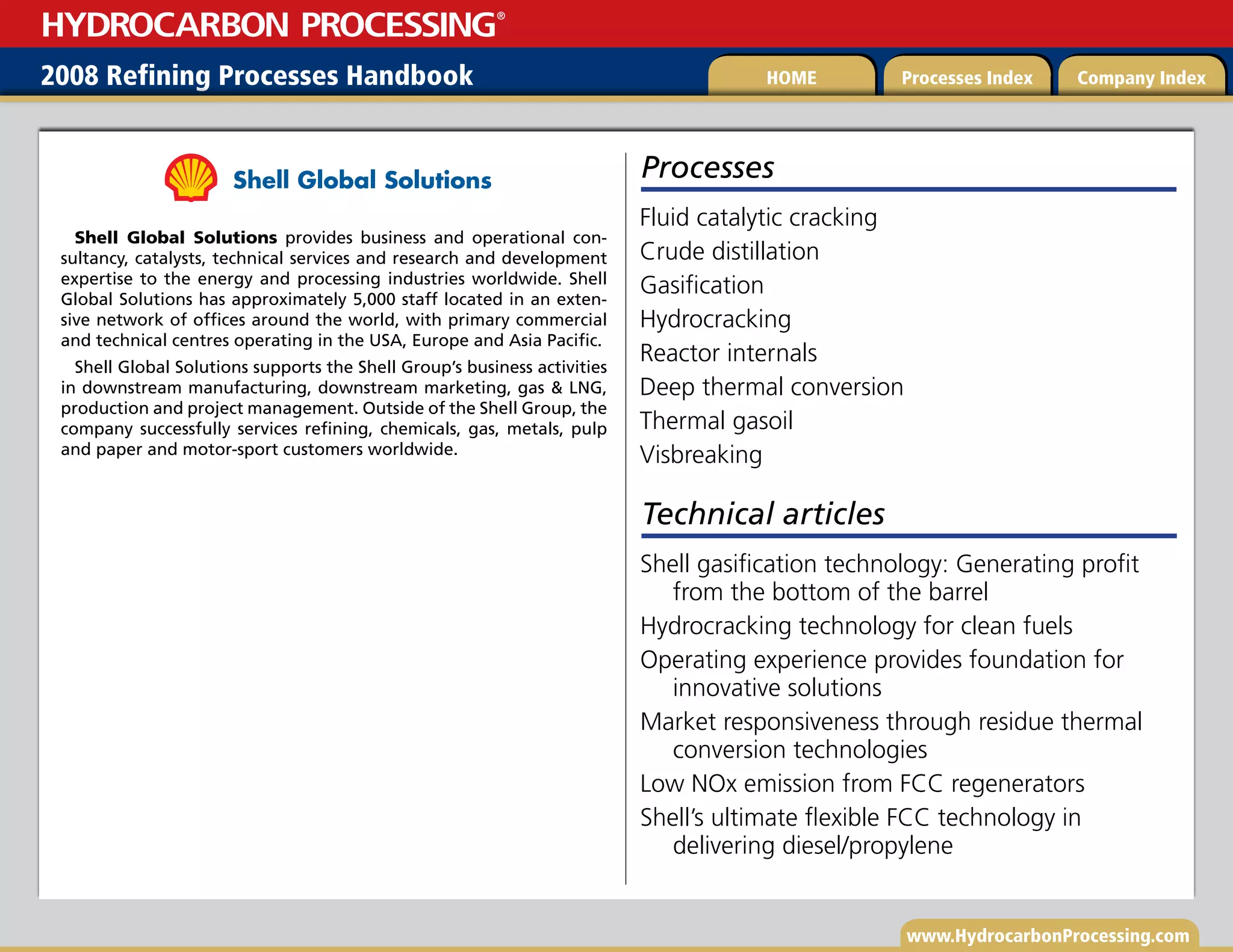
The heat of reaction evaporates liquid, and the resulting vapor is
condensed in the overhead condenser (2) to provide additional reflux.
The natural temperature profile in the fractionation column results in a
virtually isothermal catalyst bed rather than the temperature increase
typical of conventional reactors.
The CDHydro process can operate at much lower pressure than
conventional processes. Pressures for the CDHydro process are typically
set by the fractionation requirements. Additionally, the elimination of a
separate hydrogenation reactor and hydrogen stripper offers significant
capital cost reduction relative to conventional technologies.
Feeding the CDHydro process with reformate and light-straight run
for benzene saturation provides the refiner with increased flexibility to
produce low-benzene gasoline. Isomerization of the resulting C5 /C6
overhead stream provides higher octane and yield due to reduced ben-
zene and C7
+ content compared to typical isomerization feedstocks.
Economics: Fixed-bed hydrogenation requires a distillation column fol-
lowed by a fixed-bed hydrogenation unit. The CDHydro process elimi-
nates the fixed-bed unit by incorporating catalyst in the column. When
a new distillation column is used, capital cost of the column is only 5%
to 20% more than for a standard column depending on the CDHydro
application. Elimination of the fixed-bed reactor and stripper can reduce
capital cost by as much as 50%.
Installation: There are 50 CDHydro units are commercially licensed for
C4, C5, C6, LCN and benzene hydrogenation applications. Twenty units
have been in operation for more than five years and total commer-
cial operating time now exceeds 100 years for CDHydro technologies.
Eleven units are currently in engineering  
/construction.
Licensor: CDTECH.
1
Hydrogen
Reflux Treated FCC C4s
MP steam
Depentanizer
FCC C4
+
CW
Hydrogen recycle
Offgas
FCC C5
+ gasoline
2
2008 Refining Processes Handbook Processes Index Company Index
HOME
HYDROCARBON PROCESSING
®
click here to e-mail for more information
Hydrogenation, selective for
MTBE/ETBE C4 raffinates
Application: To achieve selective hydrogenation of butadiene to n-butenes
in a catalytic distillation column.
Description: The C4 CDHydro catalytic distillation technology processes
C4 streams from refineries or steam crackers within an methyl tertiary
butyl ether (MTBE)/ethyl tertiary butyl ether (ETBE) debutanizer to pro-
duce a raffinate with a high butylenes content that is essentially butadi-
ene-free. After methanol recovery, the treated C4 raffinate can be used
for butene-1 production or alkylation feed.
Selective hydrogenation increases butenes available for alkylation
or isomerization, reduces acid consumption in alkylation units, and
greatly improves the quality of HF alkylate. The process uses commer-
cially available catalyst in its proprietary catalytic distillation structures
(CDModules).
The C4 stream is combined with hydrogen in the MTBE/ETBE
debutanizer. Treated C4 raffinate is taken overhead. The washing action
of the reflux minimizes oligomer formation, flushing heavy compounds
from the catalyst and promoting long catalyst life. Excess hydrogen and
lights are vented from the overhead drum. The catalyst is sulfur tolerant.
Feed sulfur compounds react with diolefins to form heavy compounds
that exit in the tower bottoms with the MTBE/ETBE product. The distil-
late product is essentually mercaptan-sulfur free.
Process advantages include:
• Low capital cost
• Low catalyst requirements
• Low operating cost
• High product yield (low saturation to paraffins)
• No polymer recycle across catalyst
• Use of reaction heat
• Sulfur tolerant catalyst
• Essentially mercaptan-sulfur-free distillate product
• Flexible butene-1/butene-2 ratio
• Retrofit to existing C4 columns
• All carbon steel construction.
Economics: Capital costs are considerably lower than conventional hy-
drotreaters since the single column design eliminates costs associated
with fixed-bed systems. The C4 CDHydro process would typically be in-
stalled in a conventional or catalytic MTBE/ETBE debutanizer, either as a
retrofit or in a new column.
Installation: There are 50 total commercially licensed CDHydro units,
11 of which are currently in design or construction.
Licensor: CDTECH.
Treated C4s
raffinate
C4s with MTBE/ETBE
and methanol/ethanol
Offgas
Reflux
LP steam
CW
Hydrogen
MTBE/ETBE
Overhead
drum
MTBE/ETBE debutainzer
2008 Refining Processes Handbook Processes Index Company Index
HOME
HYDROCARBON PROCESSING
®
click here to e-mail for more information
Hydrogenation, selective for
refinery C4 feeds
Application: To process C4 streams from refineries to produce a stream
with high butylenes content that is essentially butadiene-free, suitable
for methyl tertiary butyl ether (MTBE) production, butene-1 production
or alkylation feed.
Description: The patented C4 CDHydro process achieves selective hy-
drogenation of butadiene to n-butenes in a catalytic distillation column.
Selective hydrogenation increases butenes available for alkylation or
isomerization, reduces acid consumption in alkylation units, and greatly
improves the quality of HF alkylate. The process uses commercially avail-
able catalyst in proprietary catalytic distillation structures.
The unique catalytic distillation column combines reaction and frac-
tionation in a single unit operation. This constant pressure boiling system
assures precise temperature control in the catalyst zone. Low reaction
temperature and isothermal operation enhance selectivity and minimize
yield losses to paraffins. Isomerization of butene-1 to butene-2 can be
maximized to improve HF alkylate quality or minimized for increased
butene-1 recovery.
Refinery C4 streams are combined with hydrogen in the catalytic
column. Treated C4 products are taken overhead. The washing action
of the reflux minimizes oligomer formation, flushing heavy compounds
from the catalyst and promoting long catalyst life. Excess hydrogen and
lights are vented from the overhead drum. The catalyst will react acidic
sulfur compounds with diolefins to form heavy compounds which exit
in the tower bottoms. The distillate product is essentially mercaptan-
sulfur-free.
Economics: Capital costs are considerably lower than conventional hy-
drotreaters since the single column design eliminates costs associated
with fixed-bed systems. Additionally, the ability to remove acidic sulfur
compounds eliminates the need for sweetening. The C4 CDHydro pro-
cess would typically be installed in a debutanizer, either as a retrofit or
in a new column.
Process advantages include:
• Low operating pressure
• Low operating cost
• High product yield (low paraffin make)
• No polymer recycle across catalyst
• No sweetening required
• Essentially mercaptan sulfur-free distillate product
• Flexible butene-1/butene-2 ratio
• Retrofit to existing C4 columns
• All carbon steel construction
• Isomerization option
• No hydrogen compressor.
Installation: There are 50 total commercially licensed CDHydro units,
11 of which are in design or under construction.
Licensor: CDTECH.
Treated C4s
Offgas
Reflux
C4+
LP steam
CW
Low-pressure
hydrogen
C5+
Overhead
drum
2008 Refining Processes Handbook Processes Index Company Index
HOME
HYDROCARBON PROCESSING
®
click here to e-mail for more information
Hydrogenation—benzene in reformate
Application: The CDHydro catalytic distillation technology processes re-
formate streams from refineries to reduce benzene to levels required by
low-benzene gasoline specifications.
Description: The patented CDHydro process achieves hydrogenation of
benzene to cyclohexane in a catalytic distillation column. Hydrogenation
reduces benzene in the gasoline pool. The process uses commercially
available catalyst in proprietary catalytic distillation structures.
Selective hydrogenation: Reformate and hydrogen are fed to the catalytic
distillation column. Hydrogenation of benzene to cyclohexane can exceed
99%. Benzene conversion can easily be limited to lower levels through con-
trol of hydrogen addition. Washing action of the reflux minimizes oligomer
formation, flushes heavy compounds from the catalyst and promotes long
catalyst life. Treated C6 product is taken as overhead. Excess hydrogen and
lights are recycled and vented from the overhead drum. The C7+ product is
taken as bottom with essentially full recovery of heavy aromatics.
The unique catalytic distillation column combines reaction and frac-
tionation in a single unit operation. This constant-pressure boiling sys-
tem assures precise temperature control in the catalyst zone. Low reac-
tion temperature and isothermal operation enhance safety.
Economics: Capital costs are considerably lower than conventional hy-
drotreaters since the single-column design eliminates costs associated
with fixed-bed systems and operates at low enough pressure to avoid
the need for a hydrogen compressor. The CDHydro process would typi-
cally be installed in a benzene-toluene splitter, either as a retrofit or in a
new column.
Advantages:
• Lower capital cost
• High conversion
• Simple operation
• Low operating pressure
• Low operating cost
• Low capital cost
• Low benzene in reformate
• All carbon steel construction
• No hydrogen compressor
• Isothermal operation
• Reduced plot area.
Installation: There are six operational units, the oldest in operation since
1995.
Licensor: CDTECH.
Hydrogen recycle
Benzene-toluene
splitter
CW
Low benzene
reformate
Overhead
drum
Reflux Treated C6s
C7+
C5 – C9 reformate
Low-pressure
hydrogen
MP steam
Offgas
2008 Refining Processes Handbook Processes Index Company Index
HOME
HYDROCARBON PROCESSING
®
click here to e-mail for more information
Hydrogenation, selective for
refinery C5 feeds
Application: To process C5 streams from refineries to produce a stream
with high isoamylenes content that is essentially free of diolefins. The
treated C5 stream is suitable for tertiary amyl methyl ether (TAME) pro-
duction or alkylation feed.
Description: The patented C5 CDHydro process achieves selective hydro-
genates diolefins to amylenes in a catalytic distillation column. Selective
hydrogenation is a required pretreatment step for TAME production and
C5 alkylation, improving product quality in both, and reducing acid con-
sumption in the latter.
The process uses commercially available catalyst in proprietary cata-
lytic distillation structures. The unique catalytic distillation column com-
bines reaction and fractionation in a single unit operation. This constant
pressure boiling system assures precise temperature control in the cata-
lyst zone. Low reaction temperature and isothermal operation enhance
selectivity and minimize yield losses to paraffins. Non-reactive 3-methyl
butene-1 is isomerized to reactive 2-methyl butene-2, which increas-
es potential TAME production. Pentene-1 is isomerized to pentene-2,
which improves octane number.
Refinery C5 streams are combined with hydrogen in the catalytic
column. Treated C5 products are taken overhead. The washing action
of the reflux minimizes oligomer formation, flushing heavy compounds
from the catalyst and promoting long catalyst life. The catalyst will react
acidic sulfur compounds with diolefins to form heavy compounds, which
exit in the tower bottoms. The distillate product is essentially mercaptan-
sulfur-free.
Economics: Capital costs are considerably lower than conventional hy-
drotreaters since the single column design eliminates costs associated
with fixed-bed systems. Additionally, the ability to remove acidic sulfur
compounds eliminates the need for sweetening. The C5 CDHydro pro-
cess would typically be installed in a depentanizer, either as a retrofit or
in a new column.
Process advantages include:
• Low operating pressure
• Low operating cost
• High product yield (low paraffin make)
• No polymer recycle across catalyst
• No sweetening required
• Essentially mercaptan sulfur-free distillate product
• Flexible butene-1/butene-2 ratio
• Retrofit to existing C4 columns
• All carbon steel construction
• Isomerization option
• No hydrogen compressor.
Installation: There are 50 total commercially licensed CDHydro units,
11 of which are currently in design or construction.
Licensor: CDTECH.
Treated C5s
Offgas
Reflux
Light cat naphtha
LP steam
CW
Low-pressure
hydrogen
C6+
Overhead
drum
2008 Refining Processes Handbook Processes Index Company Index
HOME
HYDROCARBON PROCESSING
®
click here to e-mail for more information
Hydroprocessing—resid
Application: The UOP SRC Uniflex process is a high-conversion residue
hydroprocessing process for the production of gasoil conversion unit
feedstocks, distillates and naphtha. The normal feedstock to a SRC Uni-
flex Process Unit is vacuum residue, although atmospheric residue and
other streams (SDA pitch) can be processed.
Description: The feed is heated to the desired temperature by separate
heating from the bulk of the recycle gas, which is heated to an elevated
temperature above the desired mix temperature. Small particulate cata-
lyst is added continuously in the feed just before the feed heater. The
recycle gas is heated in its own heater then the feed plus the recycle
gas are mixed in the bottom zone of the reactor. Product and catalyst
leave the top of the reactor, are then immediately quenched then flow
to the hot high-pressure separator (HHPS) and to further fractionation.
The vapor stream from the CHPS is recycled back to the reactor after
combining with make-up hydrogen. HVGO is typically recycled to almost
extinction.
Economics: The SRC Uniflex Process will result in very high refinery mar-
gins due to the high conversion to distillates and naphtha’s.
Experience: One has been in operation at the PetroCanada Montreal
Refinery.
Licensor: UOP.
CHPS
Vacuum
column
Stripper/
product
fractionator
Vacuum
residue
feed
Recycle
H2
HHPS
Slurry
reactor
Makeup H2
C4-
Naphtha
HVGO recycle
LVGO
HVGO
Pitch
Diesel
Catalyst
2008 Refining Processes Handbook Processes Index Company Index
HOME
HYDROCARBON PROCESSING
®
click here to e-mail for more information
Hydroprocessing, ULSD
Application: A versatile family of ExxonMobil Research and Engineering
Co. (EMRE) process technologies and catalysts are used to meet all cur-
rent and possible future premium diesel requirements.
ULSD HDS—Ultra-deep hydrodesulfurization process to produce
distillate products with sulfur levels below 10 wppm.
HDHC—Heavy-distillate mild-hydrocracking process for the reduc-
tion of T90 and T95 boiling points, and high-level density reduction.
MAXSAT—High-activity aromatics saturation process for the selec-
tive reduction of polyaromatics under low pressure and temperature
conditions.
CPI—Diesel cloud point improvement by selective normal paraffin
hydrocracking (MDDW) or by paraffin isomerization dewaxing (MIDW).
Description: EMRE units combine the technologies listed above in
low-cost integrated designs to achieve the necessary product uplift at
minimum investment and operating cost. For ultra-low-sulfur-diesel
hydrodesulfurization (ULSD HDS), a single-stage single-reactor process
can be designed. A small cetane improvement, together with the reduc-
tion of polyaromatics to less than 11 wt.% or as low as 5 wt.%, can be
economically achieved with proper specification of catalyst, hydrogen
partial pressure, space velocity and the installation of high-performance
Spider Vortex internals.
The addition of heavy-diesel hydrocracking (HDHC) function to the HDS
reactor can achieve T95 boiling point reduction together with higher levels
of density and aromatics reduction and greater cetane improvement.
When feedstock aromatics are very high, or very low aromatics in
the product are desired, a second-stage aromatics saturation (MAXSAT)
system is specified to avoid very high design pressures required for a
single-step base-metal hydrotreating catalyst system. When the distil-
late product must also meet stringent fluidity specifications, EMRE can
offer either paraffin isomerization dewaxing (MIDW) or selective normal
paraffin cracking-based dewaxing technologies (MDDW). These can be
closely integrated with ULSD HDS and other functions to achieve the full
upgrading requirements.
The EMRE ULSD technologies are equally amenable to revamp or
grassroots applications. EMRE has an alliance with Kellogg Brown 
Root (KBR) to provide these technologies to refiners.
Installation: Nineteen distillate upgrading units have applied the EMRE
ULSD technologies. Twelve of these applications are revamps.
Licensor: ExxonMobil Research and Engineering Co.
Rich amine
Fuel gas
Naphtha
Low-sulfur diesel
Sour
water
Wash water
Hot
separator
Makeup
compressor
Cold
separator
Product
stripper
Lean amine
Steam
Absorber
ULSD
reactor
Heater
Hydrogen
Charge pump
Gas oil feed
Recycle
compressor
2008 Refining Processes Handbook Processes Index Company Index
HOME
HYDROCARBON PROCESSING
®
click here to e-mail for more information
Hydrotreating
Application: The CDHydro and CDHDS processes are used to selectively
desulfurize FCC gasoline with minimum octane loss.
Products: Ultra-low-sulfur FCC gasoline with maximum retention of
olefins and octane.
Description: The light, mid and heavy cat naphthas (LCN, MCN, HCN)
are treated separately, under optimal conditions for each. The full-
range FCC gasoline sulfur reduction begins with fractionation of the
light naphtha overhead in a CDHydro column. Mercaptan sulfur re-
acts quantitatively with excess diolefins to produce heavier sulfur com-
pounds, and the remaining diolefins are partially saturated to olefins
by reaction with hydrogen. Bottoms from the CDHydro column, con-
taining the reacted mercaptans, are fed to the CDHDS column where
the MCN and HCN are catalytically desulfurized in two separate zones.
HDS conditions are optimized for each fraction to achieve the desired
sulfur reduction with minimal olefin saturation. Olefins are concentrat-
ed at the top of the column, where conditions are mild, while sulfur
is concentrated at the bottom where the conditions result in very high
levels of HDS.
No cracking reactions occur at the mild conditions, so that yield
losses are easily minimized with vent-gas recovery. The three product
streams are stabilized together or separately, as desired, resulting in
product streams appropriate for their subsequent use. The two columns
are heat integrated to minimize energy requirements. Typical reformer
hydrogen is used in both columns without makeup compression. The
sulfur reduction achieved will allow the blending of gasoline that meets
current and future regulations.
Catalytic distillation essentially eliminates catalyst fouling because
the fractionation removes heavy-coke precursors from the catalyst zone
before coke can form and foul the catalyst pores. Thus, catalyst life in
catalytic distillation is increased significantly beyond typical fixed-bed
life. The CDHydro/CDHDS units can operate throughout an FCC turn-
around cycle up to six years without requiring a shutdown to regenerate
or to replace catalyst. Typical fixed-bed processes will require a mid FCC
shutdown to regenerate/replace catalyst, requiring higher capital cost
for feed, storage, pumping and additional feed capacity.
Economics: The estimated ISBL capital cost for a 50,000-bpd CDHydro/
CDHDS unit with 95% desulfurization is $40 million (2005 US Gulf
Coast).
Installation: There are 38 CDHydro/CDHDS desulfurization units com-
mercially licensed to treat FCC gasoline, of which 12 are currently in en-
gineering/construction. Total licensed capacity exceeds 1.3 million bpd.
Licensor: CDTECH.
HCN
MCN
LCN
MCN/HCN
CDHydro
CDHDS
Hydrogen
Hydrogen
FCC C5 + gasoline
2008 Refining Processes Handbook Processes Index Company Index
HOME
HYDROCARBON PROCESSING
®
click here to e-mail for more information
Hydrotreating
Application: Hydrotreating of light and middle distillates and various gas
oils, including cracked feedstocks (coker naphtha, coker LGO and HGO,
visbreaker gas oil, and LCO) using the ISOTREATING Process for deep
desulfurization, denitrification and aromatics saturation and to produce
low-sulfur naphtha, jet fuel, ultra-low sulfur diesel (ULSD), or improved-
quality FCC feed.
Description: Feedstock is mixed with hydrogen-rich treat gas, heated
and reacted over high-activity hydrogenation catalyst (1). Several CoMo
and NiMo catalysts are available for use in the ISOTREATING Process. One
or multiple beds of catalyst(s), together with Chevron Lummus Global’s
advanced high-efficiency reactor internals for reactant distribution and
interbed quenching, are used.
Reactor effluent is cooled and flashed (2) producing hydrogen-rich
recycle gas, which, after H2S removal by amine (3), is partially used as
quench gas while the rest is combined with makeup hydrogen gas to
form the required treat gas. An intermediate pressure level flash (4) can
be used to recover some additional hydrogen-rich gas from the liquid
effluent prior to the flashed liquids being stripped or fractionated (5) to
remove light ends, H2S and naphtha-boiling range material, and/or to
fractionate the higher boiling range materials into separate products.
Operating conditions: Typical reactor operating conditions can range
from 600–2,300 psig and 500–780°F, 350–2,000 psia hydrogen partial
pressure, and 0.6-3 hr–1 LHSV, all depending on feedstock(s) and prod-
uct quality objective(s).
Yields: Depends on feedstock(s) characteristics and product require-
ments. Desired product recovery is maximized based on required flash
point and/or specific fractionation specification. Reactor liquid product
(350°F plus TBP material) is maximized through efficient hydrogenation
with minimum lighter liquid product and gas production. Reactor liq-
uid product (350°F plus) yield can vary between 98 vol% from straight-
run gas oil feed to 104 vol% from predominantly cracked feedstock
to produce ULSD (10 wppm sulfur). Chemical-hydrogen consumption
ranges from 450–900+ scf/bbl feed.
Economics: Investment will vary depending on feedstock character-
istics and product requirements. For a 40,000–45,000-bpsd unit for
ULSD, the ISBL investment cost (US Gulf Coast 2007) is $2,000–$3,000/
bspd.
Installation: Currently, there are more than 50 units operating based on
ISOTREATING technology and an additional 17 units in various stages of
engineering.
Licensor: Chevron Lummus Global LLC.
Feed
Wash
water
1
2
4
2
3
5
4
A
A
B
B
Sour water
Stripping
steam
Product
Light ends
and naphtha
H2 and
light ends
Rich amine
Lean amine
HP purge gas
Makeup H2 gas
2008 Refining Processes Handbook Processes Index Company Index
HOME
HYDROCARBON PROCESSING
®
Hydrotreating
Application: The IsoTherming process provides refiners an economical
means to produce ultra-low-sulfur diesel (ULSD), low-sulfur and low-
nitrogen feedstocks and other very low-sulfur hydrocarbon products. In
addition, IsoTherming can also be used for feed upgrading in a mild-to
partial-conversion hydrocracking mode in conjunction with or in lieu of
conventional hydrotreating.
Products: ULSD, low-sulfur FCC feed, low-sulfur gasoline-kerosine type
products.
Description: This process uses a novel approach to introduce dissolved
hydrogen in excess of reaction requirements into the reactor. This ap-
proach allows operation at higher space velocities than conventional
trickle-bed reactors. The IsoTherming process eliminates problems asso-
ciated with flow mal-distribution, gas-liquid mass transfer and catalyst
wetting. The process obviates the need for some equipment in conven-
tional hydrotreating thereby lowering cost.
The technology can be installed as a pre-treat unit ahead of an exist-
ing hydrotreater reactor or a new stand-alone process unit. Fresh feed,
after heat exchange, is combined with recycled product and hydrogen in
a mixer internal to the reactor. The liquid feed with soluble hydrogen is
fed to IsoTherming reactor/bed one where partial desulfurization occurs.
The stream is combined with additional hydrogen in a second mixer and
fed to the second IsoTherming reactor/bed where further desulfurization
takes place.
Treated oil is recycled back to the inlet of reactor one. This recycle
stream delivers more hydrogen to the reactors and also acts as a heat
sink; thus, a nearly isothermal reactor operation is achieved.
The treated oil from the second IsoTherming reactor/bed may then
be fed to additional IsoTherming reactors/beds and/or a trickle-bed
hydrotreating reactor (revamp case only) acting in the polishing mode to
produce an ultra-low-sulfur product.
Operating conditions: Typical diesel IsoTherming revamp conditions are:
			 Treated product
		 IsoTherming from existing
Diesel pre-treat conventional
feed reactor reactor
LCO, vol% 42
SR, vol% 58
Sulfur, ppm 4,300 451 7
Nitrogen, ppm 415 49 0
H2 Consumption, scf/bbl		 305 245
LHSV, Hr –1*		 4 2.1
Reactor DT		 24 30
Reactor Pressure, psig		 900 750
* Based on fresh feedrate without recycle
Trickle-bed
reactor
Recycle
compressor
Separator
Stripper
Heater
Heater
Amine
treating
Product diesel
Cold
separator
Feed
Fuel gas
Naphtha
Makeup hydrogen
Purge gas
IsoTherming
reactor
Recycle
pump
Hot
separator
Legend:
Existing equipment
New equipment
Grassroots
only
Grassroots
only
Not required
for grassroots
projects
Continued 
Economics: Revamp investment (basis 15,000–20,000 bpsd, 1Q2008,
US Gulf Coast) $500/bpsd diesel.
Installation: Six units have been licensed for ULSD; two units licensed for
mild hydrocracking; and one unit for gasoil desulfurization.
Licensor: DuPont.
Hydrotreating, continued
click here to e-mail for more information
2008 Refining Processes Handbook Processes Index Company Index
HOME
HYDROCARBON PROCESSING
®
click here to e-mail for more information
Hydrotreating
Application: Topsøe hydrotreating technology has a wide range of ap-
plications, including the purification of naphtha, distillates and residue,
as well as the deep desulfurization and color improvement of diesel fuel
and pretreatment of FCC and hydrocracker feedstocks.
Products: Ultra-low-sulfur diesel fuel, and clean feedstocks for FCC and
hydrocracker units.
Description: Topsøe’s hydrotreating process design incorporates our in-
dustrially proven high-activity TK catalysts with optimized graded-bed
loading and high-performance, patented reactor internals. The combi-
nation of these features and custom design of grassroots and revamp
hydrotreating units result in process solutions that meet the refiner’s
objectives in the most economic way.
In the Topsøe hydrotreater, feed is mixed with hydrogen, heated
and partially evaporated in a feed/effluent exchanger before it enters
the reactor. In the reactor, Topsøe’s high-efficiency internals have a
low sensitivity to unlevelness and are designed to ensure the most
effective mixing of liquid and vapor streams and the maximum utili-
zation of the catalyst volume. These internals are effective at a high
range of liquid loadings, thereby enabling high turndown ratios. Top-
søe’s graded-bed technology and the use of shape-optimized inert
topping and catalysts minimize the build-up of pressure drop, there-
by enabling longer catalyst cycle length. The hydrotreating catalysts
themselves are of the Topsøe TK series, and have proven their high
activities and outstanding performance in numerous operating units
throughout the world. The reactor effluent is cooled in the feed-ef-
fluent exchanger, and the gas and liquid are separated. The hydro-
gen gas is sent to an amine wash for removal of hydrogen sulfide
and is then recycled to the reactor. Cold hydrogen recycle is used as
quench gas between the catalyst beds, if required. The liquid product
is steam stripped in a product stripper column to remove hydrogen
sulfide, dissolved gases and light ends.
Operating conditions: Typical operating pressures range from 20 to 80
barg (300 to 1,200 psig), and typical operating temperatures range from
320°C to 400°C (600°F to 750°F).
References: Cooper, B. H. and K. G. Knudsen, “Production of ULSD: Cat-
alyst, kinetics and reactor design,” World Petroleum Congress, 2002.
Patel, R. and K. G. Knudsen, “How are refiners meeting the ul-
tra-low-sulfur diesel challenge,” NPRA Annual Meeting, San Antonio,
March 2003.
Topsøe, H., K. Knudsen, L. Skyum and B. Cooper, “ULSD with BRIM
catalyst technology,” NPRA Annual Meeting, San Francisco, March 2005.
Installation: More than 60 Topsøe hydrotreating units for the various ap-
plications above are in operation or in the design phase.
Licensor: Haldor Topsøe A/S.
START
Products to
fractionation
Rich amine
Lean amine
H2 rich gas
Makeup
hydrogen
Furnace
Reactor
Absorber
High-pressure
separator
Low-pressure
separator
Fresh feed
Recycle gas
compressor
2008 Refining Processes Handbook Processes Index Company Index
HOME
HYDROCARBON PROCESSING
®
click here to e-mail for more information
Hydrotreating
Application: RCD Unionfining process reduces the sulfur, nitrogen, Con-
radson carbon, asphaltene and organometallic contents of heavier resi-
due-derived feedstocks to allow them to be used as either specification
fuel oils or as feedstocks for downstream processing units such as hydro-
crackers, fluidized catalytic crackers, resid catalytic crackers and cokers.
Feed: Feedstocks range from solvent-derived materials to atmospheric
and vacuum residues.
Description: The process uses a fixed-bed catalytic system that operates at
moderate temperatures and moderate to high hydrogen partial pressures.
Typically, moderate levels of hydrogen are consumed with minimal pro-
duction of light gaseous and liquid products. However, adjustments can
be made to the unit’s operating conditions, flowscheme configuration or
catalysts to increase conversion to distillate and lighter products.
Fresh feed is combined with makeup hydrogen and recycled gas,
and then heated by exchange and fired heaters before entering the
unit’s reactor section. Simple downflow reactors incorporating a graded
bed catalyst system designed to accomplish the desired reactions while
minimizing side reactions and pressure drop buildup are used. Reactor
effluent flows to a series of separators to recover recycle gas and liquid
products. The hydrogen-rich recycle gas is scrubbed to remove H2S and
recycled to the reactors while finished products are recovered in the
fractionation section. Fractionation facilities may be designed to simply
recover a full-boiling range product or to recover individual fractions of
the hydrotreated product.
Economics:
Utilities, typical per barrel of fresh feed (20,000 bpsd basis)
Fuel, MMBtu/hr 46
Electricity, kWh 5,100
Steam, HP, lb/hr 8,900
Steam, LP, lb/hr 1,500
Installation: Twenty-eight licensed units with a combined licensed ca-
pacity of approximately one million bpsd. Commercial applications have
included processing of atmospheric and vacuum residues and solvent-
derived feedstocks.
Licensor: UOP.
START
Resid charge
Guard
reactor
HHPS
Gas
Fuel gas
Naphtha
Distillate
Treated
atm. resid
Main reactors (2-4)
Fractionator
Hot low
press. flash
Cold low
press. flash
Amine
scrubber
Rich amine
Makeup
hydrogen
Lean amine
Recycle
gas comp.
Recycle
gas heater
Cold high
press. sep.
2008 Refining Processes Handbook Processes Index Company Index
HOME
HYDROCARBON PROCESSING
®
click here to e-mail for more information
Hydrotreating
Application: Hydrodesulfurization, hydrodenitrogenation and hydro-
genation of petroleum and chemical feedstocks using the UOP Union-
fining processes.
Products: Ultra-low-sulfur diesel fuel; feed for catalytic reforming,
FCC pretreat; upgrading distillates (higher cetane, lower aromatics);
desulfurization, denitrogenation and demetallization of vacuum and at-
mospheric gas oils, coker gas oils and chemical feedstocks.
Description: Feed and hydrogen-rich gas are mixed, heated and contact-
ed with regenerable catalyst (1). Reactor effluent is cooled and separated
(2). Hydrogen-rich gas is recycled or used elsewhere. Liquid is stripped
(3) to remove light components and remaining hydrogen sulfide, or frac-
tionated for splitting into multiple products.
Operating conditions: Operating conditions depend on feedstock and
desired level of impurities removal. Pressures range from 500 to 2,000
psi. Temperatures and space velocities are determined by process objec-
tives.
Yields:
Purpose FCC feed Desulf. Desulf. Desulf.
Feed, source VGO + Coker AGO VGO VGO + LCO
Gravity, °API 17.0 25.7 24.3 36.6
Boiling range, °F 400/1,000 310/660 540/1,085 390/690
Sulfur, wt% 1.37 1.40 3 0.1
Nitrogen, ppmw 6,050 400 1,670 280
Bromine number — 26 — 3.9
Naphtha, vol% 4.8 4.2 3.9 2.0
Gravity, °API 45.0 50.0 54.0 55
Boiling range, °F 180/400 C4/325 C4/356 C5/310
Sulfur, ppmw 50 2 2 5
Nitrogen, ppmw 30 1 2 2
Distillate, vol% 97.2 97.6 98.0 100.3
Gravity, °API 24.0 26.9 27.8 38.6
Boiling range, °F 400+ 325/660 300+ 310 +
Sulfur, wt% 0.025 0.001 0.002 0.001
H2 consump., scf/bbl 700 350 620 310
Economics:
Utilities, typical per bbl feed:
Fuel, 103 Btu		40–100
Electricity, kWh		0.5–1.5
Installation: Several hundred units installed.
Licensor: UOP.
START
Light components
Product
1
2
3
Makeup
hydrogen
Feed
2008 Refining Processes Handbook Processes Index Company Index
HOME
HYDROCARBON PROCESSING
®
Hydrotreating, diesel
Application: Produce ultra-low-sulfur diesel (ULSD) and high-cetane and
improved-color diesel fuel from a wide range of middle distillates feeds
including large amount of cracked stock (such as LCO, light coker/vis-
breaker gasoils or MHC-GO, AR/VRDS GO) using Axens’ Prime-D Toolbox
of proven state-of-the-art technology (including high activity/stability HR
Series catalysts and high-performances EquiFlow internals) and services.
Description: In the basic process, as shown in the diagram, feed and
hydrogen are heated in the feed-reactor effluent exchanger (1) and fur-
nace (2) and enter the reaction section (3), with possible added volume
for revamp cases. The reaction effluent is cooled by the exchanger (1)
and air cooler (4) and separated in the separator (5). The hydrogen-
rich gas phase is treated in an existing or new amine absorber for H2S
removal (6) and recycled to the reactor. The liquid phase is sent to the
stripper (7) where small amounts of gas and naphtha are removed and
high-quality product diesel is recovered.
Whether the need is for a new unit or for maximum reuse of exist-
ing diesel HDS units, the Prime-D Hydrotreating Toolbox of solutions
meets the challenge. Process objectives ranging from low-sulfur, ultra-
low-sulfur, low-aromatics, and/or high-cetane number are met with
minimum cost by:
• Selection of the proper combination of catalyst from HR Series and
ACT grading materials for maximized cycle length and performance. HR
626 catalyst covers the range of ULSD requirements with highly active
and stable catalysts. HR 626 CoMo exhibits high desulfurization rates at
low to medium pressures; HR 538/HR 548 NiMo have higher hydrogena-
tion activities at higher pressures.
• Use of proven, high-performance reactor internals, EquiFlow, that
allow near-perfect gas and liquid distribution and outstanding radial
temperature profiles (implemented in over 100 units).
• Loading catalyst in the reactor(s) with the Catapac dense loading
technique for up to 20% more reactor capacity. Over 15,000 tons of
catalyst have been loaded quickly, easily and safely in recent years using
the Catapac technique.
• Application of Advanced Process Control for dependable opera-
tion and longer catalyst life.
• Sound engineering design based on years of RD, process design
and technical service feedback to ensure the right application of the
right technology for new and revamp projects.
Whatever the diesel quality goals—ULSD, high cetane or low aro-
matics—Prime-D’s Hydrotreating Toolbox approach will attain your goals
in a cost-effective manner.
Installation: Over 200 middle distillate hydrotreaters have been licensed
or revamped. They include 85 low- and ultra-low-sulfur diesel units, as
well as a number of cetane boosting units equipped with Equiflow
internals and loaded with HR series catalysts.
References: “Getting Total Performance with Hydrotreating,” Petroleum
Technology Quarterly, Spring 2002.
Feed
PSA purified
hydrogen
Offgas
Low-sulfur
product
H2S
H2 recycle New amine
absorber
Additional
catalyst
volume
2
4
5
6
7
1
3
Amine
absorber
Continued 
Hydrotreating, diesel, continued
“Premium Performance Hydrotreating with Axens HR 400 Series
Hydrotreating Catalysts,” NPRA Annual Meeting, March 2002, San
Antonio.
“The Hydrotreating Toolbox Approach,” Hart’s European Fuel News,
May 29, 2002.
click here to e-mail for more information
“Squeezing the most from hydrotreaters,” Hydrocarbon Asia, April/
May 2004.
“Upgrade hydrocracked resid through integrated hydrotreating,”
Hydrocarbon Processing, September 2008.
Licensor: Axens.
2008 Refining Processes Handbook Processes Index Company Index
HOME
HYDROCARBON PROCESSING
®
Hydrotreating, pyrolysis gasoline
Application: GTC Technology, in alliance with technology partners, of-
fers an optimized technology for two-stage pyrolysis gasoline (pygas)
hydrotreatment in cases where di-olefins, olefins and styrene in the raw
pygas feed are saturated. The technology is simple and easy to imple-
ment into existing plant requirements. The process is applied to the C5+
fraction of raw pyrolysis gasoline.
Description: The hydrotreating unit consists of three sections:
• First stage hydrotreating section saturates di-olefins to olefins
• Second stage hydrotreating section saturates olefins and desulfur-
izes the pygas
• Fractionation section stabilizes the hydrotreated streams and re-
covers the C6– C8 heart cut for further processing for aromatics extrac-
tion and the C9+ cut.
Raw pygas is first sent to the first stage hydrotreating section. The
pygas feed stream along with hydrogen is preheated by the recycle
liquid stream to the desired temperature and sent to the first stage
hydrotreating (HDT) reactor where most diolefins in the feed are selec-
tively saturated into olefins only—preserving the octane value of the
hydrotreated stream.
The reactor effluent is sent to the first stage product separator. Part
of the liquid from the bottom of the product separator is recycled back
to the front section of the first stage hydrogenator to control reactor
temperature rise. Excess hydrogen and light hydrocarbons are removed
at the top of the separator and sent to the recycle gas compressor. The
separator liquid is fed to a first stage stabilizer column. In the receiver,
H2 and light hydrocarbons are separated and drawn as a vapor product,
which is sent as offgas to the battery limit (B.L.). The liquid from the
receiver is fully returned as reflux to the column. The liquid stream from
the stabilizer bottoms is C5 + gasoline fraction and can be sent to the
gasoline pool. To produce benzene, toluene and xylene (BTX), this C5+
stream is sent to a fractionation section to obtain a C6– C8 heat cut,
which will be further hydrotreated to saturate mono-olefins in the sec-
ond stage hydrotreating section.
In the second stage hydrotreating section, the C6– C8 heart cut com-
bined with a recycle vapor stream and makeup hydrogen is preheated
in the second stage feed/effluent heat exchanger before being heated
further to the desirable reaction temperature by a charge heater. The
feed mixture passes through the fixed catalyst beds in the second stage
HDT reactor where olefin species are saturated and sulfur species are
converted to hydrogen sulfide (H2S).
The reactor effluent is then cooled in the second stage feed/efflu-
ent heat exchanger and subsequently in an after-cooler before being
routed to a second stage product separator. In the product separator,
the unreacted hydrogen and other light components are separated from
the hydrotreated liquid products and recycled to the HDT reactor using
a recycle gas compressor. A small vapor stream is purged as offgas to
control impurities level in the recycle gas.
The hydrotreated liquid stream is fed to the second stage stabilizer
column. The column vapors are partially condensed in the overhead
Feed
H2
Gasoline
C5
C9+
Fractionation
Reactor purge gas
Offgas
C6-C8
product
Stabilizer
Offgas
Stabilizer
Makeup H2
2nd Stage HDT
1st Stage HDT
Continued 
condenser and sent to an overhead receiver. In the receiver, H2 and light
hydrocarbons are separated and drawn as a vapor product, which is
sent as offgas to the BL. The liquid from the receiver is fully returned as
reflux to the column. The bottoms product from the stabilizer, which is
the hydrotreated C6–C8 cut is cooled further and sent to BL for further
processing for aromatics extraction.
Process advantages:
Process advantages:
• Flexibility in prefractionator cut point and a proprietary vaporizer
allows control of polymerization potential in the hydrotreaters
• Reactor operates at high liquid content with mixed phases to mini-
mize polymer byproduct plugging
• Optimized recycle scheme minimizes hydrocarbon vaporization
and thereby extends reactor run length
Hydrotreating, pyrolysis gasoline, continued
• Catalyst exhibits high activity, stability, mechanical strength and
poison resistance
• Aromatics saturation in second stage reactor is less than 1%
• Efficient heat integration scheme reduces energy consumption
• Turnkey package for high-purity benzene, toluene and paraxylene
production available from licensor.
Economics: Feedrate 500 thousand tpy (11,000 bpsd); erected cost
$26MM (ISBL, 2007 US Gulf Coast Basis).
Installation: Commercialized technology available for license.
Licensor: GTC Technology.
click here to e-mail for more information
2008 Refining Processes Handbook Processes Index Company Index
HOME
HYDROCARBON PROCESSING
®
Hydrotreating/desulfurization
Application: The UOP SelectFining process is a gasoline desulfurization
technology developed to produce ultra-low-sulfur gasoline by removing
more than 99% of the sulfur present in olefinic naphtha while:
• Minimizing octane loss
• Maximizing liquid yield
• Minimizing H2 consumption
• Eliminating recombination sulfur.
Description: The SelectFining process can hydrotreat full boiling-range
(FBR) olefinic naphtha or, when used in conjunction with a naphtha split-
ter, any fraction of FBR naphtha.
The configuration of a single-stage SelectFining unit processing
FBR olefinic naphtha (Fig. 1) is very similar to that of a conventional
hydrotreater. The operating conditions of the SelectFining process are
similar to those of conventional hydrotreating: it enables refiners to re-
use existing idle hydroprocessing equipment.
Since FBR olefinic naphtha can contain highly reactive di-olefins
(which may polymerize and foul equipment and catalyst beds), the Se-
lectFining unit may include a separate reactor for di-olefin stabilization.
Incoming naphtha is mixed with a small stream of heated hydrogen-rich
recycle gas and directed to this reactor. The “stabilized” naphtha is then
heated to final reaction conditions and processed in the unit’s main reac-
tor over SelectFining catalyst.
Effluent from the main reactor is washed, cooled and separated into
liquid and gaseous fractions. Recovered gases are scrubbed (for H2S re-
moval) and recycled to the unit’s reactor section, while recovered liquids
are debutanized (for Rvp control) and sent to gasoline blending.
Process chemistry: While the principal reactions that occur in a
hydrotreater involve conversion of sulfur and nitrogen components,
conventional hydrotreaters also promote other reactions, including
olefin saturation, reducing the feed’s octane. UOP’s S 200 SelectFining
catalyst was developed to effectively hydrotreat the olefinic naphtha
while minimizing olefin saturation. It uses an amorphous alumina sup-
port (with optimized acidity) and non-noble metal promoters to achieve
the optimal combination of desulfurization, olefin retention and operat-
ing stability.
In addition to processing FBR naphtha, the SelectFining technology
can also be used in an integrated gasoline upgrading configuration that
includes naphtha splitting, Merox extraction technology for mercaptan
removal and ISAL hydroconversion technology for octane recovery.
Economics: A SelectFining unit can preserve olefins while desulfur-
izing FBR naphtha from a fluid catalytic cracking unit. When produc-
ing a 50-wppm sulfur product (~98% HDS), the additional olefin re-
tention provided by the single-stage SelectFining unit corresponds to a
2.5 (R+M)/2 octane advantage relative to conventional hydrotreating.
This advantage increases to 3.5 (R+M)/2 when a two-stage unit is used.
Based upon an octane value of $0.50 per octane-bbl, hydrogen cost of
Product
Light ends
Main
reactor
Heater
Recycle gas
Di-olefin reactor
Makeup H2
Feed
Continued 
$6 per 1,000 SCFB and 20,000 BPSD naphtha throughput, the resulting
savings in processing costs can range from $8 to $12 million per year
depending upon the SelectFining process flowscheme applied.
Installation: UOP’s experience in hydroprocessing and gasoline
desulfurization is extensive with approximately 200 Unionfining units
and more than 240 Merox units (for naphtha service) in operation. The
first commercial SelectFining unit has been operating successfully since
2006.
Licensor: UOP in cooperation with PDVSA-INTEVEP.
Hydrotreating/desulfurization, continued
click here to e-mail for more information
2008 Refining Processes Handbook Processes Index Company Index
HOME
HYDROCARBON PROCESSING
®
click here to e-mail for more information
Hydrotreating—RDS/VRDS/UFR/OCR
Application: Hydrotreat atmospheric and vacuum residuum feedstocks
to reduce sulfur, metals, nitrogen, carbon residue and asphaltene con-
tents. The process converts residuum into lighter products while im-
proving the quality of unconverted bottoms for more economic down-
stream use.
Products: Residuum FCC feedstock, coker feedstock, SDA feedstock or
low-sulfur fuel oil. VGO product, if separated, is suitable for further up-
grading by FCC units or hydrocrackers for gasoline/mid-distillate manu-
facture. Mid-distillate material can be directly blended into low-sulfur
diesel or further hydrotreated into ultra-low-sulfur diesel (ULSD).
The process integrates well with residuum FCC units to minimize
catalyst consumption, improve yields and reduce sulfur content of FCC
products. RDS/VRDS also can be used to substantially improve the yields
of downstream cokers and SDA units.
Description: Oil feed and hydrogen are charged to the reactors in a
once-through operation. The catalyst combination can be varied signifi-
cantly according to feedstock properties to meet the required product
qualities. Product separation is done by the hot separator, cold separator
and fractionator. Recycle hydrogen passes through an H2S absorber.
A wide range of AR, VR and DAO feedstocks can be processed. Ex-
isting units have processed feedstocks with viscosities as high as 6,000
cSt at 100°C and feed-metals contents of 500 ppm.
Onstream Catalyst Replacement (OCR) reactor technology has been
commercialized to improve catalyst utilization and increase run length
with high-metals, heavy feedstocks. This technology allows spent cata-
lyst to be removed from one or more reactors and replaced with fresh
while the reactors continue to operate normally. The novel use of up-
flow reactors in OCR provides greatly increased tolerance of feed solids
while maintaining low-pressure drop.
A related technology called UFR (upflow reactor) uses a multibed
upflow reactor for minimum pressure drop in cases where onstream
catalyst replacement is not necessary. OCR and UFR are particularly well
suited to revamp existing RDS/VRDS units for additional throughput or
heavier feedstock.
Installation: Over 26 RDS/VRDS units are in operation. Six units have ex-
tensive experience with VR feedstocks. Sixteen units prepare feedstock
for RFCC units. Four OCR units and two UFR unit are in operation, with
another six in engineering. Total current operating capacity is about 1.1
million bpsd
References: Reynolds, “Resid Hydroprocessing With Chevron Technol-
ogy,” JPI, Tokyo, Japan, Fall 1998.
Reynolds and Brossard, “RDS/VRDS Hydrotreating Broadens Appli-
cation of RFCC,” HTI Quarterly, Winter 1995/96.
Reynolds, et al., “VRDS for conversion to middle distillate,” NPRA
Annual Meetng, March 1998, Paper AM-98-23.
Licensor: Chevron Lummus Global LLC.
Makeup hydrogen
Recycle gas
scrubbing
H2S
To gas recovery
Unstabilized
naphtha
Product
Product
stripper
Diesel
Steam
Cold HP
separator
Sour water
LP
separator
Hot HP
separator
H2O
Reactors
Fresh feed
Filter
2008 Refining Processes Handbook Processes Index Company Index
HOME
HYDROCARBON PROCESSING
®
click here to e-mail for more information
Hydrotreating—resid
Application: Upgrade and/or convert atmospheric and vacuum residues
using the Hyvahl fixed-bed process.
Products: Low-sulfur fuels (0.3% to 1.0% sulfur) and RFCC feeds (re-
moval of metals, sulfur and nitrogen, reduction of carbon residue). Thirty
percent to 50% conversion of the 565°C+ fraction into distillates.
Description: Residue feed and hydrogen, heated in a feed/effluent ex-
changer and furnace, enter a reactor section—typically comprising of a
guard-reactor section (PRS), main HDM and HDS reactors.
The guard reactors are onstream at the same time in series, and they
protect downstream reactors by removing or converting sediment, met-
als and asphaltenes. For heavy feeds, they are permutable in operation
(PRS technology) and allow catalyst reloading during the run. Permuta-
tion frequency is adjusted according to feed-metals content and process
objectives. Regular catalyst changeout allows a high and constant pro-
tection of downstream reactors.
Following the guard reactors, the HDM section carries out the re-
maining demetallization and conversion functions. With most of the
contaminants removed, the residue is sent to the HDS section where the
sulfur level is reduced to the design specification.
The PRS technology associated with the high stability of the HDS
catalytic system leads to cycle runs exceeding a year even when process-
ing VR-type feeds to produce ultra-low-sulfur fuel oil.
Yields: Typical HDS and HDM rates are above 90%. Net production of
12% to 25% of diesel + naphtha.
Installation: In addition to three units in operation, four more were li-
censed in 2005/07. Total installed capacity will reach 370,000 bpsd.
Two units will be operating on AR and VR feed, five on VR alone.
References: Plain, C., D. Guillaume and E. Benazzi, “Residue desulphu-
risation and conversion,” Petroleum Technology Quarterly, Summer
2006.
Plain, C., D. Guillaume and E. Benazzi, “Better margins with cheaper
crudes,” ERTC 2005 Show Daily.
“Option for Resid Conversion,” BBTC, Oct. 8–9, 2002, Istanbul.
“Maintaining on-spec products with residue hydroprocessing,”
2000 NPRA Annual Meeting, March 26–28, 2000, San Antonio.
Licensor: Axens.
HDM-HDS
reaction
section
Guard reactors
Product
Feed
2008 Refining Processes Handbook Processes Index Company Index
HOME
HYDROCARBON PROCESSING
®
click here to e-mail for more information
Isomerization
Application: C5/C6 paraffin-rich hydrocarbon streams are isomerized to
produce high RON and MON product suitable for addition to the gaso-
line pool.
Description: Several variations of the C5 /C6 isomerization process are
available. The choice can be a once-through reaction for an inexpensive-
but-limited octane boost, or, for substantial octane improvement and as
an alternate (in addition) to the conventional DIH recycle option, the Ip-
sorb Isom scheme shown to recycle the normal paraffins for their com-
plete conversion. The Hexorb Isom configuration achieves a complete
normal paraffin conversion plus substantial conversion of low (75) oc-
tane methyl pentanes gives the maximum octane results. With the most
active isomerization catalyst (chlorinated alumina), particularly with the
Albemarle/Axens jointly developed ATIS2L catalyst, the isomerization
performance varies from 84 to 92: once-through isomerization -84,
isomerization with DIH recycle-88, Ipsorb-90, Hexorb-92.
Operating conditions: The Ipsorb Isom process uses a deisopentanizer
(1) to separate the isopentane from the reactor feed. A small amount of
hydrogen is also added to reactor (2) feed. The isomerization reaction
proceeds at moderate temperature producing an equilibrium mixture of
normal and isoparaffins. The catalyst has a long service life. The reactor
products are separated into isomerate product and normal paraffins in
the Ipsorb molecular sieve separation section (3) which features a novel
vapor phase PSA technique. This enables the product to consist entirely
of branched isomers.
Installation: Of 35 licenses issued for C5 /C6 isomerization plants, 14
units are operating including one Ipsorb unit.
Reference: Axens/Albemarle, “Advanced solutions for paraffin
isomerization,” NPRA Annual Meeting, March 2004, San Antonio.
“Paraffins isomerizatioin options,” Petroleum Technology Quarterly,
Q2, 2005.
Licensor: Axens.
START
C5/C6 feed
Hydrogen
Offgas
Isomerate
Recycle
CW
2 3
1
2008 Refining Processes Handbook Processes Index Company Index
HOME
HYDROCARBON PROCESSING
®
click here to e-mail for more information
Isomerization
Application: Convert normal olefins to isoolefins.
Description:
C4 olefin skeletal isomerization (IsomPlus)
A zeolite-based catalyst especially developed for this process pro-
vides near equilibrium conversion of normal butenes to isobutylene at
high selectivity and long process cycle times. A simple process scheme
and moderate process conditions result in low capital and operating
costs. Hydrocarbon feed containing n-butenes, such as C4 raffinate, can
be processed without steam or other diluents, nor the addition of cata-
lyst activation agents to promote the reaction. Near-equilibrium con-
version levels up to 44% of the contained n-butenes are achieved at
greater than 90% selectivity to isobutylene. During the process cycle,
coke gradually builds up on the catalyst, reducing the isomerization ac-
tivity. At the end of the process cycle, the feed is switched to a fresh
catalyst bed, and the spent catalyst bed is regenerated by oxidizing the
coke with an air/nitrogen mixture. The butene isomerate is suitable for
making high purity isobutylene product.
C5 olefin skeletal isomerization (IsomPlus)
A zeolite-based catalyst especially developed for this process pro-
vides near-equilibrium conversion of normal pentenes to isoamylene at
high selectivity and long process cycle times. Hydrocarbon feeds con-
taining n-pentenes, such as C5 raffinate, are processed in the skeletal
isomerization reactor without steam or other diluents, nor the addition
of catalyst activation agents to promote the reaction. Near-equilibrium
conversion levels up to 72% of the contained normal pentenes are ob-
served at greater than 95% selectivity to isoamylenes.
Economics: The IsomPlus process offers the advantages of low capital
investment and operating costs coupled with a high yield of isobutylene
or isoamylene. Also, the small quantity of heavy byproducts formed can
easily be blended into the gasoline pool. Capital costs (equipment, labor
and detailed engineering) for three different plant sizes are:
Total installed cost: Feedrate, Mbpd ISBL cost, $MM
10 8
15 11
30 20
Utility consumption: per barrel of feed (assuming an electric-motor-
driven compressor) are:
Power, kWh 3.2
Fuel gas, MMBtu 0.44
Steam, MP, MMBtu 0.002
Water, cooling, MMBtu 0.051
Nitrogen, scf 57–250
Installation: Two plants are in operation. Two licensed units are in vari-
ous stages of design.
Licensor: CDTECH and Lyondell Chemical Co.
3
4
2
5
MTBE unit raffinate
C4s to MTBE unit
C5
+
2008 Refining Processes Handbook Processes Index Company Index
HOME
HYDROCARBON PROCESSING
®
click here to e-mail for more information
Isomerization
Application: For more refiners, the issue of benzene in the gasoline pool
is one of managing benzene production from the catalytic reformer. The
two primary strategies to accomplish this goal include the minimization
of benzene and benzene precursors in the catalytic reformer feed, or
elimination of the benzene from the reformate after it is formed. The
UOP BenSat process can be applied in either of these strategies. The
process can operate in stand-along mode or in conjunction with C5–C6
isomerization such as the UOP Penex-Plus process configuration.
Description: The UOP BenSat process was developed as a low-cost
stand-alone option to treat C5–C6 feedstocks that are high in benzene.
Benzene is saturated to C6 naphthenes. The catalyst used in this process
is highly selective for benzene saturation to C6 naphthenes.
Makeup hydrogen is provided in an amount slightly above the stoi-
chiometric level required for benzene saturation. The heat of reaction
associated with benzene saturation is carefully managed to control tem-
perature rise across the reactor. Use of a relatively high space velocity in
the reactor contributes to the unit’s cost-effectiveness.
Feed: Typical feeds include hydrotreated light straight-run (LSR) naphtha
or light reformate streams. The Ben Sat process is designed to handle 30
vol% or more benzene in the feed. Sulfur suppresses activity, as expect-
ed for any noble-metal-based catalyst. However, the suppression effect
is fully reversible by subsequent processing with clean feedstocks.
Yields: For feeds with 5–10 vol% benzene, the C5+ volumetric product
yields are 101–106% of the feed. Because of high catalyst selectivity,
hydrogen consumption is minimized and is near the stoichiometric level
of three moles of hydrogen per mole of benzene saturated. The BenSat
process saturates benzene without an increase in Rvp.
Installation: The first BenSat unit was started in 1994. Since then 13 ad-
ditional units have been commissioned either as a stand-alone unit or
integrated with the Penex process in a Penex-Plus configuration. Several
additional units are in design and construction.
Licensor: UOP.
Makeup hydrogen
Preheater
(for startup only)
Feed/effluent
exchanger
Reactor
Light ends
to FG
Stabilizer
Feed
Product
2008 Refining Processes Handbook Processes Index Company Index
HOME
HYDROCARBON PROCESSING
®
click here to e-mail for more information
Isomerization
Application: The UOP Par-Isom process is an innovative application us-
ing high-performance nonchlorided-alumina catalysts for light-naphtha
isomerization. The process uses PI-242 catalyst, which approaches the
activity of chlorided alumina catalysts without requiring organic chloride
injection. The catalyst is regenerable and is sulfur and water tolerant.
Description: The fresh C5/C6 feed is combined with make-up and recy-
cle hydrogen which is directed to a heat exchanger, where the reactants
are heated to reaction temperature. The heated combined feed is then
sent to the reactor. Either one or two reactors can be used in series, de-
pending on the specific application.
The reactor effluent is cooled and sent to a product separator where
the recycle hydrogen is separated from the other products. Recovered
recycle hydrogen is directed to the recycle compressor and back to the
reaction section. Liquid product is sent to a stabilizer column where light
ends and any dissolved hydrogen are removed. The stabilized isomerate
product can be sent directly to gasoline blending.
Feed: Typical feed sources for the Par-Isom process include hydrotreated
light straight-run naphtha, light natural gasoline or condensate and light
raffinate from benzene extraction units.
Water and oxygenates at concentrations of typical hydrotreated
naphtha are not detrimental, although free water in the feedstock must
be avoided. Sulfur suppresses activity, as expected, for any noble-metal
based catalyst. However, the suppression effect is fully reversible by sub-
sequent processing with clean feedstocks.
Yield: Typical product C5+ yields are 97 wt% of the fresh feed. The
product octane is 81 to 87, depending on the flow configuration and
feedstock qualities.
Installation: The first commercial Par-Isom process unit was placed in
operation in 1996. There are currently 13 units in operation. The first
commercial application of PI-242 catalyst was in 2003. There are several
units in operation with PI-242 catalyst successsfully meeting all perfor-
mance expectations.
Licensor: UOP.
Isomerate
Product
separator
Rx
Reactor feed
Stabilizer
Makeup gas
Offgas
2008 Refining Processes Handbook Processes Index Company Index
HOME
HYDROCARBON PROCESSING
®
click here to e-mail for more information
Isomerization
Application: Most of the implemented legislation requires limiting
benzene concentration in the gasoline pool. This has increased the
demand for high-performance C5 and C6 naphtha isomerization tech-
nology because of its ability to reduce the benzene concentration in
the gasoline pool while maintaining or increasing the pool octane. The
UOP Penex process has served as the primary isomerization technology
for upgrading C5 /C6 light straight-run naphtha.
Description: UOP’s innovative hydrogen-once-through (HOT) Penex pro-
cess results in subtantial savings in capital equipment and utility costs by
eliminating the need for a product separator or recycle-gas compressor.
The Penex process is a fixed-bed process that uses high-activity chlo-
ride-promoted catalysts to isomerize C5 /C6 paraffins to higher-octane-
branched components. The reaction conditions promote isomerization
and minimize hydrocracking.
Typically, two reactors, in series flow, are used to achieve high
onstream efficiency. The catalyst can be replaced in one reactor while
operation continues in the other. The stabilizer separates light gas from
the reactor effluent.
Products: For typical C5 /C6 feeds, equilibrium will limit the product to
83 to 86 RONC on a single hydrocarbon pass basis. To achieve higher
octane, UOP offers several schemes in which lower octane components
are separated from the reactor effluent and recycled back to the reac-
tors. These recycle modes of operation can lead to product octane as
high as 93 RONC, depending on feed quality.
Yields:
Penex process: Octane 86
Penex process/DIH: Octane 90
Penex process/Molex process: Octane 91
DIP/Penex process/DIH: Octane 93
Feed: Penex process can process feeds with high levels of C6 cyclics and
C7 components. In addition, feeds with substantial levels of benzene
can be processed without the need for a separate saturation section.
Installation: UOP is the leading world-wide provider of isomerization tech-
nology. More than 140 Penex units are in operation. Capacities range
from 1,000 bpsd to more than 25,000 bpsd of fresh feed capacity.
Licensor: UOP.
Penex isomerate
Makeup hydrogen
Dryer
Reactors
Stabilizer
Dryer
Gas to scrubbing
and fuel
C5/C6 charge
2008 Refining Processes Handbook Processes Index Company Index
HOME
HYDROCARBON PROCESSING
®
click here to e-mail for more information
Isomerization
Application: The widely used UOP Butamer process is a high-efficien-
cy, cost effective means of meeting the demands for the production of
isobutane by isomerizing normal butane (nC4) to isobutane (i C4).
Motor-fuel alkylate is one blending component that has seen a sub-
stantial increase in demand because of its paraffinic, high-octane, low-
vapor pressure blending properties. Isobutane is a primary feedstock for
producing motor-fuel alkylate.
Description: UOP’s innovative hydrogen-once-through (HOT) Butamer pro-
cess results in substantial savings in capital equipment and utility costs by
eliminating the need for a product separator or recycle-gas compressor.
Typically, two reactors, in series flow, are used to achieve high
onstream efficiency. The catalyst can be replaced in one reactor while
operation continues in the other. The stabilizer separates the light gas
from the reactor effluent.
A Butamer unit can be integrated with an alkylation unit. In this
application, the Butamer unit feed is a side-cut from an isostripper col-
umn, and the stabilized isomerate is returned to the isostripper column.
Unconverted n-butane is recycled to the Butamer unit, along with n-bu-
tane from the fresh feed. Virtually complete conversion of n-butane to
isobutane can be achieved.
Feed: The best feeds for a Butamer unit contain the highest practical
n-butane content, and only small amounts of isobutane, pentanes and
heavier material. Natural gas liquids (NGL) from a UOP NGL recovery unit
can be processed in a Butamer unit.
Yield: The stabilized isomerate is a near-equilibrium mixture of isobutane
and n-butane with small amounts of heavier material. The light-ends
yield from cracking is less than 1 wt% of the butane feed.
Installation: More than 70 Butamer units have been commissioned, and
additional units are in design or construction. Butamer unit feed capaci-
ties range from 800 to 35,000+ bpsd (74 to 3,250 tpd).
Licensor: UOP.
*TPNFSBUF
.BLFVQIZESPHFO
3FBDUPS
4UBCJMJ[FS
%SZFS
(BTUPTDSVCCJOH
BOEGVFM
%SZFS
O#VUBOF
2008 Refining Processes Handbook Processes Index Company Index
HOME
HYDROCARBON PROCESSING
®
Isooctene/isooctane
Application: Conversion of isobutylene contained in mixed-C4 feeds to
isooctane (2,2,4 tri-methyl pentane) to produce a high-quality gasoline
blendstock. The full-range of C4 feeds can be processed—from refinery
FCC, olefin-plant raffinate and isobutane dehydrogenation processes.

The NExOCTANE process is specifically developed to minimize conver-
sion costs of existing MTBE units and offers a cost-effective alternative
to MTBE production.
Products: Isooctene and isooctane can be produced, depending on the
refiner’s gasoline pool. Flexibility to retain MTBE/ETBE production ca-
pability is also possible for a multipurpose swing plant. Typical product
properties using C4 feed from FCC are:
		 Isooctene Isooctane
RONC 101.1 99.1
MONC 85.7 96.3
(R+M)/2 93.4 97.7
Specific gravity 0.73 0.70
Vapor pressure, psia 1.8 1.8
Distillation ASTM D86
T50, °F 221 216
T90, °F 238 234
EP, °F 380 390
Description: In the NExOCTANE process, reuse of existing equipment
from the MTBE unit is maximized. The process consists of three sections.
First, isobutylene is dimerized to isooctene in the reaction section. The
dimerization reaction occurs in the liquid phase over a proprietary acidic
ion-exchange resin catalyst, and it uses simple liquid-phase fixed-bed
reactors. The isooctene product is recovered in a distillation system that
generally can utilize the existing fractionation equipment. Recovered
isooctene product can be further hydrogenated to produce isooctane. A
highly efficient trickle-bed hydrogenation technology is offered with the
NExOCTANE process. This compact and cost-effective technology does
not require recirculation of hydrogen. In the refinery, the NExOCTANE
process fits as a replacement to MTBE production, thus associated refin-
ery operations are mostly unaffected.
Process efficiency: The NExOCTANE process is optimized to minimize
revamp costs but can also be designed for flexibility to multiple products
(isooctene, isooctane, MTBE or ETBE) or to maximize product yield. In
fact, 99% conversion of isobutylene with a selectivity of over 91% to
isooctene can be achieved.
Economics: Investment cost for revamps depend on the existing MTBE
plant design, capacity and feedstock composition.
Utilities, typical per bbl isooctene product
Steam, 150-psig, lb 700
Electricity, kWh 2.0
Water, cooling, ft3 150
TBA recycle
Hydrogen
Isobutylene
dimerization
Hydrogenation
Isooctane
Isooctene
Isooctene
product recovery
C4 feed/
isobutylene
C4 raffinate to
alky or dehydro
Continued 
Installation: The NExOCTANE process has been in commercial operation
since 2002. Current installed production capacity is over 37,000 bpd in
both refinery and dehydrogenation applications. Recent projects include
MTBE unit conversions at Valero’s Corpus Christi refinery and the BP
Carson refinery.
Isooctene/isooctane, continued
click here to e-mail for more information
Reference: Hunszinger et al. “Case History: Converting an MTBE Unit to
Isooctane Operation,” Hydrocarbon Processing, September 2003, pp.
57–62.
Halinen et al., “Economic Evaluation of Production and Blending of
Iso-octene and Iso-octane Produced by Isobutylene Dimerization,” 2005
NPRA Annual Meeting. March 13–15, 2005, AM-05-28, San Francisco.
Licensor: KBR and Neste Jacobs OY.
2008 Refining Processes Handbook Processes Index Company Index
HOME
HYDROCARBON PROCESSING
®
Isooctene/isooctane
Application: New processes, RHT-isooctene and RHT-isooctane, can be
used to revamp existing MTBE units to isooctene/isooctane production.
Feeds include C4 iso-olefin feed from FCC, steam crackers, thermal
crackers or on-purpose iso-butylene from dehydrogenation units. The
processes uses a unique configuration for dimerization. A new selectiva-
tor is used, together with a dual-bed catalyst.
The configuration is capable of revamping conventional or reactive
distillation MTBE units. The process provides higher conversion, better
selectivity, conventional catalyst, and a new selectivator supports with
longer catalyst life with a dual catalyst application.
The process is designed to apply a hydrogenation unit to convert
isooctene into isooctane, if desired, by utilizing a dual-catalyst system,
in the first and finishing reactors. The process operates at lower pressure
and provides lower costs for the hydrogenation unit.
Description: The feed is water washed to remove any basic compounds
that can poison the catalyst system. Most applications will be directed
toward isooctene production. However as olefin specifications are re-
quired, the isooctene can be hydrogenated to isooctane, which is an
excellent gasoline blending stock.
The RHT isooctene process has a unique configuration; it is flexible
and can provide low per pass conversion through dilution, using a new
selectivator. The dual catalyst system also provides multiple advantages.
The isobutylene conversion is 97–99 %, with better selectivity and yield
together with enhanced catalyst life. The product is over 91% C8 olefins,
and 5–9% C12 olefins, with very small amount of C16 olefins.
The feed after water wash, is mixed with recycle stream, which
provides the dilution (also some unreacted isobutylene) and is mixed
with a small amount of hydrogen. The feed is sent to the dual-bed re-
actor for isooctene reaction in which most of isobutylene is converted
to isooctene and codimer. The residual conversion is done with single-
resin catalyst via a side reactor. The feed to the side reactor is taken as
a side draw from the column and does contain unreacted isobutylene,
selectivator, normal olefins and non-reactive C4s. The recycle stream
provides the dilution, and reactor effluent is fed to the column at mul-
tiple locations. Recycling does not increase column size due to the
unique configuration of the process. The isooctene is taken from the
debutanizer column bottom and is sent to OSBL after cooling or as is
sent to hydrogenation unit. The C4s are taken as overhead stream and
sent to OSBL or alkylation unit. Isooctene/product, octane (R+M)/2 is
expected to be about 105.
If isooctane is to be produced the debutanizer bottom, isooctene
product is sent to hydrogenation unit. The isooctene is pumped to the
required pressure (which is much lower than conventional processes),
mixed with recycle stream and hydrogen and is heated to the reaction
Isooctene
product
Water to treatment (1) 1
to 3% propylene in feed
LP
H2
C4 feed (1)
Water wash
C4 raffinate
Selectivator
recycle IPA
Isooctene
column
Finishing
reactor
Water wash
column
Mixer 1st
reactor
Debutanizer
Isooctene
stripper
Finishing
reactor
Mixer 1st reactor KO drum
2
1
8
9
4
H2
Isooctene
Isooctene product
Vent
Hydrogen
CW
7
6
6
1
3
4
9
6
5
11
10
6
5
14
13
11
12
7
10
3
Continued 
Economics:
		 Isooctene Isooctane1
CAPEX ISBL, MM USD
(US Gulf Coast 1Q 06, 1,000 bpd) 8.15 5.5
Utilities basis 1,000-bpd isooctene/isooctane
Power, kWh 65 105
Water, cooling, m3/h 154 243
Steam, HP, kg/h 3,870 4,650
Basis: FCC feed (about 15–20% isobutelene in C4 mixed stream)
1These utilities are for isooctene/isooctane cumulative.
Installation: Technology is ready for commercial application.
Licensor: Refining Hydrocarbon Technologies LLC.
temperature before sending it the first hydrogenation reactor. This reac-
tor uses a nickel (Ni) or palladium (Pd) catalyst.
If feed is coming directly from the isooctene unit, only a start-up
heater is required. The reactor effluent is flashed, and the vent is sent
to OSBL. The liquid stream is recycled to the reactor after cooling (to
remove heat of reaction) and a portion is forwarded to the finishing
reactor—which also applies a Ni or Pd catalyst (preferably Pd catalyst)—
and residual hydrogenation to isooctane reaction occurs. The isooctane
product, octane (R+M)/2 is 98.
The reaction occurs in liquid phase or two phase (preferably two
phases), which results in lower pressure option. The olefins in isooctene
product are hydrogenated to over 99%. The finishing reactor effluent is
sent to isooctane stripper, which removes all light ends, and the product
is stabilized and can be stored easily.
Isooctene/Isooctane, continued
click here to e-mail for more information
2008 Refining Processes Handbook Processes Index Company Index
HOME
HYDROCARBON PROCESSING
®
click here to e-mail for more information
Isooctene/isooctane
Application: The Snamprogetti dimerization/hydrogenation technology
is used to produce isooctene/isooctane—high-octane compounds (rich
in C8) for gasoline blending.
Feed: C4 streams from steam cracker, fluid catalytic cracking (FCC) and
isobutane dehydrogenation units with isobutene contents ranging from
15 wt% to 50 wt %.
Products: Isooctene and Isooctane streams contain at least 85 wt% of
C8s with less than 5,000 ppm of oligomers higher than C12s.
Description. Depending on conversion and investment requirements
various options are available to reach isobutene conversion ranging from
85 wt% to 99 wt%.
Oxygenates, such as methanol, methyl tertiary butyl ether (MTBE)
and/or tert-butyl alcohol (TBA), are used as “selectivator” to improve se-
lectivity of the dimerization reaction while avoiding formation of heavier
oligomers.
A high conversion level of isobutene (99 wt%) can be reached with
a double-stage configuration where, in both stages, water cooled tubu-
lar reactors (WCTR), (1) and (2), are used for the isobutene dimerization
to maintain an optimal temperature control inside the catalytic bed.
The reactors effluents are sent to two fractionation columns (3) and
(5) to separate the residual C4 from the mixture oxygenate-dimers. At
the end, the oxygenates are recovered from raffinate C4 (6) and from
dimers (column 4) and then recycled to reactors.
The isooctene product, collected as bottom of column (4), can be
sent to storage or fed to the hydrogenation unit (7) to produce the satu-
rate hydrocarbon stream—isooctane.
Due to a joint development agreement between Snamprogetti and
Catalytic Distillation Technologies (CDTech) for the isobutene dimeriza-
tion (Dimer8 process) the plant configuration can be optionally modified
with the introduction of a catalytic distillation (CD Column), to have an
alternative scheme particularly suitable for revamping of refinery MTBE
units.
Utilities: (Referred to a feedstock from isobutane dehydrogenation at
50% wt isobutylene concentrate)
Steam 1 t/t isooctene
Water, cooling 65 m³/t isoocetene
Power 15 kWh/t isooctene
Installation: Five industrial tests have been carried out with different
feedstock, and two units have been licensed by Snamprogetti.
Licensor: Snamprogetti, a company of Saipem.
3
Oxygenate
to reactors
Oxygenate feed
4
5
7
1
2
6
Oxygenate
to reactors
Isooctene
Isooctane
C4 raffinate
C4 feed
2008 Refining Processes Handbook Processes Index Company Index
HOME
HYDROCARBON PROCESSING
®
click here to e-mail for more information
Isooctene/isooctane, conversion
of refinery MTBE units
Application: The Dimer8 process uses a fixed-bed reactor followed by
catalytic distillation to achieve final isobutene conversion at high dim-
er selectivity. The Dimer8 process is the most attractive technology for
converting a refinery-based methyl tertiary butyl ether (MTBE) unit to
isooctene/isooctane production.
Description: The selective dimerization of isobutenes over acidic ion-
exchange resin produces isooctene or di-isobutylene (DIB). Oxygenates
such as methanol, MTBE, water or tert-butyl-alcohol (TBA) are used
as selectivators for the dimerization reaction, to prevent formation of
heavier oligomers. The Dimer8 process uses a fixed-bed reactor followed
by catalytic distillation to achieve final isobutene conversion at high di-
mer selectivity.
The primary fixed-bed reactor can utilize a boiling point reactor or a
water-cooled tubular reactor (WCTR) design depending on the finished
product and operational requirements of the refiner. Either reactor can
be used to achieve high isobutylene conversion with excellent dimmer
selectivity.
The unique catalytic distillation (CD) column combines reaction and
distillation in a single unit operation. Continuous removal of heavier
dimer product from the reaction zone enables further conversion of
isobutene without loss of dimer selectivity. The use of CD eliminates the
need for any downstream reaction/fractionation system to achieve such
performance.
Isooctene can be used as a gasoline blendstock due to its excellent
characteristics. Should olefin restrictions require a paraffinic product, the
isooctene product can be saturated to isooctane in a trickle-bed hydro-
genation reactor. Hydrogenation uses a base or noble metal catalyst
depending on the feed contamination level.
Process advantages include:
• 
Easy implementation, minimum revamp changes, low capital cost,
short schedule
• 
90+% isobutylene conversion
• 
80+% C8 selectivity
• 
High flexibility
• 
Simple control
• 
High octane/low Rvp blend stock
• 
Low utilities.
Licensor: Jointly licensed CDTECH and Snamprogetti.
Feed
wash
Makeup oxygenate
Water
Wastewater
Oxygenate
recycle
C4 feed
C4 raffinate
Isooctene
Offgas
Isooctane
H2 feed
Primary
reactor
Catalytic
distillation
column
Oxygenate
recovery
column
Olefin
saturation unit
2008 Refining Processes Handbook Processes Index Company Index
HOME
HYDROCARBON PROCESSING
®
click here to e-mail for more information
Hydrofinishing/hydrotreating
Application: Process to produce finished lube-base oils and special oils.
Feeds: Dewaxed solvent or hydrogen-refined lube stocks or raw vacuum
distillates for lubricating oils ranging from spindle oil to machine oil and
bright stock.
Products: Finished lube oils (base grades or intermediate lube oils) and
special oils with specified color, thermal and oxidation stability.
Description: Feedstock is fed together with make-up and recycle hydro-
gen over a fixed-bed catalyst at moderate temperature and pressure.
The treated oil is separated from unreacted hydrogen, which is recycled.
Very high yields product are obtained.
For lube-oil hydrofinishing, the catalytic hydrogenation process is
operated at medium hydrogen pressure, moderate temperature and low
hydrogen consumption. The catalyst is easily regenerated with steam
and air.
Operating pressures for hydrogen-finishing processes range from
25 to 80 bar. The higher-pressure range enables greater flexibility with
regard to base-stock source and product qualities. Oil color and thermal
stability depend on treating severity. Hydrogen consumption depends
on the feed stock and desired product quality.
Utility requirements (typical, Middle East crude), units per m3 of feed:
Electricity, kWh 15
Steam, MP, kg 25
Steam, LP, kg 45
Fuel oil, kg 3
Water, cooling, m3 10
Installation: Numerous installations using the Uhde (Edeleanu) propri-
etary technology are in operation worldwide. The most recent reference
is a complete lube-oil production facility licensed to the state of Turk-
menistan.
Licensor: Uhde GmbH.
Reactor
Feed
Reactor
feed heater
HP separator
LP separator
To fuel
gas (H2S
absorption)
Recycle
gas comp.
Makeup
gas comp.
Makeup
hydrogen
Stm
Stm
Stm
Stripper
Drier
Vent gas
to heater
Sour water
Slop oil
Oil product
2008 Refining Processes Handbook Processes Index Company Index
HOME
HYDROCARBON PROCESSING
®
click here to e-mail for more information
Lube extraction
Application: Bechtel’s MP Refining process is a solvent-extraction pro-
cess that uses N-methyl-2-pyrrolidone (NMP) as the solvent to selec-
tively remove the undesirable components of low-quality lubrication oil,
which are naturally present in crude oil distillate and residual stocks.
The unit produces paraffinic or naphthenic raffinates suitable for further
processing into lube-base stocks. This process selectively removes aro-
matics and compounds containing heteroatoms (e.g., oxygen, nitrogen
and sulfur).
Products: A raffinate that may be dewaxed to produce a high-qual-
ity lube-base oil, characterized by high viscosity index, good thermal
and oxidation stability, light color and excellent additive response. The
byproduct extracts, being high in aromatic content, can be used, in
some cases, for carbon black feedstocks, rubber extender oils and other
nonlube applications where this feature is desirable.
Description: The distillate or residual feedstock and solvent are contact-
ed in the extraction tower (1) at controlled temperatures and flowrates
required for optimum countercurrent, liquid-liquid extraction of the
feedstock. The extract stream, containing the bulk of the solvent, exits
the bottom of the extraction tower. It is routed to a recovery section
to remove solvent contained in this stream. Solvent is separated from
the extract oil by multiple-effect evaporation (2) at various pressures,
followed by vacuum flashing and steam stripping (3) under vacuum.
The raffinate stream exits the overhead of the extraction tower and is
routed to a recovery section to remove the NMP solvent contained in
this stream by flashing and steam stripping (4) under vacuum.
Overhead vapors from the steam strippers are condensed and com-
bined with solvent condensate from the recovery sections and are dis-
tilled at low pressure to remove water from the solvent (5). Solvent is
recovered in a single tower because NMP does not form an azeotrope
with water, as does furfural. The water is drained to the oily-water sew-
er. The solvent is cooled and recycled to the extraction section.
Economics:
Investment (Basis: 10,000-bpsd feedrate
capacity, 2008 US Gulf Coast), $/bpsd 6,000
Utilities, typical per bbl feed:
Fuel, 103 Btu (absorbed) 100
Electricity, kWh 2
Steam, lb 5
Water, cooling (25°F rise), gal 600
Installation: This process is being used in 15 licensed units to produce high-
quality lubricating oils. Of this number, eight are units converted from phe-
nol or furfural, with another three units under license for conversion.
Licensor: Bechtel Corp.
START
1
5
4
3
2
Extract
Refined oil
Water
Stm.
Stm.
Feed
Continued 
2008 Refining Processes Handbook Processes Index Company Index
HOME
HYDROCARBON PROCESSING
®
click here to e-mail for more information
Lube extraction
Application: Bechtel’s Furfural Refining process is a solvent-extraction
process that uses furfural as the solvent to selectively remove undesir-
able components of low lubrication oil quality, which are naturally pres-
ent in crude oil distillate and residual stocks. This process selectively re-
moves aromatics and compounds containing heteroatoms (e.g., oxygen,
nitrogen and sulfur). The unit produces paraffinic raffinates suitable for
further processing into lube base stocks.
Products: A raffinate that may be dewaxed to produce a high-qual-
ity lube-base oil, characterized by high viscosity index, good thermal
and oxidation stability, light color and excellent additive response. The
byproduct extracts, being high in aromatic content, can be used, in
some cases, for carbon black feedstocks, rubber extender oils and other
nonlube applications where this feature is desirable.
Description: The distillate or residual feedstock and solvent are contact-
ed in the extraction tower (1) at controlled temperatures and flowrates
required for optimum countercurrent, liquid-liquid extraction of the
feedstock. The extract stream, containing the bulk of the solvent, exits
the bottom of the extraction tower. It is routed to a recovery section to
remove solvent contained in this stream. Solvent is separated from the
extract oil by multiple-effect evaporation (2) at various pressures, fol-
lowed by vacuum flashing and steam stripping (3) under vacuum. The
raffinate stream exits the overhead of the extraction tower and is routed
to a recovery section to remove the furfural solvent contained in this
stream by flashing and steam stripping (4) under vacuum.
The solvent is cooled and recycled to the extraction section. Over-
head vapors from the steam strippers are condensed and combined with
the solvent condensate from the recovery sections and are distilled at
low pressure to remove water from the solvent. Furfural forms an azeo-
trope with water and requires two fractionators. One fractionator (5)
separates the furfural from the azeotrope, and the second (6) separates
water from the azeotrope. The water drains to the oily-water sewer. The
solvent is cooled and recycled to the extraction section.
Economics:
Investment (Basis: 10,000-bpsd feed rate capacity,
2008 US Gulf Coast), $/bpsd 6,200
Utilities, typical per bbl feed:
Fuel, 103 Btu (absorbed) 120
Electricity, kWh 2
Steam, lb 5
Water, cooling (25°F rise), gal 650
Installation: For almost 60 years, this process has been or is being used
in over 100 licensed units to produce high-quality lubricating oils.
Licensor: Bechtel Corp.
START
1
5
4
3
2
Extract
Refined oil
Water
Stm.
Stm.
Feed
6
Stm.
2008 Refining Processes Handbook Processes Index Company Index
HOME
HYDROCARBON PROCESSING
®
click here to e-mail for more information
Lube hydrotreating
Application: TheBechtelHy-Finishingprocessisaspecializedhydrotreating
technology to remove impurities and improve the quality of paraffinic
and naphthenic lubricating base oils. In the normal configuration, the
hydrogen finishing unit is located in the processing scheme between the
solvent extraction and solvent dewaxing units for a lube plant operating
on an approved lube crude. In this application, the unit operates under
mild hydrotreating conditions to improve color and stability, to reduce
sulfur, nitrogen, oxygen and aromatics, and to remove metals.
Another application is Hy-Starting, which is a more severe hydro-
treating process (higher pressure and lower space velocity) and upgrades
distillates from lower-quality crudes. This unit is usually placed before
solvent extraction in the processing sequence to upgrade distillate qual-
ity and, thus, improve extraction yields at the same raffinate quality.
Description: Hydrocarbon feed is mixed with hydrogen (recycle plus
makeup), preheated, and charged to a fixed-bed hydrotreating reac-
tor (1). Reactor effluent is cooled in exchange with the mixed feed-hy-
drogen stream. Gas-liquid separation of the effluent occurs first in the
hot separator (2) then in the cold separator (3). The hydrocarbon liquid
stream from each of the two separators is sent to the product stripper (4)
to remove the remaining gas and unstabilized distillate from the lube-oil
product. The product is then dried in a vacuum flash (5). Gas from the
cold separator is amine-scrubbed (6) to remove H2S before compression
in the recycle hydrogen compressor (7).
Economics:
Investment (Basis 7,000-bpsd feedrate capacity,
2008 US Gulf Coast), $/bpsd 7,700
Utilities, typical per bbl feed:
Fuel, 103 Btu (absorbed) 20
Electricity, kWh 5
Steam, lb 15
Water, cooling (25°F rise), gal 400
Licensor: Bechtel Corp.
START
Feed
Wax product
4
3
2
H2
1
5
Offgas
Unstable naphtha
2008 Refining Processes Handbook Processes Index Company Index
HOME
HYDROCARBON PROCESSING
®
click here to e-mail for more information
Lube hydrotreating
Application: Hy-Raff is a new process to hydrotreat raffinates from an
extraction unit of a solvent-based lube oil plant for upgrading standard
Group I lube-base oils to produce Group II base oils. Sulfur is reduced to
below 0.03 wt% and saturates are increased to greater than 90 wt%.
The integration of this process into an existing base oil plant allows
the operator to cost-effectively upgrade base-oil products to the new
specifications rather than scrapping the existing plant and building an
expensive new hydrocracker-based plant.
The product from the Hy-Raff unit is a lube-base oil of sufficient
quality to meet Group II specifications. The color of the finished prod-
uct is significantly improved over standard-base oils. Middle distillate
byproducts are of sufficient quality for blending into diesel.
Description: Raffinate feed is mixed with hydrogen (recycle plus make-
up), preheated, and charged to a fixed-bed hydrotreating reactor (1).
The reactor effluent is cooled in exchange with the mixed feed-hydrogen
stream. Gas-liquid separation of the effluent occurs first in the hot sepa-
rator (2) then in the cold separator (3). The hydrocarbon liquid stream
from each of the two separators is sent to the product stripper (4) to
remove the remaining gas and unstabilized distillate from the lube-oil
product, and product is dried in a vacuum flash (5). Gas from the cold
separator is amine-scrubbed (6) for removal of H2S before compression
in the recycle-hydrogen compressor (7).
Economics:
Investment (Basis 7,000-bpsd feedrate capacity,
2008 U.S. Gulf Coast), $/bpsd 10,700
Utilitiies, typical per bbl feed:
Fuel, 103 Btu (absorbed) 70
Electricity, kWh 5
Steam, lb 15
Water, cooling (25°F rise), gal 200
Licensor: Bechtel Corp.
START
Feed
Lube oil
Stm.
4
3
1
5
Makeup H2
Unstable naphtha
2
6
7
Amine
2008 Refining Processes Handbook Processes Index Company Index
HOME
HYDROCARBON PROCESSING
®
click here to e-mail for more information
Lube oil refining, spent
Application: The Revivoil process can be used to produce high yields of
premium quality lube bases from spent motor oils. Requiring neither
acid nor clay treatment steps, the process can eliminate environmental
and logistical problems of waste handling and disposal associated with
conventional re-refining schemes.
Description: Spent oil is distilled in an atmospheric flash distillation
column to remove water and gasoline and then sent to the Thermal
Deasphalting (TDA) vacuum column for recovery of gas oil overhead
and oil bases as side streams. The energy-efficient TDA column features
excellent performance with no plugging and no moving parts. Metals
and metalloids concentrate in the residue, which is sent to an optional
Selectopropane unit for brightstock and asphalt recovery. This scheme
is different from those for which the entire vacuum column feed goes
through a deasphalting step; Revivoil’s energy savings are significant,
and the overall lube oil base recovery is maximized. The results are sub-
stantial improvements in selectivity, quality and yields.
The final, but very important step for base oil quality is a specific
hydrofinishing process that reduces or removes remaining metals and
metalloids, Conradson Carbon, organic acids, and compounds contain-
ing chlorine, sulfur and nitrogen. Color, UV and thermal stability are
restored and polynuclear aromatics are reduced to values far below the
latest health thresholds. Viscosity index remains equal to or better than
the original feed. For metal removal ( 96%) and refining-purification
duty, the multicomponent catalyst system is the industry’s best.
Product quality: The oil bases are premium products; all lube oil base
specifications are met by Revivoil processing from Group 1 through
Group 2 of the API basestocks definitions. Besides, a diesel can be ob-
tained, in compliance with the EURO 5 requirements (low sulfur).
Health  safety and environment: The high-pressure process is in line
with future European specifications concerning carcinogenic PNA com-
pounds in the final product at a level inferior to 5 wppm (less than 1
wt% PCA - IP346 method).
Economics: The process can be installed stepwise or entirely. A simpler
scheme consists of the atmospheric flash, TDA and hydrofinishing unit
and enables 70%–80% recovery of lube oil bases. The Selectopropane
unit can be added at a later stage, to bring the oil recovery to the 95%
level on dry basis. For two plants of equal capacity, payout times before
taxes are two years in both cases.
Installation: Ten units have been licensed using all or part of the Revivoil
Technology.
Licensor: Axens and Viscolube SpA.
Spent oil
Base
oils
Hydrogen
DAO
TDA
column
(Optional)
Asphalt
Gas oil
Hydrofinishing
Selectopropane
Water, gasoline
Hydrotreated gas oil
Light ends
Water and
lights removal
2008 Refining Processes Handbook Processes Index Company Index
HOME
HYDROCARBON PROCESSING
®
click here to e-mail for more information
Lube treating
Application: Process to produce lube oil raffinates with high viscosity
index from vacuum distillates and deasphalted oil.
Feeds: Vacuum distillate lube cuts and deasphalted oils.
Products: Lube oil raffinates of high viscosity indices. The raffinates con-
tain substantially all of the desirable lubricating oil components present
in the feedstock. The extract contains a concentrate of aromatics that
may be utilized as rubber oil or cracker feed.
Description: This liquid-liquid extraction process uses furfural or N-
methyl pyrrolidone (NMP) as the selective solvent to remove aromat-
ics and other impurities present in the distillates and deasphalted oils.
The solvents have a high solvent power for those components that are
unstable to oxygen as well as for other undesirable materials includ-
ing color bodies, resins, carbon-forming constituents and sulfur com-
pounds. In the extraction tower, the feed oil is introduced below the top
at a predetermined temperature. The raffinate phase leaves at the top
of the tower, and the extract, which contains the bulk of the furfural, is
withdrawn from the bottom. The extract phase is cooled and a so-called
“pseudo raffinate“ may be sent back to the extraction tower. Multi-
stage solvent recovery systems for raffinate and extract solutions secure
energy efficient operation.
Utility requirements (typical, Middle East crude), units per m3 of feed:
Electricity, kWh 10
Steam, MP, kg 10
Steam, LP, kg 35
Fuel oil, kg 20
Water, cooling, m3 20
Installation: Numerous installations using the Uhde (Edeleanu) propri-
etary technology are in operation worldwide. The most recent is a com-
plete lube-oil production facility licensed to the state of Turkmenistan.
Licensor: Uhde GmbH.
Extraction
tower
Raffinate
mix buffer
Extract
mix
settler
Feed
deaerator
Feed
Stm
Stm
Stm
Stm
Stm
Sewer
Water
stripper
Decanter
Solvent
drying
system
Extract
flasher
stripper
Extract
Raffinate
Furfural
stripper
buffer
Extract
flash
system
Raffinate
flasher
stripper
2008 Refining Processes Handbook Processes Index Company Index
HOME
HYDROCARBON PROCESSING
®
click here to e-mail for more information
Spent lube oil re-refining
Application: The Revivoil process can be used to produce high yields of
premium quality lube bases from spent motor oils. Requiring neither
acid nor clay treatment steps, the process can eliminate environmental
and logistical problems of waste handling and disposal associated with
conventional re-refining schemes.
Description: Spent oil is distilled in an atmospheric flash distillation
column to remove water and gasoline and then sent to the Thermal
Deasphalting (TDA) vacuum column for recovery of gas oil overhead
and oil bases as side streams. The energy-efficient TDA column features
excellent performance with no plugging and no moving parts. Metals
and metalloids concentrate in the residue, which is sent to an optional
Selectopropane unit for brightstock and asphalt recovery. This scheme
is different from those for which the entire vacuum column feed goes
through a deasphalting step; Revivoil’s energy savings are significant,
and the overall lube oil base recovery is maximized. The results are sub-
stantial improvements in selectivity, quality and yields.
The final, but very important step for base oil quality is a specific
hydrofinishing process that reduces or removes remaining metals and
metalloids, Conradson Carbon, organic acids, and compounds con-
taining chlorine, sulfur and nitrogen. Color, UV and thermal stability
are restored and polynuclear aromatics are reduced to values far be-
low the latest health thresholds. Viscosity index remains equal to or
better than the original feed. For metal removal ( 96%) and refining-
purification duty, the multicomponent catalyst system is the industry’s
best.
Product quality: The oil bases are premium products; all lube oil base
specifications are met by Revivoil processing from Group 1 through
Group 2 of the API basestocks definitions. Besides, a diesel can be ob-
tained, in compliance with the EURO 5 requirements (low sulfur).
Health  safety and environment: The high-pressure process is in line
with future European specifications concerning carcinogenic PNA com-
pounds in the final product at a level inferior to 5 wppm (less than 1
wt% PCA—IP346 method).
Economics: The process can be installed stepwise or entirely. A simpler
scheme consists of the atmospheric flash, TDA and hydrofinishing unit
and enables 70%-80% recovery of lube oil bases. The Selectopropane
unit can be added at a later stage, to bring the oil recovery to the 95%
level on dry basis. For two plants of equal capacity, payout times before
taxes are two years in both cases.
Installation: Ten units have been licensed using all or part of the Revivoil
Technology.
Licensor: Axens and Viscolube SpA.
Spent oil
Base
oils
Hydrogen
DAO
TDA
column
(Optional)
Asphalt
Gas oil
Hydrofinishing
Selectopropane
Water, gasoline
Hydrotreated gas oil
Light ends
Water and
lights removal
2008 Refining Processes Handbook Processes Index Company Index
HOME
HYDROCARBON PROCESSING
®
click here to e-mail for more information
Butene-1 recovery
Application: The Snamprogetti butene-1 recovery technology allows ex-
tracting a C4 cut as a very high-purity butene-1 stream that is suitable as
a comonomer for polyethylene production.
Feed: Olefinic C4 streams from steam cracker or fluid catalytic cracking
(FCC) unit can be used as feedstock for the recovery of butene-1.
Description: The Snamprogetti process for butene-1 is based on propri-
etary binary interaction parameters that are specifically optimized after
experimental work to minimize investment cost and utilities consump-
tion. The plant is a super-fractionation unit composed of two fraction-
ation towers provided with traditional trays.
Depending on the C4 feed composition, Snamprogetti offers differ-
ent possible processing schemes. In a typical configuration, the C4 feed
is sent to the first column (1) where the heavy hydrocarbons (mainly
n-butane and butenes-2) are removed as bottom stream. In the second
column (2), the butene-1 is recovered at the bottom and the light-ends
(mainly isobutane) are removed as overhead stream.
This plant covers a wide range of product specifications including
the more challenging level of butene-1 purities (99.3 wt%–99.6 wt%).
Utilities:
Steam 4 t/t 1-butene
Water, cooling 110 m³/t 1-butene
Power 43 kWh/t 1-butene
Installation: Four units have been licensed by Snamprogetti.
Licensor: Snamprogetti, a company of Saipem.
1 2
Butene-1
Heavy ends
Light ends
C4 feed
2008 Refining Processes Handbook Processes Index Company Index
HOME
HYDROCARBON PROCESSING
®
click here to e-mail for more information
Isobutylene, from MTBE
decomposition
Application: To decompose commercial-grade methyl tertiary butyl ether
(MTBE) feed to high-purity isobutylene and commercial-grade methanol.
Isobutylene purity of greater than 99.9% is achievable.
Description: By utilizing the CDIB technology, commercial MTBE feed-
stock is first fractionated to remove light ends and heavies. The high-
purity MTBE is then fed to the decomposition reactor where MTBE is
converted to isobutylene and methanol. The decomposition reaction
takes place in vapor phase and is performed with high selectivity. Heat
of reaction is supplied by medium-pressure steam. The methanol is ex-
tracted from the reactor effluent in a water wash. The aqueous stream
is fractionated to recover the wash water and MTBE for recycle, and to
produce high-quality methanol. The water-washed reactor effluent is
fractionated to remove heavies (including MTBE for recycle) and light
ends, leaving a high-purity (99.9%) isobutylene product.
Economics: The CDIB technology can be provided in a stand-alone unit
or can be coupled with a CDMtbe unit to provide a very efficient inte-
grated unit. Capital and operating costs are reduced when compared
to separate units. Isobutylene product purification can be simplified by
providing recycle to the MTBE unit. CDIB methanol recovery can be sim-
plified by combining it with MTBE unit methanol recovery in common
equipment.
Process advantages include:
• Simple and effective control
• High MTBE conversion
• High isobutylene selectivity
• High flexibility
• Low capital cost
• High purity isobutylene
• No corrosion problems
• Significant operating experience.
Installation: There are three operational units at present; two are in op-
eration since 1987 and 1989.
Licensor: CDTECH.
MTBE MTBE
MTBE
MTBE
Lights
Heavies
Methanol
Washwater
MTBE
isobutylene
methanol
Fuel
High-purity
isobutylene
Methanol/
MTBE/water
Pre-
fractionation
Reaction Product
purification
Methanol
recovery
2008 Refining Processes Handbook Processes Index Company Index
HOME
HYDROCARBON PROCESSING
®
click here to e-mail for more information
Isobutylene, high-purity
Application: The Snamprogetti methyl tertiary butyl ether (MTBE) crack-
ing technology allows producing high-purity isobutylene, which can be
used as monomer for elastomers (polyIsobutylene, butyl rubber), and/
or as intermediate for the production of chemicals (MMA, tertiary-butyl
phenols, tertiary-butyl amines, etc.)
Feed: MTBE can be used as the feedstock in the plant; in case of high level
of impurities, a purification section can be added before the reactor.
Description: The MTBE cracking technology is based on proprietary cat-
alyst and reactor that carry out the reaction with excellent flexibility, mild
conditions as well as without corrosion and environmental problems.
With Snamprogetti consolidated technology, it is possible to reach
the desired isobutylene purity and production with only one tubular re-
actor (1) filled with a proprietary catalyst characterized for the right bal-
ance between acidity and activity.
The reaction effluent, mainly consisting of isobutylene, methanol
and unconverted MTBE, is sent to a counter-current washing tower (2)
to separate out methanol and then to two fractionation towers to sepa-
rate isobutylene from unconverted MTBE, which is recycled to the reac-
tor (3) and from lights compounds (4). The produced isobutylene has a
product purity of 99.9+ wt%.
The methanol/water solution leaving the washing tower is fed to the
alcohol recovery section (5) where high-quality methanol is recovered.
Utilities:
Steam 5 t/t isobutylene
Water, cooling 186 m³/t isobutylene
Power 17.4 kWh/t isobutylene
Installation: Four units have been licensed by Snamprogetti.
Licensor: Snamprogetti, a company of Saipem.
2
Ether
High-purity
isobutene
MTBE feed
MeOH
1
3
5
4
Light ends
2008 Refining Processes Handbook Processes Index Company Index
HOME
HYDROCARBON PROCESSING
®
click here to e-mail for more information
Olefins recovery
Application: Recover high-purity hydrogen (H2) and C2
+ liquid products
from refinery offgases using cryogenics.
Description: Cryogenic separation of refinery offgases and purges con-
taining 10%–80% H2 and 15%–40% hydrocarbon liquids such as eth-
ylene, ethane, propylene, propane and butanes. Refinery offgases are
optionally compressed and then pretreated (1) to remove sulfur, carbon
dioxide (CO2  ), H2O and other trace impurities. Treated feed is partially
condensed in an integrated multi-passage exchanger system (2) against
returning products and refrigerant.
Separated liquids are sent to a demethanizer (3) for stabilization
while hydrogen is concentrated (4) to 90%–95%+ purity by further
cooling. Methane, other impurities, and unrecovered products are sent
to fuel or optionally split into a synthetic natural gas (SNG) product and
low-Btu fuel. Refrigeration is provided by a closed-loop system (5). Mixed
C2
+ liquids from the demethanizer can be further fractionated (6) into
finished petrochemical feeds and products such as ethane, ethylene,
propane and propylene.
Operating conditions: Feed capacities from 10 to 150+ million scfd. Feed
pressures as low as 150 psig. Ethylene recoveries are greater than 95%,
with higher recoveries of ethane and heavier components. Hydrogen
recoveries are better than 95% recovery.
Economics: Hydrogen is economically co-produced with liquid hydro-
carbon products, especially ethylene and propylene, whose high value
can subsidize the capital investment. High hydrocarbon liquid products
recovery is achieved without the cost for feed compression and subse-
quent feed expansion to fuel pressure. Power consumption is a function
of hydrocarbon quantities in the feed and feed pressure. High-purity
hydrogen is produced without the investment for a “back-end” PSA
system. Project costs can have less than a two-year simple payback.
Installations: Five operating refinery offgas cryogenic systems processing
FCC offgas, cat reformer offgas, hydrotreater purge gas, coker offgas
and refinery fuel gas. Several process and refrigeration schemes used
since 1987 with the most recent plant startup in 2001.
Reference: US Patents 6,266,977 and 6,560,989.
Trautmann, S. R. and R. A. Davis, “Refinery offgases—alternative
sources for ethylene recovery and integration,” AIChE Spring Meeting,
New Orleans, March 14, 2002, Paper 102d.
Licensor: Air Products and Chemicals Inc.
  
4/(PS
GVFM
3FmOFSZ
PGGHBTTFT
$ QSPEVDU
$
$
$
)JHIQVSJUZ
IZESPHFO
2008 Refining Processes Handbook Processes Index Company Index
HOME
HYDROCARBON PROCESSING
®
click here to e-mail for more information
Olefins—butenes extractive distillation
Application: Separation of pure C4 olefins from olefinic/paraffinic C4 mix-
tures via extractive distillation using a selective solvent. BUTENEX is the
Uhde technology to separate light olefins from various C4 feedstocks,
which include ethylene cracker and FCC sources.
Description: In the extractive distillation (ED) process, a single-com-
pound solvent, N-Formylmorpholine (NFM), or NFM in a mixture with
further morpholine derivatives, alters the vapor pressure of the com-
ponents being separated. The vapor pressure of the olefins is lowered
more than that of the less soluble paraffins. Paraffinic vapors leave the
top of the ED column, and solvent with olefins leaves the bottom of the
ED column.
The bottom product of the ED column is fed to the stripper to
separate pure olefins (mixtures) from the solvent. After intensive heat
exchange, the lean solvent is recycled to the ED column. The solvent,
which can be either NFM or a mixture including NFM, perfectly satisfies
the solvent properties needed for this process, including high selectivity,
thermal stability and a suitable boiling point.
Economics:
Consumption per metric ton of FCC C4 fraction feedstock:
Steam, t/t 0.5–0.8
Water, cooling (DT = 10°C), m3/t 15.0
Electric power, kWh/t 25.0
Product purity:
n-Butene content 99.+ wt.–% min.
Solvent content 1 wt.–ppm max.
Installation: Two commercial plants for the recovery of n-butenes have
been installed since 1998.
Licensor: Uhde GmbH.
Solvent
Solvent + olefins
Extractive
distillation
column
Stripper
column
C4 olefins
C4
fraction
C4 paraffins
2008 Refining Processes Handbook Processes Index Company Index
HOME
HYDROCARBON PROCESSING
®
Olefins—dehydrogenation of light
paraffins to olefins
Application: The Uhde STeam Active Reforming (STAR) process produces
(a) propylene as feedstock for polypropylene, propylene oxide, cumene,
acrylonitrile or other propylene derivatives, and (b) butylenes as feed-
stock for methyl tertiary butyl ether (MTBE), alkylate, isooctane, polybu-
tylenes or other butylene derivatives.
Feed: Liquefied petroleum gas (LPG) from gas fields, gas condensate
fields and refineries.
Product:Propylene(polymer- orchemical-grade);isobutylene;n-butylenes;
high-purity hydrogen (H2) may also be produced as a byproduct.
Description: The fresh paraffin feedstock is combined with paraffin re-
cycle and internally generated steam. After preheating, the feed is sent
to the reaction section. This section consists of an externally fired tubular
fixed-bed reactor (Uhde reformer) connected in series with an adiabat-
ic fixed-bed oxyreactor (secondary reformer type). In the reformer, the
endothermic dehydrogenation reaction takes place over a proprietary,
noble metal catalyst.
In the adiabatic oxyreactor, part of the hydrogen from the intermediate
product leaving the reformer is selectively converted with added oxygen
or air, thereby forming steam. This is followed by further dehydrogenation
over the same noble-metal catalyst. Exothermic selective H2 conversion
in the oxyreactor increases olefin product space-time yield and supplies
heat for further endothermic dehydrogenation. The reaction takes place
at temperatures between 500°C and 600°C and at 4–6 bar.
The Uhde reformer is top-fired and has a proprietary “cold” out-
let manifold system to enhance reliability. Heat recovery utilizes process
heat for high-pressure steam generation, feed preheat and for heat re-
quired in the fractionation section.
After cooling and condensate separation, the product is subse-
quently compressed, light-ends are separated and the olefin product is
separated from unconverted paraffins in the fractionation section.
Apart from light-ends, which are internally used as fuel gas, the
olefin is the only product. High-purity H2 may optionally be recovered
from light-ends in the gas separation section.
Economics: Typical specific consumption figures (for polymer-grade
propylene production) are shown (per metric ton of propylene product,
including production of oxygen and all steam required):
Propane, kg/metric ton 1,200
Fuel gas, GJ/metric ton 6.4
Circul. cooling water, m3/metric ton 170
Electrical energy, kWh/metric ton 100
Installation: Two commercial plants using the STAR process for dehy-
drogenation of isobutene to isobutylene have been commissioned (in
the US and Argentina). A STAR process oxydehydrogenation plant for
the production of 350,000 tpy propylene will go on-stream in Egypt in
Fuel gas
Star
reformer
Hydrocarbon feed
Process condensate
Process steam
Boiler feed water
Oxy
reactor
O2/air
HP steam
Fuel gas
Heat
recovery
Feed
preheater Raw gas
compression
Gas
separation
Olefin
product
Hydrocarbon
recycle
Fractionation
Air
Continued 
2009. More than 60 Uhde reformers and 25 Uhde secondary reformers
have been constructed worldwide.
References: Heinritz-Adrian, M., S. Wenzel and F. Youssef, “Advanced
propane dehydrogenation,” Petroleum Technology Quarterly, Spring
2008, pp. 83–91.
Olefins, continued
click here to e-mail for more information
Heinritz-Adrian, M., “STAR process – Advanced propane dehydro-
genation for on-purpose propylene production,” CMT 5th Middle East
Olefins  Polyolefins Conference, Dubai, November 2007.
Wenzel, S., “STAR process—Uhde´s oxydehydrogenation technol-
ogy,“ 9th International Petrochemicals  Gas Conference and Exhibi-
tion, London, 2007.
Licensor: Uhde GmbH.
2008 Refining Processes Handbook Processes Index Company Index
HOME
HYDROCARBON PROCESSING
®
Refinery offgas—purification
and olefins recovery
Application: Purification and recovery of olefins from FCC, RFCC and
DCC offgas.
Products: Hydrogen, methane, ethylene and LPG.
Description: Refinery offgas (ROG) streams from fluid catalytic cracker
(FCC) units, deep catalytic cracking (DCC) units, catalytic pyrolysis pro-
cess (CPP) units and coker units are normally used as fuel gas in refiner-
ies. Most FCC type units recover their propylene separately. But the ROG
steam (typically C2 and lighter) may, in certain cases, also contain a por-
tion of propylene. However, these streams contain significant amounts
of olefins (ethylene and propylene), which can be economically recov-
ered. In fact, many such streams can be recovered with project payout
times of less than one year. As FCC type units use more zeolitic type
catalysts, the respective proportion of both propylene and ethylene will
increase.
Offgas-recovery units can be integrat­
ed with existing olefins units
or, if the flows are large enough, stand-alone units may be feasible.
ROG recovery units can be broken down into sections including feed
contaminant removal, ethylene recovery and propylene recovery. Feed
contaminants including acid gases, O2, NOx, arsine, mercury, ammonia,
nitrites, COS, acetylenes and water must be removed. The ROG feed-
stock pretreatment is critical since many of the trace components in the
ROG streams can impact the ultimate product purity, downstream cata-
lyst performance and operational safety.
The ethylene recovery section can be a stand-alone unit where ei-
ther dilute ethylene or polymer-grade ethylene (PGE) is produced; or a
unit where partially recovered streams suitable for integration into an
ethylene plant recovery section are produced.
Integration of treated ROG into an ethylene plant involves com-
pression and treatment/removal of contaminants. If an ethylene prod-
uct is required (dilute ethylene or PGE), an additional section is needed
that cryogenically separates hydrogen, nitrogen and methane in a cold
box, followed by a demethanizer, a deethanizer; and for PGE and C2
splitter.
Removal of contaminants including acid gases, COS, RSH, NO2, NH3,
HCN, H2O, AsH3 and Hg is achieved by established processing methods,
depending on the concentrations in the ROG feed. The difficult con-
taminants to remove in the ROG are the O2 and NOx, which are typically
removed by hydrogenation to H2O and NH3 (DeOxo unit). Commercially
available hydrogenation catalysts cause significant loss of ethylene to
ethane. BASF together with Shaw have developed a copper-based De-
Oxo catalyst (R3-81), which in sulfided form is capable of complete hy-
drogenation of the O2 and NOx.
Amine wash
Amine
wash
Arsine/
polishing bed
Caustic
wash
DeOxo feed/
effluent cross
exchanger
DeOxo feed/
effluent cross
exchanger
DeOxo
steam
heater
DeOxo
steam
heater
DeOxo
reactor
DeOxo
reactor
Reactor effluent
cooler
Cold box/expander
compressor
Reactor effluent
cooler
Arsine
removal bed
Treated ROG to
ethylene plant
Dilute or
polymer-grade
ethylene plant
ROG from
refinery
ROG from
refinery
Fuel gas
RSH/COS
removal beds
RSH/COS
removal beds
Dryer/mercury
removal beds
Dryer/mercury
removal beds
Dry feed
drum
Dry feed
drum
Continued 
DeOxo reactor. The DeOxo Reactor, in which the sulfided-copper cata-
lyst (R3-81) is used, serves a dual function. By removing the O2, NOx and
acetylene, it provides necessary purification of olefins but is also vital
toward the safety of the process. Without it, the formation of explosive
deposits in and around the downstream cold box can become an issue.
An additional, economic benefit of the Shaw Stone  Webster solution,
Refinery offgas—purification and olefins recovery,
continued
click here to e-mail for more information
comes from the superior selectivity of the special catalyst—allowing
deep removal of O2 and NOx, with negligible ethylene loss.
Installation: Three such latest DeOxo units are currently operating. Sev-
eral units are under construction, and many units are under design.
Licensor: Shaw.
2008 Refining Processes Handbook Processes Index Company Index
HOME
HYDROCARBON PROCESSING
®
Oxygen enrichment for Claus units
Application: Increase the capacity of Claus plants and decompose haz-
ardous materials such as ammonia
Description: As “clean fuels” regulations become effective, refiners
must recover more sulfur in their Claus plants. As a byproduct of deep
desulfurization, ammonia is generated and typically must be decom-
posed in the Claus plant. To upgrade the sulfur recovery units (SRUs)
accordingly, oxygen enrichment is an effcient and low-cost option.
Oxygen enrichment can increase sulfur capacity substantially and is
capable of decomposing ammonia from sour-water stripper gas very
efficiently.
Oxygen addition can be done in three levels, depending on the
required capacity increase:
1. Up to approximately 28% oxygen. Oxygen is simply added to
the Claus furnace air. This can raise sulfur capacity by up to 35%.
2. Up to approximately 40% oxygen. The burner of the Claus fur-
nace must be replaced. Up to 50% additional sulfur capacity can be
achieved by this method.
3. Beyond 40% oxygen. The temperature in the Claus furnace is
elevated so high that the product gas must be recycled to maintain
temperature control. This process is expensive and, therefore, rarely
applied.
Oxygen sources can be liquid oxygen tanks, onsite ASUs or pipe-
line supply. Oxygen consumption in Claus plants fluctuates widely in
most cases; thus, tanks are the best choice due to ease of operation,
flexibility and economy. For oxygen addition into the CS air duct, a
number of safety rules must be observed. The oxygen metering device
FLOWTRAIN contains all of the necessary safety features, including
flow control, low-temperature and low-pressure alarm and switch-off,
and safe standby operation. All features are connected to the Claus
plants’ process control system.
An effcient mixing device ensures even oxygen distribution in the
Claus air. A proprietary Claus burner was developed especially for ap-
plication for air- and oxygen-enriched operations. This burner provides
for a short and highly turbulent flame, which ensures good approach
toward equilibrium for Claus operation and for the decomposition of
ammonia.
Economics: As oxygen enrichment provides substantial additional
Claus capacity, it is a low-cost alternative to building an additional Claus
plant. It can save investment, manpower and maintenance. Installed
cost for oxygen enrichment per level 1 is typically below $250,000.
For level 2, the investment costs range from $200,000 to $500,000
and depend on the size of the Claus plant. Operating costs are varied
and depend on the duration of oxygen usage. Typically, annual costs
of oxygen enrichment are estimated as 10% to 40% of the operating
cost for a Claus plant, providing the same additional sulfur capacity.
Due to improved ammonia destruction maintenance work, as cleaning
Liquid oxygen tank
Vaporizer
Claus plant process
control system
Measuring and
control unit
FLOWTRAIN
Onsite ASU
1 Alternative oxygen sources
2 FLOWTRAIN with all required safety features
3 Oxygen injection and mixing device
4 Claus reaction furnace with burner for air and/or oxygen enriched operation
Oxygen pipeline
Acid gas plus sour
water stripper gas
Air
BFW
Steam
4
3
1
2
Process gas
to catalytic
reactors
Controller
Continued 
of heat exchanger tubes from ammonium salts and the respective cor-
rosion become substantially less.
Installations: Over 10, plus numerous test installations to quantify the
effects of capacity increase and ammonia decomposition.
Oxygen enrichment for Claus units, continued Reference: Reinhardt, H. J. and P. M. Heisel, “Increasing the capacity of
Claus plants with oxygen,” Reports on Science and Technology, No. 61
(1999), p. 2.
Contributor: Linde AG, Division Gas and Engineering.
click here to e-mail for more information
2008 Refining Processes Handbook Processes Index Company Index
HOME
HYDROCARBON PROCESSING
®
click here to e-mail for more information
Oxygen enrichment for FCC units
Application: Increase the throughput capacity by up to 50% and/or con-
version in FCC units; process heavier feeds; overcome blower limita-
tions, also temporarily.
Description: “Clean fuels” regulations are being implemented. Plus, the
demand for transport fuels continually shifts toward more kerosine and
diesel. The reason is that the regulations and the change in demand are
totally independent developments. But both contribute to the require-
ment of more flexibility in fluid catalytic cracking units (FCCUs). Conse-
quently, FCCUs require more flexibility to treat a wider range of feeds,
especially heavier feeds, and increasing throughput capacity. Both goals
can be achieved via oxygen enrichment in the FCC regeneration.
In the FCC reactor, long-chain hydrocarbons are cleaved into shorter
chains in a fluidized-bed reactor at 450–550°C. This reaction produces
coke as a byproduct that deposits on the catalyst. To remove the coke
from the catalyst, it is burned off at 650–750°C in the regenerator. The
regenerated catalyst is returned to the reactor.
Oxygen enrichment, typically up to 27 vol% oxygen, intensifies cata-
lyst regeneration and can substantially raise throughput capacity and/or
conversion of the FCC unit. Oxygen sources can be liquid oxygen tanks,
onsite ASUs or pipeline supply. Oxygen consumption in FCC units fluctu-
ates widely in most cases; thus, tanks are the best choice with respect to
ease of operation, flexibility and economy.
For oxygen addition into the CS air duct, a number of safety rules
must be observed. The oxygen metering device FLOWTRAIN contains all
necessary safety features, including flow control, low-temperature and
low-pressure alarm and switch-off, and safe standby operation. All of
these features are connected to the FCC units’ process control system.
An efficient mixing device ensures even oxygen distribution in the air
feed to the FCC regeneration.
Economics: Oxygen enrichment in FCC regeneration is economically
favorable in many plants. For example, one refinery increased through-
put by 15%. The net improvement was a 26% increase in higher-value
products, such as naphtha. Likewise, lower value products increased
only 5%, as fuel gas. The net profit increased substantially. Installed cost
for oxygen enrichment is typically below $250,000.
Operating costs will depend on the cost for oxygen and the duration
of oxygen enrichment. Economical oxygen usage can be calculated on
a case-by-case basis and should include increased yields of higher-value
products and optional usage of lower-value feeds.
Installations: Currently, four units are in operation, plus test installations
to quantify the effects of higher capacity and conversion levels.
Reference: Heisel, M. P., C. Morén, A. Reichhold, A. Krause, A. Berlanga,
“Cracking with Oxygen,” Linde Technology 1, 2004.
Contributor: Linde AG, Division Gas and Engineering.
Liquid oxygen tank
Vaporizer
Onsite ASU
1 Alternative oxygen sources
2 Process control system for FCC unit
3 FLOWTRAIN for dosing oxygen with all
required safety features
4 Oxygen injection and mixing device
5 FCC reactor
6 Regenerator
7 Steam boiler
8 Fractionator
9 Cycle oil separator
Oxygen pipeline
Air
Crack gas
Residue
Cycle oil
Vacuum gasoil
Steam
Steam
Offgas
Gasoline
Gas oil
4
1
2
3
8
5
6
7
9
2008 Refining Processes Handbook Processes Index Company Index
HOME
HYDROCARBON PROCESSING
®
click here to e-mail for more information
Carboxylic acid recovery
Application: The GT-CAR recovery process combines GTC’s liquid-liquid
extraction technology with distillation to recover and concentrate car-
boxylic acids from wastewater. Using a high-boiling solvent enables the
process to attain the lowest energy use of any commercially available
process with minimal capital costs. The recovered acids have sufficient
purity to be sold as glacial grade or recycled back to the process. The
biological oxygen demand (BOD) of the resulting wastewater stream is
greatly reduced. The process is economical for any aqueous stream gen-
erated in the production of dimethyl terephthalate (DMT), acetic acid,
pulp/paper, furfural and other processes.
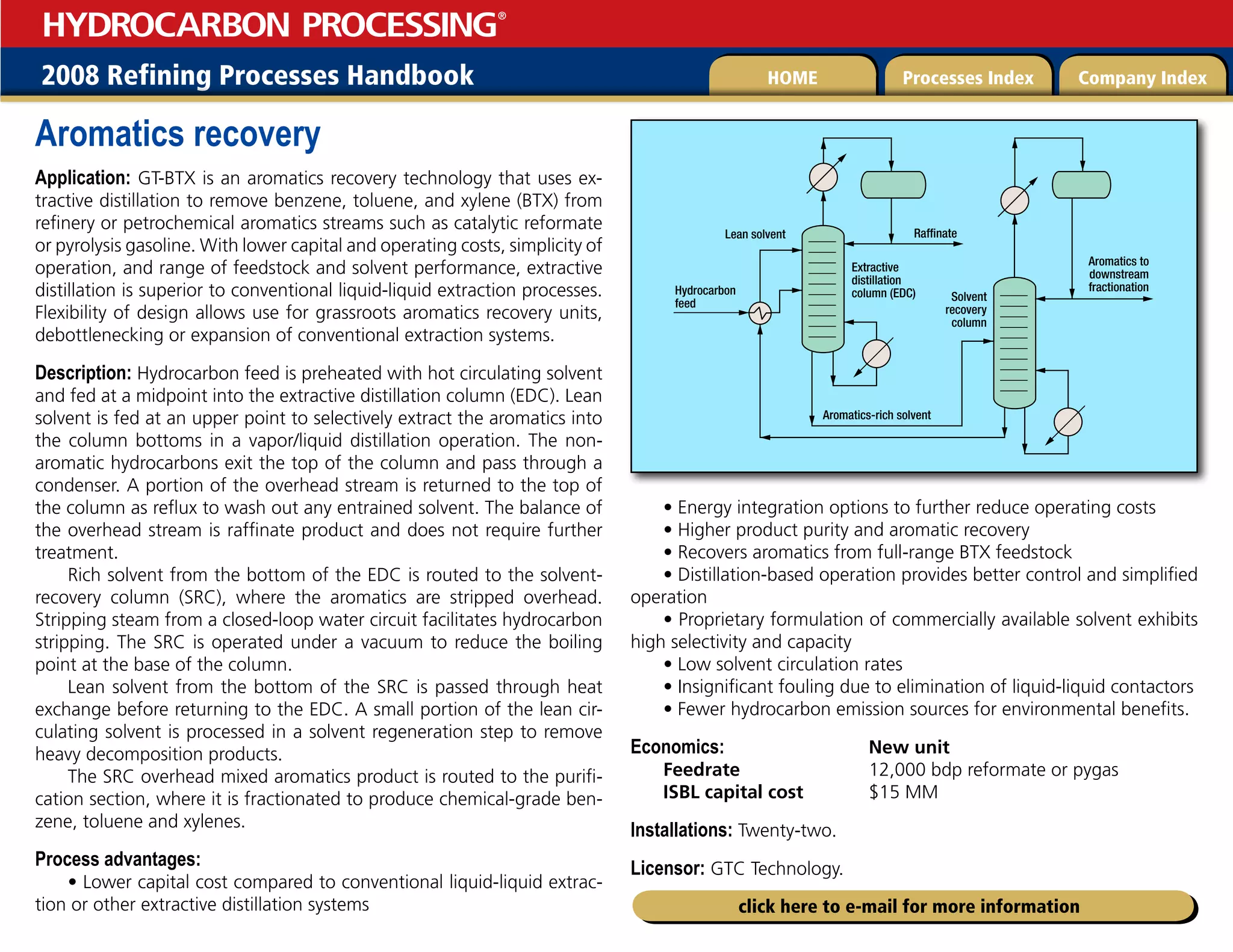
Process description: Acid-containing aqueous stream is fed to an ex-
traction column, which operates using a proprietary, phosphine oxide-
based solvent, highly selective to carboxylic acids. The acid-rich solvent
stream is carried overhead from the extraction column for regeneration.
In the two-stage regeneration step, surplus water is removed (dehydra-
tion) and the acids are recovered by acid stripping. The solvent is routed
back to the extraction column for reuse. Final processing of the concen-
trated acids is determined on a plant-by-plant basis. The treated waste-
water stream, containing acid levels on the order of  2,000 ppm, exits
the system to the plant’s wastewater treatment area.
Advantages:
• Up to 98% of the acids can be recovered
• 
Acid concentrations as low as 0.5%+ can be economically
recovered
• Low capital investment results in typical ROI up to 40%
• Modular systems approach enables minimal disruption
of plant operation and shorter project schedule
• Use of high-boiling solvent yields high-acetic recovery and
substantial energy savings
• Solvent is easily separated from water, giving a solvent-free
( 20 ppm) wastewater exit stream
• Acetic acid product purity allows for recycle or resale
• High acid recovery provides environmental benefits, unloading the
biological treatment system
Installation: Two licensed units.
Licensor: GTC Technology.
Acids-containing
water stream
Acid-rich solvent
stream
Liquid-liquid
extractor
Lean solvent
To wastewater
treatment 0.2%
acids content
Solvent
stripper
Water
Dehydrator
Recovered
acids
High-selectivity
solvent removes
acids from the
water by liquid
extraction
Second-stage
distillation
to recover acids
and regenerate
the solvent
First-stage
distillation
removes
water
2008 Refining Processes Handbook Processes Index Company Index
HOME
HYDROCARBON PROCESSING
®
Dimethyl terephthalate
Application: Modifications to the traditional process for manufacturing
dimethyl terephthalate (DMT) can significantly improve results includ-
ing capacity increase, yield improvements, reduced energy consumption
and upgrade of byproduct quality for increased commercial value.
The technology is flexible and may be implemented in increments.
GTC can optimize the design or configuration to maximize use of exist-
ing equipment.
Description: The common method for the production of DMT from par-
axylene (PX) and methanol consists of four major steps: oxidation, es-
terification, distillation and crystallization. A mixture of PX and PT-ester
is oxidized with air in the presence of a heavy metal catalyst. All useful
organics are recovered from the offgas and recycled to the system. The
acid mixture resulting from the oxidation is esterified with methanol
(MeOH) to produce a mixture of esters. The crude ester mixture is dis-
tilled to remove all the heavy boilers and residue produced; the lighter
esters are recycled to the oxidation section. The raw DMT is then sent
to the crystallization section to remove DMT isomers, residual acids and
aromatic aldehydes. This purification produces DMT that meets world-
market specifications and is preferred in some polyester applications.
Byproducts are recovered for sale or burned for fuel value and usable
intermediate materials are recycled.
The GTC process improvements enhance the traditional process in
each of the four sections through changes in process configurations
and operating conditions, alteration of separation schemes, revision of
recovery arrangements, increase in the value of byproducts and reduc-
tion in the total recycles in the plant. The upgrade options may be imple-
mented individually, combined or through a series of revamps over a
period of time.
Process advantages:
• Reduction in use of raw materials (p-xylene and methanol)
• Higher specific throughput
• Lower energy consumption/ton DMT produced
• Flexible application for revamp projects
• Accumulated technical expertise available through engineering
packages and follow-up services
Oxidation section
• Improved oxidation reduces side reactions and more effectively
uses reaction volume, resulting in lower PX consumption.
• New and more efficient scheme for the catalyst recovery in the
plant helps reduce residue formation.
• Improved recovery of PX and removal of methyl benzoate: Prod-
uct is upgraded to food or perfume grade.
• Carboxylic acid recovery: Recovery of formic and acetic acid as
byproducts, upgrading value and reducing load in biotreatment unit.
PX
MPT
Air Pure DMT
Crystallization
Methy p-toluate
to oxidation
DMT
PX
recovery
ATM
MeOH recycle
WW
To filtrate recovery
and isomer removal
Catalyst
Low acids
recovery
MeOH
Residue removal
MeOH
Residue
treatment
Catalyst recovery/recycle
Residue
Methyl benzoate
removal
WW
PX recycle
Residue recycle
Continued 
Distillation section
• Improved distillation scheme increases purity of DMT to crystalliza-
tion and reduces plant recycles.
• Improved residue treatment can increase the yields of the plant by
recovering valuable materials.
Crystallization
• Typical double-crystallization scheme is simplified to increase
throughputs and minimize equipment.
• New single-stage crystallization offers a low-cost alternative in re-
vamps.
Dimethyl terephthlate, continued
• Improved methanol recovery and handling system reduces plant
losses.
• Improved isomer removal system helps reduce DMT losses.
Esterification
• Improved reactor design gives higher throughputs and improved
methanol usage.
Installation: Five licensed units.
Licensor: GTC Technology.
click here to e-mail for more information
2008 Refining Processes Handbook Processes Index Company Index
HOME
HYDROCARBON PROCESSING
®
click here to e-mail for more information
Reactor internals
Application: A suite of proprietary reactor internals that offer uniform
gas and liquid distribution to increase catalyst utilization and efficiently
quench highly exothermic hydroprocessing catalytic reactions. The state-
of-the-art reactor internals take up less space, thus enabling high reac-
tor volume utilization while helping maximize catalyst run length. The
designs are simple and robust and allow easy access to the reactor and
efficient maintenance and catalyst change-out activities.
Description: Shell Global Solutions’ high-dispersion (HD) trays help to
optimize catalyst utilization by achieving highly uniform vapor–liquid
distribution and excellent thermal distribution. Each tray nozzle is cus-
tomized so that gas flow momentum is used to disperse the liquid into a
mist of small droplets. This operating concept differentiates the technol-
ogy from conventional downcomers or bubble caps because the nozzles
fully and uniformly wet the entire catalyst surface and make efficient use
of the top part of the catalyst bed.
Our reactor internals system also includes the following technology:
• Top-bed scale-catching trays to trap fouling material and prevent
it from entering the catalyst beds
• Ultra-flat quench (UFQ) interbed internals for uniform process and
quench mixing at the interbeds
• Catalyst support grids
• Compact bottom baskets to help maximize the catalyst volume in
the bottom domes.
Performance data:
• Activity—Shell Global Solutions’ reactor internals can produce
30%–50% activity gains through improved catalyst utilization and extra
volume for loading catalyst.
• Efficiency—HD trays can help to utilize nearly 100% of the cata-
lyst inventory.
• Operating window—HD trays offer high flexibility of feedrate:
typically +50% to –70% for liquid as well as gas.
• Anti-fouling capacity—Shell Global Solutions’ top-bed filters can
efficiently remove fouling materials yet take up virtually no valuable re-
actor volume
• Robust design—Nuts and bolts are not used for any fixing. We of-
fer global manufacturing options, and units are designed to withstand
tilting and fouling.
Business value: The HD tray results in improved liquid and thermal dis-
tribution, so ensuring maximum use of the catalyst bed. Refiners may
double their cycle lengths as a result of using the new tray. These longer
cycle lengths are due to the slower catalyst deactivation; the lower inlet
temperatures required to produce high-specification products; and the
better thermal distribution that the HD trays offer. The anti-fouling trays
have resulted in increases in cycle length of up to 200%.
Installation: All Shell Global Solutions’ internals have been commercially
proven through more than 230 hydroprocessing applications.
A South Korean refiner was experiencing hot spots in the catalyst
beds of its lube-oil hydrotreater. Shell Global Solutions and its affiliate
Criterion Catalysts  Technologies worked together to resolve the prob-
lem. HD trays were applied in combination with UFQ interbed internals
to improve quenching and mixing between the catalyst beds. As a re-
sult, catalyst utilization improved significantly, and helped to facilitate a
longer cycle and more severe operation.
Shell Global Solutions and Criterion Catalysts  Technologies tai-
lored a system for JSC Naftan refinery when it converted a hydrotreating
reactor for use as a mild hydrocracker. The system incorporated state-
of-the-art internals and new-generation pre-treatment and cracking
catalysts. The revamped unit was able to achieve conversion of the
370°C+ vacuum gasoil fraction at levels up to 50% higher than the
design target.
Licensor: Shell Global Solutions International B.V.
2008 Refining Processes Handbook Processes Index Company Index
HOME
HYDROCARBON PROCESSING
®
click here to e-mail for more information
Sulfur processing
Application: The D’GAASS Sulfur Degassing Process removes dissolved
H2S and H2Sx from produced liquid sulfur. Undegassed sulfur can create
odor problems and poses toxic and explosive hazards during the storage
and transport of liquid sulfur.
Description: Degasification is accomplished in a pressurized vertical ves-
sel where undegassed sulfur is efficiently contacted with pressurized
process air (instrument or clean utility air). The contactor vessel may be
located at any convenient location. The undegassed sulfur is pumped to
the vessel and intimately contacted with air across special fixed vessel
internals.
Operation at elevated pressure and a controlled temperature ac-
celerates the oxidation of H2S and polysulfides (H2Sx) to sulfur. The de-
gassed sulfur can be sent to storage or directly to loading without ad-
ditional pumping. Operation at elevated pressure allows the overhead
vapor stream to be routed to the traditional incinerator location, or to
the SRU main burner or TGTU line burner—thus eliminating the degas-
sing unit as an SO2 emission source.
Economics: D’GAASS achieves 10 ppmw combined H2S/H2Sx in product
sulfur without using catalyst. Elevated pressure results in the following
benefits: low capital investment, very small footprint, low operating cost
and low air requirement. Operation is simple, requiring minimal opera-
tor and maintenance time. No chemicals, catalysts, etc., are required.
Installations: Over 65 licensed units with total capacity over 35,000 long
ton per day (LTPD).
Reference: US Patent 5,632,967.
Nasato, E. and T. A. Allison, “Sulfur degasification—The D’GAASS
process,” Laurance Reid Gas Conditioning Conference, Norman, Okla-
homa, March, 1998.
Fenderson, S., “Continued development of the D’GAASS sulfur de-
gasification process,” Brimstone Sulfur Recovery Symposium, Canmore,
Alberta, May 2001.
Licensor: Goar, Allison  Associates, Inc., an Air Products Company.
Sulfur
rundowns
from SRU
Sulfur
pit
Air
Degassing
contactor
Air+H2S
Degassed
sulfur
Sulfur
degassing
pump
2008 Refining Processes Handbook Processes Index Company Index
HOME
HYDROCARBON PROCESSING
®
click here to e-mail for more information
Sulfur recovery
Application: The COPE Oxygen Enrichment Process allows existing Claus
sulfur recovery/tail gas cleanup units to increase capacity and recov­
ery, can provide redundant sulfur processing capacity, and can improve
combus­
tion per­
formance of units processing lean acid gas.
Description: The sulfur processing capacity of typical Claus sulfur re­
covery units can be increased to more than 200% of the base capacity
through partial to complete replace­
ment of combustion air with pure
oxygen (O2). SRU capacity is typically limited by hydraulic pressure drop.
As O2 replaces combustion air, the quantity of inert nitrogen is reduced
allow­
ing additional acid gas to be processed.
The process can be implemented in two stages. As the O2 enrich­
ment level increases, the combus­
tion temperature (1) increases. COPE
Phase I, which does not use a recycle stream, can often achieve 50%
capacity increase through O2 enrich­
ment to the maximum reac­
tion fur­
nace refractory tempera­
ture limit of 2,700ºF–2,800ºF. Higher O2 enrich­
ment levels are possible with COPE Phase II which uses an internal pro­
cess recycle stream to moderate the combustion temperature allowing
enrichment up to 100% O2.
Flow through the remainder of the SRU (2, 3, and 4) and the tail
gas cleanup unit is greatly reduced. Ammonia and hydrocar­
bon acid
gas impurity destruction and thermal stage conversion are improved at
the higher O2 enriched combus­
tion temperatures. Overall SRU sulfur
recov­
ery is typically increased by 0.5% to 1%. A single proprietary COPE
burner handles acid gas, recycle gas, air and O2.
Operating conditions: Combustion pressure is from 6 psig to 12 psig;
combustion temperature is up to 2,800ºF. Oxygen concentration is from
21% to 100%.
Economics: Expanded SRU and tail gas unit retrofit sulfur process­
ing
capacity at capital cost of 15%–25% of new plant cost. New plant sav­
ings of up to 25%, and redundant capacity at 15% of base capital cost.
Oper­
ating costs are a function of O2 cost, reduced incinerator fuel, and
reduced operat­
ing and mainte­
nance labor costs.
Installations: Thirty-two COPE trains at 19 loca­
tions.
Reference: US Patents 4,552,747 and 6,508,998.
Sala, L., W. P. Ferrell and P. Morris, “The COPE process—Increase
sulfur recovery capacity to meet changing needs,” European Fuels Week
Conference, Giardini Naxos, Taormina, Italy, April 2000.
Nasato, E. and T. A. Allison, “COPE Ejector—Proven technology,”
Sulphur 2002, Vienna, Austria, October 2002.
Licensor: Goar, Allison  Associates, Inc., an Air Products Company.
To tail gas cleanup
Motive steam
1
Acid gas feed
Oxygen
Air
HPS
HPS
HPS Recycle gas
LPS
LPS
LPS
HPS
RH1
R1
RF
RH2
R3 R3
R2
C3
C1
C2
C4
RH3
BFW
BFW
Air blower SL
SL
SL
SL
3
4
2
BFW
BFW
LPS
BFW
Claus
reactor
W.H.
boiler
2008 Refining Processes Handbook Processes Index Company Index
HOME
HYDROCARBON PROCESSING
®
click here to e-mail for more information
Sulfur recovery
Application: Sulfur recovery from typical Claus gas rich in hydrogen sul-
fide (H2S) from industrial gases, and sour-water stripper (SWS) gas.
Description: DEGsulf is an improved Claus process plus tail-gas treat-
ment that allows sulfur recovery rates of 99.8+% with just two cata-
lytic reactors. Downstream of the Claus furnace and waste-heat boiler
(1) are two catalytic reactors (3A / B) integrating the Claus step and
a sub-dewpoint tail-gas treatment. Its main feature is the use of in-
ternally cooled reactors, which control the reaction temperatures by
special welded plate-heat exchangers in the catalyst beds. The first bed
(3A) operates at high temperatures, the second bed (3B) below the
sulfur dew point. This reactor adsorbs sulfur and must be regenerated
eventually, which is done by switching the cool second reactor to the
position of the hot first reactor and vice versa. The use of proprietary
4-way valves (2A / B) makes the switch-over between adsorption and
regeneration simple and reliable. The produced sulfur is recovered in
the sulfur condenser (4) and collected in the sulfur pit (7). Prior to en-
tering the 2nd reactor the process gas is reheated (5). The desulfurized
gas is incinerated (6).
Conventional Claus catalysts are applied. They ensure up to 99.85%
sulfur recovery. In no-operating mode, there are no dead pipes. This
avoids the related problems of corrosion and sulfur plugging.
Typical feed gas is Claus gas rich in H2S. DEGsulf is capable of han-
dling wide fluctuations of feed gas flows and compositions. Turn-down
ratios up to 6/1 have been realized. Sulfur recovery rates up to 99.8+%
were observed. The process operates fully automatic, including the
switch-over.
Economics: Capital cost depends on the amount of feed gas and on
the required sulfur recovery rate. Products are bright yellow sulfur and
steam. Utility consumptions are very low, as in a conventional Claus
process.
Installation: More than 10 units have been built, both 1-reactor and
2-reactor plants.
Reference: Kunkel, J. and M. Heisel, “Clinsulf-SDP makes its debut,”
SULPHUR, no.243.
Licensor: Worley Parsons.
Acid gas
plus
SWS gas
Plant air
Sulfur
Fuel Air
MP steam
MP steam
MP BFW
supply
LP BFW
supply
1
2A
2B
3A 3B
4
6
7
LP BFW
F01/ E01
D01
R01A R01B
F02
E02
V01B
V01A
D02
E03
D03A D03B
LP steam
LP steam LP steam
5
2008 Refining Processes Handbook Processes Index Company Index
HOME
HYDROCARBON PROCESSING
®
click here to e-mail for more information
Treating—phenolic caustic
Application: ECOMERICAT treating systems removes phenols from phe-
nolic caustics by neutralization in conjunction with solvent washing us-
ing a FIBER-FILM Contactor.
Description: An ECOMERICAT system contacts the spent caustic with a
slipstream of sweetened gasoline containing CO2 whereby neutralizing
the spent caustic, springing the phenols, absorbing the phenols into
the sweetened gasoline yielding neutral brine with minimal phenolic
content.
Competitive advantages:
• Minimizes spent caustic disposal cost
• Reduces the phenol content of spent caustic and increases the
phenol content of sweetened gasoline thus adding value
• Operates over a wide pH range
• Simple to operate
• No corrosion problems due to the buffering effect of CO2.
Installation: Two installation worldwide.
Licensor: Merichem Chemicals  Refinery Services LLC, Process Technol-
ogy Division.
Phenolic
caustic
Low phenols
content neutralized
brine to storage
Untreated hydrocarbon
Oxidation air
Fresh caustic (batch)
Sweetened hydrocarbon
CO2
Catalyst in
Batch
Phenolic caustic
Mericat Ecomericat
2008 Refining Processes Handbook Processes Index Company Index
HOME
HYDROCARBON PROCESSING
®
Treating—Pressure swing adsorption
Application: Pressure swing adsorption (PSA) process selectively adsorb-
ing impurities from product streams. The impurities are adsorbed in a
fixed-bed adsorber at high pressure and desorbed by “swinging” the
adsorber from the feed to the tail gas pressure and by using a high-
purity purge. Typically, the desired component is not adsorbed and is
recovered at high purity.
Description: A PSA system operates as a batch process. However, mul-
tiple adsorbers operating in a staggered sequence are used to produce
constant feed, product and tail gas flows.
Step 1: Adsorption. The feed gas enters an adsorber at a high pres-
sure, impurities are adsorbed and high-purity product is produced. Flow
is normally in the upwardly direction. When an adsorber has reached
its adsorption capacity, it is taken offline, and the feed automatically
switched to a fresh adsorber.
Step 2: Co-current depressurization. To recover the product trapped
in the adsorbent void spaces, the adsorber is co-currently (in the direc-
tion of feed flow) depressurized. The product gas withdrawn is used
internally to repressurize and purge other adsorbers.
Step 3: Counter-current depressurization. At the end of the co-cur-
rent depressurization step, the adsorbent is partially regenerated by
counter-currently depressurizing the adsorber to the tail-gas pressure,
and thereby rejecting the impurities.
Step 4: Purge. The adsorbent is purged with a high-purity stream
(taken from another adsorber on the cocurrent depressurization step) at
a constant pressure to further regenerate the bed.
Step 5: Repressurization. The repressurization gas is provided from
the co-current depressurization step and a slipstream from the product.
When the adsorber has reached the adsorption pressure, the cycle has
been completed. The vessel is ready for the next adsorption cycle.
UOP’s Polybed PSA system offers:
• High reliability (greater than 99.8% onstream time)
• Minimal manpower requirements due to automatic operation
• 
Reduced equipment costs and enhanced performance based on
high performance adsorbents and advanced PSA cycles
• 
Lower operating and equipment costs for downstream process
units
• Flexibility to process more than one feedstock
• 
Modular construction for improved delivery times and low instal-
lation costs
• Minimal feed pretreatment and utility requirements
• 
Adsorbents last for the life of the mechanical equipment (more
than 30 years).
Offgas
Purge
Repressurization
Product
Feed gas
1 2 3 4 5
Counter-current
depressurization
Co-current
depressurization
Continued 
1,000 psig (7 to 70 kg/cm2g) with concentrations of the desired com-
ponent typically in the range of 30 to 98+ mole%. System capacities
range from less than 1 to more than 350 MMscfd (less than 1,100 to
more than 390,000 Nm3/hr). UOP provides unit and complex integration
development support to ensure the PSA system meets the end-user’s
processing objectives and worldwide service and technical support after
startup.
Licensor: UOP.
Installation: Since commercialization in 1966, UOP has provided over
800 PSA systems in more than 60 countries in the refining, petrochemi-
cal, steel and power-generation industries. The Polybed PSA System has
demonstrated exceptional economic value in many applications, such
as hydrogen recovery from steam methane reforming, refinery offgas,
monomer recovery in polyolefin plants, hydrogen extraction from gasifi-
cation syngas, helium purification for industrial gas use, adjustment of
synthesis gas for ammonia production, methane purification for petro-
chemicals productions, and H2/CO ratio adjustment for syngas used in
oxo-alcohols production. Feed conditions typically range from 100 to
Treating—pressure swing adsorption, continued
click here to e-mail for more information
2008 Refining Processes Handbook Processes Index Company Index
HOME
HYDROCARBON PROCESSING
®
click here to e-mail for more information
Treating—spent caustic deep
neutralization
Application: MERICON systems neutralize spent caustics containing sul-
fides, mercaptans, naphthenic acids, and phenols.
Description: A MERICON system neutralizes spent caustic with acid to
a low pH. The sprung acid oils are separated from the acidic brine. The
resulting acid gases (H2S and mercaptans) flow to a sulfur plant. The
sprung acid oils are returned to the refinery for processing. The acid-
ic brine is further stripped with fuel gas to remove traces of H2S and
mercaptans. Finally, the acidic brine is mixed with caustic to return it to
a neutral pH for final disposal.
Competitive advantages:
• Minimal operator attention and 100 % onstream factor between
turnarounds
• Minimal capital investment
• Maximum COD reduction
• Non-odorous neutralized brine product
• Recovery of valuable hydrocarbons.
Installation: Twenty-five installations worldwide.
Reference: Petroleum Technology Quarterly, Spring 2001, p. 55.
Licensor: Merichem Chemicals  Refinery Services LLC, Process Technol-
ogy Division.
Offgas to sulfur plant
Fuel gas or nitrogen
Sulfuric acid
Spent caustic feed
Neutralized
brine to WWTP
Acid oils to storage
Acid brine
Fresh caustic
2008 Refining Processes Handbook Processes Index Company Index
HOME
HYDROCARBON PROCESSING
®
click here to e-mail for more information
Gas treating—H2S removal
Application: ExxonMobil’s Research  Engineering (EMRE’s) FLEXSORB
SE and SE Plus removes H2S selectively, or remove a group of acidic im-
purities (H2S, CO2, COS, CS2 and mercaptans) from a variety of streams,
depending on the solvent used. FLEXSORB SE technology has been used
in refineries, natural gas production facilities and petrochemical opera-
tions.
FLEXSORB SE or SE Plus solvent is used on: hydrogenated Claus plant
tail gas to give H2S, ranging down to H2S 10 ppmv; pipeline natural
gas to give H2S 0.25 gr/100 scf; or FLEXICOKING low-Btu fuel gas. The
resulting acid gas byproduct stream is rich in H2S.
Hybrid FLEXSORB SE solvent is used to selectively remove H2S, as
well as organic sulfur impurities commonly found in natural gas.
Description: A typical amine system flow scheme is used. The feed gas
contacts the treating solvent in the absorber (1). The resulting rich-sol-
vent bottom stream is heated and sent to the regenerator (2). Regen-
erator heat is supplied by any suitable heat source. Lean solvent from
the regenerator is sent through rich/lean solvent exchangers and coolers
before returning to the absorber.
FLEXSORB SE solvent is an aqueous solution of a hindered amine.
FLEXSORB SE Plus solvent is an enhanced aqueous solution, which has
improved H2S regenerability yielding 10 vppm H2S in the treated gas.
Hybrid FLEXSORB SE solvent is a hybrid solution containing FLEXSORB SE
amine, a physical solvent and water.
Economics: Lower investment and energy requirements based primarily
on requiring 30% to 50% lower solution circulation rates, compared to
other selective solvents.
Installations: Total gases treated by FLEXSORB solvents are about 2 bil-
lion scfd and the total sulfur recovery is about 900 long tpd.
FLEXSORB SE—31 plants operating, three in design
FLEXSORB SE Plus—19 plants operating, nine in design
Hybrid FLEXSORB SE—two plants operating, three in design
Over 60 plants operating or in design.
Reference: Garrison, J., et al., “Keyspan Energy Canada Rimbey acid gas
enrichment with FLEXSORB SE Plus technology,” 2002 Laurance Reid
Gas Conditioning Conference, Norman, Oklahoma.
Adams-Smith, J., et al., Chevron USA Production Company, “Carter
Creek Gas Plant FLEXSORB tail gas treating unit,” 2002 GPA Annual
Meeting, Dallas.
Connock, L., et al., “High recovery tail gas treating,” Sulphur, No.
296, November/ December 2004.
Fedich, R., et al., “Selective H2S Removal,” Hydrocarbon Engineer-
ing, May 2004.
Fedich, R. B., et al., “Solvent changeover benefits,” Hydrocarbon
Engineering, Vol. 10, No. 5, May 2005.
“Gas Processes 2006,” Hydrocarbon Processing, January 2006.
Fedich,R, et al., “Selective cleanups,” Hydrocarbon Engineering,
February 2008.
Licensor: ExxonMobil Research and Engineering Co.
Treated gas
Acid gas
to Claus
Rich amine
Lean amine
Feed gas
1
2
2008 Refining Processes Handbook Processes Index Company Index
HOME
HYDROCARBON PROCESSING
®
click here to e-mail for more information
H2S removal
Application: ELIMINATOR technology consisting of a full line of ELIMI-
NATOR products removes hydrogen sulfide (H2S) and light mercaptans
from a variety of process gas streams in a safe, efficient, environmentally
friendly and easy to operate manner.
Description: The ELIMINATOR technology is extremely versatile, and its
performance is not sensitive to operating pressure. In properly designed
systems, H2S concentrations of less than 1 ppm can easily be achieved
on a continuous basis.
A number of different treatment methodologies may be used to
treat sour gas streams.
• Line injection—ELIMINATOR can be sprayed directly into a gas
stream with removal of the spent product in a downstream knockout
pot.
• Sparge tower—Sour gas is bubbled up through a static volume of
ELIMINATOR. A lead-lag vessel arrangement can be installed to allow for
the removal of spent solution and the addition of fresh solution without
shutting down. This arrangement also results in the optimum utilization
of the solution.
• Packed tower—Sour gas is contacted with circulating solution of
ELIMINATOR in a counter, packed-bed scrubber.
Products: A full line of ELIMINATOR products can treat any type of gas
streams.
Economics: Operating costs are very favorable for removing less than
250 kg/d of H2S.
Installation: Fifteen units in operation.
Licensor: Merichem Chemicals  Refinery Services LLC, Gas Technology
Products Division.
Sour gas
Sweet gas
Drains
Inlet
knockout
pot
Absorber
Spent scavenger
2008 Refining Processes Handbook Processes Index Company Index
HOME
HYDROCARBON PROCESSING
®
click here to e-mail for more information
H2S removal
Application: LO-CAT removes H2S from gas streams and produces el-
emental sulfur. LO-CAT units are in service treating refinery fuel gas,
hydrodesulfurization offgas, sour-water-stripper gas, amine acid gas,
claus tail gas and sulfur tank vent gas. Sulfur capacities are typically less
than 25 ltpd down to several pounds per day. Key benefits of operation
are high (99.9%) H2S removal efficiency, and flexible operation, with vir-
tually 100% turndown capability of H2S composition and total gas flow.
Sulfur is recovered as a slurry, filter cake or high-purity molten sulfur.
The sulfur cake is increasingly being used in agriculture, but can also be
deposited in a nonhazardous landfill.
Description: The conventional configuration is used to process combus-
tible gas and product gas streams. Sour gas contacts the dilute, propri-
etary, iron chelate catalyst solution in an absorber (1), where the H2S is
absorbed and oxidized to solid sulfur. Sweet gas leaves the absorber for
use by the refinery. The reduced catalyst solution returns to the oxidizer
(2), where sparged air reoxidizes the catalyst solution. The catalyst solu-
tion is returned to the absorber. Continuous regeneration of the catalyst
solution allows for very low chemical operating costs.
In the patented autocirculation configuration, the absorber (1) and
oxidizer (2) are combined in one vessel, but separated internally by baf-
fles. Sparging of the sour gas and regeneration air into the specially
designed baffle system creates a series of “gas lift” pumps, eliminating
the external circulation pumps. This configuration is ideally suited for
treating amine acid gas and sour-water-stripper gas streams.
In both configurations, sulfur is concentrated in the oxidizer cone
and sent to a sulfur filter, which can produce filter cake as high as 85%
sulfur. If desired, the filter cake can be further washed and melted to
produce pure molten sulfur.
Operating conditions: Operating pressures range from vacuum condi-
tions to 1,000 psi. Operating temperatures range from 40°F to 140°F.
Hydrogen sulfide concentrations range from a few ppm to 100%. Sul-
fur loadings range from a few pounds per day to 25+ tons per day. No
restrictions on type of gas to be treated; however, some contaminants,
such as SO2, may increase operating costs.
Installations: Presently, 180 licensed units are in operation with four
units under construction.
Reference: Nagl, G., W. Rouleau and J. Watson,, “Consider optimized
Iron-Redox processes to remove sulfur,” Hydrocarbon Processing, Janu-
ary 2003, pp. 53–57.
Licensor: Merichem Chemicals  Refinery Services LLC, Gas Technology
Products Division.
1
Air blower
Sulfur filter
Oxidizer
Absorber
Fe2+
Fe3+
Spent air
Sour gas
Sweet gas
Filtrate
2
2008 Refining Processes Handbook Processes Index Company Index
HOME
HYDROCARBON PROCESSING
®
click here to e-mail for more information
H2S removal
Applications: Sulfur-Rite is a solid-bed scavenger for removal of H2S from
aerobic and anaerobic gas streams. Suitable applications are generally
sulfur loads below 200 lb/d sulfur, and/or remote refinery locations. Sul-
fur vents, loading and unloading facilities, or backup insurance for other
refinery sulfur-removal systems are examples.
The spent media is nonpyrophoric, and is suitable for disposition in
nonhazardous landfills.
Description: Single-bed (shown) or dual “lead-lag” configurations are
possible. Sour gas is saturated prior to entering media bed. Gas enters
vessel top, flows over media where H2S is removed and reacted. Sweet
gas exits the bottom of vessel. In the single-vessel configuration, when
the H2S level exceeds the level allowed, the vessel must be bypassed,
media removed through the lower manway, fresh media installed and
vessel returned to service.
For continuous operation, a dual “lead-lag” configuration is desir-
able. The two vessels operate in series, with one vessel in the lead posi-
tion, the other in the lag position. When the H2S level at the outlet of
the lead vessel equals the inlet H2S level (the media is completely spent),
the gas flow is changed and the vessels reverse rolls, so that the “lag”
vessel becomes the “lead” vessel. The vessel with the spent media is
bypassed. The media is replaced, and the vessel with fresh media is re-
turned to service in the “lag” position.
Operating conditions: Gas streams up to 400°F can be treated. Gas
streams should be at least 50% water saturated.
Installations: Sixteen units installed.
Licensor: Merichem Chemicals  Refinery Services LLC, Gas Technology
Products Division.
Sour gas
H2O inject
Sweet gas
Drains
Inlet
knockout
pot
2008 Refining Processes Handbook Processes Index Company Index
HOME
HYDROCARBON PROCESSING
®
Treating
Application: The AMMEX process integrates sour water stripping and
sour gas scrubbing in a single simple process. It can be used without
supplemental ammonia (NH3) to remove some of the hydrogen sulfide
(H2S) from a gas stream, for instance to unload an existing amine unit.
Adding a substoichiometric amount of NH3 allows AMMEX to reduce
H2S in the scrubbed gas to low concentration, eliminating the need for
a separate amine system for gas treating. AMMEX is especially attractive
when the sour water stripper gas is converted to ammonium thiosulfate
in ThioSolv’s SWAATS process.
Description: ThioSolv developed this process by modeling in PRO/II 8.1
using electrolyte thermo. Water in contact with refining process gases
readily dissolves essentially all of the NH3 from the gas. The NH3 solu-
tion, in turn, dissolves roughly equimolar amounts of H2S, which is typi-
cally present in excess. The molar ratio of H2S/NH3 in the feed to the sour
water stripper is therefore typically about 1. Because the vapor pressure
of H2S over water increases faster with temperature than the vapor pres-
sure of NH3, the ratio of H2S/NH3 in the sour water stripper reflux liquid
is about 1/3. When liquid from the reflux drum is cooled, excess NH3 in
solution allows the liquid to absorb more H2S from a gas stream.
Sour feed gas (1) is fed to a first contact zone A, where it is scrubbed
with a stream of cooled liquid (2) from the reflux drum C of a sour-water
stripper D (SWS). The high ratio of NH3 to H2S in the liquid allows it to
dissolve H2S from the gas. Rich liquid (3) from the bottom of the first
contact zone is preheated by exchange (X) and combined with the par-
tially-condensed stream from the SWS condenser E. Heat removal from
the condenser is modulated to control the temperature of the combined
stream to the reflux drum. The gas leaving the first contact zone, con-
taining some NH3 stripped from the recycle liquid and some H2S, enters
a second contacting zone B, where it is washed with cooled, recycled
sour water (4), which dissolves some H2S and essentially all of the NH3
from the gas, carrying it into the first zone A. If the intent is to reduce
the H2S concentration in the scrubbed gas to meet a specification, rath-
er than simply to remove most of the H2S, a small amount of NH3 (6)
is added to the second contacting zone B. The refinery sour water (8)
feeds the stripper conventionally, with the net stripped water (9) leaving
the system. Net H2S and NH3 leave the reflux drum C as sour water strip-
per gas (7). Heat for stripping is provided by LP steam S.
The SWS acid gas may be fed to a conventional sulfur recovery pro-
cess, but more favorably would be converted to ammonium thiosulfate
(ATS) fertilizer in ThioSolv’s SWAATS process.
Economics: AMMEX is highly energy efficient. Most of the H2S is re-
moved from the feed gas by the circulation from the reflux drum, using
latent heat of condensation that would normally be rejected to atmo-
sphere to reheat the rich liquid and flash out excess H2S. Circulation of
the reflux liquid costs only pump power and some cooling water. The
recycle rate of stripped water required to remove NH3 from the gas in
the second contactor adds only a relatively small load to the sour water
Continued 
X
X
P
P
P
3
2
5
6
1
A
B
D
C
E
7
4
9
8
T
S
X
stripper. Because the amount of H2S in the gas entering the second zone
B is small compared to the amount in the feed gas, the moles of NH3
addition required to reduce the H2S concentration to 100 ppm is less
than the total moles of H2S captured.
Example: A refinery makes 10 tpd of sulfur as H2S, 90% in sour fuel gas
and 10% in sour water. Sour fuel gas containing 6% H2S and 0.6% CO2
can be treated to 20 ppm H2S using 4.6 tpd of NH3 addition and recy-
Treating, continued
cle of 14 gpm of stripped sour water for washing. By contrast, scrubbing
the fuel gas with MDEA would require six times as much circulation.
The sour water stripper gas produced can be converted to ATS in a
SWAATS unit at negligible operating cost.
Installation: None. Patent pending.
Licensor: ThioSolv, LLC.
click here to e-mail for more information
2008 Refining Processes Handbook Processes Index Company Index
HOME
HYDROCARBON PROCESSING
®
click here to e-mail for more information
Treating—gases
Application: AMINEX and THIOLEX systems extract COS and H2S from
gases with amine or caustic solution using FIBER-FILM Contactor tech-
nology.
Description: In an AMINEX system, the amine phase flows along the fi-
bers of the FIBER-FILM Contactor as it preferentially wets the fibers. The
gas phase flows through the Contactor parallel to the amine-wetted
fibers as the COS and H2S is extracted into the amine. The two phases
disengage in the separator vessel with the rich amine flowing to the
amine regeneration unit and the treated gas flowing to its final use.
Similarly, a THIOLEX system employs the same process utilizing caus-
tic and caustic/amine solutions to preferentially wet the fibers as the
COS and H2S is extracted into the caustic phase. The rich caustic flows
to sulfidic caustic storage and the treated gas flows to its final use.
Competitive advantages: FIBER-FILM Contactor technology requires
smaller processing vessels thus saving valuable plant space and reducing
capital expenditures.
Installation: Four installations worldwide in THIOLEX service.
Reference: Hydrocarbon Processing, Vol. 63, No. 4, April 1984, P. 87.
Licensor: Merichem Chemicals  Refinery Services LLC, Process Technol-
ogy Division.
Untreated gas
Treated gas
Fresh caustic or lean amine
from regeneration unit
Spent caustic to disposal or
rich amine to regeneration unit
2008 Refining Processes Handbook Processes Index Company Index
HOME
HYDROCARBON PROCESSING
®
Treating—sour water stripper gas
Application: The sour water ammonia to ammonium thiosulfate
(SWAATS) process diverts sour water stripper gas (SWSG) from the
Claus to convert the ammonia (NH3) and hydrogen sulfide (H2S) to
ammonium thiosulfate (ATS) solution, thus freeing up Claus capacity
and improving operability. SWAATS also can treat Claus tail gas to low
emissions at low cost. For plants producing small amounts of sulfur,
SWAATS can be designed to capture all of the refinery H2S. The cost of
supplemental ammonia (0.54 ton NH3/ton sulfur) is justified by having
only one unit that can process both SWSG and amine-acid gas (AAG)
with low emission rates.
High chemical selectivity of the process enables it to economically
remove H2S or SO2 from gas mixtures including carbon dioxide. The
process has been recognized by EPA as best available control technology
(BACT) for control of sulfur oxide (SO2) emissions.
Description: Ammonia and a stoichiometric amount of H2S are selec-
tively absorbed from SWSG. The reject H2S and Claus tail gas, if desired,
are selectively oxidized to convert all sulfur species to SO2, which is then
scrubbed from the combustion gas in a low pressure drop system to
yield a vent gas with very low SOx concentration and no reduced sulfur
requiring incineration:
6NH3 + 4SO2 + 2H2S + H2O 3(NH4)2S2O3(ATS)
SWAATS may be controlled to import or export H2S to balance on
the NH3 available in the SWSG, or supplemental NH3 may be added to
capture additional H2S.
The chemistry and internal circulation rates provide for robust op-
eration, resistant to upsets in the feedstreams. They also prevent or re-
verse sulfur precipitation by converting any elemental sulfur in the Claus
tail gas to thiosulfate. Control is based on simple inline analyzers (pH,
combustion gas O2) and requires little attention.
Economics: Each ton of SWSG sulfur diverted from Claus to SWAATS
frees up Claus capacity for about three tons of AAG sulfur. Remov-
ing NH3 from the Claus feed also greatly improves Claus operability
and extends the service life of the catalyst. With SWAATS, the SWSG
ammonia is an asset; the value of the process increases as higher
severity hydrotreating for ultra-low-sulfur diesel production increases
denitrification to over 90%, greatly increasing ammonia production.
CAPEX for SWAATS to process SWSG and Claus tail gas is about a
quarter of the CAPEX for construction of an equivalent amount of new
Claus and tail-gas treating capacity. SWAATS OPEX is typically negative
due to credit for export of MP steam, substantially lower than the OPEX
for oxygen enrichment or for amine-based tail gas treatment. SWAATS
consumes no external chemicals or reducing gas. Licensor removes the
ATS produced.
Installation: The first unit is operating since June 2007, using supple-
mental NH3 to capture all of the refinery sulfur to eliminate need for a
second type of sulfur-recovery unit. Two more SWAATS units have been
licensed and designed as of June ‘08.
Claus reactors
and condensers
Sulfur
Incinerator
Tail
gas
Claus
thermal reactor
AAG
SWSG
X
X
ATS
SWAATS
reactor
SWAATS
absorber
Burner
Rx
WHB
Continued 
Reference: US Patent 6,534,030 and other patents pending.
Berry, R., “Treating hydrogen sulfide: When Claus is not enough,”
Chemical Engineering, Oct. 6, 1980, p. 92.
Anderson, M.C., “Increasing SRU capacity,” Sulphur, September-
October 2007, p. 52.
Licensor: ThioSolv, LLC.
Treating—sour water stripper gas, continued
click here to e-mail for more information
2008 Refining Processes Handbook Processes Index Company Index
HOME
HYDROCARBON PROCESSING
®
Wet gas scrubbing (WGS), wet gas
scrubbing plus
Application: ExxonMobil’s Research  Engineering’s (EMRE’s) can reduce
fluid catalytic cracking unit (FCCU) particulate (catalyst) and sulfur oxides
(SOx) and nitrogen oxide (NOx) emissions to achieve compliance with
environmental regulations—generally NSPS (New Source Performance
Standards) and consent decrees (in the US). The technology can also be
adapted for other refinery applications, e.g., coke calciners when flue
gases must be treated to reduce SOx and particulate emissions.
Description: The WGS process takes dirty gas from FCCUs and simul-
taneously removes particulate matter and SOx via direct contact with a
buffered liquid. Particulate removal is accomplished via inertial impaction
of the particulate with the scrubbing liquid. SO2 removal is accomplished
via absorption into and reaction with the buffered scrubbing liquid. SO3
removal is accomplished via a combination of nucleate condensation,
absorption and inertial impaction. All of this can be accomplished with
low-pressure (3-in. of water column) or no pressure drop. This is impor-
tant when aged heat recovery systems are involved.
The liquid purge from the WGS system is further treated in either the
refinery wastewater system or in a segregated system, either of which
will remove solids for landfill disposal and will reduce the chemical oxy-
gen demand (COD) of the stream to meet local discharge requirements.
NOx can be removed by adding an additional
Operation of WGS systems demonstrates:
• Flexible/”forgiving” performance under a wide range of FCCU op-
erations/upsets
• Service factors equal to or better than FCCUs with runs exceeding
12 years
• Low/zero pressure drop
• Ability to meet stringent emission regulations, e.g., consent de-
cree requirements.
Performance: All WGS facilities are in compliance with their permitted
values. Compliance has been achieved for the current consent decree
particulate limits that can require emission of less than ¼ -lb of particu-
lates /1,000 lb of coke burned. They are also in compliance with consent
decree SO2 requirements of 25 vppmd @ 0% O2 and SO3 consent de-
cree emission requirements of less than 10 vppmd. In addition, the WGS
has recorded run lengths in excess of 12 years without affecting FCCU
throughput.
Installation: More than 25 operating plants have over 500 years of op-
erating experience. Several additional units are in various stages of en-
gineering.
Makeup water
Slurry circulation
pumps
Circulation
pump and spare
Filter feed
pump and spare
CO boiler
Air Oxidation
tank
Oxidation
blower
ATM
Stack
Venturi
scrubbers
Disengaging
drum
FCCU
regenerator
or third
separator
Caustic
Treated purge
Filter press
Dry solids dumpster
Dry solids
Continued 
Reference: 1991 AIChE Spring National Meeting, Paper No. 62c.
1990 National Petroleum Refiners Association Annual Meeting, Pa-
per No. AM-90-45, March 1990.
1996 National Petroleum Refiners Association Annual Meeting, Pa-
per No. AM-96-47, March 1996.
Wet gas scrubbing (WGS), wet gas scrubbing plus,
continued
click here to e-mail for more information
Technology owner: ExxonMobil Research and Engineering Co.
Licensor: Hamon Research-Cottrell, GN-Hamon, LLC.
2008 Refining Processes Handbook Processes Index Company Index
HOME
HYDROCARBON PROCESSING
®
click here to e-mail for more information
Flue gas denitrification
Application: The Topsøe SCR DeNOx process removes NOx from flue
gases through reactions with an ammonia-based reducing agent over
a specially designed fixed-bed monolithic catalyst. By carefully select-
ing the catalyst parameters, channel size and chemical composition, the
process covers a wide range of operating conditions and flue-gas dust
contents and may be applied to practically all types of refinery units in-
cluding furnaces, boilers, crackers and FCC units.
Products: The Topsøe SCR DeNOx converts NOx into inert nitrogen and
water vapor. The process may be designed for NOx reductions in excess
of 95% and with an ammonia leakage of just a few ppm.
Description: The reducing agent such as ammonia or urea, aqueous or
pure, is injected into the flue gas stream in stoichiometric proportion to
the amount of NOx in the flue gas, controlled by measurement of flue
gas flow and NOx concentration. The injection takes place in a grid over
the entire cross-section of the flue-gas duct to ensure a uniform distribu-
tion of NOx and ammonia upstream the SCR catalyst vessel.
The process incorporates Topsøe’s well-proven corrugated mono-
lithic DNX catalyst. DNX is manufactured in small units, which may be
combined into larger modules to match any requirement in terms of
vessel dimensions and pressure drop, and in both horizontal and vertical
vessel configurations.
The DNX catalyst is based on a fiber-reinforced ceramic carrier, which
gives a unique combination of a high strength and a high micro-poros-
ity. The high micro-porosity provides a superior resistance to catalyst
poisons and low weight. The fibers add flexibility to the catalyst so that
it can tolerate a wide range of heating and cooling rates.
Operating conditions: Typical operating conditions range from 300°C to
500°C (570–930°F), up to 3 bar (44 psia) and up to 50 g/Nm3 of dust in
the flue gas.
Installation: More than 50 refinery units use Topsøe SCR DeNOx catalyst
and technology. The applications range from low-dust furnaces to high-
dust FCC units and temperatures up to 500°C (930°F).
References: Damgaard, L., B. Widroth and M. Schröter: “Control refin-
ery NOx with SCRs,” Hydrocarbon Processing, November 2004.
Licensor: Haldor Topsøe A/S.
Control
unit
Compressed air
Caustic ammonia
Steam
To stack
From furnace
Soot blower
SCR
reactor
NO, NO2
NH3 NO
QI
QI QI
PI
FI
PI
2008 Refining Processes Handbook Processes Index Company Index
HOME
HYDROCARBON PROCESSING
®
click here to e-mail for more information
NOx abatement/SNCR
Application: Flue gases are treated with ammonia: ExxonMobil’s Re-
search  Engineering’s (EMRE’s) proprietary selective noncatalytic NOx
reduction technology—SNCR THERMAL DeNOx (TDN). NOx plus ammo-
nia (NH3) are converted to elemental nitrogen and water if temperature
and residence time are appropriate. The technology has been widely
applied since it was first commercialized in 1974.
Products: If conditions are appropriate, the flue gas is treated to achieve
NOx reductions of 40% to 70%+ with minimal NH3 slip or leakage.
Description: The technology involves the gas-phase reaction of NO with
NH3 (either aqueous or anhydrous) to produce elemental nitrogen if con-
ditions are favorable. Ammonia is injected into the flue gas using steam
or air as a carrier gas into a zone where the temperature is 1,600°F
to 2,000°F. This range can be extended down to 1,300°F with a small
amount of hydrogen added to the injected gas. For most applications,
wall injectors are used for simplicity of operation.
Yield: Cleaned flue gas with 40% to 70%+ NOx reduction and less than
10-ppm NH3 slip.
Installation: Over 135 applications on all types of fired heaters, boilers
and incinerators with a wide variety of fuels (gas, oil, coal, coke, wood
and waste). The technology has also been applied to full and partial-
burn FCCU regenerators.
Reference: McIntyre, A. D., “Applications of the THERMAL DeNOx pro-
cess to utility and independent power production boilers,” ASME Joint
International Power Generation Conference, Phoenix, 1994.
McIntyre, A. D., “The THERMAL DeNOx process: Liquid fuels appli-
cations,” International Flame Research Foundation’s 11th Topic Oriented
Technical Meeting, Biarritz, France, 1995.
McIntyre, A. D., “Applications of the THERMAL DeNOx process to
FBC boilers,” CIBO 13th Annual Fluidized Bed Conference, Lake Charles,
Louisiana, 1997.
Licensor: ExxonMobil Research and Engineering Co., via an alliance with
Engineers India Ltd. (for India) and Hamon Research-Cottrell (for the rest
of the world).
Heater
Combustion air
Fuel
Injectors
NOx
analyzer
NH3 flow
controller
NH3
vaporizer
Anhydrous NH3
storage
Pressure
controller
Flow controller
Heater load
Heater load
Carrier supply
2008 Refining Processes Handbook Processes Index Company Index
HOME
HYDROCARBON PROCESSING
®
click here to e-mail for more information
Treating—Coker LPG to low total
sulfur levels
Application: AMINEX/THIOLEX and REGEN ULS treating processes are
used to remove COS, H2S and mercaptans from LPG streams with high
mercaptans levels and produce treated streams with less than 2 ppm-wt
of total sulfur.
Description: The removal of COS and H2S can be achieved utilizing an
AMINEX treating unit using an amine solution or with a THIOLEX treating
unit using a caustic solution. When using the THIOLEX unit, mercaptan
impurities are removed with a caustic solution, and the caustic is regen-
erated to previously unachievable purity levels in the REGEN ULS system.
The combination of THIOLEX/REGEN ULS results in minimal back extrac-
tion of disulfide oil (DSO) into the treated product. Thus, the treated
product will meet specifications of less than 2 ppm-wt of total sulfur.
Installations: One under installation.
Licensor: Merichem Chemicals  Refinery Services LLC, Process Technol-
ogy Division.
Vent
Solvent
Solvent/DSO
Coker LPG
Treated coker LPG
Total sulfur  2ppm-wt
Rich amine or
Spent caustic/MEA
Lean amine or
Caustic/MEA
Air
2008 Refining Processes Handbook Processes Index Company Index
HOME
HYDROCARBON PROCESSING
®
click here to e-mail for more information
Treating—gasoline and LPG
Application: THIOLEX/REGEN systems extract H2S and mercaptans from
gases and light liquid hydrocarbon streams, including gasolines, with
caustic using FIBER-FILM Contactor technology. It can also be used to
hydrolyze and remove COS from LPG and propane.
Description: In a THIOLEX system, the caustic phase flows along the
fibers of the FIBER-FILM Contactor as it preferentially wets the fibers.
Hydrocarbon flows through the caustic-wetted fibers where the H2S and
mercaptans are extracted into the caustic phase. The two phases disen-
gage and the caustic flows to the REGEN where the caustic is regener-
ated using heat, air and catalyst. The disulfide oil formed in this reaction
may be removed via gravity separation, FIBER-FILM solvent washing or
a combination of the two. The regenerated caustic flows back to the
THIOLEX system for continued re-use.
COS is removed from LPG or propane by either employing AMINEX
technology using an amine solution or THIOLEX technology using an
MEA/caustic solution to hydrolyze the COS to H2S and CO2 which are
easily removed by amine or caustic.
Competitive advantages: FIBER-FILM Contactor technology requires
smaller processing vessels thus saving valuable plant space and reducing
capital expenditures.
Installation: At present, 373 installations worldwide.
References: 
Oil  Gas Journal, August 12, 1985, p. 78.
Hydrocarbon Engineering, February 2000.
Licensor: Merichem Chemicals  Refinery Services LLC, Process Technol-
ogy Division.
Catalyst
Fresh caustic
Fresh solvent
Treated hydrocarbon
Offgas
Spent
caustic
Solvent/DSO
Oxidation air
Untreated
hydrocarbon
2008 Refining Processes Handbook Processes Index Company Index
HOME
HYDROCARBON PROCESSING
®
click here to e-mail for more information
Treating—gasoline desulfurization,
ultra deep
Application: EXOMER extracts recombinant mercaptan sulfur from se-
lectively hydrotreated FCC gasoline streams with a proprietary treating
solution. FIBER-FILM Contactor technology is used for mass transfer ef-
ficiency to obtain a maximum reduction in total sulfur content. EXOMER
is jointly developed with ExxonMobil Research  Engineering Co.
Description: In an EXOMER system, the lean treating solution phase
flows along the fibers of the FIBER-FILM Contactor along with the hy-
drocarbon phase, allowing the recombinant mercaptans to be extracted
into the treating solution in a non-dispersive manner. The two phases
disengage in the separator vessel with the treated hydrocarbon flowing
to storage.
The separated rich treating solution phase is sent to the regenera-
tion unit where sulfur-bearing components are removed. The removed
sulfur is sent to another refinery unit for further processing. The regen-
erated lean treating solution is returned to the EXOMER extraction step
for further use.
Economics: EXOMER allows refiners to meet stricter sulfur specifica-
tions while preserving octane by allowing the hydrotreater severity to be
reduced. The capital expenditure for a grass roots EXOMER is 35–50%
of the cost of incremental hydrotreating capacity. Operating costs per
barrel are about 60–70% less than hydrotreating.
Installation: Three installations worldwide.
Reference: Hydrocarbon Processing, February 2002, p. 45.
Licensor: Merichem Chemicals  Refinery Services LLC, Process Technol-
ogy Division.
Hydrotreated FCC naphtha
Spent treating
solution storage
Spent treating
solution cleaning
plant
Mercaptan
extraction
system
Regenerated
treating solution
Treating solution purge
Rich treating solution
Treating solution
regeneration
system
Or
To outside
disposal
Cleansed treating solution to
wastewater treatment plant
Treated FCC naphtha
Sulfur-rich
stream
Fresh treating
solution
2008 Refining Processes Handbook Processes Index Company Index
HOME
HYDROCARBON PROCESSING
®
click here to e-mail for more information
Treating—gasoline sweetening
Application: MERICAT systems oxidize mercaptans to disulfides by react-
ing mercaptans with air and caustic in the presence of catalyst using
FIBER-FILM Contactor technology.
Description: In a MERICAT system, the caustic phase flows along the fi-
bers of the FIBER-FILM Contactor as it preferentially wets the fibers. Prior
to entering the FIBER-FILM Contactor the gasoline phase mixes with air
through a proprietary air sparger. The gasoline then flows through the
caustic-wetted fibers in the Contactor where the mercaptans are ex-
tracted and converted to disulfides in the caustic phase. The disulfides
are immediately absorbed back into the gasoline phase. The two phases
disengage and the caustic is recycled back to the FIBER-FILM Contactor
until spent.
Competitive advantages: FIBER-FILM Contactor technology uses smaller
processing vessels while guaranteeing the sodium content of the prod-
uct. This saves valuable plant space and reduces capital expenditure.
Installation: At present, 144 installations worldwide.
Licensor: Merichem Chemicals  Refinery Services LLC, Process Technol-
ogy Division.
Spent caustic
Untreated gasoline
Oxidation air
Fresh caustic
Sweetened gasoline
Catalyst
2008 Refining Processes Handbook Processes Index Company Index
HOME
HYDROCARBON PROCESSING
®
click here to e-mail for more information
Treating—jet fuel/kerosine
Application: NAPFINING/  
MERICAT II/AQUAFINING systems eliminate
naphthenic acids and mercaptans from kerosine to meet acid number
and mercaptan jet fuel specifications. Caustic, air and catalyst are used
along with FIBER-FILM Contactor technology and an upflow catalyst im-
pregnated carbon bed saturated with caustic.
Description: In the NAPFINING system, the caustic phase flows along
the fibers of the FIBER-FILM Contactor as it preferentially wets the fi-
bers. The kerosine phase simultaneously flows through the caustic-wet-
ted fibers where naphthenic acids react with the caustic phase to form
sodium naphthenate. The two phases disengage and the naphthenic
acid-free kerosine flows to the MERICAT II where the mercaptans react
with caustic, air, and catalyst in the FIBER-FILM Contactor to form disul-
fides. The two phases disengage again and the kerosine flows upwards
through a catalyst impregnated carbon bed where the remaining heavy
mercaptans are converted to disulfides.
An AQUAFINING system is then used to water wash the kerosine
downstream of the MERICAT II vessel to remove sodium. Salt driers and
clay filters are used downstream of the water wash to remove water,
surfactants and particulates to ensure a completely clean product.
Competitive advantages: FIBER-FILM Contactor technology requires
smaller processing vessels thus saving valuable plant space and reduc-
ing capital expenditure. Onstream factor is 100% whereas electrostatic
precipitators and downflow fixed-bed reactors onstream factors are un-
predictable.
Installation: 199 installations worldwide.
References: 
Hydrocarbon Technology International, 1993.
Petroleum Technology Quarterly, Winter 1996/97.
Licensor: Merichem Chemicals  Refinery Services LLC, Process Technol-
ogy Division.
START
Untreated
jet fuel
Treated
jet fuel
Water in
Water out
Caustic out
Catalyst in (batch)
Air
Caustic in
2008 Refining Processes Handbook Processes Index Company Index
HOME
HYDROCARBON PROCESSING
®
click here to e-mail for more information
Treating—kerosine and heavy naphtha
sweetening
Application: MERICAT II treating unit oxidizes mercaptan sulfur to disul-
fides to reduce product odor. The streams treated are jet fuel, kerosine,
natural gasoline and selectively hydrotreated FCC gasolines.
Description: A MERICAT II system consists of two treaters. The FIBER-
FILM Contactor section removes hydrogen sulfide and naphthenic acids
while converting some mercaptans to disulfides with air, oxidation cata-
lyst and caustic solution. The partially treated hydrocarbon exits the FI-
BER-FILM Contactor and passes upflow through a catalyst-impregnated
carbon bed saturated with caustic to convert the remaining high-boiling
mercaptans to disulfides.
Competitive advantages:
• Minimal caustic and catalyst consumption
• Operating simplicity
• Minimal capital investment
• Recausticizing of the carbon bed without interruption of treating.
The FIBER-FILM section keeps organic acids from entering the carbon
bed. This conserves caustic and avoids fouling of the bed with sodium
naphthenate soaps. Competitive downflow reactors need frequent car-
bon bed hot water washings to remove these soaps whereas MERICAT
II does not require hot water washes.
The MERICAT II onstream factor is 100% while competitive systems
requiring periodic cleaning have unpredictable onstream factors.
Installation: Thirty-nine installations worldwide.
Reference: Hydrocarbon Technology International, 1993.
Licensor: Merichem Chemicals  Refinery Services LLC, Process Technol-
ogy Division.
Untreated kerosine
Air in
Catalyst in
Spent caustic
Treated kerosine
Fresh caustic
2008 Refining Processes Handbook Processes Index Company Index
HOME
HYDROCARBON PROCESSING
®
click here to e-mail for more information
Treating—propane
Application: AMINEX treating system extracts H2S and COS from pro-
pane with an amine solution using FIBER-FILM Contactor technology.
Description: In an AMINEX system, the amine phase flows along the fi-
bers of the FIBER-FILM Contactor as it preferentially wets the fibers. The
propane phase flows through the amine-wetted fibers as the H2S and
COS are extracted into the amine phase. The two phases disengage in
the separator vessel with the rich amine flowing to the amine regenera-
tion unit and the treated propane flowing to storage.
Competitive advantages: FIBER-FILM Contactor technology requires
smaller processing vessels thus saving valuable plant space and reducing
capital expenditure.
Installation: Twenty-six installations worldwide.
Reference: Hydrocarbon Processing, Vol. 63, No. 4, April 1984, p. 87.
Licensor: Merichem Chemicals  Refinery Services LLC, Process Technol-
ogy Division.
Untreated LPG
Rich amine to regenerator Lean amine from regenerator
Treated LPG
2008 Refining Processes Handbook Processes Index Company Index
HOME
HYDROCARBON PROCESSING
®
click here to e-mail for more information
Treating—reformer products
Application: CHLOREX treating system removes inorganic chloride com-
pounds from liquid and gas reformer products using a FIBER-FILM Con-
tactor and an alkaline water treating solution.
Description: The CHLOREX system uses an alkaline water solution to
extract chloride impurities contained in the reformate stabilizer feed or
the stabilizer overhead product. CHLOREX can also be used to remove
chlorides from reformer offgas. Fresh caustic and fresh process water are
added to the system to maintain the proper pH of the recycle solution.
Competitive advantages: CHLOREX produces an easily handled waste
when compared to disposal of sacrificial solid bed absorbents.
Installation: Four installations worldwide.
Licensor: Merichem Chemicals  Refinery Services LLC, Process Technol-
ogy Division.
Untreated reformate
Fresh water
Fresh caustic
Treated reformate
Spent alkaline water
Recycle
Separator
2008 Refining Processes Handbook Processes Index Company Index
HOME
HYDROCARBON PROCESSING
®
click here to e-mail for more information
Flue gas desulfurization—SNOX
Application: The SNOX process treats boiler flue gases from the com-
bustion of high-sulfur fuels, such as heavy residual oil and petroleum
coke. The SNOX process is a combination of the Topsøe WSA process
and the Topsøe SCR DeNOx process. The process removes SO2, SO3 and
NOx as well as dust. The sulfur is recovered in the form of concentrated
commercial-grade sulfuric acid. The SNOX process is distinctly different
from most other flue gas desulfurization processes in that its economy
increases with increasing sulfur content in the flue gas.
Description: Dust is removed from the flue gas by means of an electro-
static precipitator or a bag filter. The flue gas is preheated in a gas/gas
heat exchanger. Thereafter, it is further heated to approximately 400°C
and ammonia is added, before it enters the reactor, where two different
catalysts are installed. The first catalyst makes the NOx react with ammo-
nia to form N2 and water vapor, and the second catalyst makes the SO2
react with oxygen to form SO3. The second catalyst also removes any
dust traces remaining. During the cooling in the gas/gas heat exchanger,
most of the SO3 reacts with water vapor to form sulfuric acid vapor. The
sulfuric acid vapor is condensed via further cooling in the WSA con-
denser, which is a heat exchanger with vertical glass tubes.
Concentrated commercial-grade sulfuric acid is collected in the
bottom of the WSA condenser and is cooled and pumped to storage.
Cleaned flue gas leaves the WSA condenser at 100°C and can be sent
to the stack without further treatment. The WSA condenser is cooled by
atmospheric air. The cooling air can be used as preheated combustion
air in the boiler. This process can achieve up to 98% sulfur removal and
about 96% NOx removal.
Other features of the SNOX process are:
• No absorbent is applied
• 
No waste products are produced. Besides dust removed from the
flue gas, the only products are cleaned flue gas and concentrated
commercial-grade sulfuric acid.
• High degree of heat efficiency
• Modest utility consumption
• Attractive operating economy
• Simple, reliable and flexible process.
Installation: Six SNOX units have been contracted for cleaning of a total
of more than five million Nm3/h of flue gas. Additionally, 65 WSA plants
have been contracted. These are similar to SNOX plants, only smaller,
and some without NOx removal, for other applications than flue gas
cleaning.
Licensor: Haldor Topsøe A/S.
Acid cooler
Flue gas
blower
Flue gas
Filter
Boiler
Petcoke
Heat
exchanger
Air
preheater
Support
heat
NH3
Product acid
Air
Cleaned gas
SCR DeNOx
and SO2 reactor
WSA
condenser
Blower
2008 Refining Processes Handbook Processes Index Company Index
HOME
HYDROCARBON PROCESSING
®
click here to e-mail for more information
NOx reduction, low-temperature
Application: The LoTOx low-temperature oxidation process removes NOx
from flue gases in conjunction with BELCO’s EDV wet scrubbing system.
Ozone is a very selective oxidizing agent; it converts relatively insoluble
NO and NO2 to higher, more soluble nitrogen oxides. These oxides are
easily captured in a wet scrubber that is controlling sulfur compounds
and/or particulates simultaneously.
Description: In the LoTOx process, ozone is added to oxidize insoluble
NO and NO2 to highly oxidized, highly soluble species of NOx that can
be effectively removed by a variety of wet or semi-dry scrubbers. Ozone,
a highly effective oxidizing agent, is produced onsite and on demand
by passing oxygen through an ozone generator—an electric corona de-
vice with no moving parts. The rapid reaction rate of ozone with NOx
results in high selectivity for NOx over other components within the gas
stream.
Thus, the NOx in the gas phase is converted to soluble ionic com-
pounds in the aqueous phase; the reaction is driven to completion, thus
removing NOx with no secondary gaseous pollutants. The ozone is con-
sumed by the process or destroyed within the system scrubber. All sys-
tem components are proven, well-understood technologies with a his-
tory of safe and reliable performance.
Operating conditions: Ozone injection typically occurs in the flue-gas
stream upstream of the scrubber, near atmospheric pressure and at
temperatures up to roughly 150°C. For higher-temperature streams, the
ozone is injected after a quench section of the scrubber, at adiabatic
saturation, typically 60°C to 75°C. High-particulate saturated gas and
sulfur loading (SOx or TRS) do not cause problems.
Economics: The costs for NOx control using this technology are espe-
cially low when used as a part of a multi-pollutant control scenario.
Sulfurous and particulate-laden streams can be treated attractively as no
pretreatment is required by the LoTOx system.
Installation: The technology has been developed and commercialized
over several years, winning the prestigious 2001 Kirkpatrick Chemical
Engineering Technology Award. Currently, there are 11 commercial ap-
plications, including boilers and 5 FCC units. Many other EDV scrubbers
have been designed for future LoTOx application. Pilot-scale demonstra-
tions have been completed on coal- and petroleum-coke fired boilers, as
well as refinery FCC units.
Reference: Confuorto, et al., “LoTOx technology demonstration at Mar-
athon Ashland Petroleum LLC’s refinery at Texas City, Texas,” NPRA An-
nual Meeting, March 2004, San Antonio.
Licensor: Belco Technologies Corp.
EDV quench Reagent
Purge
EDV scrubber stack
LoTOx
injection
2008 Refining Processes Handbook Processes Index Company Index
HOME
HYDROCARBON PROCESSING
®
click here to e-mail for more information
SO2 removal, regenerative
Application: Regenerative scrubbing system to recover SO2 from flue gas
containing high SO2 levels such as gas from FCC regenerator or inciner-
ated SRU tail gas and other high SO2 applications. The LABSORB process
is a low pressure drop system and is able to operate under varying condi-
tions and not sensitive to variations in the upstream processes.
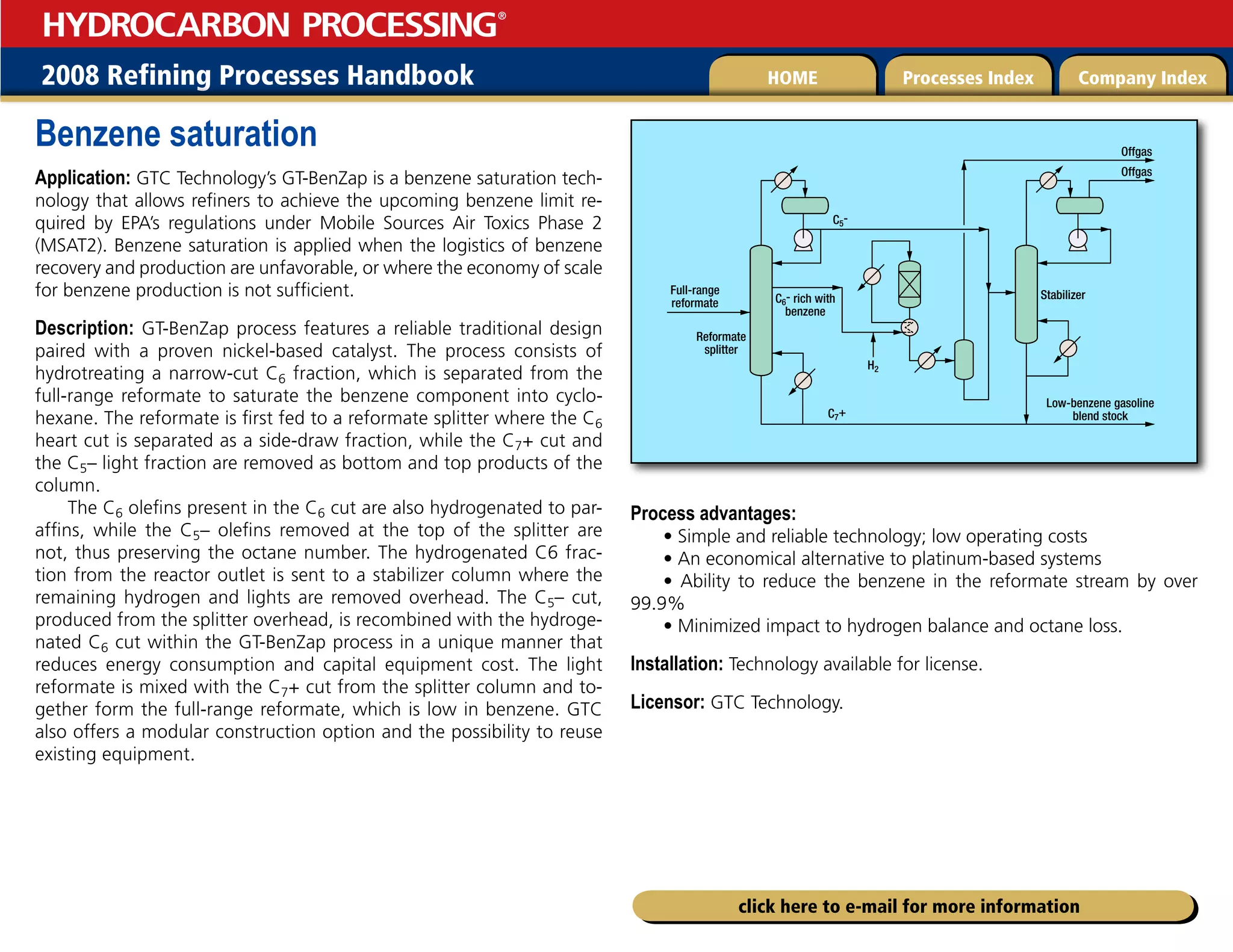
Products: The product from the LABSORB process is a concentrated SO2
stream consisting of approximately 90% SO2 and 10% moisture. This
stream can be sent to the front of the SRU to be mixed with H2S and
form sulfur, or it can be concentrated for other marketable uses.
Description: Hot dirty flue gas is cooled in a flue-gas cooler or waste-
heat recovery boiler prior to entering the systems. Steam produced can
be used in the LABSORB plant. The gas is then quenched to adiabatic
saturation (typically 50°C–75°C) in a quencher/pre-scrubber; it proceeds
to the absorption tower where the SO2 is removed from the gas. The
tower incorporates multiple internal and re-circulation stages to ensure
sufficient absorption.
A safe, chemically stable and regenerable buffer solution is con-
tacted with the SO2-rich gas for absorption. The rich solution is then
piped to a LABSORB buffer regeneration section where the solution is
regenerated for re-use in the scrubber. Regeneration is achieved using
low-pressure steam and conventional equipment such as strippers, con-
densers and heat exchangers.
Economics: This process is very attractive at higher SO2 concentrations
or when liquid or solid effluents are not allowed. The system’s buffer
loss is very low, contributing to a very low operating cost. Additionally,
when utilizing LABSORB as an SRU tail-gas treater, many components
normally associated with the SCOT process are not required; thus saving
considerable capital.
Installation: One SRU tail-gas system and two FCCU scrubbing systems.
Reference: Confuorto, Weaver and Pedersen, “LABSORB regenerative
scrubbing operating history, design and economics,” Sulfur 2000, San
Francisco, October 2000.
Confuorto, Eagleson and Pedersen, “LABSORB, A regenerable wet
scrubbing process for controlling SO2 emissions,” Petrotech-2001, New
Delhi, January 2001.
Licensor: Belco Technologies Corp.
Buffer
makeup
Cleaned
gas
Absorber
Quench column
pre-scrubber
Flue gas
Reclaimed SO2
Condenser
Stripper
LP
steam
Condensate
Heat
exch.
Oxidation
product removal
Vapor/
liquid
separator
Particulates
Buffer tank
2008 Refining Processes Handbook Processes Index Company Index
HOME
HYDROCARBON PROCESSING
®
click here to e-mail for more information
Sour gas treatment
Application: The WSA process (Wet gas Sulfuric Acid) treats all types of
sulfur-containing gases such as amine and Rectisol regenerator offgas,
SWS gas and Claus plant tail gas in refineries, gas treatment plants,
petrochemicals and coke chemicals plants. The WSA process can also be
applied for SOx removal and regeneration of spent sulfuric acid.
Sulfur, in any form, is efficiently recovered as concentrated commer-
cial-quality sulfuric acid.
Description: Feed gas is combusted and cooled to approximately
420°C in a waste heat boiler. The gas then enters the SO2 converter
containing one or several beds of SO2 oxidation catalyst to convert
SO2 to SO3. The gas is cooled in a gas cooler whereby SO3 hydrates to
H2SO4 (gas), which is finally condensed as concentrated sulfuric acid
(typically 98% w/w).
The WSA condenser is cooled by ambient air, and heated air may
be used as combustion air in the incinerator for increased thermal effi-
ciency. The heat released by incineration and SO2 oxidation is recovered
as steam. The process operates without removing water from the gas.
Therefore, the number of equipment items is minimized, and no liquid
waste is formed. Cleaned process gas leaving the WSA condenser is sent
to stack without further treatment.
The WSA process is characterized by:
• 
More than 99% recovery of sulfur as commercial-grade
sulfuric acid
• No generation of waste solids or wastewater
• No consumption of absorbents or auxiliary chemicals
• Efficient heat recovery ensuring economical operation
• 
Simple and fully automated operation adapting to variations in
feed gas flow and composition.
Installation: More than 70 units worldwide.
Licensor: Haldor Topsøe A/S.
Acid cooler
Product acid
Superheated
steam
Air
Stack gas
WSA
condenser
SO2
converter
Steam
system
Interbed
cooler
Interbed
cooler
Gas
cooler
H2S gas
Incinerator
Combustion air
Blower
Blower
2008 Refining Processes Handbook Processes Index Company Index
HOME
HYDROCARBON PROCESSING
®
click here to e-mail for more information
Spent acid regeneration
Application: The WSA process (Wet gas Sulfuric Acid) treats spent sul-
furic acid from alkylation as well as other types of waste sulfuric acid
in the petrochemical and chemicals industry. Amine regenerator offgas
and/or refinery gas may be used as auxiliary fuel. The regenerated acid
will contain min. 98% H2SO4 and can be recycled directly to the alkyla-
tion process.
The WSA process is also applied for conversion of H2S and removal
of SOx.
Description: Spent acid is decomposed to SO2 and water vapor in an
incinerator using amine regenerator offgas or refinery gas as fuel. The
SO2 containing flue gas is cooled in a waste-heat boiler and solid matter
originating from the acid feed is separated in an electrostatic precipita-
tor. By adding preheated air, the process gas temperature and oxygen
content are adjusted before the catalytic converter converting SO2 to
SO3. The gas is cooled in the gas cooler whereby SO3 is hydrated to
H2SO4 (gas), which is finally condensed as 98% sulfuric acid.
The WSA condenser is cooled by ambient air. The heated air may be
used as combustion air in the burner for increased thermal efficiency. The
heat released by incineration and SO2 oxidation is recovered as steam.
The process operates without removing water from the gas. There-
fore, the number of equipment items is minimized and no liquid waste
is formed. This is especially important in spent acid regeneration where
SO  
3 formed by the acid decomposition will otherwise be lost with the
wastewater.
The WSA process is characterized by:
• No generation of waste solids or wastewater
• No consumption of absorbents or auxiliary chemicals
• Efficient heat recovery ensuring economical operation
• 
Simple and fully automated operation adapting to variations in
feed flow and composition.
Installation: More than 70 WSA units worldwide, including 10 for spent
acid regeneration.
Licensor: Haldor Topsøe A/S.
Spent acid
+ fuel Air
Dust
removal
Heat exchange system
SO2
converter
DENOX
WSA
condenser
Stack gas
Acid
Cooler
Export steam
Incinerator
2008 Refining Processes Handbook Processes Index Company Index
HOME
HYDROCARBON PROCESSING
®
click here to e-mail for more information
Wet scrubbing system, EDV
Application: EDV Technology is a low pressure drop scrubbing system,
to scrub particulate matter (including PM2.5), SO2 and SO3 from flue
gases. It is especially well suited where the application requires high reli-
ability, flexibility and the ability to operate for 4–7 years continuously
without maintenance shutdowns. The EDV technology is highly suited
for FCCU regenerator flue-gas applications.
Products: The effluents from the process will vary based on the re-
agent selected for use with the scrubber. In the case where a sodium-
based reagent is used, the product will be a solution of sodium salts.
Similarly, a magnesium-based reagent will result in magnesium salts.
A lime/limestone-based system will produce a gypsum waste. The EDV
technology can also be used with the LABSORB buffer thus making
the system regenerative. The product, in that case, would be a usable
condensed SO2 stream.
Description: The flue gas enters the spray tower through the quench
section where it is immediately quenched to saturation temperature.
It proceeds to the absorber section for particulate and SO2 reduction.
The spray tower is an open tower with multiple levels of BELCO-G-
Nozzles. These nonplugging and abrasion-resistant nozzles remove
particulates by impacting on the water/reagent curtains. At the same
time, these curtains also reduce SO2 and SO3 emissions. The BELCO-
G-Nozzles are designed not to produce mist; thus a conventional mist
eliminator is not required.
Upon leaving the absorber section, the saturated gases are direct-
ed to the EDV filtering modules to remove the fine particulates and ad-
ditional SO3. The filtering module is designed to cause condensation of
the saturated gas onto the fine particles and onto the acid mist, thus
allowing it to be collected by the BELCO-F-Nozzle located at the top.
To ensure droplet-free stack, the flue gas enters a droplet separa-
tor. This is an open design that contains fixed-spin vanes that induce a
cyclonic flow of the gas. As the gases spiral down the droplet separa-
tor, the centrifugal forces drive any free droplets to the wall, separat-
ing them from the gas stream.
Economics: The EDV wet scrubbing system has been extremely suc-
cessful in the incineration and refining industries due to the very high
scrubbing capabilities, very reliable operation and reasonable price.
Installation: More than 200 applications worldwide on various pro-
cesses including more than 60 FCCU applications, heater applications,
SRU tailgas unit, fluidized coker application and coal-fired boilers.
Reference: Confuorto and Weaver, “Flue gas scrubbing of FCCU re-
generator flue gas—performance, reliability, and flexibility—a case his-
tory,” Hydrocarbon Engineering, 1999.
Eagleson and Dharia, “Controlling FCCU emissions,” 11th Refin-
ing Technology Meeting, HPCL, Hyderabad, 2000.
Licensor: Belco Technologies Corp.
Quench
Flue gas
Cleaned gas
Droplet
separators
Filtering
modules
Absorber
Reagent addition
Stack
Slipstream to purge treatment unit
Recirculation
pumps
2008 Refining Processes Handbook Processes Index Company Index
HOME
HYDROCARBON PROCESSING
®
click here to e-mail for more information
Deep thermal conversion
Application: The Shell Deep Thermal Conversion process closes the gap
between visbreaking and coking. The process yields a maximum of distil-
lates by applying deep thermal conversion of the vacuum residue feed
and by vacuum flashing the cracked residue. High-distillate yields are
obtained, while still producing a stable liquid residual product, referred
to as liquid coke. The liquid coke, not suitable for blending to commer-
cial fuel, is used for speciality products, gasification and/or combustion,
e.g., to generate power and/or hydrogen.
Description: The preheated short residue is charged to the heater (1)
and from there to the soaker (2), where the deep conversion takes place.
The conversion is maximized by controlling the operating temperature
and pressure. The soaker effluent is routed to a cyclone (3). The cyclone
overheads are charged to an atmospheric fractionator (4) to produce the
desired products like gas, LPG, naphtha, kero and gasoil. The cyclone
and fractionator bottoms are subsequently routed to a vacuum flasher
(5), which recovers additional gasoil and waxy distillate. The residual liq-
uid coke is routed for further processing depending on the outlet.
Yields: Depend on feed type and product specifications.
Feed, vacuum residue Middle East
Viscosity, cSt @100°C 615
Products in % wt. on feed
Gas 3.8
Gasoline, ECP 165°C 8.2
Gas oil, ECP 350°C 19
Waxy distillate, ECP 520°C 22.8
Residue ECP 520°C+ 46.2
Economics: The typical investment for a 25,000-bpd unit will be about
$1,900 to $2,300/bbl installed, excluding treating facilities. (Basis: West-
ern Europe, 2004.).
Utilities, typical consumption/production for a 25,000-bpd unit,
dependent on configuration and a site’s marginal econmic values for
steam and fuel:
Fuel as fuel oil equivalent, bpd 417
Power, MW 1.2
Net steam production (18 bar), tpd 370
Installation: To date, six Shell Deep Thermal Conversion units have been
licensed. In four cases, this has involved revamping an existing Shell
Soaker Visbreaker unit. Post startup services and technical services for
existing units are available from Shell Global Solutions.
Reference: Hydrocarbon Engineering, September 2003.
Licensor: Shell Global Solutions International B.V. and ABB Lummus
Global B.V.
Feed
Naphtha
LGO
HGO
Vacuum flashed
cracked residue
Gas
Steam
Steam
5
4
2
1
3
2008 Refining Processes Handbook Processes Index Company Index
HOME
HYDROCARBON PROCESSING
®
click here to e-mail for more information
Emulsion residue upgrade
Application: The Akzo Nobel/Quadrise emulsion residue enhancement
process converts highly viscous, low-value, uncut residues from vacuum
unit operations to an emulsion fuel for onward sale to third parties. Re-
finers benefit from term contract offtake of residue and release of HFO
cutter-stock back to the refinery, for higher value realization. Quadrise
typically purchases the residue at a price higher than its intrinsic value,
and assume responsibility for the emulsion fuel sales.
Enhancements include moving to deeper vacuum unit cuts and in-
creasing visbreaker severity or visbreaker vacuum flasher recovery to in-
crease yields of lighter products. Enhancements are achieved without
the normal penalty of increased cutter-stock addition to the resulting
heavier residues. A combination of modifying process conditions and
processing heavier, cheaper, crude oils leads to significantly lower quality
residues in terms of density, CCR and viscosity. The technology handles
these low-quality residues and produces a transportable emulsion fuel
with a viscosity of 200–1,000cSt at 50°C.
Description: Residues from a vacuum unit, visbreaker, visbreaker vacuum
flasher or solvent de-asphalter (1) are taken from the refiners run-down
system after process heat has been extracted, but prior to cutter stock
addition. The residue stream is processed to a 70:30 oil-in-water emul-
sion in a proprietary skid-mounted package (2) supplied by Quadrise un-
der license from Akzo Nobel. Various commercial options are available
including licence; BOO/BOOT by Quadrise or JV with refiner.
Operating conditions: The residue temperature is adjusted to give a vis-
cosity of around 300cSt for supply to the emulsification process. The
maximum supply temperatures are 190°C (standard unit) and 260°C
(high-temperature unit). The emulsion fuel run-down temperature to
conventional HFO storage tanks is less than 65°C.
Residue viscosities of up to 100,000cSt (standard unit) and
60,000,000cSt (high-temperature unit) measured at 100°C can be han-
dled, without impacting the quality of the emulsion fuel. The standard
unit operates at less than 10 bars.
Economics: Margin improvement to the refinery varies according to its
configuration, crude supply and location but typically lies in the range of
$0.25–$1.5/bbl of crude input.
Installed cost: $3000/bbl of residue (USGC 2008) for a unit of 4,000 bbl
residue feed. Units are modular; installed system lead-time is typically
12 months.
Utilities: typical per barrel of feed (detail available on request)
Water, cooling 	 Dependent on feedstock temperature
Process water 0.30–0.45 bbl
Power 1kWh
Chemicals Dependent on feedstock.
Installation: One unit currently operating for emulsion fuel production.
Licensor: Akzo Nobel through Quadrise Fuels International.
START
1
2
Distillates (cutter-stock recovery)
Residue
Process water + surfactants
Emulsion fuel
2008 Refining Processes Handbook Processes Index Company Index
HOME
HYDROCARBON PROCESSING
®
click here to e-mail for more information
Heavy oil upgrading
Application: Process designed for upgrading heavy oils including the
Athabasca bitumen into a easily transportable synthetic crude oil.
Description: This process uses various proven and established refining
technologies.
Bitumen with diluent is brought to the upgrader. The diluent is re-
covered in the diluent recovery unit (DRU) and returned to the produc-
tion site. The bottom of the DRU is sent to a high deasphalted oil lift
ROSE solvent deasphalting unit. The DAO is then sent to a special pur-
pose Fluid Catalytic Cracking Unit (FCCU). The FCCU operates at low
conversion, normally between 30% and 60% and uses low cost low
activity catalyst.
The metals in DAO are rejected with the spent catalyst. The carbon
(CCR) is burnt in regenerator to produce steam. The FCCU products
can be blended into synthetic crude oil. Alternately the products can be
hydrotreated to produce low-sulfur synthetic crude oil. Steam produced
in the FCCU is used within the complex. The asphaltenes from ROSE
unit can be pelletized using KBR’s AQUAFORM pelletizing technology
for ease of transportation to end users. Alternately the asphaltenes can
be gasified to produce hydrogen, steam and power for bitumen produc-
tion and upgrading.
Applications: This scheme can be used for upgrading of bitumen and
other heavy and very heavy oils.
KBR has performed extensive pilot plant testing to confirm the vi-
ability of the scheme. Given below are pilot test results for KBR’s ROSE
portion of the scheme.
ROSE pilot results:
Feed: Athabasca Bitumen
Feed Solvents DAO yield, vol.% CCR in DAO, wt.%
Full nC4 to C6 70–82 7–10
ATB C3 to nC5 40–87 1–9
VTB iC4 to nC5 17–65 5–14
The synthetic crude oil of following composition can be produced by the
above scheme:
C5-350°F: 15–30 vol.%
Distillate: 40–65 vol.%
Gas oil: 20–30 vol.%
Economics: KBR estimates that the above scheme will have several per-
cent higher rate of return on investment when compared with tradi-
tional heavy oil upgrading schemes.
Reference: “KBR KLEEN Upgrading Process, ” Conrad Conference, Feb.
23, 2005, Calgary, Alberta.
Licensor: KBR.
Diluent return
Heavy oil
ROSE*
*Residuum oil supercritical extraction
D
R
U
V
R
U
S
p
e
c
i
a
l
F
C
C
Pellets
Aquaform
Naphtha
hydrotreater
GO
hydrotreater
Diesel
hydrotreater
Synthetic
crude
Gasifier
Steam+power
2008 Refining Processes Handbook Processes Index Company Index
HOME
HYDROCARBON PROCESSING
®
Hydroprocessing—heavy oil
and residue
Application: Conversion of heavy petroleum residues or crude oil into
lighter and higher value materials.
Products: Low-sulfur content naphtha, diesel and gasoil
Description: The Genoil Upgrader consists of the proprietary Genoil hy-
droconversion unit (GHU) and an integrated gasification and combined
cycle (IGCC) section. By integrating with gasification and balancing pitch
conversion with hydrogen and utility demands, the GHU and the overall
upgrader becomes a truly bottomless, self-sufficient facility that is suit-
able to be added into an existing refining complex or as a merchant
upgrader near a remote oil field.
Based on a fixed-bed hydrogenation technology and using special
mixing devices to ensure full catalysts utilization and higher efficiency,
the GHU converts the heavy petroleum feed into lighter products such as
naphtha, diesel and low-sulfur gasoil that can be used as fuel-oil blend
or FCCU feed. The unconverted portion will be removed as vacuum resi-
due (VR) and fed to the IGCC units. In comparison to the traditional resi-
due treating processes such as visbreaking and delayed coking, the GHU
offers a significantly higher conversion to valuable petroleum products.
The IGCC will use partial oxidation and gasification technologies to
convert the VR into hydrogen, fuel gas and power. The hydrogen will be
recovered and fed to the GHU to support the hydrogenation reactions,
whereas fuel gas, steam and power are used to run the overall Genoil
upgrader.
Process: In general, the Genoil upgrader consists of these processing
units (see diagram):
• Genoil hydroconversion unit (GHU)
• Syngas unit (SGU)
• Air separation unit (ASU)
• Acid-gas removal unit (AGR)
• Hydrogen recovery unit (HRU)
• Combined-cycle unit (CCU.)
The GHU is similar to normal hydrotreating units consisting sections
such as: feed preparation and preheat, reactions, effluent cooling and
separation, gas recycle and product fractionation. The reactor section
consists of a series of four reactor beds: guard, hydrodemetalization
(HDM), hydrodesulfurization (HDS) and hydrodenitrogenation (HDN).
The syngas unit converts the VR under a partial oxidation processing
condition in the gasifier to produce syngas, which is a mixture of H2, CO
and CO2. The sulfur and nitrogen content in the residue will be con-
verted to H2S, NH3 and HCN. After purification and cooling, the syngas
will be sent to the AGR unit.
The ASU uses refrigeration and distillation to separate oxygen from
ambient air. The oxygen product stream consisting over 95% oxygen is
fed to the gasifier in the SGU as combustion air.
Genoil
hydro-
conversion
unit Sulfur
recovery
Naphtha
Diesel
Feed
Syngas
Hydrogen
Vacuum
residue
O2
Acid gas
Fuel gas
Sulfur
Combined
cycle
Hydrogen
recovery
Air
separation
Acid gas
removal
Gasification
Steam
Power
Gasoil
Offgas
Continued 
The AGR performs these operations: Remove the H2S from the
syngas, GHU offgas and sour condensate using MDEA absorption tech-
nology; Convert CO into more H2 using high temperature shift and re-
move CO2 from sweetened gas using DGA absorption technology.
The HRU recovers H2 using pressure swing adsorption (PSA) tech-
nology. The sulfur recovery unit (SRU) uses a three-stage Claus Unit fol-
lowed by an amine tail gas recovery plant to recover over 99.5% of the
sulfur in the AGR offgas.
The CCU consists of gas turbine generator (GTG), heat-recovery
steam generator (HRSG). Part of the steam produced will be used in the
Upgrader and the reminder is sent to a steam turbine generator (STG) to
produce more electrical power.
Performance: 85+% HDS, 50+%HDN, 8–12 API increase, 50% pitch
conversion (to balance conversion and utilities requirement)
Hydroprocessing—heavy oil and residue, continued Yields: Product yields depend on the quality of feed. For a typical AR
feed, the liquid yields are: 3% Naphtha, 26% Diesel and 57% Gasoil, all
based on the mass of crude feed.
Installation: At present, there is no commercial Genoil Upgrader in op-
eration. A feasibility study has been completed for the installation of a
19,500-bpd unit in the ZJSH Refinery in Hebei, China. Commissioning of
the unit is scheduled on the first quarter of 2010.
Reference: “Is bottomless-barrel refining possible?” Hydrocarbon Pro-
cessing, September 2007, pp.81–92.
Oilsands Review, October 2007 and March 2007.
“Opportunity Crudes 2008,” HP Company.
Licensor: Genoil Inc.
click here to e-mail for more information
2008 Refining Processes Handbook Processes Index Company Index
HOME
HYDROCARBON PROCESSING
®
click here to e-mail for more information
Thermal gasoil
Application: The Shell Thermal Gasoil process is a combined residue and
waxy distillate conversion unit. The process is an attractive low-cost con-
version option for hydroskimming refineries in gasoil-driven markets or
for complex refineries with constrained waxy distillate conversion capac-
ity. The typical feedstock is atmospheric residue, which eliminates the
need for an upstream vacuum flasher. This process features Shell Soaker
Visbreaking technology for residue conversion and an integrated recycle
heater system for the conversion of waxy distillate.
Description: The preheated atmospheric (or vacuum) residue is charged
to the visbreaker heater (1) and from there to the soaker (2). The con-
version takes place in both the heater and soaker and is controlled by
the operating temperature and pressure. The soaker effluent is routed
to a cyclone (3). The cyclone overheads are charged to an atmospheric
fractionator (4) to produce the desired products including a light waxy
distillate. The cyclone and fractionator bottoms are routed to a vacuum
flasher (6), where waxy distillate is recovered. The combined waxy distil-
lates are fully converted in the distillate heater (5) at elevated pressure.
Yields: Depend on feed type and product specifications.
Feed atmospheric residue Middle East
Viscosity, cSt @ 100°C 31
Products, % wt.
Gas 6.4
Gasoline, ECP 165°C 12.9
Gasoil, ECP 350°C 38.6
Residue, ECP 520°C+ 42.1
Economics: The typical investment for a 25,000-bpd unit will be about
$2,400 to $3,000/bbl installed, excluding treating facilities. (Basis: West-
ern Euope, 2004.)
Utilities, typical consumption/production for a 25,000-bpd unit,
dependent on configuration and a site’s marginal economic values for
steam and fuel:
Fuel as fuel oil equivalent, bpd 675
Power, MW 1.7
Net steam production (18 bar), tpd 370
Installation: To date, 12 Shell Thermal Gasoil units have been built. Post
startup services and technical services for existing units are available
from Shell Global Solutions..
Licensor: Shell Global Solutions International B.V., and ABB Lummus
Global B.V.
Charge
Naphtha
Gasoil
Waxy
distillate
Vacuum flashed
cracked residue
Gas
Steam
Steam 6
5
4
2
1
3
2008 Refining Processes Handbook Processes Index Company Index
HOME
HYDROCARBON PROCESSING
®
click here to e-mail for more information
Visbreaking
Application: Manufacture incremental gas and distillate products and simul-
taneously reduce fuel oil viscosity and pour point. Also, reduce the amount
of cutter stock required to dilute the resid to meet the fuel oil specifications.
Foster Wheeler/UOP offer both “coil” and “soaker” type visbreaking pro-
cesses. The following information pertains to the “coil” process.
Products: Gas, naphtha, gas oil, visbroken resid (tar).
Description: In a “coil” type operation, charge is fed to the visbreaker
heater (1) where it is heated to a high temperature, causing partial va-
porization and mild cracking. The heater outlet stream is quenched with
gas oil or fractionator bottoms to stop the cracking reaction. The va-
por-liquid mixture enters the fractionator (2) to be separated into gas,
naphtha, gas oil and visbroken resid (tar). The tar may also be vacuum
flashed for recovery of visbroken vacuum gas oil.
Operating conditions: Typical ranges are:
Heater outlet temperature, ºF 850–910
Quenched temperature, ºF 710–800
An increase in heater outlet temperature will result in an increase in
overall severity, further viscosity reduction and an increase in conversion.
Yields:
Feed, source Light Arabian Light Arabian
Type Atm. Resid Vac. Resid
Gravity, ºAPI 15.9 7.1
Sulfur, wt% 3.0 4.0
Concarbon, wt% 8.5 20.3
Viscosity, CKS @130ºF 150 30,000
CKS @ 210ºF 25 900
Products, wt%
Gas 3.1 2.4
Naphtha (C5 –330 ºF) 7.9 6.0
Gas oil 14.5 15.5
Visbroken resid 74.5 (600ºF+) 76.1 (662ºF+)
Economics:
Investment (basis: 40,000–10,000 bpsd, 2Q 2005, US Gulf),
$ per bpsd 1,800–3,500
Utilities, typical per bbl feed:
Fuel, MMBtu 0.1195
Power, kW/bpsd 0.0358
Steam, MP, lb 6.4
Water, cooling, gal 71.0
Installation: Over 50 units worldwide.
Reference: Handbook of Petroleum Refining Processes, Third Ed., Mc-
Graw-Hill, 2003, pp. 12.91–12.105.
Licensor: Foster Wheeler USA Corp./UOP.
4535
3FEVDFE
DSVEFDIBSHF
(BT
(BTPMJOF
(BTPJM
5BS
4UFBN
2008 Refining Processes Handbook Processes Index Company Index
HOME
HYDROCARBON PROCESSING
®
click here to e-mail for more information
Visbreaking
Application: The Shell Soaker Visbreaking process is most suitable to re-
duce the viscosity of vacuum (and atmospheric) residues in (semi) complex
refineries. The products are primarily distillates and stable fuel oil. The to-
tal fuel oil production is reduced by decreasing the quantity of cutter stock
required. Optionally, a Shell vacuum flasher may be installed to recover
additional gas oil and waxy distillates as cat cracker or hydrocracker feed
from the cracked residue. The Shell Soaker Visbreaking technology has
also proven to be a very cost-effective revamp option for existing units.
Description: The preheated vacuum residue is charged to the visbreaker
heater (1) and from there to the soaker (2). The conversion takes place
in both the heater and the soaker. The operating temperature and pres-
sure are controlled such as to reach the desired conversion level and/
or unit capacity. The cracked feed is then charged to an atmospheric
fractionator (3) to produce the desired products like gas, LPG, naph-
tha, kerosine, gas oil, waxy distillates and cracked residue. If a vacuum
flasher is installed, additional gas oil and waxy distillates are recovered
from the cracked residue.
Yields: Vary with feed type and product specifications.
Feed, vacuum residue Middle East
Viscosity, cSt @100°C 615
Products, wt%
Gas 2.2
Gasoline, 165°C EP 4.8
Gas oil, 350°C EP 13.6
Waxy distillate, 520°C EP 23.4
Residue, 520°C+ 56
Economics: The typical investment for a 25,000-bpd unit will be about
$1,200 to $1,500/bbl installed, excluding treating facilities. (Basis: West-
ern Europe, 2004.)
Utilities, typical consumption consumption/production for a 25,000-
bpd unit, dependent on configuration and a site’s marginal economic
values for steam and fuel:
Fuel as fuel oil equivalent, bpd 400
Power, MW 1.2
Net steam production (18 bar), tpd 370
Installation: More than 70 Shell Soaker Visbreakers have been built. Post
startup services and technical services for existing units are available from
Shell Global Solutions.
Licensor: Shell Global Solutions International B.V. and ABB Lummus
Global B.V.
START
Residue charge
Gas
1
Naphtha
Gas oil
Visbroken residue
Vacuum gas oil
Cutter stock
Vacuum system
Steam
4
3
Steam
2
2008 Refining Processes Handbook Processes Index Company Index
HOME
HYDROCARBON PROCESSING
®
click here to e-mail for more information
Catalytic dewaxing
Application: Use ExxonMobil’s Research  Engineering’s (EMRE’s) Se-
lective Catalytic Dewaxing (MSDW) process to make high VI lube base
stock.
Products: High VI / low-aromatics lube base oils (light neutral through
bright stocks). Byproducts include fuel gas, naphtha and low-pour die-
sel.
Description: ExxonMobil’s Research  Engineering’s (EMRE’s) MSDW is
targeted for hydrocracked or severely hydrotreated stocks. The improved
selectivity of MSDW for the highly isoparaffinic-lube components results
in higher lube yields and VIs. The process uses multiple catalyst sys-
tems with multiple reactors. Internals are proprietary (the Spider Vortex
Quench Zone technology is used). Feed and recycle gases are preheated
and contact the catalyst in a down-flow-fixed-bed reactor.
Reactor effluent is cooled, and the remaining aromatics are satu-
rated in a post-treat reactor. The process can be integrated into a lube
hydrocracker or lube hydrotreater. Post-fractionation is targeted for cli-
ent needs.
Operating conditions:
Temperatures, ° F 550 – 800
Hydrogen partial pressures, psig 500 – 2,500
LHSV 0.4 – 3.0
Conversion depends on feed wax content
Pour point reduction as needed.
Yields:
Light neutral Heavy neutral
Lube yield, wt% 94.5 96.5
C1 –C4, wt% 1.5 1.0
C5 –400°F, wt% 2.7 1.8
400°F–Lube, wt% 1.5 1.0
H2 cons, scf/bbl 100–300 100–300
Installation: Eight units are operating and four are in design.
Licensor: ExxonMobil Research and Engineering Co.
Lube product
HDT
Rxr
HDW
Rxr
Purge
MP steam
Oily
water
LT
sep
HT
sep
Water
Fuel gas to LP absorber
Wild naphtha
Sour water
Sour
water
Distillate
Vacuum system
Makeup H2
MP steam
Vac
dryer
Vac
strip.
Water
wash
Water
wash
M/U
Rec
HP
stripper
Waxy feed
2008 Refining Processes Handbook Processes Index Company Index
HOME
HYDROCARBON PROCESSING
®
click here to e-mail for more information
Dewaxing
Application: Bechtel’s Dewaxing process is used to remove waxy com-
ponents from lubrication base-oil streams to simultaneously meet de-
sired low-temperature properties for dewaxed oils and produce slack
wax as a byproduct.
Description: Waxy feedstock (raffinate, distillate or deasphalted oil) is
mixed with a binary-solvent system and chilled in a very closely controlled
manner in scraped-surface double-pipe exchangers (1) and refrigerated
chillers (2) to form a wax/oil/solvent slurry.
The slurry is filtered through the primary filter stage (3) and dewaxed
oil mixture is routed to the dewaxed oil recovery section (5) to separate
solvent from oil. Prior to solvent recovery, the primary filtrate is used to
cool the feed/solvent mixture (1). Wax from the primary stage is slurried
with cold solvent and filtered again in the repulp filter (4) to reduce the
oil content to approximately 10%.
The repulp filtrate is reused as dilution solvent in the feed chilling
train. The wax mixture is routed to a solvent-recovery section (6) to re-
move solvent from the product streams (hard wax and soft wax). The
recovered solvent is collected, dried (7) and recycled back to the chilling
and filtration sections.
Economics:
Investment (Basis: 7,000-bpsd feedrate
capacity, 2008 US Gulf Coast), $/bpsd 17,000
Utilities, typical per bbl feed:
Fuel, 103 Btu (absorbed) 160
Electricity, kWh 15
Steam, lb 35
Water, cooling (25°F rise), gal 1,100
Installation: Over 100 have been licensed and built.
Licensor: Bechtel Corp.
Refrigerant
Water
Dewaxed
oil
Steam
Slack wax
Waxy feed Steam
Water
Refrigerant
Process stream
Solvent
recovery
3
2
1
5
6
7
4
Refrigerant
2008 Refining Processes Handbook Processes Index Company Index
HOME
HYDROCARBON PROCESSING
®
click here to e-mail for more information
Dewaxing
Application: Selectively convert feedstock’s waxy molecules by isomeriza-
tion in the presence of ISODEWAXING Catalysts. The high-quality prod-
ucts can meet stringent cold flow properties and viscosity index (VI) re-
quirements for Group II or Group III baseoils.
Description: ISODEWAXING Catalysts are very special catalysts that con-
vert feedstocks with waxy molecules (containing long, paraffinic chains)
into two or three main branch isomers that have low-pour points. The
product also has low aromatics content. Typical feeds are: raffinates,
slack wax, foots oil, hydrotreated VGO, hydrotreated DAO and uncon-
verted oil from hydrocracking.
As shown in the simplified flow diagram, waxy feedstocks are mixed
with recycle hydrogen and fresh makeup hydrogen, heated and charged
to a reactor containing ISODEWAXING Catalyst (1). The effluent will
have a much lower pour point and, depending on the operating severity,
the aromatics content is reduced by 50–80% in the dewaxing reactor.
In a typical configuration, the effluent from a dewaxing reactor is
cooled down and sent to a finishing reactor (2) where the remaining
single ring and multiple ring aromatics are further saturated by the ISO-
FINISHING Catalysts. The effluent is flashed in high-pressure and low-
pressure separators (3, 4). Small amounts of light products are recovered
in a fractionation system (5).
Yields: The base oil yields strongly depend on the feedstocks. For a typi-
cal low wax content feedstock, the base oil yield can be 90–95%. Higher
wax feed will have a little lower base oil yield.
Economics:
Investment: 
This is a moderate investment process; for a typical size
ISODEWAXING/ISOFINISHING Unit, the capital for ISBL
is about $8,000/bpsd.
Utilities: Typical per bbl feed:
Power, kWh 3.3
Fuel , kcal 13.4 x 10³
Steam, superheated, required, kg 5.3
Steam, saturated, produced, kg 2.4
Water, cooling, kg 192
Chemical-hydrogen consumption, Nm3/m3 oil 30~50
Installation: More than 14 units are in operation and 7 units are in vari-
ous stages of design or construction.
Reference: NPRA Annual Meeting, March 2005, San Francisco, Paper
AM-05-39.
Licensor: Chevron Lummus Global LLC.
Medium
base oil
Heavy base oil
Light base oil
Jet
Diesel
Naphtha
Process gas
Makeup hydrogen
Fresh feed
1 2
6
5
4
3
2008 Refining Processes Handbook Processes Index Company Index
HOME
HYDROCARBON PROCESSING
®
click here to e-mail for more information
Dewaxing/wax deoiling
Application: Bechtel’s Dewaxing/Wax Fractionation processes are used
to remove waxy components from lubrication base-oil streams to si-
multaneously meet desired low-temperature properties for dewaxed oils
and produce hard wax as a premium byproduct.
Description: Bechtel’s two-stage solvent dewaxing process can be ex-
panded to simultaneously produce hard wax by adding a third deoiling
stage using the Wax Fractionation process. Waxy feedstock (raffinate,
distillate or deasphalted oil) is mixed with a binary-solvent system and
chilled in a very closely controlled manner in scraped-surface double-
pipe exchangers (1) and refrigerated chillers (2) to form a wax/oil/solvent
slurry.
The slurry is filtered through the primary filter stage (3) and dewaxed
oil mixture is routed to the dewaxed oil recovery section (6) to separate
solvent from oil. Prior to solvent recovery, the primary filtrate is used to
cool the feed/solvent mixture (1).
Wax from the primary stage is slurried with cold solvent and filtered
again in the repulp filter (4) to reduce the oil content to approximately
10%. The repulp filtrate is reused as dilution solvent in the feed chilling
train. The low-oil content slack wax is warmed by mixing with warm
solvent to melt the low-melting-point waxes (soft wax) and is filtered in
a third stage filtration (5) to separate the hard wax from the soft wax.
The hard and soft wax mixtures are each routed to solvent recovery sec-
tions (7,8) to remove solvent from the product streams (hard wax and
soft wax). The recovered solvent is collected, dried (9) and recycled back
to the chilling and filtration sections.
Economics:
Investment (Basis: 7,000-bpsd feedrate
capacity, 2008 US Gulf Coast), $/bpsd 20,000
Utilities, typical per bbl feed:
Fuel, 103 Btu (absorbed) 230
Electricity, kWh 25
Steam, lb 25
Water, cooling (25°F rise), gal 1,500
Installation: Seven in service.
Licensor: Bechtel Corp.
Refrigerant
Hard wax
Water
Dewaxed
oil
Steam
Soft wax
Waxy feed Steam
Water
Refrigerant
Process stream
Solvent
recovery
3
2
1
6
7 8
5
4
Refrigerant
9
2008 Refining Processes Handbook Processes Index Company Index
HOME
HYDROCARBON PROCESSING
®
click here to e-mail for more information
Slack wax deoiling
Application: Process to produce high-melting and low-oil containing
hard wax products for a wide range of applications.
Feeds: Different types of slack waxes from lube dewaxing units, includ-
ing macrocrystalline (paraffinic) and microcrystalline wax (from residual
oil). Oil contents typically range from 5–25 wt%.
Products: Wax products with an oil content of less than 0.5 wt%, except
for the microcrystalline paraffins, which may have a somewhat higher
oil content. The deoiled wax can be processed further to produce high-
quality, food-grade wax.
Description: Warm slack wax is dissolved in a mixture of solvents and
cooled by heat exchange with cold main filtrate. Cold wash filtrate
is added to the mixture, which is chilled to filtration temperature in
scraped-type coolers. Crystallized wax is separated from the solution in
a rotary drum filter (stage 1). The main filtrate is pumped to the soft-wax
solvent recovery section. Oil is removed from the wax cake in the filter
by thorough washing with chilled solvent.
The wax cake of the first filter stage consists mainly of hard wax and
solvent but still contains some oil and soft wax. Therefore, it is blown off
the filter surface and is again mixed with solvent and repulped in an agi-
tated vessel. From there the slurry is fed to the filter stage 2 and the wax
cake is washed again with oil-free solvent. The solvent containing hard
wax is pumped to a solvent recovery system. The filtrate streams of filter
stage 2 are returned to the process, the main filtrate as initial dilution to
the crystallization section, and the wash filtrate as repulp solvent.
The solvent recovery sections serve to separate solvent from the
hard wax respectively from the soft wax. These sections yield oil-free
hard wax and soft wax (or foots oil).
Utility requirements (slack wax feed containing 20 wt% oil, per metric
ton of feed):
Steam, LP, kg 1,500
Water, cooling, m3 120
Electricity, kWh 250
Installation: Wax deoiling units have been added to existing solvent de-
waxing units in several lube refineries. The most recent reference in-
cludes the revamp of a dewaxing unit into two-stage wax deoiling; this
unit went onstream in 2005.
Licensor: Uhde GmbH.
Refrigeration
unit
To refrigeration unit
From heat
exchangers
Feed
Feed/
filtrate
exchangers
Initial
dilution
To
refrigeration
unit
Soft wax/solvent mix
to solvent recovery
Hard wax/solvent
mix to solvent
recovery
Rotating
vacuum
filter 2
Rotating
vacuum
filter 1
Scraped
exchangers
Feed
vessel
2
Feed
vessel
1
Gas holder
Stm
Wash solvent from
solvent recovery
2008 Refining Processes Handbook Processes Index Company Index
HOME
HYDROCARBON PROCESSING
®
click here to e-mail for more information
Wax hydrotreating
Application: Hydrogen finishing technology has largely replaced clay
treatment of low-oil-content waxes to produce food- and medicinal-
grade product specifications (color, UV absorbency and sulfur) in new
units. Advantages include lower operating costs, elimination of environ-
mental concerns regarding clay disposal and regeneration, and higher
net wax product yields.
Bechtel has been offering for license the Wax Hy-Finishing process.
Bechtel now is marketing a line of modular, standard hydrogen finish-
ing units for wax treatment. Standard sizes are 500, 1,000, 2,000 and
3,000-bpsd feedrate.
The core of the unit is standardized; however, individual modules are
modified as needed for specific client needs. This unit will be fabricated
to industry standards in a shop environment and delivered to the plant
site as an essentially complete unit. Cost and schedule reductions of at
least 20% over conventional stick-built units are expected. The standard
licensor’s process guarantees and contractor’s performance guarantees
(hydraulic and mechanical) come with the modules.
Description: Hard-wax feed is mixed with hydrogen (recycle plus make-
up), preheated, and charged to a fixed-bed hydrotreating reactor (1).
The reactor effluent is cooled in exchange with the mixed feed-hydrogen
stream. Gas-liquid separation of the effluent occurs first in the hot sepa-
rator (2) then in the cold separator (3). The hydrocarbon liquid stream
from each of the two separators is sent to the product stripper (4) to
remove the remaining gas and unstabilized distillate from the wax prod-
uct, and the product is dried in a vacuum flash (5). Gas from the cold
separator is either compressed and recycled to the reactor or purged
from the unit if the design is for once-through hydrogen.
Economics:
Investment (Basis 2,000-bpsd feedrate capacity,
2008 US Gulf Coast), $/bpsd 11,000
Utilitiies, typical per bbl feed:
Fuel, 103 Btu (absorbed) 30
Electricity, kWh 5
Steam, lb 25
Water, cooling (25°F rise), gal 300
Licensor: Bechtel Corp.
START
Feed
Wax product
4
3
2
H2
1
5
Offgas
Unstable naphtha
2008 Refining Processes Handbook Processes Index Company Index
HOME
HYDROCARBON PROCESSING
®
click here to e-mail for more information
White oil and wax hydrotreating
Application: Process to produce white oils and waxes.
Feeds: Nonrefined as well as solvent- or hydrogen-refined naphthenic or
paraffinic vacuum distillates or deoiled waxes.
Products: Technical- and medical-grade white oils and waxes for plasti-
cizer, textile, cosmetic, pharmaceutical and food industries. Products are
in accordance with the US Food and Drug Administration (FDA) regula-
tions and the German Pharmacopoeia (DAB 8 and DAB 9) specifications.
Description: This catalytic hydrotreating process uses two reactors. Hydro-
gen and feed are heated upstream of the first reaction zone (containing a
special presulfided NiMo/alumina catalyst) and are separated downstream
of the reactors into the main product and byproducts (hydrogen sulfide
and light hydrocarbons). A stripping column permits adjusting product
specifications for technical-grade white oil or feed to the second hydro-
genation stage.
When hydrotreating waxes, however, medical quality is obtained
in the one-stage process. In the second reactor, the feed is passed
over a highly active hydrogenation catalyst to achieve a very low level
of aromatics, especially of polynuclear compounds. This scheme per-
mits each stage to operate independently and to produce technical- or
medical-grade white oils separately. Yields after the first stage range
from 85% to 99% depending on feedstock. Yields from the second
hydrogenation step are nearly 100%. When treating waxes, the yield
is approximately 98%.
Utility requirements (typical, Middle East Crude), units per m3 of feed:
		 1st stage for 2nd stage for Food-grade
		 techn. white oil med. white oil wax
Electricity, kWh 197 130 70
Steam, LP, kg 665 495 140
Water, cooling, m3 48 20 7
Hydrogen, kg 10.0 2.6 1.6
Installation: Four installations use the Uhde (Edeleanu) proprietary tech-
nology, one of which has the largest capacity worldwide.
Licensor: Uhde GmbH.
H2
recycle
H2
recycle
Stm
Oil
stripper
Reactor
Food or
medicinal-
grade
white oil
Purge
Purge
Makeup hydrogen
First stage
Feed
Second stage
Technical white oil
or fully refined wax
Food or medicinal-
grade white oil
Tailgas
Stripped oil
Technical grade white
oil or fully-refined wax
Reactor

Refining process flow units.pdf

  • 1.
    2008 Refining ProcessesHandbook www.HydrocarbonProcessing.com Processes Index Company Index Premier sponsors: Sponsors: Hydrocarbon Processing’s 2008 Refining Processes Handbook reflects the dynamic advancements now available in licensed process technologies, catalysts and equipment. The refining industry is under tremendous pressure to process “cleaner” transportation fuels with varying specifications for a global market. Refiners must balance capital investment and operating strategies that provide the optimum profitability for their organization. Hence, refining organizations will apply leading-edge technology in conjunction with “best practices” for refining fuels and petrochemical feedstocks from crude oil. HP’s process handbooks are inclusive catalogs of established and emerging refining technologies that can be applied to existing and grassroots facilities. Economic stresses drive efforts to conserve energy consumption, minimize waste, improve product qualities, and, most important, increase yields and throughput. In further expansion, the process entries presented an expanded description of the licensed technology including a process flow diagram, product description, economic information and other vital information. Specific processing operations to be emphasized include alkylation, biofuels, coking, (crude) distillation, catalytic cracking (fluid and resid), gasification, hydrocracking, hydrotreating, hydrogen, isomerization, desulfurization, lube treating, visbreaking, etc. To maintain as complete a listing as possible, the 2008 Refining Processes Handbook is available on CD-ROM and at our website for paid subscribers. Additional copies may be ordered from our website. Photo: Neste Oil’s Naantali special product refinery on the western coast of Finland. HOME
  • 2.
    2008 Refining ProcessesHandbook www.HydrocarbonProcessing.com Company Index Premier sponsors: Sponsors: Alkylation Aromatics Biofuels Catalytic cracking Catalytic reforming Coking Deasphalting/asphalt Desulfurization-fuels Distillation-Crude Distillation-Vacuum Ethers Gasification Hydroconversion Hydrocracking Hydrodearomatization Hydrofinishing Hydrogen Hydrogenation Hydroprocessing Hydrotreating Isomerization Isooctene/isooctane Lubes Olefins Oxygen enrichment Petrochemicals Reactors Sulfur recovery Treating Treating-acid gas Treating-flue gas Treating-fuels Treating-offgas Upgrading-heavy oil Visbreaking Waxes HOME Processes Index Processes Index
  • 3.
    2008 Refining ProcessesHandbook www.HydrocarbonProcessing.com Premier sponsors: Sponsors: ABB Lummus Global B.V. Air Products and Chemicals Inc. Akzo Nobel Axens Bechtel Corp. Belco Technologies Corp. CDTECH Chevron Lummus Global LLC Davy Process Technology DuPont ExxonMobil Research and Engineering Co. Foster Wheeler USA Corp. GE Energy Genoil Inc. Goar, Allison & Associates, Inc., an Air Products Company GTC Technology Haldor Topsøe A/S Hamon Research-Cottrell KBR Linde AG, Division Gas and Engineering Lummus Technology, a CB&I company Lurgi GmbH Lyondell Chemical Co. Merichem Chemical & Refinery Services LLC, Process Technology Division Merichem Chemical & Refinery Services LLC, Gas Technology Products Division Neste Jacobs OY Quadrise Fuel International QuestAir Technologies Inc. Refining Hydrocarbon Technologies LLC Shaw Shell Global Solutions International B.V. Snamprogetti, a company of Saipem TECHNIP ThioSolv LLC TOTAL Uhde GmbH UOP Viscolube SpA Worley Parsons HOME Processes Index Company Index Company Index
  • 4.
    www.HydrocarbonProcessing.com Deep thermal conversion Thermalgasoil Visbreaking ABB Lummus Global B.V. 2008 Refining Processes Handbook Processes Index Company Index HOME HYDROCARBON PROCESSING ®
  • 5.
    www.HydrocarbonProcessing.com Hydrogen-recovery Olefins recovery Air Productsand Chemicals Inc. 2008 Refining Processes Handbook Processes Index Company Index HOME HYDROCARBON PROCESSING ®
  • 6.
    www.HydrocarbonProcessing.com Emulsion residue upgrade AkzoNobel 2008 Refining Processes Handbook Processes Index Company Index HOME HYDROCARBON PROCESSING ®
  • 7.
    www.HydrocarbonProcessing.com 2008 Refining ProcessesHandbook Processes Index Company Index HOME HYDROCARBON PROCESSING ® www.HydrocarbonProcessing.com 2008 Refining Processes Handbook Processes Index Company Index HOME HYDROCARBON PROCESSING ® Axens is a refining, petrochemical and natural gas market-focused supplier of process technology, catalysts, adsorbents and services, backed by nearly 50 years of commercial success. Axens is a world leader in several areas, such as: • Petroleum hydrotreating & hydroconversion • FCC gasoline desulfurization • Catalytic Reforming • BTX (benzene, toluene, xylenes) production purification • Selective Hydrogenation of olefin cuts • Sulfur recovery catalysts. Axens is a fully-owned subsidiary of IFP. Processes Fluid catalytic cracking Resid catalytic cracking Resid cracking Catalytic reforming Hydroconversion—VGO and DAO Hydrocracking Hydrocracking-residue Hydrotreating, diesel Hydrotreating-resid Isomerization Lube oil refining, spent Spent lube oil re-refining
  • 8.
    www.HydrocarbonProcessing.com Lube extraction (2processes) Lube hydrotreating (2 processes) Dewaxing Dewaxing/wax deoiling Wax hydrotreating Bechtel Corp. 2008 Refining Processes Handbook Processes Index Company Index HOME HYDROCARBON PROCESSING ®
  • 9.
    www.HydrocarbonProcessing.com NOX reduction, low temperature SO2 removal,regenerative Wet scrubbing system, EDV Belco Technologies Corp. 2008 Refining Processes Handbook Processes Index Company Index HOME HYDROCARBON PROCESSING ®
  • 10.
    www.HydrocarbonProcessing.com Alkylate, butanes toalkylate Alkylation, low-temperature acid catalyzed Ethers-ETBE Ethers-MTBE TAEE, from refinery C5 feeds TAME, from refinery and steam cracker C5 feeds TAME, from refinery C5 feeds Hydrogenation Hydrogenation-benzene in reformate Hydrogenation, selective for MTBE/ETBE C4 raffinate Hydrogenation, selective for refinery C4 feeds Hydrogenation-selective for refinery C5 feeds Hydrotreating Isomerization Isooctene/isooctane, conversion of refinery MTBE units Isobutylene, from MTBE decomposition CDTECH 2008 Refining Processes Handbook Processes Index Company Index HOME HYDROCARBON PROCESSING ®
  • 11.
    www.HydrocarbonProcessing.com Hydrocracking Hydrocracking, resid Hydrofinishing Hydrotreating Hydrotreating-RDS/VRDS/UFR/OCR Dewaxing Chevron LummusGlobal LLC 2008 Refining Processes Handbook Processes Index Company Index HOME HYDROCARBON PROCESSING ®
  • 12.
    www.HydrocarbonProcessing.com Prereforming with feedultra purification Davy Process Technology 2008 Refining Processes Handbook Processes Index Company Index HOME HYDROCARBON PROCESSING ®
  • 13.
    www.HydrocarbonProcessing.com Alkylation Hydrocracking Hydrotreating DuPont 2008 Refining ProcessesHandbook Processes Index Company Index HOME HYDROCARBON PROCESSING ®
  • 14.
    www.HydrocarbonProcessing.com Alkylation, sulfuric acid Fluidcatalytic cracking Fluid catalytic cracking, high olefin Fluid catalytic cracking, residual Coking, fluid Gasoline desulfurization, ultra-deep Gasification Hydrocracking, moderate pressure Pressure swing adsorption-rapid cycle Hydroprocessing, ULSD Gas treating—H2 S removal Wet gas scrubbing (WGS), wet gas scrubbing plus NOX abatement/SNCR Catalytic dewaxing ExxonMobil Research and Engineering Co. 2008 Refining Processes Handbook Processes Index Company Index HOME HYDROCARBON PROCESSING ®
  • 15.
    www.HydrocarbonProcessing.com 2008 Refining ProcessesHandbook Processes Index Company Index HOME HYDROCARBON PROCESSING ® Processes Coking Deasphalting Crude distillation Hydrogen-steam reforming Visbreaking Foster Wheeler USA Corpration is a global engineering and con- struction contractor and power equipment supplier, with a reputa- tion for delivering high-quality, technically-advanced, reliable facili- ties and equipment on time, on budget and with a world-class safety record. Our Engineering Construction Group designs and constructs leading-edge processing facilities for the upstream oil gas, LNG gas-to-liquids, refining, chemicals petrochemicals, power, environ- mental, pharmaceuticals, biotechnology healthcare industries. Fos- ter Wheeler is a market leader in heavy oil upgrading technologies, offering world-leading technology in delayed coking, solvent deas- phalting, and visbreaking, and providing cost-effective solutions for the refining industry. Services: • Market studies • Master planning • Feasibility studies • Concept screening • Environmental engineering • Front-end design (FEED) • Project management (PMC) • Engineering (E) • Procurement (P) • Construction (C) construction management (Cm) • Commissioning start-up • Validation • Plant operations maintenance • Training Our Global Power Group, world-leading experts in combustion technology, designs, manufactures and erects steam generating and auxiliary equipment for power stations and industrial markets world- wide, and also provides a range of after-market services. Technical articles Integrated hydrogen solutions: Combining hydrogen recovery and optimized steam Upgrade refinery residuals into value-added products Optimize turnaround projects Drivers for additional delayed coking capacity in the refining industry When solvent deasphalting is the most appropri- ate technology for upgrading residue
  • 16.
    www.HydrocarbonProcessing.com Gasification GE Energy 2008 RefiningProcesses Handbook Processes Index Company Index HOME HYDROCARBON PROCESSING ®
  • 17.
    www.HydrocarbonProcessing.com Hydroprocessing-heavy oil andresidue Genoil Inc. 2008 Refining Processes Handbook Processes Index Company Index HOME HYDROCARBON PROCESSING ®
  • 18.
    www.HydrocarbonProcessing.com Sulfur processing Sulfur recovery Goar,Allison Associates, Inc., an Air Products Company 2008 Refining Processes Handbook Processes Index Company Index HOME HYDROCARBON PROCESSING ®
  • 19.
    www.HydrocarbonProcessing.com Aromatics (3 processes) Aromaticsrecovery Benzene saturation Paraxylene Styrene recovery Xylene isomerization Desulfurization Hydrotreating, pyrolysis gasoline Carboxylic acid recovery Dimethyl terephthlate GTC Technology 2008 Refining Processes Handbook Processes Index Company Index HOME HYDROCARBON PROCESSING ®
  • 20.
    www.HydrocarbonProcessing.com Fluid catalytic cracking-pretreatment Dieselupgrading Diesel-ultra-low-sulfur diesel (ULSD) Hydrocracking Hydrodearomatization Hydrogen-HTCR and HTCR twin plants Hydrogen-HTER-p Hydrogen—Methanol-to-shift Hydrogen-Steam methane reforming (SMR) Hydrotreating Flue gas denitrification Flue gas desulfurization-SNOX Sour gas treatment Spent acid regeneration Haldor Topsøe A/S 2008 Refining Processes Handbook Processes Index Company Index HOME HYDROCARBON PROCESSING ®
  • 21.
    www.HydrocarbonProcessing.com Wet gas scrubbing,wet gas scrubbing plus Hamon Research-Cottrell 2008 Refining Processes Handbook Processes Index Company Index HOME HYDROCARBON PROCESSING ®
  • 22.
    www.HydrocarbonProcessing.com 2008 Refining ProcessesHandbook Processes Index Company Index HOME HYDROCARBON PROCESSING ® Processes Fluid catalytic cracking Fluid catalytic cracking, high olefin Fluid catalytic cracking, residual Coking Asphaltene pelletization Deasphalting Isooctene/isooctane Heavy oil upgrading KBR is a leading global engineering, construction and services com- pany supporting the energy, petrochemicals, government services and civil infrastructure sectors. KBR has been delivering high yields and efficiency to its customers in the hydrocarbon processing industry for over 80 years, when Morris Kellogg founded the M.W. Kellogg Com- pany. KBR is one of the few leading engineering and construction companies to specialize in the development and licensing of process technologies for petrochemicals, refining, ammonia production and coal gasification, all founded on extensive research and development at its Technology Center. With thousands of successful projects worldwide, KBR also com- bines its technology expertise with full engineering, procurement and construction services to help clients maximize the value of their assets. This has become a critical factor as the world’s supply of con- ventional oil and gas resources is being depleted, and KBR technol- ogy continues to help customers transform low value hydrocarbons into high value products with processes that produce some of the highest yields, efficiencies and reliability available in the hydrocarbon processing industry. Email: technology@kbr.com Web: technology.kbr.com Technical articles To vacuum or not to vacuum Unlocking current refinery constraints Consider new technology to produce clean diesel Holding the key
  • 23.
    www.HydrocarbonProcessing.com Oxygen enrichment forClaus units Oxygen enrichment for FCC units Linde AG, Division Gas and Engineering 2008 Refining Processes Handbook Processes Index Company Index HOME HYDROCARBON PROCESSING ®
  • 24.
    www.HydrocarbonProcessing.com Alkylation Fluid catalytic cracking Fluidcatalytic cracking for maximum olefins Coking Lummus Technology, a CBI company 2008 Refining Processes Handbook Processes Index Company Index HOME HYDROCARBON PROCESSING ®
  • 25.
    www.HydrocarbonProcessing.com Biodiesel Multipurpose gasification Hydrogen (steamreforming) Lurgi GmbH 2008 Refining Processes Handbook Processes Index Company Index HOME HYDROCARBON PROCESSING ®
  • 26.
    www.HydrocarbonProcessing.com Isomerization Lyondell Chemical Co. 2008Refining Processes Handbook Processes Index Company Index HOME HYDROCARBON PROCESSING ®
  • 27.
    www.HydrocarbonProcessing.com 2008 Refining ProcessesHandbook Processes Index Company Index HOME HYDROCARBON PROCESSING ® Merichem Chemicals Refinery Services LLC is a world leader in providing services for management of caustic streams; the devel- opment, engineering, fabrication, and sale of innovative technolo- gies for treating H2 S, mercaptans, and other impurities in gas and liq- uid hydrocarbon streams; and the production of catalysts for treating processes and naphthenic chemicals for a variety of industries. With research facilities in Houston, Texas, Merichem continues to create, innovate, and support new technologies, services and products for all the industries it serves. Headquartered in Houston, with offices in Illinois, Alabama, United Kingdom and Japan, Merichem is actively engaged meeting the customers’ needs throughout the world, giving you access to unmatched technical knowledge, applications exper- tise, and worldwide service coverage. Treating hydrocarbon streams and processing spent caustics within the refinery Since 1974, MCRS’s Process Technology Division (PTD) has been providing technologies to the hydrocarbon process industry. The most widely applied technologies employ the FIBER-FILM™ Contac- tor, which essentially eliminates the problems associated with con- ventional dispersive mass transfer methods to remove hydrocarbon contaminants such as acid gases, sulfur, organic acids and basic com- pounds. PTD is also engaged in the design and fabrication of modularized process systems applying its proprietary technology. With a fabrica- tion facility in Houston, PTD can manage the entire project, from design to start-up. Processes - PTD Treating-phenolic caustic Treating-spent caustic deep neutralization Treating-gases Treating-coker LPG to low total sulfur levels Treating-gasoline and LPG Treating-gasoline desulfurization ultra deep Treating-gasoline sweetening Treating-jet fuel/kerosine Treating-kerosine and heavy naphtha sweetening Treating-propane Treating-reformer products
  • 28.
    www.HydrocarbonProcessing.com 2008 Refining ProcessesHandbook Processes Index Company Index HOME Meeting Today’s Challenges for H2 S Removal/Recovery MCRS’s Gas Technology Products division (GTP), with more than 30 years of experience in H2 S removal, provides a full line of complementary hydrogen sulfide oxidation products: LO-CAT® and LO-CAT® II and H2 S scavenger process chemicals for use in its propri- etary SULFUR-RITE® and THE ELIMINATOR™ processes, along with its ARI®-100 mercaptan oxidation catalysts. These processes are based on liquid and solid media desulfurization technologies to sweeten natural gas, unconventional gas and syn- gas streams, as well as ventilation air containing virtually any levels of hydrogen sulfide or mercaptans – for streams of widely ranging capacities. For any application, GTP offers engineering services and complete turnkey systems with total system responsibility. HYDROCARBON PROCESSING ® Processes - GTP H2 S removal (3 processes)
  • 29.
    www.HydrocarbonProcessing.com Isooctene/isooctane Neste Jacobs OY 2008Refining Processes Handbook Processes Index Company Index HOME HYDROCARBON PROCESSING ®
  • 30.
    www.HydrocarbonProcessing.com Emulsion residue upgrade QuadriseFuel International 2008 Refining Processes Handbook Processes Index Company Index HOME HYDROCARBON PROCESSING ®
  • 31.
    www.HydrocarbonProcessing.com Pressure swing adsorption-rapidcycle QuestAir Technologies Inc. 2008 Refining Processes Handbook Processes Index Company Index HOME HYDROCARBON PROCESSING ®
  • 32.
    www.HydrocarbonProcessing.com Alkylation Biodiesel Hydrogenation/hydrodesulfurization Olefin etherification Isooctene/isooctane Refining HydrocarbonTechnologies LLC 2008 Refining Processes Handbook Processes Index Company Index HOME HYDROCARBON PROCESSING ®
  • 33.
    www.HydrocarbonProcessing.com Deep catalytic cracking Fluidcatalytic cracking Resid catalytic cracking Refinery offgas-purification and olefins recovery Shaw 2008 Refining Processes Handbook Processes Index Company Index HOME HYDROCARBON PROCESSING ®
  • 34.
    www.HydrocarbonProcessing.com 2008 Refining ProcessesHandbook Processes Index Company Index HOME HYDROCARBON PROCESSING ® Shell Global Solutions provides business and operational con- sultancy, catalysts, technical services and research and development expertise to the energy and processing industries worldwide. Shell Global Solutions has approximately 5,000 staff located in an exten- sive network of offices around the world, with primary commercial and technical centres operating in the USA, Europe and Asia Pacific. Shell Global Solutions supports the Shell Group’s business activities in downstream manufacturing, downstream marketing, gas LNG, production and project management. Outside of the Shell Group, the company successfully services refining, chemicals, gas, metals, pulp and paper and motor-sport customers worldwide. Processes Fluid catalytic cracking Crude distillation Gasification Hydrocracking Reactor internals Deep thermal conversion Thermal gasoil Visbreaking Technical articles Shell gasification technology: Generating profit from the bottom of the barrel Hydrocracking technology for clean fuels Operating experience provides foundation for innovative solutions Market responsiveness through residue thermal conversion technologies Low NOx emission from FCC regenerators Shell’s ultimate flexible FCC technology in delivering diesel/propylene
  • 35.
    www.HydrocarbonProcessing.com Ethers Isooctene/isooctane Isooctene/isooctane, conversion ofrefinery MTBE units Butene-1 recovery Isobutylene, high-purity Snamprogetti, a company of Saipem 2008 Refining Processes Handbook Processes Index Company Index HOME HYDROCARBON PROCESSING ®
  • 36.
    www.HydrocarbonProcessing.com Crude distillation Hydrogen TECHNIP 2008 RefiningProcesses Handbook Processes Index Company Index HOME HYDROCARBON PROCESSING ®
  • 37.
    www.HydrocarbonProcessing.com Treating Treating-sour water strippergas ThioSolv LLC 2008 Refining Processes Handbook Processes Index Company Index HOME HYDROCARBON PROCESSING ®
  • 38.
    www.HydrocarbonProcessing.com Crude distillation TOTAL 2008 RefiningProcesses Handbook Processes Index Company Index HOME HYDROCARBON PROCESSING ®
  • 39.
    www.HydrocarbonProcessing.com Aromatics extractive distillation Vacuumdistillation Ethers-ETBE Ethers-MTBE Gasification-PDQ Gasification-PSG Hydrogen Hydrofinishing/hydrotreating Lube treating Olefins-butenes extractive distillation Olefins-dehydrogenation of light paraffins to olefins Slack wax deoiling White oil and wax hydrotreating Uhde GmbH 2008 Refining Processes Handbook Processes Index Company Index HOME HYDROCARBON PROCESSING ®
  • 40.
    www.HydrocarbonProcessing.com 2008 Refining ProcessesHandbook Processes Index Company Index HOME HYDROCARBON PROCESSING ® UOP LLC, a Honeywell company, has been delivering cutting-edge technology to the petroleum refining, gas processing, petrochemi- cal production and major manufacturing industries for almost 100 years. The company’s roots date back to 1914, when the revolutionary Dubbs thermal cracking process created the technological founda- tion for today’s modern refining industry. Since then, UOP engineers have generated thousands of patents, leading to a complete port- folio of licensed processes, catalysts, molecular sieve adsorbents and key mechanical equipment that support the quality, efficiency and profitability needs of customers around the globe. These products are backed by a broad array of engineering and technical services that facilitate successful installation and operations. For more information, visit UOP online at www.uop.com. Processes Alkylation (2 processes) Alkylation-HF Green diesel Fluid catalytic cracking Catalytic reforming Coking Deasphalting Hydrocracking Hydroprocessing-resid Hydrotreating (2 processes) Hydrotreating/desulfurization Isomerization (4 processes) Treating-pressure swing adsorption Visbreaking Technical articles Technology advancements in benzene saturation Process and catalyst innovations in hydrocracking to maximize high-quality distillate fuel
  • 41.
    www.HydrocarbonProcessing.com Lube oil refining,spent Spent lube oil re-refining Viscolube SpA 2008 Refining Processes Handbook Processes Index Company Index HOME HYDROCARBON PROCESSING ®
  • 42.
    www.HydrocarbonProcessing.com Sulfur recovery Worley Parsons 2008Refining Processes Handbook Processes Index Company Index HOME HYDROCARBON PROCESSING ®
  • 43.
    www.HydrocarbonProcessing.com Alkylate, butanes toalkylate - CDTECH Alkylation - DuPont Alkylation - Lummus Technology, a CBI company Alkylation - Refining Hydrocarbon Technologies LLC Alkylation - UOP (2 processes) Alkylation, low-temperature acid catalyzed - CDTECH Alkylation, sulfuric acid - ExxonMobil Research and Engineering Co. Alkylation-HF - UOP Alkylation 2008 Refining Processes Handbook Processes Index Company Index HOME HYDROCARBON PROCESSING ®
  • 44.
    www.HydrocarbonProcessing.com Aromatics - GTCTechnology (3 processes) Aromatics extractive distillation - Uhde GmbH Aromatics recovery - GTC Technology Benzene saturation - GTC Technology Paraxylene - GTC Technology Styrene recovery - GTC Technology Xylene isomerization - GTC Technology Aromatics 2008 Refining Processes Handbook Processes Index Company Index HOME HYDROCARBON PROCESSING ®
  • 45.
    www.HydrocarbonProcessing.com Biodiesel - LurgiGmbH Biodiesel - Refining Hydrocarbon Technologies LLC Green diesel - UOP Biofuels 2008 Refining Processes Handbook Processes Index Company Index HOME HYDROCARBON PROCESSING ®
  • 46.
    www.HydrocarbonProcessing.com Deep catalytic cracking- Shaw Fluid catalytic cracking - ExxonMobil Research and Engineering Co. Fluid catalytic cracking - KBR Fluid catalytic cracking - Lummus Technology, a CBI company Fluid catalytic cracking - Shaw Fluid catalytic cracking - Shell Global Solutions International B.V. Fluid catalytic cracking - UOP Fluid catalytic cracking for maximum olefins - Lummus Technology, a CBI company Fluid catalytic cracking, high olefin - KBR Fluid catalytic cracking, residual - KBR Fluid catalytic cracking-pretreatment - Haldor Topsøe A/S Resid catalytic cracking - Shaw Resid cracking - Axens Catalytic cracking 2008 Refining Processes Handbook Processes Index Company Index HOME HYDROCARBON PROCESSING ®
  • 47.
    www.HydrocarbonProcessing.com Catalytic reforming -Axens Catalytic reforming - UOP Catalytic reforming 2008 Refining Processes Handbook Processes Index Company Index HOME HYDROCARBON PROCESSING ®
  • 48.
    www.HydrocarbonProcessing.com Coking - FosterWheeler USA Corp. Coking - KBR Coking - Lummus Technology, a CBI company Coking, fluid - ExxonMobil Research and Engineering Co. Coking 2008 Refining Processes Handbook Processes Index Company Index HOME HYDROCARBON PROCESSING ®
  • 49.
    www.HydrocarbonProcessing.com Asphaltene pelletization -KBR Deasphalting - Foster Wheeler USA Corp. Deasphalting - KBR Deasphalting/asphalt 2008 Refining Processes Handbook Processes Index Company Index HOME HYDROCARBON PROCESSING ®
  • 50.
    www.HydrocarbonProcessing.com Desulfurizaton - GTCTechnology Diesel upgrading - Haldor Topsøe A/S Diesel-ultra-low-sulfur diesel (ULSD) - Haldor Topsøe Gasoline desulfurization, ultra-deep - ExxonMobil Research and Engineering Co. Hydrogenation/hydrodesulfurization - Refining Hydrocarbon Technologies LLC Desulfurization-fuels 2008 Refining Processes Handbook Processes Index Company Index HOME HYDROCARBON PROCESSING ®
  • 51.
    www.HydrocarbonProcessing.com Crude distillation -Foster Wheeler USA Corp. Crude distillation - Shell Global Solutions International B.V. Crude distillation - TECHNIP Distillation-Crude 2008 Refining Processes Handbook Processes Index Company Index HOME HYDROCARBON PROCESSING ®
  • 52.
    www.HydrocarbonProcessing.com Ethers - Snamprogetti,a company of Saipem Ethers-ETBE - CDTECH Ethers-ETBE - Uhde GmbH Ethers-MTBE - CDTECH Ethers-MTBE - Uhde GmbH Olefin etherification - Refining Hydrocarbon Technologies LLC TAEE, from refinery C5 feeds - CDTECH TAME, from refinery and steam cracker C5 feeds - CDTECH TAME, from refinery C5 feeds - CDTECH Ethers 2008 Refining Processes Handbook Processes Index Company Index HOME HYDROCARBON PROCESSING ®
  • 53.
    www.HydrocarbonProcessing.com Gasification - ExxonMobilResearch and Engineering Co. Gasification - GE Energy Gasification - Shell Global Solutions International B.V. Gasification-PDQ - Uhde GmbH Gasification-PSG - Uhde GmbH Multipurpose gasification - Lurgi GmbH Gasification 2008 Refining Processes Handbook Processes Index Company Index HOME HYDROCARBON PROCESSING ®
  • 54.
    www.HydrocarbonProcessing.com Hydrocracking - Axens Hydrocracking- Chevron Lummus Global LLC Hydrocracking - DuPont Hydrocracking - Haldor Topsøe A/S Hydrocracking - Shell Global Solutions International B.V. Hydrocracking - UOP Hydrocracking, moderate pressure - ExxonMobil Research and Engineering Co. Hydrocracking, resid - Chevron Lummus Global LLC Hydrocracking-residue - Axens Hydrocracking 2008 Refining Processes Handbook Processes Index Company Index HOME HYDROCARBON PROCESSING ®
  • 55.
    www.HydrocarbonProcessing.com Hydrogen - TECHNIP Hydrogen- Uhde GmbH Hydrogen (steam reforming) - Lurgi GmbH Hydrogen-HTCR and HTCR twin plants - Haldor Topsøe Hydrogen-HTER-p - Haldor Topsøe Hydrogen—Methanol-to-shift - Haldor Topsøe Hydrogen-recovery - Air Products and Chemicals Inc. Hydrogen-steam methane reforming (SMR) - Haldor Topsøe A/S Hydrogen-steam reforming - Foster Wheeler USA Corp. Prereforming with feed ultra purification - Davy Process Technology Pressure swing adsorption-rapid cycle - ExxonMobil Research and Engineering Co. Hydrogen 2008 Refining Processes Handbook Processes Index Company Index HOME HYDROCARBON PROCESSING ®
  • 56.
    www.HydrocarbonProcessing.com Hydrogenation - CDTECH Hydrogenation,selective for MTBE/ETBE C4 raffinate - CDTECH Hydrogenation, selective for refinery C4 feeds - CDTECH Hydrogenation-benzene in reformate - CDTECH Hydrogenation-selective for refinery C5 feeds - CDTECH Hydrogenation 2008 Refining Processes Handbook Processes Index Company Index HOME HYDROCARBON PROCESSING ®
  • 57.
    www.HydrocarbonProcessing.com Hydroprocessing-resid - UOP Hydroprocessing,ULSD - ExxonMobil Research and Engineering Co. Hydroprocessing 2008 Refining Processes Handbook Processes Index Company Index HOME HYDROCARBON PROCESSING ®
  • 58.
    www.HydrocarbonProcessing.com Hydrotreating - CDTECH Hydrotreating- Chevron Lummus Global LLC Hydrotreating - DuPont Hydrotreating - Haldor Topsøe A/S Hydrotreating - UOP (2 processes) Hydrotreating, diesel - Axens Hydrotreating, pyrolysis gasoline - GTC Technology Hydrotreating/desulfurization - UOP Hydrotreating-RDS/VRDS/UFR/OCR - Chevron Lummus Global LLC Hydrotreating-resid - Axens Hydrotreating 2008 Refining Processes Handbook Processes Index Company Index HOME HYDROCARBON PROCESSING ®
  • 59.
    www.HydrocarbonProcessing.com Isomerization - Axens Isomerization- CDTECH Isomerization - UOP (4 processes) Isomerization 2008 Refining Processes Handbook Processes Index Company Index HOME HYDROCARBON PROCESSING ®
  • 60.
    www.HydrocarbonProcessing.com Isooctene/isooctane - KBR Isooctene/isooctane- Refining Hydrocarbon Technologies LLC Isooctene/isooctane - Snamprogetti, a company of Saipem Isooctene/isooctane, conversion of refinery MTBE units - CDTECH Isooctene/isooctane 2008 Refining Processes Handbook Processes Index Company Index HOME HYDROCARBON PROCESSING ®
  • 61.
    www.HydrocarbonProcessing.com Hydrofinishing/hydrotreating - UhdeGmbH Lube extraction - Bechtel Corp. (2 processes) Lube hydrotreating - Bechtel Corp. (2 processes) Lube oil refining, spent - Axens Lube treating - Uhde GmbH Spent lube oil re-refining - Axens Lubes 2008 Refining Processes Handbook Processes Index Company Index HOME HYDROCARBON PROCESSING ®
  • 62.
    www.HydrocarbonProcessing.com Butene-1 recovery -Snamprogetti, a company of Saipem Isobutylene, from MTBE decomposition - CDTECH Isobutylene, high purity - Snamprogetti, a company of Saipem Olefins recovery - Air Products and Chemicals Inc. Olefins-butenes extractive distillation - Uhde GmbH Olefins-dehydrogenation of light paraffins to olefins - Uhde GmbH Refinery offgas-purification and olefins recovery - Shaw Olefins 2008 Refining Processes Handbook Processes Index Company Index HOME HYDROCARBON PROCESSING ®
  • 63.
    www.HydrocarbonProcessing.com Oxygen enrichment forClaus units - Linde AG, Division Gas and Engineering Oxygen enrichment for FCC units - Linde AG, Division Gas and Engineering Oxygen enrichment 2008 Refining Processes Handbook Processes Index Company Index HOME HYDROCARBON PROCESSING ®
  • 64.
    www.HydrocarbonProcessing.com Carboxylic acid recovery- GTC Technology Dimethyl terephthlate - GTC Technology Petrochemicals 2008 Refining Processes Handbook Processes Index Company Index HOME HYDROCARBON PROCESSING ®
  • 65.
    www.HydrocarbonProcessing.com Sulfur processing -Goar, Allison Associates, Inc., an Air Products Company Sulfur recovery - Goar, Allison Associates, Inc., an Air Products Company Sulfur recovery - Worley Parsons Sulfur recovery 2008 Refining Processes Handbook Processes Index Company Index HOME HYDROCARBON PROCESSING ®
  • 66.
    www.HydrocarbonProcessing.com Treating-phenolic caustic -Merichem Chemical Refinery Services LLC, Process Technology Division Treating-pressure swing adsorption - UOP Treating-spent caustic deep neutralization - Merichem Chemical Refinery Services LLC, Process Technology Division Treating 2008 Refining Processes Handbook Processes Index Company Index HOME HYDROCARBON PROCESSING ®
  • 67.
    www.HydrocarbonProcessing.com Gas treating–H2 S removal- ExxonMobil Research and Engineering Co. H2 S removal - Merichem Chemical Refinery Services LLC, Gas Technology Products Division (3 processes) Treating - ThioSolv LLC Treating-gases - Merichem Chemical Refinery Services LLC, Process Technology Division Treating-sour water stripper gas - ThioSolv LLC Wet gas scrubbing (WGS), wet gas scrubbing plus - ExxonMobil Research and Engineering Co. Treating-acid gases 2008 Refining Processes Handbook Processes Index Company Index HOME HYDROCARBON PROCESSING ®
  • 68.
    www.HydrocarbonProcessing.com Flue gas denitrification- Haldor Topsøe A/S NOX abatement - ExxonMobil Research and Engineering Co. Treating-flue gas 2008 Refining Processes Handbook Processes Index Company Index HOME HYDROCARBON PROCESSING ®
  • 69.
    www.HydrocarbonProcessing.com Treating-coker LPG tolow total sulfur levels - Merichem Chemical Refinery Services LLC, Process Technology Division Treating-gasoline and LPG - Merichem Chemical Refinery Services LLC, Process Technology Division Treating-gasoline desulfurization ultra deep - Merichem Chemical Refinery Services LLC, Process Technology Division Treating-gasoline sweetening - Merichem Chemical Refinery Services LLC, Process Technology Division Treating-jet fuel/kerosine - Merichem Chemical Refinery Services LLC, Process Technology Division Treating-kerosine and heavy naphtha sweetening - Merichem Chemical Refinery Services LLC, Process Technology Division Treating-propane - Merichem Chemical Refinery Services LLC, Process Technology Division Treating-reformer products - Merichem Chemical Refinery Services LLC, Process Technology Division Treating-fuels 2008 Refining Processes Handbook Processes Index Company Index HOME HYDROCARBON PROCESSING ®
  • 70.
    www.HydrocarbonProcessing.com Flue gas desulfurization-SNOX- Haldor Topsøe A/S NOX reduction, low temperature - Belco Technologies Corp. SO2 removal, regenerative - Belco Technologies Corp. Sour gas treatment - Haldor Topsøe A/S Spent acid regeneration - Haldor Topsøe A/S Wet scrubbing system, EDV - Belco Technologies Corp. Treating-offgas 2008 Refining Processes Handbook Processes Index Company Index HOME HYDROCARBON PROCESSING ®
  • 71.
    www.HydrocarbonProcessing.com Deep thermal conversion- Shell Global Solutions International B.V. Emulsion residue upgrade - Quadrise Fuel International Heavy oil upgrading - KBR Hydroprocessing-heavy oil and residue - Genoil Inc. Thermal gasoil - Shell Global Solutions International B.V. Upgrading-heavy oil 2008 Refining Processes Handbook Processes Index Company Index HOME HYDROCARBON PROCESSING ®
  • 72.
    www.HydrocarbonProcessing.com Visbreaking - FosterWheeler USA Corp. Visbreaking - Shell Global Solutions International B.V. Visbreaking 2008 Refining Processes Handbook Processes Index Company Index HOME HYDROCARBON PROCESSING ®
  • 73.
    www.HydrocarbonProcessing.com Catalytic dewaxing -ExxonMobil Research and Engineering Co. Dewaxing - Bechtel Corp. Dewaxing - Chevron Lummus Global LLC Dewaxing/wax deoiling - Bechtel Corp. Slack wax deoiling - Uhde GmbH Wax hydrotreating - Bechtel Corp. White oil and wax hydrotreating - Uhde GmbH Waxes 2008 Refining Processes Handbook Processes Index Company Index HOME HYDROCARBON PROCESSING ®
  • 74.
    2008 Refining ProcessesHandbook Processes Index Company Index HOME HYDROCARBON PROCESSING ® click here to e-mail for more information Alkylate, butanes to alkylate Application: With the conversion of butanes to high-value motor fuel al- kylate using the CDAlkyPlus process, NGL producers now have another route to upgrade butanes to gasoline blend stock. By using isobutylene as the sole olefin source, the CDAlkyPlus technology allows for the prof- itable conversion of isobutylene and isobutane into high-value motor fuel alkylate. Description: The patented CDAlkyPlus process is a low-temperature sul- furic acid-catalyzed alkylation process coupled with a simple olefin pre- treatment step. This combination provides significant benefits over direct alkylation of isobutylene as well as other isobutylene upgrading pro- cesses such is isooctene production. Because isobutane and isobutylene are incorporated together to produce a high-value alkylate product, the CDAlkyPlus process produces two times the volume of gasoline blend- stock compared with isooctene production. This process is ideal for use downstream of an isobutane dehydrogentation process. The whole de- hydrogenation unit product, a roughly 50/50 blend of isobutane and isobutylene, is fed directly to the CDAlkyPlus process. This technology also provides a unique opportunity for revamp- ing an existing dehydrogenation unit-based methyl tertiary butyl ether (MTBE) plant to produce alkylate. Much of the existing MTBE equip- ment can be used in the CDAlkyPlus process, thus reducing capital requirements. For these retrofit cases, the isobutane recycle around the dehydrogenation unit is essentially eliminated. This means the n- butane capacity of the complex can be doubled without expanding the existing dehydrogenation unit. Process advantages: The benefits of CDAlkyPlus process: Compared to direct alkylation of isobutylene • Lower acid consumption • Compressor horsepower requirements reduced by 50% • Lower utilities • No caustic waste streams • Higher octane alkylate product • Lower vapor pressure product. Compared to iso-octene product alternative • Twice the product volume. Licensor: CDTECH. n-Butane Recycle isobutane Fresh sulfuric acid Separation Alkylation reaction Product fractionation Alkylate product Isobutylene/isobutane feed Olefin pretreatment n-Butane isomerization Isobutane dehydrogenation
  • 75.
    2008 Refining ProcessesHandbook Processes Index Company Index HOME HYDROCARBON PROCESSING ® click here to e-mail for more information Alkylation Application: To combine propylene, butylenes and amylenes with isobutane in the presence of strong sulfuric acid to produce high-octane branched chain hydrocarbons using the STRATCO Effluent Refrigeration Alkylation process. Products: Branched chain hydrocarbons for use in high-octane motor fuel and aviation gasoline. Description: Plants are designed to process a mixture of propylene, butylenes and amylenes. Olefins and isobutane-rich streams along with a recycle stream of H2SO4 are charged to the STRATCO Contactor reac- tor (1). The liquid contents of the Contactor reactor are circulated at high velocities and an extremely large amount of interfacial area is exposed between the reacting hydrocarbons and the acid catalyst from the acid settler (2). The entire volume of the liquid in the Contactor reactor is main- tained at a uniform temperature, less than 1°F between any two points within the reaction mass. Contactor reactor products pass through a flash drum (3) and deisobutanizer (4). The refrigeration section consists of a compressor (5) and depropanizer (6). The overhead from the deisobutanizer (4) and effluent refrigerant recycle (6) constitutes the total isobutane recycle to the reaction zone. This total quantity of isobutane and all other hydrocarbons is maintained in the liquid phase throughout the Contactor reactor, thereby serving to promote the alkylation reaction. Onsite acid regeneration technology is also available. Product quality: The total debutanized alkylate has RON of 92 to 96 clear and MON of 90 to 94 clear. When processing straight butylenes, the debutanized total alkylate has RON as high as 98 clear. Endpoint of the total alkylate from straight butylene feeds is less than 390°F, and less than 420°F for mixed feeds containing amylenes in most cases. Economics (basis: butylene feed): Investment (basis: 10,000-bpsd unit), $ per bpsd 4,500 Utilities, typical per bbl alkylate: Electricity, kWh 13.5 Steam, 150 psig, lb 180 Water, cooling (20°F rise), 103 gal 1.85 Acid, lb 15 Caustic, lb 0.1 Installation: Over 850,000 bpsd licensed capacity. Reference: Hydrocarbon Processing, Vol. 64, No. 9, September 1985, pp. 67–71. Licensor: DuPont. START START Olefin feed 6 i-Butane 3 5 1 2 Propane product 4 n-Butane product Alkylate product
  • 76.
    2008 Refining ProcessesHandbook Processes Index Company Index HOME HYDROCARBON PROCESSING ® click here to e-mail for more information Alkylation Application: The AlkyClean process converts light olefins into alkylate by reacting the olefins with isobutane over a true solid acid catalyst. AlkyClean’s unique catalyst, reactor design and process scheme allow operation at low external isobutane-to-olefin ratios while maintaining excellent product quality. Products: Alkylate is a high-octane, low-Rvp gasoline component used for blending in all grades of gasoline. Description: The light olefin feed is combined with the isobutane make- up and recycle and sent to the alkylation reactors which convert the olefins into alkylate using a solid acid catalyst (1). The AlkyClean process uses a true solid acid catalyst to produce alkylate, eliminating the safety and environmental hazards associated with liquid acid technologies. Si- multaneously, reactors are undergoing a mild liquid-phase regeneration using isobutane and hydrogen and, periodically, a reactor undergoes a higher temperature vapor phase hydrogen strip (2). The reactor and mild regeneration effluent is sent to the product-fractionation section, which produces n-butane and alkylate products, while also recycling isobutane and recovering hydrogen used in regeneration for reuse in other refinery hydroprocessing units (3). The AlkyClean process does not produce any acid soluble oils (ASO) or require post treatment of the reactor effluent or final products. Product: The C5 + alkylate has a RON of 93–98 depending on processing conditions and feed composition. Economics: Investment (2007 USGC basis 10,000-bpsd unit) $/bpsd 5,200 Utility and catalyst costs, $/gal (2007) 0.10 Installation: Demonstration unit at Neste Oil’s Porvoo, Finland Refinery. Reference: “The AlkyClean process: New technology eliminates liquid acids,” NPRA 2006 Annual Meeting, March 19–21, 2006. D’Amico, V., J. Gieseman, E. von Broekhoven, E. van Rooijen and H. Nousiainen, “Consider new methods to debottleneck clean alkylate production,” Hydrocarbon Processing, February 2006, pp. 65–70. Licensor: Lummus Technology, Albemarle Catalysts and Neste Oil. 3FBDUPS TZTUFN $BUBMZTU SFHFOFSBUJPO 1SPEVDU EJTUJMMBUJPO 0MFmOGFFE )ZESPHFO *TPCVUBOF *TPCVUBOFGFFE )ZESPHFO O#VUBOF MLZMBUF QSPEVDU
  • 77.
    2008 Refining ProcessesHandbook Processes Index Company Index HOME HYDROCARBON PROCESSING ® Alkylation Application: The RHT-Alkylation process is an improved method to react C3–C5 olefins with isobutane using the classical sulfuric acid alkylation process. This process uses a unique mixing device—eductor(s)—that provides low-temperature (25°F–30°F) operations at isothermal condi- tions. This eductor mixing device is more cost-effective than other de- vices being used or proposed. It is maintenance free and does not re- quire replacement every two to three years. This mixing device can be a retrofit replacement for existing contactors. In addition, the auto refrig- eration vapor can be condensed by enhancing pressure and then easily absorbed in hydrocarbon liquid, without revamping the compressor. Description: In the RHT-Alkylation, C3–C5 feed from FCC or any other source including steam cracker, etc., with isobutane make-up, recycle isobutene, and recovered hydrocarbons from the depropanizer bottom and refrigeration vapors are collected in a surge drum—the C4 system (5). The mixture is pumped to the reactor (1) to the eductor suction port. The motive fluid is sent to the eductor nozzle from the bottom of reac- tor, which is essentially sulfuric acid, through pumps to mix the reactants with the sulfuric-acid catalyst. The mixing is vigorous to move the reaction to completion. The makeup acid and acid-soluble oil (ASO) is removed from the pump dis- charge. The process has provisions to install a static mixer at the pump discharge. Some feed can be injected here to provide higher OSV, which is required for C3 alkylation. Reactor effluent is withdrawn from the reactor as a side draw and is sent to acid/ hydrocarbon coalescer (2) where most of the acid is removed and recycled to the reactor (1). The coalescers are being used by conventional process to reduce the acid in the hydrocarbon phase to 7–15 wppm. The enhanced coalescer design RHT can reduce the sulfuric acid content in the hydrocarbon phase to negligible levels (below 1 wppm). After the coalescer, the hydrocarbon phase is heated and flashed increasing the alkylate concentration in the hydrocarbon, which is sent through the finishing coalescer (4) where essentially all of the remaining acid is removed. The hydrocarbon is sent to distillation column(s) (7), to separate alky- late product and isobutane, which is recycled. The butane is sent to offsites or can be converted back to isobutane for processing units requirements. The auto refrigeration occurs in the reactor at temperatures 25–30°F. The isothermal condition lowers acid consumption and yields higher octane product due to improved selectivity of 2,4,4 trimethylpentane. The auto-refrigeration vapor is first enhanced by the ejector and then absorbed in a heavy liquid—alkylate, which provides a low-cost option and then condensed. Some liquid is sent to depropanizer (6); propane and light ends are removed. The bottoms are recycled to C4 system and sent to the reactor. The major advances of RHT process are threefold: eductor mixing device, advance coalescer system to remove acid from hydrocarbon (dry system), and C4 autorefrigeration vapors recovery by absorption, mak- ing compressor redundant. Mix olefin feed C3 purge Condensed C4 s C4 s C3 removal Absorber Olefin/HC reactor feed Isobutane Reactor effluent Crude alkylate n-Butane Reactor feed Acid return Acid makeup Alkylate product Spent acid Acid recycle Reactor system C4 system HC/separation 2 7 6 5 1 Finishing coalescer Alkylate separation Depropanizer Continued 
  • 78.
    Economics: For aUS Gulf Coast unit 1Q 2006 with a capacity of 10,000 bpd alkylate unit CAPEX ISBL, MM USD 29.5 Power, kWh 2,800 Water, cooling, m3/h 1,750 Steam, kg/h 25,600 FCC Feed (about 15% isobutelene in C4 mixed stream) Product properties: Octane (R+M)/2:94.8–95.4 Alkylation, continued Commercial units: Technology is ready for commercialization. References: US patent 5,095168. US Patent 4,130593. Kranz, K., “Alkylation Chemistry,” Stratco, Inc., 2001. Branzaru, J., “Introduction to Sulfuric Acid Alkylation,” Stratco, Inc., 2001. Nelson, Handbook of Refining. Meyers, R. A., Handbook of Refining, McGraw Hill, New York, 1997. Licensor: Refining Hydrocarbon Technologies LLC. click here to e-mail for more information
  • 79.
    2008 Refining ProcessesHandbook Processes Index Company Index HOME HYDROCARBON PROCESSING ® click here to e-mail for more information Alkylation Application: The modified HF Alkylation technology is used with HF al- kylation technology to reduce aerosol formation in the event of an HF release, while maintaining unit operability and product quality. The UOP Alkad Modified HF Alkylation process and the UOP ReVap Modified Al- kylation process are both passive mitigation systems that will reduce aerosol from any leak that occurs while additive is in the system. Description: The additive stripper sends acid, water and light-acid sol- uble oils overhead and on to the acid regenerator. Heavy acid soluble oils and the concentrated HF-additive complex are sent to the additive stripper bottoms separator. From this separator the polymer is sent to neutralization, and the HF-additive complex is recycled to the reactor section. The acid regenerator removes water and light-acid soluble oils from the additive stripper overhead stream. The water is in the form of a constant boiling mixture (CBM) of water and HF. There is no expected increase in the need for operator manpower. Maintenance requirements are similar to equipment currently in stan- dard operation in an HF alkylation unit in similar service. Installation: Twelve units have been licensed at present. Three are in operation. Licensor: UOP. HF to Rx section Acid regeneration column i-C4 recycled Light acid soluble oils and CBM to neutralization Polymer to neutralization HF to isostripper (internal regeneration) Additive stripper i-C4 i-C4 HF from Rx section HF – additive to Rx section
  • 80.
    2008 Refining ProcessesHandbook Processes Index Company Index HOME HYDROCARBON PROCESSING ® click here to e-mail for more information Alkylation Application: The UOP Indirect Alkylation (InAlk) process uses solid cata- lysts to convert light olefins (mainly C4 but also C3 and C5) to alkylate. Description: The InAlk process makes premium alkylate using a combi- nation of commercially proven technologies. Iso-butene reacts with itself or with other C3–C5 olefins via polymerization. The resulting mixture of higher molecular weight iso-olefins may then be hydrogenated to form a high-octane paraffinic gasoline blendstock that is similar to alkylate, but usually higher in octane, or it may be left as an olefinic high-octane gasoline blending component. Either resin or solid phosphoric acid (SPA) catalysts are used to po- lymerize the olefins. Resin catalyst primarily converts iso-butene. SPA catalyst also converts n-butenes. The saturation section uses either a base-metal or noble-metal catalyst. Feed: A wide variety of feeds can be processed in the InAlk process. Typical feeds include FCC-derived light olefins, steam-cracker olefins and iC4 dehydrogenation olefins. Installation: The InAlk process is an extension of UOP’s catalytic con- densation and olefin saturation technologies. UOP has licensed and de- signed more than 400 catalytic condensation units for the production of polygasoline and petrochemical olefins and more than 200 hydrogena- tion units of various types. Currently, 10 InAlk units are in operation. Licensor: UOP. 1 2 3 4 5 Olefin feed Raffinate Offgas Alkylate Makeup hydrogen Polymerization reactors Debutanizer column Saturation reactor Product stripper
  • 81.
    2008 Refining ProcessesHandbook Processes Index Company Index HOME HYDROCARBON PROCESSING ® click here to e-mail for more information Alkylation, low-temperature acid catalyzed Application: The patented CDAlky process is an advanced sulfuric acid- catalyzed alkylation process for the production of motor fuel alkylate. Description: The CDAlky low-temperature sulfuric acid alkylation tech- nology reacts light olefin streams from refinery sources such as fluid catalytic cracking units or from steam-cracking units with isoparaffins to produce motor fuel alkylate. Central to the CDAlky process is a novel scalable contactor/reactor design. The CDAlky process is available for license to the petroleum refining and petrochemical industries. The process flow diagram shows the basic configuration to process a mixed-C4 olefin feed and produce a high-octane motor fuel alkylate, without the need for a reactor effluent alkaline water wash. The CDAlky process yields a higher quality product while consuming significantly less acid than conventional sulfuric acid-based technologies. The flow scheme is also less complex than conventional designs, which reduces capital and operating costs. Conventional sulfuric acid alkylation units use mechanical mixing in their contactors, which are characterized by their high acid consump- tion. In addition, they are unable to take full benefit of operating at very low temperature, which substantially improves alkylate quality and re- duces acid consumption. This scalable, vertical reactor also reduces capi- tal costs and plot space requirements. This process has also eliminated the need for reactor effluent alkaline water wash, thus reducing caustic waste. In addition, this dry fractionation section reduces the potential for downstream corrosion and thereby reducing overall maintenance costs. Advantages. The benefits of the CDAlky process: • Lower acid consumption • Lower utilities • Reduced operating cost • Reduced environmental exposure • Higher octane product • Lower CAPEX—simpler flowsheet with fewer pieces of equipment • Highly flexible operation range—maximum absolute product oc- tane or maximum octane barrels • Lower maintenance—no mechanical agitator or complex seals • Less corrosion due to dry system • No caustic waste stream. Licensor: CDTECH. Propane to storage DeC3 Olefin feed Fresh acid Spent acid Acid recycle Separation Reaction iC4 recycle iC4 Makeup Fractionator n-Butane to storage Alkylate product to storage
  • 82.
    2008 Refining ProcessesHandbook Processes Index Company Index HOME HYDROCARBON PROCESSING ® Alkylation, sulfuric acid Application: ExxonMobil’s Research Engineering (EMRE’s) autore- frigerated sulfuric-acid catalyzed process that combines butylene (and propylene or pentylene if desired) with isobutane to produce high-oc- tane gasoline components that are particularly attractive in locations that are MON limited. Technology can be installed rassroots or retrofit into existing alkylation facilities. Products: A low-sulfur, low-Rvp, highly isoparaffinic, high-octane (es- pecially MON) gasoline blendstock is produced from this alkylation pro- cess. Description: Olefin feed and recycled isobutane are introduced into the stirred, autorefrigerated reactor (1). Mixers provide intimate contact be- tween the reactants and acid catalyst. Highly efficient autorefrigeration removes heat of reaction heat from the reactor. Hydrocarbons, vaporized from the reactor to provide cooling, are compressed (2) and returned to the reactor. A depropanizer (3), which is fed by a slipstream from the refrigeration section, is designed to remove any propane introduced to the plant with the feeds. Hydrocarbon products are separated from the acid in the settler con- taining proprietary internals (4). In the deisobutanizer (5), isobutane is recovered and recycled along with makeup isobutane to the reactor. Butane is removed from alkylate in the debutanizer (6) to produce a low-Rvp, high-octane alkylate product. A small acid stream containing acid soluble oil byproducts is removed from the unit and is either regen- erated on site or sent to an off-site sulfuric acid regeneration facility to recover acid strength. Yields: Alkylate yield 1.8 bbl C5+/bbl butylene feed Isobutane required 1.2 bbl/bbl butylene feed Alkylate quality 97 RON/94 MON Rvp, psi 3 Utilities: typical per barrel of alkylate produced: Water, cooling, M gal 2 Power, kWH 9 Steam, lb 200 H2SO4, lb 19 NaOH, 100%, lb 0.1 Operating experience: Extensive commercial experience in both ExxonMobil and licensee refineries, with a total operating capacity of 137 bpsd at 13 locations worldwide. Unit capacities currently range from 2,000 bpsd to 30,000 bpsd. In addition, the world’s largest alkyla- tion unit, with a capacity of 83,000 bpsd will be starting up in 2008 at Reliance ’Petroleum Limited’s Export Refinery in Jamnagar, India. Anoth- er licensed unit is in the design phase with a capacity of 16,000 bpsd. The larger units take advantage of the single reactor/settler trains with capacities up to 10,000 bpsd. START Alkylate product Butane product Olefin feed Recycle acid Makeup isobutane Propane product Recycle isobutane Refrigerant 1 4 5 6 3 2 Continued 
  • 83.
    Technical advantages: • Autorefridgerationis thermodynamically more efficient, allows lower reactor temperatures, which favor better product quality, and lowers energy usage. • Staged reactor results in a high average isobutane concentration, which favors high product quality. • Low space velocity results in high product quality and reduced ester formation eliminating corrosion problems in fractionation equip- ment. • Low reactor operating pressure translates into high reliability for the mechanical seals for the mixers, which operate in the vapor phase. Alkylation, sulfuric acid, continued click here to e-mail for more information Economic advantages: Better economy of scale—Reactor system is sim- ple and easily expandable with 10,000 bpsd single train capacities easily achievable Reference: Lerner, H., “Exxon sulfuric acid alkylation technology,” Hand- book of Petroleum Refining Processes, Second Ed., R. A. Meyers, Ed., pp. 1.3–1.14. Licensor: ExxonMobil Research Engineering Co.
  • 84.
    2008 Refining ProcessesHandbook Processes Index Company Index HOME HYDROCARBON PROCESSING ® click here to e-mail for more information Alkylation—HF Application: UOP HF Alkylation improves gasoline quality by adding clean-burning, mid-boiling-range isoparaffins and reducing gasoline pool vapor pressure and olefin content by conversion of C3–C5 olefin components to alkylate. Description: The alkylation reaction catalytically combines C3–C5 olefins with isobutane to produce motor-fuel alkylate. Alkylation takes place in the presence of HF catalyst under conditions selected to maximize alkyl- ate yield and quality. UOP offers two configurations. Both ensure efficient contacting and mixing of hydrocarbon feed with the acid catalyst. Our gravity flow de- sign provides good mixing without the need for a catalyst circulation pump. The forced circulation design reduces acid inventory and reaction vessel elevations. Acid regeneration occurs in the acid regenerator or via a patented internal-acid-regeneration method. Internal regeneration allows the refiner to shutdown the acid regenerator, thereby realizing a utility savings as well as reducing acid consumption and eliminating polymer disposal. Feed: Alkylation feedstocks are typically treated to remove sulfur and water. In cases where MTBE and TAME raffinates are still being pro- cessed, an oxygenate removal unit (ORU) may be desirable. Selective hydrogenation of butylene feedstock is recommended to reduce acid regeneration requirements, catalyst (acid) consumption and increase alkylate octane by isomerizing 1-butene to 2-butene. Efficiency: HF Alkylation remains the most economically viable method for the production of alkylate. The acid consumption rate for HF Alkyla- tion is less than 1/100th the rate for sulfuric alkylation units. And un- like sulfuric alkylation units, HF Alkylation does not require refrigeration equipment to maintain a low reactor temperature. Installations: Since 1942, UOP has licensed 216 alkylation units. Licensor: UOP. Propane product Forced circulation design n-C4 product Saturate feed Alkylate Recycle i-C4 Olefin feed Cooling water
  • 85.
    2008 Refining ProcessesHandbook Processes Index Company Index HOME HYDROCARBON PROCESSING ® click here to e-mail for more information Aromatics Application: DX process converts ethylbenzene (EB) contained in the C8 aromatics feedstocks to high-purity benzene plus ethane and upgrades mixed xylenes to premium grade. The feedstocks can be either pygas C8 or reformer C8 streams. The technology features a proprietary catalyst with high activity, low ring loss and superior long catalyst cycle length. This technology is partnered with Toray Industries, Inc. Description: The technology encompasses two main processing areas: reactor section and product distillation section. In this process, C8 aro- matics feed stream is first mixed with hydrogen. The mixed stream is then heated against reactor effluent and sent through a process furnace. The heated mixture is fed into the DX reaction unit, where EB is de-alkylated at very high conversion and xylenes are isomerized to equilibrium. The reactor effluent is cooled and flows to the separator, where the hydrogen-rich vapor phase is separated from the liquid stream. A small portion of the vapor phase is purged to control the recycle hydrogen purity. The recycle hydrogen is then compressed, mixed with makeup hydrogen and returned to the reactor. The liquid stream from the separator is pumped to the deheptanizer to remove light hydrocarbons. The liquid stream from the deheptanizer overhead contains benzene and toluene and is sent to distillation sec- tion to produce high-purity benzene and toluene products. The liquid stream from the deheptanizer bottoms contains mixed xylenes and a small amount of C9+ aromatics. This liquid stream is sent to the PX re- covery section. The mixed xylenes stream is very low in EB due to high EB conversion in the DX reactor, which debottlenecks the PX recovery unit. Process advantages: • Simple, low cost fixed-bed reactor design • Flexible feedstocks and operation • High EB conversion per pass can be nearly 100wt% • DX products are isomerized to equilibrium composition of xylene, which unloads the isomerization unit • Low ring loss at very high EB conversion • On-specification benzene with traditional distillation • Extremely stable catalyst • Low hydrogen consumption • Moderate operating parameters • Efficient heat integration scheme reduces energy consumption • Turnkey package for high-purity benzene, toluene and PX produc- tion available from licensor. Economics: Feedrate (pygas basis): 100 thousand tpy (2,200 bpsd); erected cost: $10 MM (ISBL, 2007 US Gulf Coast Basis) Installation: Commercialized technology available for license. Licensor: GTC Technology. Makeup H2 Feed Reactor purge gas Offgas Light ends Reduced EB product Deheptanizer Reactor
  • 86.
    2008 Refining ProcessesHandbook Processes Index Company Index HOME HYDROCARBON PROCESSING ® click here to e-mail for more information Aromatics Application: GT-STDP process technology produces benzene and para- enriched xylenes from toluene disproportionation. The technology fea- tures a proprietary catalyst with high activity and selectivity toward par- axylene. Description: The technology encompasses three main processing areas: reactor section, product distillation and paraxylene (PX) recovery. Fresh toluene and recycled toluene from the product distillation area are mixed with hydrogen. The hydrogen-to-toluene ratio is about 1 to 1.5. The mixed stream is heated against reactor effluent and through a process furnace. The heated vapor stream flows to the reactor, which produces the benzene and xylenes. The toluene disproportionation reactions are mildly exothermic. The reactor effluent is cooled and flows to the separator, where the hydrogen-rich vapor phase is separated from the liquid stream. A small portion of the vapor phase is purged to control recycle hydrogen purity. The recycle hydrogen is then compressed, mixed with makeup hydrogen and returned to the reactor. The liquid stream from the separator is pumped to the stripper to remove light hydrocarbons. The liquid stream from the stripper bottoms contains benzene, toluene, mixed xylenes and a small quantity of C9+ aromatics. This liquid stream is sent to product distillation section to ob- tain benzene product, toluene for recycle to the reactor, mixed xylenes to the PX recovery section and C9+ aromatics. The PX in the mixed xy- lenes stream is over 90% purity, which permits low-cost crystallization technology to be used for the PX purification. Advantages: • Simple, low cost fixed-bed reactor design • Drop-in catalyst replacement for existing hydroprocessing reactors • Paraxylene enriched to over 90% in the xylene stream • On-specification benzene with traditional distillation • Physically stable catalyst • Low hydrogen consumption • Moderate operating parameters; catalyst can be used as replace- ment for traditional toluene disproportionation unit or in grassroots de- signs • Efficient heat integration scheme; reduced energy consumption • Turnkey package for high-purity benzene and paraxylene produc- tion available from licensor. Economics: Feed rate 1,000 thousand tpy (22,000 bpsd), erected cost $25MM (ISBL, 2008 US Gulf Coast Basis) Installation: GTC markets this technology on a select, regional basis. There are two commercial applications of the GT-STDP process. Licensor: GTC Technology. Product distillation Fuel gas C9+ aromatics Separator Toluene Toluene recycle PX recovery (90 wt % PX) Heater Reactor H2 Benzene Stabilizer
  • 87.
    2008 Refining ProcessesHandbook Processes Index Company Index HOME HYDROCARBON PROCESSING ® click here to e-mail for more information Aromatics Application: GT-TransAlk produces benzene and xylenes from toluene and/or heavy aromatics streams. The technology features a proprietary catalyst and can accommodate varying ratios of feedstock while main- taining high activity and selectivity. Process description: The technology encompasses three main process- ing areas: splitter, reactor and stabilizer sections. The heavy-aromatics stream (C9+ feed) is fed to the splitter. The overhead C9 /C10 aromatic product is the feed to the transalkylation reactor section. The splitter bottoms are exchanged with other streams for heat recovery before leaving the system. The aromatic product is mixed with toluene and hydrogen, vapor- ized and fed to the reactor. The reactor gaseous product is primarily unreacted hydrogen, which is recycled to the reactor. The liquid prod- uct stream is subsequently stabilized to remove light components. The resulting aromatics are routed to product fractionation to produce the final benzene and xylene products. The reactor is charged with zeolite catalyst, which exhibits both long life and good flexibility to feed stream variations including substantial C10 aromatics. Depending on feed compositions and light components present, the xylene yield can vary from 25% to 32% and C9 conversion from 53% to 67%. Process advantages: • Simple, low cost fixed-bed reactor design; drop in replacement for other catalysts • Very high selectivity; benzene purity is 99.9% without extraction • Physically stable catalyst • Flexible to handle up to 90+% C9+ components in feed with high conversion • Catalyst is resistant to impurities common to this service • Moderate operating parameters; catalyst can be used as replace- ment to other transalkylation units, or in grass roots designs • Decreased hydrogen consumption due to low cracking rates • Significant decrease in energy consumption due to efficient heat integration scheme. Economics: Feedrate 1,000 thousand tpy (22,000 bpsd); erected cost $18 MM (ISBL, 2007 US Gulf Coast Basis). Installation: Two commercial licenses. Licensor: GTC Technology. Charge heater Stabilizer Reactor Light HC Aromatics to product fractionation Heavy aromatics Feed splitter Toluene (optional) Recycle plus make-up H2 C9/C10 C11 + Separator Offgas
  • 88.
    2008 Refining ProcessesHandbook Processes Index Company Index HOME HYDROCARBON PROCESSING ® Aromatics extractive distillation Application: Recovery of high-purity aromatics from reformate, pyrolysis gasoline or coke oven light oil using extractive distillation. Description: In Uhde’s proprietary extractive distillation (ED) Morphylane process, a single-compound solvent, N-Formylmorpholine (NFM), alters the vapor pressure of the components being separated. The vapor pressure of the aromatics is lowered more than that of the less soluble nonaromatics. Nonaromatics vapors leave the top of the ED column with some solv­ ent, which is recovered in a small column that can either be mounted on the main column or installed separately. Bottom product of the ED column is fed to the stripper to separate pure aromatics from the solvent. After intensive heat exchange, the lean solvent is recycled to the ED column. NFM perfectly satisfies the neces- sary solvent properties needed for this process including high selectivity, thermal stability and a suitable boiling point. Uhde’s new single-column morphylane extractive distillation process uses a single-column configuration, which integrates the ED column and the stripper column of the conventional design. It represents a superior process option in terms of investment and operating cost. Economics: Pygas feedstock: Production yield Benzene Benzene/toluene Benzene 99.95% 99.95% Toluene – 99.98% Quality Benzene 30 wt ppm NA* 80 wt ppm NA* Toluene – 600 wt ppm NA* Consumption Steam 475 kg/t ED feed 680 kg/t ED feed** Reformate feedstock with low-aromatics content (20 wt%): Benzene Quality Benzene 10 wt ppm NA* Consumption Steam 320 kg/t ED feed *Maximum content of nonaromatics **Including benzene/toluene splitter Installation: More than 55 Morphylane plants (total capacity of more than 11 MMtpy). The first single-column Morphylane unit went onstream in 2004. References: Diehl, T., B. Kolbe and H. Gehrke, “Uhde Morphylane Ex- tractive Distillation—Where do we stand?” ERTC Petrochemical Confer- ence, October 3–5, 2005, Prague. Nonaromatics Aromatics Extractive distillation column Stripper column Aromatics fraction Solvent Solvent+aromatics Continued 
  • 89.
    Emmrich, G., U.Ranke and H. Gehrke, “Working with an extractive dis- tillation process,” Petroleum Technology Quarterly, Summer 2001, p. 125. Licensor: Uhde GmbH. Aromatics extractive distillation, continued click here to e-mail for more information
  • 90.
    2008 Refining ProcessesHandbook Processes Index Company Index HOME HYDROCARBON PROCESSING ® click here to e-mail for more information Aromatics recovery Application: GT-BTX is an aromatics recovery technology that uses ex- tractive distillation to remove benzene, toluene, and xylene (BTX) from refinery or petrochemical aromatics streams such as catalytic reformate or pyrolysis gasoline. With lower capital and operating costs, simplicity of operation, and range of feedstock and solvent performance, extractive distillation is superior to conventional liquid-liquid extraction processes. Flexibility of design allows use for grassroots aromatics recovery units, debottlenecking or expansion of conventional extraction systems. Description: Hydrocarbon feed is preheated with hot circulating solvent and fed at a midpoint into the extractive distillation column (EDC). Lean solvent is fed at an upper point to selectively extract the aromatics into the column bottoms in a vapor/liquid distillation operation. The non- aromatic hydrocarbons exit the top of the column and pass through a condenser. A portion of the overhead stream is returned to the top of the column as reflux to wash out any entrained solvent. The balance of the overhead stream is raffinate product and does not require further treatment. Rich solvent from the bottom of the EDC is routed to the solvent- recovery column (SRC), where the aromatics are stripped overhead. Stripping steam from a closed-loop water circuit facilitates hydrocarbon stripping. The SRC is operated under a vacuum to reduce the boiling point at the base of the column. Lean solvent from the bottom of the SRC is passed through heat exchange before returning to the EDC. A small portion of the lean cir- culating solvent is processed in a solvent regeneration step to remove heavy decomposition products. The SRC overhead mixed aromatics product is routed to the purifi- cation section, where it is fractionated to produce chemical-grade ben- zene, toluene and xylenes. Process advantages: • Lower capital cost compared to conventional liquid-liquid extrac- tion or other extractive distillation systems • Energy integration options to further reduce operating costs • Higher product purity and aromatic recovery • Recovers aromatics from full-range BTX feedstock • Distillation-based operation provides better control and simplified operation • Proprietary formulation of commercially available solvent exhibits high selectivity and capacity • Low solvent circulation rates • Insignificant fouling due to elimination of liquid-liquid contactors • Fewer hydrocarbon emission sources for environmental benefits. Economics: New unit Feedrate 12,000 bdp reformate or pygas ISBL capital cost $15 MM Installations: Twenty-two. Licensor: GTC Technology. Lean solvent Aromatics-rich solvent Aromatics to downstream fractionation Raffinate Solvent recovery column Extractive distillation column (EDC) Hydrocarbon feed
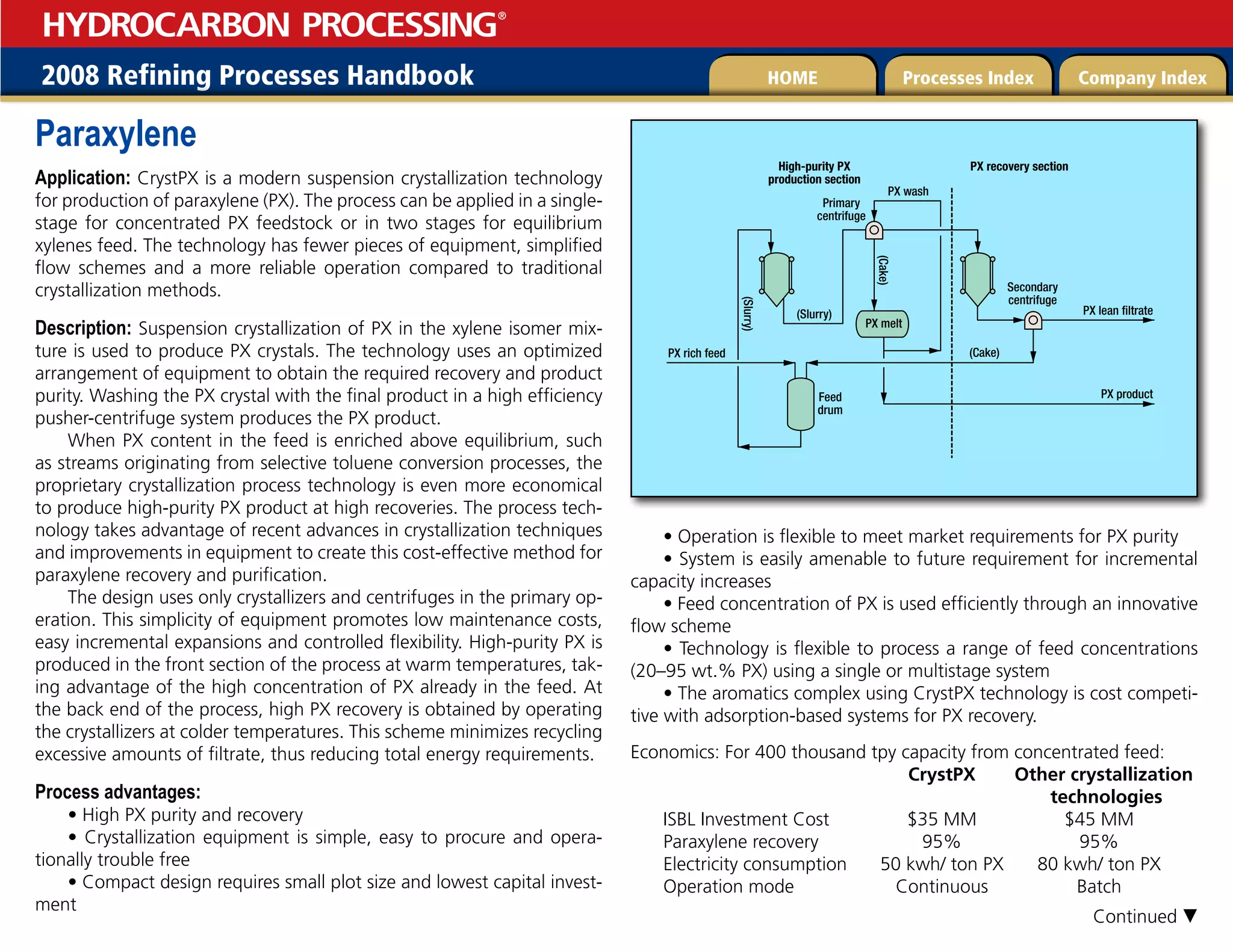
  • 91.
    2008 Refining ProcessesHandbook Processes Index Company Index HOME HYDROCARBON PROCESSING ® click here to e-mail for more information Benzene saturation Application: GTC Technology’s GT-BenZap is a benzene saturation tech- nology that allows refiners to achieve the upcoming benzene limit re- quired by EPA’s regulations under Mobile Sources Air Toxics Phase 2 (MSAT2). Benzene saturation is applied when the logistics of benzene recovery and production are unfavorable, or where the economy of scale for benzene production is not sufficient. Description: GT-BenZap process features a reliable traditional design paired with a proven nickel-based catalyst. The process consists of hydrotreating a narrow-cut C6 fraction, which is separated from the full-range reformate to saturate the benzene component into cyclo- hexane. The reformate is first fed to a reformate splitter where the C6 heart cut is separated as a side-draw fraction, while the C7+ cut and the C5– light fraction are removed as bottom and top products of the column. The C6 olefins present in the C6 cut are also hydrogenated to par- affins, while the C5– olefins removed at the top of the splitter are not, thus preserving the octane number. The hydrogenated C6 frac- tion from the reactor outlet is sent to a stabilizer column where the remaining hydrogen and lights are removed overhead. The C5– cut, produced from the splitter overhead, is recombined with the hydroge- nated C6 cut within the GT-BenZap process in a unique manner that reduces energy consumption and capital equipment cost. The light reformate is mixed with the C7+ cut from the splitter column and to- gether form the full-range reformate, which is low in benzene. GTC also offers a modular construction option and the possibility to reuse existing equipment. Process advantages: • Simple and reliable technology; low operating costs • An economical alternative to platinum-based systems • Ability to reduce the benzene in the reformate stream by over 99.9% • Minimized impact to hydrogen balance and octane loss. Installation: Technology available for license. Licensor: GTC Technology. Full-range reformate Reformate splitter C7+ C6- rich with benzene C5- Stabilizer Low-benzene gasoline blend stock Offgas Offgas H2
  • 92.
    2008 Refining ProcessesHandbook Processes Index Company Index HOME HYDROCARBON PROCESSING ® Paraxylene Application: CrystPX is a modern suspension crystallization technology for production of paraxylene (PX). The process can be applied in a single- stage for concentrated PX feedstock or in two stages for equilibrium xylenes feed. The technology has fewer pieces of equipment, simplified flow schemes and a more reliable operation compared to traditional crystallization methods. Description: Suspension crystallization of PX in the xylene isomer mix- ture is used to produce PX crystals. The technology uses an optimized arrangement of equipment to obtain the required recovery and product purity. Washing the PX crystal with the final product in a high efficiency pusher-centrifuge system produces the PX product. When PX content in the feed is enriched above equilibrium, such as streams originating from selective toluene conversion processes, the proprietary crystallization process technology is even more economical to produce high-purity PX product at high recoveries. The process tech- nology takes advantage of recent advances in crystallization techniques and improvements in equipment to create this cost-effective method for paraxylene recovery and purification. The design uses only crystallizers and centrifuges in the primary op- eration. This simplicity of equipment promotes low maintenance costs, easy incremental expansions and controlled flexibility. High-purity PX is produced in the front section of the process at warm temperatures, tak- ing advantage of the high concentration of PX already in the feed. At the back end of the process, high PX recovery is obtained by operating the crystallizers at colder temperatures. This scheme minimizes recycling excessive amounts of filtrate, thus reducing total energy requirements. Process advantages: • High PX purity and recovery • Crystallization equipment is simple, easy to procure and opera- tionally trouble free • Compact design requires small plot size and lowest capital invest- ment • Operation is flexible to meet market requirements for PX purity • System is easily amenable to future requirement for incremental capacity increases • Feed concentration of PX is used efficiently through an innovative flow scheme • Technology is flexible to process a range of feed concentrations (20–95 wt.% PX) using a single or multistage system • The aromatics complex using CrystPX technology is cost competi- tive with adsorption-based systems for PX recovery. Economics: For 400 thousand tpy capacity from concentrated feed: CrystPX Other crystallization technologies ISBL Investment Cost $35 MM $45 MM Paraxylene recovery 95% 95% Electricity consumption 50 kwh/ ton PX 80 kwh/ ton PX Operation mode Continuous Batch PX rich feed Secondary centrifuge Primary centrifuge PX wash PX lean filtrate PX product PX recovery section High-purity PX production section Feed drum PX melt (Slurry) (Cake) (Cake) (Slurry) Continued 
  • 93.
    Installation: Two commerciallicenses. Licensor: CrystPX is a proprietary process technology marketed and li- censed by GTC Technology Inc., in alliance with Lyondell. Paraxylene, continued click here to e-mail for more information
  • 94.
    2008 Refining ProcessesHandbook Processes Index Company Index HOME HYDROCARBON PROCESSING ® click here to e-mail for more information Styrene recovery Application: GT-Styrene is an extractive distillation (ED) process that di- rectly recovers styrene from the raw pyrolysis gasoline derived from the steam cracking of naphtha, gasoils and natural gas liquids (NGLs). The produced styrene is high purity and suitable for polymerization at a very attractive cost compared to conventional styrene production routes. If desired, the mixed xylenes can also be extracted from the pygas, up- grading their value as a chemical feedstock. The process is economically attractive for pygas feeds containing more than 15,000 tpy styrene. Description: Raw pyrolysis gasoline is prefractionated into a heartcut C8 stream. The resulting styrene concentrate is fed to an ED column and mixed with a selective solvent, which extracts the styrene to the tower bottoms. The rich solvent mixture is routed to a solvent recovery column SRC), which recycles the lean solvent back to the ED column and recovers the styrene overhead. A final purification step produces a 99.9% styrene product containing less than 50-ppm phenyl acetylene. The ED column overhead can be further processed to recover a high- quality mixed-xylene stream. A typical world-scale cracker can produce approximately 25,000 tpy styrene and 75,000 tpy mixed xylenes from pyrolysis gasoline. Process advantages: • Produces polymer-grade styrene at 99.9% purity • Allows the recovery of isomer-quality mixed xylenes for paraxylene production • Upgrades pygas stream components to chemical value • Debottlenecks pygas hydrotreater and extends cycle length • Reduces hydrogen consumed in hydrotreating • Optimized solvent system and design provide economical operat- ing costs Economics: Basis: 25,000 tpy styrene capacity Typical USGC capital cost $25 million Styrene value in pygas $800/ton Styrene product sales value $1,400/ton Net processing $160/ton Gross margin $11 million/yr Pretax ROI 44% Installation: Two commercial licenses. Licensor: GTC Technology. PA hydrogenation Feed pretreatment Finishing treatment Solvent C8 aromatics Heavies Extractive distillation Solvent recovery 99.9+ wt% Styrene product Styrene finishing Pygas C8 cut H2
  • 95.
    2008 Refining ProcessesHandbook Processes Index Company Index HOME HYDROCARBON PROCESSING ® click here to e-mail for more information Xylene isomerization Application: GT-IsomPX is GTC’s xylene isomerization technology. It is available in two versions: EB isomerization type and EB dealkylation type. Both versions gain high ethylbenzene (EB) conversion rates while pro- ducing equilibrium mixed xylenes. Catalysts that exhibit superior physi- cal activity and stability are the key to this technology. The technology and catalysts are used commercially in several applications. Description: For an EB dealkylation type of isomerization, the technolo- gy encompasses two main processing areas: reactor section and product distillation section. In this process, paraxylene (PX)-depleted feed stream is first mixed with hydrogen. The mixed stream is then heated against reactor effluent and through a process furnace. The heated mixture is fed into isomerization reaction unit, where m-xylene,o-xylene and PX are isomerized to equilibrium and EB is de-alkylated to benzene. The reactor effluent is cooled and flows to the separator, where the hydrogen-rich vapor phase is separated from the liquid stream. A small portion of the vapor phase is purged to control recycle hydrogen purity. The recycle hydrogen is then compressed, mixed with makeup hydrogen and returned to the reactor. The liquid stream from the separator is pumped to the deheptanizer to remove light hydrocarbons. The liquid stream from the deheptanizer overhead contains benzene and toluene and is sent to the distillation section to produce high-purity benzene and toluene products. The liquid stream from the deheptanizer bottoms contains mixed xylenes and a small amount of C9+ aromatics. This liquid stream is returned to the PX recovery section. Process advantages: • PX in xylenes reaches thermodynamic equilibrium after reaction • With the EB-dealkylation catalyst, the byproduct benzene is pro- duced at high purity by simple distillation. • Low H2/HC ratio, high WHSV and low xylenes loss • Long cycle length • Efficient heat integration scheme reduces energy consumption • Turnkey package for high-purity benzene, toluene and PX produc- tion available from licensor. Economics: Feedrate: 4,000 thousand tpy (88,000 bpsd); erected cost: $29 MM (ISBL, 2007 US Gulf Coast Basis). Installation: Technology available for license. Licensor: GTC Technology. Feed Offgas Light ends Deheptanizer bottom Deheptanizer Reactor Makeup H2 Reactor purge gas
  • 96.
    2008 Refining ProcessesHandbook Processes Index Company Index HOME HYDROCARBON PROCESSING ® click here to e-mail for more information Biodiesel Application: Consumption of primary energy has risen substantially in recent years, and greenhouse gases (GHG) emissions have increased by a substantial amount. To counter this trend, there is a global strong em- phasis on regenerative energy such as biofuels to effectively reduce or avoid such emissions. Description: The Lurgi biodiesel process is centered on the transesterifi- cation of different raw materials to methyl ester using methanol in the presence of a catalyst. In principle, most edible oils and fats—both veg- etable and animal sources—can be transesterified if suitably prepared. Transesterification is based on the chemical reaction of triglycerides with methanol to methyl ester and glycerine in the presence of an alka- line catalyst. The reaction occurs in two mixer-settler units. The actual conversion occurs in the mixers. The separation of methyl ester as the light phase and glycerine water as the heavy phase occurs in the settlers due to the insolubility of both products and the difference in density. Byproduct components are removed from the methyl ester in the down- stream washing stage, which operates in a counter-current mode. After a final drying step under vacuum, the biodiesel is ready for use. Any residual methanol contained in the glycerine water is removed in a rectification column. In this unit operation, the methanol has a puri- ty, which is suitable for recycling back to process. For further refinement of the glycerine water, optional steps are available such as chemical treatment, evaporation, distillation and bleaching to either deliver crude glycerine at approximately 80% concentration or pharmaceutical-grade glycerine at 99.7% purity. Economics: The (approximate) consumption figures—without glycerine distillation and bleaching—stated below are valid for the production of one ton of rapeseed methyl ester at continuous operation and nominal capacity. Steam, kg 320 Water, cooling (t = 10°C), m3 25 Electrical energy, kWh 12 Methanol, kg 96 Catalyst (Na-methylate 100%), kg 5 Hydrochloric acid (37%), kg 10 Caustic soda (50%), kg 1.5 Nitrogen, Nm3 1 Installation: Lurgi has been building biodiesel plants for 20 years. Only in the last five years, Lurgi has contracted more than 40 plants for the pro- duction of biodiesel with capacities ranging from 30,000 to 250,000 tpy. Licensors: Lurgi GmbH. Oil Methanol Biodiesel Transesterification Catalyst Crude glycerin Glycerin water evaporation Wash column Glycerin cross-flow (patented) Closed washwater loop Glycerin water Reactor 1 Reactor 2 Methanol recovery
  • 97.
    2008 Refining ProcessesHandbook Processes Index Company Index HOME HYDROCARBON PROCESSING ® Biodiesel Application: The RHT- Biodiesel process is optimized to produce biodiesel from palm oil, rape-seed oil, vegetable and animal products that contain fatty acids with even number of carbon atom (12 to 22). The lack of sulfur in the biodiesel enables complying with many international fuel specifications. The biodiesel is comparable to petroleum-based diesel. Triglycerides are reacted with methanol, ethanol or higher alcohols to yield biodiesel within the acceptable boiling range. Methanol is most commonly used for the biodiesel production since it is the most cost-effective of alco- hols, and it can provide better economics for the biodiesel producers. Biodiesel is produced by reacting vegetable oils and animal fats (triglyc- erides) with methanol in the presence of highly alkaline heterogeneous catalyst at moderate pressure and temperature. Pretreatment may be required if the vegetable oil has a high free-fatty acids content to optimize methyl esters yield. If free fatty acids are present in the feed, first step is esterfication of the free-fatty acid with metha- nol. However if the free-fatty acids concentrations are low, then this step can be deleted. The triglycerides and methanol are converted by transesterfication reaction to yield methyl esters of the oils and fats, and glycerine is pro- duced as a byproduct. The glycerine is separated from the methyl esters (biodiesel) by phase separation via gravity settling. The methyl esters and glycerine are purified to meet the product specifications. Description: In the simplified process flow diagram (1), the feed—veg- etable oil or animal fats—is pumped from storage and is mixed with methanol in the required molar ratio vegetable/methanol at moderate operating pressure. The feed is heated to the reaction temperature and is sent to esterification reactor. Free-fatty acids are pretreated if the con- centration exceeds 3% percent of the feed. The reactor contains an acid catalyst for this reaction and can remove 99.9 % of free-fatty acids from the vegetable oils. (Note: the pretreatment is only required when the feed contains free-fatty acids; otherwise, this step can be omitted. The effluent from the first reactor (if free-fatty acids are present) or the heated feed is sent to the transesterfication reactor, where 3 moles of methanol react with the triglyceride to produce 3 moles of methyl ester oil (biodiesel) and one mole of glycerine. The transesterfication re- actor uses a highly alkaline heterogeneous catalyst and provides essen- tially 100% conversion. The transesterification reactor effluent is sent Esterification reactor Transesterification reactor LP Gravity separator Methanol Biodiesel Biodiesel product Water wash Mixer Water Glycerine product MeOH/water for recovery MeOH/water for recovery Purification Purification Esterification reactor Transesterification reactors Triglycerides LP Gravity separator Methanol Biodiesel Biodiesel product Water wash Mixer Water Glycerine product MeOH/water for recovery MeOH/water for recovery Purification Triglycerides Wash solvent Residual glycerine/wash solvent Continued 
  • 98.
    Economics: The normalutilities for continuous biodiesel unit based on heterogeneous catalyst for tph of biodiesel capacity are listed. This does not include the glycerine purification utilities. The capital cost for the ISBL Biodiesel plant on Gulf coast site basis based on 1Q 2006 is pro- vided below. CAPEX ISBL plant : USD/ton Biodiesel 235–265 Steam, lb/h 368 Water, cooling gpm 64 Power, kWh 9 Licensor: Refining Hydrocarbon Technologies LLC. to gravity separator/settler. The biodiesel product is taken from the top of the separator, and is water washed. The washed biodiesel product is taken from the top of the drum. Water washing removes excess metha- nol from the reaction products, which is recovered by normal distillation; the pure methanol is recycled back to the reactor. The bottoms from the separator/settler are sent to the purification unit to remove impurities and residual methanol, which is recycled back. Pure glycerine product is sent to storage. Fig. 2 is an alternate flow scheme; a spare transesterification reactor is added to remove glycerine from the reactor to sustain reaction rates. Once the reaction rates are reduced the reactor is switched and washed with hot solvent to remove residual glycerine and biodiesel. This extra reactor patented mode of operation provides higher reactions rates and onstream capability while enhancing yield and productivity. Glycerine purity can exceed 99.8% after distillation. Reaction chemistry: Transesterification reactions: Triglycerides + 3 Methanol ➞ Methyl Ester of the oil (biodiesel) + Glycerol Comparision of the Diesel/Biodiesel Properties Fuel Property Diesel Biodiesel Fuel standard ASTM D 975 ASTM P S 121 Fuel composition C10–C21 HC C12–C22 FAME Lower heating value, Btu/gal 131 117 Kinemetic Vis @ 40°C 1.3–4.1 1.9–6 SG at 60°F 0.85 0.88 Water, wppm 161 500 Carbon 87 77 Hydrogen 13 12 Oxygen 0 11 Sulfur, wppm 15–500 0 Bp, °F 380–650 370–340 Flash Pt, °F 140–175 210–140 Biodiesel, continued click here to e-mail for more information
  • 99.
    2008 Refining ProcessesHandbook Processes Index Company Index HOME HYDROCARBON PROCESSING ® click here to e-mail for more information Green diesel Application: The UOP/Eni Ecofining process for the production of green diesel fuel is UOP’s solution to meeting the increasing demand for a sus- tainable high-quality renewable diesel using conventional hydroprocess- ing technology already widely used in refineries. Description: The Ecofining process deoxygenates and then hydroge- nates triglycerides and/or free fatty-acid feedstocks such as vegetable oils and animal fats. The resulting paraffins are then isomerized to create a high-quality hydrocarbon known as green diesel. If desired, the Ecofin- ing process can also be designed to produce a slipstream of a paraffinic green jet fuel stream in addition to the green diesel product. A thermochemical process, the Ecofining process produces green diesel fuel that is indistinguishable from traditional diesel fuel. It can be used as a direct replacement fuel or as a valuable blendstock to enhance the quality of the existing diesel pool. Blending of high-quality green diesel will allow the use of lower quality diesel range refinery product streams, ultimately reducing the cost of biofuel compliance and increas- ing the overall diesel pool. Designed for feedstock flexibility, the Ecofining process works with a wide range of pretreated biofeedstocks—from vegetable oils and ani- mal fats to second generation, non-food-based options such as jatropha and algal oils. The diesel yield and hydrogen consumption vary slightly according to the feed-stock source and the required product cloud point. The hy- drogen consumption may also vary between different feeds. Experience: UOP introduced Ecofining in early 2007 as the first com- mercial offering from its Renewable Energy Chemicals business group dedicated to introducing new technology for processing renewable energy sources in existing or new petroleum refineries worldwide. The Ecofining process is an extension of UOP’s leading portfolio of hydropro- cessing and isomerization technologies. Installation: ENI has announced construction of the first Ecofining unit, with startup due in 2010. A second unit was licensed in early 2008 amid significant market interest. Licensor: UOP. Green jet product Green propane and light ends Green naphtha product Water Separator Acid gas scrubber Reactor system CO2 Makeup hydrogen Feed Green diesel product Green diesel product Jet option
  • 100.
    2008 Refining ProcessesHandbook Processes Index Company Index HOME HYDROCARBON PROCESSING ® Deep catalytic cracking Application: Selective conversion of gasoil and paraffinic residual feed- stocks. Products: C2–C5 olefins, aromatic-rich, high-octane gasoline and dis- tillate. Description: Deep catalytic cracking (DCC) is a fluidized process for se- lectively cracking a wide variety of feedstocks to light olefins. Propylene yields over 24 wt% are achievable with paraffinic feeds. DCC uses a conventional traditional reactor/regenerator unit design with a catalyst that has physical properties similar to traditional FCC catalyst. The DCC unit may be operated in two operational modes: maximum propylene (Type I) or maximum iso-olefins (Type II). Each operational mode utilizes unique catalyst as well as reaction conditions. Maximum propylene DCC uses both riser and bed crack- ing at relatively severe reactor conditions while Type II DCC uses only riser cracking like a modern fluid catalytic cracking (FCC) unit at milder conditions. The overall flow scheme of DCC is very similar to that of a con- ventional FCC. However, innovations in the areas of catalyst devel- opment, process variable selection and severity and gas plant design enables the DCC to produce significantly more olefins than FCC in a maximum-olefins mode of operation. This technology is quite suitable for revamps as well as grassroots applications. Feed enters the unit through proprietary feed nozzles, as shown in the schematic. Integrating DCC technology into existing refineries as either a grassroots or revamp application can offer an at- tractive opportunity to produce large quantities of light olefins. In a market requiring both propylene and ethylene, use of both thermal and catalytic processes is essential, due to the fundamental differences in the reaction mechanisms involved. The combination of thermal and catalytic cracking mechanisms is the only way to increase total olefins from light and heavy feedstocks while meeting the need for increased propylene to ethylene ratio. A benefit associated with DCC rather than steam cracking for propylene production is a direct consequence of relative cost differences between DCC heavy feeds and steam cracker’s light feeds. Additional capital and operating cost- savings are achieved by the integration of the DCC unit and the adja- cent steam cracker. Products (wt% of fresh feed) DCC Type I DCC Type II FCC Ethylene 6.1 2.3 0.9 Propylene 20.5 14.3 6.8 Butylene 14.3 14.6 11.0 in which iC4 = 5.4 6.1 3.3 Amylene — 9.8 8.5 in which iC5 = — 6.5 4.3
  • 101.
    Deep catalytic cracking,continued Installation: A total of 15 DCC units have been licensed. Reference: Dharia, D., et al., “Increase light olefins production,” Hydro- carbon Processing, April 2004, pp. 61–66. Licensor: Shaw and Research Institute of Petroleum Processing, Sinopec. click here to e-mail for more information
  • 102.
    2008 Refining ProcessesHandbook Processes Index Company Index HOME HYDROCARBON PROCESSING ® click here to e-mail for more information Fluid catalytic cracking Application: Conversion of gas oils and residues to light olefins, high- octane gasoline, and distillates using the compact, self supporting Or- thoflow converter. Description: Feed enters through the proprietary ATOMAX-2 feed injec- tion system. Reaction vapors pass through a right angle turn and are quickly separated from the catalyst in a positive pressure closed-cyclone system. Closed cyclones minimize dry-gas make and increase gasoline yield. Spent catalyst flows through a stripper equipped with Dynaflux baffles to the regenerator where countercurrent flow of catalyst and air contacting is carried out. Catalyst flow from the regenerator to the external vertical riser is controlled by riser outlet temperature, which regulates the regenerated catalyst slide valve. A plug valve located in the regenerator bottom head controls the level in the stripper by regulating the catalyst flow from the spent catalyst standpipe. Either partial or complete CO combustion may be used in the regen- erator. Flue gas flows to an external plenum and then to the flue-gas system. A Cyclofines Third Stage Separator may be used to remove par- ticulates from the flue gas for protection of a power recovery expander and/or compliance with particulate emissions standards. Economics: The converter is a one-piece modularized unit that combines the disengager, stripper and regenerator vessels into a single structure. This unique design minimizes the cost of construction, and also reduces the amount of field mechanical work and required plot space. Installations: More than 150 grassroots units have been designed, re- sulting in a total of over 4 million bpsd fresh feed, with 12 of the latest units since 1990. References: “Maximizing flexibility for FCC’s designed to maximize propylene,” 2008 NPRA Annual Meeting, March 9–11, 2008, San Diego. “Optimize FCC Flue-Gas Emission Control—Part 2,” Hydrocarbon Processing, Vol. 81, No. 10, October 2002, pp. 85–91. “New developments in FCC feed injection and stripping technolo- gies,” NPRA Annual Meeting, March 2000. Licensors: KBR and ExxonMobil
  • 103.
    2008 Refining ProcessesHandbook Processes Index Company Index HOME HYDROCARBON PROCESSING ® Fluid catalytic cracking Application: Selective and high conversion of a wide range of feedstocks into high-value products. Feedstocks include virgin or hydrotreated gasoils that may also include lube oil extract, coker gasoil and resid. Products: High-octane gasoline, light olefins and distillate. Flexibility in unit operation allows for maximizing the most desirable product. Description: The Lummus process incorporates an advanced reaction system, high-efficiency catalyst stripper and a mechanically robust, single-stage fast fluidized bed regenerator. Oil is injected into the base of the riser via proprietary Micro-Jet feed injection nozzles (1). Catalyst and oil vapor flow upwards through a short-contact time, all-vertical riser (2) where raw oil feedstock is cracked under opti- mum conditions. Reaction products exiting the riser are separated from the spent catalyst in a patented, direct-coupled cyclone system (3). Product va- pors are routed directly to fractionation, thereby eliminating nonselec- tive post-riser cracking reactions and maintaining the optimum product yield slate. Spent catalyst containing only minute quantities of hydro- carbon is discharged from the diplegs of the direct-coupled cyclones into the cyclone containment vessel (4). The catalyst flows down into the stripper containing proprietary modular grid (MG) baffles (5). Trace hydrocarbons entrained with spent catalyst are removed in the MG stripper using stripping steam. The MG stripper efficiently removes hydrocarbons at low steam rate. The net stripper vapors are routed to the fractionator via specially designed vents in the direct- coupled cyclones. Catalyst from the stripper flows down the spent- catalyst standpipe and through the slide valve (6). The spent catalyst is then transported in dilute phase to the center of the regenerator (8) through a unique square-bend-spent catalyst transfer line (7). This arrangement provides the lowest overall unit elevation. Catalyst is regenerated by efficient contacting with air for complete combus- tion of coke. For resid-containing feeds, a catalyst cooler is integrat- ed with the regenerator. The resulting flue gas exits via cyclones (9) to energy recovery/flue gas treating. The hot regenerated catalyst is withdrawn via an external withdrawal well (10). The well allows independent optimization of catalyst density in the regenerated cata- lyst standpipe, maximizes slide valve (11) pressure drop and ensures stable catalyst flow back to the riser feed injection zone. The catalyst formulation can be tailored to maximize the most desired product. Economics: Investment (basis: 30,000 bpsd including reaction/regeneration system and product recovery. Excluding offsites, power recovery and flue gas scrubbing US Gulf Coast 2006.) $/bpsd (typical) 2,400–3,500 Utilities, typical per bbl fresh feed: Electricity, kWh 0.8–1.0 Steam, 600 psig (produced) 50–200 Maintenance, % of investment per year 2–3 Continued 
  • 104.
    Installation: Seventeen grassrootsunits licensed. Thirty-three units re- vamped, with five revamps in design stage. Licensor: Lummus Technology, a CBI company. Fluid catalytic cracking, continued click here to e-mail for more information
  • 105.
    2008 Refining ProcessesHandbook Processes Index Company Index HOME HYDROCARBON PROCESSING ® click here to e-mail for more information Fluid catalytic cracking Application: Selective conversion of gas oil feedstocks. Products: High-octane gasoline, distillate and C3– C4 olefins. Description: Catalytic and selective cracking in a short-contact-time riser where oil feed is effectively dispersed and vaporized through a proprietary feed-injection system. Operation is carried out at a temperature consistent with targeted yields. The riser temperature profile can be optimized with the proprietary mixed temperature control (MTC) system. Reaction products exit the riser-reactor through a high-efficiency, close-coupled, proprietary riser termination device RSS (riser separator stripper). Spent catalyst is pre-stripped followed by an advanced high- efficiency packed stripper prior to regeneration. The reaction prod- uct vapor may be quenched to give the lowest possible dry gas and maximum gasoline yield. Final recovery of catalyst particles occurs in cyclones before the product vapor is transferred to the fractionation section. Catalyst regeneration is carried out in a single regenerator equipped with proprietary air and catalyst distribution systems, and may be oper- ated for either full or partial CO combustion. Heat removal for heavier feedstocks may be accomplished by using reliable dense-phase catalyst cooler, which has been commercially proven in over 56 units. As an alternative to catalyst cooling, this unit can easily be retrofitted to a two-regenerator system (R2R) in the event that a future resid operation is desired. The converter vessels use a cold-wall design that results in mini- mum capital investment and maximum mechanical reliability and safe- ty. Reliable operation is ensured through the use of advanced fluidi- zation technology combined with a proprietary reaction system. Unit design is tailored to the refiner’s needs and can include wide turndown flexibility. Available options include power recovery, waste-heat recovery, flue-gas treatment and slurry filtration. Revamps incorporating pro- prietary feed injection and riser termination devices and vapor quench result in substantial improvements in capacity, yields and feedstock flexibility within the mechanical limits of the existing unit. Installation: Shaw and Axens have licensed 34 grassroots FCC units and performed more than 160 revamp projects. Reference: Meyers, R., Handbook of Petroleum Refining Process, Third Ed. Licensor: Shaw and Axens.
  • 106.
    2008 Refining ProcessesHandbook Processes Index Company Index HOME HYDROCARBON PROCESSING ® click here to e-mail for more information Fluid catalytic cracking Application: To convert heavy distillates and residues into high-value products, including selective propylene production when required, us- ing the Shell fluid catalytic cracking (FCC) process. Description: In this process, Shell’s high-performance feed nozzle sys- tem feeds hydrocarbons to a short contact-time riser. This design en- sures good mixing and rapid vaporization into the hot catalyst stream. Cracking selectivity is enhanced by the feed nozzles and proprietary riser-internals, which reduce catalyst back mixing while reducing overall riser pressure drop. Riser termination design incorporates reliable close-couple cyclones that provide rapid catalyst/hydrocarbon separation. It minimizes post- riser cracking and maximizes desired product yields, with no slurry clean up required. Stripping begins in the staged stripper, equipped with high- capacity baffle structure. A single-stage partial or full-burn regenerator delivers excellent per- formance at low cost. Proprietary internals are used at the catalyst inlet to disperse catalyst, and the catalyst outlet to provide significant catalyst circulation enhancement. Catalyst coolers can be added for more feed- stock flexibility. Cyclone-systems in the reactor and regenerator use a proprietary design, thus providing reliability, efficiency and robustness. Flue gas cleanup can be incorporated with Shell’s third-stage separator. Shell Global Solutions FCC technologies are proven reliability champi- ons due to simplicity of components and incorporation of Shell’s extensive operating experience. The latest addition to the Shell Global Solutions FCC technology is the MILOS process (Middle Distillate and Lower Olefins Selective process). With this technology, refiners can produce more diesel with improved quality and more propylene from FCC units. The key ele- ment of MILOS is a separate riser to produce the additional propylene, with its own optimal process conditions, while the existing FCC riser is used for “normal” cracking or for enhanced light cycle oil (LCO) make. This process option has a wide flexibility with respect to products, ranging from the normal product slate to maximized propylene or diesel, which can be achieved through operational measures. Installation: Over 30 grassroots units designed/licensed, including 7 to handle residue feeds, and over 30 units revamped. Supplier: Shell Global Solutions International B.V. Shell FCC design Shell MILOS-FCC design To fractionator To fractionator To fractionator MILOS riser reactor MILOS catalyst separator Close coupled cyclones Close coupled cyclones Catalyst circulation enhancement technology Advanced spent cat inlet device Cold-wall construction Cold-wall construction Staged stripping Staged stripping Riser internals Riser internals High performance feed nozzles High performance feed nozzles
  • 107.
    2008 Refining ProcessesHandbook Processes Index Company Index HOME HYDROCARBON PROCESSING ® Fluid catalytic cracking Application: Selectively convert gas oils and residue feedstocks into higher value products using the UOP FCC process, the UOP Resid FCC (RFCC) and the UOP PetroFCC process. Products: Light olefins (for alkylation, polymerization, etherification or petrochemicals), LPG, high-octane gasoline, distillates and fuel oils. Description: UOP’s process uses a side-by-side reactor/regenerator con- figuration and a patented pre-acceleration zone to condition the regen- erated catalyst. Modern Optimix feed distributors inject the feed into the riser, which terminates in a vortex separation system (VSS). A high- efficiency stripper then separates the remaining hydrocarbons from the catalyst, which is then reactivated in a combustor-style regenerator. With RxCat technology, a portion of the catalyst that is pre-stripped by the riser termination device can be recycled back to the riser via a standpipe and the MxR chamber. The reactor zone features a short-contact-time riser, state-of the- art riser termination device for quick separation of catalyst and vapor, with high hydrocarbon containment (VSS/VDS technology) and RxCat technology, wherein a portion of the pre-stripped (carbonized) catalyst from the riser termination device is blended with the hotter regenerated catalyst in a proprietary mixing chamber (MxR) for delivery to the riser. Unlike other approaches to increasing the catalyst-to-oil ratio, this technology does not affect the total heat balance and, therefore, does not increase coke yield. The reactor temperature can be lowered to re- duce thermal cracking with no negative impact on conversion, thus im- proving product selectivity. The ability to vary the carbonized/regener- ated catalyst ratio provides considerable flexibility to handle changes in feedstock quality and shortens the time for operating adjustments by enabling rapid switches between gasoline, olefins or distillate operat- ing modes. Since coke yield can be decreased at constant conversion, capacity and reaction severity can be increased, and CO2 emissions re- duced. Furthermore, because the catalyst delivered to the regenerator has a higher coke content, it requires less excess oxygen at a given tem- perature to sustain the same kinetic combustion rate. RxCat technology has been licensed for use in four units, two of which are currently in construction. The first unit to incorporate RxCat technology has been operating successfully since the second quarter of 2005. The combustor-style regenerator burns coke in a fast-fluidized envi- ronment completely to CO2 with very low levels of CO. The circulation of hot catalyst from the upper section to the combustor provides added control over the burn-zone temperature and kinetics and enhances ra- dial mixing. Catalyst coolers can be added to new and existing units to reduce catalyst temperature and increase unit flexibility for commercial operations of feeds up to 6 wt% Conradson carbon. A recent study of eight different combustor-style regenerators and 15 bubbling-bed re- generators clearly demonstrated that at a given excess oxygen level, less NOx is emitted from the combustor-style regenerators than other avail- able technologies. MxR chamber Recycled catalyst standpipe Reactor Regenerator Continued 
  • 108.
    For heavier residuefeeds, the two-stage regenerator is used. In the first stage, upper zone, the bulk of the carbon is burned from the cata- lyst, forming a mixture of CO and CO2. Catalyst is transferred to the second stage, lower zone, where the remaining coke is burned in com- plete combustion, producing low levels of carbon on regenerated cata- lyst. A catalyst cooler is located between the stages. This configuration maximizes oxygen use, requires only one train of cyclones and one flue gas stream, which avoids costly multiple flue gas systems and creates a hydraulically-simple. The two stage regenerator system has processed feeds up to 8.5 wt% Conradson carbon. PetroFCC is a customized application using mechanical features such as RxCAT technology for recontacting carbonized catalyst, high sever- ity processing conditions and selected catalyst and additives to produce high yields of propylene, light olefins and aromatics for petrochemical applications. UOP’s Advanced Fluidization (AF) spent catalyst stripper internals provide a family of options (trays, grids and packing) all with state of the art efficiency. Often the optimal selection is dependent on the unique configuration of the unit, site constructability and inspection issues. Within residence constraints, the new designs can save about 10 feet in length compared to 1990s units of the same capacity and diameter. The benefits provided by the AF internals include reduced coke, lower re- generator temperature, higher catalyst circulation, lower dry gas make, increased conversion, higher selectivity for desired products, the ability to operate at high catalyst flux and increased capacity, and lower steam consumption. One application of AF trays resulted in a 0.04 wt% reduc- tion in coke, a 14°F (8°C) drop in the regenerator temperature, and a 2.3 LV% boost in conversion. Another FCC unit utilizes these trays to handle a high catalyst flux rate of over 2-M lb/ft2 min. The installation of AF grids in a small unit increased conversion and gasoline yield by 3.0 LV% and 2.8 LV% respectively, paying back the investment in less than three months. UOP’s stripper technology has been implemented in more than 36 FCC units with a combined on-stream capacity exceeding 1MM bpsd. Installation: All of UOP’s technology and equipment are commercially proven for both process performance and mechanical reliability. UOP has been an active designer and licensor of FCC technology since the early 1940s and has licensed more than 225 FCC, Resid FCC and MSCC process units. More than 150 of these units are operating worldwide. In addition to applying our technology and skills to new units, UOP is also extensively involved in the revamping of existing units. During the past 15 years, UOP’s FCC Engineering department has undertaken 40 to 60 revamp projects or studies per year. Licensor: UOP. Fluid catalytic cracking, continued click here to e-mail for more information
  • 109.
    2008 Refining ProcessesHandbook Processes Index Company Index HOME HYDROCARBON PROCESSING ® Fluid catalytic cracking for maximum olefins Application: The Indmax FCC (I-FCC) process cracks a wide range of feedstocks into light olefins. Feedstocks include virgin or hydrotreated gasoil that may include lube oil extract, coker gasoil and resid. Products: Light olefins (principally propylene, but also ethylene and butylenes), high-octane gasoline, blending components, and distillate. Flexibility of unit operation allows for maximizing propylene, propylene plus ethylene, or propylene plus gasoline. Catalyst: The Indmax catalyst is a unique, proprietary, multi-component, multi-functional catalyst formulation that promotes selective component cracking to provide very high conversion and yield of light olefins. It is highly metals-tolerant and produces low delta coke and dry gas – prop- erties that are particularly important when processing residue to make light olefins. Description: The I-FCC unit is designed for and operated at Indmax process conditions: riser reactor temperature from 560°C to 600°C, catalyst-to-oil ratio from 12 to 20, and lower hydrocarbon partial pressure compared to conventional FCC operations. The I-FCC pro- cess incorporates an advanced reaction system, high-efficiency cata- lyst stripper and a mechanically robust, single-stage fast fluidized bed regenerator. Oil is injected into the base of the riser via proprietary Micro-Jet feed injection nozzles (1). Catalyst and oil vapor flow up- wards through a short-contact time, all-vertical riser (2) where raw oil feedstock is cracked under optimum conditions. Reaction products exiting the riser are separated from the spent catalyst in a patented, direct-coupled cyclone system (3). Product vapors are routed directly to fractionation, thereby eliminating non- selective, post-riser cracking and maintaining the optimum prod- uct yield slate. Spent catalyst containing only minute quantities of hydrocarbon is discharged from the diplegs of the direct-coupled cyclones into the cyclone containment vessel (4). The catalyst flows down into the stripper containing proprietary modular grid (MG) baffles (5). Trace hydrocarbons entrained with spent catalyst are removed in the MG stripper using stripping steam. The MG stripper efficient- ly removes hydrocarbons at low steam rate. The net stripper vapors are routed to the fractionator via specially designed vents in the direct-coupled cyclones. Catalyst from the stripper flows down the spent-catalyst standpipe and through the slide valve (6). The spent catalyst is then transported in dilute phase to the center of the re- generator (8) through a unique square-bend-spent catalyst transfer line (7). This arrangement provides the lowest overall unit elevation. Catalyst is regenerated by efficient contacting with air for complete combustion of coke. For resid-containing feeds, the optional cata- lyst cooler is integrated with the regenerator. The resulting flue gas exits via cyclones (9) to energy recovery/flue gas treating. The hot regenerated catalyst is withdrawn via an external withdrawal well Continued 
  • 110.
    (10). The wellallows independent optimization of catalyst density in the regenerated catalyst standpipe, maximizes slide valve (11) pressure drop and ensures stable catalyst flow back to the riser feed injection zone. Economics: Investment (basis: 30,000 bpsd including reaction/regeneration system and product recovery. Excluding offsites, power recovery and flue gas scrubbing US Gulf Coast 2006.) $/bpsd (typical) 3,000–4,000 Fluid catalytic cracking for maximum olefins, continued click here to e-mail for more information Installation: Two grassroots units licensed. One demonstration-scale unit is commercially operating. Licensor: Lummus Technology, a CBI company.
  • 111.
    2008 Refining ProcessesHandbook Processes Index Company Index HOME HYDROCARBON PROCESSING ® click here to e-mail for more information Fluid catalytic cracking, high olefin Application: MAXOFIN FCC offers refiners greater returns by maximizing propylene yields from FCC feedstocks. Over 20 wt% propylene yield can be produced from gasoils by combining the effects of enhanced ZSM-5 catalysts and proprietary hardware. Description: This dual-riser design uses independent riser reaction con- ditions (cat/oil and temperatures) for heavy and light feedstocks. C4–C6 nonaromatic naphtha cuts can be recycled to the light hydrocarbon riser. In addition to processing light naphtha, the recycle riser can also accept coker and light-straight-run naphthas from the refinery. Both risers can operate at 100% gas oil/resid if market conditions dictate the need for petroleum products instead of petrochemicals. The recycle riser is an external, cold wall riser similar to the primary riser. Products produced from both risers merge in the disengager vessel and travel as a common stream to the main fractionator. Yields: The following yields were produced from a pilot plant using a hydrocracked gasoil feedstock: Yields, wt% Run A Run B Run C Run D Ethylene 3.2 3.9 6.4 8.2 Propylene 16.0 18.7 19.1 21.5 C5+ gasoline 37.9 28.8 26.2 25.0 Economics: Investment and operating costs are only slightly higher than a conventional FCC with a single riser. Installation: All elements of MAXOFIN FCC technology have been prov- en. Propylene yield was dependent upon constraints in the downstream gas plant and not the converter section. Reference: “Maximizing Flexibility for FCC’s Designed to Maximize Propylene,” NPRA 2008 Annual Meeting, March 9–11, 2008, San Diego. “Future refinery—FCC’s role in refinery/petrochemical integration,” NPRA 2001 Annual Meeting, March 2001. Licensors: KBR and ExxonMobil.
  • 112.
    2008 Refining ProcessesHandbook Processes Index Company Index HOME HYDROCARBON PROCESSING ® click here to e-mail for more information Fluid catalytic cracking, residual Application: Conversion of low-value residual feeds and deasphalted oils from heavy crudes to high-valued light olefins, gasoline and distillates. Description: The converter is a one-piece modularized unit that efficiently combines KBR’s proven Orthoflow features with ExxonMobil’s advanced reaction design features. The regenerator is a single vessel that operates in partial or complete CO combustion with a dense phase catalyst cooler depending on the coke-forming tendencies of the feedstock. The regenerator operates with a counter current flow of air and catalyst featuring a (1) spent catalyst distributor that evenly distributes the catalyst over the regenerator bed; and a (2) proprietary baffle that limits back-mixing between the upper and lower portions of the bed, effectively achieving a staged combustion in a single regenerator. The counter-current regeneration also reduces NOx emissions compared to other types of regenerators. Economics: Investment: (basis 50,000 BPSD fresh feed including converter, main fractionator, vapor recovery unit, C3 splitter, and amine treating (no power recovery), battery limit, direct material and labor, 2008 Gulf Coast), $/bbl- 4900 to 5400. Utilities, typical per bbl fresh feed Electricity, kWh 0.7–1.0 Steam, 600 psig, produced, lb 40–200 Maintenance: % of plant replacement cost/y 3 Installation: Since 1990, KBR has designed more than a dozen FCC units, including those that process resid and have revamped more than 160 FCC units worldwide Reference: “Holding the key,” Hydrocarbon Engineering, March 2008. Niccum, P. K. et al., “Optimize FCC Flue-Gas Emission Control— Part 2,” Hydrocarbon Processing, Vol. 81, No. 10, October 2002, pp. 85–91. “New developments in FCC feed injection and stripping technolo- gies,” 2000 NPRA Annual Meeting, March 2000. Licensors: KBR and ExxonMobil.
  • 113.
    2008 Refining ProcessesHandbook Processes Index Company Index HOME HYDROCARBON PROCESSING ® click here to e-mail for more information Fluid catalytic cracking—pretreatment Application: Topsøe’s FCC pretreatment technology is designed to treat a wide variety of feedstocks ranging from gasoils through heavy-vacu- um gas oils and coker streams to resids. This pretreatment process can maximize FCC unit performance. Objectives: The processing objectives range from deep desulfurization for meeting gasoline-sulfur specifications from the FCC products, to de- nitrogenation and metals removal, thus maximizing FCC catalyst activ- ity. Additional objectives can include Conradson carbon reduction and saturation of polyaromatics to maximize gasoline yields. Description: The Topsøe FCC Pretreatment technology combines under- standing of kinetics, high-activity catalysts, state-of-the-art internals and engineering skills. The unit can be designed to meet specific process- ing objectives in a cost-effective manner by utilizing the combination of processing severity and catalyst activity. Topsøe has experience in revamping moderate- to low-pressure units for deep desulfurization. Such efforts enable refiners to directly blend gasoline produced from the FCC and meet future low-sulfur (less than 15 ppm) gasoline specifications. An additional option is Topsøe’s Aroshift process that maximizes the conversion of polyaromatics which can be equilibrium limited at high operating temperatures. The Aroshift process increases the FCC conver- sion, and the yield of gasoline and C3/C4 olefins, while reducing the amount of light- and heavy-cycle oil. Furthermore, the quality of the FCC gasoline is improved. Topsøe has a wide variety of catalysts for FCC pretreatment service. The catalysttypescoverTK-558BRIM,aCoMocatalystwithhighdesulfurization activity, and TK-559 BRIM, a NiMo catalyst with hydrodesulfurization and high hydrodenitrogenation activity. Topsøe offers a wide range of engi- neering scopes from full scoping studies, reactor design packages and process design packages to engineering design packages. Operating conditions: Typical operating pressures range from 60 to 125 bar (900 to 1,800 psi), and temperatures from 300°C to 430°C (575°F to 800°F). References: Andonov, G., S. Petrov, D. Stratiev and P. Zeuthen, “MCHC mode vs. HDS mode in an FCC unit in relation to Euro IV fuels specifica- tions,” 10th ERTC, Vienna, November 2005. Patel R., H. Moore and B. Hamari, “FCC hydrotreater revamp for low- sulfur gasoline,” NPRA Annual Meeting, San Antonio, March 2004. Patel, R., P. Zeuthen and M. Schaldemose, “Advanced FCC feed pre- treatment technology and catalysts improves FCC profitability,” NPRA Annual Meeting, San Antonio, March 2002. Installations: Four units in the US. Licensor: Haldor Topsøe A/S. START Products to FCC or fractionation Rich amine Lean amine H2 rich gas Makeup hydrogen Furnace Reactor Absorber High-pressure separator Low-pressure separator Fresh feed Recycle gas compressor
  • 114.
    2008 Refining ProcessesHandbook Processes Index Company Index HOME HYDROCARBON PROCESSING ® click here to e-mail for more information Resid catalytic cracking Application: Selective conversion of gasoil and heavy residual feed- stocks. Products: High-octane gasoline, distillate and C3– C4 olefins. Description: For residue cracking the process is known as R2R (reactor–2 regenerators). Catalytic and selective cracking occurs in a short-contact- time riser where oil feed is effectively dispersed and vaporized through a proprietary feed-injection system. Operation is carried out at a tempera- ture consistent with targeted yields. The riser temperature profile can be optimized with the proprietary mixed temperature control (MTC) system. Reaction products exit the riser-reactor through a high-efficiency, close-coupled, proprietary riser termination device RSS (riser separator stripper). Spent catalyst is pre-stripped followed by an advanced high- efficiency packed stripper prior to regeneration. The reaction product vapor may be quenched to give the lowest dry gas and maximum gaso- line yield. Final recovery of catalyst particles occurs in cyclones before the product vapor is transferred to the fractionation section. Catalyst regeneration is carried out in two independent stages equipped with proprietary air and catalyst distribution systems resulting in fully regenerated catalyst with minimum hydrothermal deactivation, plus superior metals tolerance relative to single-stage systems. These benefits are derived by operating the first-stage regenerator in a partial burn mode, the second-stage regenerator in a full-combustion mode and both regenerators in parallel with respect to air and flue gas flows. The resulting system is capable of processing feeds up to about 6 wt% ConC without additional catalyst cooling means, with less air, lower catalyst deactivation and smaller regenerators than a single-stage regenerator design. Heat removal for heavier feedstocks (above 6 CCR) may be accom- plished by using a reliable dense-phase catalyst cooler, which has been commercially proven in over 56 units. The converter vessels use a cold-wall design that results in minimum capital investment and maximum mechanical reliability and safety. Reliable operation is ensured through the use of advanced fluidiza- tion technology combined with a proprietary reaction system. Unit design is tailored to refiner’s needs and can include wide turndown flexibility. Available options include power recovery, wasteheat recovery, flue- gas treatment and slurry filtration. Existing gasoil units can be easily retrofitted to this technology. Re- vamps incorporating proprietary feed injection and riser termination de- vices and vapor quench result in substantial improvements in capacity, yields and feedstock flexibility within the mechanical limits of the exist- ing unit. Installation: Shaw and Axens have licensed 34 grassroots FCC units and performed more than 160 revamp projects. Reference: Meyers, R., Handbook of Petroleum Refining Process, Third Ed. Licensor: Shaw and Axens.
  • 115.
    2008 Refining ProcessesHandbook Processes Index Company Index HOME HYDROCARBON PROCESSING ® Resid cracking Application: Selective conversion of heavy feedstocks into petrochemi- cal products Products: C3–C4 olefins, in particular propylene; high-octane gasoline, aromatics Description: Based on the R2R resid fluid catalytic cracking (RFCC) pro- cess using a riser and a double regenerator for gasoline production, this new petrochemical version is oriented toward light olefins, particularly propylene, and aromatics. The process is characterized by the utilization of two independent risers. The main riser cracks the resid feed under con- ditions to optimize fuels production; the second PetroRiser riser is oper- ated to selectively crack specific recycle streams to maximize propylene production. The RFCC applies a short contact-time riser, proprietary injection sys- tem and severe cracking conditions for bottoms conversion. The tempera- ture and catalyst circulation rates are higher than those used for a conven- tional gasoline mode operation. The main riser temperature profile can be optimized with a mixed temperature control (MTC) system. Reaction products are then rapidly separated from the catalyst through a high- efficiency riser termination device (RS2). Recycle feed is re-cracked in the PetroRiser under conditions, which are substantially more severe than in the main riser. A precise selection of recycle cuts combined with adapted commercial FCC catalysts and addi- tives lead to high propylene yields with moderate dry-gas production. Both the main riser and PetroRiser are equipped with a rapid sepa- ration system, and the deactivated catalysts are collected in to a single packed stripper, which enhances steam stripping efficiency of the cata- lyst. Catalyst regeneration is carried out in two, independent stages to minimize permanent hydrothermal activity loss. The first stage is operated in a mild partial-combustion mode that removes produced moisture and limits catalyst deactivation, while the second stage finishes the combus- tion at higher temperature to fully restore catalyst activity. The R2R system is able to process residue feed containing high metals and CCR using this regenerator configuration and even higher contents with the addition of a catalyst cooler. The recycle feeds that can be used in the PetroRiser are light and medium FCC gasoline as well as olefin streams coming from a butenes oligomerization unit. This last option is of particular interesting under market conditions that favor propylene over C4 olefins. The reaction and regeneration sections use a cold-wall design that re- sults in minimum capital investment and maximum mechanical reliability and safety. Units are tailored to fit the market needs (feedstock and prod- uct slate) and can include a wide range of turndown flexibility. Available options include power recovery, waste-heat recovery, flue-gas treatment and slurry filtration and light olefins recovery and purification. Continued 
  • 116.
    Installation: PetroRiser technologyis available for revamp of all RFCC and FCC units. Axens and the Shaw Group have licensed more than 40 FCC units and performed more than 100 revamp projects since the alli- ance was created. Resid cracking, continued Reference: “Fine-tune FCC operations for changing fuels market,” Hy- drocarbon Processing, September 2005. Licensor: Axens and Shaw. click here to e-mail for more information
  • 117.
    2008 Refining ProcessesHandbook Processes Index Company Index HOME HYDROCARBON PROCESSING ® click here to e-mail for more information Catalytic reforming Application: Upgrade various types of naphtha to produce high-octane reformate, BTX and LPG. Description: Two different designs are offered. One design is conventional where the catalyst is regenerated in place at the end of each cycle. Oper- ating normally in a pressure range of 12 to 25 kg/cm2 (170 to 350 psig) and with low pressure drop in the hydrogen loop, the product is 90 to 100 RONC. With their higher selectivity, trimetallic catalysts RG582 and RG682 make an excellent catalyst replacement for semi-regenerative reformers. The second, the advanced Octanizing process, uses continuous cata- lyst regeneration allowing operating pressures as low as 3.5 kg/cm2 (50 psig). This is made possible by smooth-flowing moving bed reactors (1–3) which use a highly stable and selective catalyst suitable for continuous regeneration (4). Main features of Axens’ regenerative technology are: • Side-by-side reactor arrangement, which is very easy to erect and consequently leads to low investment cost. • The RegenC-2 catalyst regeneration system featuring the dry burn loop, completely restores the catalyst activity while maintaining its specific area for more than 600 cycles. Finally, with the new CR 601 (gasoline mode) and AR 701 (aromatics production) catalysts specifically developed for ultra-low operating pres- sure and the very effective catalyst regeneration system, refiners operat- ing Octanizing or Aromizing processes can obtain the highest hydrogen, C5+ and aromatics yields over the entire catalyst life. Yields: Typical for a 90°C to 170°C (176°F to 338°F) cut from light Ara- bian feedstock: Conventional Octanizing/Aromizing Oper. press., kg/cm2 10–15 3–7 Yield, wt% of feed: Hydrogen 2.8 3–4 C5+ 83 88–95 RONC 100 100–105 MONC 89 89–92 Installation: Of 140 units licensed, 88 units are designed with continu- ous regeneration technology capability. Reference: “Fixed Bed Reformer Revamp Solutions for Gasoline Pool Improvement,” Petroleum Technology Quarterly, Summer 2000. “Increase reformer performance through catalytic solutions,” Sev- enth ERTC, November 2002, Paris. “Squeezing the most out of fixed-bed reactors,” Hart Show Special, NPRA 2003 Annual. “Octanizing reformer options to optimize existing assets,” NPRA Annual Meeting, March 15–17, 2005, San Francisco. “Octanizing reformer options,” Petroleum Technology Quarterly, Spring, 2006. Boitiaux, J. P., et al., “New developments accelerating catalyst re- search,” Hydrocarbon Processing, September 2006, pp. 33–40. Licensor: Axens. START Feed 2 3 4 1 Reformate
  • 118.
    2008 Refining ProcessesHandbook Processes Index Company Index HOME HYDROCARBON PROCESSING ® click here to e-mail for more information Catalytic reforming Application: The UOP CCR Platforming process is used throughout the world in the petroleum and petrochemical industries. It produces feed for an aromatics complex or a high-octane gasoline blending product and a significant amount of hydrogen. Description: Hydrotreated naphtha feed is combined with recycle hy- drogen gas and heat exchanged against reactor effluent. The combined feed is then raised to reaction temperature in the charge heater and sent to the reactor section. Radial-flow reactors are arranged in a vertical stack. The predomi- nant reactions are endothermic; so an interheater is used between each reactor to reheat the charge to reaction temperature. The effluent from the last reactor is heat exchanged against combined feed, cooled and split into vapor and liquid products in a separator. The vapor phase is hydrogen-rich. A portion of the gas is compressed and recycled back to the reactors. The net hydrogen-rich gas is compressed and charged to- gether with the separator liquid phase to the product recovery section. This section is engineered to provide optimum performance. Catalyst flows vertically by gravity down the reactor stack. Over time, coke builds up on the catalyst at reaction conditions. Partially de- activated catalyst is continually withdrawn from the bottom of the reac- tor stack and transferred to the CCR regenerator. Installation: UOP commercialized the CCR Platforming process in 1971 and now has commissioned more than 210 units (more than 4.7 million bpd of capacity) with another 50 in various stages of design, construc- tion and commissioning. Efficiency/product quality: Commercial onstream efficiencies of more than 97% are routinely achieved in CCR Platforming units. Licensor: UOP. Stacked reactor CCR regenerator Regenerated catalyst Net gas compressor Recovery section Separator Combined feed exchanger Naphtha feed from treating Net H2 rich gas Fuel gas Light ends Aromatic rich reformate Stabilizer Spent catalyst Fired heaters
  • 119.
    2008 Refining ProcessesHandbook Processes Index Company Index HOME HYDROCARBON PROCESSING ® click here to e-mail for more information Coking Application: Upgrade residues to lighter hydrocarbon fractions using the Selective Yield Delayed Coking (SYDEC) process. Description: Charge is fed directly to the fractionator (1) where it com- bines with recycle and is pumped to the coker heater. The mixture is heated to coking temperature, causing partial vaporization and mild cracking. The vapor-liquid mix enters a coke drum (2 or 3) for further cracking. Drum overhead enters the fractionator (1) to be separated into gas, naphtha, and light and heavy gas oils. Gas and naphtha enter the vapor recovery unit (VRU)(4). There are at least two coking drums, one coking while the other is decoked using high-pressure water jets. The coking unit also includes a coke handling, coke cutting, water recovery and blowdown system. Vent gas from the blowdown system is recov- ered in the VRU. Operating conditions: Typical ranges are: Heater outlet temperature, ºF 900–950 Coke drum pressure, psig 15–100 Recycle ratio, equiv. fresh feed 0–1.0 Increased coking temperature decreases coke production; increases liquid yield and gas oil end point. Increasing pressure and/or recycle ra- tio increases gas and coke make, decreases liquid yield and gas oil end point. Yields: Operation: Products, wt% Max dist. Anode coke Needle coke Gas 8.7 8.4 9.8 Naphtha 14.0 21.6 8.4 Gas oil 48.3 43.8 41.6 Coke 29.3 26.2 40.2 Economics: Investment (basis 65,000–10,000 bpsd) 2Q 2005 US Gulf), $ per bpsd 6,700–13,600 Utilities, typical per bbl feed: Fuel, 103 Btu 120 Electricity, kWh 3 Steam (exported), lb 35 Water, cooling, gal 36 Installations: Currently, 52 delayed cokers are installed worldwide with a total installed capacity over 2.5 million bpsd References: Handbook of Petroleum Refining Processes, Third Ed., Mc- Graw-Hill, pp. 12.33–12.89. “Delayed coking revamps,” Hydrocarbon Processing, September 2004. “Residue upgrading with SYDEC Delayed Coking: Benefits Eco- nomics,” AIChE Spring National Meeting, April 23–27, 2006, Orlando. “Upgrade refinery residuals into value-added products,” Hydrocar- bon Processing, June 2006. Licensor: Foster Wheeler USA Corp./UOP. 4535 %SZHBT $$ 736 /BQIUIB 4UFBN -JHIUHBTPJM )FBWZHBTPJM 'FFE
  • 120.
    2008 Refining ProcessesHandbook Processes Index Company Index HOME HYDROCARBON PROCESSING ® click here to e-mail for more information Coking Application: The coking process involves cracking of heavy residual oils into more valuable gasoil, distillate, naphtha and LPG products. Coke is also produced. Normal feeds include vacuum bottoms, atmospheric bottoms, asphaltenes from ROSE and other types of solvent deasphalt- ing units, bitumen and other heavy oils, thermal and pyrolsis tars, de- cant oils, visbreaker and thermal tars. Description: Delayed coking is a semi-batch thermal cracking process. The process is comprised of coker heaters, coke drums, fractionation, vapor recovery unit, hydraulic decoking, coke handling and blowdown systems. Feed is normally routed via coker fractionator to remove light fractions. Feed plus recycle from the fractionator are brought to coking temperature in a specially designed heater and then sent to the coke drum. The feed cracks into lighter fractions and coke in the coke drum. Cracked material exiting from the overhead is quenched and sent to the fractionator. After the coke level in the drum has reached the maximum accepted level, the feed is directed to the second drum. The drum with coke is cooled, then cut with high-pressure water jets and removed to coke handling area. The drum is then heated and put back in service when the second drum fills up with coke. Process applications: KBR has designed and delivered significant pilot- plant work on coking of asphaltenes obtained from bitumen and other heavy oils. Comparison of coke produced from vacuum resid and asphaltenes: Basis: Refinery Feed: 200,000 bpsd Arab Heavy Maya VTB Asphaltene VTB Asphaltene Coker Feed Mbpsd 49.7 26.5 63.6 49.1 wt.% CCR 23.8 38 31.2 38 Coke make, Mtd 2.7 2.1 4.4 4 Process development: KBR operates a large one bpd coker pilot plant at its Technology Center in Houston. The pilot plant is used for process development and for run- ning coker pilot tests for clients. Experience: KBR has provided process technology for more than 15 cok- ers. The most recent design is for a bitumen vacuum resid coker, which is expected startup in 2008. Licensor: KBR. Blowdown Hydraulic decoking Coke handling VRU Fuel gas LPG Naphtha Water Water Makeup water Slop oil to coker feed Vapors to recovery Crushed coke Resid feed Steam BFW BFW Steam Light GO HGO
  • 121.
    2008 Refining ProcessesHandbook Processes Index Company Index HOME HYDROCARBON PROCESSING ® Coking Application: Conversion of atmospheric and vacuum residues, hydro- treated and hydrocracked resids, asphalt, pyrolysis tar, decant oil, visbro- ken or coal tar pitch, solvent-refined and Athabasca bitumen. Description: Feedstock is introduced (after heat exchange) to the bot- tom of the coker fractionator (1) where it mixes with condensed recycle. The mixture is pumped to one of two coke drums (3) through the coker heater (2) where the desired coking temperature is achieved. Steam or boiler feedwater is injected into the heater tubes to prevent coking in the furnace tubes. Coke drum overhead vapors flow to the fractionator (1) where they are separated into an overhead stream containing the wet gas, LPG and naphtha and two gasoil sidestreams. The overhead stream is sent to a vapor recovery unit (4) where the individual light product streams are separated. The coke that forms in one of at least two (parallel connected) drums is then removed using high-pressure water. The plant also includes a blow-down system for recovery of all vent gas and slop streams, coke handling and a water recovery system. Operating conditions: Heater outlet temperature, °F 900–950 Coke drum pressure, psig 15–90 Recycle ratio, vol/vol feed, % 0–100 Yields: Vacuum residue of Middle East hydrotreated Athabasca Feedstock vac. residue bottoms bitumen Gravity, °API 7.4 1.3 2.5 Sulfur, wt% 4.2 2.3 5.7 Conradson carbon, wt% 20.0 27.6 23.0 Products, wt% Gas + LPG 7.9 9.0 9.2 Naphtha 12.6 11.1 12.5 Gas oils 50.8 44.0 46.0 Coke 28.7 35.9 32.5 Economics: Investment (basis: 20,000 bpsd straight-run vacuum residue feed, US Gulf Coast 2008, fuel-grade coke, includes vapor recovery), US$ per bpsd (typical) 8,000 'VFMHBT $$-1( $PLFSOBQIUIB -JHIUHBTPJM )FBWZHBTPJM #'8 4UN 4UN 4UN #'8 'SFTIGFFE 4535 Continued 
  • 122.
    Economics (continued): Utilities, typical/bblof feed: Fuel, 103 Btu 123 Electricity, kWh 3.6 Steam (exported), lb 1 Water, cooling, gal 58 Boiler feedwater, lbs 38 Condensate (exported), lbs 24 Coking, continued click here to e-mail for more information Installation: More than 60 units. Reference: Sieli, G. M., A. Faegh and S. Shimoda, “The impact of de- layed coker operating conditions on refinery operations,” ERTC Coking Gasification Conference, April 16–18, 2007. Licensor: Lummus Technology, a CBI company.
  • 123.
    2008 Refining ProcessesHandbook Processes Index Company Index HOME HYDROCARBON PROCESSING ® Coking, fluid Application: ExxonMobil’s Research Engineering (EMRE’s) continuous thermal conversion process with fluidized bed reactor to convert heavy hydrocarbons (vacuum residuum, extra heavy oil or bitumen) to lighter liquid products and fuel-grade coke. Attractive when markets available for fuel-grade fluid coke, or if planned applications include present or future addition of a fluid bed boiler for cogeneration of steam and pow- er as this combination has both heat integration as well as SOx removal benefits. Products: Liquid products produced are similar in yields and quality to delayed coking. These products are upgraded through conventional hydrotreating, hydrocracking or in a fluid catalytic cracker (FCC). Fluid coke is used as a solid fuel, with particular advantages in cement kilns or fluid bed boilers. Description: A fluid coking unit is similar in operation to an FCC unit but operates on much more difficult vacuum resid feeds. Instead of cata- lyst, fluid coke particles are circulated between the burner and reactor to transfer process heat. Feed, typically 1,050°F+ vacuum resid from the bottom of the vacuum pipestill, is pumped without the need for a preheat furnace directly to the scrubber (1) on the top of the reactor (2). The scrubber (1) has several functions: i) to further heat the feed by direct heat exchange with reactor effluent vapors, ii) to separate coke particles for return to the fluid bed reactor and iii) to recycle the higher boiling reactor effluent hydrocarbons (typically at 975+°F, but this can be adjusted to meet downstream gas oil processing requirements) back to the reactor with fresh feed. Specially designed nozzles in the reactor (2) produce droplets of feed, which interact with the circulating coke particles. Gas and liquid thermal conversion products are removed from the top of the scrubber and a layer of coke is added to the circulating particles. Heat for the thermal cracking reactions is supplied by burning a fraction of the coke in the fluid bed burner (3). Hot coke circulates between the burner (3) and reactor (2), and cold coke returns to the burner (3). About 20% of the coke is burned with air to supply process heat requirements, elimi- nating the need for an external fuel supply. The rest of the coke is with- drawn from the burner and either sold as a product or burned in a fluid bed boiler in cogen projects. Yields: Typical vacuum resid (~26 wt% Concarbon, 4.6 wt% sulfur, 125 Ni+V): Component yield wt% wt% Fuel gas (C2–) 6.7 LPG, (C3/C4) 4.4 Total C4– 11.1 Naphtha (C5-430°F) 15.3 Distillate (430°F – 650°F) 11.0 Gas oil (650°F – 975 °F) 32.2 Total C5+ Liquids 58.6 Product coke 24.8 Consumed for process heat 5.5 Total reactor coke 30.3 Total: 100 100 START Reactor products to fractionator Net coke 1 2 3 Air blower Air Hot coke Cold coke Flue gas to CO boiler Continued 
  • 124.
    Competitive advantages: • Continuousfluid bed process, coke conveyed pneumatically and contained in fluid solids and product silos. • Process very heavy feeds from tar sands bitumen to Venezuelan heavy crudes. Coking, fluid, continued click here to e-mail for more information • Internally heat integrated, minimal use of fuel gas, and lower coke production than delayed coking. • Combination of fluid coking and fluid-bed boilers for COGEN has heat integration and SOx removal synergies. Licensor: ExxonMobil Research and Engineering Co.
  • 125.
    2008 Refining ProcessesHandbook Processes Index Company Index HOME HYDROCARBON PROCESSING ® click here to e-mail for more information Asphaltene pelletization Application: The AQUAFORM unit is designed for pelletizing heavy hy- drocarbons including asphaltenes from ROSE solvent deasphalting pro- cess. Description: AQUAFORM has been designed for easy integration with the KBR ROSE solvent deasphalting unit. Asphaltenes from the ROSE asphaltene product drum are pumped through an exchanger to the AQUAFORM pelletizing vessel. A rotating head inside the vessel pro- duces small droplets of asphaltene, which are quenched in a water bath. The pellets are removed on screen separators and then transferred to storage using conveyer systems. The water is filtered, cooled and re- turned to the pelletizing vessel. The unit is constructed of carbon steel metallurgy and operates at moderate temperatures and at near atmospheric pressure. An asphaltene pelletizing vessel is designed for up to 1,000 tpd of asphaltene feed. Pel- let size can be controlled by adjusting key operating conditions. Properties of pellets: The pellets have ~30% higher heating value than petroleum coke. The crush strength is high thus allowing for storage in silos. Process applications: The asphaltene pellets can be stored at ambient conditions and can be transported using bulk transporters. The pellets are suitable for use in cement plants and steel mills. The higher heating value of the pellets as compared to coke can help in the debottlenecking of cement and steel mills. The pellets can be melted again after trans- portation for gasification and cracking in cokers. Licensor: KBR. Proprietary high-capacity feed distributor Cooling water Pellets and water Water dump Screen for dewatering drying Solids filter Fin fan or water cooler Conveyor belt for pellet transportation Solid pellets to storage Feed pump Surge drum Pelletizer vessel Hot liquid asphaltene Cooling water pump Trim heat exchanger
  • 126.
    2008 Refining ProcessesHandbook Processes Index Company Index HOME HYDROCARBON PROCESSING ® Deasphalting Application: Prepare quality feed for FCC units and hydrocrackers from vacuum residue, and blending stocks for lube oil and asphalt manufac- turing. Products: Deasphalted oil (DAO) for catalytic cracking and hydrocracking feedstocks, resins for specification asphalts, and pitch for specification asphalts and residue fuels. Description: Feed and light paraffinic solvent are mixed and then charged to the extractor (1). The DAO and pitch phases, both containing solvents, exit the extractor. The DAO and solvent mixture is separated under supercritical conditions (2). Both the pitch and DAO products are stripped of entrained solvent (3,4). A second extraction stage is utililized if resins are to be produced. Operating conditions: Typical ranges are: Solvent various blends of C3–C7 hydrocarbons includ- ing light naphthas Pressure, psig 300–600 Temp., °F 120–450 Solvent to oil ratio: 4/1 to 13/1 Yields: Feed, type Lube oil Cracking stock Gravity, ºAPI 6.6 6.5 Sulfur, wt% 4.9 3.0 CCR, wt% 20.1 21.8 Visc, SSU@210ºF 7,300 8,720 Ni/V, wppm 29/100 46/125 DAO Yield, vol.% of feed 30 65 Gravity, ºAPI 20.3 15.1 Sulfur, wt% 2.7 2.2 CCR, wt% 1.4 6.2 Visc., SSU@210ºF 165 540 Ni/V, wppm 0.25/0.37 4.5/10.3 Pitch Softening point, RB, ºF 149 240 Penetration@77ºF 12 0 Economics: Investment (basis: 40,000–2,000 bpsd) 2Q 2005, US Gulf, $/bpsd 2,000–8,000 Utilities, typical per bbl feed: Fuel, 103 Btu (hot oil) 56–100 Electricity, kWh 1.9–2.0 Steam, 150 psig, lb 6–9 Water, cooling (25ºF rise), gal 10 7BDVVN SFTJEVF DIBSHF 1JUDI 1JUDI TUSJQQFS )PUPJM )PUPJM %0 TUSJQQFS %0 %0 TFQBSBUPS YUSBDUPS Continued 
  • 127.
    Installations: Over 50units installed; this also includes both UOP and Foster Wheeler units originally licensed separately before merging the technologies in 1996. References: Handbook of Petroleum Refining Processes, Third Ed., Mc- Graw Hill, 2003, pp. 10.37–10.61. Deasphalting, continued click here to e-mail for more information “When Solvent Deasphalting is the Most Appropriate Technology for Upgrading Residue,” International Downstream Technology Confer- ence, February 15–16, 2006, London. Licensor: Foster Wheeler USA Corp./UOP.
  • 128.
    2008 Refining ProcessesHandbook Processes Index Company Index HOME HYDROCARBON PROCESSING ® Deasphalting Application: KBR’s ROSE (Residuum Oil Supercritical Extraction) solvent deasphalting technology is used to extract maximum volumes of FCCU, or hydrocracker/hydrotreater feedstocks from atmospheric and vacuum resids, and in some special cases from whole crude oils. The extracted deasphalted oil (DAO) yields can be adjusted to optimize integration with downstream units. The ROSE DAO has “order of magnitude” lower heptane insolubles content as well as lower metals and conradson car- bon than from other solvent deasphalting processes. This lower hep- tane insolubles content allows refiners to achieve longer run lengths in hydrotreating and hydrocracking units and reduced catalyst usage in FCC units. Moderate operating temperatures almost alleviates the need for 317SS metallurgy when processing high acid crude oils. ROSE is also useful in production and upgrading of heavy oils. The process is also used for debottlenecking of existing vacuum distillation units and cokers. Products: Lube blendstocks, synthetic crude, FCCU feed, hydrocracker feed, coker feed, resins and asphaltenes. Description: Resid is charged through a mixer (M-1), where it is mixed with solvent before entering the asphaltene separator (V-1), which uses special internals to achieve maximum benefit of counter current solvent flow. The solvent extracts primarily non-asphaltenic, paraffinic deas- phalted oil. The asphaltene-rich stream leaves from the bottom of the separator. The extracted oils and solvent flow overhead (V-1) through heat exchangers (E-1, E-4, E-6) so that the solvent reaches conditions where it exists as a supercritical fluid in which the oil is virtually insoluble. Recovered solvent leaves the separator top (V-3) to be cooled by heat exchange (E-4, E-1) and a cooler (E-2). The only solvent vaporized is a small amount dissolved in fractions withdrawn in the separators. This solvent is recovered in the product strippers. Alternately an intermediate resin rich product can be produced in V2 and T2 as shown in the attached figure. V-1, V-2 and V-3 are equipped with high-performance ROSEMAX internals. These high-efficiency, high-capacity internals offer superior product yield and quality while minimizing vessel size and capital invest- ment. These internals can also be used to debottleneck and improve operations of existing solvent deasphalting units. Yields: The solvent composition and operating conditions are adjusted to provide the highest product quality and yields required for down- stream processing or to meet finished product specifications. Solvents range from propane through hexane and almost always are streams pro- duced in refineries. Economics: Investment: (Basis: 30,000 bpsd, US Gulf Coast), $1,850 per bpsd Utilities, typical per bbl feed: Fuel absorbed, 103 Btu 80–110 Electricity, kWh 2.0 Steam, 150-psig, lb 12 START Oils Resins Hot oil Hot oil Asphaltenes V-1 T-1 V-2 T-2 V-3 T-3 E-6 E-4 E-1 E-2 P-1 P-2 M-1 Residuum E-3 S-1 Continued 

  • 129.
    Installation: KBR haslicensed 48 units with a combined capacity of over 900,000 bpd. More than 25 units are operating with several more ex- pected to startup within the next two years. Deasphalting, continued Reference: Patel, V., R. Iqbal and O. Eng, “To vacuum or not to vacuum,” Hydrocarbon Engineering, June 2007. Iqbal, R., A. Khan, O. Eng and R. Floyd, “Unlocking current refinery constraints,” PTQ, Summer 2008. Licensor: KBR. click here to e-mail for more information
  • 130.
    2008 Refining ProcessesHandbook Processes Index Company Index HOME HYDROCARBON PROCESSING ® click here to e-mail for more information Desulfurization Application: GT-BTX PluS accomplishes desulfurization of FCC gasoline with no octane loss and decreased hydrogen consumption by using a proprietary solvent in an extractive-distillation system. This process also recovers valuable aromatics compounds, which can be used as petro- chemical feedstock. Description: The optimum feed is the mid fraction of FCC gasoline from 70°C to 150°C. This material is fed to the GT-BTX PluS unit, which extracts the sulfur and aromatics from the hydrocarbon stream. The sulfur-containing aromatic components are processed in a conven- tional hydrotreater to convert the sulfur into hydrogen sulfide (H2S). Because the portion of gasoline being hydrotreated is reduced in vol- ume and free of olefins, hydrogen consumption and operating costs are greatly reduced. In contrast, conventional desulfurization schemes must process the majority of the gasoline through hydrotreating units to remove sulfur, which inevitably results in olefin saturation, octane downgrade and yield loss. FCC gasoline is fed to the extractive distillation column (EDC). In a vapor-liquid operation, the solvent extracts the sulfur compounds into the bottoms of the column along with the aromatic components, while rejecting the olefins and non-aromatics into the overhead as raffinate. Nearly all of the non-aromatics, including olefins, are effec- tively separated into the raffinate stream. The raffinate stream can be optionally caustic washed before routing to the gasoline pool or to an aromatization unit to further increase benzene, toluene and xylene (BTX) production. Rich solvent, containing aromatics and sulfur compounds, is routed to the solvent recovery column (SRC), where the hydrocarbons and sul- fur species are separated and lean solvent is recovered in columns bot- toms. The SRC overhead is hydrotreated by conventional means and either used as desulfurized gasoline or directed to an aromatics plant. Lean solvent from the SRC bottoms is recycled back to the EDC. Process advantages: • Eliminates FCC gasoline sulfur species to meet a pool gasoline target of 10 ppm sulfur. • Rejects olefins from being hydrotreated in the HDS unit to prevent loss of octane rating and to reduce hydrogen consumption. • Fewer components (only the heavy-most fraction and the aromatic concentrate from the ED unit) are sent to hydrodesulfurization, resulting in a smaller HDS unit and less yield loss. • Purified benzene and other aromatics can be produced from the aromatic-rich extract stream after hydrotreating. • Olefin-rich raffinate stream (from the ED unit) can be directed to an aromatization unit to produce additional BTX or recycled to the FCC unit to increase the light olefin production. Economics: Feedrate 1,000 thousand tpy (22,000 bpsd); erected cost (including Fractionation and Hydrotreating) $30 MM (ISBL, 2007 US Gulf Coast Basis). Installation: Technology available for license. Licensor: GTC Technology. Feed fractionation Full-range FCC naphtha Desulfurized/de-aromatized olefin-rich gasoline H2S HDS Benzene Toluene Xylenes C9+ Aromatics/ sulfur-rich extract H2 GT-BTX PluS Aromatics fractionation C5-
  • 131.
    2008 Refining ProcessesHandbook Processes Index Company Index HOME HYDROCARBON PROCESSING ® click here to e-mail for more information Diesel upgrading Application: Topsøe’s Diesel Upgrading process can be applied for im- provement of a variety of diesel properties, including reduction of diesel specific gravity, reduction of T90 and T95 distillation (Back-end-shift), reduction of aromatics, and improvements of cetane, cold-flow prop- erties, (pour point, clouds point, viscosity and CFPP) and diesel color reduction (poly shift). Feeds can range from blends of straight-run and cracked gas oils up to heavy distillates, including light vacuum gasoil. Description: Topsøe’s Diesel Upgrading process is a combination of treating and upgrading. The technology combines state-of-the-art reactor internals, engineering expertise in quality design, high-activity treating catalyst and proprietary diesel upgrading catalyst. Every unit is individually designed to improve the diesel property that requires upgrading. This is done by se- lecting the optimum processing parameters, including unit pressure and LHSV and determining the appropriate Topsøe high-activity catalysts and plant lay-out. The process is suitable for new units or revamps of existing hydrotreating units. In the reactor system, the treating section uses Topsøe’s high-activ- ity CoMo or NiMo catalyst, such as TK-575 BRIM or TK-576 BRIM, to remove feed impurities such as sulfur and nitrogen. These compounds limit the downstream upgrading catalyst performance, and the purified stream is treated in the downstream upgrading reactor. Reactor catalyst used in the application is dependent on the specific diesel property that requires upgrading. Reactor section is followed by separation and strip- ping/fractionation where final products are produced. Like the conventional Topsøe hydrotreating process, the diesel up- grading process uses Topsøe’s graded-bed loading and high-efficiency patented reactor internals to provide optimal reactor performance and catalyst utilization. Topsøe’s high-efficiency internals are effective for a wide range of liquid loading. Topsøe’s graded-bed technology and the use of shape-optimized inert topping material and catalyst minimize the pressure drop build-up, thereby reducing catalyst skimming require- ments and ensuring long catalyst cycle lengths. References: Patel, R., “How are refiners meeting the ultra-low-sulfur diesel challenge?” NPRA Annual Meeting, San Antonio, March 2003. Fuente, E., P. Christensen, and M. Johansen, “Options for meeting EU year 2005 fuels specifications,” 4th ERTC, November 1999. Installations: A total of 16 units; six in Asia-Pacific region, one in the Middle East, two in Europe and seven HDS/HDA units (see Hydrodearo- matization). Licensor: Haldor Topsøe A/S. Hydrogen makeup Fresh feed H2-rich gas Absorber Recycle gas compressor Upgrading reactor Treating reactor Lean amine High-pressure separator Low-pressure separator Product fractionation Rich amine Furnace
  • 132.
    2008 Refining ProcessesHandbook Processes Index Company Index HOME HYDROCARBON PROCESSING ® click here to e-mail for more information Diesel—ultra-low-sulfur diesel (ULSD) Application: Topsøe ULSD process is designed to produce ultra-low-sulfur diesel (ULSD) (5–50 wppm S) from cracked and straight-run distillates. By selecting the proper catalyst and operating conditions, the process can be designed to produce 5 wppm S diesel at low reactor pressures (500 psig) or at higher reactor pressure when products with improved density, cetane, and polyaromatics are required. Description: Topsøe ULSD process is a hydrotreating process that com- bines Topsøe’s understanding of deep-desulfurization kinetics, high-ac- tivity catalyst, state-of-the-art reactor internal, and engineering exper- tise in the design of new and revamped ULSD units. The ULSD process can be applied over a very wide range of reactor pressures. Our highest activity BRIM catalyst is specifically formulated with high-desulfurization activity and stability at low reactor pressure (~ 500 psig) to produce 5 wppm diesel. This catalyst is suitable for revamping existing low-pressure hydrotreaters or in new units when minimizing hydrogen consumption. The highest activity BRIM catalyst is suitable at higher pressure when secondary objectives such as cetane improvement and density reduction are required. Topsøe offers a wide range of engineering deliverables to meet the needs of the refiners. Our offerings include process scoping study, reactor design package, process design package, or engineering design package. Installation: Topsøe has licensed more than 50 ULSD hydrotreaters of which more than 40 units are designed for less than 10 wppm sulfur in the diesel. Our reactor internals are installed in more than 60 ULSD units. References: Low, G., J. Townsend and T. Shooter, “Systematic approach for the revamp of a low-pressure hydrotreater to produce 10-ppm, sulfur-free diesel at BP Conyton Refinery,” 7th ERTC, Paris, November 2002. Sarup, B., M. Johansen, L. Skyum and B. Cooper, “ULSD Production in Practice,” 9th ERTC, Prague, November 2004. Hoekstra, G., V. Pradhan, K. Knudsen, P. Christensen, I. Vasalos and S. Vousvoukis, “ULSD: Ensuring the unit makes on-spec. product,” NPRA Annual Meeting, Salt Lake City, March 2006. Licensor: Haldor Topsøe A/S. START Product to fractionation Rich amine Lean amine H2 rich gas Makeup hydrogen Furnace Reactor Absorber High-pressure separator Low-pressure separator Fresh feed Recycle gas compressor
  • 133.
    2008 Refining ProcessesHandbook Processes Index Company Index HOME HYDROCARBON PROCESSING ® click here to e-mail for more information Gasoline desulfurization, ultra-deep Application: ExxonMobil’s Research Engineering’s (EMRE’s) SCANfin- ing technology reduces sulfur in FCC gasoline to levels as low as 10 wppm by selective hydrotreating to maximize octane retention with the SCANfining technology. Description: The feed is mixed with hydrogen, heated with reactor efflu- ent exchange and passed through a pretreat reactor for diolefin satura- tion. After further heat exchange with reactor effluent and preheat using a utility, the hydrocarbon/hydrogen mixture enters the main reaction sec- tion which features ExxonMobil Research and Engineering Co. (EMRE) proprietary selective catalyst systems. In this section of the plant, sulfur is removed in the form of H2S under tailored process conditions, which strongly favor hydrodesulfurization while minimizing olefin saturation. The feed may be full-range, intermediate or heavy FCC-naphtha fraction. Other sulfur-containing streams such as light-coker naphtha, steam cracker or light straight-run naphthas can also be processed with FCC naphthas. SCANfining technology can be retrofitted to existing units such as naphtha or diesel hydrotreaters and reformers. SCANfining technology also features ExxonMobil’s proprietary reactor internals such as Automatic Bed Bypass Technology for onstream mitigation of reactor plugging/pressure drop buildup. For high-sulfur feeds and/or very low-sulfur product, with low levels of product mercaptans variations in the plant design from SCANfining I Process to the SCANfining II Process for greater HDS selectivity, or addi- tion of a ZEROMER process step for mercaptan conversion, or addition of an EXOMER process unit for mercaptan extraction. EMRE has an alliance with Kellogg Brown Root (KBR) to pro- vide SCANfining technology to refiners and an alliance with Merichem Chemicals Refinery Services LLC to provide EXOMER technology to refiners. Yields: Yield of C5+ liquid product is typically over 100 LV%. Installation: Thirty-seven units under design, construction or operation having combined capacity of over 1.1 million bpsd. References: Sapre, A.V., et al., “Case History: Desulfurization of FCC naphtha,” Hydrocarbon Processing, February 2004. Ellis, E. S., et al., “Meeting the Low Sulfur Mogas Challenge,” World Refining Association Third European Fuels Conference, March 2002. Licensor: ExxonMobil Research and Engineering Co. SCANfining 1, SCANfining 2, or SCANfining with ZEROMER reaction section Feed Preheater Pretreat reactor Product stripper Low-sulfur naphtha Sour fuel gas Hydrogen
  • 134.
    2008 Refining ProcessesHandbook Processes Index Company Index HOME HYDROCARBON PROCESSING ® Hydrogenation/hydrodesulfurization Application:Thesmartconfigurationcanbeappliedforselectivehydroge- nation/hydroisomerization, aromatic saturation and hydrodesulfurization (HDS) of gasoline, kerosine and diesel/distillate desulfurization. In addi- tion, this process can be used for the selective hydrogenation of acety- lene, MAPD, C3/C4/C5/C6/C7 and LCN, hydro-isomerization, benzene saturation and hydrodesulfurization of gasoline, kerosine and diesel/dis- tillate. Multiple catalyst types provide the best performance and lower cost with optimum configuration. The RHT process operates the dis- tillation and reaction units at optimum conditions and integrates the stabilizer with the main distillation column thereby reducing CAPEX and OPEX. By taking multiple draws off from distillation column, it is possible to obtain the highest conversion, high selectivity with low operating costs. The processes apply optimum catalyst and conditions to obtain the best results. The process is optimized for energy consumption via heat integration to provide low CAPEX and OPEX. Description: RHT-Hydrogenation: In the RHT- Hydrogenation process (flow dia- gram A), the hydrocarbon feed is sent to the distillation column where the feed is treated and taken as a side draw or multiple draw offs. The feed can be treated in an optimum way for catalyst/reactor utilization. Additional liquid is needed to dilute the feed and to maintain reaction temperature. The feed is mixed with sufficient hydrogen to maintain the required for reaction before entering the reactor. The side draw is mixed with liquid from the heat sink and is heated to the reactor temperature. The reactor effluent is sent back to the distillation column to remove light ends/hydrogen at top, and the product is taken as side draw after the pasteurization section. The bottom product does not require further treatment except in the isomerization option. The process uses metal catalyst used for hydrogenation. Most com- monly used catalysts are Pt/Pd, Pd/Ag, Pd, Ni, Ni/Mo, and Co/Mo on silica or alumina base. (Catalysts such as zeolite/Pt can be used aromatic saturation). The process can be optimized for multiple or single cata- lyst to provide best catalyst utilization and lower cost. The multiple side draws allows heat sink and highest conversions and selectivity required for the process/olefins or saturation. The process uses lower pressure than conventional processes and can work in single phase or two phase reactor operation. RHT-HDS: FCC Gasoline: The RHT- HDS process (flow diagram B) can be used for FCC gasoline. Processing scheme for straight-run naph- tha, heavy gasoil and diesel is similar to conventional schemes. The FCC Low pressure splitter LP H2 recycle/vent Hydrocarbons reformate1 H2 recycle/vent Heavy hydrocarbons H2 H2 H2 Light hydrocarbons Hydrogen recycle2 1 Hydrocarbons from refinery/petrochemical and other units 2 If recycle is required for excess hydrogen Mixer Gasoline stripper 5 SHU reactor (A) (B) L cat naphtha FCC naphtha Recycle H2 Vent Furnace H2 to furnace Compressor Makeup Mid cut naphtha Hydrogenation reactor Recycle H2 HDS reactor Compressor Flash drum Flash drum Continued 
  • 135.
    gasoline is mixedwith hydrogen and is heated to moderate tempera- ture. The feed is sent to the selective hydrogenation reactor to remove diolefins to prevent the formation of gums and polymers and coking on the HDS catalyst. The reactor operates in two phases or single phase down-flow reaction mode. Reactor effluent is sent to the splitter where light cut naphtha (LCN) is taken as side-draw overhead and heavy cut naphtha (HCN) is taken from the bottom and medium cut naphtha (MCN) is taken as side draw. The LCN is almost sulfur-free and contains less than 3 to 5 wppm mercaptans and other sulfur compounds. DMS is essentially eliminated or minimized. The HCN is taken from bottom of the splitter and is mixed with hy- drogen required for HDS and is heated to the desulfurization temperature in the furnace. The feed is fed to the HDS reactor in down-flow mode. The HDS occurs in the catalyst zone at high temperatures to support high desulfurization rates HCN, which contains the maximum sulfur lev- el and is the most refractory. The MCN is also mixed with hydrogen and heated to the reactor temperature and is sent the HDS reactor around the middle of reactor. The space velocity for HCN and MCN depends on the total sulfur concentration in both streams and the sulfur-containing species. Another consideration for the catalyst quantity is based on the product specifications required. The reactor effluent is sent to stabilizer, where residual sulfur is driven from the MCN and HCN product and is taken as the bottom product from stabilizer. The catalyst used for first reactor for selective hydrogenations are Pt/ Pd, Pd, Ni, Ni//W or Ni/Mo depending upon the feed and operating con- ditions selected. Catalyst required for HDS include Co/ Mo, Ni/W or Ni/ Hydrogenation/hydrodesulfurization, continued Mo. RHT processes do not use any internals. Additionally, if the capacity must be increased for future processes with special internals become a bottleneck and one has to install complete additional train, which is very expensive. RHT-HDS: Gasoil/diesel: RHT has a configuration to desulfurize the crude and vacuum unit pumparound and main fractionators side draws at the location with staggered pressures so that hydrogen can be spilled into lower pressure unit, gasoil, diesel/kerosine/naphtha in that order. The flow schemes are similar to conventional processes with reactor internals designed to meet high-distribution efficiency. The catalyst is same as mentioned above earlier, e.g., Co/Mo, Ni/W, Ni/Mo. Zeolite/Pt catalyst and Ni is used for light cycle oil (LCO) aromatic saturation and ring opening. Economics: 1Q 2006 Gulf coast Basis; RHT-Hydrogenation: CAPEX (ISBL facility only), $/bbl 517 Utilities and catalyst, $/bbl 0.25 RHT-HDS: Capex (ISBL facility only), $/bbl 980 Utilities and catalyst, $/bbl 1.26 Product properties: Hydrogenation stream meets the diolefin specifica- tion as required with high selectivity. For HDS, the product sulfur speci- fications are met below 10 wppm. Installation: Technology is ready for commercialization. Licensor: Refining Hydrocarbon Technologies LLC. click here to e-mail for more information
  • 136.
    2008 Refining ProcessesHandbook Processes Index Company Index HOME HYDROCARBON PROCESSING ® click here to e-mail for more information Crude distillation Application: Separates and recovers the relatively lighter fractions (e.g., naphtha, kerosine, diesel and cracking stock) from a fresh crude oil charge. The vacuum flasher processes the crude distillation bottoms to produce an increased yield of liquid distillates and a heavy residual material. Description: The charge is preheated (1), desalted (2) and directed to a preheat train (3) where it recovers heat from product and reflux streams. The typical crude fired heater (4) inlet temperature is on the order of 550°F, while the outlet temperature is on the order of 675°F to 725°F. Heater effluent then enters a crude distillation column (5) where light naphtha is drawn off the tower overhead (6); heavy naphtha, kerosine, diesel and cracking stock are sidestream drawoffs. External reflux for the tower is provided by pumparound streams (7–10). The atmospheric residue is charged to a fired heater (11) where the typical outlet tem- perature is on the order of 725°F to 775°F. From the heater outlet, the stream is fed into a vacuum tower (12), where the distillate is condensed in two sections and withdrawn as two sidestreams. The two sidestreams are combined to form crack- ing feedstock. An asphalt base stock is pumped from the bottom of the tower. Two circulating reflux streams serve as heat removal media for the tower. Yields: Typical for Merey crude oil: Crude unit products wt% °API Pour, °F Overhead naphtha 6.2 58.0 — Kerosine 4.5 41.4 –   85 Diesel 18.0 30.0 –10 Gas oil 3.9 24.0 20 Lt. vac. gas oil 2.6 23.4 35 Hvy. vac. gas oil 10.9 19.5 85 Vac. bottoms 53.9 5.8 (120)* Total 100.0 8.7 85 *Softening point, °F Note: Crude unit feed is 2.19 wt% sulfur. Vacuum unit feed is 2.91 wt% sulfur. Economics: Investment (basis: 100,000–50,000 bpsd, 2nd Q, 2005, US Gulf), $ per bpsd 1,600–2,000 Utility requirements, typical per bbl fresh feed Steam, lb 24 Fuel (liberated), 103 Btu (80–120) Power, kWh 0.6 Water, cooling, gal 300–  400 Installation: Foster Wheeler has designed and constructed crude units having a total crude capacity in excess of 15 MMbpsd. Reference: Encyclopedia of Chemical Processing and Design, Marcel- Dekker, 1997, pp. 230–249. Licensor: Foster Wheeler USA Corp. 11 START Flash gas Light naphtha Heavy naphtha Kerosine Diesel Cracker feed To vac. system Lt. vac. gas oil Hvy. vac. gas oil Vac. gas oil (cracker feed) Asphalt Stm. Stm. 3 4 5 6 7 8 9 10 2 1 Stm. Crude 12
  • 137.
    2008 Refining ProcessesHandbook Processes Index Company Index HOME HYDROCARBON PROCESSING ® click here to e-mail for more information Crude distillation Application: The Shell Bulk CDU is a highly integrated concept. It sepa- rates the crude in long residue, middle distillates and a naphtha minus fraction. Compared with stand-alone units, the total integration of a crude distillation unit (CDU), hydrodesulfurization unit (HDS), high vac- uum unit (HVU) and a visbreaker (VBU) results in a 50% reduction in equipment count and significantly lowered operating costs. A promi- nent feature embedded in this design is the Shell deepflash HVU tech- nology. This technology can also be provided in cost-effective process designs for both feedprep and lube oil HVUs as stand-alone units. For each application, tailor-made designs can be produced. Description: The basic concept of the bulk CDU is the separation of the naphtha minus and the long residue from the middle distillate fraction, which is routed to a bulk HDS. After desulfurization in the HDS unit, final product separation of the bulk middle distillate stream from the CDU occurs in the HDS fractionator (HDF), which consists of a main at- mospheric fractionator with side strippers. The long residue is routed hot to a feedprep HVU, which recov- ers the waxy distillate fraction from long residue as the feedstock for a cat-cracker or hydrocracker unit (HCU). Typical flashzone conditions are 415°C and 24 mbara. The Shell design features a deentrainment sec- tion, empty spray sections to obtain a lower flashzone pressure, and a vacuum gasoil (VGO) recovery section to recover up to 10 wt% as auto- motive diesel. The Shell furnace design prevents excessive cracking and enables a five-year run length between decoke. Yields: Typical for Arabian light crude Products wt, % Gas C1–C4 0.7 Gasoline C5–150°C 15.2 Kerosine 150°C–250°C 17.4 Gasoil (GO) 250°C–350°C 18.3 VGO 350°C–370°C 3.6 Waxy distillate (WD) 370°C–575°C 28.8 Residue 575°C+ 16.0 Economics: Due to the incorporation of Shell high capacity internals and the deeply integrated designs, a CAPEX reduction in the order of 30% can be achieved. Investment costs are dependent on the required configuration and process objectives. Installation: Over 100 Shell CDUs have been designed and operated since the early 1900s. Additionally, a total of some 50 HVU units have been built while a similar number has been debottlenecked, including many third-party designs of feedprep and lube oil HVUs. Licensor: Shell Global Solutions International B.V. HCU VBU Flash column VBU HDS Storage Kero LGO Rec NHT FG LPG Tops Naphtha Kero GO Bleed Residue HGO WD VGO LR Crude Vac C D U H D F H V U
  • 138.
    2008 Refining ProcessesHandbook Processes Index Company Index HOME HYDROCARBON PROCESSING ® Crude distillation Application: The D2000 process is progressive distillation to minimize the total energy consumption required to separate crude oils or condensates into hydrocarbon cuts, which number and properties are optimized to fit with sophisticated refining schemes and future regulations. This process is applied normally for new topping units or new integrated topping/vacu- um units but the concept can be used for debottlenecking purpose. Products: This process is particularly suitable when more than two naphtha cuts are to be produced. Typically the process is optimized to produce three naphtha cuts or more, one or two kerosine cuts, two at- mospheric gas oil cuts, one vacuum gas oil cut, two vacuum distillates cuts, and one vacuum residue. Description: The crude is preheated and desalted (1). It is fed to a first dry reboiled pre-flash tower (2) and then to a wet pre-flash tower (3). The overhead products of the two pre-flash towers are then fraction- ated as required in a gas plant and rectification towers (4). The topped crude typically reduced by 2/3 of the total naphtha cut is then heated in a conventional heater and conventional topping column (5). If necessary the reduced crude is fractionated in one deep vacuum column designed for a sharp fractionation between vacuum gas oil, two vacuum distillates (6) and a vacuum residue, which could be also a road bitumen. Extensive use of pinch technology minimizes heat supplied by heat- ers and heat removed by air and water coolers. This process is particularly suitable for large crude capacity from 150,000 to 250,000 bpsd. It is also available for condensates and light crudes progressive distil- lation with a slightly adapted scheme. Economics: Investment (basis 230,000 bpsd including atmospheric and vacuum distillation, gas plant and rectification tower) $750 to $950 per bpsd (US Gulf Coast 2000). Utility requirements, typical per bbl of crude feed: Fuel fired, 103 btu 50–65 Power, kWh 0.9–1.2 Steam 65 psig, lb 0–5 Water cooling, (15°C rise) gal 50–100 Total primary energy consumption: for Arabian Light or Russian Export Blend: 1.25 tons of fuel per 100 tons of Crude for Arabian Heavy 1.15 tons of fuel per 100 tons of Crude Installation: Technip has designed and constructed one crude unit and one condensate unit with the D2000 concept. The latest revamp proj- 2 3 4 1 5 6 Feed START LPG Light naphtha Medium naphtha Heavy naphtha Distillate for FCC Vacuum residue Distillate Vacuum gas oil Two kerosine cut One or two kerosine cut Stm. Continued 
  • 139.
    ect currently inoperation shows an increase of capacity of the existing crude unit of 30% without heater addition. Licensor: TOTAL and Technip. Crude distillation, continued click here to e-mail for more information
  • 140.
    2008 Refining ProcessesHandbook Processes Index Company Index HOME HYDROCARBON PROCESSING ® click here to e-mail for more information Vacuum distillation Application: Process to produce vacuum distillates that are suitable for lubricating oil production by downstream units, and as feedstocks to FCC and hydrocracker units. Feed: Atmospheric bottoms from crude oils (atmospheric residue) or hydrocracker bottoms. Product:Vacuumdistillatesofpreciselydefinedviscositiesandflashpoints (for lube production) and low metals content (for FCC and hydrocracker units) as well as vacuum residue with specified softening point, penetra- tion and flash point. Description: Feed is preheated in a heat-exchanger train and fed to the fired heater. The heater outlet temperature is controlled to produce the required quality of vacuum distillates and residue. Structured packings are typically used as tower internals to achieve low flashzone pressure and, hence, to maximize distillate yields. Circulating reflux streams en- able maximum heat recovery and reduced column diameter. A wash section immediately above the flash zone ensures that the metals content in the lowest side draw is minimized. Heavy distillate from the wash trays is recycled to the heater inlet or withdrawn as met- als cut. When processing naphthenic residues, a neutralization section may be added to the fractionator. Utility requirements (typical, North Sea Crude), units per m³ of feed: Electricity, kWh 5 Steam, MP, kg 15 Steam production, LP, kg 60 Fuel oil, kg 7 Water, cooling, m³ 3 Installation: Numerous installations using the Uhde (Edeleanu) propri­ etary technology are in operation worldwide. The most recent reference is a 86,000-bpd unit for a German refinery, which was commissioned in 2004; the unit produces vacuum distillates as feedstock for FCC and hydrocracker units. Licensor: Uhde GmbH. Low visc. Vacuum gasoil To vacuum system Side strippers Vacuum tower Heater Medium visc. BFW Stm Stm High visc. Metals cut Vacuum resid. Feed
  • 141.
    2008 Refining ProcessesHandbook Processes Index Company Index HOME HYDROCARBON PROCESSING ® click here to e-mail for more information Ethers Application: The Snamprogetti Etherification Technology allows to pro- duce high-octane oxygenates compounds such as methyl tert-butyl ether (MTBE), ethyl tert-butyl ether (ETBE), tert-amyl methyl ether (TAME), tert- amyl ethyl ether (TAEE) and etherified light cracked naphtha (ELCN). Feed: C4 streams from steam cracker, fluid catalytic cracking unit (FCCU) and isobutane dehydrogenation units, with isobutene contents ranging from 15 wt% to 50 wt%, C5 and light cracked naphtha (LCN–FCC light gasoline 35°C–100°C) from FCC Units. Description: A typical MTBE/ETBE unit using FCC cut is based on a sin- gle-stage scheme with a tubular (1) and an adiabatic (2) reactor. The front-end reactor uses the proprietary water cooled tubular reactor (WCTR). The WCTR is a very flexible reactor and can treat all C4 cuts on a once-through basis. It is the optimal solution for the etherification reaction since it enables an optimal temperature profile with the best compromise between kinetic and thermodynamic. The reactor effluent is sent to the first column (3) where the prod- uct is recovered as bottom stream while the residual C4 are sent to the washing column (4) to separate the alcohol. The water/alcohol leaving the column is sent to alcohol-recovery column (5), to recycle both alco- hol and water. This scheme will provide a total isobutene conversion up to 95 wt%. With the double-stage scheme, it is possible to reach more than 99 wt%. The industrial experience has proven that this plant with the WCTR, can be easily switched from ETBE to MTBE production, and vice ver- sa, without stopping the plant and any reduction in feedrates. Process schemes are similar for production of heavier ethers starting from C5 or LCN streams. Utilities: (Referred to a feedstock at 20 wt% isobutylene concentrate— light cracked naphtha). Steam 0.8 ÷ 0.9 t/t Ether Water, cooling 53 ÷ 62 m³/t Ether Power 8.4 ÷ 9.2 kWh/ t Ether Installation: Over 25 units including MTBE, ETBE, TAME and TAEE have been licensed by Snamprogetti. Licensor: Snamprogetti, a company of Saipem. 3 4 Raffinate C4 Ether C4 feed 5 Alcohol 1 2
  • 142.
    2008 Refining ProcessesHandbook Processes Index Company Index HOME HYDROCARBON PROCESSING ® click here to e-mail for more information Ethers, ETBE Application: The CDEtbe catalytic distillation technology processes C4 streams from steam cracker, refining and isobutane dehydrogenation units to produce ETBE. Description: ETBE is formed by the catalytic etherification of isobutylene with ethanol. The patented CDEtbe process is based on a two-step re- actor design, consisting of a fixed bed reactor followed by final con- version in a catalytic distillation column. The process utilizes an acidic ion exchange resin catalyst in both its fixed bed reactor and proprietary catalytic distillation structures. The unique catalytic distillation column combines reaction and fractionation in a single unit operation. It allows a high conversion of isobutylene to be achieved simply and economically. By using distillation to separate the product from the reactants, the equilibrium limitation is exceeded and higher conversion of isobutylene is achieved. The ETBE produced has a very low ethanol content that does not require addi- tional downstream processing. Product: The produced ETBE can be blended as a high quality bio-fuel. Process advantages: CDTECH’s catalytic distillation offers: • Improved kinetics • High conversion (beyond fixed bed-equilibrium limit) • Low capital cost • Low utilities • Long catalyst life with sustained high conversion • Reduced plot space. CDTECH’s boiling point reactor offers: • Simple and effective control • Elimination of hot spots • Long catalyst life • High flexibility • Low capital cost • Elimination of catalyst attrition • Most effective heat removal technique • Elimination of cooling water requirement. Installation: CDTECH converted the first MTBE unit to produce ETBE in 2002, and continues to work with numerous licensors to retrofit other existing MTBE units to produce ETBE. Licensor: CDTECH Fresh ethanol Mixed C4s Boiling point reactor Catalytic distillation Ethanol extraction Ethanol recovery Recycle ethanol Ethanol and C4s Water Catalytic C4 raffinate ETBE
  • 143.
    2008 Refining ProcessesHandbook Processes Index Company Index HOME HYDROCARBON PROCESSING ® click here to e-mail for more information Ethers—ETBE Application: The Uhde (Edeleanu) ETBE process combines ethanol and isobutene to produce the high-octane oxygenate ethyl tertiary butyl ether (ETBE). Feeds: C4 cuts from steam cracker and FCC units with isobutene con- tents ranging from 12% to 30%. Products: ETBE and other tertiary alkyl ethers are primarily used in gas- oline blending as an octane enhancer to improve hydrocarbon com- bustion efficiency. Moreover, blending of ETBE to the gasoline pool will lower vapor pressure (Rvp). Description: The Uhde (Edeleanu) technology features a two-stage re- actor system of which the first reactor is operated in the recycle mode. With this method, a slight expansion of the catalyst bed is achieved that ensures very uniform concentration profiles in the reactor and, most important, avoids hot spot formation. Undesired side reactions, such as the formation of di-ethyl ether (DEE), are minimized. The reactor inlet temperature ranges from 50°C at start-of-run to about 65°C at end-of-run conditions. One important feature of the two- stage system is that the catalyst can be replaced in each reactor sepa- rately, without shutting down the ETBE unit. The catalyst used in this process is a cation-exchange resin and is available from several manufacturers. Isobutene conversions of 94% are typical for FCC feedstocks. Higher conversions are attainable when processing steam- cracker C4 cuts that contain isobutene concentrations of about 25%. ETBE is recovered as the bottoms product of the distillation unit. The ethanol-rich C4 distillate is sent to the ethanol recovery section. Water is used to extract excess ethanol and recycle it back to process. At the top of the ethanol/water separation column, an ethanol/water azeotrope is recycled to the reactor section. The isobutene-depleted C4 stream may be sent to a raffinate stripper or to a molsieve-based unit to remove oxygenates such as DEE, ETBE, ethanol and tert-butanol. Utility requirements: (C4 feed containing 21% isobutene; per metric ton of ETBE): Steam, LP, kg 110 Steam, MP, kg 1,000 Electricity, kWh 35 Water, cooling, m3 24 Installation: The Uhde (Edeleanu) proprietary ETBE process has been successfully applied in three refineries, converting existing MTBE units. Two other MTBE plants are in the conversion stage. Licensor: Uhde GmbH. ETBE reactor C4 feedstock Ethanol BB raffinate Ethanol/water azeotrope ETBE product Debutanizer Water wash Ethanol/water separation
  • 144.
    2008 Refining ProcessesHandbook Processes Index Company Index HOME HYDROCARBON PROCESSING ® click here to e-mail for more information Ethers—MTBE Application: To process C4 streams from steam cracker, refinery and isobu- tane dehydrogenation units to produce methyl tertiary butyl ether (MTBE). Description: MTBE is formed by the catalytic etherification of isobutylene with methanol. The patented CDMtbe process is based on a two-step reactor design, consisting of a boiling point fixed-bed reactor followed by final conversion in a catalytic distillation column. The process uses an acidic ion-exchange resin catalyst in both its fixed-bed reactor and proprietary catalytic distillation structures. The unique catalytic distillation column combines reaction and fractionation in a single unit operation. It allows a high conversion of isobutylene to be achieved simply and economically. By using distillation to separate the product from the reactants, the equilibrium limitation is exceeded and higher conversion of isobutylene is achieved. Products: MTBE synthesis is a highly selective process for removal of isobutylene. It can be used for pretreatment to produce high-purity butene-1 or for recovery to make high-purity isobutylene via MTBE decomposition. Process advantages: CDTECH’s catalytic distillation offers: • Improved kinetics • High conversion (beyond fixed bed-equilibrium limit) • Low capital cost • Low utilities • Long catalyst life with sustained high conversion • Reduced plot space CDTECH’s boiling point reactor offers: • Simple and effective control • Elimination of hot spots • Long catalyst life • High flexibility • Low capital cost • Elimination of catalyst attrition • Most effective heat removal technique • Elimination of cooling water requirement. Installations: With more than 20 years of experience and a total of 117 licensed ethers units, 88 units are MTBE, with 36 still in operation. Licensor: CDTECH. Fresh methanol Fresh wash Boiling point reactor Catalytic distillation Methanol extraction Methanol recovery Recycle methanol Methanol and C4s Water Water C4 raffinate MTBE Water and contaminants Mixed C4s
  • 145.
    2008 Refining ProcessesHandbook Processes Index Company Index HOME HYDROCARBON PROCESSING ® click here to e-mail for more information Ethers—MTBE Application: The Uhde (Edeleanu) MTBE process combines methanol and isobutene to produce the high-octane oxygenate—methyl tertiary butyl ether (MTBE). Feeds: C4-cuts from steam cracker and FCC units with isobutene con- tents range from 12% to 30%. Products: MTBE and other tertiary alkyl ethers are primarily used in gas- oline blending as an octane enhancer to improve hydrocarbon combus- tion efficiency. Description: The technology features a two-stage reactor system of which the first reactor is operated in the recycle mode. With this meth- od, a slight expansion of the catalyst bed is achieved which ensures very uniform concentration profiles within the reactor and, most important, avoids hot spot formation. Undesired side reactions, such as the forma- tion of dimethyl ether (DME), are minimized. The reactor inlet temperature ranges from 45°C at start-of-run to about 60°C at end-of-run conditions. One important factor of the two- stage system is that the catalyst may be replaced in each reactor sepa- rately, without shutting down the MTBE unit. The catalyst used in this process is a cation-exchange resin and is available from several catalyst manufacturers. Isobutene conversions of 97% are typical for FCC feedstocks. Higher conversions are attainable when processing steam-cracker C4 cuts that contain isobutene concen- trations of 25%. MTBE is recovered as the bottoms product of the distillation unit. The methanol-rich C4 distillate is sent to the methanol-recovery section. Water is used to extract excess methanol and recycle it back to process. The isobutene-depleted C4 stream may be sent to a raffinate stripper or to a molsieve-based unit to remove other oxygenates such as DME, MTBE, methanol and tert-butanol. Very high isobutene conversion, in excess of 99%, can be achieved through a debutanizer column with structured packings containing ad- ditional catalyst. This reactive distillation technique is particularly suited when the raffinate-stream from the MTBE unit will be used to produce a high-purity butene-1 product. For a C4 cut containing 22% isobutene, the isobutene conversion may exceed 98% at a selectivity for MTBE of 99.5%. Utility requirements, (C4 feed containing 21% isobutene; per metric ton of MTBE): Steam, MP, kg 100 Electricity, kWh 35 Water, cooling, m3 15 Steam, LP, kg 900 Installation: The Uhde (Edeleanu) proprietary MTBE process has been successfully applied in five refineries. The accumulated licensed capacity exceeds 1 MMtpy. Licensor: Uhde GmbH. MTBE reactor C4 feedstock Methanol BB raffinate MTBE product Debutanizer Water wash Methanol/water separation
  • 146.
    2008 Refining ProcessesHandbook Processes Index Company Index HOME HYDROCARBON PROCESSING ® Olefin etherification Application: New processing methods improve etherification of C4–C7 reactive olefins including light catalytic naphtha (LCN) with alcohol (e.g., methanol and ethanol). The processes, RHT-MixedEthers, RHT-MTBE, RHT-ETBE, RHT-TAME and RHT-TAEE, use unique concepts to achieve the maximum conversion without applying cumbersome catalyst in the col- umn. The processing economics provide improvements over other avail- able ether technologies currently available. The technology suite can be applied to ethyl tertiary butyl ether (ETBE) production in which wet ethanol can be used in place of dry ethanol. The drier can be eliminated, which is approximately half the cost for an etherification unit. The RHT ethers processes can provide the highest conversion with unique mul- tiple equilibrium stages. Description: The feed is water washed to remove basic compounds that are poisons for the resin catalyst of the etherification reaction. The C4 ethers—methyl tertiary butyl ether (MTBE)/ETBE), C5   –tertiary amyl methyl ether (TAME/ tertiary amyl ethyl ether (TAEE) and C6   /C7 ethers are made in this process separately. The reaction is difficult; heavier ethers conversion of the reactive olefins are equilibrium conversion of about 97% for MTBE and 70% for TAME and much lower for C6  /C7 ethers are expected. Higher alcohols have similar effects (azeotrope hydrocarbon/alcohol relationship decreases when using methanol over ethanol). The equilib- rium conversions and azeotrope effects for higher ethers are lower, as is expected. After the hydrocarbon feed is washed, it is mixed with alcohol with reactive olefin ratio control with alcohol. The feed mixture is heated to reaction temperature (and mixed with recycle stream (for MTBE/ETBE only) and is sent to the first reactor (1), where equilibrium conversion is done in the presence of sulfonated resin catalyst, e.g. Amberlyst 15 or 35 or equivalent from other vendors. Major vaporization is detrimental to this reaction. Vapor-phase re- active olefins are not available for reaction. Additionally at higher tem- peratures, there is slight thermal degradation of the catalyst occurs. The reactor effluent is sent to fractionator (debutanizer or depentanizer) to separate the ether and heavy hydrocarbons from C4 or C5 hydrocarbons, which are taken as overhead. Single or multiple draw offs are taken from the fractionation column. In the fractionation column, unreacted olefins (C4 or C5) are sent to the finishing reactor (5). This stream normally does not require alcohol, since azeotrope levels are available. But, some ad- ditional alcohol is added for the equilibrium-stage reaction. Depending on the liquid withdrawn (number of side draws), the conversion can be enhanced to a higher level than via other conventional or unconven- tional processes. By installing multiple reactors, it is possible to extinct the olefins within the raffinate. The cost of side draws and reactors can achieve pay-off in 6 to 18 months by the higher catalyst cost as compared to other processes. This process could provide 97–99.9% isobutene con- version in C4 feed (depending on the configuration) and 95–98+% of isoamylenes in C5 stream. Water Wash column trayed or packed 1st reactor Fractionator Condenser Finishing reactor Water Alcohol MeOH or ETOH Alcohol recycle C4 or C5 /C7 Wash water Water purge C4 feed or C5 -C7 * LPS MTBE/ETBE or mixed ether product CW CW MPS CW C4 or C5 raffinate** 1 2 3 4 5 * No recycle reactor required. **only C5s Alcohol Alcohol extraction Alcohol recovery column C4 or C5 raffinate OSBL CW Alcohol recycle to reactor Water makeup LP 6 7 Continued 
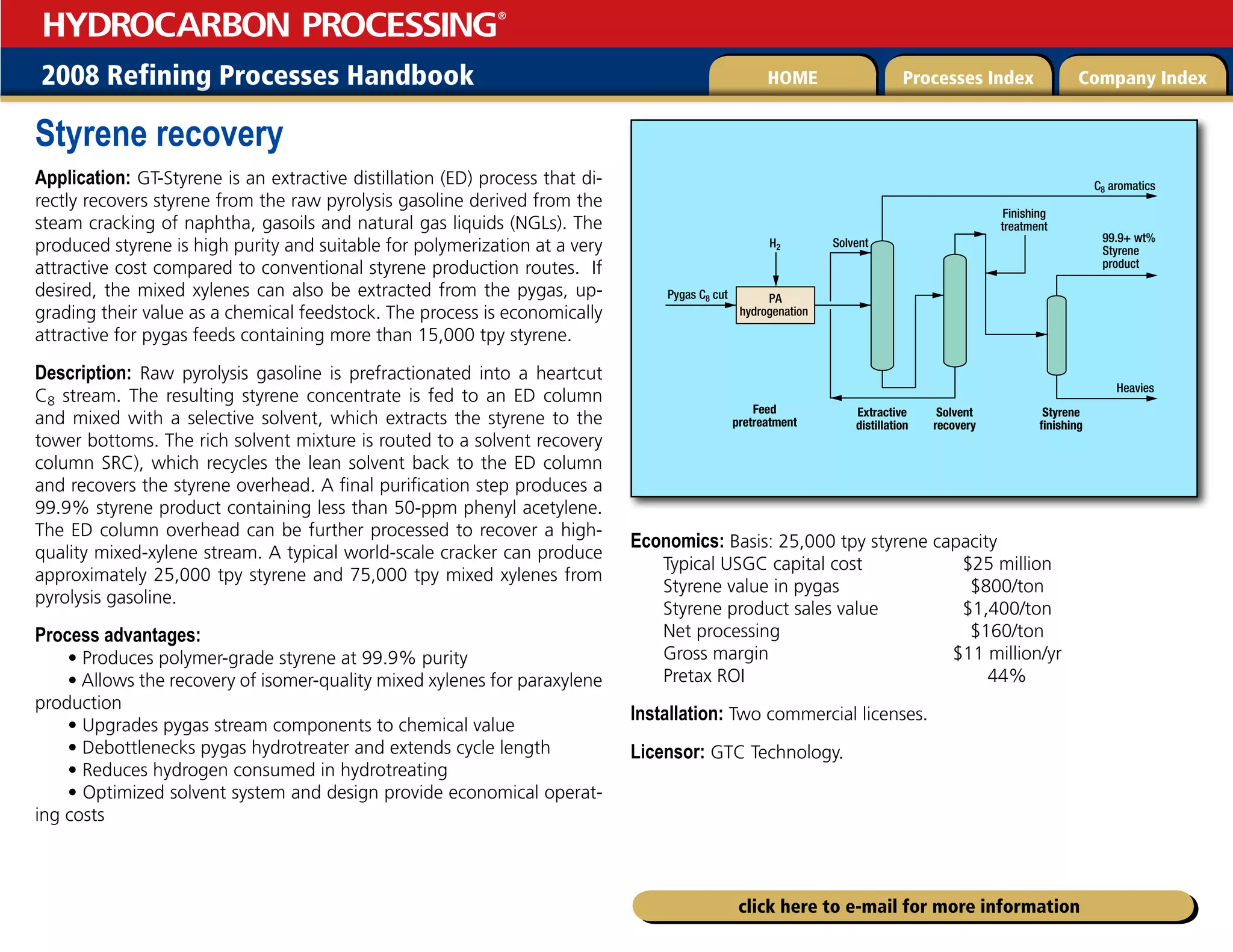
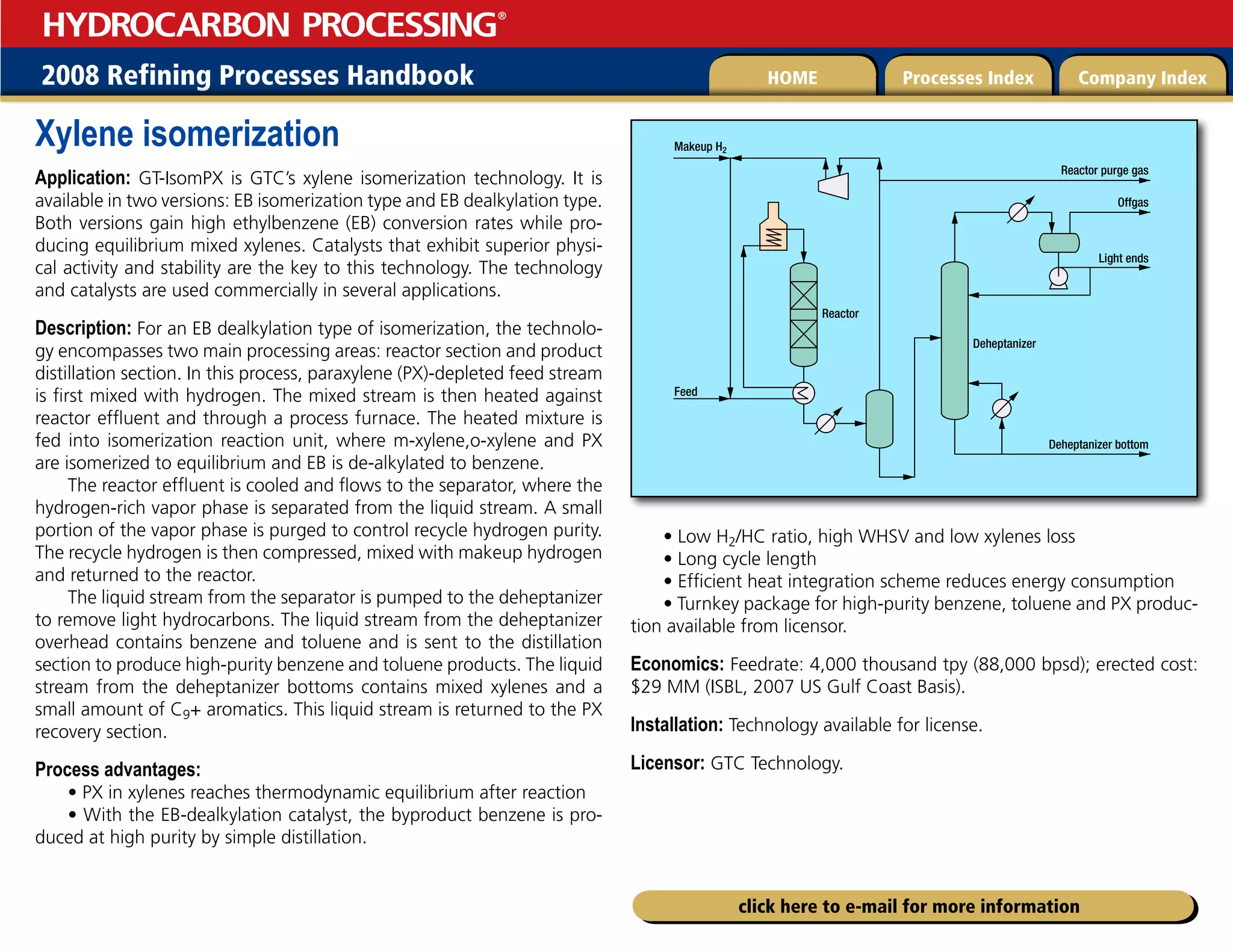
  • 147.
    The ether productis taken from the bottom, cooled and sent to the storage. The raffinate is washed in extractor column (6) with and is sent to the OSBL. The water/alcohol mixture is sent to alcohol recovery col- umn (7) where the alcohol is recovered and recycled as feed. For ETBE and TAEE, ethanol dehydration is required for most of the processes, whereas for RHT process, wet ethanol can be used providing maximum conversions. If need be, the TBA specification can be met by optimum design with additional equipment providing high ETBE yield and conversion. Cost of ethanol dehydration is much more than the present configuration for the RHT wet-ethanol process. The total capital cost/economics is lower with conventional catalyst usage, compared to other technologies, which use complicated struc- ture, require installing a manway (cumbersome) and require frequently catalyst changes outs. The RHT ether processes can provide maximum conversion as com- pared to other technologies with better economics. No complicated or proprietary internals for the column including single source expensive Olefin etherification, continued catalyst. Distillation is done at optimum conditions. Much lower steam consumption for alcohol recovery. For example, the C5 feed case requires less alcohol with RHT configuration (azeotropic alcohol is not required) and lowers lower steam consumption. Economics: CAPEX ISBL, MM USD (US Gulf Coast 1Q06, 1,000-bpd ether product) 9.1 Utilities Basis 1,000 bpd ether Power kWh 45.0 Water, cooling m3/h 250 Steam MP, Kg/h 6,000 Basis: FCC Feed (about 15–20% isobutylene in C4 mixed stream) Commercial units: Technology is ready for commercialization. Licensor: Refining Hydrocarbon Technologies LLC. click here to e-mail for more information
  • 148.
    2008 Refining ProcessesHandbook Processes Index Company Index HOME HYDROCARBON PROCESSING ® click here to e-mail for more information TAEE, from refinery C5 feeds Application: To process C5 streams from refinery units to produce ter- tiary amyl ethyl ether (TAEE). Description: TAEE is formed by the catalytic etherification of isoamylene with ethanol. The patented CDTaee process is based on a two-step reac- tor design, consisting of a boiling point fixed-bed reactor followed by final conversion in a catalytic distillation column. The process uses an acidic ion-exchange resin catalyst in both its fixed-bed reactor and pro- prietary catalytic distillation structures. The unique catalytic distillation column combines reaction and frac- tionation in a single unit operation. It allows a high conversion of isoam- ylene (exceeding fixed-bed equilibrium limitations) to be achieved simply and economically. By using distillation to separate the product from the reactants, the equilibrium limitation is exceeded and higher conversion of isoamylene is achieved. Catalytic distillation also takes advantage of the improved kinetics through increased temperature without penaliz- ing equilibrium conversion. CDTECH’s boiling point reactor offers: • Simple and effective control • Elimination of hot spots • Long catalyst life • High flexibility • Low capital cost • Elimination of catalyst attrition • Most effective heat removal technique • Elimination of cooling water requirement. Installation: With 20 years of experience, CDTECH has 120 licensed ethers units. Licensor: CDTECH. Fresh ethanol Fresh wash Boiling point reactor Catalytic distillation Ethanol extraction Ethanol recovery Recycle Ethanol Ethanol and C5s Water Water C5 raffinate TAEE Water and contaminants Mixed C5s
  • 149.
    2008 Refining ProcessesHandbook Processes Index Company Index HOME HYDROCARBON PROCESSING ® click here to e-mail for more information TAME, from refinery and steamcracker C5 feeds Application: The CD-Isotame process combines skeletal isomerization and etherification steps to maximize the production of tertiary amyl methyl ether (TAME) from refinery and steam-cracker C5 streams. Description: TAME is formed by the catalytic etherification of reactive isoamylenes with methanol. Skeletal isomerization increases TAME pro- duction from an olefinic C5 stream by converting normal amylenes to isoamylenes. The combination significantly reduces olefin content while also increasing octane. This process provides the minimum capital cost at about 80% C5 olefin reduction. The olefinic C5 stream is fed to a selective hydroge- nation step where dienes are converted to olefins. Removal of dienes reduces color and gum formation in the TAME product. In addition, un- reactive 3 methyl 1-butene (3MB1) is converted to reactive isoamylene via hydroisomerization, thus increasing the TAME yield. The primary TAME product is made in the first CDTame unit where greater than 90% conversion of isoamylene is achieved. Raffinate 1 from this unit is fed to a skeletal isomerization unit (ISOMPLUS) where n-pentenes are converted to isoamylenes at high yield and selectivity. The vapor-phase reaction takes place over a robust catalyst with long cycles between regenerations. The isomerate is then fed to a second CDTame unit where additional TAME is produced at greater than 95% conversion of isoamylenes. Even higher conversion of normal pentenes to TAME can be achieved by an optional raffinate 2 recycle to the skeletal isomerization unit. A purge stream removes the saturated C5s from the recycle stream. A common methanol recovery unit serves both CDTame units. Process advantages include: • Selective hydrogenation of diolefins at minimum capital cost • High conversion of isoamylenes (95%) • High conversion of normal pentenes (70%) • High selectivity of isomerization (90%) • Isomerization of 3MB1 to reactive isoamylene • Improved C5 raffinate as gasoline feedstock due to reduced, color, gum formation and olefin content • Increased TAME production • Increased gasoline pool octane • Decreased gasoline pool Rvp and olefins • Low capital and operating cost • Superior economics and performance over C5 alkylation • High-quality TAME product without objectionable odor or color. Installation: Out of the 120 licensed ethers units, approximately half of the units use the TAME technology. Licensor: CDTECH. C5 olefin Hydrogen Fresh methanol Methanol recovery C5 raffinate 1 Extract Recycle Isomerate Extract Methanol ISOMPLUS CDTAME Optional recycle TAME Lights C5 raffinate Selective hydrogenation and CDTAME
  • 150.
    2008 Refining ProcessesHandbook Processes Index Company Index HOME HYDROCARBON PROCESSING ® click here to e-mail for more information TAME, from refinery C5 feeds Application: To process C5 streams from refinery units to produce ter- tiary amyl methyl ether (TAME). Description: TAME is formed by the catalytic etherification of isoamylene with methanol. The patented CDTame process is based on a two-step reactor design, consisting of a boiling point fixed-bed reactor followed by final conversion in a catalytic distillation column. The process utilizes an acidic ion-exchange resin catalyst in both its fixed-bed reactor and proprietary catalytic distillation structures. The unique catalytic distillation column combines reaction and fractionation in a single unit operation. It allows a high conversion of isoamylene (exceeding fixed-bed equilibrium limitations) to be achieved simply and economically. By using distillation also to separate the product from the reactants, the equilibrium limitation is exceeded and higher conversion of isoamylene is achieved. Catalytic distillation also takes advantage of the improved kinetics through increased tem- perature without penalizing equilibrium conversion. Advanced process control maximizes catalyst life and activity to provide high sustained TAME production. CDTECH’s boiling point reactor offers: • Simple and effective control • Elimination of hot spots • Long catalyst life • High flexibility • Low capital cost • Elimination of catalyst attrition • Most effective heat removal technique • Elimination of cooling water requirement. Installation: Out of the 120 licensed ethers units, approximately half of units use the TAME technology. Licensor: CDTECH. Fresh methanol Fresh wash Boiling point reactor Catalytic distillation Methanol extraction Methanol recovery Recycle methanol Methanol and C5s Water Water C5 raffinate TAME Water and contaminants Mixed C5s
  • 151.
    2008 Refining ProcessesHandbook Processes Index Company Index HOME HYDROCARBON PROCESSING ® Gasification Application: ExxonMobil’s Reserach Engineering’s (EMRE’s) continuous fluid-bed coking with integrated steam gasification technology to con- vert heavy hydrocarbons (vacuum residuum, extra heavy oil or bitumen) to lighter liquid products and a clean burning fuel gas, Flexigas, with minimum coke production. Attractive when coking for complete resid conversion with low or no fuel oil production is preferred and when outlets for fuel coke are limited or not economic, and especially when low-cost clean fuel gas is needed or where natural gas is high cost. Products: Liquid product yields are similar to delayed coking and are upgraded to transportation fuels in the refinery by hydrotreating, hydrocracking, fluid catalytic cracker (FCC), or other processes. A large quantity of clean fuel gas is produced, which can be burned in a variety of grassroots or revamp furnaces and boilers in the refinery or in nearby power plants with low SOx and NOx emissions. Description: FLEXICOKING has essentially the same feed system and fluid bed reactor (1) and scrubber (2) sections as FLUID COKING, and also has the same process flexibility to directly process vacuum tower bottoms without the need for a preheat furnace. It can also handle very heavy feeds, and can adjust recycle cut point depending upon gasoil product quality requirements. A steam/air gasification fluid bed reactor (4) is added to convert coke produced in the reactor to a CO and H2-rich fuel gas, diluted by N2. The heater vessel (3) serves as a fluid solids heat exchanger to pro- vide process heat for reactions in the heater and gasifier and to initially cool and clean Flexigas from the gasifier. Flexigas overhead from the heater (3) is cooled and cleaned in several steps (5) to remove fines and is then treated with FLEXSORB hindered amine to reduce H2S to as low 10 wppm if needed. Typically 95 wt%–97 wt% of the coke generated in the reactor is gasified to produce process heat and Flexigas, depending upon the amount of nickel (Ni) and vanadium (V) in the feed, A small amount of purge or net product coke is withdrawn from the heater (3) and fines removal system (5), which can be burned in cement kilns or used for recovery of V. Partial gasification with coke withdrawal can also be used to provide additional process flexibility for increased capacity or to make fuel grade coke if attractive markets are available. Reactor yields: Typical 1,050°F+ cut point vacuum resid (~26 wt% Con- radson carbon, 4.6 wt% sulfur, 125 wppm Ni + V) Component yield wt% wt% Fuel gas (C2–) 6.7 LPG, (C3/C4) 4.4 Total C4– 11.1 Naphtha (C5-430°F) 15.3 Distillate (430°F – 650°F) 11.0 Gas oil (650°F – 975°F) 32.2 Total C5+ liquids 58.6 Net product coke 1.7 Gasified coke 28.6 Total reactor coke 30.3 Total: 100 100 START Reactor products to fractionator Low heating value coke gas 1 2 3 4 5 5 Air blower Steam Coke fines Sour water Direct contact cooler Steam generation Tertiary cyclones Air Hot coke Cold coke Continued 
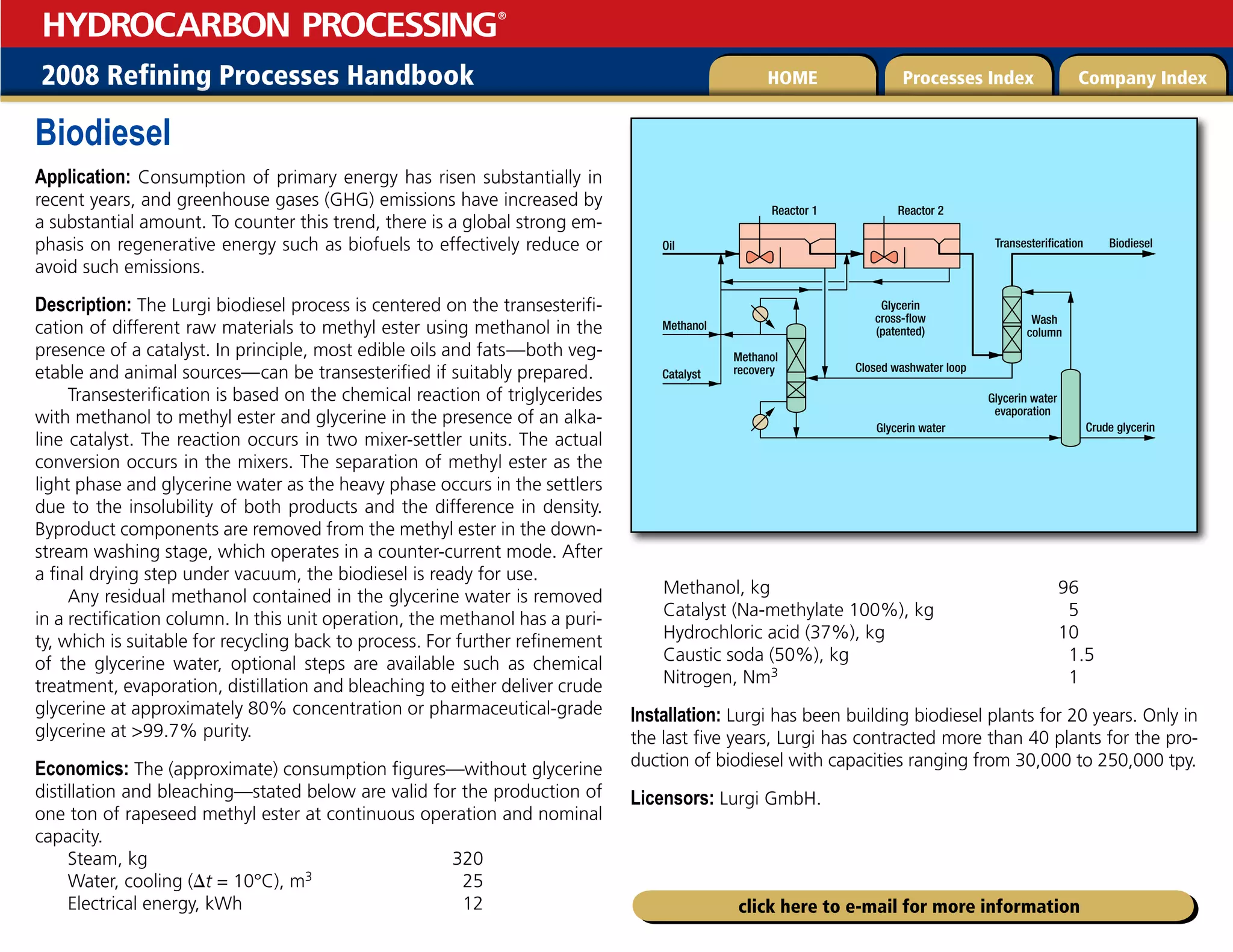
  • 152.
    Fuel gas production:Steam and air gasification of coke produced in the reactor generates a large fuel gas stream that is rich in CO/H2, which can be used as fuel. Fuel gas production consistent with the above yields for a 31,000 bpd FLEXICOKING Unit is: Flexigas production: 1,580 MBtu/hr [460 MW (th)] Flexigas heating value: 128 Btu/SCF H2S content: 10 wppm Competitive advantages: • Integrated coking and gasification technology that yields the same valuable liquid products as other coking processes but produces clean fuel gas instead of high-sulfur coke. • Fluid bed process with coke transferred pneumatically and con- tained within fluid solids reactors and product silos. Gasification, continued click here to e-mail for more information • Environmental advantages with lower SOx, NOx, and particulates emissions than conventional delayed coking processes • Much lower investment and more reliable than delayed coking plus partial oxidation or direct gasification of solids or heavy feeds. Par- ticularly attractive for SAGD tar sands upgrading with large fuel require- ments. Reference: Kamienski, P. W. , S. Massenzio and M. de Wit, “Coking without the coke,” Hydrocarbon Engineering, March 2008. Kamienski, P. W. , S. Massenzio and M. de Wit, “FLEXICOKING: Inte- grated Coking and Gasification Technology,” ERTC Coking and gasifica- tion Conference, Rome, April 21–22, 2008. Licensor: ExxonMobil Research and Engineering Co.
  • 153.
    2008 Refining ProcessesHandbook Processes Index Company Index HOME HYDROCARBON PROCESSING ® click here to e-mail for more information Gasification Application: To produce high-value products (hydrogen, fuel gas, chemi- cal synthesis gas (CO + H2) and steam) from the lowest value residual streams (resid, tar or coke), using GE’s Gasification Process. Sulfur is removed as hydrogen sulfide (H2S), and metals are removed in a filter cake, for further processing. If desired, up to 90% of the carbon in the feed can be recovered as a purified carbon dioxide (CO2) stream. Typically, 80%–90% of the energy in the feed is recovered in prod- uct and export steam streams. The fuel gas produced is well-suited for combustion turbines. Description: Heavy feed is mixed with steam and/or hot soot water and fed with oxygen to the gasifier, at pressures ranging from 400 psig to 1,250 psig and temperatures ranging from 2,300°F to 2,700°F, which breaks down hydrocarbons into syngas (CO and H2) and minimal soot and ash. The cooled syngas is water-scrubbed to remove soot and ash. The moisturized gas passes through a water-shift reactor; carbon monoxide (CO) reacts with steam producing additional hydrogen and CO2. This al- lows the adjustment of the H2/CO ratio in the syngas to values greater than 1. The dry syngas is then separated into various components us- ing conventional methods (physical and/or chemical solvents, pressure swing adsorption, etc.) Heat can be recovered as HP steam (up to 2,000 psig) from syngas cooling and water-shift reaction. Economics: Yields: Feed Maya crude Oil sands Type SDA Tar Visbr Tar API –4.4 0 Sulfur, wt% 7 7 Ni + V, ppm 1,200 600 Products, typical per bbl feed Hydrogen, Mscf 14 14 CO2, tons/bbl 0.5 0.5 Fuel gas, 106 Btu 0.8 0.8 Steam SH HP, export, lb 500 600 Utilities, typical per bbl feed Steam Sat’d LP, cons, lb 0 100 Power, kWh 12 12 Oxygen, tons 0.2 0.2 Water, cooling, gal 1,800 1,400 *Economics based on 2004 data. Installation: As of July 1, 2008, 63 units using GE’s Gasification process are operating worldwide; 13 in refinery applications, producing hydro- gen, turbine fuel gas and syngas for chemicals manufacturing. Licensor: GE Energy. Tar Oxygen Steam Blowdown to SWS CO2 Fuel gas Hydrogen Acid gas (to SRU) Ni/V ash Sour shift BFW Soot scrubber Filtration Filter cake processing (optional) Gasifier syngas cooler Soot water Liquid wastes (optional) Gas separation
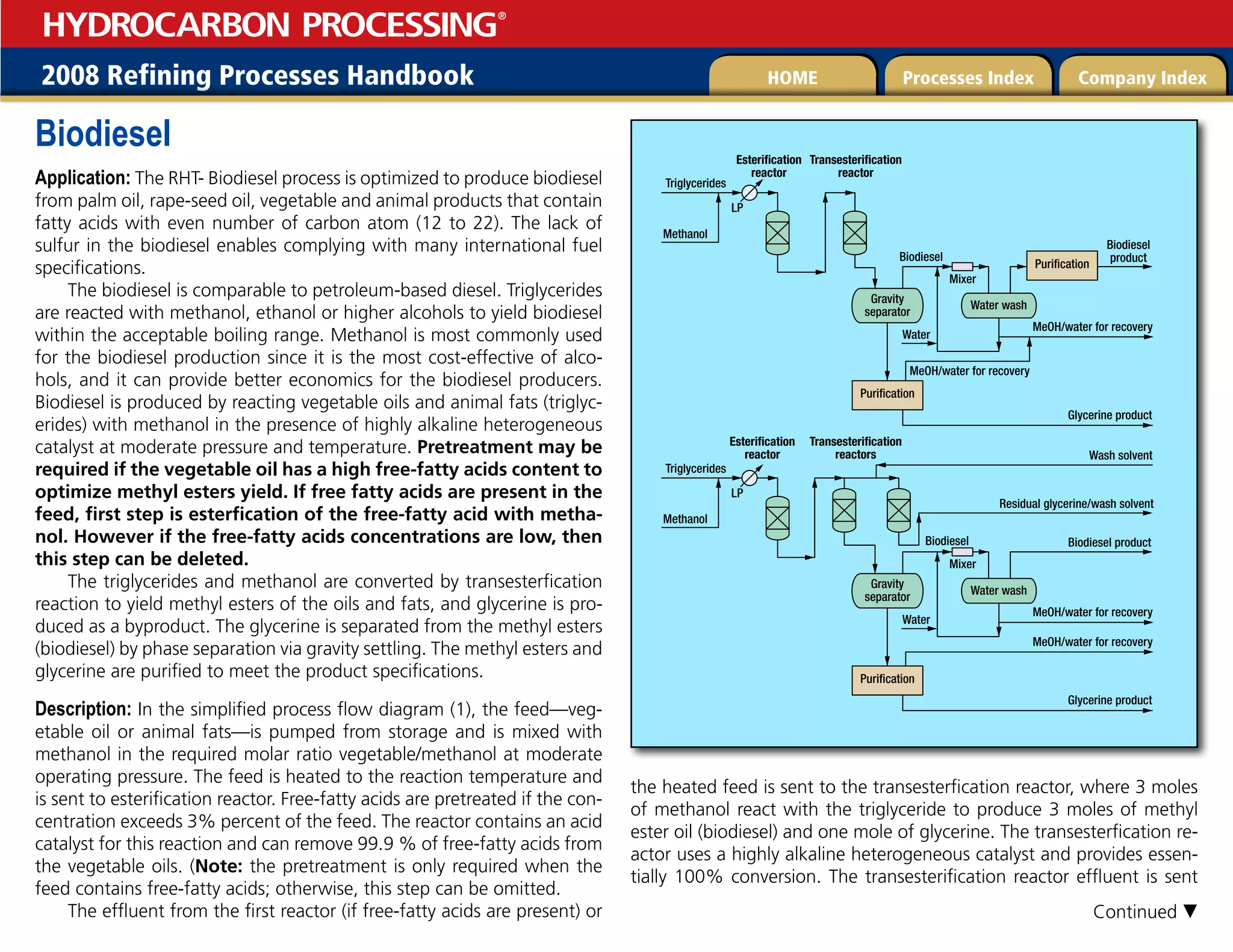
  • 154.
    2008 Refining ProcessesHandbook Processes Index Company Index HOME HYDROCARBON PROCESSING ® Gasification Application: The Shell Gasification Process (SGP) converts heavy refinery residual liquid hydrocarbon streams with high-sulfur and metals content into a clean synthesis gas (syngas) and marketable metal oxides. Sulfur (S) is removed by normal gas treating processes and sold as elemental S. The process converts residual streams with virtually zero value as fuel-blending components into marketable, clean gas and byproducts. This gas can be used to generate power in gas turbines and for making hydrogen (H2) by the well-known shift and pressure swing adsorption (PSA) technology. It is one of the few environmentally acceptable solu- tions for residual hydrocarbon streams. Products: Synthesis gas (CO + H2), sulfur and metal oxides. Description: Liquid hydrocarbon feedstock (from very light such as natu- ral gas to very heavy such as vacuum flashed cracked residue (VFCR) and ashphalt) is fed into a reactor, and gasified with pure O2 and steam. The net reaction is exothermic and produces a gas primarily containing car- bon monoxide (CO) and H2. Depending on the final syngas application, operating pressures, ranging from atmospheric up to 65 bar, can easily be accommodated. SGP uses refractory-lined reactors that are fitted with a gasification burner and syngas effluent cooler, designed to produce high-pressure steam—over 100 bar (about 2.5 tons per ton feedstock). Gases leaving the steam generator are at a temperature approaching the steam tem- perature; thus, further heat recovery occurs in an economizer. Soot (unconverted carbon) and ash are removed from the raw gas by a two-stage waterwash. After the final scrubbing, the gas is virtually particulate-free; it is then routed to a selective-acid-gas-removal system. Net water from the scrubber section is routed to the soot ash removal unit (SARU) to filter out soot and ash from the slurry. By controlled oxi- dation of the filtercake, ash components are recovered as marketable oxides—principally vanadium pentoxide. The (clean) filtrate is returned to the scrubber. Installation: Over the past 40 years, more than 150 SGP units have been installed that convert residue feedstock into synthesis gas for chemical applications. The Shell Pernis refinery near Rotterdam, The Netherlands, uses the SGP process in a close refinery integration. This highly com- plex refinery depends on the SGP process for its H2 supply. Recently, ENI refinery in Sannazzaro, Italy, has been successfully started-up. Similar projects are underway in Canada and China. The Shell middle distillate synthesis plant in Bintulu, Malaysia, uses SGP to convert 100 million scfd of natural gas into synthesis gas that is used for petrochemical applications. A related process—the Shell Coal Gasification Process (SCGP)—gas- ifies solids such as coal or petroleum coke. The reactor is different, but main process layout and work-up are similar. The Demkolec Power plant at Buggenum, The Netherlands, produces 250 mega watts based on the SCGP process. In total, over 20 licenses are in different phases of project execution using SCGP. Ni/V ash Filtercake work up Oxygen Bleed to SWS Syngas Process steam Boiler Steam Oil BFW Scrubber Effluent boiler Soot quench Filtration Reactor Continued 
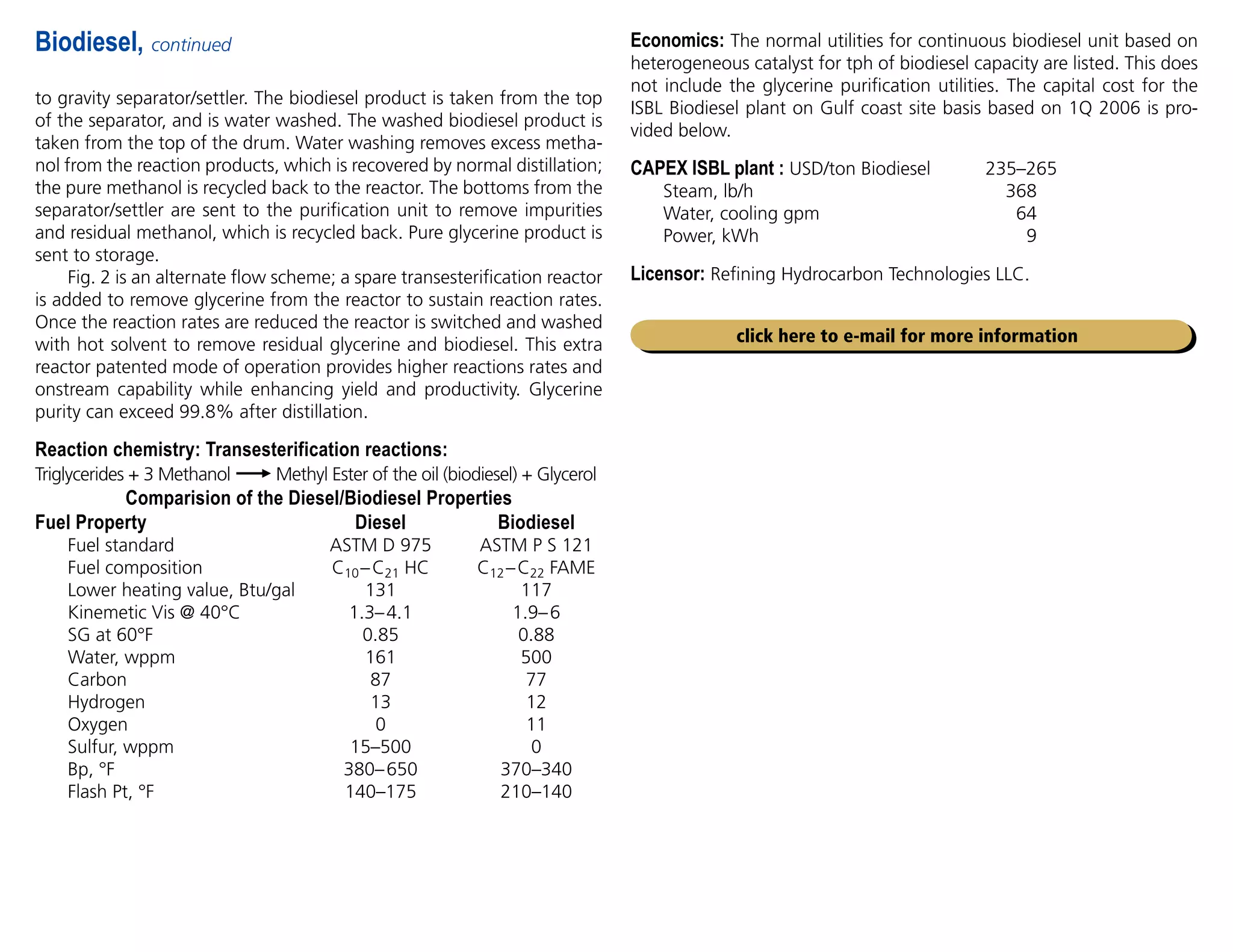
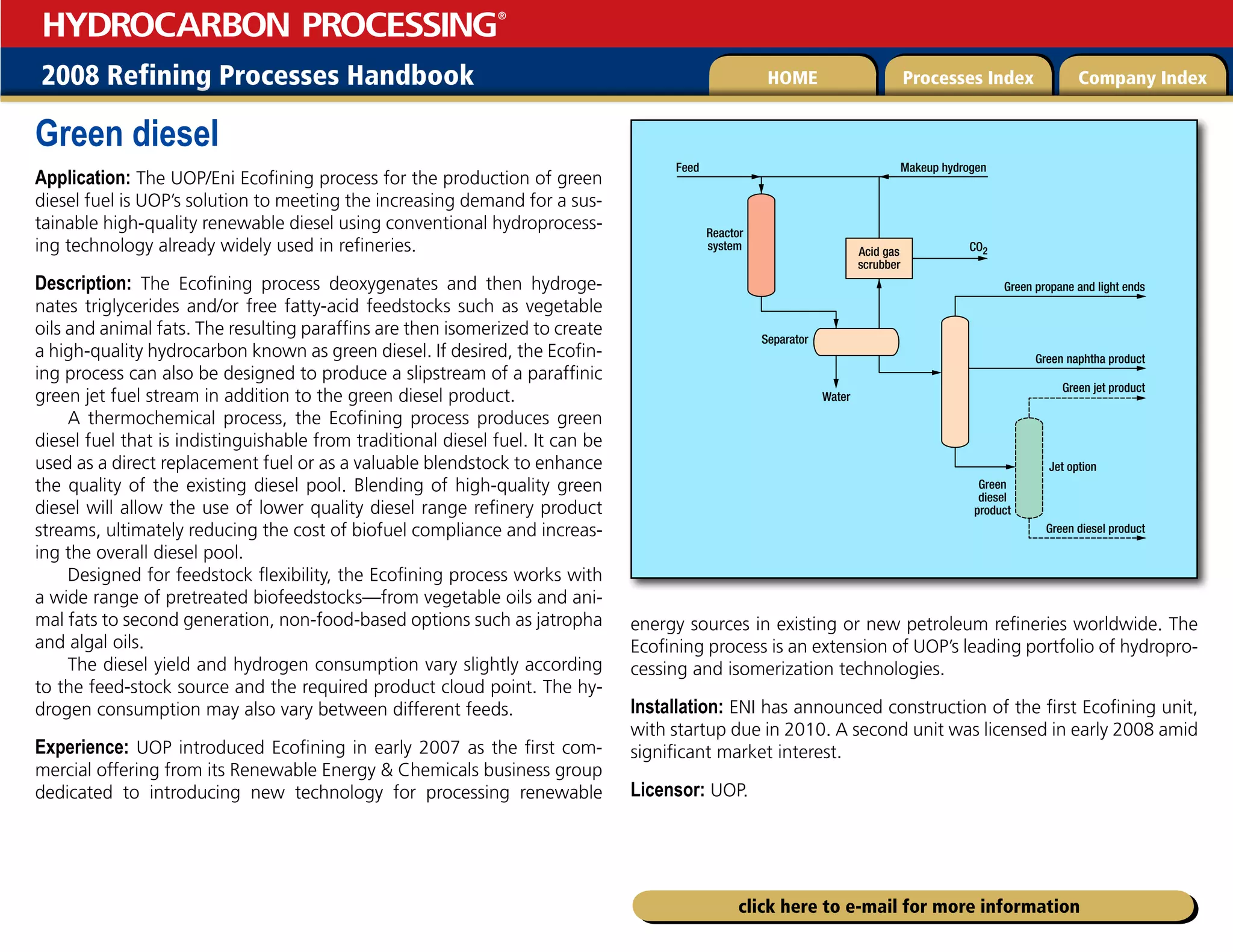
  • 155.
    Reference: “Shell GasificationProcess,” Conference Defining the Fu- ture, Bahrain, June 1–2, 2004. “Shell Gasification Process for Upgrading Gdansk Refinery,” The 6th European Gasification Conference IChemE, Brighton, May 10–12, 2004. “Overview of Shell Global Solutions Worldwide Gasification Devel- opments,” 2003 Gasification Technologies Conference, San Francisco, Oct. 12–15, 2003. Gasification, continued Zuideveld, P. and J. Wolff,“New methods upgrade refinery residu- als into lighter products,” Hydrocarbon Processing, February 2006, pp. 73–79. “Shell Gasification Technology—Optimal disposal solution for refin- eries heavy ends,” ERTC Gasification Conference, Paris, 2007. “Shell Gasification Technology: Generating Profit from the Bottom of the Barrel,” NPRA, Annual Meeting, San Diego, March 9–11,2008. “Shell Gasification Technology—Part of refinery upgrading strate- gies,” ERTC Gasification Conference, Rome, April 21–23,2008. Licensor: Shell Global Solutions International B.V. click here to e-mail for more information
  • 156.
    2008 Refining ProcessesHandbook Processes Index Company Index HOME HYDROCARBON PROCESSING ® click here to e-mail for more information Gasification—PDQ Application: The PRENFLO (PRessurized ENtrained-FLOw) direct quench (PDQ) is an optimized design of the proven PSG gasification process for all types of solid feedstock as petcoke, solid refinery residues, coal and biomass for chemical applications (ammonia,methanol, hydrogen, syn- fuel.) Description: First, the feed dust is prepared in the feed preparation unit. Approximately 80% of the dust is smaller than 0.1 mm and has a water content of approximately 1 wt%–2 wt% in the case of hard coals, and approximately 8 wt%–10 wt% for lignite. This feed dust is gasified in the PRENFLO gasifier using oxygen and steam as the gasification agent. The gasification temperature is higher than ash-melting temperature, which allows feedstocks containing ash to be removed as slag. The cooled-type gasifier is equipped with mul- tiple, horizontally arranged burners. The raw gas produced, which contains mainly carbon monoxide and hydrogen, is quenched with water in a direct quench in the gasifier ves- sel and then cleaned in a scrubber. Economics: Main process data: Gasification pressure: 40 bar and higher Gasification temperature: 2,000°C Gas temperature at outlet of gasifier/quench: 200°C–250°C Carbon conversion: 99% Typical raw gas composition: CO + H2 85 vol% CO2 6–8 vol% CH4 0.1 vol% Installation: The PRENFLO PDQ process is under development for indus- trial-scale applications Licensor: Uhde GmbH. Cyclone filter Feed dust Oxygen Lock hopper Feed bin PRENFLO gasifier Direct quench Slurry filtration Slag crusher/ collector Steam Steam drum Wash water Scrubber Boiler feed water Raw gas Filter cake Waste water Slag Slag lock hopper
  • 157.
    2008 Refining ProcessesHandbook Processes Index Company Index HOME HYDROCARBON PROCESSING ® click here to e-mail for more information Gasification—PSG Application: The PRENFLO (PRessurized ENtrained-FLOw) process can be used to gasify all types of solid feedstocks (petcoke, solid refinery resi- dues, coal and biomass). Description: First, the feed dust is prepared in the feed preparation unit. Approximately 80% of the dust is smaller than 0.1 mm and has a water content of approximately 1wt%-2 wt% in the case of hard coals, and approximately 8wt%-10 wt% for lignite. This feed dust is then gasified in the PRENFLO gasifier using oxygen and steam as gasification agents. The gasification temperature is higher than the ash-melting temperature, which allows the feedstock contain- ing ash to be removed as slag. The cooled-type gasifier is equipped with multiple, horizontally arranged burners. In the PRENFLO process with steam generation (PSG), the raw gas produced, which contains mainly carbon monoxide and hydrogen, is cooled in the waste-heat boiler and generates steam. The gas is de- dusted in a candle filter and further treated in a scrubber unit. Economics: Main process data • Gasification pressure: 40 bar • Gasification temperature: 2,000°C • Gas temperature at outlet of gasifier: 1,350°C–1,600°C • Carbon conversion: 99% Typical raw gas composition: • CO + H2 85 vol.% • CO2 2–4 vol.% • CH4 0.1 vol.% Reference: PRENFLO technology has been successfully commercialized in the world’s largest solid-feedstock based IGCC 300 MWe net power plant in Puertollano, Spain. Licensor: Uhde GmbH. Cyclone filter Feed dust Boiler feed water Oxygen Lock hopper Feed bin Slag crusher/ collector Slag Fly ash Raw gas Scrubber Filter Fly ash feed bin Fly ash lock hopper Wash water Waste heat boiler Slag lock hopper Steam Steam drum PRENFLO gasifier Ultimate Coal Petcoke Mixture analysis C, wt% 36.3 82.2 59.2 H, wt% 2.5 3.1 2.8 N, wt% 0.8 1.9 1.4 O, wt% 6.6 – 3.3 S, wt% 0.9 5.5 3.2 Ash, wt% 41.1 0.3 20.7 Water, wt% 11.8 7.0 9.4 Total, wt% 100.0 100.0 100.0 LHV, MJ/kg 13.1 32.6 23.1 Raw gas analysis CO2, vol% 2.9 CO, vol% 59.9 H2, vol% 21.7 N2 + Ar, vol% 14.4* CH4, vol% 0.1 H2S + COS, vol% 1.1 Total, vol%: 100.0 LHV, dry, MJ/m3n 10.16
  • 158.
    2008 Refining ProcessesHandbook Processes Index Company Index HOME HYDROCARBON PROCESSING ® Multipurpose gasification Application: Production of synthesis gas, essentially H2 and CO, from a wide range of gaseous to extra heavy liquid hydrocarbons, as well as emulsions and slurries. Recent new applications are in (chemical) waste gasification. The main advantage over comparable processes is its ex- treme feedstock flexibility in the quench mode. A boiler mode for high- est efficiency is also available. Description: Continuous noncatalytic partial oxidation process. The quench mode is shown above: hydrocarbon feedstock, moderator (H2O, CO2 or N2) and oxidant (pure or diluted O2, air) are fed through a special burner into the reactor (1), a refractory-lined pressure vessel. Operating conditions are automatically controlled. Hot gas leaves the reactor at the bottom, passing the quench where water is injected to lower the tem- perature near the saturation temperature. Quench water washes out most particulates as unconverted carbon (soot) and ash. Further cleaning occurs in a venturi scrubber (2) from where the gas passes to a medium-pressure steam boiler (3) for heat recovery and to the final cooler (4) before further processing. In hydrogen production, the hot, wet gas from the venturi is passed directly to a raw gas shift conversion. The soot/ash slurry from the process contains virtually all metals and ashes from the feedstock. It is withdrawn via a slurry col- lector (5) and processed in the metals ash recovery system (MARS) (6). There, soot/ash is filtered from the slurry and incinerated under con- trolled conditions, yielding a saleable metal/ash product. Filtered water is returned for quenching. Excess water is stripped and sent to conven- tional wastewater treatment. Operating conditions: Actual gasification temperatures of 1,200°C to 1,500°C, pressures from atmospheric to 70 bar (or higher, if economically justified). Feedstock and oxidant preheat possible in a wide range from 100°C to 600°C, depending on type of feed. Product yields and composi- tion vary with moderator rate and type of feed. Water quench is selected for highest feedstock flexibility. At low-salt contents, the boiler mode can recover heat as high-pressure steam, raising overall efficiency. Economics: Characteristic consumption and production rates per ton of heavy residue feedstock: 1 to 1.1 t O2 (100%), export 0.5 t MP steam (quench) to 2.2 t HP steam (boiler mode), 2.2 t raw syngas (dry) equiv. to 2,600 Nm3 H2 + CO. Cold gas efficiency is 82% to 85%. In boiler mode, thermal efficiencies including HP steam generated are about 95% based on feedstock HHV. This makes the process attractive for syngas produc- tion and for an IGCC power plant. A highly integrated and efficient power complex will be in the range of $1,200/kW total invested cost. Installations: A large-scale industrial plant operates in Germany, demon- strating full feedstock and product flexibility by feeding to a methanol Reactor Feedstock Slurry collector C.W. C.W. C.W. O2/steam Metals/ash 3 2 1 4 5 Quench water Quench water Waste water MP-steam BFW Venturi scrubber MP- boiler Raw gas Alternative route to raw gas shift Metals ash recovery system MARS (soot slurry treatment) 6 Quench Continued 
  • 159.
    Multipurpose gasification, continued andIGCC complex. Another plant gasifies residue asphalt, producing syngas for an ammonia plant. Reference: Liebner, W. and C. Erdmann, “MPG—Lurgi Multipurpose Gasification—Recent Applications and Experiences,” World Petroleum Congress 2000, Calgary, Canada, June 2000. Licensor: Lurgi GmbH. click here to e-mail for more information
  • 160.
    2008 Refining ProcessesHandbook Processes Index Company Index HOME HYDROCARBON PROCESSING ® click here to e-mail for more information Hydroconversion—VGO and DAO Application: An ebullated-bed process H-OilDC is used for hydrocon- version (hydrocracking and hydrotreating) of heavy vacuum gasoil and DAO having high Conradson carbon residue and metal contents and low asphaltene content. It is best suited for high severity operations and applications requiring long run lengths. Description: The flow diagram includes integrated mid-distillate hydro- treating for an ultra-low-sulfur-diesel product. The typical battery limits scheme includes oil- and hydrogen-fired heaters, an advanced design hot high-pressure separator and ebullating pump recycle system, a re- cycle gas scrubber and product separation and fractionation. Catalyst in the reactor is replaced periodically without shutdown and, for cases of feeds with low metal contents, the catalyst can be re- generated onsite to reduce catalyst consumption. Various catalysts are available as a function of the feedstock and the required objectives. An H-OilDC unit can operate for four-year run lengths at constant catalyst activity with conversion in the 20-80% range in once-through mode and to more than 95% in recycle mode with up to 99% hydrodesulfurization. Operating conditions: Temperature, °F 750–820 Hydrogen partial pressure, psi 600–1,500 LHSV, hr–1 0.5–3.0 Conversion, wt% 20–80 in once-through mode Example: VGO + DAO feed: a blend of heavy VGO and C5 DAO con- taining close to 100 ppm metals is processed at 80% conversion at an overall desulfurization rate of over 96%. Economics: Basis—2008 US Gulf Coast Investment in $ per bpsd 2,800–4,500 Utilities, per bbl of feed Fuel, 103 Btu 60 Power, kWh 3 Catalyst makeup, lb 0.01–0.3 Installation: The H-OilDC process has two references, one in operation and one under construction, with a total cumulative capacity of 139,900 bpsd. This technology has been commercially demonstrated based on the ebullated bed reactor making a total of 11 references for residue and VGO hydroconversion. Licensor: Axens. START VGO feed Oil feed heater Ebullated reactor High pressure separator Recycle hydrogen compressor Recycle hydrogen Makeup hydrogen Ebullating pump Gas-oil stripper FCC feed S= 1,000-1,500 wppm Diesel S= 50 wppm Fuel gas Fixed-bed HDS Stabilizer Amine absorber Naphtha S= 2 wppm Hydrogen heater
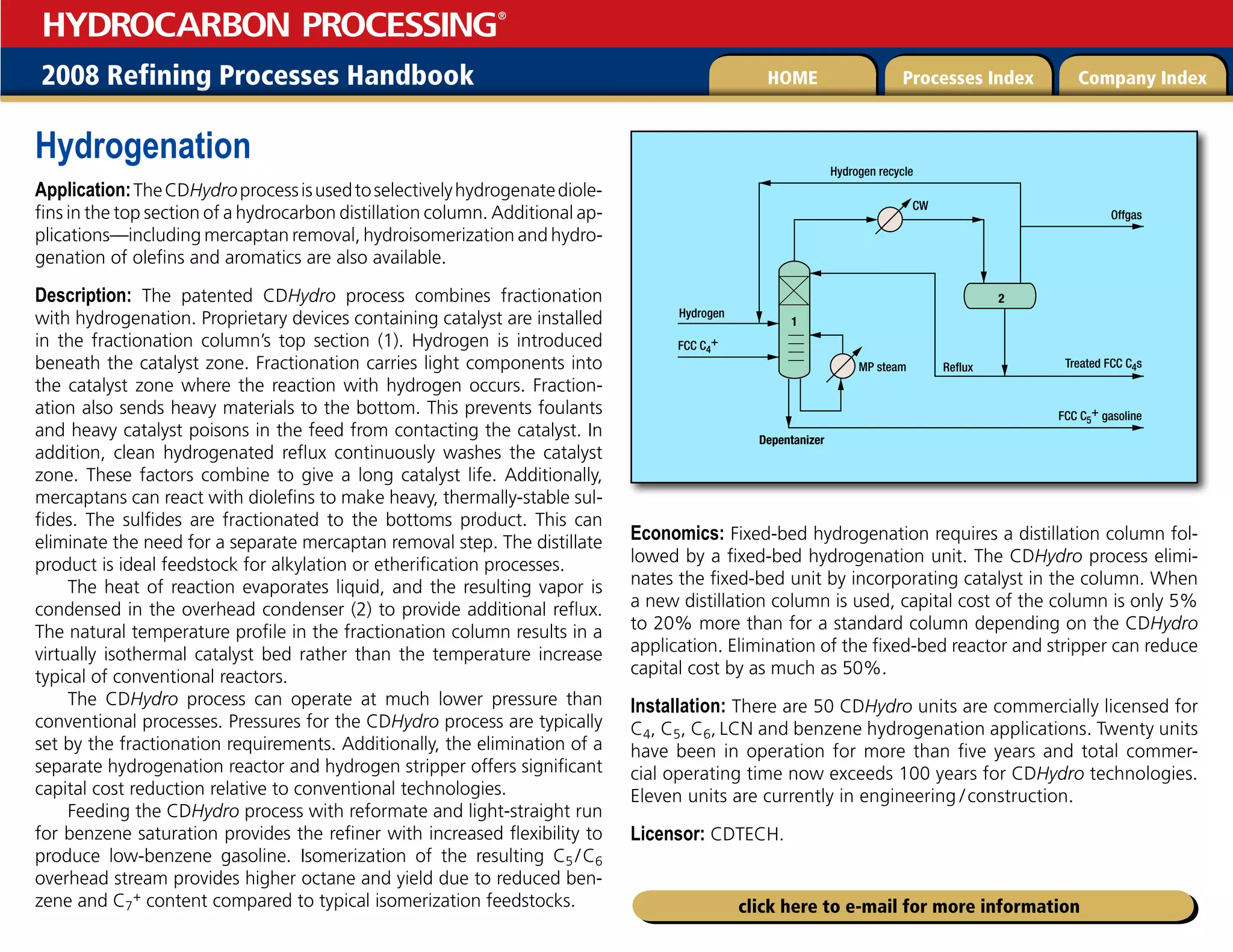
  • 161.
    2008 Refining ProcessesHandbook Processes Index Company Index HOME HYDROCARBON PROCESSING ® click here to e-mail for more information Hydrocracking Application: Upgrade vacuum gas oil alone or blended with various feedstocks (light-cycle oil, deasphalted oil, visbreaker or coker gasoil). Products: Jet fuel, diesel, very-low-sulfur fuel oil, extra-quality FCC feed with limited or no FCC gasoline post-treatment or high VI lube base stocks. Description: This process uses a refining catalyst usually followed by an amorphous and/or zeolite-type hydrocracking catalyst. Main features of this process are: • High tolerance toward feedstock nitrogen • High selectivity toward middle distillates • High activity of the zeolite, allowing for 3–4 year cycle lengths and products with low aromatics content until end of cycle. Three different process arrangements are available: single-step/ once-through; single-step/total conversion with liquid recycle; and two- step hydrocracking. The process consists of: reaction section (1, 2), gas separator (3), stripper (4) and product fractionator (5). Product quality: Typical for HVGO (50/50 Arabian light/heavy): Feed, Jet HVGO fuel Diesel Sp. gr. 0.932 0.800 0.826 TBP cut point, °C 405–565 140–225 225–360 Sulfur, ppm 31,700 10 10 Nitrogen, ppm 853 5 5 Metals, ppm 2 – – Cetane index – – 62 Flash pt., °C –  40 125 Smoke pt., mm, EOR – 26–28 – Aromatics, vol%, EOR – 12 8 Viscosity @ 38°C, cSt 110 – 5.3 PAH, wt%, EOR 2 Installation: More than 67 references, cumulative capacity exceeding 2.7 million bpsd, conversions up to 99%. Licensor: Axens. START H2 makeup Fuel gas Heavy naphtha Diesel Jet fuel Wild naphtha Low-sulfur VGO Feed 3 4 5 1 2
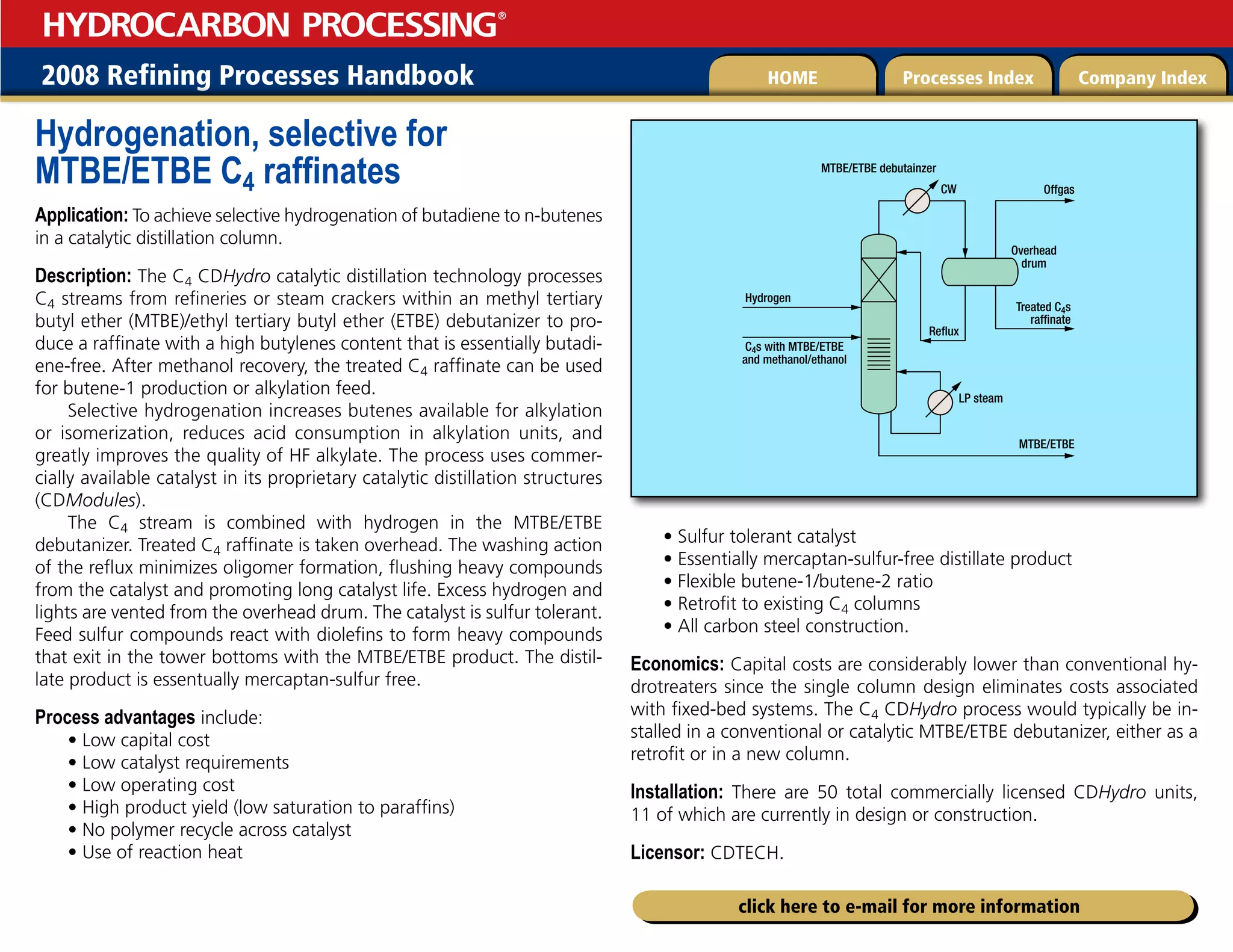
  • 162.
    2008 Refining ProcessesHandbook Processes Index Company Index HOME HYDROCARBON PROCESSING ® Hydrocracking Application: Convert naphthas, AGO, VGO, DAO, cracked oils from FCC units, delayed cokers and visbreakers, and intermediate products from residue hydroprocessing units using the Chevron Lummus Global ISO- CRACKING Process. Products: Lighter, high-quality, more valuable products: LPG, gasoline, catalytic reformer feed, jet fuel, kerosene, diesel and feeds for FCC, eth- ylene cracker or lube oil units. Description: A broad range of both amorphous/zeolite and zeolitic catalysts, including noble-metal zeolitic catalysts, are used to tailor the ISOCRACKING Process exactly to the refiner’s objectives. In general, the process involves a staged reactor system with an initial stage of hydrotreating and partially hydrocracking the feed, and a subsequent stage continuing the conversion or product upgrade process in a more favorable environment. Feeds can be introduced in between stages using Chevron Lummus Global patented split-feed injection technology, or effluent flow paths can be arranged to best utilize hydrogen and minimize quench-gas requirements using proprietary SSRS (single-stage reaction sequenced) technology. Most modern large-capacity flow schemes involving heavy sour gas oils require two reactors (1, 4) and one high-pressure separation system (2) with an optional recycle gas scrubber (5) and one recycle-gas com- pressor (8). The low-pressure separators (3), product stripper (6) and fractionator (7) provide the flexibility to fractionate products either in between reaction stages or at the tail-end, depending on desired prod- uct slate and selectivity requirements. Single-stage options are used in once-through mode typically for mild hydrocracking or when a significant quantity of unconverted oil is required for FCC, lubes, or ethylene units. The single-stage recycle op- tion is used for lower capacity units when economical. The reactors use patented internals technology called ISOMIX for near-flawless mixing and redistribution. Yields: Typical from various feeds: Feed VGO VGO VGO VGO Gravity, API 24.1 24.1 24.1 21.3 TBP range, °F 700–1,100 700–1,100 700–1,100 700–1,100 Nitrogen, wppm 2,500 2,500 2,500 900 Sulfur, wt % 1.9 1.9 1.9 2.5 Mode Max. Diesel Max. Jet Max. Mid- Max. Mid- Distillate Distillate + Lubes Yields, vol % Naphtha 22.8 30.8 14.0 18 Jet/kerosine – 79.7 22.0 50 Diesel 85.5 – 73.0 35 UCO – – – 10 START Diesel UCO to lubes FCC or ethylene unit Jet/kerosine Heavy naphtha Hydrogen- rich gas to recovery FG, LPG naphtha Light naphtha Makeup hydrogen Sour water Water H2S 5 8 R 2 1 4 3 6 7 Continued 
  • 163.
    Feed VGO VGOVGO VGO Product quality Kerosine smoke, mm 29–32 29–32 29–32 Diesel cetane number 58–64 58–64 58–64 UCO BMCI 6–8 UCO Waxy V.I. 143–145 UCO Dewaxed V.I. 131–133 Economics: ISBL total installed cost of 50,000-bpsd unit at 100% con- version to middle distillates using Middle Eastern VGO feed (USGC, 2007 basis): $300 million. Process fuel (absorbed), MMBtu/hr 180 Electricity, MW 10 CW, gpm 2,500 Steam (export at 150 psig), M lb/hr 22 Hydrocracking, continued Installation: More than 80 units worldwide with over two million-bpsd total capacity. Reference: Dahlberg, A., U. Mukherjee and C. W. Olsen, “Consider us- ing integrated hydroprocessing methods for processing clean fuels,” Hy- drocarbon Processing, September 2007, pp. 111–120. Mukherjee, U., J. Mayer and B. Srinivasan, “Hydroprocessing Inno- vation—Some Recent Applications, Petroleum Technology Quarterly, Summer 2004. Bridge, A. G. and U. Mukherjee, “ISOCRACKING—Hydrocracking for Superior Fuels and Lubes Production,” Handbook of Petroleum Re- fining Processes, McGraw Hill, Third Edition. Licensor: Chevron Lummus Global LLC. click here to e-mail for more information
  • 164.
    2008 Refining ProcessesHandbook Processes Index Company Index HOME HYDROCARBON PROCESSING ® click here to e-mail for more information Hydrocracking Application: The IsoTherming process provides refiners an economical means to upgrade gasoil, heavy gasoil, coker gasoils, deasphalted oil and FCC cycle oils. Products: Low-sulfur, low-nitrogen FCC feed, low-sulfur gasoline-ker- osine type products, and low-nitrogen fuels and/or downstream feed- stocks. Description: This process uses a novel approach to introduce hydrogen in excess of reaction requirements into the reactor. It enables much higher space velocities than conventional hydrocracking reactors. The IsoTherm- ing process eliminates problems associated with flow mal-distribution, gas-liquid mass transfer and catalyst wetting. The process eliminates the need for some of the equipment in conventional hydrotreating thereby lowering cost. Fresh feed, after heat exchange, is combined with recycle product and hydrogen in a mixer internal to the reactor. The liquid feed with soluble hydrogen is fed to IsoTherming reactor/bed one where partial desulfurization, removal of metals or mild hydrocracking occurs. The stream is combined with additional hydrogen in a second mixer and fed to the second IsoTherming reactor/bed where further mild hydrocracking takes place. The treated oil from the second IsoTherming bed may then be fed to additional IsoTherming beds to achieve the desired level of conversion. At this time the technology is recommended for maximum feed conversion of approximately 65%. Treated oil is recycled back to the inlet of reactor one. This recycle stream delivers more hydrogen to the reactors and also acts as a heat sink; thus, a nearly isothermal reactor operation is achieved. Economics: Revamp investment is estimated to be half that of con- ventional hydrocracking due to the primary advantages offered by Iso- Therming, which include: • Elimination of a recycle gas compressor, high-pressure flash drum and separator, condenser and amine scrubber. • Smaller volume(s) of catalyst required for a given feed basis. Installation: Three units are licensed for mild hydrocracking of heavy oils with startups scheduled in 4Q08, 1Q09. Licensor: DuPont GO/DAO feed Makeup hydrogen To FG treating To FG treating Light naphtha FCC feed ULSD diesel Kerosine Heavy naphtha
  • 165.
    2008 Refining ProcessesHandbook Processes Index Company Index HOME HYDROCARBON PROCESSING ® click here to e-mail for more information Hydrocracking Application: Topsøe’s hydrocracking process can be used to convert straight run vacuum gas oils and heavy cracked gasoils to high quality “sulfur-free” naphtha, kerosene, diesel, and FCC feed, meeting current and future regulatory requirements. In addition, high VI lube stocks and petrochemical feedstock can be produced to increase the refinery’s prof- itability. Product: By proper selection of operating conditions, process configura- tion, and catalysts, the Topsøe hydrocracking process can be designed for high conversion to produce high smoke point kerosine and high cetane diesel. The process can also be designed for lower conversion/ upgrade mode to produce low sulfur FCC feed with the optimum hy- drogen uptake or high VI (145) lube stock. The FCC gasoline produced from a Topsøe hydrocracking unit does not require post-treatment for sulfur removal. Description: Topsøe’s hydrocracking process uses well proven co-current downflow fixed bed reactors with state-of-the-art reactor internals and catalysts. The process uses recycle hydrogen and can be configured in partial conversion once-through feed mode or with recycle of partially converted oil to obtain 100% conversion to diesel and lighter prod- ucts. Topsøe’s zeolitic and amorphous hydrocracking catalysts have been proven in several commercial hydrocrackers. Operating conditions: Typical operating pressure and temperatures range from 55 to 170 bar (800 to 2500 psig) and 340 to 420°C (645 to 780°F). Installations: One operating licensed hydrocracking unit. Topsøe hydro- cracking catalysts have been supplied to eight hydrocrackers. Licensor: Haldor Topsøe A/S. Hydrogen makeup Fresh feed H2-rich gas Recycle gas compressor Hydrocracking reactor Pre- treating reactor High-pressure separator Low-pressure separator Product fractionator Process gas Naphtha Middle distillate Lube stock Furnace
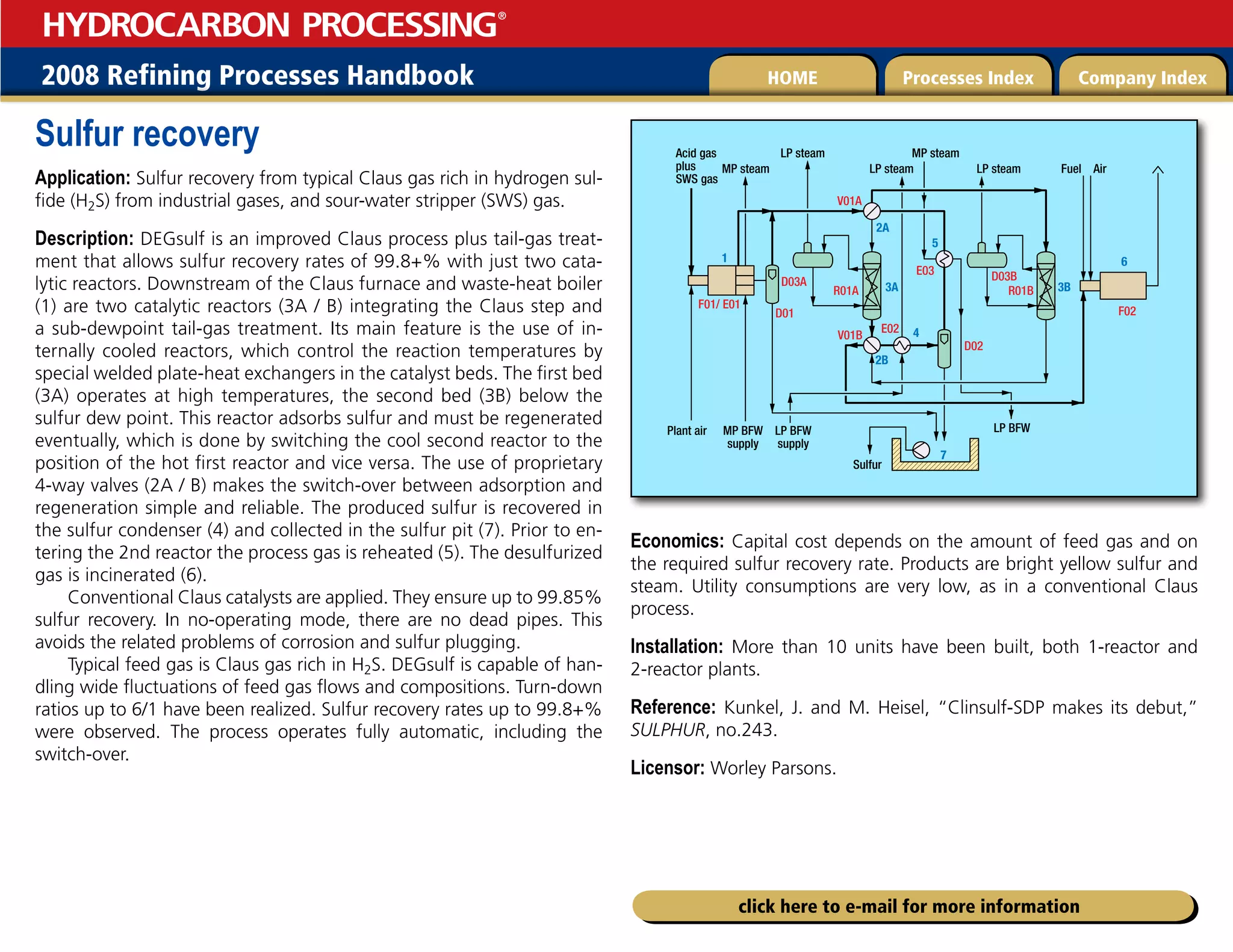
  • 166.
    2008 Refining ProcessesHandbook Processes Index Company Index HOME HYDROCARBON PROCESSING ® click here to e-mail for more information Hydrocracking Application: To convert heavy vacuum gasoil (VGO) and other low-cost cracked and extracted feedstocks into high-value, high-quality products, such as low-sulfur diesel, jet fuel, high-octane light gasoline and reform- er feed via the Shell Hydrocracking Process. Unconverted or recycle oil are prime feeds for secondary processing in fluid catalytic cracking units (FCCUs), lube base oil plants and ethylene crackers. Description: Heavy feed hydrocarbons are preheated with reactor efflu- ent (1). Fresh hydrogen is combined with recycle gas from the cold high- pressure separator, preheated with reactor effluent, and then heated in a single-phase furnace. Reactants pass via trickle flow through multi-bed reactor(s) containing proprietary pre-treat, cracking and post-treat cata- lysts (2). Interbed ultra-flat quench internals and high-dispersion nozzle trays combine excellent quench, mixing and liquid flow distribution at the top of each catalyst bed while helps maximize reactor volume utiliza- tion. After cooling by feed streams, reactor effluent enters a separator system. Hot effluent is routed to fractionation (3). Two-stage, series flow and single-stage unit design configurations are available, capable of converting a wide range of heavy feedstocks, especially heavy coker gasoils and deasphalted oils directly into clean fu- els. The catalyst systems are carefully tailored for maximum yield of the desired product slate at an optimum catalyst cycle length. Installation: Over 30 new and revamp designs installed or under design. Revamps have been implemented in own or other licensors’ designs usually to debottleneck and increase feed heaviness. Supplier: Shell Global Solutions International B.V. FCC/lube oil/ethylene Feed Recycle compressor Recycle gas Fresh gas Quench gas CHP separator HLP separator HHP separator CLP separator Fractionator Process gas Light naphtha Heavy naphtha Kerosine Diesel 2 1 3
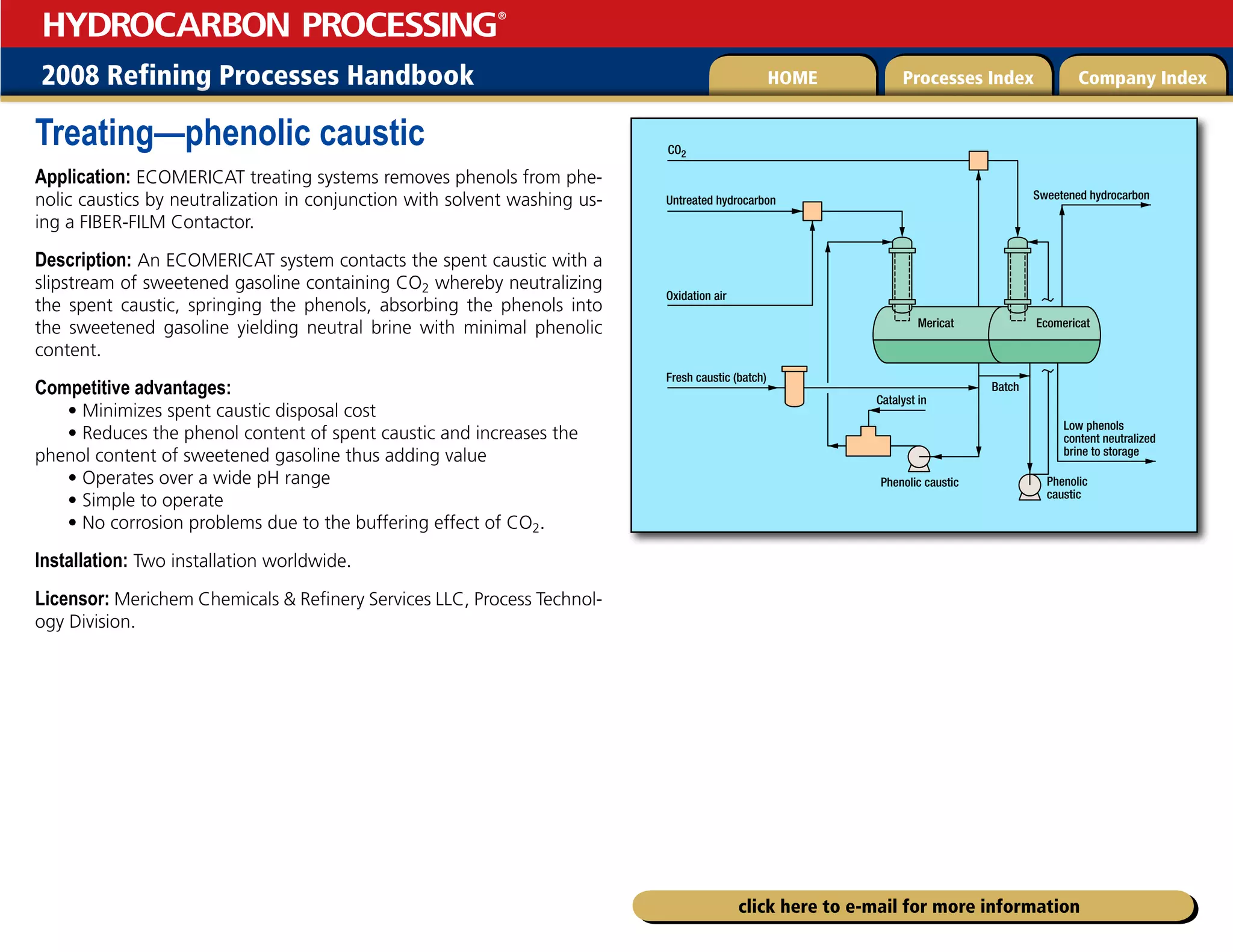
  • 167.
    2008 Refining ProcessesHandbook Processes Index Company Index HOME HYDROCARBON PROCESSING ® click here to e-mail for more information Hydrocracking Application: Convert a wide variety of feedstocks into lower-molecular- weight products using the UOP Unicracking process. Feed: Feedstocks include atmospheric gasoil, vacuum gasoil, FCC/RCC cycle oil, coker gasoil, deasphalted oil and naphtha for production of LPG. Products: Processing objectives include production of gasoline, jet fuel, diesel fuel, lube stocks, ethylene-plant feedstock, high-quality FCC feed- stock and LPG. Description: Feed and hydrogen are contacted with catalysts, which in- duce desulfurization, denitrogenation and hydrocracking. Catalysts are based upon both amorphous and molecular-sieve containing supports. Process objectives and feedstock properties determine catalyst selection and process flow scheme for a specific unit. Product from the reactor section is condensed, separated from hydrogen-rich gas and fraction- ated into desired products. Unconverted oil is recycled or used as lube stock, FCC feedstock or ethylene-plant feedstock. Yields: Example: 30,000 bpsd typical vacuum gasoil feed FCC cycle Vacuum Fluid coker Feed type oil blend gasoil gasoil Gravity, °API 27.8 22.3 8.4 Boiling, 10%, °F 481 690 640 End pt., °F 674 1,015 1,100 Sulfur, wt% 0.54 2.4 4.57 Nitrogen, wt% 0.024 0.15 0.269 Yields, vol% of feed with principal product of diesel Butanes 3.0 Light gasoline 6.6 Heavy naphtha 11.2 Distillate 92.3 H2 consump., scf/bbl 1,550 Economics: Utilities, typical per bbl feed: Fuel, 103 Btu 70–130 Electricity, kWh 7–10 Installation: Selected for 190 commercial units, including several converted from competing technologies. Total capacity exceeds 4.4 million bpsd. Licensor: UOP. START Sour water To fractionator To fractionator Flash gas Makeup hydrogen Wash water 3 4 5 1 2 Fresh feed Recycle oil
  • 168.
    2008 Refining ProcessesHandbook Processes Index Company Index HOME HYDROCARBON PROCESSING ® Hydrocracking, moderate pressure Application: Convert a wide variety of feedstocks including vacuum deep-cut gas oil, coker gas oils, de-asphalted oil (DAO), and FCC cy- cle oils into high-quality, low-sulfur fuels using ExxonMobil Research and Engineering Company’s (EMRE) moderate pressure hydrocracking (MPHC) process. Products: Products include a wide range of high-quality, low-sulfur dis- tillates and blending stocks including LPG, high-octane gasoline, high- quality reformer naphtha. Unconverted bottoms product from the MPHC unit is very low in sulfur and is an excellent feedstock for fluid catalytic cracking (FCC), lube-oil basestock production, steam cracking and low- sulfur fuel oil. Description: The process uses a multiple catalyst system in multi-bed reactor(s) that incorporates proprietary advanced quench and redistri- bution internals (Spider Vortex). Heavy hydrocarbons and recycle gas are preheated and contact the catalyst in the trickle-phase fixed-bed reactor(s). Reactor effluent is flashed in high- and low-temperature separators. An amine scrubber removes H2S from the recycle gas be- fore it gets compressed and re-circulated back to the unit. An opti- mized, low cost stripper/fractionator arrangement is used for product recovery. When higher-quality distillates are required, the addition of a low- cost, highly integrated distillate post-treating unit (PTU) can be incor- porated in the design to meet or exceed high-pressure hydrocracking product quality at lower capital cost and hydrogen consumption Operating conditions and yields: Typical operating conditions on a Mid- dle East VGO for a once-through MPHC operation are shown: Operation conditions: Configuration MPHC MPHC MPHC Nominal conversion, % 35 50 50 H2 pressure, psig 800 800 1,250 Yields: Naphtha, wt% 4 10 10 Kero/jet, wt% 6 10 10 Diesel, wt% 22 26 27 LSGO (FCC feed), wt% 65 50 50 H2 consumption, wt% 1.0–1.5 1.3–1.8 1.5–2.0 Product quality: Kero sulfur, wppm 20–200 20–200 20–200 Kero smoke Pt, mm 13–18 15–20 17–22 Diesel sulfur, wppm 30–500 30–300 30–200 Diesel cetane no. 45–50 47–52 50–55 Utilities, per bbl of feed: Naphtha LPG/naphtha Rich amine LTS HTS Lean amine Hydrogen Kerosine Diesel Fractionator Absorber Stripper Reactor Heater Recycle compressor HVGO DAO HCGO FCC feed LSGO Continued 
  • 169.
    Electric power, kW4.1 7.2 Fuel (absorbed), Btu 67,100 69,600 Steam, MP (export), lb (15.9) (21.1) Water, cooling, gal 101 178 Wash water, gal 1.5 2.2 Lean amine, gal 36.1 36.1 Hydrocracking, moderate pressure continued click here to e-mail for more information EMRE’s MPHC process is equally amenable to revamp or grassroots applications. EMRE has an alliance with Kellogg Brown Root (KBR) to provide MPHC technology to refiners. Installation: Four operating units; two in construction. Licensor: ExxonMobil Research and Engineering Co.
  • 170.
    2008 Refining ProcessesHandbook Processes Index Company Index HOME HYDROCARBON PROCESSING ® Hydrocracking, resid Application: Desulfurization, demetalization, CCR reduction and hydro- cracking of atmospheric and vacuum resids using the LC-FINING Pro- cess. Products: Full range of high-quality distillates. Residual products can be used as fuel oil, synthetic crude or feedstock for a resid FCC, coker, visbreaker or solvent deasphalter. Description: Fresh hydrocarbon liquid feed is mixed with hydrogen and reacted within an expanded catalyst bed (1) maintained in turbulence by liquid upflow to achieve efficient isothermal operation. Product quality is maintained constant and at a high level by intermittent catalyst addition and withdrawal. Reactor products flow to a high-pressure separator (2), low-pressure separator (3) and product fractionator (4). Recycle hydro- gen is separated (5) and purified (6). Process features include onstream catalyst addition and withdrawal. Recovering and purifying the recycled H2 at low pressure rather than at high pressure can reduce capital cost and allows design at lower gas rates. Operating conditions: Reactor temperature, °F 725–840 Reactor pressure, psig 1,400–3,500 H2 partial pressure, psig 1,000–2,700 LSHV 0.1 to 0.6 Conversion, % 40–97+ Desulfurization, % 60–90 Demetalization, % 50–98 CCR reduction, % 35–80 Yields: For Arabian heavy/Arabian light blends: Atm. resid Vac. resid Feed Gravity, °API 12.40 4.73 4.73 4.73 Sulfur, wt % 3.90 4.97 4.97 4.97 Ni/   V, ppmw 18/65 39/142 39/142 39/142 Conversion, vol% 45 60 75 95 (1,022°F+) Products, vol% C4 1.11 2.35 3.57 5.53 C5–350°F 6.89 12.60 18.25 23.86 350–700°F (650°F) (15.24) 30.62 42.65 64.81 700 (650°F)–1,022°F (55.27) 21.46 19.32 11.92 1,022°F+ 25.33 40.00 25.00 5.0 C5+, °API/wt% S 23.70/0.54 22.5/0.71 26.6/0.66 33.3/0.33 START 4 5 6 3 2 1 Makeup hydrogen Steam Products Recycle H2 Hydrocarbon feed LC-FINING reactor Continued 
  • 171.
    Economics: Investment, estimated (USGulf Coast, 2007) Size, bpsd fresh feed 92,000 49,000 $/bpsd typical fresh feed 4,000 6,000 7,000 8,000 Utilities, per bbl fresh feed Fuel fired, 103 Btu 56.1 62.8 69.8 88.6 Electricity, kWh 8.4 13.9 16.5 22.9 Steam (export), lb 35.5 69.2 97.0 97.7 Water, cooling, gal. 64.2 163 164 248 Hydrocracking, resid, continued click here to e-mail for more information Installation: Six LC-FINING units are in operation, and three LC-FINING Units are in engineering. Reference: Gupta, A., “Chevron Lummus Global Ebullated Bed Bottom- of-theBarrel Hydroconversion (LC-FINING) Process,” Handbook of Petro- leum Refining Prcesses, McGraw Hill, Third Edition. “LC-FINING Options for Heavy Oil Upgrading,” NPRA Annual Meet- ing, March 9–11, 2008, San Diego, Paper AM-08-33. Licensor: Chevron Lummus Global LLC.
  • 172.
    2008 Refining ProcessesHandbook Processes Index Company Index HOME HYDROCARBON PROCESSING ® click here to e-mail for more information Hydrocracking—residue Application: H-OilRC is an ebullated-bed process for hydrocracking at- mospheric or vacuum residue. It is the ideal solution for feedstocks hav- ing high metal, CCR and asphaltene contents. The process can have two different objectives: at high conversion, to produce stable products; or, at moderate conversion, to produce a synthetic crude oil. Description: The flow diagram illustrates a typical H-OilRC unit that in- cludes oil and hydrogen fired heaters, an optional inter stage separa- tor, an internal recycle cup providing feed to the ebullating pump, high pressure separators, recycle gas scrubber and product separation and fractionation (not required for synthetic crude oil production). Catalyst is replaced periodically in the reactor, without shutdown. Different catalysts are available as a function of the feedstock and the required objectives. An H-OilRC unit can operate for three-year run lengths at constant catalyst activity with conversion in the 50–80% range and hydrodesulfurization as high as 85%. Operating conditions: Temperature, °F 770–820 Hydrogen partial pressure, psi 1,600–1,950 LHSV, hr–1 0.25–0.6 Conversion, wt% 50–80 Examples: Ural VR feed: a 540°C+ cut from Ural crude is processed at 66% conversion to obtain a stable fuel oil containing less than 1%wt sulfur, 25% diesel and 30% VGO. The diesel cut is further hydrotreated to meet ULSD specifications using an integrated Prime-D unit. Arab Me- dium VR feed: a vacuum residue from a blend 70% Arab Light-30% Arab Heavy containing 5.5wt% sulfur is processed at above 75% con- version to obtain a stable fuel oil with 2wt% sulfur. Economics: Basis 2008 US Gulf Coast Investment in $ per bpsd 5,100–7,400 Utilities, per bbl of feed Fuel, 103 Btu 70 Power, kWh 11 Catalyst makeup, lb 0.2–0.8 Installation: There are nine H-OilRC units, seven in operation and two un- der design, with a total capacity of 336,500 bpsd. Two additional refer- ences for H-OilDC, the ebullated bed technology for VGO and DAO, add another 139,900 bpsd. Reference: “Resid hydrocracker produces low-sulfur diesel from difficult feed,” Hydrocarbon Processing, May 2006. Licensor: Axens. Acid gas removal and HPU Fractionation and stabilization Sour gas Sour water Sour gas Naphtha Mid distillate Vacuum gasoil Vacuum tower V/L separator H-oil reactor V/L separator V/L separator Resid feed Heater Makeup H2 Heater Vacuum bottoms recycle (optional) Vacuum residue Air cooler Inter stage separator (optional)
  • 173.
    2008 Refining ProcessesHandbook Processes Index Company Index HOME HYDROCARBON PROCESSING ® Hydrodearomatization Application: Topsøe’s two-stage hydrodesulfurization hydrodearomati- zation (HDS/HDA) process is designed to produce low-aromatics distil- late products. This process enables refiners to meet the new, stringent standards for environmentally friendly fuels. Products: Ultra-low sulfur, ultra-low nitrogen, low-aromatics diesel, ker- osine and solvents (ultra-low aromatics). Description: The process consists of four sections: initial hydrotreating, intermediate stripping, final hydrotreating and product stripping. The initial hydrotreating step, or the “first stage” of the two-stage reaction process, is similar to conventional Topsøe hydrotreating, using a Topsøe high-activity base metal catalyst such as TK-575 BRIM to perform deep desulfurization and deep denitrification of the distillate feed. Liquid ef- fluent from this first stage is sent to an intermediate stripping section, in which H2S and ammonia are removed using steam or recycle hydrogen. Stripped distillate is sent to the final hydrotreating reactor, or the “second stage.” In this reactor, distillate feed undergoes saturation of aromatics using a Topsøe noble metal catalyst, either TK-907/TK-911 or TK-915, a high-activity dearomatization catalyst. Finally, the desulfurized, dearoma- tized distillate product is steam stripped in the product stripping column to remove H2S, dissolved gases and a small amount of naphtha formed. Like the conventional Topsøe hydrotreating process, the HDS/HDA process uses Topsøe’s graded bed loading and high-efficiency patented reactor internals to provide optimum reactor performance and catalyst use leading to the longest possible catalyst cycle lengths. Topsøe’s high efficiency internals have a low sensitivity to unlevelness and are designed to ensure the most effective mixing of liquid and vapor streams and max- imum utilization of catalyst. These internals are effective at high liquid loadings, thereby enabling high turndown ratios. Topsøe’s graded-bed technology and the use of shape-optimized inert topping and catalysts minimize the build-up of pressure drop, thereby enabling longer catalyst cycle length. Operating conditions: Typical operating pressures range from 20 to 60 barg (300 to 900 psig), and typical operating temperatures range from 320°C to 400°C (600°F to 750°F) in the first stage reactor, and from 260°C to 330°C (500°F to 625°F) in the second stage reactor. An ex- ample of the Topsøe HDS/HDA treatment of a heavy straight-run gas oil feed is shown below: Feed Product Specific gravity 0.86 0.83 Sulfur, ppmw 3,000 1 Nitrogen, ppmw 400 1 Total aromatics, wt% 30 10 Cetane index, D-976 49 57 %JFTFM GFFE .BLFVQIZESPHFO 'JSTU TUBHF )%4 SFBDUPS )% SFBDUPS 4FDPOE TUBHF )%4 TUSJQQFS )% TFQBSBUPS %JFTFMQSPEVDU 8JME OBQIUIB 8BUFS 0WFSIFBE WBQPS 4UFBN %JFTFMDPPMFS 8BTI XBUFS NJOF TDSVCCFS 3FDZDMFHBT DPNQSFTTPS )%4 TUSJQQFS 1SPEVDU EJFTFM TUSJQQFS 4PVS XBUFS )%4 TFQBSBUPS Continued 
  • 174.
    References: Cooper, Hannerupand Søgaard-Andersen, “Reduction of aromatics in diesel,” Oil and Gas, September 1994. de la Fuente, E., P. Christensen, and M. Johansen, “Options for meet- ing EU year 2005 fuel specifications,” 4th ERTC, Paris, November 1999. Installation: A total of seven units. Licensor: Haldor Topsøe A/S. Hydrodearomatization, continued click here to e-mail for more information
  • 175.
    2008 Refining ProcessesHandbook Processes Index Company Index HOME HYDROCARBON PROCESSING ® click here to e-mail for more information Hydrofinishing Application: Deeply saturate single- and multiple-ring aromatics in base- oil feedstocks. The product will have very low-aromatics content, very high-oxidation stability and high thermal stability. Description: ISOFINISHING catalysts hydrogenate aromatics at relative- ly low reaction temperatures. They are especially effective in complete polyaromatics saturation—a reaction that is normally equilibrium limited. Typical feedstocks are the effluent from a dewaxing reactor, effluent from hydrated feeds or solvent-dewaxed feedstocks. The products are highly stabilized base-oil, technical-grade white oil or food-grade white oil. As shown in the simplified flow diagram, feedstocks are mixed with recycle hydrogen and fresh makeup hydrogen, heated and charged to a reactor containing ISOFINISHING Catalyst (1). Effluent from the finishing reactor is flashed in high-pressure and low-pressure separators (2, 3). A very small amount of light products are recovered in a fractionation system (4). Yields: For a typical feedstock, such as dewaxing reactor effluent, the yield can be 99%. The chemical-hydrogen consumption is usually very low, less than ~10 Nm3/m3 oil. Economics: Investment: For a stand-alone ISOFINISHING Unit, the ISBL capital is about 3,000–5,000 $/bpsd, depending on the pressure level and size. Utilities: Typical per bbl feed: Power, kW 2.6 Fuel, kcal 3.4 x 10³ Installation: Twenty-nine units are in various stages of operation, con- struction or design. Reference: NPRA Annual Meeting, March 2004, San Antonio, Paper AM-04-68. Licensor: Chevron Lummus Global LLC. START Base oil product Light ends Process gas Makeup hydrogen Fresh dewaxed feed 1 4 3 2
  • 176.
    2008 Refining ProcessesHandbook Processes Index Company Index HOME HYDROCARBON PROCESSING ® click here to e-mail for more information Hydrogen Application: Production of high-purity hydrogen (H2) from hydrocarbon (HC) feedstocks, using the steam reforming process. Feedstocks: Ranging from natural gas, LPG to naphtha as well as poten- tial refinery offgases (ROG). Several modern hydrogen plants designed by TECHNIP have multiple feedstock flexibility. Description: The generic flowsheet consists of feed pre-treatment, pre-reforming (optional), steam-HC reforming, shift conversion and hydrogen purification by pressure swing adsorption (PSA). However, it is often tailored to satisfy specific requirements. Feed pre-treatment normally involves preheating to 350°C to 400°C and catalytic removal of sulfur, chlorine and other contaminants detrimental to downstream catalysts. The treated feed gas mixed with process steam is sent to the fired steam reformer (or adiabatic pre- reformer upstream when applied) after necessary superheating. The net reforming reaction is strongly endothermic. Heat is sup- plied externally by combustion of PSA purge gas, supplemented by make-up fuel in multiple burners in a top-fired reformer. Reforming severity is optimized for each specific case mainly in terms of S/C ratio and outlet temperature. The reformer effluent is essentially an equi- librium mixture and is cooled though HP-steam generation in the PG boiler before going for shift conversion, where a major portion of car- bon monoxide (CO) further converts to hydrogen. The process condensate resulting from heat recovery and cooling is separated and generally re-utilized in the steam system after neces- sary treatment. The entire steam generation is usually on natural circu- lation, which adds to high reliability. The cooled process gas flows to the PSA unit that provides high-purity hydrogen product (typically 10 ppmv total carbon oxides and in some cases 1ppmv CO). Typical specific energy consumptions based on feed + fuel – export steam range between 3 to 3.5 Gcal/KNm3 (330 to 370 Btu/scf) LHV, depending upon the feedstock, plant capacity, optimization criteria and steam export conditions. Recent advances include gas turbine in- tegration for steam-power synergy, environmental performance and recuperative reforming for capacity retrofit. Installation: TECHNIP, maintaining a leading market share, has designed over 250 hydrogen plants worldwide covering a wide range of capaci- ties ranging from 12 to 520 tpd (5–220 MMscfd). Most of these instal- lations are for refinery application with basic features for high reliability (99.5%+ excluding forced outage) and optimized cost. Licensor: TECHNIP Pre-reformer (optional) HC feedstock, ROG Stack Reformer Steam system Steam Compressor pumping Feed pretreatment Fuel system Makeup fuel Combustion air BFW preparation system Cooling train PSA Export steam Air Dosing Process condensate Purge gas to fuel system BFW to steam system Process steam Recycle H2 Steam BFW PG boiler To steam system DMW Steam coils APH (Opt.) Process coils Shock coils Hydrogen product Shift conversion Recycle H2
  • 177.
    2008 Refining ProcessesHandbook Processes Index Company Index HOME HYDROCARBON PROCESSING ® Hydrogen Application: Production of hydrogen for refinery applications and petro- chemical and other industrial uses. Feed: Natural gas, refinery offgases, LPG, naphtha or mixtures thereof or any other feedstocks. Product: High-purity hydrogen (typically 99.9%), CO, CO2, HP steam and/or electricity may be produced as separate creditable byproduct. Description: The plant generally comprises four process units. The feed is desulfurized, mixed with steam and converted to synthesis gas in steam reformer over a nickel containing catalyst at 20–40 bar pressure and outlet temperatures of typically 860°C–890°C for hydrogen production. The synthesis gas is further treated in the adiabatic carbon monoxide (CO) shift and the pressure swing adsorption unit to obtain high-purity hydrogen. Process options include feed evaporation, adiabatic feed pre- reforming and/or HT/LT shift to process, e.g., heavier feeds and/or opti- mize feed/fuel consumption and steam production. Uhde’s design enables maximizing process heat recovery and op- timizing energy efficiency with operational safety and reliability. The Uhde’s steam reformer features a well-proven top-fired design with tubes made of centrifugally cast alloy steel and a unique proprietary “cold” outlet manifold system for enhanced reliability. AA special fea- ture further speciality is Uhde’s bi-sectional steam system for the envi- ronment-friendly full recovery of process condensate and production of contaminant-free high-pressure export steam (3) with a proven process gas cooler design. The Uhde steam reformer concept also includes a modularized shop-tested convection bank to maximize plant quality and minimize construction risks. Uhde usually offers tailor-made designs based on ei- ther their own or the customer’s design standards. The hydrogen plant is often fully integrated into the refinery, particularly with respect to steam production and use of refinery waste gases. Uhde has extensive experience and expertise in the construction of highly reliable reform- ers with hydrogen capacities of up to 220,000 Nm3/h (197 MMscfd). Recent developments include the reduction of CO2-emissions while using removed CO2 for sequestration or enhanced oil recovery (EOR). Economics: Depending on the individual plant concept, the typical con- sumption figure for natural gas based plants (feed + fuel – steam) may be as low as 3.05 Gcal /1,000 Nm3 (324 MMBtu/MMscf). Installation: Uhde is currently executing several designs for hydrogen plants. These include a 150,000 Nm³/134 MMscfd plant for Shell in Canada and a 91,000 Nm³/h/81 MMscfd plant for Bayernoil in Germa- ny. In addition, Uhde is building a multi-feedstock hydrogen plant for an Italian refiner and a naphtha and natural- gas fed plant for Neste Oil OYJ of Finland. Uhde has also successfully started up Europe’s largest hydrogen plant for Neste Oil OYJ with a capacity of 155,000 Nm³/h (139 MMscfd). This plant features, among others, a unit to reduce CO2 emissions. Steam export Steam reformer Fuel Steam drum HT shift Gas cooler CW PSA Hydrogen Desulfuri- zation Feed Combustion air BFW 1 2 3 4 5 Continued 
  • 178.
    References: Ruthardt, K.and M. Smith, “Reliability and availability,” Hy- drocarbon Engineering, February 2008. Ruthardt, K., K. R. Radtke and J. Larsen, “Hydrogen trends,” Hydro- carbon Engineering, November 2005, pp. 41–45. Hydrogen, continued click here to e-mail for more information Michel, M., “Design and Engineering Experience with Large-Scale Hydrogen Plants,” Oil Gas European Magazine, Vol. 30 (2004) No. 2 in: Erdöl Erdgas Kohle Vol. 120 (2004) No. 6, pp. OG 85–88. Licensor: Uhde GmbH.
  • 179.
    2008 Refining ProcessesHandbook Processes Index Company Index HOME HYDROCARBON PROCESSING ® Hydrogen (steam reforming) Application: Hydrogen production from natural gas, refinery gas, associ- ated gas, naphtha, LPG or any mixture of these. Appropriate purity prod- uct (up to 99.999%) can be used in refinery upgrade processes, chemi- cal production and metallurgy (direct reduction). Possible byproducts are export steam or electricity, depending on cost and/or efficiency optimi- zation targets. Description: The hydrocarbon feedstock is admixed with some recycle hydrogen and preheated to 350°C–380°C. Sulfur components are to- tally converted to H2S at CoMo catalyst and then adsorbed on zinc oxide by conversion to ZnS. The desulfurized feed is mixed with process steam at an optimized steam/carbon ratio. The desulfurized feed is mixed with process steam at an optimized steam/carbon ratio, superheated to 500°C–650°C and fed to the Lurgi Reformer. The feed/steam mixture passing the reformer tubes is convert- ed at 800°C–900°C by presence of a nickel catalyst to a reformed gas containing H2, CO2, CO, CH4 and undecomposed steam. The reformed gas is cooled to approximately 330°C in a reformed gas boiler. The Lurgi Reformer is a top-fired reformer with a low number of burners and low heat losses, almost uniform wall temperature over the entire heated tube length and low NOx formation by very accurate fuel and combustion air equipartition to the burners. An adiabatic pre-reformer operating at an inlet temperature of 400°C–500°C (dependent on feedstock) may be inserted upstream of the feed superheater as a process option. Feedgas is partly converted to H2, CO and CO2 with high-activity catalyst; all hydrocarbons are totally converted to methane. The pre-reformer limits steam export to maxi- mize heat recovery from the process and increases feedstock flexibility. The CO in the reformed gas is shift-converted with an iron-chromi- um catalyst, increasing hydrogen yield and reducing CO content to be- low 3 vol.%. The shift gas is cooled to 40°C and any process condensate is separated and recycled to the process. The gas is then routed to the PSA unit, where pure hydrogen is separated from the shift-gas stream. Offgas is used as fuel for steam reforming. Recovered waste heat from the reformed and flue gases generates steam, which is used as process steam with the excess exported to bat- tery limits. Turndown rates of 30% or even less are achievable. The control concept allows fully automatic operation with load changes up to 3% of full capacity/minute. Economics: Consumption figures based on light natural gas feedstock/1 millon scfd of H2: Feed + fuel, million scfd 0.4 Demineralized water, t 1.25 Water, cooling, m3 3.0 Electricity, kWh 19 Export steam, t 0.7 Hydrogen Fuel Feed Demineralized water Flue gas Export Desulfurization Pre-reforming (optional) Shift conversion Pressure swing adsorption Heat recovery Steam reforming Process steam Continued 
  • 180.
    Installations: More than125 gas reforming plants, 33 being hydrogen plants, with single-train capacities ranging from 1 million scfd to 200 million scfd. Licensor: Lurgi GmbH. Hydrogen (steam reform), continued click here to e-mail for more information
  • 181.
    2008 Refining ProcessesHandbook Processes Index Company Index HOME HYDROCARBON PROCESSING ® click here to e-mail for more information Hydrogen—HTCR and HTCR twin plants Application: Produce hydrogen from hydrocarbon feedstocks such as: natural gas, LPG, naphtha, refinery offgases, etc., using the Haldor Top- søe Convective Reformer (HTCR). Plant capacities range from approxi- mately 5,000 Nm3/h to 25,000+ Nm3/h (5 MM scfd to 25+ MMscfd) and hydrogen purity from about 99.5–99.999+%. This is achieved without any steam export. Description: The HTCR-based hydrogen plant can be tailor-made to suit the customer’s needs with respect to feedstock flexibility. A typical plant comprises feedstock desulfurization, pre-reforming, HTCR reforming, shift reaction and pressure swing adsorption (PSA) purification to obtain product-grade hydrogen. PSA offgases are used as fuel in the HTCR. Ex- cess heat in the plant is efficiently used for process heating and process steam generation. A unique feature of the HTCR is the high thermal efficiency. Product gas and flue gas are cooled by providing heat to the reforming reac- tion to about 600°C (1,100°F). The high thermal efficiency is utilized to design energy-efficient hydrogen plants without the need for steam export. In larger plants, the reforming section consists of two HTCR re- formers operating in parallel. Economics: HTCR-based hydrogen plants provide the customer with a low-investment cost and low operating expenses for hydrogen pro- duction. The plant is supplied as a skid-mounted unit providing a short installation time. These plants provide high operating flexibility, reliabil- ity and safety. Fully automated operation, startup and shutdown allow minimum operator attendance. A net energy efficiency of about 3.4 Gcal/1,000 Nm3 hydrogen (361 MMBtu/scf H2) is achieved depending on size and feedstock. Installations: Twenty-eight licensed units. Licensor: Haldor Topsøe A/S. HTCR Twin reformer H2 Feed S-removal Prereformer Shift Combustion air Offgas Steam PSA Fuel Flue gas 3x
  • 182.
    2008 Refining ProcessesHandbook Processes Index Company Index HOME HYDROCARBON PROCESSING ® click here to e-mail for more information Hydrogen—HTER-p Application: Topsøe’s proprietary and patented HTER-p (Haldor Top- søe Exchange Reformer—  parallel installation) technology is a revamp option for production increase in a steam-reforming-based hydrogen plant. The technology allows hydrogen capacity increases of more than 25%. This option is especially advantageous because the significant ca- pacity expansion is possible with minimal impact on the existing tubular reformer, which usually is the plant bottleneck. Description: The HTER-p is installed in parallel with the tubular steam methane reformer (SMR) and fed independently with desulfurized feed taken upstream the reformer section. This enables individual ad- justment of feedrate and steam- and process steam-to-carbon ratio to obtain the desired conversion. The hydrocarbon feed is reformed over a catalyst bed installed in the HTER-p. Process effluent from the SMR is transferred to the HTER-p and mixed internally with the product gas from the HTER-p catalyst. The process gas supplies the required heat for the reforming reaction in the tubes of the HTER-p. Thus, no addi- tional firing is required for the reforming reactions in the HTER-p. Economics: An HTER-p offers a compact and cost-effective hydrogen capacity expansion. The investment cost is as low as 60% of that for a new hydrogen plant. Energy consumption increases only slightly. For a 25% capacity increase, the net energy consumption is 3.13 Gcal/1,000 Nm3 H2 (333 MM Btu/scf H2 ). References: Dybkjær, I., and S. W. Madsen, “Novel Revamp Solutions for Increased Hydrogen Demands,” Eighth European Refining Technol- ogy Conference, November 17–19, 2003, London, UK Licensor: Haldor Topsøe A/S. To CO shift converter Fuel HTER-p Tubular reformer Prereformer To stack Process steam Desulfurized feed
  • 183.
    2008 Refining ProcessesHandbook Processes Index Company Index HOME HYDROCARBON PROCESSING ® click here to e-mail for more information Hydrogen—Methanol-to-Shift Application: Topsøe’s proprietary Methanol-to-Shift technology is a re- vamp option for hydrogen production increase for a reforming-based hydrogen plant. This technology can raise hydrogen production ca- pacity by more than 25%. The capacity expansion is flexible and can be changed in very short time; the technology is suitable for capacity peak shaving and offers the refiner higher feedstock and product slate flexibility. Description: Additional hydrogen is produced by reforming of methanol over Topsøe’s novel dual-function catalyst—LK-510. When installed in the existing CO shift converter and fed simultaneously with methanol and re- formed gas, the LK-510 catalyst promotes both the conversion of CO with steam to H2 and CO2 and the reforming of methanol to H2 and CO2. Methanol from a day tank is pumped to a steam-heated evaporator and fed as vapor to the existing CO shift converter, now loaded with the LK-510 catalyst. In most cases, it will be necessary to revamp the PSA unit for the additional capacity and to check the equipment down- stream of the CO shift converter and modify as required. Economics: The Methanol-to-Shift revamp technology is a low-invest- ment option for hydrogen capacity increase and is rapid to install. The total investment cost is less than 40% of that of a new hydrogen plant. Methanol consumption is approximately 0.54 kg/Nm3 hydrogen (0.03 lb/scf H2). References: Dybkjær, I., and S. W. Madsen, “Novel Revamp Solutions for Increased Hydrogen Demands,” Eighth European Refining Technol- ogy Conference, November 17–19, 2003, London, UK. Licensor: Haldor Topsøe A/S. Waste heat recovery and purification Steam export CO shift methanol cracking Tubular reformer Fuel gas and combustion air To stack Gas from prereformer Methanol day tank Steam Large methanol storage tank Methanol evaporation
  • 184.
    2008 Refining ProcessesHandbook Processes Index Company Index HOME HYDROCARBON PROCESSING ® click here to e-mail for more information Hydrogen—recovery Application: To recover and purify hydrogen or to reject hydrogen from refinery, petrochemical or gas processing streams using a PRISM mem- brane. Refinery streams include hydrotreating or hydrocracking purge, catalytic reformer offgas, fluid catalytic cracker offgas or fuel gas. Pet- rochemical process streams include ammonia synthesis purge, methanol synthesis purge or ethylene offgas. Synthesis gas includes those gener- ated from steam reforming or partial oxidation. Product: Typical hydrogen (H2) product purity is 90%–98% and, in some cases, 99.9%. Product purity is dependent upon feed purity, avail- able differential partial pressure and desired H2 recovery level. Typical H2 recovery is 80–95% or more. The hydrocarbon-rich nonpermeate product is returned at nearly the same pressure as the feed gas for use as fuel gas, or in the case of synthesis gas applications, as a carbon monoxide (CO) enriched feed to oxo-alcohol, organic acid, or Fisher-Tropsch synthesis. Description: Typical PRISM membrane systems consist of a pretreatment (1) section to remove entrained liquids and preheat feed before gas en- ters the membrane separators (2). Various membrane separator con- figurations are possible to optimize purity and recovery, and operating and capital costs such as adding a second stage membrane separator (3). Pretreatment options include water scrubbing to recover ammonia from ammonia synthesis purge stream. Membrane separators are compact bundles of hollow fibers contained in a coded pressure vessel. The pressurized feed enters the vessel and flows on the outside of the fibers (shell side). Hydrogen selectively permeates through the membrane to the inside of the hollow fibers (tube side), which is at lower pressure. PRISM membrane separators’ key benefits include resistance to wa- ter exposure, particulates and low feed to nonpermeate pressure drop. Membrane systems consist of a pre-assembled skid unit with pres- sure vessels, interconnecting piping, and instrumentation and are fac- tory tested for ease of installation and commissioning. Economics: Economic benefits are derived from high-product recoveries and purities, from high reliability and low capital cost. Additional ben- efits include relative ease of operation with minimal maintenance. Also, systems are expandable and adaptable to changing requirements. Installations: Over 400 PRISM H2 membrane systems have been com- missioned or are in design. These systems include over 80 systems in re- finery applications, 210 in ammonia synthesis purge and 50 in synthesis gas applications. Licensor: Air Products and Chemicals, Inc. Feed gas Nonpermeate product Additional H2 product Optional Hydrogen product 1 2 3
  • 185.
    2008 Refining ProcessesHandbook Processes Index Company Index HOME HYDROCARBON PROCESSING ® click here to e-mail for more information Hydrogen—steam methane reforming (SMR) Application: Production of hydrogen from hydrocarbon feedstocks such as: natural gas, LPG, butane, naphtha, refinery offgases, etc., using the Haldor Topsøe radiant-wall Steam Methane Reformer (SMR). Plant ca- pacities range from 5,000 Nm3/h to more than 200,000 Nm3/h hydro- gen (200+ MMscfd H2) and hydrogen purity of up to 99.999+%. Description: The Haldor Topsøe SMR-based hydrogen plant is tailor-made to suit the customer’s needs with respect to economics, feedstock flex- ibility and steam export. In a typical Topsøe SMR-based hydrogen plant, a mix of hydrocarbon feedstocks or a single feedstock stream is first de- sulfurized. Subsequently, process steam is added, and the mixture is fed to a prereformer. Further reforming is carried out in the Haldor Topsøe radiant wall SMR. The process gas is reacted in a medium-temperature CO shift reactor and purified by pressure swing absorption (PSA) to ob- tain product-grade hydrogen. PSA offgases are used as fuel in the SMR. Excess heat in the plant is efficiently used for process heating and steam generation. The Haldor Topsøe radiant wall SMR operates at high outlet temper- atures up to 950°C (1,740°F). The Topsøe reforming catalysts allow op- eration at low steam-to-carbon ratio. Advanced Steam Reforming uses both high outlet temperature and low steam-to-carbon ratio, which are necessary for high-energy efficiency and low hydrogen production cost. The Advanced Steam Reforming design is in operation in many indus- trial plants throughout the world. Economics: The Advanced Steam Reforming conditions described can achieve a net energy efficiency as low as 2.96 Gcal/1,000 Nm3 hydrogen using natural gas feed (315 MM Btu/scf H2). Installations: More than 100 units. References: Rostrup-Nielsen, J. R. and T. Rostrup-Nielsen, “Large scale hydrogen production,” CatTech, Vol. 6, no. 4, 2002. Dybkjær, I., and S. W. Madsen, “Advanced reforming technologies for hydrogen production,” Hydrocarbon Engineering, December/Janu- ary 1997/1998. Gøl, J.N., and I. Dybkjær, “Options for hydrogen production,” HTI Quarterly: Summer 1995. Licensor: Haldor Topsøe A/S. Steam export H2 Flue gas Feed Combustion air BFW Fuel gas S-removal PSA Radiant wall reformer Pre- reformer CO shift reactor
  • 186.
    2008 Refining ProcessesHandbook Processes Index Company Index HOME HYDROCARBON PROCESSING ® click here to e-mail for more information Hydrogen—steam reforming Application: Manufacture hydrogen for hydrotreating, hydrocracking or other refinery or chemical use. Feedstock: Light saturated hydrocarbons: refinery gas or natural gas, LPG or light naphtha. Products: Typical purity 99.99%; pressure 300 psig, with steam or CO2 as byproducts. Description: Hydrogen is produced by steam reforming of hydrocarbons with purification by pressure swing adsorption (PSA). Feed is heated (1) and then hydrogenated (2) over a cobalt-molybdenum catalyst bed fol- lowed by purification (3) with zinc oxide to remove sulfur. The purified feed is mixed with steam and preheated further, then reformed over nickel catalyst in the tubes of the reforming furnace (1). Foster Wheeler’s Terrace Wall reformer combines high efficiency with ease of operation and reliability. Depending on size or site requirements, Foster Wheeler can also provide a down-fired furnace. Combustion air preheat can be used to reduce fuel consumption and steam export. Pre-reforming can be used upstream of the reformer if a mixture of naphtha and light feeds will be used, or if steam export must be minimized. The syngas from the reformer is cooled by generating steam, then reacted in the shift converter (4) where CO reacts with steam to form additional H2 and CO2. In the PSA section (5), impurities are removed by solid adsorbent, and the adsorbent beds are regenerated by depressurizing. Purge gas from the PSA section, containing CO2, CH4, CO and some H2, is used as fuel in the reforming furnace. Heat recovery from reformer flue gas may be via combustion air preheat or additional steam generation. Variations include a scrubbing system to recover CO2. Economics: Investment: 10–100 MMscfd, First Q 2005, USGC $10–60 million Utilities, 50 MMscfd plant: Air Steam preheat generation Natural gas, feed + fuel, MMBtu/hr 780 885 Export steam at 600 psig/700ºF, lb/hr 35,000 130,000 Boiler feedwater, lb/hr 70,000 170,000 Electricity, kW 670 170 Water, cooling, 18ºF rise, gpm 350 350 Installations: Over 100 plants, ranging from less than 1 MMscfd to 95 MMscfd in a single train, with numerous multi-train installations. Reference: Handbook of Petroleum Refining Processes, Third Ed., Mc- Graw-Hill, 2003, pp 6.3–6.33. Licensor: Foster Wheeler USA Corp. 1SPEVDUIZESPHFO 4UFBN 'VFMHBT 1VSHFHBT 4UFBN 4UFBN )ZESPDBSCPOGFFE
  • 187.
    2008 Refining ProcessesHandbook Processes Index Company Index HOME HYDROCARBON PROCESSING ® click here to e-mail for more information Prereforming with feed ultra purification Application: Ultra-desulfurization and adiabatic-steam reforming of hy- drocarbon feed from refinery offgas or natural gas through LPG to naph- tha feeds as a prereforming step in the route to hydrogen production. Description: Sulfur components contained in the hydrocarbon feed are converted to H2 S in the HDS vessel and then fed to two desulfurization vessels in series. Each vessel contains two catalyst types—the first for bulk sulfur removal and the second for ultrapurification down to sulfur levels of less than 1 ppb. The two-desulfurization vessels are arranged in series in such a way that either may be located in the lead position allowing online change out of the catalysts. The novel interchanger between the two vessels allows for the lead and lag vessels to work under different optimized conditions for the duties that require two catalyst types. This arrange- ment may be retrofitted to existing units. Desulfurized feed is then fed to a fixed bed of nickel-based catalyst that converts the hydrocarbon feed, in the presence of steam, to a prod- uct stream containing only methane together with H2, CO, CO2 and unreacted steam which is suitable for further processing in a conven- tional fired reformer. The CRG prereformer enables capital cost savings in primary reforming due to reductions in the radiant box heat load. It also allows high-activity gas-reforming catalyst to be used. The ability to increase preheat temperatures and transfer radiant duty to the convec- tion section of the primary reformer can minimize involuntary steam production. Operating conditions: The desulfurization section typically operates be- tween 170°C and 420°C and the CRG prereformer will operate over a wide range of temperatures from 250°C to 650°C and at pressures up to 75 bara. Installation: CRG process technology covers 40 years of experience with over 150 plants built and operated. Ongoing development of the cata- lyst has lead to almost 50 such units since 1990. Catalyst: The CRG catalyst is manufactured under license by Johnson Matthey Catalysts. Licensor: The process and CRG catalyst are licensed by Davy Process Technology. Hydrocarbon feed HDS vessel Product gas Lead desulfurization vessel Lag desulfurization vessel Preheat Preheat CRG prereformer Steam
  • 188.
    2008 Refining ProcessesHandbook Processes Index Company Index HOME HYDROCARBON PROCESSING ® Pressure swing adsorption—rapid cycle Applications: Proper management of hydrogen molecules within the refineries and chemical plants is becoming increasingly important due to the introduction of stringent product sulfur specifications. Hydro- gen recovery/purification from fuel gas and hydrogen containing offgas streams in refining and chemical processes offers many potential ben- efits, including product uplift, reduced H2 costs, avoided H2 plant expan- sion and emission reductions. Rapid-cycle pressure swing adsorption (RCPSA) technology offers a more-compact, less-expensive and more-energy-efficient solution for H2 recovery compared to conventional PSA (cPSA) technology. This technol- ogy has been jointly developed by ExxonMobil Research and Engineer- ing Co. (EMRE) and QuestAir Technologies. The RCPSA unit for hydro- gen recovery/purification is marketed as the QuestAir H-6200. Some of the potential applications of RCPSA are: H2 recovery/purification from: • Fuel gas • Recycle gas loop in hydrotreater • Naphtha reformer hydrogen offgas • Hydrocracker offgas and purges • Steam cracker offgas. Description: RCPSA technology overcomes the inherent disadvantages of cPSA, namely, slow cycle speeds, relatively large adsorbent beads and complex networks of individual switching valves. RCPSA uses two novel proprietary technologies: structured adsorbents—replacing convention- al beaded cPSA adsorbents—and integrated rotary valves—replacing solenoid-actuated valves used in cPSA. Structured adsorbents provide mass transfer coefficients that are up to 100 times higher than beaded adsorbents used in cPSA; thus, significantly increasing the productivity of a unit volume of adsorbent bed. The multi-port rotary valves are used for rapid and efficient switching of gases between adsorbent beds, ef- fectively capturing the increased capacity of the structured adsorbent. Multi-bed RCPSA systems can be efficiently packaged in an inte- grated, modular rotating bed design. The net result is that large PSA systems made up of multiple vessels of beaded adsorbent, complex pro- cess piping and multiple switching valves can be replaced with integrat- ed modular skid-mounted QuestAir H-6200 plants that are a fraction of the required footprint of a cPSA of equivalent capacity. In addition, the RCPSA’s modular skid mounted design reduces installation time and cost. In the high feed pressure (p 500 psig) applications, RCPSA can be stably operated without a tail-gas compressor resulting in further reduction of total installed cost in comparison to cPSA. Flexible prod- uct purity, enhanced recovery and better control of RCPSA can result in capital and operating cost savings. The modular skid mounted design of the RCPSA makes it possible for refiners to manage H2 molecules closer to the processing units as needed, a new paradigm for distributed H2 recovery technology for refineries and chemical plants. Hydro- cracker Atmospheric pipestill Crude oil Vacuum pipestill FCC CAT naphtha HDT Virgin naphtha HDT CAT feed HDT Jet fuel HDT Diesel HDT Gasoline Diesel Jet fuel Natural gas Refinery gas Propane Butane H2 plant PSA LPG H2 to process units Centralized cPSA in H2 plant Distributed RCPSA in process loops Cat reformer Continued 
  • 189.
    Installation: The firstcommercial QuestAir H- 6200 unit was started-up at an ExxonMobil Refinery in 2007. It is installed in the diesel hydrotreater recycle loop to increase H2 purity that results in product uplift and mini- mizes valuable H2 loss from the hydrotreating unit. Yields: Available upon request. Utilities: Compact RCPSA technology results in significantly less inert gas consumption in operation or in purging. Furthermore, since the switch- ing valve function is controlled through an electric motor, instrument air is only required for the operation of each module’s product control valve and automated isolation valves. Nitrogen consumption: Estimated inert purge gas requirement: 40.4 nm3 Pressure swing adsorption, rapid cycle, continued click here to e-mail for more information Typical N2 consumption in normal start-up operation: 0.12 nm3/h per H-6200 module Instrument air consumption: 1.5 Nm3h estimated for operation per H-6200 module Power: 480–600V 3ph, 50 or 60 Hz to suit local requirements, con- sumption: 37 kw/module References: “PSA technology hits the fast lane,” Chemical Processing, August 2003. “Recovery costs less,” Hydrocarbon Engineering, November 2007. ”Rapid Cycle Pressure Swing Adsorption (RCPSA), A new, low-cost commercialized H2 recovery process” NPRA Annual Meeting, March 9–11, 2008, San Diego. Licensor: ExxonMobil Research and Engineering Co., and QuestAir Technologies Inc.
  • 190.
    2008 Refining ProcessesHandbook Processes Index Company Index HOME HYDROCARBON PROCESSING ® click here to e-mail for more information Hydrogenation Application:TheCDHydroprocessisusedtoselectivelyhydrogenatediole- fins in the top section of a hydrocarbon distillation column. Additional ap- plications—including mercaptan removal, hydroisomerization and hydro- genation of olefins and aromatics are also available. Description: The patented CDHydro process combines fractionation with hydrogenation. Proprietary devices containing catalyst are installed in the fractionation column’s top section (1). Hydrogen is introduced beneath the catalyst zone. Fractionation carries light components into the catalyst zone where the reaction with hydrogen occurs. Fraction- ation also sends heavy materials to the bottom. This prevents foulants and heavy catalyst poisons in the feed from contacting the catalyst. In addition, clean hydrogenated reflux continuously washes the catalyst zone. These factors combine to give a long catalyst life. Additionally, mercaptans can react with diolefins to make heavy, thermally-stable sul- fides. The sulfides are fractionated to the bottoms product. This can eliminate the need for a separate mercaptan removal step. The distillate product is ideal feedstock for alkylation or etherification processes. The heat of reaction evaporates liquid, and the resulting vapor is condensed in the overhead condenser (2) to provide additional reflux. The natural temperature profile in the fractionation column results in a virtually isothermal catalyst bed rather than the temperature increase typical of conventional reactors. The CDHydro process can operate at much lower pressure than conventional processes. Pressures for the CDHydro process are typically set by the fractionation requirements. Additionally, the elimination of a separate hydrogenation reactor and hydrogen stripper offers significant capital cost reduction relative to conventional technologies. Feeding the CDHydro process with reformate and light-straight run for benzene saturation provides the refiner with increased flexibility to produce low-benzene gasoline. Isomerization of the resulting C5 /C6 overhead stream provides higher octane and yield due to reduced ben- zene and C7 + content compared to typical isomerization feedstocks. Economics: Fixed-bed hydrogenation requires a distillation column fol- lowed by a fixed-bed hydrogenation unit. The CDHydro process elimi- nates the fixed-bed unit by incorporating catalyst in the column. When a new distillation column is used, capital cost of the column is only 5% to 20% more than for a standard column depending on the CDHydro application. Elimination of the fixed-bed reactor and stripper can reduce capital cost by as much as 50%. Installation: There are 50 CDHydro units are commercially licensed for C4, C5, C6, LCN and benzene hydrogenation applications. Twenty units have been in operation for more than five years and total commer- cial operating time now exceeds 100 years for CDHydro technologies. Eleven units are currently in engineering   /construction. Licensor: CDTECH. 1 Hydrogen Reflux Treated FCC C4s MP steam Depentanizer FCC C4 + CW Hydrogen recycle Offgas FCC C5 + gasoline 2
  • 191.
    2008 Refining ProcessesHandbook Processes Index Company Index HOME HYDROCARBON PROCESSING ® click here to e-mail for more information Hydrogenation, selective for MTBE/ETBE C4 raffinates Application: To achieve selective hydrogenation of butadiene to n-butenes in a catalytic distillation column. Description: The C4 CDHydro catalytic distillation technology processes C4 streams from refineries or steam crackers within an methyl tertiary butyl ether (MTBE)/ethyl tertiary butyl ether (ETBE) debutanizer to pro- duce a raffinate with a high butylenes content that is essentially butadi- ene-free. After methanol recovery, the treated C4 raffinate can be used for butene-1 production or alkylation feed. Selective hydrogenation increases butenes available for alkylation or isomerization, reduces acid consumption in alkylation units, and greatly improves the quality of HF alkylate. The process uses commer- cially available catalyst in its proprietary catalytic distillation structures (CDModules). The C4 stream is combined with hydrogen in the MTBE/ETBE debutanizer. Treated C4 raffinate is taken overhead. The washing action of the reflux minimizes oligomer formation, flushing heavy compounds from the catalyst and promoting long catalyst life. Excess hydrogen and lights are vented from the overhead drum. The catalyst is sulfur tolerant. Feed sulfur compounds react with diolefins to form heavy compounds that exit in the tower bottoms with the MTBE/ETBE product. The distil- late product is essentually mercaptan-sulfur free. Process advantages include: • Low capital cost • Low catalyst requirements • Low operating cost • High product yield (low saturation to paraffins) • No polymer recycle across catalyst • Use of reaction heat • Sulfur tolerant catalyst • Essentially mercaptan-sulfur-free distillate product • Flexible butene-1/butene-2 ratio • Retrofit to existing C4 columns • All carbon steel construction. Economics: Capital costs are considerably lower than conventional hy- drotreaters since the single column design eliminates costs associated with fixed-bed systems. The C4 CDHydro process would typically be in- stalled in a conventional or catalytic MTBE/ETBE debutanizer, either as a retrofit or in a new column. Installation: There are 50 total commercially licensed CDHydro units, 11 of which are currently in design or construction. Licensor: CDTECH. Treated C4s raffinate C4s with MTBE/ETBE and methanol/ethanol Offgas Reflux LP steam CW Hydrogen MTBE/ETBE Overhead drum MTBE/ETBE debutainzer
  • 192.
    2008 Refining ProcessesHandbook Processes Index Company Index HOME HYDROCARBON PROCESSING ® click here to e-mail for more information Hydrogenation, selective for refinery C4 feeds Application: To process C4 streams from refineries to produce a stream with high butylenes content that is essentially butadiene-free, suitable for methyl tertiary butyl ether (MTBE) production, butene-1 production or alkylation feed. Description: The patented C4 CDHydro process achieves selective hy- drogenation of butadiene to n-butenes in a catalytic distillation column. Selective hydrogenation increases butenes available for alkylation or isomerization, reduces acid consumption in alkylation units, and greatly improves the quality of HF alkylate. The process uses commercially avail- able catalyst in proprietary catalytic distillation structures. The unique catalytic distillation column combines reaction and frac- tionation in a single unit operation. This constant pressure boiling system assures precise temperature control in the catalyst zone. Low reaction temperature and isothermal operation enhance selectivity and minimize yield losses to paraffins. Isomerization of butene-1 to butene-2 can be maximized to improve HF alkylate quality or minimized for increased butene-1 recovery. Refinery C4 streams are combined with hydrogen in the catalytic column. Treated C4 products are taken overhead. The washing action of the reflux minimizes oligomer formation, flushing heavy compounds from the catalyst and promoting long catalyst life. Excess hydrogen and lights are vented from the overhead drum. The catalyst will react acidic sulfur compounds with diolefins to form heavy compounds which exit in the tower bottoms. The distillate product is essentially mercaptan- sulfur-free. Economics: Capital costs are considerably lower than conventional hy- drotreaters since the single column design eliminates costs associated with fixed-bed systems. Additionally, the ability to remove acidic sulfur compounds eliminates the need for sweetening. The C4 CDHydro pro- cess would typically be installed in a debutanizer, either as a retrofit or in a new column. Process advantages include: • Low operating pressure • Low operating cost • High product yield (low paraffin make) • No polymer recycle across catalyst • No sweetening required • Essentially mercaptan sulfur-free distillate product • Flexible butene-1/butene-2 ratio • Retrofit to existing C4 columns • All carbon steel construction • Isomerization option • No hydrogen compressor. Installation: There are 50 total commercially licensed CDHydro units, 11 of which are in design or under construction. Licensor: CDTECH. Treated C4s Offgas Reflux C4+ LP steam CW Low-pressure hydrogen C5+ Overhead drum
  • 193.
    2008 Refining ProcessesHandbook Processes Index Company Index HOME HYDROCARBON PROCESSING ® click here to e-mail for more information Hydrogenation—benzene in reformate Application: The CDHydro catalytic distillation technology processes re- formate streams from refineries to reduce benzene to levels required by low-benzene gasoline specifications. Description: The patented CDHydro process achieves hydrogenation of benzene to cyclohexane in a catalytic distillation column. Hydrogenation reduces benzene in the gasoline pool. The process uses commercially available catalyst in proprietary catalytic distillation structures. Selective hydrogenation: Reformate and hydrogen are fed to the catalytic distillation column. Hydrogenation of benzene to cyclohexane can exceed 99%. Benzene conversion can easily be limited to lower levels through con- trol of hydrogen addition. Washing action of the reflux minimizes oligomer formation, flushes heavy compounds from the catalyst and promotes long catalyst life. Treated C6 product is taken as overhead. Excess hydrogen and lights are recycled and vented from the overhead drum. The C7+ product is taken as bottom with essentially full recovery of heavy aromatics. The unique catalytic distillation column combines reaction and frac- tionation in a single unit operation. This constant-pressure boiling sys- tem assures precise temperature control in the catalyst zone. Low reac- tion temperature and isothermal operation enhance safety. Economics: Capital costs are considerably lower than conventional hy- drotreaters since the single-column design eliminates costs associated with fixed-bed systems and operates at low enough pressure to avoid the need for a hydrogen compressor. The CDHydro process would typi- cally be installed in a benzene-toluene splitter, either as a retrofit or in a new column. Advantages: • Lower capital cost • High conversion • Simple operation • Low operating pressure • Low operating cost • Low capital cost • Low benzene in reformate • All carbon steel construction • No hydrogen compressor • Isothermal operation • Reduced plot area. Installation: There are six operational units, the oldest in operation since 1995. Licensor: CDTECH. Hydrogen recycle Benzene-toluene splitter CW Low benzene reformate Overhead drum Reflux Treated C6s C7+ C5 – C9 reformate Low-pressure hydrogen MP steam Offgas
  • 194.
    2008 Refining ProcessesHandbook Processes Index Company Index HOME HYDROCARBON PROCESSING ® click here to e-mail for more information Hydrogenation, selective for refinery C5 feeds Application: To process C5 streams from refineries to produce a stream with high isoamylenes content that is essentially free of diolefins. The treated C5 stream is suitable for tertiary amyl methyl ether (TAME) pro- duction or alkylation feed. Description: The patented C5 CDHydro process achieves selective hydro- genates diolefins to amylenes in a catalytic distillation column. Selective hydrogenation is a required pretreatment step for TAME production and C5 alkylation, improving product quality in both, and reducing acid con- sumption in the latter. The process uses commercially available catalyst in proprietary cata- lytic distillation structures. The unique catalytic distillation column com- bines reaction and fractionation in a single unit operation. This constant pressure boiling system assures precise temperature control in the cata- lyst zone. Low reaction temperature and isothermal operation enhance selectivity and minimize yield losses to paraffins. Non-reactive 3-methyl butene-1 is isomerized to reactive 2-methyl butene-2, which increas- es potential TAME production. Pentene-1 is isomerized to pentene-2, which improves octane number. Refinery C5 streams are combined with hydrogen in the catalytic column. Treated C5 products are taken overhead. The washing action of the reflux minimizes oligomer formation, flushing heavy compounds from the catalyst and promoting long catalyst life. The catalyst will react acidic sulfur compounds with diolefins to form heavy compounds, which exit in the tower bottoms. The distillate product is essentially mercaptan- sulfur-free. Economics: Capital costs are considerably lower than conventional hy- drotreaters since the single column design eliminates costs associated with fixed-bed systems. Additionally, the ability to remove acidic sulfur compounds eliminates the need for sweetening. The C5 CDHydro pro- cess would typically be installed in a depentanizer, either as a retrofit or in a new column. Process advantages include: • Low operating pressure • Low operating cost • High product yield (low paraffin make) • No polymer recycle across catalyst • No sweetening required • Essentially mercaptan sulfur-free distillate product • Flexible butene-1/butene-2 ratio • Retrofit to existing C4 columns • All carbon steel construction • Isomerization option • No hydrogen compressor. Installation: There are 50 total commercially licensed CDHydro units, 11 of which are currently in design or construction. Licensor: CDTECH. Treated C5s Offgas Reflux Light cat naphtha LP steam CW Low-pressure hydrogen C6+ Overhead drum
  • 195.
    2008 Refining ProcessesHandbook Processes Index Company Index HOME HYDROCARBON PROCESSING ® click here to e-mail for more information Hydroprocessing—resid Application: The UOP SRC Uniflex process is a high-conversion residue hydroprocessing process for the production of gasoil conversion unit feedstocks, distillates and naphtha. The normal feedstock to a SRC Uni- flex Process Unit is vacuum residue, although atmospheric residue and other streams (SDA pitch) can be processed. Description: The feed is heated to the desired temperature by separate heating from the bulk of the recycle gas, which is heated to an elevated temperature above the desired mix temperature. Small particulate cata- lyst is added continuously in the feed just before the feed heater. The recycle gas is heated in its own heater then the feed plus the recycle gas are mixed in the bottom zone of the reactor. Product and catalyst leave the top of the reactor, are then immediately quenched then flow to the hot high-pressure separator (HHPS) and to further fractionation. The vapor stream from the CHPS is recycled back to the reactor after combining with make-up hydrogen. HVGO is typically recycled to almost extinction. Economics: The SRC Uniflex Process will result in very high refinery mar- gins due to the high conversion to distillates and naphtha’s. Experience: One has been in operation at the PetroCanada Montreal Refinery. Licensor: UOP. CHPS Vacuum column Stripper/ product fractionator Vacuum residue feed Recycle H2 HHPS Slurry reactor Makeup H2 C4- Naphtha HVGO recycle LVGO HVGO Pitch Diesel Catalyst
  • 196.
    2008 Refining ProcessesHandbook Processes Index Company Index HOME HYDROCARBON PROCESSING ® click here to e-mail for more information Hydroprocessing, ULSD Application: A versatile family of ExxonMobil Research and Engineering Co. (EMRE) process technologies and catalysts are used to meet all cur- rent and possible future premium diesel requirements. ULSD HDS—Ultra-deep hydrodesulfurization process to produce distillate products with sulfur levels below 10 wppm. HDHC—Heavy-distillate mild-hydrocracking process for the reduc- tion of T90 and T95 boiling points, and high-level density reduction. MAXSAT—High-activity aromatics saturation process for the selec- tive reduction of polyaromatics under low pressure and temperature conditions. CPI—Diesel cloud point improvement by selective normal paraffin hydrocracking (MDDW) or by paraffin isomerization dewaxing (MIDW). Description: EMRE units combine the technologies listed above in low-cost integrated designs to achieve the necessary product uplift at minimum investment and operating cost. For ultra-low-sulfur-diesel hydrodesulfurization (ULSD HDS), a single-stage single-reactor process can be designed. A small cetane improvement, together with the reduc- tion of polyaromatics to less than 11 wt.% or as low as 5 wt.%, can be economically achieved with proper specification of catalyst, hydrogen partial pressure, space velocity and the installation of high-performance Spider Vortex internals. The addition of heavy-diesel hydrocracking (HDHC) function to the HDS reactor can achieve T95 boiling point reduction together with higher levels of density and aromatics reduction and greater cetane improvement. When feedstock aromatics are very high, or very low aromatics in the product are desired, a second-stage aromatics saturation (MAXSAT) system is specified to avoid very high design pressures required for a single-step base-metal hydrotreating catalyst system. When the distil- late product must also meet stringent fluidity specifications, EMRE can offer either paraffin isomerization dewaxing (MIDW) or selective normal paraffin cracking-based dewaxing technologies (MDDW). These can be closely integrated with ULSD HDS and other functions to achieve the full upgrading requirements. The EMRE ULSD technologies are equally amenable to revamp or grassroots applications. EMRE has an alliance with Kellogg Brown Root (KBR) to provide these technologies to refiners. Installation: Nineteen distillate upgrading units have applied the EMRE ULSD technologies. Twelve of these applications are revamps. Licensor: ExxonMobil Research and Engineering Co. Rich amine Fuel gas Naphtha Low-sulfur diesel Sour water Wash water Hot separator Makeup compressor Cold separator Product stripper Lean amine Steam Absorber ULSD reactor Heater Hydrogen Charge pump Gas oil feed Recycle compressor
  • 197.
    2008 Refining ProcessesHandbook Processes Index Company Index HOME HYDROCARBON PROCESSING ® click here to e-mail for more information Hydrotreating Application: The CDHydro and CDHDS processes are used to selectively desulfurize FCC gasoline with minimum octane loss. Products: Ultra-low-sulfur FCC gasoline with maximum retention of olefins and octane. Description: The light, mid and heavy cat naphthas (LCN, MCN, HCN) are treated separately, under optimal conditions for each. The full- range FCC gasoline sulfur reduction begins with fractionation of the light naphtha overhead in a CDHydro column. Mercaptan sulfur re- acts quantitatively with excess diolefins to produce heavier sulfur com- pounds, and the remaining diolefins are partially saturated to olefins by reaction with hydrogen. Bottoms from the CDHydro column, con- taining the reacted mercaptans, are fed to the CDHDS column where the MCN and HCN are catalytically desulfurized in two separate zones. HDS conditions are optimized for each fraction to achieve the desired sulfur reduction with minimal olefin saturation. Olefins are concentrat- ed at the top of the column, where conditions are mild, while sulfur is concentrated at the bottom where the conditions result in very high levels of HDS. No cracking reactions occur at the mild conditions, so that yield losses are easily minimized with vent-gas recovery. The three product streams are stabilized together or separately, as desired, resulting in product streams appropriate for their subsequent use. The two columns are heat integrated to minimize energy requirements. Typical reformer hydrogen is used in both columns without makeup compression. The sulfur reduction achieved will allow the blending of gasoline that meets current and future regulations. Catalytic distillation essentially eliminates catalyst fouling because the fractionation removes heavy-coke precursors from the catalyst zone before coke can form and foul the catalyst pores. Thus, catalyst life in catalytic distillation is increased significantly beyond typical fixed-bed life. The CDHydro/CDHDS units can operate throughout an FCC turn- around cycle up to six years without requiring a shutdown to regenerate or to replace catalyst. Typical fixed-bed processes will require a mid FCC shutdown to regenerate/replace catalyst, requiring higher capital cost for feed, storage, pumping and additional feed capacity. Economics: The estimated ISBL capital cost for a 50,000-bpd CDHydro/ CDHDS unit with 95% desulfurization is $40 million (2005 US Gulf Coast). Installation: There are 38 CDHydro/CDHDS desulfurization units com- mercially licensed to treat FCC gasoline, of which 12 are currently in en- gineering/construction. Total licensed capacity exceeds 1.3 million bpd. Licensor: CDTECH. HCN MCN LCN MCN/HCN CDHydro CDHDS Hydrogen Hydrogen FCC C5 + gasoline
  • 198.
    2008 Refining ProcessesHandbook Processes Index Company Index HOME HYDROCARBON PROCESSING ® click here to e-mail for more information Hydrotreating Application: Hydrotreating of light and middle distillates and various gas oils, including cracked feedstocks (coker naphtha, coker LGO and HGO, visbreaker gas oil, and LCO) using the ISOTREATING Process for deep desulfurization, denitrification and aromatics saturation and to produce low-sulfur naphtha, jet fuel, ultra-low sulfur diesel (ULSD), or improved- quality FCC feed. Description: Feedstock is mixed with hydrogen-rich treat gas, heated and reacted over high-activity hydrogenation catalyst (1). Several CoMo and NiMo catalysts are available for use in the ISOTREATING Process. One or multiple beds of catalyst(s), together with Chevron Lummus Global’s advanced high-efficiency reactor internals for reactant distribution and interbed quenching, are used. Reactor effluent is cooled and flashed (2) producing hydrogen-rich recycle gas, which, after H2S removal by amine (3), is partially used as quench gas while the rest is combined with makeup hydrogen gas to form the required treat gas. An intermediate pressure level flash (4) can be used to recover some additional hydrogen-rich gas from the liquid effluent prior to the flashed liquids being stripped or fractionated (5) to remove light ends, H2S and naphtha-boiling range material, and/or to fractionate the higher boiling range materials into separate products. Operating conditions: Typical reactor operating conditions can range from 600–2,300 psig and 500–780°F, 350–2,000 psia hydrogen partial pressure, and 0.6-3 hr–1 LHSV, all depending on feedstock(s) and prod- uct quality objective(s). Yields: Depends on feedstock(s) characteristics and product require- ments. Desired product recovery is maximized based on required flash point and/or specific fractionation specification. Reactor liquid product (350°F plus TBP material) is maximized through efficient hydrogenation with minimum lighter liquid product and gas production. Reactor liq- uid product (350°F plus) yield can vary between 98 vol% from straight- run gas oil feed to 104 vol% from predominantly cracked feedstock to produce ULSD (10 wppm sulfur). Chemical-hydrogen consumption ranges from 450–900+ scf/bbl feed. Economics: Investment will vary depending on feedstock character- istics and product requirements. For a 40,000–45,000-bpsd unit for ULSD, the ISBL investment cost (US Gulf Coast 2007) is $2,000–$3,000/ bspd. Installation: Currently, there are more than 50 units operating based on ISOTREATING technology and an additional 17 units in various stages of engineering. Licensor: Chevron Lummus Global LLC. Feed Wash water 1 2 4 2 3 5 4 A A B B Sour water Stripping steam Product Light ends and naphtha H2 and light ends Rich amine Lean amine HP purge gas Makeup H2 gas
  • 199.
    2008 Refining ProcessesHandbook Processes Index Company Index HOME HYDROCARBON PROCESSING ® Hydrotreating Application: The IsoTherming process provides refiners an economical means to produce ultra-low-sulfur diesel (ULSD), low-sulfur and low- nitrogen feedstocks and other very low-sulfur hydrocarbon products. In addition, IsoTherming can also be used for feed upgrading in a mild-to partial-conversion hydrocracking mode in conjunction with or in lieu of conventional hydrotreating. Products: ULSD, low-sulfur FCC feed, low-sulfur gasoline-kerosine type products. Description: This process uses a novel approach to introduce dissolved hydrogen in excess of reaction requirements into the reactor. This ap- proach allows operation at higher space velocities than conventional trickle-bed reactors. The IsoTherming process eliminates problems asso- ciated with flow mal-distribution, gas-liquid mass transfer and catalyst wetting. The process obviates the need for some equipment in conven- tional hydrotreating thereby lowering cost. The technology can be installed as a pre-treat unit ahead of an exist- ing hydrotreater reactor or a new stand-alone process unit. Fresh feed, after heat exchange, is combined with recycled product and hydrogen in a mixer internal to the reactor. The liquid feed with soluble hydrogen is fed to IsoTherming reactor/bed one where partial desulfurization occurs. The stream is combined with additional hydrogen in a second mixer and fed to the second IsoTherming reactor/bed where further desulfurization takes place. Treated oil is recycled back to the inlet of reactor one. This recycle stream delivers more hydrogen to the reactors and also acts as a heat sink; thus, a nearly isothermal reactor operation is achieved. The treated oil from the second IsoTherming reactor/bed may then be fed to additional IsoTherming reactors/beds and/or a trickle-bed hydrotreating reactor (revamp case only) acting in the polishing mode to produce an ultra-low-sulfur product. Operating conditions: Typical diesel IsoTherming revamp conditions are: Treated product IsoTherming from existing Diesel pre-treat conventional feed reactor reactor LCO, vol% 42 SR, vol% 58 Sulfur, ppm 4,300 451 7 Nitrogen, ppm 415 49 0 H2 Consumption, scf/bbl 305 245 LHSV, Hr –1* 4 2.1 Reactor DT 24 30 Reactor Pressure, psig 900 750 * Based on fresh feedrate without recycle Trickle-bed reactor Recycle compressor Separator Stripper Heater Heater Amine treating Product diesel Cold separator Feed Fuel gas Naphtha Makeup hydrogen Purge gas IsoTherming reactor Recycle pump Hot separator Legend: Existing equipment New equipment Grassroots only Grassroots only Not required for grassroots projects Continued 
  • 200.
    Economics: Revamp investment(basis 15,000–20,000 bpsd, 1Q2008, US Gulf Coast) $500/bpsd diesel. Installation: Six units have been licensed for ULSD; two units licensed for mild hydrocracking; and one unit for gasoil desulfurization. Licensor: DuPont. Hydrotreating, continued click here to e-mail for more information
  • 201.
    2008 Refining ProcessesHandbook Processes Index Company Index HOME HYDROCARBON PROCESSING ® click here to e-mail for more information Hydrotreating Application: Topsøe hydrotreating technology has a wide range of ap- plications, including the purification of naphtha, distillates and residue, as well as the deep desulfurization and color improvement of diesel fuel and pretreatment of FCC and hydrocracker feedstocks. Products: Ultra-low-sulfur diesel fuel, and clean feedstocks for FCC and hydrocracker units. Description: Topsøe’s hydrotreating process design incorporates our in- dustrially proven high-activity TK catalysts with optimized graded-bed loading and high-performance, patented reactor internals. The combi- nation of these features and custom design of grassroots and revamp hydrotreating units result in process solutions that meet the refiner’s objectives in the most economic way. In the Topsøe hydrotreater, feed is mixed with hydrogen, heated and partially evaporated in a feed/effluent exchanger before it enters the reactor. In the reactor, Topsøe’s high-efficiency internals have a low sensitivity to unlevelness and are designed to ensure the most effective mixing of liquid and vapor streams and the maximum utili- zation of the catalyst volume. These internals are effective at a high range of liquid loadings, thereby enabling high turndown ratios. Top- søe’s graded-bed technology and the use of shape-optimized inert topping and catalysts minimize the build-up of pressure drop, there- by enabling longer catalyst cycle length. The hydrotreating catalysts themselves are of the Topsøe TK series, and have proven their high activities and outstanding performance in numerous operating units throughout the world. The reactor effluent is cooled in the feed-ef- fluent exchanger, and the gas and liquid are separated. The hydro- gen gas is sent to an amine wash for removal of hydrogen sulfide and is then recycled to the reactor. Cold hydrogen recycle is used as quench gas between the catalyst beds, if required. The liquid product is steam stripped in a product stripper column to remove hydrogen sulfide, dissolved gases and light ends. Operating conditions: Typical operating pressures range from 20 to 80 barg (300 to 1,200 psig), and typical operating temperatures range from 320°C to 400°C (600°F to 750°F). References: Cooper, B. H. and K. G. Knudsen, “Production of ULSD: Cat- alyst, kinetics and reactor design,” World Petroleum Congress, 2002. Patel, R. and K. G. Knudsen, “How are refiners meeting the ul- tra-low-sulfur diesel challenge,” NPRA Annual Meeting, San Antonio, March 2003. Topsøe, H., K. Knudsen, L. Skyum and B. Cooper, “ULSD with BRIM catalyst technology,” NPRA Annual Meeting, San Francisco, March 2005. Installation: More than 60 Topsøe hydrotreating units for the various ap- plications above are in operation or in the design phase. Licensor: Haldor Topsøe A/S. START Products to fractionation Rich amine Lean amine H2 rich gas Makeup hydrogen Furnace Reactor Absorber High-pressure separator Low-pressure separator Fresh feed Recycle gas compressor
  • 202.
    2008 Refining ProcessesHandbook Processes Index Company Index HOME HYDROCARBON PROCESSING ® click here to e-mail for more information Hydrotreating Application: RCD Unionfining process reduces the sulfur, nitrogen, Con- radson carbon, asphaltene and organometallic contents of heavier resi- due-derived feedstocks to allow them to be used as either specification fuel oils or as feedstocks for downstream processing units such as hydro- crackers, fluidized catalytic crackers, resid catalytic crackers and cokers. Feed: Feedstocks range from solvent-derived materials to atmospheric and vacuum residues. Description: The process uses a fixed-bed catalytic system that operates at moderate temperatures and moderate to high hydrogen partial pressures. Typically, moderate levels of hydrogen are consumed with minimal pro- duction of light gaseous and liquid products. However, adjustments can be made to the unit’s operating conditions, flowscheme configuration or catalysts to increase conversion to distillate and lighter products. Fresh feed is combined with makeup hydrogen and recycled gas, and then heated by exchange and fired heaters before entering the unit’s reactor section. Simple downflow reactors incorporating a graded bed catalyst system designed to accomplish the desired reactions while minimizing side reactions and pressure drop buildup are used. Reactor effluent flows to a series of separators to recover recycle gas and liquid products. The hydrogen-rich recycle gas is scrubbed to remove H2S and recycled to the reactors while finished products are recovered in the fractionation section. Fractionation facilities may be designed to simply recover a full-boiling range product or to recover individual fractions of the hydrotreated product. Economics: Utilities, typical per barrel of fresh feed (20,000 bpsd basis) Fuel, MMBtu/hr 46 Electricity, kWh 5,100 Steam, HP, lb/hr 8,900 Steam, LP, lb/hr 1,500 Installation: Twenty-eight licensed units with a combined licensed ca- pacity of approximately one million bpsd. Commercial applications have included processing of atmospheric and vacuum residues and solvent- derived feedstocks. Licensor: UOP. START Resid charge Guard reactor HHPS Gas Fuel gas Naphtha Distillate Treated atm. resid Main reactors (2-4) Fractionator Hot low press. flash Cold low press. flash Amine scrubber Rich amine Makeup hydrogen Lean amine Recycle gas comp. Recycle gas heater Cold high press. sep.
  • 203.
    2008 Refining ProcessesHandbook Processes Index Company Index HOME HYDROCARBON PROCESSING ® click here to e-mail for more information Hydrotreating Application: Hydrodesulfurization, hydrodenitrogenation and hydro- genation of petroleum and chemical feedstocks using the UOP Union- fining processes. Products: Ultra-low-sulfur diesel fuel; feed for catalytic reforming, FCC pretreat; upgrading distillates (higher cetane, lower aromatics); desulfurization, denitrogenation and demetallization of vacuum and at- mospheric gas oils, coker gas oils and chemical feedstocks. Description: Feed and hydrogen-rich gas are mixed, heated and contact- ed with regenerable catalyst (1). Reactor effluent is cooled and separated (2). Hydrogen-rich gas is recycled or used elsewhere. Liquid is stripped (3) to remove light components and remaining hydrogen sulfide, or frac- tionated for splitting into multiple products. Operating conditions: Operating conditions depend on feedstock and desired level of impurities removal. Pressures range from 500 to 2,000 psi. Temperatures and space velocities are determined by process objec- tives. Yields: Purpose FCC feed Desulf. Desulf. Desulf. Feed, source VGO + Coker AGO VGO VGO + LCO Gravity, °API 17.0 25.7 24.3 36.6 Boiling range, °F 400/1,000 310/660 540/1,085 390/690 Sulfur, wt% 1.37 1.40 3 0.1 Nitrogen, ppmw 6,050 400 1,670 280 Bromine number — 26 — 3.9 Naphtha, vol% 4.8 4.2 3.9 2.0 Gravity, °API 45.0 50.0 54.0 55 Boiling range, °F 180/400 C4/325 C4/356 C5/310 Sulfur, ppmw 50 2 2 5 Nitrogen, ppmw 30 1 2 2 Distillate, vol% 97.2 97.6 98.0 100.3 Gravity, °API 24.0 26.9 27.8 38.6 Boiling range, °F 400+ 325/660 300+ 310 + Sulfur, wt% 0.025 0.001 0.002 0.001 H2 consump., scf/bbl 700 350 620 310 Economics: Utilities, typical per bbl feed: Fuel, 103 Btu 40–100 Electricity, kWh 0.5–1.5 Installation: Several hundred units installed. Licensor: UOP. START Light components Product 1 2 3 Makeup hydrogen Feed
  • 204.
    2008 Refining ProcessesHandbook Processes Index Company Index HOME HYDROCARBON PROCESSING ® Hydrotreating, diesel Application: Produce ultra-low-sulfur diesel (ULSD) and high-cetane and improved-color diesel fuel from a wide range of middle distillates feeds including large amount of cracked stock (such as LCO, light coker/vis- breaker gasoils or MHC-GO, AR/VRDS GO) using Axens’ Prime-D Toolbox of proven state-of-the-art technology (including high activity/stability HR Series catalysts and high-performances EquiFlow internals) and services. Description: In the basic process, as shown in the diagram, feed and hydrogen are heated in the feed-reactor effluent exchanger (1) and fur- nace (2) and enter the reaction section (3), with possible added volume for revamp cases. The reaction effluent is cooled by the exchanger (1) and air cooler (4) and separated in the separator (5). The hydrogen- rich gas phase is treated in an existing or new amine absorber for H2S removal (6) and recycled to the reactor. The liquid phase is sent to the stripper (7) where small amounts of gas and naphtha are removed and high-quality product diesel is recovered. Whether the need is for a new unit or for maximum reuse of exist- ing diesel HDS units, the Prime-D Hydrotreating Toolbox of solutions meets the challenge. Process objectives ranging from low-sulfur, ultra- low-sulfur, low-aromatics, and/or high-cetane number are met with minimum cost by: • Selection of the proper combination of catalyst from HR Series and ACT grading materials for maximized cycle length and performance. HR 626 catalyst covers the range of ULSD requirements with highly active and stable catalysts. HR 626 CoMo exhibits high desulfurization rates at low to medium pressures; HR 538/HR 548 NiMo have higher hydrogena- tion activities at higher pressures. • Use of proven, high-performance reactor internals, EquiFlow, that allow near-perfect gas and liquid distribution and outstanding radial temperature profiles (implemented in over 100 units). • Loading catalyst in the reactor(s) with the Catapac dense loading technique for up to 20% more reactor capacity. Over 15,000 tons of catalyst have been loaded quickly, easily and safely in recent years using the Catapac technique. • Application of Advanced Process Control for dependable opera- tion and longer catalyst life. • Sound engineering design based on years of RD, process design and technical service feedback to ensure the right application of the right technology for new and revamp projects. Whatever the diesel quality goals—ULSD, high cetane or low aro- matics—Prime-D’s Hydrotreating Toolbox approach will attain your goals in a cost-effective manner. Installation: Over 200 middle distillate hydrotreaters have been licensed or revamped. They include 85 low- and ultra-low-sulfur diesel units, as well as a number of cetane boosting units equipped with Equiflow internals and loaded with HR series catalysts. References: “Getting Total Performance with Hydrotreating,” Petroleum Technology Quarterly, Spring 2002. Feed PSA purified hydrogen Offgas Low-sulfur product H2S H2 recycle New amine absorber Additional catalyst volume 2 4 5 6 7 1 3 Amine absorber Continued 
  • 205.
    Hydrotreating, diesel, continued “PremiumPerformance Hydrotreating with Axens HR 400 Series Hydrotreating Catalysts,” NPRA Annual Meeting, March 2002, San Antonio. “The Hydrotreating Toolbox Approach,” Hart’s European Fuel News, May 29, 2002. click here to e-mail for more information “Squeezing the most from hydrotreaters,” Hydrocarbon Asia, April/ May 2004. “Upgrade hydrocracked resid through integrated hydrotreating,” Hydrocarbon Processing, September 2008. Licensor: Axens.
  • 206.
    2008 Refining ProcessesHandbook Processes Index Company Index HOME HYDROCARBON PROCESSING ® Hydrotreating, pyrolysis gasoline Application: GTC Technology, in alliance with technology partners, of- fers an optimized technology for two-stage pyrolysis gasoline (pygas) hydrotreatment in cases where di-olefins, olefins and styrene in the raw pygas feed are saturated. The technology is simple and easy to imple- ment into existing plant requirements. The process is applied to the C5+ fraction of raw pyrolysis gasoline. Description: The hydrotreating unit consists of three sections: • First stage hydrotreating section saturates di-olefins to olefins • Second stage hydrotreating section saturates olefins and desulfur- izes the pygas • Fractionation section stabilizes the hydrotreated streams and re- covers the C6– C8 heart cut for further processing for aromatics extrac- tion and the C9+ cut. Raw pygas is first sent to the first stage hydrotreating section. The pygas feed stream along with hydrogen is preheated by the recycle liquid stream to the desired temperature and sent to the first stage hydrotreating (HDT) reactor where most diolefins in the feed are selec- tively saturated into olefins only—preserving the octane value of the hydrotreated stream. The reactor effluent is sent to the first stage product separator. Part of the liquid from the bottom of the product separator is recycled back to the front section of the first stage hydrogenator to control reactor temperature rise. Excess hydrogen and light hydrocarbons are removed at the top of the separator and sent to the recycle gas compressor. The separator liquid is fed to a first stage stabilizer column. In the receiver, H2 and light hydrocarbons are separated and drawn as a vapor product, which is sent as offgas to the battery limit (B.L.). The liquid from the receiver is fully returned as reflux to the column. The liquid stream from the stabilizer bottoms is C5 + gasoline fraction and can be sent to the gasoline pool. To produce benzene, toluene and xylene (BTX), this C5+ stream is sent to a fractionation section to obtain a C6– C8 heat cut, which will be further hydrotreated to saturate mono-olefins in the sec- ond stage hydrotreating section. In the second stage hydrotreating section, the C6– C8 heart cut com- bined with a recycle vapor stream and makeup hydrogen is preheated in the second stage feed/effluent heat exchanger before being heated further to the desirable reaction temperature by a charge heater. The feed mixture passes through the fixed catalyst beds in the second stage HDT reactor where olefin species are saturated and sulfur species are converted to hydrogen sulfide (H2S). The reactor effluent is then cooled in the second stage feed/efflu- ent heat exchanger and subsequently in an after-cooler before being routed to a second stage product separator. In the product separator, the unreacted hydrogen and other light components are separated from the hydrotreated liquid products and recycled to the HDT reactor using a recycle gas compressor. A small vapor stream is purged as offgas to control impurities level in the recycle gas. The hydrotreated liquid stream is fed to the second stage stabilizer column. The column vapors are partially condensed in the overhead Feed H2 Gasoline C5 C9+ Fractionation Reactor purge gas Offgas C6-C8 product Stabilizer Offgas Stabilizer Makeup H2 2nd Stage HDT 1st Stage HDT Continued 
  • 207.
    condenser and sentto an overhead receiver. In the receiver, H2 and light hydrocarbons are separated and drawn as a vapor product, which is sent as offgas to the BL. The liquid from the receiver is fully returned as reflux to the column. The bottoms product from the stabilizer, which is the hydrotreated C6–C8 cut is cooled further and sent to BL for further processing for aromatics extraction. Process advantages: Process advantages: • Flexibility in prefractionator cut point and a proprietary vaporizer allows control of polymerization potential in the hydrotreaters • Reactor operates at high liquid content with mixed phases to mini- mize polymer byproduct plugging • Optimized recycle scheme minimizes hydrocarbon vaporization and thereby extends reactor run length Hydrotreating, pyrolysis gasoline, continued • Catalyst exhibits high activity, stability, mechanical strength and poison resistance • Aromatics saturation in second stage reactor is less than 1% • Efficient heat integration scheme reduces energy consumption • Turnkey package for high-purity benzene, toluene and paraxylene production available from licensor. Economics: Feedrate 500 thousand tpy (11,000 bpsd); erected cost $26MM (ISBL, 2007 US Gulf Coast Basis). Installation: Commercialized technology available for license. Licensor: GTC Technology. click here to e-mail for more information
  • 208.
    2008 Refining ProcessesHandbook Processes Index Company Index HOME HYDROCARBON PROCESSING ® Hydrotreating/desulfurization Application: The UOP SelectFining process is a gasoline desulfurization technology developed to produce ultra-low-sulfur gasoline by removing more than 99% of the sulfur present in olefinic naphtha while: • Minimizing octane loss • Maximizing liquid yield • Minimizing H2 consumption • Eliminating recombination sulfur. Description: The SelectFining process can hydrotreat full boiling-range (FBR) olefinic naphtha or, when used in conjunction with a naphtha split- ter, any fraction of FBR naphtha. The configuration of a single-stage SelectFining unit processing FBR olefinic naphtha (Fig. 1) is very similar to that of a conventional hydrotreater. The operating conditions of the SelectFining process are similar to those of conventional hydrotreating: it enables refiners to re- use existing idle hydroprocessing equipment. Since FBR olefinic naphtha can contain highly reactive di-olefins (which may polymerize and foul equipment and catalyst beds), the Se- lectFining unit may include a separate reactor for di-olefin stabilization. Incoming naphtha is mixed with a small stream of heated hydrogen-rich recycle gas and directed to this reactor. The “stabilized” naphtha is then heated to final reaction conditions and processed in the unit’s main reac- tor over SelectFining catalyst. Effluent from the main reactor is washed, cooled and separated into liquid and gaseous fractions. Recovered gases are scrubbed (for H2S re- moval) and recycled to the unit’s reactor section, while recovered liquids are debutanized (for Rvp control) and sent to gasoline blending. Process chemistry: While the principal reactions that occur in a hydrotreater involve conversion of sulfur and nitrogen components, conventional hydrotreaters also promote other reactions, including olefin saturation, reducing the feed’s octane. UOP’s S 200 SelectFining catalyst was developed to effectively hydrotreat the olefinic naphtha while minimizing olefin saturation. It uses an amorphous alumina sup- port (with optimized acidity) and non-noble metal promoters to achieve the optimal combination of desulfurization, olefin retention and operat- ing stability. In addition to processing FBR naphtha, the SelectFining technology can also be used in an integrated gasoline upgrading configuration that includes naphtha splitting, Merox extraction technology for mercaptan removal and ISAL hydroconversion technology for octane recovery. Economics: A SelectFining unit can preserve olefins while desulfur- izing FBR naphtha from a fluid catalytic cracking unit. When produc- ing a 50-wppm sulfur product (~98% HDS), the additional olefin re- tention provided by the single-stage SelectFining unit corresponds to a 2.5 (R+M)/2 octane advantage relative to conventional hydrotreating. This advantage increases to 3.5 (R+M)/2 when a two-stage unit is used. Based upon an octane value of $0.50 per octane-bbl, hydrogen cost of Product Light ends Main reactor Heater Recycle gas Di-olefin reactor Makeup H2 Feed Continued 
  • 209.
    $6 per 1,000SCFB and 20,000 BPSD naphtha throughput, the resulting savings in processing costs can range from $8 to $12 million per year depending upon the SelectFining process flowscheme applied. Installation: UOP’s experience in hydroprocessing and gasoline desulfurization is extensive with approximately 200 Unionfining units and more than 240 Merox units (for naphtha service) in operation. The first commercial SelectFining unit has been operating successfully since 2006. Licensor: UOP in cooperation with PDVSA-INTEVEP. Hydrotreating/desulfurization, continued click here to e-mail for more information
  • 210.
    2008 Refining ProcessesHandbook Processes Index Company Index HOME HYDROCARBON PROCESSING ® click here to e-mail for more information Hydrotreating—RDS/VRDS/UFR/OCR Application: Hydrotreat atmospheric and vacuum residuum feedstocks to reduce sulfur, metals, nitrogen, carbon residue and asphaltene con- tents. The process converts residuum into lighter products while im- proving the quality of unconverted bottoms for more economic down- stream use. Products: Residuum FCC feedstock, coker feedstock, SDA feedstock or low-sulfur fuel oil. VGO product, if separated, is suitable for further up- grading by FCC units or hydrocrackers for gasoline/mid-distillate manu- facture. Mid-distillate material can be directly blended into low-sulfur diesel or further hydrotreated into ultra-low-sulfur diesel (ULSD). The process integrates well with residuum FCC units to minimize catalyst consumption, improve yields and reduce sulfur content of FCC products. RDS/VRDS also can be used to substantially improve the yields of downstream cokers and SDA units. Description: Oil feed and hydrogen are charged to the reactors in a once-through operation. The catalyst combination can be varied signifi- cantly according to feedstock properties to meet the required product qualities. Product separation is done by the hot separator, cold separator and fractionator. Recycle hydrogen passes through an H2S absorber. A wide range of AR, VR and DAO feedstocks can be processed. Ex- isting units have processed feedstocks with viscosities as high as 6,000 cSt at 100°C and feed-metals contents of 500 ppm. Onstream Catalyst Replacement (OCR) reactor technology has been commercialized to improve catalyst utilization and increase run length with high-metals, heavy feedstocks. This technology allows spent cata- lyst to be removed from one or more reactors and replaced with fresh while the reactors continue to operate normally. The novel use of up- flow reactors in OCR provides greatly increased tolerance of feed solids while maintaining low-pressure drop. A related technology called UFR (upflow reactor) uses a multibed upflow reactor for minimum pressure drop in cases where onstream catalyst replacement is not necessary. OCR and UFR are particularly well suited to revamp existing RDS/VRDS units for additional throughput or heavier feedstock. Installation: Over 26 RDS/VRDS units are in operation. Six units have ex- tensive experience with VR feedstocks. Sixteen units prepare feedstock for RFCC units. Four OCR units and two UFR unit are in operation, with another six in engineering. Total current operating capacity is about 1.1 million bpsd References: Reynolds, “Resid Hydroprocessing With Chevron Technol- ogy,” JPI, Tokyo, Japan, Fall 1998. Reynolds and Brossard, “RDS/VRDS Hydrotreating Broadens Appli- cation of RFCC,” HTI Quarterly, Winter 1995/96. Reynolds, et al., “VRDS for conversion to middle distillate,” NPRA Annual Meetng, March 1998, Paper AM-98-23. Licensor: Chevron Lummus Global LLC. Makeup hydrogen Recycle gas scrubbing H2S To gas recovery Unstabilized naphtha Product Product stripper Diesel Steam Cold HP separator Sour water LP separator Hot HP separator H2O Reactors Fresh feed Filter
  • 211.
    2008 Refining ProcessesHandbook Processes Index Company Index HOME HYDROCARBON PROCESSING ® click here to e-mail for more information Hydrotreating—resid Application: Upgrade and/or convert atmospheric and vacuum residues using the Hyvahl fixed-bed process. Products: Low-sulfur fuels (0.3% to 1.0% sulfur) and RFCC feeds (re- moval of metals, sulfur and nitrogen, reduction of carbon residue). Thirty percent to 50% conversion of the 565°C+ fraction into distillates. Description: Residue feed and hydrogen, heated in a feed/effluent ex- changer and furnace, enter a reactor section—typically comprising of a guard-reactor section (PRS), main HDM and HDS reactors. The guard reactors are onstream at the same time in series, and they protect downstream reactors by removing or converting sediment, met- als and asphaltenes. For heavy feeds, they are permutable in operation (PRS technology) and allow catalyst reloading during the run. Permuta- tion frequency is adjusted according to feed-metals content and process objectives. Regular catalyst changeout allows a high and constant pro- tection of downstream reactors. Following the guard reactors, the HDM section carries out the re- maining demetallization and conversion functions. With most of the contaminants removed, the residue is sent to the HDS section where the sulfur level is reduced to the design specification. The PRS technology associated with the high stability of the HDS catalytic system leads to cycle runs exceeding a year even when process- ing VR-type feeds to produce ultra-low-sulfur fuel oil. Yields: Typical HDS and HDM rates are above 90%. Net production of 12% to 25% of diesel + naphtha. Installation: In addition to three units in operation, four more were li- censed in 2005/07. Total installed capacity will reach 370,000 bpsd. Two units will be operating on AR and VR feed, five on VR alone. References: Plain, C., D. Guillaume and E. Benazzi, “Residue desulphu- risation and conversion,” Petroleum Technology Quarterly, Summer 2006. Plain, C., D. Guillaume and E. Benazzi, “Better margins with cheaper crudes,” ERTC 2005 Show Daily. “Option for Resid Conversion,” BBTC, Oct. 8–9, 2002, Istanbul. “Maintaining on-spec products with residue hydroprocessing,” 2000 NPRA Annual Meeting, March 26–28, 2000, San Antonio. Licensor: Axens. HDM-HDS reaction section Guard reactors Product Feed
  • 212.
    2008 Refining ProcessesHandbook Processes Index Company Index HOME HYDROCARBON PROCESSING ® click here to e-mail for more information Isomerization Application: C5/C6 paraffin-rich hydrocarbon streams are isomerized to produce high RON and MON product suitable for addition to the gaso- line pool. Description: Several variations of the C5 /C6 isomerization process are available. The choice can be a once-through reaction for an inexpensive- but-limited octane boost, or, for substantial octane improvement and as an alternate (in addition) to the conventional DIH recycle option, the Ip- sorb Isom scheme shown to recycle the normal paraffins for their com- plete conversion. The Hexorb Isom configuration achieves a complete normal paraffin conversion plus substantial conversion of low (75) oc- tane methyl pentanes gives the maximum octane results. With the most active isomerization catalyst (chlorinated alumina), particularly with the Albemarle/Axens jointly developed ATIS2L catalyst, the isomerization performance varies from 84 to 92: once-through isomerization -84, isomerization with DIH recycle-88, Ipsorb-90, Hexorb-92. Operating conditions: The Ipsorb Isom process uses a deisopentanizer (1) to separate the isopentane from the reactor feed. A small amount of hydrogen is also added to reactor (2) feed. The isomerization reaction proceeds at moderate temperature producing an equilibrium mixture of normal and isoparaffins. The catalyst has a long service life. The reactor products are separated into isomerate product and normal paraffins in the Ipsorb molecular sieve separation section (3) which features a novel vapor phase PSA technique. This enables the product to consist entirely of branched isomers. Installation: Of 35 licenses issued for C5 /C6 isomerization plants, 14 units are operating including one Ipsorb unit. Reference: Axens/Albemarle, “Advanced solutions for paraffin isomerization,” NPRA Annual Meeting, March 2004, San Antonio. “Paraffins isomerizatioin options,” Petroleum Technology Quarterly, Q2, 2005. Licensor: Axens. START C5/C6 feed Hydrogen Offgas Isomerate Recycle CW 2 3 1
  • 213.
    2008 Refining ProcessesHandbook Processes Index Company Index HOME HYDROCARBON PROCESSING ® click here to e-mail for more information Isomerization Application: Convert normal olefins to isoolefins. Description: C4 olefin skeletal isomerization (IsomPlus) A zeolite-based catalyst especially developed for this process pro- vides near equilibrium conversion of normal butenes to isobutylene at high selectivity and long process cycle times. A simple process scheme and moderate process conditions result in low capital and operating costs. Hydrocarbon feed containing n-butenes, such as C4 raffinate, can be processed without steam or other diluents, nor the addition of cata- lyst activation agents to promote the reaction. Near-equilibrium con- version levels up to 44% of the contained n-butenes are achieved at greater than 90% selectivity to isobutylene. During the process cycle, coke gradually builds up on the catalyst, reducing the isomerization ac- tivity. At the end of the process cycle, the feed is switched to a fresh catalyst bed, and the spent catalyst bed is regenerated by oxidizing the coke with an air/nitrogen mixture. The butene isomerate is suitable for making high purity isobutylene product. C5 olefin skeletal isomerization (IsomPlus) A zeolite-based catalyst especially developed for this process pro- vides near-equilibrium conversion of normal pentenes to isoamylene at high selectivity and long process cycle times. Hydrocarbon feeds con- taining n-pentenes, such as C5 raffinate, are processed in the skeletal isomerization reactor without steam or other diluents, nor the addition of catalyst activation agents to promote the reaction. Near-equilibrium conversion levels up to 72% of the contained normal pentenes are ob- served at greater than 95% selectivity to isoamylenes. Economics: The IsomPlus process offers the advantages of low capital investment and operating costs coupled with a high yield of isobutylene or isoamylene. Also, the small quantity of heavy byproducts formed can easily be blended into the gasoline pool. Capital costs (equipment, labor and detailed engineering) for three different plant sizes are: Total installed cost: Feedrate, Mbpd ISBL cost, $MM 10 8 15 11 30 20 Utility consumption: per barrel of feed (assuming an electric-motor- driven compressor) are: Power, kWh 3.2 Fuel gas, MMBtu 0.44 Steam, MP, MMBtu 0.002 Water, cooling, MMBtu 0.051 Nitrogen, scf 57–250 Installation: Two plants are in operation. Two licensed units are in vari- ous stages of design. Licensor: CDTECH and Lyondell Chemical Co. 3 4 2 5 MTBE unit raffinate C4s to MTBE unit C5 +
  • 214.
    2008 Refining ProcessesHandbook Processes Index Company Index HOME HYDROCARBON PROCESSING ® click here to e-mail for more information Isomerization Application: For more refiners, the issue of benzene in the gasoline pool is one of managing benzene production from the catalytic reformer. The two primary strategies to accomplish this goal include the minimization of benzene and benzene precursors in the catalytic reformer feed, or elimination of the benzene from the reformate after it is formed. The UOP BenSat process can be applied in either of these strategies. The process can operate in stand-along mode or in conjunction with C5–C6 isomerization such as the UOP Penex-Plus process configuration. Description: The UOP BenSat process was developed as a low-cost stand-alone option to treat C5–C6 feedstocks that are high in benzene. Benzene is saturated to C6 naphthenes. The catalyst used in this process is highly selective for benzene saturation to C6 naphthenes. Makeup hydrogen is provided in an amount slightly above the stoi- chiometric level required for benzene saturation. The heat of reaction associated with benzene saturation is carefully managed to control tem- perature rise across the reactor. Use of a relatively high space velocity in the reactor contributes to the unit’s cost-effectiveness. Feed: Typical feeds include hydrotreated light straight-run (LSR) naphtha or light reformate streams. The Ben Sat process is designed to handle 30 vol% or more benzene in the feed. Sulfur suppresses activity, as expect- ed for any noble-metal-based catalyst. However, the suppression effect is fully reversible by subsequent processing with clean feedstocks. Yields: For feeds with 5–10 vol% benzene, the C5+ volumetric product yields are 101–106% of the feed. Because of high catalyst selectivity, hydrogen consumption is minimized and is near the stoichiometric level of three moles of hydrogen per mole of benzene saturated. The BenSat process saturates benzene without an increase in Rvp. Installation: The first BenSat unit was started in 1994. Since then 13 ad- ditional units have been commissioned either as a stand-alone unit or integrated with the Penex process in a Penex-Plus configuration. Several additional units are in design and construction. Licensor: UOP. Makeup hydrogen Preheater (for startup only) Feed/effluent exchanger Reactor Light ends to FG Stabilizer Feed Product
  • 215.
    2008 Refining ProcessesHandbook Processes Index Company Index HOME HYDROCARBON PROCESSING ® click here to e-mail for more information Isomerization Application: The UOP Par-Isom process is an innovative application us- ing high-performance nonchlorided-alumina catalysts for light-naphtha isomerization. The process uses PI-242 catalyst, which approaches the activity of chlorided alumina catalysts without requiring organic chloride injection. The catalyst is regenerable and is sulfur and water tolerant. Description: The fresh C5/C6 feed is combined with make-up and recy- cle hydrogen which is directed to a heat exchanger, where the reactants are heated to reaction temperature. The heated combined feed is then sent to the reactor. Either one or two reactors can be used in series, de- pending on the specific application. The reactor effluent is cooled and sent to a product separator where the recycle hydrogen is separated from the other products. Recovered recycle hydrogen is directed to the recycle compressor and back to the reaction section. Liquid product is sent to a stabilizer column where light ends and any dissolved hydrogen are removed. The stabilized isomerate product can be sent directly to gasoline blending. Feed: Typical feed sources for the Par-Isom process include hydrotreated light straight-run naphtha, light natural gasoline or condensate and light raffinate from benzene extraction units. Water and oxygenates at concentrations of typical hydrotreated naphtha are not detrimental, although free water in the feedstock must be avoided. Sulfur suppresses activity, as expected, for any noble-metal based catalyst. However, the suppression effect is fully reversible by sub- sequent processing with clean feedstocks. Yield: Typical product C5+ yields are 97 wt% of the fresh feed. The product octane is 81 to 87, depending on the flow configuration and feedstock qualities. Installation: The first commercial Par-Isom process unit was placed in operation in 1996. There are currently 13 units in operation. The first commercial application of PI-242 catalyst was in 2003. There are several units in operation with PI-242 catalyst successsfully meeting all perfor- mance expectations. Licensor: UOP. Isomerate Product separator Rx Reactor feed Stabilizer Makeup gas Offgas
  • 216.
    2008 Refining ProcessesHandbook Processes Index Company Index HOME HYDROCARBON PROCESSING ® click here to e-mail for more information Isomerization Application: Most of the implemented legislation requires limiting benzene concentration in the gasoline pool. This has increased the demand for high-performance C5 and C6 naphtha isomerization tech- nology because of its ability to reduce the benzene concentration in the gasoline pool while maintaining or increasing the pool octane. The UOP Penex process has served as the primary isomerization technology for upgrading C5 /C6 light straight-run naphtha. Description: UOP’s innovative hydrogen-once-through (HOT) Penex pro- cess results in subtantial savings in capital equipment and utility costs by eliminating the need for a product separator or recycle-gas compressor. The Penex process is a fixed-bed process that uses high-activity chlo- ride-promoted catalysts to isomerize C5 /C6 paraffins to higher-octane- branched components. The reaction conditions promote isomerization and minimize hydrocracking. Typically, two reactors, in series flow, are used to achieve high onstream efficiency. The catalyst can be replaced in one reactor while operation continues in the other. The stabilizer separates light gas from the reactor effluent. Products: For typical C5 /C6 feeds, equilibrium will limit the product to 83 to 86 RONC on a single hydrocarbon pass basis. To achieve higher octane, UOP offers several schemes in which lower octane components are separated from the reactor effluent and recycled back to the reac- tors. These recycle modes of operation can lead to product octane as high as 93 RONC, depending on feed quality. Yields: Penex process: Octane 86 Penex process/DIH: Octane 90 Penex process/Molex process: Octane 91 DIP/Penex process/DIH: Octane 93 Feed: Penex process can process feeds with high levels of C6 cyclics and C7 components. In addition, feeds with substantial levels of benzene can be processed without the need for a separate saturation section. Installation: UOP is the leading world-wide provider of isomerization tech- nology. More than 140 Penex units are in operation. Capacities range from 1,000 bpsd to more than 25,000 bpsd of fresh feed capacity. Licensor: UOP. Penex isomerate Makeup hydrogen Dryer Reactors Stabilizer Dryer Gas to scrubbing and fuel C5/C6 charge
  • 217.
    2008 Refining ProcessesHandbook Processes Index Company Index HOME HYDROCARBON PROCESSING ® click here to e-mail for more information Isomerization Application: The widely used UOP Butamer process is a high-efficien- cy, cost effective means of meeting the demands for the production of isobutane by isomerizing normal butane (nC4) to isobutane (i C4). Motor-fuel alkylate is one blending component that has seen a sub- stantial increase in demand because of its paraffinic, high-octane, low- vapor pressure blending properties. Isobutane is a primary feedstock for producing motor-fuel alkylate. Description: UOP’s innovative hydrogen-once-through (HOT) Butamer pro- cess results in substantial savings in capital equipment and utility costs by eliminating the need for a product separator or recycle-gas compressor. Typically, two reactors, in series flow, are used to achieve high onstream efficiency. The catalyst can be replaced in one reactor while operation continues in the other. The stabilizer separates the light gas from the reactor effluent. A Butamer unit can be integrated with an alkylation unit. In this application, the Butamer unit feed is a side-cut from an isostripper col- umn, and the stabilized isomerate is returned to the isostripper column. Unconverted n-butane is recycled to the Butamer unit, along with n-bu- tane from the fresh feed. Virtually complete conversion of n-butane to isobutane can be achieved. Feed: The best feeds for a Butamer unit contain the highest practical n-butane content, and only small amounts of isobutane, pentanes and heavier material. Natural gas liquids (NGL) from a UOP NGL recovery unit can be processed in a Butamer unit. Yield: The stabilized isomerate is a near-equilibrium mixture of isobutane and n-butane with small amounts of heavier material. The light-ends yield from cracking is less than 1 wt% of the butane feed. Installation: More than 70 Butamer units have been commissioned, and additional units are in design or construction. Butamer unit feed capaci- ties range from 800 to 35,000+ bpsd (74 to 3,250 tpd). Licensor: UOP. *TPNFSBUF .BLFVQIZESPHFO 3FBDUPS 4UBCJMJ[FS %SZFS (BTUPTDSVCCJOH BOEGVFM %SZFS O#VUBOF
  • 218.
    2008 Refining ProcessesHandbook Processes Index Company Index HOME HYDROCARBON PROCESSING ® Isooctene/isooctane Application: Conversion of isobutylene contained in mixed-C4 feeds to isooctane (2,2,4 tri-methyl pentane) to produce a high-quality gasoline blendstock. The full-range of C4 feeds can be processed—from refinery FCC, olefin-plant raffinate and isobutane dehydrogenation processes. The NExOCTANE process is specifically developed to minimize conver- sion costs of existing MTBE units and offers a cost-effective alternative to MTBE production. Products: Isooctene and isooctane can be produced, depending on the refiner’s gasoline pool. Flexibility to retain MTBE/ETBE production ca- pability is also possible for a multipurpose swing plant. Typical product properties using C4 feed from FCC are: Isooctene Isooctane RONC 101.1 99.1 MONC 85.7 96.3 (R+M)/2 93.4 97.7 Specific gravity 0.73 0.70 Vapor pressure, psia 1.8 1.8 Distillation ASTM D86 T50, °F 221 216 T90, °F 238 234 EP, °F 380 390 Description: In the NExOCTANE process, reuse of existing equipment from the MTBE unit is maximized. The process consists of three sections. First, isobutylene is dimerized to isooctene in the reaction section. The dimerization reaction occurs in the liquid phase over a proprietary acidic ion-exchange resin catalyst, and it uses simple liquid-phase fixed-bed reactors. The isooctene product is recovered in a distillation system that generally can utilize the existing fractionation equipment. Recovered isooctene product can be further hydrogenated to produce isooctane. A highly efficient trickle-bed hydrogenation technology is offered with the NExOCTANE process. This compact and cost-effective technology does not require recirculation of hydrogen. In the refinery, the NExOCTANE process fits as a replacement to MTBE production, thus associated refin- ery operations are mostly unaffected. Process efficiency: The NExOCTANE process is optimized to minimize revamp costs but can also be designed for flexibility to multiple products (isooctene, isooctane, MTBE or ETBE) or to maximize product yield. In fact, 99% conversion of isobutylene with a selectivity of over 91% to isooctene can be achieved. Economics: Investment cost for revamps depend on the existing MTBE plant design, capacity and feedstock composition. Utilities, typical per bbl isooctene product Steam, 150-psig, lb 700 Electricity, kWh 2.0 Water, cooling, ft3 150 TBA recycle Hydrogen Isobutylene dimerization Hydrogenation Isooctane Isooctene Isooctene product recovery C4 feed/ isobutylene C4 raffinate to alky or dehydro Continued 
  • 219.
    Installation: The NExOCTANEprocess has been in commercial operation since 2002. Current installed production capacity is over 37,000 bpd in both refinery and dehydrogenation applications. Recent projects include MTBE unit conversions at Valero’s Corpus Christi refinery and the BP Carson refinery. Isooctene/isooctane, continued click here to e-mail for more information Reference: Hunszinger et al. “Case History: Converting an MTBE Unit to Isooctane Operation,” Hydrocarbon Processing, September 2003, pp. 57–62. Halinen et al., “Economic Evaluation of Production and Blending of Iso-octene and Iso-octane Produced by Isobutylene Dimerization,” 2005 NPRA Annual Meeting. March 13–15, 2005, AM-05-28, San Francisco. Licensor: KBR and Neste Jacobs OY.
  • 220.
    2008 Refining ProcessesHandbook Processes Index Company Index HOME HYDROCARBON PROCESSING ® Isooctene/isooctane Application: New processes, RHT-isooctene and RHT-isooctane, can be used to revamp existing MTBE units to isooctene/isooctane production. Feeds include C4 iso-olefin feed from FCC, steam crackers, thermal crackers or on-purpose iso-butylene from dehydrogenation units. The processes uses a unique configuration for dimerization. A new selectiva- tor is used, together with a dual-bed catalyst. The configuration is capable of revamping conventional or reactive distillation MTBE units. The process provides higher conversion, better selectivity, conventional catalyst, and a new selectivator supports with longer catalyst life with a dual catalyst application. The process is designed to apply a hydrogenation unit to convert isooctene into isooctane, if desired, by utilizing a dual-catalyst system, in the first and finishing reactors. The process operates at lower pressure and provides lower costs for the hydrogenation unit. Description: The feed is water washed to remove any basic compounds that can poison the catalyst system. Most applications will be directed toward isooctene production. However as olefin specifications are re- quired, the isooctene can be hydrogenated to isooctane, which is an excellent gasoline blending stock. The RHT isooctene process has a unique configuration; it is flexible and can provide low per pass conversion through dilution, using a new selectivator. The dual catalyst system also provides multiple advantages. The isobutylene conversion is 97–99 %, with better selectivity and yield together with enhanced catalyst life. The product is over 91% C8 olefins, and 5–9% C12 olefins, with very small amount of C16 olefins. The feed after water wash, is mixed with recycle stream, which provides the dilution (also some unreacted isobutylene) and is mixed with a small amount of hydrogen. The feed is sent to the dual-bed re- actor for isooctene reaction in which most of isobutylene is converted to isooctene and codimer. The residual conversion is done with single- resin catalyst via a side reactor. The feed to the side reactor is taken as a side draw from the column and does contain unreacted isobutylene, selectivator, normal olefins and non-reactive C4s. The recycle stream provides the dilution, and reactor effluent is fed to the column at mul- tiple locations. Recycling does not increase column size due to the unique configuration of the process. The isooctene is taken from the debutanizer column bottom and is sent to OSBL after cooling or as is sent to hydrogenation unit. The C4s are taken as overhead stream and sent to OSBL or alkylation unit. Isooctene/product, octane (R+M)/2 is expected to be about 105. If isooctane is to be produced the debutanizer bottom, isooctene product is sent to hydrogenation unit. The isooctene is pumped to the required pressure (which is much lower than conventional processes), mixed with recycle stream and hydrogen and is heated to the reaction Isooctene product Water to treatment (1) 1 to 3% propylene in feed LP H2 C4 feed (1) Water wash C4 raffinate Selectivator recycle IPA Isooctene column Finishing reactor Water wash column Mixer 1st reactor Debutanizer Isooctene stripper Finishing reactor Mixer 1st reactor KO drum 2 1 8 9 4 H2 Isooctene Isooctene product Vent Hydrogen CW 7 6 6 1 3 4 9 6 5 11 10 6 5 14 13 11 12 7 10 3 Continued 
  • 221.
    Economics: Isooctene Isooctane1 CAPEXISBL, MM USD (US Gulf Coast 1Q 06, 1,000 bpd) 8.15 5.5 Utilities basis 1,000-bpd isooctene/isooctane Power, kWh 65 105 Water, cooling, m3/h 154 243 Steam, HP, kg/h 3,870 4,650 Basis: FCC feed (about 15–20% isobutelene in C4 mixed stream) 1These utilities are for isooctene/isooctane cumulative. Installation: Technology is ready for commercial application. Licensor: Refining Hydrocarbon Technologies LLC. temperature before sending it the first hydrogenation reactor. This reac- tor uses a nickel (Ni) or palladium (Pd) catalyst. If feed is coming directly from the isooctene unit, only a start-up heater is required. The reactor effluent is flashed, and the vent is sent to OSBL. The liquid stream is recycled to the reactor after cooling (to remove heat of reaction) and a portion is forwarded to the finishing reactor—which also applies a Ni or Pd catalyst (preferably Pd catalyst)— and residual hydrogenation to isooctane reaction occurs. The isooctane product, octane (R+M)/2 is 98. The reaction occurs in liquid phase or two phase (preferably two phases), which results in lower pressure option. The olefins in isooctene product are hydrogenated to over 99%. The finishing reactor effluent is sent to isooctane stripper, which removes all light ends, and the product is stabilized and can be stored easily. Isooctene/Isooctane, continued click here to e-mail for more information
  • 222.
    2008 Refining ProcessesHandbook Processes Index Company Index HOME HYDROCARBON PROCESSING ® click here to e-mail for more information Isooctene/isooctane Application: The Snamprogetti dimerization/hydrogenation technology is used to produce isooctene/isooctane—high-octane compounds (rich in C8) for gasoline blending. Feed: C4 streams from steam cracker, fluid catalytic cracking (FCC) and isobutane dehydrogenation units with isobutene contents ranging from 15 wt% to 50 wt %. Products: Isooctene and Isooctane streams contain at least 85 wt% of C8s with less than 5,000 ppm of oligomers higher than C12s. Description. Depending on conversion and investment requirements various options are available to reach isobutene conversion ranging from 85 wt% to 99 wt%. Oxygenates, such as methanol, methyl tertiary butyl ether (MTBE) and/or tert-butyl alcohol (TBA), are used as “selectivator” to improve se- lectivity of the dimerization reaction while avoiding formation of heavier oligomers. A high conversion level of isobutene (99 wt%) can be reached with a double-stage configuration where, in both stages, water cooled tubu- lar reactors (WCTR), (1) and (2), are used for the isobutene dimerization to maintain an optimal temperature control inside the catalytic bed. The reactors effluents are sent to two fractionation columns (3) and (5) to separate the residual C4 from the mixture oxygenate-dimers. At the end, the oxygenates are recovered from raffinate C4 (6) and from dimers (column 4) and then recycled to reactors. The isooctene product, collected as bottom of column (4), can be sent to storage or fed to the hydrogenation unit (7) to produce the satu- rate hydrocarbon stream—isooctane. Due to a joint development agreement between Snamprogetti and Catalytic Distillation Technologies (CDTech) for the isobutene dimeriza- tion (Dimer8 process) the plant configuration can be optionally modified with the introduction of a catalytic distillation (CD Column), to have an alternative scheme particularly suitable for revamping of refinery MTBE units. Utilities: (Referred to a feedstock from isobutane dehydrogenation at 50% wt isobutylene concentrate) Steam 1 t/t isooctene Water, cooling 65 m³/t isoocetene Power 15 kWh/t isooctene Installation: Five industrial tests have been carried out with different feedstock, and two units have been licensed by Snamprogetti. Licensor: Snamprogetti, a company of Saipem. 3 Oxygenate to reactors Oxygenate feed 4 5 7 1 2 6 Oxygenate to reactors Isooctene Isooctane C4 raffinate C4 feed
  • 223.
    2008 Refining ProcessesHandbook Processes Index Company Index HOME HYDROCARBON PROCESSING ® click here to e-mail for more information Isooctene/isooctane, conversion of refinery MTBE units Application: The Dimer8 process uses a fixed-bed reactor followed by catalytic distillation to achieve final isobutene conversion at high dim- er selectivity. The Dimer8 process is the most attractive technology for converting a refinery-based methyl tertiary butyl ether (MTBE) unit to isooctene/isooctane production. Description: The selective dimerization of isobutenes over acidic ion- exchange resin produces isooctene or di-isobutylene (DIB). Oxygenates such as methanol, MTBE, water or tert-butyl-alcohol (TBA) are used as selectivators for the dimerization reaction, to prevent formation of heavier oligomers. The Dimer8 process uses a fixed-bed reactor followed by catalytic distillation to achieve final isobutene conversion at high di- mer selectivity. The primary fixed-bed reactor can utilize a boiling point reactor or a water-cooled tubular reactor (WCTR) design depending on the finished product and operational requirements of the refiner. Either reactor can be used to achieve high isobutylene conversion with excellent dimmer selectivity. The unique catalytic distillation (CD) column combines reaction and distillation in a single unit operation. Continuous removal of heavier dimer product from the reaction zone enables further conversion of isobutene without loss of dimer selectivity. The use of CD eliminates the need for any downstream reaction/fractionation system to achieve such performance. Isooctene can be used as a gasoline blendstock due to its excellent characteristics. Should olefin restrictions require a paraffinic product, the isooctene product can be saturated to isooctane in a trickle-bed hydro- genation reactor. Hydrogenation uses a base or noble metal catalyst depending on the feed contamination level. Process advantages include: • Easy implementation, minimum revamp changes, low capital cost, short schedule • 90+% isobutylene conversion • 80+% C8 selectivity • High flexibility • Simple control • High octane/low Rvp blend stock • Low utilities. Licensor: Jointly licensed CDTECH and Snamprogetti. Feed wash Makeup oxygenate Water Wastewater Oxygenate recycle C4 feed C4 raffinate Isooctene Offgas Isooctane H2 feed Primary reactor Catalytic distillation column Oxygenate recovery column Olefin saturation unit
  • 224.
    2008 Refining ProcessesHandbook Processes Index Company Index HOME HYDROCARBON PROCESSING ® click here to e-mail for more information Hydrofinishing/hydrotreating Application: Process to produce finished lube-base oils and special oils. Feeds: Dewaxed solvent or hydrogen-refined lube stocks or raw vacuum distillates for lubricating oils ranging from spindle oil to machine oil and bright stock. Products: Finished lube oils (base grades or intermediate lube oils) and special oils with specified color, thermal and oxidation stability. Description: Feedstock is fed together with make-up and recycle hydro- gen over a fixed-bed catalyst at moderate temperature and pressure. The treated oil is separated from unreacted hydrogen, which is recycled. Very high yields product are obtained. For lube-oil hydrofinishing, the catalytic hydrogenation process is operated at medium hydrogen pressure, moderate temperature and low hydrogen consumption. The catalyst is easily regenerated with steam and air. Operating pressures for hydrogen-finishing processes range from 25 to 80 bar. The higher-pressure range enables greater flexibility with regard to base-stock source and product qualities. Oil color and thermal stability depend on treating severity. Hydrogen consumption depends on the feed stock and desired product quality. Utility requirements (typical, Middle East crude), units per m3 of feed: Electricity, kWh 15 Steam, MP, kg 25 Steam, LP, kg 45 Fuel oil, kg 3 Water, cooling, m3 10 Installation: Numerous installations using the Uhde (Edeleanu) propri- etary technology are in operation worldwide. The most recent reference is a complete lube-oil production facility licensed to the state of Turk- menistan. Licensor: Uhde GmbH. Reactor Feed Reactor feed heater HP separator LP separator To fuel gas (H2S absorption) Recycle gas comp. Makeup gas comp. Makeup hydrogen Stm Stm Stm Stripper Drier Vent gas to heater Sour water Slop oil Oil product
  • 225.
    2008 Refining ProcessesHandbook Processes Index Company Index HOME HYDROCARBON PROCESSING ® click here to e-mail for more information Lube extraction Application: Bechtel’s MP Refining process is a solvent-extraction pro- cess that uses N-methyl-2-pyrrolidone (NMP) as the solvent to selec- tively remove the undesirable components of low-quality lubrication oil, which are naturally present in crude oil distillate and residual stocks. The unit produces paraffinic or naphthenic raffinates suitable for further processing into lube-base stocks. This process selectively removes aro- matics and compounds containing heteroatoms (e.g., oxygen, nitrogen and sulfur). Products: A raffinate that may be dewaxed to produce a high-qual- ity lube-base oil, characterized by high viscosity index, good thermal and oxidation stability, light color and excellent additive response. The byproduct extracts, being high in aromatic content, can be used, in some cases, for carbon black feedstocks, rubber extender oils and other nonlube applications where this feature is desirable. Description: The distillate or residual feedstock and solvent are contact- ed in the extraction tower (1) at controlled temperatures and flowrates required for optimum countercurrent, liquid-liquid extraction of the feedstock. The extract stream, containing the bulk of the solvent, exits the bottom of the extraction tower. It is routed to a recovery section to remove solvent contained in this stream. Solvent is separated from the extract oil by multiple-effect evaporation (2) at various pressures, followed by vacuum flashing and steam stripping (3) under vacuum. The raffinate stream exits the overhead of the extraction tower and is routed to a recovery section to remove the NMP solvent contained in this stream by flashing and steam stripping (4) under vacuum. Overhead vapors from the steam strippers are condensed and com- bined with solvent condensate from the recovery sections and are dis- tilled at low pressure to remove water from the solvent (5). Solvent is recovered in a single tower because NMP does not form an azeotrope with water, as does furfural. The water is drained to the oily-water sew- er. The solvent is cooled and recycled to the extraction section. Economics: Investment (Basis: 10,000-bpsd feedrate capacity, 2008 US Gulf Coast), $/bpsd 6,000 Utilities, typical per bbl feed: Fuel, 103 Btu (absorbed) 100 Electricity, kWh 2 Steam, lb 5 Water, cooling (25°F rise), gal 600 Installation: This process is being used in 15 licensed units to produce high- quality lubricating oils. Of this number, eight are units converted from phe- nol or furfural, with another three units under license for conversion. Licensor: Bechtel Corp. START 1 5 4 3 2 Extract Refined oil Water Stm. Stm. Feed Continued 
  • 226.
    2008 Refining ProcessesHandbook Processes Index Company Index HOME HYDROCARBON PROCESSING ® click here to e-mail for more information Lube extraction Application: Bechtel’s Furfural Refining process is a solvent-extraction process that uses furfural as the solvent to selectively remove undesir- able components of low lubrication oil quality, which are naturally pres- ent in crude oil distillate and residual stocks. This process selectively re- moves aromatics and compounds containing heteroatoms (e.g., oxygen, nitrogen and sulfur). The unit produces paraffinic raffinates suitable for further processing into lube base stocks. Products: A raffinate that may be dewaxed to produce a high-qual- ity lube-base oil, characterized by high viscosity index, good thermal and oxidation stability, light color and excellent additive response. The byproduct extracts, being high in aromatic content, can be used, in some cases, for carbon black feedstocks, rubber extender oils and other nonlube applications where this feature is desirable. Description: The distillate or residual feedstock and solvent are contact- ed in the extraction tower (1) at controlled temperatures and flowrates required for optimum countercurrent, liquid-liquid extraction of the feedstock. The extract stream, containing the bulk of the solvent, exits the bottom of the extraction tower. It is routed to a recovery section to remove solvent contained in this stream. Solvent is separated from the extract oil by multiple-effect evaporation (2) at various pressures, fol- lowed by vacuum flashing and steam stripping (3) under vacuum. The raffinate stream exits the overhead of the extraction tower and is routed to a recovery section to remove the furfural solvent contained in this stream by flashing and steam stripping (4) under vacuum. The solvent is cooled and recycled to the extraction section. Over- head vapors from the steam strippers are condensed and combined with the solvent condensate from the recovery sections and are distilled at low pressure to remove water from the solvent. Furfural forms an azeo- trope with water and requires two fractionators. One fractionator (5) separates the furfural from the azeotrope, and the second (6) separates water from the azeotrope. The water drains to the oily-water sewer. The solvent is cooled and recycled to the extraction section. Economics: Investment (Basis: 10,000-bpsd feed rate capacity, 2008 US Gulf Coast), $/bpsd 6,200 Utilities, typical per bbl feed: Fuel, 103 Btu (absorbed) 120 Electricity, kWh 2 Steam, lb 5 Water, cooling (25°F rise), gal 650 Installation: For almost 60 years, this process has been or is being used in over 100 licensed units to produce high-quality lubricating oils. Licensor: Bechtel Corp. START 1 5 4 3 2 Extract Refined oil Water Stm. Stm. Feed 6 Stm.
  • 227.
    2008 Refining ProcessesHandbook Processes Index Company Index HOME HYDROCARBON PROCESSING ® click here to e-mail for more information Lube hydrotreating Application: TheBechtelHy-Finishingprocessisaspecializedhydrotreating technology to remove impurities and improve the quality of paraffinic and naphthenic lubricating base oils. In the normal configuration, the hydrogen finishing unit is located in the processing scheme between the solvent extraction and solvent dewaxing units for a lube plant operating on an approved lube crude. In this application, the unit operates under mild hydrotreating conditions to improve color and stability, to reduce sulfur, nitrogen, oxygen and aromatics, and to remove metals. Another application is Hy-Starting, which is a more severe hydro- treating process (higher pressure and lower space velocity) and upgrades distillates from lower-quality crudes. This unit is usually placed before solvent extraction in the processing sequence to upgrade distillate qual- ity and, thus, improve extraction yields at the same raffinate quality. Description: Hydrocarbon feed is mixed with hydrogen (recycle plus makeup), preheated, and charged to a fixed-bed hydrotreating reac- tor (1). Reactor effluent is cooled in exchange with the mixed feed-hy- drogen stream. Gas-liquid separation of the effluent occurs first in the hot separator (2) then in the cold separator (3). The hydrocarbon liquid stream from each of the two separators is sent to the product stripper (4) to remove the remaining gas and unstabilized distillate from the lube-oil product. The product is then dried in a vacuum flash (5). Gas from the cold separator is amine-scrubbed (6) to remove H2S before compression in the recycle hydrogen compressor (7). Economics: Investment (Basis 7,000-bpsd feedrate capacity, 2008 US Gulf Coast), $/bpsd 7,700 Utilities, typical per bbl feed: Fuel, 103 Btu (absorbed) 20 Electricity, kWh 5 Steam, lb 15 Water, cooling (25°F rise), gal 400 Licensor: Bechtel Corp. START Feed Wax product 4 3 2 H2 1 5 Offgas Unstable naphtha
  • 228.
    2008 Refining ProcessesHandbook Processes Index Company Index HOME HYDROCARBON PROCESSING ® click here to e-mail for more information Lube hydrotreating Application: Hy-Raff is a new process to hydrotreat raffinates from an extraction unit of a solvent-based lube oil plant for upgrading standard Group I lube-base oils to produce Group II base oils. Sulfur is reduced to below 0.03 wt% and saturates are increased to greater than 90 wt%. The integration of this process into an existing base oil plant allows the operator to cost-effectively upgrade base-oil products to the new specifications rather than scrapping the existing plant and building an expensive new hydrocracker-based plant. The product from the Hy-Raff unit is a lube-base oil of sufficient quality to meet Group II specifications. The color of the finished prod- uct is significantly improved over standard-base oils. Middle distillate byproducts are of sufficient quality for blending into diesel. Description: Raffinate feed is mixed with hydrogen (recycle plus make- up), preheated, and charged to a fixed-bed hydrotreating reactor (1). The reactor effluent is cooled in exchange with the mixed feed-hydrogen stream. Gas-liquid separation of the effluent occurs first in the hot sepa- rator (2) then in the cold separator (3). The hydrocarbon liquid stream from each of the two separators is sent to the product stripper (4) to remove the remaining gas and unstabilized distillate from the lube-oil product, and product is dried in a vacuum flash (5). Gas from the cold separator is amine-scrubbed (6) for removal of H2S before compression in the recycle-hydrogen compressor (7). Economics: Investment (Basis 7,000-bpsd feedrate capacity, 2008 U.S. Gulf Coast), $/bpsd 10,700 Utilitiies, typical per bbl feed: Fuel, 103 Btu (absorbed) 70 Electricity, kWh 5 Steam, lb 15 Water, cooling (25°F rise), gal 200 Licensor: Bechtel Corp. START Feed Lube oil Stm. 4 3 1 5 Makeup H2 Unstable naphtha 2 6 7 Amine
  • 229.
    2008 Refining ProcessesHandbook Processes Index Company Index HOME HYDROCARBON PROCESSING ® click here to e-mail for more information Lube oil refining, spent Application: The Revivoil process can be used to produce high yields of premium quality lube bases from spent motor oils. Requiring neither acid nor clay treatment steps, the process can eliminate environmental and logistical problems of waste handling and disposal associated with conventional re-refining schemes. Description: Spent oil is distilled in an atmospheric flash distillation column to remove water and gasoline and then sent to the Thermal Deasphalting (TDA) vacuum column for recovery of gas oil overhead and oil bases as side streams. The energy-efficient TDA column features excellent performance with no plugging and no moving parts. Metals and metalloids concentrate in the residue, which is sent to an optional Selectopropane unit for brightstock and asphalt recovery. This scheme is different from those for which the entire vacuum column feed goes through a deasphalting step; Revivoil’s energy savings are significant, and the overall lube oil base recovery is maximized. The results are sub- stantial improvements in selectivity, quality and yields. The final, but very important step for base oil quality is a specific hydrofinishing process that reduces or removes remaining metals and metalloids, Conradson Carbon, organic acids, and compounds contain- ing chlorine, sulfur and nitrogen. Color, UV and thermal stability are restored and polynuclear aromatics are reduced to values far below the latest health thresholds. Viscosity index remains equal to or better than the original feed. For metal removal ( 96%) and refining-purification duty, the multicomponent catalyst system is the industry’s best. Product quality: The oil bases are premium products; all lube oil base specifications are met by Revivoil processing from Group 1 through Group 2 of the API basestocks definitions. Besides, a diesel can be ob- tained, in compliance with the EURO 5 requirements (low sulfur). Health safety and environment: The high-pressure process is in line with future European specifications concerning carcinogenic PNA com- pounds in the final product at a level inferior to 5 wppm (less than 1 wt% PCA - IP346 method). Economics: The process can be installed stepwise or entirely. A simpler scheme consists of the atmospheric flash, TDA and hydrofinishing unit and enables 70%–80% recovery of lube oil bases. The Selectopropane unit can be added at a later stage, to bring the oil recovery to the 95% level on dry basis. For two plants of equal capacity, payout times before taxes are two years in both cases. Installation: Ten units have been licensed using all or part of the Revivoil Technology. Licensor: Axens and Viscolube SpA. Spent oil Base oils Hydrogen DAO TDA column (Optional) Asphalt Gas oil Hydrofinishing Selectopropane Water, gasoline Hydrotreated gas oil Light ends Water and lights removal
  • 230.
    2008 Refining ProcessesHandbook Processes Index Company Index HOME HYDROCARBON PROCESSING ® click here to e-mail for more information Lube treating Application: Process to produce lube oil raffinates with high viscosity index from vacuum distillates and deasphalted oil. Feeds: Vacuum distillate lube cuts and deasphalted oils. Products: Lube oil raffinates of high viscosity indices. The raffinates con- tain substantially all of the desirable lubricating oil components present in the feedstock. The extract contains a concentrate of aromatics that may be utilized as rubber oil or cracker feed. Description: This liquid-liquid extraction process uses furfural or N- methyl pyrrolidone (NMP) as the selective solvent to remove aromat- ics and other impurities present in the distillates and deasphalted oils. The solvents have a high solvent power for those components that are unstable to oxygen as well as for other undesirable materials includ- ing color bodies, resins, carbon-forming constituents and sulfur com- pounds. In the extraction tower, the feed oil is introduced below the top at a predetermined temperature. The raffinate phase leaves at the top of the tower, and the extract, which contains the bulk of the furfural, is withdrawn from the bottom. The extract phase is cooled and a so-called “pseudo raffinate“ may be sent back to the extraction tower. Multi- stage solvent recovery systems for raffinate and extract solutions secure energy efficient operation. Utility requirements (typical, Middle East crude), units per m3 of feed: Electricity, kWh 10 Steam, MP, kg 10 Steam, LP, kg 35 Fuel oil, kg 20 Water, cooling, m3 20 Installation: Numerous installations using the Uhde (Edeleanu) propri- etary technology are in operation worldwide. The most recent is a com- plete lube-oil production facility licensed to the state of Turkmenistan. Licensor: Uhde GmbH. Extraction tower Raffinate mix buffer Extract mix settler Feed deaerator Feed Stm Stm Stm Stm Stm Sewer Water stripper Decanter Solvent drying system Extract flasher stripper Extract Raffinate Furfural stripper buffer Extract flash system Raffinate flasher stripper
  • 231.
    2008 Refining ProcessesHandbook Processes Index Company Index HOME HYDROCARBON PROCESSING ® click here to e-mail for more information Spent lube oil re-refining Application: The Revivoil process can be used to produce high yields of premium quality lube bases from spent motor oils. Requiring neither acid nor clay treatment steps, the process can eliminate environmental and logistical problems of waste handling and disposal associated with conventional re-refining schemes. Description: Spent oil is distilled in an atmospheric flash distillation column to remove water and gasoline and then sent to the Thermal Deasphalting (TDA) vacuum column for recovery of gas oil overhead and oil bases as side streams. The energy-efficient TDA column features excellent performance with no plugging and no moving parts. Metals and metalloids concentrate in the residue, which is sent to an optional Selectopropane unit for brightstock and asphalt recovery. This scheme is different from those for which the entire vacuum column feed goes through a deasphalting step; Revivoil’s energy savings are significant, and the overall lube oil base recovery is maximized. The results are sub- stantial improvements in selectivity, quality and yields. The final, but very important step for base oil quality is a specific hydrofinishing process that reduces or removes remaining metals and metalloids, Conradson Carbon, organic acids, and compounds con- taining chlorine, sulfur and nitrogen. Color, UV and thermal stability are restored and polynuclear aromatics are reduced to values far be- low the latest health thresholds. Viscosity index remains equal to or better than the original feed. For metal removal ( 96%) and refining- purification duty, the multicomponent catalyst system is the industry’s best. Product quality: The oil bases are premium products; all lube oil base specifications are met by Revivoil processing from Group 1 through Group 2 of the API basestocks definitions. Besides, a diesel can be ob- tained, in compliance with the EURO 5 requirements (low sulfur). Health safety and environment: The high-pressure process is in line with future European specifications concerning carcinogenic PNA com- pounds in the final product at a level inferior to 5 wppm (less than 1 wt% PCA—IP346 method). Economics: The process can be installed stepwise or entirely. A simpler scheme consists of the atmospheric flash, TDA and hydrofinishing unit and enables 70%-80% recovery of lube oil bases. The Selectopropane unit can be added at a later stage, to bring the oil recovery to the 95% level on dry basis. For two plants of equal capacity, payout times before taxes are two years in both cases. Installation: Ten units have been licensed using all or part of the Revivoil Technology. Licensor: Axens and Viscolube SpA. Spent oil Base oils Hydrogen DAO TDA column (Optional) Asphalt Gas oil Hydrofinishing Selectopropane Water, gasoline Hydrotreated gas oil Light ends Water and lights removal
  • 232.
    2008 Refining ProcessesHandbook Processes Index Company Index HOME HYDROCARBON PROCESSING ® click here to e-mail for more information Butene-1 recovery Application: The Snamprogetti butene-1 recovery technology allows ex- tracting a C4 cut as a very high-purity butene-1 stream that is suitable as a comonomer for polyethylene production. Feed: Olefinic C4 streams from steam cracker or fluid catalytic cracking (FCC) unit can be used as feedstock for the recovery of butene-1. Description: The Snamprogetti process for butene-1 is based on propri- etary binary interaction parameters that are specifically optimized after experimental work to minimize investment cost and utilities consump- tion. The plant is a super-fractionation unit composed of two fraction- ation towers provided with traditional trays. Depending on the C4 feed composition, Snamprogetti offers differ- ent possible processing schemes. In a typical configuration, the C4 feed is sent to the first column (1) where the heavy hydrocarbons (mainly n-butane and butenes-2) are removed as bottom stream. In the second column (2), the butene-1 is recovered at the bottom and the light-ends (mainly isobutane) are removed as overhead stream. This plant covers a wide range of product specifications including the more challenging level of butene-1 purities (99.3 wt%–99.6 wt%). Utilities: Steam 4 t/t 1-butene Water, cooling 110 m³/t 1-butene Power 43 kWh/t 1-butene Installation: Four units have been licensed by Snamprogetti. Licensor: Snamprogetti, a company of Saipem. 1 2 Butene-1 Heavy ends Light ends C4 feed
  • 233.
    2008 Refining ProcessesHandbook Processes Index Company Index HOME HYDROCARBON PROCESSING ® click here to e-mail for more information Isobutylene, from MTBE decomposition Application: To decompose commercial-grade methyl tertiary butyl ether (MTBE) feed to high-purity isobutylene and commercial-grade methanol. Isobutylene purity of greater than 99.9% is achievable. Description: By utilizing the CDIB technology, commercial MTBE feed- stock is first fractionated to remove light ends and heavies. The high- purity MTBE is then fed to the decomposition reactor where MTBE is converted to isobutylene and methanol. The decomposition reaction takes place in vapor phase and is performed with high selectivity. Heat of reaction is supplied by medium-pressure steam. The methanol is ex- tracted from the reactor effluent in a water wash. The aqueous stream is fractionated to recover the wash water and MTBE for recycle, and to produce high-quality methanol. The water-washed reactor effluent is fractionated to remove heavies (including MTBE for recycle) and light ends, leaving a high-purity (99.9%) isobutylene product. Economics: The CDIB technology can be provided in a stand-alone unit or can be coupled with a CDMtbe unit to provide a very efficient inte- grated unit. Capital and operating costs are reduced when compared to separate units. Isobutylene product purification can be simplified by providing recycle to the MTBE unit. CDIB methanol recovery can be sim- plified by combining it with MTBE unit methanol recovery in common equipment. Process advantages include: • Simple and effective control • High MTBE conversion • High isobutylene selectivity • High flexibility • Low capital cost • High purity isobutylene • No corrosion problems • Significant operating experience. Installation: There are three operational units at present; two are in op- eration since 1987 and 1989. Licensor: CDTECH. MTBE MTBE MTBE MTBE Lights Heavies Methanol Washwater MTBE isobutylene methanol Fuel High-purity isobutylene Methanol/ MTBE/water Pre- fractionation Reaction Product purification Methanol recovery
  • 234.
    2008 Refining ProcessesHandbook Processes Index Company Index HOME HYDROCARBON PROCESSING ® click here to e-mail for more information Isobutylene, high-purity Application: The Snamprogetti methyl tertiary butyl ether (MTBE) crack- ing technology allows producing high-purity isobutylene, which can be used as monomer for elastomers (polyIsobutylene, butyl rubber), and/ or as intermediate for the production of chemicals (MMA, tertiary-butyl phenols, tertiary-butyl amines, etc.) Feed: MTBE can be used as the feedstock in the plant; in case of high level of impurities, a purification section can be added before the reactor. Description: The MTBE cracking technology is based on proprietary cat- alyst and reactor that carry out the reaction with excellent flexibility, mild conditions as well as without corrosion and environmental problems. With Snamprogetti consolidated technology, it is possible to reach the desired isobutylene purity and production with only one tubular re- actor (1) filled with a proprietary catalyst characterized for the right bal- ance between acidity and activity. The reaction effluent, mainly consisting of isobutylene, methanol and unconverted MTBE, is sent to a counter-current washing tower (2) to separate out methanol and then to two fractionation towers to sepa- rate isobutylene from unconverted MTBE, which is recycled to the reac- tor (3) and from lights compounds (4). The produced isobutylene has a product purity of 99.9+ wt%. The methanol/water solution leaving the washing tower is fed to the alcohol recovery section (5) where high-quality methanol is recovered. Utilities: Steam 5 t/t isobutylene Water, cooling 186 m³/t isobutylene Power 17.4 kWh/t isobutylene Installation: Four units have been licensed by Snamprogetti. Licensor: Snamprogetti, a company of Saipem. 2 Ether High-purity isobutene MTBE feed MeOH 1 3 5 4 Light ends
  • 235.
    2008 Refining ProcessesHandbook Processes Index Company Index HOME HYDROCARBON PROCESSING ® click here to e-mail for more information Olefins recovery Application: Recover high-purity hydrogen (H2) and C2 + liquid products from refinery offgases using cryogenics. Description: Cryogenic separation of refinery offgases and purges con- taining 10%–80% H2 and 15%–40% hydrocarbon liquids such as eth- ylene, ethane, propylene, propane and butanes. Refinery offgases are optionally compressed and then pretreated (1) to remove sulfur, carbon dioxide (CO2  ), H2O and other trace impurities. Treated feed is partially condensed in an integrated multi-passage exchanger system (2) against returning products and refrigerant. Separated liquids are sent to a demethanizer (3) for stabilization while hydrogen is concentrated (4) to 90%–95%+ purity by further cooling. Methane, other impurities, and unrecovered products are sent to fuel or optionally split into a synthetic natural gas (SNG) product and low-Btu fuel. Refrigeration is provided by a closed-loop system (5). Mixed C2 + liquids from the demethanizer can be further fractionated (6) into finished petrochemical feeds and products such as ethane, ethylene, propane and propylene. Operating conditions: Feed capacities from 10 to 150+ million scfd. Feed pressures as low as 150 psig. Ethylene recoveries are greater than 95%, with higher recoveries of ethane and heavier components. Hydrogen recoveries are better than 95% recovery. Economics: Hydrogen is economically co-produced with liquid hydro- carbon products, especially ethylene and propylene, whose high value can subsidize the capital investment. High hydrocarbon liquid products recovery is achieved without the cost for feed compression and subse- quent feed expansion to fuel pressure. Power consumption is a function of hydrocarbon quantities in the feed and feed pressure. High-purity hydrogen is produced without the investment for a “back-end” PSA system. Project costs can have less than a two-year simple payback. Installations: Five operating refinery offgas cryogenic systems processing FCC offgas, cat reformer offgas, hydrotreater purge gas, coker offgas and refinery fuel gas. Several process and refrigeration schemes used since 1987 with the most recent plant startup in 2001. Reference: US Patents 6,266,977 and 6,560,989. Trautmann, S. R. and R. A. Davis, “Refinery offgases—alternative sources for ethylene recovery and integration,” AIChE Spring Meeting, New Orleans, March 14, 2002, Paper 102d. Licensor: Air Products and Chemicals Inc.    4/(PS GVFM 3FmOFSZ PGGHBTTFT $ QSPEVDU $ $ $ )JHIQVSJUZ IZESPHFO
  • 236.
    2008 Refining ProcessesHandbook Processes Index Company Index HOME HYDROCARBON PROCESSING ® click here to e-mail for more information Olefins—butenes extractive distillation Application: Separation of pure C4 olefins from olefinic/paraffinic C4 mix- tures via extractive distillation using a selective solvent. BUTENEX is the Uhde technology to separate light olefins from various C4 feedstocks, which include ethylene cracker and FCC sources. Description: In the extractive distillation (ED) process, a single-com- pound solvent, N-Formylmorpholine (NFM), or NFM in a mixture with further morpholine derivatives, alters the vapor pressure of the com- ponents being separated. The vapor pressure of the olefins is lowered more than that of the less soluble paraffins. Paraffinic vapors leave the top of the ED column, and solvent with olefins leaves the bottom of the ED column. The bottom product of the ED column is fed to the stripper to separate pure olefins (mixtures) from the solvent. After intensive heat exchange, the lean solvent is recycled to the ED column. The solvent, which can be either NFM or a mixture including NFM, perfectly satisfies the solvent properties needed for this process, including high selectivity, thermal stability and a suitable boiling point. Economics: Consumption per metric ton of FCC C4 fraction feedstock: Steam, t/t 0.5–0.8 Water, cooling (DT = 10°C), m3/t 15.0 Electric power, kWh/t 25.0 Product purity: n-Butene content 99.+ wt.–% min. Solvent content 1 wt.–ppm max. Installation: Two commercial plants for the recovery of n-butenes have been installed since 1998. Licensor: Uhde GmbH. Solvent Solvent + olefins Extractive distillation column Stripper column C4 olefins C4 fraction C4 paraffins
  • 237.
    2008 Refining ProcessesHandbook Processes Index Company Index HOME HYDROCARBON PROCESSING ® Olefins—dehydrogenation of light paraffins to olefins Application: The Uhde STeam Active Reforming (STAR) process produces (a) propylene as feedstock for polypropylene, propylene oxide, cumene, acrylonitrile or other propylene derivatives, and (b) butylenes as feed- stock for methyl tertiary butyl ether (MTBE), alkylate, isooctane, polybu- tylenes or other butylene derivatives. Feed: Liquefied petroleum gas (LPG) from gas fields, gas condensate fields and refineries. Product:Propylene(polymer- orchemical-grade);isobutylene;n-butylenes; high-purity hydrogen (H2) may also be produced as a byproduct. Description: The fresh paraffin feedstock is combined with paraffin re- cycle and internally generated steam. After preheating, the feed is sent to the reaction section. This section consists of an externally fired tubular fixed-bed reactor (Uhde reformer) connected in series with an adiabat- ic fixed-bed oxyreactor (secondary reformer type). In the reformer, the endothermic dehydrogenation reaction takes place over a proprietary, noble metal catalyst. In the adiabatic oxyreactor, part of the hydrogen from the intermediate product leaving the reformer is selectively converted with added oxygen or air, thereby forming steam. This is followed by further dehydrogenation over the same noble-metal catalyst. Exothermic selective H2 conversion in the oxyreactor increases olefin product space-time yield and supplies heat for further endothermic dehydrogenation. The reaction takes place at temperatures between 500°C and 600°C and at 4–6 bar. The Uhde reformer is top-fired and has a proprietary “cold” out- let manifold system to enhance reliability. Heat recovery utilizes process heat for high-pressure steam generation, feed preheat and for heat re- quired in the fractionation section. After cooling and condensate separation, the product is subse- quently compressed, light-ends are separated and the olefin product is separated from unconverted paraffins in the fractionation section. Apart from light-ends, which are internally used as fuel gas, the olefin is the only product. High-purity H2 may optionally be recovered from light-ends in the gas separation section. Economics: Typical specific consumption figures (for polymer-grade propylene production) are shown (per metric ton of propylene product, including production of oxygen and all steam required): Propane, kg/metric ton 1,200 Fuel gas, GJ/metric ton 6.4 Circul. cooling water, m3/metric ton 170 Electrical energy, kWh/metric ton 100 Installation: Two commercial plants using the STAR process for dehy- drogenation of isobutene to isobutylene have been commissioned (in the US and Argentina). A STAR process oxydehydrogenation plant for the production of 350,000 tpy propylene will go on-stream in Egypt in Fuel gas Star reformer Hydrocarbon feed Process condensate Process steam Boiler feed water Oxy reactor O2/air HP steam Fuel gas Heat recovery Feed preheater Raw gas compression Gas separation Olefin product Hydrocarbon recycle Fractionation Air Continued 
  • 238.
    2009. More than60 Uhde reformers and 25 Uhde secondary reformers have been constructed worldwide. References: Heinritz-Adrian, M., S. Wenzel and F. Youssef, “Advanced propane dehydrogenation,” Petroleum Technology Quarterly, Spring 2008, pp. 83–91. Olefins, continued click here to e-mail for more information Heinritz-Adrian, M., “STAR process – Advanced propane dehydro- genation for on-purpose propylene production,” CMT 5th Middle East Olefins Polyolefins Conference, Dubai, November 2007. Wenzel, S., “STAR process—Uhde´s oxydehydrogenation technol- ogy,“ 9th International Petrochemicals Gas Conference and Exhibi- tion, London, 2007. Licensor: Uhde GmbH.
  • 239.
    2008 Refining ProcessesHandbook Processes Index Company Index HOME HYDROCARBON PROCESSING ® Refinery offgas—purification and olefins recovery Application: Purification and recovery of olefins from FCC, RFCC and DCC offgas. Products: Hydrogen, methane, ethylene and LPG. Description: Refinery offgas (ROG) streams from fluid catalytic cracker (FCC) units, deep catalytic cracking (DCC) units, catalytic pyrolysis pro- cess (CPP) units and coker units are normally used as fuel gas in refiner- ies. Most FCC type units recover their propylene separately. But the ROG steam (typically C2 and lighter) may, in certain cases, also contain a por- tion of propylene. However, these streams contain significant amounts of olefins (ethylene and propylene), which can be economically recov- ered. In fact, many such streams can be recovered with project payout times of less than one year. As FCC type units use more zeolitic type catalysts, the respective proportion of both propylene and ethylene will increase. Offgas-recovery units can be integrat­ ed with existing olefins units or, if the flows are large enough, stand-alone units may be feasible. ROG recovery units can be broken down into sections including feed contaminant removal, ethylene recovery and propylene recovery. Feed contaminants including acid gases, O2, NOx, arsine, mercury, ammonia, nitrites, COS, acetylenes and water must be removed. The ROG feed- stock pretreatment is critical since many of the trace components in the ROG streams can impact the ultimate product purity, downstream cata- lyst performance and operational safety. The ethylene recovery section can be a stand-alone unit where ei- ther dilute ethylene or polymer-grade ethylene (PGE) is produced; or a unit where partially recovered streams suitable for integration into an ethylene plant recovery section are produced. Integration of treated ROG into an ethylene plant involves com- pression and treatment/removal of contaminants. If an ethylene prod- uct is required (dilute ethylene or PGE), an additional section is needed that cryogenically separates hydrogen, nitrogen and methane in a cold box, followed by a demethanizer, a deethanizer; and for PGE and C2 splitter. Removal of contaminants including acid gases, COS, RSH, NO2, NH3, HCN, H2O, AsH3 and Hg is achieved by established processing methods, depending on the concentrations in the ROG feed. The difficult con- taminants to remove in the ROG are the O2 and NOx, which are typically removed by hydrogenation to H2O and NH3 (DeOxo unit). Commercially available hydrogenation catalysts cause significant loss of ethylene to ethane. BASF together with Shaw have developed a copper-based De- Oxo catalyst (R3-81), which in sulfided form is capable of complete hy- drogenation of the O2 and NOx. Amine wash Amine wash Arsine/ polishing bed Caustic wash DeOxo feed/ effluent cross exchanger DeOxo feed/ effluent cross exchanger DeOxo steam heater DeOxo steam heater DeOxo reactor DeOxo reactor Reactor effluent cooler Cold box/expander compressor Reactor effluent cooler Arsine removal bed Treated ROG to ethylene plant Dilute or polymer-grade ethylene plant ROG from refinery ROG from refinery Fuel gas RSH/COS removal beds RSH/COS removal beds Dryer/mercury removal beds Dryer/mercury removal beds Dry feed drum Dry feed drum Continued 
  • 240.
    DeOxo reactor. TheDeOxo Reactor, in which the sulfided-copper cata- lyst (R3-81) is used, serves a dual function. By removing the O2, NOx and acetylene, it provides necessary purification of olefins but is also vital toward the safety of the process. Without it, the formation of explosive deposits in and around the downstream cold box can become an issue. An additional, economic benefit of the Shaw Stone Webster solution, Refinery offgas—purification and olefins recovery, continued click here to e-mail for more information comes from the superior selectivity of the special catalyst—allowing deep removal of O2 and NOx, with negligible ethylene loss. Installation: Three such latest DeOxo units are currently operating. Sev- eral units are under construction, and many units are under design. Licensor: Shaw.
  • 241.
    2008 Refining ProcessesHandbook Processes Index Company Index HOME HYDROCARBON PROCESSING ® Oxygen enrichment for Claus units Application: Increase the capacity of Claus plants and decompose haz- ardous materials such as ammonia Description: As “clean fuels” regulations become effective, refiners must recover more sulfur in their Claus plants. As a byproduct of deep desulfurization, ammonia is generated and typically must be decom- posed in the Claus plant. To upgrade the sulfur recovery units (SRUs) accordingly, oxygen enrichment is an effcient and low-cost option. Oxygen enrichment can increase sulfur capacity substantially and is capable of decomposing ammonia from sour-water stripper gas very efficiently. Oxygen addition can be done in three levels, depending on the required capacity increase: 1. Up to approximately 28% oxygen. Oxygen is simply added to the Claus furnace air. This can raise sulfur capacity by up to 35%. 2. Up to approximately 40% oxygen. The burner of the Claus fur- nace must be replaced. Up to 50% additional sulfur capacity can be achieved by this method. 3. Beyond 40% oxygen. The temperature in the Claus furnace is elevated so high that the product gas must be recycled to maintain temperature control. This process is expensive and, therefore, rarely applied. Oxygen sources can be liquid oxygen tanks, onsite ASUs or pipe- line supply. Oxygen consumption in Claus plants fluctuates widely in most cases; thus, tanks are the best choice due to ease of operation, flexibility and economy. For oxygen addition into the CS air duct, a number of safety rules must be observed. The oxygen metering device FLOWTRAIN contains all of the necessary safety features, including flow control, low-temperature and low-pressure alarm and switch-off, and safe standby operation. All features are connected to the Claus plants’ process control system. An effcient mixing device ensures even oxygen distribution in the Claus air. A proprietary Claus burner was developed especially for ap- plication for air- and oxygen-enriched operations. This burner provides for a short and highly turbulent flame, which ensures good approach toward equilibrium for Claus operation and for the decomposition of ammonia. Economics: As oxygen enrichment provides substantial additional Claus capacity, it is a low-cost alternative to building an additional Claus plant. It can save investment, manpower and maintenance. Installed cost for oxygen enrichment per level 1 is typically below $250,000. For level 2, the investment costs range from $200,000 to $500,000 and depend on the size of the Claus plant. Operating costs are varied and depend on the duration of oxygen usage. Typically, annual costs of oxygen enrichment are estimated as 10% to 40% of the operating cost for a Claus plant, providing the same additional sulfur capacity. Due to improved ammonia destruction maintenance work, as cleaning Liquid oxygen tank Vaporizer Claus plant process control system Measuring and control unit FLOWTRAIN Onsite ASU 1 Alternative oxygen sources 2 FLOWTRAIN with all required safety features 3 Oxygen injection and mixing device 4 Claus reaction furnace with burner for air and/or oxygen enriched operation Oxygen pipeline Acid gas plus sour water stripper gas Air BFW Steam 4 3 1 2 Process gas to catalytic reactors Controller Continued 
  • 242.
    of heat exchangertubes from ammonium salts and the respective cor- rosion become substantially less. Installations: Over 10, plus numerous test installations to quantify the effects of capacity increase and ammonia decomposition. Oxygen enrichment for Claus units, continued Reference: Reinhardt, H. J. and P. M. Heisel, “Increasing the capacity of Claus plants with oxygen,” Reports on Science and Technology, No. 61 (1999), p. 2. Contributor: Linde AG, Division Gas and Engineering. click here to e-mail for more information
  • 243.
    2008 Refining ProcessesHandbook Processes Index Company Index HOME HYDROCARBON PROCESSING ® click here to e-mail for more information Oxygen enrichment for FCC units Application: Increase the throughput capacity by up to 50% and/or con- version in FCC units; process heavier feeds; overcome blower limita- tions, also temporarily. Description: “Clean fuels” regulations are being implemented. Plus, the demand for transport fuels continually shifts toward more kerosine and diesel. The reason is that the regulations and the change in demand are totally independent developments. But both contribute to the require- ment of more flexibility in fluid catalytic cracking units (FCCUs). Conse- quently, FCCUs require more flexibility to treat a wider range of feeds, especially heavier feeds, and increasing throughput capacity. Both goals can be achieved via oxygen enrichment in the FCC regeneration. In the FCC reactor, long-chain hydrocarbons are cleaved into shorter chains in a fluidized-bed reactor at 450–550°C. This reaction produces coke as a byproduct that deposits on the catalyst. To remove the coke from the catalyst, it is burned off at 650–750°C in the regenerator. The regenerated catalyst is returned to the reactor. Oxygen enrichment, typically up to 27 vol% oxygen, intensifies cata- lyst regeneration and can substantially raise throughput capacity and/or conversion of the FCC unit. Oxygen sources can be liquid oxygen tanks, onsite ASUs or pipeline supply. Oxygen consumption in FCC units fluctu- ates widely in most cases; thus, tanks are the best choice with respect to ease of operation, flexibility and economy. For oxygen addition into the CS air duct, a number of safety rules must be observed. The oxygen metering device FLOWTRAIN contains all necessary safety features, including flow control, low-temperature and low-pressure alarm and switch-off, and safe standby operation. All of these features are connected to the FCC units’ process control system. An efficient mixing device ensures even oxygen distribution in the air feed to the FCC regeneration. Economics: Oxygen enrichment in FCC regeneration is economically favorable in many plants. For example, one refinery increased through- put by 15%. The net improvement was a 26% increase in higher-value products, such as naphtha. Likewise, lower value products increased only 5%, as fuel gas. The net profit increased substantially. Installed cost for oxygen enrichment is typically below $250,000. Operating costs will depend on the cost for oxygen and the duration of oxygen enrichment. Economical oxygen usage can be calculated on a case-by-case basis and should include increased yields of higher-value products and optional usage of lower-value feeds. Installations: Currently, four units are in operation, plus test installations to quantify the effects of higher capacity and conversion levels. Reference: Heisel, M. P., C. Morén, A. Reichhold, A. Krause, A. Berlanga, “Cracking with Oxygen,” Linde Technology 1, 2004. Contributor: Linde AG, Division Gas and Engineering. Liquid oxygen tank Vaporizer Onsite ASU 1 Alternative oxygen sources 2 Process control system for FCC unit 3 FLOWTRAIN for dosing oxygen with all required safety features 4 Oxygen injection and mixing device 5 FCC reactor 6 Regenerator 7 Steam boiler 8 Fractionator 9 Cycle oil separator Oxygen pipeline Air Crack gas Residue Cycle oil Vacuum gasoil Steam Steam Offgas Gasoline Gas oil 4 1 2 3 8 5 6 7 9
  • 244.
    2008 Refining ProcessesHandbook Processes Index Company Index HOME HYDROCARBON PROCESSING ® click here to e-mail for more information Carboxylic acid recovery Application: The GT-CAR recovery process combines GTC’s liquid-liquid extraction technology with distillation to recover and concentrate car- boxylic acids from wastewater. Using a high-boiling solvent enables the process to attain the lowest energy use of any commercially available process with minimal capital costs. The recovered acids have sufficient purity to be sold as glacial grade or recycled back to the process. The biological oxygen demand (BOD) of the resulting wastewater stream is greatly reduced. The process is economical for any aqueous stream gen- erated in the production of dimethyl terephthalate (DMT), acetic acid, pulp/paper, furfural and other processes. Process description: Acid-containing aqueous stream is fed to an ex- traction column, which operates using a proprietary, phosphine oxide- based solvent, highly selective to carboxylic acids. The acid-rich solvent stream is carried overhead from the extraction column for regeneration. In the two-stage regeneration step, surplus water is removed (dehydra- tion) and the acids are recovered by acid stripping. The solvent is routed back to the extraction column for reuse. Final processing of the concen- trated acids is determined on a plant-by-plant basis. The treated waste- water stream, containing acid levels on the order of 2,000 ppm, exits the system to the plant’s wastewater treatment area. Advantages: • Up to 98% of the acids can be recovered • Acid concentrations as low as 0.5%+ can be economically recovered • Low capital investment results in typical ROI up to 40% • Modular systems approach enables minimal disruption of plant operation and shorter project schedule • Use of high-boiling solvent yields high-acetic recovery and substantial energy savings • Solvent is easily separated from water, giving a solvent-free ( 20 ppm) wastewater exit stream • Acetic acid product purity allows for recycle or resale • High acid recovery provides environmental benefits, unloading the biological treatment system Installation: Two licensed units. Licensor: GTC Technology. Acids-containing water stream Acid-rich solvent stream Liquid-liquid extractor Lean solvent To wastewater treatment 0.2% acids content Solvent stripper Water Dehydrator Recovered acids High-selectivity solvent removes acids from the water by liquid extraction Second-stage distillation to recover acids and regenerate the solvent First-stage distillation removes water
  • 245.
    2008 Refining ProcessesHandbook Processes Index Company Index HOME HYDROCARBON PROCESSING ® Dimethyl terephthalate Application: Modifications to the traditional process for manufacturing dimethyl terephthalate (DMT) can significantly improve results includ- ing capacity increase, yield improvements, reduced energy consumption and upgrade of byproduct quality for increased commercial value. The technology is flexible and may be implemented in increments. GTC can optimize the design or configuration to maximize use of exist- ing equipment. Description: The common method for the production of DMT from par- axylene (PX) and methanol consists of four major steps: oxidation, es- terification, distillation and crystallization. A mixture of PX and PT-ester is oxidized with air in the presence of a heavy metal catalyst. All useful organics are recovered from the offgas and recycled to the system. The acid mixture resulting from the oxidation is esterified with methanol (MeOH) to produce a mixture of esters. The crude ester mixture is dis- tilled to remove all the heavy boilers and residue produced; the lighter esters are recycled to the oxidation section. The raw DMT is then sent to the crystallization section to remove DMT isomers, residual acids and aromatic aldehydes. This purification produces DMT that meets world- market specifications and is preferred in some polyester applications. Byproducts are recovered for sale or burned for fuel value and usable intermediate materials are recycled. The GTC process improvements enhance the traditional process in each of the four sections through changes in process configurations and operating conditions, alteration of separation schemes, revision of recovery arrangements, increase in the value of byproducts and reduc- tion in the total recycles in the plant. The upgrade options may be imple- mented individually, combined or through a series of revamps over a period of time. Process advantages: • Reduction in use of raw materials (p-xylene and methanol) • Higher specific throughput • Lower energy consumption/ton DMT produced • Flexible application for revamp projects • Accumulated technical expertise available through engineering packages and follow-up services Oxidation section • Improved oxidation reduces side reactions and more effectively uses reaction volume, resulting in lower PX consumption. • New and more efficient scheme for the catalyst recovery in the plant helps reduce residue formation. • Improved recovery of PX and removal of methyl benzoate: Prod- uct is upgraded to food or perfume grade. • Carboxylic acid recovery: Recovery of formic and acetic acid as byproducts, upgrading value and reducing load in biotreatment unit. PX MPT Air Pure DMT Crystallization Methy p-toluate to oxidation DMT PX recovery ATM MeOH recycle WW To filtrate recovery and isomer removal Catalyst Low acids recovery MeOH Residue removal MeOH Residue treatment Catalyst recovery/recycle Residue Methyl benzoate removal WW PX recycle Residue recycle Continued 
  • 246.
    Distillation section • Improveddistillation scheme increases purity of DMT to crystalliza- tion and reduces plant recycles. • Improved residue treatment can increase the yields of the plant by recovering valuable materials. Crystallization • Typical double-crystallization scheme is simplified to increase throughputs and minimize equipment. • New single-stage crystallization offers a low-cost alternative in re- vamps. Dimethyl terephthlate, continued • Improved methanol recovery and handling system reduces plant losses. • Improved isomer removal system helps reduce DMT losses. Esterification • Improved reactor design gives higher throughputs and improved methanol usage. Installation: Five licensed units. Licensor: GTC Technology. click here to e-mail for more information
  • 247.
    2008 Refining ProcessesHandbook Processes Index Company Index HOME HYDROCARBON PROCESSING ® click here to e-mail for more information Reactor internals Application: A suite of proprietary reactor internals that offer uniform gas and liquid distribution to increase catalyst utilization and efficiently quench highly exothermic hydroprocessing catalytic reactions. The state- of-the-art reactor internals take up less space, thus enabling high reac- tor volume utilization while helping maximize catalyst run length. The designs are simple and robust and allow easy access to the reactor and efficient maintenance and catalyst change-out activities. Description: Shell Global Solutions’ high-dispersion (HD) trays help to optimize catalyst utilization by achieving highly uniform vapor–liquid distribution and excellent thermal distribution. Each tray nozzle is cus- tomized so that gas flow momentum is used to disperse the liquid into a mist of small droplets. This operating concept differentiates the technol- ogy from conventional downcomers or bubble caps because the nozzles fully and uniformly wet the entire catalyst surface and make efficient use of the top part of the catalyst bed. Our reactor internals system also includes the following technology: • Top-bed scale-catching trays to trap fouling material and prevent it from entering the catalyst beds • Ultra-flat quench (UFQ) interbed internals for uniform process and quench mixing at the interbeds • Catalyst support grids • Compact bottom baskets to help maximize the catalyst volume in the bottom domes. Performance data: • Activity—Shell Global Solutions’ reactor internals can produce 30%–50% activity gains through improved catalyst utilization and extra volume for loading catalyst. • Efficiency—HD trays can help to utilize nearly 100% of the cata- lyst inventory. • Operating window—HD trays offer high flexibility of feedrate: typically +50% to –70% for liquid as well as gas. • Anti-fouling capacity—Shell Global Solutions’ top-bed filters can efficiently remove fouling materials yet take up virtually no valuable re- actor volume • Robust design—Nuts and bolts are not used for any fixing. We of- fer global manufacturing options, and units are designed to withstand tilting and fouling. Business value: The HD tray results in improved liquid and thermal dis- tribution, so ensuring maximum use of the catalyst bed. Refiners may double their cycle lengths as a result of using the new tray. These longer cycle lengths are due to the slower catalyst deactivation; the lower inlet temperatures required to produce high-specification products; and the better thermal distribution that the HD trays offer. The anti-fouling trays have resulted in increases in cycle length of up to 200%. Installation: All Shell Global Solutions’ internals have been commercially proven through more than 230 hydroprocessing applications. A South Korean refiner was experiencing hot spots in the catalyst beds of its lube-oil hydrotreater. Shell Global Solutions and its affiliate Criterion Catalysts Technologies worked together to resolve the prob- lem. HD trays were applied in combination with UFQ interbed internals to improve quenching and mixing between the catalyst beds. As a re- sult, catalyst utilization improved significantly, and helped to facilitate a longer cycle and more severe operation. Shell Global Solutions and Criterion Catalysts Technologies tai- lored a system for JSC Naftan refinery when it converted a hydrotreating reactor for use as a mild hydrocracker. The system incorporated state- of-the-art internals and new-generation pre-treatment and cracking catalysts. The revamped unit was able to achieve conversion of the 370°C+ vacuum gasoil fraction at levels up to 50% higher than the design target. Licensor: Shell Global Solutions International B.V.
  • 248.
    2008 Refining ProcessesHandbook Processes Index Company Index HOME HYDROCARBON PROCESSING ® click here to e-mail for more information Sulfur processing Application: The D’GAASS Sulfur Degassing Process removes dissolved H2S and H2Sx from produced liquid sulfur. Undegassed sulfur can create odor problems and poses toxic and explosive hazards during the storage and transport of liquid sulfur. Description: Degasification is accomplished in a pressurized vertical ves- sel where undegassed sulfur is efficiently contacted with pressurized process air (instrument or clean utility air). The contactor vessel may be located at any convenient location. The undegassed sulfur is pumped to the vessel and intimately contacted with air across special fixed vessel internals. Operation at elevated pressure and a controlled temperature ac- celerates the oxidation of H2S and polysulfides (H2Sx) to sulfur. The de- gassed sulfur can be sent to storage or directly to loading without ad- ditional pumping. Operation at elevated pressure allows the overhead vapor stream to be routed to the traditional incinerator location, or to the SRU main burner or TGTU line burner—thus eliminating the degas- sing unit as an SO2 emission source. Economics: D’GAASS achieves 10 ppmw combined H2S/H2Sx in product sulfur without using catalyst. Elevated pressure results in the following benefits: low capital investment, very small footprint, low operating cost and low air requirement. Operation is simple, requiring minimal opera- tor and maintenance time. No chemicals, catalysts, etc., are required. Installations: Over 65 licensed units with total capacity over 35,000 long ton per day (LTPD). Reference: US Patent 5,632,967. Nasato, E. and T. A. Allison, “Sulfur degasification—The D’GAASS process,” Laurance Reid Gas Conditioning Conference, Norman, Okla- homa, March, 1998. Fenderson, S., “Continued development of the D’GAASS sulfur de- gasification process,” Brimstone Sulfur Recovery Symposium, Canmore, Alberta, May 2001. Licensor: Goar, Allison Associates, Inc., an Air Products Company. Sulfur rundowns from SRU Sulfur pit Air Degassing contactor Air+H2S Degassed sulfur Sulfur degassing pump
  • 249.
    2008 Refining ProcessesHandbook Processes Index Company Index HOME HYDROCARBON PROCESSING ® click here to e-mail for more information Sulfur recovery Application: The COPE Oxygen Enrichment Process allows existing Claus sulfur recovery/tail gas cleanup units to increase capacity and recov­ ery, can provide redundant sulfur processing capacity, and can improve combus­ tion per­ formance of units processing lean acid gas. Description: The sulfur processing capacity of typical Claus sulfur re­ covery units can be increased to more than 200% of the base capacity through partial to complete replace­ ment of combustion air with pure oxygen (O2). SRU capacity is typically limited by hydraulic pressure drop. As O2 replaces combustion air, the quantity of inert nitrogen is reduced allow­ ing additional acid gas to be processed. The process can be implemented in two stages. As the O2 enrich­ ment level increases, the combus­ tion temperature (1) increases. COPE Phase I, which does not use a recycle stream, can often achieve 50% capacity increase through O2 enrich­ ment to the maximum reac­ tion fur­ nace refractory tempera­ ture limit of 2,700ºF–2,800ºF. Higher O2 enrich­ ment levels are possible with COPE Phase II which uses an internal pro­ cess recycle stream to moderate the combustion temperature allowing enrichment up to 100% O2. Flow through the remainder of the SRU (2, 3, and 4) and the tail gas cleanup unit is greatly reduced. Ammonia and hydrocar­ bon acid gas impurity destruction and thermal stage conversion are improved at the higher O2 enriched combus­ tion temperatures. Overall SRU sulfur recov­ ery is typically increased by 0.5% to 1%. A single proprietary COPE burner handles acid gas, recycle gas, air and O2. Operating conditions: Combustion pressure is from 6 psig to 12 psig; combustion temperature is up to 2,800ºF. Oxygen concentration is from 21% to 100%. Economics: Expanded SRU and tail gas unit retrofit sulfur process­ ing capacity at capital cost of 15%–25% of new plant cost. New plant sav­ ings of up to 25%, and redundant capacity at 15% of base capital cost. Oper­ ating costs are a function of O2 cost, reduced incinerator fuel, and reduced operat­ ing and mainte­ nance labor costs. Installations: Thirty-two COPE trains at 19 loca­ tions. Reference: US Patents 4,552,747 and 6,508,998. Sala, L., W. P. Ferrell and P. Morris, “The COPE process—Increase sulfur recovery capacity to meet changing needs,” European Fuels Week Conference, Giardini Naxos, Taormina, Italy, April 2000. Nasato, E. and T. A. Allison, “COPE Ejector—Proven technology,” Sulphur 2002, Vienna, Austria, October 2002. Licensor: Goar, Allison Associates, Inc., an Air Products Company. To tail gas cleanup Motive steam 1 Acid gas feed Oxygen Air HPS HPS HPS Recycle gas LPS LPS LPS HPS RH1 R1 RF RH2 R3 R3 R2 C3 C1 C2 C4 RH3 BFW BFW Air blower SL SL SL SL 3 4 2 BFW BFW LPS BFW Claus reactor W.H. boiler
  • 250.
    2008 Refining ProcessesHandbook Processes Index Company Index HOME HYDROCARBON PROCESSING ® click here to e-mail for more information Sulfur recovery Application: Sulfur recovery from typical Claus gas rich in hydrogen sul- fide (H2S) from industrial gases, and sour-water stripper (SWS) gas. Description: DEGsulf is an improved Claus process plus tail-gas treat- ment that allows sulfur recovery rates of 99.8+% with just two cata- lytic reactors. Downstream of the Claus furnace and waste-heat boiler (1) are two catalytic reactors (3A / B) integrating the Claus step and a sub-dewpoint tail-gas treatment. Its main feature is the use of in- ternally cooled reactors, which control the reaction temperatures by special welded plate-heat exchangers in the catalyst beds. The first bed (3A) operates at high temperatures, the second bed (3B) below the sulfur dew point. This reactor adsorbs sulfur and must be regenerated eventually, which is done by switching the cool second reactor to the position of the hot first reactor and vice versa. The use of proprietary 4-way valves (2A / B) makes the switch-over between adsorption and regeneration simple and reliable. The produced sulfur is recovered in the sulfur condenser (4) and collected in the sulfur pit (7). Prior to en- tering the 2nd reactor the process gas is reheated (5). The desulfurized gas is incinerated (6). Conventional Claus catalysts are applied. They ensure up to 99.85% sulfur recovery. In no-operating mode, there are no dead pipes. This avoids the related problems of corrosion and sulfur plugging. Typical feed gas is Claus gas rich in H2S. DEGsulf is capable of han- dling wide fluctuations of feed gas flows and compositions. Turn-down ratios up to 6/1 have been realized. Sulfur recovery rates up to 99.8+% were observed. The process operates fully automatic, including the switch-over. Economics: Capital cost depends on the amount of feed gas and on the required sulfur recovery rate. Products are bright yellow sulfur and steam. Utility consumptions are very low, as in a conventional Claus process. Installation: More than 10 units have been built, both 1-reactor and 2-reactor plants. Reference: Kunkel, J. and M. Heisel, “Clinsulf-SDP makes its debut,” SULPHUR, no.243. Licensor: Worley Parsons. Acid gas plus SWS gas Plant air Sulfur Fuel Air MP steam MP steam MP BFW supply LP BFW supply 1 2A 2B 3A 3B 4 6 7 LP BFW F01/ E01 D01 R01A R01B F02 E02 V01B V01A D02 E03 D03A D03B LP steam LP steam LP steam 5
  • 251.
    2008 Refining ProcessesHandbook Processes Index Company Index HOME HYDROCARBON PROCESSING ® click here to e-mail for more information Treating—phenolic caustic Application: ECOMERICAT treating systems removes phenols from phe- nolic caustics by neutralization in conjunction with solvent washing us- ing a FIBER-FILM Contactor. Description: An ECOMERICAT system contacts the spent caustic with a slipstream of sweetened gasoline containing CO2 whereby neutralizing the spent caustic, springing the phenols, absorbing the phenols into the sweetened gasoline yielding neutral brine with minimal phenolic content. Competitive advantages: • Minimizes spent caustic disposal cost • Reduces the phenol content of spent caustic and increases the phenol content of sweetened gasoline thus adding value • Operates over a wide pH range • Simple to operate • No corrosion problems due to the buffering effect of CO2. Installation: Two installation worldwide. Licensor: Merichem Chemicals Refinery Services LLC, Process Technol- ogy Division. Phenolic caustic Low phenols content neutralized brine to storage Untreated hydrocarbon Oxidation air Fresh caustic (batch) Sweetened hydrocarbon CO2 Catalyst in Batch Phenolic caustic Mericat Ecomericat
  • 252.
    2008 Refining ProcessesHandbook Processes Index Company Index HOME HYDROCARBON PROCESSING ® Treating—Pressure swing adsorption Application: Pressure swing adsorption (PSA) process selectively adsorb- ing impurities from product streams. The impurities are adsorbed in a fixed-bed adsorber at high pressure and desorbed by “swinging” the adsorber from the feed to the tail gas pressure and by using a high- purity purge. Typically, the desired component is not adsorbed and is recovered at high purity. Description: A PSA system operates as a batch process. However, mul- tiple adsorbers operating in a staggered sequence are used to produce constant feed, product and tail gas flows. Step 1: Adsorption. The feed gas enters an adsorber at a high pres- sure, impurities are adsorbed and high-purity product is produced. Flow is normally in the upwardly direction. When an adsorber has reached its adsorption capacity, it is taken offline, and the feed automatically switched to a fresh adsorber. Step 2: Co-current depressurization. To recover the product trapped in the adsorbent void spaces, the adsorber is co-currently (in the direc- tion of feed flow) depressurized. The product gas withdrawn is used internally to repressurize and purge other adsorbers. Step 3: Counter-current depressurization. At the end of the co-cur- rent depressurization step, the adsorbent is partially regenerated by counter-currently depressurizing the adsorber to the tail-gas pressure, and thereby rejecting the impurities. Step 4: Purge. The adsorbent is purged with a high-purity stream (taken from another adsorber on the cocurrent depressurization step) at a constant pressure to further regenerate the bed. Step 5: Repressurization. The repressurization gas is provided from the co-current depressurization step and a slipstream from the product. When the adsorber has reached the adsorption pressure, the cycle has been completed. The vessel is ready for the next adsorption cycle. UOP’s Polybed PSA system offers: • High reliability (greater than 99.8% onstream time) • Minimal manpower requirements due to automatic operation • Reduced equipment costs and enhanced performance based on high performance adsorbents and advanced PSA cycles • Lower operating and equipment costs for downstream process units • Flexibility to process more than one feedstock • Modular construction for improved delivery times and low instal- lation costs • Minimal feed pretreatment and utility requirements • Adsorbents last for the life of the mechanical equipment (more than 30 years). Offgas Purge Repressurization Product Feed gas 1 2 3 4 5 Counter-current depressurization Co-current depressurization Continued 
  • 253.
    1,000 psig (7to 70 kg/cm2g) with concentrations of the desired com- ponent typically in the range of 30 to 98+ mole%. System capacities range from less than 1 to more than 350 MMscfd (less than 1,100 to more than 390,000 Nm3/hr). UOP provides unit and complex integration development support to ensure the PSA system meets the end-user’s processing objectives and worldwide service and technical support after startup. Licensor: UOP. Installation: Since commercialization in 1966, UOP has provided over 800 PSA systems in more than 60 countries in the refining, petrochemi- cal, steel and power-generation industries. The Polybed PSA System has demonstrated exceptional economic value in many applications, such as hydrogen recovery from steam methane reforming, refinery offgas, monomer recovery in polyolefin plants, hydrogen extraction from gasifi- cation syngas, helium purification for industrial gas use, adjustment of synthesis gas for ammonia production, methane purification for petro- chemicals productions, and H2/CO ratio adjustment for syngas used in oxo-alcohols production. Feed conditions typically range from 100 to Treating—pressure swing adsorption, continued click here to e-mail for more information
  • 254.
    2008 Refining ProcessesHandbook Processes Index Company Index HOME HYDROCARBON PROCESSING ® click here to e-mail for more information Treating—spent caustic deep neutralization Application: MERICON systems neutralize spent caustics containing sul- fides, mercaptans, naphthenic acids, and phenols. Description: A MERICON system neutralizes spent caustic with acid to a low pH. The sprung acid oils are separated from the acidic brine. The resulting acid gases (H2S and mercaptans) flow to a sulfur plant. The sprung acid oils are returned to the refinery for processing. The acid- ic brine is further stripped with fuel gas to remove traces of H2S and mercaptans. Finally, the acidic brine is mixed with caustic to return it to a neutral pH for final disposal. Competitive advantages: • Minimal operator attention and 100 % onstream factor between turnarounds • Minimal capital investment • Maximum COD reduction • Non-odorous neutralized brine product • Recovery of valuable hydrocarbons. Installation: Twenty-five installations worldwide. Reference: Petroleum Technology Quarterly, Spring 2001, p. 55. Licensor: Merichem Chemicals Refinery Services LLC, Process Technol- ogy Division. Offgas to sulfur plant Fuel gas or nitrogen Sulfuric acid Spent caustic feed Neutralized brine to WWTP Acid oils to storage Acid brine Fresh caustic
  • 255.
    2008 Refining ProcessesHandbook Processes Index Company Index HOME HYDROCARBON PROCESSING ® click here to e-mail for more information Gas treating—H2S removal Application: ExxonMobil’s Research Engineering (EMRE’s) FLEXSORB SE and SE Plus removes H2S selectively, or remove a group of acidic im- purities (H2S, CO2, COS, CS2 and mercaptans) from a variety of streams, depending on the solvent used. FLEXSORB SE technology has been used in refineries, natural gas production facilities and petrochemical opera- tions. FLEXSORB SE or SE Plus solvent is used on: hydrogenated Claus plant tail gas to give H2S, ranging down to H2S 10 ppmv; pipeline natural gas to give H2S 0.25 gr/100 scf; or FLEXICOKING low-Btu fuel gas. The resulting acid gas byproduct stream is rich in H2S. Hybrid FLEXSORB SE solvent is used to selectively remove H2S, as well as organic sulfur impurities commonly found in natural gas. Description: A typical amine system flow scheme is used. The feed gas contacts the treating solvent in the absorber (1). The resulting rich-sol- vent bottom stream is heated and sent to the regenerator (2). Regen- erator heat is supplied by any suitable heat source. Lean solvent from the regenerator is sent through rich/lean solvent exchangers and coolers before returning to the absorber. FLEXSORB SE solvent is an aqueous solution of a hindered amine. FLEXSORB SE Plus solvent is an enhanced aqueous solution, which has improved H2S regenerability yielding 10 vppm H2S in the treated gas. Hybrid FLEXSORB SE solvent is a hybrid solution containing FLEXSORB SE amine, a physical solvent and water. Economics: Lower investment and energy requirements based primarily on requiring 30% to 50% lower solution circulation rates, compared to other selective solvents. Installations: Total gases treated by FLEXSORB solvents are about 2 bil- lion scfd and the total sulfur recovery is about 900 long tpd. FLEXSORB SE—31 plants operating, three in design FLEXSORB SE Plus—19 plants operating, nine in design Hybrid FLEXSORB SE—two plants operating, three in design Over 60 plants operating or in design. Reference: Garrison, J., et al., “Keyspan Energy Canada Rimbey acid gas enrichment with FLEXSORB SE Plus technology,” 2002 Laurance Reid Gas Conditioning Conference, Norman, Oklahoma. Adams-Smith, J., et al., Chevron USA Production Company, “Carter Creek Gas Plant FLEXSORB tail gas treating unit,” 2002 GPA Annual Meeting, Dallas. Connock, L., et al., “High recovery tail gas treating,” Sulphur, No. 296, November/ December 2004. Fedich, R., et al., “Selective H2S Removal,” Hydrocarbon Engineer- ing, May 2004. Fedich, R. B., et al., “Solvent changeover benefits,” Hydrocarbon Engineering, Vol. 10, No. 5, May 2005. “Gas Processes 2006,” Hydrocarbon Processing, January 2006. Fedich,R, et al., “Selective cleanups,” Hydrocarbon Engineering, February 2008. Licensor: ExxonMobil Research and Engineering Co. Treated gas Acid gas to Claus Rich amine Lean amine Feed gas 1 2
  • 256.
    2008 Refining ProcessesHandbook Processes Index Company Index HOME HYDROCARBON PROCESSING ® click here to e-mail for more information H2S removal Application: ELIMINATOR technology consisting of a full line of ELIMI- NATOR products removes hydrogen sulfide (H2S) and light mercaptans from a variety of process gas streams in a safe, efficient, environmentally friendly and easy to operate manner. Description: The ELIMINATOR technology is extremely versatile, and its performance is not sensitive to operating pressure. In properly designed systems, H2S concentrations of less than 1 ppm can easily be achieved on a continuous basis. A number of different treatment methodologies may be used to treat sour gas streams. • Line injection—ELIMINATOR can be sprayed directly into a gas stream with removal of the spent product in a downstream knockout pot. • Sparge tower—Sour gas is bubbled up through a static volume of ELIMINATOR. A lead-lag vessel arrangement can be installed to allow for the removal of spent solution and the addition of fresh solution without shutting down. This arrangement also results in the optimum utilization of the solution. • Packed tower—Sour gas is contacted with circulating solution of ELIMINATOR in a counter, packed-bed scrubber. Products: A full line of ELIMINATOR products can treat any type of gas streams. Economics: Operating costs are very favorable for removing less than 250 kg/d of H2S. Installation: Fifteen units in operation. Licensor: Merichem Chemicals Refinery Services LLC, Gas Technology Products Division. Sour gas Sweet gas Drains Inlet knockout pot Absorber Spent scavenger
  • 257.
    2008 Refining ProcessesHandbook Processes Index Company Index HOME HYDROCARBON PROCESSING ® click here to e-mail for more information H2S removal Application: LO-CAT removes H2S from gas streams and produces el- emental sulfur. LO-CAT units are in service treating refinery fuel gas, hydrodesulfurization offgas, sour-water-stripper gas, amine acid gas, claus tail gas and sulfur tank vent gas. Sulfur capacities are typically less than 25 ltpd down to several pounds per day. Key benefits of operation are high (99.9%) H2S removal efficiency, and flexible operation, with vir- tually 100% turndown capability of H2S composition and total gas flow. Sulfur is recovered as a slurry, filter cake or high-purity molten sulfur. The sulfur cake is increasingly being used in agriculture, but can also be deposited in a nonhazardous landfill. Description: The conventional configuration is used to process combus- tible gas and product gas streams. Sour gas contacts the dilute, propri- etary, iron chelate catalyst solution in an absorber (1), where the H2S is absorbed and oxidized to solid sulfur. Sweet gas leaves the absorber for use by the refinery. The reduced catalyst solution returns to the oxidizer (2), where sparged air reoxidizes the catalyst solution. The catalyst solu- tion is returned to the absorber. Continuous regeneration of the catalyst solution allows for very low chemical operating costs. In the patented autocirculation configuration, the absorber (1) and oxidizer (2) are combined in one vessel, but separated internally by baf- fles. Sparging of the sour gas and regeneration air into the specially designed baffle system creates a series of “gas lift” pumps, eliminating the external circulation pumps. This configuration is ideally suited for treating amine acid gas and sour-water-stripper gas streams. In both configurations, sulfur is concentrated in the oxidizer cone and sent to a sulfur filter, which can produce filter cake as high as 85% sulfur. If desired, the filter cake can be further washed and melted to produce pure molten sulfur. Operating conditions: Operating pressures range from vacuum condi- tions to 1,000 psi. Operating temperatures range from 40°F to 140°F. Hydrogen sulfide concentrations range from a few ppm to 100%. Sul- fur loadings range from a few pounds per day to 25+ tons per day. No restrictions on type of gas to be treated; however, some contaminants, such as SO2, may increase operating costs. Installations: Presently, 180 licensed units are in operation with four units under construction. Reference: Nagl, G., W. Rouleau and J. Watson,, “Consider optimized Iron-Redox processes to remove sulfur,” Hydrocarbon Processing, Janu- ary 2003, pp. 53–57. Licensor: Merichem Chemicals Refinery Services LLC, Gas Technology Products Division. 1 Air blower Sulfur filter Oxidizer Absorber Fe2+ Fe3+ Spent air Sour gas Sweet gas Filtrate 2
  • 258.
    2008 Refining ProcessesHandbook Processes Index Company Index HOME HYDROCARBON PROCESSING ® click here to e-mail for more information H2S removal Applications: Sulfur-Rite is a solid-bed scavenger for removal of H2S from aerobic and anaerobic gas streams. Suitable applications are generally sulfur loads below 200 lb/d sulfur, and/or remote refinery locations. Sul- fur vents, loading and unloading facilities, or backup insurance for other refinery sulfur-removal systems are examples. The spent media is nonpyrophoric, and is suitable for disposition in nonhazardous landfills. Description: Single-bed (shown) or dual “lead-lag” configurations are possible. Sour gas is saturated prior to entering media bed. Gas enters vessel top, flows over media where H2S is removed and reacted. Sweet gas exits the bottom of vessel. In the single-vessel configuration, when the H2S level exceeds the level allowed, the vessel must be bypassed, media removed through the lower manway, fresh media installed and vessel returned to service. For continuous operation, a dual “lead-lag” configuration is desir- able. The two vessels operate in series, with one vessel in the lead posi- tion, the other in the lag position. When the H2S level at the outlet of the lead vessel equals the inlet H2S level (the media is completely spent), the gas flow is changed and the vessels reverse rolls, so that the “lag” vessel becomes the “lead” vessel. The vessel with the spent media is bypassed. The media is replaced, and the vessel with fresh media is re- turned to service in the “lag” position. Operating conditions: Gas streams up to 400°F can be treated. Gas streams should be at least 50% water saturated. Installations: Sixteen units installed. Licensor: Merichem Chemicals Refinery Services LLC, Gas Technology Products Division. Sour gas H2O inject Sweet gas Drains Inlet knockout pot
  • 259.
    2008 Refining ProcessesHandbook Processes Index Company Index HOME HYDROCARBON PROCESSING ® Treating Application: The AMMEX process integrates sour water stripping and sour gas scrubbing in a single simple process. It can be used without supplemental ammonia (NH3) to remove some of the hydrogen sulfide (H2S) from a gas stream, for instance to unload an existing amine unit. Adding a substoichiometric amount of NH3 allows AMMEX to reduce H2S in the scrubbed gas to low concentration, eliminating the need for a separate amine system for gas treating. AMMEX is especially attractive when the sour water stripper gas is converted to ammonium thiosulfate in ThioSolv’s SWAATS process. Description: ThioSolv developed this process by modeling in PRO/II 8.1 using electrolyte thermo. Water in contact with refining process gases readily dissolves essentially all of the NH3 from the gas. The NH3 solu- tion, in turn, dissolves roughly equimolar amounts of H2S, which is typi- cally present in excess. The molar ratio of H2S/NH3 in the feed to the sour water stripper is therefore typically about 1. Because the vapor pressure of H2S over water increases faster with temperature than the vapor pres- sure of NH3, the ratio of H2S/NH3 in the sour water stripper reflux liquid is about 1/3. When liquid from the reflux drum is cooled, excess NH3 in solution allows the liquid to absorb more H2S from a gas stream. Sour feed gas (1) is fed to a first contact zone A, where it is scrubbed with a stream of cooled liquid (2) from the reflux drum C of a sour-water stripper D (SWS). The high ratio of NH3 to H2S in the liquid allows it to dissolve H2S from the gas. Rich liquid (3) from the bottom of the first contact zone is preheated by exchange (X) and combined with the par- tially-condensed stream from the SWS condenser E. Heat removal from the condenser is modulated to control the temperature of the combined stream to the reflux drum. The gas leaving the first contact zone, con- taining some NH3 stripped from the recycle liquid and some H2S, enters a second contacting zone B, where it is washed with cooled, recycled sour water (4), which dissolves some H2S and essentially all of the NH3 from the gas, carrying it into the first zone A. If the intent is to reduce the H2S concentration in the scrubbed gas to meet a specification, rath- er than simply to remove most of the H2S, a small amount of NH3 (6) is added to the second contacting zone B. The refinery sour water (8) feeds the stripper conventionally, with the net stripped water (9) leaving the system. Net H2S and NH3 leave the reflux drum C as sour water strip- per gas (7). Heat for stripping is provided by LP steam S. The SWS acid gas may be fed to a conventional sulfur recovery pro- cess, but more favorably would be converted to ammonium thiosulfate (ATS) fertilizer in ThioSolv’s SWAATS process. Economics: AMMEX is highly energy efficient. Most of the H2S is re- moved from the feed gas by the circulation from the reflux drum, using latent heat of condensation that would normally be rejected to atmo- sphere to reheat the rich liquid and flash out excess H2S. Circulation of the reflux liquid costs only pump power and some cooling water. The recycle rate of stripped water required to remove NH3 from the gas in the second contactor adds only a relatively small load to the sour water Continued  X X P P P 3 2 5 6 1 A B D C E 7 4 9 8 T S X
  • 260.
    stripper. Because theamount of H2S in the gas entering the second zone B is small compared to the amount in the feed gas, the moles of NH3 addition required to reduce the H2S concentration to 100 ppm is less than the total moles of H2S captured. Example: A refinery makes 10 tpd of sulfur as H2S, 90% in sour fuel gas and 10% in sour water. Sour fuel gas containing 6% H2S and 0.6% CO2 can be treated to 20 ppm H2S using 4.6 tpd of NH3 addition and recy- Treating, continued cle of 14 gpm of stripped sour water for washing. By contrast, scrubbing the fuel gas with MDEA would require six times as much circulation. The sour water stripper gas produced can be converted to ATS in a SWAATS unit at negligible operating cost. Installation: None. Patent pending. Licensor: ThioSolv, LLC. click here to e-mail for more information
  • 261.
    2008 Refining ProcessesHandbook Processes Index Company Index HOME HYDROCARBON PROCESSING ® click here to e-mail for more information Treating—gases Application: AMINEX and THIOLEX systems extract COS and H2S from gases with amine or caustic solution using FIBER-FILM Contactor tech- nology. Description: In an AMINEX system, the amine phase flows along the fi- bers of the FIBER-FILM Contactor as it preferentially wets the fibers. The gas phase flows through the Contactor parallel to the amine-wetted fibers as the COS and H2S is extracted into the amine. The two phases disengage in the separator vessel with the rich amine flowing to the amine regeneration unit and the treated gas flowing to its final use. Similarly, a THIOLEX system employs the same process utilizing caus- tic and caustic/amine solutions to preferentially wet the fibers as the COS and H2S is extracted into the caustic phase. The rich caustic flows to sulfidic caustic storage and the treated gas flows to its final use. Competitive advantages: FIBER-FILM Contactor technology requires smaller processing vessels thus saving valuable plant space and reducing capital expenditures. Installation: Four installations worldwide in THIOLEX service. Reference: Hydrocarbon Processing, Vol. 63, No. 4, April 1984, P. 87. Licensor: Merichem Chemicals Refinery Services LLC, Process Technol- ogy Division. Untreated gas Treated gas Fresh caustic or lean amine from regeneration unit Spent caustic to disposal or rich amine to regeneration unit
  • 262.
    2008 Refining ProcessesHandbook Processes Index Company Index HOME HYDROCARBON PROCESSING ® Treating—sour water stripper gas Application: The sour water ammonia to ammonium thiosulfate (SWAATS) process diverts sour water stripper gas (SWSG) from the Claus to convert the ammonia (NH3) and hydrogen sulfide (H2S) to ammonium thiosulfate (ATS) solution, thus freeing up Claus capacity and improving operability. SWAATS also can treat Claus tail gas to low emissions at low cost. For plants producing small amounts of sulfur, SWAATS can be designed to capture all of the refinery H2S. The cost of supplemental ammonia (0.54 ton NH3/ton sulfur) is justified by having only one unit that can process both SWSG and amine-acid gas (AAG) with low emission rates. High chemical selectivity of the process enables it to economically remove H2S or SO2 from gas mixtures including carbon dioxide. The process has been recognized by EPA as best available control technology (BACT) for control of sulfur oxide (SO2) emissions. Description: Ammonia and a stoichiometric amount of H2S are selec- tively absorbed from SWSG. The reject H2S and Claus tail gas, if desired, are selectively oxidized to convert all sulfur species to SO2, which is then scrubbed from the combustion gas in a low pressure drop system to yield a vent gas with very low SOx concentration and no reduced sulfur requiring incineration: 6NH3 + 4SO2 + 2H2S + H2O 3(NH4)2S2O3(ATS) SWAATS may be controlled to import or export H2S to balance on the NH3 available in the SWSG, or supplemental NH3 may be added to capture additional H2S. The chemistry and internal circulation rates provide for robust op- eration, resistant to upsets in the feedstreams. They also prevent or re- verse sulfur precipitation by converting any elemental sulfur in the Claus tail gas to thiosulfate. Control is based on simple inline analyzers (pH, combustion gas O2) and requires little attention. Economics: Each ton of SWSG sulfur diverted from Claus to SWAATS frees up Claus capacity for about three tons of AAG sulfur. Remov- ing NH3 from the Claus feed also greatly improves Claus operability and extends the service life of the catalyst. With SWAATS, the SWSG ammonia is an asset; the value of the process increases as higher severity hydrotreating for ultra-low-sulfur diesel production increases denitrification to over 90%, greatly increasing ammonia production. CAPEX for SWAATS to process SWSG and Claus tail gas is about a quarter of the CAPEX for construction of an equivalent amount of new Claus and tail-gas treating capacity. SWAATS OPEX is typically negative due to credit for export of MP steam, substantially lower than the OPEX for oxygen enrichment or for amine-based tail gas treatment. SWAATS consumes no external chemicals or reducing gas. Licensor removes the ATS produced. Installation: The first unit is operating since June 2007, using supple- mental NH3 to capture all of the refinery sulfur to eliminate need for a second type of sulfur-recovery unit. Two more SWAATS units have been licensed and designed as of June ‘08. Claus reactors and condensers Sulfur Incinerator Tail gas Claus thermal reactor AAG SWSG X X ATS SWAATS reactor SWAATS absorber Burner Rx WHB Continued 
  • 263.
    Reference: US Patent6,534,030 and other patents pending. Berry, R., “Treating hydrogen sulfide: When Claus is not enough,” Chemical Engineering, Oct. 6, 1980, p. 92. Anderson, M.C., “Increasing SRU capacity,” Sulphur, September- October 2007, p. 52. Licensor: ThioSolv, LLC. Treating—sour water stripper gas, continued click here to e-mail for more information
  • 264.
    2008 Refining ProcessesHandbook Processes Index Company Index HOME HYDROCARBON PROCESSING ® Wet gas scrubbing (WGS), wet gas scrubbing plus Application: ExxonMobil’s Research Engineering’s (EMRE’s) can reduce fluid catalytic cracking unit (FCCU) particulate (catalyst) and sulfur oxides (SOx) and nitrogen oxide (NOx) emissions to achieve compliance with environmental regulations—generally NSPS (New Source Performance Standards) and consent decrees (in the US). The technology can also be adapted for other refinery applications, e.g., coke calciners when flue gases must be treated to reduce SOx and particulate emissions. Description: The WGS process takes dirty gas from FCCUs and simul- taneously removes particulate matter and SOx via direct contact with a buffered liquid. Particulate removal is accomplished via inertial impaction of the particulate with the scrubbing liquid. SO2 removal is accomplished via absorption into and reaction with the buffered scrubbing liquid. SO3 removal is accomplished via a combination of nucleate condensation, absorption and inertial impaction. All of this can be accomplished with low-pressure (3-in. of water column) or no pressure drop. This is impor- tant when aged heat recovery systems are involved. The liquid purge from the WGS system is further treated in either the refinery wastewater system or in a segregated system, either of which will remove solids for landfill disposal and will reduce the chemical oxy- gen demand (COD) of the stream to meet local discharge requirements. NOx can be removed by adding an additional Operation of WGS systems demonstrates: • Flexible/”forgiving” performance under a wide range of FCCU op- erations/upsets • Service factors equal to or better than FCCUs with runs exceeding 12 years • Low/zero pressure drop • Ability to meet stringent emission regulations, e.g., consent de- cree requirements. Performance: All WGS facilities are in compliance with their permitted values. Compliance has been achieved for the current consent decree particulate limits that can require emission of less than ¼ -lb of particu- lates /1,000 lb of coke burned. They are also in compliance with consent decree SO2 requirements of 25 vppmd @ 0% O2 and SO3 consent de- cree emission requirements of less than 10 vppmd. In addition, the WGS has recorded run lengths in excess of 12 years without affecting FCCU throughput. Installation: More than 25 operating plants have over 500 years of op- erating experience. Several additional units are in various stages of en- gineering. Makeup water Slurry circulation pumps Circulation pump and spare Filter feed pump and spare CO boiler Air Oxidation tank Oxidation blower ATM Stack Venturi scrubbers Disengaging drum FCCU regenerator or third separator Caustic Treated purge Filter press Dry solids dumpster Dry solids Continued 
  • 265.
    Reference: 1991 AIChESpring National Meeting, Paper No. 62c. 1990 National Petroleum Refiners Association Annual Meeting, Pa- per No. AM-90-45, March 1990. 1996 National Petroleum Refiners Association Annual Meeting, Pa- per No. AM-96-47, March 1996. Wet gas scrubbing (WGS), wet gas scrubbing plus, continued click here to e-mail for more information Technology owner: ExxonMobil Research and Engineering Co. Licensor: Hamon Research-Cottrell, GN-Hamon, LLC.
  • 266.
    2008 Refining ProcessesHandbook Processes Index Company Index HOME HYDROCARBON PROCESSING ® click here to e-mail for more information Flue gas denitrification Application: The Topsøe SCR DeNOx process removes NOx from flue gases through reactions with an ammonia-based reducing agent over a specially designed fixed-bed monolithic catalyst. By carefully select- ing the catalyst parameters, channel size and chemical composition, the process covers a wide range of operating conditions and flue-gas dust contents and may be applied to practically all types of refinery units in- cluding furnaces, boilers, crackers and FCC units. Products: The Topsøe SCR DeNOx converts NOx into inert nitrogen and water vapor. The process may be designed for NOx reductions in excess of 95% and with an ammonia leakage of just a few ppm. Description: The reducing agent such as ammonia or urea, aqueous or pure, is injected into the flue gas stream in stoichiometric proportion to the amount of NOx in the flue gas, controlled by measurement of flue gas flow and NOx concentration. The injection takes place in a grid over the entire cross-section of the flue-gas duct to ensure a uniform distribu- tion of NOx and ammonia upstream the SCR catalyst vessel. The process incorporates Topsøe’s well-proven corrugated mono- lithic DNX catalyst. DNX is manufactured in small units, which may be combined into larger modules to match any requirement in terms of vessel dimensions and pressure drop, and in both horizontal and vertical vessel configurations. The DNX catalyst is based on a fiber-reinforced ceramic carrier, which gives a unique combination of a high strength and a high micro-poros- ity. The high micro-porosity provides a superior resistance to catalyst poisons and low weight. The fibers add flexibility to the catalyst so that it can tolerate a wide range of heating and cooling rates. Operating conditions: Typical operating conditions range from 300°C to 500°C (570–930°F), up to 3 bar (44 psia) and up to 50 g/Nm3 of dust in the flue gas. Installation: More than 50 refinery units use Topsøe SCR DeNOx catalyst and technology. The applications range from low-dust furnaces to high- dust FCC units and temperatures up to 500°C (930°F). References: Damgaard, L., B. Widroth and M. Schröter: “Control refin- ery NOx with SCRs,” Hydrocarbon Processing, November 2004. Licensor: Haldor Topsøe A/S. Control unit Compressed air Caustic ammonia Steam To stack From furnace Soot blower SCR reactor NO, NO2 NH3 NO QI QI QI PI FI PI
  • 267.
    2008 Refining ProcessesHandbook Processes Index Company Index HOME HYDROCARBON PROCESSING ® click here to e-mail for more information NOx abatement/SNCR Application: Flue gases are treated with ammonia: ExxonMobil’s Re- search Engineering’s (EMRE’s) proprietary selective noncatalytic NOx reduction technology—SNCR THERMAL DeNOx (TDN). NOx plus ammo- nia (NH3) are converted to elemental nitrogen and water if temperature and residence time are appropriate. The technology has been widely applied since it was first commercialized in 1974. Products: If conditions are appropriate, the flue gas is treated to achieve NOx reductions of 40% to 70%+ with minimal NH3 slip or leakage. Description: The technology involves the gas-phase reaction of NO with NH3 (either aqueous or anhydrous) to produce elemental nitrogen if con- ditions are favorable. Ammonia is injected into the flue gas using steam or air as a carrier gas into a zone where the temperature is 1,600°F to 2,000°F. This range can be extended down to 1,300°F with a small amount of hydrogen added to the injected gas. For most applications, wall injectors are used for simplicity of operation. Yield: Cleaned flue gas with 40% to 70%+ NOx reduction and less than 10-ppm NH3 slip. Installation: Over 135 applications on all types of fired heaters, boilers and incinerators with a wide variety of fuels (gas, oil, coal, coke, wood and waste). The technology has also been applied to full and partial- burn FCCU regenerators. Reference: McIntyre, A. D., “Applications of the THERMAL DeNOx pro- cess to utility and independent power production boilers,” ASME Joint International Power Generation Conference, Phoenix, 1994. McIntyre, A. D., “The THERMAL DeNOx process: Liquid fuels appli- cations,” International Flame Research Foundation’s 11th Topic Oriented Technical Meeting, Biarritz, France, 1995. McIntyre, A. D., “Applications of the THERMAL DeNOx process to FBC boilers,” CIBO 13th Annual Fluidized Bed Conference, Lake Charles, Louisiana, 1997. Licensor: ExxonMobil Research and Engineering Co., via an alliance with Engineers India Ltd. (for India) and Hamon Research-Cottrell (for the rest of the world). Heater Combustion air Fuel Injectors NOx analyzer NH3 flow controller NH3 vaporizer Anhydrous NH3 storage Pressure controller Flow controller Heater load Heater load Carrier supply
  • 268.
    2008 Refining ProcessesHandbook Processes Index Company Index HOME HYDROCARBON PROCESSING ® click here to e-mail for more information Treating—Coker LPG to low total sulfur levels Application: AMINEX/THIOLEX and REGEN ULS treating processes are used to remove COS, H2S and mercaptans from LPG streams with high mercaptans levels and produce treated streams with less than 2 ppm-wt of total sulfur. Description: The removal of COS and H2S can be achieved utilizing an AMINEX treating unit using an amine solution or with a THIOLEX treating unit using a caustic solution. When using the THIOLEX unit, mercaptan impurities are removed with a caustic solution, and the caustic is regen- erated to previously unachievable purity levels in the REGEN ULS system. The combination of THIOLEX/REGEN ULS results in minimal back extrac- tion of disulfide oil (DSO) into the treated product. Thus, the treated product will meet specifications of less than 2 ppm-wt of total sulfur. Installations: One under installation. Licensor: Merichem Chemicals Refinery Services LLC, Process Technol- ogy Division. Vent Solvent Solvent/DSO Coker LPG Treated coker LPG Total sulfur 2ppm-wt Rich amine or Spent caustic/MEA Lean amine or Caustic/MEA Air
  • 269.
    2008 Refining ProcessesHandbook Processes Index Company Index HOME HYDROCARBON PROCESSING ® click here to e-mail for more information Treating—gasoline and LPG Application: THIOLEX/REGEN systems extract H2S and mercaptans from gases and light liquid hydrocarbon streams, including gasolines, with caustic using FIBER-FILM Contactor technology. It can also be used to hydrolyze and remove COS from LPG and propane. Description: In a THIOLEX system, the caustic phase flows along the fibers of the FIBER-FILM Contactor as it preferentially wets the fibers. Hydrocarbon flows through the caustic-wetted fibers where the H2S and mercaptans are extracted into the caustic phase. The two phases disen- gage and the caustic flows to the REGEN where the caustic is regener- ated using heat, air and catalyst. The disulfide oil formed in this reaction may be removed via gravity separation, FIBER-FILM solvent washing or a combination of the two. The regenerated caustic flows back to the THIOLEX system for continued re-use. COS is removed from LPG or propane by either employing AMINEX technology using an amine solution or THIOLEX technology using an MEA/caustic solution to hydrolyze the COS to H2S and CO2 which are easily removed by amine or caustic. Competitive advantages: FIBER-FILM Contactor technology requires smaller processing vessels thus saving valuable plant space and reducing capital expenditures. Installation: At present, 373 installations worldwide. References: Oil Gas Journal, August 12, 1985, p. 78. Hydrocarbon Engineering, February 2000. Licensor: Merichem Chemicals Refinery Services LLC, Process Technol- ogy Division. Catalyst Fresh caustic Fresh solvent Treated hydrocarbon Offgas Spent caustic Solvent/DSO Oxidation air Untreated hydrocarbon
  • 270.
    2008 Refining ProcessesHandbook Processes Index Company Index HOME HYDROCARBON PROCESSING ® click here to e-mail for more information Treating—gasoline desulfurization, ultra deep Application: EXOMER extracts recombinant mercaptan sulfur from se- lectively hydrotreated FCC gasoline streams with a proprietary treating solution. FIBER-FILM Contactor technology is used for mass transfer ef- ficiency to obtain a maximum reduction in total sulfur content. EXOMER is jointly developed with ExxonMobil Research Engineering Co. Description: In an EXOMER system, the lean treating solution phase flows along the fibers of the FIBER-FILM Contactor along with the hy- drocarbon phase, allowing the recombinant mercaptans to be extracted into the treating solution in a non-dispersive manner. The two phases disengage in the separator vessel with the treated hydrocarbon flowing to storage. The separated rich treating solution phase is sent to the regenera- tion unit where sulfur-bearing components are removed. The removed sulfur is sent to another refinery unit for further processing. The regen- erated lean treating solution is returned to the EXOMER extraction step for further use. Economics: EXOMER allows refiners to meet stricter sulfur specifica- tions while preserving octane by allowing the hydrotreater severity to be reduced. The capital expenditure for a grass roots EXOMER is 35–50% of the cost of incremental hydrotreating capacity. Operating costs per barrel are about 60–70% less than hydrotreating. Installation: Three installations worldwide. Reference: Hydrocarbon Processing, February 2002, p. 45. Licensor: Merichem Chemicals Refinery Services LLC, Process Technol- ogy Division. Hydrotreated FCC naphtha Spent treating solution storage Spent treating solution cleaning plant Mercaptan extraction system Regenerated treating solution Treating solution purge Rich treating solution Treating solution regeneration system Or To outside disposal Cleansed treating solution to wastewater treatment plant Treated FCC naphtha Sulfur-rich stream Fresh treating solution
  • 271.
    2008 Refining ProcessesHandbook Processes Index Company Index HOME HYDROCARBON PROCESSING ® click here to e-mail for more information Treating—gasoline sweetening Application: MERICAT systems oxidize mercaptans to disulfides by react- ing mercaptans with air and caustic in the presence of catalyst using FIBER-FILM Contactor technology. Description: In a MERICAT system, the caustic phase flows along the fi- bers of the FIBER-FILM Contactor as it preferentially wets the fibers. Prior to entering the FIBER-FILM Contactor the gasoline phase mixes with air through a proprietary air sparger. The gasoline then flows through the caustic-wetted fibers in the Contactor where the mercaptans are ex- tracted and converted to disulfides in the caustic phase. The disulfides are immediately absorbed back into the gasoline phase. The two phases disengage and the caustic is recycled back to the FIBER-FILM Contactor until spent. Competitive advantages: FIBER-FILM Contactor technology uses smaller processing vessels while guaranteeing the sodium content of the prod- uct. This saves valuable plant space and reduces capital expenditure. Installation: At present, 144 installations worldwide. Licensor: Merichem Chemicals Refinery Services LLC, Process Technol- ogy Division. Spent caustic Untreated gasoline Oxidation air Fresh caustic Sweetened gasoline Catalyst
  • 272.
    2008 Refining ProcessesHandbook Processes Index Company Index HOME HYDROCARBON PROCESSING ® click here to e-mail for more information Treating—jet fuel/kerosine Application: NAPFINING/   MERICAT II/AQUAFINING systems eliminate naphthenic acids and mercaptans from kerosine to meet acid number and mercaptan jet fuel specifications. Caustic, air and catalyst are used along with FIBER-FILM Contactor technology and an upflow catalyst im- pregnated carbon bed saturated with caustic. Description: In the NAPFINING system, the caustic phase flows along the fibers of the FIBER-FILM Contactor as it preferentially wets the fi- bers. The kerosine phase simultaneously flows through the caustic-wet- ted fibers where naphthenic acids react with the caustic phase to form sodium naphthenate. The two phases disengage and the naphthenic acid-free kerosine flows to the MERICAT II where the mercaptans react with caustic, air, and catalyst in the FIBER-FILM Contactor to form disul- fides. The two phases disengage again and the kerosine flows upwards through a catalyst impregnated carbon bed where the remaining heavy mercaptans are converted to disulfides. An AQUAFINING system is then used to water wash the kerosine downstream of the MERICAT II vessel to remove sodium. Salt driers and clay filters are used downstream of the water wash to remove water, surfactants and particulates to ensure a completely clean product. Competitive advantages: FIBER-FILM Contactor technology requires smaller processing vessels thus saving valuable plant space and reduc- ing capital expenditure. Onstream factor is 100% whereas electrostatic precipitators and downflow fixed-bed reactors onstream factors are un- predictable. Installation: 199 installations worldwide. References: Hydrocarbon Technology International, 1993. Petroleum Technology Quarterly, Winter 1996/97. Licensor: Merichem Chemicals Refinery Services LLC, Process Technol- ogy Division. START Untreated jet fuel Treated jet fuel Water in Water out Caustic out Catalyst in (batch) Air Caustic in
  • 273.
    2008 Refining ProcessesHandbook Processes Index Company Index HOME HYDROCARBON PROCESSING ® click here to e-mail for more information Treating—kerosine and heavy naphtha sweetening Application: MERICAT II treating unit oxidizes mercaptan sulfur to disul- fides to reduce product odor. The streams treated are jet fuel, kerosine, natural gasoline and selectively hydrotreated FCC gasolines. Description: A MERICAT II system consists of two treaters. The FIBER- FILM Contactor section removes hydrogen sulfide and naphthenic acids while converting some mercaptans to disulfides with air, oxidation cata- lyst and caustic solution. The partially treated hydrocarbon exits the FI- BER-FILM Contactor and passes upflow through a catalyst-impregnated carbon bed saturated with caustic to convert the remaining high-boiling mercaptans to disulfides. Competitive advantages: • Minimal caustic and catalyst consumption • Operating simplicity • Minimal capital investment • Recausticizing of the carbon bed without interruption of treating. The FIBER-FILM section keeps organic acids from entering the carbon bed. This conserves caustic and avoids fouling of the bed with sodium naphthenate soaps. Competitive downflow reactors need frequent car- bon bed hot water washings to remove these soaps whereas MERICAT II does not require hot water washes. The MERICAT II onstream factor is 100% while competitive systems requiring periodic cleaning have unpredictable onstream factors. Installation: Thirty-nine installations worldwide. Reference: Hydrocarbon Technology International, 1993. Licensor: Merichem Chemicals Refinery Services LLC, Process Technol- ogy Division. Untreated kerosine Air in Catalyst in Spent caustic Treated kerosine Fresh caustic
  • 274.
    2008 Refining ProcessesHandbook Processes Index Company Index HOME HYDROCARBON PROCESSING ® click here to e-mail for more information Treating—propane Application: AMINEX treating system extracts H2S and COS from pro- pane with an amine solution using FIBER-FILM Contactor technology. Description: In an AMINEX system, the amine phase flows along the fi- bers of the FIBER-FILM Contactor as it preferentially wets the fibers. The propane phase flows through the amine-wetted fibers as the H2S and COS are extracted into the amine phase. The two phases disengage in the separator vessel with the rich amine flowing to the amine regenera- tion unit and the treated propane flowing to storage. Competitive advantages: FIBER-FILM Contactor technology requires smaller processing vessels thus saving valuable plant space and reducing capital expenditure. Installation: Twenty-six installations worldwide. Reference: Hydrocarbon Processing, Vol. 63, No. 4, April 1984, p. 87. Licensor: Merichem Chemicals Refinery Services LLC, Process Technol- ogy Division. Untreated LPG Rich amine to regenerator Lean amine from regenerator Treated LPG
  • 275.
    2008 Refining ProcessesHandbook Processes Index Company Index HOME HYDROCARBON PROCESSING ® click here to e-mail for more information Treating—reformer products Application: CHLOREX treating system removes inorganic chloride com- pounds from liquid and gas reformer products using a FIBER-FILM Con- tactor and an alkaline water treating solution. Description: The CHLOREX system uses an alkaline water solution to extract chloride impurities contained in the reformate stabilizer feed or the stabilizer overhead product. CHLOREX can also be used to remove chlorides from reformer offgas. Fresh caustic and fresh process water are added to the system to maintain the proper pH of the recycle solution. Competitive advantages: CHLOREX produces an easily handled waste when compared to disposal of sacrificial solid bed absorbents. Installation: Four installations worldwide. Licensor: Merichem Chemicals Refinery Services LLC, Process Technol- ogy Division. Untreated reformate Fresh water Fresh caustic Treated reformate Spent alkaline water Recycle Separator
  • 276.
    2008 Refining ProcessesHandbook Processes Index Company Index HOME HYDROCARBON PROCESSING ® click here to e-mail for more information Flue gas desulfurization—SNOX Application: The SNOX process treats boiler flue gases from the com- bustion of high-sulfur fuels, such as heavy residual oil and petroleum coke. The SNOX process is a combination of the Topsøe WSA process and the Topsøe SCR DeNOx process. The process removes SO2, SO3 and NOx as well as dust. The sulfur is recovered in the form of concentrated commercial-grade sulfuric acid. The SNOX process is distinctly different from most other flue gas desulfurization processes in that its economy increases with increasing sulfur content in the flue gas. Description: Dust is removed from the flue gas by means of an electro- static precipitator or a bag filter. The flue gas is preheated in a gas/gas heat exchanger. Thereafter, it is further heated to approximately 400°C and ammonia is added, before it enters the reactor, where two different catalysts are installed. The first catalyst makes the NOx react with ammo- nia to form N2 and water vapor, and the second catalyst makes the SO2 react with oxygen to form SO3. The second catalyst also removes any dust traces remaining. During the cooling in the gas/gas heat exchanger, most of the SO3 reacts with water vapor to form sulfuric acid vapor. The sulfuric acid vapor is condensed via further cooling in the WSA con- denser, which is a heat exchanger with vertical glass tubes. Concentrated commercial-grade sulfuric acid is collected in the bottom of the WSA condenser and is cooled and pumped to storage. Cleaned flue gas leaves the WSA condenser at 100°C and can be sent to the stack without further treatment. The WSA condenser is cooled by atmospheric air. The cooling air can be used as preheated combustion air in the boiler. This process can achieve up to 98% sulfur removal and about 96% NOx removal. Other features of the SNOX process are: • No absorbent is applied • No waste products are produced. Besides dust removed from the flue gas, the only products are cleaned flue gas and concentrated commercial-grade sulfuric acid. • High degree of heat efficiency • Modest utility consumption • Attractive operating economy • Simple, reliable and flexible process. Installation: Six SNOX units have been contracted for cleaning of a total of more than five million Nm3/h of flue gas. Additionally, 65 WSA plants have been contracted. These are similar to SNOX plants, only smaller, and some without NOx removal, for other applications than flue gas cleaning. Licensor: Haldor Topsøe A/S. Acid cooler Flue gas blower Flue gas Filter Boiler Petcoke Heat exchanger Air preheater Support heat NH3 Product acid Air Cleaned gas SCR DeNOx and SO2 reactor WSA condenser Blower
  • 277.
    2008 Refining ProcessesHandbook Processes Index Company Index HOME HYDROCARBON PROCESSING ® click here to e-mail for more information NOx reduction, low-temperature Application: The LoTOx low-temperature oxidation process removes NOx from flue gases in conjunction with BELCO’s EDV wet scrubbing system. Ozone is a very selective oxidizing agent; it converts relatively insoluble NO and NO2 to higher, more soluble nitrogen oxides. These oxides are easily captured in a wet scrubber that is controlling sulfur compounds and/or particulates simultaneously. Description: In the LoTOx process, ozone is added to oxidize insoluble NO and NO2 to highly oxidized, highly soluble species of NOx that can be effectively removed by a variety of wet or semi-dry scrubbers. Ozone, a highly effective oxidizing agent, is produced onsite and on demand by passing oxygen through an ozone generator—an electric corona de- vice with no moving parts. The rapid reaction rate of ozone with NOx results in high selectivity for NOx over other components within the gas stream. Thus, the NOx in the gas phase is converted to soluble ionic com- pounds in the aqueous phase; the reaction is driven to completion, thus removing NOx with no secondary gaseous pollutants. The ozone is con- sumed by the process or destroyed within the system scrubber. All sys- tem components are proven, well-understood technologies with a his- tory of safe and reliable performance. Operating conditions: Ozone injection typically occurs in the flue-gas stream upstream of the scrubber, near atmospheric pressure and at temperatures up to roughly 150°C. For higher-temperature streams, the ozone is injected after a quench section of the scrubber, at adiabatic saturation, typically 60°C to 75°C. High-particulate saturated gas and sulfur loading (SOx or TRS) do not cause problems. Economics: The costs for NOx control using this technology are espe- cially low when used as a part of a multi-pollutant control scenario. Sulfurous and particulate-laden streams can be treated attractively as no pretreatment is required by the LoTOx system. Installation: The technology has been developed and commercialized over several years, winning the prestigious 2001 Kirkpatrick Chemical Engineering Technology Award. Currently, there are 11 commercial ap- plications, including boilers and 5 FCC units. Many other EDV scrubbers have been designed for future LoTOx application. Pilot-scale demonstra- tions have been completed on coal- and petroleum-coke fired boilers, as well as refinery FCC units. Reference: Confuorto, et al., “LoTOx technology demonstration at Mar- athon Ashland Petroleum LLC’s refinery at Texas City, Texas,” NPRA An- nual Meeting, March 2004, San Antonio. Licensor: Belco Technologies Corp. EDV quench Reagent Purge EDV scrubber stack LoTOx injection
  • 278.
    2008 Refining ProcessesHandbook Processes Index Company Index HOME HYDROCARBON PROCESSING ® click here to e-mail for more information SO2 removal, regenerative Application: Regenerative scrubbing system to recover SO2 from flue gas containing high SO2 levels such as gas from FCC regenerator or inciner- ated SRU tail gas and other high SO2 applications. The LABSORB process is a low pressure drop system and is able to operate under varying condi- tions and not sensitive to variations in the upstream processes. Products: The product from the LABSORB process is a concentrated SO2 stream consisting of approximately 90% SO2 and 10% moisture. This stream can be sent to the front of the SRU to be mixed with H2S and form sulfur, or it can be concentrated for other marketable uses. Description: Hot dirty flue gas is cooled in a flue-gas cooler or waste- heat recovery boiler prior to entering the systems. Steam produced can be used in the LABSORB plant. The gas is then quenched to adiabatic saturation (typically 50°C–75°C) in a quencher/pre-scrubber; it proceeds to the absorption tower where the SO2 is removed from the gas. The tower incorporates multiple internal and re-circulation stages to ensure sufficient absorption. A safe, chemically stable and regenerable buffer solution is con- tacted with the SO2-rich gas for absorption. The rich solution is then piped to a LABSORB buffer regeneration section where the solution is regenerated for re-use in the scrubber. Regeneration is achieved using low-pressure steam and conventional equipment such as strippers, con- densers and heat exchangers. Economics: This process is very attractive at higher SO2 concentrations or when liquid or solid effluents are not allowed. The system’s buffer loss is very low, contributing to a very low operating cost. Additionally, when utilizing LABSORB as an SRU tail-gas treater, many components normally associated with the SCOT process are not required; thus saving considerable capital. Installation: One SRU tail-gas system and two FCCU scrubbing systems. Reference: Confuorto, Weaver and Pedersen, “LABSORB regenerative scrubbing operating history, design and economics,” Sulfur 2000, San Francisco, October 2000. Confuorto, Eagleson and Pedersen, “LABSORB, A regenerable wet scrubbing process for controlling SO2 emissions,” Petrotech-2001, New Delhi, January 2001. Licensor: Belco Technologies Corp. Buffer makeup Cleaned gas Absorber Quench column pre-scrubber Flue gas Reclaimed SO2 Condenser Stripper LP steam Condensate Heat exch. Oxidation product removal Vapor/ liquid separator Particulates Buffer tank
  • 279.
    2008 Refining ProcessesHandbook Processes Index Company Index HOME HYDROCARBON PROCESSING ® click here to e-mail for more information Sour gas treatment Application: The WSA process (Wet gas Sulfuric Acid) treats all types of sulfur-containing gases such as amine and Rectisol regenerator offgas, SWS gas and Claus plant tail gas in refineries, gas treatment plants, petrochemicals and coke chemicals plants. The WSA process can also be applied for SOx removal and regeneration of spent sulfuric acid. Sulfur, in any form, is efficiently recovered as concentrated commer- cial-quality sulfuric acid. Description: Feed gas is combusted and cooled to approximately 420°C in a waste heat boiler. The gas then enters the SO2 converter containing one or several beds of SO2 oxidation catalyst to convert SO2 to SO3. The gas is cooled in a gas cooler whereby SO3 hydrates to H2SO4 (gas), which is finally condensed as concentrated sulfuric acid (typically 98% w/w). The WSA condenser is cooled by ambient air, and heated air may be used as combustion air in the incinerator for increased thermal effi- ciency. The heat released by incineration and SO2 oxidation is recovered as steam. The process operates without removing water from the gas. Therefore, the number of equipment items is minimized, and no liquid waste is formed. Cleaned process gas leaving the WSA condenser is sent to stack without further treatment. The WSA process is characterized by: • More than 99% recovery of sulfur as commercial-grade sulfuric acid • No generation of waste solids or wastewater • No consumption of absorbents or auxiliary chemicals • Efficient heat recovery ensuring economical operation • Simple and fully automated operation adapting to variations in feed gas flow and composition. Installation: More than 70 units worldwide. Licensor: Haldor Topsøe A/S. Acid cooler Product acid Superheated steam Air Stack gas WSA condenser SO2 converter Steam system Interbed cooler Interbed cooler Gas cooler H2S gas Incinerator Combustion air Blower Blower
  • 280.
    2008 Refining ProcessesHandbook Processes Index Company Index HOME HYDROCARBON PROCESSING ® click here to e-mail for more information Spent acid regeneration Application: The WSA process (Wet gas Sulfuric Acid) treats spent sul- furic acid from alkylation as well as other types of waste sulfuric acid in the petrochemical and chemicals industry. Amine regenerator offgas and/or refinery gas may be used as auxiliary fuel. The regenerated acid will contain min. 98% H2SO4 and can be recycled directly to the alkyla- tion process. The WSA process is also applied for conversion of H2S and removal of SOx. Description: Spent acid is decomposed to SO2 and water vapor in an incinerator using amine regenerator offgas or refinery gas as fuel. The SO2 containing flue gas is cooled in a waste-heat boiler and solid matter originating from the acid feed is separated in an electrostatic precipita- tor. By adding preheated air, the process gas temperature and oxygen content are adjusted before the catalytic converter converting SO2 to SO3. The gas is cooled in the gas cooler whereby SO3 is hydrated to H2SO4 (gas), which is finally condensed as 98% sulfuric acid. The WSA condenser is cooled by ambient air. The heated air may be used as combustion air in the burner for increased thermal efficiency. The heat released by incineration and SO2 oxidation is recovered as steam. The process operates without removing water from the gas. There- fore, the number of equipment items is minimized and no liquid waste is formed. This is especially important in spent acid regeneration where SO   3 formed by the acid decomposition will otherwise be lost with the wastewater. The WSA process is characterized by: • No generation of waste solids or wastewater • No consumption of absorbents or auxiliary chemicals • Efficient heat recovery ensuring economical operation • Simple and fully automated operation adapting to variations in feed flow and composition. Installation: More than 70 WSA units worldwide, including 10 for spent acid regeneration. Licensor: Haldor Topsøe A/S. Spent acid + fuel Air Dust removal Heat exchange system SO2 converter DENOX WSA condenser Stack gas Acid Cooler Export steam Incinerator
  • 281.
    2008 Refining ProcessesHandbook Processes Index Company Index HOME HYDROCARBON PROCESSING ® click here to e-mail for more information Wet scrubbing system, EDV Application: EDV Technology is a low pressure drop scrubbing system, to scrub particulate matter (including PM2.5), SO2 and SO3 from flue gases. It is especially well suited where the application requires high reli- ability, flexibility and the ability to operate for 4–7 years continuously without maintenance shutdowns. The EDV technology is highly suited for FCCU regenerator flue-gas applications. Products: The effluents from the process will vary based on the re- agent selected for use with the scrubber. In the case where a sodium- based reagent is used, the product will be a solution of sodium salts. Similarly, a magnesium-based reagent will result in magnesium salts. A lime/limestone-based system will produce a gypsum waste. The EDV technology can also be used with the LABSORB buffer thus making the system regenerative. The product, in that case, would be a usable condensed SO2 stream. Description: The flue gas enters the spray tower through the quench section where it is immediately quenched to saturation temperature. It proceeds to the absorber section for particulate and SO2 reduction. The spray tower is an open tower with multiple levels of BELCO-G- Nozzles. These nonplugging and abrasion-resistant nozzles remove particulates by impacting on the water/reagent curtains. At the same time, these curtains also reduce SO2 and SO3 emissions. The BELCO- G-Nozzles are designed not to produce mist; thus a conventional mist eliminator is not required. Upon leaving the absorber section, the saturated gases are direct- ed to the EDV filtering modules to remove the fine particulates and ad- ditional SO3. The filtering module is designed to cause condensation of the saturated gas onto the fine particles and onto the acid mist, thus allowing it to be collected by the BELCO-F-Nozzle located at the top. To ensure droplet-free stack, the flue gas enters a droplet separa- tor. This is an open design that contains fixed-spin vanes that induce a cyclonic flow of the gas. As the gases spiral down the droplet separa- tor, the centrifugal forces drive any free droplets to the wall, separat- ing them from the gas stream. Economics: The EDV wet scrubbing system has been extremely suc- cessful in the incineration and refining industries due to the very high scrubbing capabilities, very reliable operation and reasonable price. Installation: More than 200 applications worldwide on various pro- cesses including more than 60 FCCU applications, heater applications, SRU tailgas unit, fluidized coker application and coal-fired boilers. Reference: Confuorto and Weaver, “Flue gas scrubbing of FCCU re- generator flue gas—performance, reliability, and flexibility—a case his- tory,” Hydrocarbon Engineering, 1999. Eagleson and Dharia, “Controlling FCCU emissions,” 11th Refin- ing Technology Meeting, HPCL, Hyderabad, 2000. Licensor: Belco Technologies Corp. Quench Flue gas Cleaned gas Droplet separators Filtering modules Absorber Reagent addition Stack Slipstream to purge treatment unit Recirculation pumps
  • 282.
    2008 Refining ProcessesHandbook Processes Index Company Index HOME HYDROCARBON PROCESSING ® click here to e-mail for more information Deep thermal conversion Application: The Shell Deep Thermal Conversion process closes the gap between visbreaking and coking. The process yields a maximum of distil- lates by applying deep thermal conversion of the vacuum residue feed and by vacuum flashing the cracked residue. High-distillate yields are obtained, while still producing a stable liquid residual product, referred to as liquid coke. The liquid coke, not suitable for blending to commer- cial fuel, is used for speciality products, gasification and/or combustion, e.g., to generate power and/or hydrogen. Description: The preheated short residue is charged to the heater (1) and from there to the soaker (2), where the deep conversion takes place. The conversion is maximized by controlling the operating temperature and pressure. The soaker effluent is routed to a cyclone (3). The cyclone overheads are charged to an atmospheric fractionator (4) to produce the desired products like gas, LPG, naphtha, kero and gasoil. The cyclone and fractionator bottoms are subsequently routed to a vacuum flasher (5), which recovers additional gasoil and waxy distillate. The residual liq- uid coke is routed for further processing depending on the outlet. Yields: Depend on feed type and product specifications. Feed, vacuum residue Middle East Viscosity, cSt @100°C 615 Products in % wt. on feed Gas 3.8 Gasoline, ECP 165°C 8.2 Gas oil, ECP 350°C 19 Waxy distillate, ECP 520°C 22.8 Residue ECP 520°C+ 46.2 Economics: The typical investment for a 25,000-bpd unit will be about $1,900 to $2,300/bbl installed, excluding treating facilities. (Basis: West- ern Europe, 2004.). Utilities, typical consumption/production for a 25,000-bpd unit, dependent on configuration and a site’s marginal econmic values for steam and fuel: Fuel as fuel oil equivalent, bpd 417 Power, MW 1.2 Net steam production (18 bar), tpd 370 Installation: To date, six Shell Deep Thermal Conversion units have been licensed. In four cases, this has involved revamping an existing Shell Soaker Visbreaker unit. Post startup services and technical services for existing units are available from Shell Global Solutions. Reference: Hydrocarbon Engineering, September 2003. Licensor: Shell Global Solutions International B.V. and ABB Lummus Global B.V. Feed Naphtha LGO HGO Vacuum flashed cracked residue Gas Steam Steam 5 4 2 1 3
  • 283.
    2008 Refining ProcessesHandbook Processes Index Company Index HOME HYDROCARBON PROCESSING ® click here to e-mail for more information Emulsion residue upgrade Application: The Akzo Nobel/Quadrise emulsion residue enhancement process converts highly viscous, low-value, uncut residues from vacuum unit operations to an emulsion fuel for onward sale to third parties. Re- finers benefit from term contract offtake of residue and release of HFO cutter-stock back to the refinery, for higher value realization. Quadrise typically purchases the residue at a price higher than its intrinsic value, and assume responsibility for the emulsion fuel sales. Enhancements include moving to deeper vacuum unit cuts and in- creasing visbreaker severity or visbreaker vacuum flasher recovery to in- crease yields of lighter products. Enhancements are achieved without the normal penalty of increased cutter-stock addition to the resulting heavier residues. A combination of modifying process conditions and processing heavier, cheaper, crude oils leads to significantly lower quality residues in terms of density, CCR and viscosity. The technology handles these low-quality residues and produces a transportable emulsion fuel with a viscosity of 200–1,000cSt at 50°C. Description: Residues from a vacuum unit, visbreaker, visbreaker vacuum flasher or solvent de-asphalter (1) are taken from the refiners run-down system after process heat has been extracted, but prior to cutter stock addition. The residue stream is processed to a 70:30 oil-in-water emul- sion in a proprietary skid-mounted package (2) supplied by Quadrise un- der license from Akzo Nobel. Various commercial options are available including licence; BOO/BOOT by Quadrise or JV with refiner. Operating conditions: The residue temperature is adjusted to give a vis- cosity of around 300cSt for supply to the emulsification process. The maximum supply temperatures are 190°C (standard unit) and 260°C (high-temperature unit). The emulsion fuel run-down temperature to conventional HFO storage tanks is less than 65°C. Residue viscosities of up to 100,000cSt (standard unit) and 60,000,000cSt (high-temperature unit) measured at 100°C can be han- dled, without impacting the quality of the emulsion fuel. The standard unit operates at less than 10 bars. Economics: Margin improvement to the refinery varies according to its configuration, crude supply and location but typically lies in the range of $0.25–$1.5/bbl of crude input. Installed cost: $3000/bbl of residue (USGC 2008) for a unit of 4,000 bbl residue feed. Units are modular; installed system lead-time is typically 12 months. Utilities: typical per barrel of feed (detail available on request) Water, cooling  Dependent on feedstock temperature Process water 0.30–0.45 bbl Power 1kWh Chemicals Dependent on feedstock. Installation: One unit currently operating for emulsion fuel production. Licensor: Akzo Nobel through Quadrise Fuels International. START 1 2 Distillates (cutter-stock recovery) Residue Process water + surfactants Emulsion fuel
  • 284.
    2008 Refining ProcessesHandbook Processes Index Company Index HOME HYDROCARBON PROCESSING ® click here to e-mail for more information Heavy oil upgrading Application: Process designed for upgrading heavy oils including the Athabasca bitumen into a easily transportable synthetic crude oil. Description: This process uses various proven and established refining technologies. Bitumen with diluent is brought to the upgrader. The diluent is re- covered in the diluent recovery unit (DRU) and returned to the produc- tion site. The bottom of the DRU is sent to a high deasphalted oil lift ROSE solvent deasphalting unit. The DAO is then sent to a special pur- pose Fluid Catalytic Cracking Unit (FCCU). The FCCU operates at low conversion, normally between 30% and 60% and uses low cost low activity catalyst. The metals in DAO are rejected with the spent catalyst. The carbon (CCR) is burnt in regenerator to produce steam. The FCCU products can be blended into synthetic crude oil. Alternately the products can be hydrotreated to produce low-sulfur synthetic crude oil. Steam produced in the FCCU is used within the complex. The asphaltenes from ROSE unit can be pelletized using KBR’s AQUAFORM pelletizing technology for ease of transportation to end users. Alternately the asphaltenes can be gasified to produce hydrogen, steam and power for bitumen produc- tion and upgrading. Applications: This scheme can be used for upgrading of bitumen and other heavy and very heavy oils. KBR has performed extensive pilot plant testing to confirm the vi- ability of the scheme. Given below are pilot test results for KBR’s ROSE portion of the scheme. ROSE pilot results: Feed: Athabasca Bitumen Feed Solvents DAO yield, vol.% CCR in DAO, wt.% Full nC4 to C6 70–82 7–10 ATB C3 to nC5 40–87 1–9 VTB iC4 to nC5 17–65 5–14 The synthetic crude oil of following composition can be produced by the above scheme: C5-350°F: 15–30 vol.% Distillate: 40–65 vol.% Gas oil: 20–30 vol.% Economics: KBR estimates that the above scheme will have several per- cent higher rate of return on investment when compared with tradi- tional heavy oil upgrading schemes. Reference: “KBR KLEEN Upgrading Process, ” Conrad Conference, Feb. 23, 2005, Calgary, Alberta. Licensor: KBR. Diluent return Heavy oil ROSE* *Residuum oil supercritical extraction D R U V R U S p e c i a l F C C Pellets Aquaform Naphtha hydrotreater GO hydrotreater Diesel hydrotreater Synthetic crude Gasifier Steam+power
  • 285.
    2008 Refining ProcessesHandbook Processes Index Company Index HOME HYDROCARBON PROCESSING ® Hydroprocessing—heavy oil and residue Application: Conversion of heavy petroleum residues or crude oil into lighter and higher value materials. Products: Low-sulfur content naphtha, diesel and gasoil Description: The Genoil Upgrader consists of the proprietary Genoil hy- droconversion unit (GHU) and an integrated gasification and combined cycle (IGCC) section. By integrating with gasification and balancing pitch conversion with hydrogen and utility demands, the GHU and the overall upgrader becomes a truly bottomless, self-sufficient facility that is suit- able to be added into an existing refining complex or as a merchant upgrader near a remote oil field. Based on a fixed-bed hydrogenation technology and using special mixing devices to ensure full catalysts utilization and higher efficiency, the GHU converts the heavy petroleum feed into lighter products such as naphtha, diesel and low-sulfur gasoil that can be used as fuel-oil blend or FCCU feed. The unconverted portion will be removed as vacuum resi- due (VR) and fed to the IGCC units. In comparison to the traditional resi- due treating processes such as visbreaking and delayed coking, the GHU offers a significantly higher conversion to valuable petroleum products. The IGCC will use partial oxidation and gasification technologies to convert the VR into hydrogen, fuel gas and power. The hydrogen will be recovered and fed to the GHU to support the hydrogenation reactions, whereas fuel gas, steam and power are used to run the overall Genoil upgrader. Process: In general, the Genoil upgrader consists of these processing units (see diagram): • Genoil hydroconversion unit (GHU) • Syngas unit (SGU) • Air separation unit (ASU) • Acid-gas removal unit (AGR) • Hydrogen recovery unit (HRU) • Combined-cycle unit (CCU.) The GHU is similar to normal hydrotreating units consisting sections such as: feed preparation and preheat, reactions, effluent cooling and separation, gas recycle and product fractionation. The reactor section consists of a series of four reactor beds: guard, hydrodemetalization (HDM), hydrodesulfurization (HDS) and hydrodenitrogenation (HDN). The syngas unit converts the VR under a partial oxidation processing condition in the gasifier to produce syngas, which is a mixture of H2, CO and CO2. The sulfur and nitrogen content in the residue will be con- verted to H2S, NH3 and HCN. After purification and cooling, the syngas will be sent to the AGR unit. The ASU uses refrigeration and distillation to separate oxygen from ambient air. The oxygen product stream consisting over 95% oxygen is fed to the gasifier in the SGU as combustion air. Genoil hydro- conversion unit Sulfur recovery Naphtha Diesel Feed Syngas Hydrogen Vacuum residue O2 Acid gas Fuel gas Sulfur Combined cycle Hydrogen recovery Air separation Acid gas removal Gasification Steam Power Gasoil Offgas Continued 
  • 286.
    The AGR performsthese operations: Remove the H2S from the syngas, GHU offgas and sour condensate using MDEA absorption tech- nology; Convert CO into more H2 using high temperature shift and re- move CO2 from sweetened gas using DGA absorption technology. The HRU recovers H2 using pressure swing adsorption (PSA) tech- nology. The sulfur recovery unit (SRU) uses a three-stage Claus Unit fol- lowed by an amine tail gas recovery plant to recover over 99.5% of the sulfur in the AGR offgas. The CCU consists of gas turbine generator (GTG), heat-recovery steam generator (HRSG). Part of the steam produced will be used in the Upgrader and the reminder is sent to a steam turbine generator (STG) to produce more electrical power. Performance: 85+% HDS, 50+%HDN, 8–12 API increase, 50% pitch conversion (to balance conversion and utilities requirement) Hydroprocessing—heavy oil and residue, continued Yields: Product yields depend on the quality of feed. For a typical AR feed, the liquid yields are: 3% Naphtha, 26% Diesel and 57% Gasoil, all based on the mass of crude feed. Installation: At present, there is no commercial Genoil Upgrader in op- eration. A feasibility study has been completed for the installation of a 19,500-bpd unit in the ZJSH Refinery in Hebei, China. Commissioning of the unit is scheduled on the first quarter of 2010. Reference: “Is bottomless-barrel refining possible?” Hydrocarbon Pro- cessing, September 2007, pp.81–92. Oilsands Review, October 2007 and March 2007. “Opportunity Crudes 2008,” HP Company. Licensor: Genoil Inc. click here to e-mail for more information
  • 287.
    2008 Refining ProcessesHandbook Processes Index Company Index HOME HYDROCARBON PROCESSING ® click here to e-mail for more information Thermal gasoil Application: The Shell Thermal Gasoil process is a combined residue and waxy distillate conversion unit. The process is an attractive low-cost con- version option for hydroskimming refineries in gasoil-driven markets or for complex refineries with constrained waxy distillate conversion capac- ity. The typical feedstock is atmospheric residue, which eliminates the need for an upstream vacuum flasher. This process features Shell Soaker Visbreaking technology for residue conversion and an integrated recycle heater system for the conversion of waxy distillate. Description: The preheated atmospheric (or vacuum) residue is charged to the visbreaker heater (1) and from there to the soaker (2). The con- version takes place in both the heater and soaker and is controlled by the operating temperature and pressure. The soaker effluent is routed to a cyclone (3). The cyclone overheads are charged to an atmospheric fractionator (4) to produce the desired products including a light waxy distillate. The cyclone and fractionator bottoms are routed to a vacuum flasher (6), where waxy distillate is recovered. The combined waxy distil- lates are fully converted in the distillate heater (5) at elevated pressure. Yields: Depend on feed type and product specifications. Feed atmospheric residue Middle East Viscosity, cSt @ 100°C 31 Products, % wt. Gas 6.4 Gasoline, ECP 165°C 12.9 Gasoil, ECP 350°C 38.6 Residue, ECP 520°C+ 42.1 Economics: The typical investment for a 25,000-bpd unit will be about $2,400 to $3,000/bbl installed, excluding treating facilities. (Basis: West- ern Euope, 2004.) Utilities, typical consumption/production for a 25,000-bpd unit, dependent on configuration and a site’s marginal economic values for steam and fuel: Fuel as fuel oil equivalent, bpd 675 Power, MW 1.7 Net steam production (18 bar), tpd 370 Installation: To date, 12 Shell Thermal Gasoil units have been built. Post startup services and technical services for existing units are available from Shell Global Solutions.. Licensor: Shell Global Solutions International B.V., and ABB Lummus Global B.V. Charge Naphtha Gasoil Waxy distillate Vacuum flashed cracked residue Gas Steam Steam 6 5 4 2 1 3
  • 288.
    2008 Refining ProcessesHandbook Processes Index Company Index HOME HYDROCARBON PROCESSING ® click here to e-mail for more information Visbreaking Application: Manufacture incremental gas and distillate products and simul- taneously reduce fuel oil viscosity and pour point. Also, reduce the amount of cutter stock required to dilute the resid to meet the fuel oil specifications. Foster Wheeler/UOP offer both “coil” and “soaker” type visbreaking pro- cesses. The following information pertains to the “coil” process. Products: Gas, naphtha, gas oil, visbroken resid (tar). Description: In a “coil” type operation, charge is fed to the visbreaker heater (1) where it is heated to a high temperature, causing partial va- porization and mild cracking. The heater outlet stream is quenched with gas oil or fractionator bottoms to stop the cracking reaction. The va- por-liquid mixture enters the fractionator (2) to be separated into gas, naphtha, gas oil and visbroken resid (tar). The tar may also be vacuum flashed for recovery of visbroken vacuum gas oil. Operating conditions: Typical ranges are: Heater outlet temperature, ºF 850–910 Quenched temperature, ºF 710–800 An increase in heater outlet temperature will result in an increase in overall severity, further viscosity reduction and an increase in conversion. Yields: Feed, source Light Arabian Light Arabian Type Atm. Resid Vac. Resid Gravity, ºAPI 15.9 7.1 Sulfur, wt% 3.0 4.0 Concarbon, wt% 8.5 20.3 Viscosity, CKS @130ºF 150 30,000 CKS @ 210ºF 25 900 Products, wt% Gas 3.1 2.4 Naphtha (C5 –330 ºF) 7.9 6.0 Gas oil 14.5 15.5 Visbroken resid 74.5 (600ºF+) 76.1 (662ºF+) Economics: Investment (basis: 40,000–10,000 bpsd, 2Q 2005, US Gulf), $ per bpsd 1,800–3,500 Utilities, typical per bbl feed: Fuel, MMBtu 0.1195 Power, kW/bpsd 0.0358 Steam, MP, lb 6.4 Water, cooling, gal 71.0 Installation: Over 50 units worldwide. Reference: Handbook of Petroleum Refining Processes, Third Ed., Mc- Graw-Hill, 2003, pp. 12.91–12.105. Licensor: Foster Wheeler USA Corp./UOP. 4535 3FEVDFE DSVEFDIBSHF (BT (BTPMJOF (BTPJM 5BS 4UFBN
  • 289.
    2008 Refining ProcessesHandbook Processes Index Company Index HOME HYDROCARBON PROCESSING ® click here to e-mail for more information Visbreaking Application: The Shell Soaker Visbreaking process is most suitable to re- duce the viscosity of vacuum (and atmospheric) residues in (semi) complex refineries. The products are primarily distillates and stable fuel oil. The to- tal fuel oil production is reduced by decreasing the quantity of cutter stock required. Optionally, a Shell vacuum flasher may be installed to recover additional gas oil and waxy distillates as cat cracker or hydrocracker feed from the cracked residue. The Shell Soaker Visbreaking technology has also proven to be a very cost-effective revamp option for existing units. Description: The preheated vacuum residue is charged to the visbreaker heater (1) and from there to the soaker (2). The conversion takes place in both the heater and the soaker. The operating temperature and pres- sure are controlled such as to reach the desired conversion level and/ or unit capacity. The cracked feed is then charged to an atmospheric fractionator (3) to produce the desired products like gas, LPG, naph- tha, kerosine, gas oil, waxy distillates and cracked residue. If a vacuum flasher is installed, additional gas oil and waxy distillates are recovered from the cracked residue. Yields: Vary with feed type and product specifications. Feed, vacuum residue Middle East Viscosity, cSt @100°C 615 Products, wt% Gas 2.2 Gasoline, 165°C EP 4.8 Gas oil, 350°C EP 13.6 Waxy distillate, 520°C EP 23.4 Residue, 520°C+ 56 Economics: The typical investment for a 25,000-bpd unit will be about $1,200 to $1,500/bbl installed, excluding treating facilities. (Basis: West- ern Europe, 2004.) Utilities, typical consumption consumption/production for a 25,000- bpd unit, dependent on configuration and a site’s marginal economic values for steam and fuel: Fuel as fuel oil equivalent, bpd 400 Power, MW 1.2 Net steam production (18 bar), tpd 370 Installation: More than 70 Shell Soaker Visbreakers have been built. Post startup services and technical services for existing units are available from Shell Global Solutions. Licensor: Shell Global Solutions International B.V. and ABB Lummus Global B.V. START Residue charge Gas 1 Naphtha Gas oil Visbroken residue Vacuum gas oil Cutter stock Vacuum system Steam 4 3 Steam 2
  • 290.
    2008 Refining ProcessesHandbook Processes Index Company Index HOME HYDROCARBON PROCESSING ® click here to e-mail for more information Catalytic dewaxing Application: Use ExxonMobil’s Research Engineering’s (EMRE’s) Se- lective Catalytic Dewaxing (MSDW) process to make high VI lube base stock. Products: High VI / low-aromatics lube base oils (light neutral through bright stocks). Byproducts include fuel gas, naphtha and low-pour die- sel. Description: ExxonMobil’s Research Engineering’s (EMRE’s) MSDW is targeted for hydrocracked or severely hydrotreated stocks. The improved selectivity of MSDW for the highly isoparaffinic-lube components results in higher lube yields and VIs. The process uses multiple catalyst sys- tems with multiple reactors. Internals are proprietary (the Spider Vortex Quench Zone technology is used). Feed and recycle gases are preheated and contact the catalyst in a down-flow-fixed-bed reactor. Reactor effluent is cooled, and the remaining aromatics are satu- rated in a post-treat reactor. The process can be integrated into a lube hydrocracker or lube hydrotreater. Post-fractionation is targeted for cli- ent needs. Operating conditions: Temperatures, ° F 550 – 800 Hydrogen partial pressures, psig 500 – 2,500 LHSV 0.4 – 3.0 Conversion depends on feed wax content Pour point reduction as needed. Yields: Light neutral Heavy neutral Lube yield, wt% 94.5 96.5 C1 –C4, wt% 1.5 1.0 C5 –400°F, wt% 2.7 1.8 400°F–Lube, wt% 1.5 1.0 H2 cons, scf/bbl 100–300 100–300 Installation: Eight units are operating and four are in design. Licensor: ExxonMobil Research and Engineering Co. Lube product HDT Rxr HDW Rxr Purge MP steam Oily water LT sep HT sep Water Fuel gas to LP absorber Wild naphtha Sour water Sour water Distillate Vacuum system Makeup H2 MP steam Vac dryer Vac strip. Water wash Water wash M/U Rec HP stripper Waxy feed
  • 291.
    2008 Refining ProcessesHandbook Processes Index Company Index HOME HYDROCARBON PROCESSING ® click here to e-mail for more information Dewaxing Application: Bechtel’s Dewaxing process is used to remove waxy com- ponents from lubrication base-oil streams to simultaneously meet de- sired low-temperature properties for dewaxed oils and produce slack wax as a byproduct. Description: Waxy feedstock (raffinate, distillate or deasphalted oil) is mixed with a binary-solvent system and chilled in a very closely controlled manner in scraped-surface double-pipe exchangers (1) and refrigerated chillers (2) to form a wax/oil/solvent slurry. The slurry is filtered through the primary filter stage (3) and dewaxed oil mixture is routed to the dewaxed oil recovery section (5) to separate solvent from oil. Prior to solvent recovery, the primary filtrate is used to cool the feed/solvent mixture (1). Wax from the primary stage is slurried with cold solvent and filtered again in the repulp filter (4) to reduce the oil content to approximately 10%. The repulp filtrate is reused as dilution solvent in the feed chilling train. The wax mixture is routed to a solvent-recovery section (6) to re- move solvent from the product streams (hard wax and soft wax). The recovered solvent is collected, dried (7) and recycled back to the chilling and filtration sections. Economics: Investment (Basis: 7,000-bpsd feedrate capacity, 2008 US Gulf Coast), $/bpsd 17,000 Utilities, typical per bbl feed: Fuel, 103 Btu (absorbed) 160 Electricity, kWh 15 Steam, lb 35 Water, cooling (25°F rise), gal 1,100 Installation: Over 100 have been licensed and built. Licensor: Bechtel Corp. Refrigerant Water Dewaxed oil Steam Slack wax Waxy feed Steam Water Refrigerant Process stream Solvent recovery 3 2 1 5 6 7 4 Refrigerant
  • 292.
    2008 Refining ProcessesHandbook Processes Index Company Index HOME HYDROCARBON PROCESSING ® click here to e-mail for more information Dewaxing Application: Selectively convert feedstock’s waxy molecules by isomeriza- tion in the presence of ISODEWAXING Catalysts. The high-quality prod- ucts can meet stringent cold flow properties and viscosity index (VI) re- quirements for Group II or Group III baseoils. Description: ISODEWAXING Catalysts are very special catalysts that con- vert feedstocks with waxy molecules (containing long, paraffinic chains) into two or three main branch isomers that have low-pour points. The product also has low aromatics content. Typical feeds are: raffinates, slack wax, foots oil, hydrotreated VGO, hydrotreated DAO and uncon- verted oil from hydrocracking. As shown in the simplified flow diagram, waxy feedstocks are mixed with recycle hydrogen and fresh makeup hydrogen, heated and charged to a reactor containing ISODEWAXING Catalyst (1). The effluent will have a much lower pour point and, depending on the operating severity, the aromatics content is reduced by 50–80% in the dewaxing reactor. In a typical configuration, the effluent from a dewaxing reactor is cooled down and sent to a finishing reactor (2) where the remaining single ring and multiple ring aromatics are further saturated by the ISO- FINISHING Catalysts. The effluent is flashed in high-pressure and low- pressure separators (3, 4). Small amounts of light products are recovered in a fractionation system (5). Yields: The base oil yields strongly depend on the feedstocks. For a typi- cal low wax content feedstock, the base oil yield can be 90–95%. Higher wax feed will have a little lower base oil yield. Economics: Investment: This is a moderate investment process; for a typical size ISODEWAXING/ISOFINISHING Unit, the capital for ISBL is about $8,000/bpsd. Utilities: Typical per bbl feed: Power, kWh 3.3 Fuel , kcal 13.4 x 10³ Steam, superheated, required, kg 5.3 Steam, saturated, produced, kg 2.4 Water, cooling, kg 192 Chemical-hydrogen consumption, Nm3/m3 oil 30~50 Installation: More than 14 units are in operation and 7 units are in vari- ous stages of design or construction. Reference: NPRA Annual Meeting, March 2005, San Francisco, Paper AM-05-39. Licensor: Chevron Lummus Global LLC. Medium base oil Heavy base oil Light base oil Jet Diesel Naphtha Process gas Makeup hydrogen Fresh feed 1 2 6 5 4 3
  • 293.
    2008 Refining ProcessesHandbook Processes Index Company Index HOME HYDROCARBON PROCESSING ® click here to e-mail for more information Dewaxing/wax deoiling Application: Bechtel’s Dewaxing/Wax Fractionation processes are used to remove waxy components from lubrication base-oil streams to si- multaneously meet desired low-temperature properties for dewaxed oils and produce hard wax as a premium byproduct. Description: Bechtel’s two-stage solvent dewaxing process can be ex- panded to simultaneously produce hard wax by adding a third deoiling stage using the Wax Fractionation process. Waxy feedstock (raffinate, distillate or deasphalted oil) is mixed with a binary-solvent system and chilled in a very closely controlled manner in scraped-surface double- pipe exchangers (1) and refrigerated chillers (2) to form a wax/oil/solvent slurry. The slurry is filtered through the primary filter stage (3) and dewaxed oil mixture is routed to the dewaxed oil recovery section (6) to separate solvent from oil. Prior to solvent recovery, the primary filtrate is used to cool the feed/solvent mixture (1). Wax from the primary stage is slurried with cold solvent and filtered again in the repulp filter (4) to reduce the oil content to approximately 10%. The repulp filtrate is reused as dilution solvent in the feed chilling train. The low-oil content slack wax is warmed by mixing with warm solvent to melt the low-melting-point waxes (soft wax) and is filtered in a third stage filtration (5) to separate the hard wax from the soft wax. The hard and soft wax mixtures are each routed to solvent recovery sec- tions (7,8) to remove solvent from the product streams (hard wax and soft wax). The recovered solvent is collected, dried (9) and recycled back to the chilling and filtration sections. Economics: Investment (Basis: 7,000-bpsd feedrate capacity, 2008 US Gulf Coast), $/bpsd 20,000 Utilities, typical per bbl feed: Fuel, 103 Btu (absorbed) 230 Electricity, kWh 25 Steam, lb 25 Water, cooling (25°F rise), gal 1,500 Installation: Seven in service. Licensor: Bechtel Corp. Refrigerant Hard wax Water Dewaxed oil Steam Soft wax Waxy feed Steam Water Refrigerant Process stream Solvent recovery 3 2 1 6 7 8 5 4 Refrigerant 9
  • 294.
    2008 Refining ProcessesHandbook Processes Index Company Index HOME HYDROCARBON PROCESSING ® click here to e-mail for more information Slack wax deoiling Application: Process to produce high-melting and low-oil containing hard wax products for a wide range of applications. Feeds: Different types of slack waxes from lube dewaxing units, includ- ing macrocrystalline (paraffinic) and microcrystalline wax (from residual oil). Oil contents typically range from 5–25 wt%. Products: Wax products with an oil content of less than 0.5 wt%, except for the microcrystalline paraffins, which may have a somewhat higher oil content. The deoiled wax can be processed further to produce high- quality, food-grade wax. Description: Warm slack wax is dissolved in a mixture of solvents and cooled by heat exchange with cold main filtrate. Cold wash filtrate is added to the mixture, which is chilled to filtration temperature in scraped-type coolers. Crystallized wax is separated from the solution in a rotary drum filter (stage 1). The main filtrate is pumped to the soft-wax solvent recovery section. Oil is removed from the wax cake in the filter by thorough washing with chilled solvent. The wax cake of the first filter stage consists mainly of hard wax and solvent but still contains some oil and soft wax. Therefore, it is blown off the filter surface and is again mixed with solvent and repulped in an agi- tated vessel. From there the slurry is fed to the filter stage 2 and the wax cake is washed again with oil-free solvent. The solvent containing hard wax is pumped to a solvent recovery system. The filtrate streams of filter stage 2 are returned to the process, the main filtrate as initial dilution to the crystallization section, and the wash filtrate as repulp solvent. The solvent recovery sections serve to separate solvent from the hard wax respectively from the soft wax. These sections yield oil-free hard wax and soft wax (or foots oil). Utility requirements (slack wax feed containing 20 wt% oil, per metric ton of feed): Steam, LP, kg 1,500 Water, cooling, m3 120 Electricity, kWh 250 Installation: Wax deoiling units have been added to existing solvent de- waxing units in several lube refineries. The most recent reference in- cludes the revamp of a dewaxing unit into two-stage wax deoiling; this unit went onstream in 2005. Licensor: Uhde GmbH. Refrigeration unit To refrigeration unit From heat exchangers Feed Feed/ filtrate exchangers Initial dilution To refrigeration unit Soft wax/solvent mix to solvent recovery Hard wax/solvent mix to solvent recovery Rotating vacuum filter 2 Rotating vacuum filter 1 Scraped exchangers Feed vessel 2 Feed vessel 1 Gas holder Stm Wash solvent from solvent recovery
  • 295.
    2008 Refining ProcessesHandbook Processes Index Company Index HOME HYDROCARBON PROCESSING ® click here to e-mail for more information Wax hydrotreating Application: Hydrogen finishing technology has largely replaced clay treatment of low-oil-content waxes to produce food- and medicinal- grade product specifications (color, UV absorbency and sulfur) in new units. Advantages include lower operating costs, elimination of environ- mental concerns regarding clay disposal and regeneration, and higher net wax product yields. Bechtel has been offering for license the Wax Hy-Finishing process. Bechtel now is marketing a line of modular, standard hydrogen finish- ing units for wax treatment. Standard sizes are 500, 1,000, 2,000 and 3,000-bpsd feedrate. The core of the unit is standardized; however, individual modules are modified as needed for specific client needs. This unit will be fabricated to industry standards in a shop environment and delivered to the plant site as an essentially complete unit. Cost and schedule reductions of at least 20% over conventional stick-built units are expected. The standard licensor’s process guarantees and contractor’s performance guarantees (hydraulic and mechanical) come with the modules. Description: Hard-wax feed is mixed with hydrogen (recycle plus make- up), preheated, and charged to a fixed-bed hydrotreating reactor (1). The reactor effluent is cooled in exchange with the mixed feed-hydrogen stream. Gas-liquid separation of the effluent occurs first in the hot sepa- rator (2) then in the cold separator (3). The hydrocarbon liquid stream from each of the two separators is sent to the product stripper (4) to remove the remaining gas and unstabilized distillate from the wax prod- uct, and the product is dried in a vacuum flash (5). Gas from the cold separator is either compressed and recycled to the reactor or purged from the unit if the design is for once-through hydrogen. Economics: Investment (Basis 2,000-bpsd feedrate capacity, 2008 US Gulf Coast), $/bpsd 11,000 Utilitiies, typical per bbl feed: Fuel, 103 Btu (absorbed) 30 Electricity, kWh 5 Steam, lb 25 Water, cooling (25°F rise), gal 300 Licensor: Bechtel Corp. START Feed Wax product 4 3 2 H2 1 5 Offgas Unstable naphtha
  • 296.
    2008 Refining ProcessesHandbook Processes Index Company Index HOME HYDROCARBON PROCESSING ® click here to e-mail for more information White oil and wax hydrotreating Application: Process to produce white oils and waxes. Feeds: Nonrefined as well as solvent- or hydrogen-refined naphthenic or paraffinic vacuum distillates or deoiled waxes. Products: Technical- and medical-grade white oils and waxes for plasti- cizer, textile, cosmetic, pharmaceutical and food industries. Products are in accordance with the US Food and Drug Administration (FDA) regula- tions and the German Pharmacopoeia (DAB 8 and DAB 9) specifications. Description: This catalytic hydrotreating process uses two reactors. Hydro- gen and feed are heated upstream of the first reaction zone (containing a special presulfided NiMo/alumina catalyst) and are separated downstream of the reactors into the main product and byproducts (hydrogen sulfide and light hydrocarbons). A stripping column permits adjusting product specifications for technical-grade white oil or feed to the second hydro- genation stage. When hydrotreating waxes, however, medical quality is obtained in the one-stage process. In the second reactor, the feed is passed over a highly active hydrogenation catalyst to achieve a very low level of aromatics, especially of polynuclear compounds. This scheme per- mits each stage to operate independently and to produce technical- or medical-grade white oils separately. Yields after the first stage range from 85% to 99% depending on feedstock. Yields from the second hydrogenation step are nearly 100%. When treating waxes, the yield is approximately 98%. Utility requirements (typical, Middle East Crude), units per m3 of feed: 1st stage for 2nd stage for Food-grade techn. white oil med. white oil wax Electricity, kWh 197 130 70 Steam, LP, kg 665 495 140 Water, cooling, m3 48 20 7 Hydrogen, kg 10.0 2.6 1.6 Installation: Four installations use the Uhde (Edeleanu) proprietary tech- nology, one of which has the largest capacity worldwide. Licensor: Uhde GmbH. H2 recycle H2 recycle Stm Oil stripper Reactor Food or medicinal- grade white oil Purge Purge Makeup hydrogen First stage Feed Second stage Technical white oil or fully refined wax Food or medicinal- grade white oil Tailgas Stripped oil Technical grade white oil or fully-refined wax Reactor