REFINED BEGG
CONTENT
INTRODUCTION
APPLIANCE CONSTRUTION
STAGE 1
STAGE 2
PRE STAGE 3
STAGE 3
FINISHING AND DETAILING
CONCLUSION
REFERENCE
INTRODUCTION
• The Begg differential light force technique introduced by Dr.P.R.Begg in
the year 1956 has dominated the Indian orthodontic since for several
years now because of its simplicity ,versatility ,modifiability and
affordability.
• It is essential to diversify the approaches to therapy by using a multitude
of appliance mechanics which are scientifically proven to successfully
meet the goal of treatment plan.
20XX presentation title 3
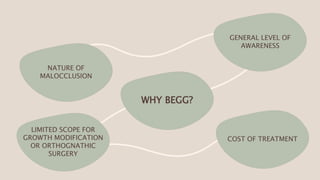
GENERAL LEVEL OF
AWARENESS
NATURE OF
MALOCCLUSION
WHY BEGG?
COST OF TREATMENT
LIMITED SCOPE FOR
GROWTH MODIFICATION
OR ORTHOGNATHIC
SURGERY
Nature of malocclusion
• Patient seeking ortho treatment for correction of minor tooth
displacement are very rare.
• They report for treatment only when they have disfiguring malocclusion
like bimaxillary protrusion , severe crowding and excessive spacing.
• Hence , the appliance should be efficient in achieving anterior , posterior
and vertical corrections.
20XX Refined Begg For Modern Times.Dr.Vijay P. Jayade.1st edition.Sept.2001 5
Limited scope
• Due to lack of awereness ,only some patients operated for treatment
during active growth phase.
• Orthodontic surgery is ruled out because of the face that they cannot be
afforted or because the facilities are not available.
• So,the appliance should be capable of camouflaging mild to moderate
skeletal disproportions.
20XX Refined Begg For Modern Times.Dr.Vijay P. Jayade.1st edition.Sept.2001 6
Level of awareness
• Extra oral appliances like headgear are not accepted.
• So,the appliance should not depend on the headgear
20XX
Refined Begg For Modern Times.Dr.Vijay P. Jayade.1st edition.Sept.2001
7
Cost
• Cost of the treatment must be kept low
• The low cost of the components in Begg technique makes it
the ideal appliance.
20XX
Refined Begg For Modern Times.Dr.Vijay P. Jayade.1st edition.Sept.2001
8
Why Begg lost popularity
Broadly on the account of two reasons:
1. Wrong projection
2. The antagonism it faced from vested commercial interests
20XX
Refined Begg For Modern Times.Dr.Vijay P. Jayade.1st edition.Sept.2001
9
Refined begg
• Is the current begg practice using the same begg brackets.
• Although it significantly deviates from the conventional begg,
it is still within the framework of basic begg tenets.
20XX
Refined Begg For Modern Times.Dr.Vijay P. Jayade.1st edition.Sept.2001
10
How much of “Begg” retained in the
“Refined Begg”
• Light orthodontic forces.
• splitting of bodily movement into the crown tipping
movement followed by root movement ,for an efficient
anchorage management.
• Differential forces for movement of different groups of teeth
• Sequence of treatment stage
20XX Refined Begg For Modern Times.Dr.Vijay P. Jayade.1st edition.Sept.2001 11
• Enmasse movements of anterior and posterior teeth – overjet
& correction of post. Occlusion.
• Over corrections of all displacements.
• Use of round high tensile wires
• Use of light intraoral elastics
20XX Refined Begg For Modern Times.Dr.Vijay P. Jayade.1st edition.Sept.2001 12
Appliance
construction
Diamension of the components
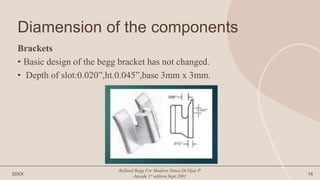
Brackets
• Basic design of the begg bracket has not changed.
• Depth of slot:0.020”,ht.0.045”,base 3mm x 3mm.
20XX
Refined Begg For Modern Times.Dr.Vijay P.
Jayade.1st edition.Sept.2001 14
20XX Refined Begg For Modern Times.Dr.Vijay P.
Jayade.1st edition.Sept.2001
15
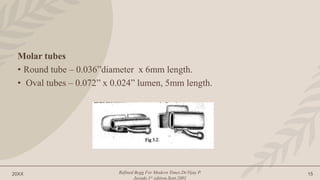
Molar tubes
• Round tube – 0.036”diameter x 6mm length.
• Oval tubes – 0.072” x 0.024” lumen, 5mm length.
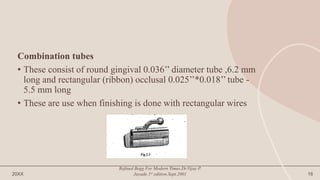
Combination tubes
• These consist of round gingival 0.036’’ diameter tube ,6.2 mm
long and rectangular (ribbon) occlusal 0.025’’*0.018’’ tube -
5.5 mm long
• These are use when finishing is done with rectangular wires
20XX
Refined Begg For Modern Times.Dr.Vijay P.
Jayade.1st edition.Sept.2001 16
20XX
Refined Begg For Modern Times.Dr.Vijay P.
Jayade.1st edition.Sept.2001 17
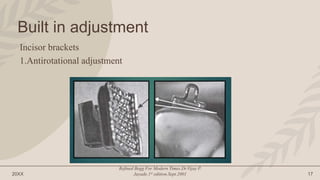
Built in adjustment
Incisor brackets
1.Antirotational adjustment
20XX
Refined Begg For Modern Times.Dr.Vijay P.
Jayade.1st edition.Sept.2001 18
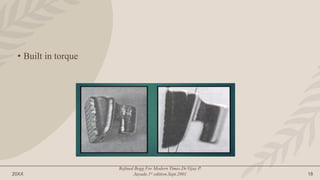
• Built in torque
20XX
Refined Begg For Modern Times.Dr.Vijay P.
Jayade.1st edition.Sept.2001 19
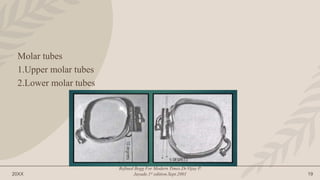
Molar tubes
1.Upper molar tubes
2.Lower molar tubes
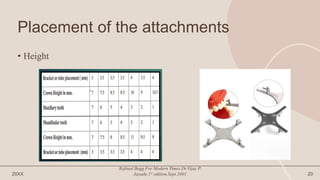
Placement of the attachments
• Height
20XX
Refined Begg For Modern Times.Dr.Vijay P.
Jayade.1st edition.Sept.2001 20
20XX
Refined Begg For Modern Times.Dr.Vijay P.
Jayade.1st edition.Sept.2001 21
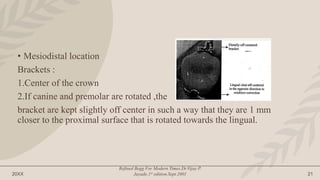
• Mesiodistal location
Brackets :
1.Center of the crown
2.If canine and premolar are rotated ,the
bracket are kept slightly off center in such a way that they are 1 mm
closer to the proximal surface that is rotated towards the lingual.
20XX
Refined Begg For Modern Times.Dr.Vijay P.
Jayade.1st edition.Sept.2001 22
Molar tubes
• Mesial end of the molar tube is at the center of the mesio-buccal cusp
of the molar tooth.
• All the tubes are aligned parallel to a line joining the tips of the buccal
cusps of the concerned molar.
How many teeth are to be bracketed at the beginning of
the treatment ?
• In a first premolar extraction case the treatment is started by
bonding only 6 Upper and 6 Lower anterior brackets.
• Bracket are not placed on the 2nd premolars because they
interfere with the bite opening mechanism.
20XX
Refined Begg For Modern Times.Dr.Vijay P.
Jayade.1st edition.Sept.2001 23
• In second premolar extraction case or when extraction are
unbalanced ,brackets are bonded on the remaining premolar
right from the beginning.
• But the arch wire is not engaged in the premolar bracket slot
till the bite open, but is kept out of the bracket and loosely
ligated
• If the premolar are not ligated to archwire from the beginning
they can over erupt and get locked as the teeth start tipping
distally(interfere space closure)
20XX
Refined Begg For Modern Times.Dr.Vijay P.
Jayade.1st edition.Sept.2001 24
• 1st molar extraction case all the premolars are bonded at the
beginning but are similarly ligated archwire outside the
bracket slot for the same reason as 2nd premolar .
• In non extraction case only 1st premolar are bonded early and
ligated to archwire only.
• The 2nd premolar are bonded after the bite open.
20XX
Refined Begg For Modern Times.Dr.Vijay P.
Jayade.1st edition.Sept.2001 25
• Palatal brackets
• Additional brackets are placed on the palatal surface of upper
incisors when the palatal elastics from TPA are used for upper
incisor intrusion.
20XX
Refined Begg For Modern Times.Dr.Vijay P.
Jayade.1st edition.Sept.2001 26
Other attachments
• Hooks:
1. Buccal hook (centre of MB cusp)
2. Palatal hook (Centre of distolingual cusp)
• Lingual buttons, cleats or eyelets.
Placed slightly off center – over correcting rotations.
• Additional round tubes.
For engaging lip bumpers, head gears, distal ends of U loops of
EVAA appl
20XX
Refined Begg For Modern Times.Dr.Vijay P.
Jayade.1st edition.Sept.2001 27
Arch wires
• Higher grade Australian arch wires like:
Premium, Premium plus, Supreme.
• Unraveling of crowding: Thin premium plus or supreme wires,
multi-stranded (co-ax) or NiTi wires are used.
• For finishing: alpha titanium wires. Rectangular wires.
• Tandem wires :combination of rectangular & round cross
sections in the anterior & posterior segment.
20XX
Refined Begg For Modern Times.Dr.Vijay P.
Jayade.1st edition.Sept.2001 28
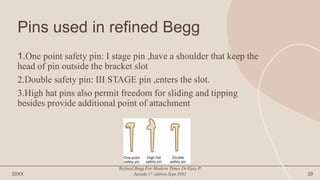
Pins used in refined Begg
1.One point safety pin: I stage pin ,have a shoulder that keep the
head of pin outside the bracket slot
2.Double safety pin: III STAGE pin ,enters the slot.
3.High hat pins also permit freedom for sliding and tipping
besides provide additional point of attachment
20XX
Refined Begg For Modern Times.Dr.Vijay P.
Jayade.1st edition.Sept.2001 29
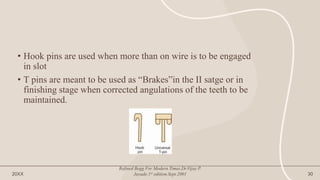
• Hook pins are used when more than on wire is to be engaged
in slot
• T pins are meant to be used as “Brakes”in the II satge or in
finishing stage when corrected angulations of the teeth to be
maintained.
20XX
Refined Begg For Modern Times.Dr.Vijay P.
Jayade.1st edition.Sept.2001 30
Stage 1
Objectives of stage I in conventional Begg
• Alignment
• Elimination of crossbite
• Correction of abnormal overbite
• Reduction of overjet
• Correction of arch form
• Matching of midlines
• Attaining class I molar and canine relationship
20XX
Refined Begg For Modern Times.Dr.Vijay P.
Jayade.1st edition.Sept.2001 31
Priorities in stage I
• Overbite before overjet.
• Alignment of teeth.
• Proclination to be reduced before applying higher intrusive
force.
20XX
Refined Begg For Modern Times.Dr.Vijay P.
Jayade.1st edition.Sept.2001 32
Objectives – described under two
substages.
Substage I – A.
• Create space for correcting crowded teeth / close spacing if
already present.
• Alignment of anterior teeth by correcting labiolingual
displacement /rotations. Anterior crossbites,if any ,are also
corrected
• To improved upper incisor inclination - /+ 10° of normal.
• Rotations and Bucco-lingual positions of upper molars corrected
so that TPA can be fitted. Molar crossbite are also corrected.
• PM rotations- only with palatal or lingual attachments.
• Upper arch broadened in canine premolar area if narrow , to
permit mandibular advancement for correcting class II
20XX
Refined Begg For Modern Times.Dr.Vijay P.
Jayade.1st edition.Sept.2001 33
• Substage I – B.
• Bite opening.
• Retraction of upper anterior teeth to eliminate the overjet with
control over the root position.
• Control of mandibular plane angle.
• Matching the upper and lower midline
• Correcting the inter arch relationship to class I
• Displacement and rotation of premolar are corrected in those
cases where premolar brackets are bonded from beginning.
20XX
Refined Begg For Modern Times.Dr.Vijay P.
Jayade.1st edition.Sept.2001 34
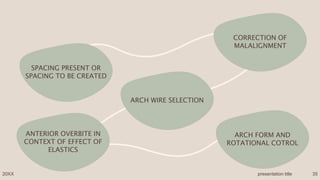
CORRECTION OF
MALALIGNMENT
SPACING PRESENT OR
SPACING TO BE CREATED
ARCH WIRE SELECTION
ARCH FORM AND
ROTATIONAL COTROL
ANTERIOR OVERBITE IN
CONTEXT OF EFFECT OF
ELASTICS
20XX presentation title 35
20XX
Refined Begg For Modern Times.Dr.Vijay P.
Jayade.1st edition.Sept.2001 36
1)Spacing present or space to be created:
• The arch wires used are of lesser diameter usually 0.016’’(occasionally
0.014’’ followed by 0.016’’)size.
2)Correction of malalignment
Arch wire should be capable of producing light constant forces over
long deflections and long time .NiTi wires,multistranded wires and ss
small diameter wire
3)Consideration of anterior overbite
For average to deep bite case the preferred arch wire during this
stage is 0.018’’P+ or P because
It provide adequate intrusive force
It effectively resists the lingular rolling effect on lower molar
For anterior open bite
Upper arch 0.014’’P/P+ wire to facilitate bite closure
Lower arch 0.016’’P/P+
20XX
Refined Begg For Modern Times.Dr.Vijay P.
Jayade.1st edition.Sept.2001 37
4)arch form and rotation control
• Best by 0.018’’
• It gives better rotational control in beg bracket than 0.016’’
20XX
Refined Begg For Modern Times.Dr.Vijay P.
Jayade.1st edition.Sept.2001 38
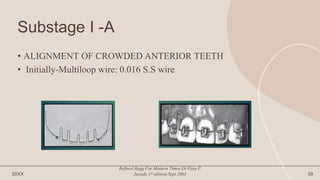
Substage I -A
• ALIGNMENT OF CROWDED ANTERIOR TEETH
• Initially-Multiloop wire: 0.016 S.S wire
20XX
Refined Begg For Modern Times.Dr.Vijay P.
Jayade.1st edition.Sept.2001 39
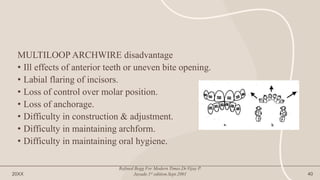
MULTILOOP ARCHWIRE disadvantage
• Ill effects of anterior teeth or uneven bite opening.
• Labial flaring of incisors.
• Loss of control over molar position.
• Loss of anchorage.
• Difficulty in construction & adjustment.
• Difficulty in maintaining archform.
• Difficulty in maintaining oral hygiene.
20XX
Refined Begg For Modern Times.Dr.Vijay P.
Jayade.1st edition.Sept.2001 40
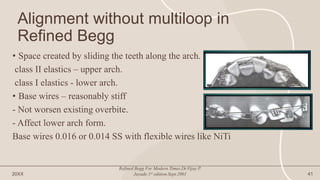
Alignment without multiloop in
Refined Begg
• Space created by sliding the teeth along the arch.
class II elastics – upper arch.
class I elastics - lower arch.
• Base wires – reasonably stiff
- Not worsen existing overbite.
- Affect lower arch form.
Base wires 0.016 or 0.014 SS with flexible wires like NiTi
20XX
Refined Begg For Modern Times.Dr.Vijay P.
Jayade.1st edition.Sept.2001 41
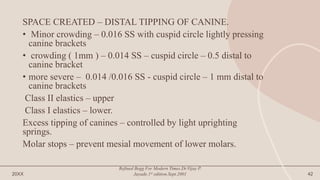
SPACE CREATED – DISTAL TIPPING OF CANINE.
• Minor crowding – 0.016 SS with cuspid circle lightly pressing
canine brackets
• crowding ( 1mm ) – 0.014 SS – cuspid circle – 0.5 distal to
canine bracket
• more severe – 0.014 /0.016 SS - cuspid circle – 1 mm distal to
canine brackets
Class II elastics – upper
Class I elastics – lower.
Excess tipping of canines – controlled by light uprighting
springs.
Molar stops – prevent mesial movement of lower molars.
20XX
Refined Begg For Modern Times.Dr.Vijay P.
Jayade.1st edition.Sept.2001 42
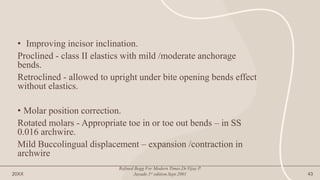
• Improving incisor inclination.
Proclined - class II elastics with mild /moderate anchorage
bends.
Retroclined - allowed to upright under bite opening bends effect
without elastics.
• Molar position correction.
Rotated molars - Appropriate toe in or toe out bends – in SS
0.016 archwire.
Mild Buccolingual displacement – expansion /contraction in
archwire
20XX
Refined Begg For Modern Times.Dr.Vijay P.
Jayade.1st edition.Sept.2001 43
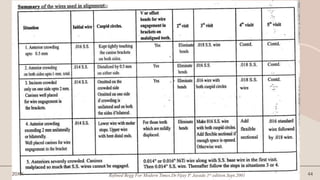
20XX Refined Begg For Modern Times.Dr.Vijay P. Jayade.1st edition.Sept.2001 44
Substage I B
• Arch wire used are the standard 0.018’’ P+ or P
• The elastics employed are mostly class 2 light or ultra light.
20XX
Refined Begg For Modern Times.Dr.Vijay P.
Jayade.1st edition.Sept.2001 45
Bite opening
• Preference – incisor intrusion & avoiding molar extrusion
• Because incisor intrusion reduces or prevents “gummy” smile
and molar extrusion cause increase in mandibular plane angle
there by worsening the profile
20XX
Refined Begg For Modern Times.Dr.Vijay P.
Jayade.1st edition.Sept.2001 46
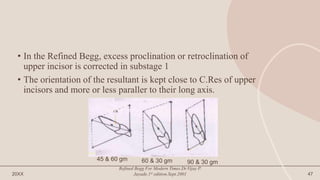
• In the Refined Begg, excess proclination or retroclination of
upper incisor is corrected in substage 1
• The orientation of the resultant is kept close to C.Res of upper
incisors and more or less paraller to their long axis.
20XX
Refined Begg For Modern Times.Dr.Vijay P.
Jayade.1st edition.Sept.2001 47
45 & 60 gm 60 & 30 gm 90 & 30 gm
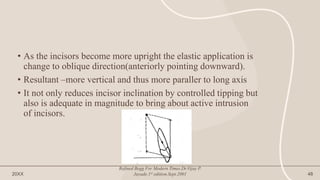
• As the incisors become more upright the elastic application is
change to oblique direction(anteriorly pointing downward).
• Resultant –more vertical and thus more paraller to long axis
• It not only reduces incisor inclination by controlled tipping but
also is adequate in magnitude to bring about active intrusion
of incisors.
20XX
Refined Begg For Modern Times.Dr.Vijay P.
Jayade.1st edition.Sept.2001 48
• Gradual increase in magnitude of intrusive force
• Increasing anchor bend 30°- 50° - 0.016 archwire over 2-3
visits.
• Elastic force reduced by using for longer periods – 3-5 days or
by switching from yellow ( 5/16”) to Road runner ( 3/8” )
elastics.
20XX
Refined Begg For Modern Times.Dr.Vijay P.
Jayade.1st edition.Sept.2001 49
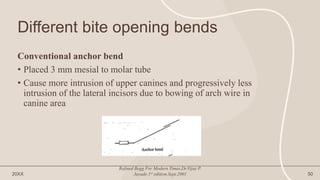
Different bite opening bends
Conventional anchor bend
• Placed 3 mm mesial to molar tube
• Cause more intrusion of upper canines and progressively less
intrusion of the lateral incisors due to bowing of arch wire in
canine area
20XX
Refined Begg For Modern Times.Dr.Vijay P.
Jayade.1st edition.Sept.2001 50
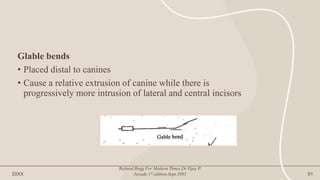
Glable bends
• Placed distal to canines
• Cause a relative extrusion of canine while there is
progressively more intrusion of lateral and central incisors
20XX
Refined Begg For Modern Times.Dr.Vijay P.
Jayade.1st edition.Sept.2001 51
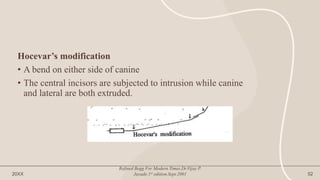
Hocevar’s modification
• A bend on either side of canine
• The central incisors are subjected to intrusion while canine
and lateral are both extruded.
20XX
Refined Begg For Modern Times.Dr.Vijay P.
Jayade.1st edition.Sept.2001 52
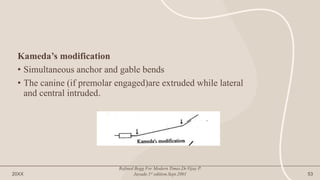
Kameda’s modification
• Simultaneous anchor and gable bends
• The canine (if premolar engaged)are extruded while lateral
and central intruded.
20XX
Refined Begg For Modern Times.Dr.Vijay P.
Jayade.1st edition.Sept.2001 53
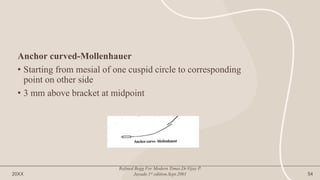
Anchor curved-Mollenhauer
• Starting from mesial of one cuspid circle to corresponding
point on other side
• 3 mm above bracket at midpoint
20XX
Refined Begg For Modern Times.Dr.Vijay P.
Jayade.1st edition.Sept.2001 54
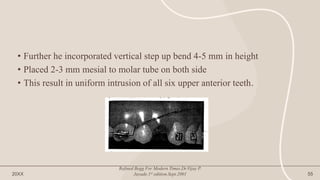
• Further he incorporated vertical step up bend 4-5 mm in height
• Placed 2-3 mm mesial to molar tube on both side
• This result in uniform intrusion of all six upper anterior teeth.
20XX
Refined Begg For Modern Times.Dr.Vijay P.
Jayade.1st edition.Sept.2001 55
20XX
Refined Begg For Modern Times.Dr.Vijay P.
Jayade.1st edition.Sept.2001 56
Elimination of overjet maintaining control over the
root positions of anterior teeth
• Controlled tipping of the upper incisor during retraction
• With the combination of higher intrusive forces and light or ultra
light elastic forces that is used now for incisor intrusion ,the chances
of obtaining a proper M/F ratio for controlled tipping are much better
• After bite open ,it become necessary to reduce the intrusive for by
decreasing the anchor bend
• Preventing uncontrolled tipping of the lower incisor
-the lower incisor brackets are bonded as far as gingivally as
possible
-anchor bend in lower arch are of lesser degree than upper
-a MMA with labial root torque is used
20XX
Refined Begg For Modern Times.Dr.Vijay P.
Jayade.1st edition.Sept.2001 57
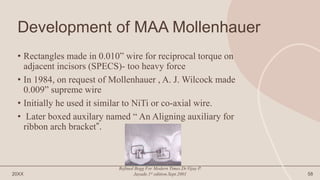
Development of MAA Mollenhauer
• Rectangles made in 0.010” wire for reciprocal torque on
adjacent incisors (SPECS)- too heavy force
• In 1984, on request of Mollenhauer , A. J. Wilcock made
0.009” supreme wire
• Initially he used it similar to NiTi or co-axial wire.
• Later boxed auxilary named “ An Aligning auxiliary for
ribbon arch bracket”.
20XX
Refined Begg For Modern Times.Dr.Vijay P.
Jayade.1st edition.Sept.2001 58
Requirements of MAA
• Must generate very light root moving forces
• when reciprocal torque is required on the adjacent teeth the
adjucent rectangle must not diverge by more than 45 degree
• Auxiliary should resist deformation .
• Base wire should be able to resist vertical and transverse
reactive forces from MAA.therefore must be made in
0.018”P+ wire.
20XX
Refined Begg For Modern Times.Dr.Vijay P.
Jayade.1st edition.Sept.2001 59
ADVANTAGES OF MAA
• simultaneous intrusion and retraction of incisors
• rapid bodily alignment of anterior teeth with gentle forces
• Stable results
• Periodontal advantages – gingival dehiscences associated
with prolonged labial root torquing is eliminated
• Short stage three.
20XX
Refined Begg For Modern Times.Dr.Vijay P.
Jayade.1st edition.Sept.2001 60
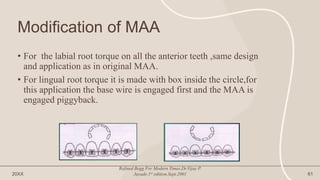
Modification of MAA
• For the labial root torque on all the anterior teeth ,same design
and application as in original MAA.
• For lingual root torque it is made with box inside the circle,for
this application the base wire is engaged first and the MAA is
engaged piggyback.
20XX
Refined Begg For Modern Times.Dr.Vijay P.
Jayade.1st edition.Sept.2001 61
• When reciprocal root torque is required on adjacent teeth the
concerned box rides over the main arch wire with a cross over
bend and pressed against the incisor surface of the crown.
20XX
Refined Begg For Modern Times.Dr.Vijay P.
Jayade.1st edition.Sept.2001 62
Controlling mandibular plane angle
• Open during treatment due to molar extrusion – worsening of
Cl II profile.
• Avoid stronger anchor bends in archwires and heavy class II
elastics
• Other adjuncts like T.P.A.or high pull headgear on upper molar
can help in controlling their vertical position
• Bite blocks can also be used to prevent over eruption of upper
and lower molars.
20XX
Refined Begg For Modern Times.Dr.Vijay P.
Jayade.1st edition.Sept.2001 63
Correcting the midline discrepancy
• Upper midline correction is done using slightly uneven class II
elastics force on both side
• If both midlines are shifted in opposite directions – a midline
diagonal elastic(from the upper rt cuspid circle to lower lf or
from upper lf cuspid circle to lower rt)is used along with Class
II elastics
• If the lower midline is alone deviated,it is corrected by using a
unilateral lower class I elastic
20XX
Refined Begg For Modern Times.Dr.Vijay P.
Jayade.1st edition.Sept.2001 64
Correcting inter - arch relationships to Class I
• In Growing child correction of molar and canine class II to
class I is mostly achieved by encouraging the mandibular
growth.
• Adults – mesial movement of the lower post. dental segment
brought about by class II elastics.
• Selected cases –class II cases are corrected by distalizing
upper molars.
20XX
Refined Begg For Modern Times.Dr.Vijay P.
Jayade.1st edition.Sept.2001 65
Check list at the end of
Stage I.
 Incisors – edge to edge relation.
 Midlines matching.
 Molar & canines – class I.
 Upper and lower arch forms – matching.
 Molar rotations & BL displ. Corrected.
 Good control – root positions & mandibular plane
angle.
20XX
Refined Begg For Modern Times.Dr.Vijay P.
Jayade.1st edition.Sept.2001 66
20XX
Refined Begg For Modern Times.Dr.Vijay P.
Jayade.1st edition.Sept.2001 67
Common –
• Maintain all corrections – in stage I.
• Close all extraction spaces.
Additional.
 Controlled tipping of incisor when space closure
achieved by anterior retraction.
 Prevent excess tipping of anterior when space
closure by protracting posteriors.
 If molar relation is not fully corrected at end of
stage I this correction also achieved during stage II
 In 1st PM extraction Cases – rotations & crossbites
of 2nd pm corrected
STAGE II OBJECTIVES
Archwires in Stage II of Refined Begg
• In extraction & non extraction cases – 0.018” P or P+, or
0.020 P wires.
• If stage corrections involved extreme deep bite, badly
distorted arch forms or severe rotations new arch wire are
made in 0.020” size.
• Making a double back in 0.020’’ wire is very effective in 1st
molar extraction case. However 2nd molar should be carefully
controlled with appropriate toe ins.
20XX
Refined Begg For Modern Times.Dr.Vijay P.
Jayade.1st edition.Sept.2001 68
• Anchor bends are reduced because a continuous use bends
will lead to excessive tipping of molar.
• Premolar are bypassed till the space close except when they
are in distol-buccal rotation.
20XX
Refined Begg For Modern Times.Dr.Vijay P.
Jayade.1st edition.Sept.2001 69
Controlled tipping of the incisors
• MAA for lingual root torque is must during stage II for
controlled lingual tipping of incisors during retraction. ( as
bite opening force reduced - intrusive force supplemented with
moment – MAA).
• Lower incisors need MMA for lingual torque when they are to
be significantly retracted during stage II in order to prevent
their uncontrolled tipping.
• Canines – excess tipping – 0.010 uprighting springs.
20XX
Refined Begg For Modern Times.Dr.Vijay P.
Jayade.1st edition.Sept.2001 70
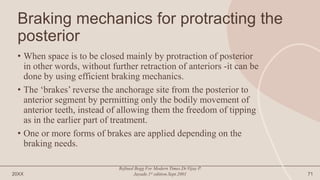
Braking mechanics for protracting the
posterior
• When space is to be closed mainly by protraction of posterior
in other words, without further retraction of anteriors -it can be
done by using efficient braking mechanics.
• The ‘brakes’ reverse the anchorage site from the posterior to
anterior segment by permitting only the bodily movement of
anterior teeth, instead of allowing them the freedom of tipping
as in the earlier part of treatment.
• One or more forms of brakes are applied depending on the
braking needs.
20XX
Refined Begg For Modern Times.Dr.Vijay P.
Jayade.1st edition.Sept.2001 71
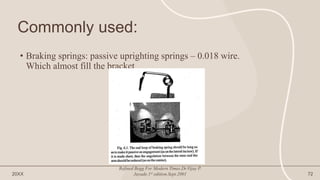
Commonly used:
• Braking springs: passive uprighting springs – 0.018 wire.
Which almost fill the bracket
20XX
Refined Begg For Modern Times.Dr.Vijay P.
Jayade.1st edition.Sept.2001 72
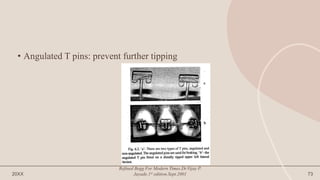
• Angulated T pins: prevent further tipping
20XX
Refined Begg For Modern Times.Dr.Vijay P.
Jayade.1st edition.Sept.2001 73
Combination wires:
• Made either of SS or Alpha Ti alloy.
• Ant segment. – 0.022 x 0.018 (ribbon mode).
• Post. segment – 0.018( round) .
• Alpha Ti – easier to engage in anterior bracket slots.
• Increase chance of distortion, use SS combination wire which
decreases torque than alpha Ti.
• Disadv. – expensive.
• SS 0.022 x 0.018 sectionals – torqued in ribbon mode – piggy back
over 0.018 base wire
20XX
Refined Begg For Modern Times.Dr.Vijay P.
Jayade.1st edition.Sept.2001 74
• Torquing auxiliaries
• A two spur or four spur auxiliary,which is activated to desired
extent or MAA design in 0.010’’ or 0.011’’ size can also be
used as a braking mechanism along with strong base wire
(0.020’’ or at least 0.018’’)
20XX
Refined Begg For Modern Times.Dr.Vijay P.
Jayade.1st edition.Sept.2001 75
Elastics –different configurations are employed during this
stage as per the patients need
• Light ( yellow ) Class I or II elastics – anterior retraction.
• Ultra light Class II elastics.
• Stronger ( green ) – class I – posterior protraction.
20XX
Refined Begg For Modern Times.Dr.Vijay P.
Jayade.1st edition.Sept.2001 76
Check list.
• Spaces closed completely.
• Anterior edge to edge bite or +ve overjet in open bite cases.
• Canine & molar relations – Cl I or super Cl .
20XX presentation title 77
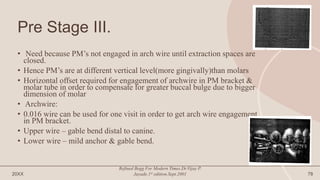
Pre Stage III.
• Need because PM’s not engaged in arch wire until extraction spaces are
closed.
• Hence PM’s are at different vertical level(more gingivally)than molars
• Horizontal offset required for engagement of archwire in PM bracket &
molar tube in order to compensate for greater buccal bulge due to bigger
dimension of molar
• Archwire:
• 0.016 wire can be used for one visit in order to get arch wire engagement
in PM bracket.
• Upper wire – gable bend distal to canine.
• Lower wire – mild anchor & gable bend.
20XX
Refined Begg For Modern Times.Dr.Vijay P.
Jayade.1st edition.Sept.2001 78
Stage III.
• Objectives.
To maintain corrections.
To achieve desired root positions.
• Additional Objectives.( Refined Begg ).
 Monitor sagittal & vertical anchorage.
Monitor & correct inclinations of posterior teeth
To correct the position of 2 nd molars when required.
To monitor treatment for undesirable sequels like root resorption,
parafunctional habit due to cuspal interference.
20XX
Refined Begg For Modern Times.Dr.Vijay P.
Jayade.1st edition.Sept.2001 79
Problems encountered in Stage III.
 Undesired sagittal movements.
• In the treatment of class II malocclusion, the inter arch relation
reverts back(partially/fully)from the corrected Cl I to Cl II,when
the upper arch moves mesially.
• Mesial movement of both arches cause a reversal of bimaxillary
protrusion correction.
• Individual crown movements in a mesial direction can crowd the
incisor and affect the rotational correction .
• Mesial & distal crown moving tendencies in the teeth adjacent to
the extraction site can open spaces.
20XX
Refined Begg For Modern Times.Dr.Vijay P.
Jayade.1st edition.Sept.2001 80
Undesired vertical movements cause the anterior deep bite to
return partially or fully. In the 2nd PM or 1st Molar extraction
cases,an open bite may develop in the molar area.
Undesired transverse movements cause the molars to roll out
buccally and rotate.this can lead to serious fumctional
disturbance.
 Root resorption possibilities are substantial during the 3rd
stage
20XX
Refined Begg For Modern Times.Dr.Vijay P.
Jayade.1st edition.Sept.2001 81
Genesis of III stage complications
1. Amount of lingual root torque needed for incisors & distal
root movement. Greater the need for these corrections,more
will be effect of reciprocal reactions in all three planes of
space
2. Amount of force generated auxiliaries & springs. Heavier
wires causes root resorption.
3. Use of weak base wires. Such wire can not resist the
reciprocal actions of torquing auxiliary and uprighting
spring.
20XX
Refined Begg For Modern Times.Dr.Vijay P.
Jayade.1st edition.Sept.2001 82
20XX
Refined Begg For Modern Times.Dr.Vijay P.
Jayade.1st edition.Sept.2001 83
How the III stage problems are
overcome
 Minimize need for root movements.
• Correct diagnosis & carefully planning extraction
• Using efficient brakes.
• Incisors tipped in a controlled manner.
Use of heavy base wires.
• 0.020 Premimum wire , which are 3 times stiffer than previously used
0.020’’ Special + wires
20XX
Refined Begg For Modern Times.Dr.Vijay P.
Jayade.1st edition.Sept.2001 84
Lighter auxiliaries & Uprighting springs.
• Because of reduced need to torque the incisor roots– 2 spur auxiliary is
used. (2,4 & 6)
• 0.012 wire used.
• Uprighting springs “mini” springs made in 0.009” wire, while slightly
bigger coils 0.012” wire for canines & PM’s and 0.010” size for
incisors.
Light Class II elastics. (yellow)
• Because of lighter reciprocal actions.
20XX
Refined Begg For Modern Times.Dr.Vijay P.
Jayade.1st edition.Sept.2001 85
Reinforcement of the anchorage.
• In Extreme malocclusion,
• For Sagittal direction – reverse torquing in lower incisors. Head gear or TPA
may be added to upper molars. Lip Bumper to lower molars.
• Vertical Augmentation-High pull head gear, TPA or posterior bite blocks can
be used.
• Molar uprighting springs reinforce anchorage in sagittal and vertical
directions in the 2nd PM or 1st Molar extraction cases.
• Transverse -0.020 premium grade wires ,provide enough contraction & toe
in is built in the wire.
Archwires.
• Cuspid circles tightly touching – cuspid brackets.
• Posterior segment gingivally in relation to the anterior
segment
• Contraction & toe in – upper wire And
expansion in lower – less.
decided – looking at original study models.
• Arch wires properly co-ordinated.
• Wire ends – annealed & tightly cinched.
20XX
Refined Begg For Modern Times.Dr.Vijay P.
Jayade.1st edition.Sept.2001 86
• Elastics: very :light class II elastics.
• Second molars banded midway in third stage.
• Completion of third stage: Degree of uprighting & torquing
assessed
 Visual inspection
Palpating – roots.
Radiographs – Lateral Cephalogram, Panoramic radiograph,
Occlusal film: labiolingul alignment of LI roots
20XX
Refined Begg For Modern Times.Dr.Vijay P.
Jayade.1st edition.Sept.2001 87
20XX
Refined Begg For Modern Times.Dr.Vijay P.
Jayade.1st edition.Sept.2001 88
Finishing and detailing
• Finishing with Begg appliance – difficult , not impossible.
• Objectives of finishing & detailing.
Intra arch objectives.
 Good interdental contacts, proper faciolingual positioning of teeth.
 All rotations over corrected.
 Complete space closure.
 Vertical levelling.
 Flat curve of spee.
 Proper tip & torque.
 Maintenance of lower Inter-Canine dimensions.
20XX
Refined Begg For Modern Times.Dr.Vijay P.
Jayade.1st edition.Sept.2001 89
• Interarch objectives.
Normal overjet and overbite.
 Cl I canine & Molar relation
 Tight interdigitation of all the cusps of posterior Teeth.
• Functional requirements.
 Matching CO – CR.
 No cuspal interference during function
 Cuspid & incisor guidance.
• Control of etiologic factors.
• Soft tissue factors
 Frenectomy etc
20XX
Refined Begg For Modern Times.Dr.Vijay P.
Jayade.1st edition.Sept.2001 90
Round finishing archwire.
• Used 0.020 stage III wires .
• It is necessary to continue torquing auxiliary and uprighting springs of
III stage into finishing stage.
• Archwires given – ideal shape & co-ordinated.
• Some additional First order & Second order adjustments made.
20XX
Refined Begg For Modern Times.Dr.Vijay P.
Jayade.1st edition.Sept.2001 91
First order adjustment
• Labio lingual position of upper laterals.
• Upper canine prominence.
• Molar offset made in stage III is continued.
• Toe in is required for U6 (and the U7 when necessary ) for their
distolingual rotation in order to obtained proper Cl I molar
relationship.
20XX
Refined Begg For Modern Times.Dr.Vijay P.
Jayade.1st edition.Sept.2001 92
Second order adjustments.
• U 2 , shorter in relation to U1 and U3.
• Mesial angulation of U6 for seating its distobuccal cusp against the
mesiobuccal cusp of lower 7.
• U3’s slightly more mesially angulated to make their cusp tip occlude
with the distal half of labial surface of L3 . Uprighting springs on U3
can be continued for this.
• L3 & L2 – levels to be adjusted if necessary.
20XX
Refined Begg For Modern Times.Dr.Vijay P.
Jayade.1st edition.Sept.2001 93
• Rectangular finishing wires.
Alpha Ti – 0.022 x 0.018 ribbon wires because
 it is possible to build Precise degree of torque in anterior segment.
 Soft – easy to bend. Harder in mouth.
 its 0.022 vertical dimension gives enough clearence in 0.040” vertical
slot for vertical settling of the teeth
Check list on finishing and detailing
• Establish all Andrews six keys.
• Check the midline.
• Check the occlusion – Centric position.
• Occlsuion in functional movements.
• Excellent interdigitation.
20XX
Refined Begg For Modern Times.Dr.Vijay P.
Jayade.1st edition.Sept.2001 94
Conclusion
• No treatment modality is ever perfect.
• CHANGE – keyword of every treatment modality
• Drawbacks become apparent with passage of time.
• Refinements also become necessary to incorporate new concepts
and technological progress
• The trend in Refined Begg is in the scientific progression of Dr.
Begg’s concepts, especially in the use of ultra light forces. With the
advances in technology & materials, a better realization of these
concepts has been possible, ultimately leading to superior results in
treatment
20XX presentation title 95
Referances
• Refined Begg For Modern Times.Dr.Vijay P. Jayade.1st
edition.Sept.2001.
• Essential of orthodontics Biomechanics.Dr.Vijay
P.Jayade,Dr.Chentan V. Jayade.
• Fletcher GGT:Begg appliance and technique,London.John
G.Wright:PSG,1982
• Evolution of orthodontic brackets. Shubhanjali Sharma,Kanika
Kundra.
• Proffit WR.Contemporary orthodontics,Edition 6th.
20XX presentation title 96
thank you

REFINED BEGG philosophy [Autosaved].pptx

  • 1.
  • 2.
    CONTENT INTRODUCTION APPLIANCE CONSTRUTION STAGE 1 STAGE2 PRE STAGE 3 STAGE 3 FINISHING AND DETAILING CONCLUSION REFERENCE
  • 3.
    INTRODUCTION • The Beggdifferential light force technique introduced by Dr.P.R.Begg in the year 1956 has dominated the Indian orthodontic since for several years now because of its simplicity ,versatility ,modifiability and affordability. • It is essential to diversify the approaches to therapy by using a multitude of appliance mechanics which are scientifically proven to successfully meet the goal of treatment plan. 20XX presentation title 3
  • 4.
    GENERAL LEVEL OF AWARENESS NATUREOF MALOCCLUSION WHY BEGG? COST OF TREATMENT LIMITED SCOPE FOR GROWTH MODIFICATION OR ORTHOGNATHIC SURGERY
  • 5.
    Nature of malocclusion •Patient seeking ortho treatment for correction of minor tooth displacement are very rare. • They report for treatment only when they have disfiguring malocclusion like bimaxillary protrusion , severe crowding and excessive spacing. • Hence , the appliance should be efficient in achieving anterior , posterior and vertical corrections. 20XX Refined Begg For Modern Times.Dr.Vijay P. Jayade.1st edition.Sept.2001 5
  • 6.
    Limited scope • Dueto lack of awereness ,only some patients operated for treatment during active growth phase. • Orthodontic surgery is ruled out because of the face that they cannot be afforted or because the facilities are not available. • So,the appliance should be capable of camouflaging mild to moderate skeletal disproportions. 20XX Refined Begg For Modern Times.Dr.Vijay P. Jayade.1st edition.Sept.2001 6
  • 7.
    Level of awareness •Extra oral appliances like headgear are not accepted. • So,the appliance should not depend on the headgear 20XX Refined Begg For Modern Times.Dr.Vijay P. Jayade.1st edition.Sept.2001 7
  • 8.
    Cost • Cost ofthe treatment must be kept low • The low cost of the components in Begg technique makes it the ideal appliance. 20XX Refined Begg For Modern Times.Dr.Vijay P. Jayade.1st edition.Sept.2001 8
  • 9.
    Why Begg lostpopularity Broadly on the account of two reasons: 1. Wrong projection 2. The antagonism it faced from vested commercial interests 20XX Refined Begg For Modern Times.Dr.Vijay P. Jayade.1st edition.Sept.2001 9
  • 10.
    Refined begg • Isthe current begg practice using the same begg brackets. • Although it significantly deviates from the conventional begg, it is still within the framework of basic begg tenets. 20XX Refined Begg For Modern Times.Dr.Vijay P. Jayade.1st edition.Sept.2001 10
  • 11.
    How much of“Begg” retained in the “Refined Begg” • Light orthodontic forces. • splitting of bodily movement into the crown tipping movement followed by root movement ,for an efficient anchorage management. • Differential forces for movement of different groups of teeth • Sequence of treatment stage 20XX Refined Begg For Modern Times.Dr.Vijay P. Jayade.1st edition.Sept.2001 11
  • 12.
    • Enmasse movementsof anterior and posterior teeth – overjet & correction of post. Occlusion. • Over corrections of all displacements. • Use of round high tensile wires • Use of light intraoral elastics 20XX Refined Begg For Modern Times.Dr.Vijay P. Jayade.1st edition.Sept.2001 12
  • 13.
  • 14.
    Diamension of thecomponents Brackets • Basic design of the begg bracket has not changed. • Depth of slot:0.020”,ht.0.045”,base 3mm x 3mm. 20XX Refined Begg For Modern Times.Dr.Vijay P. Jayade.1st edition.Sept.2001 14
  • 15.
    20XX Refined BeggFor Modern Times.Dr.Vijay P. Jayade.1st edition.Sept.2001 15 Molar tubes • Round tube – 0.036”diameter x 6mm length. • Oval tubes – 0.072” x 0.024” lumen, 5mm length.
  • 16.
    Combination tubes • Theseconsist of round gingival 0.036’’ diameter tube ,6.2 mm long and rectangular (ribbon) occlusal 0.025’’*0.018’’ tube - 5.5 mm long • These are use when finishing is done with rectangular wires 20XX Refined Begg For Modern Times.Dr.Vijay P. Jayade.1st edition.Sept.2001 16
  • 17.
    20XX Refined Begg ForModern Times.Dr.Vijay P. Jayade.1st edition.Sept.2001 17 Built in adjustment Incisor brackets 1.Antirotational adjustment
  • 18.
    20XX Refined Begg ForModern Times.Dr.Vijay P. Jayade.1st edition.Sept.2001 18 • Built in torque
  • 19.
    20XX Refined Begg ForModern Times.Dr.Vijay P. Jayade.1st edition.Sept.2001 19 Molar tubes 1.Upper molar tubes 2.Lower molar tubes
  • 20.
    Placement of theattachments • Height 20XX Refined Begg For Modern Times.Dr.Vijay P. Jayade.1st edition.Sept.2001 20
  • 21.
    20XX Refined Begg ForModern Times.Dr.Vijay P. Jayade.1st edition.Sept.2001 21 • Mesiodistal location Brackets : 1.Center of the crown 2.If canine and premolar are rotated ,the bracket are kept slightly off center in such a way that they are 1 mm closer to the proximal surface that is rotated towards the lingual.
  • 22.
    20XX Refined Begg ForModern Times.Dr.Vijay P. Jayade.1st edition.Sept.2001 22 Molar tubes • Mesial end of the molar tube is at the center of the mesio-buccal cusp of the molar tooth. • All the tubes are aligned parallel to a line joining the tips of the buccal cusps of the concerned molar.
  • 23.
    How many teethare to be bracketed at the beginning of the treatment ? • In a first premolar extraction case the treatment is started by bonding only 6 Upper and 6 Lower anterior brackets. • Bracket are not placed on the 2nd premolars because they interfere with the bite opening mechanism. 20XX Refined Begg For Modern Times.Dr.Vijay P. Jayade.1st edition.Sept.2001 23
  • 24.
    • In secondpremolar extraction case or when extraction are unbalanced ,brackets are bonded on the remaining premolar right from the beginning. • But the arch wire is not engaged in the premolar bracket slot till the bite open, but is kept out of the bracket and loosely ligated • If the premolar are not ligated to archwire from the beginning they can over erupt and get locked as the teeth start tipping distally(interfere space closure) 20XX Refined Begg For Modern Times.Dr.Vijay P. Jayade.1st edition.Sept.2001 24
  • 25.
    • 1st molarextraction case all the premolars are bonded at the beginning but are similarly ligated archwire outside the bracket slot for the same reason as 2nd premolar . • In non extraction case only 1st premolar are bonded early and ligated to archwire only. • The 2nd premolar are bonded after the bite open. 20XX Refined Begg For Modern Times.Dr.Vijay P. Jayade.1st edition.Sept.2001 25
  • 26.
    • Palatal brackets •Additional brackets are placed on the palatal surface of upper incisors when the palatal elastics from TPA are used for upper incisor intrusion. 20XX Refined Begg For Modern Times.Dr.Vijay P. Jayade.1st edition.Sept.2001 26
  • 27.
    Other attachments • Hooks: 1.Buccal hook (centre of MB cusp) 2. Palatal hook (Centre of distolingual cusp) • Lingual buttons, cleats or eyelets. Placed slightly off center – over correcting rotations. • Additional round tubes. For engaging lip bumpers, head gears, distal ends of U loops of EVAA appl 20XX Refined Begg For Modern Times.Dr.Vijay P. Jayade.1st edition.Sept.2001 27
  • 28.
    Arch wires • Highergrade Australian arch wires like: Premium, Premium plus, Supreme. • Unraveling of crowding: Thin premium plus or supreme wires, multi-stranded (co-ax) or NiTi wires are used. • For finishing: alpha titanium wires. Rectangular wires. • Tandem wires :combination of rectangular & round cross sections in the anterior & posterior segment. 20XX Refined Begg For Modern Times.Dr.Vijay P. Jayade.1st edition.Sept.2001 28
  • 29.
    Pins used inrefined Begg 1.One point safety pin: I stage pin ,have a shoulder that keep the head of pin outside the bracket slot 2.Double safety pin: III STAGE pin ,enters the slot. 3.High hat pins also permit freedom for sliding and tipping besides provide additional point of attachment 20XX Refined Begg For Modern Times.Dr.Vijay P. Jayade.1st edition.Sept.2001 29
  • 30.
    • Hook pinsare used when more than on wire is to be engaged in slot • T pins are meant to be used as “Brakes”in the II satge or in finishing stage when corrected angulations of the teeth to be maintained. 20XX Refined Begg For Modern Times.Dr.Vijay P. Jayade.1st edition.Sept.2001 30
  • 31.
    Stage 1 Objectives ofstage I in conventional Begg • Alignment • Elimination of crossbite • Correction of abnormal overbite • Reduction of overjet • Correction of arch form • Matching of midlines • Attaining class I molar and canine relationship 20XX Refined Begg For Modern Times.Dr.Vijay P. Jayade.1st edition.Sept.2001 31
  • 32.
    Priorities in stageI • Overbite before overjet. • Alignment of teeth. • Proclination to be reduced before applying higher intrusive force. 20XX Refined Begg For Modern Times.Dr.Vijay P. Jayade.1st edition.Sept.2001 32
  • 33.
    Objectives – describedunder two substages. Substage I – A. • Create space for correcting crowded teeth / close spacing if already present. • Alignment of anterior teeth by correcting labiolingual displacement /rotations. Anterior crossbites,if any ,are also corrected • To improved upper incisor inclination - /+ 10° of normal. • Rotations and Bucco-lingual positions of upper molars corrected so that TPA can be fitted. Molar crossbite are also corrected. • PM rotations- only with palatal or lingual attachments. • Upper arch broadened in canine premolar area if narrow , to permit mandibular advancement for correcting class II 20XX Refined Begg For Modern Times.Dr.Vijay P. Jayade.1st edition.Sept.2001 33
  • 34.
    • Substage I– B. • Bite opening. • Retraction of upper anterior teeth to eliminate the overjet with control over the root position. • Control of mandibular plane angle. • Matching the upper and lower midline • Correcting the inter arch relationship to class I • Displacement and rotation of premolar are corrected in those cases where premolar brackets are bonded from beginning. 20XX Refined Begg For Modern Times.Dr.Vijay P. Jayade.1st edition.Sept.2001 34
  • 35.
    CORRECTION OF MALALIGNMENT SPACING PRESENTOR SPACING TO BE CREATED ARCH WIRE SELECTION ARCH FORM AND ROTATIONAL COTROL ANTERIOR OVERBITE IN CONTEXT OF EFFECT OF ELASTICS 20XX presentation title 35
  • 36.
    20XX Refined Begg ForModern Times.Dr.Vijay P. Jayade.1st edition.Sept.2001 36 1)Spacing present or space to be created: • The arch wires used are of lesser diameter usually 0.016’’(occasionally 0.014’’ followed by 0.016’’)size. 2)Correction of malalignment Arch wire should be capable of producing light constant forces over long deflections and long time .NiTi wires,multistranded wires and ss small diameter wire
  • 37.
    3)Consideration of anterioroverbite For average to deep bite case the preferred arch wire during this stage is 0.018’’P+ or P because It provide adequate intrusive force It effectively resists the lingular rolling effect on lower molar For anterior open bite Upper arch 0.014’’P/P+ wire to facilitate bite closure Lower arch 0.016’’P/P+ 20XX Refined Begg For Modern Times.Dr.Vijay P. Jayade.1st edition.Sept.2001 37
  • 38.
    4)arch form androtation control • Best by 0.018’’ • It gives better rotational control in beg bracket than 0.016’’ 20XX Refined Begg For Modern Times.Dr.Vijay P. Jayade.1st edition.Sept.2001 38
  • 39.
    Substage I -A •ALIGNMENT OF CROWDED ANTERIOR TEETH • Initially-Multiloop wire: 0.016 S.S wire 20XX Refined Begg For Modern Times.Dr.Vijay P. Jayade.1st edition.Sept.2001 39
  • 40.
    MULTILOOP ARCHWIRE disadvantage •Ill effects of anterior teeth or uneven bite opening. • Labial flaring of incisors. • Loss of control over molar position. • Loss of anchorage. • Difficulty in construction & adjustment. • Difficulty in maintaining archform. • Difficulty in maintaining oral hygiene. 20XX Refined Begg For Modern Times.Dr.Vijay P. Jayade.1st edition.Sept.2001 40
  • 41.
    Alignment without multiloopin Refined Begg • Space created by sliding the teeth along the arch. class II elastics – upper arch. class I elastics - lower arch. • Base wires – reasonably stiff - Not worsen existing overbite. - Affect lower arch form. Base wires 0.016 or 0.014 SS with flexible wires like NiTi 20XX Refined Begg For Modern Times.Dr.Vijay P. Jayade.1st edition.Sept.2001 41
  • 42.
    SPACE CREATED –DISTAL TIPPING OF CANINE. • Minor crowding – 0.016 SS with cuspid circle lightly pressing canine brackets • crowding ( 1mm ) – 0.014 SS – cuspid circle – 0.5 distal to canine bracket • more severe – 0.014 /0.016 SS - cuspid circle – 1 mm distal to canine brackets Class II elastics – upper Class I elastics – lower. Excess tipping of canines – controlled by light uprighting springs. Molar stops – prevent mesial movement of lower molars. 20XX Refined Begg For Modern Times.Dr.Vijay P. Jayade.1st edition.Sept.2001 42
  • 43.
    • Improving incisorinclination. Proclined - class II elastics with mild /moderate anchorage bends. Retroclined - allowed to upright under bite opening bends effect without elastics. • Molar position correction. Rotated molars - Appropriate toe in or toe out bends – in SS 0.016 archwire. Mild Buccolingual displacement – expansion /contraction in archwire 20XX Refined Begg For Modern Times.Dr.Vijay P. Jayade.1st edition.Sept.2001 43
  • 44.
    20XX Refined BeggFor Modern Times.Dr.Vijay P. Jayade.1st edition.Sept.2001 44
  • 45.
    Substage I B •Arch wire used are the standard 0.018’’ P+ or P • The elastics employed are mostly class 2 light or ultra light. 20XX Refined Begg For Modern Times.Dr.Vijay P. Jayade.1st edition.Sept.2001 45
  • 46.
    Bite opening • Preference– incisor intrusion & avoiding molar extrusion • Because incisor intrusion reduces or prevents “gummy” smile and molar extrusion cause increase in mandibular plane angle there by worsening the profile 20XX Refined Begg For Modern Times.Dr.Vijay P. Jayade.1st edition.Sept.2001 46
  • 47.
    • In theRefined Begg, excess proclination or retroclination of upper incisor is corrected in substage 1 • The orientation of the resultant is kept close to C.Res of upper incisors and more or less paraller to their long axis. 20XX Refined Begg For Modern Times.Dr.Vijay P. Jayade.1st edition.Sept.2001 47 45 & 60 gm 60 & 30 gm 90 & 30 gm
  • 48.
    • As theincisors become more upright the elastic application is change to oblique direction(anteriorly pointing downward). • Resultant –more vertical and thus more paraller to long axis • It not only reduces incisor inclination by controlled tipping but also is adequate in magnitude to bring about active intrusion of incisors. 20XX Refined Begg For Modern Times.Dr.Vijay P. Jayade.1st edition.Sept.2001 48
  • 49.
    • Gradual increasein magnitude of intrusive force • Increasing anchor bend 30°- 50° - 0.016 archwire over 2-3 visits. • Elastic force reduced by using for longer periods – 3-5 days or by switching from yellow ( 5/16”) to Road runner ( 3/8” ) elastics. 20XX Refined Begg For Modern Times.Dr.Vijay P. Jayade.1st edition.Sept.2001 49
  • 50.
    Different bite openingbends Conventional anchor bend • Placed 3 mm mesial to molar tube • Cause more intrusion of upper canines and progressively less intrusion of the lateral incisors due to bowing of arch wire in canine area 20XX Refined Begg For Modern Times.Dr.Vijay P. Jayade.1st edition.Sept.2001 50
  • 51.
    Glable bends • Placeddistal to canines • Cause a relative extrusion of canine while there is progressively more intrusion of lateral and central incisors 20XX Refined Begg For Modern Times.Dr.Vijay P. Jayade.1st edition.Sept.2001 51
  • 52.
    Hocevar’s modification • Abend on either side of canine • The central incisors are subjected to intrusion while canine and lateral are both extruded. 20XX Refined Begg For Modern Times.Dr.Vijay P. Jayade.1st edition.Sept.2001 52
  • 53.
    Kameda’s modification • Simultaneousanchor and gable bends • The canine (if premolar engaged)are extruded while lateral and central intruded. 20XX Refined Begg For Modern Times.Dr.Vijay P. Jayade.1st edition.Sept.2001 53
  • 54.
    Anchor curved-Mollenhauer • Startingfrom mesial of one cuspid circle to corresponding point on other side • 3 mm above bracket at midpoint 20XX Refined Begg For Modern Times.Dr.Vijay P. Jayade.1st edition.Sept.2001 54
  • 55.
    • Further heincorporated vertical step up bend 4-5 mm in height • Placed 2-3 mm mesial to molar tube on both side • This result in uniform intrusion of all six upper anterior teeth. 20XX Refined Begg For Modern Times.Dr.Vijay P. Jayade.1st edition.Sept.2001 55
  • 56.
    20XX Refined Begg ForModern Times.Dr.Vijay P. Jayade.1st edition.Sept.2001 56 Elimination of overjet maintaining control over the root positions of anterior teeth • Controlled tipping of the upper incisor during retraction • With the combination of higher intrusive forces and light or ultra light elastic forces that is used now for incisor intrusion ,the chances of obtaining a proper M/F ratio for controlled tipping are much better • After bite open ,it become necessary to reduce the intrusive for by decreasing the anchor bend
  • 57.
    • Preventing uncontrolledtipping of the lower incisor -the lower incisor brackets are bonded as far as gingivally as possible -anchor bend in lower arch are of lesser degree than upper -a MMA with labial root torque is used 20XX Refined Begg For Modern Times.Dr.Vijay P. Jayade.1st edition.Sept.2001 57
  • 58.
    Development of MAAMollenhauer • Rectangles made in 0.010” wire for reciprocal torque on adjacent incisors (SPECS)- too heavy force • In 1984, on request of Mollenhauer , A. J. Wilcock made 0.009” supreme wire • Initially he used it similar to NiTi or co-axial wire. • Later boxed auxilary named “ An Aligning auxiliary for ribbon arch bracket”. 20XX Refined Begg For Modern Times.Dr.Vijay P. Jayade.1st edition.Sept.2001 58
  • 59.
    Requirements of MAA •Must generate very light root moving forces • when reciprocal torque is required on the adjacent teeth the adjucent rectangle must not diverge by more than 45 degree • Auxiliary should resist deformation . • Base wire should be able to resist vertical and transverse reactive forces from MAA.therefore must be made in 0.018”P+ wire. 20XX Refined Begg For Modern Times.Dr.Vijay P. Jayade.1st edition.Sept.2001 59
  • 60.
    ADVANTAGES OF MAA •simultaneous intrusion and retraction of incisors • rapid bodily alignment of anterior teeth with gentle forces • Stable results • Periodontal advantages – gingival dehiscences associated with prolonged labial root torquing is eliminated • Short stage three. 20XX Refined Begg For Modern Times.Dr.Vijay P. Jayade.1st edition.Sept.2001 60
  • 61.
    Modification of MAA •For the labial root torque on all the anterior teeth ,same design and application as in original MAA. • For lingual root torque it is made with box inside the circle,for this application the base wire is engaged first and the MAA is engaged piggyback. 20XX Refined Begg For Modern Times.Dr.Vijay P. Jayade.1st edition.Sept.2001 61
  • 62.
    • When reciprocalroot torque is required on adjacent teeth the concerned box rides over the main arch wire with a cross over bend and pressed against the incisor surface of the crown. 20XX Refined Begg For Modern Times.Dr.Vijay P. Jayade.1st edition.Sept.2001 62
  • 63.
    Controlling mandibular planeangle • Open during treatment due to molar extrusion – worsening of Cl II profile. • Avoid stronger anchor bends in archwires and heavy class II elastics • Other adjuncts like T.P.A.or high pull headgear on upper molar can help in controlling their vertical position • Bite blocks can also be used to prevent over eruption of upper and lower molars. 20XX Refined Begg For Modern Times.Dr.Vijay P. Jayade.1st edition.Sept.2001 63
  • 64.
    Correcting the midlinediscrepancy • Upper midline correction is done using slightly uneven class II elastics force on both side • If both midlines are shifted in opposite directions – a midline diagonal elastic(from the upper rt cuspid circle to lower lf or from upper lf cuspid circle to lower rt)is used along with Class II elastics • If the lower midline is alone deviated,it is corrected by using a unilateral lower class I elastic 20XX Refined Begg For Modern Times.Dr.Vijay P. Jayade.1st edition.Sept.2001 64
  • 65.
    Correcting inter -arch relationships to Class I • In Growing child correction of molar and canine class II to class I is mostly achieved by encouraging the mandibular growth. • Adults – mesial movement of the lower post. dental segment brought about by class II elastics. • Selected cases –class II cases are corrected by distalizing upper molars. 20XX Refined Begg For Modern Times.Dr.Vijay P. Jayade.1st edition.Sept.2001 65
  • 66.
    Check list atthe end of Stage I.  Incisors – edge to edge relation.  Midlines matching.  Molar & canines – class I.  Upper and lower arch forms – matching.  Molar rotations & BL displ. Corrected.  Good control – root positions & mandibular plane angle. 20XX Refined Begg For Modern Times.Dr.Vijay P. Jayade.1st edition.Sept.2001 66
  • 67.
    20XX Refined Begg ForModern Times.Dr.Vijay P. Jayade.1st edition.Sept.2001 67 Common – • Maintain all corrections – in stage I. • Close all extraction spaces. Additional.  Controlled tipping of incisor when space closure achieved by anterior retraction.  Prevent excess tipping of anterior when space closure by protracting posteriors.  If molar relation is not fully corrected at end of stage I this correction also achieved during stage II  In 1st PM extraction Cases – rotations & crossbites of 2nd pm corrected STAGE II OBJECTIVES
  • 68.
    Archwires in StageII of Refined Begg • In extraction & non extraction cases – 0.018” P or P+, or 0.020 P wires. • If stage corrections involved extreme deep bite, badly distorted arch forms or severe rotations new arch wire are made in 0.020” size. • Making a double back in 0.020’’ wire is very effective in 1st molar extraction case. However 2nd molar should be carefully controlled with appropriate toe ins. 20XX Refined Begg For Modern Times.Dr.Vijay P. Jayade.1st edition.Sept.2001 68
  • 69.
    • Anchor bendsare reduced because a continuous use bends will lead to excessive tipping of molar. • Premolar are bypassed till the space close except when they are in distol-buccal rotation. 20XX Refined Begg For Modern Times.Dr.Vijay P. Jayade.1st edition.Sept.2001 69
  • 70.
    Controlled tipping ofthe incisors • MAA for lingual root torque is must during stage II for controlled lingual tipping of incisors during retraction. ( as bite opening force reduced - intrusive force supplemented with moment – MAA). • Lower incisors need MMA for lingual torque when they are to be significantly retracted during stage II in order to prevent their uncontrolled tipping. • Canines – excess tipping – 0.010 uprighting springs. 20XX Refined Begg For Modern Times.Dr.Vijay P. Jayade.1st edition.Sept.2001 70
  • 71.
    Braking mechanics forprotracting the posterior • When space is to be closed mainly by protraction of posterior in other words, without further retraction of anteriors -it can be done by using efficient braking mechanics. • The ‘brakes’ reverse the anchorage site from the posterior to anterior segment by permitting only the bodily movement of anterior teeth, instead of allowing them the freedom of tipping as in the earlier part of treatment. • One or more forms of brakes are applied depending on the braking needs. 20XX Refined Begg For Modern Times.Dr.Vijay P. Jayade.1st edition.Sept.2001 71
  • 72.
    Commonly used: • Brakingsprings: passive uprighting springs – 0.018 wire. Which almost fill the bracket 20XX Refined Begg For Modern Times.Dr.Vijay P. Jayade.1st edition.Sept.2001 72
  • 73.
    • Angulated Tpins: prevent further tipping 20XX Refined Begg For Modern Times.Dr.Vijay P. Jayade.1st edition.Sept.2001 73
  • 74.
    Combination wires: • Madeeither of SS or Alpha Ti alloy. • Ant segment. – 0.022 x 0.018 (ribbon mode). • Post. segment – 0.018( round) . • Alpha Ti – easier to engage in anterior bracket slots. • Increase chance of distortion, use SS combination wire which decreases torque than alpha Ti. • Disadv. – expensive. • SS 0.022 x 0.018 sectionals – torqued in ribbon mode – piggy back over 0.018 base wire 20XX Refined Begg For Modern Times.Dr.Vijay P. Jayade.1st edition.Sept.2001 74
  • 75.
    • Torquing auxiliaries •A two spur or four spur auxiliary,which is activated to desired extent or MAA design in 0.010’’ or 0.011’’ size can also be used as a braking mechanism along with strong base wire (0.020’’ or at least 0.018’’) 20XX Refined Begg For Modern Times.Dr.Vijay P. Jayade.1st edition.Sept.2001 75
  • 76.
    Elastics –different configurationsare employed during this stage as per the patients need • Light ( yellow ) Class I or II elastics – anterior retraction. • Ultra light Class II elastics. • Stronger ( green ) – class I – posterior protraction. 20XX Refined Begg For Modern Times.Dr.Vijay P. Jayade.1st edition.Sept.2001 76
  • 77.
    Check list. • Spacesclosed completely. • Anterior edge to edge bite or +ve overjet in open bite cases. • Canine & molar relations – Cl I or super Cl . 20XX presentation title 77
  • 78.
    Pre Stage III. •Need because PM’s not engaged in arch wire until extraction spaces are closed. • Hence PM’s are at different vertical level(more gingivally)than molars • Horizontal offset required for engagement of archwire in PM bracket & molar tube in order to compensate for greater buccal bulge due to bigger dimension of molar • Archwire: • 0.016 wire can be used for one visit in order to get arch wire engagement in PM bracket. • Upper wire – gable bend distal to canine. • Lower wire – mild anchor & gable bend. 20XX Refined Begg For Modern Times.Dr.Vijay P. Jayade.1st edition.Sept.2001 78
  • 79.
    Stage III. • Objectives. Tomaintain corrections. To achieve desired root positions. • Additional Objectives.( Refined Begg ).  Monitor sagittal & vertical anchorage. Monitor & correct inclinations of posterior teeth To correct the position of 2 nd molars when required. To monitor treatment for undesirable sequels like root resorption, parafunctional habit due to cuspal interference. 20XX Refined Begg For Modern Times.Dr.Vijay P. Jayade.1st edition.Sept.2001 79
  • 80.
    Problems encountered inStage III.  Undesired sagittal movements. • In the treatment of class II malocclusion, the inter arch relation reverts back(partially/fully)from the corrected Cl I to Cl II,when the upper arch moves mesially. • Mesial movement of both arches cause a reversal of bimaxillary protrusion correction. • Individual crown movements in a mesial direction can crowd the incisor and affect the rotational correction . • Mesial & distal crown moving tendencies in the teeth adjacent to the extraction site can open spaces. 20XX Refined Begg For Modern Times.Dr.Vijay P. Jayade.1st edition.Sept.2001 80
  • 81.
    Undesired vertical movementscause the anterior deep bite to return partially or fully. In the 2nd PM or 1st Molar extraction cases,an open bite may develop in the molar area. Undesired transverse movements cause the molars to roll out buccally and rotate.this can lead to serious fumctional disturbance.  Root resorption possibilities are substantial during the 3rd stage 20XX Refined Begg For Modern Times.Dr.Vijay P. Jayade.1st edition.Sept.2001 81
  • 82.
    Genesis of IIIstage complications 1. Amount of lingual root torque needed for incisors & distal root movement. Greater the need for these corrections,more will be effect of reciprocal reactions in all three planes of space 2. Amount of force generated auxiliaries & springs. Heavier wires causes root resorption. 3. Use of weak base wires. Such wire can not resist the reciprocal actions of torquing auxiliary and uprighting spring. 20XX Refined Begg For Modern Times.Dr.Vijay P. Jayade.1st edition.Sept.2001 82
  • 83.
    20XX Refined Begg ForModern Times.Dr.Vijay P. Jayade.1st edition.Sept.2001 83 How the III stage problems are overcome  Minimize need for root movements. • Correct diagnosis & carefully planning extraction • Using efficient brakes. • Incisors tipped in a controlled manner. Use of heavy base wires. • 0.020 Premimum wire , which are 3 times stiffer than previously used 0.020’’ Special + wires
  • 84.
    20XX Refined Begg ForModern Times.Dr.Vijay P. Jayade.1st edition.Sept.2001 84 Lighter auxiliaries & Uprighting springs. • Because of reduced need to torque the incisor roots– 2 spur auxiliary is used. (2,4 & 6) • 0.012 wire used. • Uprighting springs “mini” springs made in 0.009” wire, while slightly bigger coils 0.012” wire for canines & PM’s and 0.010” size for incisors. Light Class II elastics. (yellow) • Because of lighter reciprocal actions.
  • 85.
    20XX Refined Begg ForModern Times.Dr.Vijay P. Jayade.1st edition.Sept.2001 85 Reinforcement of the anchorage. • In Extreme malocclusion, • For Sagittal direction – reverse torquing in lower incisors. Head gear or TPA may be added to upper molars. Lip Bumper to lower molars. • Vertical Augmentation-High pull head gear, TPA or posterior bite blocks can be used. • Molar uprighting springs reinforce anchorage in sagittal and vertical directions in the 2nd PM or 1st Molar extraction cases. • Transverse -0.020 premium grade wires ,provide enough contraction & toe in is built in the wire.
  • 86.
    Archwires. • Cuspid circlestightly touching – cuspid brackets. • Posterior segment gingivally in relation to the anterior segment • Contraction & toe in – upper wire And expansion in lower – less. decided – looking at original study models. • Arch wires properly co-ordinated. • Wire ends – annealed & tightly cinched. 20XX Refined Begg For Modern Times.Dr.Vijay P. Jayade.1st edition.Sept.2001 86
  • 87.
    • Elastics: very:light class II elastics. • Second molars banded midway in third stage. • Completion of third stage: Degree of uprighting & torquing assessed  Visual inspection Palpating – roots. Radiographs – Lateral Cephalogram, Panoramic radiograph, Occlusal film: labiolingul alignment of LI roots 20XX Refined Begg For Modern Times.Dr.Vijay P. Jayade.1st edition.Sept.2001 87
  • 88.
    20XX Refined Begg ForModern Times.Dr.Vijay P. Jayade.1st edition.Sept.2001 88 Finishing and detailing • Finishing with Begg appliance – difficult , not impossible. • Objectives of finishing & detailing. Intra arch objectives.  Good interdental contacts, proper faciolingual positioning of teeth.  All rotations over corrected.  Complete space closure.  Vertical levelling.  Flat curve of spee.  Proper tip & torque.  Maintenance of lower Inter-Canine dimensions.
  • 89.
    20XX Refined Begg ForModern Times.Dr.Vijay P. Jayade.1st edition.Sept.2001 89 • Interarch objectives. Normal overjet and overbite.  Cl I canine & Molar relation  Tight interdigitation of all the cusps of posterior Teeth. • Functional requirements.  Matching CO – CR.  No cuspal interference during function  Cuspid & incisor guidance. • Control of etiologic factors. • Soft tissue factors  Frenectomy etc
  • 90.
    20XX Refined Begg ForModern Times.Dr.Vijay P. Jayade.1st edition.Sept.2001 90 Round finishing archwire. • Used 0.020 stage III wires . • It is necessary to continue torquing auxiliary and uprighting springs of III stage into finishing stage. • Archwires given – ideal shape & co-ordinated. • Some additional First order & Second order adjustments made.
  • 91.
    20XX Refined Begg ForModern Times.Dr.Vijay P. Jayade.1st edition.Sept.2001 91 First order adjustment • Labio lingual position of upper laterals. • Upper canine prominence. • Molar offset made in stage III is continued. • Toe in is required for U6 (and the U7 when necessary ) for their distolingual rotation in order to obtained proper Cl I molar relationship.
  • 92.
    20XX Refined Begg ForModern Times.Dr.Vijay P. Jayade.1st edition.Sept.2001 92 Second order adjustments. • U 2 , shorter in relation to U1 and U3. • Mesial angulation of U6 for seating its distobuccal cusp against the mesiobuccal cusp of lower 7. • U3’s slightly more mesially angulated to make their cusp tip occlude with the distal half of labial surface of L3 . Uprighting springs on U3 can be continued for this. • L3 & L2 – levels to be adjusted if necessary.
  • 93.
    20XX Refined Begg ForModern Times.Dr.Vijay P. Jayade.1st edition.Sept.2001 93 • Rectangular finishing wires. Alpha Ti – 0.022 x 0.018 ribbon wires because  it is possible to build Precise degree of torque in anterior segment.  Soft – easy to bend. Harder in mouth.  its 0.022 vertical dimension gives enough clearence in 0.040” vertical slot for vertical settling of the teeth
  • 94.
    Check list onfinishing and detailing • Establish all Andrews six keys. • Check the midline. • Check the occlusion – Centric position. • Occlsuion in functional movements. • Excellent interdigitation. 20XX Refined Begg For Modern Times.Dr.Vijay P. Jayade.1st edition.Sept.2001 94
  • 95.
    Conclusion • No treatmentmodality is ever perfect. • CHANGE – keyword of every treatment modality • Drawbacks become apparent with passage of time. • Refinements also become necessary to incorporate new concepts and technological progress • The trend in Refined Begg is in the scientific progression of Dr. Begg’s concepts, especially in the use of ultra light forces. With the advances in technology & materials, a better realization of these concepts has been possible, ultimately leading to superior results in treatment 20XX presentation title 95
  • 96.
    Referances • Refined BeggFor Modern Times.Dr.Vijay P. Jayade.1st edition.Sept.2001. • Essential of orthodontics Biomechanics.Dr.Vijay P.Jayade,Dr.Chentan V. Jayade. • Fletcher GGT:Begg appliance and technique,London.John G.Wright:PSG,1982 • Evolution of orthodontic brackets. Shubhanjali Sharma,Kanika Kundra. • Proffit WR.Contemporary orthodontics,Edition 6th. 20XX presentation title 96
  • 97.