Being a Critically Reflective Educator in a Digital Community Coquitlam LTT March 3 rd , 2010
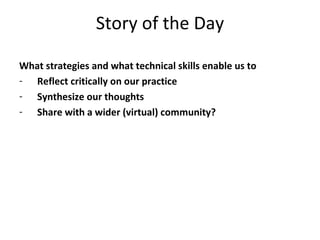
Story of the Day What strategies and what technical skills enable us to Reflect critically on our practice Synthesize our thoughts Share with a wider (virtual) community?
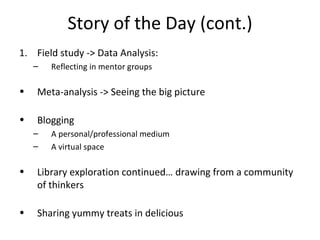
Story of the Day (cont.) Field study -> Data Analysis: Reflecting in mentor groups Meta-analysis -> Seeing the big picture Blogging A personal/professional medium A virtual space Library exploration continued… drawing from a community of thinkers Sharing yummy treats in delicious
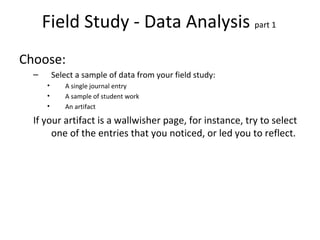
Field Study - Data Analysis  part 1  Choose: Select a sample of data from your field study: A single journal entry A sample of student work An artifact If your artifact is a wallwisher page, for instance, try to select one of the entries that you noticed, or led you to reflect.
Field Study - Data Analysis  part 1  Describe: What type of data is it? How is this kind of data helpful in supporting your inquiry? (refer to Chapter 4 of the Reflective Educator’s Guide) Where does it come from? (speak to the context) When did it occur? What were the circumstances around it? Why did you notice it / choose it? Work with a partner
Field Study - Data Analysis  part 2  2. Make sense of your data: Elaborate on what you noticed What does your partner notice? Why did you select this piece? How does it fit with your other pieces of data? What story is emerging? What is the “why” behind this data? Speculate and ask questions about it…
Field Study - Data Analysis  part 3  3. Interpretation(s) and Implication(s): What are you learning from this data? What themes/big ideas about learning and teaching with technology are coming to mind? What new questions are emerging?
Seeing the Big Picture Look carefully at your data analysis Highlight findings / thoughts that would be relevant to other educators What questions do you have that might invite a conversation?
Seeing the Big Picture How can you reshape your thoughts to share them with a public audience? What can you share from your practice that would be relevant to other educators (globally)? Consider: Your audience: What context they would need and what you are comfortable providing How can you protect the confidentiality of your students? The incidental audience in a public forum (parents, school board, students, etc.)
Write a short blog post on your computer (save it as a document) Look carefully at your data analysis Highlight findings / thoughts that would be relevant to other educators What questions do you have that might invite a conversation? How can you reshape your thoughts to share them with a public audience? What can you share from your practice that would be relevant to other educators (globally)? Consider: Your audience: What context they would need and what you are comfortable providing How can you protect the confidentiality of your students? The incidental audience in a public forum (parents, school board, students, etc.)
Tagging After writing up your reflection, choose keywords that describe your post and write them out under your entry. If I was looking for this post on your blog, what words should I use to find it more easily?
Using keywords as search terms Use those keywords to find an article that will be your reading for this month. You can use SFU’s library and search for a journal article or find one like: http://www.cast.org/publications/ncac/ncac_diffinstructudl.html Copy the link to your article into your post
Social Bookmarking Use your keywords as search terms in delicious.com Tag one link with “sfu_ltt” Search delicious including the tag sfu_ltt to see results from across the cohorts.
Copy and paste your blog entry to your existing blog and tag it with the keywords you used. If you don’t have a blog yet, please register for one at http://www.wordpress.com Please visit and comment on 2 blog posts 2. Read the article you referenced for next class. 3. If you haven’t signed up for an account with delicious.com yet, please do 4. Visit the following page and fill in your delicious ID and blog address: http://tinyurl.com/ygg33mx List of to-do’s:

Coquitlam Ltt March3

  • 1.
    Being a CriticallyReflective Educator in a Digital Community Coquitlam LTT March 3 rd , 2010
  • 2.
    Story of theDay What strategies and what technical skills enable us to Reflect critically on our practice Synthesize our thoughts Share with a wider (virtual) community?
  • 3.
    Story of theDay (cont.) Field study -> Data Analysis: Reflecting in mentor groups Meta-analysis -> Seeing the big picture Blogging A personal/professional medium A virtual space Library exploration continued… drawing from a community of thinkers Sharing yummy treats in delicious
  • 4.
    Field Study -Data Analysis part 1 Choose: Select a sample of data from your field study: A single journal entry A sample of student work An artifact If your artifact is a wallwisher page, for instance, try to select one of the entries that you noticed, or led you to reflect.
  • 5.
    Field Study -Data Analysis part 1 Describe: What type of data is it? How is this kind of data helpful in supporting your inquiry? (refer to Chapter 4 of the Reflective Educator’s Guide) Where does it come from? (speak to the context) When did it occur? What were the circumstances around it? Why did you notice it / choose it? Work with a partner
  • 6.
    Field Study -Data Analysis part 2 2. Make sense of your data: Elaborate on what you noticed What does your partner notice? Why did you select this piece? How does it fit with your other pieces of data? What story is emerging? What is the “why” behind this data? Speculate and ask questions about it…
  • 7.
    Field Study -Data Analysis part 3 3. Interpretation(s) and Implication(s): What are you learning from this data? What themes/big ideas about learning and teaching with technology are coming to mind? What new questions are emerging?
  • 8.
    Seeing the BigPicture Look carefully at your data analysis Highlight findings / thoughts that would be relevant to other educators What questions do you have that might invite a conversation?
  • 9.
    Seeing the BigPicture How can you reshape your thoughts to share them with a public audience? What can you share from your practice that would be relevant to other educators (globally)? Consider: Your audience: What context they would need and what you are comfortable providing How can you protect the confidentiality of your students? The incidental audience in a public forum (parents, school board, students, etc.)
  • 10.
    Write a shortblog post on your computer (save it as a document) Look carefully at your data analysis Highlight findings / thoughts that would be relevant to other educators What questions do you have that might invite a conversation? How can you reshape your thoughts to share them with a public audience? What can you share from your practice that would be relevant to other educators (globally)? Consider: Your audience: What context they would need and what you are comfortable providing How can you protect the confidentiality of your students? The incidental audience in a public forum (parents, school board, students, etc.)
  • 11.
    Tagging After writingup your reflection, choose keywords that describe your post and write them out under your entry. If I was looking for this post on your blog, what words should I use to find it more easily?
  • 12.
    Using keywords assearch terms Use those keywords to find an article that will be your reading for this month. You can use SFU’s library and search for a journal article or find one like: http://www.cast.org/publications/ncac/ncac_diffinstructudl.html Copy the link to your article into your post
  • 13.
    Social Bookmarking Useyour keywords as search terms in delicious.com Tag one link with “sfu_ltt” Search delicious including the tag sfu_ltt to see results from across the cohorts.
  • 14.
    Copy and pasteyour blog entry to your existing blog and tag it with the keywords you used. If you don’t have a blog yet, please register for one at http://www.wordpress.com Please visit and comment on 2 blog posts 2. Read the article you referenced for next class. 3. If you haven’t signed up for an account with delicious.com yet, please do 4. Visit the following page and fill in your delicious ID and blog address: http://tinyurl.com/ygg33mx List of to-do’s: