Question
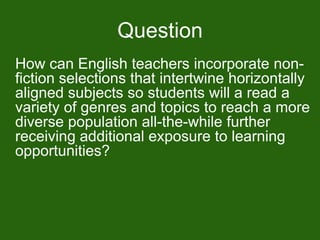
How can English teachers incorporate non-
fiction selections that intertwine horizontally
aligned subjects so students will a read a
variety of genres and topics to reach a more
diverse population all-the-while further
receiving additional exposure to learning
opportunities?
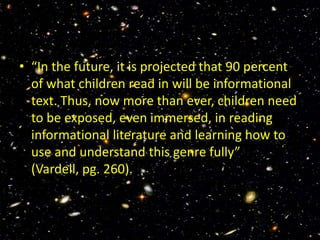
• “In the future, it is projected that 90 percent
  of what children read in will be informational
  text. Thus, now more than ever, children need
  to be exposed, even immersed, in reading
  informational literature and learning how to
  use and understand this genre fully”
  (Vardell, pg. 260).
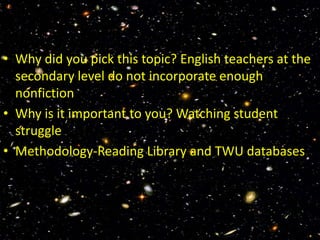
• Why did you pick this topic? English teachers at the
  secondary level do not incorporate enough
  nonfiction
• Why is it important to you? Watching student
  struggle
• Methodology-Reading Library and TWU databases
Research
• What did you learn from the articles? Nonfiction
  is limited, students aren’t familiar with the text
  structure
• What did you learn from all of your other
  readings?
• Everyone struggles with some form of reading.
  Students need to be taught structure and format
  of genre. Fine-tuning aesthetic vs efferent stance.
• A synthesis of your findings.
Implications
• What are the implications of your findings to
  research and practice?
• Teachers need to: be knowledgeable of
  vertical curriculum, text structure,
  comprehension strategies and aware of
  students’ interests.
Practicum
•   Discuss your practicum
•   What worked, what you would change
•   Preparation, length of article, expectations
•   Scale
    questions, video, articles, books, technology, v
    ocabulary
Conclusions
• Conclusions based on practicum and readings
• Closing thoughts
• ELA teachers can incorporate non-fiction
  based around vertical curriculum to reinforce
  learning and continue to apply traditional
  literary elements. This strategy can eventually
  be a researched-base study.
REFERENCES
Beach, R. W., & Taylor, B. M. (1984). The effects of text structure instruction on middle-grade students'
    comprehension and production [Electronic version]. Reading Research Quarterly, 19, 134-146.
Beers, K. (2003). When Kids Can't Read: What teachers can do: A guide for teachers 6-12. Portsmouth,
    NH: Heinemann.
Bennett, L., Faibisch, F. M., Guthrie, J. T., Hunt, B., McCann, A. D., Meter, P. V., Mitchell, A. M.,
    Poundstone, C. C., Rice, M. E., &Wigfield, A. (1996). Growth of literacy engagement: Changes in
    motivations and strategies during concept-oriented reading instruction [Electronic version].
    Reading Research Quarterly, 31, 306-332.
Bomer, R., &Bomer, K. (2001). For a better world: Reading and writing for social action. Portsmouth, NH:
    Heinemann.
Duke, N. (2000). 3.6 minutes perday: Thescarcityofinformationaltexts in first
    grade. ReadingResearchQuarterly, 35, 202-224.
Fisher, D., & Frey, N. (2008). Student and teacher perspectives on the usefulness of content literacy
    strategies [Electronic version]. Literacy Research and Instruction, 47, 246-263.
Fisher, D., Frey, N., & Lapp, D. (2008). Shared readings: Modeling comprehension, vocabulary, text
    structures, and text features for older readers. The Reading Teacher, 61(7), 548-556.
    doi:10.1598/RT.61.7.4
Irwin, J. W. (2007). Teaching Reading Comprehension Processes (3rd ed.). New York, NY: Pearson
    Education, Inc.
Rosenblatt, L. (2005). Making meaning with text: Selected essays. Portsmouth, NH: Heinemann.
Vardell, S. M. (2008). Children's literature in action (pp. 260-263). Westport, CT: Library and information
    science text series.

Read 5453 fall polyniak arp

  • 2.
    Question How can Englishteachers incorporate non- fiction selections that intertwine horizontally aligned subjects so students will a read a variety of genres and topics to reach a more diverse population all-the-while further receiving additional exposure to learning opportunities?
  • 3.
    • “In thefuture, it is projected that 90 percent of what children read in will be informational text. Thus, now more than ever, children need to be exposed, even immersed, in reading informational literature and learning how to use and understand this genre fully” (Vardell, pg. 260).
  • 4.
    • Why didyou pick this topic? English teachers at the secondary level do not incorporate enough nonfiction • Why is it important to you? Watching student struggle • Methodology-Reading Library and TWU databases
  • 5.
    Research • What didyou learn from the articles? Nonfiction is limited, students aren’t familiar with the text structure • What did you learn from all of your other readings? • Everyone struggles with some form of reading. Students need to be taught structure and format of genre. Fine-tuning aesthetic vs efferent stance. • A synthesis of your findings.
  • 6.
    Implications • What arethe implications of your findings to research and practice? • Teachers need to: be knowledgeable of vertical curriculum, text structure, comprehension strategies and aware of students’ interests.
  • 7.
    Practicum • Discuss your practicum • What worked, what you would change • Preparation, length of article, expectations • Scale questions, video, articles, books, technology, v ocabulary
  • 8.
    Conclusions • Conclusions basedon practicum and readings • Closing thoughts • ELA teachers can incorporate non-fiction based around vertical curriculum to reinforce learning and continue to apply traditional literary elements. This strategy can eventually be a researched-base study.
  • 9.
    REFERENCES Beach, R. W.,& Taylor, B. M. (1984). The effects of text structure instruction on middle-grade students' comprehension and production [Electronic version]. Reading Research Quarterly, 19, 134-146. Beers, K. (2003). When Kids Can't Read: What teachers can do: A guide for teachers 6-12. Portsmouth, NH: Heinemann. Bennett, L., Faibisch, F. M., Guthrie, J. T., Hunt, B., McCann, A. D., Meter, P. V., Mitchell, A. M., Poundstone, C. C., Rice, M. E., &Wigfield, A. (1996). Growth of literacy engagement: Changes in motivations and strategies during concept-oriented reading instruction [Electronic version]. Reading Research Quarterly, 31, 306-332. Bomer, R., &Bomer, K. (2001). For a better world: Reading and writing for social action. Portsmouth, NH: Heinemann. Duke, N. (2000). 3.6 minutes perday: Thescarcityofinformationaltexts in first grade. ReadingResearchQuarterly, 35, 202-224. Fisher, D., & Frey, N. (2008). Student and teacher perspectives on the usefulness of content literacy strategies [Electronic version]. Literacy Research and Instruction, 47, 246-263. Fisher, D., Frey, N., & Lapp, D. (2008). Shared readings: Modeling comprehension, vocabulary, text structures, and text features for older readers. The Reading Teacher, 61(7), 548-556. doi:10.1598/RT.61.7.4 Irwin, J. W. (2007). Teaching Reading Comprehension Processes (3rd ed.). New York, NY: Pearson Education, Inc. Rosenblatt, L. (2005). Making meaning with text: Selected essays. Portsmouth, NH: Heinemann. Vardell, S. M. (2008). Children's literature in action (pp. 260-263). Westport, CT: Library and information science text series.