CONFIDENTIAL designator
Advanced Cluster Management
John Gammon
Senior Account Solution
Architect
Aly Ibrahim
Cloud App Dev Solutions
Architect
1
CONFIDENTIAL designator
2
Lunch & Learn Agenda
● Advanced Cluster Management Presentation (~ 25 minutes)
○ Why Advanced Cluster Management?
○ Features of Advanced Cluster Management?
● Demo ---------------------------------------------------------------- (~30 minutes)
○ Cluster Lifecycle Management
○ Policy and Governance
○ Application Lifecycle Deployments
John Gammon
Senior Account Solution Architect
Aly Ibrahim
Cloud App Dev Solutions Architect
CONFIDENTIAL designator
Why Advanced Cluster Management?
CONFIDENTIAL designator
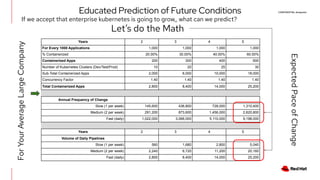
Educated Prediction of Future Conditions
If we accept that enterprise kubernetes is going to grow,, what can we predict?
Years 2 3 4 5
For Every 1000 Applications 1,000 1,000 1,000 1,000
% Containerized 20.00% 30.00% 40.00% 60.00%
Containerized Apps 200 300 400 600
Number of Kubernetes Clusters (Dev/Test/Prod) 10 20 25 30
Sub-Total Containerized Apps 2,000 6,000 10,000 18,000
Concurrency Factor 1.40 1.40 1.40 1.40
Total Containerized Apps 2,800 8,400 14,000 25,200
Annual Frequency of Change
Slow (1 per week) 145,600 436,800 728,000 1,310,400
Medium (2 per week) 291,200 873,600 1,456,000 2,620,800
Fast (daily) 1,022,000 3,066,000 5,110,000 9,198,000
Years 2 3 4 5
Volume of Daily Pipelines
Slow (1 per week) 560 1,680 2,800 5,040
Medium (2 per week) 2,240 6,720 11,200 20,160
Fast (daily) 2,800 8,400 14,000 25,200
Let’s do the Math
For
Your
Average
Large
Company
Expected
Pace
of
Change
CONFIDENTIAL designator
OR
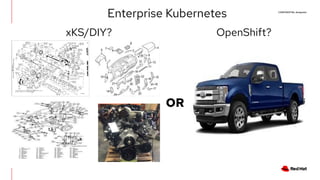
Enterprise Kubernetes
xKS/DIY? OpenShift?
CONFIDENTIAL designator
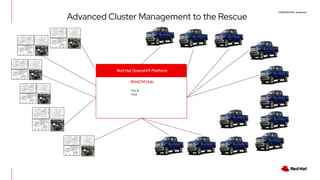
Advanced Cluster Management to the Rescue
RHACM Hub
Red Hat Openshift Platform
Pre &
Post
CONFIDENTIAL designator
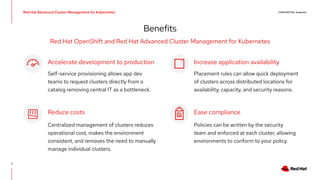
Policies can be written by the security
team and enforced at each cluster, allowing
environments to conform to your policy.
Ease compliance
Red Hat OpenShift and Red Hat Advanced Cluster Management for Kubernetes
Benefits
7
Placement rules can allow quick deployment
of clusters across distributed locations for
availability, capacity, and security reasons.
Increase application availability
Self-service provisioning allows app dev
teams to request clusters directly from a
catalog removing central IT as a bottleneck.
Accelerate development to production
Centralized management of clusters reduces
operational cost, makes the environment
consistent, and removes the need to manually
manage individual clusters.
Reduce costs
Red Hat Advanced Cluster Management for Kubernetes
CONFIDENTIAL designator
Advanced Cluster Management
CONFIDENTIAL designator
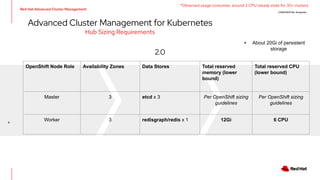
Advanced Cluster Management for Kubernetes
Red Hat Advanced Cluster Management
9
Hub Sizing Requirements
OpenShift Node Role Availability Zones Data Stores Total reserved
memory (lower
bound)
Total reserved CPU
(lower bound)
Master 3 etcd x 3 Per OpenShift sizing
guidelines
Per OpenShift sizing
guidelines
Worker 3 redisgraph/redis x 1 12Gi 6 CPU
2.0
*Observed usage consumes around 2 CPU steady state for 30+ clusters
+ About 20Gi of persistent
storage
CONFIDENTIAL designator
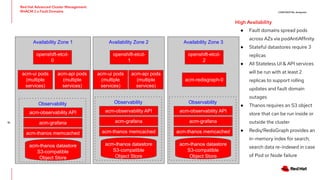
Availability Zone 1
Red Hat Advanced Cluster Management
RHACM 2.x Fault Domains
10
Availability Zone 2 Availability Zone 3
openshift-etcd-
0
openshift-etcd-
1
openshift-etcd-
2
acm-ui pods
(multiple
services)
acm-ui pods
(multiple
services)
acm-api pods
(multiple
services)
acm-api pods
(multiple
services)
● Fault domains spread pods
across AZs via podAntiAffinity
● Stateful datastores require 3
replicas
● All Stateless UI & API services
will be run with at least 2
replicas to support rolling
updates and fault domain
outages
● Thanos requires an S3 object
store that can be run inside or
outside the cluster
● Redis/RedisGraph provides an
in-memory index for search;
search data re-indexed in case
of Pod or Node failure
High Availability
acm-redisgraph-0
Observability
acm-observability API
acm-thanos datastore
S3-compatible
Object Store
acm-grafana
acm-thanos memcached
Observability
acm-observability API
acm-thanos datastore
S3-compatible
Object Store
acm-grafana
acm-thanos memcached
Observability
acm-observability API
acm-thanos datastore
S3-compatible
Object Store
acm-grafana
acm-thanos memcached
11
11
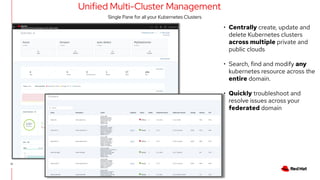
• Centrally create, update and
delete Kubernetes clusters
across multiple private and
public clouds
• Search, find and modify any
kubernetes resource across the
entire domain.
• Quickly troubleshoot and
resolve issues across your
federated domain
Unified Multi-Cluster Management
Single Pane for all your Kubernetes Clusters
12
12
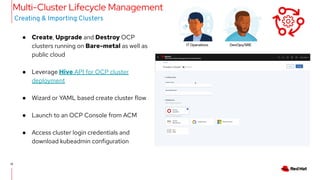
● Create, Upgrade and Destroy OCP
clusters running on Bare-metal as well as
public cloud
● Leverage Hive API for OCP cluster
deployment
● Wizard or YAML based create cluster flow
● Launch to an OCP Console from ACM
● Access cluster login credentials and
download kubeadmin configuration
Creating & Importing Clusters
Multi-Cluster Lifecycle Management
IT Operations DevOps/SRE
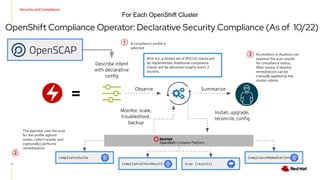
OpenShift Compliance Operator: Declarative Security Compliance (As of 10/22)
=
Install, upgrade,
reconcile, config
Describe intent
with declarative
config
Monitor, scale,
troubleshoot,
backup
Summarize
Observe
ComplianceSuite
Scan (results)
1 A compliance profile is
selected
2
The operator runs the scan
for the profile against
nodes, collect results, and
(optionally) performs
remeditations
3 Accreditors or Auditors can
examine the scan results
for compliance status,
After review, if desired,
remediations can be
manually applied by the
cluster-admin.
ComplianceCheckResult
ComplianceRemediations
Security and Compliance
With 4.6, a limited set of RHCOS checks will
be implemented. Additional compliance
checks will be delivered roughly every 2
months.
13
For Each OpenShift Cluster
14
14
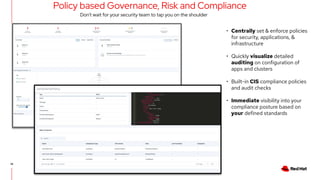
Policy based Governance, Risk and Compliance
• Centrally set & enforce policies
for security, applications, &
infrastructure
• Quickly visualize detailed
auditing on configuration of
apps and clusters
• Built-in CIS compliance policies
and audit checks
• Immediate visibility into your
compliance posture based on
your defined standards
Don’t wait for your security team to tap you on the shoulder
15
15
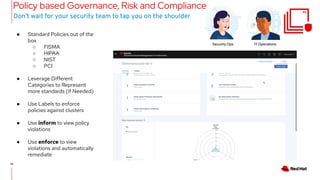
Policy based Governance, Risk and Compliance
● Standard Policies out of the
box
○ FISMA
○ HIPAA
○ NIST
○ PCI
● Leverage Different
Categories to Represent
more standards (if Needed)
● Use Labels to enforce
policies against clusters
● Use inform to view policy
violations
● Use enforce to view
violations and automatically
remediate
Don’t wait for your security team to tap you on the shoulder
Security Ops IT Operations
16
16
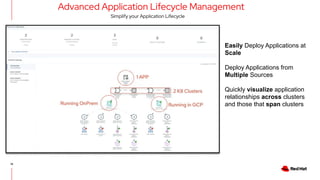
Advanced Application Lifecycle Management
• Easily Deploy Applications at
Scale
• Deploy Applications from
Multiple Sources
• Quickly visualize application
relationships across clusters
and those that span clusters
Simplify your Application Lifecycle
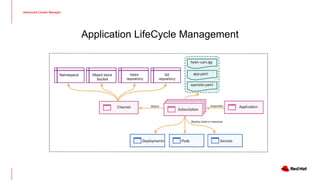
Application LifeCycle Management
Advanced Cluster Manager
F18017-190601
RHACM Hub
Managed Clusters
18
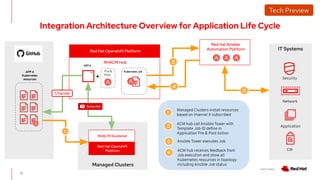
Integration Architecture Overview for Application Life Cycle
Red Hat Openshift Platform
RHACM Klusterlet
Red Hat Openshift
Platform
Red Hat Ansible
Automation Platform IT Systems
Security
Network
Application
CM
APP A
APP A
Kubernetes
resources
Channel
1
2
3
4
2
Kubernetes Job
1
3
4
Managed Clusters install resources
based on channel it subscribed
ACM hub call Ansible Tower with
Template Job ID define in
Application Pre & Post Action
Ansible Tower executes Job
ACM hub receives feedback from
Job execution and show all
Kubernetes resources in topology
including Ansible Job status
Pre &
Post
+

Red Hat Advanced Cluster Manager Details

  • 1.
    CONFIDENTIAL designator Advanced ClusterManagement John Gammon Senior Account Solution Architect Aly Ibrahim Cloud App Dev Solutions Architect 1
  • 2.
    CONFIDENTIAL designator 2 Lunch &Learn Agenda ● Advanced Cluster Management Presentation (~ 25 minutes) ○ Why Advanced Cluster Management? ○ Features of Advanced Cluster Management? ● Demo ---------------------------------------------------------------- (~30 minutes) ○ Cluster Lifecycle Management ○ Policy and Governance ○ Application Lifecycle Deployments John Gammon Senior Account Solution Architect Aly Ibrahim Cloud App Dev Solutions Architect
  • 3.
  • 4.
    CONFIDENTIAL designator Educated Predictionof Future Conditions If we accept that enterprise kubernetes is going to grow,, what can we predict? Years 2 3 4 5 For Every 1000 Applications 1,000 1,000 1,000 1,000 % Containerized 20.00% 30.00% 40.00% 60.00% Containerized Apps 200 300 400 600 Number of Kubernetes Clusters (Dev/Test/Prod) 10 20 25 30 Sub-Total Containerized Apps 2,000 6,000 10,000 18,000 Concurrency Factor 1.40 1.40 1.40 1.40 Total Containerized Apps 2,800 8,400 14,000 25,200 Annual Frequency of Change Slow (1 per week) 145,600 436,800 728,000 1,310,400 Medium (2 per week) 291,200 873,600 1,456,000 2,620,800 Fast (daily) 1,022,000 3,066,000 5,110,000 9,198,000 Years 2 3 4 5 Volume of Daily Pipelines Slow (1 per week) 560 1,680 2,800 5,040 Medium (2 per week) 2,240 6,720 11,200 20,160 Fast (daily) 2,800 8,400 14,000 25,200 Let’s do the Math For Your Average Large Company Expected Pace of Change
  • 5.
  • 6.
    CONFIDENTIAL designator Advanced ClusterManagement to the Rescue RHACM Hub Red Hat Openshift Platform Pre & Post
  • 7.
    CONFIDENTIAL designator Policies canbe written by the security team and enforced at each cluster, allowing environments to conform to your policy. Ease compliance Red Hat OpenShift and Red Hat Advanced Cluster Management for Kubernetes Benefits 7 Placement rules can allow quick deployment of clusters across distributed locations for availability, capacity, and security reasons. Increase application availability Self-service provisioning allows app dev teams to request clusters directly from a catalog removing central IT as a bottleneck. Accelerate development to production Centralized management of clusters reduces operational cost, makes the environment consistent, and removes the need to manually manage individual clusters. Reduce costs Red Hat Advanced Cluster Management for Kubernetes
  • 8.
  • 9.
    CONFIDENTIAL designator Advanced ClusterManagement for Kubernetes Red Hat Advanced Cluster Management 9 Hub Sizing Requirements OpenShift Node Role Availability Zones Data Stores Total reserved memory (lower bound) Total reserved CPU (lower bound) Master 3 etcd x 3 Per OpenShift sizing guidelines Per OpenShift sizing guidelines Worker 3 redisgraph/redis x 1 12Gi 6 CPU 2.0 *Observed usage consumes around 2 CPU steady state for 30+ clusters + About 20Gi of persistent storage
  • 10.
    CONFIDENTIAL designator Availability Zone1 Red Hat Advanced Cluster Management RHACM 2.x Fault Domains 10 Availability Zone 2 Availability Zone 3 openshift-etcd- 0 openshift-etcd- 1 openshift-etcd- 2 acm-ui pods (multiple services) acm-ui pods (multiple services) acm-api pods (multiple services) acm-api pods (multiple services) ● Fault domains spread pods across AZs via podAntiAffinity ● Stateful datastores require 3 replicas ● All Stateless UI & API services will be run with at least 2 replicas to support rolling updates and fault domain outages ● Thanos requires an S3 object store that can be run inside or outside the cluster ● Redis/RedisGraph provides an in-memory index for search; search data re-indexed in case of Pod or Node failure High Availability acm-redisgraph-0 Observability acm-observability API acm-thanos datastore S3-compatible Object Store acm-grafana acm-thanos memcached Observability acm-observability API acm-thanos datastore S3-compatible Object Store acm-grafana acm-thanos memcached Observability acm-observability API acm-thanos datastore S3-compatible Object Store acm-grafana acm-thanos memcached
  • 11.
    11 11 • Centrally create,update and delete Kubernetes clusters across multiple private and public clouds • Search, find and modify any kubernetes resource across the entire domain. • Quickly troubleshoot and resolve issues across your federated domain Unified Multi-Cluster Management Single Pane for all your Kubernetes Clusters
  • 12.
    12 12 ● Create, Upgradeand Destroy OCP clusters running on Bare-metal as well as public cloud ● Leverage Hive API for OCP cluster deployment ● Wizard or YAML based create cluster flow ● Launch to an OCP Console from ACM ● Access cluster login credentials and download kubeadmin configuration Creating & Importing Clusters Multi-Cluster Lifecycle Management IT Operations DevOps/SRE
  • 13.
    OpenShift Compliance Operator:Declarative Security Compliance (As of 10/22) = Install, upgrade, reconcile, config Describe intent with declarative config Monitor, scale, troubleshoot, backup Summarize Observe ComplianceSuite Scan (results) 1 A compliance profile is selected 2 The operator runs the scan for the profile against nodes, collect results, and (optionally) performs remeditations 3 Accreditors or Auditors can examine the scan results for compliance status, After review, if desired, remediations can be manually applied by the cluster-admin. ComplianceCheckResult ComplianceRemediations Security and Compliance With 4.6, a limited set of RHCOS checks will be implemented. Additional compliance checks will be delivered roughly every 2 months. 13 For Each OpenShift Cluster
  • 14.
    14 14 Policy based Governance,Risk and Compliance • Centrally set & enforce policies for security, applications, & infrastructure • Quickly visualize detailed auditing on configuration of apps and clusters • Built-in CIS compliance policies and audit checks • Immediate visibility into your compliance posture based on your defined standards Don’t wait for your security team to tap you on the shoulder
  • 15.
    15 15 Policy based Governance,Risk and Compliance ● Standard Policies out of the box ○ FISMA ○ HIPAA ○ NIST ○ PCI ● Leverage Different Categories to Represent more standards (if Needed) ● Use Labels to enforce policies against clusters ● Use inform to view policy violations ● Use enforce to view violations and automatically remediate Don’t wait for your security team to tap you on the shoulder Security Ops IT Operations
  • 16.
    16 16 Advanced Application LifecycleManagement • Easily Deploy Applications at Scale • Deploy Applications from Multiple Sources • Quickly visualize application relationships across clusters and those that span clusters Simplify your Application Lifecycle
  • 17.
  • 18.
    F18017-190601 RHACM Hub Managed Clusters 18 IntegrationArchitecture Overview for Application Life Cycle Red Hat Openshift Platform RHACM Klusterlet Red Hat Openshift Platform Red Hat Ansible Automation Platform IT Systems Security Network Application CM APP A APP A Kubernetes resources Channel 1 2 3 4 2 Kubernetes Job 1 3 4 Managed Clusters install resources based on channel it subscribed ACM hub call Ansible Tower with Template Job ID define in Application Pre & Post Action Ansible Tower executes Job ACM hub receives feedback from Job execution and show all Kubernetes resources in topology including Ansible Job status Pre & Post +