Migration Methodology
Red Hat OpenShift
Virtualization
Matt Witzenman
OpenShift Practice Lead
1
2
OpenShift
virtualization
update
▸ OpenShift Virtualization Overview
▸ Migration Methodology
▸ Migration at Scale
Agenda
CONFIDENTIAL
OpenShift
Virtualization
Overview
What is OpenShift
Virtualization?
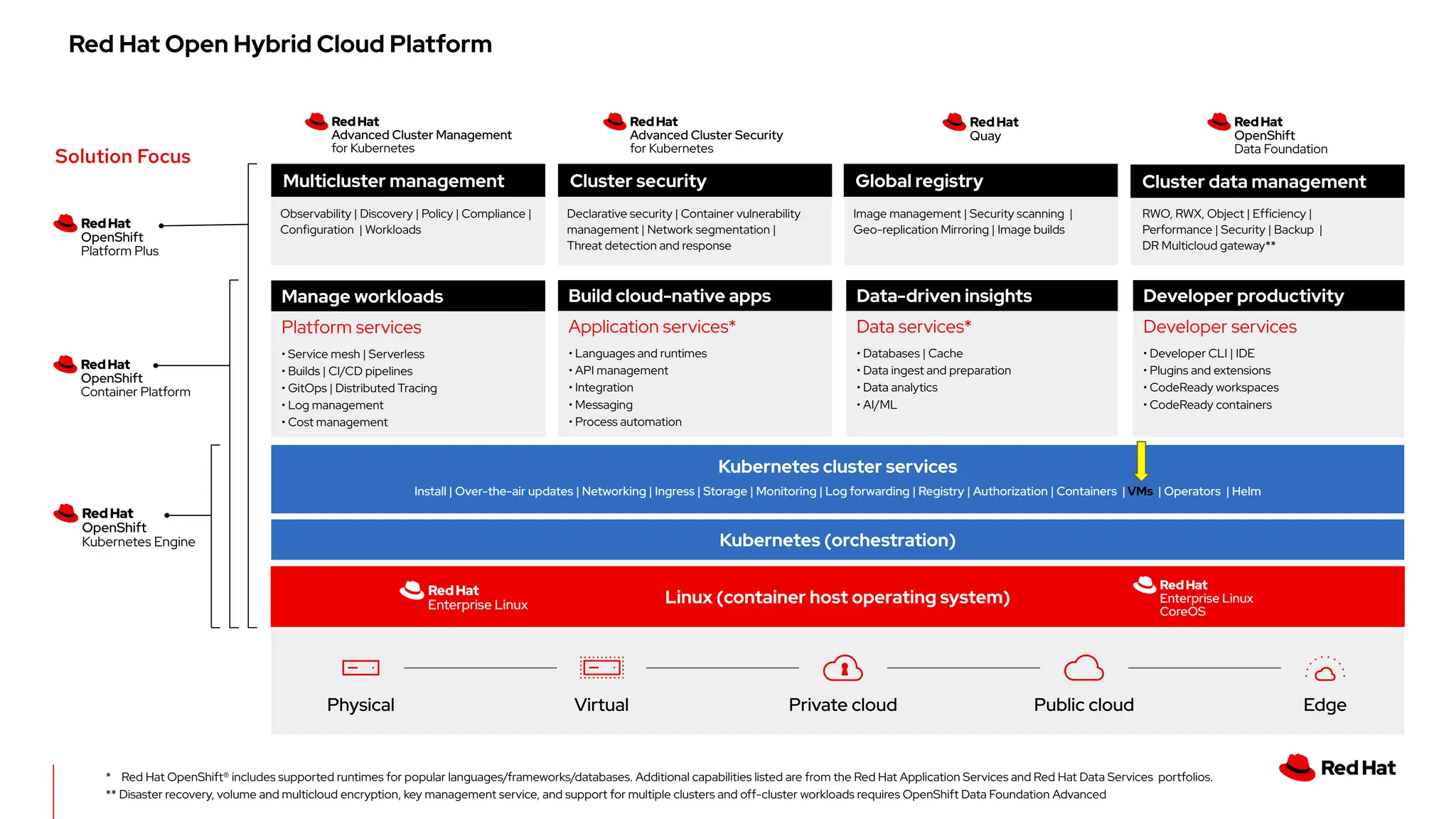
Red Hat Open Hybrid Cloud Platform
• Service mesh | Serverless
• Builds | CI/CD pipelines
• GitOps | Distributed Tracing
• Log management
• Cost management
• Languages and runtimes
• API management
• Integration
• Messaging
• Process automation
• Databases | Cache
• Data ingest and preparation
• Data analytics
• AI/ML
• Developer CLI | IDE
• Plugins and extensions
• CodeReady workspaces
• CodeReady containers
Developer services
Developer productivity
Kubernetes cluster services
Install | Over-the-air updates | Networking | Ingress | Storage | Monitoring | Log forwarding | Registry | Authorization | Containers |VMs | Operators | Helm
Linux (container host operating system)
Kubernetes (orchestration)
Physical Virtual Private cloud Public cloud Edge
Cluster security Global registry
Multicluster management
Data services*
Data-driven insights
Application services*
Build cloud-native apps
Platform services
Manage workloads
* Red Hat OpenShift® includes supported runtimes for popular languages/frameworks/databases. Additional capabilities listed are from the Red Hat Application Services and Red Hat Data Services portfolios.
** Disaster recovery, volume and multicloud encryption, key management service, and support for multiple clusters and off-cluster workloads requires OpenShift Data Foundation Advanced
Observability | Discovery | Policy | Compliance |
Configuration | Workloads
Image management | Security scanning |
Geo-replication Mirroring | Image builds
Declarative security | Container vulnerability
management | Network segmentation |
Threat detection and response
RWO, RWX, Object | Efficiency |
Performance | Security | Backup |
DR Multicloud gateway**
Cluster data management
Solution Focus
5
Red Hat OpenShift Virtualization
Red Hat
OpenShift Virtualization
Red Hat OpenShift
Container Platform
Red Hat Enterprise Linux
Physical machine
VMs Containers
▸ Included capability
of the Red Hat OpenShift application platform
▸ Built on KubeVirt
Top 10 CNCF active project
▸ Unified application platform
Consistent management, tooling,
diverse ecosystem
▸ Performance and stability
The industry standard Kernel Virtual
Machine (KVM) hypervisor
▸ Includes Red Hat Enterprise Linux
guest entitlements
▸ Supports Microsoft Windows guests
Microsoft Server Virtualization Validation
Program (SVVP)
Modern virtualization option for general purpose virtualization customers
Containers are not virtual machines
6
Infrastructure
Operating System
App 1 App 3
App 2
Hypervisor
Guest
OS
Guest
OS
Guest
OS
Infrastructure
Virtualization Containerization
App 1 App 3
App 2
● Containers are process isolation
● Kernel namespaces provide isolation and
cgroups provide resource controls
● No hypervisor needed for containers
● Contain only binaries, libraries, and tools
which are needed by the application
● Ephemeral
Virtual machines can be put into containers
7
● A KVM virtual machine is a process
● Containers encapsulate processes
● Both have the same underlying
resource needs:
○ Compute
○ Network
○ (sometimes) Storage
OpenShift Virtualization
8
● Virtual machines
○ Running in containers, managed as Pods
○ Using the KVM hypervisor
● Scheduled, deployed, and managed by Kubernetes
● Integrated with container orchestrator resources and
services
○ Traditional Pod-like SDN connectivity and/or
connectivity to external VLAN and other networks
via multus
○ Persistent storage paradigm
(PVC, PV, StorageClass)
OpenShift Virtualization uses KVM
9
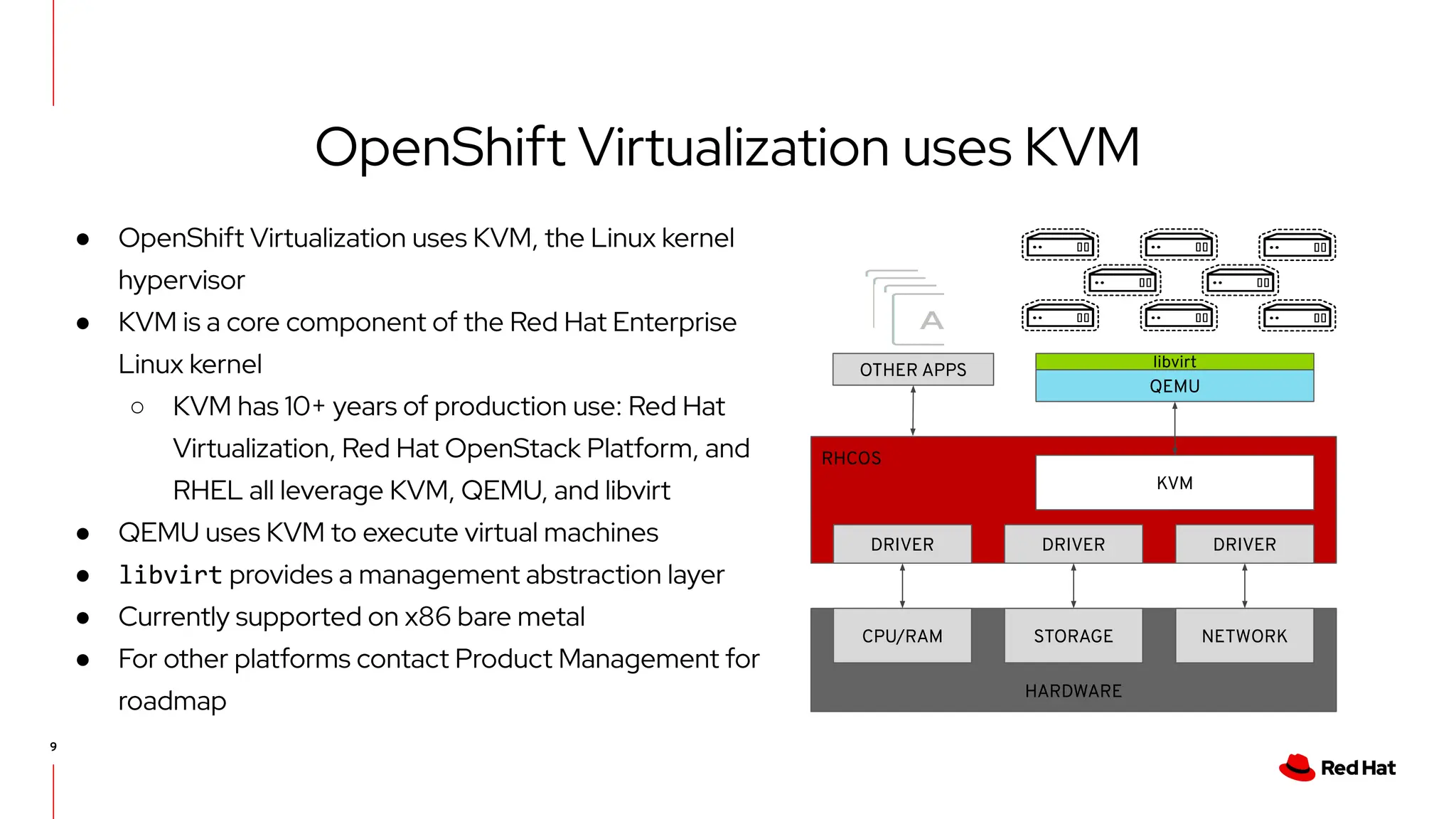
● OpenShift Virtualization uses KVM, the Linux kernel
hypervisor
● KVM is a core component of the Red Hat Enterprise
Linux kernel
○ KVM has 10+ years of production use: Red Hat
Virtualization, Red Hat OpenStack Platform, and
RHEL all leverage KVM, QEMU, and libvirt
● QEMU uses KVM to execute virtual machines
● libvirt provides a management abstraction layer
● Currently supported on x86 bare metal
● For other platforms contact Product Management for
roadmap HARDWARE
RHCOS
KVM
CPU/RAM STORAGE NETWORK
DRIVER DRIVER DRIVER
OTHER APPS
QEMU
libvirt
Containerized virtual machines
10
Kubernetes resources
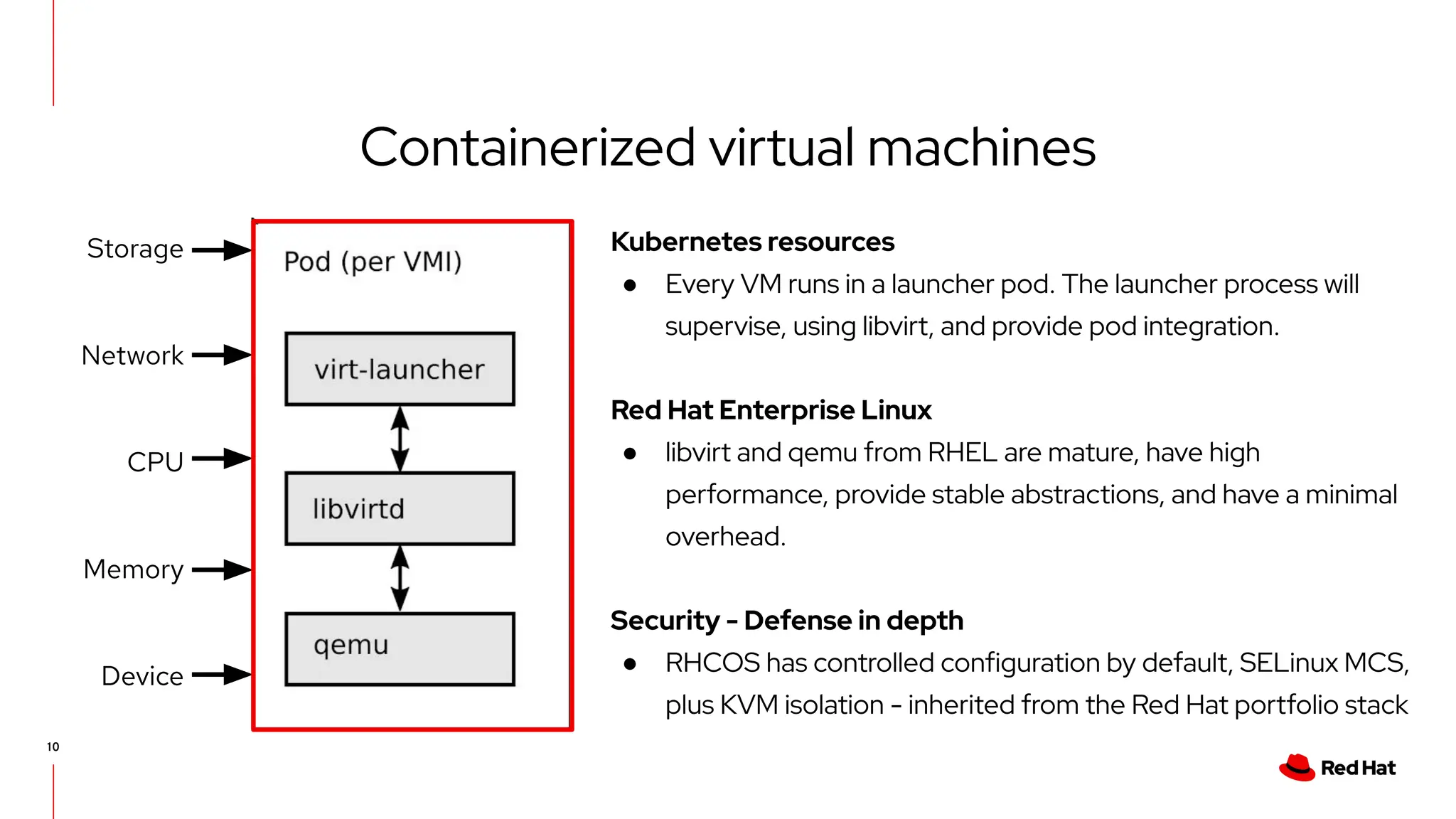
● Every VM runs in a launcher pod. The launcher process will
supervise, using libvirt, and provide pod integration.
Red Hat Enterprise Linux
● libvirt and qemu from RHEL are mature, have high
performance, provide stable abstractions, and have a minimal
overhead.
Security - Defense in depth
● RHCOS has controlled configuration by default, SELinux MCS,
plus KVM isolation - inherited from the Red Hat portfolio stack
Storage
Network
CPU
Memory
Device
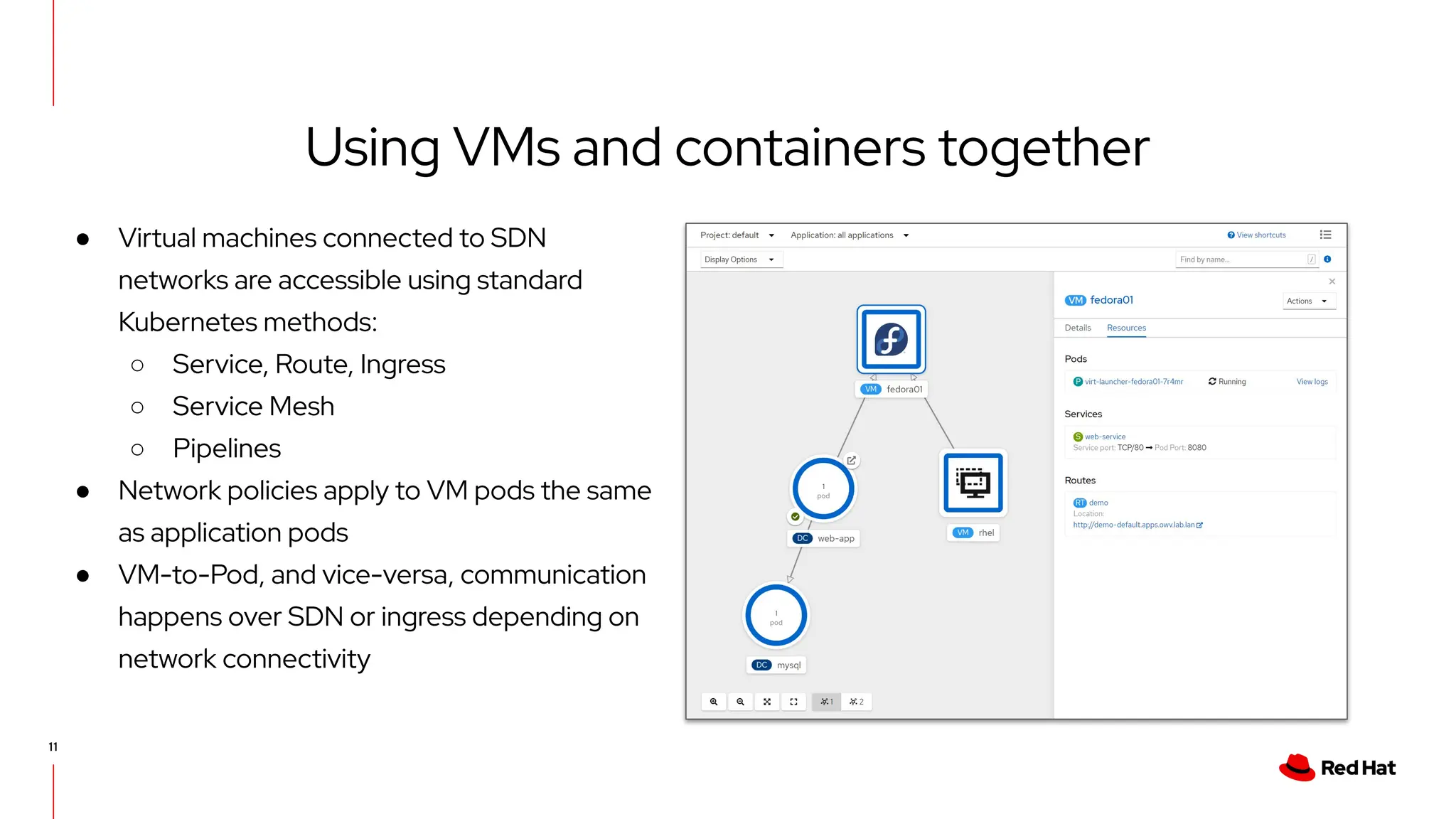
Using VMs and containers together
11
● Virtual machines connected to SDN
networks are accessible using standard
Kubernetes methods:
○ Service, Route, Ingress
○ Service Mesh
○ Pipelines
● Network policies apply to VM pods the same
as application pods
● VM-to-Pod, and vice-versa, communication
happens over SDN or ingress depending on
network connectivity
Cloud
native
12
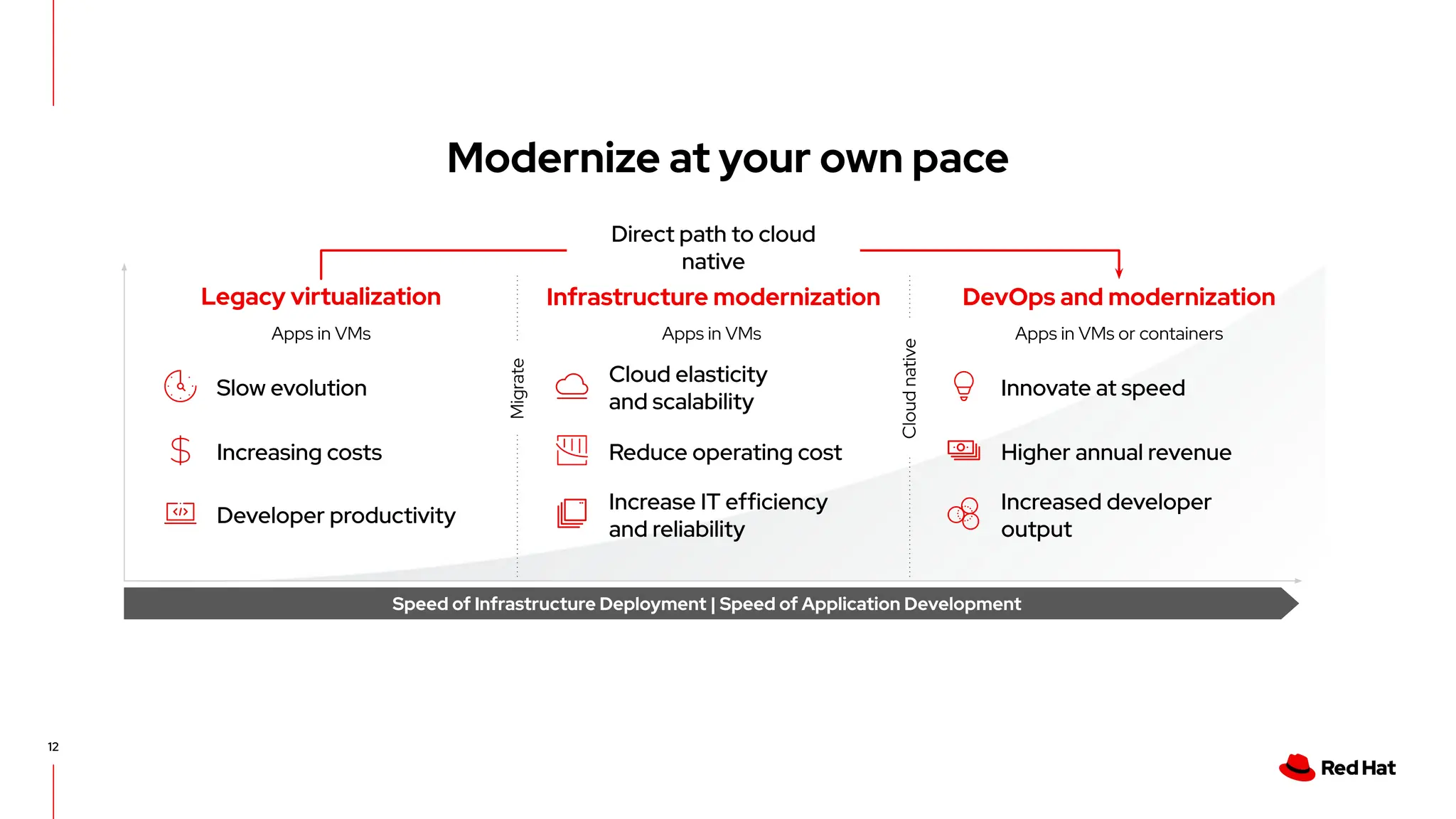
Modernize at your own pace
Infrastructure modernization DevOps and modernization
Legacy virtualization
Apps in VMs
Apps in VMs Apps in VMs or containers
Slow evolution
Increasing costs
Developer productivity
Cloud elasticity
and scalability
Reduce operating cost
Increase IT efficiency
and reliability
Innovate at speed
Higher annual revenue
Increased developer
output
Speed of Infrastructure Deployment | Speed of Application Development
Direct path to cloud
native
Migrate
CONFIDENTIAL
OpenShift
Virtualization
Overview
Migration
Methodology
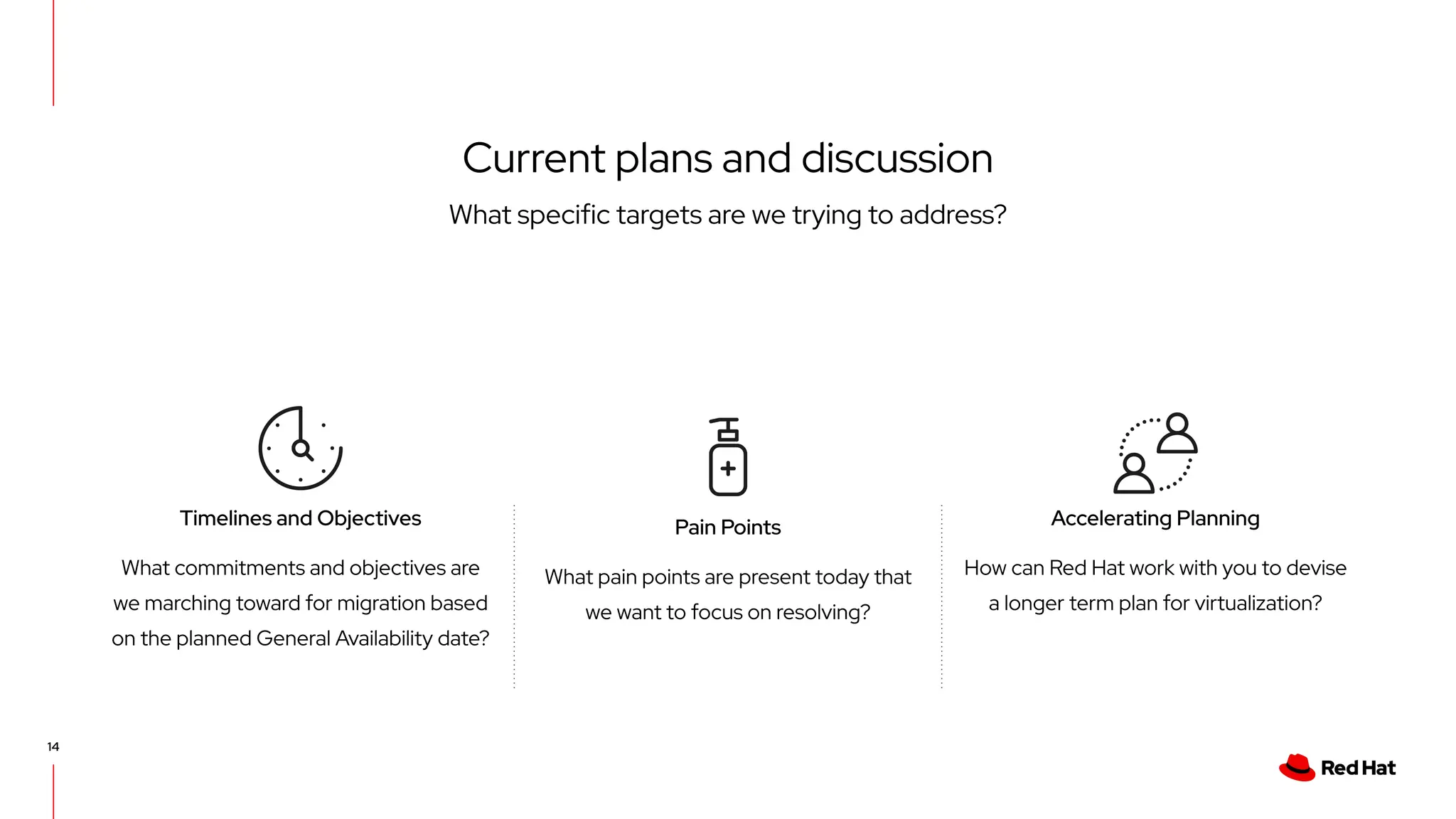
What specific targets are we trying to address?
14
What pain points are present today that
we want to focus on resolving?
Accelerating Planning
Pain Points
How can Red Hat work with you to devise
a longer term plan for virtualization?
Timelines and Objectives
Current plans and discussion
What commitments and objectives are
we marching toward for migration based
on the planned General Availability date?
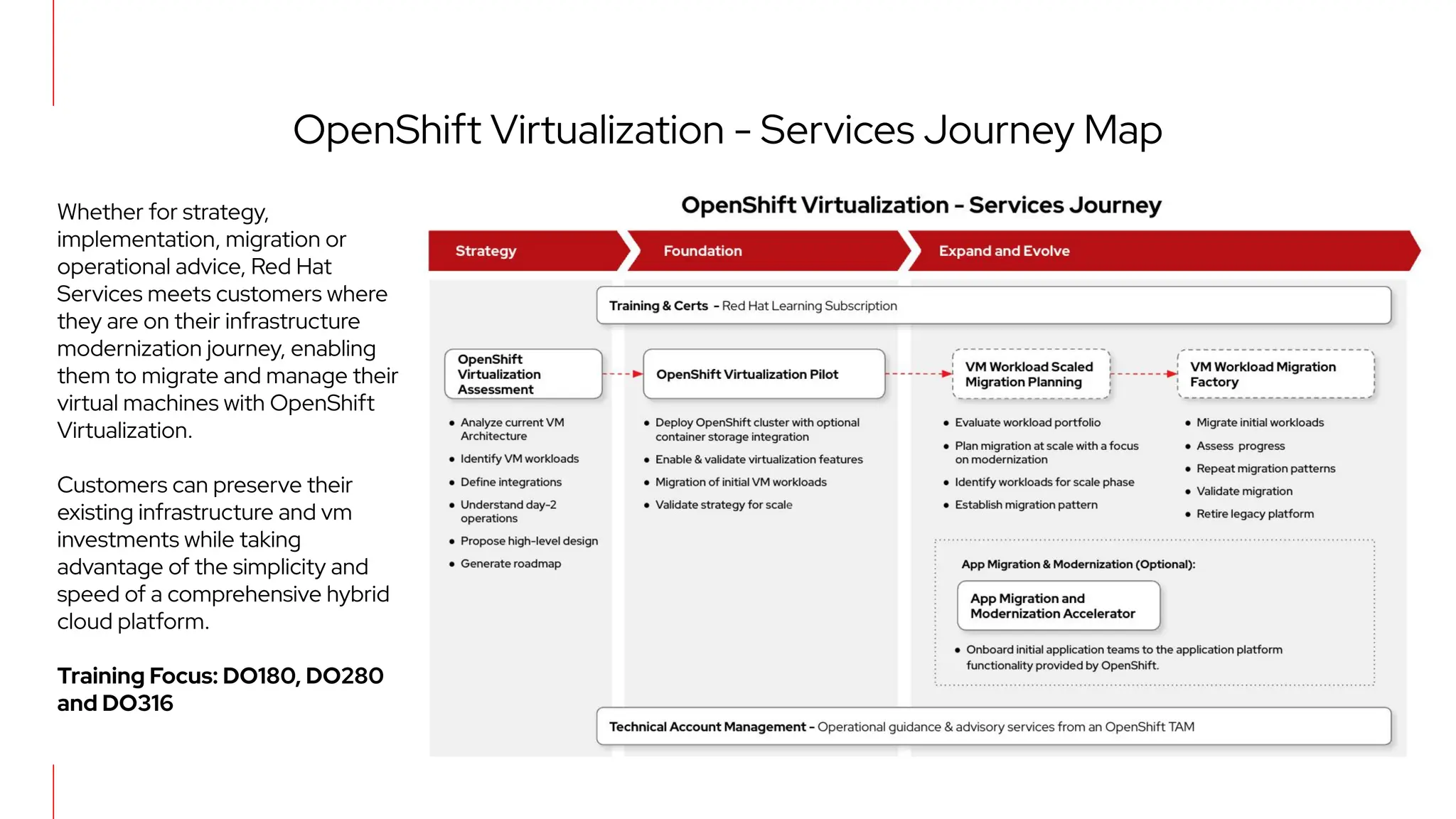
Whether for strategy,
implementation, migration or
operational advice, Red Hat
Services meets customers where
they are on their infrastructure
modernization journey, enabling
them to migrate and manage their
virtual machines with OpenShift
Virtualization.
Customers can preserve their
existing infrastructure and vm
investments while taking
advantage of the simplicity and
speed of a comprehensive hybrid
cloud platform.
Training Focus: DO180, DO280
and DO316
OpenShift Virtualization - Services Journey Map
Discovery
1.5 hours
Assessment
Workshops
1 week
Roadmap
Review
1 hour
OpenShift
Virtualization
Pilot
What We Cover
● Virtual environment current state
● Deep dives into virtualization use cases
● Hybrid cloud and edge strategy
● Platform management & security strategy
● Environment monitoring and observability
● Backup and disaster recovery
● Pilot identification and plan for scaling
migration
Our Assessment Approach
Outcomes
● Smarter adoption through a clear path to pilot
and business value realization
● Expertly-leveraged capabilities supported
with high-level recommendations and design
considerations
● Faster time-to-value by embarking on a
customer journey with Red Hat Services
CONFIDENTIAL
OpenShift
Virtualization
Overview
Migration at Scale
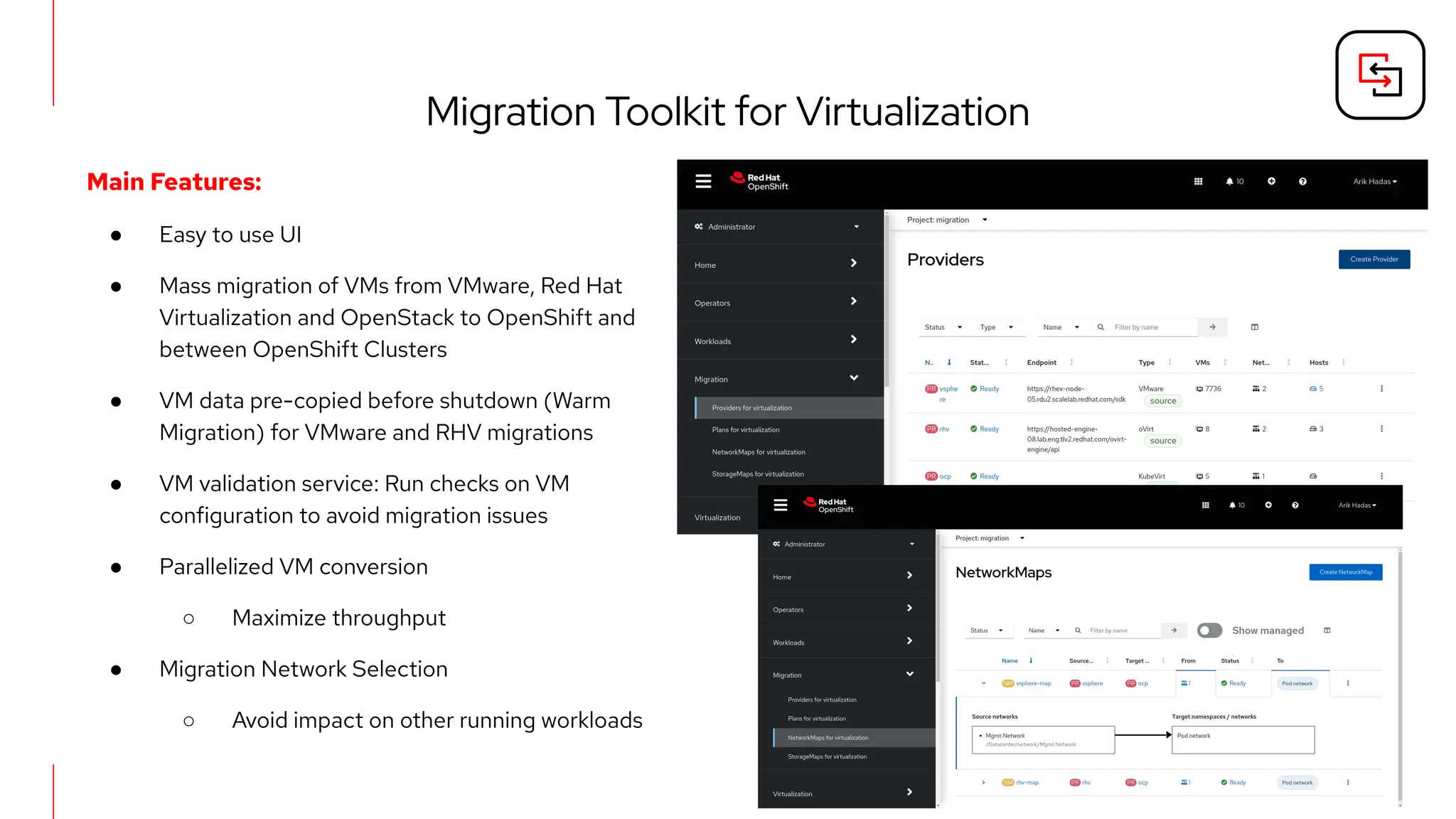
Main Features:
● Easy to use UI
● Mass migration of VMs from VMware, Red Hat
Virtualization and OpenStack to OpenShift and
between OpenShift Clusters
● VM data pre-copied before shutdown (Warm
Migration) for VMware and RHV migrations
● VM validation service: Run checks on VM
configuration to avoid migration issues
● Parallelized VM conversion
○ Maximize throughput
● Migration Network Selection
○ Avoid impact on other running workloads
Migration Toolkit for Virtualization
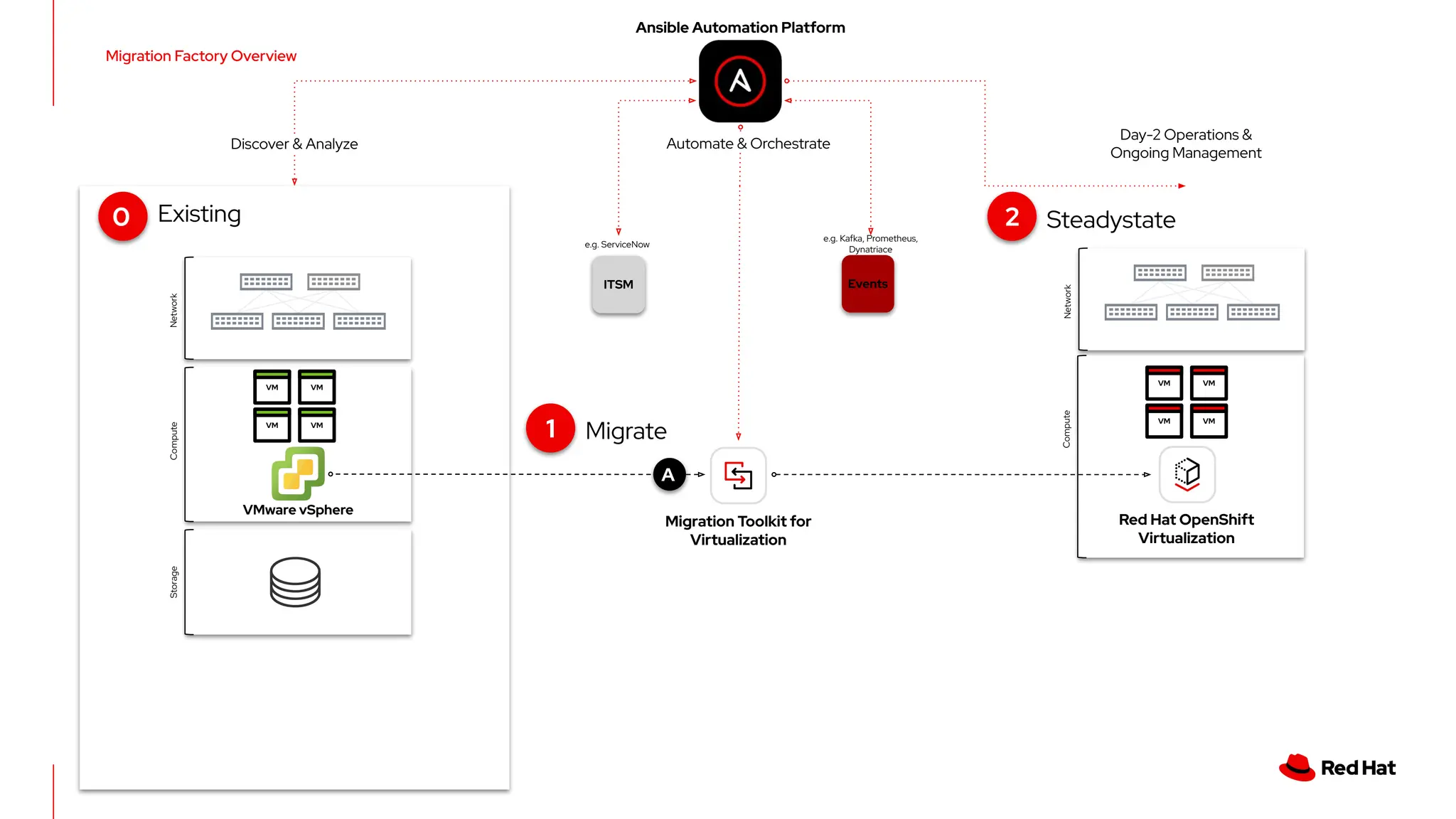
VM
VM
0
1
2
VM
VM
VMware vSphere
Red Hat OpenShift
Virtualization
Ansible Automation Platform
Discover & Analyze Automate & Orchestrate
Existing Steadystate
Migrate
Migration Toolkit for
Virtualization
Day-2 Operations &
Ongoing Management
Compute
Network
Storage
VM
VM
VM
VM
A
Network
Compute
ITSM
e.g. ServiceNow
Events
e.g. Kafka, Prometheus,
Dynatriace
Migration Factory Overview
20
OpenShift
virtualization
update
OpenShift Virtualization Series
▸ 4/17 - Overview
▸ 5/14 - Migration Methodology
▸ 5/29 - Technical Deep Dive
Join us for more!
linkedin.com/company/red-hat
youtube.com/OpenShift
facebook.com/redhatinc
twitter.com/Openshift
21
Red Hat is the world’s leading provider of enterprise
open source software solutions. Award-winning
support, training, and consulting services make
Red Hat a trusted adviser to the Fortune 500.
Thank you

brighttalk---openshift-virtualization_-migration-methodology_981043.pdf

  • 1.
    Migration Methodology Red HatOpenShift Virtualization Matt Witzenman OpenShift Practice Lead 1
  • 2.
    2 OpenShift virtualization update ▸ OpenShift VirtualizationOverview ▸ Migration Methodology ▸ Migration at Scale Agenda
  • 3.
  • 4.
    Red Hat OpenHybrid Cloud Platform • Service mesh | Serverless • Builds | CI/CD pipelines • GitOps | Distributed Tracing • Log management • Cost management • Languages and runtimes • API management • Integration • Messaging • Process automation • Databases | Cache • Data ingest and preparation • Data analytics • AI/ML • Developer CLI | IDE • Plugins and extensions • CodeReady workspaces • CodeReady containers Developer services Developer productivity Kubernetes cluster services Install | Over-the-air updates | Networking | Ingress | Storage | Monitoring | Log forwarding | Registry | Authorization | Containers |VMs | Operators | Helm Linux (container host operating system) Kubernetes (orchestration) Physical Virtual Private cloud Public cloud Edge Cluster security Global registry Multicluster management Data services* Data-driven insights Application services* Build cloud-native apps Platform services Manage workloads * Red Hat OpenShift® includes supported runtimes for popular languages/frameworks/databases. Additional capabilities listed are from the Red Hat Application Services and Red Hat Data Services portfolios. ** Disaster recovery, volume and multicloud encryption, key management service, and support for multiple clusters and off-cluster workloads requires OpenShift Data Foundation Advanced Observability | Discovery | Policy | Compliance | Configuration | Workloads Image management | Security scanning | Geo-replication Mirroring | Image builds Declarative security | Container vulnerability management | Network segmentation | Threat detection and response RWO, RWX, Object | Efficiency | Performance | Security | Backup | DR Multicloud gateway** Cluster data management Solution Focus
  • 5.
    5 Red Hat OpenShiftVirtualization Red Hat OpenShift Virtualization Red Hat OpenShift Container Platform Red Hat Enterprise Linux Physical machine VMs Containers ▸ Included capability of the Red Hat OpenShift application platform ▸ Built on KubeVirt Top 10 CNCF active project ▸ Unified application platform Consistent management, tooling, diverse ecosystem ▸ Performance and stability The industry standard Kernel Virtual Machine (KVM) hypervisor ▸ Includes Red Hat Enterprise Linux guest entitlements ▸ Supports Microsoft Windows guests Microsoft Server Virtualization Validation Program (SVVP) Modern virtualization option for general purpose virtualization customers
  • 6.
    Containers are notvirtual machines 6 Infrastructure Operating System App 1 App 3 App 2 Hypervisor Guest OS Guest OS Guest OS Infrastructure Virtualization Containerization App 1 App 3 App 2 ● Containers are process isolation ● Kernel namespaces provide isolation and cgroups provide resource controls ● No hypervisor needed for containers ● Contain only binaries, libraries, and tools which are needed by the application ● Ephemeral
  • 7.
    Virtual machines canbe put into containers 7 ● A KVM virtual machine is a process ● Containers encapsulate processes ● Both have the same underlying resource needs: ○ Compute ○ Network ○ (sometimes) Storage
  • 8.
    OpenShift Virtualization 8 ● Virtualmachines ○ Running in containers, managed as Pods ○ Using the KVM hypervisor ● Scheduled, deployed, and managed by Kubernetes ● Integrated with container orchestrator resources and services ○ Traditional Pod-like SDN connectivity and/or connectivity to external VLAN and other networks via multus ○ Persistent storage paradigm (PVC, PV, StorageClass)
  • 9.
    OpenShift Virtualization usesKVM 9 ● OpenShift Virtualization uses KVM, the Linux kernel hypervisor ● KVM is a core component of the Red Hat Enterprise Linux kernel ○ KVM has 10+ years of production use: Red Hat Virtualization, Red Hat OpenStack Platform, and RHEL all leverage KVM, QEMU, and libvirt ● QEMU uses KVM to execute virtual machines ● libvirt provides a management abstraction layer ● Currently supported on x86 bare metal ● For other platforms contact Product Management for roadmap HARDWARE RHCOS KVM CPU/RAM STORAGE NETWORK DRIVER DRIVER DRIVER OTHER APPS QEMU libvirt
  • 10.
    Containerized virtual machines 10 Kubernetesresources ● Every VM runs in a launcher pod. The launcher process will supervise, using libvirt, and provide pod integration. Red Hat Enterprise Linux ● libvirt and qemu from RHEL are mature, have high performance, provide stable abstractions, and have a minimal overhead. Security - Defense in depth ● RHCOS has controlled configuration by default, SELinux MCS, plus KVM isolation - inherited from the Red Hat portfolio stack Storage Network CPU Memory Device
  • 11.
    Using VMs andcontainers together 11 ● Virtual machines connected to SDN networks are accessible using standard Kubernetes methods: ○ Service, Route, Ingress ○ Service Mesh ○ Pipelines ● Network policies apply to VM pods the same as application pods ● VM-to-Pod, and vice-versa, communication happens over SDN or ingress depending on network connectivity
  • 12.
    Cloud native 12 Modernize at yourown pace Infrastructure modernization DevOps and modernization Legacy virtualization Apps in VMs Apps in VMs Apps in VMs or containers Slow evolution Increasing costs Developer productivity Cloud elasticity and scalability Reduce operating cost Increase IT efficiency and reliability Innovate at speed Higher annual revenue Increased developer output Speed of Infrastructure Deployment | Speed of Application Development Direct path to cloud native Migrate
  • 13.
  • 14.
    What specific targetsare we trying to address? 14 What pain points are present today that we want to focus on resolving? Accelerating Planning Pain Points How can Red Hat work with you to devise a longer term plan for virtualization? Timelines and Objectives Current plans and discussion What commitments and objectives are we marching toward for migration based on the planned General Availability date?
  • 15.
    Whether for strategy, implementation,migration or operational advice, Red Hat Services meets customers where they are on their infrastructure modernization journey, enabling them to migrate and manage their virtual machines with OpenShift Virtualization. Customers can preserve their existing infrastructure and vm investments while taking advantage of the simplicity and speed of a comprehensive hybrid cloud platform. Training Focus: DO180, DO280 and DO316 OpenShift Virtualization - Services Journey Map
  • 16.
    Discovery 1.5 hours Assessment Workshops 1 week Roadmap Review 1hour OpenShift Virtualization Pilot What We Cover ● Virtual environment current state ● Deep dives into virtualization use cases ● Hybrid cloud and edge strategy ● Platform management & security strategy ● Environment monitoring and observability ● Backup and disaster recovery ● Pilot identification and plan for scaling migration Our Assessment Approach Outcomes ● Smarter adoption through a clear path to pilot and business value realization ● Expertly-leveraged capabilities supported with high-level recommendations and design considerations ● Faster time-to-value by embarking on a customer journey with Red Hat Services
  • 17.
  • 18.
    Main Features: ● Easyto use UI ● Mass migration of VMs from VMware, Red Hat Virtualization and OpenStack to OpenShift and between OpenShift Clusters ● VM data pre-copied before shutdown (Warm Migration) for VMware and RHV migrations ● VM validation service: Run checks on VM configuration to avoid migration issues ● Parallelized VM conversion ○ Maximize throughput ● Migration Network Selection ○ Avoid impact on other running workloads Migration Toolkit for Virtualization
  • 19.
    VM VM 0 1 2 VM VM VMware vSphere Red HatOpenShift Virtualization Ansible Automation Platform Discover & Analyze Automate & Orchestrate Existing Steadystate Migrate Migration Toolkit for Virtualization Day-2 Operations & Ongoing Management Compute Network Storage VM VM VM VM A Network Compute ITSM e.g. ServiceNow Events e.g. Kafka, Prometheus, Dynatriace Migration Factory Overview
  • 20.
    20 OpenShift virtualization update OpenShift Virtualization Series ▸4/17 - Overview ▸ 5/14 - Migration Methodology ▸ 5/29 - Technical Deep Dive Join us for more!
  • 21.
    linkedin.com/company/red-hat youtube.com/OpenShift facebook.com/redhatinc twitter.com/Openshift 21 Red Hat isthe world’s leading provider of enterprise open source software solutions. Award-winning support, training, and consulting services make Red Hat a trusted adviser to the Fortune 500. Thank you