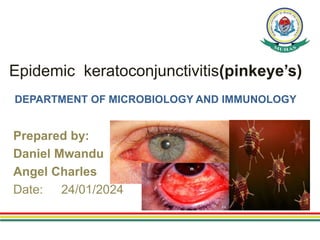
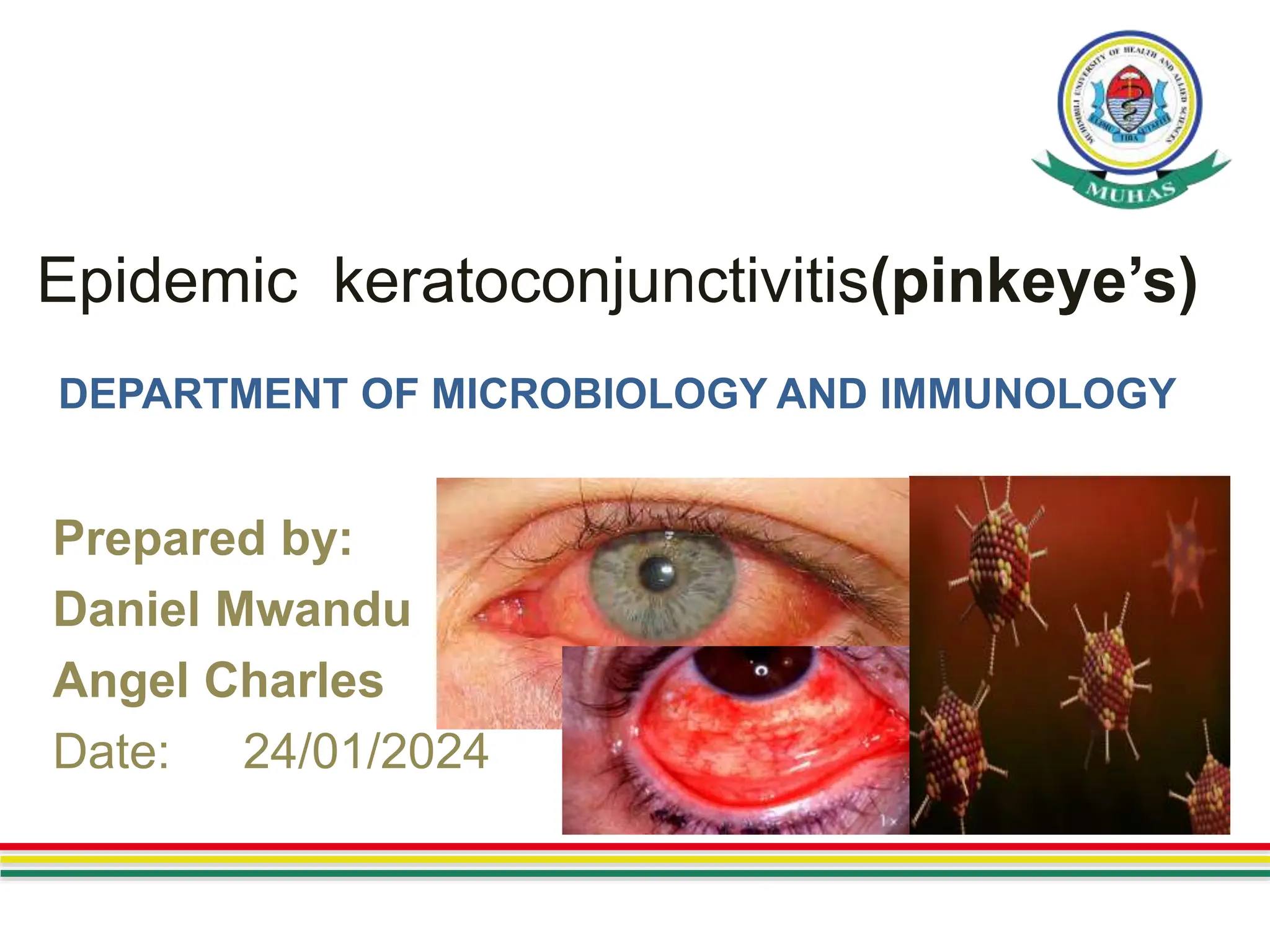
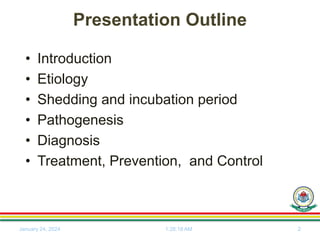
Epidemic keratoconjunctivitis(pinkeye’s)
DEPARTMENT OF MICROBIOLOGY AND IMMUNOLOGY
Prepared by:
Daniel Mwandu
Angel Charles
Date: 24/01/2024
Presentation Outline
• Introduction
• Etiology
• Shedding and incubation period
• Pathogenesis
• Diagnosis
• Treatment, Prevention, and Control
January 24, 2024 2
1:28:18 AM
INTRODUCTION
• Epidemic keratoconjunctivitis (EKC), also known as
adenoviral keratoconjunctivitis,
• It is a highly contagious eye infection that affects both the
cornea and the conjunctiva
• It can spread through hand-to-eye contact by hands or
objects that are contaminated with the infectious virus.
• It can also spread by respiratory droplets.
• EKC infections tend to occur in clusters such as military
camps, schools, hospitals, nursing homes, and
workplaces.
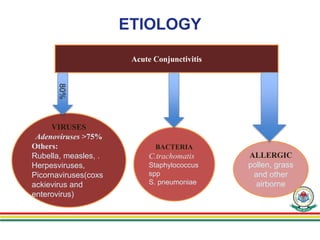
ETIOLOGY
Acute Conjunctivitis
VIRUSES
Adenoviruses >75%
Others:
Rubella, measles, .
Herpesviruses,
Picornaviruses(coxs
ackievirus and
enterovirus)
BACTERIA
C.trachomatis
Staphylococcus
spp
S. pneumoniae
ALLERGIC
pollen, grass
and other
airborne
80%
cont.
Cont.
• About 19 serotypes known to cause epidemic
keratoconjunctivitis (EKC).
• The most commonly associated serotypes
include adenovirus 8, 19, and 37.
• Adenovirus, serotype 8 is the major agent of
epidemic keratoconjunctivitis (EKC)
• less frequently, serotypes 2-5, 7, 9, 10, 11, 14,
16, 21, and 29.
VIRAL SHEDDING AND INCUBATION PERIOD
• The incubation period is 2-14 days,
• Most people will have symptoms in 5-6 days
after exposure.
• Infected person may remain infectious for 10-14
days after symptoms develop
• Viral shedding also may occur before symptoms
PATHOGENESIS
 Adenoviruses are able to survive outside of the body
for a prolonged period of time (up to 30 days).
 Adenovirus (AdV) is a lytic, naked ds DNA virus
 The presence, internalization and replication of the
virus of AdV on the ocular surface causes secretion
of IL-8.
 IL-8 inflammatory cells and promotes the
internalization of AdV into the host cell.
 Also actives complement-mediated lysis of AdV-
infected cells, and ADCC via NK cells
DIAGNOSIS
• PE: Eye examination.
• Specimens from Conjunctival swab for dipstick test
and or PCR should be collected in the early illness,
• Viral shedding for keratoconjunctivitis is 2 weeks
• Serum is required after two week( useful for
epidemiology purpose)
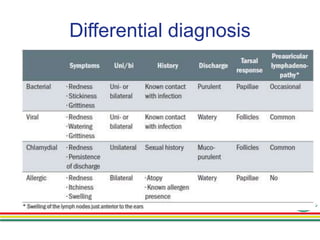
Differential diagnosis
Laboratory Diagnosis
A. Viral Culture: CPE in 2 to 7 days (cell rounding, grapelike
clusters)
B. Direct examination of clinical specimens
 Polymerase chain reaction (PCR) assays
C. Immunoassay tests
 Neutralization and hemagglutination inhibition
tests.
 Adenovirus Swab Test(RP Adeno Detector and
Adeno Plus),
 ELISA
Adenovirus Swab Test
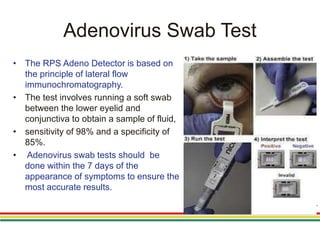
• The RPS Adeno Detector is based on
the principle of lateral flow
immunochromatography.
• The test involves running a soft swab
between the lower eyelid and
conjunctiva to obtain a sample of fluid,
• sensitivity of 98% and a specificity of
85%.
• Adenovirus swab tests should be
done within the 7 days of the
appearance of symptoms to ensure the
most accurate results.
Treatment, Prevention and Control
• No approved antiviral drugs and Vaccines for
adenoviral infections
• Treatment is based on the symptoms, antibiotic
used to prevent 2o bacterial infections.
• Face washing, Environmental and total body
hygiene to prevent transmission of disease from
one person to another
• Chlorination of swimming pool to prevent
outbreaks of adenovirus conjunctivitis.
Reference
1. Arun Kumar Adhikary: Genetic characterization of
adenovirus Type 8 (Ad8) isolated in South-East Kyushu
for the period of 1998-1999, Nov, 2000.
2. Andria M. Pihos :Epidemic keratoconjunctivitis: A review
of current concepts in management, 25 July 2012.
3. Jeremy Hoffman: Adenovirus: ocular manifestations,
2020.
4. Cristina Martin et al: Epidemic keratoconjunctivitis:
efficacy of outbreak management, Aug ,2021.
THANK YOU

RED EYE diagnosis causative agent and control measures

  • 1.
    Epidemic keratoconjunctivitis(pinkeye’s) DEPARTMENT OFMICROBIOLOGY AND IMMUNOLOGY Prepared by: Daniel Mwandu Angel Charles Date: 24/01/2024
  • 2.
    Presentation Outline • Introduction •Etiology • Shedding and incubation period • Pathogenesis • Diagnosis • Treatment, Prevention, and Control January 24, 2024 2 1:28:18 AM
  • 3.
    INTRODUCTION • Epidemic keratoconjunctivitis(EKC), also known as adenoviral keratoconjunctivitis, • It is a highly contagious eye infection that affects both the cornea and the conjunctiva • It can spread through hand-to-eye contact by hands or objects that are contaminated with the infectious virus. • It can also spread by respiratory droplets. • EKC infections tend to occur in clusters such as military camps, schools, hospitals, nursing homes, and workplaces.
  • 4.
    ETIOLOGY Acute Conjunctivitis VIRUSES Adenoviruses >75% Others: Rubella,measles, . Herpesviruses, Picornaviruses(coxs ackievirus and enterovirus) BACTERIA C.trachomatis Staphylococcus spp S. pneumoniae ALLERGIC pollen, grass and other airborne 80%
  • 5.
  • 6.
    Cont. • About 19serotypes known to cause epidemic keratoconjunctivitis (EKC). • The most commonly associated serotypes include adenovirus 8, 19, and 37. • Adenovirus, serotype 8 is the major agent of epidemic keratoconjunctivitis (EKC) • less frequently, serotypes 2-5, 7, 9, 10, 11, 14, 16, 21, and 29.
  • 7.
    VIRAL SHEDDING ANDINCUBATION PERIOD • The incubation period is 2-14 days, • Most people will have symptoms in 5-6 days after exposure. • Infected person may remain infectious for 10-14 days after symptoms develop • Viral shedding also may occur before symptoms
  • 8.
    PATHOGENESIS  Adenoviruses areable to survive outside of the body for a prolonged period of time (up to 30 days).  Adenovirus (AdV) is a lytic, naked ds DNA virus  The presence, internalization and replication of the virus of AdV on the ocular surface causes secretion of IL-8.  IL-8 inflammatory cells and promotes the internalization of AdV into the host cell.  Also actives complement-mediated lysis of AdV- infected cells, and ADCC via NK cells
  • 9.
    DIAGNOSIS • PE: Eyeexamination. • Specimens from Conjunctival swab for dipstick test and or PCR should be collected in the early illness, • Viral shedding for keratoconjunctivitis is 2 weeks • Serum is required after two week( useful for epidemiology purpose)
  • 10.
  • 11.
    Laboratory Diagnosis A. ViralCulture: CPE in 2 to 7 days (cell rounding, grapelike clusters) B. Direct examination of clinical specimens  Polymerase chain reaction (PCR) assays C. Immunoassay tests  Neutralization and hemagglutination inhibition tests.  Adenovirus Swab Test(RP Adeno Detector and Adeno Plus),  ELISA
  • 12.
    Adenovirus Swab Test •The RPS Adeno Detector is based on the principle of lateral flow immunochromatography. • The test involves running a soft swab between the lower eyelid and conjunctiva to obtain a sample of fluid, • sensitivity of 98% and a specificity of 85%. • Adenovirus swab tests should be done within the 7 days of the appearance of symptoms to ensure the most accurate results.
  • 13.
    Treatment, Prevention andControl • No approved antiviral drugs and Vaccines for adenoviral infections • Treatment is based on the symptoms, antibiotic used to prevent 2o bacterial infections. • Face washing, Environmental and total body hygiene to prevent transmission of disease from one person to another • Chlorination of swimming pool to prevent outbreaks of adenovirus conjunctivitis.
  • 14.
    Reference 1. Arun KumarAdhikary: Genetic characterization of adenovirus Type 8 (Ad8) isolated in South-East Kyushu for the period of 1998-1999, Nov, 2000. 2. Andria M. Pihos :Epidemic keratoconjunctivitis: A review of current concepts in management, 25 July 2012. 3. Jeremy Hoffman: Adenovirus: ocular manifestations, 2020. 4. Cristina Martin et al: Epidemic keratoconjunctivitis: efficacy of outbreak management, Aug ,2021.
  • 15.

Editor's Notes

  • #5 Viruses represent about 80% of all causes of acute conjunctivitis, Adenoviral conjunctivitis is known to be the most common cause of red eye in the world, About 62% to 75% of cases of infectious conjunctivitis are caused by adenovirus.
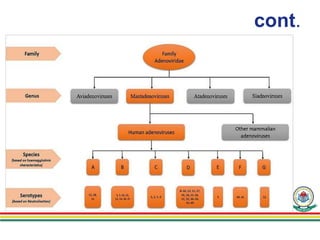
  • #6 Species also known as serogroup
  • #9 Adenoviruses are unusually stable to chemical or physical agents and adverse pH conditions, allowing for prolonged survival outside of the body and water.
  • #12 Throat swab, eye swab, urine and stool etc. Cytopathic changes may take several days to develop and consist of cell rounding and aggregation into grape like clusters.
  • #13 The RPS Adeno Detector detects common epitopes on the hexon protein of the adenovirus within a conserved region among all known serotypes. One antibody is immobilized in the detection zone of the device. The second antibody is labeled with colloidal