Presented by
Prashant kumar
A0523115022
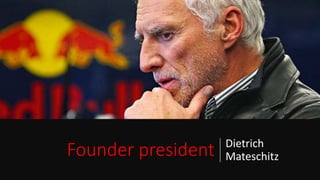
Founder president Dietrich
Mateschitz
ABOUT RED BULL
• Red Bull is an energy drink sold by Austrian
company Red Bull GmbH, created in 1987.
Red Bull has the highest market share of any
energy drink in the world, with 5.387 billion
cans sold in 2013.
• Austrian entrepreneur Dietrich Mateschitz
was inspired by an existing energy drink
named Krating Daeng, which was first
introduced and sold in Thailand by Chaleo
Yoovidhya.
• He took this idea, modified the ingredients to
suit the tastes of Westerners, and, in
partnership with Chaleo, founded Red
Bull GmbH in 1987 in Chakkapong, Thailand.
ABOUT RED BULL
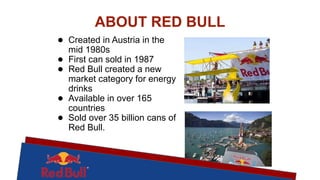
● Created in Austria in the
mid 1980s
● First can sold in 1987
● Red Bull created a new
market category for energy
drinks
● Available in over 165
countries
● Sold over 35 billion cans of
Red Bull.
ABOUT RED BULL
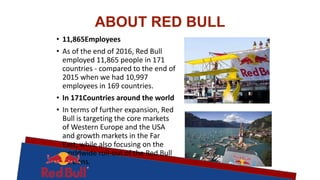
• 11,865Employees
• As of the end of 2016, Red Bull
employed 11,865 people in 171
countries - compared to the end of
2015 when we had 10,997
employees in 169 countries.
• In 171Countries around the world
• In terms of further expansion, Red
Bull is targeting the core markets
of Western Europe and the USA
and growth markets in the Far
East, while also focusing on the
worldwide roll-out of the Red Bull
Editions.
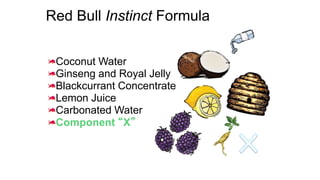
Red Bull Instinct Formula
Coconut Water
Ginseng and Royal Jelly
Blackcurrant Concentrate
Lemon Juice
Carbonated Water
Component “X”
Major contain of Red Bull
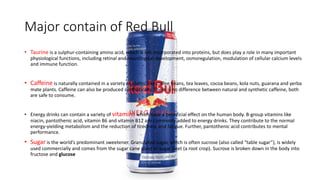
• Taurine is a sulphur-containing amino acid, which is not incorporated into proteins, but does play a role in many important
physiological functions, including retinal and neurological development, osmoregulation, modulation of cellular calcium levels
and immune function.
• Caffeine is naturally contained in a variety of plants, like coffee beans, tea leaves, cocoa beans, kola nuts, guarana and yerba
mate plants. Caffeine can also be produced synthetically. There is no difference between natural and synthetic caffeine, both
are safe to consume.
• Energy drinks can contain a variety of vitamins which have a beneficial effect on the human body. B-group vitamins like
niacin, pantothenic acid, vitamin B6 and vitamin B12 are commonly added to energy drinks. They contribute to the normal
energy-yielding metabolism and the reduction of tiredness and fatigue. Further, pantothenic acid contributes to mental
performance.
• Sugar is the world’s predominant sweetener. Granulated sugar, which is often sucrose (also called “table sugar”), is widely
used commercially and comes from the sugar cane plant or sugar beet (a root crop). Sucrose is broken down in the body into
fructose and glucose
Processing Steps
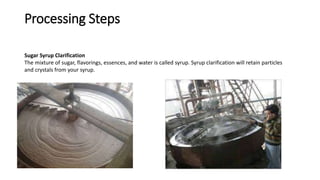
Sugar Syrup Clarification
The mixture of sugar, flavorings, essences, and water is called syrup. Syrup clarification will retain particles
and crystals from your syrup.
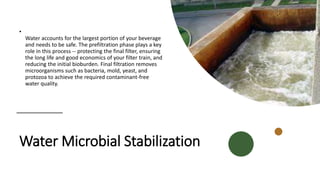
Water Microbial Stabilization
•
Water accounts for the largest portion of your beverage
and needs to be safe. The prefiltration phase plays a key
role in this process -- protecting the final filter, ensuring
the long life and good economics of your filter train, and
reducing the initial bioburden. Final filtration removes
microorganisms such as bacteria, mold, yeast, and
protozoa to achieve the required contaminant-free
water quality.
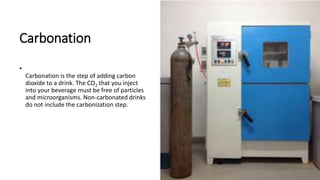
Carbonation
•
Carbonation is the step of adding carbon
dioxide to a drink. The CO2 that you inject
into your beverage must be free of particles
and microorganisms. Non-carbonated drinks
do not include the carbonization step.
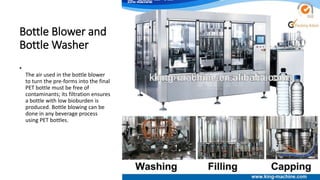
Bottle Blower and
Bottle Washer
•
The air used in the bottle blower
to turn the pre-forms into the final
PET bottle must be free of
contaminants; its filtration ensures
a bottle with low bioburden is
produced. Bottle blowing can be
done in any beverage process
using PET bottles.
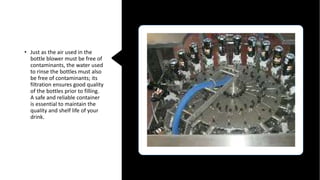
• Just as the air used in the
bottle blower must be free of
contaminants, the water used
to rinse the bottles must also
be free of contaminants; its
filtration ensures good quality
of the bottles prior to filling.
A safe and reliable container
is essential to maintain the
quality and shelf life of your
drink.
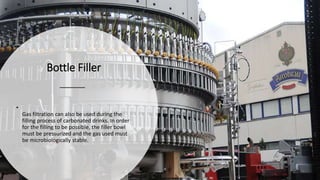
Bottle Filler
•
Gas filtration can also be used during the
filling process of carbonated drinks. In order
for the filling to be possible, the filler bowl
must be pressurized and the gas used must
be microbiologically stable.
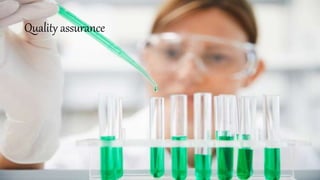
Quality assurance
Unknown Material Identification & Analysis
Our chemists use a variety of techniques
and instrumentation to perform material identification
including:
Gas Chromatography GC/MS & GC/FID
liquid-Chromatography LC/MS & HP/LC
Infrared-spectroscopy FTIR
NMR-spectroscopy NMR
ICP/AA
Create nutritional level
•Calories
•Calories from Fat
•Total Fat
•Fatty Acid
•Saturated, Unsaturated,
& Trans Fat
•Cholesterol
•Sodium
•Dietary Fiber
•Sugar
•Proteins
•Vitamins A, C, D
•Calcium
•Iron
Our analytical services lab
can help with
labelling, shelf life
testing, safety regulations
testing, competitor
product analysis, patent
infringement,
and regulatory consulting.
Our Ph.D. chemists have
experience in a variety of
analytical service fields.
Safety Regulations Testing
Avomeen Analytical Services is an
FDA-Registered and DEA-Licensed full-
service laboratory that
assists pharmaceutical, medical
device, nutraceutical, cosmetics,
and food manufacturers in acquiring
their product safety certifications. Our
health and safety lab can help make
your product compliant with the Code
of Federal Regulaations (CFR).
Identify toxins and impurities (organic or inorganic)
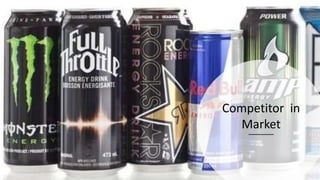
Competitor in
Market
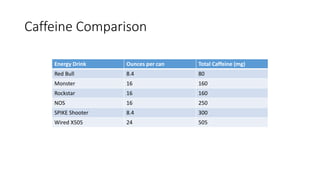
Caffeine Comparison
Energy Drink Ounces per can Total Caffeine (mg)
Red Bull 8.4 80
Monster 16 160
Rockstar 16 160
NOS 16 250
SPIKE Shooter 8.4 300
Wired X505 24 505
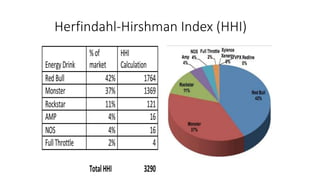
Herfindahl-Hirshman Index (HHI)
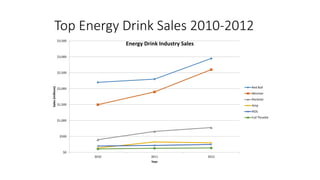
$0
$500
$1,000
$1,500
$2,000
$2,500
$3,000
$3,500
2010 2011 2012
Sales(millions)
Year
Energy Drink Industry Sales
Red Bull
Monster
Rockstar
Amp
NOS
Full Throttle
Top Energy Drink Sales 2010-2012
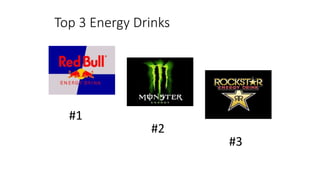
Top 3 Energy Drinks
#1
#2
#3
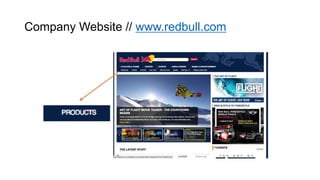
Company Website // www.redbull.com
Internship Program at Red bull
www.redbullinternshipprogram.com
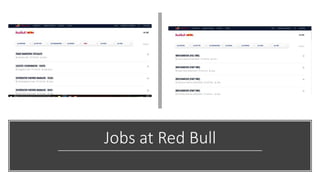
Jobs at Red Bull
CONCLUSION

red bull

  • 1.
  • 2.
  • 3.
    ABOUT RED BULL •Red Bull is an energy drink sold by Austrian company Red Bull GmbH, created in 1987. Red Bull has the highest market share of any energy drink in the world, with 5.387 billion cans sold in 2013. • Austrian entrepreneur Dietrich Mateschitz was inspired by an existing energy drink named Krating Daeng, which was first introduced and sold in Thailand by Chaleo Yoovidhya. • He took this idea, modified the ingredients to suit the tastes of Westerners, and, in partnership with Chaleo, founded Red Bull GmbH in 1987 in Chakkapong, Thailand.
  • 4.
    ABOUT RED BULL ●Created in Austria in the mid 1980s ● First can sold in 1987 ● Red Bull created a new market category for energy drinks ● Available in over 165 countries ● Sold over 35 billion cans of Red Bull.
  • 5.
    ABOUT RED BULL •11,865Employees • As of the end of 2016, Red Bull employed 11,865 people in 171 countries - compared to the end of 2015 when we had 10,997 employees in 169 countries. • In 171Countries around the world • In terms of further expansion, Red Bull is targeting the core markets of Western Europe and the USA and growth markets in the Far East, while also focusing on the worldwide roll-out of the Red Bull Editions.
  • 6.
    Red Bull InstinctFormula Coconut Water Ginseng and Royal Jelly Blackcurrant Concentrate Lemon Juice Carbonated Water Component “X”
  • 7.
    Major contain ofRed Bull • Taurine is a sulphur-containing amino acid, which is not incorporated into proteins, but does play a role in many important physiological functions, including retinal and neurological development, osmoregulation, modulation of cellular calcium levels and immune function. • Caffeine is naturally contained in a variety of plants, like coffee beans, tea leaves, cocoa beans, kola nuts, guarana and yerba mate plants. Caffeine can also be produced synthetically. There is no difference between natural and synthetic caffeine, both are safe to consume. • Energy drinks can contain a variety of vitamins which have a beneficial effect on the human body. B-group vitamins like niacin, pantothenic acid, vitamin B6 and vitamin B12 are commonly added to energy drinks. They contribute to the normal energy-yielding metabolism and the reduction of tiredness and fatigue. Further, pantothenic acid contributes to mental performance. • Sugar is the world’s predominant sweetener. Granulated sugar, which is often sucrose (also called “table sugar”), is widely used commercially and comes from the sugar cane plant or sugar beet (a root crop). Sucrose is broken down in the body into fructose and glucose
  • 8.
    Processing Steps Sugar SyrupClarification The mixture of sugar, flavorings, essences, and water is called syrup. Syrup clarification will retain particles and crystals from your syrup.
  • 9.
    Water Microbial Stabilization • Wateraccounts for the largest portion of your beverage and needs to be safe. The prefiltration phase plays a key role in this process -- protecting the final filter, ensuring the long life and good economics of your filter train, and reducing the initial bioburden. Final filtration removes microorganisms such as bacteria, mold, yeast, and protozoa to achieve the required contaminant-free water quality.
  • 10.
    Carbonation • Carbonation is thestep of adding carbon dioxide to a drink. The CO2 that you inject into your beverage must be free of particles and microorganisms. Non-carbonated drinks do not include the carbonization step.
  • 11.
    Bottle Blower and BottleWasher • The air used in the bottle blower to turn the pre-forms into the final PET bottle must be free of contaminants; its filtration ensures a bottle with low bioburden is produced. Bottle blowing can be done in any beverage process using PET bottles.
  • 12.
    • Just asthe air used in the bottle blower must be free of contaminants, the water used to rinse the bottles must also be free of contaminants; its filtration ensures good quality of the bottles prior to filling. A safe and reliable container is essential to maintain the quality and shelf life of your drink.
  • 13.
    Bottle Filler • Gas filtrationcan also be used during the filling process of carbonated drinks. In order for the filling to be possible, the filler bowl must be pressurized and the gas used must be microbiologically stable.
  • 14.
  • 15.
    Unknown Material Identification& Analysis Unknown Material Identification & Analysis Our chemists use a variety of techniques and instrumentation to perform material identification including: Gas Chromatography GC/MS & GC/FID liquid-Chromatography LC/MS & HP/LC Infrared-spectroscopy FTIR NMR-spectroscopy NMR ICP/AA
  • 16.
    Create nutritional level •Calories •Caloriesfrom Fat •Total Fat •Fatty Acid •Saturated, Unsaturated, & Trans Fat •Cholesterol •Sodium •Dietary Fiber •Sugar •Proteins •Vitamins A, C, D •Calcium •Iron Our analytical services lab can help with labelling, shelf life testing, safety regulations testing, competitor product analysis, patent infringement, and regulatory consulting. Our Ph.D. chemists have experience in a variety of analytical service fields.
  • 17.
    Safety Regulations Testing AvomeenAnalytical Services is an FDA-Registered and DEA-Licensed full- service laboratory that assists pharmaceutical, medical device, nutraceutical, cosmetics, and food manufacturers in acquiring their product safety certifications. Our health and safety lab can help make your product compliant with the Code of Federal Regulaations (CFR).
  • 18.
    Identify toxins andimpurities (organic or inorganic)
  • 19.
  • 20.
    Caffeine Comparison Energy DrinkOunces per can Total Caffeine (mg) Red Bull 8.4 80 Monster 16 160 Rockstar 16 160 NOS 16 250 SPIKE Shooter 8.4 300 Wired X505 24 505
  • 21.
  • 22.
    $0 $500 $1,000 $1,500 $2,000 $2,500 $3,000 $3,500 2010 2011 2012 Sales(millions) Year EnergyDrink Industry Sales Red Bull Monster Rockstar Amp NOS Full Throttle Top Energy Drink Sales 2010-2012
  • 24.
    Top 3 EnergyDrinks #1 #2 #3
  • 25.
    Company Website //www.redbull.com
  • 26.
    Internship Program atRed bull www.redbullinternshipprogram.com
  • 27.
  • 28.