Recreational drugs
        ass. prof. S. Zakharov, M.D., Ph.D.
              Charles University in Prague
                  First Faculty of Medicine
     Department of Occupational Medicine
                                       1
„Fourth drive“
(Ronald K. Siegel)
   Satisfaction of
    hunger, thirst
   Need for safety
    (shelter)
   Sexual drive
   ? „Altered-mind“ states ?

„We are perceiving creatures...“
                            (C. Castaneda)
- Thirst for new impressions, sensations,
  feeling, emotions, experiences – ways
  of satisfaction?                       2
Recreational drug use
   Why? (Intention) –
    creating/enchancing
    recreational experience
   Where,when? – night clubs
    („party drugs“), psychonautics,
        spiritual communities, sport, army,
    sex...
   Problems:
-   Legality?
-   Addiction
-   Tolerance
-   Physical/psychical dependence
-   Neurotoxicity                             3
Novel Recreational Drugs of Abuse („Legal Highs“)

• New synthesized chemicals,not listed in Convention
  on psychotropic substances, sold by internet
  (in Czech republic – 3 websites with „legal highs“)
• http://botanic.cz – psychoactive plants.
• „clubbers drugs“ – use 40% of night clubs visiters
• Each 2-3 months new „Legal High“ is marketed
  (absence of studies about toxicity, biometabolism, no
  lab methods of identification in human liquids)


                                                     4
Novel Recreational Drugs of Abuse

• Production in Southeast Asia, China,
  packaging and distribution in Europe
  and USA.
• Growth of popularity: earlier http://bythemg.com,
  now http://bythekg.com
• Simple synthesis schemes (2-3 chemical
  reactions, common reagents (toluene, acetone...),
  high grade of chemical purity, low prices
• Chemical structure is similar to the structure of
  forbidden „classical“ psychoactive substances
                                                 5
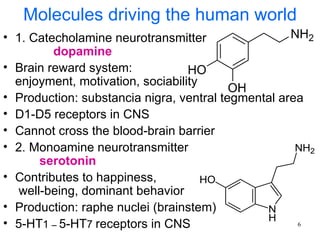
Molecules driving the human world
• 1. Catecholamine neurotransmitter
         dopamine
• Brain reward system:
  enjoyment, motivation, sociability
• Production: substancia nigra, ventral tegmental area
• D1-D5 receptors in CNS
• Cannot cross the blood-brain barrier
• 2. Monoamine neurotransmitter
       serotonin
• Contributes to happiness,
   well-being, dominant behavior
• Production: raphe nuclei (brainstem)
• 5-HT1 – 5-HT7 receptors in CNS                     6
1. Stimulants („uppers“) -
    dopamine/serotonin/norepinephrin releasing drugs

•    Amphetamines, methamphetamines („Pervitin“)
•    MDMA („Extasy“), MDxx family
•    Cathinones
•    Piperazines
•    Mitragynine (Kratom)

* Empathogens-entactogens („love drugs“)
• MDA, MDMA, MDxx family
• 2C-x family
• Tryptamines (AET, AMT)                         7
2. Hallucinogens
• 2.1. Psychedelics („classical hallucinogens“-
  5-HT2a/2c receptors agonists):
- Phenethylamines (mescaline, DOx, 2C-x)
- Tryptamines (LSD, psilocybin, DMT, ibogaine)
• 2.2. Deliriants:
- Muscimol (Amanita muscaria)
- Solanaceae alkaloids (atropine, scopolamine...)
- Myristicin („Nutmeg“)
• 2.3. Dissociatives:
- Ketamine, Phencyclidine, Salvinorin
- Dextromethorphan (opioid)                   8
3. Common psychoactives
•   Opiates and opioids
-   morphine, heroin
-   hydrocodone, oxycodone
•   Cannabis and cannabinoids
•   Cocaine and analogues


                                 9
Amphetamines, methamphetamines
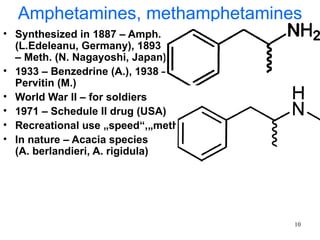
• Synthesized in 1887 – Amph.
  (L.Edeleanu, Germany), 1893
  – Meth. (N. Nagayoshi, Japan)
• 1933 – Benzedrine (A.), 1938 –
  Pervitin (M.)
• World War II – for soldiers
• 1971 – Schedule II drug (USA)
• Recreational use „speed“,„meth“
• In nature – Acacia species
  (A. berlandieri, A. rigidula)


                                    10
Amphetamines, methamphetamines
• Recreational use: from 1937 (Minnesota, USA,
  students), 16-51 mln. of abusers worldwide
• Psychological effects: euphoria, positive mood,
  decreased fatigue, reduced appetite, increased
  energy (self-esteem, self-confidence),
  alertness, sociability, psychomotor agitation,
  insomnia, increased libido, excessive feeling of
  power and invincibility, hallucinations
• Routes of exposure: ingestion, injection,
  insufflation, inhalation (smoking), suppositoria
  (rectal, vaginal)                              11
Amphetamines, methamphetamines
• Mechanisms of action
    (toxicity):
i – enters the cell by
    passive diffusion or
ii – via membrane-bound
    dopamine reuptake
    transportes (DAT)
iii – redistribution of DA
    from vesicles into the
    cytosol (VMAT-2)
iv – promotes the activity of
    tyrosine hydroxylase
v – blocking the presynaptic re-uptake of DA by DAT
vi – inhibiting MAO activity
                                                      12
Amphetamines, methamphetamines
• Neurotoxicity:
- enhanced cytosol concentration
  of DA
- increased oxidation
- superoxide free radicals,
  peroxylnitrite (:NO3)
- oxidative stress
- mitochondrial injury,
- neuronal apoptosis, nerve terminal degeneration

• General toxicity - sympathomimetic toxidrome!
                                                    13
Sympathomimec toxidrome (amphetamines,
               methamphetame, MDMA…)
-   Cardio: tachycardia, hypertension, palpitations,
    chest pain, ischemia/infarction;
-   CNS: nistagmus, tremor, headache,
    paresthesia, numbness, hyperreflexia, muscle
    rigidity (bruxisme), seizures;
-   Psychiatric: anxiety, paranoia, psychosis,
    confusion/desorientation, delirium,
    hallucinations;
-   Respiratory: tachypnea, dyspnea, pulmonary
    hypertension

                                                 14
Sympathomimec toxidrome (amphetamines,
        methamphetame, MDMA…)

- Metabolic: dehydratation (hypovolemia), lactic
  acidosis, hyperglycemia, hyper-K, hypo-Na,
  hyper-CK (rhabdomyolysis – renal
  insufficience);
- Ocular: mydriasis, blurred vision, intraretinal
  hemorrhagia;
- GI: nausea/vomiting, diarrhea, abdominal pain;


                                              15
MDA, MDMA („Extasy“), MDxx
• MDA synthetised in 1910
  (G.Mannish, W.Jacobson),
     MDMA in 1912 (A.Kollisch)
• Recreational use from 1963
• „Love drugs“, empathogens-
  entactogens (induce
   feelings of empathy, love,
  emotional closeness to others)
• Dose: 100-160 mg MDA, 75-120 mg MDMA
• Overdose at 200-250mg (mainly in combination with
  excessive physical activity + strong alcohol)


                                                16
MDA, MDMA („Extasy“), MDxx
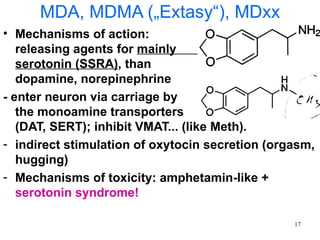
• Mechanisms of action:
   releasing agents for mainly
   serotonin (SSRA), than
   dopamine, norepinephrine
- enter neuron via carriage by
   the monoamine transporters
   (DAT, SERT); inhibit VMAT... (like Meth).
- indirect stimulation of oxytocin secretion (orgasm,
   hugging)
- Mechanisms of toxicity: amphetamin-like +
   serotonin syndrome!

                                                 17
Acute recreational drug toxicity syndrom
• Sympathomimetic toxidrome
• Serotonin syndrome
• Psychiatric symptoms
(„Amphetamine psychosis“)
• Combination: „alcohol + legal high“
  milder cardiovascular symptoms
  (softer „onset“ of MDMA after
  1 glass of red vine),                   --
  -- better driving ability then after
   alcohol intake only)
• Use less than 1 weekly
  (tolerance due to „receptor
  downregulation effect“)
• Drink plenty of water (not Coca)
                                          18
Selective serotonin releasing agents (SSRA)
• MDMA („Extasy“), MDxx, PMA („Chicken
  Powder“, „Dr. Death“) – effective releasers
  of 5-HT, reuptake inhibitors of 5-HT (risk in
  combination with SSRI, MAO-A and CYP450
  inhibitors)
• Serotonergic neurotoxicity - Serotonin
  syndrom:
- Rapid increase in body temperature
  (hyperthermia)
- Hypertension/hypotension, tachycardia,
  convulsions, seizures, coma
- Dehydratation, rhabdomyolysis               19
Selective serotonin releasing agents (SSRA)
• Treatment: intubation, external cooling (4º
  water, ice)
- Internal cooling (i.v. Infusion of cooled
  saline, gastric lavage with „ice“ saline),
- Treatment of convulsions and agitation:
  benzodiazepines (i.v. diazepam in bolus),
  phenytoin, thiopental;
- Treatment of hypertension: alpha/beta
  blockers, nitroprusside;
- Dantrolene (5-HT antagonist);
- Rehydratation                              20
Cathinones
• Khat (Catha edulis) – tropical
  East Africa, Arabian Peninsula;
• Fresh leaves – stimulating
  amphetamine-like effect;
• Legal in UK,Netherlands,Israel
• http://ekhat.org/our-new-
  shop-buy-khat-online-now
prices of khat in our site:
• 100gr – £33.99
• 200gr – £38.99
• 400gr – £53.99                    21
Cathinones
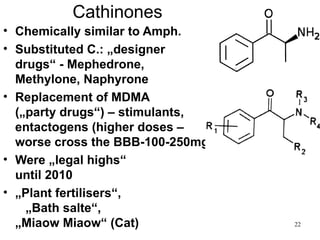
• Chemically similar to Amph.
• Substituted C.: „designer
  drugs“ - Mephedrone,
  Methylone, Naphyrone
• Replacement of MDMA
  („party drugs“) – stimulants,
  entactogens (higher doses –
  worse cross the BBB-100-250mg)
• Were „legal highs“
  until 2010
• „Plant fertilisers“,
    „Bath salte“,
  „Miaow Miaow“ (Cat)              22
Piperidines
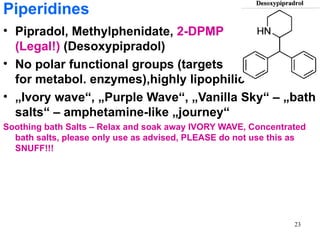
• Pipradol, Methylphenidate, 2-DPMP
  (Legal!) (Desoxypipradol)
• No polar functional groups (targets
  for metabol. enzymes),highly lipophilic
• „Ivory wave“, „Purple Wave“, „Vanilla Sky“ – „bath
  salts“ – amphetamine-like „journey“
Soothing bath Salts – Relax and soak away IVORY WAVE, Concentrated
  bath salts, please only use as advised, PLEASE do not use this as
  SNUFF!!!


                                                                23
New Herbal Stimulants
• Kratom (Mitragyna speciosa)
- Native to Southeast Asia
- Leaves contain alcaloid mitragynin
  interacts with opioid receptors
- Stimulant-like effect in small doses,
  opiate-like effect in higher doses


                                          24
Psychedelics: Phenethylamines (mescaline,
DOx, 2C-x)
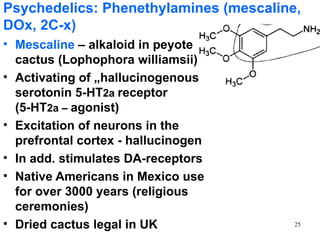
• Mescaline – alkaloid in peyote
  cactus (Lophophora williamsii)
• Activating of „hallucinogenous“
  serotonin 5-HT2a receptor
  (5-HT2a – agonist)
• Excitation of neurons in the
  prefrontal cortex - hallucinogen
• In add. stimulates DA-receptors
• Native Americans in Mexico use
  for over 3000 years (religious
  ceremonies)
• Dried cactus legal in UK              25
Psychedelics: Tryptamines (LSD - 5-HT2a–
agonist, DA–receptor agonist )
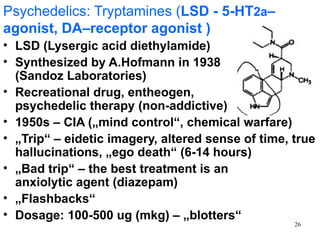
• LSD (Lysergic acid diethylamide)
• Synthesized by A.Hofmann in 1938
  (Sandoz Laboratories)
• Recreational drug, entheogen,
  psychedelic therapy (non-addictive)
• 1950s – CIA („mind control“, chemical warfare)
• „Trip“ – eidetic imagery, altered sense of time, true
  hallucinations, „ego death“ (6-14 hours)
• „Bad trip“ – the best treatment is an
  anxiolytic agent (diazepam)
• „Flashbacks“
• Dosage: 100-500 ug (mkg) – „blotters“
                                                   26
LSD (5-HT2a – receptor agonist)
• Natural sources:
• Fungus Claviceps purpurea (grows
  on the rye and other cereals) -
  ergotamine
• „Morning glory“ (Ipomoea tricolor, I. violacea) –
        ergine (LSA, lysergic acid amide)


                                                  27
Novel Recreational Herbal Drugs of Abuse

• Hawaiian Baby Woodrose
(Argyreia nervosa)
- Effect of ergine (LSA) – LSD-like
- „Tropical stones“ (seeds
  of HBW)


                                                28
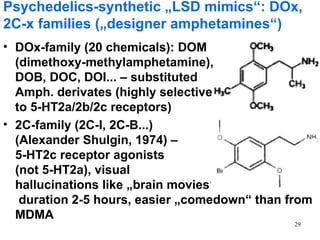
Psychedelics-synthetic „LSD mimics“: DOx,
2C-x families („designer amphetamines“)
• DOx-family (20 chemicals): DOM
  (dimethoxy-methylamphetamine),
  DOB, DOC, DOI... – substituted
  Amph. derivates (highly selective
  to 5-HT2a/2b/2c receptors)
• 2C-family (2C-I, 2C-B...)
  (Alexander Shulgin, 1974) –
  5-HT2c receptor agonists
  (not 5-HT2a), visual
  hallucinations like „brain movies“
   duration 2-5 hours, easier „comedown“ than from
  MDMA
                                               29
Psychedelics: Tryptamines:
Psilocin (Psilocybin)
• Psychedelic mushrooms
  alkaloid (over 200 species –
  Psilocybe cubensis,
  P.semilanceata, P.cyanescens...)
• Partial agonist at 5-HT2a
• No efect at DA-R (unlike LSD)
• Hallucinations, synesthesia
  (hearing colours, seeing sounds)
• Effect lasts 3-8
  hours


                                     30
Psychedelics: Tryptamines:
Psilocin (Psilocybin)
• History: religious ceremonies (9000 BCE – Africa,
  6000 BCE – Europe, Spain, Mayan and Aztec
  cultures in America)
• Purified from P. mexicana in 1958 by A. Hofmann
• Low toxicity (LD50 for rats 280 mg/kg – 1,7 kg
  of dried or 17 kg of fresh rooms for adult)
• Recreational dosage: 10-50 mg
  (alkohol and tobacco enhance
  the effect)- „brain movies“
• Adverse reactions in 25% of
  cases (psychosis, panic attack,
                                                31
   aggression, confusion)
Psychedelics: Tryptamines:
DMT (Dimethyltryptamine)
• Natural sources: 50 plant species,
  4 animal species
• Product of normal metabolism in
  humans and other mammals?
• Ayahuasca (Amazonian Amerindian
  brew) – DMT (B. rusbyana,
  Psychotria viridis aj.)+ MAOI
  (harmala alcaloids of jungle
  vine Banisteriopsis caapi)
• Agonist of 5-HT2a receptor
  („classical hallucinogen“)
                                       32
Psychedelics: Tryptamines:
DMT (Dimethyltryptamine)
• Routes of exposure: ingestion (only with MAOI –
  othervise is metabolised in GIT), inhalation
  (smoking as „crack“ cocain), insufflation, injection
  (contacts with „alien entities“);
• Short action when smoking („businessman´s trip“)
  15 min, orally over 3 hours.
• Intense erotic
  imagery and
  sensations,
  archetypal visions

                                                  33
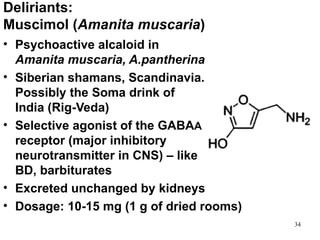
Deliriants:
Muscimol (Amanita muscaria)
• Psychoactive alcaloid in
  Amanita muscaria, A.pantherina
• Siberian shamans, Scandinavia.
  Possibly the Soma drink of
  India (Rig-Veda)
• Selective agonist of the GABAA
  receptor (major inhibitory
  neurotransmitter in CNS) – like
  BD, barbiturates
• Excreted unchanged by kidneys
• Dosage: 10-15 mg (1 g of dried rooms)
                                          34
Deliriants: Solanaceae alkaloids
(atropine, scopolamine, hyoscyamine)
• Jimsonweed (Datura stramonium),
  Deadly nightshade (Atropa bella-            donna),
  Mandrake (Mandragora officinarum)…
• Potent combination of anticholinergic substances
  (competitive antagonists of muscarinic
  acetylcholine receptors)
• Anticholinergic delirium, hyperthermia, dry mouth
  tachycardia; bizarre (violent) behavior; mydriasis,
  photophobia, blurred vision
• Treatment: gastric lavage,
  activated charcoal, benzodiazepi-
  nes, antidote physostigmine,                    35
Deliriants: Myristicin
• Myristica fragrans („Nutmeg
  tree“)
• Anticholinergic-like symptoms
  when consuming raw nutmegs
  (nausea, vomiting, dizziness, anxiety, headache,
  hallucinations and irrational behavior, myosis)
• MDMA-like chemical structure + weak inhibitor
  MAO
• extremely long time before peak (4-7 hours),
  effects last for 24-72 hours

                                                 36
Dissociatives: Ketamine („Vitamin K“,
„Kitties“), Phencyclidine („Angel dust“)
• Dissociation – reduce/block signals to the
   conscious mind from other parts of the brain
   (trances):
- sensory loss (dissociation from the body),
- depersonalization („out-of-body“, „near-death“
   experiences), spiritual/psychonautic use
- derealization (unreal world outside)
Other effects: hallucinogenic, euphoric, anesthetic


                                                 37
Dissociatives: Ketamine, Phencyclidine
• „Non-classical hallucinogens“ – no effect on 5-
  HT2A receptors in CNS
• Mechanisms of action: non-competitive NMDA-
  receptor antagonist (antagonizes glutamic acid –
  main excitatory neurotransmitter in CNS), D2-
  receptor partial agonist
• Problems of abuse: great neurotoxicity (much
  more than of „classical hallucinogens“) –
  cognitive impairment, memory loss, urinary tract
  diseases (ulcerative cystitis, „shrunken bludder“),
  abdominal „K-cramps“

                                                 38
Cannabis and cannabinoids
• Species: Cannabis sativa (North America),
  C. indica (!!!) (Indie), C. ruderalis (Russia)
• Marijuana (flowers and subtending leaves
      and stalks of mature female plants)
• Hashish (compressed stalked resin
  glands from the unfertilized buds)


                                                   39
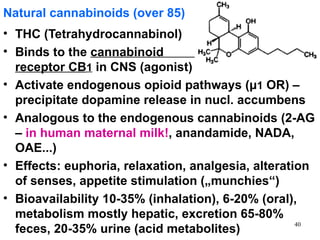
Natural cannabinoids (over 85)
• THC (Tetrahydrocannabinol)
• Binds to the cannabinoid
  receptor CB1 in CNS (agonist)
• Activate endogenous opioid pathways (μ1 OR) –
  precipitate dopamine release in nucl. accumbens
• Analogous to the endogenous cannabinoids (2-AG
  – in human maternal milk!, anandamide, NADA,
  OAE...)
• Effects: euphoria, relaxation, analgesia, alteration
  of senses, appetite stimulation („munchies“)
• Bioavailability 10-35% (inhalation), 6-20% (oral),
  metabolism mostly hepatic, excretion 65-80%
                                                    40
  feces, 20-35% urine (acid metabolites)
Synthetic cannabinoids – CB1-agonists
• Distinct chemical classes (THC-analogues,
  aminoalkylindoles, diarylpyrazoles, quinolines...)
• Distinct legal status – many legal ones („legal
  highs“) – www.bythekg.com : JWH-250, AM-2201,
  AM-694, JWH-019, 2-DPMP. ATTENTION!
  JWH-203 SALE OUT!! 5$ PER GRAM!!
• JWH cannabinoids – synthesized by the John.W.
  Huffman research group at Clemson University
  (over 450 chemicals)
• AM cannabinoids – synthesized by the A.
  Makriyannis research group at the University of
  Connecticut
• HU cannabinoids – Hebrew University, Jerusalem
                                                  41
„Legal smoke blends“ with CB1-agonists
• „Herbal“ mixtures – synthetic Cannabinoid
  Receptor Agonists JWH class – „Spice“, „Smoke“,
  „Jamaican Gold“, „Ninja“, „Monkees go bananas“


                                              42
Symptoms of „acute intoxication by smoking herbal
                      products“
• Cardiovascular, neurological, psychiatric
  symptoms
• Hallucinations, agitation, somnolence, insomnia,
  mydriasis
• Tremor, seizures, myoclonus
• Addiction/dependence and tolerance
• Tachycardia, palpitations, chest pains
• Dyspnoea
• Nausea, vomitind
• Hypokalemia

                                                       43
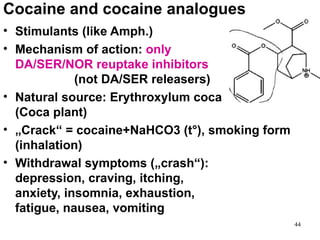
Cocaine and cocaine analogues
• Stimulants (like Amph.)
• Mechanism of action: only
  DA/SER/NOR reuptake inhibitors
             (not DA/SER releasers)
• Natural source: Erythroxylum coca
  (Coca plant)
• „Crack“ = cocaine+NaHCO3 (t°), smoking form
  (inhalation)
• Withdrawal symptoms („crash“):
  depression, craving, itching,
  anxiety, insomnia, exhaustion,
  fatigue, nausea, vomiting
                                                44
Opiates and opioids
• Morphine, heroin, hydrocodone,
  oxycodone, methadone, tramadol...
• Natural source of opiates – Opium
  poppy (Papaver somniferum)
• Mechanisms of action: binding to specific opioid
  receptors (mimic endogenous opioids –
  endorphins, enkephalins...)
• Activating the μ-opioid receptors in the CNS
  (analgesia, sedation, euphoria, physical
  dependence, respiratory depression)
• Activating the k-opioid receptors in the CNS
  (myosis (pinpoint pupils), psychotomimetic
  effects). Respiratory depression!
• Treatment of overdose: opioid antagonist - naloxone
                                                    45

Recreational Drugs

  • 1.
    Recreational drugs ass. prof. S. Zakharov, M.D., Ph.D. Charles University in Prague First Faculty of Medicine Department of Occupational Medicine 1
  • 2.
    „Fourth drive“ (Ronald K.Siegel)  Satisfaction of hunger, thirst  Need for safety (shelter)  Sexual drive  ? „Altered-mind“ states ? „We are perceiving creatures...“ (C. Castaneda) - Thirst for new impressions, sensations, feeling, emotions, experiences – ways of satisfaction? 2
  • 3.
    Recreational drug use  Why? (Intention) – creating/enchancing recreational experience  Where,when? – night clubs („party drugs“), psychonautics, spiritual communities, sport, army, sex...  Problems: - Legality? - Addiction - Tolerance - Physical/psychical dependence - Neurotoxicity 3
  • 4.
    Novel Recreational Drugsof Abuse („Legal Highs“) • New synthesized chemicals,not listed in Convention on psychotropic substances, sold by internet (in Czech republic – 3 websites with „legal highs“) • http://botanic.cz – psychoactive plants. • „clubbers drugs“ – use 40% of night clubs visiters • Each 2-3 months new „Legal High“ is marketed (absence of studies about toxicity, biometabolism, no lab methods of identification in human liquids) 4
  • 5.
    Novel Recreational Drugsof Abuse • Production in Southeast Asia, China, packaging and distribution in Europe and USA. • Growth of popularity: earlier http://bythemg.com, now http://bythekg.com • Simple synthesis schemes (2-3 chemical reactions, common reagents (toluene, acetone...), high grade of chemical purity, low prices • Chemical structure is similar to the structure of forbidden „classical“ psychoactive substances 5
  • 6.
    Molecules driving thehuman world • 1. Catecholamine neurotransmitter dopamine • Brain reward system: enjoyment, motivation, sociability • Production: substancia nigra, ventral tegmental area • D1-D5 receptors in CNS • Cannot cross the blood-brain barrier • 2. Monoamine neurotransmitter serotonin • Contributes to happiness, well-being, dominant behavior • Production: raphe nuclei (brainstem) • 5-HT1 – 5-HT7 receptors in CNS 6
  • 7.
    1. Stimulants („uppers“)- dopamine/serotonin/norepinephrin releasing drugs • Amphetamines, methamphetamines („Pervitin“) • MDMA („Extasy“), MDxx family • Cathinones • Piperazines • Mitragynine (Kratom) * Empathogens-entactogens („love drugs“) • MDA, MDMA, MDxx family • 2C-x family • Tryptamines (AET, AMT) 7
  • 8.
    2. Hallucinogens • 2.1.Psychedelics („classical hallucinogens“- 5-HT2a/2c receptors agonists): - Phenethylamines (mescaline, DOx, 2C-x) - Tryptamines (LSD, psilocybin, DMT, ibogaine) • 2.2. Deliriants: - Muscimol (Amanita muscaria) - Solanaceae alkaloids (atropine, scopolamine...) - Myristicin („Nutmeg“) • 2.3. Dissociatives: - Ketamine, Phencyclidine, Salvinorin - Dextromethorphan (opioid) 8
  • 9.
    3. Common psychoactives • Opiates and opioids - morphine, heroin - hydrocodone, oxycodone • Cannabis and cannabinoids • Cocaine and analogues 9
  • 10.
    Amphetamines, methamphetamines • Synthesizedin 1887 – Amph. (L.Edeleanu, Germany), 1893 – Meth. (N. Nagayoshi, Japan) • 1933 – Benzedrine (A.), 1938 – Pervitin (M.) • World War II – for soldiers • 1971 – Schedule II drug (USA) • Recreational use „speed“,„meth“ • In nature – Acacia species (A. berlandieri, A. rigidula) 10
  • 11.
    Amphetamines, methamphetamines • Recreationaluse: from 1937 (Minnesota, USA, students), 16-51 mln. of abusers worldwide • Psychological effects: euphoria, positive mood, decreased fatigue, reduced appetite, increased energy (self-esteem, self-confidence), alertness, sociability, psychomotor agitation, insomnia, increased libido, excessive feeling of power and invincibility, hallucinations • Routes of exposure: ingestion, injection, insufflation, inhalation (smoking), suppositoria (rectal, vaginal) 11
  • 12.
    Amphetamines, methamphetamines • Mechanismsof action (toxicity): i – enters the cell by passive diffusion or ii – via membrane-bound dopamine reuptake transportes (DAT) iii – redistribution of DA from vesicles into the cytosol (VMAT-2) iv – promotes the activity of tyrosine hydroxylase v – blocking the presynaptic re-uptake of DA by DAT vi – inhibiting MAO activity 12
  • 13.
    Amphetamines, methamphetamines • Neurotoxicity: -enhanced cytosol concentration of DA - increased oxidation - superoxide free radicals, peroxylnitrite (:NO3) - oxidative stress - mitochondrial injury, - neuronal apoptosis, nerve terminal degeneration • General toxicity - sympathomimetic toxidrome! 13
  • 14.
    Sympathomimec toxidrome (amphetamines, methamphetame, MDMA…) - Cardio: tachycardia, hypertension, palpitations, chest pain, ischemia/infarction; - CNS: nistagmus, tremor, headache, paresthesia, numbness, hyperreflexia, muscle rigidity (bruxisme), seizures; - Psychiatric: anxiety, paranoia, psychosis, confusion/desorientation, delirium, hallucinations; - Respiratory: tachypnea, dyspnea, pulmonary hypertension 14
  • 15.
    Sympathomimec toxidrome (amphetamines, methamphetame, MDMA…) - Metabolic: dehydratation (hypovolemia), lactic acidosis, hyperglycemia, hyper-K, hypo-Na, hyper-CK (rhabdomyolysis – renal insufficience); - Ocular: mydriasis, blurred vision, intraretinal hemorrhagia; - GI: nausea/vomiting, diarrhea, abdominal pain; 15
  • 16.
    MDA, MDMA („Extasy“),MDxx • MDA synthetised in 1910 (G.Mannish, W.Jacobson), MDMA in 1912 (A.Kollisch) • Recreational use from 1963 • „Love drugs“, empathogens- entactogens (induce feelings of empathy, love, emotional closeness to others) • Dose: 100-160 mg MDA, 75-120 mg MDMA • Overdose at 200-250mg (mainly in combination with excessive physical activity + strong alcohol) 16
  • 17.
    MDA, MDMA („Extasy“),MDxx • Mechanisms of action: releasing agents for mainly serotonin (SSRA), than dopamine, norepinephrine - enter neuron via carriage by the monoamine transporters (DAT, SERT); inhibit VMAT... (like Meth). - indirect stimulation of oxytocin secretion (orgasm, hugging) - Mechanisms of toxicity: amphetamin-like + serotonin syndrome! 17
  • 18.
    Acute recreational drugtoxicity syndrom • Sympathomimetic toxidrome • Serotonin syndrome • Psychiatric symptoms („Amphetamine psychosis“) • Combination: „alcohol + legal high“ milder cardiovascular symptoms (softer „onset“ of MDMA after 1 glass of red vine), -- -- better driving ability then after alcohol intake only) • Use less than 1 weekly (tolerance due to „receptor downregulation effect“) • Drink plenty of water (not Coca) 18
  • 19.
    Selective serotonin releasingagents (SSRA) • MDMA („Extasy“), MDxx, PMA („Chicken Powder“, „Dr. Death“) – effective releasers of 5-HT, reuptake inhibitors of 5-HT (risk in combination with SSRI, MAO-A and CYP450 inhibitors) • Serotonergic neurotoxicity - Serotonin syndrom: - Rapid increase in body temperature (hyperthermia) - Hypertension/hypotension, tachycardia, convulsions, seizures, coma - Dehydratation, rhabdomyolysis 19
  • 20.
    Selective serotonin releasingagents (SSRA) • Treatment: intubation, external cooling (4º water, ice) - Internal cooling (i.v. Infusion of cooled saline, gastric lavage with „ice“ saline), - Treatment of convulsions and agitation: benzodiazepines (i.v. diazepam in bolus), phenytoin, thiopental; - Treatment of hypertension: alpha/beta blockers, nitroprusside; - Dantrolene (5-HT antagonist); - Rehydratation 20
  • 21.
    Cathinones • Khat (Cathaedulis) – tropical East Africa, Arabian Peninsula; • Fresh leaves – stimulating amphetamine-like effect; • Legal in UK,Netherlands,Israel • http://ekhat.org/our-new- shop-buy-khat-online-now prices of khat in our site: • 100gr – £33.99 • 200gr – £38.99 • 400gr – £53.99 21
  • 22.
    Cathinones • Chemically similarto Amph. • Substituted C.: „designer drugs“ - Mephedrone, Methylone, Naphyrone • Replacement of MDMA („party drugs“) – stimulants, entactogens (higher doses – worse cross the BBB-100-250mg) • Were „legal highs“ until 2010 • „Plant fertilisers“, „Bath salte“, „Miaow Miaow“ (Cat) 22
  • 23.
    Piperidines • Pipradol, Methylphenidate,2-DPMP (Legal!) (Desoxypipradol) • No polar functional groups (targets for metabol. enzymes),highly lipophilic • „Ivory wave“, „Purple Wave“, „Vanilla Sky“ – „bath salts“ – amphetamine-like „journey“ Soothing bath Salts – Relax and soak away IVORY WAVE, Concentrated bath salts, please only use as advised, PLEASE do not use this as SNUFF!!! 23
  • 24.
    New Herbal Stimulants •Kratom (Mitragyna speciosa) - Native to Southeast Asia - Leaves contain alcaloid mitragynin interacts with opioid receptors - Stimulant-like effect in small doses, opiate-like effect in higher doses 24
  • 25.
    Psychedelics: Phenethylamines (mescaline, DOx,2C-x) • Mescaline – alkaloid in peyote cactus (Lophophora williamsii) • Activating of „hallucinogenous“ serotonin 5-HT2a receptor (5-HT2a – agonist) • Excitation of neurons in the prefrontal cortex - hallucinogen • In add. stimulates DA-receptors • Native Americans in Mexico use for over 3000 years (religious ceremonies) • Dried cactus legal in UK 25
  • 26.
    Psychedelics: Tryptamines (LSD- 5-HT2a– agonist, DA–receptor agonist ) • LSD (Lysergic acid diethylamide) • Synthesized by A.Hofmann in 1938 (Sandoz Laboratories) • Recreational drug, entheogen, psychedelic therapy (non-addictive) • 1950s – CIA („mind control“, chemical warfare) • „Trip“ – eidetic imagery, altered sense of time, true hallucinations, „ego death“ (6-14 hours) • „Bad trip“ – the best treatment is an anxiolytic agent (diazepam) • „Flashbacks“ • Dosage: 100-500 ug (mkg) – „blotters“ 26
  • 27.
    LSD (5-HT2a –receptor agonist) • Natural sources: • Fungus Claviceps purpurea (grows on the rye and other cereals) - ergotamine • „Morning glory“ (Ipomoea tricolor, I. violacea) – ergine (LSA, lysergic acid amide) 27
  • 28.
    Novel Recreational HerbalDrugs of Abuse • Hawaiian Baby Woodrose (Argyreia nervosa) - Effect of ergine (LSA) – LSD-like - „Tropical stones“ (seeds of HBW) 28
  • 29.
    Psychedelics-synthetic „LSD mimics“:DOx, 2C-x families („designer amphetamines“) • DOx-family (20 chemicals): DOM (dimethoxy-methylamphetamine), DOB, DOC, DOI... – substituted Amph. derivates (highly selective to 5-HT2a/2b/2c receptors) • 2C-family (2C-I, 2C-B...) (Alexander Shulgin, 1974) – 5-HT2c receptor agonists (not 5-HT2a), visual hallucinations like „brain movies“ duration 2-5 hours, easier „comedown“ than from MDMA 29
  • 30.
    Psychedelics: Tryptamines: Psilocin (Psilocybin) •Psychedelic mushrooms alkaloid (over 200 species – Psilocybe cubensis, P.semilanceata, P.cyanescens...) • Partial agonist at 5-HT2a • No efect at DA-R (unlike LSD) • Hallucinations, synesthesia (hearing colours, seeing sounds) • Effect lasts 3-8 hours 30
  • 31.
    Psychedelics: Tryptamines: Psilocin (Psilocybin) •History: religious ceremonies (9000 BCE – Africa, 6000 BCE – Europe, Spain, Mayan and Aztec cultures in America) • Purified from P. mexicana in 1958 by A. Hofmann • Low toxicity (LD50 for rats 280 mg/kg – 1,7 kg of dried or 17 kg of fresh rooms for adult) • Recreational dosage: 10-50 mg (alkohol and tobacco enhance the effect)- „brain movies“ • Adverse reactions in 25% of cases (psychosis, panic attack, 31 aggression, confusion)
  • 32.
    Psychedelics: Tryptamines: DMT (Dimethyltryptamine) •Natural sources: 50 plant species, 4 animal species • Product of normal metabolism in humans and other mammals? • Ayahuasca (Amazonian Amerindian brew) – DMT (B. rusbyana, Psychotria viridis aj.)+ MAOI (harmala alcaloids of jungle vine Banisteriopsis caapi) • Agonist of 5-HT2a receptor („classical hallucinogen“) 32
  • 33.
    Psychedelics: Tryptamines: DMT (Dimethyltryptamine) •Routes of exposure: ingestion (only with MAOI – othervise is metabolised in GIT), inhalation (smoking as „crack“ cocain), insufflation, injection (contacts with „alien entities“); • Short action when smoking („businessman´s trip“) 15 min, orally over 3 hours. • Intense erotic imagery and sensations, archetypal visions 33
  • 34.
    Deliriants: Muscimol (Amanita muscaria) •Psychoactive alcaloid in Amanita muscaria, A.pantherina • Siberian shamans, Scandinavia. Possibly the Soma drink of India (Rig-Veda) • Selective agonist of the GABAA receptor (major inhibitory neurotransmitter in CNS) – like BD, barbiturates • Excreted unchanged by kidneys • Dosage: 10-15 mg (1 g of dried rooms) 34
  • 35.
    Deliriants: Solanaceae alkaloids (atropine,scopolamine, hyoscyamine) • Jimsonweed (Datura stramonium), Deadly nightshade (Atropa bella- donna), Mandrake (Mandragora officinarum)… • Potent combination of anticholinergic substances (competitive antagonists of muscarinic acetylcholine receptors) • Anticholinergic delirium, hyperthermia, dry mouth tachycardia; bizarre (violent) behavior; mydriasis, photophobia, blurred vision • Treatment: gastric lavage, activated charcoal, benzodiazepi- nes, antidote physostigmine, 35
  • 36.
    Deliriants: Myristicin • Myristicafragrans („Nutmeg tree“) • Anticholinergic-like symptoms when consuming raw nutmegs (nausea, vomiting, dizziness, anxiety, headache, hallucinations and irrational behavior, myosis) • MDMA-like chemical structure + weak inhibitor MAO • extremely long time before peak (4-7 hours), effects last for 24-72 hours 36
  • 37.
    Dissociatives: Ketamine („VitaminK“, „Kitties“), Phencyclidine („Angel dust“) • Dissociation – reduce/block signals to the conscious mind from other parts of the brain (trances): - sensory loss (dissociation from the body), - depersonalization („out-of-body“, „near-death“ experiences), spiritual/psychonautic use - derealization (unreal world outside) Other effects: hallucinogenic, euphoric, anesthetic 37
  • 38.
    Dissociatives: Ketamine, Phencyclidine •„Non-classical hallucinogens“ – no effect on 5- HT2A receptors in CNS • Mechanisms of action: non-competitive NMDA- receptor antagonist (antagonizes glutamic acid – main excitatory neurotransmitter in CNS), D2- receptor partial agonist • Problems of abuse: great neurotoxicity (much more than of „classical hallucinogens“) – cognitive impairment, memory loss, urinary tract diseases (ulcerative cystitis, „shrunken bludder“), abdominal „K-cramps“ 38
  • 39.
    Cannabis and cannabinoids •Species: Cannabis sativa (North America), C. indica (!!!) (Indie), C. ruderalis (Russia) • Marijuana (flowers and subtending leaves and stalks of mature female plants) • Hashish (compressed stalked resin glands from the unfertilized buds) 39
  • 40.
    Natural cannabinoids (over85) • THC (Tetrahydrocannabinol) • Binds to the cannabinoid receptor CB1 in CNS (agonist) • Activate endogenous opioid pathways (μ1 OR) – precipitate dopamine release in nucl. accumbens • Analogous to the endogenous cannabinoids (2-AG – in human maternal milk!, anandamide, NADA, OAE...) • Effects: euphoria, relaxation, analgesia, alteration of senses, appetite stimulation („munchies“) • Bioavailability 10-35% (inhalation), 6-20% (oral), metabolism mostly hepatic, excretion 65-80% 40 feces, 20-35% urine (acid metabolites)
  • 41.
    Synthetic cannabinoids –CB1-agonists • Distinct chemical classes (THC-analogues, aminoalkylindoles, diarylpyrazoles, quinolines...) • Distinct legal status – many legal ones („legal highs“) – www.bythekg.com : JWH-250, AM-2201, AM-694, JWH-019, 2-DPMP. ATTENTION! JWH-203 SALE OUT!! 5$ PER GRAM!! • JWH cannabinoids – synthesized by the John.W. Huffman research group at Clemson University (over 450 chemicals) • AM cannabinoids – synthesized by the A. Makriyannis research group at the University of Connecticut • HU cannabinoids – Hebrew University, Jerusalem 41
  • 42.
    „Legal smoke blends“with CB1-agonists • „Herbal“ mixtures – synthetic Cannabinoid Receptor Agonists JWH class – „Spice“, „Smoke“, „Jamaican Gold“, „Ninja“, „Monkees go bananas“ 42
  • 43.
    Symptoms of „acuteintoxication by smoking herbal products“ • Cardiovascular, neurological, psychiatric symptoms • Hallucinations, agitation, somnolence, insomnia, mydriasis • Tremor, seizures, myoclonus • Addiction/dependence and tolerance • Tachycardia, palpitations, chest pains • Dyspnoea • Nausea, vomitind • Hypokalemia 43
  • 44.
    Cocaine and cocaineanalogues • Stimulants (like Amph.) • Mechanism of action: only DA/SER/NOR reuptake inhibitors (not DA/SER releasers) • Natural source: Erythroxylum coca (Coca plant) • „Crack“ = cocaine+NaHCO3 (t°), smoking form (inhalation) • Withdrawal symptoms („crash“): depression, craving, itching, anxiety, insomnia, exhaustion, fatigue, nausea, vomiting 44
  • 45.
    Opiates and opioids •Morphine, heroin, hydrocodone, oxycodone, methadone, tramadol... • Natural source of opiates – Opium poppy (Papaver somniferum) • Mechanisms of action: binding to specific opioid receptors (mimic endogenous opioids – endorphins, enkephalins...) • Activating the μ-opioid receptors in the CNS (analgesia, sedation, euphoria, physical dependence, respiratory depression) • Activating the k-opioid receptors in the CNS (myosis (pinpoint pupils), psychotomimetic effects). Respiratory depression! • Treatment of overdose: opioid antagonist - naloxone 45