MDMA
     (Ecstasy)

Prepared by: Shaina Horton
       ICC Student
Prepared for: Duke Walker
      ICC Professor
What is MDMA?
• MDMA is 3,4-
  methylenedioxymethampheta
  mine.
• It is also known as Ecstasy.
• MDMA is derived from the
    oils of plants such as nutmeg,
    sassafras, saffron, dill, parsley
    seed, crocus, vanilla beans,
    and calamus.
•   MDMA is an amphetamine
    derivative that is related chemically
    to both amphetamines and
    hallucinogens.
The Synthesis Process
      of MDMA
• The synthesis of MDMA has four
  processes:
  – 1. extraction of safrole from sassafras oil,
    or other sources (piperonal),
  – 2. Isomerization of safrole into isosafrole
    by heating with NaOH or KOH,
  – 3. Oxidizing isosafrole into MDP-2-P
  – 4. Using the Leukart Reaction add N-
    methyl-N-forumyl-MDA to MDP-2-P
    resulting in MDMA
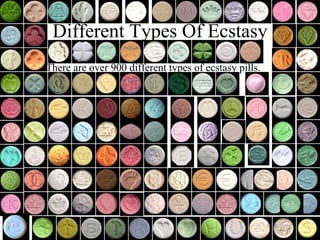
Different Types Of Ecstasy
There are over 900 different types of ecstasy pills.
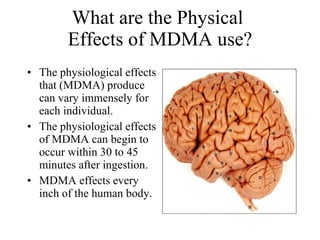
What are the Physical
        Effects of MDMA use?
• The physiological effects
  that (MDMA) produce
  can vary immensely for
  each individual.
• The physiological effects
  of MDMA can begin to
  occur within 30 to 45
  minutes after ingestion.
• MDMA effects every
  inch of the human body.
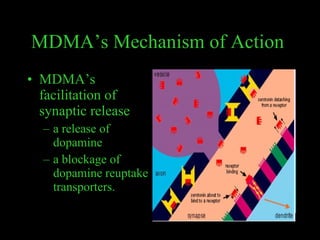
MDMA’s Mechanism of Action.
• MDMA’s
  facilitation of
  synaptic release
  – a release of
    dopamine
  – a blockage of
    dopamine reuptake
    transporters.
The short term effects of MDMA are:
   –   Headache
   –   High blood pressure
   –   Nausea
   –    Vomiting
   –    rapid heart beat
   –   Trisma (clenching of the jaw)
   –   sweating
   –    Tremors
   –    Blurred vision
   –    muscle spasms
   –    backache
   –    tongue and cheek chewing
   –    bruxia (teeth grinding)
   –    dizziness
   –    dryness of mouth
   –    profound physical relaxation
   –    nystagmus (eye wiggles)
More Physical Effects
• MDMA can be quite           • The blockage of
  damaging to the               Dopamine reuptake
  circulatory system, due       transporters can also lead
  to elevated blood             to a total loss of the
  pressure and heart rate       reuptake sites.
  for long periods of time.
                              • MDMA acts as a
• Kidney failure can occur      Serotonin agonist and
  as well as the death of       these agonist effects
  large amounts of muscle       cause the damage to
  tissue which can stop         Serotonin nerve
  circulation, known as         terminals and the loss of
  cardiovascular collapse.
                                reuptake sites.
Long-term physiological
       effects from MDMA
• Heart/Circulatory Disease:
  – MDMA use puts stress on the heart, which in
    the future can bring on heart attacks or stroke.
• Liver Disease:
  – For some people, usually those with pre-
    existing liver problems, MDMA can prove to
    be hepatoxic.
MDMA and Heat Stroke
• This is the result of a • The greatest risk to have
  physiological responses   heat stroke is within a
  going unnoticed.          person who has a fairly
• Heat stroke is very       low level of the enzyme
  common while under        in the liver that breaks
  the influence of          down MDMA. People
  MDMA.                     with a high level of
• The body's temperature    enzyme on the other
  is regulated by the       hand suffer a greater risk
  serotonine system.        of brain damage.
MDMA and the Serotonin System
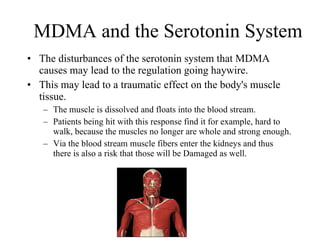
• The disturbances of the serotonin system that MDMA
  causes may lead to the regulation going haywire.
• This may lead to a traumatic effect on the body's muscle
  tissue.
   – The muscle is dissolved and floats into the blood stream.
   – Patients being hit with this response find it for example, hard to
     walk, because the muscles no longer are whole and strong enough.
   – Via the blood stream muscle fibers enter the kidneys and thus
     there is also a risk that those will be Damaged as well.
MDMA and Water.

• Another cause of possible death is a result from an exaggerated
  consumption of water.
• A common place of recreational MDMA use is at 'raves'. Or
  underground all night dance parties.
    – A person experiencing the effects of MDMA will dance for lengthy
      periods of time at which point they will no longer pay attention to
      there body's need of replenishing itself.
    – The person will then drink extraordinary amounts of water to "make
      up" for dancing for so long and being so hot. This is extremely
      dangerous.
    – An excess of water can lead to water intoxication. This is a case in
      which water floods the body's cells causing cells to swell and then
      burst. This can end in death.
MDMA, Pain, and
         the Immune System.
• MDMA's lessens            • MDMA users may
  the awareness of            experience a decreased
                              resistance to disease.
  pain.                       Scientists do not know
  – The person will not       whether this is from the
    notice the pain their     pharmacological "body
    body is in if they        load" of MDMA, or the
    are sustaining            heightened activities
    blisters, bruises,        that are involved with
    cuts, etc.                MDMA such as dancing
                              and close contact with
                              other people.
Behavioral Effects of MDMA
• When MDMA was first developed it was
  used in marriage counseling.
• MDMA is nicknamed the love drug.
  – This is because of the need for intimacy many
    users feel while under the influence of this
    drug.
  – Out of a group of twenty MDMA users 80%
    reported a decrease in defensiveness.
Short Term Behavioral Effects
• Many people have           –   Happy
  reported being more        –   Playful
  “open” with people         –   Energetic
  when using this drug.      –   Excited
• Assuming one doesn’t       –   Cuddly
  feel the negative effect
  of this drug, people
  under the influence of
  this drug will appear:
Adverse Behavioral Effects.
• The behavioral effect
  which is perhaps most
  common among users of
  MDMA is a severe mood
  depression following use
  of Ecstasy.
• Persistent insomnia
• agitation
• depression
• psychosis
• hallucinations
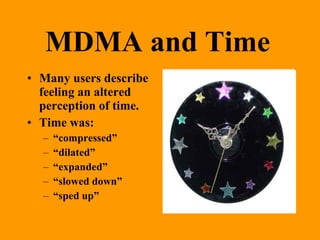
MDMA and Time
• Many users describe
  feeling an altered
  perception of time.
• Time was:
  –   “compressed”
  –   “dilated”
  –   “expanded”
  –   “slowed down”
  –   “sped up”
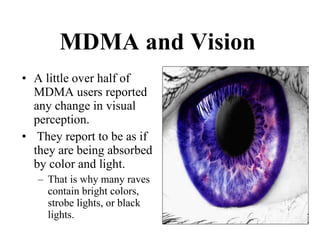
MDMA and Vision
• A little over half of
  MDMA users reported
  any change in visual
  perception.
• They report to be as if
  they are being absorbed
  by color and light.
   – That is why many raves
     contain bright colors,
     strobe lights, or black
     lights.
Raves
• Raves are huge         • Despite the size of the
  underground dance        party, and the
  parties.                 number of people
• These types of parties   involved in them,
  are usually large,       raves rarely end in
  loud, and full of        any violence.
  people under the       • This is because of the
  influence of illegal     effect that MDMA
  drugs.                   has on mood and
                           aggressiveness.
Raves
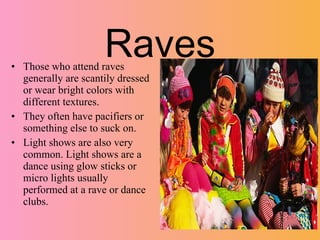
• Those who attend raves
  generally are scantily dressed
  or wear bright colors with
  different textures.
• They often have pacifiers or
  something else to suck on.
• Light shows are also very
  common. Light shows are a
  dance using glow sticks or
  micro lights usually
  performed at a rave or dance
  clubs.
References
• Gary Van Horn
• Jaime Stewart
• Urban Dictionary

Mdma

  • 1.
    MDMA (Ecstasy) Prepared by: Shaina Horton ICC Student Prepared for: Duke Walker ICC Professor
  • 2.
    What is MDMA? •MDMA is 3,4- methylenedioxymethampheta mine. • It is also known as Ecstasy. • MDMA is derived from the oils of plants such as nutmeg, sassafras, saffron, dill, parsley seed, crocus, vanilla beans, and calamus. • MDMA is an amphetamine derivative that is related chemically to both amphetamines and hallucinogens.
  • 3.
    The Synthesis Process of MDMA • The synthesis of MDMA has four processes: – 1. extraction of safrole from sassafras oil, or other sources (piperonal), – 2. Isomerization of safrole into isosafrole by heating with NaOH or KOH, – 3. Oxidizing isosafrole into MDP-2-P – 4. Using the Leukart Reaction add N- methyl-N-forumyl-MDA to MDP-2-P resulting in MDMA
  • 4.
    Different Types OfEcstasy There are over 900 different types of ecstasy pills.
  • 5.
    What are thePhysical Effects of MDMA use? • The physiological effects that (MDMA) produce can vary immensely for each individual. • The physiological effects of MDMA can begin to occur within 30 to 45 minutes after ingestion. • MDMA effects every inch of the human body.
  • 6.
    MDMA’s Mechanism ofAction. • MDMA’s facilitation of synaptic release – a release of dopamine – a blockage of dopamine reuptake transporters.
  • 7.
    The short termeffects of MDMA are: – Headache – High blood pressure – Nausea – Vomiting – rapid heart beat – Trisma (clenching of the jaw) – sweating – Tremors – Blurred vision – muscle spasms – backache – tongue and cheek chewing – bruxia (teeth grinding) – dizziness – dryness of mouth – profound physical relaxation – nystagmus (eye wiggles)
  • 8.
    More Physical Effects •MDMA can be quite • The blockage of damaging to the Dopamine reuptake circulatory system, due transporters can also lead to elevated blood to a total loss of the pressure and heart rate reuptake sites. for long periods of time. • MDMA acts as a • Kidney failure can occur Serotonin agonist and as well as the death of these agonist effects large amounts of muscle cause the damage to tissue which can stop Serotonin nerve circulation, known as terminals and the loss of cardiovascular collapse. reuptake sites.
  • 9.
    Long-term physiological effects from MDMA • Heart/Circulatory Disease: – MDMA use puts stress on the heart, which in the future can bring on heart attacks or stroke. • Liver Disease: – For some people, usually those with pre- existing liver problems, MDMA can prove to be hepatoxic.
  • 10.
    MDMA and HeatStroke • This is the result of a • The greatest risk to have physiological responses heat stroke is within a going unnoticed. person who has a fairly • Heat stroke is very low level of the enzyme common while under in the liver that breaks the influence of down MDMA. People MDMA. with a high level of • The body's temperature enzyme on the other is regulated by the hand suffer a greater risk serotonine system. of brain damage.
  • 11.
    MDMA and theSerotonin System • The disturbances of the serotonin system that MDMA causes may lead to the regulation going haywire. • This may lead to a traumatic effect on the body's muscle tissue. – The muscle is dissolved and floats into the blood stream. – Patients being hit with this response find it for example, hard to walk, because the muscles no longer are whole and strong enough. – Via the blood stream muscle fibers enter the kidneys and thus there is also a risk that those will be Damaged as well.
  • 12.
    MDMA and Water. •Another cause of possible death is a result from an exaggerated consumption of water. • A common place of recreational MDMA use is at 'raves'. Or underground all night dance parties. – A person experiencing the effects of MDMA will dance for lengthy periods of time at which point they will no longer pay attention to there body's need of replenishing itself. – The person will then drink extraordinary amounts of water to "make up" for dancing for so long and being so hot. This is extremely dangerous. – An excess of water can lead to water intoxication. This is a case in which water floods the body's cells causing cells to swell and then burst. This can end in death.
  • 13.
    MDMA, Pain, and the Immune System. • MDMA's lessens • MDMA users may the awareness of experience a decreased resistance to disease. pain. Scientists do not know – The person will not whether this is from the notice the pain their pharmacological "body body is in if they load" of MDMA, or the are sustaining heightened activities blisters, bruises, that are involved with cuts, etc. MDMA such as dancing and close contact with other people.
  • 14.
    Behavioral Effects ofMDMA • When MDMA was first developed it was used in marriage counseling. • MDMA is nicknamed the love drug. – This is because of the need for intimacy many users feel while under the influence of this drug. – Out of a group of twenty MDMA users 80% reported a decrease in defensiveness.
  • 15.
    Short Term BehavioralEffects • Many people have – Happy reported being more – Playful “open” with people – Energetic when using this drug. – Excited • Assuming one doesn’t – Cuddly feel the negative effect of this drug, people under the influence of this drug will appear:
  • 16.
    Adverse Behavioral Effects. •The behavioral effect which is perhaps most common among users of MDMA is a severe mood depression following use of Ecstasy. • Persistent insomnia • agitation • depression • psychosis • hallucinations
  • 17.
    MDMA and Time •Many users describe feeling an altered perception of time. • Time was: – “compressed” – “dilated” – “expanded” – “slowed down” – “sped up”
  • 18.
    MDMA and Vision •A little over half of MDMA users reported any change in visual perception. • They report to be as if they are being absorbed by color and light. – That is why many raves contain bright colors, strobe lights, or black lights.
  • 19.
    Raves • Raves arehuge • Despite the size of the underground dance party, and the parties. number of people • These types of parties involved in them, are usually large, raves rarely end in loud, and full of any violence. people under the • This is because of the influence of illegal effect that MDMA drugs. has on mood and aggressiveness.
  • 20.
    Raves • Those whoattend raves generally are scantily dressed or wear bright colors with different textures. • They often have pacifiers or something else to suck on. • Light shows are also very common. Light shows are a dance using glow sticks or micro lights usually performed at a rave or dance clubs.
  • 21.
    References • Gary VanHorn • Jaime Stewart • Urban Dictionary