A Recovery Model

               Richard Evans-Lacey
                 Psychotherapist


15/02/2013    © Richard Evans-Lacey www.psychicplumbing.com   1
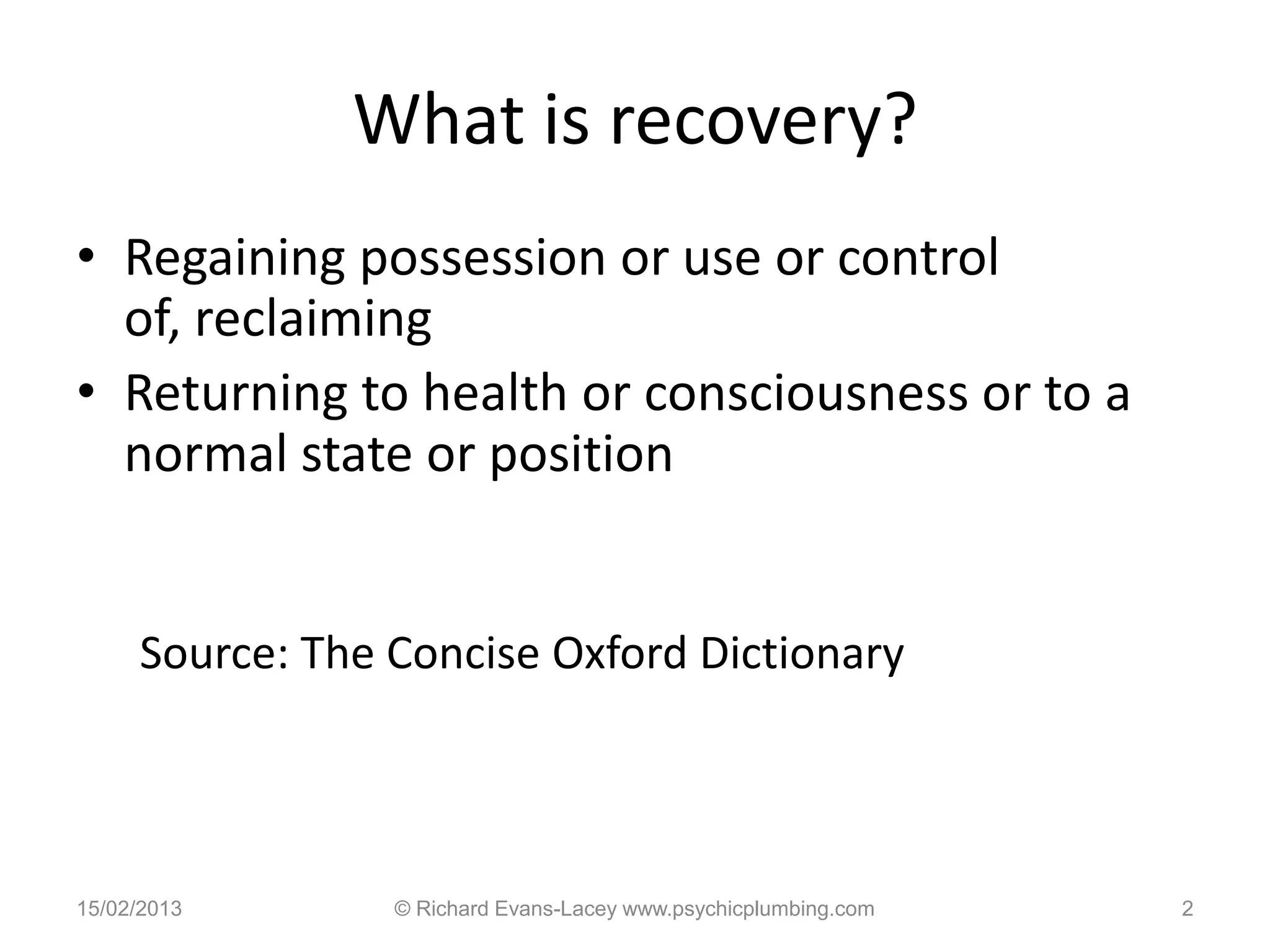
What is recovery?
• Regaining possession or use or control
  of, reclaiming
• Returning to health or consciousness or to a
  normal state or position


     Source: The Concise Oxford Dictionary


15/02/2013       © Richard Evans-Lacey www.psychicplumbing.com   2
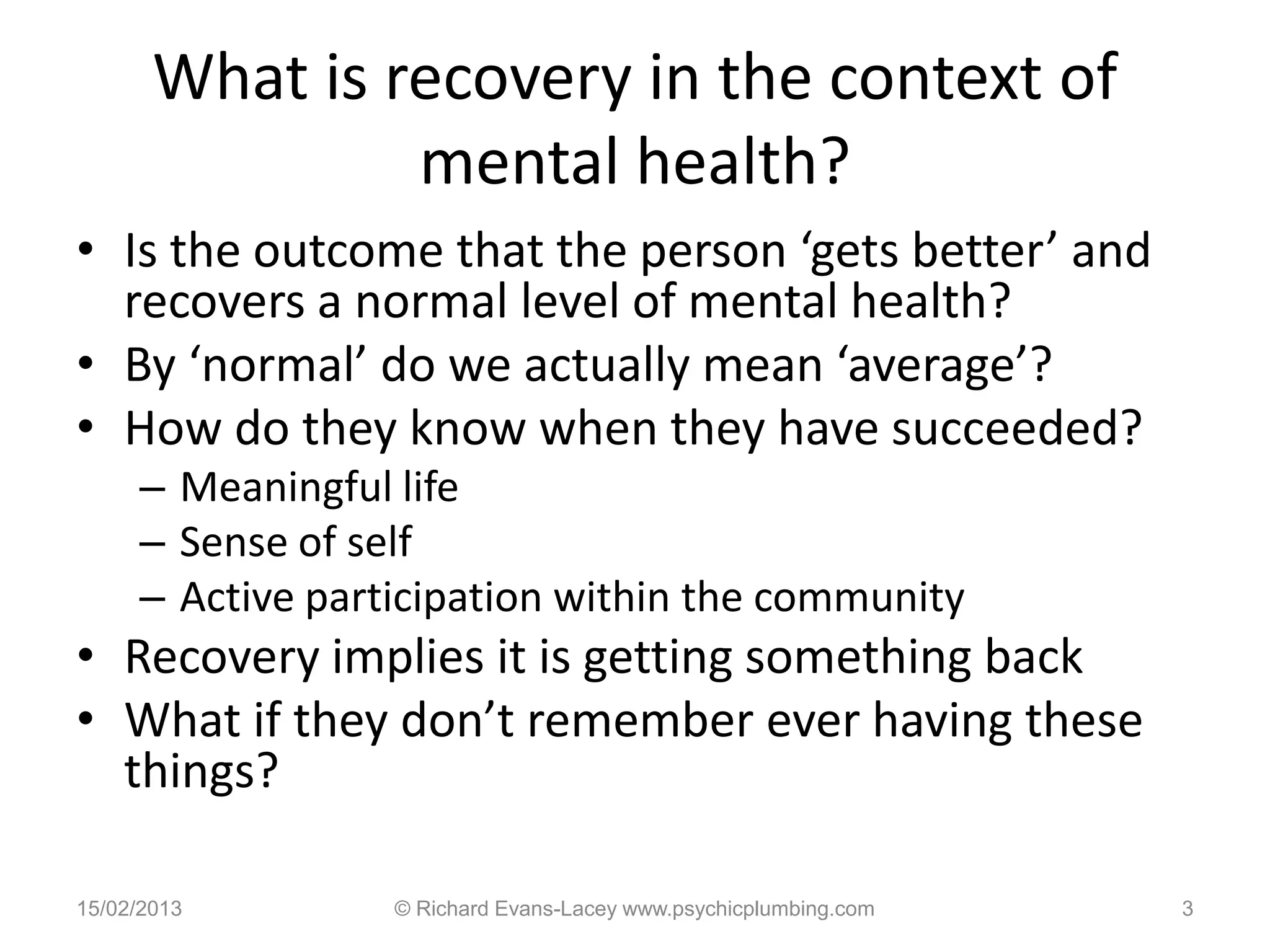
What is recovery in the context of
                mental health?
• Is the outcome that the person ‘gets better’ and
  recovers a normal level of mental health?
• By ‘normal’ do we actually mean ‘average’?
• How do they know when they have succeeded?
     – Meaningful life
     – Sense of self
     – Active participation within the community
• Recovery implies it is getting something back
• What if they don’t remember ever having these
  things?

15/02/2013        © Richard Evans-Lacey www.psychicplumbing.com   3
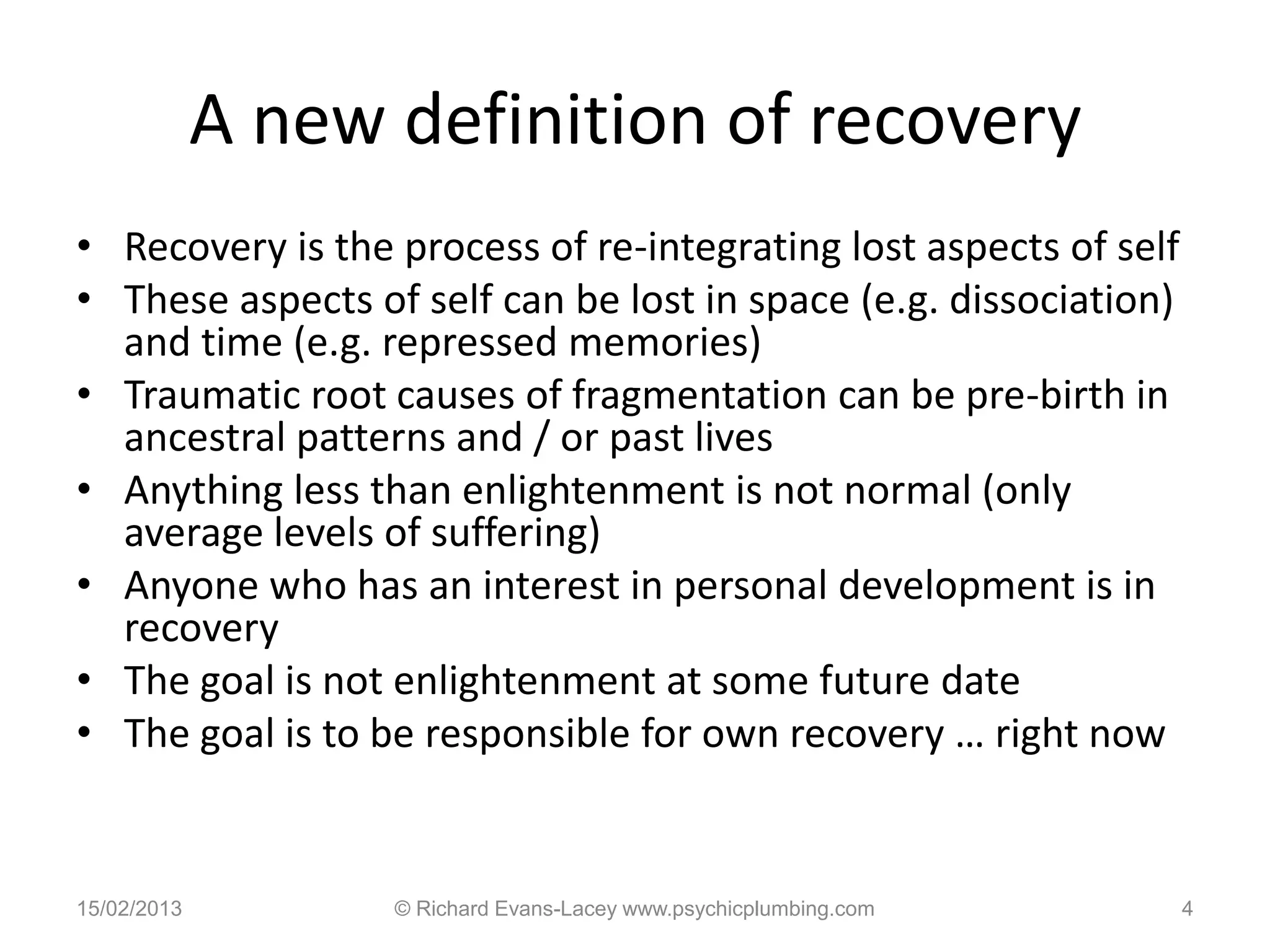
A new definition of recovery
• Recovery is the process of re-integrating lost aspects of self
• These aspects of self can be lost in space (e.g. dissociation)
  and time (e.g. repressed memories)
• Traumatic root causes of fragmentation can be pre-birth in
  ancestral patterns and / or past lives
• Anything less than enlightenment is not normal (only
  average levels of suffering)
• Anyone who has an interest in personal development is in
  recovery
• The goal is not enlightenment at some future date
• The goal is to be responsible for own recovery … right now


15/02/2013         © Richard Evans-Lacey www.psychicplumbing.com   4
What do other people say about recovery?
• Implies that the person once had what is being recovered

• The process of recovering a meaningful life, sense of self and active
  participation within the community.
• Not the outcome of being „normal‟ or „healthy‟
     – As compared with average levels of discord and suffering in the
       general population
• Guiding principles which emphasise and support the individual‟s
  ability to heal themselves
• Scientific studies show this approach to be „unexpectedly‟ effective
     – WHO study: Complete „recovery‟ 20 – 25%; Social recovery 40 – 45%
• Popular with consumers / survivors
• Taken on by the health services of many countries


15/02/2013            © Richard Evans-Lacey www.psychicplumbing.com        5
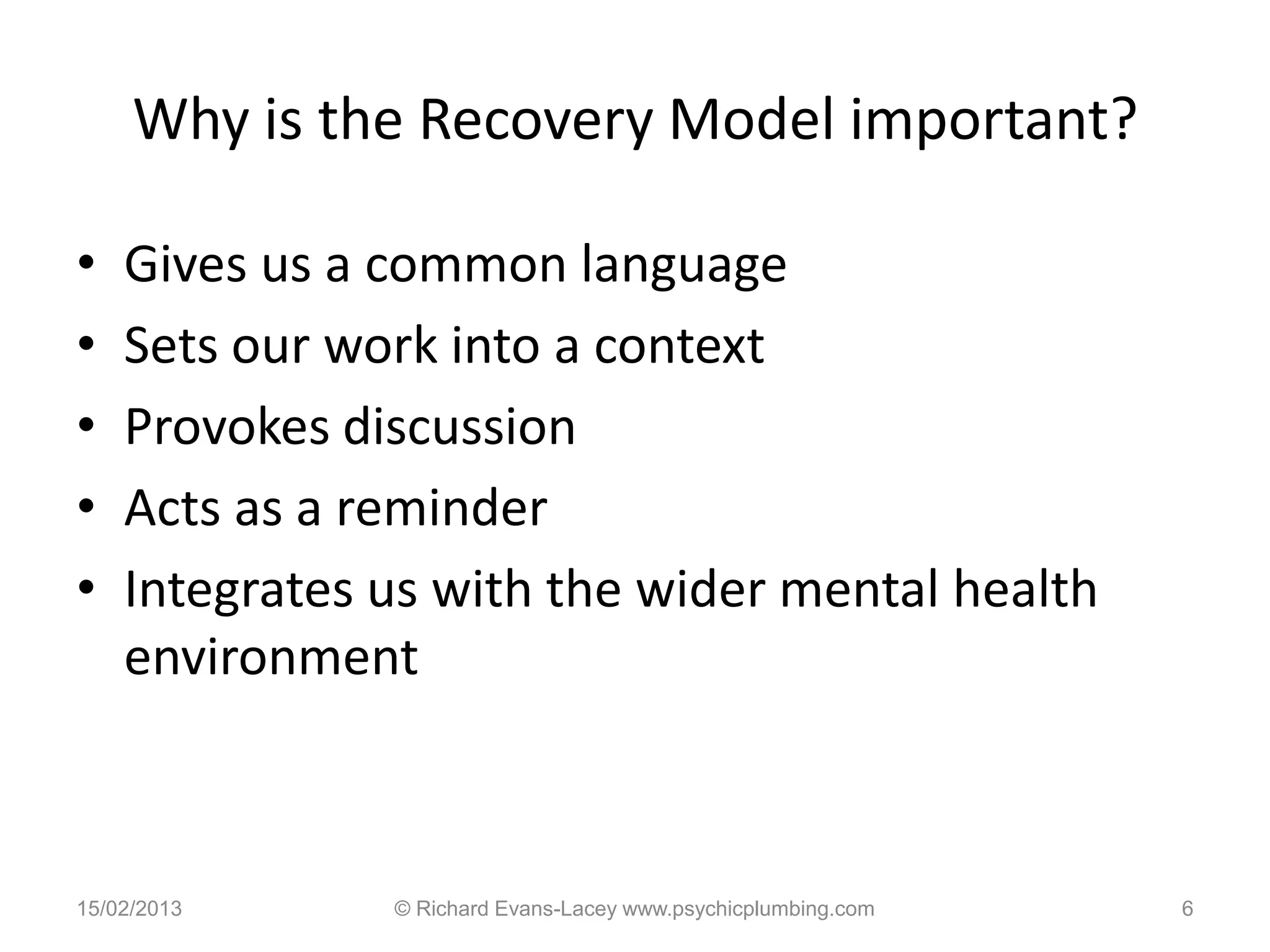
Why is the Recovery Model important?

•   Gives us a common language
•   Sets our work into a context
•   Provokes discussion
•   Acts as a reminder
•   Integrates us with the wider mental health
    environment


15/02/2013     © Richard Evans-Lacey www.psychicplumbing.com   6
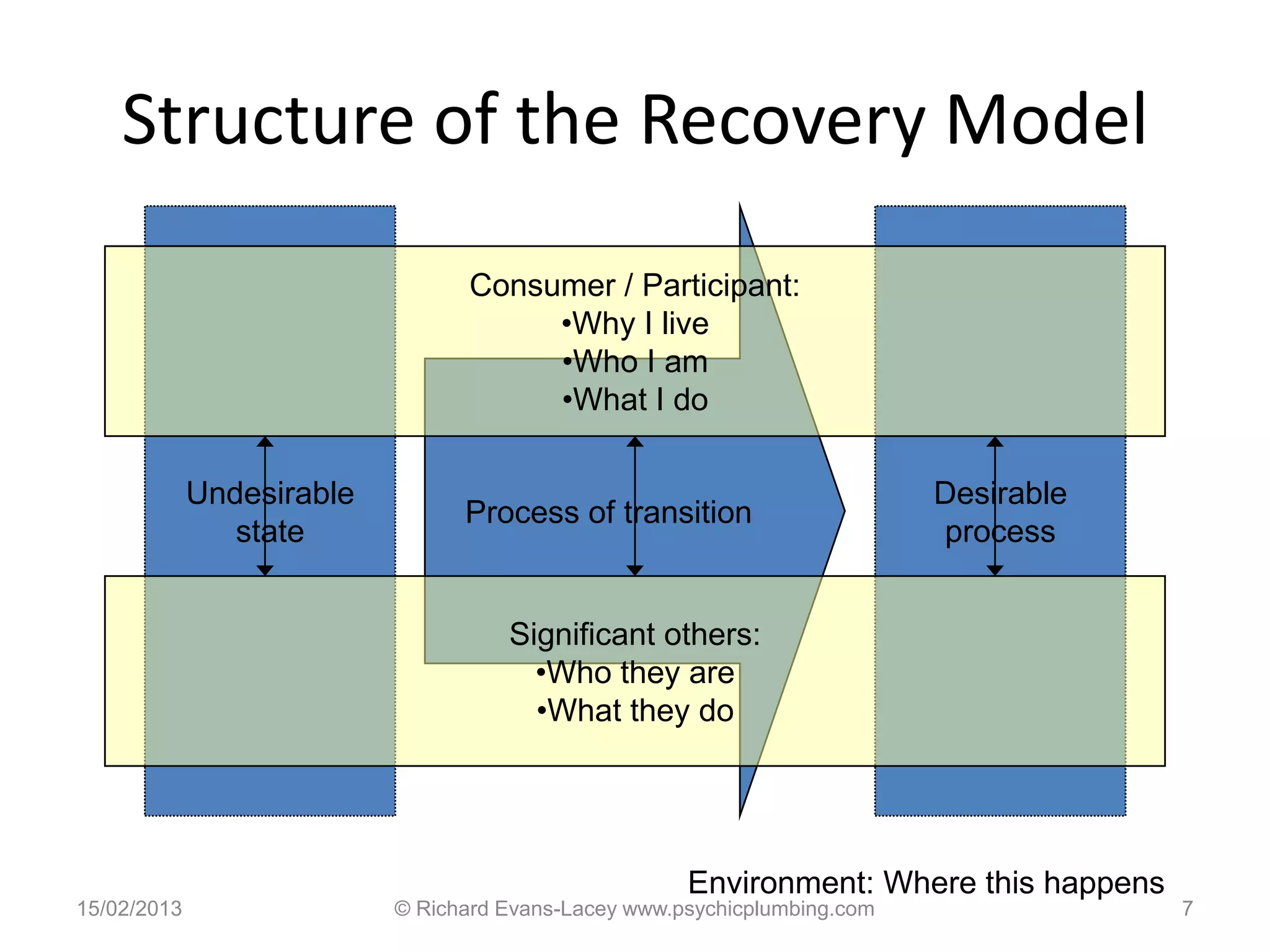
Structure of the Recovery Model
                                  Consumer / Participant:
                                       •Why I live
                                       •Who I am
                                       •What I do

             Undesirable                                                   Desirable
                                 Process of transition
                state                                                      process


                                     Significant others:
                                       •Who they are
                                       •What they do


                                                      Environment: Where this happens
15/02/2013                 © Richard Evans-Lacey www.psychicplumbing.com                7
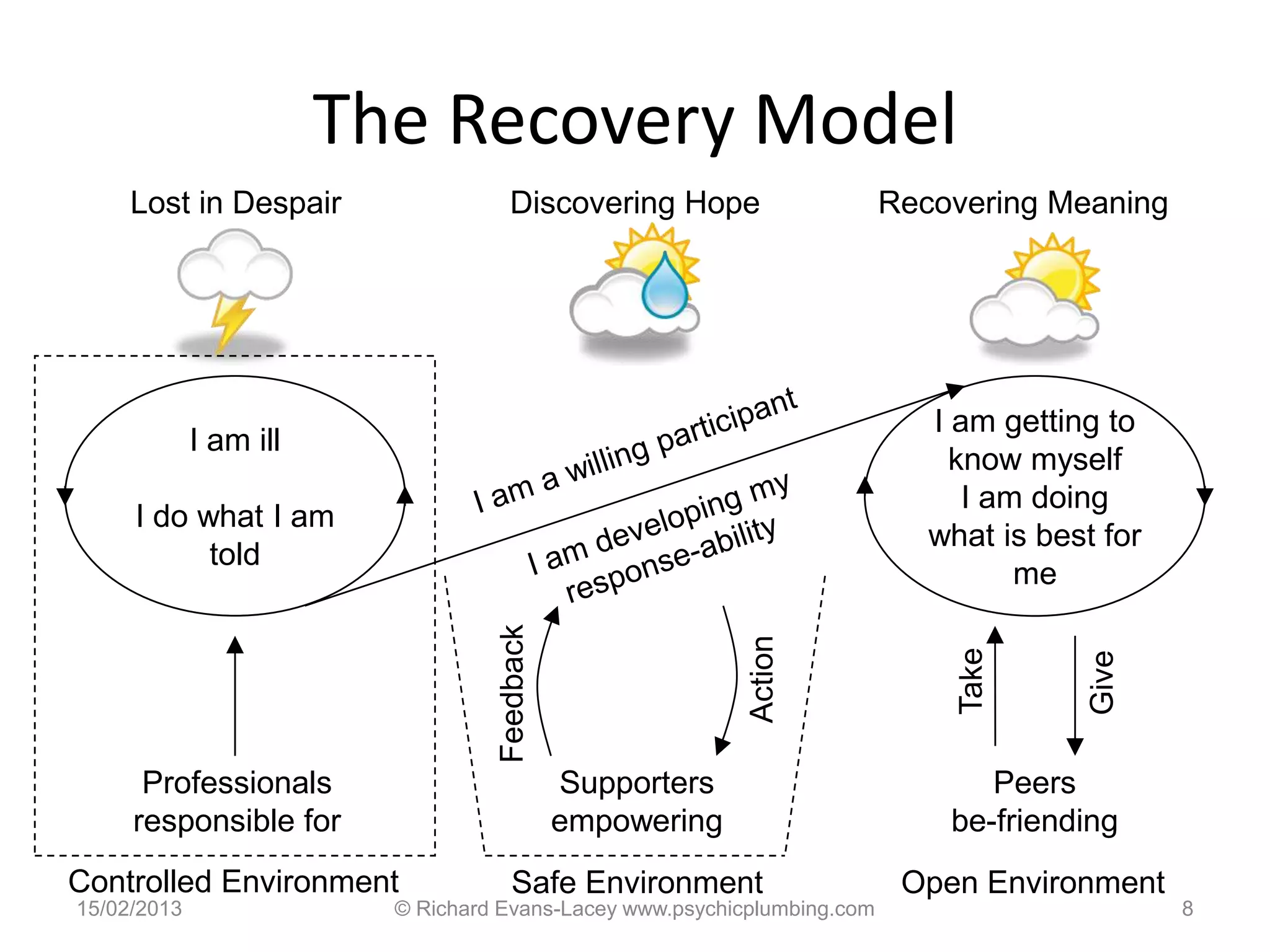
The Recovery Model
     Lost in Despair                 Discovering Hope                     Recovering Meaning


                                                                             I am getting to
             I am ill
                                                                               know myself
                                                                                I am doing
     I do what I am
                                                                             what is best for
           told
                                                                                    me
                                   Feedback


                                                           Action


                                                                               Take


                                                                                         Give
      Professionals                           Supporters                         Peers
     responsible for                          empowering                      be-friending
Controlled Environment                Safe Environment                     Open Environment
15/02/2013                © Richard Evans-Lacey www.psychicplumbing.com                         8
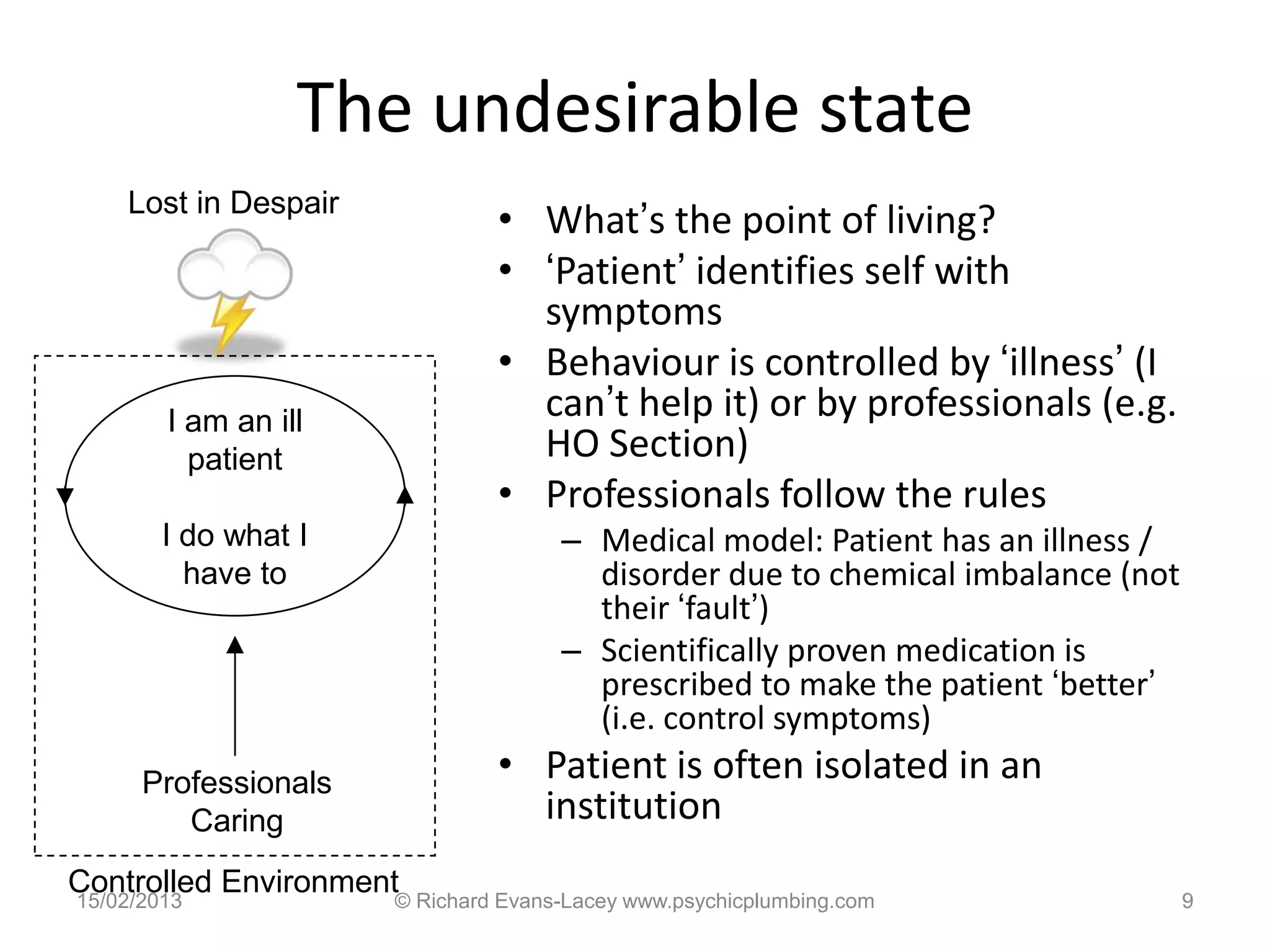
The undesirable state
    Lost in Despair
                                   • What‟s the point of living?
                                   • „Patient‟ identifies self with
                                     symptoms
                                   • Behaviour is controlled by „illness‟ (I
        I am an ill                  can‟t help it) or by professionals (e.g.
          patient                    HO Section)
                                   • Professionals follow the rules
       I do what I                      – Medical model: Patient has an illness /
         have to                          disorder due to chemical imbalance (not
                                          their „fault‟)
                                        – Scientifically proven medication is
                                          prescribed to make the patient „better‟
                                          (i.e. control symptoms)
      Professionals                • Patient is often isolated in an
         Caring                      institution
Controlled Environment© Richard Evans-Lacey www.psychicplumbing.com
15/02/2013                                                                          9
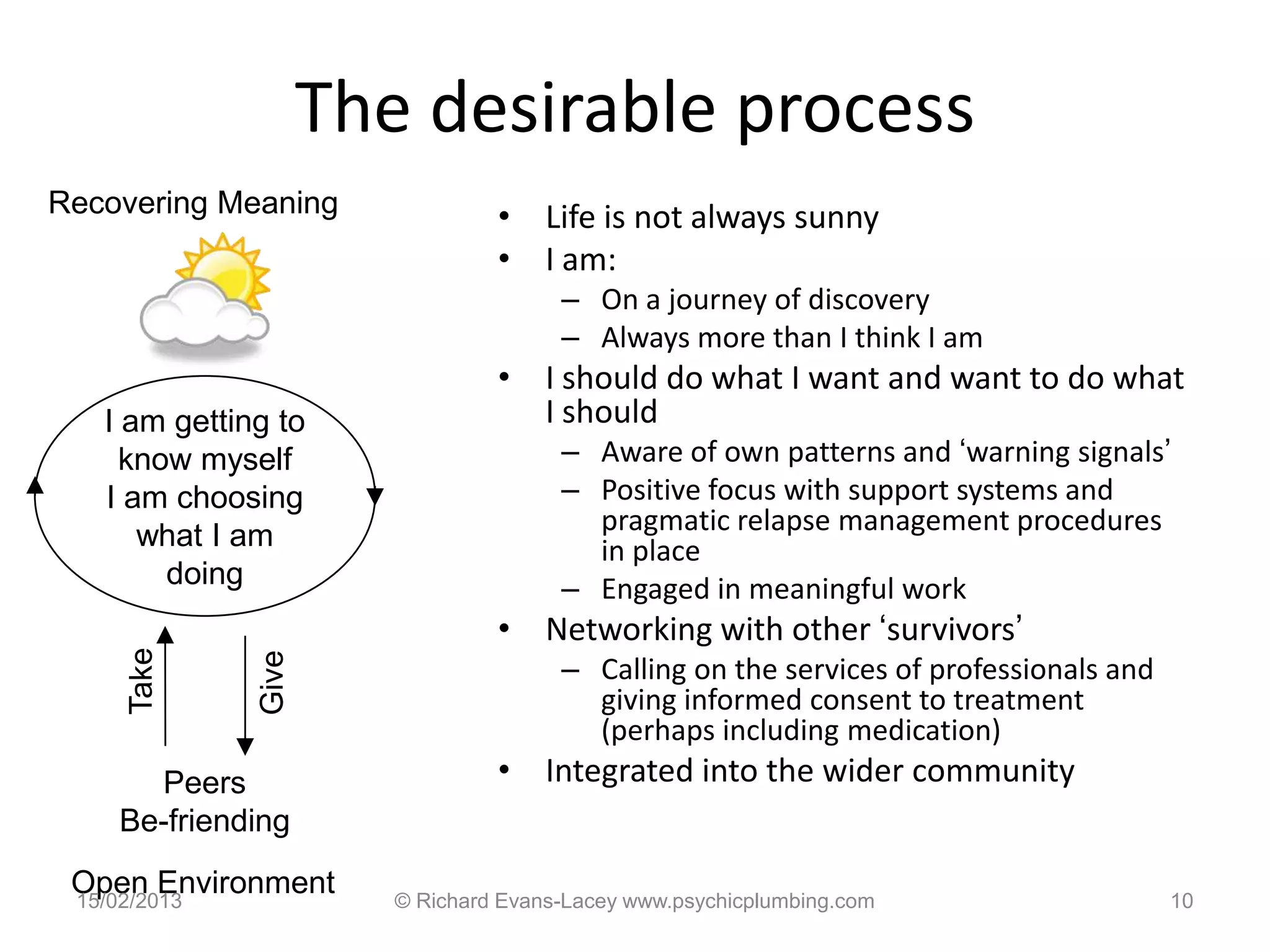
The desirable process
Recovering Meaning               • Life is not always sunny
                                 • I am:
                                       – On a journey of discovery
                                       – Always more than I think I am
                                 • I should do what I want and want to do what
   I am getting to                 I should
     know myself                       – Aware of own patterns and „warning signals‟
   I am choosing                       – Positive focus with support systems and
                                         pragmatic relapse management procedures
      what I am                          in place
        doing                          – Engaged in meaningful work
                                 • Networking with other „survivors‟
     Take


              Give


                                       – Calling on the services of professionals and
                                         giving informed consent to treatment
                                         (perhaps including medication)
      Peers                      • Integrated into the wider community
    Be-friending
 Open Environment
 15/02/2013             © Richard Evans-Lacey www.psychicplumbing.com                   10
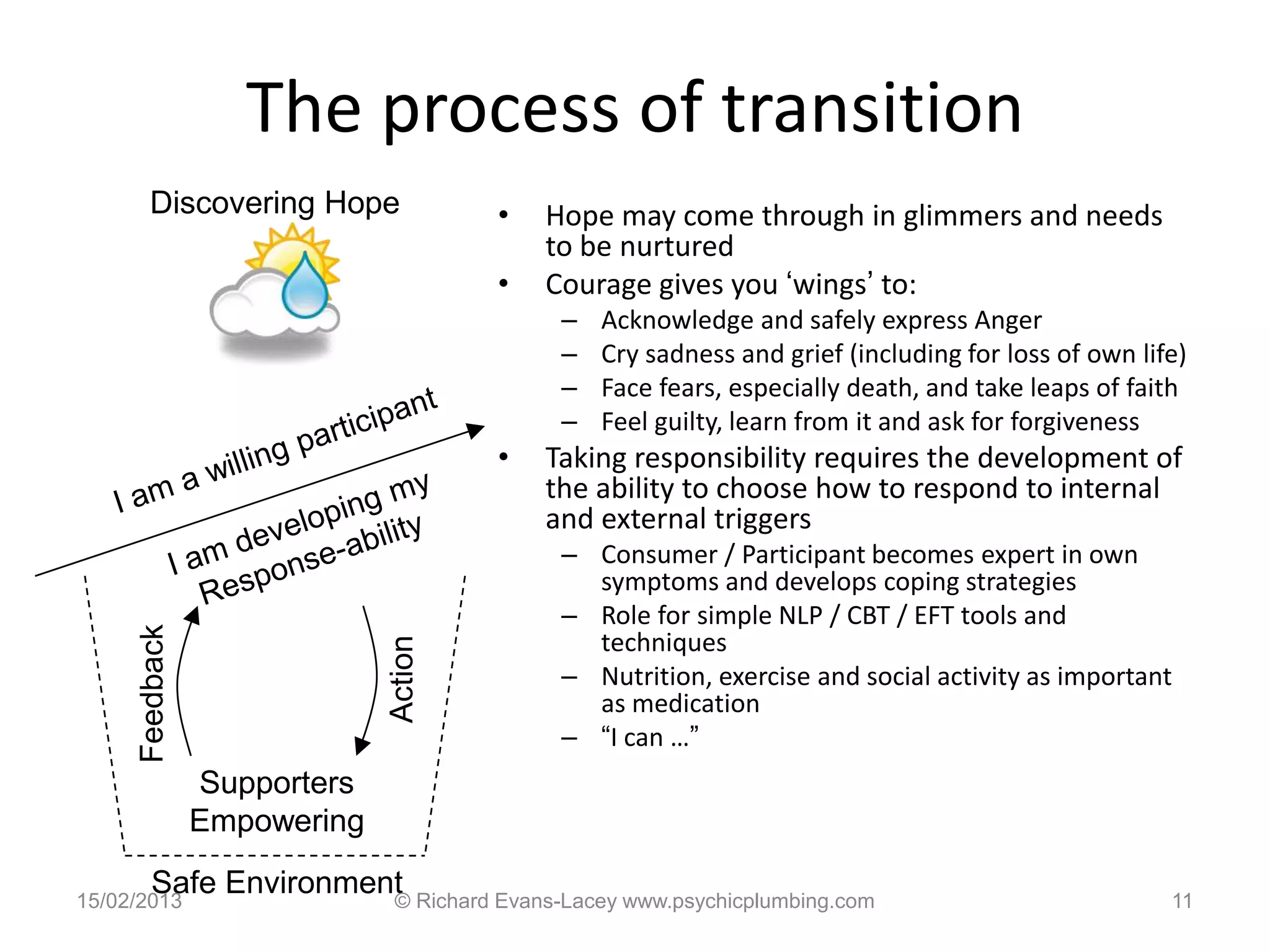
The process of transition
       Discovering Hope               •   Hope may come through in glimmers and needs
                                          to be nurtured
                                      •   Courage gives you „wings‟ to:
                                           –   Acknowledge and safely express Anger
                                           –   Cry sadness and grief (including for loss of own life)
                                           –   Face fears, especially death, and take leaps of faith
                                           –   Feel guilty, learn from it and ask for forgiveness
                                      •   Taking responsibility requires the development of
                                          the ability to choose how to respond to internal
                                          and external triggers
                                           – Consumer / Participant becomes expert in own
                                             symptoms and develops coping strategies
                                           – Role for simple NLP / CBT / EFT tools and
     Feedback


                                             techniques
                             Action


                                           – Nutrition, exercise and social activity as important
                                             as medication
                                           – “I can …”
                Supporters
                Empowering
        Safe Environment Richard Evans-Lacey www.psychicplumbing.com
15/02/2013             ©                                                                           11
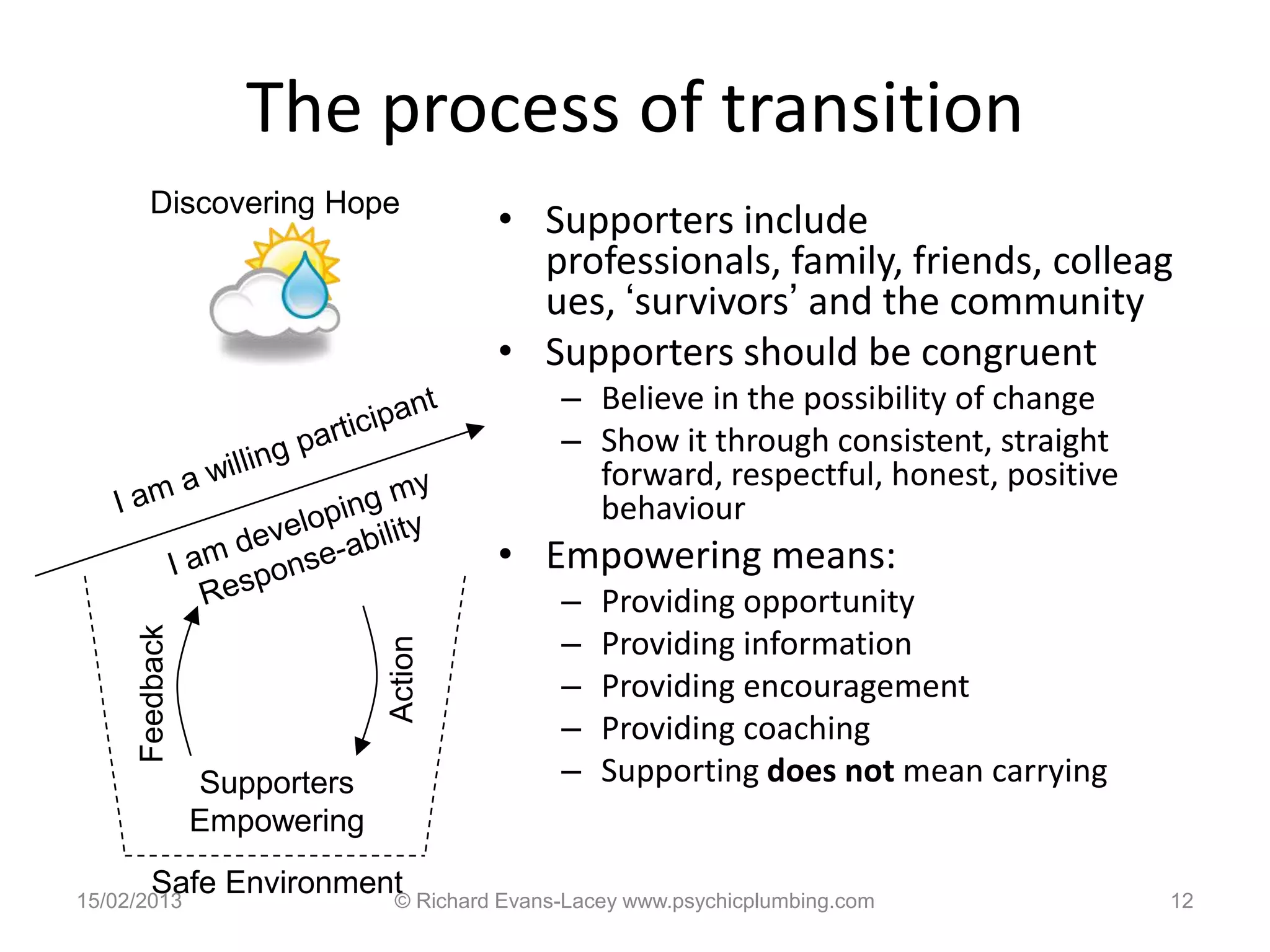
The process of transition
       Discovering Hope
                                      • Supporters include
                                        professionals, family, friends, colleag
                                        ues, „survivors‟ and the community
                                      • Supporters should be congruent
                                          – Believe in the possibility of change
                                          – Show it through consistent, straight
                                            forward, respectful, honest, positive
                                            behaviour
                                      • Empowering means:
                                          –   Providing opportunity
                                          –
     Feedback


                                              Providing information
                             Action


                                          –   Providing encouragement
                                          –   Providing coaching
                Supporters                –   Supporting does not mean carrying
                Empowering
        Safe Environment Richard Evans-Lacey www.psychicplumbing.com
15/02/2013             ©                                                            12
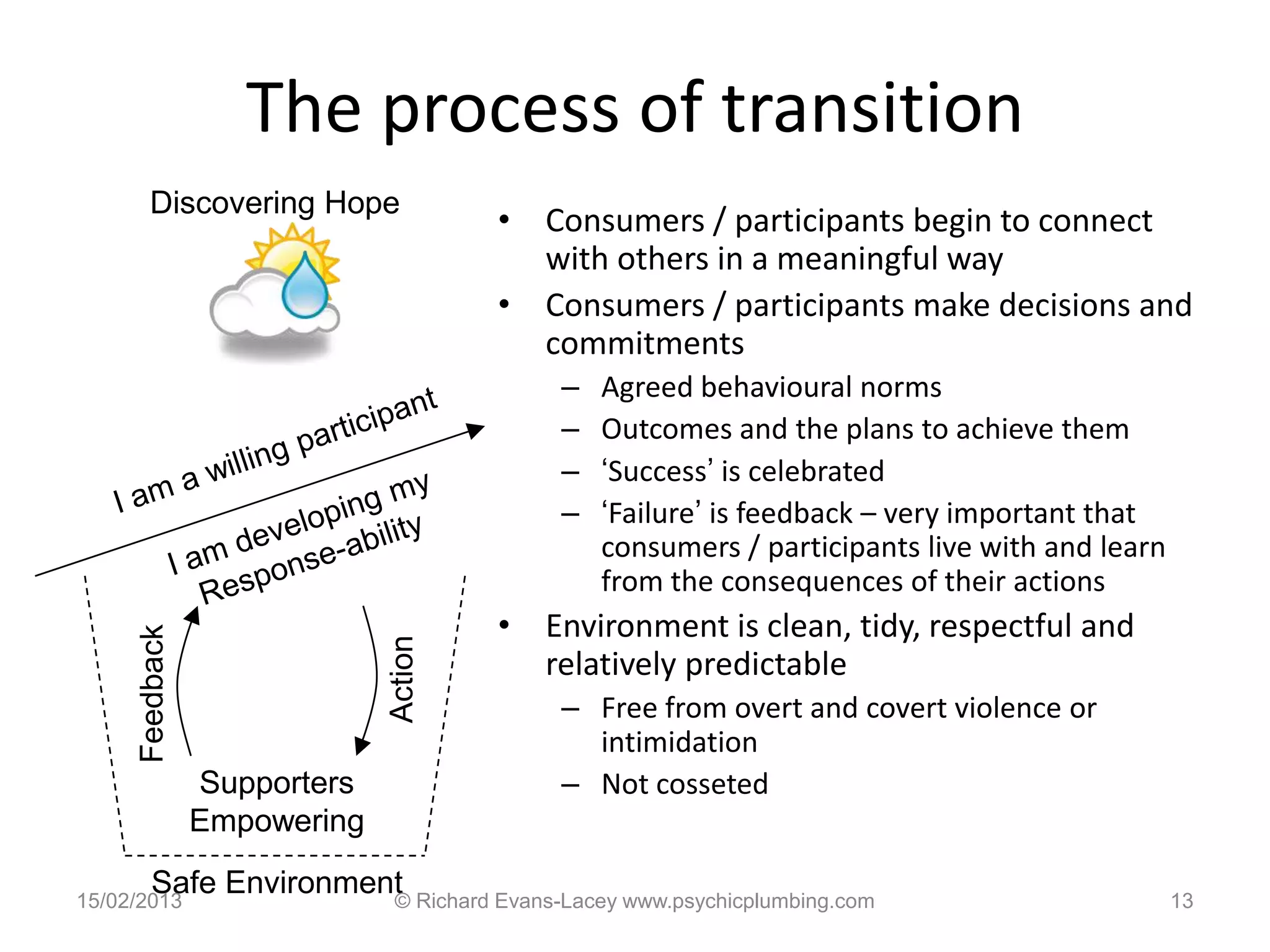
The process of transition
       Discovering Hope
                                      • Consumers / participants begin to connect
                                        with others in a meaningful way
                                      • Consumers / participants make decisions and
                                        commitments
                                          –   Agreed behavioural norms
                                          –   Outcomes and the plans to achieve them
                                          –   „Success‟ is celebrated
                                          –   „Failure‟ is feedback – very important that
                                              consumers / participants live with and learn
                                              from the consequences of their actions
                                      • Environment is clean, tidy, respectful and
     Feedback


                             Action


                                        relatively predictable
                                          – Free from overt and covert violence or
                                            intimidation
                Supporters                – Not cosseted
                Empowering
        Safe Environment Richard Evans-Lacey www.psychicplumbing.com
15/02/2013             ©                                                                     13
References
• JACOBSON AND GREENLEY, (2001) What Is
  Recovery? A Conceptual Model and
  Explication. Psychiatric Services 52 482-
  485, April 2001, American Psychiatric
  Association
• Recovery Model. In: Wikipedia [WWW]
  Available from:
  http://en.wikipedia.org/wiki/Recovery_model
  [accessed 7/8/2008]
15/02/2013   © Richard Evans-Lacey www.psychicplumbing.com   14

The Recovery Model

  • 1.
    A Recovery Model Richard Evans-Lacey Psychotherapist 15/02/2013 © Richard Evans-Lacey www.psychicplumbing.com 1
  • 2.
    What is recovery? •Regaining possession or use or control of, reclaiming • Returning to health or consciousness or to a normal state or position Source: The Concise Oxford Dictionary 15/02/2013 © Richard Evans-Lacey www.psychicplumbing.com 2
  • 3.
    What is recoveryin the context of mental health? • Is the outcome that the person ‘gets better’ and recovers a normal level of mental health? • By ‘normal’ do we actually mean ‘average’? • How do they know when they have succeeded? – Meaningful life – Sense of self – Active participation within the community • Recovery implies it is getting something back • What if they don’t remember ever having these things? 15/02/2013 © Richard Evans-Lacey www.psychicplumbing.com 3
  • 4.
    A new definitionof recovery • Recovery is the process of re-integrating lost aspects of self • These aspects of self can be lost in space (e.g. dissociation) and time (e.g. repressed memories) • Traumatic root causes of fragmentation can be pre-birth in ancestral patterns and / or past lives • Anything less than enlightenment is not normal (only average levels of suffering) • Anyone who has an interest in personal development is in recovery • The goal is not enlightenment at some future date • The goal is to be responsible for own recovery … right now 15/02/2013 © Richard Evans-Lacey www.psychicplumbing.com 4
  • 5.
    What do otherpeople say about recovery? • Implies that the person once had what is being recovered • The process of recovering a meaningful life, sense of self and active participation within the community. • Not the outcome of being „normal‟ or „healthy‟ – As compared with average levels of discord and suffering in the general population • Guiding principles which emphasise and support the individual‟s ability to heal themselves • Scientific studies show this approach to be „unexpectedly‟ effective – WHO study: Complete „recovery‟ 20 – 25%; Social recovery 40 – 45% • Popular with consumers / survivors • Taken on by the health services of many countries 15/02/2013 © Richard Evans-Lacey www.psychicplumbing.com 5
  • 6.
    Why is theRecovery Model important? • Gives us a common language • Sets our work into a context • Provokes discussion • Acts as a reminder • Integrates us with the wider mental health environment 15/02/2013 © Richard Evans-Lacey www.psychicplumbing.com 6
  • 7.
    Structure of theRecovery Model Consumer / Participant: •Why I live •Who I am •What I do Undesirable Desirable Process of transition state process Significant others: •Who they are •What they do Environment: Where this happens 15/02/2013 © Richard Evans-Lacey www.psychicplumbing.com 7
  • 8.
    The Recovery Model Lost in Despair Discovering Hope Recovering Meaning I am getting to I am ill know myself I am doing I do what I am what is best for told me Feedback Action Take Give Professionals Supporters Peers responsible for empowering be-friending Controlled Environment Safe Environment Open Environment 15/02/2013 © Richard Evans-Lacey www.psychicplumbing.com 8
  • 9.
    The undesirable state Lost in Despair • What‟s the point of living? • „Patient‟ identifies self with symptoms • Behaviour is controlled by „illness‟ (I I am an ill can‟t help it) or by professionals (e.g. patient HO Section) • Professionals follow the rules I do what I – Medical model: Patient has an illness / have to disorder due to chemical imbalance (not their „fault‟) – Scientifically proven medication is prescribed to make the patient „better‟ (i.e. control symptoms) Professionals • Patient is often isolated in an Caring institution Controlled Environment© Richard Evans-Lacey www.psychicplumbing.com 15/02/2013 9
  • 10.
    The desirable process RecoveringMeaning • Life is not always sunny • I am: – On a journey of discovery – Always more than I think I am • I should do what I want and want to do what I am getting to I should know myself – Aware of own patterns and „warning signals‟ I am choosing – Positive focus with support systems and pragmatic relapse management procedures what I am in place doing – Engaged in meaningful work • Networking with other „survivors‟ Take Give – Calling on the services of professionals and giving informed consent to treatment (perhaps including medication) Peers • Integrated into the wider community Be-friending Open Environment 15/02/2013 © Richard Evans-Lacey www.psychicplumbing.com 10
  • 11.
    The process oftransition Discovering Hope • Hope may come through in glimmers and needs to be nurtured • Courage gives you „wings‟ to: – Acknowledge and safely express Anger – Cry sadness and grief (including for loss of own life) – Face fears, especially death, and take leaps of faith – Feel guilty, learn from it and ask for forgiveness • Taking responsibility requires the development of the ability to choose how to respond to internal and external triggers – Consumer / Participant becomes expert in own symptoms and develops coping strategies – Role for simple NLP / CBT / EFT tools and Feedback techniques Action – Nutrition, exercise and social activity as important as medication – “I can …” Supporters Empowering Safe Environment Richard Evans-Lacey www.psychicplumbing.com 15/02/2013 © 11
  • 12.
    The process oftransition Discovering Hope • Supporters include professionals, family, friends, colleag ues, „survivors‟ and the community • Supporters should be congruent – Believe in the possibility of change – Show it through consistent, straight forward, respectful, honest, positive behaviour • Empowering means: – Providing opportunity – Feedback Providing information Action – Providing encouragement – Providing coaching Supporters – Supporting does not mean carrying Empowering Safe Environment Richard Evans-Lacey www.psychicplumbing.com 15/02/2013 © 12
  • 13.
    The process oftransition Discovering Hope • Consumers / participants begin to connect with others in a meaningful way • Consumers / participants make decisions and commitments – Agreed behavioural norms – Outcomes and the plans to achieve them – „Success‟ is celebrated – „Failure‟ is feedback – very important that consumers / participants live with and learn from the consequences of their actions • Environment is clean, tidy, respectful and Feedback Action relatively predictable – Free from overt and covert violence or intimidation Supporters – Not cosseted Empowering Safe Environment Richard Evans-Lacey www.psychicplumbing.com 15/02/2013 © 13
  • 14.
    References • JACOBSON ANDGREENLEY, (2001) What Is Recovery? A Conceptual Model and Explication. Psychiatric Services 52 482- 485, April 2001, American Psychiatric Association • Recovery Model. In: Wikipedia [WWW] Available from: http://en.wikipedia.org/wiki/Recovery_model [accessed 7/8/2008] 15/02/2013 © Richard Evans-Lacey www.psychicplumbing.com 14