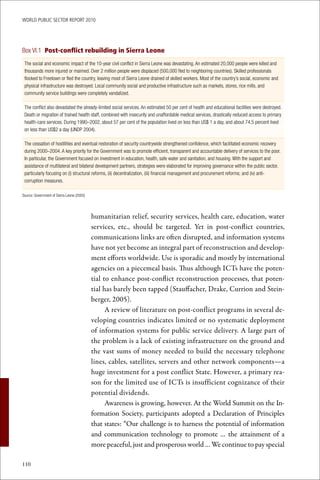






Countries emerging from conflict situations are almost always plagued by social
upheaval, damaged infrastructure, reduced productive capacity, severe revenue
shortfalls, seriously weakened human resources and greatly diminished security.
The challenges are daunting as post-conflict governments strive to ensure peace
and security, foster social reconciliation and promote development. Yet recovery
is possible if the public administration can earn the trust of the people, effectively
provide services to all and operate in an efficient, effective, transparent and
accountable way. In fact, whereas the root causes of intrastate conflict are usually
assumed to be poverty and economic inequality or clashes among different
ethnic or religious groups, the central cause of violent conflict is ineffective
leadership, weak governance institutions, inappropriate human resources, lack
of mechanisms to engage citizens in public policy-making decisions and lack of
or ineffective delivery of public services.

The report emphasizes that because post-conflict situations are heterogeneous,
there are no “one size fits all” solutions to governance challenges. In each country,
public administration reforms should be tailored to local needs. The report also
highlights that contrary to commonly held belief, post-conflict situations not
only present challenges, but also offer numerous opportunities to leapfrog stages
of development by adopting innovative practices in public administration,
particularly the application of ICTs in government and service delivery in the
information age we all live in.


                                    Published by the United Nations
                                    ISBN: 978-92-1-123182-3
                                    Sales No.: E.10.II.H.1
                                    Price: USD 60.00

                                    March 2010
Reconstructing
Public Administration
after Conflict:
Challenges, Practices and Lessons Learned


World Public Sector Report 2010
ReconstRucting Public AdministRAtion AfteR conflict


                                              ST/ESA/PAD/SER.E/135


Department of Economic and Social Affairs


Reconstructing
Public Administration
after Conflict:
Challenges, Practices and Lessons Learned


World Public Sector Report 2010


  New York, 2010
WoRld Public sectoR RePoRt 2010


DESA Mission Statement

The Department of Economic and Social Affairs of the United Nations Secretariat is a vital inter-
face between global policies in the economic, social and environmental spheres and national ac-
tion. The Department works in three main interlinked areas: (i) it compiles, generates and analy-
ses a wide range of economic, social and environmental data and information on which Member
States of the United Nations draw to review common problems and to take stock of policy op-
tions; (ii) it facilitates the negotiations of Member States in many intergovernmental bodies on
joint courses of action to address ongoing or emerging global challenges; and (iii) it advises inter-
ested Governments on the ways and means of translating policy frameworks developed in United
Nations conferences and summits into programmes at the country level and, through technical
assistance, helps build national capacities. ◆


                                                     Note
                                                     the designations employed and the presentation
                                                     of the material in this publication do not imply the
                                                     expression of any opinion whatsoever on the part of
                                                     the secretariat of the united nations concerning the
                                                     legal status of any country, territory, city or area, or
                                                     of its authorities, or concerning the delimitation of its
                                                     frontiers or boundaries.
                                                     the designations “developed” and “developing”
                                                     economies are intended for statistical convenience
                                                     and do not necessarily imply a judgment about the
                                                     stage reached by a particular country or area in the
                                                     development process. the term “country” as used in
                                                     the text of this publication also refers, as appropriate,
                                                     to territories or areas. the term “dollar” normally
                                                     refers to the united states dollar ($).
                                                     the views expressed are those of the individual
                                                     authors and do not imply any expression of opinion
                                                     on the part of the united nations. ◆


                                                     A united nations Publication
                                                     Publication no.: st/esA/PAd/seR.e/135
                                                     march 2010
                                                     copyright © united nations, 2010
                                                     All rights reserved
ReconstRucting Public AdministRAtion AfteR conflict


Preface

Since the World Public Sector Report was launched in 2001, it has
become a major reference on governance and public administration
trends and issues for policymakers, the academia and practitioners
from around the world. So far, five editions of this series have been
published in a number of crucial thematic areas, including “Globaliza-
tion and the State”, 2001; “E-government at the Crossroads”, 2003;
“Unlocking the Human Potential for Public Sector Performance”,
2005, and “People Matter: Civic Engagement in Public Governance”,
2008. In 2008, at its Seventh Session, the United Nations Committee
of Experts on Public Administration recommended that the Depart-
ment of Economic and Social Affairs focus its 2010 World Public Sec-
tor Report on “lessons learned in reconstructing governance and pub-
lic administration after violent conflict”.
      This 2010 Report brings to the fore a very critical issue - how to
reconstruct public administration in post-conflict situations so as to
enable it to promote peace and development in countries that have
been affected by civil war and destruction. It is a question that has re-
mained unresolved for decades and has brought poverty, despair, and
death to people in many corners of the world. Over 20 million people
have died since World War II because of civil wars, and many more
have been internally displaced*.
      This Report shows that no progress can be made in promoting
peace, development and protection of human rights unless appropri-
ate governance and public administration institutions are established.
Such institutions can help mediate differences and set the founda-
tions for an effective, efficient, transparent, accountable and innova-
tive government. This Report emphasizes that there are no “one size
fits all” solutions to governance challenges in post-conflict situations.
In each country, public administration reforms should be tailored to
local needs.
      This Report also highlights that institutions will be meaningful
when there are effective leadership and competent civil servants in the
public sector. But leaders and civil servants cannot accomplish the mis-
sion of re-establishing peace and development on their own. The pro-
cess of reconstruction can lead to an inclusive and sustainable peace
*	 Collier	and	Sambanis	2005,	p.ix.


                                                                                                      iii
WoRld Public sectoR RePoRt 2010


                             only by involving all stakeholders. Finally, unless newly established
                             governments are able to provide essential public services to the popula-
                             tion, including safety, security, health, education, shelter, access to wa-
                             ter and sanitation and job opportunities, there will be no durable
                             peace. Tensions over access to scarce economic and natural resources
                             will rapidly re-escalate and lead to more violence.
                                   The Report also highlights that contrary to commonly held be-
                             lief, post-conflict situations not only present challenges, but also nu-
                             merous opportunities to leapfrog stages of development by adopting
                             innovative practices in public administration, particularly the applica-
                             tion of ICTs in government and service delivery. By illustrating some
                             of the most critical issues and strategies for public sector capacity
                             building in countries emerging from conflict, this Report provides an
                             important contribution to a better understanding of the difficulties,
                             but also of the opportunities that countries face in rebuilding their
                             public administration institutions, mechanisms and processes in their
                             quest for durable peace and sustainable development. ◆


                             SHA Zukang
                             Under Secretary-General for Economic and Social Affairs


iv
ReconstRucting Public AdministRAtion AfteR conflict


Acknowledgments

The 2010 World Public Sector Report (WPSR) was finalized, under the
overall guidance of Jomo Kwame Sundaram, United Nations Assistant
Secretary-General for Economic and Social Affairs (DESA), by the Di-
vision for Public Administration and Development Management
(DPADM). Within the Division, a team of experts lead by Haiyan Qian,
Director of DPADM, produced the report. John-Mary Kauzya, Chief of
the Governance and Public Administration Branch and Adriana Alber-
ti, Governance and Public Administration Officer in DPADM, coordi-
nated the final production of the publication. Adriana Alberti also au-
thored Chapter I, together with Peride K. Blind, former Governance
and Public Administration Officer in DPADM, Chapter II together
with John-Mary Kauzya and Chapter III. John-Mary Kauzya is the au-
thor of Chapter IV. Chapter V was prepared by Valentina Resta, Gover-
nance and Public Administration Officer, DPADM, and Chapter VI
was authored by Seema Hafeez, Senior Governance and Public Admin-
istration Officer, DPADM. Kathryn Dahl provided external technical
editing and copy-editing. This publication was designed by Eliot Sela, a
design director consultant. Lois Warner, Associate Governance and
Public Administration Officer in DPADM, provided support in final-
izing the references. Roseanne Greco provided administrative support,
and Mutya Delos Reyes, an intern at DESA, helped format the report.
      The WPSR team benefited from the technical advice of in-house
colleagues, including Alphonse Mekolo, Atnafu Almaz, Garegin Ma-
nukyan, Ulrich Graute, Yoshinobu Yonekawa and Lois Warner, and
from the comments of Gay Rosenblum-Kumar and Anita Estroneffer
at the Bureau for Crisis Prevention and Recovery in the United Na-
tions Development Programme (UNDP). DESA, through DPADM,
has done a great deal of work in the field of governance and public ad-
ministration, including in countries emerging from conflict. DPADM
has engaged in analytical studies, advocacy and capacity-building in
post-conflict societies by fostering dialogue and providing government
officials with concrete tools to manage conflict. Moreover, to help
countries prevent conflict from occurring or recurring, DPADM has
increasingly focused on strategies to integrate conflict-sensitive poli-
cies and conflict-prevention measures into public administration sys-
tems, institutions and practices.

                                                                                                      v
WoRld Public sectoR RePoRt 2010


                                   Invaluable input for the report also came from various organiza-
                             tions dealing with issues related to rebuilding governance and public
                             administration. We are grateful to the Center for Global Peace and
                             Conflict Studies at the University of California, Irvine; South Afri-
                             ca’s Centre for Conflict Resolution; the German Agency for Techni-
                             cal Cooperation; the International Development Research Centre;
                             the U.K.’s Department for International Development; the United
                             Nations Capital Development Fund; the United Nations Economic
                             Commission for Africa; the United Nations Development Fund for
                             Women; selected UNDP country offices; the UNDP Regional Bu-
                             reau for Asia and the Pacific; the UNDP Regional Centre for East-
                             ern and Southern Africa; UNDP’s Bureau for Policy Development;
                             the United Nations Peace Building Support Office; United Nations
                             Department of Economic and Social Affairs; the University of Cali-
                             fornia, Irvine (USA); the University for Peace; the University of
                             Denver; the World Bank; and the Woodrow Wilson International
                             Center for Scholars. ◆


vi
ReconstRucting Public AdministRAtion AfteR conflict


Executive Summary

The World Public Sector Report is produced by DPADM every two
years as a research and analytical tool to provide policymakers and
civil society with relevant research findings, information and lessons
learned on subjects related to the public sector. It also addresses
emerging issues, trends and innovative practices in governance and
public administration from around the world, with a particular focus
on those that contribute to the realization of the United Nations De-
velopment Agenda, including the Millennium Development Goals.
The report was established following the recommendations of the
Group of Experts on the United Nations Programme on Public Ad-
ministration and Finance (later renamed the Committee of Experts
on Public Administration) at its fifteenth session in 2000. The Eco-
nomic and Social Council endorsed this recommendation in its reso-
lution E/RES/45/2001.
      The main objective of the 2010 World Public Sector Report is to
analyse challenges, practices and lessons learned in rebuilding public
administration after conflict. The report is intended for decision mak-
ers in conflict or conflict-prone situations; personnel in regional and
international organizations; practitioners and experts involved in re-
constructing governance and public administration, particularly in
developing countries and transition economies; educators, scholars
and students at academic institutions, think-tanks and policy centres;
and interested laypersons. The report is also intended to facilitate and
inform discussions of United Nations inter-governmental bodies on
issues related to governance and public administration reconstruction
in post-conflict situations.
      Several reports and studies have been written on how to restore
peace after violent conflict, focusing mainly on peacemaking, peace-
building and economic and social recovery. This report focuses exclu-
sively on rebuilding public administration in post-conflict situations.
It is unique in providing key lessons learned about transforming gov-
ernments to gain trust from citizens and promote peaceful coexistence,
sustainable development and prosperity for all.
      The report is based on a literature review of the main theories and
issues involved in post-conflict reconstruction, coupled with an analy-
sis of relevant case studies and good practices from all five regions of

                                                                                                     vii
WoRld Public sectoR RePoRt 2010


                             the world, dating from the end of World War II to the present.
                             DPADM also organized three ad hoc expert group meetings—in Mo-
                             zambique in 2005, in Cameroon in 2006 and in Ghana in 2008—
                             which yielded insightful discussion of technical papers and practical
                             cases. In addition, at United Nations Headquarters in November
                             2008, a panel of the Second Committee of the General Assembly dis-
                             cussed the topic of State capacity for post-conflict reconstruction. Par-
                             ticipants at these events provided invaluable inputs; they included
                             representatives from the Center for Global Peace and Conflict Studies
                             at the University of California, Irvine; South Africa’s Centre for Con-
                             flict Resolution; the German Agency for Technical Cooperation; the
                             International Development Research Centre; the U.K.’s Department
                             for International Development; the United Nations Capital Develop-
                             ment Fund; the United Nations Economic Commission for Africa;
                             the United Nations Development Fund for Women; selected United
                             Nations Development Programme (UNDP) country offices; the
                             UNDP Regional Bureau for Asia and the Pacific; the UNDP Region-
                             al Centre for Eastern and Southern Africa; UNDP’s Bureau for Policy
                             Development; the United Nations Peace Building Support Office;
                             United Nations Headquarters; the University of California, Irvine;
                             the University for Peace; the University of Denver; the World Bank;
                             and the Woodrow Wilson International Center for Scholars.
                                   The report identifies a number of lessons learned and recommen-
                             dations for governments in post-conflict situations. They can be sum-
                             marized as follows.

                             1.	 Rebuilding	Trust	in	Government	Institutions:
                                 A Key Challenge in Post-Conflict Reconstruction
                             Countries emerging from conflict situations face a number of unique
                             challenges in rebuilding their public administration systems—ensur-
                             ing peace and security, fostering social reconciliation and promoting
                             development. Success depends largely on the effectiveness of public
                             administration and the promotion of an efficient, effective, transpar-
                             ent, accountable and innovative government that works in partnership
                             with all stakeholders. The public service is the connecting link between
                             the State and the people, and as such, it is the incubator of public trust
                             or mistrust in government. Other factors may also play a role, but peo-
                             ple are most likely to trust government when public servants effective-
                             ly deliver desired services in a timely manner, behave transparently and

viii
ReconstRucting Public AdministRAtion AfteR conflict


ethically, demonstrate accountability and integrity, are responsive to
the needs of the people and mirror the diversity within the population.
      In each country, depending on the past and present government
institutions, structures, practices and leadership capacities, the needs
for reconstruction vary greatly. In Rwanda, for example, after the 1994
genocide, the public administration system was completely destroyed
and could not be reformed; it had to be rebuilt. Similarly, in Timor-
Leste and in Kosovo, the United Nations had to intervene to re-estab-
lish public administration. In other cases, however, where relatively
strong institutions existed before the outbreak of violence, reform and
reconfiguration would be most appropriate. A common denominator,
however, is that the public service must be seen to be fundamentally
and positively different from the previous government. This is often a
challenge, if the public administration that is supposed to enact re-
forms is the same one that contributed, either directly or indirectly, to
the original conflict. In order to rebuild trust, appropriate institutions,
systems and mechanisms need to be put in place to engage citizens in
identifying their needs and priorities, as well as in planning, imple-
menting and evaluating policies, programmes and public services that
are citizen-centric and equitable.

2.	 Post-Conflict	Reconstruction:
    A Complex Task Requiring Effective Leadership
The root causes of intrastate conflict are usually assumed to be poverty
and economic inequality or clashes among different ethnic or religious
groups. However, the central cause of violent conflict is weak gover-
nance institutions characterized by a lack of predictable and sustain-
able systems and by leaders who use public office to benefit themselves
and their affiliates. The result is divisive politics based on the monopo-
lization of power and the exclusion of major social and political groups.
Factional disputes and the State’s inability to function effectively, let
alone achieve economic and social progress, breed violent conflict. In
Uganda, for example, rebel groups took up arms in response to a suc-
cession of autocratic leaders who repressed the opposition and were
accused of rigging the 1980 general elections. In Rwanda, a succession
of Hutu-dominated governments excluded and expelled Tutsis, trig-
gering a Tutsi-led armed rebellion that in turn led the Hutus to try ex-
terminating the Tutsi in the 1994 genocide. In Somalia, Siad Barre
monopolized power from 1969 until 1991 by favoring his own clan

                                                                                                        ix
WoRld Public sectoR RePoRt 2010


                             and imprisoning and killing opponents. Therefore, a major priority of
                             post-conflict governance is to transform previous patterns of divisive
                             oppositional politics.
                                   Developing leadership capacities in post-conflict countries is pre-
                             eminently an endogenous process that can be aided by impartial facili-
                             tators and by donor-supported initiatives to bring contending parties
                             together and to strengthen the capacities of the capacity builders.
                             Leadership is critical in post-conflict situations to establish appropri-
                             ate systems and institutions, to enhance human resources, to judicious-
                             ly manage scarce resources, to promote knowledge and last but not
                             least, to promote innovation and technological usage. Leaders must
                             have a vision of the future in order to implement institutional reforms.
                             They must also be able to mobilize the people around them to move
                             reforms in the right direction and achieve shared goals.
                                   It is not possible to transform public administration without trans-
                             forming the beliefs, attitudes and behaviours of leaders and civil servants
                             so that they perform effectively within a democratic setting. Thus, al-
                             though there is a great emphasis on building technical and managerial
                             skills, it is equally important to develop trust between leaders of compet-
                             ing factions and among competing factions themselves. Most impor-
                             tantly, the perception of politics as a zero-sum game needs to be trans-
                             formed into a mindset that emphasizes collaboration and respect for the
                             underlying values and principles of agreed-upon governance institu-
                             tions. Leadership and institutional development are symbiotic. Leaders
                             create institutions, but they must then be willing to accept to submit
                             themselves to those institutions. Unless a political and technical leader-
                             ship emerges after conflict to champion the creation and operationaliza-
                             tion of the right institutions, no lasting peace can be guaranteed.

                             3.	 Institution-Building:
                                 Establishing Formal Rules of Governance Is Not Enough;
                                 Their Underlying Values and Belief Systems Must Also
                                 Be Internalized by All Actors
                             Rebuilding appropriate governance and public administration institu-
                             tions, systems and mechanisms is undoubtedly one of the most critical
                             issues in ensuring peace and security, human rights and socio-econom-
                             ic development in countries emerging from violent conflict. Every
                             post-conflict situation is unique and requires a unique institutional
                             development strategy, which should begin from an accurate assess-

x
ReconstRucting Public AdministRAtion AfteR conflict


ment of the past. The degree of institutional development needed in
each country depends on the nature of the systems and institutions,
practices and behaviours, and local political culture that were present
before the upsurge of violence. Redesigning democratic institutions in
countries where they previously existed is very different from design-
ing new governance institutions where there were none before. In ad-
dition, institution-building is affected by the duration of a conflict and
the way it ends (whether with a negotiated peace settlement, a power-
sharing arrangement, or the outright victory of one party).
      One of the most challenging yet vital tasks for a country in the
aftermath of civil war is to create a common vision for the future. Aspi-
rations for socio-politico-economic development—and the challenges
that stand in the way—should be discussed and agreed in consultation
with a cross-section of the population. At the same time, discussions
must address how responsibilities will be shared among different stake-
holders and what mechanisms will be used to encourage collaboration
and participation by all sectors (public, private and civil society). In
South Africa, for example, the African National Congress leadership
prepared a White Paper outlining its proposals for transforming the
public service, and then invited—and received—extensive public
comment. The White Paper proved to be a very effective mechanism
for ensuring public participation and achieving unity in the country.
      The main challenge is not designing new institutions per se, but
promoting mechanisms to ensure that public servants behave accord-
ing to agreed-upon rules and values. In other words, the formal rules
and the underlying values and belief systems must be well understood,
shared and internalized by all stakeholders.
      Because post-conflict situations are heterogeneous, there are no
“one size fits all” institutional solutions to governance challenges. In
each country, institutional reforms should be tailored to current needs
while taking into account the legacy of pre-existing institutions, includ-
ing past values and belief systems. Rebuilding the same institutions that
led to violent conflict should be avoided, but some traditional practices
might be worthy of retaining or creatively adapting. Uganda, for exam-
ple, reintroduced kingdoms and traditional leadership institutions but
conferred on them missions related to economic development and cul-
tural development. Rwanda introduced the gacaca court system, based
on traditional communal law-enforcement practices, to meet the chal-
lenges brought about by the genocide of 1994.

                                                                                                       xi
WoRld Public sectoR RePoRt 2010


                             Effective institution-building rests on the following steps: (i) design-
                             ing, through dialogue with stakeholders, a comprehensive national
                             programme for strengthening governance and public administration;
                             (ii) developing a shared vision and clear mission for governance and
                             public administration institutions; (iii) enshrining the principles of
                             good governance in formal frameworks such as written constitutions;
                             (iv) harmonizing traditional and modern institutions; (e) promoting
                             participatory democracy and local governance; and (f ) building an in-
                             frastructure for peace, including institutions and mechanisms to medi-
                             ate disputes.

                             4.	 The	Public	Service:
                                 A Central Actor in the Reconstruction Process
                             The public service is integral to the social, political, economic and
                             cultural life of every country. Consequently, in conflict situations, the
                             public service is generally both a contributing factor to the conflict
                             and a casualty of it. It is also a central actor in the reconstruction pro-
                             cess, and as such, the public service must transform itself so that it can
                             appropriately manage the changed and changing public administra-
                             tion environment.
                                   The success of government in a post-conflict society depends on
                             the performance of the public service in providing critical services to
                             the population and restoring trust and confidence in governance.
                             Public servants are engaged in every facet of government activity—
                             education, health care, public safety, infrastructure, environmental
                             protection, etc.,—and most of them work directly with citizens, to
                             whom they represent the face of government. Therefore, the quality
                             of public servants in terms of knowledge, skills, ethics, attitudes and
                             networks can make or break public trust in a post-conflict govern-
                             ment. This makes capacity-building in the public service essential for
                             post-conflict recovery.
                                   The human resources challenges that countries face after conflict
                             are serious, since many skilled government workers die or flee to other
                             countries. Timor-Leste, for example, lost an estimated 7,000 civil ser-
                             vants after Indonesian rule collapsed in 1999, leaving a vacuum in all
                             areas of government. Uganda had a very different problem after its
                             civil war ended in 1986. Uganda’s post-conflict public service was
                             overstaffed—bloated by redundant positions with overlapping func-
                             tions. Ghost workers on the State payroll also create problems. Coun-

xii
ReconstRucting Public AdministRAtion AfteR conflict


tries in such situations may find that they do not have enough staff to
run the public service, yet payroll records reveal more employees than
the budget can support.
      Another challenge in reconstructing human resources in the pub-
lic service after conflict is modifying the behaviour of public servants.
In all cases, violence not only thins the ranks of the civil service, but
also warps the behaviour and motivation of those who remain. In Bos-
nia and Herzegovina, for example, the war was the beginning of totally
unacceptable practices in the public sector. The political parties in
power protected certain ethnic and religious interests, and corruption
and nepotism flourished. Uganda’s public service was likewise plagued
by corrupt or uncommitted personnel.
      In most post-conflict and crisis situations, there are also tensions
among various ethnic, socio-politico-cultural or religious groups. Such
situations are ripe for conflict and need to be carefully managed. South
Africa, for example, by emphasizing reconciliation and inclusiveness,
successfully managed to turn its diversity to an advantage and create a
pluralistic workforce of high-performing public servants.
      Reconstruction efforts should proceed from an accurate count of
a country’s public servants and an accurate picture of their knowledge
and skills. Because employee censuses are expensive, they should be
planned to fit within the overall strategy for developing human re-
sources in the public service. It is highly desirable for oversight of the
recruitment process to be managed by independent bodies such as
civil service commissions to avoid cronyism, nepotism, and other
forms of favoritism. But because it takes time to create and develop
such institutions, interim measures should be devised to address the
immediate challenge of recruiting competent personnel. If merit-
based recruitment is introduced early, there is a greater chance of lim-
iting patronage and other harmful practices and instead ensuring a
well-functioning public service. Efforts must also be made to restore
integrity, ethics and professional conduct in the public service. More-
over, diversity within the population should be reflected within the
public service. If men and women, as well as members of all ethnic,
religious and other groups, are actively included in the government,
then conflict is less likely to erupt. A representative, merit-based, ser-
vice-oriented public service can provide a model for participation,
inclusive decision-making, reconciliation and social cohesion, and
proactive peacebuilding.

                                                                                                     xiii
WoRld Public sectoR RePoRt 2010


                             5.	 Engaging	Citizens	in	Post-Conflict	Reconstruction:
                                 An Essential Ingredient for Sustainable Peace
                             Participatory governance can be fostered in many ways. One key strategy
                             is decentralization, which allows for the shared exercise of power and
                             facilitates the involvement of local communities in policy decisions
                             about their own development. Decentralization is not a panacea, how-
                             ever. If implemented without proper planning and accountability mech-
                             anisms, decentralization can reallocate power and resources in a way that
                             leads to power struggles and renewed conflict. Moreover, if it does not
                             empower citizens to participate in decision-making processes so as to en-
                             sure that policies are citizen-centric, responsive and sustainable, then
                             decentralization is not effective. How the process is managed has a great
                             impact on its effectiveness as a tool for participation. The engagement of
                             stakeholders in inter-group negotiations reduces the propensity for con-
                             flict and fosters social, political and economic stability.
                                   Guatemala’s experience is informative because of the extraordinary
                             degree to which decentralization opened doors for civil society—par-
                             ticularly long-marginalized indigenous populations—to take part in
                             the decision making processes of government. Peace accords were
                             signed in Guatemala in 1999 at the end of 36 years of conflict and au-
                             thoritarian rule. As part of the peace agreement, the Government
                             agreed to reform the municipal code to ensure local input into local
                             decisions through the cabildo abierto—–the Guatemalan equivalent of
                             the town meeting. The Government also committed to restoring local
                             development councils to ensure that community groups—associations
                             of indigenous people, campesino organizations, women’s groups, etc.—
                             help formulate local investment priorities. Guatemala needs to do more
                             to institutionalize the participatory mechanisms it has created, but the
                             emphasis on citizen engagement has helped prevent or resolve some
                             conflicts and laid the foundations for a more peaceful society.
                                   Another positive example is that of South Africa. In 1994, in re-
                             sponse to popular demand, the country’s first democratically elected
                             Government initiated a post-conflict recovery process that included
                             extensive negotiations for decentralization as well as for a post-apart-
                             heid national constitution. The negotiations were crucial for mobilizing
                             all South Africans to accept the principle of empowering local commu-
                             nities and dismantling the apartheid system that had left the country
                             with racially divided business and residential areas. The structural ar-
                             rangement that facilitated the formulation of these plans was the Inte-

xiv
ReconstRucting Public AdministRAtion AfteR conflict


grated Development Plan Representative Forum. It also ensured proper
communication between all stakeholders and the municipality, as well
as the monitoring of planning and implementation processes. Commu-
nity members felt empowered to participate and influence the social,
political and economic decisions of concern to them.
      In Rwanda, the push to decentralize came from the top. After the
genocidal conflict in 1994, the government undertook decentraliza-
tion as part of peacebuilding. Old politico-administrative structures,
leadership groups and mentalities were replaced by new ones more
suited to promoting peace and social reconciliation. Participatory de-
cision-making, based on local leadership, was encouraged through the
establishment of Community Development Committees attended by
all community members of voting age. Gender issues were also main-
streamed into development planning, and it was mandated that wom-
en should represent 33 per cent of local government council represen-
tatives. Although political will was responsible for initiating the
decentralization, civic will was cultivated through extensive consulta-
tion and sensitization.
      Rwanda’s efforts to engage women in governance are notable be-
cause in many countries, women have been excluded from the negoti-
ating tables and left out of the ensuing peacebuilding processes, despite
their vital contributions during the conflict and recovery periods. In
Mozambique, to cite just one example, women played a critical role
during the liberation struggle that brought independence to the coun-
try, but they were totally absent from the Rome peace process that
ended the civil war. Arguably, peace cannot be lasting unless both men
and women can participate in peacebuilding, influence reconstruction
and development efforts and equally enjoy their benefits. Ethnic and
religious minorities and other marginalized groups must also be drawn
into public administration reconstruction.
      Governments in post-conflict settings should adopt strategies
aimed at promoting institutionalized collaboration of State and non-
State actors in identifying, analyzing and addressing the root causes of
conflict. Experiences from around the world clearly point to the criti-
cal importance of engaging civil society, in all its diversity, to ensure
that actions are responsive to the actual needs of the population. This
can be of enormous help in achieving governmental and societal trans-
formation after conflict and bringing countries forward on a path of
long-lasting peace and development.

                                                                                                     xv
WoRld Public sectoR RePoRt 2010


                             6.	 	Citizen-Centric	Service	Delivery	in	Post-	
                                  Conflict	Situations:
                                 The Raison d’Être of Public Administration
                                 Post-Conflict Reconstruction
                             The fundamental raison d’être of government is the delivery of services
                             to its people. Tragically, in times of violent conflict, attention and re-
                             sources shift from production to destruction, and the government’s
                             capacity to provide services becomes severely impaired. The effects on
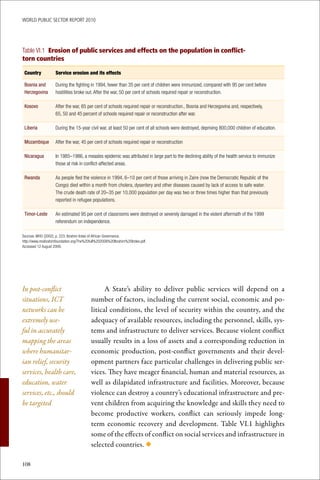
                             the population are devastating. In Bosnia and Herzegovina, for exam-
                             ple, fewer than 35 per cent of children were immunized during the
                             fighting in 1994, compared with 95 per cent before hostilities broke
                             out. During Liberia’s 15-year civil war, at least 50 per cent of all schools
                             were destroyed, depriving 800,000 children of education.
                                   The government’s inability to provide security, health care, educa-
                             tion, access to clean water and other basic services not only threatens
                             people’s welfare; it also erodes the State’s credibility and legitimacy.
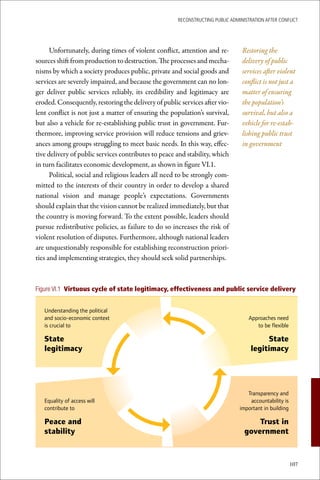
                             Consequently, restoring effective delivery of public services after vio-
                             lent conflict is necessary not just to ensure the survival of the people,
                             but also to re-establish public trust in government. Improving service
                             delivery can also reduce tensions and grievances among groups strug-
                             gling to meet basic needs and competing for scarce resources. In this
                             way, strengthening government capacity to provide services becomes a
                             means of promoting peace and spearheading economic development.
                                   In the aftermath of conflict, States rarely have adequate financial,
                             human and other resources to undertake effective reconstruction and
                             rebuilding efforts. In this context, the involvement of multiple stake-
                             holders is necessary. Public officials should adopt an inclusive ap-
                             proach that brings together both State and non-State players, includ-
                             ing multilateral and bilateral donors and local and international
                             non-governmental organizations, to solidify public service delivery ca-
                             pacities. However, when foreign donors are involved, there must be an
                             understanding that they are partners in the process, not directors of it.
                             Reconstruction and reform programmes must be designed, decided
                             and implemented with the participation and ownership of nationals.
                             Service delivery systems should be crafted to use local resources, deliv-
                             er tangible outputs based on need and target the poorest and most
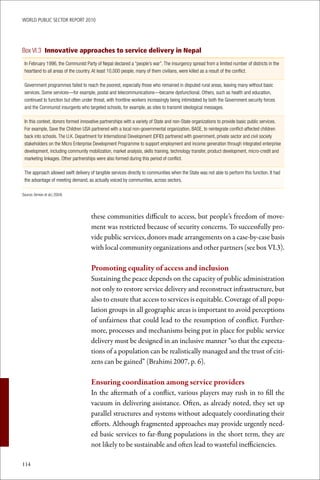
                             marginalized groups. Aid donors took such an approach in Nepal after
                             insurgents declared a “people’s war” in 1996. The biggest need for pub-
                             lic services was in remote, rural communities, where security concerns

xvi
ReconstRucting Public AdministRAtion AfteR conflict


made access even more challenging. To successfully provide public ser-
vices, donors made arrangements on a case by case basis with local
community organizations and other partners.
     In devising effective strategies for public service delivery, it is im-
portant to allow room for flexibility and innovation. Stakeholders also
need to recognize the benefits of using information and communica-
tions technologies (ICTs) as an integral part of the overall reconstruc-
tion of public administration and service delivery capacities in post
conflict situations. Information dissemination should be treated as a
basic service in post-conflict societies. In the short term, information
about security, emergency relief and services for displaced persons and
refugees may literally mean the difference between life and death. In
the long run, information on various development initiatives, such as
public health and education programmes, can contribute to effective
service delivery, nation building and sustainable development.
     The ICT tools available for communicating information include
radio, television, mobile phones and the Internet. For example, during
the conflict in the Democratic Repulic of Congo, the United Nations
and other donors set up Radio Okapi to help keep peace by dissemi-
nating reliable and credible information from an independent source.
The free flow of information can also empower public institutions, so-
cietal groups and citizens to produce and share knowledge—between
and within service delivery sectors—to bring a greater degree of cohe-
sion, transparency and accountability.
     New technologies can, moreover, be used to directly facilitate the
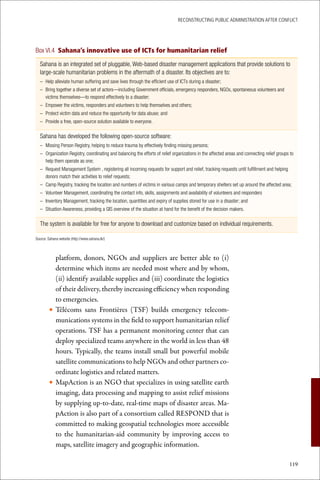
delivery of more tangible public services. An example is the Sahana
disaster management system developed after the Asian tsunami in De-
cember 2004. Sahana is an open-source, Web-based collaboration tool
that has facilitated the coordination and distribution of relief after
natural disasters. Another example is the introduction of new tech-
nologies to support the provision of water and electricity at the head-
quarters of the United Nations Interim Force in Lebanon. The ICTs
used there allow for constant monitoring of the water supply levels and
the electrical grid. The system enables quick repair of any fault before
any operations are affected, minimizing service disruptions and engen-
dering cost savings.
     ICTs have not yet been widely incorporated into strategies for im-
proving public service delivery in post-conflict situations. However,
the donor community does have considerable experience using ICTs

                                                                                                      xvii
WoRld Public sectoR RePoRt 2010


                             in disaster relief efforts. Various international organizations, non-gov-
                             ernmental organizations and private companies have gone beyond the
                             basic applications of ICTs and are providing interactive tools, search-
                             able databases, maps and GIS and electronic forums for disaster man-
                             agement. If such strategies are adapted for use in post-conflict situa-
                             tions, they can transform the whole operation of government, which
                             will enable it to provide citizen-centric, more efficient, effective, trans-
                             parent, and accountable public services. ◆


xviii
ReconstRucting Public AdministRAtion AfteR conflict


Introduction

This Report is divided into six chapters each one dealing with specific
areas of public administration reconstruction after conflict. Moreover,
each chapter highlights challenges, strategies, and lessons learned so as
to provide concrete policy options. Chapter I analyzes the critical chal-
lenges and goals of reconstructing public administration after conflict.
It begins by “providing an overview of instrastate violent conflict after
World War II. It then attempts to define post-conflict reconstruction”
—a relatively new term that is not universally understood. The chapter
then presents the overarching goals of post-conflict governments and
the specific challenges they face in rebuilding public administration.
      Chapter II focuses on leadership capacity-building in post-con-
flict situations. One of the most critical elements for the success of
post-conflict reconstruction is the presence of capable leaders, at all
levels of government, who are committed to transforming conflict into
peaceful coexistence and collaboration. Yet as energy is exerted on
peace negotiations, peacekeeping operations and basic humanitarian
assistance, too little attention is paid to cultivating effective leaders and
promoting respect for institutions. Instead, the conversation is domi-
nated by discussion about how parties to the conflict should share
power and wealth. This approach often reignites conflict, demonstrat-
ing the need to focus more sharply on leadership transformation and
capacity-building. This chapter looks at the challenges in building ef-
fective leadership, the capacities needed by post-conflict leaders and
strategies for developing those capacities. The chapter also analyzes the
role of international and regional donors in promoting leadership ca-
pacity development.
      Chapter III looks at institution-building. Institutions are gener-
ally defined as the rules of the game in economic, political and social
interactions. Put another way, they equate to the formal (e.g., the con-
stitution and party systems) rules and procedures governing human
behavior. In governance, institutions encompass (i) all standard oper-
ating procedures of governments, (ii) more overarching structures of
State, and (iii) a nation’s normative social order (Ikenberry 1988).
Only recently has attention been given to public administration re-
forms, including civil service reforms, in post-conflict States. Interna-
tional organizations and donors have often focused on elections as the

                                                                                                        xix
WoRld Public sectoR RePoRt 2010


                             political tool for institution-building and on macroeconomic develop-
                             ment as the economic engine of growth. International financial insti-
                             tutions have prescribed the reduction of public sector expenditures,
                             including civil service expenditures (Vandermoortele 2003). Yet it is
                             equally important, if not more so, to pay explicit attention to institu-
                             tion-building as an ongoing process in post-conflict societies. This
                             chapter begins by looking at the key issues involved in building institu-
                             tions after conflict. It then discusses ways to strengthen public sector
                             institutions, focusing on the civil service, legislative institutions and
                             the judiciary. It also addresses mechanisms to improve the public sec-
                             tor’s performance in delivering public services and preventing relapses
                             into conflict.
                                   Chapter IV explores the critical issue of human resources capacity
                             building in post-conflict situations. The public service is integral to the
                             social, political, economic and cultural life of every country. Conse-
                             quently, in conflict situations, the public service is generally both a
                             contributing factor to the conflict and a casualty of it. It is also a central
                             actor in the reconstruction process, and as such, the public service
                             must transform itself so that it can appropriately manage the changed
                             and changing public administration environment. This chapter looks
                             first at why a strong public service is so important in post-conflict situ-
                             ations, and how human resources capacity varies from country to
                             country. The chapter then focuses on challenges and strategies related
                             to the development of human resources capacity after conflict. It ad-
                             dresses the following issues: controlling the number of public servants
                             on the payroll; practicing merit-based recruitment; promoting trans-
                             parency, accountability, integrity, professionalism and ethics; respect-
                             ing diversity in the public service and tapping its potential benefits;
                             paying civil servants in a post-conflict situation; and counteracting
                             brain drain.
                                   Post-conflict reconstruction is most successful when all segments
                             of society are engaged in the process. Therefore, as part of their efforts
                             to rebuild robust public administration systems, post-conflict coun-
                             tries must seek to involve citizens in decisionmaking. One key strate-
                             gy in this regard is decentralization—the transfer of powers, func-
                             tions, responsibilities and resources from the central government to
                             local authorities or other subnational entities. In practical terms, de-
                             centralization involves striking a balance between the claims of the
                             periphery and the demands of the centre. Chapter V, therefore, exam-

xx
ReconstRucting Public AdministRAtion AfteR conflict


ines decentralization as a mechanism for institutionalizing engaged
governance and promoting sustainable peace. It analyzes the concept
of decentralization, the challenges in implementing it, and the experi-
ences of several post-conflict countries. The chapter then discusses the
importance of engaging two particular constituencies—women and
minority groups—in governance, highlighting challenges as well as
strategies for success.
      The fundamental raison d’être of government is the delivery of
services to its people. These include social services (primary education
and basic health services), infrastructure (water and sanitation, roads
and bridges) and services that promote personal security (justice sys-
tem and police services), whether provided directly by the public sec-
tor or by government-financed private providers. Thus, Chapter VI
looks at the challenges and strategies involved in rebuilding capacities
for public service delivery. In particular, the chapter analyses the ben-
efits of a multistakeholder approach and the crucial role that informa-
tion and communication technologies (ICTs) can play. n


                                                                                                     xxi
ReconstRucting Public AdministRAtion AfteR conflict


Contents
Preface                                               iii
Acknowledgements                                       v
Executive Summary                                     vii
Introduction                                         xxi
Abbreviations and Acronyms                          xxiii

Chapter I                                                   Chapter II
Public Administration Challenges                            Developing Effective Public
after Conflict                                         1    Sector Leadership                                     23

1. Overview of Instrastate Violent Conflict                 1. Challenges in reconstructing public
   after World War II                                  3       sector leadership                                  25

2. Definition and phases of post-                             – Overcoming weak governance structures
   conflict reconstruction                             6        and unpredictable systems                         25

  – Defining post-conflict reconstruction              6      – Obstacles to institutionalizing new models of
                                                                leadership                                       26
  – Phases of post-conflict reconstruction            13
                                                              – Divergence between rules and behaviours          27
3. Goals of public administration reconstruction
   after conflict                                     16    2. Capacities needed for post-conflict leadership    28

  – Ensuring peace and security                       17      – Commitment to change                             30

  – Fostering social reconciliation                   17      – Ability to unite citizens and build a
                                                                positive vision of the future                    31
  – Promoting socio-economic development              18
                                                              – Ability to foster inclusiveness and
4. Challenges in reconstructing public                          manage diversity                                 34
   administration after conflict                      19
                                                              – Willingness to nurture future leaders             34
  – Developing effective public sector leadership     20
                                                              – Skill in managing citizens’ expectations
  – Building effective public institutions            20        and communicating effectively                     35
  – Strengthening human resources in the                      – Balanced skills and personal qualities            37
    public sector                                     21
                                                            3. Strategies and tools for leadership
  – Establishing mechanisms for inclusive                      capacity-building                                  37
    governance                                        21
                                                              – Visioning workshops and simulation activities 39
  – Providing citizen-centric public
    service delivery                                  22      – Leadership coaching                               40
                                                              – Staff exchanges and visits                        41
                                                              – Peer-to-peer learning                             41

                                                            4. The role of external partners in building
                                                               leadership capacity                                42
                                                              – Providing appropriate assistance                  43
                                                              – Coordinating assistance                           46

                                                            5. Lessons learned                                    46


                                                                                                                xxiii
WoRld Public sectoR RePoRt 2010


Chapter III                                                 Chapter V
Building Effective Public                                   Engaging Citizens in Post-
Administration Institutions                           49    conflict Reconstruction:
                                                            Decentralization for Participatory Governance        85
1. Public administration institutions as
   foundations of good governance                     51    1. Decentralization in post-conflict contexts        87
  – Designing a comprehensive programme                       – Horizontal decentralization                      87
    to strengthen governance and public                       – Elements of successful decentralization          88
    administration through dialogue
    with stakeholders                                 53    2. Challenges in decentralizing                      89
  – Developing a shared vision and clear                    3. Decentralization experiences in selected countries 90
    mission for governance and public                         – South Africa                                     91
    administration institutions                       53
                                                              – Rwanda                                           91
  – Creating formal frameworks for governance         54
                                                              – Uganda                                           92
  – Harmonizing traditional and
                                                              – Mozambique                                       93
    modern institutions                               56
                                                              – El Salvador                                      93
  – Promoting participatory democracy
    and local governance                              57      – Guatemala                                        94

2 Strengthening public sector institutions            58    4. Engaging women in governance:
                                                               Challenges and strategies                         95
  – The civil service                                 58
                                                              – Challenges impeding women’s participation        97
  – Legislative institutions                          61
                                                              – Strategies for engaging women                    98
  – The judiciary                                     62
                                                            5. Engaging minority groups in governance:
3. Improving public sector performance                66
                                                               Challenges and strategies                        100
  – Building effective mechanisms for
                                                              – Challenges impeding the participation
    citizen-centric public service delivery           66
                                                                of minority groups                              100
  – Building an infrastructure for peace              66
                                                              – Strategies for engaging minority groups         101
4. Lessons learned                                    69
                                                            6. Lessons learned                                  103

Chapter IV                                                  Chapter VI
Strengthening Human Resources                               Promoting Citizen-Centric Public Service
in the Public Service                                 71    Delivery in Post-Conflict Situations                105

1. The central role of the public service             73    1. The challenges of delivering citizen-
                                                               centric services after conflict                  109
2. Variation in human resources capacity
   after conflict                                     74    2. A multi-stakeholder approach to public
                                                               service delivery                                 111
3. Challenges and strategies involved in managing
   public service personnel                           75    3. Strategies for effective delivery of services    113
  – Controlling the number of public servants                 – Allowing for flexibility and innovation         113
    on the payroll                                    76      – Promoting equality of access and inclusion      114
  – Practicing merit-based recruitment                77      – Ensuring coordination among
  – Promoting transparency, accountability,                     service providers                               114
    integrity, professionalism and ethics             78
                                                            4. Building ICTs into strategies for citizen-
  – Respecting diversity and tapping its                       centric public service delivery                  115
    potential benefits                                79
                                                              The role of ICTs in post-conflict situations      115
  – Paying civil servants in a post-conflict situation 80
                                                              Use of ICTs after disasters:
  – Fighting brain drain in post-conflict situations 82         A model for post-conflict situations            118
4. Lessons learned                                    83    5. Lessons learned                                  120


xxiv
ReconstRucting Public AdministRAtion AfteR conflict


Bibliography                                    123   Figures

                                                      I.1   Violent conflicts of high intensity in 2007    4

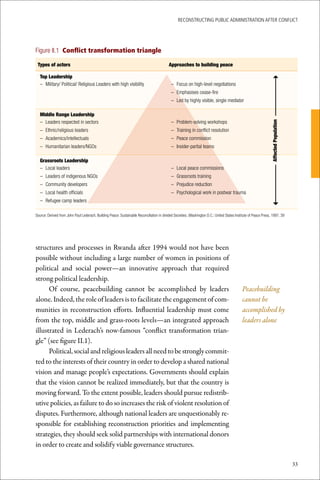
Boxes                                                 II.1 Conflict transformation triangle               33
                                                      VI.1 Virtuous cycle of state legitimacy,
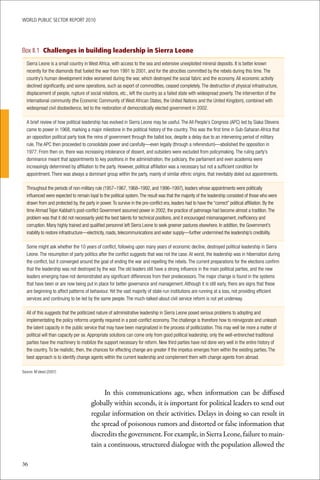
II.1 Challenges in building leadership
                                                           effectiveness and public service delivery      107
     in Sierra Leone                             36
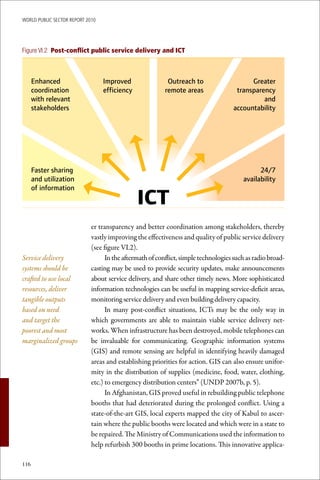
                                                      VI.2 Post-conflict public service delivery and ICT 116
V.1 Rwanda’s success in engaging women
    in governance                                98
VI.1 Post-conflict rebuilding in Sierra Leone   110
VI.2 Health care delivery in Angola:                  Tables
     Poor coordination, poor results            112
                                                      I.1   Early use of “post-conflict” terminology
VI.3 Innovative approaches to service                       by international organizations                  7
     delivery in Nepal                          114
                                                      I.2   Post-conflict reconstruction from
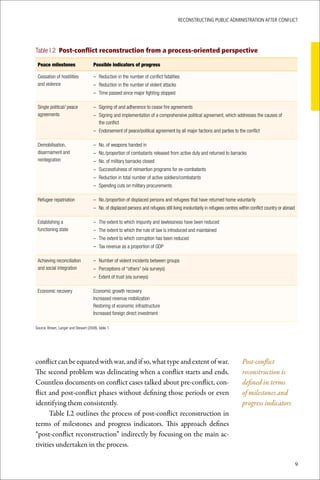
VI.4 Sahana’s innovative use of ICTs                        a process-oriented perspective                  9
     for humanitarian relief                    119
                                                      I.3   Post-conflict activity by the United
                                                            Nations: Key concepts                          12
                                                      II.1 Comparison of the context for capacity-
                                                           development efforts in post-conflict
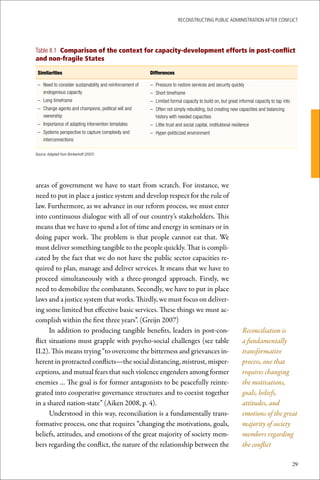
                                                           and non-fragile States                          29
                                                      II.2 Psycho-social challenges to
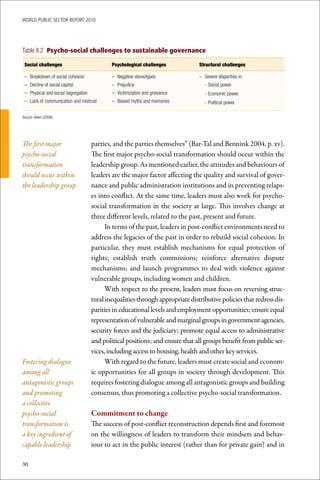
                                                           sustainable governance                          30
                                                      VI.1 Erosion of public services and effects on
                                                           the population in conflict-torn countries      108


                                                                                                          xxv
WoRld Public sectoR RePoRt 2010


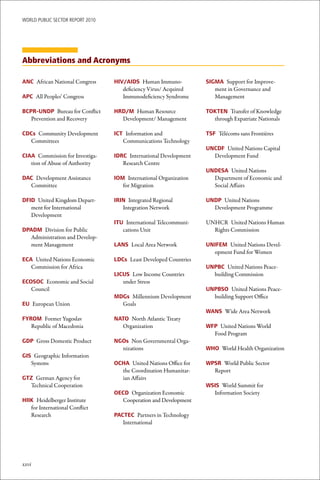
Abbreviations and Acronyms

ANC African National Congress     HIV/AIDS Human Immuno-           SIGMA Support for Improve-
                                     deficiency Virus/ Acquired       ment in Governance and
APC All Peoples’ Congress            Immunodeficiency Syndrome        Management

BCPR-UNDP Bureau for Conflict     HRD/M Human Resource             TOKTEN Transfer of Knowledge
   Prevention and Recovery          Development/ Management          through Expatriate Nationals

CDCs Community Development        ICT Information and              TSF Télécoms sans Frontières
  Committees                         Communications Technology
                                                                   UNCDF United Nations Capital
CIAA Commission for Investiga-    IDRC International Development     Development Fund
   tion of Abuse of Authority        Research Centre
                                                                   UNDESA United Nations
DAC Development Assistance        IOM International Organization     Department of Economic and
  Committee                          for Migration                   Social Affairs

DFID United Kingdom Depart-       IRIN Integrated Regional         UNDP United Nations
   ment for International            Integration Network             Development Programme
   Development
                                  ITU International Telecommuni-   UNHCR United Nations Human
DPADM Division for Public            cations Unit                    Rights Commission
  Administration and Develop-
  ment Management                 LANS Local Area Network          UNIFEM United Nations Devel-
                                                                     opment Fund for Women
ECA United Nations Economic       LDCs Least Developed Countries
   Commission for Africa                                           UNPBC United Nations Peace-
                                  LICUS Low Income Countries         building Commission
ECOSOC Economic and Social           under Stress
   Council                                                         UNPBSO United Nations Peace-
                                  MDGs Millennium Development        building Support Office
EU European Union                   Goals
                                                                   WANS Wide Area Network
FYROM Former Yugoslav             NATO North Atlantic Treaty
   Republic of Macedonia            Organization                   WFP United Nations World
                                                                     Food Program
GDP Gross Domestic Product        NGOs Non Governmental Orga-
                                    nizations                      WHO World Health Organization
GIS Geographic Information
   Systems                        OCHA United Nations Office for   WPSR World Public Sector
                                    the Coordination Humanitar-      Report
GTZ German Agency for               ian Affairs
  Technical Cooperation                                            WSIS World Summit for
                                  OECD Organization Economic         Information Society
HIIK Heidelberger Institute         Cooperation and Development
   for International Conflict
   Research                       PACTEC Partners in Technology
                                     International


xxvi
ReconstRucting Public AdministRAtion AfteR conflict


Chapter I

Public Administration
Challenges after
Conflict


this chapter analyzes the critical challenges of reconstructing public
administration after conflict. it begins by providing an overview of
instrastate violent conflict after World War ii. it then attempts to define
“post-conflict reconstruction”—a relatively new term that is not
universally understood. the chapter then presents the overarching
goals of post-conflict governments and the specific challenges they
face in rebuilding public administration.


                                                                             1
ReconstRucting Public AdministRAtion AfteR conflict


1. Overview of Instrastate Violent Conflict
after World War II

Since the end of the Second World War, most armed conflicts have                                                                                      Since 1945 about 20
been within states rather than between them—a shift from the inter-                                                                                   million people have
state warfare that marked much of the nineteenth and early twentieth                                                                                  died and 67 million
centuries. Civil wars around the world “have killed since 1945 approx-                                                                                were displaced due
imately 20 million people and displaced at least 67 million”1. Civilian                                                                               to civil wars
deaths as a percentage of all war-related deaths increased from 50 per
cent in the eighteenth century to 90 per cent in 1990.
     The United Nations High Commissioner for Refugees estimated
that in December 2006, there was a global population of 8.8 million
registered refugees and as many as 24.5 million internally displaced
people in more than 50 countries. The actual global population of ref-
ugees is probably closer to 10 million, given the estimated 1.5 million
Iraqi refugees displaced throughout the Middle East. Internal wars
have not only caused alarmingly high rates of casualties, but they have
also contributed to the destabilization of entire regions while causing
economic deterioration and exacerbating social inequalities. More-
over, research has shown that of all countries emerging from war, near-
ly 50 per cent face relapse into conflict within a decade.
     Since 1948, the United Nations Security Council has authorized                                                                                   The UN Security
63 UN peacekeeping operations (see the annex to this report). Just 18                                                                                 Council has
of these were established between 1948 and 1990; 45 operations were                                                                                   authorized 63
established between 1990 and 2008; and 16 are still ongoing. As of late                                                                               UN Peacekeeping
2009, about 35 countries could be described as having entered a post-                                                                                 operations
conflict phase since the Cold War era (UNDP 2008).
     The worst intrastate conflicts over the past decades have taken
place in the developing world and in newly independent states, par-                                                                                   The worst intrastate
ticularly in Sub-Saharan Africa (the site of more than 20 civil wars                                                                                  conflicts over the
since 1945), the Middle East and Maghreb, Asia and the Pacific, and                                                                                   past decades have
to a lesser extent, the Americas.2 In Europe, internal conflicts have                                                                                 taken place in the
erupted in Cyprus, Georgia, Greece, Russia, Spain, the United King-                                                                                   developing world

	 (Collier	and	Sambanis	2005,	p.	ix)
1

	 Sub-Saharan	African	countries	affected	by	conflict	include	Angola,	Burundi,	Central	African	Republic,	Chad,	the	Republic	of	Congo,	Djibouti,	
2

  Ethiopia,	Guinea-Bissau,	Kenya,	Liberia,	Mali,	Mozambique,	Namibia,	Nigeria,	Rwanda,	Senegal,	Sierra	Leone,	Somalia,	South	Africa,	Sudan,	
  Uganda,	Zaire/Democratic	Republic	of	Congo	and	Zimbabwe.	In	the	Middle	East	and	Maghreb,	conflict	has	erupted	in	Algeria,	Egypt,	Israel,	
  Lebanon,	Morocco/Western	Sahara,	Jordan	and	Syria.	In	Asia	and	the	Pacific,	internal	conflicts	have	taken	place	in	Afghanistan,	Azerbaijan,	
  Bangladesh,	Cambodia,	China,	India,	Indonesia,	Iran,	Iraq,	Laos,	Myanmar/Burma,	Nepal,	Oman,	Pakistan,	Papua	New	Guinea,	the	Philippines,	
  Sri	Lanka,	Tajikistan,	Thailand,	Turkey,	Vietnam	and	Yemen.	In	the	Americas,	conflicts	have	erupted	in	Argentina,	Bolivia,	Colombia,	Costa	Rica,	
  Cuba,	the	Dominican	Republic,	El	Salvador,	Guatemala,	Haiti,	Nicaragua,	Paraguay	and	Peru.


                                                                                                                                                                         3
WoRld Public sectoR RePoRt 2010


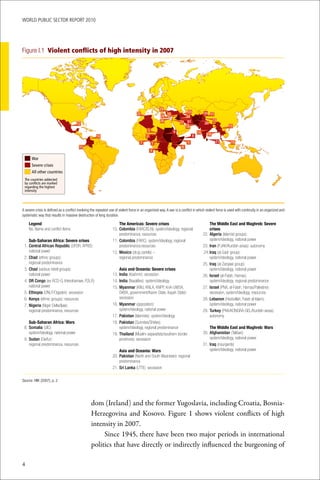
Figure I.1 Violent conflicts of high intensity in 2007


                                                                                                    29
                                                                                                                       23             30 17
                                                                                    22
                                                                                                     28 25            24
                                                                                                     26            27 31                     13
                                        12                                                                                             20
                                                                                                                      18                               15
                                                                                            3                 9                  14     16
                                                      10                                   2                                 8
                                                                                      7         1                        5                    21        19
                                         11                                                                          6
                                                                                                4

      War
      Severe crises
      All other countries
 The countries addected
 by conflicts are marked
 regarding the highest
 intensity


A severe crisis is defined as a conflict involving the repeated use of violent force in an organized way. A war is a conflict in which violent force is used with continuity in an organized and
systematic way that results in massive destruction of long duration.

   Legend                                                              The Americas: Severe crises                                          The Middle East and Maghreb: Severe
	 	No.	Name	and	conflict	items                                    	 0.	Colombia	(FARC/ELN):	system/ideology,	regional	
                                                                  1                                                                         crises
                                                                       predominance,	resources                                        	 2.	Algeria	(Islamist	groups):
                                                                                                                                      2
     Sub-Saharan Africa: Severe crises                            	 1.	Colombia	(FARC):	system/ideology,	regional	
                                                                  1                                                                         system/ideology,	national	power
	 1.	Central African Republic	(UFDR,	APRD):	                           predominance,resources                                         	 3.	Iran	(PJAK/Kurdish	areas):	autonomy
                                                                                                                                      2
     national	power                                               	 2.	Mexico	(drug	cartels)	–	
                                                                  1                                                                   .	 4.	Iraq	(al-Sadr	group):	
                                                                                                                                       2
	 2.	Chad	(ethnic	groups):	                                            regional	predominance                                                system/ideology,	national	power
     regional	predominance                                                                                                            	 5.	Iraq	(al-Zarqawi	group):	
                                                                                                                                      2
	 3.	Chad	(various	rebel	groups):	                                     Asia and Oceania: Severe crises                                      system/ideology,	national	power
     national	power                                               	 3.	India	(Kashmir):	secession
                                                                  1                                                                   	 6.	Israel	(al-Fatah,	Hamas):	
                                                                                                                                      2
	 4.	DR Congo	(ex-RCD-G,	Interahamwe,	FDLR):	                     	 4.	India	(Naxalites):	system/ideology
                                                                  1                                                                         system/ideology,	regional	predominance
     national	power                                               	 5.	Myanmar	(KNU,	KNLA,	KNPP,	KnA-UWSA,	
                                                                  1                                                                   	 7.	Israel	(PNA,	al-Fatah,	Hamas/Palestine):
                                                                                                                                      2
	 5.	Ethiopia	(ONLF/Ogaden):	secession                                 DKBA,	government/Karen	State,	Kayah	State):	                         secession,	system/ideology,	resources
	 6.	Kenya	(ethnic	groups):	resources                                  secession                                                      	 8.	Lebanon	(Hezbollah,	Fatah	al-Islam):
                                                                                                                                      2
	 7.	Nigeria	(Niger	Delta/Ijaw):	                                 	 6.	Myanmar	(opposition):	
                                                                  1                                                                         system/ideology,	national	power
     regional	predominance,	resources                                  system/ideology,	national	power                                	 9.	Turkey	(PKK/KONGRA-GEL/Kurdish	areas):	
                                                                                                                                      2
                                                                  	 7.	Pakistan	(Islamists):	system/ideology
                                                                  1                                                                         autonomy
     Sub-Saharan Africa: Wars                                     	 8.	Pakistan	(Sunnites/Shiites):	
                                                                  1
	 8.	Somalia	(UIC):	                                                   system/ideology,	regional	predominance                              The Middle East and Maghreb: Wars
     system/ideology,	national	power                              	 9.	Thailand	(Muslim	separatists/southern	border	
                                                                  1                                                                   	 0.	Afghanistan	(Taliban):	
                                                                                                                                      3
	 9.	Sudan	(Darfur):	                                                  provinces):	secession                                               system/ideology,	national	power
     regional	predominance,	resources                                                                                                 	 1.	Iraq	(insurgents)
                                                                                                                                      3
                                                                       Asia and Oceania: Wars                                              system/ideology,	national	power
                                                                  	 0.	Pakistan	(North	and	South	Waziristan):	regional	
                                                                  2
                                                                       predominance
                                                                  	 1.	Sri Lanka	(LTTE):	secession
                                                                  2

Source: HIIK (2007), p. 2


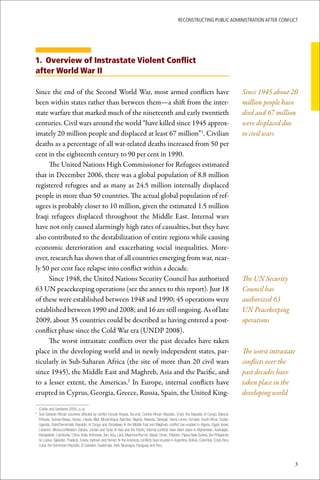
                                                  dom (Ireland) and the former Yugoslavia, including Croatia, Bosnia-
                                                  Herzegovina and Kosovo. Figure 1 shows violent conflicts of high
                                                  intensity in 2007.
                                                       Since 1945, there have been two major periods in international
                                                  politics that have directly or indirectly influenced the burgeoning of

4
ReconstRucting Public AdministRAtion AfteR conflict


conflict within countries around the world. First, the end of World
War II led to a wave of decolonization and the consequent advent of
the international bipolar system and a number of proxy wars. Second,
the demise of the Cold War in the early 1990s fed a struggle for inde-
pendence and self-determination in several nations that were formerly
part of the Soviet Union.
     During the first historical period—that is, in the aftermath of the
Second World War—two different trends in reconstruction and re-
covery unfolded. Countries in the West received an enormous boost
in financial aid and state-building support from a single donor, the
United States, through the European Recovery Plan, best known as
the Marshall Plan. Meanwhile, countries in other regions of the world
were still struggling for political independence. The decolonization
movement that occurred between 1946 and 1960 was characterized
by peaceful liberation in some countries, and by internal conflict and
struggle in others. The high hopes that countries had after gaining in-
dependence were often followed by bitter disappointment, as domi-
nation by a foreign country was replaced by coups d’états or loss of
state authority and political legitimacy. These developments brought
an increased use of violent means in order to ensure survival, security
and access to resources.
     Many of these violent conflicts were exacerbated by the Cold               Many of the violent
War ideological struggle. The two superpowers did not intend to fight           conflicts that erupted
wars directly (because both sides possessed atomic weapons), but they           after decolonization
supported a number of proxy wars throughout the world. For exam-                were exacerbated
ple, the Soviet Union encouraged uprisings in Vietnam, Nicaragua,               by the Cold War
Congo and Sudan as part of its ideological battle against coloniza-             ideological struggle
tion, which it viewed as the epitome of capitalism and imperialism.
The United States, for its part, aided factions fighting against the
communist ideology. This indirect competition between the super-
powers worsened the internal conflicts in several countries by adding
more fuel to escalating tensions.
     Following the end of the Cold War in the early 1990s, a move-
ment for independence and self-determination swept through Eastern
Europe. With the dismantling of old state institutions and the com-
plexity of the geo-political and ethnic configuration of nations in the
former Eastern Bloc, a number of conflicts erupted within the bound-
aries of this region. The Western Balkans, for example, suffered in-
creased ethnic and religious strife. Conflicts also developed in coun-

                                                                                                      5
WoRld Public sectoR RePoRt 2010


                             tries like Algeria and Afghanistan, as religious fundamentalist groups
                             tried to control political institutions and dominate public life.
With the increase                  As intrastate wars became increasingly common, international
of intrastate wars,          and regional organizations such as the United Nations, the North
international                Atlantic Treaty Organization (NATO) and the European Union3
and regional                 shifted their focus towards issues of peace and security within states
organizations                rather than between them. State-building—international interven-
shifted their focus          tion to restore order and strengthen government institutions in the
towards issues of            aftermath of conflict—emerged as a key strategy. This focus is espe-
peace and security           cially needed in the post-9/11 era; there is now heightened aware-
within states rather         ness that weak states—those that lack the capacity to control their
than between them            own territory and to implement public policies—can become safe
                             havens for terrorists, drug traffickers and extremist groups. As such,
                             they pose a grave threat to regional and international security.
                                   To help counter this threat and to support peace efforts in coun-
                             tries emerging from conflict, the United Nations Peacebuilding Com-
                             mission was established in 2005. The Commission now plays a key role
                             in advancing the international community’s broad peace agenda. ◆


                             2. Definition and phases of post-conflict
                             reconstruction

                             Defining	post-conflict	reconstruction
                             In recent years, the concept of “post-conflict reconstruction” has re-
                             ceived much attention from scholars and practitioners, as well as from
                             international organizations including the United Nations. Neverthe-
                             less, because of the complexities inherent to post-conflict situations,
                             the term continues to lack a precise definition.
The UN started                     Conflict is age-old in the history of humanity, but post-conflict
focusing on                  reconstruction has only recently become a domain of international
“post-conflict               interest (see table I.1). It was not until the 1990s that the United Na-
reconstruction” in           tions began to focus on post-conflict reconstruction as a distinctive
the 1990s                    activity, separate from peacemaking, peacekeeping and conflict pre-
                             vention. In fact, an analysis of United Nations documents written

                             	 The	European	Union,	originally	called	the	European	Community,	was	created	after	World	War	II	with	the	overriding	aim	of	preventing	future	wars	
                             3

                               among	sovereign	states.


6
ReconstRucting Public AdministRAtion AfteR conflict


Table I.1 Early use of “post-conflict” terminology by international organizations

    Year       Term                                              Context

    1992       Post-conflict peacebuilding                       Post-conflict peacebuilding is highlighted in An Agenda for Peace, a United Nations Secretary-
                                                                 General Report.

    1995       Post-conflict countries                           The International Monetary Fund introduces a new
                                                                 financing instrument for post-conflict countries focusing on institution-building.

    1997       Post-conflict reconstruction                      The World Bank develops its Framework for World Bank Involvement in Post-Conflict Reconstruction and
                                                                 establishes the Post-Conflict Fund. The Organisation for Economic Co-operation and
                                                                 Development establishes the Development Assistance Committee (DAC) and the DAC Task
                                                                 Force to guide investments in post-conflict countries. It also sets up a Conflict Prevention and
                                                                 Conflict Reconstruction Network.

    2005       Post-conflict peacebuilding                       The United Nations establishes the Peacebuilding Commission (PBC).
               and recovery


before 1990 shows that the term “post-conflict reconstruction” either
did not appear or was used ad hoc to refer to activities during specific
periods such as the post-colonial, post-World War II and post-com-
munism eras.4
     Thereafter, it took more than a decade to institutionalize both                                                                                           In 2005, the UN
post-conflict reconstruction and peacebuilding in practice as well as                                                                                          Peacebuilding
in theory. A turning point came when the United Nations Peace-                                                                                                 Commission was
building Commission was created with resolution 60/180 and reso-                                                                                               established
lution 1645 (2005) of Dec. 20, 2005. The Commission was explicity
charged, among other things, with “advising on and proposing inte-
grated strategies for post-conflict peacebuilding and recovery.” The
creation of the Commission reflected a commitment by the interna-
tional community to undertake sustained engagement in countries
emerging from conflict.
     On Oct. 11, 2006, the United Nations also launched the Peace-
building Fund, which relied on voluntary contributions from Mem-
ber States to finance the Peacebuilding Commission. With the cre-
ation of both the Commission and the Fund, post-conflict
reconstruction became firmly linked with peacebuilding, while at the
same time, questions began to arise about the nature and scope of the
peacebuilding process.

	 The	first	initiative	in	carving	out	post-conflict	reconstruction	as	a	niche	of	its	own	came	in	July	1992,	when	the	Secretary-General	at	the	time,	
4

  Boutros	 Boutros-Ghali,	 presented	 his	“Agenda	 for	 Peace”	 to	 the	 Security	 Council.	 He	 said,	“The	 Council	 has	 specifically	 requested	 that	 I	
  consider:	preventive	diplomacy,	peacemaking	and	peace-keeping—to	which	I	have	added	a	closely	related	concept,	post-conflict	peace-
  building”	(United	Nations	1992).


                                                                                                                                                                                 7
WoRld Public sectoR RePoRt 2010


“Post-conflict                     The United Nations was not alone in recognizing that post-conflict
reconstruction”              situations present special challenges and require special remedies. In
continues to                 1997, the World Bank issued its Framework for World Bank Involve-
lack a precise               ment in Post-Conflict Reconstruction, and to implement the frame-
definition due to the        work, it established the Post-Conflict Fund in the newly created Con-
complexity of post-          flict Prevention and Reconstruction Unit. Another fund targeting
conflict situations          fragile and conflict-affected countries, called the Low-Income Countries
                             under Stress Trust Fund, was also set up in the same unit in 2004.
                                   Meanwhile, in 1995, the International Monetary Fund, which is
                             mostly geared towards crisis lending and short-term stabilization of
It is commonly               economic imbalances, introduced a new financing instrument for
assumed that the             post-conflict countries, focusing on technical assistance to help its
post-conflict period         members with institution-building. The Organisation for Economic
starts after a peace         Co-operation and Development (OECD) likewise took up post-con-
agreement has                flict peacebuilding within a larger policy framework linking conflict
been signed                  and development. It created the OECD Development Assistance
                             Committee (DAC). In 1997 it then established a task force to coordi-
                             nate individual donor innovations and a collective response. A Con-
                             flict Prevention and Post-Conflict Reconstruction Network of 30
                             units was set up in tandem to apply the DAC guidelines, which started
                             an era of convergence between conflict prevention and peacebuilding.
Yet, signing a peace               Despite taking up post-conflict reconstruction as a distinctive ac-
agreementdoes not            tivity, no international organization provided a precise definition of
necessarily qualify          the term. The World Bank chose to associate “post-conflict” mostly
a country as “post-          with “transitional” countries undergoing their first elections after a vio-
conflict” as conflict        lent conflict. Consequently, the Bank’s post-conflict assistance pro-
often continues              grams consisted mainly of developing the economic infrastructure and
                             supporting lending for social services with a view towards future in-
                             vestments (Flores and Nooruddin 2007). The United Nations equated
                             post-conflict situations simply with the aftermath of war, without
                             specifying exactly when that was. One rule of thumb, however, was
                             that while conflict cases were associated with humanitarian relief,
                             peacemaking and peacekeeping activities by the United Nations, post-
                             conflict activities almost unequivocally involved peacebuilding, un-
                             derstood as the “full range of non-military commitments undertaken
                             to assist countries to achieve self-sustaining peace and socio-economic
                             development” (Tschirgi 2004, p. 2).
                                   Clearly, therefore, “post-conflict” did not lend itself to easy defi-
                             nitions. One problem was defining “conflict”—determining if violent

8
ReconstRucting Public AdministRAtion AfteR conflict


Table I.2 Post-conflict reconstruction from a process-oriented perspective

 Peace milestones                     Possible indicators of progress

 Cessation of hostilities             – Reduction in the number of conflict fatalities
 and violence                         – Reduction in the number of violent attacks
                                      – Time passed since major fighting stopped

 Single political/ peace              – Signing of and adherence to cease fire agreements
 agreements                           – Signing and implementation of a comprehensive political agreement, which addresses the causes of
                                        the conflict
                                      – Endorsement of peace/political agreement by all major factions and parties to the conflict

 Demobilisation,                      – No. of weapons handed in
 disarmament and                      – No./proportion of combatants released from active duty and returned to barracks
 reintegration                        – No. of military barracks closed
                                      – Successfulness of reinsertion programs for ex-combatants
                                      – Reduction in total number of active soldiers/combatants
                                      – Spending cuts on military procurements

 Refugee repatriation                 – No./proportion of displaced persons and refugees that have returned home voluntarily
                                      – No. of displaced persons and refugees still living involuntarily in refugees centres within conflict country or abroad

 Establishing a                       – The extent to which impunity and lawlessness have been reduced
 functioning state                    – The extent to which the rule of law is introduced and maintained
                                      – The extent to which corruption has been reduced
                                      – Tax revenue as a proportion of GDP

 Achieving reconciliation             – Number of violent incidents between groups
 and social integration               – Perceptions of “others” (via surveys)
                                      – Extent of trust (via surveys)

 Economic recovery                    Economic growth recovery
                                      Increased revenue mobilization
                                      Restoring of economic infrastructure
                                      Increased foreign direct investment

Source: Brown, Langer and Stewart (2008), table 1.


conflict can be equated with war, and if so, what type and extent of war.                                                     Post-conflict
The second problem was delineating when a conflict starts and ends.                                                           reconstruction is
Countless documents on conflict cases talked about pre-conflict, con-                                                         defined in terms
flict and post-conflict phases without defining those periods or even                                                         of milestones and
identifying them consistently.                                                                                                progress indicators
      Table I.2 outlines the process of post-conflict reconstruction in
terms of milestones and progress indicators. This approach defines
“post-conflict reconstruction” indirectly by focusing on the main ac-
tivities undertaken in the process.

                                                                                                                                                                 9
WoRld Public sectoR RePoRt 2010


                                    The prevailing view among conflict epxerts is that the post-con-
                             flict period starts after a peace agreement has been signed. Yet there is
                             also awareness that signing a peace agreement does not necessarily
                             qualify a country as post-conflict, because conflict often continues ir-
                             regardless, albeit in a disguised form.
                                    Experience shows that post-conflict countries are almost always
                             plagued by population displacements, damaged infrastructure, re-
                             duced productive capacity, devastated government revenue base, seri-
                             ously weakened human and social capital, and greatly reduced security
                             (World Bank 2005). The main activities in the early post-conflict
                             phase often consist of (i) demobilization and reintegration of ex-com-
                             batants, (ii) reintegration of displaced populations, and (iii) demining
                             as a prerequisite for the normalization of civilian life and the start of
                             development activities. Later phases of post-conflict reconstruction
                             include institution- and capacity-building activities, including the en-
                             gendering, maintenance and strengthening of the rule of law, effective
                             governance, social policymaking and economic development.
The first phase                     The first phase of post-conflict reconstruction coincides with the
of post-conflict             early phase of peacebuilding, originally defined as “non-military or ci-
reconstruction               vilian dimension of efforts to support countries emerging from con-
coincides with the           flict.” Since its conception in the 1990s, peacebuilding has gradually
early phase                  become a catchall concept encompassing preventive diplomacy, preven-
of peacebuilding             tive development, conflict prevention, conflict resolution and post-
                             conflict reconstruction. In fact, the 2000 “Report of the Panel on Unit-
                             ed Nations Peace Operations,” also known as the Brahimi Report,
                             acknowledged the growing interlinkages between conflict and peace
                             and adopted a longer-term view of peacebuilding, as epitomized in its
                             doctrinal shift away from international civilian policing to rule-of-law
                             teams. However, the emphasis in this report, as in other United Nations
                             documents since 2000, is on the need to take a more in-depth view of
                             peacebuilding that focuses on the structural causes of conflict.
                                    Like the Brahimi Report, a 2004 report by the Secretary-Gener-
                             al’s High-level Panel on Threats, Challenges and Change (United Na-
                             tions 2004a) put special emphasis on policies for preventing conflict,
                             underlining that development is a condition for security and peace
                             rather than a mere consequence. The 2004 report, however, went a step
                             further to enumerate and discuss the emerging threats to peace and
                             security, which include poverty; infectious disease and environmental
                             degradation; nuclear, radiological, chemical and biological weapons;

10
ReconstRucting Public AdministRAtion AfteR conflict


terrorism; and transnational organized crime. To counter these threats,
the report discussed deploying military capacities as a means of peace-
keeping and peace enforcement.
     The report suggested that peacebuilding, by contrast, involves
rebuilding shattered societies. “Successful peacebuilding,” it said,
“requires the deployment of peacekeepers with the right mandates
and sufficient capacity to deter would-be spoilers; funds for demo-
bilization and disarmament, built into peacekeeping budgets; … re-
habilitation and reintegration of combatants, as well as other early
reconstruction tasks; and a focus on building State institutions and
capacity, especially in the rule of law” (United Nations 2004b, p. 5).
Thus the report focused on the activities and objectives of peace-
building undertaken under the banner of post-conflict reconstruc-
tion, which it associated mainly with the dominance of non-mili-
tary efforts:
     • re-establishing the conditions for self-sustaining human devel-
        opment with or without the help of peacekeeping forces,
     • managing the major risk factors of conflict relapse, including
        unemployment, poverty, socioeconomic gaps and political im-
        balances in the institutional structures, and
     • undertaking a long-term perspective on building the institu-
        tions of State and society.
     The United Nations Development Programme, in a recent publi-
cation titled Post-Conflict Economic Recovery, characterizes post-
conflict countries according to their progress along a range of “peace-
building milestones”. The report states:
           A post-conflict country should be seen as lying somewhere            A post-conflict
     along a continuum on each of these milestones, recognizing that it         country should
     could sometimes move backwards. As long as a country does not              be seen as lying
     slip back on too many of these milestones at once, it can reasonably       somewhere along
     be expected to continue towards recovery. The following are the            a continuum of
     most important peacebuilding milestones:                                   peacebuilding
     • Ceasing hostilities and violence;                                        milestones,
     • Signing of peace agreements;                                             recognizing that
     • Demobilization, disarmament and reintegration;                           it could sometimes
     • Return of refugees and internally displaced persons (IDPs);              move backwards
     • Establishing the foundations for a functioning State;
     • Initiating reconciliation and societal integration; and
     • Commencing economic recovery. (UNDP 2008, p. xviii)

                                                                                                     11
WoRld Public sectoR RePoRt 2010


Table I.3 Post-conflict activity by the United Nations: Key concepts
Peacemaking        Peacemaking is “action to bring hostile parties to agreement, essentially through such peaceful means as those
                   foreseen in Chapter VI of the Charter of the United Nations; Pacific Settlement of Disputes” (United Nations 1992). In
                   this sense, peacemaking is a diplomatic effort to promote the forging of a settlement between disputing parties.

Peacekeeping       The term “peacekeeping” is not found in the United Nations Charter and defies simple definition. “Peacekeeping”
                   refers to a United Nations presence in the field (normally involving civilian and military personnel) that, with the
                   consent of the conflicting parties, implements or monitors arrangements relating to the control of conflicts and their
                   resolution, or ensures the safe delivery of humanitarian relief. Peacekeeping can be divided into three broad
                   categories: (i) assistance in maintenance of cease-fires, (ii) implementation of comprehensive settlements, and (iii)
                   protection of humanitarian operations. As the United Nations Peacekeeping website explains, “today’s peacekeepers
                   undertake a wide variety of complex tasks, from helping to build sustainable institutions of governance, to human
                   rights monitoring, to security sector reform, to the disarmament, demobilization and reintegration of former
                   combatants” (see: www.un.org/Depts/dpko/dpko).

Peacebuilding      Peacebuilding is associated with the transition from the end of a conflict to the attainment of lasting peace and
                   sustainable development. The term “peacebuilding” came into widespread use after 1992 following the former
                   United Nations Secretary General's Agenda for Peace (United Nations, 1992). According to the Secretary-General’s
                   High-level Panel on Threats, Challenges and Change, peacebuilding involves “deployment of peacekeepers with the
                   right mandates and sufficient capacity to deter would-be spoilers; enough funds for demobilization and
                   disarmament, built into peacekeeping budgets; … rehabilitation and reintegration of combatants, as well as other
                   early reconstruction tasks; and a focus on building State institutions and capacity, especially in the rule of law”
                   (United Nations 2004b, p. 5). And in a press release issued July 23, 2009, Secretary-General Ban Ki-moon said,
                   “Building peace is about much more than ending war. It is about putting in place the institutions and trust that will
                   carry people forward into a peaceful future”.

Post-conflict      Post-conflict reconstruction, which overlaps conceptually with post-conflict peacebuilding, involves the
reconstruction     reconstruction of the core functions of the State and the delivery of basic public goods that support economic
                   growth and human development.


While post-conflict                 While post-conflict peacebuilding might overlap with peacekeep-
peacebuilding                  ing activities, there is no doubt that it extends to the processes of build-
might overlap                  ing and strengthening State institutions. Post-conflict peacebuilding,
with peacekeeping              in other words, does not end with the establishment of nascent govern-
activities, there is no        ment structures, including the immediate transition of authority to
doubt that it extends          the new government; its “nuts and bolts” start there.
to the processes                    Table I.3 provides details about how the United Nations de-
of building and                fines “peacemaking”, “peacekeeping”, “peacebuilding” and “post-
strengthening State            conflict reconstruction”. To sum up, however, post-conflict recon-
institutions                   struction (i) is part of the progression from peacekeeping to
                               peacebuilding, (ii) can include both at times, if conflict continues
                               even after the signing of a peace agreement, and (iii) transpires as a
                               comprehensive, multidimensional and long-term undertaking to
                               build institutions and promote good governance after the signing of
                               peace agreements.

12
ReconstRucting Public AdministRAtion AfteR conflict


Phases	of	post-conflict	reconstruction
It is important to underline that post-conflict situations are heteroge-        Post-conflict
neous in nature. Depending on the past and present government insti-            reconstruction
tutions, structures, practices and leadership capacities, the extent and        is part of the
the degree of reconstruction vary greatly, as does the length of each           progression from
phase of reconstruction. In cases of severe violence and destruction,           peacekeeping to
policymakers face especially daunting challenges. Kauzya (2002)                 peacebuilding
points out that in Rwanda, for example, after the 1994 genocide, the
public administration system was completely destroyed and could not
be reformed; it had to be rebuilt. Similarly, in Timor-Leste and in
Kosovo, the United Nations had to intervene to re-establish public ad-
ministration. In other cases, however, where relatively strong institu-
tions existed before the outbreak of violence, reform and reconfigura-
tion would be most appropriate.
       Since countries emerging from violent conflict present unique cir-       It can include both
cumstances that require different approaches for strengthening public           at times, if conflict
administration, the term “post-conflict reconstruction” encompasses a           continues even after
range of activities. These take place in four main phases:                      the signing of a
       • Emergency	 relief: Meeting the population’s immediate aid              peace agreement
         needs, often through massive external technical, financial, lo-
         gistical and social assistance from external sources;
       • Rehabilitation: Rehabilitating basic infrastructure, structures,
         facilities, equipment, logistics and basic human capacities;
       • Reform	and	modernization	of	the	State: Redesigning insti-
         tutions, systems, structures, human capacities, etc., to improve
         effectiveness and efficiency and to control costs; and
       • Reconfiguration	of	the	role	of	the	State: Redesigning public
         administration to include the governed (civil society, private
         sector) at all levels (Kauzya, 2002).                                  Post-conflict
       These phases are not always sequential; they generally overlap           reconstruction is
because the process of rebuilding public administration is multidi-             a comprehensive,
rectional. In other words, it is probably not possible to complete              multidimensional
emergency relief before starting rehabilitation, just as it is not pos-         and long-term
sible to complete rehabilitation before starting reform. Even the               undertaking to
process of reconfiguring the public administration system to make it            build institutions
more inclusive, responsive and accountable to the community can-                and promote good
not wait until the reform phase is complete. Nonetheless, the phases            governance after
need to be conceptualized as distinct because some aspects should               the signing of
not be mixed.                                                                   peace agreements

                                                                                                     13
WoRld Public sectoR RePoRt 2010


Emergency relief                  • Emergency	relief. In the immediate aftermath of conflict, the
and rehabilitation                  stakeholders are not yet organized in a stable way, emotionally
of infrastructure,                  or materially, to effectively participate in the rethinking and re-
facilities, and                     design of the public administration. At this stage, the public
capacities are                      administration itself is almost non-existent, the private sector
the first phases                    is often destroyed and civil society is in disarray. Tensions that
of post-conflict                    may have triggered the conflict in the first place and/or arisen
reconstruction                      as a result are too high to permit rational debate on reconfigur-
                                    ing public administration. Metaphorically, this is a stage when
                                    fires must be put out and anyone with a bucket of water is wel-
                                    comed. In other words, the focus is on providing food, shelter,
                                    medical care, financial assistance, etc.
Emergency relief                  • Rehabilitation. This phase in most cases involves repairing
ensures the survival                buildings and other facilities and putting structures and systems
of a country and                    back in place to permit orderly administration and decision-
its people                          making. It also includes reassembling human resources and train-
                                    ing them to staff the rehabilitated structures and systems. The
                                    rehabilitation stage should prepare the country to participate in
                                    a deep and engaged debate on the future of the country’s public
                                    administration. The problem with this phase is that in most cases
                                    there is a lack of long-range planning. Authorities are preoccu-
                                    pied with putting back structures that may, in just a few years,
                                    have to be dismantled as reform and reconfiguration take place.
                                    In most cases, successful rehabilitation will end with adequate
                                    administrative institutions such as functioning legislatures, min-
                                    istries, and judicial systems. However, most of these institutions
                                    and structures will be inefficient because of inadequate human
                                    capacities and systems. Also the linkages among them will be
                                    weak if there was little collaboration during the rehabilitation
                                    process. Sometimes individual donors or development partners
                                    support the rehabilitation of individual institutions. Where
                                    these have not collaborated, it is possible to have two institutions
                                    in the same country following contradictory systems.
                                  • Reform	and	modernization	of	the	State. The reform phase in-
                                    volves the rethinking of systems, procedures, organizational struc-
                                    tures, human capacities, information management, methodologies
                                    and institutional linkages as they relate to the entire development
                                    process. In other words, reform “is a process of re-adjustment of
                                    State institutions and public management to the need for greater

14
ReconstRucting Public AdministRAtion AfteR conflict


         cost-effectiveness, quality, simplicity and transparency” (Alberti
         2005, p. 10). The biggest preoccupation during reform is effi-
         ciency. In most cases, reforms have come as packages conceived of
         elsewhere and branded “best practices”. Rarely have reforms been
         home-grown in response to local needs. Consequently, reform
         efforts are often ill-suited to the situation at hand. For example,
         some efforts focus on downsizing the public service even when the
         country has too few personnel already. There have also been cases
         of countries being hurried to privatize enterprises before the social
         ownership of such enterprises has been sorted out.
      • Reconfiguration	of	the	role	of	the	State. This phase involves in-           Modernization
         tensive self-examination and strategic planning for the country. It        of the State and
         is the phase that often lasts longest, depending on the readiness of       reconfiguration of
         the country’s leadership and people to engage in participatory re-         the state’s role are
         thinking and re-engineering of the country’s governance and pub-           the next steps in
         lic administration. This phase will resolve issues such as participa-      the reconstruction
         tory governance, private-sector development, the extent of civil           process
         society’s involvement as a strong partner in governance, and the
         extent of partnerships among government, the private sector and
         civil society at all levels (community, local, national, regional and
         international). During reconfiguration, a country reaffirms that
         participatory governance is a shared responsibility, and engages
         with global actors and the forces of globalization in the country’s
         development. It also acts assertively to anchor governance and
         public administration to its own needs and circumstances.
      The four phases of post-conflict reconstruction can be summa-
rized as follows: emergency relief ensures the survival of a country and
its people, rehabilitation restores some form of administration, reform
strives to make public administration efficient, and reconfiguration of
the role of the State installs governance. Each phase of post-conflict
reconstruction thus has a particular focus: emergency relief is about
short-term recovery, rehabilitation centers on creating a framework for
public administration, reform emphasizes public management, and
reconfiguration centers on good governance.
      It is worth reiterating that each country’s experience with these
phases strongly depends on its specific circumstances—the nature of
the conflict it has undergone, the extent to which public administra-
tion has been affected and the level of commitment by local forces to
putting the country back on the road to development. ◆

                                                                                                           15
WoRld Public sectoR RePoRt 2010


                             3. Goals of public adminison reconstruction
                             after conflict

Post-conflict                Generally speaking, there are three major goals for national recon-
reconstruction goals         struction in post-conflict situations: (i) ensuring peace and security;
include ensuring             (ii) fostering social reconciliation and cohesion and respect for human
peace and security,          rights; and (iii) promoting socio-economic development. These coin-
fostering social             cide with the three pillars of the United Nations’ work—peace and
reconciliation               security issues, human rights protection, and development efforts. De-
and cohesion,                velopment is not possible “without peace and security, but successful
and promoting                development also contributes to peace and security by reducing some
socio-economic               of the tensions that give rise to conflict. Although there are two way
development                  interactions between peace and development, resolving conflict and
                             avoiding violence within a society are necessary preconditions for de-
                             velopment” (United Nations 2007c, p. 14). Likewise if governments
                             do not guarantee the respect of universal human rights, tensions
                             among different interest groups, including majority and minority
                             groups, are more likely to escalate into violence and threaten peace and
                             security, thus endangering development as well.
                                   We should not forget that the overriding purpose for developing
                             democratic governments is to enable them to support peace and secu-
                             rity, social harmony and development. Achieving these goals requires
                             appropriate leadership capacities, governance mechanisms and public
                             administration institutions and processes. The State’s fundamental
                             functions include guaranteeing personal security and property, provid-
                             ing for the common defence, ensuring law and order, protecting and
                             maintaining human rights and freedoms, promoting the general wel-
                             fare, creating an enabling environment for economic development,
                             and promoting social justice. Without security ensured by the State,
                             there is no order; without justice administered by appropriate courts,
                             there is no certainty of law and security; without basic health services
                             and sanitation delivered by the public sector, there is suffering and lim-
                             ited life expectancy; without an enabling environment for economic
                             development, there is no future and no peace.
                                   Therefore, providing effective services to the population is the
                             most critical challenge in post-conflict situations. The State’s ability to
                             provide essential public services, especially security and justice, can ad-
                             vance the peacebuilding process and prevent relapses into violence. As

16
ReconstRucting Public AdministRAtion AfteR conflict


a recent United Nations report notes, “people will most likely trust
government when public servants effectively deliver the desired ser-
vices in a timely manner, behave transparently with accountability and
integrity, act in an ethical manner, are responsive to the needs of the
people, and can be identified with the people they serve. Above all, in
a post-conflict and crisis situation the public service must be seen to be
fundamentally and positively different from the previous government
in all its respects” (United Nations 2007a).

Ensuring	peace	and	security
There is a growing awareness among United Nations Member States
that for peace to be sustainable, it has to rest on a sovereign State’s ca-
pacity to resolve conflicts by means other than war (Schnabel and Eh-
rhart 2005). In post-conflict societies, the remnants of wartime mili-
tary and security apparatuses pose great risks to internal security:
inflated armies with little or no civilian control; irregular and para-
military forces; an overabundance of arms and ammunition in private
and government hands; weak internal security forces; and a lack of
trust in the government’s control over police and military forces (Sch-
nabel and Ehrhart 2006). Therefore, public administration institutions
must be designed or redesigned so that security institutions include an
effective and accountable police body. In addition, the military must
be depoliticized and unified, and civilian combatants must be dis-
armed and demobilized.

Fostering	social	reconciliation
To recover from violent conflict, States must promote psychological               States must promote
healing and social reconciliation. As Karbo and Mutisi (2008, p. 2) note,         psychological
“those who have experienced the horrors of violent conflict are often             healing and social
scarred emotionally and left traumatized … Healing at the psychological           reconciliation
level allows for the rebuilding and mending of broken relationships,              through respect
which is necessary for the human society to remain intact. Scholars and           for human rights,
practitioners contend that psychosocial healing is an effective way to re-        particularly
construct and rebuild society with an improved quality of life”.                  minority rights;
      To achieve social reconciliation, States must ensure respect for hu-        redistributive
man rights, particularly minority rights; promote redistributive poli-            policies and
cies and social justice; include diversity management in public admin-            social justice
istration; and establish truth commissions (with the caveat that peace
and security come before justice, and temporal distance is needed to

                                                                                                       17
WoRld Public sectoR RePoRt 2010


                             close open wounds). Governments need to provide and ensure access
                             to essential services—including security, justice, health, education,
                             sanitation and basic infrastructure—to all groups in society. At the
                             same time, the State also needs to provide an enabling framework for
                             economic development. There is little chance that disarming and de-
                             mobilizing armed militia will be long-lasting unless ex-combatants can
                             make a living and access resources without using force.
                                   Strengthening civil society institutions and making sure that societal
                             groups take part in decisions that affect their lives are critical elements for
                             ensuring peace agreements’ sustainability. Citizen engagement in policy-
                             making allows diverse values and interests to be brought forward.5 How-
                             ever, a strong and vocal civil society is not enough for successful recon-
                             struction and peacebuilding. Another necessary component is effective
                             use of information and communication technologies and knowledge
                             management. A recent United Nations publication puts it this way:
                                         Access to reliable and objective information is a vital element
                                   of democratic process and settings. Countries’ experience shows
                                   that the manipulation of information can be a trigger of rising
                                   misunderstanding and tensions that can lead to devastating con-
                                   flicts. Therefore, the promotion of exchange and dissemination of
                                   information is an important element of re-construction efforts. It
                                   is therefore in the interest of governments to set up mechanisms
                                   allowing them to manage information and knowledge assets.
                                   (United Nations 2007b, p. 19).

                             Promoting	socio-economic	development
Only by shifting the         As stated earlier in this chapter, development is a necessary condition
energies and focus           for peace and security. In post-conflict situations, it is only by shifting
of the population            the energies and focus of the population from conflict to development
from conflict to             that a country can avoid relapsing into violence.
development                       Douglas North, a winner of the Nobel Prize in economics in
can a country                1993, has concluded that economic growth is related not only to
avoid relapsing              technological or demographic factors, but also—and more impor-
into violence                tantly—to institutional factors. To foster socio-economic develop-
                             ment in countries emerging from violent conflict, one key challenge is
                             macroeconomic reconstruction and stabilization. Regulating owner-
                             ship in a post-conflict society and combating and constraining the so-
                             called “war economies” and parallel economies are fundamental pri-
                             	 See	also	United	Nations	(2007a).
                             5


18
ReconstRucting Public AdministRAtion AfteR conflict


orities. In the immediate period after the end of violence, it is crucial       It is crucial to create
to create jobs through public works programmes and to stimulate mi-             jobs through public
cro and small enterprises. Threatened livelihoods can easily lead to a          works programmes
new outbreak of conflicts. Reintegrating ex-combatants, refugees and            and to stimulate
internally displaced people into the economy can further strain the             micro and small
finances of fragile post-conflict States already suffering from sharply         enterprises, and
reduced revenues. Declining confidence in the domestic currency                 to re-integrate ex-
leads to brain drain and dwindling capital, and thus to a spiral of con-        combatants into
tinued economic failures.                                                       the economy
      To encourage the development of market mechanisms that can
efficiently and effectively allocate scarce economic resources, new mac-
roeconomic policies and institutions are needed, along with capacity-
building for people working in these areas. International organizations
should encourage governments to establish sustainable partnerships
with the private sector (public-private partnerships) and to foster pri-
vate sector development.
      In addition to macroeconomic stabilization, other factors are im-         Countries in post
portant for socio-economic development. These include reconstruct-              conflict situations
ing economic institutions, including property rights; dismantling the           must rebuild trust
economy of violence (through security sector reforms and provision of           and legitimacy
economic opportunities for ex-combatants); and promoting social jus-            in government
tice through distributive policies. ◆                                           institutions


4. Challenges in reconstructing public
administration after conflict

After violent conflict, countries face a number of unique challenges in         Success depends
rebuilding their public administration systems to achieve the goals             largely on the
outlined above—ensuring peace and security, fostering social recon-             effectiveness of public
ciliation, and promoting development. Among other things, coun-                 administration to
tries must rebuild trust and legitimacy in government institutions,             deliver public services
re-establish the rule of law and justice, and build a political culture
that emphasizes institutionalized political competition as opposed to
violent confrontation and personalized politics. Success depends
largely on the effectiveness of public administration. In most cases,
however, the public administration that is supposed to enact reforms

                                                                                                      19
WoRld Public sectoR RePoRt 2010


                             is the same one that contributed, either directly or indirectly, to the
                             original conflict. Reconstruction, therefore, is a complex task that re-
                             quires effective leadership.
                                  The main challenges in rebuilding public administration after
                             conflict include:
                                  • Developing effective public sector leadership;
                                  • Building effective public administration institutions;
                                  • Strengthening human resources in the public sector;
                                  • Establishing mechanisms for inclusive governance; and
                                  • Improving the delivery of public services.
                                  These challenges are discussed briefly below, and each is then ex-
                             plored in depth in a subsequent chapter. The assumption is that stron-
                             ger public administration will lead to two critical outputs: better pro-
                             vision of public services and enhanced trust in government. Achieving
                             these will ultimately solidify peace and level the playing field for all
                             actors to engage in development.

                             Developing	effective	public	sector	leadership	
                             It is not possible to transform public administration without trans-
                             forming the beliefs, attitudes and behaviours of political leaders and
                             civil servants so that they perform effectively within a democratic set-
                             ting. Leadership with a vision of the future is fundamental in imple-
                             menting institutional reforms. Competent leaders must also be able to
                             mobilize the people around them to move reforms in the right direc-
                             tion and achieve shared goals.
Leadership and                     Leadership and institutional development are symbiotic. Leaders
institutional                create institutions, but they must also be willing to submit to the au-
development are              thority of these same institutions. Unless leaders champion the cre-
symbiotic. Leaders           ation and operationalization of the right institutions, no lasting peace
create institutions,         can be guaranteed. Weak government institutions (or low levels of in-
but they must                stitutionalization) often lead to violent conflict as different factions vie
also be willing              for power. With capable leadership, however, conflict is channeled
to submit to the             through the appropriate political and legal institutions.
authority of these
same institution             Building	effective	public	institutions
                             In post-conflict situations, comprehensive institutional development is
                             often necessary. Political institutions, for example, might require reform—
                             changes in the political-party system, perhaps, or constitutional reforms
                             that guarantee rights to minorities and create checks and balances to pre-

20
ReconstRucting Public AdministRAtion AfteR conflict


vent abuses of power. Similarly, market institutions—property rights, reg-        Creating
ulatory frameworks, banking systems, etc.—might need to be overhauled.            effective public
Civil society institutions, too, might require attention. This report, how-       administration is
ever, focuses solely on rebuilding public administration institutions.            not simply a matter
      In post-conflict situations, creating effective public administra-          of reconstructing
tion is not simply a matter of reconstructing institutions according to           “old” institutions
traditional models. Instead, leaders may need to remodel the old insti-
tutions or search for new forms that fit the country’s unique needs,
taking account of its cultural, historical and political reality.
      An important challenge facing government leaders and develop-               Instead, leaders may
ment partners alike is how to restructure the public service in an inclu-         need to remodel the
sive, transparent and comprehensive way so that it incorporates and rein-         old institutions or
vigorates desirable traditional public service values, such as impartiality,      search for new forms
integrity, and dedication. It is only through a public service based upon         that fit the country’s
such values that citizens can be served while management innovations              unique needs
and efficiency improvements can be promoted to encourage more open                taking account of its
and responsive forms of administration. This virtuous cycle of effective          cultural, historical
service delivery and open administration can then act as a vigorous coun-         and political reality
terforce against any backsliding to conflict or violence.
      An additional challenge is making sure that the public servants
themselves are invested in the change process so that they can be-
come the most effective contributors to and champions of their
country’s recovery. The composition and functioning of the public
service represents a microcosm of the society and mirrors the larger
governance environment.

Strengthening	human	resources	in	the	public	sector	
Another critical challenge is how the capacities, beliefs, attitudes and
behaviors of civil servants can be transformed so that they can operate
effectively within a democratic institutional setting where conflict is
channeled through appropriate political and legal institutions. It is not
possible to transform public administration without a transformation
of the beliefs, attitudes and behaviors of people and how they relate to
each other and their capacities for positive engagement.

Establishing	mechanisms	for	inclusive	governance
Another important element in ensuring that countries emerging from
conflict do not relapse into violence is to ensure that all social groups
are part of the country’s transformation process. The greatest challeng-

                                                                                                       21
WoRld Public sectoR RePoRt 2010


                             es in building participatory governance are developing appropriate
                             mechanisms for the articulation of citizens’ interests and developing a
                             culture of pluralism. If institutions are created without any mecha-
                             nisms for expressing citizens’ concerns and mobilizing grassroots par-
                             ticipation, then the institutions remain empty shells.
Decentralization                  Decentralization can help people become engaged in managing
can help people              public affairs and committed to peaceful progress. Under other cir-
become engaged               cumstances, decentralization can exacerbate local conflicts and under-
in managing                  mine sustainable peace. Once again, the challenge for countries in
public affairs and           post-conflict situations is to figure out which mechanisms best suit
committed to                 their own situation based on their past, present and future capacities
peaceful progress            and expectations.

                             Providing	citizen-centric	public	service	delivery
Transforming the             Running a government is largely about ensuring that basic services,
beliefs, attitudes,          such as security, sanitation, health care, education and justice, get to
and behaviours               those who need them. To accomplish this, healthy democracies require
of civil servants            fair and efficient public administration—nationally and locally—with
is of paramount              a solid civil service and equitable social policies (UNDP 2008).
importance to                      In post-conflict situations, the provision of efficient and afford-
post-conflict                able public services for all, including vulnerable groups and minorities,
reconstruction               remains a core function of the State, but in the wake of severely dimin-
                             ished human, financial and material resources, it becomes harder than
                             ever. At the same time, it becomes more important than ever, not only
                             for sustaining the population, but also for restoring public trust in gov-
                             ernment and keeping the peace. n


22
ReconstRucting Public AdministRAtion AfteR conflict


Chapter II

Developing Effective
Public Sector
Leadership


one of the most critical elements for the success of post-conflict
reconstruction is the presence of capable leaders, at all levels of
government, who are committed to transforming conflict into peaceful
coexistence and collaboration. Yet as energy is exerted on peace
negotiations, peacekeeping operations and basic humanitarian
assistance, too little attention is paid to cultivating effective leaders and
promoting respect for institutions. instead, the conversation is dominated
by discussion about how parties to the conflict should share power and
wealth. this approach often reignites conflict, demonstrating the need to
focus more sharply on leadership transformation and capacity-building.
     this chapter looks at the challenges in building effective leadership,
the capacities needed by post-conflict leaders and strategies for developing
those capacities. the chapter also analyzes the role of international and
regional donors in promoting leadership capacity development.


                                                                             23
ReconstRucting Public AdministRAtion AfteR conflict


1. Challenges in reconstructing public
sector leadership

 Every country strives for high-quality leadership in public administra-
tion. For post-conflict countries, however, special challenges may arise
because of weak governance institutions, the difficulty of institutional-
izing new leadership models, and discrepancies between formal rules
and actual behaviours.

Overcoming	weak	governance	structures	and		
unpredictable	systems
The root causes of intrastate conflict are usually assumed to be poverty           The root causes of
and economic inequality or clashes among different ethnic or religious             intrastate conflict
groups. However, the central cause of violent conflict is weak gover-              are usually assumed
nance institutions characterized by low levels of institutionalization             to be poverty and
and the personalization of politics. This is also one reason for relapses          economic inequality
into conflict after peace agreements have been signed and governance               or ethic/religious
and public administration institutions redesigned. In other words, di-             clashes, however,
visive politics based on the monopolization of power and the exclusion             the central cause of
of major social and political groups in the pre-conflict stage is often            violent conflict is
responsible for armed rebellion and civil wars.                                    weak governance
     As an example, consider Uganda. Rebel groups there took up                    institutions
arms in response to a succession of dictatorial regimes whose leaders
repressed the opposition and were accused of rigging the 1980 general
elections (Langseth and Mugaja, 1996). In Rwanda, a succession of
Hutu-dominated governments that expelled and excluded Tutsis trig-
gered a Tutsi-led armed rebellion and the Hutus’ subsequent efforts to
exterminate the Tutsi in the 1994 genocide. In Somalia, Siad Barre
monopolized power from 1969 until 1991 by favoring his own clan
and imprisoning and killing opponents. Therefore, a major priority of
post-conflict governance is to transform previous patterns of divisive
oppositional politics.                                                             Institutions are
     While many conflict-affected countries have elaborate constitu-               often undermined
tions, charters, criminal and civil codes and justice systems, their institu-      by a culture of
tions, including the rule of law, are nevertheless often undermined by a           personalized politics,
culture of personalized politics, corruption and impunity for the power-           corruption and
ful. Recent scholarship indicates that communal divisions within the               impunity for
State are often actively crafted by political elites, community leaders or         the powerful

                                                                                                        25
WoRld Public sectoR RePoRt 2010


In some conflict-            ethnic activists who seek to band a community together to compete for
prone countries, the         scarce resources, access to State power or other instrumental gains
personalization of           (Horowitz 2000; Brass 1991; Connor 1994; Kaufman 2001; Lake and
power and the neo-           Rothchild 1996; Fearon and Laitin 2004). In some conflict-prone coun-
patrimonial nature           tries, the personalization of power and the neo-patrimonial nature of the
of the State have            State have led to institutional decay rather than development. By defini-
led to institutional         tion, a neo-patrimonial system develops when political actors do not
decay rather than            recognize the State as an institution and when the power to rule resides
development                  in a person rather than an office. There is no division between public and
                             private spheres, as these two coincide in one person (the dictator) or in a
                             specific group of people. Thus there are no formal mechanisms for po-
                             litical competition or political participation. Instead, politics is practised
                             as a zero-sum game, in which the gains of one group translate to losses for
                             other groups. The State’s inability to function effectively, let alone
In post-conflict             achieve economic and social progress, breeds conflict and violence as
situations, a                competing factions vie for power and control of resources.
committed                          In many countries that have experienced violent conflict, institu-
leadership needs             tional decay can be attributed to leaders who thrived on promoting a
to be in place               personality cult, clientelism, nepotism and repression of dissent. How
to champion                  then can leaders be part of the solution to the challenge of rebuilding
institutional                an effective and equitable public administration? How can the gap be-
development                  tween government institutional prescriptions and actual leaders’ be-
                             haviour be bridged? In order to tackle these questions, we examine
                             more carefully the challenges of institutionalization, the capacities that
                             have proven most effective for leaders in post-conflict situations and
                             the strategies and tools available to build them.

There has been a             Obstacles	to	institutionalizing	new	models	of	leadership
longheld assumption          In post-conflict situations, a committed leadership needs to be in place
that designing the           to champion institutional development. As already mentioned, design-
right institutions           ing appropriate institutions is a complex and challenging task but an
is all that counts,          essential ingredient for recovery. However, it is only the first step in the
but for institutions         quest for sustainable peace and development. There has been a long-
to matter, their             held assumption that designing the right institutions is all that counts,
underlying rules             and that new rules, processes and technologies automatically replace
and values must              the old order. Yet the new message of reform is unlikely to sink in or
be respected by              make much difference if it does not fully reckon with old mindsets and
leaders and all              traditional practices. For institutions to matter, their underlying rules
other constituents           and values must be respected by leaders and all other constituents.

26
ReconstRucting Public AdministRAtion AfteR conflict


      Formal rules are easily changed by writing new rules, but beliefs,          Formal rules are
informal codes of conduct, ingrained behaviours and informal con-                 easily changed
straints are much more difficult to change. Because reformers, including          by writing new
the donor community, sometimes have only a partial understanding of               rules, but beliefs,
local institutions, their efforts at reform do not always bring about the         informal codes of
desired results. Modifying only the visible structure of institutional sys-       conduct, ingrained
tems cannot by itself change how actors behave. New rules that are sim-           behaviours and
ply grafted onto old superstructures or insensitively imposed from out-           informal constraints
side are doomed to fail (Alberti and Balogun, 2005). This does not imply          are much more
that the past dictates the future and that no changes are possible. What          difficult to change
it means instead is that past behaviours and beliefs should always be
taken into consideration when embarking on institutional reforms.
      The same may be said when transferring institutional models from
one country to another. In many instances, this has been done without
consideration for pre-existing institutions and the local political culture.
This was the case in a number of African countries that imported demo-
cratic institutions from the West between the late 1940s and the 1960s.
As Balogun (2002) has noted, these attempts at institutional grafting
ended much the same way that the earliest medical heart-transplant op-
erations did—with the recipient’s body rejecting the externally donated
organs. According to Adamolekun (2005, p. 2), “the emergence of one-
party and military governments in place of democratic systems … led
many observers to conclude that the transfer efforts failed”.

Divergence	between	rules	and	behaviours
One of the major problems in many post-conflict situations (especially            One of the major
in Africa and Latin America) is the discrepancy between the formal                problems in many
rules for governing and the actual behaviour of leaders and civil ser-            post-conflict
vants. While many countries have comprehensive, well-written consti-              situations is
tutions, government officials often fail to follow the rules therein. We          the discrepancy
do not have to look far for explanations; the problem lies in human               between the formal
nature. If human beings were merely passive agents, the law would suf-            rules for governing
fice to keep them within institutional bounds. However, because hu-               and the actual
mans exercise independent thought and judgment, they are capable of               behaviour of leaders
acting for private ends and taking institutions in directions that were           and civil servants
not originally intended.
      The challenge is ensuring that governance and public administra-
tion institutions do not become total captives of dysfunctional behav-
iour, and certainly not captives of personalities. A constitution that

                                                                                                       27
WoRld Public sectoR RePoRt 2010


Building a                   can be easily amended to benefit those in power is no defensible con-
viable public                stitution, much less an institution. An institution is viable only when it
administration               retains its substance and character over time, even when personalities
requires                     and circumstances change.
institutionalization              Building a viable public administration requires institutionaliza-
of appropriate               tion of appropriate behaviour for civil servants. What is meant here by
behaviour for civil          “institutionalization” is the process by which roles and values become
servants                     internalized. This occurs when members of the institution have high
                             levels of professionalism and identify with institutional goals. The
                             more institutionalized the civil service is, the less vulnerable it is to
                             external influences and the more integrity its members demonstrate.
The more                     They feel empowered to act independently of other political forces
institutionalized            while carrying out their statutory functions. The police constable ap-
the civil service is,        prehends offenders without waiting to be so instructed by his or her
the less vulnerable          superiors. The police commissioner will not declare an assembly to be
it is to external            unlawful on the say-so of a high-ranking political functionary, but only
influences and               in accordance with the law. An anti-corruption agency will resist the
the more integrity           temptation to be used as a weapon to settle political scores or to harass
its members                  and intimidate law-abiding citizens (Alberti and Balogun, 2005).
demonstrate                       The problem in many post-conflict countries lies in the low level
                             of institutionalization of governance institutions. Only when mem-
                             bers of an organization have respect for the institutions’ values and
                             objectives will their behaviour conform to formal rules. ◆


                             2. Capacities needed for post-conflict leadership

                             Leaders in post-conflict situations need to be as able and agile as leaders of
                             countries enjoying relative peace, but they have the added challenges of
                             managing conflict in divided societies and overcoming the devastating ef-
                             fects of war and destruction. Table II.1 shows how leadership capacity de-
                             velopment differs in the two environments. Dr. Toga McIntosh, who was
                             appointed Minister of Planning and Economic Affairs in Liberia in Febru-
                             ary 2006, aptly described the challenges facing his country’s leaders:
                                   In a country that had normal governance processes before the
                             conflict, the task of capacity building is easier. But our country suffered
                             decades of bad governance resulting in collapse and civil conflict. In all

28
ReconstRucting Public AdministRAtion AfteR conflict


Table II.1 Comparison of the context for capacity-development efforts in post-conflict
and non-fragile States

 Similarities                                             Differences

 – Need to consider sustainability and reinforcement of   – Pressure to restore services and security quickly
   endogenous capacity                                    – Short timeframe
 – Long timeframe                                         – Limited formal capacity to build on, but great informal capacity to tap into
 – Change agents and champions, political will and        – Often not simply rebuilding, but creating new capacities and balancing
   ownership                                                history with needed capacities
 – Importance of adapting intervention templates          – Little trust and social capital, institutional resilience
 – Systems perspective to capture complexity and          – Hyper-politicized environment
   interconnections

Source: Adapted from Brinkerhoff (2007)


areas of government we have to start from scratch. For instance, we
need to put in place a justice system and develop respect for the rule of
law. Furthermore, as we advance in our reform process, we must enter
into continuous dialogue with all of our country’s stakeholders. This
means that we have to spend a lot of time and energy in seminars or in
doing paper work. The problem is that people cannot eat that. We
must deliver something tangible to the people quickly. That is compli-
cated by the fact that we do not have the public sector capacities re-
quired to plan, manage and deliver services. It means that we have to
proceed simultaneously with a three-pronged approach. Firstly, we
need to demobilize the combatants. Secondly, we have to put in place
laws and a justice system that works. Thirdly, we must focus on deliver-
ing some limited but effective basic services. These things we must ac-
complish within the first three years”. (Greijn 2007)
      In addition to producing tangible benefits, leaders in post-con-                                           Reconciliation is
flict situations must grapple with psycho-social challenges (see table                                           a fundamentally
II.2). This means trying “to overcome the bitterness and grievances in-                                          transformative
herent in protracted conflicts—the social distancing, mistrust, misper-                                          process, one that
ceptions, and mutual fears that such violence engenders among former                                             requires changing
enemies … The goal is for former antagonists to be peacefully reinte-                                            the motivations,
grated into cooperative governance structures and to coexist together                                            goals, beliefs,
in a shared nation-state” (Aiken 2008, p. 4).                                                                    attitudes, and
      Understood in this way, reconciliation is a fundamentally trans-                                           emotions of the great
formative process, one that requires “changing the motivations, goals,                                           majority of society
beliefs, attitudes, and emotions of the great majority of society mem-                                           members regarding
bers regarding the conflict, the nature of the relationship between the                                          the conflict

                                                                                                                                           29
WoRld Public sectoR RePoRt 2010


Table II.2 Psycho-social challenges to sustainable governance

 Social challenges                           Psychological challenges           Structural challenges

 – Breakdown of social cohesion              – Negative stereotypes             – Severe disparities in:
 – Decline of social capital                 – Prejudice                           - Social power
 – Physical and social segregation           – Victimization and grievance         - Economic power
 – Lack of communication and mistrust        – Biased myths and memories           - Political power

Source: Aiken (2008)


The first major                      parties, and the parties themselves” (Bar-Tal and Bennink 2004, p. xv).
psycho-social                        The first major psycho-social transformation should occur within the
transformation                       leadership group. As mentioned earlier, the attitudes and behaviours of
should occur within                  leaders are the major factor affecting the quality and survival of gover-
the leadership group                 nance and public administration institutions and in preventing relaps-
                                     es into conflict. At the same time, leaders must also work for psycho-
                                     social transformation in the society at large. This involves change at
                                     three different levels, related to the past, present and future.
                                           In terms of the past, leaders in post-conflict environments need to
                                     address the legacies of the past in order to rebuild social cohesion. In
                                     particular, they must establish mechanisms for equal protection of
                                     rights; establish truth commissions; reinforce alternative dispute
                                     mechanisms; and launch programmes to deal with violence against
                                     vulnerable groups, including women and children.
                                           With respect to the present, leaders must focus on reversing struc-
                                     tural inequalities through appropriate distributive policies that redress dis-
                                     parities in educational levels and employment opportunities; ensure equal
                                     representation of vulnerable and marginal groups in government agencies,
                                     security forces and the judiciary; promote equal access to administrative
                                     and political positions; and ensure that all groups benefit from public ser-
                                     vices, including access to housing, health and other key services.
Fostering dialogue                         With regard to the future, leaders must create social and econom-
among all                            ic opportunities for all groups in society through development. This
antagonistic groups                  requires fostering dialogue among all antagonistic groups and building
and promoting                        consensus, thus promoting a collective psycho-social transformation.
a collective
psycho-social                        Commitment	to	change
transformation is                    The success of post-conflict reconstruction depends first and foremost
a key ingredient of                  on the willingness of leaders to transform their mindsets and behav-
capable leadership                   iour to act in the public interest (rather than for private gain) and in

30
ReconstRucting Public AdministRAtion AfteR conflict


accordance with institutions—impersonal rules—that have been le-
gally established and agreed upon. Fostering a political culture that
values respect for institutions is of the utmost importance. The critical
issue is to move from a “personalistic” type of leadership to what We-
ber defined as a rational-legal, or democratic, leader—that is, a leader
who is subject to the rule of law.6
      The commitment of the leadership class to the values underpin-                                                                                         The commitment
ning public administration institutions cannot be emphasized enough.                                                                                         of the leadership
By “leadership class”, we mean not just high-level governmental offi-                                                                                        class to the values
cials, but opposition-party leaders, civic leaders and other leaders of                                                                                      underpinning public
opinion. Unless they share the institutions’ underlying values (say,                                                                                         administration
multiparty competition, the rule of law, separation of powers, ethics                                                                                        institutions cannot
and accountability, and professionalism), the chances are that the insti-                                                                                    be emphasized
tutions will constantly swing back and forth on the integrity scale.                                                                                         enough
      To reverse a culture of violence and restore trust among compet-
ing factions in society, leaders must be willing to empower one another
(a horizontal sharing of power) and to delegate authority to their sub-
ordinates (a hierarchical process). The State should be seen not as a
network of relations built around a strongman, but as a set of functions
that are to be performed in a neutral and objective way. In other words,
the State cannot be treated as the property of the rulers and their clan
or entourage, who are entitled to reap any benefits that it might yield.
Such views must give way to a new, shared trust in impartial public
institutions before which all persons are equal and entitled to equal
protection under the law.

Ability	to	unite	citizens	and	build	a	positive	vision	for		
the	future
Leadership with a vision for the future is fundamental in ensuring                                                                                           Leadership with a
that institutional reforms are implemented. Competent leaders who                                                                                            vision for the future
are able to mobilize the people around them to move the reforms in                                                                                           is fundamental
the right direction and to achieve public shared goals are essential                                                                                         in ensuring that
(Kauzya, 2009)7.                                                                                                                                             institutional reforms
     Building consensus on maintaining peace and developing a cul-                                                                                           are implemented
ture of prevention is one of the most important tasks leaders face in the
aftermath of a violent conflict. A broad range of actors must be in-

6	A	democratic	rule	of	law	ensures	“political	rights,	civil	liberties,	and	mechanisms	of	accountability	which	in	turn	affirm	the	equality	of	all	citizens	
  and	constrain	potential	abuses	of	state	power”	(O’Donnell	2004,	p.	32).
7	The	following	points	have	been	adapted	from	Kauzya’s	article	on	“Leadership	Capacity	Development	Perspectives	in	Africa”	in	Pagaza	I	and	D.	
  Argyriades	(eds.),	Winning	the	Needed	Change:	Saving	our	Planet,	IIAS,	2009.


                                                                                                                                                                                31
WoRld Public sectoR RePoRt 2010


                             volved in elaborating and implementing practical prevention policies
                             that address the root causes of conflict in particular situations. This
                             calls for a new spirit of collaboration among national and international
                             actors and involves the development of common mechanisms for ad-
                             dressing potential crises in a way that takes account of the perspectives
                             of all parties to the conflict.
Even if new                        Collaborative engagement among former antagonists depends
institutions are             on comprehensive human rights-related education, consensus-
established, they            seeking skills, and consciously inclusive policies that are formulat-
will deadlock if their       ed and implemented with the full participation of stakeholders.
members fail to              Even if new institutions are established, they will deadlock if their
reach consensus or           members fail to reach consensus or compromise. Thus, leadership
compromise. Thus,            again is crucial and needs to model the behaviour of inclusiveness.
leadership again is          “In a highly politicized post-conflict environment where expecta-
crucial and needs to         tions of peace are very high, the perception of an inefficient or un-
model the behaviour          fair system can be highly damaging. Therefore, national leaders
of inclusiveness             and their international partners must be particularly careful to
                             convey their vision to their various constituencies, demonstrate
                             their progress, and explain positive changes to win support for the
                             legitimacy of the emerging order. Progress is about sequencing
                             tasks, and credibility is gained through momentum towards the
                             goal so that the expectations of a population can be realistically
                             managed and the trust of citizens can be gained and consolidated.
                             Peace must be seen as an outcome of a truly inclusive process,
                             achieved through steady progress and providing hope for more jus-
                             tice, more equality and increasingly better opportunities for up-
                             ward social mobility” (Lakdhar 2007, p. 7).
Successful State-                  Most fundamentally, sustained peace requires visionary leader-
building often comes         ship in a trustful, transparent and participatory partnership with civil
down to managing             society. Successful State-building often comes down to managing di-
diversity and                versity and competition among different groups without resorting to
competition among            violence and authoritarianism, while providing equal political and eco-
different groups             nomic opportunities to all citizens, irrespective of identity. Any post-
                             conflict leadership needs to place the larger national interest over
                             group interests, and resolve conflicts so that there are not victors and
                             vanquished, but only victors and partners.
                                   In post-conflict reconstruction, leaders also need to welcome the
                             equal contribution of women and men and vulnerable and marginal-
                             ized groups. For example, the reconstruction of public administration

32
ReconstRucting Public AdministRAtion AfteR conflict


Figure II.1 Conflict transformation triangle

 Types of actors                                                                            Approaches to building peace

   Top Leadership
   – Military/ Political/ Religious Leaders with high visibility                             – Focus on high-level negotiations
                                                                                             – Emphasises cease-fire
                                                                                             – Led by highly visible, single mediator

   Middle Range Leadership
   – Leaders respected in sectors                                                            – Problem-solving workshops


                                                                                                                                                                   Affected Population
   – Ethnic/religious leaders                                                                – Training in conflict resolution
   – Academics/intellectuals                                                                 – Peace commission
   – Humanitarian leaders/NGOs                                                               – Insider-partial teams

   Grassroots Leadership
   – Local leaders                                                                           – Local peace commissions
   – Leaders of indigenous NGOs                                                              – Grassroots training
   – Community developers                                                                    – Prejudice reduction
   – Local health officials                                                                  – Psychological work in postwar trauma
   – Refugee camp leaders

Source: Derived from John Paul Lederach, Building Peace: Sustainable Reconciliation in divided Societies. (Washington D.C.: United States Institute of Peace Press, 1997, 39


structures and processes in Rwanda after 1994 would not have been
possible without including a large number of women in positions of
political and social power—an innovative approach that required
strong political leadership.
      Of course, peacebuilding cannot be accomplished by leaders                                                                              Peacebuilding
alone. Indeed, the role of leaders is to facilitate the engagement of com-                                                                    cannot be
munities in reconstruction efforts. Influential leadership must come                                                                          accomplished by
from the top, middle and grass-roots levels—an integrated approach                                                                            leaders alone
illustrated in Lederach’s now-famous “conflict transformation trian-
gle” (see figure II.1).
      Political, social and religious leaders all need to be strongly commit-
ted to the interests of their country in order to develop a shared national
vision and manage people’s expectations. Governments should explain
that the vision cannot be realized immediately, but that the country is
moving forward. To the extent possible, leaders should pursue redistrib-
utive policies, as failure to do so increases the risk of violent resolution of
disputes. Furthermore, although national leaders are unquestionably re-
sponsible for establishing reconstruction priorities and implementing
strategies, they should seek solid partnerships with international donors
in order to create and solidify viable governance structures.

                                                                                                                                                                                         33
WoRld Public sectoR RePoRt 2010


                             Ability	to	foster	inclusiveness	and	manage	diversity	
After violent                One of the causes of violent conflict in many countries is leadership that
conflict, political          excludes certain members of the population from participating in deci-
leaders need to              sion making about development. Accordingly, after violent conflict, po-
ensure the inclusion         litical leaders need to ensure the inclusion of all members of the popula-
of all members of            tion (women, youth, the disabled, all ethnic groups, political groups,
the population in            religious groups, traditional and cultural leaders, etc.) in all aspects of
all aspects of socio-        socio-politico-economic development.
politico-economic                  In poor countries, the public sector is often the biggest employer,
development                  and political leaders must see that public-service jobs are open to all
                             and filled in a fair, transparent fashion. Political leaders should take a
                             strategic stand by making it an objective to tap the full potential of all
                             segments of the population. In addition, they must put in place a legal
                             framework with clear policies for managing diversity in the public ser-
                             vice. The aim should be to create equity, fairness, and predictability,
                             instead of leaving public servants subject to the whims of political lead-
                             ership. Once the legal framework is established, political leaders must
                             then ensure adherence to it. When leaders divert from written rules
                             and policies, everyone else tends to follow suit, once again opening the
                             door for exclusionary practices that will stir resentment.

                             Willingness	to	nurture	future	leaders
Leadership is an             Leadership is an ongoing activity. Leaders who emerge after conflict
ongoing activity             must understand that good leadership will not start and end with
                             them and that public administration reforms cannot be sustained
                             without continuous, supportive, development-oriented leadership.
                             Thus another important task for political leaders in post-conflict
                             countries is molding the next generation of leaders. Of course, devel-
                             oping future leaders is part of any leader’s responsibilities. However,
                             in countries struggling to return to peace, it is especially critical to
                             nurture motivated, responsible young leaders who are capable of help-
                             ing their countries align post-conflict demands with development vi-
                             sions and strategies.
                                   The first challenge concerns succession planning—preparing for
                             others to continue managing a country’s affairs once current leaders
                             step down or can no longer serve. One leadership expert succinctly de-
                             scribes the importance of grooming successors: “In the leadership re-
                             lay, it makes no difference how you run, if you drop the baton” (Gar-
                             low 2002, p. 175). Another says: “Achievement comes to someone

34
ReconstRucting Public AdministRAtion AfteR conflict


when he is able to do great things for himself. Success comes when he
empowers followers to do great things with him. Significance comes
when he develops leaders to do great things for him. But a legacy is
created only when a person puts his organization into the position to
do great things without him” (Maxwell 20020, p. 104-205).
     Unfortunately, political leaders who emerge after violent conflict
tend to adopt the attitude of conquerors: they consider themselves in-
vincible and imperishable. The reality is that leaders come and go. A
political leader who truly wishes to leave positive prints on the history
of his or her country needs to aggressively develop an inexhaustible
pool of capable leaders for the country. In this way, the reconstruction
agenda for public service will be assured of sustained support.
     Looking closely at a number of post-conflict countries, it is clear
that developing leaders for smooth succession has not been priority. It
should be emphasized that leadership is not an isolated activity done
by one greatly endowed person. It is an endeavor of collective commu-
nity action dependent on followers who trust the leaders enough to
jointly work towards mutual goals. Confusion about who will succeed
the top leaders causes mistrust to cascade through all levels of govern-
ment and hinders the reconstruction of public administration. In
other words, in a post-conflict situation, if the political leadership is
not in order, the public service cannot be in order either.

Skill	in	managing	citizens’	expectations	and		
communicating	effectively
Managing citizens’ expectations after violent conflict is one of the most         Managing citizens’
important tasks for the survival of any governance system. After years            expectations after
of suffering and destruction, much is demanded of those in power. Un-             violent conflict is
fortunately, a combination of forces—huge capacity shortcomings in                one of the most
the public service, a prevailing culture of corruption and the after-ef-          important tasks for
fects of economic disruption—usually make it impossible to meet                   the survival of any
people’s expectations. Post-conflict reconstruction tends to be slow              governance system
and painful, and leaders have to help the population withstand the ac-
companying uncertainty and frustration. The role of political leader-
ship here is to inspire people to be hopeful but not blindly so, and to
motivate them to trust in their own capacities rather than in external
or divine intervention. In order for this to happen, people must be led
to realistically assess the country’s situation and deploy their collective
energy to meet the challenges.

                                                                                                       35
WoRld Public sectoR RePoRt 2010


Box II.1 Challenges in building leadership in Sierra Leone
  Sierra Leone is a small country in West Africa, with access to the sea and extensive unexploited mineral deposits. It is better known
  recently for the diamonds that fueled the war from 1991 to 2001, and for the atrocities committed by the rebels during this time. The
  country’s human development index worsened during the war, which destroyed the social fabric and the economy. All economic activity
  declined significantly, and some operations, such as export of commodities, ceased completely. The destruction of physical infrastructure,
  displacement of people, rupture of social relations, etc., left the country as a failed state with widespread poverty. The intervention of the
  international community (the Economic Community of West African States, the United Nations and the United Kingdom), combined with
  widespread civil disobedience, led to the restoration of democratically elected government in 2002.

  A brief review of how political leadership has evolved in Sierra Leone may be useful. The All People’s Congress (APC) led by Siaka Stevens
  came to power in 1968, marking a major milestone in the political history of the country. This was the first time in Sub-Saharan Africa that
  an opposition political party took the reins of government through the ballot box, despite a delay due to an intervening period of military
  rule. The APC then proceeded to consolidate power and carefully—even legally (through a referendum)—abolished the opposition in
  1977. From then on, there was increasing intolerance of dissent, and outsiders were excluded from policymaking. The ruling party’s
  dominance meant that appointments to key positions in the administration, the judiciary, the parliament and even academia were
  increasingly determined by affiliation to the party. However, political affiliation was a necessary but not a sufficient condition for
  appointment. There was always a dominant group within the party, mainly of similar ethnic origins, that inevitably doled out appointments.

  Throughout the periods of non-military rule (1957–1967, 1968–1992, and 1996–1997), leaders whose appointments were politically
  influenced were expected to remain loyal to the political system. The result was that the majority of the leadership consisted of those who were
  drawn from and protected by, the party in power. To survive in the pre-conflict era, leaders had to have the “correct” political affiliation. By the
  time Ahmad Tejan Kabbah’s post-conflict Government assumed power in 2002, the practice of patronage had become almost a tradition. The
  problem was that it did not necessarily yield the best talents for technical positions, and it encouraged mismanagement, inefficiency and
  corruption. Many highly trained and qualified personnel left Sierra Leone to seek greener pastures elsewhere. In addition, the Government’s
  inability to restore infrastructure—electricity, roads, telecommunications and water supply—further undermined the leadership’s credibility.

  Some might ask whether the 10 years of conflict, following upon many years of economic decline, destroyed political leadership in Sierra
  Leone. The resumption of party politics after the conflict suggests that was not the case. At worst, the leadership was in hibernation during
  the conflict, but it converged around the goal of ending the war and repelling the rebels. The current preparations for the elections confirm
  that the leadership was not destroyed by the war. The old leaders still have a strong influence in the main political parties, and the new
  leaders emerging have not demonstrated any significant differences from their predecessors. The major change is found in the systems
  that have been or are now being put in place for better governance and management. Although it is still early, there are signs that these
  are beginning to affect patterns of behaviour. Yet the vast majority of state-run institutions are running at a loss, not providing efficient
  services and continuing to be led by the same people. The much-talked-about civil service reform is not yet underway.

  All of this suggests that the politicized nature of administrative leadership in Sierra Leone posed serious problems to adopting and
  implementating the policy reforms urgently required in a post-conflict economy. The challenge is therefore how to reinvigorate and unleash
  the latent capacity in the public service that may have been marginalized in the process of politicization. This may well be more a matter of
  political will than capacity per se. Appropriate solutions can come only from good political leadership; only the well-entrenched traditional
  parties have the machinery to mobilize the support necessary for reform. New third parties have not done very well in the entire history of
  the country. To be realistic, then, the chances for effecting change are greater if the impetus emerges from within the existing parties. The
  best approach is to identify change agents within the current leadership and complement them with change agents from abroad.

Source: M’cleod (2007)


                                             In this communications age, when information can be diffused
                                        globally within seconds, it is important for political leaders to send out
                                        regular information on their activities. Delays in doing so can result in
                                        the spread of poisonous rumors and distorted or false information that
                                        discredits the government. For example, in Sierra Leone, failure to main-
                                        tain a continuous, structured dialogue with the population allowed the

36
ReconstRucting Public AdministRAtion AfteR conflict


opposition and other groups to put the worst possible spin on every is-
sue. The political leadership was too often on the defensive because of
unsubstantiated charges brought by irresponsible media and the opposi-
tion. Had Sierra Leone’s political leaders given priority to a well-crafted
communication and information strategy, the population would have
had more appreciation of the leadership’s efforts and results. For more
details on the leadership challenges in Sierra Leone, see box II.1.

Balanced	skills	and	personal	qualities
An effective leader anywhere will have an appropriate mix of integra-
tive, entrepreneurial, administrative and operative skills supported by
adequate knowledge, networks, good character and appropriate values
and attitudes. However, leadership in post-conflict countries cannot
be based on leadership archetypes from the past or on models from
other countries with other conditions. Post-conflict countries need
“warriors” who have the abilities, values and virtues identified above,
and who are willing to fight for peace, stability and development with
passion, determination, foresight and versatility. When necessary, they
will be iron-fisted and bark orders to ensure strict discipline, ethics and
integrity. They will be decisive and purposeful and will take responsi-
bility for the consequences of their orders. At the same time, they will
be adaptable, collaborative and innovative. Their behaviour will be ex-
emplary, and they will be prepared to continuously learn and unlearn
to ensure that the organizations they lead are responsive to evolving
needs. In this way, post-conflict leaders will engineer and sustain mo-
mentum for reconstructing public administration. ◆


3. Strategies and tools for leadership
capacity-building

There has always been debate about how to effect social, political and
economic development within an environment where human capaci-
ties are generally inadequate. Sometimes this debate paralyses develop-
ment initiatives and perpetuates poor performance in the public ser-
vice. One of the prerequisites for developing leadership capacity, then,
is to put in place institutional arrangements and structures that pro-

                                                                                                       37
WoRld Public sectoR RePoRt 2010


                             vide opportunities for leadership training. For leaders to progressively
                             develop their management knowledge and skills, they need practice, a
                             supportive institutional infrastructure and a conducive governance
                             and policy environment.
Each post-conflict                 Given the diversity of politico-administrative cultures and soci-
country’s leadership         etal environments, each post-conflict country’s leadership has to be
has to be open-              open-minded and look at all potential solutions to their problems. For
minded and look              example, in post-conflict Rwanda, the new political and the adminis-
at all potential             trative leaders were returning exiles with no experience in running the
solutions to                 public service. Their long-term solution was to revamp the country’s
their problems               management-training institutions. But to govern initially, they sought
                             help from former public service employees, whom they did not trust,
                             but who could at least teach them the system. Southern Sudan, too, is
                             approaching its needs realistically. The country is not yet in a position
                             to set up a high-level centre for executive leadership development. The
                             best it can do for now is to set up vocational centres to train mid- and
                             lower-level public servants under the supervision of training centers in
                             Uganda and Kenya. Southern Sudan may also utilize private consul-
                             tancy and training institutions.
The key for any                    The key for any government is to develop a sense of direction for
government is to             the public service that takes into account the country’s history, its cur-
develop a sense of           rent circumstances, its position in the global world and a realistic de-
direction for the            velopment strategy. In other words, situational needs should dictate
public service               the approaches, techniques, thematic content and training methods to
                             be used to improve leadership capacity. In all cases, however, when de-
                             signing, planning, implementing, monitoring and evaluating leader-
                             ship development programs—whether they are short-, medium- or
                             long-term—organizers should adopt a participatory approach involv-
                             ing the beneficiaries and target groups of such programs. Each target
                             group will require a program consistent with its needs, and those needs
                             should be identified in consultation with group members.
                                   Some people believe that top political leaders (ministers, parlia-
                             mentarians, etc.) cannot be trained and are therefore beyond leader-
                             ship-building initiatives. Accepting such opinions is defeatist. With
                             the appropriate approaches and methodologies, current and future po-
                             litical leaders can certainly develop their leadership capacities. In fact,
                             the more willing that top leaders are to undergo capacity-building ac-
                             tivities, the more likely they are to be seen as honest and realistic about
                             their limitations and therefore worthy of public trust.

38
ReconstRucting Public AdministRAtion AfteR conflict


      As might be expected, capacity development for post-conflict
leaders involves helping them acquire managerial skills and competen-
cies. Even more fundamentally, however, it means transforming mind-
sets to help leaders embrace the rule of law and the need to act within
a democratic institutional framework. A spirit of collaboration must
also be cultivated to prevent conflict from recurring and to promote
sustainable development. Leaders and the public at large should be
educated to understand that solutions reached by compromise are
more rewarding in the long run than the winner-take-all outcomes as-
sociated with violence and zero-sum games.
      The first priorities in building leadership capacity in post-conflict       Post-conflict capacity
situations should be (i) transforming the zero-sum paradigm, (ii)                 development implies
building trust and restoring relationships, (iii) developing a consensus          transforming
on the “rules of the game” and (iv) strengthening communications ca-              mindsets to help
pacities. A variety of tools and methodologies can be applied to these            leaders embrace
tasks. Below we discuss four that have been successfully used by differ-          the rule of law
ent training organizations: visioning workshops and simulation activi-            and act within
ties, leadership coaching, staff exchanges and peer-to-peer learning.             an institutional
                                                                                  framework
Visioning	workshops	and	simulation	activities
Visioning workshops that have been successful in the past, such as the
ones undertaken in Rwanda, were led by independent third parties
who facilitated conflict analysis, problem-solving and reconciliation
among parties engaged in protracted conflict. Bringing antagonistic
leaders together in a common space and addressing conflict from a
needs-based paradigm can promote communication and lead to col-
laborative solutions for the future. When visioning workshops bring
together different sectors (public, private and civil society), they en-
hance trust in government by allowing participants to share informa-
tion, take ownership of objectives and understand the obstacles the
government faces in its work to develop the country.
     The planning of visioning workshops is done by the ministry re-              Visioning workshops
sponsible for public service, with officials charged with human resource          and simulation
development and personnel administration taking the lead. The style               activities can help
that individuals use will be based on a combination of their beliefs, val-        build bridges of
ues and preferences, as well as the organizational culture and norms.             communication
     Simulation activities can also help build bridges of communica-              among opposing
tion among opposing groups. In simulation games, participants role-               groups
play real-life situations in a secure environment and have an opportu-

                                                                                                       39
WoRld Public sectoR RePoRt 2010


                             nity to reflect on lessons learned. Simulations can be used to create
                             empathy among antagonists, to map out collaborative strategies for the
                             country’s future development, or to train participants in conflict man-
                             agement, conflict resolution and conflict transformation.8

                             Leadership	coaching
Personal leadership          Another strategy that can enhance top leadership capacity is coaching.
coaching is becoming         Personal leadership coaching is becoming one of the most popular ap-
one of the most              proaches to leadership development and organizational change in
popular approaches           both the public and the private sector. It can build self-confidence, im-
to leadership                prove listening ability, enhance teamwork and communication skills
development and              and facilitate the learning of new techniques to manage change in dif-
organizational               ficult conditions.
change in both                     High-level, busy government leaders often get caught up in the
the public and the           demands of managing government activity. Being involved in coaching
private sector               enables such leaders to formulate plans, thoughts, and ideas in a neu-
                             tral environment. It is a way to reevaluate current communication and
                             management methods and look for new ways to approach old issues
                             and problems. Taking part in a leadership coaching program is also a
                             way for leaders to demonstrate dedication and humility. Coaching
                             programs involve performance monitoring, which can include 360-de-
                             gree assessments (reviews in which feedback is gathered from supervi-
                             sors, peers and subordinates). In post-conflict situations, when top
                             political leaders subject themselves to such scrutiny, they set examples
                             that break resistance to change and learning within the public sector.
                                   The question, however, is who will serve as coaches? Is it possible
                             to identify a pool of qualified individuals who can be relied upon to
                             periodically coach leaders and effectively develop their capacity? We
                             believe this should be one of the tasks of those concerned with develop-
                             ing leadership capacity in post-conflict situations. Coaching requires
                             not only superior knowledge and skills; it also requires mutual trust and
                             an established reputation. Just as most professional soccer coaches have
                             been very successful soccer players, the best leadership coaches will be
                             experienced leaders with knowledge, skills and a positive reputation.
                                   Liberia is one country that has implemented coaching. The Libe-
                             ria Emergency Capacity Building programme recruits a number of
                             top-level professionals with special skills, who are compensated to
                             	 The	term	“conflict	management”	developed	in	the	1960s	and	1970s	to	describe	activities,	often	by	a	third	party,	to	temporarily	reduce	tensions.	
                             8

                               “Conflict	resolution”,	coined	in	the	mid-1980s,	refers	to	long-term	solutions	that	address	the	root	causes	of	conflict.	“Conflict	transformation”	
                               involves	deep	levels	of	change	in	the	structural	aspects	of	conflict;	it	includes	a	preventative	element	and	focuses	on	relationship-building.


40
ReconstRucting Public AdministRAtion AfteR conflict


spearhead reforms. Another project, called Transfer of Knowledge
through Expatriate Nationals (TOKTEN), has also been launched.
Managed in collaboration with the United Nations Development Pro-
gramme, TOKTEN recruits expatriate Liberians to undertake specific
short-term assignments that often range from three to six months. The
project provides them with a return ticket and meets their local costs.
Finally, Liberia has also set up the Senior Executive Service (SES), an
effort to recruit 100 very competent Liberians, in batches over a three-
year period, to help bolster the public sector’s capacity to deliver ser-          Staff exchange
vices (Greijn 2007).                                                               and visits can help
                                                                                   leaders to develop
Staff	exchanges	and	visits                                                         their capacities
Staff exchange and visits can help leaders to develop their capacities by          by meeting and
meeting and conferring with their professional counterparts and get-               conferring with
ting first-hand experience in different ways of doing things. This is an           their professional
approach that post-conflict countries can jointly promote to share ex-             counterparts and
periences and gain quick learning. It is actually now a very common                getting first-hand
practice for countries emerging from conflict to seek for effective solu-          experience in
tions to their governance and public administration challenges and for             different ways of
governemnt officials to visit other countries in order to learn from               doing things
their experiences.

Peer-to-peer	learning
While staff exchanges and visits are usually one-time events, peer-to-             Peer-to-peer
peer learning is an ongoing process for sustainable knowledge transfer.            learning is an
The United Nations is increasingly focusing on peer-to-peer (or prac-              ongoing process
titioner-to-practitioner) transfers because they promote technical co-             for sustainable
operation, help match supply a or expertise and experience, and are not            knowledge transfer
just donor-to-recipient exchanges. They are characterized by the fol-
lowing elements:
     • Exchange of knowledge, know-how, expertise and experience
        between people and organizations with similar roles and re-
        sponsibilities, facing similar issues and problems; and
     • Decentralized cooperation that implies a demand-driven process
        in which one party is willing to learn and the other party is willing
        to share the lessons derived from its own experience, as well as to
        learn from the process of adaptation. People who have taken risks
        and conducted successful innovations are proud of what they
        have achieved and are usually eager to share their knowledge.

                                                                                                         41
WoRld Public sectoR RePoRt 2010


                             Peer-to-peer transfers may include the following elements:
                                  • Establishment of regional and national networks of leaders and
                                    human resources managers;
                                  • Documentation and dissemination of effective capacity devel-
                                    opment practices;
                                  • National and international workshops;
                                  • Dialogue among cities and/or governments;
                                  • Training activities;
                                  • Study tours;
                                  • Consultation and the exchange of technical assistance; and
                                  • Transfer or adaptation of effective practices for leadership ca-
                                    pacity development.
South-South                  In the United Nations’ experience, South-South information sharing
information sharing          and cooperation are powerful tools for fostering good governance and
and cooperation              development. Accordingly, General Assembly resolution 50/225 on
are powerful tools           Public Administration and Development underlines the importance
for fostering good           of enhancing international cooperation in public administration, in-
governance and               cluding South-South and interregional cooperation. Furthermore,
development                  General Assembly resolution 57/277 of December 2002 recom-
                             mends that particular attention be devoted to the exchange of experi-
                             ence related to public administration. In its resolution A/62/7, the
                             General Assembly also encourages governments to strengthen nation-
                             al programmes devoted to the promotion and consolidation of de-
                             mocracy, including through increased bilateral, regional and interna-
                             tional cooperation, taking into account innovative approaches and
                             best practices. ◆


                             4. The role of external partners in building
                             leadership capacity

                             Institutions imposed without local participation and support are not
                             sustainable. Devoid of local ownership, capacity-building undertak-
                             ings tend to ignore the history and value systems of the country in
                             question—a recipe for fueling conflict rather than preventing it.
                             Therefore, capacity development requires in-depth knowledge and un-
                             derstanding of specific country contexts.

42
ReconstRucting Public AdministRAtion AfteR conflict


      The United Nations development agenda advocates national                    Home-grown
ownership of country strategies. In other words, each country must be             reforms, which
free to determine its own development strategy. This is particularly im-          build on pre-existing
portant for the recovery of public administration and governance after            practices, are usually
a conflict. In the immediate aftermath of conflict, international actors          more appropriate
may be needed to deliver emergency and relief aid in humanitarian op-             and more effective
erations. But in the rush to supply peacekeepers, food or shelter, and to         than outside in-
measure success in terms of tonnage delivered or lives saved, it is easy to       tiatives in achieving
forget that the external intervention predominant during this phase is            the desired goals of
very transitory. It soon becomes apparent that what is needed for sus-            public administra-
tainable reconstruction is local knowledge, networks and support.                 tion reform
Home-grown reforms build on pre-existing practices fit the real needs
of people and engage them in the process. As a result, they are usually
more appropriate and more effective than outside intiatives in achiev-
ing the desired goals of public administration reform.
      Nonetheless, foreign technical assistance plays a key role in devel-
oping public leadership capacity in post-conflict situations. In Ugan-
da, for example, donor-funded projects have helped train parliamen-
tarians and teach leadership skills to members of civil society
organizations. In Southern Sudan, the Government is relying on Ke-
nya’s assistance to give Arabic-speaking magistrates a crash course in
English, which the South has adopted as its official language.
      International organizations’ modalities of intervention in post-
conflict State-building have differed across regions and time. In some
cases, international organizations have worked with State govern-
ments, as in Sierra Leone and Afghanistan. In other instances, the in-
ternational community has established international administrations
that can assume legislative and executive powers, as in Cambodia, or
they have taken over the whole government, as in Kosovo, Timor-                   External funding
Leste and Iraq (Sambanis 2007). The results of international interven-            and technical
tion have been mixed, but experience has yielded useful lessons.                  assistance must
                                                                                  be sequenced and
Providing	appropriate	assistance                                                  long-term, focusing
One key lesson is that external funding and technical assistance must             on developing
be sequenced and long-term, focusing on developing capacity from                  capacity from
the outset so that governments can mobilize resources domestically.               the outset so that
Paradoxically, the most aid is available early on, when crisis or post-           governments can
conflict governments’ absorptive capacity is weakest. When govern-                mobilize resources
ments actually develop capacity, aid often dries up. Therefore, a care-           domestically

                                                                                                       43
WoRld Public sectoR RePoRt 2010


                             ful balance must be struck between short- and long-term initiatives.
                             Capacity-building in institutions must begin immediately, but it
                             must be sequenced realistically, acknowledging that reform pro-
                             grammes need to be incremental, ongoing and long-term. External
                             donors also need to strike a balance between the goal of ensuring ac-
                             countability and the goal of collaborating effectively with other as-
                             sistance groups.
Donors often try                   In terms of leadership capacity development, the role of donors in
for quick fixes. Such        providing financial support is very important, as both human resourc-
efforts provide only         es and economic resources are scarce in post-conflict countries. How-
temporary solutions          ever, donors often try for quick fixes by bringing in international ex-
                             perts, specialized organizations and non-governmental organizations
                             to work in specific sectors such as security and finance. Such efforts
                             provide only temporary solutions. Once foreign aid has been exhaust-
                             ed, donors find that they have built islands of excellence within public
                             administration but with no sustainable capacity to operate over the
                             long term. If building leadership capacity is about equipping present
                             and future leaders to work together for peace and development, then
                             international donors will be more effective if they provide funding to
                             bring in impartial facilitators to help all political factions jointly shape
                             a vision for their country.
                                   Brinkerhoff (2007, p. 6) sums up the importance of close part-
                             nership this way: “Local knowledge is essential in order to move
                             beyond standard intervention templates and generic recipes. An un-
                             derstanding of the local context is especially critical for country-led
                             assistance strategies and support to endogenous capacity develop-
                             ment. One way in which donors can increase their knowledge of lo-
                             cal contexts is to improve their analysis and rapid reconnaissance
                             tools. Several international actors have already invested in such
                             tools. Another approach for donors to increase their contextual
                             knowledge is to make better use of individuals with country-specific
                             knowledge, both prior to intervention and as members of recon-
                             struction efforts on the ground. This can be accomplished through
                             greater incorporation of members of the national diaspora as well as
                             by increasing the participation of local actors earlier in planning and
                             implementation processes”.
                                   Another important issue involving foreign donors is the type of
                             capacity development they typically favour in post-conflict situations.
                             An overemphasis on building technical skills to produce quick wins in

44
ReconstRucting Public AdministRAtion AfteR conflict


terms of service delivery may miss the point of the whole reconstruc-           To transform
tion process, which is to transform mindsets so that governance is per-         mindsets,
ceived not as a zero-sum game but as an act of collaborative problem-           mechanisms for
solving. Fostering this cognitive transformation and rebuilding trust           acculturation
among factions should therefore go hand in hand with building the               to public service
technical skills needed to deliver public services and re-establish peace       are of the utmost
and security.                                                                   importance
     To transform mindsets, mechanisms for acculturation to public
service are of the utmost importance. Both formal training and infor-
mal socialization can help new members of an organization internalize
the organization’s objectives and respect the roles assigned to them.
Schools of public administration should be enhanced to better serve
this purpose. Other mechanisms can also be set up to transmit the
principles and underlying values of public service and to foster a high
degree of identification with the institutional role. In the United King-
dom, for example, before aspiring barristers can practice law, they must
belong to an Inns of Court, a professional association that provides
informal supplementary education and socialization.
     There is a tendency to believe that because of the conditions in
post-conflict countries—violence, displacement of people, brain drain
and diasporas—leadership capacities there are non-existent. In reality,
they exist, but not always where expected. Leadership capacities are as
likely to be found in ex-combatants or heads of grass-roots women’s
organizations, for example, as among government officials. Thus a ma-
jor concern in post-conflict environments is to create appropriate
mechanisms for informal leaders to contribute to the process of peace
and reconstruction.
     This leads to another important issue, which is that international         International
donors usually focus on rebuilding capacities at the national level             donors usually
while neglecting the local levels. Participatory governance can be an           focus on rebuilding
effective tool for engaging citizens in post-conflict reconstruction (as        capacities at the
discussed in Chapter V), but its implementation varies greatly, de-             national level
pending on local conditions. For example, in societies that are deeply          while neglecting
divided by ethnic, religious or other social identities, decentralization       the local levels
has to be managed carefully so as not to exacerbate conflict. However,
whether or not decentralization is appropriate in a given setting, it is
clear that greater appreciation of local and country-specific condi-
tions could help in involving local leaders more fully in capacity de-
velopment programmes.

                                                                                                     45
WoRld Public sectoR RePoRt 2010


                             Coordinating	assistance
Coordination                 Coordination of efforts to provide leadership capacity development is
needs to occur               critical. Coordination needs to occur among donors, between donors
among donors,                and governments, and among ministries. The coordination should be
between donors and           undertaken at the horizontal level, but also vertically among central and
governments, and             local structures that provide capacity development for local leaders.
among ministries                   Regional organizations have also increasingly provided support
                             to countries after violent conflict. In 1992, the United Nations Sec-
                             retary-General’s report on “An Agenda for Peace” advocated for re-
                             gional organizations to play a greater role in peacekeeping opera-
                             tions, given their knowledge of local conditions. The Department of
                             Peacekeeping Operations has recently intensified dialogue with the
                             African Union to increase its role in mediation and peacekeeping in
                             African countries. Likewise, the European Union has assumed great-
                             er involvement in internal crises affecting countries in its own neigh-
                             bourhood. Regional organizations can also help disseminate knowl-
                             edge about building leadership capacities. They can organize workshops
                             and seminars to share best practices, and they can facilitate meetings
                             among governments that have recovered from conflict and rebuilt
                             their capacities and those that are struggling to do so. Although situ-
                             ations vary greatly even within a specific region, depending on inter-
                             nal social identities, political circumstances and existing capacities,
                             cooperation among neighbouring governments and the sharing of
                             lessons learned can be powerful tools that contribute to leadership
                             capacity development. ◆


                             5. Lessons learned

                                  • Developing leadership capacities in post-conflict countries is
                                    pre-eminently an endogenous process that should take into ac-
                                    count pre-existing belief systems and patterns of behavior. Al-
                                    though it is important to build technical and managerial skills,
                                    in order to transform conflict into peaceful cohabitation, the
                                    first task is to develop trust between leaders of competing fac-
                                    tions and among competing factions themselves. Most impor-
                                    tantly, the perception of politics as a zero-sum game needs to be

46
ReconstRucting Public AdministRAtion AfteR conflict


  transformed into a mindset that emphasizes collaboration and
  respect for the underlying values and principles of agreed-upon
  governance institutions
• In addition to the willingness to adopt a new mindset, post-
  conflict leaders need other key capacities: the ability to unite
  citizens behind a shared vision for the future; the ability to
  manage diversity and foster inclusivness; a willingness to nur-
  ture future leaders to ensure smooth succession of power; and
  skill in communicating with the public and managing citizens’
  expectations for progress.
• A number of tools and strategies can be adopted to promote
  capacity development, especially to jump-start the process of
  transforming mindsets. These tools include visioning work-
  shops and simulation games; leadership coaching; staff ex-
  changes and visits; and peer-to-peer learning. All of these are
  especially helpful in the immediate phase of reconstruction;
  however focusing on long-term leadership capacity-building is
  of essence so as to avoid relapses into violent conflict.
• International and regional donors can most effectively assist
  in capacity-building if they are sensitive to local conditions
  and tap into local expertise. They can play a valuable role by
  providing funding and technical assistance that is sequenced
  over the long term and coordinated with other partners. The
  focus should be on facilitating home-grown solutions. In the
  immediate aftermath of conflict, that might mean bringing
  together opposing factions for constructive dialogue. In the
  long term, priority should be given to building the compe-
  tence of local capacity developers, particularly schools of pub-
  lic administration and other institutional programmes that
  promote acculturation to public service through training and
  lifelong learning. n


                                                                                               47
ReconstRucting Public AdministRAtion AfteR conflict


Chapter III

Building Effective
Public Administration
Institutions


institutions are generally defined as the rules of the game in economic,
political and social interactions. Put another way, they equate to the formal
(e.g., the constitution and party systems) rules and procedures governing
human behavior. in governance, institutions encompass (i) all standard
operating procedures of governments, (ii) more overarching structures of
state, and (iii) a nation’s normative social order (ikenberry 1988).
      only recently has attention been given to public administration
reforms, including civil service reforms, in post-conflict states.
international organizations and donors have often focused on elections
as the political tool for institution-building and on macroeconomic
development as the economic engine of growth. international financial
institutions have prescribed the reduction of public sector expenditures,
including civil service expenditures (Vandermoortele 2003). Yet it is
equally important, if not more so, to play explicit attention to institution-
building as an ongoing process in post-conflict societies.9
      this chapter begins by looking at the key issues involved in building
institutions after conflict. it then discusses ways to strengthen public
sector institutions, focusing on the civil service, legislative institutions
and the judiciary. it also addresses mechanisms to improve the public
sector’s performance in delivering public services and preventing relapses
into conflict.


	 The	three	priorities	in	post-conflict	institution-building,	according	to	Jolicoeur	(2004),	are	(i)	disarmament	and	the	rehabilitation	and	integration	
9

  of	refugees,	(ii)	elections	and	(iii)	respect	for	human	rights.


                                                                                                                                                  49
ReconstRucting Public AdministRAtion AfteR conflict


1. Public administration institutions as
foundations of good governance

Building or rebuilding governance institutions, whether in a post-con-
flict context or under less challenging circumstances, is a complex task.
When discussing the subject, it helps to keep four points in mind.
First, governance is a broader concept than public administration;
it encompasses public administration but refers more sweepingly to
“the exercise of economic, political and administrative authority to
manage a country’s affairs at all levels” (UNDP 1997).10 Taking this
into account, countries rebuilding their governance systems should
guard against focusing only institutions of government. In fact, to en-
sure sustainable development and peace, it is critical to design gover-
nance institutions that promote the collaboration and participation of
all stakeholders from all sectors (the public sector, private sector, and
civil society).
      A second point to remember is that governance and public                                                                                            Building governance
administration institutions are purposeful instruments for                                                                                                institutions should
achieving national political and socio-economic objectives.                                                                                               be viewed not as
Therefore, building such institutions should be viewed not as a                                                                                           a value-free re-
value-free, technical re-engineering process that can be outsourced                                                                                       engineering process,
to external actors, but rather as the most significant task for a na-                                                                                     but rather as the
tion’s people in the aftermath of a civil war. The overriding purpose                                                                                     most significant task
for developing governance and public administration institutions                                                                                          for a nation’s people
must be to support the development process and meet post-con-
flict challenges.
      Third, every post-conflict situation is unique and requires a
unique institutional development strategy, which should begin
from an accurate assessment of the past. The degree of institu-
tional development needed in each country depends on the nature of                                                                                        Every post-conflict
the systems and institutions, practices and behaviours, and local po-                                                                                     situation is unique
litical culture that were present before the upsurge of violence. Rede-                                                                                   and requires a
signing democratic institutions in countries where they previously                                                                                        unique institutional
existed is very different from designing new governance institutions                                                                                      development
where there were none before. In addition, institution-building is af-                                                                                    strategy

 	Kauzya	(2003,	p.	1)	says,	“As	an	act	of	steering	a	people’s	socio-politico-economic	development,	overnance	is	a	multifaceted	compound	
10

  situation	of	institutions,	systems,	structures,	processes,	procedures,	practices,	relationships,	and	leadership	behaviour	in	the	exercise	of	social,	
  political,	economic,	and	managerial	/	administrative	authority	in	the	running	of	public	or	private	affairs.”	He	adds	that	“good	governance	is	the	
  exercise	of	this	authority	with	the	participation,	interest,	and	livelihood	of	the	governed	as	the	driving	force”.	


                                                                                                                                                                            51
WoRld Public sectoR RePoRt 2010


                             fected by the duration of a conflict and the way it ends (with a nego-
                             tiated peace settlement, a power-sharing arrangement, or the out-
                             right victory of one party).
                                   Fourth, there is no road map for building institutions that en-
                             sure peace and prosperity in post-conflict situations, but there are
                             signposts for effective institutional development and capacity-
                             building.11 These include:
                                   • Designing, in a participatory way, a comprehensive national
                                      programme for strengthening governance and public adminis-
                                      tration;
                                   • Developing a shared vision and clear mission for governance
                                      and public administration institutions;
                                   • Creating formal frameworks for good governance;
                                   • Harmonizing traditional and modern institutions; and
                                   • Promoting participatory democracy and local governance.
Well-designed                      Each of these is discussed in turn below.
institutions are                   In general, capacity needs to be built at the individual level
meaningless                  (expanding the experience, knowledge and technical skills of lead-
without capable              ers and civil servants), and at the organizational level (developing
leaders and civil            structures, systems, rules, norms, policies, etc.). These levels are in-
servants to carry            terdependent: well-designed institutions are meaningless without
out institutional            capable leaders and civil servants to carry out institutional func-
functions                    tions, and leaders and civil servants will be ineffectual in the ab-
                             sence of strong institutions that meet people’s needs and have
                             broad support. In post-conflict situations, institutional capacity-
                             building/development is particularly challenging because protract-
                             ed conflict erodes trust and tolerance among different societal and
                             political groups. Agreeing on and designing the most appropriate
                             governance and public administration institutions in countries re-
                             covering from violent conflict is difficult by itself; ensuring that all
                             stakeholders and competing groups respect the institutions built
                             can be even more difficult.
                                   It is beyond the purview of this report to indicate what institu-
                             tional arrangements are best suited for countries emerging from con-
                             flict, because, as we have said, there are no blanket solutions. Instead,
                             we focus on what has borne positive results in the past.
                              	“Capacity-building”	refers	to	building	capacity	in	situations	where	there	is	none	(as	in	post-conflict	reconstruction	of	public	administration).	
                             11

                               “Capacity”	is	the	ability	to	evaluate	and	address	the	crucial	questions	related	to	development	policy	choices	and	modes	of	implementation,	
                               based	on	an	understanding	of	the	local	context	and	the	needs	of	the	people.	It	encompasses	the	country’s	human,	scientific,	technological,	
                               organizational,	institutional	and	resource	capabilities	(UNDP).	“Capacity	development”	refers	to	strengthening	and	fine-tuning	existing	capacity.


52
ReconstRucting Public AdministRAtion AfteR conflict


Designing	a	comprehensive	programme	to	strengthen		
governance	and	public	administration	through	dialogue	
with	stakeholders
As mentioned earlier, countries embarking on post-conflict reconstruc-               It is only by
tion must look at the entire spectrum of governance institutions rather              including all societal
than at the narrow realm of public administration. Furthermore, they                 stakeholders that
must adopt an inclusive, consultative approach when articulating a long-             competing interests
term vision and development strategy for the country. It is only by in-              can be reconciled
cluding all societal stakeholders in this process that competing interests           and government
can be reconciled and government activities can be aligned with people’s             activities can be
needs. The United Nations Conference on Least Developed Countries                    aligned with
discussed this issue and came to the following conclusion:                           people’s needs
            Any meaningful public administration effort should emanate
      from and be an integral part of a nation-wide programme for promot-
      ing and strengthening good governance, peace and stability. Despite
      this, many LDCs [least-developed countries] still use uncoordinated
      rule application systems and ineffective welfare structures that stifle        It is important to
      the private sector and civil society. The development performance in           ensure coherence
      LDCs will not improve if their governments are reluctant to re-ex-             and coordination
      amine and redefine the role of public administration and how it re-            in designing
      lates to private sector, civil society, and global actors—not only in de-      governance
      velopment but also in the delivery of services and maintenance of              and public
      stability. (United Nations 2001a)                                              administration
      It is also important to ensure coherence and coordination in de-               institutions
signing governance and public administration institutions, since coun-
tries that have taken a piecemeal approach to institution-building have
found themselves on shaky ground.

Developing	a	shared	vision	and	clear	mission	for	governance	
and	public	administration	institutions
One of the most challenging yet vital tasks for a country in the after-              Discussions must
math of civil war is to create a common vision for the future. Aspira-               address how
tions for socio-politico-economic development—and the challenges                     responsibilities
that stand in the way—should be discussed and agreed in consultation                 will be shared
with a cross-section of the population. At the same time, discussions                among different
must address how responsibilities will be shared among different stake-              stakeholders
holders and what mechanisms will be used to encourage collaboration
and participation by all sectors (public, private and civil society). In
South Africa, for example, the African National Congress leadership

                                                                                                          53
WoRld Public sectoR RePoRt 2010


                             prepared a White Paper outlining its proposals for transforming the
                             public service, and then invited—and received—extensive public
                             comment. The White Paper proved to be a very effective mechanism
                             for ensuring public participation and achieving unity in the country
                             (Ramsingh 2008).
The first step in                  Therefore, the first step in strengthening governance and public
strengthening gov-           administration institutions is to specify and agree on their missions
ernance and public           and objectives and the challenges they are intended to overcome.
administration               When this is done with input from all sectors, each stakeholder is more
institutions is              likely to know what the others are doing and how to approach collabo-
to specify and agree         ration. There is also a sense of empowerment that derives from being
on their missions            part of the solution, which makes stakeholders less likely to resort to
and objectives               violence in the future.
                                   In laying out a vision for the future, actors in post-conflict situa-
                             tions need to acknowledge the past. Without this, the forces that led
                             to the conflict may be left unresolved and may resurface again. In addi-
                             tion, it is important to thoroughly analyze current capacities, chal-
In laying out a              lenges and opportunities. Finally, plans for the future need to clearly
vision for the future,       spell out the strategic actions and programmatic activities to be under-
actors in post-conflict      taken to reconfigure the State. One important part of this process is to
situations need to           review and restate the missions of the State as they relate to the coun-
acknowledge the past         try’s development aspirations.

                             Creating	formal	frameworks	for	governance
                             Sustainable peace requires legal and constitutional frameworks for
                             governance that must be constructed through a process of inclusive
                             participation, especially if they are expected to be visionary enough to
                             lay the foundation for democratic development. While short-term
                             needs may have to be met through an interim, unilaterally constructed
                             constitution, the rewards of a carefully designed participatory process
                             to build an enduring framework will be worth the time. National and
                             international actors should jointly invest in these efforts. They secure
                             the State’s legitimacy, increase its credibility and build commitment to
                             democracy. Although participation may take different forms, it should
                             allow the people to draw on their history, suffering and aspirations to
                             create a constitution truly reflective of their needs and vision.
                                   National constitutions that reflect consensus on national socio-po-
                             litico-economic interests are critical to the survival of any institutional
                             arrangements that are put in place. Constitutions are also the basic guar-

54
ReconstRucting Public AdministRAtion AfteR conflict


antors of the rule of law—“the principle that all persons, institutions and
entities, public and private, including the State itself, are accountable to
laws that are publicly promulgated, equally enforced and independently
adjudicated, and which are consistent with international human rights
norms and standards” (United Nations 2004, p. 4).12
      Early on, rule-of-law reform must promote greater transparency                                                                                 Rule-of-law reform
and accountability in public administration agencies that handle                                                                                     must promote
things like vehicle registration, building permits, rubbish removal,                                                                                 greater transparency
public health inspection, banking regulations and tax collection, since                                                                              and accountability
more people have contact with these agencies (and their history of dis-                                                                              in public adminis-
criminatory practices and corruption) than they do with the formal                                                                                   tration agencies
judiciary. Any continuing bad practices by government agencies can
quickly deepen lawlessness and reinforce the perception that the situa-
tion is out of control or has not changed.
      Inconsistencies in legislation and regulations also undermine the                                                                              Constitutions are
rule of law. Bergling et al. (2008, p. 16) point out that “confusion re-                                                                             most durable and
garding the applicable law is a serious problem in many post-crisis soci-                                                                            stable when they
eties. The problem is often compounded by lack of established tradi-                                                                                 are made through
tions, practices and principles. Timor-Leste and Liberia are cases in                                                                                broad consultation
point. In want of clear laws and norms, individuals here may be sub-                                                                                 and negotiation
jected to arbitrary treatment and have few means of redress under an
extremely weak oversight system. For weak and vulnerable groups,
who depend on predictable service delivery, for example in relation to
health and medicine, unclear rules or sudden changes in policy and
practice can have particularly adverse effects. For other groups such as
businessmen, arbitrariness and discretion discourage investment and
provide incentives for short-sighted opportunistic behaviour.
      Constitutions can be crafted in a number of ways, depending on the
particularities of a given country and the aspirations of its people. How-
ever, constitutions are most durable and stable when they are made
through broad consultation and negotiation to ensure that all socio-po-
litico-economic forces of the country agree on the rules of the game and
put the interests of the people at the center of everything. Unfortunately,
in some countries emerging from conflict, the problem is not so much
the absence of national constitutions but rather disrespect for their pro-
visions. Constitutions may spell out institutional arrangements and rules
on paper, but public officials may disregard these in practice. Therefore,

 	The	United	Nations	system	is	currently	supporting	national	rule-of-law	efforts	in	116	countries,	including	24	countries	emerging	from	conflict.	
12

  Recently	a	new	interdepartmental	and	inter-agency	mechanism	was	established	to	ensure	policy	coherence	and	coordination	among	these	entities.	


                                                                                                                                                                          55
WoRld Public sectoR RePoRt 2010


                             involving all parties in constitution making or constitutional reforms is
                             particularly critical in post-crisis situations, where conflict can arise from
                             disagreements over the distribution of power among public bodies, or
                             the composition, functions and competencies of these entities.
                                   Aware of numerous failed governments, many countries are now
                             undertaking national efforts to elicit the aspirations of the citizenry,
                             and then following up with arduous constitutional formation and re-
                             formulation processes. Mechanisms for articulating citizens’ interests
                             (such as a system of political parties) and for developing a culture of
                             pluralism need to be enshrined in national constitutions, just as checks
                             and balances among different branches of government are. Most im-
                             portantly, a strong bill of fundamental rights needs to be included, to
                             secure a range of protections for citizens and to impose responsibilities
                             on the government and the public sector. When a constitution con-
                             tains safeguards against injustices (such as freedom from arbitrary ar-
                             rest and torture), as well as civil rights (the right to equality), political
                             rights (the right to vote) and economic rights (the right to employ-
                             ment), it impels the government and the public sector to provide an
                             environment for the realization of those rights.

                             Harmonizing	traditional	and	modern	institutions
Post-conflict govern-        All post-conflict countries have different historical legacies—they
ments need to find           have adapted in diverse ways to internal and external pressures, had
workable ways to             differing experiences with colonizing powers (where these existed) and
accommodate tradi-           developed diverse relationships with new governments after indepen-
tional institutions          dence. Yet while each country has evolved in a unique way, each has a
and to define their          rich history of traditional leaders and institutions that generally co-
spheres of authority         exist in an uneasy equilibrium with modern institutions of the State.
in various areas                   Post-conflict governments need to find workable ways to accom-
                             modate traditional institutions and to define their spheres of authority
                             in areas such as family, marriage, land and certain criminal and civil
                             matters. There are examples of African countries adapting traditional
                             institutions to the needs of modern public administration with some
                             success. Uganda reintroduced kingdoms and traditional leadership in-
                             stitutions but conferred on them missions related to economic devel-
                             opment and cultural development. Rwanda introduced the gacaca
                             court system, based on traditional communal law-enforcement prac-
                             tices, to meet the challenges brought about by the genocide of 1994. It
                             is hoped that the gacaca courts, which are well understood by the com-

56
ReconstRucting Public AdministRAtion AfteR conflict


mon man and woman, will not only enable the State to expedite the
handling of some genocide-related cases but also facilitate reconcilia-
tion at the grass-roots level.

Promoting	participatory	democracy	and	local	governance
This chapter has already touched on the need for broad public engage-            Institutional
ment in various aspects of post-conflict reconstruction. Over the past           capacity and
years there has been growing consensus that no single actor—private              competencies must
or public—has the capacity to solve on its own the complex and diver-            be developed in
sified problems that post-conflict societies confront. Partnerships be-          the management
tween the State, the private sector and civil society institutions have          and operation of
proven to be very important in both social service delivery and policy-          national democratic
making in such areas as the protection of the environment, work con-             institutions,
ditions, and social safety nets. Such success is predicated on building          including national
and maintaining an institutional framework open to diversity and hos-            assemblies, the
pitable to stakeholders’ involvement in policymaking and evaluation              judiciary and
processes. Although this is not always easy, evidence has shown that             the executive
success in modern government depends largely on widening citizen
participation and galvanizing support for broadly shared objectives.
Recognizing this, the Charter of the Public Service in Africa includes
the following statement in article 9:
            It shall be the responsibility of the administration to ensure
      that the mechanisms of participation and consultation involving
      civil society and other stakeholders are effectively put in place
      through consultative forums and advisory bodies.
      However, one of the problems confronting countries emerging
from years of violent conflict is how to create structures that promote
and support the participation of the people in determining the direc-
tion and content of their socio-politico-economic development. Many
countries may be ready to introduce participatory democracy, but the
issue of how to do so is still unsettled.
      One measure being used by some countries is decentralization,              The civil service
which has the effect of strengthening local councils and other organi-           should be based
zations that give local actors a voice in public affairs. Whether decen-         on the accepted
tralization is explicitly implemented or occuring de facto, it is empow-         principles of
ering local populations to participate in planning and managing their            neutrality, legality
development. Chapter V provides a more comprehensive picture of                  and continuity
decentralization and other mechanisms for encouraging broad partici-
pation in post-conflict public administration reconstruction. ◆

                                                                                                        57
WoRld Public sectoR RePoRt 2010


                             2. Strengthening public sector institutions

                             During protracted civil strife, a country’s institutional and organiza-
                             tional structures tend to succumb to decay and neglect. In most cases,
                             a government that comes after conflict finds the inherited institutions
                             inadequate to the challenges of the new era. In post-apartheid South
                             Africa, the public service institutions and structures had to be disman-
                             tled and drastically restructured to cope with new demands and meet
                             the growing expectations of previously marginalized demographic
                             groups. In Uganda, the autocratic public service inherited from the
                             Amin and Obote regimes had to be completely overhauled in line with
                             the policy of the National Resistance Movement.
Systems and                       The institutional and structural arrangement of the public service
structures need              will be determined by the missions and objectives it takes on and the
to be devised and            way it defines its relations with the public. Realistically, the natural
implemented based            tendency is to fall back to the traditional design of the bureaucratic
not only on the ways         public service. However, a post-conflict government that is genuinely
that government              concerned with avoiding the mistakes of the past (the mistakes that led
ministries are               to the conflict in the first place) will avoid returning to the status quo.
differentiated but           The questions involved in rebuilding the public service—what new in-
also on the ways they        stitutions; what new structures; what new laws, rules and regulations;
work together                and what new systems, processes and procedures should be put in
                             place—need to be addressed through a consultative process that may
                             be painful and will certainly require patience and technical know-how.
                             The difficulty is that patience and technical know-how are often lack-
                             ing in post-conflict or crisis situations. Institutional capacity and com-
                             petencies must be developed in the management and operation of na-
                             tional democratic institutions, including national assemblies, the
                             judiciary and the executive.

                             The	civil	service
                             One of the institutions that operationalizes and sustains State action is
                             the civil service. Governments all over the world have historically en-
                             gaged in efforts to make their civil service institutions effective. Coun-
                             tries emerging from conflict cannot be an exception to this. The civil
                             service should be based on the accepted principles of neutrality, legal-
                             ity and continuity, as well as the fundamental values of professional-
                             ism, ethics, integrity and moral rectitude. The civil service is especially

58
ReconstRucting Public AdministRAtion AfteR conflict


critical to the development process since it is at the center of planning,
implementing, monitoring and evaluating the delivery of essential
public services (health care, education, agricultural extension, environ-
mental protection, etc.) that are vital for reducing poverty. Countries
that do not have effective civil service institutions are likely to lag be-
hind in achievement of the Millennium Development Goals.
      The civil service is an institution composed of sub-institutions.
Therefore, developing its capacity may depend on determining which
sub-institutions need to be strengthened in which ways. Some insti-
tutions are responsible for coordination, others are responsible for
control, and yet others are operational. Systems and structures need
to be devised and implemented based not only on the ways that gov-
ernment ministries are differentiated but also on the ways they work
together. It is difficult to prescribe one way of organizing govern-
ment ministries. However, it is worth noting that some post-conflict
countries have set up separate ministries of information and technol-
ogy to handle the technological retooling so vital to reconstruction
(improving Internet connectivity, establishing computer-based in-
formation networks such as LANS and WANS, etc.). By not relegat-
ing this work to the Ministry of Communications or another body,
these countries are making a strong commitment to technological
capacity-building.
      Historically, external funding for public administration reform             Historically,
has been much lower than funding for economic liberalization and                  external funding
growth, including privatizations and other economic policy planning               for public
and advice. In Guatemala, Tajikistan and Sierra Leone, donors pledged             administration
and gave much more financial support to enterprise and economic de-               reform has been
velopment than to the reform of public administration (Nakaya 2009).              much lower than
Therefore, to rebuild and revive the institutional structure in post-             funding for economic
conflict countries, private consultancy can be used, or a more home-              liberalization
grown approach can be preferred. In Uganda, for instance, the reform              and growth
of public service was assigned to the Public Service Review and Reor-
ganization Committee, which designed a programme supervised by
the Ministry of Public Service. The programme limited the number of
cabinet ministries to 22, which put an end to the previous problem of
proliferation of ministries. This measure also contributed to the con-
tainment of the patronage-based spoils system, making room for more
effective, transparent and accountable organizational structures in
public administration (Katorobo 2007).

                                                                                                       59
WoRld Public sectoR RePoRt 2010


Success in public                  The Government of Rwanda, on the other hand, hired a consul-
administration               tancy firm based in Boston to assist the country in drafting its public
reform in post-              administration reform strategy. This approach was also relatively suc-
conflict situations          cessful, because as in the Ugandan case, the formalization of the re-
depends much                 forms succeeded a long gestation period when inclusive brainstorming
on the will to               on the possible restructuring took place (Katorobo 2007).
combat corruption                  The successful institutionalization of a new public administration
                             system with a reformed civil service in post-conflict countries hinges
                             upon the new government’s approach to corruption. Several post-con-
                             flict States have introduced new institutions to break the chains of cor-
                             rupt dealings in governance. Uganda and Rwanda have created the of-
                             fice of Inspector General of Government, modeled after the
                             Scandinavian institution of the Ombudsman. The office of the Auditor
                             General, which ensures financial accountability, is a complementary in-
                             stitution. In Uganda, the Auditor General’s reports are scrutinized by
                             parliamentary fiscal accountability committees (Katorobo 2007).
                                   Uganda also has a Ministry of Ethics and Transparency, which is
                             responsible for the overall implications of new laws and policies with
                             regard to corruption. An independent agency specializing in the con-
                             trol and monitoring of public tendering and procurement was also put
                             in place. The successful anti-corruption institutions in Uganda suggest
                             the benefit of several specialized institutions dealing with sectors sus-
                             ceptible to corruption, rather than a big umbrella institution watching
                             all corruption matters.
                                   Like Uganda, Nepal has also institutionalized an anti-corruption
                             focus in its post-conflict reconstruction. It has created a separate de-
                             partment, the Special Police Department, to prevent corruption, and
                             the Commission for Investigation of Abuse of Authority (CIAA) to
                             curb corrupt practices among public officials, including the Prime
                             Minister and other government representatives. Under the CIAA, a
                             specialized group called the Property Investigation Judicial Commis-
                             sion has been empowered to deal specifically with the cases of retired
                             civil servants and ex-ministers. Special courts were also established to
                             deal exclusively with corruption cases filed by the CIAA. In addition,
                             Nepal, like Uganda, has a separate commission that deals with finan-
                             cial irregularities (Roshi 2008).
                                   Giving explicit attention to human capacity development and
                             management in the public service, heeding the increasingly important
                             role of information and communication technologies in successful

60
ReconstRucting Public AdministRAtion AfteR conflict


public administration, and opting for inclusive and gradual processes
of public administration reform have been some of the hallmarks of
post-conflict institution-building. In all three of these areas, civil ser-
vice reform has been undertaken as a precursor to successful policy-
making in development and governance. Some of the focal points for
reform have been (i) the statutory basis underlying civil servants’ rights
and duties, (ii) the relation of employment categories and grades to
salary structures and benefits, and (iii) procedures for recruitment,
promotion, disciplinary action and termination.
      The case of the civil service in Cambodia illustrates that all these
points must be addressed holistically if public administration reform is
to succeed. The Cambodian civil service suffered from ineffective de-
ployment of inadequate numbers of personnel in needed areas such as
health care and education. Many civil servants had little education, and
salaries were so low that most held secondary jobs as an additional source
of revenue. Frequent absenteeism resulted, and corruption soared as
well, partly because of the low pay and partly because of inflexible and
constraining staff categorization, automatic promotion based on time
spent in the service rather than performance, and weak incentives for
career development. Because civil service reform in Cambodia addressed
all of these issues holistically rather than piecemeal, it has constituted the
stepping-stone to comprehensive public administration reform.
      In order to foster a new relationship between civil servants and              To foster a new
citizens, public sector institutions ought to incorporate mechanisms                relationship between
that allow for openness, flexibility in the face of change, and, most im-           civil servants and
portantly, accountability to the public at large. Greater attention is be-          citizens, public
ing given to developing a more service-oriented spirit among civil ser-             sector institutions
vants and to ensuring effective and transparent mechanisms for citizens             ought to incorporate
to voice complaints concerning poor-quality, inefficient or inaccessible            mechanisms that
public services. Flexible structures and processes are being favoured               allow for openness,
over the more traditional and bureaucratic patterns. This is important              flexibility in the
because the ability of governments to “include and synergize”, as well as           face of change, and
“listen and respond”, are almost universally accepted as an important               accountability to the
source of policy legitimation” (United Nations 2001b).                              public at large

Legislative	institutions
The functions of the legislature include representation of the people,
law-making and oversight of the executive. For this reason, the legisla-
ture is a critical institution in representative democracy, defending the

                                                                                                         61
WoRld Public sectoR RePoRt 2010


Experience shows             interests of citizens, making just laws to provide a basis for the rule of
that in many                 law and ensuring accountability of the executive, especially for the way
countries, the               it deploys public resources, power and authority. Experience shows
legislature has              that in many countries, the legislature has suffered under overbearing
suffered under               executives and their coercive wing, the military. Therefore, one of the
overbearing                  institutions that requires revamping and strengthening in post-con-
executives and               flict environments is the legislature. Measures that could be taken to
their coercive wing,         strengthen legislatures include the following:
the military                       • Creating national constitutions that specify the legislature’s
                                     structure and functions and provide it with adequate power,
                                     authority and constitutional legitimacy to control the excesses
                                     of the executive;
                                   • Establishing good working methods for Parliament and its
                                     sub-units, with respect to management of time, the legislative
                                     agenda and disciplinary rules;
                                   • Enhancing the legislative and management skills of legislatures
                                     and their aides, including skills in drafting legislation, conduct-
                                     ing investigations for committee work and handling the budget
                                     and budgetary process;
                                   • Structuring or restructuring the organizational set-up of parlia-
                                     mentary committees and improving their effectiveness by building
                                     capacities for process skills such as negotiation and mediation;
                                   • Developing greater public awareness of the legislature’s work and
                                     significance by, for example, broadcasting parliamentary sessions
                                     on national radio and television, keeping most legislative and
                                     committee sessions open to the public and engaging in formal
                                     and informal education about the role of the legislative branch;
                                   • Strengthening legislators’ outreach to and communication
                                     with their constituencies by establishing local, staffed constitu-
                                     ency offices, using communications technologies for conveying
                                     opinions, and encouraging legislators to hold or attend town
                                     meetings in their districts and participate in other forums.
                                   • Linking national legislatures to local legislatures so that there is
                                     no contradiction between the legislatures at these different levels.

                             The	judiciary
                             Reforms aimed at building an independent and effective judiciary are
                             critical to ensuring the rule of law, protecting life and property, build-
                             ing a working system of checks and balances to guarantee fundamental

62
ReconstRucting Public AdministRAtion AfteR conflict


rights, and solving disputes among different levels of government as                                                                                      Reforming the
well as various socio-politico-economic actors. In addition, an inde-                                                                                     judiciary is,
pendent and competent judiciary is necessary for promoting both lo-                                                                                       however, a complex
cal and foreign investment. One of the factors contributing to the in-                                                                                    task that goes
ability of post-conflict countries to attract investment is the                                                                                           beyond the mere
inadequacy of judicial systems to provide predictable dispute-resolu-                                                                                     act of redesigning
tion mechanisms through which investors can be assured of the secu-                                                                                       judicial institutions
rity of their investments.
      Reforming the judiciary is, however, a complex task that goes be-
yond the mere act of redesigning judicial institutions. The case of
Sub-Saharan Africa offers an interesting example and useful lessons
on why institutional reforms are quite difficult to implement. As
pointed out in the Introduction, several Sub-Saharan countries have
experienced internal conflict over the past decades. They all had judi-
cial systems in place before violence broke out, yet these systems were
unable to facilitate peaceful resolutions of festering disputes. A closer
look at the judicial systems of these countries will provide an explana-
tion for their failure.
      The main feature of Sub-Saharan countries’ judicial systems is
that they were all imported. That is to say, they were models trans-
planted from Western countries by European colonial authorities and
placed in “alien” contexts. The Gambia, Nigeria, Sierra Leone, Uganda
and Liberia have common law systems (Liberia’s is based on American
common law; the other countries follow English common law). Cam-
eroon is peculiar in that the north has adopted a French civil law sys-
tem while the south has a common law system. Namibia and South
Africa have a Roman-Dutch civil system. Somalia has an Italian ver-
sion of the civil law system, although many of its clans are resorting to
the Islamic Sharia form of justice. These judicial systems did not oper-
ate while civil war was ongoing, but they now have been or are being
re-established in all countries except Somalia.
      Judicial systems, like other institutions, embody both formal rules                                                                                 Judicial systems,
and embedded belief systems and values. Because the civil law (or in-                                                                                     like other
quisitorial) system and the common law (accusatorial) system evolved                                                                                      institutions, embody
in different historical contexts,13 they reflect two different conceptions                                                                                both formal rules
of the State’s function. Whereas the inquisitorial system is a feature of                                                                                 and embedded belief
strongly centralized States in which the government manages the lives                                                                                     systems and values
 	The	inquisitorial	system	developed	in	continental	Europe	during	the	absolutist	era	as	an	instrument	of	the	king’s	centralizing	efforts.	By	contrast,	
13

  in	the	Anglo-Saxon	world,	where	absolutism	failed	to	take	hold,,	the	old	forms	of	mediation,	which	were	more	accusatorially	based,	prevailed	
  and	justice	remained	a	prerogative	of	the	community,	which	was	represented	by	justices	of	the	peace	or	jurors.


                                                                                                                                                                              63
WoRld Public sectoR RePoRt 2010


                             of people, the adversarial system is the product of a liberal type of State
                             in which government maintains the social equilibrium and provides a
                             framework for social self-management. Where government is con-
                             ceived of as a manager, the administration of justice seems to be di-
                             rected towards the implementation of State policies, whereas where
                             government maintains the social equilibrium, the administration of
                             justice tends to be associated with conflict resolution (Damaska 1986).
                             In inquisitorial systems, the high degree of faith in the State and its
                             institutions that allows the entire case to be entrusted to “non-parti-
                             san” State-officials is unthinkable without the underlying ideological
                             assumptions about the individual’s relationship to the State and soci-
                             ety, and about the best way of serving the public interest.
The choice of judicial             Such differences, which go far beyond mere technicalities, were
models should reflect        not carefully taken into consideration when transferring specific judi-
the way political            cial systems to certain developing countries and war-torn societies.
power is structured          The adoption of these models was not consistent with the way politi-
and particularly the         cal power is structured and particularly with the role of the State vis-
role of the State vis        à-vis society.
à-vis society                      In Sub-Saharan Africa, for example, as in most traditional societ-
                             ies, the tendency is to resolve conflicts through forms of mediation
                             such as negotiation, conciliation and arbitration. The traditional arbi-
                             tration procedure is simple, transparent and shorn of the legalisms as-
                             sociated with “foreign” law. The contending parties typically present
                             their cases in front of third parties who have been chosen by the com-
                             munity based on their social standing, their reputation for fairness and
                             their oratorical skills, including ability to sum up evidence with prov-
                             erbs and idioms. The arbitrators’ task is to direct the oral debate, allow
                             comments and interjections from other bystanders and, after weighing
                             the submissions, decide how blame and credit should be fairly shared
                             by the plaintiffs and the respondents. It is rare for one side to walk
                             away with absolute victory while the other is pronounced totally at
                             fault. The ultimate goal of justice is to reconcile the interests at stake so
                             as to re-establish social order and ensure the stability of social relations.
                             The judicial process thus favours compromise, perceiving it as a device
                             to recompose and strengthen solidarity among the members of society.
                             This stems in part from a traditional vision of social life and organiza-
                             tion in which individuals see themselves as community members first
                             and foremost, and place the community’s integrity and cohesion above
                             the redress of wrongs to individuals (Alberti 1997).

64
ReconstRucting Public AdministRAtion AfteR conflict


      This view of how society should function and how disputes
should be solved was clearly not taken into account when Western ju-
dicial institutions were first imported to African countries. Not sur-
prisingly, then, the legitimacy of these institutions was always in ques-
tion. When formal judicial institutions do not serve their intended
purpose and are not perceived as legitimate, contending parties may
prefer to seek justice within parallel, pre-existing mediation structures.
Even worse, parties may not accept as binding the decisions taken by
formal courts of law. Legal decisions may actually aggravate rather than
settle the tensions among different parts of society, and the law may be
seen as destructive of the established order rather than as a means to
keep the peace.
      Thus, introducing sophisticated rules and procedures to govern             Introducing
conflict resolution will not by itself forestall violence if the rules are       sophisticated rules
not perceived by “users” as legitimate. Because consent is at the basis of       and procedures
a working system of justice, judicial systems should not be imposed              to govern conflict
from above but instead adapted and integrated into the legal environ-            resolution will not
ment in which they are to operate.                                               by itself forestall
      In enacting judicial reforms in post-conflict situations, the pro-         violence if the rules
cesses and practices of the judiciary need to be made relevant to cur-           are not perceived by
rent conditions, and the system needs to be made understandable and              “users” as legitimate
accessible to all, including the poor. The following measures are also
recommended to strengthen the judiciary:
      • Specific procedures should be clearly defined for the training,
        recruitment and advancement of all judges and court officials,
        to protect the judiciary from interference by political bodies
        or contending parties. In general, the keys to an independent
        judiciary include long-term appointments or lifetime tenure,
        merit-based promotions, adequate salaries and status parity
        with other government officials.
      • Improvements should be made to the operation and working
        modalities of the judicial system. For example, mediation and
        arbitration techniques can be introduced as alternatives to go-
        ing to court to resolve disputes.
      • A code of ethics should be spelled out, along with plans for im-
        plementing it, imposing sanctions and raising awareness among
        both the judicial community and the public.
      • Effort should be made to ensure a satisfactory working environ-
        ment, adequate infrastructure and adequate building facilities.

                                                                                                      65
WoRld Public sectoR RePoRt 2010


                                  • Information and communication technologies should be used
                                    to facilitate working modalities and internal operations, espe-
                                    cially concerning records.
                                  • Competent and corruption-free commercial courts should be
                                    established to settle business disputes expeditiously.
                                  • In the current context of globalization and regional integra-
                                    tion, judicial systems and institutions should be cognizant of
                                    international legal frameworks, international laws and interna-
                                    tional dispute resolution mechanisms. ◆


                             3. Improving public sector performance

                             Building	effective	mechanisms	for	citizen-centric	public	
                             service	delivery
Post-conflict                The provision of efficient and affordable public services for all, includ-
recovery will not            ing vulnerable groups and minorities, is one of the core functions of
be sustainable unless        the State and a key to reducing poverty. It is also crucial to ensuring
governments, civil           widespread support for the government and, more specifically, public
society and other            administration institutions. Therefore, it is imperative to develop new
stakeholders acquire         and more efficient tools for improving the delivery of services, includ-
the capacities and           ing performance and monitoring systems, client surveys, and effective
skills to manage             outsourcing mechanisms. In this respect, one of the greatest challenges
and resolve conflict         is identifying which services can be more effectively provided by the
                             market and which, instead, should be the sole responsibility of the
                             public sector. Improving the delivery of services, their quality and their
                             social impact requires (i) enhanced leadership capacity, as discussed in
                             Chapter II; (ii) changes in the organizational structure and culture of
                             the public sector and (iii) policies for human resources development,
                             as discussed in Chapter IV.

                             Building	an	infrastructure	for	peace
                             Some observers believe that post-conflict recovery will not be sustain-
                             able unless governments, civil society and other stakeholders acquire the
                             capacities and skills to manage and resolve, through compromise and
                             consensus, recurring conflicts over scarce resources, the allocation of
                             mineral wealth, land or identity. While many recovery efforts focus on

66
ReconstRucting Public AdministRAtion AfteR conflict


the rebuilding of physical infrastructure, equal emphasis must be placed            Post-conflict
on building an “infrastructure for peace”—the institutions and processes            countries
through which a society anticipates and mediates its conflicts.                     should build an
      The United Nations Millennium Declaration, in addressing issues               “infrastructure
of peace and security, highlights not only short-term conflict preven-              for peace”—the
tion, but also long-term governance and development. This is because                institutions and
most of the violent conflicts that have rocked the world and hindered               processes through
development are a consequence of failures in governance and public                  which a society
administration systems. While efforts must be made to stop violence                 anticipates and
where it has erupted, governance and administration institutions                    mediates its conflicts
should have the requisite institutional and human capacities to foresee
possible sources of violent conflict and try to avert them. The capaci-
ties of community, national, regional, and international institutions
should be strengthened to analyze policy and distributive issues with a
view to avoiding violence.
      Institutions of governance contribute to stability and peace by creat-
ing platforms for resolving disputes, sharing perspectives and balancing
competing societal interests. The separation of powers among three
branches of government, each responsible for serving the public in differ-
ent ways, provides multiple access points for citizen involvement and plat-
forms for resolving differences. The greater the number, diversity and ef-
fectiveness of these platforms, at both national and local levels, the greater
the possibility of peaceful resolution of disputes. The more regular and
frequent the interactions among diverse elements in society, the greater
the potential for sustainable security and peace. Consequently, institu-
tional structures need to be designed and strengthened so they can facili-
tate ongoing interaction among different development stakeholders.
      The disputes that trigger violence generally involve policy decisions
over the distribution of resources, political power or territorial boundar-
ies. Preventing the eruption of destructive conflict depends largely on
the degree to which national and local leaders and governance institu-
tions can manage tensions among different ethnic groups, religious
groups or marginalized parties. The goal of conflict prevention is not to
eradicate conflict per se, but rather to manage conflict situations so that
they don’t escalate into violence, repression, institutional maladministra-
tion or structural injustice. Effective management of conflict aims fur-
ther than preventing or limiting the negative consequences of violence,
exclusion or disaffection. It aims to generate positive outcomes from the
synergy of airing competing viewpoints, building consensus around divi-

                                                                                                         67
WoRld Public sectoR RePoRt 2010


Infusing conflict            sive issues, solving problems jointly and, ultimately, transforming antag-
analysis and                 onistic relationships into respectful, tolerant ones that can enable com-
management                   munities to develop peacefully and sustainably.
techniques into                    Conflict management constitutes an essential part of the everyday
internal, as well as         work of all governments, whether the country is approaching or in the
external governance          midst of violent crisis, recovering from conflict, or in a stable, non-vio-
practices is                 lent situation. Infusing conflict analysis and management techniques
key to avoiding              into internal, as well as external, governance practices can help govern-
conflict relapses            ment administrators improve decision-making and coordination among
                             ministries, resolve policy issues between branches of government, and
                             smooth out implementation problems among tiers of government and
                             with civil society. Improving conflict management skills will also help
                             government officials to communicate and manage negotiate more effec-
                             tively with civil society, organized labor and the private sector, as well as
                             with bilateral donors and intergovernmental agencies.
                                   A two-pronged approach should be taken. First, special emphasis
                             should be placed on strengthening conflict-mitigating institutions
                             such as ombudsman institutions, minority commissions, national and
                             local mediation centers, human rights offices, contemporary and tradi-
                             tional judicial systems, alternative dispute resolution systems and the
                             educational institutions that train personnel for all of the above. Sec-
                             ondarily, conflict management skills and sensitivity need to be infused
                             broadly into the policies and programmes of all government offices to
                             deal with internal policy and procedures as well as facilitate their inter-
                             face with the public.
Particular emphasis                In sum, a combination of factors determines whether institutions
should be placed             in post-conflict situations are sustainable and likely to head off the re-
on developing                currence of violence. These factors include:
conflict-mitigating                • The degree of consensus on the institutions’ underlying values
institutions                          and purpose;
                                   • The level of political commitment by leaders and followers to
                                      adhere to the values and purpose of the newly established in-
                                      stitutions;
                                   • The extent to which the institutions (including their purposes,
                                      operating structures and rules) are perceived as legitimate and
                                      deserving of allegiance and trust;
                                   • The modernity-tradition ratio—that is, the balance struck be-
                                      tween the need for continuity and the need for change within
                                      the institutions;

68
ReconstRucting Public AdministRAtion AfteR conflict


   • The institutions’ capacity to manage diversity and prevent con-
       flict;
   • The dependability of theconflict resolution mechanisms and;
   • The capacity of actors to perform according to institutional
       rules. (Alberti and Balogun, 2005) ◆


4. Lessons learned

   • Rebuilding appropriate governance and public administration
       institutions is critical for ensuring peace and security, human
       rights and socio-economic development in countries emerging
       from violent conflict.
   •   Developing mechanisms to ensure that political and administra-
       tive actors behave according to agreed-upon institutional rules and
       values is critical in securing a high degree of institutionalization.
   •   Post-conflict situations are heterogeneous, and therefore there
       are no “one size fits all” institutional solutions to governance
       challenges. In each country, institutional reforms should be
       tailored to current needs while taking into acount the legacy
       of pre-existing institutions, including past values and belief sys-
       tems. Rebuilding the same institutions that led to violent con-
       flict should be avoided, but some traditional practices might be
       worthy of retaining or creatively adapting.
   •   Institutional reforms should be negotiated among all stake-
       holders and should appear to solve concrete challenges. Genu-
       ine inclusion of all parties in the reconstruction of governance
       and public administration is the foundation for long-lasting
       peace and development. In addition, for a particular institu-
       tional reform to be accepted and embraced within the public
       sector, it must be seen as adding value by helping to solve a
       problem. It should respond to a felt need by stakeholders who
       agree on a common definition of the problem.
   •   Institutional reforms are more sustainable when change arises
       from within the country, or when internal leaders collaborate
       intensely with external actors, rather than when reforms are im-
       posed from the outside.

                                                                                                       69
WoRld Public sectoR RePoRt 2010


                                  • Successfully adopting new institutional models depends not
                                    only on designing the formal rules, but also on understanding
                                    the values and belief systems underlying those institutions.
                                  • Post-conflict public administration institutions must be well-
                                    designed, but it is equally important for the rules and expected
                                    behaviours they embody to be internalized by leaders and all
                                    other actors.
                                  • Building an infrastructure for peace, including institutions and
                                    mechanisms to mediate disputes, is critical in preventing a re-
                                    lapse into conflict. n


70
ReconstRucting Public AdministRAtion AfteR conflict


Chapter IV

Strengthening Human
Resources in the
Public Service


the public service is integral to the social, political, economic and cultural
life of every country. consequently, in conflict situations, the public
service is generally both a contributing factor to the conflict and a
casualty of it. it is also a central actor in the reconstruction process, and
as such, the public service must transform itself so that it can appropriately
manage the changed and changing public administration environment.
     this chapter looks first at why a strong public service is so important
in post-conflict situations, and how human resources capacity varies from
country to country. the chapter then focuses on challenges and strategies
related to the development of human resurces capacity after conflict. it
addresses the following issues: controlling the number of public servants
on the payroll; practicing merit-based recruitment; promoting transparency,
accountability, integrity, professionalism and ethics; respecting diversity in
the public service and tapping its potential benefits; paying civil servants
in a post-conflict situation; and counteracting brain drain.


                                                                             71
ReconstRucting Public AdministRAtion AfteR conflict


1. The central role of the public service

The success of government in a post-conflict society depends on the
performance of the public service in providing critical services to the
population and restoring trust and confidence in governance. This is
because the public service constitutes the heartbeat of any govern-
ment. Public servants pervade the entire sphere of government ac-
tion. They are schoolteachers delivering education services; they are
medical practitioners (doctors, nurses, midwives, public health
workers, etc.) providing a whole range of health services; they are
judges and other court personnel handling judicial matters; they are
police officers keeping law and order; they are military men and
women ensuring security; they are agricultural extension workers,
road constructors, forestry officers, administrative officials, parlia-
mentarians, finance officers, planners, etc. Not only are public ser-
vants engaged in every facet of government activity, but most of
them work directly with citizens, to whom they represent the face of
government. Therefore, the quality of public servants in terms of
knowledge, skills, attitudes and networks can make or break public
trust in a post-conflict government.
      “Trust in government” may refer to people’s faith that the insti-        Strengthening public
tutions of government are working well and predictably. It may mean            servants’ knowledge,
trusting that government employees are competent and ethical. It               skills, networks and
may also be a matter of appreciating government services and view-             attitudes is key to
ing them as equitably provided. However trust in government is de-             any improvement
fined, the role of human resources is paramount. The challenges fac-           in government
ing post-conflict countries can be adequately addressed only by                performance,
competent and committed public servants. Yet in most post-conflict             because it is through
cases, the public service has become dysfunctional or altogether de-           public servants that
stroyed. Therefore, a priority for post-conflict reconstruction is to          services are planned
build the capacities of public administration personnel. Strengthen-           and delivered
ing public servants’ knowledge, skills, networks and attitudes is key
to any improvement in government performance, because it is
through public servants that services are planned and delivered, crit-
ical innovations conceived and realized, needed reforms carried out
and trust in government restored. ◆


                                                                                                    73
WoRld Public sectoR RePoRt 2010


                             2. Variation in human resources capacity
                             after conflict

Rebuilding human             Post-conflict public administration situations are not always similar. Hu-
capacities in the            man capacities in the public service break down in different ways, de-
public service should        pending on the nature of the conflict and the conditions that obtain af-
proceed from an              terward. Consequently, countries will face different challenges in
accurate assessment          rebuilding their human resources capabilities, and experience gained in
of the past since            one situation may not be relevant in another. For example, in South Af-
post-conflict public         rica after the fall of the apartheid regime, the institutions, systems, struc-
administration               tures and even personnel of the public service were in place and intact.
situations are not           But they were all suited to the apartheid regime, which needed to be
always similar               dismantled and replaced by a people-oriented, representative public ser-
                             vice. According to Ramsingh (2008), the employee profile of the Public
                             Service did not reflect the demographics of the South African society, as
                             members of the privileged white minority were grossly overrepresented
                             and occupied key positions. There was no equity in the employment
                             conditions of public servants, as these were largely determined along ra-
                             cial lines, with the white minority receiving the most favorable benefits.
                             The public service was shrouded in secrecy and corrupt practices, with
                             little to no emphasis on accountability and transparency.
                                   The South African situation was different from the one in Rwanda
                             after the 1994 genocide, when most public servants were killed. Most of
                             the rest, particularly those implicated in genocidal acts, escaped into Zaire
                             (now the Democratic Republic of Congo) carrying files, records and
                             other movable public service assets. When these exiles returned to Rwan-
                             da, they took over public offices in an unauthorized, uncoordinated man-
                             ner. This “created a major problem for the incoming administration, espe-
                             cially, that of how to eject the new self-declared officials and ensure that
                             vacancies were filled in an orderly fashion” (Katorobo 2007, p. 55). By the
                             time the new regime settled in, knowledgeable and skilled personnel were
                             unavailable, and the public service’s systems and institutions, along with
                             equipment, office space and logistics, were severely lacking.
                                   A somewhat similar situation existed in Timor-Leste after 1999.
                             An estimated 7,000 Indonesian civil servants had fled the Territory af-
                             ter Indonesian rule collapsed, and institutions and public records were
                             destroyed or removed. This left a vacuum in all areas of government,
                             because Indonesian officials had formerly occupied most of the techni-

74
ReconstRucting Public AdministRAtion AfteR conflict


cal positions, as well as senior and middle management positions, and
there had been limited development of Timorese skills in administra-
tion and governance. Furthermore, whereas some of the Rwandans
who returned after the genocide were eager to work and reconstruct
their country, the Indonesians who fled Timor-Leste had little interest
in returning. When the United Nations took over the administration
of the Territory, there was no such thing as the Timor-Leste public
service. Initially the United Nations had to rely on Member State vol-
unteers, as new Timorese civil servants were being trained.
      Uganda had a very different problem after the civil war that ended
in 1986. Uganda’s post-conflict public service was overstaffed—bloat-
ed by redundant positions with overlapping functions. The system was
also plagued by poor remuneration, moonlighting, extensive corrup-
tion and uncommitted personnel (Langseth and Mugaju 1996).
      These examples illustrate the wide variation in human resource ca-         Given the wide
pacity in post-conflict countries. Not surprisingly, then, approaches to         variation in
strengthening human resources within the public service will vary from           human resource
country to country. Where a substantial number of personnel have been            capacity in post-
inherited from the outgoing regime, the task may be simply to change             conflict countries,
employees’ attitudes towards the new government and towards serving              approaches to
the public. Such was the case in Uganda after 1986. In situations such as        strengthening
Rwanda, where the public service has been flooded by returning exiles            human resources
without the necessary education, skills or experience, then massive im-          within the public
mediate retraining is required, not only to transmit knowledge and               service should
skills but also to cultivate a sense of togetherness and a shared work           be tailored to
ethic. In a situation like Timor-Leste or Kosovo, where United Nations           local needs
personnel from different countries and cultures constituted an interim
public service, the initial concern is to help everyone work together har-
moniously in a new environment that is often insecure. ◆


3. Challenges and strategies involved in managing
public service personnel

In post-conflict situations where there has been severe disruption or
destruction of the public service, every aspect of managing the system’s
human resources becomes problematic. Recruitment, remuneration,

                                                                                                       75
WoRld Public sectoR RePoRt 2010


In many post-                discipline, promotion, supervision, performance evaluation—these all
conflict situations,         present challenges. Many factors can lead to poor management of pub-
one challenge                lic service personnel, including a lack of employment policies, unclear
is determining               policies, the absence or breakdown of personnel control systems (in-
how many public              cluding destroyed records), unprofessional employment practices (in-
servants are on the          cluding politicization, favoritism, tribalism and other forms of patron-
government payroll           age), corruption, abuse of power, lack of discipline and so on.

                             Controlling	the	number	of	public	servants	on	the	payroll
                             In many post-conflict situations, one challenge is determining how many
                             public servants are on the government payroll. Getting an exact count of
                             employees is often one of the demands of donors who were funding the
                             post-conflict government, as was the case in Sierra Leone in 2001 (Ul-
                             reich 2001). For donors and government leaders, establishing a baseline
                             number of public servants can facilitate planning, restructuring and
                             cost-cutting. Accordingly, they undertake exercises variously referred to
                             as censuses, enumerations, headcounts, staff audits, payroll verifications,
                             or payroll reconciliations. Oftentimes, the work is actually done by for-
                             eign consultants, because after destructive conflict, the country may have
                             not enough qualified personnel to take on the task.
                                   Surveys of international experience suggest that enumeration ex-
                             ercises have yielded mixed results. In some cases, they have temporarily
                             eliminated ghost workers, resulting in some savings. For example, in
                             Sierra Leone in 2001, a census of public servants resulted in 6,181 staff
                             being cut from the payroll, saving the country about US$300,000 a
                             month. However, because post-conflict countries generally lack the
                             resources to continue monitoring the number of public service em-
                             ployees. ghost workers are likely to return to the payroll. One of the
                             ironies of post-conflict public administration reconstruction is that on
                             one hand, countries in such situations find that they do not have
                             enough staff to run the public service. On the other hand, a simple
                             tally of workers on the payroll reveals that the number is already more
                             than the country’s budget can support.
                                   Several points should be kept in mind here. One is that it is in-
                             deed desirable in a post-conflict situation to know precisely how many
                             public servants the country has as it begins reconstructing its public
                             administration capacity. However, the personnel profile should in-
                             clude more than numbers; data should also be gathered about qualifi-
                             cations and skills. The second point is that censuses are very expensive

76
ReconstRucting Public AdministRAtion AfteR conflict


exercises. Therefore they should be planned strategically to fit with the
overall objectives for human resources in the public service, especially
plans for long-term investment in basic personnel and payroll systems.
Third, to be useful, censuses should be designed with the local context
in mind, to ensure that the information collected is compatible with
the capacity of local staff to analyze it, verify it and use it effectively in
a timely manner. Finally, censuses need to be part of a nationally coor-
dinated action with top-level leadership support and local ownership,
especially in their design and delivery.

Practicing	merit-based	recruitment
In most post-conflict situations, recruitment for government positions
is poorly controlled, and the civil service quickly grows too large to be
effective. Careful steps must be taken to reduce its size without increas-
ing unemployment or creating political problems. If uncontrolled re-
cruitment is not replaced by merit-based recruitment, the public service
can continue to fuel conflict, especially over the resources it controls.
      When there are already too many people on the payroll, recruit-
ing needed staff constitutes a paradoxical challenge for post-conflict
countries. A number of dilemmas arise: What should be done with the
existing personnel? Where will people with the right knowledge, skills
and attitudes be found? In a situation of broken-down systems, by
whom and through what procedures can recruitment be rightly done?
How should the politically sensitive issue of layoffs be addressed? To
what extent can recruitment be based on merit, given the political
compromises that characterize post-conflict situations?
      It is always desirable for personnel policy and the recruitment pro-          It is always desirable
cess to be overseen by independent bodies such as civil service commis-             for personnel policy
sions, to avoid cronyism, nepotism and favoritism. However, creating                and the recruitment
and developing such institutions takes time, and in post-conflict situa-            process to be overseen
tions there is an immediate need to recruit competent personnel. In-                by independent
terim measures to promote merit-based recruitment should therefore                  bodies such as civil
be introduced as soon as possible. The earlier this happens, the greater            service commissions,
the chances of limiting nepotism, patronage, tribalism and other prac-              to avoid cronyism,
tices that are harmful to the functioning of the public service.                    nepotism and
      In Rwanda in the first few years after the conflict, ministries were          favoritism
allocated to political parties (per the Arusha Accords), and ministerial
posts—especially at the lowest levels—were being filled by party mem-
bers without the requisite qualifications or any public service experi-

                                                                                                         77
WoRld Public sectoR RePoRt 2010


                             ence. Since the ministry responsible for the public service was itself
                             allocated to a party, recruitment became a political and controversial
                             issue. In order to make the process objective, a Canadian firm was
                             hired to review applications and conduct interviews, and short-listed
                             candidates had to be vetted by Parliament (Katorobo 2007). Eventu-
                             ally, in 2002, Rwanda established by law the Public Service Commis-
                             sion14 with a mandate that includes maintaining objectivity and neu-
                             trality in the recruitment and management of human resources, and
                             respecting discipline and professional ethics. The Commission is also
                             mandated to organize tests for various positions in the public service
                             and to publish their results.

                             Promoting	transparency,	accountability,	integrity,		
                             professionalism	and	ethics
                             Another challenge in reconstructing human resources in the public
                             service after conflict is modifying the behaviour of public servants. In
                             all cases, violence not only thins the ranks of the civil service, but also
                             warps the behaviour and motivation of those who remain. In Bosnia
                             and Herzegovina, for example, the civil servants employed before the
                             war were better educated, better trained and more efficient than
                             their successors in the 1990s and early 2000s. Raised in peacetime
                             and schooled in a comparatively advanced education system, they
                             learned to protect and promote the common good, and they man-
                             aged government affairs in a relatively effective, rational and efficient
                             manner. The war was the beginning of totally unacceptable behav-
                             iour in the public sector. The political parties in power protected
                             certain ethnic and religious interests, and corruption and nepotism
                             flourished (Finca 2007).
Governments                        Post-conflict and crisis situations are known to be breeding
should establish             grounds for misconduct by public officials. Sometimes this is because
institutions, systems        institutions, systems and procedures for ensuring transparency and ac-
and procedures               countability have been ruptured by the conflict. Oftentimes transpar-
for ensuring                 ency and accountability are overlooked in the rush to handle emergen-
transparency and             cies and humanitarian relief. But often the problem is that stress and
accountability that          duress trigger the baser instincts in humans, and public servants who
have been ruptured           would otherwise act ethically succumb to the temptation to use their
by the conflict              offices for personal gain. After the conflict ends, such abuse of power
                             remains an acquired habit that is difficult to change.
                              	It	was	not	until	May	2008,	however,	that	the	Public	Service	Commission	was	actually	constituted.
                             14


78
ReconstRucting Public AdministRAtion AfteR conflict


       Another challenge for post-conflict governments is that the pub-          Recruitment,
lic is impatient to see tangible political, economic and social progress.        induction, and
To address citizens’ expectations and gain their trust and respect, the          supervision of public
government’s best strategy is regular and transparent communication              servants must be
with the public. Often, however, systems for sharing information are             done carefully so
not in place. Furthermore, to restore confidence in government , the             that only individuals
most acute need is for integrity, ethics and professional conduct in the         with strong morals, a
public service. Thus although systems of information dissemination               strong work ethic and
must be designed and implemented, the first priority should be insti-            professionalism are
tuting rules, regulations and codes of conduct to guide the behaviour            hired and retained
of public servants. In addition, recruitment, induction, and supervi-
sion of public servants must be done carefully so that only individuals
with strong morals, a strong work ethic and professionalism are hired
and retained. This is partly why many post-conflict countries endeav-
our to establish public service commissions.
       Finally, while governments often identify and address the skills
gaps and knowledge gaps of public servants, there is often no parallel
effort to address the work attitudes and behaviours that maximize or
undermine employees’ performance. Therefore, another important
strategy for post-conflict countries is to incorporate character consid-
erations into employee reviews, professional development pro-
grammes, and other performance management systems.

Respecting	diversity	and	tapping	its	potential	benefits
In most post-conflict and crisis situations, there are tensions among            The public service
various ethnic, socio-politico-cultural or religious groups. In most             must be inclusive
cases, one group or another feels excluded from decision-making pro-             and embrace
cesses, causing mistrust and resentment that can fuel further conflict. If       all groups in
diversity in the population is to become an asset rather than a liability,       the country so
two challenges must be addressed. First, the public service must be in-          that no one feels
clusive and embrace all groups in the country so that no one feels mar-          marginalized
ginalized. Second, government officials need to tap the potential of
every individual to contribute to the performance of the public service.
Often this is easier said than done. South Africa, however, successfully
managed such a situation and capitalized on its seemingly conflict-
prone diversity to create a pluralistic workforce of high-performing
public servants.
     When the African National Congress came to power in South
Africa, it opted to explicitly include all races and both women and men

                                                                                                      79
WoRld Public sectoR RePoRt 2010


                             in the country’s public service. Restoring legitimacy and credibility by
                             developing a broadly representative public service was seen as key to
                             the transformation process. Early evidence of the ANC’s goodwill and
                             reconciliatory tone came with the “sunset provision” in the Interim
                             Constitution of 1993, which protected the tenure of white public ser-
                             vants who had been employed by the apartheid regime. This was fol-
                             lowed in 1998 by the White Paper on Affirmative Action, which pro-
                             moted the employment of previously disadvantaged persons and in
                             particular targeted blacks, women and persons with disabilities. Gov-
                             ernment departments were also obliged to develop affirmative-action
                             programmes to achieve representivity. All these measures to embrace
                             diversity in the public service helped South Africa become stable rela-
                             tively quickly.
A representative,                 A clear message emerges that the composition and functioning of
merit-based, service-        the public service represent a microcosm of a society’s overall recovery
oriented public              and mirror the larger governance environment. Thus, a representative,
service can provide          merit-based, service-oriented public service can provide a model for
a model for par-             participation, inclusive decision-making, reconciliation and social co-
ticipation, inclusive        hesion, and proactive peacebuilding. Enabling a demographically di-
decision-making,             verse public service to meet the challenges of recovery and develop-
reconciliation and           ment after conflict requires: (i) sound institutional arrangements for
social cohesion              managing the public service; (ii) systems for creating predictability
                             and consistency in the operations of the public service; (iii) laws, rules
                             and regulations that are fair and equitably applied to all public ser-
                             vants; (iv) networks through which public servants can communicate
                             among themselves, with citizens and with external collaborators and
                             partners; and (iv) a commited, competent cadre of public officials with
                             appropriate knowledge, skills (both cognitive and interpersonal), val-
                             ues, norms, attitudes, and behaviour.

                             Paying	civil	servants	in	a	post-conflict	situation
                             Most post-conflict countries find themselves with severely strained
                             revenue bases and collection capacities. Therefore, the problems
                             they face in paying their public servants go beyond matters such as
                             how to set different salaries for different job grades. Often, post-
                             conflict countries are not capable of providing any meaningful pay
                             at all. Because such countries need to attract talented people into
                             the public service, the inability to compensate them adequately
                             presents a real challenge.

80
ReconstRucting Public AdministRAtion AfteR conflict


      In addition, most post-conflict countries lack capacities for financial
management. While they usually receive financial aid and technical assis-
tance from donors and development partners, this may make it harder for
them to manage the payment of public servants in the long term. Donors
and development partners often provide and fund large numbers of advi-
sors and consultants who, given the lack of internal capacity, end up doing
the work of line managers themselves. In the short-term this offers relief,
but it certainly raises concerns about sustainability. Problems also arise
when donors and development partners establish projects and recruit local
project staff from ministries and government agencies. The donors pay
these personnel a fair wage and give them the opportunity to acquire new
skills. However, after the projects end, it is difficult for the public service to
reabsorb these individuals, because they are more qualified and accus-
tomed to higher pay than the government can offer. Often the income
discrepancy between government employees and donor-funded project
personnel becomes a source of conflict within the public service.
      The situation in the Balkans is illustrative. Experts involved in
public administration reform there report the following:
           Despite the high unemployment in the region, the civil ser-
      vice remains an unattractive option for a professional career be-
      cause of its politicisation and low salaries. Young people may de-
      cide to enter the civil service, if they can count on the right
      connections, only to leave it shortly afterwards to capitalize, often
      improperly, on their newly-acquired marketable skills and knowl-
      edge. Salary schemes are opaque. Fixed salaries are low, whereas
      the variable part of the salary tends to be significant. This makes
      the determination of individual remuneration generally arbi-
      trary, as there are no legitimate performance evaluation schemes
      in place nor are there the necessary capacities to manage perfor-
      mance-related pay schemes, which have proliferated in the region,
      often due to advice from international donors … Well-intentioned                 To ensure that the
      policies, by certain donors, to provide salary “top-ups” for key posts           actions of donors
      related to their interests or their projects have distorted the labour           do not undermine
      market, created resentment within the public service and have of-                government efforts
      ten not resulted in sustainability improvement in capacity. (SIG-                to manage human
      MA 2004, p. 3).                                                                  resources, both
      To ensure that the actions of donors do not undermine govern-                    parties should
ment efforts to manage human resources, both parties should always                     always engage in
engage in strategic dialogue. Solutions must be found to the problems                  strategic dialogue

                                                                                                            81
WoRld Public sectoR RePoRt 2010


                             of low pay for public servants and post-conflict governments’ inability
                             to attract the requisite personnel. As part of this problem-solving, do-
                             nors and development partners should work with the government to
                             design a realistic incentive system that takes into account the country’s
                             revenue situation and growth expectations. For example, in Uganda,
                             the incentive scheme was designed to offer public servants progres-
                             sively better wages as the country’s finances improved. Employees
                             would begin by earning a minimum living wage, then be paid an ap-
                             propriate wage, later earn a wage comparable to others in the region
                             and eventually make a regionally competitive wage. Such an approach
                             helps motivate public servants while ensuring that the government
                             budget does not become overburdened.

                             Fighting	brain	drain	in	post-conflict	situations
Once peace and order         Post-conflict countries lose skilled personnel not only because violence
are re-established,          claims many lives but also because fear drives many people to flee their
attention can shift          homelands. In 2003 about 30 per cent of all highly educated Sierra
to identifying               Leoneans lived abroad. More than 300 South African specialist nurses
potential returnees          are thought to leave the country every month (Tettey 2003). Address-
and developing               ing the problem of brain drain must therefore be part and parcel of any
appropriate                  strategy to strengthen human resources in the public service.
incentives—financial         To persuade experts to return to post-conflict countries, the first step is
or otherwise—to lure         to address the factors that forced these experts out originally. There-
them back                    fore, restoring security and good governance is paramount. Once peace
                             and order are re-established, attention can shift to identifying poten-
                             tial returnees and developing appropriate incentives—financial or oth-
                             erwise—to lure them back.
                                   Serbia is one country that is currently experimenting with strate-
                             gies to reverse brain drain. Hoping to ensure steady progress towards
                             European Union accession, Serbia is seeking to convince some of its
                             brightest expatriate scientists, government administrators and aca-
                             demics to return to the country on a temporary or permanent basis. In
                             State institutions alone, there are some 3,700 posts that need to be
                             filled. The Ministry for Diaspora has now created a database of Serbi-
                             ans living abroad who might be interested in returning. Using this da-
                             tabase, the International Organization for Migration will work with
                             the University of Belgrade, regional chambers of commerce, and part-
                             ner institutions in order to attract, place and retain up to 150 returning
                             experts (IOM 2009, p. 87).

82
ReconstRucting Public AdministRAtion AfteR conflict


     While post-conflict countries pursue strategies to draw exiles back        While post-conflict
home, they should also consider tapping into the pool of émigrés abroad         countries pursue
to take advantage of their knowledge and experience. Modern informa-            strategies to draw
tion and communications technology makes it easy to share expertise             exiles back home,
from afar. Thus skilled members of the diaspora who do not wish to re-          they should also
turn can still make significant contributions to building human resourc-        consider tapping
es capacity in their home countries. The goal is the transformation of          into the pool of
diasporic resources into the new “foreign” direct investment. ◆                 émigrés abroad to
                                                                                take advantage of
                                                                                their knowledge
                                                                                and experience

4. Lessons learned

    • The quality of public servants is crucial to the recovery of a
      post-conflict government and the trust that people have in it.
      This makes capacity-building in the public service essential for
      post-conflict recovery. Strengthening public servants’ knowl-
      edge, ethics, skills, networks and attitudes is key, because it is
      through public servants that government services are planned
      and delivered, critical innovations conceived and realized,
      needed reforms carried out and trust in government restored.
    • The nature of the conflict, the levels of violence and destruc-
      tion, and the conditions that emerge after the conflict deter-
      mine the state of human resources in the public service. Recon-
      struction efforts must be tailored to the specific situation.
    • Reconstruction efforts should proceed from an accurate count
      of a country’s public servants and an accurate picture of their
      knowledge and skills. Because employee censuses are expen-
      sive, they should be planned to fit within the overall strategy
      for developing human resources in the public service. In addi-
      tion, censuses should be designed for congruence with the local
      context to ensure that the government has the capacity to ef-
      fectively use the data collected.
    • It is highly desirable for oversight of the recruitment process to
      be managed by independent bodies such as civil service com-
      missions to avoid cronyism, nepotism, and other forms of fa-
      voritism. But because it takes time to create and develop such
      institutions, interim measures need to be devised to address

                                                                                                     83
WoRld Public sectoR RePoRt 2010


                                     the immediate challenge of recruiting competent personnel. If
                                     merit-based recruitment is introduced early, there is a greater
                                     chance of limiting patronage and other harmful practices and
                                     instead ensuring a well-functioning public service.
                                  • Violence takes a toll on civil servants not only in terms of their
                                     numbers, but also in terms of their behavior and motivation.
                                     To rebuild the ranks of qualified personnel, it is not enough
                                     to remedy skills deficits and knowledge gaps. Efforts must also
                                     be made to restore integrity, ethics and professional conduct in
                                     the public service.
                                  • Diversity within the population should be reflected within the
                                     public service. If both men and women, as well as members of
                                     all ethnic, religious and other groups, are actively included in
                                     the government, then conflict is less likely to erupt. A represen-
                                     tative, merit-based, service-oriented public service can provide
                                     a model for participation, inclusive decision-making, reconcili-
                                     ation and social cohesion, and proactive peacebuilding.
                                  • Most post-conflict countries lack the financial resources to
                                     pay public servants adequately, and reliance on foreign aid
                                     and technical assistance is unsustainable in the long term. Do-
                                     nors thus need to work strategically with post-conflict gov-
                                     ernments to help them develop pay management and incen-
                                     tive systems that will attract the requisite personnel without
                                     overtaxing the budget.
                             Civil war drives many skilled public servants out of their homelands.
                             Addressing the problem of brain drain must therefore be part of the
                             strategy to strengthen human resources in the public service. The first
                             step in convincing professionals to return to post-conflict countries is
                             to restore security and good governance. As a secondary strategy, gov-
                             ernments should consider providing financial or other incentives to
                             return to their countries of origin. n


84
ReconstRucting Public AdministRAtion AfteR conflict


Chapter V

Engaging Citizens in
Post-conflict
Reconstruction:
Decentralization for
Participatory Governance
As earlier chapters have noted, post-conflict reconstruction is most
successful when all segments of society are engaged in the process.
therefore, as part of their efforts to rebuild robust public administration
systems, post-conflict countries must seek to involve citizens in decision-
making. one key strategy in this regard is decentralization—the transfer
of powers, functions, responsibilities and resources from the central
government to local authorities or other subnational entities. in practical
terms, decentralization involves striking a balance between the claims of
the periphery and the demands of the centre.
      this chapter examines decentralization as a mechanism for institutiona-
lizing engaged governance and promoting sustainable peace. it analyzes
the concept of decentralization, the challenges in implementing it, and the
experiences of several post-conflict countries. the chapter then discusses
the importance of engaging two particular constituencies—women and
minority groups—in governance, highlighting challenges as well as strategies
for success.


                                                                             85
ReconstRucting Public AdministRAtion AfteR conflict


1. Decentralization in post-conflict contexts

Overcentralization and monopolization of power by the central govern-             Decentralization
ment are a source of conflict in many countries. To counteract the ten-           is a key strategy to
sions caused by elitism and authoritarian rule, many post-conflict gov-           include citizens in
ernments have implemented decentralization strategies as a means to               decision-making
ensure that services reach communities and that the voices of local peo-
ple are heard in the development and reconstruction process. When lo-
cal governance structures exist, citizens and groups can articulate their
interests, mediate differences, receive services and exercise legal rights
and obligations. Increasingly, decentralization is also regarded as an ef-
fective instrument for building and sustaining peace. This is because de-
centralization creates a situation of engaged governance, where the con-
cern of everyone is not who has power over whom, but how the power is
exercised for the well-being of all the people. It is this peaceful power-
sharing among all stakeholders that holds the country together.
      However, decentralization does not automatically predispose a               If handled poorly
country towards peace, democracy or development. If handled poorly                decentralization can
and without proper accountability mechanisms, decentralization can                create instability.
reallocate power and resources in a way that leads to power struggles,            Correctly, it
thereby creating instability or even renewed conflict.                            promotes improved
      All the same, there is a case for designing decentralized systems in        service delivery and
post-conflict countries. Decentralization provides a structural arrange-          better peace prospects
ment for the orderly negotiation and shared exercise of power, and it
facilitates the involvement of the local people in policy decisions about
their country’s development. Moreover, it offers a means of allocating
resources effectively, improving service delivery and enhancing the
prospects for peace.

Horizontal	decentralization	
Decentralization can take two forms. Under vertical decentralization,
the central government hands down certain powers, functions and re-
sources to local governments. Under horizontal decentralization, gov-
ernance responsibilities are spread more broadly across the society, and
civil society organizations (non-governmental organizations, religious
organizations, community groups, etc.) are empowered to plan and
manage affairs themselves. There is a concerted effort to involve all citi-
zens in public administraton, including women, people with disabili-

                                                                                                         87
WoRld Public sectoR RePoRt 2010


Vertical decentral-          ties, youth and other groups that were marginalized before the eruption
ization promotes             of conflict. With horizontal decentralization, multiple constituents
participation by             participate in formulating policies, identifying priorities, planning ac-
representation               tions, budgeting and implementating and monitoring programs.
                                   It is important to clarify that vertical decentralization also offers
                             opportunities for citizens to participate in government decision-mak-
                             ing—but indirectly, through their elected representatives. In order to
Horizontal                   promote direct community engagement, vertical decentralization needs
decentralization             to be accompanied by horizontal decentralization. The latter enables
is when vote is              people to exert regular influence on their leaders to shape their decisions
reinforced by                and demand accountability from them. Indeed, horizontal decentraliza-
voice and direct             tion requires “structuring local governments in such a way that they are
participation                legally obliged to seek and promote the participation of local communi-
                             ties” in making and implementing decisions (Kauzya 2007a, p. 5). The
                             underlying concept is that community members have more experience
                             and knowledge about their needs than anyone else, and therefore they
                             are in the best position to devise appropriate responses.

                             Elements	of	successful	decentralization
Decentralization             Decentralization is not a one-time action but an ongoing process that
is an ongoing                requires innovative ways of structuring and institutionalizing the inter-
process requiring            face between people and their local governments. The elements of suc-
legal frameworks,            cessful participatory governance at the local level include the following:
strengthened capac-               • Legal frameworks and structural arrangements to devolve pow-
ity, accountability,                 er not only to local governments but also to local communities;
and engagement                    • Strengthened local government capacity to perform gover-
                                     nance functions (including revenue generation, provision of
                                     local services, personnel management, planning and decision-
                                     making, government performance monitoring, investment
                                     management for development, and local fiscal management);
                                  • Local government responsiveness and accountability to both
                                     citizens and the central government (evidenced by transpar-
                                     ency, dissemination of information to the public, accessibility
                                     of public meetings and records, etc.);
                                  • Enhanced role for civil society, with civil society organizations
                                     and the private sector working in partnership with local and
                                     national governments; and
                                  • Evidence of government intent to improve the quality of life in
                                     local communities, and demonstrable progress in doing so. ◆

88
ReconstRucting Public AdministRAtion AfteR conflict


2. Challenges in decentralizing

After conflict, it is through local governments that citizens receive ba-
sic services and goods. But effective service delivery is not the only re-
sponsibility that local governments have to the communities they
serve. They also need to provide a means for citizens to participate in
the post-conflict reconstruction of the economic, political and social
fabric of the country. Decentralization may present ideal opportuni-
ties to create a new basis for state-society relations.
      However, this is a mammoth task, because local structures “are
often at the frontlines of fighting between warring sides and may be
destroyed during conflict” (United Nations Peacebuilding Commis-
sion 2007b, p. 2).
      Because of the diversity of post-conflict scenarios, it is impossible       Central government
to make an exhaustive list of the challenges involved in decentralizing.          leaders must be
However, under no circumstances can decentralization be initiated                 committed to
without political will. This means that central government leaders                sharing power
must be committed to sharing power and authority. In addition, civil              and authority
servants must be ready and willing to facilitate the transfer of power,
authority, functions, responsibilities and resources. Lack of bureau-
cratic buy-in can derail decentralization policies. Yet central govern-
ment officials often do resist the decentralization process, suspecting
that it will mean some loss of power for them. To overcome this attitu-
dinal constraint, it is important to conceive decentralization policies
with the extensive involvement of civil servants at the national level.
They need to understand the policy objectives, implementation plans
and coordination roles, as well as the benefits of the reforms.
      Another challenge in decentralizing is ensuring that civil society
has sufficient capacity and will to responsibly handle the power trans-
ferred to it from the central government. Experience shows that local
communities, particularly those traumatized by conflict, do not al-
ways accept decentralization policies automatically. In countries used
to highly centralized governance, people are accustomed to receiving
services from the central government, and so they tend to perceive
decentralization as a move by the State to abandon its service provi-
sion role and neglect the people. Governments must therefore clarify
the objectives and benefits of decentralization and undertake local
capacity development.

                                                                                                       89
WoRld Public sectoR RePoRt 2010


                                  It is also imperative to implement decentralization carefully so
                             that local elites cannot abuse their authority over local resources.
                             Otherwise, local corruption can pose a serious threat to post-conflict
                             reconstruction. Another challenge in decentralizing is the expense.
                             The costs associated with creating additional layers of governance
                             can be significant for post-conflict countries with few resources. Se-
                             curity concerns and mistrust between the central power and local
                             actors may also limit the effectiveness and extent of citizen participa-
                             tion in local government structures, hampering social reconciliation
                             and development efforts.
                                  Finally, it is worth mentioning some challenges identified by an
                             expert panel organized by the United Nations Peacebuilding Commis-
                             sion (2007a, p. 2). These include:
                                  • Inappropriate or ambiguous legal frameworks that fail to pro-
                                     vide guidance on the relationship of local authority to the cen-
                                     tral government, the services it should deliver, and how it can
                                     raise and distribute revenue;
                                  • Weak institutional frameworks for implementing the existing
                                     legal frameworks;
                                  • Political and social dynamics that, if not taken into account,
                                     can result in failure, since successful decentralization in post-
                                     conflict societies depends on repairing social cohesion as well
                                     as rebuilding institutions; and
                                  • Difficulty identifying legitimate local authorities to deal with,
                                     since it may not be clear who holds power or who is a trustwor-
                                     thy partner. ◆


                             3. Decentralization experiences in
                             selected countries

Strategies need to be        Decentralization strategies need to be tailored to the specific circum-
tailored to specific         stances of every country, especially in the case of states recovering
circumstances                from devastating conflict. Although approaches will vary according
                             to the local context, it is instructive to study what has—and hasn’t—
                             worked in the past. Therefore, we briefly examine the experiences of
                             six conflict-torn countries—four in Africa (South Africa, Rwanda,

90
ReconstRucting Public AdministRAtion AfteR conflict


Uganda and Mozambique) and two in Latin America (El Salvador
and Guatemala)—that have used decentralization to promote partici-
patory governance.

South	Africa
In 1994 South Africa’s first democratically elected government initi-          South Africa estab-
ated a post-conflict recovery process. In response to popular demand           lished legal frame-
for decentralization, the Government undertook an extensive negotia-           works requiring
tion process that went on alongside negotiations for a post-apartheid          people’s participation
national constitution. The negotiations were crucial for mobilizing all        in municipal devel-
South Africans to accept the principle of empowering local communi-            opment planning
ties and dismantling the apartheid system that had left the country
with racially divided business and residential areas. The new legal
framework required each municipality to prepare an Integrated Devel-
opment Plan created with the participation of the entire municipality
and all stakeholders.
     The structural arrangement that facilitated the formulation of
these plans was the Integrated Development Plan Representative Fo-
rum. Forum participants included local council members, traditional
community leaders, senior officials from municipal government de-
partments, representatives from organized stakeholder groups and
various resource people. The Forum provided a structure for discus-
sion, negotiation and joint decision-making. It also ensured proper
communication between all stakeholders and the municipality, as well
as monitoring of planning and implementation processes. Communi-
ty members felt empowered to participate and influence the social,
political and economic decisions that concern them. Thus the Forum
structure institutionalized participatory decision-making in local gov-
ernments and enhanced peaceful interaction.

Rwanda
In Rwanda, unlike South Africa, the push to decentralize came from             Rwanda encour-
the top. After the genocidal conflict in 1994, the Government under-           aged participatory
took decentralization as part of peacebuilding. Old politico-adminis-          decision-making
trative structures, leadership groups and mentalities were replaced by         based on local
new ones more suited to promoting peace and social reconciliation.             leadership
Participatory decision-making, based on local leadership, was encour-
aged through the establishment of Community Development Com-
mittees (CDCs) attended by all community members of voting age.

                                                                                                    91
WoRld Public sectoR RePoRt 2010


                             Gender issues were also mainstreamed in development planning, and
                             it was initially mandated that women should represent 33 per cent of
                             local government council representatives.
                                   Although political will was responsible for initiating the decen-
                             tralization, civic will was cultivated through extensive consultation
                             and sensitization. Community development was conceived as a dy-
                             namic process in which members of a given community analyze their
                             environment, define their needs and problems, elaborate collective and
                             individual plans to address them, and implement the plans using com-
                             munity resources complemented, where necessary, by resources pro-
                             vided by the central government or private sector organizations
                             (Kauzya 2007a). CDCs were instrumental in engaging the communi-
                             ty with its own development and efforts to reduce poverty. Commu-
                             nity members submitted proposals to the local government council
                             and shared responsibility for monitoring, evaluating and controlling
                             development activities. Emphasis was given to accountability, trans-
                             parency, responsiveness of the public administration, sustainable ca-
                             pacity development at the local level, and efficient service delivery.

                             Uganda
Uganda established           After 1986, Uganda enacted substantial decentralization reforms that
participatory deci-          were engineered from the top through consultations and pilot pro-
sion making at com-          grammes. The reforms were aimed at enhancing State capacity and
munity level, quotas         avoiding continued conflict arising from ethnic divisions. A pilot de-
for women and                centralization exercise in 13 districts, conducted in 1993, helped ob-
marginalized groups’         tain support for broader decentralization. Participatory governance at
representation               the local level was also recognized by the 1995 constitution.
                                   As in Rwanda, participatory decision-making was instituted at
                             the community level. Uganda’s Local Government Statute provided
                             the legal basis for establishing village-based councils composed of all
                             villagers of voting age, led by an elected chairperson and an executive.
                             Quotas mandated that women must represent one-third of the repre-
                             sentatives in local councils, and other formerly marginalized groups
                             must be represented as well.
                                   Decentralization was beneficial for peacebuilding, as it strength-
                             ened institutions, increased citizen participation in development, en-
                             couraged accountability through improved local monitoring, and im-
                             proved service delivery. Policy shifts in the implementation of
                             decentralization have also started addressing local economic develop-

92
ReconstRucting Public AdministRAtion AfteR conflict


ment in order to create more employment opportunities, increase local
incomes and expand the local revenue base (Mutabwire 2008). How-
ever, some challenges remain. Uganda needs to reduce administrative
fragmentation and expand decentralization to the whole country
(Northern Uganda only recently brokered peace). Moreover, there is a
need to accommodate political competition while encouraging a shift
away from ethnically based political identifications, which have been
so contentious in the past (HPCR n.d.).

Mozambique
The 1992 Rome Peace Accord marked the end of a 16-year civil war                In Mozambique,
that affected almost all of Mozambique, destroying the social fabric of         the lack of strong
the country and marginalizing much of the population. Soon after, in            political will in
1994, consensus started to emerge on the need for a political frame-            support of inclusion-
work characterized by inclusion and geared towards poverty reduction            ary strategies has
to ensure long-lasting peace. Political inclusion was understood to re-         slowed down
quire political and administrative decentralization in the country. Ac-         decentralization
cordingly, a legal framework for establishing local governance was de-
veloped in the constitution and in Law 2/97.
     However, because of disagreements between the leading and op-
position parties, only a fraction of the country’s municipalities were
allowed to elect their own leaders and form local governments. In
most of the country, subnational power remains concentrated at the
district level, where officials are appointed by the central government
and not legitimated by the local communities. Furthermore, local
governments lack mechanisms to raise their own resources. Sitoe and
Hunguana (2005, p. 13) conclude that decentralization in Mozam-
bique “is not yet a clear expression of political will geared towards the
consolidation of democratic governance in the country”. However,
decentralization has allowed some citizens to become active partici-
pants in governing their cities or townships—most notably in the mu-
nicipality of Dondo.

El	Salvador
The Government of El Salvador, supported by the national association
of municipalities, promoted decentralization and community partici-
pation immediately after signing the Peace Accords in 1992. The aim,
after 12 years of civil war, was to embark on a peacebuilding and unifi-
cation process whereby the Government would regain citizens’ trust,

                                                                                                     93
WoRld Public sectoR RePoRt 2010


                             be more responsive to their needs and encourage citizen participation
                             in government decision-making by gradually moving towards decen-
                             tralization. This entailed the creation of more autonomous and inclu-
                             sive municipal governments.
El Salvasdor                       Since 1992, when the key policy directions were established,
recognized the               some progress has been made (Pereira 2003). With international sup-
need for promoting           port, programmes were piloted to foster community participation in
citizen participation        identifying priorities, developing local plans, and defining local service
mechanisms                   requirements; these programmes engaged citizens through mecha-
                             nisms such as budget hearings and radio talk shows. Participatory stra-
                             tegic planning processes were also replicated nationwide and made a
                             condition for financing infrastructure projects.
                                   Challenges included changing individual, group and institutional
                             attitudes to be more favorable towards participatory governance. For
                             instance, most mayors were willing to hold the public hearings man-
                             dated for municipalities to become eligible for central government
                             funds, but they were not initially inclined to involve the community in
                             key policy decisions. Similarly, municipal councils were originally slow
                             to accept the idea of citizen advisory groups.

                             Guatemala
In Guatemala,                Peace accords were signed in Guatemala in 1999 at the end of 36 years
rules for par-               of conflict and authoritarian rule. The Guatemalan case is informative
ticipation have been         because of the “extraordinary degree to which decentralization is as-
created, but their           sociated with the incorporation of civil society generally, and long-
implementation has           marginalized indigenous populations in particular, into the decision
lagged behind                making processes of government” (Bland 2002, p. 1).
                                  As part of the peace agreement, the Government agreed to reform
                             the municipal code to ensure local input into local decisions through
                             the cabildo abierto—–the Guatemalan equivalent of the town meet-
                             ing. The Government also committed to restoring local development
                             councils, in view of their important role in ensuring that community
                             groups—associations of indigenous people, campesino organizations,
                             women’s groups, etc.—participate in the formulation of local invest-
                             ment priorities. Municipal technical and planning units were also con-
                             sidered to be instrumental for establishing a dialogue with local orga-
                             nizations and communities and promoting participatory means of
                             addressing municipal concerns, prioritizing projects and reaching con-
                             sensus on investments.

94
ReconstRucting Public AdministRAtion AfteR conflict


      Guatemala thus created multiple opportunities for citizens and
civil society groups to interact with the State. The emphasis on citi-
zen participation has helped prevent or resolve some conflicts and
laid the foundations for a more peaceful society. However, “the legal
reforms that have formally opened space for citizen participation in
municipal affairs have not had, in practice, the desired impact”
(Bland 2002, p. 3). The local development councils have been criti-
cized as complex and difficult to implement. Mayors are reluctant to
convene town meetings, and in any case, they are not obligated to act
on community input they receive. Municipalities lack autonomy be-
cause the functions of different levels of government are not clearly
defined. Thus the Guatemalan Government needs to go beyond the
creation of participatory mechanisms and move towards institution-
alizing them. ◆


4. Engaging women in governance:
Challenges and strategies

Typically during conflict, as men are drawn into the fighting, women           Women should not
take on new roles as community leaders or non-traditional workers.             be viewed as mere
However, once the conflict ends, stereotypical attitudes about wom-            victims of conflict:
en’s capacities for leadership and decision-making often resurface. Re-        they are leaders
search shows that “during and immediately after the conflict there is          in rebuilding
an expansion of women’s roles in the public arena that is often fol-           communities
lowed by a decrease in women’s opportunities and a retraction of
women’s space for public action in the post conflict stages of recon-
struction” (Mutamba and Izabiliza 2005, p. 9). www.peacebuildin-
ginitiative.org.
      Traditionally, women were viewed as mere victims of conflict.
The fact that they were effective local leaders—actively engaged in
rebuilding communities, mediating, promoting peace, rehabilitat-
ing victims and overcoming trauma—remained largely undocu-
mented. As a result, despite their vital contributions during the con-
flict and recovery periods, women were excluded from the
negotiating tables and left out of the ensuing peacebuilding process-
es. In Mozambique, to cite just one example, women played a criti-

                                                                                                    95
WoRld Public sectoR RePoRt 2010


                             cal role during the liberation struggle that brought independence to
                             the country, but they were totally absent from the Rome peace pro-
                             cess that ended the civil war.
Peace cannot be                   Arguably, peace cannot be lasting unless both men and women
lasting unless both          can participate in peacebuilding, influence reconstruction and devel-
men and women                opment efforts and equally enjoy their benefits. Gender-specific is-
can participate in           sues need to be addressed as part of the formal post-conflict deci-
peacebuilding                sion-making process in order to affect policy and programming
                             development. This principle is reflected in Security Council resolu-
                             tion 1889 (S/RES/1889 – 5 October 2009) which urges Member
                             States, United Nations bodies, donors and civil society to ensure that
                             “women’s empowerment is taken into account during post-conflict
                             needs assessments and planning, and factored into subsequent fund-
                             ing disbursements and programme activities (..)”. Hence, both men
                             and women need to be participants, voicing their respective needs
                             and priorities on an equal basis within a spirit of coexistence, nonvio-
                             lence and inclusiveness.
                                  Unfortunately, the exclusion of women from decision-making
                             processes means that their needs and concerns may be neglected. “As a
                             result, resources may be inaccurately targeted and the protection prob-
                             lems women and girls face regarding their security and their access to
                             services may be exacerbated” (UNHCR 2008). The absence of gender
                             perspectives may significantly slow down reconstruction activities,
                             jeopardize democratic inclusiveness and lasting peace, and further
                             erode women’s power within fragile and divided societies. This ulti-
                             mately has negative effects on economic growth, prosperity, the recov-
                             ery of human capital and overall development.
The Beijing                       Therefore, special attention must be paid to engaging women in
Platform of Action           post-conflict reconstruction. This is a position that the United Na-
states that women            tions advocated at the Fourth World Conference on Women, held in
need to be part of           Beijing in September 1995. The Beijing Platform for Action stated
decision-making              that women should be assured of equal access to and full participa-
and leadership               tion in power structures and decision-making, and that efforts
                             should be made to increase women’s capacity to participate in deci-
                             sion-making and leadership. The Platform also highlighted the im-
                             portance of gender balance in governmental bodies and in public
                             administration. These provisions were reaffirmed in 2000 by United
                             Nations Security Council resolution 1325, and by world leaders at
                             the 2005 World Summit.

96
ReconstRucting Public AdministRAtion AfteR conflict


Challenges	impeding	women’s	participation
Many post-conflict contexts are characterized by unequal power-shar-
ing between men and women. Women often have the burden of ensur-
ing the subsistence of their households—they are frequently the sole
breadwinners, struggling to provide food and water under difficult se-
curity conditions. They are also the primary caregivers for elderly rela-
tives and children, and often, as in Rwanda, for displaced people and
orphans. This is a responsibility made more arduous by the injuries and
disease commonly suffered during conflict. Because of the heavy de-
mands on them, the majority of women have very limited opportuni-
ties to get involved in national or even local decision-making.
      In addition to increased care burdens, women also experience lack
of empowerment and equal rights. They are often denied access to land
and other property, for example, which has a detrimental effect on
power relations between men and women.
      According to the Peacebuilding Initiative, even when “women’s
rights and priorities have been incorporated in peace agreements and
post-conflict legislative and policy reform, these formal measures do
not necessarily translate into better access for women to decision-mak-
ing processes, nor to increased protection from violence at the com-
munity level”. URL: www.peacebuildinginitiative.org. As acknowl-
edged in United Nations Security Council resolution 1820, persistent
violence, intimidation and discrimination are additional obstacles to
women’s participation and full involvement in post-conflict public life.
      It must be noted that women are not a monolithic group and
their needs are not homogeneous. In post-conflict societies in particu-              Women may be
lar, women may be divided by competition for resources and by ten-                   divided by
sions over tribal affiliation, ethnic identity, religious affiliation or social      competition.
status. Such divisions diminish trust among women, which weakens                     This weakens
collective efforts to incorporate their needs and rights within new so-              collective efforts to
cial structural, economic, political and social frameworks.                          incorporate their
      Lastly, women’s participation in public administration is ham-                 needs and rights
pered by a lack of opportunities for women to network and develop
formal leadership skills. In Rwanda, for example, women were tradi-
tionally not encouraged to attend political gatherings or speak in pub-              Women lack
lic. The society was highly patriarchal, and women were accustomed to                opportunities
expressing themselves indirectly through another person, preferably a                to network
man. In addition, they often lacked the education or information to feel             and develop
confident publicly voicing their ideas (Mutamba and Izabiliza 2005).                 leadership skills

                                                                                                             97
WoRld Public sectoR RePoRt 2010


Box V.1 Rwanda’s success in engaging women in governance
 Rwanda’s 1994 war and genocide, which caused loss of life and destruction of the country’s socio-economic and political infrastructure, had
 a disproportionately strong impact on women. Thousands of women suffered rape, physical injury, and other traumas, including infection
 with the AIDS virus. Widows had to become heads of households and caretakers of orphans, despite severe economic deprivation.
 Nonetheless, women became a driving force of peacebuilding, reconciliation and socio-economic development, thanks to committed
 leadership at different levels and the willingness of the people to move forward.

 From the very beginning of the post-conflict period, the Government of Rwanda gave priority to promoting gender equality and women’s empowerment
 as a prerequisite for sustainable peace and development. It established a national mechanism to ensure women’s engagement in the reconstruction
 process, and as part of this mechanism, it created the Ministry of Family and Women’s Affairs. Among the priorities of the Ministry was the
 establishment of women’s committees that ran from the lowest administrative level (cell) up to the national level. The overall objective of these
 committees was to allow Rwandese women to express their views, concerns and interests regarding the country’s reconstruction processes. The
 Government further demonstrated its trust in women by appointing them to positions of leadership in the executive, legislative and judiciary branches.

 Because of this enabling environment, women started actively participating in decision-making and managing financial resources, despite their
 inexperience in these non-traditional roles. Women in leadership positions created associations to influence reforms in politics, law, elections,
 justice and security. For instance, the Rwanda Women Leaders’ Caucus lobbied for laws protecting women’s rights (relating to inheritances,
 children, the workplace, etc.). A caucus of female parliamentarians mobilized grassroots women to help shape the constitution of 2003, which
 gave special focus to the principles of national unity and gender equality. Women were granted at least 30 per cent of posts in decision-
 making organs. The Government also set up national women’s councils to give women more visibility and influence in the national debate on
 reconstruction policy. In addition, decentralization facilitated the representation of women at the district, provincial and community levels.

 At the same time, networks of women’s groups were instrumental in creating opportunities for reconciliation. Some of these opportunities
 came from income-generating activities, particularly in rural areas, that not only empowered women economically but helped restore trust
 and harmony within the community. As women worked together, they broke barriers of isolation and mistrust, particularly between families
 who survived the genocide and those whose relatives were suspected of committing genocide.

 Women also played an important role in the peacebuilding process. They helped bring an early end to the insurgency by switching their
 support from the rebels to the Government and persuading their sons and husbands to return home peacefully. Women also engaged in
 negotiations and “peace talks” with other associations inside and outside Rwanda, reaching consensus to focus on peace.

Source: Mutamba and Izabiliza (2005)


                                       Strategies	for	engaging	women
Strategies include                     A number of countries have made a concerted effort to empower wom-
decentralization,                      en and widen opportunities for their participation in the post-conflict
and setting quotas                     reconstruction process. For example, governments have instituted de-
for participation in                   centralization policies, as discussed earlier in the chapter, to make gov-
decision-making                        ernance opportunities available at the local level. They have passed
                                       laws, adopted constitutional provisions and enacted electoral, judicial
                                       and military reforms aimed at ending gender discrimination and open-
                                       ing more doors for women.
                                            Another effective strategy to bring women into public adminis-
                                       tration is to set quotas for their participation. Rwanda, for example,
                                       mandated that 30 per cent of the positions in government decision-
                                       making bodies be filled by female representatives. (For a review of
                                       Rwanda’s comprehensive efforts to engage women in governance, see
                                       box V.1.) Uganda’s 1995 Constitution states that women should

98
ReconstRucting Public AdministRAtion AfteR conflict


make up one-third of the membership of each local government                    As women were
council. The introduction of quotas in Burundi resulted in women                a driving force in
comprising 30 per cent of parliamentarians and seven of 20 ministers            peacebuilding, some
in 2006. For the first time, women were also elected as chiefs of com-          countries prioritized
munes (Klot 2007).                                                              gender equality by
      Quotas—whether voluntarily adopted by political parties or con-           establishing gender
stitutionally or legislatively mandated—have certainly helped women             mechanisms
gain access to leadership positions. However, greater female represen-
tation does not necessarily equate to higher empowerment. Gender
quotas tend to reduce concerns about women’s participation to a su-
perficial, numerical approach. It is important to know whether a coun-
try is truly committed to involving women in governance or just filling
its mandatory quotas. In Sudan, Congo and Uganda, for example,
women activists criticized affirmative-action programmes they felt
were implemented simply to draw donor funding and media coverage.
The programmes, they argued, were vague, inappropriate, poorly mon-
itored and not sustainable (see the Peacebuilding Initiative15). Accord-
ing to a UNIFEM16 study on women, war and peace, “quotas must be
seen as a temporary solution to increase gender balance … They are a
first step on the path to gender equality, both a practical and a sym-
bolic measure to support women’s leadership”.
      Beyond the use of quotas, a crucial step is to enhance women’s            ICT can foster
leadership capacity. In this regard, greater partnership with existing          women’s participation
women’s organizations can be an important strategy. Civil society
women’s groups provide avenues for advocacy, mobilization and social
networking. They thus widen opportunities to advance gender main-
streaming, on the one hand, and offer opportunities for women to
practise leadership, on the other. In addition, capacity-building can be
done by government agencies that focus on improving women’s lives.
Some countries, for example, establish a Ministry of Women’s Affairs,
Ministry of Gender Equality or a State Secretary for Women. In cer-
tain circumstances, temporary units that oversee the immediate post-
conflict needs of women can also contribute to developing women’s
leadership capacity.
      Finally, the application of information and communication tech-           Quotas have limits.
nologies in public administration and governance can help women par-            They must be seen
ticipate in decision-making. This is a particularly useful strategy when        as temporary
                                                                                solutions to increase
 	Beyond	victimhood”,	2006,	16
15

 	Syrleaf	and	Rehn,	“Women	War	peace”,	2002,	81
16
                                                                                gender balance

                                                                                                     99
WoRld Public sectoR RePoRt 2010


                             security concerns restrict physical mobility, as happens often in post-
                             conflict situations. In such circumstances, “cyber centers” can provide
                             women with access to Internet resources in a safe environment. ◆


                             5. Engaging minority groups in governance:
                             Challenges and strategies

Exclusion of minority        Just as it is vital for women to participate in post-conflict governance,
groups can hamper            so it is vital to engage minority groups, particularly in multi-ethnic,
reconstruction and           multi-cultural societies. The State “must be a polity that is shared by all
development processes        citizens of the country” (Daskalovski 2007, p. 207). When a group of
                             citizens does not identify with the symbols, legal systems and institu-
                             tions of a State, its legitimacy is critically undermined. This triggers
                             social unrest that can slow down reconstruction and development pro-
                             cesses or even escalate into violent conflict.
                                   Minority groups, by virtue of being in the minority, are always at
                             high risk of becoming marginalized by the dominant groups in society.
                             If their perspectives and needs are not taken into consideration during
                             post-conflict reconstruction, then policies and programmes designed
                             to address the needs of the majority can prevent them from enjoying
                             peace dividends and can even harm their interests. In the mid- to long
                             term, marginalizing certain groups can cause imbalances in economic
                             and social development that lead to structural socio-economic dispari-
                             ties and mounting unrest, especially when coupled with uneven re-
                             source allocation within a country.

                             Challenges	impeding	the	participation	of	minority	groups
Exclusion can                When a country has a diverse population, differences in ethnicity, reli-
derive from lack of          gion and culture can create tensions. Some groups may feel socially
respect for cultural         excluded and aggrieved by a perceived lack of respect for their cultural
identity or unequal          identity and heritage. In other cases, conflicts arise over control of re-
access to resources          sources or access to opportunities. In Indonesia, for example, various
                             ethnic groups clashed over ownership rights to local land and forests.
                             They felt threatened by a lack of transparent government practices in
                             allocating mining and forestry rights and by the arbitrary setting of
                             territorial boundaries (Hadi 2005).

100
ReconstRucting Public AdministRAtion AfteR conflict


       The potential for mistrust between communities intensifies as              Decentralization
they become more ethnically or religiously homogenous, especially if              can increase conflict
there are few channels for communication between different groups.                when religious
Creating separate political districts as a way of dealing with issues of          and ethnic lines are
power-sharing and resource allocation only increases the risk of con-             drawn by dividing
flict, as stronger religious and ethnic lines are drawn.                          power along
       When violent conflict has an ethnic or religious dimension, social         these lines
cohesion can be profoundly damaged, but the bonds within ethnic or
religious groups can actually be strengthened, thus the social pressures
that led to or emerged during the conflict continue to affect socio-po-
litico-economic life even after the formal cessation of hostilities. Sev-
eral post-conflict transitional governments have sought to achieve so-
cial cohesion by dividing power among different ethnic or religious
groups. However, “constituting a government along these lines, espe-
cially in societies where such identities have previously not been sharp-
ly drawn, or where different groups have suffered from relatively un-
equal access to opportunity, may heighten division among groups”
(United Nations 2007, p. 15).
       The question, then, is what should States do to reconcile and
bring together antagonistic communities polarized along religious or
ethnic lines? How can governments engage them in rebuilding and de-
veloping the country for the good of all?

Strategies	for	engaging	minority	groups
Studies conducted by the United Nations show that local gover-                    Sharing a common
nance can give voice to the local population and enhance their par-               purpose can help put
ticipation in reconstruction and peacebuilding efforts, Thus decen-               the public good above
tralization, as discussed earlier in the chapter, is a key strategy for           group interests
helping minority groups become invested in post-conflict public ad-
ministration. And if power and responsibilities are to be shared, then
decentralization must be accompanied by capacity development for
members of marginalized groups. Training and education should fo-
cus on leadership development, partnership building and conflict
management and resolution.
      When local governance is firmly established, political leaders need to      Minority groups’
create platforms aimed at engaging citizens in community dialogue and             participation must
participatory decision-making to ensure social cohesion and ethnic har-           be promoted through
mony. Religious, traditional and community leaders are among the non-             laws and regulations
state actors who can help foster dialogue and reconciliation. Working to-

                                                                                                      101
WoRld Public sectoR RePoRt 2010


                             gether, civil society actors and public officials can create what Chapter III
                             called “an infrastructure for peace”—mechanisms, systems and processes
                             that stimulate dialogue and help solve day-to-day disputes within society.
                                   The trust and participation of minority groups cannot be taken for
                             granted, however; it needs to be nurtured. To bring about social cohe-
                             sion, efforts must be made to strengthen a sense of national identity
                             forged around shared goals and values rather than affiliation with a par-
                             ticular ethnic group, tribe or religious group. Local governments can also
                             promote social integration by organizing cultural festivals, sports con-
                             tests and traditional folklore and music performances, as well as collec-
                             tively supported initiatives. When people feel themselves to be part of a
                             joint enterprise working towards a common purpose, they are more will-
                             ing to put the public good above the interests of their own group.
A key to creating                  A key to creating such social cohesion is rebuilding inter-commu-
social cohesion              nity and inter-ethnic dialogue and trust. One promising strategy in-
is rebuilding                volves community-led reconciliation and recovery programmes that
inter-community              help communities mend relations and move towards peace by redis-
and inter-ethnic             covering their “interconnected nature and responsibility for each oth-
dialogue and trust           er’s welfare” (Pottebaum and Lee 2007, p. 4).
                                   Post-conflict leaders must also “proactively address the root causes
                             of conflict and diminish tension and destructive competition among
                             interest groups” (United Nations 2007, p. 16). This is not a task for the
                             government alone; civil society groups can make major contributions
                             to identifying, analyzing and addressing the causes of conflict. Their
                             engagement is critical to ensure that actions are responsive to people’s
                             needs, and that all segments of the population take ownership of the
                             solutions and share responsibility for sustaining them.
                                   In many cases, enactment or revision of laws and regulations is
                             needed to promote minority groups’ participation in public adminis-
                             tration. For example, after the violent conflict in 2001 between differ-
                             ent ethnic groups in the Former Yugoslav Republic of Macedonia (FY-
                             ROM), the Government took legal steps to ensure the minority rights
                             of ethnic Albanians. Among other things, the principle of ethnic neu-
                             trality was incorporated into the constitution. New rules in Parlia-
                             ment required that “laws affecting an ethnic minority population must
                             be passed by the majority of members of that ethnicity, in addition to
                             an overall majority” (Daskalovski 2007, p. 206). In addition, special
                             measures were implemented to achieve greater representation of mi-
                             nority groups in public office at both the national and local levels.

102
ReconstRucting Public AdministRAtion AfteR conflict


      Governments may also create special structures to engage minor-
ity groups in governance. Guatemala, for example, set up a system of
urban and rural development councils as the main means for the Maya,
Xinca, Garifuna and non-indigenous population to participate in pub-
lic administration.
      Indonesia used a combination of strategies to encourage minori-
ty group participation after the collapse of President Suharto’s regime
in 1998. Minorities had been marginalized for decades, and ethnic or
religious conflict affected several parts of Indonesia, particularly the
eastern provinces. The Government of Indonesia National Mid-Term
Development Plan (2004-2009) identified stronger social trust and
harmony among community groups as a priority. One of the focus
areas of the Plan was increased community participation in public
policymaking and overcoming social problems (Hadi 2005). The new
legal framework gave full autonomy to (rural) districts and (urban)
municipalities to manage a number of services and duties, and it clari-
fied the fiscal roles and responsibilities of central, provincial and local
governments. Key responsibilities for local development and commu-
nity welfare were assigned to local governments, with the goal of at-
taining social cohesion and ending sectarian tensions through
strengthened vertical and horizontal relationships. This prompted the
institution of a village council, called a Badan Perwakilan Desa,
which was responsible for drafting village regulation and overseeing
the budget. This structure proved instrumental in achieving decen-
tralization objectives in those instances where its members represent-
ed different village groups.
      Research conducted in the country identified the municipality               Special governance
of Solo—located in Central Java province, 60 kilometers from the                  structures, participa-
city of Yogyakarta—as an example of best practice (Widianingsih                   tion in policy
2006). This municipality needed to address a high level of diversity              making and
that contributed to conflict and social disintegration. To do so, the             development plan-
local government, in collaboration with non-governmental organiza-                ning are key to
tions and civil society organizations, adopted in 2001 a model of di-             effective decentral-
rect community involvement in development planning. This ap-                      ized governance
proach eased tensions in the city by emphasizing citizens’ rights to
equality and freedom of expression through participatory develop-
ment. This helped foster better relations among different ethnic
groups, and despite practical problems, community involvement con-
tinued to increase in 2003 and 2004. ◆

                                                                                                      103
WoRld Public sectoR RePoRt 2010


                             6. Lessons learned

                                  • Participatory governance at the local level facilitates the in-
                                    volvement of local communities in policy decisions about their
                                    own development, thereby creating a shared commitment to
                                    peaceful progress that reduces the likelihood of violent conflict.
                                  • Successful decentralization depends on political will, civic will
                                    and capacity development at the local level and careful imple-
                                    mentation to ensure appropriate power-sharing arrangements
                                    and allocation of resources.
                                  • Peace cannot be lasting unless both men and women partici-
                                    pate in shaping post-conflict reconstruction and are able to
                                    equally enjoy its benefits. Barriers to women’s participation
                                    include traditional notions about gender roles, women’s care-
                                    giving burdens and their inexperience in leadership positions.
                                    Nonetheless, women’s participation can be increased by enact-
                                    ing reforms to end gender discrimination, setting quotas for
                                    female representation in government and undertaking capacity
                                    development efforts to strengthen women’s leadership skills.
                                  • Peace cannot be lasting unless minority groups are engaged in
                                    post-conflict governance, especially when ethnic or religious
                                    divisions were a root cause of the conflict or a contributing fac-
                                    tor. It is important to foster dialogue and reconciliation among
                                    antagonistic groups, build a shared national identity that
                                    trumps ethnic or religious ties, and take concrete steps (such as
                                    constitutional reforms or the creation of special mechanisms)
                                    to protect minority rights and engage minority groups in par-
                                    ticipatory decision-making. n


104
ReconstRucting Public AdministRAtion AfteR conflict


Chapter VI

Promoting Citizen-
Centric Public Service
Delivery in Post-
Conflict Situations

this chapter looks at the challenges and strategies involved in rebuilding
capacities for public service delivery. in particular, the chapter analyses
the benefits of a multi-stakeholder approach and the crucial role that
information and communication technologies (icts) can play.
     the fundamental raison d’être of government is the delivery of
services to its people. these include social services (primary education
and basic health services), infrastructure (water and sanitation, roads
and bridges) and services that promote personal security (justice system
and police services), whether provided directly by the public sector or by
government-financed private providers.


                                                                           105
ReconstRucting Public AdministRAtion AfteR conflict


      Unfortunately, during times of violent conflict, attention and re-         Restoring the
sources shift from production to destruction. The processes and mecha-           delivery of public
nisms by which a society produces public, private and social goods and           services after violent
services are severely impaired, and because the government can no lon-           conflict is not just a
ger deliver public services reliably, its credibility and legitimacy are         matter of ensuring
eroded. Consequently, restoring the delivery of public services after vio-       the population’s
lent conflict is not just a matter of ensuring the population’s survival,        survival, but also a
but also a vehicle for re-establishing public trust in government. Fur-          vehicle for re-estab-
thermore, improving service provision will reduce tensions and griev-            lishing public trust
ances among groups struggling to meet basic needs. In this way, effec-           in government
tive delivery of public services contributes to peace and stability, which
in turn facilitates economic development, as shown in figure VI.1.
      Political, social and religious leaders all need to be strongly com-
mitted to the interests of their country in order to develop a shared
national vision and manage people’s expectations. Governments
should explain that the vision cannot be realized immediately, but that
the country is moving forward. To the extent possible, leaders should
pursue redistributive policies, as failure to do so increases the risk of
violent resolution of disputes. Furthermore, although national leaders
are unquestionably responsible for establishing reconstruction priori-
ties and implementing strategies, they should seek solid partnerships.


Figure VI.1 Virtuous cycle of state legitimacy, effectiveness and public service delivery


   Understanding the political
   and socio-economic context                                                       Approaches need
   is crucial to                                                                       to be flexible

   State                                                                                   State
   legitimacy                                                                        legitimacy


                                                                                   Transparency and
   Equality of access will                                                          accountability is
   contribute to                                                                important in building

   Peace and                                                                          Trust in
   stability                                                                      government


                                                                                                        107
WoRld Public sectoR RePoRt 2010


Table VI.1 Erosion of public services and effects on the population in conflict-
torn countries

 Country            Service erosion and its effects

 Bosnia and         During the fighting in 1994, fewer than 35 per cent of children were immunized, compared with 95 per cent before
 Herzegovina        hostilities broke out. After the war, 50 per cent of schools required repair or reconstruction.

 Kosovo             After the war, 65 per cent of schools required repair or reconstruction., Bosnia and Herzegovina and, respectively,
                    65, 50 and 45 percent of schools required repair or reconstruction after war.

 Liberia            During the 15-year civil war, at least 50 per cent of all schools were destroyed, depriving 800,000 children of education.

 Mozambique         After the war, 45 per cent of schools required repair or reconstruction

 Nicaragua          In 1985–1986, a measles epidemic was attributed in large part to the declining ability of the health service to immunize
                    those at risk in conflict-affected areas.

 Rwanda             As people fled the violence in 1994, 6–10 per cent of those arriving in Zaire (now the Democratic Republic of the
                    Congo) died within a month from cholera, dysentery and other diseases caused by lack of access to safe water.
                    The crude death rate of 20–35 per 10,000 population per day was two or three times higher than that previously
                    reported in refugee populations.

 Timor-Leste        An estimated 95 per cent of classrooms were destroyed or severely damaged in the violent aftermath of the 1999
                    referendum on independence.

Sources: WHO (2002), p. 223; Ibrahim Index of African Governance.
http://www.moibrahimfoundation.org/The%20full%202008%20Ibrahim%20Index.pdf.
Accessed 12 August 2009.


In post-conflict                               A State’s ability to deliver public services will depend on a
situations, ICT                          number of factors, including the current social, economic and po-
networks can be                          litical conditions, the level of security within the country, and the
extremely use-                           adequacy of available resources, including the personnel, skills, sys-
ful in accurately                        tems and infrastructure to deliver services. Because violent conflict
mapping the areas                        usually results in a loss of assets and a corresponding reduction in
where humanitar-                         economic production, post-conflict governments and their devel-
ian relief, security                     opment partners face particular challenges in delivering public ser-
services, health care,                   vices. They have meager financial, human and material resources, as
education, water                         well as dilapidated infrastructure and facilities. Moreover, because
services, etc., should                   violence can destroy a country’s educational infrastructure and pre-
be targeted                              vent children from acquiring the knowledge and skills they need to
                                         become productive workers, conflict can seriously impede long-
                                         term economic recovery and development. Table VI.1 highlights
                                         some of the effects of conflict on social services and infrastructure in
                                         selected countries. ◆

108
ReconstRucting Public AdministRAtion AfteR conflict


1. The challenges of delivering citizen-centric
services after conflict

Post-conflict countries face an array of challenges related to the deliv-
ery of services. These are challenges not only for the authorities in the
affected countries but also for the donors and development partners
trying to support them.
     The particular needs and issues will vary by country, of course. In
some cases, the public sector has collapsed as a result of the conflict. In
other cases, the public sector is functioning but struggling to cope with
regime change, lingering violence, disputes over resources, lack of
funds, etc. Typically, however, regardless of context, the following
questions arise:
     • How can public services be delivered with severely impaired
        institutional, human, material, infrastructural and financial ca-
        pacities? (See box VI.1 for a description of the obstacles that
        Sierra Leone faced, for example.)
     • How can public services be delivered effectively and efficiently
        in a situation where accountability systems are not yet robust
        and people are more concerned with individual survival than
        with delivering services to all citizens?
     • How can providers of public services meet the high public ex-
        pectations that always accompany new regimes after conflict?
     • How can efforts and resources for public service delivery be
        spread to all corners of the country and all population groups,
        to avoid the perception that the government is delivering pub-
        lic services to select segments of the population?
     • How can the short-term need to provide services, especially
        to the poor (who in most post-conflict countries are the
        majority), be balanced with the long-term needs for public
        sector reform, economic recovery and development, all of
        which compete for attention and resources? If the focus is
        on meeting short-term needs, there may be inadequate re-
        sources for future generations, thus sowing the seeds of fu-
        ture conflict.
     A special challenge in the delivery of public services is that of
infrastructure deficiencies. In post-conflict situations, ICT net-
works can be extremely useful in accurately mapping the areas where

                                                                                                      109
WoRld Public sectoR RePoRt 2010


Box VI.1 Post-conflict rebuilding in Sierra Leone
 The social and economic impact of the 10-year civil conflict in Sierra Leone was devastating. An estimated 20,000 people were killed and
 thousands more injured or maimed. Over 2 million people were displaced (500,000 fled to neighboring countries). Skilled professionals
 flocked to Freetown or fled the country, leaving most of Sierra Leone drained of skilled workers. Most of the country’s social, economic and
 physical infrastructure was destroyed. Local community social and productive infrastructure such as markets, stores, rice mills, and
 community service buildings were completely vandalized.

 The conflict also devastated the already-limited social services. An estimated 50 per cent of health and educational facilities were destroyed.
 Death or migration of trained health staff, combined with insecurity and unaffordable medical services, drastically reduced access to primary
 health-care services. During 1990–2002, about 57 per cent of the population lived on less than US$ 1 a day, and about 74.5 percent lived
 on less than US$2 a day (UNDP 2004).

 The cessation of hostilities and eventual restoration of security countrywide strengthened confidence, which facilitated economic recovery
 during 2000–2004. A key priority for the Government was to promote efficient, transparent and accountable delivery of services to the poor.
 In particular, the Government focused on investment in education, health, safe water and sanitation, and housing. With the support and
 assistance of multilateral and bilateral development partners, strategies were elaborated for improving governance within the public sector,
 particularly focusing on (i) structural reforms, (ii) decentralization, (iii) financial management and procurement reforms; and (iv) anti-
 corruption measures.

Source: Government of Sierra Leone (2005)


                                            humanitarian relief, security services, health care, education, water
                                            services, etc., should be targeted. Yet in post-conflict countries,
                                            communications links are often disrupted, and information systems
                                            have not yet become an integral part of reconstruction and develop-
                                            ment efforts worldwide. Use is sporadic and mostly by international
                                            agencies on a piecemeal basis. Thus although ICTs have the poten-
                                            tial to enhance post-conflict reconstruction processes, that poten-
                                            tial has barely been tapped (Stauffacher, Drake, Currion and Stein-
                                            berger, 2005).
                                                  A review of literature on post-conflict programs in several de-
                                            veloping countries indicates limited or no systematic deployment
                                            of information systems for public service delivery. A large part of
                                            the problem is a lack of existing infrastructure on the ground and
                                            the vast sums of money needed to build the necessary telephone
                                            lines, cables, satellites, servers and other network components—a
                                            huge investment for a post conflict State. However, a primary rea-
                                            son for the limited use of ICTs is insufficient cognizance of their
                                            potential dividends.
                                                  Awareness is growing, however. At the World Summit on the In-
                                            formation Society, participants adopted a Declaration of Principles
                                            that states: “Our challenge is to harness the potential of information
                                            and communication technology to promote … the attainment of a
                                            more peaceful, just and prosperous world … We continue to pay special

110
ReconstRucting Public AdministRAtion AfteR conflict


attention to … countries recovering from conflict” (WSIS 2003, para-
graphs 2 and 16).17 For post-conflict countries, the corresponding
challenge is to take advantage of ICTs and incorporate them into strat-
egies for strengthening public service delivery.
      Challenges of providing services in post-conflict situations do not
only vary depending on the country and situation. They also vary de-
pending on the specific services themselves. For example in the same
country, the challenge of providing education may be different from
the challenge of providing judicial services. For example in Rwanda,
after the 1994 genocide the country was confronted with an unprece-
dented number of detainees suspected of having participated in geno-
cide. This was in a situation where the country did not have judges or
even courts to handle all the cases. Despite the intervention of the In-
ternational Tribunal, the challenge remained enormous. The country
then had to dig deep in its past traditions to examine how the tradi-
tional way of handling cases could be remodeled to handle the situa-
tion of post-genocide justice and reconciliation. Thus the birth of the
gacaca courts in the country which so far despite some initial disagree-
ments on the system, especially from modern law systems, has provid-
ed effective restorative community justice. ◆


2. A multi-stakeholder approach to public
service delivery

As stated earlier, in the aftermath of conflict, States rarely have ade-                                                Public officials
quate financial, human and other resources to undertake effective re-                                                   should adopt an
construction and rebuilding efforts. In this context, the involvement of                                                inclusive approach
multiple stakeholders is necessary. Public officials should adopt an in-                                                that brings together
clusive approach that brings together both State and non-State players,                                                 both State and non-
including multilateral and bilateral donors and local and international                                                 State players to so-
non-governmental organizations (NGOs), to solidify public service                                                       lidify public service
delivery capacities.                                                                                                    delivery capacities
     However, when foreign donors are involved, there must be an
understanding that they are partners in the process, not directors

 	Source:	WSIS	declaration	of	Principles.	Document	WSIS-03/GENEVA/DOC/4-E.	12	December	2003.	p	1-3.
17

  http://www.itu.int/dms_pub/itu-s/md/03/wsis/doc/S03-WSIS-DOC-0004!!MSW-E.doc


                                                                                                                                            111
WoRld Public sectoR RePoRt 2010


Box VI.2 Health care delivery in Angola: Poor coordination, poor results
 During much of the 20 years of Angola’s civil war, health services were provided primarily by the Government in Government-controlled
 areas. As a result of insecurity in the country, the rural health network went into rapid decline.

 With the end of the Cold War and an increased willingness of donors to engage with the Angolan Government, a more varied model of
 delivery developed that included international non-governmental organizations (INGOs) as providers, with support channeled mainly through
 the United Nations. However, the Government continued to make only a limited commitment to the provision of health services. With scant
 strategic direction and minimal outreach to communities, the projects had limited impact, despite donors’ efforts to strengthen the Ministry
 of Health and institutions at the provincial and municipal levels.

 When hostilities resumed in 1998, many donors withdrew from Angola, though they continued to fund the INGO programmes there. Many
 donors and INGOs operated in specific sectors or geographic areas, taking vertical, non-integrated approaches. This led to fragmented
 service delivery across the country, which was further compounded by humanitarian agencies often working in parallel to Government
 structures, rather than in concert with them. Throughout this period, less than 30 percent of the total population had access to health care,
 with care often impossible to get in rural areas.

Source Carlson et al. (2005) n


                                      of it. Reconstruction and reform programmes must be designed,
                                      decided and implemented with the participation and ownership of
                                      nationals. Although international attention and large amounts of
                                      donor assistance are necessary to end many conflicts, consensus has
                                      emerged that State-building interventions will be sustained only
                                      through national structures (Brahimi 2007). Thus while donors
                                      and development partners can provide assistance and support for
                                      the delivery of public services, they must work in tandem with na-
                                      tional governments.
                                           It is increasingly being recognized that lack of coordination
                                      between and among stakeholders can lead to suboptimal outcomes.
                                      When multiple non-integrated programmes are used for service
                                      delivery, they often bypass or undermine existing mechanisms,
                                      rather than complementing them (Pavenello and Darcy 2008). For
                                      example, during the war years in Angola, fragmentation in health
                                      service delivery resulted in large part from a lack of coordination
                                      among the various players (see box VI.2). By contrast, in Uganda,
                                      UNICEF worked closely with the Ministry of Health to provide
                                      strong leadership and supervision to the assistance program. Re-
                                      sponsibility was eventually turned back to the Ministry, which had
                                      developed significant capacity under UNICEF’s mentorship. In
                                      Afghanistan, the World Health Organization has provided overall
                                      coordination, policymaking and strategy support for the health
                                      sector (OECD 2008). ◆

112
ReconstRucting Public AdministRAtion AfteR conflict


3. Strategies for effective delivery of services

Terms such as “recovery”, “reconstruction” and “rebuilding” imply a re-
turn to the status quo before the conflict. However, since public service
delivery might have been inadequate before the conflict, and might
even have been a contributing cause, efforts to address service delivery
challenges should not necessarily be about restoring pre-conflict eco-
nomic or institutional arrangements. Rather, the emphasis should be on
“building back differently and better” (UNDP 2008, p. 5).
     Post-conflict situations allow a “window of opportunity” for
transformation (UNDP 2007a, p. 1). States can develop better pro-
cesses and systems aimed at more efficient, effective and inclusive ser-
vice delivery. The approach needs to be a holistic one, with scaling up
of societal, organizational and individual capacities.
     In post-conflict situations, the needs relating to public service de-        There should be
livery range from providing humanitarian relief in the short term to              a dual focus on
ensuring sustainable public service delivery in the long term. In many            meeting the most
cases, the ideal mix may be to address both objectives at the same time.          pressing needs for
In other words, there should be a dual focus on meeting the most press-           security services,
ing needs for security services, clean water, health care, etc., and on           clean water, health
building capacity for long-term, equitable, effective provision of ser-           care, etc., and on
vices. It is also important to have an integrative approach from the be-          building capacity
ginning, taking into account the local context and the structures and             for long-term,
processes already in place before introducing new initiatives (Pavanel-           equitable, effective
lo and Darcy 2008).                                                               provision of services

Allowing	for	flexibility	and	innovation	
Post-conflict situations change over time. Therefore, approaches to               Post-conflict
public service delivery need to be flexible enough to take into account           situations allow
changing realities and development progress. There should also be                 a “window of
room for innovation on the ground when difficult circumstances arise.             opportunity” for
In cases where the State must rely on foreign donors to step in, aid              transformation:
agencies must tailor the delivery of services to the characteristics of the       States can develop
situation and be flexible with respect to entry points and approaches.            better processes
Service delivery systems should be crafted to use local resources, deliv-         and systems aimed
er tangible outputs based on need and target the poorest and most                 at more efficient,
marginalized groups. For example, in Nepal in 1996, the biggest need              effective and inclusive
for public services was in remote, rural communities. Not only were               service delivery

                                                                                                      113
WoRld Public sectoR RePoRt 2010


Box VI.3 Innovative approaches to service delivery in Nepal
 In February 1996, the Communist Party of Nepal declared a “people’s war”. The insurgency spread from a limited number of districts in the
 heartland to all areas of the country. At least 10,000 people, many of them civilians, were killed as a result of the conflict.

 Government programmes failed to reach the poorest, especially those who remained in disputed rural areas, leaving many without basic
 services. Some services—for example, postal and telecommunications—became dysfunctional. Others, such as health and education,
 continued to function but often under threat, with frontline workers increasingly being intimidated by both the Government security forces
 and the Communist insurgents who targeted schools, for example, as sites to transmit ideological messages.

 In this context, donors formed innovative partnerships with a variety of State and non-State organizations to provide basic public services.
 For example, Save the Children USA partnered with a local non-governmental organization, BASE, to reintegrate conflict-affected children
 back into schools. The U.K. Department for International Development (DFID) partnered with government, private sector and civil society
 stakeholders on the Micro Enterprise Development Programme to support employment and income generation through integrated enterprise
 development, including community mobilization, market analysis, skills training, technology transfer, product development, micro-credit and
 marketing linkages. Other partnerships were also formed during this period of conflict.

 The approach allowed swift delivery of tangible services directly to communities when the State was not able to perform this function. It had
 the advantage of meeting demand, as actually voiced by communities, across sectors.

Source: Armon et al.( 2004)


                                     these communities difficult to access, but people’s freedom of move-
                                     ment was restricted because of security concerns. To successfully pro-
                                     vide public services, donors made arrangements on a case-by-case basis
                                     with local community organizations and other partners (see box VI.3).

                                     Promoting	equality	of	access	and	inclusion
                                     Sustaining the peace depends on the capacity of public administration
                                     not only to restore service delivery and reconstruct infrastructure, but
                                     also to ensure that access to services is equitable. Coverage of all popu-
                                     lation groups in all geographic areas is important to avoid perceptions
                                     of unfairness that could lead to the resumption of conflict. Further-
                                     more, processes and mechanisms being put in place for public service
                                     delivery must be designed in an inclusive manner “so that the expecta-
                                     tions of a population can be realistically managed and the trust of citi-
                                     zens can be gained” (Brahimi 2007, p. 6).

                                     Ensuring	coordination	among	service	providers
                                     In the aftermath of a conflict, various players may rush in to fill the
                                     vacuum in delivering assistance. Often, as already noted, they set up
                                     parallel structures and systems without adequately coordinating their
                                     efforts. Although fragmented approaches may provide urgently need-
                                     ed basic services to far-flung populations in the short term, they are
                                     not likely to be sustainable and often lead to wasteful inefficiencies.

114
ReconstRucting Public AdministRAtion AfteR conflict


Ensuring coordination among various donors, the State and local au-
thorities should be the cornerstone of any service delivery. Effective
mechanisms of coordination keep all stakeholders informed and en-
gaged, helping them design assistance programmes that are comple-
mentary rather than duplicative. Coordination also allows the sharing
of best practices and innovative ideas, creating opportunities to build
better and newer approaches to public service delivery. ◆


4. Building ICTs into strategies for citizen-centric
public service delivery

Provision of relevant, accurate and timely information is imperative             Provision of
after conflict. In the short term, information about security, food, and         relevant, accurate
services for displaced persons, refugees and devastated communities              and timely
may literally mean the difference between life and death. In the long            information is
run, dissemination of information on various development initiatives,            imperative after
such as public health and education programmes, can contribute to                conflict. Information
effective service delivery, nation building and sustainable develop-             about security,
ment. Thus the provision of information should be treated as a basic             food, and services
service in post-conflict societies. The tools that can be used for this          for devastated
purpose include radio, television, mobile phones and the Internet.               communities may
When divorced from politics and used in a neutral fashion, these in-             literally mean the
formation and communications technologies can help support the                   difference between
State in reconstruction and rebuilding.                                          life and death

The	role	of	ICTs	in	post-conflict	situations
In recent times, ICTs have sometimes been used to assist in peace-
building. For example, during the conflict in the Democratic Repulic
of Congo, the United Nations and other donors set up Radio Okapi to
help keep peace by disseminating reliable and credible information
from an independent source (Putzel and van der Zwan 2005). There is,
however, little evidence on the use of information and communica-
tions technologies for building public service delivery in the aftermath
of conflict. Yet in today’s globalized age, the use of ICTs in such situa-
tions can be critical. Their ubiquitous 24/7 nature can allow faster
sharing and utilization of information, outreach to remote areas, great-

                                                                                                     115
WoRld Public sectoR RePoRt 2010


Figure VI.2 Post-conflict public service delivery and ICT


      Enhanced                    Improved                 Outreach to                    Greater
      coordination                efficiency              remote areas               transparency
      with relevant                                                                           and
      stakeholders                                                                  accountability


      Faster sharing                                                                          24/7
      and utilization                                                                   availability
      of information
                                               ICT
                             er transparency and better coordination among stakeholders, thereby
                             vastly improving the effectiveness and quality of public service delivery
                             (see figure VI.2).
Service delivery                   In the aftermath of conflict, simple technologies such as radio broad-
systems should be            casting may be used to provide security updates, make announcements
crafted to use local         about service delivery, and share other timely news. More sophisticated
resources, deliver           information technologies can be useful in mapping service-deficit areas,
tangible outputs             monitoring service delivery and even building delivery capacity.
based on need                      In many post-conflict situations, ICTs may be the only way in
and target the               which governments are able to maintain viable service delivery net-
poorest and most             works. When infrastructure has been destroyed, mobile telephones can
marginalized groups          be invaluable for communicating. Geographic information systems
                             (GIS) and remote sensing are helpful in identifying heavily damaged
                             areas and establishing priorities for action. GIS can also ensure unifor-
                             mity in the distribution of supplies (medicine, food, water, clothing,
                             etc.) to emergency distribution centers” (UNDP 2007b, p. 5).
                                   In Afghanistan, GIS proved useful in rebuilding public telephone
                             booths that had deteriorated during the prolonged conflict. Using a
                             state-of-the-art GIS, local experts mapped the city of Kabul to ascer-
                             tain where the public booths were located and which were in a state to
                             be repaired. The Ministry of Communications used the information to
                             help refurbish 300 booths in prime locations. This innovative applica-

116
ReconstRucting Public AdministRAtion AfteR conflict


tion of GIS mapping eliminated the need for an expensive physical
recount and reduced the cost of telecommunications because the city
could repair existing telephone booths instead of building new ones
(UNDP 2005).
      New technologies offer features that may facilitate public service          New technologies
delivery during reconstruction and rebuilding. New technologies in-               offer features that
clude such telecommunication systems as portable satellite earth sta-             may facilitate
tions, mobile and portable cellular telephone base stations, and telemed-         public service
icine video base and remote stations. Emergency telecommunications                delivery during
such as cellular telephones, digital dispatch radios, facsimile, data com-        reconstruction and
munications, television and satellites can all complement traditional ef-         rebuilding
forts to secure peace and deliver public services (ITU 2005). For exam-
ple, the introduction of new technologies to support the provision of
water and electricity at the headquarters of the United Nations Interim
Force in Lebanon has allowed for constant monitoring of the water sup-
ply levels and the electrical grid. The system enables quick repair of any
fault before any operations are affected, minimizing service disruptions
and engendering cost savings.
      ICTs cut across sectors and provide support to governance pro-              ICTs cut across
cesses critical for building public services. The incorporation of ICTs           sectors and
into public sector human resource management strategies can be in-                provide support to
strumental in capacity-building and improving the managerial, techni-             governance processes
cal and professional skills of public employees.                                  critical for building
      It is possible to successfully utilize information and communica-           public services
tion technologies and frameworks that promote inclusiveness in pub-
lic service delivery and public sector institution-building after conflict.
Horizontal and vertical IT linkages between various public sector in-
stitutions and nodal points at the grassroots level in a post-conflict
situation can also promote greater participation and social inclusive-
ness. The information flow can empower public institutions, societal
groups and citizens to produce and share information—between and
within service delivery sectors—to bring a greater degree of cohesion,            ICTs, especially
transparency and accountability.                                                  mobile technologies,
      ICTs, especially mobile technologies, provide a medium to in-               provide a medium
clude the voices of grassroots communities and displaced and margin-              to include the
alized persons. By taking ICTs to the people instead of making the                voices of grassroots
people come to technology hubs, and by creating opportunities for on-             communities and
line dissemination of information in far-flung conflict zones, ICTs               displaced and
contribute to more effective service delivery.                                    marginalized persons

                                                                                                      117
WoRld Public sectoR RePoRt 2010


                             Use	of	ICTs	after	disasters:	A	model	for	post-	
                             conflict	situations	
ICTs have not                As mentioned earlier, ICTs have not yet been widely incorporated into
yet been widely              strategies for improving public service delivery in post-conflict situa-
incorporated                 tions. However, the donor community does have considerable experi-
into strategies for          ence using ICTs in disaster relief efforts. Because the challenges in deliv-
improving public             ering public services after a natural disaster are similar to the challenges
service delivery             in delivering public services after conflict, it is worth reviewing some of
in post-conflict             the ways that ICTs are being used in post-disaster situations.
situations but have               Successful initiatives by governments and international organiza-
great potential              tions include the following:
                                  • The Sahana disaster management system is an open-source
                                     Web-based collaboration tool that has facilitated coordination
                                     and distribution of relief after natural disasters (see box VI.4).
                                     The Sahana project was developed after the Asian tsunami in
                                     December 2004 and first used by the Sri Lankan Government;
                                     it has since been used by the Governments of the Philippines,
                                     Pakistan and Indonesia, as well as by NGOs.
                                  • The United Nations Office for the Coordination of Humani-
                                     tarian Affairs (OCHA) maintains a website called Relief Web,
                                     which is the world’s leading online gateway to information on
                                     humanitarian emergencies and disasters. OCHA also manages
                                     the Integrated Regional Information Network (IRIN), an in-
                                     dependent news service reporting on humanitarian crises.
                                  • The United Nations World Food Programme (WFP) is an ad-
                                     vanced user of ICTs for its field operations. The WFP can rapidly
                                     mobilize needed resources in an emergency, thanks to a sophis-
                                     ticated communications network, teams of ICT experts who
                                     can be dispatched anywhere in the world on short notice, and a
                                     database platform that allows thousands of tons of food supplies
                                     to be tracked from procurement to arrival at WFP distribution
                                     points (Stauffacher, Drake, Currion and Steinberger 2005).
                                  Some non-governmental organizations are also in the vanguard of
                             using ICTs for disaster relief. They have gone beyond the basic applica-
                             tions of ICTs and are providing interactive tools, searchable databases,
                             maps and GIS and electronic forums for disaster management:
                                  • Aidmatrix is a non-profit that builds partnerships to bring
                                     food, clothing, building materials, medical supplies and educa-
                                     tional materials to people in need. Using Aidmatrix’s Internet

118
ReconstRucting Public AdministRAtion AfteR conflict


Box VI.4 Sahana’s innovative use of ICTs for humanitarian relief

  Sahana is an integrated set of pluggable, Web-based disaster management applications that provide solutions to
  large-scale humanitarian problems in the aftermath of a disaster. Its objectives are to:
  – Help alleviate human suffering and save lives through the efficient use of ICTs during a disaster;
  – Bring together a diverse set of actors—including Government officials, emergency responders, NGOs, spontaneous volunteers and
    victims themselves—to respond effectively to a disaster;
  – Empower the victims, responders and volunteers to help themselves and others;
  – Protect victim data and reduce the opportunity for data abuse; and
  – Provide a free, open-source solution available to everyone.

  Sahana has developed the following open-source software:
  – Missing Person Registry, helping to reduce trauma by effectively finding missing persons;
  – Organization Registry, coordinating and balancing the efforts of relief organizations in the affected areas and connecting relief groups to
    help them operate as one;
  – Request Management System , registering all incoming requests for support and relief, tracking requests until fulfillment and helping
    donors match their activities to relief requests;
  – Camp Registry, tracking the location and numbers of victims in various camps and temporary shelters set up around the affected area;
  – Volunteer Management, coordinating the contact info, skills, assignments and availability of volunteers and responders
  – Inventory Management, tracking the location, quantities and expiry of supplies stored for use in a disaster; and
  – Situation Awareness, providing a GIS overview of the situation at hand for the benefit of the decision makers.

  The system is available for free for anyone to download and customize based on individual requirements.

Source: Sahana website (http://www.sahana.lk/)


          platform, donors, NGOs and suppliers are better able to (i)
          determine which items are needed most where and by whom,
          (ii) identify available supplies and (iii) coordinate the logistics
          of their delivery, thereby increasing efficiency when responding
          to emergencies.
        • Télécoms sans Frontières (TSF) builds emergency telecom-
          munications systems in the field to support humanitarian relief
          operations. TSF has a permanent monitoring center that can
          deploy specialized teams anywhere in the world in less than 48
          hours. Typically, the teams install small but powerful mobile
          satellite communications to help NGOs and other partners co-
          ordinate logistics and related matters.
        • MapAction is an NGO that specializes in using satellite earth
          imaging, data processing and mapping to assist relief missions
          by supplying up-to-date, real-time maps of disaster areas. Ma-
          pAction is also part of a consortium called RESPOND that is
          committed to making geospatial technologies more accessible
          to the humanitarian-aid community by improving access to
          maps, satellite imagery and geographic information.

                                                                                                                                            119
WoRld Public sectoR RePoRt 2010


Private and                        The private sector has also been involved in the field, with one
government agencies          notable example being the Ericsson Response Program, an initiative of
are also beginning           the global telecommunications company to assist in relief and recon-
to study how new             struction. Ericsson has been involved in numerous disaster response
technologies                 efforts, from supporting United Nations OCHA with ICT networks
can be used for              in Pakistan following the October 2005 earthquake to bringing teams
conflict prevention          of Ericsson volunteers and mobile phone systems to the areas struck by
                             the 2004 tsunami in Indonesia and Sri Lanka. Another example is
                             Partners in Technology International (PACTEC), which specializes in
                             the installation of high-frequency radio systems, radio e-mail and sat-
                             ellite telephones in remote environments. PACTEC has undertaken
                             installation projects in Afghanistan, Indonesia (Aceh), Kazakhstan,
                             Mauritania, Morocco, Laos and Senegal and offered technical and
                             business training to local populations to help them develop sustainable
                             business models (Stauffacher et al. 2005).
                                   Although the initiatives described above are part of humanitarian
                             and relief operations, private and government agencies are also begin-
                             ning to study how new technologies can be used for conflict preven-
                             tion. At the 2009 Global Media Forum in Bonn, Germany, attended
                             by 1,200 participants from about 100 countries, workshop partici-
                             pants discussed the use of mobile phones as a conflict-prevention tool
                             (Aginam 2009). As time passes, it is to be hoped that stakeholders in
                             post-conflict reconstruction recognize the benefits of using ICTs even
                             more broadly. ◆


                             5. Lessons learned

                                  • In a post-conflict situation, rapid restoration and rehabilitation
                                    of public sector services are imperative to build legitimacy of the
                                    State, promote development and prevent a recurrence of conflict.
                                  • To reform citizen-centric public service delivery approaches and
                                    practices, governments should work in partnership with non-
                                    State actors, including multilateral and bilateral donors, develop-
                                    ment organizations and civil society organizations. However, any
                                    framework aimed at restoring public service delivery must derive
                                    its legitimacy from national ownership and local involvement.

120
ReconstRucting Public AdministRAtion AfteR conflict


• Building effective delivery capacity early on is good governance.
• Public service delivery approaches should allow for flexibility and
  innovation to meet changing needs and challenging conditions.
• Information and communications technologies can facilitate
  post-conflict citizen-centric public service delivery and should
  be increasingly incorporated into the delivery systems and
  processes used by governments, international organizations,
  NGOs and private sector groups.
• Contrary to commonly held belief, post-conflict situations
  not only present challenges, but also numerous opportuni-
  ties to leapfrog stages of development by adopting innovative
  practices in public administration, including the application of
  ICTs in government and service delivery service delivery in the
  information age we all live in. n


                                                                                                121
ReconstRucting Public AdministRAtion AfteR conflict


Bibliography


Chapter I                                                             Learned in Post-Conflict State Capacity: Recon-
                                                                      structing Governance and Public Administra-
Alberti, Adriana, ed. (2005). Human Resources for Ef-                 tion Capacities in Post-Conflict Societies, Accra,
        fective Public Administration in a Changing                   Ghana, Oct. 2–4. Available at unpan1.un.org/
        World. New York: United Nations.                              intradoc/groups/public/documents/UN/UN-
                                                                      PAN032152.pdf
Alberti, A. and Jide Balogun, (2005). “Challenges and Per-
         spectives in Reforming Governance Institutions”,    Kauzya, John-Mary (2002). “Approaches, Processes,
         DPADM Discussion Paper, United Nations.                    and Methodologies for Reconstructing Public
                                                                    Administration in Post-conflict Countries”. Pa-
Brown, Graham, Arnim Langer and Frances Stewart                     per presented at the Fourth Global Forum on
       (2008). “A Typology of Post-Conflict Environ-                Reinventing Government: Capacity Develop-
       ments: An Overview”. CRISE Working Paper                     ment Workshops, Marrakech, Morocco, Dec.
       53. Oxford: Centre for Research on Inequality,               10–11. Available at unpan1.un.org/intradoc/
       Human Security and Ethnicity. Available at                   g r o u p s / p u b l i c / d o c u m e n t s / U N / U N-
       www.crise.ox.ac.uk/pubs/workingpaper53.pdf                   PAN007003.pdf


Collier, Paul and Nicholas Sambanis, eds. (2005). Un-        Schnabel, Albrecht and Hans-Georg Ehrhart, eds.
         derstanding Civil War. Washington, DC:                     (2006). Security Sector Reform and Post-
         World Bank.                                                Conflict Peacebuilding. New York: United Na-
                                                                    tions University Press.
Flores, T. E. and Irfan Nooruddin (2007). “Evaluating
        World Bank Post-Conflict Assistance Programs,        Tschirgi, Neclâ (2004). “Post-conflict Peacebuilding Revis-
        1987–2006”. Paper presented at the annual meet-              ited: Achievements, Limitations, Challenges”. Pa-
        ing of the International Studies Association 48th            per presented at the WSP International/IPA
        Annual Convention, Chicago, Feb. 28. Available               Peacebuilding Forum Conference, New York, Oct.
        at www.allacademic.com/meta/p179938_index.                   7. Available at www.un.org/esa/peacebuilding/Li-
        html www.sahana.lk                                           brary/Post_Conflict_Peacebuilding_IPA.pdf


HIIK (Heidelberg Institute for International Conflict        United Nations (1992). “An Agenda for Peace: Preventive
      Research) (2007). Conflict Barometer 2007.                    Diplomacy, Peacemaking and Peace-keeping”.
      Heidelberg, Germany: Department of Political                  June 17. UN Doc A/47/277 - S/24111. Available
      Science, University of Heidelberg. Available at               at www.un.org/Docs/SG/agpeace.html
      hiik.de/en/konfliktbarometer/pdf/ConflictBa-
      rometer_2007.pdf                                       – (2000) “Report of the Panel on United Nations
                                                               Peace Operations”. Aug. 21. UN Doc A/55/305-
Karbo, Tony, and Martha Mutisi (2008). “Psychological          S/2000/809. Available at wwwupdate.un.org/
       Aspects of Post-Conflict Reconstruction: Trans-         peace/reports/peace_operations
       forming Mindsets: The Case of the Gacaca in
       Rwanda”. UNDP/BCPR paper prepared for the             – (2004a). A More Secure World: Our Shared
       Ad Hoc Expert Group Meeting on Lessons                  Responsibility. Report of the Secretary-Gener-


                                                                                                                         123
WoRld Public sectoR RePoRt 2010


       al’s High-level Panel on Threats, Challenges and   Chapter II
       Change. Available at www.un.org/secureworld/
       report2.pdf                                        Aiken, Nevin T. (2008). “The Crucial Role of Conflict
                                                                 Transformation in Overcoming the Psycho-So-
– (2004b). Executive Summary for A More Se-                      cial Challenges to Reconstructing Post-Conflict
  cure World: Our Shared Responsibility. Re-                     Governance: A Review and Lessons from
  port of the Secretary-General’s High-level Panel               Northern Ireland.” UNDP/BCPR paper pre-
  on Threats, Challenges and Change. Available at                pared for the Ad Hoc Expert Group Meeting on
  www.un.org/secureworld/brochure.pdf                            Lessons Learned in Post-Conflict State Capaci-
                                                                 ty: Reconstructing Governance and Public Ad-
– (2007a). Building Capacities for Public Service                ministration Capacities in Post-Conflict Societ-
  in Post-Conflict Countries. New York. Available                ies. Accra, Ghana, Oct. 2–4. Available at
  at unpan1.un.org/intradoc/groups/public/docu-                  unpan1.un.org/intradoc/groups/public/docu-
  ments/UN/UNPAN028646.pdf                                       ments/UN/UNPAN032137.pdf

– (2007b). “Governance Strategies for Post Con-           Adamolekun (2005). “On the transferability of gover-
  flict Reconstruction, Sustainable Peace and De-               nance institutions: two illustrations – Sweden’s
  velopment”. UN DESA Discussion Paper. Avail-                  Ombudsman and Hong Kong’s Independent
  able at unpan1.un.org/intradoc/groups/public/                 Commission Against Corruption,” in G. Ber-
  documents/un/unpan028332.pdf                                  tucci and A. Alberti (eds.), Methodologies for
                                                                the transfer of innovations and best practices
– (2007c). The United Nations Development                       in governance and public administration. 
  Agenda: Development for All. New York.                        New York: United Nations.
  Available at www.un.org/en/development/deva-
  genda/UNDA_BW5_Final.pdf                                Balogun, M. Jide, and Mutahaba, Gelase (Eds.) (2002). Eco-
                                                                 nomic Restructuring and African Public Adminis-
– UNDP (United Nations Development Pro-                          tration: Issues, Actions And Future Choices, West
  gramme) (2008). Post-Conflict Economic Re-                     Hartford Kumarian Press, pp. 246.
  covery: Enabling Local Ingenuity. Crisis Pre-
  vention and Recovery Report 2008. New York.             Bar-Tal, Daniel and Gemma H. Bennink (2004). “The
                                                                  Nature of Reconciliation as an Outcome and as
– UNDP (United Nations Development Pro-                           a Process”. In Yacoov Bar-Siman-Tov, ed., From
  gramme) (2008). Post-Conflict Economic Re-                      Conflict Resolution to Reconciliation. Ox-
  covery: Establishing Enabling Local Ingenu-                     ford: Oxford University Press. Available at tau.
  ity. Crisis Prevention and Recovery Report                      ac.il/~daniel/pdf/42.pdf
  2008. New York.
                                                          Brass, Paul R. (1991). Ethnicity and Nationalism. New
– (2009). Human Development Report 2008.                          Delhi: Sage.
  New York.
                                                          Brinkerhoff, Derick W. (2007). “Dilemmas and Direc-
World Bank (2005). Post-Conflict Reconstruction: The             tions: Capacity Development in Fragile States”.
       Role of the World Bank. Washington, DC.                   Capacity.org, issue 32 (Dec.). Available at www.
                                                                 capacity.org/en/journal/feature/dilemmas_
                                                                 and_directions


124
ReconstRucting Public AdministRAtion AfteR conflict


Connor, Walker (1994). Ethnonationalism. Princeton,         M’cleod, H. P. (2007). “The Role of Political Leader-
      NJ: Princeton University Press.                              ship in Post-Conflict Recovery: The Case of
                                                                   Sierra Leone”. Paper presented at the 7th
Fearon, James D. and David D. Laitin (2000). “Violence             Global Forum on Reinventing Government:
        and the Social Construction of Ethnic Identity”.           Building Trust in Government, June 26–29,
        International Organization, vol. 54, issue 4, pp.          Vienna, Austria. Available at unpan1.un.org/
        845–877.                                                   intradoc/groups/public/documents/un/un-
                                                                   pan026844.pdf
Garlow, James L. (2002). The 21 Irrefutable Laws of
       Leadership Tested by Time: Those Who Fol-            Sambanis, Nicholas (2007). “Short and Long-Term Ef-
       lowed Them … and Those Who Didn’t. Nash-                   fects of United Nations Peace Operations”.
       ville, TN: Thomas Nelson Publishers.                       World Bank Economic Review, vol. 22, issue 1,
                                                                  pp. 9–32.
Greijn, Heinz (2007). “Rebuilding Liberia”. Interview
        with Dr. Toga McIntosh. Capacity.org, issue 32      United Nations (1999). “Governance in Africa: Con-
        (Dec.). Available at www.capacity.org/en/jour-             solidating the Institutional Foundations”. ST/
        nal/interview/rebuilding_liberia                           ESA/PAD/SER.E/64. Available at unpan1.
                                                                   un.org/intradoc/groups/public/documents/
Horowitz, Donald (2000). Ethnic Groups in Conflict.                UN/UNPAN000236.pdf
      Berkeley, CA: University of California Press.
                                                            – (2007). “Governance Strategies for Post Con-
Kaufman, Stuart (2001). Modern Hatreds: The Sym-              flict Reconstruction, Sustainable Peace and De-
      bolic Politics of Ethnic War. New York: Cor-            velopment”. DESA Discussion Paper (GPAB/
      nell University Press.                                  REGOPA cluster), Nov. Available at unpan1.
                                                              un.org/intradoc/groups/public/documents/
Lake, David A. and Donald Rothchild (1996). “Con-             un/unpan028332.pdf
       taining Fear: The Origins and Management of
       Ethnic Conflict”. International Society, vol. 21,
       issue 2, pp. 41–75.
                                                            Chapter III
Lakhdar, Brahimi (2007). “State Building in Crisis and
       Post-Conflict Countries”. Paper presented at the     Alberti, Adriana (1997). The Role of Public Prosecutors
       7th Global Forum on Reinventing Government:                  in Democratic Regimes, Ph.D. Thesis Disserta-
       Building Trust in Government, June 26–29, Vi-                tion, European University Institute.
       enna, Austria. Available at unpan1.un.org/intra-
       doc/groups/public/documents/UN/UN-                   Bergling, Per, Lars Bejstam, Jenny Ederlöv, Erik
       PAN026305.pdf                                               Wennerström, and Richard Zajac Sannerholm
                                                                   (2008). “Rule of Law in Public Administra-
Lederach, John Paul (1997). Building Peace: Sustain-               tion: Problems and Ways Ahead in Peace
       able Reconciliation in Divided Societies.                   Building and Development.” Research Re-
       Washington, DC: United States Institute of                  port. Sweden: Folke Bernadotte Academy.
       Peace Press.                                                Available at www.osce.org/documents/odi-
                                                                   hr/2009/05/37586_en.pdf
Maxwell, John C. (2002). Leadership 101: What Every
      Leader Needs to Know. Nashville, TN: Thom-            Damaska (1986).
      as Nelson Publishers.


                                                                                                               125
WoRld Public sectoR RePoRt 2010


Musa, Shehu A. (2001). “Charter for Public Service in Af-               Security. Available at www.statesandsecurity.
       rica: Strategies for Implementation in Nigeria”.                 org/_pdfs/Nakaya.pdf
       Tangier, Morocco: African Training and Research
       Centre in Administration for Development. Avail-          North, Douglass C. (1990). Institutions, Institutional
       able at unpan1.un.org/intradoc/groups/public/                    Change and Economic Performance: Politi-
       documents/CAFRAD/UNPAN005169.pdf                                 cal Economy of Institutions and Decisions.
                                                                        Cambridge, U.K.: Cambridge University Press.
Ikenberry, G. John (1988). “Conclusion: An Institution-
       al Approach to American Foreign Economic                  Ramsingh, Odette (2008). “The Challenges of Recon-
       Policy”. International Organization, vol. 42, is-               structing the Public Service after Conflict: The
       sue 1, pp. 219–243.                                             Case of the Republic of South Africa”. Paper pre-
                                                                       sented to the 2nd Committee of the General As-
Jolicoeur, Pierre, ed. (2004). “Études stratégiques et sécuri-         sembly of the United Nations. Nov. 13. Available
        té.” Review of Ending Civil Wars: The Imple-                   at esango.un.org/event/documents/Second%20
        mentation of Peace Agreements, edited by Ste-                  committee%20panel-Ramsinghpaper.doc
        phen John Stedman, Donald Rothchild and
        Elizabeth M. Cousens. Études internationals, vol.        United Nations (2001a). Minutes of the session on Gov-
        35, issue 2 (June), pp. 379–382. Available at www.              ernance, Peace and Social Stability at the 3rd
        erudit.org/revue/ei/2004/v35/n2/009048ar.pdf                    United Nations Conference on Least Developed
                                                                        Countries, May 14. Available at www.un.org/
Joshi, Janak Raj. (2008). “Making Governance Systems                    events/ldc3/conference/press/devbru4e.htm
         Compatible with the Changing Paradigms of Con-
         flict in Nepal”. Draft paper for the Expert Group       – (2001b). World Public Sector Report: Glo-
         Meeting on the Reconstruction of Governance and           balization and the State. New York. Available
         Public Administration after Conflict, Accra, Gha-         at unpan1.un.org/intradoc/groups/public/doc-
         na, Oct. 2–4. Available at unpan1.un.org/intradoc/        uments/UN/UNPAN012761.pdf
         groups/public/documents/un/unpan032128.pdf
                                                                 – (2004). “The Rule of Law and Transitional Jus-
Katorobo, James (2007). “Restoring the Post-Conflict               tice in Conflict and Post-Conflict Societies”.
       Public Service to Its Position as the Heartbeat of          Report of the Secretary-General, Aug. 3. UN
       Government”. Chap. 4 in Building Capacities                 Doc S/2004/616. Available at daccess-dds-ny.
       for Public Service in Post-Conflict Countries,              un.org/doc/UNDOC/GEN/N04/395/29/
       pp. 50–64. New York: UNDESA. Available at                   PDF/N0439529.pdf ?OpenElement
       unpan1.un.org/intradoc/groups/public/docu-
       ments/UN/UNPAN028646.pdf                                  UNDP (United Nations Development Programme)
                                                                     (1997). “Reconceptualizing Governance”. Dis-
Kauzya, John-Mary. (2005). “Strengthening Local Gover-               cussion Paper 2. New York: UNDP Manage-
       nance Capacity-Building for Participation” in Den-            ment Development and Governance Division,
       nis Rondinelli and G. Shabbir Cheema (eds.), Re-              Bureau for Policy and Programme Support.
       inventing Governemnt for the 21st Century: State
       capacity in a Globalizing Society, Kumarian Press.        Vandemoortele, Jan (2003). “The MDGs and Pro-Poor
                                                                       Policies: Can External Partners Make a Differ-
Nakaya, Sumie (2009). “Aid in Post-Conflict (Non)                      ence?” New York: United Nations Development
       State Building: A Synthesis”. New York: City                    Programme. Available at www.sarpn.org.za/
       University of New York, Ralph Bunche Institute                  documents/d0000674/P674-MDGs_pro-
       for International Studies Program on States and                 poor_policies.pdf


126
ReconstRucting Public AdministRAtion AfteR conflict


Chapter IV                                                    Katorobo, James (1996). “Mission Report on Organisa-
                                                                     tional Analysis of the Structure and Functions in
Barnes, Nathaniel and Bennet Yalartai (2007). “Engag-                the Rwandese Public Service”. March. Kigali:
        ing the Liberian Diaspora: Mobilization of Do-               Ministry of Public Service.
        mestic Resources and Partnership Building for
        Development: An Alternative Development               – (2003). “Governance and Peace Building in
        Model”. Available at www.phoenixamericapital.           Post-Conflict Countries: The Case of Somalia”.
        com/files/pdf.pdf                                       Sept. Cameroon: UNDESA.


Besteman, Catherine and Lee V. Cassanelli, eds. (2000). The   – (2007). “Restoring the Post-Conflict Public Ser-
       Struggle for Land in Southern Somalia: The War           vice to Its Position as the Heartbeat of Govern-
       Behind the War. London: Haan Associates.                 ment”. Chap. 4 in Building Capacities for Public
                                                                Service in Post-Conflict Countries by the Unit-
Clarke, Walter and Jeffrey Herbst, eds. (1997). Learning        ed Nations Department of Economic and Social
        from Somalia: The Lessons of Armed Hu-                  Affairs, pp. 50–64. New York: United Nations.
        manitarian Intervention. Boulder, CO, and               Available at unpan1.un.org/intradoc/groups/
        Oxford: Westview Press.                                 public/documents/UN/UNPAN028646.pdf


Dunn, James (1996). Timor: A People Betrayed. Syd-            Kasozi, A. B. K. (1994). The Social Origins of Vio-
       ney: ABC Books.                                               lence in Uganda, 1964–1985. Kampala:
                                                                     Fountain Publishers.
Finci, Jakob (2007). “Challenges of Reconstituting
        Conflict-Sensitive Governance Institutions in         Kauzya, John-Mary (2000). Essentials of the Decen-
        the Public Service: The Case of Bosnia Herze-                tralisation Policy of Rwanda. New York: UN-
        govina”. Chap. 6 in Building Capacities for                  DESA.
        Public Service in Post-Conflict Countries by
        the United Nations Department of Economic             – (2005) Managing Diversity in the Public Service:
        and Social Affairs, pp. 90–115. New York:               One of Africa’s Least-Tackled Issues: Lessons
        United Nations. Available at unpan1.un.org/             from South Africa’s Experiences” in Sumat Red-
        intradoc/groups/public/documents/UN/UN-                 dy (ed.) Workfroce Diversity. Global Experienc-
        PAN028646.pdf                                           es, The ICFAI University Press, India, p. 71-83.


Government of Rwanda (1997). “Public Service Reform           Kyemba, Henry (1997). The State of Blood. Kampala:
      Programme”. Kigali: Ministry of Public Service.               Fountain Publishers.


Government of Uganda (1992). “The Public Service Re-          Langseth, Petter and Justus Mugaju, eds. (1996). Post-
      view and Re-organisation Report”. Kampala.                     Conflict Uganda: Towards an Effective Civil
                                                                     Service. Kampala, Uganda: Fountain Publishers.
Hussein, Ali Dualeh (2002). Search for a New Somalia
       Identity. Nairobi: H. A. Dualeh.                       Lesch, Ann Mosely (1998). The Sudan: Contested Na-
                                                                      tional Identities. Bloomington and Indianapo-
IOM (International Organization for Migration) (2009).                lis, IN: Indiana University Press.
      Migration Initiatives Appeal 2009. Geneva.
      Available at publications.iom.int/bookstore/            Levy, Brian and Sahr Kpundeh, eds. (2004). Building State
      free/Migration_Initiatives_09_EN.pdf                            Capacity in Africa: New Approaches, Emerging
                                                                      Lessons. Washington, DC: World Bank.


                                                                                                                   127
WoRld Public sectoR RePoRt 2010


Lewis, I. M. (1993). Understanding Somalia. London:       SIGMA (Support for Improvement in Governance and
        Haan Associates.                                       Management) (2004). “Public Administration
                                                               in the Balkans: Overview”. Assessment report.
Mohammed, Osman Omar (1996). Somalia: A Nation                 Available at www.sigmaweb.org/dataoecd/45/2/
     Driven to Despair. London: Haan Associates.               34862245.pdf


Mugoju, Justus, ed. (1996) Uganda’s Age of Re-            Tettey, Wisdom J. (2003). “Africa’s Options: Return, Re-
      forms: A Critical Overview. Kampala: Foun-                  tention or Diaspora?” Policy brief. Available at
      tain Publishers.                                            www.scidev.net/en/policy-briefs/africa-s-op-
                                                                  tions-return-retention-or-diaspora-.html
NGO QuAM Working Group (2006). “Our Code of Hon-
     our: The NGO Quality Assurance Certification         Ulreich, Roland (2001). “Case Study 4, Sierra Leone”. An-
     Mechanism (QuAM)”. Kampala. Available at www.                nex 2 of International Experience with Civil
     deniva.or.ug/files/quam-downloads_faqs.pdf                   Service Censuses and Civil Service Databases
                                                                  by Neil McCallum and Vicky Tyler, pp. 80–95.
Nyaba, P. A. (1997). The Politics of Liberation in                London: International Records Management
       Southern Sudan: An Insider’s View. Kampala:                Trust. Available at www1.worldbank.org/public-
       Fountain Publishers.                                       sector/civilservice/casestudy4sierraleone.pdf


Okoth, P. Godfrey and Bethwell A. Ogot, eds. (2000).
       Conflict in Contemporary Africa. Nairobi:
       Jomo Kenyatta Foundation.                          Chapter V


Pagaza, I. and D. Argyriades (eds.), Winning the needed   Blair, Harry (2000). “Participation and Accountability
        Change: Saving our Planet Earth. A Global                 at the Periphery: Democratic Local Governance
        Public Service, OIS, IIAS, 2009.                          in Six Countries”. World Development, vol. 28,
                                                                  issue 1, pp. 21–39.
Pecos, Kutesa (2006). Uganda’s Revolution 1979–
       1986. Kampala: Fountain Publishers.                Bland, Gary (2002). “Decentralization in Guatemala:
                                                                 The Search for Participatory Democracy”. Wood-
Petterson, Donald (1999). Inside Sudan: Political Is-            row Wilson Center Update on the Americas,
        lam, Conflict and Catastrophe. Boulder, CO,              issue 3 (March). Available at www.wilsoncenter.
        and Oxford: Westview Press.                              org/topics/pubs/DecentGuatemala.pdf


Pinto, Constancio and Mathew Jardine (1997). East         Daskalovski, Zhidas (2007). “Achieving Equal Repre-
       Timor’s Unfinished Struggle. Boston: South                sentation of Ethnic Minorities in Public Ad-
       End Press.                                                ministration in the Former Yugoslav Republic
                                                                 of Macedonia”. Ch. 14 in Innovations in Gov-
Ramsingh, Odette (2008). “The Challenges of Recon-               ernance in the Middle East, North Africa,
      structing the Public Service after Conflict: The           and Western Balkans. New York: United Na-
      Case of the Republic of South Africa”. Paper pre-          tions. Available at unpan1.un.org/intradoc/
      sented to the 2nd Committee of the General As-             g r o u p s / p u b l i c / d o c u m e n t s / U N / U N-
      sembly of the United Nations, Nov. 13. Available           PAN025283.pdf
      at esango.un.org/event/documents/Second%20
      committee%20panel-Ramsinghpaper.doc                 Hadi, Suprayoga (2005). “Enhancing Local Governance
                                                                 through Decentralization Policy in Managing


128
ReconstRucting Public AdministRAtion AfteR conflict


       Conflict-Affected Regions in Eastern Indone-               Available at www.un.org/peace/peacebuilding/
       sia”. Regional Development Dialogue, vol. 26,              Working%20Group%20on%20Lessons%20
       issue 2, pp. 96–109.                                       L e a r n e d / WG L L b a c k g r o un d p a p e r % 2 0
                                                                  29.01.08.pdf
HPCR (International Association for Humanitarian
    Policy and Conflict Research) (n.d.). “Uganda:        Mutabwire, Patrick K. (2008). “Resource Mobilisation
    Debates and Challenges in Peacebuilding Initi-              for Implementing Decentralisation and Wealth
    tatives”. Case study. Available at www.peace-               Creation at Local Level: Uganda’s Experience”.
    buildinginitiative.org/index.cfm?pageId=1951                Presentation at a joint meeting of the All Africa
                                                                Ministerial Conference on Decentralisation
Kauzya, John-Mary (2006). “Decentralization and De-             and Local Development (AMCOD), and the
       centralized Governance for Enhancing Delivery            Conference on Capacity Building on Leader-
       of Services in Transition Conditions”. Back-             ship on Matters of Local Governance and Pov-
       ground paper for the Regional Forum on Enhanc-           erty Reduction in Africa, Yaoundé, Cameroon,
       ing Trust in Government through Leadership               May 28–30. Available at unpan1.un.org/intra-
       Capacity Building, St. Petersburg, Sept. 28–30.          doc/groups/public/documents/UN/UN-
                                                                PAN030748.pdf
Kauzya, John-Mary (2005a). “Decentralization: Prospects
       for Peace, Democracy and Development”. DPADM       Mutamba, John and Jeanne Izabiliza (2005).“ The Role of
       Discussion Paper. New York: UNDESA.                     Women in Reconciliation and Peace Building in
                                                               Rwanda: Ten Years after Genocide, 1994–2004:
– (2005b). “Decentralized Governance and Lead-                 Contributions, Challenges, and the Way For-
  ership Capacity Building: Symbiotic Linkages                 ward”. Study for the National Unity and Recon-
  and Potential for Local Level Development”. Pa-              ciliation Commission, Kigali. Available at www.
  per for the Ministerial Conference on: Leader-               nurc.gov.rw/documents/researches/Role_of_
  ship Capacity Building for Decentralized Gov-                women_in_peace_building.pdf
  ernance and Poverty Reduction for Sub-Saharan
  Africa, Kigali, Rwanda, June 6–8.                       Peacebuilding Initiative (n.d.). “Empowerment: Women
                                                                 & Gender Issues: Women, Gender & Peace-
– (2007a). “Political Decentralization in Africa:                building Processes”. Web page available at www.
  Experiences of Uganda, Rwanda and South Af-                    peacebuildinginitiative.org/index.
  rica”. Discussion paper. New York: UNDESA.                     cfm?pageId=1959#_ftn34
  Available at unpan1.un.org/intradoc/groups/
  public/documents/UN/UNPAN028411.pdf                     Pereira, Stephen (2003). “Case Study: El Salvador
                                                                  Post-Conflict Program in Democracy and
– (2007). In G. Shabbir Cheema and D. Rondi-                      Governance”. Report on an RTI International
  nelli (eds.), Decentralizing Governance: Emerg-                 project. Available at www.rti.org/pubs/El_Sal-
  ing Concepts and Practices, “Political Decen-                   vador_Case_Study.pdf
  trlilzation in Africa: Experiences of Uganda,
  rwanda, and South Africa”, Brooking Institution         Pottebaum, David and Christopher Lee (2007). “In Con-
  Press, Washington D.C. 2007, p. 75-91.                         trol of Their Future: Community-Led Reconcilia-
                                                                 tion and Recovery”. Discussion paper. Available at
Klot, Jennifer F. (2007). “Women and Peacebuilding”.             www.dai.com/pdf/POTTEBAUM%20LEE_
        Independent expert paper commissioned by                 CommunityLed_Reconciliation_
        the United Nations Development Fund for                  Recovery_16Apr07.pdf
        Women and the Peacebuilding Support Office.


                                                                                                                      129
WoRld Public sectoR RePoRt 2010


Regional Expert Network on Local Democracy in Asia.              ing%20Group%20on%20Lessons%20Learned/
       (2007). “Summary of E-Discussions: September              Decentralization%20and%20Governance%20
       1, 2006–Februrary 26, 2007”. Bangkok: UNDP.               (13.12.2007)/WGLL%20Chair%20Summa-
       Available at regionalcentrebangkok.undp.or.th/            ry%20_13.12.07_.pdf
       practices/governance/decentralization/docu-
       ments/RENConsolidatedNote.pdf                      – (2007b). “Local Governance and Decentraliza-
                                                            tion in Postwar Contexts”. Background note of the
Sitoe, Eduardo and Carolina Hunguana (2005). “De-           Working Group on Lessons Learned. Prepared for
        centralisation and Sustainable Peacebuilding in     the meeting on Local Governance and Decentral-
        Mozambique: Bringing the Elements Together          ization in Post-War Contexts, New York, Dec. 13.
        Again”. Research paper written for CEDE.            Available at www.un.org/peace/peacebuilding/
        Available at www.nsi-ins.ca/english/pdf/Mo-         Working%20Group%20on%20Lessons%20
        zambiqueWorkingPaper_Oct_05_Eng.pdf                 Learned/Decentralization%20and%20Gover-
                                                            nan c e % 2 0 ( 1 3 . 1 2 . 2 0 0 7 ) / WG L L % 2 0
UNDP (United Nations Development Programme)                 13.12.07-%20Background%20Note.pdf
    (2004). “Decentralised Governance for Devel-
    opment: A Combined Practice Note on Decen-            United Nations Security Council (2000). Resolution
    tralisation, Local Governance, and Urban/Rural               1325. Women Peace and Security. Available at
    Development”. New York.                                      www.peacewomen.org/un/sc/res1325.pdf


– (2008). Post-Conflict Economic Recovery:                – (2009). Resolution 1820. Report of the Secretary-
  Enabling Local Ingenuity. Crisis Prevention               General on Peacebuilding in the Immediate After-
  and Recovery Report. New York.                            math of Conflict. Available at www.ifuw.org/advo-
                                                            cacy/docs/UN_SC_Resolution1820.pdf
UNHCR (United Nations High Commission for Refu-
    gees) (2008). Handbook for the Protection of          Widianingsih, Ida (2006). “Local Governance, Decentral-
    Women and Girls. Available at www.unhcr.org/                 ization, and Participatory Planning in Indonesia:
    protect/PROTECTION/47cfae612.html                            Seeking a New Path to a Harmonious Society”. In
                                                                 The Role of Public Administration in Building
United Nations (2005). “2005 World Summit Out-                   Harmonious Society: Selected Proceedings
       come”. UN Doc. A/60/L.1. New York.                        from the Annual Conference of the Network of
                                                                 Asia-Pacific Schools and Institutes of Public
(2007). “Governance Strategies for Post Conflict Recon-          Administration and Governance (NAPSIPAG),
        struction, Sustainable Peace and Development”.           edited by Ahmad, Raza. Beijing: Asian Develop-
        UNDESA Discussion Paper. Available at un-                ment Bank and NAPSIPAG.
        pan1.un.org/intradoc/groups/public/docu-
        ments/un/unpan028332.pdf

United Nations Peacebuilding Commission (2007a).          Chapter VI
       “Implementing Local Governance and Decen-
       tralization Efforts in Post-conflict Contexts”.    African Capacity Building Foundation (2008). “Studies
       Chair’s summary prepared by the Working                    in Reconstruction and Capacity Building in
       Group on Lessons Learned for the meeting on                Post-Conflict Countries in Africa: Some Lessons
       Local Governance and Decentralization in Post-             of Experience from Mozambique”. Revision of
       War Contexts, New York, Dec. 13. Available at              2003 report. Cited in “Comparative Experiences
       www.un.org/peace/peacebuilding/Work-                       in Developing National Capacities after Con-


130
ReconstRucting Public AdministRAtion AfteR conflict


        flict: Concept Note” by Peacebuilding Commis-                 Good Governance (2005 – 2007)”. Poverty Re-
        sion Working Group on Lessons Learned.                        duction Strategy Paper. Available at www.imf.
                                                                      org/external/pubs/ft/scr/2005/cr05191.pdf
Aginam, Emeka (2009). “Using Mobile Phone in Con-
      flict Situation Takes Center Stage at Global Me-        Ibrahim Index of African Governance. Available at www.
      dia Forum”. Online story distributed by AllAf-                 moibrahimfoundation.org/The%20full%20
      rica Global Media, June 14. Available at allafrica.            2008%20Ibrahim%20Index.pdf
      com/stories/200906171050.html
                                                              ITU (International Telecommunications Union) (2005).
Armon, Jeremy et al. (2004). “Service Delivery in Difficult          Handbook on Emergency Telecommunica-
       Environments: The Case of Nepal”. London: U.K.                tions: Part III. Geneva. Available at www.itu.int/
       Department for International Development, Asia                ITU-D/emergencytelecoms/doc/handbook/
       Policy Division, Nepal Country Office. Available              pdf/Emergency_Telecom-e_partIII.pdf
       at www.gsdrc.org/docs/open/eb96.pdf
                                                              Krug, Etienne G. et al., eds. (2002). World Report on
Brahimi, Lakhdar (2007). “State Building in Crisis and               Violence and Health. Geneva: World Health
       Post-Conflict Countries”. Paper presented at the              Organization.
       7th Global Forum on Reinventing Government:
       Building Trust in Government, Vienna, Austria,         Organisation for Economic Co-operation and Develop-
       June 26–29. Available at unpan1.un.org/intra-                 ment (2009). “Service Delivery in Fragile Situa-
       doc/groups/public/documents/UN/UN-                            tions: Key Concepts, Findings and Lessons”.
       PAN026305.pdf                                                 OECD Journal on Development, vol. 9, issue
                                                                     3, pp. 9–63. Available at www.oecd.org/datao-
Carlson, Cindy et al. (2005). “Improving the Delivery of             ecd/17/54/40886707.pdf
       Health and Education Services in Difficult Envi-
       ronments: Lessons from Case Studies”. London:          Partanen, Mira and Kirsi Joenpolvi, eds. (2007). “Gover-
       DFID Health Systems Resource Center. Avail-                   nance Out of a Box: Priorities and Sequencing in
       able at www.dfidhealthrc.org/publications/                    Rebuilding Civil Administration in Post-Con-
       health_service_delivery/SDDE%20summary_                       flict Countries. Helsinki: Crisis Management
       revised%2021feb.pdf                                           Initiative. Available at www.reliefweb.int/rw/
                                                                     lib.nsf/db900sid/PANA-7D5H2T/$file/
Commins, Stephen (2004). “Service Delivery in LICUS                  CMI_oct2007.pdf ?openelement
     Contexts: Balancing Short-Term Provision with
     Longer Term Institutional Goals.” Discussion             Pavanello, Sara and James Darcy (2008). “Improving the
     note. Available at siteresources.worldbank.org/                  Provision of Basic Services for the Poor in Frag-
     INTSF/Resources/395669-1126194965141/                            ile Environments”. International Literature Re-
     1635383-1154459301238/LICUSServiceDe-                            view Synthesis Paper. London: Overseas Devel-
     livery_ConceptNote.pdf                                           opment Institute. Available at www.ode.ausaid.
                                                                      gov.au/publications/pdf/synthesis.pdf
Dijkzeul, Dennis (2005). Models for Service Delivery
       in Conflict-Affected Environments.London:              Putzel, James and Joost van der Zwan (2005). “Why
       International Rescue Committee U.K. Available                  Templates for Media Development Do Not
       at www.gsdrc.org/docs/open/CON8.pdf                            Work in Crisis States: Defining and Under-
                                                                      standing Media Development Strategies in Post-
Government of Sierra Leone (2005). “A National Pro-                   War and Crisis States”. London: London School
      gramme for Food Security, Job Creation and                      of Economics and Political Science. Available at


                                                                                                                   131
WoRld Public sectoR RePoRt 2010


       www.crisisstates.com/download/publicity/cri-     – (2007b). “ICT in Disaster Management”. AP-
       sis_report_low.res.pdf                             DIP e-Note 16. Available at www.apdip.net/ap-
                                                          dipenote/16.pdf
Stauffacher, Daniel, William Drake, Paul Currion and
        Julia Steinberger (2005) “Information and       – 2008. Post-Conflict Economic Recovery: En-
        Communication Technology for Peace: The           abling Local Ingenuity. Crisis Prevention and
        Role of ICT in Preventing, Responding to and      Recovery Report. New York. Available at www.
        Recovering from Conflict”. New York: United       undp.org/cpr/content/economic_recovery/
        Nations ICT Task Force. Available at www.ict-     PCER_rev.pdf
        4peace.org/articles/ict4peace_ebook.pdf
                                                        United Nations Peacebuilding Commission (2007).
Torres, Magüi Moreno and Michael Anderson (2004).             “Implementing Local Governance and Decen-
        “Fragile States: Defining Difficult Environ-          tralization Efforts in Post-Conflict Contexts”.
        ments for Poverty Reduction”. PRDE Working            Chair’s summary prepared by the Working
        Paper 1. London: U.K. Department for Inter-           Group on Lessons Learned for the meeting on
        national Development, Policy Division, Re-            Local Governance and Decentralization in Post-
        duction in Difficult Environments Team.               War Contexts, New York, Dec. 13. Available at
        Available at www.reliefweb.int/rw/lib.nsf/db-         www.un.org/peace/peacebuilding/Work-
        900sid/JBRN-7QBDFR/$file/DFID_aug04.                  ing%20Group%20on%20Lessons%20Learned/
        pdf ?openelement.                                     Decentralization%20and%20Governance%20
                                                              (13.12.2007)/WGLL%20Chair%20Summa-
UNDP (United Nations Development Programme)                   ry%20_13.12.07_.pdf
    (2004). Human Development Report 2004:
    Cultural Liberty in Today’s Diverse World.          World Bank (2009). “Understanding and Responding
    New York.                                                 Effectively to Deterioration in Fragile and Con-
                                                              flict-Affected States”. Draft report on April 8
– (2005). “Functioning Phones”. UNDP Afghani-                 Headline Seminar discussions. Available at sit-
  stan Newsletter, Aug. 1, p. 1. Available at www.            eresources.worldbank.org/EXTLICUS/Re-
  undp.org.af/Publications/Newsletters/english/               sources/511777-1224016350914/Headline_
  newsletter_20050801.pdf                                     Seminar_Deterioration_Report_FINAL_
                                                              draft_Apr_8_09.pdf ◆
– (2007a). “Capacity Development during Peri-
  ods of Transition”. Practice note. Available at
  content.undp.org/go/cms-service/download/
  asset/?asset_id=1635026


132
Reconstructing Public Administration after Conflict

Reconstructing Public Administration after Conflict

  • 1.
    Countries emerging fromconflict situations are almost always plagued by social upheaval, damaged infrastructure, reduced productive capacity, severe revenue shortfalls, seriously weakened human resources and greatly diminished security. The challenges are daunting as post-conflict governments strive to ensure peace and security, foster social reconciliation and promote development. Yet recovery is possible if the public administration can earn the trust of the people, effectively provide services to all and operate in an efficient, effective, transparent and accountable way. In fact, whereas the root causes of intrastate conflict are usually assumed to be poverty and economic inequality or clashes among different ethnic or religious groups, the central cause of violent conflict is ineffective leadership, weak governance institutions, inappropriate human resources, lack of mechanisms to engage citizens in public policy-making decisions and lack of or ineffective delivery of public services. The report emphasizes that because post-conflict situations are heterogeneous, there are no “one size fits all” solutions to governance challenges. In each country, public administration reforms should be tailored to local needs. The report also highlights that contrary to commonly held belief, post-conflict situations not only present challenges, but also offer numerous opportunities to leapfrog stages of development by adopting innovative practices in public administration, particularly the application of ICTs in government and service delivery in the information age we all live in. Published by the United Nations ISBN: 978-92-1-123182-3 Sales No.: E.10.II.H.1 Price: USD 60.00 March 2010
  • 2.
    Reconstructing Public Administration after Conflict: Challenges,Practices and Lessons Learned World Public Sector Report 2010
  • 4.
    ReconstRucting Public AdministRAtionAfteR conflict ST/ESA/PAD/SER.E/135 Department of Economic and Social Affairs Reconstructing Public Administration after Conflict: Challenges, Practices and Lessons Learned World Public Sector Report 2010 New York, 2010
  • 5.
    WoRld Public sectoRRePoRt 2010 DESA Mission Statement The Department of Economic and Social Affairs of the United Nations Secretariat is a vital inter- face between global policies in the economic, social and environmental spheres and national ac- tion. The Department works in three main interlinked areas: (i) it compiles, generates and analy- ses a wide range of economic, social and environmental data and information on which Member States of the United Nations draw to review common problems and to take stock of policy op- tions; (ii) it facilitates the negotiations of Member States in many intergovernmental bodies on joint courses of action to address ongoing or emerging global challenges; and (iii) it advises inter- ested Governments on the ways and means of translating policy frameworks developed in United Nations conferences and summits into programmes at the country level and, through technical assistance, helps build national capacities. ◆ Note the designations employed and the presentation of the material in this publication do not imply the expression of any opinion whatsoever on the part of the secretariat of the united nations concerning the legal status of any country, territory, city or area, or of its authorities, or concerning the delimitation of its frontiers or boundaries. the designations “developed” and “developing” economies are intended for statistical convenience and do not necessarily imply a judgment about the stage reached by a particular country or area in the development process. the term “country” as used in the text of this publication also refers, as appropriate, to territories or areas. the term “dollar” normally refers to the united states dollar ($). the views expressed are those of the individual authors and do not imply any expression of opinion on the part of the united nations. ◆ A united nations Publication Publication no.: st/esA/PAd/seR.e/135 march 2010 copyright © united nations, 2010 All rights reserved
  • 6.
    ReconstRucting Public AdministRAtionAfteR conflict Preface Since the World Public Sector Report was launched in 2001, it has become a major reference on governance and public administration trends and issues for policymakers, the academia and practitioners from around the world. So far, five editions of this series have been published in a number of crucial thematic areas, including “Globaliza- tion and the State”, 2001; “E-government at the Crossroads”, 2003; “Unlocking the Human Potential for Public Sector Performance”, 2005, and “People Matter: Civic Engagement in Public Governance”, 2008. In 2008, at its Seventh Session, the United Nations Committee of Experts on Public Administration recommended that the Depart- ment of Economic and Social Affairs focus its 2010 World Public Sec- tor Report on “lessons learned in reconstructing governance and pub- lic administration after violent conflict”. This 2010 Report brings to the fore a very critical issue - how to reconstruct public administration in post-conflict situations so as to enable it to promote peace and development in countries that have been affected by civil war and destruction. It is a question that has re- mained unresolved for decades and has brought poverty, despair, and death to people in many corners of the world. Over 20 million people have died since World War II because of civil wars, and many more have been internally displaced*. This Report shows that no progress can be made in promoting peace, development and protection of human rights unless appropri- ate governance and public administration institutions are established. Such institutions can help mediate differences and set the founda- tions for an effective, efficient, transparent, accountable and innova- tive government. This Report emphasizes that there are no “one size fits all” solutions to governance challenges in post-conflict situations. In each country, public administration reforms should be tailored to local needs. This Report also highlights that institutions will be meaningful when there are effective leadership and competent civil servants in the public sector. But leaders and civil servants cannot accomplish the mis- sion of re-establishing peace and development on their own. The pro- cess of reconstruction can lead to an inclusive and sustainable peace * Collier and Sambanis 2005, p.ix. iii
  • 7.
    WoRld Public sectoRRePoRt 2010 only by involving all stakeholders. Finally, unless newly established governments are able to provide essential public services to the popula- tion, including safety, security, health, education, shelter, access to wa- ter and sanitation and job opportunities, there will be no durable peace. Tensions over access to scarce economic and natural resources will rapidly re-escalate and lead to more violence. The Report also highlights that contrary to commonly held be- lief, post-conflict situations not only present challenges, but also nu- merous opportunities to leapfrog stages of development by adopting innovative practices in public administration, particularly the applica- tion of ICTs in government and service delivery. By illustrating some of the most critical issues and strategies for public sector capacity building in countries emerging from conflict, this Report provides an important contribution to a better understanding of the difficulties, but also of the opportunities that countries face in rebuilding their public administration institutions, mechanisms and processes in their quest for durable peace and sustainable development. ◆ SHA Zukang Under Secretary-General for Economic and Social Affairs iv
  • 8.
    ReconstRucting Public AdministRAtionAfteR conflict Acknowledgments The 2010 World Public Sector Report (WPSR) was finalized, under the overall guidance of Jomo Kwame Sundaram, United Nations Assistant Secretary-General for Economic and Social Affairs (DESA), by the Di- vision for Public Administration and Development Management (DPADM). Within the Division, a team of experts lead by Haiyan Qian, Director of DPADM, produced the report. John-Mary Kauzya, Chief of the Governance and Public Administration Branch and Adriana Alber- ti, Governance and Public Administration Officer in DPADM, coordi- nated the final production of the publication. Adriana Alberti also au- thored Chapter I, together with Peride K. Blind, former Governance and Public Administration Officer in DPADM, Chapter II together with John-Mary Kauzya and Chapter III. John-Mary Kauzya is the au- thor of Chapter IV. Chapter V was prepared by Valentina Resta, Gover- nance and Public Administration Officer, DPADM, and Chapter VI was authored by Seema Hafeez, Senior Governance and Public Admin- istration Officer, DPADM. Kathryn Dahl provided external technical editing and copy-editing. This publication was designed by Eliot Sela, a design director consultant. Lois Warner, Associate Governance and Public Administration Officer in DPADM, provided support in final- izing the references. Roseanne Greco provided administrative support, and Mutya Delos Reyes, an intern at DESA, helped format the report. The WPSR team benefited from the technical advice of in-house colleagues, including Alphonse Mekolo, Atnafu Almaz, Garegin Ma- nukyan, Ulrich Graute, Yoshinobu Yonekawa and Lois Warner, and from the comments of Gay Rosenblum-Kumar and Anita Estroneffer at the Bureau for Crisis Prevention and Recovery in the United Na- tions Development Programme (UNDP). DESA, through DPADM, has done a great deal of work in the field of governance and public ad- ministration, including in countries emerging from conflict. DPADM has engaged in analytical studies, advocacy and capacity-building in post-conflict societies by fostering dialogue and providing government officials with concrete tools to manage conflict. Moreover, to help countries prevent conflict from occurring or recurring, DPADM has increasingly focused on strategies to integrate conflict-sensitive poli- cies and conflict-prevention measures into public administration sys- tems, institutions and practices. v
  • 9.
    WoRld Public sectoRRePoRt 2010 Invaluable input for the report also came from various organiza- tions dealing with issues related to rebuilding governance and public administration. We are grateful to the Center for Global Peace and Conflict Studies at the University of California, Irvine; South Afri- ca’s Centre for Conflict Resolution; the German Agency for Techni- cal Cooperation; the International Development Research Centre; the U.K.’s Department for International Development; the United Nations Capital Development Fund; the United Nations Economic Commission for Africa; the United Nations Development Fund for Women; selected UNDP country offices; the UNDP Regional Bu- reau for Asia and the Pacific; the UNDP Regional Centre for East- ern and Southern Africa; UNDP’s Bureau for Policy Development; the United Nations Peace Building Support Office; United Nations Department of Economic and Social Affairs; the University of Cali- fornia, Irvine (USA); the University for Peace; the University of Denver; the World Bank; and the Woodrow Wilson International Center for Scholars. ◆ vi
  • 10.
    ReconstRucting Public AdministRAtionAfteR conflict Executive Summary The World Public Sector Report is produced by DPADM every two years as a research and analytical tool to provide policymakers and civil society with relevant research findings, information and lessons learned on subjects related to the public sector. It also addresses emerging issues, trends and innovative practices in governance and public administration from around the world, with a particular focus on those that contribute to the realization of the United Nations De- velopment Agenda, including the Millennium Development Goals. The report was established following the recommendations of the Group of Experts on the United Nations Programme on Public Ad- ministration and Finance (later renamed the Committee of Experts on Public Administration) at its fifteenth session in 2000. The Eco- nomic and Social Council endorsed this recommendation in its reso- lution E/RES/45/2001. The main objective of the 2010 World Public Sector Report is to analyse challenges, practices and lessons learned in rebuilding public administration after conflict. The report is intended for decision mak- ers in conflict or conflict-prone situations; personnel in regional and international organizations; practitioners and experts involved in re- constructing governance and public administration, particularly in developing countries and transition economies; educators, scholars and students at academic institutions, think-tanks and policy centres; and interested laypersons. The report is also intended to facilitate and inform discussions of United Nations inter-governmental bodies on issues related to governance and public administration reconstruction in post-conflict situations. Several reports and studies have been written on how to restore peace after violent conflict, focusing mainly on peacemaking, peace- building and economic and social recovery. This report focuses exclu- sively on rebuilding public administration in post-conflict situations. It is unique in providing key lessons learned about transforming gov- ernments to gain trust from citizens and promote peaceful coexistence, sustainable development and prosperity for all. The report is based on a literature review of the main theories and issues involved in post-conflict reconstruction, coupled with an analy- sis of relevant case studies and good practices from all five regions of vii
  • 11.
    WoRld Public sectoRRePoRt 2010 the world, dating from the end of World War II to the present. DPADM also organized three ad hoc expert group meetings—in Mo- zambique in 2005, in Cameroon in 2006 and in Ghana in 2008— which yielded insightful discussion of technical papers and practical cases. In addition, at United Nations Headquarters in November 2008, a panel of the Second Committee of the General Assembly dis- cussed the topic of State capacity for post-conflict reconstruction. Par- ticipants at these events provided invaluable inputs; they included representatives from the Center for Global Peace and Conflict Studies at the University of California, Irvine; South Africa’s Centre for Con- flict Resolution; the German Agency for Technical Cooperation; the International Development Research Centre; the U.K.’s Department for International Development; the United Nations Capital Develop- ment Fund; the United Nations Economic Commission for Africa; the United Nations Development Fund for Women; selected United Nations Development Programme (UNDP) country offices; the UNDP Regional Bureau for Asia and the Pacific; the UNDP Region- al Centre for Eastern and Southern Africa; UNDP’s Bureau for Policy Development; the United Nations Peace Building Support Office; United Nations Headquarters; the University of California, Irvine; the University for Peace; the University of Denver; the World Bank; and the Woodrow Wilson International Center for Scholars. The report identifies a number of lessons learned and recommen- dations for governments in post-conflict situations. They can be sum- marized as follows. 1. Rebuilding Trust in Government Institutions: A Key Challenge in Post-Conflict Reconstruction Countries emerging from conflict situations face a number of unique challenges in rebuilding their public administration systems—ensur- ing peace and security, fostering social reconciliation and promoting development. Success depends largely on the effectiveness of public administration and the promotion of an efficient, effective, transpar- ent, accountable and innovative government that works in partnership with all stakeholders. The public service is the connecting link between the State and the people, and as such, it is the incubator of public trust or mistrust in government. Other factors may also play a role, but peo- ple are most likely to trust government when public servants effective- ly deliver desired services in a timely manner, behave transparently and viii
  • 12.
    ReconstRucting Public AdministRAtionAfteR conflict ethically, demonstrate accountability and integrity, are responsive to the needs of the people and mirror the diversity within the population. In each country, depending on the past and present government institutions, structures, practices and leadership capacities, the needs for reconstruction vary greatly. In Rwanda, for example, after the 1994 genocide, the public administration system was completely destroyed and could not be reformed; it had to be rebuilt. Similarly, in Timor- Leste and in Kosovo, the United Nations had to intervene to re-estab- lish public administration. In other cases, however, where relatively strong institutions existed before the outbreak of violence, reform and reconfiguration would be most appropriate. A common denominator, however, is that the public service must be seen to be fundamentally and positively different from the previous government. This is often a challenge, if the public administration that is supposed to enact re- forms is the same one that contributed, either directly or indirectly, to the original conflict. In order to rebuild trust, appropriate institutions, systems and mechanisms need to be put in place to engage citizens in identifying their needs and priorities, as well as in planning, imple- menting and evaluating policies, programmes and public services that are citizen-centric and equitable. 2. Post-Conflict Reconstruction: A Complex Task Requiring Effective Leadership The root causes of intrastate conflict are usually assumed to be poverty and economic inequality or clashes among different ethnic or religious groups. However, the central cause of violent conflict is weak gover- nance institutions characterized by a lack of predictable and sustain- able systems and by leaders who use public office to benefit themselves and their affiliates. The result is divisive politics based on the monopo- lization of power and the exclusion of major social and political groups. Factional disputes and the State’s inability to function effectively, let alone achieve economic and social progress, breed violent conflict. In Uganda, for example, rebel groups took up arms in response to a suc- cession of autocratic leaders who repressed the opposition and were accused of rigging the 1980 general elections. In Rwanda, a succession of Hutu-dominated governments excluded and expelled Tutsis, trig- gering a Tutsi-led armed rebellion that in turn led the Hutus to try ex- terminating the Tutsi in the 1994 genocide. In Somalia, Siad Barre monopolized power from 1969 until 1991 by favoring his own clan ix
  • 13.
    WoRld Public sectoRRePoRt 2010 and imprisoning and killing opponents. Therefore, a major priority of post-conflict governance is to transform previous patterns of divisive oppositional politics. Developing leadership capacities in post-conflict countries is pre- eminently an endogenous process that can be aided by impartial facili- tators and by donor-supported initiatives to bring contending parties together and to strengthen the capacities of the capacity builders. Leadership is critical in post-conflict situations to establish appropri- ate systems and institutions, to enhance human resources, to judicious- ly manage scarce resources, to promote knowledge and last but not least, to promote innovation and technological usage. Leaders must have a vision of the future in order to implement institutional reforms. They must also be able to mobilize the people around them to move reforms in the right direction and achieve shared goals. It is not possible to transform public administration without trans- forming the beliefs, attitudes and behaviours of leaders and civil servants so that they perform effectively within a democratic setting. Thus, al- though there is a great emphasis on building technical and managerial skills, it is equally important to develop trust between leaders of compet- ing factions and among competing factions themselves. Most impor- tantly, the perception of politics as a zero-sum game needs to be trans- formed into a mindset that emphasizes collaboration and respect for the underlying values and principles of agreed-upon governance institu- tions. Leadership and institutional development are symbiotic. Leaders create institutions, but they must then be willing to accept to submit themselves to those institutions. Unless a political and technical leader- ship emerges after conflict to champion the creation and operationaliza- tion of the right institutions, no lasting peace can be guaranteed. 3. Institution-Building: Establishing Formal Rules of Governance Is Not Enough; Their Underlying Values and Belief Systems Must Also Be Internalized by All Actors Rebuilding appropriate governance and public administration institu- tions, systems and mechanisms is undoubtedly one of the most critical issues in ensuring peace and security, human rights and socio-econom- ic development in countries emerging from violent conflict. Every post-conflict situation is unique and requires a unique institutional development strategy, which should begin from an accurate assess- x
  • 14.
    ReconstRucting Public AdministRAtionAfteR conflict ment of the past. The degree of institutional development needed in each country depends on the nature of the systems and institutions, practices and behaviours, and local political culture that were present before the upsurge of violence. Redesigning democratic institutions in countries where they previously existed is very different from design- ing new governance institutions where there were none before. In ad- dition, institution-building is affected by the duration of a conflict and the way it ends (whether with a negotiated peace settlement, a power- sharing arrangement, or the outright victory of one party). One of the most challenging yet vital tasks for a country in the aftermath of civil war is to create a common vision for the future. Aspi- rations for socio-politico-economic development—and the challenges that stand in the way—should be discussed and agreed in consultation with a cross-section of the population. At the same time, discussions must address how responsibilities will be shared among different stake- holders and what mechanisms will be used to encourage collaboration and participation by all sectors (public, private and civil society). In South Africa, for example, the African National Congress leadership prepared a White Paper outlining its proposals for transforming the public service, and then invited—and received—extensive public comment. The White Paper proved to be a very effective mechanism for ensuring public participation and achieving unity in the country. The main challenge is not designing new institutions per se, but promoting mechanisms to ensure that public servants behave accord- ing to agreed-upon rules and values. In other words, the formal rules and the underlying values and belief systems must be well understood, shared and internalized by all stakeholders. Because post-conflict situations are heterogeneous, there are no “one size fits all” institutional solutions to governance challenges. In each country, institutional reforms should be tailored to current needs while taking into account the legacy of pre-existing institutions, includ- ing past values and belief systems. Rebuilding the same institutions that led to violent conflict should be avoided, but some traditional practices might be worthy of retaining or creatively adapting. Uganda, for exam- ple, reintroduced kingdoms and traditional leadership institutions but conferred on them missions related to economic development and cul- tural development. Rwanda introduced the gacaca court system, based on traditional communal law-enforcement practices, to meet the chal- lenges brought about by the genocide of 1994. xi
  • 15.
    WoRld Public sectoRRePoRt 2010 Effective institution-building rests on the following steps: (i) design- ing, through dialogue with stakeholders, a comprehensive national programme for strengthening governance and public administration; (ii) developing a shared vision and clear mission for governance and public administration institutions; (iii) enshrining the principles of good governance in formal frameworks such as written constitutions; (iv) harmonizing traditional and modern institutions; (e) promoting participatory democracy and local governance; and (f ) building an in- frastructure for peace, including institutions and mechanisms to medi- ate disputes. 4. The Public Service: A Central Actor in the Reconstruction Process The public service is integral to the social, political, economic and cultural life of every country. Consequently, in conflict situations, the public service is generally both a contributing factor to the conflict and a casualty of it. It is also a central actor in the reconstruction pro- cess, and as such, the public service must transform itself so that it can appropriately manage the changed and changing public administra- tion environment. The success of government in a post-conflict society depends on the performance of the public service in providing critical services to the population and restoring trust and confidence in governance. Public servants are engaged in every facet of government activity— education, health care, public safety, infrastructure, environmental protection, etc.,—and most of them work directly with citizens, to whom they represent the face of government. Therefore, the quality of public servants in terms of knowledge, skills, ethics, attitudes and networks can make or break public trust in a post-conflict govern- ment. This makes capacity-building in the public service essential for post-conflict recovery. The human resources challenges that countries face after conflict are serious, since many skilled government workers die or flee to other countries. Timor-Leste, for example, lost an estimated 7,000 civil ser- vants after Indonesian rule collapsed in 1999, leaving a vacuum in all areas of government. Uganda had a very different problem after its civil war ended in 1986. Uganda’s post-conflict public service was overstaffed—bloated by redundant positions with overlapping func- tions. Ghost workers on the State payroll also create problems. Coun- xii
  • 16.
    ReconstRucting Public AdministRAtionAfteR conflict tries in such situations may find that they do not have enough staff to run the public service, yet payroll records reveal more employees than the budget can support. Another challenge in reconstructing human resources in the pub- lic service after conflict is modifying the behaviour of public servants. In all cases, violence not only thins the ranks of the civil service, but also warps the behaviour and motivation of those who remain. In Bos- nia and Herzegovina, for example, the war was the beginning of totally unacceptable practices in the public sector. The political parties in power protected certain ethnic and religious interests, and corruption and nepotism flourished. Uganda’s public service was likewise plagued by corrupt or uncommitted personnel. In most post-conflict and crisis situations, there are also tensions among various ethnic, socio-politico-cultural or religious groups. Such situations are ripe for conflict and need to be carefully managed. South Africa, for example, by emphasizing reconciliation and inclusiveness, successfully managed to turn its diversity to an advantage and create a pluralistic workforce of high-performing public servants. Reconstruction efforts should proceed from an accurate count of a country’s public servants and an accurate picture of their knowledge and skills. Because employee censuses are expensive, they should be planned to fit within the overall strategy for developing human re- sources in the public service. It is highly desirable for oversight of the recruitment process to be managed by independent bodies such as civil service commissions to avoid cronyism, nepotism, and other forms of favoritism. But because it takes time to create and develop such institutions, interim measures should be devised to address the immediate challenge of recruiting competent personnel. If merit- based recruitment is introduced early, there is a greater chance of lim- iting patronage and other harmful practices and instead ensuring a well-functioning public service. Efforts must also be made to restore integrity, ethics and professional conduct in the public service. More- over, diversity within the population should be reflected within the public service. If men and women, as well as members of all ethnic, religious and other groups, are actively included in the government, then conflict is less likely to erupt. A representative, merit-based, ser- vice-oriented public service can provide a model for participation, inclusive decision-making, reconciliation and social cohesion, and proactive peacebuilding. xiii
  • 17.
    WoRld Public sectoRRePoRt 2010 5. Engaging Citizens in Post-Conflict Reconstruction: An Essential Ingredient for Sustainable Peace Participatory governance can be fostered in many ways. One key strategy is decentralization, which allows for the shared exercise of power and facilitates the involvement of local communities in policy decisions about their own development. Decentralization is not a panacea, how- ever. If implemented without proper planning and accountability mech- anisms, decentralization can reallocate power and resources in a way that leads to power struggles and renewed conflict. Moreover, if it does not empower citizens to participate in decision-making processes so as to en- sure that policies are citizen-centric, responsive and sustainable, then decentralization is not effective. How the process is managed has a great impact on its effectiveness as a tool for participation. The engagement of stakeholders in inter-group negotiations reduces the propensity for con- flict and fosters social, political and economic stability. Guatemala’s experience is informative because of the extraordinary degree to which decentralization opened doors for civil society—par- ticularly long-marginalized indigenous populations—to take part in the decision making processes of government. Peace accords were signed in Guatemala in 1999 at the end of 36 years of conflict and au- thoritarian rule. As part of the peace agreement, the Government agreed to reform the municipal code to ensure local input into local decisions through the cabildo abierto—–the Guatemalan equivalent of the town meeting. The Government also committed to restoring local development councils to ensure that community groups—associations of indigenous people, campesino organizations, women’s groups, etc.— help formulate local investment priorities. Guatemala needs to do more to institutionalize the participatory mechanisms it has created, but the emphasis on citizen engagement has helped prevent or resolve some conflicts and laid the foundations for a more peaceful society. Another positive example is that of South Africa. In 1994, in re- sponse to popular demand, the country’s first democratically elected Government initiated a post-conflict recovery process that included extensive negotiations for decentralization as well as for a post-apart- heid national constitution. The negotiations were crucial for mobilizing all South Africans to accept the principle of empowering local commu- nities and dismantling the apartheid system that had left the country with racially divided business and residential areas. The structural ar- rangement that facilitated the formulation of these plans was the Inte- xiv
  • 18.
    ReconstRucting Public AdministRAtionAfteR conflict grated Development Plan Representative Forum. It also ensured proper communication between all stakeholders and the municipality, as well as the monitoring of planning and implementation processes. Commu- nity members felt empowered to participate and influence the social, political and economic decisions of concern to them. In Rwanda, the push to decentralize came from the top. After the genocidal conflict in 1994, the government undertook decentraliza- tion as part of peacebuilding. Old politico-administrative structures, leadership groups and mentalities were replaced by new ones more suited to promoting peace and social reconciliation. Participatory de- cision-making, based on local leadership, was encouraged through the establishment of Community Development Committees attended by all community members of voting age. Gender issues were also main- streamed into development planning, and it was mandated that wom- en should represent 33 per cent of local government council represen- tatives. Although political will was responsible for initiating the decentralization, civic will was cultivated through extensive consulta- tion and sensitization. Rwanda’s efforts to engage women in governance are notable be- cause in many countries, women have been excluded from the negoti- ating tables and left out of the ensuing peacebuilding processes, despite their vital contributions during the conflict and recovery periods. In Mozambique, to cite just one example, women played a critical role during the liberation struggle that brought independence to the coun- try, but they were totally absent from the Rome peace process that ended the civil war. Arguably, peace cannot be lasting unless both men and women can participate in peacebuilding, influence reconstruction and development efforts and equally enjoy their benefits. Ethnic and religious minorities and other marginalized groups must also be drawn into public administration reconstruction. Governments in post-conflict settings should adopt strategies aimed at promoting institutionalized collaboration of State and non- State actors in identifying, analyzing and addressing the root causes of conflict. Experiences from around the world clearly point to the criti- cal importance of engaging civil society, in all its diversity, to ensure that actions are responsive to the actual needs of the population. This can be of enormous help in achieving governmental and societal trans- formation after conflict and bringing countries forward on a path of long-lasting peace and development. xv
  • 19.
    WoRld Public sectoRRePoRt 2010 6. Citizen-Centric Service Delivery in Post- Conflict Situations: The Raison d’Être of Public Administration Post-Conflict Reconstruction The fundamental raison d’être of government is the delivery of services to its people. Tragically, in times of violent conflict, attention and re- sources shift from production to destruction, and the government’s capacity to provide services becomes severely impaired. The effects on the population are devastating. In Bosnia and Herzegovina, for exam- ple, fewer than 35 per cent of children were immunized during the fighting in 1994, compared with 95 per cent before hostilities broke out. During Liberia’s 15-year civil war, at least 50 per cent of all schools were destroyed, depriving 800,000 children of education. The government’s inability to provide security, health care, educa- tion, access to clean water and other basic services not only threatens people’s welfare; it also erodes the State’s credibility and legitimacy. Consequently, restoring effective delivery of public services after vio- lent conflict is necessary not just to ensure the survival of the people, but also to re-establish public trust in government. Improving service delivery can also reduce tensions and grievances among groups strug- gling to meet basic needs and competing for scarce resources. In this way, strengthening government capacity to provide services becomes a means of promoting peace and spearheading economic development. In the aftermath of conflict, States rarely have adequate financial, human and other resources to undertake effective reconstruction and rebuilding efforts. In this context, the involvement of multiple stake- holders is necessary. Public officials should adopt an inclusive ap- proach that brings together both State and non-State players, includ- ing multilateral and bilateral donors and local and international non-governmental organizations, to solidify public service delivery ca- pacities. However, when foreign donors are involved, there must be an understanding that they are partners in the process, not directors of it. Reconstruction and reform programmes must be designed, decided and implemented with the participation and ownership of nationals. Service delivery systems should be crafted to use local resources, deliv- er tangible outputs based on need and target the poorest and most marginalized groups. Aid donors took such an approach in Nepal after insurgents declared a “people’s war” in 1996. The biggest need for pub- lic services was in remote, rural communities, where security concerns xvi
  • 20.
    ReconstRucting Public AdministRAtionAfteR conflict made access even more challenging. To successfully provide public ser- vices, donors made arrangements on a case by case basis with local community organizations and other partners. In devising effective strategies for public service delivery, it is im- portant to allow room for flexibility and innovation. Stakeholders also need to recognize the benefits of using information and communica- tions technologies (ICTs) as an integral part of the overall reconstruc- tion of public administration and service delivery capacities in post conflict situations. Information dissemination should be treated as a basic service in post-conflict societies. In the short term, information about security, emergency relief and services for displaced persons and refugees may literally mean the difference between life and death. In the long run, information on various development initiatives, such as public health and education programmes, can contribute to effective service delivery, nation building and sustainable development. The ICT tools available for communicating information include radio, television, mobile phones and the Internet. For example, during the conflict in the Democratic Repulic of Congo, the United Nations and other donors set up Radio Okapi to help keep peace by dissemi- nating reliable and credible information from an independent source. The free flow of information can also empower public institutions, so- cietal groups and citizens to produce and share knowledge—between and within service delivery sectors—to bring a greater degree of cohe- sion, transparency and accountability. New technologies can, moreover, be used to directly facilitate the delivery of more tangible public services. An example is the Sahana disaster management system developed after the Asian tsunami in De- cember 2004. Sahana is an open-source, Web-based collaboration tool that has facilitated the coordination and distribution of relief after natural disasters. Another example is the introduction of new tech- nologies to support the provision of water and electricity at the head- quarters of the United Nations Interim Force in Lebanon. The ICTs used there allow for constant monitoring of the water supply levels and the electrical grid. The system enables quick repair of any fault before any operations are affected, minimizing service disruptions and engen- dering cost savings. ICTs have not yet been widely incorporated into strategies for im- proving public service delivery in post-conflict situations. However, the donor community does have considerable experience using ICTs xvii
  • 21.
    WoRld Public sectoRRePoRt 2010 in disaster relief efforts. Various international organizations, non-gov- ernmental organizations and private companies have gone beyond the basic applications of ICTs and are providing interactive tools, search- able databases, maps and GIS and electronic forums for disaster man- agement. If such strategies are adapted for use in post-conflict situa- tions, they can transform the whole operation of government, which will enable it to provide citizen-centric, more efficient, effective, trans- parent, and accountable public services. ◆ xviii
  • 22.
    ReconstRucting Public AdministRAtionAfteR conflict Introduction This Report is divided into six chapters each one dealing with specific areas of public administration reconstruction after conflict. Moreover, each chapter highlights challenges, strategies, and lessons learned so as to provide concrete policy options. Chapter I analyzes the critical chal- lenges and goals of reconstructing public administration after conflict. It begins by “providing an overview of instrastate violent conflict after World War II. It then attempts to define post-conflict reconstruction” —a relatively new term that is not universally understood. The chapter then presents the overarching goals of post-conflict governments and the specific challenges they face in rebuilding public administration. Chapter II focuses on leadership capacity-building in post-con- flict situations. One of the most critical elements for the success of post-conflict reconstruction is the presence of capable leaders, at all levels of government, who are committed to transforming conflict into peaceful coexistence and collaboration. Yet as energy is exerted on peace negotiations, peacekeeping operations and basic humanitarian assistance, too little attention is paid to cultivating effective leaders and promoting respect for institutions. Instead, the conversation is domi- nated by discussion about how parties to the conflict should share power and wealth. This approach often reignites conflict, demonstrat- ing the need to focus more sharply on leadership transformation and capacity-building. This chapter looks at the challenges in building ef- fective leadership, the capacities needed by post-conflict leaders and strategies for developing those capacities. The chapter also analyzes the role of international and regional donors in promoting leadership ca- pacity development. Chapter III looks at institution-building. Institutions are gener- ally defined as the rules of the game in economic, political and social interactions. Put another way, they equate to the formal (e.g., the con- stitution and party systems) rules and procedures governing human behavior. In governance, institutions encompass (i) all standard oper- ating procedures of governments, (ii) more overarching structures of State, and (iii) a nation’s normative social order (Ikenberry 1988). Only recently has attention been given to public administration re- forms, including civil service reforms, in post-conflict States. Interna- tional organizations and donors have often focused on elections as the xix
  • 23.
    WoRld Public sectoRRePoRt 2010 political tool for institution-building and on macroeconomic develop- ment as the economic engine of growth. International financial insti- tutions have prescribed the reduction of public sector expenditures, including civil service expenditures (Vandermoortele 2003). Yet it is equally important, if not more so, to pay explicit attention to institu- tion-building as an ongoing process in post-conflict societies. This chapter begins by looking at the key issues involved in building institu- tions after conflict. It then discusses ways to strengthen public sector institutions, focusing on the civil service, legislative institutions and the judiciary. It also addresses mechanisms to improve the public sec- tor’s performance in delivering public services and preventing relapses into conflict. Chapter IV explores the critical issue of human resources capacity building in post-conflict situations. The public service is integral to the social, political, economic and cultural life of every country. Conse- quently, in conflict situations, the public service is generally both a contributing factor to the conflict and a casualty of it. It is also a central actor in the reconstruction process, and as such, the public service must transform itself so that it can appropriately manage the changed and changing public administration environment. This chapter looks first at why a strong public service is so important in post-conflict situ- ations, and how human resources capacity varies from country to country. The chapter then focuses on challenges and strategies related to the development of human resources capacity after conflict. It ad- dresses the following issues: controlling the number of public servants on the payroll; practicing merit-based recruitment; promoting trans- parency, accountability, integrity, professionalism and ethics; respect- ing diversity in the public service and tapping its potential benefits; paying civil servants in a post-conflict situation; and counteracting brain drain. Post-conflict reconstruction is most successful when all segments of society are engaged in the process. Therefore, as part of their efforts to rebuild robust public administration systems, post-conflict coun- tries must seek to involve citizens in decisionmaking. One key strate- gy in this regard is decentralization—the transfer of powers, func- tions, responsibilities and resources from the central government to local authorities or other subnational entities. In practical terms, de- centralization involves striking a balance between the claims of the periphery and the demands of the centre. Chapter V, therefore, exam- xx
  • 24.
    ReconstRucting Public AdministRAtionAfteR conflict ines decentralization as a mechanism for institutionalizing engaged governance and promoting sustainable peace. It analyzes the concept of decentralization, the challenges in implementing it, and the experi- ences of several post-conflict countries. The chapter then discusses the importance of engaging two particular constituencies—women and minority groups—in governance, highlighting challenges as well as strategies for success. The fundamental raison d’être of government is the delivery of services to its people. These include social services (primary education and basic health services), infrastructure (water and sanitation, roads and bridges) and services that promote personal security (justice sys- tem and police services), whether provided directly by the public sec- tor or by government-financed private providers. Thus, Chapter VI looks at the challenges and strategies involved in rebuilding capacities for public service delivery. In particular, the chapter analyses the ben- efits of a multistakeholder approach and the crucial role that informa- tion and communication technologies (ICTs) can play. n xxi
  • 26.
    ReconstRucting Public AdministRAtionAfteR conflict Contents Preface iii Acknowledgements v Executive Summary vii Introduction xxi Abbreviations and Acronyms xxiii Chapter I Chapter II Public Administration Challenges Developing Effective Public after Conflict 1 Sector Leadership 23 1. Overview of Instrastate Violent Conflict 1. Challenges in reconstructing public after World War II 3 sector leadership 25 2. Definition and phases of post- – Overcoming weak governance structures conflict reconstruction 6 and unpredictable systems 25 – Defining post-conflict reconstruction 6 – Obstacles to institutionalizing new models of leadership 26 – Phases of post-conflict reconstruction 13 – Divergence between rules and behaviours 27 3. Goals of public administration reconstruction after conflict 16 2. Capacities needed for post-conflict leadership 28 – Ensuring peace and security 17 – Commitment to change 30 – Fostering social reconciliation 17 – Ability to unite citizens and build a positive vision of the future 31 – Promoting socio-economic development 18 – Ability to foster inclusiveness and 4. Challenges in reconstructing public manage diversity 34 administration after conflict 19 – Willingness to nurture future leaders 34 – Developing effective public sector leadership 20 – Skill in managing citizens’ expectations – Building effective public institutions 20 and communicating effectively 35 – Strengthening human resources in the – Balanced skills and personal qualities 37 public sector 21 3. Strategies and tools for leadership – Establishing mechanisms for inclusive capacity-building 37 governance 21 – Visioning workshops and simulation activities 39 – Providing citizen-centric public service delivery 22 – Leadership coaching 40 – Staff exchanges and visits 41 – Peer-to-peer learning 41 4. The role of external partners in building leadership capacity 42 – Providing appropriate assistance 43 – Coordinating assistance 46 5. Lessons learned 46 xxiii
  • 27.
    WoRld Public sectoRRePoRt 2010 Chapter III Chapter V Building Effective Public Engaging Citizens in Post- Administration Institutions 49 conflict Reconstruction: Decentralization for Participatory Governance 85 1. Public administration institutions as foundations of good governance 51 1. Decentralization in post-conflict contexts 87 – Designing a comprehensive programme – Horizontal decentralization 87 to strengthen governance and public – Elements of successful decentralization 88 administration through dialogue with stakeholders 53 2. Challenges in decentralizing 89 – Developing a shared vision and clear 3. Decentralization experiences in selected countries 90 mission for governance and public – South Africa 91 administration institutions 53 – Rwanda 91 – Creating formal frameworks for governance 54 – Uganda 92 – Harmonizing traditional and – Mozambique 93 modern institutions 56 – El Salvador 93 – Promoting participatory democracy and local governance 57 – Guatemala 94 2 Strengthening public sector institutions 58 4. Engaging women in governance: Challenges and strategies 95 – The civil service 58 – Challenges impeding women’s participation 97 – Legislative institutions 61 – Strategies for engaging women 98 – The judiciary 62 5. Engaging minority groups in governance: 3. Improving public sector performance 66 Challenges and strategies 100 – Building effective mechanisms for – Challenges impeding the participation citizen-centric public service delivery 66 of minority groups 100 – Building an infrastructure for peace 66 – Strategies for engaging minority groups 101 4. Lessons learned 69 6. Lessons learned 103 Chapter IV Chapter VI Strengthening Human Resources Promoting Citizen-Centric Public Service in the Public Service 71 Delivery in Post-Conflict Situations 105 1. The central role of the public service 73 1. The challenges of delivering citizen- centric services after conflict 109 2. Variation in human resources capacity after conflict 74 2. A multi-stakeholder approach to public service delivery 111 3. Challenges and strategies involved in managing public service personnel 75 3. Strategies for effective delivery of services 113 – Controlling the number of public servants – Allowing for flexibility and innovation 113 on the payroll 76 – Promoting equality of access and inclusion 114 – Practicing merit-based recruitment 77 – Ensuring coordination among – Promoting transparency, accountability, service providers 114 integrity, professionalism and ethics 78 4. Building ICTs into strategies for citizen- – Respecting diversity and tapping its centric public service delivery 115 potential benefits 79 The role of ICTs in post-conflict situations 115 – Paying civil servants in a post-conflict situation 80 Use of ICTs after disasters: – Fighting brain drain in post-conflict situations 82 A model for post-conflict situations 118 4. Lessons learned 83 5. Lessons learned 120 xxiv
  • 28.
    ReconstRucting Public AdministRAtionAfteR conflict Bibliography 123 Figures I.1 Violent conflicts of high intensity in 2007 4 Boxes II.1 Conflict transformation triangle 33 VI.1 Virtuous cycle of state legitimacy, II.1 Challenges in building leadership effectiveness and public service delivery 107 in Sierra Leone 36 VI.2 Post-conflict public service delivery and ICT 116 V.1 Rwanda’s success in engaging women in governance 98 VI.1 Post-conflict rebuilding in Sierra Leone 110 VI.2 Health care delivery in Angola: Tables Poor coordination, poor results 112 I.1 Early use of “post-conflict” terminology VI.3 Innovative approaches to service by international organizations 7 delivery in Nepal 114 I.2 Post-conflict reconstruction from VI.4 Sahana’s innovative use of ICTs a process-oriented perspective 9 for humanitarian relief 119 I.3 Post-conflict activity by the United Nations: Key concepts 12 II.1 Comparison of the context for capacity- development efforts in post-conflict and non-fragile States 29 II.2 Psycho-social challenges to sustainable governance 30 VI.1 Erosion of public services and effects on the population in conflict-torn countries 108 xxv
  • 29.
    WoRld Public sectoRRePoRt 2010 Abbreviations and Acronyms ANC African National Congress HIV/AIDS Human Immuno- SIGMA Support for Improve- deficiency Virus/ Acquired ment in Governance and APC All Peoples’ Congress Immunodeficiency Syndrome Management BCPR-UNDP Bureau for Conflict HRD/M Human Resource TOKTEN Transfer of Knowledge Prevention and Recovery Development/ Management through Expatriate Nationals CDCs Community Development ICT Information and TSF Télécoms sans Frontières Committees Communications Technology UNCDF United Nations Capital CIAA Commission for Investiga- IDRC International Development Development Fund tion of Abuse of Authority Research Centre UNDESA United Nations DAC Development Assistance IOM International Organization Department of Economic and Committee for Migration Social Affairs DFID United Kingdom Depart- IRIN Integrated Regional UNDP United Nations ment for International Integration Network Development Programme Development ITU International Telecommuni- UNHCR United Nations Human DPADM Division for Public cations Unit Rights Commission Administration and Develop- ment Management LANS Local Area Network UNIFEM United Nations Devel- opment Fund for Women ECA United Nations Economic LDCs Least Developed Countries Commission for Africa UNPBC United Nations Peace- LICUS Low Income Countries building Commission ECOSOC Economic and Social under Stress Council UNPBSO United Nations Peace- MDGs Millennium Development building Support Office EU European Union Goals WANS Wide Area Network FYROM Former Yugoslav NATO North Atlantic Treaty Republic of Macedonia Organization WFP United Nations World Food Program GDP Gross Domestic Product NGOs Non Governmental Orga- nizations WHO World Health Organization GIS Geographic Information Systems OCHA United Nations Office for WPSR World Public Sector the Coordination Humanitar- Report GTZ German Agency for ian Affairs Technical Cooperation WSIS World Summit for OECD Organization Economic Information Society HIIK Heidelberger Institute Cooperation and Development for International Conflict Research PACTEC Partners in Technology International xxvi
  • 30.
    ReconstRucting Public AdministRAtionAfteR conflict Chapter I Public Administration Challenges after Conflict this chapter analyzes the critical challenges of reconstructing public administration after conflict. it begins by providing an overview of instrastate violent conflict after World War ii. it then attempts to define “post-conflict reconstruction”—a relatively new term that is not universally understood. the chapter then presents the overarching goals of post-conflict governments and the specific challenges they face in rebuilding public administration. 1
  • 32.
    ReconstRucting Public AdministRAtionAfteR conflict 1. Overview of Instrastate Violent Conflict after World War II Since the end of the Second World War, most armed conflicts have Since 1945 about 20 been within states rather than between them—a shift from the inter- million people have state warfare that marked much of the nineteenth and early twentieth died and 67 million centuries. Civil wars around the world “have killed since 1945 approx- were displaced due imately 20 million people and displaced at least 67 million”1. Civilian to civil wars deaths as a percentage of all war-related deaths increased from 50 per cent in the eighteenth century to 90 per cent in 1990. The United Nations High Commissioner for Refugees estimated that in December 2006, there was a global population of 8.8 million registered refugees and as many as 24.5 million internally displaced people in more than 50 countries. The actual global population of ref- ugees is probably closer to 10 million, given the estimated 1.5 million Iraqi refugees displaced throughout the Middle East. Internal wars have not only caused alarmingly high rates of casualties, but they have also contributed to the destabilization of entire regions while causing economic deterioration and exacerbating social inequalities. More- over, research has shown that of all countries emerging from war, near- ly 50 per cent face relapse into conflict within a decade. Since 1948, the United Nations Security Council has authorized The UN Security 63 UN peacekeeping operations (see the annex to this report). Just 18 Council has of these were established between 1948 and 1990; 45 operations were authorized 63 established between 1990 and 2008; and 16 are still ongoing. As of late UN Peacekeeping 2009, about 35 countries could be described as having entered a post- operations conflict phase since the Cold War era (UNDP 2008). The worst intrastate conflicts over the past decades have taken place in the developing world and in newly independent states, par- The worst intrastate ticularly in Sub-Saharan Africa (the site of more than 20 civil wars conflicts over the since 1945), the Middle East and Maghreb, Asia and the Pacific, and past decades have to a lesser extent, the Americas.2 In Europe, internal conflicts have taken place in the erupted in Cyprus, Georgia, Greece, Russia, Spain, the United King- developing world (Collier and Sambanis 2005, p. ix) 1 Sub-Saharan African countries affected by conflict include Angola, Burundi, Central African Republic, Chad, the Republic of Congo, Djibouti, 2 Ethiopia, Guinea-Bissau, Kenya, Liberia, Mali, Mozambique, Namibia, Nigeria, Rwanda, Senegal, Sierra Leone, Somalia, South Africa, Sudan, Uganda, Zaire/Democratic Republic of Congo and Zimbabwe. In the Middle East and Maghreb, conflict has erupted in Algeria, Egypt, Israel, Lebanon, Morocco/Western Sahara, Jordan and Syria. In Asia and the Pacific, internal conflicts have taken place in Afghanistan, Azerbaijan, Bangladesh, Cambodia, China, India, Indonesia, Iran, Iraq, Laos, Myanmar/Burma, Nepal, Oman, Pakistan, Papua New Guinea, the Philippines, Sri Lanka, Tajikistan, Thailand, Turkey, Vietnam and Yemen. In the Americas, conflicts have erupted in Argentina, Bolivia, Colombia, Costa Rica, Cuba, the Dominican Republic, El Salvador, Guatemala, Haiti, Nicaragua, Paraguay and Peru. 3
  • 33.
    WoRld Public sectoRRePoRt 2010 Figure I.1 Violent conflicts of high intensity in 2007 29 23 30 17 22 28 25 24 26 27 31 13 12 20 18 15 3 9 14 16 10 2 8 7 1 5 21 19 11 6 4 War Severe crises All other countries The countries addected by conflicts are marked regarding the highest intensity A severe crisis is defined as a conflict involving the repeated use of violent force in an organized way. A war is a conflict in which violent force is used with continuity in an organized and systematic way that results in massive destruction of long duration. Legend The Americas: Severe crises The Middle East and Maghreb: Severe No. Name and conflict items 0. Colombia (FARC/ELN): system/ideology, regional 1 crises predominance, resources 2. Algeria (Islamist groups): 2 Sub-Saharan Africa: Severe crises 1. Colombia (FARC): system/ideology, regional 1 system/ideology, national power 1. Central African Republic (UFDR, APRD): predominance,resources 3. Iran (PJAK/Kurdish areas): autonomy 2 national power 2. Mexico (drug cartels) – 1 . 4. Iraq (al-Sadr group): 2 2. Chad (ethnic groups): regional predominance system/ideology, national power regional predominance 5. Iraq (al-Zarqawi group): 2 3. Chad (various rebel groups): Asia and Oceania: Severe crises system/ideology, national power national power 3. India (Kashmir): secession 1 6. Israel (al-Fatah, Hamas): 2 4. DR Congo (ex-RCD-G, Interahamwe, FDLR): 4. India (Naxalites): system/ideology 1 system/ideology, regional predominance national power 5. Myanmar (KNU, KNLA, KNPP, KnA-UWSA, 1 7. Israel (PNA, al-Fatah, Hamas/Palestine): 2 5. Ethiopia (ONLF/Ogaden): secession DKBA, government/Karen State, Kayah State): secession, system/ideology, resources 6. Kenya (ethnic groups): resources secession 8. Lebanon (Hezbollah, Fatah al-Islam): 2 7. Nigeria (Niger Delta/Ijaw): 6. Myanmar (opposition): 1 system/ideology, national power regional predominance, resources system/ideology, national power 9. Turkey (PKK/KONGRA-GEL/Kurdish areas): 2 7. Pakistan (Islamists): system/ideology 1 autonomy Sub-Saharan Africa: Wars 8. Pakistan (Sunnites/Shiites): 1 8. Somalia (UIC): system/ideology, regional predominance The Middle East and Maghreb: Wars system/ideology, national power 9. Thailand (Muslim separatists/southern border 1 0. Afghanistan (Taliban): 3 9. Sudan (Darfur): provinces): secession system/ideology, national power regional predominance, resources 1. Iraq (insurgents) 3 Asia and Oceania: Wars system/ideology, national power 0. Pakistan (North and South Waziristan): regional 2 predominance 1. Sri Lanka (LTTE): secession 2 Source: HIIK (2007), p. 2 dom (Ireland) and the former Yugoslavia, including Croatia, Bosnia- Herzegovina and Kosovo. Figure 1 shows violent conflicts of high intensity in 2007. Since 1945, there have been two major periods in international politics that have directly or indirectly influenced the burgeoning of 4
  • 34.
    ReconstRucting Public AdministRAtionAfteR conflict conflict within countries around the world. First, the end of World War II led to a wave of decolonization and the consequent advent of the international bipolar system and a number of proxy wars. Second, the demise of the Cold War in the early 1990s fed a struggle for inde- pendence and self-determination in several nations that were formerly part of the Soviet Union. During the first historical period—that is, in the aftermath of the Second World War—two different trends in reconstruction and re- covery unfolded. Countries in the West received an enormous boost in financial aid and state-building support from a single donor, the United States, through the European Recovery Plan, best known as the Marshall Plan. Meanwhile, countries in other regions of the world were still struggling for political independence. The decolonization movement that occurred between 1946 and 1960 was characterized by peaceful liberation in some countries, and by internal conflict and struggle in others. The high hopes that countries had after gaining in- dependence were often followed by bitter disappointment, as domi- nation by a foreign country was replaced by coups d’états or loss of state authority and political legitimacy. These developments brought an increased use of violent means in order to ensure survival, security and access to resources. Many of these violent conflicts were exacerbated by the Cold Many of the violent War ideological struggle. The two superpowers did not intend to fight conflicts that erupted wars directly (because both sides possessed atomic weapons), but they after decolonization supported a number of proxy wars throughout the world. For exam- were exacerbated ple, the Soviet Union encouraged uprisings in Vietnam, Nicaragua, by the Cold War Congo and Sudan as part of its ideological battle against coloniza- ideological struggle tion, which it viewed as the epitome of capitalism and imperialism. The United States, for its part, aided factions fighting against the communist ideology. This indirect competition between the super- powers worsened the internal conflicts in several countries by adding more fuel to escalating tensions. Following the end of the Cold War in the early 1990s, a move- ment for independence and self-determination swept through Eastern Europe. With the dismantling of old state institutions and the com- plexity of the geo-political and ethnic configuration of nations in the former Eastern Bloc, a number of conflicts erupted within the bound- aries of this region. The Western Balkans, for example, suffered in- creased ethnic and religious strife. Conflicts also developed in coun- 5
  • 35.
    WoRld Public sectoRRePoRt 2010 tries like Algeria and Afghanistan, as religious fundamentalist groups tried to control political institutions and dominate public life. With the increase As intrastate wars became increasingly common, international of intrastate wars, and regional organizations such as the United Nations, the North international Atlantic Treaty Organization (NATO) and the European Union3 and regional shifted their focus towards issues of peace and security within states organizations rather than between them. State-building—international interven- shifted their focus tion to restore order and strengthen government institutions in the towards issues of aftermath of conflict—emerged as a key strategy. This focus is espe- peace and security cially needed in the post-9/11 era; there is now heightened aware- within states rather ness that weak states—those that lack the capacity to control their than between them own territory and to implement public policies—can become safe havens for terrorists, drug traffickers and extremist groups. As such, they pose a grave threat to regional and international security. To help counter this threat and to support peace efforts in coun- tries emerging from conflict, the United Nations Peacebuilding Com- mission was established in 2005. The Commission now plays a key role in advancing the international community’s broad peace agenda. ◆ 2. Definition and phases of post-conflict reconstruction Defining post-conflict reconstruction In recent years, the concept of “post-conflict reconstruction” has re- ceived much attention from scholars and practitioners, as well as from international organizations including the United Nations. Neverthe- less, because of the complexities inherent to post-conflict situations, the term continues to lack a precise definition. The UN started Conflict is age-old in the history of humanity, but post-conflict focusing on reconstruction has only recently become a domain of international “post-conflict interest (see table I.1). It was not until the 1990s that the United Na- reconstruction” in tions began to focus on post-conflict reconstruction as a distinctive the 1990s activity, separate from peacemaking, peacekeeping and conflict pre- vention. In fact, an analysis of United Nations documents written The European Union, originally called the European Community, was created after World War II with the overriding aim of preventing future wars 3 among sovereign states. 6
  • 36.
    ReconstRucting Public AdministRAtionAfteR conflict Table I.1 Early use of “post-conflict” terminology by international organizations Year Term Context 1992 Post-conflict peacebuilding Post-conflict peacebuilding is highlighted in An Agenda for Peace, a United Nations Secretary- General Report. 1995 Post-conflict countries The International Monetary Fund introduces a new financing instrument for post-conflict countries focusing on institution-building. 1997 Post-conflict reconstruction The World Bank develops its Framework for World Bank Involvement in Post-Conflict Reconstruction and establishes the Post-Conflict Fund. The Organisation for Economic Co-operation and Development establishes the Development Assistance Committee (DAC) and the DAC Task Force to guide investments in post-conflict countries. It also sets up a Conflict Prevention and Conflict Reconstruction Network. 2005 Post-conflict peacebuilding The United Nations establishes the Peacebuilding Commission (PBC). and recovery before 1990 shows that the term “post-conflict reconstruction” either did not appear or was used ad hoc to refer to activities during specific periods such as the post-colonial, post-World War II and post-com- munism eras.4 Thereafter, it took more than a decade to institutionalize both In 2005, the UN post-conflict reconstruction and peacebuilding in practice as well as Peacebuilding in theory. A turning point came when the United Nations Peace- Commission was building Commission was created with resolution 60/180 and reso- established lution 1645 (2005) of Dec. 20, 2005. The Commission was explicity charged, among other things, with “advising on and proposing inte- grated strategies for post-conflict peacebuilding and recovery.” The creation of the Commission reflected a commitment by the interna- tional community to undertake sustained engagement in countries emerging from conflict. On Oct. 11, 2006, the United Nations also launched the Peace- building Fund, which relied on voluntary contributions from Mem- ber States to finance the Peacebuilding Commission. With the cre- ation of both the Commission and the Fund, post-conflict reconstruction became firmly linked with peacebuilding, while at the same time, questions began to arise about the nature and scope of the peacebuilding process. The first initiative in carving out post-conflict reconstruction as a niche of its own came in July 1992, when the Secretary-General at the time, 4 Boutros Boutros-Ghali, presented his “Agenda for Peace” to the Security Council. He said, “The Council has specifically requested that I consider: preventive diplomacy, peacemaking and peace-keeping—to which I have added a closely related concept, post-conflict peace- building” (United Nations 1992). 7
  • 37.
    WoRld Public sectoRRePoRt 2010 “Post-conflict The United Nations was not alone in recognizing that post-conflict reconstruction” situations present special challenges and require special remedies. In continues to 1997, the World Bank issued its Framework for World Bank Involve- lack a precise ment in Post-Conflict Reconstruction, and to implement the frame- definition due to the work, it established the Post-Conflict Fund in the newly created Con- complexity of post- flict Prevention and Reconstruction Unit. Another fund targeting conflict situations fragile and conflict-affected countries, called the Low-Income Countries under Stress Trust Fund, was also set up in the same unit in 2004. Meanwhile, in 1995, the International Monetary Fund, which is mostly geared towards crisis lending and short-term stabilization of It is commonly economic imbalances, introduced a new financing instrument for assumed that the post-conflict countries, focusing on technical assistance to help its post-conflict period members with institution-building. The Organisation for Economic starts after a peace Co-operation and Development (OECD) likewise took up post-con- agreement has flict peacebuilding within a larger policy framework linking conflict been signed and development. It created the OECD Development Assistance Committee (DAC). In 1997 it then established a task force to coordi- nate individual donor innovations and a collective response. A Con- flict Prevention and Post-Conflict Reconstruction Network of 30 units was set up in tandem to apply the DAC guidelines, which started an era of convergence between conflict prevention and peacebuilding. Yet, signing a peace Despite taking up post-conflict reconstruction as a distinctive ac- agreementdoes not tivity, no international organization provided a precise definition of necessarily qualify the term. The World Bank chose to associate “post-conflict” mostly a country as “post- with “transitional” countries undergoing their first elections after a vio- conflict” as conflict lent conflict. Consequently, the Bank’s post-conflict assistance pro- often continues grams consisted mainly of developing the economic infrastructure and supporting lending for social services with a view towards future in- vestments (Flores and Nooruddin 2007). The United Nations equated post-conflict situations simply with the aftermath of war, without specifying exactly when that was. One rule of thumb, however, was that while conflict cases were associated with humanitarian relief, peacemaking and peacekeeping activities by the United Nations, post- conflict activities almost unequivocally involved peacebuilding, un- derstood as the “full range of non-military commitments undertaken to assist countries to achieve self-sustaining peace and socio-economic development” (Tschirgi 2004, p. 2). Clearly, therefore, “post-conflict” did not lend itself to easy defi- nitions. One problem was defining “conflict”—determining if violent 8
  • 38.
    ReconstRucting Public AdministRAtionAfteR conflict Table I.2 Post-conflict reconstruction from a process-oriented perspective Peace milestones Possible indicators of progress Cessation of hostilities – Reduction in the number of conflict fatalities and violence – Reduction in the number of violent attacks – Time passed since major fighting stopped Single political/ peace – Signing of and adherence to cease fire agreements agreements – Signing and implementation of a comprehensive political agreement, which addresses the causes of the conflict – Endorsement of peace/political agreement by all major factions and parties to the conflict Demobilisation, – No. of weapons handed in disarmament and – No./proportion of combatants released from active duty and returned to barracks reintegration – No. of military barracks closed – Successfulness of reinsertion programs for ex-combatants – Reduction in total number of active soldiers/combatants – Spending cuts on military procurements Refugee repatriation – No./proportion of displaced persons and refugees that have returned home voluntarily – No. of displaced persons and refugees still living involuntarily in refugees centres within conflict country or abroad Establishing a – The extent to which impunity and lawlessness have been reduced functioning state – The extent to which the rule of law is introduced and maintained – The extent to which corruption has been reduced – Tax revenue as a proportion of GDP Achieving reconciliation – Number of violent incidents between groups and social integration – Perceptions of “others” (via surveys) – Extent of trust (via surveys) Economic recovery Economic growth recovery Increased revenue mobilization Restoring of economic infrastructure Increased foreign direct investment Source: Brown, Langer and Stewart (2008), table 1. conflict can be equated with war, and if so, what type and extent of war. Post-conflict The second problem was delineating when a conflict starts and ends. reconstruction is Countless documents on conflict cases talked about pre-conflict, con- defined in terms flict and post-conflict phases without defining those periods or even of milestones and identifying them consistently. progress indicators Table I.2 outlines the process of post-conflict reconstruction in terms of milestones and progress indicators. This approach defines “post-conflict reconstruction” indirectly by focusing on the main ac- tivities undertaken in the process. 9
  • 39.
    WoRld Public sectoRRePoRt 2010 The prevailing view among conflict epxerts is that the post-con- flict period starts after a peace agreement has been signed. Yet there is also awareness that signing a peace agreement does not necessarily qualify a country as post-conflict, because conflict often continues ir- regardless, albeit in a disguised form. Experience shows that post-conflict countries are almost always plagued by population displacements, damaged infrastructure, re- duced productive capacity, devastated government revenue base, seri- ously weakened human and social capital, and greatly reduced security (World Bank 2005). The main activities in the early post-conflict phase often consist of (i) demobilization and reintegration of ex-com- batants, (ii) reintegration of displaced populations, and (iii) demining as a prerequisite for the normalization of civilian life and the start of development activities. Later phases of post-conflict reconstruction include institution- and capacity-building activities, including the en- gendering, maintenance and strengthening of the rule of law, effective governance, social policymaking and economic development. The first phase The first phase of post-conflict reconstruction coincides with the of post-conflict early phase of peacebuilding, originally defined as “non-military or ci- reconstruction vilian dimension of efforts to support countries emerging from con- coincides with the flict.” Since its conception in the 1990s, peacebuilding has gradually early phase become a catchall concept encompassing preventive diplomacy, preven- of peacebuilding tive development, conflict prevention, conflict resolution and post- conflict reconstruction. In fact, the 2000 “Report of the Panel on Unit- ed Nations Peace Operations,” also known as the Brahimi Report, acknowledged the growing interlinkages between conflict and peace and adopted a longer-term view of peacebuilding, as epitomized in its doctrinal shift away from international civilian policing to rule-of-law teams. However, the emphasis in this report, as in other United Nations documents since 2000, is on the need to take a more in-depth view of peacebuilding that focuses on the structural causes of conflict. Like the Brahimi Report, a 2004 report by the Secretary-Gener- al’s High-level Panel on Threats, Challenges and Change (United Na- tions 2004a) put special emphasis on policies for preventing conflict, underlining that development is a condition for security and peace rather than a mere consequence. The 2004 report, however, went a step further to enumerate and discuss the emerging threats to peace and security, which include poverty; infectious disease and environmental degradation; nuclear, radiological, chemical and biological weapons; 10
  • 40.
    ReconstRucting Public AdministRAtionAfteR conflict terrorism; and transnational organized crime. To counter these threats, the report discussed deploying military capacities as a means of peace- keeping and peace enforcement. The report suggested that peacebuilding, by contrast, involves rebuilding shattered societies. “Successful peacebuilding,” it said, “requires the deployment of peacekeepers with the right mandates and sufficient capacity to deter would-be spoilers; funds for demo- bilization and disarmament, built into peacekeeping budgets; … re- habilitation and reintegration of combatants, as well as other early reconstruction tasks; and a focus on building State institutions and capacity, especially in the rule of law” (United Nations 2004b, p. 5). Thus the report focused on the activities and objectives of peace- building undertaken under the banner of post-conflict reconstruc- tion, which it associated mainly with the dominance of non-mili- tary efforts: • re-establishing the conditions for self-sustaining human devel- opment with or without the help of peacekeeping forces, • managing the major risk factors of conflict relapse, including unemployment, poverty, socioeconomic gaps and political im- balances in the institutional structures, and • undertaking a long-term perspective on building the institu- tions of State and society. The United Nations Development Programme, in a recent publi- cation titled Post-Conflict Economic Recovery, characterizes post- conflict countries according to their progress along a range of “peace- building milestones”. The report states: A post-conflict country should be seen as lying somewhere A post-conflict along a continuum on each of these milestones, recognizing that it country should could sometimes move backwards. As long as a country does not be seen as lying slip back on too many of these milestones at once, it can reasonably somewhere along be expected to continue towards recovery. The following are the a continuum of most important peacebuilding milestones: peacebuilding • Ceasing hostilities and violence; milestones, • Signing of peace agreements; recognizing that • Demobilization, disarmament and reintegration; it could sometimes • Return of refugees and internally displaced persons (IDPs); move backwards • Establishing the foundations for a functioning State; • Initiating reconciliation and societal integration; and • Commencing economic recovery. (UNDP 2008, p. xviii) 11
  • 41.
    WoRld Public sectoRRePoRt 2010 Table I.3 Post-conflict activity by the United Nations: Key concepts Peacemaking Peacemaking is “action to bring hostile parties to agreement, essentially through such peaceful means as those foreseen in Chapter VI of the Charter of the United Nations; Pacific Settlement of Disputes” (United Nations 1992). In this sense, peacemaking is a diplomatic effort to promote the forging of a settlement between disputing parties. Peacekeeping The term “peacekeeping” is not found in the United Nations Charter and defies simple definition. “Peacekeeping” refers to a United Nations presence in the field (normally involving civilian and military personnel) that, with the consent of the conflicting parties, implements or monitors arrangements relating to the control of conflicts and their resolution, or ensures the safe delivery of humanitarian relief. Peacekeeping can be divided into three broad categories: (i) assistance in maintenance of cease-fires, (ii) implementation of comprehensive settlements, and (iii) protection of humanitarian operations. As the United Nations Peacekeeping website explains, “today’s peacekeepers undertake a wide variety of complex tasks, from helping to build sustainable institutions of governance, to human rights monitoring, to security sector reform, to the disarmament, demobilization and reintegration of former combatants” (see: www.un.org/Depts/dpko/dpko). Peacebuilding Peacebuilding is associated with the transition from the end of a conflict to the attainment of lasting peace and sustainable development. The term “peacebuilding” came into widespread use after 1992 following the former United Nations Secretary General's Agenda for Peace (United Nations, 1992). According to the Secretary-General’s High-level Panel on Threats, Challenges and Change, peacebuilding involves “deployment of peacekeepers with the right mandates and sufficient capacity to deter would-be spoilers; enough funds for demobilization and disarmament, built into peacekeeping budgets; … rehabilitation and reintegration of combatants, as well as other early reconstruction tasks; and a focus on building State institutions and capacity, especially in the rule of law” (United Nations 2004b, p. 5). And in a press release issued July 23, 2009, Secretary-General Ban Ki-moon said, “Building peace is about much more than ending war. It is about putting in place the institutions and trust that will carry people forward into a peaceful future”. Post-conflict Post-conflict reconstruction, which overlaps conceptually with post-conflict peacebuilding, involves the reconstruction reconstruction of the core functions of the State and the delivery of basic public goods that support economic growth and human development. While post-conflict While post-conflict peacebuilding might overlap with peacekeep- peacebuilding ing activities, there is no doubt that it extends to the processes of build- might overlap ing and strengthening State institutions. Post-conflict peacebuilding, with peacekeeping in other words, does not end with the establishment of nascent govern- activities, there is no ment structures, including the immediate transition of authority to doubt that it extends the new government; its “nuts and bolts” start there. to the processes Table I.3 provides details about how the United Nations de- of building and fines “peacemaking”, “peacekeeping”, “peacebuilding” and “post- strengthening State conflict reconstruction”. To sum up, however, post-conflict recon- institutions struction (i) is part of the progression from peacekeeping to peacebuilding, (ii) can include both at times, if conflict continues even after the signing of a peace agreement, and (iii) transpires as a comprehensive, multidimensional and long-term undertaking to build institutions and promote good governance after the signing of peace agreements. 12
  • 42.
    ReconstRucting Public AdministRAtionAfteR conflict Phases of post-conflict reconstruction It is important to underline that post-conflict situations are heteroge- Post-conflict neous in nature. Depending on the past and present government insti- reconstruction tutions, structures, practices and leadership capacities, the extent and is part of the the degree of reconstruction vary greatly, as does the length of each progression from phase of reconstruction. In cases of severe violence and destruction, peacekeeping to policymakers face especially daunting challenges. Kauzya (2002) peacebuilding points out that in Rwanda, for example, after the 1994 genocide, the public administration system was completely destroyed and could not be reformed; it had to be rebuilt. Similarly, in Timor-Leste and in Kosovo, the United Nations had to intervene to re-establish public ad- ministration. In other cases, however, where relatively strong institu- tions existed before the outbreak of violence, reform and reconfigura- tion would be most appropriate. Since countries emerging from violent conflict present unique cir- It can include both cumstances that require different approaches for strengthening public at times, if conflict administration, the term “post-conflict reconstruction” encompasses a continues even after range of activities. These take place in four main phases: the signing of a • Emergency relief: Meeting the population’s immediate aid peace agreement needs, often through massive external technical, financial, lo- gistical and social assistance from external sources; • Rehabilitation: Rehabilitating basic infrastructure, structures, facilities, equipment, logistics and basic human capacities; • Reform and modernization of the State: Redesigning insti- tutions, systems, structures, human capacities, etc., to improve effectiveness and efficiency and to control costs; and • Reconfiguration of the role of the State: Redesigning public administration to include the governed (civil society, private sector) at all levels (Kauzya, 2002). Post-conflict These phases are not always sequential; they generally overlap reconstruction is because the process of rebuilding public administration is multidi- a comprehensive, rectional. In other words, it is probably not possible to complete multidimensional emergency relief before starting rehabilitation, just as it is not pos- and long-term sible to complete rehabilitation before starting reform. Even the undertaking to process of reconfiguring the public administration system to make it build institutions more inclusive, responsive and accountable to the community can- and promote good not wait until the reform phase is complete. Nonetheless, the phases governance after need to be conceptualized as distinct because some aspects should the signing of not be mixed. peace agreements 13
  • 43.
    WoRld Public sectoRRePoRt 2010 Emergency relief • Emergency relief. In the immediate aftermath of conflict, the and rehabilitation stakeholders are not yet organized in a stable way, emotionally of infrastructure, or materially, to effectively participate in the rethinking and re- facilities, and design of the public administration. At this stage, the public capacities are administration itself is almost non-existent, the private sector the first phases is often destroyed and civil society is in disarray. Tensions that of post-conflict may have triggered the conflict in the first place and/or arisen reconstruction as a result are too high to permit rational debate on reconfigur- ing public administration. Metaphorically, this is a stage when fires must be put out and anyone with a bucket of water is wel- comed. In other words, the focus is on providing food, shelter, medical care, financial assistance, etc. Emergency relief • Rehabilitation. This phase in most cases involves repairing ensures the survival buildings and other facilities and putting structures and systems of a country and back in place to permit orderly administration and decision- its people making. It also includes reassembling human resources and train- ing them to staff the rehabilitated structures and systems. The rehabilitation stage should prepare the country to participate in a deep and engaged debate on the future of the country’s public administration. The problem with this phase is that in most cases there is a lack of long-range planning. Authorities are preoccu- pied with putting back structures that may, in just a few years, have to be dismantled as reform and reconfiguration take place. In most cases, successful rehabilitation will end with adequate administrative institutions such as functioning legislatures, min- istries, and judicial systems. However, most of these institutions and structures will be inefficient because of inadequate human capacities and systems. Also the linkages among them will be weak if there was little collaboration during the rehabilitation process. Sometimes individual donors or development partners support the rehabilitation of individual institutions. Where these have not collaborated, it is possible to have two institutions in the same country following contradictory systems. • Reform and modernization of the State. The reform phase in- volves the rethinking of systems, procedures, organizational struc- tures, human capacities, information management, methodologies and institutional linkages as they relate to the entire development process. In other words, reform “is a process of re-adjustment of State institutions and public management to the need for greater 14
  • 44.
    ReconstRucting Public AdministRAtionAfteR conflict cost-effectiveness, quality, simplicity and transparency” (Alberti 2005, p. 10). The biggest preoccupation during reform is effi- ciency. In most cases, reforms have come as packages conceived of elsewhere and branded “best practices”. Rarely have reforms been home-grown in response to local needs. Consequently, reform efforts are often ill-suited to the situation at hand. For example, some efforts focus on downsizing the public service even when the country has too few personnel already. There have also been cases of countries being hurried to privatize enterprises before the social ownership of such enterprises has been sorted out. • Reconfiguration of the role of the State. This phase involves in- Modernization tensive self-examination and strategic planning for the country. It of the State and is the phase that often lasts longest, depending on the readiness of reconfiguration of the country’s leadership and people to engage in participatory re- the state’s role are thinking and re-engineering of the country’s governance and pub- the next steps in lic administration. This phase will resolve issues such as participa- the reconstruction tory governance, private-sector development, the extent of civil process society’s involvement as a strong partner in governance, and the extent of partnerships among government, the private sector and civil society at all levels (community, local, national, regional and international). During reconfiguration, a country reaffirms that participatory governance is a shared responsibility, and engages with global actors and the forces of globalization in the country’s development. It also acts assertively to anchor governance and public administration to its own needs and circumstances. The four phases of post-conflict reconstruction can be summa- rized as follows: emergency relief ensures the survival of a country and its people, rehabilitation restores some form of administration, reform strives to make public administration efficient, and reconfiguration of the role of the State installs governance. Each phase of post-conflict reconstruction thus has a particular focus: emergency relief is about short-term recovery, rehabilitation centers on creating a framework for public administration, reform emphasizes public management, and reconfiguration centers on good governance. It is worth reiterating that each country’s experience with these phases strongly depends on its specific circumstances—the nature of the conflict it has undergone, the extent to which public administra- tion has been affected and the level of commitment by local forces to putting the country back on the road to development. ◆ 15
  • 45.
    WoRld Public sectoRRePoRt 2010 3. Goals of public adminison reconstruction after conflict Post-conflict Generally speaking, there are three major goals for national recon- reconstruction goals struction in post-conflict situations: (i) ensuring peace and security; include ensuring (ii) fostering social reconciliation and cohesion and respect for human peace and security, rights; and (iii) promoting socio-economic development. These coin- fostering social cide with the three pillars of the United Nations’ work—peace and reconciliation security issues, human rights protection, and development efforts. De- and cohesion, velopment is not possible “without peace and security, but successful and promoting development also contributes to peace and security by reducing some socio-economic of the tensions that give rise to conflict. Although there are two way development interactions between peace and development, resolving conflict and avoiding violence within a society are necessary preconditions for de- velopment” (United Nations 2007c, p. 14). Likewise if governments do not guarantee the respect of universal human rights, tensions among different interest groups, including majority and minority groups, are more likely to escalate into violence and threaten peace and security, thus endangering development as well. We should not forget that the overriding purpose for developing democratic governments is to enable them to support peace and secu- rity, social harmony and development. Achieving these goals requires appropriate leadership capacities, governance mechanisms and public administration institutions and processes. The State’s fundamental functions include guaranteeing personal security and property, provid- ing for the common defence, ensuring law and order, protecting and maintaining human rights and freedoms, promoting the general wel- fare, creating an enabling environment for economic development, and promoting social justice. Without security ensured by the State, there is no order; without justice administered by appropriate courts, there is no certainty of law and security; without basic health services and sanitation delivered by the public sector, there is suffering and lim- ited life expectancy; without an enabling environment for economic development, there is no future and no peace. Therefore, providing effective services to the population is the most critical challenge in post-conflict situations. The State’s ability to provide essential public services, especially security and justice, can ad- vance the peacebuilding process and prevent relapses into violence. As 16
  • 46.
    ReconstRucting Public AdministRAtionAfteR conflict a recent United Nations report notes, “people will most likely trust government when public servants effectively deliver the desired ser- vices in a timely manner, behave transparently with accountability and integrity, act in an ethical manner, are responsive to the needs of the people, and can be identified with the people they serve. Above all, in a post-conflict and crisis situation the public service must be seen to be fundamentally and positively different from the previous government in all its respects” (United Nations 2007a). Ensuring peace and security There is a growing awareness among United Nations Member States that for peace to be sustainable, it has to rest on a sovereign State’s ca- pacity to resolve conflicts by means other than war (Schnabel and Eh- rhart 2005). In post-conflict societies, the remnants of wartime mili- tary and security apparatuses pose great risks to internal security: inflated armies with little or no civilian control; irregular and para- military forces; an overabundance of arms and ammunition in private and government hands; weak internal security forces; and a lack of trust in the government’s control over police and military forces (Sch- nabel and Ehrhart 2006). Therefore, public administration institutions must be designed or redesigned so that security institutions include an effective and accountable police body. In addition, the military must be depoliticized and unified, and civilian combatants must be dis- armed and demobilized. Fostering social reconciliation To recover from violent conflict, States must promote psychological States must promote healing and social reconciliation. As Karbo and Mutisi (2008, p. 2) note, psychological “those who have experienced the horrors of violent conflict are often healing and social scarred emotionally and left traumatized … Healing at the psychological reconciliation level allows for the rebuilding and mending of broken relationships, through respect which is necessary for the human society to remain intact. Scholars and for human rights, practitioners contend that psychosocial healing is an effective way to re- particularly construct and rebuild society with an improved quality of life”. minority rights; To achieve social reconciliation, States must ensure respect for hu- redistributive man rights, particularly minority rights; promote redistributive poli- policies and cies and social justice; include diversity management in public admin- social justice istration; and establish truth commissions (with the caveat that peace and security come before justice, and temporal distance is needed to 17
  • 47.
    WoRld Public sectoRRePoRt 2010 close open wounds). Governments need to provide and ensure access to essential services—including security, justice, health, education, sanitation and basic infrastructure—to all groups in society. At the same time, the State also needs to provide an enabling framework for economic development. There is little chance that disarming and de- mobilizing armed militia will be long-lasting unless ex-combatants can make a living and access resources without using force. Strengthening civil society institutions and making sure that societal groups take part in decisions that affect their lives are critical elements for ensuring peace agreements’ sustainability. Citizen engagement in policy- making allows diverse values and interests to be brought forward.5 How- ever, a strong and vocal civil society is not enough for successful recon- struction and peacebuilding. Another necessary component is effective use of information and communication technologies and knowledge management. A recent United Nations publication puts it this way: Access to reliable and objective information is a vital element of democratic process and settings. Countries’ experience shows that the manipulation of information can be a trigger of rising misunderstanding and tensions that can lead to devastating con- flicts. Therefore, the promotion of exchange and dissemination of information is an important element of re-construction efforts. It is therefore in the interest of governments to set up mechanisms allowing them to manage information and knowledge assets. (United Nations 2007b, p. 19). Promoting socio-economic development Only by shifting the As stated earlier in this chapter, development is a necessary condition energies and focus for peace and security. In post-conflict situations, it is only by shifting of the population the energies and focus of the population from conflict to development from conflict to that a country can avoid relapsing into violence. development Douglas North, a winner of the Nobel Prize in economics in can a country 1993, has concluded that economic growth is related not only to avoid relapsing technological or demographic factors, but also—and more impor- into violence tantly—to institutional factors. To foster socio-economic develop- ment in countries emerging from violent conflict, one key challenge is macroeconomic reconstruction and stabilization. Regulating owner- ship in a post-conflict society and combating and constraining the so- called “war economies” and parallel economies are fundamental pri- See also United Nations (2007a). 5 18
  • 48.
    ReconstRucting Public AdministRAtionAfteR conflict orities. In the immediate period after the end of violence, it is crucial It is crucial to create to create jobs through public works programmes and to stimulate mi- jobs through public cro and small enterprises. Threatened livelihoods can easily lead to a works programmes new outbreak of conflicts. Reintegrating ex-combatants, refugees and and to stimulate internally displaced people into the economy can further strain the micro and small finances of fragile post-conflict States already suffering from sharply enterprises, and reduced revenues. Declining confidence in the domestic currency to re-integrate ex- leads to brain drain and dwindling capital, and thus to a spiral of con- combatants into tinued economic failures. the economy To encourage the development of market mechanisms that can efficiently and effectively allocate scarce economic resources, new mac- roeconomic policies and institutions are needed, along with capacity- building for people working in these areas. International organizations should encourage governments to establish sustainable partnerships with the private sector (public-private partnerships) and to foster pri- vate sector development. In addition to macroeconomic stabilization, other factors are im- Countries in post portant for socio-economic development. These include reconstruct- conflict situations ing economic institutions, including property rights; dismantling the must rebuild trust economy of violence (through security sector reforms and provision of and legitimacy economic opportunities for ex-combatants); and promoting social jus- in government tice through distributive policies. ◆ institutions 4. Challenges in reconstructing public administration after conflict After violent conflict, countries face a number of unique challenges in Success depends rebuilding their public administration systems to achieve the goals largely on the outlined above—ensuring peace and security, fostering social recon- effectiveness of public ciliation, and promoting development. Among other things, coun- administration to tries must rebuild trust and legitimacy in government institutions, deliver public services re-establish the rule of law and justice, and build a political culture that emphasizes institutionalized political competition as opposed to violent confrontation and personalized politics. Success depends largely on the effectiveness of public administration. In most cases, however, the public administration that is supposed to enact reforms 19
  • 49.
    WoRld Public sectoRRePoRt 2010 is the same one that contributed, either directly or indirectly, to the original conflict. Reconstruction, therefore, is a complex task that re- quires effective leadership. The main challenges in rebuilding public administration after conflict include: • Developing effective public sector leadership; • Building effective public administration institutions; • Strengthening human resources in the public sector; • Establishing mechanisms for inclusive governance; and • Improving the delivery of public services. These challenges are discussed briefly below, and each is then ex- plored in depth in a subsequent chapter. The assumption is that stron- ger public administration will lead to two critical outputs: better pro- vision of public services and enhanced trust in government. Achieving these will ultimately solidify peace and level the playing field for all actors to engage in development. Developing effective public sector leadership It is not possible to transform public administration without trans- forming the beliefs, attitudes and behaviours of political leaders and civil servants so that they perform effectively within a democratic set- ting. Leadership with a vision of the future is fundamental in imple- menting institutional reforms. Competent leaders must also be able to mobilize the people around them to move reforms in the right direc- tion and achieve shared goals. Leadership and Leadership and institutional development are symbiotic. Leaders institutional create institutions, but they must also be willing to submit to the au- development are thority of these same institutions. Unless leaders champion the cre- symbiotic. Leaders ation and operationalization of the right institutions, no lasting peace create institutions, can be guaranteed. Weak government institutions (or low levels of in- but they must stitutionalization) often lead to violent conflict as different factions vie also be willing for power. With capable leadership, however, conflict is channeled to submit to the through the appropriate political and legal institutions. authority of these same institution Building effective public institutions In post-conflict situations, comprehensive institutional development is often necessary. Political institutions, for example, might require reform— changes in the political-party system, perhaps, or constitutional reforms that guarantee rights to minorities and create checks and balances to pre- 20
  • 50.
    ReconstRucting Public AdministRAtionAfteR conflict vent abuses of power. Similarly, market institutions—property rights, reg- Creating ulatory frameworks, banking systems, etc.—might need to be overhauled. effective public Civil society institutions, too, might require attention. This report, how- administration is ever, focuses solely on rebuilding public administration institutions. not simply a matter In post-conflict situations, creating effective public administra- of reconstructing tion is not simply a matter of reconstructing institutions according to “old” institutions traditional models. Instead, leaders may need to remodel the old insti- tutions or search for new forms that fit the country’s unique needs, taking account of its cultural, historical and political reality. An important challenge facing government leaders and develop- Instead, leaders may ment partners alike is how to restructure the public service in an inclu- need to remodel the sive, transparent and comprehensive way so that it incorporates and rein- old institutions or vigorates desirable traditional public service values, such as impartiality, search for new forms integrity, and dedication. It is only through a public service based upon that fit the country’s such values that citizens can be served while management innovations unique needs and efficiency improvements can be promoted to encourage more open taking account of its and responsive forms of administration. This virtuous cycle of effective cultural, historical service delivery and open administration can then act as a vigorous coun- and political reality terforce against any backsliding to conflict or violence. An additional challenge is making sure that the public servants themselves are invested in the change process so that they can be- come the most effective contributors to and champions of their country’s recovery. The composition and functioning of the public service represents a microcosm of the society and mirrors the larger governance environment. Strengthening human resources in the public sector Another critical challenge is how the capacities, beliefs, attitudes and behaviors of civil servants can be transformed so that they can operate effectively within a democratic institutional setting where conflict is channeled through appropriate political and legal institutions. It is not possible to transform public administration without a transformation of the beliefs, attitudes and behaviors of people and how they relate to each other and their capacities for positive engagement. Establishing mechanisms for inclusive governance Another important element in ensuring that countries emerging from conflict do not relapse into violence is to ensure that all social groups are part of the country’s transformation process. The greatest challeng- 21
  • 51.
    WoRld Public sectoRRePoRt 2010 es in building participatory governance are developing appropriate mechanisms for the articulation of citizens’ interests and developing a culture of pluralism. If institutions are created without any mecha- nisms for expressing citizens’ concerns and mobilizing grassroots par- ticipation, then the institutions remain empty shells. Decentralization Decentralization can help people become engaged in managing can help people public affairs and committed to peaceful progress. Under other cir- become engaged cumstances, decentralization can exacerbate local conflicts and under- in managing mine sustainable peace. Once again, the challenge for countries in public affairs and post-conflict situations is to figure out which mechanisms best suit committed to their own situation based on their past, present and future capacities peaceful progress and expectations. Providing citizen-centric public service delivery Transforming the Running a government is largely about ensuring that basic services, beliefs, attitudes, such as security, sanitation, health care, education and justice, get to and behaviours those who need them. To accomplish this, healthy democracies require of civil servants fair and efficient public administration—nationally and locally—with is of paramount a solid civil service and equitable social policies (UNDP 2008). importance to In post-conflict situations, the provision of efficient and afford- post-conflict able public services for all, including vulnerable groups and minorities, reconstruction remains a core function of the State, but in the wake of severely dimin- ished human, financial and material resources, it becomes harder than ever. At the same time, it becomes more important than ever, not only for sustaining the population, but also for restoring public trust in gov- ernment and keeping the peace. n 22
  • 52.
    ReconstRucting Public AdministRAtionAfteR conflict Chapter II Developing Effective Public Sector Leadership one of the most critical elements for the success of post-conflict reconstruction is the presence of capable leaders, at all levels of government, who are committed to transforming conflict into peaceful coexistence and collaboration. Yet as energy is exerted on peace negotiations, peacekeeping operations and basic humanitarian assistance, too little attention is paid to cultivating effective leaders and promoting respect for institutions. instead, the conversation is dominated by discussion about how parties to the conflict should share power and wealth. this approach often reignites conflict, demonstrating the need to focus more sharply on leadership transformation and capacity-building. this chapter looks at the challenges in building effective leadership, the capacities needed by post-conflict leaders and strategies for developing those capacities. the chapter also analyzes the role of international and regional donors in promoting leadership capacity development. 23
  • 54.
    ReconstRucting Public AdministRAtionAfteR conflict 1. Challenges in reconstructing public sector leadership Every country strives for high-quality leadership in public administra- tion. For post-conflict countries, however, special challenges may arise because of weak governance institutions, the difficulty of institutional- izing new leadership models, and discrepancies between formal rules and actual behaviours. Overcoming weak governance structures and unpredictable systems The root causes of intrastate conflict are usually assumed to be poverty The root causes of and economic inequality or clashes among different ethnic or religious intrastate conflict groups. However, the central cause of violent conflict is weak gover- are usually assumed nance institutions characterized by low levels of institutionalization to be poverty and and the personalization of politics. This is also one reason for relapses economic inequality into conflict after peace agreements have been signed and governance or ethic/religious and public administration institutions redesigned. In other words, di- clashes, however, visive politics based on the monopolization of power and the exclusion the central cause of of major social and political groups in the pre-conflict stage is often violent conflict is responsible for armed rebellion and civil wars. weak governance As an example, consider Uganda. Rebel groups there took up institutions arms in response to a succession of dictatorial regimes whose leaders repressed the opposition and were accused of rigging the 1980 general elections (Langseth and Mugaja, 1996). In Rwanda, a succession of Hutu-dominated governments that expelled and excluded Tutsis trig- gered a Tutsi-led armed rebellion and the Hutus’ subsequent efforts to exterminate the Tutsi in the 1994 genocide. In Somalia, Siad Barre monopolized power from 1969 until 1991 by favoring his own clan and imprisoning and killing opponents. Therefore, a major priority of post-conflict governance is to transform previous patterns of divisive oppositional politics. Institutions are While many conflict-affected countries have elaborate constitu- often undermined tions, charters, criminal and civil codes and justice systems, their institu- by a culture of tions, including the rule of law, are nevertheless often undermined by a personalized politics, culture of personalized politics, corruption and impunity for the power- corruption and ful. Recent scholarship indicates that communal divisions within the impunity for State are often actively crafted by political elites, community leaders or the powerful 25
  • 55.
    WoRld Public sectoRRePoRt 2010 In some conflict- ethnic activists who seek to band a community together to compete for prone countries, the scarce resources, access to State power or other instrumental gains personalization of (Horowitz 2000; Brass 1991; Connor 1994; Kaufman 2001; Lake and power and the neo- Rothchild 1996; Fearon and Laitin 2004). In some conflict-prone coun- patrimonial nature tries, the personalization of power and the neo-patrimonial nature of the of the State have State have led to institutional decay rather than development. By defini- led to institutional tion, a neo-patrimonial system develops when political actors do not decay rather than recognize the State as an institution and when the power to rule resides development in a person rather than an office. There is no division between public and private spheres, as these two coincide in one person (the dictator) or in a specific group of people. Thus there are no formal mechanisms for po- litical competition or political participation. Instead, politics is practised as a zero-sum game, in which the gains of one group translate to losses for other groups. The State’s inability to function effectively, let alone In post-conflict achieve economic and social progress, breeds conflict and violence as situations, a competing factions vie for power and control of resources. committed In many countries that have experienced violent conflict, institu- leadership needs tional decay can be attributed to leaders who thrived on promoting a to be in place personality cult, clientelism, nepotism and repression of dissent. How to champion then can leaders be part of the solution to the challenge of rebuilding institutional an effective and equitable public administration? How can the gap be- development tween government institutional prescriptions and actual leaders’ be- haviour be bridged? In order to tackle these questions, we examine more carefully the challenges of institutionalization, the capacities that have proven most effective for leaders in post-conflict situations and the strategies and tools available to build them. There has been a Obstacles to institutionalizing new models of leadership longheld assumption In post-conflict situations, a committed leadership needs to be in place that designing the to champion institutional development. As already mentioned, design- right institutions ing appropriate institutions is a complex and challenging task but an is all that counts, essential ingredient for recovery. However, it is only the first step in the but for institutions quest for sustainable peace and development. There has been a long- to matter, their held assumption that designing the right institutions is all that counts, underlying rules and that new rules, processes and technologies automatically replace and values must the old order. Yet the new message of reform is unlikely to sink in or be respected by make much difference if it does not fully reckon with old mindsets and leaders and all traditional practices. For institutions to matter, their underlying rules other constituents and values must be respected by leaders and all other constituents. 26
  • 56.
    ReconstRucting Public AdministRAtionAfteR conflict Formal rules are easily changed by writing new rules, but beliefs, Formal rules are informal codes of conduct, ingrained behaviours and informal con- easily changed straints are much more difficult to change. Because reformers, including by writing new the donor community, sometimes have only a partial understanding of rules, but beliefs, local institutions, their efforts at reform do not always bring about the informal codes of desired results. Modifying only the visible structure of institutional sys- conduct, ingrained tems cannot by itself change how actors behave. New rules that are sim- behaviours and ply grafted onto old superstructures or insensitively imposed from out- informal constraints side are doomed to fail (Alberti and Balogun, 2005). This does not imply are much more that the past dictates the future and that no changes are possible. What difficult to change it means instead is that past behaviours and beliefs should always be taken into consideration when embarking on institutional reforms. The same may be said when transferring institutional models from one country to another. In many instances, this has been done without consideration for pre-existing institutions and the local political culture. This was the case in a number of African countries that imported demo- cratic institutions from the West between the late 1940s and the 1960s. As Balogun (2002) has noted, these attempts at institutional grafting ended much the same way that the earliest medical heart-transplant op- erations did—with the recipient’s body rejecting the externally donated organs. According to Adamolekun (2005, p. 2), “the emergence of one- party and military governments in place of democratic systems … led many observers to conclude that the transfer efforts failed”. Divergence between rules and behaviours One of the major problems in many post-conflict situations (especially One of the major in Africa and Latin America) is the discrepancy between the formal problems in many rules for governing and the actual behaviour of leaders and civil ser- post-conflict vants. While many countries have comprehensive, well-written consti- situations is tutions, government officials often fail to follow the rules therein. We the discrepancy do not have to look far for explanations; the problem lies in human between the formal nature. If human beings were merely passive agents, the law would suf- rules for governing fice to keep them within institutional bounds. However, because hu- and the actual mans exercise independent thought and judgment, they are capable of behaviour of leaders acting for private ends and taking institutions in directions that were and civil servants not originally intended. The challenge is ensuring that governance and public administra- tion institutions do not become total captives of dysfunctional behav- iour, and certainly not captives of personalities. A constitution that 27
  • 57.
    WoRld Public sectoRRePoRt 2010 Building a can be easily amended to benefit those in power is no defensible con- viable public stitution, much less an institution. An institution is viable only when it administration retains its substance and character over time, even when personalities requires and circumstances change. institutionalization Building a viable public administration requires institutionaliza- of appropriate tion of appropriate behaviour for civil servants. What is meant here by behaviour for civil “institutionalization” is the process by which roles and values become servants internalized. This occurs when members of the institution have high levels of professionalism and identify with institutional goals. The more institutionalized the civil service is, the less vulnerable it is to external influences and the more integrity its members demonstrate. The more They feel empowered to act independently of other political forces institutionalized while carrying out their statutory functions. The police constable ap- the civil service is, prehends offenders without waiting to be so instructed by his or her the less vulnerable superiors. The police commissioner will not declare an assembly to be it is to external unlawful on the say-so of a high-ranking political functionary, but only influences and in accordance with the law. An anti-corruption agency will resist the the more integrity temptation to be used as a weapon to settle political scores or to harass its members and intimidate law-abiding citizens (Alberti and Balogun, 2005). demonstrate The problem in many post-conflict countries lies in the low level of institutionalization of governance institutions. Only when mem- bers of an organization have respect for the institutions’ values and objectives will their behaviour conform to formal rules. ◆ 2. Capacities needed for post-conflict leadership Leaders in post-conflict situations need to be as able and agile as leaders of countries enjoying relative peace, but they have the added challenges of managing conflict in divided societies and overcoming the devastating ef- fects of war and destruction. Table II.1 shows how leadership capacity de- velopment differs in the two environments. Dr. Toga McIntosh, who was appointed Minister of Planning and Economic Affairs in Liberia in Febru- ary 2006, aptly described the challenges facing his country’s leaders: In a country that had normal governance processes before the conflict, the task of capacity building is easier. But our country suffered decades of bad governance resulting in collapse and civil conflict. In all 28
  • 58.
    ReconstRucting Public AdministRAtionAfteR conflict Table II.1 Comparison of the context for capacity-development efforts in post-conflict and non-fragile States Similarities Differences – Need to consider sustainability and reinforcement of – Pressure to restore services and security quickly endogenous capacity – Short timeframe – Long timeframe – Limited formal capacity to build on, but great informal capacity to tap into – Change agents and champions, political will and – Often not simply rebuilding, but creating new capacities and balancing ownership history with needed capacities – Importance of adapting intervention templates – Little trust and social capital, institutional resilience – Systems perspective to capture complexity and – Hyper-politicized environment interconnections Source: Adapted from Brinkerhoff (2007) areas of government we have to start from scratch. For instance, we need to put in place a justice system and develop respect for the rule of law. Furthermore, as we advance in our reform process, we must enter into continuous dialogue with all of our country’s stakeholders. This means that we have to spend a lot of time and energy in seminars or in doing paper work. The problem is that people cannot eat that. We must deliver something tangible to the people quickly. That is compli- cated by the fact that we do not have the public sector capacities re- quired to plan, manage and deliver services. It means that we have to proceed simultaneously with a three-pronged approach. Firstly, we need to demobilize the combatants. Secondly, we have to put in place laws and a justice system that works. Thirdly, we must focus on deliver- ing some limited but effective basic services. These things we must ac- complish within the first three years”. (Greijn 2007) In addition to producing tangible benefits, leaders in post-con- Reconciliation is flict situations must grapple with psycho-social challenges (see table a fundamentally II.2). This means trying “to overcome the bitterness and grievances in- transformative herent in protracted conflicts—the social distancing, mistrust, misper- process, one that ceptions, and mutual fears that such violence engenders among former requires changing enemies … The goal is for former antagonists to be peacefully reinte- the motivations, grated into cooperative governance structures and to coexist together goals, beliefs, in a shared nation-state” (Aiken 2008, p. 4). attitudes, and Understood in this way, reconciliation is a fundamentally trans- emotions of the great formative process, one that requires “changing the motivations, goals, majority of society beliefs, attitudes, and emotions of the great majority of society mem- members regarding bers regarding the conflict, the nature of the relationship between the the conflict 29
  • 59.
    WoRld Public sectoRRePoRt 2010 Table II.2 Psycho-social challenges to sustainable governance Social challenges Psychological challenges Structural challenges – Breakdown of social cohesion – Negative stereotypes – Severe disparities in: – Decline of social capital – Prejudice - Social power – Physical and social segregation – Victimization and grievance - Economic power – Lack of communication and mistrust – Biased myths and memories - Political power Source: Aiken (2008) The first major parties, and the parties themselves” (Bar-Tal and Bennink 2004, p. xv). psycho-social The first major psycho-social transformation should occur within the transformation leadership group. As mentioned earlier, the attitudes and behaviours of should occur within leaders are the major factor affecting the quality and survival of gover- the leadership group nance and public administration institutions and in preventing relaps- es into conflict. At the same time, leaders must also work for psycho- social transformation in the society at large. This involves change at three different levels, related to the past, present and future. In terms of the past, leaders in post-conflict environments need to address the legacies of the past in order to rebuild social cohesion. In particular, they must establish mechanisms for equal protection of rights; establish truth commissions; reinforce alternative dispute mechanisms; and launch programmes to deal with violence against vulnerable groups, including women and children. With respect to the present, leaders must focus on reversing struc- tural inequalities through appropriate distributive policies that redress dis- parities in educational levels and employment opportunities; ensure equal representation of vulnerable and marginal groups in government agencies, security forces and the judiciary; promote equal access to administrative and political positions; and ensure that all groups benefit from public ser- vices, including access to housing, health and other key services. Fostering dialogue With regard to the future, leaders must create social and econom- among all ic opportunities for all groups in society through development. This antagonistic groups requires fostering dialogue among all antagonistic groups and building and promoting consensus, thus promoting a collective psycho-social transformation. a collective psycho-social Commitment to change transformation is The success of post-conflict reconstruction depends first and foremost a key ingredient of on the willingness of leaders to transform their mindsets and behav- capable leadership iour to act in the public interest (rather than for private gain) and in 30
  • 60.
    ReconstRucting Public AdministRAtionAfteR conflict accordance with institutions—impersonal rules—that have been le- gally established and agreed upon. Fostering a political culture that values respect for institutions is of the utmost importance. The critical issue is to move from a “personalistic” type of leadership to what We- ber defined as a rational-legal, or democratic, leader—that is, a leader who is subject to the rule of law.6 The commitment of the leadership class to the values underpin- The commitment ning public administration institutions cannot be emphasized enough. of the leadership By “leadership class”, we mean not just high-level governmental offi- class to the values cials, but opposition-party leaders, civic leaders and other leaders of underpinning public opinion. Unless they share the institutions’ underlying values (say, administration multiparty competition, the rule of law, separation of powers, ethics institutions cannot and accountability, and professionalism), the chances are that the insti- be emphasized tutions will constantly swing back and forth on the integrity scale. enough To reverse a culture of violence and restore trust among compet- ing factions in society, leaders must be willing to empower one another (a horizontal sharing of power) and to delegate authority to their sub- ordinates (a hierarchical process). The State should be seen not as a network of relations built around a strongman, but as a set of functions that are to be performed in a neutral and objective way. In other words, the State cannot be treated as the property of the rulers and their clan or entourage, who are entitled to reap any benefits that it might yield. Such views must give way to a new, shared trust in impartial public institutions before which all persons are equal and entitled to equal protection under the law. Ability to unite citizens and build a positive vision for the future Leadership with a vision for the future is fundamental in ensuring Leadership with a that institutional reforms are implemented. Competent leaders who vision for the future are able to mobilize the people around them to move the reforms in is fundamental the right direction and to achieve public shared goals are essential in ensuring that (Kauzya, 2009)7. institutional reforms Building consensus on maintaining peace and developing a cul- are implemented ture of prevention is one of the most important tasks leaders face in the aftermath of a violent conflict. A broad range of actors must be in- 6 A democratic rule of law ensures “political rights, civil liberties, and mechanisms of accountability which in turn affirm the equality of all citizens and constrain potential abuses of state power” (O’Donnell 2004, p. 32). 7 The following points have been adapted from Kauzya’s article on “Leadership Capacity Development Perspectives in Africa” in Pagaza I and D. Argyriades (eds.), Winning the Needed Change: Saving our Planet, IIAS, 2009. 31
  • 61.
    WoRld Public sectoRRePoRt 2010 volved in elaborating and implementing practical prevention policies that address the root causes of conflict in particular situations. This calls for a new spirit of collaboration among national and international actors and involves the development of common mechanisms for ad- dressing potential crises in a way that takes account of the perspectives of all parties to the conflict. Even if new Collaborative engagement among former antagonists depends institutions are on comprehensive human rights-related education, consensus- established, they seeking skills, and consciously inclusive policies that are formulat- will deadlock if their ed and implemented with the full participation of stakeholders. members fail to Even if new institutions are established, they will deadlock if their reach consensus or members fail to reach consensus or compromise. Thus, leadership compromise. Thus, again is crucial and needs to model the behaviour of inclusiveness. leadership again is “In a highly politicized post-conflict environment where expecta- crucial and needs to tions of peace are very high, the perception of an inefficient or un- model the behaviour fair system can be highly damaging. Therefore, national leaders of inclusiveness and their international partners must be particularly careful to convey their vision to their various constituencies, demonstrate their progress, and explain positive changes to win support for the legitimacy of the emerging order. Progress is about sequencing tasks, and credibility is gained through momentum towards the goal so that the expectations of a population can be realistically managed and the trust of citizens can be gained and consolidated. Peace must be seen as an outcome of a truly inclusive process, achieved through steady progress and providing hope for more jus- tice, more equality and increasingly better opportunities for up- ward social mobility” (Lakdhar 2007, p. 7). Successful State- Most fundamentally, sustained peace requires visionary leader- building often comes ship in a trustful, transparent and participatory partnership with civil down to managing society. Successful State-building often comes down to managing di- diversity and versity and competition among different groups without resorting to competition among violence and authoritarianism, while providing equal political and eco- different groups nomic opportunities to all citizens, irrespective of identity. Any post- conflict leadership needs to place the larger national interest over group interests, and resolve conflicts so that there are not victors and vanquished, but only victors and partners. In post-conflict reconstruction, leaders also need to welcome the equal contribution of women and men and vulnerable and marginal- ized groups. For example, the reconstruction of public administration 32
  • 62.
    ReconstRucting Public AdministRAtionAfteR conflict Figure II.1 Conflict transformation triangle Types of actors Approaches to building peace Top Leadership – Military/ Political/ Religious Leaders with high visibility – Focus on high-level negotiations – Emphasises cease-fire – Led by highly visible, single mediator Middle Range Leadership – Leaders respected in sectors – Problem-solving workshops Affected Population – Ethnic/religious leaders – Training in conflict resolution – Academics/intellectuals – Peace commission – Humanitarian leaders/NGOs – Insider-partial teams Grassroots Leadership – Local leaders – Local peace commissions – Leaders of indigenous NGOs – Grassroots training – Community developers – Prejudice reduction – Local health officials – Psychological work in postwar trauma – Refugee camp leaders Source: Derived from John Paul Lederach, Building Peace: Sustainable Reconciliation in divided Societies. (Washington D.C.: United States Institute of Peace Press, 1997, 39 structures and processes in Rwanda after 1994 would not have been possible without including a large number of women in positions of political and social power—an innovative approach that required strong political leadership. Of course, peacebuilding cannot be accomplished by leaders Peacebuilding alone. Indeed, the role of leaders is to facilitate the engagement of com- cannot be munities in reconstruction efforts. Influential leadership must come accomplished by from the top, middle and grass-roots levels—an integrated approach leaders alone illustrated in Lederach’s now-famous “conflict transformation trian- gle” (see figure II.1). Political, social and religious leaders all need to be strongly commit- ted to the interests of their country in order to develop a shared national vision and manage people’s expectations. Governments should explain that the vision cannot be realized immediately, but that the country is moving forward. To the extent possible, leaders should pursue redistrib- utive policies, as failure to do so increases the risk of violent resolution of disputes. Furthermore, although national leaders are unquestionably re- sponsible for establishing reconstruction priorities and implementing strategies, they should seek solid partnerships with international donors in order to create and solidify viable governance structures. 33
  • 63.
    WoRld Public sectoRRePoRt 2010 Ability to foster inclusiveness and manage diversity After violent One of the causes of violent conflict in many countries is leadership that conflict, political excludes certain members of the population from participating in deci- leaders need to sion making about development. Accordingly, after violent conflict, po- ensure the inclusion litical leaders need to ensure the inclusion of all members of the popula- of all members of tion (women, youth, the disabled, all ethnic groups, political groups, the population in religious groups, traditional and cultural leaders, etc.) in all aspects of all aspects of socio- socio-politico-economic development. politico-economic In poor countries, the public sector is often the biggest employer, development and political leaders must see that public-service jobs are open to all and filled in a fair, transparent fashion. Political leaders should take a strategic stand by making it an objective to tap the full potential of all segments of the population. In addition, they must put in place a legal framework with clear policies for managing diversity in the public ser- vice. The aim should be to create equity, fairness, and predictability, instead of leaving public servants subject to the whims of political lead- ership. Once the legal framework is established, political leaders must then ensure adherence to it. When leaders divert from written rules and policies, everyone else tends to follow suit, once again opening the door for exclusionary practices that will stir resentment. Willingness to nurture future leaders Leadership is an Leadership is an ongoing activity. Leaders who emerge after conflict ongoing activity must understand that good leadership will not start and end with them and that public administration reforms cannot be sustained without continuous, supportive, development-oriented leadership. Thus another important task for political leaders in post-conflict countries is molding the next generation of leaders. Of course, devel- oping future leaders is part of any leader’s responsibilities. However, in countries struggling to return to peace, it is especially critical to nurture motivated, responsible young leaders who are capable of help- ing their countries align post-conflict demands with development vi- sions and strategies. The first challenge concerns succession planning—preparing for others to continue managing a country’s affairs once current leaders step down or can no longer serve. One leadership expert succinctly de- scribes the importance of grooming successors: “In the leadership re- lay, it makes no difference how you run, if you drop the baton” (Gar- low 2002, p. 175). Another says: “Achievement comes to someone 34
  • 64.
    ReconstRucting Public AdministRAtionAfteR conflict when he is able to do great things for himself. Success comes when he empowers followers to do great things with him. Significance comes when he develops leaders to do great things for him. But a legacy is created only when a person puts his organization into the position to do great things without him” (Maxwell 20020, p. 104-205). Unfortunately, political leaders who emerge after violent conflict tend to adopt the attitude of conquerors: they consider themselves in- vincible and imperishable. The reality is that leaders come and go. A political leader who truly wishes to leave positive prints on the history of his or her country needs to aggressively develop an inexhaustible pool of capable leaders for the country. In this way, the reconstruction agenda for public service will be assured of sustained support. Looking closely at a number of post-conflict countries, it is clear that developing leaders for smooth succession has not been priority. It should be emphasized that leadership is not an isolated activity done by one greatly endowed person. It is an endeavor of collective commu- nity action dependent on followers who trust the leaders enough to jointly work towards mutual goals. Confusion about who will succeed the top leaders causes mistrust to cascade through all levels of govern- ment and hinders the reconstruction of public administration. In other words, in a post-conflict situation, if the political leadership is not in order, the public service cannot be in order either. Skill in managing citizens’ expectations and communicating effectively Managing citizens’ expectations after violent conflict is one of the most Managing citizens’ important tasks for the survival of any governance system. After years expectations after of suffering and destruction, much is demanded of those in power. Un- violent conflict is fortunately, a combination of forces—huge capacity shortcomings in one of the most the public service, a prevailing culture of corruption and the after-ef- important tasks for fects of economic disruption—usually make it impossible to meet the survival of any people’s expectations. Post-conflict reconstruction tends to be slow governance system and painful, and leaders have to help the population withstand the ac- companying uncertainty and frustration. The role of political leader- ship here is to inspire people to be hopeful but not blindly so, and to motivate them to trust in their own capacities rather than in external or divine intervention. In order for this to happen, people must be led to realistically assess the country’s situation and deploy their collective energy to meet the challenges. 35
  • 65.
    WoRld Public sectoRRePoRt 2010 Box II.1 Challenges in building leadership in Sierra Leone Sierra Leone is a small country in West Africa, with access to the sea and extensive unexploited mineral deposits. It is better known recently for the diamonds that fueled the war from 1991 to 2001, and for the atrocities committed by the rebels during this time. The country’s human development index worsened during the war, which destroyed the social fabric and the economy. All economic activity declined significantly, and some operations, such as export of commodities, ceased completely. The destruction of physical infrastructure, displacement of people, rupture of social relations, etc., left the country as a failed state with widespread poverty. The intervention of the international community (the Economic Community of West African States, the United Nations and the United Kingdom), combined with widespread civil disobedience, led to the restoration of democratically elected government in 2002. A brief review of how political leadership has evolved in Sierra Leone may be useful. The All People’s Congress (APC) led by Siaka Stevens came to power in 1968, marking a major milestone in the political history of the country. This was the first time in Sub-Saharan Africa that an opposition political party took the reins of government through the ballot box, despite a delay due to an intervening period of military rule. The APC then proceeded to consolidate power and carefully—even legally (through a referendum)—abolished the opposition in 1977. From then on, there was increasing intolerance of dissent, and outsiders were excluded from policymaking. The ruling party’s dominance meant that appointments to key positions in the administration, the judiciary, the parliament and even academia were increasingly determined by affiliation to the party. However, political affiliation was a necessary but not a sufficient condition for appointment. There was always a dominant group within the party, mainly of similar ethnic origins, that inevitably doled out appointments. Throughout the periods of non-military rule (1957–1967, 1968–1992, and 1996–1997), leaders whose appointments were politically influenced were expected to remain loyal to the political system. The result was that the majority of the leadership consisted of those who were drawn from and protected by, the party in power. To survive in the pre-conflict era, leaders had to have the “correct” political affiliation. By the time Ahmad Tejan Kabbah’s post-conflict Government assumed power in 2002, the practice of patronage had become almost a tradition. The problem was that it did not necessarily yield the best talents for technical positions, and it encouraged mismanagement, inefficiency and corruption. Many highly trained and qualified personnel left Sierra Leone to seek greener pastures elsewhere. In addition, the Government’s inability to restore infrastructure—electricity, roads, telecommunications and water supply—further undermined the leadership’s credibility. Some might ask whether the 10 years of conflict, following upon many years of economic decline, destroyed political leadership in Sierra Leone. The resumption of party politics after the conflict suggests that was not the case. At worst, the leadership was in hibernation during the conflict, but it converged around the goal of ending the war and repelling the rebels. The current preparations for the elections confirm that the leadership was not destroyed by the war. The old leaders still have a strong influence in the main political parties, and the new leaders emerging have not demonstrated any significant differences from their predecessors. The major change is found in the systems that have been or are now being put in place for better governance and management. Although it is still early, there are signs that these are beginning to affect patterns of behaviour. Yet the vast majority of state-run institutions are running at a loss, not providing efficient services and continuing to be led by the same people. The much-talked-about civil service reform is not yet underway. All of this suggests that the politicized nature of administrative leadership in Sierra Leone posed serious problems to adopting and implementating the policy reforms urgently required in a post-conflict economy. The challenge is therefore how to reinvigorate and unleash the latent capacity in the public service that may have been marginalized in the process of politicization. This may well be more a matter of political will than capacity per se. Appropriate solutions can come only from good political leadership; only the well-entrenched traditional parties have the machinery to mobilize the support necessary for reform. New third parties have not done very well in the entire history of the country. To be realistic, then, the chances for effecting change are greater if the impetus emerges from within the existing parties. The best approach is to identify change agents within the current leadership and complement them with change agents from abroad. Source: M’cleod (2007) In this communications age, when information can be diffused globally within seconds, it is important for political leaders to send out regular information on their activities. Delays in doing so can result in the spread of poisonous rumors and distorted or false information that discredits the government. For example, in Sierra Leone, failure to main- tain a continuous, structured dialogue with the population allowed the 36
  • 66.
    ReconstRucting Public AdministRAtionAfteR conflict opposition and other groups to put the worst possible spin on every is- sue. The political leadership was too often on the defensive because of unsubstantiated charges brought by irresponsible media and the opposi- tion. Had Sierra Leone’s political leaders given priority to a well-crafted communication and information strategy, the population would have had more appreciation of the leadership’s efforts and results. For more details on the leadership challenges in Sierra Leone, see box II.1. Balanced skills and personal qualities An effective leader anywhere will have an appropriate mix of integra- tive, entrepreneurial, administrative and operative skills supported by adequate knowledge, networks, good character and appropriate values and attitudes. However, leadership in post-conflict countries cannot be based on leadership archetypes from the past or on models from other countries with other conditions. Post-conflict countries need “warriors” who have the abilities, values and virtues identified above, and who are willing to fight for peace, stability and development with passion, determination, foresight and versatility. When necessary, they will be iron-fisted and bark orders to ensure strict discipline, ethics and integrity. They will be decisive and purposeful and will take responsi- bility for the consequences of their orders. At the same time, they will be adaptable, collaborative and innovative. Their behaviour will be ex- emplary, and they will be prepared to continuously learn and unlearn to ensure that the organizations they lead are responsive to evolving needs. In this way, post-conflict leaders will engineer and sustain mo- mentum for reconstructing public administration. ◆ 3. Strategies and tools for leadership capacity-building There has always been debate about how to effect social, political and economic development within an environment where human capaci- ties are generally inadequate. Sometimes this debate paralyses develop- ment initiatives and perpetuates poor performance in the public ser- vice. One of the prerequisites for developing leadership capacity, then, is to put in place institutional arrangements and structures that pro- 37
  • 67.
    WoRld Public sectoRRePoRt 2010 vide opportunities for leadership training. For leaders to progressively develop their management knowledge and skills, they need practice, a supportive institutional infrastructure and a conducive governance and policy environment. Each post-conflict Given the diversity of politico-administrative cultures and soci- country’s leadership etal environments, each post-conflict country’s leadership has to be has to be open- open-minded and look at all potential solutions to their problems. For minded and look example, in post-conflict Rwanda, the new political and the adminis- at all potential trative leaders were returning exiles with no experience in running the solutions to public service. Their long-term solution was to revamp the country’s their problems management-training institutions. But to govern initially, they sought help from former public service employees, whom they did not trust, but who could at least teach them the system. Southern Sudan, too, is approaching its needs realistically. The country is not yet in a position to set up a high-level centre for executive leadership development. The best it can do for now is to set up vocational centres to train mid- and lower-level public servants under the supervision of training centers in Uganda and Kenya. Southern Sudan may also utilize private consul- tancy and training institutions. The key for any The key for any government is to develop a sense of direction for government is to the public service that takes into account the country’s history, its cur- develop a sense of rent circumstances, its position in the global world and a realistic de- direction for the velopment strategy. In other words, situational needs should dictate public service the approaches, techniques, thematic content and training methods to be used to improve leadership capacity. In all cases, however, when de- signing, planning, implementing, monitoring and evaluating leader- ship development programs—whether they are short-, medium- or long-term—organizers should adopt a participatory approach involv- ing the beneficiaries and target groups of such programs. Each target group will require a program consistent with its needs, and those needs should be identified in consultation with group members. Some people believe that top political leaders (ministers, parlia- mentarians, etc.) cannot be trained and are therefore beyond leader- ship-building initiatives. Accepting such opinions is defeatist. With the appropriate approaches and methodologies, current and future po- litical leaders can certainly develop their leadership capacities. In fact, the more willing that top leaders are to undergo capacity-building ac- tivities, the more likely they are to be seen as honest and realistic about their limitations and therefore worthy of public trust. 38
  • 68.
    ReconstRucting Public AdministRAtionAfteR conflict As might be expected, capacity development for post-conflict leaders involves helping them acquire managerial skills and competen- cies. Even more fundamentally, however, it means transforming mind- sets to help leaders embrace the rule of law and the need to act within a democratic institutional framework. A spirit of collaboration must also be cultivated to prevent conflict from recurring and to promote sustainable development. Leaders and the public at large should be educated to understand that solutions reached by compromise are more rewarding in the long run than the winner-take-all outcomes as- sociated with violence and zero-sum games. The first priorities in building leadership capacity in post-conflict Post-conflict capacity situations should be (i) transforming the zero-sum paradigm, (ii) development implies building trust and restoring relationships, (iii) developing a consensus transforming on the “rules of the game” and (iv) strengthening communications ca- mindsets to help pacities. A variety of tools and methodologies can be applied to these leaders embrace tasks. Below we discuss four that have been successfully used by differ- the rule of law ent training organizations: visioning workshops and simulation activi- and act within ties, leadership coaching, staff exchanges and peer-to-peer learning. an institutional framework Visioning workshops and simulation activities Visioning workshops that have been successful in the past, such as the ones undertaken in Rwanda, were led by independent third parties who facilitated conflict analysis, problem-solving and reconciliation among parties engaged in protracted conflict. Bringing antagonistic leaders together in a common space and addressing conflict from a needs-based paradigm can promote communication and lead to col- laborative solutions for the future. When visioning workshops bring together different sectors (public, private and civil society), they en- hance trust in government by allowing participants to share informa- tion, take ownership of objectives and understand the obstacles the government faces in its work to develop the country. The planning of visioning workshops is done by the ministry re- Visioning workshops sponsible for public service, with officials charged with human resource and simulation development and personnel administration taking the lead. The style activities can help that individuals use will be based on a combination of their beliefs, val- build bridges of ues and preferences, as well as the organizational culture and norms. communication Simulation activities can also help build bridges of communica- among opposing tion among opposing groups. In simulation games, participants role- groups play real-life situations in a secure environment and have an opportu- 39
  • 69.
    WoRld Public sectoRRePoRt 2010 nity to reflect on lessons learned. Simulations can be used to create empathy among antagonists, to map out collaborative strategies for the country’s future development, or to train participants in conflict man- agement, conflict resolution and conflict transformation.8 Leadership coaching Personal leadership Another strategy that can enhance top leadership capacity is coaching. coaching is becoming Personal leadership coaching is becoming one of the most popular ap- one of the most proaches to leadership development and organizational change in popular approaches both the public and the private sector. It can build self-confidence, im- to leadership prove listening ability, enhance teamwork and communication skills development and and facilitate the learning of new techniques to manage change in dif- organizational ficult conditions. change in both High-level, busy government leaders often get caught up in the the public and the demands of managing government activity. Being involved in coaching private sector enables such leaders to formulate plans, thoughts, and ideas in a neu- tral environment. It is a way to reevaluate current communication and management methods and look for new ways to approach old issues and problems. Taking part in a leadership coaching program is also a way for leaders to demonstrate dedication and humility. Coaching programs involve performance monitoring, which can include 360-de- gree assessments (reviews in which feedback is gathered from supervi- sors, peers and subordinates). In post-conflict situations, when top political leaders subject themselves to such scrutiny, they set examples that break resistance to change and learning within the public sector. The question, however, is who will serve as coaches? Is it possible to identify a pool of qualified individuals who can be relied upon to periodically coach leaders and effectively develop their capacity? We believe this should be one of the tasks of those concerned with develop- ing leadership capacity in post-conflict situations. Coaching requires not only superior knowledge and skills; it also requires mutual trust and an established reputation. Just as most professional soccer coaches have been very successful soccer players, the best leadership coaches will be experienced leaders with knowledge, skills and a positive reputation. Liberia is one country that has implemented coaching. The Libe- ria Emergency Capacity Building programme recruits a number of top-level professionals with special skills, who are compensated to The term “conflict management” developed in the 1960s and 1970s to describe activities, often by a third party, to temporarily reduce tensions. 8 “Conflict resolution”, coined in the mid-1980s, refers to long-term solutions that address the root causes of conflict. “Conflict transformation” involves deep levels of change in the structural aspects of conflict; it includes a preventative element and focuses on relationship-building. 40
  • 70.
    ReconstRucting Public AdministRAtionAfteR conflict spearhead reforms. Another project, called Transfer of Knowledge through Expatriate Nationals (TOKTEN), has also been launched. Managed in collaboration with the United Nations Development Pro- gramme, TOKTEN recruits expatriate Liberians to undertake specific short-term assignments that often range from three to six months. The project provides them with a return ticket and meets their local costs. Finally, Liberia has also set up the Senior Executive Service (SES), an effort to recruit 100 very competent Liberians, in batches over a three- year period, to help bolster the public sector’s capacity to deliver ser- Staff exchange vices (Greijn 2007). and visits can help leaders to develop Staff exchanges and visits their capacities Staff exchange and visits can help leaders to develop their capacities by by meeting and meeting and conferring with their professional counterparts and get- conferring with ting first-hand experience in different ways of doing things. This is an their professional approach that post-conflict countries can jointly promote to share ex- counterparts and periences and gain quick learning. It is actually now a very common getting first-hand practice for countries emerging from conflict to seek for effective solu- experience in tions to their governance and public administration challenges and for different ways of governemnt officials to visit other countries in order to learn from doing things their experiences. Peer-to-peer learning While staff exchanges and visits are usually one-time events, peer-to- Peer-to-peer peer learning is an ongoing process for sustainable knowledge transfer. learning is an The United Nations is increasingly focusing on peer-to-peer (or prac- ongoing process titioner-to-practitioner) transfers because they promote technical co- for sustainable operation, help match supply a or expertise and experience, and are not knowledge transfer just donor-to-recipient exchanges. They are characterized by the fol- lowing elements: • Exchange of knowledge, know-how, expertise and experience between people and organizations with similar roles and re- sponsibilities, facing similar issues and problems; and • Decentralized cooperation that implies a demand-driven process in which one party is willing to learn and the other party is willing to share the lessons derived from its own experience, as well as to learn from the process of adaptation. People who have taken risks and conducted successful innovations are proud of what they have achieved and are usually eager to share their knowledge. 41
  • 71.
    WoRld Public sectoRRePoRt 2010 Peer-to-peer transfers may include the following elements: • Establishment of regional and national networks of leaders and human resources managers; • Documentation and dissemination of effective capacity devel- opment practices; • National and international workshops; • Dialogue among cities and/or governments; • Training activities; • Study tours; • Consultation and the exchange of technical assistance; and • Transfer or adaptation of effective practices for leadership ca- pacity development. South-South In the United Nations’ experience, South-South information sharing information sharing and cooperation are powerful tools for fostering good governance and and cooperation development. Accordingly, General Assembly resolution 50/225 on are powerful tools Public Administration and Development underlines the importance for fostering good of enhancing international cooperation in public administration, in- governance and cluding South-South and interregional cooperation. Furthermore, development General Assembly resolution 57/277 of December 2002 recom- mends that particular attention be devoted to the exchange of experi- ence related to public administration. In its resolution A/62/7, the General Assembly also encourages governments to strengthen nation- al programmes devoted to the promotion and consolidation of de- mocracy, including through increased bilateral, regional and interna- tional cooperation, taking into account innovative approaches and best practices. ◆ 4. The role of external partners in building leadership capacity Institutions imposed without local participation and support are not sustainable. Devoid of local ownership, capacity-building undertak- ings tend to ignore the history and value systems of the country in question—a recipe for fueling conflict rather than preventing it. Therefore, capacity development requires in-depth knowledge and un- derstanding of specific country contexts. 42
  • 72.
    ReconstRucting Public AdministRAtionAfteR conflict The United Nations development agenda advocates national Home-grown ownership of country strategies. In other words, each country must be reforms, which free to determine its own development strategy. This is particularly im- build on pre-existing portant for the recovery of public administration and governance after practices, are usually a conflict. In the immediate aftermath of conflict, international actors more appropriate may be needed to deliver emergency and relief aid in humanitarian op- and more effective erations. But in the rush to supply peacekeepers, food or shelter, and to than outside in- measure success in terms of tonnage delivered or lives saved, it is easy to tiatives in achieving forget that the external intervention predominant during this phase is the desired goals of very transitory. It soon becomes apparent that what is needed for sus- public administra- tainable reconstruction is local knowledge, networks and support. tion reform Home-grown reforms build on pre-existing practices fit the real needs of people and engage them in the process. As a result, they are usually more appropriate and more effective than outside intiatives in achiev- ing the desired goals of public administration reform. Nonetheless, foreign technical assistance plays a key role in devel- oping public leadership capacity in post-conflict situations. In Ugan- da, for example, donor-funded projects have helped train parliamen- tarians and teach leadership skills to members of civil society organizations. In Southern Sudan, the Government is relying on Ke- nya’s assistance to give Arabic-speaking magistrates a crash course in English, which the South has adopted as its official language. International organizations’ modalities of intervention in post- conflict State-building have differed across regions and time. In some cases, international organizations have worked with State govern- ments, as in Sierra Leone and Afghanistan. In other instances, the in- ternational community has established international administrations that can assume legislative and executive powers, as in Cambodia, or they have taken over the whole government, as in Kosovo, Timor- External funding Leste and Iraq (Sambanis 2007). The results of international interven- and technical tion have been mixed, but experience has yielded useful lessons. assistance must be sequenced and Providing appropriate assistance long-term, focusing One key lesson is that external funding and technical assistance must on developing be sequenced and long-term, focusing on developing capacity from capacity from the outset so that governments can mobilize resources domestically. the outset so that Paradoxically, the most aid is available early on, when crisis or post- governments can conflict governments’ absorptive capacity is weakest. When govern- mobilize resources ments actually develop capacity, aid often dries up. Therefore, a care- domestically 43
  • 73.
    WoRld Public sectoRRePoRt 2010 ful balance must be struck between short- and long-term initiatives. Capacity-building in institutions must begin immediately, but it must be sequenced realistically, acknowledging that reform pro- grammes need to be incremental, ongoing and long-term. External donors also need to strike a balance between the goal of ensuring ac- countability and the goal of collaborating effectively with other as- sistance groups. Donors often try In terms of leadership capacity development, the role of donors in for quick fixes. Such providing financial support is very important, as both human resourc- efforts provide only es and economic resources are scarce in post-conflict countries. How- temporary solutions ever, donors often try for quick fixes by bringing in international ex- perts, specialized organizations and non-governmental organizations to work in specific sectors such as security and finance. Such efforts provide only temporary solutions. Once foreign aid has been exhaust- ed, donors find that they have built islands of excellence within public administration but with no sustainable capacity to operate over the long term. If building leadership capacity is about equipping present and future leaders to work together for peace and development, then international donors will be more effective if they provide funding to bring in impartial facilitators to help all political factions jointly shape a vision for their country. Brinkerhoff (2007, p. 6) sums up the importance of close part- nership this way: “Local knowledge is essential in order to move beyond standard intervention templates and generic recipes. An un- derstanding of the local context is especially critical for country-led assistance strategies and support to endogenous capacity develop- ment. One way in which donors can increase their knowledge of lo- cal contexts is to improve their analysis and rapid reconnaissance tools. Several international actors have already invested in such tools. Another approach for donors to increase their contextual knowledge is to make better use of individuals with country-specific knowledge, both prior to intervention and as members of recon- struction efforts on the ground. This can be accomplished through greater incorporation of members of the national diaspora as well as by increasing the participation of local actors earlier in planning and implementation processes”. Another important issue involving foreign donors is the type of capacity development they typically favour in post-conflict situations. An overemphasis on building technical skills to produce quick wins in 44
  • 74.
    ReconstRucting Public AdministRAtionAfteR conflict terms of service delivery may miss the point of the whole reconstruc- To transform tion process, which is to transform mindsets so that governance is per- mindsets, ceived not as a zero-sum game but as an act of collaborative problem- mechanisms for solving. Fostering this cognitive transformation and rebuilding trust acculturation among factions should therefore go hand in hand with building the to public service technical skills needed to deliver public services and re-establish peace are of the utmost and security. importance To transform mindsets, mechanisms for acculturation to public service are of the utmost importance. Both formal training and infor- mal socialization can help new members of an organization internalize the organization’s objectives and respect the roles assigned to them. Schools of public administration should be enhanced to better serve this purpose. Other mechanisms can also be set up to transmit the principles and underlying values of public service and to foster a high degree of identification with the institutional role. In the United King- dom, for example, before aspiring barristers can practice law, they must belong to an Inns of Court, a professional association that provides informal supplementary education and socialization. There is a tendency to believe that because of the conditions in post-conflict countries—violence, displacement of people, brain drain and diasporas—leadership capacities there are non-existent. In reality, they exist, but not always where expected. Leadership capacities are as likely to be found in ex-combatants or heads of grass-roots women’s organizations, for example, as among government officials. Thus a ma- jor concern in post-conflict environments is to create appropriate mechanisms for informal leaders to contribute to the process of peace and reconstruction. This leads to another important issue, which is that international International donors usually focus on rebuilding capacities at the national level donors usually while neglecting the local levels. Participatory governance can be an focus on rebuilding effective tool for engaging citizens in post-conflict reconstruction (as capacities at the discussed in Chapter V), but its implementation varies greatly, de- national level pending on local conditions. For example, in societies that are deeply while neglecting divided by ethnic, religious or other social identities, decentralization the local levels has to be managed carefully so as not to exacerbate conflict. However, whether or not decentralization is appropriate in a given setting, it is clear that greater appreciation of local and country-specific condi- tions could help in involving local leaders more fully in capacity de- velopment programmes. 45
  • 75.
    WoRld Public sectoRRePoRt 2010 Coordinating assistance Coordination Coordination of efforts to provide leadership capacity development is needs to occur critical. Coordination needs to occur among donors, between donors among donors, and governments, and among ministries. The coordination should be between donors and undertaken at the horizontal level, but also vertically among central and governments, and local structures that provide capacity development for local leaders. among ministries Regional organizations have also increasingly provided support to countries after violent conflict. In 1992, the United Nations Sec- retary-General’s report on “An Agenda for Peace” advocated for re- gional organizations to play a greater role in peacekeeping opera- tions, given their knowledge of local conditions. The Department of Peacekeeping Operations has recently intensified dialogue with the African Union to increase its role in mediation and peacekeeping in African countries. Likewise, the European Union has assumed great- er involvement in internal crises affecting countries in its own neigh- bourhood. Regional organizations can also help disseminate knowl- edge about building leadership capacities. They can organize workshops and seminars to share best practices, and they can facilitate meetings among governments that have recovered from conflict and rebuilt their capacities and those that are struggling to do so. Although situ- ations vary greatly even within a specific region, depending on inter- nal social identities, political circumstances and existing capacities, cooperation among neighbouring governments and the sharing of lessons learned can be powerful tools that contribute to leadership capacity development. ◆ 5. Lessons learned • Developing leadership capacities in post-conflict countries is pre-eminently an endogenous process that should take into ac- count pre-existing belief systems and patterns of behavior. Al- though it is important to build technical and managerial skills, in order to transform conflict into peaceful cohabitation, the first task is to develop trust between leaders of competing fac- tions and among competing factions themselves. Most impor- tantly, the perception of politics as a zero-sum game needs to be 46
  • 76.
    ReconstRucting Public AdministRAtionAfteR conflict transformed into a mindset that emphasizes collaboration and respect for the underlying values and principles of agreed-upon governance institutions • In addition to the willingness to adopt a new mindset, post- conflict leaders need other key capacities: the ability to unite citizens behind a shared vision for the future; the ability to manage diversity and foster inclusivness; a willingness to nur- ture future leaders to ensure smooth succession of power; and skill in communicating with the public and managing citizens’ expectations for progress. • A number of tools and strategies can be adopted to promote capacity development, especially to jump-start the process of transforming mindsets. These tools include visioning work- shops and simulation games; leadership coaching; staff ex- changes and visits; and peer-to-peer learning. All of these are especially helpful in the immediate phase of reconstruction; however focusing on long-term leadership capacity-building is of essence so as to avoid relapses into violent conflict. • International and regional donors can most effectively assist in capacity-building if they are sensitive to local conditions and tap into local expertise. They can play a valuable role by providing funding and technical assistance that is sequenced over the long term and coordinated with other partners. The focus should be on facilitating home-grown solutions. In the immediate aftermath of conflict, that might mean bringing together opposing factions for constructive dialogue. In the long term, priority should be given to building the compe- tence of local capacity developers, particularly schools of pub- lic administration and other institutional programmes that promote acculturation to public service through training and lifelong learning. n 47
  • 78.
    ReconstRucting Public AdministRAtionAfteR conflict Chapter III Building Effective Public Administration Institutions institutions are generally defined as the rules of the game in economic, political and social interactions. Put another way, they equate to the formal (e.g., the constitution and party systems) rules and procedures governing human behavior. in governance, institutions encompass (i) all standard operating procedures of governments, (ii) more overarching structures of state, and (iii) a nation’s normative social order (ikenberry 1988). only recently has attention been given to public administration reforms, including civil service reforms, in post-conflict states. international organizations and donors have often focused on elections as the political tool for institution-building and on macroeconomic development as the economic engine of growth. international financial institutions have prescribed the reduction of public sector expenditures, including civil service expenditures (Vandermoortele 2003). Yet it is equally important, if not more so, to play explicit attention to institution- building as an ongoing process in post-conflict societies.9 this chapter begins by looking at the key issues involved in building institutions after conflict. it then discusses ways to strengthen public sector institutions, focusing on the civil service, legislative institutions and the judiciary. it also addresses mechanisms to improve the public sector’s performance in delivering public services and preventing relapses into conflict. The three priorities in post-conflict institution-building, according to Jolicoeur (2004), are (i) disarmament and the rehabilitation and integration 9 of refugees, (ii) elections and (iii) respect for human rights. 49
  • 80.
    ReconstRucting Public AdministRAtionAfteR conflict 1. Public administration institutions as foundations of good governance Building or rebuilding governance institutions, whether in a post-con- flict context or under less challenging circumstances, is a complex task. When discussing the subject, it helps to keep four points in mind. First, governance is a broader concept than public administration; it encompasses public administration but refers more sweepingly to “the exercise of economic, political and administrative authority to manage a country’s affairs at all levels” (UNDP 1997).10 Taking this into account, countries rebuilding their governance systems should guard against focusing only institutions of government. In fact, to en- sure sustainable development and peace, it is critical to design gover- nance institutions that promote the collaboration and participation of all stakeholders from all sectors (the public sector, private sector, and civil society). A second point to remember is that governance and public Building governance administration institutions are purposeful instruments for institutions should achieving national political and socio-economic objectives. be viewed not as Therefore, building such institutions should be viewed not as a a value-free re- value-free, technical re-engineering process that can be outsourced engineering process, to external actors, but rather as the most significant task for a na- but rather as the tion’s people in the aftermath of a civil war. The overriding purpose most significant task for developing governance and public administration institutions for a nation’s people must be to support the development process and meet post-con- flict challenges. Third, every post-conflict situation is unique and requires a unique institutional development strategy, which should begin from an accurate assessment of the past. The degree of institu- tional development needed in each country depends on the nature of Every post-conflict the systems and institutions, practices and behaviours, and local po- situation is unique litical culture that were present before the upsurge of violence. Rede- and requires a signing democratic institutions in countries where they previously unique institutional existed is very different from designing new governance institutions development where there were none before. In addition, institution-building is af- strategy Kauzya (2003, p. 1) says, “As an act of steering a people’s socio-politico-economic development, overnance is a multifaceted compound 10 situation of institutions, systems, structures, processes, procedures, practices, relationships, and leadership behaviour in the exercise of social, political, economic, and managerial / administrative authority in the running of public or private affairs.” He adds that “good governance is the exercise of this authority with the participation, interest, and livelihood of the governed as the driving force”. 51
  • 81.
    WoRld Public sectoRRePoRt 2010 fected by the duration of a conflict and the way it ends (with a nego- tiated peace settlement, a power-sharing arrangement, or the out- right victory of one party). Fourth, there is no road map for building institutions that en- sure peace and prosperity in post-conflict situations, but there are signposts for effective institutional development and capacity- building.11 These include: • Designing, in a participatory way, a comprehensive national programme for strengthening governance and public adminis- tration; • Developing a shared vision and clear mission for governance and public administration institutions; • Creating formal frameworks for good governance; • Harmonizing traditional and modern institutions; and • Promoting participatory democracy and local governance. Well-designed Each of these is discussed in turn below. institutions are In general, capacity needs to be built at the individual level meaningless (expanding the experience, knowledge and technical skills of lead- without capable ers and civil servants), and at the organizational level (developing leaders and civil structures, systems, rules, norms, policies, etc.). These levels are in- servants to carry terdependent: well-designed institutions are meaningless without out institutional capable leaders and civil servants to carry out institutional func- functions tions, and leaders and civil servants will be ineffectual in the ab- sence of strong institutions that meet people’s needs and have broad support. In post-conflict situations, institutional capacity- building/development is particularly challenging because protract- ed conflict erodes trust and tolerance among different societal and political groups. Agreeing on and designing the most appropriate governance and public administration institutions in countries re- covering from violent conflict is difficult by itself; ensuring that all stakeholders and competing groups respect the institutions built can be even more difficult. It is beyond the purview of this report to indicate what institu- tional arrangements are best suited for countries emerging from con- flict, because, as we have said, there are no blanket solutions. Instead, we focus on what has borne positive results in the past. “Capacity-building” refers to building capacity in situations where there is none (as in post-conflict reconstruction of public administration). 11 “Capacity” is the ability to evaluate and address the crucial questions related to development policy choices and modes of implementation, based on an understanding of the local context and the needs of the people. It encompasses the country’s human, scientific, technological, organizational, institutional and resource capabilities (UNDP). “Capacity development” refers to strengthening and fine-tuning existing capacity. 52
  • 82.
    ReconstRucting Public AdministRAtionAfteR conflict Designing a comprehensive programme to strengthen governance and public administration through dialogue with stakeholders As mentioned earlier, countries embarking on post-conflict reconstruc- It is only by tion must look at the entire spectrum of governance institutions rather including all societal than at the narrow realm of public administration. Furthermore, they stakeholders that must adopt an inclusive, consultative approach when articulating a long- competing interests term vision and development strategy for the country. It is only by in- can be reconciled cluding all societal stakeholders in this process that competing interests and government can be reconciled and government activities can be aligned with people’s activities can be needs. The United Nations Conference on Least Developed Countries aligned with discussed this issue and came to the following conclusion: people’s needs Any meaningful public administration effort should emanate from and be an integral part of a nation-wide programme for promot- ing and strengthening good governance, peace and stability. Despite this, many LDCs [least-developed countries] still use uncoordinated rule application systems and ineffective welfare structures that stifle It is important to the private sector and civil society. The development performance in ensure coherence LDCs will not improve if their governments are reluctant to re-ex- and coordination amine and redefine the role of public administration and how it re- in designing lates to private sector, civil society, and global actors—not only in de- governance velopment but also in the delivery of services and maintenance of and public stability. (United Nations 2001a) administration It is also important to ensure coherence and coordination in de- institutions signing governance and public administration institutions, since coun- tries that have taken a piecemeal approach to institution-building have found themselves on shaky ground. Developing a shared vision and clear mission for governance and public administration institutions One of the most challenging yet vital tasks for a country in the after- Discussions must math of civil war is to create a common vision for the future. Aspira- address how tions for socio-politico-economic development—and the challenges responsibilities that stand in the way—should be discussed and agreed in consultation will be shared with a cross-section of the population. At the same time, discussions among different must address how responsibilities will be shared among different stake- stakeholders holders and what mechanisms will be used to encourage collaboration and participation by all sectors (public, private and civil society). In South Africa, for example, the African National Congress leadership 53
  • 83.
    WoRld Public sectoRRePoRt 2010 prepared a White Paper outlining its proposals for transforming the public service, and then invited—and received—extensive public comment. The White Paper proved to be a very effective mechanism for ensuring public participation and achieving unity in the country (Ramsingh 2008). The first step in Therefore, the first step in strengthening governance and public strengthening gov- administration institutions is to specify and agree on their missions ernance and public and objectives and the challenges they are intended to overcome. administration When this is done with input from all sectors, each stakeholder is more institutions is likely to know what the others are doing and how to approach collabo- to specify and agree ration. There is also a sense of empowerment that derives from being on their missions part of the solution, which makes stakeholders less likely to resort to and objectives violence in the future. In laying out a vision for the future, actors in post-conflict situa- tions need to acknowledge the past. Without this, the forces that led to the conflict may be left unresolved and may resurface again. In addi- tion, it is important to thoroughly analyze current capacities, chal- In laying out a lenges and opportunities. Finally, plans for the future need to clearly vision for the future, spell out the strategic actions and programmatic activities to be under- actors in post-conflict taken to reconfigure the State. One important part of this process is to situations need to review and restate the missions of the State as they relate to the coun- acknowledge the past try’s development aspirations. Creating formal frameworks for governance Sustainable peace requires legal and constitutional frameworks for governance that must be constructed through a process of inclusive participation, especially if they are expected to be visionary enough to lay the foundation for democratic development. While short-term needs may have to be met through an interim, unilaterally constructed constitution, the rewards of a carefully designed participatory process to build an enduring framework will be worth the time. National and international actors should jointly invest in these efforts. They secure the State’s legitimacy, increase its credibility and build commitment to democracy. Although participation may take different forms, it should allow the people to draw on their history, suffering and aspirations to create a constitution truly reflective of their needs and vision. National constitutions that reflect consensus on national socio-po- litico-economic interests are critical to the survival of any institutional arrangements that are put in place. Constitutions are also the basic guar- 54
  • 84.
    ReconstRucting Public AdministRAtionAfteR conflict antors of the rule of law—“the principle that all persons, institutions and entities, public and private, including the State itself, are accountable to laws that are publicly promulgated, equally enforced and independently adjudicated, and which are consistent with international human rights norms and standards” (United Nations 2004, p. 4).12 Early on, rule-of-law reform must promote greater transparency Rule-of-law reform and accountability in public administration agencies that handle must promote things like vehicle registration, building permits, rubbish removal, greater transparency public health inspection, banking regulations and tax collection, since and accountability more people have contact with these agencies (and their history of dis- in public adminis- criminatory practices and corruption) than they do with the formal tration agencies judiciary. Any continuing bad practices by government agencies can quickly deepen lawlessness and reinforce the perception that the situa- tion is out of control or has not changed. Inconsistencies in legislation and regulations also undermine the Constitutions are rule of law. Bergling et al. (2008, p. 16) point out that “confusion re- most durable and garding the applicable law is a serious problem in many post-crisis soci- stable when they eties. The problem is often compounded by lack of established tradi- are made through tions, practices and principles. Timor-Leste and Liberia are cases in broad consultation point. In want of clear laws and norms, individuals here may be sub- and negotiation jected to arbitrary treatment and have few means of redress under an extremely weak oversight system. For weak and vulnerable groups, who depend on predictable service delivery, for example in relation to health and medicine, unclear rules or sudden changes in policy and practice can have particularly adverse effects. For other groups such as businessmen, arbitrariness and discretion discourage investment and provide incentives for short-sighted opportunistic behaviour. Constitutions can be crafted in a number of ways, depending on the particularities of a given country and the aspirations of its people. How- ever, constitutions are most durable and stable when they are made through broad consultation and negotiation to ensure that all socio-po- litico-economic forces of the country agree on the rules of the game and put the interests of the people at the center of everything. Unfortunately, in some countries emerging from conflict, the problem is not so much the absence of national constitutions but rather disrespect for their pro- visions. Constitutions may spell out institutional arrangements and rules on paper, but public officials may disregard these in practice. Therefore, The United Nations system is currently supporting national rule-of-law efforts in 116 countries, including 24 countries emerging from conflict. 12 Recently a new interdepartmental and inter-agency mechanism was established to ensure policy coherence and coordination among these entities. 55
  • 85.
    WoRld Public sectoRRePoRt 2010 involving all parties in constitution making or constitutional reforms is particularly critical in post-crisis situations, where conflict can arise from disagreements over the distribution of power among public bodies, or the composition, functions and competencies of these entities. Aware of numerous failed governments, many countries are now undertaking national efforts to elicit the aspirations of the citizenry, and then following up with arduous constitutional formation and re- formulation processes. Mechanisms for articulating citizens’ interests (such as a system of political parties) and for developing a culture of pluralism need to be enshrined in national constitutions, just as checks and balances among different branches of government are. Most im- portantly, a strong bill of fundamental rights needs to be included, to secure a range of protections for citizens and to impose responsibilities on the government and the public sector. When a constitution con- tains safeguards against injustices (such as freedom from arbitrary ar- rest and torture), as well as civil rights (the right to equality), political rights (the right to vote) and economic rights (the right to employ- ment), it impels the government and the public sector to provide an environment for the realization of those rights. Harmonizing traditional and modern institutions Post-conflict govern- All post-conflict countries have different historical legacies—they ments need to find have adapted in diverse ways to internal and external pressures, had workable ways to differing experiences with colonizing powers (where these existed) and accommodate tradi- developed diverse relationships with new governments after indepen- tional institutions dence. Yet while each country has evolved in a unique way, each has a and to define their rich history of traditional leaders and institutions that generally co- spheres of authority exist in an uneasy equilibrium with modern institutions of the State. in various areas Post-conflict governments need to find workable ways to accom- modate traditional institutions and to define their spheres of authority in areas such as family, marriage, land and certain criminal and civil matters. There are examples of African countries adapting traditional institutions to the needs of modern public administration with some success. Uganda reintroduced kingdoms and traditional leadership in- stitutions but conferred on them missions related to economic devel- opment and cultural development. Rwanda introduced the gacaca court system, based on traditional communal law-enforcement prac- tices, to meet the challenges brought about by the genocide of 1994. It is hoped that the gacaca courts, which are well understood by the com- 56
  • 86.
    ReconstRucting Public AdministRAtionAfteR conflict mon man and woman, will not only enable the State to expedite the handling of some genocide-related cases but also facilitate reconcilia- tion at the grass-roots level. Promoting participatory democracy and local governance This chapter has already touched on the need for broad public engage- Institutional ment in various aspects of post-conflict reconstruction. Over the past capacity and years there has been growing consensus that no single actor—private competencies must or public—has the capacity to solve on its own the complex and diver- be developed in sified problems that post-conflict societies confront. Partnerships be- the management tween the State, the private sector and civil society institutions have and operation of proven to be very important in both social service delivery and policy- national democratic making in such areas as the protection of the environment, work con- institutions, ditions, and social safety nets. Such success is predicated on building including national and maintaining an institutional framework open to diversity and hos- assemblies, the pitable to stakeholders’ involvement in policymaking and evaluation judiciary and processes. Although this is not always easy, evidence has shown that the executive success in modern government depends largely on widening citizen participation and galvanizing support for broadly shared objectives. Recognizing this, the Charter of the Public Service in Africa includes the following statement in article 9: It shall be the responsibility of the administration to ensure that the mechanisms of participation and consultation involving civil society and other stakeholders are effectively put in place through consultative forums and advisory bodies. However, one of the problems confronting countries emerging from years of violent conflict is how to create structures that promote and support the participation of the people in determining the direc- tion and content of their socio-politico-economic development. Many countries may be ready to introduce participatory democracy, but the issue of how to do so is still unsettled. One measure being used by some countries is decentralization, The civil service which has the effect of strengthening local councils and other organi- should be based zations that give local actors a voice in public affairs. Whether decen- on the accepted tralization is explicitly implemented or occuring de facto, it is empow- principles of ering local populations to participate in planning and managing their neutrality, legality development. Chapter V provides a more comprehensive picture of and continuity decentralization and other mechanisms for encouraging broad partici- pation in post-conflict public administration reconstruction. ◆ 57
  • 87.
    WoRld Public sectoRRePoRt 2010 2. Strengthening public sector institutions During protracted civil strife, a country’s institutional and organiza- tional structures tend to succumb to decay and neglect. In most cases, a government that comes after conflict finds the inherited institutions inadequate to the challenges of the new era. In post-apartheid South Africa, the public service institutions and structures had to be disman- tled and drastically restructured to cope with new demands and meet the growing expectations of previously marginalized demographic groups. In Uganda, the autocratic public service inherited from the Amin and Obote regimes had to be completely overhauled in line with the policy of the National Resistance Movement. Systems and The institutional and structural arrangement of the public service structures need will be determined by the missions and objectives it takes on and the to be devised and way it defines its relations with the public. Realistically, the natural implemented based tendency is to fall back to the traditional design of the bureaucratic not only on the ways public service. However, a post-conflict government that is genuinely that government concerned with avoiding the mistakes of the past (the mistakes that led ministries are to the conflict in the first place) will avoid returning to the status quo. differentiated but The questions involved in rebuilding the public service—what new in- also on the ways they stitutions; what new structures; what new laws, rules and regulations; work together and what new systems, processes and procedures should be put in place—need to be addressed through a consultative process that may be painful and will certainly require patience and technical know-how. The difficulty is that patience and technical know-how are often lack- ing in post-conflict or crisis situations. Institutional capacity and com- petencies must be developed in the management and operation of na- tional democratic institutions, including national assemblies, the judiciary and the executive. The civil service One of the institutions that operationalizes and sustains State action is the civil service. Governments all over the world have historically en- gaged in efforts to make their civil service institutions effective. Coun- tries emerging from conflict cannot be an exception to this. The civil service should be based on the accepted principles of neutrality, legal- ity and continuity, as well as the fundamental values of professional- ism, ethics, integrity and moral rectitude. The civil service is especially 58
  • 88.
    ReconstRucting Public AdministRAtionAfteR conflict critical to the development process since it is at the center of planning, implementing, monitoring and evaluating the delivery of essential public services (health care, education, agricultural extension, environ- mental protection, etc.) that are vital for reducing poverty. Countries that do not have effective civil service institutions are likely to lag be- hind in achievement of the Millennium Development Goals. The civil service is an institution composed of sub-institutions. Therefore, developing its capacity may depend on determining which sub-institutions need to be strengthened in which ways. Some insti- tutions are responsible for coordination, others are responsible for control, and yet others are operational. Systems and structures need to be devised and implemented based not only on the ways that gov- ernment ministries are differentiated but also on the ways they work together. It is difficult to prescribe one way of organizing govern- ment ministries. However, it is worth noting that some post-conflict countries have set up separate ministries of information and technol- ogy to handle the technological retooling so vital to reconstruction (improving Internet connectivity, establishing computer-based in- formation networks such as LANS and WANS, etc.). By not relegat- ing this work to the Ministry of Communications or another body, these countries are making a strong commitment to technological capacity-building. Historically, external funding for public administration reform Historically, has been much lower than funding for economic liberalization and external funding growth, including privatizations and other economic policy planning for public and advice. In Guatemala, Tajikistan and Sierra Leone, donors pledged administration and gave much more financial support to enterprise and economic de- reform has been velopment than to the reform of public administration (Nakaya 2009). much lower than Therefore, to rebuild and revive the institutional structure in post- funding for economic conflict countries, private consultancy can be used, or a more home- liberalization grown approach can be preferred. In Uganda, for instance, the reform and growth of public service was assigned to the Public Service Review and Reor- ganization Committee, which designed a programme supervised by the Ministry of Public Service. The programme limited the number of cabinet ministries to 22, which put an end to the previous problem of proliferation of ministries. This measure also contributed to the con- tainment of the patronage-based spoils system, making room for more effective, transparent and accountable organizational structures in public administration (Katorobo 2007). 59
  • 89.
    WoRld Public sectoRRePoRt 2010 Success in public The Government of Rwanda, on the other hand, hired a consul- administration tancy firm based in Boston to assist the country in drafting its public reform in post- administration reform strategy. This approach was also relatively suc- conflict situations cessful, because as in the Ugandan case, the formalization of the re- depends much forms succeeded a long gestation period when inclusive brainstorming on the will to on the possible restructuring took place (Katorobo 2007). combat corruption The successful institutionalization of a new public administration system with a reformed civil service in post-conflict countries hinges upon the new government’s approach to corruption. Several post-con- flict States have introduced new institutions to break the chains of cor- rupt dealings in governance. Uganda and Rwanda have created the of- fice of Inspector General of Government, modeled after the Scandinavian institution of the Ombudsman. The office of the Auditor General, which ensures financial accountability, is a complementary in- stitution. In Uganda, the Auditor General’s reports are scrutinized by parliamentary fiscal accountability committees (Katorobo 2007). Uganda also has a Ministry of Ethics and Transparency, which is responsible for the overall implications of new laws and policies with regard to corruption. An independent agency specializing in the con- trol and monitoring of public tendering and procurement was also put in place. The successful anti-corruption institutions in Uganda suggest the benefit of several specialized institutions dealing with sectors sus- ceptible to corruption, rather than a big umbrella institution watching all corruption matters. Like Uganda, Nepal has also institutionalized an anti-corruption focus in its post-conflict reconstruction. It has created a separate de- partment, the Special Police Department, to prevent corruption, and the Commission for Investigation of Abuse of Authority (CIAA) to curb corrupt practices among public officials, including the Prime Minister and other government representatives. Under the CIAA, a specialized group called the Property Investigation Judicial Commis- sion has been empowered to deal specifically with the cases of retired civil servants and ex-ministers. Special courts were also established to deal exclusively with corruption cases filed by the CIAA. In addition, Nepal, like Uganda, has a separate commission that deals with finan- cial irregularities (Roshi 2008). Giving explicit attention to human capacity development and management in the public service, heeding the increasingly important role of information and communication technologies in successful 60
  • 90.
    ReconstRucting Public AdministRAtionAfteR conflict public administration, and opting for inclusive and gradual processes of public administration reform have been some of the hallmarks of post-conflict institution-building. In all three of these areas, civil ser- vice reform has been undertaken as a precursor to successful policy- making in development and governance. Some of the focal points for reform have been (i) the statutory basis underlying civil servants’ rights and duties, (ii) the relation of employment categories and grades to salary structures and benefits, and (iii) procedures for recruitment, promotion, disciplinary action and termination. The case of the civil service in Cambodia illustrates that all these points must be addressed holistically if public administration reform is to succeed. The Cambodian civil service suffered from ineffective de- ployment of inadequate numbers of personnel in needed areas such as health care and education. Many civil servants had little education, and salaries were so low that most held secondary jobs as an additional source of revenue. Frequent absenteeism resulted, and corruption soared as well, partly because of the low pay and partly because of inflexible and constraining staff categorization, automatic promotion based on time spent in the service rather than performance, and weak incentives for career development. Because civil service reform in Cambodia addressed all of these issues holistically rather than piecemeal, it has constituted the stepping-stone to comprehensive public administration reform. In order to foster a new relationship between civil servants and To foster a new citizens, public sector institutions ought to incorporate mechanisms relationship between that allow for openness, flexibility in the face of change, and, most im- civil servants and portantly, accountability to the public at large. Greater attention is be- citizens, public ing given to developing a more service-oriented spirit among civil ser- sector institutions vants and to ensuring effective and transparent mechanisms for citizens ought to incorporate to voice complaints concerning poor-quality, inefficient or inaccessible mechanisms that public services. Flexible structures and processes are being favoured allow for openness, over the more traditional and bureaucratic patterns. This is important flexibility in the because the ability of governments to “include and synergize”, as well as face of change, and “listen and respond”, are almost universally accepted as an important accountability to the source of policy legitimation” (United Nations 2001b). public at large Legislative institutions The functions of the legislature include representation of the people, law-making and oversight of the executive. For this reason, the legisla- ture is a critical institution in representative democracy, defending the 61
  • 91.
    WoRld Public sectoRRePoRt 2010 Experience shows interests of citizens, making just laws to provide a basis for the rule of that in many law and ensuring accountability of the executive, especially for the way countries, the it deploys public resources, power and authority. Experience shows legislature has that in many countries, the legislature has suffered under overbearing suffered under executives and their coercive wing, the military. Therefore, one of the overbearing institutions that requires revamping and strengthening in post-con- executives and flict environments is the legislature. Measures that could be taken to their coercive wing, strengthen legislatures include the following: the military • Creating national constitutions that specify the legislature’s structure and functions and provide it with adequate power, authority and constitutional legitimacy to control the excesses of the executive; • Establishing good working methods for Parliament and its sub-units, with respect to management of time, the legislative agenda and disciplinary rules; • Enhancing the legislative and management skills of legislatures and their aides, including skills in drafting legislation, conduct- ing investigations for committee work and handling the budget and budgetary process; • Structuring or restructuring the organizational set-up of parlia- mentary committees and improving their effectiveness by building capacities for process skills such as negotiation and mediation; • Developing greater public awareness of the legislature’s work and significance by, for example, broadcasting parliamentary sessions on national radio and television, keeping most legislative and committee sessions open to the public and engaging in formal and informal education about the role of the legislative branch; • Strengthening legislators’ outreach to and communication with their constituencies by establishing local, staffed constitu- ency offices, using communications technologies for conveying opinions, and encouraging legislators to hold or attend town meetings in their districts and participate in other forums. • Linking national legislatures to local legislatures so that there is no contradiction between the legislatures at these different levels. The judiciary Reforms aimed at building an independent and effective judiciary are critical to ensuring the rule of law, protecting life and property, build- ing a working system of checks and balances to guarantee fundamental 62
  • 92.
    ReconstRucting Public AdministRAtionAfteR conflict rights, and solving disputes among different levels of government as Reforming the well as various socio-politico-economic actors. In addition, an inde- judiciary is, pendent and competent judiciary is necessary for promoting both lo- however, a complex cal and foreign investment. One of the factors contributing to the in- task that goes ability of post-conflict countries to attract investment is the beyond the mere inadequacy of judicial systems to provide predictable dispute-resolu- act of redesigning tion mechanisms through which investors can be assured of the secu- judicial institutions rity of their investments. Reforming the judiciary is, however, a complex task that goes be- yond the mere act of redesigning judicial institutions. The case of Sub-Saharan Africa offers an interesting example and useful lessons on why institutional reforms are quite difficult to implement. As pointed out in the Introduction, several Sub-Saharan countries have experienced internal conflict over the past decades. They all had judi- cial systems in place before violence broke out, yet these systems were unable to facilitate peaceful resolutions of festering disputes. A closer look at the judicial systems of these countries will provide an explana- tion for their failure. The main feature of Sub-Saharan countries’ judicial systems is that they were all imported. That is to say, they were models trans- planted from Western countries by European colonial authorities and placed in “alien” contexts. The Gambia, Nigeria, Sierra Leone, Uganda and Liberia have common law systems (Liberia’s is based on American common law; the other countries follow English common law). Cam- eroon is peculiar in that the north has adopted a French civil law sys- tem while the south has a common law system. Namibia and South Africa have a Roman-Dutch civil system. Somalia has an Italian ver- sion of the civil law system, although many of its clans are resorting to the Islamic Sharia form of justice. These judicial systems did not oper- ate while civil war was ongoing, but they now have been or are being re-established in all countries except Somalia. Judicial systems, like other institutions, embody both formal rules Judicial systems, and embedded belief systems and values. Because the civil law (or in- like other quisitorial) system and the common law (accusatorial) system evolved institutions, embody in different historical contexts,13 they reflect two different conceptions both formal rules of the State’s function. Whereas the inquisitorial system is a feature of and embedded belief strongly centralized States in which the government manages the lives systems and values The inquisitorial system developed in continental Europe during the absolutist era as an instrument of the king’s centralizing efforts. By contrast, 13 in the Anglo-Saxon world, where absolutism failed to take hold,, the old forms of mediation, which were more accusatorially based, prevailed and justice remained a prerogative of the community, which was represented by justices of the peace or jurors. 63
  • 93.
    WoRld Public sectoRRePoRt 2010 of people, the adversarial system is the product of a liberal type of State in which government maintains the social equilibrium and provides a framework for social self-management. Where government is con- ceived of as a manager, the administration of justice seems to be di- rected towards the implementation of State policies, whereas where government maintains the social equilibrium, the administration of justice tends to be associated with conflict resolution (Damaska 1986). In inquisitorial systems, the high degree of faith in the State and its institutions that allows the entire case to be entrusted to “non-parti- san” State-officials is unthinkable without the underlying ideological assumptions about the individual’s relationship to the State and soci- ety, and about the best way of serving the public interest. The choice of judicial Such differences, which go far beyond mere technicalities, were models should reflect not carefully taken into consideration when transferring specific judi- the way political cial systems to certain developing countries and war-torn societies. power is structured The adoption of these models was not consistent with the way politi- and particularly the cal power is structured and particularly with the role of the State vis- role of the State vis à-vis society. à-vis society In Sub-Saharan Africa, for example, as in most traditional societ- ies, the tendency is to resolve conflicts through forms of mediation such as negotiation, conciliation and arbitration. The traditional arbi- tration procedure is simple, transparent and shorn of the legalisms as- sociated with “foreign” law. The contending parties typically present their cases in front of third parties who have been chosen by the com- munity based on their social standing, their reputation for fairness and their oratorical skills, including ability to sum up evidence with prov- erbs and idioms. The arbitrators’ task is to direct the oral debate, allow comments and interjections from other bystanders and, after weighing the submissions, decide how blame and credit should be fairly shared by the plaintiffs and the respondents. It is rare for one side to walk away with absolute victory while the other is pronounced totally at fault. The ultimate goal of justice is to reconcile the interests at stake so as to re-establish social order and ensure the stability of social relations. The judicial process thus favours compromise, perceiving it as a device to recompose and strengthen solidarity among the members of society. This stems in part from a traditional vision of social life and organiza- tion in which individuals see themselves as community members first and foremost, and place the community’s integrity and cohesion above the redress of wrongs to individuals (Alberti 1997). 64
  • 94.
    ReconstRucting Public AdministRAtionAfteR conflict This view of how society should function and how disputes should be solved was clearly not taken into account when Western ju- dicial institutions were first imported to African countries. Not sur- prisingly, then, the legitimacy of these institutions was always in ques- tion. When formal judicial institutions do not serve their intended purpose and are not perceived as legitimate, contending parties may prefer to seek justice within parallel, pre-existing mediation structures. Even worse, parties may not accept as binding the decisions taken by formal courts of law. Legal decisions may actually aggravate rather than settle the tensions among different parts of society, and the law may be seen as destructive of the established order rather than as a means to keep the peace. Thus, introducing sophisticated rules and procedures to govern Introducing conflict resolution will not by itself forestall violence if the rules are sophisticated rules not perceived by “users” as legitimate. Because consent is at the basis of and procedures a working system of justice, judicial systems should not be imposed to govern conflict from above but instead adapted and integrated into the legal environ- resolution will not ment in which they are to operate. by itself forestall In enacting judicial reforms in post-conflict situations, the pro- violence if the rules cesses and practices of the judiciary need to be made relevant to cur- are not perceived by rent conditions, and the system needs to be made understandable and “users” as legitimate accessible to all, including the poor. The following measures are also recommended to strengthen the judiciary: • Specific procedures should be clearly defined for the training, recruitment and advancement of all judges and court officials, to protect the judiciary from interference by political bodies or contending parties. In general, the keys to an independent judiciary include long-term appointments or lifetime tenure, merit-based promotions, adequate salaries and status parity with other government officials. • Improvements should be made to the operation and working modalities of the judicial system. For example, mediation and arbitration techniques can be introduced as alternatives to go- ing to court to resolve disputes. • A code of ethics should be spelled out, along with plans for im- plementing it, imposing sanctions and raising awareness among both the judicial community and the public. • Effort should be made to ensure a satisfactory working environ- ment, adequate infrastructure and adequate building facilities. 65
  • 95.
    WoRld Public sectoRRePoRt 2010 • Information and communication technologies should be used to facilitate working modalities and internal operations, espe- cially concerning records. • Competent and corruption-free commercial courts should be established to settle business disputes expeditiously. • In the current context of globalization and regional integra- tion, judicial systems and institutions should be cognizant of international legal frameworks, international laws and interna- tional dispute resolution mechanisms. ◆ 3. Improving public sector performance Building effective mechanisms for citizen-centric public service delivery Post-conflict The provision of efficient and affordable public services for all, includ- recovery will not ing vulnerable groups and minorities, is one of the core functions of be sustainable unless the State and a key to reducing poverty. It is also crucial to ensuring governments, civil widespread support for the government and, more specifically, public society and other administration institutions. Therefore, it is imperative to develop new stakeholders acquire and more efficient tools for improving the delivery of services, includ- the capacities and ing performance and monitoring systems, client surveys, and effective skills to manage outsourcing mechanisms. In this respect, one of the greatest challenges and resolve conflict is identifying which services can be more effectively provided by the market and which, instead, should be the sole responsibility of the public sector. Improving the delivery of services, their quality and their social impact requires (i) enhanced leadership capacity, as discussed in Chapter II; (ii) changes in the organizational structure and culture of the public sector and (iii) policies for human resources development, as discussed in Chapter IV. Building an infrastructure for peace Some observers believe that post-conflict recovery will not be sustain- able unless governments, civil society and other stakeholders acquire the capacities and skills to manage and resolve, through compromise and consensus, recurring conflicts over scarce resources, the allocation of mineral wealth, land or identity. While many recovery efforts focus on 66
  • 96.
    ReconstRucting Public AdministRAtionAfteR conflict the rebuilding of physical infrastructure, equal emphasis must be placed Post-conflict on building an “infrastructure for peace”—the institutions and processes countries through which a society anticipates and mediates its conflicts. should build an The United Nations Millennium Declaration, in addressing issues “infrastructure of peace and security, highlights not only short-term conflict preven- for peace”—the tion, but also long-term governance and development. This is because institutions and most of the violent conflicts that have rocked the world and hindered processes through development are a consequence of failures in governance and public which a society administration systems. While efforts must be made to stop violence anticipates and where it has erupted, governance and administration institutions mediates its conflicts should have the requisite institutional and human capacities to foresee possible sources of violent conflict and try to avert them. The capaci- ties of community, national, regional, and international institutions should be strengthened to analyze policy and distributive issues with a view to avoiding violence. Institutions of governance contribute to stability and peace by creat- ing platforms for resolving disputes, sharing perspectives and balancing competing societal interests. The separation of powers among three branches of government, each responsible for serving the public in differ- ent ways, provides multiple access points for citizen involvement and plat- forms for resolving differences. The greater the number, diversity and ef- fectiveness of these platforms, at both national and local levels, the greater the possibility of peaceful resolution of disputes. The more regular and frequent the interactions among diverse elements in society, the greater the potential for sustainable security and peace. Consequently, institu- tional structures need to be designed and strengthened so they can facili- tate ongoing interaction among different development stakeholders. The disputes that trigger violence generally involve policy decisions over the distribution of resources, political power or territorial boundar- ies. Preventing the eruption of destructive conflict depends largely on the degree to which national and local leaders and governance institu- tions can manage tensions among different ethnic groups, religious groups or marginalized parties. The goal of conflict prevention is not to eradicate conflict per se, but rather to manage conflict situations so that they don’t escalate into violence, repression, institutional maladministra- tion or structural injustice. Effective management of conflict aims fur- ther than preventing or limiting the negative consequences of violence, exclusion or disaffection. It aims to generate positive outcomes from the synergy of airing competing viewpoints, building consensus around divi- 67
  • 97.
    WoRld Public sectoRRePoRt 2010 Infusing conflict sive issues, solving problems jointly and, ultimately, transforming antag- analysis and onistic relationships into respectful, tolerant ones that can enable com- management munities to develop peacefully and sustainably. techniques into Conflict management constitutes an essential part of the everyday internal, as well as work of all governments, whether the country is approaching or in the external governance midst of violent crisis, recovering from conflict, or in a stable, non-vio- practices is lent situation. Infusing conflict analysis and management techniques key to avoiding into internal, as well as external, governance practices can help govern- conflict relapses ment administrators improve decision-making and coordination among ministries, resolve policy issues between branches of government, and smooth out implementation problems among tiers of government and with civil society. Improving conflict management skills will also help government officials to communicate and manage negotiate more effec- tively with civil society, organized labor and the private sector, as well as with bilateral donors and intergovernmental agencies. A two-pronged approach should be taken. First, special emphasis should be placed on strengthening conflict-mitigating institutions such as ombudsman institutions, minority commissions, national and local mediation centers, human rights offices, contemporary and tradi- tional judicial systems, alternative dispute resolution systems and the educational institutions that train personnel for all of the above. Sec- ondarily, conflict management skills and sensitivity need to be infused broadly into the policies and programmes of all government offices to deal with internal policy and procedures as well as facilitate their inter- face with the public. Particular emphasis In sum, a combination of factors determines whether institutions should be placed in post-conflict situations are sustainable and likely to head off the re- on developing currence of violence. These factors include: conflict-mitigating • The degree of consensus on the institutions’ underlying values institutions and purpose; • The level of political commitment by leaders and followers to adhere to the values and purpose of the newly established in- stitutions; • The extent to which the institutions (including their purposes, operating structures and rules) are perceived as legitimate and deserving of allegiance and trust; • The modernity-tradition ratio—that is, the balance struck be- tween the need for continuity and the need for change within the institutions; 68
  • 98.
    ReconstRucting Public AdministRAtionAfteR conflict • The institutions’ capacity to manage diversity and prevent con- flict; • The dependability of theconflict resolution mechanisms and; • The capacity of actors to perform according to institutional rules. (Alberti and Balogun, 2005) ◆ 4. Lessons learned • Rebuilding appropriate governance and public administration institutions is critical for ensuring peace and security, human rights and socio-economic development in countries emerging from violent conflict. • Developing mechanisms to ensure that political and administra- tive actors behave according to agreed-upon institutional rules and values is critical in securing a high degree of institutionalization. • Post-conflict situations are heterogeneous, and therefore there are no “one size fits all” institutional solutions to governance challenges. In each country, institutional reforms should be tailored to current needs while taking into acount the legacy of pre-existing institutions, including past values and belief sys- tems. Rebuilding the same institutions that led to violent con- flict should be avoided, but some traditional practices might be worthy of retaining or creatively adapting. • Institutional reforms should be negotiated among all stake- holders and should appear to solve concrete challenges. Genu- ine inclusion of all parties in the reconstruction of governance and public administration is the foundation for long-lasting peace and development. In addition, for a particular institu- tional reform to be accepted and embraced within the public sector, it must be seen as adding value by helping to solve a problem. It should respond to a felt need by stakeholders who agree on a common definition of the problem. • Institutional reforms are more sustainable when change arises from within the country, or when internal leaders collaborate intensely with external actors, rather than when reforms are im- posed from the outside. 69
  • 99.
    WoRld Public sectoRRePoRt 2010 • Successfully adopting new institutional models depends not only on designing the formal rules, but also on understanding the values and belief systems underlying those institutions. • Post-conflict public administration institutions must be well- designed, but it is equally important for the rules and expected behaviours they embody to be internalized by leaders and all other actors. • Building an infrastructure for peace, including institutions and mechanisms to mediate disputes, is critical in preventing a re- lapse into conflict. n 70
  • 100.
    ReconstRucting Public AdministRAtionAfteR conflict Chapter IV Strengthening Human Resources in the Public Service the public service is integral to the social, political, economic and cultural life of every country. consequently, in conflict situations, the public service is generally both a contributing factor to the conflict and a casualty of it. it is also a central actor in the reconstruction process, and as such, the public service must transform itself so that it can appropriately manage the changed and changing public administration environment. this chapter looks first at why a strong public service is so important in post-conflict situations, and how human resources capacity varies from country to country. the chapter then focuses on challenges and strategies related to the development of human resurces capacity after conflict. it addresses the following issues: controlling the number of public servants on the payroll; practicing merit-based recruitment; promoting transparency, accountability, integrity, professionalism and ethics; respecting diversity in the public service and tapping its potential benefits; paying civil servants in a post-conflict situation; and counteracting brain drain. 71
  • 102.
    ReconstRucting Public AdministRAtionAfteR conflict 1. The central role of the public service The success of government in a post-conflict society depends on the performance of the public service in providing critical services to the population and restoring trust and confidence in governance. This is because the public service constitutes the heartbeat of any govern- ment. Public servants pervade the entire sphere of government ac- tion. They are schoolteachers delivering education services; they are medical practitioners (doctors, nurses, midwives, public health workers, etc.) providing a whole range of health services; they are judges and other court personnel handling judicial matters; they are police officers keeping law and order; they are military men and women ensuring security; they are agricultural extension workers, road constructors, forestry officers, administrative officials, parlia- mentarians, finance officers, planners, etc. Not only are public ser- vants engaged in every facet of government activity, but most of them work directly with citizens, to whom they represent the face of government. Therefore, the quality of public servants in terms of knowledge, skills, attitudes and networks can make or break public trust in a post-conflict government. “Trust in government” may refer to people’s faith that the insti- Strengthening public tutions of government are working well and predictably. It may mean servants’ knowledge, trusting that government employees are competent and ethical. It skills, networks and may also be a matter of appreciating government services and view- attitudes is key to ing them as equitably provided. However trust in government is de- any improvement fined, the role of human resources is paramount. The challenges fac- in government ing post-conflict countries can be adequately addressed only by performance, competent and committed public servants. Yet in most post-conflict because it is through cases, the public service has become dysfunctional or altogether de- public servants that stroyed. Therefore, a priority for post-conflict reconstruction is to services are planned build the capacities of public administration personnel. Strengthen- and delivered ing public servants’ knowledge, skills, networks and attitudes is key to any improvement in government performance, because it is through public servants that services are planned and delivered, crit- ical innovations conceived and realized, needed reforms carried out and trust in government restored. ◆ 73
  • 103.
    WoRld Public sectoRRePoRt 2010 2. Variation in human resources capacity after conflict Rebuilding human Post-conflict public administration situations are not always similar. Hu- capacities in the man capacities in the public service break down in different ways, de- public service should pending on the nature of the conflict and the conditions that obtain af- proceed from an terward. Consequently, countries will face different challenges in accurate assessment rebuilding their human resources capabilities, and experience gained in of the past since one situation may not be relevant in another. For example, in South Af- post-conflict public rica after the fall of the apartheid regime, the institutions, systems, struc- administration tures and even personnel of the public service were in place and intact. situations are not But they were all suited to the apartheid regime, which needed to be always similar dismantled and replaced by a people-oriented, representative public ser- vice. According to Ramsingh (2008), the employee profile of the Public Service did not reflect the demographics of the South African society, as members of the privileged white minority were grossly overrepresented and occupied key positions. There was no equity in the employment conditions of public servants, as these were largely determined along ra- cial lines, with the white minority receiving the most favorable benefits. The public service was shrouded in secrecy and corrupt practices, with little to no emphasis on accountability and transparency. The South African situation was different from the one in Rwanda after the 1994 genocide, when most public servants were killed. Most of the rest, particularly those implicated in genocidal acts, escaped into Zaire (now the Democratic Republic of Congo) carrying files, records and other movable public service assets. When these exiles returned to Rwan- da, they took over public offices in an unauthorized, uncoordinated man- ner. This “created a major problem for the incoming administration, espe- cially, that of how to eject the new self-declared officials and ensure that vacancies were filled in an orderly fashion” (Katorobo 2007, p. 55). By the time the new regime settled in, knowledgeable and skilled personnel were unavailable, and the public service’s systems and institutions, along with equipment, office space and logistics, were severely lacking. A somewhat similar situation existed in Timor-Leste after 1999. An estimated 7,000 Indonesian civil servants had fled the Territory af- ter Indonesian rule collapsed, and institutions and public records were destroyed or removed. This left a vacuum in all areas of government, because Indonesian officials had formerly occupied most of the techni- 74
  • 104.
    ReconstRucting Public AdministRAtionAfteR conflict cal positions, as well as senior and middle management positions, and there had been limited development of Timorese skills in administra- tion and governance. Furthermore, whereas some of the Rwandans who returned after the genocide were eager to work and reconstruct their country, the Indonesians who fled Timor-Leste had little interest in returning. When the United Nations took over the administration of the Territory, there was no such thing as the Timor-Leste public service. Initially the United Nations had to rely on Member State vol- unteers, as new Timorese civil servants were being trained. Uganda had a very different problem after the civil war that ended in 1986. Uganda’s post-conflict public service was overstaffed—bloat- ed by redundant positions with overlapping functions. The system was also plagued by poor remuneration, moonlighting, extensive corrup- tion and uncommitted personnel (Langseth and Mugaju 1996). These examples illustrate the wide variation in human resource ca- Given the wide pacity in post-conflict countries. Not surprisingly, then, approaches to variation in strengthening human resources within the public service will vary from human resource country to country. Where a substantial number of personnel have been capacity in post- inherited from the outgoing regime, the task may be simply to change conflict countries, employees’ attitudes towards the new government and towards serving approaches to the public. Such was the case in Uganda after 1986. In situations such as strengthening Rwanda, where the public service has been flooded by returning exiles human resources without the necessary education, skills or experience, then massive im- within the public mediate retraining is required, not only to transmit knowledge and service should skills but also to cultivate a sense of togetherness and a shared work be tailored to ethic. In a situation like Timor-Leste or Kosovo, where United Nations local needs personnel from different countries and cultures constituted an interim public service, the initial concern is to help everyone work together har- moniously in a new environment that is often insecure. ◆ 3. Challenges and strategies involved in managing public service personnel In post-conflict situations where there has been severe disruption or destruction of the public service, every aspect of managing the system’s human resources becomes problematic. Recruitment, remuneration, 75
  • 105.
    WoRld Public sectoRRePoRt 2010 In many post- discipline, promotion, supervision, performance evaluation—these all conflict situations, present challenges. Many factors can lead to poor management of pub- one challenge lic service personnel, including a lack of employment policies, unclear is determining policies, the absence or breakdown of personnel control systems (in- how many public cluding destroyed records), unprofessional employment practices (in- servants are on the cluding politicization, favoritism, tribalism and other forms of patron- government payroll age), corruption, abuse of power, lack of discipline and so on. Controlling the number of public servants on the payroll In many post-conflict situations, one challenge is determining how many public servants are on the government payroll. Getting an exact count of employees is often one of the demands of donors who were funding the post-conflict government, as was the case in Sierra Leone in 2001 (Ul- reich 2001). For donors and government leaders, establishing a baseline number of public servants can facilitate planning, restructuring and cost-cutting. Accordingly, they undertake exercises variously referred to as censuses, enumerations, headcounts, staff audits, payroll verifications, or payroll reconciliations. Oftentimes, the work is actually done by for- eign consultants, because after destructive conflict, the country may have not enough qualified personnel to take on the task. Surveys of international experience suggest that enumeration ex- ercises have yielded mixed results. In some cases, they have temporarily eliminated ghost workers, resulting in some savings. For example, in Sierra Leone in 2001, a census of public servants resulted in 6,181 staff being cut from the payroll, saving the country about US$300,000 a month. However, because post-conflict countries generally lack the resources to continue monitoring the number of public service em- ployees. ghost workers are likely to return to the payroll. One of the ironies of post-conflict public administration reconstruction is that on one hand, countries in such situations find that they do not have enough staff to run the public service. On the other hand, a simple tally of workers on the payroll reveals that the number is already more than the country’s budget can support. Several points should be kept in mind here. One is that it is in- deed desirable in a post-conflict situation to know precisely how many public servants the country has as it begins reconstructing its public administration capacity. However, the personnel profile should in- clude more than numbers; data should also be gathered about qualifi- cations and skills. The second point is that censuses are very expensive 76
  • 106.
    ReconstRucting Public AdministRAtionAfteR conflict exercises. Therefore they should be planned strategically to fit with the overall objectives for human resources in the public service, especially plans for long-term investment in basic personnel and payroll systems. Third, to be useful, censuses should be designed with the local context in mind, to ensure that the information collected is compatible with the capacity of local staff to analyze it, verify it and use it effectively in a timely manner. Finally, censuses need to be part of a nationally coor- dinated action with top-level leadership support and local ownership, especially in their design and delivery. Practicing merit-based recruitment In most post-conflict situations, recruitment for government positions is poorly controlled, and the civil service quickly grows too large to be effective. Careful steps must be taken to reduce its size without increas- ing unemployment or creating political problems. If uncontrolled re- cruitment is not replaced by merit-based recruitment, the public service can continue to fuel conflict, especially over the resources it controls. When there are already too many people on the payroll, recruit- ing needed staff constitutes a paradoxical challenge for post-conflict countries. A number of dilemmas arise: What should be done with the existing personnel? Where will people with the right knowledge, skills and attitudes be found? In a situation of broken-down systems, by whom and through what procedures can recruitment be rightly done? How should the politically sensitive issue of layoffs be addressed? To what extent can recruitment be based on merit, given the political compromises that characterize post-conflict situations? It is always desirable for personnel policy and the recruitment pro- It is always desirable cess to be overseen by independent bodies such as civil service commis- for personnel policy sions, to avoid cronyism, nepotism and favoritism. However, creating and the recruitment and developing such institutions takes time, and in post-conflict situa- process to be overseen tions there is an immediate need to recruit competent personnel. In- by independent terim measures to promote merit-based recruitment should therefore bodies such as civil be introduced as soon as possible. The earlier this happens, the greater service commissions, the chances of limiting nepotism, patronage, tribalism and other prac- to avoid cronyism, tices that are harmful to the functioning of the public service. nepotism and In Rwanda in the first few years after the conflict, ministries were favoritism allocated to political parties (per the Arusha Accords), and ministerial posts—especially at the lowest levels—were being filled by party mem- bers without the requisite qualifications or any public service experi- 77
  • 107.
    WoRld Public sectoRRePoRt 2010 ence. Since the ministry responsible for the public service was itself allocated to a party, recruitment became a political and controversial issue. In order to make the process objective, a Canadian firm was hired to review applications and conduct interviews, and short-listed candidates had to be vetted by Parliament (Katorobo 2007). Eventu- ally, in 2002, Rwanda established by law the Public Service Commis- sion14 with a mandate that includes maintaining objectivity and neu- trality in the recruitment and management of human resources, and respecting discipline and professional ethics. The Commission is also mandated to organize tests for various positions in the public service and to publish their results. Promoting transparency, accountability, integrity, professionalism and ethics Another challenge in reconstructing human resources in the public service after conflict is modifying the behaviour of public servants. In all cases, violence not only thins the ranks of the civil service, but also warps the behaviour and motivation of those who remain. In Bosnia and Herzegovina, for example, the civil servants employed before the war were better educated, better trained and more efficient than their successors in the 1990s and early 2000s. Raised in peacetime and schooled in a comparatively advanced education system, they learned to protect and promote the common good, and they man- aged government affairs in a relatively effective, rational and efficient manner. The war was the beginning of totally unacceptable behav- iour in the public sector. The political parties in power protected certain ethnic and religious interests, and corruption and nepotism flourished (Finca 2007). Governments Post-conflict and crisis situations are known to be breeding should establish grounds for misconduct by public officials. Sometimes this is because institutions, systems institutions, systems and procedures for ensuring transparency and ac- and procedures countability have been ruptured by the conflict. Oftentimes transpar- for ensuring ency and accountability are overlooked in the rush to handle emergen- transparency and cies and humanitarian relief. But often the problem is that stress and accountability that duress trigger the baser instincts in humans, and public servants who have been ruptured would otherwise act ethically succumb to the temptation to use their by the conflict offices for personal gain. After the conflict ends, such abuse of power remains an acquired habit that is difficult to change. It was not until May 2008, however, that the Public Service Commission was actually constituted. 14 78
  • 108.
    ReconstRucting Public AdministRAtionAfteR conflict Another challenge for post-conflict governments is that the pub- Recruitment, lic is impatient to see tangible political, economic and social progress. induction, and To address citizens’ expectations and gain their trust and respect, the supervision of public government’s best strategy is regular and transparent communication servants must be with the public. Often, however, systems for sharing information are done carefully so not in place. Furthermore, to restore confidence in government , the that only individuals most acute need is for integrity, ethics and professional conduct in the with strong morals, a public service. Thus although systems of information dissemination strong work ethic and must be designed and implemented, the first priority should be insti- professionalism are tuting rules, regulations and codes of conduct to guide the behaviour hired and retained of public servants. In addition, recruitment, induction, and supervi- sion of public servants must be done carefully so that only individuals with strong morals, a strong work ethic and professionalism are hired and retained. This is partly why many post-conflict countries endeav- our to establish public service commissions. Finally, while governments often identify and address the skills gaps and knowledge gaps of public servants, there is often no parallel effort to address the work attitudes and behaviours that maximize or undermine employees’ performance. Therefore, another important strategy for post-conflict countries is to incorporate character consid- erations into employee reviews, professional development pro- grammes, and other performance management systems. Respecting diversity and tapping its potential benefits In most post-conflict and crisis situations, there are tensions among The public service various ethnic, socio-politico-cultural or religious groups. In most must be inclusive cases, one group or another feels excluded from decision-making pro- and embrace cesses, causing mistrust and resentment that can fuel further conflict. If all groups in diversity in the population is to become an asset rather than a liability, the country so two challenges must be addressed. First, the public service must be in- that no one feels clusive and embrace all groups in the country so that no one feels mar- marginalized ginalized. Second, government officials need to tap the potential of every individual to contribute to the performance of the public service. Often this is easier said than done. South Africa, however, successfully managed such a situation and capitalized on its seemingly conflict- prone diversity to create a pluralistic workforce of high-performing public servants. When the African National Congress came to power in South Africa, it opted to explicitly include all races and both women and men 79
  • 109.
    WoRld Public sectoRRePoRt 2010 in the country’s public service. Restoring legitimacy and credibility by developing a broadly representative public service was seen as key to the transformation process. Early evidence of the ANC’s goodwill and reconciliatory tone came with the “sunset provision” in the Interim Constitution of 1993, which protected the tenure of white public ser- vants who had been employed by the apartheid regime. This was fol- lowed in 1998 by the White Paper on Affirmative Action, which pro- moted the employment of previously disadvantaged persons and in particular targeted blacks, women and persons with disabilities. Gov- ernment departments were also obliged to develop affirmative-action programmes to achieve representivity. All these measures to embrace diversity in the public service helped South Africa become stable rela- tively quickly. A representative, A clear message emerges that the composition and functioning of merit-based, service- the public service represent a microcosm of a society’s overall recovery oriented public and mirror the larger governance environment. Thus, a representative, service can provide merit-based, service-oriented public service can provide a model for a model for par- participation, inclusive decision-making, reconciliation and social co- ticipation, inclusive hesion, and proactive peacebuilding. Enabling a demographically di- decision-making, verse public service to meet the challenges of recovery and develop- reconciliation and ment after conflict requires: (i) sound institutional arrangements for social cohesion managing the public service; (ii) systems for creating predictability and consistency in the operations of the public service; (iii) laws, rules and regulations that are fair and equitably applied to all public ser- vants; (iv) networks through which public servants can communicate among themselves, with citizens and with external collaborators and partners; and (iv) a commited, competent cadre of public officials with appropriate knowledge, skills (both cognitive and interpersonal), val- ues, norms, attitudes, and behaviour. Paying civil servants in a post-conflict situation Most post-conflict countries find themselves with severely strained revenue bases and collection capacities. Therefore, the problems they face in paying their public servants go beyond matters such as how to set different salaries for different job grades. Often, post- conflict countries are not capable of providing any meaningful pay at all. Because such countries need to attract talented people into the public service, the inability to compensate them adequately presents a real challenge. 80
  • 110.
    ReconstRucting Public AdministRAtionAfteR conflict In addition, most post-conflict countries lack capacities for financial management. While they usually receive financial aid and technical assis- tance from donors and development partners, this may make it harder for them to manage the payment of public servants in the long term. Donors and development partners often provide and fund large numbers of advi- sors and consultants who, given the lack of internal capacity, end up doing the work of line managers themselves. In the short-term this offers relief, but it certainly raises concerns about sustainability. Problems also arise when donors and development partners establish projects and recruit local project staff from ministries and government agencies. The donors pay these personnel a fair wage and give them the opportunity to acquire new skills. However, after the projects end, it is difficult for the public service to reabsorb these individuals, because they are more qualified and accus- tomed to higher pay than the government can offer. Often the income discrepancy between government employees and donor-funded project personnel becomes a source of conflict within the public service. The situation in the Balkans is illustrative. Experts involved in public administration reform there report the following: Despite the high unemployment in the region, the civil ser- vice remains an unattractive option for a professional career be- cause of its politicisation and low salaries. Young people may de- cide to enter the civil service, if they can count on the right connections, only to leave it shortly afterwards to capitalize, often improperly, on their newly-acquired marketable skills and knowl- edge. Salary schemes are opaque. Fixed salaries are low, whereas the variable part of the salary tends to be significant. This makes the determination of individual remuneration generally arbi- trary, as there are no legitimate performance evaluation schemes in place nor are there the necessary capacities to manage perfor- mance-related pay schemes, which have proliferated in the region, often due to advice from international donors … Well-intentioned To ensure that the policies, by certain donors, to provide salary “top-ups” for key posts actions of donors related to their interests or their projects have distorted the labour do not undermine market, created resentment within the public service and have of- government efforts ten not resulted in sustainability improvement in capacity. (SIG- to manage human MA 2004, p. 3). resources, both To ensure that the actions of donors do not undermine govern- parties should ment efforts to manage human resources, both parties should always always engage in engage in strategic dialogue. Solutions must be found to the problems strategic dialogue 81
  • 111.
    WoRld Public sectoRRePoRt 2010 of low pay for public servants and post-conflict governments’ inability to attract the requisite personnel. As part of this problem-solving, do- nors and development partners should work with the government to design a realistic incentive system that takes into account the country’s revenue situation and growth expectations. For example, in Uganda, the incentive scheme was designed to offer public servants progres- sively better wages as the country’s finances improved. Employees would begin by earning a minimum living wage, then be paid an ap- propriate wage, later earn a wage comparable to others in the region and eventually make a regionally competitive wage. Such an approach helps motivate public servants while ensuring that the government budget does not become overburdened. Fighting brain drain in post-conflict situations Once peace and order Post-conflict countries lose skilled personnel not only because violence are re-established, claims many lives but also because fear drives many people to flee their attention can shift homelands. In 2003 about 30 per cent of all highly educated Sierra to identifying Leoneans lived abroad. More than 300 South African specialist nurses potential returnees are thought to leave the country every month (Tettey 2003). Address- and developing ing the problem of brain drain must therefore be part and parcel of any appropriate strategy to strengthen human resources in the public service. incentives—financial To persuade experts to return to post-conflict countries, the first step is or otherwise—to lure to address the factors that forced these experts out originally. There- them back fore, restoring security and good governance is paramount. Once peace and order are re-established, attention can shift to identifying poten- tial returnees and developing appropriate incentives—financial or oth- erwise—to lure them back. Serbia is one country that is currently experimenting with strate- gies to reverse brain drain. Hoping to ensure steady progress towards European Union accession, Serbia is seeking to convince some of its brightest expatriate scientists, government administrators and aca- demics to return to the country on a temporary or permanent basis. In State institutions alone, there are some 3,700 posts that need to be filled. The Ministry for Diaspora has now created a database of Serbi- ans living abroad who might be interested in returning. Using this da- tabase, the International Organization for Migration will work with the University of Belgrade, regional chambers of commerce, and part- ner institutions in order to attract, place and retain up to 150 returning experts (IOM 2009, p. 87). 82
  • 112.
    ReconstRucting Public AdministRAtionAfteR conflict While post-conflict countries pursue strategies to draw exiles back While post-conflict home, they should also consider tapping into the pool of émigrés abroad countries pursue to take advantage of their knowledge and experience. Modern informa- strategies to draw tion and communications technology makes it easy to share expertise exiles back home, from afar. Thus skilled members of the diaspora who do not wish to re- they should also turn can still make significant contributions to building human resourc- consider tapping es capacity in their home countries. The goal is the transformation of into the pool of diasporic resources into the new “foreign” direct investment. ◆ émigrés abroad to take advantage of their knowledge and experience 4. Lessons learned • The quality of public servants is crucial to the recovery of a post-conflict government and the trust that people have in it. This makes capacity-building in the public service essential for post-conflict recovery. Strengthening public servants’ knowl- edge, ethics, skills, networks and attitudes is key, because it is through public servants that government services are planned and delivered, critical innovations conceived and realized, needed reforms carried out and trust in government restored. • The nature of the conflict, the levels of violence and destruc- tion, and the conditions that emerge after the conflict deter- mine the state of human resources in the public service. Recon- struction efforts must be tailored to the specific situation. • Reconstruction efforts should proceed from an accurate count of a country’s public servants and an accurate picture of their knowledge and skills. Because employee censuses are expen- sive, they should be planned to fit within the overall strategy for developing human resources in the public service. In addi- tion, censuses should be designed for congruence with the local context to ensure that the government has the capacity to ef- fectively use the data collected. • It is highly desirable for oversight of the recruitment process to be managed by independent bodies such as civil service com- missions to avoid cronyism, nepotism, and other forms of fa- voritism. But because it takes time to create and develop such institutions, interim measures need to be devised to address 83
  • 113.
    WoRld Public sectoRRePoRt 2010 the immediate challenge of recruiting competent personnel. If merit-based recruitment is introduced early, there is a greater chance of limiting patronage and other harmful practices and instead ensuring a well-functioning public service. • Violence takes a toll on civil servants not only in terms of their numbers, but also in terms of their behavior and motivation. To rebuild the ranks of qualified personnel, it is not enough to remedy skills deficits and knowledge gaps. Efforts must also be made to restore integrity, ethics and professional conduct in the public service. • Diversity within the population should be reflected within the public service. If both men and women, as well as members of all ethnic, religious and other groups, are actively included in the government, then conflict is less likely to erupt. A represen- tative, merit-based, service-oriented public service can provide a model for participation, inclusive decision-making, reconcili- ation and social cohesion, and proactive peacebuilding. • Most post-conflict countries lack the financial resources to pay public servants adequately, and reliance on foreign aid and technical assistance is unsustainable in the long term. Do- nors thus need to work strategically with post-conflict gov- ernments to help them develop pay management and incen- tive systems that will attract the requisite personnel without overtaxing the budget. Civil war drives many skilled public servants out of their homelands. Addressing the problem of brain drain must therefore be part of the strategy to strengthen human resources in the public service. The first step in convincing professionals to return to post-conflict countries is to restore security and good governance. As a secondary strategy, gov- ernments should consider providing financial or other incentives to return to their countries of origin. n 84
  • 114.
    ReconstRucting Public AdministRAtionAfteR conflict Chapter V Engaging Citizens in Post-conflict Reconstruction: Decentralization for Participatory Governance As earlier chapters have noted, post-conflict reconstruction is most successful when all segments of society are engaged in the process. therefore, as part of their efforts to rebuild robust public administration systems, post-conflict countries must seek to involve citizens in decision- making. one key strategy in this regard is decentralization—the transfer of powers, functions, responsibilities and resources from the central government to local authorities or other subnational entities. in practical terms, decentralization involves striking a balance between the claims of the periphery and the demands of the centre. this chapter examines decentralization as a mechanism for institutiona- lizing engaged governance and promoting sustainable peace. it analyzes the concept of decentralization, the challenges in implementing it, and the experiences of several post-conflict countries. the chapter then discusses the importance of engaging two particular constituencies—women and minority groups—in governance, highlighting challenges as well as strategies for success. 85
  • 116.
    ReconstRucting Public AdministRAtionAfteR conflict 1. Decentralization in post-conflict contexts Overcentralization and monopolization of power by the central govern- Decentralization ment are a source of conflict in many countries. To counteract the ten- is a key strategy to sions caused by elitism and authoritarian rule, many post-conflict gov- include citizens in ernments have implemented decentralization strategies as a means to decision-making ensure that services reach communities and that the voices of local peo- ple are heard in the development and reconstruction process. When lo- cal governance structures exist, citizens and groups can articulate their interests, mediate differences, receive services and exercise legal rights and obligations. Increasingly, decentralization is also regarded as an ef- fective instrument for building and sustaining peace. This is because de- centralization creates a situation of engaged governance, where the con- cern of everyone is not who has power over whom, but how the power is exercised for the well-being of all the people. It is this peaceful power- sharing among all stakeholders that holds the country together. However, decentralization does not automatically predispose a If handled poorly country towards peace, democracy or development. If handled poorly decentralization can and without proper accountability mechanisms, decentralization can create instability. reallocate power and resources in a way that leads to power struggles, Correctly, it thereby creating instability or even renewed conflict. promotes improved All the same, there is a case for designing decentralized systems in service delivery and post-conflict countries. Decentralization provides a structural arrange- better peace prospects ment for the orderly negotiation and shared exercise of power, and it facilitates the involvement of the local people in policy decisions about their country’s development. Moreover, it offers a means of allocating resources effectively, improving service delivery and enhancing the prospects for peace. Horizontal decentralization Decentralization can take two forms. Under vertical decentralization, the central government hands down certain powers, functions and re- sources to local governments. Under horizontal decentralization, gov- ernance responsibilities are spread more broadly across the society, and civil society organizations (non-governmental organizations, religious organizations, community groups, etc.) are empowered to plan and manage affairs themselves. There is a concerted effort to involve all citi- zens in public administraton, including women, people with disabili- 87
  • 117.
    WoRld Public sectoRRePoRt 2010 Vertical decentral- ties, youth and other groups that were marginalized before the eruption ization promotes of conflict. With horizontal decentralization, multiple constituents participation by participate in formulating policies, identifying priorities, planning ac- representation tions, budgeting and implementating and monitoring programs. It is important to clarify that vertical decentralization also offers opportunities for citizens to participate in government decision-mak- ing—but indirectly, through their elected representatives. In order to Horizontal promote direct community engagement, vertical decentralization needs decentralization to be accompanied by horizontal decentralization. The latter enables is when vote is people to exert regular influence on their leaders to shape their decisions reinforced by and demand accountability from them. Indeed, horizontal decentraliza- voice and direct tion requires “structuring local governments in such a way that they are participation legally obliged to seek and promote the participation of local communi- ties” in making and implementing decisions (Kauzya 2007a, p. 5). The underlying concept is that community members have more experience and knowledge about their needs than anyone else, and therefore they are in the best position to devise appropriate responses. Elements of successful decentralization Decentralization Decentralization is not a one-time action but an ongoing process that is an ongoing requires innovative ways of structuring and institutionalizing the inter- process requiring face between people and their local governments. The elements of suc- legal frameworks, cessful participatory governance at the local level include the following: strengthened capac- • Legal frameworks and structural arrangements to devolve pow- ity, accountability, er not only to local governments but also to local communities; and engagement • Strengthened local government capacity to perform gover- nance functions (including revenue generation, provision of local services, personnel management, planning and decision- making, government performance monitoring, investment management for development, and local fiscal management); • Local government responsiveness and accountability to both citizens and the central government (evidenced by transpar- ency, dissemination of information to the public, accessibility of public meetings and records, etc.); • Enhanced role for civil society, with civil society organizations and the private sector working in partnership with local and national governments; and • Evidence of government intent to improve the quality of life in local communities, and demonstrable progress in doing so. ◆ 88
  • 118.
    ReconstRucting Public AdministRAtionAfteR conflict 2. Challenges in decentralizing After conflict, it is through local governments that citizens receive ba- sic services and goods. But effective service delivery is not the only re- sponsibility that local governments have to the communities they serve. They also need to provide a means for citizens to participate in the post-conflict reconstruction of the economic, political and social fabric of the country. Decentralization may present ideal opportuni- ties to create a new basis for state-society relations. However, this is a mammoth task, because local structures “are often at the frontlines of fighting between warring sides and may be destroyed during conflict” (United Nations Peacebuilding Commis- sion 2007b, p. 2). Because of the diversity of post-conflict scenarios, it is impossible Central government to make an exhaustive list of the challenges involved in decentralizing. leaders must be However, under no circumstances can decentralization be initiated committed to without political will. This means that central government leaders sharing power must be committed to sharing power and authority. In addition, civil and authority servants must be ready and willing to facilitate the transfer of power, authority, functions, responsibilities and resources. Lack of bureau- cratic buy-in can derail decentralization policies. Yet central govern- ment officials often do resist the decentralization process, suspecting that it will mean some loss of power for them. To overcome this attitu- dinal constraint, it is important to conceive decentralization policies with the extensive involvement of civil servants at the national level. They need to understand the policy objectives, implementation plans and coordination roles, as well as the benefits of the reforms. Another challenge in decentralizing is ensuring that civil society has sufficient capacity and will to responsibly handle the power trans- ferred to it from the central government. Experience shows that local communities, particularly those traumatized by conflict, do not al- ways accept decentralization policies automatically. In countries used to highly centralized governance, people are accustomed to receiving services from the central government, and so they tend to perceive decentralization as a move by the State to abandon its service provi- sion role and neglect the people. Governments must therefore clarify the objectives and benefits of decentralization and undertake local capacity development. 89
  • 119.
    WoRld Public sectoRRePoRt 2010 It is also imperative to implement decentralization carefully so that local elites cannot abuse their authority over local resources. Otherwise, local corruption can pose a serious threat to post-conflict reconstruction. Another challenge in decentralizing is the expense. The costs associated with creating additional layers of governance can be significant for post-conflict countries with few resources. Se- curity concerns and mistrust between the central power and local actors may also limit the effectiveness and extent of citizen participa- tion in local government structures, hampering social reconciliation and development efforts. Finally, it is worth mentioning some challenges identified by an expert panel organized by the United Nations Peacebuilding Commis- sion (2007a, p. 2). These include: • Inappropriate or ambiguous legal frameworks that fail to pro- vide guidance on the relationship of local authority to the cen- tral government, the services it should deliver, and how it can raise and distribute revenue; • Weak institutional frameworks for implementing the existing legal frameworks; • Political and social dynamics that, if not taken into account, can result in failure, since successful decentralization in post- conflict societies depends on repairing social cohesion as well as rebuilding institutions; and • Difficulty identifying legitimate local authorities to deal with, since it may not be clear who holds power or who is a trustwor- thy partner. ◆ 3. Decentralization experiences in selected countries Strategies need to be Decentralization strategies need to be tailored to the specific circum- tailored to specific stances of every country, especially in the case of states recovering circumstances from devastating conflict. Although approaches will vary according to the local context, it is instructive to study what has—and hasn’t— worked in the past. Therefore, we briefly examine the experiences of six conflict-torn countries—four in Africa (South Africa, Rwanda, 90
  • 120.
    ReconstRucting Public AdministRAtionAfteR conflict Uganda and Mozambique) and two in Latin America (El Salvador and Guatemala)—that have used decentralization to promote partici- patory governance. South Africa In 1994 South Africa’s first democratically elected government initi- South Africa estab- ated a post-conflict recovery process. In response to popular demand lished legal frame- for decentralization, the Government undertook an extensive negotia- works requiring tion process that went on alongside negotiations for a post-apartheid people’s participation national constitution. The negotiations were crucial for mobilizing all in municipal devel- South Africans to accept the principle of empowering local communi- opment planning ties and dismantling the apartheid system that had left the country with racially divided business and residential areas. The new legal framework required each municipality to prepare an Integrated Devel- opment Plan created with the participation of the entire municipality and all stakeholders. The structural arrangement that facilitated the formulation of these plans was the Integrated Development Plan Representative Fo- rum. Forum participants included local council members, traditional community leaders, senior officials from municipal government de- partments, representatives from organized stakeholder groups and various resource people. The Forum provided a structure for discus- sion, negotiation and joint decision-making. It also ensured proper communication between all stakeholders and the municipality, as well as monitoring of planning and implementation processes. Communi- ty members felt empowered to participate and influence the social, political and economic decisions that concern them. Thus the Forum structure institutionalized participatory decision-making in local gov- ernments and enhanced peaceful interaction. Rwanda In Rwanda, unlike South Africa, the push to decentralize came from Rwanda encour- the top. After the genocidal conflict in 1994, the Government under- aged participatory took decentralization as part of peacebuilding. Old politico-adminis- decision-making trative structures, leadership groups and mentalities were replaced by based on local new ones more suited to promoting peace and social reconciliation. leadership Participatory decision-making, based on local leadership, was encour- aged through the establishment of Community Development Com- mittees (CDCs) attended by all community members of voting age. 91
  • 121.
    WoRld Public sectoRRePoRt 2010 Gender issues were also mainstreamed in development planning, and it was initially mandated that women should represent 33 per cent of local government council representatives. Although political will was responsible for initiating the decen- tralization, civic will was cultivated through extensive consultation and sensitization. Community development was conceived as a dy- namic process in which members of a given community analyze their environment, define their needs and problems, elaborate collective and individual plans to address them, and implement the plans using com- munity resources complemented, where necessary, by resources pro- vided by the central government or private sector organizations (Kauzya 2007a). CDCs were instrumental in engaging the communi- ty with its own development and efforts to reduce poverty. Commu- nity members submitted proposals to the local government council and shared responsibility for monitoring, evaluating and controlling development activities. Emphasis was given to accountability, trans- parency, responsiveness of the public administration, sustainable ca- pacity development at the local level, and efficient service delivery. Uganda Uganda established After 1986, Uganda enacted substantial decentralization reforms that participatory deci- were engineered from the top through consultations and pilot pro- sion making at com- grammes. The reforms were aimed at enhancing State capacity and munity level, quotas avoiding continued conflict arising from ethnic divisions. A pilot de- for women and centralization exercise in 13 districts, conducted in 1993, helped ob- marginalized groups’ tain support for broader decentralization. Participatory governance at representation the local level was also recognized by the 1995 constitution. As in Rwanda, participatory decision-making was instituted at the community level. Uganda’s Local Government Statute provided the legal basis for establishing village-based councils composed of all villagers of voting age, led by an elected chairperson and an executive. Quotas mandated that women must represent one-third of the repre- sentatives in local councils, and other formerly marginalized groups must be represented as well. Decentralization was beneficial for peacebuilding, as it strength- ened institutions, increased citizen participation in development, en- couraged accountability through improved local monitoring, and im- proved service delivery. Policy shifts in the implementation of decentralization have also started addressing local economic develop- 92
  • 122.
    ReconstRucting Public AdministRAtionAfteR conflict ment in order to create more employment opportunities, increase local incomes and expand the local revenue base (Mutabwire 2008). How- ever, some challenges remain. Uganda needs to reduce administrative fragmentation and expand decentralization to the whole country (Northern Uganda only recently brokered peace). Moreover, there is a need to accommodate political competition while encouraging a shift away from ethnically based political identifications, which have been so contentious in the past (HPCR n.d.). Mozambique The 1992 Rome Peace Accord marked the end of a 16-year civil war In Mozambique, that affected almost all of Mozambique, destroying the social fabric of the lack of strong the country and marginalizing much of the population. Soon after, in political will in 1994, consensus started to emerge on the need for a political frame- support of inclusion- work characterized by inclusion and geared towards poverty reduction ary strategies has to ensure long-lasting peace. Political inclusion was understood to re- slowed down quire political and administrative decentralization in the country. Ac- decentralization cordingly, a legal framework for establishing local governance was de- veloped in the constitution and in Law 2/97. However, because of disagreements between the leading and op- position parties, only a fraction of the country’s municipalities were allowed to elect their own leaders and form local governments. In most of the country, subnational power remains concentrated at the district level, where officials are appointed by the central government and not legitimated by the local communities. Furthermore, local governments lack mechanisms to raise their own resources. Sitoe and Hunguana (2005, p. 13) conclude that decentralization in Mozam- bique “is not yet a clear expression of political will geared towards the consolidation of democratic governance in the country”. However, decentralization has allowed some citizens to become active partici- pants in governing their cities or townships—most notably in the mu- nicipality of Dondo. El Salvador The Government of El Salvador, supported by the national association of municipalities, promoted decentralization and community partici- pation immediately after signing the Peace Accords in 1992. The aim, after 12 years of civil war, was to embark on a peacebuilding and unifi- cation process whereby the Government would regain citizens’ trust, 93
  • 123.
    WoRld Public sectoRRePoRt 2010 be more responsive to their needs and encourage citizen participation in government decision-making by gradually moving towards decen- tralization. This entailed the creation of more autonomous and inclu- sive municipal governments. El Salvasdor Since 1992, when the key policy directions were established, recognized the some progress has been made (Pereira 2003). With international sup- need for promoting port, programmes were piloted to foster community participation in citizen participation identifying priorities, developing local plans, and defining local service mechanisms requirements; these programmes engaged citizens through mecha- nisms such as budget hearings and radio talk shows. Participatory stra- tegic planning processes were also replicated nationwide and made a condition for financing infrastructure projects. Challenges included changing individual, group and institutional attitudes to be more favorable towards participatory governance. For instance, most mayors were willing to hold the public hearings man- dated for municipalities to become eligible for central government funds, but they were not initially inclined to involve the community in key policy decisions. Similarly, municipal councils were originally slow to accept the idea of citizen advisory groups. Guatemala In Guatemala, Peace accords were signed in Guatemala in 1999 at the end of 36 years rules for par- of conflict and authoritarian rule. The Guatemalan case is informative ticipation have been because of the “extraordinary degree to which decentralization is as- created, but their sociated with the incorporation of civil society generally, and long- implementation has marginalized indigenous populations in particular, into the decision lagged behind making processes of government” (Bland 2002, p. 1). As part of the peace agreement, the Government agreed to reform the municipal code to ensure local input into local decisions through the cabildo abierto—–the Guatemalan equivalent of the town meet- ing. The Government also committed to restoring local development councils, in view of their important role in ensuring that community groups—associations of indigenous people, campesino organizations, women’s groups, etc.—participate in the formulation of local invest- ment priorities. Municipal technical and planning units were also con- sidered to be instrumental for establishing a dialogue with local orga- nizations and communities and promoting participatory means of addressing municipal concerns, prioritizing projects and reaching con- sensus on investments. 94
  • 124.
    ReconstRucting Public AdministRAtionAfteR conflict Guatemala thus created multiple opportunities for citizens and civil society groups to interact with the State. The emphasis on citi- zen participation has helped prevent or resolve some conflicts and laid the foundations for a more peaceful society. However, “the legal reforms that have formally opened space for citizen participation in municipal affairs have not had, in practice, the desired impact” (Bland 2002, p. 3). The local development councils have been criti- cized as complex and difficult to implement. Mayors are reluctant to convene town meetings, and in any case, they are not obligated to act on community input they receive. Municipalities lack autonomy be- cause the functions of different levels of government are not clearly defined. Thus the Guatemalan Government needs to go beyond the creation of participatory mechanisms and move towards institution- alizing them. ◆ 4. Engaging women in governance: Challenges and strategies Typically during conflict, as men are drawn into the fighting, women Women should not take on new roles as community leaders or non-traditional workers. be viewed as mere However, once the conflict ends, stereotypical attitudes about wom- victims of conflict: en’s capacities for leadership and decision-making often resurface. Re- they are leaders search shows that “during and immediately after the conflict there is in rebuilding an expansion of women’s roles in the public arena that is often fol- communities lowed by a decrease in women’s opportunities and a retraction of women’s space for public action in the post conflict stages of recon- struction” (Mutamba and Izabiliza 2005, p. 9). www.peacebuildin- ginitiative.org. Traditionally, women were viewed as mere victims of conflict. The fact that they were effective local leaders—actively engaged in rebuilding communities, mediating, promoting peace, rehabilitat- ing victims and overcoming trauma—remained largely undocu- mented. As a result, despite their vital contributions during the con- flict and recovery periods, women were excluded from the negotiating tables and left out of the ensuing peacebuilding process- es. In Mozambique, to cite just one example, women played a criti- 95
  • 125.
    WoRld Public sectoRRePoRt 2010 cal role during the liberation struggle that brought independence to the country, but they were totally absent from the Rome peace pro- cess that ended the civil war. Peace cannot be Arguably, peace cannot be lasting unless both men and women lasting unless both can participate in peacebuilding, influence reconstruction and devel- men and women opment efforts and equally enjoy their benefits. Gender-specific is- can participate in sues need to be addressed as part of the formal post-conflict deci- peacebuilding sion-making process in order to affect policy and programming development. This principle is reflected in Security Council resolu- tion 1889 (S/RES/1889 – 5 October 2009) which urges Member States, United Nations bodies, donors and civil society to ensure that “women’s empowerment is taken into account during post-conflict needs assessments and planning, and factored into subsequent fund- ing disbursements and programme activities (..)”. Hence, both men and women need to be participants, voicing their respective needs and priorities on an equal basis within a spirit of coexistence, nonvio- lence and inclusiveness. Unfortunately, the exclusion of women from decision-making processes means that their needs and concerns may be neglected. “As a result, resources may be inaccurately targeted and the protection prob- lems women and girls face regarding their security and their access to services may be exacerbated” (UNHCR 2008). The absence of gender perspectives may significantly slow down reconstruction activities, jeopardize democratic inclusiveness and lasting peace, and further erode women’s power within fragile and divided societies. This ulti- mately has negative effects on economic growth, prosperity, the recov- ery of human capital and overall development. The Beijing Therefore, special attention must be paid to engaging women in Platform of Action post-conflict reconstruction. This is a position that the United Na- states that women tions advocated at the Fourth World Conference on Women, held in need to be part of Beijing in September 1995. The Beijing Platform for Action stated decision-making that women should be assured of equal access to and full participa- and leadership tion in power structures and decision-making, and that efforts should be made to increase women’s capacity to participate in deci- sion-making and leadership. The Platform also highlighted the im- portance of gender balance in governmental bodies and in public administration. These provisions were reaffirmed in 2000 by United Nations Security Council resolution 1325, and by world leaders at the 2005 World Summit. 96
  • 126.
    ReconstRucting Public AdministRAtionAfteR conflict Challenges impeding women’s participation Many post-conflict contexts are characterized by unequal power-shar- ing between men and women. Women often have the burden of ensur- ing the subsistence of their households—they are frequently the sole breadwinners, struggling to provide food and water under difficult se- curity conditions. They are also the primary caregivers for elderly rela- tives and children, and often, as in Rwanda, for displaced people and orphans. This is a responsibility made more arduous by the injuries and disease commonly suffered during conflict. Because of the heavy de- mands on them, the majority of women have very limited opportuni- ties to get involved in national or even local decision-making. In addition to increased care burdens, women also experience lack of empowerment and equal rights. They are often denied access to land and other property, for example, which has a detrimental effect on power relations between men and women. According to the Peacebuilding Initiative, even when “women’s rights and priorities have been incorporated in peace agreements and post-conflict legislative and policy reform, these formal measures do not necessarily translate into better access for women to decision-mak- ing processes, nor to increased protection from violence at the com- munity level”. URL: www.peacebuildinginitiative.org. As acknowl- edged in United Nations Security Council resolution 1820, persistent violence, intimidation and discrimination are additional obstacles to women’s participation and full involvement in post-conflict public life. It must be noted that women are not a monolithic group and their needs are not homogeneous. In post-conflict societies in particu- Women may be lar, women may be divided by competition for resources and by ten- divided by sions over tribal affiliation, ethnic identity, religious affiliation or social competition. status. Such divisions diminish trust among women, which weakens This weakens collective efforts to incorporate their needs and rights within new so- collective efforts to cial structural, economic, political and social frameworks. incorporate their Lastly, women’s participation in public administration is ham- needs and rights pered by a lack of opportunities for women to network and develop formal leadership skills. In Rwanda, for example, women were tradi- tionally not encouraged to attend political gatherings or speak in pub- Women lack lic. The society was highly patriarchal, and women were accustomed to opportunities expressing themselves indirectly through another person, preferably a to network man. In addition, they often lacked the education or information to feel and develop confident publicly voicing their ideas (Mutamba and Izabiliza 2005). leadership skills 97
  • 127.
    WoRld Public sectoRRePoRt 2010 Box V.1 Rwanda’s success in engaging women in governance Rwanda’s 1994 war and genocide, which caused loss of life and destruction of the country’s socio-economic and political infrastructure, had a disproportionately strong impact on women. Thousands of women suffered rape, physical injury, and other traumas, including infection with the AIDS virus. Widows had to become heads of households and caretakers of orphans, despite severe economic deprivation. Nonetheless, women became a driving force of peacebuilding, reconciliation and socio-economic development, thanks to committed leadership at different levels and the willingness of the people to move forward. From the very beginning of the post-conflict period, the Government of Rwanda gave priority to promoting gender equality and women’s empowerment as a prerequisite for sustainable peace and development. It established a national mechanism to ensure women’s engagement in the reconstruction process, and as part of this mechanism, it created the Ministry of Family and Women’s Affairs. Among the priorities of the Ministry was the establishment of women’s committees that ran from the lowest administrative level (cell) up to the national level. The overall objective of these committees was to allow Rwandese women to express their views, concerns and interests regarding the country’s reconstruction processes. The Government further demonstrated its trust in women by appointing them to positions of leadership in the executive, legislative and judiciary branches. Because of this enabling environment, women started actively participating in decision-making and managing financial resources, despite their inexperience in these non-traditional roles. Women in leadership positions created associations to influence reforms in politics, law, elections, justice and security. For instance, the Rwanda Women Leaders’ Caucus lobbied for laws protecting women’s rights (relating to inheritances, children, the workplace, etc.). A caucus of female parliamentarians mobilized grassroots women to help shape the constitution of 2003, which gave special focus to the principles of national unity and gender equality. Women were granted at least 30 per cent of posts in decision- making organs. The Government also set up national women’s councils to give women more visibility and influence in the national debate on reconstruction policy. In addition, decentralization facilitated the representation of women at the district, provincial and community levels. At the same time, networks of women’s groups were instrumental in creating opportunities for reconciliation. Some of these opportunities came from income-generating activities, particularly in rural areas, that not only empowered women economically but helped restore trust and harmony within the community. As women worked together, they broke barriers of isolation and mistrust, particularly between families who survived the genocide and those whose relatives were suspected of committing genocide. Women also played an important role in the peacebuilding process. They helped bring an early end to the insurgency by switching their support from the rebels to the Government and persuading their sons and husbands to return home peacefully. Women also engaged in negotiations and “peace talks” with other associations inside and outside Rwanda, reaching consensus to focus on peace. Source: Mutamba and Izabiliza (2005) Strategies for engaging women Strategies include A number of countries have made a concerted effort to empower wom- decentralization, en and widen opportunities for their participation in the post-conflict and setting quotas reconstruction process. For example, governments have instituted de- for participation in centralization policies, as discussed earlier in the chapter, to make gov- decision-making ernance opportunities available at the local level. They have passed laws, adopted constitutional provisions and enacted electoral, judicial and military reforms aimed at ending gender discrimination and open- ing more doors for women. Another effective strategy to bring women into public adminis- tration is to set quotas for their participation. Rwanda, for example, mandated that 30 per cent of the positions in government decision- making bodies be filled by female representatives. (For a review of Rwanda’s comprehensive efforts to engage women in governance, see box V.1.) Uganda’s 1995 Constitution states that women should 98
  • 128.
    ReconstRucting Public AdministRAtionAfteR conflict make up one-third of the membership of each local government As women were council. The introduction of quotas in Burundi resulted in women a driving force in comprising 30 per cent of parliamentarians and seven of 20 ministers peacebuilding, some in 2006. For the first time, women were also elected as chiefs of com- countries prioritized munes (Klot 2007). gender equality by Quotas—whether voluntarily adopted by political parties or con- establishing gender stitutionally or legislatively mandated—have certainly helped women mechanisms gain access to leadership positions. However, greater female represen- tation does not necessarily equate to higher empowerment. Gender quotas tend to reduce concerns about women’s participation to a su- perficial, numerical approach. It is important to know whether a coun- try is truly committed to involving women in governance or just filling its mandatory quotas. In Sudan, Congo and Uganda, for example, women activists criticized affirmative-action programmes they felt were implemented simply to draw donor funding and media coverage. The programmes, they argued, were vague, inappropriate, poorly mon- itored and not sustainable (see the Peacebuilding Initiative15). Accord- ing to a UNIFEM16 study on women, war and peace, “quotas must be seen as a temporary solution to increase gender balance … They are a first step on the path to gender equality, both a practical and a sym- bolic measure to support women’s leadership”. Beyond the use of quotas, a crucial step is to enhance women’s ICT can foster leadership capacity. In this regard, greater partnership with existing women’s participation women’s organizations can be an important strategy. Civil society women’s groups provide avenues for advocacy, mobilization and social networking. They thus widen opportunities to advance gender main- streaming, on the one hand, and offer opportunities for women to practise leadership, on the other. In addition, capacity-building can be done by government agencies that focus on improving women’s lives. Some countries, for example, establish a Ministry of Women’s Affairs, Ministry of Gender Equality or a State Secretary for Women. In cer- tain circumstances, temporary units that oversee the immediate post- conflict needs of women can also contribute to developing women’s leadership capacity. Finally, the application of information and communication tech- Quotas have limits. nologies in public administration and governance can help women par- They must be seen ticipate in decision-making. This is a particularly useful strategy when as temporary solutions to increase Beyond victimhood”, 2006, 16 15 Syrleaf and Rehn, “Women War peace”, 2002, 81 16 gender balance 99
  • 129.
    WoRld Public sectoRRePoRt 2010 security concerns restrict physical mobility, as happens often in post- conflict situations. In such circumstances, “cyber centers” can provide women with access to Internet resources in a safe environment. ◆ 5. Engaging minority groups in governance: Challenges and strategies Exclusion of minority Just as it is vital for women to participate in post-conflict governance, groups can hamper so it is vital to engage minority groups, particularly in multi-ethnic, reconstruction and multi-cultural societies. The State “must be a polity that is shared by all development processes citizens of the country” (Daskalovski 2007, p. 207). When a group of citizens does not identify with the symbols, legal systems and institu- tions of a State, its legitimacy is critically undermined. This triggers social unrest that can slow down reconstruction and development pro- cesses or even escalate into violent conflict. Minority groups, by virtue of being in the minority, are always at high risk of becoming marginalized by the dominant groups in society. If their perspectives and needs are not taken into consideration during post-conflict reconstruction, then policies and programmes designed to address the needs of the majority can prevent them from enjoying peace dividends and can even harm their interests. In the mid- to long term, marginalizing certain groups can cause imbalances in economic and social development that lead to structural socio-economic dispari- ties and mounting unrest, especially when coupled with uneven re- source allocation within a country. Challenges impeding the participation of minority groups Exclusion can When a country has a diverse population, differences in ethnicity, reli- derive from lack of gion and culture can create tensions. Some groups may feel socially respect for cultural excluded and aggrieved by a perceived lack of respect for their cultural identity or unequal identity and heritage. In other cases, conflicts arise over control of re- access to resources sources or access to opportunities. In Indonesia, for example, various ethnic groups clashed over ownership rights to local land and forests. They felt threatened by a lack of transparent government practices in allocating mining and forestry rights and by the arbitrary setting of territorial boundaries (Hadi 2005). 100
  • 130.
    ReconstRucting Public AdministRAtionAfteR conflict The potential for mistrust between communities intensifies as Decentralization they become more ethnically or religiously homogenous, especially if can increase conflict there are few channels for communication between different groups. when religious Creating separate political districts as a way of dealing with issues of and ethnic lines are power-sharing and resource allocation only increases the risk of con- drawn by dividing flict, as stronger religious and ethnic lines are drawn. power along When violent conflict has an ethnic or religious dimension, social these lines cohesion can be profoundly damaged, but the bonds within ethnic or religious groups can actually be strengthened, thus the social pressures that led to or emerged during the conflict continue to affect socio-po- litico-economic life even after the formal cessation of hostilities. Sev- eral post-conflict transitional governments have sought to achieve so- cial cohesion by dividing power among different ethnic or religious groups. However, “constituting a government along these lines, espe- cially in societies where such identities have previously not been sharp- ly drawn, or where different groups have suffered from relatively un- equal access to opportunity, may heighten division among groups” (United Nations 2007, p. 15). The question, then, is what should States do to reconcile and bring together antagonistic communities polarized along religious or ethnic lines? How can governments engage them in rebuilding and de- veloping the country for the good of all? Strategies for engaging minority groups Studies conducted by the United Nations show that local gover- Sharing a common nance can give voice to the local population and enhance their par- purpose can help put ticipation in reconstruction and peacebuilding efforts, Thus decen- the public good above tralization, as discussed earlier in the chapter, is a key strategy for group interests helping minority groups become invested in post-conflict public ad- ministration. And if power and responsibilities are to be shared, then decentralization must be accompanied by capacity development for members of marginalized groups. Training and education should fo- cus on leadership development, partnership building and conflict management and resolution. When local governance is firmly established, political leaders need to Minority groups’ create platforms aimed at engaging citizens in community dialogue and participation must participatory decision-making to ensure social cohesion and ethnic har- be promoted through mony. Religious, traditional and community leaders are among the non- laws and regulations state actors who can help foster dialogue and reconciliation. Working to- 101
  • 131.
    WoRld Public sectoRRePoRt 2010 gether, civil society actors and public officials can create what Chapter III called “an infrastructure for peace”—mechanisms, systems and processes that stimulate dialogue and help solve day-to-day disputes within society. The trust and participation of minority groups cannot be taken for granted, however; it needs to be nurtured. To bring about social cohe- sion, efforts must be made to strengthen a sense of national identity forged around shared goals and values rather than affiliation with a par- ticular ethnic group, tribe or religious group. Local governments can also promote social integration by organizing cultural festivals, sports con- tests and traditional folklore and music performances, as well as collec- tively supported initiatives. When people feel themselves to be part of a joint enterprise working towards a common purpose, they are more will- ing to put the public good above the interests of their own group. A key to creating A key to creating such social cohesion is rebuilding inter-commu- social cohesion nity and inter-ethnic dialogue and trust. One promising strategy in- is rebuilding volves community-led reconciliation and recovery programmes that inter-community help communities mend relations and move towards peace by redis- and inter-ethnic covering their “interconnected nature and responsibility for each oth- dialogue and trust er’s welfare” (Pottebaum and Lee 2007, p. 4). Post-conflict leaders must also “proactively address the root causes of conflict and diminish tension and destructive competition among interest groups” (United Nations 2007, p. 16). This is not a task for the government alone; civil society groups can make major contributions to identifying, analyzing and addressing the causes of conflict. Their engagement is critical to ensure that actions are responsive to people’s needs, and that all segments of the population take ownership of the solutions and share responsibility for sustaining them. In many cases, enactment or revision of laws and regulations is needed to promote minority groups’ participation in public adminis- tration. For example, after the violent conflict in 2001 between differ- ent ethnic groups in the Former Yugoslav Republic of Macedonia (FY- ROM), the Government took legal steps to ensure the minority rights of ethnic Albanians. Among other things, the principle of ethnic neu- trality was incorporated into the constitution. New rules in Parlia- ment required that “laws affecting an ethnic minority population must be passed by the majority of members of that ethnicity, in addition to an overall majority” (Daskalovski 2007, p. 206). In addition, special measures were implemented to achieve greater representation of mi- nority groups in public office at both the national and local levels. 102
  • 132.
    ReconstRucting Public AdministRAtionAfteR conflict Governments may also create special structures to engage minor- ity groups in governance. Guatemala, for example, set up a system of urban and rural development councils as the main means for the Maya, Xinca, Garifuna and non-indigenous population to participate in pub- lic administration. Indonesia used a combination of strategies to encourage minori- ty group participation after the collapse of President Suharto’s regime in 1998. Minorities had been marginalized for decades, and ethnic or religious conflict affected several parts of Indonesia, particularly the eastern provinces. The Government of Indonesia National Mid-Term Development Plan (2004-2009) identified stronger social trust and harmony among community groups as a priority. One of the focus areas of the Plan was increased community participation in public policymaking and overcoming social problems (Hadi 2005). The new legal framework gave full autonomy to (rural) districts and (urban) municipalities to manage a number of services and duties, and it clari- fied the fiscal roles and responsibilities of central, provincial and local governments. Key responsibilities for local development and commu- nity welfare were assigned to local governments, with the goal of at- taining social cohesion and ending sectarian tensions through strengthened vertical and horizontal relationships. This prompted the institution of a village council, called a Badan Perwakilan Desa, which was responsible for drafting village regulation and overseeing the budget. This structure proved instrumental in achieving decen- tralization objectives in those instances where its members represent- ed different village groups. Research conducted in the country identified the municipality Special governance of Solo—located in Central Java province, 60 kilometers from the structures, participa- city of Yogyakarta—as an example of best practice (Widianingsih tion in policy 2006). This municipality needed to address a high level of diversity making and that contributed to conflict and social disintegration. To do so, the development plan- local government, in collaboration with non-governmental organiza- ning are key to tions and civil society organizations, adopted in 2001 a model of di- effective decentral- rect community involvement in development planning. This ap- ized governance proach eased tensions in the city by emphasizing citizens’ rights to equality and freedom of expression through participatory develop- ment. This helped foster better relations among different ethnic groups, and despite practical problems, community involvement con- tinued to increase in 2003 and 2004. ◆ 103
  • 133.
    WoRld Public sectoRRePoRt 2010 6. Lessons learned • Participatory governance at the local level facilitates the in- volvement of local communities in policy decisions about their own development, thereby creating a shared commitment to peaceful progress that reduces the likelihood of violent conflict. • Successful decentralization depends on political will, civic will and capacity development at the local level and careful imple- mentation to ensure appropriate power-sharing arrangements and allocation of resources. • Peace cannot be lasting unless both men and women partici- pate in shaping post-conflict reconstruction and are able to equally enjoy its benefits. Barriers to women’s participation include traditional notions about gender roles, women’s care- giving burdens and their inexperience in leadership positions. Nonetheless, women’s participation can be increased by enact- ing reforms to end gender discrimination, setting quotas for female representation in government and undertaking capacity development efforts to strengthen women’s leadership skills. • Peace cannot be lasting unless minority groups are engaged in post-conflict governance, especially when ethnic or religious divisions were a root cause of the conflict or a contributing fac- tor. It is important to foster dialogue and reconciliation among antagonistic groups, build a shared national identity that trumps ethnic or religious ties, and take concrete steps (such as constitutional reforms or the creation of special mechanisms) to protect minority rights and engage minority groups in par- ticipatory decision-making. n 104
  • 134.
    ReconstRucting Public AdministRAtionAfteR conflict Chapter VI Promoting Citizen- Centric Public Service Delivery in Post- Conflict Situations this chapter looks at the challenges and strategies involved in rebuilding capacities for public service delivery. in particular, the chapter analyses the benefits of a multi-stakeholder approach and the crucial role that information and communication technologies (icts) can play. the fundamental raison d’être of government is the delivery of services to its people. these include social services (primary education and basic health services), infrastructure (water and sanitation, roads and bridges) and services that promote personal security (justice system and police services), whether provided directly by the public sector or by government-financed private providers. 105
  • 136.
    ReconstRucting Public AdministRAtionAfteR conflict Unfortunately, during times of violent conflict, attention and re- Restoring the sources shift from production to destruction. The processes and mecha- delivery of public nisms by which a society produces public, private and social goods and services after violent services are severely impaired, and because the government can no lon- conflict is not just a ger deliver public services reliably, its credibility and legitimacy are matter of ensuring eroded. Consequently, restoring the delivery of public services after vio- the population’s lent conflict is not just a matter of ensuring the population’s survival, survival, but also a but also a vehicle for re-establishing public trust in government. Fur- vehicle for re-estab- thermore, improving service provision will reduce tensions and griev- lishing public trust ances among groups struggling to meet basic needs. In this way, effec- in government tive delivery of public services contributes to peace and stability, which in turn facilitates economic development, as shown in figure VI.1. Political, social and religious leaders all need to be strongly com- mitted to the interests of their country in order to develop a shared national vision and manage people’s expectations. Governments should explain that the vision cannot be realized immediately, but that the country is moving forward. To the extent possible, leaders should pursue redistributive policies, as failure to do so increases the risk of violent resolution of disputes. Furthermore, although national leaders are unquestionably responsible for establishing reconstruction priori- ties and implementing strategies, they should seek solid partnerships. Figure VI.1 Virtuous cycle of state legitimacy, effectiveness and public service delivery Understanding the political and socio-economic context Approaches need is crucial to to be flexible State State legitimacy legitimacy Transparency and Equality of access will accountability is contribute to important in building Peace and Trust in stability government 107
  • 137.
    WoRld Public sectoRRePoRt 2010 Table VI.1 Erosion of public services and effects on the population in conflict- torn countries Country Service erosion and its effects Bosnia and During the fighting in 1994, fewer than 35 per cent of children were immunized, compared with 95 per cent before Herzegovina hostilities broke out. After the war, 50 per cent of schools required repair or reconstruction. Kosovo After the war, 65 per cent of schools required repair or reconstruction., Bosnia and Herzegovina and, respectively, 65, 50 and 45 percent of schools required repair or reconstruction after war. Liberia During the 15-year civil war, at least 50 per cent of all schools were destroyed, depriving 800,000 children of education. Mozambique After the war, 45 per cent of schools required repair or reconstruction Nicaragua In 1985–1986, a measles epidemic was attributed in large part to the declining ability of the health service to immunize those at risk in conflict-affected areas. Rwanda As people fled the violence in 1994, 6–10 per cent of those arriving in Zaire (now the Democratic Republic of the Congo) died within a month from cholera, dysentery and other diseases caused by lack of access to safe water. The crude death rate of 20–35 per 10,000 population per day was two or three times higher than that previously reported in refugee populations. Timor-Leste An estimated 95 per cent of classrooms were destroyed or severely damaged in the violent aftermath of the 1999 referendum on independence. Sources: WHO (2002), p. 223; Ibrahim Index of African Governance. http://www.moibrahimfoundation.org/The%20full%202008%20Ibrahim%20Index.pdf. Accessed 12 August 2009. In post-conflict A State’s ability to deliver public services will depend on a situations, ICT number of factors, including the current social, economic and po- networks can be litical conditions, the level of security within the country, and the extremely use- adequacy of available resources, including the personnel, skills, sys- ful in accurately tems and infrastructure to deliver services. Because violent conflict mapping the areas usually results in a loss of assets and a corresponding reduction in where humanitar- economic production, post-conflict governments and their devel- ian relief, security opment partners face particular challenges in delivering public ser- services, health care, vices. They have meager financial, human and material resources, as education, water well as dilapidated infrastructure and facilities. Moreover, because services, etc., should violence can destroy a country’s educational infrastructure and pre- be targeted vent children from acquiring the knowledge and skills they need to become productive workers, conflict can seriously impede long- term economic recovery and development. Table VI.1 highlights some of the effects of conflict on social services and infrastructure in selected countries. ◆ 108
  • 138.
    ReconstRucting Public AdministRAtionAfteR conflict 1. The challenges of delivering citizen-centric services after conflict Post-conflict countries face an array of challenges related to the deliv- ery of services. These are challenges not only for the authorities in the affected countries but also for the donors and development partners trying to support them. The particular needs and issues will vary by country, of course. In some cases, the public sector has collapsed as a result of the conflict. In other cases, the public sector is functioning but struggling to cope with regime change, lingering violence, disputes over resources, lack of funds, etc. Typically, however, regardless of context, the following questions arise: • How can public services be delivered with severely impaired institutional, human, material, infrastructural and financial ca- pacities? (See box VI.1 for a description of the obstacles that Sierra Leone faced, for example.) • How can public services be delivered effectively and efficiently in a situation where accountability systems are not yet robust and people are more concerned with individual survival than with delivering services to all citizens? • How can providers of public services meet the high public ex- pectations that always accompany new regimes after conflict? • How can efforts and resources for public service delivery be spread to all corners of the country and all population groups, to avoid the perception that the government is delivering pub- lic services to select segments of the population? • How can the short-term need to provide services, especially to the poor (who in most post-conflict countries are the majority), be balanced with the long-term needs for public sector reform, economic recovery and development, all of which compete for attention and resources? If the focus is on meeting short-term needs, there may be inadequate re- sources for future generations, thus sowing the seeds of fu- ture conflict. A special challenge in the delivery of public services is that of infrastructure deficiencies. In post-conflict situations, ICT net- works can be extremely useful in accurately mapping the areas where 109
  • 139.
    WoRld Public sectoRRePoRt 2010 Box VI.1 Post-conflict rebuilding in Sierra Leone The social and economic impact of the 10-year civil conflict in Sierra Leone was devastating. An estimated 20,000 people were killed and thousands more injured or maimed. Over 2 million people were displaced (500,000 fled to neighboring countries). Skilled professionals flocked to Freetown or fled the country, leaving most of Sierra Leone drained of skilled workers. Most of the country’s social, economic and physical infrastructure was destroyed. Local community social and productive infrastructure such as markets, stores, rice mills, and community service buildings were completely vandalized. The conflict also devastated the already-limited social services. An estimated 50 per cent of health and educational facilities were destroyed. Death or migration of trained health staff, combined with insecurity and unaffordable medical services, drastically reduced access to primary health-care services. During 1990–2002, about 57 per cent of the population lived on less than US$ 1 a day, and about 74.5 percent lived on less than US$2 a day (UNDP 2004). The cessation of hostilities and eventual restoration of security countrywide strengthened confidence, which facilitated economic recovery during 2000–2004. A key priority for the Government was to promote efficient, transparent and accountable delivery of services to the poor. In particular, the Government focused on investment in education, health, safe water and sanitation, and housing. With the support and assistance of multilateral and bilateral development partners, strategies were elaborated for improving governance within the public sector, particularly focusing on (i) structural reforms, (ii) decentralization, (iii) financial management and procurement reforms; and (iv) anti- corruption measures. Source: Government of Sierra Leone (2005) humanitarian relief, security services, health care, education, water services, etc., should be targeted. Yet in post-conflict countries, communications links are often disrupted, and information systems have not yet become an integral part of reconstruction and develop- ment efforts worldwide. Use is sporadic and mostly by international agencies on a piecemeal basis. Thus although ICTs have the poten- tial to enhance post-conflict reconstruction processes, that poten- tial has barely been tapped (Stauffacher, Drake, Currion and Stein- berger, 2005). A review of literature on post-conflict programs in several de- veloping countries indicates limited or no systematic deployment of information systems for public service delivery. A large part of the problem is a lack of existing infrastructure on the ground and the vast sums of money needed to build the necessary telephone lines, cables, satellites, servers and other network components—a huge investment for a post conflict State. However, a primary rea- son for the limited use of ICTs is insufficient cognizance of their potential dividends. Awareness is growing, however. At the World Summit on the In- formation Society, participants adopted a Declaration of Principles that states: “Our challenge is to harness the potential of information and communication technology to promote … the attainment of a more peaceful, just and prosperous world … We continue to pay special 110
  • 140.
    ReconstRucting Public AdministRAtionAfteR conflict attention to … countries recovering from conflict” (WSIS 2003, para- graphs 2 and 16).17 For post-conflict countries, the corresponding challenge is to take advantage of ICTs and incorporate them into strat- egies for strengthening public service delivery. Challenges of providing services in post-conflict situations do not only vary depending on the country and situation. They also vary de- pending on the specific services themselves. For example in the same country, the challenge of providing education may be different from the challenge of providing judicial services. For example in Rwanda, after the 1994 genocide the country was confronted with an unprece- dented number of detainees suspected of having participated in geno- cide. This was in a situation where the country did not have judges or even courts to handle all the cases. Despite the intervention of the In- ternational Tribunal, the challenge remained enormous. The country then had to dig deep in its past traditions to examine how the tradi- tional way of handling cases could be remodeled to handle the situa- tion of post-genocide justice and reconciliation. Thus the birth of the gacaca courts in the country which so far despite some initial disagree- ments on the system, especially from modern law systems, has provid- ed effective restorative community justice. ◆ 2. A multi-stakeholder approach to public service delivery As stated earlier, in the aftermath of conflict, States rarely have ade- Public officials quate financial, human and other resources to undertake effective re- should adopt an construction and rebuilding efforts. In this context, the involvement of inclusive approach multiple stakeholders is necessary. Public officials should adopt an in- that brings together clusive approach that brings together both State and non-State players, both State and non- including multilateral and bilateral donors and local and international State players to so- non-governmental organizations (NGOs), to solidify public service lidify public service delivery capacities. delivery capacities However, when foreign donors are involved, there must be an understanding that they are partners in the process, not directors Source: WSIS declaration of Principles. Document WSIS-03/GENEVA/DOC/4-E. 12 December 2003. p 1-3. 17 http://www.itu.int/dms_pub/itu-s/md/03/wsis/doc/S03-WSIS-DOC-0004!!MSW-E.doc 111
  • 141.
    WoRld Public sectoRRePoRt 2010 Box VI.2 Health care delivery in Angola: Poor coordination, poor results During much of the 20 years of Angola’s civil war, health services were provided primarily by the Government in Government-controlled areas. As a result of insecurity in the country, the rural health network went into rapid decline. With the end of the Cold War and an increased willingness of donors to engage with the Angolan Government, a more varied model of delivery developed that included international non-governmental organizations (INGOs) as providers, with support channeled mainly through the United Nations. However, the Government continued to make only a limited commitment to the provision of health services. With scant strategic direction and minimal outreach to communities, the projects had limited impact, despite donors’ efforts to strengthen the Ministry of Health and institutions at the provincial and municipal levels. When hostilities resumed in 1998, many donors withdrew from Angola, though they continued to fund the INGO programmes there. Many donors and INGOs operated in specific sectors or geographic areas, taking vertical, non-integrated approaches. This led to fragmented service delivery across the country, which was further compounded by humanitarian agencies often working in parallel to Government structures, rather than in concert with them. Throughout this period, less than 30 percent of the total population had access to health care, with care often impossible to get in rural areas. Source Carlson et al. (2005) n of it. Reconstruction and reform programmes must be designed, decided and implemented with the participation and ownership of nationals. Although international attention and large amounts of donor assistance are necessary to end many conflicts, consensus has emerged that State-building interventions will be sustained only through national structures (Brahimi 2007). Thus while donors and development partners can provide assistance and support for the delivery of public services, they must work in tandem with na- tional governments. It is increasingly being recognized that lack of coordination between and among stakeholders can lead to suboptimal outcomes. When multiple non-integrated programmes are used for service delivery, they often bypass or undermine existing mechanisms, rather than complementing them (Pavenello and Darcy 2008). For example, during the war years in Angola, fragmentation in health service delivery resulted in large part from a lack of coordination among the various players (see box VI.2). By contrast, in Uganda, UNICEF worked closely with the Ministry of Health to provide strong leadership and supervision to the assistance program. Re- sponsibility was eventually turned back to the Ministry, which had developed significant capacity under UNICEF’s mentorship. In Afghanistan, the World Health Organization has provided overall coordination, policymaking and strategy support for the health sector (OECD 2008). ◆ 112
  • 142.
    ReconstRucting Public AdministRAtionAfteR conflict 3. Strategies for effective delivery of services Terms such as “recovery”, “reconstruction” and “rebuilding” imply a re- turn to the status quo before the conflict. However, since public service delivery might have been inadequate before the conflict, and might even have been a contributing cause, efforts to address service delivery challenges should not necessarily be about restoring pre-conflict eco- nomic or institutional arrangements. Rather, the emphasis should be on “building back differently and better” (UNDP 2008, p. 5). Post-conflict situations allow a “window of opportunity” for transformation (UNDP 2007a, p. 1). States can develop better pro- cesses and systems aimed at more efficient, effective and inclusive ser- vice delivery. The approach needs to be a holistic one, with scaling up of societal, organizational and individual capacities. In post-conflict situations, the needs relating to public service de- There should be livery range from providing humanitarian relief in the short term to a dual focus on ensuring sustainable public service delivery in the long term. In many meeting the most cases, the ideal mix may be to address both objectives at the same time. pressing needs for In other words, there should be a dual focus on meeting the most press- security services, ing needs for security services, clean water, health care, etc., and on clean water, health building capacity for long-term, equitable, effective provision of ser- care, etc., and on vices. It is also important to have an integrative approach from the be- building capacity ginning, taking into account the local context and the structures and for long-term, processes already in place before introducing new initiatives (Pavanel- equitable, effective lo and Darcy 2008). provision of services Allowing for flexibility and innovation Post-conflict situations change over time. Therefore, approaches to Post-conflict public service delivery need to be flexible enough to take into account situations allow changing realities and development progress. There should also be a “window of room for innovation on the ground when difficult circumstances arise. opportunity” for In cases where the State must rely on foreign donors to step in, aid transformation: agencies must tailor the delivery of services to the characteristics of the States can develop situation and be flexible with respect to entry points and approaches. better processes Service delivery systems should be crafted to use local resources, deliv- and systems aimed er tangible outputs based on need and target the poorest and most at more efficient, marginalized groups. For example, in Nepal in 1996, the biggest need effective and inclusive for public services was in remote, rural communities. Not only were service delivery 113
  • 143.
    WoRld Public sectoRRePoRt 2010 Box VI.3 Innovative approaches to service delivery in Nepal In February 1996, the Communist Party of Nepal declared a “people’s war”. The insurgency spread from a limited number of districts in the heartland to all areas of the country. At least 10,000 people, many of them civilians, were killed as a result of the conflict. Government programmes failed to reach the poorest, especially those who remained in disputed rural areas, leaving many without basic services. Some services—for example, postal and telecommunications—became dysfunctional. Others, such as health and education, continued to function but often under threat, with frontline workers increasingly being intimidated by both the Government security forces and the Communist insurgents who targeted schools, for example, as sites to transmit ideological messages. In this context, donors formed innovative partnerships with a variety of State and non-State organizations to provide basic public services. For example, Save the Children USA partnered with a local non-governmental organization, BASE, to reintegrate conflict-affected children back into schools. The U.K. Department for International Development (DFID) partnered with government, private sector and civil society stakeholders on the Micro Enterprise Development Programme to support employment and income generation through integrated enterprise development, including community mobilization, market analysis, skills training, technology transfer, product development, micro-credit and marketing linkages. Other partnerships were also formed during this period of conflict. The approach allowed swift delivery of tangible services directly to communities when the State was not able to perform this function. It had the advantage of meeting demand, as actually voiced by communities, across sectors. Source: Armon et al.( 2004) these communities difficult to access, but people’s freedom of move- ment was restricted because of security concerns. To successfully pro- vide public services, donors made arrangements on a case-by-case basis with local community organizations and other partners (see box VI.3). Promoting equality of access and inclusion Sustaining the peace depends on the capacity of public administration not only to restore service delivery and reconstruct infrastructure, but also to ensure that access to services is equitable. Coverage of all popu- lation groups in all geographic areas is important to avoid perceptions of unfairness that could lead to the resumption of conflict. Further- more, processes and mechanisms being put in place for public service delivery must be designed in an inclusive manner “so that the expecta- tions of a population can be realistically managed and the trust of citi- zens can be gained” (Brahimi 2007, p. 6). Ensuring coordination among service providers In the aftermath of a conflict, various players may rush in to fill the vacuum in delivering assistance. Often, as already noted, they set up parallel structures and systems without adequately coordinating their efforts. Although fragmented approaches may provide urgently need- ed basic services to far-flung populations in the short term, they are not likely to be sustainable and often lead to wasteful inefficiencies. 114
  • 144.
    ReconstRucting Public AdministRAtionAfteR conflict Ensuring coordination among various donors, the State and local au- thorities should be the cornerstone of any service delivery. Effective mechanisms of coordination keep all stakeholders informed and en- gaged, helping them design assistance programmes that are comple- mentary rather than duplicative. Coordination also allows the sharing of best practices and innovative ideas, creating opportunities to build better and newer approaches to public service delivery. ◆ 4. Building ICTs into strategies for citizen-centric public service delivery Provision of relevant, accurate and timely information is imperative Provision of after conflict. In the short term, information about security, food, and relevant, accurate services for displaced persons, refugees and devastated communities and timely may literally mean the difference between life and death. In the long information is run, dissemination of information on various development initiatives, imperative after such as public health and education programmes, can contribute to conflict. Information effective service delivery, nation building and sustainable develop- about security, ment. Thus the provision of information should be treated as a basic food, and services service in post-conflict societies. The tools that can be used for this for devastated purpose include radio, television, mobile phones and the Internet. communities may When divorced from politics and used in a neutral fashion, these in- literally mean the formation and communications technologies can help support the difference between State in reconstruction and rebuilding. life and death The role of ICTs in post-conflict situations In recent times, ICTs have sometimes been used to assist in peace- building. For example, during the conflict in the Democratic Repulic of Congo, the United Nations and other donors set up Radio Okapi to help keep peace by disseminating reliable and credible information from an independent source (Putzel and van der Zwan 2005). There is, however, little evidence on the use of information and communica- tions technologies for building public service delivery in the aftermath of conflict. Yet in today’s globalized age, the use of ICTs in such situa- tions can be critical. Their ubiquitous 24/7 nature can allow faster sharing and utilization of information, outreach to remote areas, great- 115
  • 145.
    WoRld Public sectoRRePoRt 2010 Figure VI.2 Post-conflict public service delivery and ICT Enhanced Improved Outreach to Greater coordination efficiency remote areas transparency with relevant and stakeholders accountability Faster sharing 24/7 and utilization availability of information ICT er transparency and better coordination among stakeholders, thereby vastly improving the effectiveness and quality of public service delivery (see figure VI.2). Service delivery In the aftermath of conflict, simple technologies such as radio broad- systems should be casting may be used to provide security updates, make announcements crafted to use local about service delivery, and share other timely news. More sophisticated resources, deliver information technologies can be useful in mapping service-deficit areas, tangible outputs monitoring service delivery and even building delivery capacity. based on need In many post-conflict situations, ICTs may be the only way in and target the which governments are able to maintain viable service delivery net- poorest and most works. When infrastructure has been destroyed, mobile telephones can marginalized groups be invaluable for communicating. Geographic information systems (GIS) and remote sensing are helpful in identifying heavily damaged areas and establishing priorities for action. GIS can also ensure unifor- mity in the distribution of supplies (medicine, food, water, clothing, etc.) to emergency distribution centers” (UNDP 2007b, p. 5). In Afghanistan, GIS proved useful in rebuilding public telephone booths that had deteriorated during the prolonged conflict. Using a state-of-the-art GIS, local experts mapped the city of Kabul to ascer- tain where the public booths were located and which were in a state to be repaired. The Ministry of Communications used the information to help refurbish 300 booths in prime locations. This innovative applica- 116
  • 146.
    ReconstRucting Public AdministRAtionAfteR conflict tion of GIS mapping eliminated the need for an expensive physical recount and reduced the cost of telecommunications because the city could repair existing telephone booths instead of building new ones (UNDP 2005). New technologies offer features that may facilitate public service New technologies delivery during reconstruction and rebuilding. New technologies in- offer features that clude such telecommunication systems as portable satellite earth sta- may facilitate tions, mobile and portable cellular telephone base stations, and telemed- public service icine video base and remote stations. Emergency telecommunications delivery during such as cellular telephones, digital dispatch radios, facsimile, data com- reconstruction and munications, television and satellites can all complement traditional ef- rebuilding forts to secure peace and deliver public services (ITU 2005). For exam- ple, the introduction of new technologies to support the provision of water and electricity at the headquarters of the United Nations Interim Force in Lebanon has allowed for constant monitoring of the water sup- ply levels and the electrical grid. The system enables quick repair of any fault before any operations are affected, minimizing service disruptions and engendering cost savings. ICTs cut across sectors and provide support to governance pro- ICTs cut across cesses critical for building public services. The incorporation of ICTs sectors and into public sector human resource management strategies can be in- provide support to strumental in capacity-building and improving the managerial, techni- governance processes cal and professional skills of public employees. critical for building It is possible to successfully utilize information and communica- public services tion technologies and frameworks that promote inclusiveness in pub- lic service delivery and public sector institution-building after conflict. Horizontal and vertical IT linkages between various public sector in- stitutions and nodal points at the grassroots level in a post-conflict situation can also promote greater participation and social inclusive- ness. The information flow can empower public institutions, societal groups and citizens to produce and share information—between and within service delivery sectors—to bring a greater degree of cohesion, ICTs, especially transparency and accountability. mobile technologies, ICTs, especially mobile technologies, provide a medium to in- provide a medium clude the voices of grassroots communities and displaced and margin- to include the alized persons. By taking ICTs to the people instead of making the voices of grassroots people come to technology hubs, and by creating opportunities for on- communities and line dissemination of information in far-flung conflict zones, ICTs displaced and contribute to more effective service delivery. marginalized persons 117
  • 147.
    WoRld Public sectoRRePoRt 2010 Use of ICTs after disasters: A model for post- conflict situations ICTs have not As mentioned earlier, ICTs have not yet been widely incorporated into yet been widely strategies for improving public service delivery in post-conflict situa- incorporated tions. However, the donor community does have considerable experi- into strategies for ence using ICTs in disaster relief efforts. Because the challenges in deliv- improving public ering public services after a natural disaster are similar to the challenges service delivery in delivering public services after conflict, it is worth reviewing some of in post-conflict the ways that ICTs are being used in post-disaster situations. situations but have Successful initiatives by governments and international organiza- great potential tions include the following: • The Sahana disaster management system is an open-source Web-based collaboration tool that has facilitated coordination and distribution of relief after natural disasters (see box VI.4). The Sahana project was developed after the Asian tsunami in December 2004 and first used by the Sri Lankan Government; it has since been used by the Governments of the Philippines, Pakistan and Indonesia, as well as by NGOs. • The United Nations Office for the Coordination of Humani- tarian Affairs (OCHA) maintains a website called Relief Web, which is the world’s leading online gateway to information on humanitarian emergencies and disasters. OCHA also manages the Integrated Regional Information Network (IRIN), an in- dependent news service reporting on humanitarian crises. • The United Nations World Food Programme (WFP) is an ad- vanced user of ICTs for its field operations. The WFP can rapidly mobilize needed resources in an emergency, thanks to a sophis- ticated communications network, teams of ICT experts who can be dispatched anywhere in the world on short notice, and a database platform that allows thousands of tons of food supplies to be tracked from procurement to arrival at WFP distribution points (Stauffacher, Drake, Currion and Steinberger 2005). Some non-governmental organizations are also in the vanguard of using ICTs for disaster relief. They have gone beyond the basic applica- tions of ICTs and are providing interactive tools, searchable databases, maps and GIS and electronic forums for disaster management: • Aidmatrix is a non-profit that builds partnerships to bring food, clothing, building materials, medical supplies and educa- tional materials to people in need. Using Aidmatrix’s Internet 118
  • 148.
    ReconstRucting Public AdministRAtionAfteR conflict Box VI.4 Sahana’s innovative use of ICTs for humanitarian relief Sahana is an integrated set of pluggable, Web-based disaster management applications that provide solutions to large-scale humanitarian problems in the aftermath of a disaster. Its objectives are to: – Help alleviate human suffering and save lives through the efficient use of ICTs during a disaster; – Bring together a diverse set of actors—including Government officials, emergency responders, NGOs, spontaneous volunteers and victims themselves—to respond effectively to a disaster; – Empower the victims, responders and volunteers to help themselves and others; – Protect victim data and reduce the opportunity for data abuse; and – Provide a free, open-source solution available to everyone. Sahana has developed the following open-source software: – Missing Person Registry, helping to reduce trauma by effectively finding missing persons; – Organization Registry, coordinating and balancing the efforts of relief organizations in the affected areas and connecting relief groups to help them operate as one; – Request Management System , registering all incoming requests for support and relief, tracking requests until fulfillment and helping donors match their activities to relief requests; – Camp Registry, tracking the location and numbers of victims in various camps and temporary shelters set up around the affected area; – Volunteer Management, coordinating the contact info, skills, assignments and availability of volunteers and responders – Inventory Management, tracking the location, quantities and expiry of supplies stored for use in a disaster; and – Situation Awareness, providing a GIS overview of the situation at hand for the benefit of the decision makers. The system is available for free for anyone to download and customize based on individual requirements. Source: Sahana website (http://www.sahana.lk/) platform, donors, NGOs and suppliers are better able to (i) determine which items are needed most where and by whom, (ii) identify available supplies and (iii) coordinate the logistics of their delivery, thereby increasing efficiency when responding to emergencies. • Télécoms sans Frontières (TSF) builds emergency telecom- munications systems in the field to support humanitarian relief operations. TSF has a permanent monitoring center that can deploy specialized teams anywhere in the world in less than 48 hours. Typically, the teams install small but powerful mobile satellite communications to help NGOs and other partners co- ordinate logistics and related matters. • MapAction is an NGO that specializes in using satellite earth imaging, data processing and mapping to assist relief missions by supplying up-to-date, real-time maps of disaster areas. Ma- pAction is also part of a consortium called RESPOND that is committed to making geospatial technologies more accessible to the humanitarian-aid community by improving access to maps, satellite imagery and geographic information. 119
  • 149.
    WoRld Public sectoRRePoRt 2010 Private and The private sector has also been involved in the field, with one government agencies notable example being the Ericsson Response Program, an initiative of are also beginning the global telecommunications company to assist in relief and recon- to study how new struction. Ericsson has been involved in numerous disaster response technologies efforts, from supporting United Nations OCHA with ICT networks can be used for in Pakistan following the October 2005 earthquake to bringing teams conflict prevention of Ericsson volunteers and mobile phone systems to the areas struck by the 2004 tsunami in Indonesia and Sri Lanka. Another example is Partners in Technology International (PACTEC), which specializes in the installation of high-frequency radio systems, radio e-mail and sat- ellite telephones in remote environments. PACTEC has undertaken installation projects in Afghanistan, Indonesia (Aceh), Kazakhstan, Mauritania, Morocco, Laos and Senegal and offered technical and business training to local populations to help them develop sustainable business models (Stauffacher et al. 2005). Although the initiatives described above are part of humanitarian and relief operations, private and government agencies are also begin- ning to study how new technologies can be used for conflict preven- tion. At the 2009 Global Media Forum in Bonn, Germany, attended by 1,200 participants from about 100 countries, workshop partici- pants discussed the use of mobile phones as a conflict-prevention tool (Aginam 2009). As time passes, it is to be hoped that stakeholders in post-conflict reconstruction recognize the benefits of using ICTs even more broadly. ◆ 5. Lessons learned • In a post-conflict situation, rapid restoration and rehabilitation of public sector services are imperative to build legitimacy of the State, promote development and prevent a recurrence of conflict. • To reform citizen-centric public service delivery approaches and practices, governments should work in partnership with non- State actors, including multilateral and bilateral donors, develop- ment organizations and civil society organizations. However, any framework aimed at restoring public service delivery must derive its legitimacy from national ownership and local involvement. 120
  • 150.
    ReconstRucting Public AdministRAtionAfteR conflict • Building effective delivery capacity early on is good governance. • Public service delivery approaches should allow for flexibility and innovation to meet changing needs and challenging conditions. • Information and communications technologies can facilitate post-conflict citizen-centric public service delivery and should be increasingly incorporated into the delivery systems and processes used by governments, international organizations, NGOs and private sector groups. • Contrary to commonly held belief, post-conflict situations not only present challenges, but also numerous opportuni- ties to leapfrog stages of development by adopting innovative practices in public administration, including the application of ICTs in government and service delivery service delivery in the information age we all live in. n 121
  • 152.
    ReconstRucting Public AdministRAtionAfteR conflict Bibliography Chapter I Learned in Post-Conflict State Capacity: Recon- structing Governance and Public Administra- Alberti, Adriana, ed. (2005). Human Resources for Ef- tion Capacities in Post-Conflict Societies, Accra, fective Public Administration in a Changing Ghana, Oct. 2–4. Available at unpan1.un.org/ World. New York: United Nations. intradoc/groups/public/documents/UN/UN- PAN032152.pdf Alberti, A. and Jide Balogun, (2005). “Challenges and Per- spectives in Reforming Governance Institutions”, Kauzya, John-Mary (2002). “Approaches, Processes, DPADM Discussion Paper, United Nations. and Methodologies for Reconstructing Public Administration in Post-conflict Countries”. Pa- Brown, Graham, Arnim Langer and Frances Stewart per presented at the Fourth Global Forum on (2008). “A Typology of Post-Conflict Environ- Reinventing Government: Capacity Develop- ments: An Overview”. CRISE Working Paper ment Workshops, Marrakech, Morocco, Dec. 53. Oxford: Centre for Research on Inequality, 10–11. Available at unpan1.un.org/intradoc/ Human Security and Ethnicity. Available at g r o u p s / p u b l i c / d o c u m e n t s / U N / U N- www.crise.ox.ac.uk/pubs/workingpaper53.pdf PAN007003.pdf Collier, Paul and Nicholas Sambanis, eds. (2005). Un- Schnabel, Albrecht and Hans-Georg Ehrhart, eds. derstanding Civil War. Washington, DC: (2006). Security Sector Reform and Post- World Bank. Conflict Peacebuilding. New York: United Na- tions University Press. Flores, T. E. and Irfan Nooruddin (2007). “Evaluating World Bank Post-Conflict Assistance Programs, Tschirgi, Neclâ (2004). “Post-conflict Peacebuilding Revis- 1987–2006”. Paper presented at the annual meet- ited: Achievements, Limitations, Challenges”. Pa- ing of the International Studies Association 48th per presented at the WSP International/IPA Annual Convention, Chicago, Feb. 28. Available Peacebuilding Forum Conference, New York, Oct. at www.allacademic.com/meta/p179938_index. 7. Available at www.un.org/esa/peacebuilding/Li- html www.sahana.lk brary/Post_Conflict_Peacebuilding_IPA.pdf HIIK (Heidelberg Institute for International Conflict United Nations (1992). “An Agenda for Peace: Preventive Research) (2007). Conflict Barometer 2007. Diplomacy, Peacemaking and Peace-keeping”. Heidelberg, Germany: Department of Political June 17. UN Doc A/47/277 - S/24111. Available Science, University of Heidelberg. Available at at www.un.org/Docs/SG/agpeace.html hiik.de/en/konfliktbarometer/pdf/ConflictBa- rometer_2007.pdf – (2000) “Report of the Panel on United Nations Peace Operations”. Aug. 21. UN Doc A/55/305- Karbo, Tony, and Martha Mutisi (2008). “Psychological S/2000/809. Available at wwwupdate.un.org/ Aspects of Post-Conflict Reconstruction: Trans- peace/reports/peace_operations forming Mindsets: The Case of the Gacaca in Rwanda”. UNDP/BCPR paper prepared for the – (2004a). A More Secure World: Our Shared Ad Hoc Expert Group Meeting on Lessons Responsibility. Report of the Secretary-Gener- 123
  • 153.
    WoRld Public sectoRRePoRt 2010 al’s High-level Panel on Threats, Challenges and Chapter II Change. Available at www.un.org/secureworld/ report2.pdf Aiken, Nevin T. (2008). “The Crucial Role of Conflict Transformation in Overcoming the Psycho-So- – (2004b). Executive Summary for A More Se- cial Challenges to Reconstructing Post-Conflict cure World: Our Shared Responsibility. Re- Governance: A Review and Lessons from port of the Secretary-General’s High-level Panel Northern Ireland.” UNDP/BCPR paper pre- on Threats, Challenges and Change. Available at pared for the Ad Hoc Expert Group Meeting on www.un.org/secureworld/brochure.pdf Lessons Learned in Post-Conflict State Capaci- ty: Reconstructing Governance and Public Ad- – (2007a). Building Capacities for Public Service ministration Capacities in Post-Conflict Societ- in Post-Conflict Countries. New York. Available ies. Accra, Ghana, Oct. 2–4. Available at at unpan1.un.org/intradoc/groups/public/docu- unpan1.un.org/intradoc/groups/public/docu- ments/UN/UNPAN028646.pdf ments/UN/UNPAN032137.pdf – (2007b). “Governance Strategies for Post Con- Adamolekun (2005). “On the transferability of gover- flict Reconstruction, Sustainable Peace and De- nance institutions: two illustrations – Sweden’s velopment”. UN DESA Discussion Paper. Avail- Ombudsman and Hong Kong’s Independent able at unpan1.un.org/intradoc/groups/public/ Commission Against Corruption,” in G. Ber- documents/un/unpan028332.pdf tucci and A. Alberti (eds.), Methodologies for the transfer of innovations and best practices – (2007c). The United Nations Development in governance and public administration.  Agenda: Development for All. New York. New York: United Nations. Available at www.un.org/en/development/deva- genda/UNDA_BW5_Final.pdf Balogun, M. Jide, and Mutahaba, Gelase (Eds.) (2002). Eco- nomic Restructuring and African Public Adminis- – UNDP (United Nations Development Pro- tration: Issues, Actions And Future Choices, West gramme) (2008). Post-Conflict Economic Re- Hartford Kumarian Press, pp. 246. covery: Enabling Local Ingenuity. Crisis Pre- vention and Recovery Report 2008. New York. Bar-Tal, Daniel and Gemma H. Bennink (2004). “The Nature of Reconciliation as an Outcome and as – UNDP (United Nations Development Pro- a Process”. In Yacoov Bar-Siman-Tov, ed., From gramme) (2008). Post-Conflict Economic Re- Conflict Resolution to Reconciliation. Ox- covery: Establishing Enabling Local Ingenu- ford: Oxford University Press. Available at tau. ity. Crisis Prevention and Recovery Report ac.il/~daniel/pdf/42.pdf 2008. New York. Brass, Paul R. (1991). Ethnicity and Nationalism. New – (2009). Human Development Report 2008. Delhi: Sage. New York. Brinkerhoff, Derick W. (2007). “Dilemmas and Direc- World Bank (2005). Post-Conflict Reconstruction: The tions: Capacity Development in Fragile States”. Role of the World Bank. Washington, DC. Capacity.org, issue 32 (Dec.). Available at www. capacity.org/en/journal/feature/dilemmas_ and_directions 124
  • 154.
    ReconstRucting Public AdministRAtionAfteR conflict Connor, Walker (1994). Ethnonationalism. Princeton, M’cleod, H. P. (2007). “The Role of Political Leader- NJ: Princeton University Press. ship in Post-Conflict Recovery: The Case of Sierra Leone”. Paper presented at the 7th Fearon, James D. and David D. Laitin (2000). “Violence Global Forum on Reinventing Government: and the Social Construction of Ethnic Identity”. Building Trust in Government, June 26–29, International Organization, vol. 54, issue 4, pp. Vienna, Austria. Available at unpan1.un.org/ 845–877. intradoc/groups/public/documents/un/un- pan026844.pdf Garlow, James L. (2002). The 21 Irrefutable Laws of Leadership Tested by Time: Those Who Fol- Sambanis, Nicholas (2007). “Short and Long-Term Ef- lowed Them … and Those Who Didn’t. Nash- fects of United Nations Peace Operations”. ville, TN: Thomas Nelson Publishers. World Bank Economic Review, vol. 22, issue 1, pp. 9–32. Greijn, Heinz (2007). “Rebuilding Liberia”. Interview with Dr. Toga McIntosh. Capacity.org, issue 32 United Nations (1999). “Governance in Africa: Con- (Dec.). Available at www.capacity.org/en/jour- solidating the Institutional Foundations”. ST/ nal/interview/rebuilding_liberia ESA/PAD/SER.E/64. Available at unpan1. un.org/intradoc/groups/public/documents/ Horowitz, Donald (2000). Ethnic Groups in Conflict. UN/UNPAN000236.pdf Berkeley, CA: University of California Press. – (2007). “Governance Strategies for Post Con- Kaufman, Stuart (2001). Modern Hatreds: The Sym- flict Reconstruction, Sustainable Peace and De- bolic Politics of Ethnic War. New York: Cor- velopment”. DESA Discussion Paper (GPAB/ nell University Press. REGOPA cluster), Nov. Available at unpan1. un.org/intradoc/groups/public/documents/ Lake, David A. and Donald Rothchild (1996). “Con- un/unpan028332.pdf taining Fear: The Origins and Management of Ethnic Conflict”. International Society, vol. 21, issue 2, pp. 41–75. Chapter III Lakhdar, Brahimi (2007). “State Building in Crisis and Post-Conflict Countries”. Paper presented at the Alberti, Adriana (1997). The Role of Public Prosecutors 7th Global Forum on Reinventing Government: in Democratic Regimes, Ph.D. Thesis Disserta- Building Trust in Government, June 26–29, Vi- tion, European University Institute. enna, Austria. Available at unpan1.un.org/intra- doc/groups/public/documents/UN/UN- Bergling, Per, Lars Bejstam, Jenny Ederlöv, Erik PAN026305.pdf Wennerström, and Richard Zajac Sannerholm (2008). “Rule of Law in Public Administra- Lederach, John Paul (1997). Building Peace: Sustain- tion: Problems and Ways Ahead in Peace able Reconciliation in Divided Societies. Building and Development.” Research Re- Washington, DC: United States Institute of port. Sweden: Folke Bernadotte Academy. Peace Press. Available at www.osce.org/documents/odi- hr/2009/05/37586_en.pdf Maxwell, John C. (2002). Leadership 101: What Every Leader Needs to Know. Nashville, TN: Thom- Damaska (1986). as Nelson Publishers. 125
  • 155.
    WoRld Public sectoRRePoRt 2010 Musa, Shehu A. (2001). “Charter for Public Service in Af- Security. Available at www.statesandsecurity. rica: Strategies for Implementation in Nigeria”. org/_pdfs/Nakaya.pdf Tangier, Morocco: African Training and Research Centre in Administration for Development. Avail- North, Douglass C. (1990). Institutions, Institutional able at unpan1.un.org/intradoc/groups/public/ Change and Economic Performance: Politi- documents/CAFRAD/UNPAN005169.pdf cal Economy of Institutions and Decisions. Cambridge, U.K.: Cambridge University Press. Ikenberry, G. John (1988). “Conclusion: An Institution- al Approach to American Foreign Economic Ramsingh, Odette (2008). “The Challenges of Recon- Policy”. International Organization, vol. 42, is- structing the Public Service after Conflict: The sue 1, pp. 219–243. Case of the Republic of South Africa”. Paper pre- sented to the 2nd Committee of the General As- Jolicoeur, Pierre, ed. (2004). “Études stratégiques et sécuri- sembly of the United Nations. Nov. 13. Available té.” Review of Ending Civil Wars: The Imple- at esango.un.org/event/documents/Second%20 mentation of Peace Agreements, edited by Ste- committee%20panel-Ramsinghpaper.doc phen John Stedman, Donald Rothchild and Elizabeth M. Cousens. Études internationals, vol. United Nations (2001a). Minutes of the session on Gov- 35, issue 2 (June), pp. 379–382. Available at www. ernance, Peace and Social Stability at the 3rd erudit.org/revue/ei/2004/v35/n2/009048ar.pdf United Nations Conference on Least Developed Countries, May 14. Available at www.un.org/ Joshi, Janak Raj. (2008). “Making Governance Systems events/ldc3/conference/press/devbru4e.htm Compatible with the Changing Paradigms of Con- flict in Nepal”. Draft paper for the Expert Group – (2001b). World Public Sector Report: Glo- Meeting on the Reconstruction of Governance and balization and the State. New York. Available Public Administration after Conflict, Accra, Gha- at unpan1.un.org/intradoc/groups/public/doc- na, Oct. 2–4. Available at unpan1.un.org/intradoc/ uments/UN/UNPAN012761.pdf groups/public/documents/un/unpan032128.pdf – (2004). “The Rule of Law and Transitional Jus- Katorobo, James (2007). “Restoring the Post-Conflict tice in Conflict and Post-Conflict Societies”. Public Service to Its Position as the Heartbeat of Report of the Secretary-General, Aug. 3. UN Government”. Chap. 4 in Building Capacities Doc S/2004/616. Available at daccess-dds-ny. for Public Service in Post-Conflict Countries, un.org/doc/UNDOC/GEN/N04/395/29/ pp. 50–64. New York: UNDESA. Available at PDF/N0439529.pdf ?OpenElement unpan1.un.org/intradoc/groups/public/docu- ments/UN/UNPAN028646.pdf UNDP (United Nations Development Programme) (1997). “Reconceptualizing Governance”. Dis- Kauzya, John-Mary. (2005). “Strengthening Local Gover- cussion Paper 2. New York: UNDP Manage- nance Capacity-Building for Participation” in Den- ment Development and Governance Division, nis Rondinelli and G. Shabbir Cheema (eds.), Re- Bureau for Policy and Programme Support. inventing Governemnt for the 21st Century: State capacity in a Globalizing Society, Kumarian Press. Vandemoortele, Jan (2003). “The MDGs and Pro-Poor Policies: Can External Partners Make a Differ- Nakaya, Sumie (2009). “Aid in Post-Conflict (Non) ence?” New York: United Nations Development State Building: A Synthesis”. New York: City Programme. Available at www.sarpn.org.za/ University of New York, Ralph Bunche Institute documents/d0000674/P674-MDGs_pro- for International Studies Program on States and poor_policies.pdf 126
  • 156.
    ReconstRucting Public AdministRAtionAfteR conflict Chapter IV Katorobo, James (1996). “Mission Report on Organisa- tional Analysis of the Structure and Functions in Barnes, Nathaniel and Bennet Yalartai (2007). “Engag- the Rwandese Public Service”. March. Kigali: ing the Liberian Diaspora: Mobilization of Do- Ministry of Public Service. mestic Resources and Partnership Building for Development: An Alternative Development – (2003). “Governance and Peace Building in Model”. Available at www.phoenixamericapital. Post-Conflict Countries: The Case of Somalia”. com/files/pdf.pdf Sept. Cameroon: UNDESA. Besteman, Catherine and Lee V. Cassanelli, eds. (2000). The – (2007). “Restoring the Post-Conflict Public Ser- Struggle for Land in Southern Somalia: The War vice to Its Position as the Heartbeat of Govern- Behind the War. London: Haan Associates. ment”. Chap. 4 in Building Capacities for Public Service in Post-Conflict Countries by the Unit- Clarke, Walter and Jeffrey Herbst, eds. (1997). Learning ed Nations Department of Economic and Social from Somalia: The Lessons of Armed Hu- Affairs, pp. 50–64. New York: United Nations. manitarian Intervention. Boulder, CO, and Available at unpan1.un.org/intradoc/groups/ Oxford: Westview Press. public/documents/UN/UNPAN028646.pdf Dunn, James (1996). Timor: A People Betrayed. Syd- Kasozi, A. B. K. (1994). The Social Origins of Vio- ney: ABC Books. lence in Uganda, 1964–1985. Kampala: Fountain Publishers. Finci, Jakob (2007). “Challenges of Reconstituting Conflict-Sensitive Governance Institutions in Kauzya, John-Mary (2000). Essentials of the Decen- the Public Service: The Case of Bosnia Herze- tralisation Policy of Rwanda. New York: UN- govina”. Chap. 6 in Building Capacities for DESA. Public Service in Post-Conflict Countries by the United Nations Department of Economic – (2005) Managing Diversity in the Public Service: and Social Affairs, pp. 90–115. New York: One of Africa’s Least-Tackled Issues: Lessons United Nations. Available at unpan1.un.org/ from South Africa’s Experiences” in Sumat Red- intradoc/groups/public/documents/UN/UN- dy (ed.) Workfroce Diversity. Global Experienc- PAN028646.pdf es, The ICFAI University Press, India, p. 71-83. Government of Rwanda (1997). “Public Service Reform Kyemba, Henry (1997). The State of Blood. Kampala: Programme”. Kigali: Ministry of Public Service. Fountain Publishers. Government of Uganda (1992). “The Public Service Re- Langseth, Petter and Justus Mugaju, eds. (1996). Post- view and Re-organisation Report”. Kampala. Conflict Uganda: Towards an Effective Civil Service. Kampala, Uganda: Fountain Publishers. Hussein, Ali Dualeh (2002). Search for a New Somalia Identity. Nairobi: H. A. Dualeh. Lesch, Ann Mosely (1998). The Sudan: Contested Na- tional Identities. Bloomington and Indianapo- IOM (International Organization for Migration) (2009). lis, IN: Indiana University Press. Migration Initiatives Appeal 2009. Geneva. Available at publications.iom.int/bookstore/ Levy, Brian and Sahr Kpundeh, eds. (2004). Building State free/Migration_Initiatives_09_EN.pdf Capacity in Africa: New Approaches, Emerging Lessons. Washington, DC: World Bank. 127
  • 157.
    WoRld Public sectoRRePoRt 2010 Lewis, I. M. (1993). Understanding Somalia. London: SIGMA (Support for Improvement in Governance and Haan Associates. Management) (2004). “Public Administration in the Balkans: Overview”. Assessment report. Mohammed, Osman Omar (1996). Somalia: A Nation Available at www.sigmaweb.org/dataoecd/45/2/ Driven to Despair. London: Haan Associates. 34862245.pdf Mugoju, Justus, ed. (1996) Uganda’s Age of Re- Tettey, Wisdom J. (2003). “Africa’s Options: Return, Re- forms: A Critical Overview. Kampala: Foun- tention or Diaspora?” Policy brief. Available at tain Publishers. www.scidev.net/en/policy-briefs/africa-s-op- tions-return-retention-or-diaspora-.html NGO QuAM Working Group (2006). “Our Code of Hon- our: The NGO Quality Assurance Certification Ulreich, Roland (2001). “Case Study 4, Sierra Leone”. An- Mechanism (QuAM)”. Kampala. Available at www. nex 2 of International Experience with Civil deniva.or.ug/files/quam-downloads_faqs.pdf Service Censuses and Civil Service Databases by Neil McCallum and Vicky Tyler, pp. 80–95. Nyaba, P. A. (1997). The Politics of Liberation in London: International Records Management Southern Sudan: An Insider’s View. Kampala: Trust. Available at www1.worldbank.org/public- Fountain Publishers. sector/civilservice/casestudy4sierraleone.pdf Okoth, P. Godfrey and Bethwell A. Ogot, eds. (2000). Conflict in Contemporary Africa. Nairobi: Jomo Kenyatta Foundation. Chapter V Pagaza, I. and D. Argyriades (eds.), Winning the needed Blair, Harry (2000). “Participation and Accountability Change: Saving our Planet Earth. A Global at the Periphery: Democratic Local Governance Public Service, OIS, IIAS, 2009. in Six Countries”. World Development, vol. 28, issue 1, pp. 21–39. Pecos, Kutesa (2006). Uganda’s Revolution 1979– 1986. Kampala: Fountain Publishers. Bland, Gary (2002). “Decentralization in Guatemala: The Search for Participatory Democracy”. Wood- Petterson, Donald (1999). Inside Sudan: Political Is- row Wilson Center Update on the Americas, lam, Conflict and Catastrophe. Boulder, CO, issue 3 (March). Available at www.wilsoncenter. and Oxford: Westview Press. org/topics/pubs/DecentGuatemala.pdf Pinto, Constancio and Mathew Jardine (1997). East Daskalovski, Zhidas (2007). “Achieving Equal Repre- Timor’s Unfinished Struggle. Boston: South sentation of Ethnic Minorities in Public Ad- End Press. ministration in the Former Yugoslav Republic of Macedonia”. Ch. 14 in Innovations in Gov- Ramsingh, Odette (2008). “The Challenges of Recon- ernance in the Middle East, North Africa, structing the Public Service after Conflict: The and Western Balkans. New York: United Na- Case of the Republic of South Africa”. Paper pre- tions. Available at unpan1.un.org/intradoc/ sented to the 2nd Committee of the General As- g r o u p s / p u b l i c / d o c u m e n t s / U N / U N- sembly of the United Nations, Nov. 13. Available PAN025283.pdf at esango.un.org/event/documents/Second%20 committee%20panel-Ramsinghpaper.doc Hadi, Suprayoga (2005). “Enhancing Local Governance through Decentralization Policy in Managing 128
  • 158.
    ReconstRucting Public AdministRAtionAfteR conflict Conflict-Affected Regions in Eastern Indone- Available at www.un.org/peace/peacebuilding/ sia”. Regional Development Dialogue, vol. 26, Working%20Group%20on%20Lessons%20 issue 2, pp. 96–109. L e a r n e d / WG L L b a c k g r o un d p a p e r % 2 0 29.01.08.pdf HPCR (International Association for Humanitarian Policy and Conflict Research) (n.d.). “Uganda: Mutabwire, Patrick K. (2008). “Resource Mobilisation Debates and Challenges in Peacebuilding Initi- for Implementing Decentralisation and Wealth tatives”. Case study. Available at www.peace- Creation at Local Level: Uganda’s Experience”. buildinginitiative.org/index.cfm?pageId=1951 Presentation at a joint meeting of the All Africa Ministerial Conference on Decentralisation Kauzya, John-Mary (2006). “Decentralization and De- and Local Development (AMCOD), and the centralized Governance for Enhancing Delivery Conference on Capacity Building on Leader- of Services in Transition Conditions”. Back- ship on Matters of Local Governance and Pov- ground paper for the Regional Forum on Enhanc- erty Reduction in Africa, Yaoundé, Cameroon, ing Trust in Government through Leadership May 28–30. Available at unpan1.un.org/intra- Capacity Building, St. Petersburg, Sept. 28–30. doc/groups/public/documents/UN/UN- PAN030748.pdf Kauzya, John-Mary (2005a). “Decentralization: Prospects for Peace, Democracy and Development”. DPADM Mutamba, John and Jeanne Izabiliza (2005).“ The Role of Discussion Paper. New York: UNDESA. Women in Reconciliation and Peace Building in Rwanda: Ten Years after Genocide, 1994–2004: – (2005b). “Decentralized Governance and Lead- Contributions, Challenges, and the Way For- ership Capacity Building: Symbiotic Linkages ward”. Study for the National Unity and Recon- and Potential for Local Level Development”. Pa- ciliation Commission, Kigali. Available at www. per for the Ministerial Conference on: Leader- nurc.gov.rw/documents/researches/Role_of_ ship Capacity Building for Decentralized Gov- women_in_peace_building.pdf ernance and Poverty Reduction for Sub-Saharan Africa, Kigali, Rwanda, June 6–8. Peacebuilding Initiative (n.d.). “Empowerment: Women & Gender Issues: Women, Gender & Peace- – (2007a). “Political Decentralization in Africa: building Processes”. Web page available at www. Experiences of Uganda, Rwanda and South Af- peacebuildinginitiative.org/index. rica”. Discussion paper. New York: UNDESA. cfm?pageId=1959#_ftn34 Available at unpan1.un.org/intradoc/groups/ public/documents/UN/UNPAN028411.pdf Pereira, Stephen (2003). “Case Study: El Salvador Post-Conflict Program in Democracy and – (2007). In G. Shabbir Cheema and D. Rondi- Governance”. Report on an RTI International nelli (eds.), Decentralizing Governance: Emerg- project. Available at www.rti.org/pubs/El_Sal- ing Concepts and Practices, “Political Decen- vador_Case_Study.pdf trlilzation in Africa: Experiences of Uganda, rwanda, and South Africa”, Brooking Institution Pottebaum, David and Christopher Lee (2007). “In Con- Press, Washington D.C. 2007, p. 75-91. trol of Their Future: Community-Led Reconcilia- tion and Recovery”. Discussion paper. Available at Klot, Jennifer F. (2007). “Women and Peacebuilding”. www.dai.com/pdf/POTTEBAUM%20LEE_ Independent expert paper commissioned by CommunityLed_Reconciliation_ the United Nations Development Fund for Recovery_16Apr07.pdf Women and the Peacebuilding Support Office. 129
  • 159.
    WoRld Public sectoRRePoRt 2010 Regional Expert Network on Local Democracy in Asia. ing%20Group%20on%20Lessons%20Learned/ (2007). “Summary of E-Discussions: September Decentralization%20and%20Governance%20 1, 2006–Februrary 26, 2007”. Bangkok: UNDP. (13.12.2007)/WGLL%20Chair%20Summa- Available at regionalcentrebangkok.undp.or.th/ ry%20_13.12.07_.pdf practices/governance/decentralization/docu- ments/RENConsolidatedNote.pdf – (2007b). “Local Governance and Decentraliza- tion in Postwar Contexts”. Background note of the Sitoe, Eduardo and Carolina Hunguana (2005). “De- Working Group on Lessons Learned. Prepared for centralisation and Sustainable Peacebuilding in the meeting on Local Governance and Decentral- Mozambique: Bringing the Elements Together ization in Post-War Contexts, New York, Dec. 13. Again”. Research paper written for CEDE. Available at www.un.org/peace/peacebuilding/ Available at www.nsi-ins.ca/english/pdf/Mo- Working%20Group%20on%20Lessons%20 zambiqueWorkingPaper_Oct_05_Eng.pdf Learned/Decentralization%20and%20Gover- nan c e % 2 0 ( 1 3 . 1 2 . 2 0 0 7 ) / WG L L % 2 0 UNDP (United Nations Development Programme) 13.12.07-%20Background%20Note.pdf (2004). “Decentralised Governance for Devel- opment: A Combined Practice Note on Decen- United Nations Security Council (2000). Resolution tralisation, Local Governance, and Urban/Rural 1325. Women Peace and Security. Available at Development”. New York. www.peacewomen.org/un/sc/res1325.pdf – (2008). Post-Conflict Economic Recovery: – (2009). Resolution 1820. Report of the Secretary- Enabling Local Ingenuity. Crisis Prevention General on Peacebuilding in the Immediate After- and Recovery Report. New York. math of Conflict. Available at www.ifuw.org/advo- cacy/docs/UN_SC_Resolution1820.pdf UNHCR (United Nations High Commission for Refu- gees) (2008). Handbook for the Protection of Widianingsih, Ida (2006). “Local Governance, Decentral- Women and Girls. Available at www.unhcr.org/ ization, and Participatory Planning in Indonesia: protect/PROTECTION/47cfae612.html Seeking a New Path to a Harmonious Society”. In The Role of Public Administration in Building United Nations (2005). “2005 World Summit Out- Harmonious Society: Selected Proceedings come”. UN Doc. A/60/L.1. New York. from the Annual Conference of the Network of Asia-Pacific Schools and Institutes of Public (2007). “Governance Strategies for Post Conflict Recon- Administration and Governance (NAPSIPAG), struction, Sustainable Peace and Development”. edited by Ahmad, Raza. Beijing: Asian Develop- UNDESA Discussion Paper. Available at un- ment Bank and NAPSIPAG. pan1.un.org/intradoc/groups/public/docu- ments/un/unpan028332.pdf United Nations Peacebuilding Commission (2007a). Chapter VI “Implementing Local Governance and Decen- tralization Efforts in Post-conflict Contexts”. African Capacity Building Foundation (2008). “Studies Chair’s summary prepared by the Working in Reconstruction and Capacity Building in Group on Lessons Learned for the meeting on Post-Conflict Countries in Africa: Some Lessons Local Governance and Decentralization in Post- of Experience from Mozambique”. Revision of War Contexts, New York, Dec. 13. Available at 2003 report. Cited in “Comparative Experiences www.un.org/peace/peacebuilding/Work- in Developing National Capacities after Con- 130
  • 160.
    ReconstRucting Public AdministRAtionAfteR conflict flict: Concept Note” by Peacebuilding Commis- Good Governance (2005 – 2007)”. Poverty Re- sion Working Group on Lessons Learned. duction Strategy Paper. Available at www.imf. org/external/pubs/ft/scr/2005/cr05191.pdf Aginam, Emeka (2009). “Using Mobile Phone in Con- flict Situation Takes Center Stage at Global Me- Ibrahim Index of African Governance. Available at www. dia Forum”. Online story distributed by AllAf- moibrahimfoundation.org/The%20full%20 rica Global Media, June 14. Available at allafrica. 2008%20Ibrahim%20Index.pdf com/stories/200906171050.html ITU (International Telecommunications Union) (2005). Armon, Jeremy et al. (2004). “Service Delivery in Difficult Handbook on Emergency Telecommunica- Environments: The Case of Nepal”. London: U.K. tions: Part III. Geneva. Available at www.itu.int/ Department for International Development, Asia ITU-D/emergencytelecoms/doc/handbook/ Policy Division, Nepal Country Office. Available pdf/Emergency_Telecom-e_partIII.pdf at www.gsdrc.org/docs/open/eb96.pdf Krug, Etienne G. et al., eds. (2002). World Report on Brahimi, Lakhdar (2007). “State Building in Crisis and Violence and Health. Geneva: World Health Post-Conflict Countries”. Paper presented at the Organization. 7th Global Forum on Reinventing Government: Building Trust in Government, Vienna, Austria, Organisation for Economic Co-operation and Develop- June 26–29. Available at unpan1.un.org/intra- ment (2009). “Service Delivery in Fragile Situa- doc/groups/public/documents/UN/UN- tions: Key Concepts, Findings and Lessons”. PAN026305.pdf OECD Journal on Development, vol. 9, issue 3, pp. 9–63. Available at www.oecd.org/datao- Carlson, Cindy et al. (2005). “Improving the Delivery of ecd/17/54/40886707.pdf Health and Education Services in Difficult Envi- ronments: Lessons from Case Studies”. London: Partanen, Mira and Kirsi Joenpolvi, eds. (2007). “Gover- DFID Health Systems Resource Center. Avail- nance Out of a Box: Priorities and Sequencing in able at www.dfidhealthrc.org/publications/ Rebuilding Civil Administration in Post-Con- health_service_delivery/SDDE%20summary_ flict Countries. Helsinki: Crisis Management revised%2021feb.pdf Initiative. Available at www.reliefweb.int/rw/ lib.nsf/db900sid/PANA-7D5H2T/$file/ Commins, Stephen (2004). “Service Delivery in LICUS CMI_oct2007.pdf ?openelement Contexts: Balancing Short-Term Provision with Longer Term Institutional Goals.” Discussion Pavanello, Sara and James Darcy (2008). “Improving the note. Available at siteresources.worldbank.org/ Provision of Basic Services for the Poor in Frag- INTSF/Resources/395669-1126194965141/ ile Environments”. International Literature Re- 1635383-1154459301238/LICUSServiceDe- view Synthesis Paper. London: Overseas Devel- livery_ConceptNote.pdf opment Institute. Available at www.ode.ausaid. gov.au/publications/pdf/synthesis.pdf Dijkzeul, Dennis (2005). Models for Service Delivery in Conflict-Affected Environments.London: Putzel, James and Joost van der Zwan (2005). “Why International Rescue Committee U.K. Available Templates for Media Development Do Not at www.gsdrc.org/docs/open/CON8.pdf Work in Crisis States: Defining and Under- standing Media Development Strategies in Post- Government of Sierra Leone (2005). “A National Pro- War and Crisis States”. London: London School gramme for Food Security, Job Creation and of Economics and Political Science. Available at 131
  • 161.
    WoRld Public sectoRRePoRt 2010 www.crisisstates.com/download/publicity/cri- – (2007b). “ICT in Disaster Management”. AP- sis_report_low.res.pdf DIP e-Note 16. Available at www.apdip.net/ap- dipenote/16.pdf Stauffacher, Daniel, William Drake, Paul Currion and Julia Steinberger (2005) “Information and – 2008. Post-Conflict Economic Recovery: En- Communication Technology for Peace: The abling Local Ingenuity. Crisis Prevention and Role of ICT in Preventing, Responding to and Recovery Report. New York. Available at www. Recovering from Conflict”. New York: United undp.org/cpr/content/economic_recovery/ Nations ICT Task Force. Available at www.ict- PCER_rev.pdf 4peace.org/articles/ict4peace_ebook.pdf United Nations Peacebuilding Commission (2007). Torres, Magüi Moreno and Michael Anderson (2004). “Implementing Local Governance and Decen- “Fragile States: Defining Difficult Environ- tralization Efforts in Post-Conflict Contexts”. ments for Poverty Reduction”. PRDE Working Chair’s summary prepared by the Working Paper 1. London: U.K. Department for Inter- Group on Lessons Learned for the meeting on national Development, Policy Division, Re- Local Governance and Decentralization in Post- duction in Difficult Environments Team. War Contexts, New York, Dec. 13. Available at Available at www.reliefweb.int/rw/lib.nsf/db- www.un.org/peace/peacebuilding/Work- 900sid/JBRN-7QBDFR/$file/DFID_aug04. ing%20Group%20on%20Lessons%20Learned/ pdf ?openelement. Decentralization%20and%20Governance%20 (13.12.2007)/WGLL%20Chair%20Summa- UNDP (United Nations Development Programme) ry%20_13.12.07_.pdf (2004). Human Development Report 2004: Cultural Liberty in Today’s Diverse World. World Bank (2009). “Understanding and Responding New York. Effectively to Deterioration in Fragile and Con- flict-Affected States”. Draft report on April 8 – (2005). “Functioning Phones”. UNDP Afghani- Headline Seminar discussions. Available at sit- stan Newsletter, Aug. 1, p. 1. Available at www. eresources.worldbank.org/EXTLICUS/Re- undp.org.af/Publications/Newsletters/english/ sources/511777-1224016350914/Headline_ newsletter_20050801.pdf Seminar_Deterioration_Report_FINAL_ draft_Apr_8_09.pdf ◆ – (2007a). “Capacity Development during Peri- ods of Transition”. Practice note. Available at content.undp.org/go/cms-service/download/ asset/?asset_id=1635026 132