Simone Bordet
                      1
sbordet@intalio.com
How to Build

  WebSocket

Web Applications


            Simone Bordet
                               2
         sbordet@intalio.com
Simone Bordet

Senior Engineer/Architect at Intalio/Webtide
   Support for Jetty and CometD open source projects


Open Source Contributor
   Jetty, CometD, MX4J, Foxtrot, LiveTribe, JBoss, Larex


JVM tuning expert

Working on Web Network Protocols
   HTTP, WebSocket, SPDY, etc.

                                 Simone Bordet
                                                            3
                              sbordet@intalio.com
Agenda

What is WebSocket

WebSocket Browser API

WebSocket Server API

Demo

Q&A


                            Simone Bordet
                                               4
                         sbordet@intalio.com
What is WebSocket ?


             Simone Bordet
                                5
          sbordet@intalio.com
WebSocket


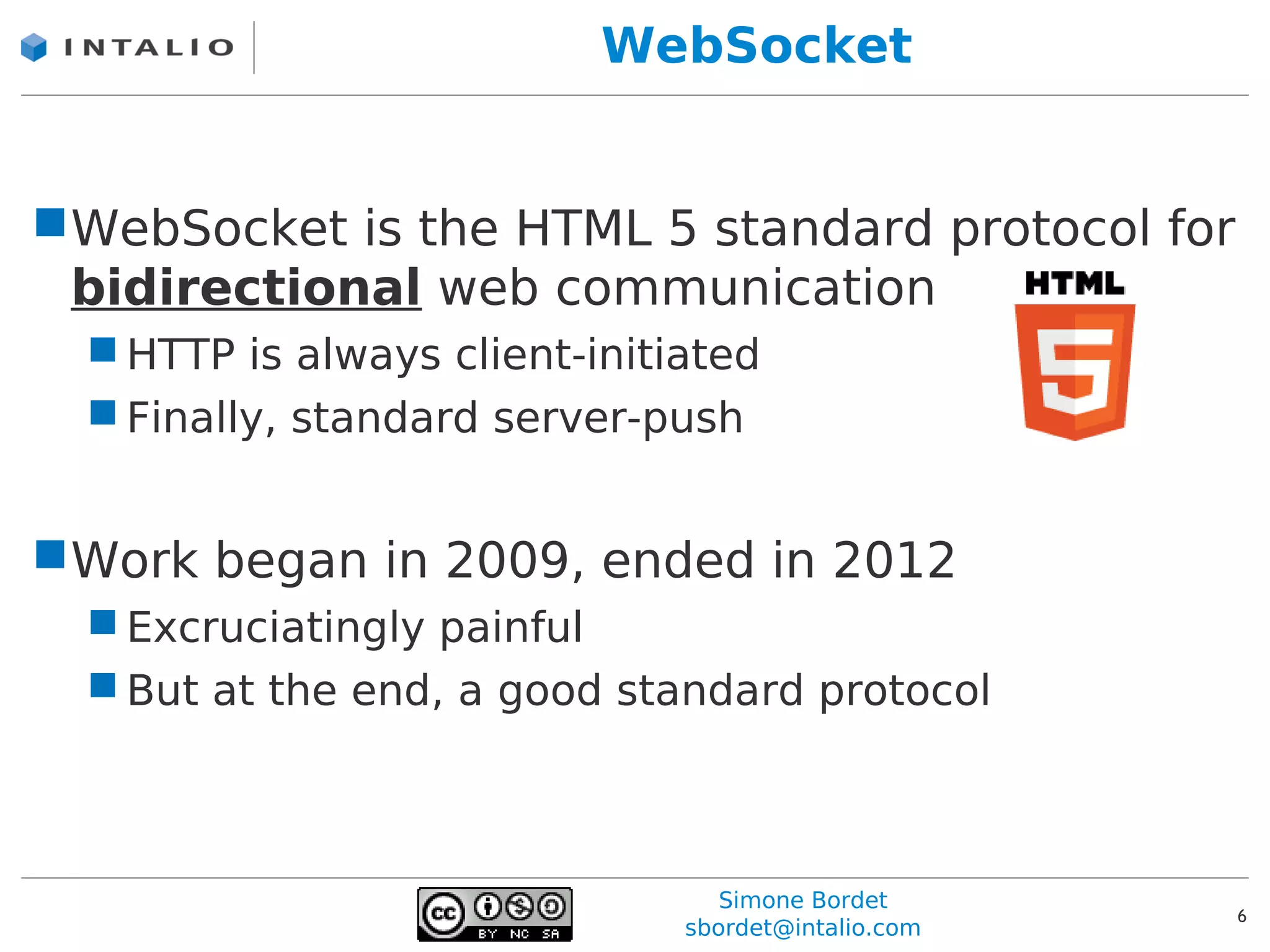
WebSocket is the HTML 5 standard protocol for
 bidirectional web communication
   HTTP is always client-initiated
   Finally, standard server-push


Work began in 2009, ended in 2012
   Excruciatingly painful
   But at the end, a good standard protocol


                                  Simone Bordet
                                                     6
                               sbordet@intalio.com
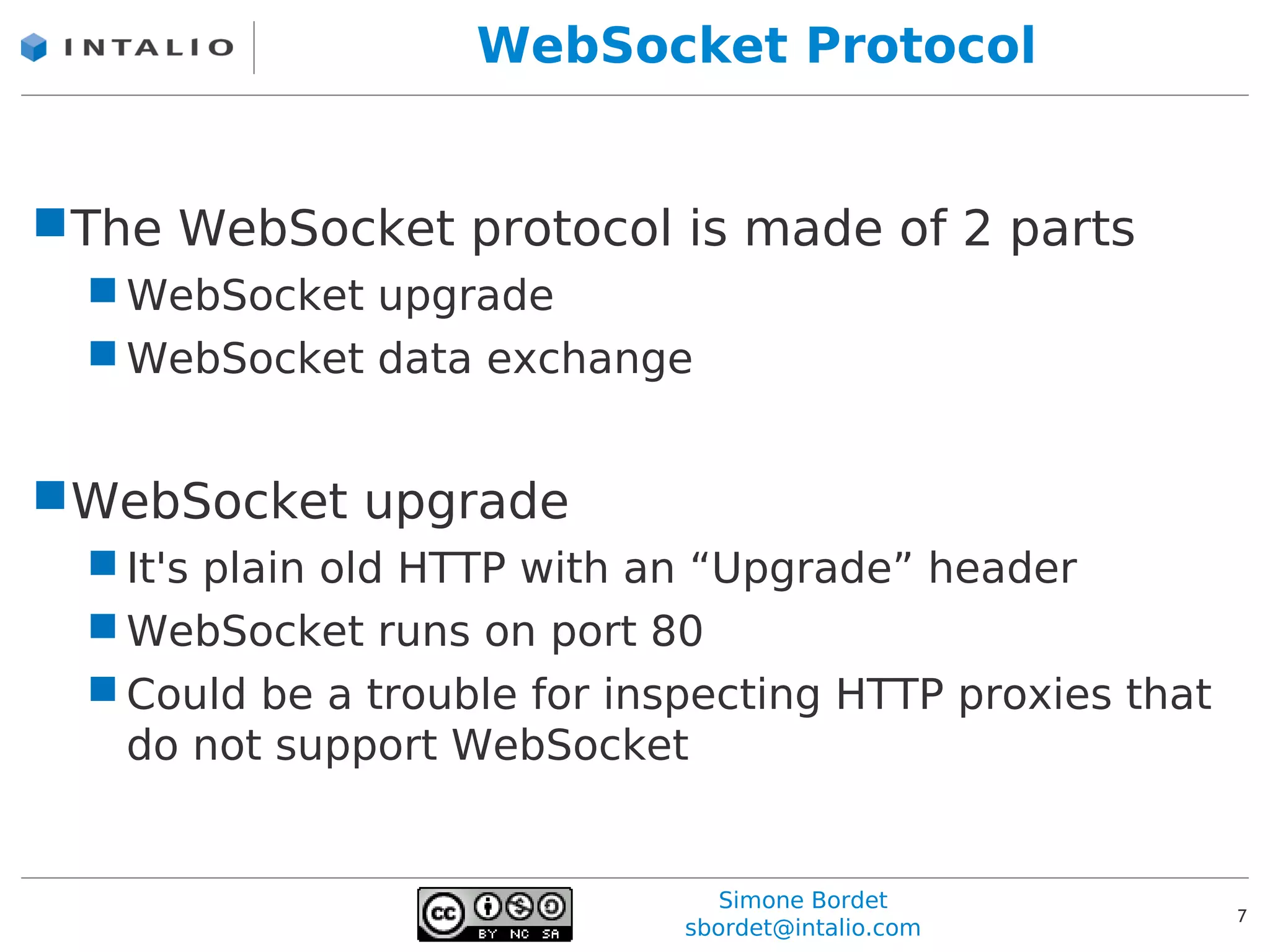
WebSocket Protocol


The WebSocket protocol is made of 2 parts
   WebSocket upgrade
   WebSocket data exchange


WebSocket upgrade
   It's plain old HTTP with an “Upgrade” header
   WebSocket runs on port 80
   Could be a trouble for inspecting HTTP proxies that
    do not support WebSocket


                                 Simone Bordet
                                                          7
                              sbordet@intalio.com
WebSocket Upgrade
REQUEST
GET / HTTP/1.1
Host: localhost:8080
Origin: http://localhost:8080
Connection: Upgrade
Upgrade: websocket
Sec-WebSocket-Key: SbdIETLKHQ1TNBLeZFZS0g==
Sec-WebSocket-Version: 13


RESPONSE
HTTP/1.1 101 Switching Protocols
Connection: Upgrade
Upgrade: websocket
Sec-WebSocket-Accept: y4yXRUolfnFfo3Jc5HFqRHNgx2A=

                                            Simone Bordet
                                                               8
                                         sbordet@intalio.com
WebSocket Protocol

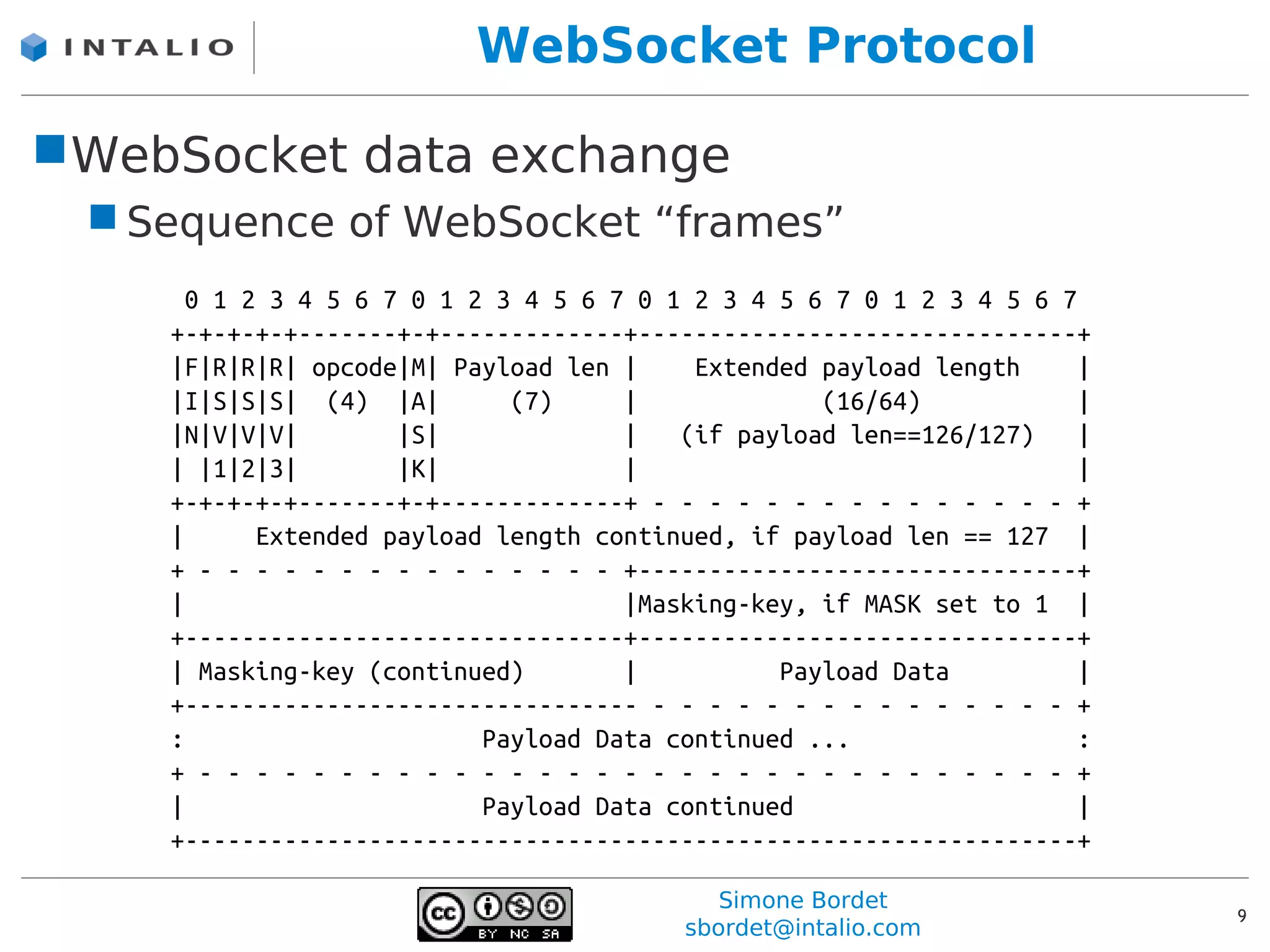
WebSocket data exchange
  Sequence of WebSocket “frames”
      0 1 2 3 4 5 6 7 0 1 2 3 4 5 6 7 0 1 2 3 4 5 6 7 0 1 2 3 4 5 6 7
    +-+-+-+-+-------+-+-------------+-------------------------------+
    |F|R|R|R| opcode|M| Payload len |     Extended payload length     |
    |I|S|S|S| (4) |A|        (7)     |             (16/64)            |
    |N|V|V|V|        |S|             |   (if payload len==126/127)    |
    | |1|2|3|        |K|             |                                |
    +-+-+-+-+-------+-+-------------+ - - - - - - - - - - - - - - - +
    |      Extended payload length continued, if payload len == 127 |
    + - - - - - - - - - - - - - - - +-------------------------------+
    |                                |Masking-key, if MASK set to 1 |
    +-------------------------------+-------------------------------+
    | Masking-key (continued)        |          Payload Data          |
    +-------------------------------- - - - - - - - - - - - - - - - +
    :                      Payload Data continued ...                 :
    + - - - - - - - - - - - - - - - - - - - - - - - - - - - - - - - +
    |                      Payload Data continued                     |
    +---------------------------------------------------------------+

                                            Simone Bordet
                                                                          9
                                         sbordet@intalio.com
WebSocket Protocol

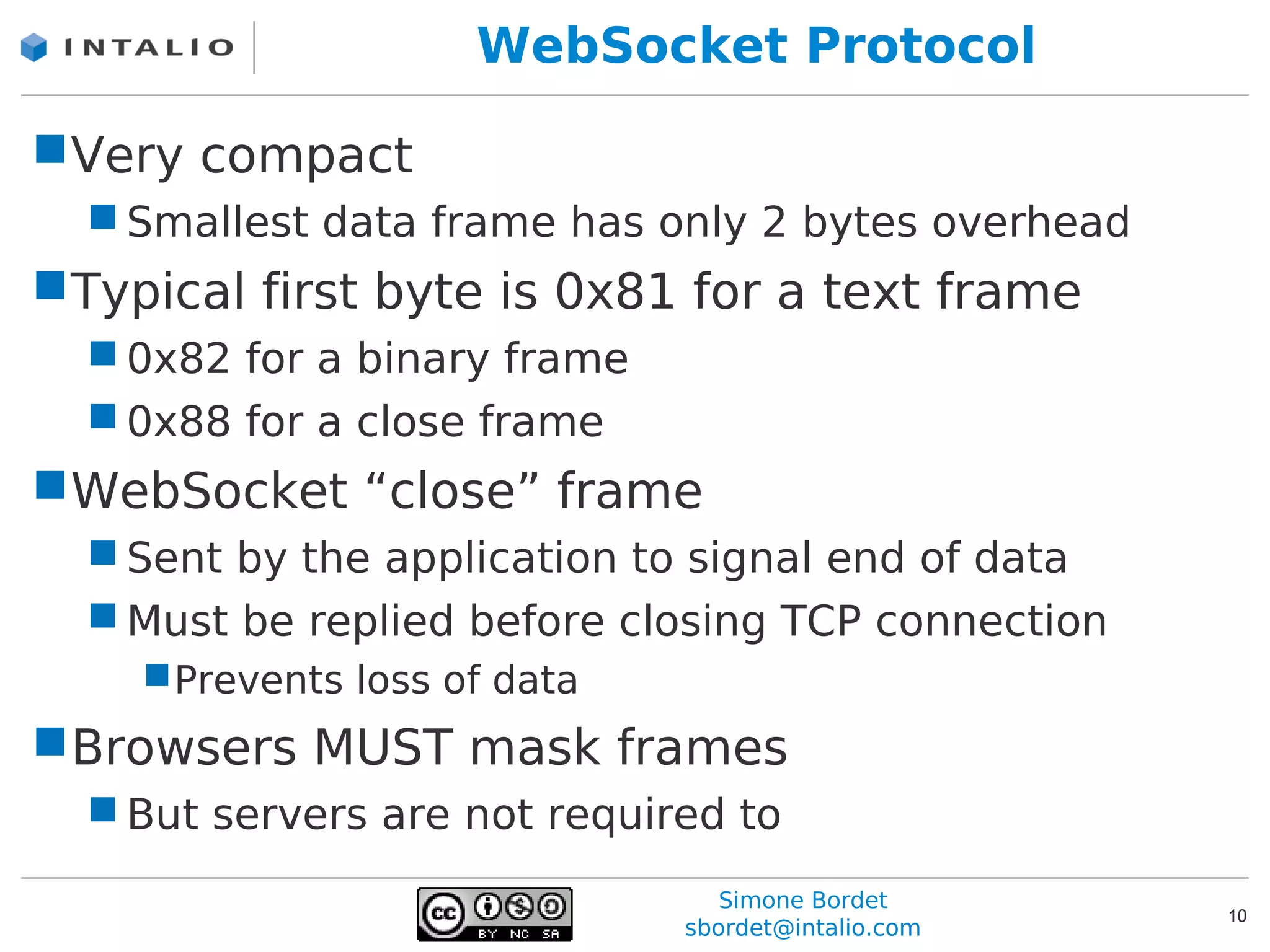
Very compact
   Smallest data frame has only 2 bytes overhead
Typical first byte is 0x81 for a text frame
   0x82 for a binary frame
   0x88 for a close frame
WebSocket “close” frame
   Sent by the application to signal end of data
   Must be replied before closing TCP connection
    Prevents loss of data
Browsers MUST mask frames
   But servers are not required to
                                 Simone Bordet
                                                    10
                              sbordet@intalio.com
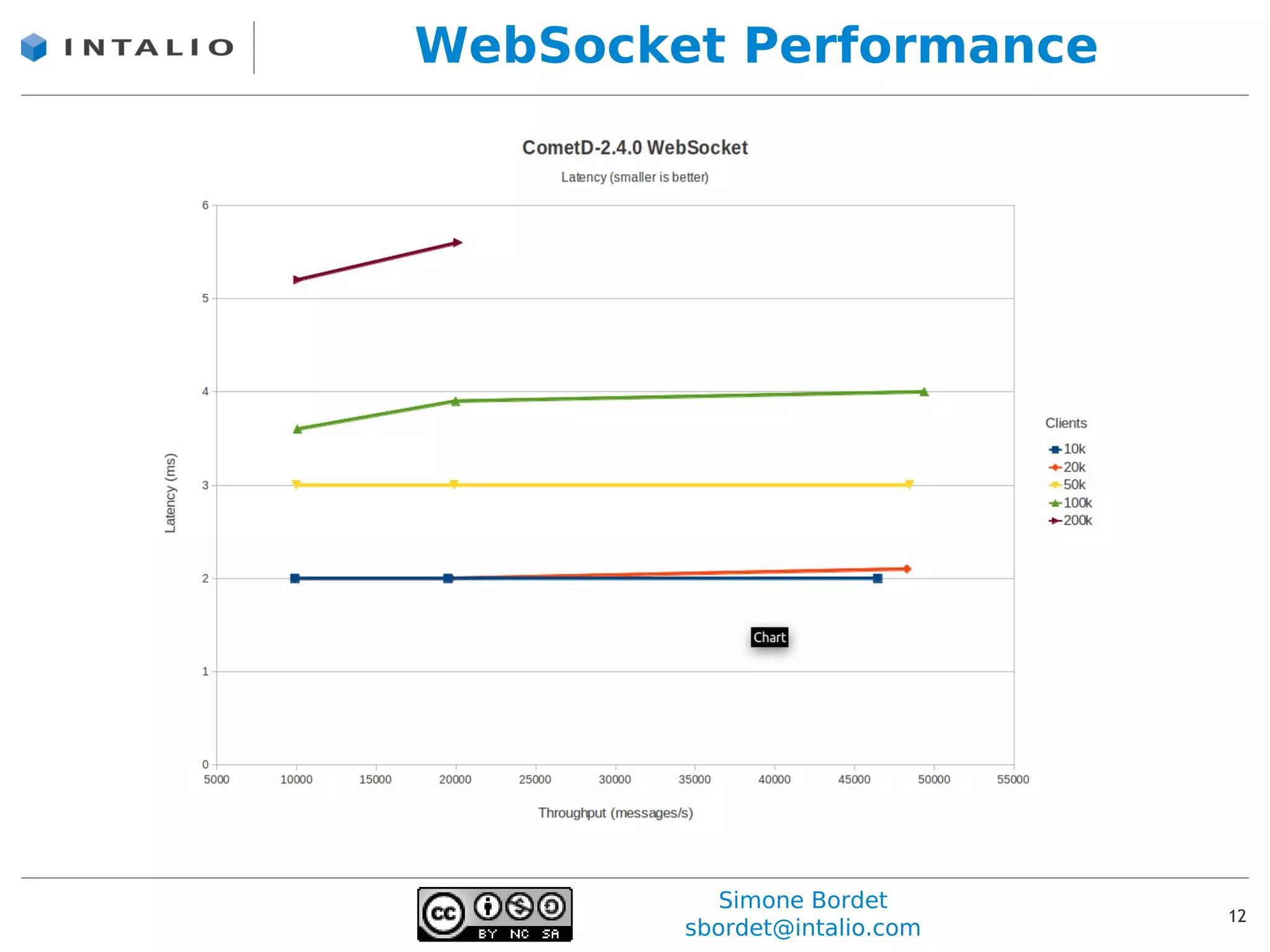
WebSocket Performance


           Simone Bordet
                              11
        sbordet@intalio.com
WebSocket Performance


           Simone Bordet
                              12
        sbordet@intalio.com
WebSocket
Browser API


         Simone Bordet
                            13
      sbordet@intalio.com
WebSocket Browser API
interface WebSocket {
    WebSocket(DOMString url, optional (DOMString or DOMString[]) protocols)]

     attribute   Function?   onopen;
     attribute   Function?   onerror;
     attribute   Function?   onclose;
     attribute   Function?   onmessage;

     void send(DOMString data);
     void close(optional unsigned short code, optional DOMString reason);

     attribute DOMString binaryType; // “blob” or “arraybuffer”
     void send(ArrayBuffer data);
     void send(Blob data);
};


                                              Simone Bordet
                                                                               14
                                           sbordet@intalio.com
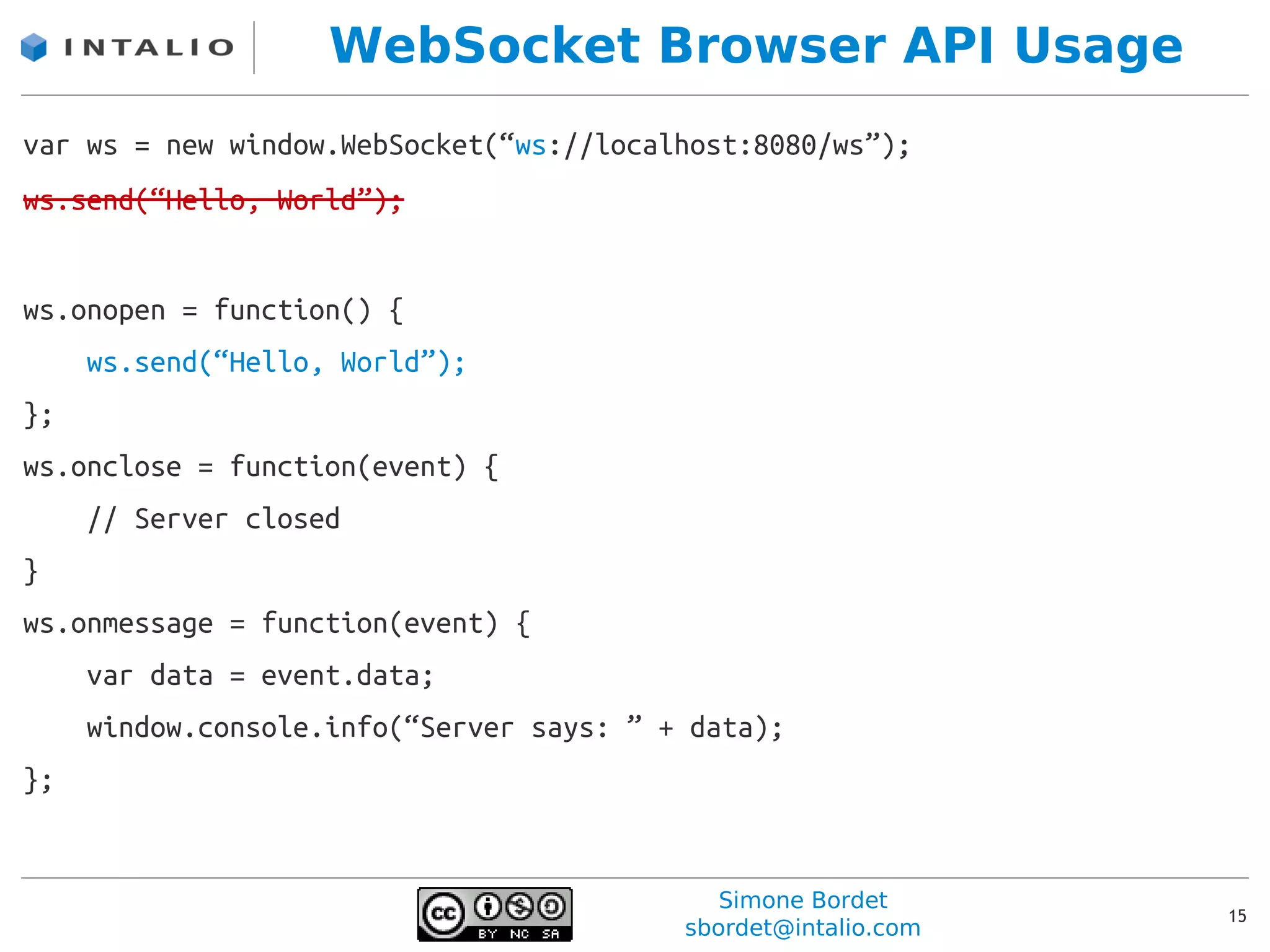
WebSocket Browser API Usage
var ws = new window.WebSocket(“ws://localhost:8080/ws”);
ws.send(“Hello, World”);


ws.onopen = function() {
     ws.send(“Hello, World”);
};
ws.onclose = function(event) {
     // Server closed
}
ws.onmessage = function(event) {
     var data = event.data;
     window.console.info(“Server says: ” + data);
};


                                             Simone Bordet
                                                                15
                                          sbordet@intalio.com
WebSocket
Server API


         Simone Bordet
                            16
      sbordet@intalio.com
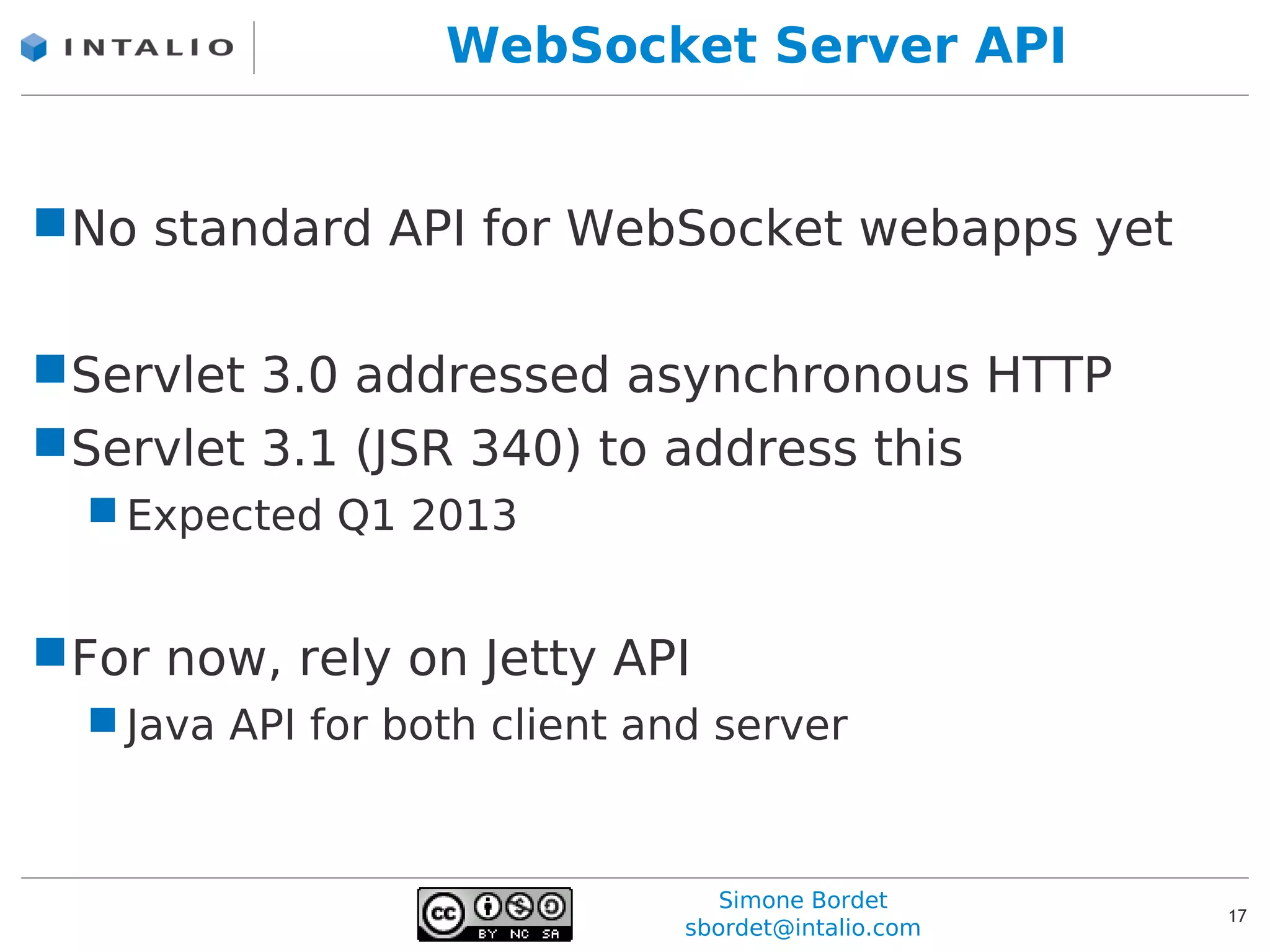
WebSocket Server API


No standard API for WebSocket webapps yet

Servlet 3.0 addressed asynchronous HTTP
Servlet 3.1 (JSR 340) to address this
   Expected Q1 2013


For now, rely on Jetty API
   Java API for both client and server


                                  Simone Bordet
                                                     17
                               sbordet@intalio.com
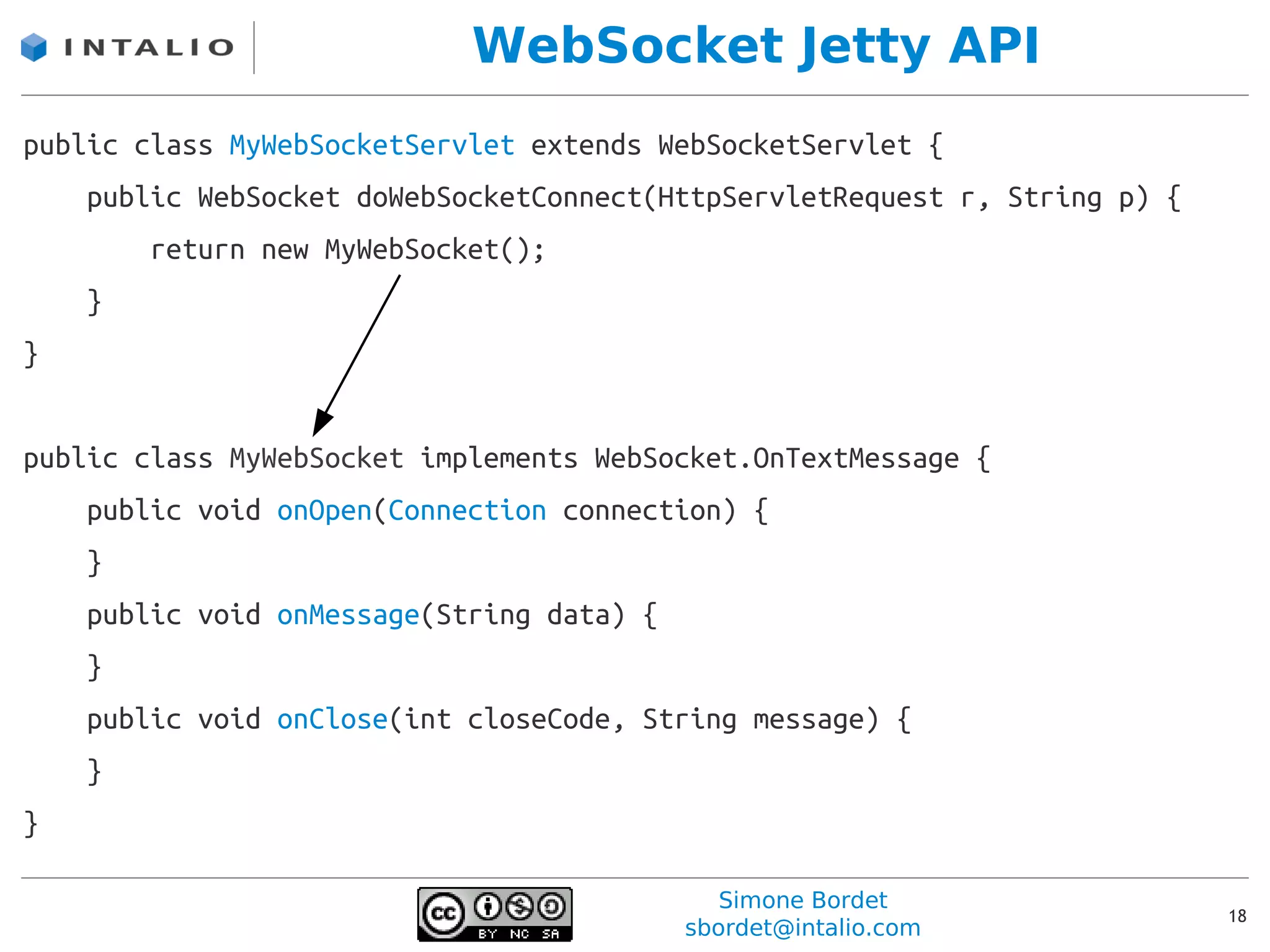
WebSocket Jetty API
public class MyWebSocketServlet extends WebSocketServlet {
    public WebSocket doWebSocketConnect(HttpServletRequest r, String p) {
        return new MyWebSocket();
    }
}


public class MyWebSocket implements WebSocket.OnTextMessage {
    public void onOpen(Connection connection) {
    }
    public void onMessage(String data) {
    }
    public void onClose(int closeCode, String message) {
    }
}

                                              Simone Bordet
                                                                            18
                                           sbordet@intalio.com
Simone Bordet
                      19
sbordet@intalio.com
Conclusions


WebSocket programming is easy !

However, may not be widely deployed
   Old browsers
   Old internet proxies


WebSocket is low-level
   A framework on top gives much more productivity
   CometD

                                 Simone Bordet
                                                      20
                              sbordet@intalio.com
References

WebSocket Protocol
   http://www.ietf.org/rfc/rfc6455.txt
JSR 340 (Servlet 3.1)
   http://jcp.org/en/jsr/detail?id=340
WebSocket API
   http://dev.w3.org/html5/websockets/
Jetty
   http://eclipse.org/jetty
CometD
   http://cometd.org


                                    Simone Bordet
                                                       21
                                 sbordet@intalio.com
Questions
    &
 Answers


        Simone Bordet
                           22
     sbordet@intalio.com

Realizzare applicazioni Web con WebSocket, by Simone Bordet

  • 1.
    Simone Bordet 1 sbordet@intalio.com
  • 2.
    How to Build WebSocket Web Applications Simone Bordet 2 sbordet@intalio.com
  • 3.
    Simone Bordet Senior Engineer/Architectat Intalio/Webtide  Support for Jetty and CometD open source projects Open Source Contributor  Jetty, CometD, MX4J, Foxtrot, LiveTribe, JBoss, Larex JVM tuning expert Working on Web Network Protocols  HTTP, WebSocket, SPDY, etc. Simone Bordet 3 sbordet@intalio.com
  • 4.
    Agenda What is WebSocket WebSocketBrowser API WebSocket Server API Demo Q&A Simone Bordet 4 sbordet@intalio.com
  • 5.
    What is WebSocket? Simone Bordet 5 sbordet@intalio.com
  • 6.
    WebSocket WebSocket is theHTML 5 standard protocol for bidirectional web communication  HTTP is always client-initiated  Finally, standard server-push Work began in 2009, ended in 2012  Excruciatingly painful  But at the end, a good standard protocol Simone Bordet 6 sbordet@intalio.com
  • 7.
    WebSocket Protocol The WebSocketprotocol is made of 2 parts  WebSocket upgrade  WebSocket data exchange WebSocket upgrade  It's plain old HTTP with an “Upgrade” header  WebSocket runs on port 80  Could be a trouble for inspecting HTTP proxies that do not support WebSocket Simone Bordet 7 sbordet@intalio.com
  • 8.
    WebSocket Upgrade REQUEST GET /HTTP/1.1 Host: localhost:8080 Origin: http://localhost:8080 Connection: Upgrade Upgrade: websocket Sec-WebSocket-Key: SbdIETLKHQ1TNBLeZFZS0g== Sec-WebSocket-Version: 13 RESPONSE HTTP/1.1 101 Switching Protocols Connection: Upgrade Upgrade: websocket Sec-WebSocket-Accept: y4yXRUolfnFfo3Jc5HFqRHNgx2A= Simone Bordet 8 sbordet@intalio.com
  • 9.
    WebSocket Protocol WebSocket dataexchange  Sequence of WebSocket “frames” 0 1 2 3 4 5 6 7 0 1 2 3 4 5 6 7 0 1 2 3 4 5 6 7 0 1 2 3 4 5 6 7 +-+-+-+-+-------+-+-------------+-------------------------------+ |F|R|R|R| opcode|M| Payload len | Extended payload length | |I|S|S|S| (4) |A| (7) | (16/64) | |N|V|V|V| |S| | (if payload len==126/127) | | |1|2|3| |K| | | +-+-+-+-+-------+-+-------------+ - - - - - - - - - - - - - - - + | Extended payload length continued, if payload len == 127 | + - - - - - - - - - - - - - - - +-------------------------------+ | |Masking-key, if MASK set to 1 | +-------------------------------+-------------------------------+ | Masking-key (continued) | Payload Data | +-------------------------------- - - - - - - - - - - - - - - - + : Payload Data continued ... : + - - - - - - - - - - - - - - - - - - - - - - - - - - - - - - - + | Payload Data continued | +---------------------------------------------------------------+ Simone Bordet 9 sbordet@intalio.com
  • 10.
    WebSocket Protocol Very compact  Smallest data frame has only 2 bytes overhead Typical first byte is 0x81 for a text frame  0x82 for a binary frame  0x88 for a close frame WebSocket “close” frame  Sent by the application to signal end of data  Must be replied before closing TCP connection Prevents loss of data Browsers MUST mask frames  But servers are not required to Simone Bordet 10 sbordet@intalio.com
  • 11.
    WebSocket Performance Simone Bordet 11 sbordet@intalio.com
  • 12.
    WebSocket Performance Simone Bordet 12 sbordet@intalio.com
  • 13.
    WebSocket Browser API Simone Bordet 13 sbordet@intalio.com
  • 14.
    WebSocket Browser API interfaceWebSocket { WebSocket(DOMString url, optional (DOMString or DOMString[]) protocols)] attribute Function? onopen; attribute Function? onerror; attribute Function? onclose; attribute Function? onmessage; void send(DOMString data); void close(optional unsigned short code, optional DOMString reason); attribute DOMString binaryType; // “blob” or “arraybuffer” void send(ArrayBuffer data); void send(Blob data); }; Simone Bordet 14 sbordet@intalio.com
  • 15.
    WebSocket Browser APIUsage var ws = new window.WebSocket(“ws://localhost:8080/ws”); ws.send(“Hello, World”); ws.onopen = function() { ws.send(“Hello, World”); }; ws.onclose = function(event) { // Server closed } ws.onmessage = function(event) { var data = event.data; window.console.info(“Server says: ” + data); }; Simone Bordet 15 sbordet@intalio.com
  • 16.
    WebSocket Server API Simone Bordet 16 sbordet@intalio.com
  • 17.
    WebSocket Server API Nostandard API for WebSocket webapps yet Servlet 3.0 addressed asynchronous HTTP Servlet 3.1 (JSR 340) to address this  Expected Q1 2013 For now, rely on Jetty API  Java API for both client and server Simone Bordet 17 sbordet@intalio.com
  • 18.
    WebSocket Jetty API publicclass MyWebSocketServlet extends WebSocketServlet { public WebSocket doWebSocketConnect(HttpServletRequest r, String p) { return new MyWebSocket(); } } public class MyWebSocket implements WebSocket.OnTextMessage { public void onOpen(Connection connection) { } public void onMessage(String data) { } public void onClose(int closeCode, String message) { } } Simone Bordet 18 sbordet@intalio.com
  • 19.
    Simone Bordet 19 sbordet@intalio.com
  • 20.
    Conclusions WebSocket programming iseasy ! However, may not be widely deployed  Old browsers  Old internet proxies WebSocket is low-level  A framework on top gives much more productivity  CometD Simone Bordet 20 sbordet@intalio.com
  • 21.
    References WebSocket Protocol  http://www.ietf.org/rfc/rfc6455.txt JSR 340 (Servlet 3.1)  http://jcp.org/en/jsr/detail?id=340 WebSocket API  http://dev.w3.org/html5/websockets/ Jetty  http://eclipse.org/jetty CometD  http://cometd.org Simone Bordet 21 sbordet@intalio.com
  • 22.
    Questions & Answers Simone Bordet 22 sbordet@intalio.com