WebSockets: Revolutionizing
Real-Time Communication
WebSocketsare transforming web communication. They replace
traditional HTTP with stateful, full-duplex connections. This
revolutionizes real-time data transfer on the web, enabling faster and
more interactive applications.
2.
HTTP vs. WebSockets:A Comparative Analysis
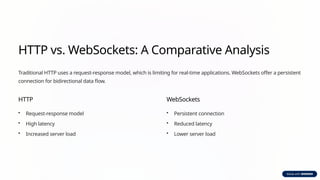
Traditional HTTP uses a request-response model, which is limiting for real-time applications. WebSockets offer a persistent
connection for bidirectional data flow.
HTTP
• Request-response model
• High latency
• Increased server load
WebSockets
• Persistent connection
• Reduced latency
• Lower server load
3.
The WebSocket Protocol:
Underthe Hood
WebSockets use an upgrade handshake to establish a connection.
Framing protocol, opcode definitions, and masking are key
components.
1 Handshake
Upgrades HTTP to
WebSocket
2 Framing
Manages data transfer
3 Security
WSS uses TLS encryption
4.
Advantages of Using
WebSockets
WebSocketsprovide real-time, bidirectional communication. They
reduce server load and bandwidth consumption. Latency is improved,
leading to more responsive apps.
Real-Time Efficient Responsive
5.
Common Use Casesfor WebSockets
WebSockets are ideal for real-time dashboards and analytics. They power online gaming and chat applications.
Dashboards
Live data visualization
Gaming
Multiplayer interaction
Chat
Instant messaging
6.
WebSocket APIs andFrameworks
Many WebSocket libraries and frameworks are available. JavaScript has
Socket.IO, ws, and SockJS. Python offers Autobahn and Tornado. Java provides
Jetty and Netty.
1 JavaScript
Socket.IO, ws, SockJS
2 Python
Autobahn, Tornado
3 Java
Jetty, Netty
7.
Implementing WebSockets: PracticalExample
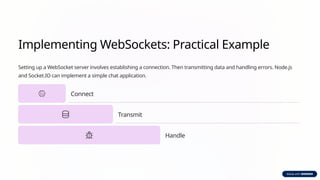
Setting up a WebSocket server involves establishing a connection. Then transmitting data and handling errors. Node.js
and Socket.IO can implement a simple chat application.
Connect
Transmit
Handle
8.
Security Considerations forWebSockets
Protect against Cross-Site WebSocket Hijacking (CSWSH) attacks. Validate input to prevent injection vulnerabilities. Authentication and authorisation are essential. Use TLS encryption (WSS).
CSWSH
Validate
Auth
TLS
9.
Scaling WebSockets: Challengesand Solutions
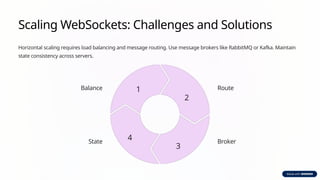
Horizontal scaling requires load balancing and message routing. Use message brokers like RabbitMQ or Kafka. Maintain
state consistency across servers.
Balance 1 Route
2
Broker
3
State
4
10.
Future Trends inWebSockets
Technology
WebSockets will integrate with WebAssembly and QUIC. Advancements in
security and performance are coming. WebSockets are crucial for real-time
applications and IoT.
IoT
Devices
Real-time data streaming
QUIC
Protocol
Improved transport
WASM
WebAssembly
Enhanced performance









![5G Explained! A High Level Overview [Introduction]](https://cdn.slidesharecdn.com/ss_thumbnails/5gexplainedahighleveloverview-260119165306-cc137a3e-thumbnail.jpg?width=640&height=640&fit=bounds)


