Jetty Continuation

작성자: 이상민


문서범위 (일반)


                     ⓒ 2010 NHN CORPORATION
목차


1. Current WAS
2. Jetty Continuation
3. Jetty Continuation sample & demo

4. Servlet 3.0
1. Current WAS
(Based on Servlet spec. 2.5)
1.1 Thread Pool


     • Whenever we request, WAS always doesn’t
      make new thread.
       It uses Thread Pool.

     • It’s not easy to set suitable Thread Pool size.

     • Thread per connection
          • The traditional IO model of java associates a thread with
          every TCP/IP connection.


                                                                 4 / Jetty Continuation
1.2 Synchronous


     • Almost all web requests are handled
      synchronously.

     • Asynchronous request handling on WAS is
      not easy.


                                             5 / Jetty Continuation
1.3 AJAX polling problem


     • AJAX servers cannot deliver asynchronous
      events to the client, the AJAX client must
      poll for events on the server.
          • To avoid a busy polling loop, AJAX servers will often hold
            onto a poll request until either there is an event or a
            timeout occurs.


     • The server again needs to have one or
      more threads for every client.
        http://docs.codehaus.org/display/JETTY/Continuations


                                                                 6 / Jetty Continuation
2. Jetty Continuation


                        7 / Jetty Continuation
2.1.1 What is Jetty


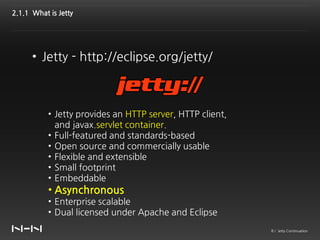
      • Jetty - http://eclipse.org/jetty/


           • Jetty provides an HTTP server, HTTP client,
             and javax.servlet container.
           • Full-featured and standards-based
           • Open source and commercially usable
           • Flexible and extensible
           • Small footprint
           • Embeddable
           • Asynchronous
           • Enterprise scalable
           • Dual licensed under Apache and Eclipse
                                                           8 / Jetty Continuation
2.1.2 Asynchronous Servlet


     • Asynchronous Servlets
          • Not Asynchronous IO
               • Asynchronous Servlets are different with
                 Asynchronous IO or the use of NIO


          • Asynchronous Waiting
               • waiting for a resource to be available before
                 processing the request
               • waiting for an application event in an AJAX Comet
                 application
               • waiting for a response from a remote service
                                                                 9 / Jetty Continuation
2.1.3 Continuation


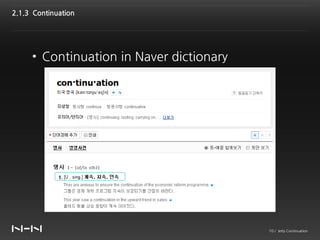
     • Continuation in Naver dictionary


                                          10 / Jetty Continuation
2.1.3 Continuation


     • Continuation in Jetty
          • A continuation is a mechanism by which a HTTP Request

            can be suspended and restarted after a timeout or an
            asynchronous event has occurred.


                                                            11 / Jetty Continuation
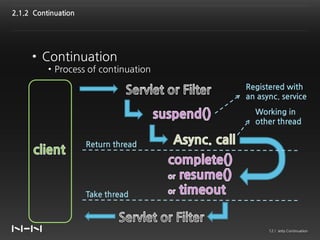
2.1.2 Continuation


     • Continuation
          • Process of continuation
                                      Registered with
                                      an async. service
                                        Working in
                                        other thread

                     Return thread


                     Take thread


                                            12 / Jetty Continuation
2.2.1 Thread Pool with Continuation


     • You also should use Thread Pool when you
      use Continuation

     • But you can manage WAS with a fewer
      Thread.


                                             13 / Jetty Continuation
2.2.2 Use Asynchronous call with Continuation


     • You must use “Asynchronous call” to use
      Continuation

     • One thread can run much request at a time.


                                                14 / Jetty Continuation
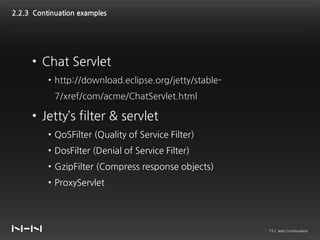
2.2.3 Continuation examples


     • Chat Servlet
          • http://download.eclipse.org/jetty/stable-
            7/xref/com/acme/ChatServlet.html

     • Jetty’s filter & servlet
          • QoSFilter (Quality of Service Filter)
          • DosFilter (Denial of Service Filter)
          • GzipFilter (Compress response objects)
          • ProxyServlet


                                                        15 / Jetty Continuation
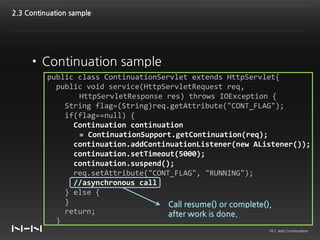
2.3 Continuation sample


     • Continuation sample
          public class ContinuationServlet extends HttpServlet{
            public void service(HttpServletRequest req,
                 HttpServletResponse res) throws IOException {
              String flag=(String)req.getAttribute("CONT_FLAG");
              if(flag==null) {
                Continuation continuation
                 = ContinuationSupport.getContinuation(req);
                continuation.addContinuationListener(new AListener());
                continuation.setTimeout(5000);
                continuation.suspend();
                req.setAttribute("CONT_FLAG", "RUNNING");
                //asynchronous call
              } else {
              }                       Call resume() or complete(),
              return;                 after work is done.
            }
                                                            16 / Jetty Continuation
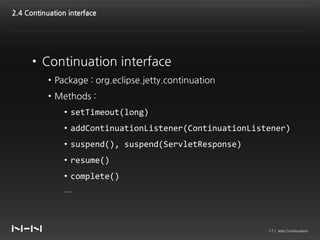
2.4 Continuation interface


      • Continuation interface
           • Package : org.eclipse.jetty.continuation
           • Methods :
                • setTimeout(long)
                • addContinuationListener(ContinuationListener)
                • suspend(), suspend(ServletResponse)
                • resume()
                • complete()
                …


                                                          17 / Jetty Continuation
2.4 Continuation interface


      • Continuation interface
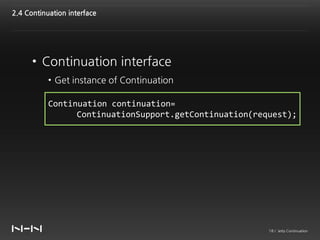
           • Get instance of Continuation

           Continuation continuation=
                 ContinuationSupport.getContinuation(request);


                                                        18 / Jetty Continuation
2.5.1 Continuation.setTimeout (long)


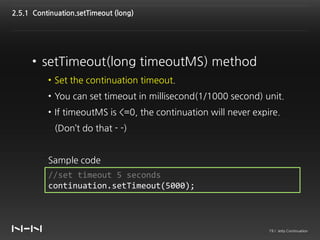
     • setTimeout(long timeoutMS) method
          • Set the continuation timeout.
          • You can set timeout in millisecond(1/1000 second) unit.
          • If timeoutMS is <=0, the continuation will never expire.
            (Don’t do that - -)


          Sample code
          //set timeout 5 seconds
          continuation.setTimeout(5000);


                                                                 19 / Jetty Continuation
2.5.2.1 Continuation. addContinuationListener(ContinuationListener )


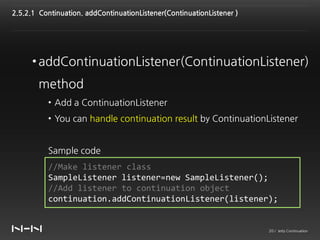
      • addContinuationListener(ContinuationListener)
       method
          • Add a ContinuationListener
          • You can handle continuation result by ContinuationListener


          Sample code
          //Make listener class
          SampleListener listener=new SampleListener();
          //Add listener to continuation object
          continuation.addContinuationListener(listener);


                                                                       20 / Jetty Continuation
2.5.2.2 How can I make ContinuationListener?


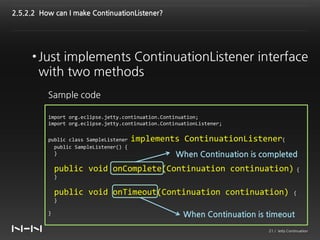
     • Just implements ContinuationListener interface
       with two methods
          Sample code

          import org.eclipse.jetty.continuation.Continuation;
          import org.eclipse.jetty.continuation.ContinuationListener;


          public class SampleListener   implements ContinuationListener{
            public SampleListener() {
            }                                        When Continuation is completed
              public void onComplete(Continuation continuation)                             {
              }


              public void onTimeout(Continuation continuation)                            {
              }

          }                                            When Continuation is timeout
                                                                            21 / Jetty Continuation
2.5.3 Continuation.suspend()


     • suspend() & suspend(ServletResponse)
      method
          • Suspend the processing of the request and
            associated ServletResponse.

          • After this method has been called, the lifecycle of the
            request will be extended beyond the return to the container
            from
               • Servlet.service(ServletRequest, ServletResponse)
               • Filter.doFilter(ServletRequest, ServletResponse,
                 FilterChain) calls.


                                                               22 / Jetty Continuation
2.5.3 Continuation.suspend()


     • suspend() & suspend(ServletResponse)
      method
          • The thread is freed for other tasks and the request is held
            until
              • a call to resume().
              • a call to complete().
              • the timeout expires.

          Sample code

          continuation.suspend();

          or

          continuation.suspend(response);
                                                                 23 / Jetty Continuation
2.5.4 Continuation.resume()


     • resume() method
          • Resume a suspended request.
          • The request is redispatched to the normal filter chain and
            servlet processing with isInitial() false.
          • Typically resume() is used after a call to suspend() with no
            arguments.


                                                                  24 / Jetty Continuation
2.5.5 Continuation.complete()


     • complete() method
          • Complete a suspended request.
          • The associated response object committed and flushed.
            The request is not redispatched.
          • Typically complete() is used after a call
            to suspend(ServletResponse) with a possibly wrapped
            response.


                                                             25 / Jetty Continuation
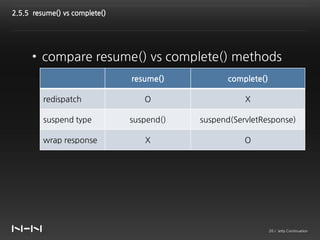
2.5.5 resume() vs complete()


      • compare resume() vs complete() methods
                               resume()          complete()

         redispatch               O                   X

         suspend type          suspend()   suspend(ServletResponse)

         wrap response            X                   O


                                                              26 / Jetty Continuation
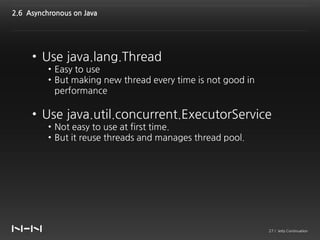
2.6 Asynchronous on Java


     • Use java.lang.Thread
          • Easy to use
          • But making new thread every time is not good in
            performance

     • Use java.util.concurrent.ExecutorService
          • Not easy to use at first time.
          • But it reuse threads and manages thread pool.


                                                              27 / Jetty Continuation
2.6 Asynchronous on Java


     • Thread sample
     package com.cont.sample.async;

     public class ThreadSample extends Thread {
       public static void main(String args[]) {
         ThreadSample sample=new ThreadSample();
         System.out.println("Before start sample.");   Before start sample.
         sample.start();                               After start sample.
         System.out.println("After start sample.");    Run method called
       }
       public void run() {
         System.out.println("Run method called");
       }
     }


                                                                  28 / Jetty Continuation
2.6 Asynchronous on Java


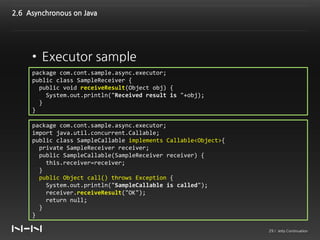
     • Executor sample
     package com.cont.sample.async.executor;
     public class SampleReceiver {
       public void receiveResult(Object obj) {
         System.out.println("Received result is "+obj);
       }
     }

     package com.cont.sample.async.executor;
     import java.util.concurrent.Callable;
     public class SampleCallable implements Callable<Object>{
       private SampleReceiver receiver;
       public SampleCallable(SampleReceiver receiver) {
         this.receiver=receiver;
       }
       public Object call() throws Exception {
         System.out.println("SampleCallable is called");
         receiver.receiveResult("OK");
         return null;
       }
     }

                                                                29 / Jetty Continuation
2.6 Asynchronous on Java


     • Executor sample – execute
     package com.cont.sample.async.executor;
     import java.util.concurrent.ExecutorService;
     import java.util.concurrent.Executors;
     public class ExecutorMain {
       public static void main(String[] args) {
         ExecutorService service=
              Executors.newCachedThreadPool();
                                                    Before submit
                                                    After submit
             SampleReceiver receiver=
                                                    SampleCallable is called
                  new SampleReceiver();
                                                    Received result is OK
             SampleCallable callable=
                  new SampleCallable(receiver);
             System.out.println("Before submit");
             service.submit(callable);
             System.out.println("After submit");
         }
     }


                                                                 30 / Jetty Continuation
3. Jetty Continuation sample & demo


                              31 / Jetty Continuation
3.1 Common Servlet


     • Common Servlet Sample
     • Continuation timeout sample
     • Continuation resume() sample
     • Continuation complete() sample


                                        32 / Jetty Continuation
4. Servlet 3.0


                 33 / Jetty Continuation
4.1 Servlet 3.0


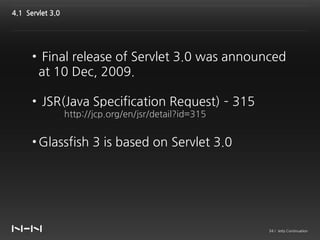
      • Final release of Servlet 3.0 was announced
       at 10 Dec, 2009.

      • JSR(Java Specification Request) – 315
                  http://jcp.org/en/jsr/detail?id=315


      • Glassfish 3 is based on Servlet 3.0


                                                        34 / Jetty Continuation
4.2 Servlet 3.0 new features


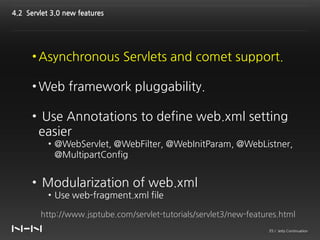
      • Asynchronous Servlets and comet support.

      • Web framework pluggability.

      • Use Annotations to define web.xml setting
       easier
           • @WebServlet, @WebFilter, @WebInitParam, @WebListner,
             @MultipartConfig


      • Modularization of web.xml
           • Use web-fragment.xml file

        http://www.jsptube.com/servlet-tutorials/servlet3/new-features.html
                                                                    35 / Jetty Continuation
4.3 AsyncContext


     • AsyncContext interface
         • Package : javax.servlet
         • Class representing the execution context for an
           asynchronous operation that was initiated on a
           ServletRequest.
         • Methods :
              • setTimeout(long)
              • addListener(AsyncListener)
              • complete()
              …

                                                             36 / Jetty Continuation
4.4 ServletRequest


     • ServletRequest interface
          • Package : javax.servlet
          • Added Methods :
               • startAsync()
               • startAsync(ServletRequest , ServletResponse )
               …


                                                         37 / Jetty Continuation
5. Conclusion


                38 / Jetty Continuation
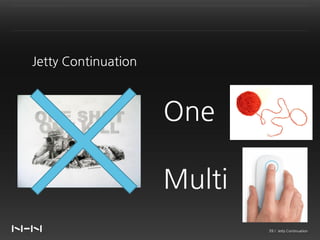
Jetty Continuation


                     One

                     Multi
                             39 / Jetty Continuation
Thank you.

Jetty Continuation - 이상민

  • 1.
  • 2.
    목차 1. Current WAS 2.Jetty Continuation 3. Jetty Continuation sample & demo 4. Servlet 3.0
  • 3.
    1. Current WAS (Basedon Servlet spec. 2.5)
  • 4.
    1.1 Thread Pool • Whenever we request, WAS always doesn’t make new thread.  It uses Thread Pool. • It’s not easy to set suitable Thread Pool size. • Thread per connection • The traditional IO model of java associates a thread with every TCP/IP connection. 4 / Jetty Continuation
  • 5.
    1.2 Synchronous • Almost all web requests are handled synchronously. • Asynchronous request handling on WAS is not easy. 5 / Jetty Continuation
  • 6.
    1.3 AJAX pollingproblem • AJAX servers cannot deliver asynchronous events to the client, the AJAX client must poll for events on the server. • To avoid a busy polling loop, AJAX servers will often hold onto a poll request until either there is an event or a timeout occurs. • The server again needs to have one or more threads for every client. http://docs.codehaus.org/display/JETTY/Continuations 6 / Jetty Continuation
  • 7.
    2. Jetty Continuation 7 / Jetty Continuation
  • 8.
    2.1.1 What isJetty • Jetty - http://eclipse.org/jetty/ • Jetty provides an HTTP server, HTTP client, and javax.servlet container. • Full-featured and standards-based • Open source and commercially usable • Flexible and extensible • Small footprint • Embeddable • Asynchronous • Enterprise scalable • Dual licensed under Apache and Eclipse 8 / Jetty Continuation
  • 9.
    2.1.2 Asynchronous Servlet • Asynchronous Servlets • Not Asynchronous IO • Asynchronous Servlets are different with Asynchronous IO or the use of NIO • Asynchronous Waiting • waiting for a resource to be available before processing the request • waiting for an application event in an AJAX Comet application • waiting for a response from a remote service 9 / Jetty Continuation
  • 10.
    2.1.3 Continuation • Continuation in Naver dictionary 10 / Jetty Continuation
  • 11.
    2.1.3 Continuation • Continuation in Jetty • A continuation is a mechanism by which a HTTP Request can be suspended and restarted after a timeout or an asynchronous event has occurred. 11 / Jetty Continuation
  • 12.
    2.1.2 Continuation • Continuation • Process of continuation Registered with an async. service Working in other thread Return thread Take thread 12 / Jetty Continuation
  • 13.
    2.2.1 Thread Poolwith Continuation • You also should use Thread Pool when you use Continuation • But you can manage WAS with a fewer Thread. 13 / Jetty Continuation
  • 14.
    2.2.2 Use Asynchronouscall with Continuation • You must use “Asynchronous call” to use Continuation • One thread can run much request at a time. 14 / Jetty Continuation
  • 15.
    2.2.3 Continuation examples • Chat Servlet • http://download.eclipse.org/jetty/stable- 7/xref/com/acme/ChatServlet.html • Jetty’s filter & servlet • QoSFilter (Quality of Service Filter) • DosFilter (Denial of Service Filter) • GzipFilter (Compress response objects) • ProxyServlet 15 / Jetty Continuation
  • 16.
    2.3 Continuation sample • Continuation sample public class ContinuationServlet extends HttpServlet{ public void service(HttpServletRequest req, HttpServletResponse res) throws IOException { String flag=(String)req.getAttribute("CONT_FLAG"); if(flag==null) { Continuation continuation = ContinuationSupport.getContinuation(req); continuation.addContinuationListener(new AListener()); continuation.setTimeout(5000); continuation.suspend(); req.setAttribute("CONT_FLAG", "RUNNING"); //asynchronous call } else { } Call resume() or complete(), return; after work is done. } 16 / Jetty Continuation
  • 17.
    2.4 Continuation interface • Continuation interface • Package : org.eclipse.jetty.continuation • Methods : • setTimeout(long) • addContinuationListener(ContinuationListener) • suspend(), suspend(ServletResponse) • resume() • complete() … 17 / Jetty Continuation
  • 18.
    2.4 Continuation interface • Continuation interface • Get instance of Continuation Continuation continuation= ContinuationSupport.getContinuation(request); 18 / Jetty Continuation
  • 19.
    2.5.1 Continuation.setTimeout (long) • setTimeout(long timeoutMS) method • Set the continuation timeout. • You can set timeout in millisecond(1/1000 second) unit. • If timeoutMS is <=0, the continuation will never expire. (Don’t do that - -) Sample code //set timeout 5 seconds continuation.setTimeout(5000); 19 / Jetty Continuation
  • 20.
    2.5.2.1 Continuation. addContinuationListener(ContinuationListener) • addContinuationListener(ContinuationListener) method • Add a ContinuationListener • You can handle continuation result by ContinuationListener Sample code //Make listener class SampleListener listener=new SampleListener(); //Add listener to continuation object continuation.addContinuationListener(listener); 20 / Jetty Continuation
  • 21.
    2.5.2.2 How canI make ContinuationListener? • Just implements ContinuationListener interface with two methods Sample code import org.eclipse.jetty.continuation.Continuation; import org.eclipse.jetty.continuation.ContinuationListener; public class SampleListener implements ContinuationListener{ public SampleListener() { } When Continuation is completed public void onComplete(Continuation continuation) { } public void onTimeout(Continuation continuation) { } } When Continuation is timeout 21 / Jetty Continuation
  • 22.
    2.5.3 Continuation.suspend() • suspend() & suspend(ServletResponse) method • Suspend the processing of the request and associated ServletResponse. • After this method has been called, the lifecycle of the request will be extended beyond the return to the container from • Servlet.service(ServletRequest, ServletResponse) • Filter.doFilter(ServletRequest, ServletResponse, FilterChain) calls. 22 / Jetty Continuation
  • 23.
    2.5.3 Continuation.suspend() • suspend() & suspend(ServletResponse) method • The thread is freed for other tasks and the request is held until • a call to resume(). • a call to complete(). • the timeout expires. Sample code continuation.suspend(); or continuation.suspend(response); 23 / Jetty Continuation
  • 24.
    2.5.4 Continuation.resume() • resume() method • Resume a suspended request. • The request is redispatched to the normal filter chain and servlet processing with isInitial() false. • Typically resume() is used after a call to suspend() with no arguments. 24 / Jetty Continuation
  • 25.
    2.5.5 Continuation.complete() • complete() method • Complete a suspended request. • The associated response object committed and flushed. The request is not redispatched. • Typically complete() is used after a call to suspend(ServletResponse) with a possibly wrapped response. 25 / Jetty Continuation
  • 26.
    2.5.5 resume() vscomplete() • compare resume() vs complete() methods resume() complete() redispatch O X suspend type suspend() suspend(ServletResponse) wrap response X O 26 / Jetty Continuation
  • 27.
    2.6 Asynchronous onJava • Use java.lang.Thread • Easy to use • But making new thread every time is not good in performance • Use java.util.concurrent.ExecutorService • Not easy to use at first time. • But it reuse threads and manages thread pool. 27 / Jetty Continuation
  • 28.
    2.6 Asynchronous onJava • Thread sample package com.cont.sample.async; public class ThreadSample extends Thread { public static void main(String args[]) { ThreadSample sample=new ThreadSample(); System.out.println("Before start sample."); Before start sample. sample.start(); After start sample. System.out.println("After start sample."); Run method called } public void run() { System.out.println("Run method called"); } } 28 / Jetty Continuation
  • 29.
    2.6 Asynchronous onJava • Executor sample package com.cont.sample.async.executor; public class SampleReceiver { public void receiveResult(Object obj) { System.out.println("Received result is "+obj); } } package com.cont.sample.async.executor; import java.util.concurrent.Callable; public class SampleCallable implements Callable<Object>{ private SampleReceiver receiver; public SampleCallable(SampleReceiver receiver) { this.receiver=receiver; } public Object call() throws Exception { System.out.println("SampleCallable is called"); receiver.receiveResult("OK"); return null; } } 29 / Jetty Continuation
  • 30.
    2.6 Asynchronous onJava • Executor sample – execute package com.cont.sample.async.executor; import java.util.concurrent.ExecutorService; import java.util.concurrent.Executors; public class ExecutorMain { public static void main(String[] args) { ExecutorService service= Executors.newCachedThreadPool(); Before submit After submit SampleReceiver receiver= SampleCallable is called new SampleReceiver(); Received result is OK SampleCallable callable= new SampleCallable(receiver); System.out.println("Before submit"); service.submit(callable); System.out.println("After submit"); } } 30 / Jetty Continuation
  • 31.
    3. Jetty Continuationsample & demo 31 / Jetty Continuation
  • 32.
    3.1 Common Servlet • Common Servlet Sample • Continuation timeout sample • Continuation resume() sample • Continuation complete() sample 32 / Jetty Continuation
  • 33.
    4. Servlet 3.0 33 / Jetty Continuation
  • 34.
    4.1 Servlet 3.0 • Final release of Servlet 3.0 was announced at 10 Dec, 2009. • JSR(Java Specification Request) – 315 http://jcp.org/en/jsr/detail?id=315 • Glassfish 3 is based on Servlet 3.0 34 / Jetty Continuation
  • 35.
    4.2 Servlet 3.0new features • Asynchronous Servlets and comet support. • Web framework pluggability. • Use Annotations to define web.xml setting easier • @WebServlet, @WebFilter, @WebInitParam, @WebListner, @MultipartConfig • Modularization of web.xml • Use web-fragment.xml file http://www.jsptube.com/servlet-tutorials/servlet3/new-features.html 35 / Jetty Continuation
  • 36.
    4.3 AsyncContext • AsyncContext interface • Package : javax.servlet • Class representing the execution context for an asynchronous operation that was initiated on a ServletRequest. • Methods : • setTimeout(long) • addListener(AsyncListener) • complete() … 36 / Jetty Continuation
  • 37.
    4.4 ServletRequest • ServletRequest interface • Package : javax.servlet • Added Methods : • startAsync() • startAsync(ServletRequest , ServletResponse ) … 37 / Jetty Continuation
  • 38.
    5. Conclusion 38 / Jetty Continuation
  • 39.
    Jetty Continuation One Multi 39 / Jetty Continuation
  • 40.