REAL WORLD ELIXIR
DEPLOYMENT
Empire City Elixir | 2016-05-21
pete gamache | pete@gamache.org | @gamache
Hi!
Summary
• Elixir and Erlang make a rock-solid platform
• Erlang excels at long-lived clusters
• "Modern" deployment practices do not take
advantage of Erlang core features
• Deploying Elixir can be painful, but if you are
taking advantage of platform, can be worth it
Let's talk about an
ideal platform
Platform Desirables
• Horizontal scalability
• Fault tolerance
• Zero-downtime upgrades and rollbacks
• Stability and performance
• Ease of administration and maintenance
Let's talk about an
average platform
Devops 2010
• Fleets of ephemeral, stateless servers
• Load-balancer or shared work queue
• All message passing happens externally
• All state held externally
Devops 2010, cont.
• Upgrade: Start new servers, add to pool,
remove old servers from pool, kill old servers
• Rollback: either same as above, or hot/cold
a.k.a. blue/green deployment
• Many moving parts -- provisioning, load
balancer, connection draining
Devops 2016
• Mostly like that
• Something something Docker
• Heavily automated
• Far-out stuff: virtualized resource pools, e.g.
Mesos
Desirables Achieved?
• Horizontal scalability and fault tolerance, check
• Zero-downtime upgrades and rollbacks, mostly
• Stability and performance, yeah sure
• Ease of maintenance, not so sure
Let's talk about the
Erlang platform
Things Erlang Does
• Extreme fault tolerance
• Simple scalability to dozens of server nodes
• Zero-downtime upgrades/rollbacks (and fast)
• Stability and performance
Things Elixir Helps With
• Ease of administration and maintenance
Erlang Clustering
• Designed for long-lived server clusters
• Treat OTP apps like microservices, and you get
a free resource pool
• Postpone sharding
• Postpone outboard message passing
Erlang vs The World
• Erlang doesn't look like Devops 2010, but
delivers much of Devops 2016
• Go with the flow of the platform
• Startups love time-to-market advantages
Real Talk
• Don't use Elixir in prod just because it's shiny
• Evaluate advantages and disadvantages
• If Elixir and Erlang have the features to get you to
market faster or better, consider it
• Also consider Erlang + Devops 2016 if that works
for your use case
• Nothing's free in the long run -- scale hurts
Deployment
• The sum of tools and topology
• Topology is a big topic, so here I will
abbreviate to "at least two of everything"
• Now let's discuss deployment tools on the
Erlang/Elixir platform
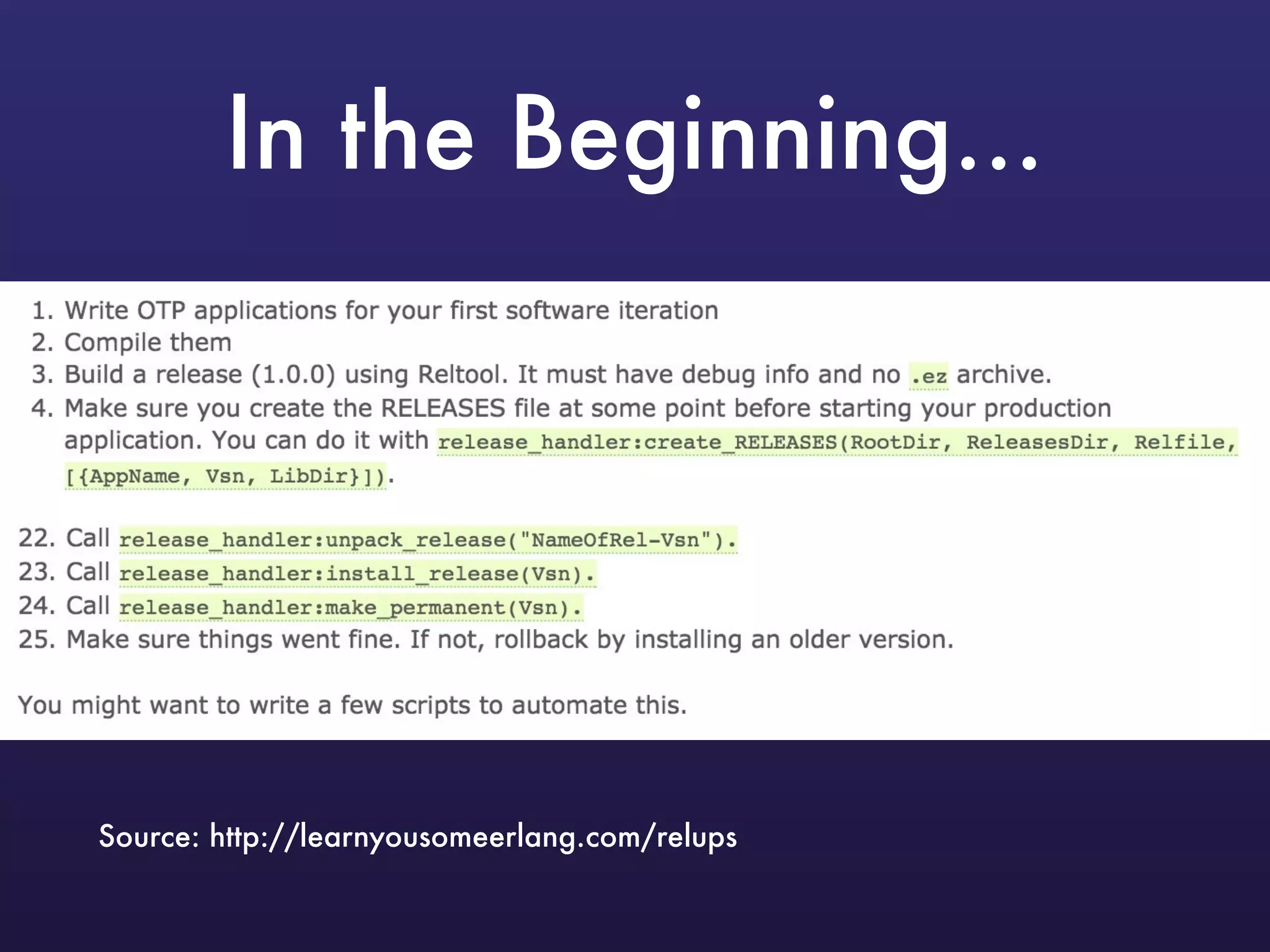
In the Beginning...
Source: http://learnyousomeerlang.com/relups
exrm
• Elixir Release Manager
• Handles most of steps 1-25 in previous slide
• Generates Erlang releases
• Then you like, put them on servers or
something? lol
edeliver
• Based on deliver, a bash-based deploy tool
• Works with rebar, mix, relx, exrm
• Handles builds, deployment, versioning
• Actively developed
• https://github.com/boldpoker/edeliver
How to edeliver
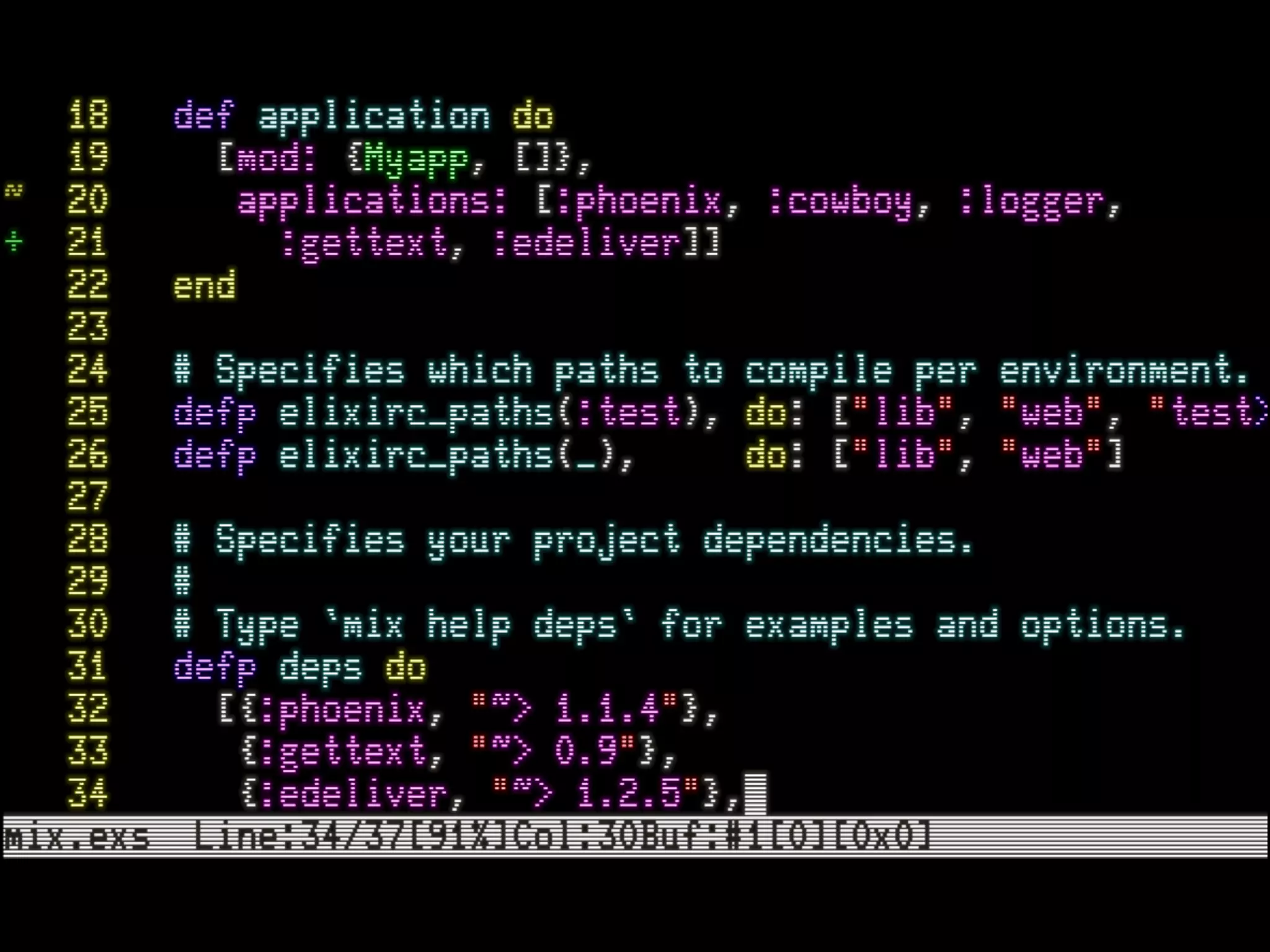
• Add edeliver as a dependency/app in mix.exs
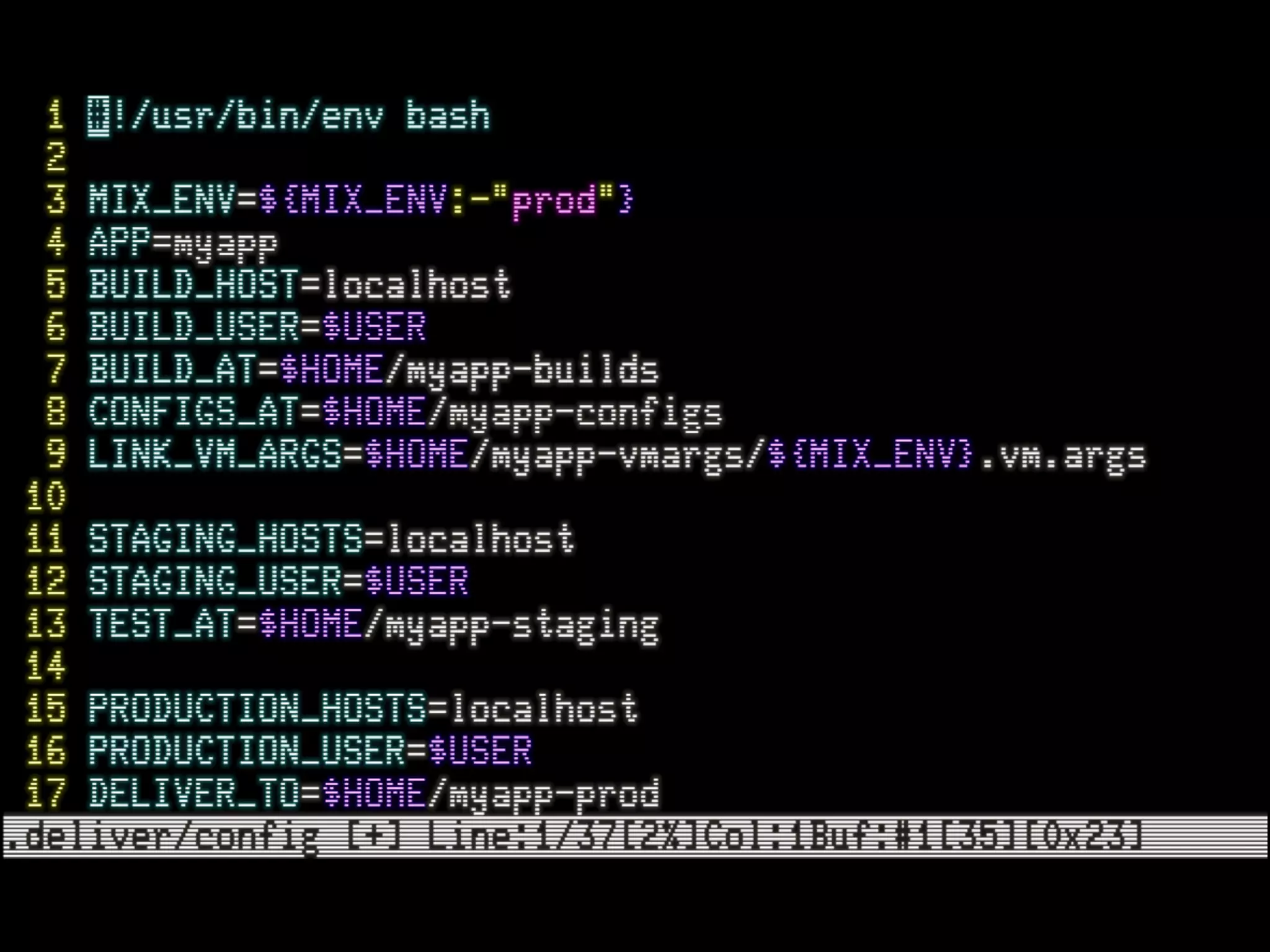
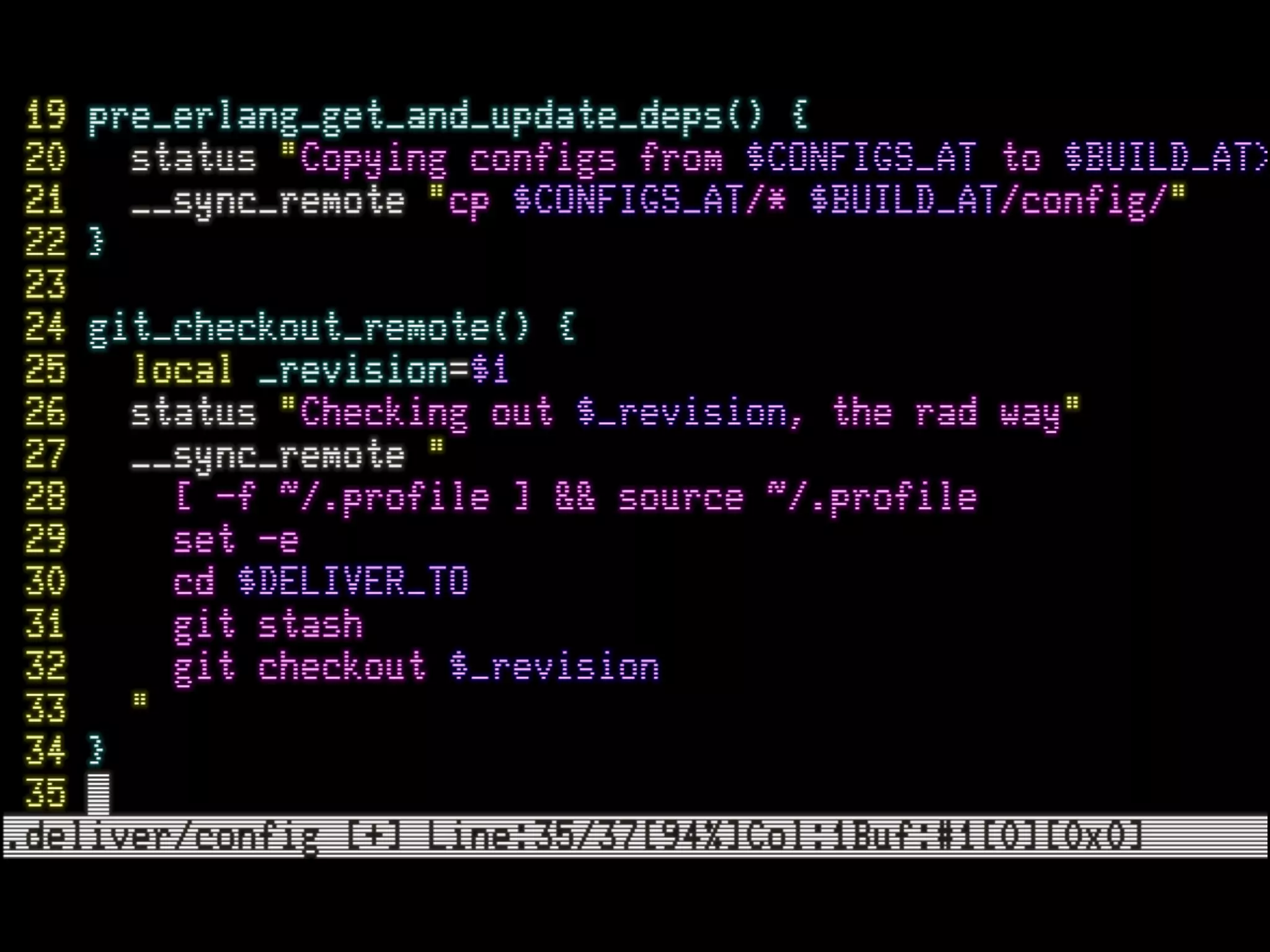
• Create and configure .deliver/config file
• Set up servers, logins, dirs, and configs
• Use git tags to mark mix.exs versions
• Run mix tasks, make money
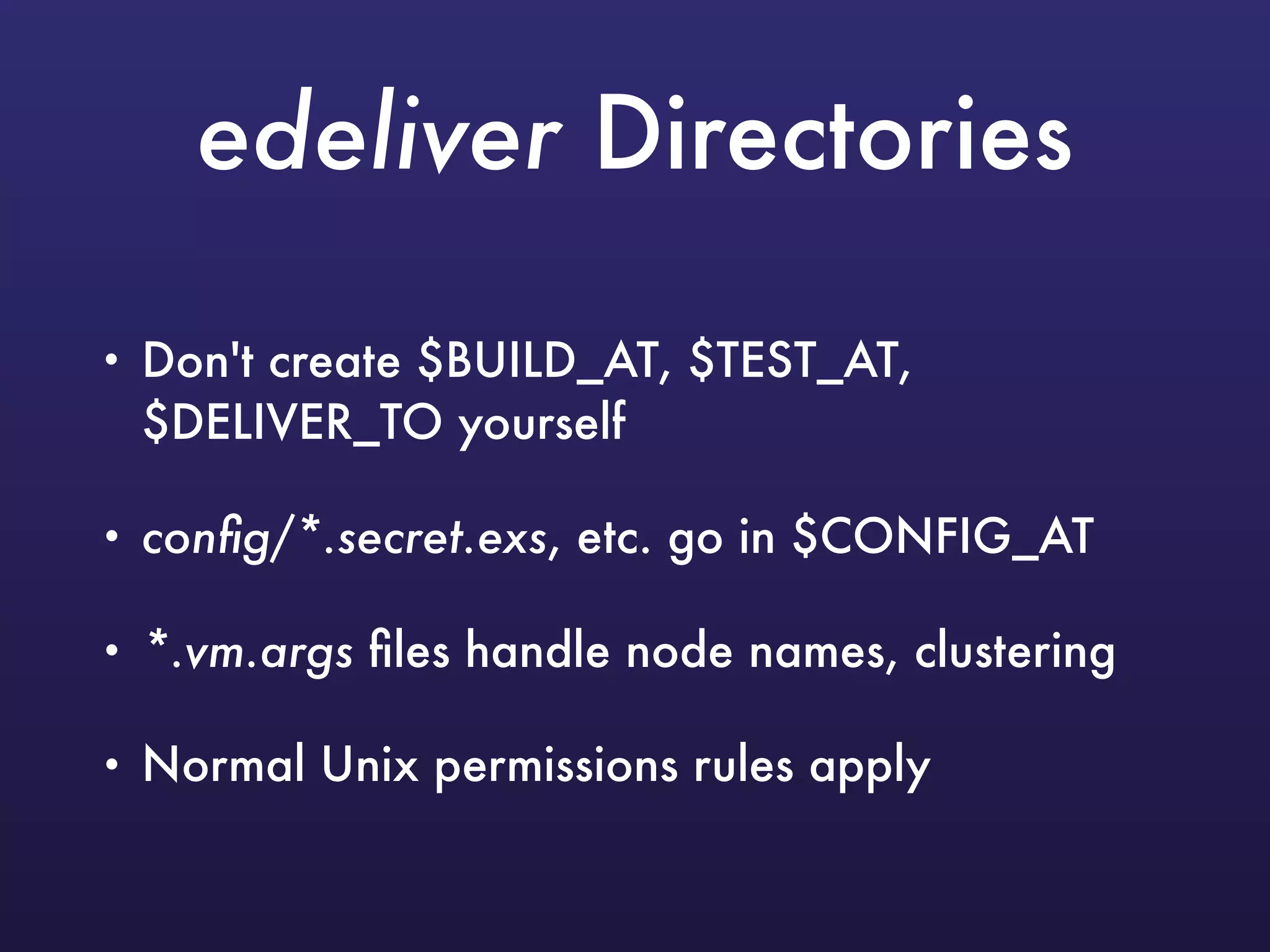
edeliver Directories
• Don't create $BUILD_AT, $TEST_AT,
$DELIVER_TO yourself
• config/*.secret.exs, etc. go in $CONFIG_AT
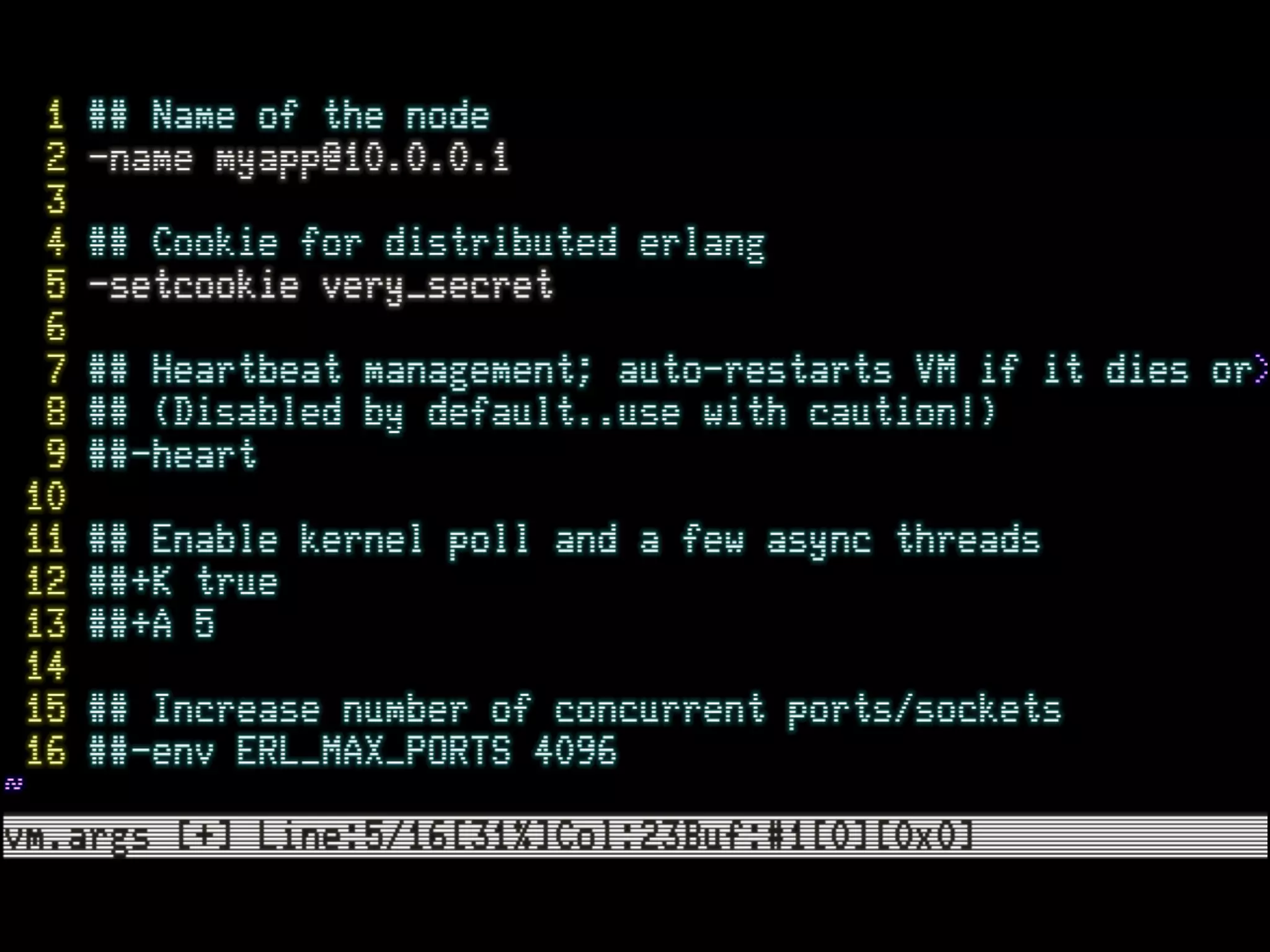
• *.vm.args files handle node names, clustering
• Normal Unix permissions rules apply
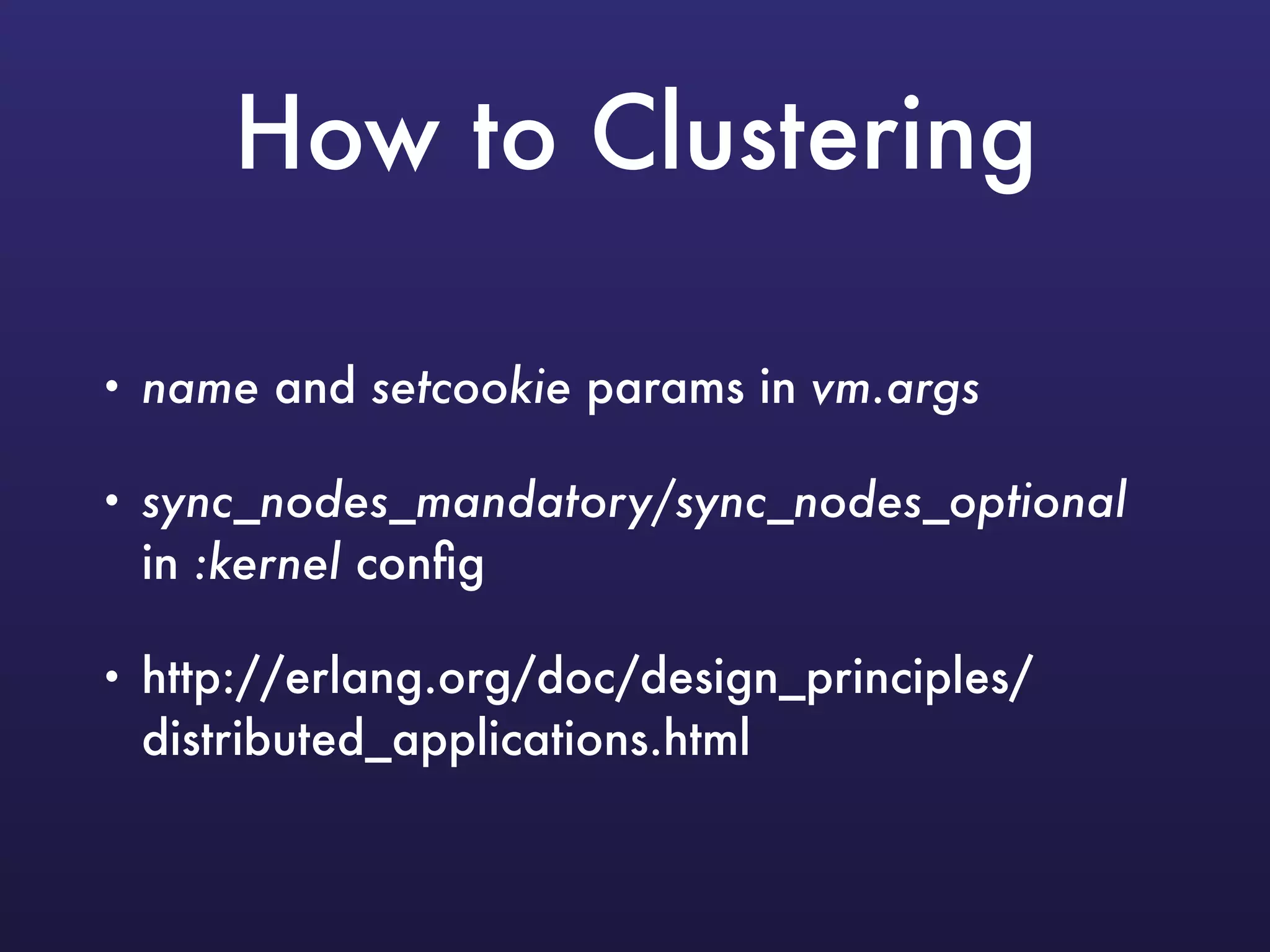
How to Clustering
• name and setcookie params in vm.args
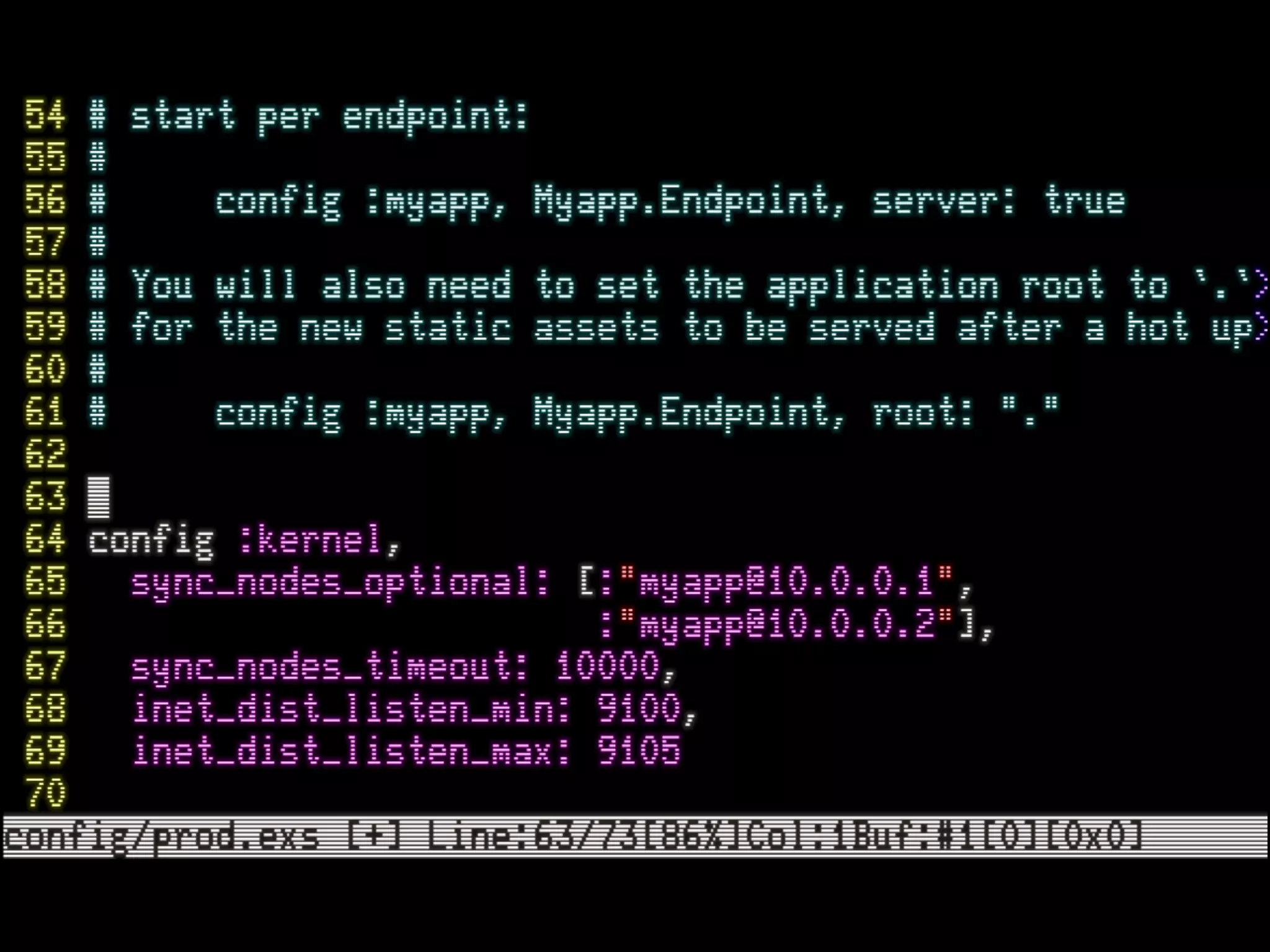
• sync_nodes_mandatory/sync_nodes_optional
in :kernel config
• http://erlang.org/doc/design_principles/
distributed_applications.html
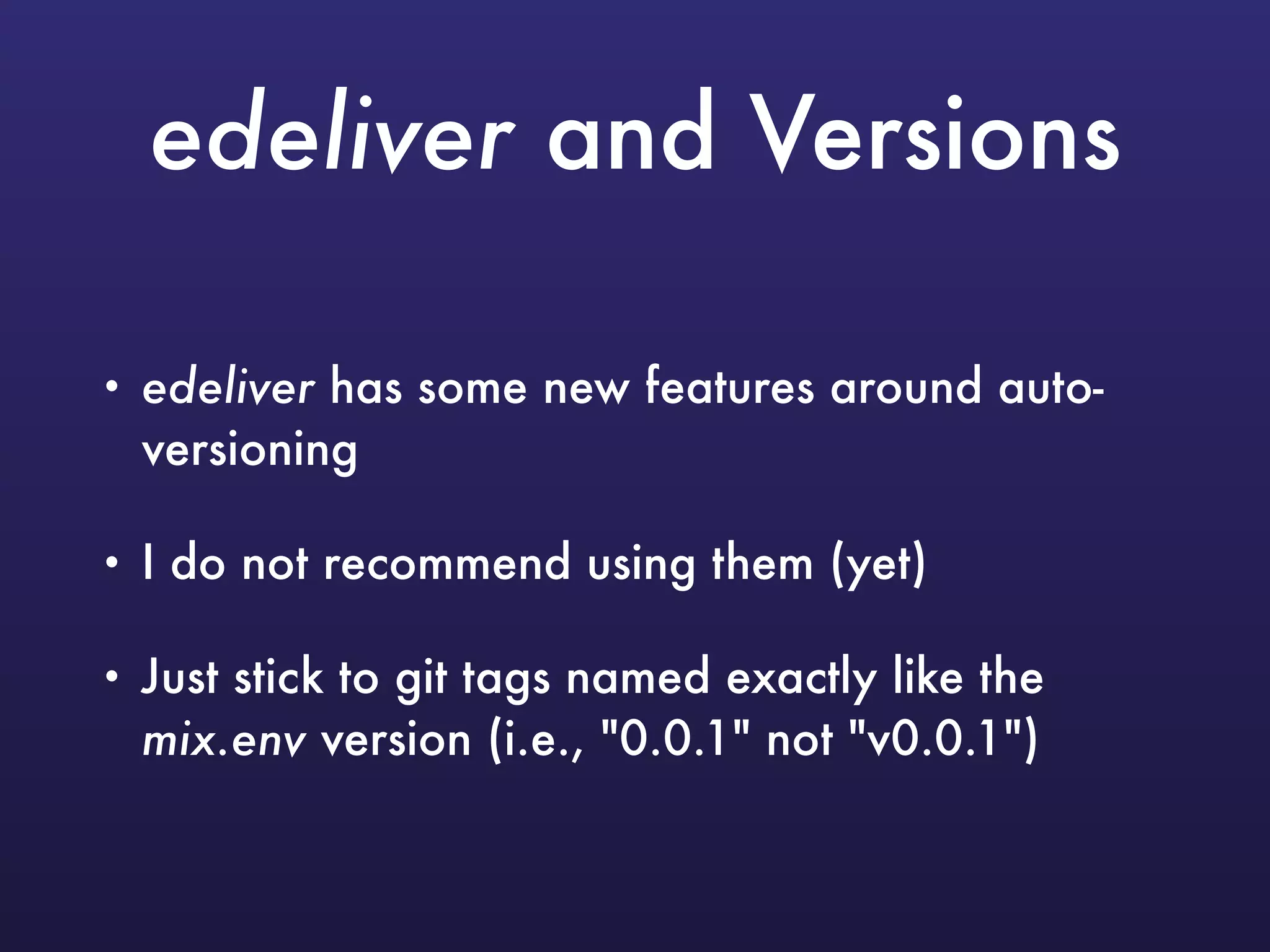
edeliver and Versions
• edeliver has some new features around auto-
versioning
• I do not recommend using them (yet)
• Just stick to git tags named exactly like the
mix.env version (i.e., "0.0.1" not "v0.0.1")
Let's take edeliver

out for a spin
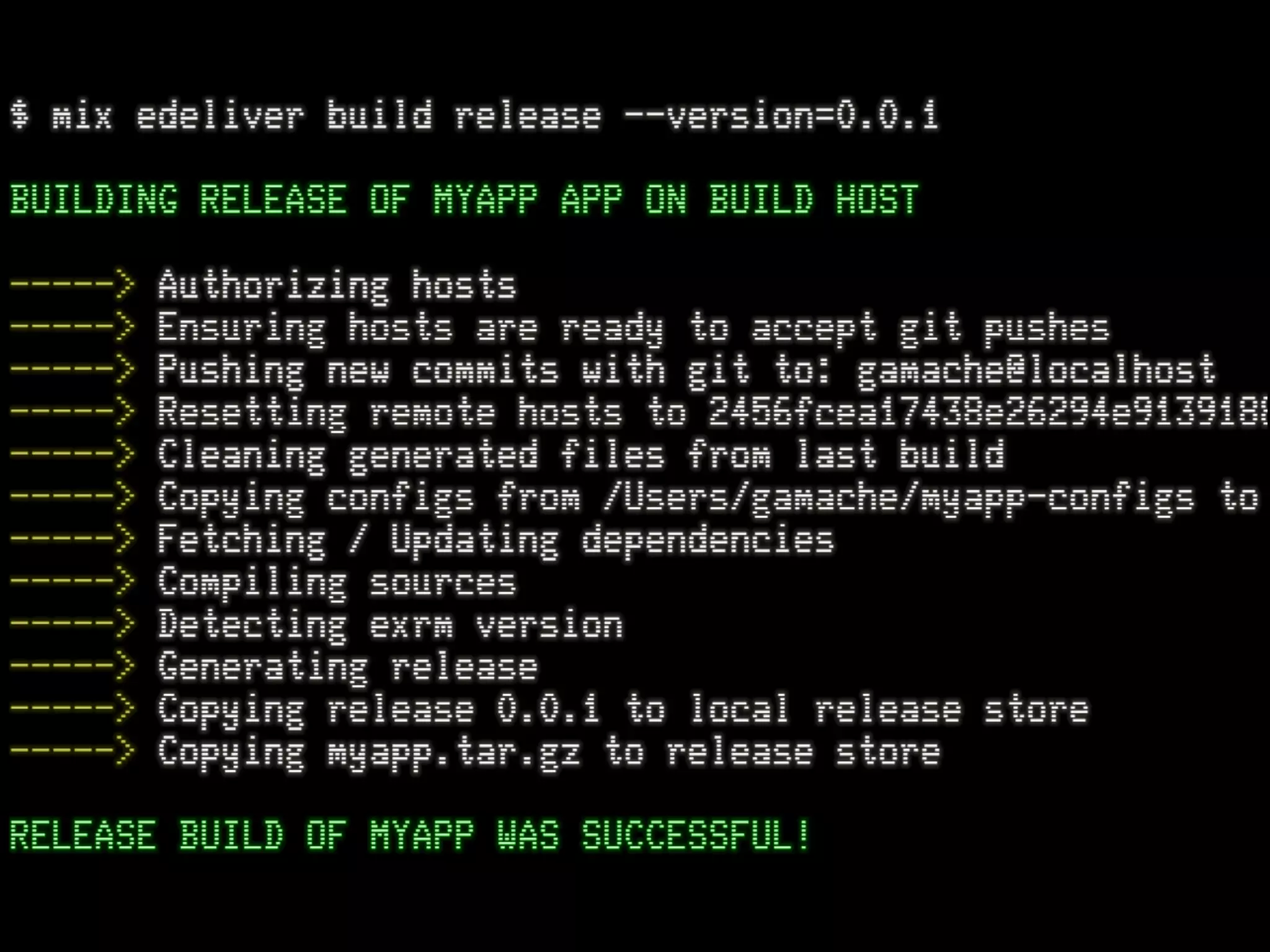
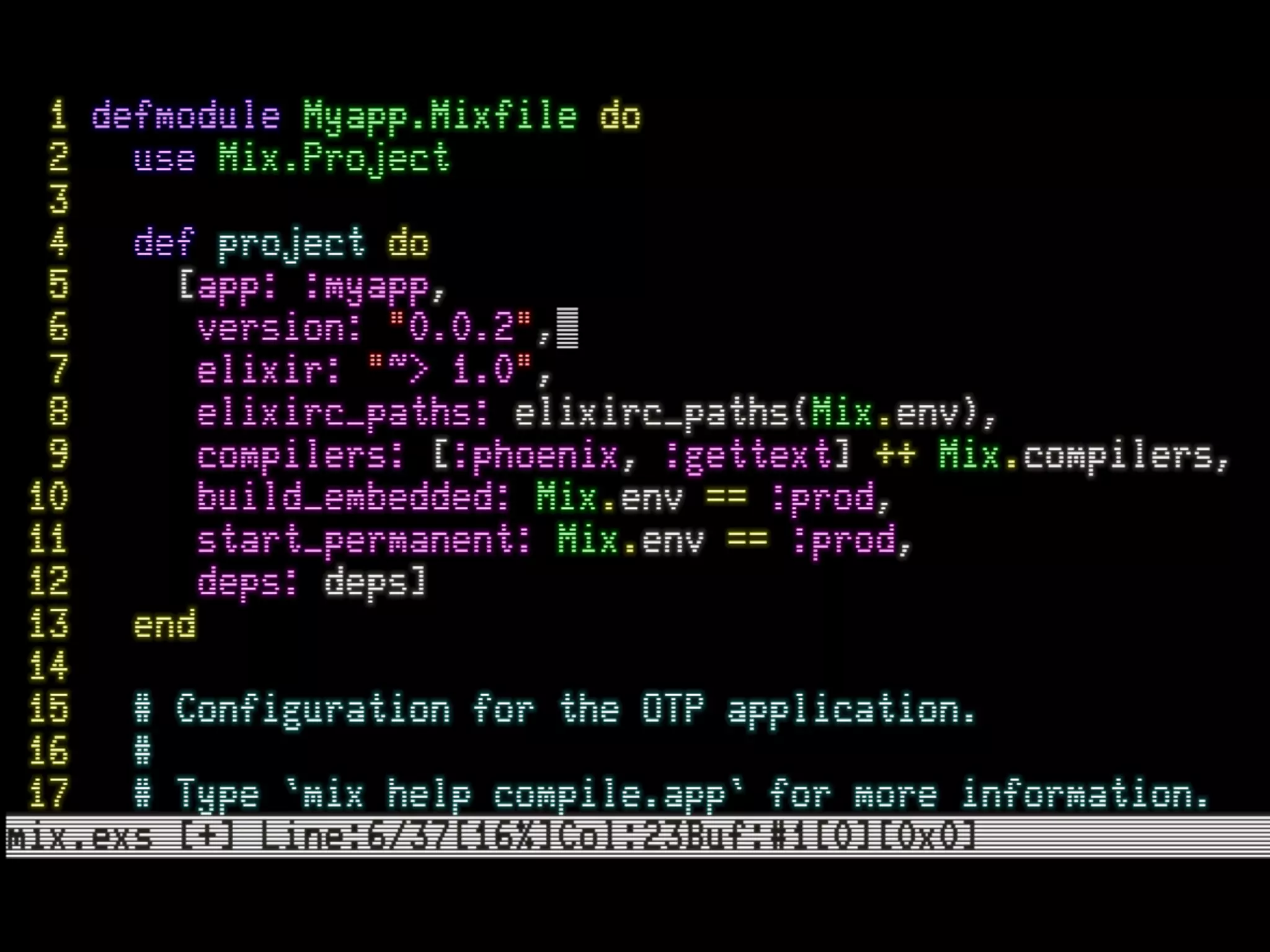
Build a release
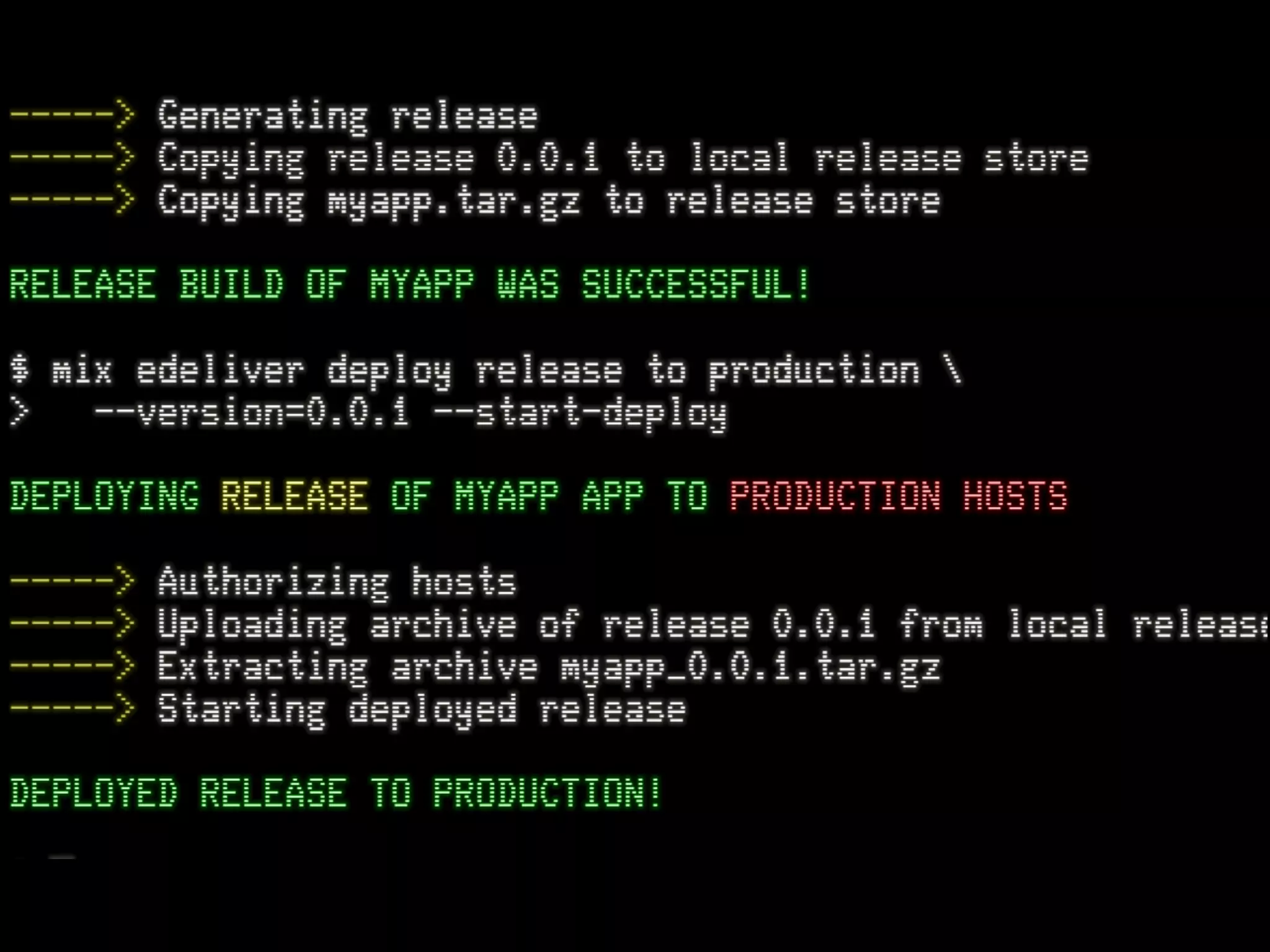
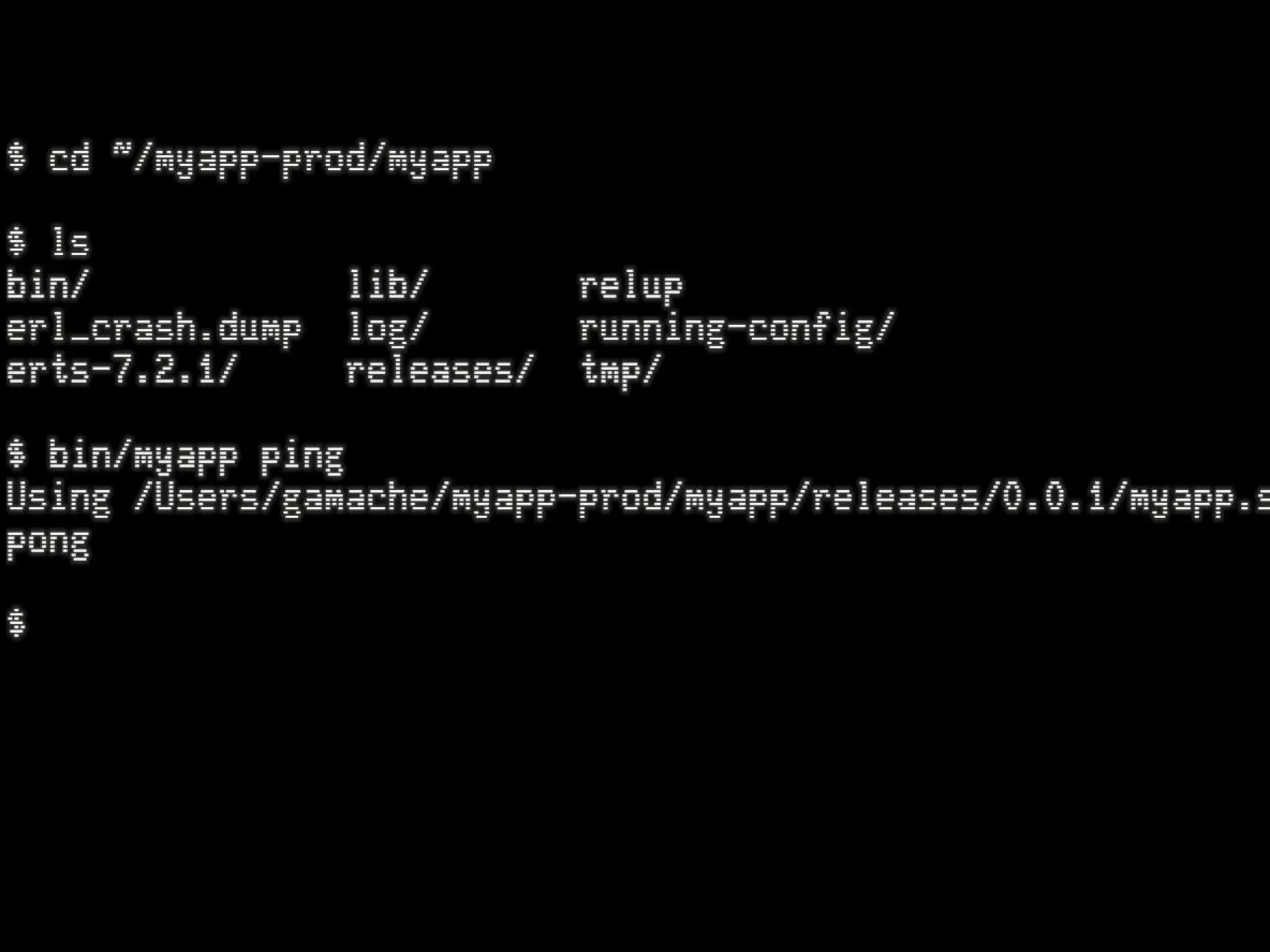
Deploy the first
release
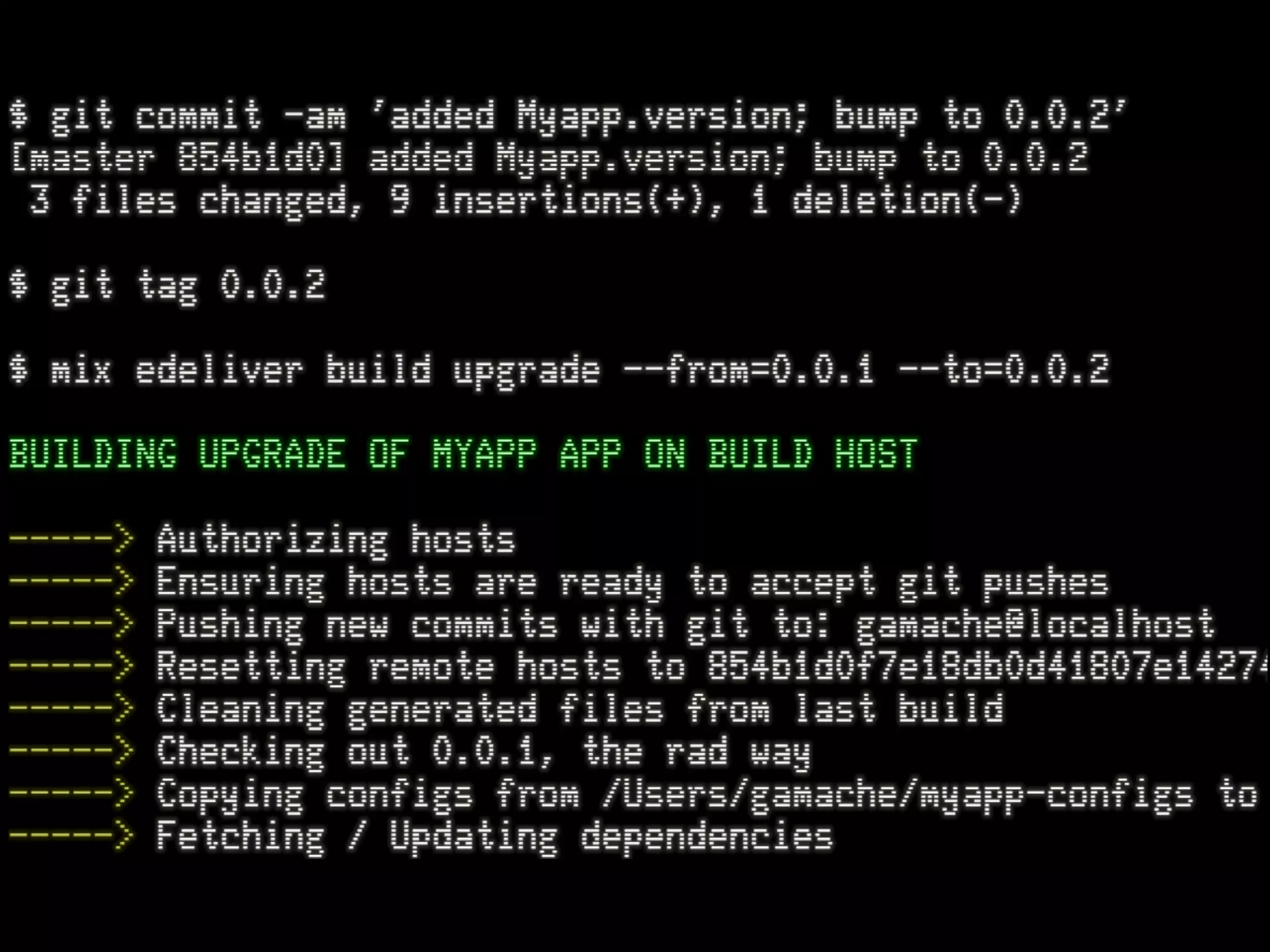
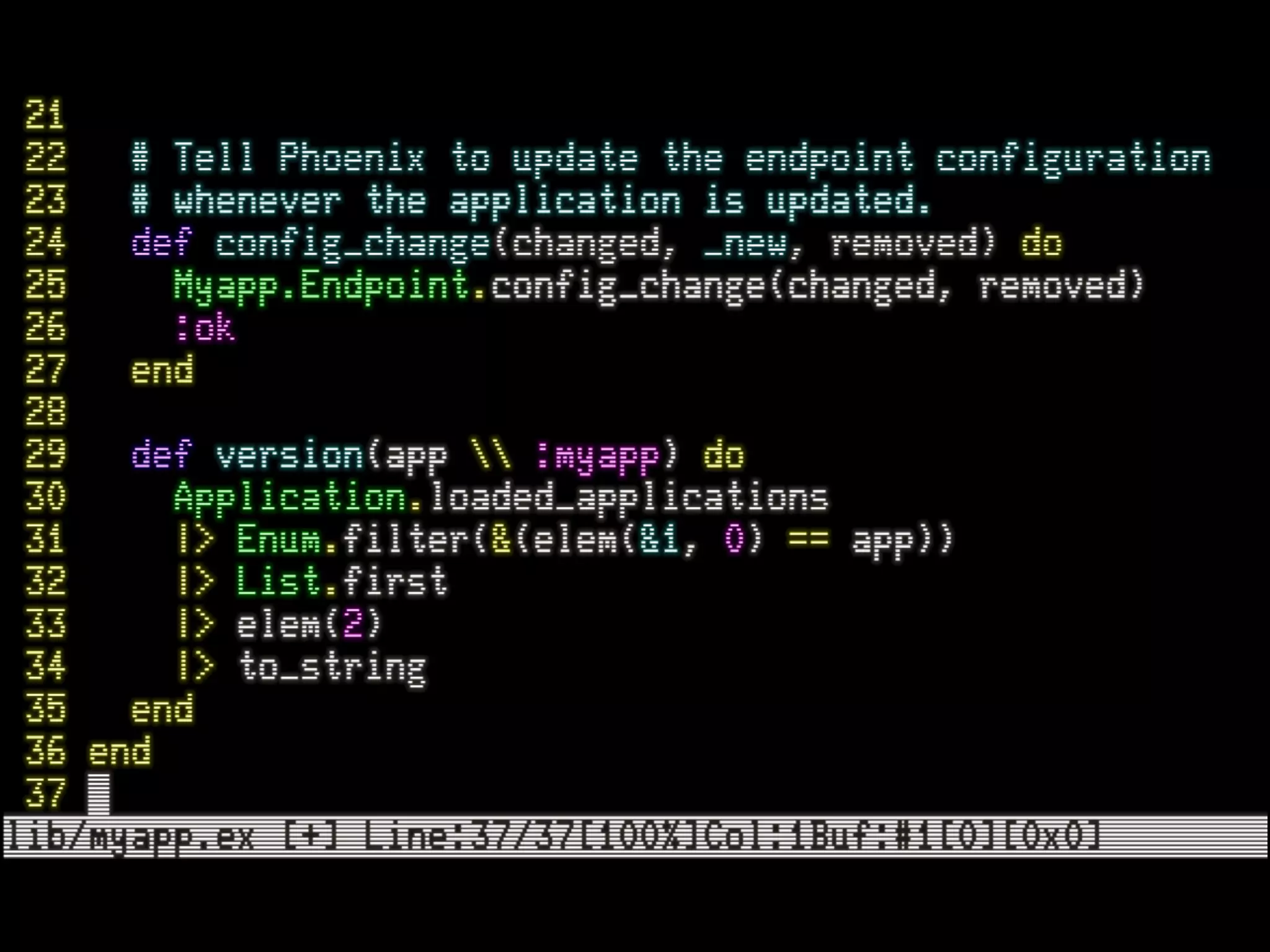
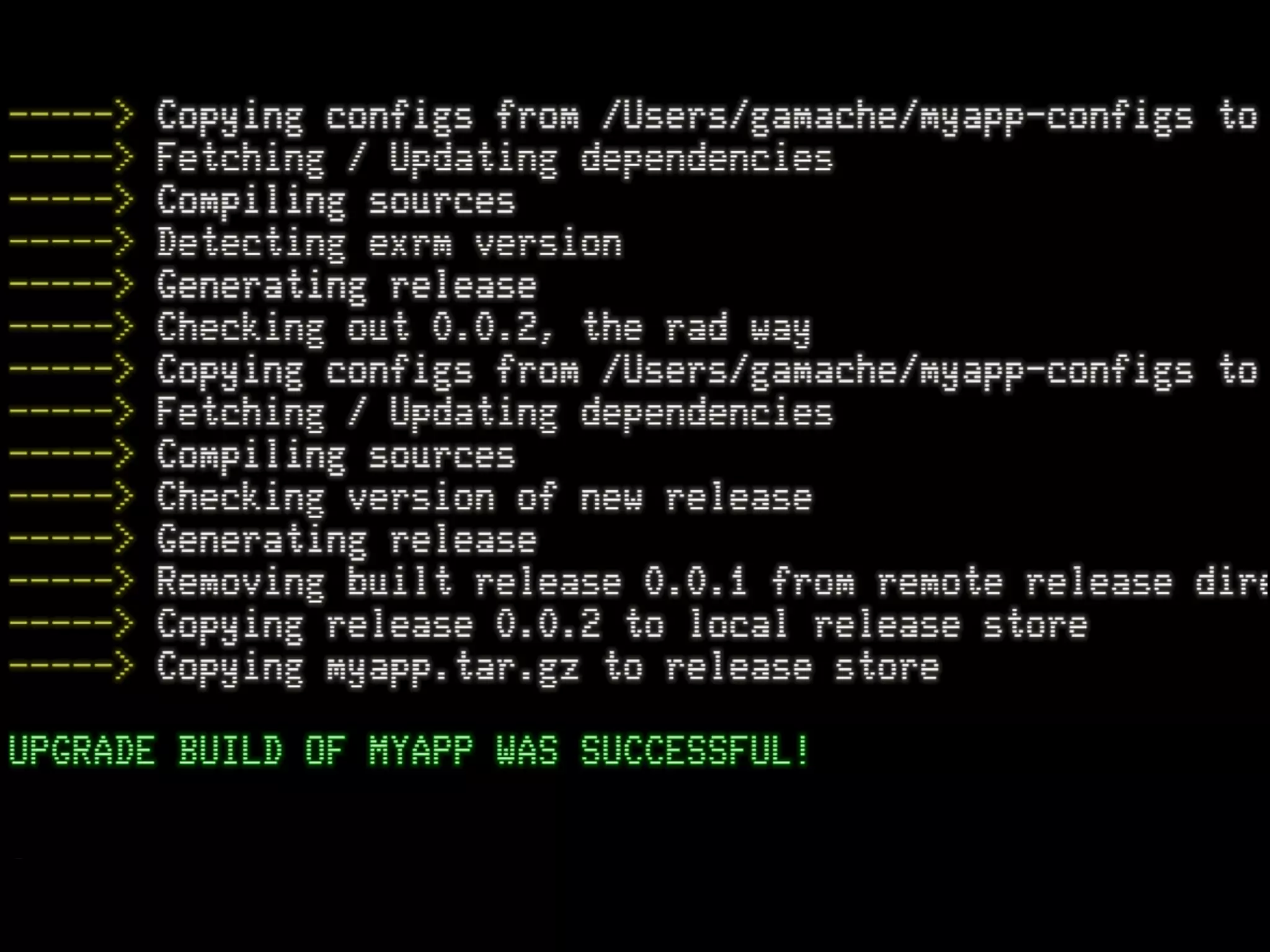
Build a hot upgrade
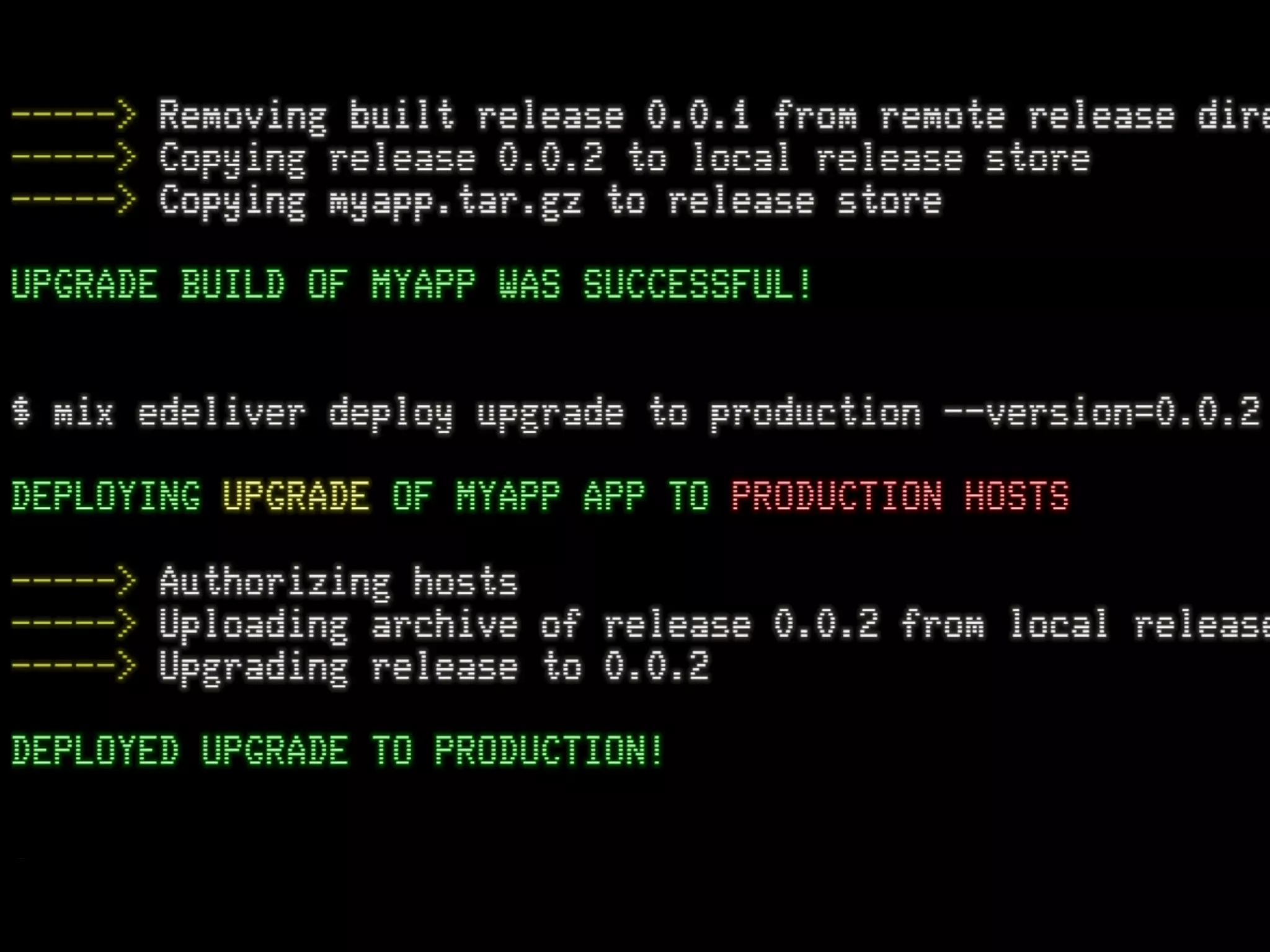
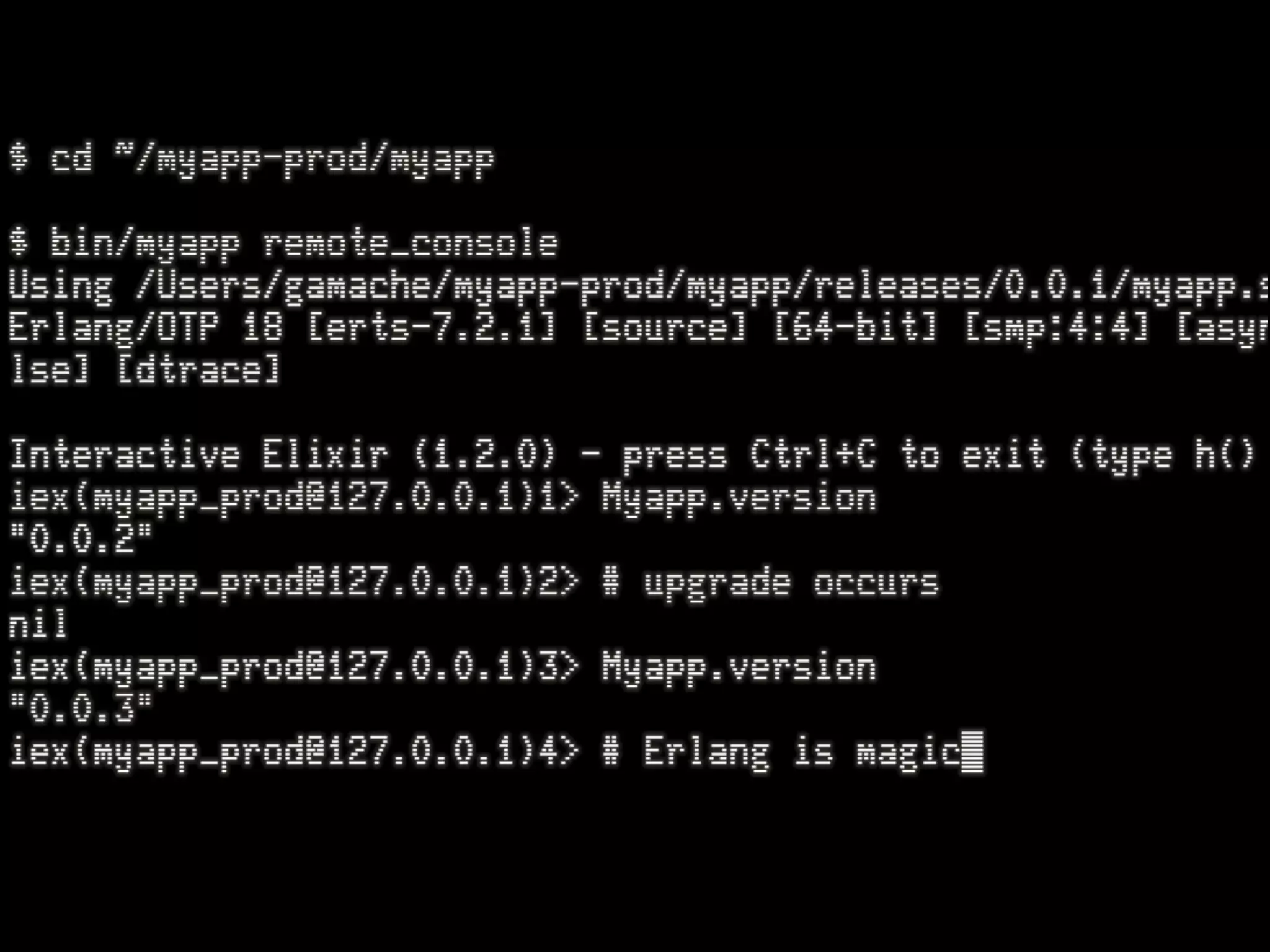
Deploy a hot upgrade
Hot upgrades
are cool
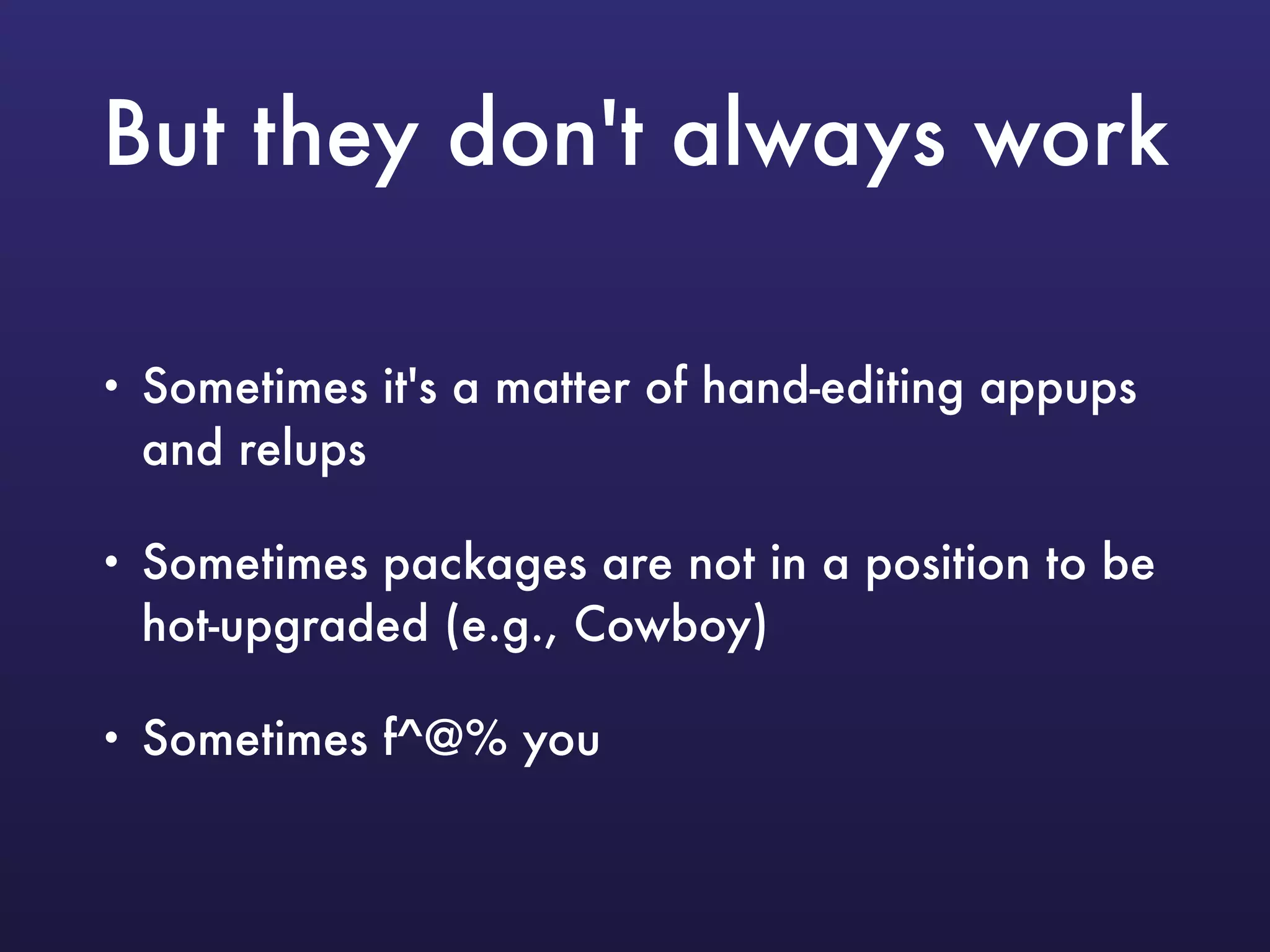
But they don't always work
• Sometimes it's a matter of hand-editing appups
and relups
• Sometimes packages are not in a position to be
hot-upgraded (e.g., Cowboy)
• Sometimes f^@% you
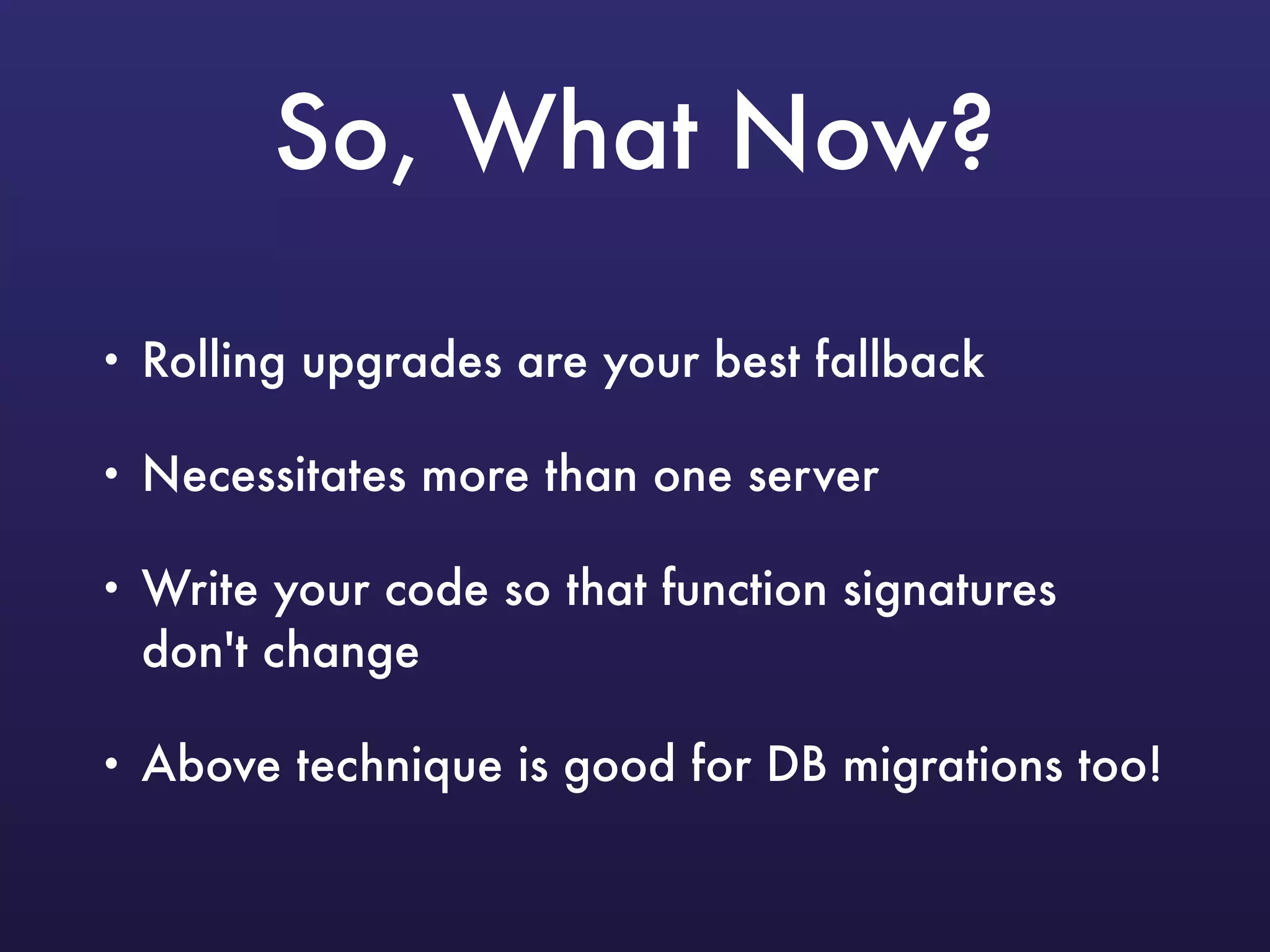
So, What Now?
• Rolling upgrades are your best fallback
• Necessitates more than one server
• Write your code so that function signatures
don't change
• Above technique is good for DB migrations too!
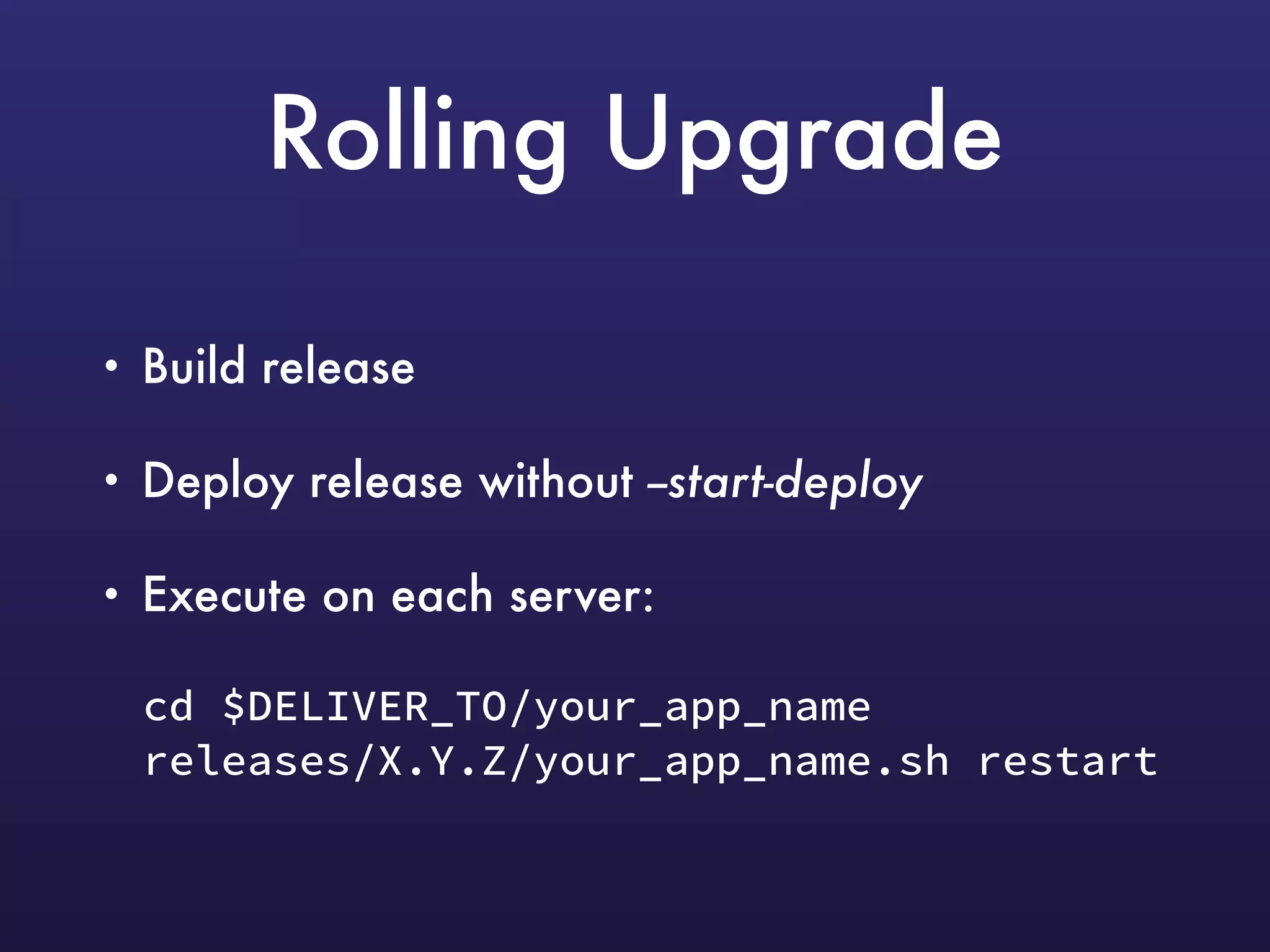
Rolling Upgrade
• Build release
• Deploy release without --start-deploy
• Execute on each server:
cd $DELIVER_TO/your_app_name

releases/X.Y.Z/your_app_name.sh restart
Rollbacks
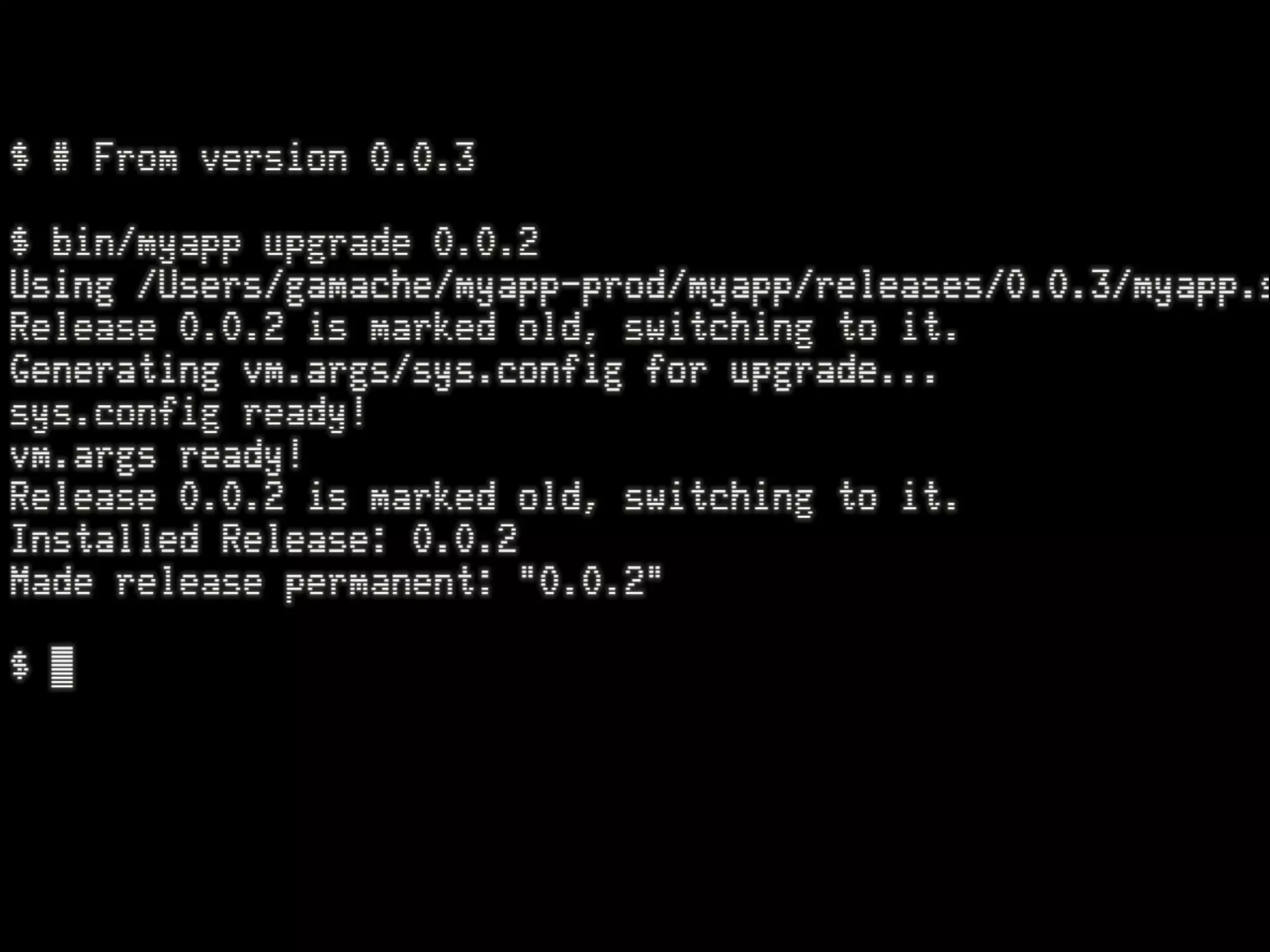
• Rollbacks are just upgrades
• If you could upgrade version X to Y, you can
rollback Y to X just as quickly
Database Migrations
• edeliver now has a migration feature
• http://blog.plataformatec.com.br/2016/04/
running-migration-in-an-exrm-release/
• I usually just log into the build server and:
cd $BUILD_AT/prod

MIX_ENV=prod mix ecto.migrate
Gotcha!
Gotcha! Ulimit
• a.k.a. EFILE, Too many open files
• Erlang rules at using file descriptors
• It rules so hard that Unix thinks something went
wrong and must be contained
• Be sure and set ulimit very high/infinite
• Set -env ERL_MAX_PORTS very high in vm.args
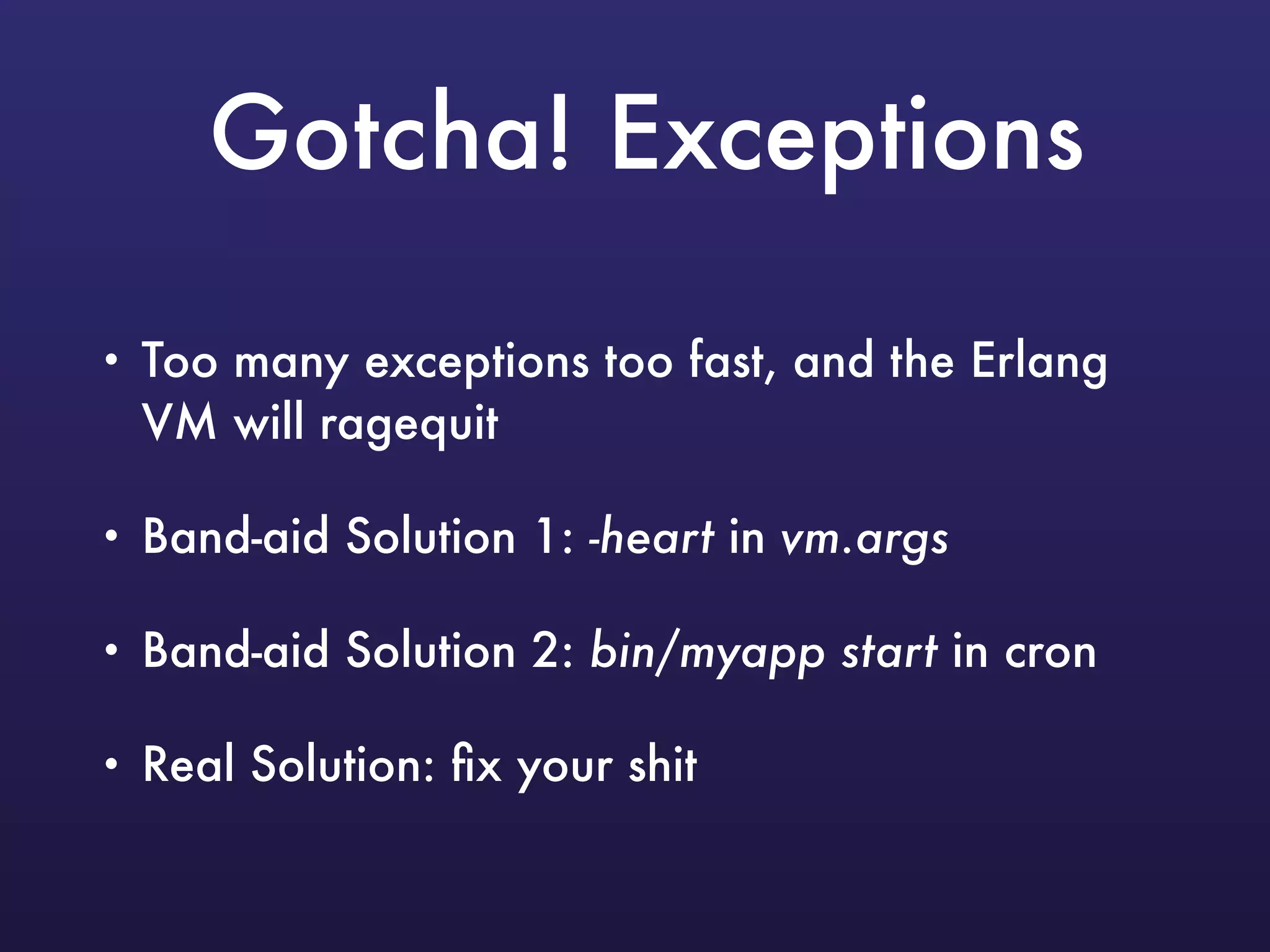
Gotcha! Exceptions
• Too many exceptions too fast, and the Erlang
VM will ragequit
• Band-aid Solution 1: -heart in vm.args
• Band-aid Solution 2: bin/myapp start in cron
• Real Solution: fix your shit
Gotcha! Segfaults
• The Erlang VM is not supposed to segfault
• How adorable
• Same instructions as previous slide
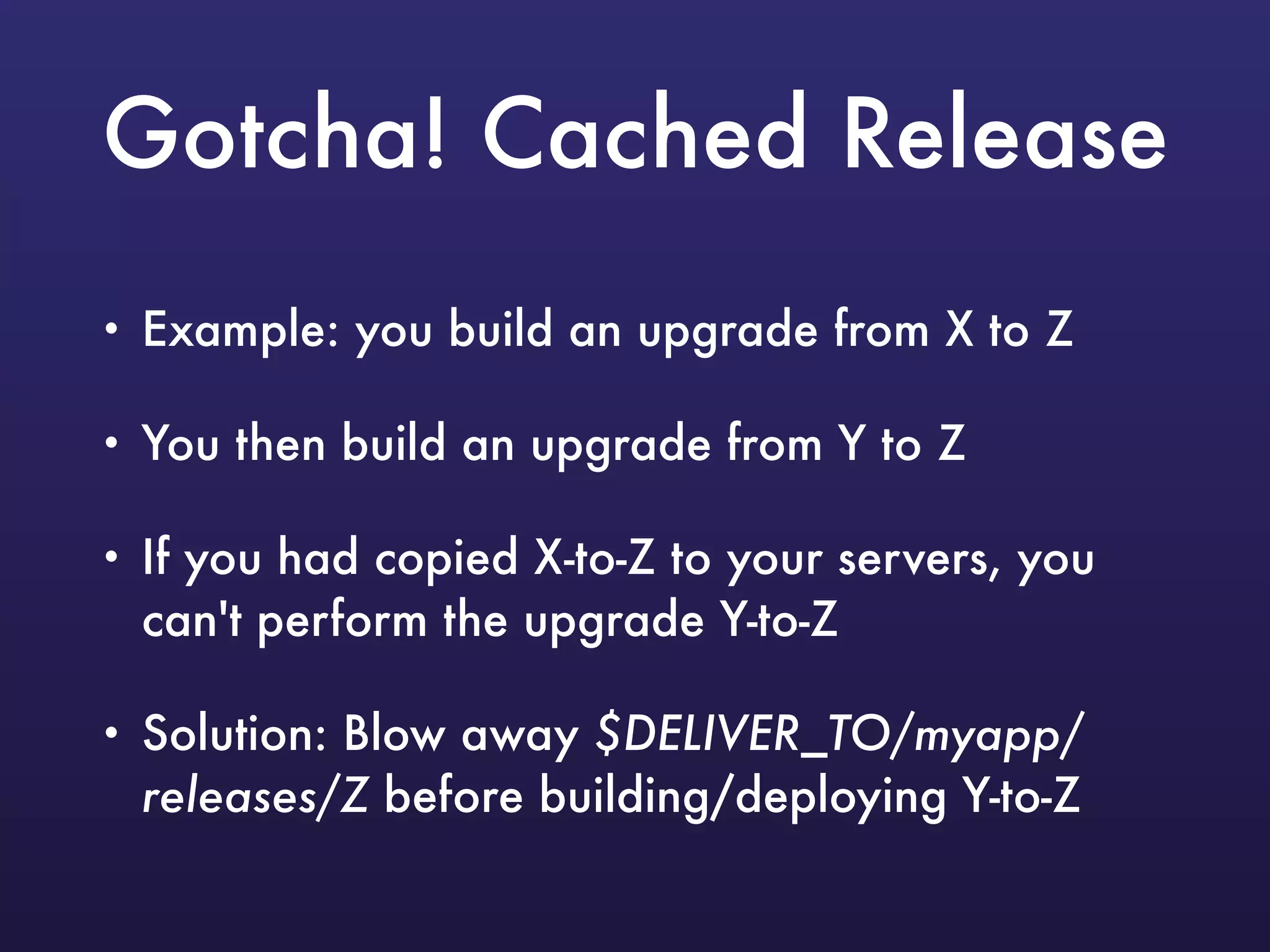
Gotcha! Cached Release
• Example: you build an upgrade from X to Z
• You then build an upgrade from Y to Z
• If you had copied X-to-Z to your servers, you
can't perform the upgrade Y-to-Z
• Solution: Blow away $DELIVER_TO/myapp/
releases/Z before building/deploying Y-to-Z
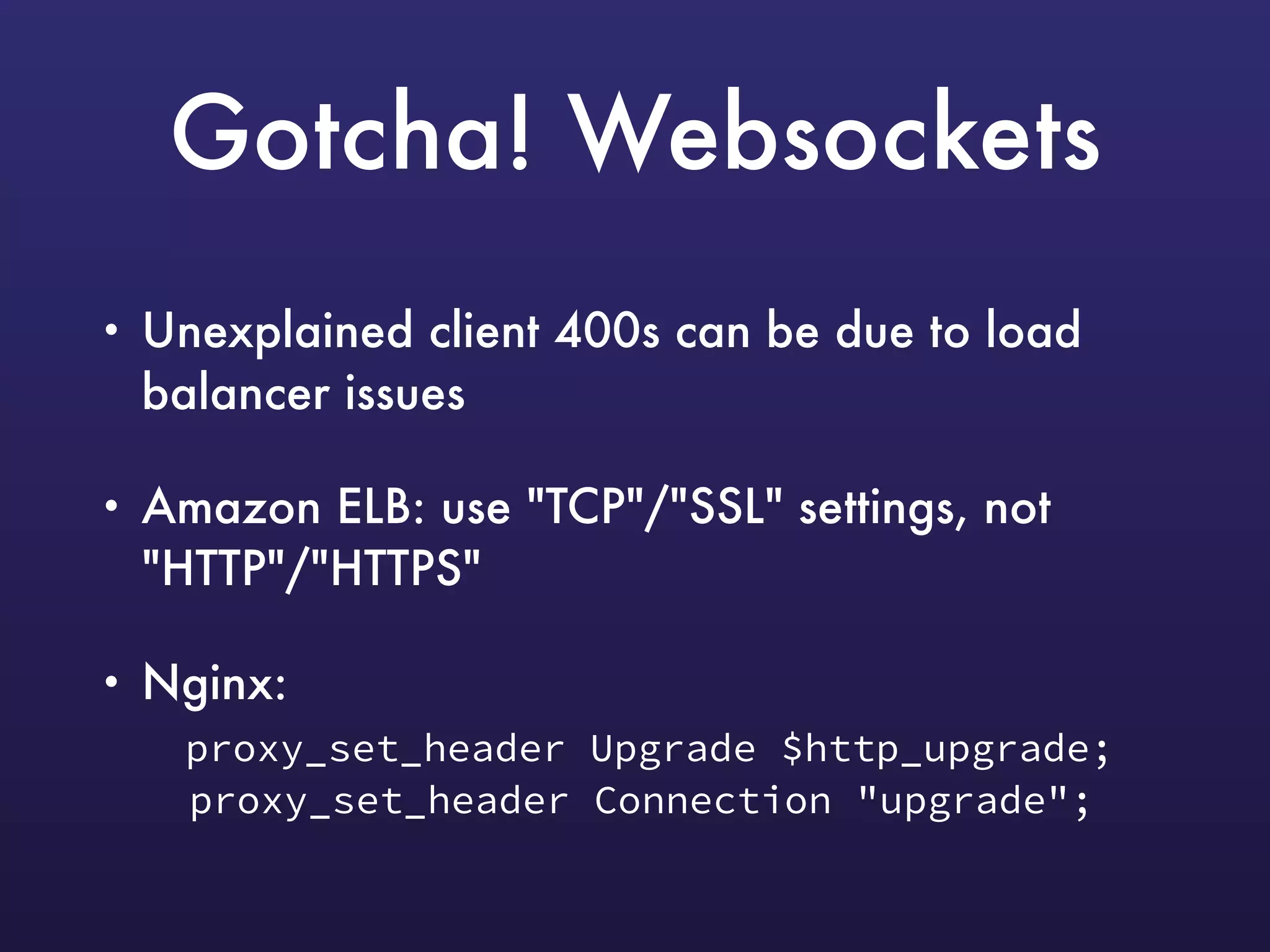
Gotcha! Websockets
• Unexplained client 400s can be due to load
balancer issues
• Amazon ELB: use "TCP"/"SSL" settings, not
"HTTP"/"HTTPS"
• Nginx:

proxy_set_header Upgrade $http_upgrade;

proxy_set_header Connection "upgrade";
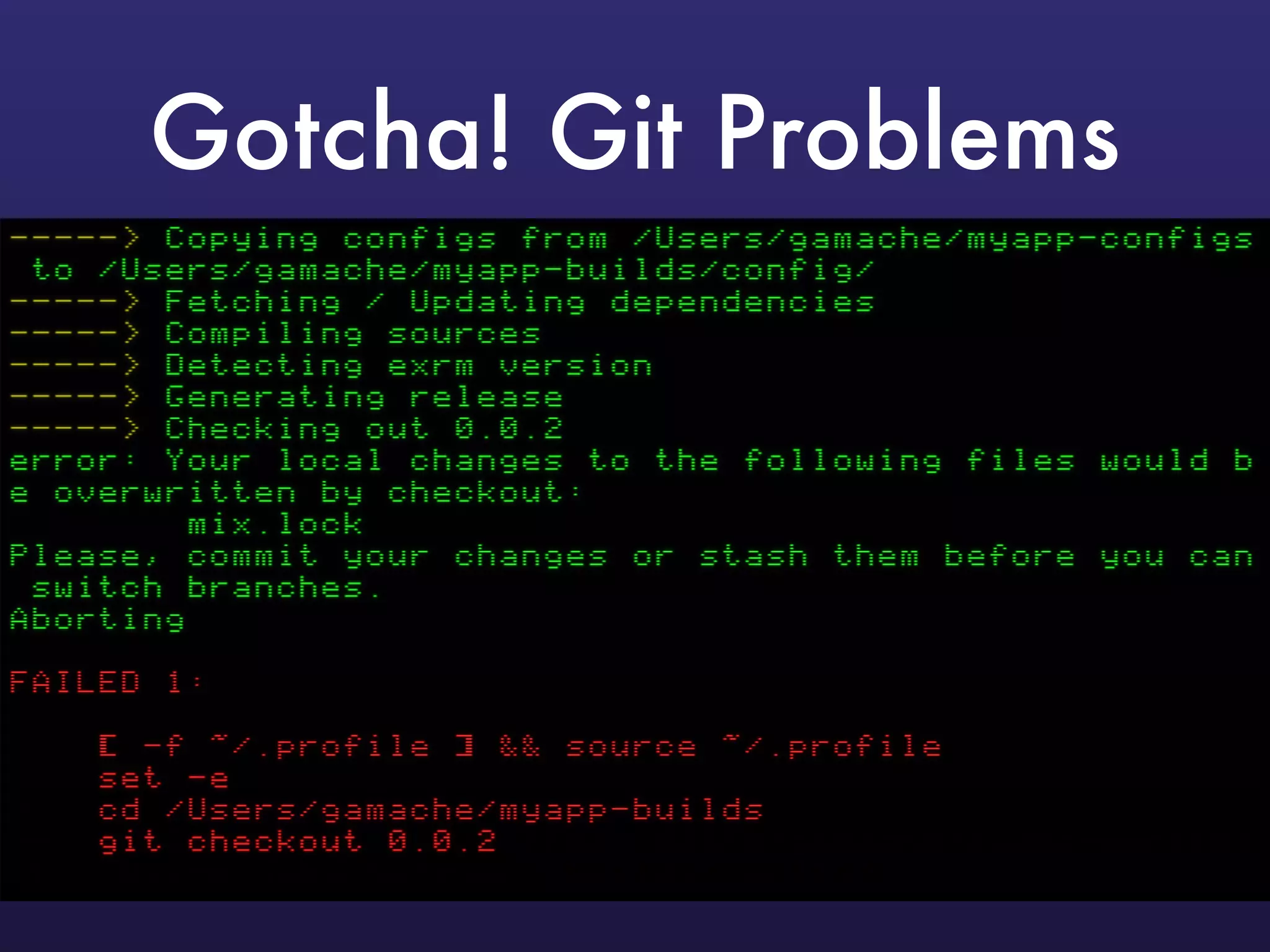
Gotcha! Git Problems
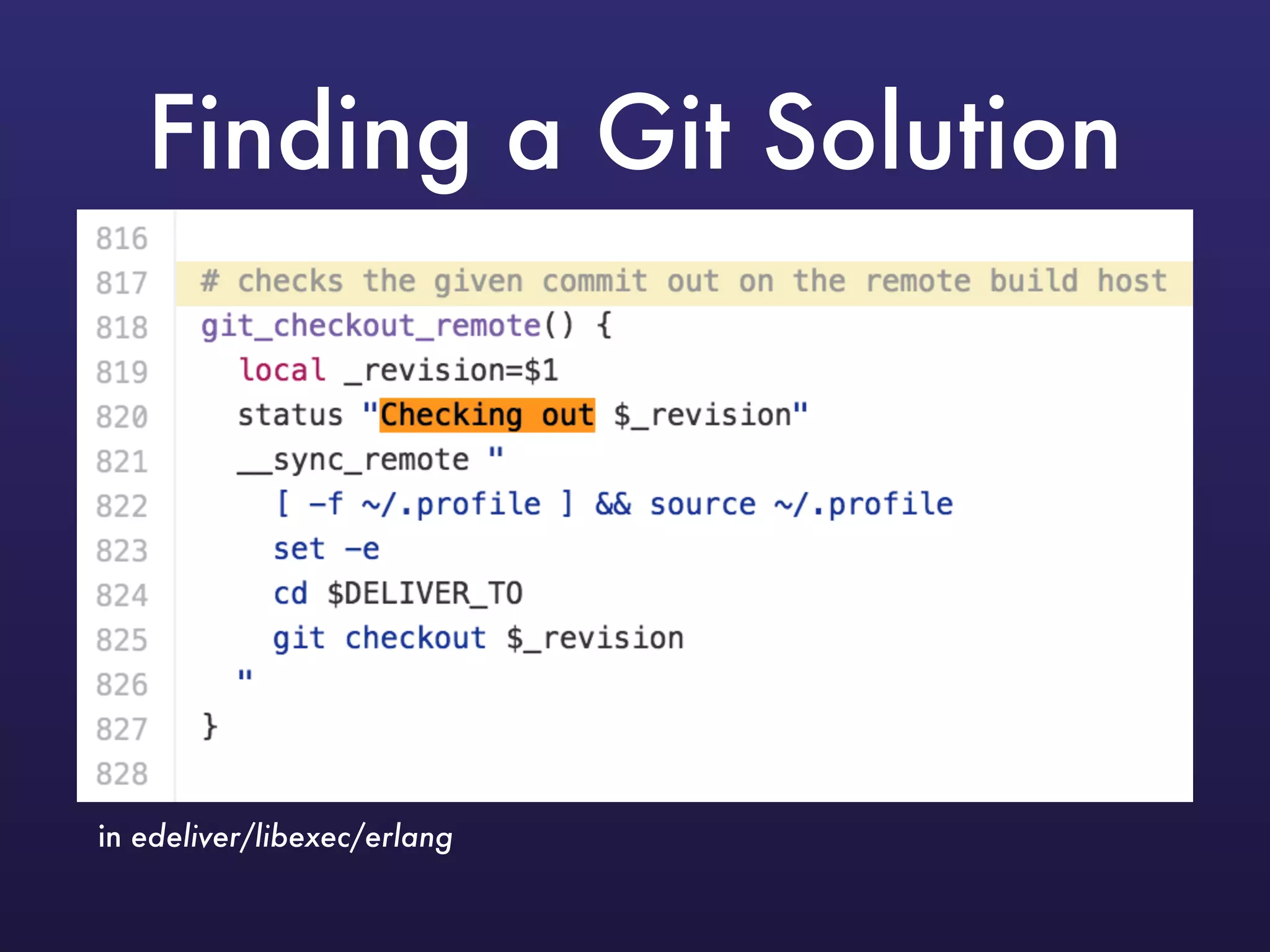
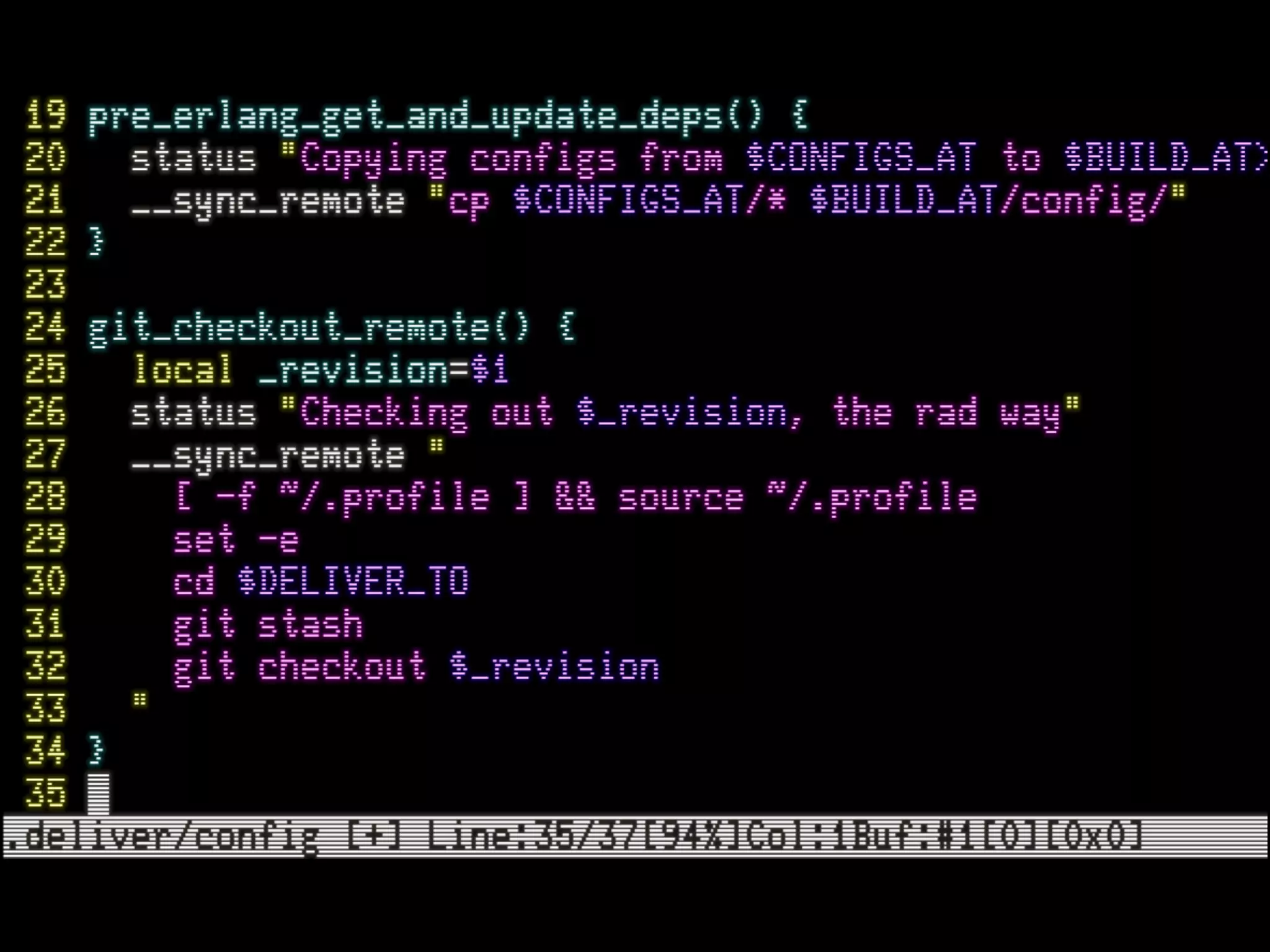
Finding a Git Solution
in edeliver/libexec/erlang
Another Summary
• Erlang and Elixir deployment shouldn't look like
less-powerful platforms'
• edeliver automates most of the deployment
process, mostly. Let's say 90% of the time
• Taken next to the platform's advantages, the
gotchas aren't so bad
• 2016 is early in the Elixir Deployment timeline
Questions?
Thanks!
https://twitter.com/gamache
https://engineering.appcues.com
http://www.slideshare.net/petegamache/real-world-elixir-deployment

Real World Elixir Deployment

  • 1.
    REAL WORLD ELIXIR DEPLOYMENT EmpireCity Elixir | 2016-05-21 pete gamache | pete@gamache.org | @gamache
  • 2.
  • 3.
    Summary • Elixir andErlang make a rock-solid platform • Erlang excels at long-lived clusters • "Modern" deployment practices do not take advantage of Erlang core features • Deploying Elixir can be painful, but if you are taking advantage of platform, can be worth it
  • 4.
    Let's talk aboutan ideal platform
  • 5.
    Platform Desirables • Horizontalscalability • Fault tolerance • Zero-downtime upgrades and rollbacks • Stability and performance • Ease of administration and maintenance
  • 6.
    Let's talk aboutan average platform
  • 7.
    Devops 2010 • Fleetsof ephemeral, stateless servers • Load-balancer or shared work queue • All message passing happens externally • All state held externally
  • 8.
    Devops 2010, cont. •Upgrade: Start new servers, add to pool, remove old servers from pool, kill old servers • Rollback: either same as above, or hot/cold a.k.a. blue/green deployment • Many moving parts -- provisioning, load balancer, connection draining
  • 9.
    Devops 2016 • Mostlylike that • Something something Docker • Heavily automated • Far-out stuff: virtualized resource pools, e.g. Mesos
  • 10.
    Desirables Achieved? • Horizontalscalability and fault tolerance, check • Zero-downtime upgrades and rollbacks, mostly • Stability and performance, yeah sure • Ease of maintenance, not so sure
  • 11.
    Let's talk aboutthe Erlang platform
  • 12.
    Things Erlang Does •Extreme fault tolerance • Simple scalability to dozens of server nodes • Zero-downtime upgrades/rollbacks (and fast) • Stability and performance
  • 13.
    Things Elixir HelpsWith • Ease of administration and maintenance
  • 14.
    Erlang Clustering • Designedfor long-lived server clusters • Treat OTP apps like microservices, and you get a free resource pool • Postpone sharding • Postpone outboard message passing
  • 15.
    Erlang vs TheWorld • Erlang doesn't look like Devops 2010, but delivers much of Devops 2016 • Go with the flow of the platform • Startups love time-to-market advantages
  • 16.
    Real Talk • Don'tuse Elixir in prod just because it's shiny • Evaluate advantages and disadvantages • If Elixir and Erlang have the features to get you to market faster or better, consider it • Also consider Erlang + Devops 2016 if that works for your use case • Nothing's free in the long run -- scale hurts
  • 17.
    Deployment • The sumof tools and topology • Topology is a big topic, so here I will abbreviate to "at least two of everything" • Now let's discuss deployment tools on the Erlang/Elixir platform
  • 18.
    In the Beginning... Source:http://learnyousomeerlang.com/relups
  • 19.
    exrm • Elixir ReleaseManager • Handles most of steps 1-25 in previous slide • Generates Erlang releases • Then you like, put them on servers or something? lol
  • 20.
    edeliver • Based ondeliver, a bash-based deploy tool • Works with rebar, mix, relx, exrm • Handles builds, deployment, versioning • Actively developed • https://github.com/boldpoker/edeliver
  • 21.
    How to edeliver •Add edeliver as a dependency/app in mix.exs • Create and configure .deliver/config file • Set up servers, logins, dirs, and configs • Use git tags to mark mix.exs versions • Run mix tasks, make money
  • 25.
    edeliver Directories • Don'tcreate $BUILD_AT, $TEST_AT, $DELIVER_TO yourself • config/*.secret.exs, etc. go in $CONFIG_AT • *.vm.args files handle node names, clustering • Normal Unix permissions rules apply
  • 26.
    How to Clustering •name and setcookie params in vm.args • sync_nodes_mandatory/sync_nodes_optional in :kernel config • http://erlang.org/doc/design_principles/ distributed_applications.html
  • 29.
    edeliver and Versions •edeliver has some new features around auto- versioning • I do not recommend using them (yet) • Just stick to git tags named exactly like the mix.env version (i.e., "0.0.1" not "v0.0.1")
  • 30.
  • 31.
  • 33.
  • 36.
    Build a hotupgrade
  • 40.
    Deploy a hotupgrade
  • 42.
  • 45.
    But they don'talways work • Sometimes it's a matter of hand-editing appups and relups • Sometimes packages are not in a position to be hot-upgraded (e.g., Cowboy) • Sometimes f^@% you
  • 46.
    So, What Now? •Rolling upgrades are your best fallback • Necessitates more than one server • Write your code so that function signatures don't change • Above technique is good for DB migrations too!
  • 47.
    Rolling Upgrade • Buildrelease • Deploy release without --start-deploy • Execute on each server: cd $DELIVER_TO/your_app_name
 releases/X.Y.Z/your_app_name.sh restart
  • 48.
    Rollbacks • Rollbacks arejust upgrades • If you could upgrade version X to Y, you can rollback Y to X just as quickly
  • 50.
    Database Migrations • edelivernow has a migration feature • http://blog.plataformatec.com.br/2016/04/ running-migration-in-an-exrm-release/ • I usually just log into the build server and: cd $BUILD_AT/prod
 MIX_ENV=prod mix ecto.migrate
  • 51.
  • 52.
    Gotcha! Ulimit • a.k.a.EFILE, Too many open files • Erlang rules at using file descriptors • It rules so hard that Unix thinks something went wrong and must be contained • Be sure and set ulimit very high/infinite • Set -env ERL_MAX_PORTS very high in vm.args
  • 53.
    Gotcha! Exceptions • Toomany exceptions too fast, and the Erlang VM will ragequit • Band-aid Solution 1: -heart in vm.args • Band-aid Solution 2: bin/myapp start in cron • Real Solution: fix your shit
  • 54.
    Gotcha! Segfaults • TheErlang VM is not supposed to segfault • How adorable • Same instructions as previous slide
  • 55.
    Gotcha! Cached Release •Example: you build an upgrade from X to Z • You then build an upgrade from Y to Z • If you had copied X-to-Z to your servers, you can't perform the upgrade Y-to-Z • Solution: Blow away $DELIVER_TO/myapp/ releases/Z before building/deploying Y-to-Z
  • 56.
    Gotcha! Websockets • Unexplainedclient 400s can be due to load balancer issues • Amazon ELB: use "TCP"/"SSL" settings, not "HTTP"/"HTTPS" • Nginx:
 proxy_set_header Upgrade $http_upgrade;
 proxy_set_header Connection "upgrade";
  • 57.
  • 58.
    Finding a GitSolution in edeliver/libexec/erlang
  • 61.
    Another Summary • Erlangand Elixir deployment shouldn't look like less-powerful platforms' • edeliver automates most of the deployment process, mostly. Let's say 90% of the time • Taken next to the platform's advantages, the gotchas aren't so bad • 2016 is early in the Elixir Deployment timeline
  • 62.
  • 63.