Rethinking the debugger 
Iulian Dragos 
@jaguarul
Overview 
• Async Debugger 
• Scala IDE for Eclipse 4.0
Reactive applications 
• Different parts of the application run in different logical 
threads 
• ..the programmer must ensure correct coordination and 
communication
Concurrency 
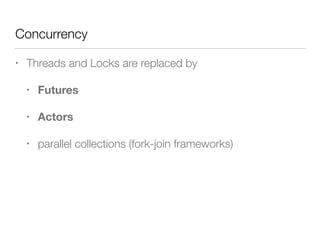
• Threads and Locks are replaced by 
• Futures 
• Actors 
• parallel collections (fork-join frameworks)
Concurrency 
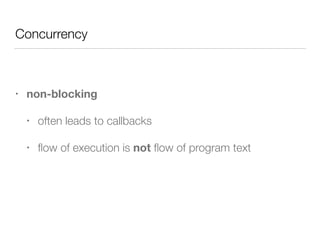
• non-blocking 
• often leads to callbacks 
• flow of execution is not flow of program text
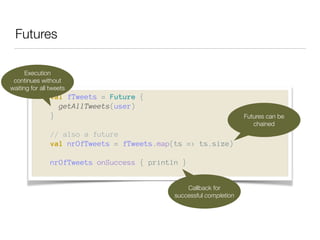
Futures 
Execution 
continues without 
waiting for all tweets 
val fTweets = Future { 
getAllTweets(user) 
} 
! 
// also a future 
val nrOfTweets = fTweets.map(ts => ts.size) 
! 
nrOfTweets onSuccess { println } 
Futures can be 
chained 
Callback for 
successful completion
How do we debug asynchronous programs?
Detective work 
• go from undesirable effects 
back to causes 
• attempt a fix 
• repeat
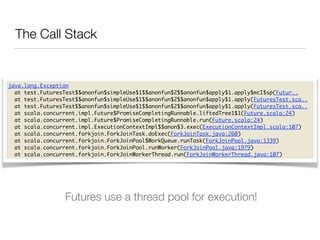
The Call Stack 
java.lang.Exception 
at test.FuturesTest$$anonfun$simpleUse$1$$anonfun$2$$anonfun$apply$1.apply$mcI$sp(Futur.. 
at test.FuturesTest$$anonfun$simpleUse$1$$anonfun$2$$anonfun$apply$1.apply(FuturesTest.sca.. 
at scala.concurrent.impl.Future$PromiseCompletingRunnable.liftedTree1$1(Future.scala:24) 
at scala.concurrent.impl.Future$PromiseCompletingRunnable.run(Future.scala:24) 
at scala.concurrent.impl.ExecutionContextImpl$$anon$3.exec(ExecutionContextImpl.scala:107) 
at scala.concurrent.forkjoin.ForkJoinTask.doExec(ForkJoinTask.java:260) 
at scala.concurrent.forkjoin.ForkJoinPool$WorkQueue.runTask(ForkJoinPool.java:1339) 
at scala.concurrent.forkjoin.ForkJoinPool.runWorker(ForkJoinPool.java:1979) 
at scala.concurrent.forkjoin.ForkJoinWorkerThread.run(ForkJoinWorkerThread.java:107) 
Futures use a thread pool for execution!
The Problem 
• The call-stack used to record the flow of control of 
sequential programs 
• futures (and actors) execute each computation step on a 
different thread 
• on a mostly uninteresting call stack
Can we recover the async stack? 
Record call stack when a future is created
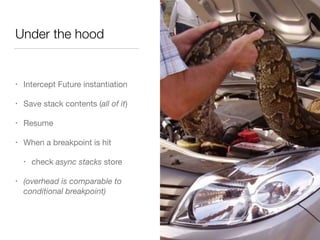
Under the hood 
• Intercept Future instantiation 
• Save stack contents (all of it) 
• Resume 
• When a breakpoint is hit 
• check async stacks store 
• (overhead is comparable to 
conditional breakpoint)
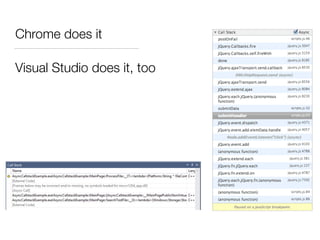
Chrome does it 
Visual Studio does it, too
Debugging Actors
Debugging Actors 
• Can we find out where a message was sent? 
• what was the state at that point? 
• IT’S THE SAME THING!
Not just futures 
• message sends (Akka, Scala actors) 
• Play iteratees 
• any composable asynchronous structure 
• user-defined/data-flow debugging
Debugging Actors 
• Message-send is like an asynchronous method call 
• “I’d really like to step-into that message send”
Step-with-a-bang 
• resume execution until the next message sent is 
received by an actor 
• the receiving actor might run on a different thread 
• other messages might be exchanged in the meantime
Demo Time!
More tools 
• Exception breakpoint: break on dead letters 
• Logical Structure of an actor 
• parent 
• current sender 
• supervisor strategy
Future 
• user-extensible points-of-interest 
• filter collected data (by package, frame)
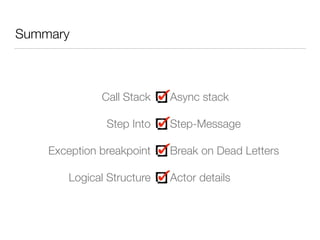
Summary 
Call Stack 
Step Into 
Exception breakpoint 
Logical Structure 
Async stack 
Step-Message 
Break on Dead Letters 
Actor details
Scala IDE for Eclipse 4.0 preview and roadmap
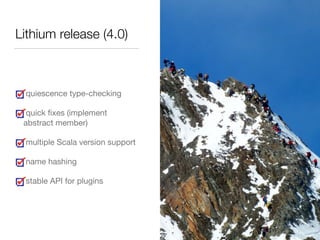
Lithium release (4.0) 
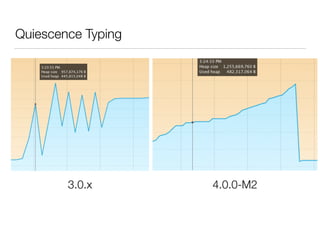
quiescence type-checking 
quick fixes (implement 
abstract member) 
multiple Scala version support 
name hashing 
stable API for plugins
Community steps up
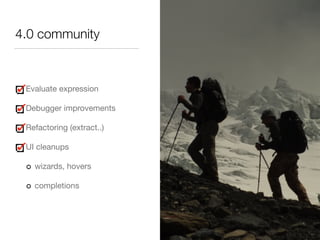
4.0 community 
Evaluate expression 
Debugger improvements 
Refactoring (extract..) 
UI cleanups 
wizards, hovers 
completions
Quiescence Typing 
3.0.x 4.0.0-M2
Multiple Scala Version support 
• Starting with Scala 2.11.0 and IDE 4.0-M2 
• Presentation compiler works in (2.10) compatibility mode 
• The build compiler is 2.10 
• Can have multiple Scala versions in the same workspace
What next?
Sbt-server 
• Delegate build to an Sbt 
(shared) process 
• Directly import Sbt project 
• Run any task 
• Launch/debug Play apps
GSoC project 
• extensible IDE 
• use Scala snippets to plug into 
the IDE 
• Save Actions 
• Debug Object rendering 
• Auto-edits
Contribute!

Rethinking the debugger

  • 1.
    Rethinking the debugger Iulian Dragos @jaguarul
  • 2.
    Overview • AsyncDebugger • Scala IDE for Eclipse 4.0
  • 3.
    Reactive applications •Different parts of the application run in different logical threads • ..the programmer must ensure correct coordination and communication
  • 6.
    Concurrency • Threadsand Locks are replaced by • Futures • Actors • parallel collections (fork-join frameworks)
  • 7.
    Concurrency • non-blocking • often leads to callbacks • flow of execution is not flow of program text
  • 8.
    Futures Execution continueswithout waiting for all tweets val fTweets = Future { getAllTweets(user) } ! // also a future val nrOfTweets = fTweets.map(ts => ts.size) ! nrOfTweets onSuccess { println } Futures can be chained Callback for successful completion
  • 9.
    How do wedebug asynchronous programs?
  • 10.
    Detective work •go from undesirable effects back to causes • attempt a fix • repeat
  • 11.
    The Call Stack java.lang.Exception at test.FuturesTest$$anonfun$simpleUse$1$$anonfun$2$$anonfun$apply$1.apply$mcI$sp(Futur.. at test.FuturesTest$$anonfun$simpleUse$1$$anonfun$2$$anonfun$apply$1.apply(FuturesTest.sca.. at test.FuturesTest$$anonfun$simpleUse$1$$anonfun$2$$anonfun$apply$1.apply(FuturesTest.sca.. at scala.concurrent.impl.Future$PromiseCompletingRunnable.liftedTree1$1(Future.scala:24) at scala.concurrent.impl.Future$PromiseCompletingRunnable.run(Future.scala:24) at scala.concurrent.impl.ExecutionContextImpl$$anon$3.exec(ExecutionContextImpl.scala:107) at scala.concurrent.forkjoin.ForkJoinTask.doExec(ForkJoinTask.java:260) at scala.concurrent.forkjoin.ForkJoinPool$WorkQueue.runTask(ForkJoinPool.java:1339) at scala.concurrent.forkjoin.ForkJoinPool.runWorker(ForkJoinPool.java:1979) at scala.concurrent.forkjoin.ForkJoinWorkerThread.run(ForkJoinWorkerThread.java:107) Futures use a thread pool for execution!
  • 12.
    The Problem •The call-stack used to record the flow of control of sequential programs • futures (and actors) execute each computation step on a different thread • on a mostly uninteresting call stack
  • 13.
    Can we recoverthe async stack? Record call stack when a future is created
  • 14.
    Under the hood • Intercept Future instantiation • Save stack contents (all of it) • Resume • When a breakpoint is hit • check async stacks store • (overhead is comparable to conditional breakpoint)
  • 15.
    Chrome does it Visual Studio does it, too
  • 16.
  • 17.
    Debugging Actors •Can we find out where a message was sent? • what was the state at that point? • IT’S THE SAME THING!
  • 18.
    Not just futures • message sends (Akka, Scala actors) • Play iteratees • any composable asynchronous structure • user-defined/data-flow debugging
  • 19.
    Debugging Actors •Message-send is like an asynchronous method call • “I’d really like to step-into that message send”
  • 20.
    Step-with-a-bang • resumeexecution until the next message sent is received by an actor • the receiving actor might run on a different thread • other messages might be exchanged in the meantime
  • 21.
  • 22.
    More tools •Exception breakpoint: break on dead letters • Logical Structure of an actor • parent • current sender • supervisor strategy
  • 23.
    Future • user-extensiblepoints-of-interest • filter collected data (by package, frame)
  • 24.
    Summary Call Stack Step Into Exception breakpoint Logical Structure Async stack Step-Message Break on Dead Letters Actor details
  • 25.
    Scala IDE forEclipse 4.0 preview and roadmap
  • 26.
    Lithium release (4.0) quiescence type-checking quick fixes (implement abstract member) multiple Scala version support name hashing stable API for plugins
  • 27.
  • 28.
    4.0 community Evaluateexpression Debugger improvements Refactoring (extract..) UI cleanups wizards, hovers completions
  • 29.
  • 30.
    Multiple Scala Versionsupport • Starting with Scala 2.11.0 and IDE 4.0-M2 • Presentation compiler works in (2.10) compatibility mode • The build compiler is 2.10 • Can have multiple Scala versions in the same workspace
  • 31.
  • 32.
    Sbt-server • Delegatebuild to an Sbt (shared) process • Directly import Sbt project • Run any task • Launch/debug Play apps
  • 33.
    GSoC project •extensible IDE • use Scala snippets to plug into the IDE • Save Actions • Debug Object rendering • Auto-edits
  • 34.