The Actor ModelTowards Better ConcurrencyBy: DrorBereznitsky1
Warning: Code Examples
The end of Moore law?Shared state concurrencyMessage passing concurrencyActors on the JVMMore concurrency modelsSummaryAgendaAgenda
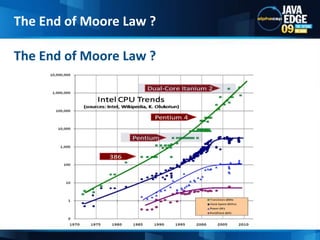
The End of Moore Law ?
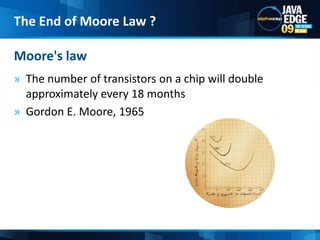
The number of transistors on a chip will double approximately every 18 months Gordon E. Moore, 1965Moore's lawThe End of Moore Law ?
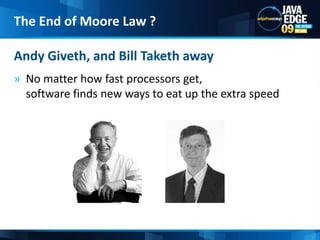
No matter how fast processors get, software finds new ways to eat up the extra speedAndy Giveth, and Bill Taketh away The End of Moore Law ?
Free and regular performance gains, even without releasing new versions or doing anything specialThe Free LunchThe End of Moore Law ?
The End of Moore Law ?The End of Moore Law ?
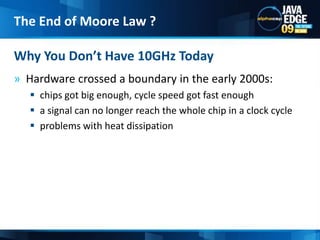
Hardware crossed a boundary in the early 2000s: chips got big enough, cycle speed got fast enough a signal can no longer reach the whole chip in a clock cycleproblems with heat dissipation  Why You Don’t Have 10GHz TodayThe End of Moore Law ?9
Processor manufacturers have turned towards multi-core processorsCapable of doing multiple calculations in parallel  CPU speeds are likely to stay relatively flat in the near future The Multicore EraThe End of Moore Law ?10
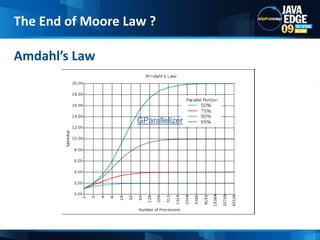
The performance lunch isn’t free any more Want to benefit from the continued throughput advances in new processors?You will need to develop well-written concurrent applicationsThe Concurrency RevolutionThe End of Moore Law ?11
Amdahl’s LawThe End of Moore Law ?GParallelizer12
Shared State Concurrency13
Shared mutable state Locking mechanismShared State ConcurrencyShared State Concurrency
Threads concurrently execute code sectionsContains resources that must be sharedSynchronized in order to guarantee Correct orderingVisibilityData consistencyThreadsShared State Concurrency
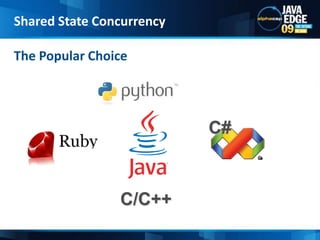
The Popular ChoiceShared State ConcurrencyC#C/C++
Why Threads are EvilShared State Concurrencyhttp://www.flickr.com/photos/amagill/235453953/
“Non-trivial multi-threaded programs are incomprehensible to human …”Edward A. Lee, The Problem with Threads  Not Convinced Yet ?Shared State Concurrency
Message Passing Concurrency (Actors)Software Transactional MemoryDataflow ConcurrencyAlternative Concurrency ModelsShared State Concurrency
Message Passing Concurrency
1973, paper by Carl HewittAvoid the problems caused by threading and locking Implemented in Erlang, Oz, OccamMessage Passing concurrencyMessage Passing concurrency
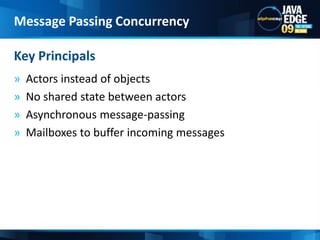
Actors instead of objectsNo shared state between actorsAsynchronous message-passing Mailboxes to buffer incoming messagesKey PrincipalsMessage Passing Concurrency
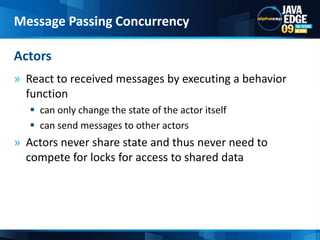
React to received messages by executing a behavior functioncan only change the state of the actor itself can send messages to other actorsActors never share state and thus never need to compete for locks for access to shared dataActorsMessage Passing Concurrency
Actors exchange data by sending immutable messages Messages are sent asynchronouslyActors do not block waiting for responses to their messagesMessagesMessage Passing Concurrency
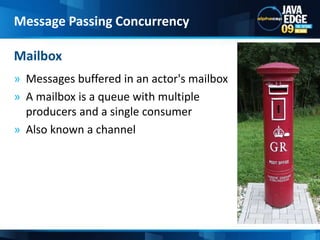
Messages buffered in an actor's mailbox A mailbox is a queue with multiple producers and a single consumerAlso known a channel MailboxMessage Passing Concurrency
A pure functional, dynamically typed language invented in 1986 at EricssonDesigned for concurrency, distribution and scalability Actors are part of the language No Mutable stateErlangMessage Passing Concurrency
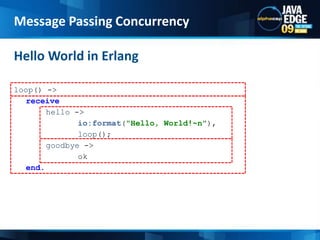
loop() ->receivehello ->io:format("Hello, World!~n"),loop();goodbye ->		okend.Hello World in ErlangMessage Passing Concurrency
Actors on the JVM
JVM languages actors implementations available forJavaScala Groovy FantomActors on the JVMActors on the JVM
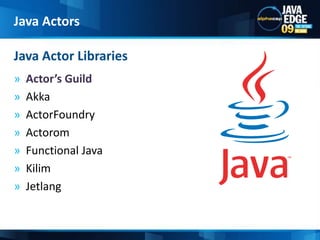
Actor’s GuildAkkaActorFoundryActoromFunctional JavaKilimJetlangJava Actor LibrariesJava Actors
Experimental Java frameworkmake concurrent programming easierAnnotation based approachMessages handlers are implemented as Java methodsUses a request/response pattern for messagesNot a pure Actors implementationNo special pre-processingActors GuildJava Actors
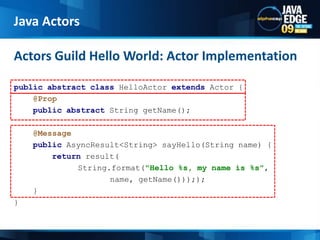
public abstract class HelloActorextends Actor {@Proppublic abstract String getName();@MessagepublicAsyncResult<String> sayHello(String name) {return result(String.format("Hello %s, my name is %s", 				name, getName())););    }}Actors Guild Hello World: Actor ImplementationJava Actors
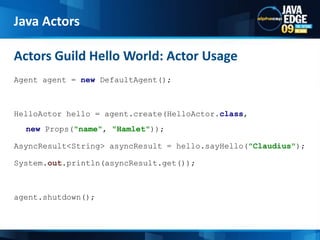
Agent agent = newDefaultAgent();HelloActor hello = agent.create(HelloActor.class, new Props("name", "Hamlet"));AsyncResult<String> asyncResult = hello.sayHello("Claudius");System.out.println(asyncResult.get());agent.shutdown();Actors Guild Hello World: Actor Usage Java Actors
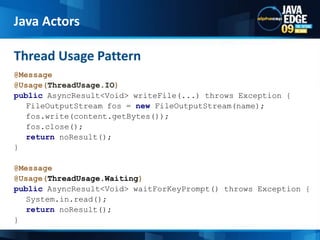
@Message@Usage(ThreadUsage.IO)publicAsyncResult<Void> writeFile(...) throws Exception {FileOutputStreamfos = newFileOutputStream(name);fos.write(content.getBytes());fos.close();returnnoResult();}   @Message@Usage(ThreadUsage.Waiting)publicAsyncResult<Void> waitForKeyPrompt() throws Exception {System.in.read();returnnoResult();}Thread Usage PatternJava Actors
@Model(ConcurrencyModel.Stateless)classMultiplicatorActorextends Actor {@Message    public AsyncResult<Integer> mul(int a, int b) {return result(a * b);    }   }Concurrency Model AnnotationsJava Actors
Scala ActorsScala ActorsScala actors combine the powers of functional programming along with the flexible type-system of Scala
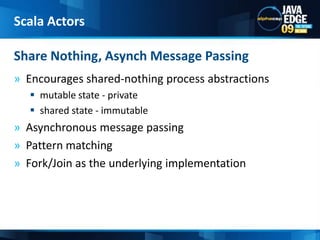
Encourages shared-nothing process abstractionsmutable state - privateshared state - immutable Asynchronous message passingPattern matching Fork/Join as the underlying implementation Share Nothing, Asynch Message PassingScala Actors
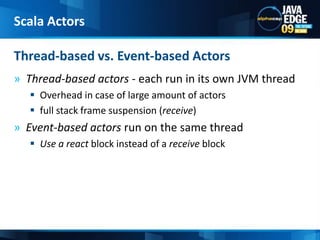
Thread-based actors - each run in its own JVM threadOverhead in case of large amount of actorsfull stack frame suspension (receive)Event-based actors run on the same thread Use a react block instead of a receive block Thread-based vs. Event-based ActorsScala Actors
Lightweight event objectsExecuted on an underlying worker thread poolautomatically resized when all threads block on long running operations Suspension mechanism based on a continuation closure (react)Lightweight Event Based ActorsScala Actors
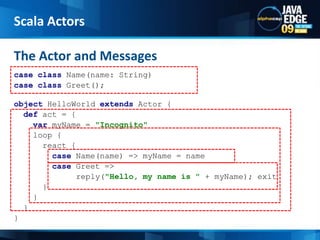
The Actor and MessagesScala Actorscase class Name(name: String) case class Greet();objectHelloWorldextends Actor { def act = { varmyName = "Incognito"     loop {       react { case Name(name) => myName = name case Greet =>              reply("Hello, my name is " + myName); exit       }     }   } }
object Greetings extends Application {HelloWorld.startHelloWorld ! Name("foo")HelloWorld !? Greet match {case result: String => println(result);  }}Interacting with the ActorScala Actors
Groovy Actors
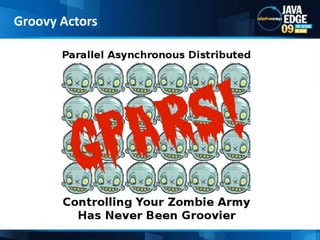
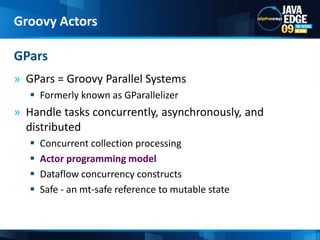
GPars = Groovy Parallel SystemsFormerly known as GParallelizerHandle tasks concurrently, asynchronously, and distributedConcurrent collection processingActor programming modelDataflow concurrency constructsSafe - an mt-safe reference to mutable stateGParsGroovy Actors
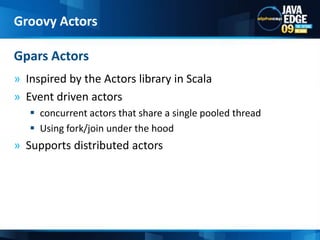
Inspired by the Actors library in ScalaEvent driven actorsconcurrent actors that share a single pooled threadUsing fork/join under the hoodSupports distributed actorsGpars ActorsGroovy Actors
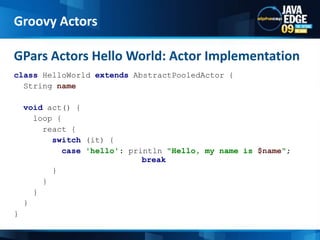
classHelloWorldextendsAbstractPooledActor {  String namevoid act() {    loop {      react {switch (it) {case'hello': println"Hello, my name is $name"; 					break        }      }    }  }}GPars Actors Hello World: Actor ImplementationGroovy Actors
def actor = newHelloWorld(name : "Charlie").start();actor.send('hello')GPars Actors Hello World: Actor UsageGroovy Actors
Actors in the Real World
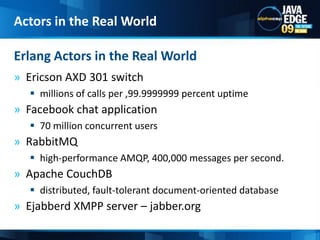
Ericson AXD 301 switchmillions of calls per ,99.9999999 percent uptimeFacebook chat application70 million concurrent usersRabbitMQhigh-performance AMQP, 400,000 messages per second. Apache CouchDBdistributed, fault-tolerant document-oriented databaseEjabberd XMPP server – jabber.orgErlang Actors in the Real WorldActors in the Real World
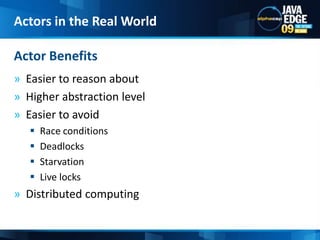
Easier to reason aboutHigher abstraction levelEasier to avoidRace conditionsDeadlocksStarvationLive locksDistributed computingActor BenefitsActors in the Real World
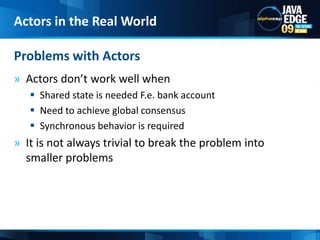
Actors don’t work well whenShared state is needed F.e. bank accountNeed to achieve global consensusSynchronous behavior is requiredIt is not always trivial to break the problem into smaller problemsProblems with ActorsActors in the Real World
More Concurrency Models
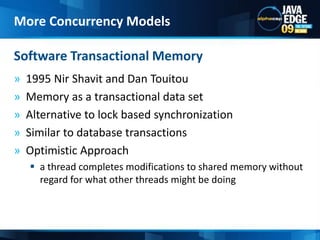
1995 Nir Shavit and Dan TouitouMemory as a transactional data setAlternative to lock based synchronizationSimilar to database transactionsOptimistic Approacha thread completes modifications to shared memory without regard for what other threads might be doingSoftware Transactional MemoryMore Concurrency Models
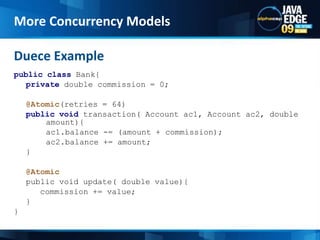
Java STM framework by Guy Korland (TAU, GigaSpaces)@Atomic methodsField based accessMore scalable than Object bases.More efficient than word based.No reserved wordsNo need for new compilers (Existing IDEs can be used)Using bytecode instrumentation (ASM)DeuceMore Concurrency Models
public class Bank{private double commission = 0;@Atomic(retries = 64)public void transaction( Account ac1, Account ac2, double 	amount){		ac1.balance -= (amount + commission);		ac2.balance += amount;	}@Atomic	public void update( double value){	   commission += value;	}}Duece ExampleMore Concurrency Models
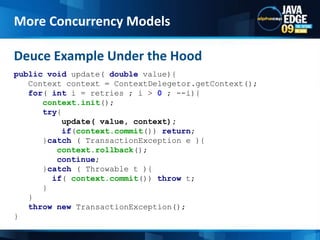
public void update( double value){   Context context = ContextDelegetor.getContext();for( inti = retries ; i > 0 ; --i){context.init();try{update( value, context);  if(context.commit()) return;      }catch ( TransactionException e ){context.rollback();continue;      }catch ( Throwable t ){if( context.commit()) throw t;      }     }throw new TransactionException();}Deuce Example Under the HoodMore Concurrency Models
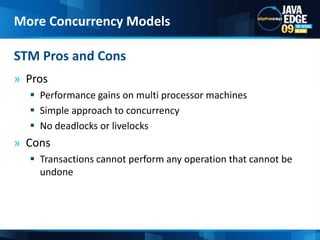
ProsPerformance gains on multi processor machinesSimple approach to concurrencyNo deadlocks or livelocksConsTransactions cannot perform any operation that cannot be undoneSTM Pros and ConsMore Concurrency Models
Summary
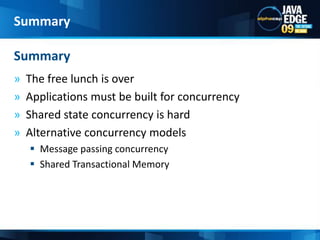
The free lunch is overApplications must be built for concurrencyShared state concurrency is hardAlternative concurrency modelsMessage passing concurrencyShared Transactional MemorySummarySummary
The free lunch is overState: You're Doing It WrongEdward A. Lee, The Problem with Threads (PDF)  Alex Miller – Actor ConcurrencyDeuce STMResourcesSummary
Thank You :-)

The Actor Model - Towards Better Concurrency

  • 1.
    The Actor ModelTowardsBetter ConcurrencyBy: DrorBereznitsky1
  • 2.
  • 3.
    The end ofMoore law?Shared state concurrencyMessage passing concurrencyActors on the JVMMore concurrency modelsSummaryAgendaAgenda
  • 4.
    The End ofMoore Law ?
  • 5.
    The number oftransistors on a chip will double approximately every 18 months Gordon E. Moore, 1965Moore's lawThe End of Moore Law ?
  • 6.
    No matter howfast processors get, software finds new ways to eat up the extra speedAndy Giveth, and Bill Taketh away The End of Moore Law ?
  • 7.
    Free and regularperformance gains, even without releasing new versions or doing anything specialThe Free LunchThe End of Moore Law ?
  • 8.
    The End ofMoore Law ?The End of Moore Law ?
  • 9.
    Hardware crossed aboundary in the early 2000s: chips got big enough, cycle speed got fast enough a signal can no longer reach the whole chip in a clock cycleproblems with heat dissipation Why You Don’t Have 10GHz TodayThe End of Moore Law ?9
  • 10.
    Processor manufacturers haveturned towards multi-core processorsCapable of doing multiple calculations in parallel CPU speeds are likely to stay relatively flat in the near future The Multicore EraThe End of Moore Law ?10
  • 11.
    The performance lunchisn’t free any more Want to benefit from the continued throughput advances in new processors?You will need to develop well-written concurrent applicationsThe Concurrency RevolutionThe End of Moore Law ?11
  • 12.
    Amdahl’s LawThe Endof Moore Law ?GParallelizer12
  • 13.
  • 14.
    Shared mutable stateLocking mechanismShared State ConcurrencyShared State Concurrency
  • 15.
    Threads concurrently executecode sectionsContains resources that must be sharedSynchronized in order to guarantee Correct orderingVisibilityData consistencyThreadsShared State Concurrency
  • 16.
    The Popular ChoiceSharedState ConcurrencyC#C/C++
  • 17.
    Why Threads areEvilShared State Concurrencyhttp://www.flickr.com/photos/amagill/235453953/
  • 18.
    “Non-trivial multi-threaded programsare incomprehensible to human …”Edward A. Lee, The Problem with Threads Not Convinced Yet ?Shared State Concurrency
  • 19.
    Message Passing Concurrency(Actors)Software Transactional MemoryDataflow ConcurrencyAlternative Concurrency ModelsShared State Concurrency
  • 20.
  • 21.
    1973, paper byCarl HewittAvoid the problems caused by threading and locking Implemented in Erlang, Oz, OccamMessage Passing concurrencyMessage Passing concurrency
  • 22.
    Actors instead ofobjectsNo shared state between actorsAsynchronous message-passing Mailboxes to buffer incoming messagesKey PrincipalsMessage Passing Concurrency
  • 23.
    React to receivedmessages by executing a behavior functioncan only change the state of the actor itself can send messages to other actorsActors never share state and thus never need to compete for locks for access to shared dataActorsMessage Passing Concurrency
  • 24.
    Actors exchange databy sending immutable messages Messages are sent asynchronouslyActors do not block waiting for responses to their messagesMessagesMessage Passing Concurrency
  • 25.
    Messages buffered inan actor's mailbox A mailbox is a queue with multiple producers and a single consumerAlso known a channel MailboxMessage Passing Concurrency
  • 26.
    A pure functional,dynamically typed language invented in 1986 at EricssonDesigned for concurrency, distribution and scalability Actors are part of the language No Mutable stateErlangMessage Passing Concurrency
  • 27.
    loop() ->receivehello ->io:format("Hello,World!~n"),loop();goodbye -> okend.Hello World in ErlangMessage Passing Concurrency
  • 28.
  • 29.
    JVM languages actorsimplementations available forJavaScala Groovy FantomActors on the JVMActors on the JVM
  • 30.
  • 31.
    Experimental Java frameworkmakeconcurrent programming easierAnnotation based approachMessages handlers are implemented as Java methodsUses a request/response pattern for messagesNot a pure Actors implementationNo special pre-processingActors GuildJava Actors
  • 32.
    public abstract classHelloActorextends Actor {@Proppublic abstract String getName();@MessagepublicAsyncResult<String> sayHello(String name) {return result(String.format("Hello %s, my name is %s", name, getName()));); }}Actors Guild Hello World: Actor ImplementationJava Actors
  • 33.
    Agent agent =newDefaultAgent();HelloActor hello = agent.create(HelloActor.class, new Props("name", "Hamlet"));AsyncResult<String> asyncResult = hello.sayHello("Claudius");System.out.println(asyncResult.get());agent.shutdown();Actors Guild Hello World: Actor Usage Java Actors
  • 34.
    @Message@Usage(ThreadUsage.IO)publicAsyncResult<Void> writeFile(...) throwsException {FileOutputStreamfos = newFileOutputStream(name);fos.write(content.getBytes());fos.close();returnnoResult();} @Message@Usage(ThreadUsage.Waiting)publicAsyncResult<Void> waitForKeyPrompt() throws Exception {System.in.read();returnnoResult();}Thread Usage PatternJava Actors
  • 35.
    @Model(ConcurrencyModel.Stateless)classMultiplicatorActorextends Actor {@Message public AsyncResult<Integer> mul(int a, int b) {return result(a * b); } }Concurrency Model AnnotationsJava Actors
  • 36.
    Scala ActorsScala ActorsScalaactors combine the powers of functional programming along with the flexible type-system of Scala
  • 37.
    Encourages shared-nothing processabstractionsmutable state - privateshared state - immutable Asynchronous message passingPattern matching Fork/Join as the underlying implementation Share Nothing, Asynch Message PassingScala Actors
  • 38.
    Thread-based actors -each run in its own JVM threadOverhead in case of large amount of actorsfull stack frame suspension (receive)Event-based actors run on the same thread Use a react block instead of a receive block Thread-based vs. Event-based ActorsScala Actors
  • 39.
    Lightweight event objectsExecutedon an underlying worker thread poolautomatically resized when all threads block on long running operations Suspension mechanism based on a continuation closure (react)Lightweight Event Based ActorsScala Actors
  • 40.
    The Actor andMessagesScala Actorscase class Name(name: String) case class Greet();objectHelloWorldextends Actor { def act = { varmyName = "Incognito" loop { react { case Name(name) => myName = name case Greet => reply("Hello, my name is " + myName); exit } } } }
  • 41.
    object Greetings extendsApplication {HelloWorld.startHelloWorld ! Name("foo")HelloWorld !? Greet match {case result: String => println(result); }}Interacting with the ActorScala Actors
  • 42.
  • 43.
    GPars = GroovyParallel SystemsFormerly known as GParallelizerHandle tasks concurrently, asynchronously, and distributedConcurrent collection processingActor programming modelDataflow concurrency constructsSafe - an mt-safe reference to mutable stateGParsGroovy Actors
  • 44.
    Inspired by theActors library in ScalaEvent driven actorsconcurrent actors that share a single pooled threadUsing fork/join under the hoodSupports distributed actorsGpars ActorsGroovy Actors
  • 45.
    classHelloWorldextendsAbstractPooledActor { String namevoid act() { loop { react {switch (it) {case'hello': println"Hello, my name is $name"; break } } } }}GPars Actors Hello World: Actor ImplementationGroovy Actors
  • 46.
    def actor =newHelloWorld(name : "Charlie").start();actor.send('hello')GPars Actors Hello World: Actor UsageGroovy Actors
  • 47.
    Actors in theReal World
  • 48.
    Ericson AXD 301switchmillions of calls per ,99.9999999 percent uptimeFacebook chat application70 million concurrent usersRabbitMQhigh-performance AMQP, 400,000 messages per second. Apache CouchDBdistributed, fault-tolerant document-oriented databaseEjabberd XMPP server – jabber.orgErlang Actors in the Real WorldActors in the Real World
  • 49.
    Easier to reasonaboutHigher abstraction levelEasier to avoidRace conditionsDeadlocksStarvationLive locksDistributed computingActor BenefitsActors in the Real World
  • 50.
    Actors don’t workwell whenShared state is needed F.e. bank accountNeed to achieve global consensusSynchronous behavior is requiredIt is not always trivial to break the problem into smaller problemsProblems with ActorsActors in the Real World
  • 51.
  • 52.
    1995 Nir Shavitand Dan TouitouMemory as a transactional data setAlternative to lock based synchronizationSimilar to database transactionsOptimistic Approacha thread completes modifications to shared memory without regard for what other threads might be doingSoftware Transactional MemoryMore Concurrency Models
  • 53.
    Java STM frameworkby Guy Korland (TAU, GigaSpaces)@Atomic methodsField based accessMore scalable than Object bases.More efficient than word based.No reserved wordsNo need for new compilers (Existing IDEs can be used)Using bytecode instrumentation (ASM)DeuceMore Concurrency Models
  • 54.
    public class Bank{privatedouble commission = 0;@Atomic(retries = 64)public void transaction( Account ac1, Account ac2, double amount){ ac1.balance -= (amount + commission); ac2.balance += amount; }@Atomic public void update( double value){ commission += value; }}Duece ExampleMore Concurrency Models
  • 55.
    public void update(double value){ Context context = ContextDelegetor.getContext();for( inti = retries ; i > 0 ; --i){context.init();try{update( value, context); if(context.commit()) return; }catch ( TransactionException e ){context.rollback();continue; }catch ( Throwable t ){if( context.commit()) throw t; } }throw new TransactionException();}Deuce Example Under the HoodMore Concurrency Models
  • 56.
    ProsPerformance gains onmulti processor machinesSimple approach to concurrencyNo deadlocks or livelocksConsTransactions cannot perform any operation that cannot be undoneSTM Pros and ConsMore Concurrency Models
  • 57.
  • 58.
    The free lunchis overApplications must be built for concurrencyShared state concurrency is hardAlternative concurrency modelsMessage passing concurrencyShared Transactional MemorySummarySummary
  • 59.
    The free lunchis overState: You're Doing It WrongEdward A. Lee, The Problem with Threads (PDF) Alex Miller – Actor ConcurrencyDeuce STMResourcesSummary
  • 60.