Ivy Academy A Public Charter School Key Concepts
!!!  Public School  !!! (NO Tuition) Aligned with HCDE  Strategic Plan Aligned with purpose of charter school law  Serving at risk and other students
Learning Environment Small Class Groups Themed learning Project-based learning Outdoor “classrooms” Longer class periods
Integrated Thematic Learning A combination of subjects An emphasis on projects Sources that go beyond textbooks Relationships among concepts Thematic units as organizing principles Flexible schedules Flexible student groupings
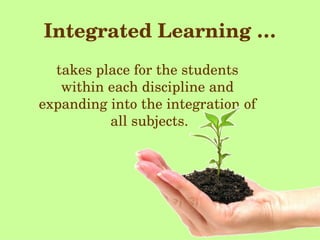
Integrated Learning … takes place for the students  within each discipline and  expanding into the integration of  all subjects.
Benefits of Integrated Learning Mirrors the real world Motivates students – learning is relevant  to their personal lives Works with the natural ways in which the brain integrates  and processes new information
Benefits  continued Adds coherence to vast amounts of information by making connections among disciplines Acknowledges reading, writing, speaking, listening, viewing, and the use of numbers as enabling skills within thinking processes. Fosters collaboration among students  and teachers.
Projects Year-level teacher teams will design interdisciplinary projects which can be personalized for each student  Students work to design a solution for the problem by using critical thinking skills and applying the knowledge learned in each of the disciplines.
Purpose of Projects Teachers can have a common aim for the knowledge conveyed in their individual classes Depth of subject matter is supported and increased Demands critical thinking from the students  and the teachers in order to design a solution Student-learned knowledge is applied to a real world application. Graduation standards are fulfilled.
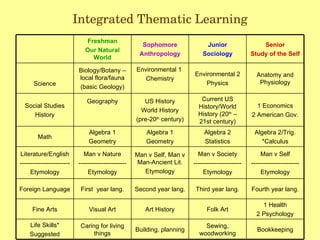
Integrated Thematic Learning Bookkeeping Sewing, woodworking Building, planning Caring for living things Life Skills* Suggested 1 Health 2 Psychology Folk Art Art History Visual Art Fine Arts Fourth year lang. Third year lang. Second year lang. First  year lang. Foreign Language Man v Self ----------------------- Etymology Man v Society ----------------------- Etymology Man v Self, Man v Man-Ancient Lit. Etymology Man v Nature ----------------------- Etymology Literature/English ------------------------ Etymology Algebra 2/Trig. *Calculus Algebra 2 Statistics Algebra 1 Geometry Algebra 1 Geometry Math 1 Economics 2 American Gov. Current US History/World History (20 th  – 21st century) US History World History (pre-20 th  century) Geography Social Studies History Anatomy and Physiology Environmental 2 Physics Environmental 1  Chemistry Biology/Botany –local flora/fauna (basic Geology) Science Senior Study of the Self Junior Sociology Sophomore Anthropology Freshman Our Natural World
Why Outdoors? Return students to a healthy, natural learning environment Gardner’s 8 th  Intelligence: Naturalist http://www.education-world.com/a_curr/curr054.shtml The ability to recognize and classify In a natural Setting – rocks, plants, animals In an urban Setting – automobile, clothing, electronic brands
Today’s Students “ Nature-deficit disorder  describes the human costs of alienation from nature, among them: diminished use of the senses, attention difficulties,  and higher rates of physical and emotional illnesses.” The rate at which doctors prescribe antidepressants to children  has doubled in the last five years. By the 1990s the radius around the home where children were allowed roam on their own had shrunk to a ninth of what it had been in 1970.  Today, average eight-year-olds able to identify more cartoon characters than native species, such as beetles and oak trees, in their own community. “ [Benjamin Franklin] applied a scientist’s mind to the lessons of the senses, and used his direct experience with nature to solve a problem.” (Last Child in the Woods :) Physical education / wellness is in inseparable component and is daily.

Ivy Key Concepts

  • 1.
    Ivy Academy APublic Charter School Key Concepts
  • 2.
    !!! PublicSchool !!! (NO Tuition) Aligned with HCDE Strategic Plan Aligned with purpose of charter school law Serving at risk and other students
  • 3.
    Learning Environment SmallClass Groups Themed learning Project-based learning Outdoor “classrooms” Longer class periods
  • 4.
    Integrated Thematic LearningA combination of subjects An emphasis on projects Sources that go beyond textbooks Relationships among concepts Thematic units as organizing principles Flexible schedules Flexible student groupings
  • 5.
    Integrated Learning …takes place for the students within each discipline and expanding into the integration of all subjects.
  • 6.
    Benefits of IntegratedLearning Mirrors the real world Motivates students – learning is relevant to their personal lives Works with the natural ways in which the brain integrates and processes new information
  • 7.
    Benefits continuedAdds coherence to vast amounts of information by making connections among disciplines Acknowledges reading, writing, speaking, listening, viewing, and the use of numbers as enabling skills within thinking processes. Fosters collaboration among students and teachers.
  • 8.
    Projects Year-level teacherteams will design interdisciplinary projects which can be personalized for each student Students work to design a solution for the problem by using critical thinking skills and applying the knowledge learned in each of the disciplines.
  • 9.
    Purpose of ProjectsTeachers can have a common aim for the knowledge conveyed in their individual classes Depth of subject matter is supported and increased Demands critical thinking from the students and the teachers in order to design a solution Student-learned knowledge is applied to a real world application. Graduation standards are fulfilled.
  • 10.
    Integrated Thematic LearningBookkeeping Sewing, woodworking Building, planning Caring for living things Life Skills* Suggested 1 Health 2 Psychology Folk Art Art History Visual Art Fine Arts Fourth year lang. Third year lang. Second year lang. First year lang. Foreign Language Man v Self ----------------------- Etymology Man v Society ----------------------- Etymology Man v Self, Man v Man-Ancient Lit. Etymology Man v Nature ----------------------- Etymology Literature/English ------------------------ Etymology Algebra 2/Trig. *Calculus Algebra 2 Statistics Algebra 1 Geometry Algebra 1 Geometry Math 1 Economics 2 American Gov. Current US History/World History (20 th – 21st century) US History World History (pre-20 th century) Geography Social Studies History Anatomy and Physiology Environmental 2 Physics Environmental 1 Chemistry Biology/Botany –local flora/fauna (basic Geology) Science Senior Study of the Self Junior Sociology Sophomore Anthropology Freshman Our Natural World
  • 11.
    Why Outdoors? Returnstudents to a healthy, natural learning environment Gardner’s 8 th Intelligence: Naturalist http://www.education-world.com/a_curr/curr054.shtml The ability to recognize and classify In a natural Setting – rocks, plants, animals In an urban Setting – automobile, clothing, electronic brands
  • 12.
    Today’s Students “Nature-deficit disorder describes the human costs of alienation from nature, among them: diminished use of the senses, attention difficulties, and higher rates of physical and emotional illnesses.” The rate at which doctors prescribe antidepressants to children has doubled in the last five years. By the 1990s the radius around the home where children were allowed roam on their own had shrunk to a ninth of what it had been in 1970. Today, average eight-year-olds able to identify more cartoon characters than native species, such as beetles and oak trees, in their own community. “ [Benjamin Franklin] applied a scientist’s mind to the lessons of the senses, and used his direct experience with nature to solve a problem.” (Last Child in the Woods :) Physical education / wellness is in inseparable component and is daily.