
Reading Styles
1. Skimming
Skimming is reading a text quickly to get a
general idea of meaning.
It can be contrasted with scanning, which is
reading in order to find specific information,
e.g., figures or names.
Example:
➔
1. Skimming
In the classroom:
Skimming is a specific reading skill which is common
in reading newspapers, messages and e-mails. It is
important that learners understand that there is no need to
read every word when skimming, so often teachers set this
as a timed task to encourage speed.
2. Scanning
Scanning is reading a text quickly in order to find specific
information, e.g., figures or names.
It can be contrasted with skimming, which is reading
quickly to get a general idea of meaning.
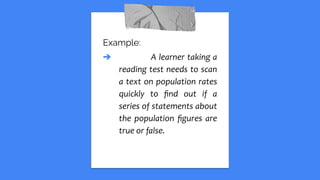
Example:
➔
2. Scanning
In the classroom:
As the above example shows, scanning is a specific
reading skill which is often used in combination with others
such as skimming and intensive reading. Learners need to
learn different ways and understand that choosing how to
read is an important step in building reading skills.
3. Intensive Reading
Intensive reading involves learners reading in detail
with specific learning aims and tasks.
It can be compared with extensive reading, which
involves learners reading texts for enjoyment and to
develop general reading skills.
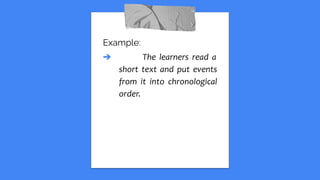
Example:
➔
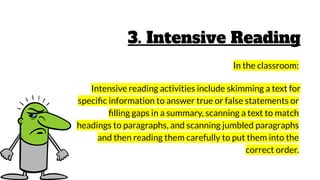
In the classroom:
Intensive reading activities include skimming a text for
specific information to answer true or false statements or
filling gaps in a summary, scanning a text to match
headings to paragraphs, and scanning jumbled paragraphs
and then reading them carefully to put them into the
correct order.
3. Intensive Reading
4. Extensive Reading
Extensive reading involves learners reading texts for
enjoyment and to develop general reading skills.
It can be compared with intensive reading, which means
reading in detail with specific learning aims and tasks.
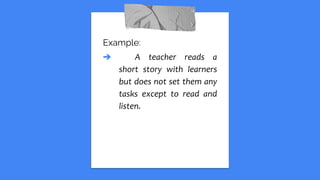
Example:
➔
4. Extensive Reading
In the classroom:
Extensive reading is often overlooked, especially as a
classroom activity. Teachers often feel it is not an effective
use of class time or are just uncomfortable with the
extended silence. Learners can be encouraged to read
extensively by setting up a class library, encouraging review
writing, and incorporating reading of books into the
syllabus, and dedicating some class time to quiet reading.
END
Thank You!
Online Source with No Author (n.d.). Skimming. Retrieved from
https://www.teachingenglish.org.uk/article/skimming
Online Source with No Author (n.d.). Scanning. Retrieved from
https://www.teachingenglish.org.uk/article/scanning
Online Source with No Author (n.d.). Extensive Reading. Retrieved from
https://www.teachingenglish.org.uk/article/extensive-reading-0#:~:text=Extensive%
20reading%20involves%20learners%20reading,except%20to%20read%20and%20lis
ten
Online Source with No Author (n.d.). Intensive Reading. Retrieved from
https://www.teachingenglish.org.uk/article/intensive-reading
References:

Reading Styles

  • 1.
  • 2.
    1. Skimming Skimming isreading a text quickly to get a general idea of meaning. It can be contrasted with scanning, which is reading in order to find specific information, e.g., figures or names.
  • 3.
  • 4.
    1. Skimming In theclassroom: Skimming is a specific reading skill which is common in reading newspapers, messages and e-mails. It is important that learners understand that there is no need to read every word when skimming, so often teachers set this as a timed task to encourage speed.
  • 5.
    2. Scanning Scanning isreading a text quickly in order to find specific information, e.g., figures or names. It can be contrasted with skimming, which is reading quickly to get a general idea of meaning.
  • 6.
  • 7.
    2. Scanning In theclassroom: As the above example shows, scanning is a specific reading skill which is often used in combination with others such as skimming and intensive reading. Learners need to learn different ways and understand that choosing how to read is an important step in building reading skills.
  • 8.
    3. Intensive Reading Intensivereading involves learners reading in detail with specific learning aims and tasks. It can be compared with extensive reading, which involves learners reading texts for enjoyment and to develop general reading skills.
  • 9.
  • 10.
    In the classroom: Intensivereading activities include skimming a text for specific information to answer true or false statements or filling gaps in a summary, scanning a text to match headings to paragraphs, and scanning jumbled paragraphs and then reading them carefully to put them into the correct order. 3. Intensive Reading
  • 11.
    4. Extensive Reading Extensivereading involves learners reading texts for enjoyment and to develop general reading skills. It can be compared with intensive reading, which means reading in detail with specific learning aims and tasks.
  • 12.
  • 13.
    4. Extensive Reading Inthe classroom: Extensive reading is often overlooked, especially as a classroom activity. Teachers often feel it is not an effective use of class time or are just uncomfortable with the extended silence. Learners can be encouraged to read extensively by setting up a class library, encouraging review writing, and incorporating reading of books into the syllabus, and dedicating some class time to quiet reading.
  • 14.
  • 15.
    Online Source withNo Author (n.d.). Skimming. Retrieved from https://www.teachingenglish.org.uk/article/skimming Online Source with No Author (n.d.). Scanning. Retrieved from https://www.teachingenglish.org.uk/article/scanning Online Source with No Author (n.d.). Extensive Reading. Retrieved from https://www.teachingenglish.org.uk/article/extensive-reading-0#:~:text=Extensive% 20reading%20involves%20learners%20reading,except%20to%20read%20and%20lis ten Online Source with No Author (n.d.). Intensive Reading. Retrieved from https://www.teachingenglish.org.uk/article/intensive-reading References: