PURPOSES AND STRATEGIES OF
READING
Email : tenry.colle@gmail.com
IG : rymari.translation17
Facebook : rymari id
YouTube : rymari belajar
LinkedIn : Andi Tenry Lawangen Aspat Colle
ACADEMIC WRITING
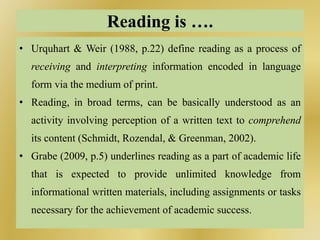
Reading is ….
• Urquhart & Weir (1988, p.22) define reading as a process of
receiving and interpreting information encoded in language
form via the medium of print.
• Reading, in broad terms, can be basically understood as an
activity involving perception of a written text to comprehend
its content (Schmidt, Rozendal, & Greenman, 2002).
• Grabe (2009, p.5) underlines reading as a part of academic life
that is expected to provide unlimited knowledge from
informational written materials, including assignments or tasks
necessary for the achievement of academic success.
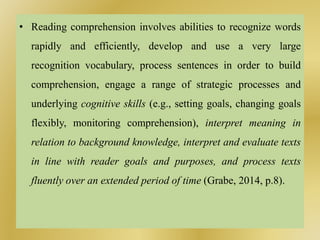
• Reading comprehension involves abilities to recognize words
rapidly and efficiently, develop and use a very large
recognition vocabulary, process sentences in order to build
comprehension, engage a range of strategic processes and
underlying cognitive skills (e.g., setting goals, changing goals
flexibly, monitoring comprehension), interpret meaning in
relation to background knowledge, interpret and evaluate texts
in line with reader goals and purposes, and process texts
fluently over an extended period of time (Grabe, 2014, p.8).
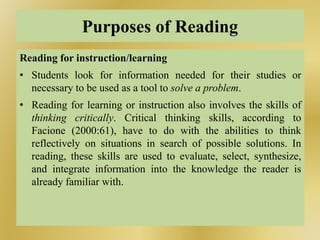
Purposes of Reading
Reading for instruction/learning
• Students look for information needed for their studies or
necessary to be used as a tool to solve a problem.
• Reading for learning or instruction also involves the skills of
thinking critically. Critical thinking skills, according to
Facione (2000:61), have to do with the abilities to think
reflectively on situations in search of possible solutions. In
reading, these skills are used to evaluate, select, synthesize,
and integrate information into the knowledge the reader is
already familiar with.
Reading for Information
• Students are required not only to read for information they are
expected to have in order to deal with their course of study but
also they can read other related information to enlarge their
knowledge background which is an important support to help
them understand the world around them.
• According to Grabe (2009:8), when we read for information, it
involves both the skills of skimming and scanning that allow
us to search for information efficiently. These skills can be
applied either combined or isolated in relation to each other,
depending on the demand or relevance of the reading content
to the reader.
Reading Techniques and Strategies
Skimming
• Skimming is a quick reading strategy of glancing through a
text to find its general idea.
• In skim reading we quickly take the main idea of the content
we read, without absorbing or looking at every word in the
text. That is, we get the gist of what is written.
• According to Reading & Study Skills Lab, skim reading is a
more text-oriented form of surveying which involves
recognizing the parts of a text with the most important
information such as titles, subtitles, introduction, headings,
subheadings, words in special print, visuals, first and last
paragraphs, conclusion, that often provide valuable
background, summarizing, or concluding information.
Scanning
• scanning is an efficient technique used to find a particular
piece of information rather than general impression, without
having the need to understand the rest of the text.
• This technique involves looking down and around a page
quickly and efficiently searching for specific information we
need.
• It is useful for finding a specific name, date, statistical number,
fact, or detail without reading the whole text.
• during scan reading we should use peripheral vision instead of
focusing only on the logical sequence of the text.
Extensive reading
• Reading extensively means reading in quantity, principally in
works of literature.
• In societies where extensive reading is encouraged, people
tend to gain the culture of reading as much as they can for
pleasure in their first or official language in which reading
materials are accessible in large quantities with regular
frequency. These materials are novels, newspapers, and
magazines.
• According to Richards (1998:8), reading research reveals that
many other terms like abundant reading, free reading, wide
reading, and supplementary reading, have been used to refer
to extensive reading, mainly in foreign language pedagogy, to
mean reading rapidly in quantity for pleasure. In this kind of
reading, the reader’s attention is more centred on the content
rather than the language of the text.
• Extensive reading as Richards, Platt & Platt (1992:133)
explain, it is a kind of reading expected to help foreign
language learners to develop a liking for reading in the target
language and consequently expand their language knowledge.
• Contrary to reading for academic purposes, it does not seem to
meet students’ needs in content areas, since the intention is not
primarily to expand the knowledge of the target language but
the knowledge of a specific area. This being so, devoting
careful attention to intensive reading would be more
significant to the research carried out in our particular context.
Intensive reading
• In academic contexts, reading intensively is the greatest
requisite for success. Richards & Schmidt (2002:194) refer to
it as a kind of reading done slowly and demanding a higher
level of understanding information.
• Bogoya González (2011:35) also says it is a language teaching
strategy to make students develop their reading comprehension
ability and the understanding of concepts. Academic intensive
reading implies recognizing, deciphering and constructing
meaning from texts so as to make students be capable of
giving descriptions, explanations and clear illustrations of
concepts.
References
• Faccione, P., Faccione, N., & Giancarlo, C. (2000). The
disposition toward critical thinking: Its character,
measurement, and relationship to critical thinking skill.
Informal Logic, 20(1), 61-84.
• Bogoya González, A. P. (2011). Fostering fifth graders' reading
comprehension through the use of intensive reading in
physical science. Colombian Applied Linguistics Journal,
13(1), 39-57.
• Grabe, W. (2009). Reading in a Second Language: Moving
from Theory to Practice. Cambridge: Cambridge University
Press.
• Grabe, W. (2014). Key issues in L2 reading development. In
Proceedings of the 4th CELC Symposium for English
Language Teachers-Selected Papers (pp. 8-18).
• Richard, J. C., Platt, J., & Platt, H. (1992). Dictionary of
language teaching & applied linguistics. Essex: Longman.
• Richards, J.C. and R. Schmidt. 2002. Dictionary of Language
Teaching and Applied Linguistics (3rd Edition). Essex:
Longman.
• Schmidt, R. J., Rozendal, M. S., & Greenman, G. G. (2002).
Reading instruction in the inclusion classroom: Research-
based practices. Remedial and Special Education, 23(3), 130-
140.
• Urquhart, S. and Weir, C. (1998). Reading in a Second
Language: Process, Product and Practice. London: Longman.

Academic Writing

  • 1.
    PURPOSES AND STRATEGIESOF READING Email : tenry.colle@gmail.com IG : rymari.translation17 Facebook : rymari id YouTube : rymari belajar LinkedIn : Andi Tenry Lawangen Aspat Colle ACADEMIC WRITING
  • 2.
    Reading is …. •Urquhart & Weir (1988, p.22) define reading as a process of receiving and interpreting information encoded in language form via the medium of print. • Reading, in broad terms, can be basically understood as an activity involving perception of a written text to comprehend its content (Schmidt, Rozendal, & Greenman, 2002). • Grabe (2009, p.5) underlines reading as a part of academic life that is expected to provide unlimited knowledge from informational written materials, including assignments or tasks necessary for the achievement of academic success.
  • 3.
    • Reading comprehensioninvolves abilities to recognize words rapidly and efficiently, develop and use a very large recognition vocabulary, process sentences in order to build comprehension, engage a range of strategic processes and underlying cognitive skills (e.g., setting goals, changing goals flexibly, monitoring comprehension), interpret meaning in relation to background knowledge, interpret and evaluate texts in line with reader goals and purposes, and process texts fluently over an extended period of time (Grabe, 2014, p.8).
  • 4.
    Purposes of Reading Readingfor instruction/learning • Students look for information needed for their studies or necessary to be used as a tool to solve a problem. • Reading for learning or instruction also involves the skills of thinking critically. Critical thinking skills, according to Facione (2000:61), have to do with the abilities to think reflectively on situations in search of possible solutions. In reading, these skills are used to evaluate, select, synthesize, and integrate information into the knowledge the reader is already familiar with.
  • 5.
    Reading for Information •Students are required not only to read for information they are expected to have in order to deal with their course of study but also they can read other related information to enlarge their knowledge background which is an important support to help them understand the world around them. • According to Grabe (2009:8), when we read for information, it involves both the skills of skimming and scanning that allow us to search for information efficiently. These skills can be applied either combined or isolated in relation to each other, depending on the demand or relevance of the reading content to the reader.
  • 6.
    Reading Techniques andStrategies Skimming • Skimming is a quick reading strategy of glancing through a text to find its general idea. • In skim reading we quickly take the main idea of the content we read, without absorbing or looking at every word in the text. That is, we get the gist of what is written. • According to Reading & Study Skills Lab, skim reading is a more text-oriented form of surveying which involves recognizing the parts of a text with the most important information such as titles, subtitles, introduction, headings, subheadings, words in special print, visuals, first and last paragraphs, conclusion, that often provide valuable background, summarizing, or concluding information.
  • 7.
    Scanning • scanning isan efficient technique used to find a particular piece of information rather than general impression, without having the need to understand the rest of the text. • This technique involves looking down and around a page quickly and efficiently searching for specific information we need. • It is useful for finding a specific name, date, statistical number, fact, or detail without reading the whole text. • during scan reading we should use peripheral vision instead of focusing only on the logical sequence of the text.
  • 8.
    Extensive reading • Readingextensively means reading in quantity, principally in works of literature. • In societies where extensive reading is encouraged, people tend to gain the culture of reading as much as they can for pleasure in their first or official language in which reading materials are accessible in large quantities with regular frequency. These materials are novels, newspapers, and magazines. • According to Richards (1998:8), reading research reveals that many other terms like abundant reading, free reading, wide reading, and supplementary reading, have been used to refer to extensive reading, mainly in foreign language pedagogy, to mean reading rapidly in quantity for pleasure. In this kind of reading, the reader’s attention is more centred on the content rather than the language of the text.
  • 9.
    • Extensive readingas Richards, Platt & Platt (1992:133) explain, it is a kind of reading expected to help foreign language learners to develop a liking for reading in the target language and consequently expand their language knowledge. • Contrary to reading for academic purposes, it does not seem to meet students’ needs in content areas, since the intention is not primarily to expand the knowledge of the target language but the knowledge of a specific area. This being so, devoting careful attention to intensive reading would be more significant to the research carried out in our particular context.
  • 10.
    Intensive reading • Inacademic contexts, reading intensively is the greatest requisite for success. Richards & Schmidt (2002:194) refer to it as a kind of reading done slowly and demanding a higher level of understanding information. • Bogoya González (2011:35) also says it is a language teaching strategy to make students develop their reading comprehension ability and the understanding of concepts. Academic intensive reading implies recognizing, deciphering and constructing meaning from texts so as to make students be capable of giving descriptions, explanations and clear illustrations of concepts.
  • 11.
    References • Faccione, P.,Faccione, N., & Giancarlo, C. (2000). The disposition toward critical thinking: Its character, measurement, and relationship to critical thinking skill. Informal Logic, 20(1), 61-84. • Bogoya González, A. P. (2011). Fostering fifth graders' reading comprehension through the use of intensive reading in physical science. Colombian Applied Linguistics Journal, 13(1), 39-57. • Grabe, W. (2009). Reading in a Second Language: Moving from Theory to Practice. Cambridge: Cambridge University Press. • Grabe, W. (2014). Key issues in L2 reading development. In Proceedings of the 4th CELC Symposium for English Language Teachers-Selected Papers (pp. 8-18).
  • 12.
    • Richard, J.C., Platt, J., & Platt, H. (1992). Dictionary of language teaching & applied linguistics. Essex: Longman. • Richards, J.C. and R. Schmidt. 2002. Dictionary of Language Teaching and Applied Linguistics (3rd Edition). Essex: Longman. • Schmidt, R. J., Rozendal, M. S., & Greenman, G. G. (2002). Reading instruction in the inclusion classroom: Research- based practices. Remedial and Special Education, 23(3), 130- 140. • Urquhart, S. and Weir, C. (1998). Reading in a Second Language: Process, Product and Practice. London: Longman.