Reading strategies: According to Solé (1992), strategies are procedures or

actions with a specific objective, these actions requires monitoring, supervision,

assessment and implied changes when necessary. Furthermore, Tudor (1996)

defines strategies also as “purposeful activities undertaken by learners with the

goal of promoting their knowledge of an ability to use the target language” (p. 11).

Thus, strategies must be seen under this two definitions and for the purposes of

this study, as the actions students took to increase their understanding of a written

texts; actions that were done in three different moments: before, during and after

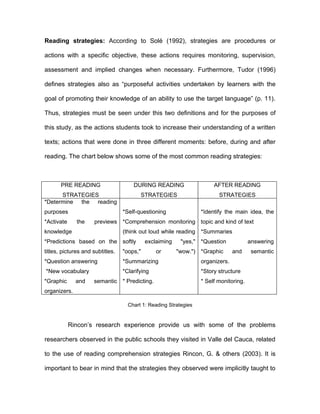
reading. The chart below shows some of the most common reading strategies:


       PRE READING                    DURING READING                   AFTER READING
      STRATEGIES                         STRATEGIES                      STRATEGIES
*Determine the reading
purposes                          *Self-questioning               *Identify the main idea, the
*Activate     the    previews *Comprehension monitoring topic and kind of text
knowledge                         (think out loud while reading *Summaries
*Predictions based on the softly            exclaiming    "yes," *Question             answering
titles, pictures and subtitles.   "oops,"       or       "wow.") *Graphic       and     semantic
*Question answering               *Summarizing                    organizers.
*New vocabulary                   *Clarifying                     *Story structure
*Graphic      and    semantic * Predicting.                       * Self monitoring.
organizers.

                                    Chart 1: Reading Strategies


            Rincon’s research experience provide us with some of the problems

researchers observed in the public schools they visited in Valle del Cauca, related

to the use of reading comprehension strategies Rincon, G. & others (2003). It is

important to bear in mind that the strategies they observed were implicitly taught to
students. Rincon and her research team observed that some of the questions

asked by the teachers with the purposed to activate students’ previews knowledge

or to check for understanding, underestimated students’ knowledge; besides there

were not enough didactic sequences before and after reading; and finally students

did not have the chance to monitor and assess their reading process.           This

problems detected through Rincon’s research experience, were taking into account

in the instructional design of the present study.


      Also, when working with reading strategies, we must not forget that each

individual is different and therefore strategies are not recipes. What work for some

students may not work for others, being part of the teachers’ job then, to help

students discover what best works for them.


       So far, I have approach the main constructs of reading comprehension,

scaffolding and reading strategies. I will now approach the concept of autonomous

learning since reading in this study is seen as a vehicle towards it. The better the

students learn to face the texts by their own, the more independent learners they

will be.

Reading strategies

  • 1.
    Reading strategies: Accordingto Solé (1992), strategies are procedures or actions with a specific objective, these actions requires monitoring, supervision, assessment and implied changes when necessary. Furthermore, Tudor (1996) defines strategies also as “purposeful activities undertaken by learners with the goal of promoting their knowledge of an ability to use the target language” (p. 11). Thus, strategies must be seen under this two definitions and for the purposes of this study, as the actions students took to increase their understanding of a written texts; actions that were done in three different moments: before, during and after reading. The chart below shows some of the most common reading strategies: PRE READING DURING READING AFTER READING STRATEGIES STRATEGIES STRATEGIES *Determine the reading purposes *Self-questioning *Identify the main idea, the *Activate the previews *Comprehension monitoring topic and kind of text knowledge (think out loud while reading *Summaries *Predictions based on the softly exclaiming "yes," *Question answering titles, pictures and subtitles. "oops," or "wow.") *Graphic and semantic *Question answering *Summarizing organizers. *New vocabulary *Clarifying *Story structure *Graphic and semantic * Predicting. * Self monitoring. organizers. Chart 1: Reading Strategies Rincon’s research experience provide us with some of the problems researchers observed in the public schools they visited in Valle del Cauca, related to the use of reading comprehension strategies Rincon, G. & others (2003). It is important to bear in mind that the strategies they observed were implicitly taught to
  • 2.
    students. Rincon andher research team observed that some of the questions asked by the teachers with the purposed to activate students’ previews knowledge or to check for understanding, underestimated students’ knowledge; besides there were not enough didactic sequences before and after reading; and finally students did not have the chance to monitor and assess their reading process. This problems detected through Rincon’s research experience, were taking into account in the instructional design of the present study. Also, when working with reading strategies, we must not forget that each individual is different and therefore strategies are not recipes. What work for some students may not work for others, being part of the teachers’ job then, to help students discover what best works for them. So far, I have approach the main constructs of reading comprehension, scaffolding and reading strategies. I will now approach the concept of autonomous learning since reading in this study is seen as a vehicle towards it. The better the students learn to face the texts by their own, the more independent learners they will be.