Cooperative Learning with
Carousel Brainstorming
Christine M Smith
04-13-2011
Carousel Brainstorming
● Students rotate around the classroom in small
groups, stopping at stations for a designated amount
of time.
● Students will activate prior knowledge of different
topics or different aspects of a single topic through
conversation with peers.
● Ideas will be posted at each station for all groups to
read.
● Prior knowledge will be activated, providing scaffolding
for new information to be learned in the lesson.
Carousel Brainstorming
Cooperative learning roles:
● Recorder, contributes own ideas, records the ideas
each member of the group, writes the name of the
contributor beside the idea.
● Speaker, contributes own ideas, presents group ideas
to the class, is fair and impartial in sharing all ideas.
● Mediator, contributes own ideas, helps to keep ideas
flowing within the group, encourages and refocuses
the group to each task.
● All group members, communicate ideas openly, listen
to teammates, "all for one and one for all"
McGraw-Hill, Inc.
Carousel Brainstorming
Step 1: Assign roles and tasks
● Divide students into groups of three for more equal
participation
● Explain and assign the roles of recorder, speaker, and
mediator
● Highlight the responsibility of the group "all for one and
one for all"
Carousel Brainstorming
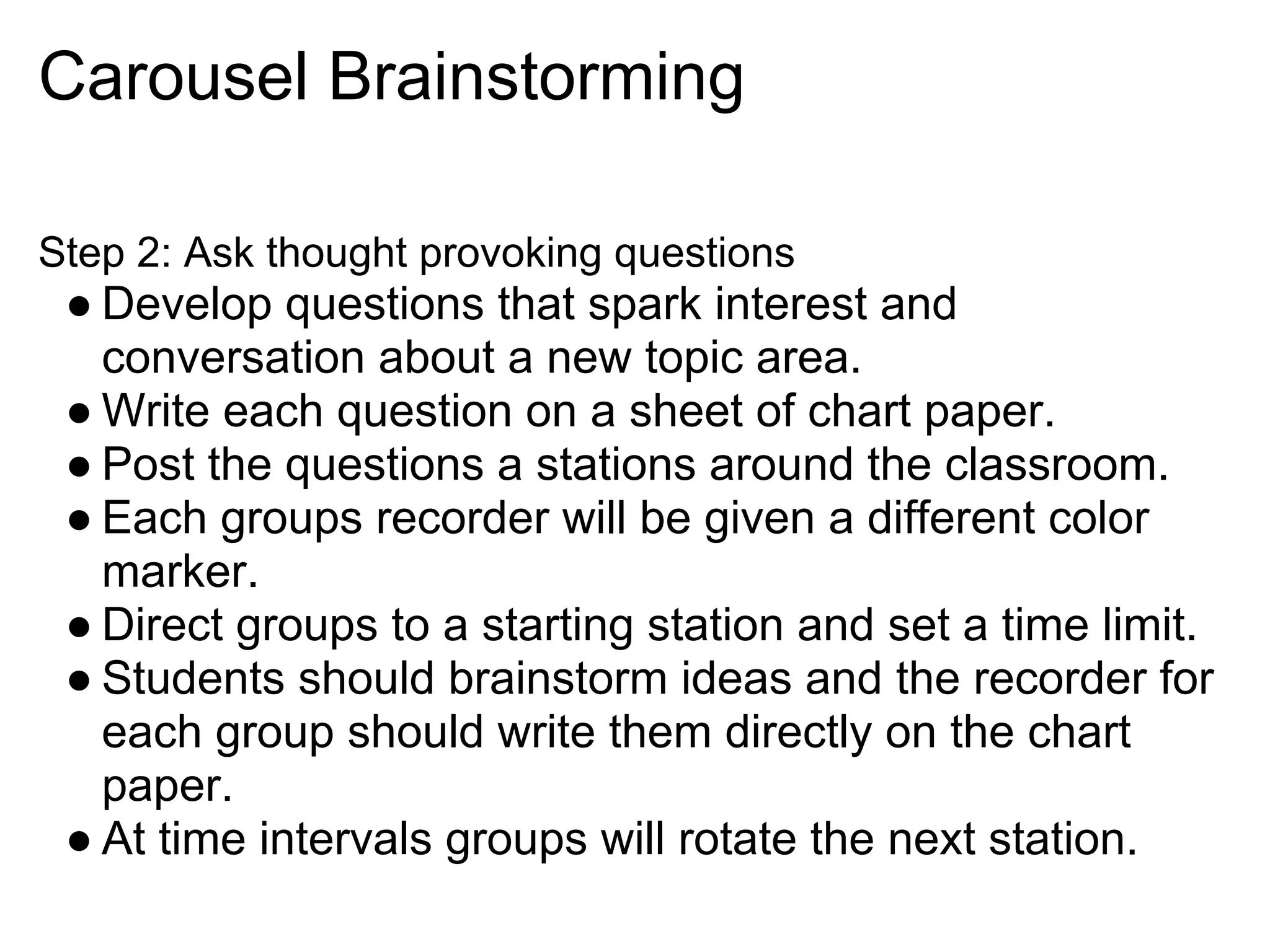
Step 2: Ask thought provoking questions
● Develop questions that spark interest and
conversation about a new topic area.
● Write each question on a sheet of chart paper.
● Post the questions a stations around the classroom.
● Each groups recorder will be given a different color
marker.
● Direct groups to a starting station and set a time limit.
● Students should brainstorm ideas and the recorder for
each group should write them directly on the chart
paper.
● At time intervals groups will rotate the next station.
Carousel Brainstorming
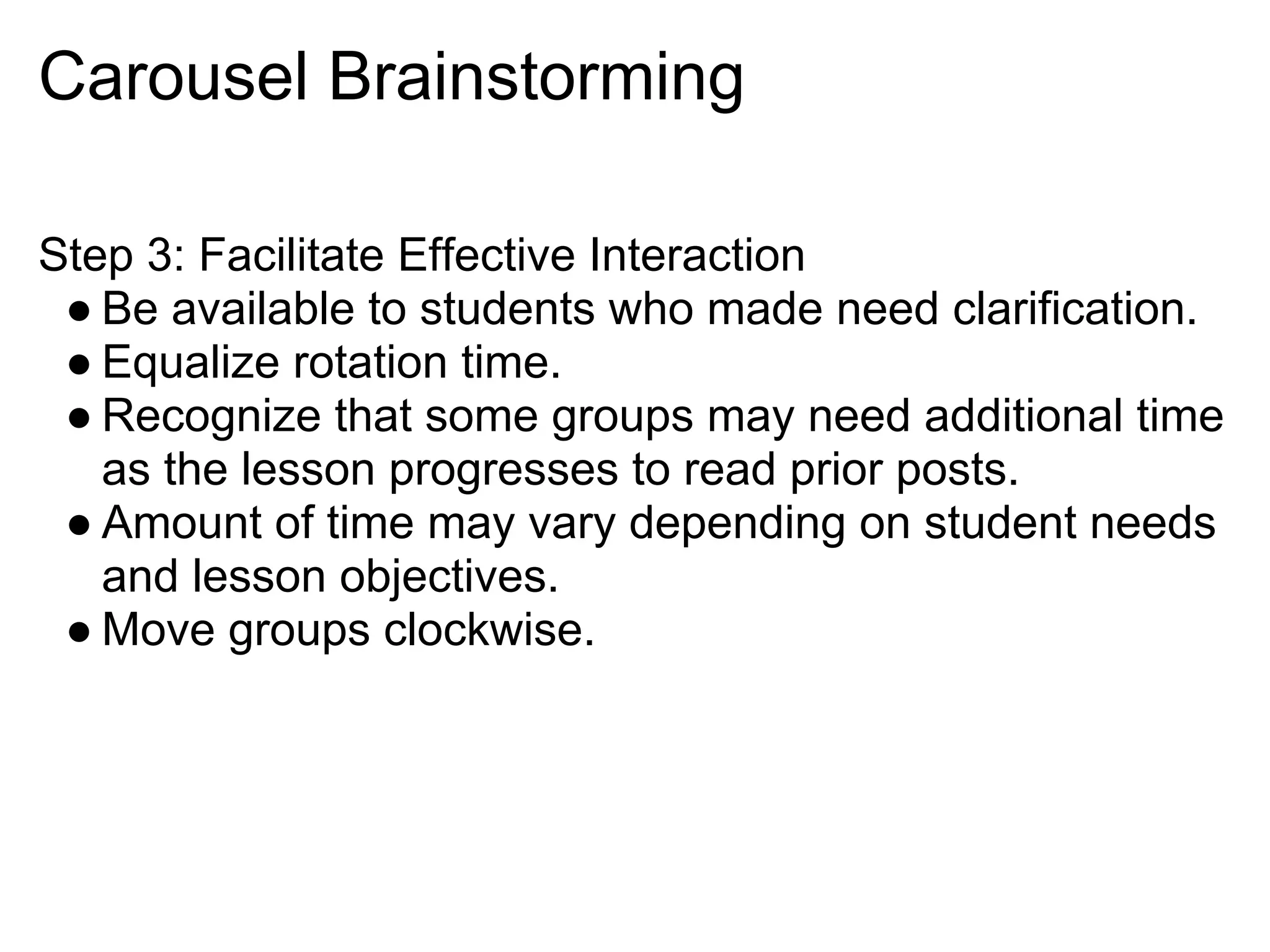
Step 3: Facilitate Effective Interaction
● Be available to students who made need clarification.
● Equalize rotation time.
● Recognize that some groups may need additional time
as the lesson progresses to read prior posts.
● Amount of time may vary depending on student needs
and lesson objectives.
● Move groups clockwise.
Carousel Brainstorming
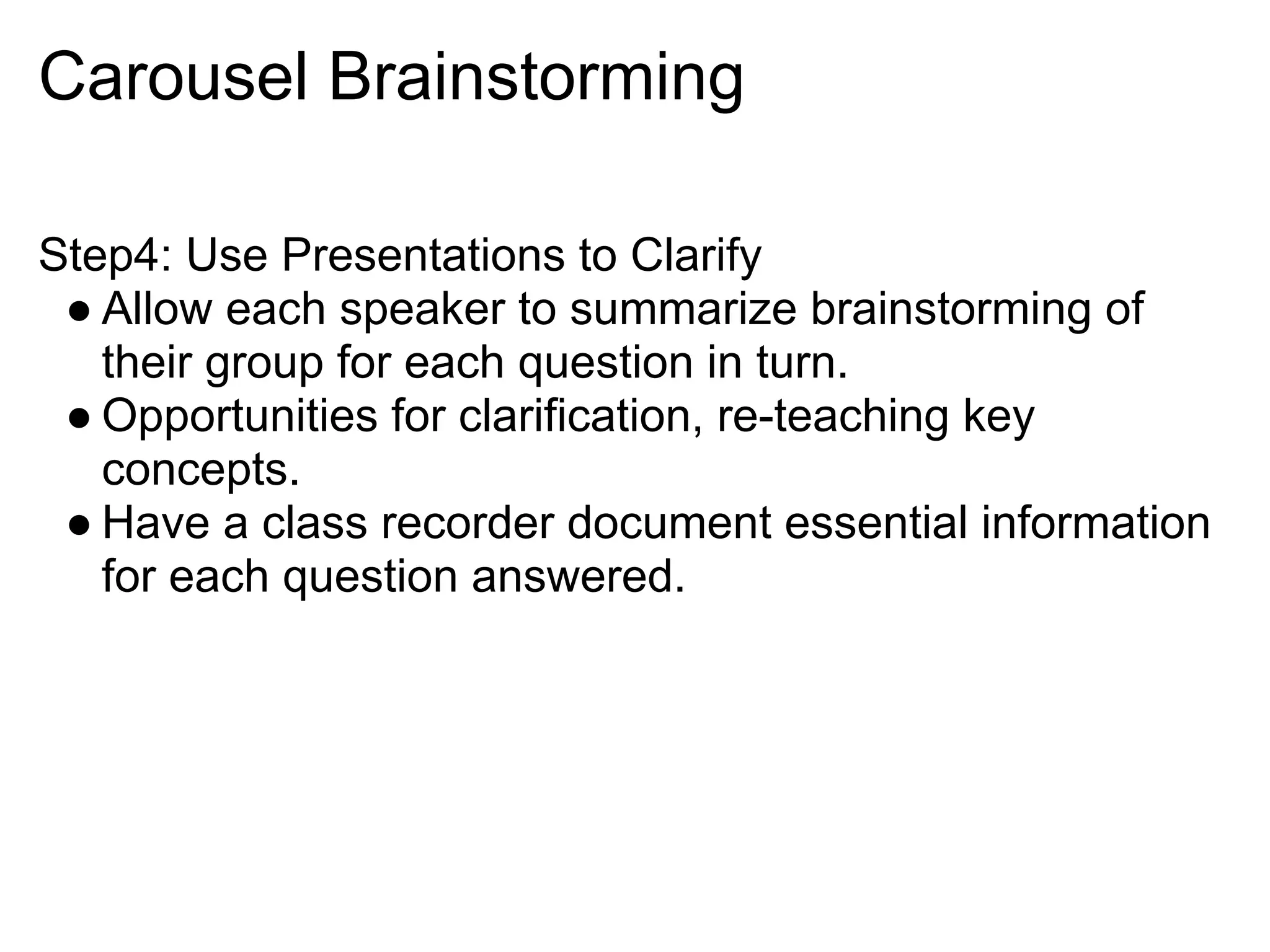
Step4: Use Presentations to Clarify
● Allow each speaker to summarize brainstorming of
their group for each question in turn.
● Opportunities for clarification, re-teaching key
concepts.
● Have a class recorder document essential information
for each question answered.
Carousel Brainstorming
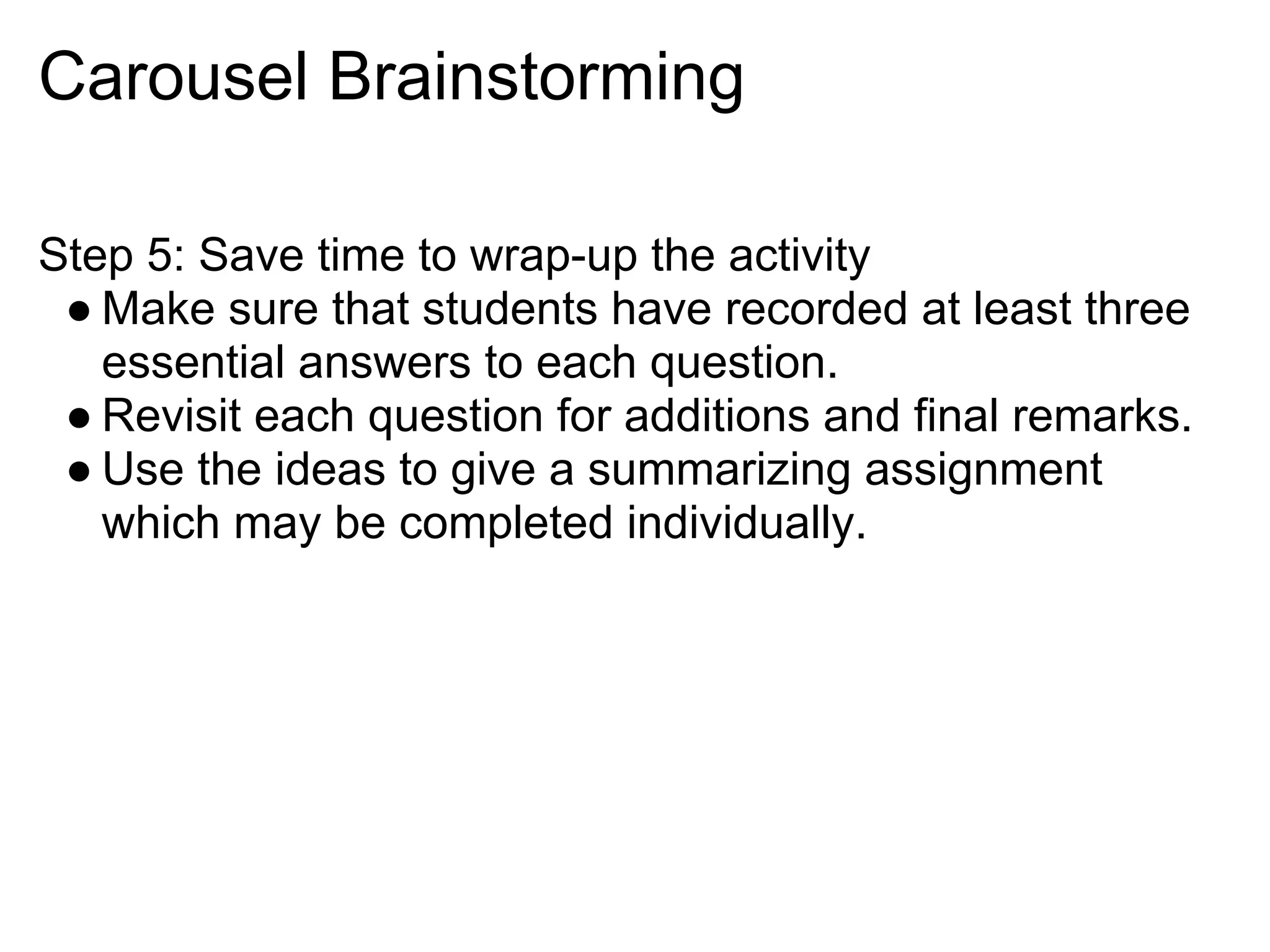
Step 5: Save time to wrap-up the activity
● Make sure that students have recorded at least three
essential answers to each question.
● Revisit each question for additions and final remarks.
● Use the ideas to give a summarizing assignment
which may be completed individually.
Sample Carousel Brainstorming for books with themes of
"Social Justice"
● Why would the author call his book Bystander? What does it
mean to "just stand by?"
● Who do you think the author is referring to when he calls the
kids in his book Misfits? What makes someone feel like a
misfit?
● Why do you think a book called Poison Ivy might be about
bullying? What questions would you ask a bully if you could
put them on trial?
● In the book Waiting for Normal, what do you think some of
the challenges are that the main character might face?
What is normal? Is it the same for everyone?
● What might make you think that the main character in the
book Word Nerd has been bullied? What do you think of
when someone is called a nerd?
Sample wrap-up activities
● After group presentations, students will identify three
key concepts for each question.
● Books will be "book talked."
● Students will choose a book with a partner.
● They will read and write letters to each other
discussing the themes in the book.
● They will demonstrate understanding of the concept of
"social justice" today not just in an historical context by
presenting book talks to their peers.

Cooperative learning with_carousel_brainstormi

  • 1.
    Cooperative Learning with CarouselBrainstorming Christine M Smith 04-13-2011
  • 2.
    Carousel Brainstorming ● Studentsrotate around the classroom in small groups, stopping at stations for a designated amount of time. ● Students will activate prior knowledge of different topics or different aspects of a single topic through conversation with peers. ● Ideas will be posted at each station for all groups to read. ● Prior knowledge will be activated, providing scaffolding for new information to be learned in the lesson.
  • 3.
    Carousel Brainstorming Cooperative learningroles: ● Recorder, contributes own ideas, records the ideas each member of the group, writes the name of the contributor beside the idea. ● Speaker, contributes own ideas, presents group ideas to the class, is fair and impartial in sharing all ideas. ● Mediator, contributes own ideas, helps to keep ideas flowing within the group, encourages and refocuses the group to each task. ● All group members, communicate ideas openly, listen to teammates, "all for one and one for all" McGraw-Hill, Inc.
  • 4.
    Carousel Brainstorming Step 1:Assign roles and tasks ● Divide students into groups of three for more equal participation ● Explain and assign the roles of recorder, speaker, and mediator ● Highlight the responsibility of the group "all for one and one for all"
  • 5.
    Carousel Brainstorming Step 2:Ask thought provoking questions ● Develop questions that spark interest and conversation about a new topic area. ● Write each question on a sheet of chart paper. ● Post the questions a stations around the classroom. ● Each groups recorder will be given a different color marker. ● Direct groups to a starting station and set a time limit. ● Students should brainstorm ideas and the recorder for each group should write them directly on the chart paper. ● At time intervals groups will rotate the next station.
  • 6.
    Carousel Brainstorming Step 3:Facilitate Effective Interaction ● Be available to students who made need clarification. ● Equalize rotation time. ● Recognize that some groups may need additional time as the lesson progresses to read prior posts. ● Amount of time may vary depending on student needs and lesson objectives. ● Move groups clockwise.
  • 7.
    Carousel Brainstorming Step4: UsePresentations to Clarify ● Allow each speaker to summarize brainstorming of their group for each question in turn. ● Opportunities for clarification, re-teaching key concepts. ● Have a class recorder document essential information for each question answered.
  • 8.
    Carousel Brainstorming Step 5:Save time to wrap-up the activity ● Make sure that students have recorded at least three essential answers to each question. ● Revisit each question for additions and final remarks. ● Use the ideas to give a summarizing assignment which may be completed individually.
  • 9.
    Sample Carousel Brainstormingfor books with themes of "Social Justice" ● Why would the author call his book Bystander? What does it mean to "just stand by?" ● Who do you think the author is referring to when he calls the kids in his book Misfits? What makes someone feel like a misfit? ● Why do you think a book called Poison Ivy might be about bullying? What questions would you ask a bully if you could put them on trial? ● In the book Waiting for Normal, what do you think some of the challenges are that the main character might face? What is normal? Is it the same for everyone? ● What might make you think that the main character in the book Word Nerd has been bullied? What do you think of when someone is called a nerd?
  • 10.
    Sample wrap-up activities ●After group presentations, students will identify three key concepts for each question. ● Books will be "book talked." ● Students will choose a book with a partner. ● They will read and write letters to each other discussing the themes in the book. ● They will demonstrate understanding of the concept of "social justice" today not just in an historical context by presenting book talks to their peers.