Transacting with Text
Chapter 3
Megan Thornton
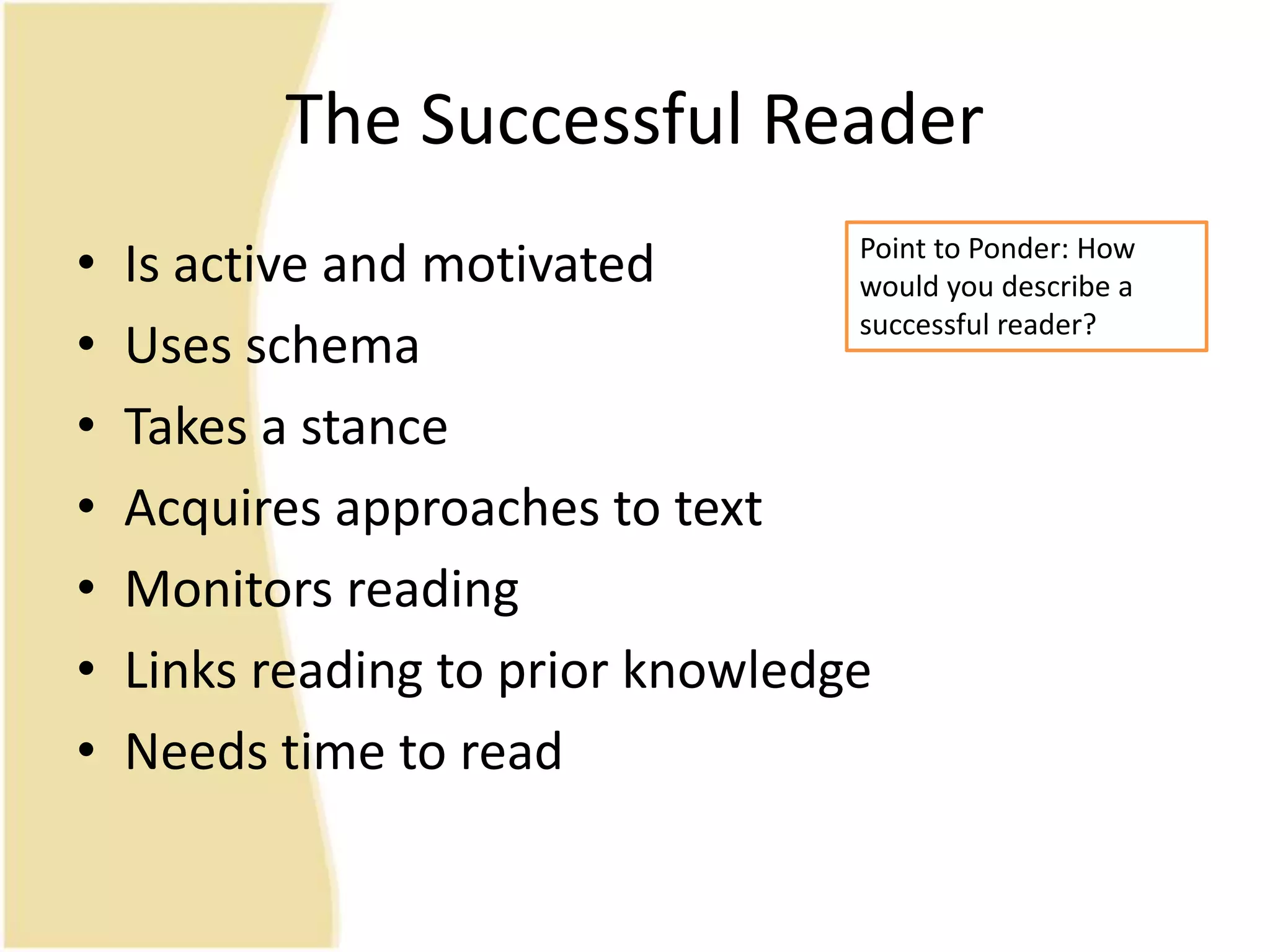
The Successful Reader
• Is active and motivated
• Uses schema
• Takes a stance
• Acquires approaches to text
• Monitors reading
• Links reading to prior knowledge
• Needs time to read
Point to Ponder: How
would you describe a
successful reader?
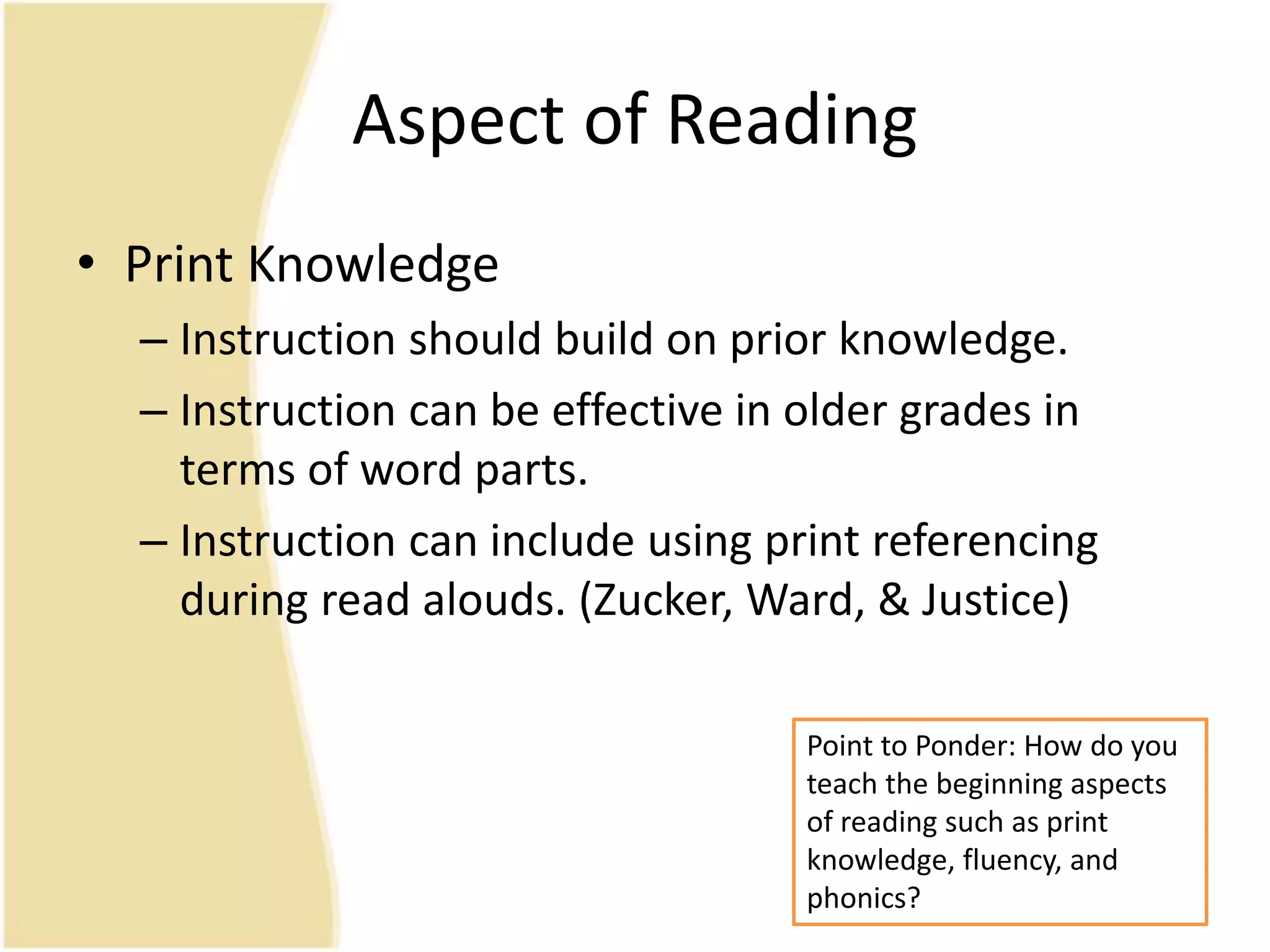
Aspect of Reading
• Print Knowledge
– Instruction should build on prior knowledge.
– Instruction can be effective in older grades in
terms of word parts.
– Instruction can include using print referencing
during read alouds. (Zucker, Ward, & Justice)
Point to Ponder: How do you
teach the beginning aspects
of reading such as print
knowledge, fluency, and
phonics?
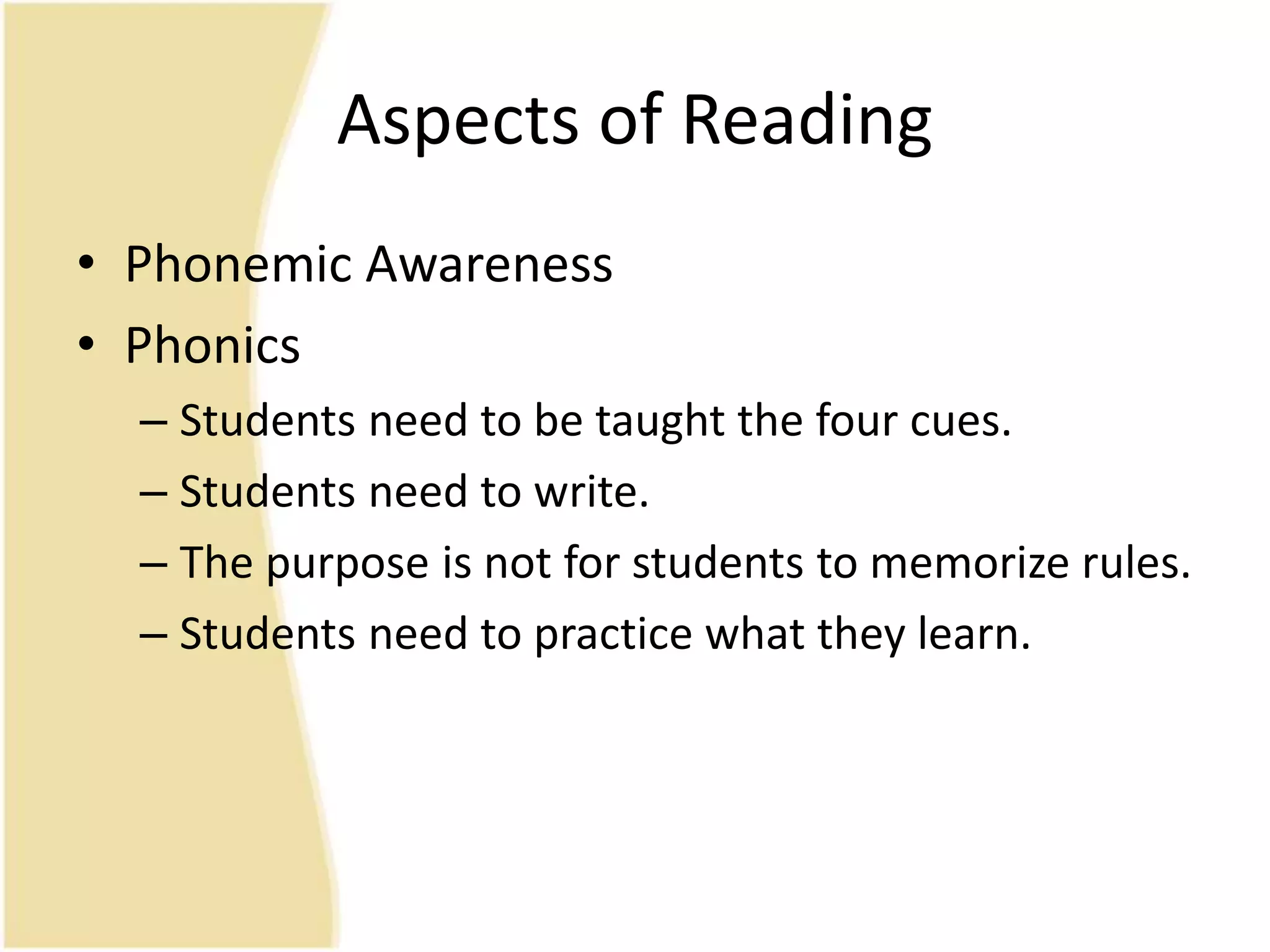
Aspects of Reading
• Phonemic Awareness
• Phonics
– Students need to be taught the four cues.
– Students need to write.
– The purpose is not for students to memorize rules.
– Students need to practice what they learn.
Aspects of Reading
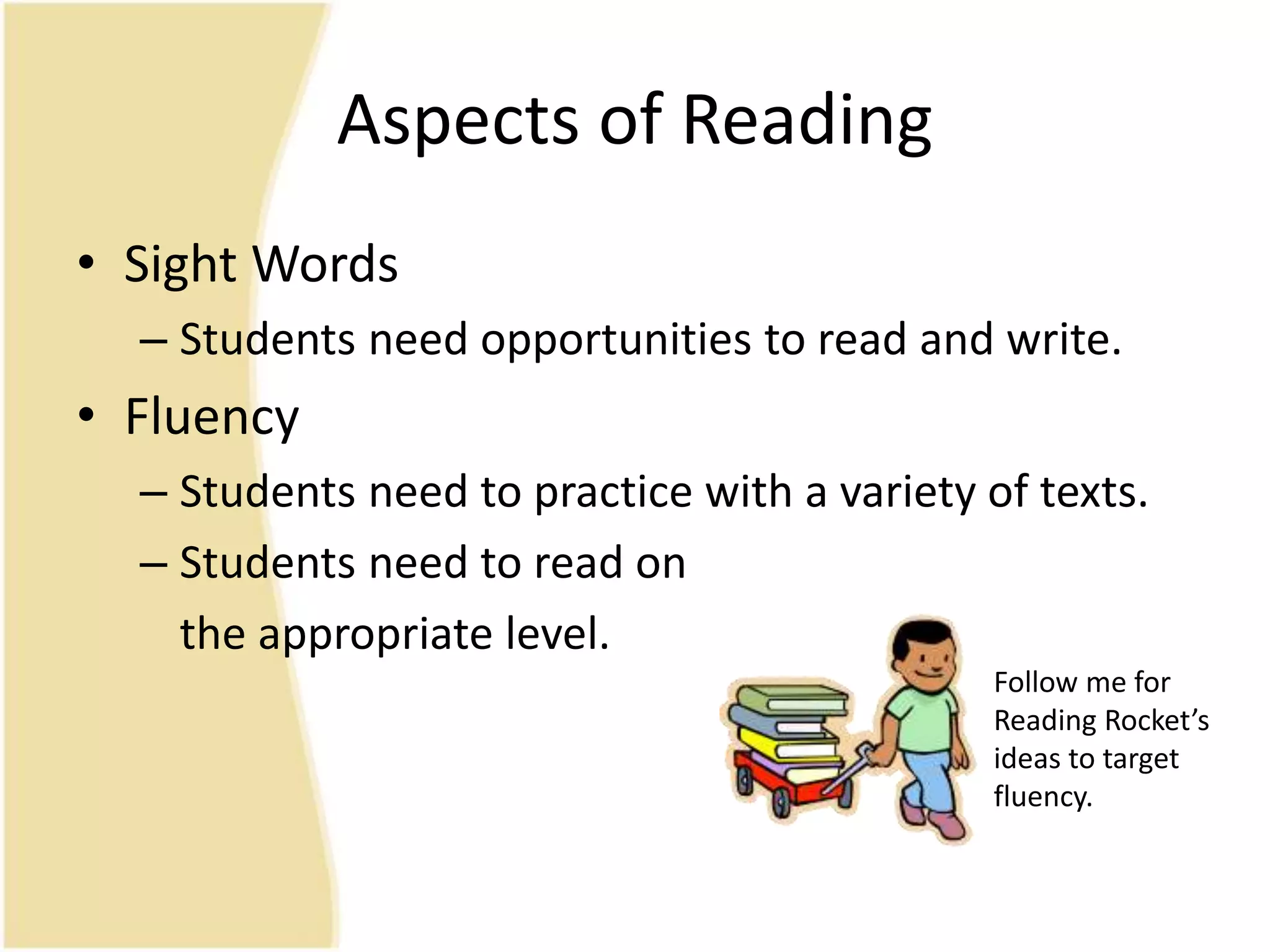
• Sight Words
– Students need opportunities to read and write.
• Fluency
– Students need to practice with a variety of texts.
– Students need to read on
the appropriate level.
Follow me for
Reading Rocket’s
ideas to target
fluency.
Fluency and Technology
Point to Ponder:
Would you
consider using
iPods as a part of
fluency
instruction? Why
or why not?
To see a video about how to
incorporate fluency and technology,
click here
Aspect of Reading
• Comprehension
– Needs to be taught across all curricula
• SQ3R is one method to encourage comprehension
during content area reading.
Point to Ponder:
Do you teach note
taking skills as a
part of your
reading
instruction?
Aspects of Reading
– Taught using before, during and after strategies
• Before: Brainstorming, Questioning, Connecting
• During: Questioning, Rereading, Taking notes
• After: Discussing, Presenting, Writing
• Reciprocal Teaching can incorporate several strategies
to lead to student independence (Marcell, DeCleene,
Juettner)
Point to Ponder: Has
anyone tried
reciprocal teaching?
How did it work?
Aspects of Reading
• Vocabulary
– Learning word strategies are important
• Students need to practice using context clues
(Greenwood).
– Wide reading can increase vocabulary
– Teacher read alouds can be used to enhance
student vocabulary.
– Some specific strategies that work are PAVE, The
Frayer Model, Concept Circles, Semantic Mapping,
and Analogies (Greenwood).
Aspects of Reading
• Strategies
– Strategies should be taught in all content areas.
• Pitcher, Martinez, Dicembre, Fewster, and McCormick
found that adolescents still struggle with
comprehending content area texts (2010).
– Before Reading strategies activate schema
– During Reading strategies help students to
construct meaning while reading.
– After Reading strategies can expand thinking.
Pick me for
more
content
area
reading
Info!!!
A variety of
strategies
from All About
Adolescent
Literacy
Instruction
• Explicit
– Instruction uses the whole text.
– Comprehension is never mastered.
– There may be multiple answers.
– Strategies from the National Reading Panel that are
helpful:
• Comprehension monitoring
• Cooperative learning
• Graphic and Semantic Organizers
• Question Answering and Question Generating
• Story Structure
• Summarization
Click for peer reviewed lessons from
IRA and NCTE
Instruction
• Implicit
– Teacher is the guide.
– Examples are reader response or literature circles.
• Reader response can be conducted online (Larson).
– Students are grouped by book choice and post in an online
forum.
– The online format allows for inclusion of new literacies.
– Students need the opportunity to discuss.
• Online discussion can provide more time for students
to discuss as they can access it at home.
Point to Ponder:
What are some
instruction strategies
that have worked
well in your
classroom?
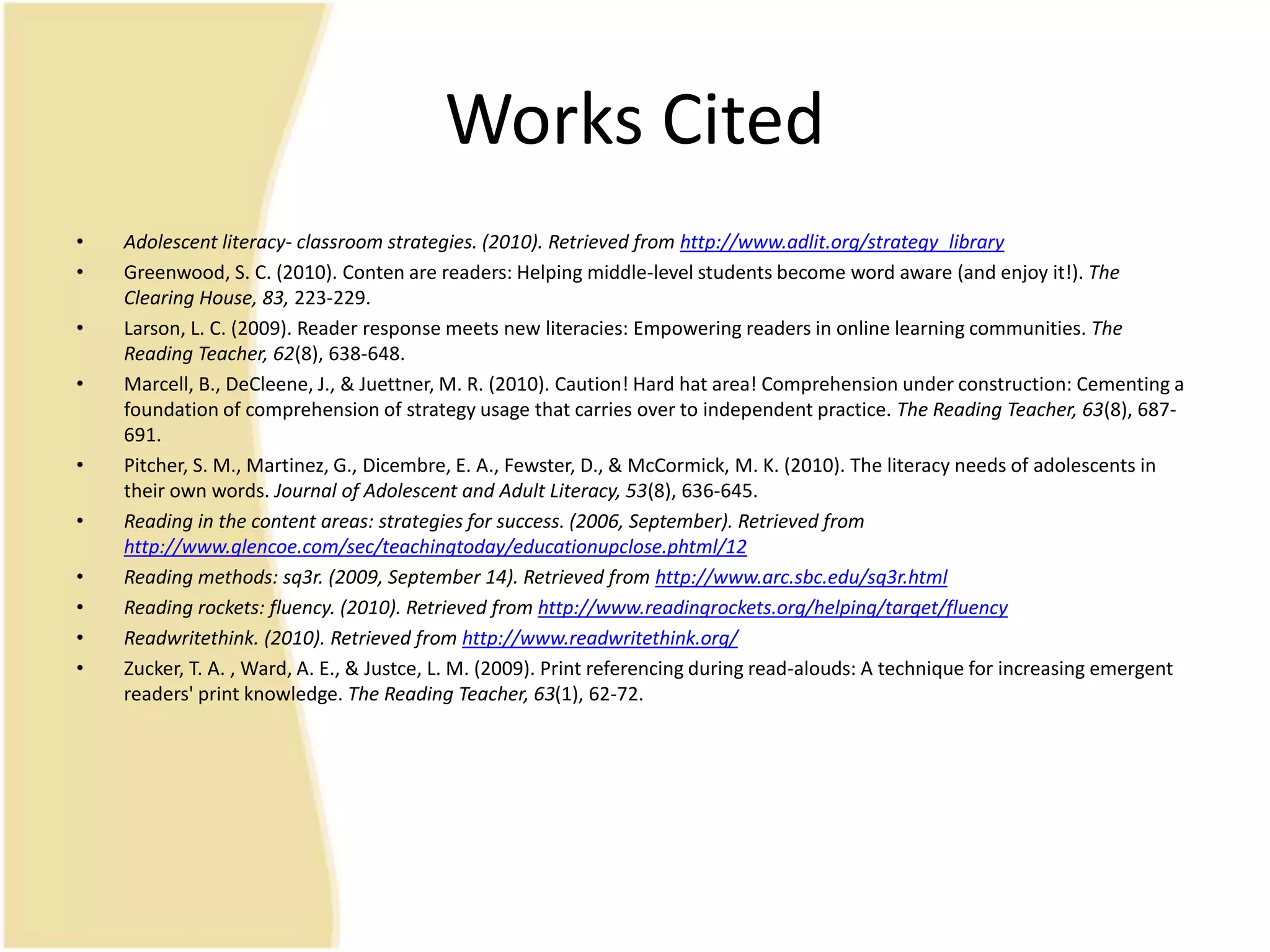
Works Cited
• Adolescent literacy- classroom strategies. (2010). Retrieved from http://www.adlit.org/strategy_library
• Greenwood, S. C. (2010). Conten are readers: Helping middle-level students become word aware (and enjoy it!). The
Clearing House, 83, 223-229.
• Larson, L. C. (2009). Reader response meets new literacies: Empowering readers in online learning communities. The
Reading Teacher, 62(8), 638-648.
• Marcell, B., DeCleene, J., & Juettner, M. R. (2010). Caution! Hard hat area! Comprehension under construction: Cementing a
foundation of comprehension of strategy usage that carries over to independent practice. The Reading Teacher, 63(8), 687-
691.
• Pitcher, S. M., Martinez, G., Dicembre, E. A., Fewster, D., & McCormick, M. K. (2010). The literacy needs of adolescents in
their own words. Journal of Adolescent and Adult Literacy, 53(8), 636-645.
• Reading in the content areas: strategies for success. (2006, September). Retrieved from
http://www.glencoe.com/sec/teachingtoday/educationupclose.phtml/12
• Reading methods: sq3r. (2009, September 14). Retrieved from http://www.arc.sbc.edu/sq3r.html
• Reading rockets: fluency. (2010). Retrieved from http://www.readingrockets.org/helping/target/fluency
• Readwritethink. (2010). Retrieved from http://www.readwritethink.org/
• Zucker, T. A. , Ward, A. E., & Justce, L. M. (2009). Print referencing during read-alouds: A technique for increasing emergent
readers' print knowledge. The Reading Teacher, 63(1), 62-72.

Chap 3

  • 1.
  • 2.
    The Successful Reader •Is active and motivated • Uses schema • Takes a stance • Acquires approaches to text • Monitors reading • Links reading to prior knowledge • Needs time to read Point to Ponder: How would you describe a successful reader?
  • 3.
    Aspect of Reading •Print Knowledge – Instruction should build on prior knowledge. – Instruction can be effective in older grades in terms of word parts. – Instruction can include using print referencing during read alouds. (Zucker, Ward, & Justice) Point to Ponder: How do you teach the beginning aspects of reading such as print knowledge, fluency, and phonics?
  • 4.
    Aspects of Reading •Phonemic Awareness • Phonics – Students need to be taught the four cues. – Students need to write. – The purpose is not for students to memorize rules. – Students need to practice what they learn.
  • 5.
    Aspects of Reading •Sight Words – Students need opportunities to read and write. • Fluency – Students need to practice with a variety of texts. – Students need to read on the appropriate level. Follow me for Reading Rocket’s ideas to target fluency.
  • 6.
    Fluency and Technology Pointto Ponder: Would you consider using iPods as a part of fluency instruction? Why or why not? To see a video about how to incorporate fluency and technology, click here
  • 7.
    Aspect of Reading •Comprehension – Needs to be taught across all curricula • SQ3R is one method to encourage comprehension during content area reading. Point to Ponder: Do you teach note taking skills as a part of your reading instruction?
  • 8.
    Aspects of Reading –Taught using before, during and after strategies • Before: Brainstorming, Questioning, Connecting • During: Questioning, Rereading, Taking notes • After: Discussing, Presenting, Writing • Reciprocal Teaching can incorporate several strategies to lead to student independence (Marcell, DeCleene, Juettner) Point to Ponder: Has anyone tried reciprocal teaching? How did it work?
  • 9.
    Aspects of Reading •Vocabulary – Learning word strategies are important • Students need to practice using context clues (Greenwood). – Wide reading can increase vocabulary – Teacher read alouds can be used to enhance student vocabulary. – Some specific strategies that work are PAVE, The Frayer Model, Concept Circles, Semantic Mapping, and Analogies (Greenwood).
  • 10.
    Aspects of Reading •Strategies – Strategies should be taught in all content areas. • Pitcher, Martinez, Dicembre, Fewster, and McCormick found that adolescents still struggle with comprehending content area texts (2010). – Before Reading strategies activate schema – During Reading strategies help students to construct meaning while reading. – After Reading strategies can expand thinking. Pick me for more content area reading Info!!! A variety of strategies from All About Adolescent Literacy
  • 11.
    Instruction • Explicit – Instructionuses the whole text. – Comprehension is never mastered. – There may be multiple answers. – Strategies from the National Reading Panel that are helpful: • Comprehension monitoring • Cooperative learning • Graphic and Semantic Organizers • Question Answering and Question Generating • Story Structure • Summarization Click for peer reviewed lessons from IRA and NCTE
  • 12.
    Instruction • Implicit – Teacheris the guide. – Examples are reader response or literature circles. • Reader response can be conducted online (Larson). – Students are grouped by book choice and post in an online forum. – The online format allows for inclusion of new literacies. – Students need the opportunity to discuss. • Online discussion can provide more time for students to discuss as they can access it at home. Point to Ponder: What are some instruction strategies that have worked well in your classroom?
  • 13.
    Works Cited • Adolescentliteracy- classroom strategies. (2010). Retrieved from http://www.adlit.org/strategy_library • Greenwood, S. C. (2010). Conten are readers: Helping middle-level students become word aware (and enjoy it!). The Clearing House, 83, 223-229. • Larson, L. C. (2009). Reader response meets new literacies: Empowering readers in online learning communities. The Reading Teacher, 62(8), 638-648. • Marcell, B., DeCleene, J., & Juettner, M. R. (2010). Caution! Hard hat area! Comprehension under construction: Cementing a foundation of comprehension of strategy usage that carries over to independent practice. The Reading Teacher, 63(8), 687- 691. • Pitcher, S. M., Martinez, G., Dicembre, E. A., Fewster, D., & McCormick, M. K. (2010). The literacy needs of adolescents in their own words. Journal of Adolescent and Adult Literacy, 53(8), 636-645. • Reading in the content areas: strategies for success. (2006, September). Retrieved from http://www.glencoe.com/sec/teachingtoday/educationupclose.phtml/12 • Reading methods: sq3r. (2009, September 14). Retrieved from http://www.arc.sbc.edu/sq3r.html • Reading rockets: fluency. (2010). Retrieved from http://www.readingrockets.org/helping/target/fluency • Readwritethink. (2010). Retrieved from http://www.readwritethink.org/ • Zucker, T. A. , Ward, A. E., & Justce, L. M. (2009). Print referencing during read-alouds: A technique for increasing emergent readers' print knowledge. The Reading Teacher, 63(1), 62-72.