CHAPTER 6: ACTIVATING PRIOR
KNOWLEDGE AND INTEREST
Mika Ella O. Perez
READ 209
SCOPE OF
CHAPTER
6
SELF-
EFFICACY
AND
MOTIVATION
MAKING
PREDICTIONS
QUESTION
GENERATION
SELF-EFFICACY AND MOTIVATION
• Refers to “people’s judgment of their
abilities to organize and execute
courses of action required to attain
designated types of performance.”
(Bandura, 1986)
Characteristics of students who are
motivated readers
• They apply appropriate strategies in
order to make complex reading tasks
more manageable; and
• They display a high level of
engagement in their reading
experiences
What needs to be done?
1. A relevant curriculum, engaging
instructional strategies and a school
culture that fosters wide reading (May,
2014).
2. They [students] are more enthusiastic
about in-school reading when the texts
used are accessible, interesting, and
when they have a choice in the selection
of the text (Lapp and Fisher, 2009).
3. Teachers should think broadly about the
types of text they use in their content area
classes, pointing out that a variety of high-
interest, high-quality texts can serve to
engage students in reading (Wolk, 2010).
4. Teachers who understand their
students’ backgrounds, prior
knowledge, and motivations are much
more likely to make the connections that
adolescents crave (Ivey and Fisher, 2005).
5. Teachers can also give students
opportunities to interact with one
through shared reading experiences, and
they can guide students in learning how
to evaluating their own understanding of
a text (Wigfield, 2004; Reed, Schallert,
Beth & Woodruff, 2004).
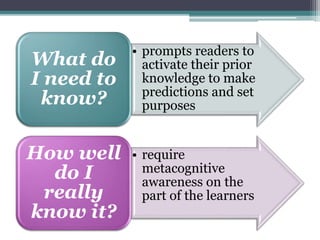
• prompts readers to
activate their prior
knowledge to make
predictions and set
purposes
What do
I need to
know?
• require
metacognitive
awareness on the
part of the learners
How well
do I
really
know it?
MAKING PREDICTIONS
• According to Smith (1988), “readers do not
normally attend to print with their minds blank,
with no prior purpose and with no expectation of
what they might find in the text… The way
readers look for meaning is not to consider all
possibilities, nor to make reckless guesses about
just one, but rather to predict within the
most likely range of alternatives… Readers
can derive meaning from text because they bring
expectations about meaning to text.”
Strategies on how to engage students
in making predictions
ANTICIPATION GUIDES
• It is a series of statements to which students
must respond individually before reading the
text.
IMAGINE, ELABORATE, PREDICT,
AND CONFIRM (IEPC)
Guidelines in conducting the
Anticipation Guide
Analyze the
material to be
read.
Write those ideas
in short, clear
declarative
statements.
Put these
statements in a
format that will
elicit anticipation
and prediction.
Discuss the
students’
predictions and
anticipations
before they read
the text selection
Assign the text
selection
Contrast the
readers’
predictions with
the author’s
intended
meaning.
Directions: Put a check under “Likely” if you believe that the weather saying
has any scientific basis; put a check under “Unlikely” if you believe that it has
no scientific basis. Be ready to explain your choice.
Likely Unlikely
____ ____ 1. Red sky at night, sailor’s delight; red sky at morning ,
sailors take warning.
____ ____ 2. If you see a sunspot, there is going to be a bad weather.
____ ____ 3. When the leaves turn under, it is going to storm.
____ ____ 4. If you see a hornet’s nest high in a tree, a harsh winter is
coming.
____ ____ 5. Aching bones mean a cold and rainy forecast.
____ ____ 6. If a groundhog sees his shadow, six more weeks of winter.
____ ____ 7. Rain before seven, sun by eleven.
____ ____ 8. If a cow lies down in a pasture, it is going to rain soon.
____ ____ 9. Sea gull, sea gull, sitting on the sand; it’s never good
weather while you’re on land.
Guidelines in conducting the IEPC
Model
Select a text
passage or
introduction to
the text that
contains content
appropriate for
developing
imagery
Imagine. Elaborate.
Predict.Confirm.
QUESTION GENERATION
• Neufeld (2005) suggests that, before
reading a text, students ask and answer
questions that will help them to read with
a purpose, to recognize major
characteristics of the texts, to activate
their prior knowledge, and to make
predictions about what they are about to
read.
Strategies on how to engage students
in generating questions
ACTIVE COMPREHENSION
• Ask questions that beget questions in return.
• Read to students an opening paragraph or two
from a selection, enough to whet their appetites
for the selection.
ReQuest
• It encourages students to ask their own questions
about the content material under study.
Guidelines in conducting ReQuest
(Manzo, Manzo, and Estes, 2001)
Both the students and
the teacher silently read
the same segment of the
text.
The teacher closes the
book and is questioned
about the passage by
the students.
Next, there is an
exchange of
roles.
The students and the
teacher read the next
segment of the text,
pausing at the
predetermined
stopping points.
Students stop
questioning
and begin
predicting.
Students are then
assigned the
remaining portion of
the text to read
independently.
The teacher facilitates a
follow-up discussion of the
material.
Reference:
Vacca, R. T., Vacca, J. L. & Mraz, M. (2014).
Content Area Reading: Literacy and
Learning Across the Curriculum. New Jersey:
Pearson.

ACTIVATING PRIOR KNOWLEDGE AND INTEREST

  • 1.
    CHAPTER 6: ACTIVATINGPRIOR KNOWLEDGE AND INTEREST Mika Ella O. Perez READ 209
  • 2.
  • 3.
    SELF-EFFICACY AND MOTIVATION •Refers to “people’s judgment of their abilities to organize and execute courses of action required to attain designated types of performance.” (Bandura, 1986)
  • 4.
    Characteristics of studentswho are motivated readers • They apply appropriate strategies in order to make complex reading tasks more manageable; and • They display a high level of engagement in their reading experiences
  • 5.
    What needs tobe done? 1. A relevant curriculum, engaging instructional strategies and a school culture that fosters wide reading (May, 2014). 2. They [students] are more enthusiastic about in-school reading when the texts used are accessible, interesting, and when they have a choice in the selection of the text (Lapp and Fisher, 2009).
  • 6.
    3. Teachers shouldthink broadly about the types of text they use in their content area classes, pointing out that a variety of high- interest, high-quality texts can serve to engage students in reading (Wolk, 2010). 4. Teachers who understand their students’ backgrounds, prior knowledge, and motivations are much more likely to make the connections that adolescents crave (Ivey and Fisher, 2005).
  • 7.
    5. Teachers canalso give students opportunities to interact with one through shared reading experiences, and they can guide students in learning how to evaluating their own understanding of a text (Wigfield, 2004; Reed, Schallert, Beth & Woodruff, 2004).
  • 8.
    • prompts readersto activate their prior knowledge to make predictions and set purposes What do I need to know? • require metacognitive awareness on the part of the learners How well do I really know it?
  • 9.
    MAKING PREDICTIONS • Accordingto Smith (1988), “readers do not normally attend to print with their minds blank, with no prior purpose and with no expectation of what they might find in the text… The way readers look for meaning is not to consider all possibilities, nor to make reckless guesses about just one, but rather to predict within the most likely range of alternatives… Readers can derive meaning from text because they bring expectations about meaning to text.”
  • 10.
    Strategies on howto engage students in making predictions ANTICIPATION GUIDES • It is a series of statements to which students must respond individually before reading the text. IMAGINE, ELABORATE, PREDICT, AND CONFIRM (IEPC)
  • 11.
    Guidelines in conductingthe Anticipation Guide Analyze the material to be read. Write those ideas in short, clear declarative statements. Put these statements in a format that will elicit anticipation and prediction. Discuss the students’ predictions and anticipations before they read the text selection Assign the text selection Contrast the readers’ predictions with the author’s intended meaning.
  • 12.
    Directions: Put acheck under “Likely” if you believe that the weather saying has any scientific basis; put a check under “Unlikely” if you believe that it has no scientific basis. Be ready to explain your choice. Likely Unlikely ____ ____ 1. Red sky at night, sailor’s delight; red sky at morning , sailors take warning. ____ ____ 2. If you see a sunspot, there is going to be a bad weather. ____ ____ 3. When the leaves turn under, it is going to storm. ____ ____ 4. If you see a hornet’s nest high in a tree, a harsh winter is coming. ____ ____ 5. Aching bones mean a cold and rainy forecast. ____ ____ 6. If a groundhog sees his shadow, six more weeks of winter. ____ ____ 7. Rain before seven, sun by eleven. ____ ____ 8. If a cow lies down in a pasture, it is going to rain soon. ____ ____ 9. Sea gull, sea gull, sitting on the sand; it’s never good weather while you’re on land.
  • 13.
    Guidelines in conductingthe IEPC Model Select a text passage or introduction to the text that contains content appropriate for developing imagery Imagine. Elaborate. Predict.Confirm.
  • 14.
    QUESTION GENERATION • Neufeld(2005) suggests that, before reading a text, students ask and answer questions that will help them to read with a purpose, to recognize major characteristics of the texts, to activate their prior knowledge, and to make predictions about what they are about to read.
  • 15.
    Strategies on howto engage students in generating questions ACTIVE COMPREHENSION • Ask questions that beget questions in return. • Read to students an opening paragraph or two from a selection, enough to whet their appetites for the selection. ReQuest • It encourages students to ask their own questions about the content material under study.
  • 16.
    Guidelines in conductingReQuest (Manzo, Manzo, and Estes, 2001) Both the students and the teacher silently read the same segment of the text. The teacher closes the book and is questioned about the passage by the students. Next, there is an exchange of roles. The students and the teacher read the next segment of the text, pausing at the predetermined stopping points. Students stop questioning and begin predicting. Students are then assigned the remaining portion of the text to read independently. The teacher facilitates a follow-up discussion of the material.
  • 17.
    Reference: Vacca, R. T.,Vacca, J. L. & Mraz, M. (2014). Content Area Reading: Literacy and Learning Across the Curriculum. New Jersey: Pearson.

Editor's Notes

  • #4 SELF-EFFICACY CONTRIBUTES TO THE DEVELOPMENT OF STUDENTS’ LITERACY IDENTITIES. BEFORE THEY CAN BECOME LIFELONG READERS, STUDENTS MUST FIRST VIEW THEMSELVES AS COMPETENT AND CAPABLE READERS.
  • #5 BY THE TIME THE STUDENTS TURNS INTO MIDDLE SCHOOL, THEIR MOTIVATION TO READ DECLINES. ACCORDING TO OLDFATHER AND DAHL (1994), THIS DECLINE IN STUDENTS; MOTIVATION MAY BE ATTRIBUTED TO THE LIMITED EMPHASIS MIDDLE AND SECONDARY TEACHERS TYPICALLY PLACE ON SELF-EXPRESSION AND PERSONAL RESPONSE TO READING.
  • #16 ReQuest SOMETIMES CALLED AS RECIPROCAL TEACHING, WAS ORIGINALLY DEVISED AS A ONE-ON-ONE PROCEDURE FOR A REMEDIAL INSTRUCTIONAL CONTENT.