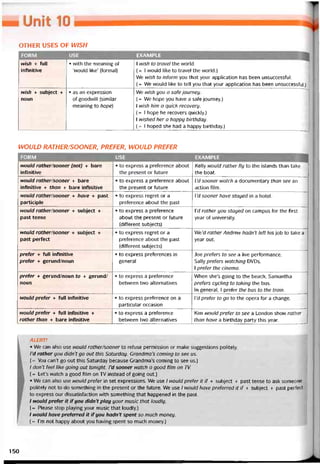
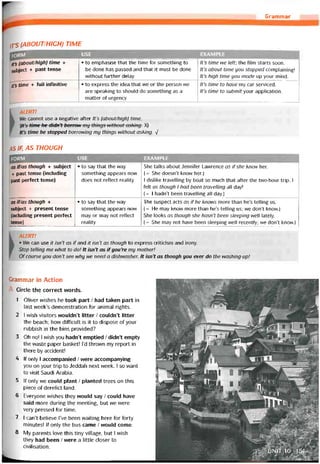
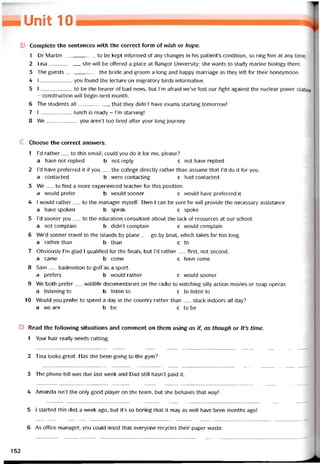
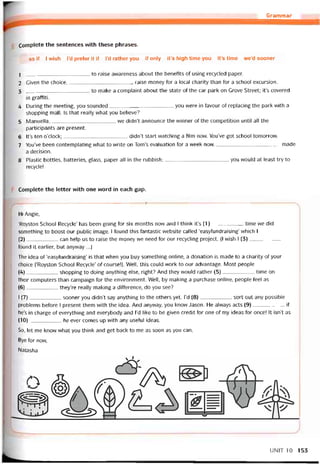
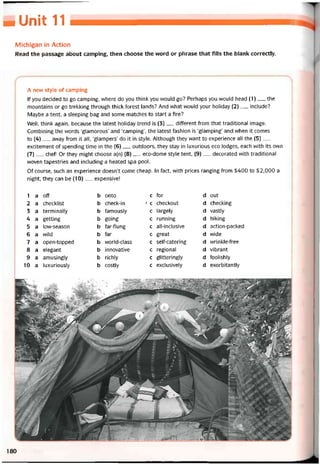
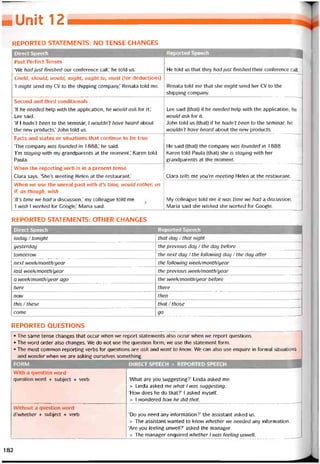
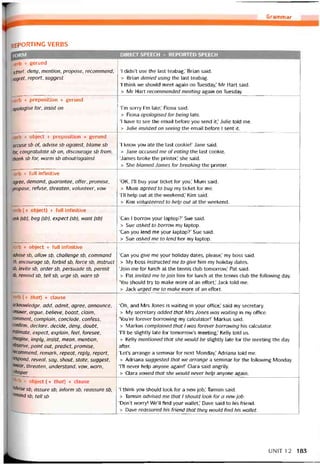
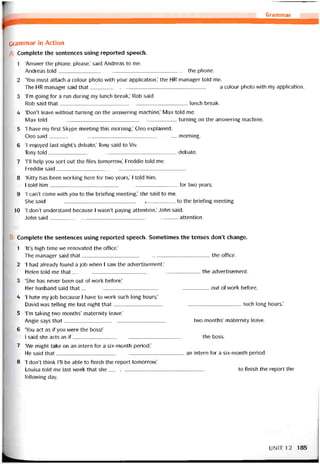
REACT1VATE
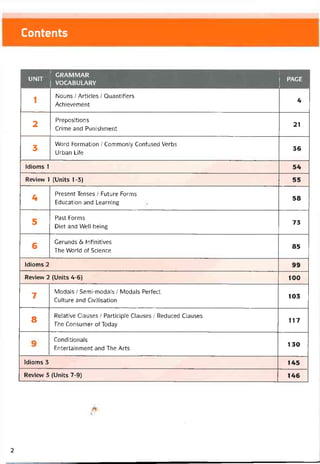
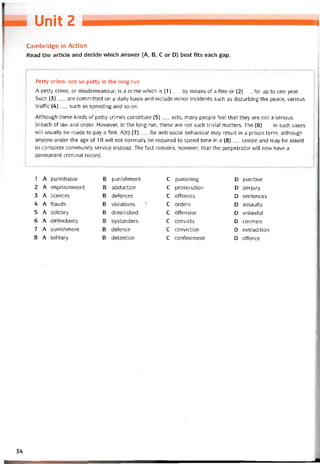
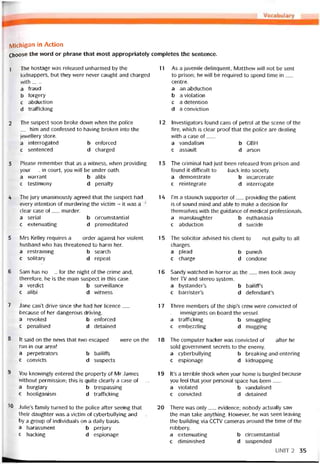
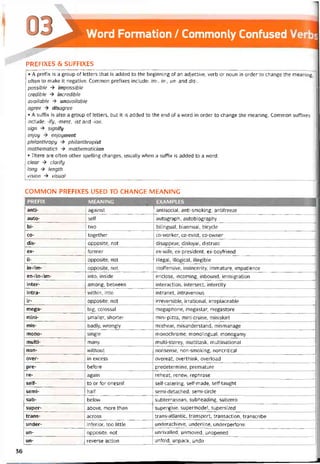
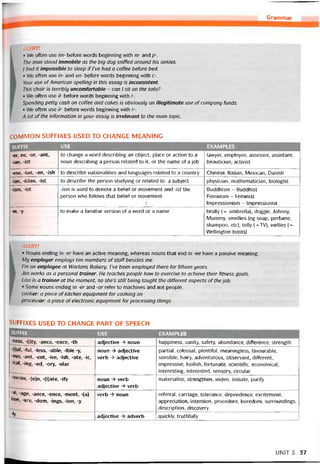
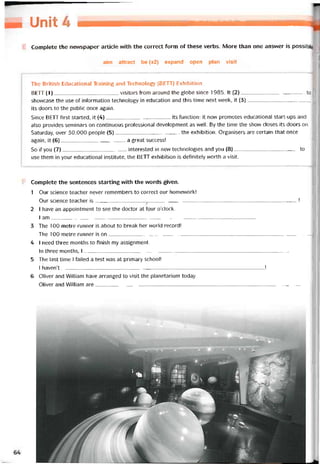
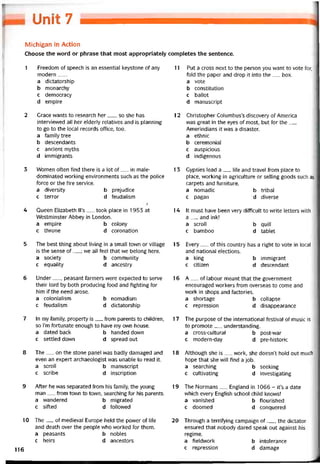
Contents
UNIT
GRAMMAR
VOCABULARY
PAGE
1
Nouns / Articles / Quantifiers
Achievement
4
2
Prepositions
Crime and Punishment
21
3
Word Formation / Commonly Coníused Verbs
Urban Life
36
Idioms 1 54
Revievv 1 (Units 1-3) 55
4
Present Tenses / Future Forms
Education and Learning
58
5
Past Forms
Diet and Well-being
73
(S
Gerunds <5í Iníinitives
The World of Science
85
Idioms 2 99
Revievv 2 (Units 4-6) 100
7
Modals / Semi-modals / Modals Períect
Culture and Civỉlisation
103
8
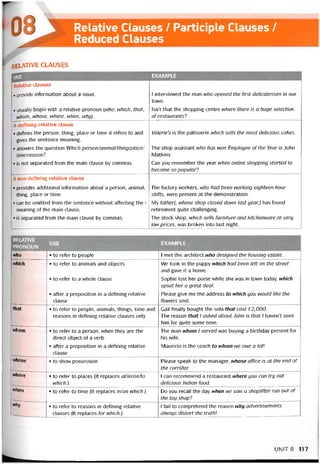
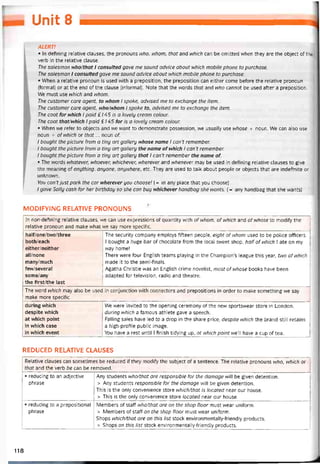
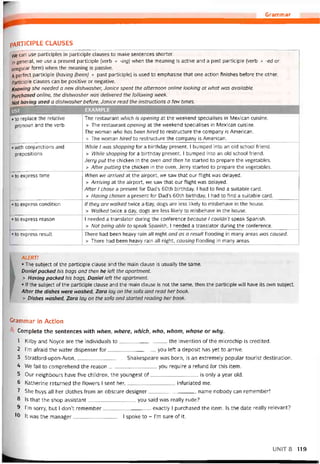
Relative Clauses / Participle Clauses / Reduced Clauses
The Consumer of Today
117
Conditionals
Entertainment and The Arts
130
Idioms 3 145
Revievv 3 (Units 7-9) 146
2
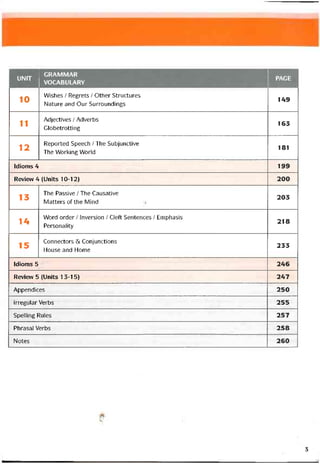
UNIT
GRAMMAR
VOCABULARY
PAGE
10
Wishes / Regrets / Other Structures
Nature and Our Surroundings
149
11
Adjectives / Adverbs
Globetrotting
163
12
Reported Speech / The Subjunctive
The Working World
181
Idioms 4 199
Revievv 4 (Units 10-12) 200
13
The Passive / The Causative
Matters of the Mind
203
14
Word order / Inversion / Cleft Sentences / Emphasis
Personality
218
15
Connectors & Conjunctions
House and Home
233
Idioms 5 246
Review 5 (Units 13-15) 247
Appendices 250
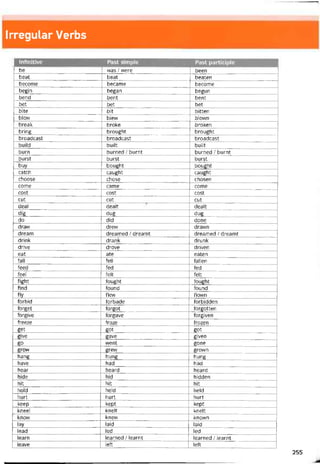
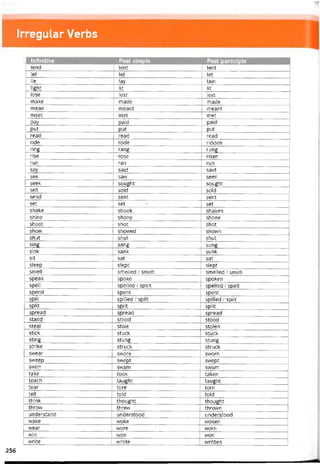
Irregular Verbs 255
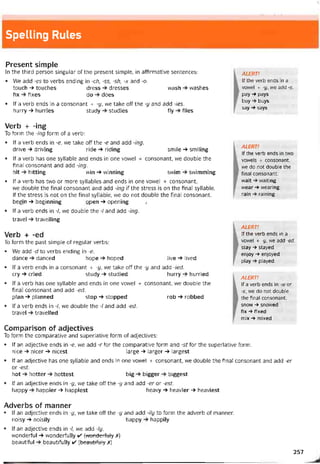
Spelling Rules 257
Phrasal Verbs 258
Notes 26©
3
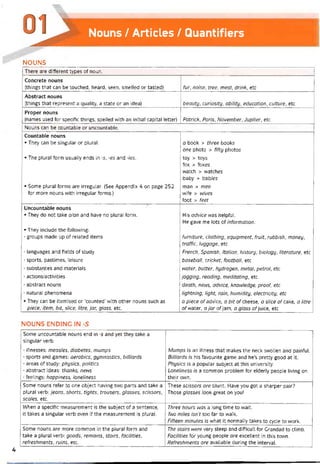
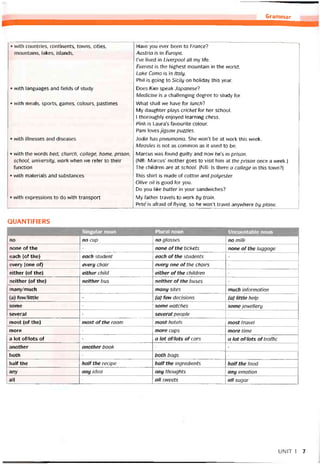
Nouns / Articles / Quantiíiers
NOUNS
There are different types of noun.
Concrete nouns
(things that can be touched, heard, seen, smelled or tasted) fur, noise, tree, meal, drink, etc
Abstract nouns
[things that represent a quality, a State or an idea) beauty, curiosity, ability, education, culture, etc
Proper nouns
(names used for specitic things, spelled with an initial Capital letter) Patrick, Paris, November, dupiter, etc
Nouns can be countable or uncountable.
Countabie nouns
• They can be singular or plural.
• The plural form usually ends in -s, -es and -ies.
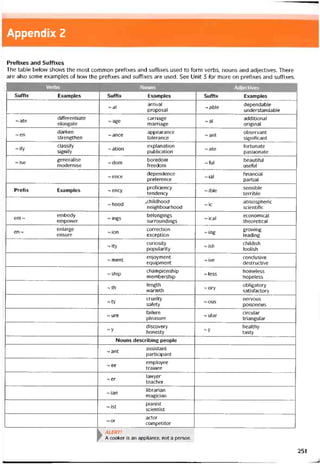
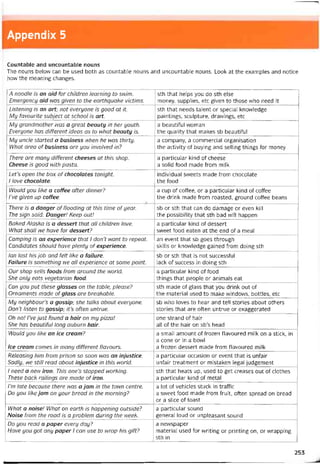
• Some plural íorms are irregular. (See Appendix 4 on page 252
for more nouns with irregular torms.)
a book > three books
one photo > fifty photos
toy > toys
fox > íoxes
vvatch > vvatches
baby > bab/es
man > men
wife > wives
foot > feet
Uncountable nouns
• They do not take a/an and have no plural form.
• They incỉude the following:
- groups made up of related items
- languages and tields of study
- sports, pastimes, leisure
- substaiỴces and materials
- actions/activities
- abstract nouns
- natural phenomena
• They can be itemised or ‘counted’ with other nouns such as
piece, item, bit, slice, litre, jar, glass, etc.
His advice vvas helptul.
He gave me lots of intormation.
furniture, clothing, equipment, fruit, rubbish, money,
traffic, luggage, etc
French, Spanish, Italian, history, biology, literature, etc
baseball, cricket, football, etc
water, butter, hydrogen, metal, petrol, etc
jogging, reading, meditating, etc
death, news, advice, knowledge, proof, etc
lightning, light, rain, humidity, electricity, etc
a piece of advice, a bit of cheese, a slice of cake, a litre
oívvater, ữ jar ofjam, a glass ofjuice, etc
NOUNS ENDING IN -S
Some uncountable nouns end in -s and yet they take a
singular verb.
- illnesses: measles, diabetes, mumps
■ sports and games: aerobics, gymnastics, billiards
- areas of study: physics, politics
- abstract ideas: thanks, news
- teelings: happiness, loneliness
Mumps is an illness that makes the neck svvollen and paintul.
Billiards is his tavourite game and he’s pretty good at it.
Physics is a popular subject at this university.
Loneliness is a common problem for elderly people living on
their own.
Some nouns reter to one object having two parts and take a
plural verb: jeans, shorts, tights, trousers, glasses, scissors,
scales, etc.
These scissors are blunt. Have you got a sharper pair?
Those glasses look great on you!
When a specitic measurement is the subject of a sentence,
it takes a singular verb even if the measurement is pỉural.
Three hours was a long time to wait.
Two miles isn’t too far to walk.
Fifteen minutes is what it normally takes to cycle to work.
Some nouns are more common in the plural form and
take a plural verb: goods, remains, stairs, facilities,
reíreshments, ruins, etc.
The stairs were very steep and ditticult for Grandad to climb.
Facilities for young people are excellent in this town.
Refreshments are available during the interval.
4
Grammar
COMPOUND NOUNS
In compound nouns, the tirst word classihes the second word
and is usually singular.
a car park (= somewhere to park your car)
(a cars park X)
a mountain climber (= someone who climbs mountains)
(a mountains climber X)
Common combinations are:
-noun + noun
- noun + verb
- verb + noun
bedroom, vvater tank, credit card
haircut, sky-diving, dog walker
washing machine, driving licence, boxing ring
COLLECT1VE NOUNS
Collective nouns reter to a group of people, animals or objects.
We can usually use a singular or plural verb aíter these nouns
depending on vvhether we are considering the noun as one entity or
as a group of individual people, animals or objects.
My tamily is Corning to vìsit this summer.
(= They are travelling as one unit.)
My family are very Creative.
(= Each person in my íamily is very Creative.)
Some collective nouns ịpolice, folk, cattle) alvvays take a plural verb. The police have arrested the gang leader.
Folk are complaining about his lack of talent
Adjectives used as collective nouns alvvays take a plural verb. The elderly are more vulnerable than other citizens.
The famous otten buy houses in this part of London.
k ALERT!
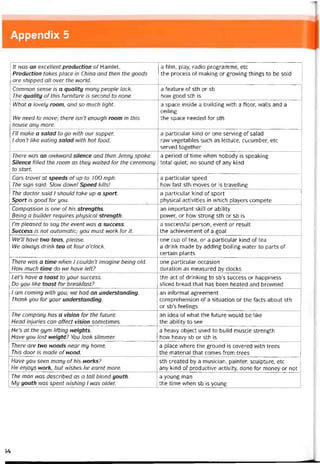
Some nouns can be both countable and uncountable, but with a change in meaning. See Appendix 5 on
pages 253-254 for examples.
There is a wood on the other side of the river.
This table is made of wood.
THE INDEFÍNITE ARTICLE (A/AN)
USE EXAMPLE
o with singular countable nouns
• with nouns that have not been mentioned betore or are
non-specific
• with proíessions, nationalities, jobs
• to reter to One example in a larger group such as a
proíession or species
• vvith a proper noun when we are not íamiliar with the
person in question
• with certain abstract nouns in a specitic context: horror,
dislike, love, hatred, fear, knowledge, cnvareness, etc
• with large numbers and íractions
• with expressions of quantity
• for trequency and speed
a burger, a unitorm, an egg, an MP3 player
Jill bought a book.
I had an omelette for lunch.
Chris is a lawyer.
Marie is an Italian.
]’m a chef.
Ít takes many years of study to become a barrister.
An orca is part of the dolphin tamily.
Do you know a James Carter? He’s sent me a birthday card.
There’s a Marion at the door. She wants to speak to you.
He has a hatred of spiders!
She has a fear of heights.
This dress cost a thousand pounds!
The price had been reduced by a third.
There are a lot of people here today.
I’d like a kilo oígrapes, please.
I have my hair cut once a month.
The car was travelling at one hundred miles an hour.
k ALERT!
' A/an has a similar meaning to one. Hovvever, it does not alvvays mean the same thing.
Terrific Tees has a black T-shirt in Large. (= The shop may have more than one; the exact number isn’t important.)
Territic Tees has one black T-shirt in Large. (= The shop only has one T-shirt in this size and colour combination.)
UN1T 1 5
UoẵỉÈ 1
THE DEFINITE ARTICLE (THE}
I USE EXAMPLE
• with countable and uncountable nouns the tree, the flowers
the music, the atmosphere
• to reíer to nouns that have been mentioned betore
• to reter to something specitic, or something that is known to
the lỉstener
Jill bought a book. The book was on vegetarian cooking.
The man who is sitting next to Mia is an actor.
The government are bringing in new measures.
The media is to blame for the star’s fall from grace.
The police are investigating the disappearance of a
young woman.
l’m going to the supermarket.
Can you put these magazines in the living room?
• with single nouns to reter to a generic characteristic of the
whole group or species (tormal)
• vvith adjectives vvhen we reter to a group of people
• with nationality adjectives that end in -ch, -sh, ese, and -s [For
other nationalities we must use a plural noun.)
• with things that are unique
The male peacock is a visually impressive bird.
Sadly, the dodo is now extinct.
Even the rích are attected by these measures.
Jacob says the Swiss are less hospitable than the Greeks.
The sky was fulI of ominous dark clouds.
The World Health Organisation was established in 1948.
• with geographical names and the physical environment We strolled along the River Seine.
The Andes are in South America.
We went camping in the mountains.
Have you ever been to the desert?
• with the names of some countries, newspapers, cinemas,
theatres, etc
Ne visited the USA last summer.
My parents read The Telegraph.
What’s on at The Odeon?
I’m theatre manager at The Globe.
• with some torms of media [art/entertainment] Let’s go to the cinema.
Would you like to come to the theatre with me?
Do you ever listen to the radio?
• with thề superlative and some other grammatical structures Was yesterday the hottest day of the year?
The longer I wait, the more trustrated 1 become.
The only thing 1 ask is that you act cautiously.
The last thing she remembers is banging her head.
It’s the right thing to do!
• with musical Instruments and dances Does he play the violin well?
Have you ever danced the tango?
• with time, date (when spoken), periods of time in the atternoon, during the day (NB: at night}
Today is the sixth ofJune.
It took place in the nineteenth century.
NO ARTICLE
USE EXAMPLE
• with plural countable and uncountabie nouns to
reter to something in general
• with abstract nouns
• vvith names and titles
• names of shops and companies
Tourists otten buy souvenirs to remind them of places they’ve visited.
Adding cheese to a dish can make all the ditterence.
Music helps me to unvvind at the end of the day.
AI! you need is love.
Maria is married to dason.
Maureen Helston lives next door to my aunt.
MrJohnson is our English teacher.
Harrods is in Knightsbridge.
My son’s dream is to work for Apple.
Jenny has a Saturdayjob at Waterstones.
6
Grammar
• with countries, continents, towns, cities,
mountains, lakes, islands,
Have you ever been to France?
Austria is in Europe.
I’ve lived in Liverpool all my life.
Everest is the highest mountain in the world.
Lake Como is in Italy.
Phil is going to Sicily on holiday this year.
• with languages and íields of study Does Kim speak Japanese?
Medicine is a challenging degree to study for.
• with meals, sports, games, colours, pastimes What shall we have for lunch?
My daughter plays cricket for her school.
1 thoroughly enjoyed learning chess.
Pink is Laura’s tavourite colour.
Pam loves jigsaw puzzles.
• with illnesses and diseases Jodie has pneumonia. She won’t be at work this week.
Measles is not as common as it used to be.
• with the words bed, church, college, home, prison,
school, university, work when we reter to their
tunction
• with materials and substances
Marcus was tound guilty and now he’s in prison.
(NB: Marcus’ mother goes to visit him at the prison once a week.)
The children are at school. (NB: Is there a college in this town?)
This shirt is made of cotton and polyester.
Olive oil is good for you.
Do you like butter in your sandvviches?
• with expressions to do with transport My tather travels to work by train.
Peté' is atraid of flying, so he won’t travel anyvvhere by plane.
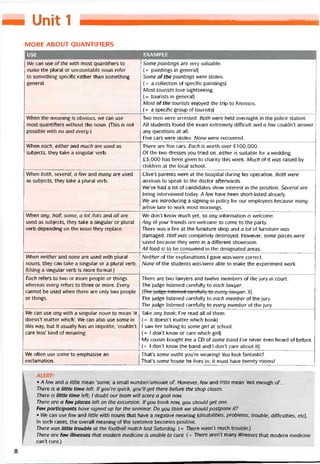
QUANTIFIERS
Singular noun Plural noun Uncountable noun
no no cup no glasses no milk
none of the - none of the tickets none of the luggage
each (of the) each student each of the students -
every (one of) every chair every one of the chairs -
either (of the) either child either of the children -
neither (of the) neither bus neither of the buses -
many/much - many sites much intormation
(a) few/little - (a) few decisions (a) little help
some - some watches some jewellery
several - several people -
most (of the) most of the room most hotels most travel
more - more cups more time
a lot of/lots of - a lot of/lots of cars a lot of/lots of traííic
another another book - -
both - both bags -
half the half the recipe half the ingredients half the food
any any idea any thoughts any emotion
all - all sweets all sugar
UNIT 1 7
— Unit 1
MORE ABOUT QUANTIFIERS
I USE EXAMPLE
We can use oíthe with most quantitiers to
make the plural or uncountable noun refer
to something specitic rather than something
general.
Some paintings are very valuable.
(= paintings in general)
Some oỉthe paintings were stolen.
(= a collection of specitic paintings)
Most tourists love sightseeing.
(= tourists in general)
Most of the tourists enjoyed the trip to Knossos.
(= a specitic group of tourists)
When the meaning is obvious, we can use
most quantitiers vvithout the noun. (This is not
possible with no and every.)
Two men were arrested. Both were held overnight in the police station.
All students íound the exam extremely difficult and a few couldn't answer
any questions at all.
Five cars were stolen. None were recovered.
When each, either and much are used as
subjects, they take a singular verb.
There are five cars. Each is vvorth over £100,000.
Of the two dresses you tried on, either is suitable for a vvedding.
£3,000 has been given to charity this week. Much of it was raised by
children at the local school.
When both, several, a few and many are used
as subjects, they take a plural verb.
Clive’s parents were at the hospital during his operation. Both were
anxious to speak to the doctor afterwards.
We’ve had a lot of candidates show interest in the position. Several are
being interviewed today. A few have been short-listed already.
Wẹ are introducing a signing-in policy for our employees because many
arrive late to work most mornings.
When any, half, some, a lot/lots and all are
used as subjects, they take a singular or plural
verb depending on the noun they replace.
We don’t know much yet, so any intormation /s vvelcome.
Any of your íriends are welcome to come to the party.
There was a fire at the íurniture shop and ữ lot of turniture was
damaged. Half was completely destroyed. Hovvever, some pieces were
saved because they were in a different showroom.
All food is to be consumed in the designated areas.
When neither and none are used with plural
nouns, they can take a singular or a plural verb.
(Using a singular verb is more íormal.)
Neither of the explanations 1 gave was/were correct.
None of the students was/were able to make the experiment work.
Each reters to two or more people or things
vvhereas every reíers to three or more. Every
cannot be used when there are only tvvo people
or things.
There are two lawyers and twelve members of the jury in court.
The judge listened caretully to each lawyer.
The judge listened caretully to each member of the jury.
The judge listened caretully to every member of the jury.
We can use any with a singular noun to mean ‘it
doesn’t matter which’. We can also use some in
this way, but it usually has an impolite, ‘couldn’t
care less’ kind of meaning.
Take any book; l’ve read all of them.
(= it doesn’t matter vvhich book)
I saw her talking to some girl at school.
(= 1 don’t know or care which girl)
My cousin bought me a CD of some band l’ve never even heard of betore.
(= 1 don’t know the band and 1 don’t care about it)
We often use some to emphasise an
exclamation.
That’s some outtit you’re vvearing! You look tantastic!
That’s some house he lives in; it must have twenty rooms!
ALERT!
• A few and a little mean ‘some, a small number/amount of. Hovvever, few and little mean ‘not enough of.
There is a little time left. If you’re quick, you’ll get there before the shop closes.
There is little time left; I doubt our team will score a goal now.
There are a few places left on the excursion. If you book now, you should get one.
Few participants have signed up for the seminar. Do you thinh we should postpone it?
• We can use few and little with nouns that have a negative meaning (disabilities, problems, trouble, diffículties, etc).
In such cases, the overall meaning of the sentence becomes positive.
There was little trouble at the tootball match last Saturday. (= There wasn’t much trouble.)
There are few illnesses that modern medicine is unable to cure. (= There aren’t many illnesses that modern medicine
can’t cure.)
8
■■M
Grammar
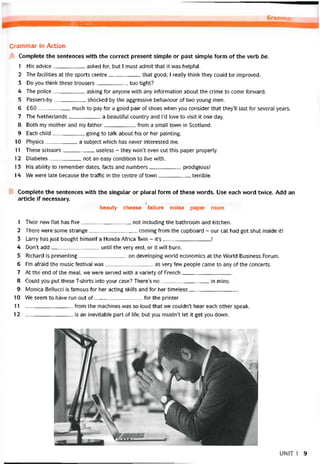
Grammar in Action
A Complete the sentences with the correct present simple or past simple form of the verb be.
1 His advice asked for, but I must admit that it was helpíul.
2 The tacilities at the sports centre that good; I really think they could be improved.
3 Do you think these trousers too tight?
4 The police asking for anyone with any intormation about the crime to come forward.
5 Passers-by shocked by the aggressive behaviour of two young men.
6 £60 much to pay for a good pair of shoes when you consider that they’ll last for several years.
7 The Netherlands a beautitui country and l’d love to visit it one day.
8 Both my mother and my tather from a small town in Scotland.
9 Each child going to talk about his or her painting.
10 Physics a subject which has never interested me.
11 These scissors useless - they won’t even cut this paper properly.
12 Diabetes not an easy condition to live vvith.
13 His ability to remember dates, facts and numbers prodigious!
14 We were late because the traffic in the centre of town terrible.
Complete the sentences vvith the singular or plural íorm of these words. Use each vvord tvvice. Add an
article if necessary.
beauty cheese íailure noise paper room
1 Their new flat has five not including the bathroom and kitchen.
2 There vvere some strange Corning from the cupboard - our cat had got shut inside it!
3 Larry has just bought himselí a Honda Atrica Twin - it’s!
4 Don’t add until the very end, or it vvill burn.
5 Richard is presenting on developing world economics at the World Business Forum.
6 l’m aíraid the music testival vvas as very few people came to any of the concerts.
7 At the end of the meal, we were served vvith a variety of French
8 Could you put these T-shirts into your case? There’s no in mine.
9 Monica Bellucci is tamous for her acting skills and for her timeless
10 We seem to have run out of for the printer.
11 from the machines was so ioud that vve couldn’t hear each other speak.
12 is an inevitable part of life, but you rnusúTt let it get you down.
UNIT 1 9
Unit 1
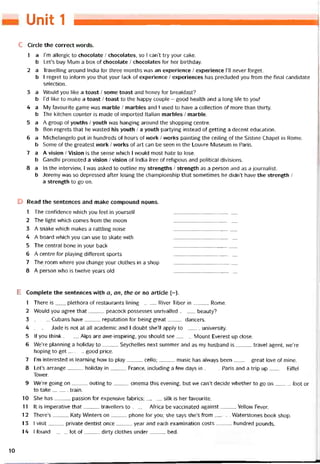
c Circle the correct vvords.
1 a l’m allergic to chocolate / chocolates, so I can’t try your cake.
b Let’s buy Mum a box of chocolate / chocolates for her birthday.
2 a Travelling around India for three months was an experience / experience ru never íorget.
b I regret to iníorm you that your lack of experience / experiences has precluded you from the tinal candidate
selection.
3 a Would you like a toast / some toast and honey for breaktast?
b l’d like to make a toast / toast to the happy couple - good health and a long life to you!
4 a My tavourite game was marble / marbles and I used to have a collection of more than thirty.
b The kitchen counter is made of imported Italian marbles / marble.
5 a A group of youths / youth was hanging around the shopping centre.
b Ben regrets that he vvasted his youth / a youth partying instead of getting a decent education.
6 a Michelangelo put in hundreds of hours of work / vvorks painting the ceiling of the Sistine Chapel in Rome.
b Some of the greatest work / vvorks of art can be seen in the Louvre Museum in Paris.
7 a A Vision / Vision ìs the sense vvhich I vvould most hate to lose.
b Gandhi promoted a Vision / Vision of India free of religious and political divisions.
8 a In the intervievv, l vvas asked to outline my strengths / strength as a person and as a íournalist.
b Jeremy was so depressed after losing the championship that sometimes he didn’t have the strength /
a strength to go on.
D Read the sentences and make compound nọuns.
1 The contidence vvhich you feel in yourselt
2 The light which comes from the moon
3 A snake which makes a rattling noise
4 A board which you can use to skate with
5 The Central bone in your back
6 A centre for playing ditíerent sports
7 The room where you change your clothes in a shop
8 A person who is tvvelve years old
E Complete the sentences with a, an, the or no article (-).
1 There is___ plethora of restaurants lining River Tiber in Rome.
2 VVould you agree that peacock possesses unrivalled beauty?
3 Cubans have reputation for being great dancers.
4 Jade is not at all academic and I doubt sheTl apply to university.
5 lf you think Alps are avve-inspiring, you should see Mount Everest up close.
6 We’re pianning a holiday to Seychelles next summer and as my husband is travel agent, we’re
hoping to get good price.
7 l’m interested in learning how to play cello;music has alvvays been great love of mine.
8 Let’s arrange holiday in France, including a few days in Paris and a trip up Eittel
Tovver.
9 We’re going on outing to cinema this evening, but we can’t decide whether to go on foot or
to take train.
10 She has passion for expensive tabrics;silk is her tavourite.
11 It is imperative that travellers to Aírica be vaccinated against Yellow Fever.
12 There’s Katy Winters on phone for you; she says she’s from Waterstones book shop.
1 3 I visit private dentist once year and each examination costs hundred pounds.
14 I íound lot of dìrty clothes under bed.
10
Grammar Ị
F Complete the text vvith a, the or -
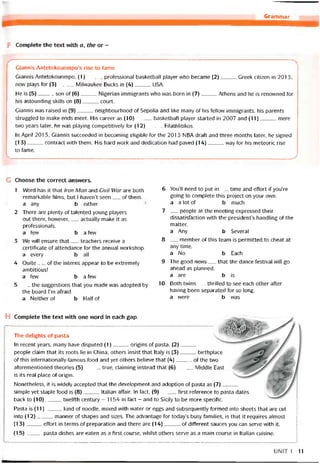
Giannis Antetokounmpo’s rise to fame
Giannis Antetokounmpo, (1)protessional basketball player who became (2)Greek citizen in 2013,
now plays for (3)Milwaukee Bucks in (4)USA.
He is (5)son of (6)Nigerian immigrants who was born in (7)Athens and he is renovvned for
his astounding skills on (8)court.
Giannis was raised in (9)neighbourhood of Sepolia and like many of his fellow immigrants, his parents
struggled to make ends meet. His career as (10)basketball player started in 2007 and (11)mere
two years ỉater, he was playing competitively for (12)Rlathlitikos.
In April 201 3, Giannis succeeded in becoming eligible for the 2013 NBA dratt and three months later, he signed
(13)contract vvith them. His hard vvork and dedication had paved (14)way for his meteoric rise
to fame.
_
______________ _ _____ _ __________________________________________________ .
G Choose the correct ansvvers.
1 Word has it that Iron Man and Civil War are both
remarkable films, but I haven’t seen__ of them.
a any b either
2 There are plenty of talented young players
out there, hovvever,__ actually make it as
proíessionals.
a few b a few
3 We will ensure that__ teachers receive a
certiticate of attendance for the annual vvorkshop.
a every b all
4 Quite _í_ of the interns appear to be extremely
ambitiỏùs!
a few b a few
5 __ the suggestions that you made was adopted by
the board l’m atraid.
a Neitherot b Halfof
6 You’lI need to put in__ time and effort if you’re
going to complete this project on your own.
a a lot of b much
7 __ people at the meeting expressed their
dissatistaction with the presidents handling of the
matter.
a Any b Several
8 __ member of this team is permitted to cheat at
any time.
a No b Each
9 The good news__ that the dance testival vvill go
ahead as planned.
a are b is
10 Both tvvins__ thrilled to see each other atter
having been separated for so long.
a were b was
H Complete the text vvith one word in each gap.
The delights of pasta
In recent years, many have disputed (1)origins of pasta. (2)
people claim that its roots lie in China, others insist that Italy is (3)birthplace
of this internationally-tamous food and yet others believe that (4)of the two
atorementioned theories (5)true, claiming instead that (6)Middle East
is ìts real place of origin.
Nonetheless, it is M/idely accepted that the development and adoption of pasta as (7)_____
simple yet staple food is (8)Italian affair. In fact, (9)tirst reíerence to pasta dates
back to (10)twelfth century - 1154 in fact - and to Sicily to be more speciíic.
Pasta is (11)kind of noodle, mixed with water or eggs and subsequently tormed into sheets that are cut
into (12)manner of shapes and sizes. The advantage for today’s busy tamilies, is that it requires almost
(13)effort in terms of preparation and there are (14)of ditíerent sauces you can serve with it.
(15)pasta dishes are eaten as a íirst course, vvhilst others serve as a main course in Italian cuisine.
UNIT 1 11
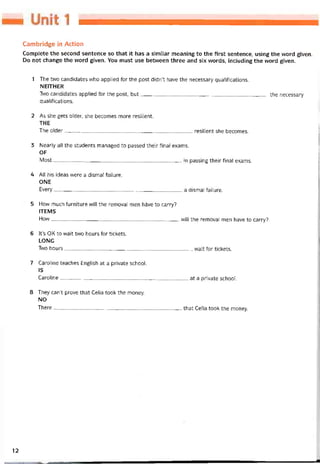
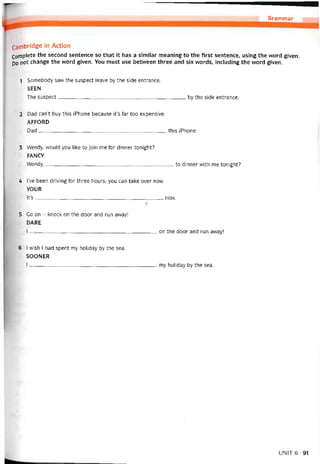
Cambridge in Action
Complete the second sentence so that it has a similar meaning to the first sentence, using the word given.
Do not change the word given. You must use betvveen three and six vvords, including the word given.
1 The two candidates who applied for the post didn’t have the necessary qualitications.
NEITHER
Two candidates applied for the post, but the necessary
qualitications.
2 As she gets older, she becomes more resilient.
THE
The older resilient she becomes.
3 Nearly all the students managed to passed their final exams.
OF
Most.---------------------------------------------------------------------------- in passing their final exams.
4 All his ideas were a dismal tailure.
ONE
Every-----------------------------------------------------------------------------a dismal tailure.
5 How much íurniture vvill the removal men hầve to carry?
ITEMS
How-----—-------------------------------------------------------------------- vvill the removal men have to carry?
6 lt’s OK to wait two hours for tickets.
LONG
Two hours vvait for tickets.
7 Cạroline teaches English at a private school.
IS
Caroline-----------------------------------------------------------------------------at a private school.
8 They can’t prove that Celia took the money.
NO
There----- —--------------------------------------------------------------------that Celia took the money.
12
Grammar
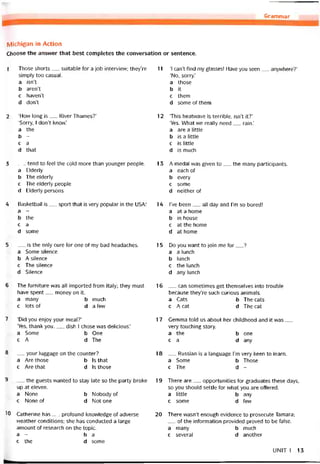
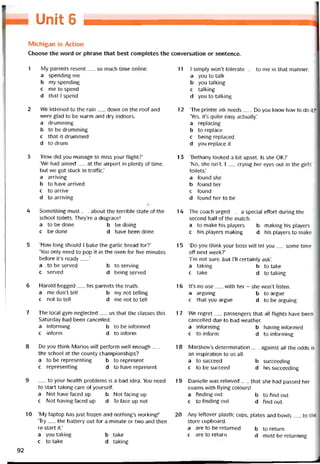
Michigan in Action
Choose the ansvver that best completes the conversation or sentence.
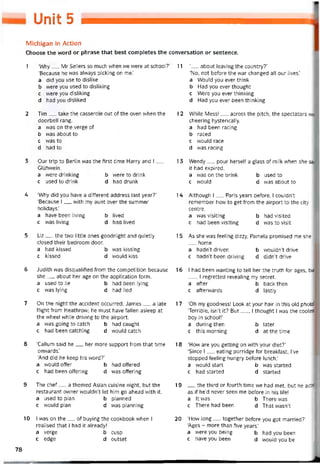
1 Those shorts__ suitable for a job intervievv; they’re
símply too casual.
a isn’t
b aren’t
c haven’t
d doiít
2 ‘How long is__ River Thames?’
‘Sorry, I don’t know.’
a the
b -
c a
d that
3 __ tend to feel the cold more than younger people.
a Elderly
b The elderly
c The elderly people
d Elderly persons
4 Basketball is__ sport that is very popular in the USA:
a -
b the
c a
d some
5 __ is the only cure for one of my bad headaches.
a Some silence
b A silence
c The silence
d Silence
6 The turniture was all imported from Italy; they must
have spent__ money on it.
a many b much
c lots of da few
7 ‘Did you enjoy your meal?’
‘Yes, thank you.__ dish I chose vvas delicious.’
a Some b One
c A d The
8 __ your luggage on the counter?
a Are those b Is that
c Are that d Is those
9 __ the guests vvanted to stay late so the party broke
up at eleven.
a None b Nobody of
c None of d Not one
10 Catherine has__ protound knovvledge of adverse
vveather conditions; she has conducted a large
amount of research on the topic.
a - ba
c the d some
11 ‘I can’t find my glasses! Have you seen__ anywhere?’
‘No, sorry.’
a those
b it
c them
d someotthem
12 ‘This heatvvave is terrible, isn’t ít?’
‘Yes. What we really need__ rain.’
a are a little
b is a little
c is little
d is much
13 A medal was given to__ the many participants.
a each of
b every
c some
d neither of
14 l’ve been__ all day and l’m so bored!
a at a home
b in house
c atthehome
d at home
15 Do you want to join me for__ ?
a a lunch
b lunch
c the lunch
d any lunch
16 __ can sometimes get themselves into trouble
because they’re such curious animais.
a Cats b The cats
c A cat d The cat
17 Gemma told us about her chiidhood and it was__
very touching story.
a the b one
ca d any
18 __ Russian is a language l’m very keen to learn.
a Some b Those
c The d -
19 There are__ opportunities for graduates these days,
so you should settle for what you are ottered.
a little b any
c some d few
20 There wasn’t enough evidence to prosecute Tamara;
__ of the intormation provided proved to be talse.
a many b much
c several d another
UNIT 1 13
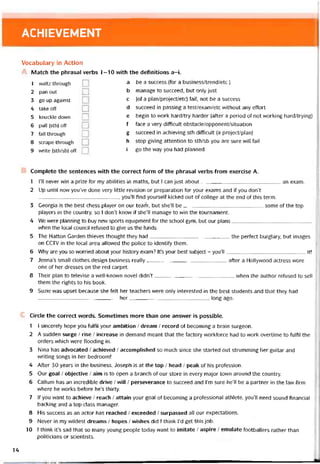
ACHIEVEMENT
Vocabulary in Action
Match the phrasal verbs 1-10 vvith the detinitions a-i.
1 waltz through
2 pan out
3 go up against
4 take off
5 knuckle down
6 pull (sth) off
7 fall through
8 scrape through
9 write (sth/sb) off
a be a success (for a business/trend/etc )
b manage to succeed, but only just
c [of a plan/project/etc) fail, not be a success
d succeed in passing a test/exam/etc vvithout any effort
e begin to work hard/try harder (after a period of not vvorking hard/trying)
f face a very ditticult obstacle/opponent/situation
g succeed in achieving sth diííicult (a project/plan)
h stop giving attention to sth/sb you are sure vvill tail
i go the way you had planned
Complete the sentences vvith the correct form of the phrasal verbs from exercise A.
1 1’11 never win a prize for my abilities in maths, but I can just about an exam.
2 Up until now you’ve done very little revision or preparation for your exams and if you don’t
, you’ll find yourselt kicked out of college at the end of this term.
3 Georgia is the best chess player on our tearh, but she’ll be some of the top
players in the country, so I don’t know if she’ll manage to win the tournament.
4 We were planning to buy new sports equipment for the school gym, but our plans
when the local council retused to give us the tunds.
5 The Hatton Garden thieves thought they had the pertect burglary, but images
on CCTV in the local area allovved the police to identity them.
6 Why are you so worried about your history exam? It’s your best subject - youìl it!
7 Jenna’s small clothes design business really atter a Hollyvvood actress wore
ohe of her dresses on the red carpet.
8 Their plan to televise a well-known novel didn’t when the author retused to sell
them the rights to his book.
9 Suzie vvas upset because she telt her teachers were only interested in the best students and that they had
her long ago.
Circle the correct words. Sometimes more than one answer is possible.
1 í sincerely hope you fulfil your ambition / dream / record of becoming a brain surgeon.
2 A sudden surge / rise / increase in demand meant that the tactory vvorktorce had to work overtime to tulíil the
orders vvhich were tlooding in.
3 Nina has advocated / achieved / accomplished so much since she started out strumming her guitar and
vvriting songs in her bedroom!
4 Atter 30 years in the business, Joseph is at the top / head / peak of his protession.
5 Our goal / objective / aim is to open a branch of our store in every major town around the country.
6 Callum has an incredible drive / vvill / perseverance to succeed and l’m sure he’ll be a partner in the law firm
vvhere he vvorks betore he’s thirty.
7 lf you want to achieve / reach / attain your goal of becoming a protessional athlete, you’ll need sound tinancial
backing and a top-class manager.
8 His success as an actor has reached / exceeded / surpassed all our expectations.
9 Never in my vvildest dreams / hopes / wishes did I think I’d get this job.
10 I think it’s sad that so many young people today want to imitate / aspire / emulate tootballers rather than
politicians or scientists.
14
D Complete the sentences with these verbs. The words in bold vvill help you.
do get go hit (x2) lose make meet procure set spearhead
1 I beiieve that if you yourselt goals in life, you’re more likely to succeed, both
hnancially and career-wise.
2 I’m going to have to pull an all-nighter if 1 want to the deadline.
3 Turn the power off and on and then press the ‘restart’ button; that should the trick.
4 Our manager knows he was in the vvrong, but he won’t admit it because he doesn’t vvant to
face.
5 Eric is prepared to do the lovvliest of jobs in the company in order to a toothold in
the publishing business.
6 Just because he’s your uncle, that doesn’t mean he’s obliged to a job for you, you
knovv!
7 Jo is the campaign to encourage people to cycle into town instead of driving.
8 Medical researchers have a breakthrough in their quest to find a cure for Hodgkin’s
Disease.
9 Laura, a new-comer on the tennis scene, really the ground running when she beat
the current Champion in her tirst tennis match ot ithe season.
10 Since Martin changed schools, he’s been from strength to strength and should do
well in his exams later this year.
11 After Corning last in the talent contest, Thomas rock bottom and it took him ages to
come out of the depression.
Complete the sentences with these vvords. The vvords in bold will help you.
credit - dismal overnight recipe remarkable rise strongest turn-up unbelievable usetul
1 Uníortunately, his attempt to start a business was a íailure and ended in
bankruptcy.
2 Putting Ryan in charge of sales is a for disaster - you know how incompetent he is!
3 Leicester City’s triumph in the 2015-2016 íootball Premiere League was a
achievement.
4 The meeting was productive and all the team members made contributions to the
discussion.
5 James Fernandez became an success when his song became a massive Online hít.
6 The reality star’s precipitous to fame was followed by an equally sudden downfall.
7 VVinning a prize in the photography competition was a for the books and ultimately
led to her pursuing photography as a career.
8 Aidan is a to you both; he’s one of our top students.
9 With a new management team, this organisation has made an turnaround over the
last year and is set to make a proíit next year.
10 As we’re in agreement over who the candidate is, shall we invite Mr Peters to join
our firm at the earliest opportunity?
UN1T 1 15
Unit 1
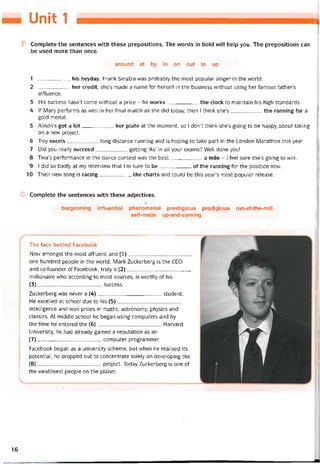
Complete the sentences with these prepositions. The words in bold vvill help you. The prepositions can
be used more than once.
around at by in on out to up
1 his heyday, Frank Sinatra was probably the most popular singer in the world.
2 her credit, she’s made a name for herseỉt in the business vvithout using her tamous father’s
intluence.
3 His success hasn’t come vvithout a price - he works the clock to maintain his high standards.
4 lf Mary períorms as well in her tinal match as she did today, then I think she’s the running for a
gold medal.
5 Alison’s got a lot her plate at the moment, so I don’t think she’s going to be happy about taking
on a new project.
6 Troy excels long-distance running and is hoping to take part in the London Marathon this year.
7 Did you really succeed getting ‘As’ in all your exams? Well done you!
8 Tina’s períormance in the dance contest was the best_______ __ . a mile - I feel sure she’s going to win.
9 I did so badly at my intervievv that l’m sure to be of the running for the position now.
10 Their new song is racing the charts and could be this year’s most popular release.
Complete the sentences with these adjectives.
burgeoning iníluential phenómenal prestigious prodigious run-of-the-mill
seif-made up-and-coming
The face behind Facebook
Now amongst the most ahluent and (1)______________________
one hundred people in the world, Mark Zuckerberg is the CEO
and co-founder of Facebook, truly a (2)______________________
millionaire who according to most sources, is vvorthy of his
(3)______________________ success.
Zuckerberg was never a (4)______________________ student.
He excelled at school due to his (5)______________________
intelligence and won prizes in maths, astronomy, physics and
classics. At middle school he began using computers and by
the time he entered the (6)______________________ Harvard
University, he had already gained a reputation as an
(7) ______________________ Computer programmer.
Facebook began as a university scheme, but when he realised its
potential, he dropped out to concentrate solely on developing the
(8) ______________________ project. Today Zuckerberg is One of
the vvealthiest people on the planet.
16
Complete the table.
Verb Noun Adjective
— ambition (1)______________________
aspire (2)-------------------------------------- aspiring
determine determination (3)______________________
fulfil (4)______________________ fulfilling / fulfilled
(5)-------------------------------------- perseverance persevering
persist (6)-------------------------------------- persistent
- prestige (7)--------------------------------------
(8)______________________ priority -
prosper prosperity (9)--------------------------------------
- resilience (10)______________________
—
resource /
(11)______________________
resourceíul
- zeal / zealot_• (12)______________________
I Complete the sentences vvith vvords from exercise H.
1 His for work is matched only by his enthusiasm for his hobbies and treetime leisure
pursuits.
2 lf you vvant to achieve a good work-life balance, then you must your tasks in order of
importance.
3 As an lavvyer, you’re expected to put in long hours if you ever want to make a success
of your career.
4 The most important quality for an explorer and hiker is- you need to be able to use
what you can íind to hand in order to survive.
5 Victor isn’t very and will be content with an undemanding job in his local town.
6 I understand that you haven’t reached the level you want vvith your music, but ]’m sure if you
, you’ll manage ìt eventually.
7 Mr Rhodes is a businessman who has bought himselt three homes and ovvns several
luxury cars.
8 Teachers are holding special vvorkshops to teach their students- the ability to
continue despite setbacks and disappointment.
9 This applicant is certainly very- l’ve told him three times that we can’t give him a
job, but he keeps calling me!
10 We were all amazed by Jason’s to get back on his feet atter the accident; just one
month atter he broke both legs, he was able to walk again.
11 Becoming the youngest partner in a top Iaw firm did much to increase his personal
12 Helen tound being a stay-at-home mother very; she really couldn’t imagine ever
going back to work.
UNIT 1 17
— Umit 1
Cambridge in Action
Read the text and use the word given in capitals at the end of some of the lines to form a vvord that íits
in the gap in the same line.
The bionic eye
According to statistics, around 40 mlllion people around the globe
are blind. Not surprisingly, medical researchers in this tield have one
(1)and that’s a deíinitive cure for blindness.
They are vvorking (2)tovvards developing
technology that is as effective for visual disabilities as that available
for the hearing-impaired. And their (3)may
íinally have paid off.
The ‘bionic eye’ is maybe the greatest (4)that
scientists couíd make in this íield. Although curing ail torms of blindness
may be too (5)a goal, the bionic eye may be
the solution to at least certain torms of blindness. It differs from a
‘prosthetic eye’ in that the latter replaces the physical structure and
appearance of the eye vvhilst the tormer works inside the eye structure
or in the brain.
One of the íirst people to benetit from the (6)
new technology spoke of her joy at tinally being able to tell the time
aíter more than six years. ‘The doctors’ (7)is
just incredible,’ she said.
With turther work and steadtast (8), scientists
hope that they will be able to restore many more people’s sight.
OBJECT
ZEAL
PERSEVERE
BREAK
AMBITION
REMARK
ACCOMPLISH
DETERMINE
18
Vocabulary
Michigan in Action
Choose the vvord or phrase that best completes the sentence.
1 Jasper’s work experience vvill allow him to hít__
when he starts his new job next week.
a a tailure
b rock bottom
c the ground running
d from bad to vvorse
2 Untortunately, vve only have one position and it must
go to the__ candidate.
a vvildest
b highest
c strongest
d greatest
3 We had to vvork around the__ to produce enough
goods to till the big order we had last week.
a clock
b priority
c day
d overnight
4 Despite his poor pertormance in last month’s
athletics trials, Jack is still__ for a medal in next
week’s race.
a in the running b meeting the deadline
c on his plate d by a mile
5 Although not everyone is a tan of Justin Bieber,
most people agree he is vvorthy of his__ success.
a intluential b aspiring
c phenomenal d resourceíul
6 Jenny__ her audition and was immediately oííered
the part!
a went up against b scraped through
c took off d waltzed through
7 You’ve got one last chance to take this exam and
pass, so you’d better__ and do some work.
a take off b scrape through
c knuckle down d excel at
8 Untortunately, Jamie’s plans to tour around
Australia didn’t__ due to a lack of tinances.
a tall through b pan out
c pull off d knuckle down
9 Phoebe__ all our expectations with her incredible
pertormance in the dance contest.
a attained b approved
c reached d surpassed
10 The money laundering scandal lead to the minister’s
tall trom political power.
a prodigious b precipitous
c dismal d persistent
11 A major political party is__ the campaign tor tighter
gun Controls in the vvake of last month’s shooting.
a procuring
b setting
c spearheading
d tultilling
12 Untortunately, Tina’s attempts to get a part in a
West End show have been a dismal___
a dovvntall
b contribution
c disaster
d íailiire
13 Robbie is no__ student; he gets straight As in all
subjects and is captain of the íootball team.
a well-known
b up-and-coming
c selí-made
d run-of-the-mill
14 My tather was proud of being__ man - he
started out with nothing and now he’s a successtul
businessman.
a an aspiring b a selt-made
c a zealous d a burgeoning
15 In ìts__ , the City of Bath was a magnet for M/ealthy
and tashionable people írom all over the country.
a dream b toothold
c prestige d heyday
16 Zoe’s plans to study at university__ vvhen she didn’t
get the required grades in her school leaving exams.
a tell through b wrote off
c got back d put in
17 Sally attends the__ Royal Ballet School in
Richmond.
a precipitous b resilient
c prestigious d persevering
18 I hope 1’11 be able to__ today’s pertormance on the
opening night.
a aspire b emiilate
c advocate d persevere
19 VVilliam__ to becoming a powerful politician and has
already started to make his way in the world of politics.
a persìsts b determines
c aspires d perseveres
20 Pablo-is just tvvelve years old, but thanks to his parents’
encouragement, he is already a__ chess player.
a prodigious b peak
c usetul d resilient
UNIT 1 19
— Unit 1
Michigan in Action
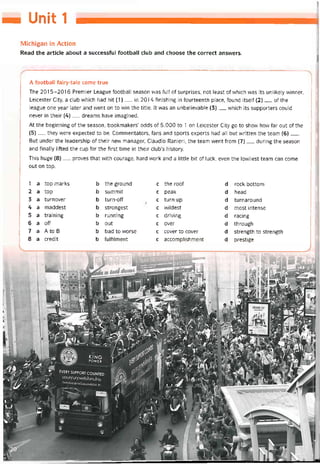
Read the article about a successíul tootball Club and choose the correct ansvvers.
A íootball fairy-tale come true
The 2015-2016 Premier League íootball season was full of surprises, not least of vvhich was its unlikely vvinner.
Leicester City, a Club vvhich had hít (1)__ in 2014 tinishing in tourteenth place, íound itselí (2)___ of the
league one year later and went on to win the title. It was an unbelievable (3)__ vvhich its supporters could
never in their (4)__ dreams have imagined.
At the beginning of the season, bookmakers’ odds of 5,000 to 1 on Leicester City go to show how far out of the
(5)__ they were expected to be. Commentators, fans and sports experts had all but vvritten the team (6)___
But under the leadership of their new manager, Claudio Ranieri, the team went from (7)__ during the season
and tinally litted the cup for the first time in their club’s history.
This huge (8)__ proves that with courage, hard vvork and a little bít of luck, even the lovvliest team can come
out on top.
1 a top marks b the ground c the roof d rock bottom
2 a top b summit c peak d head
3 a turnover b turn-off c turn-up d turnaround
4 a maddest b strongest c vvildest d most intense
5 a training b running c driving d racing
6 a off b out c over d through
7 a A to B b bad to vvorse c cover to cover d strength to strength
8 a credit b tultiỉment c accomplishment d prestige
Prepositions
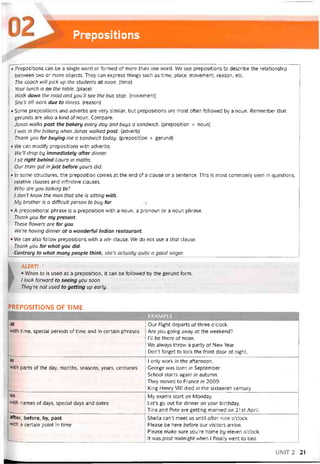
• Prepositions can be a single word or íormed of more than one word. We use prepositions to describe the relationship
between two or more objects. They can express things such as time, place, movement, reason, etc.
The coach will pick up the students at noon. (time)
Your lunch is on the table. (place)
Walk down the road and you’11 see the bus stop. [movement)
She’s offwork due to illness. (reason)
• Some prepositions and adverbs are very similar, but prepositions are most otten followed by a noun. Remember that
gerunds are also a kind of noun. Compare:
Jonas walks past the bakery every day and buys a sandvvich. (preposition + noun)
/ was in the bakery when Jonas walked past. (adverb)
Thank you for buying me a sandì/vich today. (preposition + gerund)
• VVe can modity prepositions with adverbs.
We’ll drop by immediately after dinner.
I sít right behind Laura in maths.
Our train got in just before yours did.
• In some structures, the preposition comes at the end of a clause or a sentence. This is most commonỉy seen in questions,
relative clauses and intinitive clauses.
Who are you talking to?
I don’t know the man that she is sitting with.
My brother is a difficult person to buy for.
• A prepositional phrase is a preposition with a noun, a pronoun or a noun phrase.
Thanh you for my present.
These flowers are for you.
We’re having dinner at a wonderful Indian restaurant.
• We can also follow prepositions with a wh- clause. We do not use a that clause.
Thanh you for what you did.
Contrary to what many people think, she’s actually quite a good singer.
1 ALERT! -
* When to is used as a preposition, it can be followed by the gerund form.
/ look forward to seeing you soon.
They're not used to getting up early.
PREPOSITIONS OF TIME
at
with time, special periods of time and in certain phrases
Our tlight departs at three o’clock.
Are you going avvay at the vveekend?
1’11 be there at noon.
We alvvays throw a party at New Year.
Don’t torget to lock the front door at night.
in
with parts of the day, months, seasons, years, centuries
—..... ..............
................... ..........
1 only work in the atternoon.
George was born in September.
School starts again in autumn.
They moved to France in 2009.
King Henry VIII died in the sixteenth century.
on
vvith names of days, special days and dates
----- --- -------------------------------------------------------------------------
My exams start on Monday.
Let’s go out for dinner on your birthday.
Tina and Pete are getting married on 21 st April.
after, beíore, by, past
with a certain point in time
*—------.________________________ _
Sheila can’t meet us until after nine o’clock.
Please be here beíore our visitors arrive.
Please make sure you’re home by eleven o’clock.
Ít was past midnight when I tinally went to bed.
UNIT2 21
Unit 2
EXAMPLE
about, around
with at to be less specitic
We left the house at about ten o’clock.
Let’s visit Nicky in hospital at around six.
durĩng, for, from ... till, from ... until, from ... to, in,
since, through, throughout, until, till
with a point in time or a period of time
The children sometimes get bored during the summer holidays.
She’s staying for three days.
We’ll be in Madrid from Monday to Friday.
Jonah passed his driving test in just a few weeks.
1 haven’t visited Johannesburg since 201 2.
My husband coughed through the whole pertormance!
We don’t have a free vveekend until November.
ALERT!
• We say in the morning, in the atternoon and in the evening, but at night and on Monday morning.
• Ne can use while to mean the same as during, but it is alvvays followed by a verb clause.
He was talking on his mobile phone during the fítm.
He was talking on his mobile phone while the fìlm was shovving.
• In American English, we say on the weekend rather than at the weekend.
• In American English, we can omit the preposition beíore the names of days.
British English: / don’t work on VVednesdays.
American English: / don’t work Wednesdays.
British English: We’re visiting triends from Friday to Monday.
American English: We’re visiting triends Friday through Monday.
• There is a slight difference in meaning betvveen in time and on time. In time means ‘vvith enough time to spare’ and
on time means ‘exactly at the right time - not tóo late and not too early’. Compare:
The City has excellent Public transport and the buses are alvvays on time.
Do you thinh we’ll be in time for the bus?
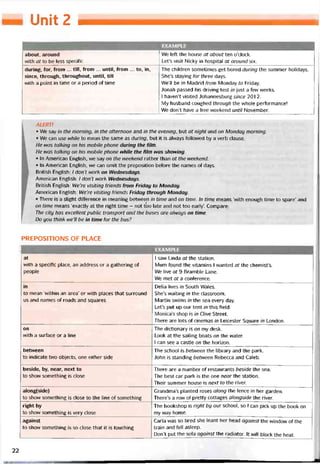
PREPOSITIONS OF PLACE
1 EXAMPLE
at
with a specìtic place, an address or a gathering of
people
1 saw Linda ơtthe station.
Mum found the vitamins 1 wanted at the chemist’s.
We live at 9 Bramble Lane.
We met at a conterence.
in
to mean ‘within an area’ or with places that surround
us and names of roads and squares
Delia lives in South Wales.
She’s vvaiting in the classroom.
Martin swims in the sea every day.
Let’s put up our tent in thỉs tield.
Monica’s shop is in Clive Street.
There are lots of cinemas in Leicester Square in London.
on
with a suríace or a line
The dictionary is on my desk.
Look at the sailing boats on the water.
1 can see a castle on the horizon.
betvveen
to indicate two objects, one either side
The school is between the library and the park.
John is standing betì/veen Rebecca and Caleb.
beside, by, near, next to
to show something is close
There are a number of restaurants beside the sea.
The best car park is the one near the station.
Their summer house is next to the river.
along(side)
to shovv something is close to the line of somethỉng
Grandma’s planted roses alongthe tence in her garden.
There’s a row of pretty cottages alongside the river.
right by
to show something is very close
The bookshop is right by our school, so 1 can pick up the book on
my way home.
against
to show something is so close that it is touching
Carla was so tired she leant her head against the window of the
train and fell asleep.
Don’t put the soía against the radiator. It wĩll block the heat.
22
Grammar
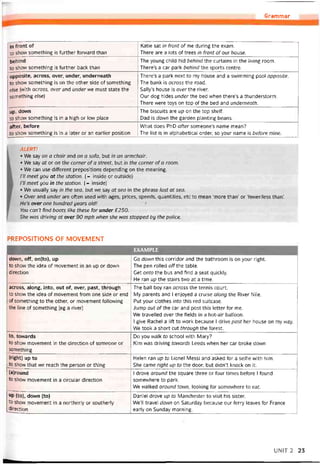
in front of
to show something is turther forward than
Katie sat in front ofme during the exam.
There are a lots of trees in front of our house.
behind
to show something is íurther back than
The young child hid behind the curtains in the living room.
There’s a car park behind the sports centre.
opposite, across, over, under, underneath
to show something is on the other side of something
else (vvith across, over and under we must State the
something else)
There’s a park next to my house and a svvimming pool opposite.
The bank is across the road.
Sally’s house is over the river.
Our dog hides under the bed when there’s a thunderstorm.
There were toys on top of the bed and underneath.
up, down
to show something is in a high or low place
The biscuits are up on the top shelt.
Dad is down the garden planting beans.
aíter, beíore
to show something is in a later or an earlier position
What does PhD aíter someone’s name mean?
The list is in alphabetical order, so your name is beíore mine.
ALERT!
• Ne say on a chair and on a sofa, but in an armchair.
• Ne say at or on the corner of a Street, but in the corner of a room.
• We can use different prepositions depending on the meaning.
ru meet you at the station. (= inside or outside)
1’11 meet you in the station. (= inside)
• We usually say in the sea, but we say at sea in the phrase lost at sea.
• Over and under are otten used vvith ages, prices, speeds, quantities, etc to mean ‘more than’ or ‘fewer/less than’.
He’s over one hundred years old!
You can’t find boots lihe these for under £250.
She was driving at over 90 mph when she was stopped by the police.
PREPOS1TIONS OF MOVEMENT
EXAMPLE
down, off, on(to), up
to show the idea of movement in an up or down
direction
Go down this corridor and the bathroom is on your right.
The pen rolled off the table.
Get onto the bus and find a seat quickly.
He ran up the stairs tvvo at a time.
across, along, into, out of, over, past, through
to shovv the idea of movement from one side or end
of something to the other, or movement following
the line of something (eg a river)
The ball boy ran across the tennis court.
My parents and I enjoyed a cruise along the River Nile.
Put your clothes into this red suitcase.
Jump out of the car and post this letter for me.
We travelled oi/erthe fields in a hot-air balloon.
1 give Rachel a lĩft to work because 1 drive past her house on my way.
We took a short cut through the torest.
to, towards
to show movement in the direction of someone or
something
Do you walk to school with Mary?
Kim was driving towards Leeds when her car broke down
(right) up to
_to show that we reach the person or thing
Helen ran up to Lionel Messi and asked for a seltie M/ith him.
She came right up to the door, but didn’t knock on it.
(a)round
to show movement in a circular direction
1 drove around the square three or four times betore 1 tound
somevvhere to park.
We vvalked around town, looking for somevvhere to eat.
up (to), dovvn (to)
to show movement in a northerly or southerly
direction
-------------------------------------------------------------------------
Daniel drove up to Manchester to visit his sister.
We’ll travel down on Saturday because our terry leaves for France
early on Sunday morning.
UNIT2 23
— UnỉẺ 2
ALERT!
• Ne often use up and down with the same meaning as along.
Drive up the road until you see the library. Then find somewhere to park.
Go down this corridor and you’ll find her office on your right.
• We use on(to) and offfor a bus, a coach, a train, a plane, a boat and a bike, vvhereas we use in(to] and out offor a
car or a taxi.
The passengers got on the plane and the cabin crew prepared for take-off.
Get into the taxi and tell him where we’re going.
• We usually use in and on to express the position of something and into and onto to express the idea of movement
tovvards a place.
My Sivimming things are in the beach bag.
Please put my swimming things into the beach bag.
The actors were standing on the stage.
The actors ran onto the stage.
• We can use at and to atter some verbs. At implies that the person isn’t happy. Compare:
Pass the ball to Tom and he’ll score a goal.
Don’t throw things at your brother; it isn’t very nice.
'Don’t tbrget to lock the door", mum shouted to Pat.
Mum shouted at Pat for spilling coffee all over the table.
OTHER USES OF PREPOSIT1ONS
EXAMPLE
because of, due to, from, out of,
owing to
to show reason
The elderly lady died from pneumonia.
Owing to his lack of interpersonal skills, he wasn’t given the job.
against, beside, contrary to
to show contrast
The company made a protit this year against last year’s loss.
Joseph really is quite tall beside his brother.
Contrary to popular beliet, there are advantages to both parents vvorking.
for
to show purpose
This program is for keeping track of expenses.
This fluid is for cleaning screens.
through
to show how something happened
She succeeded in business through sheer determination.
He recovered the use of his right arm through physiotherapy.
by, with
to talk about what we use to do
something
Ken alvvays travels by train as he doesn’t drive.
1 put the desk together with an electric screvvdriver.
by
to introduce the person who did
something
This is a novel by Jojo Moyes.
1 love the water lily paintings by Monet
betvveen
vvithin a range of numbers, dates,
ages
Choose a number between one and ten.
There’s quite a diíterence between entertainment today and in the 20th century.
You can take holiday betvveen 5th and 25th July.
They have five children between the ages of six and thirteen.
like
to compare
Sandy acts like my mother, yet she’s only two years older than me!
despite, in spite of
to show concession
Despite the bad vveather, the match went ahead.
In spite o/Teeling unvvell, Jude went to work.
Despite what everyone else says, 1 believe you,
as
to shovv the role of someone or
something
As a teacher, Jeff is brilliant.
/As a Container for flowers, this pot is no good; it’s got a hole in the bottom.
besides
to mean ‘in addition to’
Besides Janet, 1 also spoke to Miriam and Jenny.
Have you done anything else today besides playing video games?
according to
to report what someone has said
According to the local paper, we’re going to have a heat wave this weekend.
Fifty people have lost their homes in the recent tloods, according to the latest reports.
24
Grammar
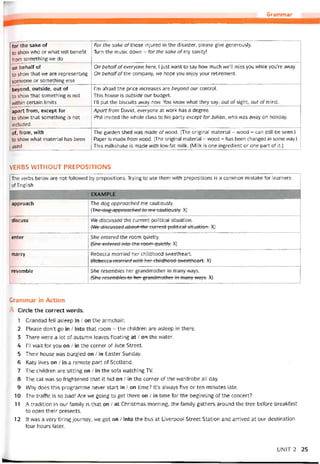
for the sake of
to show who or what vvill benetit
from something we do
For the sake oTthose injured in the disaster, please give generously.
Turn the music dovvn - for the sake of my sanity!
on behalí of
to show that we are representing
someone or something else
On behalf of everyone here, í just want to say how much we’ll miss you vvhile you're away.
On behalíthe company, we hope you enjoy your retirement.
------- 1 ......."■......... ............
beyond, outside, out of
to show that something is not
vvithin certain limits
I’m afraid the price increases are beyond our control.
This house is outside our budget.
1’11 put the biscuits away now. You know what they say: out of sight, out of mind.
apart from, except for
to show that something is not
included
Apart from David, everyone at work has a degree.
Phil invited the vvhole class to his party excepttor Julian, who was away on holiday.
of, from, with
to show what material has been
used
The garden shed was made ofwood. (The original material - wood - can still be seen.)
Paper is made from wood. (The original material - wood - has been changed in some way.)
This milkshake is made with low-fat milk. (Milk is one ingredient or one part of it.)
VERBS WITHOUT PREPOSITIONS
The verbs below are not followed by prepositions. Trying to use them with prepositions is a common mistake for learners
of English
approach
discuss
example____________ _____________________________________
The dog approached me cautiously.
(T-he ởogapproached to me cautiously. X)
We discussed the current political situation.
(We discussed abont the currcnt political situatien-. X)
enter She entered the room quietly.
(Shc entered into the room quict-ly. X)
marry Rebecca married her childhood svveetheart.
(Rcbccca married with hcr childhood svveethcart. X)
resemble She resembles her grandmother in many ways.
(She resembles to her grandmothcr in- many ways? X)
Grammar in Action
Circle the correct words.
1 Grandad fell asleep in / on the armchair.
2 Please don’t go in / into that room - the children are asleep in there.
3 There were a lot of autumn leaves ĩloating at / on the water.
4 ru wait for you on / in the corner of Jute Street.
5 Their house was burgled on / in Easter Sunday.
6 Katy lives on / in a remote part of Scotland.
7 The children are sitting on / in the sofa vvatching TV.
8 The cat was so írightened that it hid on / in the corner of the vvardrobe all day.
9 Why does this programme never start in / on time? It’s always five or ten minutes late.
10 The traffic is so bad! Are we going to get there on / in time for the beginning of the concert?
11 A tradition in our íamily is that on / at Christmas morning, the íamily gathers around the tree betore breakíast
to open their presents.
12 Ít was a very tiring journey; we got on / into the bus at Liverpoọl Street Station and arrived at our destination
four hours later.
UNIT2 25
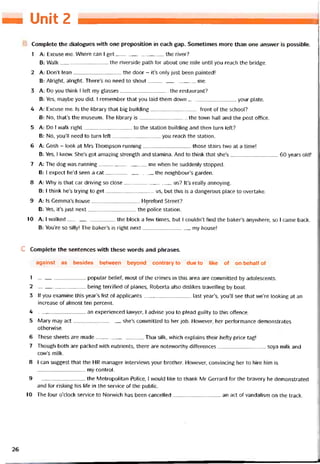
— Unỉt 2
Complete the dialogues with one preposition in each gap. Sometimes more than one answer is possíble.
1 A: Excuse me. Where can I get the river?
B: Walk the riverside path for about one mile until you reach the bridge.
2 A: Don’t lean the door - it’s only just been painted!
B: Alright, alright. There’s no need to shout me.
3 A: Do you think I left my glasses the restaurant?
B: Yes, maybe you dỉd. I remember that you laid them down your plate.
4 A: Excuse me. Is the library that big building tront of the school?
B: No, that’s the museum. The library is the tovvn hall and the post ottice.
5 A: Do I vvalk right to the station building and then turn left?
B: No, you’ll need to turn left you reach the station.
6 A: Gosh - look at Mrs Thompson running those stairs two at a time!
B: Yes, I knovv. She’s got amazing strength and stamina. And to think that she’s 60 years old!
7 A: The dog was running me vvhen he suddenly stopped.
B: I expect he’d seen a cat the neighbour’s garden.
8 A: Why is that car driving so close us? It’s really annoying.
B: I think he’s trying to get us, but this is a dangerous place to overtake.
9 A: Is Gemma’s house Hẹretord Street?
B: Yes, it’s just next the police station.
10 A: I vvalked the block a few times, but I couldn’t tind the baker’s anyvvhere, so I came back.
B: You’re so silly! The baker’s is right next my house!
c Complete the sentences with these vvords and phrases.
against as besides between beyond contrary to due to like of on behalt of
1 ---------------------------- popular belieí, most of the crimes in this area are committed by adolescents.
2 being territied of planes, Roberta also dislikes travelling by boat.
3 lf you examine this year’s list of applicants last year’s, you’11 see that we’re looking at an
increase of almost ten percent.
4 ---------------------------- an experienced lavvyer, I advise you to plead guilty to this ottence.
5 Mary may act she’s committed to her job. Hovvever, her pertormance demonstrates
othervvise.
6 These sheets are made Thai silk, which explains their hetty price tag!
7 Though both are packed with nutrients, there are notevvorthy diíterences soya milk and
cow’s milk.
8 1 can suggest that the HR manager interviews your brother. Hovvever, convincing her to hire him is
my control.
9 ---------------------------- the Metropolitan Police, 1 vvould like to thank Mr Gerrard for the bravery he demonstrated
and for risking his life in the Service of the public.
10 The four o’clock Service to Norvvich has been cancelled an act of vandalism on the track.
26
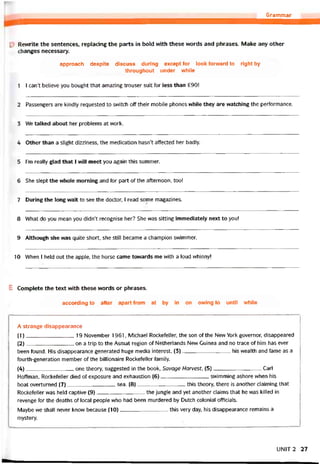
Grammar
D Rewrite the sentences, replacing the parts in bold with these vvords and phrases. Make any other
changes necessary.
approach despite discuss during except for look forward to right by
throughout under while
1 I can’t believe you bought that amazing trouser suit for less than £90!
2 Passengers are kindly requested to svvitch off their mobile phones while they are vvatching the pertormance.
3 We talked about her problems at work.
4 Other than a slight dizziness, the medication hasn’t aííected her badly.
5 l’m really glad that I vvill meet you again this summer.
6 She slept the vvhole morning and for part of the atternoon, too!
7 During the long wait to see the doctor, I read sorne magazines.
8 What do you mean you didn’t recognise her? She was sitting immediately next to you!
9 Although she was quite short, she still became a Champion svvimmer.
10 When I held out the apple, the horse came towards me with a loud vvhinny!
E Complete the text with these vvords or phrases.
according to atter apart írom at by in on owing to until while
A strange disappearance
(1) 19 November 1961, Michael Rocketeller, the son of the New York governor, disappeared
(2) on a trip to the Asmat region of Netherlands Nevv Guinea and no trace of him has ever
been íound. His disappearance generated huge media interest, (3)his vvealth and fame as a
tourth-generation member of the billionaire Rocketeller tamily.
(4)one theory, suggested in the book, Savage Harvest, (5)Carl
Hottman, Rockeíeller died of exposure and exhaustion (6)svvimming ashore when his
boat overturned (7)sea. (8)this theory, there is another claiming that
Rocketeỉler vvas held captive (9)the jungle and yet another claims that he vvas killed in
revenge for the deaths of local people who had been murdered by Dutch colonial otticials.
Maybe we shall never know because (10)this very day, his disappearance remains a
mystery.
UN1T2 27
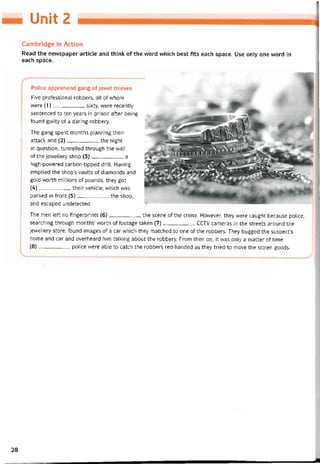
Unit 2
Cambridge in Action
Read the nevvspaper article and think of the word vvhich best fits each space. Use only one word in
each space.
Police apprehend gang of jewel thieves
Five protessional robbers, all of whom
were (1)sixty, were recently
sentenced to ten years in prison atter being
tound guilty of a daring robbery.
The gang spent months planning their
attack and (2)the night
in question, tunnelled through the wall
of the jewellery shop (3)a
high-powered carbon-tipped drill. Having
emptied the shop’s vaults of diamonds and
gold vvorth millions of pounds, they got
(4)their vehicle, vvhich was
parked in tront (5)the shop,
and escaped undetected.
The men left no íingerprints (6)-------------------the scene of the crime. Hovvever, they vvere caught because police,
searching through months’ vvorth of tootage taken (7)CCTV cameras in the streets around the
jewellery store, tound images of a car which they matched to one of the robbers. They bugged the suspect’s
home and car and overheard him talking about the robbery. From then on, it vvas only a matter of time
(8)-------------------police were able to catch the robbers red-handed as they tried to move the stolen goods.
28
Grammar
IVlichigan in Action
Choose the word or phrase that best completes the conversation or sentence.
1
2
3
4
5
6
7
8
9
10
They have just purchased a property__ the South
of France.
a
b
c
d
to
by
in
at
11 Billy the Kid was a notorious American guntighter
who lived___ the 19th century.
a while
b on
c for
d in
Your pills are__ the soap - on the bathroom shelí.
a just next to
b near next to
c quite next to
d really next to
From the top of the mountain, there’s a breath-taking
view of the sea and of far-away ships__ the horizon.
a in
b at
c behind
d on
12
13
Shall we go for a stroll__ the river? It’s a glorious day!
a against
b out of
c right by
d along
This is the kind of music my daughter spends all her
time___
a listening
b listening to
c to listening
d listen to
‘What are you doing during the Easter holidays?’
‘__ Easter Sunday, ru detinitely be at home vvith mỷ
íamily.’
a On b At
c In d Into
14 __ vvhat the inhabitants of the village thought, the
shoplitter wasn’t underprivileged; he came from a
very attluent tamily.
a Contrary to b Ovving to
c Out of d Except for
‘Is that Sarah’s tather?’
‘Yes, she really__ , don’t you think?’
a resembles to him b him resembles
c resembles him d resembles with him
15 American gangster AI Capone died of a heart attack
__ 1947.
a in b on
c at d past
1 had spent the whole morning looking for my wallet,
which I later found__ the sofa!
a dovvn b under
c across d beíore
16 You should have passed the bail__ me. ]’d have
kicked it and scored!
a at b on
c to d for
‘Did you make the cake__ cocoa povvder or cooking 17
chocolate?’
‘I used cocoa povvder.’
a on b from
c of d vvith
Opening hours are from 9 am__ 6 pm. 18
a to b past
c until d up to
While Julie was skating__ the Street, she saw a van 19
turn the corner and a masked man jump out.
a through b to
c down d towards
‘Oh no! I can’t remember if 1 turned off the gas cooker!’ 20
‘__ your peace of mind, I think you should go back
and check.’
a In spite of b Except for
c According to d For the sake of
‘Did you hear about the mugging last night?’
‘Yes. You won’t believe it, but it happened just__
the road from my house!’
a across b
c through d
opposite
around
This red brush is__ the dog.
a for grooming b
c for groom d
for to groom
for I groom
Bella got__ the coach, sat in her numbered Seat and
waited for the journey to start.
a into b onto
c in d off
‘You can either take a taxi to the party or I can give
you a lift.’
‘Don’t'worry. It’s only a quick vvalk__ the park
a tovvards b over
c through d between
UNIT 2 29
CRIME AND PUNISHMENT
Vocabulary in Action
A Circle the correct vvords. Sometimes more than one answer is possible.
1 Holland is one of the few countries in vvhich euthanasia / assisted suicide / manslaughter, a way to
intentionally end somebody’s lĩfe, ỉs legal.
2 The CEO was tound guilty of íraud / traííicking / embezzlement; nobody could believe that he had been
deceiving the company for so many months.
3 Unbelievable! The íorest ranger himselt has been charged with arson / robbery / vandalism atter setting Tire to
the torest he was meant to be guarding!
4 The matia boss was convicted of money-laundering / burglary / breaking-and-entering atter it was discovered
that a seemingly legal hotel business was a way of hiding the protits from his extensive drug tratticking trade.
5 A group of youths came beíore the judge on a charge of mugging / assault / grievous bodily harm (GBH) aíter
they attacked a nightclub DJ with clubs and sticks.
6 A security expert taught the billionaire evasion techniques to help him avoid any possible abduction /
hooliganism / kidnap attempt.
7 The signature on the cheques turned out to be a íorgery / fake / íront, but by then ỉt was too late as the thieí
had got away vvith £100,000.
Match the vvords 1 -8 vvith the detinitions a-h.
1 abduction
2 espionage
3 hacking
4 manslaughter Q
5 perjury
6 smuggling □
7 harassment Q
8 trespassing
a the use of programming skills to gain illegal access to a Computer
b secretly importing or exporting goods or people, in violation of the law
c the act of spying
d the illegal carrying away of a person against their vvilI
e the vvrongtul entry into the property of others; one pertorms this action knowingly
f bullying or intimidating actions or words which cause fear
g the unlawful killing of a human being, vvithout intention
h wilfully giving talse testimony under oath
Complete the sentences with the correct form of the words from exercise B.
1 The young whizz kid’s crime was into the company’s Computer System Via the Internet in
order to obtain contidential data.
2 The jury vvas convinced that the man’s death was an accident, but the driver of the car that hit him was tound
guilty of because he had been driving dangerously at the time of the accident.
3 Parents have been told to be particularly vigilant following three child in the area in the
space of three months.
4 The vvitness requested that he be allovved to change his testimony, proving to the court that he had been lying
and he vvas subsequently charged with
5 This is private property and I vvould ask you to leave immediately; othervvise you’ll be prosecuted for
6 Through industrial, the secret recipe for the company’s new chocolate bar was stolen!
7 Trying to bring a few extra bottles of vvhiskey through customs in your luggage is actually,
so make sure you declare anything of that nature.
8 Helen brought a case of sexual against her tormer employer and successtully won the case
and received compensation.
30
Vocabulary
_________________________________
Complete the sentences with the correct íorm of these verbs.
condone cross-examine detain eníorce interrogate penalise plead
reintegrate revoke sentence
1 The man was to thirty years in prison for his heinous crime.
2 Atter the break, the counsel for the deíence wi11 the vvitness.
3 Atter a lengthy consultation vvith his lavvyer, the deíendant agreed to guilty.
4 Mark’s driving licence was after he was charged vvith speeding for the tourth time.
5 Atter spending five years in prison, the convict toiind it ditíicult to into society.
6 The nevv law against smoking in public places will be strictly
7 While I don’t what this young vvoman did, I can understand that she vvas in a diíticiilt
situation and felt that she had no alternative but to steal.
8 Will the player be for speaking to the reteree in a disrespecttul manner?
9 The vandal was in prison for one night; charges against him were subsequently dropped.
10 Police the suspect for six hours, but he still continued to declare his innocence.
The vvords in bold are in the wrong sentences. Write the correct vvords.
1 Police believe the bailiíí of this crime to be a man of middle-age who lives locaily
and is tamiliar with the area. ----------------------------
2 Eva wasn’t involved in the robbery; she was just one of several innocent convicts
who were unlucky enough to be in the wrong place at the wrong time. ----------------------------
3 The conman in this case has asserted his innocence from the very beginning of
the trial, but it remains to be seen if the jury vvill agree vvith him. ----------------------------
4 The bystanders were chained together by their hands and feet and loaded into
a vvaíting security van. ----------------------------
5 In the British judicial System, a solicitor does not have the right to appear in court, but
works together vvith a perpetrator who will represent the Client during his or her trial.
6 Elderly people are being vvarned to guard against a magistrate who has been posing
as a postman in order to gain access to people’s homes. ----------------------------
7 lf you don’t pay the backlog of six instalments, then the deíendant wi11 be called in
to repossess items of turniture and electrical goods in the amount of the debt. -----------------------------
8 A barrister sits in a local courthouse and rules on cases such as land disputes or
petty theít. ----------------------------
UNỈT2 31
Unít 2
Complete the table.
Verb Noun Adjective
convict convict /
conviction
defence /
deíendant
detention /
detainee
lavv /
(4) _
prison / prisoner /
imprisonment
offend offence /
offender
punish
violation
detensive
(un)lawful
(6)_____
offending
punishing / punitive /
punishable
(in)violable
Complete the sentences with vvords from exercise F.
1 He was convicted of carrying a(n)vveapon with intent to cause grievous bodily harm.
2 Inmates must not, under any circumstances,the strict prison rules.
3 The murder victim had his arms up over his face in what had obviously been a move as he
tried to protect himselt from his attacker.
4 Found guilty of traud and corruption, the businessman was required to pay damages in
excess of one million pounds.
5 A criminal usually tinds it very diííicult to get a job or rent a home as very few people want
to be involved with a person who has a criminal record.
6 The killer was for a total of thirty years.
7 Under new counter-terrorism laws, the police have the right to a suspect for an indehnite
period of time íor interrogation.
8 You are in a very serious predicament and I suggest that you consult a at once in order to
get some legal advice.
32
Vocabulary
Circle the correct vvords.
1 Kidnapping, the sale of illegal drugs and murder are all mishaps / íelonies, vvhich require the offender to be
incarcerated for more than twelve months.
2 Once a penalty / verdict has been reached, it vvill be announced by the judge.
3 Although it is argued that the use of CCTV cameras reduces crime, video seizure / surveillance is nonetheless
an intringement of privacy.
4 You can’t simply barge into my house like this; do you have a search testimony / warrant?
5 Jenny’s lawyer asked the magistrate for a(n) extradition / restraining order against her neighbour, as he had
been threatening her for some time.
6 The detectives are trying to establish vvhether John has a(n) alibi / coníession for the time at which the
robbery was committed.
Match to make compound nouns.
1 extenuating
2 circumstantial
3 diminished
4 serial
5 solitary
6 suspended
7 premeditated
8 repeat
a continement
b responsibility
c murder
d ottender
e sentence
f circumstances
g killer
h evidence
Complete the sentences with the compound nouns from exercise I.
1 Katherine has a history of mental ỉllness which means that sometimes she cannot control her actions; she
pleaded- not guilty on the grounds of
2 The criminal in question has committed more than three murders and is now considered a
3 The criminal was kept in as a punishment due to his aggressive and violent
behaviour tovvards the other inmates.
3 This isn’t the first time you’ve mugged someone, is it? You are a(n)and will be
prosecuted accordingly.
4 The police only have; although the suspect was seen entering the nightclub
with the victim, nobody actually savv what happened next.
5 Though Nicky was seen shoplitting, she was let off due to; she had recently
suííered the loss of a parent which had caused her to exhibit unusual behaviour.
7 The detendant was given a; providing that he demonstrates good behaviour,
he won’t be imprisoned.
8 The jury unanimously concluded that the deíendant had every intention of killing his victim and he was
theretore convicted of____________________________
UNIT2 33
Unit 2
Cambridge in Action
Read the article and decide vvhich answer (A, B, c or D) best fits each gap.
Petty crime: not so petty in the long run
A petty crime, or misdemeanour, is a crime which is (1)__ by means of a fine or (2)___ for up to One year.
Such (3) — are committed on a daily basis and include minor incidents such as disturbing the peace, various
traffic (4)__ such as speeding and so on.
Although these kinds of petty crimes constitute (5)__ acts, many people feel that they are not a serious
breach of law and order. Hovvever, in the long run, these are not such trivial matters. The (6)__ in such cases
will usually be made to pay a fine. A(n) (7) _ for anti-social behaviour may result in a prison term, although
anyone under the age of 18 will not normally be required to spend time in a (8)__ centre and may be asked
to complete community Service instead. The fact remains, hovvever, that the perpetrator will now have a
permanent criminal record.
1 A punishable B punishment c punishing D punitive
2 A imprisonment B abduction c prosecution D perjury
3 A licences B detences c ottences D sentences
4 A trauds B violations c orders D assaults
5 A solitary B diminished c ottensive D unlawful
6 A detendants B bystanders c convicts D conmen
7 A punishment B detence c conviction D extradition
8 A solitary B detention c continement D ottence
34
Michĩgan in Action
Choose the vvord or phrase that most appropriately completes the sentence.
1
2
3
4
5
6
7
8
9
10
The hostage was released unharmed by the
kidnappers, but they were never caught and charged
with___
a fraud
b torgery
c abduction
d tratticking
The suspect soon broke down when the police
__ him and contessed to having broken into the
jewellery store.
a interrogated b entorced
c sentenced d charged
Please remember that as a witness, vvhen providing
your__ in court, you vvili be under oath.
a vvarrant b alibi
c testimony d penalty
The jury unanimously agreed that the suspect had
every intention of murdering the victim - it was a
clear case of__ murder.
a serial b circumstantial
c extenuating d premeditated
Mrs Kelley requires a__ order against her violent
husband who has threatened to harm her.
a restraining b search
c solitary d repeat
Sam has no__ for the night of the crime and,
theretore, he is the main suspect in this case.
a verdict b surveillance
c alibi d vvitness
Jane can’t drive since she had her licence__
because of her dangerous driving.
a revoked b entorced
c penalised d detained
It said on the news that two escaped__ vvere on the
run in our area!
a perpetrators b bailitís
c convicts d suspects
You knovvingly entered the property of Mr James
vvithout permission; this is quite clearly a case of___
a burglary b trespassing
c hooiiganism d tratticking
Julie’s tamily turned to the police atter seeing that
their daughter vvas a victim of cyberbullying and__
by a group of individuals on a daily basis.
a harassment b perjury
c hacking d espionage
17
18
19
20
11 As a juvenile delinquent, Matthevv will not be sent
to prison; he wlll be required to spend time in__
centre.
a an abductìon
b a violation
c a detention
d a conviction
12 Investigators íound cans of petrol at the scene of the
Tire, which is clear proot that the police are dealing
with a case of___
a vandalism b CBH
c assault d arson
1 5 The criminal had just been released from prison and
tound it difficult to___ back into society.
a demonstrate b incarcerate
c reintegrate d interrogate
14 l’m a staunch supporter of__ providing the patient
is of sound mind and able to make a decision for
themselves with the guidance of medical proíessionals.
a mansỉaughter b euthanasia
c abduction d suicide
15 The solicitor advised his Client to__ not guilty to all
charges.
a plead b punish
c charge d condone
16 Sandy vvatched in horror as the__ men took away
her TV and stereo System.
a bystander’s b bailiff’s
c barrister’s d defendant’s
Three members of the ship’s crew were convicted of
__ immigrants on board the vessel.
a trafficking b smuggling
c embezzling d mugging
The Computer hacker vvas convicted of__ atter he
soỉd government secrets to the enemy.
a cyberbullying b breaking-and-entering
c espionage d kidnapping
It’s a terrible shock when your home is burgled because
you feel that your personal space has been___
a violated b vandalised
c convicted d detained
There vvas only__ evidence; nobody actually saw
the man take anything. However, he was seen leaving
the building Via CCTV cameras around the time of the
robbery.
a extenuating b circumstantial
c diminished d suspended
UNIT2 35
Word Formation / Commonly Coníused
PREFIXES & SUFFIXES
• A pretix is a group of letters that is added to the beginning of an adjective, verb or noun in order to change the meaning,
otten to make it negative. Common pretixes include: im-, in-, un- and dis-.
possible -> impossible
credible -> incredible
available -> unavailable
agree -ỳ disagree
• A suttix is also a group of letters, but it is added to the end of a word in order to change the meaning. Common suttixes
include: -ify, -ment, -ist and -ian.
sign -> signiíy
enjoy enjoyment
philanthropy -ỳ philanthropist
mathematics -> mathematician
• There are otten other spelling changes, usually when a suttix is added to a word.
clear -ỳ clarify
long -> length
Vision -à visual
COMMON PREFIXES USED TO CHANGE MEAN1NG
1 PREFIX MEANING EXAMPLES
anti- against antisocial, anti-smoking, antifreeze
auto- self autograph, autobiography
bi- two bilingual, biannual, bicycle
co- together co-worker, co-exist, co-owner
dis- opposite, not disappear, disloyal, distrust
ex- tormer ex-wife, ex-president, ex-boyfriend
il- opposite, not illegal, illogical, illegible
in-/im- opposite, not inottensive, insincerity, immature, impatience
en-/in-/im- into, inside enclose, incoming, inbound, immigration
inter- among, betvveen interaction, intersect, intercity
intra- within, into intranet, intravenous
ir- opposite, not irreversible, irrational, irreplaceable
mega- big, colossal megaphone, megastar, megastore
mini- smaller, shorter mini-pizza, mini-cruise, miniskirt
mis- badly, wrongly mishear, misunderstand, mismanage
mono- single monochrome, monolingual, monogamy
multi- many multi-storey, multitask, multinational
non- vvithout nonsense, non-smoking, noncritical
over- in excess overeat, overthink, overload
pre- betore predetermine, premature
re- again reheat, renevv, rephrase
self- to or for oneseỉt self-catering, self-made, self-taught
semi- half semi-detached, semi-circle
sub- belovv subterranean, subheading, subzero
super- above, more than superglue, supermodel, supersized
trans- across trans-atlantic, transport, transaction, transcribe
under- interior, too little underachieve, underline, underpertorm
un- opposite, not unrivalled, unmoved, unopened
un- reverse action untold, unpack, undo
36
Grammar
ALERT!
• We often use im- before words beginning vvith m- and p-.
The man stood immobile as the big dog sniffed around his ankles.
I fìnd it impossible to sleep if Tve had a coffee betore bed.
• Ne oíten use in- and un- beíore words begỉnning with C-.
Your use ofAmerican spelling in this essag is inconsistent.
This chair is terribly uncomtortable - can I sít on the sofa?
• Ne often use il- beíore vvords beginning with
Spending petty cash on coffee and cakes is obviously an illegitimate use of company funds.
• We often use ir- betore words beginning with r-.
A lot of the intormation in your essay is irrelevant to the main topic.
COMMON SUFFIXES USED TO CHANGE MEANING
SUFFIX USE EXAMPLES
-er, ee, -or, -ant,
-ian, -ist
to change a word describing an object, place or action to a
noun describing a person related to it, or the name of a job
lawyer, employee, assessor, assistant,
beautician, activist
-ese, -ian, -an, -ish to describe nationalities and languages related to a country Chinese, Italian, Mexican, Danish
-ian, -ician, -ist to describe the person studying or related to a subject physician, mathematician, biologist
-ism, -ist -ism is used to denote a belieí or movement and -ist the
person who follows that beliet or movement
Buddhism - Buddhist
Feminism - Feminist
Impressionism - Impressionist
-le, -y to make a íamiliar version of a word or a name brolly (= umbrella), doggie, Johnny,
Mummy, smellies (eg soap, períume,
shampoo, etc), telly ( = TV), vvellies ( =
VVellington boots)
ALERT!
• Nouns endỉng in -er have an active meaning, vvhereas nouns that end in -ee have a passive meaning.
My employer employs ten members of staff besides me.
1'm an etnployee at Wartons Bakery. I’ve been employed there for fìfteen years.
dim works as a personal trainer. He teaches people how to exercise to achieve their titness goals.
Lisa is a trainee at the moment, so she’s still being taught the different aspects of the job.
• Some nouns ending in -er and -or refer to machines and not people.
cooker: a piece of kitchen equipment for cooking on
processor: a piece of electronic equipment for Processing things
SUFFIXES USED TO CHANGE PART OF SPEECH
SUFFIX USE EXAMPLES
■ness, -(i)ty, -ance, -ence, -th adjective -ỳ noun happiness, vanity, satety, abundance, difference, strength
■(i)al, -ful, -less, -able, -ible -y,
■ous, -ant, -ent, -ive, -ish, -ate, -ic,
■ical, -ing, -ed, -ory, -ular
—■——-
noun -> adjective
verb -> adjective
partial, colossai, plentiíul, meaningless, tavourable,
sensible, hairy, adventurous, observant, different,
impressive, ĩoolish, tortunate, scientihc, economical,
interesting, interested, sensory, circular
-ise/ize, “(e)n, -(i)ate, -ify
—-------------
noun verb
adjective -> verb
materialise, strengthen, widen, initiate, purity
■ạ1’ -age, -ance, -ence, -ment, -(a)
tion, -ure, -dom, -ings, -ion, -y
verb -> noun reíerral, carriage, tolerance, dependence, excitement,
appreciation, intention, procedure, boredom, surroundings,
description, discovery
Jy________ adjective adverb quickly, truthíully
UNIT 3 37
Unit 3
ALERT!
• When we use participle forms of verbs as adjectives, the present participle (-ing) has an active meaning and the
past participle (-ed) has a passive meaning.
Fireman took half an hour to reach the burning house and bụ then it was too late to save it. (= the house which
was burning]
This burnt toast is horrible; I thinh /7/ have cereal instead. (= the toast which had been burnt)
• Some suffixes do not change the part of speech. This is most common with nouns because we sometimes have, for
example, one noun for the person and another for the object, or one noun for the male and another for the ĩemale.
child -ỳ childhood neighbour -ỳ neighbourhood
racism -> racist romanticism romanticist
gene -y genealogy archaeologist -» archaeology
relation -> relationship íriend -» ữiendship
manager -» manageress actor -> actress
COMMONLY CONFUSED VERBS
• There are a number of verbs in English which are sometimes coníused because the meanings are very similar. There are
some techniques that can help you identity vvhich verb is correct in which context.
• Some verbs may be mirror image verbs, ie they look at the same action from two different perspectives. For example,
borrow and lend. Compare:
Jenny borroived Lisa’s ruler.
Lisa lent her ruler to Jenny.
• Other verbs are transitive or intransitive. A transịtive verb is an action verb that needs a direct object. An intransitive
verb does not need a direct object. For example, raise and rise. Compare:
Mark knew the answer to the teacher’5 question and raised his hand eagerly. [Raise is transitive and we must follow it with
a direct object - his hand.)
The sun rises early in the morning. [Rise is intransitive and no direct object is needed.)
• For other verbs, learning the difference in usage, meaning and structure will be helptul. For example, the verb may
require a dependent preposition or perhaps it is followed by a gerund or an intinitive.
VERBS EXAMPLE
borrovv vs lend
(mirror image)
borrow: receive, use and promise to return
something that belongs to someone else
lend: give something to someone for a short
time, expecting them to return it
Dad, 1 need to borrow some money.
OK, 1’11 lend you £20 and you can pay me back later.
teach vs learn
(mirror image)
teach: help someone learn something by giving
lessons or showing them what to do
learn: acquire knovvledge or a skill through
having lessons or being shovvn
Mr Grimsby teaches history and makes the lessons really interesting.
We're learning all about the Tudor kings and queens in history this term.
lay vs lie
(transitive/intransitive)
lay: put something in a horizontal position
He: to be or put yourselí in a horizontal position
Just lay the ironing on the bed and 1’11 put it away later.
He laid his head on the table and cried.
She lay on the grass looking up at the sky.
My head aches; I’m going to He on the sofa for a bít.
reach vs arrive
(transitive/intransitive)
reach: arrive in or at a place
arrive: reach a place
We reached London in the morning.
We arrived in the morning.
38
Grammar
sit vs set
(intransitive/transitive)
set: put something or someone in a particular
place
sit: be in a position where your lovver body is
resting on the ground or a Seat vvhile the top
part of your body is upright, or lower your body
so you are in a sitting position
Set the vase of ílovvers on that table.
1 set out your clothes on your bed.
Please come and sit here next to me.
1 sat next to Linda on the bus.
speak vs talk
(úsage)
speak and talk: often used interchangeably
speak: used for tormal situations
speak: used for languages
speak: used in certain expressions
talk: used for lengthy discussions
talk: used in certain expressions
1’11 talk/speak to Rosie. She’ll know.
The Prime Minister spoke to the nation.
Jake speaks Spanish íluently.
Can you speak up, please?
Speak for yourselí! 1 disagree
We spent the vvhoỉe atternoon talking.
1 talked to my boss for over an hour.
Let’s meet and talk about our summer holidays.
1 didn’t ottend you; you’re talking nonsense.
beat vs win
(meaning)
beat: come first or be the best - tocus on the
person/team/etc
win: come tirst or be the best - tocus on the object
Tyler and 1 played a game and I beat him.
1 won the game that Tyler and 1 played.
bring vs take
(mirror image)
bring: move from one place to the location where
the speaker is; move from ‘there’ to ‘here’
take: move to a diííerent location; move from
‘here’ to ‘there’
Can you bring my glasses when you come dovvnstairs, please?
1 brought you a cup of tea.
1’11 take the letters to the post ottice.
Martin took my keys when he left in a rush this morning.
bring, take vs íetch
(meaning)
bring and take: movement is in one direction
only; something is brought to the place where
the speaker is, or is taken to a different pỉace
fetch; describes going somevvhere, getting
something and bringing it back; collect
something from one place and bring to the place
we are now
1 brought you some new flowers.
1’11 take these dead ones to the kitchen.
1 can’t read the newspaper vvithout my glasses. Could you fetch them,
please? They’re upstairs next to my bed.
I’m going to fetch the children from school; we’ll be back in half an hour.
hear vs listen
(meaning)
hear: notice sounds with your ear; realise that
someone or something is making a sound
listeir. pay attention to a sound; try to hear the
sound that someone or something is making
-----—
I heard the birds singing when I woke up this morning.
Can you hear that strange noise?
1 otten listen to the radio while driving.
OK. Tell me your news. ’m listening.
Ssh. Listen. What’s that noise?
make vs do
(meaning)
rri°ke: create or manutacture something, cause
someone to do or feel something, íorce someone
to do something
d°: often describes an action or an activity or
lrnPlies that a task has been completed
Mum made a delicious pie last night
These clothes are made in Thailand.
This film alvvays makes me cry!
My teacher made me do the test again.
What are we going to do this vveekend?
Are you doing the ironing? Thank you.
Have you done the shopping?
UNIT 3 39
Unit 3
notice vs realise vs understand
(meaning)
notice: become aware of something through
hearing, seeing or íeeling it
realise: know and understand the importance of
something; start to knovv something you hadn’t
noticed beíore
understand: comprehend intormation or a
situation
1 noticed you were upset this morning; is there anything 1 can do to help?
Jenna notices small details because she’s very observant.
Mía realised her mistake and apologised.
Jack looked at his watch and suddenly realised how late he was.
Peter understands maths because he pays attention in class.
Dad understood why 1 was angry and didn’t try and make me change
my mind.
recall vs remind
(meaning)
recall: remember (and tell someone)
remind: to make someone remember something
1 recall our trip to Egypt and how much we enjoyed it.
You must remind Grandad to take his pills; otherwise he’ll íorget them
again.
rob vs steal
(meaning)
rob: take something from someone without
permission - tocus on the person
steal: take something from someone vvithout
permission - tocus on the object taken
Two men robbed Thomas last night
They stole his watch and his vvallet.
reíuse vs deny
(meaning and structure)
reíuse: say you will not do what you have been
asked to do; say you do not want something you
have been oítered or given; not do something or
give someone what they have asked for
deny: say you did not do something someone is
accusing you of; say something is untrue
■ĩ
1 refuse to tell you my secret.
Petra refused our dinner invitation.
He refused to help move the turniture.
Kim denied damaging my laptop.
He denied rumours that he is getting married.
agree vs accept
(meaning and structure)
agree: say you will do as somebody asks/wants;
say you think the same as somebody else
accept: give an athrmative response to a
request, offer, etc; vvillingly recognise a fact,
idea, etc
They agreed to postpone the meeting.
Mr Smith agreed to a postponement.
1 agree with your plan.
She doesn’t agree.
1 accepted the job in London.
He accepts that he was partly to blame.
He accepts his share of the blame.
let vs allovv vs permit
(structure)
let: give somebody permission to do something
allow: give somebody permission to do
something (more íormal than let)
permit: give somebody permission to do
something (more tormal then both let and allovv)
Mother let me wear her gold earrings.
Please let me in!
The council don’t allow people to cycle in the park.
The council don’t allow cycling in the park.
You mustn’t allow strangers in.
The council doesn't permit people to build on Creentield sites.
The council doesn’t permit building on Greentield sites.
fit vs suit vs match
(meaning)
fit: be the correct size, shape, etc
suit: be right in terms of colour, shape, etc; also,
be right in terms of character, emotion, etc
match: go well with another item, person, etc
My new dress fits períectly.
That colour really suits you - you should vvear it more otten.
Motherhood suits her - she’s much happier now than she used to be.
Those brown shoes don't match your blue suit.
40
Grammar
ALERT!
• The meaning of bring and take is very similar when used with along or with. These phrases refer to including
someone or something when you move to another place.
Mary brought her brother along to the party.
H Mary brought her sister with her too.
■ Mary took some crisps with her to the party.
Mary took her tavourite CDs along too.
• The verbs reach and arrive can both have the object there.
We were travelling to Paris. We reached there in the morning.
14/e ivere travelling to Paris. We arrived there just atter eight o’clock.
Grammar in Action
Complete the table vvith these vvords.
appear approve certain complete considerate convenient deíinite do dress
expected Integrate imaginative legal legible legitimate liberal literate logical loyal mature
modest moral obedient partial patient possible rational redeemable regular replaceable
reverent reversible sensitive sincere tie trust
dis- il-______________ im-____________ ĩn- ir- un-
1 1 1 II
1 1mỆ >m II
1 1 1 1
1 1
1 1 1 1
1 1 1 1
Complete the sentences with words from exercise A.
1 Your fear of spiders is completely- they’re not poisonous and they can’t harm you, so why
are you scared of them?
2 Even though I know many of the contestants in the talent contest, l will be and judge each
pertormer on musical skill only.
3 My grandmother of social media - she thinks they’re killing face-to-face commimication
and true Triendship.
4 Could you the lock on this box, please? I can’t seem to get it open.
5 Who is this letter addressed to? The vvriting on the envelope is completely
6 It was very of you to start talking about your pet cat when you know that lmelda’s dog has
just died!
7 David may be íiíteen years old, but I think he’s quite- he acts like he’s still in primary
school!
8 She’s quite, so don’t expect her to come up with any brilliant ideas for the school play.
9 The driver wasn’t killed in the road accident, but untortunately, he suffered brain damage.
'0 My dog is so; he never comes when I call him and won’t sit down when I tell him to.
11 Yoưr application form is as you haven’t tilled in the tield about your relevant work
experience.
12 Many young women and girls in that country are as they don’t get the chance to go to
school and learn to read and vvrite.
UNIT3 41
/M Unit 3
c Complete each pair of sentences with one of the pairs of pretìxes.
anti/mis auto/self bi/mono co/en mega/multi mini/super over/under pre/re
1 a The market on the corner of our road is very handy when we run out of milk or coffee, but I
don’t do my vveekly shop there.
b We go to the market once a week and stock up on food.
2 a Although Pam has never had any lessons, she plays the piano very well and says she’s-taught.
b lf we manage to see the star in her dressing room, 1’11 definitely ask for her graph.
3 a In my opinion, the film Civil War is___________ rated; it’s not nearly as good as the revievvs said.
b lf a shop assistant charged you, vvould you tell her, or would you keep the extra money?
4 a The best vvay to gain a good command of a toreign language is to use a lingual dictionary, so
you have the word and its deíinition in the target language.
b Tristana is lingual in Spanish and English because her mother is British and her tather is from
Spain.
5 a Please close this letter with the presents vvhen you vvrap up the parcel.
b As his vvriting skills weren’t that good, the politician-vvrote the book vvith a well-known
journalist.
6 a 1 don’t think you should-heat that tish Soup. You’re supposed to cook it and eat it - it’s not
safe to consume it for a second day.
b It says in the cookery book that you have to-heat the oven to 1500 c.
7 a It really annoys me when people allow their children to behave in public places.
b Parents should control their children’s -social behaviour in public places like catés and
restaurants.
8 a The best place to buy a new TV is that electronics store on the outskirts of town.
b We parked our car on the fifth tloor of the-storey car park and used the lift to get down to the
ground floor.
Complete the sentences with the correct form of the vvords in bold.
1 George works as a for an international pharmaceuticals
company.
2 Katy’s has given her a week off to prepare for her tinal
accountancy exams.
3 trom all the main parties gave their vievvs betore the final
vote took place.
4 Maybe the careers couid give you some guidance about
your íuture employment choices.
5 Atter being ottered a job in Brazil, Tony is doing a crash course in
so that he’ll be able to communicate with his colleagues.
6 Mark Zuckerberg is becoming knovvn as something of a as he
continues to donate large sums of money to charity.
7 The cheque can only be cashed by the- the person the
cheque is made out to.
8 Many of the USAs most prominent citizens have ancestry,
perhaps the most notable of them being the tamous Kennedy íamily.
9 Matthew’s tather vvorks as a management for a large
multi-national company.
10 That shop has a beautiíul display of carpets and textiles.
BIOLOGY
EMPLOY
POLITICS
COUNSEL
PORTUGAL
PHILANTHROPY
PAY
IRELAND
CONSULT
MOROCCO
42
Grammar
Complete the sentences with an adjective, noun or verb íormed from these vvords.
care explode íluent torgive free justification long plenty redundancy reluctant
1 There’s no need to ask for my time and time again. You apologised, I accepted,
end of story.
2 My boss’s to hire Agnes, just because she was a vvoman, really angered me.
3 You are an extremely driver; please be more cautious in the íuture!
4 Tina was made from her job atter five years and now she’s unemployed.
5 Bomb disposal experts were able to detuse the device betore it vvent off and nobody
was hurt.
6 How can you possibly spending £600 on a dress?
7 One of the European Union’s key principles is the idea of of movement from one
country to another.
8 When testing vvritten work, the emphasis is usually on accuracy rather than---------------------------------------
9 Fresh vegetables are so cheap and here, that vve have a big salad for lunch and for
supper every day.
10 If you ask me, that skirt is far too short - I think you should--------------------------------------it a bít.
Complete the sentences with a different part of speech made by adding the correct suffix to the word
given in bold.
1 The road is ten metres wide, so it has a of ten metres.
2 Kelly has a lot of good sense, vvhich makes her a-------------------------------------- person.
3 The City council wants to develop this area of the City; it wants to encourage new---------------------------------------
4 Ceorgina suffers from autism, so we say that she is
5 He’s a doctor, but his special subject is endocrinology; that’s the area he--------------------------------------in.
6 We didn’t even know that a secret tunnel existed; we vvere unavvare of its---------------------------------------
7 The train arrived late; its late caused problems for the passengers.
8 You should consult a specialist; atter the you’ll know what’s wrong with you.
9 She married very young, but untortunately, the was not a success.
10 Use a pencil to draw around this triangle; then colour in the shape you have made.
Circle the correct vvords.
1 Renoir was arguably the most renovvned impressionism / impressionist painter.
2 The ovvner / ovvnership of the hotel passed into the hands of the bank atter the company was declared bankrupt
last year.
3 All vvaitresses / vvaiters must wear the regulation grey skirt with tan tights and sensible dark shoes.
4 lYlany young people are continuing to live with their parents well into adult / adulthood as they simply can’t
afford to rent a place of their ovvn.
5 Archaeologists / Archaeology can be hard work when you are digging through soil all day long in the
uníorgiving heat of the Mediterranean sun.
6 She had a vivid child / childhood memory of playing on the swing in her grandmothehs garden.
7 Arter years of his authoritarian rule of terror, the dictator / dictatorship was finally overthrovvn and imprisoned.
8 Ladies and gentlemen - your hostess / host for tonights charity gala is the well-known TV presenter, John Owens.
UNIT3 43
Unit 3
Complete the sentences vvith the correct form of the verbs.
1 borrovv lend
a l’d appreciate it if you could me your laptop for the meeting.
b lt’s been a week since you my laptop and you still haven’t returned it.
2 bring íetch take
a Please can you these application forms to Human Resources? I can’t leave my desk
right now.
b My dog’s íavourite game is to his ball after it’s been thrown for him.
c WilI you me a cup of tea from the canteen if you’re going?
3 speak talk
a l’m atraid that in order to apply for this position, you must be able to at least one
additional European language.
b ỉ don’t understand - vvhat are you about?
4 lay lie
a Please the contents of your bag on the table; we need to verity that it doesn’t contain
any Sharp objects.
b We on our backs in the shade of the tree and looked up at the svvaying leaves.
5 arrive reach
a Catherine always at work betore anybody of her colleagues.
b I usually the ottice ,after everybody else because I have a longer drive.
6 set sit
a The cat was at the top of a tall tree, looking down at the garden below.
b Please the tall glasses caretully on the drinks tray and don’t torget to bring some ice, too
7 beat win
a We the other team 3-0 and our fans went crazy!
b Our team has been training hard, so ỉ think we’ve got a good chance of the match.
8 accept agree
a You’ll just have to-----------------------------that Jenny doesn’t vvant to be triends vvith you anymore and move on
b Did Martin to consider the idea of moving house?
9 hear listen
a What do you mean ‘a tunny noise’? I can’t anything.
b lt’s no use talking to John because he never
10 deny refuse
a Danny---------------------------- to take a pay cut and chose to quít his job instead.
b Do you íorging the director’s signature on this letter?
11 rob steal
a Bill had his car when he left it unlocked outsỉde the supermarket.
b A gang of masked men the bank and made off with a haul of £2 million.
12 recall remind
a Will you---------------------------- me to stop at the chemist’s for my prescription on the way home?
b I hope 1’11 be able to all these names and dates for the history exam.
13 notice realise understand
a We---------------------------- -that it was too late to catch the last bus home, so we got a taxi instead.
b I have never why so many people enjoy vvatching tootball; l’ve alvvays found it boring.
c 1 didn’t anything vvrong with Harry - he seemed íine to me.
14 fit match suit
a I bought this great pair of dark blue jeans, but now I need some trainers to
b It don’t think that student life Clittord very well - he seems stressed and tired.
c That T-shirt doesn’t you any more - can’t you see that it’s far too small?
Grammar
Cambridge in Action
Complete the second sentence so that it has a similar meaning to the first sentence, using the word given.
po not change the word given. You must use between three and six vvords, including the word given.
1 Nicholas has an excellent command of the Svvedish language.
FLUENTLY
Nicholas_____________________________________________
2 We suspect Mark wasn’t given the part as he is too shy.
DUE
Mark probably wasn’t given the part_____________________________________________
3 Could 1 borrovv one of your dresses for tonight’s dinner?
ME
Would you be kind enough one of your dresses for
tonight’s dinner?
4 Can you contirm that this passport is valid?
THE
Can you contirm this passport?
5 The managing director seemed very impressed by Joanne’s cv.
FIND
The managing director seemed to____________ _■_______________________________
6 Your apology means nothing if you’re not planning to change your ways.
IS
Your apology you’re planning to change your ways.
7 Jason said that he hadn’t copied his essay from the Internet.
HAVING
Jason his essay from the Internet.
8 Polly learnt to svvim from a íormer Olympic medallist.
TO
Polly by a íormer Olympic medallist.
UNIT 3 45
Grammar
Unit 3
Michigan ín Action
Choose the word or phrase that best completes the conversation or sentence.
1 Will you__ all these books and papers to my otTice,
please?
a íetch
b bring
c take
d set
2 ‘Is Leah OK?’
‘Yes, we spent hours__ about her problem and she
seems to feel better now.’
a talking
b speaking
c discussing
d listening
3 ‘Are your cousins getting a taxi from the airport?’
‘No, l’m going to__ them.
a take b fetch
c bring d go
4 All those in tavour of the motion, please__ ỳour
hands.
a raise b rise
c rose d arouse
5 ‘Waiter, we’re not happy with the taste of the Soup.’
‘, Katie. There’s nothing vvrong with the Soup.’
a Speak up b Talk nonsense
c Talk about it d Speak for yourselt
6 ‘Have you researched your tamiiy tree?’
‘Oh, yes. 1 love__ and 1 spend hours looking through
old records and photos!’
a genes b genealogy
c genealogists d genetic
7 Many European countries are dealing with__
numbers of immigrants, due to tinancial instability in
their homelands.
a precedent b unprecedented
c precedence d preceding
8 l’m sure your cat vvill soon get used to her new___
a surrounded b surrounding
c surround d surroundings
9 It was uníair of the head teacher to accuse the children
of being___ít was their íirst day at school and they
had very little knovvledge of the English language.
a disobedient b obediently
c obeying d disobeyed
10 ‘What was my essay like, Miss Hardy?’
‘Not very good. I’m atraid you’ll have to__ it.’
a redo b undo
c overdo d do
46
11 Julie is an extremely__ person; she doesn’t vvorry
about the important things in life.
a materialism
b materialist
c immaterial
d materialistic
12 The expedition was totally__ and did not live up to
my expectations; I expected so much more having
read the brochure.
a unexciting
b unexcited
c excitingly
d excitement
13 Your__ tovvards my new job bothers me. Aren’t you
interested in anything I do?
a ditterentiation b inditterent
c ditíerence d inditterence
14 Can you please__ down and raise your right arm, s
I can complete the examination.
a lay b lie
c lying d laid
15 1 can’t believe the thieves__ so much jewellery -
they took everything we had in the shop.
a robbed b stole
c had d picked
16 ‘1 can’t come to your party because my cousin is
staying with me next vveekend.’
‘Why not bring your cousin__ , too?’
a back b here
c vvith d along
17 The change in Oliver’s attitude tovvards pay cuts was
As our superior, he had alvvays listened to and
supported our demands.
a unexplained b explanatory
c inexplicable d explanation
18 Please ansvver all the questions___
a truthtully b truthtul
c true d truly
19 As a result of the captain’s__ , the ship came
extremely close to hitting a large rock just off the
coast of Sicily.
a care b carelessness
c caretully d careless
20 The__ vveather conditions meant that we were able
to sail right around the island betore sunset.
a tavoured b tavourite
c íavourable d tavour
Vũcabulary
URBAN LIFE
Vocabulary in Action
Circle the correct vvords.
1 The outskirts / Central business district is vvhere you vvill find a city’s ottices and companies and where the
main economic and commercial activity take place.
2 Because many city-dwellers in Britain have small or non-existent gardens, they can rent a(n) allotment /
íarmers’ market, which is a plot of land on the edge of town vvhere they can grow vegetables and truit.
3 On an industrial estate / inner City small tactories and manutacturing outlets are grouped together near
tacilities such as transport netvvorks, electricity and storage areas.
4 lt’s common to find large hypermarkets and superstores on the outdoors / outskirts of a City, vvhere there is
easy access for shoppers and plenty of parking space.
5 Some residential areas / recreation grounds can be very expensive to live in if the housing there consists of
detached homes with their own extensive gardens.
6 Although living in the downtown / suburbs has the advantage of being quiet and having good schools and
shops, it can be tiring when you have to commute a long way into the City centre for work every day.
7 A housing estate / retirement home is an area vvhere all the houses have been built by the same developer.
They tend to look very similar and be designed in a similar style.
8 The word ‘ghetto’ / ‘heartland’ describes a run-down inner City area vvhere people, otten of the same
nationality or race, live together in conditions of extreme poverty.
Match the descriptions with the vvords for different kinds of buildings.
block of ílats bungalow council housing semi-detached house
sky-scrapers slums terraced houses
1 Homes in this area are built of plain concrete or breeze blocks, have no
running water or electricity and have windows made of plastic sheeting.
2 This house has oniy one storey and all the rooms are on the same level.
3 These homes are in a row and all look the same. They are typical
in British towns and cities. ____________________________
4 This house is joined to and shares its Central wall with the
next-door property. ____________________________
5 These incredibly high buildings usually contain ottices and businesses.
They can be tound in the centre of any modern City.
6 In the UK, the State provides this kind of subsidised housing for peopỉe
on low incomes so that everybody can afford to rent a house.
7 This is a building with lots of storeys, and on each floor there is at
least one apartment. ____________________________
UN1T3 47
taM Unảí 3
c The vvords in bold are in the vvrong sentences. VVrite the correct words.
1 Las Vegas is a downtown City vvhich spreads out into the desert for miles
in every direction. ___________________________ .
2 Houses are cheap in this provinciai area because few people want to live
somewhere with poor amenities and a soaring crime rate. ___________________________ _
3 lt’s good tun to waik around Ludlow’s boarded-up town centre on a busy
market day and look at the íruit, flowers, china, herbs and plants which
are íor sale. ____________________________
4 The houses in this Street are bustling and vvithin a few vveeks the council
vvill be bringing in bulldozers to raze them to the ground.
5 Although Heretord is a small, inner-city City, you can tind many of the
shops and tacilities you would expect trom a much larger urban area.
6 The empty shops with their run-dovvn vvindovvs and grattiti-covered vvalls
are a sorry sight. ____________________________
7 This spravvling housing estate has become a hotbed of crime and police
are vvorking with community groups to create more opportunities for
young people to work and socialise sately.
8 The condemned area of New Orleans is íamous tor its eateries and
music clubs where both íamous and lesser-knovvn jazz musicians
entertain the customers. ____________________________
Revvrite the sentences, replacing the parts in bold with these words and phrases. Make any other
changes necessary.
asylum seekers deported ílee hostility intlux marginalised quota uprooted
1 Police raided a housing estate in Middlesborough and arrested tvvelve illegal immigrants who were subsequentl'
made to leave the country.
2 In the early tvventieth century, country dwellers tended to gravitate towards urban areas, in an attempt to
escape from rural poverty.
3 The current tinancial crisis has taken many people away trom their traditional homes and torced them to seek
work in the City.
4 Britain recorded a large incoming flow of immigrants during the 1950s and 60s.
5 This hostel in the centre of the City is home to a group of people vvanting to stay legally in the country who wil
stay there until their claims have been processed.
6 Incomers to a City neighbourhood, may tace untriendly behaviour on the part of the locals, until they integrate
successíully into the community.
7 The USA has a strict annual limited number tor the number of green cards it issues to toreign applicants.
8 Untortunately, in some cities, children of immigrants continue to be leít out of the main stream at school and
the process of integration can theretore be a slow one.
48
Vocabulary
J
Match the vvords 1 -8 with the detinitions a-h.
1 This is vvhere two or more roads meet.
2 Cars must stop here to let people go by. Q
3 Go through this tunnel to pass below a busy road.
4 This is vvhere cars can cross the train tracks.
5 You’re not allovved to park on these markings.
6 This is a road set high on a bridge.
7 You have to pay this to use the road.
8 Put money into these machines and park your car. Q
a a level Crossing
b a ílyover
c parking meters
d a pedestrian Crossing
e an underpass
f double yellovv lines
g toll
h ajunction
Complete the sentences with words from exercise E.
1 Bryn never remembers to put money into the and is alvvays being given tickets by the
trattic warden. He’s had to pay lots of fines.
2 Remember to keep some change in your purse so you can pay the on themotorway.
3 You can get to the other side of this busy main road by using the; it’s quicker and sater
than trying to dodge the traffic although there are quite a lot of steps.
4 Don’t park on those or you’ll be tined by the local trattic vvarden.
5 There are no trattic lights at this busy, so look caretully right and left betore you pull out.
6 As we approached the in our car, a loud bell rang out to let us know that a train was
Corning and the gates descended slovvly to stop the cars.
7 The City planners have decided to build a here to lighten the burden of trattic in this area
- cars will drive up and over it to reach the downtown area.
8 Don’t run across the road! Go to the and press the button. The lights vvill change and
you’ll be able to cross there sately.
Circle the correct words.
The history of cities
(1) Mechanisation / Urbanisation is the process by vvhich people move from
the countryside tovvards (2) by-pass / built-up areas such as towns or cities.
The earliest cities came into being in ancient times, but these ancient cities had
no (3) recreation / sanitation tacilities and rubbish and human waste was left
in the streets. Hovvever, our planet was mostly a (4) rural / retail world until
the nineteenth century. In VVestern Europe, the move away from the countryside
was driven by (5) industrialisation / transportation. In the USA, immigration
from Ireland, Italy and other countries played a (6) pivotal / cosmopolitan role.
In 1800, only three percent of the world’s population lived in cities, today more
than half the world’s citizens live in cities.
In today’s modern cities, traític (7) jam / congestion is a huge problem,
especially during the (8) rat race / rush hour. Where large (9) ring roads /
alleys connect with older, narrower City streets, (10) dead-ends / bottlenecks
quickly occur. Some commuters use (11) park-and-ride / traffic calming
íacilities, vvhereby they leave their cars on the outskirts of the City and take
the bus into the centre. Others share vehicles with triends or colleagues in
(12) public transport/ car-pooling schemes in order to save both money
and energy.
rn
UNIT3 49
MM Unit 3
H Complete the table.
1 Verb Noun Adjective ;
- adequacy/inadequacy adequate / (1)_______________ 1
(2)----------------------------- aííordability attordable / unaffordable
degrade (3)_________________ degrading / degradable
equalise equality / inequality / equal (4)________________ / unequal
- incidence / (5)________________ incidental
iníect (6)_________________ iníectious / iníected
(7)_________________ provision / provider -
(over)crovvd crowd / (8)_________________ crovvded / overcrowded
- plenty (9)----------------------------
reside (10)_________________/ resident residential
study the tabỉe in exercise H and complete the text with the correct form of the vvords in brackets.
The problems of City life
(1)(equal) exists in all cities and those
who live in urban areas often have a poor quality of life.
There may be a lack of (2)(aííord)
housing and the (3)(provide) of medical
and educational Services can be (4)
(adequate). Unemployment is high in inner-city areas and
the (5)(incident) of disease, caused by
stress and the (6) (degrade) of urban air,
vvater and land may also be elevated. (7)
(crovvd) in areas where there is little land to build on can lead
to (8)(intect) disease spreading quickly
through the population.
Even though Central government may step in to resolve
some of these problems, this in itselí can backtire when
(9) (reside) areas become too expensive
for local people to be able to afford. On the up side, jobs are
(10) (plenty) and social equality tends
to improve over time, with for example, women and children
enjoying more rights in City areas than in vìllages.
50
Vocabulary
Cambridge in Action
Read the text and use the vvord given in capitals at the end of some of the lines to form a word that fits in
the gap ’n the same line.
A new start?
VVhilst (1)was characteristic of an
earlier era, many young people are choosing to do exactly the opposite
of their torebears. As a result of financial instability in the City and vvorries
about (2)public Services, numerous
educated, young individuals, either alone or with their íamilies, are vvillingly
moving back to smaller towns and villages in search of a better and more
(3).____________________________way of life.
URBAN
ADEQUATE
AFFORD
When íamilies are (4)from their homes,
there are a lot of negative repercussions; educated graduates may face
competition from skilled vvorkers, who, vvhíle having no formal qualitications,
have been vvorking the land for years, and City children may find themselves
(5)at school.
Hovvever, there can also be a number of advantages when relocating to a
(6) area. Instead of living in a small
(7) house, íamilies can afford to rent or
buy a larger (8) home. Lite in the country
tends to be far less stressíul and there are more opportunities for tamilies
to spend qualĩty time together.
ROOT
MARGIN
PROV1NCE
TERRACE
DETACH
UNIT3 51
Unit 3
Michigan in Action
Choose the word or phrase that most appropriately completes the sentence.
1 The__ windows of the house seemed to indicate
that it had been derelict tor a long time.
a downtown
b boarded-up
c bustling
d semi-detached
2 Jackie lives on the toiirth tloor of a__ in London’s
West End.
a bungalovv
b block of flats
c detached house
d terraced house
3 The mayor’s__ is an imposing tvvo-storey house set
on a hill above the town.
a residence b allotment
c bungalovv d sky-scraper
4 People put their rubbish bins out into the narrow__
vvhich runs behind the row of houses.
a by-pass b ring road
c dead-end d alley
5 The inhabitants were torced to__ their homeland
because of the civil war.
a uproot b integrate
c flee d condemn
6 The Greek islands experience__ of tourists every
summer and this year is no ditterent with more than
one million visitors expected.
a an incidence b a build-up
c an underpass d an inílux
7 The majority of Mumbai’s population live in
overcrovvded, congested__ in conditions of extreme
poverty.
a quotas b grounds
c council housing d slums
8 The town plays host to__ market every Saturday
morning, with íarmers from the surrounding
countryside bringing their produce to be sold in tovvn.
a a bustling b a residentiaỉ
c an intectỉous d a condemned
9 You vvill find the stockbrokers’ otíices in the city’s
Central__ district.
a business b industrial
c rural d provincial
10 They say that even the police hesitate beíore
entering some of the city’s most lavvless___
a suburbs b ghettoes
c crowds d allotments
11 In most British cities, the council__ cheap
accommodation for tamilies on low-incomes.
a degrades
b equalises
c provides
d resides
12 Locally elected representatives to the City council _J
in the tuture development of our urban areas.
a are lett out of the main stream
b seek asylum
c play a pivotal role
d lead to bottlenecks
13 Cars are obliged to stop and let people cross the
road at a___
a junction b tlyover
c level Crossing d pedestrian Crossing
14 The council voted to build__ , so that trattic can go
around instead of through the middle of the town.
a a by-pass b a tlyover
c an underpass d an estate
1 5 _ areas tend to have high crime rates,
unemployment and a host of other social problems.
a Condemned b Retirement
c Residential d Inner-city
16 On his tirst day in the Milanese ottice, the German
executive experienced__ on the part of the
employees in the ottice, who saw him as a threat.
a inadequacy b hostility
c equality d degradation
17 I use a__ scheme to get to work every day - on
Mondays and Wednesdays, I take two of my colleague:
to work and on the other days, they drive me.
a car-pooling b traític calming
c retail d park-and-ridẹ
18 Jerry usually avoids taking the main road to work
- you have to pay a__ to use that road and it
becomes very expensive if you use it every day.
a tine b toll
c provision d quota
19 Julia wanted to get away from the__ , so she moved
to a tiny village in a rural area of Wales.
a crowd b heartland
c rat race d rush hour
20 You’ll have to reverse out of this road - it’s a__ and
we can’t go any turther.
a next-door b run-down
c built-up d dead-end
52
Vocabulary
Michigan in Actlon
Read the article about housing in the UK and choose the correct ansvvers.
Housing in the UK
lt is estimated that three million new homes must be constructed betore 2030 to accommodate the needs of
the UK population. One option is to exploit Greentield sites or so-called Brovvntield sites.
Greentield sites are areas vvhich have never previously been built on and include countryside areas on the
(1)__ of cities. This idea is not one tavoured by environmentalists, hovvever, as it destroys previously
untouched areas of countryside, increases trattic (2)__ as people travel into urban areas from outlying
districts and in addition, results in (3)__ cities vvhich occupy more and more land.
Brownfield sites are areas of derelict or disused land vvhich may tormerly have been industrial areas that have
since been abandoned. These (4)__ areas are preterred by many developers because existing buildings can
be used to create new homes, turning unsightly areas into attractive housing (5)___Because they are already
vvithin the City limits, they can easily be accessed vía existing (6)__ and so do not create increased car use
and (7)__ are avoided. Set (8)___ of such sites are also put aside for use as (9)___ , so a small garden can
also be cultivated by the (10)___
1 a outskirts b suburbs c estates d outdoors
2 a vvardens b lights c calming d congestion
3 a parking b soaring c bustling d spravvling
4 a plentitul b run-down c overcrovvded d non-existent
5 a crates b States c estates d gates
6 a ring-roads b ílyovers c dead-ends d alleys
7 a skycrapers b bottlenecks c suburbs d bulldozers
8 a quotas b flows c ghettoes d storeys
9 a recreation b eateries c allotments d asylums
10 a immlgrants b neighbours c dvvellers d residents
Idioms 1
Complete the captions under the pictures vvith the idioms belovv. Make any necessary changes.
a square peg in a round hole all roads lead to Rome have one’s tingers in the till
hold all the aces sail through throw the book at someone
She____________________________________
her exams and has been offered a place at a
number of universities.
I don’t mind how you get the work done.
At the end of the day
Of course she’ll win; she dim made a mistake and his boss really
I had to fire him. He__________________
B Match the idioms from exercise A with their meanings below.
1
2
3
4
5
6
_______________________________________ : be stealing money from your place of vvork
: someone who doesn’t feel comíortable in the situation they are ÍI
_______________________________________ : punish someone severely
_______________________________________ : there are many ways to reach your goal
_______________________________________ : have a big advantage over other people
_______________________________________ : do something very easily
54
Revhw 1
Units1-3
cambridge Part 1
Read the article and decide vvhich ansvver (A, B, c or D) best fĩts each gap. There is an example at the
beginning (0).
Parkour anyone?
VVho says that each and every teenager spends all of his or her time inside in íront of a screen? Contrary (0)__
popular belieĩ, many teens have taken to the great (1)__ in search of a way to give vent to their teelings and
stay tít. What are these teens up to? Well, it is a sport called parkour. In fact, parkour is more than just a sport;
it is a training discipline, one that has its roots in common military obstacle course training.
The (2)__ of parkour is to get from Point A to Point B, usually (3)___ a complex urban environment, vvithout
the assistance of any special equipment in the quickest way imaginable. And it does demand the use of the
imagination because the philosophy behind parkour is seeing your environment in an innovative manner;
envisioning the manner in vvhich it can be navigated by diverse movements over anything that might be in the
way. This could mean running around (4)__ buildings in an inner-city ‘ghetto’; jumping over (5)___ in busy
urban streets or climbing up, and then down, any other physical íeatures that block the route of the participant.
Parkour is something that requires (6)__ and a variety of other skills - some physical, some mental, but all
incredibly challenging. One person who has mastered these skills is Dimitris Kyrsanidis of Greece. Virtually
a(n) (7)__ success, Dimitris took up the sport and literally (8)___ the ground running! In a remarkable
achievement, he went from playing íootball on a local pitch to becoming a noted parkour Champion in the
famous Red Bull Art of Motion competition by beating seventeen of the best parkour athletes in the world.
0 A against B to C with D of
1 A outdoors Đ suburbs C outskirts D downtown
2 A ambition B dream C record D aim
3 A taking off B going up against c knuckling dovvn D scraping through
4 A bustling B provincial c run-of-the-mill D run-down
5 A bungalovvs B parking meters c barristers D junctions
6 A telonies B surveillance c perseverance D mishaps
7 A overnight B night-time c nightly D night-long
8 A set B hit c had D met
Cambridge Part 2
Read the text and think of the word which best fits each space. Use only one word in each space. There
is an example at the beginning (0).
Where there’s a VVĨII, there’s a way!
Ron Finley is living proot that one person really can make a huge difference. Commonly knovvn as (0) the
‘Renegade Gardener of South Central’, Pinley has pulled (1)something nothing short of
miraculous - he has single-handedly managed to change the law. According (2)Finley, the
City of Los Angeles, or at least the busy urban district of South Central that he lives in, (3)a
‘íood desert’, overcrovvded with drive-through fast-food restaurants selling unhealthy tattening meals. Then Finley
had (4)inspiring idea: he would make the best of the environment around him and plant a
'food íorest’. And that is exactly what he did. It is also when his troubles with the local police began. The reason for
thỉs was that Finley had decided to plant his urban garden not in an allotment where it vvould be legal, but on the
kerb in (5)of his house. It was (6)strip of land that no one was using,
but the authorities took him to court (7)trespassing on public land anyway. A petition was
started which a (8)of people signed. The result? It is now legal to plant gardens on kerbs
and in vacant lots in South Central.
REV1EW 1 55
Review 1
Units 1-3
Cambridge Part 3
Read the text and use the word given in capitals at the end of some of the lines to form a vvord that fits
in the gap in the same line. There is an example at the beginning (0).
Papillon: a ‘must’ read
Everyone likes a good ‘jail-break’ story. One of my tavourites is the narrative contained in
the best-selling (0)autobiography Papillon by a Frenchman named Henri Charrière
about his incredible escape from the notorious penal colony known as Devil’s Island. In this
(1)book, Charrière vveaves his tale of seemingly endless determination
and (2)in the face of great contlict and controntation.
The book spans more than a decade, with the opening chapters tocussing on Charriẽre’s early
career in 1930s France as a (3)satecracker. The book takes a turn
when Charrière is arrested for the murder of another criminal - an (4)
vvhich carries with it a sentence of life (5)_
Charrière is tound guilty and, as (6), is sent to French Guiana to serve
his sentence. Along the way he meets another convict called Louis Dega who makes an
(7) living as an embẹ^zler and torger. Dega hires Charriẽre as a
bodyguard, but as the tale uníolds, their relationship as employer and employee
(8) into one of deepest íriendship and loyalty. Papillon is a bít of a tome
at over 500 pages, but the time you invest in reading it will, I assure yoti, be well worth it.
BIOGRAPHY
REMARK
RESILIENT
RESOURCE
OFFEND
PRISON
PUNISH
LAW
MATERIAL
Cambridge Part 4
Complete the second sentence so that it has a similar meaning to the tirst sentence, using the word
given. Do not change the word given. You must use betvveen three and six vvords, including the vvord
given. Here is an example (0).
0 Grandad has to vvear a small device in his ear because he can’t hear very well.
DUE
-------------------- Due to I his hearìng problem, Grandad has to wear a small device in his ear.
1 We’re really happy that we VVĨII see Martha at the vveekend.
FORWARD
We’re really Martha at the vveekend.
2 The artist appeared very uninspired by his subject matter.
FIND
The artist appeared to_____________________________________________
3 The authorities don’t let people build on this land.
PERMITTED
People on this land by the authorities.
4 Can she borrovv your textbook to study for tomorrow’s French exam?
LEND
Would it be possible your textbook to study for
tomorrow’s French exam?
5 Jordan walks dogs for a living.
A
Jordan earns money_____________________________________________
6 How much coffee will the guests drink?
CUPS
How will the guests drink?
56
Michigan in Action
Choose the ansvver that best completes the conversation or sentence.
Grammar
]__ Australian rugby is a sport l’m very fond of - 1
watch every game.
a -
b Those
c The
d Some
2 These trousers__ the right shade of blue. They
don’t match the jacket that l’ve got.
a don’t
b havenT
c arerít
d isn’t
3 Uulian, how high is__ Mount Everest?’
Tm aíraid 1 don’t know that, Mr Williams.’
a the b -
ca d that
4 When you’ve tinished the exam,__ the paper on my
desk and leave the classroom.
a laid b lying
c lie d lay
5 Oh, no! The íront door of my shop has been íorced
open. I think l’ve been__ !
a stolen b had
c robbed d taken
6 ‘Goodness! It’s very hot in here, isn’t it?’
‘Yes, it is. You should__ your jacket.’
a undo b redo
c do d overdo
7 ‘So, what else do 1 need to do to apply for a passport?’
'— is required on the back of this form.’
a Some intormation b An iníormation
c Many intormation d Lot of intormation
8 ‘Have you heard about next week’s concert?’
‘Yes. They’re having it__ the post office on Maple
Avenue! There’s a big park there.’
a through b opposite
c across d aiong
9 <1
1S your new desk made_ wood or metal?’
‘Neither. It’s plastic.’
a of b for
c on d with
'0 The bank ìs open__ 8 am to 4.30 pm.
a from b to
c until d up to
Vocabulary
1 Once my grandmother had turned ninety, she
decided to move into___
a a Central business district
b a farmer’s market
c a retirement home
d an industrial estate
2 Atter my brother had lost his job, he___I hope his
depression doesn’t last much longer.
a vvent from strength to strength
b made a breakthrough
c hít rock bottom
d did the trick
3 Don’t you just love tilms about spies? The world of
ìs tascinating!
a harassment b espionage
c perjury d abduction
4 Some people - includìng the authorities - think that
grattiti is an act of__ , but I see it as urban art.
a vandalism b burglary
c euthanasia d arson
5 lf you break the law whIle visiting a toreign country,
you will most likely be___
a deported b reintegrated
c uprooted d degraded
6 Toronto is noted for being a__ City; people from
many cultures have made their home there.
a pivotal b rural
c cosmopolitan d retail
7 My attempts to learn to play the piano were__ ;
I suppose l’m just not musically inclined.
a a usetul contribution b a credit to me
c a turn-up for the books d a dismal tailure
8 l’m atraid your skills are__ for the advertised
position. Hovvever, we will keep your name on íile
in case something else comes up.
a inadequate b unaffordable
c incidental d unequal
9 I thought that the deal had been tinalised, but,
untortunately, it___
a waltzed through b vvrote off
c panned out d fell through
10 Miriam has been__ for changes to the women’s
right bill for years now.
a accomplishing b advocating
c achieving d exceeding
REVIEW 1 57
Present Tenses / Future Forms
PRESENT SIMPLE
USE___________ EXAMPLE
• tacts or general truths, laws of nature,
permanent situations
• repeated or habitual actions
• stative verbs
• declarations
• nevvspaper headlines
• narratives, jokes, film plots
• live sports commentary
• instructions
• timetables, schedules in the tuture
Lite works in mysterious ways!
In the UK, the school year starts at the beginning of September.
Helen looks beautitul in that outtit.
We regret to intorm you that tonight’s pertormance has been cancelled.
Basketball star becomes a dad!
The couple leave London and go to live in Wales.
Buíton stretches and makes a great save!
You remove the protective cover and then place the dish in the oven.
The coach leaves at 7.30 in the morning.
Expressions of Time
alí/vays, usually, normally, often, occasionally, rarely, seldom, hardly ever, scarcely, never, in the morning, once a year,
nowadays, etc
PRESENT CONTINUOUS am/are/is + verb -ing
USE EXAMPLE
• actions in progress now or at the time of speaking
• temporary situations
• changing or developing situations
• annoying habits or actions that occur otten (with
always, íorever, constantly)
• arrangements for the near tuture, especially with an
expression of time
Thomas /s cleaning out the garage.
Patricia /s walking to work this week.
Today, more and more chiỉdren are leaving private schools.
My íootball team is constantly losing matches these days!
We’re travelling to Cuba on Friday!
Expressions of Time
at present, at the moment, for the time being, currently, this week/month/year, always, torever, soon, etc
STATIVE VERBS
stative verbs describe States and not actions. We do not use them in continuous tenses even if we are describing
something that is happening now.
USE EXAMPLE
• possession: belong to, have, own, owe, possess
• sense: feel, hear, notice, see, smell, sound, taste
• emotions: adore, appreciate, care, desire, despise,
detest, dislike, envy, fear, hate, like, love, pity,
matter, want, wish
• mental States: affect, agree, believe, concern,
consider, doubt, expect, feel, torget, hope,
imagine, know, mind, preíer, realise, recall,
recognise, remember, suppose, think, understand
• quantity: cost, equal, measure, weigh
• other verbs: appear, be, need, seem, suit, suspect
This beautitul manor house belongs to my grandparents.
1 see what you mean, but you’re wrong.
It doesn’t really matter that you aren’t Corning vvith us. You can come
next time.
Do you recognise that man over there? 1 think he’s a tamous actor.
How much does this watch cost?
1 suspect thatdane will be late as usual.
58
Grammar
sTATE OR ACTION?
Sorne verbs can be both stative and action verbs. When they are action verbs, they can be used in the continuous tenses.
5ee Appendix 1 on page 250 for more examples.
verb EXAMPLE
appeac
z give the impression
= take part in, períorm
Malcolm appears to be angry about something.
Julia is appearing in the school play tonight.
be
= used to describe usual behaviour
= used to describe temporary, out-of-character behaviour
Mr Mann ís a triendly neighbour.
James is being very annoying today.
have
= own, possess
= do or experience
= eat or drink
Jane has a beautiíul house in the Cotsvvolds.
Marcus is having a dinner party tomorrovv night.
Ne’re having lunch at the moment.
look
= have the appearance
= action of vvatching something
Melanie looks lovely with her hair up like that.
Why are you looking at me in that strange way?
see
= notice with your eyes
= understand
= meet
= have a romantic relationship with someone
I see your keys! Jason’s holding them!
Oh, 1 see what you mean.
Jenny is seeing the dentist this week.
Nicola /s seeing Paul.
smell
= have a particular smell
= action of smelling
This períume smells like vanilla.
’m smelling the milk because 1 think it’s gone bad.
think
= believe, have an opinion
= action of using your brain, consider something
Katherine thinks Susie is upset with you.
Kevin is thinking of studying medicine.
weigh
= be of a certain vveight
= action of vveighing something to find out how heavy it is
Baby Ella only weighs 2.5 kg.
I’m weighing the ingredients for the cake.
PRESENT PERFECT SIMPLE have/has + past participle
USE EXAMPLE
• actions or States that started in the past and continue in
the present (often used with since, for)
• actions that have happened a number of times so far
• actions that happened at some indetinite time in the past
when the ti me is not stated
• when we use This/lt is the tirst time
• actions that happened in the past and have an effect on
the present
Zac has vrnnted to try kite surting for years now.
Alec has won the prize two years in a row.
Our neighbours have had saíari holidays in Aírica.
This is the tirst time weVe eaten sushi and it tastes good!
Kate has revised all ten units of the book and hopes to get a
good mark in the exam.
Expressỉons of Time
already, alnays, ever, for, How long ...?, just, lately, never, up tiII now, for ages, for a while, for long, since, so far, yet, etc
BEEN vs have cone
USE EXAMPLE
• Vưe use have been when someone goes somevvhere and
has come back.
’ We use have gone when someone goes somevvhere and
hasn’t returned yet.
Ursula has been to Svveden. She went to visit her
grandparents last year.
Ursula has gone to Svveden to visit her grandparents and
she’s Corning back next week.
UNiT 4 59
I Unit 4
PRESENT PERFECT CONTINUOUS have/has been + verb -ìng
USE EXAMPLE
• actions that started in the past and continue into the
present; we want to emphasise the duration
• actions that have just tinished and have an ettect on the
present
Doctors and nurses have been Norking day and night to care
for the retugees.
I’m totally exhausted! IVe been working out at the gym since
eight o’ciock this morning!
Expressions of Time
all day/morning/evening/week, for, How long ...?, recentlg, since, for a while, for a long time, for long, etc
FUTURE SIMPLE will + bare iníinitive
1 USE EXAMPLE
• tuture tacts
• events considered certain
• decisions made at the time of speaking
• offers, requests, threats and vvarnings
• predictions or opinions about the tuture (often with be
certain/sure, believe, guess, know, reckon, suppose,
thinh, dehnitely, perhaps, probably, etc)
Jenny will turn twenty-one on Thursday next week.
The exhibition will attract a plethora of educators from
around the globe.
Oh, l’m driving into the City centre, so 17/ give you a lift!
Will you help us hand out these leatlets, piease?
The new business centre will detinitely create more jobs for
local people.
Expressions of Time 1
next week/month/year, tomorrom, shortly, soon, presently, in a week’s time, in a ỉvhile, in 2018, etc
FUTURE CONTINUOUS will be + verb -ing
USE EXAMPLE
• actions in progress at a specitic time in the tuture
• planned tuture actions
• actions that are expected to happen at or very shortly
atter the time of speaking
• polite requests about somebody’s plans
In an hour’s time, we7/ be standing in a queue at the film
premiere!
The inspector will be visiting our school on Thursday.
The film will be starting at any moment.
Will Robert beíoining you at the dinner party?
Expressỉons of Time
all day tomorrow, from now on, in a week’s time, this time next week/month/year, etc
FUTURE PERFECT SIMPLE will have + past participle
USE EXAMPLE
• actions or States that vvill be tinished at a specitic time in
the tuture
• to emphasise the length ottime that an action will have
lasted for at a point of time in the tuture
By the end of the day, 17/ have written up the report.
Next Monday, 17/ have stuck to my diet for 50 days!
Expressions of Time
by the time, by now/then, this time next week/month/year, etc
60
Grammar
pUTURE PERFECT CONT1NUOUS will have been + verb -ing
USE EXAMPLE
• actions or events that started in the past and vvill still be
in progress at a specihc time in the tuture
At the end of this school year, 17/ have been learning Spanish
for three years!
Expressions of Time
Ị)IJ the time, by tomorrow/next week/by midday, etc
be GOING TO
USE EXAMPLE
• future intentions or plans
• predictions about the tuture based on evidence
’m going to invite my colleagues to the party.
dudging by the cold temperatures, it’s going to snow tonight!
be to + BARE INFINIT1VE
USE EXAMPLE
. íormal scheduled arrangements
• íuture plans or obligations
• newspaper headlines (vvithout be)
_______________________________________________ i-
The CEO and his wife are to join us for dinner tonight.
The cast and crew are to attend an important orientation
meeting tomorrovv morning.
Actor to receive international award for his humanitarian
work.
OTHER EXPRESSIONS WITH FUTURE MEANING
FORM USE EXAMPLE
• be about + full infinitive • actions that are expected to happen
vvithin moments
Quickly! The artist is about to
make án announcement.
• be due + fu|l intinitive • actions that are expected to happen in
the near tuture
Marianne is due to arrive home
from school any time now
• be on the verge of + gerund
• be on the brink of + gerund
• be on the point of + gerund
• actions that are almost certainly going
to happen very soon
World leaders are on the verge of
reaching an agreement.
►
ALERT!
Remember that it is possible to use the present simple for timetables and schedules in the íuture and the present
continuous for tuture plans (vvith an expression of time).
temporals
........... --........-
-----
—__ ___ __ ~____________ _
_______ _
• When we use temporals such as after, as soon as, before,
tte time, once, until, when, etc to talk about the
uture, we use them with a present or a present pertect
ense. We do not use them with a tuture tense.
usẹ a present períect tense to emphasise that the íirst
action is hnished betore the other oné starts.
EXAMPLE
By the time your aunt arrives, it will be dark.
Jack won’t be going out with his íriends until he has tinished
his work.
Once you have laid the table, then 1’11 serve the dinner.
The children will be allovved ice creams aíter they have eaten
all their vegetables.
UN1T4 61
Unit 4
Grammar in Action
A Circle the correct vvords.
1 l’m looking forward to our summer holiday; this time next month, we vvill be boarding / are boarding a plane
to Miami.
2 I hope the film won’t start / won’t have started yet - I dorít want to miss the beginning.
3 l’m sure that the bank vvĩll reply / is to reply to your request shortly.
4 Kate will have auditioned / is going to audition for a role in an upcoming TV drama - she hopes to get One of
the main parts.
5 Lily has been dreaming / is dreaming of becoming a chef for years now!
6 Pogba dribbles / is dribbling the ball and scores / is scoring! What a goal!
7 More and more students vvĩll apply / are applying for jobs abroad these days.
8 When I sít my exam next Wednesday, I WĨH have been learning / will have learnt French for eight years. 1 hope
I pass!
B Complete the sentences vvith the correct form of the verbs.
1 Ferries to the smaller Greek islands,(not depart) on a daily basis during
low season.
2 Max(try) to get into university for two years now, but his marks just aren’t
good enough.
3 This time next month, Jodie___________ -Ị_______________________ (sit) her law exams.
4 (this mansion / belong) to that up-and-coming tootball player?
5 At this rate, by the time we get to the ski centre, the snow------------------------------------------------(melt).
6 As soon as I(knovv) the exam results, 1’11 call you.
7 I(already go) to several university open days, but I didn’t like any of the
places I visited.
8 How much(you / weigh) novv that you’ve been on a diet for two weeks?
9 1 doubt our head teacher(allovv) us to wear jeans to school.
10 (Harriet / alvvays want) to be a nurse?
Grammar
Read the articie and choose the correct ansvvers.
VAK learning styles
What’s your learning style - are you a ‘V’, an ‘A’ or a ‘K’? The letters (1)__ Visual, Auditory or Kinaesthetic
learning styles (VAK for short). Students can be categorised according to vvhether they ỉearn principally through
looking, listening or touching.
(2)__ , teachers have applied a ‘one size fits all’ approach to learning. Whatever their special needs and abilities,
all students were expected to learn in the same way. In recent years, hovvever, teachers (3)__ that each student
is unique and that personality, experience and genes (4)__ the way they assimilate new intormation. Students
(5)__ more if they are taught in a way that matches their personal style.
Betore they (6)__ a course of study, students complete a questionnaire. Questions such as, ‘When you cook a
new dish, (7)__ a recipe, call a triend or follow your instincts?’ are designed to pinpoint students’ VAK learning
style. Once the teacher (8)__ the results, he or she can tailor his or her teaching methods to the specitic group
of students.
Visual learners tend to learn best from charts and pictures. Auditory learners (9)__ discussions and are good
at interpreting meaning through listening. Kinaesthetic learners use a hands-on approach. They enjoy physical
activities such as gardening or sports.
Hovvever, some educational experts (10) _ that there is in fact no basis in current research for this method of
learning. Despite this, a recent survey of UK teachers shovved that 93% believe in its etticacy.
1 A have stood for B
■ĩ
are standing for c will stand for D stand for
2 A Up till now B Rarely c Nowadays D Forlong
3 A are realising B have realised c realise D vvili realise
4 A are to attect B will be attecting c are aítecting D affect
5 A will be learning B are learning c have learnt D will learn
6 A begin B vvill begin c have begun D are beginning
7 A are you going to tollovv B are you following c do you follow D have you tollovved
8 A is Processing B has been Processing c has processed D vvill process
9 A preter B are preterring c have preterred D will be preterring
10 A vvill now suggest B are now going to suggest c are now to suggest D are now suggesting
Complete the article with one word in each gap.
Forest kindergarten: a diííerent option
As the new school year begins, many parents (1)___________ be looking tor something ditterent for their
pre-school children. A popular choice for many vvill be the torest kindergarten. It’s a kind of pre-school vvhich,
although it has been in existence (2)___________ some years now, (3)____________slovvly becoming a more
and more popular choice. Forest kindergarten caters for children betvveen the ages of three and six and involves
them learning in a natural environment primarily outdoors.
This educational experience (4)___________ proved to be extremeiy ettective. Activities include role play,
climbing trees and exploring the torest. On a reguiar basis, the children (5)___________ things íound outside
to make pictures, to learn counting skills and to play memory games. By the time children are ready to go to
primary school, they vvill (6)___________ learnt many ditterent skills through their experiences outdoors.
What about the teachers? They assume the role of supervisors or assistants, not leaders, and they care for,
educate and stimulate the children. It is expected that, in the tuture, more and more parents vvíll
(7)-------------------sending their children to íorest kindergartens. Children who are (8)____________to start
pre-school WỈII detinitely benetit from this unique learning environment.
UN1T4 63
M UỉhSíỉ:
Complete the nevvspaper article vvith the correct form of these verbs. More than one ansvver is possible
aim attract be (x2) expand open plan visit
The British Educational Training and Technology (BETT) Exhibition
BETT (1)visitors from around the globe since 1985. It (2)to
shovvcase the use of intormation technology in education and this time next week, it (3)--------------------------------------
its doors to the public once again.
Since BETT tirst started, it (4)its íunction: it now promotes educational start-ups and
also provides seminars on continuous proíessional development as well. By the time the shovv closes its doors on
Saturday, over 30,000 people (5)the exhibition. Organisers are certain that once
again, it (6)a great success!
So if you (7)interested in new technologies and you (8)to
use them in your educational institute, the BETT exhibition is detinitely worth a visit.
Complete the sentences starting with the words given.
1 Our Science teacher never remembers to correct our homevvork!
Our Science teacher is------------------------------------------------------------------------------------------ !
2 I have an appointment to see the doctor at four o’clock.
I am________________ _ __ __________________________________________________
3 The 100-metre runner is about to break her world record!
The 100-metre runner is on-------------------------------------------------------------------------------------------------------------------
4 I need three months to tinish my assignment.
In three months, I--------------------------------------------------------------------------------------------------------------------------
5 The last time I íailed a test was at primary school!
1 haven’t -______________________________________________________________________ !
6 Oiiver and William have arranged to visit the planetarium today.
Oliver and William are__ _
_____________________________________________________________________
-0 Grammar_____
Canibridge in Action
Coơiplete the second sentence so that it has a similar meaning to the first sentence, using the vvord given. Do
not change the word given. You must use betvưeen three and six vvords, includỉng the word given.
1 Gareth may go to another country to study.
thinking
Gareth abroad to study.
2 The country’s pensíon System will soon collapse due to economíc pressures.
BRINK
The country’s pension System due to economic pressures.
3 According to the news, the film star will make an announcement on air this atternoon.
DUE
According to the news, the film star on air this atternoon.
4 Next Friday, Freddie and I are celebrating our third vvedding anniversary.
BEEN
Next Friday, Freddie and I three years.
7
5 I have a meeting with the head teacher to talk about the problems we have in class.
GOING
I the head teacher to talk about the problems we have
in class.
6 1 started teeling unvvell ages ago.
BEEN
1---------------------------------------------------------------------------- ages.
7 Jenny’s never Ieft the country betore.
FIRST
This is ỉett the country.
8 The agreement must be signed betore the new policy is implemented.
HAS
The new policy vvill be implemented signed.
UNIT4 65
I Unit 4
Michigan in Action
Choose the word or phrase that best completes the conversation or sentence.
1 This time next week, we__ the Christmas play.
a have pertormed
b vvill be pertorming
c VVÍII have been pertorming
d are pertorming
2 l’m sure the charity event__ long to organise
because so many people have offered to help.
a isn’t to take
b won’t take
c isn’t taking
d won’t have been taking
3 What time__ dinner this evening, Sir?
a you are having
b vvill you have had
c vvill you be having
d you are to have
4 Mrs Carter__ as head teacher vvhile Mr Andrevvs is
in hospital. ?■'
a is on the verge of taking over
b is to take over
c will have taken over
d takes over
5 ‘Why__ all these clothes?’
‘They’re too small for me.’
a vvill you give away b have you given away
c are you giving away d to give away
6 Your tlight is due__ in tvventy minutes. Please
proceed to Gate 31.
a otdeparting b departing
c to depart d to have departed
7 ‘Shall I come in to collect the coat tomorrovv?’
Tm sorry, but it__ by then. Come in on Friday’
a doesn’t arrive b isn’t arriving
c won’t arrive d won’t have arrived
8 We haven’t managed to tinish our Science project___
a already b still
c yet d just
9 At the moment, Rosie__ with her aunt in the
countryside. She’11 be back next week.
a has been staying b is staying
c vvill stay d has stayed
10 l’m so excited! Demi Lovato__ at any moment novv,
so we can get her autograph!
a has arrived b vvill have arrived
c vvill be arriving d arrives
11 __ these instructions to me, please?
a Are you going to explain
b Will you be explaining
c Are you explaining
d Will you explain
12 ‘What shall we do this vveekend?’
‘The new James Bond íilm__ at the Odeon.’
a VVÍII have been shovving
b has shovvn
c shovvs
d is shovving
13 __ we get to the station, the train vvill have left!
a As soon as
b By the time
c So far
d For the time being
14 ‘Can l speak to Elsie, please?’
‘She isn’t here, l’m atraid. She__ to the post office
a has gone
b has been
c has been going
d vvill go
15 The team__ for the tootball tournament since the
beginning of term.
a vvill be training b has been training
c will have been training d is training
16 Jason has been behaving strangely__ - maybe w
should talk to him.
a by now b this time next week
c for a while d shortly
17 ‘Thomas is doing really well on his diet.’
‘Yes, he is. As soon as he. his desired weight, he’ll stơ
a will reach b reaches
c vvill be reaching d has been reaching
18 This isn’t the tirst time I__ a child with dyslexia.
a am diagnosing b diagnose
c have diagnosed d will diagnose
19 1 haven’t known Sam__ , but it íeels like we’ve bee
íriends íorever!
a tor long b lately
c so far d up until now
20 ‘How do you know so much about Manchester?’
‘My sister__ there for years and I visit regularly.’
a lives b has lived
c will have lived d vvill be living
66
Vocabulary
ducation and learning
Vocabulary in Action
Complete the sentences with these vưords.
assessment assignments campus competition curriculum degree
determination enrollment exclusion innovation prospects undergraduate
1 |f you work hard during an internship, the of getting hired by the organisation at the end of
it are quite high.
2 During their tirst year at university, most students preter to live on
3 Does the national include a second language at primary school?
4 lf you want a(n)in law, you need to be prepared to study very hard.
5 Clare is a(n)student at the University of Southampton; she’s studying modern languages.
6 What 1 appreciate about the sports management course is that the íocus is on progress throughout the year
and not merely end-of-year
7 As well as our final exams, we also have to complete a number of throughout the year.
8 Technology has brought to the classroom environment.
9 Dan found his fírst year at university ditticiilt, but with hard work and, he completed it
successíully.
10 Large numbers of students applying for a limited .number of university places has led to stiff
11 for our summer courses has now begun - visit our vvebsite for more intormation.
12 Any student who breaks the strict school rules may tind themselves tacing
Complete the table with adjectives íormed from these vvords.
advice ambiguity apply autonomy effect impress innovation logic
notice occupation study vocation
-able -ai -ive -ous
Ệ|
■ ' 1 ' ■ Ệ| ỆU ’
VIIIIIHRHHHRHHHIIRR
Complete the sentences vvith adjectives írom exercise B.
1 Well done Rob! Your final grades were really 1 honestly didn’t realise how
-—---------------------- you were!
2 Anyone can see that Helen has made progress since the beginning of the academic year.
Her grades have gone from a C+ to an A".
3 The school hopes that by introducing teaching methods, they will enhance the learning
experience for their students.
I didn’t really understand the lecturer’s opinion on Online learning. It vvas a little
5 Jane is a(n)therapist. She assists people vvith mental, physical or social disabilities.
6 Considering her creativity and flair for colour, interior design seems the choice for a career.
7 lf you an International student, you may be eligible for a reduction in course fees. Theretore, it is
------------- -------------- to contact the college directly to determine vvhether a discount is
8 The college encourages learners to be in other words, to be responsible for their learning,
whilst the teacher adopts the role of tacilitator.
Students who want to become an electrician or carpenter may benetit from_________________training vvhich
teaches them specitic skills necessary for their chosen trade.
To decide vvhether task-based learning is_________________, vve need to implement it in our classrooms for at
least a year, vvhilst requesting regular teedback from students. _
__________
UNIT 4 67
Match the phrasal verbs 1-10 vvith the detinitions a-j.
1 bond with
2 clamp dovvn on
3 come up with
4 cross out
5 drop out of
6 hand in
7 look over
8 make up for
9 make do vvith
10 pick up
a learn a new skill or start a habit, often vvithout meaning to
b attempt to stop something bad/iỉlegal
c form a close personal relationship
d draw a line through vvritten vvords
e leave an activity/school/competition prematurely
f think of an idea
g accept something less good/satisfactory because there is no other choice
h compensate, do something to fix an earlier mistake/oversight
i give a piece of vvritten work to a teacher
j read and check quickly
Complete the sentences vvith the correct form of the phrasal verbs from exercise D.
1 Amanda has never been good at maths, but she manages to modern languages very quickly
2 AI! end-of-term assignments must be by next Monday
3 We’ll have to have a three-hour lesson next week, to the lessons we missed this week.
4 Untortunately, more and more students college these days due to financial concerns.
5 Sam is new at this school and she’s tinding it hard to the students already here.
6 Do you think you could my essay and see if you can spot any spelling mistakes?
7 Our local college is trying to cheating during exams.
8 There’s no coffee left, so we’ll have to with tea.
9 Please don’t use correction fIuid on the exam paper - if you wish to change your ansvver, then
it and vvrite the correct answer in the margin.
10 The students in the biology class a great idea for a project.
Read the article and circle the correct vvords.
The importance of liíelong learning
When most people think of learning, school, (1) coliege / colleague and
university are the places vvhich come to mind. Hovvever, such (2) íormal /
compulsory education is only one kind of learning. There are many other
(3) capabilities / opportunities for improving our knowledge and skills
that we can take (4) advantage / part of throughout our lives.
Litelong learning involves a (5) conspicuous / conscious decision
to (6) pursue / Chase personal and protessional development. Whether
we are (7) motivated / skilled to take up a new hobby or study for a
tormal (8) qualitication / quality, learning is a revvarding experience
that will increase our contidence and self-esteem. (9) Prospective /
Productive employers are more inclined to (10) enlist / recruit
individuals who show they are interested in enhancing their job-related
skills. In addition, being a highly-skilled and knovvledgeable employee
can lead to (11) promotion / graduation and a better position within
the (12) occupation / organisation.
Litelong learning is important because it improves our understanding of
the vvorld we live and work in while enabling us to grow as individuals.
68
Vocabulary
ylatch the words 1-10 with the detinitions a-j.
1 symptom
2 behaviour
3 diagnosis
4 focus
5 impatient
6 process
7 disability
8 attention span
9 cause
10 hyperactive
a
b
c
d
e
f
g
h
i
j
the way somebody acts
a sign that shovvs something is wrong (usually illness)
when somebody is unwilling to waít
otticial/medical statement of what is wrong vvith someone
concentrate, give attention to
very active
the reason that something happens
the length of time a person can concentrate on something
a condition that limits a person’s physical or mental ability
take in and understand intormation
Complete the text vvith the correct form of the words trom exercise G.
ADHD
Today, there is much talk about ADHD, or Attention Deíicit Hyperactivity Disorder. ADHD is not a learning
(1)__________________ , however it can cause diíticulties in an academic setting.
Usually, this disorder is noticed in chìldren around the age of six and in order for a proper (2)__________________
to be made, they need to be observed for around six months. What are the (3)__________________ ? First and
toremost, children who sutíer from this disorder are oĩten unable to (4)__________________ intormation easily or
to (5)__________________ on a task for any length of time. Thereíore, they have diíticulties in completing it. They
have a very short (6)___________________and as a result, they get bored easily. Their (7)___________________
is also attected and in a classroom setting, the student may be (8)__________________ and unable to sit down
and take in intormation. Students are also (9)__________________ and unable to wait; they often do things
impulsively.
Uníortunately, the (10)__________________ of ADHD is still unknovvn, but as it is becoming more and more
common in students today, constant research is being carried out.
Complete the text with these prepositions. The vvords in bold vvill help you. The prepositions can be
used more than once.
at for in into of on to
Internships available
Are you aware (1)the fact that there are many internships (2)offer? What, you may ask
yourselt, is an internship?
Well, (3)brieí, it is job training that may help you jumpstart your career. If you are a college,
university or secondary school student and you thrive (4)practical, hands-on experience, this option
's (5)you. An internship involves a temporary position vvhereby students go (6)an
organisation and work, otten (7)free. Of course, this arrangement is beneíicial (8)
both the intern and the company; the intern gains work experience and the organisation gains an employee. Ideally,
you should opt (9)an organisation vvhose scope (10)work is relevant (11)
your studies or career preterence. This VVÍII allow you to gain insight (12)whether this kind of job is
actually suitable (13)you.
Another option available (14)you is a Virtual internship; some jobs do not require the physical
presence of the employee and there are a number of organisations that specialise (15)vvorking
rernotely.
If you would like to apply (16)an organisation ottering internships this year, please contact the
careers office by Friday, 23rd October (17)the latest.
UNIT4 69
Ịm Unit 4
Cambridge in Action
Read the text and use the word given in capitals at the end of some of the lines to form a vvord that fits ỉn
the gap in the same line.
A balanced classroom?
Balance balls like those used in Pilates are not exactly (1),
but their use vvith children who have trouble concentrating at school is. In the
1980s, (2)therapists suggested educators use balance
balls in class vvith children with special learning needs. Since then, several studies
have been carried out with regard to how (3)the balance
balls are and the tindings are interesting.
INNOVATION
OCCUPY
EFFECT
(4) , when students sít on these balls, their behaviour
improves, as does their ability to íocus and vvrite more clearly. This is because
students who have the opportunity to move around vvhen sitting down are more
(5) during the lesson.
APPEAR
ATTEND
How does this work? Well, according to the spẹcialists, people were not born to sít still!
We need to move around and this is especially (6)to
children. In order to ensure the (7)of their Central nervous
Systems, brains and bodies, they need to be active, some children more than
others. Constant movement is required for children to remain seated and
balanced on the ball. This channelling of physical energy helps children focus
on their work. Seemingly, even children who are usually (8)
seem to make more of an etíort.
APPLY
DEVELOP
COOPERATE
Most educators vvould agree that any suggestion that may assist in solving classroom
management issues is certainly worth a try.
70
Vocabulary
ỊVlichigan in Action
Choose the word or phrase that best completes the sentence.
1
2
3
4
5
6
7
8
9
10
|f you vvant to, you may choose to learn a second 11
language at university, hovvever it is___
a impressive
b optional
c attentive
d Progressive
The careers tair is an excellent opportunity for 12
students to meet__ employers and find out what
they are looking for in intervievvees.
a compulsory
b prospective
c conspicuous
d productive
Sonia tound the psychology course too demanding 13
and had to___
a clamp down
b cross out
c drop out
d hand in '■
Damian vvanted to be an electrician like his tather, so 14
he applied for a__ course at the local college.
a critical b logical
c vocational d cooperative
University open days are a great vvay íor students to 15
gain insight__ what courses are on otter.
a for b into
c of d at
Helen is a motivated individual who alvvays__ 16
opportunities that present themselves.
a takes part in b takes advantage of
c bonds with d puts down
As most students torgot to bring magazines for our 17
art class, we’ll have to__ the few we’ve got.
a pick up b make do with
c come up vvith d make up tor
Elena is a very__ person, so l’m sure she’lI do well 18
in her tinal exams.
a ambiguous b oíticial
c applicable d studious
Having a degree trom a good university vvill help you 19
get a job with good___
a qualities b prospects
c capabilities d enrollments
Phillip made a__ decision to start vvorking harder at 20
school and his grades improved dramatically.
a critical b conventional
c compulsory d conscious
Having triendly__ can go a long way to making an
ottice environment pleasant.
a colleagues
b colleges
c curriculums
d campuses
Our role as teachers is to guide our students and
create__ learners, who know what their goals in lite
are and are able to develop with our guidance.
a ambiguous
b otticial
c autonomous
d educational
Your homevvork must be handed in by tour o’clock
__ the latest.
a at
b by
c on
d to
Atter__ , Jonathan wants to travel around Europe
betore he starts a job.
a determination b competition
c graduation d promotion
Oliver can teach a number of languages, but he
vvants to specialise__ Mandarin.
a for b in
c on d with
lt’s always advisable to study for qualitications that
are reỉevant__ the career you are interested in.
a in b to
c at d on
_ a career in medicine will take hard work and
determination.
a Pursuing b Progressing
c Processing d Producing
Students can access details of the__ they have been
set vía the Show My Homevvork app.
a assignments b assessments
c competitíons d opportunities
There has been a__ improvement in her academic
pertormance.
a conventional b noticeable
c retlective d innovative
lí you would like to attend this course, please apply
__ Mr Jonesby the end of March.
a for b in
c to d at
UNIT4 71
Unỉt ố Vocabulary
Michigan in Action
Read the article about assessment for learning and choose the correct ansvvers.
Assessment for learning
Novvadays, emphasis ís otten placed on assessment for learning, as opposed to assessment of learning. But vvhat
exactly is the difference?
(1)__ brief, assessment for learning involves the teacher and student becoming (2)___ of how learning can be
improved and techniques mastered. Assessment of learning, on the other hand, simpỉy (3) _ what a student
knovvs. Assessment for learning (4)__ of students recognising where they are and where they want to go to in
order to reach their goals. Theretore, they need to (5)__ actively in their ỉearning.
In order for students to be (6)__ to learn, there should alvvays be a clear lesson objective and all targets should
(7)__ on the needs and abilities of each individual class. The teacher’s role is to explain to students why they
are learning what they are learning, and as most students’ (8)__ span is short, teachers should (9)___ for a
variety of Interactive activities during the lesson. The use of audiovisual aids generally helps students (10)__
things more easily, which in turn makes the learning process more ettective overall.
1 a In b On c To d At
2 a knovvn b obvious c avvare d clear
3 a exams b assigns
ĩ
c tests d studies
4 a comprises b contains c competes d consists
5 a involve b participate c determine d process
6 a motivated b studious c beneticial d capable
7 a emphasise b tocus c bond d put
8 a attention b behavioural c diagnostic d prospective
9 a choose b select c thrive d opt
10 a pick up b look over c come up with d make do vvith
Past Forms
PAST SIMPLE verb -ed (or irregular form)
USE EXÀMPLE
• completed States or actions that happened
at a specitic time in the past
• actions that happened one atter the other
in the past
• past habits or actions
We received an avvard for the best Mediterranean cuisine in the City.
The chef chopped the tomatoes, sliced the onions and poured some olive
oil into the trying pan.
When we were in Canada, we otten walked through the snow to school.
Expressions of Time
yesterday, ago, last week/month/year, in May, in the 80s, in those days, in 2015, in the morning/aíternoon/evening, the day
before yesterday, the other day, vvhenever, later, afterwards, betore, back then, when, etc
ALERT!
Past Simple or Present Períect?
• The past simple is used when we refer to a completed action that happened at a specitic time in the past, vvhereas
the present pertect is used when no specitic time reterence is made, or when an action is still relevant to the
present.
/ visited the Colosseum last year.
I have visited the Colosseum.
• When we use since, the past simple is otten used in'the clause beginning with since and the present pertect is
used in the main clause.
I’ve grown to like Elena since I started vvorking with her.
I’ve been meaning to call you since I got back from Spain.
Since she stopped eating processed foods, her health has really improved.
• Whilst in British English the present pertect is used with just, already, yet, ever, never and before, in American
English, the same adverbs are often used with the past simple.
British English American English
Have you already tinished? Did you already tìnish?
Julia’s never stayed here beíore Julia never stayed here beíore.
PAST CONTINUOUS was/were + verb -ing
USE EXAMPLE
• actions in progress at a particular time in the past
• an action in progress in the past that was interrupted by
another action
• two actions in progress at the same time in the past
• an action or situation used as an introduction to a more
signiticant event
• temporary actions in the past
• annoying or amusing past habits (with always,
constantly, íorever]
• reterring to the expectation of a planned action that did
not actually take place
• past arrangements that may or may not have taken place
L~.....
... ...... .......... ...
We were driving along the coast yesterday evening.
While Tabitha was eating a cereal bar, her tooth came out!
Andrevv was jogging around the block while 1 was playing
basketball.
1 was listening to the radio when Mum told me your news.
Last summer 1 was helping Dad out at the office.
Richard was íorever talking about his stamp collection and 1
can tell you that it got really boring!
1 was hoping you would call me at the vveekend. [but you
didn’t call)
Michael was meeting me outside the library, but he missed
the bus and couldn’t make it.
Expressions of Time
al1 day, as, at the time, back then, in those days, during, vvhile, at six o’clock in the evening, this morning, etc
UNIT 5 73
H UmtỊ: 5
ALERT!
• The phrase was/were thinking of... is used to refer to something being considered for the íuture. It is not yet
deíinite.
I was thinking ofinviting Harry and Sally to dinner.
H/e were thinking oíbooking a holiday to India.
• The phrase was/were vvondering if/whether ... is used to ask for intormation or to make a polite request
/ was wonderíng ifyou knew where I could buy a map?
The boys were nondering vvhether we could drop them off at the station?
PAST PERFECT SIMPLE had + past participle
USE EXAMPLE
• actions or States that happened betore a specitic time or another By the time Iris noticed the fire, it had already
action in the past spread.
• with That/lt was the first/second/tenth time It was the first time 1 had ever eaten raw fish.
• with That/lt was and best, ever and never when reterring to the past That was the best Italian food 1 had ever eaten!
• vvishes, plans or arrangements that remain unfulfilled (often with 1 had wanted to stay on a health farm during the
expect, hope, mean to, plan, think about, want, wish] summer, but wasn’t able to in the end.
Expressions of Time
atter, as soon as, already, just, for, since, until, by the time, never, when, betore, etc
PAST PERFECT CONTINUOUS had been + verb -ing
USE EXAMPLE
• an action in progress in the past betore another past action or time
• an action that had just tinished or was in progress and that had an
effect at a specitic time in the past
Patricia had been running along the beach vvhen it
started to rain
Alistair had been chopping onions and his eyes
vvere red and sore.
Expressions of Time
all day/night, since, for, How long ...? earlier, years betore, etc
ALERT!
Past Simple or Past Períect?
• In some sentences which talk about the past, it is clear vvhich action happened first. In this case, we can use the
past simple for both actions. However, when the order of actions is not clear, or when we want to emphasise which
action happened first, we can use the past períect simple or past períect continuous for the íirst action.
I was disappointed because I missed the fìlm.
My brother had eaten all the cake, so I didn’t get a piece!
• When one past action happens quickly after another past action, or when the second action is the result of the
first action, we must use the past simple for both actions.
Susan took her suitcase out of the car and closed the boot.
James tripped on his son’s toy and fell down the stairs.
Past Perfect Simple or Past Períect Continuous?
• lf we want to emphasise the duration or the repetitive nature of something, we use the past pertect continuous.
However, if we mention how many tỉmes something has happened we must use the past pertect simple tense.
I’d been telephoning all morning betore they tìnally answered.
Td telephoned about ten times beíore they bnally ansivered.
OTHER FORMS USED TO REFER TO PAST TIME
FORM USE EXAMPLE
• used to + bare intìnitive • past habits or States Our loft apartment used to be a restaurant.
• would + bare iníinitive • past habits, but not States When we used to eat out as a íamily, Dad would always
order dessert for everyone.
74
Grammar
FUTURE in the PAST
can use various structures to express the idea that in the past we thought something vvould happen in the íuture.
form USE EXAMPLE
• past continuous tixed tuture arrangements from a
past perspective
Robert was visiting his godparents that
evening and had bought a gift of flowers for
them.
• ívoulcl + bare intinitive predicted tuture events that actually
happened from a past perspective
Keith said it would be a tantastic party and he
wasn’t wrong.
• would + bare intinitive tuture predictions, offers or promises
from a past perspective
George decided he would try harder, and in the
following months he devoted long hours to his
studies.
• was/were going to untultilled tuture intentions from a
past perspective
Helen was going to tell me the name of her
contact, but she changed her mind.
• was/were about to + bare
iníinitive
• was/were on the verge/brínk of
+ gerund
tuture actions that almost happened,
but were stopped at the last minute
Claudia was about to take a bite, when she
realised the cake had nuts in it!
Claudia VMS on the verge ottaking a bite, when
she realised the cake had nuts in it!
Grammar in Action
Circle the correct words.
1 By the time Elisabeth remembered / had remembered to turn off the oven, the food had already burnt!
2 Nobody noticed that Jane wasn’t íeeling / hadn’t been teeling happy for a very long time.
3 Peter took / was taking the dog for a walk every morning betore breaktast.
4 The vvaitress was on the verge of / was about to taking the order when the customers got up to leave.
5 Jacob promised he was going / would look into the matter, but he never did.
6 We were having / used to have a strict dress code at my school; jewellery and make-up for girls were strictly
prohibited.
7 At midday yesterday, my classmates and I had had / were having a picnic in the park with our teacher.
8 Was yesterday the first time you had ever been / were ever going to a cricket match?
Complete the sentences vvith the correct form of the verbs.
1 you ever(taste) Japanese cuisine betore you visited the
country?
2 While Katya(study) the menu, the waiter was waiting patiently by her table.
3 Marcia(pick up) the phone,(order) a pizza and
.______________________ (sít down) to tinish her homevvork.
4 Good morning. I(vvonder) vvhether I could speak to the managing director?
5 When we were younger, my brother(constantly hide) my toys just to upset me!
6 She’s a vegetarian so she(not eat) any of the snacks because they all had meat in
them.
1 I didn’t go to the cinema with Jane because, although it’s a tantastic film, I(already
see) Worlds Apart.
8 We(prepare) all the food for the vvedding ourselves, but in the end we hired a firm of
caterer’s.
UNIT 5 75
Unit 5
Read the article and choose the correct ansvvers.
Milan’s world fair
Teeding the Planet, Energy for Lite’ vvas the theme of Milan’s World Fair vvhich the City (1)__ in 2015.
Organisers (2)__ the exhibition to attract more than 20 million visitors over a period of six months, and their
estimates weren’t far vvrong. A record-breaking 22 million people (3)__ the exhibition by the time it closed its
doors on 31 October.
The team of architects responsible for the design of the space (4)__ it to be diíterent trom other International
exhibitions. A long Central avenue (5)__ tlanked on both sides by plots of land allocated to each participating
country in an attempt to recreate the Roman toundation of Milan. Each country (6)__ its allotted plot to grow
plants and vegetables írom their homeland. Hovvever, the organisers tound it ditticult to implement the designers’
original Vision, as many of the participating countries (7)__ to tollovv the original plan, opting instead to impose
their own ideas on their individual plots. The tinal result, although varied, was visually coníusing and (8)__ to the
overall design concept.
1
2
3
4
5
6
7
8
A
A
A
A
A
A
A
A
has hosted
were expecting
have visited
vvanted
used to be
used
reĩused
hadn’t coníormed
B
B
B
B
B
B
B
B
hosted
have expected
were visiting
were vvanting
was being
was using
had retused
didn’t contơrm
c
c
c
c
c
c
c
c
was hosting
wou!d expect
visited
would want
had been
was going to use
vvould retuse
wasn’t coníorming
D
D
D
D
D
D
D
D
had hosted
used to expect
had visited
have vvanted
would be
was about to use
were retusing
wouldn’t contorm
Complete the article with the correct form of these verbs.
adopt come across conduct eat ever hear lose try wonder
Back to the tuture
For a long time, 1(1)what kind of diet could really make a ditterence to my long-term
health and vveight goals. Like many dieters, I (2)any number of diets, but atter
losing vveight, I always piled the pounds back on again. Hovvever, while I was browsing through a diet magazine,
I (3)--------------------------------------a tascinating article about the ‘caveman diet’. It was the tirst time I
(4)of this new trend.
Also knovvn as the Paleolithic diet, it is based on the idea of eating only what vvould have been available 40,000
years ago; in other vvords, lean meats, fish, berries and vegetables. Foods such as pasta, rice, bread and dairy
Products are not allovved.
In a recent study, (5)by a Svvedish university, two groups of vvomen followed two
completely different diet plans - the paleo and a Standard diet plan. Atter six months, those on the paleo diet
(6)an average of 6.2 kilos. The other group, who (7)a
diet of proteins, dairy and grains, had only managed to lose an average of 2.6 kilos.
Since the diet íirst became well-known, countless celebrities (8)it and svvear by its
effectiveness.
Complete the sentences with these expressions of time.
as soon as by the time How long in those days the other day vvhenever
1 I got to the dinner party, the other guests had already tinished their starters.
2 I ate at the Nem Mexican, í always used to order beef tacos and guacamole.
3 Kate had wolfed down her supper, she leapt from the table and hurried back to her roorĩi.
4 had you been following the paleo diet betore you saw a reduction in your vveight?
5 When my grandma was grovving up, there were food shortages on many occasions.,
food wasn’t wasted as it is today.
6 I was brovvsing in the Street market, when I tound the most unusual cups and saucers.
76
Grammar
Carnbridge in Action
Read the text and think of the vvord vưhich best fits each space. Use only one vvord in each space.
Ayurveda
For a long time, I had (1)teeling tired
and lacking in energy. (2)conventional
doctors íailed to find anything vvrong with me, I decided to turn
to alternative medicine. (3)the time, a
íriend of mine (4)started attending a
programme of Ayurvedic medicine and she was thrilled vvith the
results, so 1 decided 1 (5)try it too.
Ayurveda is a System of medicine whích originated in India 4,000
years (6)and vvhich otters a holistic
approach to health. (7)then, people
believed that three energies - vata, pitta and kapha - governed a
person’s physica! health as well as their mental well-being. Today,
Ayurvedic practitioners still attempt to help their patients by
balancing the three energies.
At my íirst consultation, I vvas asked to complete a questionnaire
related to my daily routine and diet. The head practitioner decided
that my current diet (8)coinpletely
wrong for my energy type! He recommended trequent small meals,
soups, nuts and seeds. Novvadays, I have plenty of energy and feel
far happier in myselt.
UNỈT5 77
Unit s
Michigan in Action
Choose the vvord or phrase that best completes the conversation or sentence.
1 ‘Why__ Mr Sellers so much when we were at school?
‘Because he was alvvays picking on me.’
a did you use to dislike
b were you used to disliking
c were you disliking
d had you disliked
2 Tim__ take the casserole out of the oven when the
doorbell rang.
a was on the verge of
b was about to
c was to
d had to
3 Our trip to Berlin was the íirst time Harry and I__
Glùhwein.
a vvere drinking b were to drink
c used to drink d had drunk
4 ‘Why did you have a ditterent address last year?’
‘Because I__ vvith my aunt over the summẹr
holidays.’
a have been living b lived
c was living d had lived
5 Liz__ the two little ones goodnight and quietly
closed their bedroom door.
a had kissed b vvas kissing
c kissed d would kiss
6 Judith was disqualitied from the competition because
she__ about her age on the application form.
a used to lie b had been lying
c was lying d had lied
7 On the night the accident occurred, James__ a late
tlight from Heathrovv; he must have tallen asleep at
the wheel vvhile driving to the airport.
a was going to catch b had caught
c had been catching d vvould catch
8 ‘Callum said he__ her more support from that time
onwards.’
‘And did he keep his word?’
a vvould offer b had ottered
c had been ottering d was ottering
9 The chef__ a themed Asian cuisine night, but the
restaurant ovvner wouldn’t let him go ahead vvith it.
a used to plan b planned
c would plan d was planning
10 I was on the__ of buying the cookbook when I
realised that I had it already!
a verge b cusp
c edge d outset
11 ‘__ about leaving the country?’
‘No, not betore the war changed all our lives.’
a Would you ever think
b Had you ever thought
c Were you ever thinking
d Had you ever been thinking
12 While Messi__ across the pitch, the spectators wer
cheering hysterically.
a had been racing
b raced
c vvould race
d was racing
13 Wendy__ pour herselt a glass of milk when she sa
it had expired.
a was on the brink b used to
c would d was about to
14 Although 1__ Paris years betore, I couldn't
remember how to get from the airport to the City
centre.
a was visiting b had visited
c had been visiting d was to visit
15 As she was teeling dizzy, Pamela promised me she
home.
a hadn’t driven b wouldn’t drive
c hadn’t been driving d didn’t drive
16 I had been vvanting to tell her the truth for ages, but
__ , I regretted revealingmy secret.
a atter b back then
c afterwards d lastly
1 7 ‘Oh my goodness! Look at your hair in this old photo!1
‘Terrible, isn’t it? But__ , í thought I was the coolea
boy in school!’
a during then b later
c this morning d at the time
18 ‘How are you getting on with your diet?’
‘Since I__ eating porridge for breaktast, I’ve
stopped teeling hungry beíore lunch.’
a would start b was started
c had started d started
19 __ the third or toiirth time we had met, but he actec
as if he’d never seen me betore in his life!
a It was b There was
c There had been d That wasn’t
20 ‘How long — together betore you got married?’
‘Ages - more than tive years.’
a vvere you being b had you been
c have you been d would you be
78
Vocabulary
diet and well-being
Vocabulary in Action
Complete the table.
Verb Noun Adjective Adverb
(1)---------------------------- Container / content(s) - -
(2)---------------------------- reíreshment / reíreshments (3)---------------------------- (4)----------------------------
(5)---------------------------- (6)---------------------------- moditied —
- (7)---------------------------- (un)natural (8)----------------------------
- - (9)---------------------------- artiíicially
(10)---------------------------- (11)---------------------------- tasty —
- — (12)---------------------------- organically
(13)---------------------------- extract - —
Complete the text with vvords from exercise A.
Berryvvhite drinks
In 2011, Andrevv Jennings tounded Berrywhite, a company that produces a range of healthy sparkling íruit
drinks. Berrywhite drinks are unusual in that they are made entirely from (1)íruits. They
are free from pesticides and GMOs (genetically (2)organisms); in other words, there is
nothing (3)in them at all. In addition, they don’t (4)any sugar so
they are lovv in calories too.
There are four tlavours, each of which is a combination of two fruits and white tea (5)The
fact that they are made with sparkling spring water makes them particularly (6)and their
extremeiy high fruit (7)(50 per cent fruit juices and purees) means that they are reaíly
(8)as vvell.
Hovvever, what makes this product really unusual is that for every bottle of Berryvvhite you buy, the company
makes a donation to charity. Their slogan, appropriately enough, is ‘Good for you. Good for others.’
Match the vvords 1 -8 vvith the detinitions a-h.
1 calorie a relating to the healthy qualities of food
2 ingredient b not cooked
3 nutritional c unit of energy contained in food
4 raw d food or liquid used to prepare a dish
5 sour e vvith a hot, strong tlavour
6 spicy f not svveet, tasting like a lemon
7 vegetarian g person who doesn’t eat meat or fish
8 vitamin h natural substance tound in food, which helps your body stay healthy
UNIT5 79
IPM Uniìỉ 5
Complete the text vvith the correct form of the vvords from exercise c.
Sushi
Sushi is a Japanese food which consists of cooked rice and other
(1) , such as vegetables, meat, fish and otten
(2) seaíood or even íruit. The word sushi actually
means (3) ‘
-tasting’, vvhich reters to the tlavour of
the rice which is prepared with vinegar. Sushi can be made vvithout
meat or fish, which means that (4)can also
enjoy it.
There are many ditterent kinds of sushi and the (5)
value varies from dish to dish depending on how it has been prepared.
Sushi that contains meat or fish vvill be high in protein and healthy fats,
and the vegetables will provide (6)and minerals.
For those who like hot íoods, there is also a (7)
version of sushi.
Hovvever, sushi is often high in sodium and carbohydrates so it
is advisable to eat it in moderation. For those who are counting
(8), there is a healthier option: sashimi, which
is basically just the fish.
Match to make compound nouns.
1 immune □ a disorder
2 life □ b supplements
3 eating □ c anaesthetic
4 food d System
5 GM e rate
6 local f groups
7 mortality □ g crops
8 dietary 1 1 h expectancy
Complete the sentences with compound nouns from exercise E.
1 The patient is just having a tooth removed, so he’ll only require a(n)
2 Due to better medical care, the decreased considerabiy in the tvventieth century.
3 Untortunately, anorexia is a(n)which is affecting more and more young women.
4 When your is weak, you are far more likely to catch a coỉd.
5 Instead of constantly taking like probiotics and íish oils, why don’t you just adopt a
more balanced diet?
6 lt’s important to maintain a balanced diet vvhich includes ingredients from all tive:
dairy, fruit, grains, proteins and vegetables.
7 According to an article in The Times oflndia,in the country has increased by five years.
8 Nineteen European countries have now banned because of health tears and the
impact they have on the environment.
80
Vocabulary
Circle the correct vvords.
1 Chicken pox is a highly contagious / incurable disease, so please stay at home for the next week.
2 A number of drivers involved in the accident were hurt, but tortunately there were no lethal / íatal injưries.
3 Although the benehts of herbal medicine have yet to be scientitically shovvn / proven, many people believe it
has healing qualities.
4 The patient was treated / cured for indigestion vvhen actually she had a stomach ulcer! The doctor should have
been more caretul.
5 The doctor gave Carla pills to alleviate / exacerbate the pain she was experiencing.
6 Helen had been vvorking 50-hour weeks for a month, so it came as no surprise when she vvas diagnosed with
íatigue / fate.
7 Reading the ingredients list on the back of a chocolate bar vvill tell you if the product contains additives / allergies.
8 Of course my grandad hasn’t passed away yet! He’s still the image / picture of good health.
9 Asthma is a lung disease that attects the respiratory / circulatory System.
10 Untortunately, I have lactose inability / intolerance, so I alvvays steer clear of dairy Products.
11 There have been a number of cases of cardiac arrest / seizure in young athletes lately.
12 For starters, there is melon and Parma ham, just to trigger / whet your appetite.
Complete the article vvith these prepositions. The words in bold vvill help you. The prepositions can be
used more than once.
7
about by from in of on to with
Food allergy - a common phenomenon in the vvestern world
In a society in which the majority of youngsters are obsessed (1)________ vveight loss and image, it is
interesting to note that an estimated six to eight per cent of children suffer (2)________ a food allergy.
Allergies, or allergic diseases as they are also knovvn, include hay tever, asthma, and
food allergies. The symptoms vary greatly depending on the allergy a person is
affected {3)________ Symptoms can include a runny nose, a rash, red eyes
and severe svvelling and bloating where food allergies are concerned. If a person
is susceptible (4)________ an allergic reaction caused by íoods, they should
reírain (5)________ consuming peanuts, tree nuts, eggs, vvheat, shelltish and
cow’s milk as these toods are the cause (6)
reactions.
90 per cent of all allergic
lf you are concerned [7] a reaction you have had to a particular
food, it is advisable to consult a doctor who specialises (8)________
allergies. The doctor vvill look into your medical history and conduct a
blood test and perhaps a skin test if deemed necessary. They vvill also
give you guidelines (9)________ how to cope (10)_________these
reactions and which toods to avoid.
UNIT5 81
Unit 5
I Read the leaílet and choose the correct ansvvers.
Tips for a healthier liíestyle
• Top of the list is alvvays exercise! Whether you go íogging on a daily basis, decide to take up a nevv sport or
simply vvalk to work every day, it will help to (1)__ the stress you might be íeeling.
• Another important tip is healthy eating and a balanced diet. Reducing your fat (2)__ will lower your cholesterol
level and blood pressure, so there’ll be immediate results. Adding antioxidant-rich truits and vegetables to your
daily diet, will strengthen your ability to tight intection and diseases.
• Start trying to improve your sleep (3)___Try and get to bed at a reasonable time, perhaps read betore you fall
asleep and think of things that relax you, as opposed to those that may cause tension.
• The next tip ís related to (4)___How do you do it? Simply sit up straight, close your eyes and tocus on
something positive. You can actually ease anxiety and bring about changes in your (5)__ (the Chemical
processes that occur in living organisms). Emphasis should be placed on positive thinking, in other words (6)__
This apparently reduces the risk of cardiovascular disease, depression and the chances of having a stroke.
• Last, but most detinitely not least, is laughter, which triggers the (7)__ of endorphins, the Chemicals that
lighten your mood and leave you teeling content.
(8) _ for thought? Most detinitely.
1 A relieve B reveal c relive D raise
2 A insulin B intake c insertion D retake
3 A selection B choice c option D pattern
4 A synchronization B immunisatiori c meditation D evaporation
5 A motion B metabolism c System D organs
6 A retlection B optimism c pessimism D respiration
7 A boost B release c torce D radiation
8 A Diet B Nourishment c Nutrition D Food
J Complete the sentences vvith these idioms.
cross my heart feel it in my bones have a sweet tooth have the heart
keep a straight íace see eye to eye slip of the tongue try your hand at
1 Sylvia had been dieting for a long time, so I didn’t to tell her that she didn’t appear
to have lost any vveight.
2 No, Mum! I didn’t eat the rest of the chocolate cake -
I
3 I’ve cut down on tatty toods, but I just can’t give up sugar; I
, end of story!
4 l’m sure you’re going to get a place at catering college - I can
5 lf you enjoy baking, why don’t you making some novelty children’s birthday cakes
- you might be able to make some money out of it!
6 Jamie and I otten argue and we certainly don’t on everything. Hovvever, we both
agree on the importance of a good education.
7 Despite promising not to laugh at Mum’s attempt to bake a cake, when l saw the result, l just couldn’t
8 Mary insisted that she hadn’t intended to insult her íriend. It was simply a
82
Vocabulary
Cambridge in Action
Read the article and decide vvhich ansvver (A, B, c or D) best fits each gap.
Eat your way to health
There has been a lot of talk recently about ‘super íoods’, but did you knovv that many of the simplest (1)__
- the kinds of things that everybody has in their tridge or store cupboard - are actually packed with goodness
and can have an amazing effect on your health and (2)__ ?
Take the humble apple: apparently it is capable of reducing the risk of stroke by as much as 50 per cent!
Apples are a source of antioxidants which experts believe may extend life (3)__ , too.
Then there are almonds: they are rích in (4)__ such as vitamin E and calcium. According to the European
Journal of Clinical Nutrition, it has been scientitically (5)__ that people who eat a small quantity of dry-
roasted almonds as part of a (6)__ -controlled diet can signiticantly reduce their weight.
Broccoli is another food vvhich you should really try to incorporate into your (7)___It (8) _ _ lots of tibre and
calcium and reduces the risk of developing heart disease and diabetes.
1 A contents B additives c packets D ingredients
2 A tatigue B well-being c System D organism
3 A metabolism B span c expectancy D rates
4 A nutrients B retreshments ■ c organics D extracts
5 A susceptible B proven c attected D caused
6 A calorie B svveet c fat D natural
7 A guidelines B tastes c kitchen D diet
8 A consists B comprises c contains D concerns
UNIT 5 83
Unit 5
Michigan in Action
Choose the word or phrase that most appropriately completes the sentence.
1 Would you like a starter to__ your appetite, Sir?
a affect
b catch
c whet
d bring
2 Not all vegetables are better for you when they are
; some benetit from being cooked.
a raw
b spicy
c sour
d sweet
3 lf you are given a__ anaesthetic during an
operation, you are still aware of vvhat is going on
around you.
a local
b tropical
c varied
d released
Ị
4 In my opinion, there are no benetits to using__
svveetener.
a organic b fake
c artiticial d unreal
5 If you want to boost your__ , in order to burn
off calories more easily, you should visit the gym
regularly.
a jmmunisation b metabolism
c meditation d synchronisation
6 Roberta has an__ to lactose, so she avoids eating
dairy Products.
a inability b inhibition
c instability d intolerance
7 Of course you can come and visit me at home. I only
have a headache; it’s not__ !
a incurable b contagious
c obsessive d treatable
8 I am very__ Martha’s skin condition and suggest
that she see a doctor as soon as possible.
a specialised in b suítering from
c concernedabout d coping with
9 Would you like an aspirin to__ the pain you are in?
a apply b exacerbate
c alleviate d release
10 More and more teenagers are suffering trom eating
__ novvadays, due to their desire to emulate the
stars and celebrities they see on the TV and Internet,
a rates b disorders
c disabilities d properties
11 lf you follow a healthy diet, you are less__ illness.
a specialised in
b caused by
c obsessed with
d susceptible to
12 Asthma is a condition that primarily attects the__ .
System.
a preparatory
b additive
c respiratory
d circulatory
13 I read that__ for men in the UK has risen over the
last few years and they can now expect to live nearly
as long as vvomen.
a life expectancy
b mortality rates
c tatal injury
d vvheat intolerance
14 The article vvas full of interesting intormation and
ideas - it really gave me__ for thought.
a food b retreshment
c nutrition d diet
15 You really ought to try to change your sleep__ if you
are to get up for work early in the morning vvithout
teeling terrible.
a pattern b option
c level d habit
16 I only ever buy__ fruit and vegetables; I want to know
that l’m not eating any pesticides or other Chemicals,
a physical b natural
c biological d organic
17 Visitors to the conterence vvil1 be served with light_
during the break.
a diets b retreshments
c pastries d extracts
18 I usually find that a relaxing bath helps to__ stress
after a long day at work.
a reveal b relieve
c relive d prevail
19 Exactly how many — are there in this banottee pie?
a calories b allergies
c additives d ingredients
20 I can never resist chocolate brovvnies; I have such__ !
a a heart to heart b a svveet tooth
c a íeeling in my bones d a straight face
84
Gerunds & lnfinitives
CERUNDS
form
Active Passive
Present (not) doing (not) being done
Pertect (not) having done (not) having been done
USE ________________________________ EXAMPLES
As a noun, as follows:
• atter certain verbs and expressions
• atter prepositions
• as the subject or object of a verb
• atter the verbs go and come
• vvith ‘no’ to express prohibition
lt’s pointless trying to find tickets for the film premiere. They’re all sold out.
1 miss not seeing Cheryl every day now that she’s started her new job.
We’re keen on participating in the new experiment.
Smoking is detrimental to your health.
Sally enjoys cooking and regularly makes Sunday lunch for her triends.
Helen has gone shopping vvith her triends.
Do you want to come hoverboarding with us?
No parking. This garage is in constant use.
This is a no smoking area.
VERBS FOLLOWED BY A GERUND
admit delay excuse involve postpone resist
adore deny face justify quit risk
advise discuss íancy keep recall save
appreciate dislike tinish mention recollect suggest
avoid dread hate (not) mind recommend tolerate
commence endure imagine miss resent understand
I
ALERT!
• Dread can also be followed by a full intinitive in the phrase / dread to thinh ... . We use it to show we are vvorried
about something.
I dread to think what she’ll say when she tinds out the truth.
• Suggest can be followed by the íollovving structures:
suggest + gerund
Alan suggested eating a more balanced diet.
suggest + (that) + object + (should +) bare iníinitive
Alan suggested we eat a more balanced diet.
Alan suggested that we should eat a more balanced diet.
expressions followed by a gerund
burst out find + pronoun/noun leave + pronoun/noun
can’t help have a good time look forward to
can’t bear/stand have fun/trouble/difficulty spend time/money
catch + pronoun/noun it’s no good/use there’s no point
íeel like ỉt’s (not) worth waste time/money
ALERT!
Note the following:
verb/expression + possessive pronoun/possessive noun + gerund (íormal)
Mum disapproves ofmy living in the City centre.
Mum understands Jack’s wanting to travel abroad.
verb/expression + object pronoun/noun + gerund (intormal)
Murn disapproves ofme living in the City centre.
Mum understands Jack ivanting to travel abroad.
UNIT6 85
7
ta Umt s
THE FULL INFINITIVE
USE EXAMPLES
FORM
Active Passive
Present (not) to do (not) to be done
Present Continuous (not) to be doing
Períect (not) to have done (not) to have been done
Períect Continuous (not) to have been doing
• as the subject of a sentence
• after certain verbs and expressions
• atter verb + object
• after certain adjectives expressing character,
attitudes and teelings
• after certain nouns
• with these structures:
too + adverb/adjective
enough + noun
adjective/adverb + enough
• after subject + is/are when giving tormal
instructions
• atter It + be + adjective/noun
• in certain phrases that start a sentence [To be
honest, To be fair, To tell you the truth)
• atter certain verbs [know, decide, discover,
fìnd out, see, show, understand, want to know,
wonder) + question word
• after something, anything, nothing, etc
• after 'only to express the idea of an
unpleasant event or situation
• to express purpose (= in order to)
To reveal such iníormation would be a mistake.
Jim íailed to see the logic in her suggestion.
Nancy asked us to read out her exam results.
We’re happy to be part of your special day.
Katrina has the will to succeedỉ
Oliver was too young to sít the exam.
Are there enough chairs to Seat everyone?
Mark speaks Danish tluently enough to attend university in Denmark.
All new employees are to stay behind atter vvork for a security brieting.
It would be a waste not to take all these lettovers home.
ỉ
It is your turn to drive; l’m exhausted.
It is important to be on time. Come on - let’s go!
To be frank, I don’t think our generation will experience life on
another planet.
Did you understand how to complete the exercise?
We were wondering what to do for Cassie’s next birthday. Any ideas?
The actress had nothing to say about her appalling behaviour.
I ran all the way to the station only to fínd I’d missed the traìn!
Maurice arranged a meeting to discuss his promotion.
VERBS FOLLOWED BY A FULL INFINITIVE
afford attempt consent happen long preter struggle wait
agree beg decide help manage prepare svvear want
aim care demand hesitate mean pretend tend wish
appear cease deserve hope neglect promỉse threaten would like
arrange choose expect intend offer reíuse volunteer would love
ask claim fail learn plan seem vow yearn
VERBS FOLLOWED BY A NOUN/PRONOUN + FULL INFINITIVE
advise challenge expect instruct persuade trouble
allovv choose torbid invite remind urge
ask convince force need require want
beg enable help order teach warn
cause encourage hire permit tell would like
ADJECTIVES FOLLOWED BY A FULL INFINITIVE
atraid content eager glad lucky ready shocked
amazed dangerous easy happy motivated relieved silly
anxious delighted essential hard onỉy fair/right reluctant sorry
ashamed determined íoolish hesitant pleased ridiculous surprised
astonished diTTĩcult tortunate important prepared sad upset
clever disappointed tunny impossible proud sensible vvilling
86
Grammar
imouns followed by a full infinitive
ãbiiity decision determination tailure promise scheme
ambition demand eagerness offer reíusal vvillingness
ăttempt _ _ _ desire effort plan request wish
VERBS FOLLOWED BY A GERUND OR A FULL INFINITIVE
Some verbs such as begin, can’t bear, continue, intend, love and start can be íollovved by a gerund or a full infinitive
vvithout a change in meaning.
/ started learning French when 1 was still at primary school.
1 started to learn French when 1 was still at primary school.
Hovvever, there are others that can be followed by the gerund or the full intinitive, but there is a change in meaning.
VERB __ EXAMPLE
• ĩorget + gerund
= íorget an action in the past, usually in negative sentences
• íorget + iníinitive
= íorget to complete something or a responsibility
1’11 never torget dropping my mobile phone in the bath!
We íorgot to invite Gemma to our party.
• go on + gerund
= continue the same action
• go on + intinitive
= do a ditterent action atter you have tinished doing
something else /
The oral exam had tinished but the student went on talking.
The scientist vvalked on stage and went on to describe his
experiment.
• mean + gerund
= have as a result, involve
• mean + infinitive
= intend, want
Becoming a lavvyer means studying very hard.
Dan didn’t mean to insult his teacher.
• need + gerund
= require
• need + intìnitive
= passive meaning: need to be done
This light bulb needs replacing.
You really need to get your car tixed. It’s a danger to you
and to other road users.
• regret + gerund
= be sorry about a past action
• regret + iníinitive
= be sorry about making a negative announcement
1 regret not taking a gap year after my A levels.
1 regret to intorm all passengers that the three o’clock train
to Ely has been cancelled.
• remember + gerund
= recall, not torget a past action
• remember + iníinitive
_ = not torget to pertorm an action in the tuture
1 remember watching a video about places on Earth you can
see clearly from space.
Hannah, remember to record the documentary for me, please.
•stop + gerund
= not continue an action or habit
*stop + intinitive
= stop doing one action in order to do another one
Can you stop talking, please? The film has started.
Betore you make your decision, stop to thinh about the
consequences.
* try + gerund
= do something for a vvhile to find out if it works or if it is
successíul, enjoyable, etc
‘ try + intinitive
= attempt something to see if you can do it or not
-------------
If you have ditticulty sleeping, why don’t you try reading for
a while betore turning out the light?
We tried to explain the situation to her, but she just
wouldn’t iisten.
UNIT6 87
M Unit 6 M
THE BARE 1NFIN1TIVE
FORM
Active Passive
Present (not) do (not) be done
Present Continuous (not) be doing —
Pertect (not) have done (not) have beendone
Períect Contĩnuous (not) have been doing —
USE EXAMPLE
• atter modal verbs
• atter had better, would rather,
would sooner
• aíter let
Gerry must have been fìred aíter making so many costly mistakes.
Hannah should have been arriving at the airport early this morning.
You’ơ better not be sleeping when I get home!
i’d rather live in the City centre, so 1 don’t have to commute every morning.
Mr Jones would sooner have had a pay cut than have lost his job.
Due to bad M/eather, the head teacher let the students leave earlier last Thursday.
k ALERTỈ
I ’ Let can only be used in the active voice. There is no passive form. We can express the same meaning in the
passive voice by using be allowed to.
Due to the bad weather, the students were alloned to leave earlier last Thursday.
THE FULL INFINITIVE OR THE BARE INFINITIVE?
FORM USE EXAMPLE
• dare + someone + full iníinitive
• dare + bare intinitive
• dare + íull/bare infinitive
• challenging someone
• expressing a warning
• demonstrating courage
1 dared Simon to tell our manager that she was
vvrong.
Don’t you dare take my car vvithout asking.
1 don’t dare ask / to ask my parents for more
money!
• make + pronoun/noun + bare inbnitive
• pronoun/noun + be made + full inbnitive
• active voỉce
• passive voice
Mum made me help her vvith the dishes!
Despite the noise outside, the students were
made to sít the listening test.
k ALERT!
Help can be followed by the full intinitive or the bare intinitive with no change in meaning.
Jake helped his dad clean out the garage.
Jake helped his dad to clean out the garage.
VERBS OF PERCEPTION
FORM USE EXAMPLE
• verb of perception (fee/, hear,
listen to, see, etc) + gerund
• an incomplete action
o recurring action
/ saiv Melissa talking to her secretary.
We listened to the fans cheering during the concert.
• verb of perception (fee/, hear,
listen to, see, etc) + bare infinitive
• a complete action
• a single action
John natched his son win a gold medal.
We felt the earth tremble last night.
88
Grammar
Grammar in Action
Complete the sentences with the correct form of the verbs.
1 The pilot decided(delay) take off due to adverse weather conditions.
2 The main role of a dietician is to advise patients on how best(lose) vveight in a safe
and sensible way.
3 Would moving abroad mean(sell) your house betore you leave?
4 Angela was upset(omit) from the short list of candidates for the Science prize.
5 In your opinion, vvould it be beneticial(conduct) more research into this phenomenon?
6 Matthevv doesn’t vvant to travel this year. He vvould rather(complete) his bachelor’s
degree tirst.
7 After vvalking for a very long time, the hikers stopped(take) a rest.
8 I can’t help(choose) as school representative; it was the head teacher’s decision, so
you needn’t be íealous.
9 Max caught his little brother(look) through his desk dravvers and demanded to know
what he was doing.
10 The thett of expensive equipment from the laboratory seems(go on) for quite
some time.
Read the article and círcle the correct vvords.
Asthma 1
It is estimated that asthma attects more than 300 million people around the world. Derived
from a Greek word meaning ‘to have ditticulty (1) to breathe / breathing’, asthma is a
chronic respiratory disease. Common symptoms are wheezing, coughing and an inability
(2) to breathe / breathing properly.
Our lungs are made up of thousands of tubes called ‘airvvays’. In asthma sutterers, the lining
of the airways ìs very sensitive and they become intlamed and svvollen. This svvelling reduces
the space inside the airvvays, making it ditticult (3) to breathe / breathe. A number of
tactors can cause the airvvays to become intlamed; (4) to smoke / smoking, dust, damp and
Chemicals are just some of the things which can (5) be trigger / trigger an asthma attack.
In the past, doctors believed that there was nothing (6) to be done / being done about
the condition, but modern medicine has made huge advances in the treatment of asthma.
Asthmatics can learn hovv (7) to control / control their symptoms. They become aware of
allergens vvhich will provoke an attack and do their best to avoid (8) to be exposed / being
exposed to those triggers. Sadly, for animal lovers, doctors usually recommend (9) to get /
getting rid of household pets such as cats and dogs, which can cause an allergic reaction. In
addition, using the correct medication allovvs sutterers (10) live / to live active, normal lives.
Complete the sentences with the correct form of these verbs.
fund lose pay photograph please reveal speak spend
1 John is otten exhausted; his vvillingness everyone means he says yes to everything.
2 lf signiticant progress is not made shortly, the government vvĩll cease this project and it will
have to be abandoned.
3 |’m atraid I can’t justify such a large amount of money on a phone.
4 Ít vvas very toolish of Marcus to his teacher so rudely. I’m not surprised he got into trouble.
5 Our neighbours struggle their monthly bills and they are contemplating selling their house.
6 Although he’s a tamous actor, he doesn’t like all the publicity and hates by the paparazzi.
7 1 don’t understand why we should risk such a large amount of money.
8 intormation of a sensitive nature was very irresponsible of your lavvyer.
UNIT6 89
ILPnlt (S
D Complete the email with the correct form of these verbs.
complete iníorm offer pay receive submit
To: All students
From: Administration
Subject: Financial support
Wycombe Academy of Pertorming Arts is delighted (1)its students that
for the torthcoming academic year, it plans (2)extra scholarships and
tinancial support. If you have trouble (3)your tuition fees and you intend
(4)an application for a scholarship, pỉease bear in mind that you are
required (5)the attached form and forward it to administration.
We look íorvvard to (6)your appỉications.
Read the article and circle the correct words.
News from outer space
According to scientists from NASAs ‘New Horizons’ mission, they have
discovered what (1) imagines / appears to be an ice volcano, also knovvn
as a ‘cryovolcano’, on the planet Pluto.
When a volcano on Earth erupts, it ejects molten rock and lava, but a
cryovolcano, to be (2) íound / tinding on the moons of the outer planets,
ejects vvater and methane at low temperatures, hence the name ‘cryo’
vvhich means ‘cold’.
The team (3) agreed / suggested naming the teature atter the Wright
brothers and it is now reterred to as ‘Wright mons’ by scientists.
‘Wright mons’ is more than 1 50 kilometres wide and 4 kilometres high.
If it is a cryovolcano - as NASA claims it (4) being / to be - then it is the
largest such teature to exist in the outer solar System. Scientists hope
that more detailed data from the mission will enable (5) them to dravv /
their dravving more accurate conclusiorts.
F Complete the sentences with the correct form of the vvords. Make any other changes necessary.
Sometimes more than one answer is possible.
1 I(not mind / leave out) of the team. 1’11 get my chance next year.
2 1(vvatch / walk) out of the door and out of my life. I never saw him again.
3 Jane(miist / take) your phone with her by mistake. 1’11 text and ask her.
4 You(could / do) your homevvork all this time instead of playing Computer
games!
5 Mum(alvvays make / clean) my teeth beíore bed, but sometimes I torget.
6 His(tailure / win) a place at university was a great disappointment to his
parents.
7 (vvilling / take part) in a voluntary medical testing programme? You’11 be paid
for it.
8 You must have the memory stick - I(remember / give) it to you this morning!
90
Grammar
Cambridge in Action
Complete the second sentence so that it has a similar meaning to the first sentence, using the word given.
DO not change the word given. You must use betvveen three and six words, including the word given.
1 Somebody saw the suspect leave by the side entrance.
SEEN
The suspect by the side entrance.
2 Dad can’t buy this iPhone because it’s far too expensive.
AFFORD
Dad this iPhone.
3 Wendy, would you ỉike to join me for dinner tonight?
FANCY
VVendy,to dinner vvith me tonight?
4 l’ve been driving for three hours; you can take over now.
YOUR
lt’s now.
ỉ
5 Go on - knock on the door and run away!
DARE
I on the door and run away!
6 I wish I had spent my holiday by the sea.
SOONER
I--------=________________________________________my holiday by the sea.
UNIT6 91
Unỉt 6
Michigan in Action
Choose the word or phrase that best completes the conversation or sentence.
1 My parents resent__ so much time Online.
a spending me
b my spending
c me to spend
d thatIspend
2 We listened to the rain__ dovvn on the roof and
were glad to be warm and dry indoors.
a drumming
b to be drumming
c that it drummed
d to drum
3 ‘How did you manage to miss your flight?’
‘We had aimed__ at the airport in plenty of time,
but we got stuck in trattic.’
a arriving
b to have arrived
c to arrive
d to arriving
4 Something must__ about the terrible State of the
school toilets. They’re a disgrace!
a to be done b be doing
c be done d have been done
5 ‘How long should I bake the garlic bread for?’
‘You only need to pop it in the oven for five minutes
beíore it’s ready___’
a to be served b to serving
c served d being served
6 Harold begged__ his parents the truth.
a medon’ttell b mynottelling
c not to tell d me not to tell
7 The local gym neglected__ us that the classes this
Saturday had been cancelled.
a intorming b to be intormed
c intorm d to intorm
8 Do you think Marios wỉll períorm vvell enough__
the school at the county championships?
a to be representing b to represent
c representing d to have represent
9 __ to your health problems is a bad idea. You need
to start taking care of yourselt.
a Not have taced up b Not tacing up
c Not having íaced up d To face up not
10 ‘My laptop has just frozen and nothing’s workingl’
‘Try__ the battery out for a minute or two and then
re-start it.’
a you taking b take
c to take d taking
11 1 simply won’t tolerate__ to me in that manner.
a you to talk
b you talking
c talking
d you to talking
12 ‘The printer ink needs___Do you know how to do it?’
‘Yes, it’s quite easy actually.’
a replacing
b to replace
c being replaced
d you replace it
13 ‘Bethany looked a bít upset. Is she OK?’
‘No, she isn’t. 1__ crying her eyes out in the girls’
toilets.’
a found she
b tound her
c tound
d found her to be
14 The coach urged__ a special effort during the
second half of the match.
a to make his players b making his players
c his players making d his players to make
15 ‘Do you think your boss vvill let you__ some time
off next week?’
Tm not sure, but 1’11 certainly ask’.
a taking b to take
c take d to taking
16 lt’s no use__ with her - she won’t listen.
a arguing b to argue
c that you argue d to be arguing
17 We regret — passengers that all tiights have been
cancelled due to bad vveather.
a intorming b having intormed
c to intorm d to intorming
18 Matthew’s determination__ against all the odds is
an inspiration to us all.
a to succeed b succeeding
c to be succeed d his succeeding
19 Danielle was relieved__ that she had passed her
exams with flying colours!
a tinding out b to find out
c to tinding out d find out
20 Any lettover plastic cups, plates and bowỉs__ to the
store cupboard.
a are to be returned b to return
c are to return d must be returning
92
Vocabulary
the WORLD OF SCIENCE
Vocabulary in Action
Circle the correct words.
1 Gary’s parents bought him a tantastic remote / distance control toy helicopter for his birthday.
2 There will be a wi-fi hotspot / headphone at the airport; you can go Online there.
3 My new USB / sat nav device gives me speed camera and traffic updates too.
4 Virtual reality / realism is a 3D environment created by a Computer that you can explore interactively.
5 How can developing countries close the digital divide / separation and gain better access to intormation and
communication technologies?
6 l’ve dovvnloaded a new web appliance / application which allovvs me to monitor and control my monthly
íinances.
7 My router has a built-in firewall /server to stop unauthorised access by third parties.
8 To save the file, right-click the arrovv icon and then drag / scroll and drop it into any Windows tolder.
9 Web designers otten use the ‘Futura’ spreadsheet / font because its letters are clear and easy to read.
10 To complete the Online quiz, click on each question and a hard drive / drop-dovvn menu vvill appear with three
alternative ansvvers.
Cross out the vvord or phrase vvhich doesn’t fit in each category. Can you explain why?
1 absolute zero boiling point kinetic'energy thirty-seven degrees
2 particie molecule compound element
3 eruption condensation evaporation vapour
4 ultraviolet erosion crust porous
5 voltage electrode tilament residue
6 meteor shovver elliptical orbit vocal cord dark matter
7 estuary tide current magma
8 bunsen burner spanner test tube beaker
Complete the sentences with the correct form of vvords from exercise B.
1 In our chemistry class, we used a to heat the Chemicals.
2 The in a light bulb heats up as electric current passes through it, and produces light as
a result.
3 Most children know that the of water is 100° Celsius.
4 Sea birds otten feed in the area around the where the river flows into the sea.
5 Ditterent elements join together in Chemical reactions to form
6 —______________ occurs when a liquid turns into a gas.
2 Why does the Earth have an and not go in a períect circle around the Sun?
8 Rocks vvhich easily absorb water are knovvn as ‘
UNIT6 93
Unit 6
Complete the table.
I Verb Noun Adjective Adverb
absorb absorbency (1)------------------------- —
— (2)---------------------------- (in)accurate (in)accurately
(3)_________________ calculation / calculator (in)calculable (in)calciilably
extend extent / extension (4)---------------------------- extensively
find (5)---------------------------- — —
investigate investigation /
(6) ----- -----------------------
investigative -
observe (7)---------------------------- /
observer
observable /
observant
observably /
observantly
(dis)prove (8)---------------------------- provable provably
record
7
record (9)_________________/
recordable
-
(10)_________________ variable / variety (in)variable (in)variably
E Complete the text vvith words from exercise D.
Setting up an experiment
Research: In any scientitic (1)you must íirst research your topic. What do you want to test or
discover? You can use the Internet, books or magazines to find out more. Keep a vvritten (2)of
where you tound the intormation as you wiII need to use this in your report.
Hypothesis: This is your prediction of the effect one (3)vvill have on another. For example:
‘More expensive paper towel brands (4)more vvater than cheap brands’. Will your experiment
(5)your hypothesis or reíute it?
Equipment and experiment: Make a list of all the equipment and materials you vvill need in order to conduct your
experiment. Keep detailed notes of the actual experiment so others can replicate your procedure.
Results and report: You do not need to show all your numerical (6), but you do need to
present your results and (7)in an accessible way. As vvell as vvritten (8),
graphs, diagrams and tables can help you to do this.
Discussion and conclusion: Did you ensure that your measurements were reliable and (9)______.__________ ? To
what (10)was your experiment a success?
94
Vocabulary
Match to make compound nouns.
1 amniotic Q
2 blood □
3 genetic Q
4 grovvth Q
5 cerebral 1
6 vital
7 nervous Q
8 gene □
a organ
b System
c cell
d engineering
e fluid
f pool
g cortex
h hormone
Complete the sentences with the correct form of the compound nouns from exercise F.
1 The is responsible for the processes of memory, thought and language.
2 The Central transmits electrical signals betvveen different parts of the body
and coordinates voluntary and involuntary movement.
3 The brain, heart and kidneys are just three of the------------------------------------------------in the human body.
4 stimulate cell production and regeneration and are essential to human
development.
5 Cloning is one of the most controversial uses of------------------------------------------------
6 Red and vvhite comprise approximately 40-45 per cent of our blood. The
remaining percentage is a tluid called plasma. ■'
7 The ‘
’ is what vve call all the possible variations of genes vvithin one population
of a certain species.
8 During pregnancy, the embryo is protected by a sac containing------------------------------------------------
H Read two short articles about climate change and circle the correct words.
The pace of climate change
Climate change is a continuous process which has been going on for millions of years. For example, evidence from
(1) íossils / invertebrates proves that the Earth was once much warmer. At other times, our planet experienced
(2) ice ages / acid rains when temperatures were (3) below / under freezing for thousands of years.
What makes the situation different today is the speed of climate change. (4) Botanists / Climatologists estimate
that temperatures are rising at least ten times taster than they have ever done in the past. If we fail to address the
problem of greenhouse gas (5) emissions / íootprints, global temperatures could rise by as much as 5° Celsius
over the next century. The resulting increase in (6) sea levels / raintall patterns vvill threaten Coastal areas and
the lives of over 80 million people. In some (7) humid / arid parts of our planet, the process of (8) detorestation /
desertitication will mean a total loss of all soil and vegetation.
El Niíĩo
Heavy rains, (9) íloods / shovvers and hurricanes are just some of the
extreme vveather (10) conditions / situations linked to the El Nirio
phenomenon. Paradoxically, some areas of our planet are experiencing
long periods of (11) írost / drought vvhich threaten vvater supplies, crop
(12) reservoirs / irrigation and agricultural production.
El Niho is a natural vveather pattern which typically occurs every two to
seven years. Warm water in the vvestern tropical Pacitic Ocean moves
eastvvards, atíecting ocean (13) currents / breezes and local vveather. This
increase in water temperature does not allovv cold, (14) bio-diverse /
nutrient-rich vvater to rise to the surtace and, with nothing to eat, large
numbers of fish die. El Niho thereíore affects the Coastal (15) habitat /
ecosystem with a knock-on effect on local economies.
UNIT6 95
Unit 6
Cambridge in Action
Read the text and use the vvord given in capitals at the end of some of the lines to form a word that fits in
the gap in the same line.
Technology in the developing world
In many parts of the vvorld, water, or rather the lack of it, has alvvays been
a serious problem. But the process of (1)
means that vvater supplies are becoming ever scarcer. According to the
(2)of a report published in 2010, 900
million people around the world do not have access to safe drinking water.
This (3)has an impact on health,
schooling and local economies.
DESERT
FIND
VARY
One of the ansvvers to this problem is the simple hand pump. in some areas,
rainvvater drains down through (4)rocks
and collects underground. With a simple hand pump, villagers can extract
this clean groundvvater. Hovvever, these mechanical devices tend to wear out
due to constant use. It has been (5)
estimated that at any one time 30 to 40 per ốent of them are out of order.
PORE
ACCURACY
Researchers at Oxtord University have invented a cheap data transmitter
which can be used to help resolve this problem. Using a very simple
(6), similar to those used in regular mobile
phones, the transmitter monitors movement in the pump handle and is able
to make (7)about the amount of vvater
pumped and to send an automatic text message if the pump breaks down.
The new device will be piloted in an area of Kenya vvhich commonly
experiences long periods of (8)____________________________
APPLY
CALCULATE
DRY
96
Vocabulary
IVlichigan in Action
Choose the word or phrase that most appropriately completes the sentence.
1 The local coast guard advises against svvimming off
this beach because of the strong___
a shovvers
b droughts
c breezes
d currents
2 When you have completed the experiment, use an
Excel__ to record your results.
a spreadsheet
b server
c hotspot
d appliance
3 The__ is responsibie for many higher brain
tunctions li ke language, voluntary movement and
intormation Processing.
a vocal cord b cerebral cortex
c nervous System d cell membrane
4 __ to the bottom of the screen to find the link to Qtir
sister vvebsite.
a Drag b Drop
c Click d Scroll
5 Garlic being sold as organic was found to contain
pesticide__ and was removed from the market.
a elements b tilaments
c residues d variables
6 A well-known__ journalist uncovered secret
documents relating to high levels of lead in
household vvater supplies.
a investigative b observant
c extensive d accurate
7 Scientists believe that procreation from a diverse__
creates stronger, taller and more intelligent ottspring.
a nervous System b growth hormone
c gene pool d ecosystem
8 When temperatures drop__ freezing, írogs burrovv
down into the soil to survive.
a minus b less
c under d below
8 You should back up your Tiles on an external__ so
that you don’t lose all your work.
a firewall b hard drive
c sat nav d USB
10 In this experiment, we investigated the__ of water
vapour on the inside of a glass beaker.
a condensation b eruption
c separation d extension
11 __ in the womb cushions the baby against shocks
and falls.
a Dark matter
b Amniotic tluid
c Magma
d Blood plasma
12 Scientists are not yet certain to what__ the Zika
virus is responsible for birth detects.
a existence
b extreme
c example
d extent
13 Recent research has__ the idea that vvater is only
to be íound on planet Earth; evidence of it has been
íound on Mars.
a approved b improved
c disproved d reproved
14 __ have discovered a previously unrecorded species
of orchid grovving in the mountains of Wales.
a Botanists b Climatologists
c Zoologists d Genealogists
15 Water supplies are pumped in trom__ located in the
mountains above the City.
a a sea level b a ílood
c an irrigation d a reservoir
16 Singers usually do warm-up exercises betore they
begin a pertormance, so that they don’t damage
their___
a vertebrae b taste buds
c dark matter d vocal cords
17 Any object that is in motion has__ energy; the word
is derived from the Greek for ‘movement’.
a kinetic b potential
c mechanical d electric
18 The victim survived the shooting because none of his
were damaged.
a vital organs b blood cells
c kidney stones d nervous System
19 On cold nights, gardeners cover plants with straw to
protect them from being damaged by___
a tloods b frost
c acid rain d breezes
20 Orchids grovv better in__ atmosphere as they
require 40-70 per cent moisture in the air.
a an arid b a humid
c a bio-diverse d an absorbent
UNIT6 97
Umt 6
Michigan in Action
Read the passage about VVorld Oceans Day, then choose the word or phrase that fills the blank correctly.
Save our oceans!
June 8th is World Oceans Day - an idea instituted by the United Nations to celebrate and protect our
natural heritage. Just as our own Central (1)__ Controls every part of our body, so the oceans control every
part of our planet. They regulate climate, weather and (2)___
Untortunately, human activities have led to pollution and the destruction of marine (3)___Another result
of human intervention in the natural environment is climate change vvith its accompanying extreme vveather
(4)___A rise in greenhouse gas (5)___ has led to an increase in global temperatures and as a consequence
sea (6)__ have risen. Plastic pollution is also a big issue.
In 2016, as part of World Oceans Day, thousands of people took part in ‘the better bag challenge’ and
promised to use reusable bags instead of plastic ones. 80 per cent of plastic rubbish produced on land
ends up in the sea, usually washed there Via (7) _ - where rivers empty into the sea. You may have seen
such debris vvashed up onto your local beach at low (8)___Most plastic bags are made of polyethylene - a
Chemical (9)__ which is not biodegradable. Plastic bags break down into tiny invisible (10)___ , vvhich are
ingested by fish and marine mammals. ‘The better bag challenge’ aims to halt this devastating process and
give new life to our oceans.
1 a immune System b grovvth hormones c genetic engineering d nervous System
2 a ecosystems b species c ecology d photosynthesis
3 a hotspots b habitats c coasts d contents
4 a actions b status c situations d conditions
5 a emissions b aerosols c eruptions d tootprints
6 a zones b volumes c levels d amounts
7 a estuaries b svvamps c channels d lagoons
8 a level b current c tide d vvater
9 a additive b molecule c compound d element
10 a grains b particles c tilaments d beads
Idioms 2
Complete the captions under the pictures with the idioms belovv. Make any necessary changes.
be on the same wavelength blow a fuse eat one’s vvords
get one’s thinking cap on hit the books pull through
Oliver’s exams start soon. It’s time he started We work really well together because vve
Dad’s going to_______________________
________ ,______ when he sees my report.
Your husband has been very sick, but he is novv
1 don’t knovv what to get Mum for her birthday.
1’11 have to_________________________
And you said 1 couldn’t do it; now you’11 have to
_______________________________________ Ị
Match the idioms from exercise A with their meanings belovv.
1 : manage to stay alive aíter a serious injury or illness
2 : suddenly become very angry
3 ._______________________________________: admit you were vvrong about something
4 -_______________________________________: try to work out what to do
5 -------------------------------------------------------------------: study hard
6 : understand someone because you have the same teelings and
opinions as they do
IDI0MS2 99
Review2 1
Units 4-6
Cambridge Part 1
Read the article and decide which ansvver (A, B, c or D) best fits each gap. There is an example at the
beginning (0).
Camp Tovvhee
The íinal bell may have rung, sounding the end to another year of (0)__ education, but this does not
necessarily mean that learning need end as well. Summer, and its attendant activities, should be tun, chalienging
and tull of opportunities to learn new skills, vvhile (1)__ peers and pursuing personal development.
Camp Tovvhee, located in picturesque Haliburton, Ontario, has aỉl of these things and more on otter. Open to
10-18-year-olds, Camp Tovvhee is a residential therapeutic programme for children and teens with learning
(2)__ which can be caused by anything trom short attention (3)___ to hyperactivity.
The camp has highly-trained motivated statt that have the necessary protessional (4)__ to address the unique
needs of each and every individual camper. The camp is knovvn for its very high staít to camper ratio, and
campers (5)__ on the attention that they receive írom their camp counsellors. Campers stay in spacious cabins
which can accommodate up to six people and all meals are served ‘tamily style’ in a large communal dining hall.
Assessments and discussions vvith parents and (6)__ campers take place until the end of danuary of any given
year about vvhether the camp programme is suitable (7)__ a particular girl or boy. By early February at the (8)
__ , decisions are made tor most campers about oííering them a place at the camp.
0 ® tormal Đ impressive c logical D occupational
1 A clamping down on B bonding with c Crossing óut D handing in
2 A capabilities B inability c disabilities D intolerance
3 A íocus B cells c Systems D spans
4 A qualities B qualiíications c advantages D parts
5 A thrive B trigger c reírain D extract
6 A productive B genetic c prospective D vocational
7 A for B with c to D on
8 A late B lately c later D latest
Cambridge Part 2
Read the text and think of the vvord which best fits each space. Use only one word in each space. There
is an example at the beginning (0).
Food allergies: get Online help
For people negatively attected (0)____ by_____tood allergies, cooking and, indeed, eating can be a real pain.
From planning the meal to shopping íor the necessary ingredients to actually preparing the chosen dish, it is a
long and ditticult process. But does it really have to be? Are you aware (1)the íact that there are
countless numbers of vvebsites Online that specialise (2)ottering advice and presenting guidelines
(3)nutrition and healthy eating - even for those people vvith special dietary needs?
While there are many sites that you can opt (4), one of the best ones in my opinion is called
‘Cooking Classes with Food Allergy Gai’. On this vvebsite, you can find recipes tor almost anything. And the
important thing is, by following them, you (5)be able to create dishes that are all completely
allergen-free. So, vvhether you have an intolerance for vvheat or lactose, or vvhether peanuts, soy or corn can
cause an allergic reaction as soon (6)you ingest them, there are recipes for everyone.
In addition, this site gives intormation on how to find a personaỉ AllerCoach’ in your area. These qualitied people
vvill teach you how to cook for your special needs and they vvill even take you shopping and advise you on what
Products (7)safe for you to consume. Aiternatively, classes, taught by approved chets, can be set
up in your area for groups of ten people or more. Just think, you’ll never need to dread (8)meals
ever again!
100
Cambridge Part 3
Read the text and use the vvord given in capitals at the end of some of the lines to form a word that fits in
the gap in the same lỉne. There is an example at the beginning (0).
VVho ‘ya gonna call? MythBusters!
Have you ever vrondered if is actually possible for two colliding bullets to fuse together, or
if it is physically plausible to find a needle in a haystack? Well, (0) apparently the
special effects experts Adam Savage and Jamie Hyneman, the hosts of the very popular TV
programme, MythBusters, most certainly have. For well over a decade, the show’s hosts used
(1) elements of the scientitic method to test the validity of a very wide
(2) of rumours, myths, film scenes, Internet videos and nevvs stories. The
series was aired by numerous international broadcasters, including SBS Australia and other
Discovery stations worldwide.
Each episode of this educational and entertaining programme folỉows a particular íormula.
First, the hosts introduce the myth to be ‘busted’, and then a humorous video is shown offering
íurther details about the myth. Finally, the myth is (3)tested in a two-step
process in vvhich Savage and Hyneman try to replicate the circumstances to see if the
(4)are duplicated.
The show attracted large audiences of loyal fans yeár atter year for several reasons, the most
important being that the theme of the programme was so (5)In addition,
people appreciated the (6)of the hosts’ experimental methods and
(7), and their subsequent results. Never ones to rely simply on their own
widespread knovvledge and experiences, Savage and Hyneman would otten consult with experts
when they needed assistance with their (8)
APPEAR
APPLY
VARY
EXTEND
FIND
INNOVATE
ACCURATE
CALCULATE
INVESTIGATE
Cambridge Part 4
Complete the second sentence so that it has a similar meaning to the first sentence, using the word given.
Do not change the word given. You must use betvveen three and six vvords, including the word given. Here
is an examplẽ (0).
0 Protessor Stevens may go to another country to study rare bird species.
THINKING
Protessor Stevens is thinking about going abroad to study rare bird species.
1 Somebody saw our teacher ieave by the back entrance.
SEEN
Our teacher by the back entrance.
2 Mavls started to íeel ill ages ago.
BEEN
Mavis ages.
3 I was about to leave for the lab when you called.
brink
I was________________'__________________________ for the ỉab when you called.
4 The school menu must be approved before the new ‘healthy food’ policy is implemented.
AFTER
The new ‘healthy food’ policy will be implemented approved.
5 I had never eaten sushi beíore.
TIME
It was eaten sushi.
6 1 wish I had spent my years at university more productively.
SOONER
I------------------------------------------------------------------------- spent my years at university more productively.
REVIEVV 2 101
Michigan ỉn Action
Choose the vvord or phrase that best completes the conversation or sentence.
Grammar
1 In the past, why__ that memorising things was an
eííective learning method?
a were teachers used to believing
b were teachers believing
c did teachers use to believe
d would have teachers believe
2 ‘Can 1 have your results from the Science experiment,
please, Mildred?’
Tm atraid I__haven’t íinished it, Mrs Hollis.’
a yet b still
c already d just
3 Peter__ for an important exam all night, so he was
very tired in the morning.
a would study b was studied
c had studied d had been studying
4 ‘Have you visited any of London’s museums?’
‘No, but my sister__ to Tate Modern tvvice.’
a has gone b has been
c has been going d will go
5 You have the determination__ , so l’m sure that you’ll
do very well in life.
a to succeed b of succeeding
c succeeding d to have succeeded
6 ‘What’s the matter with Jack these days?’
‘__ used to university life makes him feel lonely.’
a To not be b Not being
c Not having been d Not have been
7 I__ handing in my exam paper when I realised that
l’d torgotten to do the last question.
a was on the verge of b was to
c was about to d had to
8 1 don’t like where l’m living, but__ ỉ WÍ11 have to put
up with it.
a currently b later
c for the time being d íorever
9 ‘Why are you angry vvith your best triend?’
‘I was expecting__ to her party and I wasn’t.’
a to inviting b invited
c to be invited d being invited
10 TII bring my invention in on Monday.’
‘Great! I’m looking forward to__ ít!’
a that you see b seeing
c see d be seeing
Vocabulary
1 __ brief, the zoologist’s lecture on animal
behaviour was very thought-provoking.
a On
b Of
c In
d At
2 l’ve never actually studied Greek, but I lived in
Athens for six months and managed to__ a few
words and phrases here and there.
a make do with b drop out of
c look over d pick up
3 Have you ever heard of the saying, ‘April__ bring
May flowers’?
a additives b showers
c allergies d tloods
4 My daughter is being__ by a specialist who
believes that he can help her asthma.
a treated b cured
c enlisted d recruited
5 The singer had to cancel her European tour
because of a problem with her___
a vocal cords b cerebral cortex
c nervous System d amniotic íluid
6 The University of Toronto is a large university, with
several__ located around the City.
a campuses b colleagues
c graduations d curriculums
7 Doctors are in the process of doing__ tests to
find out what is vvrong vvith my tather.
a lethal b extensive
c conspicuous d accurate
8 Sorry! I didn’t mean to tell your mother that you
had íailed the exam; it was__ !
a a slip of the tongue b a sweet tooth
c a teeling in my bones d a straight face
9 My grandtather sutters from__ , so he can’t eat
toods like bread or pasta.
a life expectancy b wheat intolerance
c mortality rates d fatal injury
10 No, l’m not sure how to get to Leeds, but don’t
vvorry, l’ve got a__ in my car.
a firewall b tilament
c beaker d sat nav
102
07 Modals / Semi-modals / Modals Períect
MODALS modal verb + bare iníinitive
[vERB USE EXAMPLE
can • ability in the present and tiiture Harriet can play the piano.
• to express what is possible You can buy tickets to the concert Online.
• requests or offers Can join you for lunch?
I can give you a lift home.
• permission Yes, of course you can go out on Saturday.
• to sotten a statement or criticism Olivia can be very demanding sometimes!
can’t • lack of ability in the present or tuture Dan can’t pìay tootball this vveekend; he’s away on holiday.
• logical assumptions about something that is
unlikely or impossible
Sylvia lives in Beech Street, vvhich is just around the corner,
so her house can’t be far away.
could • general ability in the past Nicky could swim when she was just three years oỉd!
• possibility in the present or tuture Oliver could be studying in the library; he said that’s vvhere
he was going.
• polite requests Could you tell me some more about the Mayan civilisation,
please?
Ị
° suggestions You could avoid eating dairy Products to see if you feel better.
• to show annoyance at something You could look more excited to see me!
couldn’t • general and specitic inability in the past Lily couldn’t play the cello when she was four.
Ben hurt his ankle, so he couldn’t go to tootball practice
yesterday.
• impossibility in the present Tom couldn’t know what Mary’s passvvord is because she
never tells anyone that kind of thing.
may • possibility in the present or tuture The Museum of Modern Art may be closed on Sundays.
• tormal requests or permission May we have a minute of your time, Mr Thomas?
• to express wishes or hopes (tormal) May your marriage be íilled with happy moments!
might • possibility in the present or tuture I might not be Corning with you to the cinema atter alI.
• as criticism You might knock betore you open the door!
will • predictions, tuture tacts I’m sure your boss will let you leave early.
• decisions made at the time of speaking,
offers
lt’s raining; I7/ drop you off at the cinema.
• requests Will you help me move these exhibits to the main hall,
please?
• retusals I won’t be answering any more of your questions!
• won’t can be used with offers/formal
invitations in order to be more polite
Won’t you join us for dinner this evening?
vvould • polite requests Would you come into my office, please?
• past habits I grew up in Essex, but we would visit London every weekend.
• the past form of will I believed all the students would pass the exam.
— • to emphasise that an action is uncertain Do you really think Alice would hurt her sister?
shall • suggestions, offers (with / and we) Shall we meet at the entrance to the carnival?
___ —
• in rules, contracts, tormal English Both parties shall adhere to the terms and conditions of this
agreement.
UN1T7 103
— Unit 7
should /
ought to
• advice, suggestions
• obligations
• expected outcomes
• used with if, in case, for fear that to imply
that an action is less likely
• in that clauses atter adjectives to express the
importance of an action
• in í/ỉữtclauses atter adjectives, to describe a
personal reaction to a known fact
lf you really want to explore Rome, you ought to stay for at
least a week.
He should apologise to your mother immediately.
The coach ought to be arriving any minute now.
We’ll leave the key under the doormat in case you should
arrive home when we’re asleep.
I’m anxious that you should understand what really
happened.
It’s not surprising that they should offer him the job; he’s got
so much experience.
How strange that she should ignore you.
must • obligations
• logical assumptions, deductions
• recommendations, strong advice
All employees must come to work smartly dressed.
You haven’t eaten anything. You must be starving!
You must get your car serviced!
mustn’t • prohibition You mustn’t bring food or drink into the art gallery.
needn’t • lack of necessity The tickets have been delivered, so you needn’t stop off at the
theatre to collect them.
ALERT!
Ị
• Hon could sb do sth ...?
We use this structure to say that we think somebody’s behaviour is inappropriate, very siirprising or wrong.
Hon could you tease that little girl?
Hon could Mark eat insects? That’s just disgusting!
• couldn’t be + comparative
We use this structure to emphasise the extreme nature of something.
John couldn’t be more different to his brother.
You’re getting married! I couldn’t be happier!
• may / might as nell
We ũse this phrase to rnake a suggestion when there is nothing more interesting, usetul or better to do.
It doesn’t look like anyone’s going to turn up; ne may as nell go home.
There’s nothing on TV tonight; ne might as nell watch a DVD.
• Hon should...? / Why should...?
We can use should in questions to indicate annoyance.
‘What time nill Dan turn up?’ ‘Hon should I knon? He never tells me anything!'
'Miriam’s had an argument with Sophie!' ‘Why should I care? I don’t like either of them.’
SEMI-MODALS semi-modal verb + bare iníinitive
There are a number of semi-modals. Unlike modal verbs, they can be used in a variety of tenses as well as in a gerund or
an intinitive form providing the meaning allovvs it.
USE EXAMPLE
(not) be able to • ability Were you able to contact Mr. Hennessey last night?
’m not able to dran very well.
Sue isn’t going to be able to help you.
Dylan should be able to come with us on Saturday.
[ like being able to see my triends as otten as I want.
Thomas hopes to be able to travel on the same tlight as us.
have to • necessity, obligation I had to return the book to the library.
All guests have to check out by eleven o’clock in the morning.
The art gallery is closed. We7/ have to visit another time.
A move to France VVÍII mean having to learn French.
Gillian was disappointed to have to leave so early.
104
Grammar
not have to • lack of obligation You don’t have to drive me to the theatre tonight; Susie is picking me up.
Stan didn’t have to travel on business.
Andrea won’t have to pay ful1 price because she’s a student.
Hazel enjoys not having to get up early at the vveekend.
(nót) need to • necessity Your cough is getting worse; you need to see a doctor.
1 didn’tneed to bay a train ticket because 1 already had one.
Will you need to fínd a new job when you move house?
Alan might need to ask permission to photograph exhibits.
She ansvvered all the questions despite not needing to do so.
(not) be
supposed to
• obligation (similar to
should)
• to express contrast
betvveen what was
expected and what
actually happened
’m supposed to join my boss and his wife for dinner tonight.
You aren’t supposed to be in here. Please leave.
Jenny and 1 were supposed to catch the six o’clock train, but we got to
the station just as it was leaving!
You weren’t supposed to open your present betore your birthday!
(not) dare (to) • to express courage or
lack of it (usualiy used in
negative sentences)
We don’t dare (to) use our phones at school.
They kept running and didn’t dare (to) look back.
dare to________ • to challenge sb 1 dare you to knock on the door and run away!
ALERT!
• There is a difference betvveen mustn’t and don’t have to. We use mustn’t to say that something is prohibited
or torbidden. We use don’t have to to say that somettíing is optional; it is our choice vvhether we do it or not.
Compare:
You mustn’t take photographs in this part of the museum. It’s not allowed.
You don’t have to take photographs with your mobile phone; you can borrow mụ camera.
• We also use dare in these set phrases:
Don’t you dare tell our parents!
How dare you accuse me of lying!
I dare say Henry will íorgive you eventually.
MODALS PERFECT modal verb + have + past participle
must have • certainty about a past
action or State (affirmative
statements)
• logical assumption
Judging by these old photos, Alexandria must have been a beautiíul
City in the past.
Paul isn’t here yet. He must have missed the bus!
can’t have /
couldn’t have
• certainty about a past action
or State (negative statements)
• to express surprise or
disbelieí
Virginia can’t have told everyone your secret. She’s not that kind of
person.
Matthevv couldn’t have torgotten your birthday!
The vveather last weekend couldn’t have been better!
could have /
may have /
might have
• possibility in the past
• uncertainty about past action
The location of the legendary City of Atlantis may have been near
Cadiz, Spain.
Driving home so late was very irresponsible. You could have tallen
asleep at the vvheel.
Dean might have told me, but 1 can’t remember.
Don’t be angry. Lia may have broken the cup by accident.
c°uld have /
might have
• to express annoyance about
the íailure to do something
He could have rung to say he’d be late.
You might have warned me Josh vvould be at the dance.
c°uld have • actions that were possible in
the past, but didn’t happen
It was a fine evening, so we could have vvalked to the theatre.
(but we didn’t)
should have /
°ught to have
• criticism You should have told me that you’re allergic to Shell fish.
You ought not to have spoken to him like that.
UNIT 7 105
Unit 1 —1^J
needn’t have • to express the idea that
something was unnecessary,
but it was done regardless
You needn’t have gone shopping. 1 had already bought everything we
need earlier today!
WĨH have • certainty
• to look back on a past action
from a point in the íuture
Mary left early this morning, so she will have arrived in Paris by now.
In a couple of hours, we7/ have tinished the museum tour.
would have • assumptions about the past
• actions that vvere possible, but
didn’t take place
A tall blonde lady? That would have been Jessie’s mum.
A bank loan would have enabled the Murrays to send their son to
college.
ALERT!
• I might have knovvn (that) + pronoun/noun + would + bare iníinitive
We use this structure to show that we are not surprised by an action.
/ might have known (that) Cassie ivould forget to bring any money with her!
• needn’t / shouldn’t have + past participle
We can use this structure to thank someone politely for doing something.
What a beautitul bracelet! You really needn’t have gone to so much trouble.
You shouldn’t have sent me flowers, but thank you; they are beautiíul!
• There is a ditíerence between didn’t need to and needn’t have. We use didn’t need to to say that something was
unnecessary. We do not know if the action was done or not. We use needn’t have to say something was unnecessary
even though it was done. Compare:
There was plenty offood left over from the party, so I didn’t need to cook anything. We made do with 1/vhat we had.
There was plenty offood left over, so I didn’t heed to cook anything. I made a vegetarian lasagna, though, because
it’s Lucy’s íavourite.
There was plenty of food left over, so I needn’t have cooked anything. I wish mum had told me earlier!
Grammar in Action
A Circle the correct words.
1 Due to damage caused by ílooding, the exhibits must / could temporarily be removed from display.
2 Close your exam paper! We aren’t supposed / able to open it until the examiner tells us to!
3 The parties agree that this contract vvould / shall form the basis of all íuture negotiations.
4 Make sure to wear warm clothing in case it shouid / might snow later on.
5 You shall / might ask before taking my laptop, Jenny!
6 Today l’m going to vote in a national election for the tirst time in my life - I mustn’t / couldn’t be more excited!
7 lt’s no use trying to make John change his mind; he could / can be very stubborn when he wants to.
8 The queue is too long and we’ll never get tickets. We might / should as well go home!
E Complete the sentences with these words and phrases.
can’t must have need needn’t ought to have should
1 Our garden is covered in snow! It been snowing all night!
2 Rosie is extremely upset about the way you spoke to her; you apologise immediately.
3 You mentioned that a prerequisite for the job was a degree in anthropology - I
wasn’t aware of that.
4 Please intorm Gareth that he wear a suit to the otTice tomorrow - it’s casual Friday
and most people turn up in jeans.
5 You expect me to believe your excuse, surely?
6 They look exhausted - they to take a break.
106
Grammar
Complete the sentences with the correct modals.
1 must can’t
a Sally be enjoying her holiday. She hasn’t rung me once even though she said she vvould.
b They be enjoying their holiday. It’s been raining solidly since they arrived.
2 should shouldn’t
a Thank you. That was a delicious meal. You have gone to so much trouble.
b Tm sorry, but I don’t eat fish.’ ‘Oh, you have told me; l’d have cooked something else.’
3 didn’t need to neediít have
a I drive all the vvay into town because Alice had arranged to get the bus home.
b Why didn’t you tell me that you were Corning home with David? Then I driven all the way
into town to pick you up!
4 vvill have could have
a Jason heard the news at school, but you should call and tell him - just in case.
b Jason’s mum works on the local nevvspaper so she heard the news by now I expect.
5 couldn’t could
a You show a bit more enthusiasm about my idea, you knovv!
b Helen be more enthusiastic about the idea - she thinks it’s tantastic!
Read the extract from a leaílet and circle the córrect words.
Voting in the UK
Your polling station
First you (1) are supposed to / have to find out where your polling station is. If you don’t know this intormation, go
to your local town hall. They (2) will be able / are able to intorm you of vvhere you (3) need / must to go to vote.
On the day
When you arrive at the polling station, statt will give you a ballot paper listing the candidates you (4) have to / can
vote for. You (5) may / shall be given more than one ballot paper if there are several elections taking place on the
same day.
In the polling booth
Take your ballot paper into the closed booth so nobody (6) can / must see how you vote. Mark your ballot paper
according to the instructions - you (7) vvill / may use a blue or black pen, but you (8) couldn’t / mustn’t use a
penciỉ. You (9) needn’t / ought not to take a pen with you as you will find one in the polling booth.
Into the ballot box
Then you (10) must / shall fold your paper in half, shovv it to the election otticial and drop it into the ballot box.
Complete the sentences with one word in each gap. Sometimes more than one ansvver is possible.
1 How you take Celia’s pocket money? It’s nothing short of stealing!
2 We hope to be to travel to Peru this summer.
3 A mortgage have enabled my sister to buy a new property, but the bank said she didn’t qualiíỳ for one.
4 [ can’t understand why Sabine isn’t here; I suppose she could vvaiting for us at the other entrance.
5 The archaeology students can’t deciphered the secret vvriting - not even the world’s leading
experts understand it!
6 Lizzie have torgotten that we had a lecture about the Roman Empire. She didn’t turn up and
that’s so unlike her.
7 We’re sorry that you have íound out the bad news in this way.
8 I say 1’11 find a way of passing the time vvhiie you’re at the meeting.
UNIT 7 107
Unit 7
Complete the dialogues with these modal verbs and the correct form of the verbs in brackets. You
may need to make other changes too.
be supposed to can’t could must needn’t ought to
1 A: I saw Elena at the British Museum yesterday.
B: You her; she’s been in Milan for two weeks. (see)
2 A: Tom found what look like ancient artitacts in his garden last week.
B: Really? He to a museum. (hand over)
3 A: What’s the matter? You look disappointed.
B: I am. Adriana tlights to Peru and l’ve just tound out that she didn’t. (book)
4 A: 1 picked up a Chinese takeavvay on my way here.
B: You that. I’ve already ordered Italian! (do)
5 A: Jason tinished that 10,000-vvord essay about the Incas in under a month!
B: He very hard! (work)
6 A: Sorry, l’m iỉl so I won’t be going vvith you today.
B: You me - l’ve been vvaiting for half an hour! (tell)
Complete the sentences with suitable modal or semi-modal verbs. You WĨ1I need to make other
changes too.
Ị
1 So Anastasia has let you down again? Well, that doesn’t surprise me in the least.
I you down.
2 She chose not to become a Canadian citizen even though she had that right.
She citizen if she’d vvanted to.
3 lt’s not compulsory for applicants to State their age on the form.
Applicants their age on the form.
4 I think you were wrong to react so aggressively.
You-so aggressively.
5 A rocktall on the path torced us to turn back.
We back because of a rocktall on the path.
6 Will you manage to complete the dig with that bad leg of yours?
Are the dig vvith that bad leg of yours?
7 lt’s possible that we’re making a mistake, but it’s too soon to be sure.
We, but it’s too soon to be sure.
8 I hope that you ỉive a long and happy life!
May a long and happy life!
Complete the sentences vvith a word or short phrase.
1 Molly made sure she had her credit card on her,she should have to pay for dinner.
2 This simply be the quickest way to the ancient temple. We’ve been vvalking for hours!
3 You-------------------consulted a tourist guide betoreembarking on this long walk around the City centre.
4 Mum didn’t really like cooking, but she alvvays do a tantastic Sunday dinner.
5 I can’tattord to buy you a new camera, but Ilend you mine if you want.
6 We learn the basics of the Russianlanguage betore going to St Petersburg.
7 It wasn’t me whocalled you last night, but it been Max. I know he was looking tor you.
8 I borrovv your book about the Olmecs of Mesoamerica?
108
Grammar
Cambridge in Action
Read the text and think of the vvord vvhich best fits each space. Use only one word in each space.
VVinter Light Festival
lf you (1)--------------------------------------go to
any íestival in the world, which one would
you choose? One of the most beautitul is
the ‘Winter Light Festival’ in the Japanese
City of Kuvvana. Over seven millíon LED
lights, povvered by solar energy, are used
to create dazzling scenes of natural beauty.
stroll in the extensive grounds, admire the
incredible flower displays and of course, you
simply must (2)______________________
miss the stunning ‘tunnel of light’. If you
visit the park in the late atternoon, you will
be (3)to enjoy
both the íloral beauty by daylight and the
illuminations by night.
The park (4)-------------------------------------- become íairly crovvded so, in order to avoid the long queues, you
(5)to book your tickets in advance. Of course you (6)
to buy a ticket to enter the park, but there are discounts for children and tamilies. You don’t need
(7)------------------------------------- take any extra cash with you as the price of the ticket includes a voucher
which can (8)--------------------------------------used to buy food and drink or souvenirs at the park. The íestival
runs annually from November until mid-March.
UNIT7 109
Unit 7
Michỉgan in Action
Choose the word or phrase that best completes the conversation or sentence.
1 Although Virginia is a íriend of mine, I admit that she
very offensive sometimes.
a could be
b can be
c will be
d must be
2 ‘How come Natasha didn’t turn up for the tinal
rehearsal?’
‘She said she vvas going to, so something serious__
a was supposed to happen
b must have happened
c should have happened
d ought to have happened
3 ‘Oh no! ]’ve missed the bus!’
‘1__ give you a litt home if you Iike.’
a can
b shall
c must
d should ,
4 ‘Do you think Jeremy__ about vvhere he was last
night?’
'Possibly. He’s not the most honest person 1 know.’
a must have lied b shall lie
c must be lying d could be lying
5 How odd that she__ not to know us!
a vvill pretend b is supposed to pretend
c could be pretending d should pretend
6 ‘Was the meal to your satisíaction, Madam?’
‘Yes, thank you. It__ better!
a shouldn t have been b can’t be
c cou!dn’t have been d won’t have been
7 You__ betore you borrow my shoes! What if I want
to wear them myselt?
a can ask b shall ask
c might ask d vvould ask
8 You__ park in that space - the sign says parking is
prohibited.
a mustn’t b don’t have to
c wouldn’t d might not
9 __ visit the British Museum vvhile you’re in London,
you mustn’t torget to look at the tamoiis Rosetta Stone.
a In case you b Ityoushould
c For fear that you d When you might
10 ‘__ print out the report for me tirst thing in the
morning?’
‘Yes, of course.’
a Will you be able to b
c Ought you to d
Are you supposed to
How could you
11 You__ meet me at the entrance to the Food
Festival. Where were you? 1 vvaited for a vvhole hour,
a should have
b vvere supposed to
c dare
d must
12 Judging by the exhibits and the publicity materials,
the organisers__ a huge amount of money in the
new exhibition.
a vvill have invested
b vvould have invested
c should have invested
d must have invested
13 Kieran__ still be rehearsing for the play. We all
tinished hours ago!
a wouldn’t
b can’t
c mustn’t
d ought not
14 ‘Is VVilliam going to visit the Great VVall vvhile he’s in
China?’
*__ what William’s holiday plans are?’
a How should I knovv b 1 mustn’t know
c What do 1 know d Why could I know
15 I__ you would let me down at the last minute. Typical!
a may have known b might have known
c would have knovvn d could have known
16 I didn’t have a carnival costume, but I__ take part
in the procession.
a can still b still had to
c was still able d should still
17 It was a job interview - you__ have vvorn jeans and
a T-shirt!
a shouldn’t b ought not
c mustn’t d may not
18 Please help yourselt to the food at the buttet. You —
be starvingaíter your long journey.
a could b might
c would d must
19 She reacted so angrily that I didn’t dare__ her
anything else.
a ask b asking
c will ask d to be asking
20 ‘Didn’t you know that Olivia vvorks as a curator?’
‘To be pertectly honest, she__ me, but I probably
torgot.
a would have told b can’t have told
c ought to have d may have told
r Vocabulary
CULTURE AND CIVILISATION
Vocabulary in Action
Circle the correct vvords.
1 The first agricultural societies erupted / emerged when hunter-gatherers began to settle down in groups to
cultivate the land.
2 Indigenous Amerindian culture was perished / doomed from the moment the íirst Europeans set foot in North
America.
3 According to the ancient myth, Rome vvas íound / íounded by twin brothers, Romulus and Remus.
4 The mysterious Olmec civilisation of Central America vanished / vacated in around 400 BC, but nobody knows
the cause of its disappearance.
5 The Byzantine Empire slovvly declined / decreased over the course of centuries.
6 Most anthropologists now believe that modern humans derived / originated in Atrica and spread out across
the world around 50,000 years ago.
7 Mathematics and astronomy ílourished / established in ancient Greece, especially aíter Alexander the Great
conquered the East.
8 The historian, Brooks Adams, believed that every great civilisation will eventually dissolve / decay and collapse
entirely.
Which of the correct ansvvers in exercise A relate to the rise of a civilisation? Which words relate to the
fall of a civilisation?
Six people are talking about diííerent soclal Systems and íorms of government. Label the statements
with these vvords.
colonialism democracy dictatorship empire íeudalism monarchy nomadism
Citizens vote in elections to
choose who will govern their
country.
(1)—__________________
In this System, the country is
ruled by a king or queen.
(2)_________ __________
This is a situation vvhere one
powerful country has political and
economic control over another
country, territory or people.
(3)__________ -___ _________
This is a political System in which there are
no limits on State authority. It is usually
characterised by the vvidespread use of terror.
(4)__________ _--------------- ------
This is where a number of
countries are ruled by one
povveríul government or person.
(5) I____________ '_____
This social System existed in medieval Europe
- ordinary people had to work and tight for
powerful lords vvho owned all the land.
(6)________________________
The people in this kind of society don’t live
in one place; they move around depending
on the vveather and food supplies.
(7)____________________ '
UN1T7 111
Mỉ 7
Which group of vvords goes vvith vvhich social System or form of government in exercise c?
1 : imprisonment, repression, torture
2 : middle ages, peasants, nobles
3 : vvander, gypsies, migration
4: emperor, dynasty, imperial
5 : ballot box, constitution, parliament
6 : conquer, slavery, colony
7 : throne, coronation, heir
Complete the sentences with these vvords.
artiíact damage dig exhibits fieldwork íragments manuscripts ruins unearth vessels
Digging up the past
One of the best parts of an archaeology course is going on a (1)Most students vvill tell you
that nothing beats the excitement of getting your hands dirty as you sift through the soil and maybe come across
an ancient (2)such as a coin or a kniíe blade. Every year, thousands of students undertake
(3)in order to experience an excavation at tirst hand.
First of all a site is located - this might be in the (4)of an ancient City or an area near a modern-day
settlement. Researchers use ancient (5)______ '__________as well more modern vvritten sources to pinpoint a site.
At the site, the archaeologists (6)relics which they íind buried in the soil. These are the physical
remains from the lives of the people who lived there in the past. The objects might be old coins, (7)
of pottery or vvhole drinking (8)They must be extremely caretul not to (9)
the items as they remove them from the soil. The items are then catalogued and studied in order to give insights into
the customs of ancient cultures. Eventually, these items vvill end up as (10)in a museum.
Read two short texts about multiculturalism and immigration. Then complete this table vvith the words
in bold.
RELATINC TO RACISM RELATING TO SOMEONE’S
_________ BACKGROUND_________
RELATING TO POSITIVE SOCIAL
_________ EXPERIENCES________
—1
Multiculturalism in Canada
Multiculturalism is a detining aspect of Canadian
identity. Enshrined in Section 27 otthe 1971
Canadian Charter of Rights and Freedoms, it is
based on the tundamental beliet that every citizen
should enjoy equal rights regardless of their race,
ethnicity, religion or ancestry. While immigration
is becoming an increasingly sensitive issue in
many European countríes, Canada’s experience
proves that racial harmony and cross-cultural
understanding are achievable goals in a modern
society. Canadian citizens take pride in their racial
heritage but nevertheless have a strong sense
of community and society as a vvhole is deíinitely
more accepting of diverse cultures.
The VVindrush generation
In 1948, the ss Empire Windrush arrived at Tilbury Dock
in England and 492 passengers from Jamaica, Trinidad and
Tobago disembarked. This was to be the beginning of post-
war mass migration to the UK - the new Caribbean arrivals
came to be knovvn as ‘the VVindrush generation.’ Atter the
Second World War, the UK was suttering from a shortage
of labour and encouraged citizens of the Caribbean to seek
work in the country - many of them had tought for Britain
during the war. Sadly, many would meet vvith prejudice
and intolerance. Intluenced by racist propaganda, some
employers and home ovvners retused to employ or house
these immigrants. This discrimination was a major tactor in
the development of a shared identity amongst immigrants.
112
Vocabulary
Now íind words and phrases from the texts in exercise F to match these detinitions. The detinitions
are in the same order as the vvords in the texts.
Multiculturalism in Canada
1 a person who has the right to live in a particular country
2 having the same rights and opportunities as other people
3 belieís, customs, ideas, etc which are ditterent from other people’s
The VVindrush generation
4 the process of people moving from one place to another, oíten on a permanent basis
5 when there isn’t enough work
6 look for a job
7 íalse iníormation designed to make peopỉe think in a certain way
8 people who move from one place to another to live and work
Read the article and circle the correct vvords.
VVriting through the ages
Writing tirst appeared in about 3,200 BC and was invented by the Sumeríans of Mesopotamia. It consisted
of marks made vvith a reed on a clay (1) block / tablet - we call this early form of vvriting ‘cuneiíornT. Most
of these (2) inscriptions / memoranda record details of commercial transactions. Other Systems developed
independently in both China and Central America. A vvriting System knovvn as Linear A was used in ancient
Greece, but its meaning remains a mystery as experts have not yet (3) encoded / deciphered it.
The modern European alphabet is based on the Greek alphabet vvhich itselt derives from the /ỵ
Phoenician (4) calligraphy / script. Adopted by the Romans and passed down to the Anglo- //,/
Saxons this is the alphabet most vvìdely used today - although today it has 26 (5) symbols / /*/ /
characters rather than the oríginal 24. // //
The materials used for vvriting have also changed over the centuries. Ancient Egyptians /
wrote on (6) papyrus / bamboo, vvhich was made from a kind of plant íibre. In fact, the /44^
word ‘paper’ is derived from this. The (7) secretaries / scribes of ancient Greece and
Rome vvrote on long (8) streamers / scrolls made from processed leather knovvn Ịr
as (9) parchment / íleece. Hovvever, we must credit the ancient Chinese with the -=*
invention of paper - a mix of plant íibres and rags vvhich was mashed, smoothed
and dried. Its íabrication was a closely-guarded secret for hundreds of years.
In about 600 AD people tirst started using the (10) ballpoint / quill (a long
íeather dipped in ink) to vvrite with.
UNIT7 113
Unit 7 !
I Complete the sentences with these adjectives.
auspicious ceremonial indigenous nomadic pagan pre-historic primitive tribal
1 There are still some tribes in the jungles of Papua New Guinea who have almost no
contact with the outside world.
2 The Maasai people’s homelands are in Southern Kenya and northern Tanzania.
3 Lascaux in France is tamous for its cave paintings vvhich are thought to be around
1 7,300 years old.
4 The inhabitants of Australia are the aboriginal people who have lived there for
around 45,000 years - it wasn’t until the eighteenth century that European people began to colonise the
continent.
5 The Kazakh people of Mongolia practise a(n)liíestyle, moving from place to place
three times a year, along vvith their sheep, goats and horses.
6 On important occasions, the elders of the tribe vvould vvear beaded and embroidered
robes.
7 Most religions are ‘polytheistic’, vvhich means that they believe in a number of
different gods and goddesses.
8 Bats and magpies are just two of the animals vvhich are considered to be in ancient
Chinese culture - they were thought to bring health and happiness.
Ị
J The words in bold are in the vvrong sentences. Write the correct vvords.
1 In many cultures, houses, turniture and antiques are dated back to from
generation to generation.
2 My descendants originally came from the Outer Hebrides islands off the
north-vvest coast of Scotland, but today my tamily lives in Glasgow.
3 Grace’s hobby is genealogy - tracing her relatives back through the generations;
she can trace her roots right back to 1841!
4 Their tamily home handed down 1885 and was built by their great-great
grandtather. ______________________
5 The original ovvner of this stately home was a wealthy man, but his ancestors
were obliged to sell the house to pay their debts. ______________________ .
6 The author who has vvritten extensively about life in the USA, has gone back
to his Irish tamily tree with this latest novel. ______________________I
114
Vocabulary
Cambridge in Action
Read the article and decide vvhich ansvver (A, B, c or D) best fits each gap.
The Maya
VVhile Europe traces its (1)__ back to the eastern Mediterranean of antiquity, this was by no means the only
advanced civilisation in existence at that time.
The Mayan civilisation of Mesoamerica tirst (2)__ around 2000 BC and although some cities continued to
tlourish until the middle of the sixteenth century, their civilisation began to (3)__ aíter about 800 BC.
The Mayans were not a(n) (4)__ people and numerous (5)___ have been tound vvhich testiíy to the advanced
nature of their civilisation. In fact, they are tamoiis for developing astronomy, mathematics and hieroglyphic
vvriting. Archaeologists have (6)__ stone pottery tigures and tablets with pictorial carvings and vvritings in
Mayan (7)___They have also tound pỉates and drinking (8)___
1 A dynasty B migration c roots D inscriptions
2 A emerged B tounded c derived D established
3 A dissolve B decline c decay D decrease
4 A auspicious B diverse c indigenous D primitive
5 A exhibits B artitacts 7 c scribes D ancestors
6 A deciphered B handed down c erupted D unearthed
7 A script B quills c scrolls D parchment
8 A symbols B thrones c vessels D streamers
UNIT7 115
Omt 7
Michigan in Action
Choose the word or phrase that most appropriately completes the sentence.
1 Freedom of speech is an essentiaỉ keystone of any
modern___
a dictatorship
b monarchy
c democracy
d empire
2 Crace vvants to research her__ , so she has
intervievved all her elderly relatives and is planning
to go to the local records ottice, too.
a tamily tree
b descendants
c ancient myths
d immigrants
3 Women otten find there is a lot of__ in male-
dominated vvorking environments such as the police
torce or the tire Service.
a diversity b prejudice
c terror d teudalism
Ị
4 Queen Elizabeth ll’s__ took place in 1953 at
Westminster Abbey in London.
a empire b colony
c throne d coronation
5 The best thing about living in a small town or village
is the sense of__ ; we all teel that we belong here.
a society b community
c equality d ancestry
6 Under__ , peasant tarmers were expected to serve
their lord by both producing íood and tighting for
him if the need arose.
a colonialism b nomadism
c teudalism d dictatorship
7 In my tamily, property is__ trom parents to children,
so ỉ’m tortunate enough to have my own house.
a dated back b handed down
c settled down d spread out
8 The__ on the stone panel was badly damaged and
even an expert archaeologist was unable to read it.
a scroll b manuscript
c scribe d inscription
9 Aíter he was separated trom his tamily, the young
man__ írom town to town, searching for his parents.
a wandered b migrated
c siíted d tollovved
10 The__ of medieval Europe held the povver of lite
and death over the people who vvorked for them.
a peasants b nobles
c heirs d ancestors
11 Put a cross next to the person you want to vote for,
fold the paper and drop it into the__ box.
a vote
b constitution
c ballot
d manuscript
12 Christopher Columbus’s discovery of America
vvas great in the eyes of most, but for the__
Amerindians it vvas a disaster.
a ethnic
b ceremonial
c auspicious
d indigenous
1 3 Gypsies lead a_ lite and travel írom place to
place, vvorking in agriculture or selling goods such as
carpets and turniture.
a nomadic b tribal
c pagan d diverse
14 It must have been very ditticult to write letters with
a__ and ink!
a scroll b quill
c bamboo d tablet
15 Every__ of this country has a right to vote in local
and national elections.
a king b immigrant
c citizen d descendant
16 A__ of labour meant that the government
encouraged vvorkers trom overseas to come and
work in shops and tactories.
a shortage b collapse
c repression d disappearance
17 The purpose of the international testival of music is
to promote__ understanding.
a cross-cultural b post-war
c modern-day d pre-historic
18 Although she is__ vvork, she doesn’t hold out much
hope that she will íind a job.
a searching b seeking
c cultivating d investigating
19 The Normans__ England in 1066 - it’s a date
which every English school child knovvs!
a vanished b tlourished
c doomed d conquered
20 Through a territying campaign of__ , the dictator
ensured that nobody dared speak out against his
regime.
a tieldvvork b intolerance
c repression d damage
116
Relative Clauses / Participle Clauses /
Reduced Clauses
relative clauses
USE EXAMPLE
Relative clauses
• provide iníormatỉon about a noun.
• usually begin with a relative pronoun (who, which, that,
whom, whose, where, when, whyỴ
I intervievved the man who opened the tirst delicatessen in our
town.
Isn’t that the shopping centre vvhere there is a huge selection
of restaurants?
A deíining relative clause
• detines the person, thing, place or time it reíers to and
gives the sentence meaning.
• ansvvers the question Which person/animal/thing/place/
time/reason?.
• is not separated from the main clause by commas.
Valerie‘s is the patisserie vvhich sells the most delicious cakes.
The shop assistant who has won Employee oíthe Year is John
Matkins.
Can you remember the year when Online shopping started to
become so popular?
A non-defining relative clause
• provides additional intormation about a person, animal,
thing, place or time.
• can be omitted from the sentence vvithout affecting the7
meaning of the main clause.
• is separated from the main clause by commas.
The tactory vvorkers, who had been vvorking eighteen-hour
shiíts, were present at the demonstration.
My father(, whose shop closed down last year,) has tound
retirement quite challenging.
The stock shop, which sells turniture and kitchenware at very
low prices, was broken into last night.
RELATIVE
PRONOUN
USE EXAMPLE
who • to reter to people I met the architect who designed the housing estate.
vvhich • to reíer to animals and objects
• to reíer to a whole clause
• atter a preposition in a detining relative
clause
Ne took in the puppy which had been left on the Street
and gave it a home.
Sophie lost her purse vvhile she was in town today, which
upset her a great deal.
Please give me the address to which you would like the
flowers sent.
that • to reter to people, animals, things, time and
reasons in detining relative clauses only
Gail tinally bought the sofa that cost £2,000.
The reason that 1 asked aboutJohn is that 1 haven’t seen
him for quite some time.
Nhom • to reíer to a person, when they are the
direct object of a verb
• atter a preposition in a detining relative
clause
The man whom 1 served was buying a birthday present for
his wife.
Mauricio is the coach to whom we owe a lot
vvhose • to show possession Please speak to the manager, whose offìce is at the end of
the corridor.
Nhere • to reter to places (It replaces at/in/on/to
which.)
1 can recommend a restaurant vvhere you can try out
delicious Indian food.
when
—--- ---
• to refer to time (It replaces in/on which.) Do you recall the day when we saw a shoplitter run out of
the toy shop?
why
—'——
• to reter to reasons in detining relative
clauses (It replaces for which.}
1 fail to comprehend the reason why advertisements
always distort the truthị
UN1T8 117
Unit B
ALERT!
• In defining relative clauses, the pronouns who, whom, that and which can be omitted when they are the object of the
verb in the relative clause.
The salesman who/that I consulted gave me sound advice about which mobile phone to purchase.
The salesman 1 consulted gave me sound advice about which mobile phone to purchase.
• When a relative pronoun is used with a preposition, the preposition can either come betore the relative pronoun
(íormal) or at the end of the clause (intormal). Note that the words that and who cannot be used atter a preposition.
We must use which and whom.
The customer care agent, to whom I spoke, advised me to exchange the item.
The customer care agent, who/whom I spoke to, advised me to exchange the item.
The coot for which I paid £ / 45 /s a lovely cream colour.
The coat that/which I paid £145 for is a lovely cream colour.
• When we reter to objects and we want to demonstrate possession, we usually use whose + noun. We can also use
noun + ofwhich or that... noun of.
I bought the picture from a tiny art gallery whose name I can’t remember.
I bought the picture from a tiny art gallery the name ofwhich I can’t remember.
I bought the picture from a tiny art gallery that I caiTt remember the name of.
• The vvords whatever, whoever, whichever, wherever and whenever may be used in detining relative clauses to give
the meaning of anything, anyone, anywhere, etc. They are used to talk about people or objects that are indetinite or
unknovvn.
You can’tjust park the car wherever you choose! {= in any place that you choose)
/ gave Sally cash for her birthday so she can buy nhichever handbag she wants. (= any handbag that she wants)
MODIFY1NG RELATIVE PRONOUNS
In non-defining reỉative clauses, we can use expressions of quantity with ofwhom, of which and ofwhose to modity the
relative pronoun and make what we say more specitic.
half/one/two/three
both/each
either/neither
all/none
many/much
few/several
some/any
the first/the last
The security company employs titteen people, eight ofwhom used to be police otticers.
1 bought a huge bar of chocolate from the local sweet shop, half of which 1 ate on my
way home!
There were four English teams playing in the Champion’s league this year, two ofwhich
made it to the semi-finals.
Agatha Christie was an English crime novelist, most of whose books have been
adapted for television, radio and theatre.
The word which may also be used in conjunction vvith connectors and prepositions in order to make something we say
make more specitic
during vvhich
despite vvhich
at vvhich point
in which case
in vvhich event
We were invited to the opening ceremony of the new sportswear store in London,
during which a íamous athlete gave a speech.
Falling sales have led to a drop in the share price, despite which the brand still retains
a high-protile public image.
You have a rest until I tinish tidying up, at which pointwe’ have a cup of tea.
REDUCED RELATIVE CLAUSES
Relative clauses can sometimes be reduced if they modity the subject of a sentence. The relative pronouns who, which or
that and the verb be can be removed.
• reducing to an adjective
phrase
Any students who/that are responsible for the damage wili be given detention.
> Any students responsible for the damage will be given detention.
This is the only convenience store which/that is located near our house.
> This is the only convenience store located near our house.
• reducing to a prepositional
phrase
Members of staff who/that are on the shop tloor must wear unitorm.
> Members of staff on the shop tloor must wear unitorm.
Shops which/that are on this list stock environmentally-triendly Products.
> Shops on this list stock environmentally-triendly Products.
118
Grammar
PARTICIPLE CLAUSES
We can use partĩciples in participle clauses to make sentences shorter.
In general, we use a present participle (verb + -ing) when the meaning is active and a past participle (verb + -ed or
irregular form) when the meaning is passive.
A períect participle (having (been) + past participle) is used to emphasise that one action tinishes beíore the other.
Participle clauses can be positive or negative.
Knovving she needed a new dishwasher, Janice spent the atternoon Online looking at what was available.
Purchased Online, the dishivasher was delivered the following week.
Not having used a dishwasher betore, Janice read the instructions a few times.
USE EXAMPLE
«to replace the relative
pronoun and the verb
with conjunctions and
prepositions
to express time
• to express condition
to express reason
• to express result
The restaurant which is opening at the vveekend specialises in Mexican cuisine.
> The restaurant opening at the vveekend specialises in Mexican cuisine.
The woman who has been hired to restructure the company is American.
> The woman hired to restructure the company is American.
While I was shopping for a birthday present, I bumped into an old school triend.
> While shopping for a birthday present, I bumped into an old school triend.
Jerry put the chicken in the oven and then he started to prepare the vegetables.
> After putting the chicken in the oven, Jerry started to prepare the vegetables.
When we arrived at the airport, we saw that our tlight was delayed.
> Arriving at the airport, we saw that our tlight was delayed.
Atter I chose a present for Dad’s 60th birthday, I had to find a suitable card.
> Having chosen a present for Dad’s 60th birthday, I had to find a suitable card.
líthey are walked tvvice a day, dogs are less likely to misbehave in the house.
> Walked tvvice a day, dogs are less likely to misbehave in the house.
I needed a translator during the conterence because I couldn’t speak Spanish.
> Not being able to speak Spanish, I needed a translator during the conterence.
There had been heavy rain all night and as a result tlooding in many areas was caused.
> There had been heavy rain all night, causing tlooding in many areas.
ALERT!
• The subject of the participle clause and the main clause is usually the same.
Daniel packed his bags and then he left the apartment.
> Having packed his bags, Daniel left the apọrtment.
• lf the subject of the participle clause and the main clause is not the same, then the participle will have its own subject.
After the dishes were washed, Zara lay on the sofa and read her book.
> Dishes vvashed, Zara lay on the sofa and started reading her book.
Grammar in Action
Complete the sentences with nhen, nhere, nhich, nho, nhom, nhose or nhy.
1 Kilby and Noyce are the individuals to the invention of the microchip is credited.
2 ỉ’m atraid the vvater dispenser for you left a deposit has yet to arrive.
3 Stratford-upon-Avon,Shakespeare was born, is an extremely popular tourist destination.
4 We fail to comprehend the reason you require a reíund for this item.
5 Our neighbours have íive children, the youngest of is only a year old.
6 Katherine returned the flowers I sent her,inturiated me.
7 She buys all her clothes from an obscure designer name nobody can remember!
8 ls that the shop assistant you said was really rude?
9 l’m sorry, but I don’t remember exactly I purchased the item. Is the date really relevant?
10 lt was the manager I spoke to - l’m sure of it.
UNIT 8 119
Unit 8
B Circle the correct words. If both alternatives are correct, circle them both.
1 We had been driving around for an hour and realised we were lost, at vvhich point / during vvhich we decided
to turn back.
2 There is a grand tour of the castle in which / in that the royal tamily spends the summer months.
3 I saw a great tilm at the cinema last week, the plot of vvhich / vvhich the plot reminded me of an incident from
my childhood.
4 The mobile phone, vvhich I paid £1 50 for it / for, had a scratch on the screen.
5 Buy me vvhatever / vvhichever you want for my birthday - you knovv 1 trust your taste and judgement completely.
6 It is possible that you’ll be asked to resubmit this assignment, in / íor which case I suggest you make a greater
ettort.
7 A large number of people, many of them / many of vvhom had used their credit cards Online, were victims of
the scam.
8 Customers who are on / on a shopping spree should make sure they don’t overspend.
c Complete the sentences vvith these vvords and phrases.
about whom by which time during which most of whom neither of whom wherever
1 The summer sales got off to a great start! There vvas a huge queue of people,had arrived
outside the shop as early as six o’clock in the morning!
2 1 attended a very intormative presentatioii on smartboards,1 learnt the advantages of using
technology in education.
3 The disappearance of the elderly lady,we knevv very little, still remains an unsolved
mystery.
4 I noticed two nevv players on the basketball team,were particularly impressive.
5 The íurniture stock shop hosted a closing-down sale and shut its doors for the last time at tive o’clock,
all the turniture had been sold.
6 Don’t vvorry - 1’11 alvvays come with you,you decide to go.
120
t..........
Join the sentences using a relatỉve clause. Sometimes more than one answer is possible.
1 1 heard about the violent demonstration. Ten people were injured there.
Grammar
2 The iournalist intervievved the vvaitress. A tamous singer had given her a very generous tip.
3 That particular stall in the flea market sells clothes. Many of the items are 50% off.
4 The puppy belongs to an elderly lady. Her house backs onto the park.
5 My ex-colleague has started up his own business. He is Spanish.
6 I bought two household appliances at that store. They were both faulty.
7 The new model never actually appeared in the shops. We’d heard so much about it.
8 Is this the place? You were telling me about it.
Choose the correct answers.
1 Housework__ , it’s now time for my long-awaited coffee and cake!
a doing b done
2 __ you were a tootball enthusiast, 1 went ahead and bought tickets for the match.
a Having been guessed b Having guessed
3 __ by his school mates for several months, Mark decided to contide in his parents.
a Bullied b Bullying
4 __ the store, 1 was astonished by the huge variety of different items on display.
a Entering b Entered
5 The new mall,__ by a renovvned architect, is a pleasure to be in.
a building b built
6 __ a credit card, she paid in cash.
a Having b Not having
7 __ vvhich of the two gifts to choose, I bought both!
a No known b Not knovving
8 __ vvith care, this product vvill last for at least ten years.
a Used b Using
UN!T 8 121
r
F Complete the sentences starting with the vvords given. Use participle clauses.
1 Amelia had saved up enough money. She vvas able to purchase the new iPhone.
Having J
2 David was brovvsing in the second-hand bookshop. He came across a valuable tirst edition.
WhiIe 1
3 We aren’t particularly interested in technology. We chose not to attend the exhibition.
Not
,
4 lf you wash children’s soft toys in the vvashing machine, they shouldn’t be a source of germs.
VVashed_______________________________________________________________________________________
5 I didn’t use the Bluetooth tacility until 1 had dovvnloaded the relevant software from the product vvebsite.
Betore_________________________________________________________________________________________
6 The Online store vvhich he launched in 2015 became an immediate success.
Launched_______________________________________________________________________________________
7 John is a great bargain hunter. He picked up a trendy designer iacket for just £ 150!
Being__________________________________________________________________________________________
8 Wendy didn’t read the instructions. She wasn’t able to set up her new wí-fi connection.
Not_________________________________________________________________________________________ __
Ị
G Read the article and choose the correct answers.
My birthday present
For my birthday I’ve been given money to spend on (1)__ I want.
And what do I want? A hoverboard! (2)__ had great tun riding
my cousin’s, I decided that I vvanted one of my own.
In fact, it doesn’t actually ‘hover’, but teenagers have borrovved
the term trom the film Back to the Future Part II, (3)__ the
main character travels into the íuture (4)__ hoverboards are as
common as bicycles!
1 had seen a number of hoverboards Online, (5)_ were
manutactured in China. Beíore I went ahead, hovvever, I spoke
to some íriends, the majority of (6) _ advised me ... NEVER to
buy a hoverboard! (7)__ by their reaction, I did some Online
research of my own and guess what? They vvere absolutely right!
Hoverboards have been overheating, (8)__ them to catch íire
and explode! Amazon has stopped selling them and the us
government has made ít illegal to manuíacture them.
So ... what do I want for my birthday? Maybe a good book?!
1 A vvhich B any c vvhich thing D vvhatever
2 A To have B Had c Having D While having
3 A in vvhich B which c vvhichever D in which case
4 A when that B vvhenever c in when D when
5 A most B which they c most of vvhich D most they
6 A vvhom B vvho c vvhose D vvhoever
7 A Contusing B Contused c Having contused D Was contused
8 A causing B caused c they cause D having caused
122
Grammar
Cambridge in Action
Complete the second sentence so that it has a similar meaning to the first sentence, using the word given.
p0 not change the vvord given. You must use betvveen three and six words, including the word given.
1 Most of the people in the computing department of Currys PC World were teenagers.
MAJORITY
There were many people in the computing department of Currys PC World,
______________________________________ vvere teenagers.
2 1 didn’t particularly Iĩke either of the two laptops that the assistant shovved me.
NEITHER
The assistant shovved me tvvo laptops,very much.
3 After searching for a pair of leather trousers for two hours to no avail, I íinally decided to buy a skirt instead.
POINT
I had been searching for a pair of leather trousers for two hours,
______________________________________ decision to buy a skirt.
4 Misleading advertising oíten encourages people to buy vvorthless Products.
MISLED
_____________________________________________ otten encouraged to buy vvorthless Products.
5 Because somebody had already robbed her once, Gemma was careíul to hold her bag tightly under her arm.
BEEN
once, Gemma was careíul to hold her bag tightly under
her arm.
6 The staff members 1 communicate with are invariably polite and helptul.
WITH
The staff members into contact are invariably polite
and helpíul.
UNIT8 123
[=1 Unit 8
Michigan in Action
Choose the word or phrase that best completes the conversation or sentence.
1 __ up enough money, Jane decided to turn down
her triends’ suggestion to go on holiday.
a Not saving
b Not having saved
c Having not saved
d Not having to save
2 by his old car, Tom alvvays parked one block
avvay from campus.
a Embarrassing
b Having embarrassed
c Having been embarrassed
d Embarrassed
3 We visited numerous Stores in the us,__ were
located outside New York.
a mostotvvhich b mostotthem
c mostoívvhom d mostoíthat
4 __ a great amount of research into the mobile
phone market, Robert insists that the most
expensive phones are not necessarily the best.
a Doing b Done
c Having done d Having to do
5 The reason__ I never shop in the sales is that I
hate crovvds.
a vvhy b wherefore
c why that d for why
6 The salon__ Katie works is located opposite the
post oíTice.
a that b there vvhere
c in which d ofwhich
7 The tumble dryer had a design tault,__ overheat
and, in some cases, catch Tire!
a vvhich causing it b causing it to
c causing a result of d caused it to
8 __ out in the rain for months, the bicycle was
covered in rust.
a Been leaving b Was left
c Leaving d Having been left
9 We attended the inauguration of the cruise
company’s latest ship last week,__ the mayor of
Paris gave a speech.
a in which event b during vvhich
c in vvhich case d during that
10 The woman__ with shoplitting pleaded ‘not guilty’.
a they charged her b who charged
c who she charged d charged
11 Shelves__ , the hypermarket was ready to open its
doors to the public.
a stacking
b stacked
c having stacked
d to stack
12 Francesca decided to book her ticket to Rome only
one day in advance,___ the price vvas exorbitant!
a by vvhich time
b in which case
c duringvvhich
d in vvhich event
13 Jake has an older step-brother__ name I’ve
completely torgotten.
a that b which
c vvhose d who his
14 ‘What’s the name of the internet company__ Ursula
vvorks?’
‘1 have absolutely no idea!’
a which b where
c that d to vvhich
15 __ the corner, we came face to face with the bully
we had been trying to avoid all atternoon.
a Turning b To turn
c Having to turn d Having been turned
16 The DIY shop,__ is vast, is open every day
including Sunday.
a that car park b which car park
c whose car park d its car park
17 You may hear the fire alarm,__ you should proceed
quickiy and quietly to the nearest fire exit.
a despite vvhich b in vvhich event
c vvhenever d for which
18 Meryl streep is the actress__ I owe my passion for
cinema.
a to vvhich b who
c that d to whom
19 ‘You may take__ garment you choose into the
titting room, but you must leave the others here.’
‘OK. 1’11 try them on one by one. Thanks.’
a someotthe b either of vvhich
c vvhichever d twoofwhich
20 ‘Oh no! You’ve got to help me! l’ve lost my ticket and
l’m going to miss the bus!’
‘__ are reasons to panic - just calm down.’
a Neither of vvhich b Bothotvvhich
c Haltotthose d Despite vvhich
124
Vocabulary
the CONSUMER OF TODAY
Vocabulary in Action
Circle the correct words.
1 We otten go to the flea market on Sundays as we enjoy bargain hunting / window-shopping. We always find
something to buy.
2 What better than a little retail / market therapy when you’re teeling down?
3 Customers vvishing to check the price beíore they purchase an item may scan the barcode / price tag using an
electronic device.
4 These socks are great vvorth / value for money - I think ru buy four pairs!
5 l’m sorry, but you can only take three items into the dresser / íitting room, so you’ll have to leave that one vvith
me.
6 You’ll find all our hair Products in the Central aisle / checkout, just next to the frozen foods section.
7 I don’t think that a basket vvill be big enough for all the shopping we need to do today, so vvill you get a
trolley / till?
8 l’m aíraid that we don’t have any more of that model in shop / stock - we sold out just a few days ago.
Complete the sentences vvith these words.
affluent affordable astronomical extravagant indispensable lucrative priceless vvorthless
1 This necklace isn’t real gold - l’m sorry to have to tell you that it’s completely
2 Almost all the pupils at this school come from privileged backgrounds as only the most
parents can afford to pay the huge fees.
3 Novvadays, mobile phones have become a(n)part of our lives. We never leave home
vvithout them.
4 Rents in Central London are I We’re paying £3,000 a month for this two-bedroom property!
5 A collection of Impressionist paintings was stolen last night from a well-known Paris gallery.
6 Kelly managed to tind a more version of the designer dress she had admired in the
magazine.
7 Sanjay’s hobby of buying and selling vintage clothes on his website has turned into a successtul and
business.
8 His litestyle of luxurious hotels, fast cars and expensive holidays eventually led him to
bankruptcy.
Complete the table with these words and phrases.
a íortune a good/bad job a living
ends meet for a living it as it comes
sb harm sth lying down
advantage of sb/sth amends an otíer business do
it or leave it money nothing responsibility sb íor a ride
the/my accounts the right thing your time
jo make take
u
u 1 u
11
rm11• uu 1 m '1 ?./ 1
UNIT8 125
— Unỏt s
D Complete the sentences with vvords and phrases from exercise c.
1 l’m so sorry that I forgot your birthday. Can I make by taking you out shopping for
nice present?
2 So what exactly does Karen do? Something related to computers, isn’t it?
3 My tinances are so complicated that I empioy an expert to do
4 Steỉios Haji-loannou made by íounding a budget airline called Easyjet.
5 We haven’t got any money for new clothes, so you’ll just have to make
you’ve already got.
6 Cheryl has to support her three children on a very low wage and she íinds it ditticult to make
vvith the jeans
7 We’re planning to make on a beautiíul house vvhich we’ve seen for sale near the
town centre.
8 The department store manager told me that he won’t change the taulty product, but l’m not taking it
! l’m going to demand a retund!
Choose the correct meaning for the phrases in bold.
1 This hotel may not be the Ritz, but it’s cheap and cheertul!
a The hotel is OK.
b The hotel is not very nice.
2 Did you know that Kimberley has bought ạzwardrobe of clothes and accessories for her dog She must have
money to burn!
a She must have spent all of her money.
b She must have a lot of money.
3 I had to pay through the nose for this suit.
a I paid a lot of money.
b I didn’t pay much.
This ice cream was reduced to half price - and it tastes horrible!
a The price of a product reílects its quality.
b Never buy Products vvhich are past their sell-by date.
guess it’s true that you get what you pay for
5 I can’t go out and buy designer clothes vvhenever I want - l’m not made of money you know!
a I didn’t inherit a lot of money from my parents.
b 1 don’t have huge amounts of money to spend.
6 It cost him £20,000 to prove his innocence, but he believes that clearing his name came cheap at the price.
a He regrets spending all that money.
b He’s not sorry that he spent the money.
7 Henry’s parents ottered to pay for his flight, but he says he wants to pay his own way.
a Henry vvill raise the money himselí.
b Henry has thought of a means of raising the money.
8 Did you say that Carol spent £ 1,000 on a designer handbag? That girl’s got more money than sense!
a She vvasted her money.
b She got a bargain.
Circle the correct vvords.
lf my parents hadn’t bailed me out / ripped me off, vvould never have been able to pay back the money owed
1
a
2 I can lend you some money to cough up / tide you over until the end of the month - you know, just until you
get paid.
3 Hovv much did you have to fork out / splash out for the car repairs?
4 The hotel manager is turious because the customer in Room 107 ran up / paid off a huge bill and then
disappeared vvithout a trace!
5 Wendy tries to settle up / put aside a little money each month - she’s saving up to go on holiday next year.
6 After John lost his job, he had to start dipping into / scraping by his savings to pay the monthly bills.
126
G Now match the phrasal verbs which you did NOT choose in exercise F vvith these detinitions.
1 : to return all the money that you have borrovved
2 : to cheat somebody, especially by charging too much
3 : to manage tinancially, but with great ditticulty
4 : to pay for something which you don’t really want to buy
5 : to spend a ỉarge amount of money on something you really want
6 : to pay somebody all the money that you owe them
Complete the sentences with these vvords.
bargain cut-price debit discount instalments reíund sales special offers
1 Her new phone is quite expensive, but she’s payíng for it in twelve interest-tree
2 When you’re cooking on a budget, you need to look out for at the supermarket.
3 I got two T-shirts for the price of one - I think that’s a real, don’t you?
4 I demand a! These shoes were very expensive, but the tirst time I wore them, one of the
heels broke!
5 l’m atraid we don’t accept cards - you’ll have to pay in cash.
6 They’re otíering a of 20% on pll their electronic goods - let’s go and see if we can find a
cheap digital camera.
7 I love shopping in the because you never knovv what you’re going to come home with at the
end of the day!
8 Although this shop only stocks clothes, you can sometimes tind some really nice things.
Read the article and circle the correct vvords.
Social shopping wBH
Social shopping is a kind of (1) e-commerce / brand name in vvhich
consumers involve their íriends in their shopping experience by sharing
pictures of their latest (2) stock / purchases, outíit ideas, vvhere to find
money-off (3) labels / coupons, and so on. Although advertising plays a
vìta! role in intluencing what (4) merchandise / vvares we buy, input trom
people we trust otten seals the deal. Many sites now allovv users to upload
product revievvs, recommending (or not!) particular (5) goods / shares or
Services, or to create custom shopping ‘vvish’ lists.
Interestingly, this is a user-led approach vvhich major
Stores are struggling to keep up with. Although of
course all major (6) retailers / publicists now have
dedicated vvebsites advertising their opening hours,
the location of their (7) personnel / branches, product
lines, special otíers and so on, very few are taking
advantage of the latest trends in social shopping. In
order to discourage people from taking their (8) custom /
loyalty elsevvhere, they need to catch up vvith the latest
Online shopping trends by merging social media, ottline
Services and local promotions.
UNIT 8 127
OnẫỄS
Cambridge in Action
Read the article and decide which answer (A, B, c or D) best fits each gap.
The history of the department store
Today the department store is part of modern culture, but this wasn’t always the case. The idea of being able to
find a variety of ditterent (1)__ , all under one rooí, tirst emerged in the nineteenth century. However, ‘cheap
and (2)__ ’ they were not. The íirst department Stores catered to (3)___ middle-class women and the (4)___
outfits and multiple layers of clothing vvorn at the time íuelled the size and success of department Stores.
The department store’s concept and design was probably most intluenced by the Crystal Palace, an impressive
structure of glass and metal built to house the Great Exhibition of 1851. The Great Exhibition íeatured (5)__
trom all over the vvorld and millions of people came simply to (6)__ , amazed by the marvels of the Industrial
Revolution.
But department Stores weren’t just places to go for a spot of (7)__ therapy; vvith tea rooms, reading and
vvriting rooms, concert areas and beauty parlours, the department store became a hub of City social life and
many of these early businesses (8)__ a tortime for their ovvners
1 A shares B goods c aisles D production
2 A happy B glad c content D cheertul
3 A indispensabíe B lucrative
Ị
c attluent D priceless
4 A vvorthless B aítordable c astronomical D extravagant
5 A merchandise B sales c labels D custom
6 A stock up B bargain hunt c window-shop D do business
7 A retail B value c living D shop
8 A brought B made c did D took
128
Vocabularỵ
IVlichigan in Action
Choose the vvord or phrase that most appropriately completes the sentence.
I More and more íamilies in Southern Europe are
tinding it increasingly ditticult to___ as the economic
crisis really begins to bite.
a do a good job
b take somebody for a ride
c do the right thing
d make ends meet
2 I don’t suppose Jason vvill let you buy him dinner -
he likes to___
a get vvhat he paid for
b make more money than sense
c pay his ovvn way
d have money to burn
3 Time to___Waiter, could you bring us our bill,
please?
a settle up
b pay off
c splash out
d put aside '
4 I bought a tabulous skirt and some trendy
sportsvvear in the danuary___
a sales b discounts
c bargains d offers
5 Is there a__ of Marks and Spencer in the City
centre? I alvvays buy my undervvear from them.
a location b headquarters
c branch d retailer
6 £50 is my final offer - you can__ it or leave it.
a take b make
c do d have
11 Beauty Products are in the same__ as the
shampoos and conditioners - near the back of the
supermarket.
a tilị
b checkout
c trolley
d aisle
12 You can scan the__ over there to tind out how
much that hairdryer costs.
a brand
b PIN
c barcode
d stock
13 lt’s not advisable to buy goods from Street vendors -
there’s a good chance you’ll be___
a ripped off
b torked out
c paid off
d scraped by
14 They took so long to serve me that I decided to__
my custom elsevvhere.
a take b do
c have d shop
15 l’m paying for my Computer in six, monthly__ ; I
couldn’t have afforded it othervvise.
a instalments b debits
c retunds d doses
16 What exactly does Anna’s tather__ ? Is he a lavvyer?
a take his time b do for a living
c take advantage of d make amends
7 These__ earphones are never any good - they’ve
stopped vvorking atter only three days!
a sell-by
c interest-free
b cut-price
d e-commerce
8 Two for the price of one; that’s certainly great__ for
money!
a worth b value
c price d bargain
9 I had to pay through the__ to get this Chanel
handbag, but it was worth it!
a ears b mouth
c nose d eyes
10 We all agreed to cover some of the cost - so come
on,__ Ị
a dip in b rip off
c bail out d cough up
17 Amy has just signed__ modeling contract with a
top cosmetics brand.
a a lucrative b an astronomical
c an indispensible d an attordable
18 You__ a really good job of presenting the new
product. Well done!
a had b took
c made d did
19 Colỉn is only just__ ; he gets unemployment benetit,
but it isn’t much.
a scraping by b putting aside
c bailing out d tiding over
20 Please feel free to brovvse around the shop. There’s
no hurry -___
a in your time b tell the time
c have the time d take your time
UNIT8 129
Conditionals
CONDITIONAL SENTENCES
Conditional sentences express or ask about íactual implications, or hypothetical situations and their consequences. Complete
conditional sentences contain a conditional clause (the if clause) and a main clause. When the conditional clause comes tirst, it
is separated from the main clause by a comma. We do not use a comma when the conditional clause follows the main clause.
If we set off nom, we’ll arrive on time. We’ll arrive on time if we set off now.
ZERO CONDITIONAL if/when + present > present
USE EXAMPLE
• íacts, general truths
• to say what alvvays happens in a particular
situation
lf you press this button on the TV remote control, the voỉume increases.
When he eats peanuts, he has an allergic reaction.
ALERT!
• We can also use a modal verb in zero conditional sentences.
If he can buy himself nem clothes every meekend, he can afford to get me a birthday present.
• We use an imperative in the main clause when we give an instruction.
When the fire alarm sounds, leave the building in an orderly íashion.
FIRST CONDITIONAL if + present > tv////modal verb + bare iníinitive
USE EXAMPLE
• to reter to a probable or possibỉe tuture result
• offers
• suggestions
• warnings or advice
Jamie won’t get the part if he doesn’t speak Italian.
She7/ feel uncomtortable if she isn’t mearing the right clothes.
lf [ see Helen, 17/ invite her to the party.
If you're leaving now, you can give me a lift.
Fiona may be upset if youT-g late.
ALERT!
• We can add the word then to emphasise that the result of an action depends on the condition in the íirst part of the
sentence being tultilled.
If you can’t help with the costumes, then Tlljust have to do it myself.
• We can also use be going to in the main clause of tirst conditional sentences.
She’s going to be upset iíshe doesn’t get the part.
• When we give commands with the tirst conditional, we use an imperative in the main clause.
lf you need a lift to the theatre, call me.
• We can use a tuture tense in the conditional clause vvhen it expresses vvillingness or retusal to do something, or
insistence on something.
If Betty will book the tichets, Tll collect them from the box office.
If Tom won’t tell me what Janet said, TI/ ask her myself!
If you mill tease the cat, it’s not surprising that she scratches you!
• We can use mould or mill with a bare infinitive in the conditional clause to make polite or tormal requests.
If you vvould like to follow me, Tll take you to your room.
If you mill show me your tickets, I can lead you to your seats.
SECOND CONDITIONAL if + past > pvou/ơ/modal verb + bare intìnitive
USE EXAMPLE
• unlikely situations in the tuture
• hypothetica] situations
• advice (usually with lf 1 were you)
• polite requests
• hopes or regrets
• habitual actions in the past
lf Iris earned more money, she could buy a bigger house.
if Lorna spoke Russian, she mould apply for the position
lf 1 mere you, l’d avoid watching that new horror film!
ít would be lovely, if you mere able to join us.
If they lived closer to each other, they mould see each other more otten.
If Jenny ment out at night, she mould alvvays take a taxi home.
130
Grammar
k ALERT!
Pỵ • We can use were instead of was in the conditional clause. This is more common in a íormal style.
ị lf I were a better dancer, I would audition for the show.
/ lf the song were more catchy, maybe more people would Hke it.
THIRD CONDITIONAL if + past períect > would hơve/modal períect + past participle
USE EXAMPLE
• past States or actions that were
possible, but didn’t happen
• past satistaction or regret
lf I hadn’t been waiting for you in the rain, I wouldn't have caught that horrible cold!
If the tickets had been reasonably priced, John might have suggested that we take the
vvhole tamily.
If you hadn’t helped me with my project, we wouldn’t have become such good triends.
Sam could have won the dance competition if he hadn’t taken that nasty fall.
INVERSION IN CONDITIONALS
When we want to make a conditional sentence more tormal, we can omit //and start the conditional clause vvith should,
were (to] or had.
FORM EXAMPLE _________
First conditional
Should... bare iníinitive
Should you require any help, please don’t hesitate to contact us.
(= lf you require any help, please don’t hesitate to contact us.)
Second conditional
Should... bare iníinitive
Were... full iníinitive
Should your details on the form be wrong, your application would be rejected.
{= lf your details on the form were wrong, your application would be rejected.)
Were you to be selected for the position, you vvould need to undergo a month’s training.
(= If you were selected for the position, you would need to undergo a month’s training.)
Third conditional
Had... past participle
Had we known how poor the reviews were going to be, we wouldn’t have booked tickets
to see the opera.
(= lf we had known how poor the revievvs were going to be, we wouldn’t have booked
tickets to see the opera.)
ALERT!
• Ne oíten use a negative form with inversion in the third conditional: Had ... not... .
Had they not íound the fíre exit, they might have been trapped in the burning building.
(= lf they hadn’t tound the fire exit, they would have been trapped in the burning building.)
MIXED CONDITIONALS
A mixed conditional is vvhere the two clauses in a conditional sentence reíer to different times. We can use them to express
a variety of situations.
FQRM USE EXAMPLE
lf + past simple >
wìll/can/may/might +
bare intinitive
• the real tuture result
of a real past event or
situation
lf she came home late last night, she will be teeling tired today.
(= She did come home late last night, so she will be teeling tired
today.)
+ past tense >
present pertect
• the real present or past
result of a real past event
or situation
If you lent him money, youVe made a terrible mistake.
(= You did lend him money, but you have made a terrible
mistake.)
+ past períect >
Houldlcould/might +
bare intinitive
• hypothetical present result
of a hypothetical past
event or situation
If Julie hadn’t stopped to help the injured dog, she wouldn’t be its
proud owner now.
(= Julie did stop to help the injured dog, so she is its proud
owner now.)
lf + past tense >
Hould/could/might
hove + past participle
• hypothetical past result
of a hypothetical present
event or situation
If Elizabeth were an honest person, her boss might not have fired
her.
(= Elizabeth is not an honest person, so her boss did tire her.)
UNIT9 131
Unit S)
CONDITIONALS WITHOUT IF
USE EXAMPLE
FORM
unless • to mean ‘except if’
(similar to if... not)
Penny won’t come to the ball unless her boytriend accompanies her.
1’11 turn the television off unless there’s something else you want to watch.
provided/providing (that)
so/as long as
only if
on (the) condition that
• to mean ‘if and
only if (used in
first and second
conditionals)
You may stay with us so long as you promise to help out on the farm.
The company will cover your expenses on condition that yoư sưbmit all
receipts.
even if • to emphasise that
a condition is
unexpected in the
circumstances
Even /TSarah tinds a Saturday job, 1 doubt she’11 actually accept it.
(Emphasises the fact that Sarah is unlikely to find a Saturday job.J
We wouldn’t have stayed in the hotel even ifit had been the only one
avaiiable.
(Emphasises the fact that the hote! was unlikely to have been the only
one.)
vvhether or not
ivhether... or not
• to express two
alternative
conditions
Mum is bound to take us round the museums whether or not we actually
want to go.
The pertormance will start on time whether you are there or not.
othenvise • to imply ‘if not’ You ought to put something smart on for the intervievv. othemise, they
won’t take you seriously.
They must have gone out. othemise, why wouldn’t they answer the
tront door?
in case of • to describe what
should be done in
a certain situation
(usually tormal eg
vvritten notices)
In case offire, break glass and sound the alarm.
Irncase of emergency, dial 999.
ALERT!
• Although we normally use unless with a verb in the attirmative, we can also use a verb in the negative in certain cases.
She’ll go to the University of Kent, unless her grades aren’t good enough.
'If they offer you the job, ivill you take ít?’ ‘Not unless the salary is better than the one I have now.’
• Unless does not alvvays mean if... not. When the negative condition atter/Tgoes against known íacts, then unless
cannot be used.
You’d be happier ifyou didn’t live alone.
(Known fact = You live alone. We can’t say: You’d be happier unless-you livcd alone.)
• We use in case to reter to things we do in advance in order to be prepared for a situation that may or may not
happen. It does not mean the same as if. Compare:
/7/ take a map in case I get lost.
( = I don’t know if 1’11 get lost or not, but 1’11 take map anyvvay.)
1’11 ring you if I get lost.
(= I will only ring you if I get lost.)
IMAGINARY CONDITIONS
We can use imagine, say, suppose/supposing (that) and what if to talk about imaginary conditions. There are several
structures. They are often used vvithout a main clause.
USE EXAMPLE
FORM
+ present simple • to ask about or suggest that an
imaginary situation in the tuture is iikely
IV/ĩữtí/Uacob misses his connecting tlight?
Supposing there are no tickets left, what will we do?
+ past simple /
past continuous
• to ask about the possible results of an
imaginary situation in the present or the
tuture (similar to the second conditional)
Imagine he proposed to you?
Supposing you became a millionaire, would you stop
vvorking?
+ past simple • to make suggestions What ifyou came to stay for the vveekend?
Suppose we had lunch together on your birthday?
+ past períect • to talk about the results of an imaginary
past situation (similar to the third
conditional)
Say you had lost your passport. It would have been terrible!
Imagine there had been heavy rain. You couldn’t have
held the party in the garden then.
132
Grammar
OTHER CONDITIONAL FORMS
pFORM___________ USE EXAMPLE
jf + adjective • sometimes replaces
if + subject + be
in first conditionai
sentences
lf necessary, we’ll drive to the theatre.
(= lf it is necessary, we’ll drive to the theatre.)
Ifpossible, we’d like to sit near the tront of the cinema.
(= lf it is possible, we’d like to sit near the íront of the cinema.)
ifin doubt • to give advice to
someone who is
uncertain
If in doubt, stop using the product.
(= lf you are in doubt, stop using the product.)
ifso/ifnot 0 to replace a
conditional clause
vvhich is understood
from the context
Are you auditioning for the part? If so, please make sure to sign up by
Friday morning.
(= íf you are auditioning for the part, please make sure to sign up by
Friday.)
Documents must be sent by recorded delivery. If not, they may be lost.
(= lf documents are not sent by recorded delivery, they may be lost.)
(should) happen +
full iníinitive
• to emphasise that
an event or situation
might occur by chance
If you happen to see Julian, say hi.
If you should happen to be in town, can you buy me some batteries?
lf + was/were to • to indicate that an
action or situation is
unlikely
If you were to change your appearance, maybe you’d have better luck at
auditions.
What vvould you do if Leonardo DiCaprio was/were to wa!k into our
rehearsal right now?!
(= both vỉas and were are possible, but were is more íormal)
lfit wasn’t/weren’t
for
Were it not for /
But for
• to emphasise that one
action is dependent
on another in second
conditional sentences
lfit wasn’t/weren’t for her tamous tather, she wouldn’t be a success.
(= lf she didn’t have a tamous tather, she wouldn’t be a success.)
Were it not for her persevering nature, she wouldn’t be doing the job she’s
got now.
But for her persevering nature, she wouldn’t be doing the job she’s got now.
lfit hadn’t been
for
Had it not beẹn
for / But for
• to emphasise that one
action is dependent
on another in third
conditional sentences
If it hadn’t been for the policeman’s quick thinking, the pickpocket would
have escaped.
Had it not been for the policeman’s quick thinking, the pickpocket would
have escaped.
But for the policeman’s quick thinking, the pickpocket would have escaped.
if anything • to show a possible
ditíerence when you
are not really sure
that there is one
1 knevv the play wouldn’t be very good. If anything, it was worse than l’d
imagined it vvouid be.
We’re not planning a summer holiday this year. If anything, we’ll just go
camping for a week.
M Unỉt B
Grammar in Action
Match to make conditional sentences.
1 lf she hadn’t taken acting classes,
2 Mrs Carter vvill give your part to someone else
3 He alvvays gets nervous
4 lf I see Daniel,
5 We could have understood the film
6 It vvould be great
7 lf you’re entering the talent contest,
8 !f I were you,
□ a I would arrive early at the audition.
b when he goes on stage.
c if it had been subtitled.
d you’ll have to practise every day.
e 1 vvill invite him to the premiere.
f she would never have made it in HollyvvoocỊ.
g if you could come to my party.
h if you don’t learn your lines.
B Complete the sentences vvith the correct form of the verbs.
1 lf you(be) an actor, you have to get used to rejection.
2 Please reírain from opening the box unless you(plan) to purchase the product.
3 íf you ask Leo, he(help) you to paint the scenery.
4 Harry always rehearses for hours if he(play) a big concert.
5 lf she(not mess up) her lines at the audition, they might have given her the part.
6 lf you would like to come this way, the docto.r________.___________________ (see) you novv.
7 lf you hear the alarm,(leave) the building as fast as you can.
8 lf I(do) well in the audition, they might give me the leading role.
9 lf I were you, I(not drop out) of drama school.
10 Larry vvould knovv vvhat to do if he(be) here.
Read the situations and write sentences using mixed conditionals. Sometimes more than one ansvver
is possible.
1 She isn’t a big star now because she didn’t take my advice.
If she ■
2 I didn’t ask for your advice because I don’t want it!
If I Ị
3 You did accuse him of stealing, but you’ve got it all vvrong.
If you!
4 They did eat all that food, so they’ll be íeeling a bít sick now.
If they________________________________________________________________________ ____ ____________
5 I have a headache, so [ didn’t go to the concert with the others.
If 1__________________________________________________________________________________________
134
Grammar
Revvrite the sentences. Use the word given in brackets.
1 We will provide you vvith a refund if you can produce the receipt. (condition)
2 You may only audition for this role if you have at least three years’ acting experience. (unless)
3 Please ensure that all students evacuate the building if there is a fire. (of)
4 Ít doesn’t matter vvhether you have a ticket or not, I can’t let you in. (even)
5 Our team vvill be top of the league if we win today’s match. (provided)
6 He’s determined to become a stuntman vvhether or not his parents support him. (even)
7 Let’s get tickets in the circle or we won’t be able to see anything. (othervvise)
8 lfwe get to the theatre early, there should still be plenty of tickets left. (long)
Circle the correct vvords.
1 Supposing / Supposed the boss were to ask you to transter abroad, vvould you agree?
2 Imagine if the car broke / had broken down on the way to the airport - that vvould have been a disaster!
3 What ỉf / Even if I went through your lines with you? Would that help?
4 Saying / Say you can’t get any ínspiration for your new book. What vvill you do?
5 Suppose this painting is / vvould be worth a lot of money - will you sell it?
6 I know it’s not going to happen, but imagine George Clooney comes / came into the restaurant vvhere you
work! Wouldn’t that be incredible?
Complete the sentences vvith these words and phrases.
but for if anything if in doubt if it hadn’t been if possible if so if you happen if you should
1 Would you like your tovvels changed?, please leave them on the bathroom íloor.
2 your valuable assistance, I wouldn’t have been able to tinish the project on time.
3 to visit Barcelona this summer, I suggest you visit the Park Guell.
4 There are certain documents you’ll need beíore travelling to India., consult your travel agent.
5 happen to go to the art supplies shop, wi11 you buy me a new sketchpad?
6 I don’t agree at all that Jenny is unattractive l’d say she’s one of the most beautitul girls in
the cast.
7 for her íamoiis father’s iníluence, Paris vvould never have become a vvell-knovvn actress.
8 -__ ______________, we will broadcast the new series during primetime.
UN1T9 135
u- Unit 9 —
G Complete the sentences with the correct word or phrase.
1 provided othervvise
a Please make sure you svvitch off your phones beíore the exam begins, they vvĩll be
contiscated.
b you svvitch off your phones betore the exam begins, they vvill not be contiscated.
2 if it weren’t for what if
a the tiretighters’ bravery, many more people would have lost their lives.
b the tiretighters hadn’t been so brave? Would more people have lost their lives?
3 had John vvere John
a to relocate to the office in Malta, vvould he take his tamily vvith him?
b not agreed to relocate to the office in Malta, he vvould have lost his job.
4 supposing providing
a Contestants may invite íamily and triends to the TV show they intorm the organisers
in advance.
b you were invited onto a TV quiz show, would you accept?
5 if not if so
a Do I require a Visa to visit Canada?, 1’11 apply for one as soon as possible.
b Do I require a Visa to visit Canada? , I novv have all the travel documents I need.
6 as long as unless
a All hospital staff are vvelcome to attend the seminar they reserve a place in advance.
b All hospital staff are vvelcome to attend the seminar they are on call that aíternoon.
H Complete the sentences with a short phrase so the second sentence has a similar meaning to the
first sentence.
1 lf he hadn’t been driving so fast, he couid have avoided the crash.
Had so fast, he could have avoided the crash.
2 I think that hat looks silly on you.
You silly if you wear that hat.
3 lf we were to oíter you the part, you vvouíd need to start rehearsals immediately.
Were-------------------------------------------------------------------, you would need to start rehearsals immediately.
4 Sam made a good impression on the judges and she earned a place on the talent show.
If Sam-------------------------------------------------------------------a good impression on the judges, she wouldn’t have
earned a place on the talent show.
5 lf you should require any turther intormation, please contact head oítice.
Should, please contact head ottice.
6 Rehearsals will begin at seven o’clock Sharp regardless of vvhether all members of the cast are present.
Rehearsals vvill begin at seven o’clock Sharp not all members
of the cast are present.
136
Grammar
cambridge in Action
Read the text and think of the word vvhich best fits each space. Use only one word in each space.
Careers in film: the stunt períormer
Do you love extreme sports? Do you get a thrill from dangerous situations? And if you (1)
earn thousands of pounds by jumping off a tall building, (2)you do it? lf (3),
then ‘stunt períormer’ is the job for you.
But (4)if you are incredibly brave, you still need training, qualitications and experience. To
become a protessional stunt pertormer, you need to hold six sporting qualitications at national level and to have
vvorked as a film extra for at least sixty days.
Satety is always the number one priority. Stunt pertormers must be incredibly caretul. (5),
they could be seriously injured or even killed. Hovvever, (6)a stunt pertormer does injure
himselí, he oíten keeps it a secret. If they can’t work because of injiiry, they (7)be replaced. In
general, stunt pertormers earn very good money and (8)a stunt be extremely dangerous, they
earn even more!
UNIT9 137
Unit 9
Michigan in Action
Choose the vvord or phrase that best completes the conversation or sentence.
1 __ throughout the meeting, he wouldn’t have been
asked to leave the room.
a Should Martin not talk
b lf Martin wouldn’t have talked
c Were Martin not to talk
d Had Martin not talked
2 lf we hadn’t trained day and night, we__ our
victory now!
a wouldn’t be celebrating
b wouldn’t have celebrated
c weren’t to celebrate
d wouldn’t celebrate
3 ‘Shall we go and see the nevv action íilm this Saturday?’
‘__ the revievvs are good, ỉ’m not interested in that
genre of film, l’m aíraid.’
a In case
b Even if
c So long as
d Unless Ị
4 _ be given the opportunity to take part in a reality
show, what would you do?
a lf you b Were you to
c Had you d Should
5 ‘__ you were asked to present íirst prize at the
avvards ceremony, vvould you accept?’
‘Yes, L don’t see vvhy not.’
a Providing b Supposing
c Should d Were
6 lf we__ outside the cinema since six o’clock, we
wouldn’t have got to see the film.
a weren’t vvaiting b didn’t wait
c hadn’t been vvaiting d shouldn’t have waited
7 ‘I feel a bít sick.’
‘Well, if you__ that much chocolate, l’m not surprised.’
a will eat b vvould eat
c vvill be eating d vvould have eaten
8 ‘Let’s tackle the housevvork together.’
‘OK. lf you__ the living room, 1’11 tidy the bedrooms.’
a will clean b are cleaning
c would have cleaned d won’t clean
9 lf I vvere you, l’d take an umbrella with you__ it rains.
a supposing b in case of
c in case d vvhether
10 You__ your driving licence if you were a more caretuỉ
driver! How are you going to get to work now?
a wouldn’t have lost b didn’t lose
c weren’t losing d wouldn’t lose
11 lf Evelina__ a part in a play or musical, she vvould
alvvays send us free tickets.
a had had
b vvill have
c would have
d had
12 lf you’ve hnished rehearsing,__ your Scripts on the
table, please.
a vvould leave
b leave
c you were to leave
d you had left
1 3 ‘_ any character in Game of Thrones. Who vvould
you choose?’
‘Detinitely Jon Snovv!’
a Supposing you had been
b Imagine that you be
c Say you could be
d What if you would be
14 Had Julie not sung so beautiíully, she__ one of
today’s hnalists in the contest.
a wouldn’t be b won’t be
c shouldn’t have been d weren’t
15 ‘But, Mum! I’m too tired to do my homevvork!’
‘If you can play Computer games, then you__ your
homevvork. Come on - get goingl’
a are doing b vvould do
c will do d can do
16 lf he___ a better painter, he might have sold some
of his work by now.
a is b be
c were d vvould be
17 __ the extra tuition, Andy vvould never have passed
his music exam.
a But for b Even if
c Supposing d In case of
18 Please let me knovv if you can take on the role of
Blanche------, we’ll have to hold a new audition.
a lfso b lf not
c Itindoubt d lf anything
19 lf I hadn’t íelt so ill, I__ today’s acting class.
a would attend b vvould have attended
c had attended d was attending
20 ‘How are we going to get home from the theatre?’
‘Jed might pick us up, but if__ , we’ll have to take
a taxi.
a so b necessary
c possible d anything
Vocabulary
entertainment and the arts
Vocabulary in Action
Complete the classitìed ads with these vvords.
choreographer composer conductor playvvright scriptvvriter stuntman understudy vocalist
1 Large production company seeks
_________to períorm
risky and dangerous scenes in
nevv action movie.
2 required
to design and direct innovative
dance routines for West End
musical.
3 Youth drama group in search
of to
vvrite modern play dealing
vvith real-lỉfe issues.
4 , vvith the ability to
create dialogue and an engaging plot,
required by TV producers for new sitcom.
5 Philharmonic looking for
to lead the orchestra and other musical
ensembles.
6 Auditions for a(n)
to act as backup for main character
in new comedy at local theatre.
7 Girted_________________
vvanted to write music for
large theatrical production.
8 New boy band to recruit
to sing
alongside talented musicians.
Read the article and circle the correct vvords.
VVorking in the theatre
lf the cast of a show have given a particularly brilliant pertormance, the audience may take to their feet in
a(n) upright / standing ovation to show their appreciation when the artists (2) take / draw their tinal bow. As
the (3) applause / aisle tills the auditorium atter the tinal (4) curtain call / national anthem, the actors are
unquestionably the stars of the night.
But what about all those people who work so hard (5) centre stage / backstage to make the show a success? The
stage manager coordinates the work of the stage hands who move props and (6) stencils / scenery on and off the
stage. If an actor gets stage (7) íright / terror
and íorgets his (8) cues / lines, then the stage
manager is waiting in the (9) interval / vvings
to prompt him vvith the right words.
And let’s not torget the people who work
(10) in the vvardrobe department / íront
of house. On the opening night of a shovv,
you need to keep a level head to work in
the (11) box office / stalls as hundreds of
(12) vievvers / theatre-goers queue for their
tickets. As the members of the audience crowd
into the theatre (13) circle / foyer, an
(14) usher / understudy will show them to
their seats.
So, next time you go to the theatre, spare a
thought for all those men and women who are
vvorking hard (1 5) behind the scenes /
in the spotlight!
UNIT9 139
Vocabulary
»9
c Match these vvords vvith their detinitions.
abstract collages easel kiln masterpiece mosaics murals palette perspective sketch
1 An artist uses this to stand his or her painting on vvhile he or she works.
2 This is a quick outline dravving done in pen or pencil. _______________
3 The Romans were íamous for making these pictures out of tiny squares of stone or glass.
4 This is the art of shovving distance in pictures by painting íaravvay objects smaller.
5 Potters use this kind of oven to bake their pots, plates, etc. ________________
6 This is a tamous work of art considered to be the best the artist has created.
7 These pictures are created by sticking ditterent pieces of paper, íabric, etc onto a surtace.
8 In this style of dravving, the images don’t look natural or real.
9 An artist mixes paints on this piece of board.
10 This is another word for wall paintings. ________________
Complete the sentences vvith the correct adjective form of the words in bold
1 Kenneth Branagh stars as a disillusioned detective in this crime drama. GRIP
2 Although the film dídn’t make a lot of money, it met with acclaim and Leo’s
reputation as a serious actor began to spread. CRITICISM
3 For a few seconds the actress was frozen vvith stage íright, but the vvhispered vvords from the vvings, only
to her, prompted'her to carry on. AUDIO
4 I heard her nevv single on the radio this morning and it’s such a tune that l’ve been
humming it ever since! CATCH
5 Arthur Conan Doyle’s detective, Sherlock Holmes, is tamous for his uncanny ability t'
deduce the tacts of a case. FICTION
6 Although Kitty is only sixteen years old, she has real tlair and I expect she’ll pursue a
career in a Creative íield. ART
7 Judy DenclTs pertormance as Lady Macbeth earned her a Laurence Oliver avvard in
1977. RIVET
8 Ceramics, drawing, painting, sculpture, photography and so on are collectively described as
_________
______ _ ______ ărts. VISION
140
Vocabulary
Complete the sentences vvith the correct vvords.
ĩ screening streaming
a I love video because 1 can access content from the Internet on demand.
b There’s a of Star Wars: The Force Awakens at the cinema tonight. Shall we go?
2 overrated outstanding
a In my opinion, the new James Bond íilm is; it really wasn’t very good at all.
b Kevin Spacey gave an períormance as Richard III at Epidaurus; l’ve never seen
anyone do it better.
3 hues pigments
a Although various colours are used in this painting, the dominant are green and
blue.
b June buys from a local art supplies shop and mixes all her own colours.
4 contemporary Progressive
a I do enjoy vvatching ballet, but dance is my tavourite genre.
b How can you enjoy listening to rock? It just sounds like a lot of loud noise to me!
5 nomination avvard
a Aíter vvinning the Young Musician of the Year in 1994, Natalie vvent on to win the
Eurovision competition for young classical musicians.
b Leonardo DiCaprio had gained an Oscar five times over the years, but dídn’t win
the coveted ‘Best Actor’ prize until 2016.
6 acted played Ị
a Jamie the part of Scrooge in his school’s Christmas shovv.
b l’ve never in a musical show, but I would love to have a go.
Complete the table.
Verb Noun Adjective
narrate (1)_________________/ narration /
narrative
narrative
inspire inspiration inspired / (2)________________ /
inspirational
(3)________________ orchestra / orchestration orchestral
depict (4)---------------------------- —
broadcast broadcast / (5)_________________/
broadcasting
-
rehearse (6)---------------------------- rehearsed
authenticate authenticity / authentication (7)----------------------------
adapt (8)---------------------------- adaptable
UNIT9 141
I Unìt 9
c Complete the sentences with words from exercise F.
1 My tavourite show is every Sunday evening at nine o’clock - my íamily and I never miss ít!
2 There are a variety of tilms based on comic book heroes, hovvever in my opinion, the plot in the
is never as strong as the original One in the book.
3 During the avvards ceremony, most vvinners usually thank tamily members and those who have been a(n)
to them during their lives.
4 The painter Degas is tamous for his of ballet dancers in nineteenth century France.
5 The novel teatures not one but four ditterent, each of whom tells the story from his or her
own point of view.
6 The work was originally vvritten for piano, but a later composer created a(n)version
teaturing strings, vvoodvvind and percussíon.
7 The torensic art expert used a tingerprint tound on the canvas to a ‘lost’ work by Leonardo
da Vinci.
8 Candidates are advised not to give a speech - something spontaneous is more likely to
impress the intervievvers.
H Circle the correct vvords.
1 The tinale / premiere of the show was a tantastic musical number vvhere the entire cast danced to a live band.
2 Mum doesn’t watch pilots / reruns on TV - she thinks it’s boring to see something for the second or third time.
3 I preter subtitled / dubbed toreign movies as I enjoy listening to the original language of the film - even if 1
don’t understand vvhat they say!
4 The movie included original íootage / coverage from actual news bulletins of the tíme.
5 Why do you alvvays watch all the credits / ratings at the end of the film? Do you care who vvrote the soundtrack
or did the make-up?
6 The politiciarTs vvireless / primetime intervỉevv gained record-breaking vievving tigures with over three million
people tuning in to hear his vievvs.
7 It’s so annoying when they put channels / commercials right in the middle of the most exciting part of a film!
8 Mụ Big Fat Greek Wedding 2 is a sequel / sitcom to the íirst hít íilm which was made in 2002.
Complete the sentences with these prepositions. The words in bold vvill help you. The prepositions can
be used more than once.
by from in of on out
1 The audience appỉauded rapturously as the actors lined up stage to take their bow.
2 When Daniel is preparing for a play, he stays character even when he’s not rehearsing,
vvhich is a bít weird!
3 The director, not vvanting to make the actors nervous, remained hidden of sight as each
person auditioned for the part.
4 Yes, of course you have to memorise your lines - you need to know every word heart.
5 I ended up with the lead role in a musical show because the girl I was understudying kept singing out
tune!
6 The choir, conducted by Sir John Webster, sang pertect unison.
7 She appeared in a play where she had to deliver several long speeches memory.
8 Once the actors were costume, they were asked to improvise a scene in order to explore
the relationship betvveen their characters.
142
Vocabidary
Cambridge in Action
Read the article and decide vvhich ansvver (A, B, c or D) best fits each gap.
Top Gear
BBC2’s Top Gear is a motoring entertainment show which includes car news, revievvs and test track challenges.
lt was first (1)__ in 1977, but was relaunched in 2002. Today it is hugely successíul with massive (2)___ per
episode - the 2015 end of season (3)__ drevv an audience of 5.3 míllion vievvers.
The show has become well-known for its humorous but controversial style. In 201 5, its main presenter was
sacked after an acrimonious dispute took place behind the (4)__ with one of his co-vvorkers. A new team of
presenters, including iconic American actor, Matt LeBlanc - best knovvn for playing Joey in the (5)__ Friends
- took over the show.
Top Gear has received critical (6)__ for its visual style and presentation and has received three BATTA (7)___
as well as vvinning numerous other prizes and (8)___
1 A auditioned B conducted c rehearsed D broadcast
2 A sequels B ratings c credits D channels
3 A tinale B premiere c adaptation D narrative
4 A scenes B scenery 7 c wings D aisle
5 A pilot B rerun c sitcom D primetime
6 A ovation B applause c interval D acclaim
7 A costumes B understudies c subtitles D nominations
8 A coverage B masterpieces c avvards D soundtracks
M Uoỉt 9
Michigan in Action
Choose the vvord or phrase that most appropriately completes the sentence.
1 The Byzantine__ which archaeologists have
discovered is in quite good shape although some of
the small squares of marble are missing.
a kiln
b collage
c mural
d mosaic
2 Mark has been chosen as the__ íor the shovv,
which means he’ll only take part if the lead is unable
to pertorm.
a composer
b alternative
c understudy
d stuntman
3 Her pertormance was so__ that I was on the edge
of my Seat throughout the play.
a riveting b contemporary
c audible d catchy
Ị
4 Novv - in__ , children. Say, ‘Good Morning,
Headmaster!’
a character b tune
c memory d unison
5 The dance routines created by the___were
unrivalled!
a composer bconductor
c choreographer d pertormer
6 The speaker gave__ speech about how young
people should be encouraged to achieve their life
goals. It was very motivating.
a a rehearsed b an authentic
c an inspirational d an adaptable
7 Jeremy got a job vvorking__ at the theatre - he’s
an usher and shows people to their seats.
a on stage b in the spotlight
c íront of house d backstage
8 Sarah created a beautiíul__ using pieces of lettover
Christmas vvrapping paper.
a collage b sketch
c easel d hue
9 James Bond is my íavourite__ hero - l’ve read all
the books and seen all the tilms!
a contemporary b riveting
c íictional d authentic
10 This free__ site called ‘Popcorn’ is brilliant - I
watch all my tavourite TV series and movies on it.
a streaming b leading
c opening d screening
11 2016 was the 400th anniversary of the death of
Shakespeare and numerous events were held to
honour the memory of the great___
a playvvright
b scriptvvriter
c composer
d presenter
12 Everyone says that new Indian restaurant is
tantastic, but I think it’s__ because the food is
really not that great.
a outstanding
b overrated
c gripping
d Creative
13 In my opinion, the fiIm__ of Bridget Jones’s Diary
doesn’t do justice to the book.
a interpretation b adaptation
c prediction d recitation
14 You’ll have to speak up - your voice is barely__
and the audience will never be able to hear you.
a Progressive b dubbed
c outstanding d audible
15 Don’t you just love the ditterent__ of orange and
gold in this Turner painting?
a pigments b stenciis
c palettes d hues
16 The íirst pertormer to appear in the talent contest
was dreadtul - she was singing completely__ of
tune.
a off b out
c behind d down
17 During his speech, the actor thanked all those who
had served as__ to him during his career,
a an inspiration b a depiction
c an ovation d an audition
18 Many experts doubt the__ of the painting - they
think it’s probably a fake.
a authentic b authenticate
c authentication d authenticity
19 Jodie Foster started__ in films when she was very
young.
a rehearsing b acting
c auditioning d playing
20 I believe ‘Poppy Field nearVetheưil’ is Monet’s
great___
a depiction b masterpiece
c nomination d acclaim
144
dioms 3
Complete the captions under the pictures with the idioms belovv. Make any necessary changes.
be a blank canvas be on someone build bridges get cold feet
shop till you drop speak to
lt’s time they stopped arguing and sat dovvn
together to______________________________
When students arrive here, they
l’ve seen many works by the Old Masters,
but it’s Leonardo da Vinci’s vvork that really
I know I said I wanted to live in another country,
but now l’ve______________________________
I had a really tantastic time yesterday. I
_______________________________________ Ị
When I said, ‘Lunch_______________________
I meant that it’s my treat!
Match the idioms from exercise A with theỉr meanings belovv.
1 -______________________________________ : be paid for by someone
2 ._______________________________________: try to have a triendlier relationship after a disagreement
3 : go shopping for a long time
4 -_______________________________________ : particularly appeal to
5 : have no content, be open to new ideas
6 -------------------------------------------------------------------: feel anxious about something you have agreed to do
IDIOMS 3 145
Review 3
Units 7-9
Cambridge Part 1
Read the book revievv and decide vvhich ansvver (A, B, c or D) best fits each gap. There is an example at
the beginning (0).
The Book of Negroes: A revievự
(0)__ looking for a page-turning read this summer, go out and grab yourselt a copy of The Book of Negroes,
a literary (1)__ by the award-winning Canadian writer Lawrence Hill. Detinitely not one of those clichéd and,
in my opinion, rather (2)__ ‘beach reads’, this exquisitely vvritten novel, vveighing in at nearly 500 pages, vvill
have you on the edge of your beach towel or lounger until the very end.
The title for the novel - at least the title it was published under in HiITs native land - (3)__ from a historical
document of the same name kept by British naval officers as the American Revolutionary War began to wind
down. This otticial paper documents the 3,000 black people who, having served the King during the war, were
tleeing Manhattan, New York, for Canada in 1 783. If there was no record of you in The Book of Negroes, you
(4)__ escape to Canada.
In The Book of Negroes, Hill’s main protagonist, Aminata Diallo, is an Atrican vvoman (5)__ story is based
on this history and her endeavours to get her name into the British naval otticers’ book. When Aminata, the
daughter of a jeweller and a midwife, is only eleven years old, she, along vvith a handtul of her fellow villagers, is
kidnapped from her village - Bayo, Niger in West Atrica - and torced to walk for three months to the sea. Even
beíore she is placed on the ship bound for a country (6)__ she vvill be sold into (7)___ , she vows that one day
she vvill return to the land of her (8)___lf you,want to knovv if she keeps this promise to herselt, you’ll have to
read the book for yourselt!
0 A Could you be B You could be c 1 Should you be D You should be
1 A sketch B masterpiece c palette D anthem
2 A worthless B priceless C lucrative D indispensable
3 A derives B establishes C erupts D originates
4 A couldn’t B mustn’t C didn’t need to D can’t
5 A that B on whose C from which D vvhose
6 A vvhere B when C that D who
7 A íeudalism B colonialism c nomadism D slavery
8 A descendants B gypsies C ancestors D íragments
Cambridge Part 2
Read the text and think of the word which best fits each space. Use only one word in each space. There
is an example at the beginning (0).
Buyer beware!
Going to the theatre is surely one of the more pleasurable things in life. (0) Having the opportunity to see
íaiĩious actors (1)stage in their wonderful costumes and caretully applied make-up is something
anyone should take advantage of.
Live theatre, hovvever, especially in places like London’s Covent Garden, can (2)very expensive; it
probably isn’t something that the common man can afford to do every week. But, vvhen someone does decide
to splash (3)for a special occasion and take in a show, there is something they ought to be on the
lookout for - touts! Just (4)case anyone is unavvare of what a tout actually is, it is a person who
buys tickets for events like theatre períormances and then sells them to other people at a higher price ... otten a
much higher price. Touts are out to (5)money and they exploit the fact that there are people who
are Mining to fork (6)the astronomical amounts of cash that they are demanding for their ‘wares’.
While some feel that it is the governments job to protect people from being ripped (7)by these
touts by banning secondary marketing, others teel that the solution lies in stopping all Online sales of tickets. of
course this vvould mean returning to the rather outdated necessity of queuing up for tickets for the pertormance,
but perhaps that inconvenience vvould be vvorth it so long (8)these unscrupulous touts were
driven out of business once and for all.
146
Cambridge Part 3
Read the text and use the word given in capitals at the end of some of the lines to form a vvord that fits
in the gap in the same line. There is an example at the beginning (0).
And as the curtain rises ...
‘All the world’s a stage, and all the men and women merely players’ - if you didn’t already know,
those íamous vvords were vvritten by the (0)artistic genius, William Shakespeare,
and they come from the classic comedy As You Like It. Widely believed to be the best
(1)of all time, Shakespeare is responsible for an immense body of work
and his choice of (2)topics are enthralling and eclectic.
Clichéd though it may sound, Shakespeare’s ‘porttolio’ has something for everyone. For those
who enjoy (3)historical dramas, Henry VIII - based on the intamous British
Tudor monarch himselt - is just the thing. And for those who are the more romantic type,
there cannot be anything more (4)than the doomed, but wonderfully
(5) lovers in Romeo and Juliet.
Sometimes using characters based on actual historical tigures and sometimes using
(6) characters made up in his íertile and vivid imagination, The Bard,
as he is often called, has been entertaining audiences with his staged (7)
of human life and struggles for centuries. otten accompanied by the (8)
strains of a group of talented musicians, William Sha'kespeare’s players began delighting
theatre-goers way back in 16th-century England, and, never outdated or irrelevant, his plays
continue to do so with modern audiences today.
ART
PLAY
NARRATE
GRIP
RIVET
INSPIRE
FICTION
DEPICT
ORCHESTRA
Cambridge Part 4
Complete the second sentence so that it has a similar meaning to the tirst sentence, using the word given.
Do not change the word given. You must use between three and six vvords, including the word given. Here
is an example (0).
0 Only passengers with passports are permitted to board the plane.
MAY
Passengers may not board the plane unless they have passports.
1 The conductor who had devoted her life to studying Bach was honoured at the ceremony.
WHOSE
The conductor to studying Bach was honoured at the
ceremony.
2 lf it hadn’t been for your criticism of the director, you wouldn’t have lost your part in the tilm.
LESS
You wouldn’t have lost your part in the film of the director.
3 This is the hall where our ancestors’ portraits are hung.
WHICH
This is the hall our ancestors’ portraits.
4 The gallery policy States that up to tvventy hours’ overtime a week are allovved.
MORE
The gallery policy States that staff tvventy hours’ overtime
a vveek.
5 Due to her disability, stella can’t vvalk.
ABLE
Stella of her disability.
6 lf you don’t trust the sender, don’t risk opening the package.
ONLY
---------------------------------------------------------------------------- trust the sender.
REVIEVV 3 147
Review 3 
Units 7-9
Michigan in Action
Choose the word or phrase that best completes the conversation or sentence.
Grammar
1 lf we hadn’t rehearsed day and night for the past
six vveeks, we__ our success right now!
a wouldn’t be celebrating
b wouldn’t have celebratẽd
c weren’t to celebrate
d wouldn’t celebrate
2 ‘__ pick up the theatre tickets on your way home
from work this evening?’
‘Yes, but I íorgot; Tll get them tomorrovv.’
a Ought you to b How could you
c Would you be able to d Were you supposed to
3 l’d been vvatching the play for about five minutes,
I realised that the main character was going to
fall in love with the duchess.
a neither of which b atvvhichpoint
c halfofwhich d despite which •'
4 Your new necklace is gorgeous! You__ it at that
posh new jeweller’s on the high Street.
a were supposed to buy b must have bought
c shoưld have bought d ought to have bought
5 The King ruled for a thirty-year period,__ there was
peace in the kingdom.
a in which event b during vvhich
c in which case d during that time
6 ‘Shall I drive you all to the cinema, Megan?’
‘No, thanks, Dad. You__ because we’ve already
arranged for Julie’s mum to take us.’
a don’t have to b mustn’t
c wouldn’t d might not
7 __ we leave right this second, we’II never make it to
the stadium on time to see the start of the match.
a Even if b Provided
c Whether d Othervvise
8 ‘What’s the name of the play__ we’ve got íree passes?’
‘CatsV
a vvhich b for that
c vvhere d forwhich
9 __ been invited to play the lead in the play, vvould
you have taken it?
a Should you b Ityou
c Had you d Were you
10 ‘Karen, why did King Lear turn against his daughter?’
‘1 have no idea!__ about Shakespeare?’
a I mustn’t know b What do I know
_ c Why could I know d How shall I know
Vocabulary
1 A__ is any piece of artvvork painted on or applied
directly to a wall, ceiling or other large permanent
surtace - one of my tavourites was painted by the
Mexican, Diego Rivera.
a vessel b collage
c mural d mosaic
2 A__ is a form of government where a country is
ruled by one person or political entity - this form of
government is often tound in communist countries.
a democracy b dictatorship
c monarchy d parchment
3 I really want to go to the theatre to see Les
Miserables, so l’ve been__ a little money each
week to buy the tickets.
a settling up b paying off
c bailing out d putting aside
4 Receiving an avvard for his tirst role was__ start
to his acting career.
a an auspicious b a dubbed
c an affluent d a nomadic
5 Some non-experts commonly reter to__ art as
modern art, but they are mistaken when doing so.
a upright b contemporary
c audible d catchy
6 Atter caretul study and examination, the
anthropologist speculated that the bones__ _to
the 1 6th century.
a dated back b ran up
c settled down d scraped by
7 l’m incredíbly sorry that I broke your Ming vase; is
there anything that I can do to__ amends?
a make b take
c do d have
8 In Shakespeare’s time, the orchestra would be
hidden__ sight; the audience rarely saw it.
a off b out of
c behind d down
9 Any civilisation which retuses to embrace change is
- it will never survive.
a perished b tlourished
c doomed d vvandered
10 The lamp vvas damaged when I took it out of the
box, so I took it back and demanded___
a an artitact b a debit
c a retund d an heir
10 J Wishes / Regrets / Other Structures
WISH & IF ONLY
, We can use wish to talk about how we feel and about how other people teel. Hovvever, we can only use ifonly to talk
about how we íeel. Compare:
/ wish Joel wasn’t working this weekend. (how I teel)
Joel rtishes he wasn’t working this weekend. (how Joel teels)
líonly Joel wasn’t working this vveekend. (how I íeel; we don’t know how Joel íeels)
• Wish and ifonly are very similar in meaning, but if only can be more emphatic. Compare:
líonly l’d worked harder. Now 1’11 have to retake my exams.
I wish I’d worked harder. I’d have got a better mark.
• As in second conditional sentences, we can also use were for all persons atter wish and iíonly.
líonly / were better at tennis.
I wish he were more interested in recycling things.
form USE EXAMPLE
wish/ifonly +
past tense
’ ...___________
• to say that something is not
how we vvould like it to be in
the present or the tuture
• to express our dissatistaction
with a tuture plan
1 wish our coastline weren’t so polluted.
(= It is very polluted.)
Hazel wishes she was tree to take part in the clean-up at the vveekend.
(= She isn’t íree.)
If only you were Corning with us on Saturday.
(= You aren’t coming with us and l’m not happy about that.)
wish/ifonly +
past pertect
tense
• to express regrets about a
past situation that we are
unable to change now
Helen vvishes the vveather had been warm and sunny.
(= The vveather wasn’t warm and sunny.)
If only we had taken warm clothes for the vveekend.
(= We didn’t take warm clothes with us.)
wish/if only +
would + bare
intinitive
■
• to express a complaint or our
desire for someone to change
their behaviour
• with inanimate subjects for
emphasis
1 wish you vvould turn off the lights betore you go to bed!
(= You don’t turn ott the lights: complaint.)
lí only Chris wouldn’t make tun of me all the time!
{= He does make tun of me: desire tor him to change his behaviour)
1 wish the weekend would comeì
(= 1 really want the vveekend to come.)
If only it would stop raining!
(= 1 really want it to stop raining.)
wìsh/ifonly +
could + bare
intinitive
• to express a desire for
something that is not possible
in the present or tuture
lí only we could see a dolphin!
(= We can’t see a dolphin.)
1 wish we could visit the Lake District during our trip to the UK.
(= We aren’t going to be able to visit the Lake District.)
wish/if only
+ could +
have + past
^articiple
• to express a regret that
something was not possible in
the past
1 wish John could have come on satari with us!
( = John wasn’t able to.)
lí only you could have seen his tace when 1 ottered him the job.
( = You weren’t able to.)
ALERT!
• We cannot use would to talk about a change to the present or tuture that is impossible, or a change to the past. For
these situations, we have to use a past tense for the present or tuture, and a past períect tense for the past.
[Sandra nishes one ofher six children hvould be a girh X)
Sandra rtishes One ofher six children was a girl.
(thỡn-ly we would havektìotvn about the damage to the environment earlier. X)
lfonly we had known about the damage to the environment earlier. y/
• Be caretul not to contuse hope with wish. Although hope has a similar meaning to wish, wish reíers to something that
we cannot change, vvhereas hope reters to our teelings about a possible/likely present or tuture situation.
I wish the library was open today. (= The library is closed today.)
I hope the library is open today. (= lt’s possible that the library is open today - that’s what I want.)
• We can also use hope followed by the past simple as an expression of goodwill.
IVe hope you enịoyed your stay at our tarmhouse.
UNIT 10 149
OTHER USES OF WISH
FORM USE EXAMPLE
wish + full
iníinitive
• with the meaning of
‘vvould like’ (tormal)
1 wish to travel the world.
(= 1 would like to travel the vvorld.)
We wish to intorm you that your application has been unsuccesstul.
(= We would like to tell you that your application has been unsuccesstul.)
wish + subject +
noun
• as an expression
of goodvvill (similar
meaning to hope)
We wish you a safe journey.
(= We hope you have a safe journey.)
1 wish him a quick recovery.
(= 1 hope he recovers quickly.)
1 wished her a happy birthday.
(= 1 hoped she had a happy birthday.)
WOULD RATHER/SOONER, PREFER, WOULD PREFER
FORM USE EXAMPLE
would rather/sooner (not) + bare
iníinitive
• to express a preterence about
the present or tuture
Kelly would rathertly to the islands than take
the boat.
vvould rather/sooner + bare
iníinitive + than + bare iníinitive
• to express a preterence about
the present or tưture
rơ sooner watch a documentary than see an
action film.
would rather/sooner + have + past
participle
• to express regret or a
preterence ạbout the past
rơ sooner have stayed in a hotel.
ivould rather/sooner + subject +
past tense
• to express a preterence
about the present or tuture
(different subjects)
I’ơ rather you stayed on campus for the tirst
year of university.
1/vould rather/sooner + subject +
past períect
• to express regret or a
preterence about the past
(ditterent subjects)
We'ơ rather Andrew hadn't left his job to take a
year out.
preỉer + full iníinitive
prefer + gerund/noun
• to express preíerences in
general
Joe preíers to see a live períormance.
Sally preỉers vvatching DVDs.
1 prefer the cinema.
prefer + gerund/noun to + gerund/
noun
• to express a preterence
between two alternatives
When she’s going to the beach, Samantha
preíers cycling to taking the bus.
In general, 1 preter the bus to the train.
would prefer + full iníinitive • to express preterence on a
particular occasion
rơ preter to go to the opera for a change.
would preỉer + full iníinitive +
rather than + bare iníinitive
• to express a preterence
betvveen two alternatives
Kim would preíer to see a London show rather
than have a birthday party this year.
ALERT!
• We can also use would rather/sooner to retuse permission or make suggestions politely.
I’d rather you didn’t go out this Saturday. Grandma’s Corning to see us.
(= You can’t go out this Saturday because Grandma’s Corning to see us.)
/ don’t feel like going out tonight. I’d sooner watch a good film on TV.
(= Let’s watch a good film on TV instead of going out.)
• We can also use would preter in set expressions. We use / would prefer it if + subject + past tense to ask someone
politely not to do something in the present or the íutiire. We use / would have preterred it if + subject + past pertect
to express our dissatisíaction with something that happened in the past.
/ vvould prefer it ifyou didn’t play your music that loudly.
(= Please stop playing your music that loudly.)
/ would have preterred it ifyou hadn’t spent so much money.
(= l’m not happy about you having spent so much money.)
150
Grammar
IT’S (ABOUT/HIGH) TIME
fOrM USE_____________________________________ EXAMPLE
it’s (about/high) time +
suỳect + past tense
• to emphasise that the time for something to
be done has passed and that it must be done
vvithout turther delay
lt’s tìme we left; the film starts soon.
It’s about time you stopped complaining!
It’s high time you made up your mind.
it’s time + full intinitive • to express the idea that we or the person we
are speaking to should do something as a
matter of urgency
It's time to have my car serviced.
It’s time to submit your application.
k ALERT!
Ne cannot use a negative after lt’s (about/high) time.
- (/£s timehedidn’t borrow my things without asking. X)
lt’s tíme he stopped borroning my things vvithout asking. y/
ASIF, AS THOUGH
form use example
as if/as though + subject
+ past tense (including
past períect tense)
• to say that the way
something appears now
does not retlect reality
She talks about Jennifer Lavvrence as ifshe knew her.
(= She doesn’t know her.)
1 dislike travelling by boat so much that atter the two-hour trip, 1
felt as though I had been travelling all day!
(= 1 hadn’t been travelling all day.)
as if/as though +
subject + present tense
(including present períect
tense)
• to say that the way
something appears now
may or may not retlect
reality
The suspect acts as if he knows more than he’s telling us.
[= He may know more than he’s telling us; we don’t know.)
She looks as though she hasn’t been sleeping well lately.
(= She may not have been sleeping well recently; we don’t know.)
ALERT!
• Ne can use it ìsn’t as if and it isn’t as though to express criticism and irony.
Stop telling me what to do! It isn’t as ifyou’re my mother!
0f course you don’t see why we need a dishwasher. It isn’t as though you ever do the washing-upỊ
Grammar in Action
Circle thẹ correct vvords.
1 Oliver wishes he took part / had taken part in
last week’s demonstration for animal rights.
2 I wish visitors wouldn’t litter ỉ couldn’t litter
the beach; how difficult is it to dispose of your
rubbish in the bins provided?
3 Oh no! I wish you hadn’t emptied / didn’t empty
the waste paper basket! I’d throvvn my report in
there by accident!
4 lf only I accompanied / were accompanying
you on your trip to deddah next week. I so want
to visit Saudi Arabia.
5 lf only we could plant / planted trees on this
piece of derelict land.
6 Everyone vvishes they vvould say / could have
said more during the meeting, but we were
very pressed for time.
7 I can’t believe I’ve been vvaiting here for íorty
minutes! If only the bus came / vvould come.
8 My parents love this tiny village, but I wish
they had been / were a little closer to
civilisation.
_Unit 10
B Complete the sentences vvith the correct form of wish or hope.
1 Dr Martin to be kept intormed of any changes in his patienưs condition, so ring him at any time.
2 Lisa she vvill be ottered a place at Bangor University; she vvants to study marine biology there.
3 The guests the bride and groom a long and happy marriage as they left for their honeymoon.
4 I you tound the lecture on migratory birds iníormative.
5 I to be the bearer of bad news, but l’m atraid we’ve lost our tight against the nuclear power station
- construction vvill begin next month.
6 The students all that they didn’t have exams starting tomorrovv!
7 I lunch is ready - l’m starving!
8 We you aren’t too tired atter your long íourney.
c Choose the correct ansvvers.
1 l’d rather__ to this email; could you do it for me, please?
a have not replied b not reply c not have replied
2 l’d have preíerred it if you__ the college directly rather than assume that l’d do it for you.
a contacted b were contacting c had contacted
3 We__ to tind a more experienced teacher for this position.
a vrould preíer b would sooner c vvould have preterred it
4 I vvould rather__ to the manager myselt. Then I can be sure he vvill provide the necessary assistance.
a have spoken b speak c spoke
5 i’d sooner you__ to the education consultant about the lack of resources at our school.
a not complain b didn’t complain c would complain
6 We’d sooner travel to the islands by plane__ go by boat, which takes far too long,
a rather than b than c to
7 Obviously I’m glad I qualitied for the tinals, but l’d rather__ tirst, not second.
a came b come c have come
8 Sam__ badminton to golf as a sport.
a preters b vvouid rather c would sooner
9 We both preter__ wildlife documentaries on the radio to watching siily action movies or soap operas.
a listening to b listen to c to listen to
10 Would you preter to spend a day in the country rather than__ stuck indoors all day?
a we are b be c to be
D Read the following situations and comment on them using as if, as though or lt’s time.
1 Your hair really needs cutting.
2 Tina looks great. Has she been going to the gym?
3 The phone bill was due last week and Dad still hasn’t paid it.
4 Amanda isn’t the only good player on the team, but she behaves that way!
5 1 started this diet a week ago, but it’s so boring that it may as well have been months ago!
6 As office manager, you could insist that everyone recycles their paper vvaste.
152
Grammar
Complete the sentences with these phrases.
as if I wish l’d preter it if l’d rather you if only it’s high time you it’s time we’d sooner
1 to raise avvareness about the benetits of using recycled paper.
2 Given the choice,raise money for a local charity than for a school excursion.
3 to make a complaint about the State of the car park on Grove Street; it’s covered
in grattiti.
4 During the meeting, you sounded you were in tavour of replacing the park with a
shopping mall. Is that reaily what you believe?
5 Manuella, we didn’t announce the vvinner of the competition until all the
participants are present.
6 lt’s ten o’clock;didn’t start vvatching a tilm now. You’ve got school tomorrovv.
7 You’ve been contemplating what to vvrite on Tom’s evaluation for a week now made
a decision.
8 Plastic bottles, batteries, glass, paper all in the rubbish;you would at least try to
recycle!
Complete the letter with one word in each gap.
Hi Angie,
‘Royston School Recycle’ has been going for six months now and I think it’s (1)time we did
something to boost our public image. I tound this íantastic vvebsite called ‘easytundraising’ which I
(2) can help us to raise the money we need for our recycling project. (1 wish I (3)
tound it earlier, but anyvvay ...)
The idea of ‘easytundraising’ is that when you buy something oniine, a donation is made to a charity of your
choice (‘Royston School Recycle’ of coursel). Well, this could work to our advantage. Most people
(4)shopping to doing anything else, right? And they vvould rather (5)time on
their computers than campaign for the environment. Well, by making a purchase Online, people feel as
(6)they’re really making a diíterence, do you see?
I (7)sooner you didn’t say anything to the others yet. I’d (8)sort out any possible
problems betore 1 present them vvith the idea. And anyvvay, you know Jason. He alvvays acts (9)if
he’s in charge of everything and everybody and I’d like to be given credit for one of my ideas for once! Ít isn’t as
(10)he ever comes up with any usetul ideas.
So, let me know what you think and get back to me as soon as you can.
Bye for now,
Natasha
UNIT 10 153
u. Unit 10
Cambridge in Action
Complete the second sentence so that it has a similar meaning to the tirst sentence, using the word given,
Do not change the vvord given. You must use betvveen three and eight vvords, including the word given.
1 The match is in one week’s time, so our coach really should select his team.
HIGH
lt his team for next week’s match.
2 Why didn’t you keep the receipt? Now you can’t change the item.
ONLY
lf-----------------------------------------------------------------------------the receipt; you vvould have been able to change the item.
3 Your allovving the dog to sit on the soía inturiates me!
WOULDN’T
1 the dog sit on the sofa.
4 I don’t agree vvith your planting those flowers over there.
SOONER
I ----------------------------------------------------------------------------- those f!owers over there.
Ị
5 We wish him a speedy recovery.
HOPE
We speedily.
6 You appear to have had a shock.
THOUGH
You look a shock!
7 I vvould rather vvatch tennis than play it.
PLAYING
I preter it.
8 Don’t tell me what to do - you’re not my mother!
AS
Don’t tell me what to do - it my mother!
154
Grammar
IVlichigan in Action
Choose the vvord or phrase that best completes the conversation or sentence.
1 ‘Are you enjoying your course at university?’
‘Not really. I wish I__ such a difficult and tedious
degree!’
a weren’t choosing
b didn’t choose
c hadn’t chosen
d wouldn’t choose
2 I honestly wish I__ you, but l’m aíraid I can’t.
a could help b helped
c would help d had helped
3 Tm leaving for a medical conterence in Dubai
tomorrow. 1’11 see you when I get back.’
‘Oh, if only I__ with you!’
a would come b were Corning
c had come d came
4 Dad preters__ us to school; he’d sooner we cycled
there.
a not to drive b not driven
c didn’t drive d not having driven
5 ‘What’s vvrong? I cleared the table and threw away
the leítovers’.
‘1 just wish you__ so much tood, that’s all.’
a hadn’t been wasting b couldn’t waste
c wouldn’t waste d don’t waste
6 Katie vvishes she__ taller and then she might make
it onto the basketball team.
a vvould be b is
c were d vvould have been
7 l’d sooner hang my washing on a line__ a tumble
dryer - anything to reduce my carbon tootprint.
a to using b than use
c than using d used
3 ‘I just need to till up the dishvvasher and then l’m done.’
‘I wish you___ so reliant on the dishvvasher. Wash
the dishes by hand and save vvater and energy!’
a wouldn’t b weren’t
c didn’t d aren’t
5 ‘lsn’t it getting a bit late?’
‘Yes, you’re right. Time__ home.’
a to go b going
c to going d went
0 ‘Why don’t you join the local gym? Getting some
exercise will do you the world of good.’
‘Actually, |’d rather__ what little free time I have
Axing up my motorbike.’
a spent b spending
c to spend d spend
11 ‘Why did you act as though you___ lake when we
saw you last night?’
‘Long story, l can’t tell you now.’
a didn’t meet
b weren’t meeting
c wouldn’t have met
d hadn’t met
12 We__ a happy anniversary.
a vvished them b hoped for them
c vvished they had d hope them to have
1 3 ‘So did you enjoy going out to the cinema last
night?’
‘No, not really. I’d sooner__ at home and vvatched TV.’
a stayed b had stayed
c have stayed d stay
14 We wish__ that the gallery is due to close in ten
minutes. Please make your way to the exit.
a intormed you b you vvere intormed
c to intorm you d we had intormed you
15 I wish we__ there for your vvedding anniversary, but
it just wasn’t possible with my work commitments. I
hope you had a good time.
a could have been b have been
c could be d vvould be
16 I really hope the weather__ good today; we’ve
arranged a picnic by the lake.
a was b vvere
c is d would be
17 lf only the vvind__ a bit. otherwise, we’ll never get
these kites to fly!
a picks up b was picking up
c picked up d vvould pick up
18 Why are you acting as though nothing__ ? We came
home last night to find a house fulI of students and
very loud music!
a to happen b vvould happen
c vvere to happen d happened
19 Michael would rather Kate__ against the new
urban development project during last night’s rally.
a didn’t speak out b wouldn’t speak out
c weren’t speaking out d hadn’t spoken out
20 ‘Why have you bought a ditterent brand of tea from
usual?’
‘Why do you care? It isn’t__ you ever drink tea
anyvvay!’
a rather b even though
c time d as if
UN1T10 155
NATURE AND OUR SURROUNDINGS
Vocabulary in Action
Match the vveather vvords 1-10 with vvords a-j vvhich have a similar meaning.
1 scorching
2 humid
3 íoggy
4 overcast
5 glare
6 blustery
7 chilly
8 mild
9 blizzard
10 shovver
a misty
b blaze
c breezy
d snovvstorm
e svveltering
f nippy
g pleasant
h cloudy
i dovvnpour
j rnuggy
Complete the sentences vvith some of the vvords from exercise A. Sometimes more than one answer is
possible.
1 It was quite a day and we had to take our hats off so they didn’t blow away!
2 Although it’s February, the weather is quite _______________ ; we usually still have ice on the roads at this
time of year.
3 lf only the sky weren’t so and dark - l’d been hoping to take some good photos of the
garden today.
4 Wow - it’s really today. How about a day at the beach?
5 We were caught in a sudden while we were out shopping. We got drenched!
6 On these mornings, I have to be especially caretul as I drive to work because I can hardly
see the road ahead!
7 I hate these vvarm days which make your skin feel so sticky.
8 Ít wíll probably be quite in the evening, so I suggest you take a jacket or a cardigan with
you to the restaurant.
9 We had to wait for ages in the full of the sun because there was no shade anyvvhere.
10 The climbers put on their goggles and tried to struggle along the mountain path as the
raged around them.
Complete the sentences about the vveather with the correct form of these phrasal verbs.
beat down blow over break through brighten up bucket down die down hold off roll in
1 lf this breeze a little, vve’11 be able to have lunch in the garden.
2 We were lucky that the rain until we had got home. otherwise vve vvould have been soaked!
3 As we reached the top of the mountain, the sun the clouds and shone across the beautitul
landscape belovv us.
4 It started, so we ducked into a nearby café to wait for the rain to pass.
5 The sun---------------------------- on the passengers as they made their way across the tarmac to the vvaiting
aircraít.
6 As vve approached the bottom of the valley, the fog and soon the world around us vvas lost
from sight.
7 A light drizzle was íalling as we set out from the hotel, but by lunchtime the vveather had
and we vvere able to sit in the sun for our picnic.
8 l’m sure this storm will pretty soon and then we can carry on with our walk.
156
Circle the correct vvords.
1 You can reduce your tossil íuels / carbon íootprint / greenhouse gases by taking the train rather than driving.
2 Flying poses a serious threat / mishap / pitíall to the environment because of the amount of CO2 produced.
3 The livestock industry produces more greenhouse gas turbines / pollutants / emissions than all cars and planes.
4 Nature reserves aim to conserve / reclaim / sustain the natural habitats of various endangered species.
5 The oil spill / sewage / smog in the Gulf of Mexico in 2010 caused irreparable damage to Coastal ecosystems.
6 The council has banned / declined / denied cars from the City centre to reduce trattic and improve air quality.
7 The UK plans to close all its carbon / coal-tired / industrial povver stations by 2025.
8 It is imperative that the amount of rubbish being buried in landtills / ecosystems / junkyards be reduced.
Complete the sentences with these vvords.
agribusinesses depletion íelled tertile intensive logging nutritional
pastures ranches slash-and-burn
Are cows destroying the environment?
No doubt, like many people, you sometimes enjoy a burger or a tasty stew. But do you know what impact your
beef consumption is having on the planet?
Much of the world’s beef comes from vast cattle (1)in South America and about
15 per cent of the Amazon raintorest has been destroyed to make way for them. Detorestation occurs when
vast tracts of torest are (2)and then set light to using the technique knovvn as
(3) ‘--------------------------------------clearance’. While the (4)of South America’s raintorests
is due in part to illegal (5)- carried out in order to supply companies in the USA and
Europe with cheap timber - the main culprits are giant (6)It is estimated that 80 per
cent of the cleared areas are now being used for (7)cattle tarming.
While these (8)can be expected to produce grass for a few years,
the (9)value of the soil íalls very quickly and large amounts of
Chemical tertilisers are required to keep it (12)In addition, cattle
produce large quantities of methane, a greenhouse gas which contributes to global vvarming.
So, next time you want to order a burger, maybe you’ll think again and order the salad instead!
Cross out the word which doesn’t fit in each category. Can you explain why?
1 bud prune blossom bloom
2 root branch twig trunk
3 wilt vvither shrivel ripen
4 contaminate sow plant cultivate
5 sprout seedling shrub shoot
6 petal stem leat cutting
7 germinate extoliate pollinate photosynthesize
8 insecticide compost pesticide tertiliser
9 thresh graze harvest plough
10 foliage greenery haystack vegetation
UNIT10 157
mIM 10
G Complete the sentences with the correct form of vvords from exercise F. Sometimes more than one
answer is possible.
1 Dozens of different species of vvildliíe can hide and hunt in the lush tropical of the island.
2 The best way to vegetable seeds is to keep them in a warm, moist place until the
seedlỉngs break through the soil.
3 The use of reduces biodiversity because they wipe out hundreds of species of wildflowers.
4 Pouring boiling water on unsightly vveeds in paths and patios will cause them to and die,
vvithout using damaging Chemicals.
5 Our village is at its best when the almond trees in spring.
6 In Malavvi, small tarmers their arable land with oxen as they don’t have money to buy
machinery.
7 Crop rotation is the practice of ditterent types of crops in the same place each year.
8 Aíter cutting the at a 45-degree angle, place roses in a ciean vase of water containing a
tea-spoon-full of sugar.
9 We set light to a bundle of thin, dry and then added larger pieces of vvood and logs.
10 Tiny green were poking up out of the soil.
Circle the correct vvords.
An unusual species
Christmas Island, in the Indian Ocean, is home to a very unusual species - the red crab. (1) Familiar / Endemic
to the island, it is estimated that betvveen 40 and 50 million of these bright red crabs live on Christmas Island.
These large crabs, vvhose (2) spines / shells or carapaces can reach up to 116 mm, are classed as ‘arthropods’
and they live in the island’s shady, moist rainíorest. Although they are not (3) nocturnal / native creatures,
they preíer to avoid direct sunlight in order to (4) preserve / protect their body moisture. During the dry
season, they stay hidden in the humid interior of their underground (5) kennels / burrovvs.
Although their diet consists mainly of leaves, truit, flowers and seedlings, they are in fact (6) omnivorous /
herbivorous scavengers and vvill also eat other dead crabs and birds. They have no natural (7) prey / predators
on their island home vvhich explains their large numbers.
At the beginning of the annual wet season, the crabs (8) hibernate / migrate from their torest habitat to the
coast to (9) breed / recreate. Aíter (10) mating / multiplying, the males return to the íorest, but the temales
remain on the beach for another two vveeks after which they (11) place / lay their eggs - up to 100,000 of
them! - in the ocean at high tide. The eggs released by the íemales (12) nest / hatch as soon as they come into
contact with the sea vvater. Vast numbers of these tiny larvae are washed out to sea, vvhere millions are eaten by
fish and whale sharks, but those vvhich survive return to the shore about a month later.
158
Vocabulary
Complete the sentences with the correct vvords.
1 renevvable sustainable
a lf we want to try and halt the process of global vvarming, we must replace tossil tuels with
______________ energy.
b The goal of development is to use tarming methods which allow the countryside to
remain diverse and productive indetinitely.
2 bay shore
a This is a tavourite spot for both yachts and íishing boats to anchor as it is sheltered
from the prevailing winds.
b We tound a dead turtle vvashed up on the
3 ílock herd
a A---------------------------- of cattle had blocked the road and the drivers were obliged to wait until the tarmer
managed to round them up.
b We watched in amazement as the clever dog guided the of sheep across the hillside.
4 pond reservoir
a The Elan Valley dam holds back millions of gallons of water in a vvhich supplies the
huge City of Birmingham with vvater.
b In the centre of the tarmyard, a group of ducks and geese paddled in a muddy
5 hibernation migration
a Emperor penguins travel betvveen 50 and 100 kilometres to reach their breeding grounds in their annual
mass______________
b Although badgers do become less active during the winter months, they don’t actually go into
6 amphibians reptiles
a vvhich are kept in captivity, like snakes, have to be provided with an artiticial heat
source to keep them warm.
b Did you know that many, such as trogs, have gills until they reach their adult form?
7 battery free-range
a I alvvays buy eggs because the hens are allowed to roam around and feed outside.
b I try to avoid eggs from tarms as I think this method of production is cruel.
8 savannah swamp
a We vvere astonished to see a pride of lions basking in the sun, as we drove across the
b Visitors to the nature reserve can gain access to the by boat, with tours setting off
every hour.
UNIT10 159
Cambridge in Action
Read the text and use the word given in capitals at the end of some of the lines to form a word that fỉts in
the gap in the same line.
The íarmer and his environment
For thousands of years, íarmỉng was part of an integrated process where
a balance betvveen human activity and the (1) SYSTEM
was respected. Hovvever, modern (2)tarming INTENSE
methods are causing the degradation of both agricuỉtural land and the
environment.
Farmers use (3)and other sprays to wipe out vveeds
and to kill insects and fungi. Cuỉtivation of huge monoculture tields leads to
a (4)of the soil’s tertility. In order to maintain
its (5)value, tarmers are then obliged to use
Chemical (6)to enrich the soil. These substances
are essentially (7)vvhich seep into the vvater table
and ultimately into the food Chain.
Under pressure from activists and environmentalists, tarmers are increasingly
turning to more (8)methods of cultivation in
order to try and redress the balance. They are beginning to reintroduce the
use of traditional manure and organic means of keeping pest populations in check.
PEST
DEPLETE
NUTRITION
FERT1LE
POLLUTE
SUSTAIN
Vocabulary
IViichigan in Action
Choose the vvord or phrase that most appropriately completes the sentence.
1 In vvinter, many animals go into__ in order to
survive freezing temperatures and scarcity of food.
a migration
b hibernation
c congestion
d depletion
2 Sometimes the mother hen abandons her eggs, so we
keep them in a special incubator until the chicks___
a hatch
b nest
c lay
d mate
3 The__ of this ancient tree is more than sixteen
metres across!
a twig
b branch
c trunk
d petal
Ị
4 Local water supplies became__ when Chemicals
used in the íracking process leaked into an
underground aquiter.
a multiplied b sustained
c contaminated d logged
5 We hurried back to our car as we saw the clouds__
over the mountains.
a rolling in b holding off
c beating down d bucketing down
6 A herd of cows was__ peacetully in the tield.
a grazing b ripening
c blooming d threshing
7 The children love to sail their toy boats on the__ in
the park.
a reservoir b pond
c shore d bay
8 The red kite, a beautitul bird of prey, is__ to the
mountains of mid-Wales.
a íamiliar b endemic
c declined d conserved
’ These hot,__ days give me a headache!
a misty b mild
c chilly d muggy
Cody was brought up on a cattle__ so he knows all
about how to handle livestock.
a business b ranch
c retuge d habitat
11 The minister__ that toxic vvaste had leaked from
the water treatment plant into the river.
a reclaimed
b banned
c declined
d denied
12 A dense blanket of hazardous__ hangs over many
of China’s cities and industrial areas.
a smog
b sevvage
c mist
d carbon
13 The fox is a__ animal, so you will rarely get the
chance to see one in daylight.
a native
b free-range
c renevvable
d nocturnal
14 In my protession, I have to do a lot of tlying, but I try
to offset my carbon__ by planting trees and plants
in my garden.
a heartbeat b íuels
c threat d íootprint
15 In a few more days, the apricots will have__ and we
vvill be able to eat them straight off the tree!
a withered b recreated
c preserved d ripened
16 Dad built a special__ for our dog, Hector, to sleep in.
a kennel b burrow
c nest d battery
17 The hedgehog’s Sharp__ protect him from
predators such as íoxes and owls.
a twigs b Shell
c spines d sprouts
18 I hope the vveather__ a bít later today - l’m fed up
with sitting inside looking at the rain.
a breaks through b holds off
c brightens up d blovvs over
19 Today will be__ , so hold onto your hats!
a overcast b blustery
c svveltering d misty
20 Even a seemingly gentle walk in the mountains can
hide a number of__ , so make sure you take warm
clothes, good boots and an accurate map.
a burdens b threats
c mishaps d pitíalls
UNIT10 161
Unit 10
Michigan in Action
Read the passage about gardening, then choose the word or phrase that fills the blank correctly.
The small garden
Gardening isn’t just for oỉder people - it can be great fun
for all the tamily. You don’t need a big garden - even a small
space can be used to (1)__ all kinds of delicious herbs and
vegetables and the (2)__ will brighten up even the dullest
balcony or patio. There’s nothing like cutting a few íresh
(3)__ of mint or parsley to add to your summer salads!
You can also teach your kids the value of recycling and re-
using everyday household items in the process. Fill an old
egg tray with soil. (4)__ one seed in each of the separate
egg compartments. Lightly cover the tray with a piece of
cling film in order to (5)__ moisture - at this stage, a(n)
(6)__ atmosphere is best. Put the tray on the vvindovvsill in
the sunshine and your seeds vvill soon begin to (7)_ . Be
caretul though - if the weather is (8)__ , move the tray to
a cooler spot. When the íirst (9)__ begin to shovv through
the soil, transter them into larger pots.
Avoid harmtul Chemicals by collecting all the vegetable
and íriiit peelings from your kitchen and creating your own
organic (10)__ with which to íertilise your new plants!
1 a harvest b thresh c contaminate d cuỉtivate
2 a greenery b haystack c cuttings d greenhouse
3 a stems b leaves c petals d tvvigs
4 a Wilt b Bloom c Prune d Sow
5 a sustain b protect c preserve d breed
6 a chilly b humid c íoggy d overcast
7 a germinate b extoliate c pollinate d estimate
8 a chilly b mild c scorching d breezy
9 a mates b shoots c shrubs d roots
10 a biodiversity b toliage c insecticide d compost
162
ADJECTIVES / ADVERBS
adjectives
• Adjectives describe nouns, giving us more iníormation aboutthem. Most adjectives are used before a noun (attributive
position) or after a linking verb such as appear, be, become, feel, get, look, sound, taste (predicative position).
It was a relaxing holiday. The holiday was relaxing.
• Some adjectives describe vvhat kind of thìng something is. They are knovvn as classitying adjectives. For example, main,
entire, Chemical, medical, only, indoor, outdoor, Principal, etc.
The nurse took my medicaì history.
wy history that the mrse took was medical. X)
• other adjectives give emphasise and are knovvn as emphasising adjectives. For example, mere, sheer, utter.
The bedroom was in utter chaos.
[The chaos-the bedroom was in was utter. X)
TYPE POS1TION EXAMPLE
most adjectives • beíore a noun (attributive)
• after a linking verb (predicative)
We stayed in a wonderful hotel.
The hotel we stayed in was wonderful.
classitying adjectives • only betore a noun Ne saw the film at an outdoor cinema.
[The cincma where wc saw the íilm was-outdoor. X)
emphasising adjectives • only beíore a noun It was sheer luck that brought us to this location.
(The luck that brought us to this location was sheer. X)
ALERT!
° Adjectives always come after indehnite pronouns such as something, anyone, everything, etc.
I’m looking for something special.
(Tm looking for special something. X)
o We can use some adjectives that describe a particular group as nouns. We usually use the word the and a plural
verb vvith these adjectives.
Rích people are oíten seen ìn this restaurant.
The rích are often seen in this restaurant.
• Certain adjectives beginning with the letter a [asleep, aíraid, alive, ashamed, alone, awakeì are not usually used
betore a noun. This is also the case with adjectives that are used to describe health and teelings.
Be quiet or you’ll wake the children; they’re asleep.
[Ẹẹ quiet or you’H Wỡke-the asleep children. X)
forming adjectives
There is no general rule for íorming adjectives.
Adjectives íormed from other vvords
• common suffixes used: -able/-ible, -al/-ial, -ant/-
ent, -ative, -ous/-eous/-ious, -ful, -ic/-ical, -ish,
-ive, -less, -y.
access > access/ứ/e tragedy > trag/c
nutrition > nutritionơ/ fool > ĩooìish
contidence > contidení impress > impressive
prevent > preventot/Ve help > helpỉess
danger > dangerous bend > bendy
plenty > plentiíu/
Present and past participles
• We often use present (-ing) and past (-eỢ)
participles as adjectives to describe teelings.
• Present participles describe a teeling that
something causes (active meaning).
interest/ng, frighten/ng, amus/ng, pieas/ng
interesteđ, trightened, amused, pleasec/
The new manager is intimidating, isn’t he?
(= He intimidates me.)
The fiim was rather boring.
(= It bored us.)
’ Past participles describe a teeling that someone
experiences (passive meaníng).
1 felt intimidated when 1 met the new manager.
(= 1 was intimidated by him.)
We felt bored while vvatching the film.
(= We experienced boredom.)
UNIT11 163
h-Unỉí 11
Compound adjectives
• We can combine words to make compound
adjectives. They usually have a hyphen vvhen
used betore a noun. Common combinations are:
- adjective + noun
- noun + adjective
- verb + preposition/adverb
- self + verb, adjective, noun
• We otten add a present or past participle to an
adverb, an adjective or a noun.
• When a noun is used to make a compound
adjective, it is usually singular.
------
íull-time student, low-cost accommodation
duty-free goods, lifelong triend
drive-in cinema, knock-down prices
self-cleaning oven, self-employed plumber, self-service restaurant
James Bond is a well-known character.
You’ll need a pair of hard-wearing boots.
The recipe calls for sun-dried tomatoes.
a two-week holiday [a two weeks holiday X)
a five-hour fiight [a five hours tlight X)
a ten-year-old boy (a ten ycars old boy X)
ADJECTIVE ORDER
When we use more than one adjective to describe a noun, we generally put opinion adjectives betore tactual adjectives.
We stayed in a beautrtul tour-star hotel.
(We stayed in a four-star beautiíttl hotel. X)
lf there are other adjectives, we put them in a set order as íollovvs:
opinion size age shape colour origin material noun
stunning new oval vvooden table
interesting old
/
black and vvhite French film
tantastic little black leather vvallet
ALERT!
• It sounds clumsy to put more than three adjectives betore a noun. If we want to give lots of intormation about
something, we use additional clauses.
[We stayed in a luxurious, newly-renovated, íive-star, London hotel.]
We stayed in London in a luxurious, five-star hotel which had been newly renovated.
• When we use two adjectives to describe ditterent parts of the same thing, we put the word and betvveen them.
We had a pink and white en suite bathroom.
(= Some parts of the bathroom vvere pink and other parts were white.)
• Sometimes two adjectives can describe contrasting aspects of the same thing; it seems surprising that they go
together. In such situations, we otten use the words but or yet betvveen them.
It was a slow-paced yet exciting film. She spent a lot of tìme in her large but well-kept garden.
GRADABLE & UNGRADABLE ADJECTIVES
Adjectives can be gradable or ungradable depending on their meaning. Cradable adjectives are those that describe a point
on a scale. For example, the adjectives warm and cold are points on the ‘how hot something is’ scale. Theretore, they are
gradable adjectives. Most adjectives are gradable. Ungradable adjectives are those that describe the extremes of a scale.
For example, the adjectives boiling and freezing are the extremes of the ‘how hot something is’ scale.
Gradable adjectives
• can be strengthened by using vvords such as really, very,
extremely, most (tormal), pretty (intormal), rather, so, terribly.
• can be vveakened by using words such as slightly, íairly, a
bít, a little bit, somewhat (tormal).
The vveather is extremely cold in Helsinki at this time of year.
The guided tour was pretty good.
The climate in Egypt is terribly dry.
This hotel is a bit expensive, l’m atraid.
The manager was somewhat unfriendly.
Ungradable adjectives
• cannot be strengthened or vveakened, but the meaning of
the adjective can be emphasised by using vvords such as
absolutely, utterly, completely and totally.
• can be used with vvords such as almost, nearly, practically
and virtually to indicate a point close to the extreme of the
scale described by the adjective.
Our holiday in Dubai was absolutely brilliant
This is utterly ridiculousỉ
The illness left him completely deaf in his right ear.
My mobile phone is almost dead; where can I charge it?
His handvvriting is so bad that it’s practically illegibleỉ
This puzzle is virtually impossible.
164
Grammar
ALERT!
• The moditier quite can be used with gradable and ungradable adjectives. Hovvever, the meaning changes
depending on the adjective it modities and the stress and intonation.
The food was quite tasty. (gradable, no stress = íairly tasty)
The food was quite tastụ. (gradable, stress on adjective = tastier than expected)
The food was quite tasty. (gradable, stress on adverb = not as tasty as expected)
The food was quite delicious. (ungradable, stress on adverb = completely delicious)
adverbs
USE EXAMPLE
• Adverbs modity or give extra iníormation about verbs,
adjectives, other words or whole clauses.
Did you arrive safely?
The vvaters in the Caribbean are incredibly clear.
Our team was easily defeated.
Unfortunately, we had to cancel our trip to Barbados.
• Some adverbs such as really, almost, quite, pretty, ĩairly, etc
can modity another adverb.
The music was playing really loudlyỊ
Lucy did pretty well in her tinal exams.
• Adverbs can also give intormation about
- time.
- manner.
- place.
He arrived at our house early on Saturday morning.
• Adverbs can also shovv
- trequency. Ị
- degree.
1 seldom get to just sit and relax.
Foreign travel is often something we take for granted.
We’ve rarely met such interesting people.
The travel agency was extremely busy when 1 popped in.
Backpacking is íairly cheap.
FORMING ADVERBS
Adverbs have a strong connection with adjectives. They are otten íormed by adding -ly to the adjective.
Adverbs ending in -ly
• These are usually adjectives of manner or
degree.
- adjective + -ly
- adjective ending in -y, -y becomes -I then
add -ly
■ adjective ending in -/, add -ly
- adjective ending in -e, add -ly
- adjective ending in -ic, add -ally
calm > calm/y, fair > fair/y
easy > easily, happy > happ//y
caretul > carefu//y, beautitul > beautifu//y
íortunate > fortunate/y, extreme > extreme/y
tragic > tragicơ//y, basic > basica//y
Adverbs ending in -ward(s) or -wise
• These endings are usually added to nouns
or prepositions.
atter > afterward/afterwards
back > backivơrd/backn/ơrđs
to > toward/towards
price > pricen/íse
length > lengthnVse
health > healthkvíse
Adverbs with the same form as adjectives
• For example, back, close, daily, early,
enough, far, fast, fine, III, kindly, left, little,
long, low, pretty, short, still, straight, well,
wide, wrong
i--_
The charter ílight arrived early.
We caught an early tlight.
Stay close to me so you don’t get lost.
We can walk there; it’s quite close.
‘Open wide; said the dentist.
It’s a wide road, so there’s room to park.
UNIT11 165
Unảt 11
Adverbs with two íorms
• Some adverbs have a base form and an -ly
form with different meanings.
close (= near, not far away)
closely [= caretully, or in a way that
involves sharing ideas and intormation with
one another)
deep (to a great depth)
deeply (to a great extent)
direct [= vvithout stopping)
directly (= immediately, or involving only
the two people or things mentioned)
free (without paying)
treely (vvithout restrictions)
hard (vvith great force/effort, or careíully)
hardly (scarcely, almost not)
high (to a great height)
highly (to a great extent)
late (not early or on time)
lately (recently)
right (immediately, or shovving direction)
rightly (with good reason)
She lives very close to the ottice.
Your tinancial situation vvill be examined closely betore the loan is approved.
The team is successtul because all members work together closely.
We walked deep into the torest and tound somevvhere to put up our tent.
1 deeply regret what 1 said to you last night. I’m sorry.
My wife and 1 flew direct to New York.
1 was so tired that 1 went directly to my room.
1 hold you directly responsible for this accident.
Her parents own the theatre, so she gets in free.
Here’s a key to your room so you can come and go treely.
He hít the bali hard and ran.
She spoke so sottly that 1 had to listen hard in order to hear her.
1 hardly know her; 1 only met her once.
Can you throw a ball high into the air?
He’s a highly respected doctor.
He otten pays his bills late.
Have you seen Jenna lately?
1 liked him right from the start.
Turn right at the bottom of this road.
It’s vvorrying news and you are rightly concerned about what it means for you.
ALERT!
Remember that there are a few adjectives that look like adverbs. For example, costly, íriendly, lonely, lovely, ugly,
etc. We cannot make these words into adverbs in the usual way. Sometimes we can use an expression.
[He spoke triendlily to the students. X)
He spoke to the students in a ữiendly way/manner.
COMPARATIVE & SUPERLATIVE ADJECTIVES
• We use comparative adjectives to compare two or more people, animais or things.
A holiday in the Caribbean is likely to be more expensive than a holiday in Spain.
• We use superlative adjectives to distinguish one or more people, animals or things from a number of other people,
animals or things.
The Caribbean holiday was the most expensive of the ones I looked at.
FORM ADJECTIVE COMPARATIVE SUPERLATIVE
One syllable adjectỉves
+ -[e)r / -[e)st
small
nice
small
nicer
the smallest
the nicest
One syllable adjectives ending in one vovvel
and one consonant
double the consonant + -er / -est
sad
thin
big
sadder
thinner
bigger
the saddest
the thinnest
the biggest
Adjectives ending in -y
+ -ier / -iest
happy
ugly
happier
uglier
the happiest
the ugliest
Adjectives vvith two or more syllables
+ more / the most
stressíul
rewarding
more stresstul
more rewarding
the most stresstul
the most rewarding
Irregular adjectives and quantitiers good
bad
many/much
little
few
better
vvorse
more
less
fewer
the best
the vvorst
the most
the least
the fewest
166
Grammar
ALERT!
• When we form the comparative and superiative íorms of one-syllable adjectives ending in -ed, we do not add -er or
-est. Instead, we use the words more and most.
Tina was more tired than usual atter this ílight.
[Tina was tireder than usual after this tlighE X)
• Most one-syllable adjectives can also form the comparatíve and superlative with more and most, especially when
we want to emphasise something.
Sam is more late than he’s ever been betore. I hope everything’s OK.
This is the piece of i/vork you should be most proud of. It's brilliant!
• When superlative adjectives are used, the can be replaced by a possessive.
Have you read her latest novel?
• Superlative adjectives can be modiíied by numbers.
/s Bologna the second most affluent City in Italy?
• We can use compound adjectives in comparative and superlative torms
Simon is better-looking than his brother.
Julia is the most hard-working young lady l’ve met.
COMPARATIVE & SUPERLATIVE ADVERBS
• We use comparative adverbs to compare two or more actions.
Karen travels on business more regularly than her husband does.
• We use superlative adjectives to show the highest degree of one or more actions within a group of actions.
Ben spoke the most engagingly about his experience.
FORM ADJECTIVE COMPARATIVE SUPERLATIVE
Most adverbs
+ more / the most
rarely
quickly
more rarely
more quickly
the most rarely
the most quickly
Adverbs that do not end in -ly
same changes as for adjectives
fast
otten
taster
more often
the tastest
the most otten
Irregular adverbs well
badly
far
better
vvorse
tarther/turther
the best
the worst
the tarthest/the turthest
ALERT!
• We use the word than to introduce a clause or a noun atter comparative adjectives or adverbs.
London is larger than Athens.
Steve speaks Chinese more íluently than I thought he would.
• Atter superlative adjectives and adverbs, we can use the word in betore singular nouns and the word oíbetore
plural nouns.
Charlie is the tallest child in the class.
Duncan is the youngest ofher children.
1NTENSIFYING OR VVEAKENING COMPARATIVES & SUPERLAT1VES
Intensiíying comparatives
even, much, far, a lot/lots, considerably,
signiticantly, substantially, a great deal
His says his next film will be even more successtul than the last one.
She wrote this novel far more quickly than the others.
This story is a great deal better than the last one I read.
VVeakening comparatives
0 little, slightly, a bit, someivhat
This hotel is slightly more expensive than the one on the beach.
She answered his questions somewhat more accurately than I did.
Intensitying superlatives
by far, easily
Jogging on the beach is by far the best way to spend your morning.
This vievv is easily the most stunning on the island.
Meakening superlatives
oneot, some of, among
This camping trip has been one otthe best holidays we’ve had.
Some of the nicest beaches on the island are only accessible by boat.
UNIT11 167
Unit 11
OTHER FORMS OF COMPARISON
as ... as
• to say two things are the same
• use just or every bit with as ... as to
give emphasis
• use just about, about, nearly, almost
or more or less with as ... as to say
that things are almost equal
Marcus is as well-travelled as Luke is.
James is just as busy as you are, but he still manages to help out with chores.
I’m every bit as pleased as you are that we’ve managed to sell our house.
Martin booked his holiday nearly as early as we did.
She tinished the marathon more or less as quickly as Gina did.
not as/so ... as
• to say two things are not the same As pets, cats aren’t as demanding as dogs.
The two new colleagues did/7't work together as etíectively as we had hoped.
• use nearly or quite to modiíy this
kind of comparison
i’m not nearly as atraid of tlying as 1 used to be.
Keith isn’t quite as wealthy as he says he is.
comparative + and + comparative Are cities getting safer and safer due to CCTV cameras?
It’s the sales and the shops are getting more and more crovvded!
the + comparative ..., the +
comparative
The closer to the summer season you book, the higher the price of your plane
fare.
like + noun or verb phrase From the mountain top, the boats looked like dots scattered around the bay.
k ALERT!
When we want to contrast two related qualities, we always use more, not -er. We can also use not so much ... as and
rather than. f
Kelly is more relieved than disappointed that her business trip was cancelled.
Kelly is not so much disappointed as relieved that her business trip was cancelled.
Kelly is relieved rather than disappointed that her business tríp was cancelled.
Grammar in Action
A Complete the sentences vvith the correct adjective or adverb form of the vvords in bold.
1 Her life was cut short when she was fatally-injured in a skiing accident. TRAGEDY
2 Carol hated her adventure holiday - she found all the activities absolutely TERR1FY
3 She fell ìn love with a ski instructor she met vvhile she vvas on holiday. HOPE
4 Hiking in this terrain can be dangerous, so make sure you are properly MOUNTAIN
dressed and equipped.
5 Personally, I vvould never
comtorts too miich!
go off the beaten track - I like my creature VOLUNTEER
6 l’m sorry, but your deposit is non-; the fact that you cancelled your holiday REFUND
is your responsibility and not ours.
7 Atter a lengthy delay caused by a baggage handlers’ strike, we arrived at SAFETY
our destination.
8 Luckily for us, hotel rooms were in supply and we soon íound a charming PLENTY
little place on the vvateríront.
9 , 1 think we got a good deal, but in terms of quality the hotel left a great PRICE
deal to be desired.
10 Our hotel room vvas decorated in a colour scheme of cream and yellovv. BEAUTY
168
Grammar
Complete the sentences with the adjectives in brackets in the correct order.
1 What impressed me most about the island of Capri was the sky. (blue / clear /
Mediterranean)
2 The most striking teature of St Lucia was the beaches. [sandy / pristine / vvhite)
3 She quickly stuffed her things back into her rucksack and jumped onto the
train. (canvas / old / scrutty)
4 This airline offers a Service, so you don’t have to arrive quite so early at the
airport. (Online / check-in / handy)
5 We met a group of hikers who were just about to set off into the mountains.
(intrepid / Nevv Zealand / young)
6 We stayed in a cottage with its own path down to a private beach. (stone /
charming / little)
7 Empty your tavourite cosmetics into bottles vvhich you will be allowed to take
through the security check. (plastic / clear / small)
8 At the exclusive St Quentin resort in the Caribbean, you can luxuriate in a(n)
pool. (gold-tiled / glittering / oval)
Complete the table with these vvords.
amazing boiling clear cold ditíicult disappointed enormous excited exhausted
expensive extinct tascinating free impossible intelligent interesting revvarding
ridiculous satistying starving
Gradable adjectives Ungradable adjectives
II
1 H
1 ỊỊHỊ'• HI1HHI1ỄHI'H HI
iH 11
HmiHHHIHMỈMHilHMI
11Ệm 1:.x'*-11ỆỆ ỆỆỊ/í 11 1 1
n 11
íl HI 1'1
Circle the correct vvords. Sometimes more than one ansvver is possible.
1 I think Dad looks almost / absolutely / completely ridiculous going around vvearing socks with sandals - he’s
so embarrassing.
2 Ít was extremely / slightly / virtually impossible to get a taxi back to the hote! at that time of night - vve had
to wait for about an hour betore one came along.
3 The vievv from the hotel balcony was pretty / nearly / practically amazing.
4 Georgia was absolutely / nearly / really excited to be going abroad for the tirst time.
5 lt was totally / almost / íairly difficult to book a last-minute tlight to such a popular resort, but we managed in
the end.
6 We vvere rather / absolutely / virtually starving by the time we got back to the campsite after our eight-hour
hike through the valley.
7 To be honest, 1 vvas a bit / somewhat /a little bit disappointed by the tour guide - she didn’t seem to know
anything about the sites we visited.
8 Sadly, the Giant Panda is almost / slỉghtly / practically extinct and we didn’t see any on our tour of the
bamboo torests.
UN1T11 169
Unit 11 _
Match to make compound adjectives.
1 absent- a thinking
2 part- □ b aged
3 selt- ị^l c in
4 middle- □ d hour
5 torvvard- e tied
6 three- □ f minded
7 vvalk- g time
8 large- h scale
9 fat- i tree
10 tongue- j employed
F Complete the sentences with the compound adjectives from exercise E.
1 The island is still underdeveloped. However,inhabitants are considering constructing a
hotel complex on the seatront.
2 Please make sure Gran doesn’t leave her suitcase on the train - she’s become rather lately.
3 Kylie had a vvardrobe built in her bedroom to house her huge collection of designer dresses
and shoes.
4 In spite of the fact that the pilot was, he didn’t look a day over 30!
5 The council is planning a housing development on the outskirts of the City.
6 This recipe is ideal for anyone on a diet who vvants to lose vveight quickly.
7 We’re looking for a receptionist to vvork at the hotel in the atternoons.
8 My chiỉdren can usually entertain themselves for the duration of a ílight, but anything
longer and they start to get restỉess.
9 Ted used to work full-time for a holiday company, but he decided to set up his own business and now he’s
10 Corning face to face vvith my childhood hero, ỉ was completely and couldn’t get a single
word out!
Complete the second sentence with a compound adjective so that it has a similar meaning to the íirst
sentence.
1 In the Democratic Republic of Congo, the otticial language is French.
The Democratic Republic of Congo is a country.
2 The delicious cuisine at this Thai restaurant makes your mouth water!
This Thai restaurant boasts a cuisine.
3 Marie’s children usually behave well.
Marie’s children are usually
4 lf I were you, I vvould avoid approaching the boss as he has a very short temper.
The boss is very, so I suggest you avoid approaching him.
5 The population of Rio de daneiro is dense.
Rio de daneiro is a City.
6 The athlete broke the record in the Sprint and came tirst.
His Sprint won the athlete tirst place.
7 The Eittei Tovver is a monument that is tamous all around the world.
The Eiffel Tovver is a monument.
8 From the top of the mountain, we could see the cruise ship with its bright lights.
The cruise ship was visible from the top of the moimtain.
170
Grammar
Complete the sentences vvith the correct vvords.
1 right rightly
a The manager asked the tamily vvith the disruptive children to leave the restaurant and quite
______________ too, if you ask me.
b We got there on time, so we didn’t have to vvait and nor did we miss any of the
períormance.
2 hard hardly
a I like tennìs although l’m not very good at it and ever manage to hít the ballỉ
b Losing his job really hit him and he’s been terribly depressed every since.
3 close closely
a Please look at this photograph and tell me if you recognise any of the people.
b Lay the photograph to the others so that we can compare them all.
4 late lately
a Please don’t arrive back too at the guesthouse as we lock the doors at midnight.
b Karen’s guesthouse hasn’t been doing well and she’s thinking of closing it down.
5 direct directly
a Take a taxi to the station, it vvill be much quicker than taking the bus.
b lf you wouldn’t mind taking a Seat, the doctor vvill be with you
6 free íreely
a Everyone in this room is to be trusted completely, so you may speak
b Children under the age of five get in
7 high highly
a I predict that Giles wi!l rise in the legal proíession.
b Mr Finch is a experienced lavvyer who will no doubt be able to give you advice about
your legal problem.
8 deep deeply
a Coal miners work underground in ditticult and otten dangerous conditions.
b VVorkers are concerned about the effect on their health of the poor working conditions.
UNIT11 171
HUnỉỉ «
Complete the sentences with one word in each gap. Sometimes more than one ansvver is possible.
1 Santorini was magical and the view from the crater is of the most breath-taking I have
ever seen.
2 Our balcony is slightly spacious than yours.
3 The resort doesn’t appear to be quite crovvded as I had expected.
4 Max is more industrious than his colleagues.
5 The more languages you learn as a student,better it is for your cv and tuture career.
6 Thomas is not so excited as surprised that he got a promotion.
7 VVhen Patrick ran atter the pickpocket, I realised he was more courageous that I had
íirst thought.
8 Billy is not as keen on snorkelling as hís older brother is.
Complete the sentences vvith these vvords and phrases.
by far the most every bit as less efficient more and more more vvillingly
most revvarding oddest-sounding the fewest
1 Due to increased risk of global terrorỉsm, airport security has become stringent.
2 Though he seemed keen when he started out as a temp, John is than he used to be.
3 This year is turning out very badly for many SỊTiall businesses in the area, with local hotels recording
bookings they’ve had in a long time.
4 Robert agreed to the plan when he tound out that he would be paid for his troubles.
5 The name for a place l’ve ever heard is ‘Batman’, which is a City in Turkey.
6 The part of my job as a tour rep is seeing chìldren and parents enjoying quality time
together.
7 l’m a keen traveller and I believe that Delhi is chaotic City in the vvorld!
8 My husband is happy as I am at the news of our daughter’s engagement.
172
Grammar
Cambridge in Action
Complete the second sentence so that it has a similar meaning to the first sentence, using the word given.
Do not change the word given. You must use between three and eight vvords, including the word given.
1 You appear to be less motivated than you were yesterday.
QUITE
You don’t seem to be you were yesterday.
2 During my travels, I didn’t visit a more unusual country than Iceland.
FAR
Iceland is I have visited during my travels.
3 Untortunately, there is no access to the exhibition for wheel-chair users.
NOT
Uníortunately, the exhibition is vvheel-chair users.
4 They live in an unusual apartment block which has ten storeys.
A
They live in block.
Ị
5 Elderly people can find it ditticult to use a Computer.
THE
Using a Computer can_____________________________________________
6 My teeling was of sadness, not anger, at the vvay things turned out.
RATHER
I was at the way things turned out.
7 Either Henry or John could win the race.
LIKELY
I think Henry the race.
8 Most sources say that no building is taller than the ‘Burj Khalita’ in Dubai.
VVORLD
The tallest building said to be the ‘Burj Khaliía’ in Dubai.
UNIT11 173
■ Unit 11
Michỉgan in Action
Choose the word or phrase that best completes the conversation or sentence.
1 After hearing about the bomb scare,__ came to
collect their children from school.
a parents concerned
b the parents concerning
c concerning parents
d concerned parents
2 ‘Did you enjoy the novel you were reading?’
‘Yes, it was__ novel I have ever read!’
a the most beautitul vvritten
b vvritten most beautitully
c the most beautitully vvritten
d vvritten the most beautitully
3 We worked__ to make our business a success.
a extremely hardly
b far more extremely hard
c as extremely hard
d extremely hard
4 You did __in your exams - vvell done!
a really good
b very well
c more better
d the best
5 They say that__ you are, the easier it is for you to
adapt to change. Could there be any truth in this?
a even moodier b the moodiest
c the moodier d moodier and moodier
6 Though we had requested a minimal look for our
new apartment, it was__ turnished than we had
expected.
a the most sparsely b even more sparsely
c as sparsely d almost as sparsely
7 During our adventure holiday, we tried out vvhite-
water ratting, which really is very___
a amazing b tascinating
c incredible d exciting
8 ‘Is this speedboat to your liking, Mr Tvvain?’
‘Actually, I had expected something__ ; this appears
to be a little old-fashioned.’
a slightly more modern b slightly as modern
c not as modern d almost as modern
9 The vievvs from here are__ stunning in the Wales.
a among the most b easily more
c the more d one of the most
10 ‘Will you join us on our trip to the Swiss Alps?’
‘No, thanks! It’s__ freezing up there!’
a quite b very
c extremely d absolutely
11 ‘Have you seen these__ vvhich I tound in the attic?’
‘No, they look tascinating.’
a interesting, black and vvhite, old photos
b black and vvhite, old, interesting photos
c old, interesting, black and white photos
d interesting, old, black and white photos
12 Mr Heath is__ my mentor. He’s been a great
inspiration to me.
a not as my teacher, as
b far more my teacher
c not as much as my teacher
d not so much my teacher as
13 The coach leaves__ , so don’t be late.
a Sharp at ten o’clock the hotel
b at ten o’clock Sharp the hotel
c the hotel at ten o’clock Sharp
d at ten o’clock the hotel Sharp
14 Being a celebrity isn’t__ as it may seem.
a quite as exciting
b more and more exciting
c the more exciting
d easily the most exciting
15 This instruction manual is__ as I had expected it to
be. I don’t understand anything!
a quite as helptul b not nearly as helptul
c a littie less helpíul d not as helptully
16 ‘Why are you advising me to travel light for the climb?’
‘Because the heavier your backpack,__ you’ll have
to walk.’
a the more slowly b the slovvest
c more slovvly d the more slower
17 ‘Taking another break are you, Michael?’
‘I work__ as you do, so don’t give me your sarcasml'
a more harder b extremely as hard
c every bit as hard d almost more hard
18 ‘Did you enjoy your trekking holiday?’
‘__ enough, I did, although I hadn’t been looking
forward to ít.’
a Surprisingly b Surprised
c As surprised d Being surprised
19 This job is__ than I had expected it to be.
a almost as stresstul b easily stresstuí
c as stresstuỉ d far more stresstuỉ
20 We caught sight of dozens of__ elephants on saíati-
a huge, grey, Indian b Indian, huge, grey
c grey, Indian, htige d huge, Indian, grey
174
Vocabulary
globetrotting
Vocabulary in Action
Complete the tables.
Noun Adjective
atmosphere (1)_________________
elegance (2)----------------------------
history (3) _____ / historical
innovation (4)-------------------------
literature (5)------------------- _____ / (il)literate
Noun Adjective
panorama (6)________________
picture (7)_________________
region (8)________________
stimuiate (9)_________________
vibrancy (10)_________________
Complete the sentences vvith words from exercise A.
1 The waterfront looks like something from a painting or a postcard.
2 With its contemporary architecture and design, Copenhagen is one of Europe’s cultural
capitals.
3 Sít in a chic outdoor café on the rue de Rivoli and(watch the Parisians strolling past.
4 As well as a nightlite, Brussels otters an impressive line-up of galleries and museums.
5 Eamous for its history, Dublin has been home to many of the world’s most tamoiis vvriters
and poets.
6 ditterences mean that the same dish may be cooked quite differently depending on vvhich
part of the country you visit.
7 step back in time and lose yourselí in the heart of the ancient City.
8 Enjoy an incredible view out over the City from the top of the Eiffel Tower.
9 The ambiance of this romantic restaurant is pertect for honeymooning couples.
10 The annual theatre testival is one of the most events of the year.
Circle the correct vvords.
Holiday travel tips
Going on holiday by plane? Check out our super travel tips!
• It’s a good idea to have a (1) checklist / check-in wíth all your travel requirements vvritten on it. Some vvebsites
offer ready-to-use ones which you can print off.
• Pack all your essential documents into a (2) carry-on / self-catering bag vvhich you can take onto the plane
with you. (Don’t torget that you can only take one piece of (3) lost / hand luggage with you onto the plane.)
• This cabin bag should contain your passport, tickets, (4) íoreign currency / exchange rate (if you’re going
abroad), cash cards and your (5) itinerary / excursion, so you know roughly what you’ll be doing every day. You
should also pack essential medícal supplies into this bag.
• On most airlines you can take a suitcase vveighing up to 20 kg - try and buy a light-vveight model with vvheels
and a (6) backpack / padlock for extra security. Make sure it has a (7) luggage label / boarding pass vvhich
clearly States your name, address and (8) cancellation / destination. A brightly-coloured ribbon, tied onto your
case, will also help you to identity it quickly and easily on the (9) baggage carousel / package holiday.
’ you want to avoid (10) creased / excess clothes and don’t want to pack a heavy (11) plug adaptor / travel iron
in your luggage, roll your clothes rather than (12) boarding / íolding them - they’11 arrive surprisingly wrinkle-free.
Enjoy your holiday!
— Unỉỉ 11
Complete the sentences vvith the correct form of these phrasal verbs.
drop (sb) off get in head for hold up hop on jump out pull up soak up stop off
1 A: What time did your bus?
B: Theoretically, at 7.25, but we were in a traític jam, so I guess it was a bít later than that.
2 A: So yoiTre Spain are you?
B: Yes, this time tomorrovv, 1’11 be on the beach the sun!
3 A:the bike and 1’11 give you a ride home.
B: OK. Thanks. But can we at the bank on our way?
4 A: Can you(me) at the airport?
B: Yes, but there’s no vvaiting allovved, so 1’11 just in íront of the terminal building and you’ll
have to______________—. OK?
Match to make compound adjectives.
1 all-
2 far-
3 world-
4 low-
5 open-
6 over-
7 hassle-
8 self-
9 long-
10 action-
□
a topped
b free
c packed
d haul
e inclusive
f season
g booked
h catering
i tlung
j class
Complete the sentences with compound adjectives from exercise E.
1 l’m so exhausted that when we go away as a íamily, I seldom opt for accommodation; I
want a break from cooking when l’m on holiday!
2 Although Eve enjoys her business trips, she alvvays complains about the disadvantages of
ílights, such as jet lag.
3 We got a tantastic deal, so atter we arrived at the hotel, everything was paid for -
accommodation, food, entertainment, drinks, the lot!
4 New York is America’s culture Capital and home to museums such as the Metropolitan
Museum of Art and the Guggenheim.
5 You can enjoy the stunning sights and attractions of London on a(n)double-decker bus trip
around the City.
6 Untortunately, the hotel was and we were given a room in a neighbouring hotel, vvhich
wasn’t nearly so attractive or comtortable - Tll detinitely be asking for a retund.
7 The best thing to do, if you want a(n)holiday, is to book a package deal vvhere everything is
arranged for you by the holiday company.
8 Anna is the adventurous type and tends to choose obscure islands for her holidays.
9 ---------------------------- travel is ideal for those who don’t have school-age children, as you can get much cheaper
ílights and hoteỉs.
10 For a(n)holiday fulI of thrills and excitement, book our two-week extreme activity holiday in
Nepal - it includes abseiling, paragliding and mountain biking.
176
Vocabulary
Complete the sentences with these words. The vvords in bold will help you.
away beaten íine great kill light safe shoestring spare traps
1 lf you’re a fan of the outdoors, then vvalking the Pacitic Crest Trail may be the adventure
you’re looking for.
2 Hitchhiking may be free, but it’s also dangerous; to be on the side, use local buses and
trains instead.
3 Get from it all with a week in this delightíul cottage on a remote Scottish island.
4 The essence of ‘backpacking’ is that you’11 be carrying everything you need on your back, so it’s extremely
important to travel
5 Students on their gap year are usually travelling on a, so they otten stay in cheap
guesthouses or youth hostels.
6 Avoid ltaly’s tourist such as Venice and Rome by visiting lesser-knovvn but equally beautitul
towns in less popular parts of the country.
7 lf you plan on island hopping in Greece, leave plenty of time to between islands as you
may find that there are very few terries to some far-flung places.
8 Travelling to small villages vvhich are off the track will really broaden your horizons
because you’11 experience authentic local life and customs.
9 You should arrive at the station well in advance of the departure time because you may miss the train if you cut
it too_________________
10 I alvvays take a good book with me on long journpys, because it’s good to have something to do if you have
time to_____________
Circle the correct vvords.
1 Travelling around India vvas a real eye-opener as it was largely / vastly ditterent trom anything I had ever
experienced betore.
2 The eight-hour train íourney vvas tiring, but it was realistically / undeniably vvorth making.
3 The waỉk, vvhich was ranked as being ‘of moderate difficulty’, was stressíully / surprisingly tough.
4 The palace, vvhich was richly / íamously decorated with intricate inlaid woodwork, was an incredible place to visit.
5 The children were tremendously / highly excited about going to Euro Disney.
6 Untortunately, our hotel room was right above an alỉ-night bar and it was absolutely / incredibly noisy.
7 We were bitterly / passionately disappointed when our dream holiday was cancelled due to bad vveather.
8 The hotel restaurant was exorbitantly / extravagantly expensive and so we usually went into the local village
to eat.
9 It was tragically / painíully obvious that we weren’t vvelcome at Aunt Anna’s summer holiday cottage so we Ieft
shortly atter we had arrived.
10 The vveather was unreasonably / unseasonably cold for the time of year and we ended up having to buy some
warm pullovers in a local store.
UNIT11 177
Unit 11
Cambridge in Action
Read the text and use the word given in capitals at the end of some of the lines to form a word that fits in
the gap in the same line.
Getting avvay írom it all
lf you’re looking for a destination which is off the (1)track, BEAT
then novvhere could be better than the (2)island of Palavvan FLING
in the Philippines. Ít is the (3)of an archipelago of 1,780 islands LARGE
and boasts incredibly clear waters, pristine vvhite beaches and vvondertully
(4)íishing villages. PICTURE
Accommodation ranges from five-star luxury hotels to tamily-run guesthouses and
cheap (5)beach huts where you can do all your own cooking. CATER
So even young people who are traveỉling on a (6)can afford to stay
on this stunning island. SHOE
(7)---------------------------- one of the most beautiíul destinations in the vvorld, Palawan DENY
Island is very ditterent from the tourist traps of the Philippines. You can expect to spend
a (8)week or two in this trbpical paradise as the atmosphere is very HASSLE
laid-back and non-commercial.
178
iVlichigan in Action
Choose the vvord or phrase that most appropriately completes the sentence.
] Well, it’s__ obvious that you have no wish to see
me, so 1’11 leave at once.
a Linhappily
b sadly
c tragically
d paintully
2 There’s a huge delivery lorry__ all the trattic along
the Street.
a pulling up
b dropping off
c holding up
d heading íor
3 l’m not keen on__ holidays. I’d rather have the
option of eating out if I want to, vvithout thinking that
l’ve already paid to eat at the hotel.
a over-booked b self-catering
c all-inclusive d low-season
4 From the port of Piraeus, there is a full-day__ to ■'
Olympia.
a destination b attraction
c excursion d innovation
5 We’re__ excited about Corning out to visit you in
France.
a thrillingỉy b largely
c passionately d tremendously
6 Jet lag is one of the main disadvantages of__
ílights.
a world-class b long-haul
c large-scale d part-time
7 Flights tend to be cheaper during__ season - that’s
to say roughly betvveen October and May.
a far- b all-
c low- d long-
8 The__ vievvs from the top of the mountain were just
incredible.
a panoramic b elegant
c vibrant d historic
9 1 I
1 adore vvalking around the old City of Venice - just
— the atmosphere!
a heading for b soaking up
c getting in d pulling up
10 Here is a copy of the__ for all our guests - you’11
See that this morning, we’re going to visit the
archaeological site at Knossos.
a itinerary b currency
c checklist d boarding pass
11 Better take some travellers’ cheques with you as vvell
- to be on the safe___
a side
b part
c half
d bít
12 Pỉease__ all your clothes caretully betore you put
them in the suitcase.
a place
b file
c crease
d fold
13 Hay-on-Wye is what you might call the__ Capital
of VVales with its annual book testivaỉ and dozens of
book shops.
a literature b literate
c literary d illiterate
14 You can’t just__ of the car at the trattic lights - it’s
not safe!
a drop off b jump out
c hop on d stop off
15 l’m sorry, Sir, but your__ exceeds the size
requirements of our airline.
a package b baggage carousel
c luggage label d carry-on bag
16 Let’s allovv plenty of time to get to the airport - we
don’t want to___
a cut it too fine b get away from it ai!
c have tíme to kill d be on the safe side
17 A__ discussion about the tuture of tourism in
Europe was held by the participants.
a stunning b plentitul
c preventative d stimulating
18 Don’t torget to put a__ on your suitcase with your
name and address clearly marked.
a boarding pass b luggage label
c padlock d plug adaptor
19 My train__ at 3.15, so could you be there to collect
mé?
a stops off b pulls up
c gets in d heads for
20 Megan was__ disappointed by her tailure to pass
the exam.
a highly b tragically
c badly d bitterly
UNIT11 179
■ Unỉt 11
Michigan in Action
Read the passage about camping, then choose the word or phrase that fills the blank correctly.
A new style of camping
lf you decided to go camping, where do you think you vvould go? Perhaps you vvould head (1)__ the
mountaíns or go trekking through thick torest lands? And vvhat would your holiday (2)__ include?
Maybe a tent, a sleeping bag and some matches to start a fire?
Well, think again, because the latest holiday trend is (3)__ ditterent from that traditional image.
Combining the words ‘glamorous’ and ‘camping’, the latest tashion is ‘glamping’ and when it comes
to (4) __ avvay from it all, ‘glampers’ do it in style. Although they want to experience all the (5)___
excitement of spending time in the (6)__ outdoors, they stay in luxurious eco lodges, each with its ovvn
(7)__ chef! Or they might choose a(n) (8)___ eco-dome style tent, (9)___ decorated with traditional
vvoven tapestries and including a heated spa pool.
Of course, such an experience doesn’t come cheap. In fact, with prices ranging from $400 to $2,000 a
night, they can be (10)__ expensive!
1 a off b onto c for d out
2 a checklist b check-in ' c checkout d checking
3 a terminally b tamously c largely d vastly
4 a getting b going c running d hiking
5 a low-season b far-flung c all-inclusive d action-packed
6 a wild b far c great d vvide
7 a open-topped b world-class c self-catering d wrinkle-free
8 a elegant b innovative c regional d vibrant
9 a amusingly b richly c glitteringly d toolishly
10 a luxuriously b costly c exclusively d exorbitantly
180
Reported Speech / The Subjunctive
REPORTED speech
When we report what someone said, we can use direct speech with quotation marks or we can use reported speech. In
reported speech the tenses, word-order and pronouns are otten different from those in the original sentence.
7 work near your office,’ she said.
I > She said (that] she ivorked near my office.
reported STATEMENTS: tense changes
• The most common reporting verbs for statements are say and tể//. Tell is followed by an object. When speaking we otten
omit the word that.
• When we report commands or requests, we can use tell or ữs/í with a full inhnitive.
Direct Speech Reported Speech
Present Simple/Continuous
‘1 commute to work every day,’ Jake said.
‘1 am completing the questionnaire,’ Tamara said to Mrs Banks.
Past Simple/Continuous
Jake said (that) he commuted to work every day.
Tamara told Mrs Banks (that) she was completing the
questionnaire.
Present Períect Simple/Continuous
‘Veronica has vvorked in the tield of medicine for titteen years,’
Matt said.
'WeVe been living in the City for three years,’ Jenny told uá.
Past Períect Simple/Continuous
Matt said (that) Veronica had worked in the tield of
medicine for titteen years.
Jenny told us (that) they had been living in the City for
three years.
Past Simple/Continuous
‘It snowed heavily,’ Marie said
‘WeVe been thinking about moving house,’ my grandparents
told us.
Past Períect Simple/Continuous
Marie said (that) it had snowed heavily.
My grandparents told us (that) they had been thinking
about moving house.
Puture Simple
‘17/ reconnect the printer,’ Marcus said
Would + bare iníinitive
Marcus said (that) he would reconnectthe printer.
Future Continuous
‘Jenny will be vvorking on Saturday,’ Tim said to me.
Would + be + verb -ing
Tim told me (that) Jenny would be working on Saturday.
Be going to
‘We’re going to be latel’ Jeff told us.
Was / Nere going to
Jeff told us (that) we were going to be late.
Imperative
‘Take your time,’ my boss said to me.
‘Don’t waste time Online, please,’ Mum said.
Full inAnitive
My boss told me to take my time.
Mum asked us not to waste time Online.
Modal / Semi-modal
‘George can help you out vvith the photocopying,’ Peter said.
We must arrive by noon,’ Wendy said.
1 ™ not able to speak French,’ 1 told him.
20u may be ottered the job,’ she said.
Past form of modal
Peter said (that) George could help out with the
photocopying
Wendy said (that) we had to arrive by noon.
1 told him (that) 1 wasn't able to speak French.
She said (that) 1 might be oítered the job.
Hrst Conditional
_í[youtake my advice, you7/ be fine,’ Milly said.
Second Conditional
Milly told me (that) if 1 took her advice, 1 would be fine.
UN1T12 181
■ Unit ì 2
REPORTED STATEMENTS: NO TENSE CHANGES
Direct Speech Reported Speech
Past Períect Tenses
‘We had justfinished our coníerence call,’ he told us. He told us that they had just hnished their conterence call.
Could, should, would, might, ought to, must (for deductions)
‘1 might send my cv to the shipping company,’ Renata told me. Renata told me that she might send her cv to the
shipping company.
Second and third conditionals
‘lf he needed help with the application, he would ask for it,’
Lee said.
‘lf 1 hadn’t been to the seminar, 1 wouldn't have heard about
the new Products,’ John told us.
Lee said (that) if he needed help with the application, he
would ask for it.
John told us (that) if he hadn’t been to the seminar, he
wouldn’t have heard about the new Products.
Facts and States or situations that continue to be true
‘The company kvơs tounded in 1888,’ he said.
Tm staying with my grandparents at the moment,’ Karen told
Paula.
He said (that) the company rvơs íounded in 1888.
Karen told Paula (that) she is staying with her
grandparents at the moment.
When the reporting verb is in a present tense
Clara says, ‘She’s meeting Helen at the restaurant.’ Clara tells me you’re meeting Helen at the restaurant.
When we use the unreal past with it’s time, would rather, as
if, as though, wish
‘It’s time we had a discussion,’ my colleague told me.
‘1 wish I worked for Google,’ Maria said.
My colleague told me it was time we had a discussion.
Maria said she wished she worked for Google.
REPORTED STATEMENTS: OTHER CHANGES
Direct Speech Reported Speech
today / tonight that day / that night
yesterday the previous day / the day betore
tomorrow the next day / the following day / the day aíter
next week/month/year the following week/month/year
last week/month/year the previous week/month/year
a week/month/year ago the week/month/year betore
here there
now then
this / these that / those
come go
REPORTED QUESTIONS
• The same tense changes that occur when we report statements also occur when we report questions.
• The word order also changes. We do not use the question form; we use the statement form.
• The most common reporting verbs for questions are ask and want to know. We can also use enquire in tormal situations
and wonder when we are asking ourselves something.
FORM DIRECT SPEECH > REPORTED SPEECH
With a question word
question word + subject + verb ‘What are you suggesting?’ Linda asked me.
> Linda asked me what 1 was suggesting.
‘How does he do that?’ 1 asked myselí.
> 1 vvondered how he did that.
VVithout a question word
if/whether + subject + verb ‘Do you need any iníormation?’ the assistant asked us.
> The assistant wanted to know whetherwe needed any iníormation.
‘Are you íeeling unvvell?’ asked the manager.
> The manager enquired whether 1 was íeeling unwell.
182
Grammar
REPORTING VERBS
FORM DIRECT SPEECH > REPORTED SPEECH
verb + gerund
admit, deny, mention, propose, recommend,
regret, report, suggest
‘l didrít use the last teabag,’ Brian said.
> Brian denied using the last teabag.
‘I think we should meet again on Tuesday,’ Mr Hart said.
> Mr Hart recommended meeting again on Tuesday.
verb + preposition + gerund
apologise for, insist on Tm sorry l’m late,’ Fiona said.
> Fiona apologised for being late.
‘I have to see the email betore you send it,’ Julie told me,
> Julie insisted on seeing the email betore I sent it.
verb + object + preposition + gerund
accuse sb of, advise sb against, blame sb
for, congratulate sb on, discourage sb from,
thanh sb for, warm sb about/agaìnst
‘I knovv you ate the last cookie!’ Jane said.
> Jane accused me oteating the last cookie.
‘James broke the printer,’ she said.
> She blamed James for breahing the printer.
verb + full intìnitive
agree, demand, guarantee, offer, promise,
propose, reỉuse, threaten, volunteer, vow
‘OK, ru buy your ticket for you,’ Mum said.
> Mum agreed to buy my ticket for me.
Tll help out at the vveekend,’ Kim said.
> Kim volu/iteered to help out at the vveekend.
verb (+ object) + full intinitive
ask (sb), beg (sb), expect (sb), want (sb) ‘Can I borrovv your laptop?’ Sue said.
> Sue asked to borrow my laptop.
‘Can you lend me your laptop?’ Sue said.
> Sue ashed me to lend her my laptop.
verb + object + full iníinitive
advise sb, allow sb, challenge sb, command
sb, encourage sb, forbid sb, force sb, instruct
sb, invite sb, order sb, persuade sb, permit
sb, remind sb, tell sb, urge sb, warn sb
‘Can you give me your holiday dates, please,’ my boss said.
> My boss instructed me to give him my holiday dates.
‘Join me for lunch at the tennis Club tomorrovv,’ Pat said.
> Pat invited me to ịoin him for lunch at the tennis Club the following day.
‘You should try to make more of an effort,’ Jack told me.
> Jack urged me to make more of an ettort.
verb (+ that) + clause
acknovvledge, add, admit, agree, announce,
onsner, argue, believe, boast, claim,
comment, complain, conclude, confess,
contirm, declare, decide, deny, doubt,
estimate, expect, explain, feel, tbresee,
'magine, imply, insist, mean, mention,
observe, point out, predict, promise,
ncommend, remarh, repeat, reply, report,
respond, reveal, say, shout, State, suggest,
Sịvear, threaten, understand, vow, warn,
'•‘■'hisper
‘Oh, and Mrs Jones is vvaiting in your ottice,’ said my secretary.
> My secretary added that Mrs Jones was waiting in my ottice.
‘You’re torever borrovving my calculatorl’ Markus said.
> Markus complained that 1 was íorever borrowing his calculator.
‘1’11 be slightly late for tomorrow’s meeting,' Kelly told us.
> Kelly mentioned that she would be slightly late for the meeting the day
after.
‘Let’s arrange a seminar for next Monday,’ Adriana told me.
> Adriana suggested that we arrange a seminar for the following Monday.
‘1’11 never help anyone againl’ Clara said angrily.
> Clara vowed that she would never help anyone again.
'erb + object (+ that) + clause
Qdvise sb, assure sb, intorm sb, reassure sb,
rerninct sb, tell sb
‘1 think you should look for a new job,’ Tamsin said.
> Tamsin advised me that 1 should looh for a newjob.
‘Don’t worry! We’ll find your vvallet,’ Dave said to his triend.
> Dave reassured his triend that they would find his wallet.
UNIT12 183
M UnSt 12
REPORTING WITH NOUNS
In addition to reporting verbs, we can also use a noun íollovved by a clause to report what someone says to give more
iníormation.
The manager announced that all staff would receive a £5,000 bonus and everyone felt very excited.
> The manager’s announcement that all staff would receive a £5,000 bonus was met with great excitement.
advice, announcement, answer, argument,
claim, comment, complaint, demand,
denial, excuse, explanation, íorecast, news,
promise, remark, response, recommendation,
statement, suggestion, threat, warning
He said he didn’t steal the idea, but nobody believed him.
> Nobody believed his denial that he had stolen the idea.
1 didn’t understand what she was saying when she explained how the new
System worked.
> Her explanation ofhow the new System worked made no sense to me.
THE SUBJUNCTIVE
USE
• The subjunctive form is the bare intinitive form of a verb. Ít can be used to reter to the past, the present and the tuture.
We use it most otten in a that clause atter certain verbs and adjectives to emphasise the urgency or the importance of
something.
It is vital that Jamie communicate with head offíce.
• We can use a passive or negative form of the subjunctive.
The proposal that the opera house be demolished was rejected.
1 recommend that you not leave your personal belongings in the office overnight.
After certain verbs
advise, ask, command, demand, desire, insist, order, 1
propose, recommend, require, request, suggest, urge
Clara advised that he be part of her new team.
The boss insisted that Tom be at work by eight o’clock every
morning.
Aíter certain adjectives
advisable, best, certain, crucial, desirable, eager,
essential, imperative, important, necessary, preterable,
recommended, urgent, vital, willing
It is advisable that every employee take out a pension plan.
It is essential that both parties be aware of the terms of the
contract.
After certain nouns
idea, order, proposal, recommendation, request,
suggestion
Our proposal States that the staff canteen serve hot meals
betvveen 12 pm and 2 pm.
Her tinal request was that her son take over the company.
In certain íixed expressions
be that as it may (shows that a decision stays the same
even if sth is true)
come what may (= despite anything that might happen)
if need be ( = if necessary)
[then] so be it (shows that sb accepts sth despite being
unhappy about it)
‘It wasn’t my taultl’ ‘Be that as it may, l’m still asking for your
resignation.’
Come what may, we have to reduce our prices.
If need be, we’ll hire more staff.
If we need to cut back on spending in order to save the
company, (then) so be it.
ALERT!
Although the use of the subjunctive is more common and not so tormal in American English, it is seen as very
tormal in British English. British English speakers otten preter to use alternatives.
subjunctive: It is advisable that he book a room for the seminar.
should + intinitive: It is advisable that he should book a room for the seminar.
present simple: It is advisable that he books a room for the seminar.
for + subject + full intinitive: It is advisable for him to book a room for the seminar.
184
Grammar
Grammar in Action
Complete the sentences using reported speech.
1 ‘Ansvver the phone, please,’ said Andreas to me.
Andreas told ._____________________________________________the phone.
2 ‘You must attach a colour photo with your application,’ the HR manager told me.
The HR manager said that a colour photo with my application.
3 Tm going for a run during my lunch break,’ Rob said.
Rob said that lunch break.
4 ‘Don’t leave vvithout turning on the ansvvering machine,’ Max told me.
Max told turning on the ansvvering machine.
5 ‘1 have my íirst Skype meeting this morning,’ Cleo explained.
Cleo said morning.
6 ‘I enjoyed last night’s debate,’ Tony said to Viv.
Tony toíd debate.
7 ‘1’11 help you sort out the files tomorrow,’ Freddie told me.
Freddie said_____________________________________________
8 ‘Kitty has been vvorking here for tvvo years,’ I told him.
I told him for two years.
9 ‘I can’t come vvith you to the brieting meeting,’ she said to me.
She said__________________________________ í__________ to the brieting meeting.
10 ‘1 don’t understand because I wasn’t paying attention,’ John said.
John said attention.
Complete the sentences using reported speech. Sometĩmes the tenses don’t change.
1 ‘lt’s high time we renovated the office.’
The manager said that the office.
2 ‘I had already found a job when I saw the advertisement.’
Helen told me that the advertisement.
3 ‘She has never been out of work beíore.’
Her husband said that out of work beíore.
4 ‘I hate my job because 1 have to work such long hours.’
David was telling me last night that such long hours.’
5 Tm taking two months’ maternity leave.’
Angie says that two months’ maternity leave.
6 ‘You act as if you were the bossl’
1 said she acts as if the boss.
7 ‘We might take on an intern for a six-month period.’
He said that an intern for a six-month period.
8 ‘I don’t think 1’11 be able to tinish the report tomorrovv.’
Louisa told me last week that she to tinish the report the
following day.
UNIT12 185
■■Omt
Kelly vưent for a job intervievv. Revvrite the questions she was asked using reported speech.
1 ‘Can you tell me a little bit about yourselt?’
Mr Jones asked her____________________________________________________________
2 ‘Why are you interested in this position?’
He asked her__________________________________________________________________
3 ‘Are you currently vvorking in the tourist industry?’
He asked her__________________________________________________________________
4 ‘Why did you quít your last job a year ago?’
He asked her__________________________________________________________________
5 ‘Why have you not been vvorking since then?’
He asked her__________________________________________________________________
6 ‘What vvere your main responsibilities?’
He asked her__________________________________________________________________
7 ‘Will you be able to undertake the travelling this job involves?’
He asked her__________________________________________________________________
8 ‘Do you have any questions about the job?’
He asked her__________________________________________________________________
Complete the sentences with the correct form of the verbs in brackets. You may need to make other
changes too. Sometimes more than one ansvver is possible.
1 Sasha blamed me______________________ Ị.________________ (spread) gossip around the ottice.
2 Xavier begged(Mr Reynolds / give) him another chance.
3 Hatty volunteered(filI in) for me the íollovving Saturday.
4 Daniela denied(stand) outside the door listening to their conversation.
5 John accused Nick(try) to get him tired.
6 Jamie advised Anne[ask) for a pay rise.
7 I insist(see) the store manager to ask for a retimd.
8 She admitted(steal) the petty cash.
E Complete the sentences with the correct form of these verbs. Sometimes more than one ansvver is
possible.
agree apologise complain íorbid invite reassure remind warn
1 Tm sorry I didn’t speak out during the meeting.’
Clara during the meeting.
2 ‘Don’t vvorry. We’ll give you extra time to tinish your project.’
Tom’s boss-------------------------------------------------------------------------------------- give him extra time to tinish his project.
3 ‘Employees are not allovved to bring tood into the meeting room.
The company food into the meeting room.
4 ‘You’re right - our boss does tavour Clara.’
I-------------------------------------------------------------------------------------- does tavour Clara.
5 ‘Would you like to join me for dinner next week?’
James-------------------------------------------------------------------------------------- for dinner the following week.
6 ‘Don’t be late again, Chris!’
Chris’ supervisor late again.
7 ‘I don’t get paid enough.’
Veronica------------------------------------------------------------------------------------- paid enough.
8 ‘Don’t torget to buy more printer paper, Jen.’
Andrevv more printer paper.
186
Grammar
Complete the sentences vvith two vvords in each gap.
1 1 thought it sounded very lame when he explained that he’d been caught in traíTic.
His he had been caught in traíTic sounded very lame.
2 When they announced that 150 people would be laid off, it came as a shock to the workforce.
The 150 people vvould be laid off came as a shock to the workforce.
3 The fact that he denied the incident was remarkable as everybody had seen him hit Craig.
His the incident was remarkable as everybody had seen him hit Craig.
4 I think that what you recommended in order to improve our public image was a good idea.
Your improving our public image was a good one.
5 1 think it’s ridiculous for you to suggest that l’ve done something illegal.
Your l’ve done something illegal is ridiculous!
Complete the sentences with the correct subjunctive íorm of the verbs in brackets.
1 The pilot required that the cabin crew(sít) for landing.
2 As our staff fly on a regular basis, the recommendation vvas that the new ottices
(select) on the basis of their proximity to the airport.
3 Due to the urgency of the situation, it is essential that the new appointment(put)
on hold.
4 The suggestion vvas that all íirst year university students(give) a room on campus.
5 The model demanded that payment___________L___________(make) in advance.
6 It is necessary that you(update) me on all developments in your department.
7 I suggest that Mr Banks(offerj the position; he is under-qualihed for the job.
8 The events manager asked that all athletes[show) to the changing rooms.
9 lt’s vital that the parcel(deliver) beíore five o’clock today.
10 Ít is imperative that signing the contract(delay) any longer; the other party are
getting impatient.
Revvrite these voicemail messages in reported speech. Sometimes the tenses don’t change.
1 ‘This is Rosemary Parker from DH Jones. We received your cv, but l’m aíraid we’re not recruiting at the
moment. We’ll let you know if anything comes up in the íuture.’
Rosemary Parker from DH Jones called a few minutes ago to say that
2 ‘Hello. My name is Jenny Williams. I saw a job for a part-time cleaner advertised in today’s paper. Please can
you send me an application íorm. Thanks.’
I íorgot to tell you that Jenny Williams called last week. She said she
3 ‘Hi, Mr Andrevvs. Colin here. I’ve got a terrible migraine and I won’t be in to vvork today. I hope ru be better by
tomorrovv.’
Colin just called to say that_________________________________________________________________________
4 Tm going camping with my brother this vveekend. We won’t be back untiI late Sunday night. ru see you after I
get back.’
I íorgot to tell you that Angela phoned last Friday. She said that__________________________________ .______
UNIT12 187
■ Unií
Tick the phrases that completes the sentences correctly. Sometimes more than One phrase is possible.
1 Mr Daniels, the owner, insisted all new employees on their first day.
I I on meeting
o that he meet
I I to be meeting
2 It is preterable a security ID betore his íirst day at work.
I Ị he will acquire
I I for him to acquire
I I that he acquire
3 Roger insisted to look through the CVs together.
I I that it would be better
I I on being better
I I to be better
4 Iris a conterence call for the following day.
I 1 promised to arrange
I I promised arranging
o promised that she would arrange
Ị
5 A recorded message intormed me that the company two years previously.
I I was closing down
I J had closed down
I I ciosed down
6 The tlight attendant asked me how many times beíore.
I 11 had flown
' I had I flown
I I had flown
7 His proposal was that Carol ílexitime.
221 work
I I works
I I to work
8 My careers adviser suggested another toreign language.
I I that I learn
n that I should learn
2] learning
188
Grammar
cambridge in Action
Read the text and think of the word which best fits each space. Use only one word in each space.
Acing an intervievv
VVhílst talking to a new acquaintance recently, Damian Wright, I mentioned that 1 had an intervievv the
(1)___________day. To my surprise, he told me that he advises people on how to get through the intervievv
process.
Damian promised that he (2)___________ help me in any way he could. First of all, he recommended that 1
(3)___________ extremely vvell-prepared. I should find out as much intormation about the company as I could
betore the big day. lf (4)___________ be, 1 should be able to provide the intervievver vvith a briet history of
the firm. Although l’m not very good at selling myselí, Damian (5)___________ on my making a list of my
strengths, which I duly did. He added that an intervievver might well ask about my vveaknesses, too, and he
said that although it was important to mention one, he (6)___________ me against going into too much detail
about this.
His also said it was important that a candidate (7)___________ an idea of the saỉary he or she would expect,
so I was urged to take this into consideration.
Suffice it to say that 1 took Damian’s advice and ... guess vvhat? l’ve just had a call from the head of the
personnel department, vvho cordially (8)__________ me on my new appointment. Thanks, Damian!
UN1T12 189
MUniỉ 12
Michigan in Action
Choose the vvord or phrase that best completes the conversation or sentence.
1 ‘Was that Susan? What did she say?’
‘She says she__ her notice in!’
a was handing in
b is handing in
c had been handing in
d hand in
2 I advised that__ as soon as possible.
a an announcement be made
b an announcement made
c of making an announcement
d to make the announcement
3 Ruth said she wouldn’t have missed yesterday’s
party if she__ so late.
a wasn’t vvorking
b didn’t work
c wouldn’t be vvorking
d hadn’t been vvorking
4 Katya__ more intormation about the exchangé
programme vvhen we meet next vveek.
a promised giving
b promised that she give me
c promised me to give
d promised that she vvould give me
5 ‘I was late because I got caught in tratTic.’
‘, lateness vvill not be tolerated in this oííice.’
a Be that as it may
b lf need be
c Then so be it
d VVhatever it may be
6 Ít is imperative that the salaries__ on time this month.
a to be paid b are being paid
c be paid d vvill be paid
7 ‘Why didn’t you turn up last night?’
‘My sister Amy retused__ her car, so I had no way
of getting there.’
a that she lent me b to lend me
c lending me d me to lend
8 lt’s time we__ that old couch.
a threw out b had thrown out
c throvv out d we wouldthrovv out
9 Greta said she had tirst met Sally two years___
a previous b since
c gone d betore
10 The chemist recommended__ these pills three
times a day.
a me to take b for taking
c that [ take d to take
11 l’m so exhausted! Even my boss told me__ some
time off!
a that I take
b to me taking
c to be taken
d to take
12 The driver was anxious__ as there was a bomb threat.
a that the train evacuate
b evacuating the train
c that the train be evacuated
d to be evacuated the train
13 The head teacher insisted___ present at the
memorial Service.
a all students being
b that all students be
c on all students to be
d that the students they be
14 Katherine asked how long__ to wait betore the
doctor could see her.
a does she have
b she vvould have
c vvill she have
d vvould she have
15 The police otticer assured__ as soon as she had
news about my stoỉen phone.
a to me that she would call
b me that she would call
c to call
d that she was calling
16 My colleague asked__ tinished the project.
a had I b vvhether I had
c have I d what I had
17 ‘Why was Daniel so upset last night?’
‘Because his sister threatened__ their mother
about his bad grades.’
a telling b that she told
c to tell d be told
18 __ untair dismissal vvas rejected by the judge.
a He wasclaimed b His claim that
c He claimed d His claim tor
19 Gary says that he__ back home with us.
a didn’t come b doesn’t come
c wasn’t Corning d isn’t Corning
20 ít was my mother who urged__ my studies again.
a me to take up b to take up
b me taking up C on taking up
190
Vocabulary
THE WORKING WORLD
Vocabulary in Action
Complete the sentences with words for people.
apprentice candidate co-workers commuter intern PA
predecessor shareholder successor supervisor
1 He had this job betore I took over. He was my
2 She’s in charge of me and my colleagues. She’s our
3 l’m going to be intervievved for a new position. I’m a(n)for the job.
4 1 hope to gain experience in this job, but l’m not being paid. I’m a(n)
5 I travel a long way from my home to my office every day. I’m a(n)
6 The director relies on me to arrange his appointments. 1’m her
7 I work for an experienced carpenter, learning the trade from him. l’m a(n)
8 Caroline vvỉll be taking over my role now that l’m retiring. She’s my
9 I own a part of this company and have a right to a part of the protits. I’m a(n)
10 Helen, Craig and Zoe all work with me. They’re my
Circle the correct vvords.
Shaking up your vvorkplace: the team leader
The time-worn ‘if it isn’t broken, don’t tix it’ (1) Outlook /
approach to business management is no longer acceptable
in today’s tiercely competitive world. ‘Status quo’ literally
means the current State of affairs, or the way things
usually are, and it is this State that many employees are
endeavouring to (2) dety / challenge.
The trouble is that large (3) corporations / operations are
oíten very set in their ways and executives vvithin a company
are rarely vvilling to take the (4) intuition / initiative
tovvards changing the decades-oid corporate (5) culture /
atmosphere. Untortunately though, even vvhen somebody
is vvilling, the methods used successíully in the past may no
longer work and so team leaders need to be (6) proactive ỉ
high-powered in order to overcome in-built prejudice.
As team ỉeader, you need to make sure that every single
person gets heard, even those who are not normally (7) demanding / assertive enough to speak out in Public.
(8) Negotiate / Brainstorm ideas and encourage your colleagues to offer their views and to (9) motivate /
collaborate with each other rather than compete. You’re aiming for a culture of (10) inclusion / intrusion not
exclusion.
Lead by (11) example / model and show that you’re not atraid of change. Ask questions and be (12) motivating
/ receptive to new ideas. Encourage your co-workers to think outside the (13) line / box. When somebody comes
up vvith a new idea or work method, don’t dismiss them out of hand. Take time to listen and then adjust your
thinking. Not only will your vrorkíorce be more (14) productive / industrial, but you will have (15) improved /
empovvered your co-vvorkers in a way that simple orders and instructions never can.
UNIT12 191
MOírũũí 11 z
Complete the dialogues with the correct form of these verbs. Sometimes more than one ansvver is possible
bring close copy draw drum fall fill key measure
note pencil pick put snow step take
1 A: Do you think you could in for me this aíternoon while l’m at my doctor’s
appointment?
B: l’m really sorry but l’m absolutely under and I haven’t got a minute to spare,
2 A: Untortunately, we had to off today’s sales meeting because a lot of the staff are
down vvith flu.
B: Well, let’s it in for Friday and hope that everyone’s íeeling better by then.
3 A: OK. I’ve up the contract for the nevv Client. Here it is.
B: l’m atraid you’ve wasted your time. The deal has through and we’ve lost the
account.
4 A: Is it true that the trouser íactory is on new vvorkers?
B: No. In fact, the opposite is true. They’re probably down for good at the end of
this year.
5 A: Could you please grab a pen and down these tigures?
B: lf it’s OK, l’ll them straight into my laptop. It’s quicker that way.
6 A: Why is the new Creative director dovvn already? He’s only been in the job a couple
of months.
/
B: It seems that he didn’t________________ ’______ up to the shareholders’ expectations.
7 A: Judging by the tigures, it looks as if business has up a bít this quarter.
B: Yes, the advertising campaign up a lot of interest and sales have been increasing
steadily.
8 A: Why didn’t you tell me that you had íorvvard the date of the meeting?
B: Well, I sent the director an email and I you in too, so you should have known.
Cross out the word or phrase vvhich doesn’t tít in each category. Can you explain why?
1 out of vvork on the dole unemployed have your work cut out jobless
2 be made redundant be burnt out be laid off lose your job be let go
3 retire learn the ropes hand in your notice resign quít
4 on duty on strike vvalkout industrial action go-slow
5 sack recruit Tire dismiss discharge
Complete the sentences with the correct form of the words and phrases vvhich didn’t fỉt from exercise D.
1 Don’t worry if you can’t remember everything on your tirst day - l’m sure youìl soon
2 This multi-national company likes to all its new executives from top universities
around the world.
3 You wilI be from 10 am until 7 pm and during that time you are expected to patrol
the grounds every hour.
4 A City stockbroker’s job is so intense and stresstul that they by the time they’re thirty
years old.
5 You’ve got to process sixty tax returns in two days? You’re certainly going to
192
Vocabulary
Choose the correct ansvver.
1 The new marketing executive has__ an active role in the sales team.
a excelled b assumed
2 As team leader, part of my job involves__ duties and responsibilities to the members of the team.
a initiating b delegating
3 Your contract will__ employment terms such as vvorking hours, annual holiday entitlement, details of your
remuneration package, and so on.
a stipulate b operate
4 AU staff are required to attend the brieting meeting, during which they vvill be__ their vveekly tasks.
a assigned b appointed
5 Our new Service__ to young proíessionals with large disposable incomes.
a caters b supplies
6 A lot of British companies now__ Services such as telephone intormation helplines to countries like India
and China.
a outsource b commute
7 At the end of your internship, your progress wiII be__ by your supervisor and all being well, you vvilI be ottered
a permanent position on our staff.
a implemented b evaluated
8 As time is short, l vvill__ to outline this month’s work schedule as quickly as l can.
a prioritise b endeavour
Complete the table.
Verb Noun Adjective
apply application /
(1)----------------------------------
(in)applicable
classiíy classiíication (2)--------------------------------------
disclose (3)---------------------------------- (un)disclosed
educate education /
educator
(4)--------------------------------------
marry marriage (un)married /
(5).-------------------------------------
- punctuality (6)--------------------------------------
(7)_________________ reterence /
reíerral
—
(8)_________________ strength strong
vacate vacancy (9)______________________
vveaken (10)---------------------------------- weak
UN1T12 193
■ » 12
H Complete the sentences with vvords from exercise G.
1 is alvvays considered to be of the utmost importance at an intervievv - arriving late
will detinỉtely be held against you.
2 One of my main is that I have good communication skills, so I think I vvould be ideal
for the position in sales and marketing.
3 l’m atraid that the has now been tilled, but if you leave your cv with us, vve might
have something for you later in the year.
4 All are required to send in an up-to-date cv together vvith a recent photo.
5 The interviewer asked me what my greatest is and I explained that I otten get quite
stressed under pressure.
6 Please make sure that your resumé includes details of your background - school,
university and any post-graduate qualitications.
7 Why don’t you look in the nevvspaper at the ads? There are loads of jobs advertised
there.
8 Pỉease send LIS a covering letter and two from tormer employers.
9 AI1 new employees are required to sign a non-agreement as part of their contract
because the nature of our work here is top-secret.
10 Most application torms ask you to give personal details such as your name and address, your date of birth and
status.
Circle the correct words
A career at Rosepetal Cosmetics
lf you come to vvork (1) at / to Rosepetal Cosmetics (2) at / in the R & D (Research and Development)
department, you’ll be vvorking (3) through / vvith people who are the best in the business.
And if you’re looking for a(n) (4) demanding / arduous job in a company with extremely high standards, then
you’ve come to the right place - a heavy (5) vvorkload / vvorkout is the norm and meeting tight (6) transíers /
deadlines is a part of our everyday vvorking life.
But what do we at Rosepetal Cosmetics offer in return? We pride ourselves on our generous holiday (7) appraisal /
entitlement and many employees take advantage of our (8) ílexitime / temporary scheme in order to fit their
íamily commitments into their schedule. You vvill sometimes be required to vvork vveekends, for which we pay a
generous (9) overtime rate / maternity leave.
(10) Pension plans / Fringe benetits include free gym membership and a dedicated parking spot in the company
car park. If sales targets are met, then you’11 be in line for (11) a bonus / sick leave at the end of the year. And of
course it goes vvithout saying that free make-up and beauty Products are an automatic (12) perk / commission of
this job!
194
Vocabulary
Complete the sentences vvith the correct words.
1 occupation proíession
a I would love to get a job in the teaching
b Please State your name, address and on the form.
2 salary vvages
a Blue collar vvorkers are usually paid their at the end of every vveek.
b Could you tell us vvhat your annual was in your last job?
3 job work
a Kelly is starting a new as a vrarehouse manager at Curry’s.
b For me,is just a means to an end - l’m not one of these career-oriented types.
4 personnel personal
a are required to wear their digital ID badges at all times.
b l’m sorry, but I can’t give you her phone number - we’re not allovved to hand out
details of our staff members.
5 earns vvins
a The person who‘employee of the month’ is given a bonus and has their
photograph displayed in the office.
b Mary a living by rríaking candles and tancy table decorations.
6 gross net
a l’d like to know how much money ru have in my pocket each week - providing me with the
amoiint won’t help me make a decision.
b Your earnings are what you take home after tax and social Insurance
contributions.
UN1T12 195
Uraií 12
Cambridge in Action
Read the text and use the word given in capitals at the end of some of the lines to form a word that fits in
the gap in the same lỉne.
Getting a job
Being (1)can be an extremely stresstul and EMPLOY
depressing experience, so it’s essential to adopt an approach to íinding work that
is both positive and (2)ACTIVE
Keep an eye on the (3)ads in your local paper as CLASS1FY
it’s a good place to look for (4)Try to send off at VACANT
least one (5)every day. Make sure your cv is up APPLY
to date and that ít gives a clear picture of your achievements as well as who you are.
Once you’ve secured an interview, you need to prepare for the big event! Make sure
you are smartly attired and alvvays arrive in plenty of time. Be ready to talk about
yotir previous work experience, your skills, your (6) STRONG
and your vveaknesses. Be (7), but vvithout appearing ASSERT
aggressive or over-confident. Take the (8)_______ 7____________________ by asking IN1T1ATE
one or two questions of your own about the company and the position being ottered.
196
Vocabulary
iviichigan in Action
Choose the word or phrase that most appropriately completes the sentence.
1 A new managing director will be__ after a series of
intervievvs and aptitude tests.
a assumed
b catered
c appointed
d delegated
2 Do you work__ the menswear department as well?
l’m new here.
a on
b to
c at
d in
3 Her__ salary is £30,000 per anniim, but that’s
beíore taxes and deductions.
a gross
b net
c íringe
d overtime
Ị
4 Remember that you can’t do everything on your own;
you need to__ duties to your subordinates.
a assume b initiate
c supply d delegate
5 l’m__ for Jeff at tomorrow’s meeting as he has to go
to a conterence in Manchester.
a copying in b íilling in
c measuring up d picking up
6 Kate’s been__ for six months now, so she really
hopes that this job intervievv works out well for her.
a on duty b burnt out
c outside the box d on the dole
7 We regret to announce that 150 vvorkers at our
Dundee plant vvill be made__ over the next six
months.
a redundant b unemployed
c íobless d temporary
8 l’m spending this week shovving my__ the ropes -
l’m sure she’ll be a great team leader.
a predecessor b supervisor
c successor d executive
8 Our boss is very hard-working and kind, but he isn’t
very___ to new methods and ideas.
a receptive b competitive
c assertive d productive
10 l’m atraid I don’t know vvhere Mr Lyle is today - his
.___deals withhis scheduleand appointments.
a shareholder b team leader
c PA d applicant
11 You wĩll be required to dress smartly at all times and
to arrive__ at the office every morning.
a literaliy
b punctually
c normaliy
d steadily
12 The advertising agency has decided to__ its payroll
Services in an effort to cut costs.
a prioritise
b outsource
c classity
d disclose
13 l’ve been__ at the local supermarket for the
duration of the summer holidays.
a stepped dovvn
b put off
c tilled in
d taken on
14 Beíore dackie was__ , she was given two vvritten
vvarnings.
a dismissed b recruited
c retired d vacated
15 l’ve been working a lot of overtime during the last
month because we’ve been__ under with orders.
a piled b ílooded
c rained d snovved
16 The entire vvorkíorce staged a__ and gathered
outside the plant to protest.
a duty b vvalkout
c go-slovv d lay-off
17 You vvill undergo__ at the end of your first month
with us, which will involve both a vvritten assessment
and a progress intervievv.
a an appraisal b an entitlement
c a commission d an Outlook
18 Thousands of people__ into London every day from
their homes in outlying regions.
a assign b commute
c evaluate d appoint
19 Never__ Mr Caruthers - he doesn’t torgive
insubordination and you’ll soon find yourselí out of a job.
a defy b motivate
c exclude d intrude
20 Salaries in the legal__ tend to be íairly high.
a classitication b position
c occupation d protession
UNIT12 197
Unit 12
Michigan in Action
Read the article about employee rights in the UK, then choose the vvord or phrase that tills the blank
correctly.
VVorking in the UK
People come from all around the world to find work in London and other cities in the hope that they vvill be
able to (1) _ _ good money and turther their careers. Depending on where you’re from, you vvill need to find
out vvhat the requirements are to allow you to work legally in the UK.
Whether you’re a(n) (2)__ lavvyer or a lovvly shop assistant, you have to pay income tax on your earnings
and this law is (3) _ regardless of your nationality. Tax will be deducted automaticalỉy from your wages and
the (4)__ sum deposited in your bank account. lf you are selbemployed, you are required to (5)____ your
income and expenses on your annual tax return. You have to pay National Insurance (NI) contributions to
build up your (6)__ to State benetits such as health care and a (7)__ .
All vvorkers are entitled to a minimum wage, regardless of whether their work is permanent or (8) __, part-
time or full-time. There are, however, certain exceptions such as au pairs and some (9)___Your contract vvill
(10)__ the exact terms of your employment.
1 a proíit b earn c vvin d gain
2 a up-to-date b in-built c co-worker d high-povvered
3 a applicable b acceptable c disposable d available
4 a tringe b net c gross d bonus
5 a disclose b classity c challenge d negotiate
6 a transter b benetit c leave d entitlement
7 a reterence b strike c perk d pension
8 a demanding b temporary c personal d vacant
9 a applicants b predecessors c apprentices d shareholders
10 a approach b stipulate c classify d reíer
198
Complete the captions under the pictures with the idioms belovv. Make any necessary changes.
a ray of sunshine have a tinger in every pie have itchy feet in the same boat
keep one’s head above water the tip of the iceberg
lt’s been hard, but by caretul budgeting, I am managing
to________________________________________
He’s the happiest child in the class. He really is
Untortunately, not being able to pay the phone bill
is just________________________________________
The company’s problems are much bigger than that.
He’s off travelling again next week; this time to
India. That man___________________________
______________ Ị
He teaches sport at a school and he’s also the coach for
the local tootball team among other things. He seems
to _
_______________________________________
I don’t know why you’re complaining so
much; everyone’s losing their jobs. We’re all
Match the idioms from exercise A with their meanings belovv.
1 : in the same situation
2 : survive in a ditticult situation
3 : have a strong desire to travel
4: a small part of something bigger
5 : be involved in many ditterent things
6 : a happy person who makes others happy
(sometimes used sarcastically)
ID1OMS4 199
Reviev/ ề
Units 10-12
Cambridge Part 1
Read the article and decide vvhich ansvver (A, B, c or D) best fits each gap. There is an example at the
beginning (0).
Dian Fossey
Dian Fossey was a shy child, far more comíortable in the company of animals than humans. She was a brilliant
student who (0)__ received good grades. Upon hnishing her secondary school (1)___ , she was persuaded by
her parents to attend business college. It didn’t take long beíore Dian realised that business was not for her -
she vvanted to vvork with animals. With that in mind, Dian dropped out of college and enrolled in a pre-veterinary
course. Her parents, angry with her decision, vvithdrevv their hnancial support torcing Dian to do various menial
(2)__ to support her studies.
In 1963, Dian borrovved $8,000 and took her life savings out of her bank account. This gave her sufficient tunds
to (3)__ a plane for a seven-week visit to Aírica. While there, she had her tirst encounter with vvild mountain
gorillas. It was a meeting that vvould change her íorever; it was what made her decide to devote her life to
primates. Travelling to the (4)__ mountains of Virunga, Dian began a campaign to (5)___ the gorillas and make
attempts to (6)__ their natural habitat vvhich was grovving smaller and smaller every year.
Sadly, Dian made a lot of enemies in her line of work. Aíter being told to leave Virunga for her own satety many
times, Dian was murdered, possibly by poachers. If only she had listened to those (7)___Perhaps if she had,
she vvould still be alive today, continuing the important work that meant so much to her and the gorillas she so
(8)__ loved.
0 A never B alvvays c rarely D seldom
1 A education B educate c educational D educator
2 A proíessions B vacancies c jobs D vvorks
3 A jump out B pull up c hop on D drop off
4 A overcast B industrial c mild D misty
5 A protect B preserve c nest D hatch
6 A decline B conserve c reclaim D ban
7 A statements B responses c vvarnings D explanations
8 A bitterly B paìníully c passionately D extravagantly
Cambridge Part 2
Read the text and think of the word which best fits each space. Use only one word in each space. There is
an example at the beginning (0).
Where in the world?
What’s your idea of the dream holiday? Does it involve simply lying on a beautitul beach, soaking (0) UP
the rays and getting a gorgeous tan to show off to íriends and íamily back home? Or are you more of the
adventurous type of holiday maker? Perhaps your pertect escape necessitates getting (1)trom it all
and doing something that few people can boast about ever having done. For you, tourist traps that become more
(2)more crovvded with every passing season are totally out of the question.
If you’re interested in getting (3)the beaten track, have I got a holiday plan for you! Why not head
(4)-------------------Cappadocia in Turkey? (5)far the most picturesque part of this amazing country
- in my humble opinion anyvvay - Cappadocia, the land of the fairy chimneys, is (6)bít as vvondertul,
if not more so, than well-known and oft-frequented places such as Istanbul, Bodrum or Adiyaman.
In Cappadocia, you can enjoy exploring the vast netvvork of subterranean tunnels beneath the city’s rock
tormations, or perhaps you vvould (7)to go for a ride in a hot-air balloon. Accommodation can be
found in the magical cave dvvellings and fairy-chimney chapels vvhich have been converted into boutique hotels.
A note of vvarning, hovvever: word of this amazing holiday destination has got out and the numbers otvisitors has
picked up over the past ten years or so. To be (8)the safe side, book your holiday early so as to
avoid being disappointed.
200
Cambridge Part 3
Read the text and use the vvord given in capitals at the end of some of the lines to form a word that fits in
the gap in the same line. There is an example at the beginning (0).
The Martìan: a revievv
Just when everyone thought that Matt Damon couldn’t get any better, he did. In fact, Damon’s
latest film períormance is (0)undeniably out of this vvorld. Literally! The film is DENY
entitled The Martian and it’s about a team of astronauts whose job it is to live on the
(1)planet of Mars and conduct tests to find out if it has, or ever had, FLING
an ecosystem of any sort. (2), they are torced to abandon their project FORTUNE
and their space lab vvhen a (3)storm takes them by surprise. TERROR
The main protagonist Mark Watney, played by Damon, is struck vvith tlying debris as he
makes his way to the rocket vvhich will take them off the planet and his crew members
(4)leave him for dead. TRAGEDY
What follows is two hours of Mark’s tighting for his very survival, making the best of what is
available to him in his very barren surroundings. Mark’s biggest problem is íood. He has enough
rations to last him for a short time, but knovvs that they are not sutticient. Suddenly, it hits him!
As a botanist, as vvell as an astronaut, Mark comes;up vvith the (5)
idea of using his íresh potato rations as seedlings to produce a (6)
food source. Using human vvaste - yuck - as (7), he manages to grow
a crop which vvill hopetully supplement his (8)needs. Don’t be lulled into
believing that this is the end of Mark’s problems, though. This is, after all, a Hollywood
blockbuster, so rest assured that there is much more to come for the Martian!
INNOVATE
SUSTAIN
FERTILE
NUTRITION
Cambridge Part 4
Complete the second sentence so that it has a similar meaning to the fỉrst sentence, using the vvord given.
Do not change the word given. You must use betvveen three and eight words, including the word given.
Here is an example (0).
0 1 dream of working in a lawyer’s office, but I’m not going to be able to.
ONLY
lf only 1 could work jn a |avVyer’S ottice, but l’m not going to be able to.
1 We believe neither Cindy nor Megan vvill get the job.
UNLIKELY
We believe Cindy is the job.
2 They vvalked for three hours to get up the mountain.
A
It up the mountain.
3 We hope you return saíely.
WISH
VVe return.
4 Famous people otten find it hard to get any privacy.
THE
Getting any privacy_____________________________________________
5 It is reported that no animal runs taster than the cheetah.
PLANÉT
The reported to be the cheetah.
6 My parents were against my taking their car to school yesterday.
SÓÓNER
My parents their car to school yesterday.
REVIEW 4 201
Review 4 1
Units 10-12
Michigan in Action
Choose the word or phrase that best completes the conversation or sentence.
Grammar
1 ‘What did the tourist guide ask you?’
‘She vvanted to know__ enjoyed the tours.’
a I had
b if I have
c vvhether I have
d vvhether 1 had
2 ‘What were you looking at in that antique shop?’
‘Oh, it was__ carpet.’
a an oval, stunning, Turkish
b a Turkish, stunning, oval
c a stunning, Turkish, oval
d a stunning, oval, Turkish
3 VVorking with the poor is__ job in the vvorld.
a the more satistying
b easily the most satistying ,
c quite as satistýing
d more and more satistying
4 The__ child climbed onto his mother’s lap for comíort.
a írightened b trightening
c aíraid d atraid of
5 Pamela vvishes more of her colleagues__ women.
a vvouldbe b vvill be
c were d vvere being
6 ‘The vveather is awful today, isn’t it?’
‘Yes, but l’d sooner it__ than snovved.’
a rain b rained
c was raining d to rain
7 ‘Is it midnight already?’
‘It is! It’s high time we__ home.’
a go b are going
c went d had gone
8 I have a__ holiday Corning up and l’ve very excited
about it.
a two week b two-week
c two vveeks d two-weeks
9 Tm sorry l’m late for work again, Mr Mines.’
‘lf you are not interested in keeping your job, Brian,__
a then so be it b vvhatever it may be
c be that as it may d if need be
10 It is essential that boarding cards__ beíore
passengers get on the plane.
a having been checked b to be checked
c vvould be checked d be checked
Vocabulary
1 My tlight to Tokyo was__ , so I was put on the
next flight out.
a all-inclusive
b overbooked
c action-packed
d vvorld-class
2 Currently, l’m working as__ ; l’m learning the wood-
vvorking trade from an experienced carpenter.
a an apprentice b a commuter
c a predecessor d a supervisor
3 Once the storm__ , we’ll take the boat out on
the lake.
a beats down b holds off
c rolls in d blows over
4 1’11 never visit that City again! There was so much
in the air that we could hardly breathe!
a sevvage b compost
c smog d íoliage
5 Team leaders need to be__ ; they need to have the
skills to make things happen rather than vvaiting
for things to happen and then reacting to them.
a high-powered b proactive
c creased d receptive
6 Atter a long winter in the barn, the horses were
delighted to be put out into the__ to graze.
a ranch b haystack
c greenery d pasture
7 Did you know that the_
__ of the baobab tree can
sometimes spread for 50 metres underground?
a twigs b roots
c branches d spines
8 There’s a small__ behind my house and at night I
can hear the írogs that live in it singing.
a bay b burrovv
c swamp d shore
9 My brother is unemployed at the moment; he’s__
the dole and having a hard time making ends meet.
a at b in
c for d on
10 Sorry, Sir. I vvanted to let you know that l’ve__ the
contract, so all we need novv is the client’s signature.
a keyed into b noted down
c drawn up d measured up
202
13 The Passive / The Causative
the passive
USE
We use the passive:
• when the agent (the person or thing that does the action) is unknovvn.
The offìce has been painted. Someone must have done it over the weekend.
• to emphasise the action and not the agent.
The coníerence is being held in Paris this year.
• when it is not necessary to State the agent because it is obvious.
The young man was arrested for dangerous driving.
• when we want to be less direct and more polite. Compare:
Will you mark our essays beíore the next lesson? (direct; less polite)
Will our essays be marked beíore the next lesson? (indirect; more polite)
• when we want to avoid blaming someone for something, or to avoid personal responsibility.
/ can see the rubbish hasn’t been taken out.
Oh dear! This glass has been broken.
The passive is trequently used:
• in íormal vvritten English.
The outstanding balance must be paid vvithin 50 days.
• for rules and procedures.
Lights must be turned off when leaving the room.
• to describe processes. Ị
Light energy is absorbed by chlorophyll in the chloroplasts.
• in news reports and headlines. Note that in headlines, the verb be is otten omitted.
 government offícial has been accused of corruption.
GOVERNMENT OFFICIAL ACCUSED OF CORRUPTION!
FORM (be + past participle) ACTIVE > PASSIVE 1
Present Simple
am/is/are + past participle 1 make the tea. > The tea is made.
Present Continuous
cưn/is/are being + past participle 1 am making the tea. > The tea /s being made.
Present Períect Simple
has/have been + past participle 1 have made the tea. > The tea has been made.
Simple Past
was/were + past participle 1 made the tea. > The tea was made.
Past Continuous
was/were being + past participle 1 was making the tea. > The tea PVQS being made.
Past Períect Simple
Jiad been + past participle I had made the tea. > The tea had been made.
Future Simple
will be + past participle 1 will make the tea. > The tea vvill be made.
Puture Períect Simple
wịil have been + past participle 1 í/vill have made the tea. > The tea will have been made.
Be going to
om/is/are going to be + past participle
Wa_s/were going to be + past participle
Ị'm going to make the tea. > The tea is going to be made.
1 was going to make the tea. > The tea was going to be made.
Modal
roodal + be + past participle 1 should make the tea now. > The tea should be made now.
Semi-modal
^2[i-modal + be + past participle 1 have to make the tea every day. > The tea has to be made every day.
Modal Pertect
JỊỊ£dal + have been + past participle Tia must have made the tea last week. > The tea must have been made last week.
Iníinitive
to be + past participle 1 didn’t need to make the tea. > The tea didn’t need to be made.
UN1T 13 203
Full Pertect Iníinitive
to have been + past participle I’d preter to have made the tea myselt. > l’d preter the tea to have been made by me.
Bare Intinitive
be + past participle I’d rather make the tea myselí. > l’d rather the tea be made by me.
Bare Períect intinitive
have been + past participle I’d rather have made the tea myselí. > l’d rather the tea have been made by me.
Gerund
being + past participle 1 dislike people telling me lies. > 1 dislike being told lies.
Períect Gerund
having been + past participle 1 remember someone having asked me about it. > 1 remember having been
asked about it.
ALERT!
• There is no passive form for the tuture continuous, íuture pertect continuous, present períect continuous and past
períect continuous. We either use the active voice or we say the same thing ỉn a ditterent way.
The police had been investigating the disappearance of Mr Knight for a number of weeks.
The disappearance of Mr Knight had been under investigation for a number of weeks.
• When we use phrasal verbs and other verbs that take dependent prepositions, do not torget to include the
particle or preposition.
The firm took him on. > He was taken on.
Who did they give the job to? > Who was the job given to?
• When an active verb has a direct and an indirect object, there are two possible passive torms. This is common
with the following verbs: award, give, lend, offer, pay, promise, retuse, send, show, tell. When the indirect object
becomes the subject of a passive verb, the direct;object is usually introduced with a preposition.
They promised damie a promotion. (direct object = Jamie; indirect object = a promotion)
Jamie was promised a promotion.
A promotion was promised to Jamie.
• In spoken English, we sometimes replace the verb be with the verb get in the passive voice.
Did you hear the news? Tim got arrested last night!
• Note that some verbs, such as arrive, come, disappear, go, happen, have, //Ve, occur, sleep, whỉch do not take an
object, cannot be used in the passive.
LET, HELP, MAKE
• The verb let (= allow) cannot be used in the passive voice. We must use be allowed to.
I let my secretary leave early. > My secretary was aHowed to leave early.
• With the verbs help and make, there is a ditterence in the structure used in active and passive sentences. Compare:
BY vs WITH
We use by atter a passive verb form
• when we want to say who or what does the action.
• when it is important to know who completed the action.
• when we want to say how something vvill be achieved.
The competition was won by Jennifer Havvkins.
The tree was struck by lightning.
The stadium was tinanced by the local government.
This beautitul painting was given to us by my grandparents.
Our sales can be improved by providing better customer Service.
We use with atter a passive verb form
• to say what instrument, tool, piece of equipment, etc
was used to do an action.
• atter past participles such as packed, hlled, crowded,
covered, decorated, etc.
The suríace had been damaged with a Sharp knife.
The shirt was stained with blue ink.
The stadium was packed with supporters.
The cakes were covered with chocolate icing.
The room was decorated with íresh flowers.
204
Grammar
VERBS VVHICH CANNOT be USED in the PASSIVE
Intransitive verbs
Intransitive verbs do not take an object and cannot be used in
the passive voice.
My sister nas sitting on the sofa.
We arrived home very late at night.
Paul lay on the bed thinking about his day.
The meeting occurred in the morning.
Certain stative verbs
Some stative verbs are not used in the passive even if they are
transitive. For example, belong, have, resemble, suit, nant, etc.
1------------------------------------- ------------------------------------------------
Martin has a house in the country.
Susan resembles her aunt.
That colour suits you; you should wear it more otten.
Luke nants ice cream for dessert.
ALERT!
• Remember that some stative verbs such as neight, measure, taste, etc can also be action verbs too. If these verbs
are used as action verbs, then they can be used in the passive voice. Compare:
The doctor weighed the baby. (active voice, action verb, can be revvritten in the passive voice)
The baby was neighed by the doctor.
The baby weighed 3.5 kg nhen it nas born. (active voice, stative verb, cannot be revvritten in passive voice.
• There are a few stative verbs that are exceptions and can be used in the active and passive voice, for example,
knon, love, understand, etc.
Little is knonn about the artist of the painting.
Mr Walton was loved by everyone who knen him and he niH be missed.
The nen rules have been understood.
IMPERSONAL & PERSONAL STRUCTURES
We often use verbs such as believe, claim, consider, expect, knon, report, rumour, say, suppose, suspect, thinh and
understand in the passive voice. They are often used in impersonal and personai structures to report an opinion in a more
convincing and tormal way.
Impersonal structure
it + passive verb + that + clause
Personal structure
noun/pronoun + passive verb + full intinitive
EXAMPLE IMPERSONAL STRUCTURE PERSONAL STRUCTURE
They believed Mr Carrington stole the
money.
It was believed that Mr Carrington stole
the money.
Mr Carrington was believed to have
stolen the money.
The Met Office expect this weekend nill
be hot and sunny.
It is expected that this neekend nill be
hot and sunny.
This neekend is expected to be hot
and sunny.
The Times reported that unemployment
has risen.
It was reported that unemployment has
risen.
Unemployment was reported to have
risen.
jome people think John is arrogant. It is thought thatJohn is arrogant. John is thought to be arrogant.
UNIT 13 205
Unií 13
THE CAUSATIVE
1 FORM USE EXAMPLES
have + object + past
participle
• to describe something that is done for a
person by someone else
• to describe something that is done to a person
by someone else without them arranging it,
usually something unpleasant or unexpected
Dr Smith will have the test results checked.
Sheila had her phone contiscated yesterday
because she was using it in class.
have + agent + bare
inbnitive + object
• to say that someone causes or makes someone
else do something
We had Ellen read out the names of the
vvinners.
get + agent + full
intìnitive + object
• to say that someone persuades someone else
to do something
1 got Mrs Jenkins to give me the intormation
we needed.
have + object + gerund • to say that someone causes something to
happen
• to impiy that something vvill happen as a result
• to torbid someone to do something (negative)
Gerry had us laughing all evening!
They shouldn’t make so much noise. TheyV/
have people complaining.
1 won’t have you staying out until late on a
school night.
L ALERT!
• In spoken English, we can often use get instead of have in the structure have + object + past participle to
talk about something we have arranged. However, we cannot use get instead of have to talk about something
1  unpleasant that happened to someone. Ị
Tim had his car ivashed at the garage.
Tim got his car nashed at the garage.
Tim had his car stolen at the weekend.
(Tim-got his car stolen at the neekend. X)
Grammar in Action
Revvrite the sentences in the passive.
1 By the time we get to the tront of the queue, they will have sold all the tickets.
By the time we get to the tront of the queue,_____________________________________________
2 In how many countries do they speak Spanish?
In how many countries?
3 Do you think they vvill have eaten all the food by the time we get to the party?
Do you think by the time we get to the party?
4 They built the Rio-Antirio bridge in order to connect the town of Rio with mainland Greece.
in order to connect the town of Rio with mainland Greece.
5 They presented Thomas with an avvard for last month’s most innovative idea.
with an avvard for last montlís most innovative idea.
6 Are they going to cancel the psychiatry conterence because of the hurricane vvarning?
because of the hurricane vvarning?
7 The law department where I vvork has just taken on a new graduate.
______________________________ _
______________ by the law department vvhere I work.
8 The judges are making a decision about the tinalists as we speak.
about the tinalists as we speak.
9 The authorities were still discussing new tlood prevention measures when the storm hít.
by the authorities vvhen the storm hít.
10 You vvill not be permitted to use calculators in tomorrow’s maths exam.
The use in tomorrow’s maths exam.
206
Complete the sentences with the correct passive form of the verbs in brackets.
1 Sandra is pleased(invite) to speak at this year’s neurological
coníerence.
2 Do you recall(stop) for speeding when you had just got your
driver’s licence?
3 I was hoping(shortlist) for the job.
4 Many people believe that the detendant should(sentence) to
life imprisonment.
5 She resents(tell) how to bring up her children.
6 Fiona didn’t expect(treat) so vvell by her new colleagues.
7 l’d rather(consult) betore decisions are taken in my name.
8 I very much appreciate(give) the chance to work alongside
such an esteemed scientist.
9 Pat may(involve) in the robbery, but at the moment we onỉy
have circumstantial evidence.
10 I remember(take) to the hospital, but atter that it’s all a blank.
Put a cross against the sentences vvhich should not be revvritten or are better not revvritten in the
passive. Can you explain why? Revvrite the other sentences.
í
1 Most people don’t believe in second sight.
2 The deíendant had been taking medication to curb his violent tendencies.
3 The accident occurred on a particularly dangerous part of the motorvvay.
4 KinTs doctor vvants her to try a nevv treatment for depression.
5 The sleeper rarely remembers dreams once he or she has vvoken up.
6 The crime writer mysteriously disappeared from her home three vveeks ago.
7 Scientists call the phase of sleep in vvhich dreaming occurs ‘REM’.
8 Company experts will be analysing the results of the candidates’ psychometric tests.
UNIT 1 3 207
— Unit 13
Complete the second sentence with a passive form so that it has a similar meaning to the first sentence.
1 lf they search the scene of the crime thoroughly, they will find the necessary evidence.
The necessary evidence searching the scene of the crime thoroughly.
2 The teacher let his students take an extra week for their projects.
The students an extra week for their projects.
3 They used balloons to decorate the house and garden on the day of the party.
The house and garden balloons on the day of the party.
4 Students from the department of psychology attended the lecture on memory techniques.
The lecture on memory techniques students from the department of psychology.
5 Ralph helped me to vvrite up my notes.
I up my notes.
6 They used a rock to smash the shop window.
The shop window rock.
7 They make students of psychotherapy undergo psychoanalysis themselves.
Students of psychotherapy psychoanalysis themselves.
8 Police believe he carried out the attack with a heavy, blunt instrument.
Police believe the attack a heavy, blunt instrument.
Complete the sentences with the correct fọrm of the vvords. Make any other changes necessary.
Sometimes more than one answer is possible.
1 Chinese-----------------------------------------------------------------------------(say / be) one of the most difficult languages to
learn.
2 Cassandra-----------------------------------------------------------------------------(rumoiir / leave) the cast of the hít sitcom next
month.
3 Severa! people-----------------------------------------------------------------------------(report / injured) during yesterday’s riots.
4 lt-----------------------------------------------------------------------------(should note / smoke) is prohibited in the auditorium.
5 The spy(believe / pass) all the secret intormation to his
boss betore he died.
6 At the time, it(suppose) the escaped prisoner had
drovvned, but it now seems that he taked his own death.
7 Picasso(widely consider / be) a great painter, but I don’t
like his work myselí.
8 Ít (know) mental activity vvards off senility and Alzheimer’s
disease.
Circle the correct vvords.
1 The teacher had Rebecca to recite / recite her poem to her íellovv students.
2 Alicia is going to get / have Martin to paint the garage door.
3 VVilliam had / got his suitcase damaged during the tlight from London to Singapore.
4 YoiTll get Mum grumbled / have Mum grumbling about vvasted food if you don’t eat up all your vegetables.
5 Marcia, could you please get the lock on the cupboard íixing / fixed?
6 Rest assured we wĩll have the results sent / will have sent the results to you as soon as they are ready.
7 I won’t have you to speak / speaking to your sister like that!
8 Samantha is making her assistant to / having her assistant conduct the conterence call this atternoon.
208
Grammar
Cambridge in Action
Complete the second sentence so that it has a similar meaning to the first sentence, using the vvord given.
po not change the word given. You must use betvveen three and eight vvords, including the vvord given.
1 They had been progressing with the research for several weeks when their tunding was cut.
PROGRESS
Their research---------------------------------------------------------------------------- for several weeks vvhen their tunding was cut.
2 The head teacher vvill probably exclude Grace írom school for her unruly behaviour.
BE
Grace from school for her unruỉy behaviour.
3 The police say that Clare was seen at the scene of the crime.
BEEN
Clare seen at the scene of the crime
4 Luckily, a passer-by handed the vvallet in to the police.
WAS
Luckily,to the police by a passer-by.
/
5 I didn’t like the way the students spoke to me.
BEING
1 didn’t appreciate in that manner.
6 l’d like you to ask Maria to train the new employees.
HAVE
Please the new employees.
7 He was convicted because an eye-witness remembered his distinctive scar.
BY
He was convicted because an eye-witness.
8 Fire-fighters at the scene used a heavy metal bar to break down the door.
BROKEN
The door a heavy metal bar by fire-fighters at the scene.
Michigan in Action
Choose the word or phrase that best completes the conversation or sentence.
1 These questions__ during the negotiations; there is
little vve can now do to rectity the issue.
a should raise
b should be raising
c should have been raised
d should have raised
2 __ íor his birthday.
a A bicycle to Robin was given
b A bicycle was Robin given
c Robin was a bicycle given
d Robin was given a bicycle
3 ‘Where are you going on holiday this year?’
‘Novvhere. We__ in July, so we’ll be spending
summer at home.’
a are having our house renovated
b are getting renovated our house
c are getting our house to renovate
d are having us renovate the house
/
4 Students írom the nearby university__ the
children’s playground late last night.
a are thinking to vandalise
b are thought to have vandalised
c it is thought that they vandalised
d vvere vandalised
5 The nevv sports complex__ by the end of 2019.
a vvíll have constructed
b will have it constructed
c will have been constructed
d vvill get constructed
6 Her vvedding dress was embroidered__ tiny silver
and vvhite flowers.
a from b with
c by d of
7 ‘Did you hear about the local cinema?’
‘You mean that it’s at risk of__ ? Yes, it’s a shame.’
a having shut down b having been shut dovvn
c shutting it down d being shut down
8 A number of university students__ in yesterday’s
demonstration.
a have injured b were injured
c have been injured d were injuring
9 I vvish 1 could__ take the history exam for me - he’s
brilliant at remembering dates!
a get my brother b getting my brother
c have my brother to d have my brother
10 ‘Wi11 you__ borrow your laptop, please?’
a let me b allovv me
c allovv to me to d be let me
11 Due to the lead actor’s sudden illness, the premiere
until turther notice.
a has had to be postponed
b has had to postpone
c was being postponed
d has had it postponed
12 Alicia__ while she was away on holiday.
a got her flat broken
b had broken into her flat
c got her flat broken into
d had her Hat broken into
1 3 _ about the tlight cancellation, we turned up at the
airport only to tind that we had to return at the same
time the following day.
a Not intorming
b Not having been intormed
c Not to intorm
d Not being intormed
14 __ knew his attacker as there are no signs of a
torced entry.
a Ít is suspected that the murder victim
b The murder victim is suspected
c The murder victim had suspected that he
d They suspect the murder victim was
15 I recall__ by Harry, but i don’t remember when.
a the suggestion was made
b the suggestion has been made
c the suggestion being made
d having made the suggestion
16 l’m honoured__ considered for this position, but í’m
atraid I won’t be able to accept.
a to b being
c to have been d having
17 The proposals are likely__ by the local council due
to cutbacks.
a to be turned down b to turning down
c to have turned down d to being turned down
18 Your assignments__ to the head teacher by 5 pm
this Corning Friday.
a must be submitting b must be submitted
c must have submitted d had to be submitted
19 Due to adverse vveather conditions, all terries to the
Isle of VVight___
a are cancelling b have canceiled
c have been cancelled d are to cancel
20 As a child, I__ to stay up late on school nights.
a was never let b have never allovved
c have never let d was never allovved
210
r Vocabulary
MATTERS 0F THE MIND
Vocabulary in Action
A Cross out the vvord or phrase vvhich does not collocate with each verb.
1 think: badly of sb / an opinion / caretully about sth / of an idea
2 believe: in ghosts / sth to be true / what you read / to the atteriite / the truth
3 understand: a toreign language / a situation / to be vvrong / what sb’s said
4 reaỉise: the ditterence / your mistake / the truth / your memories
5 notice: into the distance / the ditterence / the details / sb was upset
6 interpret: sb’s expression / sb’s mind / sb’s thoughts / the underlying meaning
7 remember: a face / the tacts / to do something / an incident / sb to do sth
8 memorise: a list / some intormation / the ansvvers / to buy some milk / the route
What do the phrases in bold mean? Choose the correct ansvver.
1 Though I had studied hard for my exams, on the day of the test my mind went blank and I didn’t vvrite
anything on the test paper.
a I couldn’t remember anything b my mind was full of contlicting tacts
2 Beíore making your tinal decision, please bear in mind that your job vvill involve extensive travel to the Middle East.
a consider the fact b torget all about the fact
3 I appreciate that most people are convinced of Tim’s guilt, but until we have concrete evidence, l’d like to keep
an open mind.
a trust him completely b consider all the options
4 It never crossed my mind that Stuart could be the person who betrayed me.
a I dídn’t think b I always suspected
5 lt’s not that l’m not interested in what you’re saying, it’s just that I have a lot on my mind right now.
a am thinking about many things b am imagining something unreal
6 Why does the food mixer keep going to ‘turbo’ mode? I svvear this thìng has a mind of ỉts own!
a has artiticial intelligence b is not under my control
Circle the correct words.
1 Nobody is spreading rumours about you or trying to get you tired. I told you, it’s all in / from your mind.
2 I should have mentioned my work experience during my intervievv, but it slipped / tripped my mind.
3 Don’t vvorry! We’ll find a way to raise the money for our summer holiday. 1 put / have something in mind vvhich
may just do the trick.
4 I’m sure you can make a success of your new business. You can achieve anything if you throw / put your mind to it.
5 Keep / Stay in mind the fact that the journey is over eight hours, so you’ll need plenty of books and games to
keep the children occupied.
6 Ageing is a question of mind over body / matter - your attitude can overcome the inevitable effects of getting older.
7 There’s no point vvorrying about your exam results as they won’t be out for another two months - take / put
them out of your mind and enjoy your holidays.
8 l’m sure there was something else 1 wanted to buy here at the supermarket, but I just can’t bring it to / in the mind.
UNIT 13 211
h-Umĩ 13
Complete the sentences with these verbs.
access be commit have jog memorise recall retain
1 You must remember the time we went to Cromer for the weekend! Here, 1’11 show you some photos to
your memory.
2 The detendant claimed that he was unable to the exact time he left the building.
3 We were required to pages and pages of names and dates for our history exam.
4 lt’s a known fact that stress reduces the brain’s ability to new intormation.
5 Psychoanalysts have been knovvn to use techniques such as hypnotism to the subconscious.
6 The secret agent was required to the names and addresses of his contacts to memory, so
their identities could be protected.
7 That vvoman seemed to know me, but I couldn’t remember her at all. 1 have to admit that I
a terrible memory for taces.
8 I was hungry and exhausted by the end of the long hike so my memory of the campsite is bound to
a little hazy.
E Complete the table.
I Verb Noun Adịective
-
/
avvareness avvare / (1)_______________
characterise character / (2)_________________ (un)characteristic
- cognisance / (3)_______________ cognitive / cognizant
(4)_______________ / conceptuaiise concept / conceptualisation conceptual
- consciousness conscious / (5)_______________
disrupt (6)_____________ disruptive
impair (7)-------------------------- (un)impaired
(8)------------------------- implication implied
intellectualise (9)_______________ / intellectual intellectual
(10)_______________ mind / mindtulness / mindlessness mindtul / mindless
(11)_______________ recollection -
- sanity /(12)_______________ (in)sane
- senility (13)_______________
think / out-think / overthink thought / thinker / torethought /
atterthought
thoughtíul / (14) /
(un)thinking
212
Complete the sentences vvith words from exercise E.
1 Sadly, my grandmother suffers from and no longer recognises her own children and
grandchildren.
2 Are you that my work isn’t up to Standard? Why don’t you just come out and say it?
3 As vvelỉ as physical tests, the astronauts go through a battery of tests to assess their mental
abilities.
4 Jennifer’s aggressive behaviour today was very- she’s usually such a gentle child.
5 You have no of what it means to work hard - all you do is sit on the sofa all day!
6 The head teacher doesn’t allovv music to be played during reading hour because she íeels it vvill
students’ concentration, but I disagree.
7 When I started to hear voices in my head, I thought I vvas losing my, but then I realised that
there was a radio playing quietly in next door’s garden!
8 You must have known there vvas a possibility of rain. Why didn’t you hire a marquee for the vvedding reception?
With a little, you could have avoided this disaster.
9 It is known that music played at high decibels through ear phones can seriously your hearing.
10 During the car crash, the driver was knocked out. Hovvever, he regained aíter a few minutes.
11 l’m sorry, but I have no of ever having met you betore. Are you sure you know me?
12 I don’t understand how you can enjoy watching films vvhich include scenes of violence.
13 Sylvia is something of a(n)and spends nearly all her time reading books or discussing them.
14 Harold was completely of thẹ fact that his wife vvas angry at him for torgetting their
anniversary.
Complete the paragraphs vvith these adjectives.
cognitive distinct emotional intellectual neurological physical psychic
psychological sensory subconscious
Psychosomatic diseases
Psychosomatic diseases involve both the body and mind; the actual definition of such diseases is a
(1) ---------------------------- symptom, for example teeling sick or svveating, vvhich is caused or made worse by
(2) íactors such as stress or anxiety. These symptoms may be brought on by an
increased number of (3)impulses sent from the brain to ditterent parts of the body.
Brain gain vs brain drain
There is a (4)ditterence betvveen ‘brain gain’ and ‘brain drain’. The tormer is vvhen a
country experiences an inílux of technically-qualified persons, vvhereas the latter reters to an exodus of
vvorkers vvith a high (5)capacity leaving their home country.
What is your mental age?
When we reter to someone’s mental age, vve mean the level of mental ability or capacity ascertained by a
(6)test, in relation to the subject’s chronological age.
ESP
‘Extrasensory perception’ is insight occurring independently of sight, hearing, or other (7) ị
processes. In fact, people who possess extrasensory perception are considered to be (8)
by those who believe in the metaphysical.
Psychotherapy
In its earliest form, psychology aimed to eliminate mental problems by investigating the (9)
depths of the human mind, but with the passingyears, many psychotherapists have given up the original goal
of (10)healing and settled for trying to control human behavior and ensuring that patients
can tunction within society.
UN1T 13 213
— Unit 13 _
H Circle the correct vvords. Sometimes more than one ansvver is possible.
1 Although I complained about being brought up in a rural village, with hindsight / in retrospect / with íoresight,
I see that I had an extremely happy, careíree childhood.
2 We are gathered here today to pay tribute to / pay our respects to / commemorate a great man who gave his
life in the Service of his country.
3 1 haven’t the toggiest / don’t have a clue / have no idea why the manager has called us alỉ together. I’m as
much in the dark as you are.
4 Surely you must have had a(n) inkling / Vision / vigil of vvhat was going on behind your back?
5 You seem to be proud of the fact that you put in the minimum effort, but it’s that kind of mentality / mind-set /
attitude which will lose you your job in the end.
6 Some people claim to be able to see into / íoresee / predict the ĩuture.
7 An eccentric woman, who calls herselí a visionary, claims to have had a(n) aíterthought / premonition / Vision
about a terrible disaster vvhich vvỉll destroy the world.
8 My grandmother’s house is full of tiny ornaments, cups and decorative spoons vvhich she buys as keepsakes /
memos / mementoes of her yearly summer holidays.
9 In the book, the clever detective uses caretully gathered evidence to catch the perpetrator, but he also relies on
a kind of sixth sense / intuition / nostalgia to unravel the mystery.
10 In primitive societies, the village vvitch-doctor was believed to have second sight / double Vision / second
thoughts, which enabled him or her to predict the íuture.
I Complete the sentences with thought or thoughts.
1 The interruption caused him to lose his train of and he was unable to concentrate aíter that.
2 You look miles away, Carol. A penny for your?
3 What are your on the office manager’s plans for transtorming the office into a carbon-
neutral environment?
4 The charity director gave a-provoking speech about the role of philanthropy in society today.
5 Glenda was lost in and didn’t hear the phone ringing insistently in the other room.
6 1’11 start getting lunch ready - on second, why don’t we go out for lunch for a change?
7 Is that the phone? Hold that and we’ll carrying on discussing the matter in a moment.
8 When Richard savv the child falI into the river, he dived in to save her vvithout a second
J Complete the deíinitions vvith these vvords.
aloud box feet twice world
1 ‘Think the of someone’ means to like or love them very much.
2 He didn’t ‘think’ means that he didn’t hesitate for a moment.
3 ‘Think’ means to give voice to your thoughts.
4 ‘Think on your’ means to think fast in a situation vvhere you need to come up with
answers quickly.
5 ‘Think outside the’ means to find nevv and unusual ways of doing something.
214
Vocabulary
Cambridge in Action
Read the text and use the word given in capitals at the end of some of the lines to form a word that fits in
the gap in the same line.
Global Development Delay
VVhilst all children progress at their own pace, parents should alvvays have an
(1)______________________ of any signiíicant delays in their child’s progress.
‘Global Developmental Delay’ is a disability (2)______________________ by
below average (3)______________________ tunctioning, with substantial
limitations in at least two other areas of development. These may range from
children being visually (4)______________________ to delayed achievement
of certain milestones such as sitting up, cravvling or vvalking.
AVVARE
CHARACTER
INTELLECT
IMPAIR
Children may also be (5)______________________ disabled; they could demonstrate
ditticulties in commimication and may behave (6)______________________ in a
classroom setting.
CONCEPT
DISRUPT
At school, teachers should identity the learning (7)______________________ of
the child’s delay; in other vvords, the extent to vvhich a student is aítected
(8)______________________ , linguistically or in terms of attention span.
1MPLY
COGNITION
UNIT 13 215
_ Unỉí 13
Michigan in Action
Choose the vvord or phrase that most appropriately completes the sentence.
1 I had a__ that something bad was going to happen
to Katy and í rushed straight round to her house,
vvhere I tound her unconscious!
a premonition
b mind-set
c íoresight
d íorethought
2 I said that l’d stay at home this evening, but__ , I
think 1’11 come out vvith you instead.
a bearing in mind
b having a lot on my mind
c vvithout a second thought
d on second thoughts
3 You say that Rosie has__ abilities, but I don’t
believe anyone can predict the íuture.
a physical b sensory
c neurological d psychic
4 I was completely__ of the fact that Julie was ,
sutíering from depression - if only l’d knovvn, I could
have helped her.
a distinct b unaware
c conscious d mindless
5 We vvere very much against Fiona takỉng up a third
toreign language; hovvever, with__ , it was the best
decision she had ever made.
a hindsight b toresight
c retrospect d torethought
6 lf you’ve tried all the logical Solutions and still not
íound an ansvver, it’s time you started thinking___
a on your feet b outside the box
c the world of it d aloud
7 Did it ever__ your mind that your unkind remarks
might be really hurtíul to some people?
a cross b commit
c take d disrupt
8 Giovanni and his tamily spend hours at the dinner
table, but that’s just the Italian__ to food and eating.
a nostalgia b attitude
c keepsake d respect
9 l’m sorry I torgot to collect your dry-cleaning, but it
completely__ my mind.
a jogged b threw
c crossed d slipped
10 People would think ỉ was__ if they heard me
talking to myselt!
a disruptive b senile
c insane d intellectuaỉ
11 lf you suffer from migraines, you may get a terrible
headache along with__ as sight can oíten be
affected during an attack.
a double Vision
b sixth sense
c brain drain
d hazy memory
12 I don’t have__ what you’re talking about - slow
down and start again from the beginning.
a a memo
b an inkling
c a clue
d a thought
13 Max is visually__ , so he is asked questions by the
examiner and ansvvers orally.
a implied b intellectual
c impaired d disruptive
14 Children’s__ skills, that is the brain-based skills
required to carry out tasks, develop rapidly in the
tirst few years of their lives.
a characteristic b conscious
c emotional d cognitive
15 She believes that enemy spies have bugged her
home and are vvatching her every move, but of
course it’s all__ her mind.
a in b on
c through d at
16 Sorry - could you say that again? I vvas__ in
thought and didn’t really hear you.
a away b taken
c slipped d lost
17 I have no__ vvhatsoever of the day you’re
describing. Are you sure I vvas vvith you?
a recollection b consciousness
c concept d cognisance
18 Sadly, the old man’s__ means that he can’t be lett
alone even for a few minutes.
a mindlessness b sanity
c senility d disruption
19 How__ of you to leave your grandmother to walk
home by herselt carrying all the shopping!
a thought-provoking b thinking
c thoughttul d thoughtless
20 Please__ these tigures to memory, so that you will
be able to ansvver the investors’ questions easily and
contidently.
a memorise b recall
c retain d commit
216
Vocabulary
IVlichigan in Action
Read the article about dreams, then choose the vvord or phrase that fills the blank correctly.
Dreams
Dreams are a sequence of ideas, emotions, sensations and images, vvhich arise during certain stages of sleep.
The purpose of dreams as part of the biological cycle is not yet fully (1)___
Dreams are knovvn to be connected to the (2)__ mind and the stage of sleep at which they occur is (3)___ by
rapid-eye movement (REM), vvhen an observer might see a sleeper’s eyelids Tluttering’. Although our dreams
may last for up to half an hour, we can rarely (4)__ them clearly and usually, vvithin moments of vvaking, find it
difficiilt to bring them (5)__ mind at all.
The signiticance of dreams can be (6)__ in many different ways. Freud, renovvned as the íather of
psychoanalysis, believed that dreams are manitestations of our most protound desires and anxieties. He claimed
to be able to (7)__ an individual’s subconscious through dreams and demonstrated a connection betvveen
dreams and repressed childhood (8)___
The ancient Egyptians noted their dreams on papyrus as people who experienced vivid dreams were considered
to have a kind of (9)___They believed that dreams resembled oracles, bringing messages from the gods; thus
they vvould attempt to deliberately evoke dreams, going to sanctuaries to sleep on special dream beds. This is
not something which modern scientists vvould hold vvith, but perhaps we should keep a(n) (10)__ mind!
1
2
3
4
5
6
7
8
9
10
a
a
a
a
a
a
a
a
a
a
interpreted
unconscious
conceived
commit
out of
believed
imply
memories
second thought
avvare
b
b
b
b
b
b
b
b
b
b
believed
cognitive
recalled
memorise
to
interpreted
slip
mementoes
sixth sense
blank
c
€
c
c
c
c
c
c
c
c
realised d understood
psychic d thinking
impaired d characterised
recall d retain
across d in
retained d memorised
access d jog
inklings d visions
mind-set d double Vision
open d sensory
UNIT 13 217
Word Order / Inversion / Cleít Sentences /
Emphasis
WORD ORDER: STATEMENTS
• The word order in a simple sentence is usually subject + verb + object.
Marcus enjoys skydiving
• The word order in a more complex sentence is usually subject + verb + object + adverb of manner + place + time.
The captain sailed the ship careíully through the Corinth Canal this morning.
EXAMPLE
We can put time vvords and adverbs at the
beginning or at the end of a sentence.
During the voyage the seas were very rough.
The seas were very rough during the voyage.
We can put adverbs of trequency betore the main
verb, but aíter the verb be.
Ne trequently go ratting along the river.
We are trequently at the river, raíting.
Verbs and objects cannot be separated. ì’m launching this product in the summer.
(I’m launching in the summcr thìs product. X)
WORD ORDER: QUESTIONS
EXAMPLE
Yes/No questions
auxilỉary/modal verb + subject + verb + clause
Ị
Does Henry enjoy diving?
Can 1 help you with anything?
Questions with question words
• Subject questions: question word + verb + clause
• Non-subject questions: question word + auxiliary/modal verb
+ subject + verb (+ the rest of the sentence)
Who invited you to come surhng with us?
What happened last night?
Where does Marianna live?
Why have you worn high heels?
When did you buy this beautitul painting?
Indirect questions
Introduced by a phrase or a direct question; use the word order
of a statement; use if/whether vvhen there is no question word
1 wonder how old the little girl is.
Can you tell me whether George is married?
May 1 ask if what time the boat departs?
ALERT!
• Question vvords are not only used in questions. They can be used in clauses that act as the object or the subject of
a verb.
/ don’t know who took your parking space.
She won't tell me where she’s hidden my bỉrthday present!
Why you agreed to this is beyond me.
How you decide to live your life is none of my business.
• The suítix -ever and the phrase on earth are otten used with question words to demonstrate surprise or irritation.
This does not apply to the question word whose.
VVhatever were you thinking?
Why on earth did you buy that dress?
>18
Grammar
INVERSION
There are certain adverbs and adverbial expressions with negative, restrictive or emphatic meaning that are used at the
beginning of sentences for emphasis. When this is the case, the verb comes betore the subject. This is called inversion.
Inversion is often used in tormal or vvritten English.
EXAMPLE
RarelylSeldom
Hardly (ever)
Never
Little
Not only ..., (but... also) ...
Rarely have we seen such a wonderful períormance.
Little did 1 know that the man sitting by me on the tube was the man who
would intervievv me that day.
Not only is Kerry a good employee, [but] she is (ữ/so) a great mother.
At no time
In no way
Nowhere
On no account
Under no circumstances
At no time did he indicate that he knew the victim.
Nowhere will you find better Service.
On no account should you stop taking your medicine.
Under no circumstances must this door be opened.
Hardly/Scarcely ... when
No sooner... than
(used with the past períect to indicate one
action happens immediately atter another)
Hardly had 1 got through passport control when the tlight was called.
Scarcely had we lett the house when it started to rain.
No sooner had Oliver dropped off to sleep than his phone rang and woke
him up.
So + adjective/adverb ... that... So hot was it that the students jumped into the lake!
So fast did he drive that we got there in no time.
Such
(= so much/so great)
Such was my ẹmbarrassment that 1 left the room immediately.
Only + time expression
Only + prepositional phrase
Only later was Clare able to join us.
Only atter speaking to her tather was John allovved to take Elsa out for dinner.
Only by working steadily did we meet our deadline.
Only if
Not until
(inversion in the main clause)
Only ityou aren’t scared of heights, should you try bungee íumping.
Not until we reached the summit, did we realise how far we’d climbed.
OTHER INSTANCES OF INVERSION
aíter here, there Here comes your sister.
There goes the bus.
aíter so, neither, nor
(to express agreement)
Helen is a risk taker and so is her sister.
‘Jenna can’t come to the party.’ ‘Nor can /.’
aíter as
(= and the same is true for)
James believes in taking chances, as do 1.
aíter direct speech ‘Where are you going on holiday?’ asked George.
‘It’s been a vvorrying time,’ said Lisa.
in conditional sentences
(auxiliary or modal verb comes
betore subject to replace if]
Were 1 to have the opportunity, 1 would grab it. ( = lf 1 were to have ... /If 1 had...)
Should you hearírom Sarah, please contact me immediately. (= lf you (should) hear...)
Had 1 known you would be late, l’d have gone on my own. (= lf 1 had known ...)
ALERT!
• Ne do not use inversion after here and there when the subject is a pronoun. This is also the case atter direct speech.
Where is your tather? Oh, here he comes. [Here comes he. X)
‘Where is your íather?’ she asked. (‘Where is your ỉather?’ asked she. X)
• We do not use inversion atter as when the two subjects are the same.
Dean is going to Italy again for the summer, as he does every year.
UN1T 14 219
_Umỉ u
CLEFT SENTENCES
CIeft sentences are used to help us emphasise a particular part of a sentence. They often begin with It, What, All or The.
EXAMPLE
It + be + emphasised word/phrase + who/
thatlnhichletc
George scored the vvinning goal.
It was George who scored the vvinning goal. (= emphasises George)
It was the ivinning goal that George scored.
(= emphasises vvhich goal George scored)
What clause + be + (to) infinitive/noun
(what = the thing that)
What you should do now is (to) consult a doctor.
What you need is/are good íriends.
All + clause + be All stacey did was get up and leave the room.
All 1 want is to live a peacetul 1ife.
The (onlyllast/best) thing + be The only thing is how are we going to pay for this?
The best thing about the hotel was the wonderful Service.
What happened + be + clause
(to emphasise a whole sentence)
He lost control of the car.
What happened was (that) he lost control of the car.
K ALERT!
• We can also use negative structures in sentences beginning with /tand What.
It wasn't me that took the money!
What you mustn’t do is jump to conclusions.
FRONTING
Fronting reíers to moving part of a sentence to the beginning or íront in order to emphasise it. We otten tront adjective and
adverbial phrases. When this is the case, we invert the subject and the verb be.
EXAMPLE
comparative and superlative 1 didn’t like her latest novel. Much better was her first one.
Sport is great. Best of all is volleyball.
Aỉso + adverbial phrase Parents and teachers attended the concert. Also at the pertormance were the
mayor and his wife.
adverbial phrases expressing position In the corner otthe room was an old piano.
participle forms of verbs of movement
and position
Speeding past us on the motorway was a brand new Ferrari.
Nailed to the wall was a sign that said KEEP OUT!
full infinitive clause To be chosen for the íootball team was his only ambition.
bare iníinitive
(when echoing an earlier verb)
‘1 said 1 would win.’ ‘And win you did’
►
ALERT!
Ne can also íront adjectives and adverbs using the word os or though to show contrast and concession.
Sad as she wơs, she put a smile on her face. ( = Although she was sad, she put a smile on her face.)
Hard though he worked, he could not meet his deadline. (= Although he vvorked hard, he could not meet his deadline.)
OTHER TYPES OF EMPHASIS
EXAMPLE
Auxiliary verbs can be used in attirmative statements to
emphasise. When speaking, they are stressed.
Lucy didn’t call me back, but she did email me the next day.
I do like your outíit! You look great!
Retlexives can be used to emphasise a noun or a pronoun
• atter the subject
• at the end of the clause
Despite helping to run the tennis Club, Jenny herselt doesn’t
play tennis.
1 can’t keep sorting out your problems. 1 suggest you find a
solution yourselt.
220
Grammar
Grammar in Action
Cirde the correct words.
1 l’ve heard so many conílicting stories that I don’t know what do I think / what to think.
2 When the exam is / is the exam taking place?
3 In the past, people tended / People tended, in the past, to get more exercise than they do today.
4 How did you persuade / you persuaded him to join us is beyond me!
5 Robert vvanted to be seated at the same table as the President. Who on earth does he think / he thinks he is?
6 I can’t imagine who is / who he is behind these vicious rumours.
7 You can buy throughout the year seasonal vegetables / seasonal vegetables throughout the year.
8 Which of the extreme sports you are / are you tamiliar vvith?
9 l’m oíten /1 oíten am astonished by the things I read on social media.
10 They’re taking for a walk the dog / the dog for a walk.
Complete the second sentence using inversion so that it has a similar meaning to the first sentence. Use
the vvords in brackets.
1 As soon as the bride said ‘I do’, the fireworks started to go off.
__________________________________the tirevvorks went off! (sooner)
2 There isn’t anywhere in the world where they serve such delicious ice cream as at ‘The Ice Paỉace’.
such delicióus ice cream as at ‘The lce Palace’. (novvhere)
3 It was only when Thomas tried it that he realised how liberating paragliding was.
__________________________________how ỉiberating it was. (until)
4 James was so excited when he got the promotion that he ran around the house, shouting at the top of his voice!
vvhen he got the promotion that he ran around the house, shouting at the
top of his voice! (such)
5 !t wasn’t until aíter he had recovered that Neil realised how close to death he had come.
Only after he had recovered,close to death he had come. (did)
6 This restaurant has great food and live music on Saturday nights, too.
this restaurant also has live music on Saturday nights. (not only)
7 We had only just arrỉved on the island of Sicily vvhen news of Etna’s eruption was announced.
on the island of Sicily when nevvs of Etna’s eruption was announced.
(scarcely)
8 You should only send a photo with your job application if you are requested to do so.
Only if you are requested to send a photo vvith your job application,
(should)
UNIT 14 221
_Unit u
Revvrite the sentences using inversion. Begin with the underlined vvords, making any necessary changes.
1 1 have never heard such a tactless comment!
2 I didn’t doubt Henry’s honesty at any time.
3 Andrevv was so timid that he found social situations very stressíul.
4 I have rarely seen such a stunning pertormance.
5 You are not to leave the children alone under any circumstances.
6 We had hardly got into the shelter of the wood when the rain started pouring down.
7 I little knew that í vvould never see him again.
8 I realised how much I had hurt her only in retrospect.
Complete the sentences vvith one vvord in each gap.
/
1 you to be ottered a position in the head office in Madrid, would you transter there?
2 comes the bus - have you got your money ready?
3 1 known how dishonest he was, I would never have entrusted him with the money.
4 He can be ruthless sometimes,can his brother.
5 Carl is a very hard-working salesman and are his colleagues.
6 you change your mind about accepting the job, just call and tell me.
7 I’ve just yelled at the boss goes my chance of promotion!
8 Annie can’t stand arrogant people and can I.
Complete the second sentence using inversion so that it has a similar meaning to the tirst sentence.
The iníormation to be emphasised is in italics.
1 Sabrina did nothing but osk for a day off.
AII_____________________________________________________________________________________
2 I was captivated by the nay the actor expressed emotion.
What__________________________________________________________________________________
3 Patrick was stranded on the motorvvay for two hours.
Ít______________________________ _______________________________________________________
4 Telling the truth vvould be the best thing.
The____________________________________________________________________________________
5 Helen’s negative attitude upset me.
It_____________________________________________________________________________________
6 She doesn’t need to hear any more bad nens.
What________________________________________________________________________________ __
7 Where to hold the party is the only thing lett to decide.
The____________________________________________________________________________________
8 She had a complete mental breakdonn,
What__________________________________________________________________________________
222
Grammar
F Put the groups of vvords in the correct order to make sentences. Each sentence must use inversion.
1 from the meeting / was the mayor / also absent
2 was / sitting on the doorstep / a tiny kitten
3 to set out in this rain / was my mistake / vvithout an umbrella
4 was a large parcel / in the middle of her desk / vvrapped in brown paper
5 was / his brother, lan / far more tactíul
Grant was rather rude______________________________________________________________________________
6 run / and / he did
Oliver said he would run for help____________________________________________________________________
Complete the sentences with these vvords. There are two extra vvords.
did do does don’t herselt himselí itselí myselí
1 I didn’t like the restaurant very much as it vvas quite noisy, but the food was very tasty.
2 We weren’t able to find everything on our list, but' we manage to get most of it.
3 I don’t see vvhy I should make coffee for Dave. Why doesn’t he do it
?
4 She look silly in that hat. Can’t you tell her to take it off?
5 I intend to pay the money back! Why don’t you believe me?
6 My íamily love this hot vveather, but I preíer the cooler spring vveather.
UNIT 14 223
_ Unỉỉ u
Cambridge in Action
Read the text and think of the vvord vvhich best fits each space. Use only one word in each space.
Taking the plunge
A group of my thrill-seeking triends love bungee jumping and aíter
months of cajoling, they finally persuaded me to do my tirst ever jump.
(1)I consented to make this attempt is still beyond me
- it was the most territying experience of my life!
As you probably know, (2)bungee jumping involves
is plunging from a tall structure, vvhilst connected to an elastic cord.
(3)is the treetalIing through hundreds of feet of space
that gives bungee íumpers the adrenaline rush they crave.
Most people opt for a bridge, (4)did I, but no sooner
had 1 arrived at my point of departure (5)I realised
hovv utterly territying the vvhole thing was. What on (6)
had I been thinking when I agreed to come? (7)trightened
vvas I that I almost backed out, but I knevv my triends would never let me
torget it if I did, so I closed my eyes ... and jumped.
/
The greatest thrill for me was not íalling, but surviving! (8)vvas
my reliet when I was on terra íirma that I didn’t know vvhether to laugh or cry!
224
-------------------------------------------sa.
Michigan in Action
Choose the vvord or phrase that best completes the conversation or sentence.
1 Could you please tell me__ tomorrovv atternoon?
a what time is the meeting
b the time is the meeting
c the meeting at what time it is
d what time the meeting is
2 __ , she got up and began to prepare a meal for her
children.
a However she was tired
b Although tired she was
c Tired as she was
d Tired she was but
3 ‘__ a Facebook account?’
‘No, she hates anything to do with the Internet.’
a Does have your mother
b Your mother she has
c Your mother has
d Does your mother have
4 Who__ to borrovv my tlippers?
a did you give permission
b gave you permission
c you gave permission
d gave to you the permission
5 Scarcely__ into the vvater when we saw a shoal of
brightly coloured fish.
a we had dived b had we dived
c did we dive d we dived
6 __ to contact Susan beíore Monday, please let
me know.
a You should manage b Ityoushould
c Only if you manage d Should you manage
7 ‘Did you hear that Catherine tailed her driving test
again?’
‘Yes. Such was__ that she wouldn’t speak to anyone
for the rest of the day.’
a to be disappointed b disappointing
c her disappointment d she disappointed
8 ‘I thoroughly enjoyed my vveekend away canoeing.’
‘Great!__ now is white-water ratting!’
a All you should try b What you should try
c What to try d You should try
9 ‘I can’t believe you didn’t recognise Samantha!’
‘I know! Not until Ruth told me,__ it was her!’
a should I realise b I realised
c did I realise d had I realised
10 __ what was going on, I would have reacted quite
differently.
a Had I realised b lf 1 realỉsed
c Were I realise d I did realise
11 __ who came up with the innovative idea.
a It vvas Beth
b Beth was
c Beth was it
d Was it Beth
12 ‘Do you enjoy your lessons at school?’
‘Yes, but
a best of all is break time
b is best break time
c break time best is
d is break time best of all
13 ‘Did you enjoy canoeing?’
‘Yes! Never betore__ so much!’
a have I enjoyed myselt
b I have enjoyed myselt
c I did enjoy myselt
d I enjoyed myselt
14 Marcia is a keen skier and__ her husband.
a also is
b as is
c so is
d nor is
15 Only by checking in early__ to choose your seats
on the plane.
a you’ll be able b had you
c vvill you be able d you are able
16 ‘It was great to see you again.’
‘__ if you’re ever in tovvn again.’
a Do call me b Call me yourselí
c All you must call me d To call me
17 ‘I believe Natasha warrants a promotion. She did a
great job vvith the last product promotion.’
‘I disagree. All__ assist her colleague in sending
out a few emails’.
a she should do was b she is doing is
c she had done d she did was
18 ‘Not only__ a keen painter, but she’s also an
aspiring musician.
a is Maria b Maria she is
c Maria is d does Maria
19 Little__ that losing my job vvould open the way to a
new and exciting way of life.
a have I known b I did knovv
c had I knovvn d did I know
20 doseph is by no means a risk-taker and__ am I, so
we’d preter not to try hang gliding.
a as b so
c nor d not
UNIT 14 225
PERSONALITY
Vocabulary in Action
A Add one synonym to each group of adjectives.
agreeable considerate courageous discourteous írank malicious
placid reserved vain vivacious
1 impolite / churlish / impertinent / insolent /
2 honest / sincere / genuine / upstanding /
3 gregarious / sociable / bubbly / exuberant /
4 amiable / good-natured / pleasant / easygoing /
5 ruthless / cruel / hatetul / spiteíul /
6 plucky / tearless / bold / daring /
7 timid / anxious / retiring / inhibited /
8 calm / relaxed / composed / nonchalant /
9 selí-important / pompous / arrogant / conceited /
10 kind / compassionate / caring / thoughttul /
Complete the sentences with adjectives from exercise A. The tirst letters have been given to help you.
Sometimes more than one ansvver is possible.
1 Tony is being s vvhen he says he won’t behave like that again - I believe him.
2 A lot of people don’t like Clara because they say she is c_________________and has a very high opinion
of herselí.
3 The detendant proved to be a r________________ murderer and the life sentence imposed on him by the
judge reílected that.
4 Luckily our supervisor is a very e fellow who never loses his temper or gets angry.
5 How dare you speak to me in that i manner? Apologise at once!
6 Even in stresstul or tense situations, Evan is always calm and c_________________
7 There’s no point asking my brother to the party - he’s the shy, r_________________type and hates any kind of
loud social occasion.
8 Anthony is a g_________________fellow who loves nothing more than to be in a big group of íriends, chatting
and laughing.
9 Sometimes I worry that Shelley’s f________________ nature vvill get her into trouble - she often takes risks
vvhich put her into considerable danger.
10 Jennifer is a c________________ person who alvvays gives generously of her time, money and kindness to
anyone who is in need.
c Match to make compound adjectives.
1 big- □ a tempered
2 warm- b centred
3 strong- □ c vvilled
4 bad- I I d back
5 open- o e vvitted
6 quick- Q f headed
7 laid- I I g minded
8 self- Q h hearted
226
r Vocabulary________
p Complete the sentences vvith the compound adjectives from exercise c.
1 Mum is usually quite when she’s under pressure, so I suggest you keep out of her
way until she’s met her deadline or you might get yelled at!
2 Just because you got a part in the school play doesn’t make you George Clooney, you know! Don’t be so
and show a little modesty, will you?
3 A mountain guide and group leader needs to be in order to react to unexpected
dangers and hostile conditions.
4 Lydia is very- she thinks that the world revolves around her and her needs.
5 Everyone likes our neighbour, Mrs Roberts, because she’s such a kind and person.
6 Kate has a very approach to her children - she never scolds them. I can’t help íeeling
that they’ll end up rather spoilt.
7 Our mother won’t be upset that you’re going out vvith a boy - she’s very, you know.
8 Young Tom is a very character and alvvays seems to get his way in everything he vvants.
E Complete the similes vvhich describe character vvith these vvords.
brass button chalk and cheese cucumber ditchwater mule nails old boots peacock rock
1 She’s alvvays very calm. She’s as cool as a
2 He’s very inílexible. He’s as stubborn as a_____ í________________
3 He’s extremely reliable. He’s as solid as a
4 She’s cold and uníeeling. She’s as hard as
5 He’s a really boring person. He’s as dull as
6 The two brothers are completely ditterent from each other. They’re as ditterent as
7 She’s full of life and energy. She’s as bright as a
8 She’s always full of coníidence. She’s as bold as
9 He really thinks a lot of himselí. He’s as proud as a
10 She’s very strong and not easily intimidated. She’s as tough as
Circle the correct vvords.
So which is it?
While we are all avvare that our physical (1) characters / characteristics are
passed on to us from our parents, can the same be said for our personality?
The environment in which you grovv up has a lasting effect on your (2) attitude /
altitude to the vvorld around you and your (3) conduct / treatment tovvards others.
One of the oldest arguments in the history of psychology is the nature versus
(4) nurture / environment debate. In other words, is our (5) temperature /
temperament already programmed into our DNA or is it primarily iníluenced by
our life experiences? The coding of our genes determines the ditterent (6) traits /
details that we have - physical (7) insights / attributes like eye colour, height,
nose shape and so on. Hovvever, it is still not known vvhether the more abstract
elements like our (8) depression / disposition, our intelligence and personal
preterences are gene-coded into our DNA, too, or vvhether they are a result of our
physical, emotional and psychological environment. The most likely explanation,
hovvever, is that our (9) behaviour / conditioning is a combination of both tactors.
UNIT 14 227
Unỉt u
G Cross out the vvord or phrase which doesn’t fít in each category. Can you explain why?
a attectionate / loving / fond / solitary / admiring
b impartial / respectíul / reverent / deterential / ardent
c thorough / meticuloiis / unassuming / diiigent / conscientious
d pessimistic / gloomy / dejected / íatalistic / content
e polite / forceful / civil / courteous / chivalrous /
f sensitive / witty / humorous / amusing / comical
g reliable / dependable / trustvvorthy / affluent / responsible
h pioneering / loyal / faithful / constant / steadíast
H Match the groups of vvords in exercise G to the detinitions.
If a person displays these qualities, he or she
1 will never let you down or betray you.
2 is often unhappy and depressed.
3 trequently demonstrates vvarmth and care for others.
4 can be trusted to do what he or she has undertaken.
5 shows great admiration for someone.
6 is alvvays vvell-mannered and never rude.
7 is alvvays caretul and never overlooks important details.
8 can easily make other people laugh
228
Complete the text with the correct form of these verbs.
co-operate dedicate emulate persist provoke throw thvvart vent
Hans Eysenck
Hans Eysenck was a 20th century psychologist who (1)himselí to the study of
intelligence and personality.
Born in Berlin in 1916, his plans to study there (2)by the rise of Nazi power
in Germany and in 1934, he moved to England vvhere he attended University College in London. He
(3)himselí into his studies and received his PhD in 1940.
Eysenck developed the concept of neuroticism, arguing that it was a biological form of emotỉonal instability.
He trequently (4)controversy by arguing that intelligence was at least partially
genetic and that ditterent racial groups had diherent levels of intelligence. One protester even
(5)his fury by punching him in the nose while he was giving a lecture!
Eysenck (6)in following what today we vvould call a ‘politically-incorrect’ path,
by (7)--------------------------------------vvith tobacco companies to conduct research into the ettects of smoking.
When asked about the ethics of this practice, he argued that what mattered was that the accuracy of the
research and not who conducted it or why.
Eysenck died in 1997. His son, Michael Eysenck, (8}his íamoiis tather by also
becoming a psychology proíessor.
J Complete the sentences vvith the correct form of the vvords and phrases.
1 human nature instinct
Even if you don’t like your brother’s girltriend, you can’t blame him for talling in love - it’s just
In matters of the heart, we all follow our
2 flaw virtue
Kindness and generosity are just two of Alice’s many, but it also has to be said
that a tendency to gossip is one of her character!
3 paragon of vỉrtue shlning example
I find Tina so irritating because she thinks she’s such a- she alvvays looks like
butter wouldn’t melt in her mouth - but in my view she’s a of what conceit and
arrogance can lead to!
4 good quality shortcoming
Although my íather has a lot of, including being impatient and sometimes a little
churlish, he makes up for them by having an abundance of such as diligence and
a practical approach to life.
5 ethics vice
Smoking is a which i’m glad to say 1 have never succumbed to. lt’s not a matter
of, it’s simply that we all now know that smoking kiils!
6 íailing role model
Whatever her as an artist, she is an excellent for
her children.
UNIT 14 229
Unh u
Michigan in Action
Read the text and use the word given in capitals at the end of some of the lines to form a word that fits in
the gap in the same line.
The ‘big five’ personality traits
Many psychologists investigating the human personality believe that there are
just íive core personality traits.
Extraversion: People who are high in extroversion are (1)
and tend to gain energy in social situations. People who are low in extroversion
tend to be more (2)and have to expend energy in social
settings.
SOCIAL
RESERVE
Agreeableness: This personality dimension includes attributes such as trust and
kindness. They are (3)and tend to be more cooperative
vvhile those low in this trait are otten more (4)and even
manipulative.
AFFECTION
CONCEIT
Conscientiousness: People vvith high levels of conscientiousness are usually
(5), with good impulsế control and goal-directed behaviours.
They tend to be (6)and mindtul ọf details.
THINK
DILIGENCE
Neuroticism: Individuals high in this attribute tend to be (7) PESSIMISM
and anxious. They experience moods svvings and sadness.
Openness: People with high levels of this trait tend to be more (8) DARE
and Creative. People low in this trait are otten much more traditional and may struggle
with abstract thinking.
230
Vocabulary
Michigan in Action
Choose the word or phrase that most appropriately completes the sentence.
1 They say that young boys need a strong male__ in
their lives.
a attitude
b character
c role model
d paragon of virtue
2 To be honest, l’m a bít__ about my chances of
success in tomorrow’s athletics championship. The
other athletes are all much better than me.
a pessimistic
b thorough
c ardent
d sensitive
3 When the Tire alarm went off, our teacher stayed as
She quietly put down her book and lead us all
quickly and calmly to the emergency exit.
a cool as a cucumber b proud as a peacock
c bright as a button d dull as ditchvvater
4 Katy__ herselt into the business of organising the
charity bazaar.
a threvv b dedicated
c provoked d emulated
5 My daughter has a very sunny__ , Iinlike mỵ son
who is otten moody and uncommunícative.
a behaviour b conditioning
c disposition d nurture
6 Callum is strong-__ and a natural leader - he’ll
never take orders from somebody else.
a hearted b vvitted
c minded d vvilled
7 How could you say such__ things to me? I will
never íorgive you!
a arrogant b polite
c hateíul d upstanding
8 The thieí put on the expensive boots and, vvith__
air, vvalked calmly out of the shop!
a an anxious b a nonchalant
c a churlish d a malicious
9 Katy is very__ and thinks that the rest of us are
here just to cater to her whims.
a self-centred b laid-back
c bad-tempered d vvell-mannered
10 Leon’s wife has been his__ companion these last
thirty years.
a responsible b steadtast
c admiring d civil
11 Don’t worry about Grandad getting tired on the walk
- he’s as__ as old boots!
a hard
b stubborn
c calm
d tough
12 Your__ tovvards your teacher and your classmates
has been outrageous and you VVĨII be suspended
from school for a period of four days!
a treatment
b conduct
c paradigm
d disposition
13 We expect the talent show judges to be completely
and not to show any preterence tovvards
contestants they have a personal connection to.
a impartial b solitary
c reliable d constant
14 Our plans to hold an end-of-year picnic in the woods
were__ by the bad vveather.
a provoked b thvvarted
c emulated d vented
15 Why do you persist__ teasing the poor cat? Please
stop it!
a for b to
c on d in
16 Although she is an open and íriendly person, she has
a lot of__ as a teacher.
a virtues b ethics
c shortcomings d instincts
17 __ James Hi11 didn’t hesitate beíore íumping into
the river to save his beloved pet Labrador.
a Plucky b Gregarious
c Compassionate d Bubbly
18 Amy is nice, but she can be quite__ and we
sometimes have to bring her dovvn a peg or two!
a bad-tempered b open-minded
c quick-witted d big-headed
19 In the ‘nature versus__ ’ debate, Hans Eysenck was
quite detinitely in íavour of the íormer.
a temperament b environment
c nurtiire d instinct
20 My sister and I are as ditterent as__ and cheese
- she’s introverted and quiet and l’m the sociable,
outgoing type.
a chalk b butter
c china d rock
UNIT 14 231
UUnỉẺ u
Michigan in Action
Read the article about the personalities of dog-owners, then choose the vvord or phrase that íills the
blank correctly.
How like your dog are you?
It’s an old adage that dogs and their ovvners look alike, but is it also possible that a dog’s (1)___ might reílect
their owner’s personality, too? According to a new survey of dog ovvners, there is now scientihc proof that people
choose pets that have the same personality (2)___ as themselves!
If you’re (3)___ , then you’re more likely to ovvn a Yorkshire terrier - these dog-lovers say that they laugh ten
times a day. Jack Russells are a clever and exuberant breed and because of these (4)___ , they respond well to
training. Their ovvners tend to be similar, being hard-working and shovving a (5)___ attention to detail.
And while the (6)___ mentioned above all pertain to (7)____ such as loyalty or intelligence, you should also be
on the lookout for character (8)___ in your dog-owning acquaintances. For example, if you’re looking for a íriend
who will be as solid as a (9)___ throughout your relationship, don’t choose a bulldog owner! According to the
survey, they are less likely to be (10)___ than owners of other breeds.
1 a temperature b temper c temperament d temptation
2 a traits b tailings c details d characters
3 a humorous b churlish ( c dejected d loyal
4 a roles b characteristics c attitudes d insights
5 a íorceíul b reliable c fond d meticulous
6 a natures b instincts c attributes d ethics
7 a paragons b models c concepts d virtues
8 a examples b shortcomings c flaws d vices
9 a rock b brass c button d nails
10 a comical b faithful c reverent d civil
232
Connectors & Conjunctions
Connectors and conjunctions are linking vvords that combine ideas in vvritten or spoken language. They clarity the
relationship betvveen words, phrases, sentences or clauses and can express things such as contrast, purpose, cause, etc.
• Some linking words, such as and, or, but, nor, for, so and yet, may be used to join words, phrases and clauses that are
grammatically similar in a sentence.
My T-shirts are all black and white.
Will you wear this short-sleeved shirt or that long-sleeved one?
I live on the top floor of a block offlats, yet I hate heights!
• other linking vvords and phrases, such as although, because, so, that and even if, join a subordinate cíause to the main
clause. When the subordinate clause comes at the beginning of the sentence, it is followed by a comma.
He lives in a small one-bedroomed flat although he can afford a big house.
Even though he can afford a big house, he lives in a small one-bedroomed flat.
• Other linking words, such as however, theretore and turthermore, can either modity a whole sentence or connect two
sentences together. They are usually followed by a comma.
She spent many years abroad. Honever, in later life she returned to her native France.
• Other structures such as both ... and, neither... nor and not only ... but also are made up of two parts, but they also link
two parallel structures.
Neither Sally nor her husband liked the people who had moved in next door.
Teresa not only enjoyed holidaying in Tenerite, but she also planned to live there One day.
PROVIDING ADDITIONAL INFORMATION
FORM EXAMPLE
• turthermore/moreoverlin additionlsímilarly + clause
(íormal)
The house wasn’t vvithin our price range. Furthermore, we
weren’t keen on the location.
• besideslanyvvaylin any case/on top of that/plusl
what’s more + clause (less íormal)
Our neighbours are great triends of ours. What’s more, their
son married our daughted.
• besides/in addition tolapart ữomlas well as + noun/
gerund
Besides his garden, he also takes pride in his vintage car.
As well as being One of the most expensive areas in London,
Chelsea is also One of the most popular.
• toolalsolas well Lucy is away at college. Peter is there, too.
EXPRESSING CAUSE & REASON
FORM
• since/as/becauselseeing that/seeing aslon
the grounds that + subject + verb
• because ofldue tolowing tolon account ofl
as a result of + noun
• solthereỉorelhencelthuslas a resultl
consequentlyltor this reason + clause
• for fear thatlin the hope that + clause
• for fear of + noun/gerund
• such + adjective + noun + that + clause
• so + adjective/adverb + that + clause
• so many/fewlmuch/little + noun + that +
clause
• so + adjective + a + noun + that + clause
EXAMPLE
The bank won’t agree to a mortgage on the grounds that my salary is
insutticient.
As a result of my insufficient salary, the bank won’t agree to a mortgage.
My salary is insutticient. Consequently, the banh won't agree to a
mortgage.
Harry alvvays ensures he gets to the cinema well in advance for fear that
he won’t get a good Seat.
Harry alvvays ensures he gets to the cinema well in advance in the hope
that he’ll get a good Seat.
Harry always ensures he gets to the airport well in advance forfear of
missing his ílight.
Kevin won’t fly for fear of turbulence.
This hotel has such good amenities that 1’11 detinitely be Corning back
The amenities at this hotel are so good that 1’11 detinitely be Corning backị
We have so little money that I doubt we’ll be able to purchase this fíat.
We have so small a budget that I doubt we’ll be able to purchase this flat.
UN1T 15 233
■ Unit 15
EXPRESSING PURPOSE
FORM EXAMPLE
• so (that) + clause
• in order (not) to/so as (not) to + bare iníinitive
• to + bare iníinitive
Remember to take your keys with you so (that] you don’t wake
everyone when you get home.
Remember to take your keys with you, so as not to wake everyone
when you get home.
I looked in my bag to see if l had remembered my keys.
k ALERT!
1  • To + bare intinitive cannot be used with not for a negative purpose. We must use in order not to or so as not to +
, bare intinitive.
We’ll have something to eat beíore we go in order not to get hungry later on.
We’ll have something to eat beỉore we go so as not to get hungry later on.
(We’H have something to eat betore we go not to get hungry later on. X)
EXPRESSỈNG CONTRAST & CONCESSION
I FORM EXAMPLE
• although/even though/though + clause
• even if + clause
• despite/in spite of + noun/gerund
• despite the fact that/in spite of the fact that +
clause
• while/whereas/but/yet + clause
• no matter howlwhatlwhenlwhere + clause
• whateverlwhereverlhowever + clause
• however/nonetheless/nevertheless/still + clause
• however + adjective/adverb + clause
• contrary tolin contrast to + noun
• on the contrary + clause
• even so/all the same/just the same + clause
• instead
• instead of/rather than + noun/gerund
• adjective/adverb + aslthough + clause
• given that + clause
• unlike + noun
Although we tound a house in London, it was too expensive for us.
Even if we find a house both Tom and l like, we can’t attord to live in
London.
Deèpite living in the City centre, it still takes me half an hour to
commute to work.
In splte oíthe high cost, we rent a flat in the City centre.
In spite ofthe fact that 1 live in the City centre, it still takes me half an
hour to commute to work.
Freddie studied medicine, yet we all knew his dream was to become
an artist.
No matter how hard 1 try, I cannot master Spanish.
No matter where you relocate to, we’ll still keep in touch.
Whatever you decide, he’ll overrule your decision.
1’11 support your choice of university. Still, 1 strongly believe you
should opt for a British one.
We’ll tinish the marathon however difficult it proves to beỉ
Contrary to what we had believed, Natalie isn’t eligible for a scholarship.
‘Natalie can get a scholarship.’ 'On the contrary, she isn’t eligible for one.’
1 need a new mobile phone. Even so, l’d preter a smart vvatch for my
birthday.
1 had wanted a smart watch for my birthday, but Lynne bought me a
mobile phone instead.
Instead ofa smart watch, my parents bought me a mobile phone for
my birthday.
Instead otgetting me a smart watch for my birthday, my parents
bought me a mobile phone.
Rather than a raincoat, 1 brought an umbrella.
Rather than bringing a raincoat, 1 brought an umbrella.
Hot though it was, Kim didn’t go svvimming.
Given that 1 skipped lunch, 1 really didn’t feel that hungry.
Unlike my lastjob, 1 really enjoy this one
►
ALERT!
• When we use though at the end of a sentence, it means however.
Untortunately, the weather wasn’t very good. I/Ve still enjoyed the day out, though.
>34
Grammar
SEQUENCING IDEAS
FORM EXAMPLE
• first of alllfirst/fìrstlylat fìrst/to begin with/in the
beginning + clause
• second/secondly/next/atter/then + clause
• after thatlattemards + clause
• tìnallyllastlyllast but not least + clause
• in conclusion/to sum uplin shortlall in all + clause
First of all, we’ll decide when we can go on holiday.
Then we’ll look up some tlights.
Aíter that, we’ll book accommodation.
Finally, we’ll book French lessons.
To sum up, dates, tlights, accommodation and French lessons.
OTHER CONNECTORS & CONJUCTIONS
1 FORM USE EXAMPLE
• for example/for instance
• such as/like
providing examples Why don’t you try a new sport? For instance, scuba diving.
There are so many things to do here, such as hiking,
canoeing, rock climbing and even orienteering.
• except (for), apart ữom making exceptions Apart from his mother, nobody eise believed in Robbie’s
musical talent
• in other words/that is to
say/namely
restating
Ị
l’m sorry to say that you are surplus to our requirements and
we’ll have to let you go. In other words, you’re being made
redundant.
There are two kinds of music that 1 particularly love, name/y
classica] and jazz.
• as íor/as to + noun/gerund introducing a new subject Your work has been disappointing lately. As for your inability
to arrive on time, it’s something we’ll discuss at a later stage.
k ALERT!
1 • For linking vvords and phrases that express conditions, see Unit 9.
Grammar in Action
Circle the correct vvords.
1 In terms of experience, l’ve been vvorking as marketing director for the past ten years. Anyvvay / Furthermore,
1 have an excellent command of the French and German languages.
2 We much preter the liíestyle in Lausanne. Our jobs are closer to home, the children’s school is just around the
corner and the night life is vibrant as vvell / what’s more.
3 Tony did tvvo barn conversions in Wales. Also, / In addition, he is now renovating a cottage in the South of France.
4 We’ve retiled the bathroom and we’re also / too thinking of doing the kitchen.
5 1'11 be extremely busy at work for the next couple of months. As well as that I travel / travelling to cover the
EURO tootball tournament, l’m also vvorking on articles about the Olympic Games.
6 l’m not interested in buying a house. In any case, / Similarly, I haven’t got the money!
7 l’m not upset about you spoiling my T-shirt. On top of that, / Besides, it vvas an old one anyway.
8 Besides sheep / they have sheep, what other animals do they have on their farm?
B Complete the sentences with one or two vvords in each gap.
1 She always writes a list that she doesn’t torget anything.
2 They installed double glazing so as waste energy.
3 She ran back to the house check that she hadn’t leít the cooker on.
4 Jen boiled vvater in make some tea.
5 riI get a ladder vve can reach the trapdoor into the attic.
6 Let’s talk quietly order not to wake the children.
UNIT 15 235
MUmỉ 15.
Complete the sentences with one word in each gap. Sometimes more than one ansvver is possible.
1 Olivia is of Portuguese descent,her determination to be transterred to the Lisbon ottice.
2 There is little time to tinish the project that l’m atraid we’re going to miss the deadline.
3 We always lock our doors and windows at night for fear being burgled.
4 Zac has excellent communication skills that we’ve decided to offer him the job.
5 The company vvill be relocating to new ottices in July., employees vvill be required to take
their summer holidays in August or September.
6 Hundreds of househoỉders had to move out of their homes on of earthquake damage.
7 They have so small house that there isn’t room for guests to stay the night.
8 We can’t build an extension we can’t attord it.
D Complete the second sentence so that it has a similar meaning to the first sentence. Use the word in
brackets. Make any other changes necessary.
1 Because the coach departs at six o’clock tomorrow morning, we’ve decided to turn in early tonight.
at six o’clock in the morning, we’ve decided to turn in early tonight.
(seeing)
2 deremy is otten belligerent and never manages to resolve contlicts peacetully.
never manages to resolve contlicts peacetully. (ovving to)
3 John vvas an hour late for his appointment because of the morning traffic.
_______________________________________ '___ , was an hour late for his appointment. (result)
4 Only a handtul of participants turned up at the conterence, so it tinished very early.
____________________________________________it íinished very early. (so few)
5 Due to the fact that it is not located in a residential area, the iocal council won’t grant us planning permission
for the barn.
The local council won’t grant us planning permission for the barn
located in a residential area. (grounds)
6 Hoping for íorgiveness, Alex sent Lizzie a bouquet of red roses.
Alex sent Lizzie a bouquet of red roses vvould torgive him. (hope)
7 Because my uncle’s income was very low, his application for a mortgage vvas turned down.
My uncle’s income was very low.for a mortgage was turned
down by the bank. (reason)
8 The tloods meant that thousands of people tound themselves homeless.
Thousands of people tound themselves homeless(due)
E Circle the correct words.
1 Contrary / Instead of / Unlike the rest of his íamily, vvho are all very music-oriented, Patrick preters to spend
his free time doing sports.
2 Julie preters the countryside to the City. In spite, / Even so, / But, she lives in an apartment on the outskirts of
Edinburgh due to its close proximity to her work.
3 Stephen seems very miserable, instead / though / yet he claims to be happier than he has ever been.
4 Instead of / In contrast to / Even if buying property in the City centre, vvhy don’t you consỉder searching for
housing in the suburbs?
5 Although / Even though / Despite the star’s attempt to go unnoticed, most people could see it was him behind
the sunglasses and oversized hat.
6 Contrary to / VVhereas / Hovvever popular opinion, running a restaurant isn’t alvvays lucrative.
7 Despite / Even if / VVhile you build a small extension, you still need planning permission.
8 1 know you can drive me. VVhatever, / In contrast, / All the same, l’d rather walk.
9 Disappointed if / as / vvhile he was, Mark didn’t let ít show.
10 VVherever / No matter / Where Mum hides my birthday presents, I alvvays find them!
236
Grammar
F Revưrite each sentence in two different ways using the words given.
1 vvhatever no matter
l don’t care vvhat he says; I will never forgive him.
2 in spite of though
Alice had prepared a vvritten speech, but she ended up speaking without her notes.
3 although despite
I asked Peter to mow the lawn, but l knew he probably wouldn’t do it.
4 even though in spite of
Petrol is very expensive. Helen still drives everywhere.
5 hovvever vvhereas
Polly loves life in the countryside. Her sister tinds ít really boring.
6 but nevertheless
We followed all the building regulations. The council still won’t give us planning permission.
G Complete the sentences with these vvords and phrases.
after that as for except íor first of all for instance in other words last but not least such as
1 l’d like to thank my teachers íor helping me throughout my studies, my íriends for being there for me and,
, many thanks to my parents, who have been my inspiration.
2 lf you are reluctant to fly to Lyons, there are other ways of getting to the coníerence,
taking the boat or going throiigh the channel tunnel.
3 All the candidates vvere shortlisted Edward and he was very disappointed.
4 l’m keen on this cottage, too, but the price is too steep;, we simply can’t afford it,
l’m atraid.
5 , we stripped off the old paint, then we used sandpaper to create a smooth surtace
and tinally, we painted it a lovely shade of blue.
6 The choir vvere vvonderíul, and your solo, you were tantastic!
7 Pirstly, you need to think about how big a house you can attord to buy., you should
approach your bank for a mortgage.
8 Scented ílovvering shrubs are alvvays lovely in any garden, íasmine has a wonderful
smell and looks pretty, too.
UN1T 15 237
Unit 15
Cambridge in Action
Complete the second sentence so that it has a similar meaning to the first sentence, using the vvord given.
Do not change the word given. You must use betvveen three and eight vvords, including the word given.
1 Not only was the maisonette in dire need of new windows, but the roof needed tixing, too.
TOP
The maisonette was in dire need of new windows also
needed tixing.
2 Although she put a great deal of time and effort into her project, Lily’s marks didn’t retlect this.
SPITE
a great deal of time and effort into her project, Lily’s
marks didn’t reílect this.
3 Tim doesn’t want to risk injuring himselí beíore the tournament, so he won’t be playing in the last match of the
season.
FEAR
Tim won’t be playing in the last match of the season injury,
4 With petrol prices sky high, rather than drive to vvork, you should take the underground.
OF '
I suggest you take the underground to vvork as petrol
prices are sky high.
5 Due to animal rights activists demonstrating in St Paul’s Square, the surrounding roads were closed to trattic.
ACCOUNT
The roads surrounding St Paul’s Square were closed to trattic
by animal rights activists.
6 We ran home because we didn’t want to get caught in the rain.
TO
We ran home so caught in the rain.
7 I want to thank the two people to whom I owe everything, namely, my siblings.
SAY
I want to thank the two people to whom I ovve everything,
and my sister.
8 VVhenever 1 give you a ring, you’re alvvays asleep!
MATTER
—___________________________________________ you, you’re alvvays asleep!
238
Grammar
Michigan in Action
Choose the vvord or phrase that best completes the conversation or sentence.
1 Sales tigures are rising, customer satistaction is up
and delivery times are improving.__ , it’s been a
very successtul year for our company.
a All in all
b To begin with
c Attervvards
d Namely
2 In spite of__ , she learnt quickly and has proved to
be an asset to the company.
a be inexperienced
b she is inexperienced
c her inexperience
d not have any experience
3 __ cutting out carbohydrates and sugar, what else
does this diet plan require?
a As to b Instead of
c Apart from d Unlike
4 VVill was made redundant__ he hadn’t been '
reaching his sales targets.
a in the hope that b due to
c on the grounds that d on account of
5 Please bring two passport-sized photographs with
you__ we can renevv your work permit.
a in order b so that
c for d so as
6 __ constantly trying to tind íault vvith everything,
why don’t you oíter a littỉe positive teedback?
a As to b As well as
c Aparttrom d Instead of
7 In additìon__ how to read maps, what else will you
be doing on the outvvard bound course?
a to learning b to learn
c you learn d learning
8 Cruisỉng was once considered a luxurious option tor the
elite; novvadays, prices have decreased considerably,
making it attordable for more holidaymakers.
a thus b as
c since d like
8 __ we may not vvant to admit it, the media intluences
our lite choices more than we might like to believe.
a Contrary to b Although
c Even d Despite
'0 ‘It seems a bít harsh to give tootball players a yellovv
card for removing their shirt when they score?’
‘___ pointless it is, the rule has to be adhered to.’
a Hovvever b Whatever
c Though d How
11 I suggest you take up a new hobby as a distraction.
You should try something unusual;__ , indoor
climbing, vvhich is both challenging and tun.
a in other vvords
b in that way
c for example
d instead of
12 Let’s have a nap now__ sleepy at the late-night
movie screening.
a as well as not getting
b so as not to get
c not to get
d in spite of getting
1 3 She vvanted a detached home in the country, but she
had to settle íor a terraced house in a village____
a as b though
c instead d just the same
14 __ violinist is Iris that she has been invited to
pertorm in tront of the royal íamily.
a So a tine b Such a tine
c So she is a tine d So tine a
1 5 Embarrassed though__ I managed to hide my
discomtort.
a I was b being
c I be d to be
16 ‘Melinda’s cooking isn’t very good.’
‘, I enjoy her company.’
a Even so b VVhatever
c Though d Instead
17 __ , Leah íelt a bít shy, but everyone was so triendly
that she was soon chatting and laughing.
a Afterwards b To sum up
c Eirstly d Attirst
18 Installing an under-tloor heating System wou!d incur
considerable cost___ , the construction process can
cause damage to the existing structure of the house.
a Theretore b Because of
c In addition to d Moreover
19 No you can’t hire a rock band. And as__ a party at
your grandmother’s house - it’s out of the question!
a to hold b to holding
c you hold d for you hold
20 ‘Sally tells me that you’re unhappy with your job.’
‘, l’ve just been promoted and 1’m extremely
pleased.’
a On the contrary b In contrast
c Nonetheless d No matter
UNIT 15 239
HOUSE AND HOME
Vocabulary in Action
A Match to make compound adjectives.
1 en-
2 tirst-
3 off-
4 open-
5 tree-
6 walk-
a Street
b in
c time
d lined
e suite
f plan
Complete the classified ads with the compound adjectives from exercise A.
Stunning íamily residence for sale, in London’s exclusive
Belgravia area
This luxury property is approached along a(n)
(1) drive, ỉeading to a striking
neo-classical entrance. The detached house is spacious
with a spectacular master bedroom, vvhich boasts a large
(2) vvardrobe and a modern
(3) bathroom. With its well-kept
garden, it is a truly irresistible property - not to be missed.
Modern apartment for sale in London’s
East End
With its reasonable asking price, this property
vvould be ideaỉ for (4)buyers.
It is conveniently located with great transport
links and has two bedrooms, an airy living room
and a(n) (5)kitchen-diner.
The apartment also offers (6)
parking, an unusuai teature in the area.
c Choose the correct answers.
1 We’re having a house-warming party this Friday, so we need to tidy the garden and mow the___
a lawn b avvning
2 In the UK, new houses are buỉlt with energy conservation in mind and__ is Standard in most modern houses.
a vvooden deckìng b double glazing
3 Many homes in hot sunny countries have__ on the vvindovvs to keep the heat and bright sunlight out.
a shutters b patios
4 Arthur keeps garden tools and equipment, as well as the kids’ bicycles, in a(n)__ at the bottom of the garden.
a attic b shed
5 Please leave your umbrella and your boots in the__ betore entering the house.
a porch b cellar
6 My mother keeps a variety of potted herbs and flowering plants on the kitchen__ ; sometimes they fall off into
the sink!
a window sill b mantelpiece
7 Sarah heard the crunch of a car’s tyres on the__ drive outside her íront door.
a plaster b gravel
8 Hannah and Daniel created an extra room in their house by having a__ done - vvhat was previously unused
space is now their daughter’s bedroom.
a building plot b loft conversion
240
Circle the correct vvords.
1 When he was little, Jimmy used to slide down the railings / bannister instead of walking down the stairs like the
rest of us!
2 The two-seater sofa and comtortable armchairs are part of the nevv three-piece suite / window Seat my
grandmother has just bought.
3 Put all the upholstery / bedding away in the airing cupboard please - sheets on that shelí and pillovvcases next
to them.
4 Mum likes everybody to take off their shoes in the porch so that we don’t spoil the newly titted carpet / rug with
muddy tootmarks.
5 The morning sunlight poured in through the skylight / trapdoor in the sloping roof of the attic bedroom.
6 lf you go through the bay windows / French vvindovvs, you’lI find yourselt standing on the patio looking out over
the garden.
7 lt’s very difficult to decorate a room with vvallpaper / íloorboard, so I suggest you get a protessional painter
and decorator in to do it for you.
8 A state-of-the-art espresso maker vvas standing on the board / vvorktop in the kitchen.
Match these vvords with the detinitions.
flat share hall of residence student digs studio flat
/
1 : a general term covering all kinds of accommodation which young people may live in
while studying
2 : purpose-built accommodation on a university campus exclusively for the use of
students
3 : an arrangement where several people live together in an apartment so that they can
reduce their living expenses
4 : a small apartment vvhich combines both sleeping and living quarters
Complete the sentences with the correct form of these verbs. The vvords in bold vvill help you.
evict exchange fall behind put down put up reíurbish sublet
1 Davie asked me to lend him some money to pay his landlord this month - he says he
vvith the rent since he lost his job.
2 We’ve just purchased a lovely old Victorian house in the inner-city and we are in the process of
the kitchen; so far we’ve had all the rewiring done and now we’re installing new
kitchen units.
3 As I’m being transterred to Hong Kong for six months, l’ve decided to my apartment.
lf you’re interested, please let me know - the rent is very reasonable.
4 We’ve managed to save enough money to a deposit on our tirst house.
5 A huge development company is trying to all the tenants from this old block of ĩlats
because they want to demolish it and build a shopping centre.
6 After the buyer has agreed on a price with the seller, the two parties contracts, which
makes the deal otticial and binding.
7 The Carters have.______________________ their house for sale, but in the current
economic climate, I don’t know if they’11 get their asking price.
UNIT 15 241
15
G Complete the article vvith these vvords.
extension mortgage permission plans regulations surveyor
Planning on building?
The time may come when you discover you need more space for yourselí and your íamily. Do you move
house or do you build a(n) (1)to your existing home? If you opt for the latter,
there are a few things youll need to take into account. First and toremost, you’11 need to apply for planning
(2), as even though the property is your own, there are certain limits on what you
can buiid and vvhere.
You’ll need to consult a(n) (3), who will provide you with protessional advice on
the construction, vvill ensure the necessary (4)are followed and vvill also assist in
dravving up the (5)_______________________
What about the íinancial side of things? Approach your bank and ask about the possibility of increasing the
(6)on your home to cover the costs.
H Complete the sentences with these vvords.
paved stained-glass thatched tiled vvooden
1 Although-------------------------------------- tloors are very convenient to sweep and mop, they can be dangerously
slippery when wet.
2 When he converted the barn into a dvvelling, Tony left the beautitul beams exposed
as a íeature of the house.
3 This Victorian terraced house teatures a small entrance hall with a brightly-coloured____________________ —
window above the tront door.
4 A--------------------------------------pathvvay leads around the house to the pretty back garden.
5 We stayed in a pretty little cottage with a roof and roses around the front door - it
was just like something out of a fairy tale!
242
VocabiHary
I Complete the table.
Verb Noun Adjective
(1)_________________ contractor / contract —
decorate / redecorate (2)_________________/ decoration decorated / decorative
electrity electrician / electricity / electrics electritied / electritying /
(3)_____________-___
(4)_________________ extension / extent extended / extensive
íurnish (5)_________________/ turnishing(s) (un)furnished
home / re-home home / homeovvner (6)_________________
(7)_________________ plumber / plumbing -
renovate renovation (8)_________________
J Complete the sentences with vvords from exercise I.
1 To what do you think installing double glazing vvill reduce our heating bills?
2 lt’s been 15 years since we decorated this room; dorít you think it’s time we?
3 We’ll need to find a good vvho can install new vviring throughout the house and
connect up the cooker, dishvvasher and so on.
4 The earthquake victims will be in temporary accommodation until their houses can
be repaired.
5 They are currently the old cinema on West Street and vvĩll open to the publĩc again
next month.
6 The in this old house is very old and the pipes make strange noises as the vvater
runs through them!
7 SanTs dad is a building and he employs a crew of over thirty vvorkmen including
bricklayers, plasterers and plumbers.
8 The house is being sold as you saw it today, that is, including all the
UN1T15 243
15
Cambridge in Action
Read the article and decide vvhich ansvver (A, B, c or D) best fĩts each gap.
The dream house
Dora parked her car at the bottom of the (1)__ lane and, taking out the hand-drawn map the estate agent
had given her, she headed up the hill.
Dora had explained to the estate agent that as a (2)__ buyer, she could only attord a cheap property; she
could only raise a very modest (3)__ based on her salary as a librarian. She had now vievved half a dozen
(4) —, but the idea of cooking in the same room as her bed really didn’t appeal. Now the estate agent had
sent her to vievv a run-down cottage vvhich he explained vvould need (5)___
She struggled through a gate, overgrovvn with brambles and vveeds, until she was standing on vvhat had
once been a (6)__ ; it was obvious though that the grass hadn’t been mown for many years. Facing her was
a cottage vvhich might have come out of a fairy tale - birds were nesting in its (7)__ roof and green paint
was peeling off the (8)__ at the íront of the house. Upstairs, a small window looked out from what must be
the (9) __ bedroom which the estate agent had described.
Dora knew, vvith a suddenness vvhich astonished her, that this was her new home; she vvould beg, borrovv or
steal in order to find the money to (10)__ a deposit on this dream cottage.
1 A tree-lined B off-street c open-plan D walk-in
2 A one-time B low-season c en-suite D first-time
3 A íinance B fund c mortgage D interest
4 A kitchen-diners B garden sheds c student digs D studio tlats
5 A renovating B subletting c exchanging D evicting
6 A lawn B shed c patio D porch
7 A tiled B thatched c paved D stained-glass
8 A double glazing B avvnings c tloorboards D bay windows
9 A conversion B cellar c attic D shed
10 A put down B fall behind c put up D pour in
244
Vocabutary
Michigan in Action
Choose the word or phrase that most appropriately completes the sentence.
1 My tamily has been contemplating purchasing a__
of land just outside Margate, as an investment for
the íuture.
a plot b loft
c porch d patio
2 Josh decided to opt for accommodation in the
university’s__ as he believed living on campus
vvould be more tun than being in the City centre.
a living quarters b construction site
c flat share d halls of residence
3 Zac was in such dire tinancial trouble that he was
trom his home.
a converted b returbìshed
c exchanged d evicted
4 We are able to use our patio much more since we’ve
had__ installed; it used to be too sunny to sit there
during the day betore.
a a shutter b an awning
c a cellar d a Seat
5 In the days betore tridges, most houses in the UK had a
, vvhich, being below ground, was much cooler and
could be used as a storeroom for vegetables and íruit.
a porch b ceỉlar
c patio d loft
6 Each of the bedrooms in our holiday home has a
small__ bathroom.
a walk-in b open-plan
c en-suite d three-piece
7 Sturdy metal__ around the balcony means that you
don’t need to worry about your child playing out there.
a bannister b tile
c suite d railings
8 There’s vvater tlooding all over the kitchen! Quick!
Call ___!
a a plumber b an estate agent
c a decorator d a contractor
9 All the__ vviring vvill have to stripped out and
replaced - some of it’s been in the house for over
titty years and is really quite dangerous.
a electritied b electrical
c electrics d electrician
10 __ walkway leads trom the main house to the
stables and barns.
a A maintained b A thatched
c An off-street d A paved
11 The shabby old house had nothing but worn green and
blue patterned__ on the tloors and Emily decided to
rip it all up to reveal the wooden tloor beneath it.
a carpet b vvallpaper
c boards d upholstery
12 Double__ in countries vvhere vvinters are long
and cold and heat conservation is of paramount
importance.
a sill b vvindovv
c glazing d pane
1 3 You’ll never get__ permission for a three-storey
house in this traditional Cotsvvold village.
a contract b dvvelling
c surveyor d planning
14 Daniel had the partition wall dividing the sitting
room and the kitchen pulled down in order to create
living space.
a an open-plan b a walk-in
c an en-suite d an inner-city
15 A__ in the ceiling of the room provided the only
access to the attic, but you had to íetch and climb a
ladder to reach it.
a vvorktop b tloorboard
c skylight d trapdoor
16 We’re planning to build__ to our house now that
we have three children.
a an attic b an extension
c a conversion d a skylight
17 We want to replace the carpet in the kitchen with a
__ tloor, which will be so much easier to keep clean.
a stained b thatched
c tiled d decorated
18 Please don’t let the dog sít on the new sofa - he’s
going to ruin the__ !
a upholstery b bedding
c vvorktop d turnishing
19 The contract you signed with the ovvners says that
it’s illegal to__ your apartment, so you can’t rent it
out to anyone else.
a íurnish b reíurbish
c sublet d evict
20 Our tenants have__ vvith the rent again. How can
we persuade them to pay us the money they owe?
a tallen behind b put up
c poured through d slid down
UNIT 1 5 245
Idioms 5
A Complete the captions under the pictures vvith the idioms belovv. Make any necessary changes.
be vvrapped up in cotton wool on the ball out to lunch play wỉth fire
sweep something under the rug take someone up the garden path
lf Mr Delavvare believes your far-fetched story, he’s
clearly!
Her parents never let her go on any rides. She’s
since she was a baby.
Tom can handle this business deal. He’s alvvays You have to tell them what you’ve done. lt’s no good
_______________________________________ Ị
Kylie shouldn’t speak to her boss so rudely. She’s And you believed her? It sounds to me like she’s
B Match the idioms from exercise A with their meanings below.
1 -------------------------------------------------------------------: take unnecessary risks or behave in a dangerous way
2 : be overprotected from danger and risk
3 -------------------------------------------------------------------: unaroare of or unable to understand vvhaưs going on
4 : deceive or trick someone
5 -------------------------------------------------------------------: able to react to a situation quickly and successíully
6 : hide something that is embarrassing
Í6
Review5 1
Units 13-15
Cambridge Part 1
Read the article and decide which ansvver (A, B, c or D) best fits each gap. There is an example at the
beginning (0).
-------— ----- ——-------—______ _
_____ -______ -___________
__ -__________________ ________ _____ ___
Opposites attract
At tirst glance, it could be said that my grandparents, Archie and Dot Lambly, are a bít of an odd couple. As far
as physical (0)__ go, they couldn’t be more different. At six foot three, my vvell-built grandtather looks as strong
as an ox and tovvers over my slim five-foot-two grandmother. Personality-vvise they seem miles apart, too. Archie
is (1)__ and quick-vvitted; alvvays eager to tell a joke and make people laugh. Dot is (2)___ and hates being
the centre of attention - she’s more than vvilling to let her spouse steal the show at parties and other social
gatherings. When entertaining at home, Archie can be tound standing right in the middle of the living room
(3)__ , a group of visitors gathered around as he tells yet another anecdote. In the meantime, Dot bustles busily
at her kitchen (4)__ preparing drinks and snacks for her guests, happy as a clam. To my mind, my grandparents
(5)__ the saying ‘opposites attract’ pertectly. They met when my grandtather had travelled to a tiny seaside
village vvhere my grandmother lived (6)__ to find vvork as a shipbuilder. In those days, Dot taught at the small
local school. Ít vvas love at íirst sight. Despite their many (7)__ diíterences, both in build and personality, they
vved and had tive children. Next December, they vvill be celebrating their golden vvedding anniversary - fifty
years of married lĩfe together - and a huge celebration is being planned for them. If only more so-called ‘pertect
couples’ could be as content as my grandparents despite being as diíterent as chalk and (8)__ !
0 A insights B attributes c dispositions D attitudes
1 A placid B inhibited c retiring D gregarious
2 A daring B plucky c reserved D tearless
3 A carpet Đ bannister c trapdoor D tloorboard
4 A board B worktop c rug D skylight
5 A recollect B mind c characterise D disrupt
6 A so B ìn order c so that D owing
7 A distinct B emotional c cognitive D psychic
8 A chillies B paint c cheese D ink
Cambridge Part 2
Read the text and think of the vvord vvhich best fits each space. Use only one word in each space. There
is an example at the beginning (0)
Be it ever so humble ...
It is said (0)___ that____‘home is where the heart is’, but vvhat does this expression really mean? Well, think
about ít for a second. A person’s home is their sate place; a place where not (1)___________ can they find
security, but also comtort and vvarmth. What’s more, a house paints a picture of the person living there - it
provides clues to their character. Let’s say you’ve been invited to the home of an acquaintance for the tirst time.
Betore they even let you in, you can probably tell a lot about them from the exterior of their residence. Has
the outside of the house (2)___________ vvell-maintained? Has your acquaintance (3)___________ it painted
recently? If the ansvver to these queries is ‘yes’, then your new triend is probably a meticulous person; someone
who takes pride in their possessions and themselves. On the other hand, if the house has paint flaking off it and
the shutters look like they haven’t been vvashed (4)___________ anything more than rainwater in years, your
new triend is probably a bít of a ‘sloth’. (5)___________ that means is that they aren’t particularly concerned
with how their surroundings look. They are the type of laid-back person who habitually puts things off íor
another day. (6)___________ this ‘labellỉng’ of your acquaintance may seem somevvhat untair, the chances are
that vvhen you (7)___________ enter their house, the interior vvill retlect what you saw outside. (8)____________
short, their home vvill probably turn out to be a very good indicator of the kind of person that you’ll be spending
the next few hours or so vvith.
REVIEVV 5 247
Review i
Units 13-15
Cambridge Part 3
Read the text and use the vvord given in capitals at the end of some of the lines to form a word that fits in
the gap in the same line. There is an example at the beginning (0).
A home for Iife
For many of us, ovvning our own home is the dream of a litetime. It is the ultimate
accomplishment. That being the casẹ, we work away week atter week scrimping and
saving hoping that our (0)diligence wj|| pay off and that we will eventually
have a place that we can call our own. In many cases, the dream becomes reality and vve
become (1)Hovvever, what happens as we grow older and we are
afflicted with physical (2)vvhich may reduce our ability to move
about our residence easily?
Developing disabilities later in life can have many (3), one of them
being vvhether we will be able to continue to live in the home that we vvorked so hard for.
If we were clever enough to have had the (4)to buy Insurance or put
avvay money to support us in our later years, we can have (5)done
vvhich will make the house better-suited to our new living needs.
Novvadays, there are (6)who specialise in just that. They have been
protessionally trained and educated to make the homes of older people more liveable and
efficient. For example, many of them have trained as (7), so if it
has become too difficult for us to climb in and out of our old bathtub, they have got the
skills to install a shower vvhich is far more suited to our physical limitations. These people
have had a lot of experience with this type of work and have developed an acute
(8)of what is needed to keep aging people in the place they so
dearly love ... their home.
D1LIGENT
OVVNER
IMPAIR
IMPLY
THOUGHT
RENOVATE
CONTRACT
PLUMB
AWARE
Cambridge Part 4
Complete the second sentence so that it has a similar meaning to the first sentence, using the word given.
Do not change the vvord given. You must use betvveen three and eight words, including the word given.
Here ỉs an example (0).
0 The media reports that the burglar was caught this morning.
HAVE
The burglar is reported to have been caught this morning
1 The moment I got home the phone rang.
HARDLY
the phone rang.
2 Even though Kevin spent months vvorking on the nevv sottvvare programme, he couldn’t get it to work.
SPITE
---------------------------------------------------------------------------------------months M/orking on the new sottvvare programme,
he couldn’t get it to work.
3 People believe that the use of pastel colours in the home creates a sense of contentment.
BELIEVED
___________________________________________________ using pastel colours in the home, a sense of
contentment is created.
4 Whenever vve go somevvhere with our actor íriend, Jason, people always know who he is.
MATTER
---------------------------------------------------------------------------------------we go with our actor íriend, Jason, people alvvays
know who he is.
5 Because of raiI vvorkers striking, many train Services have faced severe disruption.
DUE
Many train Services have íaced severe disruption_____ __________ ___________________________________
being held by rail vvorkers.
6 lt’s possible that the manager will fire James on account of his habitual absenteeism.
LIKELY
James--------------------------------------------------------------------------------------- on account of his habitual absenteeism.
248
Michigan in Action
Choose the vvord or phrase that best completes the conversation or sentence.
Grammar Vocabulary
1
2
3
4
5
6
7
8
9
10
__ for all her hard work.’
‘Brilliant! She really deserves one.’
a A promotion to Karen vvill be given
b A promotion will Karen be given
c Karen vvill a promotion be given
d Karen vvill be given a promotion
‘Why are you staying at your brother’s house?’
‘Because I__ at the moment.'
a am getting painted my flat
b am getting my Hat to paint
c am having my Hat painted
d am having me paint my Hat
Excuse me. Could you show me__ on this map?
a where is the bus station
b is the bus statìon where
c where the bus station is
d the bus station vvhere it is
The roof ought to___ vvhen the other house repairs
were done in the summer.
a have been replaced b replace
c be replaced d have replaced
‘Julia loved the Asian food you prepared last night.’
‘Did she?__ now is learn how to make it for herselt.’
a What she should do b What to do she
c She should be doing d Ail she should do
__ _in Scotland that make our holidays there so
memorable.
a The people are b Ít is the people
c Is it the people d The people are it
__ going to Luigi’s like vve alvvays do, we’re going to
go to Papa’s Pizza for a change.
a Instead of b Aparttrom
c Except d As to
I want to thank the person who is responsible for my
receiving this avvard;__ , my agent, Joe Erancis.
a attervvards b namely
c all in all d turthermore
My grandparents gave me a large sum of money__
I vvould use it to get a university education.
a on no account b as a result of
c in the hope that d on account of
‘Do your parents__ stay out late on school nights?’
‘Never! I always have to be home by nine.’
a let you to b allovv you to
c allow to you to d to let you
1 I hate to say it, but l’m having__ about asking
Joanne to the party; I think she’11 cause trouble.
a a second thought b second thoughts
c double Vision d second sight
2 People don’t usually use office__ anymore; now
people communicate with their colleagues Via emails.
a mementoes
b memos
c keepsakes
d letters
3 Miriam is an incredibly__ person; did you
know that she teeds all the stray cats in the
neighbourhood?
a self-centred
b open-minded
c warm-hearted
d bad-tempered
4 My brother is a well-respected architect; he’s
vvealthy and lives in__ part of the City.
a a trustvvorthy b a pioneering
c a loyal d an attluent
5 1 don’t want you to__ badly of me, but I have to tell
you something - that dress really does not suit you.
a think b believe
c realise d understand
6 Once Maggie learnt what Brian had said about her,
she__ the truth about her so-called íriend.
a interpreted b realised
c memorised d noticed
7 Jeremy is an excellent employee who__ himselt
into his vvork and alvvays gets the job done on time.
a persists b dedicates
c throvvs d vents
8 Of course I could install wrought-iron railings on
your balcony, but__ that it vvill be expensive.
a bear in mind b cross your mind
c put your mind to it d bring it to mind
9 Don’t you remember Jack? Here, let me show you
a photo of him. Maybe that vvill__ your memory.
a commit b access
c recall d jog
10 This is a very busy ottice and in your new position
you vvill have to be able to think on your__ !
a toes b legs
c feet d knees
REVIEVV 5 249
Appendix 1
statíve and action verbs
The verbs below can be used as both stative and action verbs. Look at the examples and notice how the meaning
changes.
appear That dress shop appears to have closed down.
Laura is appearing in Othello/
give the impression of
take part in, pertorm in
be Kim is a mondertul teacher.
You’re being very seltish!
used to describe usual behaviour
used to describe temporary behaviour
consider Everyone considers her the tairest judge.
The twins are considering moving abroad.
regard as
use your brain, think of
cost That bracelet cost over £ /,500!
University is costing students more each year.
have a price of
cause to pay
depend It depends on the cost of the tickets.
We’re depending on you. Don’t let us down.
be dovvn to
rely on
expect 1 expect you’re tired atter the tlight.
We’re expecting an otter any day nom.
imagine
wait for
feel Your íorehead teeỉs very hot.
1 feel you are mocking me.
He is teeling the soil to see if it’s moist.
The children are teeling excited.
give the sensation of being
believe
touch vvith your tingers
have the sensation
íorget 1 usually torget mhere 1 park the car.
Tm torgetting that you already knom Alec.
fail to remember
not take into account
have 1 have some intormation for you.
Are you having a party to celebrate?
We’re having lunch outside today.
possess, own
used as part of an expression: have a
party, have a good time, have a shomer,
have tun, have dinner, etc
hear 1 hear you’ve bought a nem house.
I’m hearing strange noises trom the attic.
have been told
imagine
hold This bottle holds tmo litres.
Monica holds the title ‘Employee of the Year’.
My great grandmother is holding me in this photo.
contain
possess
have in your hand/arms
look She looks angry about something.
Why are you looking at your match? It won’t make the
time go any taster.
have the appearance
use your eyes, watch
mean What do you mean he won’t be meeting us?
Tve been meaning to ask you something.
be the meaning of
intend
measure The mindom measures 2 m X ỉ.5 m.
ỉ’m measuring the mindom for nem curtains.
have as dimensions
find the dimensions
mind Do you mind maiting for a moment?
My parents are minding the baby for us.
have any objection to
look atter
see Nom I see mhy you don’t like her.
I’m seeing the dentist tomorrom.
Did you knom that Jane and Reg are seeing each other.
understand
meet
go out with
smell These tlomers smell lovely.
ỉ’m smelling the cream to check it isn’t off.
have a particular smell
check the smell of
taste This Soup tastes delicious.
Why are you tasting the sauce? Is it too salty?
have a particular ílavour
check the ílavour of
think Do you think the second question is mrong?
Tm thinking ofmy tavourite place right nom.
believe, have as an opinion
use your brain
vveigh This suitcase meighs a ton. What’s in it?
The butcher is meighing the mince.
have a vveight of
find the vveight of
250
Appendix 2
Prefixes and Suítixes
The table belovv shovvs the most common prehxes and suttixes used to form verbs, nouns and adjectives. There
are also some examples of how the pretixes and suthxes are used. See Unit 3 íor more on pretixes and suttixes.
ALERT!
A cooker is an appliance, not a person.
1 Verbs Nouns Adjectives
Suffix Examples Suítix Examples Suffix Examples
~al
arrival
proposal
~ able
dependable
understandable
<v ate differentiate
elongate
~age
carriage
marriage
~ al
additional
original
~ en
darken
strengthen
~ ance
appearance
tólerance ~ ant
observant
signiticant
~ify
classiíy
signity
~ ation
explanation
publication
~ ate
tortunate
passionate
~ ise
generalise
modernise
~ dom
boredom
treedom
~ful
beautitul
usetul
~ ence
dependence
préterence ~ ial
tinancial
partial
Preíix Examples ~ency
proticiency
tendency
~ ible
sensible
terrible
~ hood
/Childhood
neighbourhood
~ ic
atmospheric
scientitic
em ~
embody
empovver
~ings
belongings
surroundings
~ ical
economical
theoretical
en ~
enlarge
ensure
~ ion
correction
exception
~ ing
grovving
leading
~ ity
curiosity
popularity
~ ish
childish
íoolish
~ ment
enjoyment
equipment
~ ive
conclusive
destructive
~ ship
championship
membership
~ less
homeless
hopeless
~th
length
vvarmth
~ ory
obligatory
satistactory
~ty
cruelty
saíety
~ ous
nervous
poisonous
~ ure
tailure
pỉeasure
~ ular
circular
triangular
~y
discovery
honesty ~y
healthy
tasty
Nouns describing people
~ ant
assistant
participant
~ ee
employee
trainee
~ er
lavvyer
teacher
~ ian
librarian
magician
~ist
pianist
scientist
~ or
actor
competitor
251
Appendix 3
Preíixes
The table belovv shovvs the most coiĩimon pretixes used to modity verbs, nouns, adjectives and adverbs together
with their meanings. There are also some examples of vvhich vvords these pretixes can be used vvith. See Unit 3
for more on pretixes.
Prefix Meaning Examples
anti ~ against/not anticrime antisocial
bi ~ two bicycle bilingual
co~ with coexist cooperate
dis ~ opposite/not disapprove dishonest
il~ opposite/not illegal illogical
im ~ opposite/not imperíect impure
in ~ opposite/not incorrect insecure
ir~ opposite/not irregular irreplaceable
inter~ between/among interact intercity
mis~ vvrongly misbehave misjudge
over~ too much oversleep overspend
re ~ again ' remix reoccur
self ~ to/for oneselt self-control self-service
sub ~ under submarine subway
super~ above/more than superhero supermarket
trans ~ across transatlantic transtorm
un ~ reverse action uníold unpack
un ~ opposite/not unhappy unused
under~ too little underachieve undercook
Appendix 4
The table belovv shovvs common nouns with irregular plural íorms.
Singular
aircratt -ỳ
child
deer
tish -»
foot
goose
half
kniíe
leaf
life -»
loai
Plural Singular Plural
aircratt man men
children mouse -> mice
deer penny pence
fish person people
feet self selves
geese shelí shelves
halves thieí -> thieves
knives tooth teeth
leaves wife vvives
lives wolf vvolves
loaves woman women
252
Appendix 5
Countable and uncountable nouns
The nouns belovv can be used both as countable nouns and uncountable nouns. Look at the examples and notice
how the meaning changes.
A noodle is an aid for children learning to swim.
Emergency aid was given to the earthquake victims.
sth that helps you do sth else
money, supplies, etc given to those who need it
Listening is an art; not evergone is good at it.
My íavourite subject at school is art.
sth that needs talent or special knovvledge
paintings, sculpture, dravvings, etc
My grandmother was a great beauty in her youth.
Everyone has diííerent ideas as to what beauty is.
a beautìtul woman
the quality that makes sb beautitul
My uncle started a business when he was thirty.
What area of business are you involved in?
a company, a commercial organisation
the activity of buying and selling things for money
There are many different cheeses at this shop.
Cheese is good with pasta.
a particular kind of cheese
a solid food made from milk
Let’s open the box of chocolates tonight.
1 love chocolate.
individual sweets made from chocolate
the food
Would you like a coffee after dinner?
I’ve given up coffee.
a cup of coítee, or a particular kind of coffee
the drink made from roasted, ground cottee beans
There is a danger of ílooding at this time of year.
The sign said: Danger! Keep out!
sb or sth that can do damage or even kill
the possibility that sth bad vvill happen
Baked Alaska is a dessert that all children love.
What shall we have for dessert?
a particular kind of dessert
svveet food eaten at the end of a meal
Camping is an experience that 1 don’t want to repeat.
Candidates should have plenty of experience.
an event that sb goes through
skills or knovvledge gained from doing sth
lan lost his ịob and felt like a íailure.
Failure is something we all experience at some point.
sb or sth that is not successtul
lack of success in doing sth
Our shop sells foods from around the world.
She only eats vegetarian food.
a particular kind of food
things that people or animals eat
Can you put these glasses on the table, please?
Ornaments made of glass are breakable.
sth made of glass that you drink out of
the material used to make vvindovvs, bottles, etc
My neighbouds a gossip; she talks about everyone.
Don’t listen to gossip; it’s oíten untrue.
sb who loves to hear and tell stories about others
stories that are often untrue or exaggerated
Oh no! I’ve just íound a hair on my pizza!
She has beautitul long auburn hair.
one strand of hair
all of the hair on sb’s head
Would you like an ice cream?
Ice cream comes in many different ílavours.
a small amount of frozen tlavoured milk on a stick, in
a cone or in a bowl
a frozen dessert made from tlavoured milk
Releasing him from prison so soon was an injustice.
Sadly, we still read about injustice in this world.
a particular occasion or event that is untair
untair treatment or mistaken legal íudgement
1 need a new iron. This one’s stopped ivorking.
These back railings are made of iron.
sth that heats up, used to get creases out of clothes
a particular kind of metal
I’m late because there was a jam in the town centre.
Do you like jam on your bread in the morning?
a lot of vehicles stuck in traffic
a sweet food made from íruit, often spread on bread
or a slice of toast
What a noise! What on earth is happening outside?
Noise from the road is a problem during the week.
a particular sound
general loud or unpleasant sound
Do you read a paper every day?
Have you got any paper 1 can use to wrap his gift?
a newspaper
material used for vvriting or printing on, or vvrapping
sth in
253
Appendix 5
It was an excellent production of Hamlet.
Production takes place in China and then the goods
are shipped all over the world.
a film, play, radio programme, etc
the process of making or grovving things to be sold
Common sense is a quality mang people lack.
The quality of this turniture is second to none.
a teature of sth or sb
how good sth is
What a lovely room, and so much light.
We need to move; there isn’t enough room in this
house any more.
a space inside a building vvith a tloor, vvalls and a
ceiling
the space needed for sth
Tll make a salad to go with our supper.
I don’t like eating salad with hot food.
a particular kind or One serving of salad
raw vegetables such as lettuce, cucumber, etc
served together
There was an awkward silence and then Jenny spoke.
Silence íilled the room as they 1/vaited for the ceremony
to start.
a period of time when nobody is speaking
total quiet, no sound of any kind
Cars travel at speeds of up to 100 mph.
The sign said: Slow down! Speed kills!
a particular speed
how fast sth moves or is travelling
The doctor said 1 should take up a sport.
Sport is good for you.
a particular kind of sport
physical activities in vvhich players compete
Compassion is one of his strengths.
Being a builder requires physical strength.
an important skill or abìlity
power, or how strong sth or sb is
Tm pleased to say the event was a success.
Success is not automatic; you must work for it.
a successtul person, event or result
the achievement of a goal
We’ll have two teas, please.
IVe always drink tea at four o’clock.
one cup of tea, or a particular kind of tea
a drink made by adding boiling water to parts of
certain plants
There was a time when 1 couldn’t imagine being old.
How much time do we have left?
one particular occasion
duration as measured by clocks
Let’s have a toast to your success.
Do you like toast for breaktast?
the act of drinking to sb’s success or happiness
sliced bread that has been heated and browned
1 am Corning with you; we had an understanding.
Thank you for your understanding.
an intormal agreement
comprehension of a situation or the facts about sth
or sb’s íeelings
The company has a Vision for the tuture.
Head injuries can attect Vision sometimes.
an idea of what the future would be like
the ability to see
He’s at the gym liỉting neights.
Have you lost neight? You look slimmer.
a heavy object used to build muscle strength
how heavy sb or sth is
There are two vvoods near my home.
This door is made of wood.
a place where the ground is covered vvith trees
the material that comes from trees
Have you seen many of his works?
He enjoys work, but mishes he earnt more.
sth created by a musician, painter, sculpture, etc
any kind of productive activity, done for money or not
The man was described as a tall blond youth.
My youth was spent nishing 1 was older.
a young man
the time when sb is young
54
Irregular Verbs
1 Iníinitive Past simple Past participle
be was / were been
beat beat beaten
become became become
begin began begun
bend bent bent
bet bet bet
bite bít bitten
blow blew blovvn
break broke broken
bring brought brought
broadcast broadcast broadcast
build built built
burn burned / burnt burned / burnt
burst burst burst
buy bought bought
catch caught caught
choose chose chosen
come came come
cost cost cost
cut cut cut
deal dealt dealt
dig dug dug
k- đo did done
draw drew dravvn
dream dreamed / dreamt dreamed / dreamt
drink drank drunk
drive drove driven
eat ate eaten
fall fell íallen
feed fed fed
feel felt felt
íight íought íought
find found found
fiy flew flown
íorbid íorbade íorbidden
íorget íorgot íorgotten
íorgive íorgave íorgiven
freeze froze frozen
get got got
give gave given
go went gone
grovv grew grovvn
hang hung hung
have had had
hear heard heard
hide hid hidden
hit hit hit
hold held held
hurt hurt hurt
keep kept kept
kneel knelt knelt
know knew knovvn
lay laid laid
lead led led
learn learned / learnt learned / learnt
leave left left
255
Irregular Verbs
1 Iníinitive Past simple Past participle
lend lent lent
let lẹt let
lie lay lain
light lít lít
lose lost lost
make made made
mean meant meant
meet met met
pay paid paid
put put put
read read read
rìde rode ridden
rinễ rang rung
rise rqse risen
run ran run
say said said
see saw seen
seek sought sought
sell sold sold
send sent sent
set set ' set
shake shook shaken
shine shone shone
shoot shot shot
show shovved shown
shut shut shut
sing sang sung
sink sank sunk
sit sat sat
sleep slept slept
smell smelled / smelt smelled / smelt
speak spoke spoken
spell spelled / spelt spelled / spelt
spend spent spent
spill spilled / spilt spilled / spilt
split split split
spread spread spread
stand stood stood
steal stole stolen
stick stuck stuck
sting stung stung
strike struck struck
svvear svvore sworn
svveep svvept svvept
svvim swam swum
take tqok taken
teach taught taught
tear tore torn
tell told told
think thought thought
throvv threvv throvvn
understand understood understood
vvake woke vvoken
wear wore worn
vvin won won
vvrite vvrote vvritten
256
Spelling Rules
Present simple
In the third person singular of the present simple, in athrmative sentences:
• We add -es to verbs ending in -ch, -ss, -sh, -X and -0.
touch -» touches dress dresses wash vvashes
fix tixes do does
• lf a verb ends in a consonant + -y, we take off the -y and add -ies.
hurry -» hurries study studies fly flies
Verb + -ing
To form the -ing form of a verb:
• lf a verb ends in -e, we take off the -e and add -ing.
drive -» driving ride -> riding smile -» smiling
• lf a verb has one syllable and ends in one vovvel + consonant, we double the
tinal consonant and add -ing.
hit hitting win -» winning svvim svvimming
• lf a verb has tvvo or more syllables and ends in one vovvel + consonant,
we double the íinal consonant and add -ing if the stress is on the tinal syllable.
If the stress is not on the íinal syllable, we do not double the final consonant.
begin -> beginning open -»opening Ị
• lf a verb ends in -/, we double the -/ and add -ing.
travel travelling
Verb + -ed
To form the past simple of regular verbs:
• We add -d to verbs ending in -e.
dance danced hope hoped live -» lived
• lf a verb ends in a consonant + -y, vve take off the -y and add -ied.
cry -» cried study -> studied hurry hurried
• lf a verb has One syllable and ends in one vovvel + consonant, we double the
íinal consonant and add -ed.
plan -» planned stop -> stopped rob -» robbed
• lf a verb ends in -/, we double the -/ and add -ed.
travel travelled
Comparison of adjectives
To form the comparative and superlative form of adjectives:
• lf an adjective ends in -e, we add -r for the comparative form and -st for the superlative form.
nice -» nicer -» nicest large -» larger -» largest
• lf an adjective has one syllable and ends in One vowel + consonant, we doubie the tinal consonant and add -er
or -est.
hot hotter hottest big bigger biggest
• lf an adjective ends in -y, we take off the -y and add -er or -est.
happy happier -» happiest heavy -> heavier -> heaviest
Adverbs of manner
• lf an adjective ends in -y, we take off the -y and add -Hy to form the adverb of manner.
noisy -» noisily happy happily
• lí an adjective ends in -/, we add -ly.
vvondertul -» wonderfully ✓ (wonderfuly X)
beautitul beautiíully ✓ (beautituly X)
ALERT!
If the verb ends in a
vowel + -y, we add -s.
pay -» pays
buy buys
say -» says
ALERT!
If the verb ends in two
vowels + consonant,
we do not double the
tinal consonant.
wait vvaiting
wear -> vvearing
rain raining
ALERT!
If the verb ends in a
vowel + -y, we add -ed.
stay -» stayed
enjoy -» enjoyed
play played
ALERT!
If a verb ends in -w or
-X, we do not double
the íinal consonant.
snow -> snowed
fix -»tixed
mix -» mixed
257
Phrasal Verbs
ask after come across fork out help out
back out of come back get along (with) hold back
back up come down get at hold off
bail sb out come down vvith get avvay hold on
be cut out for come from get away vvith hold out
be snovved under come off get back (at) hold up
beat down come on get by hop on
blow over come out get in join in
bond with come round get off join up
break down come up against get on (vvith) jump out
break in/into come up with get out keep at
break off come up with get out of keep back
break out (of) copy (sb) in get over keep down
break through cough up get round to keep off
break up count (sb) in get through keep out
brighten up count up get together keep up (with)
bring about cross out get up key sth into
bring along cut back Ị get up to knock out
bring back cut dovvn (on) give avvay knuckle down
bring forward cut in give in lay out
bring off cut off give oneselt up leave in
bring round cut out give out leave on
bring up deal with give up leave out
bucket down die down go atter let down
burst in/out die out go by let in
caII away dip into go down vvith let in fbr
call by do away with go for let off
call for do out of go in for let through
call off do up go off live on
care about do vvithout go on live through
care for dravv out go out live up to
carry off draw up go through look atter
carry on drop (sb) off go under look back on
carry out drop back go up against look down on
catch on drop by go vvith look forward to
catch up vvith drop out of go vvithout look into
check in drum up grow up look out
check out fall back on hand dovvn look out for
check up fall for hand in look over
check up on fall in with hang around look to
clamp down on fall out hang back look up
clean up fall through hang on to look up to
clear off feel like have round make do vvith
clear out feel up to head for make for
clear up fill in hear from make out
close down fill in for sb hear of make up
258
make up for ring up soak up think over
measure up to sth rip sb off speak up throw away
miss out roll in splash out throw out
note down rub out stand by tide sb over
pan out rule out stand for tidy up
pass out run across stand in for try on
pay back run down stand out try out
pay off run into stand up for turn back
pencil sth in run out of stand up to turn down
pick out run over stay up turn into
pick up run up step down turn off
play away scrape by stick out turn on
play back scrape through stick to turn out
play down see off stir up turn up
pull down see through stop off waltz through
pull in see to switch off watch out
pull off send for svvitch on wear off
pull up send on take atter wear out
put aside set aside take in wipe off
put away set back take off wipe out
put by set in take on work out
put down set off take out vvork up
put off set out take over vvrite (sth/sb) off
put on settle up take to write down
put out show off take up write up
put up show round tell off
put up with shut down think of
rely on sit up think out
259

Reactivate_your_Grammar_and_Vocabulary_for_C1-C2.pdf

  • 1.
  • 2.
    Contents UNIT GRAMMAR VOCABULARY PAGE 1 Nouns / Articles/ Quantifiers Achievement 4 2 Prepositions Crime and Punishment 21 3 Word Formation / Commonly Coníused Verbs Urban Life 36 Idioms 1 54 Revievv 1 (Units 1-3) 55 4 Present Tenses / Future Forms Education and Learning 58 5 Past Forms Diet and Well-being 73 (S Gerunds <5í Iníinitives The World of Science 85 Idioms 2 99 Revievv 2 (Units 4-6) 100 7 Modals / Semi-modals / Modals Períect Culture and Civỉlisation 103 8 Relative Clauses / Participle Clauses / Reduced Clauses The Consumer of Today 117 Conditionals Entertainment and The Arts 130 Idioms 3 145 Revievv 3 (Units 7-9) 146 2
  • 3.
    UNIT GRAMMAR VOCABULARY PAGE 10 Wishes / Regrets/ Other Structures Nature and Our Surroundings 149 11 Adjectives / Adverbs Globetrotting 163 12 Reported Speech / The Subjunctive The Working World 181 Idioms 4 199 Revievv 4 (Units 10-12) 200 13 The Passive / The Causative Matters of the Mind 203 14 Word order / Inversion / Cleft Sentences / Emphasis Personality 218 15 Connectors & Conjunctions House and Home 233 Idioms 5 246 Review 5 (Units 13-15) 247 Appendices 250 Irregular Verbs 255 Spelling Rules 257 Phrasal Verbs 258 Notes 26© 3
  • 4.
    Nouns / Articles/ Quantiíiers NOUNS There are different types of noun. Concrete nouns (things that can be touched, heard, seen, smelled or tasted) fur, noise, tree, meal, drink, etc Abstract nouns [things that represent a quality, a State or an idea) beauty, curiosity, ability, education, culture, etc Proper nouns (names used for specitic things, spelled with an initial Capital letter) Patrick, Paris, November, dupiter, etc Nouns can be countable or uncountable. Countabie nouns • They can be singular or plural. • The plural form usually ends in -s, -es and -ies. • Some plural íorms are irregular. (See Appendix 4 on page 252 for more nouns with irregular torms.) a book > three books one photo > fifty photos toy > toys fox > íoxes vvatch > vvatches baby > bab/es man > men wife > wives foot > feet Uncountable nouns • They do not take a/an and have no plural form. • They incỉude the following: - groups made up of related items - languages and tields of study - sports, pastimes, leisure - substaiỴces and materials - actions/activities - abstract nouns - natural phenomena • They can be itemised or ‘counted’ with other nouns such as piece, item, bit, slice, litre, jar, glass, etc. His advice vvas helptul. He gave me lots of intormation. furniture, clothing, equipment, fruit, rubbish, money, traffic, luggage, etc French, Spanish, Italian, history, biology, literature, etc baseball, cricket, football, etc water, butter, hydrogen, metal, petrol, etc jogging, reading, meditating, etc death, news, advice, knowledge, proof, etc lightning, light, rain, humidity, electricity, etc a piece of advice, a bit of cheese, a slice of cake, a litre oívvater, ữ jar ofjam, a glass ofjuice, etc NOUNS ENDING IN -S Some uncountable nouns end in -s and yet they take a singular verb. - illnesses: measles, diabetes, mumps ■ sports and games: aerobics, gymnastics, billiards - areas of study: physics, politics - abstract ideas: thanks, news - teelings: happiness, loneliness Mumps is an illness that makes the neck svvollen and paintul. Billiards is his tavourite game and he’s pretty good at it. Physics is a popular subject at this university. Loneliness is a common problem for elderly people living on their own. Some nouns reter to one object having two parts and take a plural verb: jeans, shorts, tights, trousers, glasses, scissors, scales, etc. These scissors are blunt. Have you got a sharper pair? Those glasses look great on you! When a specitic measurement is the subject of a sentence, it takes a singular verb even if the measurement is pỉural. Three hours was a long time to wait. Two miles isn’t too far to walk. Fifteen minutes is what it normally takes to cycle to work. Some nouns are more common in the plural form and take a plural verb: goods, remains, stairs, facilities, reíreshments, ruins, etc. The stairs were very steep and ditticult for Grandad to climb. Facilities for young people are excellent in this town. Refreshments are available during the interval. 4
  • 5.
    Grammar COMPOUND NOUNS In compoundnouns, the tirst word classihes the second word and is usually singular. a car park (= somewhere to park your car) (a cars park X) a mountain climber (= someone who climbs mountains) (a mountains climber X) Common combinations are: -noun + noun - noun + verb - verb + noun bedroom, vvater tank, credit card haircut, sky-diving, dog walker washing machine, driving licence, boxing ring COLLECT1VE NOUNS Collective nouns reter to a group of people, animals or objects. We can usually use a singular or plural verb aíter these nouns depending on vvhether we are considering the noun as one entity or as a group of individual people, animals or objects. My tamily is Corning to vìsit this summer. (= They are travelling as one unit.) My family are very Creative. (= Each person in my íamily is very Creative.) Some collective nouns ịpolice, folk, cattle) alvvays take a plural verb. The police have arrested the gang leader. Folk are complaining about his lack of talent Adjectives used as collective nouns alvvays take a plural verb. The elderly are more vulnerable than other citizens. The famous otten buy houses in this part of London. k ALERT! Some nouns can be both countable and uncountable, but with a change in meaning. See Appendix 5 on pages 253-254 for examples. There is a wood on the other side of the river. This table is made of wood. THE INDEFÍNITE ARTICLE (A/AN) USE EXAMPLE o with singular countable nouns • with nouns that have not been mentioned betore or are non-specific • with proíessions, nationalities, jobs • to reter to One example in a larger group such as a proíession or species • vvith a proper noun when we are not íamiliar with the person in question • with certain abstract nouns in a specitic context: horror, dislike, love, hatred, fear, knowledge, cnvareness, etc • with large numbers and íractions • with expressions of quantity • for trequency and speed a burger, a unitorm, an egg, an MP3 player Jill bought a book. I had an omelette for lunch. Chris is a lawyer. Marie is an Italian. ]’m a chef. Ít takes many years of study to become a barrister. An orca is part of the dolphin tamily. Do you know a James Carter? He’s sent me a birthday card. There’s a Marion at the door. She wants to speak to you. He has a hatred of spiders! She has a fear of heights. This dress cost a thousand pounds! The price had been reduced by a third. There are a lot of people here today. I’d like a kilo oígrapes, please. I have my hair cut once a month. The car was travelling at one hundred miles an hour. k ALERT! ' A/an has a similar meaning to one. Hovvever, it does not alvvays mean the same thing. Terrific Tees has a black T-shirt in Large. (= The shop may have more than one; the exact number isn’t important.) Territic Tees has one black T-shirt in Large. (= The shop only has one T-shirt in this size and colour combination.) UN1T 1 5
  • 6.
    UoẵỉÈ 1 THE DEFINITEARTICLE (THE} I USE EXAMPLE • with countable and uncountable nouns the tree, the flowers the music, the atmosphere • to reíer to nouns that have been mentioned betore • to reter to something specitic, or something that is known to the lỉstener Jill bought a book. The book was on vegetarian cooking. The man who is sitting next to Mia is an actor. The government are bringing in new measures. The media is to blame for the star’s fall from grace. The police are investigating the disappearance of a young woman. l’m going to the supermarket. Can you put these magazines in the living room? • with single nouns to reter to a generic characteristic of the whole group or species (tormal) • vvith adjectives vvhen we reter to a group of people • with nationality adjectives that end in -ch, -sh, ese, and -s [For other nationalities we must use a plural noun.) • with things that are unique The male peacock is a visually impressive bird. Sadly, the dodo is now extinct. Even the rích are attected by these measures. Jacob says the Swiss are less hospitable than the Greeks. The sky was fulI of ominous dark clouds. The World Health Organisation was established in 1948. • with geographical names and the physical environment We strolled along the River Seine. The Andes are in South America. We went camping in the mountains. Have you ever been to the desert? • with the names of some countries, newspapers, cinemas, theatres, etc Ne visited the USA last summer. My parents read The Telegraph. What’s on at The Odeon? I’m theatre manager at The Globe. • with some torms of media [art/entertainment] Let’s go to the cinema. Would you like to come to the theatre with me? Do you ever listen to the radio? • with thề superlative and some other grammatical structures Was yesterday the hottest day of the year? The longer I wait, the more trustrated 1 become. The only thing 1 ask is that you act cautiously. The last thing she remembers is banging her head. It’s the right thing to do! • with musical Instruments and dances Does he play the violin well? Have you ever danced the tango? • with time, date (when spoken), periods of time in the atternoon, during the day (NB: at night} Today is the sixth ofJune. It took place in the nineteenth century. NO ARTICLE USE EXAMPLE • with plural countable and uncountabie nouns to reter to something in general • with abstract nouns • vvith names and titles • names of shops and companies Tourists otten buy souvenirs to remind them of places they’ve visited. Adding cheese to a dish can make all the ditterence. Music helps me to unvvind at the end of the day. AI! you need is love. Maria is married to dason. Maureen Helston lives next door to my aunt. MrJohnson is our English teacher. Harrods is in Knightsbridge. My son’s dream is to work for Apple. Jenny has a Saturdayjob at Waterstones. 6
  • 7.
    Grammar • with countries,continents, towns, cities, mountains, lakes, islands, Have you ever been to France? Austria is in Europe. I’ve lived in Liverpool all my life. Everest is the highest mountain in the world. Lake Como is in Italy. Phil is going to Sicily on holiday this year. • with languages and íields of study Does Kim speak Japanese? Medicine is a challenging degree to study for. • with meals, sports, games, colours, pastimes What shall we have for lunch? My daughter plays cricket for her school. 1 thoroughly enjoyed learning chess. Pink is Laura’s tavourite colour. Pam loves jigsaw puzzles. • with illnesses and diseases Jodie has pneumonia. She won’t be at work this week. Measles is not as common as it used to be. • with the words bed, church, college, home, prison, school, university, work when we reter to their tunction • with materials and substances Marcus was tound guilty and now he’s in prison. (NB: Marcus’ mother goes to visit him at the prison once a week.) The children are at school. (NB: Is there a college in this town?) This shirt is made of cotton and polyester. Olive oil is good for you. Do you like butter in your sandvviches? • with expressions to do with transport My tather travels to work by train. Peté' is atraid of flying, so he won’t travel anyvvhere by plane. QUANTIFIERS Singular noun Plural noun Uncountable noun no no cup no glasses no milk none of the - none of the tickets none of the luggage each (of the) each student each of the students - every (one of) every chair every one of the chairs - either (of the) either child either of the children - neither (of the) neither bus neither of the buses - many/much - many sites much intormation (a) few/little - (a) few decisions (a) little help some - some watches some jewellery several - several people - most (of the) most of the room most hotels most travel more - more cups more time a lot of/lots of - a lot of/lots of cars a lot of/lots of traííic another another book - - both - both bags - half the half the recipe half the ingredients half the food any any idea any thoughts any emotion all - all sweets all sugar UNIT 1 7
  • 8.
    — Unit 1 MOREABOUT QUANTIFIERS I USE EXAMPLE We can use oíthe with most quantitiers to make the plural or uncountable noun refer to something specitic rather than something general. Some paintings are very valuable. (= paintings in general) Some oỉthe paintings were stolen. (= a collection of specitic paintings) Most tourists love sightseeing. (= tourists in general) Most of the tourists enjoyed the trip to Knossos. (= a specitic group of tourists) When the meaning is obvious, we can use most quantitiers vvithout the noun. (This is not possible with no and every.) Two men were arrested. Both were held overnight in the police station. All students íound the exam extremely difficult and a few couldn't answer any questions at all. Five cars were stolen. None were recovered. When each, either and much are used as subjects, they take a singular verb. There are five cars. Each is vvorth over £100,000. Of the two dresses you tried on, either is suitable for a vvedding. £3,000 has been given to charity this week. Much of it was raised by children at the local school. When both, several, a few and many are used as subjects, they take a plural verb. Clive’s parents were at the hospital during his operation. Both were anxious to speak to the doctor afterwards. We’ve had a lot of candidates show interest in the position. Several are being interviewed today. A few have been short-listed already. Wẹ are introducing a signing-in policy for our employees because many arrive late to work most mornings. When any, half, some, a lot/lots and all are used as subjects, they take a singular or plural verb depending on the noun they replace. We don’t know much yet, so any intormation /s vvelcome. Any of your íriends are welcome to come to the party. There was a fire at the íurniture shop and ữ lot of turniture was damaged. Half was completely destroyed. Hovvever, some pieces were saved because they were in a different showroom. All food is to be consumed in the designated areas. When neither and none are used with plural nouns, they can take a singular or a plural verb. (Using a singular verb is more íormal.) Neither of the explanations 1 gave was/were correct. None of the students was/were able to make the experiment work. Each reters to two or more people or things vvhereas every reíers to three or more. Every cannot be used when there are only tvvo people or things. There are two lawyers and twelve members of the jury in court. The judge listened caretully to each lawyer. The judge listened caretully to each member of the jury. The judge listened caretully to every member of the jury. We can use any with a singular noun to mean ‘it doesn’t matter which’. We can also use some in this way, but it usually has an impolite, ‘couldn’t care less’ kind of meaning. Take any book; l’ve read all of them. (= it doesn’t matter vvhich book) I saw her talking to some girl at school. (= 1 don’t know or care which girl) My cousin bought me a CD of some band l’ve never even heard of betore. (= 1 don’t know the band and 1 don’t care about it) We often use some to emphasise an exclamation. That’s some outtit you’re vvearing! You look tantastic! That’s some house he lives in; it must have twenty rooms! ALERT! • A few and a little mean ‘some, a small number/amount of. Hovvever, few and little mean ‘not enough of. There is a little time left. If you’re quick, you’ll get there before the shop closes. There is little time left; I doubt our team will score a goal now. There are a few places left on the excursion. If you book now, you should get one. Few participants have signed up for the seminar. Do you thinh we should postpone it? • We can use few and little with nouns that have a negative meaning (disabilities, problems, trouble, diffículties, etc). In such cases, the overall meaning of the sentence becomes positive. There was little trouble at the tootball match last Saturday. (= There wasn’t much trouble.) There are few illnesses that modern medicine is unable to cure. (= There aren’t many illnesses that modern medicine can’t cure.) 8
  • 9.
    ■■M Grammar Grammar in Action AComplete the sentences with the correct present simple or past simple form of the verb be. 1 His advice asked for, but I must admit that it was helpíul. 2 The tacilities at the sports centre that good; I really think they could be improved. 3 Do you think these trousers too tight? 4 The police asking for anyone with any intormation about the crime to come forward. 5 Passers-by shocked by the aggressive behaviour of two young men. 6 £60 much to pay for a good pair of shoes when you consider that they’ll last for several years. 7 The Netherlands a beautitui country and l’d love to visit it one day. 8 Both my mother and my tather from a small town in Scotland. 9 Each child going to talk about his or her painting. 10 Physics a subject which has never interested me. 11 These scissors useless - they won’t even cut this paper properly. 12 Diabetes not an easy condition to live vvith. 13 His ability to remember dates, facts and numbers prodigious! 14 We were late because the traffic in the centre of town terrible. Complete the sentences vvith the singular or plural íorm of these words. Use each vvord tvvice. Add an article if necessary. beauty cheese íailure noise paper room 1 Their new flat has five not including the bathroom and kitchen. 2 There vvere some strange Corning from the cupboard - our cat had got shut inside it! 3 Larry has just bought himselí a Honda Atrica Twin - it’s! 4 Don’t add until the very end, or it vvill burn. 5 Richard is presenting on developing world economics at the World Business Forum. 6 l’m aíraid the music testival vvas as very few people came to any of the concerts. 7 At the end of the meal, we were served vvith a variety of French 8 Could you put these T-shirts into your case? There’s no in mine. 9 Monica Bellucci is tamous for her acting skills and for her timeless 10 We seem to have run out of for the printer. 11 from the machines was so ioud that vve couldn’t hear each other speak. 12 is an inevitable part of life, but you rnusúTt let it get you down. UNIT 1 9
  • 10.
    Unit 1 c Circlethe correct vvords. 1 a l’m allergic to chocolate / chocolates, so I can’t try your cake. b Let’s buy Mum a box of chocolate / chocolates for her birthday. 2 a Travelling around India for three months was an experience / experience ru never íorget. b I regret to iníorm you that your lack of experience / experiences has precluded you from the tinal candidate selection. 3 a Would you like a toast / some toast and honey for breaktast? b l’d like to make a toast / toast to the happy couple - good health and a long life to you! 4 a My tavourite game was marble / marbles and I used to have a collection of more than thirty. b The kitchen counter is made of imported Italian marbles / marble. 5 a A group of youths / youth was hanging around the shopping centre. b Ben regrets that he vvasted his youth / a youth partying instead of getting a decent education. 6 a Michelangelo put in hundreds of hours of work / vvorks painting the ceiling of the Sistine Chapel in Rome. b Some of the greatest work / vvorks of art can be seen in the Louvre Museum in Paris. 7 a A Vision / Vision ìs the sense vvhich I vvould most hate to lose. b Gandhi promoted a Vision / Vision of India free of religious and political divisions. 8 a In the intervievv, l vvas asked to outline my strengths / strength as a person and as a íournalist. b Jeremy was so depressed after losing the championship that sometimes he didn’t have the strength / a strength to go on. D Read the sentences and make compound nọuns. 1 The contidence vvhich you feel in yourselt 2 The light which comes from the moon 3 A snake which makes a rattling noise 4 A board which you can use to skate with 5 The Central bone in your back 6 A centre for playing ditíerent sports 7 The room where you change your clothes in a shop 8 A person who is tvvelve years old E Complete the sentences with a, an, the or no article (-). 1 There is___ plethora of restaurants lining River Tiber in Rome. 2 VVould you agree that peacock possesses unrivalled beauty? 3 Cubans have reputation for being great dancers. 4 Jade is not at all academic and I doubt sheTl apply to university. 5 lf you think Alps are avve-inspiring, you should see Mount Everest up close. 6 We’re pianning a holiday to Seychelles next summer and as my husband is travel agent, we’re hoping to get good price. 7 l’m interested in learning how to play cello;music has alvvays been great love of mine. 8 Let’s arrange holiday in France, including a few days in Paris and a trip up Eittel Tovver. 9 We’re going on outing to cinema this evening, but we can’t decide whether to go on foot or to take train. 10 She has passion for expensive tabrics;silk is her tavourite. 11 It is imperative that travellers to Aírica be vaccinated against Yellow Fever. 12 There’s Katy Winters on phone for you; she says she’s from Waterstones book shop. 1 3 I visit private dentist once year and each examination costs hundred pounds. 14 I íound lot of dìrty clothes under bed. 10
  • 11.
    Grammar Ị F Completethe text vvith a, the or - Giannis Antetokounmpo’s rise to fame Giannis Antetokounmpo, (1)protessional basketball player who became (2)Greek citizen in 2013, now plays for (3)Milwaukee Bucks in (4)USA. He is (5)son of (6)Nigerian immigrants who was born in (7)Athens and he is renovvned for his astounding skills on (8)court. Giannis was raised in (9)neighbourhood of Sepolia and like many of his fellow immigrants, his parents struggled to make ends meet. His career as (10)basketball player started in 2007 and (11)mere two years ỉater, he was playing competitively for (12)Rlathlitikos. In April 201 3, Giannis succeeded in becoming eligible for the 2013 NBA dratt and three months later, he signed (13)contract vvith them. His hard vvork and dedication had paved (14)way for his meteoric rise to fame. _ ______________ _ _____ _ __________________________________________________ . G Choose the correct ansvvers. 1 Word has it that Iron Man and Civil War are both remarkable films, but I haven’t seen__ of them. a any b either 2 There are plenty of talented young players out there, hovvever,__ actually make it as proíessionals. a few b a few 3 We will ensure that__ teachers receive a certiticate of attendance for the annual vvorkshop. a every b all 4 Quite _í_ of the interns appear to be extremely ambitiỏùs! a few b a few 5 __ the suggestions that you made was adopted by the board l’m atraid. a Neitherot b Halfof 6 You’lI need to put in__ time and effort if you’re going to complete this project on your own. a a lot of b much 7 __ people at the meeting expressed their dissatistaction with the presidents handling of the matter. a Any b Several 8 __ member of this team is permitted to cheat at any time. a No b Each 9 The good news__ that the dance testival vvill go ahead as planned. a are b is 10 Both tvvins__ thrilled to see each other atter having been separated for so long. a were b was H Complete the text vvith one word in each gap. The delights of pasta In recent years, many have disputed (1)origins of pasta. (2) people claim that its roots lie in China, others insist that Italy is (3)birthplace of this internationally-tamous food and yet others believe that (4)of the two atorementioned theories (5)true, claiming instead that (6)Middle East is ìts real place of origin. Nonetheless, it is M/idely accepted that the development and adoption of pasta as (7)_____ simple yet staple food is (8)Italian affair. In fact, (9)tirst reíerence to pasta dates back to (10)twelfth century - 1154 in fact - and to Sicily to be more speciíic. Pasta is (11)kind of noodle, mixed with water or eggs and subsequently tormed into sheets that are cut into (12)manner of shapes and sizes. The advantage for today’s busy tamilies, is that it requires almost (13)effort in terms of preparation and there are (14)of ditíerent sauces you can serve with it. (15)pasta dishes are eaten as a íirst course, vvhilst others serve as a main course in Italian cuisine. UNIT 1 11
  • 12.
    Cambridge in Action Completethe second sentence so that it has a similar meaning to the first sentence, using the word given. Do not change the word given. You must use betvveen three and six vvords, including the word given. 1 The two candidates who applied for the post didn’t have the necessary qualitications. NEITHER Two candidates applied for the post, but the necessary qualitications. 2 As she gets older, she becomes more resilient. THE The older resilient she becomes. 3 Nearly all the students managed to passed their final exams. OF Most.---------------------------------------------------------------------------- in passing their final exams. 4 All his ideas were a dismal tailure. ONE Every-----------------------------------------------------------------------------a dismal tailure. 5 How much íurniture vvill the removal men hầve to carry? ITEMS How-----—-------------------------------------------------------------------- vvill the removal men have to carry? 6 lt’s OK to wait two hours for tickets. LONG Two hours vvait for tickets. 7 Cạroline teaches English at a private school. IS Caroline-----------------------------------------------------------------------------at a private school. 8 They can’t prove that Celia took the money. NO There----- —--------------------------------------------------------------------that Celia took the money. 12
  • 13.
    Grammar Michigan in Action Choosethe ansvver that best completes the conversation or sentence. 1 Those shorts__ suitable for a job intervievv; they’re símply too casual. a isn’t b aren’t c haven’t d doiít 2 ‘How long is__ River Thames?’ ‘Sorry, I don’t know.’ a the b - c a d that 3 __ tend to feel the cold more than younger people. a Elderly b The elderly c The elderly people d Elderly persons 4 Basketball is__ sport that is very popular in the USA: a - b the c a d some 5 __ is the only cure for one of my bad headaches. a Some silence b A silence c The silence d Silence 6 The turniture was all imported from Italy; they must have spent__ money on it. a many b much c lots of da few 7 ‘Did you enjoy your meal?’ ‘Yes, thank you.__ dish I chose vvas delicious.’ a Some b One c A d The 8 __ your luggage on the counter? a Are those b Is that c Are that d Is those 9 __ the guests vvanted to stay late so the party broke up at eleven. a None b Nobody of c None of d Not one 10 Catherine has__ protound knovvledge of adverse vveather conditions; she has conducted a large amount of research on the topic. a - ba c the d some 11 ‘I can’t find my glasses! Have you seen__ anywhere?’ ‘No, sorry.’ a those b it c them d someotthem 12 ‘This heatvvave is terrible, isn’t ít?’ ‘Yes. What we really need__ rain.’ a are a little b is a little c is little d is much 13 A medal was given to__ the many participants. a each of b every c some d neither of 14 l’ve been__ all day and l’m so bored! a at a home b in house c atthehome d at home 15 Do you want to join me for__ ? a a lunch b lunch c the lunch d any lunch 16 __ can sometimes get themselves into trouble because they’re such curious animais. a Cats b The cats c A cat d The cat 17 Gemma told us about her chiidhood and it was__ very touching story. a the b one ca d any 18 __ Russian is a language l’m very keen to learn. a Some b Those c The d - 19 There are__ opportunities for graduates these days, so you should settle for what you are ottered. a little b any c some d few 20 There wasn’t enough evidence to prosecute Tamara; __ of the intormation provided proved to be talse. a many b much c several d another UNIT 1 13
  • 14.
    ACHIEVEMENT Vocabulary in Action Matchthe phrasal verbs 1-10 vvith the detinitions a-i. 1 waltz through 2 pan out 3 go up against 4 take off 5 knuckle down 6 pull (sth) off 7 fall through 8 scrape through 9 write (sth/sb) off a be a success (for a business/trend/etc ) b manage to succeed, but only just c [of a plan/project/etc) fail, not be a success d succeed in passing a test/exam/etc vvithout any effort e begin to work hard/try harder (after a period of not vvorking hard/trying) f face a very ditticult obstacle/opponent/situation g succeed in achieving sth diííicult (a project/plan) h stop giving attention to sth/sb you are sure vvill tail i go the way you had planned Complete the sentences vvith the correct form of the phrasal verbs from exercise A. 1 1’11 never win a prize for my abilities in maths, but I can just about an exam. 2 Up until now you’ve done very little revision or preparation for your exams and if you don’t , you’ll find yourselt kicked out of college at the end of this term. 3 Georgia is the best chess player on our tearh, but she’ll be some of the top players in the country, so I don’t know if she’ll manage to win the tournament. 4 We were planning to buy new sports equipment for the school gym, but our plans when the local council retused to give us the tunds. 5 The Hatton Garden thieves thought they had the pertect burglary, but images on CCTV in the local area allovved the police to identity them. 6 Why are you so worried about your history exam? It’s your best subject - youìl it! 7 Jenna’s small clothes design business really atter a Hollyvvood actress wore ohe of her dresses on the red carpet. 8 Their plan to televise a well-known novel didn’t when the author retused to sell them the rights to his book. 9 Suzie vvas upset because she telt her teachers were only interested in the best students and that they had her long ago. Circle the correct words. Sometimes more than one answer is possible. 1 í sincerely hope you fulfil your ambition / dream / record of becoming a brain surgeon. 2 A sudden surge / rise / increase in demand meant that the tactory vvorktorce had to work overtime to tulíil the orders vvhich were tlooding in. 3 Nina has advocated / achieved / accomplished so much since she started out strumming her guitar and vvriting songs in her bedroom! 4 Atter 30 years in the business, Joseph is at the top / head / peak of his protession. 5 Our goal / objective / aim is to open a branch of our store in every major town around the country. 6 Callum has an incredible drive / vvill / perseverance to succeed and l’m sure he’ll be a partner in the law firm vvhere he vvorks betore he’s thirty. 7 lf you want to achieve / reach / attain your goal of becoming a protessional athlete, you’ll need sound tinancial backing and a top-class manager. 8 His success as an actor has reached / exceeded / surpassed all our expectations. 9 Never in my vvildest dreams / hopes / wishes did I think I’d get this job. 10 I think it’s sad that so many young people today want to imitate / aspire / emulate tootballers rather than politicians or scientists. 14
  • 15.
    D Complete thesentences with these verbs. The words in bold vvill help you. do get go hit (x2) lose make meet procure set spearhead 1 I beiieve that if you yourselt goals in life, you’re more likely to succeed, both hnancially and career-wise. 2 I’m going to have to pull an all-nighter if 1 want to the deadline. 3 Turn the power off and on and then press the ‘restart’ button; that should the trick. 4 Our manager knows he was in the vvrong, but he won’t admit it because he doesn’t vvant to face. 5 Eric is prepared to do the lovvliest of jobs in the company in order to a toothold in the publishing business. 6 Just because he’s your uncle, that doesn’t mean he’s obliged to a job for you, you knovv! 7 Jo is the campaign to encourage people to cycle into town instead of driving. 8 Medical researchers have a breakthrough in their quest to find a cure for Hodgkin’s Disease. 9 Laura, a new-comer on the tennis scene, really the ground running when she beat the current Champion in her tirst tennis match ot ithe season. 10 Since Martin changed schools, he’s been from strength to strength and should do well in his exams later this year. 11 After Corning last in the talent contest, Thomas rock bottom and it took him ages to come out of the depression. Complete the sentences with these vvords. The vvords in bold will help you. credit - dismal overnight recipe remarkable rise strongest turn-up unbelievable usetul 1 Uníortunately, his attempt to start a business was a íailure and ended in bankruptcy. 2 Putting Ryan in charge of sales is a for disaster - you know how incompetent he is! 3 Leicester City’s triumph in the 2015-2016 íootball Premiere League was a achievement. 4 The meeting was productive and all the team members made contributions to the discussion. 5 James Fernandez became an success when his song became a massive Online hít. 6 The reality star’s precipitous to fame was followed by an equally sudden downfall. 7 VVinning a prize in the photography competition was a for the books and ultimately led to her pursuing photography as a career. 8 Aidan is a to you both; he’s one of our top students. 9 With a new management team, this organisation has made an turnaround over the last year and is set to make a proíit next year. 10 As we’re in agreement over who the candidate is, shall we invite Mr Peters to join our firm at the earliest opportunity? UN1T 1 15
  • 16.
    Unit 1 Complete thesentences with these prepositions. The words in bold vvill help you. The prepositions can be used more than once. around at by in on out to up 1 his heyday, Frank Sinatra was probably the most popular singer in the world. 2 her credit, she’s made a name for herseỉt in the business vvithout using her tamous father’s intluence. 3 His success hasn’t come vvithout a price - he works the clock to maintain his high standards. 4 lf Mary períorms as well in her tinal match as she did today, then I think she’s the running for a gold medal. 5 Alison’s got a lot her plate at the moment, so I don’t think she’s going to be happy about taking on a new project. 6 Troy excels long-distance running and is hoping to take part in the London Marathon this year. 7 Did you really succeed getting ‘As’ in all your exams? Well done you! 8 Tina’s períormance in the dance contest was the best_______ __ . a mile - I feel sure she’s going to win. 9 I did so badly at my intervievv that l’m sure to be of the running for the position now. 10 Their new song is racing the charts and could be this year’s most popular release. Complete the sentences with these adjectives. burgeoning iníluential phenómenal prestigious prodigious run-of-the-mill seif-made up-and-coming The face behind Facebook Now amongst the most ahluent and (1)______________________ one hundred people in the world, Mark Zuckerberg is the CEO and co-founder of Facebook, truly a (2)______________________ millionaire who according to most sources, is vvorthy of his (3)______________________ success. Zuckerberg was never a (4)______________________ student. He excelled at school due to his (5)______________________ intelligence and won prizes in maths, astronomy, physics and classics. At middle school he began using computers and by the time he entered the (6)______________________ Harvard University, he had already gained a reputation as an (7) ______________________ Computer programmer. Facebook began as a university scheme, but when he realised its potential, he dropped out to concentrate solely on developing the (8) ______________________ project. Today Zuckerberg is One of the vvealthiest people on the planet. 16
  • 17.
    Complete the table. VerbNoun Adjective — ambition (1)______________________ aspire (2)-------------------------------------- aspiring determine determination (3)______________________ fulfil (4)______________________ fulfilling / fulfilled (5)-------------------------------------- perseverance persevering persist (6)-------------------------------------- persistent - prestige (7)-------------------------------------- (8)______________________ priority - prosper prosperity (9)-------------------------------------- - resilience (10)______________________ — resource / (11)______________________ resourceíul - zeal / zealot_• (12)______________________ I Complete the sentences vvith vvords from exercise H. 1 His for work is matched only by his enthusiasm for his hobbies and treetime leisure pursuits. 2 lf you vvant to achieve a good work-life balance, then you must your tasks in order of importance. 3 As an lavvyer, you’re expected to put in long hours if you ever want to make a success of your career. 4 The most important quality for an explorer and hiker is- you need to be able to use what you can íind to hand in order to survive. 5 Victor isn’t very and will be content with an undemanding job in his local town. 6 I understand that you haven’t reached the level you want vvith your music, but ]’m sure if you , you’ll manage ìt eventually. 7 Mr Rhodes is a businessman who has bought himselt three homes and ovvns several luxury cars. 8 Teachers are holding special vvorkshops to teach their students- the ability to continue despite setbacks and disappointment. 9 This applicant is certainly very- l’ve told him three times that we can’t give him a job, but he keeps calling me! 10 We were all amazed by Jason’s to get back on his feet atter the accident; just one month atter he broke both legs, he was able to walk again. 11 Becoming the youngest partner in a top Iaw firm did much to increase his personal 12 Helen tound being a stay-at-home mother very; she really couldn’t imagine ever going back to work. UNIT 1 17
  • 18.
    — Umit 1 Cambridgein Action Read the text and use the word given in capitals at the end of some of the lines to form a vvord that íits in the gap in the same line. The bionic eye According to statistics, around 40 mlllion people around the globe are blind. Not surprisingly, medical researchers in this tield have one (1)and that’s a deíinitive cure for blindness. They are vvorking (2)tovvards developing technology that is as effective for visual disabilities as that available for the hearing-impaired. And their (3)may íinally have paid off. The ‘bionic eye’ is maybe the greatest (4)that scientists couíd make in this íield. Although curing ail torms of blindness may be too (5)a goal, the bionic eye may be the solution to at least certain torms of blindness. It differs from a ‘prosthetic eye’ in that the latter replaces the physical structure and appearance of the eye vvhilst the tormer works inside the eye structure or in the brain. One of the íirst people to benetit from the (6) new technology spoke of her joy at tinally being able to tell the time aíter more than six years. ‘The doctors’ (7)is just incredible,’ she said. With turther work and steadtast (8), scientists hope that they will be able to restore many more people’s sight. OBJECT ZEAL PERSEVERE BREAK AMBITION REMARK ACCOMPLISH DETERMINE 18
  • 19.
    Vocabulary Michigan in Action Choosethe vvord or phrase that best completes the sentence. 1 Jasper’s work experience vvill allow him to hít__ when he starts his new job next week. a a tailure b rock bottom c the ground running d from bad to vvorse 2 Untortunately, vve only have one position and it must go to the__ candidate. a vvildest b highest c strongest d greatest 3 We had to vvork around the__ to produce enough goods to till the big order we had last week. a clock b priority c day d overnight 4 Despite his poor pertormance in last month’s athletics trials, Jack is still__ for a medal in next week’s race. a in the running b meeting the deadline c on his plate d by a mile 5 Although not everyone is a tan of Justin Bieber, most people agree he is vvorthy of his__ success. a intluential b aspiring c phenomenal d resourceíul 6 Jenny__ her audition and was immediately oííered the part! a went up against b scraped through c took off d waltzed through 7 You’ve got one last chance to take this exam and pass, so you’d better__ and do some work. a take off b scrape through c knuckle down d excel at 8 Untortunately, Jamie’s plans to tour around Australia didn’t__ due to a lack of tinances. a tall through b pan out c pull off d knuckle down 9 Phoebe__ all our expectations with her incredible pertormance in the dance contest. a attained b approved c reached d surpassed 10 The money laundering scandal lead to the minister’s tall trom political power. a prodigious b precipitous c dismal d persistent 11 A major political party is__ the campaign tor tighter gun Controls in the vvake of last month’s shooting. a procuring b setting c spearheading d tultilling 12 Untortunately, Tina’s attempts to get a part in a West End show have been a dismal___ a dovvntall b contribution c disaster d íailiire 13 Robbie is no__ student; he gets straight As in all subjects and is captain of the íootball team. a well-known b up-and-coming c selí-made d run-of-the-mill 14 My tather was proud of being__ man - he started out with nothing and now he’s a successtul businessman. a an aspiring b a selt-made c a zealous d a burgeoning 15 In ìts__ , the City of Bath was a magnet for M/ealthy and tashionable people írom all over the country. a dream b toothold c prestige d heyday 16 Zoe’s plans to study at university__ vvhen she didn’t get the required grades in her school leaving exams. a tell through b wrote off c got back d put in 17 Sally attends the__ Royal Ballet School in Richmond. a precipitous b resilient c prestigious d persevering 18 I hope 1’11 be able to__ today’s pertormance on the opening night. a aspire b emiilate c advocate d persevere 19 VVilliam__ to becoming a powerful politician and has already started to make his way in the world of politics. a persìsts b determines c aspires d perseveres 20 Pablo-is just tvvelve years old, but thanks to his parents’ encouragement, he is already a__ chess player. a prodigious b peak c usetul d resilient UNIT 1 19
  • 20.
    — Unit 1 Michiganin Action Read the article about a successíul tootball Club and choose the correct ansvvers. A íootball fairy-tale come true The 2015-2016 Premier League íootball season was full of surprises, not least of vvhich was its unlikely vvinner. Leicester City, a Club vvhich had hít (1)__ in 2014 tinishing in tourteenth place, íound itselí (2)___ of the league one year later and went on to win the title. It was an unbelievable (3)__ vvhich its supporters could never in their (4)__ dreams have imagined. At the beginning of the season, bookmakers’ odds of 5,000 to 1 on Leicester City go to show how far out of the (5)__ they were expected to be. Commentators, fans and sports experts had all but vvritten the team (6)___ But under the leadership of their new manager, Claudio Ranieri, the team went from (7)__ during the season and tinally litted the cup for the first time in their club’s history. This huge (8)__ proves that with courage, hard vvork and a little bít of luck, even the lovvliest team can come out on top. 1 a top marks b the ground c the roof d rock bottom 2 a top b summit c peak d head 3 a turnover b turn-off c turn-up d turnaround 4 a maddest b strongest c vvildest d most intense 5 a training b running c driving d racing 6 a off b out c over d through 7 a A to B b bad to vvorse c cover to cover d strength to strength 8 a credit b tultiỉment c accomplishment d prestige
  • 21.
    Prepositions • Prepositions canbe a single word or íormed of more than one word. We use prepositions to describe the relationship between two or more objects. They can express things such as time, place, movement, reason, etc. The coach will pick up the students at noon. (time) Your lunch is on the table. (place) Walk down the road and you’11 see the bus stop. [movement) She’s offwork due to illness. (reason) • Some prepositions and adverbs are very similar, but prepositions are most otten followed by a noun. Remember that gerunds are also a kind of noun. Compare: Jonas walks past the bakery every day and buys a sandvvich. (preposition + noun) / was in the bakery when Jonas walked past. (adverb) Thank you for buying me a sandì/vich today. (preposition + gerund) • VVe can modity prepositions with adverbs. We’ll drop by immediately after dinner. I sít right behind Laura in maths. Our train got in just before yours did. • In some structures, the preposition comes at the end of a clause or a sentence. This is most commonỉy seen in questions, relative clauses and intinitive clauses. Who are you talking to? I don’t know the man that she is sitting with. My brother is a difficult person to buy for. • A prepositional phrase is a preposition with a noun, a pronoun or a noun phrase. Thanh you for my present. These flowers are for you. We’re having dinner at a wonderful Indian restaurant. • We can also follow prepositions with a wh- clause. We do not use a that clause. Thanh you for what you did. Contrary to what many people think, she’s actually quite a good singer. 1 ALERT! - * When to is used as a preposition, it can be followed by the gerund form. / look forward to seeing you soon. They're not used to getting up early. PREPOSITIONS OF TIME at with time, special periods of time and in certain phrases Our tlight departs at three o’clock. Are you going avvay at the vveekend? 1’11 be there at noon. We alvvays throw a party at New Year. Don’t torget to lock the front door at night. in with parts of the day, months, seasons, years, centuries —..... .............. ................... .......... 1 only work in the atternoon. George was born in September. School starts again in autumn. They moved to France in 2009. King Henry VIII died in the sixteenth century. on vvith names of days, special days and dates ----- --- ------------------------------------------------------------------------- My exams start on Monday. Let’s go out for dinner on your birthday. Tina and Pete are getting married on 21 st April. after, beíore, by, past with a certain point in time *—------.________________________ _ Sheila can’t meet us until after nine o’clock. Please be here beíore our visitors arrive. Please make sure you’re home by eleven o’clock. Ít was past midnight when I tinally went to bed. UNIT2 21
  • 22.
    Unit 2 EXAMPLE about, around withat to be less specitic We left the house at about ten o’clock. Let’s visit Nicky in hospital at around six. durĩng, for, from ... till, from ... until, from ... to, in, since, through, throughout, until, till with a point in time or a period of time The children sometimes get bored during the summer holidays. She’s staying for three days. We’ll be in Madrid from Monday to Friday. Jonah passed his driving test in just a few weeks. 1 haven’t visited Johannesburg since 201 2. My husband coughed through the whole pertormance! We don’t have a free vveekend until November. ALERT! • We say in the morning, in the atternoon and in the evening, but at night and on Monday morning. • Ne can use while to mean the same as during, but it is alvvays followed by a verb clause. He was talking on his mobile phone during the fítm. He was talking on his mobile phone while the fìlm was shovving. • In American English, we say on the weekend rather than at the weekend. • In American English, we can omit the preposition beíore the names of days. British English: / don’t work on VVednesdays. American English: / don’t work Wednesdays. British English: We’re visiting triends from Friday to Monday. American English: We’re visiting triends Friday through Monday. • There is a slight difference in meaning betvveen in time and on time. In time means ‘vvith enough time to spare’ and on time means ‘exactly at the right time - not tóo late and not too early’. Compare: The City has excellent Public transport and the buses are alvvays on time. Do you thinh we’ll be in time for the bus? PREPOSITIONS OF PLACE 1 EXAMPLE at with a specìtic place, an address or a gathering of people 1 saw Linda ơtthe station. Mum found the vitamins 1 wanted at the chemist’s. We live at 9 Bramble Lane. We met at a conterence. in to mean ‘within an area’ or with places that surround us and names of roads and squares Delia lives in South Wales. She’s vvaiting in the classroom. Martin swims in the sea every day. Let’s put up our tent in thỉs tield. Monica’s shop is in Clive Street. There are lots of cinemas in Leicester Square in London. on with a suríace or a line The dictionary is on my desk. Look at the sailing boats on the water. 1 can see a castle on the horizon. betvveen to indicate two objects, one either side The school is between the library and the park. John is standing betì/veen Rebecca and Caleb. beside, by, near, next to to show something is close There are a number of restaurants beside the sea. The best car park is the one near the station. Their summer house is next to the river. along(side) to shovv something is close to the line of somethỉng Grandma’s planted roses alongthe tence in her garden. There’s a row of pretty cottages alongside the river. right by to show something is very close The bookshop is right by our school, so 1 can pick up the book on my way home. against to show something is so close that it is touching Carla was so tired she leant her head against the window of the train and fell asleep. Don’t put the soía against the radiator. It wĩll block the heat. 22
  • 23.
    Grammar in front of toshow something is turther forward than Katie sat in front ofme during the exam. There are a lots of trees in front of our house. behind to show something is íurther back than The young child hid behind the curtains in the living room. There’s a car park behind the sports centre. opposite, across, over, under, underneath to show something is on the other side of something else (vvith across, over and under we must State the something else) There’s a park next to my house and a svvimming pool opposite. The bank is across the road. Sally’s house is over the river. Our dog hides under the bed when there’s a thunderstorm. There were toys on top of the bed and underneath. up, down to show something is in a high or low place The biscuits are up on the top shelt. Dad is down the garden planting beans. aíter, beíore to show something is in a later or an earlier position What does PhD aíter someone’s name mean? The list is in alphabetical order, so your name is beíore mine. ALERT! • Ne say on a chair and on a sofa, but in an armchair. • Ne say at or on the corner of a Street, but in the corner of a room. • We can use different prepositions depending on the meaning. ru meet you at the station. (= inside or outside) 1’11 meet you in the station. (= inside) • We usually say in the sea, but we say at sea in the phrase lost at sea. • Over and under are otten used vvith ages, prices, speeds, quantities, etc to mean ‘more than’ or ‘fewer/less than’. He’s over one hundred years old! You can’t find boots lihe these for under £250. She was driving at over 90 mph when she was stopped by the police. PREPOS1TIONS OF MOVEMENT EXAMPLE down, off, on(to), up to show the idea of movement in an up or down direction Go down this corridor and the bathroom is on your right. The pen rolled off the table. Get onto the bus and find a seat quickly. He ran up the stairs tvvo at a time. across, along, into, out of, over, past, through to shovv the idea of movement from one side or end of something to the other, or movement following the line of something (eg a river) The ball boy ran across the tennis court. My parents and I enjoyed a cruise along the River Nile. Put your clothes into this red suitcase. Jump out of the car and post this letter for me. We travelled oi/erthe fields in a hot-air balloon. 1 give Rachel a lĩft to work because 1 drive past her house on my way. We took a short cut through the torest. to, towards to show movement in the direction of someone or something Do you walk to school with Mary? Kim was driving towards Leeds when her car broke down (right) up to _to show that we reach the person or thing Helen ran up to Lionel Messi and asked for a seltie M/ith him. She came right up to the door, but didn’t knock on it. (a)round to show movement in a circular direction 1 drove around the square three or four times betore 1 tound somevvhere to park. We vvalked around town, looking for somevvhere to eat. up (to), dovvn (to) to show movement in a northerly or southerly direction ------------------------------------------------------------------------- Daniel drove up to Manchester to visit his sister. We’ll travel down on Saturday because our terry leaves for France early on Sunday morning. UNIT2 23
  • 24.
    — UnỉẺ 2 ALERT! •Ne often use up and down with the same meaning as along. Drive up the road until you see the library. Then find somewhere to park. Go down this corridor and you’ll find her office on your right. • We use on(to) and offfor a bus, a coach, a train, a plane, a boat and a bike, vvhereas we use in(to] and out offor a car or a taxi. The passengers got on the plane and the cabin crew prepared for take-off. Get into the taxi and tell him where we’re going. • We usually use in and on to express the position of something and into and onto to express the idea of movement tovvards a place. My Sivimming things are in the beach bag. Please put my swimming things into the beach bag. The actors were standing on the stage. The actors ran onto the stage. • We can use at and to atter some verbs. At implies that the person isn’t happy. Compare: Pass the ball to Tom and he’ll score a goal. Don’t throw things at your brother; it isn’t very nice. 'Don’t tbrget to lock the door", mum shouted to Pat. Mum shouted at Pat for spilling coffee all over the table. OTHER USES OF PREPOSIT1ONS EXAMPLE because of, due to, from, out of, owing to to show reason The elderly lady died from pneumonia. Owing to his lack of interpersonal skills, he wasn’t given the job. against, beside, contrary to to show contrast The company made a protit this year against last year’s loss. Joseph really is quite tall beside his brother. Contrary to popular beliet, there are advantages to both parents vvorking. for to show purpose This program is for keeping track of expenses. This fluid is for cleaning screens. through to show how something happened She succeeded in business through sheer determination. He recovered the use of his right arm through physiotherapy. by, with to talk about what we use to do something Ken alvvays travels by train as he doesn’t drive. 1 put the desk together with an electric screvvdriver. by to introduce the person who did something This is a novel by Jojo Moyes. 1 love the water lily paintings by Monet betvveen vvithin a range of numbers, dates, ages Choose a number between one and ten. There’s quite a diíterence between entertainment today and in the 20th century. You can take holiday betvveen 5th and 25th July. They have five children between the ages of six and thirteen. like to compare Sandy acts like my mother, yet she’s only two years older than me! despite, in spite of to show concession Despite the bad vveather, the match went ahead. In spite o/Teeling unvvell, Jude went to work. Despite what everyone else says, 1 believe you, as to shovv the role of someone or something As a teacher, Jeff is brilliant. /As a Container for flowers, this pot is no good; it’s got a hole in the bottom. besides to mean ‘in addition to’ Besides Janet, 1 also spoke to Miriam and Jenny. Have you done anything else today besides playing video games? according to to report what someone has said According to the local paper, we’re going to have a heat wave this weekend. Fifty people have lost their homes in the recent tloods, according to the latest reports. 24
  • 25.
    Grammar for the sakeof to show who or what vvill benetit from something we do For the sake oTthose injured in the disaster, please give generously. Turn the music dovvn - for the sake of my sanity! on behalí of to show that we are representing someone or something else On behalf of everyone here, í just want to say how much we’ll miss you vvhile you're away. On behalíthe company, we hope you enjoy your retirement. ------- 1 ......."■......... ............ beyond, outside, out of to show that something is not vvithin certain limits I’m afraid the price increases are beyond our control. This house is outside our budget. 1’11 put the biscuits away now. You know what they say: out of sight, out of mind. apart from, except for to show that something is not included Apart from David, everyone at work has a degree. Phil invited the vvhole class to his party excepttor Julian, who was away on holiday. of, from, with to show what material has been used The garden shed was made ofwood. (The original material - wood - can still be seen.) Paper is made from wood. (The original material - wood - has been changed in some way.) This milkshake is made with low-fat milk. (Milk is one ingredient or one part of it.) VERBS WITHOUT PREPOSITIONS The verbs below are not followed by prepositions. Trying to use them with prepositions is a common mistake for learners of English approach discuss example____________ _____________________________________ The dog approached me cautiously. (T-he ởogapproached to me cautiously. X) We discussed the current political situation. (We discussed abont the currcnt political situatien-. X) enter She entered the room quietly. (Shc entered into the room quict-ly. X) marry Rebecca married her childhood svveetheart. (Rcbccca married with hcr childhood svveethcart. X) resemble She resembles her grandmother in many ways. (She resembles to her grandmothcr in- many ways? X) Grammar in Action Circle the correct words. 1 Grandad fell asleep in / on the armchair. 2 Please don’t go in / into that room - the children are asleep in there. 3 There were a lot of autumn leaves ĩloating at / on the water. 4 ru wait for you on / in the corner of Jute Street. 5 Their house was burgled on / in Easter Sunday. 6 Katy lives on / in a remote part of Scotland. 7 The children are sitting on / in the sofa vvatching TV. 8 The cat was so írightened that it hid on / in the corner of the vvardrobe all day. 9 Why does this programme never start in / on time? It’s always five or ten minutes late. 10 The traffic is so bad! Are we going to get there on / in time for the beginning of the concert? 11 A tradition in our íamily is that on / at Christmas morning, the íamily gathers around the tree betore breakíast to open their presents. 12 Ít was a very tiring journey; we got on / into the bus at Liverpoọl Street Station and arrived at our destination four hours later. UNIT2 25
  • 26.
    — Unỉt 2 Completethe dialogues with one preposition in each gap. Sometimes more than one answer is possíble. 1 A: Excuse me. Where can I get the river? B: Walk the riverside path for about one mile until you reach the bridge. 2 A: Don’t lean the door - it’s only just been painted! B: Alright, alright. There’s no need to shout me. 3 A: Do you think I left my glasses the restaurant? B: Yes, maybe you dỉd. I remember that you laid them down your plate. 4 A: Excuse me. Is the library that big building tront of the school? B: No, that’s the museum. The library is the tovvn hall and the post ottice. 5 A: Do I vvalk right to the station building and then turn left? B: No, you’ll need to turn left you reach the station. 6 A: Gosh - look at Mrs Thompson running those stairs two at a time! B: Yes, I knovv. She’s got amazing strength and stamina. And to think that she’s 60 years old! 7 A: The dog was running me vvhen he suddenly stopped. B: I expect he’d seen a cat the neighbour’s garden. 8 A: Why is that car driving so close us? It’s really annoying. B: I think he’s trying to get us, but this is a dangerous place to overtake. 9 A: Is Gemma’s house Hẹretord Street? B: Yes, it’s just next the police station. 10 A: I vvalked the block a few times, but I couldn’t tind the baker’s anyvvhere, so I came back. B: You’re so silly! The baker’s is right next my house! c Complete the sentences with these vvords and phrases. against as besides between beyond contrary to due to like of on behalt of 1 ---------------------------- popular belieí, most of the crimes in this area are committed by adolescents. 2 being territied of planes, Roberta also dislikes travelling by boat. 3 lf you examine this year’s list of applicants last year’s, you’11 see that we’re looking at an increase of almost ten percent. 4 ---------------------------- an experienced lavvyer, I advise you to plead guilty to this ottence. 5 Mary may act she’s committed to her job. Hovvever, her pertormance demonstrates othervvise. 6 These sheets are made Thai silk, which explains their hetty price tag! 7 Though both are packed with nutrients, there are notevvorthy diíterences soya milk and cow’s milk. 8 1 can suggest that the HR manager interviews your brother. Hovvever, convincing her to hire him is my control. 9 ---------------------------- the Metropolitan Police, 1 vvould like to thank Mr Gerrard for the bravery he demonstrated and for risking his life in the Service of the public. 10 The four o’clock Service to Norvvich has been cancelled an act of vandalism on the track. 26
  • 27.
    Grammar D Rewrite thesentences, replacing the parts in bold with these vvords and phrases. Make any other changes necessary. approach despite discuss during except for look forward to right by throughout under while 1 I can’t believe you bought that amazing trouser suit for less than £90! 2 Passengers are kindly requested to svvitch off their mobile phones while they are vvatching the pertormance. 3 We talked about her problems at work. 4 Other than a slight dizziness, the medication hasn’t aííected her badly. 5 l’m really glad that I vvill meet you again this summer. 6 She slept the vvhole morning and for part of the atternoon, too! 7 During the long wait to see the doctor, I read sorne magazines. 8 What do you mean you didn’t recognise her? She was sitting immediately next to you! 9 Although she was quite short, she still became a Champion svvimmer. 10 When I held out the apple, the horse came towards me with a loud vvhinny! E Complete the text with these vvords or phrases. according to atter apart írom at by in on owing to until while A strange disappearance (1) 19 November 1961, Michael Rocketeller, the son of the New York governor, disappeared (2) on a trip to the Asmat region of Netherlands Nevv Guinea and no trace of him has ever been íound. His disappearance generated huge media interest, (3)his vvealth and fame as a tourth-generation member of the billionaire Rocketeller tamily. (4)one theory, suggested in the book, Savage Harvest, (5)Carl Hottman, Rockeíeller died of exposure and exhaustion (6)svvimming ashore when his boat overturned (7)sea. (8)this theory, there is another claiming that Rocketeỉler vvas held captive (9)the jungle and yet another claims that he vvas killed in revenge for the deaths of local people who had been murdered by Dutch colonial otticials. Maybe we shall never know because (10)this very day, his disappearance remains a mystery. UN1T2 27
  • 28.
    Unit 2 Cambridge inAction Read the nevvspaper article and think of the word vvhich best fits each space. Use only one word in each space. Police apprehend gang of jewel thieves Five protessional robbers, all of whom were (1)sixty, were recently sentenced to ten years in prison atter being tound guilty of a daring robbery. The gang spent months planning their attack and (2)the night in question, tunnelled through the wall of the jewellery shop (3)a high-powered carbon-tipped drill. Having emptied the shop’s vaults of diamonds and gold vvorth millions of pounds, they got (4)their vehicle, vvhich was parked in tront (5)the shop, and escaped undetected. The men left no íingerprints (6)-------------------the scene of the crime. Hovvever, they vvere caught because police, searching through months’ vvorth of tootage taken (7)CCTV cameras in the streets around the jewellery store, tound images of a car which they matched to one of the robbers. They bugged the suspect’s home and car and overheard him talking about the robbery. From then on, it vvas only a matter of time (8)-------------------police were able to catch the robbers red-handed as they tried to move the stolen goods. 28
  • 29.
    Grammar IVlichigan in Action Choosethe word or phrase that best completes the conversation or sentence. 1 2 3 4 5 6 7 8 9 10 They have just purchased a property__ the South of France. a b c d to by in at 11 Billy the Kid was a notorious American guntighter who lived___ the 19th century. a while b on c for d in Your pills are__ the soap - on the bathroom shelí. a just next to b near next to c quite next to d really next to From the top of the mountain, there’s a breath-taking view of the sea and of far-away ships__ the horizon. a in b at c behind d on 12 13 Shall we go for a stroll__ the river? It’s a glorious day! a against b out of c right by d along This is the kind of music my daughter spends all her time___ a listening b listening to c to listening d listen to ‘What are you doing during the Easter holidays?’ ‘__ Easter Sunday, ru detinitely be at home vvith mỷ íamily.’ a On b At c In d Into 14 __ vvhat the inhabitants of the village thought, the shoplitter wasn’t underprivileged; he came from a very attluent tamily. a Contrary to b Ovving to c Out of d Except for ‘Is that Sarah’s tather?’ ‘Yes, she really__ , don’t you think?’ a resembles to him b him resembles c resembles him d resembles with him 15 American gangster AI Capone died of a heart attack __ 1947. a in b on c at d past 1 had spent the whole morning looking for my wallet, which I later found__ the sofa! a dovvn b under c across d beíore 16 You should have passed the bail__ me. ]’d have kicked it and scored! a at b on c to d for ‘Did you make the cake__ cocoa povvder or cooking 17 chocolate?’ ‘I used cocoa povvder.’ a on b from c of d vvith Opening hours are from 9 am__ 6 pm. 18 a to b past c until d up to While Julie was skating__ the Street, she saw a van 19 turn the corner and a masked man jump out. a through b to c down d towards ‘Oh no! I can’t remember if 1 turned off the gas cooker!’ 20 ‘__ your peace of mind, I think you should go back and check.’ a In spite of b Except for c According to d For the sake of ‘Did you hear about the mugging last night?’ ‘Yes. You won’t believe it, but it happened just__ the road from my house!’ a across b c through d opposite around This red brush is__ the dog. a for grooming b c for groom d for to groom for I groom Bella got__ the coach, sat in her numbered Seat and waited for the journey to start. a into b onto c in d off ‘You can either take a taxi to the party or I can give you a lift.’ ‘Don’t'worry. It’s only a quick vvalk__ the park a tovvards b over c through d between UNIT 2 29
  • 30.
    CRIME AND PUNISHMENT Vocabularyin Action A Circle the correct vvords. Sometimes more than one answer is possible. 1 Holland is one of the few countries in vvhich euthanasia / assisted suicide / manslaughter, a way to intentionally end somebody’s lĩfe, ỉs legal. 2 The CEO was tound guilty of íraud / traííicking / embezzlement; nobody could believe that he had been deceiving the company for so many months. 3 Unbelievable! The íorest ranger himselt has been charged with arson / robbery / vandalism atter setting Tire to the torest he was meant to be guarding! 4 The matia boss was convicted of money-laundering / burglary / breaking-and-entering atter it was discovered that a seemingly legal hotel business was a way of hiding the protits from his extensive drug tratticking trade. 5 A group of youths came beíore the judge on a charge of mugging / assault / grievous bodily harm (GBH) aíter they attacked a nightclub DJ with clubs and sticks. 6 A security expert taught the billionaire evasion techniques to help him avoid any possible abduction / hooliganism / kidnap attempt. 7 The signature on the cheques turned out to be a íorgery / fake / íront, but by then ỉt was too late as the thieí had got away vvith £100,000. Match the vvords 1 -8 vvith the detinitions a-h. 1 abduction 2 espionage 3 hacking 4 manslaughter Q 5 perjury 6 smuggling □ 7 harassment Q 8 trespassing a the use of programming skills to gain illegal access to a Computer b secretly importing or exporting goods or people, in violation of the law c the act of spying d the illegal carrying away of a person against their vvilI e the vvrongtul entry into the property of others; one pertorms this action knowingly f bullying or intimidating actions or words which cause fear g the unlawful killing of a human being, vvithout intention h wilfully giving talse testimony under oath Complete the sentences with the correct form of the words from exercise B. 1 The young whizz kid’s crime was into the company’s Computer System Via the Internet in order to obtain contidential data. 2 The jury vvas convinced that the man’s death was an accident, but the driver of the car that hit him was tound guilty of because he had been driving dangerously at the time of the accident. 3 Parents have been told to be particularly vigilant following three child in the area in the space of three months. 4 The vvitness requested that he be allovved to change his testimony, proving to the court that he had been lying and he vvas subsequently charged with 5 This is private property and I vvould ask you to leave immediately; othervvise you’ll be prosecuted for 6 Through industrial, the secret recipe for the company’s new chocolate bar was stolen! 7 Trying to bring a few extra bottles of vvhiskey through customs in your luggage is actually, so make sure you declare anything of that nature. 8 Helen brought a case of sexual against her tormer employer and successtully won the case and received compensation. 30
  • 31.
    Vocabulary _________________________________ Complete the sentenceswith the correct íorm of these verbs. condone cross-examine detain eníorce interrogate penalise plead reintegrate revoke sentence 1 The man was to thirty years in prison for his heinous crime. 2 Atter the break, the counsel for the deíence wi11 the vvitness. 3 Atter a lengthy consultation vvith his lavvyer, the deíendant agreed to guilty. 4 Mark’s driving licence was after he was charged vvith speeding for the tourth time. 5 Atter spending five years in prison, the convict toiind it ditíicult to into society. 6 The nevv law against smoking in public places will be strictly 7 While I don’t what this young vvoman did, I can understand that she vvas in a diíticiilt situation and felt that she had no alternative but to steal. 8 Will the player be for speaking to the reteree in a disrespecttul manner? 9 The vandal was in prison for one night; charges against him were subsequently dropped. 10 Police the suspect for six hours, but he still continued to declare his innocence. The vvords in bold are in the wrong sentences. Write the correct vvords. 1 Police believe the bailiíí of this crime to be a man of middle-age who lives locaily and is tamiliar with the area. ---------------------------- 2 Eva wasn’t involved in the robbery; she was just one of several innocent convicts who were unlucky enough to be in the wrong place at the wrong time. ---------------------------- 3 The conman in this case has asserted his innocence from the very beginning of the trial, but it remains to be seen if the jury vvill agree vvith him. ---------------------------- 4 The bystanders were chained together by their hands and feet and loaded into a vvaíting security van. ---------------------------- 5 In the British judicial System, a solicitor does not have the right to appear in court, but works together vvith a perpetrator who will represent the Client during his or her trial. 6 Elderly people are being vvarned to guard against a magistrate who has been posing as a postman in order to gain access to people’s homes. ---------------------------- 7 lf you don’t pay the backlog of six instalments, then the deíendant wi11 be called in to repossess items of turniture and electrical goods in the amount of the debt. ----------------------------- 8 A barrister sits in a local courthouse and rules on cases such as land disputes or petty theít. ---------------------------- UNỈT2 31
  • 32.
    Unít 2 Complete thetable. Verb Noun Adjective convict convict / conviction defence / deíendant detention / detainee lavv / (4) _ prison / prisoner / imprisonment offend offence / offender punish violation detensive (un)lawful (6)_____ offending punishing / punitive / punishable (in)violable Complete the sentences with vvords from exercise F. 1 He was convicted of carrying a(n)vveapon with intent to cause grievous bodily harm. 2 Inmates must not, under any circumstances,the strict prison rules. 3 The murder victim had his arms up over his face in what had obviously been a move as he tried to protect himselt from his attacker. 4 Found guilty of traud and corruption, the businessman was required to pay damages in excess of one million pounds. 5 A criminal usually tinds it very diííicult to get a job or rent a home as very few people want to be involved with a person who has a criminal record. 6 The killer was for a total of thirty years. 7 Under new counter-terrorism laws, the police have the right to a suspect for an indehnite period of time íor interrogation. 8 You are in a very serious predicament and I suggest that you consult a at once in order to get some legal advice. 32
  • 33.
    Vocabulary Circle the correctvvords. 1 Kidnapping, the sale of illegal drugs and murder are all mishaps / íelonies, vvhich require the offender to be incarcerated for more than twelve months. 2 Once a penalty / verdict has been reached, it vvill be announced by the judge. 3 Although it is argued that the use of CCTV cameras reduces crime, video seizure / surveillance is nonetheless an intringement of privacy. 4 You can’t simply barge into my house like this; do you have a search testimony / warrant? 5 Jenny’s lawyer asked the magistrate for a(n) extradition / restraining order against her neighbour, as he had been threatening her for some time. 6 The detectives are trying to establish vvhether John has a(n) alibi / coníession for the time at which the robbery was committed. Match to make compound nouns. 1 extenuating 2 circumstantial 3 diminished 4 serial 5 solitary 6 suspended 7 premeditated 8 repeat a continement b responsibility c murder d ottender e sentence f circumstances g killer h evidence Complete the sentences with the compound nouns from exercise I. 1 Katherine has a history of mental ỉllness which means that sometimes she cannot control her actions; she pleaded- not guilty on the grounds of 2 The criminal in question has committed more than three murders and is now considered a 3 The criminal was kept in as a punishment due to his aggressive and violent behaviour tovvards the other inmates. 3 This isn’t the first time you’ve mugged someone, is it? You are a(n)and will be prosecuted accordingly. 4 The police only have; although the suspect was seen entering the nightclub with the victim, nobody actually savv what happened next. 5 Though Nicky was seen shoplitting, she was let off due to; she had recently suííered the loss of a parent which had caused her to exhibit unusual behaviour. 7 The detendant was given a; providing that he demonstrates good behaviour, he won’t be imprisoned. 8 The jury unanimously concluded that the deíendant had every intention of killing his victim and he was theretore convicted of____________________________ UNIT2 33
  • 34.
    Unit 2 Cambridge inAction Read the article and decide vvhich answer (A, B, c or D) best fits each gap. Petty crime: not so petty in the long run A petty crime, or misdemeanour, is a crime which is (1)__ by means of a fine or (2)___ for up to One year. Such (3) — are committed on a daily basis and include minor incidents such as disturbing the peace, various traffic (4)__ such as speeding and so on. Although these kinds of petty crimes constitute (5)__ acts, many people feel that they are not a serious breach of law and order. Hovvever, in the long run, these are not such trivial matters. The (6)__ in such cases will usually be made to pay a fine. A(n) (7) _ for anti-social behaviour may result in a prison term, although anyone under the age of 18 will not normally be required to spend time in a (8)__ centre and may be asked to complete community Service instead. The fact remains, hovvever, that the perpetrator will now have a permanent criminal record. 1 A punishable B punishment c punishing D punitive 2 A imprisonment B abduction c prosecution D perjury 3 A licences B detences c ottences D sentences 4 A trauds B violations c orders D assaults 5 A solitary B diminished c ottensive D unlawful 6 A detendants B bystanders c convicts D conmen 7 A punishment B detence c conviction D extradition 8 A solitary B detention c continement D ottence 34
  • 35.
    Michĩgan in Action Choosethe vvord or phrase that most appropriately completes the sentence. 1 2 3 4 5 6 7 8 9 10 The hostage was released unharmed by the kidnappers, but they were never caught and charged with___ a fraud b torgery c abduction d tratticking The suspect soon broke down when the police __ him and contessed to having broken into the jewellery store. a interrogated b entorced c sentenced d charged Please remember that as a witness, vvhen providing your__ in court, you vvili be under oath. a vvarrant b alibi c testimony d penalty The jury unanimously agreed that the suspect had every intention of murdering the victim - it was a clear case of__ murder. a serial b circumstantial c extenuating d premeditated Mrs Kelley requires a__ order against her violent husband who has threatened to harm her. a restraining b search c solitary d repeat Sam has no__ for the night of the crime and, theretore, he is the main suspect in this case. a verdict b surveillance c alibi d vvitness Jane can’t drive since she had her licence__ because of her dangerous driving. a revoked b entorced c penalised d detained It said on the news that two escaped__ vvere on the run in our area! a perpetrators b bailitís c convicts d suspects You knovvingly entered the property of Mr James vvithout permission; this is quite clearly a case of___ a burglary b trespassing c hooiiganism d tratticking Julie’s tamily turned to the police atter seeing that their daughter vvas a victim of cyberbullying and__ by a group of individuals on a daily basis. a harassment b perjury c hacking d espionage 17 18 19 20 11 As a juvenile delinquent, Matthevv will not be sent to prison; he wlll be required to spend time in__ centre. a an abductìon b a violation c a detention d a conviction 12 Investigators íound cans of petrol at the scene of the Tire, which is clear proot that the police are dealing with a case of___ a vandalism b CBH c assault d arson 1 5 The criminal had just been released from prison and tound it difficult to___ back into society. a demonstrate b incarcerate c reintegrate d interrogate 14 l’m a staunch supporter of__ providing the patient is of sound mind and able to make a decision for themselves with the guidance of medical proíessionals. a mansỉaughter b euthanasia c abduction d suicide 15 The solicitor advised his Client to__ not guilty to all charges. a plead b punish c charge d condone 16 Sandy vvatched in horror as the__ men took away her TV and stereo System. a bystander’s b bailiff’s c barrister’s d defendant’s Three members of the ship’s crew were convicted of __ immigrants on board the vessel. a trafficking b smuggling c embezzling d mugging The Computer hacker vvas convicted of__ atter he soỉd government secrets to the enemy. a cyberbullying b breaking-and-entering c espionage d kidnapping It’s a terrible shock when your home is burgled because you feel that your personal space has been___ a violated b vandalised c convicted d detained There vvas only__ evidence; nobody actually saw the man take anything. However, he was seen leaving the building Via CCTV cameras around the time of the robbery. a extenuating b circumstantial c diminished d suspended UNIT2 35
  • 36.
    Word Formation /Commonly Coníused PREFIXES & SUFFIXES • A pretix is a group of letters that is added to the beginning of an adjective, verb or noun in order to change the meaning, otten to make it negative. Common pretixes include: im-, in-, un- and dis-. possible -> impossible credible -> incredible available -> unavailable agree -ỳ disagree • A suttix is also a group of letters, but it is added to the end of a word in order to change the meaning. Common suttixes include: -ify, -ment, -ist and -ian. sign -> signiíy enjoy enjoyment philanthropy -ỳ philanthropist mathematics -> mathematician • There are otten other spelling changes, usually when a suttix is added to a word. clear -ỳ clarify long -> length Vision -à visual COMMON PREFIXES USED TO CHANGE MEAN1NG 1 PREFIX MEANING EXAMPLES anti- against antisocial, anti-smoking, antifreeze auto- self autograph, autobiography bi- two bilingual, biannual, bicycle co- together co-worker, co-exist, co-owner dis- opposite, not disappear, disloyal, distrust ex- tormer ex-wife, ex-president, ex-boyfriend il- opposite, not illegal, illogical, illegible in-/im- opposite, not inottensive, insincerity, immature, impatience en-/in-/im- into, inside enclose, incoming, inbound, immigration inter- among, betvveen interaction, intersect, intercity intra- within, into intranet, intravenous ir- opposite, not irreversible, irrational, irreplaceable mega- big, colossal megaphone, megastar, megastore mini- smaller, shorter mini-pizza, mini-cruise, miniskirt mis- badly, wrongly mishear, misunderstand, mismanage mono- single monochrome, monolingual, monogamy multi- many multi-storey, multitask, multinational non- vvithout nonsense, non-smoking, noncritical over- in excess overeat, overthink, overload pre- betore predetermine, premature re- again reheat, renevv, rephrase self- to or for oneseỉt self-catering, self-made, self-taught semi- half semi-detached, semi-circle sub- belovv subterranean, subheading, subzero super- above, more than superglue, supermodel, supersized trans- across trans-atlantic, transport, transaction, transcribe under- interior, too little underachieve, underline, underpertorm un- opposite, not unrivalled, unmoved, unopened un- reverse action untold, unpack, undo 36
  • 37.
    Grammar ALERT! • We oftenuse im- before words beginning vvith m- and p-. The man stood immobile as the big dog sniffed around his ankles. I fìnd it impossible to sleep if Tve had a coffee betore bed. • Ne oíten use in- and un- beíore words begỉnning with C-. Your use ofAmerican spelling in this essag is inconsistent. This chair is terribly uncomtortable - can I sít on the sofa? • Ne often use il- beíore vvords beginning with Spending petty cash on coffee and cakes is obviously an illegitimate use of company funds. • We often use ir- betore words beginning with r-. A lot of the intormation in your essay is irrelevant to the main topic. COMMON SUFFIXES USED TO CHANGE MEANING SUFFIX USE EXAMPLES -er, ee, -or, -ant, -ian, -ist to change a word describing an object, place or action to a noun describing a person related to it, or the name of a job lawyer, employee, assessor, assistant, beautician, activist -ese, -ian, -an, -ish to describe nationalities and languages related to a country Chinese, Italian, Mexican, Danish -ian, -ician, -ist to describe the person studying or related to a subject physician, mathematician, biologist -ism, -ist -ism is used to denote a belieí or movement and -ist the person who follows that beliet or movement Buddhism - Buddhist Feminism - Feminist Impressionism - Impressionist -le, -y to make a íamiliar version of a word or a name brolly (= umbrella), doggie, Johnny, Mummy, smellies (eg soap, períume, shampoo, etc), telly ( = TV), vvellies ( = VVellington boots) ALERT! • Nouns endỉng in -er have an active meaning, vvhereas nouns that end in -ee have a passive meaning. My employer employs ten members of staff besides me. 1'm an etnployee at Wartons Bakery. I’ve been employed there for fìfteen years. dim works as a personal trainer. He teaches people how to exercise to achieve their titness goals. Lisa is a trainee at the moment, so she’s still being taught the different aspects of the job. • Some nouns ending in -er and -or refer to machines and not people. cooker: a piece of kitchen equipment for cooking on processor: a piece of electronic equipment for Processing things SUFFIXES USED TO CHANGE PART OF SPEECH SUFFIX USE EXAMPLES ■ness, -(i)ty, -ance, -ence, -th adjective -ỳ noun happiness, vanity, satety, abundance, difference, strength ■(i)al, -ful, -less, -able, -ible -y, ■ous, -ant, -ent, -ive, -ish, -ate, -ic, ■ical, -ing, -ed, -ory, -ular —■——- noun -> adjective verb -> adjective partial, colossai, plentiíul, meaningless, tavourable, sensible, hairy, adventurous, observant, different, impressive, ĩoolish, tortunate, scientihc, economical, interesting, interested, sensory, circular -ise/ize, “(e)n, -(i)ate, -ify —------------- noun verb adjective -> verb materialise, strengthen, widen, initiate, purity ■ạ1’ -age, -ance, -ence, -ment, -(a) tion, -ure, -dom, -ings, -ion, -y verb -> noun reíerral, carriage, tolerance, dependence, excitement, appreciation, intention, procedure, boredom, surroundings, description, discovery Jy________ adjective adverb quickly, truthíully UNIT 3 37
  • 38.
    Unit 3 ALERT! • Whenwe use participle forms of verbs as adjectives, the present participle (-ing) has an active meaning and the past participle (-ed) has a passive meaning. Fireman took half an hour to reach the burning house and bụ then it was too late to save it. (= the house which was burning] This burnt toast is horrible; I thinh /7/ have cereal instead. (= the toast which had been burnt) • Some suffixes do not change the part of speech. This is most common with nouns because we sometimes have, for example, one noun for the person and another for the object, or one noun for the male and another for the ĩemale. child -ỳ childhood neighbour -ỳ neighbourhood racism -> racist romanticism romanticist gene -y genealogy archaeologist -» archaeology relation -> relationship íriend -» ữiendship manager -» manageress actor -> actress COMMONLY CONFUSED VERBS • There are a number of verbs in English which are sometimes coníused because the meanings are very similar. There are some techniques that can help you identity vvhich verb is correct in which context. • Some verbs may be mirror image verbs, ie they look at the same action from two different perspectives. For example, borrow and lend. Compare: Jenny borroived Lisa’s ruler. Lisa lent her ruler to Jenny. • Other verbs are transitive or intransitive. A transịtive verb is an action verb that needs a direct object. An intransitive verb does not need a direct object. For example, raise and rise. Compare: Mark knew the answer to the teacher’5 question and raised his hand eagerly. [Raise is transitive and we must follow it with a direct object - his hand.) The sun rises early in the morning. [Rise is intransitive and no direct object is needed.) • For other verbs, learning the difference in usage, meaning and structure will be helptul. For example, the verb may require a dependent preposition or perhaps it is followed by a gerund or an intinitive. VERBS EXAMPLE borrovv vs lend (mirror image) borrow: receive, use and promise to return something that belongs to someone else lend: give something to someone for a short time, expecting them to return it Dad, 1 need to borrow some money. OK, 1’11 lend you £20 and you can pay me back later. teach vs learn (mirror image) teach: help someone learn something by giving lessons or showing them what to do learn: acquire knovvledge or a skill through having lessons or being shovvn Mr Grimsby teaches history and makes the lessons really interesting. We're learning all about the Tudor kings and queens in history this term. lay vs lie (transitive/intransitive) lay: put something in a horizontal position He: to be or put yourselí in a horizontal position Just lay the ironing on the bed and 1’11 put it away later. He laid his head on the table and cried. She lay on the grass looking up at the sky. My head aches; I’m going to He on the sofa for a bít. reach vs arrive (transitive/intransitive) reach: arrive in or at a place arrive: reach a place We reached London in the morning. We arrived in the morning. 38
  • 39.
    Grammar sit vs set (intransitive/transitive) set:put something or someone in a particular place sit: be in a position where your lovver body is resting on the ground or a Seat vvhile the top part of your body is upright, or lower your body so you are in a sitting position Set the vase of ílovvers on that table. 1 set out your clothes on your bed. Please come and sit here next to me. 1 sat next to Linda on the bus. speak vs talk (úsage) speak and talk: often used interchangeably speak: used for tormal situations speak: used for languages speak: used in certain expressions talk: used for lengthy discussions talk: used in certain expressions 1’11 talk/speak to Rosie. She’ll know. The Prime Minister spoke to the nation. Jake speaks Spanish íluently. Can you speak up, please? Speak for yourselí! 1 disagree We spent the vvhoỉe atternoon talking. 1 talked to my boss for over an hour. Let’s meet and talk about our summer holidays. 1 didn’t ottend you; you’re talking nonsense. beat vs win (meaning) beat: come first or be the best - tocus on the person/team/etc win: come tirst or be the best - tocus on the object Tyler and 1 played a game and I beat him. 1 won the game that Tyler and 1 played. bring vs take (mirror image) bring: move from one place to the location where the speaker is; move from ‘there’ to ‘here’ take: move to a diííerent location; move from ‘here’ to ‘there’ Can you bring my glasses when you come dovvnstairs, please? 1 brought you a cup of tea. 1’11 take the letters to the post ottice. Martin took my keys when he left in a rush this morning. bring, take vs íetch (meaning) bring and take: movement is in one direction only; something is brought to the place where the speaker is, or is taken to a different pỉace fetch; describes going somevvhere, getting something and bringing it back; collect something from one place and bring to the place we are now 1 brought you some new flowers. 1’11 take these dead ones to the kitchen. 1 can’t read the newspaper vvithout my glasses. Could you fetch them, please? They’re upstairs next to my bed. I’m going to fetch the children from school; we’ll be back in half an hour. hear vs listen (meaning) hear: notice sounds with your ear; realise that someone or something is making a sound listeir. pay attention to a sound; try to hear the sound that someone or something is making -----— I heard the birds singing when I woke up this morning. Can you hear that strange noise? 1 otten listen to the radio while driving. OK. Tell me your news. ’m listening. Ssh. Listen. What’s that noise? make vs do (meaning) rri°ke: create or manutacture something, cause someone to do or feel something, íorce someone to do something d°: often describes an action or an activity or lrnPlies that a task has been completed Mum made a delicious pie last night These clothes are made in Thailand. This film alvvays makes me cry! My teacher made me do the test again. What are we going to do this vveekend? Are you doing the ironing? Thank you. Have you done the shopping? UNIT 3 39
  • 40.
    Unit 3 notice vsrealise vs understand (meaning) notice: become aware of something through hearing, seeing or íeeling it realise: know and understand the importance of something; start to knovv something you hadn’t noticed beíore understand: comprehend intormation or a situation 1 noticed you were upset this morning; is there anything 1 can do to help? Jenna notices small details because she’s very observant. Mía realised her mistake and apologised. Jack looked at his watch and suddenly realised how late he was. Peter understands maths because he pays attention in class. Dad understood why 1 was angry and didn’t try and make me change my mind. recall vs remind (meaning) recall: remember (and tell someone) remind: to make someone remember something 1 recall our trip to Egypt and how much we enjoyed it. You must remind Grandad to take his pills; otherwise he’ll íorget them again. rob vs steal (meaning) rob: take something from someone without permission - tocus on the person steal: take something from someone vvithout permission - tocus on the object taken Two men robbed Thomas last night They stole his watch and his vvallet. reíuse vs deny (meaning and structure) reíuse: say you will not do what you have been asked to do; say you do not want something you have been oítered or given; not do something or give someone what they have asked for deny: say you did not do something someone is accusing you of; say something is untrue ■ĩ 1 refuse to tell you my secret. Petra refused our dinner invitation. He refused to help move the turniture. Kim denied damaging my laptop. He denied rumours that he is getting married. agree vs accept (meaning and structure) agree: say you will do as somebody asks/wants; say you think the same as somebody else accept: give an athrmative response to a request, offer, etc; vvillingly recognise a fact, idea, etc They agreed to postpone the meeting. Mr Smith agreed to a postponement. 1 agree with your plan. She doesn’t agree. 1 accepted the job in London. He accepts that he was partly to blame. He accepts his share of the blame. let vs allovv vs permit (structure) let: give somebody permission to do something allow: give somebody permission to do something (more íormal than let) permit: give somebody permission to do something (more tormal then both let and allovv) Mother let me wear her gold earrings. Please let me in! The council don’t allow people to cycle in the park. The council don’t allow cycling in the park. You mustn’t allow strangers in. The council doesn't permit people to build on Creentield sites. The council doesn’t permit building on Greentield sites. fit vs suit vs match (meaning) fit: be the correct size, shape, etc suit: be right in terms of colour, shape, etc; also, be right in terms of character, emotion, etc match: go well with another item, person, etc My new dress fits períectly. That colour really suits you - you should vvear it more otten. Motherhood suits her - she’s much happier now than she used to be. Those brown shoes don't match your blue suit. 40
  • 41.
    Grammar ALERT! • The meaningof bring and take is very similar when used with along or with. These phrases refer to including someone or something when you move to another place. Mary brought her brother along to the party. H Mary brought her sister with her too. ■ Mary took some crisps with her to the party. Mary took her tavourite CDs along too. • The verbs reach and arrive can both have the object there. We were travelling to Paris. We reached there in the morning. 14/e ivere travelling to Paris. We arrived there just atter eight o’clock. Grammar in Action Complete the table vvith these vvords. appear approve certain complete considerate convenient deíinite do dress expected Integrate imaginative legal legible legitimate liberal literate logical loyal mature modest moral obedient partial patient possible rational redeemable regular replaceable reverent reversible sensitive sincere tie trust dis- il-______________ im-____________ ĩn- ir- un- 1 1 1 II 1 1mỆ >m II 1 1 1 1 1 1 1 1 1 1 1 1 1 1 Complete the sentences with words from exercise A. 1 Your fear of spiders is completely- they’re not poisonous and they can’t harm you, so why are you scared of them? 2 Even though I know many of the contestants in the talent contest, l will be and judge each pertormer on musical skill only. 3 My grandmother of social media - she thinks they’re killing face-to-face commimication and true Triendship. 4 Could you the lock on this box, please? I can’t seem to get it open. 5 Who is this letter addressed to? The vvriting on the envelope is completely 6 It was very of you to start talking about your pet cat when you know that lmelda’s dog has just died! 7 David may be íiíteen years old, but I think he’s quite- he acts like he’s still in primary school! 8 She’s quite, so don’t expect her to come up with any brilliant ideas for the school play. 9 The driver wasn’t killed in the road accident, but untortunately, he suffered brain damage. '0 My dog is so; he never comes when I call him and won’t sit down when I tell him to. 11 Yoưr application form is as you haven’t tilled in the tield about your relevant work experience. 12 Many young women and girls in that country are as they don’t get the chance to go to school and learn to read and vvrite. UNIT3 41
  • 42.
    /M Unit 3 cComplete each pair of sentences with one of the pairs of pretìxes. anti/mis auto/self bi/mono co/en mega/multi mini/super over/under pre/re 1 a The market on the corner of our road is very handy when we run out of milk or coffee, but I don’t do my vveekly shop there. b We go to the market once a week and stock up on food. 2 a Although Pam has never had any lessons, she plays the piano very well and says she’s-taught. b lf we manage to see the star in her dressing room, 1’11 definitely ask for her graph. 3 a In my opinion, the film Civil War is___________ rated; it’s not nearly as good as the revievvs said. b lf a shop assistant charged you, vvould you tell her, or would you keep the extra money? 4 a The best vvay to gain a good command of a toreign language is to use a lingual dictionary, so you have the word and its deíinition in the target language. b Tristana is lingual in Spanish and English because her mother is British and her tather is from Spain. 5 a Please close this letter with the presents vvhen you vvrap up the parcel. b As his vvriting skills weren’t that good, the politician-vvrote the book vvith a well-known journalist. 6 a 1 don’t think you should-heat that tish Soup. You’re supposed to cook it and eat it - it’s not safe to consume it for a second day. b It says in the cookery book that you have to-heat the oven to 1500 c. 7 a It really annoys me when people allow their children to behave in public places. b Parents should control their children’s -social behaviour in public places like catés and restaurants. 8 a The best place to buy a new TV is that electronics store on the outskirts of town. b We parked our car on the fifth tloor of the-storey car park and used the lift to get down to the ground floor. Complete the sentences with the correct form of the vvords in bold. 1 George works as a for an international pharmaceuticals company. 2 Katy’s has given her a week off to prepare for her tinal accountancy exams. 3 trom all the main parties gave their vievvs betore the final vote took place. 4 Maybe the careers couid give you some guidance about your íuture employment choices. 5 Atter being ottered a job in Brazil, Tony is doing a crash course in so that he’ll be able to communicate with his colleagues. 6 Mark Zuckerberg is becoming knovvn as something of a as he continues to donate large sums of money to charity. 7 The cheque can only be cashed by the- the person the cheque is made out to. 8 Many of the USAs most prominent citizens have ancestry, perhaps the most notable of them being the tamous Kennedy íamily. 9 Matthew’s tather vvorks as a management for a large multi-national company. 10 That shop has a beautiíul display of carpets and textiles. BIOLOGY EMPLOY POLITICS COUNSEL PORTUGAL PHILANTHROPY PAY IRELAND CONSULT MOROCCO 42
  • 43.
    Grammar Complete the sentenceswith an adjective, noun or verb íormed from these vvords. care explode íluent torgive free justification long plenty redundancy reluctant 1 There’s no need to ask for my time and time again. You apologised, I accepted, end of story. 2 My boss’s to hire Agnes, just because she was a vvoman, really angered me. 3 You are an extremely driver; please be more cautious in the íuture! 4 Tina was made from her job atter five years and now she’s unemployed. 5 Bomb disposal experts were able to detuse the device betore it vvent off and nobody was hurt. 6 How can you possibly spending £600 on a dress? 7 One of the European Union’s key principles is the idea of of movement from one country to another. 8 When testing vvritten work, the emphasis is usually on accuracy rather than--------------------------------------- 9 Fresh vegetables are so cheap and here, that vve have a big salad for lunch and for supper every day. 10 If you ask me, that skirt is far too short - I think you should--------------------------------------it a bít. Complete the sentences with a different part of speech made by adding the correct suffix to the word given in bold. 1 The road is ten metres wide, so it has a of ten metres. 2 Kelly has a lot of good sense, vvhich makes her a-------------------------------------- person. 3 The City council wants to develop this area of the City; it wants to encourage new--------------------------------------- 4 Ceorgina suffers from autism, so we say that she is 5 He’s a doctor, but his special subject is endocrinology; that’s the area he--------------------------------------in. 6 We didn’t even know that a secret tunnel existed; we vvere unavvare of its--------------------------------------- 7 The train arrived late; its late caused problems for the passengers. 8 You should consult a specialist; atter the you’ll know what’s wrong with you. 9 She married very young, but untortunately, the was not a success. 10 Use a pencil to draw around this triangle; then colour in the shape you have made. Circle the correct vvords. 1 Renoir was arguably the most renovvned impressionism / impressionist painter. 2 The ovvner / ovvnership of the hotel passed into the hands of the bank atter the company was declared bankrupt last year. 3 All vvaitresses / vvaiters must wear the regulation grey skirt with tan tights and sensible dark shoes. 4 lYlany young people are continuing to live with their parents well into adult / adulthood as they simply can’t afford to rent a place of their ovvn. 5 Archaeologists / Archaeology can be hard work when you are digging through soil all day long in the uníorgiving heat of the Mediterranean sun. 6 She had a vivid child / childhood memory of playing on the swing in her grandmothehs garden. 7 Arter years of his authoritarian rule of terror, the dictator / dictatorship was finally overthrovvn and imprisoned. 8 Ladies and gentlemen - your hostess / host for tonights charity gala is the well-known TV presenter, John Owens. UNIT3 43
  • 44.
    Unit 3 Complete thesentences vvith the correct form of the verbs. 1 borrovv lend a l’d appreciate it if you could me your laptop for the meeting. b lt’s been a week since you my laptop and you still haven’t returned it. 2 bring íetch take a Please can you these application forms to Human Resources? I can’t leave my desk right now. b My dog’s íavourite game is to his ball after it’s been thrown for him. c WilI you me a cup of tea from the canteen if you’re going? 3 speak talk a l’m atraid that in order to apply for this position, you must be able to at least one additional European language. b ỉ don’t understand - vvhat are you about? 4 lay lie a Please the contents of your bag on the table; we need to verity that it doesn’t contain any Sharp objects. b We on our backs in the shade of the tree and looked up at the svvaying leaves. 5 arrive reach a Catherine always at work betore anybody of her colleagues. b I usually the ottice ,after everybody else because I have a longer drive. 6 set sit a The cat was at the top of a tall tree, looking down at the garden below. b Please the tall glasses caretully on the drinks tray and don’t torget to bring some ice, too 7 beat win a We the other team 3-0 and our fans went crazy! b Our team has been training hard, so ỉ think we’ve got a good chance of the match. 8 accept agree a You’ll just have to-----------------------------that Jenny doesn’t vvant to be triends vvith you anymore and move on b Did Martin to consider the idea of moving house? 9 hear listen a What do you mean ‘a tunny noise’? I can’t anything. b lt’s no use talking to John because he never 10 deny refuse a Danny---------------------------- to take a pay cut and chose to quít his job instead. b Do you íorging the director’s signature on this letter? 11 rob steal a Bill had his car when he left it unlocked outsỉde the supermarket. b A gang of masked men the bank and made off with a haul of £2 million. 12 recall remind a Will you---------------------------- me to stop at the chemist’s for my prescription on the way home? b I hope 1’11 be able to all these names and dates for the history exam. 13 notice realise understand a We---------------------------- -that it was too late to catch the last bus home, so we got a taxi instead. b I have never why so many people enjoy vvatching tootball; l’ve alvvays found it boring. c 1 didn’t anything vvrong with Harry - he seemed íine to me. 14 fit match suit a I bought this great pair of dark blue jeans, but now I need some trainers to b It don’t think that student life Clittord very well - he seems stressed and tired. c That T-shirt doesn’t you any more - can’t you see that it’s far too small?
  • 45.
    Grammar Cambridge in Action Completethe second sentence so that it has a similar meaning to the first sentence, using the word given. po not change the word given. You must use between three and six vvords, including the word given. 1 Nicholas has an excellent command of the Svvedish language. FLUENTLY Nicholas_____________________________________________ 2 We suspect Mark wasn’t given the part as he is too shy. DUE Mark probably wasn’t given the part_____________________________________________ 3 Could 1 borrovv one of your dresses for tonight’s dinner? ME Would you be kind enough one of your dresses for tonight’s dinner? 4 Can you contirm that this passport is valid? THE Can you contirm this passport? 5 The managing director seemed very impressed by Joanne’s cv. FIND The managing director seemed to____________ _■_______________________________ 6 Your apology means nothing if you’re not planning to change your ways. IS Your apology you’re planning to change your ways. 7 Jason said that he hadn’t copied his essay from the Internet. HAVING Jason his essay from the Internet. 8 Polly learnt to svvim from a íormer Olympic medallist. TO Polly by a íormer Olympic medallist. UNIT 3 45
  • 46.
    Grammar Unit 3 Michigan ínAction Choose the word or phrase that best completes the conversation or sentence. 1 Will you__ all these books and papers to my otTice, please? a íetch b bring c take d set 2 ‘Is Leah OK?’ ‘Yes, we spent hours__ about her problem and she seems to feel better now.’ a talking b speaking c discussing d listening 3 ‘Are your cousins getting a taxi from the airport?’ ‘No, l’m going to__ them. a take b fetch c bring d go 4 All those in tavour of the motion, please__ ỳour hands. a raise b rise c rose d arouse 5 ‘Waiter, we’re not happy with the taste of the Soup.’ ‘, Katie. There’s nothing vvrong with the Soup.’ a Speak up b Talk nonsense c Talk about it d Speak for yourselt 6 ‘Have you researched your tamiiy tree?’ ‘Oh, yes. 1 love__ and 1 spend hours looking through old records and photos!’ a genes b genealogy c genealogists d genetic 7 Many European countries are dealing with__ numbers of immigrants, due to tinancial instability in their homelands. a precedent b unprecedented c precedence d preceding 8 l’m sure your cat vvill soon get used to her new___ a surrounded b surrounding c surround d surroundings 9 It was uníair of the head teacher to accuse the children of being___ít was their íirst day at school and they had very little knovvledge of the English language. a disobedient b obediently c obeying d disobeyed 10 ‘What was my essay like, Miss Hardy?’ ‘Not very good. I’m atraid you’ll have to__ it.’ a redo b undo c overdo d do 46 11 Julie is an extremely__ person; she doesn’t vvorry about the important things in life. a materialism b materialist c immaterial d materialistic 12 The expedition was totally__ and did not live up to my expectations; I expected so much more having read the brochure. a unexciting b unexcited c excitingly d excitement 13 Your__ tovvards my new job bothers me. Aren’t you interested in anything I do? a ditterentiation b inditterent c ditíerence d inditterence 14 Can you please__ down and raise your right arm, s I can complete the examination. a lay b lie c lying d laid 15 1 can’t believe the thieves__ so much jewellery - they took everything we had in the shop. a robbed b stole c had d picked 16 ‘1 can’t come to your party because my cousin is staying with me next vveekend.’ ‘Why not bring your cousin__ , too?’ a back b here c vvith d along 17 The change in Oliver’s attitude tovvards pay cuts was As our superior, he had alvvays listened to and supported our demands. a unexplained b explanatory c inexplicable d explanation 18 Please ansvver all the questions___ a truthtully b truthtul c true d truly 19 As a result of the captain’s__ , the ship came extremely close to hitting a large rock just off the coast of Sicily. a care b carelessness c caretully d careless 20 The__ vveather conditions meant that we were able to sail right around the island betore sunset. a tavoured b tavourite c íavourable d tavour
  • 47.
    Vũcabulary URBAN LIFE Vocabulary inAction Circle the correct vvords. 1 The outskirts / Central business district is vvhere you vvill find a city’s ottices and companies and where the main economic and commercial activity take place. 2 Because many city-dwellers in Britain have small or non-existent gardens, they can rent a(n) allotment / íarmers’ market, which is a plot of land on the edge of town vvhere they can grow vegetables and truit. 3 On an industrial estate / inner City small tactories and manutacturing outlets are grouped together near tacilities such as transport netvvorks, electricity and storage areas. 4 lt’s common to find large hypermarkets and superstores on the outdoors / outskirts of a City, vvhere there is easy access for shoppers and plenty of parking space. 5 Some residential areas / recreation grounds can be very expensive to live in if the housing there consists of detached homes with their own extensive gardens. 6 Although living in the downtown / suburbs has the advantage of being quiet and having good schools and shops, it can be tiring when you have to commute a long way into the City centre for work every day. 7 A housing estate / retirement home is an area vvhere all the houses have been built by the same developer. They tend to look very similar and be designed in a similar style. 8 The word ‘ghetto’ / ‘heartland’ describes a run-down inner City area vvhere people, otten of the same nationality or race, live together in conditions of extreme poverty. Match the descriptions with the vvords for different kinds of buildings. block of ílats bungalow council housing semi-detached house sky-scrapers slums terraced houses 1 Homes in this area are built of plain concrete or breeze blocks, have no running water or electricity and have windows made of plastic sheeting. 2 This house has oniy one storey and all the rooms are on the same level. 3 These homes are in a row and all look the same. They are typical in British towns and cities. ____________________________ 4 This house is joined to and shares its Central wall with the next-door property. ____________________________ 5 These incredibly high buildings usually contain ottices and businesses. They can be tound in the centre of any modern City. 6 In the UK, the State provides this kind of subsidised housing for peopỉe on low incomes so that everybody can afford to rent a house. 7 This is a building with lots of storeys, and on each floor there is at least one apartment. ____________________________ UN1T3 47
  • 48.
    taM Unảí 3 cThe vvords in bold are in the vvrong sentences. VVrite the correct words. 1 Las Vegas is a downtown City vvhich spreads out into the desert for miles in every direction. ___________________________ . 2 Houses are cheap in this provinciai area because few people want to live somewhere with poor amenities and a soaring crime rate. ___________________________ _ 3 lt’s good tun to waik around Ludlow’s boarded-up town centre on a busy market day and look at the íruit, flowers, china, herbs and plants which are íor sale. ____________________________ 4 The houses in this Street are bustling and vvithin a few vveeks the council vvill be bringing in bulldozers to raze them to the ground. 5 Although Heretord is a small, inner-city City, you can tind many of the shops and tacilities you would expect trom a much larger urban area. 6 The empty shops with their run-dovvn vvindovvs and grattiti-covered vvalls are a sorry sight. ____________________________ 7 This spravvling housing estate has become a hotbed of crime and police are vvorking with community groups to create more opportunities for young people to work and socialise sately. 8 The condemned area of New Orleans is íamous tor its eateries and music clubs where both íamous and lesser-knovvn jazz musicians entertain the customers. ____________________________ Revvrite the sentences, replacing the parts in bold with these words and phrases. Make any other changes necessary. asylum seekers deported ílee hostility intlux marginalised quota uprooted 1 Police raided a housing estate in Middlesborough and arrested tvvelve illegal immigrants who were subsequentl' made to leave the country. 2 In the early tvventieth century, country dwellers tended to gravitate towards urban areas, in an attempt to escape from rural poverty. 3 The current tinancial crisis has taken many people away trom their traditional homes and torced them to seek work in the City. 4 Britain recorded a large incoming flow of immigrants during the 1950s and 60s. 5 This hostel in the centre of the City is home to a group of people vvanting to stay legally in the country who wil stay there until their claims have been processed. 6 Incomers to a City neighbourhood, may tace untriendly behaviour on the part of the locals, until they integrate successíully into the community. 7 The USA has a strict annual limited number tor the number of green cards it issues to toreign applicants. 8 Untortunately, in some cities, children of immigrants continue to be leít out of the main stream at school and the process of integration can theretore be a slow one. 48
  • 49.
    Vocabulary J Match the vvords1 -8 with the detinitions a-h. 1 This is vvhere two or more roads meet. 2 Cars must stop here to let people go by. Q 3 Go through this tunnel to pass below a busy road. 4 This is vvhere cars can cross the train tracks. 5 You’re not allovved to park on these markings. 6 This is a road set high on a bridge. 7 You have to pay this to use the road. 8 Put money into these machines and park your car. Q a a level Crossing b a ílyover c parking meters d a pedestrian Crossing e an underpass f double yellovv lines g toll h ajunction Complete the sentences with words from exercise E. 1 Bryn never remembers to put money into the and is alvvays being given tickets by the trattic warden. He’s had to pay lots of fines. 2 Remember to keep some change in your purse so you can pay the on themotorway. 3 You can get to the other side of this busy main road by using the; it’s quicker and sater than trying to dodge the traffic although there are quite a lot of steps. 4 Don’t park on those or you’ll be tined by the local trattic vvarden. 5 There are no trattic lights at this busy, so look caretully right and left betore you pull out. 6 As we approached the in our car, a loud bell rang out to let us know that a train was Corning and the gates descended slovvly to stop the cars. 7 The City planners have decided to build a here to lighten the burden of trattic in this area - cars will drive up and over it to reach the downtown area. 8 Don’t run across the road! Go to the and press the button. The lights vvill change and you’ll be able to cross there sately. Circle the correct words. The history of cities (1) Mechanisation / Urbanisation is the process by vvhich people move from the countryside tovvards (2) by-pass / built-up areas such as towns or cities. The earliest cities came into being in ancient times, but these ancient cities had no (3) recreation / sanitation tacilities and rubbish and human waste was left in the streets. Hovvever, our planet was mostly a (4) rural / retail world until the nineteenth century. In VVestern Europe, the move away from the countryside was driven by (5) industrialisation / transportation. In the USA, immigration from Ireland, Italy and other countries played a (6) pivotal / cosmopolitan role. In 1800, only three percent of the world’s population lived in cities, today more than half the world’s citizens live in cities. In today’s modern cities, traític (7) jam / congestion is a huge problem, especially during the (8) rat race / rush hour. Where large (9) ring roads / alleys connect with older, narrower City streets, (10) dead-ends / bottlenecks quickly occur. Some commuters use (11) park-and-ride / traffic calming íacilities, vvhereby they leave their cars on the outskirts of the City and take the bus into the centre. Others share vehicles with triends or colleagues in (12) public transport/ car-pooling schemes in order to save both money and energy. rn UNIT3 49
  • 50.
    MM Unit 3 HComplete the table. 1 Verb Noun Adjective ; - adequacy/inadequacy adequate / (1)_______________ 1 (2)----------------------------- aííordability attordable / unaffordable degrade (3)_________________ degrading / degradable equalise equality / inequality / equal (4)________________ / unequal - incidence / (5)________________ incidental iníect (6)_________________ iníectious / iníected (7)_________________ provision / provider - (over)crovvd crowd / (8)_________________ crovvded / overcrowded - plenty (9)---------------------------- reside (10)_________________/ resident residential study the tabỉe in exercise H and complete the text with the correct form of the vvords in brackets. The problems of City life (1)(equal) exists in all cities and those who live in urban areas often have a poor quality of life. There may be a lack of (2)(aííord) housing and the (3)(provide) of medical and educational Services can be (4) (adequate). Unemployment is high in inner-city areas and the (5)(incident) of disease, caused by stress and the (6) (degrade) of urban air, vvater and land may also be elevated. (7) (crovvd) in areas where there is little land to build on can lead to (8)(intect) disease spreading quickly through the population. Even though Central government may step in to resolve some of these problems, this in itselí can backtire when (9) (reside) areas become too expensive for local people to be able to afford. On the up side, jobs are (10) (plenty) and social equality tends to improve over time, with for example, women and children enjoying more rights in City areas than in vìllages. 50
  • 51.
    Vocabulary Cambridge in Action Readthe text and use the vvord given in capitals at the end of some of the lines to form a word that fits in the gap ’n the same line. A new start? VVhilst (1)was characteristic of an earlier era, many young people are choosing to do exactly the opposite of their torebears. As a result of financial instability in the City and vvorries about (2)public Services, numerous educated, young individuals, either alone or with their íamilies, are vvillingly moving back to smaller towns and villages in search of a better and more (3).____________________________way of life. URBAN ADEQUATE AFFORD When íamilies are (4)from their homes, there are a lot of negative repercussions; educated graduates may face competition from skilled vvorkers, who, vvhíle having no formal qualitications, have been vvorking the land for years, and City children may find themselves (5)at school. Hovvever, there can also be a number of advantages when relocating to a (6) area. Instead of living in a small (7) house, íamilies can afford to rent or buy a larger (8) home. Lite in the country tends to be far less stressíul and there are more opportunities for tamilies to spend qualĩty time together. ROOT MARGIN PROV1NCE TERRACE DETACH UNIT3 51
  • 52.
    Unit 3 Michigan inAction Choose the word or phrase that most appropriately completes the sentence. 1 The__ windows of the house seemed to indicate that it had been derelict tor a long time. a downtown b boarded-up c bustling d semi-detached 2 Jackie lives on the toiirth tloor of a__ in London’s West End. a bungalovv b block of flats c detached house d terraced house 3 The mayor’s__ is an imposing tvvo-storey house set on a hill above the town. a residence b allotment c bungalovv d sky-scraper 4 People put their rubbish bins out into the narrow__ vvhich runs behind the row of houses. a by-pass b ring road c dead-end d alley 5 The inhabitants were torced to__ their homeland because of the civil war. a uproot b integrate c flee d condemn 6 The Greek islands experience__ of tourists every summer and this year is no ditterent with more than one million visitors expected. a an incidence b a build-up c an underpass d an inílux 7 The majority of Mumbai’s population live in overcrovvded, congested__ in conditions of extreme poverty. a quotas b grounds c council housing d slums 8 The town plays host to__ market every Saturday morning, with íarmers from the surrounding countryside bringing their produce to be sold in tovvn. a a bustling b a residentiaỉ c an intectỉous d a condemned 9 You vvill find the stockbrokers’ otíices in the city’s Central__ district. a business b industrial c rural d provincial 10 They say that even the police hesitate beíore entering some of the city’s most lavvless___ a suburbs b ghettoes c crowds d allotments 11 In most British cities, the council__ cheap accommodation for tamilies on low-incomes. a degrades b equalises c provides d resides 12 Locally elected representatives to the City council _J in the tuture development of our urban areas. a are lett out of the main stream b seek asylum c play a pivotal role d lead to bottlenecks 13 Cars are obliged to stop and let people cross the road at a___ a junction b tlyover c level Crossing d pedestrian Crossing 14 The council voted to build__ , so that trattic can go around instead of through the middle of the town. a a by-pass b a tlyover c an underpass d an estate 1 5 _ areas tend to have high crime rates, unemployment and a host of other social problems. a Condemned b Retirement c Residential d Inner-city 16 On his tirst day in the Milanese ottice, the German executive experienced__ on the part of the employees in the ottice, who saw him as a threat. a inadequacy b hostility c equality d degradation 17 I use a__ scheme to get to work every day - on Mondays and Wednesdays, I take two of my colleague: to work and on the other days, they drive me. a car-pooling b traític calming c retail d park-and-ridẹ 18 Jerry usually avoids taking the main road to work - you have to pay a__ to use that road and it becomes very expensive if you use it every day. a tine b toll c provision d quota 19 Julia wanted to get away from the__ , so she moved to a tiny village in a rural area of Wales. a crowd b heartland c rat race d rush hour 20 You’ll have to reverse out of this road - it’s a__ and we can’t go any turther. a next-door b run-down c built-up d dead-end 52
  • 53.
    Vocabulary Michigan in Actlon Readthe article about housing in the UK and choose the correct ansvvers. Housing in the UK lt is estimated that three million new homes must be constructed betore 2030 to accommodate the needs of the UK population. One option is to exploit Greentield sites or so-called Brovvntield sites. Greentield sites are areas vvhich have never previously been built on and include countryside areas on the (1)__ of cities. This idea is not one tavoured by environmentalists, hovvever, as it destroys previously untouched areas of countryside, increases trattic (2)__ as people travel into urban areas from outlying districts and in addition, results in (3)__ cities vvhich occupy more and more land. Brownfield sites are areas of derelict or disused land vvhich may tormerly have been industrial areas that have since been abandoned. These (4)__ areas are preterred by many developers because existing buildings can be used to create new homes, turning unsightly areas into attractive housing (5)___Because they are already vvithin the City limits, they can easily be accessed vía existing (6)__ and so do not create increased car use and (7)__ are avoided. Set (8)___ of such sites are also put aside for use as (9)___ , so a small garden can also be cultivated by the (10)___ 1 a outskirts b suburbs c estates d outdoors 2 a vvardens b lights c calming d congestion 3 a parking b soaring c bustling d spravvling 4 a plentitul b run-down c overcrovvded d non-existent 5 a crates b States c estates d gates 6 a ring-roads b ílyovers c dead-ends d alleys 7 a skycrapers b bottlenecks c suburbs d bulldozers 8 a quotas b flows c ghettoes d storeys 9 a recreation b eateries c allotments d asylums 10 a immlgrants b neighbours c dvvellers d residents
  • 54.
    Idioms 1 Complete thecaptions under the pictures vvith the idioms belovv. Make any necessary changes. a square peg in a round hole all roads lead to Rome have one’s tingers in the till hold all the aces sail through throw the book at someone She____________________________________ her exams and has been offered a place at a number of universities. I don’t mind how you get the work done. At the end of the day Of course she’ll win; she dim made a mistake and his boss really I had to fire him. He__________________ B Match the idioms from exercise A with their meanings below. 1 2 3 4 5 6 _______________________________________ : be stealing money from your place of vvork : someone who doesn’t feel comíortable in the situation they are ÍI _______________________________________ : punish someone severely _______________________________________ : there are many ways to reach your goal _______________________________________ : have a big advantage over other people _______________________________________ : do something very easily 54
  • 55.
    Revhw 1 Units1-3 cambridge Part1 Read the article and decide vvhich ansvver (A, B, c or D) best fĩts each gap. There is an example at the beginning (0). Parkour anyone? VVho says that each and every teenager spends all of his or her time inside in íront of a screen? Contrary (0)__ popular belieĩ, many teens have taken to the great (1)__ in search of a way to give vent to their teelings and stay tít. What are these teens up to? Well, it is a sport called parkour. In fact, parkour is more than just a sport; it is a training discipline, one that has its roots in common military obstacle course training. The (2)__ of parkour is to get from Point A to Point B, usually (3)___ a complex urban environment, vvithout the assistance of any special equipment in the quickest way imaginable. And it does demand the use of the imagination because the philosophy behind parkour is seeing your environment in an innovative manner; envisioning the manner in vvhich it can be navigated by diverse movements over anything that might be in the way. This could mean running around (4)__ buildings in an inner-city ‘ghetto’; jumping over (5)___ in busy urban streets or climbing up, and then down, any other physical íeatures that block the route of the participant. Parkour is something that requires (6)__ and a variety of other skills - some physical, some mental, but all incredibly challenging. One person who has mastered these skills is Dimitris Kyrsanidis of Greece. Virtually a(n) (7)__ success, Dimitris took up the sport and literally (8)___ the ground running! In a remarkable achievement, he went from playing íootball on a local pitch to becoming a noted parkour Champion in the famous Red Bull Art of Motion competition by beating seventeen of the best parkour athletes in the world. 0 A against B to C with D of 1 A outdoors Đ suburbs C outskirts D downtown 2 A ambition B dream C record D aim 3 A taking off B going up against c knuckling dovvn D scraping through 4 A bustling B provincial c run-of-the-mill D run-down 5 A bungalovvs B parking meters c barristers D junctions 6 A telonies B surveillance c perseverance D mishaps 7 A overnight B night-time c nightly D night-long 8 A set B hit c had D met Cambridge Part 2 Read the text and think of the word which best fits each space. Use only one word in each space. There is an example at the beginning (0). Where there’s a VVĨII, there’s a way! Ron Finley is living proot that one person really can make a huge difference. Commonly knovvn as (0) the ‘Renegade Gardener of South Central’, Pinley has pulled (1)something nothing short of miraculous - he has single-handedly managed to change the law. According (2)Finley, the City of Los Angeles, or at least the busy urban district of South Central that he lives in, (3)a ‘íood desert’, overcrovvded with drive-through fast-food restaurants selling unhealthy tattening meals. Then Finley had (4)inspiring idea: he would make the best of the environment around him and plant a 'food íorest’. And that is exactly what he did. It is also when his troubles with the local police began. The reason for thỉs was that Finley had decided to plant his urban garden not in an allotment where it vvould be legal, but on the kerb in (5)of his house. It was (6)strip of land that no one was using, but the authorities took him to court (7)trespassing on public land anyway. A petition was started which a (8)of people signed. The result? It is now legal to plant gardens on kerbs and in vacant lots in South Central. REV1EW 1 55
  • 56.
    Review 1 Units 1-3 CambridgePart 3 Read the text and use the word given in capitals at the end of some of the lines to form a vvord that fits in the gap in the same line. There is an example at the beginning (0). Papillon: a ‘must’ read Everyone likes a good ‘jail-break’ story. One of my tavourites is the narrative contained in the best-selling (0)autobiography Papillon by a Frenchman named Henri Charrière about his incredible escape from the notorious penal colony known as Devil’s Island. In this (1)book, Charrière vveaves his tale of seemingly endless determination and (2)in the face of great contlict and controntation. The book spans more than a decade, with the opening chapters tocussing on Charriẽre’s early career in 1930s France as a (3)satecracker. The book takes a turn when Charrière is arrested for the murder of another criminal - an (4) vvhich carries with it a sentence of life (5)_ Charrière is tound guilty and, as (6), is sent to French Guiana to serve his sentence. Along the way he meets another convict called Louis Dega who makes an (7) living as an embẹ^zler and torger. Dega hires Charriẽre as a bodyguard, but as the tale uníolds, their relationship as employer and employee (8) into one of deepest íriendship and loyalty. Papillon is a bít of a tome at over 500 pages, but the time you invest in reading it will, I assure yoti, be well worth it. BIOGRAPHY REMARK RESILIENT RESOURCE OFFEND PRISON PUNISH LAW MATERIAL Cambridge Part 4 Complete the second sentence so that it has a similar meaning to the tirst sentence, using the word given. Do not change the word given. You must use betvveen three and six vvords, including the vvord given. Here is an example (0). 0 Grandad has to vvear a small device in his ear because he can’t hear very well. DUE -------------------- Due to I his hearìng problem, Grandad has to wear a small device in his ear. 1 We’re really happy that we VVĨII see Martha at the vveekend. FORWARD We’re really Martha at the vveekend. 2 The artist appeared very uninspired by his subject matter. FIND The artist appeared to_____________________________________________ 3 The authorities don’t let people build on this land. PERMITTED People on this land by the authorities. 4 Can she borrovv your textbook to study for tomorrow’s French exam? LEND Would it be possible your textbook to study for tomorrow’s French exam? 5 Jordan walks dogs for a living. A Jordan earns money_____________________________________________ 6 How much coffee will the guests drink? CUPS How will the guests drink? 56
  • 57.
    Michigan in Action Choosethe ansvver that best completes the conversation or sentence. Grammar ]__ Australian rugby is a sport l’m very fond of - 1 watch every game. a - b Those c The d Some 2 These trousers__ the right shade of blue. They don’t match the jacket that l’ve got. a don’t b havenT c arerít d isn’t 3 Uulian, how high is__ Mount Everest?’ Tm aíraid 1 don’t know that, Mr Williams.’ a the b - ca d that 4 When you’ve tinished the exam,__ the paper on my desk and leave the classroom. a laid b lying c lie d lay 5 Oh, no! The íront door of my shop has been íorced open. I think l’ve been__ ! a stolen b had c robbed d taken 6 ‘Goodness! It’s very hot in here, isn’t it?’ ‘Yes, it is. You should__ your jacket.’ a undo b redo c do d overdo 7 ‘So, what else do 1 need to do to apply for a passport?’ '— is required on the back of this form.’ a Some intormation b An iníormation c Many intormation d Lot of intormation 8 ‘Have you heard about next week’s concert?’ ‘Yes. They’re having it__ the post office on Maple Avenue! There’s a big park there.’ a through b opposite c across d aiong 9 <1 1S your new desk made_ wood or metal?’ ‘Neither. It’s plastic.’ a of b for c on d with '0 The bank ìs open__ 8 am to 4.30 pm. a from b to c until d up to Vocabulary 1 Once my grandmother had turned ninety, she decided to move into___ a a Central business district b a farmer’s market c a retirement home d an industrial estate 2 Atter my brother had lost his job, he___I hope his depression doesn’t last much longer. a vvent from strength to strength b made a breakthrough c hít rock bottom d did the trick 3 Don’t you just love tilms about spies? The world of ìs tascinating! a harassment b espionage c perjury d abduction 4 Some people - includìng the authorities - think that grattiti is an act of__ , but I see it as urban art. a vandalism b burglary c euthanasia d arson 5 lf you break the law whIle visiting a toreign country, you will most likely be___ a deported b reintegrated c uprooted d degraded 6 Toronto is noted for being a__ City; people from many cultures have made their home there. a pivotal b rural c cosmopolitan d retail 7 My attempts to learn to play the piano were__ ; I suppose l’m just not musically inclined. a a usetul contribution b a credit to me c a turn-up for the books d a dismal tailure 8 l’m atraid your skills are__ for the advertised position. Hovvever, we will keep your name on íile in case something else comes up. a inadequate b unaffordable c incidental d unequal 9 I thought that the deal had been tinalised, but, untortunately, it___ a waltzed through b vvrote off c panned out d fell through 10 Miriam has been__ for changes to the women’s right bill for years now. a accomplishing b advocating c achieving d exceeding REVIEW 1 57
  • 58.
    Present Tenses /Future Forms PRESENT SIMPLE USE___________ EXAMPLE • tacts or general truths, laws of nature, permanent situations • repeated or habitual actions • stative verbs • declarations • nevvspaper headlines • narratives, jokes, film plots • live sports commentary • instructions • timetables, schedules in the tuture Lite works in mysterious ways! In the UK, the school year starts at the beginning of September. Helen looks beautitul in that outtit. We regret to intorm you that tonight’s pertormance has been cancelled. Basketball star becomes a dad! The couple leave London and go to live in Wales. Buíton stretches and makes a great save! You remove the protective cover and then place the dish in the oven. The coach leaves at 7.30 in the morning. Expressions of Time alí/vays, usually, normally, often, occasionally, rarely, seldom, hardly ever, scarcely, never, in the morning, once a year, nowadays, etc PRESENT CONTINUOUS am/are/is + verb -ing USE EXAMPLE • actions in progress now or at the time of speaking • temporary situations • changing or developing situations • annoying habits or actions that occur otten (with always, íorever, constantly) • arrangements for the near tuture, especially with an expression of time Thomas /s cleaning out the garage. Patricia /s walking to work this week. Today, more and more chiỉdren are leaving private schools. My íootball team is constantly losing matches these days! We’re travelling to Cuba on Friday! Expressions of Time at present, at the moment, for the time being, currently, this week/month/year, always, torever, soon, etc STATIVE VERBS stative verbs describe States and not actions. We do not use them in continuous tenses even if we are describing something that is happening now. USE EXAMPLE • possession: belong to, have, own, owe, possess • sense: feel, hear, notice, see, smell, sound, taste • emotions: adore, appreciate, care, desire, despise, detest, dislike, envy, fear, hate, like, love, pity, matter, want, wish • mental States: affect, agree, believe, concern, consider, doubt, expect, feel, torget, hope, imagine, know, mind, preíer, realise, recall, recognise, remember, suppose, think, understand • quantity: cost, equal, measure, weigh • other verbs: appear, be, need, seem, suit, suspect This beautitul manor house belongs to my grandparents. 1 see what you mean, but you’re wrong. It doesn’t really matter that you aren’t Corning vvith us. You can come next time. Do you recognise that man over there? 1 think he’s a tamous actor. How much does this watch cost? 1 suspect thatdane will be late as usual. 58
  • 59.
    Grammar sTATE OR ACTION? Sorneverbs can be both stative and action verbs. When they are action verbs, they can be used in the continuous tenses. 5ee Appendix 1 on page 250 for more examples. verb EXAMPLE appeac z give the impression = take part in, períorm Malcolm appears to be angry about something. Julia is appearing in the school play tonight. be = used to describe usual behaviour = used to describe temporary, out-of-character behaviour Mr Mann ís a triendly neighbour. James is being very annoying today. have = own, possess = do or experience = eat or drink Jane has a beautiíul house in the Cotsvvolds. Marcus is having a dinner party tomorrovv night. Ne’re having lunch at the moment. look = have the appearance = action of vvatching something Melanie looks lovely with her hair up like that. Why are you looking at me in that strange way? see = notice with your eyes = understand = meet = have a romantic relationship with someone I see your keys! Jason’s holding them! Oh, 1 see what you mean. Jenny is seeing the dentist this week. Nicola /s seeing Paul. smell = have a particular smell = action of smelling This períume smells like vanilla. ’m smelling the milk because 1 think it’s gone bad. think = believe, have an opinion = action of using your brain, consider something Katherine thinks Susie is upset with you. Kevin is thinking of studying medicine. weigh = be of a certain vveight = action of vveighing something to find out how heavy it is Baby Ella only weighs 2.5 kg. I’m weighing the ingredients for the cake. PRESENT PERFECT SIMPLE have/has + past participle USE EXAMPLE • actions or States that started in the past and continue in the present (often used with since, for) • actions that have happened a number of times so far • actions that happened at some indetinite time in the past when the ti me is not stated • when we use This/lt is the tirst time • actions that happened in the past and have an effect on the present Zac has vrnnted to try kite surting for years now. Alec has won the prize two years in a row. Our neighbours have had saíari holidays in Aírica. This is the tirst time weVe eaten sushi and it tastes good! Kate has revised all ten units of the book and hopes to get a good mark in the exam. Expressỉons of Time already, alnays, ever, for, How long ...?, just, lately, never, up tiII now, for ages, for a while, for long, since, so far, yet, etc BEEN vs have cone USE EXAMPLE • Vưe use have been when someone goes somevvhere and has come back. ’ We use have gone when someone goes somevvhere and hasn’t returned yet. Ursula has been to Svveden. She went to visit her grandparents last year. Ursula has gone to Svveden to visit her grandparents and she’s Corning back next week. UNiT 4 59
  • 60.
    I Unit 4 PRESENTPERFECT CONTINUOUS have/has been + verb -ìng USE EXAMPLE • actions that started in the past and continue into the present; we want to emphasise the duration • actions that have just tinished and have an ettect on the present Doctors and nurses have been Norking day and night to care for the retugees. I’m totally exhausted! IVe been working out at the gym since eight o’ciock this morning! Expressions of Time all day/morning/evening/week, for, How long ...?, recentlg, since, for a while, for a long time, for long, etc FUTURE SIMPLE will + bare iníinitive 1 USE EXAMPLE • tuture tacts • events considered certain • decisions made at the time of speaking • offers, requests, threats and vvarnings • predictions or opinions about the tuture (often with be certain/sure, believe, guess, know, reckon, suppose, thinh, dehnitely, perhaps, probably, etc) Jenny will turn twenty-one on Thursday next week. The exhibition will attract a plethora of educators from around the globe. Oh, l’m driving into the City centre, so 17/ give you a lift! Will you help us hand out these leatlets, piease? The new business centre will detinitely create more jobs for local people. Expressions of Time 1 next week/month/year, tomorrom, shortly, soon, presently, in a week’s time, in a ỉvhile, in 2018, etc FUTURE CONTINUOUS will be + verb -ing USE EXAMPLE • actions in progress at a specitic time in the tuture • planned tuture actions • actions that are expected to happen at or very shortly atter the time of speaking • polite requests about somebody’s plans In an hour’s time, we7/ be standing in a queue at the film premiere! The inspector will be visiting our school on Thursday. The film will be starting at any moment. Will Robert beíoining you at the dinner party? Expressỉons of Time all day tomorrow, from now on, in a week’s time, this time next week/month/year, etc FUTURE PERFECT SIMPLE will have + past participle USE EXAMPLE • actions or States that vvill be tinished at a specitic time in the tuture • to emphasise the length ottime that an action will have lasted for at a point of time in the tuture By the end of the day, 17/ have written up the report. Next Monday, 17/ have stuck to my diet for 50 days! Expressions of Time by the time, by now/then, this time next week/month/year, etc 60
  • 61.
    Grammar pUTURE PERFECT CONT1NUOUSwill have been + verb -ing USE EXAMPLE • actions or events that started in the past and vvill still be in progress at a specihc time in the tuture At the end of this school year, 17/ have been learning Spanish for three years! Expressions of Time Ị)IJ the time, by tomorrow/next week/by midday, etc be GOING TO USE EXAMPLE • future intentions or plans • predictions about the tuture based on evidence ’m going to invite my colleagues to the party. dudging by the cold temperatures, it’s going to snow tonight! be to + BARE INFINIT1VE USE EXAMPLE . íormal scheduled arrangements • íuture plans or obligations • newspaper headlines (vvithout be) _______________________________________________ i- The CEO and his wife are to join us for dinner tonight. The cast and crew are to attend an important orientation meeting tomorrovv morning. Actor to receive international award for his humanitarian work. OTHER EXPRESSIONS WITH FUTURE MEANING FORM USE EXAMPLE • be about + full infinitive • actions that are expected to happen vvithin moments Quickly! The artist is about to make án announcement. • be due + fu|l intinitive • actions that are expected to happen in the near tuture Marianne is due to arrive home from school any time now • be on the verge of + gerund • be on the brink of + gerund • be on the point of + gerund • actions that are almost certainly going to happen very soon World leaders are on the verge of reaching an agreement. ► ALERT! Remember that it is possible to use the present simple for timetables and schedules in the íuture and the present continuous for tuture plans (vvith an expression of time). temporals ........... --........- ----- —__ ___ __ ~____________ _ _______ _ • When we use temporals such as after, as soon as, before, tte time, once, until, when, etc to talk about the uture, we use them with a present or a present pertect ense. We do not use them with a tuture tense. usẹ a present períect tense to emphasise that the íirst action is hnished betore the other oné starts. EXAMPLE By the time your aunt arrives, it will be dark. Jack won’t be going out with his íriends until he has tinished his work. Once you have laid the table, then 1’11 serve the dinner. The children will be allovved ice creams aíter they have eaten all their vegetables. UN1T4 61
  • 62.
    Unit 4 Grammar inAction A Circle the correct vvords. 1 l’m looking forward to our summer holiday; this time next month, we vvill be boarding / are boarding a plane to Miami. 2 I hope the film won’t start / won’t have started yet - I dorít want to miss the beginning. 3 l’m sure that the bank vvĩll reply / is to reply to your request shortly. 4 Kate will have auditioned / is going to audition for a role in an upcoming TV drama - she hopes to get One of the main parts. 5 Lily has been dreaming / is dreaming of becoming a chef for years now! 6 Pogba dribbles / is dribbling the ball and scores / is scoring! What a goal! 7 More and more students vvĩll apply / are applying for jobs abroad these days. 8 When I sít my exam next Wednesday, I WĨH have been learning / will have learnt French for eight years. 1 hope I pass! B Complete the sentences vvith the correct form of the verbs. 1 Ferries to the smaller Greek islands,(not depart) on a daily basis during low season. 2 Max(try) to get into university for two years now, but his marks just aren’t good enough. 3 This time next month, Jodie___________ -Ị_______________________ (sit) her law exams. 4 (this mansion / belong) to that up-and-coming tootball player? 5 At this rate, by the time we get to the ski centre, the snow------------------------------------------------(melt). 6 As soon as I(knovv) the exam results, 1’11 call you. 7 I(already go) to several university open days, but I didn’t like any of the places I visited. 8 How much(you / weigh) novv that you’ve been on a diet for two weeks? 9 1 doubt our head teacher(allovv) us to wear jeans to school. 10 (Harriet / alvvays want) to be a nurse?
  • 63.
    Grammar Read the articieand choose the correct ansvvers. VAK learning styles What’s your learning style - are you a ‘V’, an ‘A’ or a ‘K’? The letters (1)__ Visual, Auditory or Kinaesthetic learning styles (VAK for short). Students can be categorised according to vvhether they ỉearn principally through looking, listening or touching. (2)__ , teachers have applied a ‘one size fits all’ approach to learning. Whatever their special needs and abilities, all students were expected to learn in the same way. In recent years, hovvever, teachers (3)__ that each student is unique and that personality, experience and genes (4)__ the way they assimilate new intormation. Students (5)__ more if they are taught in a way that matches their personal style. Betore they (6)__ a course of study, students complete a questionnaire. Questions such as, ‘When you cook a new dish, (7)__ a recipe, call a triend or follow your instincts?’ are designed to pinpoint students’ VAK learning style. Once the teacher (8)__ the results, he or she can tailor his or her teaching methods to the specitic group of students. Visual learners tend to learn best from charts and pictures. Auditory learners (9)__ discussions and are good at interpreting meaning through listening. Kinaesthetic learners use a hands-on approach. They enjoy physical activities such as gardening or sports. Hovvever, some educational experts (10) _ that there is in fact no basis in current research for this method of learning. Despite this, a recent survey of UK teachers shovved that 93% believe in its etticacy. 1 A have stood for B ■ĩ are standing for c will stand for D stand for 2 A Up till now B Rarely c Nowadays D Forlong 3 A are realising B have realised c realise D vvili realise 4 A are to attect B will be attecting c are aítecting D affect 5 A will be learning B are learning c have learnt D will learn 6 A begin B vvill begin c have begun D are beginning 7 A are you going to tollovv B are you following c do you follow D have you tollovved 8 A is Processing B has been Processing c has processed D vvill process 9 A preter B are preterring c have preterred D will be preterring 10 A vvill now suggest B are now going to suggest c are now to suggest D are now suggesting Complete the article with one word in each gap. Forest kindergarten: a diííerent option As the new school year begins, many parents (1)___________ be looking tor something ditterent for their pre-school children. A popular choice for many vvill be the torest kindergarten. It’s a kind of pre-school vvhich, although it has been in existence (2)___________ some years now, (3)____________slovvly becoming a more and more popular choice. Forest kindergarten caters for children betvveen the ages of three and six and involves them learning in a natural environment primarily outdoors. This educational experience (4)___________ proved to be extremeiy ettective. Activities include role play, climbing trees and exploring the torest. On a reguiar basis, the children (5)___________ things íound outside to make pictures, to learn counting skills and to play memory games. By the time children are ready to go to primary school, they vvill (6)___________ learnt many ditterent skills through their experiences outdoors. What about the teachers? They assume the role of supervisors or assistants, not leaders, and they care for, educate and stimulate the children. It is expected that, in the tuture, more and more parents vvíll (7)-------------------sending their children to íorest kindergartens. Children who are (8)____________to start pre-school WỈII detinitely benetit from this unique learning environment. UN1T4 63
  • 64.
    M UỉhSíỉ: Complete thenevvspaper article vvith the correct form of these verbs. More than one ansvver is possible aim attract be (x2) expand open plan visit The British Educational Training and Technology (BETT) Exhibition BETT (1)visitors from around the globe since 1985. It (2)to shovvcase the use of intormation technology in education and this time next week, it (3)-------------------------------------- its doors to the public once again. Since BETT tirst started, it (4)its íunction: it now promotes educational start-ups and also provides seminars on continuous proíessional development as well. By the time the shovv closes its doors on Saturday, over 30,000 people (5)the exhibition. Organisers are certain that once again, it (6)a great success! So if you (7)interested in new technologies and you (8)to use them in your educational institute, the BETT exhibition is detinitely worth a visit. Complete the sentences starting with the words given. 1 Our Science teacher never remembers to correct our homevvork! Our Science teacher is------------------------------------------------------------------------------------------ ! 2 I have an appointment to see the doctor at four o’clock. I am________________ _ __ __________________________________________________ 3 The 100-metre runner is about to break her world record! The 100-metre runner is on------------------------------------------------------------------------------------------------------------------- 4 I need three months to tinish my assignment. In three months, I-------------------------------------------------------------------------------------------------------------------------- 5 The last time I íailed a test was at primary school! 1 haven’t -______________________________________________________________________ ! 6 Oiiver and William have arranged to visit the planetarium today. Oliver and William are__ _ _____________________________________________________________________
  • 65.
    -0 Grammar_____ Canibridge inAction Coơiplete the second sentence so that it has a similar meaning to the first sentence, using the vvord given. Do not change the word given. You must use betvưeen three and six vvords, includỉng the word given. 1 Gareth may go to another country to study. thinking Gareth abroad to study. 2 The country’s pensíon System will soon collapse due to economíc pressures. BRINK The country’s pension System due to economic pressures. 3 According to the news, the film star will make an announcement on air this atternoon. DUE According to the news, the film star on air this atternoon. 4 Next Friday, Freddie and I are celebrating our third vvedding anniversary. BEEN Next Friday, Freddie and I three years. 7 5 I have a meeting with the head teacher to talk about the problems we have in class. GOING I the head teacher to talk about the problems we have in class. 6 1 started teeling unvvell ages ago. BEEN 1---------------------------------------------------------------------------- ages. 7 Jenny’s never Ieft the country betore. FIRST This is ỉett the country. 8 The agreement must be signed betore the new policy is implemented. HAS The new policy vvill be implemented signed. UNIT4 65
  • 66.
    I Unit 4 Michiganin Action Choose the word or phrase that best completes the conversation or sentence. 1 This time next week, we__ the Christmas play. a have pertormed b vvill be pertorming c VVÍII have been pertorming d are pertorming 2 l’m sure the charity event__ long to organise because so many people have offered to help. a isn’t to take b won’t take c isn’t taking d won’t have been taking 3 What time__ dinner this evening, Sir? a you are having b vvill you have had c vvill you be having d you are to have 4 Mrs Carter__ as head teacher vvhile Mr Andrevvs is in hospital. ?■' a is on the verge of taking over b is to take over c will have taken over d takes over 5 ‘Why__ all these clothes?’ ‘They’re too small for me.’ a vvill you give away b have you given away c are you giving away d to give away 6 Your tlight is due__ in tvventy minutes. Please proceed to Gate 31. a otdeparting b departing c to depart d to have departed 7 ‘Shall I come in to collect the coat tomorrovv?’ Tm sorry, but it__ by then. Come in on Friday’ a doesn’t arrive b isn’t arriving c won’t arrive d won’t have arrived 8 We haven’t managed to tinish our Science project___ a already b still c yet d just 9 At the moment, Rosie__ with her aunt in the countryside. She’11 be back next week. a has been staying b is staying c vvill stay d has stayed 10 l’m so excited! Demi Lovato__ at any moment novv, so we can get her autograph! a has arrived b vvill have arrived c vvill be arriving d arrives 11 __ these instructions to me, please? a Are you going to explain b Will you be explaining c Are you explaining d Will you explain 12 ‘What shall we do this vveekend?’ ‘The new James Bond íilm__ at the Odeon.’ a VVÍII have been shovving b has shovvn c shovvs d is shovving 13 __ we get to the station, the train vvill have left! a As soon as b By the time c So far d For the time being 14 ‘Can l speak to Elsie, please?’ ‘She isn’t here, l’m atraid. She__ to the post office a has gone b has been c has been going d vvill go 15 The team__ for the tootball tournament since the beginning of term. a vvill be training b has been training c will have been training d is training 16 Jason has been behaving strangely__ - maybe w should talk to him. a by now b this time next week c for a while d shortly 17 ‘Thomas is doing really well on his diet.’ ‘Yes, he is. As soon as he. his desired weight, he’ll stơ a will reach b reaches c vvill be reaching d has been reaching 18 This isn’t the tirst time I__ a child with dyslexia. a am diagnosing b diagnose c have diagnosed d will diagnose 19 1 haven’t known Sam__ , but it íeels like we’ve bee íriends íorever! a tor long b lately c so far d up until now 20 ‘How do you know so much about Manchester?’ ‘My sister__ there for years and I visit regularly.’ a lives b has lived c will have lived d vvill be living 66
  • 67.
    Vocabulary ducation and learning Vocabularyin Action Complete the sentences with these vưords. assessment assignments campus competition curriculum degree determination enrollment exclusion innovation prospects undergraduate 1 |f you work hard during an internship, the of getting hired by the organisation at the end of it are quite high. 2 During their tirst year at university, most students preter to live on 3 Does the national include a second language at primary school? 4 lf you want a(n)in law, you need to be prepared to study very hard. 5 Clare is a(n)student at the University of Southampton; she’s studying modern languages. 6 What 1 appreciate about the sports management course is that the íocus is on progress throughout the year and not merely end-of-year 7 As well as our final exams, we also have to complete a number of throughout the year. 8 Technology has brought to the classroom environment. 9 Dan found his fírst year at university ditticiilt, but with hard work and, he completed it successíully. 10 Large numbers of students applying for a limited .number of university places has led to stiff 11 for our summer courses has now begun - visit our vvebsite for more intormation. 12 Any student who breaks the strict school rules may tind themselves tacing Complete the table with adjectives íormed from these vvords. advice ambiguity apply autonomy effect impress innovation logic notice occupation study vocation -able -ai -ive -ous Ệ| ■ ' 1 ' ■ Ệ| ỆU ’ VIIIIIHRHHHRHHHIIRR Complete the sentences vvith adjectives írom exercise B. 1 Well done Rob! Your final grades were really 1 honestly didn’t realise how -—---------------------- you were! 2 Anyone can see that Helen has made progress since the beginning of the academic year. Her grades have gone from a C+ to an A". 3 The school hopes that by introducing teaching methods, they will enhance the learning experience for their students. I didn’t really understand the lecturer’s opinion on Online learning. It vvas a little 5 Jane is a(n)therapist. She assists people vvith mental, physical or social disabilities. 6 Considering her creativity and flair for colour, interior design seems the choice for a career. 7 lf you an International student, you may be eligible for a reduction in course fees. Theretore, it is ------------- -------------- to contact the college directly to determine vvhether a discount is 8 The college encourages learners to be in other words, to be responsible for their learning, whilst the teacher adopts the role of tacilitator. Students who want to become an electrician or carpenter may benetit from_________________training vvhich teaches them specitic skills necessary for their chosen trade. To decide vvhether task-based learning is_________________, vve need to implement it in our classrooms for at least a year, vvhilst requesting regular teedback from students. _ __________ UNIT 4 67
  • 68.
    Match the phrasalverbs 1-10 vvith the detinitions a-j. 1 bond with 2 clamp dovvn on 3 come up with 4 cross out 5 drop out of 6 hand in 7 look over 8 make up for 9 make do vvith 10 pick up a learn a new skill or start a habit, often vvithout meaning to b attempt to stop something bad/iỉlegal c form a close personal relationship d draw a line through vvritten vvords e leave an activity/school/competition prematurely f think of an idea g accept something less good/satisfactory because there is no other choice h compensate, do something to fix an earlier mistake/oversight i give a piece of vvritten work to a teacher j read and check quickly Complete the sentences vvith the correct form of the phrasal verbs from exercise D. 1 Amanda has never been good at maths, but she manages to modern languages very quickly 2 AI! end-of-term assignments must be by next Monday 3 We’ll have to have a three-hour lesson next week, to the lessons we missed this week. 4 Untortunately, more and more students college these days due to financial concerns. 5 Sam is new at this school and she’s tinding it hard to the students already here. 6 Do you think you could my essay and see if you can spot any spelling mistakes? 7 Our local college is trying to cheating during exams. 8 There’s no coffee left, so we’ll have to with tea. 9 Please don’t use correction fIuid on the exam paper - if you wish to change your ansvver, then it and vvrite the correct answer in the margin. 10 The students in the biology class a great idea for a project. Read the article and circle the correct vvords. The importance of liíelong learning When most people think of learning, school, (1) coliege / colleague and university are the places vvhich come to mind. Hovvever, such (2) íormal / compulsory education is only one kind of learning. There are many other (3) capabilities / opportunities for improving our knowledge and skills that we can take (4) advantage / part of throughout our lives. Litelong learning involves a (5) conspicuous / conscious decision to (6) pursue / Chase personal and protessional development. Whether we are (7) motivated / skilled to take up a new hobby or study for a tormal (8) qualitication / quality, learning is a revvarding experience that will increase our contidence and self-esteem. (9) Prospective / Productive employers are more inclined to (10) enlist / recruit individuals who show they are interested in enhancing their job-related skills. In addition, being a highly-skilled and knovvledgeable employee can lead to (11) promotion / graduation and a better position within the (12) occupation / organisation. Litelong learning is important because it improves our understanding of the vvorld we live and work in while enabling us to grow as individuals. 68
  • 69.
    Vocabulary ylatch the words1-10 with the detinitions a-j. 1 symptom 2 behaviour 3 diagnosis 4 focus 5 impatient 6 process 7 disability 8 attention span 9 cause 10 hyperactive a b c d e f g h i j the way somebody acts a sign that shovvs something is wrong (usually illness) when somebody is unwilling to waít otticial/medical statement of what is wrong vvith someone concentrate, give attention to very active the reason that something happens the length of time a person can concentrate on something a condition that limits a person’s physical or mental ability take in and understand intormation Complete the text vvith the correct form of the words trom exercise G. ADHD Today, there is much talk about ADHD, or Attention Deíicit Hyperactivity Disorder. ADHD is not a learning (1)__________________ , however it can cause diíticulties in an academic setting. Usually, this disorder is noticed in chìldren around the age of six and in order for a proper (2)__________________ to be made, they need to be observed for around six months. What are the (3)__________________ ? First and toremost, children who sutíer from this disorder are oĩten unable to (4)__________________ intormation easily or to (5)__________________ on a task for any length of time. Thereíore, they have diíticulties in completing it. They have a very short (6)___________________and as a result, they get bored easily. Their (7)___________________ is also attected and in a classroom setting, the student may be (8)__________________ and unable to sit down and take in intormation. Students are also (9)__________________ and unable to wait; they often do things impulsively. Uníortunately, the (10)__________________ of ADHD is still unknovvn, but as it is becoming more and more common in students today, constant research is being carried out. Complete the text with these prepositions. The vvords in bold vvill help you. The prepositions can be used more than once. at for in into of on to Internships available Are you aware (1)the fact that there are many internships (2)offer? What, you may ask yourselt, is an internship? Well, (3)brieí, it is job training that may help you jumpstart your career. If you are a college, university or secondary school student and you thrive (4)practical, hands-on experience, this option 's (5)you. An internship involves a temporary position vvhereby students go (6)an organisation and work, otten (7)free. Of course, this arrangement is beneíicial (8) both the intern and the company; the intern gains work experience and the organisation gains an employee. Ideally, you should opt (9)an organisation vvhose scope (10)work is relevant (11) your studies or career preterence. This VVÍII allow you to gain insight (12)whether this kind of job is actually suitable (13)you. Another option available (14)you is a Virtual internship; some jobs do not require the physical presence of the employee and there are a number of organisations that specialise (15)vvorking rernotely. If you would like to apply (16)an organisation ottering internships this year, please contact the careers office by Friday, 23rd October (17)the latest. UNIT4 69
  • 70.
    Ịm Unit 4 Cambridgein Action Read the text and use the word given in capitals at the end of some of the lines to form a vvord that fits ỉn the gap in the same line. A balanced classroom? Balance balls like those used in Pilates are not exactly (1), but their use vvith children who have trouble concentrating at school is. In the 1980s, (2)therapists suggested educators use balance balls in class vvith children with special learning needs. Since then, several studies have been carried out with regard to how (3)the balance balls are and the tindings are interesting. INNOVATION OCCUPY EFFECT (4) , when students sít on these balls, their behaviour improves, as does their ability to íocus and vvrite more clearly. This is because students who have the opportunity to move around vvhen sitting down are more (5) during the lesson. APPEAR ATTEND How does this work? Well, according to the spẹcialists, people were not born to sít still! We need to move around and this is especially (6)to children. In order to ensure the (7)of their Central nervous Systems, brains and bodies, they need to be active, some children more than others. Constant movement is required for children to remain seated and balanced on the ball. This channelling of physical energy helps children focus on their work. Seemingly, even children who are usually (8) seem to make more of an etíort. APPLY DEVELOP COOPERATE Most educators vvould agree that any suggestion that may assist in solving classroom management issues is certainly worth a try. 70
  • 71.
    Vocabulary ỊVlichigan in Action Choosethe word or phrase that best completes the sentence. 1 2 3 4 5 6 7 8 9 10 |f you vvant to, you may choose to learn a second 11 language at university, hovvever it is___ a impressive b optional c attentive d Progressive The careers tair is an excellent opportunity for 12 students to meet__ employers and find out what they are looking for in intervievvees. a compulsory b prospective c conspicuous d productive Sonia tound the psychology course too demanding 13 and had to___ a clamp down b cross out c drop out d hand in '■ Damian vvanted to be an electrician like his tather, so 14 he applied for a__ course at the local college. a critical b logical c vocational d cooperative University open days are a great vvay íor students to 15 gain insight__ what courses are on otter. a for b into c of d at Helen is a motivated individual who alvvays__ 16 opportunities that present themselves. a takes part in b takes advantage of c bonds with d puts down As most students torgot to bring magazines for our 17 art class, we’ll have to__ the few we’ve got. a pick up b make do with c come up vvith d make up tor Elena is a very__ person, so l’m sure she’lI do well 18 in her tinal exams. a ambiguous b oíticial c applicable d studious Having a degree trom a good university vvill help you 19 get a job with good___ a qualities b prospects c capabilities d enrollments Phillip made a__ decision to start vvorking harder at 20 school and his grades improved dramatically. a critical b conventional c compulsory d conscious Having triendly__ can go a long way to making an ottice environment pleasant. a colleagues b colleges c curriculums d campuses Our role as teachers is to guide our students and create__ learners, who know what their goals in lite are and are able to develop with our guidance. a ambiguous b otticial c autonomous d educational Your homevvork must be handed in by tour o’clock __ the latest. a at b by c on d to Atter__ , Jonathan wants to travel around Europe betore he starts a job. a determination b competition c graduation d promotion Oliver can teach a number of languages, but he vvants to specialise__ Mandarin. a for b in c on d with lt’s always advisable to study for qualitications that are reỉevant__ the career you are interested in. a in b to c at d on _ a career in medicine will take hard work and determination. a Pursuing b Progressing c Processing d Producing Students can access details of the__ they have been set vía the Show My Homevvork app. a assignments b assessments c competitíons d opportunities There has been a__ improvement in her academic pertormance. a conventional b noticeable c retlective d innovative lí you would like to attend this course, please apply __ Mr Jonesby the end of March. a for b in c to d at UNIT4 71
  • 72.
    Unỉt ố Vocabulary Michiganin Action Read the article about assessment for learning and choose the correct ansvvers. Assessment for learning Novvadays, emphasis ís otten placed on assessment for learning, as opposed to assessment of learning. But vvhat exactly is the difference? (1)__ brief, assessment for learning involves the teacher and student becoming (2)___ of how learning can be improved and techniques mastered. Assessment of learning, on the other hand, simpỉy (3) _ what a student knovvs. Assessment for learning (4)__ of students recognising where they are and where they want to go to in order to reach their goals. Theretore, they need to (5)__ actively in their ỉearning. In order for students to be (6)__ to learn, there should alvvays be a clear lesson objective and all targets should (7)__ on the needs and abilities of each individual class. The teacher’s role is to explain to students why they are learning what they are learning, and as most students’ (8)__ span is short, teachers should (9)___ for a variety of Interactive activities during the lesson. The use of audiovisual aids generally helps students (10)__ things more easily, which in turn makes the learning process more ettective overall. 1 a In b On c To d At 2 a knovvn b obvious c avvare d clear 3 a exams b assigns ĩ c tests d studies 4 a comprises b contains c competes d consists 5 a involve b participate c determine d process 6 a motivated b studious c beneticial d capable 7 a emphasise b tocus c bond d put 8 a attention b behavioural c diagnostic d prospective 9 a choose b select c thrive d opt 10 a pick up b look over c come up with d make do vvith
  • 73.
    Past Forms PAST SIMPLEverb -ed (or irregular form) USE EXÀMPLE • completed States or actions that happened at a specitic time in the past • actions that happened one atter the other in the past • past habits or actions We received an avvard for the best Mediterranean cuisine in the City. The chef chopped the tomatoes, sliced the onions and poured some olive oil into the trying pan. When we were in Canada, we otten walked through the snow to school. Expressions of Time yesterday, ago, last week/month/year, in May, in the 80s, in those days, in 2015, in the morning/aíternoon/evening, the day before yesterday, the other day, vvhenever, later, afterwards, betore, back then, when, etc ALERT! Past Simple or Present Períect? • The past simple is used when we refer to a completed action that happened at a specitic time in the past, vvhereas the present pertect is used when no specitic time reterence is made, or when an action is still relevant to the present. / visited the Colosseum last year. I have visited the Colosseum. • When we use since, the past simple is otten used in'the clause beginning with since and the present pertect is used in the main clause. I’ve grown to like Elena since I started vvorking with her. I’ve been meaning to call you since I got back from Spain. Since she stopped eating processed foods, her health has really improved. • Whilst in British English the present pertect is used with just, already, yet, ever, never and before, in American English, the same adverbs are often used with the past simple. British English American English Have you already tinished? Did you already tìnish? Julia’s never stayed here beíore Julia never stayed here beíore. PAST CONTINUOUS was/were + verb -ing USE EXAMPLE • actions in progress at a particular time in the past • an action in progress in the past that was interrupted by another action • two actions in progress at the same time in the past • an action or situation used as an introduction to a more signiticant event • temporary actions in the past • annoying or amusing past habits (with always, constantly, íorever] • reterring to the expectation of a planned action that did not actually take place • past arrangements that may or may not have taken place L~..... ... ...... .......... ... We were driving along the coast yesterday evening. While Tabitha was eating a cereal bar, her tooth came out! Andrevv was jogging around the block while 1 was playing basketball. 1 was listening to the radio when Mum told me your news. Last summer 1 was helping Dad out at the office. Richard was íorever talking about his stamp collection and 1 can tell you that it got really boring! 1 was hoping you would call me at the vveekend. [but you didn’t call) Michael was meeting me outside the library, but he missed the bus and couldn’t make it. Expressions of Time al1 day, as, at the time, back then, in those days, during, vvhile, at six o’clock in the evening, this morning, etc UNIT 5 73
  • 74.
    H UmtỊ: 5 ALERT! •The phrase was/were thinking of... is used to refer to something being considered for the íuture. It is not yet deíinite. I was thinking ofinviting Harry and Sally to dinner. H/e were thinking oíbooking a holiday to India. • The phrase was/were vvondering if/whether ... is used to ask for intormation or to make a polite request / was wonderíng ifyou knew where I could buy a map? The boys were nondering vvhether we could drop them off at the station? PAST PERFECT SIMPLE had + past participle USE EXAMPLE • actions or States that happened betore a specitic time or another By the time Iris noticed the fire, it had already action in the past spread. • with That/lt was the first/second/tenth time It was the first time 1 had ever eaten raw fish. • with That/lt was and best, ever and never when reterring to the past That was the best Italian food 1 had ever eaten! • vvishes, plans or arrangements that remain unfulfilled (often with 1 had wanted to stay on a health farm during the expect, hope, mean to, plan, think about, want, wish] summer, but wasn’t able to in the end. Expressions of Time atter, as soon as, already, just, for, since, until, by the time, never, when, betore, etc PAST PERFECT CONTINUOUS had been + verb -ing USE EXAMPLE • an action in progress in the past betore another past action or time • an action that had just tinished or was in progress and that had an effect at a specitic time in the past Patricia had been running along the beach vvhen it started to rain Alistair had been chopping onions and his eyes vvere red and sore. Expressions of Time all day/night, since, for, How long ...? earlier, years betore, etc ALERT! Past Simple or Past Períect? • In some sentences which talk about the past, it is clear vvhich action happened first. In this case, we can use the past simple for both actions. However, when the order of actions is not clear, or when we want to emphasise which action happened first, we can use the past períect simple or past períect continuous for the íirst action. I was disappointed because I missed the fìlm. My brother had eaten all the cake, so I didn’t get a piece! • When one past action happens quickly after another past action, or when the second action is the result of the first action, we must use the past simple for both actions. Susan took her suitcase out of the car and closed the boot. James tripped on his son’s toy and fell down the stairs. Past Perfect Simple or Past Períect Continuous? • lf we want to emphasise the duration or the repetitive nature of something, we use the past pertect continuous. However, if we mention how many tỉmes something has happened we must use the past pertect simple tense. I’d been telephoning all morning betore they tìnally answered. Td telephoned about ten times beíore they bnally ansivered. OTHER FORMS USED TO REFER TO PAST TIME FORM USE EXAMPLE • used to + bare intìnitive • past habits or States Our loft apartment used to be a restaurant. • would + bare iníinitive • past habits, but not States When we used to eat out as a íamily, Dad would always order dessert for everyone. 74
  • 75.
    Grammar FUTURE in thePAST can use various structures to express the idea that in the past we thought something vvould happen in the íuture. form USE EXAMPLE • past continuous tixed tuture arrangements from a past perspective Robert was visiting his godparents that evening and had bought a gift of flowers for them. • ívoulcl + bare intinitive predicted tuture events that actually happened from a past perspective Keith said it would be a tantastic party and he wasn’t wrong. • would + bare intinitive tuture predictions, offers or promises from a past perspective George decided he would try harder, and in the following months he devoted long hours to his studies. • was/were going to untultilled tuture intentions from a past perspective Helen was going to tell me the name of her contact, but she changed her mind. • was/were about to + bare iníinitive • was/were on the verge/brínk of + gerund tuture actions that almost happened, but were stopped at the last minute Claudia was about to take a bite, when she realised the cake had nuts in it! Claudia VMS on the verge ottaking a bite, when she realised the cake had nuts in it! Grammar in Action Circle the correct words. 1 By the time Elisabeth remembered / had remembered to turn off the oven, the food had already burnt! 2 Nobody noticed that Jane wasn’t íeeling / hadn’t been teeling happy for a very long time. 3 Peter took / was taking the dog for a walk every morning betore breaktast. 4 The vvaitress was on the verge of / was about to taking the order when the customers got up to leave. 5 Jacob promised he was going / would look into the matter, but he never did. 6 We were having / used to have a strict dress code at my school; jewellery and make-up for girls were strictly prohibited. 7 At midday yesterday, my classmates and I had had / were having a picnic in the park with our teacher. 8 Was yesterday the first time you had ever been / were ever going to a cricket match? Complete the sentences vvith the correct form of the verbs. 1 you ever(taste) Japanese cuisine betore you visited the country? 2 While Katya(study) the menu, the waiter was waiting patiently by her table. 3 Marcia(pick up) the phone,(order) a pizza and .______________________ (sít down) to tinish her homevvork. 4 Good morning. I(vvonder) vvhether I could speak to the managing director? 5 When we were younger, my brother(constantly hide) my toys just to upset me! 6 She’s a vegetarian so she(not eat) any of the snacks because they all had meat in them. 1 I didn’t go to the cinema with Jane because, although it’s a tantastic film, I(already see) Worlds Apart. 8 We(prepare) all the food for the vvedding ourselves, but in the end we hired a firm of caterer’s. UNIT 5 75
  • 76.
    Unit 5 Read thearticle and choose the correct ansvvers. Milan’s world fair Teeding the Planet, Energy for Lite’ vvas the theme of Milan’s World Fair vvhich the City (1)__ in 2015. Organisers (2)__ the exhibition to attract more than 20 million visitors over a period of six months, and their estimates weren’t far vvrong. A record-breaking 22 million people (3)__ the exhibition by the time it closed its doors on 31 October. The team of architects responsible for the design of the space (4)__ it to be diíterent trom other International exhibitions. A long Central avenue (5)__ tlanked on both sides by plots of land allocated to each participating country in an attempt to recreate the Roman toundation of Milan. Each country (6)__ its allotted plot to grow plants and vegetables írom their homeland. Hovvever, the organisers tound it ditticult to implement the designers’ original Vision, as many of the participating countries (7)__ to tollovv the original plan, opting instead to impose their own ideas on their individual plots. The tinal result, although varied, was visually coníusing and (8)__ to the overall design concept. 1 2 3 4 5 6 7 8 A A A A A A A A has hosted were expecting have visited vvanted used to be used reĩused hadn’t coníormed B B B B B B B B hosted have expected were visiting were vvanting was being was using had retused didn’t contơrm c c c c c c c c was hosting wou!d expect visited would want had been was going to use vvould retuse wasn’t coníorming D D D D D D D D had hosted used to expect had visited have vvanted would be was about to use were retusing wouldn’t contorm Complete the article with the correct form of these verbs. adopt come across conduct eat ever hear lose try wonder Back to the tuture For a long time, 1(1)what kind of diet could really make a ditterence to my long-term health and vveight goals. Like many dieters, I (2)any number of diets, but atter losing vveight, I always piled the pounds back on again. Hovvever, while I was browsing through a diet magazine, I (3)--------------------------------------a tascinating article about the ‘caveman diet’. It was the tirst time I (4)of this new trend. Also knovvn as the Paleolithic diet, it is based on the idea of eating only what vvould have been available 40,000 years ago; in other vvords, lean meats, fish, berries and vegetables. Foods such as pasta, rice, bread and dairy Products are not allovved. In a recent study, (5)by a Svvedish university, two groups of vvomen followed two completely different diet plans - the paleo and a Standard diet plan. Atter six months, those on the paleo diet (6)an average of 6.2 kilos. The other group, who (7)a diet of proteins, dairy and grains, had only managed to lose an average of 2.6 kilos. Since the diet íirst became well-known, countless celebrities (8)it and svvear by its effectiveness. Complete the sentences with these expressions of time. as soon as by the time How long in those days the other day vvhenever 1 I got to the dinner party, the other guests had already tinished their starters. 2 I ate at the Nem Mexican, í always used to order beef tacos and guacamole. 3 Kate had wolfed down her supper, she leapt from the table and hurried back to her roorĩi. 4 had you been following the paleo diet betore you saw a reduction in your vveight? 5 When my grandma was grovving up, there were food shortages on many occasions., food wasn’t wasted as it is today. 6 I was brovvsing in the Street market, when I tound the most unusual cups and saucers. 76
  • 77.
    Grammar Carnbridge in Action Readthe text and think of the vvord vưhich best fits each space. Use only one vvord in each space. Ayurveda For a long time, I had (1)teeling tired and lacking in energy. (2)conventional doctors íailed to find anything vvrong with me, I decided to turn to alternative medicine. (3)the time, a íriend of mine (4)started attending a programme of Ayurvedic medicine and she was thrilled vvith the results, so 1 decided 1 (5)try it too. Ayurveda is a System of medicine whích originated in India 4,000 years (6)and vvhich otters a holistic approach to health. (7)then, people believed that three energies - vata, pitta and kapha - governed a person’s physica! health as well as their mental well-being. Today, Ayurvedic practitioners still attempt to help their patients by balancing the three energies. At my íirst consultation, I vvas asked to complete a questionnaire related to my daily routine and diet. The head practitioner decided that my current diet (8)coinpletely wrong for my energy type! He recommended trequent small meals, soups, nuts and seeds. Novvadays, I have plenty of energy and feel far happier in myselt. UNỈT5 77
  • 78.
    Unit s Michigan inAction Choose the vvord or phrase that best completes the conversation or sentence. 1 ‘Why__ Mr Sellers so much when we were at school? ‘Because he was alvvays picking on me.’ a did you use to dislike b were you used to disliking c were you disliking d had you disliked 2 Tim__ take the casserole out of the oven when the doorbell rang. a was on the verge of b was about to c was to d had to 3 Our trip to Berlin was the íirst time Harry and I__ Glùhwein. a vvere drinking b were to drink c used to drink d had drunk 4 ‘Why did you have a ditterent address last year?’ ‘Because I__ vvith my aunt over the summẹr holidays.’ a have been living b lived c was living d had lived 5 Liz__ the two little ones goodnight and quietly closed their bedroom door. a had kissed b vvas kissing c kissed d would kiss 6 Judith was disqualitied from the competition because she__ about her age on the application form. a used to lie b had been lying c was lying d had lied 7 On the night the accident occurred, James__ a late tlight from Heathrovv; he must have tallen asleep at the wheel vvhile driving to the airport. a was going to catch b had caught c had been catching d vvould catch 8 ‘Callum said he__ her more support from that time onwards.’ ‘And did he keep his word?’ a vvould offer b had ottered c had been ottering d was ottering 9 The chef__ a themed Asian cuisine night, but the restaurant ovvner wouldn’t let him go ahead vvith it. a used to plan b planned c would plan d was planning 10 I was on the__ of buying the cookbook when I realised that I had it already! a verge b cusp c edge d outset 11 ‘__ about leaving the country?’ ‘No, not betore the war changed all our lives.’ a Would you ever think b Had you ever thought c Were you ever thinking d Had you ever been thinking 12 While Messi__ across the pitch, the spectators wer cheering hysterically. a had been racing b raced c vvould race d was racing 13 Wendy__ pour herselt a glass of milk when she sa it had expired. a was on the brink b used to c would d was about to 14 Although 1__ Paris years betore, I couldn't remember how to get from the airport to the City centre. a was visiting b had visited c had been visiting d was to visit 15 As she was teeling dizzy, Pamela promised me she home. a hadn’t driven b wouldn’t drive c hadn’t been driving d didn’t drive 16 I had been vvanting to tell her the truth for ages, but __ , I regretted revealingmy secret. a atter b back then c afterwards d lastly 1 7 ‘Oh my goodness! Look at your hair in this old photo!1 ‘Terrible, isn’t it? But__ , í thought I was the coolea boy in school!’ a during then b later c this morning d at the time 18 ‘How are you getting on with your diet?’ ‘Since I__ eating porridge for breaktast, I’ve stopped teeling hungry beíore lunch.’ a would start b was started c had started d started 19 __ the third or toiirth time we had met, but he actec as if he’d never seen me betore in his life! a It was b There was c There had been d That wasn’t 20 ‘How long — together betore you got married?’ ‘Ages - more than tive years.’ a vvere you being b had you been c have you been d would you be 78
  • 79.
    Vocabulary diet and well-being Vocabularyin Action Complete the table. Verb Noun Adjective Adverb (1)---------------------------- Container / content(s) - - (2)---------------------------- reíreshment / reíreshments (3)---------------------------- (4)---------------------------- (5)---------------------------- (6)---------------------------- moditied — - (7)---------------------------- (un)natural (8)---------------------------- - - (9)---------------------------- artiíicially (10)---------------------------- (11)---------------------------- tasty — - — (12)---------------------------- organically (13)---------------------------- extract - — Complete the text with vvords from exercise A. Berryvvhite drinks In 2011, Andrevv Jennings tounded Berrywhite, a company that produces a range of healthy sparkling íruit drinks. Berrywhite drinks are unusual in that they are made entirely from (1)íruits. They are free from pesticides and GMOs (genetically (2)organisms); in other words, there is nothing (3)in them at all. In addition, they don’t (4)any sugar so they are lovv in calories too. There are four tlavours, each of which is a combination of two fruits and white tea (5)The fact that they are made with sparkling spring water makes them particularly (6)and their extremeiy high fruit (7)(50 per cent fruit juices and purees) means that they are reaíly (8)as vvell. Hovvever, what makes this product really unusual is that for every bottle of Berryvvhite you buy, the company makes a donation to charity. Their slogan, appropriately enough, is ‘Good for you. Good for others.’ Match the vvords 1 -8 vvith the detinitions a-h. 1 calorie a relating to the healthy qualities of food 2 ingredient b not cooked 3 nutritional c unit of energy contained in food 4 raw d food or liquid used to prepare a dish 5 sour e vvith a hot, strong tlavour 6 spicy f not svveet, tasting like a lemon 7 vegetarian g person who doesn’t eat meat or fish 8 vitamin h natural substance tound in food, which helps your body stay healthy UNIT5 79
  • 80.
    IPM Uniìỉ 5 Completethe text vvith the correct form of the vvords from exercise c. Sushi Sushi is a Japanese food which consists of cooked rice and other (1) , such as vegetables, meat, fish and otten (2) seaíood or even íruit. The word sushi actually means (3) ‘ -tasting’, vvhich reters to the tlavour of the rice which is prepared with vinegar. Sushi can be made vvithout meat or fish, which means that (4)can also enjoy it. There are many ditterent kinds of sushi and the (5) value varies from dish to dish depending on how it has been prepared. Sushi that contains meat or fish vvill be high in protein and healthy fats, and the vegetables will provide (6)and minerals. For those who like hot íoods, there is also a (7) version of sushi. Hovvever, sushi is often high in sodium and carbohydrates so it is advisable to eat it in moderation. For those who are counting (8), there is a healthier option: sashimi, which is basically just the fish. Match to make compound nouns. 1 immune □ a disorder 2 life □ b supplements 3 eating □ c anaesthetic 4 food d System 5 GM e rate 6 local f groups 7 mortality □ g crops 8 dietary 1 1 h expectancy Complete the sentences with compound nouns from exercise E. 1 The patient is just having a tooth removed, so he’ll only require a(n) 2 Due to better medical care, the decreased considerabiy in the tvventieth century. 3 Untortunately, anorexia is a(n)which is affecting more and more young women. 4 When your is weak, you are far more likely to catch a coỉd. 5 Instead of constantly taking like probiotics and íish oils, why don’t you just adopt a more balanced diet? 6 lt’s important to maintain a balanced diet vvhich includes ingredients from all tive: dairy, fruit, grains, proteins and vegetables. 7 According to an article in The Times oflndia,in the country has increased by five years. 8 Nineteen European countries have now banned because of health tears and the impact they have on the environment. 80
  • 81.
    Vocabulary Circle the correctvvords. 1 Chicken pox is a highly contagious / incurable disease, so please stay at home for the next week. 2 A number of drivers involved in the accident were hurt, but tortunately there were no lethal / íatal injưries. 3 Although the benehts of herbal medicine have yet to be scientitically shovvn / proven, many people believe it has healing qualities. 4 The patient was treated / cured for indigestion vvhen actually she had a stomach ulcer! The doctor should have been more caretul. 5 The doctor gave Carla pills to alleviate / exacerbate the pain she was experiencing. 6 Helen had been vvorking 50-hour weeks for a month, so it came as no surprise when she vvas diagnosed with íatigue / fate. 7 Reading the ingredients list on the back of a chocolate bar vvill tell you if the product contains additives / allergies. 8 Of course my grandad hasn’t passed away yet! He’s still the image / picture of good health. 9 Asthma is a lung disease that attects the respiratory / circulatory System. 10 Untortunately, I have lactose inability / intolerance, so I alvvays steer clear of dairy Products. 11 There have been a number of cases of cardiac arrest / seizure in young athletes lately. 12 For starters, there is melon and Parma ham, just to trigger / whet your appetite. Complete the article vvith these prepositions. The words in bold vvill help you. The prepositions can be used more than once. 7 about by from in of on to with Food allergy - a common phenomenon in the vvestern world In a society in which the majority of youngsters are obsessed (1)________ vveight loss and image, it is interesting to note that an estimated six to eight per cent of children suffer (2)________ a food allergy. Allergies, or allergic diseases as they are also knovvn, include hay tever, asthma, and food allergies. The symptoms vary greatly depending on the allergy a person is affected {3)________ Symptoms can include a runny nose, a rash, red eyes and severe svvelling and bloating where food allergies are concerned. If a person is susceptible (4)________ an allergic reaction caused by íoods, they should reírain (5)________ consuming peanuts, tree nuts, eggs, vvheat, shelltish and cow’s milk as these toods are the cause (6) reactions. 90 per cent of all allergic lf you are concerned [7] a reaction you have had to a particular food, it is advisable to consult a doctor who specialises (8)________ allergies. The doctor vvill look into your medical history and conduct a blood test and perhaps a skin test if deemed necessary. They vvill also give you guidelines (9)________ how to cope (10)_________these reactions and which toods to avoid. UNIT5 81
  • 82.
    Unit 5 I Readthe leaílet and choose the correct ansvvers. Tips for a healthier liíestyle • Top of the list is alvvays exercise! Whether you go íogging on a daily basis, decide to take up a nevv sport or simply vvalk to work every day, it will help to (1)__ the stress you might be íeeling. • Another important tip is healthy eating and a balanced diet. Reducing your fat (2)__ will lower your cholesterol level and blood pressure, so there’ll be immediate results. Adding antioxidant-rich truits and vegetables to your daily diet, will strengthen your ability to tight intection and diseases. • Start trying to improve your sleep (3)___Try and get to bed at a reasonable time, perhaps read betore you fall asleep and think of things that relax you, as opposed to those that may cause tension. • The next tip ís related to (4)___How do you do it? Simply sit up straight, close your eyes and tocus on something positive. You can actually ease anxiety and bring about changes in your (5)__ (the Chemical processes that occur in living organisms). Emphasis should be placed on positive thinking, in other words (6)__ This apparently reduces the risk of cardiovascular disease, depression and the chances of having a stroke. • Last, but most detinitely not least, is laughter, which triggers the (7)__ of endorphins, the Chemicals that lighten your mood and leave you teeling content. (8) _ for thought? Most detinitely. 1 A relieve B reveal c relive D raise 2 A insulin B intake c insertion D retake 3 A selection B choice c option D pattern 4 A synchronization B immunisatiori c meditation D evaporation 5 A motion B metabolism c System D organs 6 A retlection B optimism c pessimism D respiration 7 A boost B release c torce D radiation 8 A Diet B Nourishment c Nutrition D Food J Complete the sentences vvith these idioms. cross my heart feel it in my bones have a sweet tooth have the heart keep a straight íace see eye to eye slip of the tongue try your hand at 1 Sylvia had been dieting for a long time, so I didn’t to tell her that she didn’t appear to have lost any vveight. 2 No, Mum! I didn’t eat the rest of the chocolate cake - I 3 I’ve cut down on tatty toods, but I just can’t give up sugar; I , end of story! 4 l’m sure you’re going to get a place at catering college - I can 5 lf you enjoy baking, why don’t you making some novelty children’s birthday cakes - you might be able to make some money out of it! 6 Jamie and I otten argue and we certainly don’t on everything. Hovvever, we both agree on the importance of a good education. 7 Despite promising not to laugh at Mum’s attempt to bake a cake, when l saw the result, l just couldn’t 8 Mary insisted that she hadn’t intended to insult her íriend. It was simply a 82
  • 83.
    Vocabulary Cambridge in Action Readthe article and decide vvhich ansvver (A, B, c or D) best fits each gap. Eat your way to health There has been a lot of talk recently about ‘super íoods’, but did you knovv that many of the simplest (1)__ - the kinds of things that everybody has in their tridge or store cupboard - are actually packed with goodness and can have an amazing effect on your health and (2)__ ? Take the humble apple: apparently it is capable of reducing the risk of stroke by as much as 50 per cent! Apples are a source of antioxidants which experts believe may extend life (3)__ , too. Then there are almonds: they are rích in (4)__ such as vitamin E and calcium. According to the European Journal of Clinical Nutrition, it has been scientitically (5)__ that people who eat a small quantity of dry- roasted almonds as part of a (6)__ -controlled diet can signiticantly reduce their weight. Broccoli is another food vvhich you should really try to incorporate into your (7)___It (8) _ _ lots of tibre and calcium and reduces the risk of developing heart disease and diabetes. 1 A contents B additives c packets D ingredients 2 A tatigue B well-being c System D organism 3 A metabolism B span c expectancy D rates 4 A nutrients B retreshments ■ c organics D extracts 5 A susceptible B proven c attected D caused 6 A calorie B svveet c fat D natural 7 A guidelines B tastes c kitchen D diet 8 A consists B comprises c contains D concerns UNIT 5 83
  • 84.
    Unit 5 Michigan inAction Choose the word or phrase that most appropriately completes the sentence. 1 Would you like a starter to__ your appetite, Sir? a affect b catch c whet d bring 2 Not all vegetables are better for you when they are ; some benetit from being cooked. a raw b spicy c sour d sweet 3 lf you are given a__ anaesthetic during an operation, you are still aware of vvhat is going on around you. a local b tropical c varied d released Ị 4 In my opinion, there are no benetits to using__ svveetener. a organic b fake c artiticial d unreal 5 If you want to boost your__ , in order to burn off calories more easily, you should visit the gym regularly. a jmmunisation b metabolism c meditation d synchronisation 6 Roberta has an__ to lactose, so she avoids eating dairy Products. a inability b inhibition c instability d intolerance 7 Of course you can come and visit me at home. I only have a headache; it’s not__ ! a incurable b contagious c obsessive d treatable 8 I am very__ Martha’s skin condition and suggest that she see a doctor as soon as possible. a specialised in b suítering from c concernedabout d coping with 9 Would you like an aspirin to__ the pain you are in? a apply b exacerbate c alleviate d release 10 More and more teenagers are suffering trom eating __ novvadays, due to their desire to emulate the stars and celebrities they see on the TV and Internet, a rates b disorders c disabilities d properties 11 lf you follow a healthy diet, you are less__ illness. a specialised in b caused by c obsessed with d susceptible to 12 Asthma is a condition that primarily attects the__ . System. a preparatory b additive c respiratory d circulatory 13 I read that__ for men in the UK has risen over the last few years and they can now expect to live nearly as long as vvomen. a life expectancy b mortality rates c tatal injury d vvheat intolerance 14 The article vvas full of interesting intormation and ideas - it really gave me__ for thought. a food b retreshment c nutrition d diet 15 You really ought to try to change your sleep__ if you are to get up for work early in the morning vvithout teeling terrible. a pattern b option c level d habit 16 I only ever buy__ fruit and vegetables; I want to know that l’m not eating any pesticides or other Chemicals, a physical b natural c biological d organic 17 Visitors to the conterence vvil1 be served with light_ during the break. a diets b retreshments c pastries d extracts 18 I usually find that a relaxing bath helps to__ stress after a long day at work. a reveal b relieve c relive d prevail 19 Exactly how many — are there in this banottee pie? a calories b allergies c additives d ingredients 20 I can never resist chocolate brovvnies; I have such__ ! a a heart to heart b a svveet tooth c a íeeling in my bones d a straight face 84
  • 85.
    Gerunds & lnfinitives CERUNDS form ActivePassive Present (not) doing (not) being done Pertect (not) having done (not) having been done USE ________________________________ EXAMPLES As a noun, as follows: • atter certain verbs and expressions • atter prepositions • as the subject or object of a verb • atter the verbs go and come • vvith ‘no’ to express prohibition lt’s pointless trying to find tickets for the film premiere. They’re all sold out. 1 miss not seeing Cheryl every day now that she’s started her new job. We’re keen on participating in the new experiment. Smoking is detrimental to your health. Sally enjoys cooking and regularly makes Sunday lunch for her triends. Helen has gone shopping vvith her triends. Do you want to come hoverboarding with us? No parking. This garage is in constant use. This is a no smoking area. VERBS FOLLOWED BY A GERUND admit delay excuse involve postpone resist adore deny face justify quit risk advise discuss íancy keep recall save appreciate dislike tinish mention recollect suggest avoid dread hate (not) mind recommend tolerate commence endure imagine miss resent understand I ALERT! • Dread can also be followed by a full intinitive in the phrase / dread to thinh ... . We use it to show we are vvorried about something. I dread to think what she’ll say when she tinds out the truth. • Suggest can be followed by the íollovving structures: suggest + gerund Alan suggested eating a more balanced diet. suggest + (that) + object + (should +) bare iníinitive Alan suggested we eat a more balanced diet. Alan suggested that we should eat a more balanced diet. expressions followed by a gerund burst out find + pronoun/noun leave + pronoun/noun can’t help have a good time look forward to can’t bear/stand have fun/trouble/difficulty spend time/money catch + pronoun/noun it’s no good/use there’s no point íeel like ỉt’s (not) worth waste time/money ALERT! Note the following: verb/expression + possessive pronoun/possessive noun + gerund (íormal) Mum disapproves ofmy living in the City centre. Mum understands Jack’s wanting to travel abroad. verb/expression + object pronoun/noun + gerund (intormal) Murn disapproves ofme living in the City centre. Mum understands Jack ivanting to travel abroad. UNIT6 85
  • 86.
    7 ta Umt s THEFULL INFINITIVE USE EXAMPLES FORM Active Passive Present (not) to do (not) to be done Present Continuous (not) to be doing Períect (not) to have done (not) to have been done Períect Continuous (not) to have been doing • as the subject of a sentence • after certain verbs and expressions • atter verb + object • after certain adjectives expressing character, attitudes and teelings • after certain nouns • with these structures: too + adverb/adjective enough + noun adjective/adverb + enough • after subject + is/are when giving tormal instructions • atter It + be + adjective/noun • in certain phrases that start a sentence [To be honest, To be fair, To tell you the truth) • atter certain verbs [know, decide, discover, fìnd out, see, show, understand, want to know, wonder) + question word • after something, anything, nothing, etc • after 'only to express the idea of an unpleasant event or situation • to express purpose (= in order to) To reveal such iníormation would be a mistake. Jim íailed to see the logic in her suggestion. Nancy asked us to read out her exam results. We’re happy to be part of your special day. Katrina has the will to succeedỉ Oliver was too young to sít the exam. Are there enough chairs to Seat everyone? Mark speaks Danish tluently enough to attend university in Denmark. All new employees are to stay behind atter vvork for a security brieting. It would be a waste not to take all these lettovers home. ỉ It is your turn to drive; l’m exhausted. It is important to be on time. Come on - let’s go! To be frank, I don’t think our generation will experience life on another planet. Did you understand how to complete the exercise? We were wondering what to do for Cassie’s next birthday. Any ideas? The actress had nothing to say about her appalling behaviour. I ran all the way to the station only to fínd I’d missed the traìn! Maurice arranged a meeting to discuss his promotion. VERBS FOLLOWED BY A FULL INFINITIVE afford attempt consent happen long preter struggle wait agree beg decide help manage prepare svvear want aim care demand hesitate mean pretend tend wish appear cease deserve hope neglect promỉse threaten would like arrange choose expect intend offer reíuse volunteer would love ask claim fail learn plan seem vow yearn VERBS FOLLOWED BY A NOUN/PRONOUN + FULL INFINITIVE advise challenge expect instruct persuade trouble allovv choose torbid invite remind urge ask convince force need require want beg enable help order teach warn cause encourage hire permit tell would like ADJECTIVES FOLLOWED BY A FULL INFINITIVE atraid content eager glad lucky ready shocked amazed dangerous easy happy motivated relieved silly anxious delighted essential hard onỉy fair/right reluctant sorry ashamed determined íoolish hesitant pleased ridiculous surprised astonished diTTĩcult tortunate important prepared sad upset clever disappointed tunny impossible proud sensible vvilling 86
  • 87.
    Grammar imouns followed bya full infinitive ãbiiity decision determination tailure promise scheme ambition demand eagerness offer reíusal vvillingness ăttempt _ _ _ desire effort plan request wish VERBS FOLLOWED BY A GERUND OR A FULL INFINITIVE Some verbs such as begin, can’t bear, continue, intend, love and start can be íollovved by a gerund or a full infinitive vvithout a change in meaning. / started learning French when 1 was still at primary school. 1 started to learn French when 1 was still at primary school. Hovvever, there are others that can be followed by the gerund or the full intinitive, but there is a change in meaning. VERB __ EXAMPLE • ĩorget + gerund = íorget an action in the past, usually in negative sentences • íorget + iníinitive = íorget to complete something or a responsibility 1’11 never torget dropping my mobile phone in the bath! We íorgot to invite Gemma to our party. • go on + gerund = continue the same action • go on + intinitive = do a ditterent action atter you have tinished doing something else / The oral exam had tinished but the student went on talking. The scientist vvalked on stage and went on to describe his experiment. • mean + gerund = have as a result, involve • mean + infinitive = intend, want Becoming a lavvyer means studying very hard. Dan didn’t mean to insult his teacher. • need + gerund = require • need + intìnitive = passive meaning: need to be done This light bulb needs replacing. You really need to get your car tixed. It’s a danger to you and to other road users. • regret + gerund = be sorry about a past action • regret + iníinitive = be sorry about making a negative announcement 1 regret not taking a gap year after my A levels. 1 regret to intorm all passengers that the three o’clock train to Ely has been cancelled. • remember + gerund = recall, not torget a past action • remember + iníinitive _ = not torget to pertorm an action in the tuture 1 remember watching a video about places on Earth you can see clearly from space. Hannah, remember to record the documentary for me, please. •stop + gerund = not continue an action or habit *stop + intinitive = stop doing one action in order to do another one Can you stop talking, please? The film has started. Betore you make your decision, stop to thinh about the consequences. * try + gerund = do something for a vvhile to find out if it works or if it is successíul, enjoyable, etc ‘ try + intinitive = attempt something to see if you can do it or not ------------- If you have ditticulty sleeping, why don’t you try reading for a while betore turning out the light? We tried to explain the situation to her, but she just wouldn’t iisten. UNIT6 87
  • 88.
    M Unit 6M THE BARE 1NFIN1TIVE FORM Active Passive Present (not) do (not) be done Present Continuous (not) be doing — Pertect (not) have done (not) have beendone Períect Contĩnuous (not) have been doing — USE EXAMPLE • atter modal verbs • atter had better, would rather, would sooner • aíter let Gerry must have been fìred aíter making so many costly mistakes. Hannah should have been arriving at the airport early this morning. You’ơ better not be sleeping when I get home! i’d rather live in the City centre, so 1 don’t have to commute every morning. Mr Jones would sooner have had a pay cut than have lost his job. Due to bad M/eather, the head teacher let the students leave earlier last Thursday. k ALERTỈ I ’ Let can only be used in the active voice. There is no passive form. We can express the same meaning in the passive voice by using be allowed to. Due to the bad weather, the students were alloned to leave earlier last Thursday. THE FULL INFINITIVE OR THE BARE INFINITIVE? FORM USE EXAMPLE • dare + someone + full iníinitive • dare + bare intinitive • dare + íull/bare infinitive • challenging someone • expressing a warning • demonstrating courage 1 dared Simon to tell our manager that she was vvrong. Don’t you dare take my car vvithout asking. 1 don’t dare ask / to ask my parents for more money! • make + pronoun/noun + bare inbnitive • pronoun/noun + be made + full inbnitive • active voỉce • passive voice Mum made me help her vvith the dishes! Despite the noise outside, the students were made to sít the listening test. k ALERT! Help can be followed by the full intinitive or the bare intinitive with no change in meaning. Jake helped his dad clean out the garage. Jake helped his dad to clean out the garage. VERBS OF PERCEPTION FORM USE EXAMPLE • verb of perception (fee/, hear, listen to, see, etc) + gerund • an incomplete action o recurring action / saiv Melissa talking to her secretary. We listened to the fans cheering during the concert. • verb of perception (fee/, hear, listen to, see, etc) + bare infinitive • a complete action • a single action John natched his son win a gold medal. We felt the earth tremble last night. 88
  • 89.
    Grammar Grammar in Action Completethe sentences with the correct form of the verbs. 1 The pilot decided(delay) take off due to adverse weather conditions. 2 The main role of a dietician is to advise patients on how best(lose) vveight in a safe and sensible way. 3 Would moving abroad mean(sell) your house betore you leave? 4 Angela was upset(omit) from the short list of candidates for the Science prize. 5 In your opinion, vvould it be beneticial(conduct) more research into this phenomenon? 6 Matthevv doesn’t vvant to travel this year. He vvould rather(complete) his bachelor’s degree tirst. 7 After vvalking for a very long time, the hikers stopped(take) a rest. 8 I can’t help(choose) as school representative; it was the head teacher’s decision, so you needn’t be íealous. 9 Max caught his little brother(look) through his desk dravvers and demanded to know what he was doing. 10 The thett of expensive equipment from the laboratory seems(go on) for quite some time. Read the article and círcle the correct vvords. Asthma 1 It is estimated that asthma attects more than 300 million people around the world. Derived from a Greek word meaning ‘to have ditticulty (1) to breathe / breathing’, asthma is a chronic respiratory disease. Common symptoms are wheezing, coughing and an inability (2) to breathe / breathing properly. Our lungs are made up of thousands of tubes called ‘airvvays’. In asthma sutterers, the lining of the airways ìs very sensitive and they become intlamed and svvollen. This svvelling reduces the space inside the airvvays, making it ditticult (3) to breathe / breathe. A number of tactors can cause the airvvays to become intlamed; (4) to smoke / smoking, dust, damp and Chemicals are just some of the things which can (5) be trigger / trigger an asthma attack. In the past, doctors believed that there was nothing (6) to be done / being done about the condition, but modern medicine has made huge advances in the treatment of asthma. Asthmatics can learn hovv (7) to control / control their symptoms. They become aware of allergens vvhich will provoke an attack and do their best to avoid (8) to be exposed / being exposed to those triggers. Sadly, for animal lovers, doctors usually recommend (9) to get / getting rid of household pets such as cats and dogs, which can cause an allergic reaction. In addition, using the correct medication allovvs sutterers (10) live / to live active, normal lives. Complete the sentences with the correct form of these verbs. fund lose pay photograph please reveal speak spend 1 John is otten exhausted; his vvillingness everyone means he says yes to everything. 2 lf signiticant progress is not made shortly, the government vvĩll cease this project and it will have to be abandoned. 3 |’m atraid I can’t justify such a large amount of money on a phone. 4 Ít vvas very toolish of Marcus to his teacher so rudely. I’m not surprised he got into trouble. 5 Our neighbours struggle their monthly bills and they are contemplating selling their house. 6 Although he’s a tamous actor, he doesn’t like all the publicity and hates by the paparazzi. 7 1 don’t understand why we should risk such a large amount of money. 8 intormation of a sensitive nature was very irresponsible of your lavvyer. UNIT6 89
  • 90.
    ILPnlt (S D Completethe email with the correct form of these verbs. complete iníorm offer pay receive submit To: All students From: Administration Subject: Financial support Wycombe Academy of Pertorming Arts is delighted (1)its students that for the torthcoming academic year, it plans (2)extra scholarships and tinancial support. If you have trouble (3)your tuition fees and you intend (4)an application for a scholarship, pỉease bear in mind that you are required (5)the attached form and forward it to administration. We look íorvvard to (6)your appỉications. Read the article and circle the correct words. News from outer space According to scientists from NASAs ‘New Horizons’ mission, they have discovered what (1) imagines / appears to be an ice volcano, also knovvn as a ‘cryovolcano’, on the planet Pluto. When a volcano on Earth erupts, it ejects molten rock and lava, but a cryovolcano, to be (2) íound / tinding on the moons of the outer planets, ejects vvater and methane at low temperatures, hence the name ‘cryo’ vvhich means ‘cold’. The team (3) agreed / suggested naming the teature atter the Wright brothers and it is now reterred to as ‘Wright mons’ by scientists. ‘Wright mons’ is more than 1 50 kilometres wide and 4 kilometres high. If it is a cryovolcano - as NASA claims it (4) being / to be - then it is the largest such teature to exist in the outer solar System. Scientists hope that more detailed data from the mission will enable (5) them to dravv / their dravving more accurate conclusiorts. F Complete the sentences with the correct form of the vvords. Make any other changes necessary. Sometimes more than one answer is possible. 1 I(not mind / leave out) of the team. 1’11 get my chance next year. 2 1(vvatch / walk) out of the door and out of my life. I never saw him again. 3 Jane(miist / take) your phone with her by mistake. 1’11 text and ask her. 4 You(could / do) your homevvork all this time instead of playing Computer games! 5 Mum(alvvays make / clean) my teeth beíore bed, but sometimes I torget. 6 His(tailure / win) a place at university was a great disappointment to his parents. 7 (vvilling / take part) in a voluntary medical testing programme? You’11 be paid for it. 8 You must have the memory stick - I(remember / give) it to you this morning! 90
  • 91.
    Grammar Cambridge in Action Completethe second sentence so that it has a similar meaning to the first sentence, using the word given. DO not change the word given. You must use betvveen three and six words, including the word given. 1 Somebody saw the suspect leave by the side entrance. SEEN The suspect by the side entrance. 2 Dad can’t buy this iPhone because it’s far too expensive. AFFORD Dad this iPhone. 3 Wendy, would you ỉike to join me for dinner tonight? FANCY VVendy,to dinner vvith me tonight? 4 l’ve been driving for three hours; you can take over now. YOUR lt’s now. ỉ 5 Go on - knock on the door and run away! DARE I on the door and run away! 6 I wish I had spent my holiday by the sea. SOONER I--------=________________________________________my holiday by the sea. UNIT6 91
  • 92.
    Unỉt 6 Michigan inAction Choose the word or phrase that best completes the conversation or sentence. 1 My parents resent__ so much time Online. a spending me b my spending c me to spend d thatIspend 2 We listened to the rain__ dovvn on the roof and were glad to be warm and dry indoors. a drumming b to be drumming c that it drummed d to drum 3 ‘How did you manage to miss your flight?’ ‘We had aimed__ at the airport in plenty of time, but we got stuck in trattic.’ a arriving b to have arrived c to arrive d to arriving 4 Something must__ about the terrible State of the school toilets. They’re a disgrace! a to be done b be doing c be done d have been done 5 ‘How long should I bake the garlic bread for?’ ‘You only need to pop it in the oven for five minutes beíore it’s ready___’ a to be served b to serving c served d being served 6 Harold begged__ his parents the truth. a medon’ttell b mynottelling c not to tell d me not to tell 7 The local gym neglected__ us that the classes this Saturday had been cancelled. a intorming b to be intormed c intorm d to intorm 8 Do you think Marios wỉll períorm vvell enough__ the school at the county championships? a to be representing b to represent c representing d to have represent 9 __ to your health problems is a bad idea. You need to start taking care of yourselt. a Not have taced up b Not tacing up c Not having íaced up d To face up not 10 ‘My laptop has just frozen and nothing’s workingl’ ‘Try__ the battery out for a minute or two and then re-start it.’ a you taking b take c to take d taking 11 1 simply won’t tolerate__ to me in that manner. a you to talk b you talking c talking d you to talking 12 ‘The printer ink needs___Do you know how to do it?’ ‘Yes, it’s quite easy actually.’ a replacing b to replace c being replaced d you replace it 13 ‘Bethany looked a bít upset. Is she OK?’ ‘No, she isn’t. 1__ crying her eyes out in the girls’ toilets.’ a found she b tound her c tound d found her to be 14 The coach urged__ a special effort during the second half of the match. a to make his players b making his players c his players making d his players to make 15 ‘Do you think your boss vvill let you__ some time off next week?’ Tm not sure, but 1’11 certainly ask’. a taking b to take c take d to taking 16 lt’s no use__ with her - she won’t listen. a arguing b to argue c that you argue d to be arguing 17 We regret — passengers that all tiights have been cancelled due to bad vveather. a intorming b having intormed c to intorm d to intorming 18 Matthew’s determination__ against all the odds is an inspiration to us all. a to succeed b succeeding c to be succeed d his succeeding 19 Danielle was relieved__ that she had passed her exams with flying colours! a tinding out b to find out c to tinding out d find out 20 Any lettover plastic cups, plates and bowỉs__ to the store cupboard. a are to be returned b to return c are to return d must be returning 92
  • 93.
    Vocabulary the WORLD OFSCIENCE Vocabulary in Action Circle the correct words. 1 Gary’s parents bought him a tantastic remote / distance control toy helicopter for his birthday. 2 There will be a wi-fi hotspot / headphone at the airport; you can go Online there. 3 My new USB / sat nav device gives me speed camera and traffic updates too. 4 Virtual reality / realism is a 3D environment created by a Computer that you can explore interactively. 5 How can developing countries close the digital divide / separation and gain better access to intormation and communication technologies? 6 l’ve dovvnloaded a new web appliance / application which allovvs me to monitor and control my monthly íinances. 7 My router has a built-in firewall /server to stop unauthorised access by third parties. 8 To save the file, right-click the arrovv icon and then drag / scroll and drop it into any Windows tolder. 9 Web designers otten use the ‘Futura’ spreadsheet / font because its letters are clear and easy to read. 10 To complete the Online quiz, click on each question and a hard drive / drop-dovvn menu vvill appear with three alternative ansvvers. Cross out the vvord or phrase vvhich doesn’t fit in each category. Can you explain why? 1 absolute zero boiling point kinetic'energy thirty-seven degrees 2 particie molecule compound element 3 eruption condensation evaporation vapour 4 ultraviolet erosion crust porous 5 voltage electrode tilament residue 6 meteor shovver elliptical orbit vocal cord dark matter 7 estuary tide current magma 8 bunsen burner spanner test tube beaker Complete the sentences with the correct form of vvords from exercise B. 1 In our chemistry class, we used a to heat the Chemicals. 2 The in a light bulb heats up as electric current passes through it, and produces light as a result. 3 Most children know that the of water is 100° Celsius. 4 Sea birds otten feed in the area around the where the river flows into the sea. 5 Ditterent elements join together in Chemical reactions to form 6 —______________ occurs when a liquid turns into a gas. 2 Why does the Earth have an and not go in a períect circle around the Sun? 8 Rocks vvhich easily absorb water are knovvn as ‘ UNIT6 93
  • 94.
    Unit 6 Complete thetable. I Verb Noun Adjective Adverb absorb absorbency (1)------------------------- — — (2)---------------------------- (in)accurate (in)accurately (3)_________________ calculation / calculator (in)calculable (in)calciilably extend extent / extension (4)---------------------------- extensively find (5)---------------------------- — — investigate investigation / (6) ----- ----------------------- investigative - observe (7)---------------------------- / observer observable / observant observably / observantly (dis)prove (8)---------------------------- provable provably record 7 record (9)_________________/ recordable - (10)_________________ variable / variety (in)variable (in)variably E Complete the text vvith words from exercise D. Setting up an experiment Research: In any scientitic (1)you must íirst research your topic. What do you want to test or discover? You can use the Internet, books or magazines to find out more. Keep a vvritten (2)of where you tound the intormation as you wiII need to use this in your report. Hypothesis: This is your prediction of the effect one (3)vvill have on another. For example: ‘More expensive paper towel brands (4)more vvater than cheap brands’. Will your experiment (5)your hypothesis or reíute it? Equipment and experiment: Make a list of all the equipment and materials you vvill need in order to conduct your experiment. Keep detailed notes of the actual experiment so others can replicate your procedure. Results and report: You do not need to show all your numerical (6), but you do need to present your results and (7)in an accessible way. As vvell as vvritten (8), graphs, diagrams and tables can help you to do this. Discussion and conclusion: Did you ensure that your measurements were reliable and (9)______.__________ ? To what (10)was your experiment a success? 94
  • 95.
    Vocabulary Match to makecompound nouns. 1 amniotic Q 2 blood □ 3 genetic Q 4 grovvth Q 5 cerebral 1 6 vital 7 nervous Q 8 gene □ a organ b System c cell d engineering e fluid f pool g cortex h hormone Complete the sentences with the correct form of the compound nouns from exercise F. 1 The is responsible for the processes of memory, thought and language. 2 The Central transmits electrical signals betvveen different parts of the body and coordinates voluntary and involuntary movement. 3 The brain, heart and kidneys are just three of the------------------------------------------------in the human body. 4 stimulate cell production and regeneration and are essential to human development. 5 Cloning is one of the most controversial uses of------------------------------------------------ 6 Red and vvhite comprise approximately 40-45 per cent of our blood. The remaining percentage is a tluid called plasma. ■' 7 The ‘ ’ is what vve call all the possible variations of genes vvithin one population of a certain species. 8 During pregnancy, the embryo is protected by a sac containing------------------------------------------------ H Read two short articles about climate change and circle the correct words. The pace of climate change Climate change is a continuous process which has been going on for millions of years. For example, evidence from (1) íossils / invertebrates proves that the Earth was once much warmer. At other times, our planet experienced (2) ice ages / acid rains when temperatures were (3) below / under freezing for thousands of years. What makes the situation different today is the speed of climate change. (4) Botanists / Climatologists estimate that temperatures are rising at least ten times taster than they have ever done in the past. If we fail to address the problem of greenhouse gas (5) emissions / íootprints, global temperatures could rise by as much as 5° Celsius over the next century. The resulting increase in (6) sea levels / raintall patterns vvill threaten Coastal areas and the lives of over 80 million people. In some (7) humid / arid parts of our planet, the process of (8) detorestation / desertitication will mean a total loss of all soil and vegetation. El Niíĩo Heavy rains, (9) íloods / shovvers and hurricanes are just some of the extreme vveather (10) conditions / situations linked to the El Nirio phenomenon. Paradoxically, some areas of our planet are experiencing long periods of (11) írost / drought vvhich threaten vvater supplies, crop (12) reservoirs / irrigation and agricultural production. El Niho is a natural vveather pattern which typically occurs every two to seven years. Warm water in the vvestern tropical Pacitic Ocean moves eastvvards, atíecting ocean (13) currents / breezes and local vveather. This increase in water temperature does not allovv cold, (14) bio-diverse / nutrient-rich vvater to rise to the surtace and, with nothing to eat, large numbers of fish die. El Niho thereíore affects the Coastal (15) habitat / ecosystem with a knock-on effect on local economies. UNIT6 95
  • 96.
    Unit 6 Cambridge inAction Read the text and use the vvord given in capitals at the end of some of the lines to form a word that fits in the gap in the same line. Technology in the developing world In many parts of the vvorld, water, or rather the lack of it, has alvvays been a serious problem. But the process of (1) means that vvater supplies are becoming ever scarcer. According to the (2)of a report published in 2010, 900 million people around the world do not have access to safe drinking water. This (3)has an impact on health, schooling and local economies. DESERT FIND VARY One of the ansvvers to this problem is the simple hand pump. in some areas, rainvvater drains down through (4)rocks and collects underground. With a simple hand pump, villagers can extract this clean groundvvater. Hovvever, these mechanical devices tend to wear out due to constant use. It has been (5) estimated that at any one time 30 to 40 per ốent of them are out of order. PORE ACCURACY Researchers at Oxtord University have invented a cheap data transmitter which can be used to help resolve this problem. Using a very simple (6), similar to those used in regular mobile phones, the transmitter monitors movement in the pump handle and is able to make (7)about the amount of vvater pumped and to send an automatic text message if the pump breaks down. The new device will be piloted in an area of Kenya vvhich commonly experiences long periods of (8)____________________________ APPLY CALCULATE DRY 96
  • 97.
    Vocabulary IVlichigan in Action Choosethe word or phrase that most appropriately completes the sentence. 1 The local coast guard advises against svvimming off this beach because of the strong___ a shovvers b droughts c breezes d currents 2 When you have completed the experiment, use an Excel__ to record your results. a spreadsheet b server c hotspot d appliance 3 The__ is responsibie for many higher brain tunctions li ke language, voluntary movement and intormation Processing. a vocal cord b cerebral cortex c nervous System d cell membrane 4 __ to the bottom of the screen to find the link to Qtir sister vvebsite. a Drag b Drop c Click d Scroll 5 Garlic being sold as organic was found to contain pesticide__ and was removed from the market. a elements b tilaments c residues d variables 6 A well-known__ journalist uncovered secret documents relating to high levels of lead in household vvater supplies. a investigative b observant c extensive d accurate 7 Scientists believe that procreation from a diverse__ creates stronger, taller and more intelligent ottspring. a nervous System b growth hormone c gene pool d ecosystem 8 When temperatures drop__ freezing, írogs burrovv down into the soil to survive. a minus b less c under d below 8 You should back up your Tiles on an external__ so that you don’t lose all your work. a firewall b hard drive c sat nav d USB 10 In this experiment, we investigated the__ of water vapour on the inside of a glass beaker. a condensation b eruption c separation d extension 11 __ in the womb cushions the baby against shocks and falls. a Dark matter b Amniotic tluid c Magma d Blood plasma 12 Scientists are not yet certain to what__ the Zika virus is responsible for birth detects. a existence b extreme c example d extent 13 Recent research has__ the idea that vvater is only to be íound on planet Earth; evidence of it has been íound on Mars. a approved b improved c disproved d reproved 14 __ have discovered a previously unrecorded species of orchid grovving in the mountains of Wales. a Botanists b Climatologists c Zoologists d Genealogists 15 Water supplies are pumped in trom__ located in the mountains above the City. a a sea level b a ílood c an irrigation d a reservoir 16 Singers usually do warm-up exercises betore they begin a pertormance, so that they don’t damage their___ a vertebrae b taste buds c dark matter d vocal cords 17 Any object that is in motion has__ energy; the word is derived from the Greek for ‘movement’. a kinetic b potential c mechanical d electric 18 The victim survived the shooting because none of his were damaged. a vital organs b blood cells c kidney stones d nervous System 19 On cold nights, gardeners cover plants with straw to protect them from being damaged by___ a tloods b frost c acid rain d breezes 20 Orchids grovv better in__ atmosphere as they require 40-70 per cent moisture in the air. a an arid b a humid c a bio-diverse d an absorbent UNIT6 97
  • 98.
    Umt 6 Michigan inAction Read the passage about VVorld Oceans Day, then choose the word or phrase that fills the blank correctly. Save our oceans! June 8th is World Oceans Day - an idea instituted by the United Nations to celebrate and protect our natural heritage. Just as our own Central (1)__ Controls every part of our body, so the oceans control every part of our planet. They regulate climate, weather and (2)___ Untortunately, human activities have led to pollution and the destruction of marine (3)___Another result of human intervention in the natural environment is climate change vvith its accompanying extreme vveather (4)___A rise in greenhouse gas (5)___ has led to an increase in global temperatures and as a consequence sea (6)__ have risen. Plastic pollution is also a big issue. In 2016, as part of World Oceans Day, thousands of people took part in ‘the better bag challenge’ and promised to use reusable bags instead of plastic ones. 80 per cent of plastic rubbish produced on land ends up in the sea, usually washed there Via (7) _ - where rivers empty into the sea. You may have seen such debris vvashed up onto your local beach at low (8)___Most plastic bags are made of polyethylene - a Chemical (9)__ which is not biodegradable. Plastic bags break down into tiny invisible (10)___ , vvhich are ingested by fish and marine mammals. ‘The better bag challenge’ aims to halt this devastating process and give new life to our oceans. 1 a immune System b grovvth hormones c genetic engineering d nervous System 2 a ecosystems b species c ecology d photosynthesis 3 a hotspots b habitats c coasts d contents 4 a actions b status c situations d conditions 5 a emissions b aerosols c eruptions d tootprints 6 a zones b volumes c levels d amounts 7 a estuaries b svvamps c channels d lagoons 8 a level b current c tide d vvater 9 a additive b molecule c compound d element 10 a grains b particles c tilaments d beads
  • 99.
    Idioms 2 Complete thecaptions under the pictures with the idioms belovv. Make any necessary changes. be on the same wavelength blow a fuse eat one’s vvords get one’s thinking cap on hit the books pull through Oliver’s exams start soon. It’s time he started We work really well together because vve Dad’s going to_______________________ ________ ,______ when he sees my report. Your husband has been very sick, but he is novv 1 don’t knovv what to get Mum for her birthday. 1’11 have to_________________________ And you said 1 couldn’t do it; now you’11 have to _______________________________________ Ị Match the idioms from exercise A with their meanings belovv. 1 : manage to stay alive aíter a serious injury or illness 2 : suddenly become very angry 3 ._______________________________________: admit you were vvrong about something 4 -_______________________________________: try to work out what to do 5 -------------------------------------------------------------------: study hard 6 : understand someone because you have the same teelings and opinions as they do IDI0MS2 99
  • 100.
    Review2 1 Units 4-6 CambridgePart 1 Read the article and decide which ansvver (A, B, c or D) best fits each gap. There is an example at the beginning (0). Camp Tovvhee The íinal bell may have rung, sounding the end to another year of (0)__ education, but this does not necessarily mean that learning need end as well. Summer, and its attendant activities, should be tun, chalienging and tull of opportunities to learn new skills, vvhile (1)__ peers and pursuing personal development. Camp Tovvhee, located in picturesque Haliburton, Ontario, has aỉl of these things and more on otter. Open to 10-18-year-olds, Camp Tovvhee is a residential therapeutic programme for children and teens with learning (2)__ which can be caused by anything trom short attention (3)___ to hyperactivity. The camp has highly-trained motivated statt that have the necessary protessional (4)__ to address the unique needs of each and every individual camper. The camp is knovvn for its very high staít to camper ratio, and campers (5)__ on the attention that they receive írom their camp counsellors. Campers stay in spacious cabins which can accommodate up to six people and all meals are served ‘tamily style’ in a large communal dining hall. Assessments and discussions vvith parents and (6)__ campers take place until the end of danuary of any given year about vvhether the camp programme is suitable (7)__ a particular girl or boy. By early February at the (8) __ , decisions are made tor most campers about oííering them a place at the camp. 0 ® tormal Đ impressive c logical D occupational 1 A clamping down on B bonding with c Crossing óut D handing in 2 A capabilities B inability c disabilities D intolerance 3 A íocus B cells c Systems D spans 4 A qualities B qualiíications c advantages D parts 5 A thrive B trigger c reírain D extract 6 A productive B genetic c prospective D vocational 7 A for B with c to D on 8 A late B lately c later D latest Cambridge Part 2 Read the text and think of the vvord which best fits each space. Use only one word in each space. There is an example at the beginning (0). Food allergies: get Online help For people negatively attected (0)____ by_____tood allergies, cooking and, indeed, eating can be a real pain. From planning the meal to shopping íor the necessary ingredients to actually preparing the chosen dish, it is a long and ditticult process. But does it really have to be? Are you aware (1)the íact that there are countless numbers of vvebsites Online that specialise (2)ottering advice and presenting guidelines (3)nutrition and healthy eating - even for those people vvith special dietary needs? While there are many sites that you can opt (4), one of the best ones in my opinion is called ‘Cooking Classes with Food Allergy Gai’. On this vvebsite, you can find recipes tor almost anything. And the important thing is, by following them, you (5)be able to create dishes that are all completely allergen-free. So, vvhether you have an intolerance for vvheat or lactose, or vvhether peanuts, soy or corn can cause an allergic reaction as soon (6)you ingest them, there are recipes for everyone. In addition, this site gives intormation on how to find a personaỉ AllerCoach’ in your area. These qualitied people vvill teach you how to cook for your special needs and they vvill even take you shopping and advise you on what Products (7)safe for you to consume. Aiternatively, classes, taught by approved chets, can be set up in your area for groups of ten people or more. Just think, you’ll never need to dread (8)meals ever again! 100
  • 101.
    Cambridge Part 3 Readthe text and use the vvord given in capitals at the end of some of the lines to form a word that fits in the gap in the same lỉne. There is an example at the beginning (0). VVho ‘ya gonna call? MythBusters! Have you ever vrondered if is actually possible for two colliding bullets to fuse together, or if it is physically plausible to find a needle in a haystack? Well, (0) apparently the special effects experts Adam Savage and Jamie Hyneman, the hosts of the very popular TV programme, MythBusters, most certainly have. For well over a decade, the show’s hosts used (1) elements of the scientitic method to test the validity of a very wide (2) of rumours, myths, film scenes, Internet videos and nevvs stories. The series was aired by numerous international broadcasters, including SBS Australia and other Discovery stations worldwide. Each episode of this educational and entertaining programme folỉows a particular íormula. First, the hosts introduce the myth to be ‘busted’, and then a humorous video is shown offering íurther details about the myth. Finally, the myth is (3)tested in a two-step process in vvhich Savage and Hyneman try to replicate the circumstances to see if the (4)are duplicated. The show attracted large audiences of loyal fans yeár atter year for several reasons, the most important being that the theme of the programme was so (5)In addition, people appreciated the (6)of the hosts’ experimental methods and (7), and their subsequent results. Never ones to rely simply on their own widespread knovvledge and experiences, Savage and Hyneman would otten consult with experts when they needed assistance with their (8) APPEAR APPLY VARY EXTEND FIND INNOVATE ACCURATE CALCULATE INVESTIGATE Cambridge Part 4 Complete the second sentence so that it has a similar meaning to the first sentence, using the word given. Do not change the word given. You must use betvveen three and six vvords, including the word given. Here is an examplẽ (0). 0 Protessor Stevens may go to another country to study rare bird species. THINKING Protessor Stevens is thinking about going abroad to study rare bird species. 1 Somebody saw our teacher ieave by the back entrance. SEEN Our teacher by the back entrance. 2 Mavls started to íeel ill ages ago. BEEN Mavis ages. 3 I was about to leave for the lab when you called. brink I was________________'__________________________ for the ỉab when you called. 4 The school menu must be approved before the new ‘healthy food’ policy is implemented. AFTER The new ‘healthy food’ policy will be implemented approved. 5 I had never eaten sushi beíore. TIME It was eaten sushi. 6 1 wish I had spent my years at university more productively. SOONER I------------------------------------------------------------------------- spent my years at university more productively. REVIEVV 2 101
  • 102.
    Michigan ỉn Action Choosethe vvord or phrase that best completes the conversation or sentence. Grammar 1 In the past, why__ that memorising things was an eííective learning method? a were teachers used to believing b were teachers believing c did teachers use to believe d would have teachers believe 2 ‘Can 1 have your results from the Science experiment, please, Mildred?’ Tm atraid I__haven’t íinished it, Mrs Hollis.’ a yet b still c already d just 3 Peter__ for an important exam all night, so he was very tired in the morning. a would study b was studied c had studied d had been studying 4 ‘Have you visited any of London’s museums?’ ‘No, but my sister__ to Tate Modern tvvice.’ a has gone b has been c has been going d will go 5 You have the determination__ , so l’m sure that you’ll do very well in life. a to succeed b of succeeding c succeeding d to have succeeded 6 ‘What’s the matter with Jack these days?’ ‘__ used to university life makes him feel lonely.’ a To not be b Not being c Not having been d Not have been 7 I__ handing in my exam paper when I realised that l’d torgotten to do the last question. a was on the verge of b was to c was about to d had to 8 1 don’t like where l’m living, but__ ỉ WÍ11 have to put up with it. a currently b later c for the time being d íorever 9 ‘Why are you angry vvith your best triend?’ ‘I was expecting__ to her party and I wasn’t.’ a to inviting b invited c to be invited d being invited 10 TII bring my invention in on Monday.’ ‘Great! I’m looking forward to__ ít!’ a that you see b seeing c see d be seeing Vocabulary 1 __ brief, the zoologist’s lecture on animal behaviour was very thought-provoking. a On b Of c In d At 2 l’ve never actually studied Greek, but I lived in Athens for six months and managed to__ a few words and phrases here and there. a make do with b drop out of c look over d pick up 3 Have you ever heard of the saying, ‘April__ bring May flowers’? a additives b showers c allergies d tloods 4 My daughter is being__ by a specialist who believes that he can help her asthma. a treated b cured c enlisted d recruited 5 The singer had to cancel her European tour because of a problem with her___ a vocal cords b cerebral cortex c nervous System d amniotic íluid 6 The University of Toronto is a large university, with several__ located around the City. a campuses b colleagues c graduations d curriculums 7 Doctors are in the process of doing__ tests to find out what is vvrong vvith my tather. a lethal b extensive c conspicuous d accurate 8 Sorry! I didn’t mean to tell your mother that you had íailed the exam; it was__ ! a a slip of the tongue b a sweet tooth c a teeling in my bones d a straight face 9 My grandtather sutters from__ , so he can’t eat toods like bread or pasta. a life expectancy b wheat intolerance c mortality rates d fatal injury 10 No, l’m not sure how to get to Leeds, but don’t vvorry, l’ve got a__ in my car. a firewall b tilament c beaker d sat nav 102
  • 103.
    07 Modals /Semi-modals / Modals Períect MODALS modal verb + bare iníinitive [vERB USE EXAMPLE can • ability in the present and tiiture Harriet can play the piano. • to express what is possible You can buy tickets to the concert Online. • requests or offers Can join you for lunch? I can give you a lift home. • permission Yes, of course you can go out on Saturday. • to sotten a statement or criticism Olivia can be very demanding sometimes! can’t • lack of ability in the present or tuture Dan can’t pìay tootball this vveekend; he’s away on holiday. • logical assumptions about something that is unlikely or impossible Sylvia lives in Beech Street, vvhich is just around the corner, so her house can’t be far away. could • general ability in the past Nicky could swim when she was just three years oỉd! • possibility in the present or tuture Oliver could be studying in the library; he said that’s vvhere he was going. • polite requests Could you tell me some more about the Mayan civilisation, please? Ị ° suggestions You could avoid eating dairy Products to see if you feel better. • to show annoyance at something You could look more excited to see me! couldn’t • general and specitic inability in the past Lily couldn’t play the cello when she was four. Ben hurt his ankle, so he couldn’t go to tootball practice yesterday. • impossibility in the present Tom couldn’t know what Mary’s passvvord is because she never tells anyone that kind of thing. may • possibility in the present or tuture The Museum of Modern Art may be closed on Sundays. • tormal requests or permission May we have a minute of your time, Mr Thomas? • to express wishes or hopes (tormal) May your marriage be íilled with happy moments! might • possibility in the present or tuture I might not be Corning with you to the cinema atter alI. • as criticism You might knock betore you open the door! will • predictions, tuture tacts I’m sure your boss will let you leave early. • decisions made at the time of speaking, offers lt’s raining; I7/ drop you off at the cinema. • requests Will you help me move these exhibits to the main hall, please? • retusals I won’t be answering any more of your questions! • won’t can be used with offers/formal invitations in order to be more polite Won’t you join us for dinner this evening? vvould • polite requests Would you come into my office, please? • past habits I grew up in Essex, but we would visit London every weekend. • the past form of will I believed all the students would pass the exam. — • to emphasise that an action is uncertain Do you really think Alice would hurt her sister? shall • suggestions, offers (with / and we) Shall we meet at the entrance to the carnival? ___ — • in rules, contracts, tormal English Both parties shall adhere to the terms and conditions of this agreement. UN1T7 103
  • 104.
    — Unit 7 should/ ought to • advice, suggestions • obligations • expected outcomes • used with if, in case, for fear that to imply that an action is less likely • in that clauses atter adjectives to express the importance of an action • in í/ỉữtclauses atter adjectives, to describe a personal reaction to a known fact lf you really want to explore Rome, you ought to stay for at least a week. He should apologise to your mother immediately. The coach ought to be arriving any minute now. We’ll leave the key under the doormat in case you should arrive home when we’re asleep. I’m anxious that you should understand what really happened. It’s not surprising that they should offer him the job; he’s got so much experience. How strange that she should ignore you. must • obligations • logical assumptions, deductions • recommendations, strong advice All employees must come to work smartly dressed. You haven’t eaten anything. You must be starving! You must get your car serviced! mustn’t • prohibition You mustn’t bring food or drink into the art gallery. needn’t • lack of necessity The tickets have been delivered, so you needn’t stop off at the theatre to collect them. ALERT! Ị • Hon could sb do sth ...? We use this structure to say that we think somebody’s behaviour is inappropriate, very siirprising or wrong. Hon could you tease that little girl? Hon could Mark eat insects? That’s just disgusting! • couldn’t be + comparative We use this structure to emphasise the extreme nature of something. John couldn’t be more different to his brother. You’re getting married! I couldn’t be happier! • may / might as nell We ũse this phrase to rnake a suggestion when there is nothing more interesting, usetul or better to do. It doesn’t look like anyone’s going to turn up; ne may as nell go home. There’s nothing on TV tonight; ne might as nell watch a DVD. • Hon should...? / Why should...? We can use should in questions to indicate annoyance. ‘What time nill Dan turn up?’ ‘Hon should I knon? He never tells me anything!' 'Miriam’s had an argument with Sophie!' ‘Why should I care? I don’t like either of them.’ SEMI-MODALS semi-modal verb + bare iníinitive There are a number of semi-modals. Unlike modal verbs, they can be used in a variety of tenses as well as in a gerund or an intinitive form providing the meaning allovvs it. USE EXAMPLE (not) be able to • ability Were you able to contact Mr. Hennessey last night? ’m not able to dran very well. Sue isn’t going to be able to help you. Dylan should be able to come with us on Saturday. [ like being able to see my triends as otten as I want. Thomas hopes to be able to travel on the same tlight as us. have to • necessity, obligation I had to return the book to the library. All guests have to check out by eleven o’clock in the morning. The art gallery is closed. We7/ have to visit another time. A move to France VVÍII mean having to learn French. Gillian was disappointed to have to leave so early. 104
  • 105.
    Grammar not have to• lack of obligation You don’t have to drive me to the theatre tonight; Susie is picking me up. Stan didn’t have to travel on business. Andrea won’t have to pay ful1 price because she’s a student. Hazel enjoys not having to get up early at the vveekend. (nót) need to • necessity Your cough is getting worse; you need to see a doctor. 1 didn’tneed to bay a train ticket because 1 already had one. Will you need to fínd a new job when you move house? Alan might need to ask permission to photograph exhibits. She ansvvered all the questions despite not needing to do so. (not) be supposed to • obligation (similar to should) • to express contrast betvveen what was expected and what actually happened ’m supposed to join my boss and his wife for dinner tonight. You aren’t supposed to be in here. Please leave. Jenny and 1 were supposed to catch the six o’clock train, but we got to the station just as it was leaving! You weren’t supposed to open your present betore your birthday! (not) dare (to) • to express courage or lack of it (usualiy used in negative sentences) We don’t dare (to) use our phones at school. They kept running and didn’t dare (to) look back. dare to________ • to challenge sb 1 dare you to knock on the door and run away! ALERT! • There is a difference betvveen mustn’t and don’t have to. We use mustn’t to say that something is prohibited or torbidden. We use don’t have to to say that somettíing is optional; it is our choice vvhether we do it or not. Compare: You mustn’t take photographs in this part of the museum. It’s not allowed. You don’t have to take photographs with your mobile phone; you can borrow mụ camera. • We also use dare in these set phrases: Don’t you dare tell our parents! How dare you accuse me of lying! I dare say Henry will íorgive you eventually. MODALS PERFECT modal verb + have + past participle must have • certainty about a past action or State (affirmative statements) • logical assumption Judging by these old photos, Alexandria must have been a beautiíul City in the past. Paul isn’t here yet. He must have missed the bus! can’t have / couldn’t have • certainty about a past action or State (negative statements) • to express surprise or disbelieí Virginia can’t have told everyone your secret. She’s not that kind of person. Matthevv couldn’t have torgotten your birthday! The vveather last weekend couldn’t have been better! could have / may have / might have • possibility in the past • uncertainty about past action The location of the legendary City of Atlantis may have been near Cadiz, Spain. Driving home so late was very irresponsible. You could have tallen asleep at the vvheel. Dean might have told me, but 1 can’t remember. Don’t be angry. Lia may have broken the cup by accident. c°uld have / might have • to express annoyance about the íailure to do something He could have rung to say he’d be late. You might have warned me Josh vvould be at the dance. c°uld have • actions that were possible in the past, but didn’t happen It was a fine evening, so we could have vvalked to the theatre. (but we didn’t) should have / °ught to have • criticism You should have told me that you’re allergic to Shell fish. You ought not to have spoken to him like that. UNIT 7 105
  • 106.
    Unit 1 —1^J needn’thave • to express the idea that something was unnecessary, but it was done regardless You needn’t have gone shopping. 1 had already bought everything we need earlier today! WĨH have • certainty • to look back on a past action from a point in the íuture Mary left early this morning, so she will have arrived in Paris by now. In a couple of hours, we7/ have tinished the museum tour. would have • assumptions about the past • actions that vvere possible, but didn’t take place A tall blonde lady? That would have been Jessie’s mum. A bank loan would have enabled the Murrays to send their son to college. ALERT! • I might have knovvn (that) + pronoun/noun + would + bare iníinitive We use this structure to show that we are not surprised by an action. / might have known (that) Cassie ivould forget to bring any money with her! • needn’t / shouldn’t have + past participle We can use this structure to thank someone politely for doing something. What a beautitul bracelet! You really needn’t have gone to so much trouble. You shouldn’t have sent me flowers, but thank you; they are beautiíul! • There is a ditíerence between didn’t need to and needn’t have. We use didn’t need to to say that something was unnecessary. We do not know if the action was done or not. We use needn’t have to say something was unnecessary even though it was done. Compare: There was plenty offood left over from the party, so I didn’t need to cook anything. We made do with 1/vhat we had. There was plenty offood left over, so I didn’t heed to cook anything. I made a vegetarian lasagna, though, because it’s Lucy’s íavourite. There was plenty of food left over, so I needn’t have cooked anything. I wish mum had told me earlier! Grammar in Action A Circle the correct words. 1 Due to damage caused by ílooding, the exhibits must / could temporarily be removed from display. 2 Close your exam paper! We aren’t supposed / able to open it until the examiner tells us to! 3 The parties agree that this contract vvould / shall form the basis of all íuture negotiations. 4 Make sure to wear warm clothing in case it shouid / might snow later on. 5 You shall / might ask before taking my laptop, Jenny! 6 Today l’m going to vote in a national election for the tirst time in my life - I mustn’t / couldn’t be more excited! 7 lt’s no use trying to make John change his mind; he could / can be very stubborn when he wants to. 8 The queue is too long and we’ll never get tickets. We might / should as well go home! E Complete the sentences with these words and phrases. can’t must have need needn’t ought to have should 1 Our garden is covered in snow! It been snowing all night! 2 Rosie is extremely upset about the way you spoke to her; you apologise immediately. 3 You mentioned that a prerequisite for the job was a degree in anthropology - I wasn’t aware of that. 4 Please intorm Gareth that he wear a suit to the otTice tomorrow - it’s casual Friday and most people turn up in jeans. 5 You expect me to believe your excuse, surely? 6 They look exhausted - they to take a break. 106
  • 107.
    Grammar Complete the sentenceswith the correct modals. 1 must can’t a Sally be enjoying her holiday. She hasn’t rung me once even though she said she vvould. b They be enjoying their holiday. It’s been raining solidly since they arrived. 2 should shouldn’t a Thank you. That was a delicious meal. You have gone to so much trouble. b Tm sorry, but I don’t eat fish.’ ‘Oh, you have told me; l’d have cooked something else.’ 3 didn’t need to neediít have a I drive all the vvay into town because Alice had arranged to get the bus home. b Why didn’t you tell me that you were Corning home with David? Then I driven all the way into town to pick you up! 4 vvill have could have a Jason heard the news at school, but you should call and tell him - just in case. b Jason’s mum works on the local nevvspaper so she heard the news by now I expect. 5 couldn’t could a You show a bit more enthusiasm about my idea, you knovv! b Helen be more enthusiastic about the idea - she thinks it’s tantastic! Read the extract from a leaílet and circle the córrect words. Voting in the UK Your polling station First you (1) are supposed to / have to find out where your polling station is. If you don’t know this intormation, go to your local town hall. They (2) will be able / are able to intorm you of vvhere you (3) need / must to go to vote. On the day When you arrive at the polling station, statt will give you a ballot paper listing the candidates you (4) have to / can vote for. You (5) may / shall be given more than one ballot paper if there are several elections taking place on the same day. In the polling booth Take your ballot paper into the closed booth so nobody (6) can / must see how you vote. Mark your ballot paper according to the instructions - you (7) vvill / may use a blue or black pen, but you (8) couldn’t / mustn’t use a penciỉ. You (9) needn’t / ought not to take a pen with you as you will find one in the polling booth. Into the ballot box Then you (10) must / shall fold your paper in half, shovv it to the election otticial and drop it into the ballot box. Complete the sentences with one word in each gap. Sometimes more than one ansvver is possible. 1 How you take Celia’s pocket money? It’s nothing short of stealing! 2 We hope to be to travel to Peru this summer. 3 A mortgage have enabled my sister to buy a new property, but the bank said she didn’t qualiíỳ for one. 4 [ can’t understand why Sabine isn’t here; I suppose she could vvaiting for us at the other entrance. 5 The archaeology students can’t deciphered the secret vvriting - not even the world’s leading experts understand it! 6 Lizzie have torgotten that we had a lecture about the Roman Empire. She didn’t turn up and that’s so unlike her. 7 We’re sorry that you have íound out the bad news in this way. 8 I say 1’11 find a way of passing the time vvhiie you’re at the meeting. UNIT 7 107
  • 108.
    Unit 7 Complete thedialogues with these modal verbs and the correct form of the verbs in brackets. You may need to make other changes too. be supposed to can’t could must needn’t ought to 1 A: I saw Elena at the British Museum yesterday. B: You her; she’s been in Milan for two weeks. (see) 2 A: Tom found what look like ancient artitacts in his garden last week. B: Really? He to a museum. (hand over) 3 A: What’s the matter? You look disappointed. B: I am. Adriana tlights to Peru and l’ve just tound out that she didn’t. (book) 4 A: 1 picked up a Chinese takeavvay on my way here. B: You that. I’ve already ordered Italian! (do) 5 A: Jason tinished that 10,000-vvord essay about the Incas in under a month! B: He very hard! (work) 6 A: Sorry, l’m iỉl so I won’t be going vvith you today. B: You me - l’ve been vvaiting for half an hour! (tell) Complete the sentences with suitable modal or semi-modal verbs. You WĨ1I need to make other changes too. Ị 1 So Anastasia has let you down again? Well, that doesn’t surprise me in the least. I you down. 2 She chose not to become a Canadian citizen even though she had that right. She citizen if she’d vvanted to. 3 lt’s not compulsory for applicants to State their age on the form. Applicants their age on the form. 4 I think you were wrong to react so aggressively. You-so aggressively. 5 A rocktall on the path torced us to turn back. We back because of a rocktall on the path. 6 Will you manage to complete the dig with that bad leg of yours? Are the dig vvith that bad leg of yours? 7 lt’s possible that we’re making a mistake, but it’s too soon to be sure. We, but it’s too soon to be sure. 8 I hope that you ỉive a long and happy life! May a long and happy life! Complete the sentences vvith a word or short phrase. 1 Molly made sure she had her credit card on her,she should have to pay for dinner. 2 This simply be the quickest way to the ancient temple. We’ve been vvalking for hours! 3 You-------------------consulted a tourist guide betoreembarking on this long walk around the City centre. 4 Mum didn’t really like cooking, but she alvvays do a tantastic Sunday dinner. 5 I can’tattord to buy you a new camera, but Ilend you mine if you want. 6 We learn the basics of the Russianlanguage betore going to St Petersburg. 7 It wasn’t me whocalled you last night, but it been Max. I know he was looking tor you. 8 I borrovv your book about the Olmecs of Mesoamerica? 108
  • 109.
    Grammar Cambridge in Action Readthe text and think of the vvord vvhich best fits each space. Use only one word in each space. VVinter Light Festival lf you (1)--------------------------------------go to any íestival in the world, which one would you choose? One of the most beautitul is the ‘Winter Light Festival’ in the Japanese City of Kuvvana. Over seven millíon LED lights, povvered by solar energy, are used to create dazzling scenes of natural beauty. stroll in the extensive grounds, admire the incredible flower displays and of course, you simply must (2)______________________ miss the stunning ‘tunnel of light’. If you visit the park in the late atternoon, you will be (3)to enjoy both the íloral beauty by daylight and the illuminations by night. The park (4)-------------------------------------- become íairly crovvded so, in order to avoid the long queues, you (5)to book your tickets in advance. Of course you (6) to buy a ticket to enter the park, but there are discounts for children and tamilies. You don’t need (7)------------------------------------- take any extra cash with you as the price of the ticket includes a voucher which can (8)--------------------------------------used to buy food and drink or souvenirs at the park. The íestival runs annually from November until mid-March. UNIT7 109
  • 110.
    Unit 7 Michỉgan inAction Choose the word or phrase that best completes the conversation or sentence. 1 Although Virginia is a íriend of mine, I admit that she very offensive sometimes. a could be b can be c will be d must be 2 ‘How come Natasha didn’t turn up for the tinal rehearsal?’ ‘She said she vvas going to, so something serious__ a was supposed to happen b must have happened c should have happened d ought to have happened 3 ‘Oh no! ]’ve missed the bus!’ ‘1__ give you a litt home if you Iike.’ a can b shall c must d should , 4 ‘Do you think Jeremy__ about vvhere he was last night?’ 'Possibly. He’s not the most honest person 1 know.’ a must have lied b shall lie c must be lying d could be lying 5 How odd that she__ not to know us! a vvill pretend b is supposed to pretend c could be pretending d should pretend 6 ‘Was the meal to your satisíaction, Madam?’ ‘Yes, thank you. It__ better! a shouldn t have been b can’t be c cou!dn’t have been d won’t have been 7 You__ betore you borrow my shoes! What if I want to wear them myselt? a can ask b shall ask c might ask d vvould ask 8 You__ park in that space - the sign says parking is prohibited. a mustn’t b don’t have to c wouldn’t d might not 9 __ visit the British Museum vvhile you’re in London, you mustn’t torget to look at the tamoiis Rosetta Stone. a In case you b Ityoushould c For fear that you d When you might 10 ‘__ print out the report for me tirst thing in the morning?’ ‘Yes, of course.’ a Will you be able to b c Ought you to d Are you supposed to How could you 11 You__ meet me at the entrance to the Food Festival. Where were you? 1 vvaited for a vvhole hour, a should have b vvere supposed to c dare d must 12 Judging by the exhibits and the publicity materials, the organisers__ a huge amount of money in the new exhibition. a vvill have invested b vvould have invested c should have invested d must have invested 13 Kieran__ still be rehearsing for the play. We all tinished hours ago! a wouldn’t b can’t c mustn’t d ought not 14 ‘Is VVilliam going to visit the Great VVall vvhile he’s in China?’ *__ what William’s holiday plans are?’ a How should I knovv b 1 mustn’t know c What do 1 know d Why could I know 15 I__ you would let me down at the last minute. Typical! a may have known b might have known c would have knovvn d could have known 16 I didn’t have a carnival costume, but I__ take part in the procession. a can still b still had to c was still able d should still 17 It was a job interview - you__ have vvorn jeans and a T-shirt! a shouldn’t b ought not c mustn’t d may not 18 Please help yourselt to the food at the buttet. You — be starvingaíter your long journey. a could b might c would d must 19 She reacted so angrily that I didn’t dare__ her anything else. a ask b asking c will ask d to be asking 20 ‘Didn’t you know that Olivia vvorks as a curator?’ ‘To be pertectly honest, she__ me, but I probably torgot. a would have told b can’t have told c ought to have d may have told
  • 111.
    r Vocabulary CULTURE ANDCIVILISATION Vocabulary in Action Circle the correct vvords. 1 The first agricultural societies erupted / emerged when hunter-gatherers began to settle down in groups to cultivate the land. 2 Indigenous Amerindian culture was perished / doomed from the moment the íirst Europeans set foot in North America. 3 According to the ancient myth, Rome vvas íound / íounded by twin brothers, Romulus and Remus. 4 The mysterious Olmec civilisation of Central America vanished / vacated in around 400 BC, but nobody knows the cause of its disappearance. 5 The Byzantine Empire slovvly declined / decreased over the course of centuries. 6 Most anthropologists now believe that modern humans derived / originated in Atrica and spread out across the world around 50,000 years ago. 7 Mathematics and astronomy ílourished / established in ancient Greece, especially aíter Alexander the Great conquered the East. 8 The historian, Brooks Adams, believed that every great civilisation will eventually dissolve / decay and collapse entirely. Which of the correct ansvvers in exercise A relate to the rise of a civilisation? Which words relate to the fall of a civilisation? Six people are talking about diííerent soclal Systems and íorms of government. Label the statements with these vvords. colonialism democracy dictatorship empire íeudalism monarchy nomadism Citizens vote in elections to choose who will govern their country. (1)—__________________ In this System, the country is ruled by a king or queen. (2)_________ __________ This is a situation vvhere one powerful country has political and economic control over another country, territory or people. (3)__________ -___ _________ This is a political System in which there are no limits on State authority. It is usually characterised by the vvidespread use of terror. (4)__________ _--------------- ------ This is where a number of countries are ruled by one povveríul government or person. (5) I____________ '_____ This social System existed in medieval Europe - ordinary people had to work and tight for powerful lords vvho owned all the land. (6)________________________ The people in this kind of society don’t live in one place; they move around depending on the vveather and food supplies. (7)____________________ ' UN1T7 111
  • 112.
    Mỉ 7 Which groupof vvords goes vvith vvhich social System or form of government in exercise c? 1 : imprisonment, repression, torture 2 : middle ages, peasants, nobles 3 : vvander, gypsies, migration 4: emperor, dynasty, imperial 5 : ballot box, constitution, parliament 6 : conquer, slavery, colony 7 : throne, coronation, heir Complete the sentences with these vvords. artiíact damage dig exhibits fieldwork íragments manuscripts ruins unearth vessels Digging up the past One of the best parts of an archaeology course is going on a (1)Most students vvill tell you that nothing beats the excitement of getting your hands dirty as you sift through the soil and maybe come across an ancient (2)such as a coin or a kniíe blade. Every year, thousands of students undertake (3)in order to experience an excavation at tirst hand. First of all a site is located - this might be in the (4)of an ancient City or an area near a modern-day settlement. Researchers use ancient (5)______ '__________as well more modern vvritten sources to pinpoint a site. At the site, the archaeologists (6)relics which they íind buried in the soil. These are the physical remains from the lives of the people who lived there in the past. The objects might be old coins, (7) of pottery or vvhole drinking (8)They must be extremely caretul not to (9) the items as they remove them from the soil. The items are then catalogued and studied in order to give insights into the customs of ancient cultures. Eventually, these items vvill end up as (10)in a museum. Read two short texts about multiculturalism and immigration. Then complete this table vvith the words in bold. RELATINC TO RACISM RELATING TO SOMEONE’S _________ BACKGROUND_________ RELATING TO POSITIVE SOCIAL _________ EXPERIENCES________ —1 Multiculturalism in Canada Multiculturalism is a detining aspect of Canadian identity. Enshrined in Section 27 otthe 1971 Canadian Charter of Rights and Freedoms, it is based on the tundamental beliet that every citizen should enjoy equal rights regardless of their race, ethnicity, religion or ancestry. While immigration is becoming an increasingly sensitive issue in many European countríes, Canada’s experience proves that racial harmony and cross-cultural understanding are achievable goals in a modern society. Canadian citizens take pride in their racial heritage but nevertheless have a strong sense of community and society as a vvhole is deíinitely more accepting of diverse cultures. The VVindrush generation In 1948, the ss Empire Windrush arrived at Tilbury Dock in England and 492 passengers from Jamaica, Trinidad and Tobago disembarked. This was to be the beginning of post- war mass migration to the UK - the new Caribbean arrivals came to be knovvn as ‘the VVindrush generation.’ Atter the Second World War, the UK was suttering from a shortage of labour and encouraged citizens of the Caribbean to seek work in the country - many of them had tought for Britain during the war. Sadly, many would meet vvith prejudice and intolerance. Intluenced by racist propaganda, some employers and home ovvners retused to employ or house these immigrants. This discrimination was a major tactor in the development of a shared identity amongst immigrants. 112
  • 113.
    Vocabulary Now íind wordsand phrases from the texts in exercise F to match these detinitions. The detinitions are in the same order as the vvords in the texts. Multiculturalism in Canada 1 a person who has the right to live in a particular country 2 having the same rights and opportunities as other people 3 belieís, customs, ideas, etc which are ditterent from other people’s The VVindrush generation 4 the process of people moving from one place to another, oíten on a permanent basis 5 when there isn’t enough work 6 look for a job 7 íalse iníormation designed to make peopỉe think in a certain way 8 people who move from one place to another to live and work Read the article and circle the correct vvords. VVriting through the ages Writing tirst appeared in about 3,200 BC and was invented by the Sumeríans of Mesopotamia. It consisted of marks made vvith a reed on a clay (1) block / tablet - we call this early form of vvriting ‘cuneiíornT. Most of these (2) inscriptions / memoranda record details of commercial transactions. Other Systems developed independently in both China and Central America. A vvriting System knovvn as Linear A was used in ancient Greece, but its meaning remains a mystery as experts have not yet (3) encoded / deciphered it. The modern European alphabet is based on the Greek alphabet vvhich itselt derives from the /ỵ Phoenician (4) calligraphy / script. Adopted by the Romans and passed down to the Anglo- //,/ Saxons this is the alphabet most vvìdely used today - although today it has 26 (5) symbols / /*/ / characters rather than the oríginal 24. // // The materials used for vvriting have also changed over the centuries. Ancient Egyptians / wrote on (6) papyrus / bamboo, vvhich was made from a kind of plant íibre. In fact, the /44^ word ‘paper’ is derived from this. The (7) secretaries / scribes of ancient Greece and Rome vvrote on long (8) streamers / scrolls made from processed leather knovvn Ịr as (9) parchment / íleece. Hovvever, we must credit the ancient Chinese with the -=* invention of paper - a mix of plant íibres and rags vvhich was mashed, smoothed and dried. Its íabrication was a closely-guarded secret for hundreds of years. In about 600 AD people tirst started using the (10) ballpoint / quill (a long íeather dipped in ink) to vvrite with. UNIT7 113
  • 114.
    Unit 7 ! IComplete the sentences with these adjectives. auspicious ceremonial indigenous nomadic pagan pre-historic primitive tribal 1 There are still some tribes in the jungles of Papua New Guinea who have almost no contact with the outside world. 2 The Maasai people’s homelands are in Southern Kenya and northern Tanzania. 3 Lascaux in France is tamous for its cave paintings vvhich are thought to be around 1 7,300 years old. 4 The inhabitants of Australia are the aboriginal people who have lived there for around 45,000 years - it wasn’t until the eighteenth century that European people began to colonise the continent. 5 The Kazakh people of Mongolia practise a(n)liíestyle, moving from place to place three times a year, along vvith their sheep, goats and horses. 6 On important occasions, the elders of the tribe vvould vvear beaded and embroidered robes. 7 Most religions are ‘polytheistic’, vvhich means that they believe in a number of different gods and goddesses. 8 Bats and magpies are just two of the animals vvhich are considered to be in ancient Chinese culture - they were thought to bring health and happiness. Ị J The words in bold are in the vvrong sentences. Write the correct vvords. 1 In many cultures, houses, turniture and antiques are dated back to from generation to generation. 2 My descendants originally came from the Outer Hebrides islands off the north-vvest coast of Scotland, but today my tamily lives in Glasgow. 3 Grace’s hobby is genealogy - tracing her relatives back through the generations; she can trace her roots right back to 1841! 4 Their tamily home handed down 1885 and was built by their great-great grandtather. ______________________ 5 The original ovvner of this stately home was a wealthy man, but his ancestors were obliged to sell the house to pay their debts. ______________________ . 6 The author who has vvritten extensively about life in the USA, has gone back to his Irish tamily tree with this latest novel. ______________________I 114
  • 115.
    Vocabulary Cambridge in Action Readthe article and decide vvhich ansvver (A, B, c or D) best fits each gap. The Maya VVhile Europe traces its (1)__ back to the eastern Mediterranean of antiquity, this was by no means the only advanced civilisation in existence at that time. The Mayan civilisation of Mesoamerica tirst (2)__ around 2000 BC and although some cities continued to tlourish until the middle of the sixteenth century, their civilisation began to (3)__ aíter about 800 BC. The Mayans were not a(n) (4)__ people and numerous (5)___ have been tound vvhich testiíy to the advanced nature of their civilisation. In fact, they are tamoiis for developing astronomy, mathematics and hieroglyphic vvriting. Archaeologists have (6)__ stone pottery tigures and tablets with pictorial carvings and vvritings in Mayan (7)___They have also tound pỉates and drinking (8)___ 1 A dynasty B migration c roots D inscriptions 2 A emerged B tounded c derived D established 3 A dissolve B decline c decay D decrease 4 A auspicious B diverse c indigenous D primitive 5 A exhibits B artitacts 7 c scribes D ancestors 6 A deciphered B handed down c erupted D unearthed 7 A script B quills c scrolls D parchment 8 A symbols B thrones c vessels D streamers UNIT7 115
  • 116.
    Omt 7 Michigan inAction Choose the word or phrase that most appropriately completes the sentence. 1 Freedom of speech is an essentiaỉ keystone of any modern___ a dictatorship b monarchy c democracy d empire 2 Crace vvants to research her__ , so she has intervievved all her elderly relatives and is planning to go to the local records ottice, too. a tamily tree b descendants c ancient myths d immigrants 3 Women otten find there is a lot of__ in male- dominated vvorking environments such as the police torce or the tire Service. a diversity b prejudice c terror d teudalism Ị 4 Queen Elizabeth ll’s__ took place in 1953 at Westminster Abbey in London. a empire b colony c throne d coronation 5 The best thing about living in a small town or village is the sense of__ ; we all teel that we belong here. a society b community c equality d ancestry 6 Under__ , peasant tarmers were expected to serve their lord by both producing íood and tighting for him if the need arose. a colonialism b nomadism c teudalism d dictatorship 7 In my tamily, property is__ trom parents to children, so ỉ’m tortunate enough to have my own house. a dated back b handed down c settled down d spread out 8 The__ on the stone panel was badly damaged and even an expert archaeologist was unable to read it. a scroll b manuscript c scribe d inscription 9 Aíter he was separated trom his tamily, the young man__ írom town to town, searching for his parents. a wandered b migrated c siíted d tollovved 10 The__ of medieval Europe held the povver of lite and death over the people who vvorked for them. a peasants b nobles c heirs d ancestors 11 Put a cross next to the person you want to vote for, fold the paper and drop it into the__ box. a vote b constitution c ballot d manuscript 12 Christopher Columbus’s discovery of America vvas great in the eyes of most, but for the__ Amerindians it vvas a disaster. a ethnic b ceremonial c auspicious d indigenous 1 3 Gypsies lead a_ lite and travel írom place to place, vvorking in agriculture or selling goods such as carpets and turniture. a nomadic b tribal c pagan d diverse 14 It must have been very ditticult to write letters with a__ and ink! a scroll b quill c bamboo d tablet 15 Every__ of this country has a right to vote in local and national elections. a king b immigrant c citizen d descendant 16 A__ of labour meant that the government encouraged vvorkers trom overseas to come and work in shops and tactories. a shortage b collapse c repression d disappearance 17 The purpose of the international testival of music is to promote__ understanding. a cross-cultural b post-war c modern-day d pre-historic 18 Although she is__ vvork, she doesn’t hold out much hope that she will íind a job. a searching b seeking c cultivating d investigating 19 The Normans__ England in 1066 - it’s a date which every English school child knovvs! a vanished b tlourished c doomed d conquered 20 Through a territying campaign of__ , the dictator ensured that nobody dared speak out against his regime. a tieldvvork b intolerance c repression d damage 116
  • 117.
    Relative Clauses /Participle Clauses / Reduced Clauses relative clauses USE EXAMPLE Relative clauses • provide iníormatỉon about a noun. • usually begin with a relative pronoun (who, which, that, whom, whose, where, when, whyỴ I intervievved the man who opened the tirst delicatessen in our town. Isn’t that the shopping centre vvhere there is a huge selection of restaurants? A deíining relative clause • detines the person, thing, place or time it reíers to and gives the sentence meaning. • ansvvers the question Which person/animal/thing/place/ time/reason?. • is not separated from the main clause by commas. Valerie‘s is the patisserie vvhich sells the most delicious cakes. The shop assistant who has won Employee oíthe Year is John Matkins. Can you remember the year when Online shopping started to become so popular? A non-defining relative clause • provides additional intormation about a person, animal, thing, place or time. • can be omitted from the sentence vvithout affecting the7 meaning of the main clause. • is separated from the main clause by commas. The tactory vvorkers, who had been vvorking eighteen-hour shiíts, were present at the demonstration. My father(, whose shop closed down last year,) has tound retirement quite challenging. The stock shop, which sells turniture and kitchenware at very low prices, was broken into last night. RELATIVE PRONOUN USE EXAMPLE who • to reter to people I met the architect who designed the housing estate. vvhich • to reíer to animals and objects • to reíer to a whole clause • atter a preposition in a detining relative clause Ne took in the puppy which had been left on the Street and gave it a home. Sophie lost her purse vvhile she was in town today, which upset her a great deal. Please give me the address to which you would like the flowers sent. that • to reter to people, animals, things, time and reasons in detining relative clauses only Gail tinally bought the sofa that cost £2,000. The reason that 1 asked aboutJohn is that 1 haven’t seen him for quite some time. Nhom • to reíer to a person, when they are the direct object of a verb • atter a preposition in a detining relative clause The man whom 1 served was buying a birthday present for his wife. Mauricio is the coach to whom we owe a lot vvhose • to show possession Please speak to the manager, whose offìce is at the end of the corridor. Nhere • to reter to places (It replaces at/in/on/to which.) 1 can recommend a restaurant vvhere you can try out delicious Indian food. when —--- --- • to refer to time (It replaces in/on which.) Do you recall the day when we saw a shoplitter run out of the toy shop? why —'—— • to reter to reasons in detining relative clauses (It replaces for which.} 1 fail to comprehend the reason why advertisements always distort the truthị UN1T8 117
  • 118.
    Unit B ALERT! • Indefining relative clauses, the pronouns who, whom, that and which can be omitted when they are the object of the verb in the relative clause. The salesman who/that I consulted gave me sound advice about which mobile phone to purchase. The salesman 1 consulted gave me sound advice about which mobile phone to purchase. • When a relative pronoun is used with a preposition, the preposition can either come betore the relative pronoun (íormal) or at the end of the clause (intormal). Note that the words that and who cannot be used atter a preposition. We must use which and whom. The customer care agent, to whom I spoke, advised me to exchange the item. The customer care agent, who/whom I spoke to, advised me to exchange the item. The coot for which I paid £ / 45 /s a lovely cream colour. The coat that/which I paid £145 for is a lovely cream colour. • When we reter to objects and we want to demonstrate possession, we usually use whose + noun. We can also use noun + ofwhich or that... noun of. I bought the picture from a tiny art gallery whose name I can’t remember. I bought the picture from a tiny art gallery the name ofwhich I can’t remember. I bought the picture from a tiny art gallery that I caiTt remember the name of. • The vvords whatever, whoever, whichever, wherever and whenever may be used in detining relative clauses to give the meaning of anything, anyone, anywhere, etc. They are used to talk about people or objects that are indetinite or unknovvn. You can’tjust park the car wherever you choose! {= in any place that you choose) / gave Sally cash for her birthday so she can buy nhichever handbag she wants. (= any handbag that she wants) MODIFY1NG RELATIVE PRONOUNS In non-defining reỉative clauses, we can use expressions of quantity with ofwhom, of which and ofwhose to modity the relative pronoun and make what we say more specitic. half/one/two/three both/each either/neither all/none many/much few/several some/any the first/the last The security company employs titteen people, eight ofwhom used to be police otticers. 1 bought a huge bar of chocolate from the local sweet shop, half of which 1 ate on my way home! There were four English teams playing in the Champion’s league this year, two ofwhich made it to the semi-finals. Agatha Christie was an English crime novelist, most of whose books have been adapted for television, radio and theatre. The word which may also be used in conjunction vvith connectors and prepositions in order to make something we say make more specitic during vvhich despite vvhich at vvhich point in which case in vvhich event We were invited to the opening ceremony of the new sportswear store in London, during which a íamous athlete gave a speech. Falling sales have led to a drop in the share price, despite which the brand still retains a high-protile public image. You have a rest until I tinish tidying up, at which pointwe’ have a cup of tea. REDUCED RELATIVE CLAUSES Relative clauses can sometimes be reduced if they modity the subject of a sentence. The relative pronouns who, which or that and the verb be can be removed. • reducing to an adjective phrase Any students who/that are responsible for the damage wili be given detention. > Any students responsible for the damage will be given detention. This is the only convenience store which/that is located near our house. > This is the only convenience store located near our house. • reducing to a prepositional phrase Members of staff who/that are on the shop tloor must wear unitorm. > Members of staff on the shop tloor must wear unitorm. Shops which/that are on this list stock environmentally-triendly Products. > Shops on this list stock environmentally-triendly Products. 118
  • 119.
    Grammar PARTICIPLE CLAUSES We canuse partĩciples in participle clauses to make sentences shorter. In general, we use a present participle (verb + -ing) when the meaning is active and a past participle (verb + -ed or irregular form) when the meaning is passive. A períect participle (having (been) + past participle) is used to emphasise that one action tinishes beíore the other. Participle clauses can be positive or negative. Knovving she needed a new dishwasher, Janice spent the atternoon Online looking at what was available. Purchased Online, the dishivasher was delivered the following week. Not having used a dishwasher betore, Janice read the instructions a few times. USE EXAMPLE «to replace the relative pronoun and the verb with conjunctions and prepositions to express time • to express condition to express reason • to express result The restaurant which is opening at the vveekend specialises in Mexican cuisine. > The restaurant opening at the vveekend specialises in Mexican cuisine. The woman who has been hired to restructure the company is American. > The woman hired to restructure the company is American. While I was shopping for a birthday present, I bumped into an old school triend. > While shopping for a birthday present, I bumped into an old school triend. Jerry put the chicken in the oven and then he started to prepare the vegetables. > After putting the chicken in the oven, Jerry started to prepare the vegetables. When we arrived at the airport, we saw that our tlight was delayed. > Arriving at the airport, we saw that our tlight was delayed. Atter I chose a present for Dad’s 60th birthday, I had to find a suitable card. > Having chosen a present for Dad’s 60th birthday, I had to find a suitable card. líthey are walked tvvice a day, dogs are less likely to misbehave in the house. > Walked tvvice a day, dogs are less likely to misbehave in the house. I needed a translator during the conterence because I couldn’t speak Spanish. > Not being able to speak Spanish, I needed a translator during the conterence. There had been heavy rain all night and as a result tlooding in many areas was caused. > There had been heavy rain all night, causing tlooding in many areas. ALERT! • The subject of the participle clause and the main clause is usually the same. Daniel packed his bags and then he left the apartment. > Having packed his bags, Daniel left the apọrtment. • lf the subject of the participle clause and the main clause is not the same, then the participle will have its own subject. After the dishes were washed, Zara lay on the sofa and read her book. > Dishes vvashed, Zara lay on the sofa and started reading her book. Grammar in Action Complete the sentences with nhen, nhere, nhich, nho, nhom, nhose or nhy. 1 Kilby and Noyce are the individuals to the invention of the microchip is credited. 2 ỉ’m atraid the vvater dispenser for you left a deposit has yet to arrive. 3 Stratford-upon-Avon,Shakespeare was born, is an extremely popular tourist destination. 4 We fail to comprehend the reason you require a reíund for this item. 5 Our neighbours have íive children, the youngest of is only a year old. 6 Katherine returned the flowers I sent her,inturiated me. 7 She buys all her clothes from an obscure designer name nobody can remember! 8 ls that the shop assistant you said was really rude? 9 l’m sorry, but I don’t remember exactly I purchased the item. Is the date really relevant? 10 lt was the manager I spoke to - l’m sure of it. UNIT 8 119
  • 120.
    Unit 8 B Circlethe correct words. If both alternatives are correct, circle them both. 1 We had been driving around for an hour and realised we were lost, at vvhich point / during vvhich we decided to turn back. 2 There is a grand tour of the castle in which / in that the royal tamily spends the summer months. 3 I saw a great tilm at the cinema last week, the plot of vvhich / vvhich the plot reminded me of an incident from my childhood. 4 The mobile phone, vvhich I paid £1 50 for it / for, had a scratch on the screen. 5 Buy me vvhatever / vvhichever you want for my birthday - you knovv 1 trust your taste and judgement completely. 6 It is possible that you’ll be asked to resubmit this assignment, in / íor which case I suggest you make a greater ettort. 7 A large number of people, many of them / many of vvhom had used their credit cards Online, were victims of the scam. 8 Customers who are on / on a shopping spree should make sure they don’t overspend. c Complete the sentences vvith these vvords and phrases. about whom by which time during which most of whom neither of whom wherever 1 The summer sales got off to a great start! There vvas a huge queue of people,had arrived outside the shop as early as six o’clock in the morning! 2 1 attended a very intormative presentatioii on smartboards,1 learnt the advantages of using technology in education. 3 The disappearance of the elderly lady,we knevv very little, still remains an unsolved mystery. 4 I noticed two nevv players on the basketball team,were particularly impressive. 5 The íurniture stock shop hosted a closing-down sale and shut its doors for the last time at tive o’clock, all the turniture had been sold. 6 Don’t vvorry - 1’11 alvvays come with you,you decide to go. 120
  • 121.
    t.......... Join the sentencesusing a relatỉve clause. Sometimes more than one answer is possible. 1 1 heard about the violent demonstration. Ten people were injured there. Grammar 2 The iournalist intervievved the vvaitress. A tamous singer had given her a very generous tip. 3 That particular stall in the flea market sells clothes. Many of the items are 50% off. 4 The puppy belongs to an elderly lady. Her house backs onto the park. 5 My ex-colleague has started up his own business. He is Spanish. 6 I bought two household appliances at that store. They were both faulty. 7 The new model never actually appeared in the shops. We’d heard so much about it. 8 Is this the place? You were telling me about it. Choose the correct answers. 1 Housework__ , it’s now time for my long-awaited coffee and cake! a doing b done 2 __ you were a tootball enthusiast, 1 went ahead and bought tickets for the match. a Having been guessed b Having guessed 3 __ by his school mates for several months, Mark decided to contide in his parents. a Bullied b Bullying 4 __ the store, 1 was astonished by the huge variety of different items on display. a Entering b Entered 5 The new mall,__ by a renovvned architect, is a pleasure to be in. a building b built 6 __ a credit card, she paid in cash. a Having b Not having 7 __ vvhich of the two gifts to choose, I bought both! a No known b Not knovving 8 __ vvith care, this product vvill last for at least ten years. a Used b Using UN!T 8 121
  • 122.
    r F Complete thesentences starting with the vvords given. Use participle clauses. 1 Amelia had saved up enough money. She vvas able to purchase the new iPhone. Having J 2 David was brovvsing in the second-hand bookshop. He came across a valuable tirst edition. WhiIe 1 3 We aren’t particularly interested in technology. We chose not to attend the exhibition. Not , 4 lf you wash children’s soft toys in the vvashing machine, they shouldn’t be a source of germs. VVashed_______________________________________________________________________________________ 5 I didn’t use the Bluetooth tacility until 1 had dovvnloaded the relevant software from the product vvebsite. Betore_________________________________________________________________________________________ 6 The Online store vvhich he launched in 2015 became an immediate success. Launched_______________________________________________________________________________________ 7 John is a great bargain hunter. He picked up a trendy designer iacket for just £ 150! Being__________________________________________________________________________________________ 8 Wendy didn’t read the instructions. She wasn’t able to set up her new wí-fi connection. Not_________________________________________________________________________________________ __ Ị G Read the article and choose the correct answers. My birthday present For my birthday I’ve been given money to spend on (1)__ I want. And what do I want? A hoverboard! (2)__ had great tun riding my cousin’s, I decided that I vvanted one of my own. In fact, it doesn’t actually ‘hover’, but teenagers have borrovved the term trom the film Back to the Future Part II, (3)__ the main character travels into the íuture (4)__ hoverboards are as common as bicycles! 1 had seen a number of hoverboards Online, (5)_ were manutactured in China. Beíore I went ahead, hovvever, I spoke to some íriends, the majority of (6) _ advised me ... NEVER to buy a hoverboard! (7)__ by their reaction, I did some Online research of my own and guess what? They vvere absolutely right! Hoverboards have been overheating, (8)__ them to catch íire and explode! Amazon has stopped selling them and the us government has made ít illegal to manuíacture them. So ... what do I want for my birthday? Maybe a good book?! 1 A vvhich B any c vvhich thing D vvhatever 2 A To have B Had c Having D While having 3 A in vvhich B which c vvhichever D in which case 4 A when that B vvhenever c in when D when 5 A most B which they c most of vvhich D most they 6 A vvhom B vvho c vvhose D vvhoever 7 A Contusing B Contused c Having contused D Was contused 8 A causing B caused c they cause D having caused 122
  • 123.
    Grammar Cambridge in Action Completethe second sentence so that it has a similar meaning to the first sentence, using the word given. p0 not change the vvord given. You must use betvveen three and six words, including the word given. 1 Most of the people in the computing department of Currys PC World were teenagers. MAJORITY There were many people in the computing department of Currys PC World, ______________________________________ vvere teenagers. 2 1 didn’t particularly Iĩke either of the two laptops that the assistant shovved me. NEITHER The assistant shovved me tvvo laptops,very much. 3 After searching for a pair of leather trousers for two hours to no avail, I íinally decided to buy a skirt instead. POINT I had been searching for a pair of leather trousers for two hours, ______________________________________ decision to buy a skirt. 4 Misleading advertising oíten encourages people to buy vvorthless Products. MISLED _____________________________________________ otten encouraged to buy vvorthless Products. 5 Because somebody had already robbed her once, Gemma was careíul to hold her bag tightly under her arm. BEEN once, Gemma was careíul to hold her bag tightly under her arm. 6 The staff members 1 communicate with are invariably polite and helptul. WITH The staff members into contact are invariably polite and helpíul. UNIT8 123
  • 124.
    [=1 Unit 8 Michiganin Action Choose the word or phrase that best completes the conversation or sentence. 1 __ up enough money, Jane decided to turn down her triends’ suggestion to go on holiday. a Not saving b Not having saved c Having not saved d Not having to save 2 by his old car, Tom alvvays parked one block avvay from campus. a Embarrassing b Having embarrassed c Having been embarrassed d Embarrassed 3 We visited numerous Stores in the us,__ were located outside New York. a mostotvvhich b mostotthem c mostoívvhom d mostoíthat 4 __ a great amount of research into the mobile phone market, Robert insists that the most expensive phones are not necessarily the best. a Doing b Done c Having done d Having to do 5 The reason__ I never shop in the sales is that I hate crovvds. a vvhy b wherefore c why that d for why 6 The salon__ Katie works is located opposite the post oíTice. a that b there vvhere c in which d ofwhich 7 The tumble dryer had a design tault,__ overheat and, in some cases, catch Tire! a vvhich causing it b causing it to c causing a result of d caused it to 8 __ out in the rain for months, the bicycle was covered in rust. a Been leaving b Was left c Leaving d Having been left 9 We attended the inauguration of the cruise company’s latest ship last week,__ the mayor of Paris gave a speech. a in which event b during vvhich c in vvhich case d during that 10 The woman__ with shoplitting pleaded ‘not guilty’. a they charged her b who charged c who she charged d charged 11 Shelves__ , the hypermarket was ready to open its doors to the public. a stacking b stacked c having stacked d to stack 12 Francesca decided to book her ticket to Rome only one day in advance,___ the price vvas exorbitant! a by vvhich time b in which case c duringvvhich d in vvhich event 13 Jake has an older step-brother__ name I’ve completely torgotten. a that b which c vvhose d who his 14 ‘What’s the name of the internet company__ Ursula vvorks?’ ‘1 have absolutely no idea!’ a which b where c that d to vvhich 15 __ the corner, we came face to face with the bully we had been trying to avoid all atternoon. a Turning b To turn c Having to turn d Having been turned 16 The DIY shop,__ is vast, is open every day including Sunday. a that car park b which car park c whose car park d its car park 17 You may hear the fire alarm,__ you should proceed quickiy and quietly to the nearest fire exit. a despite vvhich b in vvhich event c vvhenever d for which 18 Meryl streep is the actress__ I owe my passion for cinema. a to vvhich b who c that d to whom 19 ‘You may take__ garment you choose into the titting room, but you must leave the others here.’ ‘OK. 1’11 try them on one by one. Thanks.’ a someotthe b either of vvhich c vvhichever d twoofwhich 20 ‘Oh no! You’ve got to help me! l’ve lost my ticket and l’m going to miss the bus!’ ‘__ are reasons to panic - just calm down.’ a Neither of vvhich b Bothotvvhich c Haltotthose d Despite vvhich 124
  • 125.
    Vocabulary the CONSUMER OFTODAY Vocabulary in Action Circle the correct words. 1 We otten go to the flea market on Sundays as we enjoy bargain hunting / window-shopping. We always find something to buy. 2 What better than a little retail / market therapy when you’re teeling down? 3 Customers vvishing to check the price beíore they purchase an item may scan the barcode / price tag using an electronic device. 4 These socks are great vvorth / value for money - I think ru buy four pairs! 5 l’m sorry, but you can only take three items into the dresser / íitting room, so you’ll have to leave that one vvith me. 6 You’ll find all our hair Products in the Central aisle / checkout, just next to the frozen foods section. 7 I don’t think that a basket vvill be big enough for all the shopping we need to do today, so vvill you get a trolley / till? 8 l’m aíraid that we don’t have any more of that model in shop / stock - we sold out just a few days ago. Complete the sentences vvith these words. affluent affordable astronomical extravagant indispensable lucrative priceless vvorthless 1 This necklace isn’t real gold - l’m sorry to have to tell you that it’s completely 2 Almost all the pupils at this school come from privileged backgrounds as only the most parents can afford to pay the huge fees. 3 Novvadays, mobile phones have become a(n)part of our lives. We never leave home vvithout them. 4 Rents in Central London are I We’re paying £3,000 a month for this two-bedroom property! 5 A collection of Impressionist paintings was stolen last night from a well-known Paris gallery. 6 Kelly managed to tind a more version of the designer dress she had admired in the magazine. 7 Sanjay’s hobby of buying and selling vintage clothes on his website has turned into a successtul and business. 8 His litestyle of luxurious hotels, fast cars and expensive holidays eventually led him to bankruptcy. Complete the table with these words and phrases. a íortune a good/bad job a living ends meet for a living it as it comes sb harm sth lying down advantage of sb/sth amends an otíer business do it or leave it money nothing responsibility sb íor a ride the/my accounts the right thing your time jo make take u u 1 u 11 rm11• uu 1 m '1 ?./ 1 UNIT8 125
  • 126.
    — Unỏt s DComplete the sentences with vvords and phrases from exercise c. 1 l’m so sorry that I forgot your birthday. Can I make by taking you out shopping for nice present? 2 So what exactly does Karen do? Something related to computers, isn’t it? 3 My tinances are so complicated that I empioy an expert to do 4 Steỉios Haji-loannou made by íounding a budget airline called Easyjet. 5 We haven’t got any money for new clothes, so you’ll just have to make you’ve already got. 6 Cheryl has to support her three children on a very low wage and she íinds it ditticult to make vvith the jeans 7 We’re planning to make on a beautiíul house vvhich we’ve seen for sale near the town centre. 8 The department store manager told me that he won’t change the taulty product, but l’m not taking it ! l’m going to demand a retund! Choose the correct meaning for the phrases in bold. 1 This hotel may not be the Ritz, but it’s cheap and cheertul! a The hotel is OK. b The hotel is not very nice. 2 Did you know that Kimberley has bought ạzwardrobe of clothes and accessories for her dog She must have money to burn! a She must have spent all of her money. b She must have a lot of money. 3 I had to pay through the nose for this suit. a I paid a lot of money. b I didn’t pay much. This ice cream was reduced to half price - and it tastes horrible! a The price of a product reílects its quality. b Never buy Products vvhich are past their sell-by date. guess it’s true that you get what you pay for 5 I can’t go out and buy designer clothes vvhenever I want - l’m not made of money you know! a I didn’t inherit a lot of money from my parents. b 1 don’t have huge amounts of money to spend. 6 It cost him £20,000 to prove his innocence, but he believes that clearing his name came cheap at the price. a He regrets spending all that money. b He’s not sorry that he spent the money. 7 Henry’s parents ottered to pay for his flight, but he says he wants to pay his own way. a Henry vvill raise the money himselí. b Henry has thought of a means of raising the money. 8 Did you say that Carol spent £ 1,000 on a designer handbag? That girl’s got more money than sense! a She vvasted her money. b She got a bargain. Circle the correct vvords. lf my parents hadn’t bailed me out / ripped me off, vvould never have been able to pay back the money owed 1 a 2 I can lend you some money to cough up / tide you over until the end of the month - you know, just until you get paid. 3 Hovv much did you have to fork out / splash out for the car repairs? 4 The hotel manager is turious because the customer in Room 107 ran up / paid off a huge bill and then disappeared vvithout a trace! 5 Wendy tries to settle up / put aside a little money each month - she’s saving up to go on holiday next year. 6 After John lost his job, he had to start dipping into / scraping by his savings to pay the monthly bills. 126
  • 127.
    G Now matchthe phrasal verbs which you did NOT choose in exercise F vvith these detinitions. 1 : to return all the money that you have borrovved 2 : to cheat somebody, especially by charging too much 3 : to manage tinancially, but with great ditticulty 4 : to pay for something which you don’t really want to buy 5 : to spend a ỉarge amount of money on something you really want 6 : to pay somebody all the money that you owe them Complete the sentences with these vvords. bargain cut-price debit discount instalments reíund sales special offers 1 Her new phone is quite expensive, but she’s payíng for it in twelve interest-tree 2 When you’re cooking on a budget, you need to look out for at the supermarket. 3 I got two T-shirts for the price of one - I think that’s a real, don’t you? 4 I demand a! These shoes were very expensive, but the tirst time I wore them, one of the heels broke! 5 l’m atraid we don’t accept cards - you’ll have to pay in cash. 6 They’re otíering a of 20% on pll their electronic goods - let’s go and see if we can find a cheap digital camera. 7 I love shopping in the because you never knovv what you’re going to come home with at the end of the day! 8 Although this shop only stocks clothes, you can sometimes tind some really nice things. Read the article and circle the correct vvords. Social shopping wBH Social shopping is a kind of (1) e-commerce / brand name in vvhich consumers involve their íriends in their shopping experience by sharing pictures of their latest (2) stock / purchases, outíit ideas, vvhere to find money-off (3) labels / coupons, and so on. Although advertising plays a vìta! role in intluencing what (4) merchandise / vvares we buy, input trom people we trust otten seals the deal. Many sites now allovv users to upload product revievvs, recommending (or not!) particular (5) goods / shares or Services, or to create custom shopping ‘vvish’ lists. Interestingly, this is a user-led approach vvhich major Stores are struggling to keep up with. Although of course all major (6) retailers / publicists now have dedicated vvebsites advertising their opening hours, the location of their (7) personnel / branches, product lines, special otíers and so on, very few are taking advantage of the latest trends in social shopping. In order to discourage people from taking their (8) custom / loyalty elsevvhere, they need to catch up vvith the latest Online shopping trends by merging social media, ottline Services and local promotions. UNIT 8 127
  • 128.
    OnẫỄS Cambridge in Action Readthe article and decide which answer (A, B, c or D) best fits each gap. The history of the department store Today the department store is part of modern culture, but this wasn’t always the case. The idea of being able to find a variety of ditterent (1)__ , all under one rooí, tirst emerged in the nineteenth century. However, ‘cheap and (2)__ ’ they were not. The íirst department Stores catered to (3)___ middle-class women and the (4)___ outfits and multiple layers of clothing vvorn at the time íuelled the size and success of department Stores. The department store’s concept and design was probably most intluenced by the Crystal Palace, an impressive structure of glass and metal built to house the Great Exhibition of 1851. The Great Exhibition íeatured (5)__ trom all over the vvorld and millions of people came simply to (6)__ , amazed by the marvels of the Industrial Revolution. But department Stores weren’t just places to go for a spot of (7)__ therapy; vvith tea rooms, reading and vvriting rooms, concert areas and beauty parlours, the department store became a hub of City social life and many of these early businesses (8)__ a tortime for their ovvners 1 A shares B goods c aisles D production 2 A happy B glad c content D cheertul 3 A indispensabíe B lucrative Ị c attluent D priceless 4 A vvorthless B aítordable c astronomical D extravagant 5 A merchandise B sales c labels D custom 6 A stock up B bargain hunt c window-shop D do business 7 A retail B value c living D shop 8 A brought B made c did D took 128
  • 129.
    Vocabularỵ IVlichigan in Action Choosethe vvord or phrase that most appropriately completes the sentence. I More and more íamilies in Southern Europe are tinding it increasingly ditticult to___ as the economic crisis really begins to bite. a do a good job b take somebody for a ride c do the right thing d make ends meet 2 I don’t suppose Jason vvill let you buy him dinner - he likes to___ a get vvhat he paid for b make more money than sense c pay his ovvn way d have money to burn 3 Time to___Waiter, could you bring us our bill, please? a settle up b pay off c splash out d put aside ' 4 I bought a tabulous skirt and some trendy sportsvvear in the danuary___ a sales b discounts c bargains d offers 5 Is there a__ of Marks and Spencer in the City centre? I alvvays buy my undervvear from them. a location b headquarters c branch d retailer 6 £50 is my final offer - you can__ it or leave it. a take b make c do d have 11 Beauty Products are in the same__ as the shampoos and conditioners - near the back of the supermarket. a tilị b checkout c trolley d aisle 12 You can scan the__ over there to tind out how much that hairdryer costs. a brand b PIN c barcode d stock 13 lt’s not advisable to buy goods from Street vendors - there’s a good chance you’ll be___ a ripped off b torked out c paid off d scraped by 14 They took so long to serve me that I decided to__ my custom elsevvhere. a take b do c have d shop 15 l’m paying for my Computer in six, monthly__ ; I couldn’t have afforded it othervvise. a instalments b debits c retunds d doses 16 What exactly does Anna’s tather__ ? Is he a lavvyer? a take his time b do for a living c take advantage of d make amends 7 These__ earphones are never any good - they’ve stopped vvorking atter only three days! a sell-by c interest-free b cut-price d e-commerce 8 Two for the price of one; that’s certainly great__ for money! a worth b value c price d bargain 9 I had to pay through the__ to get this Chanel handbag, but it was worth it! a ears b mouth c nose d eyes 10 We all agreed to cover some of the cost - so come on,__ Ị a dip in b rip off c bail out d cough up 17 Amy has just signed__ modeling contract with a top cosmetics brand. a a lucrative b an astronomical c an indispensible d an attordable 18 You__ a really good job of presenting the new product. Well done! a had b took c made d did 19 Colỉn is only just__ ; he gets unemployment benetit, but it isn’t much. a scraping by b putting aside c bailing out d tiding over 20 Please feel free to brovvse around the shop. There’s no hurry -___ a in your time b tell the time c have the time d take your time UNIT8 129
  • 130.
    Conditionals CONDITIONAL SENTENCES Conditional sentencesexpress or ask about íactual implications, or hypothetical situations and their consequences. Complete conditional sentences contain a conditional clause (the if clause) and a main clause. When the conditional clause comes tirst, it is separated from the main clause by a comma. We do not use a comma when the conditional clause follows the main clause. If we set off nom, we’ll arrive on time. We’ll arrive on time if we set off now. ZERO CONDITIONAL if/when + present > present USE EXAMPLE • íacts, general truths • to say what alvvays happens in a particular situation lf you press this button on the TV remote control, the voỉume increases. When he eats peanuts, he has an allergic reaction. ALERT! • We can also use a modal verb in zero conditional sentences. If he can buy himself nem clothes every meekend, he can afford to get me a birthday present. • We use an imperative in the main clause when we give an instruction. When the fire alarm sounds, leave the building in an orderly íashion. FIRST CONDITIONAL if + present > tv////modal verb + bare iníinitive USE EXAMPLE • to reter to a probable or possibỉe tuture result • offers • suggestions • warnings or advice Jamie won’t get the part if he doesn’t speak Italian. She7/ feel uncomtortable if she isn’t mearing the right clothes. lf [ see Helen, 17/ invite her to the party. If you're leaving now, you can give me a lift. Fiona may be upset if youT-g late. ALERT! • We can add the word then to emphasise that the result of an action depends on the condition in the íirst part of the sentence being tultilled. If you can’t help with the costumes, then Tlljust have to do it myself. • We can also use be going to in the main clause of tirst conditional sentences. She’s going to be upset iíshe doesn’t get the part. • When we give commands with the tirst conditional, we use an imperative in the main clause. lf you need a lift to the theatre, call me. • We can use a tuture tense in the conditional clause vvhen it expresses vvillingness or retusal to do something, or insistence on something. If Betty will book the tichets, Tll collect them from the box office. If Tom won’t tell me what Janet said, TI/ ask her myself! If you mill tease the cat, it’s not surprising that she scratches you! • We can use mould or mill with a bare infinitive in the conditional clause to make polite or tormal requests. If you vvould like to follow me, Tll take you to your room. If you mill show me your tickets, I can lead you to your seats. SECOND CONDITIONAL if + past > pvou/ơ/modal verb + bare intìnitive USE EXAMPLE • unlikely situations in the tuture • hypothetica] situations • advice (usually with lf 1 were you) • polite requests • hopes or regrets • habitual actions in the past lf Iris earned more money, she could buy a bigger house. if Lorna spoke Russian, she mould apply for the position lf 1 mere you, l’d avoid watching that new horror film! ít would be lovely, if you mere able to join us. If they lived closer to each other, they mould see each other more otten. If Jenny ment out at night, she mould alvvays take a taxi home. 130
  • 131.
    Grammar k ALERT! Pỵ •We can use were instead of was in the conditional clause. This is more common in a íormal style. ị lf I were a better dancer, I would audition for the show. / lf the song were more catchy, maybe more people would Hke it. THIRD CONDITIONAL if + past períect > would hơve/modal períect + past participle USE EXAMPLE • past States or actions that were possible, but didn’t happen • past satistaction or regret lf I hadn’t been waiting for you in the rain, I wouldn't have caught that horrible cold! If the tickets had been reasonably priced, John might have suggested that we take the vvhole tamily. If you hadn’t helped me with my project, we wouldn’t have become such good triends. Sam could have won the dance competition if he hadn’t taken that nasty fall. INVERSION IN CONDITIONALS When we want to make a conditional sentence more tormal, we can omit //and start the conditional clause vvith should, were (to] or had. FORM EXAMPLE _________ First conditional Should... bare iníinitive Should you require any help, please don’t hesitate to contact us. (= lf you require any help, please don’t hesitate to contact us.) Second conditional Should... bare iníinitive Were... full iníinitive Should your details on the form be wrong, your application would be rejected. {= lf your details on the form were wrong, your application would be rejected.) Were you to be selected for the position, you vvould need to undergo a month’s training. (= If you were selected for the position, you would need to undergo a month’s training.) Third conditional Had... past participle Had we known how poor the reviews were going to be, we wouldn’t have booked tickets to see the opera. (= lf we had known how poor the revievvs were going to be, we wouldn’t have booked tickets to see the opera.) ALERT! • Ne oíten use a negative form with inversion in the third conditional: Had ... not... . Had they not íound the fíre exit, they might have been trapped in the burning building. (= lf they hadn’t tound the fire exit, they would have been trapped in the burning building.) MIXED CONDITIONALS A mixed conditional is vvhere the two clauses in a conditional sentence reíer to different times. We can use them to express a variety of situations. FQRM USE EXAMPLE lf + past simple > wìll/can/may/might + bare intinitive • the real tuture result of a real past event or situation lf she came home late last night, she will be teeling tired today. (= She did come home late last night, so she will be teeling tired today.) + past tense > present pertect • the real present or past result of a real past event or situation If you lent him money, youVe made a terrible mistake. (= You did lend him money, but you have made a terrible mistake.) + past períect > Houldlcould/might + bare intinitive • hypothetical present result of a hypothetical past event or situation If Julie hadn’t stopped to help the injured dog, she wouldn’t be its proud owner now. (= Julie did stop to help the injured dog, so she is its proud owner now.) lf + past tense > Hould/could/might hove + past participle • hypothetical past result of a hypothetical present event or situation If Elizabeth were an honest person, her boss might not have fired her. (= Elizabeth is not an honest person, so her boss did tire her.) UNIT9 131
  • 132.
    Unit S) CONDITIONALS WITHOUTIF USE EXAMPLE FORM unless • to mean ‘except if’ (similar to if... not) Penny won’t come to the ball unless her boytriend accompanies her. 1’11 turn the television off unless there’s something else you want to watch. provided/providing (that) so/as long as only if on (the) condition that • to mean ‘if and only if (used in first and second conditionals) You may stay with us so long as you promise to help out on the farm. The company will cover your expenses on condition that yoư sưbmit all receipts. even if • to emphasise that a condition is unexpected in the circumstances Even /TSarah tinds a Saturday job, 1 doubt she’11 actually accept it. (Emphasises the fact that Sarah is unlikely to find a Saturday job.J We wouldn’t have stayed in the hotel even ifit had been the only one avaiiable. (Emphasises the fact that the hote! was unlikely to have been the only one.) vvhether or not ivhether... or not • to express two alternative conditions Mum is bound to take us round the museums whether or not we actually want to go. The pertormance will start on time whether you are there or not. othenvise • to imply ‘if not’ You ought to put something smart on for the intervievv. othemise, they won’t take you seriously. They must have gone out. othemise, why wouldn’t they answer the tront door? in case of • to describe what should be done in a certain situation (usually tormal eg vvritten notices) In case offire, break glass and sound the alarm. Irncase of emergency, dial 999. ALERT! • Although we normally use unless with a verb in the attirmative, we can also use a verb in the negative in certain cases. She’ll go to the University of Kent, unless her grades aren’t good enough. 'If they offer you the job, ivill you take ít?’ ‘Not unless the salary is better than the one I have now.’ • Unless does not alvvays mean if... not. When the negative condition atter/Tgoes against known íacts, then unless cannot be used. You’d be happier ifyou didn’t live alone. (Known fact = You live alone. We can’t say: You’d be happier unless-you livcd alone.) • We use in case to reter to things we do in advance in order to be prepared for a situation that may or may not happen. It does not mean the same as if. Compare: /7/ take a map in case I get lost. ( = I don’t know if 1’11 get lost or not, but 1’11 take map anyvvay.) 1’11 ring you if I get lost. (= I will only ring you if I get lost.) IMAGINARY CONDITIONS We can use imagine, say, suppose/supposing (that) and what if to talk about imaginary conditions. There are several structures. They are often used vvithout a main clause. USE EXAMPLE FORM + present simple • to ask about or suggest that an imaginary situation in the tuture is iikely IV/ĩữtí/Uacob misses his connecting tlight? Supposing there are no tickets left, what will we do? + past simple / past continuous • to ask about the possible results of an imaginary situation in the present or the tuture (similar to the second conditional) Imagine he proposed to you? Supposing you became a millionaire, would you stop vvorking? + past simple • to make suggestions What ifyou came to stay for the vveekend? Suppose we had lunch together on your birthday? + past períect • to talk about the results of an imaginary past situation (similar to the third conditional) Say you had lost your passport. It would have been terrible! Imagine there had been heavy rain. You couldn’t have held the party in the garden then. 132
  • 133.
    Grammar OTHER CONDITIONAL FORMS pFORM___________USE EXAMPLE jf + adjective • sometimes replaces if + subject + be in first conditionai sentences lf necessary, we’ll drive to the theatre. (= lf it is necessary, we’ll drive to the theatre.) Ifpossible, we’d like to sit near the tront of the cinema. (= lf it is possible, we’d like to sit near the íront of the cinema.) ifin doubt • to give advice to someone who is uncertain If in doubt, stop using the product. (= lf you are in doubt, stop using the product.) ifso/ifnot 0 to replace a conditional clause vvhich is understood from the context Are you auditioning for the part? If so, please make sure to sign up by Friday morning. (= íf you are auditioning for the part, please make sure to sign up by Friday.) Documents must be sent by recorded delivery. If not, they may be lost. (= lf documents are not sent by recorded delivery, they may be lost.) (should) happen + full iníinitive • to emphasise that an event or situation might occur by chance If you happen to see Julian, say hi. If you should happen to be in town, can you buy me some batteries? lf + was/were to • to indicate that an action or situation is unlikely If you were to change your appearance, maybe you’d have better luck at auditions. What vvould you do if Leonardo DiCaprio was/were to wa!k into our rehearsal right now?! (= both vỉas and were are possible, but were is more íormal) lfit wasn’t/weren’t for Were it not for / But for • to emphasise that one action is dependent on another in second conditional sentences lfit wasn’t/weren’t for her tamous tather, she wouldn’t be a success. (= lf she didn’t have a tamous tather, she wouldn’t be a success.) Were it not for her persevering nature, she wouldn’t be doing the job she’s got now. But for her persevering nature, she wouldn’t be doing the job she’s got now. lfit hadn’t been for Had it not beẹn for / But for • to emphasise that one action is dependent on another in third conditional sentences If it hadn’t been for the policeman’s quick thinking, the pickpocket would have escaped. Had it not been for the policeman’s quick thinking, the pickpocket would have escaped. But for the policeman’s quick thinking, the pickpocket would have escaped. if anything • to show a possible ditíerence when you are not really sure that there is one 1 knevv the play wouldn’t be very good. If anything, it was worse than l’d imagined it vvouid be. We’re not planning a summer holiday this year. If anything, we’ll just go camping for a week.
  • 134.
    M Unỉt B Grammarin Action Match to make conditional sentences. 1 lf she hadn’t taken acting classes, 2 Mrs Carter vvill give your part to someone else 3 He alvvays gets nervous 4 lf I see Daniel, 5 We could have understood the film 6 It vvould be great 7 lf you’re entering the talent contest, 8 !f I were you, □ a I would arrive early at the audition. b when he goes on stage. c if it had been subtitled. d you’ll have to practise every day. e 1 vvill invite him to the premiere. f she would never have made it in HollyvvoocỊ. g if you could come to my party. h if you don’t learn your lines. B Complete the sentences vvith the correct form of the verbs. 1 lf you(be) an actor, you have to get used to rejection. 2 Please reírain from opening the box unless you(plan) to purchase the product. 3 íf you ask Leo, he(help) you to paint the scenery. 4 Harry always rehearses for hours if he(play) a big concert. 5 lf she(not mess up) her lines at the audition, they might have given her the part. 6 lf you would like to come this way, the docto.r________.___________________ (see) you novv. 7 lf you hear the alarm,(leave) the building as fast as you can. 8 lf I(do) well in the audition, they might give me the leading role. 9 lf I were you, I(not drop out) of drama school. 10 Larry vvould knovv vvhat to do if he(be) here. Read the situations and write sentences using mixed conditionals. Sometimes more than one ansvver is possible. 1 She isn’t a big star now because she didn’t take my advice. If she ■ 2 I didn’t ask for your advice because I don’t want it! If I Ị 3 You did accuse him of stealing, but you’ve got it all vvrong. If you! 4 They did eat all that food, so they’ll be íeeling a bít sick now. If they________________________________________________________________________ ____ ____________ 5 I have a headache, so [ didn’t go to the concert with the others. If 1__________________________________________________________________________________________ 134
  • 135.
    Grammar Revvrite the sentences.Use the word given in brackets. 1 We will provide you vvith a refund if you can produce the receipt. (condition) 2 You may only audition for this role if you have at least three years’ acting experience. (unless) 3 Please ensure that all students evacuate the building if there is a fire. (of) 4 Ít doesn’t matter vvhether you have a ticket or not, I can’t let you in. (even) 5 Our team vvill be top of the league if we win today’s match. (provided) 6 He’s determined to become a stuntman vvhether or not his parents support him. (even) 7 Let’s get tickets in the circle or we won’t be able to see anything. (othervvise) 8 lfwe get to the theatre early, there should still be plenty of tickets left. (long) Circle the correct vvords. 1 Supposing / Supposed the boss were to ask you to transter abroad, vvould you agree? 2 Imagine if the car broke / had broken down on the way to the airport - that vvould have been a disaster! 3 What ỉf / Even if I went through your lines with you? Would that help? 4 Saying / Say you can’t get any ínspiration for your new book. What vvill you do? 5 Suppose this painting is / vvould be worth a lot of money - will you sell it? 6 I know it’s not going to happen, but imagine George Clooney comes / came into the restaurant vvhere you work! Wouldn’t that be incredible? Complete the sentences vvith these words and phrases. but for if anything if in doubt if it hadn’t been if possible if so if you happen if you should 1 Would you like your tovvels changed?, please leave them on the bathroom íloor. 2 your valuable assistance, I wouldn’t have been able to tinish the project on time. 3 to visit Barcelona this summer, I suggest you visit the Park Guell. 4 There are certain documents you’ll need beíore travelling to India., consult your travel agent. 5 happen to go to the art supplies shop, wi11 you buy me a new sketchpad? 6 I don’t agree at all that Jenny is unattractive l’d say she’s one of the most beautitul girls in the cast. 7 for her íamoiis father’s iníluence, Paris vvould never have become a vvell-knovvn actress. 8 -__ ______________, we will broadcast the new series during primetime. UN1T9 135
  • 136.
    u- Unit 9— G Complete the sentences with the correct word or phrase. 1 provided othervvise a Please make sure you svvitch off your phones beíore the exam begins, they vvĩll be contiscated. b you svvitch off your phones betore the exam begins, they vvill not be contiscated. 2 if it weren’t for what if a the tiretighters’ bravery, many more people would have lost their lives. b the tiretighters hadn’t been so brave? Would more people have lost their lives? 3 had John vvere John a to relocate to the office in Malta, vvould he take his tamily vvith him? b not agreed to relocate to the office in Malta, he vvould have lost his job. 4 supposing providing a Contestants may invite íamily and triends to the TV show they intorm the organisers in advance. b you were invited onto a TV quiz show, would you accept? 5 if not if so a Do I require a Visa to visit Canada?, 1’11 apply for one as soon as possible. b Do I require a Visa to visit Canada? , I novv have all the travel documents I need. 6 as long as unless a All hospital staff are vvelcome to attend the seminar they reserve a place in advance. b All hospital staff are vvelcome to attend the seminar they are on call that aíternoon. H Complete the sentences with a short phrase so the second sentence has a similar meaning to the first sentence. 1 lf he hadn’t been driving so fast, he couid have avoided the crash. Had so fast, he could have avoided the crash. 2 I think that hat looks silly on you. You silly if you wear that hat. 3 lf we were to oíter you the part, you vvouíd need to start rehearsals immediately. Were-------------------------------------------------------------------, you would need to start rehearsals immediately. 4 Sam made a good impression on the judges and she earned a place on the talent show. If Sam-------------------------------------------------------------------a good impression on the judges, she wouldn’t have earned a place on the talent show. 5 lf you should require any turther intormation, please contact head oítice. Should, please contact head ottice. 6 Rehearsals will begin at seven o’clock Sharp regardless of vvhether all members of the cast are present. Rehearsals vvill begin at seven o’clock Sharp not all members of the cast are present. 136
  • 137.
    Grammar cambridge in Action Readthe text and think of the word vvhich best fits each space. Use only one word in each space. Careers in film: the stunt períormer Do you love extreme sports? Do you get a thrill from dangerous situations? And if you (1) earn thousands of pounds by jumping off a tall building, (2)you do it? lf (3), then ‘stunt períormer’ is the job for you. But (4)if you are incredibly brave, you still need training, qualitications and experience. To become a protessional stunt pertormer, you need to hold six sporting qualitications at national level and to have vvorked as a film extra for at least sixty days. Satety is always the number one priority. Stunt pertormers must be incredibly caretul. (5), they could be seriously injured or even killed. Hovvever, (6)a stunt pertormer does injure himselí, he oíten keeps it a secret. If they can’t work because of injiiry, they (7)be replaced. In general, stunt pertormers earn very good money and (8)a stunt be extremely dangerous, they earn even more! UNIT9 137
  • 138.
    Unit 9 Michigan inAction Choose the vvord or phrase that best completes the conversation or sentence. 1 __ throughout the meeting, he wouldn’t have been asked to leave the room. a Should Martin not talk b lf Martin wouldn’t have talked c Were Martin not to talk d Had Martin not talked 2 lf we hadn’t trained day and night, we__ our victory now! a wouldn’t be celebrating b wouldn’t have celebrated c weren’t to celebrate d wouldn’t celebrate 3 ‘Shall we go and see the nevv action íilm this Saturday?’ ‘__ the revievvs are good, ỉ’m not interested in that genre of film, l’m aíraid.’ a In case b Even if c So long as d Unless Ị 4 _ be given the opportunity to take part in a reality show, what would you do? a lf you b Were you to c Had you d Should 5 ‘__ you were asked to present íirst prize at the avvards ceremony, vvould you accept?’ ‘Yes, L don’t see vvhy not.’ a Providing b Supposing c Should d Were 6 lf we__ outside the cinema since six o’clock, we wouldn’t have got to see the film. a weren’t vvaiting b didn’t wait c hadn’t been vvaiting d shouldn’t have waited 7 ‘I feel a bít sick.’ ‘Well, if you__ that much chocolate, l’m not surprised.’ a will eat b vvould eat c vvill be eating d vvould have eaten 8 ‘Let’s tackle the housevvork together.’ ‘OK. lf you__ the living room, 1’11 tidy the bedrooms.’ a will clean b are cleaning c would have cleaned d won’t clean 9 lf I vvere you, l’d take an umbrella with you__ it rains. a supposing b in case of c in case d vvhether 10 You__ your driving licence if you were a more caretuỉ driver! How are you going to get to work now? a wouldn’t have lost b didn’t lose c weren’t losing d wouldn’t lose 11 lf Evelina__ a part in a play or musical, she vvould alvvays send us free tickets. a had had b vvill have c would have d had 12 lf you’ve hnished rehearsing,__ your Scripts on the table, please. a vvould leave b leave c you were to leave d you had left 1 3 ‘_ any character in Game of Thrones. Who vvould you choose?’ ‘Detinitely Jon Snovv!’ a Supposing you had been b Imagine that you be c Say you could be d What if you would be 14 Had Julie not sung so beautiíully, she__ one of today’s hnalists in the contest. a wouldn’t be b won’t be c shouldn’t have been d weren’t 15 ‘But, Mum! I’m too tired to do my homevvork!’ ‘If you can play Computer games, then you__ your homevvork. Come on - get goingl’ a are doing b vvould do c will do d can do 16 lf he___ a better painter, he might have sold some of his work by now. a is b be c were d vvould be 17 __ the extra tuition, Andy vvould never have passed his music exam. a But for b Even if c Supposing d In case of 18 Please let me knovv if you can take on the role of Blanche------, we’ll have to hold a new audition. a lfso b lf not c Itindoubt d lf anything 19 lf I hadn’t íelt so ill, I__ today’s acting class. a would attend b vvould have attended c had attended d was attending 20 ‘How are we going to get home from the theatre?’ ‘Jed might pick us up, but if__ , we’ll have to take a taxi. a so b necessary c possible d anything
  • 139.
    Vocabulary entertainment and thearts Vocabulary in Action Complete the classitìed ads with these vvords. choreographer composer conductor playvvright scriptvvriter stuntman understudy vocalist 1 Large production company seeks _________to períorm risky and dangerous scenes in nevv action movie. 2 required to design and direct innovative dance routines for West End musical. 3 Youth drama group in search of to vvrite modern play dealing vvith real-lỉfe issues. 4 , vvith the ability to create dialogue and an engaging plot, required by TV producers for new sitcom. 5 Philharmonic looking for to lead the orchestra and other musical ensembles. 6 Auditions for a(n) to act as backup for main character in new comedy at local theatre. 7 Girted_________________ vvanted to write music for large theatrical production. 8 New boy band to recruit to sing alongside talented musicians. Read the article and circle the correct vvords. VVorking in the theatre lf the cast of a show have given a particularly brilliant pertormance, the audience may take to their feet in a(n) upright / standing ovation to show their appreciation when the artists (2) take / draw their tinal bow. As the (3) applause / aisle tills the auditorium atter the tinal (4) curtain call / national anthem, the actors are unquestionably the stars of the night. But what about all those people who work so hard (5) centre stage / backstage to make the show a success? The stage manager coordinates the work of the stage hands who move props and (6) stencils / scenery on and off the stage. If an actor gets stage (7) íright / terror and íorgets his (8) cues / lines, then the stage manager is waiting in the (9) interval / vvings to prompt him vvith the right words. And let’s not torget the people who work (10) in the vvardrobe department / íront of house. On the opening night of a shovv, you need to keep a level head to work in the (11) box office / stalls as hundreds of (12) vievvers / theatre-goers queue for their tickets. As the members of the audience crowd into the theatre (13) circle / foyer, an (14) usher / understudy will show them to their seats. So, next time you go to the theatre, spare a thought for all those men and women who are vvorking hard (1 5) behind the scenes / in the spotlight! UNIT9 139
  • 140.
    Vocabulary »9 c Match thesevvords vvith their detinitions. abstract collages easel kiln masterpiece mosaics murals palette perspective sketch 1 An artist uses this to stand his or her painting on vvhile he or she works. 2 This is a quick outline dravving done in pen or pencil. _______________ 3 The Romans were íamous for making these pictures out of tiny squares of stone or glass. 4 This is the art of shovving distance in pictures by painting íaravvay objects smaller. 5 Potters use this kind of oven to bake their pots, plates, etc. ________________ 6 This is a tamous work of art considered to be the best the artist has created. 7 These pictures are created by sticking ditterent pieces of paper, íabric, etc onto a surtace. 8 In this style of dravving, the images don’t look natural or real. 9 An artist mixes paints on this piece of board. 10 This is another word for wall paintings. ________________ Complete the sentences vvith the correct adjective form of the words in bold 1 Kenneth Branagh stars as a disillusioned detective in this crime drama. GRIP 2 Although the film dídn’t make a lot of money, it met with acclaim and Leo’s reputation as a serious actor began to spread. CRITICISM 3 For a few seconds the actress was frozen vvith stage íright, but the vvhispered vvords from the vvings, only to her, prompted'her to carry on. AUDIO 4 I heard her nevv single on the radio this morning and it’s such a tune that l’ve been humming it ever since! CATCH 5 Arthur Conan Doyle’s detective, Sherlock Holmes, is tamous for his uncanny ability t' deduce the tacts of a case. FICTION 6 Although Kitty is only sixteen years old, she has real tlair and I expect she’ll pursue a career in a Creative íield. ART 7 Judy DenclTs pertormance as Lady Macbeth earned her a Laurence Oliver avvard in 1977. RIVET 8 Ceramics, drawing, painting, sculpture, photography and so on are collectively described as _________ ______ _ ______ ărts. VISION 140
  • 141.
    Vocabulary Complete the sentencesvvith the correct vvords. ĩ screening streaming a I love video because 1 can access content from the Internet on demand. b There’s a of Star Wars: The Force Awakens at the cinema tonight. Shall we go? 2 overrated outstanding a In my opinion, the new James Bond íilm is; it really wasn’t very good at all. b Kevin Spacey gave an períormance as Richard III at Epidaurus; l’ve never seen anyone do it better. 3 hues pigments a Although various colours are used in this painting, the dominant are green and blue. b June buys from a local art supplies shop and mixes all her own colours. 4 contemporary Progressive a I do enjoy vvatching ballet, but dance is my tavourite genre. b How can you enjoy listening to rock? It just sounds like a lot of loud noise to me! 5 nomination avvard a Aíter vvinning the Young Musician of the Year in 1994, Natalie vvent on to win the Eurovision competition for young classical musicians. b Leonardo DiCaprio had gained an Oscar five times over the years, but dídn’t win the coveted ‘Best Actor’ prize until 2016. 6 acted played Ị a Jamie the part of Scrooge in his school’s Christmas shovv. b l’ve never in a musical show, but I would love to have a go. Complete the table. Verb Noun Adjective narrate (1)_________________/ narration / narrative narrative inspire inspiration inspired / (2)________________ / inspirational (3)________________ orchestra / orchestration orchestral depict (4)---------------------------- — broadcast broadcast / (5)_________________/ broadcasting - rehearse (6)---------------------------- rehearsed authenticate authenticity / authentication (7)---------------------------- adapt (8)---------------------------- adaptable UNIT9 141
  • 142.
    I Unìt 9 cComplete the sentences with words from exercise F. 1 My tavourite show is every Sunday evening at nine o’clock - my íamily and I never miss ít! 2 There are a variety of tilms based on comic book heroes, hovvever in my opinion, the plot in the is never as strong as the original One in the book. 3 During the avvards ceremony, most vvinners usually thank tamily members and those who have been a(n) to them during their lives. 4 The painter Degas is tamous for his of ballet dancers in nineteenth century France. 5 The novel teatures not one but four ditterent, each of whom tells the story from his or her own point of view. 6 The work was originally vvritten for piano, but a later composer created a(n)version teaturing strings, vvoodvvind and percussíon. 7 The torensic art expert used a tingerprint tound on the canvas to a ‘lost’ work by Leonardo da Vinci. 8 Candidates are advised not to give a speech - something spontaneous is more likely to impress the intervievvers. H Circle the correct vvords. 1 The tinale / premiere of the show was a tantastic musical number vvhere the entire cast danced to a live band. 2 Mum doesn’t watch pilots / reruns on TV - she thinks it’s boring to see something for the second or third time. 3 I preter subtitled / dubbed toreign movies as I enjoy listening to the original language of the film - even if 1 don’t understand vvhat they say! 4 The movie included original íootage / coverage from actual news bulletins of the tíme. 5 Why do you alvvays watch all the credits / ratings at the end of the film? Do you care who vvrote the soundtrack or did the make-up? 6 The politiciarTs vvireless / primetime intervỉevv gained record-breaking vievving tigures with over three million people tuning in to hear his vievvs. 7 It’s so annoying when they put channels / commercials right in the middle of the most exciting part of a film! 8 Mụ Big Fat Greek Wedding 2 is a sequel / sitcom to the íirst hít íilm which was made in 2002. Complete the sentences with these prepositions. The words in bold vvill help you. The prepositions can be used more than once. by from in of on out 1 The audience appỉauded rapturously as the actors lined up stage to take their bow. 2 When Daniel is preparing for a play, he stays character even when he’s not rehearsing, vvhich is a bít weird! 3 The director, not vvanting to make the actors nervous, remained hidden of sight as each person auditioned for the part. 4 Yes, of course you have to memorise your lines - you need to know every word heart. 5 I ended up with the lead role in a musical show because the girl I was understudying kept singing out tune! 6 The choir, conducted by Sir John Webster, sang pertect unison. 7 She appeared in a play where she had to deliver several long speeches memory. 8 Once the actors were costume, they were asked to improvise a scene in order to explore the relationship betvveen their characters. 142
  • 143.
    Vocabidary Cambridge in Action Readthe article and decide vvhich ansvver (A, B, c or D) best fits each gap. Top Gear BBC2’s Top Gear is a motoring entertainment show which includes car news, revievvs and test track challenges. lt was first (1)__ in 1977, but was relaunched in 2002. Today it is hugely successíul with massive (2)___ per episode - the 2015 end of season (3)__ drevv an audience of 5.3 míllion vievvers. The show has become well-known for its humorous but controversial style. In 201 5, its main presenter was sacked after an acrimonious dispute took place behind the (4)__ with one of his co-vvorkers. A new team of presenters, including iconic American actor, Matt LeBlanc - best knovvn for playing Joey in the (5)__ Friends - took over the show. Top Gear has received critical (6)__ for its visual style and presentation and has received three BATTA (7)___ as well as vvinning numerous other prizes and (8)___ 1 A auditioned B conducted c rehearsed D broadcast 2 A sequels B ratings c credits D channels 3 A tinale B premiere c adaptation D narrative 4 A scenes B scenery 7 c wings D aisle 5 A pilot B rerun c sitcom D primetime 6 A ovation B applause c interval D acclaim 7 A costumes B understudies c subtitles D nominations 8 A coverage B masterpieces c avvards D soundtracks
  • 144.
    M Uoỉt 9 Michiganin Action Choose the vvord or phrase that most appropriately completes the sentence. 1 The Byzantine__ which archaeologists have discovered is in quite good shape although some of the small squares of marble are missing. a kiln b collage c mural d mosaic 2 Mark has been chosen as the__ íor the shovv, which means he’ll only take part if the lead is unable to pertorm. a composer b alternative c understudy d stuntman 3 Her pertormance was so__ that I was on the edge of my Seat throughout the play. a riveting b contemporary c audible d catchy Ị 4 Novv - in__ , children. Say, ‘Good Morning, Headmaster!’ a character b tune c memory d unison 5 The dance routines created by the___were unrivalled! a composer bconductor c choreographer d pertormer 6 The speaker gave__ speech about how young people should be encouraged to achieve their life goals. It was very motivating. a a rehearsed b an authentic c an inspirational d an adaptable 7 Jeremy got a job vvorking__ at the theatre - he’s an usher and shows people to their seats. a on stage b in the spotlight c íront of house d backstage 8 Sarah created a beautiíul__ using pieces of lettover Christmas vvrapping paper. a collage b sketch c easel d hue 9 James Bond is my íavourite__ hero - l’ve read all the books and seen all the tilms! a contemporary b riveting c íictional d authentic 10 This free__ site called ‘Popcorn’ is brilliant - I watch all my tavourite TV series and movies on it. a streaming b leading c opening d screening 11 2016 was the 400th anniversary of the death of Shakespeare and numerous events were held to honour the memory of the great___ a playvvright b scriptvvriter c composer d presenter 12 Everyone says that new Indian restaurant is tantastic, but I think it’s__ because the food is really not that great. a outstanding b overrated c gripping d Creative 13 In my opinion, the fiIm__ of Bridget Jones’s Diary doesn’t do justice to the book. a interpretation b adaptation c prediction d recitation 14 You’ll have to speak up - your voice is barely__ and the audience will never be able to hear you. a Progressive b dubbed c outstanding d audible 15 Don’t you just love the ditterent__ of orange and gold in this Turner painting? a pigments b stenciis c palettes d hues 16 The íirst pertormer to appear in the talent contest was dreadtul - she was singing completely__ of tune. a off b out c behind d down 17 During his speech, the actor thanked all those who had served as__ to him during his career, a an inspiration b a depiction c an ovation d an audition 18 Many experts doubt the__ of the painting - they think it’s probably a fake. a authentic b authenticate c authentication d authenticity 19 Jodie Foster started__ in films when she was very young. a rehearsing b acting c auditioning d playing 20 I believe ‘Poppy Field nearVetheưil’ is Monet’s great___ a depiction b masterpiece c nomination d acclaim 144
  • 145.
    dioms 3 Complete thecaptions under the pictures with the idioms belovv. Make any necessary changes. be a blank canvas be on someone build bridges get cold feet shop till you drop speak to lt’s time they stopped arguing and sat dovvn together to______________________________ When students arrive here, they l’ve seen many works by the Old Masters, but it’s Leonardo da Vinci’s vvork that really I know I said I wanted to live in another country, but now l’ve______________________________ I had a really tantastic time yesterday. I _______________________________________ Ị When I said, ‘Lunch_______________________ I meant that it’s my treat! Match the idioms from exercise A with theỉr meanings belovv. 1 -______________________________________ : be paid for by someone 2 ._______________________________________: try to have a triendlier relationship after a disagreement 3 : go shopping for a long time 4 -_______________________________________ : particularly appeal to 5 : have no content, be open to new ideas 6 -------------------------------------------------------------------: feel anxious about something you have agreed to do IDIOMS 3 145
  • 146.
    Review 3 Units 7-9 CambridgePart 1 Read the book revievv and decide vvhich ansvver (A, B, c or D) best fits each gap. There is an example at the beginning (0). The Book of Negroes: A revievự (0)__ looking for a page-turning read this summer, go out and grab yourselt a copy of The Book of Negroes, a literary (1)__ by the award-winning Canadian writer Lawrence Hill. Detinitely not one of those clichéd and, in my opinion, rather (2)__ ‘beach reads’, this exquisitely vvritten novel, vveighing in at nearly 500 pages, vvill have you on the edge of your beach towel or lounger until the very end. The title for the novel - at least the title it was published under in HiITs native land - (3)__ from a historical document of the same name kept by British naval officers as the American Revolutionary War began to wind down. This otticial paper documents the 3,000 black people who, having served the King during the war, were tleeing Manhattan, New York, for Canada in 1 783. If there was no record of you in The Book of Negroes, you (4)__ escape to Canada. In The Book of Negroes, Hill’s main protagonist, Aminata Diallo, is an Atrican vvoman (5)__ story is based on this history and her endeavours to get her name into the British naval otticers’ book. When Aminata, the daughter of a jeweller and a midwife, is only eleven years old, she, along vvith a handtul of her fellow villagers, is kidnapped from her village - Bayo, Niger in West Atrica - and torced to walk for three months to the sea. Even beíore she is placed on the ship bound for a country (6)__ she vvill be sold into (7)___ , she vows that one day she vvill return to the land of her (8)___lf you,want to knovv if she keeps this promise to herselt, you’ll have to read the book for yourselt! 0 A Could you be B You could be c 1 Should you be D You should be 1 A sketch B masterpiece c palette D anthem 2 A worthless B priceless C lucrative D indispensable 3 A derives B establishes C erupts D originates 4 A couldn’t B mustn’t C didn’t need to D can’t 5 A that B on whose C from which D vvhose 6 A vvhere B when C that D who 7 A íeudalism B colonialism c nomadism D slavery 8 A descendants B gypsies C ancestors D íragments Cambridge Part 2 Read the text and think of the word which best fits each space. Use only one word in each space. There is an example at the beginning (0). Buyer beware! Going to the theatre is surely one of the more pleasurable things in life. (0) Having the opportunity to see íaiĩious actors (1)stage in their wonderful costumes and caretully applied make-up is something anyone should take advantage of. Live theatre, hovvever, especially in places like London’s Covent Garden, can (2)very expensive; it probably isn’t something that the common man can afford to do every week. But, vvhen someone does decide to splash (3)for a special occasion and take in a show, there is something they ought to be on the lookout for - touts! Just (4)case anyone is unavvare of what a tout actually is, it is a person who buys tickets for events like theatre períormances and then sells them to other people at a higher price ... otten a much higher price. Touts are out to (5)money and they exploit the fact that there are people who are Mining to fork (6)the astronomical amounts of cash that they are demanding for their ‘wares’. While some feel that it is the governments job to protect people from being ripped (7)by these touts by banning secondary marketing, others teel that the solution lies in stopping all Online sales of tickets. of course this vvould mean returning to the rather outdated necessity of queuing up for tickets for the pertormance, but perhaps that inconvenience vvould be vvorth it so long (8)these unscrupulous touts were driven out of business once and for all. 146
  • 147.
    Cambridge Part 3 Readthe text and use the word given in capitals at the end of some of the lines to form a vvord that fits in the gap in the same line. There is an example at the beginning (0). And as the curtain rises ... ‘All the world’s a stage, and all the men and women merely players’ - if you didn’t already know, those íamous vvords were vvritten by the (0)artistic genius, William Shakespeare, and they come from the classic comedy As You Like It. Widely believed to be the best (1)of all time, Shakespeare is responsible for an immense body of work and his choice of (2)topics are enthralling and eclectic. Clichéd though it may sound, Shakespeare’s ‘porttolio’ has something for everyone. For those who enjoy (3)historical dramas, Henry VIII - based on the intamous British Tudor monarch himselt - is just the thing. And for those who are the more romantic type, there cannot be anything more (4)than the doomed, but wonderfully (5) lovers in Romeo and Juliet. Sometimes using characters based on actual historical tigures and sometimes using (6) characters made up in his íertile and vivid imagination, The Bard, as he is often called, has been entertaining audiences with his staged (7) of human life and struggles for centuries. otten accompanied by the (8) strains of a group of talented musicians, William Sha'kespeare’s players began delighting theatre-goers way back in 16th-century England, and, never outdated or irrelevant, his plays continue to do so with modern audiences today. ART PLAY NARRATE GRIP RIVET INSPIRE FICTION DEPICT ORCHESTRA Cambridge Part 4 Complete the second sentence so that it has a similar meaning to the tirst sentence, using the word given. Do not change the word given. You must use between three and six vvords, including the word given. Here is an example (0). 0 Only passengers with passports are permitted to board the plane. MAY Passengers may not board the plane unless they have passports. 1 The conductor who had devoted her life to studying Bach was honoured at the ceremony. WHOSE The conductor to studying Bach was honoured at the ceremony. 2 lf it hadn’t been for your criticism of the director, you wouldn’t have lost your part in the tilm. LESS You wouldn’t have lost your part in the film of the director. 3 This is the hall where our ancestors’ portraits are hung. WHICH This is the hall our ancestors’ portraits. 4 The gallery policy States that up to tvventy hours’ overtime a week are allovved. MORE The gallery policy States that staff tvventy hours’ overtime a vveek. 5 Due to her disability, stella can’t vvalk. ABLE Stella of her disability. 6 lf you don’t trust the sender, don’t risk opening the package. ONLY ---------------------------------------------------------------------------- trust the sender. REVIEVV 3 147
  • 148.
    Review 3 Units7-9 Michigan in Action Choose the word or phrase that best completes the conversation or sentence. Grammar 1 lf we hadn’t rehearsed day and night for the past six vveeks, we__ our success right now! a wouldn’t be celebrating b wouldn’t have celebratẽd c weren’t to celebrate d wouldn’t celebrate 2 ‘__ pick up the theatre tickets on your way home from work this evening?’ ‘Yes, but I íorgot; Tll get them tomorrovv.’ a Ought you to b How could you c Would you be able to d Were you supposed to 3 l’d been vvatching the play for about five minutes, I realised that the main character was going to fall in love with the duchess. a neither of which b atvvhichpoint c halfofwhich d despite which •' 4 Your new necklace is gorgeous! You__ it at that posh new jeweller’s on the high Street. a were supposed to buy b must have bought c shoưld have bought d ought to have bought 5 The King ruled for a thirty-year period,__ there was peace in the kingdom. a in which event b during vvhich c in which case d during that time 6 ‘Shall I drive you all to the cinema, Megan?’ ‘No, thanks, Dad. You__ because we’ve already arranged for Julie’s mum to take us.’ a don’t have to b mustn’t c wouldn’t d might not 7 __ we leave right this second, we’II never make it to the stadium on time to see the start of the match. a Even if b Provided c Whether d Othervvise 8 ‘What’s the name of the play__ we’ve got íree passes?’ ‘CatsV a vvhich b for that c vvhere d forwhich 9 __ been invited to play the lead in the play, vvould you have taken it? a Should you b Ityou c Had you d Were you 10 ‘Karen, why did King Lear turn against his daughter?’ ‘1 have no idea!__ about Shakespeare?’ a I mustn’t know b What do I know _ c Why could I know d How shall I know Vocabulary 1 A__ is any piece of artvvork painted on or applied directly to a wall, ceiling or other large permanent surtace - one of my tavourites was painted by the Mexican, Diego Rivera. a vessel b collage c mural d mosaic 2 A__ is a form of government where a country is ruled by one person or political entity - this form of government is often tound in communist countries. a democracy b dictatorship c monarchy d parchment 3 I really want to go to the theatre to see Les Miserables, so l’ve been__ a little money each week to buy the tickets. a settling up b paying off c bailing out d putting aside 4 Receiving an avvard for his tirst role was__ start to his acting career. a an auspicious b a dubbed c an affluent d a nomadic 5 Some non-experts commonly reter to__ art as modern art, but they are mistaken when doing so. a upright b contemporary c audible d catchy 6 Atter caretul study and examination, the anthropologist speculated that the bones__ _to the 1 6th century. a dated back b ran up c settled down d scraped by 7 l’m incredíbly sorry that I broke your Ming vase; is there anything that I can do to__ amends? a make b take c do d have 8 In Shakespeare’s time, the orchestra would be hidden__ sight; the audience rarely saw it. a off b out of c behind d down 9 Any civilisation which retuses to embrace change is - it will never survive. a perished b tlourished c doomed d vvandered 10 The lamp vvas damaged when I took it out of the box, so I took it back and demanded___ a an artitact b a debit c a retund d an heir
  • 149.
    10 J Wishes/ Regrets / Other Structures WISH & IF ONLY , We can use wish to talk about how we feel and about how other people teel. Hovvever, we can only use ifonly to talk about how we íeel. Compare: / wish Joel wasn’t working this weekend. (how I teel) Joel rtishes he wasn’t working this weekend. (how Joel teels) líonly Joel wasn’t working this vveekend. (how I íeel; we don’t know how Joel íeels) • Wish and ifonly are very similar in meaning, but if only can be more emphatic. Compare: líonly l’d worked harder. Now 1’11 have to retake my exams. I wish I’d worked harder. I’d have got a better mark. • As in second conditional sentences, we can also use were for all persons atter wish and iíonly. líonly / were better at tennis. I wish he were more interested in recycling things. form USE EXAMPLE wish/ifonly + past tense ’ ...___________ • to say that something is not how we vvould like it to be in the present or the tuture • to express our dissatistaction with a tuture plan 1 wish our coastline weren’t so polluted. (= It is very polluted.) Hazel wishes she was tree to take part in the clean-up at the vveekend. (= She isn’t íree.) If only you were Corning with us on Saturday. (= You aren’t coming with us and l’m not happy about that.) wish/ifonly + past pertect tense • to express regrets about a past situation that we are unable to change now Helen vvishes the vveather had been warm and sunny. (= The vveather wasn’t warm and sunny.) If only we had taken warm clothes for the vveekend. (= We didn’t take warm clothes with us.) wish/if only + would + bare intinitive ■ • to express a complaint or our desire for someone to change their behaviour • with inanimate subjects for emphasis 1 wish you vvould turn off the lights betore you go to bed! (= You don’t turn ott the lights: complaint.) lí only Chris wouldn’t make tun of me all the time! {= He does make tun of me: desire tor him to change his behaviour) 1 wish the weekend would comeì (= 1 really want the vveekend to come.) If only it would stop raining! (= 1 really want it to stop raining.) wìsh/ifonly + could + bare intinitive • to express a desire for something that is not possible in the present or tuture lí only we could see a dolphin! (= We can’t see a dolphin.) 1 wish we could visit the Lake District during our trip to the UK. (= We aren’t going to be able to visit the Lake District.) wish/if only + could + have + past ^articiple • to express a regret that something was not possible in the past 1 wish John could have come on satari with us! ( = John wasn’t able to.) lí only you could have seen his tace when 1 ottered him the job. ( = You weren’t able to.) ALERT! • We cannot use would to talk about a change to the present or tuture that is impossible, or a change to the past. For these situations, we have to use a past tense for the present or tuture, and a past períect tense for the past. [Sandra nishes one ofher six children hvould be a girh X) Sandra rtishes One ofher six children was a girl. (thỡn-ly we would havektìotvn about the damage to the environment earlier. X) lfonly we had known about the damage to the environment earlier. y/ • Be caretul not to contuse hope with wish. Although hope has a similar meaning to wish, wish reíers to something that we cannot change, vvhereas hope reters to our teelings about a possible/likely present or tuture situation. I wish the library was open today. (= The library is closed today.) I hope the library is open today. (= lt’s possible that the library is open today - that’s what I want.) • We can also use hope followed by the past simple as an expression of goodwill. IVe hope you enịoyed your stay at our tarmhouse. UNIT 10 149
  • 150.
    OTHER USES OFWISH FORM USE EXAMPLE wish + full iníinitive • with the meaning of ‘vvould like’ (tormal) 1 wish to travel the world. (= 1 would like to travel the vvorld.) We wish to intorm you that your application has been unsuccesstul. (= We would like to tell you that your application has been unsuccesstul.) wish + subject + noun • as an expression of goodvvill (similar meaning to hope) We wish you a safe journey. (= We hope you have a safe journey.) 1 wish him a quick recovery. (= 1 hope he recovers quickly.) 1 wished her a happy birthday. (= 1 hoped she had a happy birthday.) WOULD RATHER/SOONER, PREFER, WOULD PREFER FORM USE EXAMPLE would rather/sooner (not) + bare iníinitive • to express a preterence about the present or tuture Kelly would rathertly to the islands than take the boat. vvould rather/sooner + bare iníinitive + than + bare iníinitive • to express a preterence about the present or tưture rơ sooner watch a documentary than see an action film. would rather/sooner + have + past participle • to express regret or a preterence ạbout the past rơ sooner have stayed in a hotel. ivould rather/sooner + subject + past tense • to express a preterence about the present or tuture (different subjects) I’ơ rather you stayed on campus for the tirst year of university. 1/vould rather/sooner + subject + past períect • to express regret or a preterence about the past (ditterent subjects) We'ơ rather Andrew hadn't left his job to take a year out. preỉer + full iníinitive prefer + gerund/noun • to express preíerences in general Joe preíers to see a live períormance. Sally preỉers vvatching DVDs. 1 prefer the cinema. prefer + gerund/noun to + gerund/ noun • to express a preterence between two alternatives When she’s going to the beach, Samantha preíers cycling to taking the bus. In general, 1 preter the bus to the train. would prefer + full iníinitive • to express preterence on a particular occasion rơ preter to go to the opera for a change. would preỉer + full iníinitive + rather than + bare iníinitive • to express a preterence betvveen two alternatives Kim would preíer to see a London show rather than have a birthday party this year. ALERT! • We can also use would rather/sooner to retuse permission or make suggestions politely. I’d rather you didn’t go out this Saturday. Grandma’s Corning to see us. (= You can’t go out this Saturday because Grandma’s Corning to see us.) / don’t feel like going out tonight. I’d sooner watch a good film on TV. (= Let’s watch a good film on TV instead of going out.) • We can also use would preter in set expressions. We use / would prefer it if + subject + past tense to ask someone politely not to do something in the present or the íutiire. We use / would have preterred it if + subject + past pertect to express our dissatisíaction with something that happened in the past. / vvould prefer it ifyou didn’t play your music that loudly. (= Please stop playing your music that loudly.) / would have preterred it ifyou hadn’t spent so much money. (= l’m not happy about you having spent so much money.) 150
  • 151.
    Grammar IT’S (ABOUT/HIGH) TIME fOrMUSE_____________________________________ EXAMPLE it’s (about/high) time + suỳect + past tense • to emphasise that the time for something to be done has passed and that it must be done vvithout turther delay lt’s tìme we left; the film starts soon. It’s about time you stopped complaining! It’s high time you made up your mind. it’s time + full intinitive • to express the idea that we or the person we are speaking to should do something as a matter of urgency It's time to have my car serviced. It’s time to submit your application. k ALERT! Ne cannot use a negative after lt’s (about/high) time. - (/£s timehedidn’t borrow my things without asking. X) lt’s tíme he stopped borroning my things vvithout asking. y/ ASIF, AS THOUGH form use example as if/as though + subject + past tense (including past períect tense) • to say that the way something appears now does not retlect reality She talks about Jennifer Lavvrence as ifshe knew her. (= She doesn’t know her.) 1 dislike travelling by boat so much that atter the two-hour trip, 1 felt as though I had been travelling all day! (= 1 hadn’t been travelling all day.) as if/as though + subject + present tense (including present períect tense) • to say that the way something appears now may or may not retlect reality The suspect acts as if he knows more than he’s telling us. [= He may know more than he’s telling us; we don’t know.) She looks as though she hasn’t been sleeping well lately. (= She may not have been sleeping well recently; we don’t know.) ALERT! • Ne can use it ìsn’t as if and it isn’t as though to express criticism and irony. Stop telling me what to do! It isn’t as ifyou’re my mother! 0f course you don’t see why we need a dishwasher. It isn’t as though you ever do the washing-upỊ Grammar in Action Circle thẹ correct vvords. 1 Oliver wishes he took part / had taken part in last week’s demonstration for animal rights. 2 I wish visitors wouldn’t litter ỉ couldn’t litter the beach; how difficult is it to dispose of your rubbish in the bins provided? 3 Oh no! I wish you hadn’t emptied / didn’t empty the waste paper basket! I’d throvvn my report in there by accident! 4 lf only I accompanied / were accompanying you on your trip to deddah next week. I so want to visit Saudi Arabia. 5 lf only we could plant / planted trees on this piece of derelict land. 6 Everyone vvishes they vvould say / could have said more during the meeting, but we were very pressed for time. 7 I can’t believe I’ve been vvaiting here for íorty minutes! If only the bus came / vvould come. 8 My parents love this tiny village, but I wish they had been / were a little closer to civilisation.
  • 152.
    _Unit 10 B Completethe sentences vvith the correct form of wish or hope. 1 Dr Martin to be kept intormed of any changes in his patienưs condition, so ring him at any time. 2 Lisa she vvill be ottered a place at Bangor University; she vvants to study marine biology there. 3 The guests the bride and groom a long and happy marriage as they left for their honeymoon. 4 I you tound the lecture on migratory birds iníormative. 5 I to be the bearer of bad news, but l’m atraid we’ve lost our tight against the nuclear power station - construction vvill begin next month. 6 The students all that they didn’t have exams starting tomorrovv! 7 I lunch is ready - l’m starving! 8 We you aren’t too tired atter your long íourney. c Choose the correct ansvvers. 1 l’d rather__ to this email; could you do it for me, please? a have not replied b not reply c not have replied 2 l’d have preíerred it if you__ the college directly rather than assume that l’d do it for you. a contacted b were contacting c had contacted 3 We__ to tind a more experienced teacher for this position. a vrould preíer b would sooner c vvould have preterred it 4 I vvould rather__ to the manager myselt. Then I can be sure he vvill provide the necessary assistance. a have spoken b speak c spoke 5 i’d sooner you__ to the education consultant about the lack of resources at our school. a not complain b didn’t complain c would complain 6 We’d sooner travel to the islands by plane__ go by boat, which takes far too long, a rather than b than c to 7 Obviously I’m glad I qualitied for the tinals, but l’d rather__ tirst, not second. a came b come c have come 8 Sam__ badminton to golf as a sport. a preters b vvouid rather c would sooner 9 We both preter__ wildlife documentaries on the radio to watching siily action movies or soap operas. a listening to b listen to c to listen to 10 Would you preter to spend a day in the country rather than__ stuck indoors all day? a we are b be c to be D Read the following situations and comment on them using as if, as though or lt’s time. 1 Your hair really needs cutting. 2 Tina looks great. Has she been going to the gym? 3 The phone bill was due last week and Dad still hasn’t paid it. 4 Amanda isn’t the only good player on the team, but she behaves that way! 5 1 started this diet a week ago, but it’s so boring that it may as well have been months ago! 6 As office manager, you could insist that everyone recycles their paper vvaste. 152
  • 153.
    Grammar Complete the sentenceswith these phrases. as if I wish l’d preter it if l’d rather you if only it’s high time you it’s time we’d sooner 1 to raise avvareness about the benetits of using recycled paper. 2 Given the choice,raise money for a local charity than for a school excursion. 3 to make a complaint about the State of the car park on Grove Street; it’s covered in grattiti. 4 During the meeting, you sounded you were in tavour of replacing the park with a shopping mall. Is that reaily what you believe? 5 Manuella, we didn’t announce the vvinner of the competition until all the participants are present. 6 lt’s ten o’clock;didn’t start vvatching a tilm now. You’ve got school tomorrovv. 7 You’ve been contemplating what to vvrite on Tom’s evaluation for a week now made a decision. 8 Plastic bottles, batteries, glass, paper all in the rubbish;you would at least try to recycle! Complete the letter with one word in each gap. Hi Angie, ‘Royston School Recycle’ has been going for six months now and I think it’s (1)time we did something to boost our public image. I tound this íantastic vvebsite called ‘easytundraising’ which I (2) can help us to raise the money we need for our recycling project. (1 wish I (3) tound it earlier, but anyvvay ...) The idea of ‘easytundraising’ is that when you buy something oniine, a donation is made to a charity of your choice (‘Royston School Recycle’ of coursel). Well, this could work to our advantage. Most people (4)shopping to doing anything else, right? And they vvould rather (5)time on their computers than campaign for the environment. Well, by making a purchase Online, people feel as (6)they’re really making a diíterence, do you see? I (7)sooner you didn’t say anything to the others yet. I’d (8)sort out any possible problems betore 1 present them vvith the idea. And anyvvay, you know Jason. He alvvays acts (9)if he’s in charge of everything and everybody and I’d like to be given credit for one of my ideas for once! Ít isn’t as (10)he ever comes up with any usetul ideas. So, let me know what you think and get back to me as soon as you can. Bye for now, Natasha UNIT 10 153
  • 154.
    u. Unit 10 Cambridgein Action Complete the second sentence so that it has a similar meaning to the tirst sentence, using the word given, Do not change the vvord given. You must use betvveen three and eight vvords, including the word given. 1 The match is in one week’s time, so our coach really should select his team. HIGH lt his team for next week’s match. 2 Why didn’t you keep the receipt? Now you can’t change the item. ONLY lf-----------------------------------------------------------------------------the receipt; you vvould have been able to change the item. 3 Your allovving the dog to sit on the soía inturiates me! WOULDN’T 1 the dog sit on the sofa. 4 I don’t agree vvith your planting those flowers over there. SOONER I ----------------------------------------------------------------------------- those f!owers over there. Ị 5 We wish him a speedy recovery. HOPE We speedily. 6 You appear to have had a shock. THOUGH You look a shock! 7 I vvould rather vvatch tennis than play it. PLAYING I preter it. 8 Don’t tell me what to do - you’re not my mother! AS Don’t tell me what to do - it my mother! 154
  • 155.
    Grammar IVlichigan in Action Choosethe vvord or phrase that best completes the conversation or sentence. 1 ‘Are you enjoying your course at university?’ ‘Not really. I wish I__ such a difficult and tedious degree!’ a weren’t choosing b didn’t choose c hadn’t chosen d wouldn’t choose 2 I honestly wish I__ you, but l’m aíraid I can’t. a could help b helped c would help d had helped 3 Tm leaving for a medical conterence in Dubai tomorrow. 1’11 see you when I get back.’ ‘Oh, if only I__ with you!’ a would come b were Corning c had come d came 4 Dad preters__ us to school; he’d sooner we cycled there. a not to drive b not driven c didn’t drive d not having driven 5 ‘What’s vvrong? I cleared the table and threw away the leítovers’. ‘1 just wish you__ so much tood, that’s all.’ a hadn’t been wasting b couldn’t waste c wouldn’t waste d don’t waste 6 Katie vvishes she__ taller and then she might make it onto the basketball team. a vvould be b is c were d vvould have been 7 l’d sooner hang my washing on a line__ a tumble dryer - anything to reduce my carbon tootprint. a to using b than use c than using d used 3 ‘I just need to till up the dishvvasher and then l’m done.’ ‘I wish you___ so reliant on the dishvvasher. Wash the dishes by hand and save vvater and energy!’ a wouldn’t b weren’t c didn’t d aren’t 5 ‘lsn’t it getting a bit late?’ ‘Yes, you’re right. Time__ home.’ a to go b going c to going d went 0 ‘Why don’t you join the local gym? Getting some exercise will do you the world of good.’ ‘Actually, |’d rather__ what little free time I have Axing up my motorbike.’ a spent b spending c to spend d spend 11 ‘Why did you act as though you___ lake when we saw you last night?’ ‘Long story, l can’t tell you now.’ a didn’t meet b weren’t meeting c wouldn’t have met d hadn’t met 12 We__ a happy anniversary. a vvished them b hoped for them c vvished they had d hope them to have 1 3 ‘So did you enjoy going out to the cinema last night?’ ‘No, not really. I’d sooner__ at home and vvatched TV.’ a stayed b had stayed c have stayed d stay 14 We wish__ that the gallery is due to close in ten minutes. Please make your way to the exit. a intormed you b you vvere intormed c to intorm you d we had intormed you 15 I wish we__ there for your vvedding anniversary, but it just wasn’t possible with my work commitments. I hope you had a good time. a could have been b have been c could be d vvould be 16 I really hope the weather__ good today; we’ve arranged a picnic by the lake. a was b vvere c is d would be 17 lf only the vvind__ a bit. otherwise, we’ll never get these kites to fly! a picks up b was picking up c picked up d vvould pick up 18 Why are you acting as though nothing__ ? We came home last night to find a house fulI of students and very loud music! a to happen b vvould happen c vvere to happen d happened 19 Michael would rather Kate__ against the new urban development project during last night’s rally. a didn’t speak out b wouldn’t speak out c weren’t speaking out d hadn’t spoken out 20 ‘Why have you bought a ditterent brand of tea from usual?’ ‘Why do you care? It isn’t__ you ever drink tea anyvvay!’ a rather b even though c time d as if UN1T10 155
  • 156.
    NATURE AND OURSURROUNDINGS Vocabulary in Action Match the vveather vvords 1-10 with vvords a-j vvhich have a similar meaning. 1 scorching 2 humid 3 íoggy 4 overcast 5 glare 6 blustery 7 chilly 8 mild 9 blizzard 10 shovver a misty b blaze c breezy d snovvstorm e svveltering f nippy g pleasant h cloudy i dovvnpour j rnuggy Complete the sentences vvith some of the vvords from exercise A. Sometimes more than one answer is possible. 1 It was quite a day and we had to take our hats off so they didn’t blow away! 2 Although it’s February, the weather is quite _______________ ; we usually still have ice on the roads at this time of year. 3 lf only the sky weren’t so and dark - l’d been hoping to take some good photos of the garden today. 4 Wow - it’s really today. How about a day at the beach? 5 We were caught in a sudden while we were out shopping. We got drenched! 6 On these mornings, I have to be especially caretul as I drive to work because I can hardly see the road ahead! 7 I hate these vvarm days which make your skin feel so sticky. 8 Ít wíll probably be quite in the evening, so I suggest you take a jacket or a cardigan with you to the restaurant. 9 We had to wait for ages in the full of the sun because there was no shade anyvvhere. 10 The climbers put on their goggles and tried to struggle along the mountain path as the raged around them. Complete the sentences about the vveather with the correct form of these phrasal verbs. beat down blow over break through brighten up bucket down die down hold off roll in 1 lf this breeze a little, vve’11 be able to have lunch in the garden. 2 We were lucky that the rain until we had got home. otherwise vve vvould have been soaked! 3 As we reached the top of the mountain, the sun the clouds and shone across the beautitul landscape belovv us. 4 It started, so we ducked into a nearby café to wait for the rain to pass. 5 The sun---------------------------- on the passengers as they made their way across the tarmac to the vvaiting aircraít. 6 As vve approached the bottom of the valley, the fog and soon the world around us vvas lost from sight. 7 A light drizzle was íalling as we set out from the hotel, but by lunchtime the vveather had and we vvere able to sit in the sun for our picnic. 8 l’m sure this storm will pretty soon and then we can carry on with our walk. 156
  • 157.
    Circle the correctvvords. 1 You can reduce your tossil íuels / carbon íootprint / greenhouse gases by taking the train rather than driving. 2 Flying poses a serious threat / mishap / pitíall to the environment because of the amount of CO2 produced. 3 The livestock industry produces more greenhouse gas turbines / pollutants / emissions than all cars and planes. 4 Nature reserves aim to conserve / reclaim / sustain the natural habitats of various endangered species. 5 The oil spill / sewage / smog in the Gulf of Mexico in 2010 caused irreparable damage to Coastal ecosystems. 6 The council has banned / declined / denied cars from the City centre to reduce trattic and improve air quality. 7 The UK plans to close all its carbon / coal-tired / industrial povver stations by 2025. 8 It is imperative that the amount of rubbish being buried in landtills / ecosystems / junkyards be reduced. Complete the sentences with these vvords. agribusinesses depletion íelled tertile intensive logging nutritional pastures ranches slash-and-burn Are cows destroying the environment? No doubt, like many people, you sometimes enjoy a burger or a tasty stew. But do you know what impact your beef consumption is having on the planet? Much of the world’s beef comes from vast cattle (1)in South America and about 15 per cent of the Amazon raintorest has been destroyed to make way for them. Detorestation occurs when vast tracts of torest are (2)and then set light to using the technique knovvn as (3) ‘--------------------------------------clearance’. While the (4)of South America’s raintorests is due in part to illegal (5)- carried out in order to supply companies in the USA and Europe with cheap timber - the main culprits are giant (6)It is estimated that 80 per cent of the cleared areas are now being used for (7)cattle tarming. While these (8)can be expected to produce grass for a few years, the (9)value of the soil íalls very quickly and large amounts of Chemical tertilisers are required to keep it (12)In addition, cattle produce large quantities of methane, a greenhouse gas which contributes to global vvarming. So, next time you want to order a burger, maybe you’ll think again and order the salad instead! Cross out the word which doesn’t fit in each category. Can you explain why? 1 bud prune blossom bloom 2 root branch twig trunk 3 wilt vvither shrivel ripen 4 contaminate sow plant cultivate 5 sprout seedling shrub shoot 6 petal stem leat cutting 7 germinate extoliate pollinate photosynthesize 8 insecticide compost pesticide tertiliser 9 thresh graze harvest plough 10 foliage greenery haystack vegetation UNIT10 157
  • 158.
    mIM 10 G Completethe sentences with the correct form of vvords from exercise F. Sometimes more than one answer is possible. 1 Dozens of different species of vvildliíe can hide and hunt in the lush tropical of the island. 2 The best way to vegetable seeds is to keep them in a warm, moist place until the seedlỉngs break through the soil. 3 The use of reduces biodiversity because they wipe out hundreds of species of wildflowers. 4 Pouring boiling water on unsightly vveeds in paths and patios will cause them to and die, vvithout using damaging Chemicals. 5 Our village is at its best when the almond trees in spring. 6 In Malavvi, small tarmers their arable land with oxen as they don’t have money to buy machinery. 7 Crop rotation is the practice of ditterent types of crops in the same place each year. 8 Aíter cutting the at a 45-degree angle, place roses in a ciean vase of water containing a tea-spoon-full of sugar. 9 We set light to a bundle of thin, dry and then added larger pieces of vvood and logs. 10 Tiny green were poking up out of the soil. Circle the correct vvords. An unusual species Christmas Island, in the Indian Ocean, is home to a very unusual species - the red crab. (1) Familiar / Endemic to the island, it is estimated that betvveen 40 and 50 million of these bright red crabs live on Christmas Island. These large crabs, vvhose (2) spines / shells or carapaces can reach up to 116 mm, are classed as ‘arthropods’ and they live in the island’s shady, moist rainíorest. Although they are not (3) nocturnal / native creatures, they preíer to avoid direct sunlight in order to (4) preserve / protect their body moisture. During the dry season, they stay hidden in the humid interior of their underground (5) kennels / burrovvs. Although their diet consists mainly of leaves, truit, flowers and seedlings, they are in fact (6) omnivorous / herbivorous scavengers and vvill also eat other dead crabs and birds. They have no natural (7) prey / predators on their island home vvhich explains their large numbers. At the beginning of the annual wet season, the crabs (8) hibernate / migrate from their torest habitat to the coast to (9) breed / recreate. Aíter (10) mating / multiplying, the males return to the íorest, but the temales remain on the beach for another two vveeks after which they (11) place / lay their eggs - up to 100,000 of them! - in the ocean at high tide. The eggs released by the íemales (12) nest / hatch as soon as they come into contact with the sea vvater. Vast numbers of these tiny larvae are washed out to sea, vvhere millions are eaten by fish and whale sharks, but those vvhich survive return to the shore about a month later. 158
  • 159.
    Vocabulary Complete the sentenceswith the correct vvords. 1 renevvable sustainable a lf we want to try and halt the process of global vvarming, we must replace tossil tuels with ______________ energy. b The goal of development is to use tarming methods which allow the countryside to remain diverse and productive indetinitely. 2 bay shore a This is a tavourite spot for both yachts and íishing boats to anchor as it is sheltered from the prevailing winds. b We tound a dead turtle vvashed up on the 3 ílock herd a A---------------------------- of cattle had blocked the road and the drivers were obliged to wait until the tarmer managed to round them up. b We watched in amazement as the clever dog guided the of sheep across the hillside. 4 pond reservoir a The Elan Valley dam holds back millions of gallons of water in a vvhich supplies the huge City of Birmingham with vvater. b In the centre of the tarmyard, a group of ducks and geese paddled in a muddy 5 hibernation migration a Emperor penguins travel betvveen 50 and 100 kilometres to reach their breeding grounds in their annual mass______________ b Although badgers do become less active during the winter months, they don’t actually go into 6 amphibians reptiles a vvhich are kept in captivity, like snakes, have to be provided with an artiticial heat source to keep them warm. b Did you know that many, such as trogs, have gills until they reach their adult form? 7 battery free-range a I alvvays buy eggs because the hens are allowed to roam around and feed outside. b I try to avoid eggs from tarms as I think this method of production is cruel. 8 savannah swamp a We vvere astonished to see a pride of lions basking in the sun, as we drove across the b Visitors to the nature reserve can gain access to the by boat, with tours setting off every hour. UNIT10 159
  • 160.
    Cambridge in Action Readthe text and use the word given in capitals at the end of some of the lines to form a word that fỉts in the gap in the same line. The íarmer and his environment For thousands of years, íarmỉng was part of an integrated process where a balance betvveen human activity and the (1) SYSTEM was respected. Hovvever, modern (2)tarming INTENSE methods are causing the degradation of both agricuỉtural land and the environment. Farmers use (3)and other sprays to wipe out vveeds and to kill insects and fungi. Cuỉtivation of huge monoculture tields leads to a (4)of the soil’s tertility. In order to maintain its (5)value, tarmers are then obliged to use Chemical (6)to enrich the soil. These substances are essentially (7)vvhich seep into the vvater table and ultimately into the food Chain. Under pressure from activists and environmentalists, tarmers are increasingly turning to more (8)methods of cultivation in order to try and redress the balance. They are beginning to reintroduce the use of traditional manure and organic means of keeping pest populations in check. PEST DEPLETE NUTRITION FERT1LE POLLUTE SUSTAIN
  • 161.
    Vocabulary IViichigan in Action Choosethe vvord or phrase that most appropriately completes the sentence. 1 In vvinter, many animals go into__ in order to survive freezing temperatures and scarcity of food. a migration b hibernation c congestion d depletion 2 Sometimes the mother hen abandons her eggs, so we keep them in a special incubator until the chicks___ a hatch b nest c lay d mate 3 The__ of this ancient tree is more than sixteen metres across! a twig b branch c trunk d petal Ị 4 Local water supplies became__ when Chemicals used in the íracking process leaked into an underground aquiter. a multiplied b sustained c contaminated d logged 5 We hurried back to our car as we saw the clouds__ over the mountains. a rolling in b holding off c beating down d bucketing down 6 A herd of cows was__ peacetully in the tield. a grazing b ripening c blooming d threshing 7 The children love to sail their toy boats on the__ in the park. a reservoir b pond c shore d bay 8 The red kite, a beautitul bird of prey, is__ to the mountains of mid-Wales. a íamiliar b endemic c declined d conserved ’ These hot,__ days give me a headache! a misty b mild c chilly d muggy Cody was brought up on a cattle__ so he knows all about how to handle livestock. a business b ranch c retuge d habitat 11 The minister__ that toxic vvaste had leaked from the water treatment plant into the river. a reclaimed b banned c declined d denied 12 A dense blanket of hazardous__ hangs over many of China’s cities and industrial areas. a smog b sevvage c mist d carbon 13 The fox is a__ animal, so you will rarely get the chance to see one in daylight. a native b free-range c renevvable d nocturnal 14 In my protession, I have to do a lot of tlying, but I try to offset my carbon__ by planting trees and plants in my garden. a heartbeat b íuels c threat d íootprint 15 In a few more days, the apricots will have__ and we vvill be able to eat them straight off the tree! a withered b recreated c preserved d ripened 16 Dad built a special__ for our dog, Hector, to sleep in. a kennel b burrow c nest d battery 17 The hedgehog’s Sharp__ protect him from predators such as íoxes and owls. a twigs b Shell c spines d sprouts 18 I hope the vveather__ a bít later today - l’m fed up with sitting inside looking at the rain. a breaks through b holds off c brightens up d blovvs over 19 Today will be__ , so hold onto your hats! a overcast b blustery c svveltering d misty 20 Even a seemingly gentle walk in the mountains can hide a number of__ , so make sure you take warm clothes, good boots and an accurate map. a burdens b threats c mishaps d pitíalls UNIT10 161
  • 162.
    Unit 10 Michigan inAction Read the passage about gardening, then choose the word or phrase that fills the blank correctly. The small garden Gardening isn’t just for oỉder people - it can be great fun for all the tamily. You don’t need a big garden - even a small space can be used to (1)__ all kinds of delicious herbs and vegetables and the (2)__ will brighten up even the dullest balcony or patio. There’s nothing like cutting a few íresh (3)__ of mint or parsley to add to your summer salads! You can also teach your kids the value of recycling and re- using everyday household items in the process. Fill an old egg tray with soil. (4)__ one seed in each of the separate egg compartments. Lightly cover the tray with a piece of cling film in order to (5)__ moisture - at this stage, a(n) (6)__ atmosphere is best. Put the tray on the vvindovvsill in the sunshine and your seeds vvill soon begin to (7)_ . Be caretul though - if the weather is (8)__ , move the tray to a cooler spot. When the íirst (9)__ begin to shovv through the soil, transter them into larger pots. Avoid harmtul Chemicals by collecting all the vegetable and íriiit peelings from your kitchen and creating your own organic (10)__ with which to íertilise your new plants! 1 a harvest b thresh c contaminate d cuỉtivate 2 a greenery b haystack c cuttings d greenhouse 3 a stems b leaves c petals d tvvigs 4 a Wilt b Bloom c Prune d Sow 5 a sustain b protect c preserve d breed 6 a chilly b humid c íoggy d overcast 7 a germinate b extoliate c pollinate d estimate 8 a chilly b mild c scorching d breezy 9 a mates b shoots c shrubs d roots 10 a biodiversity b toliage c insecticide d compost 162
  • 163.
    ADJECTIVES / ADVERBS adjectives •Adjectives describe nouns, giving us more iníormation aboutthem. Most adjectives are used before a noun (attributive position) or after a linking verb such as appear, be, become, feel, get, look, sound, taste (predicative position). It was a relaxing holiday. The holiday was relaxing. • Some adjectives describe vvhat kind of thìng something is. They are knovvn as classitying adjectives. For example, main, entire, Chemical, medical, only, indoor, outdoor, Principal, etc. The nurse took my medicaì history. wy history that the mrse took was medical. X) • other adjectives give emphasise and are knovvn as emphasising adjectives. For example, mere, sheer, utter. The bedroom was in utter chaos. [The chaos-the bedroom was in was utter. X) TYPE POS1TION EXAMPLE most adjectives • beíore a noun (attributive) • after a linking verb (predicative) We stayed in a wonderful hotel. The hotel we stayed in was wonderful. classitying adjectives • only betore a noun Ne saw the film at an outdoor cinema. [The cincma where wc saw the íilm was-outdoor. X) emphasising adjectives • only beíore a noun It was sheer luck that brought us to this location. (The luck that brought us to this location was sheer. X) ALERT! ° Adjectives always come after indehnite pronouns such as something, anyone, everything, etc. I’m looking for something special. (Tm looking for special something. X) o We can use some adjectives that describe a particular group as nouns. We usually use the word the and a plural verb vvith these adjectives. Rích people are oíten seen ìn this restaurant. The rích are often seen in this restaurant. • Certain adjectives beginning with the letter a [asleep, aíraid, alive, ashamed, alone, awakeì are not usually used betore a noun. This is also the case with adjectives that are used to describe health and teelings. Be quiet or you’ll wake the children; they’re asleep. [Ẹẹ quiet or you’H Wỡke-the asleep children. X) forming adjectives There is no general rule for íorming adjectives. Adjectives íormed from other vvords • common suffixes used: -able/-ible, -al/-ial, -ant/- ent, -ative, -ous/-eous/-ious, -ful, -ic/-ical, -ish, -ive, -less, -y. access > access/ứ/e tragedy > trag/c nutrition > nutritionơ/ fool > ĩooìish contidence > contidení impress > impressive prevent > preventot/Ve help > helpỉess danger > dangerous bend > bendy plenty > plentiíu/ Present and past participles • We often use present (-ing) and past (-eỢ) participles as adjectives to describe teelings. • Present participles describe a teeling that something causes (active meaning). interest/ng, frighten/ng, amus/ng, pieas/ng interesteđ, trightened, amused, pleasec/ The new manager is intimidating, isn’t he? (= He intimidates me.) The fiim was rather boring. (= It bored us.) ’ Past participles describe a teeling that someone experiences (passive meaníng). 1 felt intimidated when 1 met the new manager. (= 1 was intimidated by him.) We felt bored while vvatching the film. (= We experienced boredom.) UNIT11 163
  • 164.
    h-Unỉí 11 Compound adjectives •We can combine words to make compound adjectives. They usually have a hyphen vvhen used betore a noun. Common combinations are: - adjective + noun - noun + adjective - verb + preposition/adverb - self + verb, adjective, noun • We otten add a present or past participle to an adverb, an adjective or a noun. • When a noun is used to make a compound adjective, it is usually singular. ------ íull-time student, low-cost accommodation duty-free goods, lifelong triend drive-in cinema, knock-down prices self-cleaning oven, self-employed plumber, self-service restaurant James Bond is a well-known character. You’ll need a pair of hard-wearing boots. The recipe calls for sun-dried tomatoes. a two-week holiday [a two weeks holiday X) a five-hour fiight [a five hours tlight X) a ten-year-old boy (a ten ycars old boy X) ADJECTIVE ORDER When we use more than one adjective to describe a noun, we generally put opinion adjectives betore tactual adjectives. We stayed in a beautrtul tour-star hotel. (We stayed in a four-star beautiíttl hotel. X) lf there are other adjectives, we put them in a set order as íollovvs: opinion size age shape colour origin material noun stunning new oval vvooden table interesting old / black and vvhite French film tantastic little black leather vvallet ALERT! • It sounds clumsy to put more than three adjectives betore a noun. If we want to give lots of intormation about something, we use additional clauses. [We stayed in a luxurious, newly-renovated, íive-star, London hotel.] We stayed in London in a luxurious, five-star hotel which had been newly renovated. • When we use two adjectives to describe ditterent parts of the same thing, we put the word and betvveen them. We had a pink and white en suite bathroom. (= Some parts of the bathroom vvere pink and other parts were white.) • Sometimes two adjectives can describe contrasting aspects of the same thing; it seems surprising that they go together. In such situations, we otten use the words but or yet betvveen them. It was a slow-paced yet exciting film. She spent a lot of tìme in her large but well-kept garden. GRADABLE & UNGRADABLE ADJECTIVES Adjectives can be gradable or ungradable depending on their meaning. Cradable adjectives are those that describe a point on a scale. For example, the adjectives warm and cold are points on the ‘how hot something is’ scale. Theretore, they are gradable adjectives. Most adjectives are gradable. Ungradable adjectives are those that describe the extremes of a scale. For example, the adjectives boiling and freezing are the extremes of the ‘how hot something is’ scale. Gradable adjectives • can be strengthened by using vvords such as really, very, extremely, most (tormal), pretty (intormal), rather, so, terribly. • can be vveakened by using words such as slightly, íairly, a bít, a little bit, somewhat (tormal). The vveather is extremely cold in Helsinki at this time of year. The guided tour was pretty good. The climate in Egypt is terribly dry. This hotel is a bit expensive, l’m atraid. The manager was somewhat unfriendly. Ungradable adjectives • cannot be strengthened or vveakened, but the meaning of the adjective can be emphasised by using vvords such as absolutely, utterly, completely and totally. • can be used with vvords such as almost, nearly, practically and virtually to indicate a point close to the extreme of the scale described by the adjective. Our holiday in Dubai was absolutely brilliant This is utterly ridiculousỉ The illness left him completely deaf in his right ear. My mobile phone is almost dead; where can I charge it? His handvvriting is so bad that it’s practically illegibleỉ This puzzle is virtually impossible. 164
  • 165.
    Grammar ALERT! • The moditierquite can be used with gradable and ungradable adjectives. Hovvever, the meaning changes depending on the adjective it modities and the stress and intonation. The food was quite tasty. (gradable, no stress = íairly tasty) The food was quite tastụ. (gradable, stress on adjective = tastier than expected) The food was quite tasty. (gradable, stress on adverb = not as tasty as expected) The food was quite delicious. (ungradable, stress on adverb = completely delicious) adverbs USE EXAMPLE • Adverbs modity or give extra iníormation about verbs, adjectives, other words or whole clauses. Did you arrive safely? The vvaters in the Caribbean are incredibly clear. Our team was easily defeated. Unfortunately, we had to cancel our trip to Barbados. • Some adverbs such as really, almost, quite, pretty, ĩairly, etc can modity another adverb. The music was playing really loudlyỊ Lucy did pretty well in her tinal exams. • Adverbs can also give intormation about - time. - manner. - place. He arrived at our house early on Saturday morning. He arrived at our house early on Saturday morning. He arrived at our house early on Saturday morning. • Adverbs can also shovv - trequency. Ị - degree. 1 seldom get to just sit and relax. Foreign travel is often something we take for granted. We’ve rarely met such interesting people. The travel agency was extremely busy when 1 popped in. Backpacking is íairly cheap. FORMING ADVERBS Adverbs have a strong connection with adjectives. They are otten íormed by adding -ly to the adjective. Adverbs ending in -ly • These are usually adjectives of manner or degree. - adjective + -ly - adjective ending in -y, -y becomes -I then add -ly ■ adjective ending in -/, add -ly - adjective ending in -e, add -ly - adjective ending in -ic, add -ally calm > calm/y, fair > fair/y easy > easily, happy > happ//y caretul > carefu//y, beautitul > beautifu//y íortunate > fortunate/y, extreme > extreme/y tragic > tragicơ//y, basic > basica//y Adverbs ending in -ward(s) or -wise • These endings are usually added to nouns or prepositions. atter > afterward/afterwards back > backivơrd/backn/ơrđs to > toward/towards price > pricen/íse length > lengthnVse health > healthkvíse Adverbs with the same form as adjectives • For example, back, close, daily, early, enough, far, fast, fine, III, kindly, left, little, long, low, pretty, short, still, straight, well, wide, wrong i--_ The charter ílight arrived early. We caught an early tlight. Stay close to me so you don’t get lost. We can walk there; it’s quite close. ‘Open wide; said the dentist. It’s a wide road, so there’s room to park. UNIT11 165
  • 166.
    Unảt 11 Adverbs withtwo íorms • Some adverbs have a base form and an -ly form with different meanings. close (= near, not far away) closely [= caretully, or in a way that involves sharing ideas and intormation with one another) deep (to a great depth) deeply (to a great extent) direct [= vvithout stopping) directly (= immediately, or involving only the two people or things mentioned) free (without paying) treely (vvithout restrictions) hard (vvith great force/effort, or careíully) hardly (scarcely, almost not) high (to a great height) highly (to a great extent) late (not early or on time) lately (recently) right (immediately, or shovving direction) rightly (with good reason) She lives very close to the ottice. Your tinancial situation vvill be examined closely betore the loan is approved. The team is successtul because all members work together closely. We walked deep into the torest and tound somevvhere to put up our tent. 1 deeply regret what 1 said to you last night. I’m sorry. My wife and 1 flew direct to New York. 1 was so tired that 1 went directly to my room. 1 hold you directly responsible for this accident. Her parents own the theatre, so she gets in free. Here’s a key to your room so you can come and go treely. He hít the bali hard and ran. She spoke so sottly that 1 had to listen hard in order to hear her. 1 hardly know her; 1 only met her once. Can you throw a ball high into the air? He’s a highly respected doctor. He otten pays his bills late. Have you seen Jenna lately? 1 liked him right from the start. Turn right at the bottom of this road. It’s vvorrying news and you are rightly concerned about what it means for you. ALERT! Remember that there are a few adjectives that look like adverbs. For example, costly, íriendly, lonely, lovely, ugly, etc. We cannot make these words into adverbs in the usual way. Sometimes we can use an expression. [He spoke triendlily to the students. X) He spoke to the students in a ữiendly way/manner. COMPARATIVE & SUPERLATIVE ADJECTIVES • We use comparative adjectives to compare two or more people, animais or things. A holiday in the Caribbean is likely to be more expensive than a holiday in Spain. • We use superlative adjectives to distinguish one or more people, animals or things from a number of other people, animals or things. The Caribbean holiday was the most expensive of the ones I looked at. FORM ADJECTIVE COMPARATIVE SUPERLATIVE One syllable adjectỉves + -[e)r / -[e)st small nice small nicer the smallest the nicest One syllable adjectives ending in one vovvel and one consonant double the consonant + -er / -est sad thin big sadder thinner bigger the saddest the thinnest the biggest Adjectives ending in -y + -ier / -iest happy ugly happier uglier the happiest the ugliest Adjectives vvith two or more syllables + more / the most stressíul rewarding more stresstul more rewarding the most stresstul the most rewarding Irregular adjectives and quantitiers good bad many/much little few better vvorse more less fewer the best the vvorst the most the least the fewest 166
  • 167.
    Grammar ALERT! • When weform the comparative and superiative íorms of one-syllable adjectives ending in -ed, we do not add -er or -est. Instead, we use the words more and most. Tina was more tired than usual atter this ílight. [Tina was tireder than usual after this tlighE X) • Most one-syllable adjectives can also form the comparatíve and superlative with more and most, especially when we want to emphasise something. Sam is more late than he’s ever been betore. I hope everything’s OK. This is the piece of i/vork you should be most proud of. It's brilliant! • When superlative adjectives are used, the can be replaced by a possessive. Have you read her latest novel? • Superlative adjectives can be modiíied by numbers. /s Bologna the second most affluent City in Italy? • We can use compound adjectives in comparative and superlative torms Simon is better-looking than his brother. Julia is the most hard-working young lady l’ve met. COMPARATIVE & SUPERLATIVE ADVERBS • We use comparative adverbs to compare two or more actions. Karen travels on business more regularly than her husband does. • We use superlative adjectives to show the highest degree of one or more actions within a group of actions. Ben spoke the most engagingly about his experience. FORM ADJECTIVE COMPARATIVE SUPERLATIVE Most adverbs + more / the most rarely quickly more rarely more quickly the most rarely the most quickly Adverbs that do not end in -ly same changes as for adjectives fast otten taster more often the tastest the most otten Irregular adverbs well badly far better vvorse tarther/turther the best the worst the tarthest/the turthest ALERT! • We use the word than to introduce a clause or a noun atter comparative adjectives or adverbs. London is larger than Athens. Steve speaks Chinese more íluently than I thought he would. • Atter superlative adjectives and adverbs, we can use the word in betore singular nouns and the word oíbetore plural nouns. Charlie is the tallest child in the class. Duncan is the youngest ofher children. 1NTENSIFYING OR VVEAKENING COMPARATIVES & SUPERLAT1VES Intensiíying comparatives even, much, far, a lot/lots, considerably, signiticantly, substantially, a great deal His says his next film will be even more successtul than the last one. She wrote this novel far more quickly than the others. This story is a great deal better than the last one I read. VVeakening comparatives 0 little, slightly, a bit, someivhat This hotel is slightly more expensive than the one on the beach. She answered his questions somewhat more accurately than I did. Intensitying superlatives by far, easily Jogging on the beach is by far the best way to spend your morning. This vievv is easily the most stunning on the island. Meakening superlatives oneot, some of, among This camping trip has been one otthe best holidays we’ve had. Some of the nicest beaches on the island are only accessible by boat. UNIT11 167
  • 168.
    Unit 11 OTHER FORMSOF COMPARISON as ... as • to say two things are the same • use just or every bit with as ... as to give emphasis • use just about, about, nearly, almost or more or less with as ... as to say that things are almost equal Marcus is as well-travelled as Luke is. James is just as busy as you are, but he still manages to help out with chores. I’m every bit as pleased as you are that we’ve managed to sell our house. Martin booked his holiday nearly as early as we did. She tinished the marathon more or less as quickly as Gina did. not as/so ... as • to say two things are not the same As pets, cats aren’t as demanding as dogs. The two new colleagues did/7't work together as etíectively as we had hoped. • use nearly or quite to modiíy this kind of comparison i’m not nearly as atraid of tlying as 1 used to be. Keith isn’t quite as wealthy as he says he is. comparative + and + comparative Are cities getting safer and safer due to CCTV cameras? It’s the sales and the shops are getting more and more crovvded! the + comparative ..., the + comparative The closer to the summer season you book, the higher the price of your plane fare. like + noun or verb phrase From the mountain top, the boats looked like dots scattered around the bay. k ALERT! When we want to contrast two related qualities, we always use more, not -er. We can also use not so much ... as and rather than. f Kelly is more relieved than disappointed that her business trip was cancelled. Kelly is not so much disappointed as relieved that her business trip was cancelled. Kelly is relieved rather than disappointed that her business tríp was cancelled. Grammar in Action A Complete the sentences vvith the correct adjective or adverb form of the vvords in bold. 1 Her life was cut short when she was fatally-injured in a skiing accident. TRAGEDY 2 Carol hated her adventure holiday - she found all the activities absolutely TERR1FY 3 She fell ìn love with a ski instructor she met vvhile she vvas on holiday. HOPE 4 Hiking in this terrain can be dangerous, so make sure you are properly MOUNTAIN dressed and equipped. 5 Personally, I vvould never comtorts too miich! go off the beaten track - I like my creature VOLUNTEER 6 l’m sorry, but your deposit is non-; the fact that you cancelled your holiday REFUND is your responsibility and not ours. 7 Atter a lengthy delay caused by a baggage handlers’ strike, we arrived at SAFETY our destination. 8 Luckily for us, hotel rooms were in supply and we soon íound a charming PLENTY little place on the vvateríront. 9 , 1 think we got a good deal, but in terms of quality the hotel left a great PRICE deal to be desired. 10 Our hotel room vvas decorated in a colour scheme of cream and yellovv. BEAUTY 168
  • 169.
    Grammar Complete the sentenceswith the adjectives in brackets in the correct order. 1 What impressed me most about the island of Capri was the sky. (blue / clear / Mediterranean) 2 The most striking teature of St Lucia was the beaches. [sandy / pristine / vvhite) 3 She quickly stuffed her things back into her rucksack and jumped onto the train. (canvas / old / scrutty) 4 This airline offers a Service, so you don’t have to arrive quite so early at the airport. (Online / check-in / handy) 5 We met a group of hikers who were just about to set off into the mountains. (intrepid / Nevv Zealand / young) 6 We stayed in a cottage with its own path down to a private beach. (stone / charming / little) 7 Empty your tavourite cosmetics into bottles vvhich you will be allowed to take through the security check. (plastic / clear / small) 8 At the exclusive St Quentin resort in the Caribbean, you can luxuriate in a(n) pool. (gold-tiled / glittering / oval) Complete the table with these vvords. amazing boiling clear cold ditíicult disappointed enormous excited exhausted expensive extinct tascinating free impossible intelligent interesting revvarding ridiculous satistying starving Gradable adjectives Ungradable adjectives II 1 H 1 ỊỊHỊ'• HI1HHI1ỄHI'H HI iH 11 HmiHHHIHMỈMHilHMI 11Ệm 1:.x'*-11ỆỆ ỆỆỊ/í 11 1 1 n 11 íl HI 1'1 Circle the correct vvords. Sometimes more than one ansvver is possible. 1 I think Dad looks almost / absolutely / completely ridiculous going around vvearing socks with sandals - he’s so embarrassing. 2 Ít was extremely / slightly / virtually impossible to get a taxi back to the hote! at that time of night - vve had to wait for about an hour betore one came along. 3 The vievv from the hotel balcony was pretty / nearly / practically amazing. 4 Georgia was absolutely / nearly / really excited to be going abroad for the tirst time. 5 lt was totally / almost / íairly difficult to book a last-minute tlight to such a popular resort, but we managed in the end. 6 We vvere rather / absolutely / virtually starving by the time we got back to the campsite after our eight-hour hike through the valley. 7 To be honest, 1 vvas a bit / somewhat /a little bit disappointed by the tour guide - she didn’t seem to know anything about the sites we visited. 8 Sadly, the Giant Panda is almost / slỉghtly / practically extinct and we didn’t see any on our tour of the bamboo torests. UN1T11 169
  • 170.
    Unit 11 _ Matchto make compound adjectives. 1 absent- a thinking 2 part- □ b aged 3 selt- ị^l c in 4 middle- □ d hour 5 torvvard- e tied 6 three- □ f minded 7 vvalk- g time 8 large- h scale 9 fat- i tree 10 tongue- j employed F Complete the sentences with the compound adjectives from exercise E. 1 The island is still underdeveloped. However,inhabitants are considering constructing a hotel complex on the seatront. 2 Please make sure Gran doesn’t leave her suitcase on the train - she’s become rather lately. 3 Kylie had a vvardrobe built in her bedroom to house her huge collection of designer dresses and shoes. 4 In spite of the fact that the pilot was, he didn’t look a day over 30! 5 The council is planning a housing development on the outskirts of the City. 6 This recipe is ideal for anyone on a diet who vvants to lose vveight quickly. 7 We’re looking for a receptionist to vvork at the hotel in the atternoons. 8 My chiỉdren can usually entertain themselves for the duration of a ílight, but anything longer and they start to get restỉess. 9 Ted used to work full-time for a holiday company, but he decided to set up his own business and now he’s 10 Corning face to face vvith my childhood hero, ỉ was completely and couldn’t get a single word out! Complete the second sentence with a compound adjective so that it has a similar meaning to the íirst sentence. 1 In the Democratic Republic of Congo, the otticial language is French. The Democratic Republic of Congo is a country. 2 The delicious cuisine at this Thai restaurant makes your mouth water! This Thai restaurant boasts a cuisine. 3 Marie’s children usually behave well. Marie’s children are usually 4 lf I were you, I vvould avoid approaching the boss as he has a very short temper. The boss is very, so I suggest you avoid approaching him. 5 The population of Rio de daneiro is dense. Rio de daneiro is a City. 6 The athlete broke the record in the Sprint and came tirst. His Sprint won the athlete tirst place. 7 The Eittei Tovver is a monument that is tamous all around the world. The Eiffel Tovver is a monument. 8 From the top of the mountain, we could see the cruise ship with its bright lights. The cruise ship was visible from the top of the moimtain. 170
  • 171.
    Grammar Complete the sentencesvvith the correct vvords. 1 right rightly a The manager asked the tamily vvith the disruptive children to leave the restaurant and quite ______________ too, if you ask me. b We got there on time, so we didn’t have to vvait and nor did we miss any of the períormance. 2 hard hardly a I like tennìs although l’m not very good at it and ever manage to hít the ballỉ b Losing his job really hit him and he’s been terribly depressed every since. 3 close closely a Please look at this photograph and tell me if you recognise any of the people. b Lay the photograph to the others so that we can compare them all. 4 late lately a Please don’t arrive back too at the guesthouse as we lock the doors at midnight. b Karen’s guesthouse hasn’t been doing well and she’s thinking of closing it down. 5 direct directly a Take a taxi to the station, it vvill be much quicker than taking the bus. b lf you wouldn’t mind taking a Seat, the doctor vvill be with you 6 free íreely a Everyone in this room is to be trusted completely, so you may speak b Children under the age of five get in 7 high highly a I predict that Giles wi!l rise in the legal proíession. b Mr Finch is a experienced lavvyer who will no doubt be able to give you advice about your legal problem. 8 deep deeply a Coal miners work underground in ditticult and otten dangerous conditions. b VVorkers are concerned about the effect on their health of the poor working conditions. UNIT11 171
  • 172.
    HUnỉỉ « Complete thesentences with one word in each gap. Sometimes more than one ansvver is possible. 1 Santorini was magical and the view from the crater is of the most breath-taking I have ever seen. 2 Our balcony is slightly spacious than yours. 3 The resort doesn’t appear to be quite crovvded as I had expected. 4 Max is more industrious than his colleagues. 5 The more languages you learn as a student,better it is for your cv and tuture career. 6 Thomas is not so excited as surprised that he got a promotion. 7 VVhen Patrick ran atter the pickpocket, I realised he was more courageous that I had íirst thought. 8 Billy is not as keen on snorkelling as hís older brother is. Complete the sentences vvith these vvords and phrases. by far the most every bit as less efficient more and more more vvillingly most revvarding oddest-sounding the fewest 1 Due to increased risk of global terrorỉsm, airport security has become stringent. 2 Though he seemed keen when he started out as a temp, John is than he used to be. 3 This year is turning out very badly for many SỊTiall businesses in the area, with local hotels recording bookings they’ve had in a long time. 4 Robert agreed to the plan when he tound out that he would be paid for his troubles. 5 The name for a place l’ve ever heard is ‘Batman’, which is a City in Turkey. 6 The part of my job as a tour rep is seeing chìldren and parents enjoying quality time together. 7 l’m a keen traveller and I believe that Delhi is chaotic City in the vvorld! 8 My husband is happy as I am at the news of our daughter’s engagement. 172
  • 173.
    Grammar Cambridge in Action Completethe second sentence so that it has a similar meaning to the first sentence, using the word given. Do not change the word given. You must use between three and eight vvords, including the word given. 1 You appear to be less motivated than you were yesterday. QUITE You don’t seem to be you were yesterday. 2 During my travels, I didn’t visit a more unusual country than Iceland. FAR Iceland is I have visited during my travels. 3 Untortunately, there is no access to the exhibition for wheel-chair users. NOT Uníortunately, the exhibition is vvheel-chair users. 4 They live in an unusual apartment block which has ten storeys. A They live in block. Ị 5 Elderly people can find it ditticult to use a Computer. THE Using a Computer can_____________________________________________ 6 My teeling was of sadness, not anger, at the vvay things turned out. RATHER I was at the way things turned out. 7 Either Henry or John could win the race. LIKELY I think Henry the race. 8 Most sources say that no building is taller than the ‘Burj Khalita’ in Dubai. VVORLD The tallest building said to be the ‘Burj Khaliía’ in Dubai. UNIT11 173
  • 174.
    ■ Unit 11 Michỉganin Action Choose the word or phrase that best completes the conversation or sentence. 1 After hearing about the bomb scare,__ came to collect their children from school. a parents concerned b the parents concerning c concerning parents d concerned parents 2 ‘Did you enjoy the novel you were reading?’ ‘Yes, it was__ novel I have ever read!’ a the most beautitul vvritten b vvritten most beautitully c the most beautitully vvritten d vvritten the most beautitully 3 We worked__ to make our business a success. a extremely hardly b far more extremely hard c as extremely hard d extremely hard 4 You did __in your exams - vvell done! a really good b very well c more better d the best 5 They say that__ you are, the easier it is for you to adapt to change. Could there be any truth in this? a even moodier b the moodiest c the moodier d moodier and moodier 6 Though we had requested a minimal look for our new apartment, it was__ turnished than we had expected. a the most sparsely b even more sparsely c as sparsely d almost as sparsely 7 During our adventure holiday, we tried out vvhite- water ratting, which really is very___ a amazing b tascinating c incredible d exciting 8 ‘Is this speedboat to your liking, Mr Tvvain?’ ‘Actually, I had expected something__ ; this appears to be a little old-fashioned.’ a slightly more modern b slightly as modern c not as modern d almost as modern 9 The vievvs from here are__ stunning in the Wales. a among the most b easily more c the more d one of the most 10 ‘Will you join us on our trip to the Swiss Alps?’ ‘No, thanks! It’s__ freezing up there!’ a quite b very c extremely d absolutely 11 ‘Have you seen these__ vvhich I tound in the attic?’ ‘No, they look tascinating.’ a interesting, black and vvhite, old photos b black and vvhite, old, interesting photos c old, interesting, black and white photos d interesting, old, black and white photos 12 Mr Heath is__ my mentor. He’s been a great inspiration to me. a not as my teacher, as b far more my teacher c not as much as my teacher d not so much my teacher as 13 The coach leaves__ , so don’t be late. a Sharp at ten o’clock the hotel b at ten o’clock Sharp the hotel c the hotel at ten o’clock Sharp d at ten o’clock the hotel Sharp 14 Being a celebrity isn’t__ as it may seem. a quite as exciting b more and more exciting c the more exciting d easily the most exciting 15 This instruction manual is__ as I had expected it to be. I don’t understand anything! a quite as helptul b not nearly as helptul c a littie less helpíul d not as helptully 16 ‘Why are you advising me to travel light for the climb?’ ‘Because the heavier your backpack,__ you’ll have to walk.’ a the more slowly b the slovvest c more slovvly d the more slower 17 ‘Taking another break are you, Michael?’ ‘I work__ as you do, so don’t give me your sarcasml' a more harder b extremely as hard c every bit as hard d almost more hard 18 ‘Did you enjoy your trekking holiday?’ ‘__ enough, I did, although I hadn’t been looking forward to ít.’ a Surprisingly b Surprised c As surprised d Being surprised 19 This job is__ than I had expected it to be. a almost as stresstul b easily stresstuí c as stresstuỉ d far more stresstuỉ 20 We caught sight of dozens of__ elephants on saíati- a huge, grey, Indian b Indian, huge, grey c grey, Indian, htige d huge, Indian, grey 174
  • 175.
    Vocabulary globetrotting Vocabulary in Action Completethe tables. Noun Adjective atmosphere (1)_________________ elegance (2)---------------------------- history (3) _____ / historical innovation (4)------------------------- literature (5)------------------- _____ / (il)literate Noun Adjective panorama (6)________________ picture (7)_________________ region (8)________________ stimuiate (9)_________________ vibrancy (10)_________________ Complete the sentences vvith words from exercise A. 1 The waterfront looks like something from a painting or a postcard. 2 With its contemporary architecture and design, Copenhagen is one of Europe’s cultural capitals. 3 Sít in a chic outdoor café on the rue de Rivoli and(watch the Parisians strolling past. 4 As well as a nightlite, Brussels otters an impressive line-up of galleries and museums. 5 Eamous for its history, Dublin has been home to many of the world’s most tamoiis vvriters and poets. 6 ditterences mean that the same dish may be cooked quite differently depending on vvhich part of the country you visit. 7 step back in time and lose yourselí in the heart of the ancient City. 8 Enjoy an incredible view out over the City from the top of the Eiffel Tower. 9 The ambiance of this romantic restaurant is pertect for honeymooning couples. 10 The annual theatre testival is one of the most events of the year. Circle the correct vvords. Holiday travel tips Going on holiday by plane? Check out our super travel tips! • It’s a good idea to have a (1) checklist / check-in wíth all your travel requirements vvritten on it. Some vvebsites offer ready-to-use ones which you can print off. • Pack all your essential documents into a (2) carry-on / self-catering bag vvhich you can take onto the plane with you. (Don’t torget that you can only take one piece of (3) lost / hand luggage with you onto the plane.) • This cabin bag should contain your passport, tickets, (4) íoreign currency / exchange rate (if you’re going abroad), cash cards and your (5) itinerary / excursion, so you know roughly what you’ll be doing every day. You should also pack essential medícal supplies into this bag. • On most airlines you can take a suitcase vveighing up to 20 kg - try and buy a light-vveight model with vvheels and a (6) backpack / padlock for extra security. Make sure it has a (7) luggage label / boarding pass vvhich clearly States your name, address and (8) cancellation / destination. A brightly-coloured ribbon, tied onto your case, will also help you to identity it quickly and easily on the (9) baggage carousel / package holiday. ’ you want to avoid (10) creased / excess clothes and don’t want to pack a heavy (11) plug adaptor / travel iron in your luggage, roll your clothes rather than (12) boarding / íolding them - they’11 arrive surprisingly wrinkle-free. Enjoy your holiday!
  • 176.
    — Unỉỉ 11 Completethe sentences vvith the correct form of these phrasal verbs. drop (sb) off get in head for hold up hop on jump out pull up soak up stop off 1 A: What time did your bus? B: Theoretically, at 7.25, but we were in a traític jam, so I guess it was a bít later than that. 2 A: So yoiTre Spain are you? B: Yes, this time tomorrovv, 1’11 be on the beach the sun! 3 A:the bike and 1’11 give you a ride home. B: OK. Thanks. But can we at the bank on our way? 4 A: Can you(me) at the airport? B: Yes, but there’s no vvaiting allovved, so 1’11 just in íront of the terminal building and you’ll have to______________—. OK? Match to make compound adjectives. 1 all- 2 far- 3 world- 4 low- 5 open- 6 over- 7 hassle- 8 self- 9 long- 10 action- □ a topped b free c packed d haul e inclusive f season g booked h catering i tlung j class Complete the sentences with compound adjectives from exercise E. 1 l’m so exhausted that when we go away as a íamily, I seldom opt for accommodation; I want a break from cooking when l’m on holiday! 2 Although Eve enjoys her business trips, she alvvays complains about the disadvantages of ílights, such as jet lag. 3 We got a tantastic deal, so atter we arrived at the hotel, everything was paid for - accommodation, food, entertainment, drinks, the lot! 4 New York is America’s culture Capital and home to museums such as the Metropolitan Museum of Art and the Guggenheim. 5 You can enjoy the stunning sights and attractions of London on a(n)double-decker bus trip around the City. 6 Untortunately, the hotel was and we were given a room in a neighbouring hotel, vvhich wasn’t nearly so attractive or comtortable - Tll detinitely be asking for a retund. 7 The best thing to do, if you want a(n)holiday, is to book a package deal vvhere everything is arranged for you by the holiday company. 8 Anna is the adventurous type and tends to choose obscure islands for her holidays. 9 ---------------------------- travel is ideal for those who don’t have school-age children, as you can get much cheaper ílights and hoteỉs. 10 For a(n)holiday fulI of thrills and excitement, book our two-week extreme activity holiday in Nepal - it includes abseiling, paragliding and mountain biking. 176
  • 177.
    Vocabulary Complete the sentenceswith these words. The vvords in bold will help you. away beaten íine great kill light safe shoestring spare traps 1 lf you’re a fan of the outdoors, then vvalking the Pacitic Crest Trail may be the adventure you’re looking for. 2 Hitchhiking may be free, but it’s also dangerous; to be on the side, use local buses and trains instead. 3 Get from it all with a week in this delightíul cottage on a remote Scottish island. 4 The essence of ‘backpacking’ is that you’11 be carrying everything you need on your back, so it’s extremely important to travel 5 Students on their gap year are usually travelling on a, so they otten stay in cheap guesthouses or youth hostels. 6 Avoid ltaly’s tourist such as Venice and Rome by visiting lesser-knovvn but equally beautitul towns in less popular parts of the country. 7 lf you plan on island hopping in Greece, leave plenty of time to between islands as you may find that there are very few terries to some far-flung places. 8 Travelling to small villages vvhich are off the track will really broaden your horizons because you’11 experience authentic local life and customs. 9 You should arrive at the station well in advance of the departure time because you may miss the train if you cut it too_________________ 10 I alvvays take a good book with me on long journpys, because it’s good to have something to do if you have time to_____________ Circle the correct vvords. 1 Travelling around India vvas a real eye-opener as it was largely / vastly ditterent trom anything I had ever experienced betore. 2 The eight-hour train íourney vvas tiring, but it was realistically / undeniably vvorth making. 3 The waỉk, vvhich was ranked as being ‘of moderate difficulty’, was stressíully / surprisingly tough. 4 The palace, vvhich was richly / íamously decorated with intricate inlaid woodwork, was an incredible place to visit. 5 The children were tremendously / highly excited about going to Euro Disney. 6 Untortunately, our hotel room was right above an alỉ-night bar and it was absolutely / incredibly noisy. 7 We were bitterly / passionately disappointed when our dream holiday was cancelled due to bad vveather. 8 The hotel restaurant was exorbitantly / extravagantly expensive and so we usually went into the local village to eat. 9 It was tragically / painíully obvious that we weren’t vvelcome at Aunt Anna’s summer holiday cottage so we Ieft shortly atter we had arrived. 10 The vveather was unreasonably / unseasonably cold for the time of year and we ended up having to buy some warm pullovers in a local store. UNIT11 177
  • 178.
    Unit 11 Cambridge inAction Read the text and use the word given in capitals at the end of some of the lines to form a word that fits in the gap in the same line. Getting avvay írom it all lf you’re looking for a destination which is off the (1)track, BEAT then novvhere could be better than the (2)island of Palavvan FLING in the Philippines. Ít is the (3)of an archipelago of 1,780 islands LARGE and boasts incredibly clear waters, pristine vvhite beaches and vvondertully (4)íishing villages. PICTURE Accommodation ranges from five-star luxury hotels to tamily-run guesthouses and cheap (5)beach huts where you can do all your own cooking. CATER So even young people who are traveỉling on a (6)can afford to stay on this stunning island. SHOE (7)---------------------------- one of the most beautiíul destinations in the vvorld, Palawan DENY Island is very ditterent from the tourist traps of the Philippines. You can expect to spend a (8)week or two in this trbpical paradise as the atmosphere is very HASSLE laid-back and non-commercial. 178
  • 179.
    iVlichigan in Action Choosethe vvord or phrase that most appropriately completes the sentence. ] Well, it’s__ obvious that you have no wish to see me, so 1’11 leave at once. a Linhappily b sadly c tragically d paintully 2 There’s a huge delivery lorry__ all the trattic along the Street. a pulling up b dropping off c holding up d heading íor 3 l’m not keen on__ holidays. I’d rather have the option of eating out if I want to, vvithout thinking that l’ve already paid to eat at the hotel. a over-booked b self-catering c all-inclusive d low-season 4 From the port of Piraeus, there is a full-day__ to ■' Olympia. a destination b attraction c excursion d innovation 5 We’re__ excited about Corning out to visit you in France. a thrillingỉy b largely c passionately d tremendously 6 Jet lag is one of the main disadvantages of__ ílights. a world-class b long-haul c large-scale d part-time 7 Flights tend to be cheaper during__ season - that’s to say roughly betvveen October and May. a far- b all- c low- d long- 8 The__ vievvs from the top of the mountain were just incredible. a panoramic b elegant c vibrant d historic 9 1 I 1 adore vvalking around the old City of Venice - just — the atmosphere! a heading for b soaking up c getting in d pulling up 10 Here is a copy of the__ for all our guests - you’11 See that this morning, we’re going to visit the archaeological site at Knossos. a itinerary b currency c checklist d boarding pass 11 Better take some travellers’ cheques with you as vvell - to be on the safe___ a side b part c half d bít 12 Pỉease__ all your clothes caretully betore you put them in the suitcase. a place b file c crease d fold 13 Hay-on-Wye is what you might call the__ Capital of VVales with its annual book testivaỉ and dozens of book shops. a literature b literate c literary d illiterate 14 You can’t just__ of the car at the trattic lights - it’s not safe! a drop off b jump out c hop on d stop off 15 l’m sorry, Sir, but your__ exceeds the size requirements of our airline. a package b baggage carousel c luggage label d carry-on bag 16 Let’s allovv plenty of time to get to the airport - we don’t want to___ a cut it too fine b get away from it ai! c have tíme to kill d be on the safe side 17 A__ discussion about the tuture of tourism in Europe was held by the participants. a stunning b plentitul c preventative d stimulating 18 Don’t torget to put a__ on your suitcase with your name and address clearly marked. a boarding pass b luggage label c padlock d plug adaptor 19 My train__ at 3.15, so could you be there to collect mé? a stops off b pulls up c gets in d heads for 20 Megan was__ disappointed by her tailure to pass the exam. a highly b tragically c badly d bitterly UNIT11 179
  • 180.
    ■ Unỉt 11 Michiganin Action Read the passage about camping, then choose the word or phrase that fills the blank correctly. A new style of camping lf you decided to go camping, where do you think you vvould go? Perhaps you vvould head (1)__ the mountaíns or go trekking through thick torest lands? And vvhat would your holiday (2)__ include? Maybe a tent, a sleeping bag and some matches to start a fire? Well, think again, because the latest holiday trend is (3)__ ditterent from that traditional image. Combining the words ‘glamorous’ and ‘camping’, the latest tashion is ‘glamping’ and when it comes to (4) __ avvay from it all, ‘glampers’ do it in style. Although they want to experience all the (5)___ excitement of spending time in the (6)__ outdoors, they stay in luxurious eco lodges, each with its ovvn (7)__ chef! Or they might choose a(n) (8)___ eco-dome style tent, (9)___ decorated with traditional vvoven tapestries and including a heated spa pool. Of course, such an experience doesn’t come cheap. In fact, with prices ranging from $400 to $2,000 a night, they can be (10)__ expensive! 1 a off b onto c for d out 2 a checklist b check-in ' c checkout d checking 3 a terminally b tamously c largely d vastly 4 a getting b going c running d hiking 5 a low-season b far-flung c all-inclusive d action-packed 6 a wild b far c great d vvide 7 a open-topped b world-class c self-catering d wrinkle-free 8 a elegant b innovative c regional d vibrant 9 a amusingly b richly c glitteringly d toolishly 10 a luxuriously b costly c exclusively d exorbitantly 180
  • 181.
    Reported Speech /The Subjunctive REPORTED speech When we report what someone said, we can use direct speech with quotation marks or we can use reported speech. In reported speech the tenses, word-order and pronouns are otten different from those in the original sentence. 7 work near your office,’ she said. I > She said (that] she ivorked near my office. reported STATEMENTS: tense changes • The most common reporting verbs for statements are say and tể//. Tell is followed by an object. When speaking we otten omit the word that. • When we report commands or requests, we can use tell or ữs/í with a full inhnitive. Direct Speech Reported Speech Present Simple/Continuous ‘1 commute to work every day,’ Jake said. ‘1 am completing the questionnaire,’ Tamara said to Mrs Banks. Past Simple/Continuous Jake said (that) he commuted to work every day. Tamara told Mrs Banks (that) she was completing the questionnaire. Present Períect Simple/Continuous ‘Veronica has vvorked in the tield of medicine for titteen years,’ Matt said. 'WeVe been living in the City for three years,’ Jenny told uá. Past Períect Simple/Continuous Matt said (that) Veronica had worked in the tield of medicine for titteen years. Jenny told us (that) they had been living in the City for three years. Past Simple/Continuous ‘It snowed heavily,’ Marie said ‘WeVe been thinking about moving house,’ my grandparents told us. Past Períect Simple/Continuous Marie said (that) it had snowed heavily. My grandparents told us (that) they had been thinking about moving house. Puture Simple ‘17/ reconnect the printer,’ Marcus said Would + bare iníinitive Marcus said (that) he would reconnectthe printer. Future Continuous ‘Jenny will be vvorking on Saturday,’ Tim said to me. Would + be + verb -ing Tim told me (that) Jenny would be working on Saturday. Be going to ‘We’re going to be latel’ Jeff told us. Was / Nere going to Jeff told us (that) we were going to be late. Imperative ‘Take your time,’ my boss said to me. ‘Don’t waste time Online, please,’ Mum said. Full inAnitive My boss told me to take my time. Mum asked us not to waste time Online. Modal / Semi-modal ‘George can help you out vvith the photocopying,’ Peter said. We must arrive by noon,’ Wendy said. 1 ™ not able to speak French,’ 1 told him. 20u may be ottered the job,’ she said. Past form of modal Peter said (that) George could help out with the photocopying Wendy said (that) we had to arrive by noon. 1 told him (that) 1 wasn't able to speak French. She said (that) 1 might be oítered the job. Hrst Conditional _í[youtake my advice, you7/ be fine,’ Milly said. Second Conditional Milly told me (that) if 1 took her advice, 1 would be fine. UN1T12 181
  • 182.
    ■ Unit ì2 REPORTED STATEMENTS: NO TENSE CHANGES Direct Speech Reported Speech Past Períect Tenses ‘We had justfinished our coníerence call,’ he told us. He told us that they had just hnished their conterence call. Could, should, would, might, ought to, must (for deductions) ‘1 might send my cv to the shipping company,’ Renata told me. Renata told me that she might send her cv to the shipping company. Second and third conditionals ‘lf he needed help with the application, he would ask for it,’ Lee said. ‘lf 1 hadn’t been to the seminar, 1 wouldn't have heard about the new Products,’ John told us. Lee said (that) if he needed help with the application, he would ask for it. John told us (that) if he hadn’t been to the seminar, he wouldn’t have heard about the new Products. Facts and States or situations that continue to be true ‘The company kvơs tounded in 1888,’ he said. Tm staying with my grandparents at the moment,’ Karen told Paula. He said (that) the company rvơs íounded in 1888. Karen told Paula (that) she is staying with her grandparents at the moment. When the reporting verb is in a present tense Clara says, ‘She’s meeting Helen at the restaurant.’ Clara tells me you’re meeting Helen at the restaurant. When we use the unreal past with it’s time, would rather, as if, as though, wish ‘It’s time we had a discussion,’ my colleague told me. ‘1 wish I worked for Google,’ Maria said. My colleague told me it was time we had a discussion. Maria said she wished she worked for Google. REPORTED STATEMENTS: OTHER CHANGES Direct Speech Reported Speech today / tonight that day / that night yesterday the previous day / the day betore tomorrow the next day / the following day / the day aíter next week/month/year the following week/month/year last week/month/year the previous week/month/year a week/month/year ago the week/month/year betore here there now then this / these that / those come go REPORTED QUESTIONS • The same tense changes that occur when we report statements also occur when we report questions. • The word order also changes. We do not use the question form; we use the statement form. • The most common reporting verbs for questions are ask and want to know. We can also use enquire in tormal situations and wonder when we are asking ourselves something. FORM DIRECT SPEECH > REPORTED SPEECH With a question word question word + subject + verb ‘What are you suggesting?’ Linda asked me. > Linda asked me what 1 was suggesting. ‘How does he do that?’ 1 asked myselí. > 1 vvondered how he did that. VVithout a question word if/whether + subject + verb ‘Do you need any iníormation?’ the assistant asked us. > The assistant wanted to know whetherwe needed any iníormation. ‘Are you íeeling unvvell?’ asked the manager. > The manager enquired whether 1 was íeeling unwell. 182
  • 183.
    Grammar REPORTING VERBS FORM DIRECTSPEECH > REPORTED SPEECH verb + gerund admit, deny, mention, propose, recommend, regret, report, suggest ‘l didrít use the last teabag,’ Brian said. > Brian denied using the last teabag. ‘I think we should meet again on Tuesday,’ Mr Hart said. > Mr Hart recommended meeting again on Tuesday. verb + preposition + gerund apologise for, insist on Tm sorry l’m late,’ Fiona said. > Fiona apologised for being late. ‘I have to see the email betore you send it,’ Julie told me, > Julie insisted on seeing the email betore I sent it. verb + object + preposition + gerund accuse sb of, advise sb against, blame sb for, congratulate sb on, discourage sb from, thanh sb for, warm sb about/agaìnst ‘I knovv you ate the last cookie!’ Jane said. > Jane accused me oteating the last cookie. ‘James broke the printer,’ she said. > She blamed James for breahing the printer. verb + full intìnitive agree, demand, guarantee, offer, promise, propose, reỉuse, threaten, volunteer, vow ‘OK, ru buy your ticket for you,’ Mum said. > Mum agreed to buy my ticket for me. Tll help out at the vveekend,’ Kim said. > Kim volu/iteered to help out at the vveekend. verb (+ object) + full intinitive ask (sb), beg (sb), expect (sb), want (sb) ‘Can I borrovv your laptop?’ Sue said. > Sue asked to borrow my laptop. ‘Can you lend me your laptop?’ Sue said. > Sue ashed me to lend her my laptop. verb + object + full iníinitive advise sb, allow sb, challenge sb, command sb, encourage sb, forbid sb, force sb, instruct sb, invite sb, order sb, persuade sb, permit sb, remind sb, tell sb, urge sb, warn sb ‘Can you give me your holiday dates, please,’ my boss said. > My boss instructed me to give him my holiday dates. ‘Join me for lunch at the tennis Club tomorrovv,’ Pat said. > Pat invited me to ịoin him for lunch at the tennis Club the following day. ‘You should try to make more of an effort,’ Jack told me. > Jack urged me to make more of an ettort. verb (+ that) + clause acknovvledge, add, admit, agree, announce, onsner, argue, believe, boast, claim, comment, complain, conclude, confess, contirm, declare, decide, deny, doubt, estimate, expect, explain, feel, tbresee, 'magine, imply, insist, mean, mention, observe, point out, predict, promise, ncommend, remarh, repeat, reply, report, respond, reveal, say, shout, State, suggest, Sịvear, threaten, understand, vow, warn, '•‘■'hisper ‘Oh, and Mrs Jones is vvaiting in your ottice,’ said my secretary. > My secretary added that Mrs Jones was waiting in my ottice. ‘You’re torever borrovving my calculatorl’ Markus said. > Markus complained that 1 was íorever borrowing his calculator. ‘1’11 be slightly late for tomorrow’s meeting,' Kelly told us. > Kelly mentioned that she would be slightly late for the meeting the day after. ‘Let’s arrange a seminar for next Monday,’ Adriana told me. > Adriana suggested that we arrange a seminar for the following Monday. ‘1’11 never help anyone againl’ Clara said angrily. > Clara vowed that she would never help anyone again. 'erb + object (+ that) + clause Qdvise sb, assure sb, intorm sb, reassure sb, rerninct sb, tell sb ‘1 think you should look for a new job,’ Tamsin said. > Tamsin advised me that 1 should looh for a newjob. ‘Don’t worry! We’ll find your vvallet,’ Dave said to his triend. > Dave reassured his triend that they would find his wallet. UNIT12 183
  • 184.
    M UnSt 12 REPORTINGWITH NOUNS In addition to reporting verbs, we can also use a noun íollovved by a clause to report what someone says to give more iníormation. The manager announced that all staff would receive a £5,000 bonus and everyone felt very excited. > The manager’s announcement that all staff would receive a £5,000 bonus was met with great excitement. advice, announcement, answer, argument, claim, comment, complaint, demand, denial, excuse, explanation, íorecast, news, promise, remark, response, recommendation, statement, suggestion, threat, warning He said he didn’t steal the idea, but nobody believed him. > Nobody believed his denial that he had stolen the idea. 1 didn’t understand what she was saying when she explained how the new System worked. > Her explanation ofhow the new System worked made no sense to me. THE SUBJUNCTIVE USE • The subjunctive form is the bare intinitive form of a verb. Ít can be used to reter to the past, the present and the tuture. We use it most otten in a that clause atter certain verbs and adjectives to emphasise the urgency or the importance of something. It is vital that Jamie communicate with head offíce. • We can use a passive or negative form of the subjunctive. The proposal that the opera house be demolished was rejected. 1 recommend that you not leave your personal belongings in the office overnight. After certain verbs advise, ask, command, demand, desire, insist, order, 1 propose, recommend, require, request, suggest, urge Clara advised that he be part of her new team. The boss insisted that Tom be at work by eight o’clock every morning. Aíter certain adjectives advisable, best, certain, crucial, desirable, eager, essential, imperative, important, necessary, preterable, recommended, urgent, vital, willing It is advisable that every employee take out a pension plan. It is essential that both parties be aware of the terms of the contract. After certain nouns idea, order, proposal, recommendation, request, suggestion Our proposal States that the staff canteen serve hot meals betvveen 12 pm and 2 pm. Her tinal request was that her son take over the company. In certain íixed expressions be that as it may (shows that a decision stays the same even if sth is true) come what may (= despite anything that might happen) if need be ( = if necessary) [then] so be it (shows that sb accepts sth despite being unhappy about it) ‘It wasn’t my taultl’ ‘Be that as it may, l’m still asking for your resignation.’ Come what may, we have to reduce our prices. If need be, we’ll hire more staff. If we need to cut back on spending in order to save the company, (then) so be it. ALERT! Although the use of the subjunctive is more common and not so tormal in American English, it is seen as very tormal in British English. British English speakers otten preter to use alternatives. subjunctive: It is advisable that he book a room for the seminar. should + intinitive: It is advisable that he should book a room for the seminar. present simple: It is advisable that he books a room for the seminar. for + subject + full intinitive: It is advisable for him to book a room for the seminar. 184
  • 185.
    Grammar Grammar in Action Completethe sentences using reported speech. 1 ‘Ansvver the phone, please,’ said Andreas to me. Andreas told ._____________________________________________the phone. 2 ‘You must attach a colour photo with your application,’ the HR manager told me. The HR manager said that a colour photo with my application. 3 Tm going for a run during my lunch break,’ Rob said. Rob said that lunch break. 4 ‘Don’t leave vvithout turning on the ansvvering machine,’ Max told me. Max told turning on the ansvvering machine. 5 ‘1 have my íirst Skype meeting this morning,’ Cleo explained. Cleo said morning. 6 ‘I enjoyed last night’s debate,’ Tony said to Viv. Tony toíd debate. 7 ‘1’11 help you sort out the files tomorrow,’ Freddie told me. Freddie said_____________________________________________ 8 ‘Kitty has been vvorking here for tvvo years,’ I told him. I told him for two years. 9 ‘I can’t come vvith you to the brieting meeting,’ she said to me. She said__________________________________ í__________ to the brieting meeting. 10 ‘1 don’t understand because I wasn’t paying attention,’ John said. John said attention. Complete the sentences using reported speech. Sometĩmes the tenses don’t change. 1 ‘lt’s high time we renovated the office.’ The manager said that the office. 2 ‘I had already found a job when I saw the advertisement.’ Helen told me that the advertisement. 3 ‘She has never been out of work beíore.’ Her husband said that out of work beíore. 4 ‘I hate my job because 1 have to work such long hours.’ David was telling me last night that such long hours.’ 5 Tm taking two months’ maternity leave.’ Angie says that two months’ maternity leave. 6 ‘You act as if you were the bossl’ 1 said she acts as if the boss. 7 ‘We might take on an intern for a six-month period.’ He said that an intern for a six-month period. 8 ‘I don’t think 1’11 be able to tinish the report tomorrovv.’ Louisa told me last week that she to tinish the report the following day. UNIT12 185
  • 186.
    ■■Omt Kelly vưent fora job intervievv. Revvrite the questions she was asked using reported speech. 1 ‘Can you tell me a little bit about yourselt?’ Mr Jones asked her____________________________________________________________ 2 ‘Why are you interested in this position?’ He asked her__________________________________________________________________ 3 ‘Are you currently vvorking in the tourist industry?’ He asked her__________________________________________________________________ 4 ‘Why did you quít your last job a year ago?’ He asked her__________________________________________________________________ 5 ‘Why have you not been vvorking since then?’ He asked her__________________________________________________________________ 6 ‘What vvere your main responsibilities?’ He asked her__________________________________________________________________ 7 ‘Will you be able to undertake the travelling this job involves?’ He asked her__________________________________________________________________ 8 ‘Do you have any questions about the job?’ He asked her__________________________________________________________________ Complete the sentences with the correct form of the verbs in brackets. You may need to make other changes too. Sometimes more than one ansvver is possible. 1 Sasha blamed me______________________ Ị.________________ (spread) gossip around the ottice. 2 Xavier begged(Mr Reynolds / give) him another chance. 3 Hatty volunteered(filI in) for me the íollovving Saturday. 4 Daniela denied(stand) outside the door listening to their conversation. 5 John accused Nick(try) to get him tired. 6 Jamie advised Anne[ask) for a pay rise. 7 I insist(see) the store manager to ask for a retimd. 8 She admitted(steal) the petty cash. E Complete the sentences with the correct form of these verbs. Sometimes more than one ansvver is possible. agree apologise complain íorbid invite reassure remind warn 1 Tm sorry I didn’t speak out during the meeting.’ Clara during the meeting. 2 ‘Don’t vvorry. We’ll give you extra time to tinish your project.’ Tom’s boss-------------------------------------------------------------------------------------- give him extra time to tinish his project. 3 ‘Employees are not allovved to bring tood into the meeting room. The company food into the meeting room. 4 ‘You’re right - our boss does tavour Clara.’ I-------------------------------------------------------------------------------------- does tavour Clara. 5 ‘Would you like to join me for dinner next week?’ James-------------------------------------------------------------------------------------- for dinner the following week. 6 ‘Don’t be late again, Chris!’ Chris’ supervisor late again. 7 ‘I don’t get paid enough.’ Veronica------------------------------------------------------------------------------------- paid enough. 8 ‘Don’t torget to buy more printer paper, Jen.’ Andrevv more printer paper. 186
  • 187.
    Grammar Complete the sentencesvvith two vvords in each gap. 1 1 thought it sounded very lame when he explained that he’d been caught in traíTic. His he had been caught in traíTic sounded very lame. 2 When they announced that 150 people would be laid off, it came as a shock to the workforce. The 150 people vvould be laid off came as a shock to the workforce. 3 The fact that he denied the incident was remarkable as everybody had seen him hit Craig. His the incident was remarkable as everybody had seen him hit Craig. 4 I think that what you recommended in order to improve our public image was a good idea. Your improving our public image was a good one. 5 1 think it’s ridiculous for you to suggest that l’ve done something illegal. Your l’ve done something illegal is ridiculous! Complete the sentences with the correct subjunctive íorm of the verbs in brackets. 1 The pilot required that the cabin crew(sít) for landing. 2 As our staff fly on a regular basis, the recommendation vvas that the new ottices (select) on the basis of their proximity to the airport. 3 Due to the urgency of the situation, it is essential that the new appointment(put) on hold. 4 The suggestion vvas that all íirst year university students(give) a room on campus. 5 The model demanded that payment___________L___________(make) in advance. 6 It is necessary that you(update) me on all developments in your department. 7 I suggest that Mr Banks(offerj the position; he is under-qualihed for the job. 8 The events manager asked that all athletes[show) to the changing rooms. 9 lt’s vital that the parcel(deliver) beíore five o’clock today. 10 Ít is imperative that signing the contract(delay) any longer; the other party are getting impatient. Revvrite these voicemail messages in reported speech. Sometimes the tenses don’t change. 1 ‘This is Rosemary Parker from DH Jones. We received your cv, but l’m aíraid we’re not recruiting at the moment. We’ll let you know if anything comes up in the íuture.’ Rosemary Parker from DH Jones called a few minutes ago to say that 2 ‘Hello. My name is Jenny Williams. I saw a job for a part-time cleaner advertised in today’s paper. Please can you send me an application íorm. Thanks.’ I íorgot to tell you that Jenny Williams called last week. She said she 3 ‘Hi, Mr Andrevvs. Colin here. I’ve got a terrible migraine and I won’t be in to vvork today. I hope ru be better by tomorrovv.’ Colin just called to say that_________________________________________________________________________ 4 Tm going camping with my brother this vveekend. We won’t be back untiI late Sunday night. ru see you after I get back.’ I íorgot to tell you that Angela phoned last Friday. She said that__________________________________ .______ UNIT12 187
  • 188.
    ■ Unií Tick thephrases that completes the sentences correctly. Sometimes more than One phrase is possible. 1 Mr Daniels, the owner, insisted all new employees on their first day. I I on meeting o that he meet I I to be meeting 2 It is preterable a security ID betore his íirst day at work. I Ị he will acquire I I for him to acquire I I that he acquire 3 Roger insisted to look through the CVs together. I I that it would be better I I on being better I I to be better 4 Iris a conterence call for the following day. I 1 promised to arrange I I promised arranging o promised that she would arrange Ị 5 A recorded message intormed me that the company two years previously. I I was closing down I J had closed down I I ciosed down 6 The tlight attendant asked me how many times beíore. I 11 had flown ' I had I flown I I had flown 7 His proposal was that Carol ílexitime. 221 work I I works I I to work 8 My careers adviser suggested another toreign language. I I that I learn n that I should learn 2] learning 188
  • 189.
    Grammar cambridge in Action Readthe text and think of the word which best fits each space. Use only one word in each space. Acing an intervievv VVhílst talking to a new acquaintance recently, Damian Wright, I mentioned that 1 had an intervievv the (1)___________day. To my surprise, he told me that he advises people on how to get through the intervievv process. Damian promised that he (2)___________ help me in any way he could. First of all, he recommended that 1 (3)___________ extremely vvell-prepared. I should find out as much intormation about the company as I could betore the big day. lf (4)___________ be, 1 should be able to provide the intervievver vvith a briet history of the firm. Although l’m not very good at selling myselí, Damian (5)___________ on my making a list of my strengths, which I duly did. He added that an intervievver might well ask about my vveaknesses, too, and he said that although it was important to mention one, he (6)___________ me against going into too much detail about this. His also said it was important that a candidate (7)___________ an idea of the saỉary he or she would expect, so I was urged to take this into consideration. Suffice it to say that 1 took Damian’s advice and ... guess vvhat? l’ve just had a call from the head of the personnel department, vvho cordially (8)__________ me on my new appointment. Thanks, Damian! UN1T12 189
  • 190.
    MUniỉ 12 Michigan inAction Choose the vvord or phrase that best completes the conversation or sentence. 1 ‘Was that Susan? What did she say?’ ‘She says she__ her notice in!’ a was handing in b is handing in c had been handing in d hand in 2 I advised that__ as soon as possible. a an announcement be made b an announcement made c of making an announcement d to make the announcement 3 Ruth said she wouldn’t have missed yesterday’s party if she__ so late. a wasn’t vvorking b didn’t work c wouldn’t be vvorking d hadn’t been vvorking 4 Katya__ more intormation about the exchangé programme vvhen we meet next vveek. a promised giving b promised that she give me c promised me to give d promised that she vvould give me 5 ‘I was late because I got caught in tratTic.’ ‘, lateness vvill not be tolerated in this oííice.’ a Be that as it may b lf need be c Then so be it d VVhatever it may be 6 Ít is imperative that the salaries__ on time this month. a to be paid b are being paid c be paid d vvill be paid 7 ‘Why didn’t you turn up last night?’ ‘My sister Amy retused__ her car, so I had no way of getting there.’ a that she lent me b to lend me c lending me d me to lend 8 lt’s time we__ that old couch. a threw out b had thrown out c throvv out d we wouldthrovv out 9 Greta said she had tirst met Sally two years___ a previous b since c gone d betore 10 The chemist recommended__ these pills three times a day. a me to take b for taking c that [ take d to take 11 l’m so exhausted! Even my boss told me__ some time off! a that I take b to me taking c to be taken d to take 12 The driver was anxious__ as there was a bomb threat. a that the train evacuate b evacuating the train c that the train be evacuated d to be evacuated the train 13 The head teacher insisted___ present at the memorial Service. a all students being b that all students be c on all students to be d that the students they be 14 Katherine asked how long__ to wait betore the doctor could see her. a does she have b she vvould have c vvill she have d vvould she have 15 The police otticer assured__ as soon as she had news about my stoỉen phone. a to me that she would call b me that she would call c to call d that she was calling 16 My colleague asked__ tinished the project. a had I b vvhether I had c have I d what I had 17 ‘Why was Daniel so upset last night?’ ‘Because his sister threatened__ their mother about his bad grades.’ a telling b that she told c to tell d be told 18 __ untair dismissal vvas rejected by the judge. a He wasclaimed b His claim that c He claimed d His claim tor 19 Gary says that he__ back home with us. a didn’t come b doesn’t come c wasn’t Corning d isn’t Corning 20 ít was my mother who urged__ my studies again. a me to take up b to take up b me taking up C on taking up 190
  • 191.
    Vocabulary THE WORKING WORLD Vocabularyin Action Complete the sentences with words for people. apprentice candidate co-workers commuter intern PA predecessor shareholder successor supervisor 1 He had this job betore I took over. He was my 2 She’s in charge of me and my colleagues. She’s our 3 l’m going to be intervievved for a new position. I’m a(n)for the job. 4 1 hope to gain experience in this job, but l’m not being paid. I’m a(n) 5 I travel a long way from my home to my office every day. I’m a(n) 6 The director relies on me to arrange his appointments. 1’m her 7 I work for an experienced carpenter, learning the trade from him. l’m a(n) 8 Caroline vvỉll be taking over my role now that l’m retiring. She’s my 9 I own a part of this company and have a right to a part of the protits. I’m a(n) 10 Helen, Craig and Zoe all work with me. They’re my Circle the correct vvords. Shaking up your vvorkplace: the team leader The time-worn ‘if it isn’t broken, don’t tix it’ (1) Outlook / approach to business management is no longer acceptable in today’s tiercely competitive world. ‘Status quo’ literally means the current State of affairs, or the way things usually are, and it is this State that many employees are endeavouring to (2) dety / challenge. The trouble is that large (3) corporations / operations are oíten very set in their ways and executives vvithin a company are rarely vvilling to take the (4) intuition / initiative tovvards changing the decades-oid corporate (5) culture / atmosphere. Untortunately though, even vvhen somebody is vvilling, the methods used successíully in the past may no longer work and so team leaders need to be (6) proactive ỉ high-powered in order to overcome in-built prejudice. As team ỉeader, you need to make sure that every single person gets heard, even those who are not normally (7) demanding / assertive enough to speak out in Public. (8) Negotiate / Brainstorm ideas and encourage your colleagues to offer their views and to (9) motivate / collaborate with each other rather than compete. You’re aiming for a culture of (10) inclusion / intrusion not exclusion. Lead by (11) example / model and show that you’re not atraid of change. Ask questions and be (12) motivating / receptive to new ideas. Encourage your co-workers to think outside the (13) line / box. When somebody comes up vvith a new idea or work method, don’t dismiss them out of hand. Take time to listen and then adjust your thinking. Not only will your vrorkíorce be more (14) productive / industrial, but you will have (15) improved / empovvered your co-vvorkers in a way that simple orders and instructions never can. UNIT12 191
  • 192.
    MOírũũí 11 z Completethe dialogues with the correct form of these verbs. Sometimes more than one ansvver is possible bring close copy draw drum fall fill key measure note pencil pick put snow step take 1 A: Do you think you could in for me this aíternoon while l’m at my doctor’s appointment? B: l’m really sorry but l’m absolutely under and I haven’t got a minute to spare, 2 A: Untortunately, we had to off today’s sales meeting because a lot of the staff are down vvith flu. B: Well, let’s it in for Friday and hope that everyone’s íeeling better by then. 3 A: OK. I’ve up the contract for the nevv Client. Here it is. B: l’m atraid you’ve wasted your time. The deal has through and we’ve lost the account. 4 A: Is it true that the trouser íactory is on new vvorkers? B: No. In fact, the opposite is true. They’re probably down for good at the end of this year. 5 A: Could you please grab a pen and down these tigures? B: lf it’s OK, l’ll them straight into my laptop. It’s quicker that way. 6 A: Why is the new Creative director dovvn already? He’s only been in the job a couple of months. / B: It seems that he didn’t________________ ’______ up to the shareholders’ expectations. 7 A: Judging by the tigures, it looks as if business has up a bít this quarter. B: Yes, the advertising campaign up a lot of interest and sales have been increasing steadily. 8 A: Why didn’t you tell me that you had íorvvard the date of the meeting? B: Well, I sent the director an email and I you in too, so you should have known. Cross out the word or phrase vvhich doesn’t tít in each category. Can you explain why? 1 out of vvork on the dole unemployed have your work cut out jobless 2 be made redundant be burnt out be laid off lose your job be let go 3 retire learn the ropes hand in your notice resign quít 4 on duty on strike vvalkout industrial action go-slow 5 sack recruit Tire dismiss discharge Complete the sentences with the correct form of the words and phrases vvhich didn’t fỉt from exercise D. 1 Don’t worry if you can’t remember everything on your tirst day - l’m sure youìl soon 2 This multi-national company likes to all its new executives from top universities around the world. 3 You wilI be from 10 am until 7 pm and during that time you are expected to patrol the grounds every hour. 4 A City stockbroker’s job is so intense and stresstul that they by the time they’re thirty years old. 5 You’ve got to process sixty tax returns in two days? You’re certainly going to 192
  • 193.
    Vocabulary Choose the correctansvver. 1 The new marketing executive has__ an active role in the sales team. a excelled b assumed 2 As team leader, part of my job involves__ duties and responsibilities to the members of the team. a initiating b delegating 3 Your contract will__ employment terms such as vvorking hours, annual holiday entitlement, details of your remuneration package, and so on. a stipulate b operate 4 AU staff are required to attend the brieting meeting, during which they vvill be__ their vveekly tasks. a assigned b appointed 5 Our new Service__ to young proíessionals with large disposable incomes. a caters b supplies 6 A lot of British companies now__ Services such as telephone intormation helplines to countries like India and China. a outsource b commute 7 At the end of your internship, your progress wiII be__ by your supervisor and all being well, you vvilI be ottered a permanent position on our staff. a implemented b evaluated 8 As time is short, l vvill__ to outline this month’s work schedule as quickly as l can. a prioritise b endeavour Complete the table. Verb Noun Adjective apply application / (1)---------------------------------- (in)applicable classiíy classiíication (2)-------------------------------------- disclose (3)---------------------------------- (un)disclosed educate education / educator (4)-------------------------------------- marry marriage (un)married / (5).------------------------------------- - punctuality (6)-------------------------------------- (7)_________________ reterence / reíerral — (8)_________________ strength strong vacate vacancy (9)______________________ vveaken (10)---------------------------------- weak UN1T12 193
  • 194.
    ■ » 12 HComplete the sentences with vvords from exercise G. 1 is alvvays considered to be of the utmost importance at an intervievv - arriving late will detinỉtely be held against you. 2 One of my main is that I have good communication skills, so I think I vvould be ideal for the position in sales and marketing. 3 l’m atraid that the has now been tilled, but if you leave your cv with us, vve might have something for you later in the year. 4 All are required to send in an up-to-date cv together vvith a recent photo. 5 The interviewer asked me what my greatest is and I explained that I otten get quite stressed under pressure. 6 Please make sure that your resumé includes details of your background - school, university and any post-graduate qualitications. 7 Why don’t you look in the nevvspaper at the ads? There are loads of jobs advertised there. 8 Pỉease send LIS a covering letter and two from tormer employers. 9 AI1 new employees are required to sign a non-agreement as part of their contract because the nature of our work here is top-secret. 10 Most application torms ask you to give personal details such as your name and address, your date of birth and status. Circle the correct words A career at Rosepetal Cosmetics lf you come to vvork (1) at / to Rosepetal Cosmetics (2) at / in the R & D (Research and Development) department, you’ll be vvorking (3) through / vvith people who are the best in the business. And if you’re looking for a(n) (4) demanding / arduous job in a company with extremely high standards, then you’ve come to the right place - a heavy (5) vvorkload / vvorkout is the norm and meeting tight (6) transíers / deadlines is a part of our everyday vvorking life. But what do we at Rosepetal Cosmetics offer in return? We pride ourselves on our generous holiday (7) appraisal / entitlement and many employees take advantage of our (8) ílexitime / temporary scheme in order to fit their íamily commitments into their schedule. You vvill sometimes be required to vvork vveekends, for which we pay a generous (9) overtime rate / maternity leave. (10) Pension plans / Fringe benetits include free gym membership and a dedicated parking spot in the company car park. If sales targets are met, then you’11 be in line for (11) a bonus / sick leave at the end of the year. And of course it goes vvithout saying that free make-up and beauty Products are an automatic (12) perk / commission of this job! 194
  • 195.
    Vocabulary Complete the sentencesvvith the correct words. 1 occupation proíession a I would love to get a job in the teaching b Please State your name, address and on the form. 2 salary vvages a Blue collar vvorkers are usually paid their at the end of every vveek. b Could you tell us vvhat your annual was in your last job? 3 job work a Kelly is starting a new as a vrarehouse manager at Curry’s. b For me,is just a means to an end - l’m not one of these career-oriented types. 4 personnel personal a are required to wear their digital ID badges at all times. b l’m sorry, but I can’t give you her phone number - we’re not allovved to hand out details of our staff members. 5 earns vvins a The person who‘employee of the month’ is given a bonus and has their photograph displayed in the office. b Mary a living by rríaking candles and tancy table decorations. 6 gross net a l’d like to know how much money ru have in my pocket each week - providing me with the amoiint won’t help me make a decision. b Your earnings are what you take home after tax and social Insurance contributions. UN1T12 195
  • 196.
    Uraií 12 Cambridge inAction Read the text and use the word given in capitals at the end of some of the lines to form a word that fits in the gap in the same lỉne. Getting a job Being (1)can be an extremely stresstul and EMPLOY depressing experience, so it’s essential to adopt an approach to íinding work that is both positive and (2)ACTIVE Keep an eye on the (3)ads in your local paper as CLASS1FY it’s a good place to look for (4)Try to send off at VACANT least one (5)every day. Make sure your cv is up APPLY to date and that ít gives a clear picture of your achievements as well as who you are. Once you’ve secured an interview, you need to prepare for the big event! Make sure you are smartly attired and alvvays arrive in plenty of time. Be ready to talk about yotir previous work experience, your skills, your (6) STRONG and your vveaknesses. Be (7), but vvithout appearing ASSERT aggressive or over-confident. Take the (8)_______ 7____________________ by asking IN1T1ATE one or two questions of your own about the company and the position being ottered. 196
  • 197.
    Vocabulary iviichigan in Action Choosethe word or phrase that most appropriately completes the sentence. 1 A new managing director will be__ after a series of intervievvs and aptitude tests. a assumed b catered c appointed d delegated 2 Do you work__ the menswear department as well? l’m new here. a on b to c at d in 3 Her__ salary is £30,000 per anniim, but that’s beíore taxes and deductions. a gross b net c íringe d overtime Ị 4 Remember that you can’t do everything on your own; you need to__ duties to your subordinates. a assume b initiate c supply d delegate 5 l’m__ for Jeff at tomorrow’s meeting as he has to go to a conterence in Manchester. a copying in b íilling in c measuring up d picking up 6 Kate’s been__ for six months now, so she really hopes that this job intervievv works out well for her. a on duty b burnt out c outside the box d on the dole 7 We regret to announce that 150 vvorkers at our Dundee plant vvill be made__ over the next six months. a redundant b unemployed c íobless d temporary 8 l’m spending this week shovving my__ the ropes - l’m sure she’ll be a great team leader. a predecessor b supervisor c successor d executive 8 Our boss is very hard-working and kind, but he isn’t very___ to new methods and ideas. a receptive b competitive c assertive d productive 10 l’m atraid I don’t know vvhere Mr Lyle is today - his .___deals withhis scheduleand appointments. a shareholder b team leader c PA d applicant 11 You wĩll be required to dress smartly at all times and to arrive__ at the office every morning. a literaliy b punctually c normaliy d steadily 12 The advertising agency has decided to__ its payroll Services in an effort to cut costs. a prioritise b outsource c classity d disclose 13 l’ve been__ at the local supermarket for the duration of the summer holidays. a stepped dovvn b put off c tilled in d taken on 14 Beíore dackie was__ , she was given two vvritten vvarnings. a dismissed b recruited c retired d vacated 15 l’ve been working a lot of overtime during the last month because we’ve been__ under with orders. a piled b ílooded c rained d snovved 16 The entire vvorkíorce staged a__ and gathered outside the plant to protest. a duty b vvalkout c go-slovv d lay-off 17 You vvill undergo__ at the end of your first month with us, which will involve both a vvritten assessment and a progress intervievv. a an appraisal b an entitlement c a commission d an Outlook 18 Thousands of people__ into London every day from their homes in outlying regions. a assign b commute c evaluate d appoint 19 Never__ Mr Caruthers - he doesn’t torgive insubordination and you’ll soon find yourselí out of a job. a defy b motivate c exclude d intrude 20 Salaries in the legal__ tend to be íairly high. a classitication b position c occupation d protession UNIT12 197
  • 198.
    Unit 12 Michigan inAction Read the article about employee rights in the UK, then choose the vvord or phrase that tills the blank correctly. VVorking in the UK People come from all around the world to find work in London and other cities in the hope that they vvill be able to (1) _ _ good money and turther their careers. Depending on where you’re from, you vvill need to find out vvhat the requirements are to allow you to work legally in the UK. Whether you’re a(n) (2)__ lavvyer or a lovvly shop assistant, you have to pay income tax on your earnings and this law is (3) _ regardless of your nationality. Tax will be deducted automaticalỉy from your wages and the (4)__ sum deposited in your bank account. lf you are selbemployed, you are required to (5)____ your income and expenses on your annual tax return. You have to pay National Insurance (NI) contributions to build up your (6)__ to State benetits such as health care and a (7)__ . All vvorkers are entitled to a minimum wage, regardless of whether their work is permanent or (8) __, part- time or full-time. There are, however, certain exceptions such as au pairs and some (9)___Your contract vvill (10)__ the exact terms of your employment. 1 a proíit b earn c vvin d gain 2 a up-to-date b in-built c co-worker d high-povvered 3 a applicable b acceptable c disposable d available 4 a tringe b net c gross d bonus 5 a disclose b classity c challenge d negotiate 6 a transter b benetit c leave d entitlement 7 a reterence b strike c perk d pension 8 a demanding b temporary c personal d vacant 9 a applicants b predecessors c apprentices d shareholders 10 a approach b stipulate c classify d reíer 198
  • 199.
    Complete the captionsunder the pictures with the idioms belovv. Make any necessary changes. a ray of sunshine have a tinger in every pie have itchy feet in the same boat keep one’s head above water the tip of the iceberg lt’s been hard, but by caretul budgeting, I am managing to________________________________________ He’s the happiest child in the class. He really is Untortunately, not being able to pay the phone bill is just________________________________________ The company’s problems are much bigger than that. He’s off travelling again next week; this time to India. That man___________________________ ______________ Ị He teaches sport at a school and he’s also the coach for the local tootball team among other things. He seems to _ _______________________________________ I don’t know why you’re complaining so much; everyone’s losing their jobs. We’re all Match the idioms from exercise A with their meanings belovv. 1 : in the same situation 2 : survive in a ditticult situation 3 : have a strong desire to travel 4: a small part of something bigger 5 : be involved in many ditterent things 6 : a happy person who makes others happy (sometimes used sarcastically) ID1OMS4 199
  • 200.
    Reviev/ ề Units 10-12 CambridgePart 1 Read the article and decide vvhich ansvver (A, B, c or D) best fits each gap. There is an example at the beginning (0). Dian Fossey Dian Fossey was a shy child, far more comíortable in the company of animals than humans. She was a brilliant student who (0)__ received good grades. Upon hnishing her secondary school (1)___ , she was persuaded by her parents to attend business college. It didn’t take long beíore Dian realised that business was not for her - she vvanted to vvork with animals. With that in mind, Dian dropped out of college and enrolled in a pre-veterinary course. Her parents, angry with her decision, vvithdrevv their hnancial support torcing Dian to do various menial (2)__ to support her studies. In 1963, Dian borrovved $8,000 and took her life savings out of her bank account. This gave her sufficient tunds to (3)__ a plane for a seven-week visit to Aírica. While there, she had her tirst encounter with vvild mountain gorillas. It was a meeting that vvould change her íorever; it was what made her decide to devote her life to primates. Travelling to the (4)__ mountains of Virunga, Dian began a campaign to (5)___ the gorillas and make attempts to (6)__ their natural habitat vvhich was grovving smaller and smaller every year. Sadly, Dian made a lot of enemies in her line of work. Aíter being told to leave Virunga for her own satety many times, Dian was murdered, possibly by poachers. If only she had listened to those (7)___Perhaps if she had, she vvould still be alive today, continuing the important work that meant so much to her and the gorillas she so (8)__ loved. 0 A never B alvvays c rarely D seldom 1 A education B educate c educational D educator 2 A proíessions B vacancies c jobs D vvorks 3 A jump out B pull up c hop on D drop off 4 A overcast B industrial c mild D misty 5 A protect B preserve c nest D hatch 6 A decline B conserve c reclaim D ban 7 A statements B responses c vvarnings D explanations 8 A bitterly B paìníully c passionately D extravagantly Cambridge Part 2 Read the text and think of the word which best fits each space. Use only one word in each space. There is an example at the beginning (0). Where in the world? What’s your idea of the dream holiday? Does it involve simply lying on a beautitul beach, soaking (0) UP the rays and getting a gorgeous tan to show off to íriends and íamily back home? Or are you more of the adventurous type of holiday maker? Perhaps your pertect escape necessitates getting (1)trom it all and doing something that few people can boast about ever having done. For you, tourist traps that become more (2)more crovvded with every passing season are totally out of the question. If you’re interested in getting (3)the beaten track, have I got a holiday plan for you! Why not head (4)-------------------Cappadocia in Turkey? (5)far the most picturesque part of this amazing country - in my humble opinion anyvvay - Cappadocia, the land of the fairy chimneys, is (6)bít as vvondertul, if not more so, than well-known and oft-frequented places such as Istanbul, Bodrum or Adiyaman. In Cappadocia, you can enjoy exploring the vast netvvork of subterranean tunnels beneath the city’s rock tormations, or perhaps you vvould (7)to go for a ride in a hot-air balloon. Accommodation can be found in the magical cave dvvellings and fairy-chimney chapels vvhich have been converted into boutique hotels. A note of vvarning, hovvever: word of this amazing holiday destination has got out and the numbers otvisitors has picked up over the past ten years or so. To be (8)the safe side, book your holiday early so as to avoid being disappointed. 200
  • 201.
    Cambridge Part 3 Readthe text and use the vvord given in capitals at the end of some of the lines to form a word that fits in the gap in the same line. There is an example at the beginning (0). The Martìan: a revievv Just when everyone thought that Matt Damon couldn’t get any better, he did. In fact, Damon’s latest film períormance is (0)undeniably out of this vvorld. Literally! The film is DENY entitled The Martian and it’s about a team of astronauts whose job it is to live on the (1)planet of Mars and conduct tests to find out if it has, or ever had, FLING an ecosystem of any sort. (2), they are torced to abandon their project FORTUNE and their space lab vvhen a (3)storm takes them by surprise. TERROR The main protagonist Mark Watney, played by Damon, is struck vvith tlying debris as he makes his way to the rocket vvhich will take them off the planet and his crew members (4)leave him for dead. TRAGEDY What follows is two hours of Mark’s tighting for his very survival, making the best of what is available to him in his very barren surroundings. Mark’s biggest problem is íood. He has enough rations to last him for a short time, but knovvs that they are not sutticient. Suddenly, it hits him! As a botanist, as vvell as an astronaut, Mark comes;up vvith the (5) idea of using his íresh potato rations as seedlings to produce a (6) food source. Using human vvaste - yuck - as (7), he manages to grow a crop which vvill hopetully supplement his (8)needs. Don’t be lulled into believing that this is the end of Mark’s problems, though. This is, after all, a Hollywood blockbuster, so rest assured that there is much more to come for the Martian! INNOVATE SUSTAIN FERTILE NUTRITION Cambridge Part 4 Complete the second sentence so that it has a similar meaning to the fỉrst sentence, using the vvord given. Do not change the word given. You must use betvveen three and eight words, including the word given. Here is an example (0). 0 1 dream of working in a lawyer’s office, but I’m not going to be able to. ONLY lf only 1 could work jn a |avVyer’S ottice, but l’m not going to be able to. 1 We believe neither Cindy nor Megan vvill get the job. UNLIKELY We believe Cindy is the job. 2 They vvalked for three hours to get up the mountain. A It up the mountain. 3 We hope you return saíely. WISH VVe return. 4 Famous people otten find it hard to get any privacy. THE Getting any privacy_____________________________________________ 5 It is reported that no animal runs taster than the cheetah. PLANÉT The reported to be the cheetah. 6 My parents were against my taking their car to school yesterday. SÓÓNER My parents their car to school yesterday. REVIEW 4 201
  • 202.
    Review 4 1 Units10-12 Michigan in Action Choose the word or phrase that best completes the conversation or sentence. Grammar 1 ‘What did the tourist guide ask you?’ ‘She vvanted to know__ enjoyed the tours.’ a I had b if I have c vvhether I have d vvhether 1 had 2 ‘What were you looking at in that antique shop?’ ‘Oh, it was__ carpet.’ a an oval, stunning, Turkish b a Turkish, stunning, oval c a stunning, Turkish, oval d a stunning, oval, Turkish 3 VVorking with the poor is__ job in the vvorld. a the more satistying b easily the most satistying , c quite as satistýing d more and more satistying 4 The__ child climbed onto his mother’s lap for comíort. a írightened b trightening c aíraid d atraid of 5 Pamela vvishes more of her colleagues__ women. a vvouldbe b vvill be c were d vvere being 6 ‘The vveather is awful today, isn’t it?’ ‘Yes, but l’d sooner it__ than snovved.’ a rain b rained c was raining d to rain 7 ‘Is it midnight already?’ ‘It is! It’s high time we__ home.’ a go b are going c went d had gone 8 I have a__ holiday Corning up and l’ve very excited about it. a two week b two-week c two vveeks d two-weeks 9 Tm sorry l’m late for work again, Mr Mines.’ ‘lf you are not interested in keeping your job, Brian,__ a then so be it b vvhatever it may be c be that as it may d if need be 10 It is essential that boarding cards__ beíore passengers get on the plane. a having been checked b to be checked c vvould be checked d be checked Vocabulary 1 My tlight to Tokyo was__ , so I was put on the next flight out. a all-inclusive b overbooked c action-packed d vvorld-class 2 Currently, l’m working as__ ; l’m learning the wood- vvorking trade from an experienced carpenter. a an apprentice b a commuter c a predecessor d a supervisor 3 Once the storm__ , we’ll take the boat out on the lake. a beats down b holds off c rolls in d blows over 4 1’11 never visit that City again! There was so much in the air that we could hardly breathe! a sevvage b compost c smog d íoliage 5 Team leaders need to be__ ; they need to have the skills to make things happen rather than vvaiting for things to happen and then reacting to them. a high-powered b proactive c creased d receptive 6 Atter a long winter in the barn, the horses were delighted to be put out into the__ to graze. a ranch b haystack c greenery d pasture 7 Did you know that the_ __ of the baobab tree can sometimes spread for 50 metres underground? a twigs b roots c branches d spines 8 There’s a small__ behind my house and at night I can hear the írogs that live in it singing. a bay b burrovv c swamp d shore 9 My brother is unemployed at the moment; he’s__ the dole and having a hard time making ends meet. a at b in c for d on 10 Sorry, Sir. I vvanted to let you know that l’ve__ the contract, so all we need novv is the client’s signature. a keyed into b noted down c drawn up d measured up 202
  • 203.
    13 The Passive/ The Causative the passive USE We use the passive: • when the agent (the person or thing that does the action) is unknovvn. The offìce has been painted. Someone must have done it over the weekend. • to emphasise the action and not the agent. The coníerence is being held in Paris this year. • when it is not necessary to State the agent because it is obvious. The young man was arrested for dangerous driving. • when we want to be less direct and more polite. Compare: Will you mark our essays beíore the next lesson? (direct; less polite) Will our essays be marked beíore the next lesson? (indirect; more polite) • when we want to avoid blaming someone for something, or to avoid personal responsibility. / can see the rubbish hasn’t been taken out. Oh dear! This glass has been broken. The passive is trequently used: • in íormal vvritten English. The outstanding balance must be paid vvithin 50 days. • for rules and procedures. Lights must be turned off when leaving the room. • to describe processes. Ị Light energy is absorbed by chlorophyll in the chloroplasts. • in news reports and headlines. Note that in headlines, the verb be is otten omitted. Â government offícial has been accused of corruption. GOVERNMENT OFFICIAL ACCUSED OF CORRUPTION! FORM (be + past participle) ACTIVE > PASSIVE 1 Present Simple am/is/are + past participle 1 make the tea. > The tea is made. Present Continuous cưn/is/are being + past participle 1 am making the tea. > The tea /s being made. Present Períect Simple has/have been + past participle 1 have made the tea. > The tea has been made. Simple Past was/were + past participle 1 made the tea. > The tea was made. Past Continuous was/were being + past participle 1 was making the tea. > The tea PVQS being made. Past Períect Simple Jiad been + past participle I had made the tea. > The tea had been made. Future Simple will be + past participle 1 will make the tea. > The tea vvill be made. Puture Períect Simple wịil have been + past participle 1 í/vill have made the tea. > The tea will have been made. Be going to om/is/are going to be + past participle Wa_s/were going to be + past participle Ị'm going to make the tea. > The tea is going to be made. 1 was going to make the tea. > The tea was going to be made. Modal roodal + be + past participle 1 should make the tea now. > The tea should be made now. Semi-modal ^2[i-modal + be + past participle 1 have to make the tea every day. > The tea has to be made every day. Modal Pertect JỊỊ£dal + have been + past participle Tia must have made the tea last week. > The tea must have been made last week. Iníinitive to be + past participle 1 didn’t need to make the tea. > The tea didn’t need to be made. UN1T 13 203
  • 204.
    Full Pertect Iníinitive tohave been + past participle I’d preter to have made the tea myselt. > l’d preter the tea to have been made by me. Bare Intinitive be + past participle I’d rather make the tea myselí. > l’d rather the tea be made by me. Bare Períect intinitive have been + past participle I’d rather have made the tea myselí. > l’d rather the tea have been made by me. Gerund being + past participle 1 dislike people telling me lies. > 1 dislike being told lies. Períect Gerund having been + past participle 1 remember someone having asked me about it. > 1 remember having been asked about it. ALERT! • There is no passive form for the tuture continuous, íuture pertect continuous, present períect continuous and past períect continuous. We either use the active voice or we say the same thing ỉn a ditterent way. The police had been investigating the disappearance of Mr Knight for a number of weeks. The disappearance of Mr Knight had been under investigation for a number of weeks. • When we use phrasal verbs and other verbs that take dependent prepositions, do not torget to include the particle or preposition. The firm took him on. > He was taken on. Who did they give the job to? > Who was the job given to? • When an active verb has a direct and an indirect object, there are two possible passive torms. This is common with the following verbs: award, give, lend, offer, pay, promise, retuse, send, show, tell. When the indirect object becomes the subject of a passive verb, the direct;object is usually introduced with a preposition. They promised damie a promotion. (direct object = Jamie; indirect object = a promotion) Jamie was promised a promotion. A promotion was promised to Jamie. • In spoken English, we sometimes replace the verb be with the verb get in the passive voice. Did you hear the news? Tim got arrested last night! • Note that some verbs, such as arrive, come, disappear, go, happen, have, //Ve, occur, sleep, whỉch do not take an object, cannot be used in the passive. LET, HELP, MAKE • The verb let (= allow) cannot be used in the passive voice. We must use be allowed to. I let my secretary leave early. > My secretary was aHowed to leave early. • With the verbs help and make, there is a ditterence in the structure used in active and passive sentences. Compare: BY vs WITH We use by atter a passive verb form • when we want to say who or what does the action. • when it is important to know who completed the action. • when we want to say how something vvill be achieved. The competition was won by Jennifer Havvkins. The tree was struck by lightning. The stadium was tinanced by the local government. This beautitul painting was given to us by my grandparents. Our sales can be improved by providing better customer Service. We use with atter a passive verb form • to say what instrument, tool, piece of equipment, etc was used to do an action. • atter past participles such as packed, hlled, crowded, covered, decorated, etc. The suríace had been damaged with a Sharp knife. The shirt was stained with blue ink. The stadium was packed with supporters. The cakes were covered with chocolate icing. The room was decorated with íresh flowers. 204
  • 205.
    Grammar VERBS VVHICH CANNOTbe USED in the PASSIVE Intransitive verbs Intransitive verbs do not take an object and cannot be used in the passive voice. My sister nas sitting on the sofa. We arrived home very late at night. Paul lay on the bed thinking about his day. The meeting occurred in the morning. Certain stative verbs Some stative verbs are not used in the passive even if they are transitive. For example, belong, have, resemble, suit, nant, etc. 1------------------------------------- ------------------------------------------------ Martin has a house in the country. Susan resembles her aunt. That colour suits you; you should wear it more otten. Luke nants ice cream for dessert. ALERT! • Remember that some stative verbs such as neight, measure, taste, etc can also be action verbs too. If these verbs are used as action verbs, then they can be used in the passive voice. Compare: The doctor weighed the baby. (active voice, action verb, can be revvritten in the passive voice) The baby was neighed by the doctor. The baby weighed 3.5 kg nhen it nas born. (active voice, stative verb, cannot be revvritten in passive voice. • There are a few stative verbs that are exceptions and can be used in the active and passive voice, for example, knon, love, understand, etc. Little is knonn about the artist of the painting. Mr Walton was loved by everyone who knen him and he niH be missed. The nen rules have been understood. IMPERSONAL & PERSONAL STRUCTURES We often use verbs such as believe, claim, consider, expect, knon, report, rumour, say, suppose, suspect, thinh and understand in the passive voice. They are often used in impersonal and personai structures to report an opinion in a more convincing and tormal way. Impersonal structure it + passive verb + that + clause Personal structure noun/pronoun + passive verb + full intinitive EXAMPLE IMPERSONAL STRUCTURE PERSONAL STRUCTURE They believed Mr Carrington stole the money. It was believed that Mr Carrington stole the money. Mr Carrington was believed to have stolen the money. The Met Office expect this weekend nill be hot and sunny. It is expected that this neekend nill be hot and sunny. This neekend is expected to be hot and sunny. The Times reported that unemployment has risen. It was reported that unemployment has risen. Unemployment was reported to have risen. jome people think John is arrogant. It is thought thatJohn is arrogant. John is thought to be arrogant. UNIT 13 205
  • 206.
    Unií 13 THE CAUSATIVE 1FORM USE EXAMPLES have + object + past participle • to describe something that is done for a person by someone else • to describe something that is done to a person by someone else without them arranging it, usually something unpleasant or unexpected Dr Smith will have the test results checked. Sheila had her phone contiscated yesterday because she was using it in class. have + agent + bare inbnitive + object • to say that someone causes or makes someone else do something We had Ellen read out the names of the vvinners. get + agent + full intìnitive + object • to say that someone persuades someone else to do something 1 got Mrs Jenkins to give me the intormation we needed. have + object + gerund • to say that someone causes something to happen • to impiy that something vvill happen as a result • to torbid someone to do something (negative) Gerry had us laughing all evening! They shouldn’t make so much noise. TheyV/ have people complaining. 1 won’t have you staying out until late on a school night. L ALERT! • In spoken English, we can often use get instead of have in the structure have + object + past participle to talk about something we have arranged. However, we cannot use get instead of have to talk about something 1 unpleasant that happened to someone. Ị Tim had his car ivashed at the garage. Tim got his car nashed at the garage. Tim had his car stolen at the weekend. (Tim-got his car stolen at the neekend. X) Grammar in Action Revvrite the sentences in the passive. 1 By the time we get to the tront of the queue, they will have sold all the tickets. By the time we get to the tront of the queue,_____________________________________________ 2 In how many countries do they speak Spanish? In how many countries? 3 Do you think they vvill have eaten all the food by the time we get to the party? Do you think by the time we get to the party? 4 They built the Rio-Antirio bridge in order to connect the town of Rio with mainland Greece. in order to connect the town of Rio with mainland Greece. 5 They presented Thomas with an avvard for last month’s most innovative idea. with an avvard for last montlís most innovative idea. 6 Are they going to cancel the psychiatry conterence because of the hurricane vvarning? because of the hurricane vvarning? 7 The law department where I vvork has just taken on a new graduate. ______________________________ _ ______________ by the law department vvhere I work. 8 The judges are making a decision about the tinalists as we speak. about the tinalists as we speak. 9 The authorities were still discussing new tlood prevention measures when the storm hít. by the authorities vvhen the storm hít. 10 You vvill not be permitted to use calculators in tomorrow’s maths exam. The use in tomorrow’s maths exam. 206
  • 207.
    Complete the sentenceswith the correct passive form of the verbs in brackets. 1 Sandra is pleased(invite) to speak at this year’s neurological coníerence. 2 Do you recall(stop) for speeding when you had just got your driver’s licence? 3 I was hoping(shortlist) for the job. 4 Many people believe that the detendant should(sentence) to life imprisonment. 5 She resents(tell) how to bring up her children. 6 Fiona didn’t expect(treat) so vvell by her new colleagues. 7 l’d rather(consult) betore decisions are taken in my name. 8 I very much appreciate(give) the chance to work alongside such an esteemed scientist. 9 Pat may(involve) in the robbery, but at the moment we onỉy have circumstantial evidence. 10 I remember(take) to the hospital, but atter that it’s all a blank. Put a cross against the sentences vvhich should not be revvritten or are better not revvritten in the passive. Can you explain why? Revvrite the other sentences. í 1 Most people don’t believe in second sight. 2 The deíendant had been taking medication to curb his violent tendencies. 3 The accident occurred on a particularly dangerous part of the motorvvay. 4 KinTs doctor vvants her to try a nevv treatment for depression. 5 The sleeper rarely remembers dreams once he or she has vvoken up. 6 The crime writer mysteriously disappeared from her home three vveeks ago. 7 Scientists call the phase of sleep in vvhich dreaming occurs ‘REM’. 8 Company experts will be analysing the results of the candidates’ psychometric tests. UNIT 1 3 207
  • 208.
    — Unit 13 Completethe second sentence with a passive form so that it has a similar meaning to the first sentence. 1 lf they search the scene of the crime thoroughly, they will find the necessary evidence. The necessary evidence searching the scene of the crime thoroughly. 2 The teacher let his students take an extra week for their projects. The students an extra week for their projects. 3 They used balloons to decorate the house and garden on the day of the party. The house and garden balloons on the day of the party. 4 Students from the department of psychology attended the lecture on memory techniques. The lecture on memory techniques students from the department of psychology. 5 Ralph helped me to vvrite up my notes. I up my notes. 6 They used a rock to smash the shop window. The shop window rock. 7 They make students of psychotherapy undergo psychoanalysis themselves. Students of psychotherapy psychoanalysis themselves. 8 Police believe he carried out the attack with a heavy, blunt instrument. Police believe the attack a heavy, blunt instrument. Complete the sentences with the correct fọrm of the vvords. Make any other changes necessary. Sometimes more than one answer is possible. 1 Chinese-----------------------------------------------------------------------------(say / be) one of the most difficult languages to learn. 2 Cassandra-----------------------------------------------------------------------------(rumoiir / leave) the cast of the hít sitcom next month. 3 Severa! people-----------------------------------------------------------------------------(report / injured) during yesterday’s riots. 4 lt-----------------------------------------------------------------------------(should note / smoke) is prohibited in the auditorium. 5 The spy(believe / pass) all the secret intormation to his boss betore he died. 6 At the time, it(suppose) the escaped prisoner had drovvned, but it now seems that he taked his own death. 7 Picasso(widely consider / be) a great painter, but I don’t like his work myselí. 8 Ít (know) mental activity vvards off senility and Alzheimer’s disease. Circle the correct vvords. 1 The teacher had Rebecca to recite / recite her poem to her íellovv students. 2 Alicia is going to get / have Martin to paint the garage door. 3 VVilliam had / got his suitcase damaged during the tlight from London to Singapore. 4 YoiTll get Mum grumbled / have Mum grumbling about vvasted food if you don’t eat up all your vegetables. 5 Marcia, could you please get the lock on the cupboard íixing / fixed? 6 Rest assured we wĩll have the results sent / will have sent the results to you as soon as they are ready. 7 I won’t have you to speak / speaking to your sister like that! 8 Samantha is making her assistant to / having her assistant conduct the conterence call this atternoon. 208
  • 209.
    Grammar Cambridge in Action Completethe second sentence so that it has a similar meaning to the first sentence, using the vvord given. po not change the word given. You must use betvveen three and eight vvords, including the vvord given. 1 They had been progressing with the research for several weeks when their tunding was cut. PROGRESS Their research---------------------------------------------------------------------------- for several weeks vvhen their tunding was cut. 2 The head teacher vvill probably exclude Grace írom school for her unruly behaviour. BE Grace from school for her unruỉy behaviour. 3 The police say that Clare was seen at the scene of the crime. BEEN Clare seen at the scene of the crime 4 Luckily, a passer-by handed the vvallet in to the police. WAS Luckily,to the police by a passer-by. / 5 I didn’t like the way the students spoke to me. BEING 1 didn’t appreciate in that manner. 6 l’d like you to ask Maria to train the new employees. HAVE Please the new employees. 7 He was convicted because an eye-witness remembered his distinctive scar. BY He was convicted because an eye-witness. 8 Fire-fighters at the scene used a heavy metal bar to break down the door. BROKEN The door a heavy metal bar by fire-fighters at the scene.
  • 210.
    Michigan in Action Choosethe word or phrase that best completes the conversation or sentence. 1 These questions__ during the negotiations; there is little vve can now do to rectity the issue. a should raise b should be raising c should have been raised d should have raised 2 __ íor his birthday. a A bicycle to Robin was given b A bicycle was Robin given c Robin was a bicycle given d Robin was given a bicycle 3 ‘Where are you going on holiday this year?’ ‘Novvhere. We__ in July, so we’ll be spending summer at home.’ a are having our house renovated b are getting renovated our house c are getting our house to renovate d are having us renovate the house / 4 Students írom the nearby university__ the children’s playground late last night. a are thinking to vandalise b are thought to have vandalised c it is thought that they vandalised d vvere vandalised 5 The nevv sports complex__ by the end of 2019. a vvíll have constructed b will have it constructed c will have been constructed d vvill get constructed 6 Her vvedding dress was embroidered__ tiny silver and vvhite flowers. a from b with c by d of 7 ‘Did you hear about the local cinema?’ ‘You mean that it’s at risk of__ ? Yes, it’s a shame.’ a having shut down b having been shut dovvn c shutting it down d being shut down 8 A number of university students__ in yesterday’s demonstration. a have injured b were injured c have been injured d were injuring 9 I vvish 1 could__ take the history exam for me - he’s brilliant at remembering dates! a get my brother b getting my brother c have my brother to d have my brother 10 ‘Wi11 you__ borrow your laptop, please?’ a let me b allovv me c allovv to me to d be let me 11 Due to the lead actor’s sudden illness, the premiere until turther notice. a has had to be postponed b has had to postpone c was being postponed d has had it postponed 12 Alicia__ while she was away on holiday. a got her flat broken b had broken into her flat c got her flat broken into d had her Hat broken into 1 3 _ about the tlight cancellation, we turned up at the airport only to tind that we had to return at the same time the following day. a Not intorming b Not having been intormed c Not to intorm d Not being intormed 14 __ knew his attacker as there are no signs of a torced entry. a Ít is suspected that the murder victim b The murder victim is suspected c The murder victim had suspected that he d They suspect the murder victim was 15 I recall__ by Harry, but i don’t remember when. a the suggestion was made b the suggestion has been made c the suggestion being made d having made the suggestion 16 l’m honoured__ considered for this position, but í’m atraid I won’t be able to accept. a to b being c to have been d having 17 The proposals are likely__ by the local council due to cutbacks. a to be turned down b to turning down c to have turned down d to being turned down 18 Your assignments__ to the head teacher by 5 pm this Corning Friday. a must be submitting b must be submitted c must have submitted d had to be submitted 19 Due to adverse vveather conditions, all terries to the Isle of VVight___ a are cancelling b have canceiled c have been cancelled d are to cancel 20 As a child, I__ to stay up late on school nights. a was never let b have never allovved c have never let d was never allovved 210
  • 211.
    r Vocabulary MATTERS 0FTHE MIND Vocabulary in Action A Cross out the vvord or phrase vvhich does not collocate with each verb. 1 think: badly of sb / an opinion / caretully about sth / of an idea 2 believe: in ghosts / sth to be true / what you read / to the atteriite / the truth 3 understand: a toreign language / a situation / to be vvrong / what sb’s said 4 reaỉise: the ditterence / your mistake / the truth / your memories 5 notice: into the distance / the ditterence / the details / sb was upset 6 interpret: sb’s expression / sb’s mind / sb’s thoughts / the underlying meaning 7 remember: a face / the tacts / to do something / an incident / sb to do sth 8 memorise: a list / some intormation / the ansvvers / to buy some milk / the route What do the phrases in bold mean? Choose the correct ansvver. 1 Though I had studied hard for my exams, on the day of the test my mind went blank and I didn’t vvrite anything on the test paper. a I couldn’t remember anything b my mind was full of contlicting tacts 2 Beíore making your tinal decision, please bear in mind that your job vvill involve extensive travel to the Middle East. a consider the fact b torget all about the fact 3 I appreciate that most people are convinced of Tim’s guilt, but until we have concrete evidence, l’d like to keep an open mind. a trust him completely b consider all the options 4 It never crossed my mind that Stuart could be the person who betrayed me. a I dídn’t think b I always suspected 5 lt’s not that l’m not interested in what you’re saying, it’s just that I have a lot on my mind right now. a am thinking about many things b am imagining something unreal 6 Why does the food mixer keep going to ‘turbo’ mode? I svvear this thìng has a mind of ỉts own! a has artiticial intelligence b is not under my control Circle the correct words. 1 Nobody is spreading rumours about you or trying to get you tired. I told you, it’s all in / from your mind. 2 I should have mentioned my work experience during my intervievv, but it slipped / tripped my mind. 3 Don’t vvorry! We’ll find a way to raise the money for our summer holiday. 1 put / have something in mind vvhich may just do the trick. 4 I’m sure you can make a success of your new business. You can achieve anything if you throw / put your mind to it. 5 Keep / Stay in mind the fact that the journey is over eight hours, so you’ll need plenty of books and games to keep the children occupied. 6 Ageing is a question of mind over body / matter - your attitude can overcome the inevitable effects of getting older. 7 There’s no point vvorrying about your exam results as they won’t be out for another two months - take / put them out of your mind and enjoy your holidays. 8 l’m sure there was something else 1 wanted to buy here at the supermarket, but I just can’t bring it to / in the mind. UNIT 13 211
  • 212.
    h-Umĩ 13 Complete thesentences with these verbs. access be commit have jog memorise recall retain 1 You must remember the time we went to Cromer for the weekend! Here, 1’11 show you some photos to your memory. 2 The detendant claimed that he was unable to the exact time he left the building. 3 We were required to pages and pages of names and dates for our history exam. 4 lt’s a known fact that stress reduces the brain’s ability to new intormation. 5 Psychoanalysts have been knovvn to use techniques such as hypnotism to the subconscious. 6 The secret agent was required to the names and addresses of his contacts to memory, so their identities could be protected. 7 That vvoman seemed to know me, but I couldn’t remember her at all. 1 have to admit that I a terrible memory for taces. 8 I was hungry and exhausted by the end of the long hike so my memory of the campsite is bound to a little hazy. E Complete the table. I Verb Noun Adịective - / avvareness avvare / (1)_______________ characterise character / (2)_________________ (un)characteristic - cognisance / (3)_______________ cognitive / cognizant (4)_______________ / conceptuaiise concept / conceptualisation conceptual - consciousness conscious / (5)_______________ disrupt (6)_____________ disruptive impair (7)-------------------------- (un)impaired (8)------------------------- implication implied intellectualise (9)_______________ / intellectual intellectual (10)_______________ mind / mindtulness / mindlessness mindtul / mindless (11)_______________ recollection - - sanity /(12)_______________ (in)sane - senility (13)_______________ think / out-think / overthink thought / thinker / torethought / atterthought thoughtíul / (14) / (un)thinking 212
  • 213.
    Complete the sentencesvvith words from exercise E. 1 Sadly, my grandmother suffers from and no longer recognises her own children and grandchildren. 2 Are you that my work isn’t up to Standard? Why don’t you just come out and say it? 3 As vvelỉ as physical tests, the astronauts go through a battery of tests to assess their mental abilities. 4 Jennifer’s aggressive behaviour today was very- she’s usually such a gentle child. 5 You have no of what it means to work hard - all you do is sit on the sofa all day! 6 The head teacher doesn’t allovv music to be played during reading hour because she íeels it vvill students’ concentration, but I disagree. 7 When I started to hear voices in my head, I thought I vvas losing my, but then I realised that there was a radio playing quietly in next door’s garden! 8 You must have known there vvas a possibility of rain. Why didn’t you hire a marquee for the vvedding reception? With a little, you could have avoided this disaster. 9 It is known that music played at high decibels through ear phones can seriously your hearing. 10 During the car crash, the driver was knocked out. Hovvever, he regained aíter a few minutes. 11 l’m sorry, but I have no of ever having met you betore. Are you sure you know me? 12 I don’t understand how you can enjoy watching films vvhich include scenes of violence. 13 Sylvia is something of a(n)and spends nearly all her time reading books or discussing them. 14 Harold was completely of thẹ fact that his wife vvas angry at him for torgetting their anniversary. Complete the paragraphs vvith these adjectives. cognitive distinct emotional intellectual neurological physical psychic psychological sensory subconscious Psychosomatic diseases Psychosomatic diseases involve both the body and mind; the actual definition of such diseases is a (1) ---------------------------- symptom, for example teeling sick or svveating, vvhich is caused or made worse by (2) íactors such as stress or anxiety. These symptoms may be brought on by an increased number of (3)impulses sent from the brain to ditterent parts of the body. Brain gain vs brain drain There is a (4)ditterence betvveen ‘brain gain’ and ‘brain drain’. The tormer is vvhen a country experiences an inílux of technically-qualified persons, vvhereas the latter reters to an exodus of vvorkers vvith a high (5)capacity leaving their home country. What is your mental age? When we reter to someone’s mental age, vve mean the level of mental ability or capacity ascertained by a (6)test, in relation to the subject’s chronological age. ESP ‘Extrasensory perception’ is insight occurring independently of sight, hearing, or other (7) ị processes. In fact, people who possess extrasensory perception are considered to be (8) by those who believe in the metaphysical. Psychotherapy In its earliest form, psychology aimed to eliminate mental problems by investigating the (9) depths of the human mind, but with the passingyears, many psychotherapists have given up the original goal of (10)healing and settled for trying to control human behavior and ensuring that patients can tunction within society. UN1T 13 213
  • 214.
    — Unit 13_ H Circle the correct vvords. Sometimes more than one ansvver is possible. 1 Although I complained about being brought up in a rural village, with hindsight / in retrospect / with íoresight, I see that I had an extremely happy, careíree childhood. 2 We are gathered here today to pay tribute to / pay our respects to / commemorate a great man who gave his life in the Service of his country. 3 1 haven’t the toggiest / don’t have a clue / have no idea why the manager has called us alỉ together. I’m as much in the dark as you are. 4 Surely you must have had a(n) inkling / Vision / vigil of vvhat was going on behind your back? 5 You seem to be proud of the fact that you put in the minimum effort, but it’s that kind of mentality / mind-set / attitude which will lose you your job in the end. 6 Some people claim to be able to see into / íoresee / predict the ĩuture. 7 An eccentric woman, who calls herselí a visionary, claims to have had a(n) aíterthought / premonition / Vision about a terrible disaster vvhich vvỉll destroy the world. 8 My grandmother’s house is full of tiny ornaments, cups and decorative spoons vvhich she buys as keepsakes / memos / mementoes of her yearly summer holidays. 9 In the book, the clever detective uses caretully gathered evidence to catch the perpetrator, but he also relies on a kind of sixth sense / intuition / nostalgia to unravel the mystery. 10 In primitive societies, the village vvitch-doctor was believed to have second sight / double Vision / second thoughts, which enabled him or her to predict the íuture. I Complete the sentences with thought or thoughts. 1 The interruption caused him to lose his train of and he was unable to concentrate aíter that. 2 You look miles away, Carol. A penny for your? 3 What are your on the office manager’s plans for transtorming the office into a carbon- neutral environment? 4 The charity director gave a-provoking speech about the role of philanthropy in society today. 5 Glenda was lost in and didn’t hear the phone ringing insistently in the other room. 6 1’11 start getting lunch ready - on second, why don’t we go out for lunch for a change? 7 Is that the phone? Hold that and we’ll carrying on discussing the matter in a moment. 8 When Richard savv the child falI into the river, he dived in to save her vvithout a second J Complete the deíinitions vvith these vvords. aloud box feet twice world 1 ‘Think the of someone’ means to like or love them very much. 2 He didn’t ‘think’ means that he didn’t hesitate for a moment. 3 ‘Think’ means to give voice to your thoughts. 4 ‘Think on your’ means to think fast in a situation vvhere you need to come up with answers quickly. 5 ‘Think outside the’ means to find nevv and unusual ways of doing something. 214
  • 215.
    Vocabulary Cambridge in Action Readthe text and use the word given in capitals at the end of some of the lines to form a word that fits in the gap in the same line. Global Development Delay VVhilst all children progress at their own pace, parents should alvvays have an (1)______________________ of any signiíicant delays in their child’s progress. ‘Global Developmental Delay’ is a disability (2)______________________ by below average (3)______________________ tunctioning, with substantial limitations in at least two other areas of development. These may range from children being visually (4)______________________ to delayed achievement of certain milestones such as sitting up, cravvling or vvalking. AVVARE CHARACTER INTELLECT IMPAIR Children may also be (5)______________________ disabled; they could demonstrate ditticulties in commimication and may behave (6)______________________ in a classroom setting. CONCEPT DISRUPT At school, teachers should identity the learning (7)______________________ of the child’s delay; in other vvords, the extent to vvhich a student is aítected (8)______________________ , linguistically or in terms of attention span. 1MPLY COGNITION UNIT 13 215
  • 216.
    _ Unỉí 13 Michiganin Action Choose the vvord or phrase that most appropriately completes the sentence. 1 I had a__ that something bad was going to happen to Katy and í rushed straight round to her house, vvhere I tound her unconscious! a premonition b mind-set c íoresight d íorethought 2 I said that l’d stay at home this evening, but__ , I think 1’11 come out vvith you instead. a bearing in mind b having a lot on my mind c vvithout a second thought d on second thoughts 3 You say that Rosie has__ abilities, but I don’t believe anyone can predict the íuture. a physical b sensory c neurological d psychic 4 I was completely__ of the fact that Julie was , sutíering from depression - if only l’d knovvn, I could have helped her. a distinct b unaware c conscious d mindless 5 We vvere very much against Fiona takỉng up a third toreign language; hovvever, with__ , it was the best decision she had ever made. a hindsight b toresight c retrospect d torethought 6 lf you’ve tried all the logical Solutions and still not íound an ansvver, it’s time you started thinking___ a on your feet b outside the box c the world of it d aloud 7 Did it ever__ your mind that your unkind remarks might be really hurtíul to some people? a cross b commit c take d disrupt 8 Giovanni and his tamily spend hours at the dinner table, but that’s just the Italian__ to food and eating. a nostalgia b attitude c keepsake d respect 9 l’m sorry I torgot to collect your dry-cleaning, but it completely__ my mind. a jogged b threw c crossed d slipped 10 People would think ỉ was__ if they heard me talking to myselt! a disruptive b senile c insane d intellectuaỉ 11 lf you suffer from migraines, you may get a terrible headache along with__ as sight can oíten be affected during an attack. a double Vision b sixth sense c brain drain d hazy memory 12 I don’t have__ what you’re talking about - slow down and start again from the beginning. a a memo b an inkling c a clue d a thought 13 Max is visually__ , so he is asked questions by the examiner and ansvvers orally. a implied b intellectual c impaired d disruptive 14 Children’s__ skills, that is the brain-based skills required to carry out tasks, develop rapidly in the tirst few years of their lives. a characteristic b conscious c emotional d cognitive 15 She believes that enemy spies have bugged her home and are vvatching her every move, but of course it’s all__ her mind. a in b on c through d at 16 Sorry - could you say that again? I vvas__ in thought and didn’t really hear you. a away b taken c slipped d lost 17 I have no__ vvhatsoever of the day you’re describing. Are you sure I vvas vvith you? a recollection b consciousness c concept d cognisance 18 Sadly, the old man’s__ means that he can’t be lett alone even for a few minutes. a mindlessness b sanity c senility d disruption 19 How__ of you to leave your grandmother to walk home by herselt carrying all the shopping! a thought-provoking b thinking c thoughttul d thoughtless 20 Please__ these tigures to memory, so that you will be able to ansvver the investors’ questions easily and contidently. a memorise b recall c retain d commit 216
  • 217.
    Vocabulary IVlichigan in Action Readthe article about dreams, then choose the vvord or phrase that fills the blank correctly. Dreams Dreams are a sequence of ideas, emotions, sensations and images, vvhich arise during certain stages of sleep. The purpose of dreams as part of the biological cycle is not yet fully (1)___ Dreams are knovvn to be connected to the (2)__ mind and the stage of sleep at which they occur is (3)___ by rapid-eye movement (REM), vvhen an observer might see a sleeper’s eyelids Tluttering’. Although our dreams may last for up to half an hour, we can rarely (4)__ them clearly and usually, vvithin moments of vvaking, find it difficiilt to bring them (5)__ mind at all. The signiticance of dreams can be (6)__ in many different ways. Freud, renovvned as the íather of psychoanalysis, believed that dreams are manitestations of our most protound desires and anxieties. He claimed to be able to (7)__ an individual’s subconscious through dreams and demonstrated a connection betvveen dreams and repressed childhood (8)___ The ancient Egyptians noted their dreams on papyrus as people who experienced vivid dreams were considered to have a kind of (9)___They believed that dreams resembled oracles, bringing messages from the gods; thus they vvould attempt to deliberately evoke dreams, going to sanctuaries to sleep on special dream beds. This is not something which modern scientists vvould hold vvith, but perhaps we should keep a(n) (10)__ mind! 1 2 3 4 5 6 7 8 9 10 a a a a a a a a a a interpreted unconscious conceived commit out of believed imply memories second thought avvare b b b b b b b b b b believed cognitive recalled memorise to interpreted slip mementoes sixth sense blank c € c c c c c c c c realised d understood psychic d thinking impaired d characterised recall d retain across d in retained d memorised access d jog inklings d visions mind-set d double Vision open d sensory UNIT 13 217
  • 218.
    Word Order /Inversion / Cleít Sentences / Emphasis WORD ORDER: STATEMENTS • The word order in a simple sentence is usually subject + verb + object. Marcus enjoys skydiving • The word order in a more complex sentence is usually subject + verb + object + adverb of manner + place + time. The captain sailed the ship careíully through the Corinth Canal this morning. EXAMPLE We can put time vvords and adverbs at the beginning or at the end of a sentence. During the voyage the seas were very rough. The seas were very rough during the voyage. We can put adverbs of trequency betore the main verb, but aíter the verb be. Ne trequently go ratting along the river. We are trequently at the river, raíting. Verbs and objects cannot be separated. ì’m launching this product in the summer. (I’m launching in the summcr thìs product. X) WORD ORDER: QUESTIONS EXAMPLE Yes/No questions auxilỉary/modal verb + subject + verb + clause Ị Does Henry enjoy diving? Can 1 help you with anything? Questions with question words • Subject questions: question word + verb + clause • Non-subject questions: question word + auxiliary/modal verb + subject + verb (+ the rest of the sentence) Who invited you to come surhng with us? What happened last night? Where does Marianna live? Why have you worn high heels? When did you buy this beautitul painting? Indirect questions Introduced by a phrase or a direct question; use the word order of a statement; use if/whether vvhen there is no question word 1 wonder how old the little girl is. Can you tell me whether George is married? May 1 ask if what time the boat departs? ALERT! • Question vvords are not only used in questions. They can be used in clauses that act as the object or the subject of a verb. / don’t know who took your parking space. She won't tell me where she’s hidden my bỉrthday present! Why you agreed to this is beyond me. How you decide to live your life is none of my business. • The suítix -ever and the phrase on earth are otten used with question words to demonstrate surprise or irritation. This does not apply to the question word whose. VVhatever were you thinking? Why on earth did you buy that dress? >18
  • 219.
    Grammar INVERSION There are certainadverbs and adverbial expressions with negative, restrictive or emphatic meaning that are used at the beginning of sentences for emphasis. When this is the case, the verb comes betore the subject. This is called inversion. Inversion is often used in tormal or vvritten English. EXAMPLE RarelylSeldom Hardly (ever) Never Little Not only ..., (but... also) ... Rarely have we seen such a wonderful períormance. Little did 1 know that the man sitting by me on the tube was the man who would intervievv me that day. Not only is Kerry a good employee, [but] she is (ữ/so) a great mother. At no time In no way Nowhere On no account Under no circumstances At no time did he indicate that he knew the victim. Nowhere will you find better Service. On no account should you stop taking your medicine. Under no circumstances must this door be opened. Hardly/Scarcely ... when No sooner... than (used with the past períect to indicate one action happens immediately atter another) Hardly had 1 got through passport control when the tlight was called. Scarcely had we lett the house when it started to rain. No sooner had Oliver dropped off to sleep than his phone rang and woke him up. So + adjective/adverb ... that... So hot was it that the students jumped into the lake! So fast did he drive that we got there in no time. Such (= so much/so great) Such was my ẹmbarrassment that 1 left the room immediately. Only + time expression Only + prepositional phrase Only later was Clare able to join us. Only atter speaking to her tather was John allovved to take Elsa out for dinner. Only by working steadily did we meet our deadline. Only if Not until (inversion in the main clause) Only ityou aren’t scared of heights, should you try bungee íumping. Not until we reached the summit, did we realise how far we’d climbed. OTHER INSTANCES OF INVERSION aíter here, there Here comes your sister. There goes the bus. aíter so, neither, nor (to express agreement) Helen is a risk taker and so is her sister. ‘Jenna can’t come to the party.’ ‘Nor can /.’ aíter as (= and the same is true for) James believes in taking chances, as do 1. aíter direct speech ‘Where are you going on holiday?’ asked George. ‘It’s been a vvorrying time,’ said Lisa. in conditional sentences (auxiliary or modal verb comes betore subject to replace if] Were 1 to have the opportunity, 1 would grab it. ( = lf 1 were to have ... /If 1 had...) Should you hearírom Sarah, please contact me immediately. (= lf you (should) hear...) Had 1 known you would be late, l’d have gone on my own. (= lf 1 had known ...) ALERT! • Ne do not use inversion after here and there when the subject is a pronoun. This is also the case atter direct speech. Where is your tather? Oh, here he comes. [Here comes he. X) ‘Where is your íather?’ she asked. (‘Where is your ỉather?’ asked she. X) • We do not use inversion atter as when the two subjects are the same. Dean is going to Italy again for the summer, as he does every year. UN1T 14 219
  • 220.
    _Umỉ u CLEFT SENTENCES CIeftsentences are used to help us emphasise a particular part of a sentence. They often begin with It, What, All or The. EXAMPLE It + be + emphasised word/phrase + who/ thatlnhichletc George scored the vvinning goal. It was George who scored the vvinning goal. (= emphasises George) It was the ivinning goal that George scored. (= emphasises vvhich goal George scored) What clause + be + (to) infinitive/noun (what = the thing that) What you should do now is (to) consult a doctor. What you need is/are good íriends. All + clause + be All stacey did was get up and leave the room. All 1 want is to live a peacetul 1ife. The (onlyllast/best) thing + be The only thing is how are we going to pay for this? The best thing about the hotel was the wonderful Service. What happened + be + clause (to emphasise a whole sentence) He lost control of the car. What happened was (that) he lost control of the car. K ALERT! • We can also use negative structures in sentences beginning with /tand What. It wasn't me that took the money! What you mustn’t do is jump to conclusions. FRONTING Fronting reíers to moving part of a sentence to the beginning or íront in order to emphasise it. We otten tront adjective and adverbial phrases. When this is the case, we invert the subject and the verb be. EXAMPLE comparative and superlative 1 didn’t like her latest novel. Much better was her first one. Sport is great. Best of all is volleyball. Aỉso + adverbial phrase Parents and teachers attended the concert. Also at the pertormance were the mayor and his wife. adverbial phrases expressing position In the corner otthe room was an old piano. participle forms of verbs of movement and position Speeding past us on the motorway was a brand new Ferrari. Nailed to the wall was a sign that said KEEP OUT! full infinitive clause To be chosen for the íootball team was his only ambition. bare iníinitive (when echoing an earlier verb) ‘1 said 1 would win.’ ‘And win you did’ ► ALERT! Ne can also íront adjectives and adverbs using the word os or though to show contrast and concession. Sad as she wơs, she put a smile on her face. ( = Although she was sad, she put a smile on her face.) Hard though he worked, he could not meet his deadline. (= Although he vvorked hard, he could not meet his deadline.) OTHER TYPES OF EMPHASIS EXAMPLE Auxiliary verbs can be used in attirmative statements to emphasise. When speaking, they are stressed. Lucy didn’t call me back, but she did email me the next day. I do like your outíit! You look great! Retlexives can be used to emphasise a noun or a pronoun • atter the subject • at the end of the clause Despite helping to run the tennis Club, Jenny herselt doesn’t play tennis. 1 can’t keep sorting out your problems. 1 suggest you find a solution yourselt. 220
  • 221.
    Grammar Grammar in Action Cirdethe correct words. 1 l’ve heard so many conílicting stories that I don’t know what do I think / what to think. 2 When the exam is / is the exam taking place? 3 In the past, people tended / People tended, in the past, to get more exercise than they do today. 4 How did you persuade / you persuaded him to join us is beyond me! 5 Robert vvanted to be seated at the same table as the President. Who on earth does he think / he thinks he is? 6 I can’t imagine who is / who he is behind these vicious rumours. 7 You can buy throughout the year seasonal vegetables / seasonal vegetables throughout the year. 8 Which of the extreme sports you are / are you tamiliar vvith? 9 l’m oíten /1 oíten am astonished by the things I read on social media. 10 They’re taking for a walk the dog / the dog for a walk. Complete the second sentence using inversion so that it has a similar meaning to the first sentence. Use the vvords in brackets. 1 As soon as the bride said ‘I do’, the fireworks started to go off. __________________________________the tirevvorks went off! (sooner) 2 There isn’t anywhere in the world where they serve such delicious ice cream as at ‘The Ice Paỉace’. such delicióus ice cream as at ‘The lce Palace’. (novvhere) 3 It was only when Thomas tried it that he realised how liberating paragliding was. __________________________________how ỉiberating it was. (until) 4 James was so excited when he got the promotion that he ran around the house, shouting at the top of his voice! vvhen he got the promotion that he ran around the house, shouting at the top of his voice! (such) 5 !t wasn’t until aíter he had recovered that Neil realised how close to death he had come. Only after he had recovered,close to death he had come. (did) 6 This restaurant has great food and live music on Saturday nights, too. this restaurant also has live music on Saturday nights. (not only) 7 We had only just arrỉved on the island of Sicily vvhen news of Etna’s eruption was announced. on the island of Sicily when nevvs of Etna’s eruption was announced. (scarcely) 8 You should only send a photo with your job application if you are requested to do so. Only if you are requested to send a photo vvith your job application, (should) UNIT 14 221
  • 222.
    _Unit u Revvrite thesentences using inversion. Begin with the underlined vvords, making any necessary changes. 1 1 have never heard such a tactless comment! 2 I didn’t doubt Henry’s honesty at any time. 3 Andrevv was so timid that he found social situations very stressíul. 4 I have rarely seen such a stunning pertormance. 5 You are not to leave the children alone under any circumstances. 6 We had hardly got into the shelter of the wood when the rain started pouring down. 7 I little knew that í vvould never see him again. 8 I realised how much I had hurt her only in retrospect. Complete the sentences vvith one vvord in each gap. / 1 you to be ottered a position in the head office in Madrid, would you transter there? 2 comes the bus - have you got your money ready? 3 1 known how dishonest he was, I would never have entrusted him with the money. 4 He can be ruthless sometimes,can his brother. 5 Carl is a very hard-working salesman and are his colleagues. 6 you change your mind about accepting the job, just call and tell me. 7 I’ve just yelled at the boss goes my chance of promotion! 8 Annie can’t stand arrogant people and can I. Complete the second sentence using inversion so that it has a similar meaning to the tirst sentence. The iníormation to be emphasised is in italics. 1 Sabrina did nothing but osk for a day off. AII_____________________________________________________________________________________ 2 I was captivated by the nay the actor expressed emotion. What__________________________________________________________________________________ 3 Patrick was stranded on the motorvvay for two hours. Ít______________________________ _______________________________________________________ 4 Telling the truth vvould be the best thing. The____________________________________________________________________________________ 5 Helen’s negative attitude upset me. It_____________________________________________________________________________________ 6 She doesn’t need to hear any more bad nens. What________________________________________________________________________________ __ 7 Where to hold the party is the only thing lett to decide. The____________________________________________________________________________________ 8 She had a complete mental breakdonn, What__________________________________________________________________________________ 222
  • 223.
    Grammar F Put thegroups of vvords in the correct order to make sentences. Each sentence must use inversion. 1 from the meeting / was the mayor / also absent 2 was / sitting on the doorstep / a tiny kitten 3 to set out in this rain / was my mistake / vvithout an umbrella 4 was a large parcel / in the middle of her desk / vvrapped in brown paper 5 was / his brother, lan / far more tactíul Grant was rather rude______________________________________________________________________________ 6 run / and / he did Oliver said he would run for help____________________________________________________________________ Complete the sentences with these vvords. There are two extra vvords. did do does don’t herselt himselí itselí myselí 1 I didn’t like the restaurant very much as it vvas quite noisy, but the food was very tasty. 2 We weren’t able to find everything on our list, but' we manage to get most of it. 3 I don’t see vvhy I should make coffee for Dave. Why doesn’t he do it ? 4 She look silly in that hat. Can’t you tell her to take it off? 5 I intend to pay the money back! Why don’t you believe me? 6 My íamily love this hot vveather, but I preíer the cooler spring vveather. UNIT 14 223
  • 224.
    _ Unỉỉ u Cambridgein Action Read the text and think of the vvord vvhich best fits each space. Use only one word in each space. Taking the plunge A group of my thrill-seeking triends love bungee jumping and aíter months of cajoling, they finally persuaded me to do my tirst ever jump. (1)I consented to make this attempt is still beyond me - it was the most territying experience of my life! As you probably know, (2)bungee jumping involves is plunging from a tall structure, vvhilst connected to an elastic cord. (3)is the treetalIing through hundreds of feet of space that gives bungee íumpers the adrenaline rush they crave. Most people opt for a bridge, (4)did I, but no sooner had 1 arrived at my point of departure (5)I realised hovv utterly territying the vvhole thing was. What on (6) had I been thinking when I agreed to come? (7)trightened vvas I that I almost backed out, but I knevv my triends would never let me torget it if I did, so I closed my eyes ... and jumped. / The greatest thrill for me was not íalling, but surviving! (8)vvas my reliet when I was on terra íirma that I didn’t know vvhether to laugh or cry! 224
  • 225.
    -------------------------------------------sa. Michigan in Action Choosethe vvord or phrase that best completes the conversation or sentence. 1 Could you please tell me__ tomorrovv atternoon? a what time is the meeting b the time is the meeting c the meeting at what time it is d what time the meeting is 2 __ , she got up and began to prepare a meal for her children. a However she was tired b Although tired she was c Tired as she was d Tired she was but 3 ‘__ a Facebook account?’ ‘No, she hates anything to do with the Internet.’ a Does have your mother b Your mother she has c Your mother has d Does your mother have 4 Who__ to borrovv my tlippers? a did you give permission b gave you permission c you gave permission d gave to you the permission 5 Scarcely__ into the vvater when we saw a shoal of brightly coloured fish. a we had dived b had we dived c did we dive d we dived 6 __ to contact Susan beíore Monday, please let me know. a You should manage b Ityoushould c Only if you manage d Should you manage 7 ‘Did you hear that Catherine tailed her driving test again?’ ‘Yes. Such was__ that she wouldn’t speak to anyone for the rest of the day.’ a to be disappointed b disappointing c her disappointment d she disappointed 8 ‘I thoroughly enjoyed my vveekend away canoeing.’ ‘Great!__ now is white-water ratting!’ a All you should try b What you should try c What to try d You should try 9 ‘I can’t believe you didn’t recognise Samantha!’ ‘I know! Not until Ruth told me,__ it was her!’ a should I realise b I realised c did I realise d had I realised 10 __ what was going on, I would have reacted quite differently. a Had I realised b lf 1 realỉsed c Were I realise d I did realise 11 __ who came up with the innovative idea. a It vvas Beth b Beth was c Beth was it d Was it Beth 12 ‘Do you enjoy your lessons at school?’ ‘Yes, but a best of all is break time b is best break time c break time best is d is break time best of all 13 ‘Did you enjoy canoeing?’ ‘Yes! Never betore__ so much!’ a have I enjoyed myselt b I have enjoyed myselt c I did enjoy myselt d I enjoyed myselt 14 Marcia is a keen skier and__ her husband. a also is b as is c so is d nor is 15 Only by checking in early__ to choose your seats on the plane. a you’ll be able b had you c vvill you be able d you are able 16 ‘It was great to see you again.’ ‘__ if you’re ever in tovvn again.’ a Do call me b Call me yourselí c All you must call me d To call me 17 ‘I believe Natasha warrants a promotion. She did a great job vvith the last product promotion.’ ‘I disagree. All__ assist her colleague in sending out a few emails’. a she should do was b she is doing is c she had done d she did was 18 ‘Not only__ a keen painter, but she’s also an aspiring musician. a is Maria b Maria she is c Maria is d does Maria 19 Little__ that losing my job vvould open the way to a new and exciting way of life. a have I known b I did knovv c had I knovvn d did I know 20 doseph is by no means a risk-taker and__ am I, so we’d preter not to try hang gliding. a as b so c nor d not UNIT 14 225
  • 226.
    PERSONALITY Vocabulary in Action AAdd one synonym to each group of adjectives. agreeable considerate courageous discourteous írank malicious placid reserved vain vivacious 1 impolite / churlish / impertinent / insolent / 2 honest / sincere / genuine / upstanding / 3 gregarious / sociable / bubbly / exuberant / 4 amiable / good-natured / pleasant / easygoing / 5 ruthless / cruel / hatetul / spiteíul / 6 plucky / tearless / bold / daring / 7 timid / anxious / retiring / inhibited / 8 calm / relaxed / composed / nonchalant / 9 selí-important / pompous / arrogant / conceited / 10 kind / compassionate / caring / thoughttul / Complete the sentences with adjectives from exercise A. The tirst letters have been given to help you. Sometimes more than one ansvver is possible. 1 Tony is being s vvhen he says he won’t behave like that again - I believe him. 2 A lot of people don’t like Clara because they say she is c_________________and has a very high opinion of herselí. 3 The detendant proved to be a r________________ murderer and the life sentence imposed on him by the judge reílected that. 4 Luckily our supervisor is a very e fellow who never loses his temper or gets angry. 5 How dare you speak to me in that i manner? Apologise at once! 6 Even in stresstul or tense situations, Evan is always calm and c_________________ 7 There’s no point asking my brother to the party - he’s the shy, r_________________type and hates any kind of loud social occasion. 8 Anthony is a g_________________fellow who loves nothing more than to be in a big group of íriends, chatting and laughing. 9 Sometimes I worry that Shelley’s f________________ nature vvill get her into trouble - she often takes risks vvhich put her into considerable danger. 10 Jennifer is a c________________ person who alvvays gives generously of her time, money and kindness to anyone who is in need. c Match to make compound adjectives. 1 big- □ a tempered 2 warm- b centred 3 strong- □ c vvilled 4 bad- I I d back 5 open- o e vvitted 6 quick- Q f headed 7 laid- I I g minded 8 self- Q h hearted 226
  • 227.
    r Vocabulary________ p Completethe sentences vvith the compound adjectives from exercise c. 1 Mum is usually quite when she’s under pressure, so I suggest you keep out of her way until she’s met her deadline or you might get yelled at! 2 Just because you got a part in the school play doesn’t make you George Clooney, you know! Don’t be so and show a little modesty, will you? 3 A mountain guide and group leader needs to be in order to react to unexpected dangers and hostile conditions. 4 Lydia is very- she thinks that the world revolves around her and her needs. 5 Everyone likes our neighbour, Mrs Roberts, because she’s such a kind and person. 6 Kate has a very approach to her children - she never scolds them. I can’t help íeeling that they’ll end up rather spoilt. 7 Our mother won’t be upset that you’re going out vvith a boy - she’s very, you know. 8 Young Tom is a very character and alvvays seems to get his way in everything he vvants. E Complete the similes vvhich describe character vvith these vvords. brass button chalk and cheese cucumber ditchwater mule nails old boots peacock rock 1 She’s alvvays very calm. She’s as cool as a 2 He’s very inílexible. He’s as stubborn as a_____ í________________ 3 He’s extremely reliable. He’s as solid as a 4 She’s cold and uníeeling. She’s as hard as 5 He’s a really boring person. He’s as dull as 6 The two brothers are completely ditterent from each other. They’re as ditterent as 7 She’s full of life and energy. She’s as bright as a 8 She’s always full of coníidence. She’s as bold as 9 He really thinks a lot of himselí. He’s as proud as a 10 She’s very strong and not easily intimidated. She’s as tough as Circle the correct vvords. So which is it? While we are all avvare that our physical (1) characters / characteristics are passed on to us from our parents, can the same be said for our personality? The environment in which you grovv up has a lasting effect on your (2) attitude / altitude to the vvorld around you and your (3) conduct / treatment tovvards others. One of the oldest arguments in the history of psychology is the nature versus (4) nurture / environment debate. In other words, is our (5) temperature / temperament already programmed into our DNA or is it primarily iníluenced by our life experiences? The coding of our genes determines the ditterent (6) traits / details that we have - physical (7) insights / attributes like eye colour, height, nose shape and so on. Hovvever, it is still not known vvhether the more abstract elements like our (8) depression / disposition, our intelligence and personal preterences are gene-coded into our DNA, too, or vvhether they are a result of our physical, emotional and psychological environment. The most likely explanation, hovvever, is that our (9) behaviour / conditioning is a combination of both tactors. UNIT 14 227
  • 228.
    Unỉt u G Crossout the vvord or phrase which doesn’t fít in each category. Can you explain why? a attectionate / loving / fond / solitary / admiring b impartial / respectíul / reverent / deterential / ardent c thorough / meticuloiis / unassuming / diiigent / conscientious d pessimistic / gloomy / dejected / íatalistic / content e polite / forceful / civil / courteous / chivalrous / f sensitive / witty / humorous / amusing / comical g reliable / dependable / trustvvorthy / affluent / responsible h pioneering / loyal / faithful / constant / steadíast H Match the groups of vvords in exercise G to the detinitions. If a person displays these qualities, he or she 1 will never let you down or betray you. 2 is often unhappy and depressed. 3 trequently demonstrates vvarmth and care for others. 4 can be trusted to do what he or she has undertaken. 5 shows great admiration for someone. 6 is alvvays vvell-mannered and never rude. 7 is alvvays caretul and never overlooks important details. 8 can easily make other people laugh 228
  • 229.
    Complete the textwith the correct form of these verbs. co-operate dedicate emulate persist provoke throw thvvart vent Hans Eysenck Hans Eysenck was a 20th century psychologist who (1)himselí to the study of intelligence and personality. Born in Berlin in 1916, his plans to study there (2)by the rise of Nazi power in Germany and in 1934, he moved to England vvhere he attended University College in London. He (3)himselí into his studies and received his PhD in 1940. Eysenck developed the concept of neuroticism, arguing that it was a biological form of emotỉonal instability. He trequently (4)controversy by arguing that intelligence was at least partially genetic and that ditterent racial groups had diherent levels of intelligence. One protester even (5)his fury by punching him in the nose while he was giving a lecture! Eysenck (6)in following what today we vvould call a ‘politically-incorrect’ path, by (7)--------------------------------------vvith tobacco companies to conduct research into the ettects of smoking. When asked about the ethics of this practice, he argued that what mattered was that the accuracy of the research and not who conducted it or why. Eysenck died in 1997. His son, Michael Eysenck, (8}his íamoiis tather by also becoming a psychology proíessor. J Complete the sentences vvith the correct form of the vvords and phrases. 1 human nature instinct Even if you don’t like your brother’s girltriend, you can’t blame him for talling in love - it’s just In matters of the heart, we all follow our 2 flaw virtue Kindness and generosity are just two of Alice’s many, but it also has to be said that a tendency to gossip is one of her character! 3 paragon of vỉrtue shlning example I find Tina so irritating because she thinks she’s such a- she alvvays looks like butter wouldn’t melt in her mouth - but in my view she’s a of what conceit and arrogance can lead to! 4 good quality shortcoming Although my íather has a lot of, including being impatient and sometimes a little churlish, he makes up for them by having an abundance of such as diligence and a practical approach to life. 5 ethics vice Smoking is a which i’m glad to say 1 have never succumbed to. lt’s not a matter of, it’s simply that we all now know that smoking kiils! 6 íailing role model Whatever her as an artist, she is an excellent for her children. UNIT 14 229
  • 230.
    Unh u Michigan inAction Read the text and use the word given in capitals at the end of some of the lines to form a word that fits in the gap in the same line. The ‘big five’ personality traits Many psychologists investigating the human personality believe that there are just íive core personality traits. Extraversion: People who are high in extroversion are (1) and tend to gain energy in social situations. People who are low in extroversion tend to be more (2)and have to expend energy in social settings. SOCIAL RESERVE Agreeableness: This personality dimension includes attributes such as trust and kindness. They are (3)and tend to be more cooperative vvhile those low in this trait are otten more (4)and even manipulative. AFFECTION CONCEIT Conscientiousness: People vvith high levels of conscientiousness are usually (5), with good impulsế control and goal-directed behaviours. They tend to be (6)and mindtul ọf details. THINK DILIGENCE Neuroticism: Individuals high in this attribute tend to be (7) PESSIMISM and anxious. They experience moods svvings and sadness. Openness: People with high levels of this trait tend to be more (8) DARE and Creative. People low in this trait are otten much more traditional and may struggle with abstract thinking. 230
  • 231.
    Vocabulary Michigan in Action Choosethe word or phrase that most appropriately completes the sentence. 1 They say that young boys need a strong male__ in their lives. a attitude b character c role model d paragon of virtue 2 To be honest, l’m a bít__ about my chances of success in tomorrow’s athletics championship. The other athletes are all much better than me. a pessimistic b thorough c ardent d sensitive 3 When the Tire alarm went off, our teacher stayed as She quietly put down her book and lead us all quickly and calmly to the emergency exit. a cool as a cucumber b proud as a peacock c bright as a button d dull as ditchvvater 4 Katy__ herselt into the business of organising the charity bazaar. a threvv b dedicated c provoked d emulated 5 My daughter has a very sunny__ , Iinlike mỵ son who is otten moody and uncommunícative. a behaviour b conditioning c disposition d nurture 6 Callum is strong-__ and a natural leader - he’ll never take orders from somebody else. a hearted b vvitted c minded d vvilled 7 How could you say such__ things to me? I will never íorgive you! a arrogant b polite c hateíul d upstanding 8 The thieí put on the expensive boots and, vvith__ air, vvalked calmly out of the shop! a an anxious b a nonchalant c a churlish d a malicious 9 Katy is very__ and thinks that the rest of us are here just to cater to her whims. a self-centred b laid-back c bad-tempered d vvell-mannered 10 Leon’s wife has been his__ companion these last thirty years. a responsible b steadtast c admiring d civil 11 Don’t worry about Grandad getting tired on the walk - he’s as__ as old boots! a hard b stubborn c calm d tough 12 Your__ tovvards your teacher and your classmates has been outrageous and you VVĨII be suspended from school for a period of four days! a treatment b conduct c paradigm d disposition 13 We expect the talent show judges to be completely and not to show any preterence tovvards contestants they have a personal connection to. a impartial b solitary c reliable d constant 14 Our plans to hold an end-of-year picnic in the woods were__ by the bad vveather. a provoked b thvvarted c emulated d vented 15 Why do you persist__ teasing the poor cat? Please stop it! a for b to c on d in 16 Although she is an open and íriendly person, she has a lot of__ as a teacher. a virtues b ethics c shortcomings d instincts 17 __ James Hi11 didn’t hesitate beíore íumping into the river to save his beloved pet Labrador. a Plucky b Gregarious c Compassionate d Bubbly 18 Amy is nice, but she can be quite__ and we sometimes have to bring her dovvn a peg or two! a bad-tempered b open-minded c quick-witted d big-headed 19 In the ‘nature versus__ ’ debate, Hans Eysenck was quite detinitely in íavour of the íormer. a temperament b environment c nurtiire d instinct 20 My sister and I are as ditterent as__ and cheese - she’s introverted and quiet and l’m the sociable, outgoing type. a chalk b butter c china d rock UNIT 14 231
  • 232.
    UUnỉẺ u Michigan inAction Read the article about the personalities of dog-owners, then choose the vvord or phrase that íills the blank correctly. How like your dog are you? It’s an old adage that dogs and their ovvners look alike, but is it also possible that a dog’s (1)___ might reílect their owner’s personality, too? According to a new survey of dog ovvners, there is now scientihc proof that people choose pets that have the same personality (2)___ as themselves! If you’re (3)___ , then you’re more likely to ovvn a Yorkshire terrier - these dog-lovers say that they laugh ten times a day. Jack Russells are a clever and exuberant breed and because of these (4)___ , they respond well to training. Their ovvners tend to be similar, being hard-working and shovving a (5)___ attention to detail. And while the (6)___ mentioned above all pertain to (7)____ such as loyalty or intelligence, you should also be on the lookout for character (8)___ in your dog-owning acquaintances. For example, if you’re looking for a íriend who will be as solid as a (9)___ throughout your relationship, don’t choose a bulldog owner! According to the survey, they are less likely to be (10)___ than owners of other breeds. 1 a temperature b temper c temperament d temptation 2 a traits b tailings c details d characters 3 a humorous b churlish ( c dejected d loyal 4 a roles b characteristics c attitudes d insights 5 a íorceíul b reliable c fond d meticulous 6 a natures b instincts c attributes d ethics 7 a paragons b models c concepts d virtues 8 a examples b shortcomings c flaws d vices 9 a rock b brass c button d nails 10 a comical b faithful c reverent d civil 232
  • 233.
    Connectors & Conjunctions Connectorsand conjunctions are linking vvords that combine ideas in vvritten or spoken language. They clarity the relationship betvveen words, phrases, sentences or clauses and can express things such as contrast, purpose, cause, etc. • Some linking words, such as and, or, but, nor, for, so and yet, may be used to join words, phrases and clauses that are grammatically similar in a sentence. My T-shirts are all black and white. Will you wear this short-sleeved shirt or that long-sleeved one? I live on the top floor of a block offlats, yet I hate heights! • other linking vvords and phrases, such as although, because, so, that and even if, join a subordinate cíause to the main clause. When the subordinate clause comes at the beginning of the sentence, it is followed by a comma. He lives in a small one-bedroomed flat although he can afford a big house. Even though he can afford a big house, he lives in a small one-bedroomed flat. • Other linking words, such as however, theretore and turthermore, can either modity a whole sentence or connect two sentences together. They are usually followed by a comma. She spent many years abroad. Honever, in later life she returned to her native France. • Other structures such as both ... and, neither... nor and not only ... but also are made up of two parts, but they also link two parallel structures. Neither Sally nor her husband liked the people who had moved in next door. Teresa not only enjoyed holidaying in Tenerite, but she also planned to live there One day. PROVIDING ADDITIONAL INFORMATION FORM EXAMPLE • turthermore/moreoverlin additionlsímilarly + clause (íormal) The house wasn’t vvithin our price range. Furthermore, we weren’t keen on the location. • besideslanyvvaylin any case/on top of that/plusl what’s more + clause (less íormal) Our neighbours are great triends of ours. What’s more, their son married our daughted. • besides/in addition tolapart ữomlas well as + noun/ gerund Besides his garden, he also takes pride in his vintage car. As well as being One of the most expensive areas in London, Chelsea is also One of the most popular. • toolalsolas well Lucy is away at college. Peter is there, too. EXPRESSING CAUSE & REASON FORM • since/as/becauselseeing that/seeing aslon the grounds that + subject + verb • because ofldue tolowing tolon account ofl as a result of + noun • solthereỉorelhencelthuslas a resultl consequentlyltor this reason + clause • for fear thatlin the hope that + clause • for fear of + noun/gerund • such + adjective + noun + that + clause • so + adjective/adverb + that + clause • so many/fewlmuch/little + noun + that + clause • so + adjective + a + noun + that + clause EXAMPLE The bank won’t agree to a mortgage on the grounds that my salary is insutticient. As a result of my insufficient salary, the bank won’t agree to a mortgage. My salary is insutticient. Consequently, the banh won't agree to a mortgage. Harry alvvays ensures he gets to the cinema well in advance for fear that he won’t get a good Seat. Harry alvvays ensures he gets to the cinema well in advance in the hope that he’ll get a good Seat. Harry always ensures he gets to the airport well in advance forfear of missing his ílight. Kevin won’t fly for fear of turbulence. This hotel has such good amenities that 1’11 detinitely be Corning back The amenities at this hotel are so good that 1’11 detinitely be Corning backị We have so little money that I doubt we’ll be able to purchase this fíat. We have so small a budget that I doubt we’ll be able to purchase this flat. UN1T 15 233
  • 234.
    ■ Unit 15 EXPRESSINGPURPOSE FORM EXAMPLE • so (that) + clause • in order (not) to/so as (not) to + bare iníinitive • to + bare iníinitive Remember to take your keys with you so (that] you don’t wake everyone when you get home. Remember to take your keys with you, so as not to wake everyone when you get home. I looked in my bag to see if l had remembered my keys. k ALERT! 1 • To + bare intinitive cannot be used with not for a negative purpose. We must use in order not to or so as not to + , bare intinitive. We’ll have something to eat beíore we go in order not to get hungry later on. We’ll have something to eat beỉore we go so as not to get hungry later on. (We’H have something to eat betore we go not to get hungry later on. X) EXPRESSỈNG CONTRAST & CONCESSION I FORM EXAMPLE • although/even though/though + clause • even if + clause • despite/in spite of + noun/gerund • despite the fact that/in spite of the fact that + clause • while/whereas/but/yet + clause • no matter howlwhatlwhenlwhere + clause • whateverlwhereverlhowever + clause • however/nonetheless/nevertheless/still + clause • however + adjective/adverb + clause • contrary tolin contrast to + noun • on the contrary + clause • even so/all the same/just the same + clause • instead • instead of/rather than + noun/gerund • adjective/adverb + aslthough + clause • given that + clause • unlike + noun Although we tound a house in London, it was too expensive for us. Even if we find a house both Tom and l like, we can’t attord to live in London. Deèpite living in the City centre, it still takes me half an hour to commute to work. In splte oíthe high cost, we rent a flat in the City centre. In spite ofthe fact that 1 live in the City centre, it still takes me half an hour to commute to work. Freddie studied medicine, yet we all knew his dream was to become an artist. No matter how hard 1 try, I cannot master Spanish. No matter where you relocate to, we’ll still keep in touch. Whatever you decide, he’ll overrule your decision. 1’11 support your choice of university. Still, 1 strongly believe you should opt for a British one. We’ll tinish the marathon however difficult it proves to beỉ Contrary to what we had believed, Natalie isn’t eligible for a scholarship. ‘Natalie can get a scholarship.’ 'On the contrary, she isn’t eligible for one.’ 1 need a new mobile phone. Even so, l’d preter a smart vvatch for my birthday. 1 had wanted a smart watch for my birthday, but Lynne bought me a mobile phone instead. Instead ofa smart watch, my parents bought me a mobile phone for my birthday. Instead otgetting me a smart watch for my birthday, my parents bought me a mobile phone. Rather than a raincoat, 1 brought an umbrella. Rather than bringing a raincoat, 1 brought an umbrella. Hot though it was, Kim didn’t go svvimming. Given that 1 skipped lunch, 1 really didn’t feel that hungry. Unlike my lastjob, 1 really enjoy this one ► ALERT! • When we use though at the end of a sentence, it means however. Untortunately, the weather wasn’t very good. I/Ve still enjoyed the day out, though. >34
  • 235.
    Grammar SEQUENCING IDEAS FORM EXAMPLE •first of alllfirst/fìrstlylat fìrst/to begin with/in the beginning + clause • second/secondly/next/atter/then + clause • after thatlattemards + clause • tìnallyllastlyllast but not least + clause • in conclusion/to sum uplin shortlall in all + clause First of all, we’ll decide when we can go on holiday. Then we’ll look up some tlights. Aíter that, we’ll book accommodation. Finally, we’ll book French lessons. To sum up, dates, tlights, accommodation and French lessons. OTHER CONNECTORS & CONJUCTIONS 1 FORM USE EXAMPLE • for example/for instance • such as/like providing examples Why don’t you try a new sport? For instance, scuba diving. There are so many things to do here, such as hiking, canoeing, rock climbing and even orienteering. • except (for), apart ữom making exceptions Apart from his mother, nobody eise believed in Robbie’s musical talent • in other words/that is to say/namely restating Ị l’m sorry to say that you are surplus to our requirements and we’ll have to let you go. In other words, you’re being made redundant. There are two kinds of music that 1 particularly love, name/y classica] and jazz. • as íor/as to + noun/gerund introducing a new subject Your work has been disappointing lately. As for your inability to arrive on time, it’s something we’ll discuss at a later stage. k ALERT! 1 • For linking vvords and phrases that express conditions, see Unit 9. Grammar in Action Circle the correct vvords. 1 In terms of experience, l’ve been vvorking as marketing director for the past ten years. Anyvvay / Furthermore, 1 have an excellent command of the French and German languages. 2 We much preter the liíestyle in Lausanne. Our jobs are closer to home, the children’s school is just around the corner and the night life is vibrant as vvell / what’s more. 3 Tony did tvvo barn conversions in Wales. Also, / In addition, he is now renovating a cottage in the South of France. 4 We’ve retiled the bathroom and we’re also / too thinking of doing the kitchen. 5 1'11 be extremely busy at work for the next couple of months. As well as that I travel / travelling to cover the EURO tootball tournament, l’m also vvorking on articles about the Olympic Games. 6 l’m not interested in buying a house. In any case, / Similarly, I haven’t got the money! 7 l’m not upset about you spoiling my T-shirt. On top of that, / Besides, it vvas an old one anyway. 8 Besides sheep / they have sheep, what other animals do they have on their farm? B Complete the sentences with one or two vvords in each gap. 1 She always writes a list that she doesn’t torget anything. 2 They installed double glazing so as waste energy. 3 She ran back to the house check that she hadn’t leít the cooker on. 4 Jen boiled vvater in make some tea. 5 riI get a ladder vve can reach the trapdoor into the attic. 6 Let’s talk quietly order not to wake the children. UNIT 15 235
  • 236.
    MUmỉ 15. Complete thesentences with one word in each gap. Sometimes more than one ansvver is possible. 1 Olivia is of Portuguese descent,her determination to be transterred to the Lisbon ottice. 2 There is little time to tinish the project that l’m atraid we’re going to miss the deadline. 3 We always lock our doors and windows at night for fear being burgled. 4 Zac has excellent communication skills that we’ve decided to offer him the job. 5 The company vvill be relocating to new ottices in July., employees vvill be required to take their summer holidays in August or September. 6 Hundreds of househoỉders had to move out of their homes on of earthquake damage. 7 They have so small house that there isn’t room for guests to stay the night. 8 We can’t build an extension we can’t attord it. D Complete the second sentence so that it has a similar meaning to the first sentence. Use the word in brackets. Make any other changes necessary. 1 Because the coach departs at six o’clock tomorrow morning, we’ve decided to turn in early tonight. at six o’clock in the morning, we’ve decided to turn in early tonight. (seeing) 2 deremy is otten belligerent and never manages to resolve contlicts peacetully. never manages to resolve contlicts peacetully. (ovving to) 3 John vvas an hour late for his appointment because of the morning traffic. _______________________________________ '___ , was an hour late for his appointment. (result) 4 Only a handtul of participants turned up at the conterence, so it tinished very early. ____________________________________________it íinished very early. (so few) 5 Due to the fact that it is not located in a residential area, the iocal council won’t grant us planning permission for the barn. The local council won’t grant us planning permission for the barn located in a residential area. (grounds) 6 Hoping for íorgiveness, Alex sent Lizzie a bouquet of red roses. Alex sent Lizzie a bouquet of red roses vvould torgive him. (hope) 7 Because my uncle’s income was very low, his application for a mortgage vvas turned down. My uncle’s income was very low.for a mortgage was turned down by the bank. (reason) 8 The tloods meant that thousands of people tound themselves homeless. Thousands of people tound themselves homeless(due) E Circle the correct words. 1 Contrary / Instead of / Unlike the rest of his íamily, vvho are all very music-oriented, Patrick preters to spend his free time doing sports. 2 Julie preters the countryside to the City. In spite, / Even so, / But, she lives in an apartment on the outskirts of Edinburgh due to its close proximity to her work. 3 Stephen seems very miserable, instead / though / yet he claims to be happier than he has ever been. 4 Instead of / In contrast to / Even if buying property in the City centre, vvhy don’t you consỉder searching for housing in the suburbs? 5 Although / Even though / Despite the star’s attempt to go unnoticed, most people could see it was him behind the sunglasses and oversized hat. 6 Contrary to / VVhereas / Hovvever popular opinion, running a restaurant isn’t alvvays lucrative. 7 Despite / Even if / VVhile you build a small extension, you still need planning permission. 8 1 know you can drive me. VVhatever, / In contrast, / All the same, l’d rather walk. 9 Disappointed if / as / vvhile he was, Mark didn’t let ít show. 10 VVherever / No matter / Where Mum hides my birthday presents, I alvvays find them! 236
  • 237.
    Grammar F Revưrite eachsentence in two different ways using the words given. 1 vvhatever no matter l don’t care vvhat he says; I will never forgive him. 2 in spite of though Alice had prepared a vvritten speech, but she ended up speaking without her notes. 3 although despite I asked Peter to mow the lawn, but l knew he probably wouldn’t do it. 4 even though in spite of Petrol is very expensive. Helen still drives everywhere. 5 hovvever vvhereas Polly loves life in the countryside. Her sister tinds ít really boring. 6 but nevertheless We followed all the building regulations. The council still won’t give us planning permission. G Complete the sentences with these vvords and phrases. after that as for except íor first of all for instance in other words last but not least such as 1 l’d like to thank my teachers íor helping me throughout my studies, my íriends for being there for me and, , many thanks to my parents, who have been my inspiration. 2 lf you are reluctant to fly to Lyons, there are other ways of getting to the coníerence, taking the boat or going throiigh the channel tunnel. 3 All the candidates vvere shortlisted Edward and he was very disappointed. 4 l’m keen on this cottage, too, but the price is too steep;, we simply can’t afford it, l’m atraid. 5 , we stripped off the old paint, then we used sandpaper to create a smooth surtace and tinally, we painted it a lovely shade of blue. 6 The choir vvere vvonderíul, and your solo, you were tantastic! 7 Pirstly, you need to think about how big a house you can attord to buy., you should approach your bank for a mortgage. 8 Scented ílovvering shrubs are alvvays lovely in any garden, íasmine has a wonderful smell and looks pretty, too. UN1T 15 237
  • 238.
    Unit 15 Cambridge inAction Complete the second sentence so that it has a similar meaning to the first sentence, using the vvord given. Do not change the word given. You must use betvveen three and eight vvords, including the word given. 1 Not only was the maisonette in dire need of new windows, but the roof needed tixing, too. TOP The maisonette was in dire need of new windows also needed tixing. 2 Although she put a great deal of time and effort into her project, Lily’s marks didn’t retlect this. SPITE a great deal of time and effort into her project, Lily’s marks didn’t reílect this. 3 Tim doesn’t want to risk injuring himselí beíore the tournament, so he won’t be playing in the last match of the season. FEAR Tim won’t be playing in the last match of the season injury, 4 With petrol prices sky high, rather than drive to vvork, you should take the underground. OF ' I suggest you take the underground to vvork as petrol prices are sky high. 5 Due to animal rights activists demonstrating in St Paul’s Square, the surrounding roads were closed to trattic. ACCOUNT The roads surrounding St Paul’s Square were closed to trattic by animal rights activists. 6 We ran home because we didn’t want to get caught in the rain. TO We ran home so caught in the rain. 7 I want to thank the two people to whom I owe everything, namely, my siblings. SAY I want to thank the two people to whom I ovve everything, and my sister. 8 VVhenever 1 give you a ring, you’re alvvays asleep! MATTER —___________________________________________ you, you’re alvvays asleep! 238
  • 239.
    Grammar Michigan in Action Choosethe vvord or phrase that best completes the conversation or sentence. 1 Sales tigures are rising, customer satistaction is up and delivery times are improving.__ , it’s been a very successtul year for our company. a All in all b To begin with c Attervvards d Namely 2 In spite of__ , she learnt quickly and has proved to be an asset to the company. a be inexperienced b she is inexperienced c her inexperience d not have any experience 3 __ cutting out carbohydrates and sugar, what else does this diet plan require? a As to b Instead of c Apart from d Unlike 4 VVill was made redundant__ he hadn’t been ' reaching his sales targets. a in the hope that b due to c on the grounds that d on account of 5 Please bring two passport-sized photographs with you__ we can renevv your work permit. a in order b so that c for d so as 6 __ constantly trying to tind íault vvith everything, why don’t you oíter a littỉe positive teedback? a As to b As well as c Aparttrom d Instead of 7 In additìon__ how to read maps, what else will you be doing on the outvvard bound course? a to learning b to learn c you learn d learning 8 Cruisỉng was once considered a luxurious option tor the elite; novvadays, prices have decreased considerably, making it attordable for more holidaymakers. a thus b as c since d like 8 __ we may not vvant to admit it, the media intluences our lite choices more than we might like to believe. a Contrary to b Although c Even d Despite '0 ‘It seems a bít harsh to give tootball players a yellovv card for removing their shirt when they score?’ ‘___ pointless it is, the rule has to be adhered to.’ a Hovvever b Whatever c Though d How 11 I suggest you take up a new hobby as a distraction. You should try something unusual;__ , indoor climbing, vvhich is both challenging and tun. a in other vvords b in that way c for example d instead of 12 Let’s have a nap now__ sleepy at the late-night movie screening. a as well as not getting b so as not to get c not to get d in spite of getting 1 3 She vvanted a detached home in the country, but she had to settle íor a terraced house in a village____ a as b though c instead d just the same 14 __ violinist is Iris that she has been invited to pertorm in tront of the royal íamily. a So a tine b Such a tine c So she is a tine d So tine a 1 5 Embarrassed though__ I managed to hide my discomtort. a I was b being c I be d to be 16 ‘Melinda’s cooking isn’t very good.’ ‘, I enjoy her company.’ a Even so b VVhatever c Though d Instead 17 __ , Leah íelt a bít shy, but everyone was so triendly that she was soon chatting and laughing. a Afterwards b To sum up c Eirstly d Attirst 18 Installing an under-tloor heating System wou!d incur considerable cost___ , the construction process can cause damage to the existing structure of the house. a Theretore b Because of c In addition to d Moreover 19 No you can’t hire a rock band. And as__ a party at your grandmother’s house - it’s out of the question! a to hold b to holding c you hold d for you hold 20 ‘Sally tells me that you’re unhappy with your job.’ ‘, l’ve just been promoted and 1’m extremely pleased.’ a On the contrary b In contrast c Nonetheless d No matter UNIT 15 239
  • 240.
    HOUSE AND HOME Vocabularyin Action A Match to make compound adjectives. 1 en- 2 tirst- 3 off- 4 open- 5 tree- 6 walk- a Street b in c time d lined e suite f plan Complete the classified ads with the compound adjectives from exercise A. Stunning íamily residence for sale, in London’s exclusive Belgravia area This luxury property is approached along a(n) (1) drive, ỉeading to a striking neo-classical entrance. The detached house is spacious with a spectacular master bedroom, vvhich boasts a large (2) vvardrobe and a modern (3) bathroom. With its well-kept garden, it is a truly irresistible property - not to be missed. Modern apartment for sale in London’s East End With its reasonable asking price, this property vvould be ideaỉ for (4)buyers. It is conveniently located with great transport links and has two bedrooms, an airy living room and a(n) (5)kitchen-diner. The apartment also offers (6) parking, an unusuai teature in the area. c Choose the correct answers. 1 We’re having a house-warming party this Friday, so we need to tidy the garden and mow the___ a lawn b avvning 2 In the UK, new houses are buỉlt with energy conservation in mind and__ is Standard in most modern houses. a vvooden deckìng b double glazing 3 Many homes in hot sunny countries have__ on the vvindovvs to keep the heat and bright sunlight out. a shutters b patios 4 Arthur keeps garden tools and equipment, as well as the kids’ bicycles, in a(n)__ at the bottom of the garden. a attic b shed 5 Please leave your umbrella and your boots in the__ betore entering the house. a porch b cellar 6 My mother keeps a variety of potted herbs and flowering plants on the kitchen__ ; sometimes they fall off into the sink! a window sill b mantelpiece 7 Sarah heard the crunch of a car’s tyres on the__ drive outside her íront door. a plaster b gravel 8 Hannah and Daniel created an extra room in their house by having a__ done - vvhat was previously unused space is now their daughter’s bedroom. a building plot b loft conversion 240
  • 241.
    Circle the correctvvords. 1 When he was little, Jimmy used to slide down the railings / bannister instead of walking down the stairs like the rest of us! 2 The two-seater sofa and comtortable armchairs are part of the nevv three-piece suite / window Seat my grandmother has just bought. 3 Put all the upholstery / bedding away in the airing cupboard please - sheets on that shelí and pillovvcases next to them. 4 Mum likes everybody to take off their shoes in the porch so that we don’t spoil the newly titted carpet / rug with muddy tootmarks. 5 The morning sunlight poured in through the skylight / trapdoor in the sloping roof of the attic bedroom. 6 lf you go through the bay windows / French vvindovvs, you’lI find yourselt standing on the patio looking out over the garden. 7 lt’s very difficult to decorate a room with vvallpaper / íloorboard, so I suggest you get a protessional painter and decorator in to do it for you. 8 A state-of-the-art espresso maker vvas standing on the board / vvorktop in the kitchen. Match these vvords with the detinitions. flat share hall of residence student digs studio flat / 1 : a general term covering all kinds of accommodation which young people may live in while studying 2 : purpose-built accommodation on a university campus exclusively for the use of students 3 : an arrangement where several people live together in an apartment so that they can reduce their living expenses 4 : a small apartment vvhich combines both sleeping and living quarters Complete the sentences with the correct form of these verbs. The vvords in bold vvill help you. evict exchange fall behind put down put up reíurbish sublet 1 Davie asked me to lend him some money to pay his landlord this month - he says he vvith the rent since he lost his job. 2 We’ve just purchased a lovely old Victorian house in the inner-city and we are in the process of the kitchen; so far we’ve had all the rewiring done and now we’re installing new kitchen units. 3 As I’m being transterred to Hong Kong for six months, l’ve decided to my apartment. lf you’re interested, please let me know - the rent is very reasonable. 4 We’ve managed to save enough money to a deposit on our tirst house. 5 A huge development company is trying to all the tenants from this old block of ĩlats because they want to demolish it and build a shopping centre. 6 After the buyer has agreed on a price with the seller, the two parties contracts, which makes the deal otticial and binding. 7 The Carters have.______________________ their house for sale, but in the current economic climate, I don’t know if they’11 get their asking price. UNIT 15 241
  • 242.
    15 G Complete thearticle vvith these vvords. extension mortgage permission plans regulations surveyor Planning on building? The time may come when you discover you need more space for yourselí and your íamily. Do you move house or do you build a(n) (1)to your existing home? If you opt for the latter, there are a few things youll need to take into account. First and toremost, you’11 need to apply for planning (2), as even though the property is your own, there are certain limits on what you can buiid and vvhere. You’ll need to consult a(n) (3), who will provide you with protessional advice on the construction, vvill ensure the necessary (4)are followed and vvill also assist in dravving up the (5)_______________________ What about the íinancial side of things? Approach your bank and ask about the possibility of increasing the (6)on your home to cover the costs. H Complete the sentences with these vvords. paved stained-glass thatched tiled vvooden 1 Although-------------------------------------- tloors are very convenient to sweep and mop, they can be dangerously slippery when wet. 2 When he converted the barn into a dvvelling, Tony left the beautitul beams exposed as a íeature of the house. 3 This Victorian terraced house teatures a small entrance hall with a brightly-coloured____________________ — window above the tront door. 4 A--------------------------------------pathvvay leads around the house to the pretty back garden. 5 We stayed in a pretty little cottage with a roof and roses around the front door - it was just like something out of a fairy tale! 242
  • 243.
    VocabiHary I Complete thetable. Verb Noun Adjective (1)_________________ contractor / contract — decorate / redecorate (2)_________________/ decoration decorated / decorative electrity electrician / electricity / electrics electritied / electritying / (3)_____________-___ (4)_________________ extension / extent extended / extensive íurnish (5)_________________/ turnishing(s) (un)furnished home / re-home home / homeovvner (6)_________________ (7)_________________ plumber / plumbing - renovate renovation (8)_________________ J Complete the sentences with vvords from exercise I. 1 To what do you think installing double glazing vvill reduce our heating bills? 2 lt’s been 15 years since we decorated this room; dorít you think it’s time we? 3 We’ll need to find a good vvho can install new vviring throughout the house and connect up the cooker, dishvvasher and so on. 4 The earthquake victims will be in temporary accommodation until their houses can be repaired. 5 They are currently the old cinema on West Street and vvĩll open to the publĩc again next month. 6 The in this old house is very old and the pipes make strange noises as the vvater runs through them! 7 SanTs dad is a building and he employs a crew of over thirty vvorkmen including bricklayers, plasterers and plumbers. 8 The house is being sold as you saw it today, that is, including all the UN1T15 243
  • 244.
    15 Cambridge in Action Readthe article and decide vvhich ansvver (A, B, c or D) best fĩts each gap. The dream house Dora parked her car at the bottom of the (1)__ lane and, taking out the hand-drawn map the estate agent had given her, she headed up the hill. Dora had explained to the estate agent that as a (2)__ buyer, she could only attord a cheap property; she could only raise a very modest (3)__ based on her salary as a librarian. She had now vievved half a dozen (4) —, but the idea of cooking in the same room as her bed really didn’t appeal. Now the estate agent had sent her to vievv a run-down cottage vvhich he explained vvould need (5)___ She struggled through a gate, overgrovvn with brambles and vveeds, until she was standing on vvhat had once been a (6)__ ; it was obvious though that the grass hadn’t been mown for many years. Facing her was a cottage vvhich might have come out of a fairy tale - birds were nesting in its (7)__ roof and green paint was peeling off the (8)__ at the íront of the house. Upstairs, a small window looked out from what must be the (9) __ bedroom which the estate agent had described. Dora knew, vvith a suddenness vvhich astonished her, that this was her new home; she vvould beg, borrovv or steal in order to find the money to (10)__ a deposit on this dream cottage. 1 A tree-lined B off-street c open-plan D walk-in 2 A one-time B low-season c en-suite D first-time 3 A íinance B fund c mortgage D interest 4 A kitchen-diners B garden sheds c student digs D studio tlats 5 A renovating B subletting c exchanging D evicting 6 A lawn B shed c patio D porch 7 A tiled B thatched c paved D stained-glass 8 A double glazing B avvnings c tloorboards D bay windows 9 A conversion B cellar c attic D shed 10 A put down B fall behind c put up D pour in 244
  • 245.
    Vocabutary Michigan in Action Choosethe word or phrase that most appropriately completes the sentence. 1 My tamily has been contemplating purchasing a__ of land just outside Margate, as an investment for the íuture. a plot b loft c porch d patio 2 Josh decided to opt for accommodation in the university’s__ as he believed living on campus vvould be more tun than being in the City centre. a living quarters b construction site c flat share d halls of residence 3 Zac was in such dire tinancial trouble that he was trom his home. a converted b returbìshed c exchanged d evicted 4 We are able to use our patio much more since we’ve had__ installed; it used to be too sunny to sit there during the day betore. a a shutter b an awning c a cellar d a Seat 5 In the days betore tridges, most houses in the UK had a , vvhich, being below ground, was much cooler and could be used as a storeroom for vegetables and íruit. a porch b ceỉlar c patio d loft 6 Each of the bedrooms in our holiday home has a small__ bathroom. a walk-in b open-plan c en-suite d three-piece 7 Sturdy metal__ around the balcony means that you don’t need to worry about your child playing out there. a bannister b tile c suite d railings 8 There’s vvater tlooding all over the kitchen! Quick! Call ___! a a plumber b an estate agent c a decorator d a contractor 9 All the__ vviring vvill have to stripped out and replaced - some of it’s been in the house for over titty years and is really quite dangerous. a electritied b electrical c electrics d electrician 10 __ walkway leads trom the main house to the stables and barns. a A maintained b A thatched c An off-street d A paved 11 The shabby old house had nothing but worn green and blue patterned__ on the tloors and Emily decided to rip it all up to reveal the wooden tloor beneath it. a carpet b vvallpaper c boards d upholstery 12 Double__ in countries vvhere vvinters are long and cold and heat conservation is of paramount importance. a sill b vvindovv c glazing d pane 1 3 You’ll never get__ permission for a three-storey house in this traditional Cotsvvold village. a contract b dvvelling c surveyor d planning 14 Daniel had the partition wall dividing the sitting room and the kitchen pulled down in order to create living space. a an open-plan b a walk-in c an en-suite d an inner-city 15 A__ in the ceiling of the room provided the only access to the attic, but you had to íetch and climb a ladder to reach it. a vvorktop b tloorboard c skylight d trapdoor 16 We’re planning to build__ to our house now that we have three children. a an attic b an extension c a conversion d a skylight 17 We want to replace the carpet in the kitchen with a __ tloor, which will be so much easier to keep clean. a stained b thatched c tiled d decorated 18 Please don’t let the dog sít on the new sofa - he’s going to ruin the__ ! a upholstery b bedding c vvorktop d turnishing 19 The contract you signed with the ovvners says that it’s illegal to__ your apartment, so you can’t rent it out to anyone else. a íurnish b reíurbish c sublet d evict 20 Our tenants have__ vvith the rent again. How can we persuade them to pay us the money they owe? a tallen behind b put up c poured through d slid down UNIT 1 5 245
  • 246.
    Idioms 5 A Completethe captions under the pictures vvith the idioms belovv. Make any necessary changes. be vvrapped up in cotton wool on the ball out to lunch play wỉth fire sweep something under the rug take someone up the garden path lf Mr Delavvare believes your far-fetched story, he’s clearly! Her parents never let her go on any rides. She’s since she was a baby. Tom can handle this business deal. He’s alvvays You have to tell them what you’ve done. lt’s no good _______________________________________ Ị Kylie shouldn’t speak to her boss so rudely. She’s And you believed her? It sounds to me like she’s B Match the idioms from exercise A with their meanings below. 1 -------------------------------------------------------------------: take unnecessary risks or behave in a dangerous way 2 : be overprotected from danger and risk 3 -------------------------------------------------------------------: unaroare of or unable to understand vvhaưs going on 4 : deceive or trick someone 5 -------------------------------------------------------------------: able to react to a situation quickly and successíully 6 : hide something that is embarrassing Í6
  • 247.
    Review5 1 Units 13-15 CambridgePart 1 Read the article and decide which ansvver (A, B, c or D) best fits each gap. There is an example at the beginning (0). -------— ----- ——-------—______ _ _____ -______ -___________ __ -__________________ ________ _____ ___ Opposites attract At tirst glance, it could be said that my grandparents, Archie and Dot Lambly, are a bít of an odd couple. As far as physical (0)__ go, they couldn’t be more different. At six foot three, my vvell-built grandtather looks as strong as an ox and tovvers over my slim five-foot-two grandmother. Personality-vvise they seem miles apart, too. Archie is (1)__ and quick-vvitted; alvvays eager to tell a joke and make people laugh. Dot is (2)___ and hates being the centre of attention - she’s more than vvilling to let her spouse steal the show at parties and other social gatherings. When entertaining at home, Archie can be tound standing right in the middle of the living room (3)__ , a group of visitors gathered around as he tells yet another anecdote. In the meantime, Dot bustles busily at her kitchen (4)__ preparing drinks and snacks for her guests, happy as a clam. To my mind, my grandparents (5)__ the saying ‘opposites attract’ pertectly. They met when my grandtather had travelled to a tiny seaside village vvhere my grandmother lived (6)__ to find vvork as a shipbuilder. In those days, Dot taught at the small local school. Ít vvas love at íirst sight. Despite their many (7)__ diíterences, both in build and personality, they vved and had tive children. Next December, they vvill be celebrating their golden vvedding anniversary - fifty years of married lĩfe together - and a huge celebration is being planned for them. If only more so-called ‘pertect couples’ could be as content as my grandparents despite being as diíterent as chalk and (8)__ ! 0 A insights B attributes c dispositions D attitudes 1 A placid B inhibited c retiring D gregarious 2 A daring B plucky c reserved D tearless 3 A carpet Đ bannister c trapdoor D tloorboard 4 A board B worktop c rug D skylight 5 A recollect B mind c characterise D disrupt 6 A so B ìn order c so that D owing 7 A distinct B emotional c cognitive D psychic 8 A chillies B paint c cheese D ink Cambridge Part 2 Read the text and think of the vvord vvhich best fits each space. Use only one word in each space. There is an example at the beginning (0) Be it ever so humble ... It is said (0)___ that____‘home is where the heart is’, but vvhat does this expression really mean? Well, think about ít for a second. A person’s home is their sate place; a place where not (1)___________ can they find security, but also comtort and vvarmth. What’s more, a house paints a picture of the person living there - it provides clues to their character. Let’s say you’ve been invited to the home of an acquaintance for the tirst time. Betore they even let you in, you can probably tell a lot about them from the exterior of their residence. Has the outside of the house (2)___________ vvell-maintained? Has your acquaintance (3)___________ it painted recently? If the ansvver to these queries is ‘yes’, then your new triend is probably a meticulous person; someone who takes pride in their possessions and themselves. On the other hand, if the house has paint flaking off it and the shutters look like they haven’t been vvashed (4)___________ anything more than rainwater in years, your new triend is probably a bít of a ‘sloth’. (5)___________ that means is that they aren’t particularly concerned with how their surroundings look. They are the type of laid-back person who habitually puts things off íor another day. (6)___________ this ‘labellỉng’ of your acquaintance may seem somevvhat untair, the chances are that vvhen you (7)___________ enter their house, the interior vvill retlect what you saw outside. (8)____________ short, their home vvill probably turn out to be a very good indicator of the kind of person that you’ll be spending the next few hours or so vvith. REVIEVV 5 247
  • 248.
    Review i Units 13-15 CambridgePart 3 Read the text and use the vvord given in capitals at the end of some of the lines to form a word that fits in the gap in the same line. There is an example at the beginning (0). A home for Iife For many of us, ovvning our own home is the dream of a litetime. It is the ultimate accomplishment. That being the casẹ, we work away week atter week scrimping and saving hoping that our (0)diligence wj|| pay off and that we will eventually have a place that we can call our own. In many cases, the dream becomes reality and vve become (1)Hovvever, what happens as we grow older and we are afflicted with physical (2)vvhich may reduce our ability to move about our residence easily? Developing disabilities later in life can have many (3), one of them being vvhether we will be able to continue to live in the home that we vvorked so hard for. If we were clever enough to have had the (4)to buy Insurance or put avvay money to support us in our later years, we can have (5)done vvhich will make the house better-suited to our new living needs. Novvadays, there are (6)who specialise in just that. They have been protessionally trained and educated to make the homes of older people more liveable and efficient. For example, many of them have trained as (7), so if it has become too difficult for us to climb in and out of our old bathtub, they have got the skills to install a shower vvhich is far more suited to our physical limitations. These people have had a lot of experience with this type of work and have developed an acute (8)of what is needed to keep aging people in the place they so dearly love ... their home. D1LIGENT OVVNER IMPAIR IMPLY THOUGHT RENOVATE CONTRACT PLUMB AWARE Cambridge Part 4 Complete the second sentence so that it has a similar meaning to the first sentence, using the word given. Do not change the vvord given. You must use betvveen three and eight words, including the word given. Here ỉs an example (0). 0 The media reports that the burglar was caught this morning. HAVE The burglar is reported to have been caught this morning 1 The moment I got home the phone rang. HARDLY the phone rang. 2 Even though Kevin spent months vvorking on the nevv sottvvare programme, he couldn’t get it to work. SPITE ---------------------------------------------------------------------------------------months M/orking on the new sottvvare programme, he couldn’t get it to work. 3 People believe that the use of pastel colours in the home creates a sense of contentment. BELIEVED ___________________________________________________ using pastel colours in the home, a sense of contentment is created. 4 Whenever vve go somevvhere with our actor íriend, Jason, people always know who he is. MATTER ---------------------------------------------------------------------------------------we go with our actor íriend, Jason, people alvvays know who he is. 5 Because of raiI vvorkers striking, many train Services have faced severe disruption. DUE Many train Services have íaced severe disruption_____ __________ ___________________________________ being held by rail vvorkers. 6 lt’s possible that the manager will fire James on account of his habitual absenteeism. LIKELY James--------------------------------------------------------------------------------------- on account of his habitual absenteeism. 248
  • 249.
    Michigan in Action Choosethe vvord or phrase that best completes the conversation or sentence. Grammar Vocabulary 1 2 3 4 5 6 7 8 9 10 __ for all her hard work.’ ‘Brilliant! She really deserves one.’ a A promotion to Karen vvill be given b A promotion will Karen be given c Karen vvill a promotion be given d Karen vvill be given a promotion ‘Why are you staying at your brother’s house?’ ‘Because I__ at the moment.' a am getting painted my flat b am getting my Hat to paint c am having my Hat painted d am having me paint my Hat Excuse me. Could you show me__ on this map? a where is the bus station b is the bus statìon where c where the bus station is d the bus station vvhere it is The roof ought to___ vvhen the other house repairs were done in the summer. a have been replaced b replace c be replaced d have replaced ‘Julia loved the Asian food you prepared last night.’ ‘Did she?__ now is learn how to make it for herselt.’ a What she should do b What to do she c She should be doing d Ail she should do __ _in Scotland that make our holidays there so memorable. a The people are b Ít is the people c Is it the people d The people are it __ going to Luigi’s like vve alvvays do, we’re going to go to Papa’s Pizza for a change. a Instead of b Aparttrom c Except d As to I want to thank the person who is responsible for my receiving this avvard;__ , my agent, Joe Erancis. a attervvards b namely c all in all d turthermore My grandparents gave me a large sum of money__ I vvould use it to get a university education. a on no account b as a result of c in the hope that d on account of ‘Do your parents__ stay out late on school nights?’ ‘Never! I always have to be home by nine.’ a let you to b allovv you to c allow to you to d to let you 1 I hate to say it, but l’m having__ about asking Joanne to the party; I think she’11 cause trouble. a a second thought b second thoughts c double Vision d second sight 2 People don’t usually use office__ anymore; now people communicate with their colleagues Via emails. a mementoes b memos c keepsakes d letters 3 Miriam is an incredibly__ person; did you know that she teeds all the stray cats in the neighbourhood? a self-centred b open-minded c warm-hearted d bad-tempered 4 My brother is a well-respected architect; he’s vvealthy and lives in__ part of the City. a a trustvvorthy b a pioneering c a loyal d an attluent 5 1 don’t want you to__ badly of me, but I have to tell you something - that dress really does not suit you. a think b believe c realise d understand 6 Once Maggie learnt what Brian had said about her, she__ the truth about her so-called íriend. a interpreted b realised c memorised d noticed 7 Jeremy is an excellent employee who__ himselt into his vvork and alvvays gets the job done on time. a persists b dedicates c throvvs d vents 8 Of course I could install wrought-iron railings on your balcony, but__ that it vvill be expensive. a bear in mind b cross your mind c put your mind to it d bring it to mind 9 Don’t you remember Jack? Here, let me show you a photo of him. Maybe that vvill__ your memory. a commit b access c recall d jog 10 This is a very busy ottice and in your new position you vvill have to be able to think on your__ ! a toes b legs c feet d knees REVIEVV 5 249
  • 250.
    Appendix 1 statíve andaction verbs The verbs below can be used as both stative and action verbs. Look at the examples and notice how the meaning changes. appear That dress shop appears to have closed down. Laura is appearing in Othello/ give the impression of take part in, pertorm in be Kim is a mondertul teacher. You’re being very seltish! used to describe usual behaviour used to describe temporary behaviour consider Everyone considers her the tairest judge. The twins are considering moving abroad. regard as use your brain, think of cost That bracelet cost over £ /,500! University is costing students more each year. have a price of cause to pay depend It depends on the cost of the tickets. We’re depending on you. Don’t let us down. be dovvn to rely on expect 1 expect you’re tired atter the tlight. We’re expecting an otter any day nom. imagine wait for feel Your íorehead teeỉs very hot. 1 feel you are mocking me. He is teeling the soil to see if it’s moist. The children are teeling excited. give the sensation of being believe touch vvith your tingers have the sensation íorget 1 usually torget mhere 1 park the car. Tm torgetting that you already knom Alec. fail to remember not take into account have 1 have some intormation for you. Are you having a party to celebrate? We’re having lunch outside today. possess, own used as part of an expression: have a party, have a good time, have a shomer, have tun, have dinner, etc hear 1 hear you’ve bought a nem house. I’m hearing strange noises trom the attic. have been told imagine hold This bottle holds tmo litres. Monica holds the title ‘Employee of the Year’. My great grandmother is holding me in this photo. contain possess have in your hand/arms look She looks angry about something. Why are you looking at your match? It won’t make the time go any taster. have the appearance use your eyes, watch mean What do you mean he won’t be meeting us? Tve been meaning to ask you something. be the meaning of intend measure The mindom measures 2 m X ỉ.5 m. ỉ’m measuring the mindom for nem curtains. have as dimensions find the dimensions mind Do you mind maiting for a moment? My parents are minding the baby for us. have any objection to look atter see Nom I see mhy you don’t like her. I’m seeing the dentist tomorrom. Did you knom that Jane and Reg are seeing each other. understand meet go out with smell These tlomers smell lovely. ỉ’m smelling the cream to check it isn’t off. have a particular smell check the smell of taste This Soup tastes delicious. Why are you tasting the sauce? Is it too salty? have a particular ílavour check the ílavour of think Do you think the second question is mrong? Tm thinking ofmy tavourite place right nom. believe, have as an opinion use your brain vveigh This suitcase meighs a ton. What’s in it? The butcher is meighing the mince. have a vveight of find the vveight of 250
  • 251.
    Appendix 2 Prefixes andSuítixes The table belovv shovvs the most common prehxes and suttixes used to form verbs, nouns and adjectives. There are also some examples of how the pretixes and suthxes are used. See Unit 3 íor more on pretixes and suttixes. ALERT! A cooker is an appliance, not a person. 1 Verbs Nouns Adjectives Suffix Examples Suítix Examples Suffix Examples ~al arrival proposal ~ able dependable understandable <v ate differentiate elongate ~age carriage marriage ~ al additional original ~ en darken strengthen ~ ance appearance tólerance ~ ant observant signiticant ~ify classiíy signity ~ ation explanation publication ~ ate tortunate passionate ~ ise generalise modernise ~ dom boredom treedom ~ful beautitul usetul ~ ence dependence préterence ~ ial tinancial partial Preíix Examples ~ency proticiency tendency ~ ible sensible terrible ~ hood /Childhood neighbourhood ~ ic atmospheric scientitic em ~ embody empovver ~ings belongings surroundings ~ ical economical theoretical en ~ enlarge ensure ~ ion correction exception ~ ing grovving leading ~ ity curiosity popularity ~ ish childish íoolish ~ ment enjoyment equipment ~ ive conclusive destructive ~ ship championship membership ~ less homeless hopeless ~th length vvarmth ~ ory obligatory satistactory ~ty cruelty saíety ~ ous nervous poisonous ~ ure tailure pỉeasure ~ ular circular triangular ~y discovery honesty ~y healthy tasty Nouns describing people ~ ant assistant participant ~ ee employee trainee ~ er lavvyer teacher ~ ian librarian magician ~ist pianist scientist ~ or actor competitor 251
  • 252.
    Appendix 3 Preíixes The tablebelovv shovvs the most coiĩimon pretixes used to modity verbs, nouns, adjectives and adverbs together with their meanings. There are also some examples of vvhich vvords these pretixes can be used vvith. See Unit 3 for more on pretixes. Prefix Meaning Examples anti ~ against/not anticrime antisocial bi ~ two bicycle bilingual co~ with coexist cooperate dis ~ opposite/not disapprove dishonest il~ opposite/not illegal illogical im ~ opposite/not imperíect impure in ~ opposite/not incorrect insecure ir~ opposite/not irregular irreplaceable inter~ between/among interact intercity mis~ vvrongly misbehave misjudge over~ too much oversleep overspend re ~ again ' remix reoccur self ~ to/for oneselt self-control self-service sub ~ under submarine subway super~ above/more than superhero supermarket trans ~ across transatlantic transtorm un ~ reverse action uníold unpack un ~ opposite/not unhappy unused under~ too little underachieve undercook Appendix 4 The table belovv shovvs common nouns with irregular plural íorms. Singular aircratt -ỳ child deer tish -» foot goose half kniíe leaf life -» loai Plural Singular Plural aircratt man men children mouse -> mice deer penny pence fish person people feet self selves geese shelí shelves halves thieí -> thieves knives tooth teeth leaves wife vvives lives wolf vvolves loaves woman women 252
  • 253.
    Appendix 5 Countable anduncountable nouns The nouns belovv can be used both as countable nouns and uncountable nouns. Look at the examples and notice how the meaning changes. A noodle is an aid for children learning to swim. Emergency aid was given to the earthquake victims. sth that helps you do sth else money, supplies, etc given to those who need it Listening is an art; not evergone is good at it. My íavourite subject at school is art. sth that needs talent or special knovvledge paintings, sculpture, dravvings, etc My grandmother was a great beauty in her youth. Everyone has diííerent ideas as to what beauty is. a beautìtul woman the quality that makes sb beautitul My uncle started a business when he was thirty. What area of business are you involved in? a company, a commercial organisation the activity of buying and selling things for money There are many different cheeses at this shop. Cheese is good with pasta. a particular kind of cheese a solid food made from milk Let’s open the box of chocolates tonight. 1 love chocolate. individual sweets made from chocolate the food Would you like a coffee after dinner? I’ve given up coffee. a cup of coítee, or a particular kind of coffee the drink made from roasted, ground cottee beans There is a danger of ílooding at this time of year. The sign said: Danger! Keep out! sb or sth that can do damage or even kill the possibility that sth bad vvill happen Baked Alaska is a dessert that all children love. What shall we have for dessert? a particular kind of dessert svveet food eaten at the end of a meal Camping is an experience that 1 don’t want to repeat. Candidates should have plenty of experience. an event that sb goes through skills or knovvledge gained from doing sth lan lost his ịob and felt like a íailure. Failure is something we all experience at some point. sb or sth that is not successtul lack of success in doing sth Our shop sells foods from around the world. She only eats vegetarian food. a particular kind of food things that people or animals eat Can you put these glasses on the table, please? Ornaments made of glass are breakable. sth made of glass that you drink out of the material used to make vvindovvs, bottles, etc My neighbouds a gossip; she talks about everyone. Don’t listen to gossip; it’s oíten untrue. sb who loves to hear and tell stories about others stories that are often untrue or exaggerated Oh no! I’ve just íound a hair on my pizza! She has beautitul long auburn hair. one strand of hair all of the hair on sb’s head Would you like an ice cream? Ice cream comes in many different ílavours. a small amount of frozen tlavoured milk on a stick, in a cone or in a bowl a frozen dessert made from tlavoured milk Releasing him from prison so soon was an injustice. Sadly, we still read about injustice in this world. a particular occasion or event that is untair untair treatment or mistaken legal íudgement 1 need a new iron. This one’s stopped ivorking. These back railings are made of iron. sth that heats up, used to get creases out of clothes a particular kind of metal I’m late because there was a jam in the town centre. Do you like jam on your bread in the morning? a lot of vehicles stuck in traffic a sweet food made from íruit, often spread on bread or a slice of toast What a noise! What on earth is happening outside? Noise from the road is a problem during the week. a particular sound general loud or unpleasant sound Do you read a paper every day? Have you got any paper 1 can use to wrap his gift? a newspaper material used for vvriting or printing on, or vvrapping sth in 253
  • 254.
    Appendix 5 It wasan excellent production of Hamlet. Production takes place in China and then the goods are shipped all over the world. a film, play, radio programme, etc the process of making or grovving things to be sold Common sense is a quality mang people lack. The quality of this turniture is second to none. a teature of sth or sb how good sth is What a lovely room, and so much light. We need to move; there isn’t enough room in this house any more. a space inside a building vvith a tloor, vvalls and a ceiling the space needed for sth Tll make a salad to go with our supper. I don’t like eating salad with hot food. a particular kind or One serving of salad raw vegetables such as lettuce, cucumber, etc served together There was an awkward silence and then Jenny spoke. Silence íilled the room as they 1/vaited for the ceremony to start. a period of time when nobody is speaking total quiet, no sound of any kind Cars travel at speeds of up to 100 mph. The sign said: Slow down! Speed kills! a particular speed how fast sth moves or is travelling The doctor said 1 should take up a sport. Sport is good for you. a particular kind of sport physical activities in vvhich players compete Compassion is one of his strengths. Being a builder requires physical strength. an important skill or abìlity power, or how strong sth or sb is Tm pleased to say the event was a success. Success is not automatic; you must work for it. a successtul person, event or result the achievement of a goal We’ll have two teas, please. IVe always drink tea at four o’clock. one cup of tea, or a particular kind of tea a drink made by adding boiling water to parts of certain plants There was a time when 1 couldn’t imagine being old. How much time do we have left? one particular occasion duration as measured by clocks Let’s have a toast to your success. Do you like toast for breaktast? the act of drinking to sb’s success or happiness sliced bread that has been heated and browned 1 am Corning with you; we had an understanding. Thank you for your understanding. an intormal agreement comprehension of a situation or the facts about sth or sb’s íeelings The company has a Vision for the tuture. Head injuries can attect Vision sometimes. an idea of what the future would be like the ability to see He’s at the gym liỉting neights. Have you lost neight? You look slimmer. a heavy object used to build muscle strength how heavy sb or sth is There are two vvoods near my home. This door is made of wood. a place where the ground is covered vvith trees the material that comes from trees Have you seen many of his works? He enjoys work, but mishes he earnt more. sth created by a musician, painter, sculpture, etc any kind of productive activity, done for money or not The man was described as a tall blond youth. My youth was spent nishing 1 was older. a young man the time when sb is young 54
  • 255.
    Irregular Verbs 1 IníinitivePast simple Past participle be was / were been beat beat beaten become became become begin began begun bend bent bent bet bet bet bite bít bitten blow blew blovvn break broke broken bring brought brought broadcast broadcast broadcast build built built burn burned / burnt burned / burnt burst burst burst buy bought bought catch caught caught choose chose chosen come came come cost cost cost cut cut cut deal dealt dealt dig dug dug k- đo did done draw drew dravvn dream dreamed / dreamt dreamed / dreamt drink drank drunk drive drove driven eat ate eaten fall fell íallen feed fed fed feel felt felt íight íought íought find found found fiy flew flown íorbid íorbade íorbidden íorget íorgot íorgotten íorgive íorgave íorgiven freeze froze frozen get got got give gave given go went gone grovv grew grovvn hang hung hung have had had hear heard heard hide hid hidden hit hit hit hold held held hurt hurt hurt keep kept kept kneel knelt knelt know knew knovvn lay laid laid lead led led learn learned / learnt learned / learnt leave left left 255
  • 256.
    Irregular Verbs 1 IníinitivePast simple Past participle lend lent lent let lẹt let lie lay lain light lít lít lose lost lost make made made mean meant meant meet met met pay paid paid put put put read read read rìde rode ridden rinễ rang rung rise rqse risen run ran run say said said see saw seen seek sought sought sell sold sold send sent sent set set ' set shake shook shaken shine shone shone shoot shot shot show shovved shown shut shut shut sing sang sung sink sank sunk sit sat sat sleep slept slept smell smelled / smelt smelled / smelt speak spoke spoken spell spelled / spelt spelled / spelt spend spent spent spill spilled / spilt spilled / spilt split split split spread spread spread stand stood stood steal stole stolen stick stuck stuck sting stung stung strike struck struck svvear svvore sworn svveep svvept svvept svvim swam swum take tqok taken teach taught taught tear tore torn tell told told think thought thought throvv threvv throvvn understand understood understood vvake woke vvoken wear wore worn vvin won won vvrite vvrote vvritten 256
  • 257.
    Spelling Rules Present simple Inthe third person singular of the present simple, in athrmative sentences: • We add -es to verbs ending in -ch, -ss, -sh, -X and -0. touch -» touches dress dresses wash vvashes fix tixes do does • lf a verb ends in a consonant + -y, we take off the -y and add -ies. hurry -» hurries study studies fly flies Verb + -ing To form the -ing form of a verb: • lf a verb ends in -e, we take off the -e and add -ing. drive -» driving ride -> riding smile -» smiling • lf a verb has one syllable and ends in one vovvel + consonant, we double the tinal consonant and add -ing. hit hitting win -» winning svvim svvimming • lf a verb has tvvo or more syllables and ends in one vovvel + consonant, we double the íinal consonant and add -ing if the stress is on the tinal syllable. If the stress is not on the íinal syllable, we do not double the final consonant. begin -> beginning open -»opening Ị • lf a verb ends in -/, we double the -/ and add -ing. travel travelling Verb + -ed To form the past simple of regular verbs: • We add -d to verbs ending in -e. dance danced hope hoped live -» lived • lf a verb ends in a consonant + -y, vve take off the -y and add -ied. cry -» cried study -> studied hurry hurried • lf a verb has One syllable and ends in one vovvel + consonant, we double the íinal consonant and add -ed. plan -» planned stop -> stopped rob -» robbed • lf a verb ends in -/, we double the -/ and add -ed. travel travelled Comparison of adjectives To form the comparative and superlative form of adjectives: • lf an adjective ends in -e, we add -r for the comparative form and -st for the superlative form. nice -» nicer -» nicest large -» larger -» largest • lf an adjective has one syllable and ends in One vowel + consonant, we doubie the tinal consonant and add -er or -est. hot hotter hottest big bigger biggest • lf an adjective ends in -y, we take off the -y and add -er or -est. happy happier -» happiest heavy -> heavier -> heaviest Adverbs of manner • lf an adjective ends in -y, we take off the -y and add -Hy to form the adverb of manner. noisy -» noisily happy happily • lí an adjective ends in -/, we add -ly. vvondertul -» wonderfully ✓ (wonderfuly X) beautitul beautiíully ✓ (beautituly X) ALERT! If the verb ends in a vowel + -y, we add -s. pay -» pays buy buys say -» says ALERT! If the verb ends in two vowels + consonant, we do not double the tinal consonant. wait vvaiting wear -> vvearing rain raining ALERT! If the verb ends in a vowel + -y, we add -ed. stay -» stayed enjoy -» enjoyed play played ALERT! If a verb ends in -w or -X, we do not double the íinal consonant. snow -> snowed fix -»tixed mix -» mixed 257
  • 258.
    Phrasal Verbs ask aftercome across fork out help out back out of come back get along (with) hold back back up come down get at hold off bail sb out come down vvith get avvay hold on be cut out for come from get away vvith hold out be snovved under come off get back (at) hold up beat down come on get by hop on blow over come out get in join in bond with come round get off join up break down come up against get on (vvith) jump out break in/into come up with get out keep at break off come up with get out of keep back break out (of) copy (sb) in get over keep down break through cough up get round to keep off break up count (sb) in get through keep out brighten up count up get together keep up (with) bring about cross out get up key sth into bring along cut back Ị get up to knock out bring back cut dovvn (on) give avvay knuckle down bring forward cut in give in lay out bring off cut off give oneselt up leave in bring round cut out give out leave on bring up deal with give up leave out bucket down die down go atter let down burst in/out die out go by let in caII away dip into go down vvith let in fbr call by do away with go for let off call for do out of go in for let through call off do up go off live on care about do vvithout go on live through care for dravv out go out live up to carry off draw up go through look atter carry on drop (sb) off go under look back on carry out drop back go up against look down on catch on drop by go vvith look forward to catch up vvith drop out of go vvithout look into check in drum up grow up look out check out fall back on hand dovvn look out for check up fall for hand in look over check up on fall in with hang around look to clamp down on fall out hang back look up clean up fall through hang on to look up to clear off feel like have round make do vvith clear out feel up to head for make for clear up fill in hear from make out close down fill in for sb hear of make up 258
  • 259.
    make up forring up soak up think over measure up to sth rip sb off speak up throw away miss out roll in splash out throw out note down rub out stand by tide sb over pan out rule out stand for tidy up pass out run across stand in for try on pay back run down stand out try out pay off run into stand up for turn back pencil sth in run out of stand up to turn down pick out run over stay up turn into pick up run up step down turn off play away scrape by stick out turn on play back scrape through stick to turn out play down see off stir up turn up pull down see through stop off waltz through pull in see to switch off watch out pull off send for svvitch on wear off pull up send on take atter wear out put aside set aside take in wipe off put away set back take off wipe out put by set in take on work out put down set off take out vvork up put off set out take over vvrite (sth/sb) off put on settle up take to write down put out show off take up write up put up show round tell off put up with shut down think of rely on sit up think out 259