REPORTED SPEECH
MGIEV Laura Ethel Pérez Ramírez
Julio – Diciembre 2017
UNIVERSIDAD AUTÓNOMA DEL ESTADO DE
HIDALGO
ESCUELA SUPERIOR DE HUEJUTLA
LICENCIATURA EN ENFERMERÍA
Reported speech
Abstract
This work intends to present, in a simple way, basic information on how to
use Reported speech in English. Also, the difference between reported
speech and direct speech will be spotted. This presentation has been
designed to be used as additional material for the 6th level of English of
Nursing Educational Program at Escuela Superior de Huejutla, under the
guidance of the Institutional Program of Foreign Language (Programa
Institucional de Lengua Extranjera - PILE) of the Universidad Autónoma
del Estado de Hidalgo.
Key words: reported speech, backshifting of tenses, reporting state-
ments, reporting questions.
WHAT IS REPORTED SPEECH?
• Reported speech is when you tell another
person what you or somebody else have said
before.
• So, we can report in all of the different tenses
we use to speak. E.g. present simple, past
simple, future, etc.
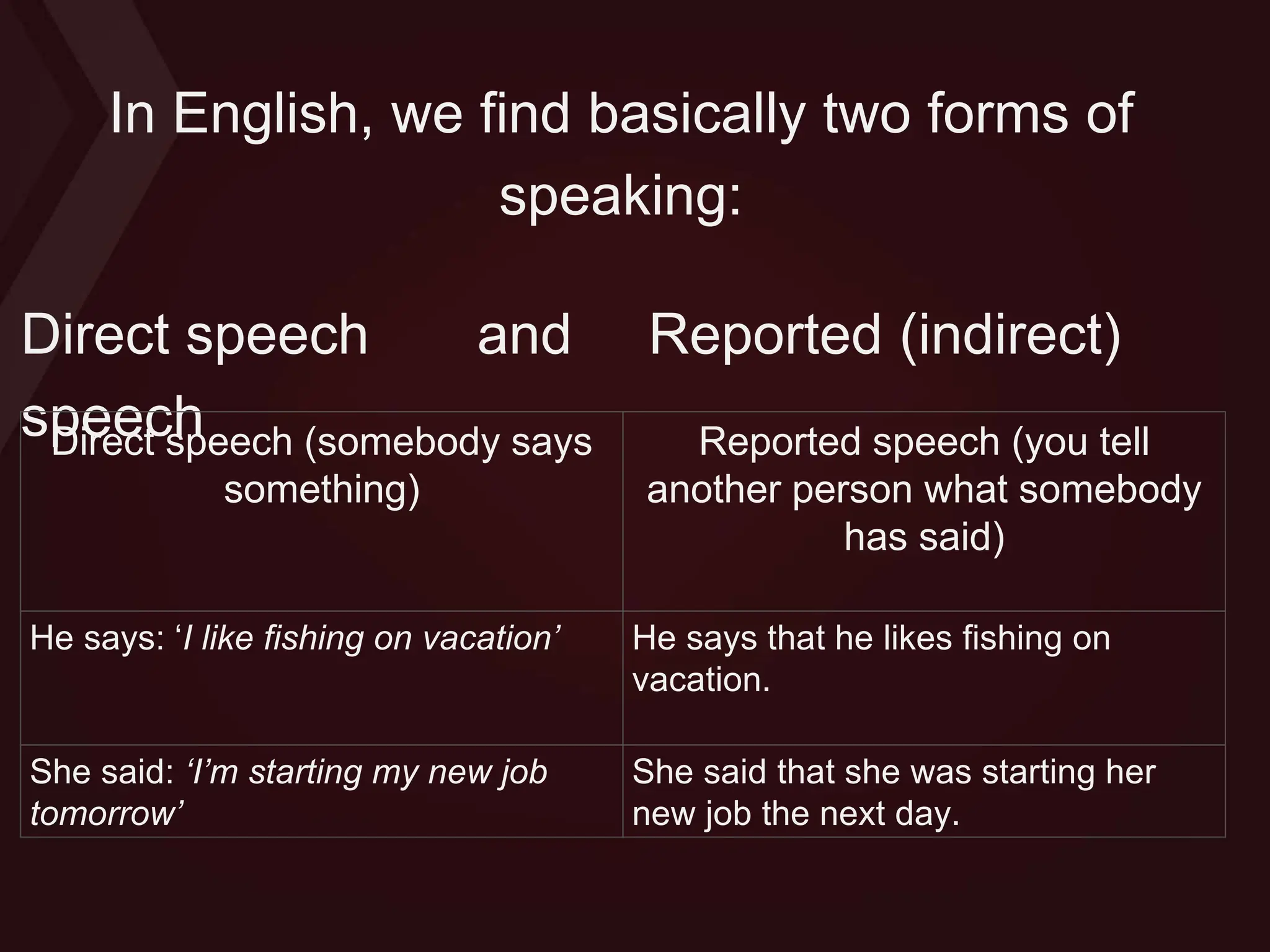
In English, we find basically two forms of
speaking:
Direct speech and Reported (indirect)
speech
Direct speech (somebody says
something)
Reported speech (you tell
another person what somebody
has said)
He says: ‘I like fishing on vacation’ He says that he likes fishing on
vacation.
She said: ‘I’m starting my new job
tomorrow’
She said that she was starting her
new job the next day.
• In this presentation, we will learn how to
report:
A. Statements
B. Questions
A. Reporting statements
In this case, sometimes we have to
change:
1. pronouns
2. tense
3. place, demonstrative and time
expressions.
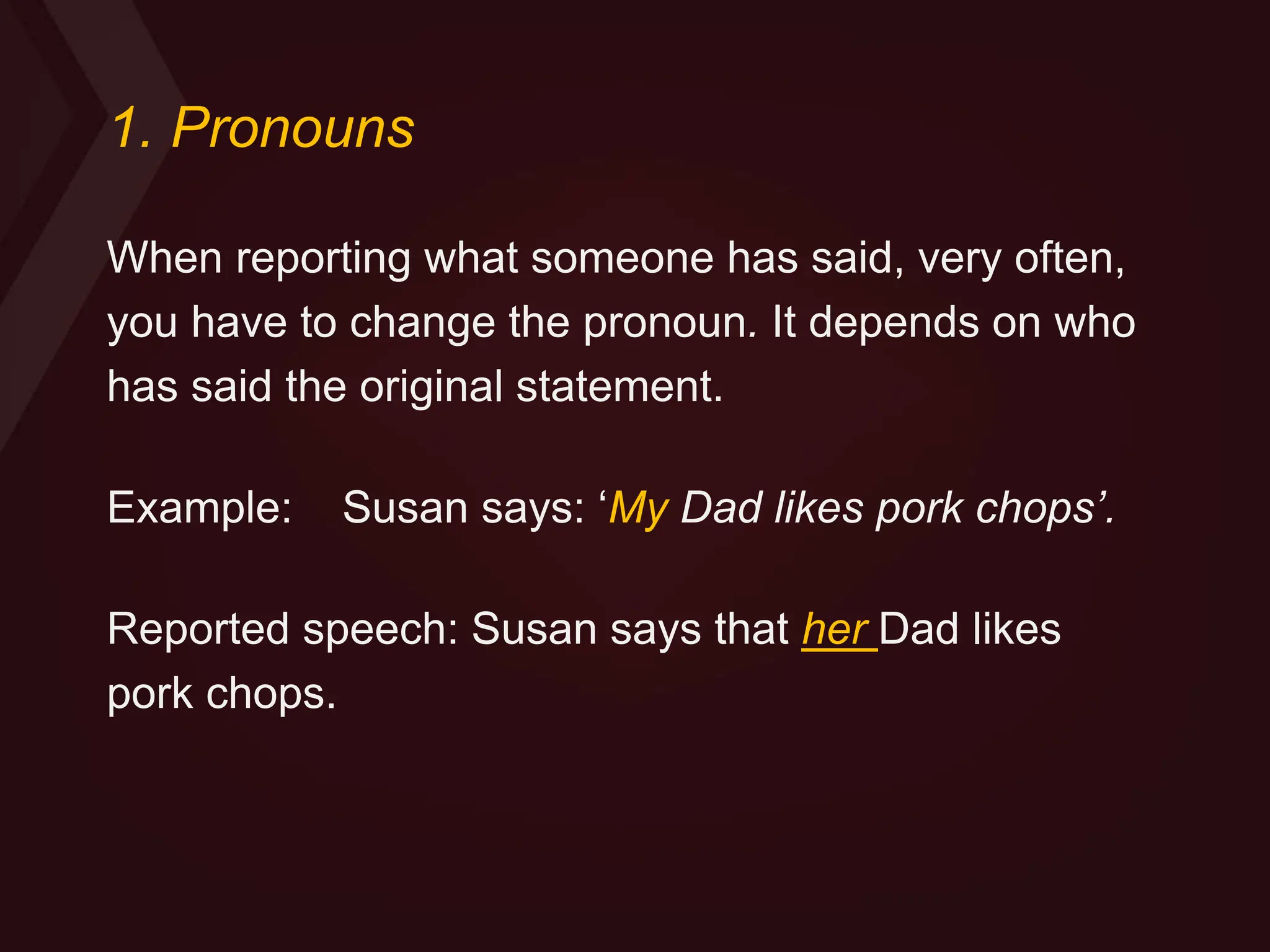
1. Pronouns
When reporting what someone has said, very often,
you have to change the pronoun. It depends on who
has said the original statement.
Example: Susan says: ‘My Dad likes pork chops’.
Reported speech: Susan says that her Dad likes
pork chops.
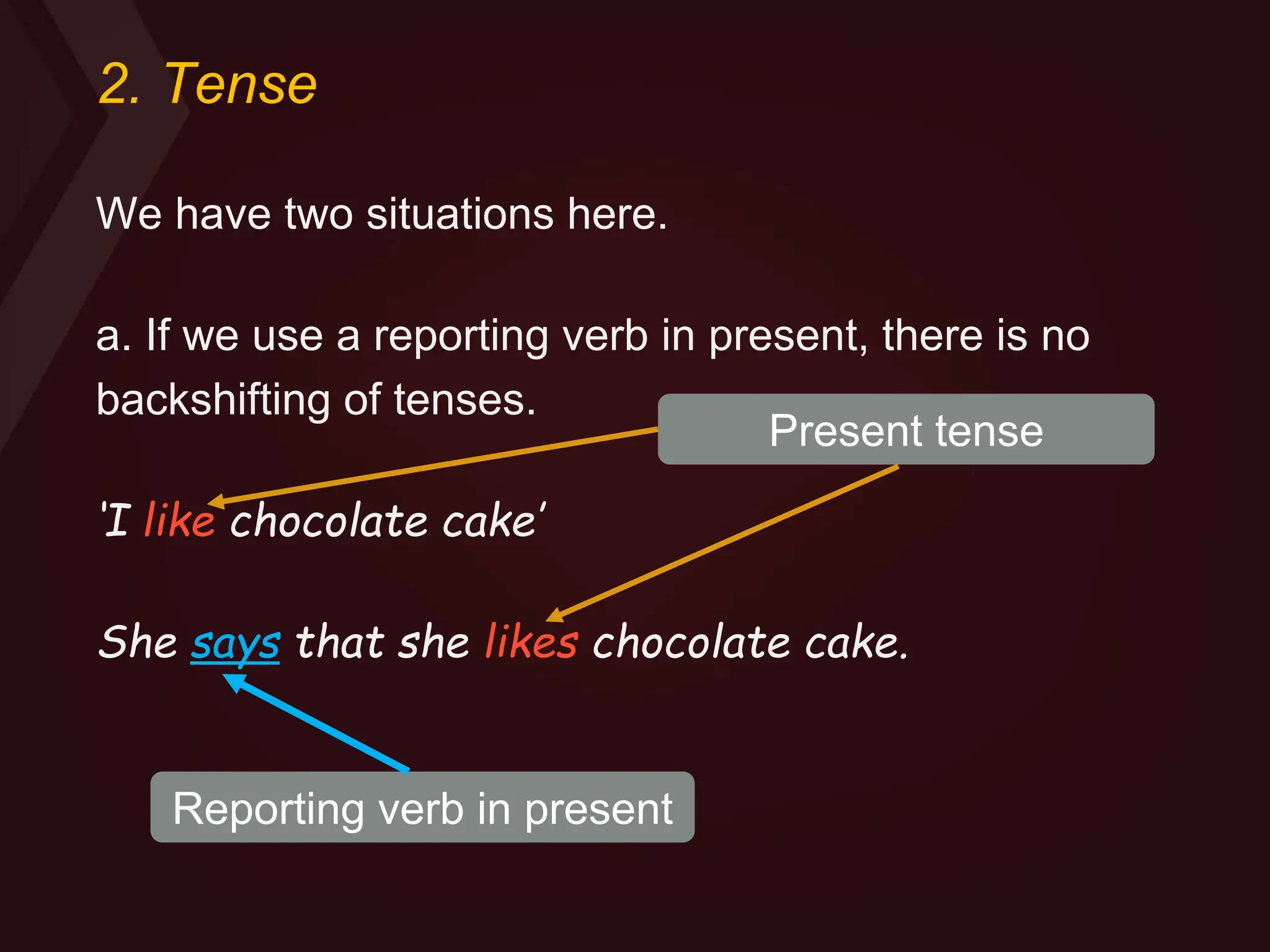
2. Tense
We have two situations here.
a. If we use a reporting verb in present, there is no
backshifting of tenses.
‘I like chocolate cake’
She says that she likes chocolate cake.
Present tense
Reporting verb in present
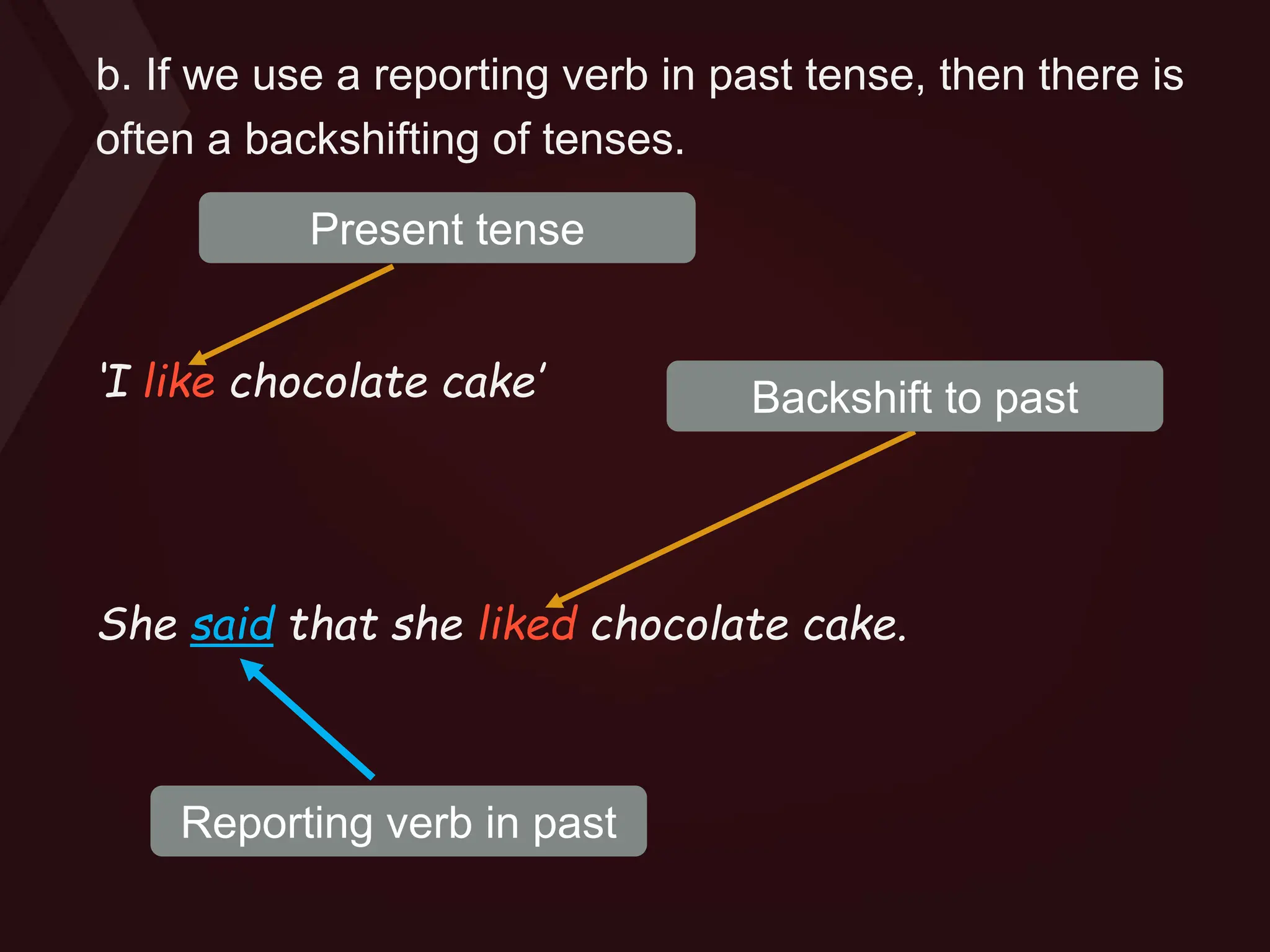
b. If we use a reporting verb in past tense, then there is
often a backshifting of tenses.
‘I like chocolate cake’
She said that she liked chocolate cake.
Present tense
Reporting verb in past
Backshift to past
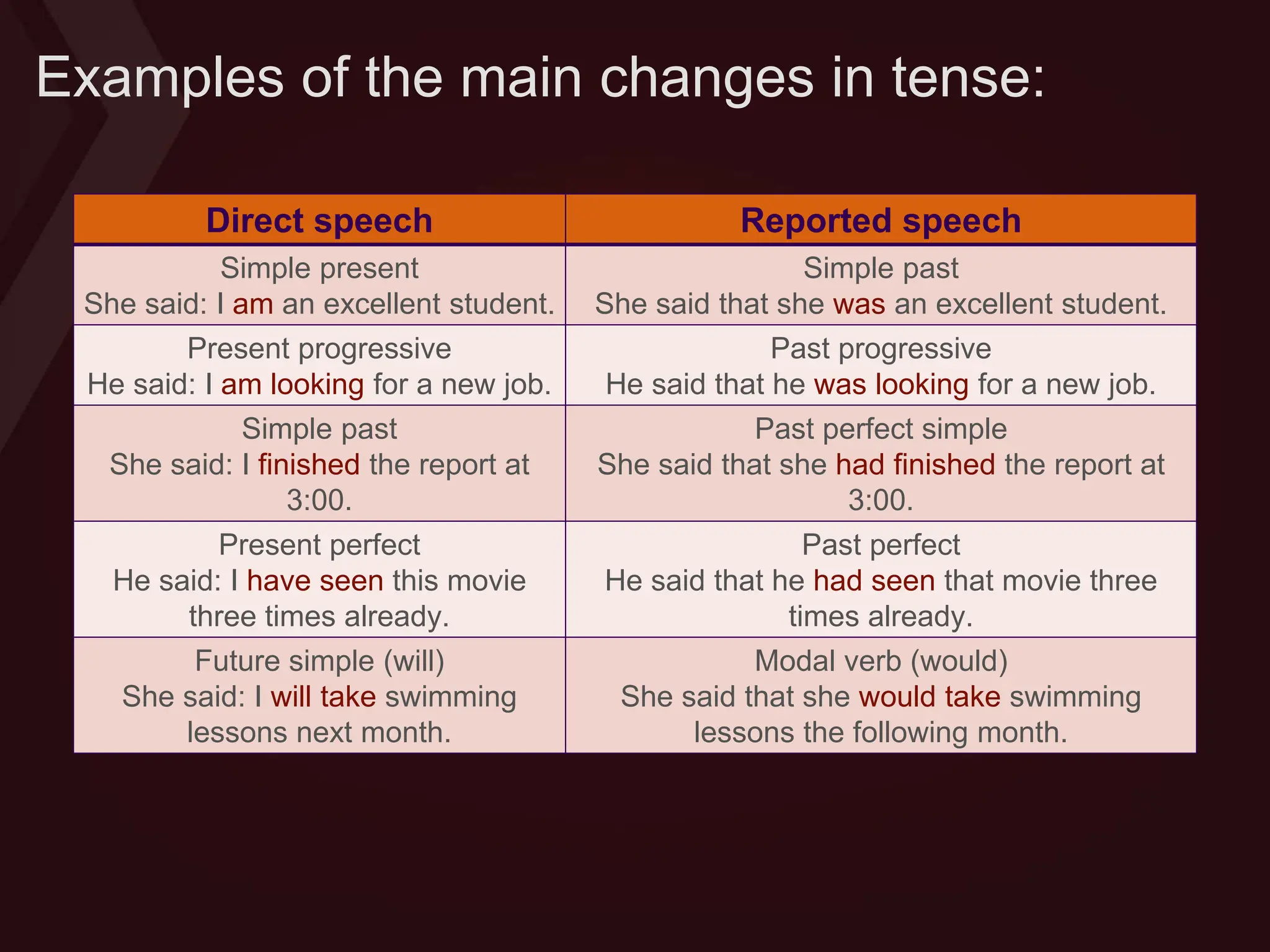
Examples of the main changes in tense:
Direct speech Reported speech
Simple present
She said: I am an excellent student.
Simple past
She said that she was an excellent student.
Present progressive
He said: I am looking for a new job.
Past progressive
He said that he was looking for a new job.
Simple past
She said: I finished the report at
3:00.
Past perfect simple
She said that she had finished the report at
3:00.
Present perfect
He said: I have seen this movie
three times already.
Past perfect
He said that he had seen that movie three
times already.
Future simple (will)
She said: I will take swimming
lessons next month.
Modal verb (would)
She said that she would take swimming
lessons the following month.
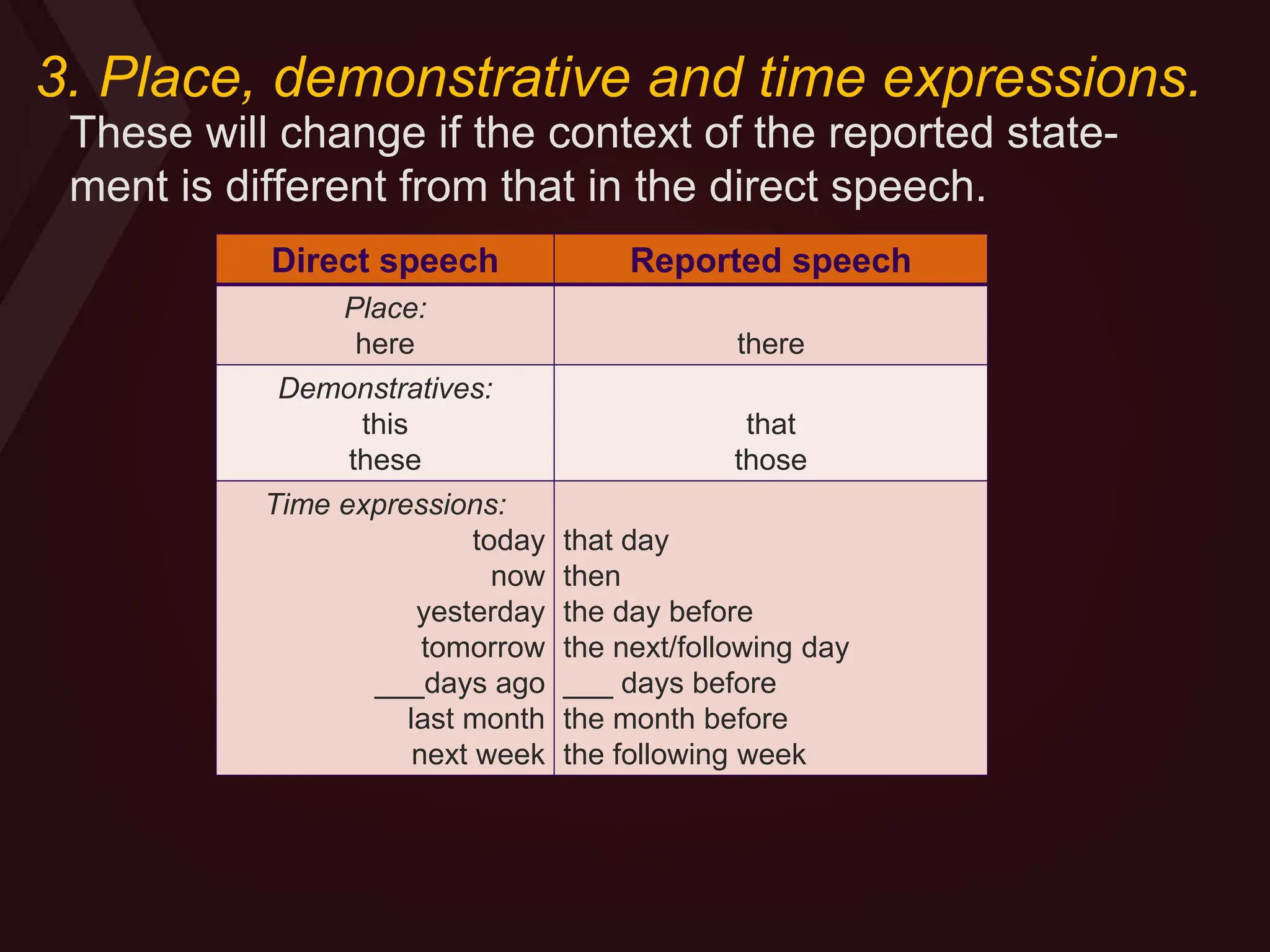
3. Place, demonstrative and time expressions.
Direct speech Reported speech
Place:
here there
Demonstratives:
this
these
that
those
Time expressions:
today
now
yesterday
tomorrow
___days ago
last month
next week
that day
then
the day before
the next/following day
___ days before
the month before
the following week
These will change if the context of the reported state-
ment is different from that in the direct speech.
B. Questions
In this case, sometimes we have to
change
1. pronouns
2. tense
3. place, demonstrative and time
expressions.
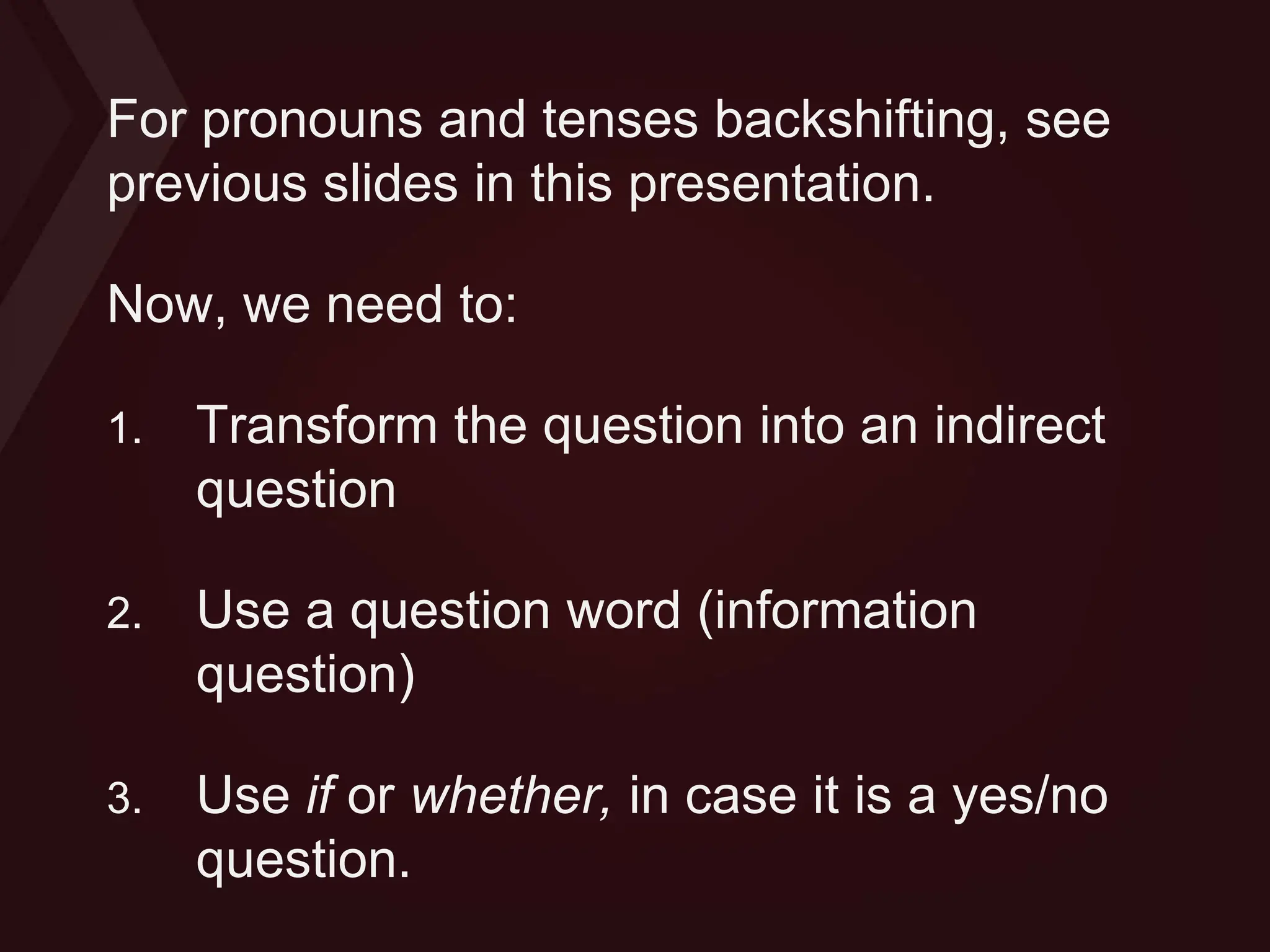
For pronouns and tenses backshifting, see
previous slides in this presentation.
Now, we need to:
1. Transform the question into an indirect
question
2. Use a question word (information
question)
3. Use if or whether, in case it is a yes/no
question.
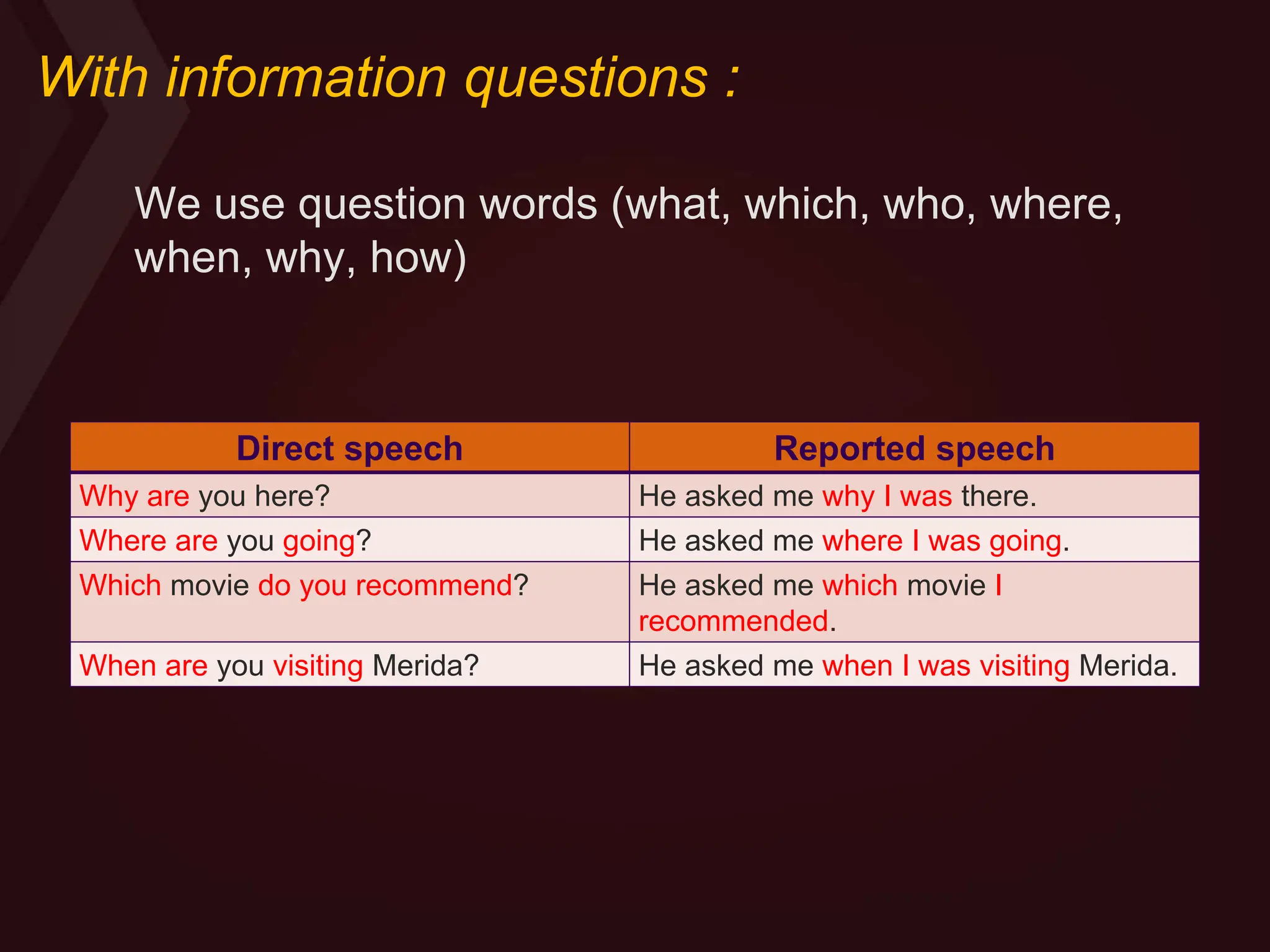
With information questions :
Direct speech Reported speech
Why are you here? He asked me why I was there.
Where are you going? He asked me where I was going.
Which movie do you recommend? He asked me which movie I
recommended.
When are you visiting Merida? He asked me when I was visiting Merida.
We use question words (what, which, who, where,
when, why, how)
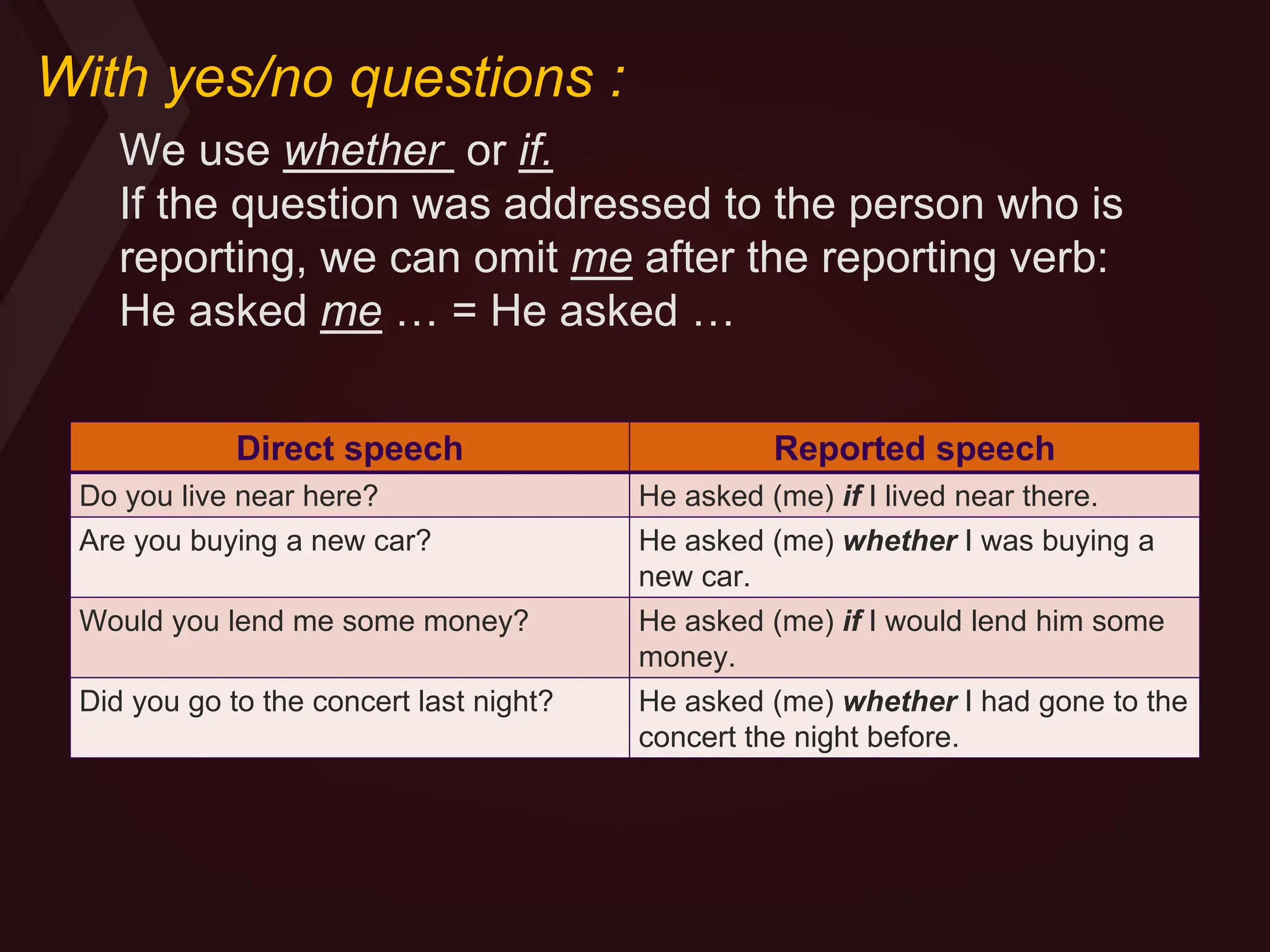
With yes/no questions :
Direct speech Reported speech
Do you live near here? He asked (me) if I lived near there.
Are you buying a new car? He asked (me) whether I was buying a
new car.
Would you lend me some money? He asked (me) if I would lend him some
money.
Did you go to the concert last night? He asked (me) whether I had gone to the
concert the night before.
We use whether or if.
If the question was addressed to the person who is
reporting, we can omit me after the reporting verb:
He asked me … = He asked …
• Referencias
Brook-Hart, G. , (2012) Complete CAE Student’s Book, UK: Cambridge
University Press.
Maxwell, K. (2017). Reported speech 1 – article. [online]
Onestopenglish. Available at:
http://www.onestopenglish.com/grammar/grammar-reference/verbs-and-
tenses/reported-speech-1-article/152841.article [Accessed 29 Aug.
2017].
Schrampfer, B., (2003), Fundamentals of English Grammar, Third
edition, USA: Longman-Pearson Education.

Reported_speech - Grammar presentation.pdf

  • 1.
    REPORTED SPEECH MGIEV LauraEthel Pérez Ramírez Julio – Diciembre 2017 UNIVERSIDAD AUTÓNOMA DEL ESTADO DE HIDALGO ESCUELA SUPERIOR DE HUEJUTLA LICENCIATURA EN ENFERMERÍA
  • 2.
    Reported speech Abstract This workintends to present, in a simple way, basic information on how to use Reported speech in English. Also, the difference between reported speech and direct speech will be spotted. This presentation has been designed to be used as additional material for the 6th level of English of Nursing Educational Program at Escuela Superior de Huejutla, under the guidance of the Institutional Program of Foreign Language (Programa Institucional de Lengua Extranjera - PILE) of the Universidad Autónoma del Estado de Hidalgo. Key words: reported speech, backshifting of tenses, reporting state- ments, reporting questions.
  • 3.
    WHAT IS REPORTEDSPEECH? • Reported speech is when you tell another person what you or somebody else have said before. • So, we can report in all of the different tenses we use to speak. E.g. present simple, past simple, future, etc.
  • 4.
    In English, wefind basically two forms of speaking: Direct speech and Reported (indirect) speech Direct speech (somebody says something) Reported speech (you tell another person what somebody has said) He says: ‘I like fishing on vacation’ He says that he likes fishing on vacation. She said: ‘I’m starting my new job tomorrow’ She said that she was starting her new job the next day.
  • 5.
    • In thispresentation, we will learn how to report: A. Statements B. Questions
  • 6.
    A. Reporting statements Inthis case, sometimes we have to change: 1. pronouns 2. tense 3. place, demonstrative and time expressions.
  • 7.
    1. Pronouns When reportingwhat someone has said, very often, you have to change the pronoun. It depends on who has said the original statement. Example: Susan says: ‘My Dad likes pork chops’. Reported speech: Susan says that her Dad likes pork chops.
  • 8.
    2. Tense We havetwo situations here. a. If we use a reporting verb in present, there is no backshifting of tenses. ‘I like chocolate cake’ She says that she likes chocolate cake. Present tense Reporting verb in present
  • 9.
    b. If weuse a reporting verb in past tense, then there is often a backshifting of tenses. ‘I like chocolate cake’ She said that she liked chocolate cake. Present tense Reporting verb in past Backshift to past
  • 10.
    Examples of themain changes in tense: Direct speech Reported speech Simple present She said: I am an excellent student. Simple past She said that she was an excellent student. Present progressive He said: I am looking for a new job. Past progressive He said that he was looking for a new job. Simple past She said: I finished the report at 3:00. Past perfect simple She said that she had finished the report at 3:00. Present perfect He said: I have seen this movie three times already. Past perfect He said that he had seen that movie three times already. Future simple (will) She said: I will take swimming lessons next month. Modal verb (would) She said that she would take swimming lessons the following month.
  • 11.
    3. Place, demonstrativeand time expressions. Direct speech Reported speech Place: here there Demonstratives: this these that those Time expressions: today now yesterday tomorrow ___days ago last month next week that day then the day before the next/following day ___ days before the month before the following week These will change if the context of the reported state- ment is different from that in the direct speech.
  • 12.
    B. Questions In thiscase, sometimes we have to change 1. pronouns 2. tense 3. place, demonstrative and time expressions.
  • 13.
    For pronouns andtenses backshifting, see previous slides in this presentation. Now, we need to: 1. Transform the question into an indirect question 2. Use a question word (information question) 3. Use if or whether, in case it is a yes/no question.
  • 14.
    With information questions: Direct speech Reported speech Why are you here? He asked me why I was there. Where are you going? He asked me where I was going. Which movie do you recommend? He asked me which movie I recommended. When are you visiting Merida? He asked me when I was visiting Merida. We use question words (what, which, who, where, when, why, how)
  • 15.
    With yes/no questions: Direct speech Reported speech Do you live near here? He asked (me) if I lived near there. Are you buying a new car? He asked (me) whether I was buying a new car. Would you lend me some money? He asked (me) if I would lend him some money. Did you go to the concert last night? He asked (me) whether I had gone to the concert the night before. We use whether or if. If the question was addressed to the person who is reporting, we can omit me after the reporting verb: He asked me … = He asked …
  • 16.
    • Referencias Brook-Hart, G., (2012) Complete CAE Student’s Book, UK: Cambridge University Press. Maxwell, K. (2017). Reported speech 1 – article. [online] Onestopenglish. Available at: http://www.onestopenglish.com/grammar/grammar-reference/verbs-and- tenses/reported-speech-1-article/152841.article [Accessed 29 Aug. 2017]. Schrampfer, B., (2003), Fundamentals of English Grammar, Third edition, USA: Longman-Pearson Education.