Personal Development

(This picture: Trinity College, Cambridge)

Contact Email

Design Copyright 1994-2014 © OxfordCambridge.Org
Personal Development

(This picture: Trinity College, Cambridge)

Contact Email

Design Copyright 1994-2014 © OxfordCambridge.Org
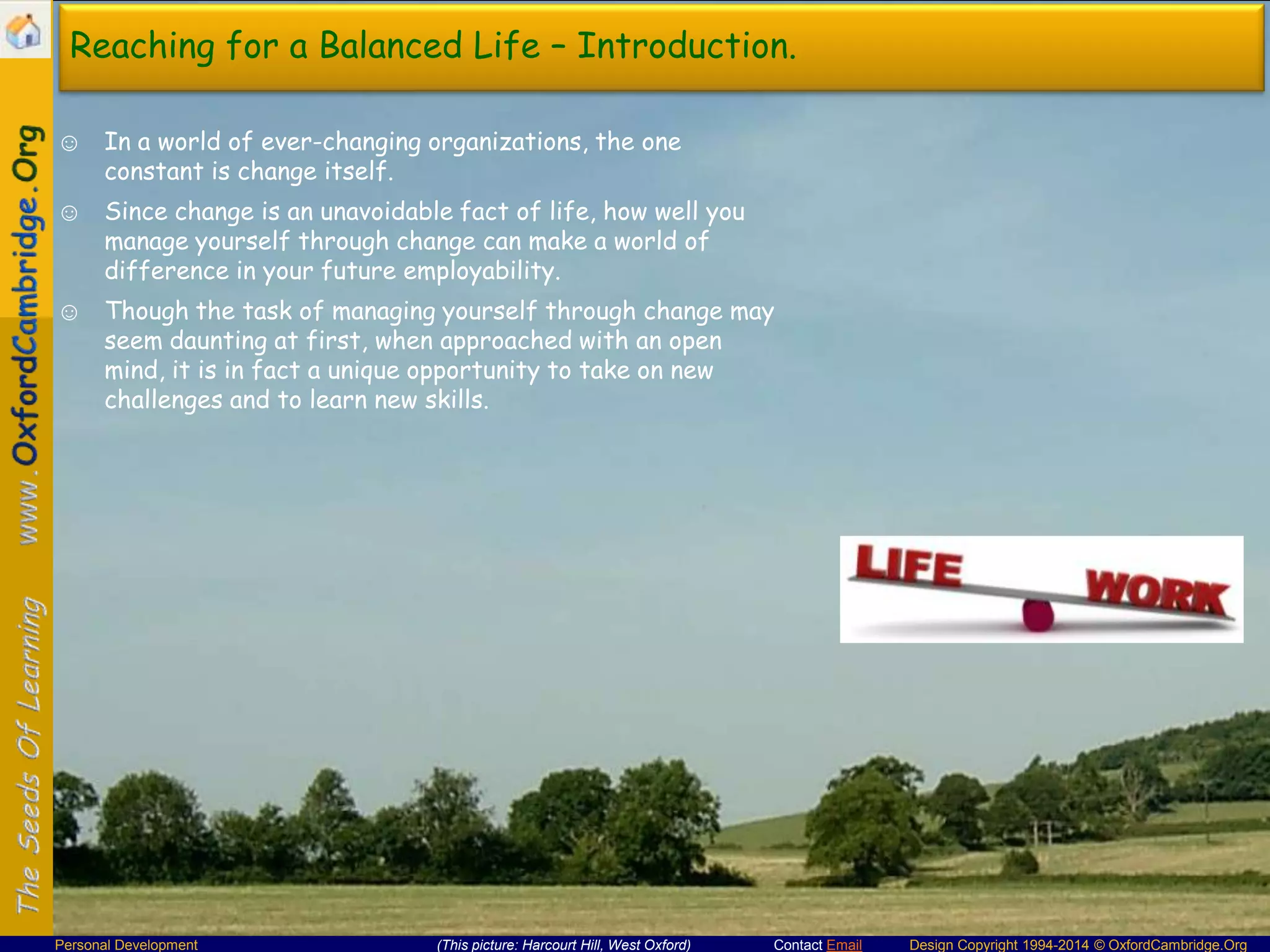
Reaching for a Balanced Life – Introduction.
☺ In a world of ever-changing organizations, the one
constant is change itself.
☺ Since change is an unavoidable fact of life, how well you
manage yourself through change can make a world of
difference in your future employability.
☺ Though the task of managing yourself through change may
seem daunting at first, when approached with an open
mind, it is in fact a unique opportunity to take on new
challenges and to learn new skills.

Personal Development

(This picture: Harcourt Hill, West Oxford)

Contact Email

Design Copyright 1994-2014 © OxfordCambridge.Org
Reaching for a Balanced Life
Introductory concepts @ OxfordCambridge.Org all for free and free for all.
The information gathered here is under KeyPoints format and may be use:
- Either to give the reader an overview before deciding for a full scale study of the topic.
- Or act as a study guide for learners in expanding their knowledge on that given topic.

Some recommendations, perhaps:
- Identify each KeyPoint on which you feel a need to expand your knowledge,
- Choose a good book or academic magazine and info from the Internet.
- And then work towards gaining that knowledge, at your own pace.
Please enjoy!

Personal Development

(This picture: Trinity College, Cambridge)

Contact Email

Design Copyright 1994-2014 © OxfordCambridge.Org
Reaching for a Balanced Life - Aim of publication.
To arouse interest in readers and learners who
wants to evaluate a possibility of balanced life
in order to increase satisfaction, energy, and
productivity in and out of the workplace.

Personal Development

(This picture: Trinity College, Cambridge)

Contact Email

Design Copyright 1994-2014 © OxfordCambridge.Org
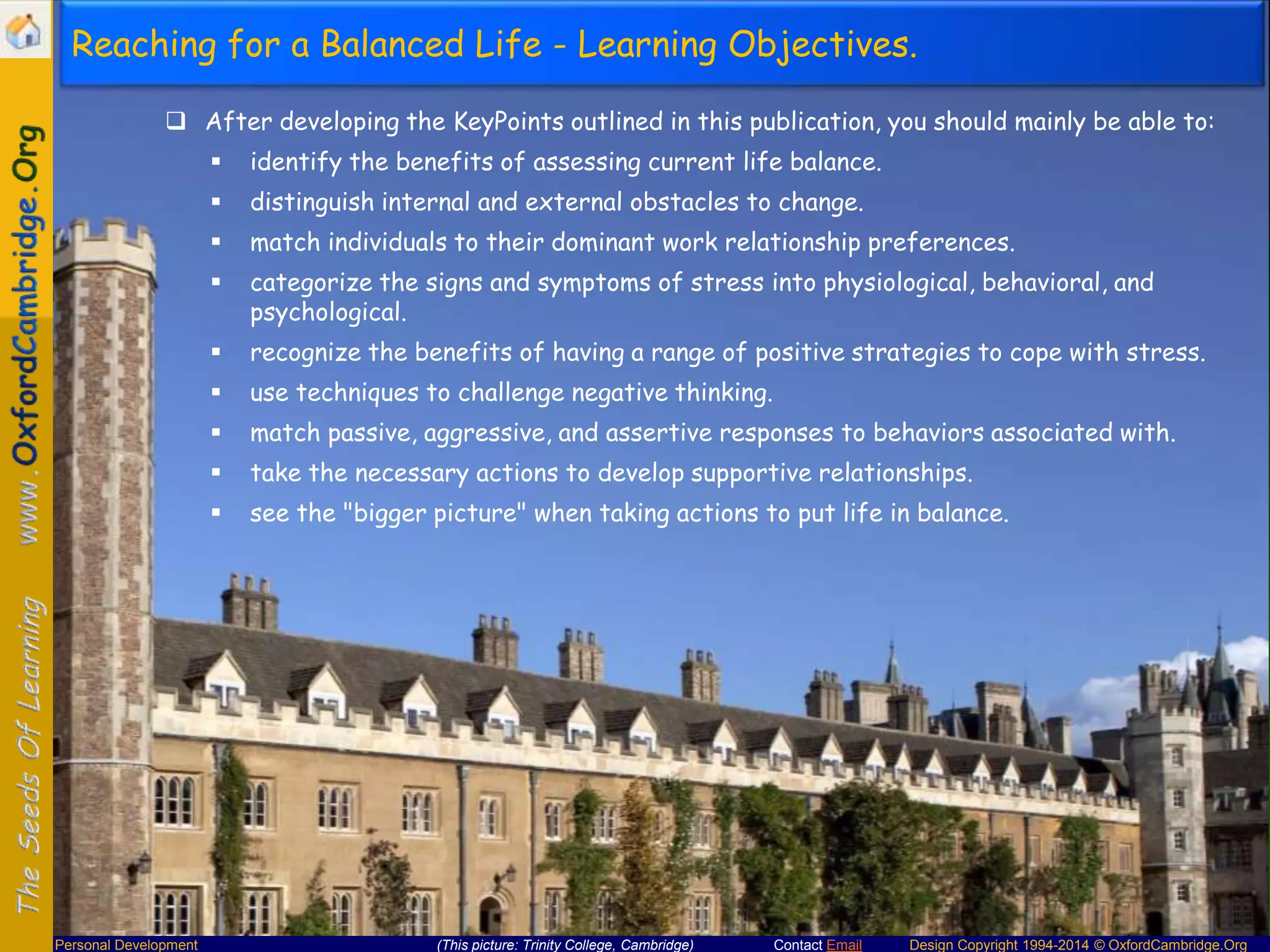
Reaching for a Balanced Life - Learning Objectives.
 After developing the KeyPoints outlined in this publication, you should mainly be able to:



distinguish internal and external obstacles to change.



match individuals to their dominant work relationship preferences.



categorize the signs and symptoms of stress into physiological, behavioral, and
psychological.



recognize the benefits of having a range of positive strategies to cope with stress.



use techniques to challenge negative thinking.



match passive, aggressive, and assertive responses to behaviors associated with.



take the necessary actions to develop supportive relationships.



Personal Development

identify the benefits of assessing current life balance.

see the "bigger picture" when taking actions to put life in balance.

(This picture: Trinity College, Cambridge)

Contact Email

Design Copyright 1994-2014 © OxfordCambridge.Org
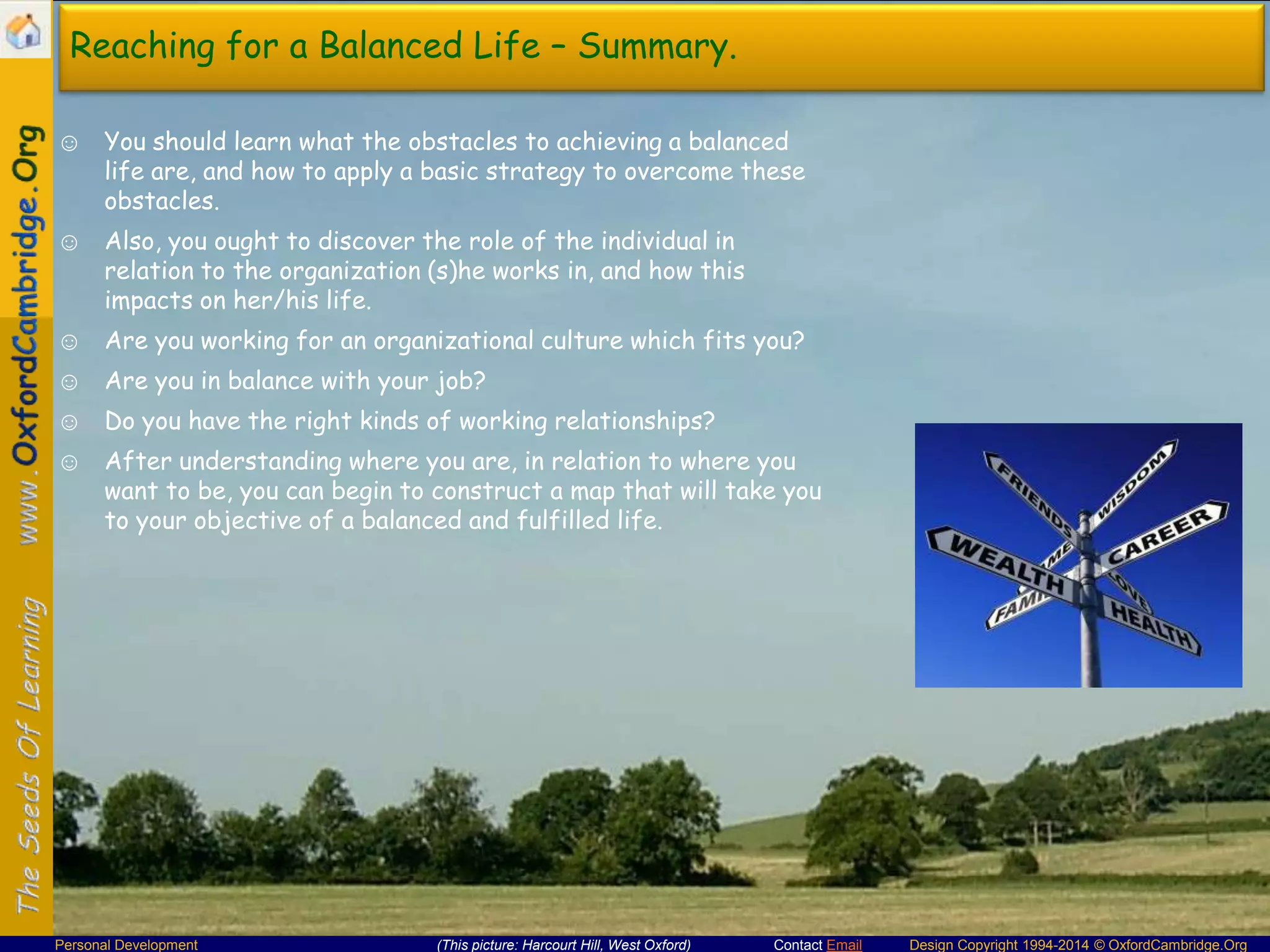
Reaching for a Balanced Life – Summary.
☺ You should learn what the obstacles to achieving a balanced
life are, and how to apply a basic strategy to overcome these
obstacles.

☺ Also, you ought to discover the role of the individual in
relation to the organization (s)he works in, and how this
impacts on her/his life.
☺ Are you working for an organizational culture which fits you?
☺ Are you in balance with your job?
☺ Do you have the right kinds of working relationships?

☺ After understanding where you are, in relation to where you
want to be, you can begin to construct a map that will take you
to your objective of a balanced and fulfilled life.

Personal Development

(This picture: Harcourt Hill, West Oxford)

Contact Email

Design Copyright 1994-2014 © OxfordCambridge.Org
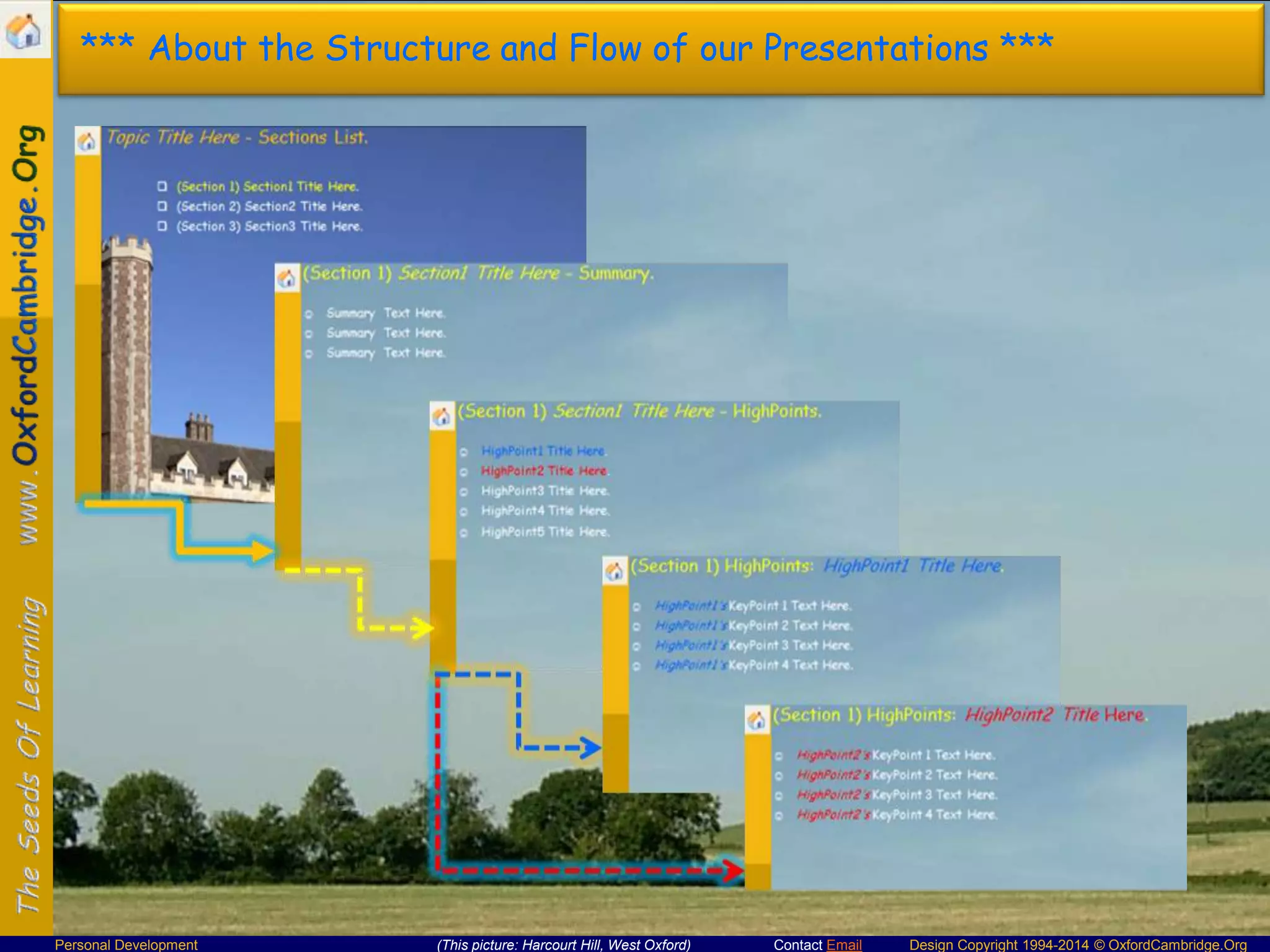
*** About the Structure and Flow of our Presentations ***

Personal Development

(This picture: Harcourt Hill, West Oxford)

Contact Email

Design Copyright 1994-2014 © OxfordCambridge.Org
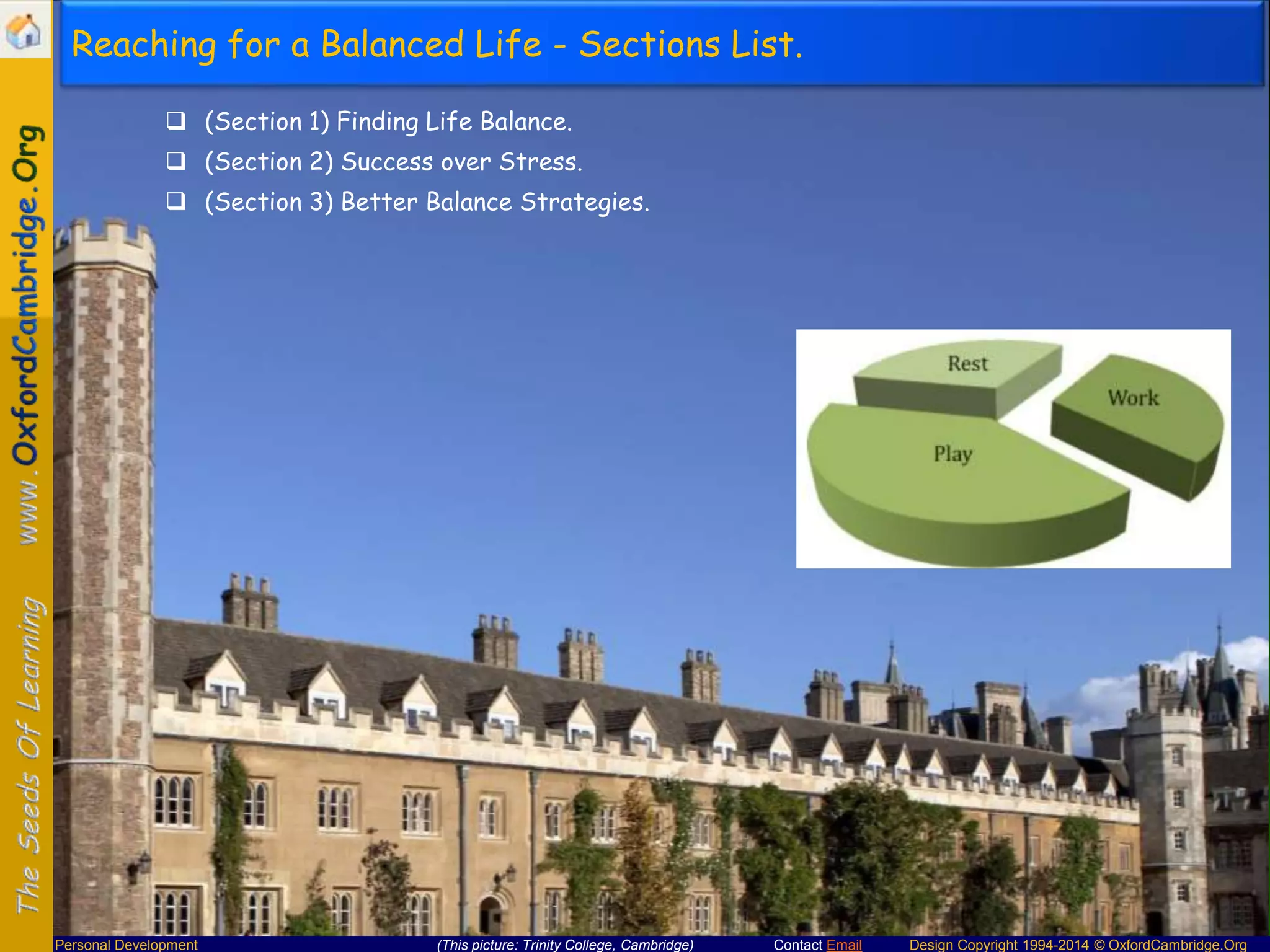
Reaching for a Balanced Life - Sections List.
 (Section 1) Finding Life Balance.
 (Section 2) Success over Stress.
 (Section 3) Better Balance Strategies.

Personal Development

(This picture: Trinity College, Cambridge)

Contact Email

Design Copyright 1994-2014 © OxfordCambridge.Org
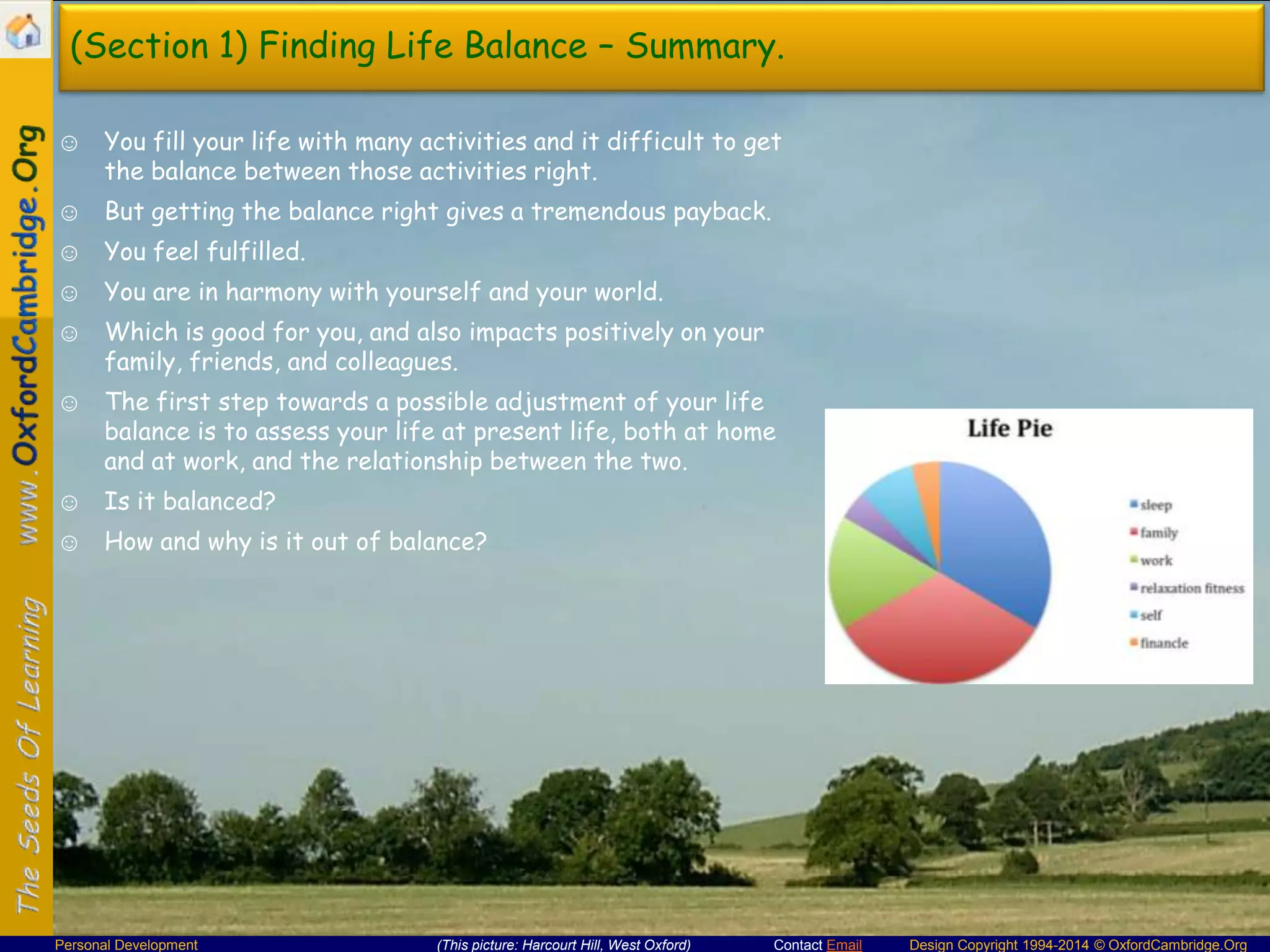
(Section 1) Finding Life Balance – Summary.
☺ You fill your life with many activities and it difficult to get
the balance between those activities right.
☺ But getting the balance right gives a tremendous payback.

☺ You feel fulfilled.
☺ You are in harmony with yourself and your world.
☺ Which is good for you, and also impacts positively on your
family, friends, and colleagues.
☺ The first step towards a possible adjustment of your life
balance is to assess your life at present life, both at home
and at work, and the relationship between the two.
☺ Is it balanced?
☺ How and why is it out of balance?

Personal Development

(This picture: Harcourt Hill, West Oxford)

Contact Email

Design Copyright 1994-2014 © OxfordCambridge.Org
(Section 1) Finding Life Balance – HighPoints.
 Assessing Current Situation.
 What’s Getting in the Way?
 Individual and Organizational Fit.

Personal Development

(This picture: Trinity College, Cambridge)

Contact Email

Design Copyright 1994-2014 © OxfordCambridge.Org
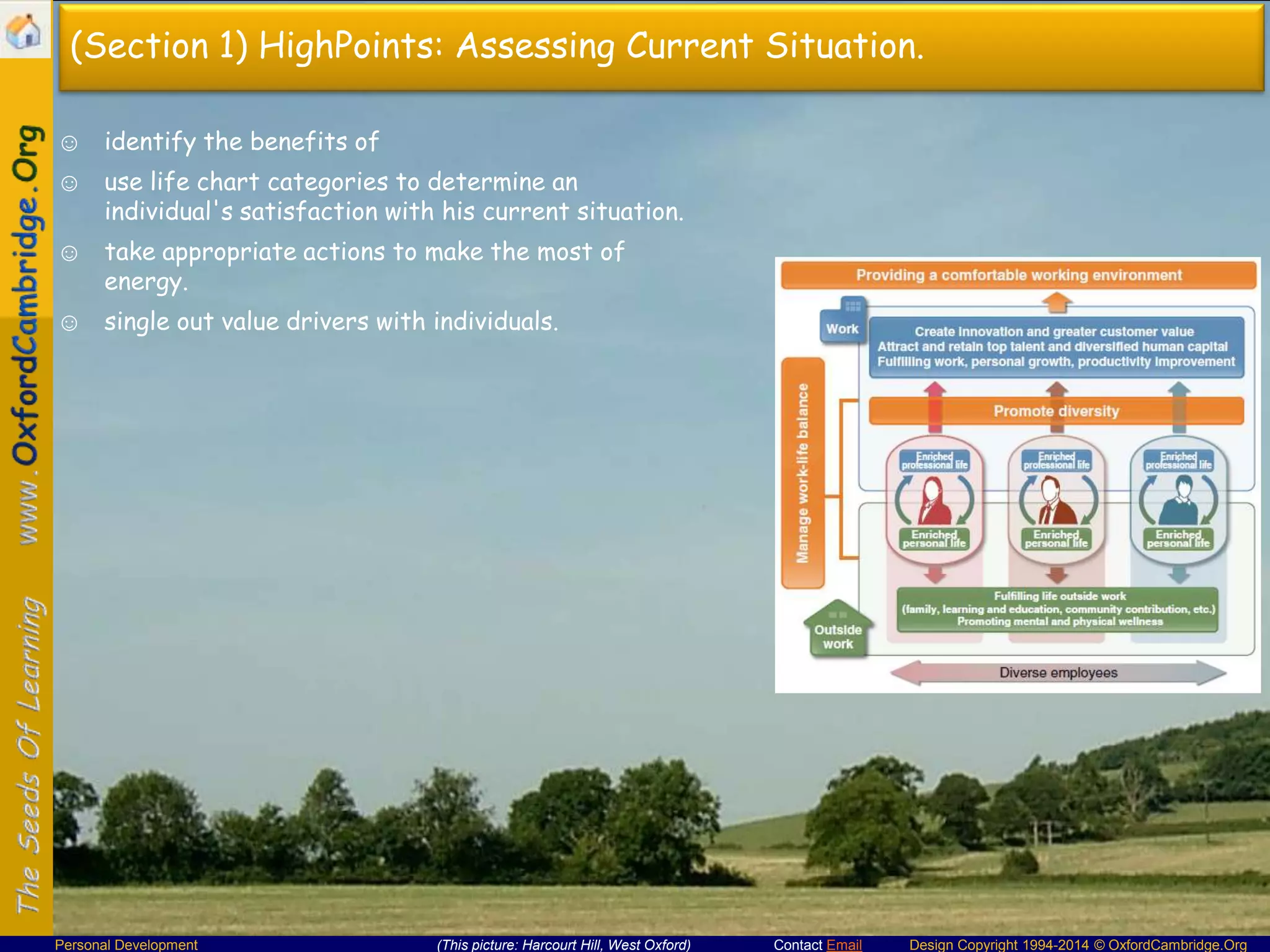
(Section 1) HighPoints: Assessing Current Situation.
☺ identify the benefits of
☺ use life chart categories to determine an
individual's satisfaction with his current situation.

☺ take appropriate actions to make the most of
energy.
☺ single out value drivers with individuals.

Personal Development

(This picture: Harcourt Hill, West Oxford)

Contact Email

Design Copyright 1994-2014 © OxfordCambridge.Org
(Section 1) HighPoints: What’s Getting in the Way?
☺ identify the benefits of learning how to .
☺ make recommendations about how an individual could act to
effectively achieve life balance.

☺ distinguish between internal and external obstacles to change.
☺ apply strategies required to overcome obstacles to changing life
balance, in relation to both internal and external barriers.

Personal Development

(This picture: Harcourt Hill, West Oxford)

Contact Email

Design Copyright 1994-2014 © OxfordCambridge.Org
(Section 1) HighPoints: Individual and Organizational Fit.
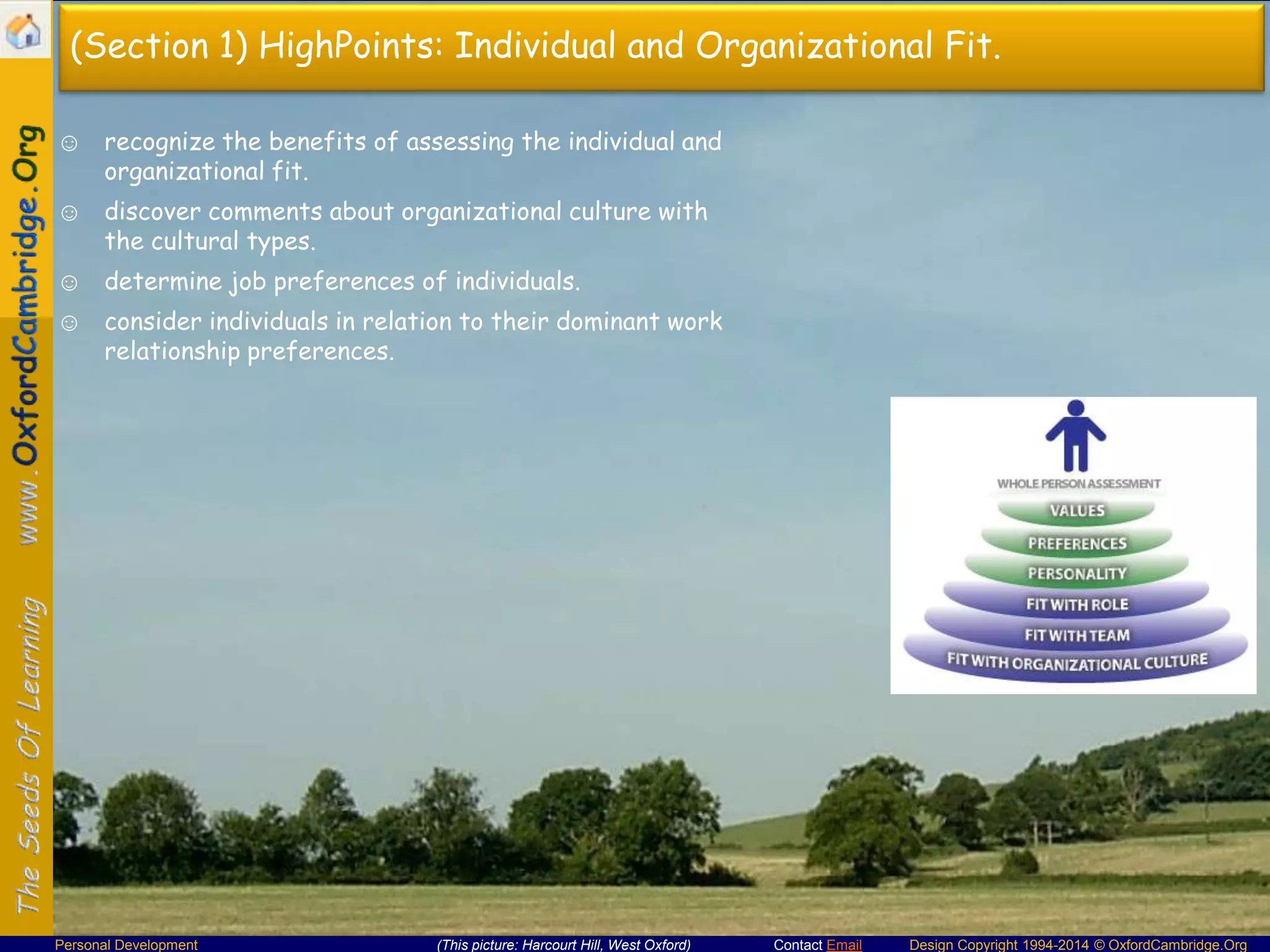
☺ recognize the benefits of assessing the individual and
organizational fit.
☺ discover comments about organizational culture with
the cultural types.
☺ determine job preferences of individuals.
☺ consider individuals in relation to their dominant work
relationship preferences.

Personal Development

(This picture: Harcourt Hill, West Oxford)

Contact Email

Design Copyright 1994-2014 © OxfordCambridge.Org
(Section 2) Success over Stress – Summary.
☺ "Stress is the psychological, physiological and behavioral
response by an individual when they perceive a lack of equilibrium
between the demands placed upon them and their ability to meet
those demands, which, over a period of time, leads to ill-health."
☺ Contrary to popular belief, stress itself is never a good thing.
☺ It is always harmful.
☺ You need discern the difference between pressure, which spurs
you into action and helps you to perform at your peak, and stress,
which impedes your performance, and has long-term health
implications.
☺ Stress is produced by own feelings and reactions to certain
external events, rather than by the events themselves.
☺ This means that once you recognize how you respond to certain
situations, you can change your response to one that is more
helpful and productive.

Personal Development

(This picture: Harcourt Hill, West Oxford)

Contact Email

Design Copyright 1994-2014 © OxfordCambridge.Org
(Section 2) Success over Stress – HighPoints.
 Recognizing Stress.
 Coping with Stress.

Personal Development

(This picture: Trinity College, Cambridge)

Contact Email

Design Copyright 1994-2014 © OxfordCambridge.Org
(Section 2) HighPoints: Recognizing Stress.
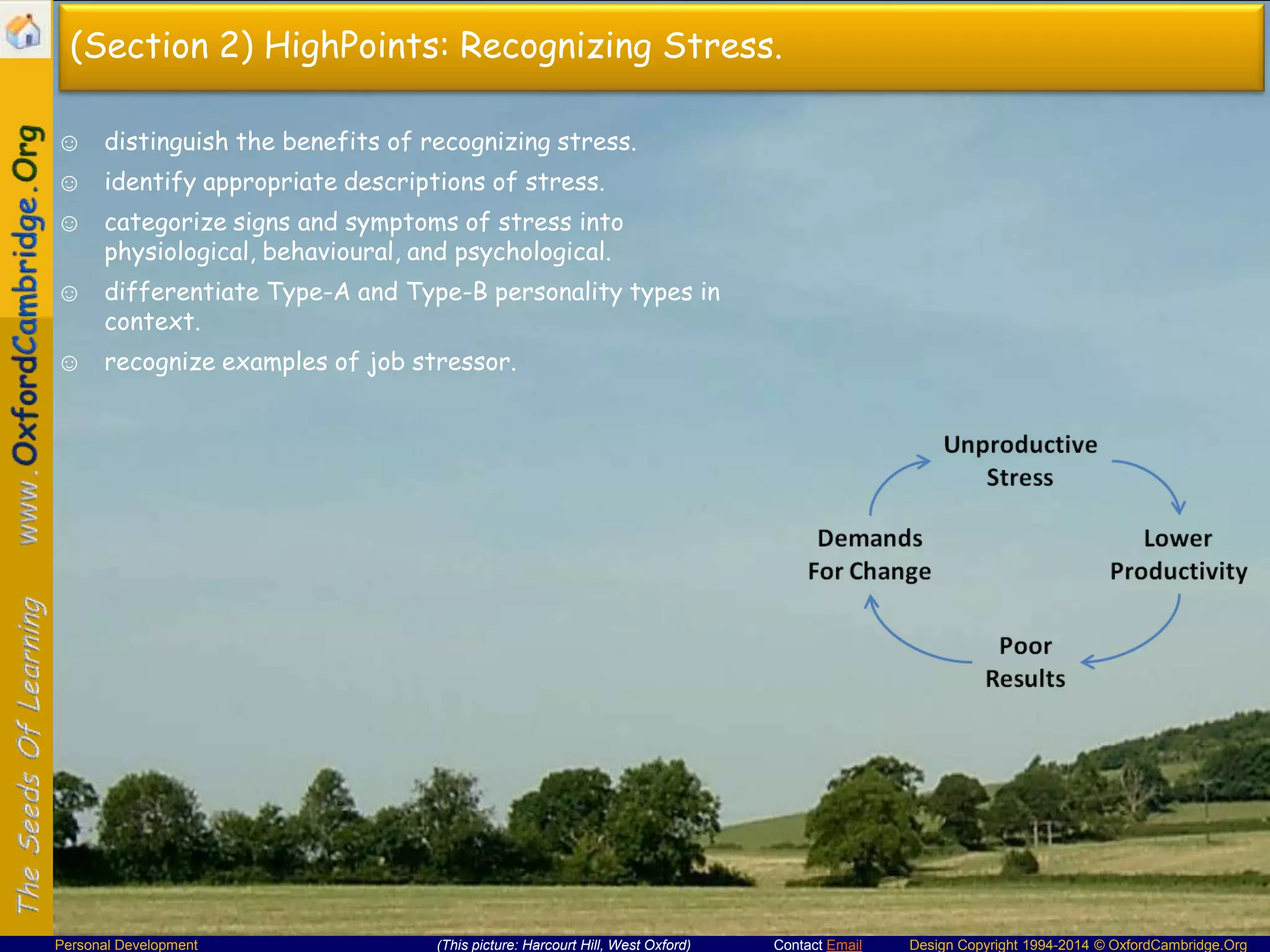
☺ distinguish the benefits of recognizing stress.
☺ identify appropriate descriptions of stress.
☺ categorize signs and symptoms of stress into
physiological, behavioural, and psychological.
☺ differentiate Type-A and Type-B personality types in
context.
☺ recognize examples of job stressor.

Personal Development

(This picture: Harcourt Hill, West Oxford)

Contact Email

Design Copyright 1994-2014 © OxfordCambridge.Org
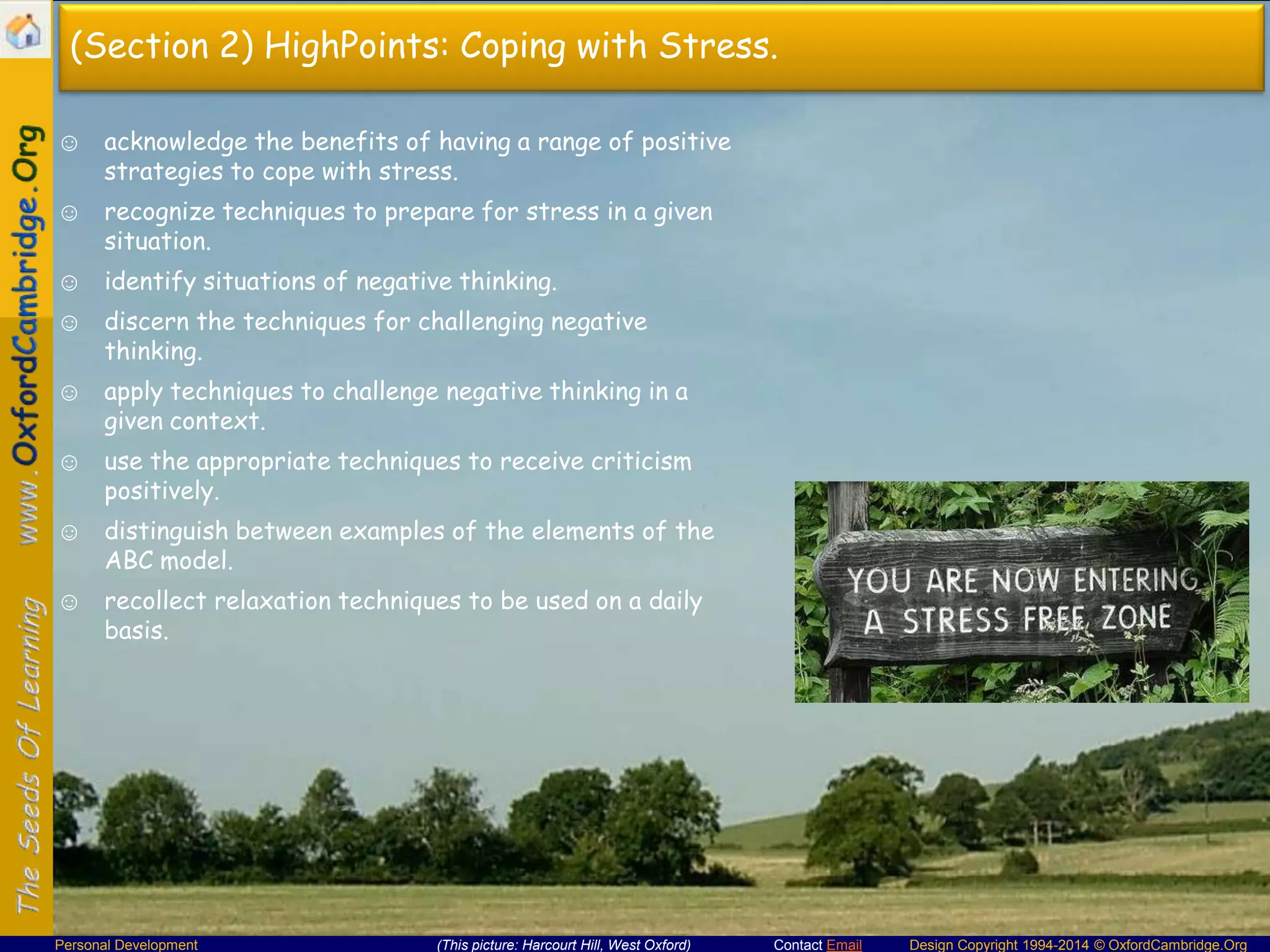
(Section 2) HighPoints: Coping with Stress.
☺ acknowledge the benefits of having a range of positive
strategies to cope with stress.
☺ recognize techniques to prepare for stress in a given
situation.
☺ identify situations of negative thinking.
☺ discern the techniques for challenging negative
thinking.
☺ apply techniques to challenge negative thinking in a
given context.

☺ use the appropriate techniques to receive criticism
positively.
☺ distinguish between examples of the elements of the
ABC model.
☺ recollect relaxation techniques to be used on a daily
basis.

Personal Development

(This picture: Harcourt Hill, West Oxford)

Contact Email

Design Copyright 1994-2014 © OxfordCambridge.Org
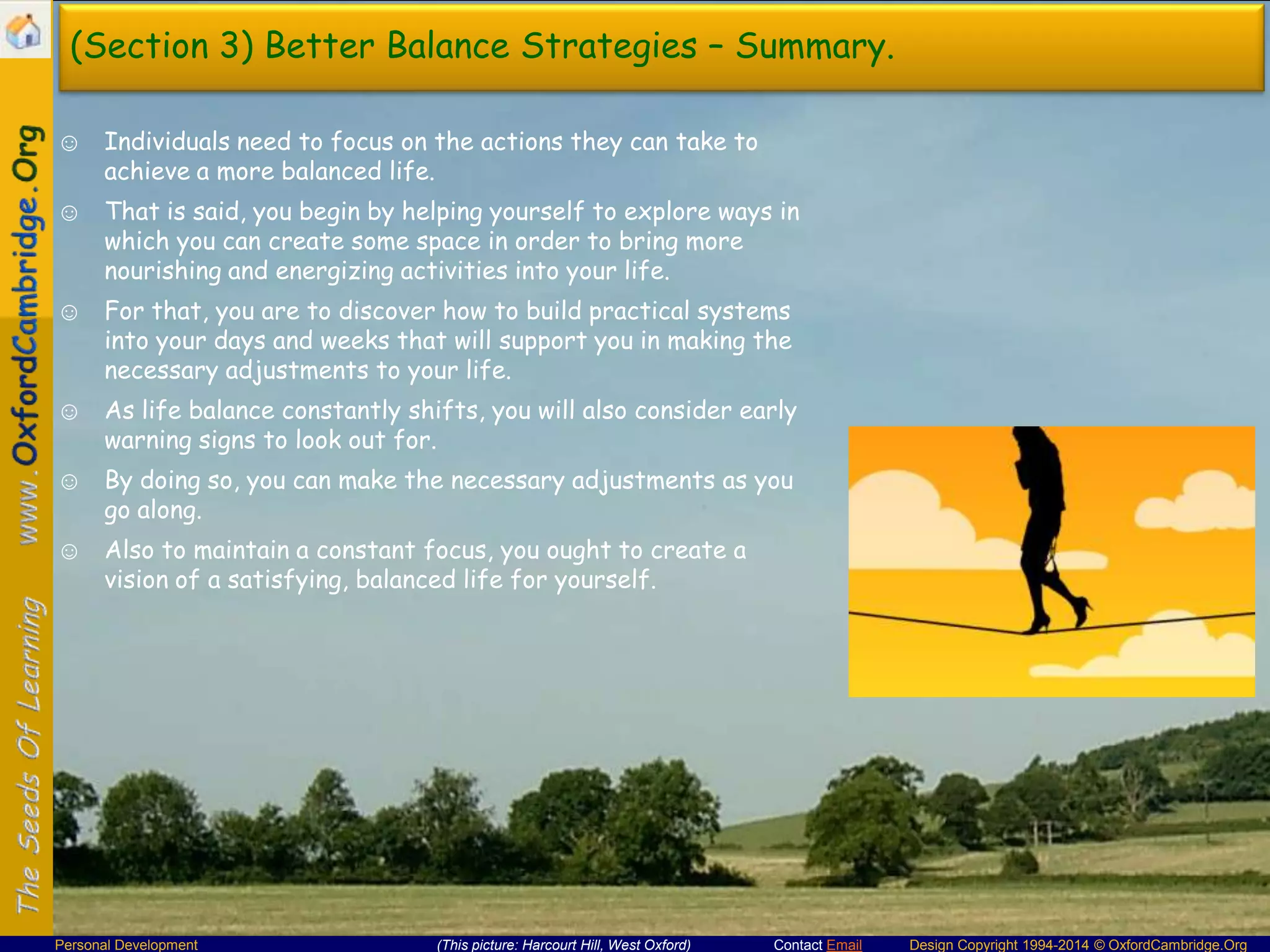
(Section 3) Better Balance Strategies – Summary.
☺ Individuals need to focus on the actions they can take to
achieve a more balanced life.
☺ That is said, you begin by helping yourself to explore ways in
which you can create some space in order to bring more
nourishing and energizing activities into your life.
☺ For that, you are to discover how to build practical systems
into your days and weeks that will support you in making the
necessary adjustments to your life.
☺ As life balance constantly shifts, you will also consider early
warning signs to look out for.
☺ By doing so, you can make the necessary adjustments as you
go along.
☺ Also to maintain a constant focus, you ought to create a
vision of a satisfying, balanced life for yourself.

Personal Development

(This picture: Harcourt Hill, West Oxford)

Contact Email

Design Copyright 1994-2014 © OxfordCambridge.Org
(Section 3) Better Balance Strategies – HighPoints
 Reducing Demands.
 Making Changes.
 Fitting in with the Bigger Picture.

Personal Development

(This picture: Trinity College, Cambridge)

Contact Email

Design Copyright 1994-2014 © OxfordCambridge.Org
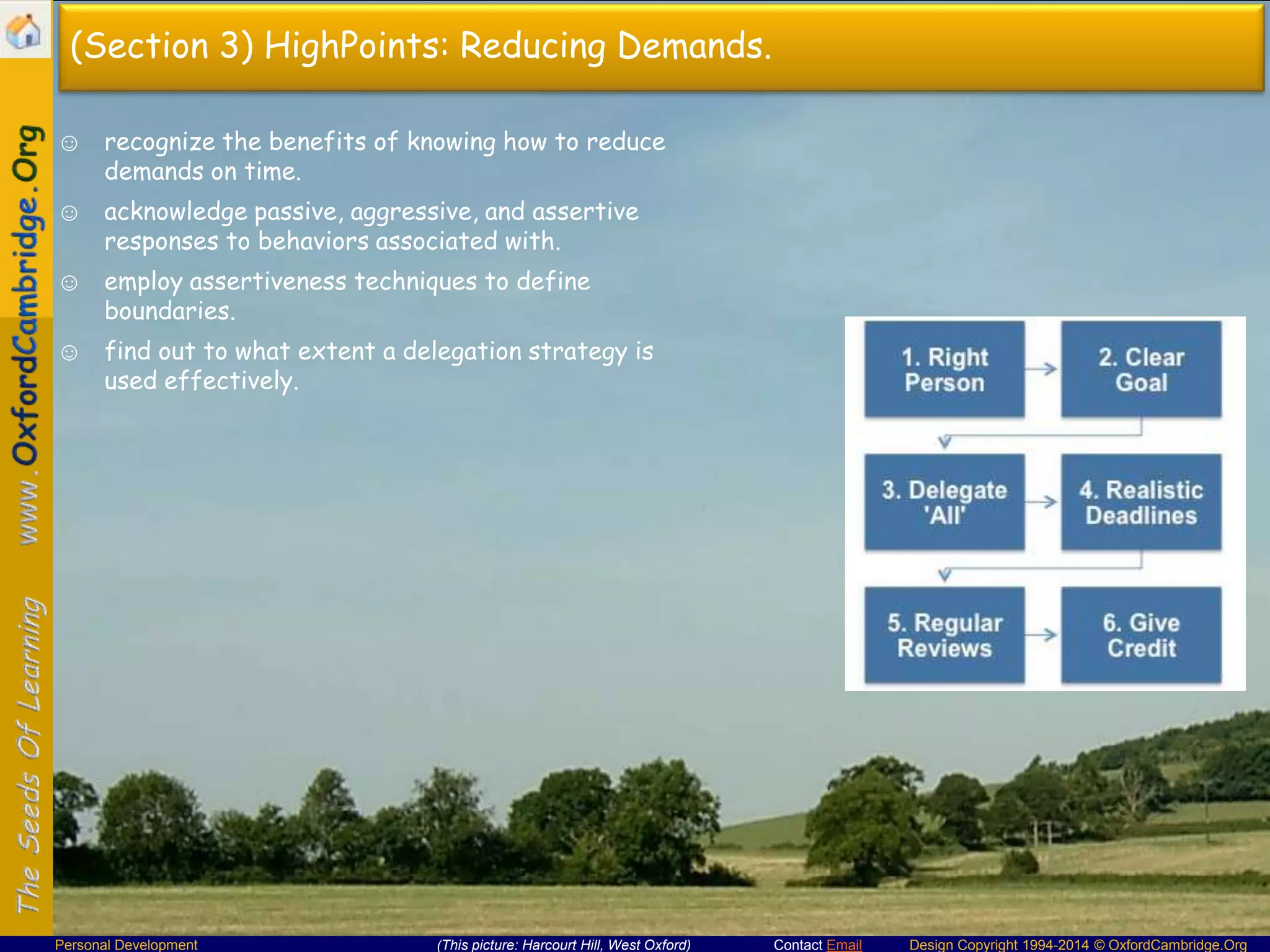
(Section 3) HighPoints: Reducing Demands.
☺ recognize the benefits of knowing how to reduce
demands on time.
☺ acknowledge passive, aggressive, and assertive
responses to behaviors associated with.
☺ employ assertiveness techniques to define
boundaries.
☺ find out to what extent a delegation strategy is
used effectively.

Personal Development

(This picture: Harcourt Hill, West Oxford)

Contact Email

Design Copyright 1994-2014 © OxfordCambridge.Org
(Section 3) HighPoints: Making Changes.
☺ appreciate the benefits of having the right tools and
strategies to make appropriate life balancing changes.
☺ use the strategy required to create and pursue a vision.

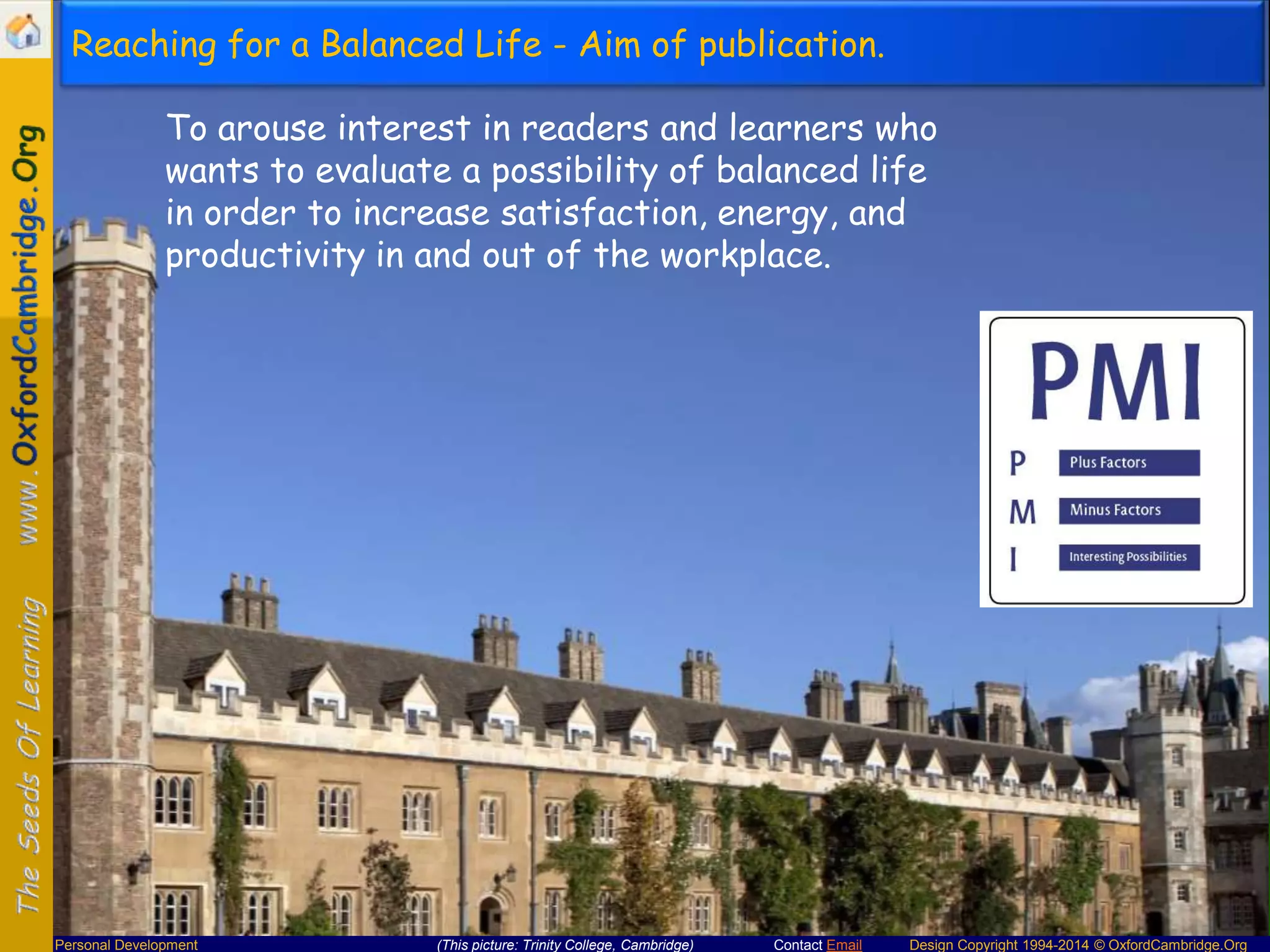
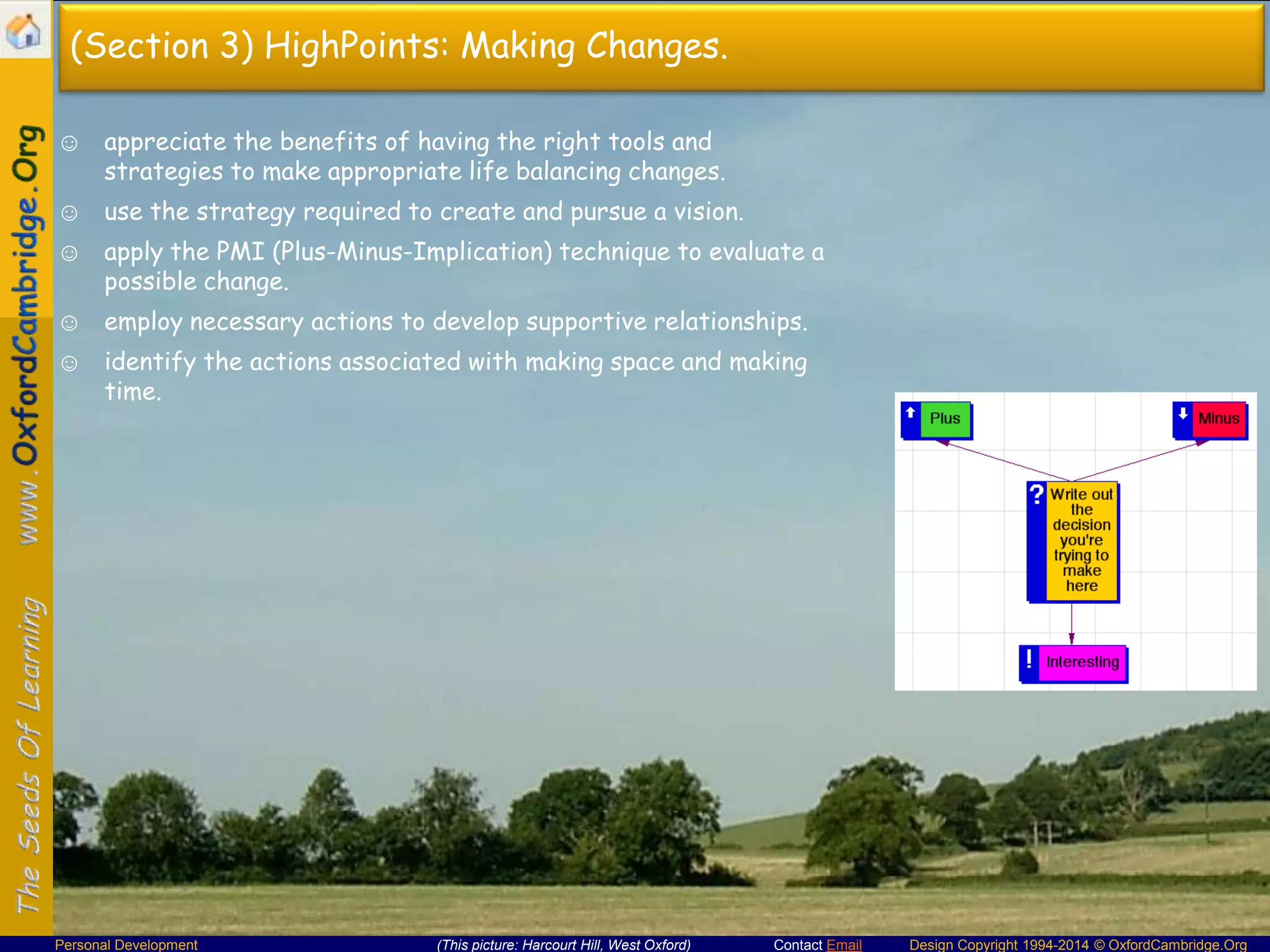
☺ apply the PMI (Plus-Minus-Implication) technique to evaluate a
possible change.
☺ employ necessary actions to develop supportive relationships.
☺ identify the actions associated with making space and making
time.

Personal Development

(This picture: Harcourt Hill, West Oxford)

Contact Email

Design Copyright 1994-2014 © OxfordCambridge.Org
(Section 3) HighPoints: Fitting in with the Bigger Picture.
☺ identify the benefits of being able to see the "bigger
picture" when taking action to put life in balance.
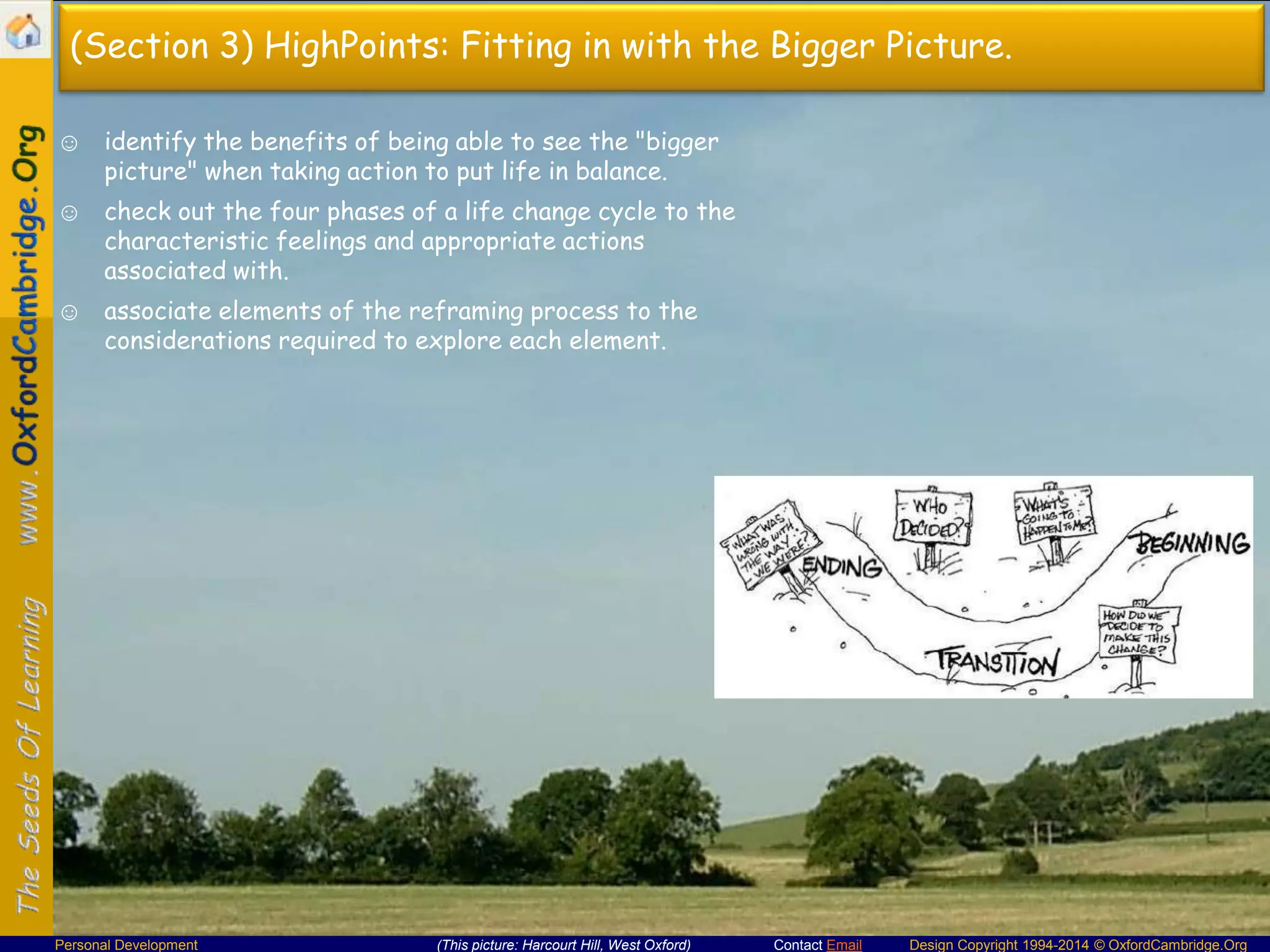
☺ check out the four phases of a life change cycle to the
characteristic feelings and appropriate actions
associated with.
☺ associate elements of the reframing process to the
considerations required to explore each element.

Personal Development

(This picture: Harcourt Hill, West Oxford)

Contact Email

Design Copyright 1994-2014 © OxfordCambridge.Org
Reaching for a Balanced Life – Conclusion.
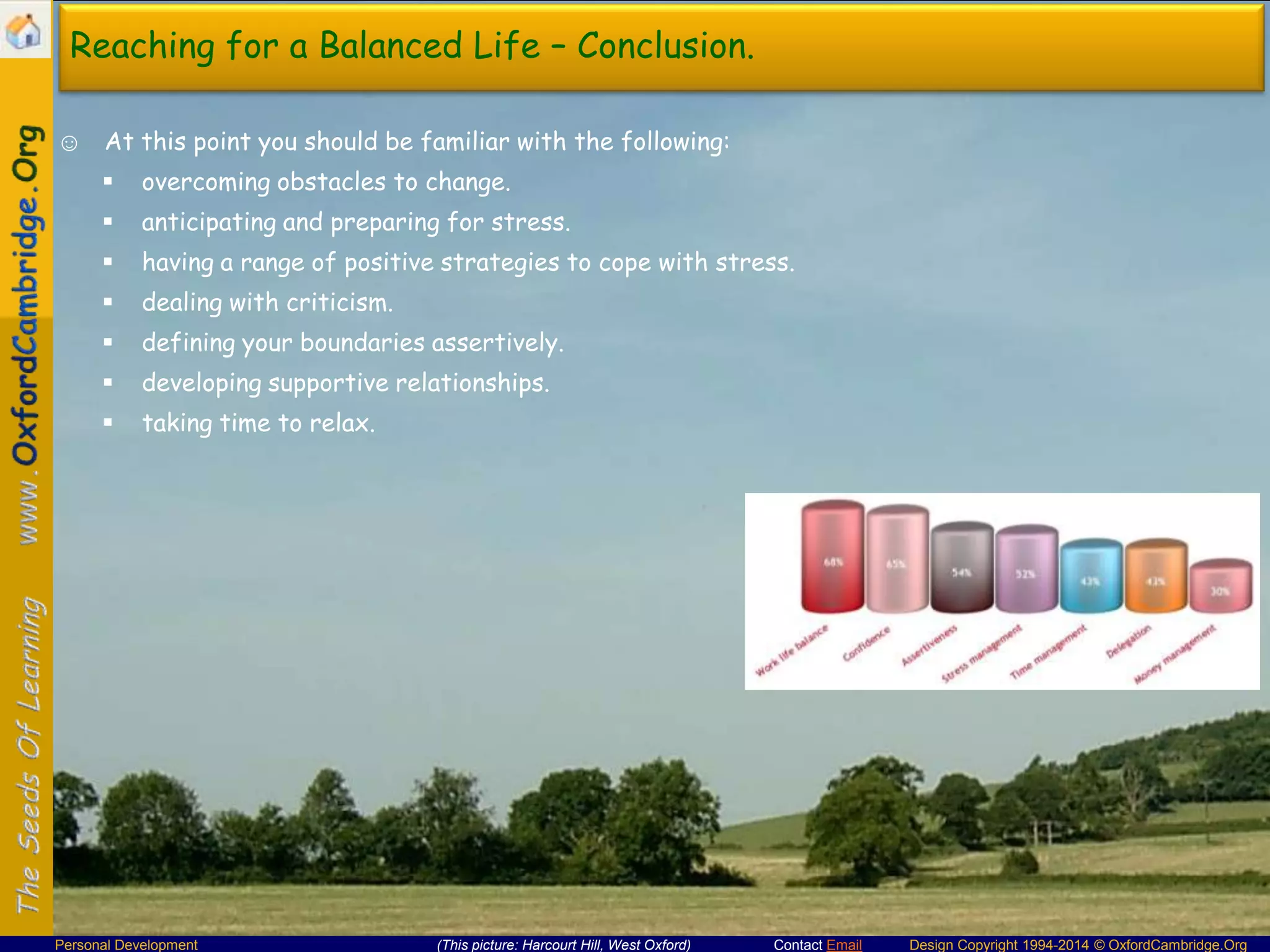
☺ At this point you should be familiar with the following:


overcoming obstacles to change.



anticipating and preparing for stress.



having a range of positive strategies to cope with stress.



dealing with criticism.



defining your boundaries assertively.



developing supportive relationships.



taking time to relax.

Personal Development

(This picture: Harcourt Hill, West Oxford)

Contact Email

Design Copyright 1994-2014 © OxfordCambridge.Org
Personal Development

(This picture: Harcourt Hill, West Oxford)

Contact Email

Design Copyright 1994-2014 © OxfordCambridge.Org
Personal Development

(This picture: Trinity College, Cambridge)

Contact Email

Design Copyright 1994-2014 © OxfordCambridge.Org
OxfordCambridge.Net

Personal Development

(This picture: Trinity College, Cambridge)

Contact Email

Design Copyright 1994-2014 © OxfordCambridge.Org
We shall always be on SlideShare!

Personal Development

(This picture: Trinity College, Cambridge)

Contact Email

Design Copyright 1994-2014 © OxfordCambridge.Org

Reaching a Balanced Life

  • 1.
    Personal Development (This picture:Trinity College, Cambridge) Contact Email Design Copyright 1994-2014 © OxfordCambridge.Org
  • 2.
    Personal Development (This picture:Trinity College, Cambridge) Contact Email Design Copyright 1994-2014 © OxfordCambridge.Org
  • 3.
    Reaching for aBalanced Life – Introduction. ☺ In a world of ever-changing organizations, the one constant is change itself. ☺ Since change is an unavoidable fact of life, how well you manage yourself through change can make a world of difference in your future employability. ☺ Though the task of managing yourself through change may seem daunting at first, when approached with an open mind, it is in fact a unique opportunity to take on new challenges and to learn new skills. Personal Development (This picture: Harcourt Hill, West Oxford) Contact Email Design Copyright 1994-2014 © OxfordCambridge.Org
  • 4.
    Reaching for aBalanced Life Introductory concepts @ OxfordCambridge.Org all for free and free for all. The information gathered here is under KeyPoints format and may be use: - Either to give the reader an overview before deciding for a full scale study of the topic. - Or act as a study guide for learners in expanding their knowledge on that given topic. Some recommendations, perhaps: - Identify each KeyPoint on which you feel a need to expand your knowledge, - Choose a good book or academic magazine and info from the Internet. - And then work towards gaining that knowledge, at your own pace. Please enjoy! Personal Development (This picture: Trinity College, Cambridge) Contact Email Design Copyright 1994-2014 © OxfordCambridge.Org
  • 5.
    Reaching for aBalanced Life - Aim of publication. To arouse interest in readers and learners who wants to evaluate a possibility of balanced life in order to increase satisfaction, energy, and productivity in and out of the workplace. Personal Development (This picture: Trinity College, Cambridge) Contact Email Design Copyright 1994-2014 © OxfordCambridge.Org
  • 6.
    Reaching for aBalanced Life - Learning Objectives.  After developing the KeyPoints outlined in this publication, you should mainly be able to:   distinguish internal and external obstacles to change.  match individuals to their dominant work relationship preferences.  categorize the signs and symptoms of stress into physiological, behavioral, and psychological.  recognize the benefits of having a range of positive strategies to cope with stress.  use techniques to challenge negative thinking.  match passive, aggressive, and assertive responses to behaviors associated with.  take the necessary actions to develop supportive relationships.  Personal Development identify the benefits of assessing current life balance. see the "bigger picture" when taking actions to put life in balance. (This picture: Trinity College, Cambridge) Contact Email Design Copyright 1994-2014 © OxfordCambridge.Org
  • 7.
    Reaching for aBalanced Life – Summary. ☺ You should learn what the obstacles to achieving a balanced life are, and how to apply a basic strategy to overcome these obstacles. ☺ Also, you ought to discover the role of the individual in relation to the organization (s)he works in, and how this impacts on her/his life. ☺ Are you working for an organizational culture which fits you? ☺ Are you in balance with your job? ☺ Do you have the right kinds of working relationships? ☺ After understanding where you are, in relation to where you want to be, you can begin to construct a map that will take you to your objective of a balanced and fulfilled life. Personal Development (This picture: Harcourt Hill, West Oxford) Contact Email Design Copyright 1994-2014 © OxfordCambridge.Org
  • 8.
    *** About theStructure and Flow of our Presentations *** Personal Development (This picture: Harcourt Hill, West Oxford) Contact Email Design Copyright 1994-2014 © OxfordCambridge.Org
  • 9.
    Reaching for aBalanced Life - Sections List.  (Section 1) Finding Life Balance.  (Section 2) Success over Stress.  (Section 3) Better Balance Strategies. Personal Development (This picture: Trinity College, Cambridge) Contact Email Design Copyright 1994-2014 © OxfordCambridge.Org
  • 10.
    (Section 1) FindingLife Balance – Summary. ☺ You fill your life with many activities and it difficult to get the balance between those activities right. ☺ But getting the balance right gives a tremendous payback. ☺ You feel fulfilled. ☺ You are in harmony with yourself and your world. ☺ Which is good for you, and also impacts positively on your family, friends, and colleagues. ☺ The first step towards a possible adjustment of your life balance is to assess your life at present life, both at home and at work, and the relationship between the two. ☺ Is it balanced? ☺ How and why is it out of balance? Personal Development (This picture: Harcourt Hill, West Oxford) Contact Email Design Copyright 1994-2014 © OxfordCambridge.Org
  • 11.
    (Section 1) FindingLife Balance – HighPoints.  Assessing Current Situation.  What’s Getting in the Way?  Individual and Organizational Fit. Personal Development (This picture: Trinity College, Cambridge) Contact Email Design Copyright 1994-2014 © OxfordCambridge.Org
  • 12.
    (Section 1) HighPoints:Assessing Current Situation. ☺ identify the benefits of ☺ use life chart categories to determine an individual's satisfaction with his current situation. ☺ take appropriate actions to make the most of energy. ☺ single out value drivers with individuals. Personal Development (This picture: Harcourt Hill, West Oxford) Contact Email Design Copyright 1994-2014 © OxfordCambridge.Org
  • 13.
    (Section 1) HighPoints:What’s Getting in the Way? ☺ identify the benefits of learning how to . ☺ make recommendations about how an individual could act to effectively achieve life balance. ☺ distinguish between internal and external obstacles to change. ☺ apply strategies required to overcome obstacles to changing life balance, in relation to both internal and external barriers. Personal Development (This picture: Harcourt Hill, West Oxford) Contact Email Design Copyright 1994-2014 © OxfordCambridge.Org
  • 14.
    (Section 1) HighPoints:Individual and Organizational Fit. ☺ recognize the benefits of assessing the individual and organizational fit. ☺ discover comments about organizational culture with the cultural types. ☺ determine job preferences of individuals. ☺ consider individuals in relation to their dominant work relationship preferences. Personal Development (This picture: Harcourt Hill, West Oxford) Contact Email Design Copyright 1994-2014 © OxfordCambridge.Org
  • 15.
    (Section 2) Successover Stress – Summary. ☺ "Stress is the psychological, physiological and behavioral response by an individual when they perceive a lack of equilibrium between the demands placed upon them and their ability to meet those demands, which, over a period of time, leads to ill-health." ☺ Contrary to popular belief, stress itself is never a good thing. ☺ It is always harmful. ☺ You need discern the difference between pressure, which spurs you into action and helps you to perform at your peak, and stress, which impedes your performance, and has long-term health implications. ☺ Stress is produced by own feelings and reactions to certain external events, rather than by the events themselves. ☺ This means that once you recognize how you respond to certain situations, you can change your response to one that is more helpful and productive. Personal Development (This picture: Harcourt Hill, West Oxford) Contact Email Design Copyright 1994-2014 © OxfordCambridge.Org
  • 16.
    (Section 2) Successover Stress – HighPoints.  Recognizing Stress.  Coping with Stress. Personal Development (This picture: Trinity College, Cambridge) Contact Email Design Copyright 1994-2014 © OxfordCambridge.Org
  • 17.
    (Section 2) HighPoints:Recognizing Stress. ☺ distinguish the benefits of recognizing stress. ☺ identify appropriate descriptions of stress. ☺ categorize signs and symptoms of stress into physiological, behavioural, and psychological. ☺ differentiate Type-A and Type-B personality types in context. ☺ recognize examples of job stressor. Personal Development (This picture: Harcourt Hill, West Oxford) Contact Email Design Copyright 1994-2014 © OxfordCambridge.Org
  • 18.
    (Section 2) HighPoints:Coping with Stress. ☺ acknowledge the benefits of having a range of positive strategies to cope with stress. ☺ recognize techniques to prepare for stress in a given situation. ☺ identify situations of negative thinking. ☺ discern the techniques for challenging negative thinking. ☺ apply techniques to challenge negative thinking in a given context. ☺ use the appropriate techniques to receive criticism positively. ☺ distinguish between examples of the elements of the ABC model. ☺ recollect relaxation techniques to be used on a daily basis. Personal Development (This picture: Harcourt Hill, West Oxford) Contact Email Design Copyright 1994-2014 © OxfordCambridge.Org
  • 19.
    (Section 3) BetterBalance Strategies – Summary. ☺ Individuals need to focus on the actions they can take to achieve a more balanced life. ☺ That is said, you begin by helping yourself to explore ways in which you can create some space in order to bring more nourishing and energizing activities into your life. ☺ For that, you are to discover how to build practical systems into your days and weeks that will support you in making the necessary adjustments to your life. ☺ As life balance constantly shifts, you will also consider early warning signs to look out for. ☺ By doing so, you can make the necessary adjustments as you go along. ☺ Also to maintain a constant focus, you ought to create a vision of a satisfying, balanced life for yourself. Personal Development (This picture: Harcourt Hill, West Oxford) Contact Email Design Copyright 1994-2014 © OxfordCambridge.Org
  • 20.
    (Section 3) BetterBalance Strategies – HighPoints  Reducing Demands.  Making Changes.  Fitting in with the Bigger Picture. Personal Development (This picture: Trinity College, Cambridge) Contact Email Design Copyright 1994-2014 © OxfordCambridge.Org
  • 21.
    (Section 3) HighPoints:Reducing Demands. ☺ recognize the benefits of knowing how to reduce demands on time. ☺ acknowledge passive, aggressive, and assertive responses to behaviors associated with. ☺ employ assertiveness techniques to define boundaries. ☺ find out to what extent a delegation strategy is used effectively. Personal Development (This picture: Harcourt Hill, West Oxford) Contact Email Design Copyright 1994-2014 © OxfordCambridge.Org
  • 22.
    (Section 3) HighPoints:Making Changes. ☺ appreciate the benefits of having the right tools and strategies to make appropriate life balancing changes. ☺ use the strategy required to create and pursue a vision. ☺ apply the PMI (Plus-Minus-Implication) technique to evaluate a possible change. ☺ employ necessary actions to develop supportive relationships. ☺ identify the actions associated with making space and making time. Personal Development (This picture: Harcourt Hill, West Oxford) Contact Email Design Copyright 1994-2014 © OxfordCambridge.Org
  • 23.
    (Section 3) HighPoints:Fitting in with the Bigger Picture. ☺ identify the benefits of being able to see the "bigger picture" when taking action to put life in balance. ☺ check out the four phases of a life change cycle to the characteristic feelings and appropriate actions associated with. ☺ associate elements of the reframing process to the considerations required to explore each element. Personal Development (This picture: Harcourt Hill, West Oxford) Contact Email Design Copyright 1994-2014 © OxfordCambridge.Org
  • 24.
    Reaching for aBalanced Life – Conclusion. ☺ At this point you should be familiar with the following:  overcoming obstacles to change.  anticipating and preparing for stress.  having a range of positive strategies to cope with stress.  dealing with criticism.  defining your boundaries assertively.  developing supportive relationships.  taking time to relax. Personal Development (This picture: Harcourt Hill, West Oxford) Contact Email Design Copyright 1994-2014 © OxfordCambridge.Org
  • 25.
    Personal Development (This picture:Harcourt Hill, West Oxford) Contact Email Design Copyright 1994-2014 © OxfordCambridge.Org
  • 26.
    Personal Development (This picture:Trinity College, Cambridge) Contact Email Design Copyright 1994-2014 © OxfordCambridge.Org
  • 27.
    OxfordCambridge.Net Personal Development (This picture:Trinity College, Cambridge) Contact Email Design Copyright 1994-2014 © OxfordCambridge.Org
  • 28.
    We shall alwaysbe on SlideShare! Personal Development (This picture: Trinity College, Cambridge) Contact Email Design Copyright 1994-2014 © OxfordCambridge.Org